EP1238966A2 - Hair cosmetic, aminocarboxylic acid amide and method for producing the same - Google Patents
Hair cosmetic, aminocarboxylic acid amide and method for producing the same Download PDFInfo
- Publication number
- EP1238966A2 EP1238966A2 EP02004373A EP02004373A EP1238966A2 EP 1238966 A2 EP1238966 A2 EP 1238966A2 EP 02004373 A EP02004373 A EP 02004373A EP 02004373 A EP02004373 A EP 02004373A EP 1238966 A2 EP1238966 A2 EP 1238966A2
- Authority
- EP
- European Patent Office
- Prior art keywords
- carbon atoms
- group
- amine
- chain
- straight
- Prior art date
- Legal status (The legal status is an assumption and is not a legal conclusion. Google has not performed a legal analysis and makes no representation as to the accuracy of the status listed.)
- Granted
Links
- 0 C1C2C1C*C2 Chemical compound C1C2C1C*C2 0.000 description 2
- KPDLIRZVFSLCQH-NSCUHMNNSA-N C/C=C/C1CC(C2)C2C1 Chemical compound C/C=C/C1CC(C2)C2C1 KPDLIRZVFSLCQH-NSCUHMNNSA-N 0.000 description 1
- XDTMQSROBMDMFD-UHFFFAOYSA-N C1CCCCC1 Chemical compound C1CCCCC1 XDTMQSROBMDMFD-UHFFFAOYSA-N 0.000 description 1
Classifications
-
- C—CHEMISTRY; METALLURGY
- C07—ORGANIC CHEMISTRY
- C07D—HETEROCYCLIC COMPOUNDS
- C07D295/00—Heterocyclic compounds containing polymethylene-imine rings with at least five ring members, 3-azabicyclo [3.2.2] nonane, piperazine, morpholine or thiomorpholine rings, having only hydrogen atoms directly attached to the ring carbon atoms
- C07D295/04—Heterocyclic compounds containing polymethylene-imine rings with at least five ring members, 3-azabicyclo [3.2.2] nonane, piperazine, morpholine or thiomorpholine rings, having only hydrogen atoms directly attached to the ring carbon atoms with substituted hydrocarbon radicals attached to ring nitrogen atoms
- C07D295/14—Heterocyclic compounds containing polymethylene-imine rings with at least five ring members, 3-azabicyclo [3.2.2] nonane, piperazine, morpholine or thiomorpholine rings, having only hydrogen atoms directly attached to the ring carbon atoms with substituted hydrocarbon radicals attached to ring nitrogen atoms substituted by carbon atoms having three bonds to hetero atoms with at the most one bond to halogen, e.g. ester or nitrile radicals
- C07D295/145—Heterocyclic compounds containing polymethylene-imine rings with at least five ring members, 3-azabicyclo [3.2.2] nonane, piperazine, morpholine or thiomorpholine rings, having only hydrogen atoms directly attached to the ring carbon atoms with substituted hydrocarbon radicals attached to ring nitrogen atoms substituted by carbon atoms having three bonds to hetero atoms with at the most one bond to halogen, e.g. ester or nitrile radicals with the ring nitrogen atoms and the carbon atoms with three bonds to hetero atoms attached to the same carbon chain, which is not interrupted by carbocyclic rings
- C07D295/15—Heterocyclic compounds containing polymethylene-imine rings with at least five ring members, 3-azabicyclo [3.2.2] nonane, piperazine, morpholine or thiomorpholine rings, having only hydrogen atoms directly attached to the ring carbon atoms with substituted hydrocarbon radicals attached to ring nitrogen atoms substituted by carbon atoms having three bonds to hetero atoms with at the most one bond to halogen, e.g. ester or nitrile radicals with the ring nitrogen atoms and the carbon atoms with three bonds to hetero atoms attached to the same carbon chain, which is not interrupted by carbocyclic rings to an acyclic saturated chain
-
- A—HUMAN NECESSITIES
- A61—MEDICAL OR VETERINARY SCIENCE; HYGIENE
- A61K—PREPARATIONS FOR MEDICAL, DENTAL OR TOILETRY PURPOSES
- A61K8/00—Cosmetics or similar toiletry preparations
- A61K8/18—Cosmetics or similar toiletry preparations characterised by the composition
- A61K8/30—Cosmetics or similar toiletry preparations characterised by the composition containing organic compounds
- A61K8/40—Cosmetics or similar toiletry preparations characterised by the composition containing organic compounds containing nitrogen
- A61K8/42—Amides
-
- A—HUMAN NECESSITIES
- A61—MEDICAL OR VETERINARY SCIENCE; HYGIENE
- A61Q—SPECIFIC USE OF COSMETICS OR SIMILAR TOILETRY PREPARATIONS
- A61Q5/00—Preparations for care of the hair
- A61Q5/12—Preparations containing hair conditioners
-
- C—CHEMISTRY; METALLURGY
- C07—ORGANIC CHEMISTRY
- C07C—ACYCLIC OR CARBOCYCLIC COMPOUNDS
- C07C237/00—Carboxylic acid amides, the carbon skeleton of the acid part being further substituted by amino groups
- C07C237/02—Carboxylic acid amides, the carbon skeleton of the acid part being further substituted by amino groups having the carbon atoms of the carboxamide groups bound to acyclic carbon atoms of the carbon skeleton
- C07C237/04—Carboxylic acid amides, the carbon skeleton of the acid part being further substituted by amino groups having the carbon atoms of the carboxamide groups bound to acyclic carbon atoms of the carbon skeleton the carbon skeleton being acyclic and saturated
- C07C237/08—Carboxylic acid amides, the carbon skeleton of the acid part being further substituted by amino groups having the carbon atoms of the carboxamide groups bound to acyclic carbon atoms of the carbon skeleton the carbon skeleton being acyclic and saturated having the nitrogen atom of at least one of the carboxamide groups bound to an acyclic carbon atom of a hydrocarbon radical substituted by singly-bound oxygen atoms
-
- A—HUMAN NECESSITIES
- A61—MEDICAL OR VETERINARY SCIENCE; HYGIENE
- A61Q—SPECIFIC USE OF COSMETICS OR SIMILAR TOILETRY PREPARATIONS
- A61Q5/00—Preparations for care of the hair
- A61Q5/006—Antidandruff preparations
-
- A—HUMAN NECESSITIES
- A61—MEDICAL OR VETERINARY SCIENCE; HYGIENE
- A61Q—SPECIFIC USE OF COSMETICS OR SIMILAR TOILETRY PREPARATIONS
- A61Q5/00—Preparations for care of the hair
- A61Q5/02—Preparations for cleaning the hair
-
- A—HUMAN NECESSITIES
- A61—MEDICAL OR VETERINARY SCIENCE; HYGIENE
- A61Q—SPECIFIC USE OF COSMETICS OR SIMILAR TOILETRY PREPARATIONS
- A61Q5/00—Preparations for care of the hair
- A61Q5/06—Preparations for styling the hair, e.g. by temporary shaping or colouring
Definitions
- the present invention relates to a hair cosmetic which can impart, to hairs, sufficient flexibility, smoothness and further oily feeling when the hairs are wetted and smoothness, softness and combing easiness after the hair are dried and which is environmentally highly safe.
- the present invention relates to a method of highly selective production of an aminocarboxylic acid amide which is useful for surfactants or as their intermediates, these surfactants being capable of exhibiting excellent flexibility to fibers and imparting excellent flexibility and smoothness to hairs and being superior in environmental safety as to biodegradation characteristics, toxicity to fishes and to algae and the like.
- the invention also relates to a novel amine, its acid salt or its quaternary ammonium salt.
- JP-A Nos. 5-271035 and 5-271036 and Japanese Patent Application National Publication No. 2000-501430 disclose the use of a salt of an amidoamine which is a tertiary amine type as a base of a hair cosmetic.
- this salt does not satisfy the above requirements and has the drawbacks that it cannot satisfy the compatibility between a feel to the touch, for example, after the hairs are dried and smoothness and oily feeling when the hairs are wetted.
- an aminocarboxylic acid amide As synthetic examples of an aminocarboxylic acid amide, a method in which an aminocarboxylate is reacted with an amine and a method in which an amine is reacted with halocarboxylic acid amide are disclosed in JP-A No. 55-143944 and WO98/03472. These methods using an aminocarboxylate or a halocarboxylic acid amide have the problem that a large amount of a reaction solvent is needed when these raw materials and aminocarboxylic acid amide are synthesized and reaction selectivity is low. It is therefore difficult to produce the amide easily.
- Various cationic surfactants and acid salts of amine have been used as conditioning agents for fibers and hairs. Performances required at this time are, for example, finish feeling and softness in the case of a fiber softening agent and oily feeling, flexibility and smoothness imparted to hairs since hair is wetted till after the hair is dried in the case of a hair cosmetics.
- quaternary ammonium salts having a long chain alkyl group such as stearyltrimethylammonium chloride and distearyldimethylammonium chloride are currently used as surfactants.
- the aforementioned quaternary ammonium salts have the problems concerning environmental safety such as the problem that these salts are not biodegraded but accumulated and adversely affect aquatic organisms such as fishes and algae when residues left after treatment are discharged to the natural world such as rivers.
- quaternary ammonium salts such as methylbis (hydrogenated beef tallow alkanoyloxyethyl)-2-hydroxyethylammoniummethyl sulfate and dimethylbis(alkanoyloxyethyl)ammonium chloride and acid salts of tertiary amines such as dimethylaminopropyl-octadecaneamide are being placed on the market.
- these compounds are improved in biodegradation characteristics but are not said to be bases which sufficiently satisfy the requirements for flexibility and environmental safety.
- JP-A 9-118606 shows a neutralization product with an organic acid and/or an amine of a quaternary ammonium salt having an alkyl or alkenyl having an ester or amide group interrupted for a base material of hair cosmetics.
- JP-A 2000-302651 shows a quaternary ammonium salt having a glycinamide group for a base material of hair cosmetics.
- the invention provides a hair cosmetic comprising an amine compound (I) having the formula (I) and a process for preparing the amine compound (I).
- the invention provides an amine compound (1) having the formula (1), an acid salt of (1) and a quaternary ammonium salt of (1).
- the amine compound (2) having the formula (2) is preferable.
- the invention provides a process for producing the amine compound (1) or (2) and use of the amine compound (1) or (2) for hair cosmetic. These inventions will be explained below.
- the explanation of hair cosmetic of (I) is applied to that of (1) or (2).
- the explanation of the production of (I) is applied to that of (1) or (2).
- the present invention provides a hair cosmetic comprising an amine (hereinafter referred to as an amine (I) ) represented by the formula (I).
- an amine hereinafter referred to as an amine (I)
- R 1 represents a straight-chain or branched alkyl group or alkenyl group having 8 to 40 carbon atoms or a group represented by the formula R 5 O- (AO) n -C m H 2m -
- R 5 represents a straight-chain or branched alkyl group or alkenyl group having 8 to 40 carbon atoms
- A represents an alkylene group having 2 to 3 carbon atoms
- n denotes a number from 0 to 30 in average
- m denotes an integer of 2 or 3, where nAs may be the same or different
- R 2 represents a straight-chain or branched alkylene group having 1 to 5 carbon atoms
- R 3 represents a hydrogen atom, a straight-chain or branched alkyl group,
- an object of the present invention to provide a highly economical method for producing an aminocarboxylic acid amide which is useful as a surfactant, which allows fibers to exhibit high flexibility, can impart high flexibility and smoothness to hairs and has high environmental safety as to biodegradation characteristics, toxicity to fishes and to algae and the like or as intermediate of the surfactant, with high selectivity in a high yield without complicated refining operations.
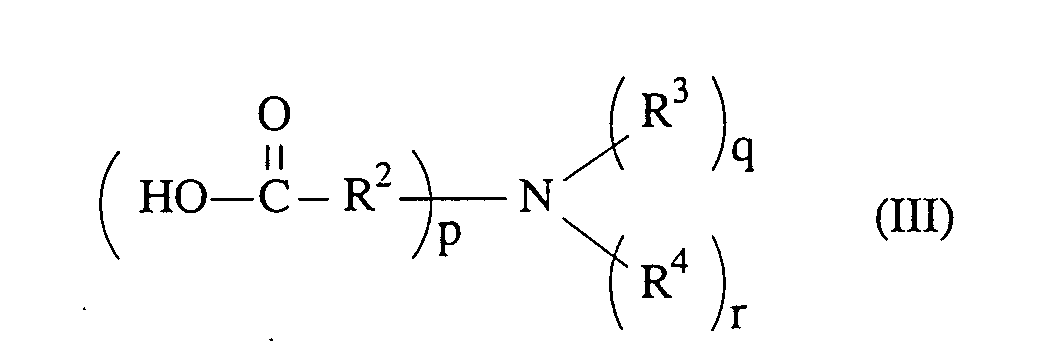
- the present invention provides a method for producing an aminocarboxylic acid amide (hereinafter referred to also as an amino carboxylic acid amide (I)) represented by the formula (I): wherein R 1 , R 2 , R 3 , R 4 , p, q and r respectively have the same meaning as above, comprising reacting a primary amine (hereinafter referred to as a primary amine (II)) represented by the formula (II): R 1 -NH 2 wherein R 1 is the same as defined above, with an aminocarboxylic acid (hereinafter referred to as an aminocarboxylic acid (III) represented by the formula (III) to run amidation: (wherein R 2 , R 3 , R 4 , p, q and r respectively are the same as above.).
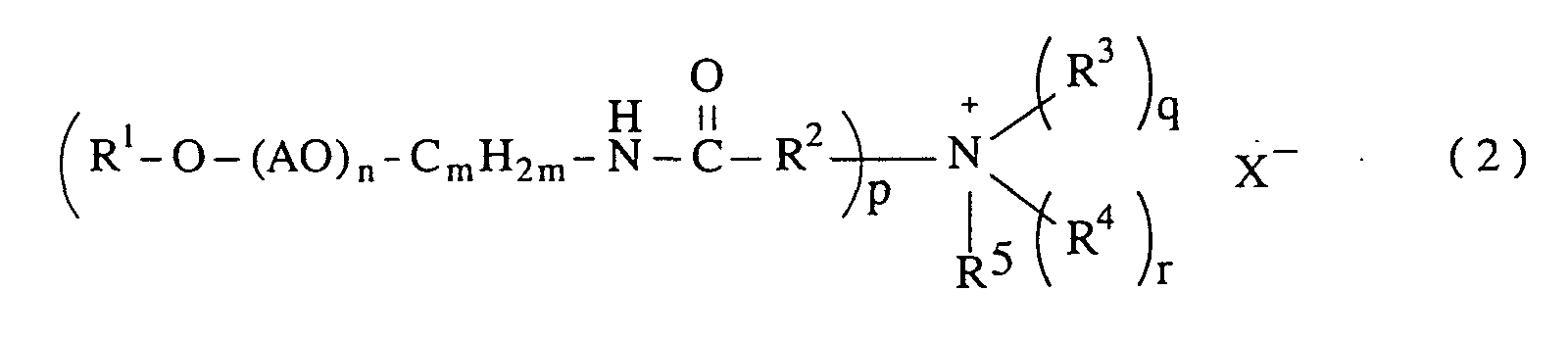
- the present invention provides an amine (hereinafter referred to as an amine (1)) represented by the formula (1), its acid salt or quaternary ammonium salt, especially, a quaternary ammonium salt (hereinafter referred to as a quaternary ammonium salt (2)) represented by the formula (2) and surfactants comprising these compounds:
- R 1 represents a straight-chain or branched alkyl group or alkenyl group having 8 to 40 carbon atoms
- A represents an alkylene group having 2 to 3 carbon atoms
- n denotes a number from 0 to 30 in average
- m denotes an integer of 2 or 3
- R 2 represents a straight-chain or branched alkylene group having 1 to 5 carbon atoms
- R 3 and R 4 which are the same or different, respectively represent a hydrogen atom, a straight-chain or branched alkyl group, alkenyl group or hydroxyalkyl group having 1 to 5 carbon atoms or an aryl group or an
- R1 is not R 5 O ⁇ (AO) n ⁇ C m H 2m ⁇ and R3 does not have 1 to 24 carbon atoms for the alkyl, alkenyl and hydroxyalkyl, but has 1 to 5.
- R 1 is preferably a straight-chain or branched alkyl group or alkenyl group having 10 to 28 carbon atoms or a group represented by the formula R 5 O-(AO) n -C m H 2m - wherein R 5 is a straight-chain or branched alkyl group or alkenyl group having 10 to 28 carbon atoms and A, n and m have preferably the same meanings as above, more preferably a straight-chain or branched alkyl group or alkenyl group having 12 to 24 carbon atoms or a group represented by the formula R 5 O- (AO) n -C m H 2m - wherein R 5 is a straight-chain or branched alkyl group or alkenyl group having 12 to 24 carbon atoms and A, n and m have preferably the same meanings as above and particularly preferably a straight-chain alkyl group having 12 to 24 carbon atoms or a group represented by the formula R 5 O-
- R 2 is preferably a straight-chain or branched alkylene group having 1 to 3 carbon atoms, more preferably a straight-chain alkylene group having 1 to 3 carbon atoms and most preferably a methylene group.
- R 3 is preferably a straight-chain or branched alkyl group, alkenyl group or hydroxyalkyl group having 1 to 22 carbon atoms or an aryl group or an arylalkyl group having 6 to 28 carbon atoms and more preferably a straight-chain or branched alkyl group or hydroxyalkyl group having 1 to 3 carbon atoms or an aryl group or an arylalkyl group having 6 to 10 carbon atoms.
- R 4 is preferably a straight-chain or branched alkyl group, alkenyl group or hydroxyalkyl group having 1 to 5 carbon atoms or an aryl group or an arylalkyl group having 6 to 28 carbon atoms and more preferably a straight-chain or branched alkyl group or hydroxyalkyl group having 1 to 3 carbon atoms, a phenyl group or a benzyl group.
- the total carbon number of R 3 and R 4 is preferably 4 to 28 and more preferably 4 to 10 and R 3 and R 4 respectively are particularly preferably a five-membered ring or a six-membered ring.
- p is preferably an integer of 1 or 2.
- q and r respectively are preferably 0 or 1 and particularly a tertiary amine is preferable.
- the amine (I) may be obtained by a method in which an amine (hereinafter referred to as an amine (II)) represented by the formula (II) : R 1 -NH 2 (wherein R 1 has the same meaning as above.) is reacted with a carboxylic acid halide or its lower alkyl ester or acid halide using a catalyst as the case may be and the reaction product is then reacted with a corresponding amine or by a method in which an amino acid or its derivative is reacted with the amine (II).
- an amine hereinafter referred to as an amine (II)
- R 1 -NH 2 wherein R 1 has the same meaning as above.
- the hair cosmetic of the present invention preferably contains at least one acid selected from the group consisting of inorganic acids and organic acids.
- the inorganic acids include hydrochloric acid, sulfuric acid and phosphoric acid.
- organic acids organic acids having 1 to 5 carbon atoms are preferable and acetic acid, glycolic acid, lactic acid, glutamic acid, malic acid and succinic acid are exemplified.
- hydrochloric acid, sulfuric acid, lactic acid, glutamic acid and malic acid are particularly preferable.
- the amine (I) and the acid may be compounded separately or an acid salt of the amine (I) which is formed in advance may be compounded.
- the hair cosmetic of the present invention preferably contains a higher alcohol having 10 to 30 carbon atoms.
- higher alcohols to be used in the present invention higher alcohols containing a straight-chain or branched alkyl group or alkenyl group having 10 to 30 carbon atoms are given, preferably higher alcohols containing a straight-chain alkyl group or alkenyl group having 12 to 26 carbon atoms are given and more preferably higher alcohols such as cetanol, cetyl alcohol, stearyl alcohol, aralkyl alcohol, behenyl alcohol, caranabyl alcohol and ceryl alcohol are given.
- the content of the amine (I) in the hair cosmetic of the present invention is preferably 0.1 to 15% by weight and particularly preferably 0.3 to 8% by weight with the view of imparting, to hairs, good feel to the touch and in view of the stability of the product concerning precipitation, solidification, layer separation and the like during storage.
- the content of the acid is preferably 0.3 to 10 mol equivalents and particularly preferably 0.5 to 5 mol equivalents to the amine (I).
- the content of the higher alcohol is preferably 0.5 to 15% by weight and particularly preferably 1 to 10% by weight with the view of allowing flexibility and wet feeling to be exhibited and in view of the stability of the product.
- a part or all of the amine (I) is converted into a salt form upon use by adjusting pH in the composition.
- the hair cosmetic is preferably used in a pH range from 2 to 8 and particularly from 3 to 6 in view of good feeling of hairs and the stability of the product.
- surfactants such as a cationic surfactant, anionic surfactant, nonionic surfactant and amphoteric surfactant, silicon, hydrocarbons, lanolin derivatives, higher fatty acid esters, higher fatty acids, oil and fats, glycerol, humectants, cationic polymers, polysaccharides, polypeptides, pearling agents, solvents, liquid crystal forming agents, aromatic sulfonic acids, dyes, perfumes, injection agents, chelating agents, pH regulators, antiseptics and anti-dandruff agents may be compounded properly to the extent that the object of the present invention is not impaired.
- surfactants such as a cationic surfactant, anionic surfactant, nonionic surfactant and amphoteric surfactant, silicon, hydrocarbons, lanolin derivatives, higher fatty acid esters, higher fatty acids, oil and fats, glycerol, humectants, cationic polymers, polysacchari
- the hair cosmetic of the present invention may be made into a desired preparation form such as an aqueous solution, ethanol solution, emulsion, suspension, gel, liquid crystal and air sol.
- the hair cosmetic of the present invention may be used for a hair rinse, hair conditioner, hair treatment, hair pack, hair cream, conditioning mousse, hair mousse, hair spray, shampoo and leave-on-treatment.
- the hair cosmetic of the present invention allows oily agents, e.g., feeling improvers, to be well-emulsified and the emulsified gel to be highly stable for a long period of time. Also, the hair cosmetic of the present invention can impart, to hairs, good rich feeling, the durability of the rich feeling, flexibility and smoothness when the hairs are wetted and softness and combing easiness after the hairs are dried.
- oily agents e.g., feeling improvers
- the hair cosmetic of the present invention can impart, to hairs, good rich feeling, the durability of the rich feeling, flexibility and smoothness when the hairs are wetted and softness and combing easiness after the hairs are dried.
- Examples of the primary amine (II) include alkyl or alkenylamines such as dodecylamine, tetradecylamine, hexadecylamine, octadecylamine, eicosylamine, docosylamine, tetracosylamine, octadecenylamine, dococenylamine, also, those obtained by converting a long-chain alcohol such as dodecanol, tetradecanol, hexadecanol, octadecanol, eicosanol, docosanol and tetracosanol, ethylene oxide and/or propylene oxide adducts of these alcohols into a cyanoethyl by using acrylonitrile and then by hydrogenating the cyanoethyl by using a catalyst or N-alkylpolyoxyethyleneamine, N-alkylpolyoxypropylene amine and the
- R 2 is preferably a straight-chain or branched alkylene group having 1 to 3 carbon atoms, more preferably a straight-chain alkylene group having 1 to 3 carbon atoms and particularly preferably a methylene group.
- R 3 is preferably a straight-chain or branched alkyl group, alkenyl group or hydroxyalkyl group having 1 to 22 carbon atoms or an aryl group or an arylalkyl group having 6 to 28 carbon atoms and more preferably a straight-chain or branched alkyl group or hydroxyalkyl group having 1 to 3 carbon atoms or an aryl group or an arylalkyl group having 6 to 10 carbon atoms.
- R 4 is preferably a straight-chain or branched alkyl group, alkenyl group or hydroxyalkyl group having 1 to 5 carbon atoms or an aryl group or an arylalkyl group having 6 to 28 carbon atoms and more preferably a straight-chain or branched alkyl group or hydroxyalkyl group having 1 to 3 carbon atoms, a phenyl group or a benzyl group.
- the total carbon number of R 3 and R 4 is preferably 4 to 28 and more preferably 4 to 10 and R 3 and R 4 respectively are particularly preferably a five-membered ring or a six-membered ring.
- p is preferably an integer of 1 or 2.
- q and r respectively are preferably 0 or 1 and particularly a tertiary amine is preferable.
- aminocarboxylic acid (III) examples include N,N-dimethylglycine, 3-(dimethylamino)propionic acid, 4-(dimethylamino)butanoic acid, N,N-diethylglycine, 3-(diethylamino)propionic acid, 4-(dimethylamino)butanoic acid, N-(2-hydroxyethyl)-N-methylglycine, 3-(N-(2-hydroxyethyl)-N-methylamino)propionic acid, N,N-bis(2-hydroxyethyl)glycine, methyliminodiacetic acid, ethyliminodiacetic acid, nitrilotriacetic acid, pyrrolidinylacetic acid, N-methyl-N-phenylaminoacetic acid and N-methyl-N-tolylaminoacetic acid.
- the aminocarboxylic acid (III) may be produced using any method.
- a corresponding aminocarboxylic acid or its alkali metal salt may be obtained using, for example, a method in which a halocarboxylic acid is reacted with an amine in the presence of a hydroxide of an alkali metal such as NaOH or KOH using, as required, a solvent such as water, a method in which an aldehyde compound such as formalin, sodium cyanide or the like and an amine are used to run a Strecker reaction in the case of a specific aminocarboxylic acid or a method in which an amino alcohol is oxidized using an oxidizing catalyst and an oxidant.
- An alkali metal salt of aminocarboxylic acid is neutralized by an acid such as sulfuric acid, hydrochloric acid or phosphoric acid, a solvent is distilled as required and the precipitated inorganic salt and the like are removed or decreased to thereby obtain the aminocarboxylic acid.
- the aminocarboxylic acid (III) containing an inorganic salt may be used as starting material from an economical point of view and the inorganic salt may be removed at the same time when unreacted starting material is removed after the amidation.
- the alkali metal salt of the aminocarboxylic acid (II) may be neutralized by the above acid, the amidation reaction may be run as it is and the inorganic salt may be removed after the reaction is finished.
- the aminocarboxylic acid (III) is reacted in an amount of preferably 0.5 to 3 equivalents and more preferably 0.9 to 1.5 equivalents to one equivalent of the primary amine (II).
- the reaction temperature in the amidation is preferably 120 to 250°C and more preferably 140 to 230°C.
- the reaction time is preferably 1 to 30 hours and more preferably 3 to 20 hours.
- the aminocarboxylic acid (III) and the primary amine (II) may be subjected to reduction treatment using sodium borohydride and an inert gas such as nitrogen and steam may be substituted or introduced during amidation as required.
- washing with water and solid-liquid separation for the purpose of removing an unreacted aminocarboxylic acid (III) and impurities such as inorganic acids after the amidation.
- the amount of water is preferably 5 to 300% by weight and more preferably 10 to 150% by weight based on the amide.
- the temperature of the washing with water is above the melting point of the amide and preferably 50 to 95°C.
- the washing with water is carried out preferably around 1 to 3 times. Dehydration after phase separation and isolation makes it possible to remove water left unremoved.
- the solid-liquid separation it may be performed using a known method using a filter press filter, Nutsche type filter or centrifuge.
- a deodorizing operation such as steaming may be carried out to decrease the odor of the aminocarboxylic acid amide (I) to be obtained.
- R 1 is preferably a straight-chain or branched alkyl group or alkenyl group having 10 to 28 carbon atoms, more preferably a straight-chain or branched alkyl group or alkenyl group having 12 to 24 carbon atoms and particularly preferably a straight-chain alkyl group having 12 to 24 carbon atoms.
- n represents the number of addition mols of an alkylene oxide and is preferably 0 to 20 in average and more preferably 5 or less.
- R 2 is preferably a straight-chain or branched alkylene group having 1 to 3 carbon atoms, more preferably a straight-chain alkylene group having 1 to 3 carbon atoms and particularly preferably a methylene group.
- R 3 and R 4 respectively are preferably a straight-chain or branched alkyl group or hydroxyalkyl group having 1 to 3 carbon atoms or an aryl group or an arylalkyl group having 6 to 10 carbon atoms and particularly preferably a straight-chain alkyl group or hydroxyalkyl group having 1 to 2 carbon atoms.
- the total number of carbons is preferably 4 to 10 with a five-membered ring or a six-membered ring being particularly preferable.
- p is preferably an integer of 1 or 2 and particularly preferably 1.
- R 5 is preferably a straight-chain or branched alkyl group or hydroxyalkyl group having 1 to 3 carbon atoms and more preferably a methyl group or an ethyl group.
- X - which represents an anionic ion group, is preferably a halogen ion, a sulfate ion, a carboxylate ion having 1 to 4 carbon atoms, which ion may be substituted with a hydroxyl group or an alkyl sulfate ion having 1 to 4 carbon atoms and more preferably Cl - , CH 3 SO 4 - or CH 3 CH 2 SO 4 - .
- the acid salt of the amine (1) may be obtained neutralizing the amine (1) by using one type selected from inorganic acids and organic acids.
- the inorganic acid include hydrochloric acid, sulfuric acid and phosphoric acid.
- the organic acid include short-chain acids such as acetic acid and propionic acid; long-chain monocarboxylic acids such as lauric acid, myristic acid, palmitic acid, stearic acid, oleic acid, behenic acid, erucic acid; dicarboxylic acids such as malonic acid, succinic acid, glutaric aid, adipic acid, maleic acid, fumaric acid and phthalic acid; hydroxycarboxylic acids such as glycolic acid, lactic acid, hydroxyacrylic acid, glyceric acid, malic acid, tartaric acid and citric acid; polycarboxylic acids such as polyglutamic acid; acidic amino acids such as glutamic acid and aspartic acid; alkyl sulfates, alkyl s
- inorganic acids short-chain monocarboxylic acids, dicarboxylic acids, hydroxycarboxylic acids and acidic amino acids are preferable and hydrochloric acid, sulfuric acid, acetic acid, succinic acid, glycolic acid, lactic acid, malic acid, citric acid and glutamic acid are more preferable.
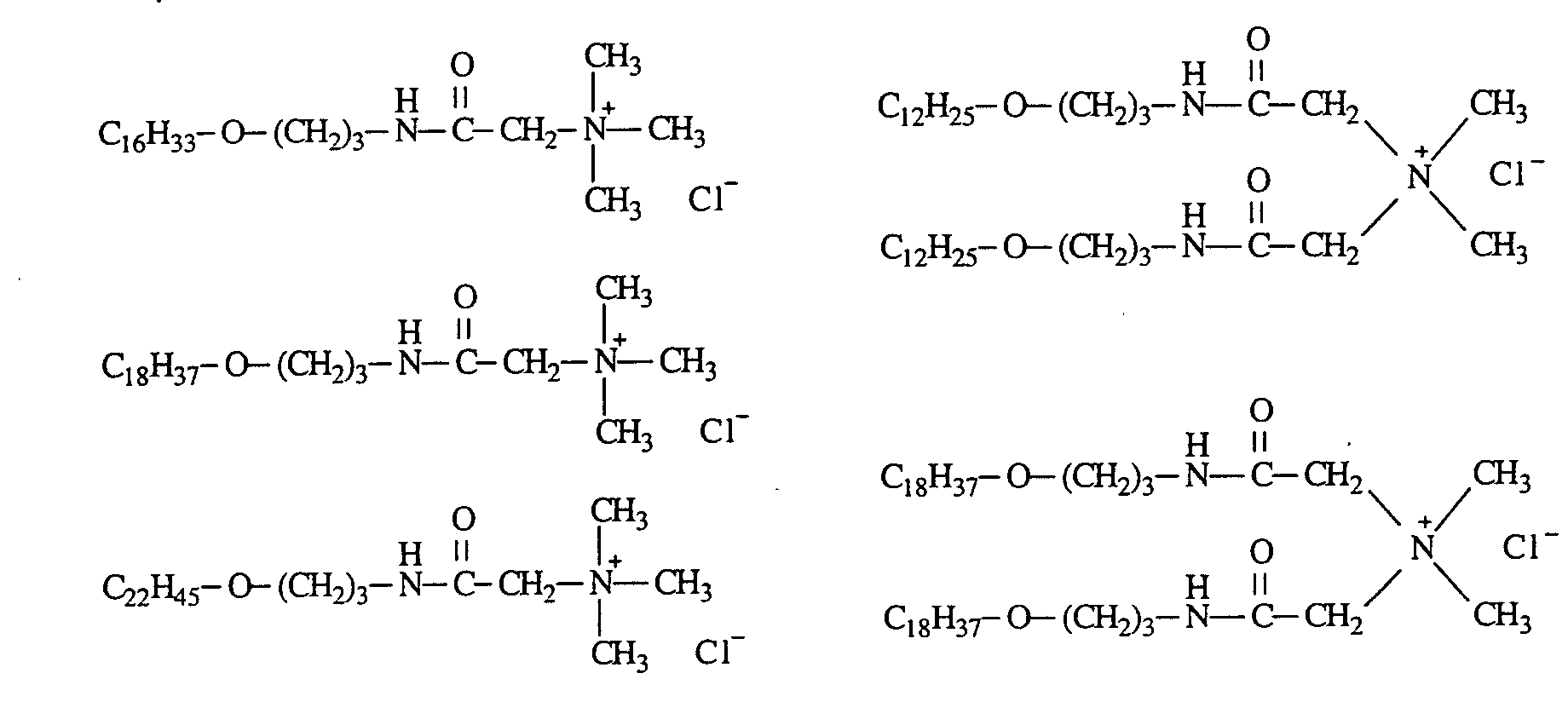
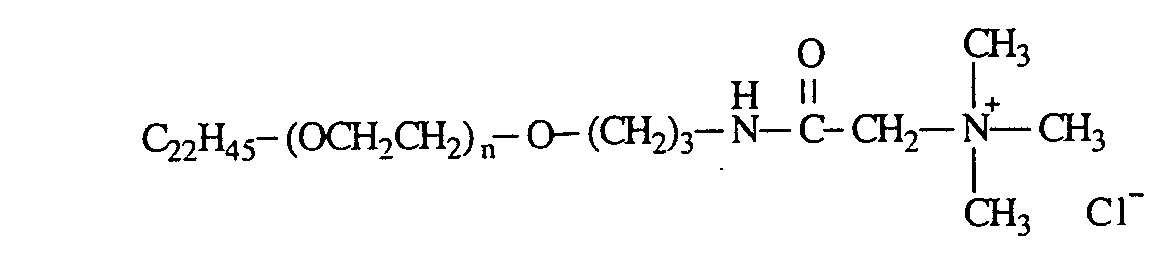
- quaternary ammonium salts (2) for example, the following compounds are exemplified.
- the amine (1), its acid salt or quaternary ammonium salt may be produced by the following production methods 1, 2 and 3.
- a primary amine (hereinafter referred to as a primary amine (3)) represented by the formula (3) is reacted with an amino compound (hereinafter referred to as an amino compound (4)) represented by the formula (4) to carry out amidation using, as required, a catalyst thereby obtaining the amine (1): R 1 -O-(AO) n -C m H 2m -NH 2 (wherein R 1 , A, n and m respectively have the same meaning as above.) (wherein R 6 represents a hydrogen atom or a straight-chain or branched alkyl group having 1 to 4 carbon atoms and R 2 , p, R 3 , R 4 , q and r respectively have the same meaning as above.).
- a quaternary agent (5) represented by the formula (5) and an salt exchange operation is performed according to the need to obtain the quaternary ammonium salt.
- a method in which the primary amine (3) is reacted with a haloester (hereinafter referred to as a haloester (6)) represented by the formula (6) using, as required, an alcoholate catalyst: (wherein R 7 represents a straight-chain or branched alkyl group having 1 to 4 carbon atoms, Y represents a halogen atom and R 2 has the same meaning as above.) to carry out amidation, thereby obtaining an haloamide compound (hereinafter referred to as a haloamide compound (7)) represented by the formula (7): (wherein R 1 , A, n, m, R 2 and Y respectively have the same meaning as above.) further this haloamide compound and an amine (hereinafter referred to as an amine (8)) represented by the formula (8) are subjected to an amidation reaction by adding, as required, an alkali agent and further, as required, to desalting treatment to obtain the amine (1): (wherein s 3 - q
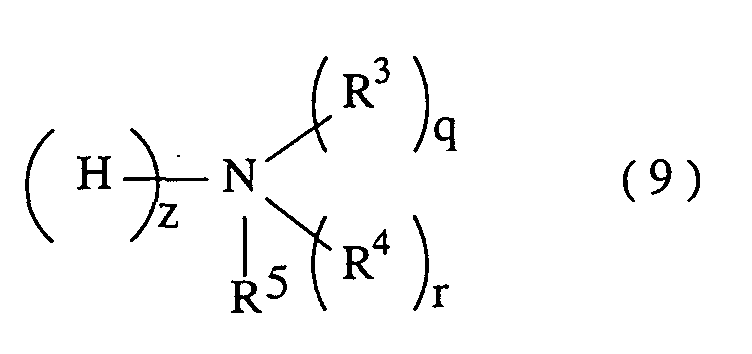
- a method in which a haloamide compound (7) is reacted with an amine (hereinafter referred to as an amine (9)) represented by the formula (9)) by adding, as required, an alkali agent and further, as required, the resulting product is subjected to a salt exchange operation to obtain the quaternary ammonium salt: (wherein z 2 - q - r and R 3 , R 4 , R 5 , q and r respectively have the same meaning as above.).
- amidation is carried out at 50 to 250°C and preferably 70 to 230°C by using, as required, a catalyst over 0.5 to 20 hours to thereby obtain the amine (1).
- the primary amine (3) used here are those obtained by converting a long-chain alcohol such as dodecanol, tetradecanol, hexadecanol, octadecanol, eicosanol, docosanol and tetracosanol, ethylene oxide and/or propylene oxide adducts of these alcohols into a cyanoethyl by using acrylonitrile and then by hydrogenating the resulting cyanoethyl by using a catalyst or N-alkylpolyoxyethyleneamine, N-alkylpolyoxypropylene and the like which are obtained by halogenating the terminal OH of the aforementioned ethylene oxide and/or propylene oxide adduct of the long-chain alcohol and then by reacting the product with ammonia.
- a long-chain alcohol such as dodecanol, tetradecanol, hexadecanol, octadecanol,
- Examples of the amino compound (4) include N,N-dimethylglycine, 3-(dimethylamino)propionic acid, 4-(dimethylamino)butanoic acid, N,N-diethylglycine, 3-(diethylamino)propionic acid, 4-(diethylamino)butanoic acid, N-(2-hydroxyethyl)-N-methylglycine, 3-(N-(2-hydroxyethyl)-N-methylamino)propionic acid, N,N-bis(2-hydroxyethyl)glycine, methyliminodiacetic acid, ethyliminodiacetic acid, nitrilotriacetic acid, pyrrolidinylacetic acid, N-methyl-N-phenylaminoacetic acid, N-methyl-N-tolylaminoacetic acid and the like and methyl esters, ethyl esters and isopropylesters of these compounds.
- amidation catalyst usual alcoholate catalysts may be used in the case of the aforementioned methylester, ethylester and isopropylester and sodium methylate and sodium ethylate are exemplified.
- the amine (1) is converted into a quaternary compound at 20 to 140°C and preferably 40 to 120°C over 0.5 to 20 hours in no solvent or in a solvent, followed by after-treatment according to a usual method and further, as required, a salt exchange operation is carried out using an ion exchange resin or the like, whereby a quaternary ammonium salt having a necessary counter ion can be obtained.
- lower alkyl halides such as methyl chloride and di-lower alkylsulfuric acids such as dimethylsulfuric acid and diethylsulfuric acid are given.
- Examples of the solvent to be used in the reaction for the formation of a quaternary compound include water, methanol, ethanol, isopropyl alcohol and acetone.
- amidation is carried out at -10 to 100°C and preferably 0 to 70°C by using, as required, an alcoholate catalyst and also, as required, a solvent over 1 to 40 hours to obtain a haloamide compound (7).
- the haloamide compound (7) is subjected to an amidation reaction at 0 to 120°C and preferably 10 to 80°C by adding, as required, an alkali agent and using, as required, a solvent over 1 to 40 hours and then, as required, the resulting product is subjected to desalting treatment, whereby the amine (1) can be obtained.
- haloester (6) examples include methylesters, ethylesters and isopropylesters of monochloroacetic acid, 3-chloropropionic acid, 4-chlorobutylic acid and the like.
- examples of the amine (8) include dimethylamine, monomethylamine, ammonia, diethylamine, monoethylamine, diethanolamine, monoethanolamine, methylethylamine, methyl ethanol amine, pyrrolidine, N-methylaniline and methyltolylamine.
- Examples of the alcoholate catalyst include sodium methylate and sodium ethylate.
- Examples of the solvent include methanol, ethanol and isopropyl alcohol.
- Examples of the alkali agent include NaOH, KOH, sodium carbonate and sodium bicarbonate.
- the amine (1) obtained in the above manner is neutralized using an acid in the same manner as in the production method 1-2, whereby the acid salt of the corresponding amine (1) may be obtained.
- the amine (1) obtained in the above manner is converted into a quaternary compound in the same manner as in the production method 1-3, whereby the quaternary ammonium salt may be obtained.
- the both are reacted with each other at 20 to 140°C and preferably 30 to 120°C by adding, as required, an alkali agent and using, as required, a solvent over 0.5 to 20 hours and the resulting product is subjected to desalting treatment according to the need, then to after-treatment according to a usual method and then to a salt exchange operation using an ion exchange resin as required, a quaternary ammonium salt having a necessary counter ion can be obtained.
- Examples of the amine (9) to be used here include trimethylamine, triethylamine, triethanolamine, dimethylamine, monomethylamine, diethylamine, monoethylamine, diethanolamine, monoethanolamine, methylethylamine, methyl ethanol amine, pyrrolidine, N-methylaniline and methyltolylamine.
- Examples of the solvent include water, methanol, ethanol, isopropyl alcohol and acetone.
- Examples of the alkali agent include NaOH, KOH, sodium carbonate and sodium bicarbonate.
- Each structure of the amine (1) and its acid salt and quaternary ammonium salt according to the present invention can be confirmed by nuclear magnetic resonance spectrum and infrared absorption spectrum.
- the amine (1) and its acid salt and quaternary ammonium salt according to the present invention are novel surfactants which impart high flexibility to fibers and high flexibility and smoothness to hairs and are useful as a base having high environmental safety concerning biodegradation characteristics, toxicity to fishes and to algae and the like.
- the amine (1) and its acid salt and quaternary ammonium salt according to the present invention may be used as fiber softeners and hair cosmetics such as hair rinses and hair treatments.
- a four-necks-flask equipped with a stirrer, a temperature gage, a dehydrating pipe and a dropping funnel was charged with 325.6 g of Nissan Amine VBS (alkyl primary amine, manufactured by NOF Corporation), 900 g of methanol and 3.9 g of a methanol solution of 28% sodium methylate as a catalyst.
- 113.9 g of methyl chloroacetate was added dropwise to the mixture in one hour while the mixture was kept at 15 to 20°C and the mixture was reacted for 30 hours. After the reaction was completed, the precipitated crystal was filtered and washed with 300 g of methanol, followed by drying to obtain 378.0 g of a corresponding chloroacetamide.
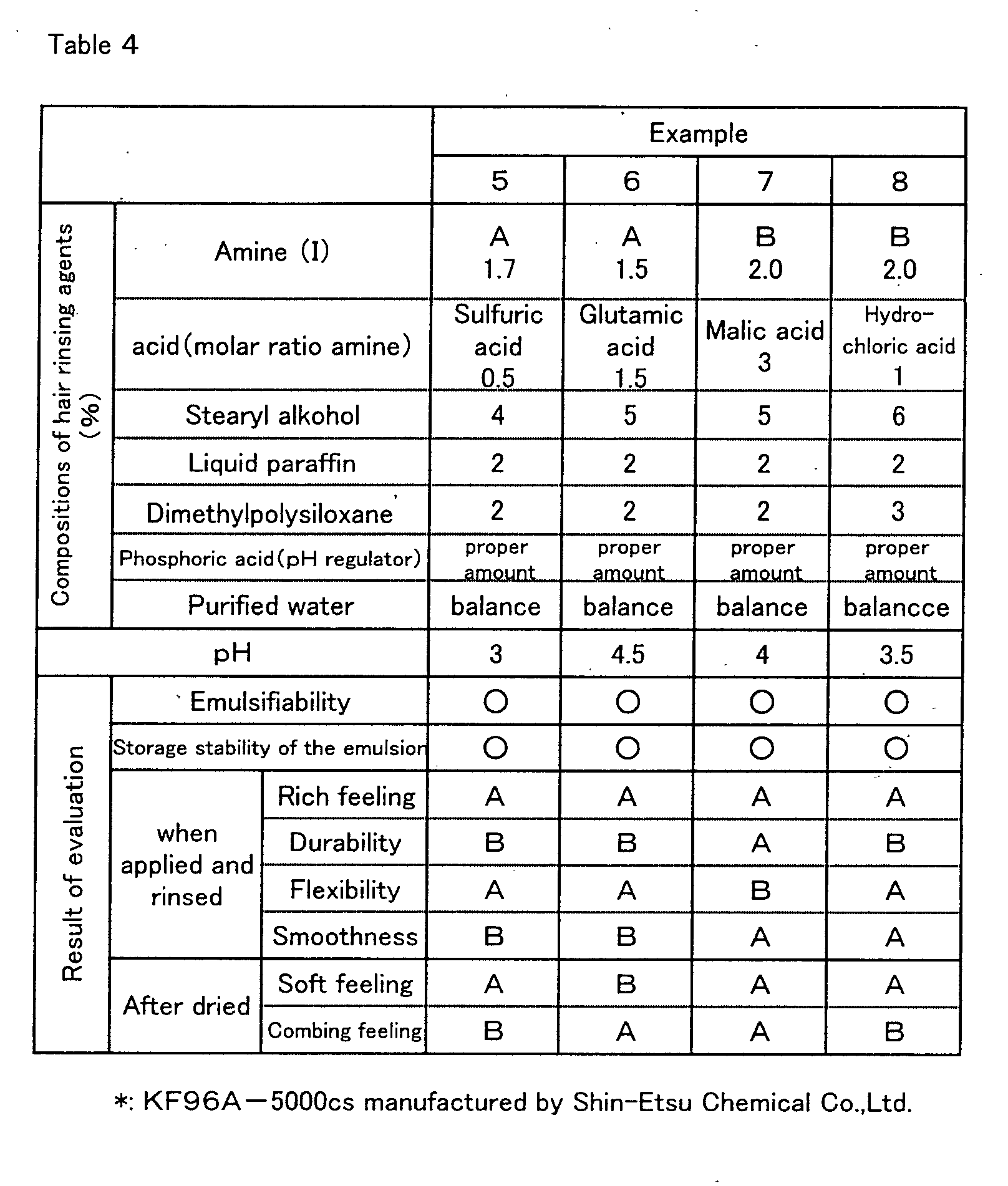
- the amines A to D obtained in Synthetic Examples 1 to 4 according to the present invention or Comparative compounds Y (trimethylstearylammonium chloride, manufactured by Tokyo Kasei Kogyo Co., Ltd.) or Comparative compound Z (NIKKOL Amide Amine MPS, manufactured by Nikko Chemicals Co., Ltd.) shown in Table 2 were used to produce hair rinsing agents having the compositions shown in Tables 3 and 4 by a usual method. These hair rinsing agents were evaluated by the following methods. The results are shown in Tables 3 and 4.
- the emulsification condition of the hair rinsing agent after it was produced and allowed to stand at 25°C for 3 hours was evaluated based on the following standard.
- the hair rinsing agent was stored at 50°C for 3 weeks as an accelerated storing test to evaluate the emulsification condition of the gel based on the following standard.
- the composition of the shampoo was as follows: sodium polyoxyethylene alkyl (12 carbons) ether sulfate (average addition mols of ethylene oxide: 2.5) : 15%, diethanolamide: 3% and water: balance.
- a hair rinsing agent having the following composition was produced.
- This rinsing agent was emulsified gel-wise and the emulsion had good storage stability. Further, the rinsing agent was superior in rich feeling and its durability, flexibility and smoothness of the hair when the rinsing agent was applied and rinsed and in soft feeling and combing feeling after hairs were dried.
- a hair treatment agent having the following composition was produced.
- Amine B 2.5% Aqueous 35% hydrochloric acid solution 0.7% Cetanol 6.5% Dimethylpolysiloxane (average molecular weight: 9000) 5.0% Polyoxyethylene sorbitan monostearate (number of average addition mols of ethylene oxide: 20) 0.5% Behenic acid 0.1% Dipropylene glycol 6.0% Glycerol 8.0% Aqueous 50% citric acid solution 0.2% Perfume, methylparabene Proper amount Purified water Balance (pH: 3.5)
- This hair treatment agent was emulsified gel-wise and the emulsion had good storage stability. Further, the hair treatment agent was superior in rich feeling and its durability, flexibility and smoothness of the hair when the rinsing agent was applied and rinsed and in soft feeling and combing feeling after hairs were dried.
- a hair treatment agent having the following composition was produced.
- Amine E 2.5% 90% lactic acid 0.9% Cetanol 4.0% Dimethylpolysiloxane 3.0% Amino-modified silicone 0.5%
- Polyoxyethylene sorbitan monostearate (number of average addition mols of ethylene oxide: 20) 0.5% Liquid paraffin 2.0% Dipropylene glycol 3.0% Glycerol 7.0%
- Aqueous 50% citric acid solution 0.2% Hydroxylethyl cellulose 0.1% Perfume, methylparabene Proper amount Purified water Balance (pH: 3.7)
- This hair treatment agent was emulsified gel-wise and the emulsion had good storage stability. Further, the hair treatment agent was superior in rich feeling and its durability, flexibility and smoothness of the hair when the rinsing agent was applied and rinsed and soft feeling and combing feeling after hairs were dried.
- a four-necks-flask equipped with a stirrer, a temperature gage, a dehydrating pipe and a nitrogen-introducing pipe was charged with 134.1 g of N,N-dimethylglycine and 325.6 g of Nissan Amine VBS (alkyl primary amine, manufactured by NOF Corporation) and the mixture was reacted at 200°C for 6 hours while nitrogen was introduced into the flask and reaction water was distilled. Thereafter, 102.7 g of water was introduced into the flask after the reaction mixture was cooled to 80°C. The resulting mixture was stirred at 80°C for 30 minutes and then subjected to phase separation and the water phase was removed.
- This washing operation was carried out twice to remove unreacted N,N-dimethylglycine and the like. After that, the mixture was dehydrated at 80°C under a vacuum of 3.9 kPa for one hour. Next, 8.2 g of steam was introduced into the flask at 180°C under a vacuum of 1.3 kPa in 2 hours to deodorize, thereby obtaining 402.5 g of the target aminocarboxylic acid amide which was a pale yellow solid.
- a four-necks-flask equipped with a stirrer, a temperature gage and a cooling tube was charged with 282.4 g of an aqueous 50% N,N-dimethylglycine potassium salt, to which was then added 98% sulfuric acid until the pH was 5.7. Then, the reaction mixture was cooled to 25°C to remove precipitated potassium sulfate, thereby obtaining 188.3 g of an aqueous 41.1% N,N-dimethylglycine solution containing 2.7% of potassium sulfate.
- Example 16 The same four-necks-flask that was used in Example 16 was charged with 168.5 g of N,N-diethylglycine sodium salt and 800.0 g of water and the mixture was neutralized by 111.4 g of an aqueous 36% hydrochloric acid solution. The pH of the resulting solution was 6.5. Next, the solution was concentrated to 70% at 110°C while nitrogen was blown into the solution. Then, 267.6 g of Firmine 80 (alkyl primary amine, manufactured by Kao Corporation) was introduced into the flask and the mixture was reacted at 170°C for 12 hours while nitrogen was introduced and reaction water was distilled. Thereafter, the reaction solution was cooled to 80°C and then 380 g of water was introduced into the flask.
- Firmine 80 alkyl primary amine, manufactured by Kao Corporation
- the resulting solution was stirred at 80°C for 30 minutes and an operation of washing the separated phase was carried out twice to remove unreacted N,N-diethylglycine, sodium chloride and the like.
- the resulting solution was dehydrated at 80°C under a vacuum of 3.9 kPa for one hour to obtain 369.3 g of target aminocarboxylic acid amide which was a pale yellow solid.
- the mixture was subjected to a Nutsche type filter to remove unreacted N,N-dimethylglycine, potassium sulfate, and the like to obtain 316.9 g of the target aminocarboxylic acid amide which was a pale yellow solid.
- Example 2 The same four-necks-flask that was used in Example 1 was charged with 325.6 g of Nissan Amine VBS (alkyl primary amine, manufactured by NOF Corporation), 1000 g of methanol as a solvent and 9.6 g of a methanol solution of 28% sodium methylate as a catalyst. 113.9 g of methyl chloroacetate was added dropwise to the mixture in one hour while the mixture was kept at 30 to 40°C and the resulting mixture was reacted for 6 hours to obtain a reaction product of 2-chloroacetamide. Next, 120.2 g of dimethylamine was introduced into the flask in 3 hours while the mixture was kept at 50 to 60°C and the resulting mixture was reacted 3 hours.
- Nissan Amine VBS alkyl primary amine, manufactured by NOF Corporation
- This method requires a large amount of a reaction solvent and therefore the production cost is high. Also, this method has a low reaction selectivity. Therefore it requires a refining operation such as crystallization using an organic solvent if it is intended to obtain a high purity product and also reduced in yield. Examples with regard to Amine (1)
- a 2 l beaker was charged with 82.5 g of an amine i obtained in the same method as in Example 21, 36.0 g of an aqueous 50% lactic acid solution and 900 g of ion exchange water and the mixture was stirred at 60°C for 2 hours to neutralize. Then, the neutralized mixture was freeze-dried to obtain 100.4 g of the target product (lactate of amine i) as a white powder.
- a 2 l beaker was charged with 93.8 g of an amine ii obtained in the same manner as in Example 4, 36.0 g of an aqueous 50% lactic acid solution and 900 g of ion exchange water and the mixture was stirred at 70°C for 2 hours to neutralize, followed by freeze-drying to obtain 111.8 g of the target compound (lactate of the amine ii) as a white powder.
- a four-necks-flask equipped with a stirrer, a temperature gage, a dehydrating pipe and a dropping funnel was charged with 383.69 g of 3-docosyloxypropylamine obtained in the same manner as in Example 24, 1000 g of methanol and 9.6 g of a methanol solution of 28% sodium methylate as a catalyst. 113.9 g of methyl chloroacetate was added to the mixture in one hour while the mixture was kept at 20 to 30°C and the resulting mixture was reacted for 24 hours. After the reaction was completed, the precipitated crystal was filtered. The crystal was washed with 1000 g of methanol and then dried to obtain 432.6 g of 2-chloro-N-(3-docosyloxypropyl)-acetamide as a white powder.
- Example 21 The same starting material and conditions as in Example 21 were used except that 407.1 g of ethylene oxide (average 3.1 mol) adduct of octadecanol was used in place of octadecanol and the distillation-refining was not performed, to obtain 445.6 g of a corresponding ether primary amine.
- the amines i and v obtained in Examples 21 and 29 and a comparative amine (NIKKOL Amide Amine MPS, manufactured by Nikko Chemicals Co., Ltd.) represented by the formula (10) were used to produce hair rinsing agents having the compositions shown in Table 7 by a usual method. These hair rinsing agents were evaluated by the following methods. The results are shown in Table 7.
- the emulsification condition of the hair rinsing agent after it was produced and allowed to stand at ambient temperature (25°C) for 3 hours was evaluated based on the following standard.
- the hair rinsing agent was stored at 50°C for 3 weeks as an accelerated storing test to evaluate the emulsification condition of the gel based on the following standard.
- the composition of the shampoo was as follows: sodium polyoxyethylene alkyl (12 carbons) ether sulfate (average addition mols of ethylene oxide: 2.5) : 15%, diethanolamide: 3% and water: balance.
Landscapes
- Organic Chemistry (AREA)
- Chemical & Material Sciences (AREA)
- Health & Medical Sciences (AREA)
- Life Sciences & Earth Sciences (AREA)
- Veterinary Medicine (AREA)
- Animal Behavior & Ethology (AREA)
- General Health & Medical Sciences (AREA)
- Public Health (AREA)
- Epidemiology (AREA)
- Birds (AREA)
- Dermatology (AREA)
- Organic Low-Molecular-Weight Compounds And Preparation Thereof (AREA)
- Cosmetics (AREA)
Abstract

Description
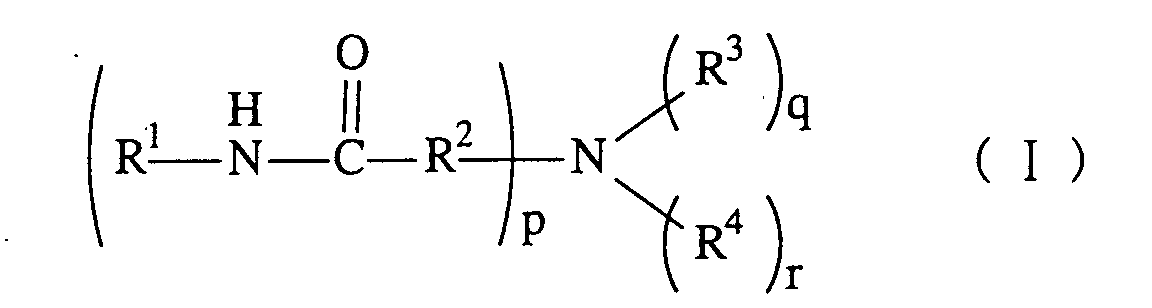

comprising reacting a primary amine (hereinafter referred to as a primary amine (II)) represented by the formula (II):
with an aminocarboxylic acid (hereinafter referred to as an aminocarboxylic acid (III) represented by the formula (III) to run amidation:


is reacted with a carboxylic acid halide or its lower alkyl ester or acid halide using a catalyst as the case may be and the reaction product is then reacted with a corresponding amine or by a method in which an amino acid or its derivative is reacted with the amine (II).

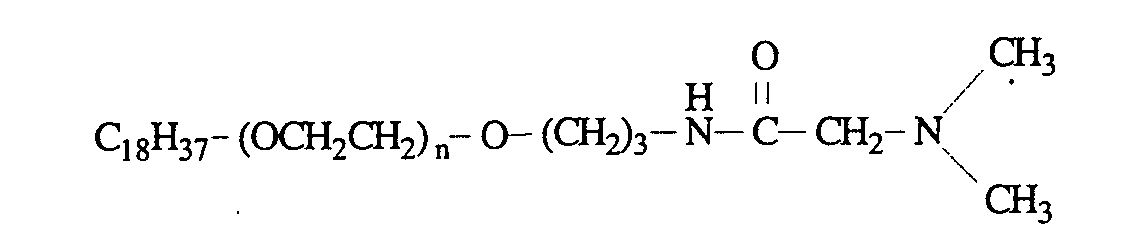
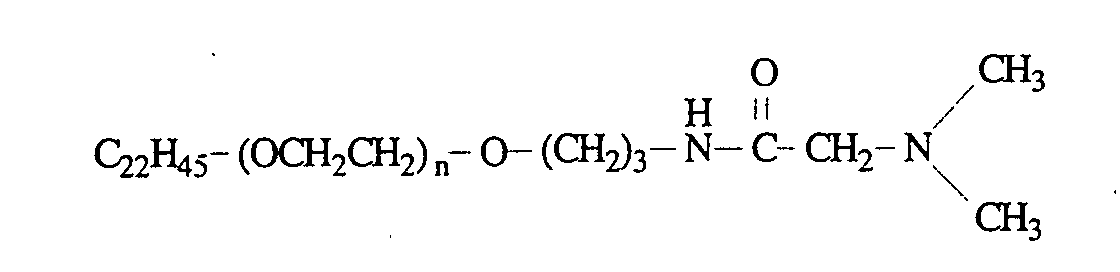



(n = Number of average addition mols 3)



to carry out amidation, thereby obtaining an haloamide compound (hereinafter referred to as a haloamide compound (7)) represented by the formula (7):

further this haloamide compound and an amine (hereinafter referred to as an amine (8)) represented by the formula (8) are subjected to an amidation reaction by adding, as required, an alkali agent and further, as required, to desalting treatment to obtain the amine (1):





| Amine A | 3.0% |
| Lactic acid | 2.0% |
| Cetanol | 4.0% |
| Isopropyl palmitate | 2.0% |
| Dimethylpolysiloxane (average molecular weight: 9000) | 1.0% |
| Polyether-modified silicone (KF6015, manufactured by Shin-Etsu Chemical Co., Ltd.) | 2.0% |
| Propylene glycol | 1.5% |
| Aqueous 50% citric acid solution | 0.2% |
| Perfume, methylparabene | Proper amount |
| Purified water | Balance |
| (pH: 3.5) |
| Amine B | 2.5% |
| Aqueous 35% hydrochloric acid solution | 0.7% |
| Cetanol | 6.5% |
| Dimethylpolysiloxane (average molecular weight: 9000) | 5.0% |
| Polyoxyethylene sorbitan monostearate (number of average addition mols of ethylene oxide: 20) | 0.5% |
| Behenic acid | 0.1% |
| Dipropylene glycol | 6.0% |
| Glycerol | 8.0% |
| Aqueous 50% citric acid solution | 0.2% |
| Perfume, methylparabene | Proper amount |
| Purified water | Balance |
| (pH: 3.5) |
| Amine E | 2.5% |
| 90% lactic acid | 0.9% |
| Cetanol | 4.0% |
| Dimethylpolysiloxane | 3.0% |
| Amino-modified silicone | 0.5% |
| Polyoxyethylene sorbitan monostearate (number of average addition mols of ethylene oxide: 20) | 0.5% |
| Liquid paraffin | 2.0% |
| Dipropylene glycol | 3.0% |
| Glycerol | 7.0% |
| Aqueous 50% citric acid solution | 0.2% |
| Hydroxylethyl cellulose | 0.1% |
| Perfume, methylparabene | Proper amount |
| Purified water | Balance |
| (pH: 3.7) |
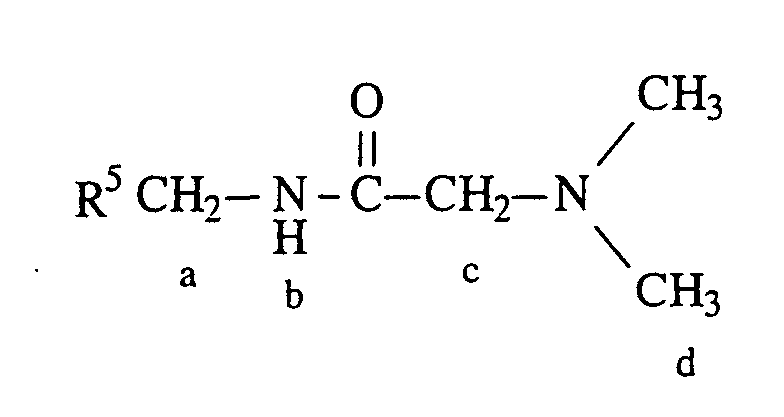
| a | 3.27 ppm (q, 2H) |
| b | 7.13 ppm ( 1H) |
| c | 2.93 ppm (s, 2H) |
| d | 2.26 ppm (s, 6H) |
1648 cm-1, 1525 cm-1
Purity 98.6%
(Others: primary amine: 0.1%, dimethylglycine: 0.1%)
Compositions of an alkyl group represented by R5CH2-C18H37/C20H41/C22H45/C24H49 = 4%/12%/82%/2%

| a | 3.27 ppm (q, 2H) |
| b | 7.23 ppm ( 1H) |
| c | 2.94 ppm (s, 2H) |
| d | 2.27 ppm (s, 6H) |
1649 cm-1, 1526 cm-1
Purity 97.8%
(Others: primary amine: 0.4%, dimethylglycine: 0.1%, potassium sulfate: 0.1% or less)
Compositions of alkyl groups represented by R7CH2-C16H33/C17H35/C18H37/C19H39/C20H41 = 4.5%/2.1%/92.0%/0.5%/0.9%

| a | 3.25 ppm (q, 2H) |
| b | 7.41 ppm ( 1H) |
| c | 3.01 ppm (s, 2H) |
| d | 2.54 ppm (q, 4H) |
| e | 1.03 ppm (q, 6H) |
1649 cm-1, 1525 cm-1
Purity 97.9%
(Others: primary amine: 0.6%, dimethylglycine: 0.2%, sodium chloride: 0.1%)
Compositions of an alkyl group represented by R8CH2-C16H33/C17H35/C18H37/C19H39/C20H41 = 5.2%/2.3%/91.3%/0.3%/0.9%
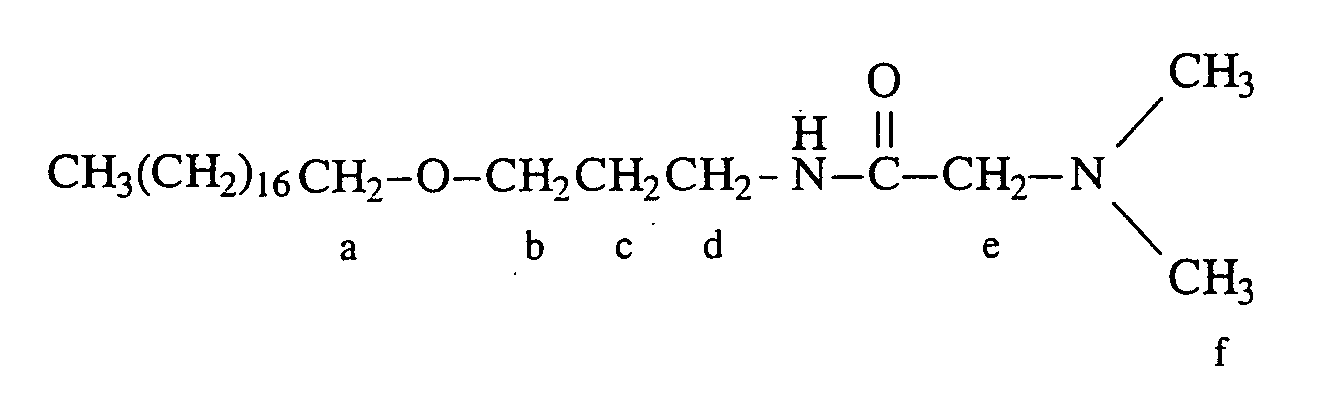
| a | 3.40 ppm (t, 2H) |
| b | 3.48 ppm (t, 2H) |
| c | 1.78 ppm (m, 2H) |
| d | 3.38 ppm (m, 2H) |
| e | 2.94 ppm (s, 2H) |
| f | 2.28 ppm (s, 6H) |
1655 cm-1, 1529 cm-1, 1122 cm-1
Purity 95.3%
(Others: C18H37-OH: 2.7%, C18H37-O-CH2CH2CH2-NH2: 0.8%, dimethylglycine: 0.1%, potassium sulfate: 0.1% or less)
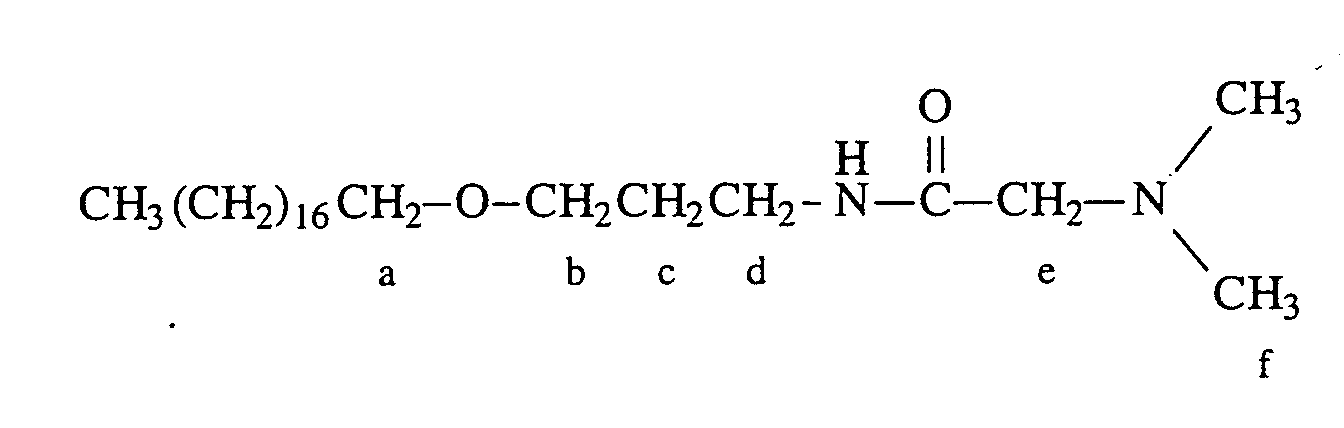
| a | 3.40 ppm (t, 2H) |
| b | 3.48 ppm (t, 2H) |
| c | 1.78 ppm (m, 2H) |
| d | 3.38 ppm (m, 2H) |
| e | 2.94 ppm (s, 2H) |
| f | 2.28 ppm (s, 6H) |
1655 cm-1, 1529 cm-1, 1122 cm-1
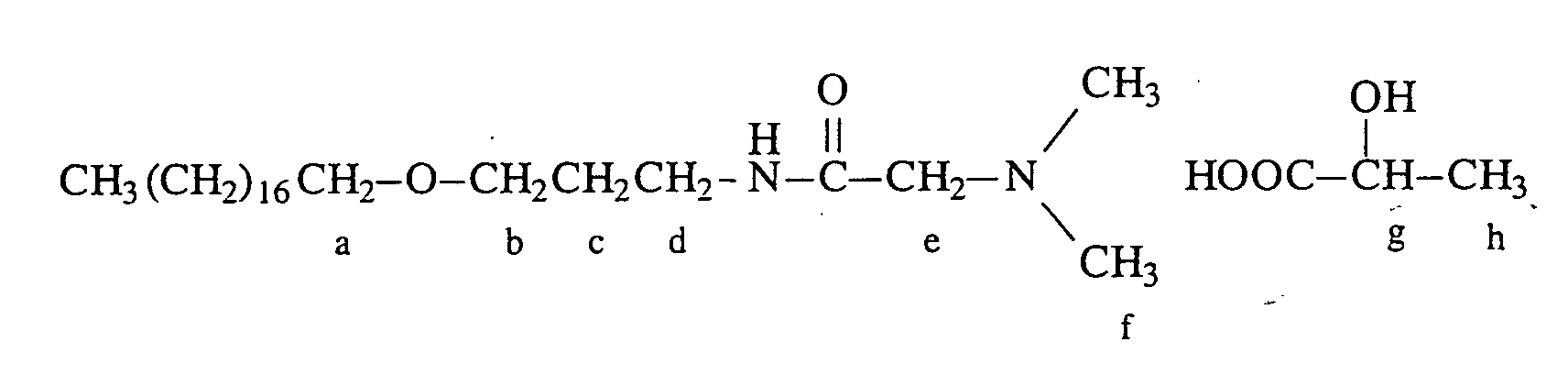
| a | 3.40 ppm (t, 2H) |
| b | 3.49 ppm (t, 2H) |
| c | 1.79 ppm (m, 2H) |
| d | 3.36 ppm (m, 2H) |
| e | 3.31 ppm (s, 2H) |
| f | 2.57 ppm (s, 6H) |
| g | 4.20 ppm (q, 1H) |
| h | 1.41 ppm (w, 3H) |
1684 cm-1, 1589 cm-1, 1122 cm-1

| a | 3.38 ppm (t, 2H) |
| b | 3.45 ppm (t, 2H) |
| c | 1.78 ppm (m, 2H) |
| d | 3.30 ppm (m, 2H) |
| e | 4.17 ppm (s, 2H) |
| f | 3.36 ppm (s, 9H) |
1682 cm-1, 1560 cm-1, 1120 cm-1
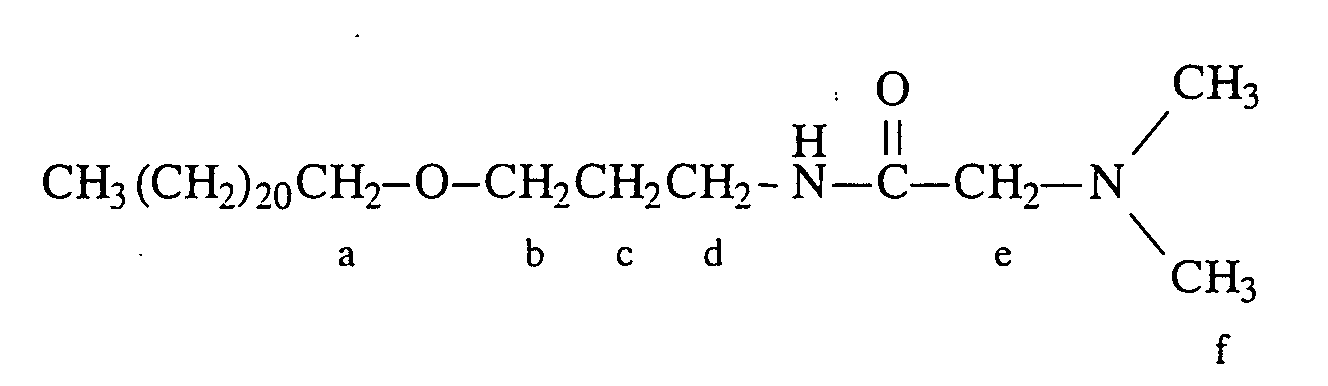
| a | 3.39 ppm (t, 2H) |
| b | 3.47 ppm (t, 2H) |
| c | 1.78 ppm (m, 2H) |
| d | 3.37 ppm (m, 2H) |
| e | 2.94 ppm (s, 2H) |
| f | 2.28 ppm (s, 6H) |
1658 cm-1, 1531 cm-1, 1124 cm-1

| a | 3.41 ppm (t, 2H) |
| b | 3.48 ppm (t, 2H) |
| c | 1.78 ppm (m, 2H) |
| d | 3.36 ppm (m, 2H) |
| e | 3.30 ppm (s, 2H) |
| f | 2.58 ppm (s, 6H) |
| g | 4.19 ppm (q, 1H) |
| h | 1.41 ppm (w, 3H) |
1684 cm-1, 1591 cm-1, 1121 cm-1

| a | 3.39 ppm (t, 2H) |
| b | 3.45 ppm (t, 2H) |
| c | 1.78 ppm (m, 2H) |
| d | 3.30 ppm (m, 2H) |
| e | 4.17 ppm (s, 2H) |
| f | 3.36 ppm (s, 9H) |
1682 cm-1, 1561 cm-1, 1121 cm-1

| a | 3.40 ppm (t, 2H) |
| b | 3.47 ppm (t, 2H) |
| c | 1.79 ppm (m, 2H) |
| d | 3.33 ppm (m, 2H) |
| e | 3.14 ppm (s, 2H) |
| f | 2.60 ppm (m, 4H) |
| g | 1.80 ppm (m, 4H) |
1655 cm-1, 1522 cm-1, 1122 cm-1

| a | 3.40 ppm (t, 2H) |
| b | 3.49 ppm (t, 2H) |
| c | 1.81 ppm (m, 2H) |
| d | 3.35 ppm (m, 2H) |
| e | 3.86 ppm (s, 2H) |
| f | 3.00 ppm (s, 3H) |
| g | 6.73 ppm (w, 2H) |
| h | 7.27 ppm (m, 2H) |
| I | 6.85 ppm (t, 1H) |
1653 cm-1, 1523 cm-1, 1122 cm-1
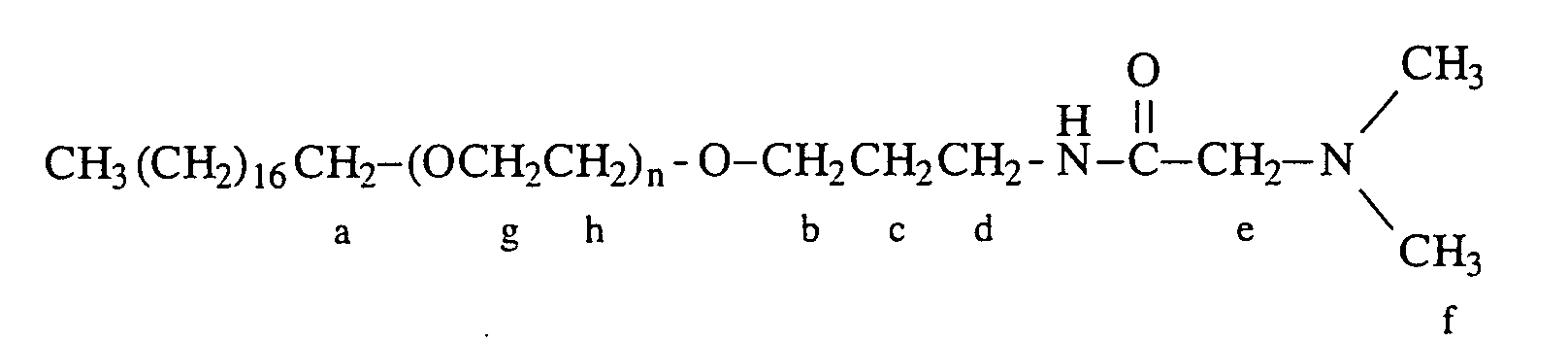
| a | 3.40 ppm (t, 2H) |
| b | 3.48 ppm (t, 2H) |
| c | 1.79 ppm (m, 2H) |
| d | 3.38 ppm (m, 2H) |
| e | 2.94 ppm (s, 2H) |
| f | 2.27 ppm (s, 6H) |
| g, h | 3.50 to 3.65 ppm (12. 4H) |
1655 cm-1, 1527 cm-1, 1120 cm-1


Claims (15)
- A hair cosmetic comprising an amine compound
(hereinafter referred to as amine (I)) represented by the formula (I):(wherein R1 represents a straight-chain or branched alkyl or alkenyl group having 8 to 40 carbon atoms or a group represented by the formula R5O-(AO)n-CmH2m- (R5 represents a straight-chain or branched alkyl or alkenyl group having 8 to 40 carbon atoms, A represents an alkylene group having 2 to 3 carbon atoms, n denotes a number from 0 to 30 on the average and m denotes an integer of 2 or 3, where nA's may be the same as or different from one another), R2 represents a straight-chain or branched alkylene group having 1 to 5 carbon atoms, R3 represents a hydrogen atom, a straight-chain or branched alkyl, alkenyl or hydroxyalkyl group having 1 to 24 carbon atoms or an aryl or arylalkyl group having 6 to 28 carbon atoms, R4 represents a hydrogen atom, a straight-chain or branched alkyl, alkylene or hydroxyalkyl group having 1 to 5 carbon atoms or an aryl or arylalkyl group having 6 to 28 carbon atoms, R3 and R4 may form a ring either independently or in combination, p denotes an integer from 1 to 3, q and r denote an integer from 0 to 2 and p + q + r is equal to 3, that pR1's, pR2's, qR3's and rR4's may be the same as or different from one another.).
- The hair cosmetic according to claim 1, wherein in the formula (I), R1 represents a straight-chain or branched alkyl or alkenyl group having 12 to 24 carbon atoms or a group represented by the formula R5O- (AO)n-CmH2m- (R5 represents a straight-chain or branched alkyl or alkenyl group having 12 to 24 carbon atoms, A, n and m represent the same meaning as above, R2 represents a straight-chain alkylene group having 1 to 3 carbon atoms, R3 and R4 represent a straight-chain or branched alkyl or hydroxyalkyl group having 1 to 3 carbon atoms or an aryl or arylalkyl group having 6 to 28 carbon atoms (R3 and R4 may form a ring either independently or in combination), p is 1 or 2 and q and r are 0 or 1.
- A hair cosmetic composition comprising the amine compound (I) as claimed in claim 1 and at least one acid selected from the group consisting of inorganic acids and organic acids.
- A hair cosmetic composition comprising the amine compound (I) as claimed in claim 1 and an alcohol having 10 to 30 carbon atoms.
- A hair cosmetic composition comprising the amine compound (I) as claimed in claim 1, at least one acid selected from the group consisting of inorganic acids and organic acids and an alcohol having 10 to 30 carbon atoms, wherein the content of the amine compound (I) is 0.1 to 15% by weight, the content of the acid is 0.3 to 10 mol equivalents to the amine (I) and the content of alcohol having 10 to 30 carbon atoms is 0.5 to 15% by weight.
- A method of producing the amine compound (I) as. claimed in claim 1, comprising reacting a primary amine represented by the formula (II) with an aminocarboxylic acid represented by the formula (III) to run amidation:(wherein R1, R2, R3, R4, p, q and r are the same as those of claim 1.).
- The method according to claim 6, wherein R1 represents a straight-chain or branched alkyl or alkenyl group having 12 to 24 carbon atoms or a group represented by the formula R5O- (AO)n-CmH2m- (R5 represents a straight-chain or branched alkyl or alkenyl group having 12 to 24 carbon atoms, A, n and m have the same meaning as above, R2 represents a straight-chain alkylene group having 1 to 3 carbon atoms, R3 and R4 represent a straight-chain or branched alkyl or hydroxyalkyl group having 1 to 3 carbon atoms or an aryl or an arylalkyl group having 6 to 10 carbon atoms (R3 and R4 may form a ring either independently or in combination), p is 1 or 2 and q and r are 0 or 1.
- The method according to claim 6, wherein an aminocarboxylic acid represented by the formula (III) is used in an amount of 0.5 to 3 equivalents to one equivalent of the primary amine represented by the formula (II) to run an amidation reaction at 120 to 250°C.
- The method according to claim 6, wherein the aminocarboxylic acid represented by the formula (III) is obtained by adding an acid to an alkali metal salt of the aminocarboxylic acid.
- The method according to claim 6, wherein washing with water and solid-liquid separation are carried out after the amidation.
- An amine represented by the formula (1), an acid salt thereof or a quaternary ammonium salt thereof:(wherein R1 represents a straight-chain or branched alkyl or alkenyl group having 8 to 40 carbon atoms, A represents an alkylene group having 2 to 3 carbon atoms, n denotes a number from 0 to 30 on the average and m denotes an integer of 2 or 3, R2 represents a straight-chain or branched alkylene group having 1 to 5 carbon atoms, R3 and R4, which are the same as or different from each other, represent a hydrogen atom, a straight-chain or branched alkyl, alkenyl or hydroxyalkyl group having 1 to 5 carbon atoms or an aryl or arylalkyl group having 6 to 28 carbon atoms, R3 and R4 may form a ring either independently or in combination, p denotes an integer from 1 to 3, q and r denote an integer from 0 to 2 and p + q + r is equal to 3, provided that (n×p)A's, pR1's, pn's, pm's, pR2's, qR3's and rR4's may be the same as or different from one another.).

- The quaternary ammonium salt according to claim 11, which is a compound represented by the formula (2):
Formula (2)(wherein R1, A, n, m, R2, R3, R4, p, q and r are the same as above, R5 represents a straight-chain or branched alkyl or hydroxyalkyl group having 1 to 5 carbon atoms and X represents an anionic ion group.).
- The amine, the acid salt or the quaternary ammonium salt according to claim 11, wherein R1 represents a straight-chain or branched alkyl or alkenyl group having 10 to 28 carbon atoms, R2 represents a straight-chain or branched alkylene group having 1 to 3 carbon atoms and p denotes an integer from 1 or 2.
- A surfactant comprising the amine, the salt or the quaternary ammonium salt as claimed in claim 11.
- Use of the amine compound (I) as defined in claim 1 for cosmetic material.
Applications Claiming Priority (8)
| Application Number | Priority Date | Filing Date | Title |
|---|---|---|---|
| JP2001060559 | 2001-03-05 | ||
| JP2001060559 | 2001-03-05 | ||
| JP2001368155 | 2001-12-03 | ||
| JP2001368156A JP2003171358A (en) | 2001-12-03 | 2001-12-03 | Amidoamine derivatives |
| JP2001368155A JP3657909B2 (en) | 2001-03-05 | 2001-12-03 | Hair cosmetics |
| JP2001368156 | 2001-12-03 | ||
| JP2001374556A JP2003171355A (en) | 2001-12-07 | 2001-12-07 | Method for producing aminocarboxylic acid amide |
| JP2001374556 | 2001-12-07 |
Publications (3)
| Publication Number | Publication Date |
|---|---|
| EP1238966A2 true EP1238966A2 (en) | 2002-09-11 |
| EP1238966A3 EP1238966A3 (en) | 2003-01-08 |
| EP1238966B1 EP1238966B1 (en) | 2007-01-24 |
Family
ID=27482086
Family Applications (1)
| Application Number | Title | Priority Date | Filing Date |
|---|---|---|---|
| EP02004373A Expired - Lifetime EP1238966B1 (en) | 2001-03-05 | 2002-03-05 | Hair cosmetic, aminocarboxylic acid amide and method for producing the same |
Country Status (4)
| Country | Link |
|---|---|
| US (3) | US20030035784A1 (en) |
| EP (1) | EP1238966B1 (en) |
| CN (1) | CN100446749C (en) |
| DE (1) | DE60217742T2 (en) |
Families Citing this family (9)
| Publication number | Priority date | Publication date | Assignee | Title |
|---|---|---|---|---|
| GB0205531D0 (en) * | 2002-03-08 | 2002-04-24 | Unilever Plc | Hair treatment compositions |
| US7632531B2 (en) * | 2003-04-11 | 2009-12-15 | International Flavors & Fragnances Inc. | Alkyldienamides exhibiting taste and sensory effect in flavor compositions |
| US7361376B2 (en) | 2003-04-11 | 2008-04-22 | International Flavors & Fragrances Inc. | Alkyldienamides exhibiting taste and sensory effect in flavor compositions |
| US7141686B2 (en) | 2003-07-10 | 2006-11-28 | International Flavors & Fragrances Inc. | E2, E4, Z8-undecatrienoic acid and ester and carboxamide derivatives thereof, organoleptic uses thereof and processes for preparing same |
| US8007839B2 (en) * | 2003-10-03 | 2011-08-30 | International Flavors & Fragrances | Conjugated dienamides, methods of production thereof, compositions containing same and uses thereof |
| US9889079B2 (en) * | 2012-07-27 | 2018-02-13 | Conopco, Inc. | Process for making a conditioning gel phase |
| JP6360608B1 (en) | 2017-11-01 | 2018-07-18 | 高級アルコール工業株式会社 | Conditioning agent and conditioning composition |
| CN107976269B (en) * | 2017-11-20 | 2023-09-22 | 河南工程学院 | Flexibility tester for hair products |
| CN111450773B (en) * | 2020-04-17 | 2022-04-26 | 辽宁石油化工大学 | Amphiphilic water-based diionic amide surfactant and preparation method thereof |
Family Cites Families (19)
| Publication number | Priority date | Publication date | Assignee | Title |
|---|---|---|---|---|
| DE217513C (en) | ||||
| DE1165038B (en) * | 1962-03-03 | 1964-03-12 | Knoll Ag | Process for the preparation of antimicrobially active derivatives of glycinamide |
| DE1240872B (en) | 1963-05-10 | 1967-05-24 | Henkel & Cie Gmbh | Process for the production of water-soluble, capillary-active ampholytes that can be used as washing and cleaning agents and as foam stabilizers |
| JPS55143A (en) | 1978-06-19 | 1980-01-05 | Nippon Kouden Kogyo Kk | Electrode resistance measuring apparatus |
| LU81068A1 (en) | 1979-03-22 | 1980-10-08 | Continental Pharma | GLYCINAMIDE DERIVATIVES, THEIR PREPARATION AND USE, AS WELL AS COMPOSITIONS CONTAINING THOSE DERIVATIVES |
| DE3010599A1 (en) * | 1979-03-22 | 1980-10-09 | Continental Pharma | DERIVATIVES OF GLYCINAMIDE, THEIR PRODUCTION AND USE |
| DD217513B1 (en) * | 1983-04-22 | 1989-03-01 | Hydrierwerk Rodleben Veb | PROCESS FOR PREPARING N, N-DIALKYLGLYCINAMIDES |
| FR2559305B1 (en) * | 1984-02-08 | 1986-10-17 | Telemecanique Electrique | ANALOGUE MANIPULATOR |
| JPH05271036A (en) | 1992-03-26 | 1993-10-19 | Shiseido Co Ltd | Hair treating agent composition |
| JPH05271035A (en) | 1992-03-26 | 1993-10-19 | Shiseido Co Ltd | Hair treating agent composition |
| US5573726A (en) * | 1993-09-22 | 1996-11-12 | Alcon Laboratories, Inc. | Use of amidoamines in ophthalmic compositions |
| JP3434298B2 (en) * | 1994-02-10 | 2003-08-04 | 花王株式会社 | Process for producing acyloxybenzenesulfonic acid or a salt thereof |
| JP3385293B2 (en) | 1994-08-31 | 2003-03-10 | 一丸ファルコス株式会社 | Altocarpine-containing antibacterial and preservatives and cosmetics |
| JP3049413B2 (en) * | 1995-10-24 | 2000-06-05 | 三洋化成工業株式会社 | Hair treatment agent |
| IT1283489B1 (en) | 1996-07-23 | 1998-04-21 | Chiesi Farma Spa | AMIDES OF ALPHA-AMINO ACIDS, THEIR PREPARATION AND THEIR THERAPEUTIC USE |
| US5888493A (en) * | 1996-12-05 | 1999-03-30 | Sawaya; Assad S. | Ophthalmic aqueous gel formulation and related methods |
| WO1998040046A2 (en) * | 1997-03-10 | 1998-09-17 | The Procter & Gamble Company | Hair conditioning compositions |
| JP3897923B2 (en) * | 1998-12-28 | 2007-03-28 | 花王株式会社 | Method for producing hair cosmetics |
| JP3497095B2 (en) * | 1999-04-26 | 2004-02-16 | 花王株式会社 | Hair cosmetics |
-
2002
- 2002-03-04 US US10/086,873 patent/US20030035784A1/en not_active Abandoned
- 2002-03-05 EP EP02004373A patent/EP1238966B1/en not_active Expired - Lifetime
- 2002-03-05 CN CNB021066663A patent/CN100446749C/en not_active Expired - Fee Related
- 2002-03-05 DE DE60217742T patent/DE60217742T2/en not_active Expired - Lifetime
-
2004
- 2004-09-24 US US10/948,656 patent/US7524486B2/en not_active Expired - Fee Related
- 2004-11-29 US US10/997,945 patent/US7531165B2/en not_active Expired - Fee Related
Also Published As
| Publication number | Publication date |
|---|---|
| US20050037934A1 (en) | 2005-02-17 |
| DE60217742T2 (en) | 2007-12-06 |
| US20050091763A1 (en) | 2005-05-05 |
| CN1374076A (en) | 2002-10-16 |
| DE60217742D1 (en) | 2007-03-15 |
| US7524486B2 (en) | 2009-04-28 |
| US20030035784A1 (en) | 2003-02-20 |
| EP1238966B1 (en) | 2007-01-24 |
| CN100446749C (en) | 2008-12-31 |
| EP1238966A3 (en) | 2003-01-08 |
| US7531165B2 (en) | 2009-05-12 |
Similar Documents
| Publication | Publication Date | Title |
|---|---|---|
| EP1136471B1 (en) | Esters derived from alkanolamines, dicarboxylic acids and fatty alcohols and the cationic surfactants obtainable therefrom. | |
| EP1123271A1 (en) | Novel amine and quaternary ammonium compounds made from ketones and aldehydes, and compositions containing them | |
| KR20110125202A (en) | Arginine Derivatives and Cosmetics Containing the Same | |
| JP2004002261A (en) | Conditioning agent | |
| EP1238966B1 (en) | Hair cosmetic, aminocarboxylic acid amide and method for producing the same | |
| WO2005033062A1 (en) | Processes for the production of carboxylic acid amides and derivatives thereof | |
| JP2009530301A (en) | Amine / amide functionalized lipophilic material | |
| JPH05286831A (en) | Hair cosmetic | |
| JP3871730B2 (en) | Novel quaternary ammonium salt, process for producing the same and surfactant composition, and hair cosmetic containing the same | |
| JPH09255638A (en) | New quaternary ammonium salt, its production and hair cosmetic containing the same | |
| JP2013535501A (en) | "Environmentally friendly" diesteramine and personal care products | |
| JP4183864B2 (en) | Method for producing quaternary ammonium salt | |
| JP3563505B2 (en) | Novel quaternary ammonium salt, method for producing the same, and hair cosmetic containing the same | |
| JP3657909B2 (en) | Hair cosmetics | |
| EP1733712B1 (en) | Hair treating agent | |
| JP2002114648A (en) | Hair cosmetic | |
| JP4236309B2 (en) | Method for producing amidoamine oxide compound having good stability | |
| JP2003171358A (en) | Amidoamine derivatives | |
| JPH09301936A (en) | Novel quaternary ammonium salt, method for producing the same, soft finish containing the same, and hair cosmetic | |
| JP3349694B2 (en) | Surfactant for washing hair or body | |
| JP3178863B2 (en) | Novel cationic compound, method for producing the same, and surfactant comprising the compound | |
| JPH0489461A (en) | Novel ether betaine compound and surfactant composed thereof | |
| JP4663540B2 (en) | Hair treatment agent | |
| JPH06256272A (en) | Novel ammonium salt, production method thereof, and hair treatment agent | |
| JPH11140484A (en) | Anionic surfactant and anionic conditioning composition |
Legal Events
| Date | Code | Title | Description |
|---|---|---|---|
| PUAI | Public reference made under article 153(3) epc to a published international application that has entered the european phase |
Free format text: ORIGINAL CODE: 0009012 |
|
| AK | Designated contracting states |
Kind code of ref document: A2 Designated state(s): AT BE CH CY DE DK ES FI FR GB GR IE IT LI LU MC NL PT SE TR |
|
| AX | Request for extension of the european patent |
Free format text: AL;LT;LV;MK;RO;SI |
|
| PUAL | Search report despatched |
Free format text: ORIGINAL CODE: 0009013 |
|
| AK | Designated contracting states |
Kind code of ref document: A3 Designated state(s): AT BE CH CY DE DK ES FI FR GB GR IE IT LI LU MC NL PT SE TR |
|
| AX | Request for extension of the european patent |
Free format text: AL;LT;LV;MK;RO;SI |
|
| 17P | Request for examination filed |
Effective date: 20030514 |
|
| AKX | Designation fees paid |
Designated state(s): DE FR GB |
|
| GRAP | Despatch of communication of intention to grant a patent |
Free format text: ORIGINAL CODE: EPIDOSNIGR1 |
|
| RIC1 | Information provided on ipc code assigned before grant |
Ipc: A61Q 5/06 20060101ALI20060912BHEP Ipc: A61K 8/42 20060101AFI20060912BHEP |
|
| GRAS | Grant fee paid |
Free format text: ORIGINAL CODE: EPIDOSNIGR3 |
|
| GRAA | (expected) grant |
Free format text: ORIGINAL CODE: 0009210 |
|
| AK | Designated contracting states |
Kind code of ref document: B1 Designated state(s): DE FR GB |
|
| REG | Reference to a national code |
Ref country code: GB Ref legal event code: FG4D |
|
| RIN1 | Information on inventor provided before grant (corrected) |
Inventor name: INOUE, KATSUHISA,KAO CORP. RESEARCH LAB. Inventor name: KAHARU, TAKESHI,KAO CORP. RESEARCH LAB. Inventor name: KATOH, TOHRU,KAO CORP. RESEARCH LAB. |
|
| REF | Corresponds to: |
Ref document number: 60217742 Country of ref document: DE Date of ref document: 20070315 Kind code of ref document: P |
|
| ET | Fr: translation filed | ||
| PLBE | No opposition filed within time limit |
Free format text: ORIGINAL CODE: 0009261 |
|
| STAA | Information on the status of an ep patent application or granted ep patent |
Free format text: STATUS: NO OPPOSITION FILED WITHIN TIME LIMIT |
|
| 26N | No opposition filed |
Effective date: 20071025 |
|
| REG | Reference to a national code |
Ref country code: FR Ref legal event code: PLFP Year of fee payment: 15 |
|
| PGFP | Annual fee paid to national office [announced via postgrant information from national office to epo] |
Ref country code: DE Payment date: 20160302 Year of fee payment: 15 |
|
| PGFP | Annual fee paid to national office [announced via postgrant information from national office to epo] |
Ref country code: GB Payment date: 20160302 Year of fee payment: 15 Ref country code: FR Payment date: 20160208 Year of fee payment: 15 |
|
| REG | Reference to a national code |
Ref country code: DE Ref legal event code: R119 Ref document number: 60217742 Country of ref document: DE |
|
| GBPC | Gb: european patent ceased through non-payment of renewal fee |
Effective date: 20170305 |
|
| REG | Reference to a national code |
Ref country code: FR Ref legal event code: ST Effective date: 20171130 |
|
| PG25 | Lapsed in a contracting state [announced via postgrant information from national office to epo] |
Ref country code: DE Free format text: LAPSE BECAUSE OF NON-PAYMENT OF DUE FEES Effective date: 20171003 Ref country code: FR Free format text: LAPSE BECAUSE OF NON-PAYMENT OF DUE FEES Effective date: 20170331 |
|
| PG25 | Lapsed in a contracting state [announced via postgrant information from national office to epo] |
Ref country code: GB Free format text: LAPSE BECAUSE OF NON-PAYMENT OF DUE FEES Effective date: 20170305 |