EP1238962A1 - A process for the preparation of michael-adducts - Google Patents
A process for the preparation of michael-adducts Download PDFInfo
- Publication number
- EP1238962A1 EP1238962A1 EP02003307A EP02003307A EP1238962A1 EP 1238962 A1 EP1238962 A1 EP 1238962A1 EP 02003307 A EP02003307 A EP 02003307A EP 02003307 A EP02003307 A EP 02003307A EP 1238962 A1 EP1238962 A1 EP 1238962A1
- Authority
- EP
- European Patent Office
- Prior art keywords
- group
- alkyl
- possibly substituted
- process according
- linear
- Prior art date
- Legal status (The legal status is an assumption and is not a legal conclusion. Google has not performed a legal analysis and makes no representation as to the accuracy of the status listed.)
- Granted
Links
Classifications
-
- C—CHEMISTRY; METALLURGY
- C07—ORGANIC CHEMISTRY
- C07C—ACYCLIC OR CARBOCYCLIC COMPOUNDS
- C07C49/00—Ketones; Ketenes; Dimeric ketenes; Ketonic chelates
- C07C49/04—Saturated compounds containing keto groups bound to acyclic carbon atoms
- C07C49/12—Ketones containing more than one keto group
-
- C—CHEMISTRY; METALLURGY
- C07—ORGANIC CHEMISTRY
- C07C—ACYCLIC OR CARBOCYCLIC COMPOUNDS
- C07C45/00—Preparation of compounds having >C = O groups bound only to carbon or hydrogen atoms; Preparation of chelates of such compounds
- C07C45/61—Preparation of compounds having >C = O groups bound only to carbon or hydrogen atoms; Preparation of chelates of such compounds by reactions not involving the formation of >C = O groups
- C07C45/67—Preparation of compounds having >C = O groups bound only to carbon or hydrogen atoms; Preparation of chelates of such compounds by reactions not involving the formation of >C = O groups by isomerisation; by change of size of the carbon skeleton
- C07C45/68—Preparation of compounds having >C = O groups bound only to carbon or hydrogen atoms; Preparation of chelates of such compounds by reactions not involving the formation of >C = O groups by isomerisation; by change of size of the carbon skeleton by increase in the number of carbon atoms
- C07C45/72—Preparation of compounds having >C = O groups bound only to carbon or hydrogen atoms; Preparation of chelates of such compounds by reactions not involving the formation of >C = O groups by isomerisation; by change of size of the carbon skeleton by increase in the number of carbon atoms by reaction of compounds containing >C = O groups with the same or other compounds containing >C = O groups
- C07C45/73—Preparation of compounds having >C = O groups bound only to carbon or hydrogen atoms; Preparation of chelates of such compounds by reactions not involving the formation of >C = O groups by isomerisation; by change of size of the carbon skeleton by increase in the number of carbon atoms by reaction of compounds containing >C = O groups with the same or other compounds containing >C = O groups combined with hydrogenation
-
- C—CHEMISTRY; METALLURGY
- C07—ORGANIC CHEMISTRY
- C07C—ACYCLIC OR CARBOCYCLIC COMPOUNDS
- C07C67/00—Preparation of carboxylic acid esters
- C07C67/30—Preparation of carboxylic acid esters by modifying the acid moiety of the ester, such modification not being an introduction of an ester group
- C07C67/333—Preparation of carboxylic acid esters by modifying the acid moiety of the ester, such modification not being an introduction of an ester group by isomerisation; by change of size of the carbon skeleton
- C07C67/343—Preparation of carboxylic acid esters by modifying the acid moiety of the ester, such modification not being an introduction of an ester group by isomerisation; by change of size of the carbon skeleton by increase in the number of carbon atoms
- C07C67/347—Preparation of carboxylic acid esters by modifying the acid moiety of the ester, such modification not being an introduction of an ester group by isomerisation; by change of size of the carbon skeleton by increase in the number of carbon atoms by addition to unsaturated carbon-to-carbon bonds
Definitions
- the present invention relates to the field of organic synthesis and more specifically to a process for the preparation of Michael-adducts, as defined below, by reacting a ⁇ , ⁇ - or a ⁇ , ⁇ -disubstituted, or a ⁇ , ⁇ , ⁇ -trisubstituted, ⁇ , ⁇ -unsaturated ketone (I) with a ⁇ -ketoester or a ⁇ -diketone (II) in presence of a suitable catalyst of formula M(X) n , according to scheme 1 :
- the present invention relates to a simple and general process, aimed at the synthesis of the compounds of formula (III) in a single step.
- groups which are possible substituents of R 1 , R 2 , R 3 , R 4 , R', R" and of the ring, which two of said R 1 to R 4 may form together are C 1 -C 7 alkyl, alkenyl or alkoxy groups, C 5 -C 7 cycloalkyl or cycloalkenyl groups, or aromatic rings possibly substituted by a C 1 -C 8 alkyl or alkoxy group or a halide atom.
- Q represents a R' or a OR' group ;
- groups which are possible substituents of R 1 , R 2 , R 3 , R 4 , R', R" and of the ring, which two of said R 1 to R 4 may form together are C 1 -C 4 alkyl, alkenyl or alkoxy groups, C 5 -C 6 cycloalkyl or cycloalkenyl groups or aromatic groups possibly substituted by a C 1 -C 6 linear or branched alkyl or alkoxy group or a halide atom.
- the compound of formula (I) is 4-methyl-3-penten-2-one or 3-methyl-3-penten-2-one, and the compound of formula (II) is 2,4-pentanedione or a C 1 -C 4 alkyl ester of the 3-oxo-butanoate.
- Preferred catalysts of formula M(X) n are those wherein M is selected from the group consisting of the 3d transition metals, the lanthanides, the trimethylsilane group (Me 3 Si), the vanadyl group (VO 3+ ), the alkaline metals, Sc, Y, Sn, Pb, Al and Bi ;
- Groups which are possible substituents of Z and R are, for example, halides atomts, C 1 to C 6 alkyl or alkoxy groups or non-coordinatng nitrogen containing groups.
- M is selected from the group consisting of Cu, Zn, Y and Yb ;
- the catalyst may be added to the reaction media as a pure and isolated chemical or it can be prepared in situ , by several methods, in the reaction medium, without isolation or purification, just before its use.
- One of the possible procedures to advantageously prepare in situ a catalyst according to the invention consists in reacting an appropriate anhydrous metal salt of formula M(acac) n or M(RCOO) n , R being defined as herein above and n being an integer from 2 to 3, with n equivalents, in respect to the metal, of BF 3 ⁇ OEt 2 in a solvent, e.g. an ester.
- a solvent e.g. an ester
- the catalyst can be added to the reaction medium in a large range of concentration.
- concentration values ranging from 0.001 to 0.1 molar equivalents, relative to the ⁇ , ⁇ -unsaturated ketone (I).
- the catalyst concentration will be comprised between 0.005 and 0.05 molar equivalents. It goes without saying that the optimum concentration of catalyst will depend on the nature of the latter and on the desired time of reaction.
- the process of the invention can be carried out in presence or absence of solvent, but in any case it is advantageously performed in anhydrous conditions, wherein by anhydrous is intended a content in water below 1% by weight, preferably below 0.5%.
- a solvent is required, it is possible to use a pure solvent or a mixture of solvents.
- Said solvent is chemically compatible with the reaction and does not deactivate the catalyst, e.g. a weakly or non-coordinating solvent.
- Preferred solvents for the process of the invention are selected from the group consisting of ethers, carboxylic acids, esters, ketones, aromatic solvent, linear or branched or cyclic hydrocarbons, chlorinated solvents and mixture thereof. More preferably, the solvent is selected from the group consisting of C 4 -C 6 ethers, C 2 -C 8 esters, C 3 -C 6 ketones, acetic acid, methylene chloride and mixture thereof.
- the temperature at which the process of the invention can be carried out is comprised between -20°C and 100°C, preferably between 0°C and 50°C.
- a person skilled in the art is also able to select the preferred temperature as a function of the melting and boiling point of the starting and final products and/or an eventual solvent.
- the process of the invention may also be advantageously carried out under pressure of an inert gas such as nitrogen.
- an inert gas such as nitrogen.
- a pressure ranging from 1.5 bar to 20 Kbar, preferably from 2 to 200 bar, may be used.
- a suspension of 0.135 g of Cu(acac) 2 (0.517 mmole) is stirred at 25°C in 0.7 g of ethylacetate.
- Boron trifluoride etherate (0.154 g ; 1.08 mmole) is added over 30 min. at 30°C and agitation is continued for 2 h.
- the resulting homogeneous solution is added as such to a mixture of 6 g of methyl 3-oxo-butanoate (51.7 mmole) and 5.07 g of 4-methyl-3-penten-2-one (51.7 mmole).
- the resulting solution is stirred at room temperature over 16 h and finally heated at 60°C for an hour.
- the solvent and the unreacted material (starting materials) are distilled out under reduced pressure.
- the oily residue is distilled, in a bulb to bulb apparatus, at 110-130°C under 1-2 mbar. 4 g of methyl 2-acetyl-3,3-dimethyl-5-oxo-hexanoate are obtained (>95% purity) corresponding to 36% yield.
- a suspension of 0.135 g of Cu(acac) 2 (0.517mmole) is stirred at 25°C in 0.7 g of ethylacetate.
- Boron trifluoride etherate (0.154 g ; 1.08 mmole) is added over 30 min. at 30°C and agitation is continued for 2 h.
- the resulting homogeneous solution is added as such to a mixture of 6 g of 2,4-pentanedione (60 mmole) and 5.88 g of 4-methyl-3-penten-2-one (60 mmole).
- the resulting solution is stirred at room temperature over 6 h and finally heated at 50°C for an hour.
- a suspension of 0.135 g of Cu(acac) 2 (0.517 mmole) is stirred at 25°C in 0.7 g of ethylacetate.
- Boron trifluoride etherate (0.154 g ; 1.08 mmole) is added over 30 min, at 30°C and agitation is continued for 2 h.
- the resulting homogeneous solution is added as such to a mixture of 6 g of methyl 3-oxo-butanoate (51.7 mmole) and 5.07 g of 3-methyl-3-penten-2-one (51.7 mmole).
- the resulting solution is stirred at room temperature.
- the solvent and the unreacted material are distilled out under reduced pressure.
- the oily residue is distilled, in a bulb to bulb apparatus, at 110-130°C under 1-2 mbar. 6.5 g of methyl 2-acetyl-3,4-dimethyl-5-oxo-hexanoate (mixture of 4 diastereoisomers) are obtained, corresponding to 58.5% yield.
Landscapes
- Chemical & Material Sciences (AREA)
- Organic Chemistry (AREA)
- Chemical Kinetics & Catalysis (AREA)
- Organic Low-Molecular-Weight Compounds And Preparation Thereof (AREA)
- Low-Molecular Organic Synthesis Reactions Using Catalysts (AREA)
- Nitrogen And Oxygen Or Sulfur-Condensed Heterocyclic Ring Systems (AREA)
Abstract
Description
- The present invention relates to the field of organic synthesis and more specifically to a process for the preparation of Michael-adducts, as defined below, by reacting a β,β- or a α,β-disubstituted, or a α,β,β-trisubstituted, α,β-unsaturated ketone (I) with a β-ketoester or a β-diketone (II) in presence of a suitable catalyst of formula M(X)n, according to scheme 1 :

- To the best of our knowledge, no reaction according to scheme 1 involving a α,β-disubstituted, or a α,β,β-trisubstituted, α,β-unsaturated ketone with a β-ketoester or a β-diketone has been reported in the prior art.
- Various processes involving addition reactions between β,β-disubstituted α,β-unsaturated ketones and β-ketoester or a β-diketone in the presence of a base have been reported before. However, they all provide a product which is the result of a so-called Robinson annulation, e.g. as described in J.D. Surmatis et al., J. Org. Chem., (1970), 1053.
- The coupling of a β,β-disubstituted enone with an alkyl β-ketoester in the presence of 5% of a metal/acac complex (acac being 2,4-pentanedione) and 5% of a Lewis or a Broënsted acid (P. Kocovsky et al., Tetrahedron Lett., (1986), 5015 or P. Kocovsky et al., Coll. Czech. Chem. Commun., (1988), 2667) has also been tried, but the β,β-disubstituted enones used by these authors proved to be inert under a variety of conditions.
- Similarly, the direct coupling of the same type of compounds under high pressures (W.G. Dauben et al., Tetrahedron Lett., (1983), 3841), has shown that a Michael-adduct can only be obtained if a highly reactive β,β-disubstituted enone, such as the 3,4,5,6-tetrahydro-1(2H)-pentalenone, is used. Another example of the synthesis of a Michael-adduct, by using highly activated β,β-disubstituted α,β-unsaturated ketones, possessing a C=C double bond moiety as part of a bycyclic ring, is described in A.M. El-Gendy et al. ; Asian. J. Chem. ; (1990), 2, 168.
- US 4,939,143 and US 4,900,754 report the synthesis of 3,3-dimethyl-2-(4-fluoro-3-methylbenzoyl)-5-oxohexanoate. In said synthesis a β,β-disubstituted enone is reacted with a β-ketoester in presence of a stoechiometric amount of BF3·OEt2 at 0°C. However, this method has the major drawback to need a stoechiometric amount of an expensive, strong and reactive Lewis acid. Furthermore, said method, which has been reported only for the specific reaction described in the US patents, cannot be considered as a general method because if a β-diketone is used instead of β-ketoester then the reaction leads directly to the Robinson annulation product, as described in A. Fernandez-Mateos et al. ; J. Org. Chem. ; (1998), 63, 9440.
- Y.L. Chow ; Can. J. Chem., (1993), 71, 846 teaches about the photochemical reaction between a β,β-disubstituted enone and a B(acac)F2 complex. Nevertheless, said reaction leads to the formation of several by-products and, additionally, needs a steochiometric amount of BF3.
- Although compounds of formula (III) are interesting intermediates in a number of synthesis, and can also be precursors of β,β-disubstituted-δ-diketonic or α,β-disubstituted-δ-diketonic compounds, to the best of our knowledge, none of the methods reported for their preparation is of general or of simple application.
- In order to overcome the difficulties aforementioned, the present invention relates to a simple and general process, aimed at the synthesis of the compounds of formula (III) in a single step.
- In this process, the preparation of a compound of formula (III):wherein Q represents a R' group, a OR' group, or a NH2, NHR' or NR'2 group ;
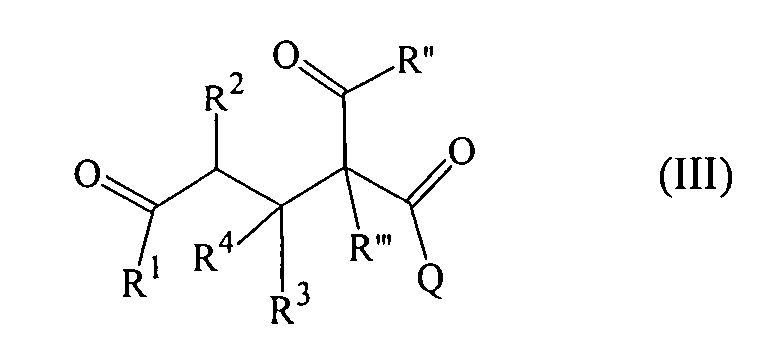
- R1, R', and R" represent, independently from each other, an aromatic ring possibly substituted, or a linear or branched C1-C8 alkyl or alkenyl group, possibly substituted;
- R''' represents a hydrogen atom or a linear or branched C1-C4 alkyl or alkenyl group ;
- R2, R3, R4, represent, independently from each other, a hydrogen atom or an aromatic ring possibly substituted, or a linear, branched or cyclic C1-C8 alkyl or alkenyl group, possibly substituted, provided that at least two of said R2, R3 and R4 groups do not represent simultaneously an hydrogen atom ; or
- two of the groups R1 to R4 are bonded together to form a ring having 5 to 15 carbon atoms, said ring being possibly substituted; characterized in that a β,β- or a α,β-disubstituted, or a α,β,β-trisubstituted, α,β-unsaturated ketone (I)
-
- As non-limiting examples, groups which are possible substituents of R1, R2, R3, R4, R', R" and of the ring, which two of said R1 to R4 may form together, are C1-C7 alkyl, alkenyl or alkoxy groups, C5-C7 cycloalkyl or cycloalkenyl groups, or aromatic rings possibly substituted by a C1-C8 alkyl or alkoxy group or a halide atom.
- Preferably, Q represents a R' or a OR' group ;
- R', R' and R" represent, independently from each other, a linear C1-C5 alkyl or alkenyl group, possibly substituted;
- R''' represents a hydrogen atom or a linear or branched C1-C3 alkyl group ;
- R2, R3 and R4 represent a hydrogen atom or a linear C1-C5 alkyl or alkenyl group, possibly substituted, provided that at least two of said R2, R3 and R4 groups do not represent simultaneously an hydrogen atom; or
- two of the groups R1 to R4 are bonded together to form a ring having 5 to 8 carbon atoms, said ring being possibly substituted.
-
- As non-limiting examples, groups which are possible substituents of R1, R2, R3, R4, R', R" and of the ring, which two of said R1 to R4 may form together, are C1-C4 alkyl, alkenyl or alkoxy groups, C5-C6 cycloalkyl or cycloalkenyl groups or aromatic groups possibly substituted by a C1-C6 linear or branched alkyl or alkoxy group or a halide atom.
- More preferably, the compound of formula (I) is 4-methyl-3-penten-2-one or 3-methyl-3-penten-2-one, and the compound of formula (II) is 2,4-pentanedione or a C1-C4 alkyl ester of the 3-oxo-butanoate.
- Preferred catalysts of formula M(X)n are those wherein M is selected from the group consisting of the 3d transition metals, the lanthanides, the trimethylsilane group (Me3Si), the vanadyl group (VO3+), the alkaline metals, Sc, Y, Sn, Pb, Al and Bi ;
- n is an integer from 1 to 3 ; and
- X is selected from the group consisting of CF3SO3 -, RSO3 -, SbF6 -, PF6 -, ClO4 -, [BF3(RCOCRCOR)]-, [BF3(RCOCRCO2R)]-, [BF3(RCOO)]-, [BF3(RO)]-, BZ4 -, Z being a fluoride atom or an alkyl or aryl group possibly substituted, and R representing an C1-C10 aromatic, alkylaromatic or alkyl group, possibly substituted.
-
- Groups which are possible substituents of Z and R are, for example, halides atomts, C1 to C6 alkyl or alkoxy groups or non-coordinatng nitrogen containing groups.
- More preferably M is selected from the group consisting of Cu, Zn, Y and Yb ;
- n is an integer from 1 to 3 ; and
- X is selected from the group consisting of CF3SO3 -, C6H5SO3 -, CH3C6H4SO3 -, CH3SO3 -, SbF6 -, PF6 -, ClO4 -, [BF3(acac)]- (acac representing CH3COCHCOCH3 -), [BF3(CH3COO)]-, BF4 - and BPh4 -.
-
- In general, the catalyst may be added to the reaction media as a pure and isolated chemical or it can be prepared in situ, by several methods, in the reaction medium, without isolation or purification, just before its use.
- One of the possible procedures to advantageously prepare in situ a catalyst according to the invention consists in reacting an appropriate anhydrous metal salt of formula M(acac)n or M(RCOO)n, R being defined as herein above and n being an integer from 2 to 3, with n equivalents, in respect to the metal, of BF3·OEt2 in a solvent, e.g. an ester. The mixture thus obtained is ready to be used in the process of the invention. Alternatively, it is possible to use a hydrate form of a catalyst of the invention, which is generally commercially available, and to proceed to a dehydration, using any of the conventional methods of the art, prior the use of said catalyst in the process.
- The catalyst can be added to the reaction medium in a large range of concentration. As non-limiting examples, one can cite as catalyst concentration values ranging from 0.001 to 0.1 molar equivalents, relative to the α,β-unsaturated ketone (I). Preferably, the catalyst concentration will be comprised between 0.005 and 0.05 molar equivalents. It goes without saying that the optimum concentration of catalyst will depend on the nature of the latter and on the desired time of reaction.
- The process of the invention can be carried out in presence or absence of solvent, but in any case it is advantageously performed in anhydrous conditions, wherein by anhydrous is intended a content in water below 1% by weight, preferably below 0.5%. When a solvent is required, it is possible to use a pure solvent or a mixture of solvents. Said solvent is chemically compatible with the reaction and does not deactivate the catalyst, e.g. a weakly or non-coordinating solvent. Preferred solvents for the process of the invention are selected from the group consisting of ethers, carboxylic acids, esters, ketones, aromatic solvent, linear or branched or cyclic hydrocarbons, chlorinated solvents and mixture thereof. More preferably, the solvent is selected from the group consisting of C4-C6 ethers, C2-C8 esters, C3-C6 ketones, acetic acid, methylene chloride and mixture thereof.
- The temperature at which the process of the invention can be carried out is comprised between -20°C and 100°C, preferably between 0°C and 50°C. Of course a person skilled in the art is also able to select the preferred temperature as a function of the melting and boiling point of the starting and final products and/or an eventual solvent.
- The process of the invention may also be advantageously carried out under pressure of an inert gas such as nitrogen. In said eventuality, a pressure ranging from 1.5 bar to 20 Kbar, preferably from 2 to 200 bar, may be used.
- The invention will now be described in further details by way of the following examples, wherein the abbreviations have the usual meaning in the art, the temperatures are indicated in degrees centigrade (°C) ; the NMR spectral data were recorded with a 360MHz machine in CDCl3, the chemical displacement δ are indicated in ppm with respect to the TMS as standard, the coupling constant J are expressed in Hz and all the abbreviations have the usual meaning in the art.
- A suspension of 0.135 g of Cu(acac)2 (0.517 mmole) is stirred at 25°C in 0.7 g of ethylacetate. Boron trifluoride etherate (0.154 g ; 1.08 mmole) is added over 30 min. at 30°C and agitation is continued for 2 h. The resulting homogeneous solution is added as such to a mixture of 6 g of methyl 3-oxo-butanoate (51.7 mmole) and 5.07 g of 4-methyl-3-penten-2-one (51.7 mmole). The resulting solution is stirred at room temperature over 16 h and finally heated at 60°C for an hour. After cooling down to 30°C, 1.5 g of cyclohexane is added and the solution is stirred vigorously in the presence of 2.25 g of a 20% aqueous solution of Na4EDTA. After the removal of the aqueous phase the resulting organic layer is washed with 2 g of 20% aqueous potassium carbonate and then with 2 g of a saturated sodium chloride solution.
- The solvent and the unreacted material (starting materials) are distilled out under reduced pressure. The oily residue is distilled, in a bulb to bulb apparatus, at 110-130°C under 1-2 mbar. 4 g of methyl 2-acetyl-3,3-dimethyl-5-oxo-hexanoate are obtained (>95% purity) corresponding to 36% yield.
- 1H-NMR : 1.16(s, 6H) ; 2.11(s, 3H) ; 2.21(s, 3H); 2.72(d.d, 2H); 3.71(s, 3H) ; 4.12(s, 1H).
- 13C-NMR : 25.7(q); 26.1(q); 31.7(q); 31.9(q); 35.6(s); 51.9(q) ; 52.0(t); 63.7(d); 169.7(s); 203.4(s); 208.4(s).
- MS : 214(M+, 0.8); 172(6.0); 157(38.0); 139(10.0); 125(77.8) ; 116(58.5); 115(92.0); 99(80.0); 83(99.2) ; 55(42.5); 43(100.0); 29(34.0).
-
- A suspension of 0.135 g of Cu(acac)2 (0.517mmole) is stirred at 25°C in 0.7 g of ethylacetate. Boron trifluoride etherate (0.154 g ; 1.08 mmole) is added over 30 min. at 30°C and agitation is continued for 2 h. The resulting homogeneous solution is added as such to a mixture of 6 g of 2,4-pentanedione (60 mmole) and 5.88 g of 4-methyl-3-penten-2-one (60 mmole). The resulting solution is stirred at room temperature over 6 h and finally heated at 50°C for an hour. After cooling down to 30°C, 1.5 g of cyclohexane is added and the solution is stirred vigorously in the presence of 2.25 g of a 20% aqueous solution of Na4EDTA. After the removal of the aqueous phase the resulting organic layer is washed with 2 g of 20% aqueous potassium carbonate and then with 2 g of a saturated sodium chloride solution.
- The solvent and the unreacted material (starting materials) are distilled out under reduced pressure. The oily residue is distilled, in a bulb to bulb apparatus, at 100-120°C under 1-2 mbar. 3.8 g of 3-acetyl-4,4-dimethyl-2,6-heptanedione are obtained (90% purity) corresponding to 28% yield.
- 1H-NMR : 1.16(s, 6H) ; 2.11(s, 3H) ; 2.21(s, 6H) ; 2.68(s, 2H) ; 4.37(s, 1H).
- 13C-NMR : 26.3(q); 26.3(q); 31.9(q); 32.7(q); 32.7(q); 36.4(s) ; 52.2(t); 71.2(d); 204.9(s); 204.9(s); 208.6(s).
- MS : 198(M+, 0.1); 165(1.2) ; 156(4.3); 141(12.5); 123(7.6); 99(59.9) ; 83(12.8); 55(4.5); 43(100.0); 29(3.4).
-
- A suspension of 0.135 g of Cu(acac)2 (0.517 mmole) is stirred at 25°C in 0.7 g of ethylacetate. Boron trifluoride etherate (0.154 g ; 1.08 mmole) is added over 30 min, at 30°C and agitation is continued for 2 h. The resulting homogeneous solution is added as such to a mixture of 6 g of methyl 3-oxo-butanoate (51.7 mmole) and 5.07 g of 3-methyl-3-penten-2-one (51.7 mmole). The resulting solution is stirred at room temperature. After cooling down to 30°C, 1.5 g of cyclohexane is added and the solution is stirred vigorously in the presence of 2.25 g of a 20% aqueous solution of Na4EDTA. After the removal of the aqueous phase the resulting organic layer is washed with 2 g of 20% aqueous potassium carbonate and then with 2 g of a saturated sodium chloride solution.
- The solvent and the unreacted material (starting materials) are distilled out under reduced pressure. The oily residue is distilled, in a bulb to bulb apparatus, at 110-130°C under 1-2 mbar. 6.5 g of methyl 2-acetyl-3,4-dimethyl-5-oxo-hexanoate (mixture of 4 diastereoisomers) are obtained, corresponding to 58.5% yield.
- 1H-NMR : 0.78, 0.83, 0.95-1.05, 1.12(d, 6H); 2.15, 2.18(s, 3H); 2.21, 2.22, 2.23, 2.27(s, 3H); 2.60, 2.80(m, 2H); 3.50, 3.80(d, 1H); 3.68, 3.72, 3.74, 3.75(s, 3H).
- 13C-NMR : 9.64, 10.91, 12.52, 12.63, 13.93, 14.36, 14.77, 15.09(q) ; 28.38, 28.68, 29.45, 29.49, 29.53, 29.66, 30.03, 30.37(q); 33.14, 33.47, 34.90, 35.71(d); 48.17, 48.50, 49.31, 49.47(d); 52.24, 52.38, 52.38, 52.55(q); 61.20, 61.95, 63.10, 63.53(d) ; 169.3(s); 202.3, 202.5, 202.9, 202.9(s); 210.6, 211.0, 211.3, 211.9(s).
- MS : 214(M+) ; 196; 183; 171; 167; 159; 143; 139; 129; 116; 111; 101; 99; 97; 85; 72; 69; 43.
-
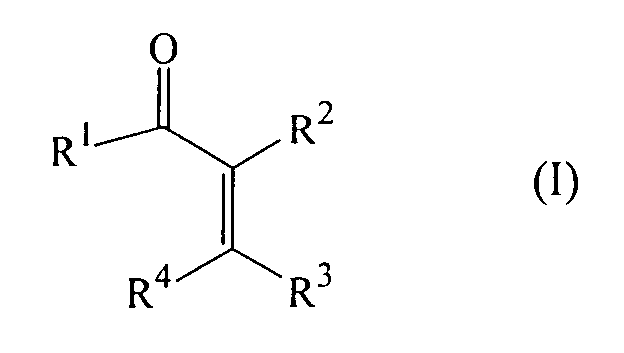
is reacted with a β-ketoester or a (3-diketone (II)

in the presence of a catalyst of formula M(X)n, M representing a metal or a group containing a metal, n representing an integer from 1 to 4 and X representing a weakly coordinating or non-coordinating mono-anion.
Claims (10)
- A process for the preparation of a compound of formula (III):wherein Q represents a R' group, a OR' group, or a NH2, NHR' or NR'2 group ;
 characterized in that a β,β- or a α,β-disubstituted, or a α,β,β-trisubstituted, α,β-unsaturated ketone (I)R', R', and R" represent, independently from each other, an aromatic ring possibly substituted, or a linear or branched C1-C8 alkyl or alkenyl group, possibly substituted ;R''' represents a hydrogen atom or a linear or branched C1-C4 alkyl or alkenyl group ;R2, R3, R4, represent, independently from each other, a hydrogen atom or an aromatic ring possibly substituted, or a linear, branched or cyclic C1-C8 alkyl or alkenyl group, possibly substituted, provided that at least two of said R2, R3 and R4 groups do not represent simultaneously a hydrogen atom ; ortwo of the groups R1 to R4 are bonded together to form a ring having 5 to 15 carbon atoms, said ring being possibly substituted;wherein R1, R2, R3 and R4 have the same meaning as in formula (III),
is reacted with a β-ketoester or a (β-diketone (II)wherein Y, R" and R''' have the same meaning as in formula (III),
in the presence of a catalyst of formula M(X)n, M representing a metal or a group containing a metal, n representing an integer from 1 to 4 and X representing a weakly coordinating or non-coordinating mono-anion. - A process according to claim 1, characterized in that Q represents a R' or a OR' group ;R1, R' and R" represent, independently from each other, a linear C1-C5 alkyl or alkenyl group, possibly substituted;R''' represents a hydrogen atom or a linear or branched C1-C3 alkyl group ;R2, R3 and R4 represent a hydrogen atom or a linear C1-C5 alkyl or alkenyl group, possibly substituted, provided that at least two of said R2, R3 and R4 groups do not represent simultaneously a hydrogen atom; ortwo of the groups R1 to R4 are bonded together to form a ring having 5 to 8 carbon atoms, said ring being possibly substituted.
- A process according to claim 1 or 2, characterized in that M is selected from the group consisting of the 3d transition metals, the lanthanides, the trimethylsilane group, the vanadyl group, the alkaline metals, Sc, Y, Sn, Pb, Al and Bi;n is an integer from 1 to 3 ; andX is selected from the group consisting of CF3SO3 -, RSO3 -, SbF6 -, PF6 -, ClO4 -, [BF3(RCOCRCOR)]-, [BF3(RCOCRCO2R)]-, [BF3(RCOO)]-, [BF3(RO)]-, BZ4 -, Z being a fluoride atom or an alkyl or aryl group possibly substituted, and R representing an C1-C10 aromatic, alkylaromatic or alkyl group, possibly substituted.
- A process according to claim 3, characterized in that M is selected from the group consisting of Cu, Zn, Y and Yb, and X is selected from the group consisting of CF3SO3 -, C6H5SO3 -, CH3C6H4SO3 -, CH3SO3 -, SbF6 -, PF6 -, ClO4 -, [BF3(CH3COCHCOCH3)]-, [BF3(CH3COO)]-, BF4 - and BPh4 -.
- A process according to any one of claims 1 to 4, characterized in that the catalyst is prepared in situ by reacting an appropriate anhydrous metal salt of formula M(CH3COCHCOCH3)n or M(RCOO)n, R being defined as in claim 3 and n being an integer from 2 to 3, with n equivalents, in respect to the metal, of BF3·OEt2 in a solvent.
- A process according to any one of claims 1 to 4, characterized in that the catalyst is prepared in situ by dehydration of a hydrate form of the catalyst.
- A process according to any one of claims 1 to 6, characterized in that it is performed in the absence of solvent.
- A process according to any one of claims 1 to 6, characterized in that it is performed in a solvent with a content in water below 0.5% by weight, and said solvent is selected from the group consisting of C4-C6 ethers, C2-C8 esters, C3-C6 ketones, acetic acid, methylene chloride and mixture thereof.
- A process according to any one of claims 1 or 8, characterized in that the α,β-unsaturated ketone (I) is 4-methyl-3-penten-2-one or 3-methyl-3-penten-2-one and the β-ketoester (II) is a C1-C4 alkyl ester of the 3-oxo-butanoate or 2,4-pentanedione.
- As a compound, methyl 2-acetyl-3,3-dimethyl-5-oxo-hexanoate, 3-acetyl-4,4-dimethyl-2,6-heptanedione or methyl 2-acetyl-3,4-dimethyl-5-oxo-hexanoate.
Applications Claiming Priority (2)
| Application Number | Priority Date | Filing Date | Title |
|---|---|---|---|
| IBPCT/IB01/00318 | 2001-03-07 | ||
| WOPCT/IB01/00318 | 2001-03-07 |
Publications (2)
| Publication Number | Publication Date |
|---|---|
| EP1238962A1 true EP1238962A1 (en) | 2002-09-11 |
| EP1238962B1 EP1238962B1 (en) | 2008-02-27 |
Family
ID=11004049
Family Applications (1)
| Application Number | Title | Priority Date | Filing Date |
|---|---|---|---|
| EP02003307A Expired - Lifetime EP1238962B1 (en) | 2001-03-07 | 2002-02-13 | A process for the preparation of michael-adducts |
Country Status (6)
| Country | Link |
|---|---|
| US (1) | US6686498B2 (en) |
| EP (1) | EP1238962B1 (en) |
| JP (1) | JP4138337B2 (en) |
| AT (1) | ATE387421T1 (en) |
| DE (1) | DE60225199T2 (en) |
| ES (1) | ES2299538T3 (en) |
Cited By (1)
| Publication number | Priority date | Publication date | Assignee | Title |
|---|---|---|---|---|
| CN104159884A (en) * | 2012-02-03 | 2014-11-19 | 株式会社Lg生命科学 | Method for preparing compound by novel michael addition reaction using water or various acids as additive |
Families Citing this family (4)
| Publication number | Priority date | Publication date | Assignee | Title |
|---|---|---|---|---|
| FR2806008B1 (en) * | 2000-03-08 | 2002-09-27 | Centre Nat Rech Scient | SOLID CATALYST WITH HYDROTALCITE STRUCTURE INTEGRATING FLUORIDE IONS |
| CN100582072C (en) * | 2004-11-11 | 2010-01-20 | 弗门尼舍有限公司 | Synthesis of cyclopentenone |
| US7279605B2 (en) * | 2004-11-11 | 2007-10-09 | Firmenich Sa | Synthesis of cyclopentenones |
| JP5544415B2 (en) * | 2010-03-11 | 2014-07-09 | 独立行政法人科学技術振興機構 | Polymer-supported boron catalyst and production method of Michael addition reaction product using this catalyst |
Citations (2)
| Publication number | Priority date | Publication date | Assignee | Title |
|---|---|---|---|---|
| EP0088423A2 (en) * | 1982-03-08 | 1983-09-14 | Daikin Kogyo Co., Ltd. | Fluoroketones and cyclic condensation products thereof |
| EP0826652A1 (en) * | 1995-03-22 | 1998-03-04 | Nagase & Company, Ltd. | Process for preparing asymmetric compound by using metal complex |
Family Cites Families (1)
| Publication number | Priority date | Publication date | Assignee | Title |
|---|---|---|---|---|
| US5017649A (en) * | 1988-01-19 | 1991-05-21 | Eastman Kodak Company | Low temperature Michael addition reactions |
-
2002
- 2002-02-13 EP EP02003307A patent/EP1238962B1/en not_active Expired - Lifetime
- 2002-02-13 DE DE60225199T patent/DE60225199T2/en not_active Expired - Lifetime
- 2002-02-13 AT AT02003307T patent/ATE387421T1/en not_active IP Right Cessation
- 2002-02-13 ES ES02003307T patent/ES2299538T3/en not_active Expired - Lifetime
- 2002-02-14 US US10/077,551 patent/US6686498B2/en not_active Expired - Lifetime
- 2002-03-07 JP JP2002061871A patent/JP4138337B2/en not_active Expired - Lifetime
Patent Citations (2)
| Publication number | Priority date | Publication date | Assignee | Title |
|---|---|---|---|---|
| EP0088423A2 (en) * | 1982-03-08 | 1983-09-14 | Daikin Kogyo Co., Ltd. | Fluoroketones and cyclic condensation products thereof |
| EP0826652A1 (en) * | 1995-03-22 | 1998-03-04 | Nagase & Company, Ltd. | Process for preparing asymmetric compound by using metal complex |
Non-Patent Citations (6)
| Title |
|---|
| DATABASE CA [online] CHEMICAL ABSTRACTS SERVICE, COLUMBUS, OHIO, US; SORIENTE, ANNUNZIATA ET AL: "K10 montmorillonite catalysis", XP002195727, retrieved from STN Database accession no. 131:257027 * |
| DATABASE CROSSFIRE BEILSTEIN [online] Beilstein Institut zur Förderung der Chemischen Wissenschaften, Frankfurt am Main, DE; XP002195726, Database accession no. 3743097 * |
| GREEN CHEM. (1999), 1(3), 157-162 * |
| KOTSUKI H ET AL: "Yb(OTf)3-CATALYZED MICHAEL ADDITION REACTIONS OF beta-KETOESTERS ON SILICA GEL SUPPORTS AND AT HIGH PRESSURE", TETRAHEDRON LETTERS, ELSEVIER SCIENCE PUBLISHERS, AMSTERDAM, NL, vol. 38, no. 43, 27 October 1997 (1997-10-27), pages 7583 - 7586, XP004189848, ISSN: 0040-4039 * |
| SORIENTE A ET AL: "Solvent Free Reaction Under Microwave Irradiation: A New Procedure For Eu-Catalyzed Michael Addition of 1,3-Dicarbonyl Compounds", TETRAHEDRON LETTERS, ELSEVIER SCIENCE PUBLISHERS, AMSTERDAM, NL, vol. 38, no. 2, 13 January 1997 (1997-01-13), pages 289 - 290, XP004070527, ISSN: 0040-4039 * |
| WILLIAM G. DAUBEN: "Organic reactions at high pressure. Michael addition of activated acyclic donors with beta,beta-disubstituted enone acceptors.", TETRAHEDRON LETTERS, vol. 24, no. 36, 1983, pages 3841 - 3844, XP001062825 * |
Cited By (2)
| Publication number | Priority date | Publication date | Assignee | Title |
|---|---|---|---|---|
| CN104159884A (en) * | 2012-02-03 | 2014-11-19 | 株式会社Lg生命科学 | Method for preparing compound by novel michael addition reaction using water or various acids as additive |
| CN104159884B (en) * | 2012-02-03 | 2016-01-13 | 株式会社Lg生命科学 | The method of compound is prepared as the novel reversal of the Michael addition of additive by using water or multiple acid |
Also Published As
| Publication number | Publication date |
|---|---|
| DE60225199D1 (en) | 2008-04-10 |
| JP2002308818A (en) | 2002-10-23 |
| DE60225199T2 (en) | 2009-03-05 |
| EP1238962B1 (en) | 2008-02-27 |
| ES2299538T3 (en) | 2008-06-01 |
| US6686498B2 (en) | 2004-02-03 |
| ATE387421T1 (en) | 2008-03-15 |
| JP4138337B2 (en) | 2008-08-27 |
| US20020128504A1 (en) | 2002-09-12 |
Similar Documents
| Publication | Publication Date | Title |
|---|---|---|
| US7550633B2 (en) | Method for the production of isopulegol | |
| US6699911B2 (en) | Catalytic reduction of alkyne compounds | |
| EP1238962B1 (en) | A process for the preparation of michael-adducts | |
| EP1008583B1 (en) | Process for making 2-alkyl-3-hydroxybenzoic acids | |
| JPH0621096B2 (en) | Process for producing pseudoionone and similar compounds | |
| US7091151B2 (en) | Catalytic system for aldol reactions | |
| EP0076721A1 (en) | Process for the carbonylation of secondary benzyl halides | |
| JP2001252570A (en) | Chiral rare earth metal catalyst and asymmetric aldol reaction method | |
| EA005857B1 (en) | Intermediates foe use in the preparation of vitamin e | |
| JPH0920716A (en) | Production of 2,2-dialkylarylidenecycloalkanones | |
| EP0330203B1 (en) | Catalytic process for preparing ethylene-tetracarboxylic esters | |
| US20010041742A1 (en) | Process for producing 2-substituted propionic acid | |
| US6838582B2 (en) | Process for preparing 2,4,4,6-tetrabromo-2,5-cycloyhexadienone | |
| JP4384840B2 (en) | Method for producing amide | |
| JPS6058934A (en) | Isomerization of epoxide | |
| JP4361876B2 (en) | Method for synthesizing 2,4,4,6-tetrabromo-2,5-cyclohexadienone | |
| EP1179520A1 (en) | Process for the preparation of phytone and novel intermediates thereof | |
| JPS6358812B2 (en) | ||
| WO1997024300A1 (en) | Cross-coupling of organic compounds using cuprous iodide | |
| JPH05345740A (en) | Process for producing 5- (4-chlorophenyl) -2-pentanone | |
| JPS59104339A (en) | Preparation of 2,15-hexadecanedione | |
| EP0290015A1 (en) | Process for preparing macrocyclic 2-Halogenoketones | |
| JPS6252735B2 (en) | ||
| JP2003073361A (en) | Method for producing imidazolidinone derivative | |
| JP2002047273A (en) | Method for producing dihalogeno cyclic compound |
Legal Events
| Date | Code | Title | Description |
|---|---|---|---|
| PUAI | Public reference made under article 153(3) epc to a published international application that has entered the european phase |
Free format text: ORIGINAL CODE: 0009012 |
|
| AK | Designated contracting states |
Kind code of ref document: A1 Designated state(s): AT BE CH CY DE DK ES FI FR GB GR IE IT LI LU MC NL PT SE TR |
|
| AX | Request for extension of the european patent |
Free format text: AL;LT;LV;MK;RO;SI |
|
| 17P | Request for examination filed |
Effective date: 20030311 |
|
| AKX | Designation fees paid |
Designated state(s): AT BE CH CY DE DK ES FI FR GB GR IE IT LI LU MC NL PT SE TR |
|
| 17Q | First examination report despatched |
Effective date: 20070329 |
|
| GRAP | Despatch of communication of intention to grant a patent |
Free format text: ORIGINAL CODE: EPIDOSNIGR1 |
|
| GRAS | Grant fee paid |
Free format text: ORIGINAL CODE: EPIDOSNIGR3 |
|
| GRAA | (expected) grant |
Free format text: ORIGINAL CODE: 0009210 |
|
| AK | Designated contracting states |
Kind code of ref document: B1 Designated state(s): AT BE CH CY DE DK ES FI FR GB GR IE IT LI LU MC NL PT SE TR |
|
| REG | Reference to a national code |
Ref country code: GB Ref legal event code: FG4D |
|
| REG | Reference to a national code |
Ref country code: CH Ref legal event code: EP |
|
| REG | Reference to a national code |
Ref country code: IE Ref legal event code: FG4D |
|
| REF | Corresponds to: |
Ref document number: 60225199 Country of ref document: DE Date of ref document: 20080410 Kind code of ref document: P |
|
| REG | Reference to a national code |
Ref country code: ES Ref legal event code: FG2A Ref document number: 2299538 Country of ref document: ES Kind code of ref document: T3 |
|
| PG25 | Lapsed in a contracting state [announced via postgrant information from national office to epo] |
Ref country code: FI Free format text: LAPSE BECAUSE OF FAILURE TO SUBMIT A TRANSLATION OF THE DESCRIPTION OR TO PAY THE FEE WITHIN THE PRESCRIBED TIME-LIMIT Effective date: 20080227 |
|
| NLV1 | Nl: lapsed or annulled due to failure to fulfill the requirements of art. 29p and 29m of the patents act | ||
| PG25 | Lapsed in a contracting state [announced via postgrant information from national office to epo] |
Ref country code: AT Free format text: LAPSE BECAUSE OF FAILURE TO SUBMIT A TRANSLATION OF THE DESCRIPTION OR TO PAY THE FEE WITHIN THE PRESCRIBED TIME-LIMIT Effective date: 20080227 |
|
| PG25 | Lapsed in a contracting state [announced via postgrant information from national office to epo] |
Ref country code: BE Free format text: LAPSE BECAUSE OF FAILURE TO SUBMIT A TRANSLATION OF THE DESCRIPTION OR TO PAY THE FEE WITHIN THE PRESCRIBED TIME-LIMIT Effective date: 20080227 |
|
| PG25 | Lapsed in a contracting state [announced via postgrant information from national office to epo] |
Ref country code: PT Free format text: LAPSE BECAUSE OF FAILURE TO SUBMIT A TRANSLATION OF THE DESCRIPTION OR TO PAY THE FEE WITHIN THE PRESCRIBED TIME-LIMIT Effective date: 20080721 Ref country code: DK Free format text: LAPSE BECAUSE OF FAILURE TO SUBMIT A TRANSLATION OF THE DESCRIPTION OR TO PAY THE FEE WITHIN THE PRESCRIBED TIME-LIMIT Effective date: 20080227 Ref country code: NL Free format text: LAPSE BECAUSE OF FAILURE TO SUBMIT A TRANSLATION OF THE DESCRIPTION OR TO PAY THE FEE WITHIN THE PRESCRIBED TIME-LIMIT Effective date: 20080227 Ref country code: SE Free format text: LAPSE BECAUSE OF FAILURE TO SUBMIT A TRANSLATION OF THE DESCRIPTION OR TO PAY THE FEE WITHIN THE PRESCRIBED TIME-LIMIT Effective date: 20080527 |
|
| PLBE | No opposition filed within time limit |
Free format text: ORIGINAL CODE: 0009261 |
|
| STAA | Information on the status of an ep patent application or granted ep patent |
Free format text: STATUS: NO OPPOSITION FILED WITHIN TIME LIMIT |
|
| 26N | No opposition filed |
Effective date: 20081128 |
|
| PG25 | Lapsed in a contracting state [announced via postgrant information from national office to epo] |
Ref country code: CY Free format text: LAPSE BECAUSE OF FAILURE TO SUBMIT A TRANSLATION OF THE DESCRIPTION OR TO PAY THE FEE WITHIN THE PRESCRIBED TIME-LIMIT Effective date: 20080227 |
|
| PG25 | Lapsed in a contracting state [announced via postgrant information from national office to epo] |
Ref country code: IT Free format text: LAPSE BECAUSE OF FAILURE TO SUBMIT A TRANSLATION OF THE DESCRIPTION OR TO PAY THE FEE WITHIN THE PRESCRIBED TIME-LIMIT Effective date: 20080227 |
|
| PG25 | Lapsed in a contracting state [announced via postgrant information from national office to epo] |
Ref country code: MC Free format text: LAPSE BECAUSE OF NON-PAYMENT OF DUE FEES Effective date: 20090228 |
|
| PG25 | Lapsed in a contracting state [announced via postgrant information from national office to epo] |
Ref country code: IE Free format text: LAPSE BECAUSE OF NON-PAYMENT OF DUE FEES Effective date: 20090213 |
|
| PG25 | Lapsed in a contracting state [announced via postgrant information from national office to epo] |
Ref country code: GR Free format text: LAPSE BECAUSE OF FAILURE TO SUBMIT A TRANSLATION OF THE DESCRIPTION OR TO PAY THE FEE WITHIN THE PRESCRIBED TIME-LIMIT Effective date: 20080528 |
|
| PG25 | Lapsed in a contracting state [announced via postgrant information from national office to epo] |
Ref country code: LU Free format text: LAPSE BECAUSE OF NON-PAYMENT OF DUE FEES Effective date: 20090213 |
|
| PG25 | Lapsed in a contracting state [announced via postgrant information from national office to epo] |
Ref country code: TR Free format text: LAPSE BECAUSE OF FAILURE TO SUBMIT A TRANSLATION OF THE DESCRIPTION OR TO PAY THE FEE WITHIN THE PRESCRIBED TIME-LIMIT Effective date: 20080227 |
|
| REG | Reference to a national code |
Ref country code: FR Ref legal event code: PLFP Year of fee payment: 15 |
|
| REG | Reference to a national code |
Ref country code: FR Ref legal event code: PLFP Year of fee payment: 16 |
|
| REG | Reference to a national code |
Ref country code: FR Ref legal event code: PLFP Year of fee payment: 17 |
|
| REG | Reference to a national code |
Ref country code: DE Ref legal event code: R081 Ref document number: 60225199 Country of ref document: DE Owner name: FIRMENICH SA, CH Free format text: FORMER OWNER: FIRMENICH S.A., GENF/GENEVE, CH |
|
| REG | Reference to a national code |
Ref country code: CH Ref legal event code: PCOW Free format text: NEW ADDRESS: 7, RUE DE LA BERGERE, 1242 SATIGNY (CH) |
|
| PGFP | Annual fee paid to national office [announced via postgrant information from national office to epo] |
Ref country code: FR Payment date: 20210126 Year of fee payment: 20 Ref country code: CH Payment date: 20210115 Year of fee payment: 20 |
|
| PGFP | Annual fee paid to national office [announced via postgrant information from national office to epo] |
Ref country code: DE Payment date: 20210202 Year of fee payment: 20 Ref country code: ES Payment date: 20210305 Year of fee payment: 20 Ref country code: GB Payment date: 20210203 Year of fee payment: 20 |
|
| REG | Reference to a national code |
Ref country code: DE Ref legal event code: R071 Ref document number: 60225199 Country of ref document: DE |
|
| REG | Reference to a national code |
Ref country code: CH Ref legal event code: PL |
|
| REG | Reference to a national code |
Ref country code: GB Ref legal event code: PE20 Expiry date: 20220212 |
|
| PG25 | Lapsed in a contracting state [announced via postgrant information from national office to epo] |
Ref country code: GB Free format text: LAPSE BECAUSE OF EXPIRATION OF PROTECTION Effective date: 20220212 |
|
| REG | Reference to a national code |
Ref country code: ES Ref legal event code: FD2A Effective date: 20220526 |
|
| PG25 | Lapsed in a contracting state [announced via postgrant information from national office to epo] |
Ref country code: ES Free format text: LAPSE BECAUSE OF EXPIRATION OF PROTECTION Effective date: 20220214 |