EP1238703A2 - Carbon monoxide selective oxidizing catalyst and manufacturing method for the same - Google Patents
Carbon monoxide selective oxidizing catalyst and manufacturing method for the same Download PDFInfo
- Publication number
- EP1238703A2 EP1238703A2 EP02004860A EP02004860A EP1238703A2 EP 1238703 A2 EP1238703 A2 EP 1238703A2 EP 02004860 A EP02004860 A EP 02004860A EP 02004860 A EP02004860 A EP 02004860A EP 1238703 A2 EP1238703 A2 EP 1238703A2
- Authority
- EP
- European Patent Office
- Prior art keywords
- carbon monoxide
- selective oxidizing
- hydrogen
- monoxide selective
- oxidizing catalyst
- Prior art date
- Legal status (The legal status is an assumption and is not a legal conclusion. Google has not performed a legal analysis and makes no representation as to the accuracy of the status listed.)
- Withdrawn
Links
Images






Classifications
-
- H—ELECTRICITY
- H01—ELECTRIC ELEMENTS
- H01M—PROCESSES OR MEANS, e.g. BATTERIES, FOR THE DIRECT CONVERSION OF CHEMICAL ENERGY INTO ELECTRICAL ENERGY
- H01M8/00—Fuel cells; Manufacture thereof
- H01M8/06—Combination of fuel cells with means for production of reactants or for treatment of residues
- H01M8/0662—Treatment of gaseous reactants or gaseous residues, e.g. cleaning
-
- B—PERFORMING OPERATIONS; TRANSPORTING
- B01—PHYSICAL OR CHEMICAL PROCESSES OR APPARATUS IN GENERAL
- B01J—CHEMICAL OR PHYSICAL PROCESSES, e.g. CATALYSIS OR COLLOID CHEMISTRY; THEIR RELEVANT APPARATUS
- B01J29/00—Catalysts comprising molecular sieves
- B01J29/04—Catalysts comprising molecular sieves having base-exchange properties, e.g. crystalline zeolites
- B01J29/06—Crystalline aluminosilicate zeolites; Isomorphous compounds thereof
- B01J29/064—Crystalline aluminosilicate zeolites; Isomorphous compounds thereof containing iron group metals, noble metals or copper
- B01J29/068—Noble metals
-
- B—PERFORMING OPERATIONS; TRANSPORTING
- B01—PHYSICAL OR CHEMICAL PROCESSES OR APPARATUS IN GENERAL
- B01J—CHEMICAL OR PHYSICAL PROCESSES, e.g. CATALYSIS OR COLLOID CHEMISTRY; THEIR RELEVANT APPARATUS
- B01J29/00—Catalysts comprising molecular sieves
- B01J29/04—Catalysts comprising molecular sieves having base-exchange properties, e.g. crystalline zeolites
- B01J29/06—Crystalline aluminosilicate zeolites; Isomorphous compounds thereof
- B01J29/40—Crystalline aluminosilicate zeolites; Isomorphous compounds thereof of the pentasil type, e.g. types ZSM-5, ZSM-8 or ZSM-11, as exemplified by patent documents US3702886, GB1334243 and US3709979, respectively
- B01J29/42—Crystalline aluminosilicate zeolites; Isomorphous compounds thereof of the pentasil type, e.g. types ZSM-5, ZSM-8 or ZSM-11, as exemplified by patent documents US3702886, GB1334243 and US3709979, respectively containing iron group metals, noble metals or copper
- B01J29/44—Noble metals
-
- B—PERFORMING OPERATIONS; TRANSPORTING
- B01—PHYSICAL OR CHEMICAL PROCESSES OR APPARATUS IN GENERAL
- B01J—CHEMICAL OR PHYSICAL PROCESSES, e.g. CATALYSIS OR COLLOID CHEMISTRY; THEIR RELEVANT APPARATUS
- B01J29/00—Catalysts comprising molecular sieves
- B01J29/04—Catalysts comprising molecular sieves having base-exchange properties, e.g. crystalline zeolites
- B01J29/06—Crystalline aluminosilicate zeolites; Isomorphous compounds thereof
- B01J29/40—Crystalline aluminosilicate zeolites; Isomorphous compounds thereof of the pentasil type, e.g. types ZSM-5, ZSM-8 or ZSM-11, as exemplified by patent documents US3702886, GB1334243 and US3709979, respectively
- B01J29/42—Crystalline aluminosilicate zeolites; Isomorphous compounds thereof of the pentasil type, e.g. types ZSM-5, ZSM-8 or ZSM-11, as exemplified by patent documents US3702886, GB1334243 and US3709979, respectively containing iron group metals, noble metals or copper
- B01J29/46—Iron group metals or copper
-
- B—PERFORMING OPERATIONS; TRANSPORTING
- B01—PHYSICAL OR CHEMICAL PROCESSES OR APPARATUS IN GENERAL
- B01J—CHEMICAL OR PHYSICAL PROCESSES, e.g. CATALYSIS OR COLLOID CHEMISTRY; THEIR RELEVANT APPARATUS
- B01J29/00—Catalysts comprising molecular sieves
- B01J29/04—Catalysts comprising molecular sieves having base-exchange properties, e.g. crystalline zeolites
- B01J29/06—Crystalline aluminosilicate zeolites; Isomorphous compounds thereof
- B01J29/65—Crystalline aluminosilicate zeolites; Isomorphous compounds thereof of the ferrierite type, e.g. types ZSM-21, ZSM-35 or ZSM-38, as exemplified by patent documents US4046859, US4016245 and US4046859, respectively
- B01J29/66—Crystalline aluminosilicate zeolites; Isomorphous compounds thereof of the ferrierite type, e.g. types ZSM-21, ZSM-35 or ZSM-38, as exemplified by patent documents US4046859, US4016245 and US4046859, respectively containing iron group metals, noble metals or copper
- B01J29/67—Noble metals
-
- B—PERFORMING OPERATIONS; TRANSPORTING
- B01—PHYSICAL OR CHEMICAL PROCESSES OR APPARATUS IN GENERAL
- B01J—CHEMICAL OR PHYSICAL PROCESSES, e.g. CATALYSIS OR COLLOID CHEMISTRY; THEIR RELEVANT APPARATUS
- B01J29/00—Catalysts comprising molecular sieves
- B01J29/04—Catalysts comprising molecular sieves having base-exchange properties, e.g. crystalline zeolites
- B01J29/06—Crystalline aluminosilicate zeolites; Isomorphous compounds thereof
- B01J29/65—Crystalline aluminosilicate zeolites; Isomorphous compounds thereof of the ferrierite type, e.g. types ZSM-21, ZSM-35 or ZSM-38, as exemplified by patent documents US4046859, US4016245 and US4046859, respectively
- B01J29/66—Crystalline aluminosilicate zeolites; Isomorphous compounds thereof of the ferrierite type, e.g. types ZSM-21, ZSM-35 or ZSM-38, as exemplified by patent documents US4046859, US4016245 and US4046859, respectively containing iron group metals, noble metals or copper
- B01J29/68—Iron group metals or copper
-
- C—CHEMISTRY; METALLURGY
- C01—INORGANIC CHEMISTRY
- C01B—NON-METALLIC ELEMENTS; COMPOUNDS THEREOF; METALLOIDS OR COMPOUNDS THEREOF NOT COVERED BY SUBCLASS C01C
- C01B3/00—Hydrogen; Gaseous mixtures containing hydrogen; Separation of hydrogen from mixtures containing it; Purification of hydrogen; Reversible storage of hydrogen
- C01B3/50—Separation of hydrogen or hydrogen-containing gases from gaseous mixtures, e.g. purification
- C01B3/56—Separation of hydrogen or hydrogen-containing gases from gaseous mixtures, e.g. purification by contacting with solids; Regeneration of used solids
- C01B3/58—Separation of hydrogen or hydrogen-containing gases from gaseous mixtures, e.g. purification by contacting with solids; Regeneration of used solids including a catalytic reaction
- C01B3/583—Separation of hydrogen or hydrogen-containing gases from gaseous mixtures, e.g. purification by contacting with solids; Regeneration of used solids including a catalytic reaction the reaction being the selective oxidation of carbon monoxide
-
- H—ELECTRICITY
- H01—ELECTRIC ELEMENTS
- H01M—PROCESSES OR MEANS, e.g. BATTERIES, FOR THE DIRECT CONVERSION OF CHEMICAL ENERGY INTO ELECTRICAL ENERGY
- H01M8/00—Fuel cells; Manufacture thereof
- H01M8/06—Combination of fuel cells with means for production of reactants or for treatment of residues
- H01M8/0662—Treatment of gaseous reactants or gaseous residues, e.g. cleaning
- H01M8/0668—Removal of carbon monoxide or carbon dioxide
-
- B—PERFORMING OPERATIONS; TRANSPORTING
- B01—PHYSICAL OR CHEMICAL PROCESSES OR APPARATUS IN GENERAL
- B01J—CHEMICAL OR PHYSICAL PROCESSES, e.g. CATALYSIS OR COLLOID CHEMISTRY; THEIR RELEVANT APPARATUS
- B01J29/00—Catalysts comprising molecular sieves
- B01J29/04—Catalysts comprising molecular sieves having base-exchange properties, e.g. crystalline zeolites
- B01J29/06—Crystalline aluminosilicate zeolites; Isomorphous compounds thereof
- B01J29/064—Crystalline aluminosilicate zeolites; Isomorphous compounds thereof containing iron group metals, noble metals or copper
-
- B—PERFORMING OPERATIONS; TRANSPORTING
- B01—PHYSICAL OR CHEMICAL PROCESSES OR APPARATUS IN GENERAL
- B01J—CHEMICAL OR PHYSICAL PROCESSES, e.g. CATALYSIS OR COLLOID CHEMISTRY; THEIR RELEVANT APPARATUS
- B01J29/00—Catalysts comprising molecular sieves
- B01J29/04—Catalysts comprising molecular sieves having base-exchange properties, e.g. crystalline zeolites
- B01J29/06—Crystalline aluminosilicate zeolites; Isomorphous compounds thereof
- B01J29/076—Crystalline aluminosilicate zeolites; Isomorphous compounds thereof containing arsenic, antimony, bismuth, vanadium, niobium, tantalum, polonium, chromium, molybdenum, tungsten, manganese, technetium or rhenium
-
- C—CHEMISTRY; METALLURGY
- C01—INORGANIC CHEMISTRY
- C01B—NON-METALLIC ELEMENTS; COMPOUNDS THEREOF; METALLOIDS OR COMPOUNDS THEREOF NOT COVERED BY SUBCLASS C01C
- C01B2203/00—Integrated processes for the production of hydrogen or synthesis gas
- C01B2203/04—Integrated processes for the production of hydrogen or synthesis gas containing a purification step for the hydrogen or the synthesis gas
- C01B2203/0435—Catalytic purification
- C01B2203/044—Selective oxidation of carbon monoxide
-
- C—CHEMISTRY; METALLURGY
- C01—INORGANIC CHEMISTRY
- C01B—NON-METALLIC ELEMENTS; COMPOUNDS THEREOF; METALLOIDS OR COMPOUNDS THEREOF NOT COVERED BY SUBCLASS C01C
- C01B2203/00—Integrated processes for the production of hydrogen or synthesis gas
- C01B2203/04—Integrated processes for the production of hydrogen or synthesis gas containing a purification step for the hydrogen or the synthesis gas
- C01B2203/0465—Composition of the impurity
- C01B2203/047—Composition of the impurity the impurity being carbon monoxide
-
- Y—GENERAL TAGGING OF NEW TECHNOLOGICAL DEVELOPMENTS; GENERAL TAGGING OF CROSS-SECTIONAL TECHNOLOGIES SPANNING OVER SEVERAL SECTIONS OF THE IPC; TECHNICAL SUBJECTS COVERED BY FORMER USPC CROSS-REFERENCE ART COLLECTIONS [XRACs] AND DIGESTS
- Y02—TECHNOLOGIES OR APPLICATIONS FOR MITIGATION OR ADAPTATION AGAINST CLIMATE CHANGE
- Y02E—REDUCTION OF GREENHOUSE GAS [GHG] EMISSIONS, RELATED TO ENERGY GENERATION, TRANSMISSION OR DISTRIBUTION
- Y02E60/00—Enabling technologies; Technologies with a potential or indirect contribution to GHG emissions mitigation
- Y02E60/30—Hydrogen technology
- Y02E60/50—Fuel cells
-
- Y—GENERAL TAGGING OF NEW TECHNOLOGICAL DEVELOPMENTS; GENERAL TAGGING OF CROSS-SECTIONAL TECHNOLOGIES SPANNING OVER SEVERAL SECTIONS OF THE IPC; TECHNICAL SUBJECTS COVERED BY FORMER USPC CROSS-REFERENCE ART COLLECTIONS [XRACs] AND DIGESTS
- Y02—TECHNOLOGIES OR APPLICATIONS FOR MITIGATION OR ADAPTATION AGAINST CLIMATE CHANGE
- Y02P—CLIMATE CHANGE MITIGATION TECHNOLOGIES IN THE PRODUCTION OR PROCESSING OF GOODS
- Y02P70/00—Climate change mitigation technologies in the production process for final industrial or consumer products
- Y02P70/50—Manufacturing or production processes characterised by the final manufactured product
Definitions
- the invention relates to carbon monoxide selective oxidizing catalysts that promote a reaction of oxidizing carbon monoxide by giving carbon monoxide priority over hydrogen and manufacturing methods for the same.
- a reformed gas obtained by reforming gasoline or a hydrocarbon-based fuel such as natural gas or alcohol is employed as a hydrogen-rich fuel gas used in an electrochemical reaction in a fuel cell.
- a reformed gas generally contains a certain amount of carbon monoxide.
- a carbon monoxide concentration reduction apparatus is employed to reduce the concentration of carbon monoxide contained in the reformed gas before the reformed gas is supplied to the fuel cell, thereby preventing the catalyst in the fuel cell from being poisoned by carbon monoxide.
- One of the reactions performed in the carbon monoxide concentration reduction apparatus is a carbon monoxide selective oxidizing reaction that oxidizes carbon monoxide by giving carbon monoxide priority over hydrogen.
- the oxidation reaction of carbon monoxide is represented by an equation I described below. CO + (1/2)O 2 ⁇ CO 2
- Japanese Patent Application Laid-Open Publication No. 11-347414 discloses a catalyst in which a platinum alloy is supported on a carrier including mordenite, a kind of zeolite. According to the art disclosed in this publication, the percentage of metals other than the platinum contained in the platinum alloy is controlled to 20 to 50 atomic percent, thereby improving the performance of the carbon monoxide selective oxidizing catalyst.
- the above-mentioned carbon monoxide selective oxidizing reaction is to selectively oxidize an extremely small amount of carbon monoxide present in a large amount of hydrogen. Therefore, in general, as the reaction temperature becomes higher, the oxidizing reaction of hydrogen becomes more active, thereby decreasing the efficiency of reducing the carbon monoxide concentration. This results in a problem that the fuel utilization efficiency decreases.
- undesirable reactions for example, a methanation reaction that methanates hydrogen
- the carbon monoxide selective oxidizing catalyst should achieve a higher carbon monoxide concentration reduction rate, provide higher selectivity in oxidizing carbon monoxide, and exhibit sufficient activity at lower temperatures.
- One object of the invention is to provide a superior technology for reducing the concentration of carbon monoxide contained in a hydrogen-rich gas that contains carbon monoxide, like a reformed gas.
- a first aspect of the invention relates to a carbon monoxide selective oxidizing catalyst provided with a carrier which includes ferrierite or ZSM-5; and a metal component supported on the carrier and which includes platinum (Pt) alone or platinum (Pt) and at least one type of transition metal.
- This carbon monoxide selective oxidizing catalyst receives a supply of a hydrogen-rich gas containing carbon monoxide, and promotes a carbon monoxide selective oxidizing reaction that oxidizes the carbon monoxide by giving the carbon monoxide priority over hydrogen.
- a second aspect of the invention relates to a carbon monoxide selective oxidizing catalyst provided with a carrier whose maximum pore diameter ranges from 0.55 to 0.65 nanometers (nm); and a metal component supported on the carrier and which includes platinum (Pt) alone or platinum (Pt) and at least one type of transition metal.
- This carbon monoxide selective oxidizing catalyst receives a supply of a hydrogen-rich gas containing carbon monoxide and promotes a carbon monoxide selective oxidizing reaction that oxidizes the carbon monoxide by giving the carbon monoxide priority over hydrogen.
- a third aspect of the invention relates to a carbon monoxide selective oxidizing catalyst which receives a supply of a hydrogen-rich gas containing carbon monoxide, and promotes a carbon monoxide selective oxidizing reaction that oxidizes the carbon monoxide by giving the carbon monoxide priority over hydrogen. It is provided with a metal component that includes platinum (Pt) alone or platinum (Pt) and at least one type of transition metal.
- This carbon monoxide selective oxidizing catalyst achieves a carbon monoxide reduction rate of 90% or higher when it performs the carbon monoxide selective oxidizing reaction under conditions (a) through (c) described below:
- a molar ratio value between Y and Z means the number of moles of Y for 1 mole of Z.
- a fourth aspect of the invention relates to a manufacturing method for a carbon monoxide selective oxidizing catalyst which receives a supply of a hydrogen-rich gas containing carbon monoxide, and promotes a carbon monoxide selective oxidizing reaction that oxidizes the carbon monoxide by giving the carbon monoxide priority over hydrogen.
- the manufacturing method includes the following processes ( ⁇ 1) and ( ⁇ 2):
- a fifth aspect of the invention relates to a manufacturing method for a carbon monoxide selective oxidizing catalyst which receives a supply of a hydrogen-rich gas containing carbon monoxide, and promotes a carbon monoxide selective oxidizing reaction that oxidizes the carbon monoxide by giving the carbon monoxide priority over hydrogen.
- the manufacturing method includes the following processes ( ⁇ 1) and ( ⁇ 2):
- the carbon monoxide selective oxidizing catalysts in the above-mentioned aspects of the invention and the carbon monoxide selective oxidizing catalysts manufactured in the above-mentioned aspects of the invention, it is possible to achieve a higher carbon monoxide reduction rate when the carbon monoxide concentration in the hydrogen-rich gas is reduced.
- a sixth aspect of the invention relates to a carbon monoxide concentration reduction apparatus including a hydrogen-rich gas supply means that supplies the hydrogen-rich gas; an oxygen supply means that supplies oxygen used for oxidizing the carbon monoxide; the carbon monoxide selective oxidizing catalyst according to one of the first to the third aspect of the invention; and a carbon monoxide selective oxidizing reactor.
- the carbon monoxide selective oxidizing reactor includes the catalyst and receives a supply of the hydrogen-rich gas and the oxygen from the hydrogen-rich gas supply means and the oxygen supply means, respectively, and selectively oxidizes the carbon monoxide contained in the hydrogen-rich gas through the carbon monoxide selective oxidizing reaction.
- the carbon monoxide concentration reduction apparatus oxidizes the carbon monoxide contained in the hydrogen-rich gas, thereby reducing the carbon monoxide concentration in the hydrogen-rich gas.
- a seventh aspect of the invention relates to a fuel cell system provided with a fuel cell that receives a supply of a fuel gas containing hydrogen and an oxidizing gas containing oxygen to obtain an electromotive force through an electrochemical reaction.
- the fuel cell system is provided with a fuel gas supply means that supplies the fuel gas to the fuel cell.
- the fuel gas supply means is provided with the carbon monoxide concentration reduction apparatus according to the sixth aspect of the invention.
- the fuel gas supply means supplies the fuel cell with a hydrogen-rich gas whose carbon monoxide concentration has been reduced as the fuel gas, by using the carbon monoxide concentration reduction apparatus.
- a carbon monoxide selective oxidizing catalyst may be manufactured by supporting a transition element on the carrier in addition to platinum (Pt). Such a carbon monoxide selective oxidizing catalyst can achieve a sufficiently high carbon monoxide reduction rate even when the reaction temperature of the carbon monoxide selective oxidizing reaction is set at a lower value.
- the transition metal iron, nickel, cobalt, manganese, copper, ruthenium, chromium, palladium, rhodium, or iridium is preferably used. Particularly, iron is preferable. If iron is selected as the transition metal, the molar ratio value between the platinum content in a solution used for supporting the platinum on the carrier and the iron content in a solution used for supporting the iron on the carrier ([Pt]/[Fe]) is preferably 1.5 to 7.5. Particularly, the value of [Pt]/[Fe] is preferably 2 to 6, and more preferably about 4.
- the carbon monoxide selective oxidizing catalyst is preferably subjected to a reduction processing after the metal component has been supported on the carrier and before the catalyst is used for promoting the carbon monoxide selective oxidizing reaction.
- the reduction processing is preferably performed at a temperature higher than that of the hydrogen-rich gas used for the carbon monoxide selective oxidizing reaction, e.g., at 150°C to 370°C.
- the fuel cell catalyst can be prevented from being poisoned by carbon monoxide, and thus the cell performance can be maintained at a high level.
- a carbon monoxide selective oxidizing catalyst according to a first embodiment of the invention is provided with a carrier which includes ferrierite or ZSM-5; and a metal component which includes platinum (Pt) alone or platinum (Pt) and at least one type of transition metal and which is supported on the carrier.
- a carrier which includes ferrierite or ZSM-5; and a metal component which includes platinum (Pt) alone or platinum (Pt) and at least one type of transition metal and which is supported on the carrier.
- Each of the ferrierite and ZSM-5 is a kind of zeolite which is a porous body having a number of pores in a predetermined size.
- Each of the atoms of zeolite forms a three-dimensional network structure in which tetrahedrons share a vertex. A void formed in this three-dimensional network structure corresponds to a pore.
- the carbon monoxide selective oxidizing catalyst When the carbon monoxide selective oxidizing catalyst is used to promote the carbon monoxide selective oxidizing reaction in the hydrogen-rich gas containing carbon monoxide, carbon monoxide and hydrogen move through the pores together with oxygen. At this time, if the size of the pore is within an appropriate range, hydrogen whose molecule is small moves through the pores quickly, while carbon monoxide and oxygen whose molecules arc larger tend to stay in the pores (i.e., in the catalyst) for a longer period of time. As a result, it is considered that carbon monoxide becomes easier to oxidize selectively. Thus, it is considered that the size of the pore, particularly the value of the longest diameter in the pore, i.e., the maximum pore diameter is an important factor directly associated with the carbon monoxide selective oxidizing performance.
- the size of the pore of ferrierite used as the carrier is 0.43 ⁇ 0.55 nm, for example, and the maximum pore diameter is 0.55 nm.
- the size of the pore of ZSM-5 is 0.54 ⁇ 0.54 nm, for example, and the maximum pore diameter is 0.54 nm.
- the pore diameter size varies depending on the type of exchange cation.
- the pore size is 0.42 ⁇ 0.42 nm (the maximum pore diameter is 0.42 nm), and when the exchange cation is Ca 2+ , the pore size is 0.5 ⁇ 0.5 nm (the maximum pore diameter is 0.5 nm). In the case of mordenite, still another type of zeolite, the pore size is 0.67 ⁇ 0.70 (the maximum pore diameter is 0.7 m).
- the carrier (ferrierite, ZSM-5) of the carbon monoxide selective oxidizing catalyst according to the first embodiment the pore has an appropriate size. Therefore, the catalyst achieves outstanding catalytic performance (a higher carbon monoxide reduction rate) as the carbon monoxide selective oxidizing catalyst.
- a carbon monoxide selective oxidizing catalyst according to a second embodiment of the invention is provided with a carrier having the maximum pore diameter of 0.55 to 0.65 nanometers (nm); and a metal component which includes platinum (Pt) alone or platinum and at least one type of transition metal and which is supported on the cannier.
- Pt platinum
- the catalyst achieves superior catalytic performance (a higher carbon monoxide reduction rate) as the carbon monoxide selective oxidizing catalyst as mentioned above.
- a carrier other than ferrieritc and ZSM-5 can be used, but a solid acid is preferably used as the carrier. It is presumed that the electron density of Pt decreases on a surface of the carbon monoxide selective oxidizing catalyst manufactured using a solid acid as the carrier, a bonding strength between Pt and carbon monoxide is weakened, and Pt is bound with oxygen more easily. When the electron density of Pt decreases, electrons of Pt flow toward the carrier side as observed microscopically, and Pt assumes more positive charges. In general, carbon monoxide has high adsorptivity with respect to platinum. Therefore, a catalyst including platinum may be poisoned by carbon monoxide, and accordingly its catalytic performance may deteriorate.
- the carrier including a solid acid it is considered that the bonding strength between Pt and carbon monoxide is weakened and accordingly the carbon monoxide selective oxidizing catalyst can be prevented from being poisoned by carbon monoxide. Moreover, it is considered that Pt is bound with oxygen more easily, and accordingly the carbon monoxide selective oxidizing reaction can be further promoted.
- the above-mentioned zeolite is also a kind of solid acid.
- one or two or more types of metals are preferably selected from the group consisting of iron (Fe), nickel (Ni), cobalt (Co), manganese (Mn), copper (Cu), ruthenium (Ru), chromium (Cr), palladium (Pd), rhodium (Rh), and iridium (Ir).
- X-ray photoelectron spectroscopy may be used to measure binding energy of electrons, thereby determining the electron density. In an example to be described later, the XPS was applied to ascertain that there was a drop in electron density of the transition metal (not shown).
- the metal is bound with oxygen more easily. It is therefore considered that when there is a transition metal whose electron density has decreased near Pt, more oxygen required for oxidizing carbon monoxide tends to be supplied to Pt that exhibits actual catalytic activity, thereby promoting the carbon monoxide selective oxidizing reaction.
- the transition metal supported together with Pt should have the property of being oxidized more easily and forming a stable oxide more easily. For this reason, the transition metal is preferably selected from the group described above.
- Pt or the transition metal When supporting the transition metal together with Pt on the carrier, Pt or the transition metal may be the first to be supported, or both may be supported at the same time.
- various common methods including an ion exchange method or an impregnation method may be used. It is also possible to positively make an alloy of Pt and the above-mentioned transition metal to be supported on the carrier.
- one type of metal, or two or more types of metals may be used as the above-mentioned transition metal.
- the carbon monoxide reduction rate can be improved in a wide temperature range, particularly in a low temperature range of 200°C or lower. Since the carbon monoxide reduction rate is improved in the lower temperature range, it becomes possible to perform carbon monoxide selective oxidizing reaction at a low temperature at which the activity of undesirable reactions such as a reverse shift reaction and a methanation reaction is sufficiently low.
- the reverse shift reaction refers to a reaction in which carbon monoxide and water are produced from carbon dioxide and hydrogen. This reaction can proceed in an environment where the carbon monoxide selective oxidizing reaction proceeds.
- the activity of the reverse shift reaction becomes high, there arise problems that reduction of the carbon monoxide concentration is inhibited and hydrogen is consumed. Since the reverse shift reaction has a characteristic that the activity becomes higher as the temperature becomes higher, the reverse shift reaction can be suppressed by performing the carbon monoxide selective oxidizing reaction at a lower temperature.
- the reverse shift reaction is represented by an equation II described below. H 2 + CO 2 ⁇ CO + H 2 O ⁇ II
- the methanation reaction is a reaction in which methane is produced from hydrogen, and thus hydrogen is consumed.
- undesirable reactions such as the methanation reaction proceed more easily.
- the molar ratio value between the platinum content in a solution used for supporting the platinum on the carrier and the iron content in a solution used for supporting the iron on the carrier is preferably 1.5 to 7.5, and more preferably 2 to 6, and most preferably about 4.
- the carbon monoxide reduction rate can be improved in a lower temperature range. Therefore, it is possible to perform the carbon monoxide selective oxidizing reaction in a temperature range in which the activity of the above-mentioned undesirable reactions is sufficiently low, thereby improving the efficiency of obtaining the hydrogen-rich gas of high purity.
- the carbon monoxide selective oxidizing catalyst is preferably subjected to a reduction processing after the metal component has been supported on the carrier and before the catalyst is used for promoting the carbon monoxide selective oxidizing reaction. It is preferable that the reduction processing be performed at a temperature higher than the reaction temperature when the carbon monoxide reduction apparatus is used.
- the reaction temperature may be the temperature of the hydrogen-rich gas used for the carbon monoxide selective oxidizing reaction (that is, the temperature of an incoming gas when a hydrogen-rich gas is supplied to the carbon monoxide reduction apparatus).
- the reduction processing temperature is preferably set at 150 to 370°C, and more preferably at 150 to 350°C.
- Pelformillg the reduction processing at such temperature ranges greatly contributes to ensuring good catalytic performance in a temperature range in which the activity of undesirable reactions that can proceed with the carbon monoxide selective oxidizing reaction is sufficiently low (for example, 100 to 180°C). If the reduction processing temperature exceeds 400°C, it is considered that the deterioration of the carrier, i.e., zeolite or the deterioration of the catalyst resulting from sintering of Pt progresses.
- the metal component (Pt and transition metals) is generally subjected to calcination after having been supported on the carrier. Owing to calcination, almost the entire portion of the metal component on the carrier is oxidized.
- the reduction processing is a processing for reducing the metal which has been oxidized as described above to obtain catalytic performance.
- a catalyst which has not been subjected to the reduction processing when used, when the hydrogen-rich gas used in the carbon monoxide selective oxidizing reaction is supplied to the catalyst, it is considered that the reduction processing proceeds gradually according to the temperature of the carbon monoxide selective oxidizing catalyst at that time, the reduction of the metal component is performed to a certain degree according to the temperature of the catalyst.
- the carbon monoxide selective oxidizing reaction be performed at a sufficiently low temperature of 100 to 180°C, preferably at about 100 to 150°C, in order to improve the efficiency of the carbon monoxide selective oxidizing reaction, while suppressing undesirable reactions. Therefore, by performing the reduction processing in advance at a temperature sufficiently higher than the reaction temperature, it becomes possible to obtain sufficiently high catalytic activity from the beginning of the carbon monoxide selective oxidizing reaction. If the temperature of the reduction processing is set at 150°C or higher, the metal oxidized through calcination on the carrier can be sufficiently reduced. The period of time for the reduction processing may be set appropriately according to the shape and size of the carbon monoxide selective oxidizing catalyst so as to ensure that the entire portion of the catalyst is reduced.
- the carbon monoxide selective oxidizing catalyst according to a third embodiment of the invention is provided with a metal component including platinum (Pt) alone or platinum and a predetermined transition metal.
- This carbon monoxide selective oxidizing catalyst achieves a carbon monoxide reduction rate of 90% or higher when the carbon monoxide selective oxidizing reaction of the hydrogen-rich gas is performed under the following conditions (a) through (c):
- the catalyst achieving the carbon monoxide reduction rate of 98% or higher is obtained when the carbon monoxide selective oxidizing reaction is performed under the conditions of (a) through (c).
- the carbon monoxide selective oxidizing reaction should be a reaction in which only carbon monoxide is selectively oxidized with no portions of the hydrogen-rich gas being oxidized.
- the carbon monoxide is completely oxidized if the molar ratio value between oxygen atoms and carbon monoxide molecules ([O]/[CO]) in the supplied hydrogen-rich gas is 1. Therefore, as the carbon monoxide reduction rate becomes higher when the molar ratio value between oxygen atoms and carbon monoxide molecules ([O]/[CO]) is 1, the selectivity in selectively oxidizing only carbon monoxide becomes more excellent.
- the carbon monoxide of the hydrogen-rich gas As the percentage of the oxygen content with respect to the carbon monoxide content becomes higher, the carbon monoxide of the hydrogen-rich gas is oxidized more easily. Thus, the carbon monoxide reduction rate is improved. However, as the amount of supplied oxygen becomes larger, the hydrogen is also oxidized more easily. Therefore, it is preferable that a sufficient carbon monoxide reduction rate be achieved in a condition in which the molar ratio value between oxygen atoms and carbon monoxide molecules ([O]/[CO]) is close to 1.
- the carbon monoxide selective oxidizing catalysts according the first to third embodiments can be employed for reducing the carbon monoxide concentration in the fuel gas supplied to the fuel cell.
- a fuel cell system provided with a fuel reformer that employs a carbon monoxide selective oxidizing catalyst according these embodiments will be described. Any one of the carbon monoxide selective oxidizing catalysts according the first to third embodiments may be used as the carbon monoxide selective oxidizing catalyst.
- Fig. 1 is an explanatory diagram showing a schematic configuration of a fuel cell system provided with such a fuel reformer. This system is provided with a fuel cell 18 and a fuel reformer that generates fuel gas supplied thereto. The fuel reformer generates hydrogen by reforming a predetermined raw fuel.
- the fuel reformer is mainly composed of a reforming portion 10, a cooler 12, a shift portion 14, and a CO oxidizing portion 16.
- the raw fuel may be appropriately chosen from among hydrocarbons including natural gas and gasoline, alcohol including methanol, and hydrocarbon-based fuels such as ether and aldehyde.
- the reforming portion 10 these raw fuels are used with steam and air in a reaction called the steam reforming reaction or partial oxidation reaction to generate a hydrogen-rich gas containing carbon monoxide.
- the reforming portion 10 functions as a hydrogen-rich gas supply apparatus.
- the hydrogen-rich gas generated through the reaction is supplied to the shift portion 14 and the CO oxidizing portion 16 in order to reduce the carbon monoxide concentration.
- Each of the reforming portion 10, shift portion 14, and the CO oxidizing portion 16 is provided with a catalyst that promotes a reaction proceeding therein.
- the internal temperature is controlled so as to be an appropriate reaction temperature according to the catalyst.
- the reforming reaction is performed under a temperature condition of about 900°C, but a shift reaction promoted by a shift catalyst is performed under a temperature condition of about 200 to 300°C. Therefore, in the system shown in Fig. 1, the hydrogen-rich gas generated in the reforming portion 10 is cooled in the cooler 12 before being supplied to the shift portion 14.
- the shift portion 14 receives the supply of the hydrogen-rich gas from the cooler 12 and allows the shift reaction to proceed.
- the shift reaction produces hydrogen and carbon dioxide from carbon monoxide and water.
- the hydrogen-rich gas, whose carbon monoxide concentration has been reduced by the shift portion 14 is supplied to the CO oxidizing portion 16.
- the CO oxidizing portion 16, which reduces the carbon monoxide concentration even further, is provided with one of the carbon monoxide selective oxidizing catalysts according to the first to third embodiments to allow the carbon monoxide selective oxidizing reaction to proceed.
- the CO oxidizing portion 16 may be configured into a container packed with a catalyst formed into pellets or a container housing a honeycomb tube coated with the catalyst.
- the CO oxidizing portion 16 is also provided with the blower 22 that supplies the CO oxidizing portion 16 with compressed air.
- Oxygen contained in the compressed air supplied by the blower 22 is used in the carbon monoxide selective oxidizing reaction.
- the hydrogen-rich gas, whose carbon monoxide concentration has been sufficiently reduced in this manner, is supplied as a fuel gas to an anode side of the fuel cell 18 to be used in electrochemical reactions.
- a blower 24 is connected to a cathode side of the fuel cell 18, and supplies air as an oxidizing gas.
- the CO oxidizing portion 16 is provided with one of the carbon monoxide selective oxidizing catalysts according the furst to third embodiments so as to ensure sufficiently high activity of the carbon monoxide selective oxidizing reaction. Therefore, the CO oxidizing portion 16 can be made more compact, and thus the entire system can be made more compact. Moreover, since the activity of the carbon monoxide selective oxidizing reaction is high, the concentration of carbon monoxide contained in the fuel gas supplied to the fuel cell 18 can be made sufficiently low. Accordingly, it is possible to sufficiently prevent the performance of the fuel cell 18 from deteriorating as a result of the catalyst being poisoned by carbon monoxide.
- the temperature range in which the carbon monoxide concentration can be sufficiently reduced is expanded.
- the temperature range in which the carbon monoxide concentration can be sufficiently reduced is expanded.
- the carbon monoxide concentration can be reduced more stably.
- the carbon monoxide selective oxidizing catalysts according the first to third embodiments by using one of the carbon monoxide selective oxidizing catalysts according the first to third embodiments, sufficiently high activity of the shift reaction can be ensured even under temperature conditions in which the activity of undesirable reactions is sufficiently low (for example, 100 to 180°C). Therefore, it becomes possible to improve the overall efficiency of generating hydrogen from the raw fuel. Moreover, since the carbon monoxide selective oxidizing catalyst according the embodiment exhibits sufficiently high activity at a lower temperature, the time required for warming up the CO oxidizing portion 16 can be made shorter.
- the reforming portion 10, the shift portion 14, and the CO oxidizing portion 16 be warmed to a temperature high enough for the reactions to take place in the reforming portion 10, the shift portion 14, and the CO oxidizing portion 16, and ideal reaction temperatures can be reached in the reforming portion 10, the shift portion 14, and the CO oxidizing portion 16 as soon as possible.
- the CO oxidizing portion 16 is generally warmed by a high temperature gas supplied from an upstream side.
- the carbon monoxide selective oxidizing catalyst is capable of promoting the carbon monoxide selective oxidizing reaction under lower temperature conditions, the carbon monoxide selective oxidizing reaction, that is, an exothermic reaction, proceeds in the CO oxidizing portion 16 under lower temperature conditions. Therefore, it becomes possible to shorten the starting time further.
- a carbon monoxide selective oxidizing catalyst according to a modified embodiment may be applied to the fuel reformer.
- a fuel cell system provided with this fuel reformer may be constructed.
- Examples 1 and 2 a carrier including ferrierite or ZSM-5 was used in a carbon monoxide selective oxidizing catalyst provided with Pt.
- the carbon monoxide selective oxidizing catalysts (1) to (7) described below were compared in terms of catalytic performance.
- the catalysts (1) to (7) are listed in ascending order in terms of the pore diameter in the carrier.
- each of the catalysts (1) to (7) the Pt content was equivalent to 3 % of the carrier weight as indicated above.
- Each of the catalysts (1) to (7) was formed into a pellet. The pellet was packed in a reactor of a predetermined size and the carbon monoxide reduction rate (CO reduction rate) was measured for evaluation of catalytic performance.
- CO reduction rate carbon monoxide reduction rate
- Fig. 2 is an explanatory diagram showing the manufacturing process of the catalyst (2) in Example 1.
- the catalyst was manufactured using the known ion exchange method.
- a pellet including ferrierite was prepared as the catalyst carrier (step S100).
- a pellet measuring about 0.5 ⁇ 1.5 mm was used.
- the pellet was then soaked in a solution that contains hexaammineplatinum hydroxide salt equivalent to 3 % of the weight of the pellet in terms of Pt. Ion exchange was performed between cations of ferrierite and Pt ions in the platinum salt solution so that Pt was supported on the pellet (step S110).
- the pellet was dried for 2 hours or more at 120°C in air (step S120), calcined for 1 hour at 250°C (step S130), and was further subjected to a reduction processing for 2 hours at 300°C in a hydrogen air stream (step S140) to obtain the catalyst (2).
- catalysts were manufactured using the same procedure as that for the catalyst (2) in Example 1.
- a pellet including A-type zeolite, a pellet including ZSM-5, a pellet including mordenite, a pellet including zeolite ⁇ , and a pellet including USY-zeolite were prepared, respectively, instead of the pellet including ferrierite in step S 100.
- the same processings as those in steps S110 through S140 of the manufacturing process shown in Fig. 2 were then performed.
- Pt was supported as in the catalyst (2) to manufacture each catalyst.
- the catalyst (7) When the catalyst (7) was manufactured, a pellet including aluminum oxide (Al 2 O 3 ) was used, and instead of the above-mentioned ion exchange method, the known impregnation method was used. That is, the aluminum oxide pellet was soaked in a dinitrodiamineplatinum nitrate solution equivalent to 3% of the weight of the pellet in terms of Pt to impregnate the pellet with platinum salt. Then, drying, calcination, and reduction processing were performed as in the ion exchange method.
- Al 2 O 3 aluminum oxide
- the known impregnation method was used. That is, the aluminum oxide pellet was soaked in a dinitrodiamineplatinum nitrate solution equivalent to 3% of the weight of the pellet in terms of Pt to impregnate the pellet with platinum salt. Then, drying, calcination, and reduction processing were performed as in the ion exchange method.
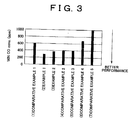
- a test gas of the following composition was supplied to a reactor in which each catalyst manufactured in this manner was packed. Then, the CO reduction rate was measured under the following conditions. Fig. 3 shows the results of the measurement.
- the carbon monoxide concentration (CO concentration) in an exhaust gas discharged from the reactor was measured, while increasing the incoming gas temperature (the temperature of the test gas supplied to the reactor in which each catalyst was packed) sequentially from the room temperature to 300°C.
- the test gas composition was set based on the composition of a typical reformed gas.
- Fig. 3 shows the minimum CO concentration in the exhaust gas achieved by each of the above-mentioned catalysts when the CO concentration in the exhaust gas was measured with the incoming gas temperature sequentially increased as mentioned above. That is, the minimum CO concentration values (MIN CO conc.) in the exhaust gas were plotted as ordinates. The lower the minimum CO concentration, the better the catalytic performance of reducing the CO concentration. As shown in Fig. 3, the catalysts (2) and (3) having ferrierite and ZSM-5 as the carriers thereof, respectively, achieve lower minimum CO concentration values as compared with other catalysts. Thus, the results show that the catalysts (2) and (3) have superior ability to reduce the CO concentration in the supplied hydrogen-rich gas.
- Fig. 4 shows the relationship between the pore diameter of the carrier of each catalyst and the maximum CO reduction rate (MAX CO conv.) achieved by each catalyst.
- the CO reduction rate is represented as the molar ratio between "the content of CO changed to CO 2 through the carbon monoxide selective oxidizing reaction (this CO content is obtained from the CO content in the exhaust gas)" and "the content of CO before the reaction (CO content in the test gas)".
- the greater the CO reduction rate the better the catalytic performance of reducing the CO concentration.
- the maximum CO reduction rate means the greatest CO reduction rate value obtained when the CO reduction rates are calculated after the CO concentration values in the exhaust gas are measured with the incoming gas temperature sequentially changed. As shown in Fig.
- the results show that the catalysts (2) and (3) have superior ability to reduce the CO concentration in the supplied hydrogen-rich gas.
- Examples 3 through 7 in carbon monoxide selective oxidizing catalysts using ferrierite as carriers thereof, various types of transition metals were supported on the carriers in addition to Pt.
- iron (Fe) was supported on a ferrierite carrier together with Pt.
- nickel (Ni) was supported on a ferrierite carrier together with Pt.
- cobalt (Co) was supported on a ferrierite carrier together with Pt.
- manganese (Mn) was supported on a ferrierite carrier together with Pt.
- copper (Cu) was supported on a ferrierite carrier together with Pt.
- steps S100 and S110 in the manufacturing process shown in Fig. 2 were performed to support Pt on the ferrierite carriers. Then, drying and calcination were performed on the carriers on which Pt was supported in steps S120 and S130. Further, the above-mentioned transition metal (one of Fe, Ni, Co, Mn, and Cu) was supported to obtain the catalyst.
- the ferrierite pellet, on which Pt was supported through the ion exchange method was soaked in a solution containing salt of one of the transition metals of Fe, Ni, Co, Mn, and Cu, and was agitated therein so that the transition metal was further supported on the ferrierite pellet. Thereafter, the same drying and calcination processes as steps S120 and S130 were performed to complete each catalyst.
- the manufactured catalyst was packed in a reactor of a predetermined size in the same manner as in Examples 1 and 2.
- the content of Pt supported on the carriers in the process corresponding to step S110 in the manufacturing process shown in Fig. 2 was 3% of the carrier weight.
- each of the above-mentioned transition metals was supported on the carrier so that the molar ratio of the supported Pt content to transition metal content was 3:1.
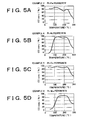
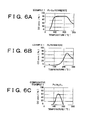
- Figs. 5A to 5D and 6A to 6C show the results of the measurement on the CO reduction rate using these catalysts under the above-mentioned conditions A and B (test gas composition and space velocity).
- the incoming gas temperature was sequentially increased from the room temperature to 300°C, and the CO concentration in the exhaust gas corresponding to each of the incoming gas temperatures was measured.
- changes in the CO reduction rate according to changes in the incoming gas temperature were examined.
- Fig. 5A shows the results in the case of using the catalyst in which iron (Fe) was supported on the ferrierite carrier together with Pt (Example 3).
- Fig. 5B shows the results in the case of using the catalyst in which nickel (Ni) was supported on the ferrierite carrier together with Pt (Example 4).
- Fig. 5C shows the results in the case of using the catalyst in which cobalt (Co) was supported on the ferrierite carrier (Example 5) together with Pt.
- Fig. 5D shows the results in the case of using the catalyst in which manganese (Mn) was supported on the ferrierite carrier together with Pt (Example 6).
- Fig. 5A shows the results in the case of using the catalyst in which iron (Fe) was supported on the ferrierite carrier together with Pt (Example 3).
- Fig. 5B shows the results in the case of using the catalyst in which nickel (Ni) was supported on the ferrierite carrier together with Pt
- FIG. 6A shows the results in the case of using the catalyst in which copper (Cu) was supported on the ferrierite carrier together with Pt (Example 7).
- Figs. 6B and 6C show the results in the cases of using the catalysts in Example 1 and Comparative Example 5, respectively.
- the catalyst in Example 1 in which only Pt was supported on the ferrierite carrier, achieved a higher maximum CO reduction rate as compared with the catalyst in Comparative Example 5 (Fig. 6C), in which Pt was supported on the aluminum oxide carrier.
- the catalysts achieved even better maximum CO reduction rates than those in which only Pt was supported as shown in Figs. 5A to 5D and 6A.
- the range of incoming gas temperatures in which high CO reduction rates could be obtained was expanded as compared with Example 1. The effect was that the range of incoming gas temperatures in which high CO reduction rates could be obtained was expanded toward the lower temperature side.
- Fig. 7A shows the results in the case where the above-mentioned catalyst in Example 1 (Fig. 6B) was used and the molar ratio of Pt to Fe in Example 1 was 3 : 0 (no Fe).
- Fig. 7B shows the results in the case where the catalyst in Example 8 was used, and the molar ratio of Pt to Fe was 3 : 0.2 (the molar ratio value between Pt and Fe is 15).
- Fig. 7C shows the results in the case where the catalyst in Example 9 was used, and the molar ratio of Pt to Fe was 3 : 0.5 (the molar ratio value between Pt and Fe is 6).
- Fig. 7A shows the results in the case where the above-mentioned catalyst in Example 1 (Fig. 6B) was used and the molar ratio of Pt to Fe in Example 1 was 3 : 0 (no Fe).
- Fig. 7B shows the results in the case where the catalyst in Example 8 was used, and the molar ratio of Pt to
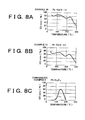
- FIG. 8A shows the results in the case where the catalyst in Example 10 was used, and the molar ratio of Pt to Fe was 3 : 1.0 (the molar ratio value between Pt and Fe is 3).
- Fig. 8B shows the results in the case where the catalyst in Example 11 was used, and the molar ratio of Pt to Fe was 3 : 2.0 (the molar ratio value between Pt and Fe is 1.5).
- the catalyst in Example 10 shown in Fig. 8A is the same as that in Example 3 shown in Fig. 5A.
- the catalyst shown in Fig. 8C is the same as that in Comparative Example 5 shown in Fig. 6C.
- Example 8 through 11 the catalysts were manufactured using the same procedures as in Example 3. Further, when the transition metal Fe was supported on the ferrierite pellet on which Pt had been supported, the Fe content was changed.
- the manufactured catalysts were packed in reactors of a predetermined size in the same manner as in Examples 1 through 7 described earlier.
- the content of Pt supported on the ferrierite carrier was 3 % of the carrier weight as in the Examples described earlier.
- Figs. 7A to 7C, and 8A to 8C show changes in the CO reduction rate according to changes in the incoming gas temperature when the incoming gas temperature was sequentially increased from the room temperature up to 300°C and the CO concentration in the exhaust gas corresponding to each of the incoming gas temperatures was measured.
- Fig. 9 shows the relationship between the CO reduction rate and the Fe content when the incoming gas temperature was 130°C in Figs. 7A to 7C and 8A to 8C. Note that a point at which the molar ratio of Pt to Fe was 3 : 0.75 (the molar ratio value between Pt and Fe was 4) and a point at which the molar ratio of Pt to Fe was 3 : 2.5 (the molar ratio value between Pt and Fe was 1.2) are added in Fig. 9.
- the highest carbon monoxide reduction rate was achieved when the molar ratio of Pt to Fe was from 3 : 0.5 (the molar ratio value between Pt and Fe was 6) to 3 : 1.0 (the molar ratio value between Pt and Fe was 3), especially when the ratio was about 3 : 0.75 (the molar ratio value between Pt and Fe was 4) in the case where the incoming gas temperature was 130°C.
- Example 12 the conditions for the reduction processing were changed when the carbon monoxide selective oxidizing catalyst, in which Fe was supported in addition to Pt, was manufactured.
- the catalysts in Example 12 were manufactured in the same manner as in Example 3. That is, Pt equivalent to 3% of the canier weight was supported on a ferrierite pellet. Further, Fe was additionally supported such that the molar ratio of Pt to Fe was 3 : 0.75.
- the reduction processing was performed on each catalyst in a hydrogen stream for 2 hours at a different temperature.
- the manufactured catalysts were packed in reactors of a predetermined size as in the other Examples mentioned earlier.
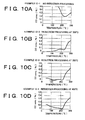
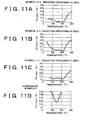
- a catalyst in Example 12-1 shown in Fig. 10A was not subjected to any reduction processing; a catalyst in Example 12-2 shown in Fig. 10B was subjected to a reduction processing at 300°C; a catalyst in Example 12-3 shown in Fig. 10C was subjected to a reduction processing at 350°C; a catalyst in Example 12-4 shown in Fig. 10D was subjected to a reduction processing at 400°C; a catalyst in Example 12-5 shown in Fig. 11A was subjected to a reduction processing at 450°C; a catalyst in Example 12-6 shown in Fig. 11B was subjected to a reduction processing at 500°C; and a catalyst in Example 12-7 shown in Fig. 11C was subjected to a reduction processing at 600°C.
- the catalyst shown in Fig. 11D is the same as that in Comparative Example 5 shown in Fig. 6C.
- the incoming gas temperature was sequentially increased from the room temperature to 300°C, and the CO concentration in the exhaust gas corresponding to each of the incoming gas temperatures was measured under the above-mentioned conditions A and B (test gas composition and space velocity).
- a and B test gas composition and space velocity
- Fig. 12 is based on the results shown in Figs. 10A to 10D and 11A to 11D, and shows the relationship between the reduction temperature and the CO concentration in the exhaust gas when the incoming gas temperature was 110°C. As shown in Fig. 12, the carbon monoxide concentration in the exhaust gas was particularly low when the reduction temperature was lower than 400° C.
- Example 13 the carbon monoxide reduction rate was examined when changing the ratio between "the content of carbon monoxide in the hydrogen-rich gas whose carbon monoxide concentration is to be reduced" and "the content of oxygen used in the carbon monoxide selective oxidizing reaction".
- the catalyst in Example 13 was formed using a ceramic honeycomb. On the ceramic honeycomb, a ferrierite carrier, Pt, and Fe were supported.
- the carbon monoxide selective oxidizing catalyst in Example 13 was manufactured as follows. First, a ceramic honeycomb was coated with a slurry manufactured by adding a predetermined binder to ferrierite powder as the catalyst carrier, and was then calcined. The ceramic honeycomb coated with ferrierite was soaked in a solution containing Pt salt and a solution containing Fe salt in the same manner as in the examples described earlier so as to support Pt and Fe on the ferrierite, and was subjected to calcination and reduction processing.
- the carbon monoxide selective oxidizing catalyst in Comparative Example 6 was manufactured in the same manner as in Example 13, except that, instead of applying the ferrierite slurry, an aluminum oxide slurry was applied to the ceramic honeycomb as the catalyst carrier and only Pt was supported on the applied aluminum oxide.
- the carrier was applied to the ceramic honeycomb.
- the content of the carrier was 120 grams per 1 liter of ceramic honeycomb volume.
- the content of supported Pt was 3 % of the carrier weight.
- the content of Fe supported in the carbon monoxide selective oxidizing catalyst in Example 13 was set such that the molar ratio of Pt to Fe was 3 : 1.
- Fig. 13 shows the results of measurement on the carbon monoxide concentration in the exhaust gas when the molar ratio value between oxygen atoms and carbon monoxide molecules ([O]/[CO]) in the supplied hydrogen-rich gas (test gas) was changed to 1, 2, and 3, in the case where the carbon monoxide concentration in the hydrogen-rich gas was reduced using the carbon monoxide selective oxidizing catalyst in Example 13 and the carbon monoxide selective oxidizing catalyst in Comparative Example 6. Measurement conditions are as follows.
- the carbon monoxide concentration in the exhaust gas could be reduced to 100 ppm or lower at all times when the molar ratio value between oxygen atom and carbon monoxide molecule was in the above-mentioned range. That is, under the conditions mentioned above, a carbon monoxide reduction rate of 98% or higher was achieved.
- the carbon monoxide selective oxidizing catalyst in Comparative Example 6 when the molar ratio value between oxygen and carbon monoxide was 2 or 3, the carbon monoxide concentration in the exhaust gas was about 500 ppm and the carbon monoxide reduction rate was about 90%.
- the carbon monoxide concentration in the exhaust gas was about 2300 ppm and the carbon monoxide reduction rate was about 54%.
- a carbon monoxide selective oxidizing catalyst includes a carrier of ferrierite or ZSM-5 that supports a metal component of platinum (Pt) alone or platinum and at least one type of transition metal.
- a carbon monoxide selective oxidizing catalyst includes a carrier whose maximum pore diameter ranges from 0.55 to 0.65 nanometers (nm) that supports a metal component of platinum (Pt) alone or platinum and at least one type of transition metal.
Landscapes
- Chemical & Material Sciences (AREA)
- Engineering & Computer Science (AREA)
- Chemical Kinetics & Catalysis (AREA)
- Organic Chemistry (AREA)
- Crystallography & Structural Chemistry (AREA)
- Materials Engineering (AREA)
- Sustainable Development (AREA)
- Manufacturing & Machinery (AREA)
- Life Sciences & Earth Sciences (AREA)
- Sustainable Energy (AREA)
- Electrochemistry (AREA)
- General Chemical & Material Sciences (AREA)
- Combustion & Propulsion (AREA)
- Inorganic Chemistry (AREA)
- Catalysts (AREA)
- Fuel Cell (AREA)
- Industrial Gases (AREA)
- Hydrogen, Water And Hydrids (AREA)
Abstract
Description
Claims (24)
- A carbon monoxide selective oxidizing catalyst that promotes a carbon monoxide selective oxidizing reaction that oxidizes the carbon monoxide by giving the carbon monoxide priority over hydrogen when the carbon monoxide selective oxidizing catalyst receives a supply of a hydrogen-rich gas containing carbon monoxide, the carbon monoxide selective oxidizing catalyst, characterized by comprising:a carrier consisting essentially of one of ferrierite and ZSM-5; anda metal component supported on the carrier and which includes one of platinum (Pt) alone and platinum (Pt) and at least one type of transition metal, wherein
- A carbon monoxide selective oxidizing catalyst promotes a carbon monoxide selective oxidizing reaction that oxidizes the carbon monoxide by giving the carbon monoxide priority over hydrogen when the carbon monoxide selective oxidizing catalyst receives a supply of a hydrogen-rich gas containing carbon monoxide, the carbon monoxide selective oxidizing catalyst, characterized by comprising:a carrier whose maximum pore diameter ranges from 0.55 to 0.65 nanometers (nm); anda metal component supported on the carrier and which includes one of platinum (Pt) alone and platinum (Pt) and at least one type of transition metal.
- A carbon monoxide selective oxidizing catalyst according to claim 2, wherein the carrier is a solid acid.
- A carbon monoxide selective oxidizing catalyst according to any one of claims 1 to 3, wherein the transition metal is at least one type of metal selected from the group consisting of iron (Fe), nickel (Ni), cobalt (Co), manganese (Mn), copper (Cu), ruthenium (Ru), chromium (Cr), palladium (Pd), rhodium (Rh), and iridium (Ir).
- A carbon monoxide selective oxidizing catalyst according to claim 4, wherein the transition metal is iron, and a molar ratio value between a platinum content in a solution used for supporting the platinum on the carrier and an iron content in a solution used for supporting the iron on the carrier ([Pt]/[Fe]) is 1.5 to 7.5 when the carbon monoxide selective oxidizing catalyst is manufactured.
- A carbon monoxide selective oxidizing catalyst according to claim 5, wherein the molar ratio value ([Pt]/[Fe]) is 2 to 6.
- A carbon monoxide selective oxidizing catalyst according to claim 6, wherein the molar ratio value ([Pt]/[Fe]) is about 4.
- A carbon monoxide selective oxidizing catalyst according to any one of claims 1 to 7, wherein the carbon monoxide sclective oxidizing catalyst is subjected to a reduction processing before being used in order to promote the carbon monoxide selective oxidizing reaction after the metal component has been supported on the carrier.
- A carbon monoxide selective oxidizing catalyst according to claim 8, wherein the reduction processing is performed at a temperature higher than a temperature of the hydrogen-rich gas used for the carbon monoxide selective oxidizing reaction.
- A carbon monoxide selective oxidizing catalyst according to claim 8, wherein the reduction processing is performed at 150 to 370°C.
- A carbon monoxide selective oxidizing catalyst that receives a supply of a hydrogen-rich gas containing carbon monoxide and promotes a carbon monoxide selective oxidizing reaction that oxidizes the carbon monoxide by giving the carbon monoxide priority over hydrogen, wherein
the catalyst is provided with a metal component including one of platinum (Pt) alone and platinum and at least one type of transition metal, and achieves a carbon monoxide reduction rate of at least 90% when the carbon monoxide selective oxidizing reaction is performed under following conditions (a) through (c):(a) contents of components other than hydrogen in the hydrogen-rich gas are as follows: a carbon monoxide concentration is about 5000 ppm; a carbon dioxide concentration is about 25 %; and an oxygen content is such that a molar ratio value between oxygen atoms and carbon monoxide molecules ([O]/[CO]) is 1;(b) a space velocity is about 22000h-1 when the hydrogen-rich gas is supplied onto the carbon monoxide selective oxidizing catalyst; and(c) a reaction temperature is 130°C. - A carbon monoxide selective oxidizing catalyst according to claim 11, wherein the carbon monoxide reduction rate of at least 98 % is achieved when the carbon monoxide selective oxidizing reaction is performed under the conditions (a) through (c).
- A carbon monoxide concentration reduction apparatus that oxidizes the carbon monoxide contained in the hydrogen-rich gas, thereby reducing a carbon monoxide concentration in the hydrogen-rich gas , the carbon monoxide concentration reduction apparatus, characterized by comprising:a hydrogen-rich gas supply means (10) for supplying the hydrogen-rich gas;an oxygen supply means (22) for supplying oxygen used for oxidizing the carbon monoxide;the carbon monoxide selective oxidizing catalyst according to any one of claims 1 to 12; anda carbon monoxide selective oxidizing reactor (16) that includes the carbon monoxide selective oxidizing catalyst and receives a supply of the hydrogen-rich gas and the oxygen from the hydrogen-rich gas supply means (10) and the oxygen supply means (22), respectively, to selectively oxidize carbon monoxide contained in the hydrogen-rich gas through the carbon monoxide selective oxidizing reaction.
- A fuel cell system provided with a fuel cell (18) that receives a supply of a fuel gas containing hydrogen and an oxidizing gas containing oxygen, and that obtains an electromotive force through an electrochemical reaction, characterized in that the fuel cell system comprises a fuel gas supply (10, 12, 14, 16, 22) that supplies the fuel cell with the fuel gas, wherein the fuel gas supply (10, 12, 14, 16, 22) is provided with the carbon monoxide concentration reduction apparatus (10, 16, 22) according to claim 13, and supplies the fuel cell (18) with a hydrogen-rich gas whose carbon monoxide concentration has been reduced using the carbon monoxide concentration reduction apparatus (10, 16, 22) as the fuel gas
- A method of manufacturing a carbon monoxide selective oxidizing catalyst that receives a supply of a hydrogen-rich gas containing carbon monoxide and promotes a carbon monoxide selective oxidizing reaction that oxidizes the carbon monoxide by giving the carbon monoxide priority over hydrogen, characterized by comprising the steps of:preparing a carrier consisting essentially of one of ferrierite and ZSM-5; andsupporting on the prepared carrier, a metal component which includes one of platinum (Pt) alone and platinum and at least one type of transition metal.
- A method of manufacturing a carbon monoxide selective oxidizing catalyst that receives a supply of a hydrogen-rich gas containing carbon monoxide and promotes a carbon monoxide selective oxidizing reaction that oxidizes the carbon monoxide by giving the carbon monoxide priority over hydrogen, characterized by comprising the steps of:preparing a carrier whose maximum pore diameter ranges from 0.55 to 0.65 nanometers (nm); andsupporting on the prepared carrier, a metal component that includes one of platinum (Pt) alone and platinum and at least one type of transition metal.
- A manufacturing method for a carbon monoxide selective oxidizing catalyst according to claim 16, wherein the carrier is a solid acid.
- A manufacturing method for a carbon monoxide selective oxidizing catalyst according to any one of claims 15 to 17, wherein the transition metal is at least one type of metal selected from the group consisting of iron (Fe), nickel (Ni), cobalt (Co), manganese (Mn), copper (Cu), ruthenium (Ru), chromium (Cr), palladium (Pd), rhodium (Rh), and iridium (Ir).
- A manufacturing method for a carbon monoxide selective oxidizing catalyst according to claim 18, wherein the transition metal is iron, and a molar ratio value between a platinum content in a solution used for supporting the platinum on the carrier and an iron content in a solution used for supporting the iron on the carrier ([Pt]/[Fe]) is 1.5 to 7.5 when the metal component is supported on the carrier.
- A manufacturing method for a carbon monoxide selective oxidizing catalyst according to claim 19, wherein the molar ratio value ([Pt]/[Fe]) is 2 to 6.
- A manufacturing method for a carbon monoxide selective oxidizing catalyst according to claim 20, wherein the molar ratio value ([Pt]/[Fe]) is about 4.
- A manufacturing method for a carbon monoxide selective oxidizing catalyst according to any one of claims 15 to 21, further comprising the step of:performing reduction processing on the carbon monoxide selective oxidizing catalyst after the metal component has been supported on the carrier.
- A manufacturing method for a carbon monoxide selective oxidizing catalyst according to claim 22, wherein the reduction processing is performed at a temperature higher than a temperature of the hydrogen-rich gas used for the carbon monoxide selective oxidizing reaction.
- A manufacturing method for a carbon monoxide selective oxidizing catalyst according to claim 22, wherein the reduction processing is performed at 150 to 370°C.
Priority Applications (1)
| Application Number | Priority Date | Filing Date | Title |
|---|---|---|---|
| EP20030028064 EP1403218A1 (en) | 2001-03-05 | 2002-03-04 | Carbon monoxide selective oxidizing catalyst and manufacturing method for the same |
Applications Claiming Priority (2)
| Application Number | Priority Date | Filing Date | Title |
|---|---|---|---|
| JP2001060060 | 2001-03-05 | ||
| JP2001060060A JP2002263501A (en) | 2001-03-05 | 2001-03-05 | Carbon monoxide selective oxidation catalyst and method for producing the same |
Publications (2)
| Publication Number | Publication Date |
|---|---|
| EP1238703A2 true EP1238703A2 (en) | 2002-09-11 |
| EP1238703A3 EP1238703A3 (en) | 2003-05-02 |
Family
ID=18919530
Family Applications (2)
| Application Number | Title | Priority Date | Filing Date |
|---|---|---|---|
| EP02004860A Withdrawn EP1238703A3 (en) | 2001-03-05 | 2002-03-04 | Carbon monoxide selective oxidizing catalyst and manufacturing method for the same |
| EP20030028064 Withdrawn EP1403218A1 (en) | 2001-03-05 | 2002-03-04 | Carbon monoxide selective oxidizing catalyst and manufacturing method for the same |
Family Applications After (1)
| Application Number | Title | Priority Date | Filing Date |
|---|---|---|---|
| EP20030028064 Withdrawn EP1403218A1 (en) | 2001-03-05 | 2002-03-04 | Carbon monoxide selective oxidizing catalyst and manufacturing method for the same |
Country Status (3)
| Country | Link |
|---|---|
| US (2) | US7094488B2 (en) |
| EP (2) | EP1238703A3 (en) |
| JP (1) | JP2002263501A (en) |
Cited By (1)
| Publication number | Priority date | Publication date | Assignee | Title |
|---|---|---|---|---|
| WO2015117269A1 (en) * | 2014-02-07 | 2015-08-13 | East China University Of Science And Technology | Methods, systems and catalysts for oxidizing carbon monoxide to carbon dioxide |
Families Citing this family (9)
| Publication number | Priority date | Publication date | Assignee | Title |
|---|---|---|---|---|
| JP2002263501A (en) * | 2001-03-05 | 2002-09-17 | Toyota Motor Corp | Carbon monoxide selective oxidation catalyst and method for producing the same |
| US8445402B2 (en) * | 2005-06-01 | 2013-05-21 | Basf Corporation | Preferential oxidation catalyst containing platinum, copper and iron |
| KR100862272B1 (en) * | 2006-08-09 | 2008-10-09 | 주식회사 코캣 | Carbon monoxide removal catalyst and its manufacturing method |
| KR100831014B1 (en) | 2007-02-12 | 2008-05-20 | 삼성에스디아이 주식회사 | Reformer of a fuel cell system, and a fuel cell system comprising the same |
| EP1955979B1 (en) * | 2007-02-12 | 2012-04-04 | Samsung SDI Co., Ltd. | Reformer and Fuel Cell System Comprising the Same |
| EP2103348A1 (en) * | 2008-03-19 | 2009-09-23 | Ford Global Technologies, LLC, A subsidary of Ford Motor Company | Catalyst system for CO-removal from hydrogen-rich fuel cell feed gas |
| WO2014185445A1 (en) * | 2013-05-16 | 2014-11-20 | 島根県 | Carbon dioxide concentration apparatus and carbon dioxide concentration method |
| CN108080012A (en) * | 2017-11-20 | 2018-05-29 | 武梦如 | A kind of preparation method for the solid acid catalyst for being used to prepare mixed dioctyl phthalate |
| CN119318989B (en) * | 2024-10-16 | 2025-11-21 | 安徽工业大学 | Double-function catalyst for preparing paraxylene by carbon dioxide hydrogenation in one step, preparation method and application |
Family Cites Families (36)
| Publication number | Priority date | Publication date | Assignee | Title |
|---|---|---|---|---|
| US6042797A (en) * | 1997-07-02 | 2000-03-28 | Tosoh Corporation | Adsorbent for ethylene, method for adsorbing and removing ethylene and method for purifying an exhaust gas |
| JPS55129232A (en) * | 1979-03-29 | 1980-10-06 | Teijin Yuka Kk | Isomerization of xylenes |
| US4385195A (en) | 1980-04-14 | 1983-05-24 | Mobil Oil Corporation | Aromatics processing |
| CA1176228A (en) | 1981-05-18 | 1984-10-16 | Minoru Koikeda | Catalyst for the production of hydrocarbons from the synthesis gas |
| US4837397A (en) | 1987-12-11 | 1989-06-06 | Mobil Oil Corporation | Nobile metal containing catalysts of improved stability |
| EP0369576B1 (en) | 1988-11-18 | 1994-06-15 | Corning Incorporated | Molecular sieve-palladium-platinum catalyst on a substrate |
| JPH03276577A (en) * | 1990-03-26 | 1991-12-06 | Fuji Electric Co Ltd | Fuel cell power generating device |
| US5208198A (en) * | 1990-12-18 | 1993-05-04 | Tosoh Corporation | Catalyst for purifying exhaust gas |
| JPH06198192A (en) * | 1992-12-28 | 1994-07-19 | Tosoh Corp | Exhaust gas purification catalyst |
| US5648585A (en) | 1993-12-29 | 1997-07-15 | Murray; Brendan Dermot | Process for isomerizing linear olefins to isoolefins |
| JP3593358B2 (en) * | 1994-03-19 | 2004-11-24 | 政廣 渡辺 | Reformed gas oxidation catalyst and method for oxidizing carbon monoxide in reformed gas using the catalyst |
| US5609751A (en) | 1994-07-26 | 1997-03-11 | Chevron Chemical Company | Para-xylene selective reforming/aromatization |
| JPH0847621A (en) * | 1994-08-05 | 1996-02-20 | Toyota Motor Corp | Carbon monoxide remover |
| US5676912A (en) * | 1995-02-22 | 1997-10-14 | Mobil Oil Corporation | Process for exhaust gas NOx, CO, and hydrocarbon removal |
| US5702838A (en) * | 1995-08-18 | 1997-12-30 | Matsushita Electric Industrial Co., Ltd. | Fuel cell device equipped with catalyst material for removing carbon monoxide and method for removing carbon monoxide |
| JP3606494B2 (en) | 1995-08-18 | 2005-01-05 | 松下電器産業株式会社 | Carbon monoxide removing catalyst body, fuel cell device equipped with the catalyst body, and method for removing carbon monoxide in reformed gas supplied to the fuel cell |
| US6133185A (en) * | 1995-11-09 | 2000-10-17 | Toyota Jidosha Kabushiki Kaisha | Exhaust gas purifying catalyst |
| DE19606286C1 (en) * | 1996-02-21 | 1997-10-02 | Daimler Benz Ag | Use of platinum-zeolite catalyst for fuel cells in vehicles |
| JP4014243B2 (en) | 1997-01-27 | 2007-11-28 | 旭化成株式会社 | Method for purifying hydrogen for fuel cells |
| US6190430B1 (en) | 1996-07-15 | 2001-02-20 | Asahi Kasei Kogyo Kabushiki Kaisha | Method for producing hydrogen-containing gas for fuel cell |
| JPH10101302A (en) * | 1996-09-24 | 1998-04-21 | Toyota Motor Corp | Apparatus and method for reducing carbon monoxide concentration |
| FR2766810B1 (en) * | 1997-07-31 | 1999-10-22 | Total Raffinage Distribution | PROCESS FOR THE PREPARATION OF A FERRIERITY-TYPE ZEOLITE AND ITS USE AS A CATALYST FOR ISOMERIZATION OF A LINEAR OLEFIN IN ISOOLEFIN |
| JPH11130406A (en) * | 1997-10-23 | 1999-05-18 | Matsushita Electric Ind Co Ltd | Apparatus for selectively removing carbon monoxide and method for preparing catalyst body |
| JP4462510B2 (en) | 1998-06-10 | 2010-05-12 | 国立大学法人山梨大学 | Reformed gas oxidation catalyst |
| EP1616616A1 (en) | 1998-07-07 | 2006-01-18 | Toyota Jidosha Kabushiki Kaisha | Catalyst for purifying exhaust gas and process for producing the same |
| JP3473898B2 (en) * | 1999-04-22 | 2003-12-08 | 松下電器産業株式会社 | Hydrogen purification equipment |
| JP2000342975A (en) * | 1999-06-08 | 2000-12-12 | Mitsubishi Heavy Ind Ltd | Method for selectively removing carbon monoxide |
| JP2000351608A (en) | 1999-06-11 | 2000-12-19 | Matsushita Electric Ind Co Ltd | Hydrogen purification equipment |
| JP2001149783A (en) * | 1999-11-25 | 2001-06-05 | Tanaka Kikinzoku Kogyo Kk | Catalyst body for hydrocarbon fuel reforming |
| JP3703001B2 (en) * | 2000-01-28 | 2005-10-05 | 日産自動車株式会社 | CO selective oxidation catalyst and method for reducing CO concentration in methanol reformed gas |
| JP4703818B2 (en) | 2000-06-20 | 2011-06-15 | 株式会社アイシーティー | Exhaust gas purification catalyst and exhaust gas purification method |
| JP2002113368A (en) * | 2000-10-11 | 2002-04-16 | Mitsubishi Heavy Ind Ltd | Method of manufacturing co selective oxidation catalyst |
| JP2002121009A (en) * | 2000-10-12 | 2002-04-23 | Mitsubishi Heavy Ind Ltd | Method of removing carbon monoxide |
| JP2002126535A (en) * | 2000-10-30 | 2002-05-08 | Mitsubishi Heavy Ind Ltd | Catalyst for selective oxidation of carbon monoxide and production method of the same |
| JP2002263501A (en) * | 2001-03-05 | 2002-09-17 | Toyota Motor Corp | Carbon monoxide selective oxidation catalyst and method for producing the same |
| TWI222896B (en) * | 2001-12-12 | 2004-11-01 | Ind Tech Res Inst | Method for removing carbon monoxide from a hydrogen-rich gas mixture by selective oxidation |
-
2001
- 2001-03-05 JP JP2001060060A patent/JP2002263501A/en active Pending
-
2002
- 2002-03-04 EP EP02004860A patent/EP1238703A3/en not_active Withdrawn
- 2002-03-04 US US10/086,806 patent/US7094488B2/en not_active Expired - Fee Related
- 2002-03-04 EP EP20030028064 patent/EP1403218A1/en not_active Withdrawn
-
2006
- 2006-02-24 US US11/360,391 patent/US7700512B2/en not_active Expired - Fee Related
Cited By (2)
| Publication number | Priority date | Publication date | Assignee | Title |
|---|---|---|---|---|
| WO2015117269A1 (en) * | 2014-02-07 | 2015-08-13 | East China University Of Science And Technology | Methods, systems and catalysts for oxidizing carbon monoxide to carbon dioxide |
| US10130941B2 (en) | 2014-02-07 | 2018-11-20 | East China University Of Science And Technology | Methods, systems and catalysts for oxidizing carbon monoxide to carbon dioxide |
Also Published As
| Publication number | Publication date |
|---|---|
| US7700512B2 (en) | 2010-04-20 |
| US20060142144A1 (en) | 2006-06-29 |
| US20020122755A1 (en) | 2002-09-05 |
| EP1403218A1 (en) | 2004-03-31 |
| JP2002263501A (en) | 2002-09-17 |
| EP1238703A3 (en) | 2003-05-02 |
| US7094488B2 (en) | 2006-08-22 |
Similar Documents
| Publication | Publication Date | Title |
|---|---|---|
| JP3743995B2 (en) | Methanol reforming catalyst | |
| TWI294413B (en) | Method for converting co and hydrogen into methane and water | |
| US7094488B2 (en) | Carbon monoxide selective oxidizing catalyst and manufacturing method for the same | |
| EP1029593B1 (en) | Catalyst and method for selectively oxidizing carbon monoxide contained in reformed gas | |
| US20030012719A1 (en) | Catalyst and process for removing carbon monoxide from a reformate gas | |
| JP3718092B2 (en) | Carbon monoxide selective oxidation catalyst in hydrogen-containing gas, carbon monoxide selective removal method using the catalyst, and solid polymer electrolyte fuel cell system | |
| JP2005021880A (en) | Exhaust gas purification catalyst and exhaust gas purification catalyst system | |
| US7354882B2 (en) | Carbon monoxide removing catalyst and production process for the same as well as carbon monoxide removing apparatus | |
| JP2007252989A (en) | Carbon monoxide methanation catalyst and carbon monoxide methanation method using the catalyst | |
| JP3606494B2 (en) | Carbon monoxide removing catalyst body, fuel cell device equipped with the catalyst body, and method for removing carbon monoxide in reformed gas supplied to the fuel cell | |
| JP3574469B2 (en) | Method for oxidizing CO to CO2 and method for producing hydrogen-containing gas for fuel cell | |
| JP2008056539A (en) | Carbon monoxide methanation method | |
| US20040156771A1 (en) | Method of reducing carbon monoxide concentration | |
| EP1535661A1 (en) | Catalyst for selective oxidation of carbon monoxide in reformed gas | |
| JP4604383B2 (en) | Carbon monoxide selective oxidation catalyst and method for producing the same | |
| JP4824332B2 (en) | Carbon monoxide removal catalyst | |
| US20060111457A1 (en) | Process for the production of a hydrogen-rich reformate gas by methanol autothermal reforming reaction | |
| JP4083556B2 (en) | Selective oxidation catalyst for carbon monoxide in reformed gas | |
| JP2008161742A (en) | Catalyst for removing carbon monoxide from hydrogen gas | |
| JP2005034778A (en) | Monolith catalyst | |
| JP4569408B2 (en) | Water gas shift reaction catalyst and method for removing carbon monoxide gas from hydrogen gas using the same | |
| WO2004000458A1 (en) | Catalysts for selective oxidation of carbon monoxide in reformed gas | |
| CN1216793C (en) | Catalyst for water transfer reaction and method for converting carbon monoxide and water to hydrogen and carbon dioxide | |
| US20030108471A1 (en) | Method for removing carbon monoxide from a hydrogen-rich gas mixture by selective oxidation | |
| JP3953302B2 (en) | Shift catalyst |
Legal Events
| Date | Code | Title | Description |
|---|---|---|---|
| PUAI | Public reference made under article 153(3) epc to a published international application that has entered the european phase |
Free format text: ORIGINAL CODE: 0009012 |
|
| 17P | Request for examination filed |
Effective date: 20020304 |
|
| AK | Designated contracting states |
Kind code of ref document: A2 Designated state(s): AT BE CH CY DE DK ES FI FR GB GR IE IT LI LU MC NL PT SE TR |
|
| AX | Request for extension of the european patent |
Free format text: AL;LT;LV;MK;RO;SI |
|
| RIC1 | Information provided on ipc code assigned before grant |
Ipc: 7B 01J 29/32 B Ipc: 7C 01B 3/58 B Ipc: 7H 01M 8/06 B Ipc: 7B 01J 29/67 B Ipc: 7B 01J 29/44 A |
|
| PUAL | Search report despatched |
Free format text: ORIGINAL CODE: 0009013 |
|
| AK | Designated contracting states |
Designated state(s): AT BE CH CY DE DK ES FI FR GB GR IE IT LI LU MC NL PT SE TR |
|
| AX | Request for extension of the european patent |
Extension state: AL LT LV MK RO SI |
|
| 17Q | First examination report despatched |
Effective date: 20030527 |
|
| AKX | Designation fees paid |
Designated state(s): DE FR GB IT |
|
| STAA | Information on the status of an ep patent application or granted ep patent |
Free format text: STATUS: THE APPLICATION IS DEEMED TO BE WITHDRAWN |
|
| 18D | Application deemed to be withdrawn |
Effective date: 20031209 |