EP1237894B1 - Process for producing epoxyorganosilicon compounds - Google Patents
Process for producing epoxyorganosilicon compounds Download PDFInfo
- Publication number
- EP1237894B1 EP1237894B1 EP00982437A EP00982437A EP1237894B1 EP 1237894 B1 EP1237894 B1 EP 1237894B1 EP 00982437 A EP00982437 A EP 00982437A EP 00982437 A EP00982437 A EP 00982437A EP 1237894 B1 EP1237894 B1 EP 1237894B1
- Authority
- EP
- European Patent Office
- Prior art keywords
- ppm
- carbon atoms
- carboxylic acid
- vcmx
- alkyl
- Prior art date
- Legal status (The legal status is an assumption and is not a legal conclusion. Google has not performed a legal analysis and makes no representation as to the accuracy of the status listed.)
- Expired - Lifetime
Links
- 238000000034 method Methods 0.000 title claims description 22
- 150000001875 compounds Chemical class 0.000 title abstract description 6
- 150000002118 epoxides Chemical class 0.000 claims abstract description 34
- 238000006459 hydrosilylation reaction Methods 0.000 claims abstract description 29
- 150000001734 carboxylic acid salts Chemical class 0.000 claims abstract description 22
- 239000000203 mixture Substances 0.000 claims abstract description 18
- BLRPTPMANUNPDV-UHFFFAOYSA-N Silane Chemical compound [SiH4] BLRPTPMANUNPDV-UHFFFAOYSA-N 0.000 claims abstract description 13
- 238000004519 manufacturing process Methods 0.000 claims abstract description 7
- BASFCYQUMIYNBI-UHFFFAOYSA-N platinum Chemical compound [Pt] BASFCYQUMIYNBI-UHFFFAOYSA-N 0.000 claims description 35
- 239000003054 catalyst Substances 0.000 claims description 32
- 239000002253 acid Substances 0.000 claims description 20
- YUYCVXFAYWRXLS-UHFFFAOYSA-N trimethoxysilane Chemical group CO[SiH](OC)OC YUYCVXFAYWRXLS-UHFFFAOYSA-N 0.000 claims description 19
- -1 amino, hydroxyl Chemical group 0.000 claims description 16
- 125000004432 carbon atom Chemical group C* 0.000 claims description 16
- JXKPEJDQGNYQSM-UHFFFAOYSA-M sodium propionate Chemical compound [Na+].CCC([O-])=O JXKPEJDQGNYQSM-UHFFFAOYSA-M 0.000 claims description 16
- 239000004324 sodium propionate Substances 0.000 claims description 16
- 235000010334 sodium propionate Nutrition 0.000 claims description 16
- 229960003212 sodium propionate Drugs 0.000 claims description 16
- 150000003839 salts Chemical class 0.000 claims description 15
- 125000000217 alkyl group Chemical group 0.000 claims description 12
- 239000004593 Epoxy Substances 0.000 claims description 11
- 229910052723 transition metal Inorganic materials 0.000 claims description 10
- QQQSFSZALRVCSZ-UHFFFAOYSA-N triethoxysilane Chemical compound CCO[SiH](OCC)OCC QQQSFSZALRVCSZ-UHFFFAOYSA-N 0.000 claims description 10
- 229910052697 platinum Inorganic materials 0.000 claims description 9
- 150000003624 transition metals Chemical class 0.000 claims description 9
- QGZKDVFQNNGYKY-UHFFFAOYSA-O Ammonium Chemical compound [NH4+] QGZKDVFQNNGYKY-UHFFFAOYSA-O 0.000 claims description 7
- 150000004678 hydrides Chemical class 0.000 claims description 6
- 239000004215 Carbon black (E152) Substances 0.000 claims description 5
- 229930195733 hydrocarbon Natural products 0.000 claims description 5
- 229910000077 silane Inorganic materials 0.000 claims description 5
- SLJFKNONPLNAPF-UHFFFAOYSA-N 3-Vinyl-7-oxabicyclo[4.1.0]heptane Chemical group C1C(C=C)CCC2OC21 SLJFKNONPLNAPF-UHFFFAOYSA-N 0.000 claims description 4
- 125000002947 alkylene group Chemical group 0.000 claims description 4
- 150000001732 carboxylic acid derivatives Chemical class 0.000 claims description 4
- 239000001257 hydrogen Substances 0.000 claims description 4
- 229910052739 hydrogen Inorganic materials 0.000 claims description 4
- 239000003513 alkali Substances 0.000 claims description 3
- 125000002877 alkyl aryl group Chemical group 0.000 claims description 3
- 125000003118 aryl group Chemical group 0.000 claims description 3
- 229910052799 carbon Inorganic materials 0.000 claims description 3
- 125000003178 carboxy group Chemical group [H]OC(*)=O 0.000 claims description 3
- GAURFLBIDLSLQU-UHFFFAOYSA-N diethoxy(methyl)silicon Chemical compound CCO[Si](C)OCC GAURFLBIDLSLQU-UHFFFAOYSA-N 0.000 claims description 3
- 125000004185 ester group Chemical group 0.000 claims description 3
- 150000002430 hydrocarbons Chemical class 0.000 claims description 3
- 125000005375 organosiloxane group Chemical group 0.000 claims description 3
- 229910007161 Si(CH3)3 Inorganic materials 0.000 claims description 2
- 125000003710 aryl alkyl group Chemical group 0.000 claims description 2
- QVGXLLKOCUKJST-UHFFFAOYSA-N atomic oxygen Chemical compound [O] QVGXLLKOCUKJST-UHFFFAOYSA-N 0.000 claims description 2
- 125000006165 cyclic alkyl group Chemical group 0.000 claims description 2
- 125000004122 cyclic group Chemical group 0.000 claims description 2
- PKTOVQRKCNPVKY-UHFFFAOYSA-N dimethoxy(methyl)silicon Chemical compound CO[Si](C)OC PKTOVQRKCNPVKY-UHFFFAOYSA-N 0.000 claims description 2
- 229910052736 halogen Inorganic materials 0.000 claims description 2
- 150000002367 halogens Chemical class 0.000 claims description 2
- UCAOGXRUJFKQAP-UHFFFAOYSA-N n,n-dimethyl-5-nitropyridin-2-amine Chemical compound CN(C)C1=CC=C([N+]([O-])=O)C=N1 UCAOGXRUJFKQAP-UHFFFAOYSA-N 0.000 claims description 2
- QJGQUHMNIGDVPM-UHFFFAOYSA-N nitrogen group Chemical group [N] QJGQUHMNIGDVPM-UHFFFAOYSA-N 0.000 claims description 2
- 239000001301 oxygen Substances 0.000 claims description 2
- 229910052760 oxygen Inorganic materials 0.000 claims description 2
- 125000001424 substituent group Chemical group 0.000 claims description 2
- 125000004435 hydrogen atom Chemical class [H]* 0.000 claims 2
- 125000004429 atom Chemical group 0.000 claims 1
- 150000001721 carbon Chemical group 0.000 claims 1
- 125000001183 hydrocarbyl group Chemical group 0.000 claims 1
- 238000006243 chemical reaction Methods 0.000 abstract description 51
- 229910052990 silicon hydride Inorganic materials 0.000 abstract description 6
- 239000000243 solution Substances 0.000 description 45
- QTBSBXVTEAMEQO-UHFFFAOYSA-N Acetic acid Chemical compound CC(O)=O QTBSBXVTEAMEQO-UHFFFAOYSA-N 0.000 description 28
- LFQSCWFLJHTTHZ-UHFFFAOYSA-N Ethanol Chemical compound CCO LFQSCWFLJHTTHZ-UHFFFAOYSA-N 0.000 description 17
- OKKJLVBELUTLKV-UHFFFAOYSA-N Methanol Chemical compound OC OKKJLVBELUTLKV-UHFFFAOYSA-N 0.000 description 15
- USFZMSVCRYTOJT-UHFFFAOYSA-N Ammonium acetate Chemical compound N.CC(O)=O USFZMSVCRYTOJT-UHFFFAOYSA-N 0.000 description 14
- 239000005695 Ammonium acetate Substances 0.000 description 14
- 235000019257 ammonium acetate Nutrition 0.000 description 14
- 229940043376 ammonium acetate Drugs 0.000 description 14
- 238000007151 ring opening polymerisation reaction Methods 0.000 description 12
- 150000001336 alkenes Chemical class 0.000 description 11
- JRZJOMJEPLMPRA-UHFFFAOYSA-N olefin Natural products CCCCCCCC=C JRZJOMJEPLMPRA-UHFFFAOYSA-N 0.000 description 11
- 239000000047 product Substances 0.000 description 11
- 229910021604 Rhodium(III) chloride Inorganic materials 0.000 description 9
- SONJTKJMTWTJCT-UHFFFAOYSA-K rhodium(iii) chloride Chemical compound [Cl-].[Cl-].[Cl-].[Rh+3] SONJTKJMTWTJCT-UHFFFAOYSA-K 0.000 description 9
- 239000010948 rhodium Substances 0.000 description 8
- NLXLAEXVIDQMFP-UHFFFAOYSA-N Ammonia chloride Chemical compound [NH4+].[Cl-] NLXLAEXVIDQMFP-UHFFFAOYSA-N 0.000 description 6
- DNIAPMSPPWPWGF-UHFFFAOYSA-N Propylene glycol Chemical compound CC(O)CO DNIAPMSPPWPWGF-UHFFFAOYSA-N 0.000 description 6
- CDBYLPFSWZWCQE-UHFFFAOYSA-L Sodium Carbonate Chemical compound [Na+].[Na+].[O-]C([O-])=O CDBYLPFSWZWCQE-UHFFFAOYSA-L 0.000 description 6
- 238000004817 gas chromatography Methods 0.000 description 6
- XJMWHXZUIGHOBA-UHFFFAOYSA-N azane;propanoic acid Chemical compound N.CCC(O)=O XJMWHXZUIGHOBA-UHFFFAOYSA-N 0.000 description 5
- SYKXNRFLNZUGAJ-UHFFFAOYSA-N platinum;triphenylphosphane Chemical compound [Pt].C1=CC=CC=C1P(C=1C=CC=CC=1)C1=CC=CC=C1.C1=CC=CC=C1P(C=1C=CC=CC=1)C1=CC=CC=C1.C1=CC=CC=C1P(C=1C=CC=CC=1)C1=CC=CC=C1.C1=CC=CC=C1P(C=1C=CC=CC=1)C1=CC=CC=C1 SYKXNRFLNZUGAJ-UHFFFAOYSA-N 0.000 description 5
- VMHLLURERBWHNL-UHFFFAOYSA-M Sodium acetate Chemical compound [Na+].CC([O-])=O VMHLLURERBWHNL-UHFFFAOYSA-M 0.000 description 4
- 230000000052 comparative effect Effects 0.000 description 4
- 238000001879 gelation Methods 0.000 description 4
- 238000006317 isomerization reaction Methods 0.000 description 4
- 229920001296 polysiloxane Polymers 0.000 description 4
- SCVFZCLFOSHCOH-UHFFFAOYSA-M potassium acetate Chemical compound [K+].CC([O-])=O SCVFZCLFOSHCOH-UHFFFAOYSA-M 0.000 description 4
- 239000001632 sodium acetate Substances 0.000 description 4
- 235000017281 sodium acetate Nutrition 0.000 description 4
- NHGXDBSUJJNIRV-UHFFFAOYSA-M tetrabutylammonium chloride Chemical compound [Cl-].CCCC[N+](CCCC)(CCCC)CCCC NHGXDBSUJJNIRV-UHFFFAOYSA-M 0.000 description 4
- YXFVVABEGXRONW-UHFFFAOYSA-N Toluene Chemical compound CC1=CC=CC=C1 YXFVVABEGXRONW-UHFFFAOYSA-N 0.000 description 3
- 235000019270 ammonium chloride Nutrition 0.000 description 3
- 125000001145 hydrido group Chemical group *[H] 0.000 description 3
- 239000011541 reaction mixture Substances 0.000 description 3
- 238000007086 side reaction Methods 0.000 description 3
- 229910000029 sodium carbonate Inorganic materials 0.000 description 3
- 239000007858 starting material Substances 0.000 description 3
- KFZMGEQAYNKOFK-UHFFFAOYSA-N Isopropanol Chemical compound CC(C)O KFZMGEQAYNKOFK-UHFFFAOYSA-N 0.000 description 2
- XUIMIQQOPSSXEZ-UHFFFAOYSA-N Silicon Chemical compound [Si] XUIMIQQOPSSXEZ-UHFFFAOYSA-N 0.000 description 2
- UWHCKJMYHZGTIT-UHFFFAOYSA-N Tetraethylene glycol, Natural products OCCOCCOCCOCCO UWHCKJMYHZGTIT-UHFFFAOYSA-N 0.000 description 2
- 150000007513 acids Chemical class 0.000 description 2
- VZTDIZULWFCMLS-UHFFFAOYSA-N ammonium formate Chemical compound [NH4+].[O-]C=O VZTDIZULWFCMLS-UHFFFAOYSA-N 0.000 description 2
- RKCHCKMAQPJXBM-UHFFFAOYSA-N ammonium isovalerate Chemical compound N.CC(C)CC(O)=O RKCHCKMAQPJXBM-UHFFFAOYSA-N 0.000 description 2
- 230000015572 biosynthetic process Effects 0.000 description 2
- VSGNNIFQASZAOI-UHFFFAOYSA-L calcium acetate Chemical compound [Ca+2].CC([O-])=O.CC([O-])=O VSGNNIFQASZAOI-UHFFFAOYSA-L 0.000 description 2
- 239000001639 calcium acetate Substances 0.000 description 2
- 235000011092 calcium acetate Nutrition 0.000 description 2
- 229960005147 calcium acetate Drugs 0.000 description 2
- 150000007942 carboxylates Chemical class 0.000 description 2
- 150000001735 carboxylic acids Chemical class 0.000 description 2
- OPQARKPSCNTWTJ-UHFFFAOYSA-L copper(ii) acetate Chemical compound [Cu+2].CC([O-])=O.CC([O-])=O OPQARKPSCNTWTJ-UHFFFAOYSA-L 0.000 description 2
- DMBHHRLKUKUOEG-UHFFFAOYSA-N diphenylamine Chemical compound C=1C=CC=CC=1NC1=CC=CC=C1 DMBHHRLKUKUOEG-UHFFFAOYSA-N 0.000 description 2
- 239000012467 final product Substances 0.000 description 2
- 125000002887 hydroxy group Chemical group [H]O* 0.000 description 2
- KDXKERNSBIXSRK-UHFFFAOYSA-N lysine Chemical compound NCCCCC(N)C(O)=O KDXKERNSBIXSRK-UHFFFAOYSA-N 0.000 description 2
- 238000002156 mixing Methods 0.000 description 2
- 235000011056 potassium acetate Nutrition 0.000 description 2
- XAEFZNCEHLXOMS-UHFFFAOYSA-M potassium benzoate Chemical compound [K+].[O-]C(=O)C1=CC=CC=C1 XAEFZNCEHLXOMS-UHFFFAOYSA-M 0.000 description 2
- 239000004300 potassium benzoate Substances 0.000 description 2
- 235000010235 potassium benzoate Nutrition 0.000 description 2
- 229940103091 potassium benzoate Drugs 0.000 description 2
- 238000002360 preparation method Methods 0.000 description 2
- 229960004063 propylene glycol Drugs 0.000 description 2
- 235000013772 propylene glycol Nutrition 0.000 description 2
- 230000009257 reactivity Effects 0.000 description 2
- 229910052703 rhodium Inorganic materials 0.000 description 2
- MHOVAHRLVXNVSD-UHFFFAOYSA-N rhodium atom Chemical compound [Rh] MHOVAHRLVXNVSD-UHFFFAOYSA-N 0.000 description 2
- 150000004756 silanes Chemical class 0.000 description 2
- 229910052710 silicon Inorganic materials 0.000 description 2
- 239000010703 silicon Substances 0.000 description 2
- UYCAUPASBSROMS-AWQJXPNKSA-M sodium;2,2,2-trifluoroacetate Chemical compound [Na+].[O-][13C](=O)[13C](F)(F)F UYCAUPASBSROMS-AWQJXPNKSA-M 0.000 description 2
- 239000002904 solvent Substances 0.000 description 2
- 238000003860 storage Methods 0.000 description 2
- 230000007704 transition Effects 0.000 description 2
- RIOQSEWOXXDEQQ-UHFFFAOYSA-N triphenylphosphine Chemical compound C1=CC=CC=C1P(C=1C=CC=CC=1)C1=CC=CC=C1 RIOQSEWOXXDEQQ-UHFFFAOYSA-N 0.000 description 2
- VEJOYRPGKZZTJW-FDGPNNRMSA-N (z)-4-hydroxypent-3-en-2-one;platinum Chemical compound [Pt].C\C(O)=C\C(C)=O.C\C(O)=C\C(C)=O VEJOYRPGKZZTJW-FDGPNNRMSA-N 0.000 description 1
- QTBSBXVTEAMEQO-UHFFFAOYSA-M Acetate Chemical compound CC([O-])=O QTBSBXVTEAMEQO-UHFFFAOYSA-M 0.000 description 1
- QGZKDVFQNNGYKY-UHFFFAOYSA-N Ammonia Chemical compound N QGZKDVFQNNGYKY-UHFFFAOYSA-N 0.000 description 1
- RQQORIUUUNCBDJ-UHFFFAOYSA-M C[SiH](OC)OC.C(CC)(=O)[O-].[Na+] Chemical compound C[SiH](OC)OC.C(CC)(=O)[O-].[Na+] RQQORIUUUNCBDJ-UHFFFAOYSA-M 0.000 description 1
- WHUUTDBJXJRKMK-UHFFFAOYSA-N Glutamic acid Natural products OC(=O)C(N)CCC(O)=O WHUUTDBJXJRKMK-UHFFFAOYSA-N 0.000 description 1
- UFHFLCQGNIYNRP-UHFFFAOYSA-N Hydrogen Chemical compound [H][H] UFHFLCQGNIYNRP-UHFFFAOYSA-N 0.000 description 1
- 229910020437 K2PtCl6 Inorganic materials 0.000 description 1
- WHUUTDBJXJRKMK-VKHMYHEASA-N L-glutamic acid Chemical compound OC(=O)[C@@H](N)CCC(O)=O WHUUTDBJXJRKMK-VKHMYHEASA-N 0.000 description 1
- 239000004472 Lysine Substances 0.000 description 1
- OKIZCWYLBDKLSU-UHFFFAOYSA-M N,N,N-Trimethylmethanaminium chloride Chemical compound [Cl-].C[N+](C)(C)C OKIZCWYLBDKLSU-UHFFFAOYSA-M 0.000 description 1
- CTQNGGLPUBDAKN-UHFFFAOYSA-N O-Xylene Chemical compound CC1=CC=CC=C1C CTQNGGLPUBDAKN-UHFFFAOYSA-N 0.000 description 1
- 239000004721 Polyphenylene oxide Substances 0.000 description 1
- 229910019032 PtCl2 Inorganic materials 0.000 description 1
- 229920002125 Sokalan® Polymers 0.000 description 1
- DHKHKXVYLBGOIT-UHFFFAOYSA-N acetaldehyde Diethyl Acetal Natural products CCOC(C)OCC DHKHKXVYLBGOIT-UHFFFAOYSA-N 0.000 description 1
- 125000002777 acetyl group Chemical class [H]C([H])([H])C(*)=O 0.000 description 1
- 150000001298 alcohols Chemical class 0.000 description 1
- 229910052783 alkali metal Inorganic materials 0.000 description 1
- 150000001340 alkali metals Chemical class 0.000 description 1
- 229910052784 alkaline earth metal Inorganic materials 0.000 description 1
- 150000001342 alkaline earth metals Chemical class 0.000 description 1
- 235000001014 amino acid Nutrition 0.000 description 1
- 150000001413 amino acids Chemical class 0.000 description 1
- 125000003277 amino group Chemical group 0.000 description 1
- 150000003863 ammonium salts Chemical class 0.000 description 1
- 238000004458 analytical method Methods 0.000 description 1
- AYVOUBQHCLIQNB-UHFFFAOYSA-N azane ethyl butanoate Chemical compound N.CCCC(=O)OCC AYVOUBQHCLIQNB-UHFFFAOYSA-N 0.000 description 1
- VJGNLOIQCWLBJR-UHFFFAOYSA-M benzyl(tributyl)azanium;chloride Chemical compound [Cl-].CCCC[N+](CCCC)(CCCC)CC1=CC=CC=C1 VJGNLOIQCWLBJR-UHFFFAOYSA-M 0.000 description 1
- ZGNMUTLEGVXIES-UHFFFAOYSA-N bis(ethenyl)-methyl-trimethylsilyloxysilane;platinum Chemical compound [Pt].[Pt].C[Si](C)(C)O[Si](C)(C=C)C=C.C[Si](C)(C)O[Si](C)(C=C)C=C.C[Si](C)(C)O[Si](C)(C=C)C=C ZGNMUTLEGVXIES-UHFFFAOYSA-N 0.000 description 1
- IETKMTGYQIVLRF-UHFFFAOYSA-N carbon monoxide;rhodium;triphenylphosphane Chemical compound [Rh].[O+]#[C-].C1=CC=CC=C1P(C=1C=CC=CC=1)C1=CC=CC=C1.C1=CC=CC=C1P(C=1C=CC=CC=1)C1=CC=CC=C1.C1=CC=CC=C1P(C=1C=CC=CC=1)C1=CC=CC=C1 IETKMTGYQIVLRF-UHFFFAOYSA-N 0.000 description 1
- 230000003197 catalytic effect Effects 0.000 description 1
- DEETYPHYGZQVKD-UHFFFAOYSA-N copper ethyl hexanoate Chemical compound [Cu+2].CCCCCC(=O)OCC DEETYPHYGZQVKD-UHFFFAOYSA-N 0.000 description 1
- SEKCXMNFUDONGJ-UHFFFAOYSA-L copper;2-ethylhexanoate Chemical compound [Cu+2].CCCCC(CC)C([O-])=O.CCCCC(CC)C([O-])=O SEKCXMNFUDONGJ-UHFFFAOYSA-L 0.000 description 1
- 230000001419 dependent effect Effects 0.000 description 1
- VBXWCGWXDOBUQZ-UHFFFAOYSA-K diacetyloxyindiganyl acetate Chemical compound [In+3].CC([O-])=O.CC([O-])=O.CC([O-])=O VBXWCGWXDOBUQZ-UHFFFAOYSA-K 0.000 description 1
- KPUWHANPEXNPJT-UHFFFAOYSA-N disiloxane Chemical class [SiH3]O[SiH3] KPUWHANPEXNPJT-UHFFFAOYSA-N 0.000 description 1
- 238000004821 distillation Methods 0.000 description 1
- DRUOQOFQRYFQGB-UHFFFAOYSA-N ethoxy(dimethyl)silicon Chemical compound CCO[Si](C)C DRUOQOFQRYFQGB-UHFFFAOYSA-N 0.000 description 1
- 238000002474 experimental method Methods 0.000 description 1
- 239000012530 fluid Substances 0.000 description 1
- 235000013922 glutamic acid Nutrition 0.000 description 1
- 239000004220 glutamic acid Substances 0.000 description 1
- 150000002431 hydrogen Chemical class 0.000 description 1
- 150000001261 hydroxy acids Chemical class 0.000 description 1
- 239000003112 inhibitor Substances 0.000 description 1
- CCEFMUBVSUDRLG-UHFFFAOYSA-N limonene-1,2-epoxide Chemical compound C1C(C(=C)C)CCC2(C)OC21 CCEFMUBVSUDRLG-UHFFFAOYSA-N 0.000 description 1
- XIXADJRWDQXREU-UHFFFAOYSA-M lithium acetate Chemical compound [Li+].CC([O-])=O XIXADJRWDQXREU-UHFFFAOYSA-M 0.000 description 1
- 239000000463 material Substances 0.000 description 1
- MDLRQEHNDJOFQN-UHFFFAOYSA-N methoxy(dimethyl)silicon Chemical compound CO[Si](C)C MDLRQEHNDJOFQN-UHFFFAOYSA-N 0.000 description 1
- SWGZAKPJNWCPRY-UHFFFAOYSA-N methyl-bis(trimethylsilyloxy)silicon Chemical compound C[Si](C)(C)O[Si](C)O[Si](C)(C)C SWGZAKPJNWCPRY-UHFFFAOYSA-N 0.000 description 1
- 239000000178 monomer Substances 0.000 description 1
- TVMXDCGIABBOFY-UHFFFAOYSA-N octane Chemical compound CCCCCCCC TVMXDCGIABBOFY-UHFFFAOYSA-N 0.000 description 1
- 150000003961 organosilicon compounds Chemical class 0.000 description 1
- 150000003003 phosphines Chemical class 0.000 description 1
- XYFCBTPGUUZFHI-UHFFFAOYSA-O phosphonium Chemical compound [PH4+] XYFCBTPGUUZFHI-UHFFFAOYSA-O 0.000 description 1
- 239000004584 polyacrylic acid Substances 0.000 description 1
- 229920000570 polyether Polymers 0.000 description 1
- 239000012041 precatalyst Substances 0.000 description 1
- 239000010970 precious metal Substances 0.000 description 1
- 230000001737 promoting effect Effects 0.000 description 1
- 239000000376 reactant Substances 0.000 description 1
- 230000035484 reaction time Effects 0.000 description 1
- 230000008707 rearrangement Effects 0.000 description 1
- 239000011347 resin Substances 0.000 description 1
- 229920005989 resin Polymers 0.000 description 1
- QBERHIJABFXGRZ-UHFFFAOYSA-M rhodium;triphenylphosphane;chloride Chemical compound [Cl-].[Rh].C1=CC=CC=C1P(C=1C=CC=CC=1)C1=CC=CC=C1.C1=CC=CC=C1P(C=1C=CC=CC=1)C1=CC=CC=C1.C1=CC=CC=C1P(C=1C=CC=CC=1)C1=CC=CC=C1 QBERHIJABFXGRZ-UHFFFAOYSA-M 0.000 description 1
- JPDBEEUPLFWHAJ-UHFFFAOYSA-K samarium(3+);triacetate Chemical compound [Sm+3].CC([O-])=O.CC([O-])=O.CC([O-])=O JPDBEEUPLFWHAJ-UHFFFAOYSA-K 0.000 description 1
- 238000004904 shortening Methods 0.000 description 1
- 238000007711 solidification Methods 0.000 description 1
- 230000008023 solidification Effects 0.000 description 1
- 239000003381 stabilizer Substances 0.000 description 1
- 239000000758 substrate Substances 0.000 description 1
- 230000001629 suppression Effects 0.000 description 1
- 238000003786 synthesis reaction Methods 0.000 description 1
- 150000003512 tertiary amines Chemical class 0.000 description 1
- JRMUNVKIHCOMHV-UHFFFAOYSA-M tetrabutylammonium bromide Chemical compound [Br-].CCCC[N+](CCCC)(CCCC)CCCC JRMUNVKIHCOMHV-UHFFFAOYSA-M 0.000 description 1
- MCZDHTKJGDCTAE-UHFFFAOYSA-M tetrabutylazanium;acetate Chemical compound CC([O-])=O.CCCC[N+](CCCC)(CCCC)CCCC MCZDHTKJGDCTAE-UHFFFAOYSA-M 0.000 description 1
- YMBCJWGVCUEGHA-UHFFFAOYSA-M tetraethylammonium chloride Chemical compound [Cl-].CC[N+](CC)(CC)CC YMBCJWGVCUEGHA-UHFFFAOYSA-M 0.000 description 1
- MRYQZMHVZZSQRT-UHFFFAOYSA-M tetramethylazanium;acetate Chemical compound CC([O-])=O.C[N+](C)(C)C MRYQZMHVZZSQRT-UHFFFAOYSA-M 0.000 description 1
- 150000003623 transition metal compounds Chemical class 0.000 description 1
- UHUUYVZLXJHWDV-UHFFFAOYSA-N trimethyl(methylsilyloxy)silane Chemical compound C[SiH2]O[Si](C)(C)C UHUUYVZLXJHWDV-UHFFFAOYSA-N 0.000 description 1
- OZWKZRFXJPGDFM-UHFFFAOYSA-N tripropoxysilane Chemical compound CCCO[SiH](OCCC)OCCC OZWKZRFXJPGDFM-UHFFFAOYSA-N 0.000 description 1
- 239000011995 wilkinson's catalyst Substances 0.000 description 1
- 239000008096 xylene Substances 0.000 description 1
Classifications
-
- C—CHEMISTRY; METALLURGY
- C07—ORGANIC CHEMISTRY
- C07F—ACYCLIC, CARBOCYCLIC OR HETEROCYCLIC COMPOUNDS CONTAINING ELEMENTS OTHER THAN CARBON, HYDROGEN, HALOGEN, OXYGEN, NITROGEN, SULFUR, SELENIUM OR TELLURIUM
- C07F7/00—Compounds containing elements of Groups 4 or 14 of the Periodic Table
- C07F7/02—Silicon compounds
- C07F7/08—Compounds having one or more C—Si linkages
- C07F7/18—Compounds having one or more C—Si linkages as well as one or more C—O—Si linkages
-
- C—CHEMISTRY; METALLURGY
- C07—ORGANIC CHEMISTRY
- C07F—ACYCLIC, CARBOCYCLIC OR HETEROCYCLIC COMPOUNDS CONTAINING ELEMENTS OTHER THAN CARBON, HYDROGEN, HALOGEN, OXYGEN, NITROGEN, SULFUR, SELENIUM OR TELLURIUM
- C07F7/00—Compounds containing elements of Groups 4 or 14 of the Periodic Table
- C07F7/02—Silicon compounds
- C07F7/08—Compounds having one or more C—Si linkages
- C07F7/18—Compounds having one or more C—Si linkages as well as one or more C—O—Si linkages
- C07F7/1804—Compounds having Si-O-C linkages
- C07F7/1872—Preparation; Treatments not provided for in C07F7/20
- C07F7/1876—Preparation; Treatments not provided for in C07F7/20 by reactions involving the formation of Si-C linkages
Definitions
- transition metal catalysts have long been known to promote the hydrosilation reaction.
- many transition metals in the presence of silicon hydrides (Si-H), also promote epoxide ring-opening polymerization of the ethylenically unsaturated epoxide starting material and the epoxysilane or epoxysilicone product of the hydrosilation reaction.
- This epoxide ring-opening polymerization reaction during production of an epoxysilane or epoxysilicone can lead to gelation, and may result in both the loss of the entire batch and in considerable loss of time to remove the insoluble gelled resin. Additionally, a partial gelation can occur during epoxysilicone synthesis such that reproducible batch-to-batch viscosities of the epoxysilicone product may be difficult to obtain.
- epoxysilicones In the presence of precious metal hydrosilation catalysts, epoxysilicones have been found to gel slowly on storage at room temperature due to the epoxide ring-opening polymerization, thus shortening the shelf life of the epoxysilicone product.
- This storage problem can be partially alleviated by deactivating the transition metal catalyst with a catalytic inhibitor as reported in U.S. Pat. No. 4,083,856 (F. Mendicino), which discloses the use of diphenylamine to inhibit gelation.
- a catalytic inhibitor as reported in U.S. Pat. No. 4,083,856 (F. Mendicino), which discloses the use of diphenylamine to inhibit gelation.
- transition metal phosphine complexes e.g., Pt(PPh 3 ) 4
- Pt(PPh 3 ) 4 transition metal phosphine complexes
- EP-A-0 485 985 discloses the preparation of epoxy organosilicone compounds by the reaction of an organosilicone with an epoxy compound in the presence of a transition metal compound.
- Carboxylic acids have been reported to promote the transition metal catalyzed hydrosilation reaction, as disclosed in JP 11 180,986 (M. Tachhikawa; K. Takei), F. Mendicino; C. Schilling Jr. Abstract of Papers, 32 nd Organosilicon Symposium; 1999; P-68, and in UDC 415,268 (Belyakova et al.). But, carboxylic acid salts have not. Carboxylic acid salts have been reported to prevent acetal formation through the hydroxyl groups of a silicone polyether copolymer as disclosed in U.S. Pat. No. 4,847,398 (K. R Mehta et al.); however, no utility for epoxides is disclosed.
- the object of this invention is to provide a method for preparing epoxy organosilicon compositions through the platinum metal-catalyzed hydrosilation reaction between an ethylenically unsaturated epoxide and a hydrido organosilicon in the presence of a carboxylic acid salt where the catalyst efficiently promotes the hydrosilation reaction without also promoting either the epoxide ring-opening polymerization reaction of either the ethylenically unsaturated epoxide starting material, the epoxysilicon composition or the isomerization of the ethylenically unsaturated epoxide starting material.
- Compositions of epoxy organosilicon compounds and the salt of the carboxylic acid are taught as well wherein the salt suppresses the reactivity of the epoxy functionality.
- the platinum-catalyzed hydrosilation of an ethylenically unsaturated epoxide with either a hydrido silane or hydrido siloxane occurs in the presence of a carboxylic acid salt without epoxide ring-opening polymerization side reaction, allowing for the production of high yields of epoxyorgano silanes or siloxanes.
- carboxylic acid salts both epoxide ring-opening polymerization and olefin isomerization are suppressed.
- These salts are also useful for the suppression of the reactivity of the epoxide after the hydrosilation reaction and thus are useful to extend the shelf life of epoxy organosilicon materials, even if added after hydrosilation.
- Ethylenically unsaturated epoxides for use herein include linear or cycloaliphatic epoxy compounds wherein the unsaturation is terminal (i.e., ⁇ , 2 ) which contain from 4 to 50 carbon atoms.
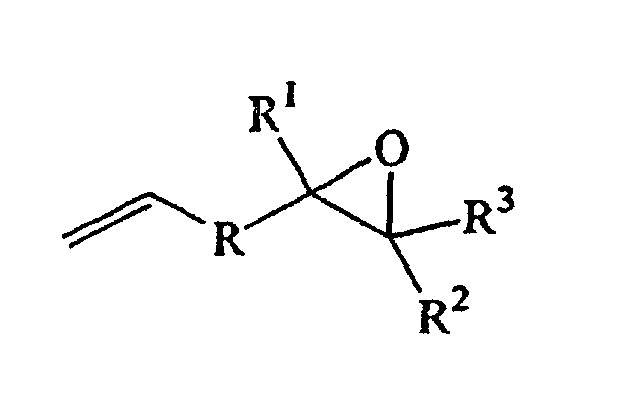
- the epoxide may be visualized as an ethylenically unsaturated epoxide of the formula: where R can be a single bond or an alkylene optionally containing alkyl pendant groups; R 1 , R 2 and R 3 can individually be hydrogen, alkyl straight, branched or cyclic, or any two of R 1 , R 2 or R 3 can be alkylene and combined to form a 5 to 12 carbon cyclic ring, optionally containing alkyl pendants; and the number of carbon atoms in R, R 1 , R 2 , and R 3 are such that the total number of carbon atoms in the epoxide is from 4 to 50.
- Some representative epoxides are: 4vinylcyclohexene monoxide, 1-methyl-4-isopropenyl cyclohexene monoxide, and butadiene monoxide.
- the preferred epoxide is 4-vinylcyclohexene monoxide.
- the hydridosilanes may be alkoxy silanes.
- the hydrido alkoxysilanes that may be used include the trialkoxysilanes, such as trimethoxysilane, triethoxysilane, tri-n-propoxysilane, and triisopropoxysilane. Trimethoxysilane and triethoxysilane are preferred.
- Other hydroalkoxysilanes include dialkoxysilanes such as methyldimethoxysilane, methyldiethoxysilane, dimethylmethoxysilane, and dimethylethoxysilane.
- Hydrosilanes in general can be represented by the formula R 4 n (OR 4 ) 3-n SiH, wherein R 4 is a branched or linear alkyl group of 1 to 18 carbon atoms, a cyclic alkyl group of four to eight carbon atoms or an aryl, alkaryl, an aralkyl group of six to twelve carbon atoms, optionally containing halogen, oxygen, or nitrogen substituents with the proviso that such substituents do not interfere with either hydrosilation or promotion, and n is an integer selected from 0, 1, and 2.
- R 4 is preferably a C 1 -C 2 alkyl wherein n is preferably 1 or 0.
- j + k 4 to 5
- the salt of the carboxylic acid may be represented by the formula R 6 CO 2 M wherein M represents an alkali, alkaline earth, transition metal, or an ammonium ion and R 6 represents a monovalent hydrocarbon of one to 18 carbon atoms, which may be substituted with amino groups, hydroxyl functionalities, carboxyl groups or ester groups.
- R 6 is a linear or branched alkyl of one to ten carbons or an aryl or alkaryl of 6 to 12 carbons.
- carboxylic acid salts include one or more salts of the alkali metals, e.g., lithium acetate, sodium acetate, potassium acetate, potassium benzoate, sodium trifluoroacetate or sodium propionate, of the alkaline earth metals, e.g., calcium acetate, of the transition metals, e.g., samarium (III) acetate, copper (II) acetate, copper (II) ethylhexanoate, indium (III) acetate, and nonquaternary ammonium or phosphonium, e.g., ammonium formate, ammonium acetate, ammonium isovalerate, ammonium 2ethylbutyrate, ammonium propionate or combinations of salts such as ammonium chloride and sodium acetate are suitable with this process, with ammonium salts of carboxylic acids being preferred, and ammonium propionate being the most preferred carboxylate salt.
- the acid may be a hydroxy acid, but only when the organosilicon hydride is an organosiloxane.
- the acid may be an amino acid, e.g., lysine or glutamic acid, but said acids are not preferred since they do not reduce olefin isomerization.
- Polymeric acids, such as polyacrylic acid may be used, in which case some of the acid may be left in acid form, i.e., it does not have to be neutralized to the salt form.
- the present carboxylic acid salts are most useful in the range of 1 to about 10000 parts per million (ppm), preferably in the range of 200 to about 5000 ppm, and most preferably in the range of 100 to about 500 ppm based upon the weight of the ethylenically unsaturated epoxide.
- ppm parts per million
- the platinum catalyst can be of any form of platinum, which catalyzes the hydrosilation reaction of an ethylenically unsaturated epoxide and a silicon hydride.
- Platinum catalysts useful in the process of the invention include: hexachloroplatinic acid, various solutions derived from chloroplatinic acid, tris(tetramethyldivinyldisiloxane)diplatinum (0), phosphine complexes of platinum, and bis(acetylacetonate)platinum (II).
- the preferred catalyst in the practice of this invention is derived from a solution of hexachloroplatinic acid, where the most preferable catalyst is derived from a 10% (wt/wt) solution of hexachloroplatinic acid in ethanol.
- said catalysts are most useful in the range of 1 to about 5000 parts per million (ppm), preferably in the range of 1-500 ppm, and most preferred in the range of 5-50 ppm of platinum, based upon the weight of the combined weight of both the ethylenically unsaturated epoxide and SiH containing reactant.
- This reaction can be carried out over a wide range of temperatures and pressures; however, the usual temperature range is from 50° C to about 175° C with the preferred temperature range being from about 75° C to 125° C.
- the preferred pressure is atmospheric pressure.
- the duration of the reaction will be dependent on catalyst concentration and the reaction temperature. At higher catalyst concentrations and temperatures, the reaction will require less reaction time.
- the residence time within the reactor is not critical but should be sufficient to achieve a satisfactory degree of conversion to the hydrosilated product, i.e., >80%, within acceptable limits given the volume of the equipment and the desired rate of production. Typical acceptable residence times are on the order of 0.5 to 4 hours.
- the reaction is usually conducted with no solvent, although a solvent may be used. Any hydrocarbon may be used such as octane, toluene or xylene.
- This reaction can be conducted in the presence of excess olefin or silicon hydride, where the preferred reaction conditions are with a molar excess of olefin.
- the usual substrate concentration for conducting the reaction is either a 1.5:1.0 to a 1.0:1.5 molar ratio of olefin to silicon hydride (based on moles of hydrogen), preferably a ratio of 1.0:1.0 to 1.5:1.0 and preferred conditions are a 1.01:1.0 to 1.20:1.0 molar ratio of olefin to silicon hydride.
- the preferred catalyst system can be generated by mixing the catalyst and carboxylic acid salt in the olefin or the carboxylic acid salt can be added to the silicon composition after the hydrosilation reaction is complete.
- a catalyst promoter such as a carboxylic acid or an alcohol may be used with the carboyxlic acid salt, if necessary.
- the resulting product may be purified for use, e.g., by stripping or distillation, as required.
- the hydrosilation may be conducted batchwise, semi-batchwise or continuously as is known in the art.
- Example 1 For Example 1 - at room temperature, 21.98 g of neat VCMX was treated with 0.018 ml of CPA and warmed. At 90 °C, the VCMX solution was reacted with 20.46 g of (MeO) 3 SiH. After the (MeO) 3 SiH addition was completed, the solution was maintained at 90 °C. After ⁇ 30 minutes, a vigorous exothermic reaction occurred accompanied with an increase in viscosity of the solution and eventual solidification (or gelation).
- Example 2 At room temperature, 19.18 g of neat VCMX was treated with 0.005 g of Pt(PPh 3 ) 4 , 0.040 ml of MeOH, and 0.040 ml of AcOH and warmed. At 90 °C, the VCMX solution was reacted with 17.10 g of (MeO) 3 SiH. After the (MeO) 3 SiH addition was completed, the solution was maintained at 90 °C for one hour. The results are in the table below with other comparative experiments run under similar conditions. Comparative examples for the transition metal-catalyzed hydrosilation reaction of VCMX and (MeO) 3 SiH.
- Example 14 At room temperature, 19.23 g of neat VCMX was treated with 0.004 g of Pt(PPh 3 ) 4 , 0.090 ml of EtOH, 0.018 ml of AcOH and warmed. At 90 °C, the VCMX solution was reacted with 23.14 of (EtO) 3 SiH. After the (EtO) 3 SiH addition was completed, the solution was maintained at 90 °C for one hour. (EtO) 3 SiH (EtO) 4 Si VCMX VCMX Isomer Product Uneluted Heavies 7.6 0.9 14.3 1.5 69.8 *
- Example 15 At room temperature, 20.11 g of neat VCMX was treated with 0.070 ml of RhCl 3 [S( n -Bu) 2 ] 3 , 0.023 ml of AcOH, 0.11 ml of EtOH, and warmed. At 90 °C, the VCMX solution was reacted with 24.0 g of (EtO) 3 SiH. After the (EtO) 3 SiH addition was completed, the solution was maintained at 90 °C for one hour. (EtO) 3 SiH (EtO) 4 Si VCMX VCMX Isomer Product Uneluted Heavies 37.2 0.4 54.6 1.3 2.9 *
- Example 60 At room temperature, 196.80 g of VCMX was treated with 1.47 g of Na 2 CO 3 , 3.27 g of propyleneglycol, 0.57 g of tetraethyleneglycol, 37.09 g of MD 26.9 D' 9.4 M (10% of total Si-H) and warmed. At 80° C, 0.11 mL of CPA was added to the VCMX solution resulting in an exothermic reaction. The remaining 333.81 g of MD 26.9 D' 9.4 M was added to the VCMX solution over the course of one hour. The solution's temperature was maintained between 80-90 °C throughout the Si-H addition.
- Example Carboxylic acid salt [Si-H] Viscosity (cSt) Epoxycontent 56 250 ppm ammonium acetate not detected 572 10.16% 57 250 ppm tetrabutytammonium acetate no reaction - - 58 No sodium propionate used not detected 3021 not measured 59 No sodium propionate used not detected >10000 not measured 60 2094 ppm sodium propionate not detected 438 9.71%
Landscapes
- Chemical & Material Sciences (AREA)
- Organic Chemistry (AREA)
- Chemical Kinetics & Catalysis (AREA)
- Low-Molecular Organic Synthesis Reactions Using Catalysts (AREA)
- Silicon Polymers (AREA)
Abstract
Description
- In the production of silicon compositions, transition metal catalysts have long been known to promote the hydrosilation reaction. In addition to catalyzing the hydrosilation reaction, many transition metals, in the presence of silicon hydrides (Si-H), also promote epoxide ring-opening polymerization of the ethylenically unsaturated epoxide starting material and the epoxysilane or epoxysilicone product of the hydrosilation reaction. This epoxide ring-opening polymerization reaction during production of an epoxysilane or epoxysilicone can lead to gelation, and may result in both the loss of the entire batch and in considerable loss of time to remove the insoluble gelled resin. Additionally, a partial gelation can occur during epoxysilicone synthesis such that reproducible batch-to-batch viscosities of the epoxysilicone product may be difficult to obtain.
- In the presence of precious metal hydrosilation catalysts, epoxysilicones have been found to gel slowly on storage at room temperature due to the epoxide ring-opening polymerization, thus shortening the shelf life of the epoxysilicone product. This storage problem can be partially alleviated by deactivating the transition metal catalyst with a catalytic inhibitor as reported in U.S. Pat. No. 4,083,856 (F. Mendicino), which discloses the use of diphenylamine to inhibit gelation. Overall, it would be less preferable to incorporate an extra component or an additional process step into the epoxysilicon composition and production process.
- The prior art has taught that the epoxide ring-opening polymerization side reaction does not occur in the rhodium-catalyzed hydrosilation reaction of an ethylenically unsaturated epoxide and a Si-H. For example, U.S. Pat. Nos. 5,442,026 (Crivello et al.), 5,169,962 (Crivello et al.), 4,804,768 (Quirk et al.) teach that rhodium catalysts such as Wilkinson's catalyst, RhCl3 hydrate, RhH(CO)(PPh3)3 can be used to produce epoxysilicones. In addition to rhodium catalysts, certain platinum catalyst systems have been reported to selectively catalyze the hydrosilation reaction of ethylenically unsaturated epoxides and a Si-H versus the epoxide ring-opening polymerization side reaction, as disclosed in U.S. Pat. No. 5,583,194 (Crivello et al.) which teaches that quaternary onium hexachloroplatinate salts, e.g., (R4M)2PtCl6, or as disclosed U.S. Pat. No. 5,260,399 (Crivello et al.) transition metal phosphine complexes, e.g., Pt(PPh3)4, can be used to produce epoxysilicon compositions. However, these catalysts have not achieved commercial acceptance yet.
- U.S. Pat. Nos. 5,240,971, 5,227,420, and 5,258,480 (Eckberg et al.) reported the preparation of epoxysilicones using either RhCl3[S(n-Bu)2]3 or PtCl2(SEt2) as the catalyst in the presence of a tertiary amine to control the viscosity during the hydrosilation reaction. However, only a limited number of transition metal catalysts are active in the presence of this stabilizer.
- EP-A-0 485 985 discloses the preparation of epoxy organosilicone compounds by the reaction of an organosilicone with an epoxy compound in the presence of a transition metal compound.
- Carboxylic acids have been reported to promote the transition metal catalyzed hydrosilation reaction, as disclosed in JP 11 180,986 (M. Tachhikawa; K. Takei), F. Mendicino; C. Schilling Jr. Abstract of Papers, 32nd Organosilicon Symposium; 1999; P-68, and in UDC 415,268 (Belyakova et al.). But, carboxylic acid salts have not. Carboxylic acid salts have been reported to prevent acetal formation through the hydroxyl groups of a silicone polyether copolymer as disclosed in U.S. Pat. No. 4,847,398 (K. R Mehta et al.); however, no utility for epoxides is disclosed.
- The literature does mention that alcohols prevent or retard the epoxide ring-opening polymerization reaction (A. K. McMullen; et al. Abstract of Papers, 27th Organosilicon Symposium, 1994; Abstract P-45; and Crivello et al. Polym. Preps. 1991, 32, 338).
- It is apparent that there exists a need in the industry for a method to eliminate epoxide ring-opening polymerization, and olefin isomerization when commonly used hydrosilation catalysts, such chloroplatinic acid, are employed. There is also a need for an efficient yet economical method of producing epoxysilicone monomers and oligomers in the absence of the epoxide ring-opening polymerization reaction, thereby generating epoxysilicon compositions of reproducible batch-to-batch viscosity. There is additionally a need for epoxysilicon compositions that are stable to the epoxide ring-opening polymerization reaction and therefore have increased the shelf life without an additional processing step.
- The object of this invention is to provide a method for preparing epoxy organosilicon compositions through the platinum metal-catalyzed hydrosilation reaction between an ethylenically unsaturated epoxide and a hydrido organosilicon in the presence of a carboxylic acid salt where the catalyst efficiently promotes the hydrosilation reaction without also promoting either the epoxide ring-opening polymerization reaction of either the ethylenically unsaturated epoxide starting material, the epoxysilicon composition or the isomerization of the ethylenically unsaturated epoxide starting material. Compositions of epoxy organosilicon compounds and the salt of the carboxylic acid are taught as well wherein the salt suppresses the reactivity of the epoxy functionality.
- According to the process of the invention, the platinum-catalyzed hydrosilation of an ethylenically unsaturated epoxide with either a hydrido silane or hydrido siloxane occurs in the presence of a carboxylic acid salt without epoxide ring-opening polymerization side reaction, allowing for the production of high yields of epoxyorgano silanes or siloxanes. For certain carboxylic acid salts, both epoxide ring-opening polymerization and olefin isomerization are suppressed. This inventive process allows for greater batch-to-batch consistencies without the use of more complex catalyst systems. While the process is useful for both siloxanes and silanes, given that the internal rearrangement of the olefin is more of an issue in the hydrosilation of a silane, the present invention will find greater utility in the hydrosilation of hydrido alkoxysilanes.
- These salts are also useful for the suppression of the reactivity of the epoxide after the hydrosilation reaction and thus are useful to extend the shelf life of epoxy organosilicon materials, even if added after hydrosilation.
- Ethylenically unsaturated epoxides for use herein include linear or cycloaliphatic epoxy compounds wherein the unsaturation is terminal (i.e., ±, 2) which contain from 4 to 50 carbon atoms. The epoxide may be visualized as an ethylenically unsaturated epoxide of the formula:where R can be a single bond or an alkylene optionally containing alkyl pendant groups; R1, R2 and R3 can individually be hydrogen, alkyl straight, branched or cyclic, or any two of R1, R2 or R3 can be alkylene and combined to form a 5 to 12 carbon cyclic ring, optionally containing alkyl pendants; and the number of carbon atoms in R, R1, R2, and R3 are such that the total number of carbon atoms in the epoxide is from 4 to 50. Some representative epoxides are: 4vinylcyclohexene monoxide, 1-methyl-4-isopropenyl cyclohexene monoxide, and butadiene monoxide. The preferred epoxide is 4-vinylcyclohexene monoxide.
- The hydridosilanes may be alkoxy silanes. The hydrido alkoxysilanes that may be used include the trialkoxysilanes, such as trimethoxysilane, triethoxysilane, tri-n-propoxysilane, and triisopropoxysilane. Trimethoxysilane and triethoxysilane are preferred. Other hydroalkoxysilanes include dialkoxysilanes such as methyldimethoxysilane, methyldiethoxysilane, dimethylmethoxysilane, and dimethylethoxysilane. Hydrosilanes in general can be represented by the formula R4 n(OR4)3-nSiH, wherein R4 is a branched or linear alkyl group of 1 to 18 carbon atoms, a cyclic alkyl group of four to eight carbon atoms or an aryl, alkaryl, an aralkyl group of six to twelve carbon atoms, optionally containing halogen, oxygen, or nitrogen substituents with the proviso that such substituents do not interfere with either hydrosilation or promotion, and n is an integer selected from 0, 1, and 2. R4 is preferably a C1-C2 alkyl wherein n is preferably 1 or 0.
- The hydrido organosiloxanes have the general formula:
- The salt of the carboxylic acid may be represented by the formula R6CO2M wherein M represents an alkali, alkaline earth, transition metal, or an ammonium ion and R6 represents a monovalent hydrocarbon of one to 18 carbon atoms, which may be substituted with amino groups, hydroxyl functionalities, carboxyl groups or ester groups. Preferably R6 is a linear or branched alkyl of one to ten carbons or an aryl or alkaryl of 6 to 12 carbons. Specific examples of carboxylic acid salts include one or more salts of the alkali metals, e.g., lithium acetate, sodium acetate, potassium acetate, potassium benzoate, sodium trifluoroacetate or sodium propionate, of the alkaline earth metals, e.g., calcium acetate, of the transition metals, e.g., samarium (III) acetate, copper (II) acetate, copper (II) ethylhexanoate, indium (III) acetate, and nonquaternary ammonium or phosphonium, e.g., ammonium formate, ammonium acetate, ammonium isovalerate, ammonium 2ethylbutyrate, ammonium propionate or combinations of salts such as ammonium chloride and sodium acetate are suitable with this process, with ammonium salts of carboxylic acids being preferred, and ammonium propionate being the most preferred carboxylate salt. The acid may be a hydroxy acid, but only when the organosilicon hydride is an organosiloxane. The acid may be an amino acid, e.g., lysine or glutamic acid, but said acids are not preferred since they do not reduce olefin isomerization. Polymeric acids, such as polyacrylic acid may be used, in which case some of the acid may be left in acid form, i.e., it does not have to be neutralized to the salt form.
- In the method of this invention, the present carboxylic acid salts are most useful in the range of 1 to about 10000 parts per million (ppm), preferably in the range of 200 to about 5000 ppm, and most preferably in the range of 100 to about 500 ppm based upon the weight of the ethylenically unsaturated epoxide.
- The platinum catalyst can be of any form of platinum, which catalyzes the hydrosilation reaction of an ethylenically unsaturated epoxide and a silicon hydride. Platinum catalysts useful in the process of the invention include: hexachloroplatinic acid, various solutions derived from chloroplatinic acid, tris(tetramethyldivinyldisiloxane)diplatinum (0), phosphine complexes of platinum, and bis(acetylacetonate)platinum (II). The preferred catalyst in the practice of this invention is derived from a solution of hexachloroplatinic acid, where the most preferable catalyst is derived from a 10% (wt/wt) solution of hexachloroplatinic acid in ethanol. In the method of this invention, said catalysts are most useful in the range of 1 to about 5000 parts per million (ppm), preferably in the range of 1-500 ppm, and most preferred in the range of 5-50 ppm of platinum, based upon the weight of the combined weight of both the ethylenically unsaturated epoxide and SiH containing reactant.
- This reaction can be carried out over a wide range of temperatures and pressures; however, the usual temperature range is from 50° C to about 175° C with the preferred temperature range being from about 75° C to 125° C. The preferred pressure is atmospheric pressure. The duration of the reaction will be dependent on catalyst concentration and the reaction temperature. At higher catalyst concentrations and temperatures, the reaction will require less reaction time. The residence time within the reactor is not critical but should be sufficient to achieve a satisfactory degree of conversion to the hydrosilated product, i.e., >80%, within acceptable limits given the volume of the equipment and the desired rate of production. Typical acceptable residence times are on the order of 0.5 to 4 hours. The reaction is usually conducted with no solvent, although a solvent may be used. Any hydrocarbon may be used such as octane, toluene or xylene.
- This reaction can be conducted in the presence of excess olefin or silicon hydride, where the preferred reaction conditions are with a molar excess of olefin. The usual substrate concentration for conducting the reaction is either a 1.5:1.0 to a 1.0:1.5 molar ratio of olefin to silicon hydride (based on moles of hydrogen), preferably a ratio of 1.0:1.0 to 1.5:1.0 and preferred conditions are a 1.01:1.0 to 1.20:1.0 molar ratio of olefin to silicon hydride. The preferred catalyst system can be generated by mixing the catalyst and carboxylic acid salt in the olefin or the carboxylic acid salt can be added to the silicon composition after the hydrosilation reaction is complete. A catalyst promoter such as a carboxylic acid or an alcohol may be used with the carboyxlic acid salt, if necessary.
- The resulting product may be purified for use, e.g., by stripping or distillation, as required.
- The hydrosilation may be conducted batchwise, semi-batchwise or continuously as is known in the art.
- The following illustrative and comparative examples are intended to describe the present invention in more detail; however, they are not meant to limit the scope of the specification and claims. All parts and percentages presented in the examples below are by weight unless otherwise specified. The abbreviations g, mL, VCMX, CPA, Si-H, AcOH, MeOH, EtOH, IPA, cSt and GC stand for, respectively, gram, milliliter, 4-vinylcyclohexene monoxide, solution consisting of 10% (wt/wt) of hexachloroplatinic acid in ethanol, any silicon hydride-containing species, acetic acid, methanol, ethanol, isopropanol, centistokes and gas chromatography. An internal standard was used in order to determine the percent of uneluted heavies for each GC analysis. Uneluted heavies are defined as all components that did not elute under the GC conditions employed for the specific analysis. An * indicates no internal standard was used.
- For Example 1 - at room temperature, 21.98 g of neat VCMX was treated with 0.018 ml of CPA and warmed. At 90 °C, the VCMX solution was reacted with 20.46 g of (MeO)3SiH. After the (MeO)3SiH addition was completed, the solution was maintained at 90 °C. After ∼30 minutes, a vigorous exothermic reaction occurred accompanied with an increase in viscosity of the solution and eventual solidification (or gelation).
- For Examples 2-15 - all reactions were conducted using a 10% molar excess of VCMX (97% purity) versus (MeO)3SiH and the specified catalyst system at 90 °C followed by one hour at 90 °C after the addition was completed. All solutions were analyzed using gas chromatography.
- Example 2 - At room temperature, 19.18 g of neat VCMX was treated with 0.005 g of Pt(PPh3)4, 0.040 ml of MeOH, and 0.040 ml of AcOH and warmed. At 90 °C, the VCMX solution was reacted with 17.10 g of (MeO)3SiH. After the (MeO)3SiH addition was completed, the solution was maintained at 90 °C for one hour. The results are in the table below with other comparative experiments run under similar conditions.
Comparative examples for the transition metal-catalyzed hydrosilation reaction of VCMX and (MeO)3SiH. Examples Catalyst System (MeO)3SiH (MeO)4Si VCMX VCMX isomer product uneluted heavies 2 Pt(PPh3)4 (10 ppm Pt) 0.2 1.4 <0.1 2.5 90.5 2.2 3 RhCl3 hydrate (50 ppm Rh) and 250 ppm tetrabutylammonium bromide 1.7 16.6 2.3 33.1 34.3 5.6 4 K2PtCl6 (50 ppm Pt) and 250 ppm tetrabutylammonium chloride 1.8 17.2 55.6 16.1 4.3 * 5 CPA (10 ppm Pt) and 250 ppm tetramethylammonium chloride 0.5 1.1 0.3 5.9 47.2 42.9 6 CPA (10 ppm Pt) and 250 ppm tetraethylammonium chloride 2.2 30.0 28.6 14.6 8.8 9.3 7 CPA (10 ppm Pt) and 116 ppm tetrabutylammonium chloride 6.2 25.4 23.6 16.6 18.0 5.0 8 CPA (10 ppm Pt) and 180 ppm benzyltributylammonium chloride 16.8 3.2 62.6 10.3 1.1 * 8 RhCl3 hydrate (258 ppm Rh) and 500 ppm triphenylphosphine <0.1 4.9 2.0 1.2 69.3 8.0 9 RhCl3 hydrate (107 ppm Rh) <0.1 1.3 0.8 4.0 86.4 3.9 10 RhCl3[S(n-Butyl)2]3 (48 ppm Rh) <0.1 1.0 3.4 3.8 88.0 1.0 11 RhCl3[S(n-Butyl)2]3 (26 ppm Rh) <0.1 1.1 5.8 1.9 86.3 1.7 12 RhCl3[S(n-Butyl)2]3 (8 ppm Rh) 16.3 1.3 74.4 1.8 3.3 * 13 Karstedts catalyst (10 ppm Pt) 0.2 1.5 0.2 4.7 57.8 31.8 - Example 14 - At room temperature, 19.23 g of neat VCMX was treated with 0.004 g of Pt(PPh3)4, 0.090 ml of EtOH, 0.018 ml of AcOH and warmed. At 90 °C, the VCMX solution was reacted with 23.14 of (EtO)3SiH. After the (EtO)3SiH addition was completed, the solution was maintained at 90 °C for one hour.
(EtO)3SiH (EtO)4Si VCMX VCMX Isomer Product Uneluted Heavies 7.6 0.9 14.3 1.5 69.8 * - Example 15 - At room temperature, 20.11 g of neat VCMX was treated with 0.070 ml of RhCl3[S(n-Bu)2]3, 0.023 ml of AcOH, 0.11 ml of EtOH, and warmed. At 90 °C, the VCMX solution was reacted with 24.0 g of (EtO)3SiH. After the (EtO)3SiH addition was completed, the solution was maintained at 90 °C for one hour.
(EtO)3SiH (EtO)4Si VCMX VCMX Isomer Product Uneluted Heavies 37.2 0.4 54.6 1.3 2.9 * -
- 1.) where Si-H is an organofunctional silane A typical reaction was conducted by treating 1.10-1.30 molar equivalents (vs. Si-H) of VCMX at room temperature with 3000 ppm of an alcohol, 500 ppm of acetic acid (AcOH), a carboxylate acid salt and a catalyst versus total mass of the reaction. Typically, 10 ppm of Pt was sufficient to catalyze the reaction. This solution was warmed. At 90 °C, the solution was reacted with 1.00 molar equivalent of Si-H. The solution's temperature was maintained between 90-102 °C throughout the Si-H addition. After the Si-H addition was completed, the solutions temperature was maintained at 90 °C for one hour. After this time, solution was allowed to cool to room temperature.
- 2.) where Si-H is organfunctional siloxane. A typical reaction was conducted by mixing 1.10-1.30 molar equivalents (vs. Si-H) of VCMX at room temperature with an alcohol, and sodium carbonate. The VCMX solution was treated with an appropriate amount of the Si-H and the solution was warmed. At 90 °C, the solution was treated with a catalyst. Typically, 10 ppm of Pt (versus the total mass of the reaction) was sufficient to catalyze the reaction. Once an initial temperature increase was detected, the remaining Si-H fluid was added to the VCMX solution. The solution's temperature was maintained between 90-100 °C throughout the Si-H addition. After the Si-H addition was completed, the carboxylic acid salt was added to the solution if it had not been added prior the hydrosilation reaction. The solution was maintained at 90 °C for one hour. After this time, solution was analyzed for Si-H content. The reaction was deemed to be complete by the absence of Si-H. The reaction mixture was warmed under reduced pressure and stripped of volatile components (primarily unreacted VCMX and the olefin isomer of VCMX) at 150 °C (75-100 mm Hg) for 2-3 hours in order to removed unreacted VCMX. The final product was then filtered through a 5 ¼m laboratory filter pad.
-
- For examples 16-38, all reactions were conducted using a 10% molar excess of VCMX (97% purity) versus (MeO)3SiH, 3000 ppm methanol, 500 ppm acetic acid, carboxylic acid salt and 10 ppm Pt as a solution of chloroplatinic acid at 90 °C followed by one hour at 90 °C after the addition was completed. All solutions were analyzed using gas chromatography.
Examples of the transition metal-catalyzed hydrosilation reaction of VCMX and (MeO)3SiH. Examples Carboxylic add salt (MeO)3SiH (MeO)4Si VCMX VCMX isomer product uneluted heavies 16 207 ppm ammonium acetate 0.3 0.8 2.9 0.4 92.8 0.3 3 17 250 ppm ammonium acetate 1.2 2.8 4.9 0.4 87.6 0.4 18 125 ppm ammonium acetate <0.1 0.8 1.3 0.6 95.0 <0.1 19 100 ppm ammonium acetate <0.1 1.0 6.6 0.4 89.2 <0.1 20 50 ppm ammonium acetate <0.1 1.7 3.9 0.9 89.3 1.2 22 25 ppm ammonium acetate <0.1 0.7 9.6 0.5 85.8 0.6 23 250 ppm ammonium chloride and 250 ppm sodium acetate 0.1 0.7 11.0 0.4 84.9 0.4 24 181 ppm ammonium chloride 0.2 1.0 1.0 4.9 87.1 2.9 25 250 ppm ammonium formate 0.9 2.9 8.8 0.3 81.5 1.4 26 250 ppm ammonium propionate <0.1 0.6 0.5 0.7 96.2 <0.1 27 250 ppm ammonium isovalerate 0.1 1.1 0.5 1.2 95.0 <0.1 28 250 ppm ammonium ethylbutyrate 0.4 1.3 0.3 0.6 74.5 21.5 29 250 ppm tetramethylammonium acetate 21.7 4.5 12.6 12.6 41.3 1.6 30 250 ppm tetrabutylammonium acetate 13.2 8.8 29.5 6.5 28.2 7.9 31 130 ppm sodium acetate <0.1 1.4 3.4 2.5 89 1.7 32 250 ppm sodium trifluoroacetate 9.4 0.8 9.7 3.4 74.5 <0.1 33 104 ppm sodium propionate <0.1 1.0 1.6 3.7 90.2 0.3 34 99 ppm sodium propionate <0.1 2.1 1.1 8.0 83.9 1.7 35 250 ppm potassium acetate 18.2 1.4 23.0 0.8 54.1 <0.1 36 250 ppm potassium benzoate 0.9 3.0 2.8 5.0 81.6 2.5 37 500 ppm calcium acetate <0.1 0.4 4.2 2.8 80.7 10.0 38 250 ppm copper 2-ethylhexanoate 0.1 0.4 1.8 2.4 92.4 0.7 - For examples 39-41, all reactions were conducted using a 10% molar excess of VCMX (97% purity) versus (MeO)3SiH, 3000 ppm methanol, 500 ppm acetic acid, specified carboxylic acid salt and the specified precatalyst at 90 °C followed by one hour at 90 °C after the addition was completed. All solutions were analyzed using gas chromatography.
Examples for the hydrosilation reaction of VCMX and TMS in the presence of carboxylate salts with alternative Pt catalysts. Example Catalyst System (MeO)3SiH (MeO)4Si VCMX VCMX isomer product uneluted heavies 39 (NH4)2PtCl6 (24 ppm Pt) 47.5 0.7 48.9 1.2 <0.1 <0.1 40 Pt(PPh3)4 (10 ppm Pt) and 100 ppm sodium propionate <0.1 1.4 14.6 1.4 76.2 3.2 41 Karstedts catalyst (10 ppm Pt) and 100 ppm sodium propionate 1.4 1.6 <0.1 3.9 87.7 3.2 - For examples 44-55, all reactions were conducted using a 20% molar excess of VCMX (97% purity) versus the specified Si-H, 3000 ppm of an alcohol, 500 ppm acetic acid, specified carboxylic acid salt and 10 ppm Pt as a solution of chloroplatinic acid at 90 °C followed by one hour at 90 °C after the addition was completed. All solutions were analyzed using gas chromatography.
Examples of the Pt-catalyzed hydrosilation reaction of VCMX with different SiH. Examples Cacboyxlic acid salt R'R2SiH R'R3Si VCMX VCMX isomer product uneluted heavies Trimethoxysilane R'=R= OMe 42 250 ppm ammonium acetate 0.2 2.1 8.2 0.3 85.4 1.0 43 307 ppm sodium propionate <0.1 3.2 2.3 7.0 82.3 1.6 Triethoxysilane R'=R= OEt 44 250 ppm ammonium acetate 2.8 1.6 5.3 0.4 82.4 2.9 45 307 ppm sodium propionate Methyldimethoxysilane 2.8 R'=CH3, 2.6 R = OEt <0.1 8.7 76.0 4.8 46 250 ppm ammonium acetate <0.1 0.7 12.8 0.6 79.2 * 47 307 ppm sodium propionate 0.1 0.7 9.0 3.2 81.9 * Methyldiethoxysilane R'=CH3, R = OEt 48 250 ppm ammonium acetate 0.3 1.3 8.7 0.6 84.5 * 49 320 ppm sodium propionate MD'M 0.3 0.6 5.0 3.7 83.7 * 50 250 ppm ammonium acetate 44.0 48.7 0.1 5.7 * 51 307 ppm sodium propionate 35.0 39.8 0.2 23.4 * 52 250 ppm ammonium propionate M'M' 45.2 51.1 0.1 1.1 * 53 250 ppm ammonium acetate, no acetic acid 0.1 10.6 1.6 82.3 * 54 307 ppm sodium propionate 0.1 16.1 1.6 76.9 * 55 250 ppm ammonium propionate 0.1 21.3 1.4 71.9 * - For examples 56 to 57, all reactions were conducted using a 20% molar excess of VCMX (97% purity) versus Si-H, specified carboxylic acid salt and 10 ppm Pt as a solution of chloroplatinic. At room temperature, neat VCMX was treated with a carboxylic acid salt, and CPA and was warmed. At 90 °C, the VCMX solution was reacted with MD26.9D'9.4M. After the MD26.9D'9.4M addition was completed, the solution was maintained at 90 °C for one hour. The reaction mixture was warmed under reduced pressure or stripped at 150 °C (20 mm Hg) for one hour in order to removed unreacted VCMX.
- For examples 58 to 60, all reactions were conducted using a 20% molar excess of VCMX (97% purity) versus Si-H and 6 ppm Pt as a solution of chloroplatinic acid. At room temperature, neat VCMX was treated with Na2CO3, propyleneglycol, tetraethyleneglycol, and MD26.9D'9.4M (10% of total Si-H), and was warmed. At 80 °C, the VCMX solution was reacted with the remaining MD26.9D'9.4M. After the MD26.9D'9.4M addition was completed, the solution was maintained at 85 °C for one hour. The reaction mixture was warmed under reduced pressure and stripped at 150 °C (20 mm Hg) for one to two hours in order to removed unreacted VCMX.
- Example 60 - At room temperature, 196.80 g of VCMX was treated with 1.47 g of Na2CO3, 3.27 g of propyleneglycol, 0.57 g of tetraethyleneglycol, 37.09 g of MD26.9D'9.4M (10% of total Si-H) and warmed. At 80° C, 0.11 mL of CPA was added to the VCMX solution resulting in an exothermic reaction. The remaining 333.81 g of MD26.9D'9.4M was added to the VCMX solution over the course of one hour. The solution's temperature was maintained between 80-90 °C throughout the Si-H addition. After the MD26.9D'9.4M addition was completed, 1.20 g of sodium propionate was added to the crude silicone composition and the solution's temperature was maintained at 85 °C for thirty minutes. An aliquot of the solution was analyzed for Si-H content. After this time, solution was stripped at 3.5 mm Hg and 150 °C in order to removed unreacted VCMX. After 1.5 hours, the solution was allowed to cool to room temperature. Recovered 37.16 g of unreacted VCMX and its olefin isomer. The final product was then filtered through a 5 µm laboratory filter pad.
Results from the Pt-catalyzed hydrosilation reaction of VCMX and an organohydrogensiloxane. Example Carboxylic acid salt [Si-H] Viscosity (cSt) Epoxycontent 56 250 ppm ammonium acetate not detected 572 10.16% 57 250 ppm tetrabutytammonium acetate no reaction - - 58 No sodium propionate used not detected 3021 not measured 59 No sodium propionate used not detected >10000 not measured 60 2094 ppm sodium propionate not detected 438 9.71%
Claims (15)
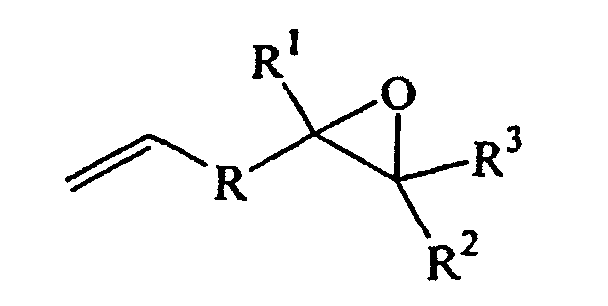
- A process for preparing epoxy organosilicon compositions comprising reacting a) an ethylenically unsaturated epoxide of the formula:where R is a single bond or an alkylene optionally containing alkyl pendant groups; R1 is a hydrogen, alkyl, straight, branched, or cyclic; R2 and R3 are individually hydrogen, straight, branched or cyclic alkyl, or any two of R1, R2 and R3, taken together are alkylene and combined with the carbon atom or atoms to which they are attached form a 5 to 12 carbon cyclic ring, optionally containing alkyl pendants; and the number of carbon atoms in R, R1, R2, and R3 are such that the total number of carbon atoms in the epoxide is from 4 to 50, with (b) an organosilicon hydride, in the presence of (c) a catalytically effective amount of a platinum catalyst and (d) a carboxylic acid salt.
- The process of claim 1 wherein the organosilicon hydride is an alkoxysilane with the general formula R4 n(OR4)3-nSiH, wherein R4 is a branched or linear alkyl group of I to 18 carbon atoms, a cyclic alkyl group of four to eight carbon atoms or an aryl, alkaryl, or aralkyl group of six to twelve carbon atoms, optionally containing halogen, oxygen, or nitrogen substituents with the proviso that such substituents do not interfere with either hydrosilation or promotion, and n is an integer selected from 0, 1, and 2.
- The process of claim 2 wherein the alkoxysilane is trimethoxysilane, triethoxysilane, methyldimethoxysilane or methyldiethoxysilane.
- The process of claim 1 wherein the organosilicon hydride is an organosiloxane with the general formula: [R 5 / a(H)bSiO(4-a-b)/2]n wherein R5 represents a monovalent hydrocarbon radical, a has a value of from 1 to 2.99, b has a value of from 0.001 to 1, and the sum of a+b has a value of from 1.5 to 3.0 and n = 2 to 400.
- The process of claim 4 wherein the organosiloxane is MDxD'yM, where x = 0 to 200, y = 1 to 200, M = -O½Si(CH3)3, D' = -OSi(H)(CH3)-, and D = -OSi(CH3)2-.
- The process in claim 1 wherein the ethylenically unsaturated epoxide is 4-vinylcyclohexene monoxide or butadiene monoxide.
- The process in claim 1 wherein the carboxylic acid salts is represented by the formula: R6CO2M wherein M is selected from the group consisting of an alkali, alkaline earth, transition metal, and an ammonium ion and R6 represents a monovalent hydrocarbon of one to 18 carbon atoms, optionally substituted with amino, hydroxyl, carboxyl or ester groups.
- The process in claim 7 wherein R6 is a linear or branched alkyl of one to ten carbon atoms.
- The process in claim 8 wherein the carboxylic acid salt is ammonium or sodium propionate.
- The process in claim 9 wherein the platinum catalyst is a solution of chloroplatinic acid.
- A composition comprising an epoxy silane and a salt of a carboxylic acid.
- A composition as in claim 11 wherein the epoxy silane is an epoxy alkoxy silane.
- The composition according to claim 11 wherein the salt is of the formula: R6CO2M wherein M is selected from the group consisting of an alkali, alkaline earth, transition metal, and an ammonium ion and R6 represents a monovalent hydrocarbon group having one to 18 carbon atoms, optionally substituted with amino, hydroxyl, carboxyl or ester groups.
- The composition of claim 13 wherein R6 is a linear or branched alkyl of one to ten carbon atoms
- The composition of claim 14 wherein the carboxylic acid salt is ammonium or sodium propionate.
Applications Claiming Priority (5)
| Application Number | Priority Date | Filing Date | Title |
|---|---|---|---|
| US46560399A | 1999-12-17 | 1999-12-17 | |
| US573111 | 2000-05-17 | ||
| US09/573,111 US6365696B1 (en) | 1999-12-17 | 2000-05-17 | Process for producing epoxyorganosilicon compounds |
| PCT/US2000/032981 WO2001044255A1 (en) | 1999-12-17 | 2000-12-04 | Process for producing epoxyorganosilicon compounds |
| US465603 | 2009-05-13 |
Publications (2)
| Publication Number | Publication Date |
|---|---|
| EP1237894A1 EP1237894A1 (en) | 2002-09-11 |
| EP1237894B1 true EP1237894B1 (en) | 2003-06-18 |
Family
ID=27041351
Family Applications (1)
| Application Number | Title | Priority Date | Filing Date |
|---|---|---|---|
| EP00982437A Expired - Lifetime EP1237894B1 (en) | 1999-12-17 | 2000-12-04 | Process for producing epoxyorganosilicon compounds |
Country Status (9)
| Country | Link |
|---|---|
| US (2) | US6365696B1 (en) |
| EP (1) | EP1237894B1 (en) |
| JP (1) | JP2003516996A (en) |
| KR (1) | KR20020061640A (en) |
| CN (1) | CN1183144C (en) |
| AT (1) | ATE243214T1 (en) |
| BR (1) | BR0016399A (en) |
| DE (1) | DE60003462T2 (en) |
| WO (1) | WO2001044255A1 (en) |
Families Citing this family (19)
| Publication number | Priority date | Publication date | Assignee | Title |
|---|---|---|---|---|
| US7241835B2 (en) * | 2001-05-16 | 2007-07-10 | General Electric Company | Cosmetic compositions comprising silicone gels |
| US6538061B2 (en) * | 2001-05-16 | 2003-03-25 | General Electric Company | Cosmetic compositions using polyether siloxane copolymer network compositions |
| US6531540B1 (en) * | 2001-05-16 | 2003-03-11 | General Electric Company | Polyether siloxane copolymer network compositions |
| US7387784B2 (en) * | 2001-05-16 | 2008-06-17 | O'brien Michael Joseph | Process for making cosmetic compositions using polyether siloxane copolymer network compositions |
| US7205372B2 (en) * | 2002-07-12 | 2007-04-17 | Rhodia Chimie | Functionalization of silicones and anti-adhesive coatings made therefrom |
| FR2842204B1 (en) * | 2002-07-12 | 2006-09-15 | Rhodia Chimie Sa | FUNCTIONALIZATION (EPOXYDATION) OF SILICONES AND USE OF THESE SILICONES AS ANTI-ADHERENT COATINGS |
| AU2003278265A1 (en) * | 2003-09-05 | 2005-04-11 | Rhodia Chimie | Functionalisation (epoxidation) of silicones and use of said silicones as non-stick coatings |
| CN1938324A (en) * | 2004-03-29 | 2007-03-28 | 陶氏康宁公司 | Process for preparing epoxyorganoalkoxysilanes |
| KR101547874B1 (en) * | 2007-07-26 | 2015-08-27 | 아지노모토 가부시키가이샤 | Resin composition |
| KR101444168B1 (en) | 2009-09-02 | 2014-09-26 | 모멘티브 퍼포먼스 머티리얼즈 인크. | Silicone modified fatty acids, method of preparation and usage thereof |
| JP5664192B2 (en) * | 2010-12-09 | 2015-02-04 | 信越化学工業株式会社 | Method for producing organosilicon compound |
| EP2787000B1 (en) * | 2010-12-09 | 2017-05-31 | Shin-Etsu Chemical Co., Ltd. | Hydrosilylation method, method for producing oranosilicon compound, and organosilicon compound |
| CN102146091B (en) * | 2011-01-26 | 2013-12-04 | 湖北德邦化工新材料有限公司 | Bis-silane coupling agent and preparation method thereof |
| CN102850388B (en) * | 2011-06-29 | 2015-08-26 | 中国蓝星(集团)股份有限公司 | A kind of preparation method of silane coupling agent |
| JP5652360B2 (en) * | 2011-09-12 | 2015-01-14 | 信越化学工業株式会社 | Method for producing organoxysilane compound |
| CN103319692B (en) * | 2012-03-22 | 2015-11-18 | 中科院广州化学有限公司 | A kind of high performance organo-silicon epoxy material and preparation method thereof and application |
| EP2857407B1 (en) * | 2013-10-03 | 2017-02-01 | Shin-Etsu Chemical Co., Ltd. | Organosilicon compound, making method, adhesive composition, and article |
| CN104086585A (en) * | 2014-07-29 | 2014-10-08 | 荆州市江汉精细化工有限公司 | Preparation method of 2-(3,4 epoxycyclohexyl)ethyl trimethoxy silane |
| EP3441397B1 (en) * | 2017-08-09 | 2019-10-09 | Evonik Degussa GmbH | Method for the preparation of 3-glycidyloxypropyltrialkoxysilanes |
Family Cites Families (21)
| Publication number | Priority date | Publication date | Assignee | Title |
|---|---|---|---|---|
| US4083856A (en) | 1969-08-18 | 1978-04-11 | Union Carbide Corporation | Addition of unsaturated epoxy monomer to Si-H with chloroplatinic acid and HCl-acceptor |
| SU415268A1 (en) | 1972-06-07 | 1974-02-15 | Method of producing aminoalkyl alkoxysilane | |
| JPS5690092A (en) | 1979-10-05 | 1981-07-21 | Chisso Corp | Preparation of epoxy group-containing organic silicon compound |
| US4804768A (en) | 1986-09-30 | 1989-02-14 | Union Carbide Corporation | Process for producing epoxyorganoalkoxysilanes |
| JPH0788394B2 (en) | 1987-04-22 | 1995-09-27 | 東燃株式会社 | Method for producing epoxy group-containing silane compound |
| US4847398A (en) * | 1987-09-09 | 1989-07-11 | Union Carbide Corporation | Process for the preparation of siloxane-oxyalkylene copolymers |
| US5128431A (en) | 1989-09-01 | 1992-07-07 | General Electric Company | Platinum catalyzed heterocyclic compound compositions |
| US5169962A (en) | 1990-09-17 | 1992-12-08 | General Electric Company | Preparation of epoxysilicon compounds using rhodium catalysts |
| US5260399A (en) | 1992-06-08 | 1993-11-09 | General Electric Company | Regiospecific catalyst for the synthesis of epoxysiloxane monomers and polymers |
| US5387698A (en) | 1992-06-11 | 1995-02-07 | General Electric Company | Rhodium containing selective catalysts for the synthesis of epoxysiloxane/epoxysilicone monomers and polymers |
| JPH04182491A (en) * | 1990-11-15 | 1992-06-30 | Shin Etsu Chem Co Ltd | Organosilicon compound and its manufacturing method |
| US5359111A (en) | 1991-09-18 | 1994-10-25 | Dow Corning Corporation | Method for controlling hydrosilylation in a reaction mixture |
| GB9126049D0 (en) | 1991-12-07 | 1992-02-05 | Dow Corning | Hydrosilylation process |
| JP2727479B2 (en) | 1991-12-17 | 1998-03-11 | 東燃株式会社 | Method for producing epoxy group-containing silane compound |
| US5258480A (en) | 1992-05-18 | 1993-11-02 | General Electric Company | Syntheses of epoxysilicones |
| KR940005716A (en) | 1992-06-11 | 1994-03-22 | 아더 엠. 킹 | Selective catalyst for the synthesis of epoxysilicone monomers and polymers |
| GB9223335D0 (en) | 1992-11-06 | 1992-12-23 | Dow Corning | Hydrosilylation process |
| US5986124A (en) * | 1995-12-24 | 1999-11-16 | Dow Corning Asia, Ltd. | Method for making compounds containing hydrocarbonoxysilyi groups by hydrosilylation using hydrido (hydrocarbonoxy) silane compounds |
| JP4266400B2 (en) | 1997-12-24 | 2009-05-20 | ダウ・コ−ニング・コ−ポレ−ション | Selective hydrosilylation method using hydrido {hydrocarbonoxy} silane compound |
| US5986022A (en) * | 1998-04-01 | 1999-11-16 | Witco Corporation | Continuous manufacture of silicone coploymers |
| US6166238A (en) * | 2000-01-12 | 2000-12-26 | Crompton Corporation | High purity organofunctional alkyldialkoxysilanes |
-
2000
- 2000-05-17 US US09/573,111 patent/US6365696B1/en not_active Expired - Lifetime
- 2000-12-04 CN CNB008172994A patent/CN1183144C/en not_active Expired - Fee Related
- 2000-12-04 AT AT00982437T patent/ATE243214T1/en not_active IP Right Cessation
- 2000-12-04 JP JP2001544745A patent/JP2003516996A/en active Pending
- 2000-12-04 BR BR0016399-6A patent/BR0016399A/en not_active Application Discontinuation
- 2000-12-04 EP EP00982437A patent/EP1237894B1/en not_active Expired - Lifetime
- 2000-12-04 DE DE60003462T patent/DE60003462T2/en not_active Expired - Lifetime
- 2000-12-04 KR KR1020027007577A patent/KR20020061640A/en not_active Ceased
- 2000-12-04 WO PCT/US2000/032981 patent/WO2001044255A1/en not_active Ceased
-
2002
- 2002-02-08 US US10/067,798 patent/US20020103323A1/en not_active Abandoned
Also Published As
| Publication number | Publication date |
|---|---|
| BR0016399A (en) | 2002-12-17 |
| DE60003462D1 (en) | 2003-07-24 |
| US20020103323A1 (en) | 2002-08-01 |
| KR20020061640A (en) | 2002-07-24 |
| EP1237894A1 (en) | 2002-09-11 |
| JP2003516996A (en) | 2003-05-20 |
| WO2001044255A1 (en) | 2001-06-21 |
| US6365696B1 (en) | 2002-04-02 |
| CN1183144C (en) | 2005-01-05 |
| CN1411462A (en) | 2003-04-16 |
| DE60003462T2 (en) | 2004-05-13 |
| ATE243214T1 (en) | 2003-07-15 |
Similar Documents
| Publication | Publication Date | Title |
|---|---|---|
| US6365696B1 (en) | Process for producing epoxyorganosilicon compounds | |
| JP2000095785A5 (en) | ||
| EP0550064A2 (en) | Process and composition for promoting hydrosilylation reactions using sterically hindered nitrogen-containing and phosphorous-containing compounds | |
| JP3947772B2 (en) | High purity organofunctional alkyl dialkoxysilane by reverse addition | |
| JP4336202B2 (en) | Accelerated hydrosilylation reaction | |
| US9434749B2 (en) | Platinum catalyzed hydrosilylation reactions utilizing cyclodiene additives | |
| US5986124A (en) | Method for making compounds containing hydrocarbonoxysilyi groups by hydrosilylation using hydrido (hydrocarbonoxy) silane compounds | |
| EP0262642A2 (en) | Process for producing epoxyorganoalkoxysilanes | |
| US4668812A (en) | Process for the preparation of olefinic silanes and siloxanes | |
| JP2000143679A (en) | Method for producing a compound containing a hydrocarbonoxysilyl group by hydrosilylation using a hydridehydrocarbonoxysilane compound | |
| EP1278757B1 (en) | Preparation of secondary aminoisobutylalkoxysilanes | |
| JP2008120735A (en) | Organosilicon compound | |
| KR100217801B1 (en) | Hydrosilylation Method | |
| JP2507251B2 (en) | 2-trimethoxysilylpropionate | |
| JP3856087B2 (en) | Method for producing 3-aminopropyl monoorganodiorganooxysilane | |
| JPH07291980A (en) | Method for producing 2-alkoxysilylpropionate |
Legal Events
| Date | Code | Title | Description |
|---|---|---|---|
| PUAI | Public reference made under article 153(3) epc to a published international application that has entered the european phase |
Free format text: ORIGINAL CODE: 0009012 |
|
| 17P | Request for examination filed |
Effective date: 20020529 |
|
| AK | Designated contracting states |
Kind code of ref document: A1 Designated state(s): AT BE CH CY DE DK ES FI FR GB GR IE IT LI LU MC NL PT SE TR |
|
| GRAH | Despatch of communication of intention to grant a patent |
Free format text: ORIGINAL CODE: EPIDOS IGRA |
|
| GRAH | Despatch of communication of intention to grant a patent |
Free format text: ORIGINAL CODE: EPIDOS IGRA |
|
| GRAA | (expected) grant |
Free format text: ORIGINAL CODE: 0009210 |
|
| AK | Designated contracting states |
Designated state(s): AT BE CH CY DE DK ES FI FR GB GR IE IT LI LU MC NL PT SE TR |
|
| PG25 | Lapsed in a contracting state [announced via postgrant information from national office to epo] |
Ref country code: FI Free format text: LAPSE BECAUSE OF FAILURE TO SUBMIT A TRANSLATION OF THE DESCRIPTION OR TO PAY THE FEE WITHIN THE PRESCRIBED TIME-LIMIT Effective date: 20030618 Ref country code: TR Free format text: LAPSE BECAUSE OF FAILURE TO SUBMIT A TRANSLATION OF THE DESCRIPTION OR TO PAY THE FEE WITHIN THE PRESCRIBED TIME-LIMIT Effective date: 20030618 Ref country code: LI Free format text: LAPSE BECAUSE OF FAILURE TO SUBMIT A TRANSLATION OF THE DESCRIPTION OR TO PAY THE FEE WITHIN THE PRESCRIBED TIME-LIMIT Effective date: 20030618 Ref country code: AT Free format text: LAPSE BECAUSE OF FAILURE TO SUBMIT A TRANSLATION OF THE DESCRIPTION OR TO PAY THE FEE WITHIN THE PRESCRIBED TIME-LIMIT Effective date: 20030618 Ref country code: CH Free format text: LAPSE BECAUSE OF FAILURE TO SUBMIT A TRANSLATION OF THE DESCRIPTION OR TO PAY THE FEE WITHIN THE PRESCRIBED TIME-LIMIT Effective date: 20030618 |
|
| REG | Reference to a national code |
Ref country code: GB Ref legal event code: FG4D |
|
| REG | Reference to a national code |
Ref country code: CH Ref legal event code: EP |
|
| REG | Reference to a national code |
Ref country code: IE Ref legal event code: FG4D |
|
| REF | Corresponds to: |
Ref document number: 60003462 Country of ref document: DE Date of ref document: 20030724 Kind code of ref document: P |
|
| PG25 | Lapsed in a contracting state [announced via postgrant information from national office to epo] |
Ref country code: GR Free format text: LAPSE BECAUSE OF FAILURE TO SUBMIT A TRANSLATION OF THE DESCRIPTION OR TO PAY THE FEE WITHIN THE PRESCRIBED TIME-LIMIT Effective date: 20030918 Ref country code: DK Free format text: LAPSE BECAUSE OF FAILURE TO SUBMIT A TRANSLATION OF THE DESCRIPTION OR TO PAY THE FEE WITHIN THE PRESCRIBED TIME-LIMIT Effective date: 20030918 Ref country code: SE Free format text: LAPSE BECAUSE OF FAILURE TO SUBMIT A TRANSLATION OF THE DESCRIPTION OR TO PAY THE FEE WITHIN THE PRESCRIBED TIME-LIMIT Effective date: 20030918 Ref country code: PT Free format text: LAPSE BECAUSE OF FAILURE TO SUBMIT A TRANSLATION OF THE DESCRIPTION OR TO PAY THE FEE WITHIN THE PRESCRIBED TIME-LIMIT Effective date: 20030918 |
|
| PG25 | Lapsed in a contracting state [announced via postgrant information from national office to epo] |
Ref country code: ES Free format text: LAPSE BECAUSE OF FAILURE TO SUBMIT A TRANSLATION OF THE DESCRIPTION OR TO PAY THE FEE WITHIN THE PRESCRIBED TIME-LIMIT Effective date: 20030929 |
|
| ET | Fr: translation filed | ||
| PG25 | Lapsed in a contracting state [announced via postgrant information from national office to epo] |
Ref country code: CY Free format text: LAPSE BECAUSE OF FAILURE TO SUBMIT A TRANSLATION OF THE DESCRIPTION OR TO PAY THE FEE WITHIN THE PRESCRIBED TIME-LIMIT Effective date: 20031204 Ref country code: IE Free format text: LAPSE BECAUSE OF NON-PAYMENT OF DUE FEES Effective date: 20031204 Ref country code: LU Free format text: LAPSE BECAUSE OF NON-PAYMENT OF DUE FEES Effective date: 20031204 |
|
| PG25 | Lapsed in a contracting state [announced via postgrant information from national office to epo] |
Ref country code: MC Free format text: LAPSE BECAUSE OF NON-PAYMENT OF DUE FEES Effective date: 20031231 |
|
| REG | Reference to a national code |
Ref country code: CH Ref legal event code: PL |
|
| PLBE | No opposition filed within time limit |
Free format text: ORIGINAL CODE: 0009261 |
|
| STAA | Information on the status of an ep patent application or granted ep patent |
Free format text: STATUS: NO OPPOSITION FILED WITHIN TIME LIMIT |
|
| 26N | No opposition filed |
Effective date: 20040319 |
|
| REG | Reference to a national code |
Ref country code: IE Ref legal event code: MM4A |
|
| PGFP | Annual fee paid to national office [announced via postgrant information from national office to epo] |
Ref country code: NL Payment date: 20051116 Year of fee payment: 6 |
|
| PGFP | Annual fee paid to national office [announced via postgrant information from national office to epo] |
Ref country code: BE Payment date: 20060202 Year of fee payment: 6 |
|
| PG25 | Lapsed in a contracting state [announced via postgrant information from national office to epo] |
Ref country code: BE Free format text: LAPSE BECAUSE OF NON-PAYMENT OF DUE FEES Effective date: 20061231 |
|
| REG | Reference to a national code |
Ref country code: GB Ref legal event code: 732E |
|
| PG25 | Lapsed in a contracting state [announced via postgrant information from national office to epo] |
Ref country code: NL Free format text: LAPSE BECAUSE OF NON-PAYMENT OF DUE FEES Effective date: 20070701 |
|
| NLV4 | Nl: lapsed or anulled due to non-payment of the annual fee |
Effective date: 20070701 |
|
| BERE | Be: lapsed |
Owner name: *CROMPTON CORP. Effective date: 20061231 |
|
| PGFP | Annual fee paid to national office [announced via postgrant information from national office to epo] |
Ref country code: IT Payment date: 20081222 Year of fee payment: 9 |
|
| PGFP | Annual fee paid to national office [announced via postgrant information from national office to epo] |
Ref country code: GB Payment date: 20081229 Year of fee payment: 9 |
|
| PGFP | Annual fee paid to national office [announced via postgrant information from national office to epo] |
Ref country code: FR Payment date: 20081217 Year of fee payment: 9 |
|
| GBPC | Gb: european patent ceased through non-payment of renewal fee |
Effective date: 20091204 |
|
| REG | Reference to a national code |
Ref country code: FR Ref legal event code: ST Effective date: 20100831 |
|
| PG25 | Lapsed in a contracting state [announced via postgrant information from national office to epo] |
Ref country code: FR Free format text: LAPSE BECAUSE OF NON-PAYMENT OF DUE FEES Effective date: 20091231 |
|
| PG25 | Lapsed in a contracting state [announced via postgrant information from national office to epo] |
Ref country code: GB Free format text: LAPSE BECAUSE OF NON-PAYMENT OF DUE FEES Effective date: 20091204 |
|
| PG25 | Lapsed in a contracting state [announced via postgrant information from national office to epo] |
Ref country code: IT Free format text: LAPSE BECAUSE OF NON-PAYMENT OF DUE FEES Effective date: 20091204 |
|
| PGFP | Annual fee paid to national office [announced via postgrant information from national office to epo] |
Ref country code: DE Payment date: 20171229 Year of fee payment: 18 |
|
| REG | Reference to a national code |
Ref country code: DE Ref legal event code: R119 Ref document number: 60003462 Country of ref document: DE |
|
| PG25 | Lapsed in a contracting state [announced via postgrant information from national office to epo] |
Ref country code: DE Free format text: LAPSE BECAUSE OF NON-PAYMENT OF DUE FEES Effective date: 20190702 |