EP1237863B1 - N-substituted perfluoroalkylated pyrrolidines, process for making them and process for the addition of rf-iodide to an olefin - Google Patents
N-substituted perfluoroalkylated pyrrolidines, process for making them and process for the addition of rf-iodide to an olefin Download PDFInfo
- Publication number
- EP1237863B1 EP1237863B1 EP00971365A EP00971365A EP1237863B1 EP 1237863 B1 EP1237863 B1 EP 1237863B1 EP 00971365 A EP00971365 A EP 00971365A EP 00971365 A EP00971365 A EP 00971365A EP 1237863 B1 EP1237863 B1 EP 1237863B1
- Authority
- EP
- European Patent Office
- Prior art keywords
- cooh
- iodide
- acid
- methyl
- compound
- Prior art date
- Legal status (The legal status is an assumption and is not a legal conclusion. Google has not performed a legal analysis and makes no representation as to the accuracy of the status listed.)
- Expired - Lifetime
Links
- 238000000034 method Methods 0.000 title claims abstract description 19
- 150000001336 alkenes Chemical class 0.000 title abstract description 6
- JRZJOMJEPLMPRA-UHFFFAOYSA-N olefin Natural products CCCCCCCC=C JRZJOMJEPLMPRA-UHFFFAOYSA-N 0.000 title abstract description 6
- 150000003235 pyrrolidines Chemical class 0.000 title abstract description 4
- 150000001875 compounds Chemical class 0.000 claims abstract description 33
- DYUWTXWIYMHBQS-UHFFFAOYSA-N n-prop-2-enylprop-2-en-1-amine Chemical compound C=CCNCC=C DYUWTXWIYMHBQS-UHFFFAOYSA-N 0.000 claims abstract description 21
- GRWZHXKQBITJKP-UHFFFAOYSA-L dithionite(2-) Chemical compound [O-]S(=O)S([O-])=O GRWZHXKQBITJKP-UHFFFAOYSA-L 0.000 claims abstract description 15
- 239000002253 acid Substances 0.000 claims abstract description 12
- 229910052783 alkali metal Inorganic materials 0.000 claims abstract description 12
- 125000000217 alkyl group Chemical group 0.000 claims abstract description 12
- 125000004432 carbon atom Chemical group C* 0.000 claims abstract description 12
- 150000001340 alkali metals Chemical class 0.000 claims abstract description 11
- 239000004519 grease Substances 0.000 claims abstract description 9
- 125000003342 alkenyl group Chemical group 0.000 claims abstract description 7
- 150000008064 anhydrides Chemical class 0.000 claims abstract description 6
- 125000003178 carboxy group Chemical group [H]OC(*)=O 0.000 claims description 30
- RWRDLPDLKQPQOW-UHFFFAOYSA-N Pyrrolidine Chemical compound C1CCNC1 RWRDLPDLKQPQOW-UHFFFAOYSA-N 0.000 claims description 28
- WSFSSNUMVMOOMR-UHFFFAOYSA-N Formaldehyde Chemical group O=C WSFSSNUMVMOOMR-UHFFFAOYSA-N 0.000 claims description 21
- 150000001299 aldehydes Chemical class 0.000 claims description 17
- 125000000325 methylidene group Chemical group [H]C([H])=* 0.000 claims description 17
- 150000003254 radicals Chemical class 0.000 claims description 14
- 229910052739 hydrogen Inorganic materials 0.000 claims description 13
- 239000001257 hydrogen Substances 0.000 claims description 13
- 239000003999 initiator Substances 0.000 claims description 11
- XWGJFPHUCFXLBL-UHFFFAOYSA-N sodium;hydroxymethanesulfinic acid Chemical group [Na+].OCS(O)=O XWGJFPHUCFXLBL-UHFFFAOYSA-N 0.000 claims description 11
- INUNLMUAPJVRME-UHFFFAOYSA-N 3-chloropropanoyl chloride Chemical compound ClCCC(Cl)=O INUNLMUAPJVRME-UHFFFAOYSA-N 0.000 claims description 9
- 125000002496 methyl group Chemical group [H]C([H])([H])* 0.000 claims description 9
- 239000002585 base Substances 0.000 claims description 7
- 150000001408 amides Chemical class 0.000 claims description 6
- LEQAOMBKQFMDFZ-UHFFFAOYSA-N glyoxal Chemical compound O=CC=O LEQAOMBKQFMDFZ-UHFFFAOYSA-N 0.000 claims description 6
- IAYPIBMASNFSPL-UHFFFAOYSA-N Ethylene oxide Chemical compound C1CO1 IAYPIBMASNFSPL-UHFFFAOYSA-N 0.000 claims description 5
- GTDPSWPPOUPBNX-UHFFFAOYSA-N ac1mqpva Chemical compound CC12C(=O)OC(=O)C1(C)C1(C)C2(C)C(=O)OC1=O GTDPSWPPOUPBNX-UHFFFAOYSA-N 0.000 claims description 5
- 239000012736 aqueous medium Substances 0.000 claims description 5
- 239000006184 cosolvent Substances 0.000 claims description 5
- 125000004435 hydrogen atom Chemical group [H]* 0.000 claims description 5
- UFHFLCQGNIYNRP-UHFFFAOYSA-N Hydrogen Chemical compound [H][H] UFHFLCQGNIYNRP-UHFFFAOYSA-N 0.000 claims description 4
- 239000005058 Isophorone diisocyanate Substances 0.000 claims description 4
- 229910006069 SO3H Inorganic materials 0.000 claims description 4
- IISBACLAFKSPIT-UHFFFAOYSA-N bisphenol A Chemical compound C=1C=C(O)C=CC=1C(C)(C)C1=CC=C(O)C=C1 IISBACLAFKSPIT-UHFFFAOYSA-N 0.000 claims description 4
- PXKLMJQFEQBVLD-UHFFFAOYSA-N bisphenol F Chemical compound C1=CC(O)=CC=C1CC1=CC=C(O)C=C1 PXKLMJQFEQBVLD-UHFFFAOYSA-N 0.000 claims description 4
- WERYXYBDKMZEQL-UHFFFAOYSA-N butane-1,4-diol Chemical compound OCCCCO WERYXYBDKMZEQL-UHFFFAOYSA-N 0.000 claims description 4
- 229910052731 fluorine Inorganic materials 0.000 claims description 4
- 150000004820 halides Chemical class 0.000 claims description 4
- RRAMGCGOFNQTLD-UHFFFAOYSA-N hexamethylene diisocyanate Chemical compound O=C=NCCCCCCN=C=O RRAMGCGOFNQTLD-UHFFFAOYSA-N 0.000 claims description 4
- 150000002431 hydrogen Chemical class 0.000 claims description 4
- NIMLQBUJDJZYEJ-UHFFFAOYSA-N isophorone diisocyanate Chemical compound CC1(C)CC(N=C=O)CC(C)(CN=C=O)C1 NIMLQBUJDJZYEJ-UHFFFAOYSA-N 0.000 claims description 4
- CTSLXHKWHWQRSH-UHFFFAOYSA-N oxalyl chloride Chemical group ClC(=O)C(Cl)=O CTSLXHKWHWQRSH-UHFFFAOYSA-N 0.000 claims description 4
- XHXFXVLFKHQFAL-UHFFFAOYSA-N phosphoryl trichloride Chemical group ClP(Cl)(Cl)=O XHXFXVLFKHQFAL-UHFFFAOYSA-N 0.000 claims description 4
- 229920006395 saturated elastomer Polymers 0.000 claims description 4
- AFINAILKDBCXMX-PBHICJAKSA-N (2s,3r)-2-amino-3-hydroxy-n-(4-octylphenyl)butanamide Chemical compound CCCCCCCCC1=CC=C(NC(=O)[C@@H](N)[C@@H](C)O)C=C1 AFINAILKDBCXMX-PBHICJAKSA-N 0.000 claims description 3
- MUXOBHXGJLMRAB-UHFFFAOYSA-N Dimethyl succinate Chemical compound COC(=O)CCC(=O)OC MUXOBHXGJLMRAB-UHFFFAOYSA-N 0.000 claims description 3
- BRLQWZUYTZBJKN-UHFFFAOYSA-N Epichlorohydrin Chemical compound ClCC1CO1 BRLQWZUYTZBJKN-UHFFFAOYSA-N 0.000 claims description 3
- 150000001204 N-oxides Chemical class 0.000 claims description 3
- 150000001266 acyl halides Chemical class 0.000 claims description 3
- VXIVSQZSERGHQP-UHFFFAOYSA-N chloroacetamide Chemical compound NC(=O)CCl VXIVSQZSERGHQP-UHFFFAOYSA-N 0.000 claims description 3
- FOCAUTSVDIKZOP-UHFFFAOYSA-N chloroacetic acid Chemical compound OC(=O)CCl FOCAUTSVDIKZOP-UHFFFAOYSA-N 0.000 claims description 3
- 125000005442 diisocyanate group Chemical group 0.000 claims description 3
- 150000002148 esters Chemical class 0.000 claims description 3
- ANSXAPJVJOKRDJ-UHFFFAOYSA-N furo[3,4-f][2]benzofuran-1,3,5,7-tetrone Chemical group C1=C2C(=O)OC(=O)C2=CC2=C1C(=O)OC2=O ANSXAPJVJOKRDJ-UHFFFAOYSA-N 0.000 claims description 3
- 229940015043 glyoxal Drugs 0.000 claims description 3
- 229910052740 iodine Inorganic materials 0.000 claims description 3
- 150000002894 organic compounds Chemical class 0.000 claims description 3
- ZWAJLVLEBYIOTI-OLQVQODUSA-N (1s,6r)-7-oxabicyclo[4.1.0]heptane Chemical compound C1CCC[C@@H]2O[C@@H]21 ZWAJLVLEBYIOTI-OLQVQODUSA-N 0.000 claims description 2
- GAWAYYRQGQZKCR-REOHCLBHSA-N (S)-2-chloropropanoic acid Chemical compound C[C@H](Cl)C(O)=O GAWAYYRQGQZKCR-REOHCLBHSA-N 0.000 claims description 2
- ZZHIDJWUJRKHGX-UHFFFAOYSA-N 1,4-bis(chloromethyl)benzene Chemical compound ClCC1=CC=C(CCl)C=C1 ZZHIDJWUJRKHGX-UHFFFAOYSA-N 0.000 claims description 2
- STMDPCBYJCIZOD-UHFFFAOYSA-N 2-(2,4-dinitroanilino)-4-methylpentanoic acid Chemical compound CC(C)CC(C(O)=O)NC1=CC=C([N+]([O-])=O)C=C1[N+]([O-])=O STMDPCBYJCIZOD-UHFFFAOYSA-N 0.000 claims description 2
- 125000003903 2-propenyl group Chemical group [H]C([*])([H])C([H])=C([H])[H] 0.000 claims description 2
- OFNISBHGPNMTMS-UHFFFAOYSA-N 3-methylideneoxolane-2,5-dione Chemical compound C=C1CC(=O)OC1=O OFNISBHGPNMTMS-UHFFFAOYSA-N 0.000 claims description 2
- UITKHKNFVCYWNG-UHFFFAOYSA-N 4-(3,4-dicarboxybenzoyl)phthalic acid Chemical compound C1=C(C(O)=O)C(C(=O)O)=CC=C1C(=O)C1=CC=C(C(O)=O)C(C(O)=O)=C1 UITKHKNFVCYWNG-UHFFFAOYSA-N 0.000 claims description 2
- MOMKYJPSVWEWPM-UHFFFAOYSA-N 4-(chloromethyl)-2-(4-methylphenyl)-1,3-thiazole Chemical compound C1=CC(C)=CC=C1C1=NC(CCl)=CS1 MOMKYJPSVWEWPM-UHFFFAOYSA-N 0.000 claims description 2
- FXNFFCMITPHEIT-UHFFFAOYSA-N Ethyl 10-undecenoate Chemical group CCOC(=O)CCCCCCCCC=C FXNFFCMITPHEIT-UHFFFAOYSA-N 0.000 claims description 2
- PXGOKWXKJXAPGV-UHFFFAOYSA-N Fluorine Chemical compound FF PXGOKWXKJXAPGV-UHFFFAOYSA-N 0.000 claims description 2
- 229910019213 POCl3 Inorganic materials 0.000 claims description 2
- GOOHAUXETOMSMM-UHFFFAOYSA-N Propylene oxide Chemical compound CC1CO1 GOOHAUXETOMSMM-UHFFFAOYSA-N 0.000 claims description 2
- AWMVMTVKBNGEAK-UHFFFAOYSA-N Styrene oxide Chemical compound C1OC1C1=CC=CC=C1 AWMVMTVKBNGEAK-UHFFFAOYSA-N 0.000 claims description 2
- WETWJCDKMRHUPV-UHFFFAOYSA-N acetyl chloride Chemical compound CC(Cl)=O WETWJCDKMRHUPV-UHFFFAOYSA-N 0.000 claims description 2
- 239000012346 acetyl chloride Substances 0.000 claims description 2
- 125000005907 alkyl ester group Chemical group 0.000 claims description 2
- 125000003277 amino group Chemical group 0.000 claims description 2
- PASDCCFISLVPSO-UHFFFAOYSA-N benzoyl chloride Chemical group ClC(=O)C1=CC=CC=C1 PASDCCFISLVPSO-UHFFFAOYSA-N 0.000 claims description 2
- 229940106681 chloroacetic acid Drugs 0.000 claims description 2
- GYZLOYUZLJXAJU-UHFFFAOYSA-N diglycidyl ether Chemical compound C1OC1COCC1CO1 GYZLOYUZLJXAJU-UHFFFAOYSA-N 0.000 claims description 2
- 239000011737 fluorine Substances 0.000 claims description 2
- FPYJFEHAWHCUMM-UHFFFAOYSA-N maleic anhydride Chemical compound O=C1OC(=O)C=C1 FPYJFEHAWHCUMM-UHFFFAOYSA-N 0.000 claims description 2
- KNRCVAANTQNTPT-UHFFFAOYSA-N methyl-5-norbornene-2,3-dicarboxylic anhydride Chemical compound O=C1OC(=O)C2C1C1(C)C=CC2C1 KNRCVAANTQNTPT-UHFFFAOYSA-N 0.000 claims description 2
- 125000001997 phenyl group Chemical group [H]C1=C([H])C([H])=C(*)C([H])=C1[H] 0.000 claims description 2
- 229920000137 polyphosphoric acid Polymers 0.000 claims description 2
- 235000019983 sodium metaphosphate Nutrition 0.000 claims description 2
- 125000000020 sulfo group Chemical group O=S(=O)([*])O[H] 0.000 claims description 2
- 150000003512 tertiary amines Chemical class 0.000 claims description 2
- DVKJHBMWWAPEIU-UHFFFAOYSA-N toluene 2,4-diisocyanate Chemical compound CC1=CC=C(N=C=O)C=C1N=C=O DVKJHBMWWAPEIU-UHFFFAOYSA-N 0.000 claims description 2
- 125000002023 trifluoromethyl group Chemical group FC(F)(F)* 0.000 claims description 2
- SRPWOOOHEPICQU-UHFFFAOYSA-N trimellitic anhydride Chemical compound OC(=O)C1=CC=C2C(=O)OC(=O)C2=C1 SRPWOOOHEPICQU-UHFFFAOYSA-N 0.000 claims description 2
- OAKJQQAXSVQMHS-UHFFFAOYSA-N Hydrazine Chemical compound NN OAKJQQAXSVQMHS-UHFFFAOYSA-N 0.000 claims 1
- 239000011248 coating agent Substances 0.000 claims 1
- 238000000576 coating method Methods 0.000 claims 1
- 125000001183 hydrocarbyl group Chemical group 0.000 claims 1
- XLYOFNOQVPJJNP-UHFFFAOYSA-N water Substances O XLYOFNOQVPJJNP-UHFFFAOYSA-N 0.000 abstract description 34
- -1 perfluoroalkyl iodide Chemical compound 0.000 abstract description 29
- 229910001868 water Inorganic materials 0.000 abstract description 27
- 239000003921 oil Substances 0.000 abstract description 18
- 229920000642 polymer Polymers 0.000 abstract description 9
- 239000004094 surface-active agent Substances 0.000 abstract description 7
- 150000003926 acrylamides Chemical class 0.000 abstract description 5
- 239000003795 chemical substances by application Substances 0.000 abstract description 5
- 239000004753 textile Substances 0.000 abstract description 5
- 150000001350 alkyl halides Chemical class 0.000 abstract description 3
- 235000013877 carbamide Nutrition 0.000 abstract description 3
- 150000003672 ureas Chemical class 0.000 abstract description 3
- 150000001735 carboxylic acids Chemical class 0.000 abstract description 2
- 150000001805 chlorine compounds Chemical class 0.000 abstract description 2
- 239000012948 isocyanate Substances 0.000 abstract description 2
- 150000002513 isocyanates Chemical class 0.000 abstract description 2
- 239000002939 oilproofing Substances 0.000 abstract description 2
- 150000002924 oxiranes Chemical class 0.000 abstract description 2
- 239000000758 substrate Substances 0.000 abstract description 2
- NIXOWILDQLNWCW-UHFFFAOYSA-N acrylic acid group Chemical group C(C=C)(=O)O NIXOWILDQLNWCW-UHFFFAOYSA-N 0.000 abstract 1
- 125000002485 formyl group Chemical class [H]C(*)=O 0.000 abstract 1
- 239000000203 mixture Substances 0.000 description 54
- HEMHJVSKTPXQMS-UHFFFAOYSA-M sodium hydroxide Inorganic materials [OH-].[Na+] HEMHJVSKTPXQMS-UHFFFAOYSA-M 0.000 description 38
- QTBSBXVTEAMEQO-UHFFFAOYSA-N Acetic acid Chemical compound CC(O)=O QTBSBXVTEAMEQO-UHFFFAOYSA-N 0.000 description 30
- 238000012360 testing method Methods 0.000 description 29
- 230000015572 biosynthetic process Effects 0.000 description 25
- 239000000047 product Substances 0.000 description 25
- 238000006243 chemical reaction Methods 0.000 description 24
- 239000000123 paper Substances 0.000 description 22
- 238000003786 synthesis reaction Methods 0.000 description 22
- IJGRMHOSHXDMSA-UHFFFAOYSA-N Atomic nitrogen Chemical compound N#N IJGRMHOSHXDMSA-UHFFFAOYSA-N 0.000 description 20
- 239000011541 reaction mixture Substances 0.000 description 17
- OZAIFHULBGXAKX-UHFFFAOYSA-N 2-(2-cyanopropan-2-yldiazenyl)-2-methylpropanenitrile Chemical compound N#CC(C)(C)N=NC(C)(C)C#N OZAIFHULBGXAKX-UHFFFAOYSA-N 0.000 description 16
- 239000000243 solution Substances 0.000 description 16
- 238000003756 stirring Methods 0.000 description 16
- 235000019198 oils Nutrition 0.000 description 14
- 239000007787 solid Substances 0.000 description 13
- KWYUFKZDYYNOTN-UHFFFAOYSA-M Potassium hydroxide Chemical compound [OH-].[K+] KWYUFKZDYYNOTN-UHFFFAOYSA-M 0.000 description 12
- DKGAVHZHDRPRBM-UHFFFAOYSA-N Tert-Butanol Chemical compound CC(C)(C)O DKGAVHZHDRPRBM-UHFFFAOYSA-N 0.000 description 12
- 238000006116 polymerization reaction Methods 0.000 description 12
- RTZKZFJDLAIYFH-UHFFFAOYSA-N Diethyl ether Chemical compound CCOCC RTZKZFJDLAIYFH-UHFFFAOYSA-N 0.000 description 11
- NTIZESTWPVYFNL-UHFFFAOYSA-N Methyl isobutyl ketone Chemical compound CC(C)CC(C)=O NTIZESTWPVYFNL-UHFFFAOYSA-N 0.000 description 11
- UIHCLUNTQKBZGK-UHFFFAOYSA-N Methyl isobutyl ketone Natural products CCC(C)C(C)=O UIHCLUNTQKBZGK-UHFFFAOYSA-N 0.000 description 11
- 239000007864 aqueous solution Substances 0.000 description 11
- 239000007795 chemical reaction product Chemical class 0.000 description 11
- 229910052757 nitrogen Inorganic materials 0.000 description 11
- JVBXVOWTABLYPX-UHFFFAOYSA-L sodium dithionite Chemical compound [Na+].[Na+].[O-]S(=O)S([O-])=O JVBXVOWTABLYPX-UHFFFAOYSA-L 0.000 description 11
- 235000013305 food Nutrition 0.000 description 9
- KFZMGEQAYNKOFK-UHFFFAOYSA-N Isopropanol Chemical compound CC(C)O KFZMGEQAYNKOFK-UHFFFAOYSA-N 0.000 description 8
- 238000004817 gas chromatography Methods 0.000 description 7
- 238000010992 reflux Methods 0.000 description 7
- 239000000126 substance Substances 0.000 description 7
- VEXZGXHMUGYJMC-UHFFFAOYSA-M Chloride anion Chemical compound [Cl-] VEXZGXHMUGYJMC-UHFFFAOYSA-M 0.000 description 6
- OKKJLVBELUTLKV-MZCSYVLQSA-N Deuterated methanol Chemical compound [2H]OC([2H])([2H])[2H] OKKJLVBELUTLKV-MZCSYVLQSA-N 0.000 description 6
- OKKJLVBELUTLKV-UHFFFAOYSA-N Methanol Chemical compound OC OKKJLVBELUTLKV-UHFFFAOYSA-N 0.000 description 6
- HEDRZPFGACZZDS-MICDWDOJSA-N Trichloro(2H)methane Chemical compound [2H]C(Cl)(Cl)Cl HEDRZPFGACZZDS-MICDWDOJSA-N 0.000 description 6
- 229920001577 copolymer Polymers 0.000 description 6
- 238000009826 distribution Methods 0.000 description 6
- 239000000178 monomer Substances 0.000 description 6
- XNLICIUVMPYHGG-UHFFFAOYSA-N pentan-2-one Chemical compound CCCC(C)=O XNLICIUVMPYHGG-UHFFFAOYSA-N 0.000 description 6
- 239000002904 solvent Substances 0.000 description 6
- KWXGJTSJUKTDQU-UHFFFAOYSA-N 1,1,1,2,2,3,3,4,4,5,5,6,6,7,7,8,8-heptadecafluoro-8-iodooctane Chemical compound FC(F)(F)C(F)(F)C(F)(F)C(F)(F)C(F)(F)C(F)(F)C(F)(F)C(F)(F)I KWXGJTSJUKTDQU-UHFFFAOYSA-N 0.000 description 5
- 238000005160 1H NMR spectroscopy Methods 0.000 description 5
- LFQSCWFLJHTTHZ-UHFFFAOYSA-N Ethanol Chemical compound CCO LFQSCWFLJHTTHZ-UHFFFAOYSA-N 0.000 description 5
- VVQNEPGJFQJSBK-UHFFFAOYSA-N Methyl methacrylate Chemical compound COC(=O)C(C)=C VVQNEPGJFQJSBK-UHFFFAOYSA-N 0.000 description 5
- 150000001252 acrylic acid derivatives Chemical class 0.000 description 5
- 239000006227 byproduct Substances 0.000 description 5
- 238000006704 dehydrohalogenation reaction Methods 0.000 description 5
- 230000008030 elimination Effects 0.000 description 5
- 238000003379 elimination reaction Methods 0.000 description 5
- 239000000543 intermediate Substances 0.000 description 5
- 230000035515 penetration Effects 0.000 description 5
- 150000003141 primary amines Chemical class 0.000 description 5
- SJIXRGNQPBQWMK-UHFFFAOYSA-N 2-(diethylamino)ethyl 2-methylprop-2-enoate Chemical compound CCN(CC)CCOC(=O)C(C)=C SJIXRGNQPBQWMK-UHFFFAOYSA-N 0.000 description 4
- 229920002472 Starch Polymers 0.000 description 4
- HFBMWMNUJJDEQZ-UHFFFAOYSA-N acryloyl chloride Chemical compound ClC(=O)C=C HFBMWMNUJJDEQZ-UHFFFAOYSA-N 0.000 description 4
- 150000001412 amines Chemical class 0.000 description 4
- 239000008367 deionised water Substances 0.000 description 4
- 229910021641 deionized water Inorganic materials 0.000 description 4
- 238000005187 foaming Methods 0.000 description 4
- 239000007788 liquid Substances 0.000 description 4
- 239000000463 material Substances 0.000 description 4
- SNVLJLYUUXKWOJ-UHFFFAOYSA-N methylidenecarbene Chemical compound C=[C] SNVLJLYUUXKWOJ-UHFFFAOYSA-N 0.000 description 4
- 238000000425 proton nuclear magnetic resonance spectrum Methods 0.000 description 4
- 239000005871 repellent Substances 0.000 description 4
- 235000019698 starch Nutrition 0.000 description 4
- 239000008107 starch Substances 0.000 description 4
- 238000004448 titration Methods 0.000 description 4
- UDWBMXSQHOHKOI-UHFFFAOYSA-N 1,1,1,2,2,3,3,4,4,5,5,6,6,7,7,8,8,9,9,10,10-henicosafluoro-10-iododecane Chemical compound FC(F)(F)C(F)(F)C(F)(F)C(F)(F)C(F)(F)C(F)(F)C(F)(F)C(F)(F)C(F)(F)C(F)(F)I UDWBMXSQHOHKOI-UHFFFAOYSA-N 0.000 description 3
- WJFKNYWRSNBZNX-UHFFFAOYSA-N 10H-phenothiazine Chemical compound C1=CC=C2NC3=CC=CC=C3SC2=C1 WJFKNYWRSNBZNX-UHFFFAOYSA-N 0.000 description 3
- AVTLBBWTUPQRAY-UHFFFAOYSA-N 2-(2-cyanobutan-2-yldiazenyl)-2-methylbutanenitrile Chemical compound CCC(C)(C#N)N=NC(C)(CC)C#N AVTLBBWTUPQRAY-UHFFFAOYSA-N 0.000 description 3
- JKNCOURZONDCGV-UHFFFAOYSA-N 2-(dimethylamino)ethyl 2-methylprop-2-enoate Chemical compound CN(C)CCOC(=O)C(C)=C JKNCOURZONDCGV-UHFFFAOYSA-N 0.000 description 3
- HRPVXLWXLXDGHG-UHFFFAOYSA-N Acrylamide Chemical compound NC(=O)C=C HRPVXLWXLXDGHG-UHFFFAOYSA-N 0.000 description 3
- OSDWBNJEKMUWAV-UHFFFAOYSA-N Allyl chloride Chemical compound ClCC=C OSDWBNJEKMUWAV-UHFFFAOYSA-N 0.000 description 3
- LSNNMFCWUKXFEE-UHFFFAOYSA-M Bisulfite Chemical compound OS([O-])=O LSNNMFCWUKXFEE-UHFFFAOYSA-M 0.000 description 3
- VEXZGXHMUGYJMC-UHFFFAOYSA-N Hydrochloric acid Chemical compound Cl VEXZGXHMUGYJMC-UHFFFAOYSA-N 0.000 description 3
- DGAQECJNVWCQMB-PUAWFVPOSA-M Ilexoside XXIX Chemical compound C[C@@H]1CC[C@@]2(CC[C@@]3(C(=CC[C@H]4[C@]3(CC[C@@H]5[C@@]4(CC[C@@H](C5(C)C)OS(=O)(=O)[O-])C)C)[C@@H]2[C@]1(C)O)C)C(=O)O[C@H]6[C@@H]([C@H]([C@@H]([C@H](O6)CO)O)O)O.[Na+] DGAQECJNVWCQMB-PUAWFVPOSA-M 0.000 description 3
- 238000005481 NMR spectroscopy Methods 0.000 description 3
- VYPSYNLAJGMNEJ-UHFFFAOYSA-N Silicium dioxide Chemical compound O=[Si]=O VYPSYNLAJGMNEJ-UHFFFAOYSA-N 0.000 description 3
- 125000002091 cationic group Chemical group 0.000 description 3
- 238000001816 cooling Methods 0.000 description 3
- 238000005831 deiodination reaction Methods 0.000 description 3
- 239000012153 distilled water Substances 0.000 description 3
- WNAHIZMDSQCWRP-UHFFFAOYSA-N dodecane-1-thiol Chemical compound CCCCCCCCCCCCS WNAHIZMDSQCWRP-UHFFFAOYSA-N 0.000 description 3
- 239000005457 ice water Substances 0.000 description 3
- 150000004694 iodide salts Chemical class 0.000 description 3
- 229960004592 isopropanol Drugs 0.000 description 3
- 229950000688 phenothiazine Drugs 0.000 description 3
- KMOUUZVZFBCRAM-OLQVQODUSA-N (3as,7ar)-3a,4,7,7a-tetrahydro-2-benzofuran-1,3-dione Chemical compound C1C=CC[C@@H]2C(=O)OC(=O)[C@@H]21 KMOUUZVZFBCRAM-OLQVQODUSA-N 0.000 description 2
- 0 *CC(CN(C1)C(C(*)=C)=O)C1=C Chemical compound *CC(CN(C1)C(C(*)=C)=O)C1=C 0.000 description 2
- AZUYLZMQTIKGSC-UHFFFAOYSA-N 1-[6-[4-(5-chloro-6-methyl-1H-indazol-4-yl)-5-methyl-3-(1-methylindazol-5-yl)pyrazol-1-yl]-2-azaspiro[3.3]heptan-2-yl]prop-2-en-1-one Chemical compound ClC=1C(=C2C=NNC2=CC=1C)C=1C(=NN(C=1C)C1CC2(CN(C2)C(C=C)=O)C1)C=1C=C2C=NN(C2=CC=1)C AZUYLZMQTIKGSC-UHFFFAOYSA-N 0.000 description 2
- SVTBMSDMJJWYQN-UHFFFAOYSA-N 2-methylpentane-2,4-diol Chemical compound CC(O)CC(C)(C)O SVTBMSDMJJWYQN-UHFFFAOYSA-N 0.000 description 2
- HVBSAKJJOYLTQU-UHFFFAOYSA-N 4-aminobenzenesulfonic acid Chemical compound NC1=CC=C(S(O)(=O)=O)C=C1 HVBSAKJJOYLTQU-UHFFFAOYSA-N 0.000 description 2
- ALYNCZNDIQEVRV-UHFFFAOYSA-N 4-aminobenzoic acid Chemical compound NC1=CC=C(C(O)=O)C=C1 ALYNCZNDIQEVRV-UHFFFAOYSA-N 0.000 description 2
- VVJKKWFAADXIJK-UHFFFAOYSA-N Allylamine Chemical compound NCC=C VVJKKWFAADXIJK-UHFFFAOYSA-N 0.000 description 2
- PIICEJLVQHRZGT-UHFFFAOYSA-N Ethylenediamine Chemical compound NCCN PIICEJLVQHRZGT-UHFFFAOYSA-N 0.000 description 2
- KRHYYFGTRYWZRS-UHFFFAOYSA-N Fluorane Chemical compound F KRHYYFGTRYWZRS-UHFFFAOYSA-N 0.000 description 2
- DHMQDGOQFOQNFH-UHFFFAOYSA-N Glycine Chemical compound NCC(O)=O DHMQDGOQFOQNFH-UHFFFAOYSA-N 0.000 description 2
- CERQOIWHTDAKMF-UHFFFAOYSA-N Methacrylic acid Chemical compound CC(=C)C(O)=O CERQOIWHTDAKMF-UHFFFAOYSA-N 0.000 description 2
- BZLVMXJERCGZMT-UHFFFAOYSA-N Methyl tert-butyl ether Chemical compound COC(C)(C)C BZLVMXJERCGZMT-UHFFFAOYSA-N 0.000 description 2
- SECXISVLQFMRJM-UHFFFAOYSA-N N-Methylpyrrolidone Chemical compound CN1CCCC1=O SECXISVLQFMRJM-UHFFFAOYSA-N 0.000 description 2
- WHNWPMSKXPGLAX-UHFFFAOYSA-N N-Vinyl-2-pyrrolidone Chemical compound C=CN1CCCC1=O WHNWPMSKXPGLAX-UHFFFAOYSA-N 0.000 description 2
- REYJJPSVUYRZGE-UHFFFAOYSA-N Octadecylamine Chemical compound CCCCCCCCCCCCCCCCCCN REYJJPSVUYRZGE-UHFFFAOYSA-N 0.000 description 2
- NBIIXXVUZAFLBC-UHFFFAOYSA-N Phosphoric acid Chemical compound OP(O)(O)=O NBIIXXVUZAFLBC-UHFFFAOYSA-N 0.000 description 2
- JUJWROOIHBZHMG-UHFFFAOYSA-N Pyridine Chemical compound C1=CC=NC=C1 JUJWROOIHBZHMG-UHFFFAOYSA-N 0.000 description 2
- FAPWRFPIFSIZLT-UHFFFAOYSA-M Sodium chloride Chemical compound [Na+].[Cl-] FAPWRFPIFSIZLT-UHFFFAOYSA-M 0.000 description 2
- PPBRXRYQALVLMV-UHFFFAOYSA-N Styrene Chemical compound C=CC1=CC=CC=C1 PPBRXRYQALVLMV-UHFFFAOYSA-N 0.000 description 2
- QAOWNCQODCNURD-UHFFFAOYSA-N Sulfuric acid Chemical compound OS(O)(=O)=O QAOWNCQODCNURD-UHFFFAOYSA-N 0.000 description 2
- 125000003647 acryloyl group Chemical group O=C([*])C([H])=C([H])[H] 0.000 description 2
- 239000002671 adjuvant Substances 0.000 description 2
- 125000001931 aliphatic group Chemical group 0.000 description 2
- 150000008044 alkali metal hydroxides Chemical class 0.000 description 2
- XXROGKLTLUQVRX-UHFFFAOYSA-N allyl alcohol Chemical compound OCC=C XXROGKLTLUQVRX-UHFFFAOYSA-N 0.000 description 2
- 239000003518 caustics Substances 0.000 description 2
- 239000002285 corn oil Substances 0.000 description 2
- 235000005687 corn oil Nutrition 0.000 description 2
- 238000004132 cross linking Methods 0.000 description 2
- 238000000354 decomposition reaction Methods 0.000 description 2
- 238000005914 dehydroiodination reaction Methods 0.000 description 2
- 239000000539 dimer Substances 0.000 description 2
- 239000006185 dispersion Substances 0.000 description 2
- 238000000921 elemental analysis Methods 0.000 description 2
- 239000000839 emulsion Substances 0.000 description 2
- 150000002430 hydrocarbons Chemical group 0.000 description 2
- XMBWDFGMSWQBCA-UHFFFAOYSA-N hydrogen iodide Chemical compound I XMBWDFGMSWQBCA-UHFFFAOYSA-N 0.000 description 2
- 239000003112 inhibitor Substances 0.000 description 2
- JVTAAEKCZFNVCJ-UHFFFAOYSA-N lactic acid Chemical compound CC(O)C(O)=O JVTAAEKCZFNVCJ-UHFFFAOYSA-N 0.000 description 2
- 229910052751 metal Inorganic materials 0.000 description 2
- 239000002184 metal Substances 0.000 description 2
- 238000004806 packaging method and process Methods 0.000 description 2
- 238000005191 phase separation Methods 0.000 description 2
- HEZHYQDYRPUXNJ-UHFFFAOYSA-L potassium dithionite Chemical compound [K+].[K+].[O-]S(=O)S([O-])=O HEZHYQDYRPUXNJ-UHFFFAOYSA-L 0.000 description 2
- 239000000843 powder Substances 0.000 description 2
- 238000002360 preparation method Methods 0.000 description 2
- BDERNNFJNOPAEC-UHFFFAOYSA-N propan-1-ol Chemical compound CCCO BDERNNFJNOPAEC-UHFFFAOYSA-N 0.000 description 2
- 239000000376 reactant Substances 0.000 description 2
- 239000004576 sand Substances 0.000 description 2
- 238000004513 sizing Methods 0.000 description 2
- 150000003384 small molecules Chemical class 0.000 description 2
- 239000011734 sodium Substances 0.000 description 2
- 229910052708 sodium Inorganic materials 0.000 description 2
- 239000007858 starting material Substances 0.000 description 2
- BDHFUVZGWQCTTF-UHFFFAOYSA-M sulfonate Chemical compound [O-]S(=O)=O BDHFUVZGWQCTTF-UHFFFAOYSA-M 0.000 description 2
- 238000004809 thin layer chromatography Methods 0.000 description 2
- 238000011282 treatment Methods 0.000 description 2
- 229960002703 undecylenic acid Drugs 0.000 description 2
- 150000003673 urethanes Chemical class 0.000 description 2
- 125000000391 vinyl group Chemical group [H]C([*])=C([H])[H] 0.000 description 2
- 239000002023 wood Substances 0.000 description 2
- BULLJMKUVKYZDJ-UHFFFAOYSA-N 1,1,1,2,2,3,3,4,4,5,5,6,6-tridecafluoro-6-iodohexane Chemical compound FC(F)(F)C(F)(F)C(F)(F)C(F)(F)C(F)(F)C(F)(F)I BULLJMKUVKYZDJ-UHFFFAOYSA-N 0.000 description 1
- AJDIZQLSFPQPEY-UHFFFAOYSA-N 1,1,2-Trichlorotrifluoroethane Chemical compound FC(F)(Cl)C(F)(Cl)Cl AJDIZQLSFPQPEY-UHFFFAOYSA-N 0.000 description 1
- FSSPGSAQUIYDCN-UHFFFAOYSA-N 1,3-Propane sultone Chemical compound O=S1(=O)CCCO1 FSSPGSAQUIYDCN-UHFFFAOYSA-N 0.000 description 1
- 238000001644 13C nuclear magnetic resonance spectroscopy Methods 0.000 description 1
- FALRKNHUBBKYCC-UHFFFAOYSA-N 2-(chloromethyl)pyridine-3-carbonitrile Chemical compound ClCC1=NC=CC=C1C#N FALRKNHUBBKYCC-UHFFFAOYSA-N 0.000 description 1
- IEQAICDLOKRSRL-UHFFFAOYSA-N 2-[2-[2-[2-[2-[2-[2-[2-[2-[2-[2-[2-[2-[2-[2-[2-[2-[2-[2-[2-[2-[2-(2-dodecoxyethoxy)ethoxy]ethoxy]ethoxy]ethoxy]ethoxy]ethoxy]ethoxy]ethoxy]ethoxy]ethoxy]ethoxy]ethoxy]ethoxy]ethoxy]ethoxy]ethoxy]ethoxy]ethoxy]ethoxy]ethoxy]ethoxy]ethanol Chemical compound CCCCCCCCCCCCOCCOCCOCCOCCOCCOCCOCCOCCOCCOCCOCCOCCOCCOCCOCCOCCOCCOCCOCCOCCOCCOCCOCCO IEQAICDLOKRSRL-UHFFFAOYSA-N 0.000 description 1
- GAWAYYRQGQZKCR-UHFFFAOYSA-N 2-chloropropionic acid Chemical class CC(Cl)C(O)=O GAWAYYRQGQZKCR-UHFFFAOYSA-N 0.000 description 1
- RXFCIXRFAJRBSG-UHFFFAOYSA-N 3,2,3-tetramine Chemical compound NCCCNCCNCCCN RXFCIXRFAJRBSG-UHFFFAOYSA-N 0.000 description 1
- WHNPOQXWAMXPTA-UHFFFAOYSA-N 3-methylbut-2-enamide Chemical compound CC(C)=CC(N)=O WHNPOQXWAMXPTA-UHFFFAOYSA-N 0.000 description 1
- ZCYVEMRRCGMTRW-UHFFFAOYSA-N 7553-56-2 Chemical compound [I] ZCYVEMRRCGMTRW-UHFFFAOYSA-N 0.000 description 1
- VHUUQVKOLVNVRT-UHFFFAOYSA-N Ammonium hydroxide Chemical compound [NH4+].[OH-] VHUUQVKOLVNVRT-UHFFFAOYSA-N 0.000 description 1
- XDTMQSROBMDMFD-UHFFFAOYSA-N Cyclohexane Chemical compound C1CCCCC1 XDTMQSROBMDMFD-UHFFFAOYSA-N 0.000 description 1
- RPNUMPOLZDHAAY-UHFFFAOYSA-N Diethylenetriamine Chemical compound NCCNCCN RPNUMPOLZDHAAY-UHFFFAOYSA-N 0.000 description 1
- ZAFNJMIOTHYJRJ-UHFFFAOYSA-N Diisopropyl ether Chemical compound CC(C)OC(C)C ZAFNJMIOTHYJRJ-UHFFFAOYSA-N 0.000 description 1
- 239000005977 Ethylene Substances 0.000 description 1
- 241000282326 Felis catus Species 0.000 description 1
- 239000004471 Glycine Substances 0.000 description 1
- 208000000913 Kidney Calculi Diseases 0.000 description 1
- KDXKERNSBIXSRK-UHFFFAOYSA-N Lysine Natural products NCCCCC(N)C(O)=O KDXKERNSBIXSRK-UHFFFAOYSA-N 0.000 description 1
- 239000004472 Lysine Substances 0.000 description 1
- 238000006845 Michael addition reaction Methods 0.000 description 1
- KWYHDKDOAIKMQN-UHFFFAOYSA-N N,N,N',N'-tetramethylethylenediamine Chemical compound CN(C)CCN(C)C KWYHDKDOAIKMQN-UHFFFAOYSA-N 0.000 description 1
- 125000003047 N-acetyl group Chemical group 0.000 description 1
- 206010029148 Nephrolithiasis Diseases 0.000 description 1
- 235000004443 Ricinus communis Nutrition 0.000 description 1
- 241000779819 Syncarpia glomulifera Species 0.000 description 1
- QYKIQEUNHZKYBP-UHFFFAOYSA-N Vinyl ether Chemical class C=COC=C QYKIQEUNHZKYBP-UHFFFAOYSA-N 0.000 description 1
- 238000010521 absorption reaction Methods 0.000 description 1
- 150000007513 acids Chemical class 0.000 description 1
- 229920006322 acrylamide copolymer Polymers 0.000 description 1
- NIXOWILDQLNWCW-UHFFFAOYSA-M acrylate group Chemical group C(C=C)(=O)[O-] NIXOWILDQLNWCW-UHFFFAOYSA-M 0.000 description 1
- 238000007259 addition reaction Methods 0.000 description 1
- 239000000654 additive Substances 0.000 description 1
- 230000000996 additive effect Effects 0.000 description 1
- 150000001298 alcohols Chemical class 0.000 description 1
- 230000029936 alkylation Effects 0.000 description 1
- 238000005804 alkylation reaction Methods 0.000 description 1
- 238000005937 allylation reaction Methods 0.000 description 1
- 229910000147 aluminium phosphate Inorganic materials 0.000 description 1
- 150000001413 amino acids Chemical class 0.000 description 1
- 229960004050 aminobenzoic acid Drugs 0.000 description 1
- 239000000908 ammonium hydroxide Substances 0.000 description 1
- 238000004458 analytical method Methods 0.000 description 1
- 125000000129 anionic group Chemical group 0.000 description 1
- 239000003945 anionic surfactant Substances 0.000 description 1
- 229940053202 antiepileptics carboxamide derivative Drugs 0.000 description 1
- 238000013459 approach Methods 0.000 description 1
- 150000004982 aromatic amines Chemical class 0.000 description 1
- KCXMKQUNVWSEMD-UHFFFAOYSA-N benzyl chloride Chemical compound ClCC1=CC=CC=C1 KCXMKQUNVWSEMD-UHFFFAOYSA-N 0.000 description 1
- 229940073608 benzyl chloride Drugs 0.000 description 1
- VEZXCJBBBCKRPI-UHFFFAOYSA-N beta-propiolactone Chemical compound O=C1CCO1 VEZXCJBBBCKRPI-UHFFFAOYSA-N 0.000 description 1
- ZOSAYFDMPYAZTB-UHFFFAOYSA-N bis(prop-2-enyl)cyanamide Chemical compound C=CCN(C#N)CC=C ZOSAYFDMPYAZTB-UHFFFAOYSA-N 0.000 description 1
- KHAVLLBUVKBTBG-UHFFFAOYSA-N caproleic acid Natural products OC(=O)CCCCCCCC=C KHAVLLBUVKBTBG-UHFFFAOYSA-N 0.000 description 1
- 229910052799 carbon Inorganic materials 0.000 description 1
- 239000011111 cardboard Substances 0.000 description 1
- 230000003197 catalytic effect Effects 0.000 description 1
- 239000012986 chain transfer agent Substances 0.000 description 1
- 238000004587 chromatography analysis Methods 0.000 description 1
- 239000011436 cob Substances 0.000 description 1
- 239000013065 commercial product Substances 0.000 description 1
- 230000000052 comparative effect Effects 0.000 description 1
- 125000000596 cyclohexenyl group Chemical group C1(=CCCCC1)* 0.000 description 1
- 230000003247 decreasing effect Effects 0.000 description 1
- 150000001470 diamides Chemical class 0.000 description 1
- 125000006159 dianhydride group Chemical group 0.000 description 1
- GLUUGHFHXGJENI-UHFFFAOYSA-N diethylenediamine Natural products C1CNCCN1 GLUUGHFHXGJENI-UHFFFAOYSA-N 0.000 description 1
- 150000004683 dihydrates Chemical class 0.000 description 1
- 238000010790 dilution Methods 0.000 description 1
- 239000012895 dilution Substances 0.000 description 1
- IUNMPGNGSSIWFP-UHFFFAOYSA-N dimethylaminopropylamine Chemical compound CN(C)CCCN IUNMPGNGSSIWFP-UHFFFAOYSA-N 0.000 description 1
- 238000004821 distillation Methods 0.000 description 1
- LQZZUXJYWNFBMV-UHFFFAOYSA-N dodecan-1-ol Chemical class CCCCCCCCCCCCO LQZZUXJYWNFBMV-UHFFFAOYSA-N 0.000 description 1
- 230000000694 effects Effects 0.000 description 1
- 238000004945 emulsification Methods 0.000 description 1
- 230000007613 environmental effect Effects 0.000 description 1
- 150000002170 ethers Chemical class 0.000 description 1
- 239000012467 final product Substances 0.000 description 1
- 239000012634 fragment Substances 0.000 description 1
- 239000011521 glass Substances 0.000 description 1
- 239000011121 hardwood Substances 0.000 description 1
- 229940051250 hexylene glycol Drugs 0.000 description 1
- 229920006158 high molecular weight polymer Polymers 0.000 description 1
- 230000007062 hydrolysis Effects 0.000 description 1
- 238000006460 hydrolysis reaction Methods 0.000 description 1
- 230000003301 hydrolyzing effect Effects 0.000 description 1
- 230000000977 initiatory effect Effects 0.000 description 1
- 239000011630 iodine Substances 0.000 description 1
- 238000002955 isolation Methods 0.000 description 1
- JMMWKPVZQRWMSS-UHFFFAOYSA-N isopropanol acetate Natural products CC(C)OC(C)=O JMMWKPVZQRWMSS-UHFFFAOYSA-N 0.000 description 1
- 229940011051 isopropyl acetate Drugs 0.000 description 1
- GWYFCOCPABKNJV-UHFFFAOYSA-M isovalerate Chemical compound CC(C)CC([O-])=O GWYFCOCPABKNJV-UHFFFAOYSA-M 0.000 description 1
- 150000002576 ketones Chemical class 0.000 description 1
- 239000004310 lactic acid Substances 0.000 description 1
- 235000014655 lactic acid Nutrition 0.000 description 1
- 238000005259 measurement Methods 0.000 description 1
- 150000002734 metacrylic acid derivatives Chemical class 0.000 description 1
- 239000002736 nonionic surfactant Substances 0.000 description 1
- CHWKGJOTGCSFNF-UHFFFAOYSA-N norbornene anhydride Chemical compound C1CC2C3C(=O)OC(=O)C3=C1C2 CHWKGJOTGCSFNF-UHFFFAOYSA-N 0.000 description 1
- 150000007524 organic acids Chemical class 0.000 description 1
- 239000001254 oxidized starch Substances 0.000 description 1
- 235000013808 oxidized starch Nutrition 0.000 description 1
- NWVVVBRKAWDGAB-UHFFFAOYSA-N p-methoxyphenol Chemical compound COC1=CC=C(O)C=C1 NWVVVBRKAWDGAB-UHFFFAOYSA-N 0.000 description 1
- 239000011087 paperboard Substances 0.000 description 1
- 125000005005 perfluorohexyl group Chemical group FC(F)(F)C(F)(F)C(F)(F)C(F)(F)C(F)(F)C(F)(F)* 0.000 description 1
- 239000001739 pinus spp. Substances 0.000 description 1
- 239000002798 polar solvent Substances 0.000 description 1
- 229920002401 polyacrylamide Polymers 0.000 description 1
- 229920000768 polyamine Polymers 0.000 description 1
- 230000003389 potentiating effect Effects 0.000 description 1
- 239000002243 precursor Substances 0.000 description 1
- 238000012746 preparative thin layer chromatography Methods 0.000 description 1
- 125000002924 primary amino group Chemical group [H]N([H])* 0.000 description 1
- YOSXAXYCARLZTR-UHFFFAOYSA-N prop-2-enoyl isocyanate Chemical compound C=CC(=O)N=C=O YOSXAXYCARLZTR-UHFFFAOYSA-N 0.000 description 1
- XTUSEBKMEQERQV-UHFFFAOYSA-N propan-2-ol;hydrate Chemical compound O.CC(C)O XTUSEBKMEQERQV-UHFFFAOYSA-N 0.000 description 1
- 229960000380 propiolactone Drugs 0.000 description 1
- 239000013055 pulp slurry Substances 0.000 description 1
- UMJSCPRVCHMLSP-UHFFFAOYSA-N pyridine Natural products COC1=CC=CN=C1 UMJSCPRVCHMLSP-UHFFFAOYSA-N 0.000 description 1
- LCDCPQHFCOBUEF-UHFFFAOYSA-N pyrrolidine-1-carboxamide Chemical compound NC(=O)N1CCCC1 LCDCPQHFCOBUEF-UHFFFAOYSA-N 0.000 description 1
- 125000000719 pyrrolidinyl group Chemical group 0.000 description 1
- 238000007342 radical addition reaction Methods 0.000 description 1
- 230000002940 repellent Effects 0.000 description 1
- 239000011347 resin Substances 0.000 description 1
- 229920005989 resin Polymers 0.000 description 1
- 238000006798 ring closing metathesis reaction Methods 0.000 description 1
- 238000007790 scraping Methods 0.000 description 1
- 150000003335 secondary amines Chemical class 0.000 description 1
- 239000000741 silica gel Substances 0.000 description 1
- 229910002027 silica gel Inorganic materials 0.000 description 1
- 239000002002 slurry Substances 0.000 description 1
- 239000011780 sodium chloride Substances 0.000 description 1
- 239000011122 softwood Substances 0.000 description 1
- 230000003595 spectral effect Effects 0.000 description 1
- 238000001228 spectrum Methods 0.000 description 1
- 238000010183 spectrum analysis Methods 0.000 description 1
- 238000003892 spreading Methods 0.000 description 1
- 239000012258 stirred mixture Substances 0.000 description 1
- 238000006467 substitution reaction Methods 0.000 description 1
- JDVPQXZIJDEHAN-UHFFFAOYSA-M succinamate Chemical compound NC(=O)CCC([O-])=O JDVPQXZIJDEHAN-UHFFFAOYSA-M 0.000 description 1
- 229940014800 succinic anhydride Drugs 0.000 description 1
- 229950000244 sulfanilic acid Drugs 0.000 description 1
- 125000001302 tertiary amino group Chemical group 0.000 description 1
- 238000010998 test method Methods 0.000 description 1
- 239000012085 test solution Substances 0.000 description 1
- UFDHBDMSHIXOKF-UHFFFAOYSA-N tetrahydrophthalic acid Natural products OC(=O)C1=C(C(O)=O)CCCC1 UFDHBDMSHIXOKF-UHFFFAOYSA-N 0.000 description 1
- 230000000699 topical effect Effects 0.000 description 1
- PUVAFTRIIUSGLK-UHFFFAOYSA-M trimethyl(oxiran-2-ylmethyl)azanium;chloride Chemical compound [Cl-].C[N+](C)(C)CC1CO1 PUVAFTRIIUSGLK-UHFFFAOYSA-M 0.000 description 1
- 229940036248 turpentine Drugs 0.000 description 1
- 229920002554 vinyl polymer Polymers 0.000 description 1
- 238000012800 visualization Methods 0.000 description 1
- 238000005406 washing Methods 0.000 description 1
- 238000005303 weighing Methods 0.000 description 1
Classifications
-
- C—CHEMISTRY; METALLURGY
- C07—ORGANIC CHEMISTRY
- C07D—HETEROCYCLIC COMPOUNDS
- C07D207/00—Heterocyclic compounds containing five-membered rings not condensed with other rings, with one nitrogen atom as the only ring hetero atom
- C07D207/02—Heterocyclic compounds containing five-membered rings not condensed with other rings, with one nitrogen atom as the only ring hetero atom with only hydrogen or carbon atoms directly attached to the ring nitrogen atom
- C07D207/18—Heterocyclic compounds containing five-membered rings not condensed with other rings, with one nitrogen atom as the only ring hetero atom with only hydrogen or carbon atoms directly attached to the ring nitrogen atom having one double bond between ring members or between a ring member and a non-ring member
- C07D207/20—Heterocyclic compounds containing five-membered rings not condensed with other rings, with one nitrogen atom as the only ring hetero atom with only hydrogen or carbon atoms directly attached to the ring nitrogen atom having one double bond between ring members or between a ring member and a non-ring member with only hydrogen atoms, hydrocarbon or substituted hydrocarbon radicals, directly attached to ring carbon atoms
Definitions
- the present invention relates to N-substituted perfluoroalkylated pyrrolidines, reaction products thereof and the use of these reaction products as specialty surfactants, as oil- and grease- proofing agents for paper, textiles and hard surfaces such as masonry and wood.
- R F -substituted acrylates or methacrylates where R F represents a perfluorinated alkyl or alkenyl moiety.
- R F -acrylamide derivatives although described in the literature, have not found a use in the market because of their uneconomical synthesis cost.
- a novel R F -acrylamide has now been found which is easily prepared in high yield from readily available starting materials, i.e. diallylamine, an R F -iodide and a difunctional acryloyl derivative, preferably 3-chloropropanoic acid chloride. Reaction products of this R F -acrylamide have diverse uses.
- U.S. Patent 3,535,381 describes the synthesis of R F -substituted amines and (meth)acrylamides thereof by reaction of R F -ethylene with a primary amine with elimination of hydrofluoric acid, followed by reaction with methacroyl chloride. The yield of R F -amine based on the R F -iodide is about 60%.
- U.S. Patent 3,996,281 describes the synthesis of R F -amines and derived (meth)acrylates from R F -epoxides or R F -chlorohydrins by reaction with primary or secondary amines. The necessity of preparing an R F -epoxide first makes this approach very impractical.
- R F -acrylamides are described in JP 10139747 A2 , for example R F -ethylacrylamide synthesized from acryloyl chloride and 1,1-dihydro-heptafluorobutylamine.
- EP-A 177122 describes an R F -substituted urethane derived from acryloyl isocyanate.
- U.S. Patent 3,996,281 describes N,N-di-R F -acrylamides derived from an R F -epoxide, an amine and acryloyl chloride.
- U.S. Patent 3,763,225 describes an R F -acrylamide derived by reaction of R F -iodide with a primary amine and amidification with acyloyl chloride in pyridine.
- JP 03261749 describes an N-R F -ethyl-N-allyl diacrylamide prepared from R F -ethyl iodide by reaction with allylamine and acryloyl chloride.
- N-benzoyl, N-acetyl and N-trifluoroacetyl, N-carbonitrile, N-propionitrile and N-carboxamide derivatives of 3-(perfluoroalkylmethyl)-4-methylenepyrrolidine are known from Brace, J. Org. Chem. 36, 3187 (1971 ), and maleic acid amide copolymers are known from U.S. Patent 5,427,859 .
- Each of these products however is made by reacting the N-substituted diallylamine with R F -iodide, and it is often almost impossible to remove the eliminated iodide salts from the final product, especially if the product is water soluble.
- fluorinated derivatives thereof such as amides, ureas, ethers and urethanes
- the inventive R F -(meth)acrylamides can readily be copolymerized with other vinyl monomers, such as (meth)acrylates, (meth)acrylamides, styrene or vinyl ethers or -esters.
- vinyl monomers such as (meth)acrylates, (meth)acrylamides, styrene or vinyl ethers or -esters.
- the hydrolytic stability of polymers based on tertiary acrylamides gives them a special advantage over the more commonly used (meth)acrylates, because it allows the synthesis of anionic water-dispersible polymers which need to be stable at alkaline pH.
- R F is a monovalent perfluorinated alkyl or alkenyl, linear or branched organic radical having four to twenty fully fluorinated carbon atoms, q is 1 or 2 when q is 1,
- R F is saturated and contains 4-12 carbon atoms, is fully fluorinated and contains at least one terminal perfluoromethyl group; most preferably R F is saturated and contains 6-10 fully fluorinated carbon atoms.
- R and R 1 are preferably hydrogen.
- m is a number from 1 to 10.
- this intermediate can be washed substantially free of iodide salts. This leads to an iodide-free end product in the subsequent step.
- the 3-(perfluoroalkyl)methyl-4-methylenepyrrolidine intermediate of the formula I is reacted with an anhydride such as oxalic-, glutaric-, alkenyl-succinic-, succinic-, tetrahydrophthalic-, norbornene-; methendic-, maleic-, trimellitic or itaconic anhydride, to form the corresponding amic-acid; with a dianhydride such as pyromellitic anhydride or benzophenone-tetracarboxylic acid dianhydride to form the corresponding di-amic acid; with an acyl halide such as benzoyl chloride or acetyl chloride or with a diacyl halide such as oxalylchloride, or an alkyl ester such as ethyl undecylenate or a dialkyl ester such as dimethyl succinate, to form the corresponding anhydride such as oxalic
- the compounds of formula III can also be made by first preparing N,N-diallyl intermediates either through the reaction of diallylamine with the reactants mentioned above, or by reaction of primary amines Q-(NH 2 ) q with two equivalents of allyl chloride, in either case adding the R F -iodide during the last step.
- a large variety of primary amines and polyamines can be used to make compounds of formula III in which B is a direct bond and Q is a hydrocarbon residue as defined above.
- Typical amines are aliphatic, cycloaliphatic and aromatic amines and substituted amines with 1 to 20 carbon atoms such as stearylamine; glycine, lysine and other amino acids; N,N-dimethylpropane-1,3-diamine, p-amino benzoic acid, sulfanilic acid, N,N'-bis-3-aminopropyl piperazine, ethylendiamine, diethylenetriamine and bis-(3-aminopropyl)-ethylenediamine.
- the radical Q can itself be R F -substituted if it is derived for example from R F -undecylenic acid, 3-R F -tetrahydrophthalic anhydride or 3-R F -4-iodo-norbornene anhydride. In such cases it is preferable to first react diallylamine with any of the unsaturated precursors - undecylenic acid, tetrahydrophthalic anhydride and/or norbornene anhydride - then to add the R F -iodide last and simultaneously to both types of double bonds in the corresponding diallyl amides.
- Such compounds of formula (III) in which Q is substituted by an Regroup are another object of this invention.
- Compounds of formula III containing tertiary amino groups can, if desired be quaternized with quaternizing agents such as alkyl halides, chloroacetic and chloropropionic acids, benzyl chloride, allyl chloride, chloroacetamide, propiolactone or propanesultone. They can also be oxidized to the corresponding N-oxides with a peroxy compound such as H 2 O 2 or salinized with an inorganic or preferably organic acid. Such compounds are another object of this invention.
- An alternative and preferred method of preparing a 1-acryloyl-3-(perfluoroalkyl)methyl-4-methylenepyrrolidine of the formula IIa when R F is a monovalent perfluorinated alkyl or alkenyl, linear or branched radical having four to twenty fully fluorinated carbon atoms comprises first reacting 3-chloropropionyl chloride (CPC) with diallylamine, to form N,N-diallyl-3-chloropropaneamide, then reacting this product with R F -iodide when R F is defined above in an aqueous medium comprising from 5 to 50% by weight of a water soluble cosolvent, a free radical initiator and a water soluble aldehyde or an adduct of an aldehyde with a free radical initiatorfollowed by dehydrohalogenating the obtained product with a base such as an alkali metal hydroxide.
- the product of the formula IIa is then washed with water followed by separating the
- R F -iodide to the diallylamine moiety is accomplished in an aqueous medium containing from 5 to 50% by weight of a water-soluble cosolvent such as an alcohol or ketone, to compatibilize both reactant phases.
- a water-soluble cosolvent such as an alcohol or ketone
- cosolvents are lower alcohols such as methanol, ethanol, n- and iso-propanol and t-butyl alcohol.
- a suitable free radical initiator for the addition of R F -iodide is 0.01 to 10 mole %, preferably 0.1 to 5 mole %, based on the R F -iodide of an alkali metal dithionite, preferably sodium or potassium dithionite, preferably in the presence of a water-soluble aldehyde such as formaldehyde or glyoxal or,especially, in the presence of an aldehyde adduct such as hydroxymethane sulfinic acid, sodium salt (the addition product of formaldehyde and sodium dithionite). It is commercially available as the dihydrate from Aldrich Chemical Company. It is also commercially available under the tradename Rongalite.
- aldehyde or aldehyde adduct is believed to scavenge bisulfite ions, which would otherwise react with the primary chloride or with the acrylic double bond of 3-chloropropionyl chloride to form surfactant-like molecules by forming an adduct with them.
- reaction is conducted at temperatures of 0 to 60° C.
- U.S. Patent 5,585,517 describes the addition of R F -iodide to allyl alcohol using an azo-type free radical initiator together with an alkali metal bisulfite or dithionite ion, which in this case only serves to reduce any free iodine which would otherwise inhibit the reaction.
- Copending U.S. Patent application No. 09/234,251 describes the addition of R F -iodide to allylic double bonds at low temperature, using only catalytic amounts of an alkali metal dithionite to create ion-radicals for initiation, with no mention of the presence of an aldehyde.
- Rongalite is that it is more stable than an alkali metal dithionite alone at the low pH required to carry out the R F -iodide addition reaction; at a high pH HCl is eliminated prematurely.
- Another object of this invention is a process for the addition of R F -iodide to an olefin which comprises reacting an R F -iodide with an olefin in the presence of 0.01 to 10 mole %, preferably 0.1 to 5 mole %, based on the R F -iodide of a combination an alkali metal dithionite and a water-soluble aldehyde or an adduct of an alkali metal dithionite and a water-soluble aldehyde, where R F is as defined above.
- the alkali metal dithionite is sodium or potassium dithionite and the water-soluble aldehyde is formaldehyde or glyoxal.
- the preferred adduct of an alkali metal dithionite and a water-soluble aldehyde is hydroxymethane sulfinic acid, sodium salt, the addition product of formaldehyde and sodium dithionite.
- the reaction is carried out in an aqueous medium containing 5-50% by weight of a water-soluble cosolvent and at temperatures of 0 to 60° C.
- Preferred bases for the subsequent dehydrohalogenation are alkali metal hydroxides, in particular sodium and potassium hydroxide.
- the compounds of the present invention are used as grease and oil repellent paper sizing agents, they are applied by methods known per se in amounts which are sufficient to deposit from 0.005 to 0.5 % of organically bound fluorine by weight based on the dry paper weight.
- the compounds of the present invention can be applied either externally in topical applications, for instance in a size press to the surface of paper or cardboard. They can also be applied internally, by adding them to an aqueous pulp together with other wet-end chemicals, as described for instance in U.S. Patent 5,091,550 , the disclosure of which is incorporated by reference, and more generally in W.F. Reynolds, "The Sizing of Paper", TAPPI Press, 1989 .
- This material is washed with methanol, filtered and dried under vacuum.
- the reaction mixture begins to spontaneously reflux at 82° C and is allowed to cool back to 73-75° C where it is maintained for two hours, after which time ⁇ 1 wt. % R F I remains as determined by GC.
- Phenothiazine 58 mg
- 45% potassium hydroxide 53 g, 0.425 mol
- the t-BuOH/H 2 O ⁇ is azeotroped off under reduced pressure with no foaming evident and the mixture is washed twice with 50 ml 2-pentanone at 65° C.
- Example 2 The process of Example 2 is repeated, but using 2,2'-azobis(2-methylbutyronitrile) (VAZO-67) in place of Rongalite as initiator. After 5 hours at 78° C, 95 mole % of the starting R F I remains unreacted as determined by GC.
- VAZO-67 2,2'-azobis(2-methylbutyronitrile)
- a flask fitted with a reflux condenser is charged with 3.0 g of N-acryloyl-3-(perfluoroalkyl)-methyl-4-methylene pyrrolidine synthesized according to Example 2, 0.5 g of N,N-diethylaminoethyl methacrylate, 0.3 g of methyl methacrylate and 5.0 g of methyl isobutyl ketone.
- the reaction flask is purged with nitrogen at 40° C and 0.05 g of azobisisobutyronitrile are added. The temperature of the stirred mixture is then raised to between 60 and 65° C and held there for 20 hours.
- reaction mixture spontaneously begins to exotherm, reaching a maximum temperature of 42° C after about 15 minutes. It is allowed to cool back to room temperature over 45 minutes where it is maintained for 90 minutes, after which time ⁇ 2 wt. % R F I remains as determined by GC.
- a charge of 50% potassium hydroxide (9.0 g, 80.4 mmol) is added to the mixture, which is then stirred at 60-62° C for 5 hours to carry out the dehydrohalogenation (reaction monitored by GC and AgNO 3 titration for iodide).
- Powdered succinic anhydride (32.6 g, 32.6 mmol) is added over 30 minutes to diallylamine (30. g, 30.8 mmol) while the temperature is maintained at 20-25° C with stirring. After the addition, the temperature is raised to 47° C and held there for 2.5 hours, after which 1.4% diallylamine is unreacted by GC.
- perfluoroalkyl iodide (R F I, DuPont's Zonyl TelA-N) with a homologue distribution of 53.0% C 8 F 17 I, 30.6%C 10 F 21 I, 11.7% C 12 F 25 I, 3.6% C 14 F 29 I, and 1.0% C 16 F 33 I (28.3 g, 47.5 mmol) is added followed by sodium dithionite (0.4 g, 1.96 mmol, 88%).
- the reaction mixture temperature spontaneously increases from 22° C to 54° C. After cooling and stirring for 90 minutes at 25-30° C, less than 1 wt. % R F I is unreacted as determined by GC.
- Example 6 The procedure of Example 6 is repeated, but using in step b) as the R F -iodide an equivalent amount of C 6 F 13 I.
- the resulting product is an anionic surfactant with the following properties in aqueous solution, as determined by surface tension measurements.
- the table shows the results in comparison with FORAFAC 1157, a benchmark surfactant from ATOCHEM Chem. Company. Compound Surface Properties* of Aqueous Solutions with 0.041 % F S.T. I. S.C. dynes/ T cm .
- Flaked tetrahydrophthalic anhydride (24.6 g, 0.162 mol) is added portionwise to diallylamine (15.0 g, 0.154 mol) resulting in an exotherm from room temperature to 90° C. The mixture is then heated to 134° C with stirring for 3 hours to give 39.2 g (98.9%) of a viscous, clear, and amber liquid that contains less than 5 mole % diallylamine by GC. Thin layer chromatography and GC show exclusively one component.
- the pyrrolidine from Example 5 (13.0 g. 22.4 mmol) is stirred at 130° C for 6 hours with pyromellitic anhydride (2.5 g, 11.1 mmol) and N-methylpyrrolidinone (4.4 g). GC analysis shows 94% of the pyrrolidine is converted to desired amide.
- An aqueous dispersion is then formulated with the following materials: 19.9 g of above product mixture, 41 g water, 4.0 g 20% ammonium hydroxide, 0.3 g Brij 35 (nonionic surfactant, ICI Chemical Corp.) and 0.15 g Brij 98 (polyethoxylated lauryl alcohol, ICI Chemical Corp.). This mixture is stirred at 60-65° C for 2 hours to give a stable dispersion.
- reaction mixture is then heated to 70° C, sodium hydroxide (13.5 g, 337 mmol, 50%) is added and the reaction mixture is stirred for an additional 5 hours to allow for deiodination, which is complete at this time based on titration for chloride.
- reaction mixture is cooled and extracted into diethyl ether and isolated as a dry solid which is characterized by NMR.
- the reaction mixture is stirred at 55° C for three hours, resulting in >99% conversion of R F -iodide by GC analysis.
- the temperature is raised to 60° C while 9.0 g of 50 % NaOH is added.
- the mixture is stirred for 5 hours at 60° C, after which time the deiodination is complete as determined by iodide titration.
- the reaction mixture is washed free of halides by adjusting the pH to alkaline with caustic and extracting with methyl propyl ketone.
- a cationic emulsion is made using Ethoquad 18/25 (polyethoxylated octadecylamine from Akzo-Nobel,1.2 g), deionized water/acetic acid (140.0 g/2.9 g), and isopropyl acetate (35 g). After stirring at 65° C for 15 minutes, the mixture is passed three times though a high pressure homogenizer. After the solvent is removed by vacuum at 50° C, a stable aqueous emulsion is obtained having 14% solids which is useful as a paper size.
- a flask fitted with a reflux condenser and a mechanical stirrer is charged with 9.0 g (14.5 mmoles) of the perfluoroalkyl pyrrolidine of Example 2, (1.65 g, 8.9 mmole) N,N-diethylaminoethyl methacrylate, 0.9 g (9.0 mmole) methyl methacrylate and 10.0 g methyl isobutyl ketone.
- the flask is purged with nitrogen at 40° C, and 0.12 g azobisisobutyronitrile (AIBN) is added.
- the polymerization is performed by stirring the mixture at 65 to 70° C for 4.5 hours.
- Example 14 is performed without methyl methacrylate as a third comonomer.
- Example 13 The procedure of Example 13 is repeated with the following charges of monomers and solvents: 6.0 g (9.7 mmoles) of the perfluoroalkyl pyrrolidine of Example 2, 1.6 g (8.6 mmoles) N,N-diethylaminoethyl methacrylate and 10.0 g methyl isobutyl ketone. The flask is purged with nitrogen at 40° C, and 0.07 g of azobisisobutyronitrile are added.
- the polymerization is carried out by stirring the mixture at 65 to 70° C for 4.0 hours; then another 0.03 g of azobisisobutyronitrile are added and the mixture is stirred at 68° C for another 5 hours, after which time the reaction is stopped due to excessive viscosity.
- the reaction mixture contains 5 % of unreacted perfluoroalkyl pyrrolidine monomer.
- An aqueous solution of acetic acid (0.7 g acetic acid in 25 g water) is added and the mixture is stirred for 15 minutes.
- the mixture is then transferred to a round bottom flask and methyl isobutyl ketone is removed under vacuum, resulting in a yellow aqueous copolymer solution having a pH of 5 and 18 % solids.
- Examples 13 and 14 resulted in highly viscous mixtures and partial crosslinking during polymerization.
- the following polymerizations are performed using a chain transfer agent to control the molecular weight and hence the viscosity.
- a flask fitted with a reflux condenser and a mechanical stirrer is charged with 10.0 g (16.0 mmoles) of the perfluoroalkyl pyrrolidine of Example 2, 2.6 g (14 mmoles) N,N-diethylaminoethyl methacrylate and 8.0 g methyl isobutyl ketone.
- the flask is purged with nitrogen at 40° C, then 0.13 g dodecane thiol and 0.1 g of 2,2'-azobis-(2-methylbutanenitrile) (Vazo-67) are added.
- the polymerization is carried out by stirring the mixture at between 68 and 72° C for 4.0 hours, after which time another 0.04 g of Vazo-67 are added and the mixture is stirred at 70° C for another 6 hours.
- An aqueous solution of acetic acid (1.2 g acetic acid in 40 g water) is added and the mixture is stirred for 15 minutes. It is then transferred to a round bottom flask and methyl isobutyl ketone is removed under vacuum, resulting in a yellow aqueous copolymer solution having a pH of 5 and 18 % solids.
- N,N-dimethylaminoethyl methacrylate is used as the amino monomer.
- N-vinyl pyrrolidinone is also used as the third comonomer in Example 17.
- a flask fitted with a reflux condenser, and a mechanical stirrer is charged with 15.0 g (24.0 mmoles) of the perfluoroalkyl pyrrolidine of Example 2, 3.4 g (21.6 mmoles) of N,N-dimethylaminoethyl methacrylate; and 12.0 g of methyl isobutyl ketone.
- the flask is purged with nitrogen at 40° C; then 0.15 g of dodecane thiol and 0.15 g of Vazo-67 are added.
- the polymerization is performed by stirring the mixture at between 68 and 70° C for 4.0 hours.
- a flask fitted with a reflux condenser and a stirrer is charged with 12.0 g (19 mmoles) of the perfluoroalkyl pyrrolidine of Example 2, 1.5 g (9.5 mmoles) of N,N-dimethylaminoethyl methacrylate; 0.9 g (8.1 mmoles) of N-vinyl pyrrolidinone and 11.0 g of methyl isobutyl ketone.
- the flask is purged with nitrogen at 40° C.
- To the flask are added 0.1 g of dodecane thiol and 0.1 g of Vazo-67.
- the polymerization is performed by stirring the mixture at between 68 and 70° C for 4.0 hours.
- Neutralized test solutions are added to a 4% aqueous solution of paper maker's starch (Stayco M, oxidized starch, from Staley Corp.) and then applied to unsized paper by padding (paper dipped through starch solution, and passed through single nip rollers). The resulting sheets are dried at ambient conditions for 15 minutes, then 3 minutes at 200° F (86.6° C) in an "Emerson Speed Drier" (heated metal plate with a canvas cover).
- paper maker's starch Staley Corp.
- the oil repellency of the surface is determined by using the TAPPI UM 557 OIL KIT TEST, which consists of determining with which of twelve castor oil-heptane-toluene mixtures having decreasing surface tension penetration occurs within 15 seconds; ratings go from 1, lowest, to 12.
- Grease resistance is determined with the Ralston-Purina test for pet food materials; RP-2 Test, Ralston-Purina Company, Packaging Reference Manual Volume 06 - Test Methods.
- cross-wise creased test papers are placed over a grid sheet imprinted with 100 squares. Five grams of sand are placed in the center of the crease. A mixture of synthetic oil and a dye for visualization is pipetted onto the sand and the samples are maintained at 60° C for 24 hours. Ratings are determined by the percentage of stained grid segments, using at least two samples.
- Example 1 Turpentine Test: a preliminary test to determine rates at which oil or grease can be expected to penetrate the paper is conducted according to TAPPI T454om-94.
- Water resistance is determined using the Cobb Sizing test as described in TAPPI T 441 om-90.
- the resulting slurry is diluted with an additional 500 ml of distilled water and mixed again. This mixture is then poured over a 100 mesh wire screen while a vacuum applied from below. This pulls the water from the pulp mixture to form a sheet on the screen. The wet sheet is removed from the screen and dried between another screen and a hard surface at a pressure of approximately 0.4 lb./in 2 at 110° C for 1 1 ⁇ 2 hours.
- the Oil-Kit Test is the same as that for the External Size.
Landscapes
- Chemical & Material Sciences (AREA)
- Organic Chemistry (AREA)
- Addition Polymer Or Copolymer, Post-Treatments, Or Chemical Modifications (AREA)
- Organic Low-Molecular-Weight Compounds And Preparation Thereof (AREA)
- Paper (AREA)
Abstract
Description
- The present invention relates to N-substituted perfluoroalkylated pyrrolidines, reaction products thereof and the use of these reaction products as specialty surfactants, as oil- and grease- proofing agents for paper, textiles and hard surfaces such as masonry and wood.
- Perfluoroalkylated polymers which are used for treatment of textile and paper products to impart water, oil and grease repellency are almost exclusively derived from RF-substituted acrylates or methacrylates, where RF represents a perfluorinated alkyl or alkenyl moiety. Certain RF-acrylamide derivatives, although described in the literature, have not found a use in the market because of their uneconomical synthesis cost. A novel RF-acrylamide has now been found which is easily prepared in high yield from readily available starting materials, i.e. diallylamine, an RF-iodide and a difunctional acryloyl derivative, preferably 3-chloropropanoic acid chloride. Reaction products of this RF-acrylamide have diverse uses.
-
U.S. Patent 3,535,381 describes the synthesis of RF-substituted amines and (meth)acrylamides thereof by reaction of RF-ethylene with a primary amine with elimination of hydrofluoric acid, followed by reaction with methacroyl chloride. The yield of RF-amine based on the RF-iodide is about 60%.U.S. Patent 3,996,281 describes the synthesis of RF-amines and derived (meth)acrylates from RF-epoxides or RF-chlorohydrins by reaction with primary or secondary amines. The necessity of preparing an RF-epoxide first makes this approach very impractical. Other previously described RF-acrylamides are described inJP 10139747 A2 EP-A 177122 -
U.S. Patent 3,996,281 describes N,N-di-RF-acrylamides derived from an RF-epoxide, an amine and acryloyl chloride.U.S. Patent 3,763,225 describes an RF-acrylamide derived by reaction of RF-iodide with a primary amine and amidification with acyloyl chloride in pyridine.JP 03261749 - The free radical-induced addition of perfluoroalkyl iodides to N,N-diallyl derivatives and subsequent formation of pyrrolidines by ring closure is well documented. Brace, in J. Polymer Science, Part A-1, 8, 2091 (1970) describes the synthesis of 3-(perfluoroalkyl)methyl-4-methylenepyrrolidine of the formula I

- The N-benzoyl, N-acetyl and N-trifluoroacetyl, N-carbonitrile, N-propionitrile and N-carboxamide derivatives of 3-(perfluoroalkylmethyl)-4-methylenepyrrolidine are known from Brace, J. Org. Chem. 36, 3187 (1971), and maleic acid amide copolymers are known from
U.S. Patent 5,427,859 . Each of these products however is made by reacting the N-substituted diallylamine with RF-iodide, and it is often almost impossible to remove the eliminated iodide salts from the final product, especially if the product is water soluble. - It is an object of the present invention to provide a convenient high yield synthesis of 3-(perfluoroalkyl)methyl-4-methylenepyrrolidine. It is a further object of the present invention to provide fluorinated derivatives thereof, such as amides, ureas, ethers and urethanes, by reaction of 3-(perfluoroalkyl)methyl-4-methylenepyrrolidine with amino-reactive compounds such as carboxylic acids, acid chlorides, anhydrides, oxiranes, isocyanates, halo-alkanes, ureas and (meth)acrylates or other vinyl compounds, which fluorinated derivatives are substantially free of iodide salts and which are useful as specialty surfactants and as oil proofing agents for paper and textiles.
- It is a further object of the present invention to provide a novel monomer, 1-(meth)acryloyl-3-(perfluoroalkyl)methyl-4-methylenepyrrolidine of the formula II

- It is a further object of the present invention to provide polymers derived from 1-(meth)acryloyl-3-(perfluoroalkyl)methyl-4-methylenepyrrolidine which are useful to impart water, oil and grease repellency to substrates such as wood, paper, textiles, metal, glass or masonry.
- The inventive RF-(meth)acrylamides can readily be copolymerized with other vinyl monomers, such as (meth)acrylates, (meth)acrylamides, styrene or vinyl ethers or -esters. The hydrolytic stability of polymers based on tertiary acrylamides gives them a special advantage over the more commonly used (meth)acrylates, because it allows the synthesis of anionic water-dispersible polymers which need to be stable at alkaline pH.
- The present invention relates to novel RF-pyrrolidines of the formula III

RF is a monovalent perfluorinated alkyl or alkenyl, linear or branched organic radical having four to twenty fully fluorinated carbon atoms,
q is 1 or 2
when q is 1,
B-Q is -(CH2)1-3COOH; -CH2-C(=O)NH2; -C(=O)-CR=CH2; -C(=O)-COOH; -(=O)-(CH2)2-3-COOH; -C(=O)-CH=CH-COOH; -C(=O)-C(=CH2)-CH2-COOH and -C(=O)-CH2-C(=CH2)-COOH; -C(=O)-(C6H4)-COOH; -C(=O)-(C6H8)-COOH; -C(=O)-(C6H5RF)-COOH; -C(=O)-(C7H6)-COOH;
-C(=O)-(C8H8)-COOH; -C(=O)(CH2)8CH=CH2; -CH2-CHOH-CH2-O-CH2-CH=CH2; -CH2CH2N(CH3)2; -C-CH2CH2CH2N(CH3)2; -CH2-CH(OH)-CH2-N(CH3)3 +; -CH2-CHOH-CH2-O-(CH2CHR-O)mR1; -P(=O)(OH)2 or -SO3H, in which R is hydrogen or methyl, m is a number from 1 to 20 and R1 is hydrogen, an alkyl group with 1 to 20 carbon atoms, or a phenyl group substituted by p-octyl- or p-nonyl, or SO3H. or if RF is a monovalent perfluorinated alkyl B-Q can be
B is a direct bond and Q is -CH2-CHOH-CH2-O-(CH2 CHR-O)m-((CH2-CHR2-O)n(CH2-CHR3-O)1)z CH2-CHOH-CH2-; -CH2CH2-; or -CH2-CHOH-CH2-; wherein R, R2 and R3 are independently of each other hydrogen or methyl, m, n and I are a number from 1 to 20 and z is zero or 1; with the proviso that if R2 is hydrogen, R and R3 are methyl and vice versa; or -CH2 CH2-C(=O)-NH-CH2-NH-C(=O)-CH2CH2-;
or B is -C(=O)-NH- and Q is the diradical hydrocarbon residue of p- or m-toluene diisocyanate, isophorone diisocyanate, 3,3,4(3,4,4)trimethylhexane-1,6-diisocyanate or hexane-1,6-diisocyanate;
or B is -C(=O)- and Q is -(C6H2)(-COOH)2)-, -(C13H6O)(-COOH)2)-, or is C2-C10alkylene or -alkenylene or -C6-C10arylene. and wherein any amino groups are optionally partially or fully salinized, quaternized or in the form of the corresponding N-oxides. - Preferably RF is saturated and contains 4-12 carbon atoms, is fully fluorinated and contains at least one terminal perfluoromethyl group; most preferably RF is saturated and contains 6-10 fully fluorinated carbon atoms.
- R and R1 are preferably hydrogen. Preferably m is a number from 1 to 10.
- Most preferred are compounds of the formula III wherein q is 1 and B-Q is -C(=O)-CR=CH2; -CH2-COOH; -C(=O)-(CH2)2-COOH; -C(=O)-(C6H4)-COOH; -C(=O)-(C6H5RF)-COOH or
-C(=O)-(C6H8)-COOH wherein R is hydrogen or methyl. Especially preferred are 1-(meth)acryloyl-3-(perfluoroalkyl)methyl-4-methylene compounds of the formula II
- Most preferred are compounds of the formula III where q is 2 and B-Q is -CH2-CHOH-CH2-;
-C(=O)-CH2CH2-C(=O)- or -C(=O)-(-C6H2(-COOH)2)-C(=O)-. - Compounds which are 3-(perfluoroalkyl)methyl-4-methylenepyrrolidines of the formula I

- By adjusting the reaction mixture to an alkaline pH, this intermediate can be washed substantially free of iodide salts. This leads to an iodide-free end product in the subsequent step.
- To prepare a compound of the formula III, the 3-(perfluoroalkyl)methyl-4-methylenepyrrolidine intermediate of the formula I is reacted with an anhydride such as oxalic-, glutaric-, alkenyl-succinic-, succinic-, tetrahydrophthalic-, norbornene-; methendic-, maleic-, trimellitic or itaconic anhydride, to form the corresponding amic-acid;
with a dianhydride such as pyromellitic anhydride or benzophenone-tetracarboxylic acid dianhydride to form the corresponding di-amic acid;
with an acyl halide such as benzoyl chloride or acetyl chloride or with a diacyl halide such as oxalylchloride, or an alkyl ester such as ethyl undecylenate or a dialkyl ester such as dimethyl succinate, to form the corresponding amides or diamides;
with a halogenated organic compound such as 1,4-dichloromethylbenzene, chloroacetic acid, chloropropionic acid or chloroacetamide to form the corresponding tertiary amine or tertiary amine-acid;
with a diisocyanate such as isophorone diisocyanate, toluene diisocyanate,
1,6-diisocyanatohexane or 1,6-diisocyanato-3,3,4(3,4,4)-trimethylhexane to form the corresponding di-urethane;
with an oxirane or a polyoxirane compound such as epichlorohydrin, ethylene oxide, propylene oxide, cyclohexane oxide, styrene oxide, allyl glycidyl ether, and the diglycidyl ether of bisphenol A, bisphenol F or 1,4-butanediol, to form the corresponding hydroxy-tertiary amino compounds;
or with a phosphoric acid derivative such as POCl3, polyphosphoric acid or sodium metaphosphate to form the corresponding phosphamic acids. - The compounds of formula III can also be made by first preparing N,N-diallyl intermediates either through the reaction of diallylamine with the reactants mentioned above, or by reaction of primary amines Q-(NH2)q with two equivalents of allyl chloride, in either case adding the RF-iodide during the last step. A large variety of primary amines and polyamines can be used to make compounds of formula III in which B is a direct bond and Q is a hydrocarbon residue as defined above. Typical amines are aliphatic, cycloaliphatic and aromatic amines and substituted amines with 1 to 20 carbon atoms such as stearylamine; glycine, lysine and other amino acids; N,N-dimethylpropane-1,3-diamine, p-amino benzoic acid, sulfanilic acid, N,N'-bis-3-aminopropyl piperazine, ethylendiamine, diethylenetriamine and bis-(3-aminopropyl)-ethylenediamine.
- The radical Q can itself be RF-substituted if it is derived for example from RF-undecylenic acid, 3-RF-tetrahydrophthalic anhydride or 3-RF-4-iodo-norbornene anhydride. In such cases it is preferable to first react diallylamine with any of the unsaturated precursors - undecylenic acid, tetrahydrophthalic anhydride and/or norbornene anhydride - then to add the RF-iodide last and simultaneously to both types of double bonds in the corresponding diallyl amides. Such compounds of formula (III) in which Q is substituted by an Regroup are another object of this invention.
- Compounds of formula III containing tertiary amino groups can, if desired be quaternized with quaternizing agents such as alkyl halides, chloroacetic and chloropropionic acids, benzyl chloride, allyl chloride, chloroacetamide, propiolactone or propanesultone. They can also be oxidized to the corresponding N-oxides with a peroxy compound such as H2O2 or salinized with an inorganic or preferably organic acid. Such compounds are another object of this invention.
- The synthesis of the preferred 1-(meth)acryloyl-3-(perfluoroalkyl)methyl-4-methylene compounds of the formula II

- An alternative and preferred method of preparing a 1-acryloyl-3-(perfluoroalkyl)methyl-4-methylenepyrrolidine of the formula IIa

- The addition of RF-iodide to the diallylamine moiety is accomplished in an aqueous medium containing from 5 to 50% by weight of a water-soluble cosolvent such as an alcohol or ketone, to compatibilize both reactant phases. Preferred cosolvents are lower alcohols such as methanol, ethanol, n- and iso-propanol and t-butyl alcohol. A suitable free radical initiator for the addition of RF-iodide is 0.01 to 10 mole %, preferably 0.1 to 5 mole %, based on the RF-iodide of an alkali metal dithionite, preferably sodium or potassium dithionite, preferably in the presence of a water-soluble aldehyde such as formaldehyde or glyoxal or,especially, in the presence of an aldehyde adduct such as hydroxymethane sulfinic acid, sodium salt (the addition product of formaldehyde and sodium dithionite). It is commercially available as the dihydrate from Aldrich Chemical Company. It is also commercially available under the tradename Rongalite. The aldehyde or aldehyde adduct is believed to scavenge bisulfite ions, which would otherwise react with the primary chloride or with the acrylic double bond of 3-chloropropionyl chloride to form surfactant-like molecules by forming an adduct with them.
- Suitably the reaction is conducted at temperatures of 0 to 60° C.
- The addition of RF-iodide to double bonds only in the presence of equivalent amounts of dithionite or Rongalite is known from Huang, Acta Chimica Sinica, 44 488, (1986) and Huang, Chin. J. Chem. (1990), 191, respectively.
-
U.S. Patent 5,585,517 describes the addition of RF-iodide to allyl alcohol using an azo-type free radical initiator together with an alkali metal bisulfite or dithionite ion, which in this case only serves to reduce any free iodine which would otherwise inhibit the reaction. CopendingU.S. Patent application No. 09/234,251 describes the addition of RF-iodide to allylic double bonds at low temperature, using only catalytic amounts of an alkali metal dithionite to create ion-radicals for initiation, with no mention of the presence of an aldehyde. In the present situation, where the end product is an acrylate, the reaction is complicated by the fact that bisulfite ion (the decomposition product of the dithionite) not only easily displaces a primary chloride, but can also add to the acrylic double bond which is formed under the basic conditions required for HCl elimination, in either case forming a very potent RF-sulfonate surfactant as by-product. This reduces the yield of the desired acrylamide product and makes isolation by phase separation very difficult due to excessive foaming and emulsification. This problem is circumvented by the use of an aldehyde or aldehyde adduct to stabilize the alkali metal dithionite. Most preferred is the use of Rongalite, the above-mentioned complex of formaldehyde and sodium dithionite. - An added advantage of Rongalite is that it is more stable than an alkali metal dithionite alone at the low pH required to carry out the RF-iodide addition reaction; at a high pH HCl is eliminated prematurely.
- Thus another object of this invention is a process for the addition of RF-iodide to an olefin which comprises reacting an RF-iodide with an olefin in the presence of 0.01 to 10 mole %, preferably 0.1 to 5 mole %, based on the RF-iodide of a combination an alkali metal dithionite and a water-soluble aldehyde or an adduct of an alkali metal dithionite and a water-soluble aldehyde, where RF is as defined above. Preferably the alkali metal dithionite is sodium or potassium dithionite and the water-soluble aldehyde is formaldehyde or glyoxal. The preferred adduct of an alkali metal dithionite and a water-soluble aldehyde is hydroxymethane sulfinic acid, sodium salt, the addition product of formaldehyde and sodium dithionite. Advantageously the reaction is carried out in an aqueous medium containing 5-50% by weight of a water-soluble cosolvent and at temperatures of 0 to 60° C.
- Preferred bases for the subsequent dehydrohalogenation are alkali metal hydroxides, in particular sodium and potassium hydroxide.
- To avoid polymerization during the dehydrohalogenation, it is advisable to carry out the reaction in the presence of a polymerization inhibitor such as phenothiazine, p-methoxyphenol or other conventional inhibitors known in the art.
- When the compounds of the present invention are used as grease and oil repellent paper sizing agents, they are applied by methods known per se in amounts which are sufficient to deposit from 0.005 to 0.5 % of organically bound fluorine by weight based on the dry paper weight. The compounds of the present invention can be applied either externally in topical applications, for instance in a size press to the surface of paper or cardboard. They can also be applied internally, by adding them to an aqueous pulp together with other wet-end chemicals, as described for instance in
U.S. Patent 5,091,550 , the disclosure of which is incorporated by reference, and more generally in W.F. Reynolds, "The Sizing of Paper", TAPPI Press, 1989. - It has been very unexpectedly found that the reaction products of 3-(perfluoroalkyl)methyl-4-methylenepyrrolidine with anhydrides and dianhydrides perform as well as the best available polymeric fluorinated compounds as treatments for the grease-repellent paper that is employed in pet-food packaging; no other small fluorinated molecule has given equivalent performance.
- The following examples illustrate various embodiments of how to make and use the invention, and are not to be interpreted as limiting the scope of the appended claims. In the examples, all parts are by weight unless otherwise specified. A perfluoroalkyl iodide mixture of the formula CnF2n+1-I with n = 4 to 14 was obtained from DuPont under the product name ZONYL® TELA-N. It has the following average telomer distribution: C6 = 6% maximum, C8 = 50 ± 3%, C10 = 29 ± 2%, C12 = 11 ± 1%, C14 and higher = 4% maximum, respectively. C6F13I was obtained from Clariant Chemical Corporation.
- Synthesis of N-acryloyl-3-(perfluoroalkyl)methyl-4-methylene pyrrolidine

- a) 3-Chloropropionyl chloride (CPC) (100 g, 0.783 mole, 98% pure) and aqueous 31.8% sodium hydroxide (99.3 g, 0.791 mole), are added while stirring to diallylamine (76.1 g, 0.783 mole) over one hour at 0-5° C with the pH controlled at 8-8.5 using a pH-meter. After the addition, the two phase mixture is allowed to warm up to 23° C and extracted twice with diisopropyl ether (40 ml). The solvent is evaporated under vacuum to give a clear, colorless liquid in quantitative yield. The structure of N,N-diallyl-3-chloro-propionamide is confirmed by analysis: Spectral data: 1H NMR (500 MHz, CDCl3); δ = 5.14, 5.21 (m, 4H, CH2=CH), 5.75 (m, 2H, CH2=CH), 3.99 (d, 2H, N-CH2), 3.65 (d, 2H, N-CH2), 2.78 (t, 2H, 3J = 6.70 Hz, CH2C=O), 3.81 (t, 2H, 3J = 6.70 Hz, Cl-CH2). Elemental Analysis: calc. for C9H14ClNO: C, 57.54; H, 7.46; N, 7.46; Cl, 18.91. Found: C, 57.41; H, 7.79; N, 7.16; Cl, 18.62.
- b) Sodium dithionite (0.35 g, 1.78 mmol, 88%) is added to a mixture of the reaction product of Example 1a) (5.2 g, 27.7 mmol), perfluoroalkyl iodide (RFI, DuPont's Zonyl TelA-N) with a homologue distribution of 53.0% C8F17I, 30.6% C10F2I, 11.7% C12F25I, 3.6% C14F29I, and 1.0% C16F33I (16.6 g, 27.2 mmol), 9.1 g water, and 8.7 g tert.-butyl alcohol (t-BuOH) at 19° C with stirring. The reaction temperature spontaneously increases to 49° C and is allowed to cool back to room temperature. After a total of two hours, the reaction is over (<0.5 wt. % RFI remaining by GC). Phenothiazine (5 mg) and potassium hydroxide (9.2 g, 81.9 mmol, 50%) are added to the mixture and it is stirred at 60-64° C for 6 hours to carry out the dehydrohalogenation. Excess base is neutralized with dilute sulfuric acid and t-BuOH/H2O is azeotroped off under reduced pressure. The mixture is washed twice with 40 ml 2-pentanone at 65° C. Substantial foaming is observed during the washing and distillation. Since bisulfite is a decomposition product of dithionite, the foaming is believed to be due to a sulfonate surfactant that is formed from bisulfite addition to the acrylic double bond. The solvent is carefully evaporated under vacuum at 40° C to give a yellow solid (13.9 g, 80%, m.p. 55-63° C). (A lower than expected yield is obtained with most of the losses occurring during phase separation due to the presence of the sulfonate by-product).
- A portion of the product is purified further by applying a band of material dissolved in ether to a preparative TLC plate (Silica gel GF, 1000 microns, 20 X 20cm, with preadsorbent zone, UV254, ether mobile phase) and scraping off the band at RF= 0.31. This material is washed with methanol, filtered and dried under vacuum. The solid residue is analyzed and its N-acryloyl-3-(perfluoroalkyl)methyl-4-methylene pyrrolidine structure confirmed by 1H NMR (500 MHz, CDCl3); δ = 6.41 (m, 2H, CH2=CH), 5.74 (m, 1H, CH2=CH), 5.20, 5.06 (d, 2H, CH2=C), 4.25 (d, 2H, N-CH2C), 3.32, 4.12 (m, 2H, AB portion of ABX, N-CH2CH), 3.10, 3.21 ( bm, 1H, CH2CHCH2), 2.13, 2.52 (bm, 2H, CF2CH2). Elemental Analysis: calc. for C18.27H12F19.54NO: C, 34.66; H, 1.90; F, 58.70; N, 2.21 %. Found: C, 34.44; H, 1.63; F, 56.95; N, 2.21 %.
- An aqueous solution of Rongalite (trade name for the addition product of formaldehyde and sodium dithionite), (0.52 g, 3.4 mmol, 30%) is added to a mixture of the reaction product of Example 1a) (30.8 g, 0.17 mol), perfluoroalkyl iodide (RFI, DuPont's Zonyl TelA-N) with a homologue distribution of 53.0% C8F17I, 30.6% C10F21I, 11.7% C12F25I, 3.6% C14F29I, and 1.0% C16F33I (100.3 g, 0.169 mol), 57.3 g water, and 51.9 g tert.-butyl alcohol (t-BuOH) at 75° C with stirring. The reaction mixture begins to spontaneously reflux at 82° C and is allowed to cool back to 73-75° C where it is maintained for two hours, after which time <1 wt. % RFI remains as determined by GC. Phenothiazine (58 mg) followed by 45% potassium hydroxide (53 g, 0.425 mol), is added to the mixture, which is then stirred at 73-77° C for 4 hours to carry out the dehydrohalogenation. The t-BuOH/H2Oµ is azeotroped off under reduced pressure with no foaming evident and the mixture is washed twice with 50 ml 2-pentanone at 65° C. The solvent is evaporated under high vacuum at 60° C to give 100.1 g of a yellow solid, corresponding to 99% yield. Chemical shifts and TLC Rf values match those of the desired compound. By proton NMR and chromatography, a cleaner product is obtained using Rongalite as the initiator as opposed to dithionite.
- The process of Example 2 is repeated, but using 2,2'-azobis(2-methylbutyronitrile) (VAZO-67) in place of Rongalite as initiator. After 5 hours at 78° C, 95 mole % of the starting RFI remains unreacted as determined by GC.
- A flask fitted with a reflux condenser is charged with 3.0 g of N-acryloyl-3-(perfluoroalkyl)-methyl-4-methylene pyrrolidine synthesized according to Example 2, 0.5 g of N,N-diethylaminoethyl methacrylate, 0.3 g of methyl methacrylate and 5.0 g of methyl isobutyl ketone. The reaction flask is purged with nitrogen at 40° C and 0.05 g of azobisisobutyronitrile are added. The temperature of the stirred mixture is then raised to between 60 and 65° C and held there for 20 hours. Then another 0.03 g of azobisisobutyronitrile are added and the mixture is stirred at 65° C for another 16 hours. Finally, methyl methacrylate (0.05 g) and another charge of azobisisobutyronitrile (0.01g) are added and the reaction is completed during further stirring at 65° C for 4 hours. To the resulting viscous solution a mixture of water (20.0 g) and acetic acid (0.3 g) is added and the mixture is stirred for 15 minutes. The ensuing polymer solution is transferred into a round-bottom flask and methyl isobutyl ketone is removed under vacuum. The final aqueous solution is adjusted with water to give 20.0 g of a copolymer solution with 19 % by weight solids content.
-
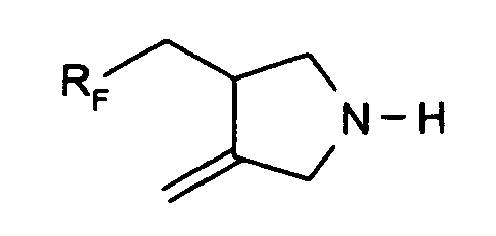
- An aqueous solution of sodium dithionite (0.6 g, 2.87 mmol, 25%) is added to a mixture of diallylamine (5.6 g, 57.4 mmol), perfluoroalkyl iodide (RFI; DuPont's Zonyl TelA-N) with a homologue distribution of 53.0% C8F17I, 30.6% C10F21I, 11.7% C12F25I, 3.6% C14F29I, and 1.0% C16F33I (35.0 g, 57.4 mmol), 18.0 g water, and 9.2 g methyl tert.-butyl ether at 13° C with stirring. The reaction mixture spontaneously begins to exotherm, reaching a maximum temperature of 42° C after about 15 minutes. It is allowed to cool back to room temperature over 45 minutes where it is maintained for 90 minutes, after which time <2 wt. % RFI remains as determined by GC. A charge of 50% potassium hydroxide (9.0 g, 80.4 mmol), is added to the mixture, which is then stirred at 60-62° C for 5 hours to carry out the dehydrohalogenation (reaction monitored by GC and AgNO3 titration for iodide). The resulting product mixture is extracted thrice with 75 ml methyl tert.-butyl ether at 50° C, and the solvent is evaporated under high vacuum at 50° C to give 30.7 g (93.7%) of white solid. The pyrrolidine structure is confirmed by 1H NMR (500 MHz, CD3OD) δ = 4.9, 5.1 (d, d, 2H, 2J =2.3 Hz, CH2=C), 3.4, 3.6 (dd, 2H, 2J=13 Hz, -NH-CH2C), 3.3, 2.6 (m, 2H, 2J=15 Hz, 3J=8.5 Hz, -NH-CH2CH), 2.9 (m, 1H, -CH2CHCH2), 2.2, 2.5 (m, 2H, CF2CH2). 13C NMR (500 MHz, CD3OD d: 152.3, CH2=C, 104.9, CH2=C, 54.2, -NH-CH2C, 51.8, -NH-CH2CH, 37.3, -CH2CHCH2, 34.1 Hz, CF2CH2 (t, 2JC-F = 22.6 Hz).
- N-succinyl-3-(perfluoroalkyl)methyl-4-methylene pyrrolidine

- Powdered succinic anhydride (32.6 g, 32.6 mmol) is added over 30 minutes to diallylamine (30. g, 30.8 mmol) while the temperature is maintained at 20-25° C with stirring. After the addition, the temperature is raised to 47° C and held there for 2.5 hours, after which 1.4% diallylamine is unreacted by GC. The clear, amber liquid is analyzed by 1H NMR (500 MHz, CD3OD δ = 5.39, 5.23 (m, 2H, CH2=CH), 5.20, 5.15 (dd, 4H, CH2=CH), 3.90 (d, d, 4H, -N-CH2), 2.65 (t, 2H, -CH2COOH), 2.55 (t, 2H, -CH2CON-). IR (film, NaCl) n=CH 993, 927 (olefin), n=CN 1415, n=CO 1474 acid), n=C=O 1624 (amide), n=c=o 1728 (acid), n=CH 3083, 2990 (aliphatic), n=OH 3300-2500.
- To a solution of the reaction product of Example 6a (10.0 g, 49.0 mmol), 23.0 g water, and 12.0 g tert.-butyl alcohol (t-BuOH) is added sodium hydroxide (4.6 g, 57.5 mmol, 50%) to adjust the pH from 3.55 to 11.92. Then perfluoroalkyl iodide (RFI, DuPont's Zonyl TelA-N) with a homologue distribution of 53.0% C8F17I, 30.6%C10F21I, 11.7% C12F25I, 3.6% C14F29I, and 1.0% C16F33I (28.3 g, 47.5 mmol) is added followed by sodium dithionite (0.4 g, 1.96 mmol, 88%). The reaction mixture temperature spontaneously increases from 22° C to 54° C. After cooling and stirring for 90 minutes at 25-30° C, less than 1 wt. % RFI is unreacted as determined by GC. Sodium hydroxide (4.7 g, 58.7 mmol) is added and the mixture is stirred at 45° C for 4.5 hours to carry out the dehydroiodination step. The product mixture is then poured into 1 liter of acidified ice water, filtered, and dried to give a white powder in quantitative yield. Proton NMR confirms the suggested structure.
- The procedure of Example 6 is repeated, but using in step b) as the RF-iodide an equivalent amount of C6F13 I. The resulting product is an anionic surfactant with the following properties in aqueous solution, as determined by surface tension measurements. The table shows the results in comparison with FORAFAC 1157, a benchmark surfactant from ATOCHEM Chem. Company.
Compound Surface Properties* of Aqueous Solutions with 0.041 % F S.T. I. S.C. dynes/ T cm . Example 7 17.9 4 3.6 . 2 FORAFAC 1157 16.6 6 3.0 . 1 *S.T. = surface tension; LT. = interfacial tension versus cyclohexane; and
S.C. = spreading coefficient -

- Flaked tetrahydrophthalic anhydride (24.6 g, 0.162 mol) is added portionwise to diallylamine (15.0 g, 0.154 mol) resulting in an exotherm from room temperature to 90° C. The mixture is then heated to 134° C with stirring for 3 hours to give 39.2 g (98.9%) of a viscous, clear, and amber liquid that contains less than 5 mole % diallylamine by GC. Thin layer chromatography and GC show exclusively one component. 1H NMR (500 MHz, CDCl3); δ = 5.81, 5.71 (m, 2H, H3 and H4), 5.70 (m, 2H, H8), 5.22, 5.13 (m, 4H, H9 and H10), 4.10-3.92 (m, 4H, H7), 3.08 (m, 1H, H6), 2.96 (m, 1H, H1), 2.52, 2.22 (m, 4H, H2 and H5).
- To a solution of the reaction product of example 7a (5.0 g, 19.4 mmol), 10.0 g water, and 6.0 g tert.-butyl alcohol (t-BuOH) is added sodium hydroxide (1.57 g, 19.6 mmol, 50%) to adjust the pH from 4.2 to 11.2. The solution is then heated to 60° C and perfluoroalkyl iodide (RFI, DuPont's Zonyl TelA-N) with a homologue distribution of 53.0% C8F17I, 30.6 %C10F21I, 11.7 % C12F25I, 3.6 % C14F29I, and 1.0 % C16F33I (23.4 g, 38.8 mmol) is added followed by a charge of Rongalite (0.19 g, 1.20 mmol). The reaction mixture's temperature spontaneously increases to reflux and is maintained with stirring at 78° C for 4 hours, resulting in a 96 wt. % RFI conversion by GC. Sodium hydroxide (4.7 g, 58.7 mmol, 50%) is added and the mixture is stirred at 63° C for 4.5 hours to carry out the deiodination step. The product mixture is then poured into acidified ice water, filtered, and dried to give an off-white powder (22.2 g, 94.9%). Proton NMR shows the downfield shifting of the olefinic hydrogen vicinal to the perfluoro group on the cyclohexenyl fragment and the overall spectrum is in agreement with the desired structure.
-

- The pyrrolidine from Example 5 (13.0 g. 22.4 mmol) is stirred at 130° C for 6 hours with pyromellitic anhydride (2.5 g, 11.1 mmol) and N-methylpyrrolidinone (4.4 g). GC analysis shows 94% of the pyrrolidine is converted to desired amide. An aqueous dispersion is then formulated with the following materials: 19.9 g of above product mixture, 41 g water, 4.0 g 20% ammonium hydroxide, 0.3 g Brij 35 (nonionic surfactant, ICI Chemical Corp.) and 0.15 g Brij 98 (polyethoxylated lauryl alcohol, ICI Chemical Corp.). This mixture is stirred at 60-65° C for 2 hours to give a stable dispersion.
-

- 4.1 g (67.5 mmol) of ethylenediamine (from Aldrich) and 23.2 g of deionized water are placed into a round-bottomed flask equipped with a stirrer, nitrogen inlet, condenser and a thermometer. Then 23.4 g (299.3 mmol) of allyl chloride is added while mixture is stirred and heated to 45° C. After 20 minutes, a solution of sodium hydroxide (10.1 g, 252 mmol, 33%) is added and the reaction mixture is stirred for 3.5 hours at 45° C, after which time the N-allylation reaction is complete as determined gas chromatography and chloride ion titration (AgNO3). The temperature is then lowered to 40° C and additional sodium hydroxide (2.3 g, 5.75 mmol, 50%) is added along with 1.5 g (7.32 mmol, 88%) of sodium hydrosulfite. Then 79.3 g (133.1 mmol) of perfluoroalkyl iodide (Zonyl TelA-N) and 8.5 g of hexylene glycol are added and the reaction mixture is stirred at 45° C for three hours to allow for free radical addition of the perfluoroalkyl iodide. Conversion of RF-iodide is determined by gas chromatography to be greater than 99%. The reaction mixture is then heated to 70° C, sodium hydroxide (13.5 g, 337 mmol, 50%) is added and the reaction mixture is stirred for an additional 5 hours to allow for deiodination, which is complete at this time based on titration for chloride.
- The reaction mixture is cooled and extracted into diethyl ether and isolated as a dry solid which is characterized by NMR.
-

- 17.4 g (173.8 mmol) of diallylamine (from Aldrich) and 10.0 g of deionized water are stirred in a round-bottomed flask at 55° C while 8.08 g (86.48 mmol) epichlorohydrin is added from an addition funnel. After 30 minutes the addition is complete. Then sodium hydroxide (10.0 g, 125 mmol, 50%) is added to the reaction mixture and it is stirred for an additional 3.5 hours, after which time the alkylation is complete as determined gas chromatography. The temperature is then cooled to 25° C and the pH is made alkaline with caustic. The product is extracted from the reaction mixture with ether (three times, 25 ml). On removal of the ether a clear yellow liquid is obtained with a purity of 98.6 % (GC and NMR).
- A cationic emulsion is made using Ethoquad 18/25 (polyethoxylated octadecylamine from Akzo-Nobel,1.2 g), deionized water/acetic acid (140.0 g/2.9 g), and isopropyl acetate (35 g). After stirring at 65° C for 15 minutes, the mixture is passed three times though a high pressure homogenizer. After the solvent is removed by vacuum at 50° C, a stable aqueous emulsion is obtained having 14% solids which is useful as a paper size.
-

- 5.02 g (8.8 mmol) of the RF-pyrrolidine of Example 5 is placed into a round-bottom flask equipped with a stirrer, nitrogen inlet, condenser and a thermometer. The mixture is stirred at 125° C under a constant nitrogen flow while 0.66 g (4.44 mmol) of dimethyl succinate (from Aldrich) is added. The reaction mixture is stirred at 170° C for one hour, after which time none of the starting materials remain as determined by gas chromatography. The bis-succinamide is obtained as a black resin which is soluble FREON-113. The structure is verified by NMR.
- A flask fitted with a reflux condenser and a mechanical stirrer is charged with 9.0 g (14.5 mmoles) of the perfluoroalkyl pyrrolidine of Example 2, (1.65 g, 8.9 mmole) N,N-diethylaminoethyl methacrylate, 0.9 g (9.0 mmole) methyl methacrylate and 10.0 g methyl isobutyl ketone. The flask is purged with nitrogen at 40° C, and 0.12 g azobisisobutyronitrile (AIBN) is added. The polymerization is performed by stirring the mixture at 65 to 70° C for 4.5 hours. To the polymerization mixture are added another 0.03 g AIBN and 0.07 g methyl methacrylate. The mixture is then stirred at 65° C for 16 hours, forming a very viscous gel-like mass. It is believed this is due to the formation of high molecular weight polymer resulting from crosslinking via the exocyclic double bond present in the monomer.
- Example 14 is performed without methyl methacrylate as a third comonomer.
- The procedure of Example 13 is repeated with the following charges of monomers and solvents: 6.0 g (9.7 mmoles) of the perfluoroalkyl pyrrolidine of Example 2, 1.6 g (8.6 mmoles) N,N-diethylaminoethyl methacrylate and 10.0 g methyl isobutyl ketone. The flask is purged with nitrogen at 40° C, and 0.07 g of azobisisobutyronitrile are added. The polymerization is carried out by stirring the mixture at 65 to 70° C for 4.0 hours; then another 0.03 g of azobisisobutyronitrile are added and the mixture is stirred at 68° C for another 5 hours, after which time the reaction is stopped due to excessive viscosity. The reaction mixture contains 5 % of unreacted perfluoroalkyl pyrrolidine monomer. An aqueous solution of acetic acid (0.7 g acetic acid in 25 g water) is added and the mixture is stirred for 15 minutes. The mixture is then transferred to a round bottom flask and methyl isobutyl ketone is removed under vacuum, resulting in a yellow aqueous copolymer solution having a pH of 5 and 18 % solids.
- Examples 13 and 14 resulted in highly viscous mixtures and partial crosslinking during polymerization. The following polymerizations are performed using a chain transfer agent to control the molecular weight and hence the viscosity.
- A flask fitted with a reflux condenser and a mechanical stirrer is charged with 10.0 g (16.0 mmoles) of the perfluoroalkyl pyrrolidine of Example 2, 2.6 g (14 mmoles) N,N-diethylaminoethyl methacrylate and 8.0 g methyl isobutyl ketone. The flask is purged with nitrogen at 40° C, then 0.13 g dodecane thiol and 0.1 g of 2,2'-azobis-(2-methylbutanenitrile) (Vazo-67) are added. The polymerization is carried out by stirring the mixture at between 68 and 72° C for 4.0 hours, after which time another 0.04 g of Vazo-67 are added and the mixture is stirred at 70° C for another 6 hours. An aqueous solution of acetic acid (1.2 g acetic acid in 40 g water) is added and the mixture is stirred for 15 minutes. It is then transferred to a round bottom flask and methyl isobutyl ketone is removed under vacuum, resulting in a yellow aqueous copolymer solution having a pH of 5 and 18 % solids.
- In Examples 16 and 17, N,N-dimethylaminoethyl methacrylate is used as the amino monomer. In order to evaluate the effect of other comonomers, N-vinyl pyrrolidinone is also used as the third comonomer in Example 17.
- A flask fitted with a reflux condenser, and a mechanical stirrer is charged with 15.0 g (24.0 mmoles) of the perfluoroalkyl pyrrolidine of Example 2, 3.4 g (21.6 mmoles) of N,N-dimethylaminoethyl methacrylate; and 12.0 g of methyl isobutyl ketone. The flask is purged with nitrogen at 40° C; then 0.15 g of dodecane thiol and 0.15 g of Vazo-67 are added. The polymerization is performed by stirring the mixture at between 68 and 70° C for 4.0 hours. To the polymerization mixture are added 0.3 g of dimethylacrylamide and another 0.04 g of Vazo-67. The mixture is then stirred at 68° C for 6 hours. An aqueous solution of acetic acid (2.1 g acetic acid in 50 g water) is added, and the mixture is stirred for 15 minutes. It is then transferred to a round bottom flask and methyl isobutyl ketone is removed under vacuum, resulting in a yellow aqueous copolymer solution having a pH of 4 and 23 % solids.
- A flask fitted with a reflux condenser and a stirrer is charged with 12.0 g (19 mmoles) of the perfluoroalkyl pyrrolidine of Example 2, 1.5 g (9.5 mmoles) of N,N-dimethylaminoethyl methacrylate; 0.9 g (8.1 mmoles) of N-vinyl pyrrolidinone and 11.0 g of methyl isobutyl ketone. The flask is purged with nitrogen at 40° C. To the flask are added 0.1 g of dodecane thiol and 0.1 g of Vazo-67. The polymerization is performed by stirring the mixture at between 68 and 70° C for 4.0 hours. To the polymerization mixture is added another 0.05 g of Vazo-67, and the mixture is stirred at between 65 to 70° C for 5 hours. An aqueous solution of acetic acid (1.0 g acetic acid in 90 g water) is added, and the mixture is stirred for 15 minutes. It is then transferred to a round bottom flask and methyl isobutyl ketone is removed under vacuum, resulting in a yellow aqueous copolymer solution having a pH of 5 and 17 % solids.
- Synthesis of {3-[3-(perfluoroalkyl)methyl-4-methylene-pyrrolidin-1-yl]-2-hydroxy-propyl}-trimethylammonium chloride
- a) At 74° C, 33.1 g (0.154 mol, 70.6%) glycidyltrimethylammonium chloride are added over 30 minutes to 15.0 g (0.154 mol) diallylamine and 12 g deionized water while an exotherm is controlled at 75-80° C by external cooling. After the addition, the clear yellow solution is stirred at about 78° for 90 minutes, after which time less than 1 mol % of diallylamine is unreacted according to GC analysis. Spectral analysis confirms the suggested product.
- b) RF-iodide addition
26 g perfluoroalkyl iodide (43.7 mmol) (RF-I, DuPont's Zonyl TelA-N) are added to a solution of 16.9 g (43.7 mmol) of the reaction product of Example 18a in 15.0 g water and 15.0 g 2-propanol, followed by 0.43 g (2.18 mmol, 88%) sodium dithionite. The reaction mixture temperature spontaneously increases from 22° C to 48° C. After cooling and stirring for 90 minutes at 25-30° C, less than 1 wt. % RF-I is unreacted as determined by GC. Then 5.2 g (65.5 mmol) sodium hydroxide are added and the mixture is stirred at 65 ° C for 4.5 hours to carry out the dehydroiodination step. The product mixture is then poured into 1 liter of ice water, filtered, and dried to give a tan solid in quantitative yield. Proton NMR confirms the suggested structure:
- The following example shows the usefulness of the novel compounds of the present invention as external paper sizes.
- Neutralized test solutions are added to a 4% aqueous solution of paper maker's starch (Stayco M, oxidized starch, from Staley Corp.) and then applied to unsized paper by padding (paper dipped through starch solution, and passed through single nip rollers). The resulting sheets are dried at ambient conditions for 15 minutes, then 3 minutes at 200° F (86.6° C) in an "Emerson Speed Drier" (heated metal plate with a canvas cover).
- The oil repellency of the surface is determined by using the TAPPI UM 557 OIL KIT TEST, which consists of determining with which of twelve castor oil-heptane-toluene mixtures having decreasing surface tension penetration occurs within 15 seconds; ratings go from 1, lowest, to 12.
- Grease resistance is determined with the Ralston-Purina test for pet food materials; RP-2 Test, Ralston-Purina Company, Packaging Reference Manual Volume 06 - Test Methods. In summary, cross-wise creased test papers are placed over a grid sheet imprinted with 100 squares. Five grams of sand are placed in the center of the crease. A mixture of synthetic oil and a dye for visualization is pipetted onto the sand and the samples are maintained at 60° C for 24 hours. Ratings are determined by the percentage of stained grid segments, using at least two samples.
- Water resistance is determined using the Cobb Sizing test as described in TAPPI T 441 om-90.
- In this test drops of isopropanol - water mixtures are placed on paper and after 3 minutes the under side of the paper is monitored for penetration, if no penetration has occurred, a mixture with the next higher IPA content is applied. The rating is based on the highest % by weight of IPA which does not penetrate. Ratings are based on 5% IPA increments.
- This is a very stringent test. French "Felix" brand cat food is placed as a 2 cm thick layer on 100 cm2 of treated paper; this sample is then put under a weight of 7 kg and kept in an environmental chamber at 70° C and 67% moisture for 16 hours. The paper is then visually inspected for signs of fat penetration, which is expressed in area %. Any value below 15% is considered passing. Cat food is used because it is a very aggressive substance, containing phosphoric acid (to prevent kidney stones).
- The same procedure is used as described above, but with Eukanuba brand pet food and under dry conditions.
- The following table shows the performance of the inventive compounds in comparison with commercial products. Note that the performance of the inventive compounds in pet food tests is similar to that of commercial polymeric compounds, whereas comparable commercial low molecular weight compounds fail in pet food tests.
Oil and Grease Resistance Resistance to Polar Solvents Pet Food Tests Compou % Oi R Tur C I FE EU nd of F I P p. ob P LIX KA- Example ap Ki - Test b2 A NU No. pl. t 2 , mi T 70° BA T T n. e C 70° es e sec % st % C t st s. % % 6 0. 7 0, 900 72 0 06 7 0 120 72 0 0. 1 0, 0 61 0 36 0.2 07 0 0 180 0. 0, 0 09 0 8 0. 9 2 900 65 0 07 1 x 180 45 0 0. 1 0 0+ 32 1 15 0 09 1 2 180 0. 2 x 0+ 12 0 2 x 0 9 0. 5 4 30 46 1 07 6 x 60 23 1 0. 9 0 180 22 0 10 0 09 4 0+ 4 0. x 0 12 0 4 x 0 10 0. 7, 4 90 41 5, 35 05 7 x 180 25 0 15 0. 8, 0 0+ 23 1 8 0 07 9 4 180 0, 0. 9, x 0+ 0 10 1 0 2 2 4 0, x 2 0 4 0. 8 0; 720 33 1 07 9 0. 150 30 0 0. 1 1 0 21 1 9 0 08 0 2 180 0 0. x 0+ 2 12 0 0 0; 1 15 0. 9 0; > 18 22 5 5 0.0 13 0 00 0 5 17 0. 1 0. >18 21 2 9 0 11 0 1 00 0 FX-850* 0. 7 0, 180 61 1 26 7 16 0. 0+ 0 1 0 For325* 0. 1 0, 180 34 1 22 0 12 2 0 0+ 0 P-208** 0. 9 0, 180 68 0 80 0 11 0. 0+ 2 FC- 0. 1 2 180 83 0 100 100 807** 10 2 x 0+ 0 * = polymers; ** = small molecules - Six grams of dry recycled pulp consisting of 70% hard-wood and 30% soft-wood is diluted in 289 ml distilled water and thoroughly dispersed in a blender. To this pulp slurry is added the required amount of a 1% solution of the test compound in distilled water and mixed in for 5 minutes. Then 6 ml of a 1% aqueous solution of cooked cationic starch is added and mixed in for an additional 5 minutes. To this mixture 24 ml of a 50% (on solids) dilution of a water-repellent adjuvant (alkylketene dimer, AKD, commercial product Hercon-76, from Nalco Chem. Corp.) are added and mixed in for another 10 minutes. The resulting slurry is diluted with an additional 500 ml of distilled water and mixed again. This mixture is then poured over a 100 mesh wire screen while a vacuum applied from below. This pulls the water from the pulp mixture to form a sheet on the screen. The wet sheet is removed from the screen and dried between another screen and a hard surface at a pressure of approximately 0.4 lb./in2 at 110° C for 1 ½ hours.
- One ml of hot (110° C) corn oil is placed on the paper and the time is recorded for penetration to occur (20 minutes maximum). Paper made in the same manner, including the cationic starch and water-repellent adjuvant, but without a fluorochemical, demonstrates an oil kit number of < 1 and holds the hot corn oil for less than one minute (begins to penetrate as soon as applied). The amount of oil absorbed is determined gravimetrically by weighing the paper before and after the hot-oil test, and after the surface oil has been removed.
- The Oil-Kit Test is the same as that for the External Size.
- One ml of a hot (83° C) 5% lactic acid solution is placed on a paper plate; hold-out time and absorption are measured the same way as in the hot-oil test.
- In this application water resistance is a function of the AKD (alkylketene dimer); it is important that the AKD cure is not inhibited by the fluorochemical additive. The test results show that the bis-pyrrolidine compound of Example 11 performs exceptionally well with the polymeric product being only slightly worse.
- The following table shows the results:
Exp. # Compound Type % F OIL WATER 6 RF-pyrr. .07 >20/ =20/32 Succinamate .15 0 1/51 >20/ 0 9 di-RF-pyrr..15 .07 1/52 >20/9 Pyromellitate .15 1/32 =20/23 11 bis-RF-pyrrolidine .07 >20/ >20/7 15 0 >20/7 >20/ 0 4 polyacrylamide .07 >20/ =20/18 .15 0 >20/46 >20/ 0
Claims (10)
- A pyrrolidine of the formula III

RF is a monovalent perfluorinated alkyl or alkenyl, linear or branched organic radical having four to twenty fully fluorinated carbon atoms,
q is 1 or 2,
when q is 1, B-Q is -(CH2)1-3COOH; -CH2-C(=O)NH2; -C(=O)-CR=CH,; -C(=O)-COOH; -C(=O)-(CH2)2-3-COOH; -C(=O)-CH=CH-COOH; -C(=O)-C(=CH2)-CH2-COOH; -C(=O)-CH2-C(=CH2)-COOH; -C(=O)-(C6H4)-COOH; -C(=O)-(C6H8)-COOH; -C(=O)-(C6H5RF)-COOH; -C(=O)-(C7H6)-COOH; -C(=O)-(C8H8)-COOH; -C(=O)(CH2)8CH=CH2; -CH2-CHOH-CH2-O-CH2-CH=CH2; -CH2CH2N(CH3)2; -C-CH2CH2CH2N(CH3)2; -CH2-CH(OH)-CH2-N(CH3)2 +; -CH2-CHOH-CH2-O-(CH2CHR-O)mR,; -P(=O)(OH)2 or -SO3H, in which R is hydrogen or methyl, m is a number from 1 to 20 and R, is hydrogen, an alkyl group with 1 to 20 carbon atoms, or a phenyl group substituted by p-octyl- or p-nonyl, or SO3H, or, if RF is a monovalent perfluorinated alkyl B-Q can be
when q is 2,
B is a direct bond and Q is -CH2-CHOH-CH2-O-(CH2 CHR-O)m-((CH2-CHR2-O)n-(CH2-CHR3-O)1)2-CH2-CHOH-CH2-; -CH2CH2-; or -CH2-CHOH-CH2-; wherein R, R2 and R3 are independently of each other hydrogen or methyl, m, n and I are a number from 1 to 20 and z is zero or 1; with the proviso that if R2 is hydrogen, R and R3 are methyl and vice versa; or -CH2 CH2-C(=O)-NH-CH2-NH-C(=O)-CH2CH2-;
or
B is -C(=O)-NH- and Q is the diradical hydrocarbon residue of p- or m-toluene diisocyanate, isophorone diisocyanate, 3,3,4(3,4,4)trimethylhexane-1,6-diisocyanate or hexane-1,6-diisocyanate;
or
B is -C(=O)- and Q is -(C6H2)(-COOH)2)-, -(C13H6O)(-COOH)2)- or is C2-C10alkylene or -alkenylene or -C6-C10arylene,
and wherein any amino groups are optionally partially or fully salinized, quaternized or in the form of the corresponding N-oxides. - A compound according to claim 1, wherein RF is saturated and contains 4-12 carbon atoms, is fully fluorinated and contains at least one terminal perfluoromethyl group.
- A compound according to claim 2, wherein RF is saturated and contains 6-10 fully fluorinated carbon atoms.
- A compound according to claim 5, wherein if q = 1, B-Q is -C(=O)-CR=CH2; -CH2-COOH; -C(=O)-(CH2)2-COOH; -C(=O)-(C6H4)-COOH; -C(=O)-(C6H5RF)-COOH or -C(=O)-(C6H8)-COOH.
- A compound of the formula II

- A process to prepare a compound of the formula III
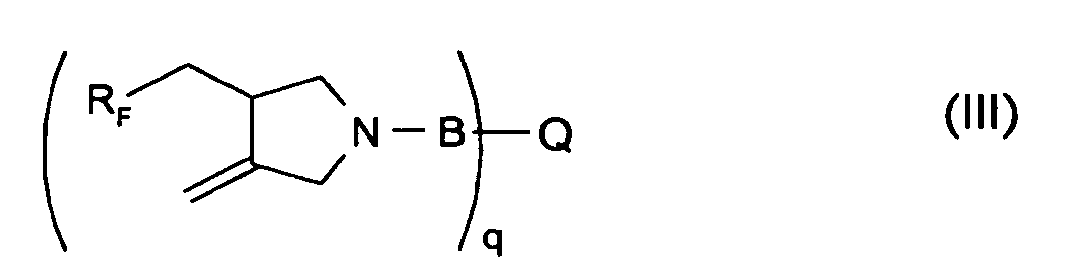
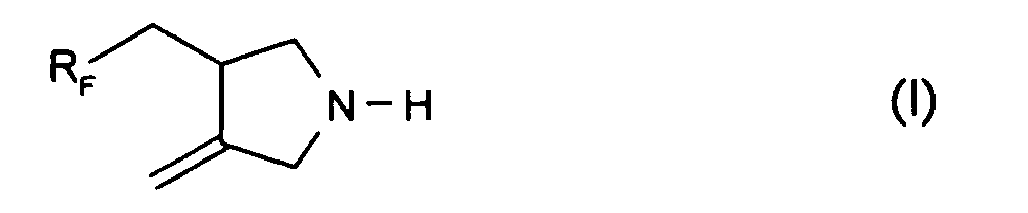
with a dianhydride to form the corresponding di-amic acid; with an acyl halide, a diacyl halide, an alkyl ester or a dialkyl ester, to form the corresponding amide or diamide;
with a halogenated organic compound to form the corresponding tertiary amine or tertiary amine-acid;
with a diisocyanate to form the corresponding di-urethane;
with an oxirane or a polyoxirane compound to form the corresponding hydroxy-tertiary amino compound;
or with a phosphoric acid derivative to form the corresponding phosphamic acid. - A process according to claim 6, wherein the anhydride is oxalic-, glutaric-, alkenyl-succinic-, succinic-, tetrahydrophthalic-, norbornene-; methendic-, maleic-, trimellitic or itaconic anhydride, the dianhydride is pyromellitic anhydride or benzophenone-tetracarboxylic acid dianhydride, the acyl halide is benzoyl chloride or acetyl chloride, the diacyl halide is oxalylchloride, the alkyl or dialkyl ester is ethyl undecylenate or dimethyl succinate, the halogenated organic compound is 1,4-dichloromethylbenzene, chloroacetic acid, chloropropionic acid or chloroacetamide, the diisocyanate is isophorone diisocyanate, toluene diisocyanate, 1,6-diisocyanatohexane or 1,6-diisocyanato-3,3,4(3,4,4)-trimethylhexane, the oxirane or polyoxirane compound is epichlorohydrin, ethylene oxide, propylene oxide, cyclohexane oxide, styrene oxide, allyl glycidyl ether, the diglycidyl ether of bisphenol A, bisphenol F or 1,4-butanediol, and the phosphoric acid derivative is POCl3, polyphosphoric acid or sodium metaphosphate.
- A process to prepare a 1-acryloyl-3-(perfluoroalkyl)methyl-4-methylene compound of the formula IIa
 a) reacting 3-chloropropionyl chloride with diallylamine to form N,N-diallyl-3-chloropropaneamide,b) reacting the product of step a) with an RF-iodide, where RF is as defined above, in an aqueous medium comprising from 5 to 50% by weight of a water-soluble cosolvent, a free radical initiator and a water-soluble aldehyde or an adduct of an aldehyde with a free radical initiator andc) dehydrohalogenating the product of step b) with a base.
 - A process according to claim 8, wherein the free radical initiator is 0.01 to 10 mole % based on the RF-iodide of an alkali metal dithionite and the water-soluble aldehyde is formaldehyde or glyoxal, or the aldehyde adduct is hydroxymethane sulfinic acid, sodium salt.
- A method of improving the resistance of a paper product to oil and grease, which comprises applying to paper as an external coating or to pulp in a size press, an amount of a compound according to claim 1 which is sufficient to deposit from 0.005 to 0.5 % of organically bound fluorine by weight based on the dry paper weight.
Applications Claiming Priority (5)
| Application Number | Priority Date | Filing Date | Title |
|---|---|---|---|
| US16082599P | 1999-10-21 | 1999-10-21 | |
| US160825P | 1999-10-21 | ||
| US22865700P | 2000-08-29 | 2000-08-29 | |
| US228657P | 2000-08-29 | ||
| PCT/EP2000/010045 WO2001028998A1 (en) | 1999-10-21 | 2000-10-12 | N-substituted perfluoroalkylated pyrrolidines, process for making them and process for the addition of rf-iodide to an olefin |
Publications (2)
| Publication Number | Publication Date |
|---|---|
| EP1237863A1 EP1237863A1 (en) | 2002-09-11 |
| EP1237863B1 true EP1237863B1 (en) | 2009-09-23 |
Family
ID=26857260
Family Applications (1)
| Application Number | Title | Priority Date | Filing Date |
|---|---|---|---|
| EP00971365A Expired - Lifetime EP1237863B1 (en) | 1999-10-21 | 2000-10-12 | N-substituted perfluoroalkylated pyrrolidines, process for making them and process for the addition of rf-iodide to an olefin |
Country Status (6)
| Country | Link |
|---|---|
| US (1) | US6436235B1 (en) |
| EP (1) | EP1237863B1 (en) |
| AU (1) | AU1024101A (en) |
| DE (1) | DE60043018D1 (en) |
| TW (1) | TW483969B (en) |
| WO (1) | WO2001028998A1 (en) |
Families Citing this family (3)
| Publication number | Priority date | Publication date | Assignee | Title |
|---|---|---|---|---|
| ITMI20050188A1 (en) * | 2005-02-10 | 2006-08-11 | Solvay Solexis Spa | WATER COMPOSITIONS CONTAINING PERFLUOROPOLIETER DI-CARBOXYLIS SALTS FOR THE OLEOREPELLENT TREATMENT OF PAPER |
| KR20090010066A (en) * | 2006-05-23 | 2009-01-28 | 시바 홀딩 인코포레이티드 | N-substituted perfluoroalkylated pyrrolidine as surface modifier |
| WO2011066211A1 (en) * | 2009-11-24 | 2011-06-03 | Glaxosmithkline Llc | Azabenzimidazoles as fatty acid synthase inhibitors |
Family Cites Families (7)
| Publication number | Priority date | Publication date | Assignee | Title |
|---|---|---|---|---|
| US3763225A (en) | 1967-01-02 | 1973-10-02 | Ugine Kuhlmann | Perfluoroaliphatic substituted amines |
| US3535381A (en) | 1967-05-22 | 1970-10-20 | Pennwalt Corp | Unsaturated fluoroalkyl amines and process for the preparation thereof |
| DE2504514A1 (en) * | 1974-02-12 | 1975-08-14 | Ciba Geigy Ag | FLUORINE CARBONIC ACID AMIDES AND THEIR POLYMERIZATION PRODUCTS |
| US5580992A (en) * | 1994-03-01 | 1996-12-03 | Shin-Etsu Chemical Co., Ltd. | Olefinic monomers containing pendant perfluorinated cyclic ether moieties |
| US5585517A (en) * | 1994-07-01 | 1996-12-17 | Ciba-Geigy Corporation | Process for reacting a perfluoroalkl iodide with an olefinic compound |
| US5408010A (en) * | 1994-07-28 | 1995-04-18 | E. I. Du Pont De Nemours And Company | Fluoroorganic soli-resist agents |
| US6156222A (en) * | 1998-05-08 | 2000-12-05 | Ciba Specialty Chemicals Corporation | Poly-perfluoroalkyl substituted polyamines as grease proofing agents for paper and foam stabilizers in aqueous fire-fighting foams |
-
2000
- 2000-10-12 DE DE60043018T patent/DE60043018D1/en not_active Expired - Lifetime
- 2000-10-12 WO PCT/EP2000/010045 patent/WO2001028998A1/en not_active Ceased
- 2000-10-12 AU AU10241/01A patent/AU1024101A/en not_active Abandoned
- 2000-10-12 EP EP00971365A patent/EP1237863B1/en not_active Expired - Lifetime
- 2000-10-18 US US09/691,486 patent/US6436235B1/en not_active Expired - Fee Related
- 2000-10-19 TW TW089121898A patent/TW483969B/en not_active IP Right Cessation
Also Published As
| Publication number | Publication date |
|---|---|
| AU1024101A (en) | 2001-04-30 |
| EP1237863A1 (en) | 2002-09-11 |
| WO2001028998A1 (en) | 2001-04-26 |
| US6436235B1 (en) | 2002-08-20 |
| DE60043018D1 (en) | 2009-11-05 |
| TW483969B (en) | 2002-04-21 |
Similar Documents
| Publication | Publication Date | Title |
|---|---|---|
| US5446118A (en) | Fluorinated acrylic monomers containing urethane groups and their polymers | |
| JPS64945B2 (en) | ||
| FR2460971A1 (en) | VINYL ALCOHOL COPOLYMERS CONTAINING CATIONIC RADICALS, USEFUL IN PAPERMAKING, AND PROCESS FOR THEIR PREPARATION | |
| KR19990088134A (en) | Poly-perfluoroalkyl substituted polyamines as grease proofing agents for paper and foam stabilizers in aqueous fire-fighting foams | |
| US7754624B2 (en) | Perfluoroalkyl substituted acrylate monomers and polymers thereof | |
| JPH0414104B2 (en) | ||
| US6436235B1 (en) | N-substituted perfluoroalkylated pyrrolidines and process for making them | |
| Ayfer et al. | Synthesis and antibacterial activities of new quaternary ammonium monomers | |
| US4147585A (en) | Process for surface-sizing papers with maleic anhydride copolymers | |
| CN110787720A (en) | Fluorine-containing gemini surfactant and preparation method thereof | |
| SE406194B (en) | AMPHOLYTIC, FLUORALIFATIC, SURFACTIVE AGENT INTENDED FOR THE PREPARATION OF FIREFIGHTING FOAM | |
| US5103048A (en) | Surface-active compounds having a perfluoroalkyl group and a nitrogen-containing aliphatic radical, a process for their preparation and their use | |
| US3576019A (en) | Fluorocarbon oil-repellency agents | |
| TW591055B (en) | Mono- and polyamides of perfluoroalkyl-substituted unsaturated acids | |
| AU647583B2 (en) | Heteratom containing perfluoroalkyl terminated neopentyl mercapto-alcohols and compositions therefrom | |
| CA1211460A (en) | Process for sizing paper with anionic hydrophobic sizing agents and cationic retention aids | |
| US5271806A (en) | Method for sizing paper | |
| US4645813A (en) | Cationic fluoro polymers | |
| US5200493A (en) | Heteroatom containing perfluoralkyl terminated neopentyl mercapto-alcohols and compositions therefrom | |
| EP0462063A1 (en) | Fluorinated paper sizes | |
| WO2011119560A1 (en) | Mixture of polyfluoroalkylsulfonamido alkyl amines | |
| SU523633A3 (en) | The method of obtaining the Quaternary ammonium salts | |
| DE69202545T2 (en) | Maleimide derivatives containing an acrylic residue. | |
| WO2011119551A1 (en) | Polyfluoroalkylsulfonamido alkyl halide intermediate | |
| US4163754A (en) | Fluorinated sulfonamides |
Legal Events
| Date | Code | Title | Description |
|---|---|---|---|
| PUAI | Public reference made under article 153(3) epc to a published international application that has entered the european phase |
Free format text: ORIGINAL CODE: 0009012 |
|
| 17P | Request for examination filed |
Effective date: 20020225 |
|
| AK | Designated contracting states |
Kind code of ref document: A1 Designated state(s): AT BE CH CY DE DK ES FI FR GB GR IE IT LI LU MC NL PT SE |
|
| AX | Request for extension of the european patent |
Free format text: AL;LT;LV;MK;RO;SI |
|
| RBV | Designated contracting states (corrected) |
Designated state(s): AT BE CH DE FR GB LI |
|
| RIC1 | Information provided on ipc code assigned before grant |
Ipc: 7C 07D 207/20 B Ipc: 7C 08K 5/3415 B Ipc: 7C 07B 37/02 A |
|
| 17Q | First examination report despatched |
Effective date: 20040519 |
|
| RAP1 | Party data changed (applicant data changed or rights of an application transferred) |
Owner name: CIBA HOLDING INC. |
|
| GRAP | Despatch of communication of intention to grant a patent |
Free format text: ORIGINAL CODE: EPIDOSNIGR1 |
|
| GRAS | Grant fee paid |
Free format text: ORIGINAL CODE: EPIDOSNIGR3 |
|
| GRAA | (expected) grant |
Free format text: ORIGINAL CODE: 0009210 |
|
| RAP1 | Party data changed (applicant data changed or rights of an application transferred) |
Owner name: BASF SE |
|
| RBV | Designated contracting states (corrected) |
Designated state(s): DE FR GB |
|
| AK | Designated contracting states |
Kind code of ref document: B1 Designated state(s): DE FR GB |
|
| REG | Reference to a national code |
Ref country code: GB Ref legal event code: FG4D |
|
| REF | Corresponds to: |
Ref document number: 60043018 Country of ref document: DE Date of ref document: 20091105 Kind code of ref document: P |
|
| PLBE | No opposition filed within time limit |
Free format text: ORIGINAL CODE: 0009261 |
|
| STAA | Information on the status of an ep patent application or granted ep patent |
Free format text: STATUS: NO OPPOSITION FILED WITHIN TIME LIMIT |
|
| GBPC | Gb: european patent ceased through non-payment of renewal fee |
Effective date: 20091223 |
|
| 26N | No opposition filed |
Effective date: 20100624 |
|
| PG25 | Lapsed in a contracting state [announced via postgrant information from national office to epo] |
Ref country code: GB Free format text: LAPSE BECAUSE OF NON-PAYMENT OF DUE FEES Effective date: 20091223 |
|
| PGFP | Annual fee paid to national office [announced via postgrant information from national office to epo] |
Ref country code: FR Payment date: 20101104 Year of fee payment: 11 |
|
| PGFP | Annual fee paid to national office [announced via postgrant information from national office to epo] |
Ref country code: DE Payment date: 20101227 Year of fee payment: 11 |
|
| REG | Reference to a national code |
Ref country code: FR Ref legal event code: ST Effective date: 20120629 |
|
| PG25 | Lapsed in a contracting state [announced via postgrant information from national office to epo] |
Ref country code: DE Free format text: LAPSE BECAUSE OF NON-PAYMENT OF DUE FEES Effective date: 20120501 |
|
| REG | Reference to a national code |
Ref country code: DE Ref legal event code: R119 Ref document number: 60043018 Country of ref document: DE Effective date: 20120501 |
|
| PG25 | Lapsed in a contracting state [announced via postgrant information from national office to epo] |
Ref country code: FR Free format text: LAPSE BECAUSE OF NON-PAYMENT OF DUE FEES Effective date: 20111102 |