EP1237422B1 - Bean curd containing lactic acid fermenting bacteria culture fluid and a method for preparing the same, and beverage containing lactic acid fermenting bacteria and a method for preparing the same - Google Patents
Bean curd containing lactic acid fermenting bacteria culture fluid and a method for preparing the same, and beverage containing lactic acid fermenting bacteria and a method for preparing the same Download PDFInfo
- Publication number
- EP1237422B1 EP1237422B1 EP00983555A EP00983555A EP1237422B1 EP 1237422 B1 EP1237422 B1 EP 1237422B1 EP 00983555 A EP00983555 A EP 00983555A EP 00983555 A EP00983555 A EP 00983555A EP 1237422 B1 EP1237422 B1 EP 1237422B1
- Authority
- EP
- European Patent Office
- Prior art keywords
- lactic acid
- preparing
- bean
- bean curd
- acid bacteria
- Prior art date
- Legal status (The legal status is an assumption and is not a legal conclusion. Google has not performed a legal analysis and makes no representation as to the accuracy of the status listed.)
- Expired - Lifetime
Links
Images
Classifications
-
- A—HUMAN NECESSITIES
- A23—FOODS OR FOODSTUFFS; TREATMENT THEREOF, NOT COVERED BY OTHER CLASSES
- A23L—FOODS, FOODSTUFFS OR NON-ALCOHOLIC BEVERAGES, NOT OTHERWISE PROVIDED FOR; PREPARATION OR TREATMENT THEREOF
- A23L11/00—Pulses, i.e. fruits of leguminous plants, for production of food; Products from legumes; Preparation or treatment thereof
- A23L11/40—Pulse curds
- A23L11/45—Soy bean curds, e.g. tofu
-
- A—HUMAN NECESSITIES
- A23—FOODS OR FOODSTUFFS; TREATMENT THEREOF, NOT COVERED BY OTHER CLASSES
- A23C—DAIRY PRODUCTS, e.g. MILK, BUTTER OR CHEESE; MILK OR CHEESE SUBSTITUTES; PREPARATION THEREOF
- A23C11/00—Milk substitutes, e.g. coffee whitener compositions
- A23C11/02—Milk substitutes, e.g. coffee whitener compositions containing at least one non-milk component as source of fats or proteins
- A23C11/10—Milk substitutes, e.g. coffee whitener compositions containing at least one non-milk component as source of fats or proteins containing or not lactose but no other milk components as source of fats, carbohydrates or proteins
- A23C11/103—Milk substitutes, e.g. coffee whitener compositions containing at least one non-milk component as source of fats or proteins containing or not lactose but no other milk components as source of fats, carbohydrates or proteins containing only proteins from pulses, oilseeds or nuts, e.g. nut milk
- A23C11/106—Addition of, or treatment with, microorganisms
-
- A—HUMAN NECESSITIES
- A23—FOODS OR FOODSTUFFS; TREATMENT THEREOF, NOT COVERED BY OTHER CLASSES
- A23L—FOODS, FOODSTUFFS OR NON-ALCOHOLIC BEVERAGES, NOT OTHERWISE PROVIDED FOR; PREPARATION OR TREATMENT THEREOF
- A23L11/00—Pulses, i.e. fruits of leguminous plants, for production of food; Products from legumes; Preparation or treatment thereof
- A23L11/05—Mashed or comminuted pulses or legumes; Products made therefrom
- A23L11/07—Soya beans, e.g. oil-extracted soya bean flakes
-
- A—HUMAN NECESSITIES
- A23—FOODS OR FOODSTUFFS; TREATMENT THEREOF, NOT COVERED BY OTHER CLASSES
- A23L—FOODS, FOODSTUFFS OR NON-ALCOHOLIC BEVERAGES, NOT OTHERWISE PROVIDED FOR; PREPARATION OR TREATMENT THEREOF
- A23L11/00—Pulses, i.e. fruits of leguminous plants, for production of food; Products from legumes; Preparation or treatment thereof
- A23L11/50—Fermented pulses or legumes; Fermentation of pulses or legumes based on the addition of microorganisms
-
- A—HUMAN NECESSITIES
- A23—FOODS OR FOODSTUFFS; TREATMENT THEREOF, NOT COVERED BY OTHER CLASSES
- A23L—FOODS, FOODSTUFFS OR NON-ALCOHOLIC BEVERAGES, NOT OTHERWISE PROVIDED FOR; PREPARATION OR TREATMENT THEREOF
- A23L11/00—Pulses, i.e. fruits of leguminous plants, for production of food; Products from legumes; Preparation or treatment thereof
- A23L11/60—Drinks from legumes, e.g. lupine drinks
- A23L11/65—Soy drinks
-
- A—HUMAN NECESSITIES
- A23—FOODS OR FOODSTUFFS; TREATMENT THEREOF, NOT COVERED BY OTHER CLASSES
- A23L—FOODS, FOODSTUFFS OR NON-ALCOHOLIC BEVERAGES, NOT OTHERWISE PROVIDED FOR; PREPARATION OR TREATMENT THEREOF
- A23L2/00—Non-alcoholic beverages; Dry compositions or concentrates therefor; Preparation or treatment thereof
- A23L2/02—Non-alcoholic beverages; Dry compositions or concentrates therefor; Preparation or treatment thereof containing fruit or vegetable juices
-
- A—HUMAN NECESSITIES
- A23—FOODS OR FOODSTUFFS; TREATMENT THEREOF, NOT COVERED BY OTHER CLASSES
- A23L—FOODS, FOODSTUFFS OR NON-ALCOHOLIC BEVERAGES, NOT OTHERWISE PROVIDED FOR; PREPARATION OR TREATMENT THEREOF
- A23L2/00—Non-alcoholic beverages; Dry compositions or concentrates therefor; Preparation or treatment thereof
- A23L2/38—Other non-alcoholic beverages
- A23L2/382—Other non-alcoholic beverages fermented
-
- A—HUMAN NECESSITIES
- A23—FOODS OR FOODSTUFFS; TREATMENT THEREOF, NOT COVERED BY OTHER CLASSES
- A23V—INDEXING SCHEME RELATING TO FOODS, FOODSTUFFS OR NON-ALCOHOLIC BEVERAGES AND LACTIC OR PROPIONIC ACID BACTERIA USED IN FOODSTUFFS OR FOOD PREPARATION
- A23V2250/00—Food ingredients
- A23V2250/02—Acid
- A23V2250/022—Acetic acid
-
- A—HUMAN NECESSITIES
- A23—FOODS OR FOODSTUFFS; TREATMENT THEREOF, NOT COVERED BY OTHER CLASSES
- A23V—INDEXING SCHEME RELATING TO FOODS, FOODSTUFFS OR NON-ALCOHOLIC BEVERAGES AND LACTIC OR PROPIONIC ACID BACTERIA USED IN FOODSTUFFS OR FOOD PREPARATION
- A23V2250/00—Food ingredients
- A23V2250/02—Acid
- A23V2250/042—Lactic acid
-
- A—HUMAN NECESSITIES
- A23—FOODS OR FOODSTUFFS; TREATMENT THEREOF, NOT COVERED BY OTHER CLASSES
- A23V—INDEXING SCHEME RELATING TO FOODS, FOODSTUFFS OR NON-ALCOHOLIC BEVERAGES AND LACTIC OR PROPIONIC ACID BACTERIA USED IN FOODSTUFFS OR FOOD PREPARATION
- A23V2300/00—Processes
Definitions
- the present invention relates to a method for preparing bean curd containing lactic acid bacteria culture, and to bean curd prepared according to the method, to a beverage containing lactic acid bacteria, and to a method for preparing the same.
- the present invention relates to a method for preparing bean curd containing lactic acid bacteria by adding lactic acid bacteria culture to bean soup, and bean curd prepared according to the method, a method for preparing a beverage containing lactic acid using bean soup remaining after preparing the bean curd, and a beverage containing lactic acid prepared according to the method.
- Proteins separated from beans can be denatured from soluble proteins to non-soluble proteins according to the concentration of salts, and these non-soluble proteins are compressed to make a bean curd that is loved by Orientals.
- positive health effects from foods made with beans, such as bean curd have been newly found.
- Beans are known to have anticancer effects due to lecithin, and to contain other healthful ingredients.
- an anticancer drug and a hypotensive are separated from soybean paste made from beans, and bean sprouts contain asparagine which protects the liver from hangovers.
- bean curds are conventionally prepared using brine, and a new preparation method of bean curds has not been developed from the conventional method.
- Brine is a by-product obtained when sea salt absorbs moisture in the air due to its deliquescence property to dissolve and wash away ingredients other than the salts, over a long period of time.
- brine comprises various dissolved ingredients which are contained in sea water, including cations such as magnesium that are known to play an important role in making bean curds.
- magnesium ions are physiologically important, but a high intake thereof can also cause physical problems.
- unpurified salts generate a bitter taste due to magnesium ions.
- the taste of bean cards can be good while they are hot, but it cannot be preserved for a long time even if stored cold.
- bean curds are difficult to preserve for even one day without refrigeration, and microorganisms can grow under conditions in which constituents other than protein contained in beans remain even in trace amounts.
- microorganisms can grow under conditions in which constituents other than protein contained in beans remain even in trace amounts.
- Bean curds containing lactic acid are presently sold on the market, and Korean Patent Application No. 98-1089 discloses a method for preparing bean curds by lactic acid fermentation.
- lactic acid is fermented and aged in soybeans to prepare bean curds containing lactic acid, and the method has a disadvantage in that manufacturing costs are high because it uses expensive diary products such as milk as well as beans, etc. as raw materials.
- FR-A-2738991 describes a method for preparing food products, in which soya milk is inoculated with different types of microorganisms and then subjected to a lactic and/or propionic acid fermentation to yield cheese type preparations.
- the present invention is made to solve these problems, and it is an object of the present invention to provide a method for preparing bean curds by using lactic acid bacteria culture, and to provide bean curds prepared according to the method.
- bean curds are prepared using lactic acid bacteria culture thereby eliminating factors hazardous to health, the lactic acid in lactic acid fermenting foods such as Kimchi is used thereby decreasing manufacturing costs, and the growth of Gram negative bacteria is inhibited due to lactic acid and lactic acid bacteria, thereby increasing storage properties and microbiological safety of bean curds.
- the present invention provides a method for preparing bean curds by adding lactic acid bacteria culture comprising the steps of:
- the present invention provides bean curds prepared according to the method.
- the bean curds prepared according to the present invention comprises living lactic acid bacteria that increases the preservation property of bean curds compared to conventional bean curds, and also increases probability that lactic acid reaches the intestine when the bean curds are digested to increase intestine-cleaning effects.
- the lactic acid bacteria culture is preferably prepared by mixing one or more of vegetables, fruits and mushrooms at room temperature using purified water such as tapped water in a basic medium comprising 2.5% salts and 1 % sugar.
- purified water such as tapped water in a basic medium comprising 2.5% salts and 1 % sugar.
- Any vegetables including radishes, cabbages, etc. can be used as the vegetables, and any fruit including pears, pineapples, etc. can be used as the fruits.
- bean curd dregs produced after filtering heated soybeans can be further added to the lactic acid bacteria culture.
- the bean curd dregs can be utilized as good nitrogen and carbon sources when culturing lactic acid bacteria, because they are pulverized beans and can be further decomposed using microorganism enzymes. They can decrease costs of the expensive lactic acid bacteria culture producing medium.
- Lactic acid bacteria have a property of inhibiting the growths of disease-causing bacteria and harmful bacteria because of the lactic acid produced by lactic acid fermentation, and they are used as a medicine for intestinal disorders because they inhabit the intestine to prevent abnormal fermentation of various bacteria.
- they are Gram positive and are common anaerobic or anaerobic bacteria, they have no motility, most are catalase negative, and they require various vitamins, amino acids, peptides, etc. for their growth.
- These lactic acid bacteria are largely classified into lactic acid bacillus and lactic acid micrococcus.
- the representative example of the lactic acid bacillus is lactic acid bacteria pertaining to the genus Lactobacillus, which are aerobic lactic acid bacteria existing in the intestine of all mammals and in other animals, and are used to treat autopoisoning of the intestine.
- the lactic acid micrococcus is further classified into the genera Streptococcus, Pediococcus and Leuconostoc, the lactic acid bacteria pertaining to the genus Pediococcus is streptococcus, and P. pentosaceus is mainly found in Kimchi.
- lactic acid bacteria pertaining to the genus Leuconostoc are diplococcus and L. mesenteroides produce a lot of gluten-like substance from sugar.
- lactic acid bacteria pertaining to the genus Leuconostoc are preferably produced, because they are found in lactic acid fermenting foods such as Kimchi, they produce a similar amount of lactic acid as lactic acid bacteria pertaining to other genera and they are inexpensive.
- the degree of lactic acid production decreases to pH 5.0 or lower within 48 hours after fermentation in the case of natural fermentation, thereby inhibiting the growth of non-acid resistant bacteria.
- Lactic acid bacteria culture undergoing sufficient lactic acid production for 72 hours or more is preferably used.
- Other lactic acid bacteria can be used to prepare bean curd by controlling growth conditions when preparing lactic acid bacteria culture.
- the preferable lactic acid bacteria culture is from Kimchi.
- bean curd is conventionally prepared in hot conditions by boiling bean soup, while in the present invention, lactic acid bacteria culture is added to bean soup after the bean soup is cooled so that the bean curd contains living lactic acid bacteria.
- lactic acid bacteria culture is added to bean soup after the bean soup is cooled so that the bean curd contains living lactic acid bacteria.
- the temperature to which to cool the bean soup is preferably 40 °C or less.
- soybeans are carefully selected and adulterants other than soybeans are removed. After selection, the soybeans are washed well and soaked in water to sufficiently absorb water. At this point, the weight of the soybeans increases by approximately 2.2 to 2.3 times.
- the soybeans are pulverized while absorbing water, and the pulverized soybeans are heated to approximately 100 °C using sour milk neutralized with Ca(OH) 2 or silicon resin as a deformer.
- the heated pulverized soybeans are filtered to obtain bean soup, and the bean soup is coagulated at 70 to 75 °C using brine or CaCl 2 , etc., while stirring, to obtain bean curd.
- the heated pulverized soybeans are cooled, and lactic acid bacteria culture is added to the cooled soybeans without using brine or CaCl 2 to coagulate the bean soup, thereby preparing bean curd comprising lactic acid bacteria.
- the present invention also provides a method for preparing a beverage containing lactic acid bacteria as the above by mixing bean soup remaining after preparing bean curd using the lactic acid bacteria culture with syrup or fruit juice.
- a method for preparing a beverage containing lactic acid bacteria as the above comprises the steps of:
- the present invention also provides a lactic acid beverage
- the bean soup remaining after preparing bean curd contains various organic substances such as amino acids, vitamins, fiber, etc., inorganic salts and important lactic acid bacteria.
- a healthy lactic acid beverage can be prepared by adding additives containing appropriate favors such as syrup or fruit juice, etc. to the bean soup,
- lactic acid bean curd can be prepared by preparing bean soup using soybeans, cooling it at 40 °C and introducing Kimchi juice into the cooled bean soup.
- a mixture of salts and sugar was prepared by mixing 100 g of salts, 40 g of sugar, and water such that the mixture reached 4 L. 330, 337, 301, 347, 337, 290 and 284 mL of the mixture were respectively introduced into each bottle, and the bottles were left to stand at room temperature for 3 days.
- the pH of the lactic acid bacteria culture prepared according to the Examples 1 - 7 was 3.5.
- the solution was prepared by mixing salts, sugar and water.
- the pH of the solution was 6.0.
- Bean curds for Examples 8 to 14 were prepared by adding 3 mL of soybean milk (Samyook soybean milk) to 2 mL of the lactic acid bacteria culture prepared for each of Examples 1 to 7.
- Bean curd was prepared by adding 3 mL of soybean milk (Samyook soybean milk) to 2 mL of vinegar (Double Strength Apple Vinegar, from Otugi Food Company).
- Bean curd was prepared by adding 3 mL of soybean milk to 2 mL of the solution of Comparative Example 1.
- Bean curd was prepared by the same method as in Comparative Example 2, except that only soybean milk was used, with no solution.
- soybean milk was coagulated after the lactic acid bacteria culture was introduced to prepare bean curd, while, and it did so quickly, while in Comparative Examples 2 and 3 where the lactic acid bacteria culture was not introduced, soybean milk was not coagulated. Particularly, in the case when radish was used, soybean milk was most rapidly coagulated to prepare bean curd. In addition, in Example 15 (comparative), even when organic acid such as vinegar was directly added during the bean curd preparing process, soybean milk was coagulated, which indicates that bean curd can be prepared using organic acid.
- the present invention uses fermented lactic acid bacteria culture to prepare bean curd, thereby standardizing a bean curd preparation method, and prepares bean curd and a beverage containing lactic acid with improved preservation properties, and increases lactic acid intake thereby improving peoples' health.
- the present invention prepares lactic acid containing bean curd and a beverage by fermenting lactic acid bacteria culture using bean curd dregs that are by-product produced when preparing bean curd and introducing it during the bean curd preparation process, thereby decreasing preparation costs of bean curd and lactic acid beverages and providing bean curd and a beverage rich in lactic acid.
Landscapes
- Life Sciences & Earth Sciences (AREA)
- Chemical & Material Sciences (AREA)
- Engineering & Computer Science (AREA)
- Polymers & Plastics (AREA)
- Food Science & Technology (AREA)
- Health & Medical Sciences (AREA)
- Nutrition Science (AREA)
- Botany (AREA)
- Agronomy & Crop Science (AREA)
- Microbiology (AREA)
- Oil, Petroleum & Natural Gas (AREA)
- Biotechnology (AREA)
- Beans For Foods Or Fodder (AREA)
- Non-Alcoholic Beverages (AREA)
- Dairy Products (AREA)
Abstract
Description
- The present invention relates to a method for preparing bean curd containing lactic acid bacteria culture, and to bean curd prepared according to the method, to a beverage containing lactic acid bacteria, and to a method for preparing the same. Specifically, the present invention relates to a method for preparing bean curd containing lactic acid bacteria by adding lactic acid bacteria culture to bean soup, and bean curd prepared according to the method, a method for preparing a beverage containing lactic acid using bean soup remaining after preparing the bean curd, and a beverage containing lactic acid prepared according to the method.
- Proteins separated from beans can be denatured from soluble proteins to non-soluble proteins according to the concentration of salts, and these non-soluble proteins are compressed to make a bean curd that is loved by Orientals. In addition, positive health effects from foods made with beans, such as bean curd, have been newly found.
- Beans are known to have anticancer effects due to lecithin, and to contain other healthful ingredients. For examples, an anticancer drug and a hypotensive are separated from soybean paste made from beans, and bean sprouts contain asparagine which protects the liver from hangovers.
- However, bean curds are conventionally prepared using brine, and a new preparation method of bean curds has not been developed from the conventional method. Brine is a by-product obtained when sea salt absorbs moisture in the air due to its deliquescence property to dissolve and wash away ingredients other than the salts, over a long period of time. Accordingly, brine comprises various dissolved ingredients which are contained in sea water, including cations such as magnesium that are known to play an important role in making bean curds.
- A deficiency in magnesium causes serious health problems since magnesium ions are physiologically important, but a high intake thereof can also cause physical problems. In addition, unpurified salts generate a bitter taste due to magnesium ions.
- Accordingly, it can be predicted that the magnesium intake of Koreans exceeds a sufficient amount since bean curds made using brine are presently sold on the market, and unpurified salts are used in homes. Although the amount of magnesium intake from bean curds is not excessive because the amount of magnesium remaining in bean curds is not large, since Koreans habitually use sauces including fermented soybeans, considering the amount of magnesium contained in sauces, they consume an excessive amount of magnesium and are consequently attacked by related diseases of adults.
- in addition, the taste of bean cards can be good while they are hot, but it cannot be preserved for a long time even if stored cold.
- Particularly, bean curds are difficult to preserve for even one day without refrigeration, and microorganisms can grow under conditions in which constituents other than protein contained in beans remain even in trace amounts. However, there is no remedy for these problems.
- Bean curds containing lactic acid are presently sold on the market, and Korean Patent Application No. 98-1089 discloses a method for preparing bean curds by lactic acid fermentation. However, according to the method, lactic acid is fermented and aged in soybeans to prepare bean curds containing lactic acid, and the method has a disadvantage in that manufacturing costs are high because it uses expensive diary products such as milk as well as beans, etc. as raw materials.
- FR-A-2738991 describes a method for preparing food products, in which soya milk is inoculated with different types of microorganisms and then subjected to a lactic and/or propionic acid fermentation to yield cheese type preparations.
- The present invention is made to solve these problems, and it is an object of the present invention to provide a method for preparing bean curds by using lactic acid bacteria culture, and to provide bean curds prepared according to the method. According to the method of the present invention, bean curds are prepared using lactic acid bacteria culture thereby eliminating factors hazardous to health, the lactic acid in lactic acid fermenting foods such as Kimchi is used thereby decreasing manufacturing costs, and the growth of Gram negative bacteria is inhibited due to lactic acid and lactic acid bacteria, thereby increasing storage properties and microbiological safety of bean curds.
- It is another object of the present invention to provide a method for preparing a beverage containing lactic acid using bean soup remaining after preparing bean curds according to the above method, and to provide a beverage containing lactic acid prepared according to the method.
- In order to achieve these objects, the present invention provides a method for preparing bean curds by adding lactic acid bacteria culture comprising the steps of:
- a) preparing lactic acid bacteria culture from Kimchi by fermenting i) salt, sugar, water and ii) material which is one or more selected from a group consisting of vegetables, fruits, and a mixture thereof;
- b) preparing bean soup by pulverizing soaked soybeans in water, heating, and filtering; and
- c) adding Kimchi juice of step a) to the been soup cooled at 40 °C or less.
- In addition, the present invention provides bean curds prepared according to the method.
- Specifically, the bean curds prepared according to the present invention comprises living lactic acid bacteria that increases the preservation property of bean curds compared to conventional bean curds, and also increases probability that lactic acid reaches the intestine when the bean curds are digested to increase intestine-cleaning effects.
- The lactic acid bacteria culture is preferably prepared by mixing one or more of vegetables, fruits and mushrooms at room temperature using purified water such as tapped water in a basic medium comprising 2.5% salts and 1 % sugar. Although the lactic acid bacteria can be prepared at room temperature without sterilization, sterilizing and aseptic operation should be preceded with for commercial production.
- Favorable lactic acid bacteria existing in Kimchi are found in the lactic acid bacteria culture prepared as the above.
- Any vegetables including radishes, cabbages, etc. can be used as the vegetables, and any fruit including pears, pineapples, etc. can be used as the fruits.
- In addition, bean curd dregs produced after filtering heated soybeans can be further added to the lactic acid bacteria culture. Specifically, the bean curd dregs can be utilized as good nitrogen and carbon sources when culturing lactic acid bacteria, because they are pulverized beans and can be further decomposed using microorganism enzymes. They can decrease costs of the expensive lactic acid bacteria culture producing medium.
- Lactic acid bacteria have a property of inhibiting the growths of disease-causing bacteria and harmful bacteria because of the lactic acid produced by lactic acid fermentation, and they are used as a medicine for intestinal disorders because they inhabit the intestine to prevent abnormal fermentation of various bacteria. In addition, they are Gram positive and are common anaerobic or anaerobic bacteria, they have no motility, most are catalase negative, and they require various vitamins, amino acids, peptides, etc. for their growth. These lactic acid bacteria are largely classified into lactic acid bacillus and lactic acid micrococcus.
- The representative example of the lactic acid bacillus is lactic acid bacteria pertaining to the genus Lactobacillus, which are aerobic lactic acid bacteria existing in the intestine of all mammals and in other animals, and are used to treat autopoisoning of the intestine.
- The lactic acid micrococcus is further classified into the genera Streptococcus, Pediococcus and Leuconostoc, the lactic acid bacteria pertaining to the genus Pediococcus is streptococcus, and P. pentosaceus is mainly found in Kimchi. In addition, lactic acid bacteria pertaining to the genus Leuconostoc are diplococcus and L. mesenteroides produce a lot of gluten-like substance from sugar.
- In the present invention, lactic acid bacteria pertaining to the genus Leuconostoc are preferably produced, because they are found in lactic acid fermenting foods such as Kimchi, they produce a similar amount of lactic acid as lactic acid bacteria pertaining to other genera and they are inexpensive.
- The degree of lactic acid production decreases to pH 5.0 or lower within 48 hours after fermentation in the case of natural fermentation, thereby inhibiting the growth of non-acid resistant bacteria. Lactic acid bacteria culture undergoing sufficient lactic acid production for 72 hours or more is preferably used. Other lactic acid bacteria can be used to prepare bean curd by controlling growth conditions when preparing lactic acid bacteria culture.
- The preferable lactic acid bacteria culture is from Kimchi.
- In addition, bean curd is conventionally prepared in hot conditions by boiling bean soup, while in the present invention, lactic acid bacteria culture is added to bean soup after the bean soup is cooled so that the bean curd contains living lactic acid bacteria. Thus, even when cooked at high temperature, although lactic acid bacteria cannot survive, the effect of the lactic acid intake lasts and adult disease prevention and intestine cleaning effects are shown, and the bean curd preserving effect is still shown until that point.
- The temperature to which to cool the bean soup is preferably 40 °C or less.
- Conventionally, in order to prepare bean curd, raw material soybeans are carefully selected and adulterants other than soybeans are removed. After selection, the soybeans are washed well and soaked in water to sufficiently absorb water. At this point, the weight of the soybeans increases by approximately 2.2 to 2.3 times. The soybeans are pulverized while absorbing water, and the pulverized soybeans are heated to approximately 100 °C using sour milk neutralized with Ca(OH)2 or silicon resin as a deformer. The heated pulverized soybeans are filtered to obtain bean soup, and the bean soup is coagulated at 70 to 75 °C using brine or CaCl2, etc., while stirring, to obtain bean curd. In the present invention, after coagulating the bean soup at 70 to 75 °C, the heated pulverized soybeans are cooled, and lactic acid bacteria culture is added to the cooled soybeans without using brine or CaCl2 to coagulate the bean soup, thereby preparing bean curd comprising lactic acid bacteria.
- The present invention also provides a method for preparing a beverage containing lactic acid bacteria as the above by mixing bean soup remaining after preparing bean curd using the lactic acid bacteria culture with syrup or fruit juice.
- According to a further aspect of the present invention, a method for preparing a beverage containing lactic acid bacteria as the above comprises the steps of:
- a) preparing lactic acid bacteria culture from Kimchi by fermenting i) salt, sugar, water and ii) material which is one or more selected from a group consisting of vegetables, fruits, and a mixture thereof;
- b) preparing bean soup by pulverizing soaked soy bean in water, heating, and filtering;
- c) adding Kimchi juice of step a) to the bean soup cooled at 40 °C or less; and
- d) mixing syrup or fruit juice with the bean soup remaining after preparing bean curds of step c).
- The present invention also provides a lactic acid beverage,
- The bean soup remaining after preparing bean curd contains various organic substances such as amino acids, vitamins, fiber, etc., inorganic salts and important lactic acid bacteria. Thus a healthy lactic acid beverage can be prepared by adding additives containing appropriate favors such as syrup or fruit juice, etc. to the bean soup,
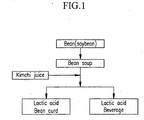
- Accordingly, as shown in Fig. 1, lactic acid bean curd can be prepared by preparing bean soup using soybeans, cooling it at 40 °C and introducing Kimchi juice into the cooled bean soup.
-
- Fig.. 1 shows a process chart for preparing lactic acid bean curd and a lactic acid beverage according to one embodiment of the present invention.
- The present invention will now be explained with reference to the following Examples. However, these are to illustrate the present invention and the present invention is not limited to them.
- 50 g of cabbage, 60 g of garlic, 100 g of pear, 40 g of unripe hot peppers, 65 g of pineapple, 10 g of potatoes and 75 g of radish were weighed and introduced into each 360 mL bottles. A mixture of salts and sugar was prepared by mixing 100 g of salts, 40 g of sugar, and water such that the mixture reached 4 L. 330, 337, 301, 347, 337, 290 and 284 mL of the mixture were respectively introduced into each bottle, and the bottles were left to stand at room temperature for 3 days.
- The pH of the lactic acid bacteria culture prepared according to the Examples 1 - 7 was 3.5.
- The solution was prepared by mixing salts, sugar and water. The pH of the solution was 6.0.
- Bean curds for Examples 8 to 14 were prepared by adding 3 mL of soybean milk (Samyook soybean milk) to 2 mL of the lactic acid bacteria culture prepared for each of Examples 1 to 7.
- Bean curd was prepared by adding 3 mL of soybean milk (Samyook soybean milk) to 2 mL of vinegar (Double Strength Apple Vinegar, from Otugi Food Company).
- Bean curd was prepared by adding 3 mL of soybean milk to 2 mL of the solution of Comparative Example 1.
- Bean curd was prepared by the same method as in Comparative Example 2, except that only soybean milk was used, with no solution.
- The results are presented in the following Table 1.
[Table 1] Coagulation Example 8 O Example 9 O Example 10 O Example 11 O Example 12 O Example 13 O Example 14 O Example 15 (comparative) O Comparative Example 2 X Comparative Example 3 X - As can be seen from the Table 1, in Examples 8 to 14 according to the present invention, soybean milk was coagulated after the lactic acid bacteria culture was introduced to prepare bean curd, while, and it did so quickly, while in Comparative Examples 2 and 3 where the lactic acid bacteria culture was not introduced, soybean milk was not coagulated. Particularly, in the case when radish was used, soybean milk was most rapidly coagulated to prepare bean curd. In addition, in Example 15 (comparative), even when organic acid such as vinegar was directly added during the bean curd preparing process, soybean milk was coagulated, which indicates that bean curd can be prepared using organic acid.
- The present invention uses fermented lactic acid bacteria culture to prepare bean curd, thereby standardizing a bean curd preparation method, and prepares bean curd and a beverage containing lactic acid with improved preservation properties, and increases lactic acid intake thereby improving peoples' health.
- In addition, the present invention prepares lactic acid containing bean curd and a beverage by fermenting lactic acid bacteria culture using bean curd dregs that are by-product produced when preparing bean curd and introducing it during the bean curd preparation process, thereby decreasing preparation costs of bean curd and lactic acid beverages and providing bean curd and a beverage rich in lactic acid.
Claims (5)
- A method for preparing bean curd comprising the steps of:a) preparing lactic acid bacteria culture from Kimchi by fermenting i) salt, sugar, water and ii) material which is one or more selected form a group consisting of vegetables, fruits, and a mixture thereof;b) preparing bean soup by pulverizing soaked soy bean in water, heating, and filtering; andc) adding Kimchi juice of step a) to the bean soup cooled at 40 °C or less.
- The method for preparing bean curd according to claim 1, wherein the vegetable is cabbage or radish, and the fruit is pear or pineapple.
- Bean curd prepared according to method of any one of claim 1 or 2.
- A method for preparing beverage containing lactic acid bacteria comprising the steps of:a) preparing lactic acid bacteria culture from Kimchi by fermenting i) salt, sugar, water and ii) material which is one or more selected from a group consisting of vegetables, fruits, and a mixture thereof;b) preparing bean soup by pulverizing soaked soy bean in water, heating, and filtering;c) adding Kimchi juice of step a) to the bean soup cooled at 40 °C or less; andd) mixing syrup or fruit juice with the bean soup remaining after preparing bean curds of step c).
- Beverage prepared according to claim 5.
Applications Claiming Priority (3)
| Application Number | Priority Date | Filing Date | Title |
|---|---|---|---|
| KR9958572 | 1999-12-17 | ||
| KR1019990058572A KR100333507B1 (en) | 1999-12-17 | 1999-12-17 | A bean curd using the juice of kimchi and method for preparing thereof |
| PCT/KR2000/001461 WO2001043565A1 (en) | 1999-12-17 | 2000-12-14 | Bean curd containing lactic acid fermenting bacteria culture fluid and a method for preparing the same, and beverage containing lactic acid fermenting bacteria and a method for preparing the same |
Publications (3)
| Publication Number | Publication Date |
|---|---|
| EP1237422A1 EP1237422A1 (en) | 2002-09-11 |
| EP1237422A4 EP1237422A4 (en) | 2003-05-28 |
| EP1237422B1 true EP1237422B1 (en) | 2006-05-24 |
Family
ID=36580418
Family Applications (1)
| Application Number | Title | Priority Date | Filing Date |
|---|---|---|---|
| EP00983555A Expired - Lifetime EP1237422B1 (en) | 1999-12-17 | 2000-12-14 | Bean curd containing lactic acid fermenting bacteria culture fluid and a method for preparing the same, and beverage containing lactic acid fermenting bacteria and a method for preparing the same |
Country Status (10)
| Country | Link |
|---|---|
| US (1) | US6756066B2 (en) |
| EP (1) | EP1237422B1 (en) |
| JP (1) | JP2003516738A (en) |
| KR (1) | KR100333507B1 (en) |
| CN (1) | CN1294840C (en) |
| AT (1) | ATE326864T1 (en) |
| AU (1) | AU2029701A (en) |
| DE (1) | DE60028237T2 (en) |
| HK (1) | HK1046621B (en) |
| WO (1) | WO2001043565A1 (en) |
Families Citing this family (21)
| Publication number | Priority date | Publication date | Assignee | Title |
|---|---|---|---|---|
| US7169752B2 (en) * | 2003-09-30 | 2007-01-30 | New River Pharmaceuticals Inc. | Compounds and compositions for prevention of overdose of oxycodone |
| KR20030041466A (en) * | 2001-11-20 | 2003-05-27 | (주) 굿 엠 | Yogurt using kimchi fermenting lactobacillus and method of producing the same |
| KR100436038B1 (en) * | 2001-12-19 | 2004-06-12 | 씨제이 주식회사 | Manufacturing method of uncooked food and uncooked food manufactured thereby |
| US8522799B2 (en) * | 2005-12-30 | 2013-09-03 | Lam Research Corporation | Apparatus and system for cleaning a substrate |
| KR100563206B1 (en) * | 2004-06-30 | 2006-03-22 | (주)정식품 | Soybean Fermented Beverage |
| EP1948860B1 (en) * | 2005-11-15 | 2016-07-06 | LG Electronics Inc. | Apparatus of supplying and dicharging fluid |
| US8196417B2 (en) * | 2005-11-23 | 2012-06-12 | Lg Electronics Inc. | Refrigerator |
| KR100915348B1 (en) * | 2007-10-24 | 2009-09-03 | 두두원발효(주) | Tofu drink fermented with Kimchi lactic acid bacteria and production method |
| KR101014867B1 (en) | 2008-08-12 | 2011-02-15 | 두두원발효(주) | Soybean fermented with Kimchi lactic acid bacteria, hanged ramen containing the fermented soybean fermented product, herbal composition, and five grain powder, and a method for producing the same |
| CN102265996B (en) * | 2010-06-07 | 2013-03-27 | 刘承荣 | Bean curd coagulator containing vegetable nutrient solution, and preparation method thereof |
| CN102150766B (en) * | 2011-04-01 | 2013-01-16 | 杭州万向职业技术学院 | Method for processing beancurd by using cucumber fermentation liquor and transglutaminase composite coagulating agent |
| CN102217679B (en) * | 2011-06-08 | 2013-08-07 | 北京融青生态农业有限公司 | Novel ecological bean curd and preparation method of bean curd |
| KR101267959B1 (en) | 2011-07-21 | 2013-05-27 | 윤운규 | Guava-Containing Bean Curd And Method for Producing the Same |
| CN102550699A (en) * | 2011-12-23 | 2012-07-11 | 陈彦屏 | Bean curd preparation method |
| KR101428647B1 (en) * | 2012-12-28 | 2014-08-13 | 대구가톨릭대학교산학협력단 | Method for producing fermented tofu using Kimchi seasoning and lactic acid bacteria |
| KR20160144119A (en) | 2015-06-08 | 2016-12-16 | (주)바이오리듬 | Method of producing lactic acid bean curd |
| CN106615187A (en) * | 2016-08-31 | 2017-05-10 | 重庆统洲食品有限公司 | Preserved vegetable dried tofu and production method thereof |
| CN107156305A (en) * | 2017-05-25 | 2017-09-15 | 北京市食品酿造研究所 | Fermented bean dregs milk drink with high dietary fiber and its preparation process |
| KR102004318B1 (en) | 2017-12-27 | 2019-07-26 | 김행아 | Lactic acid bacteria bean-curd and its preparation method |
| EP3801038A1 (en) * | 2018-06-04 | 2021-04-14 | Sabina Baglio | Process of production of vegetable cheeses without animal ingredients |
| CN110786503A (en) * | 2019-11-05 | 2020-02-14 | 湖南海霸食品有限公司 | Spicy pleurotus eryngii and preparation method thereof |
Family Cites Families (9)
| Publication number | Priority date | Publication date | Assignee | Title |
|---|---|---|---|---|
| KR880000331B1 (en) * | 1982-04-10 | 1988-03-20 | 이종태 | Process for producing milk curd alike soybeam curd |
| US4806481A (en) * | 1983-06-09 | 1989-02-21 | Taishi Foods Company Ltd. | Streptococcus sojalactis |
| JPS6030639A (en) * | 1983-07-27 | 1985-02-16 | House Food Ind Co Ltd | Preparation of soybean whey drink |
| CN1068257A (en) * | 1991-07-06 | 1993-01-27 | 长春市维利康食品厂 | Protein beverage fermented with bean protein lactobacilli |
| FR2738991B1 (en) * | 1995-09-22 | 1997-11-07 | Garreau Jean James Andre Roger | FOOD PRODUCTS BASED ON SOYA MILK AND PROCESS FOR THEIR PRODUCTION |
| IL127130A (en) * | 1996-05-18 | 2001-09-13 | Hansen Wilhelm | Process for producing cheese, curd and yogurt products from soya beans |
| KR19980068758A (en) * | 1997-02-24 | 1998-10-26 | 심재식 | Tofu manufacturing method using sodium polyacrylate, glucoseamine, acetic acid, lactic acid, and refined salt |
| KR19990065688A (en) | 1998-01-16 | 1999-08-05 | 박인배 | Tofu and beverage production method and fermentation method by lactic acid bacteria fermentation |
| CN1095343C (en) * | 1998-03-09 | 2002-12-04 | 冯伟清 | Bean curd and its preparing method |
-
1999
- 1999-12-17 KR KR1019990058572A patent/KR100333507B1/en not_active Expired - Fee Related
-
2000
- 2000-12-14 DE DE60028237T patent/DE60028237T2/en not_active Expired - Fee Related
- 2000-12-14 AT AT00983555T patent/ATE326864T1/en not_active IP Right Cessation
- 2000-12-14 JP JP2001544512A patent/JP2003516738A/en active Pending
- 2000-12-14 WO PCT/KR2000/001461 patent/WO2001043565A1/en not_active Ceased
- 2000-12-14 AU AU20297/01A patent/AU2029701A/en not_active Abandoned
- 2000-12-14 EP EP00983555A patent/EP1237422B1/en not_active Expired - Lifetime
- 2000-12-14 US US10/089,422 patent/US6756066B2/en not_active Expired - Lifetime
- 2000-12-14 CN CNB008172471A patent/CN1294840C/en not_active Expired - Fee Related
- 2000-12-14 HK HK02108175.8A patent/HK1046621B/en not_active IP Right Cessation
Also Published As
| Publication number | Publication date |
|---|---|
| DE60028237D1 (en) | 2006-06-29 |
| JP2003516738A (en) | 2003-05-20 |
| US20030091693A1 (en) | 2003-05-15 |
| EP1237422A4 (en) | 2003-05-28 |
| HK1046621A1 (en) | 2003-01-24 |
| ATE326864T1 (en) | 2006-06-15 |
| US6756066B2 (en) | 2004-06-29 |
| EP1237422A1 (en) | 2002-09-11 |
| KR20000071902A (en) | 2000-12-05 |
| CN1294840C (en) | 2007-01-17 |
| KR100333507B1 (en) | 2002-04-20 |
| AU2029701A (en) | 2001-06-25 |
| HK1046621B (en) | 2006-10-27 |
| CN1411344A (en) | 2003-04-16 |
| WO2001043565A1 (en) | 2001-06-21 |
| DE60028237T2 (en) | 2007-03-08 |
Similar Documents
| Publication | Publication Date | Title |
|---|---|---|
| US6756066B2 (en) | Bean curd containing lactic fermenting bacteria culture fluid and a method for preparing the same, and beverage containing the same | |
| KR102331346B1 (en) | Bean cheese using soybean milk and vegetable lactic acid bacteria, and manufacturing method thereof | |
| CN111728039A (en) | Soy sauce fermented bean curd and preparation method thereof | |
| JP2001258470A (en) | Method for producing vegetable yogurt | |
| EP0521331A2 (en) | Soy milk fermentation process | |
| CN104026246B (en) | A kind of flavor fermentation soya-bean milk formula and preparation method | |
| CN101731682A (en) | Peanut protein yoghourt | |
| KR20030022942A (en) | A process for preparing the liquefied vegetable fermented milk and powdered fermented milk | |
| KR100603815B1 (en) | Manufacturing method of functional granule Cheonggukjang without smell | |
| KR19980075078A (en) | Method for manufacturing fermented soybean oil lactobacillus fermented in liquid and liquid form containing fruit and vegetable fermentation extract | |
| KR100348395B1 (en) | A drink comprising the lactic acid and method for preparing thereof | |
| KR100623626B1 (en) | Tofu coagulant comprising lactic acid bacteria culture medium using tofu pure water, and lactic acid bacteria culture medium using the medium | |
| KR100283416B1 (en) | Lactobacillus fermented beverage based on chestnuts | |
| JPS6214249B2 (en) | ||
| CN1116825C (en) | Process for preparing deodourized raw beverage juice of hydrolyzed fish protein | |
| CN107960483A (en) | A kind of preparation process of functionalized lactones bean curd | |
| KR101880022B1 (en) | fish cake manufacturing method of using devil's-tongue jelly | |
| CN113040334A (en) | Low-sugar papaya plant-based yogurt and preparation method thereof | |
| KR100913066B1 (en) | Method for preparing strawberry kochujang using syrup | |
| CN113875942B (en) | Plant bean yoghourt rich in flower fragrance and fruit taste | |
| CN112155140A (en) | Turbid pumpkin fermented beverage added with compound protein and preparation method thereof | |
| KR100501945B1 (en) | A method for preparation of fermentative drink by lactic acid fermentation of prickly pear and the product thereof | |
| CN115517297B (en) | Preparation method of set hericium erinaceus yoghourt | |
| KR100637857B1 (en) | Method for manufacturing tofu of tofu using lactic acid bacteria culture medium containing silk fibroin amino acid | |
| CN120514072A (en) | Preparation method and application of fermented papaya juice |
Legal Events
| Date | Code | Title | Description |
|---|---|---|---|
| PUAI | Public reference made under article 153(3) epc to a published international application that has entered the european phase |
Free format text: ORIGINAL CODE: 0009012 |
|
| 17P | Request for examination filed |
Effective date: 20020506 |
|
| AK | Designated contracting states |
Kind code of ref document: A1 Designated state(s): AT BE CH CY DE DK ES FI FR GB GR IE IT LI LU MC NL PT SE TR |
|
| AX | Request for extension of the european patent |
Free format text: AL;LT;LV;MK;RO;SI |
|
| A4 | Supplementary search report drawn up and despatched |
Effective date: 20030415 |
|
| RIC1 | Information provided on ipc code assigned before grant |
Ipc: 7A 23C 20/02 B Ipc: 7A 23L 1/20 A Ipc: 7A 23C 11/10 B |
|
| 17Q | First examination report despatched |
Effective date: 20040826 |
|
| GRAP | Despatch of communication of intention to grant a patent |
Free format text: ORIGINAL CODE: EPIDOSNIGR1 |
|
| GRAS | Grant fee paid |
Free format text: ORIGINAL CODE: EPIDOSNIGR3 |
|
| GRAA | (expected) grant |
Free format text: ORIGINAL CODE: 0009210 |
|
| AK | Designated contracting states |
Kind code of ref document: B1 Designated state(s): AT BE CH CY DE DK ES FI FR GB GR IE IT LI LU MC NL PT SE TR |
|
| PG25 | Lapsed in a contracting state [announced via postgrant information from national office to epo] |
Ref country code: BE Free format text: LAPSE BECAUSE OF FAILURE TO SUBMIT A TRANSLATION OF THE DESCRIPTION OR TO PAY THE FEE WITHIN THE PRESCRIBED TIME-LIMIT Effective date: 20060524 Ref country code: FI Free format text: LAPSE BECAUSE OF FAILURE TO SUBMIT A TRANSLATION OF THE DESCRIPTION OR TO PAY THE FEE WITHIN THE PRESCRIBED TIME-LIMIT Effective date: 20060524 Ref country code: NL Free format text: LAPSE BECAUSE OF FAILURE TO SUBMIT A TRANSLATION OF THE DESCRIPTION OR TO PAY THE FEE WITHIN THE PRESCRIBED TIME-LIMIT Effective date: 20060524 Ref country code: AT Free format text: LAPSE BECAUSE OF FAILURE TO SUBMIT A TRANSLATION OF THE DESCRIPTION OR TO PAY THE FEE WITHIN THE PRESCRIBED TIME-LIMIT Effective date: 20060524 |
|
| REG | Reference to a national code |
Ref country code: GB Ref legal event code: FG4D |
|
| REG | Reference to a national code |
Ref country code: CH Ref legal event code: EP |
|
| REG | Reference to a national code |
Ref country code: IE Ref legal event code: FG4D |
|
| REF | Corresponds to: |
Ref document number: 60028237 Country of ref document: DE Date of ref document: 20060629 Kind code of ref document: P |
|
| REG | Reference to a national code |
Ref country code: CH Ref legal event code: NV Representative=s name: WILLIAM BLANC & CIE CONSEILS EN PROPRIETE INDUSTRI |
|
| PG25 | Lapsed in a contracting state [announced via postgrant information from national office to epo] |
Ref country code: DK Free format text: LAPSE BECAUSE OF FAILURE TO SUBMIT A TRANSLATION OF THE DESCRIPTION OR TO PAY THE FEE WITHIN THE PRESCRIBED TIME-LIMIT Effective date: 20060824 Ref country code: SE Free format text: LAPSE BECAUSE OF FAILURE TO SUBMIT A TRANSLATION OF THE DESCRIPTION OR TO PAY THE FEE WITHIN THE PRESCRIBED TIME-LIMIT Effective date: 20060824 |
|
| PG25 | Lapsed in a contracting state [announced via postgrant information from national office to epo] |
Ref country code: ES Free format text: LAPSE BECAUSE OF FAILURE TO SUBMIT A TRANSLATION OF THE DESCRIPTION OR TO PAY THE FEE WITHIN THE PRESCRIBED TIME-LIMIT Effective date: 20060904 |
|
| PG25 | Lapsed in a contracting state [announced via postgrant information from national office to epo] |
Ref country code: PT Free format text: LAPSE BECAUSE OF FAILURE TO SUBMIT A TRANSLATION OF THE DESCRIPTION OR TO PAY THE FEE WITHIN THE PRESCRIBED TIME-LIMIT Effective date: 20061024 |
|
| REG | Reference to a national code |
Ref country code: HK Ref legal event code: GR Ref document number: 1046621 Country of ref document: HK |
|
| NLV1 | Nl: lapsed or annulled due to failure to fulfill the requirements of art. 29p and 29m of the patents act | ||
| ET | Fr: translation filed | ||
| PG25 | Lapsed in a contracting state [announced via postgrant information from national office to epo] |
Ref country code: IE Free format text: LAPSE BECAUSE OF NON-PAYMENT OF DUE FEES Effective date: 20061214 |
|
| PG25 | Lapsed in a contracting state [announced via postgrant information from national office to epo] |
Ref country code: MC Free format text: LAPSE BECAUSE OF NON-PAYMENT OF DUE FEES Effective date: 20061231 |
|
| PLBE | No opposition filed within time limit |
Free format text: ORIGINAL CODE: 0009261 |
|
| STAA | Information on the status of an ep patent application or granted ep patent |
Free format text: STATUS: NO OPPOSITION FILED WITHIN TIME LIMIT |
|
| 26N | No opposition filed |
Effective date: 20070227 |
|
| PGFP | Annual fee paid to national office [announced via postgrant information from national office to epo] |
Ref country code: IT Payment date: 20071221 Year of fee payment: 8 |
|
| PG25 | Lapsed in a contracting state [announced via postgrant information from national office to epo] |
Ref country code: GR Free format text: LAPSE BECAUSE OF FAILURE TO SUBMIT A TRANSLATION OF THE DESCRIPTION OR TO PAY THE FEE WITHIN THE PRESCRIBED TIME-LIMIT Effective date: 20060825 |
|
| PGFP | Annual fee paid to national office [announced via postgrant information from national office to epo] |
Ref country code: FR Payment date: 20071210 Year of fee payment: 8 Ref country code: GB Payment date: 20071212 Year of fee payment: 8 |
|
| PGFP | Annual fee paid to national office [announced via postgrant information from national office to epo] |
Ref country code: DE Payment date: 20071206 Year of fee payment: 8 |
|
| PG25 | Lapsed in a contracting state [announced via postgrant information from national office to epo] |
Ref country code: TR Free format text: LAPSE BECAUSE OF FAILURE TO SUBMIT A TRANSLATION OF THE DESCRIPTION OR TO PAY THE FEE WITHIN THE PRESCRIBED TIME-LIMIT Effective date: 20060524 Ref country code: LU Free format text: LAPSE BECAUSE OF NON-PAYMENT OF DUE FEES Effective date: 20061214 |
|
| PG25 | Lapsed in a contracting state [announced via postgrant information from national office to epo] |
Ref country code: CY Free format text: LAPSE BECAUSE OF FAILURE TO SUBMIT A TRANSLATION OF THE DESCRIPTION OR TO PAY THE FEE WITHIN THE PRESCRIBED TIME-LIMIT Effective date: 20060524 |
|
| GBPC | Gb: european patent ceased through non-payment of renewal fee |
Effective date: 20081214 |
|
| REG | Reference to a national code |
Ref country code: FR Ref legal event code: ST Effective date: 20090831 |
|
| PG25 | Lapsed in a contracting state [announced via postgrant information from national office to epo] |
Ref country code: DE Free format text: LAPSE BECAUSE OF NON-PAYMENT OF DUE FEES Effective date: 20090701 |
|
| PG25 | Lapsed in a contracting state [announced via postgrant information from national office to epo] |
Ref country code: GB Free format text: LAPSE BECAUSE OF NON-PAYMENT OF DUE FEES Effective date: 20081214 |
|
| PG25 | Lapsed in a contracting state [announced via postgrant information from national office to epo] |
Ref country code: FR Free format text: LAPSE BECAUSE OF NON-PAYMENT OF DUE FEES Effective date: 20081231 |
|
| REG | Reference to a national code |
Ref country code: CH Ref legal event code: PFA Owner name: KIM, JOHN N. Free format text: KIM, JOHN N.#10810 DEEP GLEN DRIVE#POTOMAC, MD 20854 (US) -TRANSFER TO- KIM, JOHN N.#10810 DEEP GLEN DRIVE#POTOMAC, MD 20854 (US) |
|
| REG | Reference to a national code |
Ref country code: CH Ref legal event code: PCAR Free format text: NOVAGRAAF SWITZERLAND SA;CHEMIN DE L'ECHO 3;1213 ONEX (CH) |
|
| PGFP | Annual fee paid to national office [announced via postgrant information from national office to epo] |
Ref country code: CH Payment date: 20121213 Year of fee payment: 13 |
|
| PG25 | Lapsed in a contracting state [announced via postgrant information from national office to epo] |
Ref country code: IT Free format text: LAPSE BECAUSE OF NON-PAYMENT OF DUE FEES Effective date: 20081214 |
|
| REG | Reference to a national code |
Ref country code: CH Ref legal event code: PL |
|
| PG25 | Lapsed in a contracting state [announced via postgrant information from national office to epo] |
Ref country code: LI Free format text: LAPSE BECAUSE OF NON-PAYMENT OF DUE FEES Effective date: 20131231 Ref country code: CH Free format text: LAPSE BECAUSE OF NON-PAYMENT OF DUE FEES Effective date: 20131231 |