EP1237294B1 - Method and apparatus for equalizing channel characteristics in a computer extension system - Google Patents
Method and apparatus for equalizing channel characteristics in a computer extension system Download PDFInfo
- Publication number
- EP1237294B1 EP1237294B1 EP01200797A EP01200797A EP1237294B1 EP 1237294 B1 EP1237294 B1 EP 1237294B1 EP 01200797 A EP01200797 A EP 01200797A EP 01200797 A EP01200797 A EP 01200797A EP 1237294 B1 EP1237294 B1 EP 1237294B1
- Authority
- EP
- European Patent Office
- Prior art keywords
- video
- site
- computer
- adaptive
- video signal
- Prior art date
- Legal status (The legal status is an assumption and is not a legal conclusion. Google has not performed a legal analysis and makes no representation as to the accuracy of the status listed.)
- Expired - Lifetime
Links
- 238000000034 method Methods 0.000 title claims abstract description 16
- 230000002093 peripheral effect Effects 0.000 claims abstract description 35
- 238000005259 measurement Methods 0.000 claims abstract description 7
- 230000003044 adaptive effect Effects 0.000 claims description 33
- 230000008878 coupling Effects 0.000 claims description 5
- 238000010168 coupling process Methods 0.000 claims description 5
- 238000005859 coupling reaction Methods 0.000 claims description 5
- 238000001914 filtration Methods 0.000 claims description 2
- 230000001419 dependent effect Effects 0.000 claims 2
- 238000007493 shaping process Methods 0.000 claims 1
- 238000004891 communication Methods 0.000 abstract description 14
- 230000004044 response Effects 0.000 description 8
- 239000004606 Fillers/Extenders Substances 0.000 description 7
- 230000005540 biological transmission Effects 0.000 description 7
- 230000001771 impaired effect Effects 0.000 description 5
- 238000000691 measurement method Methods 0.000 description 5
- 230000003321 amplification Effects 0.000 description 4
- 239000000872 buffer Substances 0.000 description 4
- 230000006735 deficit Effects 0.000 description 4
- 238000003199 nucleic acid amplification method Methods 0.000 description 4
- 239000003990 capacitor Substances 0.000 description 3
- 230000003111 delayed effect Effects 0.000 description 3
- 238000011144 upstream manufacturing Methods 0.000 description 3
- 230000002238 attenuated effect Effects 0.000 description 2
- 239000011230 binding agent Substances 0.000 description 2
- 230000008859 change Effects 0.000 description 2
- 238000013461 design Methods 0.000 description 2
- 230000001976 improved effect Effects 0.000 description 2
- 230000001939 inductive effect Effects 0.000 description 2
- 238000012546 transfer Methods 0.000 description 2
- 101100060181 Mus musculus Clock gene Proteins 0.000 description 1
- 230000003213 activating effect Effects 0.000 description 1
- 230000004913 activation Effects 0.000 description 1
- 238000010586 diagram Methods 0.000 description 1
- 230000000977 initiatory effect Effects 0.000 description 1
- 238000004519 manufacturing process Methods 0.000 description 1
- 238000012986 modification Methods 0.000 description 1
- 230000004048 modification Effects 0.000 description 1
- 238000010187 selection method Methods 0.000 description 1
- 230000011664 signaling Effects 0.000 description 1
Images


Classifications
-
- H—ELECTRICITY
- H04—ELECTRIC COMMUNICATION TECHNIQUE
- H04L—TRANSMISSION OF DIGITAL INFORMATION, e.g. TELEGRAPHIC COMMUNICATION
- H04L25/00—Baseband systems
- H04L25/02—Details ; arrangements for supplying electrical power along data transmission lines
- H04L25/03—Shaping networks in transmitter or receiver, e.g. adaptive shaping networks
- H04L25/03878—Line equalisers; line build-out devices
-
- H—ELECTRICITY
- H04—ELECTRIC COMMUNICATION TECHNIQUE
- H04L—TRANSMISSION OF DIGITAL INFORMATION, e.g. TELEGRAPHIC COMMUNICATION
- H04L25/00—Baseband systems
- H04L25/02—Details ; arrangements for supplying electrical power along data transmission lines
- H04L25/03—Shaping networks in transmitter or receiver, e.g. adaptive shaping networks
- H04L25/03006—Arrangements for removing intersymbol interference
- H04L2025/03592—Adaptation methods
- H04L2025/03745—Timing of adaptation
- H04L2025/03751—Timing of adaptation only once, at installation
Definitions
- This application relates to a computer extension system for connecting a computer at a first site to peripherals at a second site and, more specifically, to a method and apparatus for automatically equalizing channel characteristics.
- a personal computer is typically coupled to peripherals that serve as computer-user interfaces.
- peripherals may include a keyboard, a mouse, and a video monitor.
- standard cables connecting each peripheral are around four feet long. Because of the characteristics of the connecting cables and their interfaces, the cables do not provide a reliable peripheral connection when they are much longer than twenty feet.
- the apparatus to extend the distance between a computer and peripherals is called a computer extender or a computer extension system.
- a computer extender or a computer extension system.
- PC-Extender Plus is available from Cybex Computer Products Corporation of Huntsville, Alabama.
- the PC-Extender Plus allows a keyboard, monitor, and mouse to be placed up to 600 feet away from the computer.
- An extender typically has two electronic boxes and several cables between the computer and the peripherals. As the demand for extenders increases, the need for more efficient use of cables has developed.
- a filter with inverse frequency characteristics can be placed in series with the cable thereby effectively canceling the frequency response impairment of the cable.
- the use of this inverse filter is referred to as equalizing the characteristics of the communications channel and the filter is called an equalizer. If the inverse filter is tuned adaptively it is referred to as an adaptive equalizer.
- Telephone line modems such as a V.34 modem, have adaptive equalizers.
- the adaptive equalizers in modems are implemented using digital signal processors and they work well at the relatively low-data rates of a telephone line modem.
- Existing extension systems typically require a plurality of communication channels. Three may be used for the video signals having red, green, and blue video signals. Other cables or wires are required for transferring peripheral information such as mouse data, mouse clock, keyboard data, keyboard clock and other information.
- peripheral information such as mouse data, mouse clock, keyboard data, keyboard clock and other information.
- each of the cables may be equalized by a manual selection of filters. While this does improve end-to-end frequency response, the manual selection method may require custom designs for each cable length and may require the efforts of a skilled technician during setup. If the extension system is moved or for some other reason the cable lengths are changed it may be necessary to readjust the equalizing filters.
- European Patent Application Publication No. 0 084 628 describes a cable equalizer for the automatic compensation of video signals transmitted via a cable and having a distorted amplitude-frequency characteristic.
- US Patent No. 4,151,490 describes a cable equalizer for automatically compensating a signal for cable attenuation as the length of the cable is varied.
- the invention provides an adaptive video receiver, an adaptive video transmitter, an extension system and a method for removing video frequency distortion from a video signal as detailed in the accompanying claims.
- the invention additionally provides an apparatus for equalizing the characteristics of at least one communication channel in a computer extension system, the apparatus comprising:
- the at least one communication channel desirably links a computer locatable at a first location and one or more peripheral devices locatable at a second location.
- the one or more peripheral devices desirably include a video monitor.
- the means for determining the value representative of the delay time optionally may be selected from one of the following:
- the first site may be the first location or the second location, the second site being the second location or first location respectively.
- the determined value representative of the delay time is desirably input to the filter selection means.
- the delay time or count value are related to the length of the communication channel between the first site and the second site.
- the filter selection means may include a switching attenuation filter comprising a plurality of independantly switchable switches, the activation of each switch being determined by the value representative of the delay time.
- the at least one communication channel is desirably a video channel and more desirably is selected from a red video channel, a blue video channel or a green video channel.
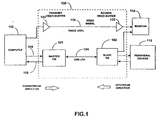
- FIG.1 illustrates an extension system 100 in accordance with the present invention.
- the extension system has a master transmitter and receiver ("T/R") 101 and a slave T/R 102 coupled by one unshielded twisted pair (“UTP") 104.
- T/R master transmitter and receiver
- UTP unshielded twisted pair
- the peripheral devices 112 include at least a mouse and a keyboard. information or data going from the computer 110 to the peripheral devices 112 is going in the downstream direction and information going from the peripherals to the computer is going in the upstream direction.
- the three UTPs 116 coupling the computer to the video monitor 114 typically would have a master video buffer 120 and a slave video buffer 122.
- These video buffers are located in the master T/R 101 and the slave T/R 102, but are shown as separate elements for clarity.
- UTPs are used to couple the master T/R 101 and the slave T/R 102 shielded pairs, coaxial cables, and other known cables could provide a communication channel and still be within the scope of the present invention.
- the one UTP 104 is also used to furnish DC power to the slave T/R 102 from the master T/R 101.
- a DC power supply located (not shown) in the master T/R is coupled to the one UTP using typical inductive coupling.
- the slave T/R 102 has an inductive coupling for receiving the DC power.
- common mode signaling is provided by the one UTP 104 for transferring a video horizontal sync signal.
- the three UTPs 116 serve as a video channel for video signals from the computer as shown in FIG. 1
- the typical video signals from the computer are red (R), green (G) and blue (B) as described in U.S. Patent 5,504,540 .
- the other arrangements may include, for example a coaxial cable or a custom designed cable which may serve as video channels for the video signals from the computer.
- horizontal sync signals and vertical sync signals may be sent using the one unshielded twisted pair 104 while R, G, and B are transferred downstream by separate video channels.
- the present invention is capable of transferring a plurality of peripheral information in both the downstream and the upstream directions.
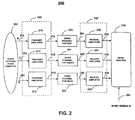
- FIG. 2 illustrates the components of a video transmission system 200 in accordance with the present invention.
- Video signals are developed in the video output circuits 202 of the computer 110.
- a red video signal 204, a green video signal 205 and blue video signal 206 are input signals to video buffer 120.
- Each of the three video signals is amplified by corresponding transmit amplifiers 210, 211, and 212.
- the outputs of the transmit amplifiers are referred to as the red transmit signal 214, green transmit signal 215, and blue transmit signal 216.
- These transmit signals have both amplification and high-frequency boost as will be seen below.
- the video channels 220, 221, and 222 are unshielded twisted pairs from a Category 5 cable.
- the output of the video channels are impaired video signals 224, 225, and 226. These impaired video signals are amplified and shaped by receive amplifiers 230, 231 and 232.
- the receive amplifiers may have amplification, amplification and filtering, amplification and selectable filters, or may have adaptive filters. Adaptive filters that automatically improve video performance are illustrated in FIG. 6 and are discussed below.
- the output of the receive amplifiers is coupled to the video monitor 114 as monitor video signals 234, 235, and 236. In order to complete the set of signals required for a monitor display, sync signals are coupled from the slave T/R 102.
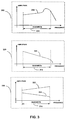
- the frequency characteristics of video elements between the computer 110 and the video monitor 114 are illustrated in FIG.3 .
- the frequency response shapes shown in these figures are approximations of characteristics and given to show the need for an adaptive equalizer.
- the transmit amplifier boost characteristics 310 are illustrated by boost curve 312 over the bandwidth of interest 314.
- the frequency characteristics of a video channel 320 such as an unshielded twisted pair varies as a function of the length of the twisted pair.
- channel characteristics 320 represent amplitude attenuation as a function of frequency per unit length over the desired bandwidth 314. Hence if a cable is doubled in length the slope of the curve will be twice that of the original cable.
- Amplitude and gain characteristics for a receive amplifier are shown in amplifier characteristics illustration 330.
- the approximate shapes shown in FIG.3 can be determined frequency response measurements.
- the shape of the boost curve 312, also referred to as a high-frequency boost, is typically selected by the circuit designer after considering the output frequency contents of the computer video signals and the characteristics of the cables that may be used as the communication channel.
- the channel characteristic curve 322 may typically be found in manufacturers' specifications. For example, a Category 5 cable used in the present invention has frequency response characteristics available from the Belden Wire and Cable Company of Richmond, Indiana.
- a prior art receive circuit 400 is shown in FIG. 4 .
- a first amplifier 402 raises the voltage level of the impaired signal.
- a filter 404 having fixed elements approximates the inverse frequency characteristics of the video channel.
- the filter may be designed for a fixed length of a specific wire or be manually adjusted by using jumper straps.
- the output of the filter is then amplified by a second amplifier 406 and then becomes an receiver output signal 234.
- the output signal is then coupled to the video monitor 114.
- the receive circuit 400 performs well with one fixed filter when all the transmission wires are approximately the same length and have the same transmission characteristics per unit length. Although adjusting the filters for different lengths of transmission wires provides satisfactory video performance, the adjusting does require manually changing components using the jumper straps.
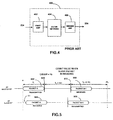
- FIG. 5 illustrates the packet protocol for transferring peripheral information between the computer and peripheral devices 112 in accordance with the present invention.
- the packet protocol designed for transferring peripheral information, is used to measure the round-trip time between the computer and the peripheral site.
- the time to travel one way is the delay time and is half of the round-trip time.
- a number representing the delay time is used as the input to an adaptive filter. Details of the content of the packets is described in an earlier application by the inventor, but is not needed in order to understand the time measurement method.
- a first packet, transmit packet N 502 is sent from the computer in the downstream direction.
- a first counter at the master R/T 101 is started at a count value of zero.
- the transmit packet N 502 arrives at the peripheral site as a received packet N 504.
- a second counter located at the peripheral site is set at a count value of 32 when the received packet N 504 arrives.
- transmit packet N+1 506 is sent in the upstream direction.
- the counter value of the first counter is stored.
- the stored counter value minus 32 is equal to a number proportional to twice the length of the twisted pair of wires of the peripheral channel.
- a count value represents a cable length of about 14 feet. Count values change at 41.67 nanosecond intervals. The count proportional to twice the cable length is stored as a number.
- the video channel pairs of twisted wires are typically in the same binder as the pair of wires of peripheral channel and therefore have the same length.
- the length measurement method as described is implemented at the computer, the automatic measurement of length could also occur at the peripheral site. When the length measurement occurs at the peripheral site, the number representing twice the length is available for activating switches in an adaptive receive amplifier.
- Alternative methods of measuring the length of a cable could be used to automatically generate the number representing the delay time. For example the alternative method of measuring a voltage at the second site when a reference voltage is applied at the first site. Other methods of automatically measuring the length of a cable are known to those persons skilled in the art.
- FIG.6 illustrates an adaptive receive amplifier 600 in accordance with the present invention.
- Three of the adaptive receive amplifiers 600 are replacements for the three video receive amplifiers 230, 231, and 232.
- the red video signals are chosen as input and outputs.
- the impaired red video signal 224 is amplified by input amplifier 602 and appears at node 603.
- the signal at the node 603 is attenuated by the switching attenuation filter 608.
- the attenuated signal receives a high-frequency boost by high-frequency boost circuit 606.
- the boosted signal is then amplified by amplifier 604 and output amplifier 610.
- the output of the output amplifier is the monitor video signal 234..
- the switcheing attenuation filter 608 comprises an arrangement of resistors and capacitors.
- each of the parallel networks comprises a resistor and capacitor in series.
- a switch of the six switches is closed one end of the series resistor and capacitor is connected to the input node 603 and the other end is connected to ground 612.
- the combination of the high-frequency boost circuit 606 and the switching attenuation filter 608 serve as an adaptive equalizer and cancel for the most part the impairments caused by the video channel for red 220. It is understood by those skilled in the art that a wide variations in the filter design as described in FIG. 6 could provide equivalent results.
- an adaptive equalizer could be placed at the computer site and designed in the manner described above.
- a variety adaptive receivers structures could be used to cancel the impairments of the video channel.
- the method of automatically and adaptively equalizing the video channel impairments is shown in FIG. 7 .
- the round trip time is determined by timing peripheral packets, step 720.
- the number representing the round trip time uses a table lookup to generate a switch control signal, step 730.
- the control signal is sent to the filter switches, step 740 and switches are set to equalize the transmission path, step 750. If it is necessary to reset the switches a return path to step 720 occurs, the YES path of step 760.
- the NO path of step 760 results in holding the switch settings, step 770.
Landscapes
- Engineering & Computer Science (AREA)
- Power Engineering (AREA)
- Computer Networks & Wireless Communication (AREA)
- Signal Processing (AREA)
- Cable Transmission Systems, Equalization Of Radio And Reduction Of Echo (AREA)
- Measurement Of Resistance Or Impedance (AREA)
- Investigating Or Analyzing Materials By The Use Of Ultrasonic Waves (AREA)
- Manufacturing Of Micro-Capsules (AREA)
- Saccharide Compounds (AREA)
- Polysaccharides And Polysaccharide Derivatives (AREA)
Abstract
Description
- This application relates to a computer extension system for connecting a computer at a first site to peripherals at a second site and, more specifically, to a method and apparatus for automatically equalizing channel characteristics.
- A personal computer is typically coupled to peripherals that serve as computer-user interfaces. Such peripherals may include a keyboard, a mouse, and a video monitor. Typically standard cables connecting each peripheral are around four feet long. Because of the characteristics of the connecting cables and their interfaces, the cables do not provide a reliable peripheral connection when they are much longer than twenty feet.
- There are situations where it is desirable to separate the computer from the peripherals at distances much greater than allowed by typical standard peripheral cables. The apparatus to extend the distance between a computer and peripherals is called a computer extender or a computer extension system. One such system, PC-Extender Plus is available from Cybex Computer Products Corporation of Huntsville, Alabama. The PC-Extender Plus allows a keyboard, monitor, and mouse to be placed up to 600 feet away from the computer. An extender typically has two electronic boxes and several cables between the computer and the peripherals. As the demand for extenders increases, the need for more efficient use of cables has developed.
- In existing extenders, standard coaxial cables, shielded cables, and unshielded cables may serve as communication channels. In addition, custom cables have been developed to provide an improved communication channel for extender systems. The cables connecting the computer to the peripherals may be confined in a binder or may be separate cables for each of the desired communication channels. Because distances between the computer and the peripherals vary from a few feet up to several hundred feet the frequency response of the cable connecting a first site from a second site has variations. These variations are available from the cable manufacture or may be observed using well-known measurement techniques. The variation in the frequency response as a function of cable length is known to those skilled in the art. If the length of a cable is known, a filter with inverse frequency characteristics can be placed in series with the cable thereby effectively canceling the frequency response impairment of the cable. The use of this inverse filter is referred to as equalizing the characteristics of the communications channel and the filter is called an equalizer. If the inverse filter is tuned adaptively it is referred to as an adaptive equalizer. Telephone line modems, such as a V.34 modem, have adaptive equalizers. The adaptive equalizers in modems are implemented using digital signal processors and they work well at the relatively low-data rates of a telephone line modem.
- Existing extension systems typically require a plurality of communication channels. Three may be used for the video signals having red, green, and blue video signals. Other cables or wires are required for transferring peripheral information such as mouse data, mouse clock, keyboard data, keyboard clock and other information. In existing extensions each of the cables may be equalized by a manual selection of filters. While this does improve end-to-end frequency response, the manual selection method may require custom designs for each cable length and may require the efforts of a skilled technician during setup. If the extension system is moved or for some other reason the cable lengths are changed it may be necessary to readjust the equalizing filters.
- Accordingly, it is the object of this invention to provide for more efficient and improved method for equalizing cable characteristics and at the same time reduce cost. In addition if equalization were automatic it would not require the use of a skilled technician and would reduce the time to install or move a computer extension system.
-
European Patent Application Publication No. 0 084 628 describes a cable equalizer for the automatic compensation of video signals transmitted via a cable and having a distorted amplitude-frequency characteristic.US Patent No. 4,151,490 describes a cable equalizer for automatically compensating a signal for cable attenuation as the length of the cable is varied. - Accordingly the invention provides an adaptive video receiver, an adaptive video transmitter, an extension system and a method for removing video frequency distortion from a video signal as detailed in the accompanying claims.
- The invention additionally provides an apparatus for equalizing the characteristics of at least one communication channel in a computer extension system, the apparatus comprising:
- means for determining a value representative of a delay time in a signal passing along the communication channel, and
- filter selection means adapted to automatically select a filter characteristic based on the value of the value representative of the delay time determined, the filter characteristic selected having inverse channel frequency characteristics.
- The at least one communication channel desirably links a computer locatable at a first location and one or more peripheral devices locatable at a second location.
- The one or more peripheral devices desirably include a video monitor.
- The means for determining the value representative of the delay time optionally may be selected from one of the following:
- a packet protocol adapted to measure a round trip time for one or more packets transmitted between the first location and the second location, or
- a voltage comparison means adapted to measure a difference between a reference voltage applied at the first location and a voltage measured at the second location.
- a) transmitting a packet from a first site, the transmission of the packet effecting an initiation of a timer at the first site,
- b) receiving the transmitted packet at a second site, and delaying the packet at the second site for a predetermined delay,
- c) transmitting the packet from the second location after expiry of the delay,
- d) receiving the delayed packet at the first site, the receipt of the delayed packet effecting a termination of the counter at the first site, and
- e) evaluating a count value for the time taken between the transmission of the packet from the first site and receipt of the delayed packet at the first site less the predetermined delay.
- The first site may be the first location or the second location, the second site being the second location or first location respectively.
- The determined value representative of the delay time is desirably input to the filter selection means.
- The delay time or count value are related to the length of the communication channel between the first site and the second site.
- The filter selection means may include a switching attenuation filter comprising a plurality of independantly switchable switches, the activation of each switch being determined by the value representative of the delay time.
- The at least one communication channel is desirably a video channel and more desirably is selected from a red video channel, a blue video channel or a green video channel.
- These and other features of the present invention will be understood with reference to the following drawings which are exemplary of the system and method of the present invention, and are not intended to limit the invention that described.
-
-
FIG. 1 is a block diagram illustrating a computer coupled to peripherals via an extension system in accordance with the present invention. -
FIG. 2 illustrates end-to-end connections for transferring video signals in an extension system in accordance with the present invention. -
FIG. 3 illustrates the frequency characteristics of a video elements between the computer and the video monitor in an extension system. -
FIG. 4 illustrates a prior art receiver circuit. -
FIG. 5 illustrates the timing sequences for transferring packets between a master T/R and a slave T/R in accordance with the present invention. -
FIG. 6 illustrates elements of an adaptive receiver in accordance with the present invention. -
FIG. 7 is a method for equalizing a video signal transmitted from a computer over a video communication channel in accordance with the present invention. -
FIG.1 illustrates anextension system 100 in accordance with the present invention. The extension system has a master transmitter and receiver ("T/R") 101 and a slave T/R 102 coupled by one unshielded twisted pair ("UTP") 104. To couple video between acomputer 110 and amonitor 114, three UTPs, 116 are used to transfer red, green, and blue video signals. Theperipheral devices 112 include at least a mouse and a keyboard. information or data going from thecomputer 110 to theperipheral devices 112 is going in the downstream direction and information going from the peripherals to the computer is going in the upstream direction. The threeUTPs 116 coupling the computer to thevideo monitor 114, typically would have amaster video buffer 120 and aslave video buffer 122. These video buffers are located in the master T/R 101 and the slave T/R 102, but are shown as separate elements for clarity. Although UTPs are used to couple the master T/R 101 and the slave T/R 102 shielded pairs, coaxial cables, and other known cables could provide a communication channel and still be within the scope of the present invention. The oneUTP 104 is also used to furnish DC power to the slave T/R 102 from the master T/R 101. A DC power supply located (not shown) in the master T/R is coupled to the one UTP using typical inductive coupling. The slave T/R 102 has an inductive coupling for receiving the DC power. Those persons skilled in the art could determine the levels of voltages required to provide the necessary DC voltage levels at each end of the power providing arrangement. Further, common mode signaling is provided by the oneUTP 104 for transferring a video horizontal sync signal. - Although the three
UTPs 116 serve as a video channel for video signals from the computer as shown inFIG. 1 , other arrangements may be used to transfer video signals. The typical video signals from the computer are red (R), green (G) and blue (B) as described inU.S. Patent 5,504,540 . The other arrangements may include, for example a coaxial cable or a custom designed cable which may serve as video channels for the video signals from the computer. As will be seen in an embodiment of the present invention horizontal sync signals and vertical sync signals may be sent using the one unshieldedtwisted pair 104 while R, G, and B are transferred downstream by separate video channels. The present invention is capable of transferring a plurality of peripheral information in both the downstream and the upstream directions. -
FIG. 2 illustrates the components of avideo transmission system 200 in accordance with the present invention. Video signals are developed in thevideo output circuits 202 of thecomputer 110. Ared video signal 204, agreen video signal 205 andblue video signal 206 are input signals tovideo buffer 120. Each of the three video signals is amplified by corresponding transmitamplifiers signal 214, green transmitsignal 215, and blue transmit signal 216. These transmit signals have both amplification and high-frequency boost as will be seen below. Thevideo channels amplifiers FIG. 6 and are discussed below. The output of the receive amplifiers is coupled to thevideo monitor 114 asmonitor video signals R 102. - The frequency characteristics of video elements between the
computer 110 and thevideo monitor 114 are illustrated inFIG.3 . The frequency response shapes shown in these figures are approximations of characteristics and given to show the need for an adaptive equalizer. The transmitamplifier boost characteristics 310 are illustrated byboost curve 312 over the bandwidth ofinterest 314. The frequency characteristics of avideo channel 320, such as an unshielded twisted pair varies as a function of the length of the twisted pair. As shown inchannel characteristics 320 thechannel curve 322 represent amplitude attenuation as a function of frequency per unit length over the desiredbandwidth 314. Hence if a cable is doubled in length the slope of the curve will be twice that of the original cable. Amplitude and gain characteristics for a receive amplifier are shown inamplifier characteristics illustration 330. In order to equalize for a long pair of wireshigh gain curve 332 would be required and for a short pair of wireslow gain curve 334 would be used. The approximate shapes shown inFIG.3 can be determined frequency response measurements. The shape of theboost curve 312, also referred to as a high-frequency boost, is typically selected by the circuit designer after considering the output frequency contents of the computer video signals and the characteristics of the cables that may be used as the communication channel. The channelcharacteristic curve 322 may typically be found in manufacturers' specifications. For example, a Category 5 cable used in the present invention has frequency response characteristics available from the Belden Wire and Cable Company of Richmond, Indiana. - A prior art receive
circuit 400 is shown inFIG. 4 . When theimpaired video signal 224 is received afirst amplifier 402 raises the voltage level of the impaired signal. Afilter 404 having fixed elements approximates the inverse frequency characteristics of the video channel. The filter may be designed for a fixed length of a specific wire or be manually adjusted by using jumper straps.
The output of the filter is then amplified by asecond amplifier 406 and then becomes anreceiver output signal 234. The output signal is then coupled to thevideo monitor 114. The receivecircuit 400 performs well with one fixed filter when all the transmission wires are approximately the same length and have the same transmission characteristics per unit length. Although adjusting the filters for different lengths of transmission wires provides satisfactory video performance, the adjusting does require manually changing components using the jumper straps. - In order to automatically change filter characteristics for pairs of wires of different lengths, a means for automatically measuring the length of the wires is required.
FIG. 5 illustrates the packet protocol for transferring peripheral information between the computer andperipheral devices 112 in accordance with the present invention. The packet protocol, designed for transferring peripheral information, is used to measure the round-trip time between the computer and the peripheral site. The time to travel one way is the delay time and is half of the round-trip time. A number representing the delay time is used as the input to an adaptive filter. Details of the content of the packets is described in an earlier application by the inventor, but is not needed in order to understand the time measurement method. - Still referring to
FIG. 5 , a first packet, transmitpacket N 502, is sent from the computer in the downstream direction. When the packet is sent a first counter, at the master R/T 101 is started at a count value of zero. The transmitpacket N 502 arrives at the peripheral site as a receivedpacket N 504. A second counter, located at the peripheral site is set at a count value of 32 when the receivedpacket N 504 arrives. When the second counter reaches a count value of 64 a second packet, transmit packet N+1 506 is sent in the upstream direction. When the second packet arrives at the computer as received packet N+1 508, the counter value of the first counter is stored. The stored counter value minus 32 is equal to a number proportional to twice the length of the twisted pair of wires of the peripheral channel. In the present embodiment a count value represents a cable length of about 14 feet. Count values change at 41.67 nanosecond intervals. The count proportional to twice the cable length is stored as a number. The video channel pairs of twisted wires are typically in the same binder as the pair of wires of peripheral channel and therefore have the same length. Although the length measurement method as described is implemented at the computer, the automatic measurement of length could also occur at the peripheral site. When the length measurement occurs at the peripheral site, the number representing twice the length is available for activating switches in an adaptive receive amplifier. Alternative methods of measuring the length of a cable could be used to automatically generate the number representing the delay time. For example the alternative method of measuring a voltage at the second site when a reference voltage is applied at the first site. Other methods of automatically measuring the length of a cable are known to those persons skilled in the art. -
FIG.6 illustrates an adaptive receive amplifier 600 in accordance with the present invention. Three of the adaptive receive amplifiers 600 are replacements for the three video receiveamplifiers FIG.6 the red video signals are chosen as input and outputs. The impairedred video signal 224 is amplified byinput amplifier 602 and appears atnode 603. The signal at thenode 603 is attenuated by the switchingattenuation filter 608. The attenuated signal receives a high-frequency boost by high-frequency boost circuit 606. The boosted signal is then amplified byamplifier 604 andoutput amplifier 610. The output of the output amplifier is themonitor video signal 234.. Theswitcheing attenuation filter 608 comprises an arrangement of resistors and capacitors. In one embodiment six parallel networks are connected to six switches. Each of the parallel networks comprises a resistor and capacitor in series. When a switch of the six switches is closed one end of the series resistor and capacitor is connected to theinput node 603 and the other end is connected toground 612. By closing the switches in a predetermined sequence in response to the number representing the delay time of the video channel, a variety of filter characteristics is obtained. The combination of the high-frequency boost circuit 606 and the switchingattenuation filter 608 serve as an adaptive equalizer and cancel for the most part the impairments caused by the video channel forred 220. It is understood by those skilled in the art that a wide variations in the filter design as described inFIG. 6 could provide equivalent results. In addition an adaptive equalizer could be placed at the computer site and designed in the manner described above. When the length of the pairs of wires or cables is known using the measurement method or an equivalent measurement method, then a variety adaptive receivers structures could be used to cancel the impairments of the video channel. - The method of automatically and adaptively equalizing the video channel impairments is shown in
FIG. 7 . When the pairs of wires coupling the computer site to the peripheral site are connected the method starts,step 710. The round trip time is determined by timing peripheral packets,step 720. The number representing the round trip time uses a table lookup to generate a switch control signal,step 730. The control signal is sent to the filter switches,step 740 and switches are set to equalize the transmission path,step 750. If it is necessary to reset the switches a return path to step 720 occurs, the YES path ofstep 760. The NO path ofstep 760 results in holding the switch settings,step 770. - It is to be understood that no limitation with respect to the specific methods and apparatus illustrated herein is intended or should be inferred. It is, of course, intended to cover by the appended claims all such modifications as fall within the scope of the claims. The invention is further defined by the following claims:
Claims (10)
- An adaptive video receiver for use in an extension system (100) having a computer (110) at one site and a video monitor (114) at a second site, the receiver adapted for removing video frequency distortion from a received video signal, the receiver comprising:an equaliser for receiving the video signal, the equalizer having a plurality of selectable frequency characteristics where the frequency characteristics are selected by the value of the delay time between the computer and the adaptive receiver and provide a frequency characteristic which is the inverse of video frequency distortion, thereby providing an undistorted video signal to the video monitor;characterised in that the received video signal is a computer video signal sourced from the computer (110) and sent on the extension system (100); and
further characterised in that the receiver comprises a time measurement system for determining the delay time between the computer and the adaptive receiver that measures the round-trip time delay between the first site and the second site by observing the round-trip time of peripheral information packets travelling between the computer and the second site. - The adaptive video receiver of claim 1 wherein the equalizer comprises a switching attenuation filter operating cooperatively with a high-frequency boost circuit, where the switching attenuation filter has switches responsive to the value of the delay time.
- The adaptive video receiver of claim 1 or claim 2 wherein the video signal is amplified before being received by the equaliser.
- An adaptive video transmitter for use in an extension system (100) having a computer (110) at one site and a video monitor (114) at a second site, the adaptive video transmitter being locatable at the first site for removing video frequency distortion from a video signal, the adaptive video transmitter comprising:an equalizer at the transmitter for shaping the transmitted video signal, the equalizer having a plurality of selectable frequency characteristics where the frequency characteristics are the inverse of the video channel and the selected frequency characteristic is dependent of the time delay between the computer and an adaptive receiver, the combination of the equaliser and the channel thereby providing an undistorted video signal to the video monitorcharacterised in that the video signal is a computer video signal sourced from the computer (110) and sent on the extension system (100); and
further characterised in that the transmitter comprises a time measurement system for determining the delay time between the computer and the adaptive receiver that measures the round-trip time delay between the first site and the second site by observing the round-trip time of peripheral information packets travelling between the computer and the second site. - An extension system (100) including an adaptive video receiver as claimed in any of claims 1 to 3 and/or an adaptive video transmitter as claimed in claim 4.
- The extension system as claimed in claim 5 wherein the video signal was shaped by a transmitter filter at the first site.
- The extension system (100) as claimed in claim 5 or 6 comprising three adaptive video receivers, each adaptive video receiver including:a time measurement system for determining the delay time between the computer (110) and the adaptive receiver; andan equaliser for receiving the video signal, the equalizer having a plurality of selectable frequency characteristics where the frequency characteristics are selected by the value of the delay time and provide a frequency characteristic which is the inverse of video frequency distortion, thereby providing an undistorted video signal to the video monitor.
- The extension system as claimed in any one of claims 5 to 7 comprising three adaptive video transmitters.
- A method for removing video frequency distortion from a video signal in an extension system (100) having a computer (110) at one site and a video monitor (114) at a second site, the method comprising:selecting (Step 730), dependent on time delay between the first site and the second site, an equalizer frequency characteristic;filtering (Step 740) the video signal using the selected equalizer frequency characteristic; andcoupling the filtered video signal to the video monitor;characterised in that the video signal is a computer video signal sourced from the computer (110) and sent on the extension system (100); and
further characterised by measuring (Step 720) the round-trip time delay between the first site and the second site by observing the round-trip time of peripheral information packets travelling between the computer and the second site. - An adaptive video receiver as claimed in claim 1, wherein the equaliser includes a switching system for selecting and connecting predetermined filters in cascade.
Priority Applications (3)
| Application Number | Priority Date | Filing Date | Title |
|---|---|---|---|
| EP01200797A EP1237294B1 (en) | 2001-03-02 | 2001-03-02 | Method and apparatus for equalizing channel characteristics in a computer extension system |
| DE60136157T DE60136157D1 (en) | 2001-03-02 | 2001-03-02 | Procede et appareil d'egalisation of the caracteristiques du canal dans un système d'extension pour ordinateurs |
| AT01200797T ATE411654T1 (en) | 2001-03-02 | 2001-03-02 | PROCEDE ET APPAREIL D'EGALIZATION DES CARACTERISTIQUES DU CANAL DANS UN SYSTEME D'EXTENSION POUR ORDINATEURS |
Applications Claiming Priority (1)
| Application Number | Priority Date | Filing Date | Title |
|---|---|---|---|
| EP01200797A EP1237294B1 (en) | 2001-03-02 | 2001-03-02 | Method and apparatus for equalizing channel characteristics in a computer extension system |
Publications (2)
| Publication Number | Publication Date |
|---|---|
| EP1237294A1 EP1237294A1 (en) | 2002-09-04 |
| EP1237294B1 true EP1237294B1 (en) | 2008-10-15 |
Family
ID=8179962
Family Applications (1)
| Application Number | Title | Priority Date | Filing Date |
|---|---|---|---|
| EP01200797A Expired - Lifetime EP1237294B1 (en) | 2001-03-02 | 2001-03-02 | Method and apparatus for equalizing channel characteristics in a computer extension system |
Country Status (3)
| Country | Link |
|---|---|
| EP (1) | EP1237294B1 (en) |
| AT (1) | ATE411654T1 (en) |
| DE (1) | DE60136157D1 (en) |
Families Citing this family (1)
| Publication number | Priority date | Publication date | Assignee | Title |
|---|---|---|---|---|
| US7062596B2 (en) * | 2001-08-22 | 2006-06-13 | Avocent Corporation | Self-synchronizing half duplex matrix switch |
Family Cites Families (5)
| Publication number | Priority date | Publication date | Assignee | Title |
|---|---|---|---|---|
| GB1596774A (en) * | 1977-03-21 | 1981-08-26 | Rca Corp | Automatic cable equalizer circuit |
| DE3148242A1 (en) * | 1981-12-05 | 1983-06-09 | Robert Bosch Gmbh, 7000 Stuttgart | CABLE EQUALIZER CIRCUIT |
| DE69327986T2 (en) * | 1992-06-03 | 2000-10-05 | Koninklijke Philips Electronics N.V., Eindhoven | System for automatic compensation of cable loss |
| EP0656694A3 (en) * | 1993-11-30 | 1999-12-01 | AT&T Corp. | Equalizer with line length detection |
| JPH09294095A (en) * | 1996-04-26 | 1997-11-11 | Oki Electric Ind Co Ltd | Adaptive equalizer |
-
2001
- 2001-03-02 EP EP01200797A patent/EP1237294B1/en not_active Expired - Lifetime
- 2001-03-02 DE DE60136157T patent/DE60136157D1/en not_active Expired - Lifetime
- 2001-03-02 AT AT01200797T patent/ATE411654T1/en not_active IP Right Cessation
Also Published As
| Publication number | Publication date |
|---|---|
| EP1237294A1 (en) | 2002-09-04 |
| DE60136157D1 (en) | 2008-11-27 |
| ATE411654T1 (en) | 2008-10-15 |
Similar Documents
| Publication | Publication Date | Title |
|---|---|---|
| US7536162B1 (en) | Active resistive summer for a transformer hybrid | |
| TWI430624B (en) | Method and apparatus for automatic compensation of video signal losses from transmission over conductors | |
| US6265951B1 (en) | Method and apparatus for equalizing channel characteristics in a computer extension system | |
| KR100191738B1 (en) | Equalizer with line length detection | |
| US20140153631A1 (en) | Methods and circuits for asymmetric distribution of channel equalization between devices | |
| KR950014619B1 (en) | Equlizer for transmission system | |
| EP1552609A2 (en) | A high speed data link with transmitter equalization and receiver equalization | |
| JP2010511310A (en) | Method and apparatus for long-distance video transmission using twisted pair cable | |
| US5455843A (en) | Adaptive equalizing apparatus and method for token ring transmission systems using unshielded twisted pair cables | |
| JP2008124669A (en) | Data receiver | |
| US20040096004A1 (en) | Asymmetrical ethernet transceiver for long reach communications | |
| US8289451B2 (en) | Method and apparatus for automatic reduction of noise in signals transmitted over conductors | |
| JP2005514857A (en) | Easy-to-adapt hybrid circuit | |
| EP1237294A1 (en) | Method and apparatus for equalizing channel characteristics in a computer extension system | |
| US7123651B2 (en) | Adaptable hybrid and selection method for ADSL modem data rate improvement | |
| JP4709404B2 (en) | Equalizer, adaptive video transceiver using the same, and method for removing video frequency distortion from video signals | |
| AU781568B2 (en) | A method and apparatus for equalizing channel characteristics in a computer extension system | |
| US4837780A (en) | Transmit line buildout circuits | |
| KR100367592B1 (en) | Adaptive type power line communication apparatus and method | |
| JP3173924B2 (en) | Line equalizer | |
| US7613235B2 (en) | Hitless modem pool expansion at steady state | |
| CA1266896A (en) | Transmit line buildout circuits | |
| JPH08340282A (en) | Transmission equipment | |
| EP3278549B1 (en) | Communication devices and methods | |
| AU737299B2 (en) | Receiving circuit for transmission systems with copper cables |
Legal Events
| Date | Code | Title | Description |
|---|---|---|---|
| PUAI | Public reference made under article 153(3) epc to a published international application that has entered the european phase |
Free format text: ORIGINAL CODE: 0009012 |
|
| AK | Designated contracting states |
Kind code of ref document: A1 Designated state(s): AT BE CH CY DE DK ES FI FR GB GR IE IT LI LU MC NL PT SE TR |
|
| AX | Request for extension of the european patent |
Free format text: AL;LT;LV;MK;RO;SI |
|
| 17P | Request for examination filed |
Effective date: 20030129 |
|
| AKX | Designation fees paid |
Designated state(s): AT BE CH CY DE DK ES FI FR GB GR IE IT LI LU MC NL PT SE TR |
|
| 17Q | First examination report despatched |
Effective date: 20061027 |
|
| GRAP | Despatch of communication of intention to grant a patent |
Free format text: ORIGINAL CODE: EPIDOSNIGR1 |
|
| GRAS | Grant fee paid |
Free format text: ORIGINAL CODE: EPIDOSNIGR3 |
|
| GRAA | (expected) grant |
Free format text: ORIGINAL CODE: 0009210 |
|
| AK | Designated contracting states |
Kind code of ref document: B1 Designated state(s): AT BE CH CY DE DK ES FI FR GB GR IE IT LI LU MC NL PT SE TR |
|
| REG | Reference to a national code |
Ref country code: CH Ref legal event code: EP Ref country code: GB Ref legal event code: FG4D |
|
| REG | Reference to a national code |
Ref country code: IE Ref legal event code: FG4D |
|
| REF | Corresponds to: |
Ref document number: 60136157 Country of ref document: DE Date of ref document: 20081127 Kind code of ref document: P |
|
| NLV1 | Nl: lapsed or annulled due to failure to fulfill the requirements of art. 29p and 29m of the patents act | ||
| PG25 | Lapsed in a contracting state [announced via postgrant information from national office to epo] |
Ref country code: ES Free format text: LAPSE BECAUSE OF FAILURE TO SUBMIT A TRANSLATION OF THE DESCRIPTION OR TO PAY THE FEE WITHIN THE PRESCRIBED TIME-LIMIT Effective date: 20090126 Ref country code: AT Free format text: LAPSE BECAUSE OF FAILURE TO SUBMIT A TRANSLATION OF THE DESCRIPTION OR TO PAY THE FEE WITHIN THE PRESCRIBED TIME-LIMIT Effective date: 20081015 |
|
| PG25 | Lapsed in a contracting state [announced via postgrant information from national office to epo] |
Ref country code: NL Free format text: LAPSE BECAUSE OF FAILURE TO SUBMIT A TRANSLATION OF THE DESCRIPTION OR TO PAY THE FEE WITHIN THE PRESCRIBED TIME-LIMIT Effective date: 20081015 Ref country code: FI Free format text: LAPSE BECAUSE OF FAILURE TO SUBMIT A TRANSLATION OF THE DESCRIPTION OR TO PAY THE FEE WITHIN THE PRESCRIBED TIME-LIMIT Effective date: 20081015 Ref country code: PT Free format text: LAPSE BECAUSE OF FAILURE TO SUBMIT A TRANSLATION OF THE DESCRIPTION OR TO PAY THE FEE WITHIN THE PRESCRIBED TIME-LIMIT Effective date: 20090316 |
|
| PG25 | Lapsed in a contracting state [announced via postgrant information from national office to epo] |
Ref country code: BE Free format text: LAPSE BECAUSE OF FAILURE TO SUBMIT A TRANSLATION OF THE DESCRIPTION OR TO PAY THE FEE WITHIN THE PRESCRIBED TIME-LIMIT Effective date: 20081015 Ref country code: DK Free format text: LAPSE BECAUSE OF FAILURE TO SUBMIT A TRANSLATION OF THE DESCRIPTION OR TO PAY THE FEE WITHIN THE PRESCRIBED TIME-LIMIT Effective date: 20081015 |
|
| PLBE | No opposition filed within time limit |
Free format text: ORIGINAL CODE: 0009261 |
|
| STAA | Information on the status of an ep patent application or granted ep patent |
Free format text: STATUS: NO OPPOSITION FILED WITHIN TIME LIMIT |
|
| PG25 | Lapsed in a contracting state [announced via postgrant information from national office to epo] |
Ref country code: IT Free format text: LAPSE BECAUSE OF FAILURE TO SUBMIT A TRANSLATION OF THE DESCRIPTION OR TO PAY THE FEE WITHIN THE PRESCRIBED TIME-LIMIT Effective date: 20081015 Ref country code: SE Free format text: LAPSE BECAUSE OF FAILURE TO SUBMIT A TRANSLATION OF THE DESCRIPTION OR TO PAY THE FEE WITHIN THE PRESCRIBED TIME-LIMIT Effective date: 20090115 |
|
| 26N | No opposition filed |
Effective date: 20090716 |
|
| PG25 | Lapsed in a contracting state [announced via postgrant information from national office to epo] |
Ref country code: MC Free format text: LAPSE BECAUSE OF NON-PAYMENT OF DUE FEES Effective date: 20090331 |
|
| REG | Reference to a national code |
Ref country code: CH Ref legal event code: PL |
|
| REG | Reference to a national code |
Ref country code: FR Ref legal event code: ST Effective date: 20091130 |
|
| PG25 | Lapsed in a contracting state [announced via postgrant information from national office to epo] |
Ref country code: LI Free format text: LAPSE BECAUSE OF NON-PAYMENT OF DUE FEES Effective date: 20090331 Ref country code: IE Free format text: LAPSE BECAUSE OF NON-PAYMENT OF DUE FEES Effective date: 20090302 Ref country code: CH Free format text: LAPSE BECAUSE OF NON-PAYMENT OF DUE FEES Effective date: 20090331 |
|
| PG25 | Lapsed in a contracting state [announced via postgrant information from national office to epo] |
Ref country code: FR Free format text: LAPSE BECAUSE OF NON-PAYMENT OF DUE FEES Effective date: 20091123 |
|
| PG25 | Lapsed in a contracting state [announced via postgrant information from national office to epo] |
Ref country code: GR Free format text: LAPSE BECAUSE OF FAILURE TO SUBMIT A TRANSLATION OF THE DESCRIPTION OR TO PAY THE FEE WITHIN THE PRESCRIBED TIME-LIMIT Effective date: 20090116 |
|
| PG25 | Lapsed in a contracting state [announced via postgrant information from national office to epo] |
Ref country code: LU Free format text: LAPSE BECAUSE OF NON-PAYMENT OF DUE FEES Effective date: 20090302 |
|
| PG25 | Lapsed in a contracting state [announced via postgrant information from national office to epo] |
Ref country code: TR Free format text: LAPSE BECAUSE OF FAILURE TO SUBMIT A TRANSLATION OF THE DESCRIPTION OR TO PAY THE FEE WITHIN THE PRESCRIBED TIME-LIMIT Effective date: 20081015 |
|
| PG25 | Lapsed in a contracting state [announced via postgrant information from national office to epo] |
Ref country code: CY Free format text: LAPSE BECAUSE OF FAILURE TO SUBMIT A TRANSLATION OF THE DESCRIPTION OR TO PAY THE FEE WITHIN THE PRESCRIBED TIME-LIMIT Effective date: 20081015 |
|
| PGFP | Annual fee paid to national office [announced via postgrant information from national office to epo] |
Ref country code: DE Payment date: 20120323 Year of fee payment: 12 |
|
| PGFP | Annual fee paid to national office [announced via postgrant information from national office to epo] |
Ref country code: GB Payment date: 20120322 Year of fee payment: 12 |
|
| GBPC | Gb: european patent ceased through non-payment of renewal fee |
Effective date: 20130302 |
|
| REG | Reference to a national code |
Ref country code: DE Ref legal event code: R119 Ref document number: 60136157 Country of ref document: DE Effective date: 20131001 |
|
| PG25 | Lapsed in a contracting state [announced via postgrant information from national office to epo] |
Ref country code: DE Free format text: LAPSE BECAUSE OF NON-PAYMENT OF DUE FEES Effective date: 20131001 Ref country code: GB Free format text: LAPSE BECAUSE OF NON-PAYMENT OF DUE FEES Effective date: 20130302 |