Field of the Technology
The present invention relates generally to IC card application field, especially
electronic deposit (bankbook) or electronic purse, used as financial IC card,
application field, and more particularly to a secure authentication method of electronic
deposit (purse) for transaction before sale.
Background of the Invention
At present, IC card application is getting popular and its scope is getting wider.
As it is convenient to use, easy to carry, fast to operate and reliable for security etc., it
is welcome by more and more users, especially in self-helping environment.
Nevertheless, payment system of present IC card is mainly pointed to transaction
after sale, i.e. the payer pays first then gets services, e.g. shopping at store. For
transaction before sale, i.e. the payer gets services first then pays, e.g. refueling oil
with IC card, there are unsafe factors for security, especially service before sale under
self-helping environment. Now, it is further explained by refueling oil with IC card:
According to the payment system of general IC card, when refueling with IC
card, the procedures are: user inserts card; both IC card and card terminal are mutually
authenticated; user refuels oil; refueling is ended and card terminal deducts money
from IC card. It can be seen from the procedures above, during the period from user
starts to refuel oil until card terminal deducts money successfully, if IC card is
extracted from card terminal or power supply is interrupted or card terminal has some
accident etc., then card terminal does not deduct money from IC card (known as
escape card) and it will cause a series of problems.
In order to solve this problem, a Grey Lock concept is introduced to IC card
refueling payment system. Grey Lock means there is a specific Mark on IC card to
identify its application state of last time. If the Grey Lock Mark is clear, it means last
transaction of the card is regularly ended and it can be used. If the Grey Lock Mark is
set, it means last transaction is irregularly ended, then if this IC card (known as Grey
Card) will be used again, then its Grey Lock Mark must be clear (unlocking grey or
unlocking Grey for short) and if the money needed to be deducted in last transaction
has not been deducted from the card, then a Supplementary Debit must be done.
Therefore, the procedures of refueling transaction with IC card above are
changed to: user inserts card; both IC card and card terminal are mutually
authenticated; card terminal judges whether it is a grey card, if it is not a grey card,
then grey lock is set; user refuels oil; refueling is ended, and card terminal deducts
money from IC card; card terminal unlocks grey lock on IC card. At the same time, an
unlocking grey transaction is added, its procedures are: if the IC card is a grey card,
then card terminal searches for corresponding grey record; card terminal judges
whether the grey record matches with the one on IC card, if grey records are matched,
then supplementary debit is done (if necessary) according to the grey record; card
terminal unlocks grey lock on IC card. In the transaction procedures above, because
supplementary debit operation and unlocking grey operation are separated, there are
still hidden troubles for security: if there is only unlocking grey operation without
supplementary debit operation, then the cardholder makes a profit and card distributor
has a loss. Herein, "transaction beneficiary" concept is introduced for further
description.
According to beneficiary of IC card unauthorized operation, the transaction (or
IC card operation) is divided into positive transaction and negative transaction. The
positive transaction (or IC card operation) is those transactions (or IC card operation)
which have advantage to cardholder and disadvantage to card distributor, if
unauthorized operation can be happened, e.g. load, change limit of overdrawn account,
unlock personal identification number (PIN), update protected file on IC card etc. The
negative transaction (or IC card operation) is those transactions (or IC card operation)
which have disadvantage to cardholder and advantage to card distributor, if
unauthorized operation can be happened, e.g. consumption etc. In general, for positive
transaction, encryption key is kept at card distributor computer; and for negative
transaction, encryption key is kept at card terminal, it is conventionally stored on card
terminal PSAM card.
According to the definition of positive transaction and negative transaction, it
can be seen that mistaken debit is a negative operation, so encryption key can be
stored on PSAM card; and mistaken unlocking grey operation is a positive operation,
encryption key should be stored in card distributor computer. Nevertheless, unlocking
grey operation, which cannot be on-line, has to be in regular transaction procedure, so
conflict happens. If encryption key of unlocked grey is put on PSAM card, then it is
possible that the PSAM card will be illegally used for unlocking grey; because PSAM
card is only an IC card, there is no any mechanism to limit the unlocking operation.
In state-of-the-art, encryption key of unlocked grey is put in card terminal
encryption module, or part of the unlocked grey encryption key is put on card terminal
encryption module and part of it is put on card terminal PSAM card. As program can
be put on encryption module and encryption module has some autonomy, it can be
used for secure control of unlocking grey operation. In order to make encryption
module has secure control of unlocked grey, it is necessary to lock the card before
service, i.e. set grey lock mark of IC card. If escape card happens during operation,
card terminal will report up by network the escaped amount of money and present
balance of the card; during next unlocking grey operation, with grey lock mark set and
escaped amount of money and balance, which have been sent back by network,
supplementary debit can be done, after that the IC card grey lock mark can be reset.
There are also problems: (1) IC card is no way to judge whether the supplementary
debit is legal, secure guarantee of supplementary debit can only be made by card
terminal and network, this is a weak point of security; (2) as said above, unlocking
operation is a positive transaction, the encryption key is put on application
environment such as IC card, which cannot be controlled by card distributor.
Up till now, there is no thorough solution for this specific transaction before sale
of IC card.
Summary of the Invention
It can be seen from above analysis, kernel of the problem is that debit operation
and unlocking operation are mutually independent. The conventional solution is to set
up certain relationship between these two, but purpose of the invention is to combine
these two operations: debit and unlocking together to form a new method for
implementing secure transaction before sale for electronic deposit.
The invention is a method implementing secure transaction for electronic deposit
(purse), which combines grey lock mark into the electronic deposit (purse), and the
grey lock mark becomes one of attribute parameters of the electronic deposit (purse);
when grey lock mark is set, any operation is invalid except operations related to reset
grey lock mark.
The invention is a method implementing secure transaction for electronic deposit
(purse), when IC card is locking, i.e. grey lock mark is setting, the source of locking
card is being written on IC card simultaneously; when debit operation, the source of
locking card is judged and debit operation and unlock grey operation are merged into
one step operation, i.e. after debit is successfully done, it is unlocked automatically.
The source of locking card exists in whole transaction procedure.
According to the invention technical scheme, computer can further keep an
encryption key for implementing debit operation and mandatory unlock operation, this
makes a grey lock IC card can implement supplementary debit and mandatory unlock
grey operation on an on-line card terminal. For example, suppose there is a failure in
card terminal, which causes debit cannot be made, or data cannot be sent up, or a
record of this transaction has been lost, then the grey lock mark of the card can be
reset with an on-line mode by an on-line card terminal.
IC card consumption transaction procedure set up by the invention method is
changed to: user inserts card; both IC card and card terminal are mutually
authenticated; card terminal locks grey IC card; consumption transaction; after the
transaction is ended, card terminal debits from electronic deposit (purse) on IC card
and unlocks grey IC card.
The locking grey IC card operation above means that IC card makes an
authentication code with locking card source, transfers locking card source parameters
to card terminal; card terminal makes another locking card source with same
mechanism of IC card and then makes another authentication code with this another
locking card source, transfers this another authentication code to IC card; IC card
compares these two authentication codes to see whether they are identical, if it is, IC
card makes locking operation and returns this grey lock characteristic code, made by
locking card source and card terminal corresponding data, to card terminal.
Card terminal debits against electronic deposit and unlocks grey lock on IC card
said above means that card terminal makes an authentication code with locking card
source and debit parameters and sends this authentication code and corresponding
parameters to IC card; IC card makes another authentication code with its internal
locking card source, with same parameters and same mechanism, and judges whether
these two authentication codes are identical, if it is, card terminal debits against
electronic deposit on IC card; if this is successfully done, then card terminal clears
grey lock mark simultaneously.
Further, card terminal can save authentication code needed for debiting, amount
of said escape card of this time and grey lock characteristic code together to form a
part of grey lock record, and sends them up to central computer; when an IC card,
with an incomplete transaction ending and in-debit grey lock, is used in a card
terminal with the grey lock record next time, card terminal first authenticates the grey
lock characteristic code to confirm that locking card source of IC card is same as
locking card source that is used to calculate debit authentication code of the grey lock
record; after passing said confirmation, debit and unlocking operation are executed.
According to the invention technical scheme, the said locking card source is a
procedure encryption key SESPK, which correlates with at least a temporarily created
pseudo random number ICC.
Procedure encryption code, said above, SESPK = 3DES (DPK, DATA), where
DPK is a consumption encryption key that is made with discrete IC card application
sequence number by consumption main encryption key MPK of electronic deposit, as
each IC card has different application sequence number, DPK of each IC card is
different as well. DATA is a specific parameter including said temporary pseudo
random number ICC, transaction sequence number of electronic deposit (purse) CTC
and last two bytes of card terminal transaction sequence number TTC. It has been
seen that each transaction SESPK is different as IC card application sequence number
and DATA are different, so SESPK can be used as a reliable locking card source.
When locking an electronic deposit (purse), card terminal sends card terminal
transaction sequence number TTC to IC card; IC card gets its own pseudo random
number ICC and transaction sequence number of electronic deposit (purse) CTC; an
internal procedure encryption key SESPK is created and corresponding parameters
that makes the procedure encryption key and grey lock characteristic code of this time
are recorded; pseudo random number ICC and transaction sequence number of
electronic deposit (purse) CTC are sent to card terminal; card terminal secure
authentication module or PSAM card has consumption main encryption key of
electronic deposit (purse) MPK, according to IC card application sequence number,
they deduce an IC card electronic deposit (purse) DPK; further, according to pseudo
random number ICC, transaction sequence number of electronic deposit (purse) CTC
and card terminal transaction sequence number TTC, with the same mechanism of IC
card, a same procedure encryption key SESPK is created.
When debiting, card terminal calculates authentication code by using the
procedure encryption key SESPK, debit amount, operation date and time etc., which
are also sent to IC card; in IC card, with same data and same algorithm another
authentication code is internally calculated; if these two authentication codes are
identical, then IC card implements debiting and unlocking internally; if these two
authentication codes are different, then no internal operation of debiting and
unlocking are taken, internal error counter is incremented and an error code is
returned; if internal error counter reaches certain number, then IC card is internally
locked to prevent malice trial.
According to the thinking of the invention scheme, when combining grey lock
mark with electronic deposit to form a specific refueling electronic deposit, except
conventional functions: read balance, load, unload, consumption/withdrawal, change
limit of overdrawn account etc.; refueling debit, local unlocking grey and on-line
unlocking grey functions are added.
There are new refueling electronic deposit states: pre-refueling state, grey lock
state and unlocked grey lock state, except convention states: idle state, load state,
consumption/withdrawal state, unload state and update state; except conventional
commands set, there are also new commands: INITIALIZE FOR REFUEL, LOCK
FOR REFUEL, DEBIT FOR REFUEL, INITIALIZE FOR UNLOCK, DEBIT FOR
UNLOCK and GET GREY STATUS command; among them INITIALIZE FOR
REFUEL command is used for initializing refueling transaction, LOCK FOR
REFUEL command is used for locking refueling electronic deposit with grey lock,
DEBIT FOR REFUEL command is used for local refueling and unlocking grey
transaction simultaneously, IMTIALIZE FOR UNLOCK command is used for
initializing on-line unlocking grey transaction, DEBIT FOR UNLOCK command is
used for on-line unlocking grey and making supplementary debit of refueling
transaction simultaneously, GET GREY STATUS command is used for reading grey
lock state and launching local unlocking grey transaction.
By using the invention technical scheme, problems in the past are thoroughly
solved.
As both unlocking grey operation and debit operation are combined into one
operation, hidden trouble of grey lock management during normal unlocking
operation no longer exists, they can be put on PSAM according to negative
transaction principle. When on-line unlocking, encryption key is put in computer
according to positive transaction principle, its hidden trouble of management also no
longer exists.
As both unlocking grey operation and debit operation are combined into one
operation, on the one hand, illegal unlocking grey problem is transformed to
correctness problem of card terminal debiting, i.e. once card terminal debiting is legal,
then unlocking is also legal. On the other hand, when supplementary debit happens
after escape card, because only the IC card and the PSAM of the card terminal, where
the escape card has happened, know the procedure encryption key SESPK used for
this supplementary debit, and card terminal PSAM does not keep SESPK after
transaction is ended, so during supplementary debit only the IC card knows (internally
recovering) this encryption key; during supplementary debit, debiting authentication
key is the one calculated by the card terminal PSAM before SESPK is deleted, any
illegally updating the SESPK or its calculating parameters (such as amount of escape
card etc.) will cause failure of supplementary debit, and at the same time internal
application locking mechanism of IC card can prevent malice trial; therefore it is
transformed to IC card security mechanism problem and no relationship with
application.
In summary, the unlocking grey problem is transformed to reliability problem of
card terminal and IC card, these can be controlled effectively, and there are no any
conflict with the present security mechanism of card terminal and IC card.
Brief Description of the Drawings
Figure 1 is a refueling transaction procedure for electronic deposit of the
invention embodiment.
Figure 2 is an on-line unlocking grey transaction procedure for electronic deposit
of the invention embodiment.
Figure 3 is a local unlocking grey transaction procedure for electronic deposit of
the invention embodiment.
Embodiments of the invention
The following is a detail description of the invention with embodiments and
drawings.
Taking refueling oil payment system as an example, combine electronic deposit
with grey lock to form a special electronic deposit known as refueling electronic
deposit, which has refueling debit, local unlocking grey and on-line unlocking grey
functions, added for off-line refueling debit, except general electronic deposit
functions, such as read balance, load, unload, consumption/withdrawal and change
limit of overdrawn account etc. Refueling debit, local unlocking grey and on-line
unlocking grey are new functions, they will be described in detail in the following.
During use a card, it is at one of states and in a specific state only some
commands can be executed. The card has following states: idle, load,
consumption/withdrawal, unload, update, pre-refueling, grey lock and unlock grey,
among them pre-refueling, grey lock and unlock grey are specific states for refueling
electronic deposit.
When an usage of a IC card has been selected, first the card enters idle state;
after receiving a command from a card terminal, the card must check whether the
command is allowed for the present state. If the command is executed successfully,
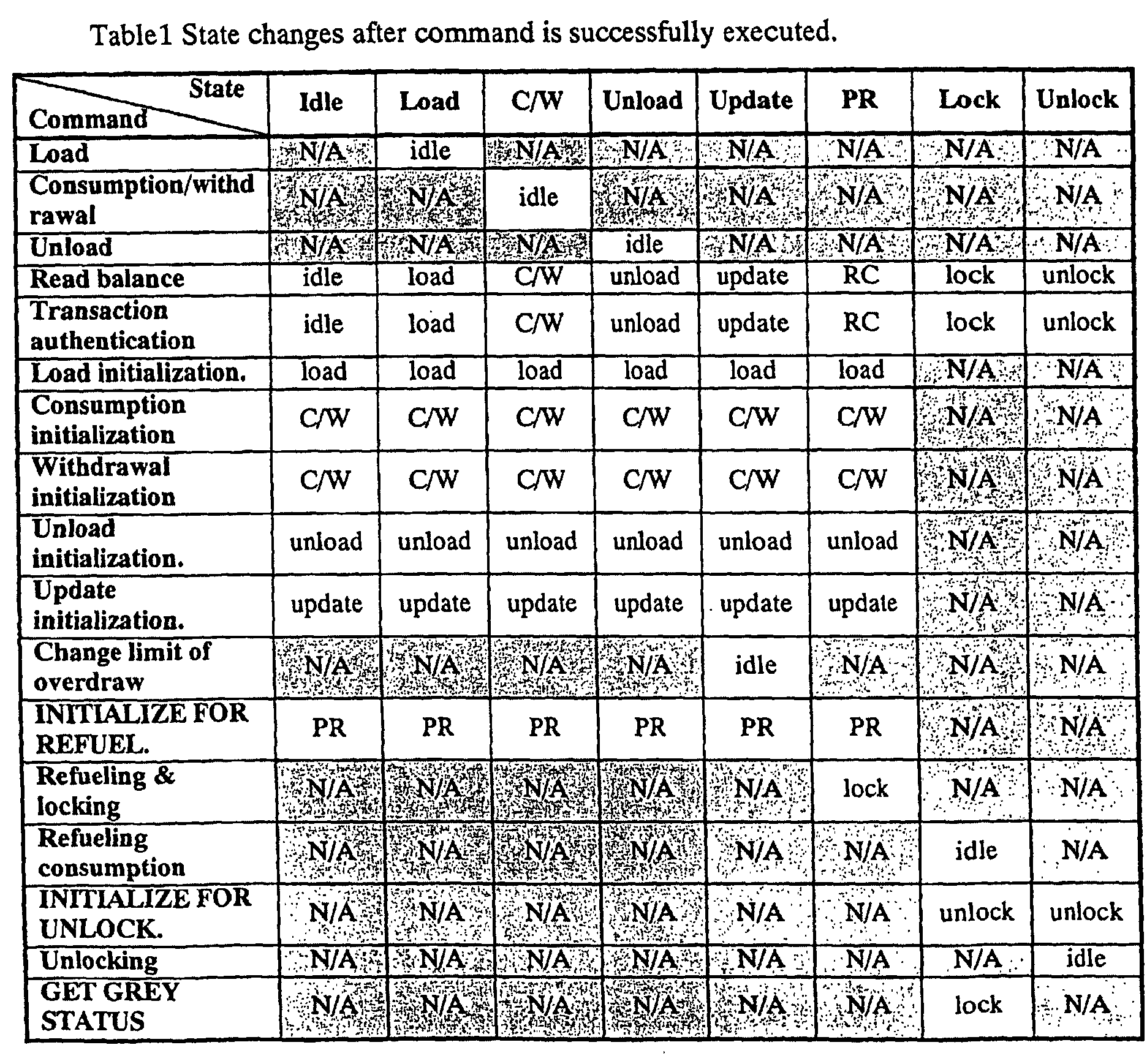
then the card enters another state (or the same state) as shown in table 1. If the
command is not executed successfully, then the card enters idle state.
Table 1 shows the state changes after successfully executing. First row is present
states when command is issuing, first column is commands to be issued and the whole
table shows the states after a command is successfully executed.
The shade part of table 1 shows a state where a command to the card is not
available (N/A). This means that the card does not execute command and responses a
"6901" state, i.e. don't accept command state (N/A), to card terminal. As the
command cannot be executed, so if the card is originally at grey lock state, then the
result is still at grey lock state; if the card is originally at other states, then the result is
at idle state.
In table 1 above, C/W represents Consumption/Withdrawal, PR represents Pre-refueling,
RC represents Refueling consumption, lock represents locking grey, and
unlock represents unlocking grey.
Table 2 defines command type, code of command byte and parameters P1 and P2
used for refueling electronic deposit. In command set, except general command of
electronic deposit, some specific commands are added: INITIALIZE FOR REFUEL,
LOCK FOR REFUEL, refuel, INITIALIZE FOR UNLOCK, unlocking grey and GET
GREY STATUS. The INITIALIZE FOR REFUEL command is used for initializing
refueling debit transaction. The LOCK FOR REFUEL command is used for locking
grey refueling electronic deposit. The refuel command is used for local refueling oil
transaction and unlocking grey simultaneity. The unlocking Initialization command is
used for initializing on-line unlocking grey transaction. The unlocking grey command
is used for on-line unlocking grey transaction and supplementary debit simultaneity.
The GET GREY STATUS command is used to read grey lock state.
| Command type byte and instruction bytes |
| Command | CLA | INS | P1 | P2 |
| Update PIN | 80 | 5E | 01 | 00 |
| Load | 80 | 52 | 00 | 00 |
| Consumption/withdrawal | 80 | 54 | 01 | 00 |
| Unload | 80 | 54 | 03 | 00 |
| Read balance | 80 | 5C | 00 | 0X |
| Transaction authentication | 80 | 5A | 00 | XX |
| Withdrawal initialization | 80 | 50 | 02 | 01 |
| Load initialization | 80 | 50 | 00 | 0X |
| Consumption initialization | 80 | 50 | 01 | 0X |
| Unload initialization | 80 | 50 | 05 | 01 |
| Change overdrawn limit initialization | 80 | 50 | 04 | 01 |
| Reload PIN | 80 | 5E | 00 | 00 |
| Change overdrawn limit | 80 | 58 | 00 | 00 |
| * INITIALIZE FOR REFUEL | E0 | 50 | 01 | 01 |
| * Refueling and locking | E0 | 50 | 02 | 01 |
| * Refueling consumption | E0 | 54 | 01 | 00 |
| *INITIALIZE FOR UNLOCK | E0 | 50 | 03 | 01 |
| * Unlocking | E0 | 54 | 01 | 01 |
| * GET GREY STATUS | E0 | 50 | 04 | 01 |
In the following, each of new commands is described in detail.
| INITIALIZE FOR REFUEL command message |
| Code | Value |
| CLA | E0 |
| INS | 50 |
| P1 | 01 |
| P2 | 01 used for refueling, others reserved |
| Lc | 0B |
| Data | See table 4 |
| Le | 10 |
| INITIALIZE FOR REFUEL command message data field |
| Description | Length (bytes) |
| Encryption key index | 1 |
| Terminal number | 6 |
| Terminal transaction sequence number | 4 |
| INITIALIZE FOR REFUEL response message data field |
| Description | Length (bytes) |
| ED balance | 4 |
| ED off-line transaction sequence number | 2 |
| Encryption key version | 1 |
| Algorithm identifier | 1 |
| Pseudo random number (ICC) | 1 |
| MAC1 | 4 |
| INITIALIZE FOR REFUEL error states |
| SW1 | SW2 | Description |
| 69 | 01 | Command unaccepted (invalid state i.e. grey lock source has been created) |
| 65 | 81 | Memory error |
| 69 | 85 | Use condition unsatisfied |
| 94 | 03 | Encryption key index unsupported |
| 94 | 02 | Transaction counter at maximum |
2. LOCK FOR REFUEL command:
LOCK FOR REFUEL command is used for locking grey refueling electronic
deposit. Its command message is shown on table 7, data field of the command
message is shown on table 8, and response message data field of successful execution
is shown on table 9. If it is an unsuccessful execution, then only send back the
response message with SW1 and SW2. If it is a successful execution, the state code of
response message is "9000". On table 10, the possible error states sent by IC card are
listed.
| LOCK FOR REFUEL command message |
| Code | Value |
| CLA | E0 |
| INS | 50 |
| P1 | 02 |
| P2 | 01 |
| Lc | 0B |
| Data | See table 8 |
| Le | 08 |
| LOCK FOR REFUEL command message data field |
| Description | Length (bytes) |
| Transaction date (terminal) | 4 |
| Transaction time (terminal) | 3 |
| MAC2 | 4 |
| LOCK FOR REFUEL response message data field |
| Description | Length (bytes) |
| TAC | 4 |
| MAC3 | 4 |
| LOCK FOR REFUEL error states |
| SW1 | SW2 | Description |
| 69 | 01 | Command unaccepted (invalid state) |
| 65 | 81 | Memory error |
| 69 | 85 | Use condition unsatisfied |
| 93 | 02 | MAC invalid |
3. DEBIT FOR REFUEL command:
DEBIT FOR REFUEL command is used for local refueling oil debit transaction
and unlocking grey simultaneity. Its command message is shown on table 11, data
field of the command message is shown on table 12, and response message data field
of successful execution is shown on table 13. If it is an unsuccessful execution, then
only send back the response message with SW1 and SW2. If it is a successful
execution, the state code of response message is "9000". On table 14, the possible
error states sent by IC card are listed.
| DEBIT FOR REFUEL command message |
| Code | Value |
| CLA | E0 |
| INS | 54 |
| P1 | 01 |
| P2 | 00 |
| Lc | 19 |
| Data | See table 12 |
| Le | 08 |
| DEBIT FOR REFUEL command message data field |
| Description | Length (bytes) |
| Transaction amount | 4 |
| ED off-line transaction sequence number | 2 |
| Terminal number | 6 |
| Terminal transaction sequence number | 4 |
| Transaction date (terminal) | 4 |
| Transaction time (terminal) | 3 |
| GMAC | 4 |
| DEBIT FOR REFUEL response message data field |
| Description | Length (bytes) |
| TAC | 4 |
| MAC4 | 4 |
| DEBIT FOR REFUEL error states |
| SW1 | SW2 | Description |
| 69 | 01 | Command unaccepted (invalid state) |
| 65 | 81 | Memory error |
| 69 | 85 | Use condition unsatisfied |
| 67 | 00 | Length error |
| 93 | 02 | MAC invalid |
4. INITIALIZE FOR UNLOCK command:
INITIALIZE FOR UNLOCK command is used for initializing on-line unlocking
grey transaction. Its command message is shown on table 15, data field of the
command message is shown on table 16, and response message data field of
successful execution is shown on table 17. If it is an unsuccessful execution, then only
send back the response message with SW1 and SW2. If it is a successful execution,
the state code of response message is "9000". On table 18, the possible error states
sent by IC card are listed.
| INITIALIZE FOR UNLOCK command message |
| Code | Value |
| CLA | E0 |
| INS | 50 |
| P1 | 03 |
| P2 | 01 for refueling transaction, others reserved |
| Lc | 07 |
| Data | See table 16 |
| Le | 10 |
| INITIALIZE FOR UNLOCK command message data field |
| Description | Length (bytes) |
| Encryption key index | 1 |
| Terminal number | 6 |
| INITIALIZE FOR UNLOCK response message data field |
| Description | Length (bytes) |
| ED balance | 4 |
| ED off-line transaction sequence number | 2 |
| Encryption key version | 1 |
| Algorithm identifier | 1 |
| Pseudo random number (ICC) | 4 |
| MAC1 | 4 |
| INITIALIZE FOR UNLOCK error states |
| SW1 | SW2 | Description |
| 69 | 01 | Command unaccepted (invalid state i.e. grey lock has not been created) |
| 65 | 81 | Memory error |
| 69 | 85 | Use condition unsatisfied |
| 94 | 03 | Encryption key index unsupported |
| 94 | 02 | Transaction counter at maximum |
5. DEBIT FOR UNLOCK command:
DEBIT FOR UNLOCK command is used for on-line unlocking grey transaction
and supplementary debit simultaneity. Its command message is shown on table 19,
data field of the command message is shown on table 20, and response message data
field of successful execution is shown on table 21. If it is an unsuccessful execution,
then only send back the response message with SW1 and SW2. If it is a successful
execution, the state code of response message is "9000". On table 22, the possible
error states sent by IC card are listed.
| DEBIT FOR UNLOCK command message |
| Code | Value |
| CLA | E0 |
| INS | 54 |
| P1 | 01 |
| P2 | 01 |
| Lc | 0F |
| Data | See table 20 |
| Le | 04 |
| DEBIT FOR UNLOCK command message data field |
| Description | Length (bytes) |
| Transaction amount | 4 |
| Transaction date (computer) | 4 |
| Transaction time (computer) | 3 |
| MAC2 | 4 |
| DEBIT FOR UNLOCK response message data field |
| Description | Length (bytes) |
| MAC3 | 4 |
| DEBIT FOR UNLOCK error states |
| SW1 | SW2 | Description |
| 69 | 01 | Command unaccepted (invalid state) |
| 65 | 81 | Memory error |
| 69 | 85 | Use condition unsatisfied |
| 67 | 00 | Length error |
| 93 | 02 | MAC invalid |
6. GET GREY STATUS command:
GET GREY STATUS command is used to get grey lock state. Its command
message is shown on table 23, there is no data field of the command message, and
response message data field of successful execution is shown on table 24. If it is an
unsuccessful execution, then only send back the response message with SW1 and
SW2. If it is a successful execution, the state code of response message is "9000". On
table 25, the possible error states sent by IC card are listed.
| GET GREY STATUS command message |
| Code | Value |
| CLA | E0 |
| INS | 50 |
| P1 | 04 |
| P2 | 01 |
| Lc | Non-existence |
| Data | Non-existence |
| Le | 11 |
| GET GREY STATUS response message data field |
| Description | Length (bytes) |
| Grey flag | 1 |
| ED balance | 4 |
| ED off-line transaction sequence number | 2 |
| ED on-line transaction sequence number | 2 |
| MAC3 | 4 |
| TAC | 4 |
| MAC3 and TAC are return value from IC card when grey lock. |
| GET GREY STATUS error states |
| SW1 | SW2 | Description |
| 69 | 01 | Command unaccepted (invalid state) |
| 65 | 81 | Memory error |
| 69 | 85 | Use condition unsatisfied |
| 67 | 00 | Length error |
In the following, transaction procedure of extended applications: refueling, local
unlocking grey and on-line unlocking grey, are described in detail.
SESPK works with following data in sequence to calculate MAC1:
- balance of refueling electronic deposit;
- transaction type identifier ("10" for refueling transaction);
- card terminal number (the card terminal which issues LOCK FOR REFUEL
command).
Step 1.3: authenticating MAC1.
With the pseudo random number ICC and off-line transaction sequence number
of refueling electronic deposit returned by IC card, the refueling security
authentication module PSAM makes a procedure encryption key SESPK and
authenticates MAC1; if MAC1 is valid, then next step is step 1.5, otherwise step 1.4. Step 1.4: send back error state, card terminal should stop refueling. Step 1.5: calculating MAC2.
After card terminal validates that refueling transaction can be proceeded, a
message authentication code MAC2 will be made for IC card to validate PSAM.SESPK works with following data in sequence to calculate MAC2:
- transaction type identifier ("10" for refueling transaction);
- card terminal number (the card terminal which issues LOCK FOR REFUEL
command);
- transaction date (the card terminal which issues LOCK FOR REFUEL
command);
- transaction time (the card terminal which issues LOCK FOR REFUEL
command).
Step 1.6: card terminal issues LOCK FOR REFUEL command. Step 1.7: authenticating MAC2.
After receiving LOCK FOR REFUEL command, IC card will authenticate
MAC2; if it is valid, then next step is step 1.8, otherwise returns error state "9302"
(MAC is invalid) to the card terminal. Step 1.8: LOCK FOR REFUEL command processing.
IC card writes the pseudo random number ICC, card terminal number, card
terminal transaction sequence number, transaction date and transaction time to an
internal file, in order to recover IC card data if power supply is interrupted during
refueling; sets refueling electronic deposit in grey lock state; except DEBIT FOR
REFUEL and DEBIT FOR UNLOCK commands, inhibits IC card operations (such as
load, unload, consumption/withdrawal, and change limit of overdrawn account etc.),
which will change balance of refueling electronic deposit. When card terminal issues
these inhibited commands, an error state "6989" (card has been locked) will be
returned to the card terminal.The off-line transaction sequence number of refueling electronic deposit is
incremented by IC card.IC card makes a message authentication code MAC3 for PSAM to check
whether IC card is legal, and writes MAC3 into an internal file at the same time.
MAC3 is included in response message of LOCK FOR REFUEL command and
response message of GET GREY STATUS command, which are transferred from IC
card to PSAM (through card terminal). SESPK works with following data to calculate
MAC3:
- balance of refueling electronic deposit;
- off-line transaction sequence number (before incremented) of refueling
electronic deposit;
- transaction type identifier ("10" for refueling transaction);
- card terminal number (the card terminal which issues LOCK FOR REFUEL
command);
- transaction date (the card terminal which issues LOCK FOR REFUEL
command);
- transaction time (the card terminal which issues LOCK FOR REFUEL
command).
With the same mechanism, IC card makes a transaction signature TAC by using
transaction authentication encryption key DTK directly, and writes TAC into an
internal file at the same time. TAC is included in response message of LOCK FOR
REFUEL command and response message of GET GREY STATUS command, which
are transferred from IC card to PSAM (through card terminal). If an exception
happens such as escape card, transaction is impossible to go on, then TAC will be
written into card terminal transaction itemized list in order to transfer to computer for
locked grey card transaction authentication. Followings are main elements to make
TAC:
- balance of refueling electronic deposit;
- off-line transaction sequence number (before incremented) of refueling
electronic deposit;
- transaction type identifier;
- card terminal number;
- transaction date (card terminal);
- transaction time (card terminal).
Step 1.9 Authenticating MAC3.
Card terminal authenticate the validation of MAC 3, if it is valid, then transaction
processing goes to step 1.10, otherwise card terminal will make an exception
processing. Step 1.10 Cardholder refueling.
During refueling, IC card is allowed to be power-off. After power-off, the IC
card can be inserted again; and after transaction makes preprocessing (authenticating
encryption code, selecting application), step 1.11 can be executed continually. Step 1.11 Making GMAC.
Refueling consumption secure authentication module PSAM makes a message
authentication code GMAC with procedure encryption key SESPK for IC card to
authenticate whether the PSAM is legal.SESPK works with following datum to calculate GMAC:
- refueling transaction amount.
Step 1.12 Card terminal issues a DEBIT FOR REFUEL command. Step 1.13 Authenticating GMAC.
After receiving DEBIT FOR REFUEL command, IC card first authenticates
whether the proposed off-line transaction sequence number of IC card is matched, if it
is unmatched, then an error returns without affecting error counter.Secondly, IC card authenticates whether GMAC is valid; if it is valid, then
transaction processing executes step 1.14 continually; if it is invalid, then error state
"9302" (MAC invalid) is returned to card terminal and error counter in IC card is
decreased at the same time; when the error counter is zero, the IC card is locked
permanently in order to prevent a malice trial. Step 1.14 Transaction processing.
IC card subtracts refueling transaction amount from refueling electronic deposit
balance and recovers refueling electronic deposit state from grey lock state to normal
state. IC card must perform all steps above completely or without performing any step;
if balance update or refueling electronic deposit recovery state are unsuccessful, then
transaction itemized list should not be revised also.IC card makes a message authentication code MAC4 for PSAM to check
whether the IC card is legal, the MAC4 is included in response message of REFUEL
command sent from IC card to PSAM (through card terminal). DPK works in the data
shown below, as calculation inputs, for calculating MAC4:
- amount of refueling transaction;
- transaction type identifier;
- card terminal number;
- transaction date (computer);
- transaction time (computer).
With the same mechanism, IC card also makes a transaction signature TAC by
using transaction authentication encryption key DTK directly. TAC will be written
into transaction itemized list of card terminal in order to transfer to computer later for
transaction authentication. Followings are main elements for making TAC:
- transaction amount;
- transaction type identifier;
- card terminal number (the card terminal which issues DEBIT FOR REFUEL
command);
- card terminal transaction sequence number (the card terminal which issues
DEBIT FOR REFUEL command);
- transaction date (the card terminal which issues DEBIT FOR REFUEL
command);
- transaction time (the card terminal which issues DEBIT FOR REFUEL
command).
IC card will use following data to form a record for updating transaction itemized
list.
- off-line transaction sequence number of refueling electronic deposit;
- transaction amount;
- transaction type identifier;
- card terminal number (the card terminal which issues DEBIT FOR REFUEL
command);
- transaction date (the card terminal which issues DEBIT FOR REFUEL
command);
- transaction time (the card terminal which issues DEBIT FOR REFUEL
command).
Step 1.15 Authenticating MAC4.
After receiving MAC4 comes from IC card (through card terminal), PSAM
authenticates MAC4 validation, the result is transferred to card terminal for taking
necessary measures. 2. On-line unlocking grey transaction
On-line unlocking grey transaction allows a cardholder to unlock a grey lock
card (recovering to normal state) and supplementary debit simultaneity. This
transaction must be made on an on-line card terminal and the cardholder must propose
PIN. Reference to Fig. 2.
Step 2.1 card terminal issues an INITIALIZE FOR UNLOCK command to start
refueling transaction. Step 2.2 after IC card has received INITIALIZE FOR UNLOCK command, it
deals with this command, includes:
(1) check whether the IC card is at grey lock state, if it is not, then returns state
code "6901" (illegal command) without any other data; (2) check whether the encryption key index included in the command is
supported by IC card, if it is not supported, then returns state code "9403"
(unsupported encryption key index) without any other data; (3) after passing above checks, the IC card will makes a pseudo random number
ICC, a procedure encryption key SESULKK and a message authentication code
MAC1 for computer to check whether the unlocking grey transaction and the IC card
are legal. The procedure encryption key SESULKK is made by unlocking grey
encryption key DULKK with the same mechanism of making consumption encryption
key and used for unlocking grey transaction. Inputting data for making procedure
encryption key SESULKK are as following:
SESULKK: pseudo random number ICC ∥ transaction sequence number of
refueling electronic deposit ∥ "8000".SESULKK works with following data in sequence to calculate MAC1:
- balance of refueling electronic deposit;
- transaction type identifier ("11" for unlocking grey transaction);
- card terminal number.
IC card send response message of INITIALIZE FOR UNLOCK command to
card terminal for processing, if the returning state is not "9000", then card terminal
will stop the transaction.After receiving response message of INITIALIZE FOR UNLOCK command,
card terminal sends an allowance request message, including data shown in table 17,
of unlocking grey to card distributor computer.
Step 2.3 Authenticating MAC1
Computer makes SESULKK and checks whether MAC1 is valid, if it is valid,
then executes step 2.5, otherwise executes step 2.4. Step 2.4 returning error state
When there are conditions cannot be accepted by unlocking grey transaction,
computer will inform card terminal and card terminal should take necessary measures
to deal with. Step 2.5 Computer processing
After confirming that load transaction can be made, computer makes a message
authentication code MAC2 for checking whether the computer is legal by IC card.
SESULKK works with the following data in sequence to calculate MAC2:
- supplementary debit amount of transaction;
- transaction type identifier;
- card terminal number;
- transaction date (computer);
- transaction time (computer).
Computer sends an unlocking transaction accepted message to card terminal,
including MAC2, transaction date (computer) and transaction time (computer).Step 2.6 when card terminal has received the unlocking transaction accepted
message from computer; card terminal will send an DEBIT FOR UNLOCK command
to IC card to update balance of refueling electronic deposit and to recover refueling
electronic deposit to normal state. Step 2.7 authenticating MAC2
After receiving DEBIT FOR UNLOCK command, IC card authenticates whether
MAC2 is valid; if it is valid, transaction executes step 2.8 continually, otherwise error
state "9302" (MAC invalid) is sent back to card terminal. Step 2.8 transaction processing
IC card subtracts supplementary debit amount of transaction from balance of
refueling electronic deposit on card, increments on-line transaction sequence number
of refueling electronic deposit, and recovers refueling electronic deposit state from
grey lock to normal. IC card must perform all steps above completely or without
performing any one step. If balance or sequence number or refueling electronic
deposit state are updated unsuccessfully, then transaction itemized list also should not
be updated. IC card makes a message authentication code MAC3 for checking
whether IC card is legal by computer. MAC3 is included in response message of
DEBIT FOR UNLOCK command transferred from card to computer (through card
terminal). SESULKK works with following data to calculate MAC3:
- balance of refueling electronic deposit;
- on-line transaction sequence number of refueling electronic deposit (before
increment);
- supplementary debit amount;
- transaction type identifier;
- card terminal number;
- transaction date (computer);
- transaction time (computer).
IC card also makes a transaction signature TAC by using transaction
authentication encryption key DTK directly with the same mechanism. TAC will be
written into card terminal transaction itemized list for transferring to computer later to
authenticate the transaction. Followings are main elements for making TAC:
- balance of refueling electronic deposit;
- on-line transaction sequence number of refueling electronic deposit (before
increment);
- supplementary debit amount;
- transaction type identifier;
- card terminal number;
- transaction date (computer);
- transaction time (computer).
IC card uses following data to form a record for updating transaction itemized
list:
- on-line transaction sequence number of refueling electronic deposit;
- supplementary debit amount;
- transaction type identifier;
- card terminal number;
- transaction date (computer);
- transaction time (computer).
Step 2.9 authenticating MAC3
When MAC3 from IC card (through card terminal) has been received, validation
of MAC3 should be authenticated, if it is valid, then step 2.10 will be executed,
otherwise computer will send an error message to card terminal. Step 2.10 returning acknowledgement
When step 2.9 has been successfully completed, computer takes corresponding
processing. 3. Local unlocking grey transaction
Local unlocking grey transaction allows cardholder to make a supplementary
debit and to unlock grey (recovering to normal state). This transaction must be done
on the card terminal that has escape card record of last time. Cardholder must propose
PIN to perform unlock grey transaction. Reference to Fig. 3.
Step 3.1 card terminal issues a GET GREY STATUS command to launch local
unlock grey transaction. Step 3.2 when IC card has received GET GREY STATUS command, IC card
sends grey mark state (Grey flag ) of electronic deposit, balance of electronic deposit,
on-line transaction sequence number of electronic deposit, off-line transaction
sequence number of electronic deposit, MAC3 and TAC when locking to card
terminal through GET GREY STATUS command response message. Step 3.3 authenticating MAC3
When card terminal has confirmed that the electronic deposit of IC card is in
grey lock state, it will compare the MAC3 received with MAC3 on escape card record. Step 3.4 card terminal issues a DEBIT FOR REFUEL command. Step 3.5 authenticating GMAC
After receiving DEBIT FOR REFUEL command, IC card authenticates whether
off-line transaction sequence number of IC card CTC submitted by card terminal is
matched, if it is unmatched, returns directly without affecting error counter.IC card should authenticate validation of GMAC. If it is valid, transaction
processing will continue step 3.6, otherwise error state "9302" (MAC is invalid) will
be sent back to card terminal. At the same time, IC card internal error counter
decrements, if the error counter is zero, the IC card is locked permanently in order to
prevent a malice trial.SESPK works with following datum to calculate GMAC:
- refueling transaction amount.
Step 3.6 transaction processing
IC card subtracts refueling transaction amount from refueling electronic deposit
balance on the card, and recovers from grey lock state to normal state. IC card must
perform all steps above completely or without performing any one step. If balance or
refueling electronic deposit state are updated unsuccessfully, then transaction itemized
list also should not be updated.IC card makes a message authentication code MAC4 for PSAM to check
whether the IC card is legal. MAC4 is included in response message of DEBIT FOR
REFUEL command sent from the card to PSAM (through card terminal) as an input
for MAC4 calculation. DPK works on the following datum to calculate MAC4:
- refueling transaction amount.
IC card also makes a transaction signature TAC by using transaction
authentication encryption key DTK directly with the same mechanism. TAC will be
written into card terminal transaction itemized list for transferring to computer later to
authenticate the transaction. Followings are main elements for making TAC:
- transaction amount;
- transaction type identifier;
- card terminal number (the card terminal which issues DEBIT FOR REFUEL
command);
- card terminal transaction sequence number (the card terminal which issues
DEBIT FOR REFUEL command);
- transaction date (the card terminal which issues DEBIT FOR REFUEL
command);
- transaction time (the card terminal which issues DEBIT FOR REFUEL
command).
IC card uses following data to form a record for updating transaction itemized
list:
- off-line transaction sequence number of refueling electronic deposit;
- transaction amount;
- transaction type identifier;
- card terminal number (the card terminal which issues DEBIT FOR REFUEL
command);
- transaction date (the card terminal which issues DEBIT FOR REFUEL
command);
- transaction time (the card terminal which issues DEBIT FOR REFUEL
command).
Step 3.7 authenticating MAC4
After receiving MAC4 from IC card (through card terminal), PSAM would
authenticate MAC4 validation. The result of authentication is sent to card terminal for
taking necessary measures.
In the application of refueling electronic deposit, metadata definition includes:
other transaction type identifiers are same as state-of-the-art.
2. encryption key relationship:
special encryption keys used for refueling electronic deposit are all double length
DEA encryption key (128 bits).
| Encryption key | Card distributor bank | IC card | POS. (PSAM) |
| Encryption key used for unlocking transaction | Unlock grey encryption main key (MULKK) | Unlock encryption sub-key (DULKK) | N/A |
Other encryption key relationship refers to state-of-the-art definition.
IC card internal changes includes:
- check whether the refueling electronic deposit is at grey lock state, if it is not,
enter idle state;
- if it is at grey lock state, from internal file IC card recovers pseudo random
number ICC, card terminal number, card terminal transaction sequence number,
transaction date, transaction time and MAC2 at last locking; and recovers procedure
encryption key SESPK with the same mechanism of recovering data.