EP1236803A1 - Method of judging flocculating properties of bottom brewer's yeast - Google Patents
Method of judging flocculating properties of bottom brewer's yeast Download PDFInfo
- Publication number
- EP1236803A1 EP1236803A1 EP00978036A EP00978036A EP1236803A1 EP 1236803 A1 EP1236803 A1 EP 1236803A1 EP 00978036 A EP00978036 A EP 00978036A EP 00978036 A EP00978036 A EP 00978036A EP 1236803 A1 EP1236803 A1 EP 1236803A1
- Authority
- EP
- European Patent Office
- Prior art keywords
- yeast
- flocculating
- flocculating properties
- dna
- properties
- Prior art date
- Legal status (The legal status is an assumption and is not a legal conclusion. Google has not performed a legal analysis and makes no representation as to the accuracy of the status listed.)
- Withdrawn
Links
Images

Classifications
-
- C—CHEMISTRY; METALLURGY
- C12—BIOCHEMISTRY; BEER; SPIRITS; WINE; VINEGAR; MICROBIOLOGY; ENZYMOLOGY; MUTATION OR GENETIC ENGINEERING
- C12Q—MEASURING OR TESTING PROCESSES INVOLVING ENZYMES, NUCLEIC ACIDS OR MICROORGANISMS; COMPOSITIONS OR TEST PAPERS THEREFOR; PROCESSES OF PREPARING SUCH COMPOSITIONS; CONDITION-RESPONSIVE CONTROL IN MICROBIOLOGICAL OR ENZYMOLOGICAL PROCESSES
- C12Q1/00—Measuring or testing processes involving enzymes, nucleic acids or microorganisms; Compositions therefor; Processes of preparing such compositions
- C12Q1/68—Measuring or testing processes involving enzymes, nucleic acids or microorganisms; Compositions therefor; Processes of preparing such compositions involving nucleic acids
-
- C—CHEMISTRY; METALLURGY
- C12—BIOCHEMISTRY; BEER; SPIRITS; WINE; VINEGAR; MICROBIOLOGY; ENZYMOLOGY; MUTATION OR GENETIC ENGINEERING
- C12Q—MEASURING OR TESTING PROCESSES INVOLVING ENZYMES, NUCLEIC ACIDS OR MICROORGANISMS; COMPOSITIONS OR TEST PAPERS THEREFOR; PROCESSES OF PREPARING SUCH COMPOSITIONS; CONDITION-RESPONSIVE CONTROL IN MICROBIOLOGICAL OR ENZYMOLOGICAL PROCESSES
- C12Q1/00—Measuring or testing processes involving enzymes, nucleic acids or microorganisms; Compositions therefor; Processes of preparing such compositions
- C12Q1/68—Measuring or testing processes involving enzymes, nucleic acids or microorganisms; Compositions therefor; Processes of preparing such compositions involving nucleic acids
- C12Q1/6876—Nucleic acid products used in the analysis of nucleic acids, e.g. primers or probes
- C12Q1/6888—Nucleic acid products used in the analysis of nucleic acids, e.g. primers or probes for detection or identification of organisms
- C12Q1/6895—Nucleic acid products used in the analysis of nucleic acids, e.g. primers or probes for detection or identification of organisms for plants, fungi or algae
-
- C—CHEMISTRY; METALLURGY
- C07—ORGANIC CHEMISTRY
- C07K—PEPTIDES
- C07K14/00—Peptides having more than 20 amino acids; Gastrins; Somatostatins; Melanotropins; Derivatives thereof
- C07K14/37—Peptides having more than 20 amino acids; Gastrins; Somatostatins; Melanotropins; Derivatives thereof from fungi
- C07K14/39—Peptides having more than 20 amino acids; Gastrins; Somatostatins; Melanotropins; Derivatives thereof from fungi from yeasts
- C07K14/395—Peptides having more than 20 amino acids; Gastrins; Somatostatins; Melanotropins; Derivatives thereof from fungi from yeasts from Saccharomyces
Definitions
- the present invention relates to a method to determine presence of flocculating properties of bottom fermenting yeast (brewer's lager yeast) or detecting genetical change to the non-flocculent.
- Beer of a lager type is produced in Japan, Germany and the other countries.
- the sedimentation properties of the yeast are important for the influence against recovery and then filtration of the yeast, and flavor and quality of beer in beer brewing. Further, when the properties of the bottom fermenting yeast are stabilized, the yeast has the advantage that it can be repeatedly used as recovery yeast in the beer production steps. In such cases, it is important to determine flocculating properties of bottom fermenting yeast in screening and selection of new yeast.
- Mutation of yeast is not caused in all cells at the same time. It is important to isolate single colonies, study the flocculating properties and know the population of mutants. However, in the method to determine flocculating properties, after conventional culturing and fermentation, it is difficult to treat many strains at a time.
- bottom fermenting yeast had chromosomes derived from both Saccharomyces cerevisiae and Saccharomyces bayanus. However, it was not successful in determination of the flocculating properties of the bottom fermenting yeast by noticing a gene derived from the both yeast (Yeast, 14, 923 (1998), System. Appl. Microbial. in Press (1999)).
- the present invention aims to easily obtain a method to determine presence of flocculating properties of bottom fermenting yeast at a short time by excellent reproductivity.
- PCR was conducted to search the presence of amplification of the objective fraction and the size.
- PCR is conducted by the above-mentioned primer and resultant amplified products is used as a probe for Southern hybridization.
- the first invention is a method to determine the presence of flocculating properties of bottom fermenting yeast by using an ORF sequence of a flocculation gene FLO5 of laboratory's yeast ( Saccharomyces cerevisiae ).
- the second invention is a method to determine non-flocculating properties and decrease of flocculating properties by genetical change of bottom fermenting yeast having original flocculating properties, by using the ORF sequence.
- the third invention is a method for foreknowing non-flocculating properties and decrease of flocculating properties by genetical change of bottom fermenting yeast having original flocculating properties, by using the sequence.
- the fourth invention is a method to determine the presence of flocculating properties of bottom fermenting yeast, wherein the primer designed from the sequence is used, and a PCR reaction is conducted to detect the presence of amplified products.
- the fifth invention is a method to determine non-flocculating properties and decrease of flocculating properties by genetical change of bottom fermenting yeast, wherein the primer designed from the sequence is used, a PCR reaction is conducted to detect the presence of amplified products.
- the sixth invention is a method for foreknowing the presence of non-flocculating properties and decrease of flocculating properties by genetical change of bottom fermenting yeast, wherein the primer designed from the ORF sequence is used, and a PCR reaction is conducted to compare the sizes of DNA of amplified products of a yeast strain showing flocculating properties.
- the seventh invention is a method to determine non-flocculating properties and decrease of flocculating properties by genetical change of bottom fermenting yeast, wherein several single colonies are isolated from the yeast, a PCR reaction is conducted by using the primer designed from the sequence, and the population of variants in the yeast is grasped.
- the eighth invention is a method for foreknowing non-flocculating properties and decrease of flocculating properties by genetical change of bottom fermenting yeast, wherein several single colonies are isolated from the yeast, a PCR reaction is conducted by using the primer designed from the sequence, and the population of variants in the yeast is grasped.
- the ninth invention is a method to determine the presence of flocculating properties of bottom fermenting yeast, wherein all DNA of the bottom fermenting yeast having flocculating properties are used as a template, the primer designed from the sequence is used, and a PCR reaction is conducted to use the amplified products.
- the tenth invention is a method to determine the nonflocculating properties by genetical change of bottom fermenting yeast, wherein all DNA of the bottom fermenting yeast having flocculating properties are used as a template, the primer designed from the sequence is used, and a PCR reaction is conducted to use the amplified products.
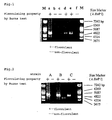
- Fig. 1 is an electrophoretogram showing flocculating properties of several kinds of bottom fermenting yeast and PCR amplified products.
- Fig. 2 is an electrophoretogram showing PCR amplified products of flocculating strains and nonflocculating strains, which are derived from bottom fermenting yeast having flocculating properties.
- Fig. 3 is an electrophoretogram showing the relation between a size of PCR amplified products of the strains derived from bottom fermenting yeast having flocculating properties, and the flocculating strength.
- Fig. 4 is a photograph showing a result of Southern analysis of flocculating strains, which are derived from bottom fermenting yeast having flocculating properties, and nonflocculating strains.
- the present invention provides a method to determine flocculating properties of yeast in several levels of bottom fermenting yeast and variants' levels that the variants are derived from flocculent lager yeast.
- the method uses a DNA sequence or the complementary sequence of ORF region (3228bp) of flocculation gene FLO5 on the chromosome VIII of laboratory's yeast ( Saccharomyces cerevisiae ).
- the present invention is a method to determine the flocculating properties by investigation of the presence of genes necessary to development of flocculating properties of yeast.
- genes can be confirmed by any methods known hitherto. The main methods are described in the following.
- Example 1 Determination of flocculating properties of bottom fermenting yeast
- Bottom fermenting yeast 30 strains were respectively cultured in 10 ml of YPD medium (1% Yeast Extract, 2% Peptone, 2% Dextrose) until the stationary phase, and the yeast was collected by centrifugation. After washing with distilled water, the yeast was collected. The yeast was suspended in 0.2 ml of a solution of 2% Triton X-100, 1% SDS, 100mM NaCl, 10mM Tris-HCl (pH 8.0), and 1mM Na 2 EDTA.
- YPD medium 1% Yeast Extract, 2% Peptone, 2% Dextrose
- TE Tris-HCl (pH 7.5), 1mM EDTA
- the resulting sediment was dissolved in 0.4 ml of the above TE, 3 ⁇ l of 10 mg/ml RNAse A solution was added, and the mixture was warmed for 5 minutes at 37°C. After adding 10 ⁇ l of 4M ammonium acetate and 1 ml of 100% ethanol, the mixture was left for 10 minutes or more at -20°C, and the sediment was recovered by centrifugation. The resulting sediment was dissolved in 50 ⁇ l of distilled water, and a part of the solution was tested.
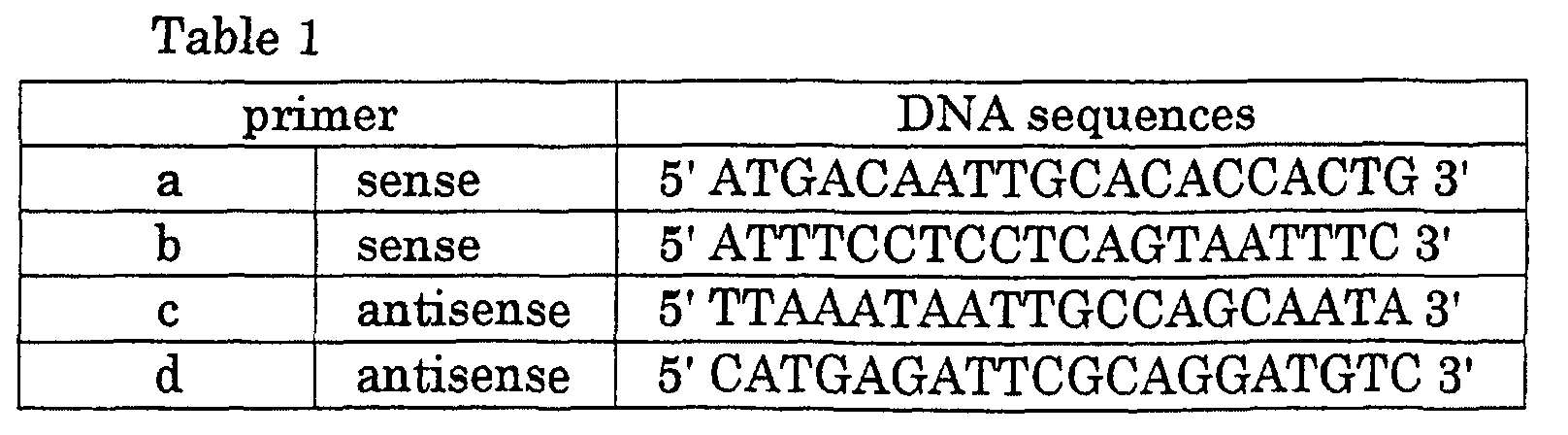
- Primer pairs were designed with ORF sequences of gene FLO5 having flocculating properties on the chromosome VIII of Saccharomyces cerevisiae. Examples of such primer pairs were shown in Table 1.
- PCR reaction was conducted under conditions: hot start was 94°C and 2 minutes; 94°C and 1 minute, 57.5°C and 2 minutes, 72°C and 2 minutes were repeated in 30 cycles; and the finish was 72°C and 20 minutes. A part thereof was taken out to be used for electrophoresis with 1 % agarose gel.
- the same strains were cultured in YPD medium and fermented in wort, and the flocculating properties were determined by the above Burns method.
- the method is that flocculating properties of yeast are artificially developed in the presence of Ca ion accelerating the flocculation under the conditions suit to flocculate and sediment the yeast, and the flocculated and sedimented property is determined. Flocculation properties are determined by the amount of sediments.
- a part of the results amplified by the PCR method using primer pair a and c is shown in Figure 1. It shows that the presence of about 5,000 bp of amplified DNA is in accord with the results determined by the Burns method.
- flocculating cells and nonflocculating cells can be determined by the presence or absence of amplified DNA of about 5,000 bp and the flocculating variants can be evaluated. Any primer pairs including those of both sides of FLO5 sequences (primers a and c ) can be used for determination of the presence of flocculating properties.
- Example 3 Population search of variants occupied in yeast groups
- Three yeast groups derived from the same yeast strain having different flocculating properties during beer fermentation were respectively applied on YPD plate mediums (1 % Yeast Extract, 2 % Peptone, 2% Dextrose, and 2 % Agarose), and cultured for 3 days at 25°C to isolate several tens single colonies respectively. Using the method described in Example 1, each single colony was cultured until the stationary phase. The resulting yeast was collected, and washed to extract the yeast DNA with an automatic DNA extraction device (Toyobo Mag-Extractor II).
- YPD plate mediums (1 % Yeast Extract, 2 % Peptone, 2% Dextrose, and 2 % Agarose
- PCR reaction was conducted by using the same primer pairs as shown in Table 1, and amplified products were subjected to electrophoresis.
- yeast groups had different rates of flocculating strains.
- the yeast group of excellent flocculating properties showed a high rate of flocculating strains, and the yeast group of poor flocculating properties showed a low rate of flocculating strains.
- the yeast group of low rate of flocculating strains had many yeast cells in wort during the fermentation, and it was expected that the yeast collection was difficult after the fermentation.
- Example 4 Method for determination of flocculating properties of bottom fermenting yeast by Southern hybridization
- the product was amplified by the PCR method using the primer pairs of the above Table 1.
- the amplified product was separated by electrophoresis in 1 % agarose gel.
- the fragment of about 5,000 bp was cut under ultraviolet irradiation, and DNA was extracted with QIA quick Gel Extraction Kit (QIAGEN Company).
- QIA quick Gel Extraction Kit QIAGEN Company
- the detection was conducted with an ECL detection system as shown in the protocol.
- the present invention it is possible to provide an accurate method to determine the presence of flocculating properties of bottom fermenting yeast and detecting the nonflocculating variants at a short time, easily and quickly, without fermentation of the bottom fermenting yeast. Many samples can be treated at a time, so that the method is useful in research and development of the yeast, and process control and quality control of the industrial production.
Landscapes
- Chemical & Material Sciences (AREA)
- Life Sciences & Earth Sciences (AREA)
- Organic Chemistry (AREA)
- Health & Medical Sciences (AREA)
- Proteomics, Peptides & Aminoacids (AREA)
- Engineering & Computer Science (AREA)
- Analytical Chemistry (AREA)
- Zoology (AREA)
- Wood Science & Technology (AREA)
- Mycology (AREA)
- Microbiology (AREA)
- General Health & Medical Sciences (AREA)
- Biophysics (AREA)
- Molecular Biology (AREA)
- Genetics & Genomics (AREA)
- Biochemistry (AREA)
- Biotechnology (AREA)
- Bioinformatics & Cheminformatics (AREA)
- General Engineering & Computer Science (AREA)
- Immunology (AREA)
- Physics & Mathematics (AREA)
- Botany (AREA)
- Gastroenterology & Hepatology (AREA)
- Medicinal Chemistry (AREA)
- Measuring Or Testing Involving Enzymes Or Micro-Organisms (AREA)
Abstract
Description
| yeast groups | A | B | C |
| flocculating of the latter period | excellent | a little bad | bad |
| rate of flocculating strains | 100% | 68% | 37% |


Claims (12)
- A method to determine the presence of flocculating properties of bottom fermenting yeast, characterized in that it uses an ORF sequence of a flocculation gene FLO5 of laboratory's yeast ( Saccharomyces cerevisiae).
- A method to determine the presence of non-flocculating properties or poor flocculating properties by genetical change of flocculating properties of bottom fermenting yeast, characterized in that it uses an ORF sequence of a flocculation gene FLO5 of laboratory's yeast ( Saccharomyces cerevisiae).
- A method for foreknowing the genetical change to non-flocculating properties or poor flocculating properties by genetical change of flocculating properties of bottom fermenting yeast, characterized in that it uses an ORF sequence of a flocculation gene FLO5 of laboratory's yeast ( Saccharomyces cerevisiae).
- A method to determine the presence of flocculating properties of bottom fermenting yeast of claim 1, characterized in that sample yeast strains are cultured, DNA is extracted, and a PCR reaction is conducted with the DNA by using a primer set of continuous bases of 10 bp or more, which is designed from an ORF sequence of a flocculation gene FLO5, to detect the presence of amplified products.
- A method to determine the presence of non-flocculating properties or poor flocculating properties by genetical change of flocculating properties of bottom fermenting yeast of claim 2, characterized in that sample yeast strains are cultured, DNA is extracted, and a PCR reaction is conducted with the DNA by using a primer set of continuous bases of 10 bp or more, which is designed from an ORF sequence of a flocculation gene FLO5 , to detect the presence of amplified products.
- A method for foreknowing the presence of non-flocculating properties and poor flocculating properties by genetical change of flocculating properties of bottom fermenting yeast of claim 3, characterized in that sample yeast strains are cultured, DNA is extracted, and a PCR reaction is conducted with the DNA by using a primer set of continuous bases of 10 bp or more, which is designed from an ORF sequence of a flocculation gene FLO5 , to compare the size of the DNA and the size of the amplified product's DNA of the yeast strains having flocculating properties.
- A method to determine non-flocculating properties and poor flocculating properties by genetical change of flocculating properties of bottom fermenting yeast of claim 2, characterized in that several single colonies are isolated from the yeast groups, each colony is cultured, DNA is extracted, and a PCR reaction is conducted by using a primer set of continuous bases of 10 bp or more, which is designed from an ORF sequence of a flocculation gene FLO5, to detect the presence of amplified products and confirm the population of flocculating variants in the yeast groups.
- A method for foreknowing non-flocculating properties and poor flocculating properties of bottom fermenting yeast of claim 3, characterized in that several single colonies are isolated from the yeast groups, each colony is cultured, DNA is extracted, and a PCR reaction is conducted by using a primer set of continuous bases of 10 bp or more, which is designed from an ORF sequence of a flocculation gene FLO5, to detect the presence of amplified products and confirm the population of flocculating variants in the yeast groups.
- A method to determine the presence of flocculating properties of bottom fermenting yeast of claim 1, characterized in that, using flocculating yeast DNA as a template, using as a probe the products amplified by a PCR reaction, in which it is conducted by using a primer set of continuous bases of 10 bp or more, which is designed from an ORF sequence of a flocculation gene FLO5, hybridization is conducted with the DNA extracted from cultured sample yeast.
- A method to determine the nonflocculating properties or poor flocculating properties by genetical change of bottom fermenting yeast of claim 2, characterized in that, using flocculating yeast DNA as a template, using as a probe the products amplified by a PCR reaction, in which it is conducted by using a primer set of continuous bases of 10 bp or more, which is designed from an ORF sequence of a flocculation gene FLO5, hybridization is conducted with the DNA extracted from cultured sample yeast.
- A method of any one of claims 4-9, wherein the DNA sequence of a primer set of continuous bases of 10 bp or more, which is designed from an ORF sequence of a flocculation gene FLO5, is any one of sequence numbers 1-4.
- A method of claim 11, wherein the primer set comprises first primer of sequence number 1 or 2 and second primer of sequence number 3 or 4.
Applications Claiming Priority (3)
| Application Number | Priority Date | Filing Date | Title |
|---|---|---|---|
| JP33893599 | 1999-11-30 | ||
| JP33893599 | 1999-11-30 | ||
| PCT/JP2000/008473 WO2001040514A1 (en) | 1999-11-30 | 2000-11-30 | Method of judging flocculating properties of bottom brewer's yeast |
Publications (2)
| Publication Number | Publication Date |
|---|---|
| EP1236803A1 true EP1236803A1 (en) | 2002-09-04 |
| EP1236803A4 EP1236803A4 (en) | 2003-05-02 |
Family
ID=18322719
Family Applications (1)
| Application Number | Title | Priority Date | Filing Date |
|---|---|---|---|
| EP00978036A Withdrawn EP1236803A4 (en) | 1999-11-30 | 2000-11-30 | METHOD FOR ESTIMATING FLOCCULATION PROPERTIES OF LOW BREWERY YEAST |
Country Status (7)
| Country | Link |
|---|---|
| US (1) | US7037655B2 (en) |
| EP (1) | EP1236803A4 (en) |
| KR (1) | KR100679349B1 (en) |
| CN (1) | CN100415898C (en) |
| AU (1) | AU780412B2 (en) |
| CA (1) | CA2392508A1 (en) |
| WO (1) | WO2001040514A1 (en) |
Cited By (4)
| Publication number | Priority date | Publication date | Assignee | Title |
|---|---|---|---|---|
| WO2007097113A1 (en) * | 2006-02-24 | 2007-08-30 | Suntory Limited | Gene encoding protein responsible for flocculation property of yeast and use thereof |
| WO2007099722A1 (en) * | 2006-02-28 | 2007-09-07 | Suntory Limited | Gene encoding protein responsible for flocculation property of yeast and use thereof |
| WO2007105461A3 (en) * | 2006-03-01 | 2007-11-29 | Suntory Ltd | Gene encoding protein responsible for flocculation property of yeast and use thereof |
| EP2409986A1 (en) * | 2010-07-23 | 2012-01-25 | Philipps-Universität Marburg | Invention related to flocculation of yeast cells |
Families Citing this family (25)
| Publication number | Priority date | Publication date | Assignee | Title |
|---|---|---|---|---|
| WO2007099692A1 (en) | 2006-02-28 | 2007-09-07 | Suntory Limited | Catalase gene and use thereof |
| EP1869175B1 (en) | 2005-08-22 | 2012-08-08 | Suntory Holdings Limited | Cysteine synthase gene and use thereof |
| WO2007026958A1 (en) | 2005-09-01 | 2007-03-08 | Suntory Limited | Tryptophan transporter gene and use thereof |
| AU2006289720B2 (en) | 2005-09-13 | 2011-07-14 | Suntory Holdings Limited | Alcohol acetyl transferase gene and use thereof |
| KR100953291B1 (en) | 2006-02-24 | 2010-04-20 | 산토리 홀딩스 가부시키가이샤 | Genes encoding proteins with neighboring diketone or diacetyl-reducing activity and uses thereof |
| JP2009527219A (en) | 2006-02-24 | 2009-07-30 | サントリーホールディングス株式会社 | Ammonia transporter gene and its use |
| AU2006339193B2 (en) | 2006-02-24 | 2009-12-17 | Suntory Holdings Limited | Gene encoding protein responsible for flocculation property of yeast and use thereof |
| DK1991671T3 (en) | 2006-02-28 | 2012-08-06 | Suntory Holdings Ltd | Gene encoding glycogen synthase, as well as its use |
| AU2006339194B2 (en) * | 2006-02-28 | 2012-03-01 | Suntory Holdings Limited | Gene encoding protein responsible for flocculation property of yeast and use thereof |
| CA2607677A1 (en) | 2006-02-28 | 2007-09-20 | Suntory Limited | Catalase gene and use thereof |
| EP1994051B1 (en) | 2006-02-28 | 2011-10-26 | Suntory Holdings Limited | Gene encoding trehalose-6-phosphate phosphatase and use thereof |
| AU2007246310B2 (en) | 2006-05-08 | 2012-12-13 | Suntory Holdings Limited | Fatty acid synthetase, polynucleotide encoding the same, and uses thereof |
| JP2008263848A (en) * | 2007-04-19 | 2008-11-06 | Asahi Breweries Ltd | A method to evaluate the effect of culture medium on aggregation of brewer's yeast |
| US8247209B2 (en) | 2007-06-18 | 2012-08-21 | Suntory Holdings Limited | Glycerol-3-phosphate acyltransferase (GPAT) homologs and use thereof |
| JP5180960B2 (en) | 2007-07-11 | 2013-04-10 | サントリーホールディングス株式会社 | Phosphatidate phosphatase homolog and its use |
| CN101349636B (en) * | 2007-07-16 | 2010-09-29 | 青岛啤酒股份有限公司 | Method for testing germinated barley flocculating degree |
| US8551744B2 (en) | 2007-07-23 | 2013-10-08 | Suntory Holdings Limited | Method of preparing a fatty acid composition |
| CA2702924C (en) | 2007-10-26 | 2017-08-15 | Suntory Holdings Limited | Atp:citrate lyase genes |
| EP2410051B1 (en) | 2009-03-18 | 2014-12-31 | Suntory Holdings Limited | NOVEL ACETYL-CoA CARBOXYLASE |
| KR101692016B1 (en) | 2009-03-26 | 2017-01-03 | 산토리 홀딩스 가부시키가이샤 | Novel lysophospholipid acyltransferase |
| EP2520646B1 (en) | 2009-12-28 | 2017-10-18 | Suntory Holdings Limited | Phosphatidic acid phosphatase gene and use thereof |
| KR101530765B1 (en) | 2010-02-03 | 2015-06-29 | 산토리 홀딩스 가부시키가이샤 | Glycerol-3-phosphate acyltransferase homologue and use thereof |
| BR112014000936A2 (en) | 2011-07-29 | 2017-06-13 | Suntory Holdings Ltd | phosphatidic acid phosphatase gene |
| JP6284311B2 (en) * | 2012-11-30 | 2018-02-28 | サッポロビール株式会社 | Sparkling beverage, raw material liquid, additive and method related thereto |
| JP7327986B2 (en) * | 2019-04-25 | 2023-08-16 | アサヒビール株式会社 | Evaluation method for early flocculation of yeast |
Family Cites Families (4)
| Publication number | Priority date | Publication date | Assignee | Title |
|---|---|---|---|---|
| CA2134354A1 (en) * | 1993-02-26 | 1994-09-01 | Junji Watari | Yeast agglutination genes and yeast containing them |
| JP4149007B2 (en) * | 1995-02-01 | 2008-09-10 | 麒麟麦酒株式会社 | DNA molecule for determining aggregation of yeast and determination method of aggregation |
| JP3643404B2 (en) * | 1995-02-01 | 2005-04-27 | 麒麟麦酒株式会社 | Genes that confer aggregation to yeast and gene products thereof |
| ES2272061T5 (en) * | 1998-04-15 | 2012-02-24 | Merck Serono Biodevelopment | GENOMIC SEQUENCE OF THE 5-LIPOXYGENASE ACTIVATING PROTEIN (FLAP), SAME POLYMORPHIC MARKERS AND METHODS FOR ASTHMA DETECTION. |
-
2000
- 2000-11-30 KR KR1020027006907A patent/KR100679349B1/en not_active Expired - Fee Related
- 2000-11-30 EP EP00978036A patent/EP1236803A4/en not_active Withdrawn
- 2000-11-30 CA CA002392508A patent/CA2392508A1/en not_active Abandoned
- 2000-11-30 WO PCT/JP2000/008473 patent/WO2001040514A1/en not_active Ceased
- 2000-11-30 AU AU15559/01A patent/AU780412B2/en not_active Ceased
- 2000-11-30 US US10/148,451 patent/US7037655B2/en not_active Expired - Fee Related
- 2000-11-30 CN CNB00816455XA patent/CN100415898C/en not_active Expired - Fee Related
Cited By (5)
| Publication number | Priority date | Publication date | Assignee | Title |
|---|---|---|---|---|
| WO2007097113A1 (en) * | 2006-02-24 | 2007-08-30 | Suntory Limited | Gene encoding protein responsible for flocculation property of yeast and use thereof |
| WO2007099722A1 (en) * | 2006-02-28 | 2007-09-07 | Suntory Limited | Gene encoding protein responsible for flocculation property of yeast and use thereof |
| WO2007105461A3 (en) * | 2006-03-01 | 2007-11-29 | Suntory Ltd | Gene encoding protein responsible for flocculation property of yeast and use thereof |
| EP2409986A1 (en) * | 2010-07-23 | 2012-01-25 | Philipps-Universität Marburg | Invention related to flocculation of yeast cells |
| WO2012010686A1 (en) * | 2010-07-23 | 2012-01-26 | Philipps-Universität Marburg | Invention relating to flocculation |
Also Published As
| Publication number | Publication date |
|---|---|
| KR100679349B1 (en) | 2007-02-07 |
| CN1402795A (en) | 2003-03-12 |
| WO2001040514A1 (en) | 2001-06-07 |
| AU1555901A (en) | 2001-06-12 |
| KR20020065542A (en) | 2002-08-13 |
| US20040214169A1 (en) | 2004-10-28 |
| CA2392508A1 (en) | 2001-06-07 |
| CN100415898C (en) | 2008-09-03 |
| AU780412B2 (en) | 2005-03-17 |
| US7037655B2 (en) | 2006-05-02 |
| EP1236803A4 (en) | 2003-05-02 |
Similar Documents
| Publication | Publication Date | Title |
|---|---|---|
| US7037655B2 (en) | Method of judging flocculating properties of bottom brewer's yeast | |
| JP4149007B2 (en) | DNA molecule for determining aggregation of yeast and determination method of aggregation | |
| Holm et al. | A rapid, efficient method for isolating DNA from yeast | |
| CA2518046C (en) | Screening method for genes of brewing yeast | |
| CA2322780C (en) | Detection of fermentation-related microorganisms | |
| US20060046253A1 (en) | Method for analyzing genes of industrial yeasts | |
| US5489513A (en) | Specific gene probes and processes for the diagnostic investigation of Candida albicans | |
| Denayrolles et al. | Incidence of SUC-RTM telomeric repeated genes in brewing and wild wine strains of Saccharomyces | |
| JP3643404B2 (en) | Genes that confer aggregation to yeast and gene products thereof | |
| Wightman et al. | Analysis of production brewing strains of yeast by DNA fingerprinting | |
| AU2005278901A1 (en) | Method for analyzing genes of industrial yeasts | |
| Jibiki et al. | Application of polymerase chain reaction to determine the flocculation properties of brewer's lager yeast | |
| US20060099612A1 (en) | Method for analyzing genes of industrial yeasts | |
| US7504239B2 (en) | Method of differentiating beer yeast | |
| RU2432402C2 (en) | PRIMER SET USED FOR Saccharomyces YEAST DETECTION | |
| Ogata et al. | Isolation of meiotic segregants from a bottom fermenting yeast | |
| JP2001008684A (en) | Novel oligonucleotide and yeast classification method using it | |
| JPWO2001040514A1 (en) | Method for determining the flocculation of bottom-fermenting brewer's yeast | |
| Balogh et al. | Presence of STA gene sequences in brewer's yeast genome | |
| JP2007228950A (en) | Determination method for flocculation of beer yeast | |
| JP2009027951A (en) | Primer for detection of Saccharomyces cerevisiae with starch resolution | |
| JP2008259454A (en) | Primer set for detection of Saccharomyces pastorianus | |
| JP2008263848A (en) | A method to evaluate the effect of culture medium on aggregation of brewer's yeast |
Legal Events
| Date | Code | Title | Description |
|---|---|---|---|
| PUAI | Public reference made under article 153(3) epc to a published international application that has entered the european phase |
Free format text: ORIGINAL CODE: 0009012 |
|
| 17P | Request for examination filed |
Effective date: 20020527 |
|
| AK | Designated contracting states |
Kind code of ref document: A1 Designated state(s): AT BE CH CY DE DK ES FI FR GB GR IE IT LI LU MC NL PT SE TR |
|
| A4 | Supplementary search report drawn up and despatched |
Effective date: 20030319 |
|
| RIC1 | Information provided on ipc code assigned before grant |
Ipc: 7C 12N 15/00 B Ipc: 7G 01N 33/53 B Ipc: 7C 12Q 1/68 B Ipc: 7C 07K 14/395 A Ipc: 7C 12C 11/02 B |
|
| 17Q | First examination report despatched |
Effective date: 20060721 |
|
| RAP1 | Party data changed (applicant data changed or rights of an application transferred) |
Owner name: ASAHI BREWERIES, LTD. |
|
| GRAP | Despatch of communication of intention to grant a patent |
Free format text: ORIGINAL CODE: EPIDOSNIGR1 |
|
| GRAC | Information related to communication of intention to grant a patent modified |
Free format text: ORIGINAL CODE: EPIDOSCIGR1 |
|
| GRAC | Information related to communication of intention to grant a patent modified |
Free format text: ORIGINAL CODE: EPIDOSCIGR1 |
|
| STAA | Information on the status of an ep patent application or granted ep patent |
Free format text: STATUS: THE APPLICATION IS DEEMED TO BE WITHDRAWN |
|
| 18D | Application deemed to be withdrawn |
Effective date: 20100421 |