EP1236791A1 - Overbased detergent additives - Google Patents
Overbased detergent additives Download PDFInfo
- Publication number
- EP1236791A1 EP1236791A1 EP01301406A EP01301406A EP1236791A1 EP 1236791 A1 EP1236791 A1 EP 1236791A1 EP 01301406 A EP01301406 A EP 01301406A EP 01301406 A EP01301406 A EP 01301406A EP 1236791 A1 EP1236791 A1 EP 1236791A1
- Authority
- EP
- European Patent Office
- Prior art keywords
- detergent
- mass
- salicylate
- phenate
- lubricating oil
- Prior art date
- Legal status (The legal status is an assumption and is not a legal conclusion. Google has not performed a legal analysis and makes no representation as to the accuracy of the status listed.)
- Withdrawn
Links
- 239000003599 detergent Substances 0.000 title claims abstract description 60
- 239000000654 additive Substances 0.000 title claims abstract description 21
- 239000004094 surface-active agent Substances 0.000 claims abstract description 25
- 229960001860 salicylate Drugs 0.000 claims abstract description 19
- YGSDEFSMJLZEOE-UHFFFAOYSA-M salicylate Chemical compound OC1=CC=CC=C1C([O-])=O YGSDEFSMJLZEOE-UHFFFAOYSA-M 0.000 claims abstract description 18
- 239000000463 material Substances 0.000 claims abstract description 5
- 239000000203 mixture Substances 0.000 claims description 40
- 239000010687 lubricating oil Substances 0.000 claims description 21
- 239000003921 oil Substances 0.000 claims description 15
- 230000000996 additive effect Effects 0.000 claims description 11
- 239000000314 lubricant Substances 0.000 claims description 9
- ISWSIDIOOBJBQZ-UHFFFAOYSA-N Phenol Chemical compound OC1=CC=CC=C1 ISWSIDIOOBJBQZ-UHFFFAOYSA-N 0.000 claims description 8
- 238000000034 method Methods 0.000 claims description 8
- YGSDEFSMJLZEOE-UHFFFAOYSA-N salicylic acid Chemical compound OC(=O)C1=CC=CC=C1O YGSDEFSMJLZEOE-UHFFFAOYSA-N 0.000 claims description 6
- 230000001050 lubricating effect Effects 0.000 claims description 5
- OYPRJOBELJOOCE-UHFFFAOYSA-N Calcium Chemical compound [Ca] OYPRJOBELJOOCE-UHFFFAOYSA-N 0.000 claims description 4
- 239000011575 calcium Substances 0.000 claims description 4
- 229910052791 calcium Inorganic materials 0.000 claims description 4
- 229910052784 alkaline earth metal Inorganic materials 0.000 claims description 3
- 230000003472 neutralizing effect Effects 0.000 claims description 3
- FJKROLUGYXJWQN-UHFFFAOYSA-N papa-hydroxy-benzoic acid Natural products OC(=O)C1=CC=C(O)C=C1 FJKROLUGYXJWQN-UHFFFAOYSA-N 0.000 claims description 3
- 229960004889 salicylic acid Drugs 0.000 claims description 3
- FYYHWMGAXLPEAU-UHFFFAOYSA-N Magnesium Chemical compound [Mg] FYYHWMGAXLPEAU-UHFFFAOYSA-N 0.000 claims description 2
- 150000001342 alkaline earth metals Chemical class 0.000 claims description 2
- 239000011777 magnesium Substances 0.000 claims description 2
- 229910052749 magnesium Inorganic materials 0.000 claims description 2
- 239000010705 motor oil Substances 0.000 claims description 2
- 239000000295 fuel oil Substances 0.000 claims 1
- -1 e.g. Substances 0.000 description 12
- 239000002585 base Substances 0.000 description 10
- 125000004432 carbon atom Chemical group C* 0.000 description 10
- 150000002989 phenols Chemical class 0.000 description 9
- 238000006243 chemical reaction Methods 0.000 description 8
- 239000003085 diluting agent Substances 0.000 description 8
- 229910052751 metal Inorganic materials 0.000 description 7
- 239000002184 metal Substances 0.000 description 7
- CURLTUGMZLYLDI-UHFFFAOYSA-N Carbon dioxide Chemical compound O=C=O CURLTUGMZLYLDI-UHFFFAOYSA-N 0.000 description 6
- NINIDFKCEFEMDL-UHFFFAOYSA-N Sulfur Chemical compound [S] NINIDFKCEFEMDL-UHFFFAOYSA-N 0.000 description 6
- YXFVVABEGXRONW-UHFFFAOYSA-N Toluene Chemical compound CC1=CC=CC=C1 YXFVVABEGXRONW-UHFFFAOYSA-N 0.000 description 6
- 125000001183 hydrocarbyl group Chemical group 0.000 description 6
- 239000005864 Sulphur Substances 0.000 description 5
- 125000000217 alkyl group Chemical group 0.000 description 5
- 239000003795 chemical substances by application Substances 0.000 description 5
- 239000003112 inhibitor Substances 0.000 description 4
- 239000002904 solvent Substances 0.000 description 4
- OKKJLVBELUTLKV-UHFFFAOYSA-N Methanol Chemical compound OC OKKJLVBELUTLKV-UHFFFAOYSA-N 0.000 description 3
- HEMHJVSKTPXQMS-UHFFFAOYSA-M Sodium hydroxide Chemical compound [OH-].[Na+] HEMHJVSKTPXQMS-UHFFFAOYSA-M 0.000 description 3
- 239000004480 active ingredient Substances 0.000 description 3
- 239000002199 base oil Substances 0.000 description 3
- ZMRQTIAUOLVKOX-UHFFFAOYSA-L calcium;diphenoxide Chemical compound [Ca+2].[O-]C1=CC=CC=C1.[O-]C1=CC=CC=C1 ZMRQTIAUOLVKOX-UHFFFAOYSA-L 0.000 description 3
- 239000001569 carbon dioxide Substances 0.000 description 3
- 229910002092 carbon dioxide Inorganic materials 0.000 description 3
- 239000000446 fuel Substances 0.000 description 3
- 150000003873 salicylate salts Chemical class 0.000 description 3
- 125000001424 substituent group Chemical group 0.000 description 3
- YNAVUWVOSKDBBP-UHFFFAOYSA-N Morpholine Chemical compound C1COCCN1 YNAVUWVOSKDBBP-UHFFFAOYSA-N 0.000 description 2
- 239000002253 acid Substances 0.000 description 2
- 230000002378 acidificating effect Effects 0.000 description 2
- 239000002518 antifoaming agent Substances 0.000 description 2
- 239000003963 antioxidant agent Substances 0.000 description 2
- 125000003118 aryl group Chemical group 0.000 description 2
- 230000015572 biosynthetic process Effects 0.000 description 2
- AXCZMVOFGPJBDE-UHFFFAOYSA-L calcium dihydroxide Chemical compound [OH-].[OH-].[Ca+2] AXCZMVOFGPJBDE-UHFFFAOYSA-L 0.000 description 2
- AVVIDTZRJBSXML-UHFFFAOYSA-L calcium;2-carboxyphenolate;dihydrate Chemical compound O.O.[Ca+2].OC1=CC=CC=C1C([O-])=O.OC1=CC=CC=C1C([O-])=O AVVIDTZRJBSXML-UHFFFAOYSA-L 0.000 description 2
- 229910052799 carbon Inorganic materials 0.000 description 2
- 239000012141 concentrate Substances 0.000 description 2
- 239000002270 dispersing agent Substances 0.000 description 2
- 230000000694 effects Effects 0.000 description 2
- 239000012467 final product Substances 0.000 description 2
- 238000010438 heat treatment Methods 0.000 description 2
- 238000010348 incorporation Methods 0.000 description 2
- JEIPFZHSYJVQDO-UHFFFAOYSA-N iron(III) oxide Inorganic materials O=[Fe]O[Fe]=O JEIPFZHSYJVQDO-UHFFFAOYSA-N 0.000 description 2
- 239000000693 micelle Substances 0.000 description 2
- 239000003973 paint Substances 0.000 description 2
- 238000010248 power generation Methods 0.000 description 2
- 239000000047 product Substances 0.000 description 2
- 150000003839 salts Chemical class 0.000 description 2
- 239000011593 sulfur Substances 0.000 description 2
- 229910052717 sulfur Inorganic materials 0.000 description 2
- XLYOFNOQVPJJNP-UHFFFAOYSA-N water Substances O XLYOFNOQVPJJNP-UHFFFAOYSA-N 0.000 description 2
- 239000004215 Carbon black (E152) Substances 0.000 description 1
- BVKZGUZCCUSVTD-UHFFFAOYSA-L Carbonate Chemical compound [O-]C([O-])=O BVKZGUZCCUSVTD-UHFFFAOYSA-L 0.000 description 1
- XDTMQSROBMDMFD-UHFFFAOYSA-N Cyclohexane Chemical compound C1CCCCC1 XDTMQSROBMDMFD-UHFFFAOYSA-N 0.000 description 1
- UFHFLCQGNIYNRP-UHFFFAOYSA-N Hydrogen Chemical compound [H][H] UFHFLCQGNIYNRP-UHFFFAOYSA-N 0.000 description 1
- DGAQECJNVWCQMB-PUAWFVPOSA-M Ilexoside XXIX Chemical compound C[C@@H]1CC[C@@]2(CC[C@@]3(C(=CC[C@H]4[C@]3(CC[C@@H]5[C@@]4(CC[C@@H](C5(C)C)OS(=O)(=O)[O-])C)C)[C@@H]2[C@]1(C)O)C)C(=O)O[C@H]6[C@@H]([C@H]([C@@H]([C@H](O6)CO)O)O)O.[Na+] DGAQECJNVWCQMB-PUAWFVPOSA-M 0.000 description 1
- 238000007065 Kolbe-Schmitt synthesis reaction Methods 0.000 description 1
- WHXSMMKQMYFTQS-UHFFFAOYSA-N Lithium Chemical compound [Li] WHXSMMKQMYFTQS-UHFFFAOYSA-N 0.000 description 1
- IGFHQQFPSIBGKE-UHFFFAOYSA-N Nonylphenol Natural products CCCCCCCCCC1=CC=C(O)C=C1 IGFHQQFPSIBGKE-UHFFFAOYSA-N 0.000 description 1
- ZLMJMSJWJFRBEC-UHFFFAOYSA-N Potassium Chemical compound [K] ZLMJMSJWJFRBEC-UHFFFAOYSA-N 0.000 description 1
- 150000001298 alcohols Chemical class 0.000 description 1
- 150000001335 aliphatic alkanes Chemical class 0.000 description 1
- 125000001931 aliphatic group Chemical group 0.000 description 1
- 239000003513 alkali Substances 0.000 description 1
- 150000004996 alkyl benzenes Chemical class 0.000 description 1
- 125000005907 alkyl ester group Chemical group 0.000 description 1
- 125000002947 alkylene group Chemical group 0.000 description 1
- 150000001412 amines Chemical class 0.000 description 1
- 125000004429 atom Chemical group 0.000 description 1
- 150000003819 basic metal compounds Chemical class 0.000 description 1
- 239000000920 calcium hydroxide Substances 0.000 description 1
- 229910001861 calcium hydroxide Inorganic materials 0.000 description 1
- 150000007942 carboxylates Chemical class 0.000 description 1
- 230000021523 carboxylation Effects 0.000 description 1
- 238000006473 carboxylation reaction Methods 0.000 description 1
- 239000003054 catalyst Substances 0.000 description 1
- 230000003749 cleanliness Effects 0.000 description 1
- 238000000576 coating method Methods 0.000 description 1
- 150000001875 compounds Chemical class 0.000 description 1
- 238000005260 corrosion Methods 0.000 description 1
- 230000007797 corrosion Effects 0.000 description 1
- 150000001991 dicarboxylic acids Chemical class 0.000 description 1
- 239000002283 diesel fuel Substances 0.000 description 1
- 238000004821 distillation Methods 0.000 description 1
- 125000002485 formyl group Chemical class [H]C(*)=O 0.000 description 1
- 239000007789 gas Substances 0.000 description 1
- 150000004820 halides Chemical class 0.000 description 1
- 239000010763 heavy fuel oil Substances 0.000 description 1
- 229930195733 hydrocarbon Natural products 0.000 description 1
- 150000002430 hydrocarbons Chemical class 0.000 description 1
- 229910052739 hydrogen Inorganic materials 0.000 description 1
- 239000001257 hydrogen Substances 0.000 description 1
- 230000002209 hydrophobic effect Effects 0.000 description 1
- XLYOFNOQVPJJNP-UHFFFAOYSA-M hydroxide Chemical compound [OH-] XLYOFNOQVPJJNP-UHFFFAOYSA-M 0.000 description 1
- 125000002887 hydroxy group Chemical group [H]O* 0.000 description 1
- 239000004922 lacquer Substances 0.000 description 1
- 229910052744 lithium Inorganic materials 0.000 description 1
- 238000004519 manufacturing process Methods 0.000 description 1
- 150000002736 metal compounds Chemical class 0.000 description 1
- 239000010688 mineral lubricating oil Substances 0.000 description 1
- 239000002480 mineral oil Substances 0.000 description 1
- 235000010446 mineral oil Nutrition 0.000 description 1
- 230000000116 mitigating effect Effects 0.000 description 1
- 238000002156 mixing Methods 0.000 description 1
- 239000003607 modifier Substances 0.000 description 1
- 239000000178 monomer Substances 0.000 description 1
- 125000001400 nonyl group Chemical group [H]C([*])([H])C([H])([H])C([H])([H])C([H])([H])C([H])([H])C([H])([H])C([H])([H])C([H])([H])C([H])([H])[H] 0.000 description 1
- SNQQPOLDUKLAAF-UHFFFAOYSA-N nonylphenol Chemical compound CCCCCCCCCC1=CC=CC=C1O SNQQPOLDUKLAAF-UHFFFAOYSA-N 0.000 description 1
- 150000002894 organic compounds Chemical class 0.000 description 1
- 150000002895 organic esters Chemical class 0.000 description 1
- 230000003647 oxidation Effects 0.000 description 1
- 238000007254 oxidation reaction Methods 0.000 description 1
- 235000011007 phosphoric acid Nutrition 0.000 description 1
- 150000003016 phosphoric acids Chemical class 0.000 description 1
- 229920013639 polyalphaolefin Polymers 0.000 description 1
- 229920001083 polybutene Polymers 0.000 description 1
- 229920000151 polyglycol Polymers 0.000 description 1
- 239000010695 polyglycol Substances 0.000 description 1
- 239000011591 potassium Substances 0.000 description 1
- 229910052700 potassium Inorganic materials 0.000 description 1
- 238000002360 preparation method Methods 0.000 description 1
- 150000003870 salicylic acids Chemical class 0.000 description 1
- 239000013049 sediment Substances 0.000 description 1
- 239000010802 sludge Substances 0.000 description 1
- 239000002002 slurry Substances 0.000 description 1
- 239000000344 soap Substances 0.000 description 1
- 239000011734 sodium Substances 0.000 description 1
- 229910052708 sodium Inorganic materials 0.000 description 1
- 239000007787 solid Substances 0.000 description 1
- 238000003756 stirring Methods 0.000 description 1
- FWMUJAIKEJWSSY-UHFFFAOYSA-N sulfur dichloride Chemical compound ClSCl FWMUJAIKEJWSSY-UHFFFAOYSA-N 0.000 description 1
- 239000000725 suspension Substances 0.000 description 1
- 238000003786 synthesis reaction Methods 0.000 description 1
- XDLNRRRJZOJTRW-UHFFFAOYSA-N thiohypochlorous acid Chemical compound ClS XDLNRRRJZOJTRW-UHFFFAOYSA-N 0.000 description 1
- 239000002966 varnish Substances 0.000 description 1
Classifications
-
- C—CHEMISTRY; METALLURGY
- C10—PETROLEUM, GAS OR COKE INDUSTRIES; TECHNICAL GASES CONTAINING CARBON MONOXIDE; FUELS; LUBRICANTS; PEAT
- C10M—LUBRICATING COMPOSITIONS; USE OF CHEMICAL SUBSTANCES EITHER ALONE OR AS LUBRICATING INGREDIENTS IN A LUBRICATING COMPOSITION
- C10M159/00—Lubricating compositions characterised by the additive being of unknown or incompletely defined constitution
- C10M159/12—Reaction products
- C10M159/20—Reaction mixtures having an excess of neutralising base, e.g. so-called overbasic or highly basic products
- C10M159/22—Reaction mixtures having an excess of neutralising base, e.g. so-called overbasic or highly basic products containing phenol radicals
-
- C—CHEMISTRY; METALLURGY
- C07—ORGANIC CHEMISTRY
- C07G—COMPOUNDS OF UNKNOWN CONSTITUTION
- C07G99/00—Subject matter not provided for in other groups of this subclass
- C07G99/002—Compounds of unknown constitution containing sulfur
- C07G99/0024—Overbased compounds
-
- C—CHEMISTRY; METALLURGY
- C10—PETROLEUM, GAS OR COKE INDUSTRIES; TECHNICAL GASES CONTAINING CARBON MONOXIDE; FUELS; LUBRICANTS; PEAT
- C10M—LUBRICATING COMPOSITIONS; USE OF CHEMICAL SUBSTANCES EITHER ALONE OR AS LUBRICATING INGREDIENTS IN A LUBRICATING COMPOSITION
- C10M2207/00—Organic non-macromolecular hydrocarbon compounds containing hydrogen, carbon and oxygen as ingredients in lubricant compositions
- C10M2207/02—Hydroxy compounds
- C10M2207/023—Hydroxy compounds having hydroxy groups bound to carbon atoms of six-membered aromatic rings
- C10M2207/028—Overbased salts thereof
-
- C—CHEMISTRY; METALLURGY
- C10—PETROLEUM, GAS OR COKE INDUSTRIES; TECHNICAL GASES CONTAINING CARBON MONOXIDE; FUELS; LUBRICANTS; PEAT
- C10M—LUBRICATING COMPOSITIONS; USE OF CHEMICAL SUBSTANCES EITHER ALONE OR AS LUBRICATING INGREDIENTS IN A LUBRICATING COMPOSITION
- C10M2207/00—Organic non-macromolecular hydrocarbon compounds containing hydrogen, carbon and oxygen as ingredients in lubricant compositions
- C10M2207/26—Overbased carboxylic acid salts
- C10M2207/262—Overbased carboxylic acid salts derived from hydroxy substituted aromatic acids, e.g. salicylates
-
- C—CHEMISTRY; METALLURGY
- C10—PETROLEUM, GAS OR COKE INDUSTRIES; TECHNICAL GASES CONTAINING CARBON MONOXIDE; FUELS; LUBRICANTS; PEAT
- C10M—LUBRICATING COMPOSITIONS; USE OF CHEMICAL SUBSTANCES EITHER ALONE OR AS LUBRICATING INGREDIENTS IN A LUBRICATING COMPOSITION
- C10M2219/00—Organic non-macromolecular compounds containing sulfur, selenium or tellurium as ingredients in lubricant compositions
- C10M2219/08—Thiols; Sulfides; Polysulfides; Mercaptals
- C10M2219/082—Thiols; Sulfides; Polysulfides; Mercaptals containing sulfur atoms bound to acyclic or cycloaliphatic carbon atoms
- C10M2219/087—Thiols; Sulfides; Polysulfides; Mercaptals containing sulfur atoms bound to acyclic or cycloaliphatic carbon atoms containing hydroxy groups; Derivatives thereof, e.g. sulfurised phenols
- C10M2219/089—Overbased salts
-
- C—CHEMISTRY; METALLURGY
- C10—PETROLEUM, GAS OR COKE INDUSTRIES; TECHNICAL GASES CONTAINING CARBON MONOXIDE; FUELS; LUBRICANTS; PEAT
- C10N—INDEXING SCHEME ASSOCIATED WITH SUBCLASS C10M RELATING TO LUBRICATING COMPOSITIONS
- C10N2040/00—Specified use or application for which the lubricating composition is intended
- C10N2040/25—Internal-combustion engines
- C10N2040/252—Diesel engines
-
- C—CHEMISTRY; METALLURGY
- C10—PETROLEUM, GAS OR COKE INDUSTRIES; TECHNICAL GASES CONTAINING CARBON MONOXIDE; FUELS; LUBRICANTS; PEAT
- C10N—INDEXING SCHEME ASSOCIATED WITH SUBCLASS C10M RELATING TO LUBRICATING COMPOSITIONS
- C10N2040/00—Specified use or application for which the lubricating composition is intended
- C10N2040/25—Internal-combustion engines
- C10N2040/252—Diesel engines
- C10N2040/253—Small diesel engines
Definitions
- This invention relates to oil-soluble overbased salicylate-phenate detergent additives, or concentrates, for lubricating oil compositions, such as compression-ignited (diesel) marine engine lubricating oil compositions.
- marine does not restrict the engines to those used in waterborne vessels; as is understood in the art, it also includes those for auxiliary power generation applications and for main propulsion stationary land-based engines for power-generation.
- One type of marine diesel engine is a medium-speed four-stroke engine, frequently referred to as a trunk piston engine.
- Lubricants or lubricating oil compositions for such engines are known and may be referred to as trunk piston engine oils or TPEO's.
- EP-A-0 662 508 describes a way of overcoming the problem using a composition that includes, as a detergent, a hydrocarbyl-substituted phenate concentrate having a TBN greater than 300 and a hydrocarbyl-substituted salicylate.
- the data in Example 2 thereof demonstrate that, for a combination of the two detergents, performance is inferior using more salicylate than phenate compared with more phenate than salicylate.
- the present invention surprisingly establishes that, when the salicylate and phenate are present in the form of a complex, superior results are achieved when more salicylate than phenate is used.
- a complex offers the advantages of superior convenience and handleability.
- the present invention is an oil-soluble overbased salicylate-phenate detergent additive comprising a complex wherein basic material of the detergent is stabilised by both salicylate and phenate surfactants wherein the mass % of the salicylate, as a percentage of the total surfactant mass, is greater than 50, provided that, when said mass % is less than 60, the TBN: mass % surfactant ratio of the detergent is 10 or less.
- the present invention is a lubricating oil composition
- a lubricating oil composition comprising an admixture of an oil of lubricating viscosity, in a major amount, and a detergent additive of the first aspect of the invention, in a minor amount.
- the present invention is a method of lubricating a trunk piston marine diesel engine comprising supplying to the engine a lubricating oil composition of the second aspect of the invention.
- the invention is a combination comprising
- the invention is the use of a detergent additive of the first aspect of the invention in a lubricating oil composition to suspend asphaltene components in the composition when used in a trunk piston marine diesel engine.
- lubricating oil compositions of this invention comprise defined individual, i.e, separate, components that may or may not remain the same chemically before and after mixing.
- a detergent is an additive that reduces formation of piston deposits, for example high-temperature varnish and lacquer deposits, in engines; it has acid-neutralising properties and is capable of keeping finely divided solids in suspension. It is based on metal "soaps", that is metal salts of acidic organic compounds, sometimes referred to as surfactants.
- a detergent comprises a polar head with a long hydrophobic tail, the polar head comprises a metal salt of the acid.
- Large amounts of a metal base are included by reacting an excess of a metal compound, such as an oxide or hydroxide, with an acidic gas such as carbon dioxide to give an overbased detergent which comprises neutralised detergent as the outer layer of a metal base (e.g. carbonate) micelle.
- the overbased detergents of this invention may have a TBN of 200 or greater, or 250 or greater, or 300 or greater, such as 300 to 500, preferably 300 to 400.
- the detergent is in the form of a complex wherein the basic material is stabilised by silicylate and phenate surfactants.
- Complexes are distinguished from mixtures of separate overbased detergents, an example of such a mixture being one of an overbased salicylate detergent with an overbased phenate detergent.
- the present detergents may be made, as generally described in International Patent Application Publication Nos WO 9746643/4/5/6 and 7 (mentioned above), as hybrid complexes by neutralising a mixture of a salicylic acid and a phenol with a basic metal compound, and then overbasing. Individual basic micelles of the detergent are thus stabilised by salicylate and phenate.
- They may also be made, as generally described in EP-A-0 750 659 (also mentioned above), as a calcium salicylate/phenate complex, by carboxylating a calcium phenate and then sulfurising and overbasing the mixture of calcium salicylate and calcium phenate.
- the detergent of the invention may be an alkali or alkaline earth metal, e.g., sodium, potassium, lithium, calcium, and magnesium, detergent. Calcium is preferred.
- Surfactants for the surfactant system of the overbased metal detergent may contain at least one hydrocarbyl group, for example, as a substituent on an aromatic ring.
- hydrocarbyl as used herein means that the group concerned is primarily composed of hydrogen and carbon atoms and is bonded to the remainder of the molecule via a carbon atom, but does not exclude the presence of other atoms or groups in a proportion insufficient to detract from the substantially hydrocarbon characteristics of the group.
- hydrocarbyl groups in surfactants for use in accordance with the invention are aliphatic groups, preferably alkyl or alkylene groups, especially alkyl groups, which may be linear or branched. The total number of carbon atoms in the surfactants should be at least sufficient to impart the desired oil-solubility.
- Salicylates of the invention may be non-sulphurized or sulphurized, and may be chemically modified and/or contain additional substituents, for example, as discussed below for phenates. Processes similar to those described below may also be used for sulphurizing a hydrocarbyl-substituted salicylic acid, and are known to those skilled in the art. Salicylic acids are typically prepared by the carboxylation, by the Kolbe-Schmitt process, of phenoxides, and in that case, will generally be obtained (normally in a diluent) in admixture with uncarboxylated phenol.
- Preferred substituents in salicylates are those represented by R in the description of phenols below.
- the alkyl groups advantageously contain 5 to 100 carbon atoms, preferably 9 to 30 carbon atoms, especially 14 to 20 carbon atoms.
- Phenates of the invention may be non-sulphurized or, preferably, sulphurized. Further, the term includes phenates derived from phenols containing more than one hydroxyl group (for example, alkyl catechols) or fused aromatic rings (for example, alkyl naphthols) and phenols which have been modified by chemical reaction, for example, alkylene-bridged phenols and Mannich base-condensed phenols; and saligenin-type phenols (produced by the reaction of a phenol and an aldehyde under basic conditions).
- phenols containing more than one hydroxyl group for example, alkyl catechols
- fused aromatic rings for example, alkyl naphthols
- phenols which have been modified by chemical reaction for example, alkylene-bridged phenols and Mannich base-condensed phenols
- saligenin-type phenols produced by the reaction of a phenol and an aldehyde under basic conditions.
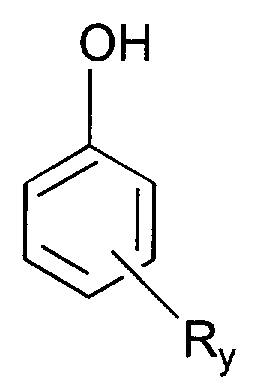
- Preferred phenates are those derived from phenols of the formula where R represents a hydrocarbyl group and y represents 1 to 4. Where y is greater than 1, the hydrocarbyl groups may be the same or different.
- Sulphurized hydrocarbyl phenols may typically be represented by the formula: where x is generally from 1 to 4. In some cases, more than two phenol molecules may be linked by S X bridges.
- hydrocarbyl groups represented by R are advantageously alkyl groups, which advantageously contain 5 to 100 carbon atoms, preferably 5 to 40 carbon atoms, especially 9 to 12 carbon atoms, the average number of carbon atoms in all of the R groups being at least about 9 in order to ensure adequate solubility in oil.
- Preferred alkyl groups are nonyl (tripropylene) groups.
- hydrocarbyl-substituted phenols will for convenience be referred to as alkyl phenols.
- a sulphurizing agent for use in preparing a sulphurized phenol or phenate may be any compound or element which introduces -(S) X - bridging groups between the alkyl phenol monomer groups, wherein x is generally from 1 to about 4.
- the reaction may be conducted with elemental sulphur or a halide thereof, for example, sulphur dichloride or, more preferably, sulphur monochloride. If elemental sulphur is used, the sulphurization reaction may be effected by heating the alkyl phenol compound at from 50 to 250°C, and preferably at least 100°C.
- the sulphurization reaction may be effected by treating the alkyl phenol at from -10°C to 120°C, preferably at least 60°C.
- the reaction may be conducted in the presence of a suitable diluent.
- the diluent advantageously comprises a substantially inert organic diluent, for example mineral oil or an alkane.
- the reaction is conducted for a period of time sufficient to effect substantial reaction. It is generally preferred to employ from 0.1 to 5 moles of the alkyl phenol material per equivalent of sulphurizing agent.
- a basic catalyst for example, sodium hydroxide or an organic amine, preferably a heterocyclic amine (e.g., morpholine).
- the salicylate-phenate may be non-sulfurised.
- the TBN: mass % surfactant ratio is preferably 10 or less when the mass % of salicylate in the detergent is 60 or greater.
- International Publication Number WO 97/46645 describes how the TBN: mass % surfactant ratio may be measured.
- the mass % of the salicylate is 65 or greater, preferably 70 or greater, or more preferably 75 or greater.
- the salicylate surfactant content of the detergent is greater than 30, such as greater than 35, mass %, and that the phenate surfactant content of the detergent is greater than 8, such as 10 or greater, mass %.
- the detergents of the invention have a kinematic viscosity, at 100°C, of less than 1,000 mm 2 s -1 .
- the overbased detergents may be incorporated into an oil of lubricating viscosity (or basestock) in any convenient way.
- they may be added directly to the oil by dispersing or dissolving them in the oil at the desired concentration optimally with the aid of a suitable solvent such as toluene or cyclohexane, and at ambient or elevated temperature.
- the detergents of the invention posses both high TBN and high active matter content, it is possible to blend lubricating oil compositions that have relatively high TBN and organic carboxylate surfactant concentrations, at lower detergent treat rates than hitherto.
- the composition is a marine lubricant such as a TPEO.
- the lubricating oil compositions of this invention have been found to be particularly efficacious in mitigating aforementioned "black paint" problem.
- the base stock for the composition may be synthetic or natural.
- Synthetic base stocks include alkyl esters of dicarboxylic acids, polyglycols and alcohols; poly- ⁇ -olefins, including polybutenes; alkyl benzenes; organic esters of phosphoric acids; and polysilicone oils.
- Natural base stocks include mineral lubricating oils which may vary widely as to their crude source, for example, as to whether they are paraffinic, napthenic, mixed, or paraffinic-napthenic, as well as to the method used in their production, for example, their distillation range and where they are straight run or cracked, hydrofined, or solvent extracted.
- Lubricating oil base stocks suitable for use in crankcase lubricants conveniently have a viscosity of 2.5 to 12 mm 2 /s, at 100°C, although base stocks with other viscosities may also be used, for example, bright stock.
- Lubricating oil base stocks suitable for use in marine lubricants conveniently have a viscosity of typically 3 to 15 mm 2 /s, at 100°C, although base stocks with other viscosities may also be used.
- base stocks with other viscosities may also be used.
- bright stocks which typically have a viscosity of 30 to 35 mm 2 /s at 100°C may be used.
- Additional additives may be incorporated in the composition to enable it to meet particular requirements.
- additional additives which may be included in lubricating oil compositions containing an overbased detergent in accordance with the invention are viscosity index improvers, corrosion inhibitors, oxidation inhibitors or antioxidants, friction modifiers, dispersants, other detergents, metal rust inhibitors, anti-wear agents, pour point depressants, and anti-foaming agents.
- Lubricating oils suitable for use in marine engines advantageously include a dispersant and an antiwear agent as additional antioxidants, antifoaming agents and/or rust inhibitors. Certain of the additional additives specified below are more appropriate for use in lubricants for automobile engine than for use in lubricants for marine engines.
- compositions may typically contain 5 to 40 mass % of additives, the remainder being base oil.
- the temperature of the mixture was reduced to approximately 28°C, and maintained at this temperature while carbon dioxide (44g) was injected into the mixture over a period of 90-120 minutes. The temperature was then raised to 60°C over 60 minutes, following which the mixture was cooled to a temperature of approximately 28°C over 30 minutes. At 28°C, a further quantity of calcium hydroxide (88g) was added and then the temperature was maintained at approximately 28°C while carbon dioxide (44g) was again injected into the mixture over a period of 90-120 minutes. After this second carbonation step, the temperature was raised to 60°C over 90 minutes. During this heat treatment period, when the temperature reached 45°C, a further charge of diluent oil (41g) was added.
Landscapes
- Chemical & Material Sciences (AREA)
- Organic Chemistry (AREA)
- Chemical Kinetics & Catalysis (AREA)
- General Chemical & Material Sciences (AREA)
- Oil, Petroleum & Natural Gas (AREA)
- Lubricants (AREA)
- Detergent Compositions (AREA)
Abstract
Description
- This invention relates to oil-soluble overbased salicylate-phenate detergent additives, or concentrates, for lubricating oil compositions, such as compression-ignited (diesel) marine engine lubricating oil compositions.
- The term "marine" does not restrict the engines to those used in waterborne vessels; as is understood in the art, it also includes those for auxiliary power generation applications and for main propulsion stationary land-based engines for power-generation.
- One type of marine diesel engine is a medium-speed four-stroke engine, frequently referred to as a trunk piston engine. Lubricants (or lubricating oil compositions) for such engines are known and may be referred to as trunk piston engine oils or TPEO's.
- Manufacturers commonly design marine diesel engines to use a variety of diesel fuels, ranging from good quality light distillate fuel with low sulfur and asphaltene content to poor quality intermediate or heavy fuel such as "Bunker C" or residual fuel oil with generally higher sulfur and asphaltene content. Lubricants used in such engines are often contaminated with asphaltene components from the fuel. This leads to severe engine cleanliness problems in service (sometimes referred to as "black paint"), a problem which is particularly widespread in four-stroke trunk piston engines where dirty cam boxes, deposits in piston scraper rings and sludge coatings on crankcase walls are found. Further, the lubricant handling system, for example, the heaters, filters and centrifuges, may function less well. The problem may not be confined to four-stroke engines; two-stoke cross-head engines may also be affected.
- EP-A-0 662 508 describes a way of overcoming the problem using a composition that includes, as a detergent, a hydrocarbyl-substituted phenate concentrate having a TBN greater than 300 and a hydrocarbyl-substituted salicylate. The data in Example 2 thereof demonstrate that, for a combination of the two detergents, performance is inferior using more salicylate than phenate compared with more phenate than salicylate.
- The present invention surprisingly establishes that, when the salicylate and phenate are present in the form of a complex, superior results are achieved when more salicylate than phenate is used. A complex offers the advantages of superior convenience and handleability.
- Complex detergents are known: see, for example International Publication Numbers WO's 97/46643, 97/46644, 97/46645, 97/46646 and 97/46647; and EP-A-0 750 659. But, none of the above specifically describes high salicylate content salicylate-phenate detergents according to this invention.
- In a first aspect, the present invention is an oil-soluble overbased salicylate-phenate detergent additive comprising a complex wherein basic material of the detergent is stabilised by both salicylate and phenate surfactants wherein the mass % of the salicylate, as a percentage of the total surfactant mass, is greater than 50, provided that, when said mass % is less than 60, the TBN: mass % surfactant ratio of the detergent is 10 or less.
- In a second aspect, the present invention is a lubricating oil composition comprising an admixture of an oil of lubricating viscosity, in a major amount, and a detergent additive of the first aspect of the invention, in a minor amount.
- In a third aspect, the present invention is a method of lubricating a trunk piston marine diesel engine comprising supplying to the engine a lubricating oil composition of the second aspect of the invention.
- In a fourth aspect, the invention is a combination comprising
- (a) mechanical parts to be lubricated of a trunk piston marine diesel engine; and
- (b) a lubricating oil composition of the second aspect of the invention
-
- In the fifth aspect, the invention is the use of a detergent additive of the first aspect of the invention in a lubricating oil composition to suspend asphaltene components in the composition when used in a trunk piston marine diesel engine.
- In this specification:
- "Major amount" means in excess of 50 mass % of the composition.
- "Minor amount" means less than 50 mass % of the compositions, both in respect of the stated additive and in respect of the total mass % of all of the additives present in the composition, reckoned as active ingredient of the additive or additives.
- "Comprises or comprising" or cognate words are taken to specify the presence of stated features, steps, integers, or components, but does not preclude the presence or addition of one or more other features, steps, integers, components or groups thereof.
- "TBN" is Total Base Number as measured by ASTM D2896.
- "Oil-soluble" or "oil-dispersable" do not necessarily indicate that the additive(s) are soluble, dissolvable, miscible or capable or being suspended in oil, in all proportions. They do mean, however, that they are, for example, soluble or stably dispersably in oil to an extent sufficient to exert their intended effect in the environment in which the oil is employed. Moreover, the additional incorporation of other additives may also permit incorporation of higher levels of a particular additive, if desired.
-
- All percentages reported are mass % on an active ingredient basis, i.e., without regard to carrier or diluent oil, unless otherwise stated.
- It should be noted that the lubricating oil compositions of this invention comprise defined individual, i.e, separate, components that may or may not remain the same chemically before and after mixing.
- The features of the invention will now be discussed in further detail as follows:-
- A detergent is an additive that reduces formation of piston deposits, for example high-temperature varnish and lacquer deposits, in engines; it has acid-neutralising properties and is capable of keeping finely divided solids in suspension. It is based on metal "soaps", that is metal salts of acidic organic compounds, sometimes referred to as surfactants.
- A detergent comprises a polar head with a long hydrophobic tail, the polar head comprises a metal salt of the acid. Large amounts of a metal base are included by reacting an excess of a metal compound, such as an oxide or hydroxide, with an acidic gas such as carbon dioxide to give an overbased detergent which comprises neutralised detergent as the outer layer of a metal base (e.g. carbonate) micelle. The overbased detergents of this invention may have a TBN of 200 or greater, or 250 or greater, or 300 or greater, such as 300 to 500, preferably 300 to 400.
- As stated, the detergent is in the form of a complex wherein the basic material is stabilised by silicylate and phenate surfactants. Complexes are distinguished from mixtures of separate overbased detergents, an example of such a mixture being one of an overbased salicylate detergent with an overbased phenate detergent.
- The present detergents may be made, as generally described in International Patent Application Publication Nos WO 9746643/4/5/6 and 7 (mentioned above), as hybrid complexes by neutralising a mixture of a salicylic acid and a phenol with a basic metal compound, and then overbasing. Individual basic micelles of the detergent are thus stabilised by salicylate and phenate.
- They may also be made, as generally described in EP-A-0 750 659 (also mentioned above), as a calcium salicylate/phenate complex, by carboxylating a calcium phenate and then sulfurising and overbasing the mixture of calcium salicylate and calcium phenate.
- The detergent of the invention may be an alkali or alkaline earth metal, e.g., sodium, potassium, lithium, calcium, and magnesium, detergent. Calcium is preferred.
- Surfactants for the surfactant system of the overbased metal detergent may contain at least one hydrocarbyl group, for example, as a substituent on an aromatic ring. The term "hydrocarbyl" as used herein means that the group concerned is primarily composed of hydrogen and carbon atoms and is bonded to the remainder of the molecule via a carbon atom, but does not exclude the presence of other atoms or groups in a proportion insufficient to detract from the substantially hydrocarbon characteristics of the group. Advantageously, hydrocarbyl groups in surfactants for use in accordance with the invention are aliphatic groups, preferably alkyl or alkylene groups, especially alkyl groups, which may be linear or branched. The total number of carbon atoms in the surfactants should be at least sufficient to impart the desired oil-solubility.
- Salicylates of the invention may be non-sulphurized or sulphurized, and may be chemically modified and/or contain additional substituents, for example, as discussed below for phenates. Processes similar to those described below may also be used for sulphurizing a hydrocarbyl-substituted salicylic acid, and are known to those skilled in the art. Salicylic acids are typically prepared by the carboxylation, by the Kolbe-Schmitt process, of phenoxides, and in that case, will generally be obtained (normally in a diluent) in admixture with uncarboxylated phenol.
- Preferred substituents in salicylates are those represented by R in the description of phenols below. In alkyl-substituted salicylicates, the alkyl groups advantageously contain 5 to 100 carbon atoms, preferably 9 to 30 carbon atoms, especially 14 to 20 carbon atoms.
- Phenates of the invention may be non-sulphurized or, preferably, sulphurized. Further, the term includes phenates derived from phenols containing more than one hydroxyl group (for example, alkyl catechols) or fused aromatic rings (for example, alkyl naphthols) and phenols which have been modified by chemical reaction, for example, alkylene-bridged phenols and Mannich base-condensed phenols; and saligenin-type phenols (produced by the reaction of a phenol and an aldehyde under basic conditions).
- Preferred phenates are those derived from phenols of the formulawhere R represents a hydrocarbyl group and y represents 1 to 4. Where y is greater than 1, the hydrocarbyl groups may be the same or different.
- The phenols from which the phenates are derived are frequently in sulphurized form. Sulphurized hydrocarbyl phenols may typically be represented by the formula:where x is generally from 1 to 4. In some cases, more than two phenol molecules may be linked by SX bridges.
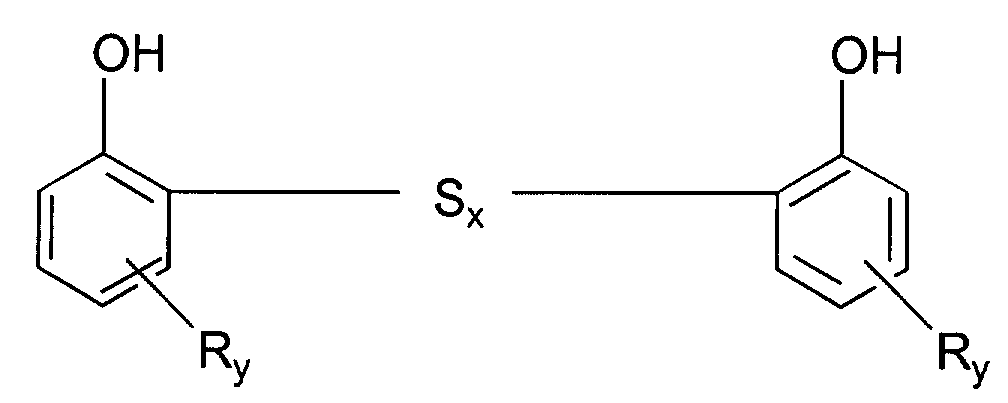
- In the above formulae, hydrocarbyl groups represented by R are advantageously alkyl groups, which advantageously contain 5 to 100 carbon atoms, preferably 5 to 40 carbon atoms, especially 9 to 12 carbon atoms, the average number of carbon atoms in all of the R groups being at least about 9 in order to ensure adequate solubility in oil. Preferred alkyl groups are nonyl (tripropylene) groups.
- In the following discussion, hydrocarbyl-substituted phenols will for convenience be referred to as alkyl phenols.
- A sulphurizing agent for use in preparing a sulphurized phenol or phenate may be any compound or element which introduces -(S)X- bridging groups between the alkyl phenol monomer groups, wherein x is generally from 1 to about 4. Thus, the reaction may be conducted with elemental sulphur or a halide thereof, for example, sulphur dichloride or, more preferably, sulphur monochloride. If elemental sulphur is used, the sulphurization reaction may be effected by heating the alkyl phenol compound at from 50 to 250°C, and preferably at least 100°C. The use of elemental sulphur will typically yield a mixture of bridging groups -(S)X- as described above. If a sulphur halide is used, the sulphurization reaction may be effected by treating the alkyl phenol at from -10°C to 120°C, preferably at least 60°C. The reaction may be conducted in the presence of a suitable diluent. The diluent advantageously comprises a substantially inert organic diluent, for example mineral oil or an alkane. In any event, the reaction is conducted for a period of time sufficient to effect substantial reaction. It is generally preferred to employ from 0.1 to 5 moles of the alkyl phenol material per equivalent of sulphurizing agent.
- Where elemental sulphur is used as the sulphurizing agent, it may be desirable to use a basic catalyst, for example, sodium hydroxide or an organic amine, preferably a heterocyclic amine (e.g., morpholine).
- Details of sulphurization processes are well known to those skilled in the art.
- In one form of the invention, the salicylate-phenate may be non-sulfurised.
- In the detergents of the invention, the TBN: mass % surfactant ratio is preferably 10 or less when the mass % of salicylate in the detergent is 60 or greater. International Publication Number WO 97/46645 describes how the TBN: mass % surfactant ratio may be measured.
- It is also preferred that the mass % of the salicylate, as a percentage of the total surfactant mass, is 65 or greater, preferably 70 or greater, or more preferably 75 or greater.
- It is preferred that the salicylate surfactant content of the detergent is greater than 30, such as greater than 35, mass %, and that the phenate surfactant content of the detergent is greater than 8, such as 10 or greater, mass %.
- Advantageously, the detergents of the invention have a kinematic viscosity, at 100°C, of less than 1,000 mm2s-1.
- To provide the second aspect of the invention, the overbased detergents may be incorporated into an oil of lubricating viscosity (or basestock) in any convenient way. Thus, they may be added directly to the oil by dispersing or dissolving them in the oil at the desired concentration optimally with the aid of a suitable solvent such as toluene or cyclohexane, and at ambient or elevated temperature.
- Because the detergents of the invention posses both high TBN and high active matter content, it is possible to blend lubricating oil compositions that have relatively high TBN and organic carboxylate surfactant concentrations, at lower detergent treat rates than hitherto.
- Preferably, the composition is a marine lubricant such as a TPEO.
- The lubricating oil compositions of this invention have been found to be particularly efficacious in mitigating aforementioned "black paint" problem.
- The base stock for the composition may be synthetic or natural.
- Synthetic base stocks include alkyl esters of dicarboxylic acids, polyglycols and alcohols; poly-α-olefins, including polybutenes; alkyl benzenes; organic esters of phosphoric acids; and polysilicone oils.
- Natural base stocks include mineral lubricating oils which may vary widely as to their crude source, for example, as to whether they are paraffinic, napthenic, mixed, or paraffinic-napthenic, as well as to the method used in their production, for example, their distillation range and where they are straight run or cracked, hydrofined, or solvent extracted.
- Lubricating oil base stocks suitable for use in crankcase lubricants conveniently have a viscosity of 2.5 to 12 mm2/s, at 100°C, although base stocks with other viscosities may also be used, for example, bright stock.
- Lubricating oil base stocks suitable for use in marine lubricants conveniently have a viscosity of typically 3 to 15 mm2/s, at 100°C, although base stocks with other viscosities may also be used. Thus, for example, bright stocks, which typically have a viscosity of 30 to 35 mm2/s at 100°C may be used.
- Additional additives may be incorporated in the composition to enable it to meet particular requirements. Examples of additional additives which may be included in lubricating oil compositions containing an overbased detergent in accordance with the invention are viscosity index improvers, corrosion inhibitors, oxidation inhibitors or antioxidants, friction modifiers, dispersants, other detergents, metal rust inhibitors, anti-wear agents, pour point depressants, and anti-foaming agents. Lubricating oils suitable for use in marine engines advantageously include a dispersant and an antiwear agent as additional antioxidants, antifoaming agents and/or rust inhibitors. Certain of the additional additives specified below are more appropriate for use in lubricants for automobile engine than for use in lubricants for marine engines.
- The compositions may typically contain 5 to 40 mass % of additives, the remainder being base oil.
- The following examples illustrate, but in no way limit, the invention.
- 673g toluene, 191g methanol, 33g water, and 19g of diluent oil (SN150) were introduced into a reactor and mixed while maintaining the temperature at approximately 20°C. Calcium hydroxide (Ca(OH)2) (136g) was added, and the mixture was heated to 40°C, with stirring. To the slurry obtained in this way was added 521g of alkylsalicylic acid and 134g of sulphurised nonyl phenol.
- The temperature of the mixture was reduced to approximately 28°C, and maintained at this temperature while carbon dioxide (44g) was injected into the mixture over a period of 90-120 minutes. The temperature was then raised to 60°C over 60 minutes, following which the mixture was cooled to a temperature of approximately 28°C over 30 minutes. At 28°C, a further quantity of calcium hydroxide (88g) was added and then the temperature was maintained at approximately 28°C while carbon dioxide (44g) was again injected into the mixture over a period of 90-120 minutes. After this second carbonation step, the temperature was raised to 60°C over 90 minutes. During this heat treatment period, when the temperature reached 45°C, a further charge of diluent oil (41g) was added.
- To complete the synthesis, the product was heated from 60 to 160°C in four hours to remove the solvents and water. This solvent stripping process was performed in three stages:
- under atmospheric pressure to 114°C, at which point a final charge of diluent oil (40g) was added
- under a pressure of 500mbar between 114°C and 125°C
- under a pressure of 250mbar between 125°C and 160°C.
-
- Finally, the product was filtered to remove sediment and further diluted with base oil (30g).
- Characteristics of the overbased detergent made by this process are as follows:
- TBN = 325mgKOH/g (measured by ASTM D2896)
- Kv100 = 277cSt (measured by ASTM D445)
- Active ingredient content = 86% (calculated as, [mass of final product - mass of base oil] / [mass of final product] )
-
Claims (15)
- An oil-soluble overbased salicylate- phenate detergent additive comprising a complex wherein basic material of the detergent is stabilised by both salicylate and phenate surfactants wherein the mass % of the salicylate, as a percentage of the total surfactant mass, is greater than 50, provided that, when said mass % is less than 60, the TBN: mass % surfactant ratio of the detergent is 10 or less.
- The detergent as claimed in claim 1 wherein the TBN: mass % surfactant ratio is 10 or less when mass % of the salicylate is 60 or greater.
- The detergent as claimed in claim 1 or claim 2 wherein the mass % of the total surfactant mass, is 65 or greater, preferably 70 or greater, or more preferably 75 or greater.
- The detergent as claimed in any of claims 1 to 3 wherein the detergent is an alkaline earth metal, such as a calcium or magnesium, detergent.
- The detergent as claimed in any of claims 1 to 4 having a TBN of 200 or greater, or 250 or greater, or 300 or greater, such as 300 to 500, preferably 300 to 400.
- The detergent as claimed in any of claims 1 to 5 having a kinematic viscosity, at 100°C, of less than 1,000 mm2s-1.
- The detergent as claimed in any of claims 1 to 6 wherein the salicylate surfactant content of the detergent is greater than 30, such as greater than 35, mass % and the phenate surfactant content of the detergent is greater than 8, such as 10 or greater, mass %.
- The detergent as claimed in any of claim 1 to 7 wherein the detergent is a hybrid complex made by neutralising a mixture of a salicylic acid and a phenol, and then overbasing.
- The detergent as claimed in any of claims 1 to 7 wherein the detergent is made by neutralising a phenol, carboxylating the resulting phenate, and subsequently overbasing.
- A lubricating oil composition comprising an admixture of an oil of lubricating viscosity, in a major amount, and a detergent additive as claimed in any of claims 1 to 9, in a minor amount.
- The lubricating oil composition as claimed in claim 10 in the form of a marine lubricant such as a trunk piston marine engine oil.
- The lubricating oil composition as claimed in claim 11 additionally comprising a fuel oil with a residual oil content.
- A method of lubricating a trunk piston marine diesel engine comprising supplying to the engine a lubricating oil composition as claimed in claim 11 or claim 12.
- A composition comprising(a) mechanical parts to be lubricated of a trunk piston marine diesel engine; and(b) a lubricating oil composition as claimed in claim 11 or claim 12
- The use of a detergent additive as claimed in any of claims 1 to 9 in a lubricating oil composition to suspend asphaltene components in the composition when used in a trunk piston marine diesel engine.
Priority Applications (9)
| Application Number | Priority Date | Filing Date | Title |
|---|---|---|---|
| EP01301406A EP1236791A1 (en) | 2001-02-16 | 2001-02-16 | Overbased detergent additives |
| DE60217204T DE60217204T2 (en) | 2001-02-16 | 2002-01-28 | Use of overbased detergents to suspend asphaltenes |
| EP02075506A EP1236792B1 (en) | 2001-02-16 | 2002-01-28 | Use of overbased detergent additives to suspend asphaltene compounds |
| AT02075506T ATE350435T1 (en) | 2001-02-16 | 2002-01-28 | USE OF OVERBASE DETERGENTS TO SUSPEND ASPHALTENES |
| US10/062,356 US6642190B2 (en) | 2001-02-16 | 2002-01-31 | Overbased detergent additives |
| CNB021047502A CN1314785C (en) | 2001-02-16 | 2002-02-10 | High alkali cleaning additive |
| CA002372478A CA2372478A1 (en) | 2001-02-16 | 2002-02-15 | Overbased detergent additives |
| SG200200827A SG104959A1 (en) | 2001-02-16 | 2002-02-15 | Overbased detergent additives |
| JP2002038570A JP4381644B2 (en) | 2001-02-16 | 2002-02-15 | Overbased detergent |
Applications Claiming Priority (1)
| Application Number | Priority Date | Filing Date | Title |
|---|---|---|---|
| EP01301406A EP1236791A1 (en) | 2001-02-16 | 2001-02-16 | Overbased detergent additives |
Publications (1)
| Publication Number | Publication Date |
|---|---|
| EP1236791A1 true EP1236791A1 (en) | 2002-09-04 |
Family
ID=8181717
Family Applications (1)
| Application Number | Title | Priority Date | Filing Date |
|---|---|---|---|
| EP01301406A Withdrawn EP1236791A1 (en) | 2001-02-16 | 2001-02-16 | Overbased detergent additives |
Country Status (8)
| Country | Link |
|---|---|
| US (1) | US6642190B2 (en) |
| EP (1) | EP1236791A1 (en) |
| JP (1) | JP4381644B2 (en) |
| CN (1) | CN1314785C (en) |
| AT (1) | ATE350435T1 (en) |
| CA (1) | CA2372478A1 (en) |
| DE (1) | DE60217204T2 (en) |
| SG (1) | SG104959A1 (en) |
Cited By (3)
| Publication number | Priority date | Publication date | Assignee | Title |
|---|---|---|---|---|
| EP1749875A1 (en) * | 2005-07-29 | 2007-02-07 | Chevron Oronite S.A. | Overbased alkaline earth metal alkylhydroxybenzoates having low crude sediment |
| GB2463367A (en) * | 2008-09-11 | 2010-03-17 | Infineum Int Ltd | A method of reducing asphaltene precipitation in an engine |
| WO2014172125A1 (en) | 2013-04-17 | 2014-10-23 | The Lubrizol Corporation | 2-stroke internal combustion engine cylinder liner lubricating composition |
Families Citing this family (14)
| Publication number | Priority date | Publication date | Assignee | Title |
|---|---|---|---|---|
| US20040224858A1 (en) * | 2003-05-06 | 2004-11-11 | Ethyl Corporation | Low sulfur, low ash, and low phosphorus lubricant additive package using overbased calcium phenate |
| US7163911B2 (en) * | 2003-05-22 | 2007-01-16 | Chevron Oronite Company Llc | Carboxylated detergent-dispersant additive for lubricating oils |
| US20050003972A1 (en) * | 2003-06-13 | 2005-01-06 | Laurent Chambard | Lubricant composition |
| US20050119140A1 (en) * | 2003-10-30 | 2005-06-02 | Laurent Chambard | Method of reducing deposit formation in a centrifuge system in a trunk piston diesel engine |
| US7956022B2 (en) * | 2005-07-29 | 2011-06-07 | Chevron Oronite Company Llc | Low sulfur metal detergent-dispersants |
| US7687444B2 (en) * | 2005-12-20 | 2010-03-30 | Chevron Japan Ltd. | Lubricating oil composition having improved oxidation stability at high temperatures |
| WO2008016484A2 (en) * | 2006-07-28 | 2008-02-07 | Exxonmobil Research And Engineering Company | Lubricant compositions having improved low temperature properties |
| US8377859B2 (en) * | 2007-07-25 | 2013-02-19 | Exxonmobil Research And Engineering Company | Hydrocarbon fluids with improved pour point |
| US20090090655A1 (en) * | 2007-10-04 | 2009-04-09 | Baker Hughes Incorporated | Additive Useful for Stabilizing Crude Oil |
| US20090090047A1 (en) * | 2007-10-04 | 2009-04-09 | Baker Hughes Incorporated | Additive Useful for Stabilizing Fuel Oils |
| EP2424965B1 (en) * | 2009-05-01 | 2015-05-20 | Infineum International Limited | Marine engine lubrication |
| EP2682451B1 (en) * | 2012-07-06 | 2015-11-18 | Infineum International Limited | Detergent modification |
| CN104017634B (en) * | 2014-06-16 | 2016-05-25 | 王盛良 | A kind of compound method of and the energy saving and environment friendly machine oil of Engine Matching |
| CN107815334A (en) * | 2017-10-19 | 2018-03-20 | 山东源根石油化工有限公司 | A kind of organic magnesium additive of non-sulphur phosphorus and its oil resistant chamotte mould taxi special lube containing the additive |
Citations (6)
| Publication number | Priority date | Publication date | Assignee | Title |
|---|---|---|---|---|
| WO1996026995A1 (en) * | 1995-02-28 | 1996-09-06 | Bp Chemicals (Additives) Limited | Lubricating oil compositions |
| EP0786448A2 (en) * | 1994-03-17 | 1997-07-30 | Chevron Chemical S.A. | Overbased sulfurised alkaline earth metal alkylsalicylate-alkylphenate as detergent/dispersant lubricating oil additives |
| WO1997046644A1 (en) * | 1996-05-31 | 1997-12-11 | Exxon Chemical Patents Inc. | Overbased metal-containing detergents |
| WO1997046645A1 (en) * | 1996-05-31 | 1997-12-11 | Exxon Chemical Patents Inc. | Overbased metal-containing detergents |
| WO1997046643A1 (en) * | 1996-05-31 | 1997-12-11 | Exxon Chemical Patents Inc. | Overbased metal-containing detergents |
| WO1997046646A1 (en) * | 1996-05-31 | 1997-12-11 | Exxon Chemical Patents Inc. | Overbased metal-containing detergents |
Family Cites Families (8)
| Publication number | Priority date | Publication date | Assignee | Title |
|---|---|---|---|---|
| GB1105217A (en) * | 1965-10-05 | 1968-03-06 | Lubrizol Corp | Process for preparing basic metal phenates |
| GB8814009D0 (en) * | 1988-06-14 | 1988-07-20 | Bp Chemicals Additives | Lubricating oil additives |
| GB9400417D0 (en) * | 1994-01-11 | 1994-03-09 | Bp Chemicals Additives | Lubricating oil composition |
| KR100519137B1 (en) * | 1997-04-16 | 2006-01-27 | 이데미쓰 고산 가부시키가이샤 | Diesel engine oil composition |
| GB9709006D0 (en) * | 1997-05-02 | 1997-06-25 | Exxon Chemical Patents Inc | Lubricating oil compositions |
| EP0963429B1 (en) * | 1997-11-28 | 2012-03-07 | Infineum USA L.P. | Lubricating oil compositions |
| GB9908771D0 (en) * | 1999-04-17 | 1999-06-09 | Infineum Uk Ltd | Lubricity oil composition |
| US6348438B1 (en) * | 1999-06-03 | 2002-02-19 | Chevron Oronite S.A. | Production of high BN alkaline earth metal single-aromatic ring hydrocarbyl salicylate-carboxylate |
-
2001
- 2001-02-16 EP EP01301406A patent/EP1236791A1/en not_active Withdrawn
-
2002
- 2002-01-28 AT AT02075506T patent/ATE350435T1/en not_active IP Right Cessation
- 2002-01-28 DE DE60217204T patent/DE60217204T2/en not_active Expired - Lifetime
- 2002-01-31 US US10/062,356 patent/US6642190B2/en not_active Expired - Lifetime
- 2002-02-10 CN CNB021047502A patent/CN1314785C/en not_active Expired - Fee Related
- 2002-02-15 JP JP2002038570A patent/JP4381644B2/en not_active Expired - Fee Related
- 2002-02-15 SG SG200200827A patent/SG104959A1/en unknown
- 2002-02-15 CA CA002372478A patent/CA2372478A1/en not_active Abandoned
Patent Citations (6)
| Publication number | Priority date | Publication date | Assignee | Title |
|---|---|---|---|---|
| EP0786448A2 (en) * | 1994-03-17 | 1997-07-30 | Chevron Chemical S.A. | Overbased sulfurised alkaline earth metal alkylsalicylate-alkylphenate as detergent/dispersant lubricating oil additives |
| WO1996026995A1 (en) * | 1995-02-28 | 1996-09-06 | Bp Chemicals (Additives) Limited | Lubricating oil compositions |
| WO1997046644A1 (en) * | 1996-05-31 | 1997-12-11 | Exxon Chemical Patents Inc. | Overbased metal-containing detergents |
| WO1997046645A1 (en) * | 1996-05-31 | 1997-12-11 | Exxon Chemical Patents Inc. | Overbased metal-containing detergents |
| WO1997046643A1 (en) * | 1996-05-31 | 1997-12-11 | Exxon Chemical Patents Inc. | Overbased metal-containing detergents |
| WO1997046646A1 (en) * | 1996-05-31 | 1997-12-11 | Exxon Chemical Patents Inc. | Overbased metal-containing detergents |
Cited By (6)
| Publication number | Priority date | Publication date | Assignee | Title |
|---|---|---|---|---|
| EP1749875A1 (en) * | 2005-07-29 | 2007-02-07 | Chevron Oronite S.A. | Overbased alkaline earth metal alkylhydroxybenzoates having low crude sediment |
| EP2322591A1 (en) * | 2005-07-29 | 2011-05-18 | Chevron Oronite S.A. | Overbased alkaline earth metal alkylhydroxybenzoates having low crude sediment |
| US8030258B2 (en) | 2005-07-29 | 2011-10-04 | Chevron Oronite Company Llc | Overbased alkaline earth metal alkylhydroxybenzoates having low crude sediment |
| GB2463367A (en) * | 2008-09-11 | 2010-03-17 | Infineum Int Ltd | A method of reducing asphaltene precipitation in an engine |
| GB2463367B (en) * | 2008-09-11 | 2010-12-08 | Infineum Int Ltd | A method of reducing asphaltene precipitation in an engine |
| WO2014172125A1 (en) | 2013-04-17 | 2014-10-23 | The Lubrizol Corporation | 2-stroke internal combustion engine cylinder liner lubricating composition |
Also Published As
| Publication number | Publication date |
|---|---|
| CA2372478A1 (en) | 2002-08-16 |
| ATE350435T1 (en) | 2007-01-15 |
| US20030004069A1 (en) | 2003-01-02 |
| CN1314785C (en) | 2007-05-09 |
| DE60217204T2 (en) | 2007-10-11 |
| DE60217204D1 (en) | 2007-02-15 |
| JP4381644B2 (en) | 2009-12-09 |
| US6642190B2 (en) | 2003-11-04 |
| SG104959A1 (en) | 2004-07-30 |
| CN1370816A (en) | 2002-09-25 |
| JP2002275487A (en) | 2002-09-25 |
Similar Documents
| Publication | Publication Date | Title |
|---|---|---|
| JP4763102B2 (en) | Metal-containing overbased detergent | |
| JP5409982B2 (en) | Overbased detergent additive | |
| US6153565A (en) | Overbased metal-containing detergents | |
| US6429179B1 (en) | Calcium overbased metal-containing detergents | |
| US6034039A (en) | Lubricating oil compositions | |
| EP0902827B1 (en) | Overbased metal-containing detergents | |
| US6417148B1 (en) | Overbased metal-containing detergents | |
| EP1236791A1 (en) | Overbased detergent additives | |
| CA2213548A1 (en) | Magnesium low base number sulphonates | |
| EP1236792B1 (en) | Use of overbased detergent additives to suspend asphaltene compounds | |
| EP1233053B1 (en) | Overbased detergent additives | |
| EP2565177B1 (en) | Cleaning agent for lubricating oil and production process thereof | |
| MXPA98010067A (en) | Overhead detergents containing me | |
| MXPA98010065A (en) | Overhead detergents containing me | |
| MXPA98010066A (en) | Overhead detergents containing me |
Legal Events
| Date | Code | Title | Description |
|---|---|---|---|
| PUAI | Public reference made under article 153(3) epc to a published international application that has entered the european phase |
Free format text: ORIGINAL CODE: 0009012 |
|
| AK | Designated contracting states |
Kind code of ref document: A1 Designated state(s): AT BE CH CY DE DK ES FI FR GB GR IE IT LI LU MC NL PT SE TR |
|
| AX | Request for extension of the european patent |
Free format text: AL;LT;LV;MK;RO;SI |
|
| 17P | Request for examination filed |
Effective date: 20020920 |
|
| 17Q | First examination report despatched |
Effective date: 20030219 |
|
| AKX | Designation fees paid |
Designated state(s): AT BE CH CY DE DK ES FI FR GB GR IE IT LI LU MC NL PT SE TR |
|
| STAA | Information on the status of an ep patent application or granted ep patent |
Free format text: STATUS: THE APPLICATION IS DEEMED TO BE WITHDRAWN |
|
| 18D | Application deemed to be withdrawn |
Effective date: 20060620 |