EP1235061A2 - Optical spectrometer and method for combustion flame temperature determination - Google Patents
Optical spectrometer and method for combustion flame temperature determination Download PDFInfo
- Publication number
- EP1235061A2 EP1235061A2 EP02251349A EP02251349A EP1235061A2 EP 1235061 A2 EP1235061 A2 EP 1235061A2 EP 02251349 A EP02251349 A EP 02251349A EP 02251349 A EP02251349 A EP 02251349A EP 1235061 A2 EP1235061 A2 EP 1235061A2
- Authority
- EP
- European Patent Office
- Prior art keywords
- photodiode
- filter
- flame temperature
- obtaining
- photodiode device
- Prior art date
- Legal status (The legal status is an assumption and is not a legal conclusion. Google has not performed a legal analysis and makes no representation as to the accuracy of the status listed.)
- Ceased
Links
- 238000002485 combustion reaction Methods 0.000 title claims abstract description 40
- 230000003287 optical effect Effects 0.000 title claims abstract description 39
- 238000000034 method Methods 0.000 title claims description 14
- HBMJWWWQQXIZIP-UHFFFAOYSA-N silicon carbide Chemical compound [Si+]#[C-] HBMJWWWQQXIZIP-UHFFFAOYSA-N 0.000 claims abstract description 41
- 229910010271 silicon carbide Inorganic materials 0.000 claims abstract description 40
- 239000007787 solid Substances 0.000 claims abstract description 9
- 229910002601 GaN Inorganic materials 0.000 claims description 28
- RNQKDQAVIXDKAG-UHFFFAOYSA-N aluminum gallium Chemical compound [Al].[Ga] RNQKDQAVIXDKAG-UHFFFAOYSA-N 0.000 claims description 21
- MWUXSHHQAYIFBG-UHFFFAOYSA-N Nitric oxide Chemical compound O=[N] MWUXSHHQAYIFBG-UHFFFAOYSA-N 0.000 description 12
- VYPSYNLAJGMNEJ-UHFFFAOYSA-N Silicium dioxide Chemical compound O=[Si]=O VYPSYNLAJGMNEJ-UHFFFAOYSA-N 0.000 description 11
- 230000003595 spectral effect Effects 0.000 description 9
- 230000005457 Black-body radiation Effects 0.000 description 8
- 229910052581 Si3N4 Inorganic materials 0.000 description 7
- 229910052814 silicon oxide Inorganic materials 0.000 description 7
- HQVNEWCFYHHQES-UHFFFAOYSA-N silicon nitride Chemical compound N12[Si]34N5[Si]62N3[Si]51N64 HQVNEWCFYHHQES-UHFFFAOYSA-N 0.000 description 6
- 230000007704 transition Effects 0.000 description 6
- JMASRVWKEDWRBT-UHFFFAOYSA-N Gallium nitride Chemical compound [Ga]#N JMASRVWKEDWRBT-UHFFFAOYSA-N 0.000 description 5
- 229910052782 aluminium Inorganic materials 0.000 description 4
- XAGFODPZIPBFFR-UHFFFAOYSA-N aluminium Chemical compound [Al] XAGFODPZIPBFFR-UHFFFAOYSA-N 0.000 description 4
- 230000008859 change Effects 0.000 description 4
- 239000000758 substrate Substances 0.000 description 4
- 238000012935 Averaging Methods 0.000 description 3
- XUIMIQQOPSSXEZ-UHFFFAOYSA-N Silicon Chemical compound [Si] XUIMIQQOPSSXEZ-UHFFFAOYSA-N 0.000 description 3
- 238000010521 absorption reaction Methods 0.000 description 3
- 229910045601 alloy Inorganic materials 0.000 description 3
- 239000000956 alloy Substances 0.000 description 3
- 230000008901 benefit Effects 0.000 description 3
- 238000001514 detection method Methods 0.000 description 3
- 239000010408 film Substances 0.000 description 3
- 239000000446 fuel Substances 0.000 description 3
- 239000000463 material Substances 0.000 description 3
- 239000004065 semiconductor Substances 0.000 description 3
- 230000035945 sensitivity Effects 0.000 description 3
- 229910052710 silicon Inorganic materials 0.000 description 3
- 239000010703 silicon Substances 0.000 description 3
- IJGRMHOSHXDMSA-UHFFFAOYSA-N Atomic nitrogen Chemical compound N#N IJGRMHOSHXDMSA-UHFFFAOYSA-N 0.000 description 2
- 239000004215 Carbon black (E152) Substances 0.000 description 2
- 230000003321 amplification Effects 0.000 description 2
- 238000006243 chemical reaction Methods 0.000 description 2
- PMHQVHHXPFUNSP-UHFFFAOYSA-M copper(1+);methylsulfanylmethane;bromide Chemical compound Br[Cu].CSC PMHQVHHXPFUNSP-UHFFFAOYSA-M 0.000 description 2
- 238000010586 diagram Methods 0.000 description 2
- 230000004907 flux Effects 0.000 description 2
- 239000007789 gas Substances 0.000 description 2
- 229930195733 hydrocarbon Natural products 0.000 description 2
- 150000002430 hydrocarbons Chemical class 0.000 description 2
- 238000004519 manufacturing process Methods 0.000 description 2
- 238000003199 nucleic acid amplification method Methods 0.000 description 2
- 238000002161 passivation Methods 0.000 description 2
- 230000009467 reduction Effects 0.000 description 2
- 239000000377 silicon dioxide Substances 0.000 description 2
- 239000010409 thin film Substances 0.000 description 2
- UGFAIRIUMAVXCW-UHFFFAOYSA-N Carbon monoxide Chemical compound [O+]#[C-] UGFAIRIUMAVXCW-UHFFFAOYSA-N 0.000 description 1
- 238000010793 Steam injection (oil industry) Methods 0.000 description 1
- 238000000429 assembly Methods 0.000 description 1
- 230000000712 assembly Effects 0.000 description 1
- 230000003416 augmentation Effects 0.000 description 1
- 230000009286 beneficial effect Effects 0.000 description 1
- 229910002091 carbon monoxide Inorganic materials 0.000 description 1
- 238000005229 chemical vapour deposition Methods 0.000 description 1
- 239000011248 coating agent Substances 0.000 description 1
- 238000000576 coating method Methods 0.000 description 1
- 229910052681 coesite Inorganic materials 0.000 description 1
- 229910052906 cristobalite Inorganic materials 0.000 description 1
- 229910021419 crystalline silicon Inorganic materials 0.000 description 1
- 230000000694 effects Effects 0.000 description 1
- 238000005516 engineering process Methods 0.000 description 1
- 238000005530 etching Methods 0.000 description 1
- 238000001914 filtration Methods 0.000 description 1
- 238000010438 heat treatment Methods 0.000 description 1
- 230000010354 integration Effects 0.000 description 1
- 230000003137 locomotive effect Effects 0.000 description 1
- 230000007774 longterm Effects 0.000 description 1
- 238000005259 measurement Methods 0.000 description 1
- 238000001465 metallisation Methods 0.000 description 1
- 229910052757 nitrogen Inorganic materials 0.000 description 1
- 239000003921 oil Substances 0.000 description 1
- 239000002245 particle Substances 0.000 description 1
- 235000012239 silicon dioxide Nutrition 0.000 description 1
- 238000000638 solvent extraction Methods 0.000 description 1
- 229910052682 stishovite Inorganic materials 0.000 description 1
- 229910052905 tridymite Inorganic materials 0.000 description 1
Images


Classifications
-
- G—PHYSICS
- G01—MEASURING; TESTING
- G01J—MEASUREMENT OF INTENSITY, VELOCITY, SPECTRAL CONTENT, POLARISATION, PHASE OR PULSE CHARACTERISTICS OF INFRARED, VISIBLE OR ULTRAVIOLET LIGHT; COLORIMETRY; RADIATION PYROMETRY
- G01J1/00—Photometry, e.g. photographic exposure meter
- G01J1/42—Photometry, e.g. photographic exposure meter using electric radiation detectors
-
- G—PHYSICS
- G01—MEASURING; TESTING
- G01J—MEASUREMENT OF INTENSITY, VELOCITY, SPECTRAL CONTENT, POLARISATION, PHASE OR PULSE CHARACTERISTICS OF INFRARED, VISIBLE OR ULTRAVIOLET LIGHT; COLORIMETRY; RADIATION PYROMETRY
- G01J5/00—Radiation pyrometry, e.g. infrared or optical thermometry
- G01J5/0014—Radiation pyrometry, e.g. infrared or optical thermometry for sensing the radiation from gases, flames
-
- G—PHYSICS
- G01—MEASURING; TESTING
- G01J—MEASUREMENT OF INTENSITY, VELOCITY, SPECTRAL CONTENT, POLARISATION, PHASE OR PULSE CHARACTERISTICS OF INFRARED, VISIBLE OR ULTRAVIOLET LIGHT; COLORIMETRY; RADIATION PYROMETRY
- G01J5/00—Radiation pyrometry, e.g. infrared or optical thermometry
- G01J5/60—Radiation pyrometry, e.g. infrared or optical thermometry using determination of colour temperature
- G01J5/602—Radiation pyrometry, e.g. infrared or optical thermometry using determination of colour temperature using selective, monochromatic or bandpass filtering
-
- G—PHYSICS
- G01—MEASURING; TESTING
- G01J—MEASUREMENT OF INTENSITY, VELOCITY, SPECTRAL CONTENT, POLARISATION, PHASE OR PULSE CHARACTERISTICS OF INFRARED, VISIBLE OR ULTRAVIOLET LIGHT; COLORIMETRY; RADIATION PYROMETRY
- G01J1/00—Photometry, e.g. photographic exposure meter
- G01J1/02—Details
- G01J1/04—Optical or mechanical part supplementary adjustable parts
- G01J1/0488—Optical or mechanical part supplementary adjustable parts with spectral filtering
-
- H—ELECTRICITY
- H04—ELECTRIC COMMUNICATION TECHNIQUE
- H04M—TELEPHONIC COMMUNICATION
- H04M3/00—Automatic or semi-automatic exchanges
- H04M3/38—Graded-service arrangements, i.e. some subscribers prevented from establishing certain connections
- H04M3/382—Graded-service arrangements, i.e. some subscribers prevented from establishing certain connections using authorisation codes or passwords
-
- H—ELECTRICITY
- H04—ELECTRIC COMMUNICATION TECHNIQUE
- H04M—TELEPHONIC COMMUNICATION
- H04M3/00—Automatic or semi-automatic exchanges
- H04M3/42—Systems providing special services or facilities to subscribers
- H04M3/42314—Systems providing special services or facilities to subscribers in private branch exchanges
-
- H—ELECTRICITY
- H04—ELECTRIC COMMUNICATION TECHNIQUE
- H04M—TELEPHONIC COMMUNICATION
- H04M3/00—Automatic or semi-automatic exchanges
- H04M3/42—Systems providing special services or facilities to subscribers
- H04M3/42314—Systems providing special services or facilities to subscribers in private branch exchanges
- H04M3/4234—Remote access to features of PBX or home telephone systems-teleworking in a PBX
Definitions
- the invention relates generally to optical flame detection.
- Flame temperature sensors are needed for controlling a wide range of combustion processes. Some combustion processes that require tight control of fuel-to-air ratios for increased fuel burning efficiency and reductions in emission pollution are present in, for example, building heating systems, jet aircrafts, locomotives, and fossil fueled electric power plants and other environments wherein gas and/or steam turbines are used.
- Previous silicon carbide flame detectors such as described in commonly assigned Brown et al., US Patent No. 5,589,682, issued 31 December 1996, detect the presence of a flame and measure the intensity of the flame's photon flux over a wide range of wavelengths. The measured intensity, however, does not always correlate to flame temperature, particularly in multiple flame combustors.
- an optical spectrometer for combustion flame temperature determination includes at least two photodetectors positioned for receiving light from a combustion flame and having different overlapping optical bandwidths for producing respective output signals; and a computer for obtaining a difference between a first respective output signal of a first one of the at least two photodetectors with respect to a second respective output signal of a second one of the at least two photodetectors, dividing the difference by one of the first and second respective output signals to obtain a normalized output signal, and using the normalized output signal to determine the combustion flame temperature.
- gallium nitride has a maximum wavelength of absorption of about 365 nanometers (that is, is transparent for wavelengths longer than 365 nanometers);
- Aluminum nitride has a maximum wavelength of absorption of about 200 nanometers;
- a class of alloys of GaN and AIN designated Al x Ga x-1 N are direct bandgap materials with bandgaps variable between the two extremes of GaN and AIN depending on the amount of aluminum in the alloy.
- the semiconductors of these alloys have optical transitions directly from valance band to conduction band and do not require phonon assistance for transitions (as compared with silicon carbide where such assistance is required).
- the cutoff in responsivity is therefore sharp and thus provides for high resolution.
- dark currents of photodiodes used in combustion flame temperature detection are preferably on the order of less than or equal to about 100 picoamperes per centimeter squared (pA/cm 2 ).
- pA/cm 2 picoamperes per centimeter squared
- gallium nitride and aluminum gallium nitride photodiodes have dark currents on the order of nanoamperes per centimeter squared (nA/cm 2 ) to microamperes per centimeter squared ( ⁇ A/cm 2 ).
- yield of good gallium nitride and aluminum gallium nitride photodiodes is relatively low.
- a solid state optical spectrometer for combustion flame temperature determination comprises: a first photodiode device for obtaining a first photodiode signal, the first photodiode device comprising a silicon carbide photodiode and having a range of optical responsivity within an OH band; a second photodiode device for obtaining a second photodiode signal, the second photodiode device comprising a silicon carbide photodiode and a filter, the second photodiode device having a range of optical responsivity in a different and overlapping portion of the OH band than the first photodiode device; and a computer for obtaining a ratio using the first and second photodiode signals and using the ratio to determine the combustion flame temperature.
- FIG. 1 is a block diagram of one example embodiment of the present invention.
- FIG. 2 is a graph of example filter properties for use in an embodiment of the present invention.
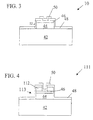
- FIGs. 3 and 4 are sectional side views of example photodiode devices for use in an embodiment of the present invention.
- a first photodiode device 10 for obtaining a first photodiode signal
- the first photodiode device comprising a
- Wide bandgap (Eg ⁇ 3ev) SiC photodiodes typically have responsivities of at least 50 mA/Watt for ultraviolet wavelengths between 200 nanometers (nm) and 350 nm with a responsivity peak at 270 nm of 150 mA/Watt. At 400 nm, the responsivity falls towards zero because the wide bandgap eliminates any possibility of photon absorption for longer wavelengths.
- SiC photodiode dark current at 482 °F (250 °C) is very low and is typically no greater than 1 pA/cm 2 at one volt reverse bias with an internal impedance of 10 14 ohms, for example.
- SiC photodiode fabrication techniques have higher yields than present gallium nitride photodiode fabrication techniques.
- Another advantage of an SiC photodiode is that the responsivity is relatively insensitive to device structure so long as the epitaxial layer (not shown) of the photodiode is sufficiently thick (greater than or equal to about 5 micrometers, for example).
- SiC photodiodes typically have DC output components with large dynamic ranges on the order of about 5000 to 1 or greater. Furthermore, SiC photodiodes have AC output components that can be used to track flame dynamics that produce acoustic vibrations, for example. Additionally, SiC photodiodes have sufficiently high sensitivity to monitor flames even when oil fuel is used and/or steam injection is applied for power augmentation.
- the OH emission band for wavelengths centered near 308 and 309 nanometers (nm) includes a series of fine emission lines which are produced by various transitions between energy levels of the OH molecule. Both rotational and vibrational transitions occur.
- the OH molecules in combustion flames are at thermal equilibrium and have emission characteristics which reflect the combustion flame temperature.
- the overlap of SiC photodiode responsivity versus wavelength with a hydrocarbon flame's strong OH band at 310 nm is beneficial. Because SiC becomes transparent at about 400 nm, the black body radiation from hot combustor walls does not blind or interfere with the detection of even dim flames. Therefore, long wavelength-blocking filters are not required.
- the OH emission band is essentially isolated from weaker emission lines produced by other excited radicals within a combustion flame.
- the temperature dependence in the OH emission band can be seen, for example, in FIGs. 3-6 of aforementioned Brown, US Application No. 09/561,885.
- a spectrometer can be used, for example, to determine a hydrocarbon flame's temperature by measuring the intensity of the various spectral lines within the OH band.
- Ultraviolet (UV) filter technology has advanced in recent years.
- an integral filter is used.
- One type of filter for example, that can be useful as an integral filter and that is compatible with high temperature operation (equal or above about 302 °F (150 °C), for example) is a filter comprising silicon oxide and silicon nitride (either mixed together in the form of silicon oxynitride or in separate films).
- the filter comprises multiple alternating layers of silicon oxide SiO 2 and silicon nitride Si 3 N 4 films.
- starting with silicon oxide forty one alternating layers of silicon oxide and silicon nitride are deposited to a total coating thickness of about 1.6 microns to form a high pass filter.
- the films are deposited by computer-controlled chemical vapor deposition.
- An example of useful filter properties is shown in FIG. 2.
- AIGaN aluminum gallium nitride
- Using an aluminum gallium nitride filter with a silicon carbide photodiode is advantageous for both single photodiode device embodiments and multiple photodiode device embodiments (FIG. 1) because aluminum gallium nitride semiconductors are direct bandgap materials and have a sharp transition between optical opaqueness and optical transparency.
- a photodiode device can have the benefits of silicon carbide photodiode ease of manufacturability and performance properties and the benefits of aluminum gallium nitride optical transition properties.
- an integral aluminum gallium nitride filter is epitaxially grown to a thickness of about two micrometers with a concentration of aluminum ranging from about fifteen percent to about thirty-five percent or, more specifically, from about twenty percent to about twenty five percent.
- the aluminum gallium nitride filter is not integral to the photodiode and instead can be deposited on a transparent substrate (not shown), for example.
- photons with wavelengths shorter than about 310 nanometers are absorbed by the filter and wavelengths longer than about 310 nanometers pass through the aluminum gallium nitride filter and are absorbed by the silicon carbide photodiode.
- the cutoff frequency is not limited to 310 nm and is typically within the range of about 260 nm to about 350 nm.
- the responsivity of the resulting photodiode device can be tailored by adjusting the amount of aluminum in the filter.
- FIGs. 3 and 4 are sectional side views of example photodiode devices for use in an embodiment of the present invention.
- a p or n type conductivity substrate 42 (and each of semiconductor layers 44 and 46 which are grown thereon) comprises appropriately doped 6H type crystalline silicon carbide.
- First layer 44 is grown on the substrate to a thickness between about 1 micrometer and about 5 micrometers and is typically lightly doped with aluminum to form a p- layer. The specific thickness of first layer 44 determines sensitivity of the photodiode to optical wavelengths.
- Second layer 46 (typically a thin layer having a thickness of about 0.1 ⁇ m to 0.3 ⁇ m) is typically epitaxially grown on first layer 44 and is heavily doped with nitrogen to n+ conductivity to form a p-/N+ junction.
- a suitable passivation layer 48 typically comprising silicon dioxide, for example
- contact metallization 50 can be applied to the exposed contact region.
- Photodiode device 111 of FIG. 4 can be fabricated in a similar manner as discussed with respect to photodiode device 10 of FIG. 3 with the addition of an integral filter 112 between second layer 46 and passivation layer 48.
- a photodiode device constructed by this technique combines both filtering and photon conversion within a single unit to enhance the feasibility of the solid state spectrometer.
- photodiode devices Although two photodiode devices are shown in FIG. 1, there is no maximum number of photodiode devices. Additional photodiode devices may provide more accurate results at the expense of equipment and complexity of calculations.
- second photodiode device 11 (including filter 12) has a range of optical responsivity in a different and overlapping portion of the OH band than first photodiode device 10.
- the first photodiode device produces a signal that is a measure of the total intensity of the OH band whereas the second photodiode device produces a signal that intersects the OH band and thereby allows for partitioning of the band.
- a ratio of these measurements can be used to determine flame temperature.
- signal amplification can be provided by sending signals from the photodiode devices into amplifier(s) 30 (one multiplexing amplifier or a number of separate amplifiers).
- the spectrometer further includes at least one analog-to-digital converter 32 for converting the amplified signals from analog signals to digital form.
- computer 34 can use a look-up table 40 for using the ratio to determine the combustion flame temperature, for example.
- the look-up table is expected to have sensitivity adequate for detecting about ⁇ 20 °F (11 °C) changes in flame temperature. More specifically, the change in ratio R(T) for each 20 °F (11 °C) change in temperature is expected to be about 1%.
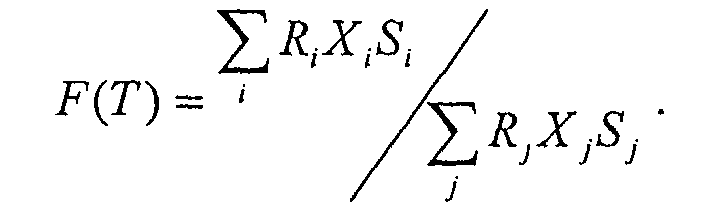
- a look-up table can be generated by performing calculations at a plurality of different temperatures using a first set of well known spectral line strengths (S j ) associated with respective wavelengths ( j ) and a second set of well known spectral line strengths (S i ) associated with respective wavelengths ( i ).
- S j well known spectral line strengths
- S i well known spectral line strengths
- Each line strength is multiplied by a respective quantum mechanical form of the Black body radiation law ( R j or R i , respectively) and by a respective photodiode responsivity ( X j or X i , respectively), and the multiplied line strengths are summed into a respective first or second summation ( respectively).
- One of the first and second summations is then divided by the other of the first and second summations:
- the set of lines i represents a smaller subset of the set of lines j. Interpolation can be used to generate values for temperatures between values that are calculated.
- the look-up table is a look-up table fabricated by performing the following calculations at a plurality of different temperatures: multiplying each of a first set of spectral line strengths (S j ) associated with respective wavelengths ( j ) by a respective quantum mechanical form of the Black body radiation law ( R j ) and by a respective photodiode responsivity ( X j ), and summing the multiplied line strengths into a respective first summation; multiplying each of a second set of spectral line strengths ( S i ) associated with respective wavelengths ( i ) by a respective quantum mechanical form of the Black body radiation law ( R i ), and by a respective photodiode responsivity ( X i ), and by a respective optical transparency ( Y i ) of the integral filter, and summing the multiplied line strengths into a respective second summation; and dividing one of the first and second summations by the other of the first and second summations:
- the filter properties of Y i can be generated by obtaining experimental filter data or by modeling calculations for the filter, for example.
- the set of lines i represents the same set as the set of lines j.
- the computer will include memory for storing individual output signals. It is further useful for the computer to perform long term time averaging of the output signals so as to reduce effects of noise (improve the signal-to-noise ratio). Such time averaging could occur on the order of seconds, minutes, or hours, for example. In one embodiment, the time averaging is accomplished by charge integration of the amplified photodiode signals prior to digitization.
- Flame temperature is the primary factor that characterizes the combustion process. If the flame temperature is known, closed loop control can be used to optimize the fuel-to-air ratio for maximizing combustion efficiency and minimizing nitrogen oxide and carbon monoxide emissions produced by combustion.
- the system can be designed to sense flame outs or ignitions rapidly. Information as to flame presence and average temperature can be directed simultaneously on a real time basis to a control system of the computer.
- a 1x1 mm 2 SiC photodiode with responsivities of about 100 mA/watt at 310 nm is expected to have signal levels varying between about 2 nA and about 20 nA. Signal levels will vary depending on the angle or field of view afforded by a photodiode that is mounted in a combustor chamber, on the flame intensity, and on the optical angle or field of view (typically about 4 degrees for conventional SiC photodiode sensor assemblies).
- the change in photodiode intensity level for a 20 °F (11 °C) temperature changed is expected to be about 0.4% for the unfiltered photodiode device and about 2% for the filtered photodiode device with a change in signal ratio of about 1%.
- the signal levels of the filtered photodiode device are expected to be about 5% of the total signal produced by the unfiltered photodiode device. Therefore, if the signal levels produced are between 2 and 20 nA, the photodiode devices must be able to accurately sense changes as small as a few picoamperes.
- the dark current of conventional 1x1 mm 2 SiC photodiode is three orders of magnitude less than a few picoamperes in that it is only a few fentoamperes at the low voltages required for the front end of an operational amplifier circuit. These properties make SiC photodiodes capable of detecting very low levels of photo flux and producing a zero offset and a low noise amplifier front end.
Landscapes
- Physics & Mathematics (AREA)
- General Physics & Mathematics (AREA)
- Spectroscopy & Molecular Physics (AREA)
- Photometry And Measurement Of Optical Pulse Characteristics (AREA)
- Control Of Combustion (AREA)
- Radiation Pyrometers (AREA)
- Optical Filters (AREA)
Abstract
Description
- The invention relates generally to optical flame detection.
- Flame temperature sensors are needed for controlling a wide range of combustion processes. Some combustion processes that require tight control of fuel-to-air ratios for increased fuel burning efficiency and reductions in emission pollution are present in, for example, building heating systems, jet aircrafts, locomotives, and fossil fueled electric power plants and other environments wherein gas and/or steam turbines are used.
- Unnecessarily high combustion temperatures can compromise fuel efficiency and increase emission pollution. For example, in a gas turbine designed to emit nine nitrogen oxide (NOx) particles per million (ppm), an increase from 2730 °F (1499 °C) to 2740 °F (1504 °C) reduces turbine efficiency by about two percent and increases NOx emissions by about two ppm.
- Previous silicon carbide flame detectors such as described in commonly assigned Brown et al., US Patent No. 5,589,682, issued 31 December 1996, detect the presence of a flame and measure the intensity of the flame's photon flux over a wide range of wavelengths. The measured intensity, however, does not always correlate to flame temperature, particularly in multiple flame combustors.
- In commonly assigned, Brown, US Application No. 09/561,885, filed 1 May 2000, a continuation in part of aforementioned Brown, US Application No. 09/246,861, an optical spectrometer for combustion flame temperature determination includes at least two photodetectors positioned for receiving light from a combustion flame and having different overlapping optical bandwidths for producing respective output signals; and a computer for obtaining a difference between a first respective output signal of a first one of the at least two photodetectors with respect to a second respective output signal of a second one of the at least two photodetectors, dividing the difference by one of the first and second respective output signals to obtain a normalized output signal, and using the normalized output signal to determine the combustion flame temperature.
- Commonly assigned, Brown, US Application No. 09/561,885, disclosed that gallium nitride, aluminum nitride, and aluminum gallium nitride were promising photodetector materials. More specifically, gallium nitride has a maximum wavelength of absorption of about 365 nanometers (that is, is transparent for wavelengths longer than 365 nanometers); Aluminum nitride has a maximum wavelength of absorption of about 200 nanometers; and a class of alloys of GaN and AIN designated AlxGax-1N are direct bandgap materials with bandgaps variable between the two extremes of GaN and AIN depending on the amount of aluminum in the alloy. The semiconductors of these alloys have optical transitions directly from valance band to conduction band and do not require phonon assistance for transitions (as compared with silicon carbide where such assistance is required). The cutoff in responsivity is therefore sharp and thus provides for high resolution.
- For maximum accuracy, dark currents of photodiodes used in combustion flame temperature detection are preferably on the order of less than or equal to about 100 picoamperes per centimeter squared (pA/cm2). Generally gallium nitride and aluminum gallium nitride photodiodes have dark currents on the order of nanoamperes per centimeter squared (nA/cm2) to microamperes per centimeter squared (µA/cm2). Furthermore, yield of good gallium nitride and aluminum gallium nitride photodiodes is relatively low.
- It would be desirable to provide a solid state flame temperature sensor for combustion control systems with low dark current and with a flame temperature accuracy within about 20 °F (11 °C) in the temperature range of about 2500 °F (1371 °C) to about 3500 °F (1927 °C).
- Briefly, in accordance with one embodiment of the present invention, a solid state optical spectrometer for combustion flame temperature determination comprises: a first photodiode device for obtaining a first photodiode signal, the first photodiode device comprising a silicon carbide photodiode and having a range of optical responsivity within an OH band; a second photodiode device for obtaining a second photodiode signal, the second photodiode device comprising a silicon carbide photodiode and a filter, the second photodiode device having a range of optical responsivity in a different and overlapping portion of the OH band than the first photodiode device; and a computer for obtaining a ratio using the first and second photodiode signals and using the ratio to determine the combustion flame temperature.
- The invention will now be described in greater detail, by way of example, with reference to the drawings, in which:-
- FIG. 1 is a block diagram of one example embodiment of the present invention.
- FIG. 2 is a graph of example filter properties for use in an embodiment of the present invention.
- FIGs. 3 and 4 are sectional side views of example photodiode devices for use in an embodiment of the present invention.
- FIG. 1 is a block diagram of one example embodiment of the present invention wherein a solid state
optical spectrometer 100 for combustion flame temperature determination comprises afirst photodiode device 10 for obtaining a first photodiode signal, the first photodiode device comprising a silicon carbide photodiode and having a range of optical responsivity in an OH band; asecond photodiode device 11 for obtaining a second photodiode signal, the second photodiode device comprisingsilicon carbide photodiode 13 and afilter 12, the second photodiode device having a range of optical responsivity in a different and overlapping portion of the OH band than the first photodiode device; and acomputer 34 for obtaining a ratio using the first and second photodiode signals and using the ratio to determine the combustion flame temperature. - Wide bandgap (Eg≈3ev) SiC photodiodes typically have responsivities of at least 50 mA/Watt for ultraviolet wavelengths between 200 nanometers (nm) and 350 nm with a responsivity peak at 270 nm of 150 mA/Watt. At 400 nm, the responsivity falls towards zero because the wide bandgap eliminates any possibility of photon absorption for longer wavelengths. SiC photodiode dark current at 482 °F (250 °C) is very low and is typically no greater than 1 pA/cm2 at one volt reverse bias with an internal impedance of 1014 ohms, for example. Additionally, SiC photodiode fabrication techniques have higher yields than present gallium nitride photodiode fabrication techniques. Another advantage of an SiC photodiode is that the responsivity is relatively insensitive to device structure so long as the epitaxial layer (not shown) of the photodiode is sufficiently thick (greater than or equal to about 5 micrometers, for example).
- SiC photodiodes typically have DC output components with large dynamic ranges on the order of about 5000 to 1 or greater. Furthermore, SiC photodiodes have AC output components that can be used to track flame dynamics that produce acoustic vibrations, for example. Additionally, SiC photodiodes have sufficiently high sensitivity to monitor flames even when oil fuel is used and/or steam injection is applied for power augmentation.
- The OH emission band for wavelengths centered near 308 and 309 nanometers (nm) (or, more broadly, within the range of about 260nm to about 350nm) includes a series of fine emission lines which are produced by various transitions between energy levels of the OH molecule. Both rotational and vibrational transitions occur. The OH molecules in combustion flames are at thermal equilibrium and have emission characteristics which reflect the combustion flame temperature. The overlap of SiC photodiode responsivity versus wavelength with a hydrocarbon flame's strong OH band at 310 nm is beneficial. Because SiC becomes transparent at about 400 nm, the black body radiation from hot combustor walls does not blind or interfere with the detection of even dim flames. Therefore, long wavelength-blocking filters are not required. The OH emission band is essentially isolated from weaker emission lines produced by other excited radicals within a combustion flame.
- The temperature dependence in the OH emission band can be seen, for example, in FIGs. 3-6 of aforementioned Brown, US Application No. 09/561,885. A spectrometer can be used, for example, to determine a hydrocarbon flame's temperature by measuring the intensity of the various spectral lines within the OH band.
- Ultraviolet (UV) filter technology has advanced in recent years. In one embodiment of the present invention, an integral filter is used. One type of filter, for example, that can be useful as an integral filter and that is compatible with high temperature operation (equal or above about 302 °F (150 °C), for example) is a filter comprising silicon oxide and silicon nitride (either mixed together in the form of silicon oxynitride or in separate films). In a more specific embodiment, the filter comprises multiple alternating layers of silicon oxide SiO2 and silicon nitride Si3N4 films. In one embodiment, starting with silicon oxide, forty one alternating layers of silicon oxide and silicon nitride are deposited to a total coating thickness of about 1.6 microns to form a high pass filter. Preferably the films are deposited by computer-controlled chemical vapor deposition. An example of useful filter properties is shown in FIG. 2.
- Another useful type of filter, for example, comprises aluminum gallium nitride (AIGaN). Using an aluminum gallium nitride filter with a silicon carbide photodiode is advantageous for both single photodiode device embodiments and multiple photodiode device embodiments (FIG. 1) because aluminum gallium nitride semiconductors are direct bandgap materials and have a sharp transition between optical opaqueness and optical transparency. Thus, a photodiode device can have the benefits of silicon carbide photodiode ease of manufacturability and performance properties and the benefits of aluminum gallium nitride optical transition properties. In one embodiment, an integral aluminum gallium nitride filter is epitaxially grown to a thickness of about two micrometers with a concentration of aluminum ranging from about fifteen percent to about thirty-five percent or, more specifically, from about twenty percent to about twenty five percent. In another embodiment, the aluminum gallium nitride filter is not integral to the photodiode and instead can be deposited on a transparent substrate (not shown), for example. In either embodiment, photons with wavelengths shorter than about 310 nanometers are absorbed by the filter and wavelengths longer than about 310 nanometers pass through the aluminum gallium nitride filter and are absorbed by the silicon carbide photodiode. Although 310 nm is used for purposes of example, the cutoff frequency is not limited to 310 nm and is typically within the range of about 260 nm to about 350 nm. The responsivity of the resulting photodiode device can be tailored by adjusting the amount of aluminum in the filter.
- FIGs. 3 and 4 are sectional side views of example photodiode devices for use in an embodiment of the present invention. With respect to
photodiode device 10 of FIG. 3, as described in commonly assigned Brown et al., US Patent No. 5,394,005, in one embodiment, a p or n type conductivity substrate 42 (and each ofsemiconductor layers First layer 44 is grown on the substrate to a thickness between about 1 micrometer and about 5 micrometers and is typically lightly doped with aluminum to form a p- layer. The specific thickness offirst layer 44 determines sensitivity of the photodiode to optical wavelengths. Second layer 46 (typically a thin layer having a thickness of about 0.1 µm to 0.3 µm) is typically epitaxially grown onfirst layer 44 and is heavily doped with nitrogen to n+ conductivity to form a p-/N+ junction. Aftersecond layer 46 is applied and the device structure is formed by etching amesa 52, for example, a suitable passivation layer 48 (typically comprising silicon dioxide, for example) may be thermally grown and/or deposited and etched to expose at least a contact region onsecond layer 46. Thencontact metallization 50 can be applied to the exposed contact region. -
Photodiode device 111 of FIG. 4 can be fabricated in a similar manner as discussed with respect tophotodiode device 10 of FIG. 3 with the addition of anintegral filter 112 betweensecond layer 46 andpassivation layer 48. A photodiode device constructed by this technique combines both filtering and photon conversion within a single unit to enhance the feasibility of the solid state spectrometer. - Although two photodiode devices are shown in FIG. 1, there is no maximum number of photodiode devices. Additional photodiode devices may provide more accurate results at the expense of equipment and complexity of calculations.
- As stated above, second photodiode device 11 (including filter 12) has a range of optical responsivity in a different and overlapping portion of the OH band than
first photodiode device 10. In a more specific embodiment, the first photodiode device produces a signal that is a measure of the total intensity of the OH band whereas the second photodiode device produces a signal that intersects the OH band and thereby allows for partitioning of the band. A ratio of these measurements can be used to determine flame temperature. - If desired, signal amplification can be provided by sending signals from the photodiode devices into amplifier(s) 30 (one multiplexing amplifier or a number of separate amplifiers). In one embodiment, the spectrometer further includes at least one analog-to-
digital converter 32 for converting the amplified signals from analog signals to digital form. - After the ratio is obtained,
computer 34 can use a look-up table 40 for using the ratio to determine the combustion flame temperature, for example. The look-up table is expected to have sensitivity adequate for detecting about ± 20 °F (11 °C) changes in flame temperature. More specifically, the change in ratio R(T) for each 20 °F (11 °C) change in temperature is expected to be about 1%. - In one embodiment, a look-up table can be generated by performing calculations at a plurality of different temperatures using a first set of well known spectral line strengths (S j ) associated with respective wavelengths (j) and a second set of well known spectral line strengths (S i ) associated with respective wavelengths (i). Each line strength is multiplied by a respective quantum mechanical form of the Black body radiation law (Rj or Ri , respectively) and by a respective photodiode responsivity (Xj or Xi , respectively), and the multiplied line strengths are summed into a respective first or second summation (respectively). One of the first and second summations is then divided by the other of the first and second summations:

- In one embodiment, the set of lines i represents a smaller subset of the set of lines j. Interpolation can be used to generate values for temperatures between values that are calculated.
- In another more specific embodiment, the look-up table is a look-up table fabricated by performing the following calculations at a plurality of different temperatures: multiplying each of a first set of spectral line strengths (S j ) associated with respective wavelengths (j) by a respective quantum mechanical form of the Black body radiation law (Rj ) and by a respective photodiode responsivity (Xj ), and summing the multiplied line strengths into a respective first summation; multiplying each of a second set of spectral line strengths (Si ) associated with respective wavelengths (i) by a respective quantum mechanical form of the Black body radiation law (Ri ), and by a respective photodiode responsivity (Xi ), and by a respective optical transparency (Yi ) of the integral filter, and summing the multiplied line strengths into a respective second summation; and dividing one of the first and second summations by the other of the first and second summations:

- The filter properties of Y i can be generated by obtaining experimental filter data or by modeling calculations for the filter, for example. In one embodiment, the set of lines i represents the same set as the set of lines j.
- In the event that an optical window (not shown) for the photodiode devices becomes dirty from the combustion environment or that attenuation occurs for other reasons, the signal reduction for each band will be proportionally reduced but the intensity ratios will remain an accurate temperature indicator regardless of the substrate or window conditions and the system will be self-compensating.
- If a multiplexer is used for the amplification and/or the A/D conversion, then the computer will include memory for storing individual output signals. It is further useful for the computer to perform long term time averaging of the output signals so as to reduce effects of noise (improve the signal-to-noise ratio). Such time averaging could occur on the order of seconds, minutes, or hours, for example. In one embodiment, the time averaging is accomplished by charge integration of the amplified photodiode signals prior to digitization. Flame temperature is the primary factor that characterizes the combustion process. If the flame temperature is known, closed loop control can be used to optimize the fuel-to-air ratio for maximizing combustion efficiency and minimizing nitrogen oxide and carbon monoxide emissions produced by combustion. The system can be designed to sense flame outs or ignitions rapidly. Information as to flame presence and average temperature can be directed simultaneously on a real time basis to a control system of the computer.
- In one example, a 1x1 mm2 SiC photodiode with responsivities of about 100 mA/watt at 310 nm is expected to have signal levels varying between about 2 nA and about 20 nA. Signal levels will vary depending on the angle or field of view afforded by a photodiode that is mounted in a combustor chamber, on the flame intensity, and on the optical angle or field of view (typically about 4 degrees for conventional SiC photodiode sensor assemblies).
- In such an embodiment, the change in photodiode intensity level for a 20 °F (11 °C) temperature changed is expected to be about 0.4% for the unfiltered photodiode device and about 2% for the filtered photodiode device with a change in signal ratio of about 1%. The signal levels of the filtered photodiode device are expected to be about 5% of the total signal produced by the unfiltered photodiode device. Therefore, if the signal levels produced are between 2 and 20 nA, the photodiode devices must be able to accurately sense changes as small as a few picoamperes. The dark current of conventional 1x1 mm2 SiC photodiode is three orders of magnitude less than a few picoamperes in that it is only a few fentoamperes at the low voltages required for the front end of an operational amplifier circuit. These properties make SiC photodiodes capable of detecting very low levels of photo flux and producing a zero offset and a low noise amplifier front end.
- For the sake of good order, various aspects of the invention are set out in the following clauses:-
- 1. A solid state optical spectrometer (100) for combustion flame
temperature determination, the spectrometer comprising:
- a first photodiode device (10) for obtaining a first photodiode signal, the first photodiode device comprising a silicon carbide photodiode and having a range of optical responsivity within an OH band;
- a second photodiode device (11) for obtaining a second photodiode signal, the second photodiode device comprising a silicon carbide photodiode (13) and a filter (12), the second photodiode device having a range of optical responsivity in a different and overlapping portion of the OH band than the first photodiode device;
- a computer (34) for obtaining a ratio using the first and second photodiode signals and using the ratio to determine the combustion flame temperature.
- 2. The spectrometer of clause 1 wherein the filter (12) comprises an integral filter (112).
- 3. The spectrometer of clause 1 wherein the filter comprises aluminum gallium nitride.
- 4. The spectrometer of clause 1 wherein the filter comprises silicon oxide and silicon nitride.
- 5. The spectrometer of clause 4 wherein the filter comprises silicon oxynitride.
- 6. The spectrometer of clause 4 wherein the filter comprises alternating thin film layers of silicon oxide and silicon nitride.
- 7. The spectrometer of clause 1 wherein the computer includes a look-up table (40) for using the ratio to determine the combustion flame temperature.
- 8. The spectrometer of clause 7 wherein the look-up table is a look-up
table fabricated by performing the following calculations at a plurality of
different temperatures:
- multiplying each of a first set of spectral line strengths (S j ) associated with respective wavelengths (j) by a respective quantum mechanical form of the Black body radiation law (Rj ) and by a respective photodiode responsivity (Xj ) and summing the multiplied line strengths into a respective first summation;
- multiplying each of a second set of spectral line strengths (Si ) associated with respective wavelengths (i) by a respective quantum mechanical form of the Black body radiation law (Ri ) and by a respective photodiode responsivity (Xi ) and summing the multiplied line strengths into a respective second summation; and
- dividing one of the first and second summations by the other of the first and second summations.
- 9. The spectrometer of clause 7 wherein the look-up table is a look-up
table fabricated by performing the following calculations at a plurality of
different temperatures:
- multiplying each of a first set of spectral line strengths (S j ) associated with respective wavelengths (j) by a respective quantum mechanical form of the Black body radiation law (Rj ) and by a respective photodiode responsivity (Xj ) and summing the multiplied line strengths into a respective first summation;
- multiplying each of a second set of spectral line strengths (S i ) associated with respective wavelengths (i) by a respective quantum mechanical form of the Black body radiation law (Ri ), by a respective photodiode responsivity (Xi ), and by a respective optical transparency (Y i ) of the filter, and summing the multiplied line strengths into a respective second summation; and
- dividing one of the first and second summations by the other of the first and second summations.
- 10. A solid state optical spectrometer (100) for combustion flame
temperature determination, the spectrometer comprising:
- a first photodiode device (10) for obtaining a first photodiode signal, the first photodiode device comprising a silicon carbide photodiode and having a range of optical responsivity within an OH band;
- a second photodiode device (11) for obtaining a second photodiode signal, the second photodiode device comprising a silicon carbide photodiode (13) and an aluminum gallium nitride filter (12), the second photodiode device having a range of optical responsivity in a different and overlapping portion of the OH band than the first photodiode device;
- a computer (34) for obtaining a ratio using the first and second photodiode signals and using the ratio to determine the combustion flame temperature.
- 11. The spectrometer of
clause 10 wherein the filter (12) comprises an integral filter (112). - 12. A method for combustion flame temperature determination comprising:
- obtaining a first photodiode signal using a first photodiode device (10) comprising a silicon carbide photodiode and having a range of optical responsivity within an OH band;
- obtaining a second photodiode signal by using a second photodiode device (11) comprising a silicon carbide photodiode (13) and a filter (12), the second photodiode device having a range of optical responsivity in a different and overlapping portion of the OH band than the first photodiode device; and
- obtaining a ratio using the first and second photodiode signals and using the ratio to determine the combustion flame temperature.
- 13. The method of
clause 12 wherein using the ratio to determine the combustion flame temperature comprises using a look-up table (40). - 14. A photodiode device comprising: a silicon carbide photodiode (11); and an aluminum gallium nitride filter (12).
- 15. The photodiode device of clause 16 wherein the aluminum gallium nitride filter comprises an integral aluminum gallium nitride filter.
- 16. A method for fabricating a photodiode device (11) for combustion flame temperature determination comprising fabricating an integral filter (12) over a silicon carbide photodiode.
- 17. The method of clause 16 wherein fabricating the integral filter comprises growing an aluminum gallium nitride filter.
- 18. The method of clause 16 wherein fabricating the integral filter comprises fabricating a silicon oxynitride filter.
- 19. The method of clause 16 wherein fabricating the integral filter comprises alternating thin film layers of silicon oxide and silicon nitride.
-
Claims (10)
- A solid state optical spectrometer (100) for combustion flame temperature determination, the spectrometer comprising:a first photodiode device (10) for obtaining a first photodiode signal, the first photodiode device comprising a silicon carbide photodiode and having a range of optical responsivity within an OH band;a second photodiode device (11) for obtaining a second photodiode signal, the second photodiode device comprising a silicon carbide photodiode (13) and a filter (12), the second photodiode device having a range of optical responsivity in a different and overlapping portion of the OH band than the first photodiode device;a computer (34) for obtaining a ratio using the first and second photodiode signals and using the ratio to determine the combustion flame temperature.
- The spectrometer of claim 1 wherein the filter (12) comprises an integral filter (112).
- A solid state optical spectrometer (100) for combustion flame temperature determination, the spectrometer comprising:a first photodiode device (10) for obtaining a first photodiode signal, the first photodiode device comprising a silicon carbide photodiode and having a range of optical responsivity within an OH band;a second photodiode device (11) for obtaining a second photodiode signal, the second photodiode device comprising a silicon carbide photodiode (13) and an aluminum gallium nitride filter (12), the second photodiode device having a range of optical responsivity in a different and overlapping portion of the OH band than the first photodiode device;a computer (34) for obtaining a ratio using the first and second photodiode signals and using the ratio to determine the combustion flame temperature.
- The spectrometer of claim 3 wherein the filter (12) comprises an integral filter (112).
- A method for combustion flame temperature determination comprising:obtaining a first photodiode signal using a first photodiode device (10) comprising a silicon carbide photodiode and having a range of optical responsivity within an OH band;obtaining a second photodiode signal by using a second photodiode device (11) comprising a silicon carbide photodiode (13) and a filter (12), the second photodiode device having a range of optical responsivity in a different and overlapping portion of the OH band than the first photodiode device; andobtaining a ratio using the first and second photodiode signals and using the ratio to determine the combustion flame temperature.
- The method of claim 5 wherein using the ratio to determine the combustion flame temperature comprises using a look-up table (40).
- A photodiode device comprising: a silicon carbide photodiode (11); and an aluminum gallium nitride filter (12).
- The photodiode device of claim 7 wherein the aluminum gallium nitride filter comprises an integral aluminum gallium nitride filter.
- A method for fabricating a photodiode device (11) for combustion flame temperature determination comprising fabricating an integral filter (12) over a silicon carbide photodiode.
- The method of claim 9 wherein fabricating the integral filter comprises growing an aluminum gallium nitride filter.
Applications Claiming Priority (2)
| Application Number | Priority Date | Filing Date | Title |
|---|---|---|---|
| US793432 | 2001-02-27 | ||
| US09/793,432 US6646265B2 (en) | 1999-02-08 | 2001-02-27 | Optical spectrometer and method for combustion flame temperature determination |
Publications (2)
| Publication Number | Publication Date |
|---|---|
| EP1235061A2 true EP1235061A2 (en) | 2002-08-28 |
| EP1235061A3 EP1235061A3 (en) | 2004-06-16 |
Family
ID=25159904
Family Applications (1)
| Application Number | Title | Priority Date | Filing Date |
|---|---|---|---|
| EP02251349A Ceased EP1235061A3 (en) | 2001-02-27 | 2002-02-27 | Optical spectrometer and method for combustion flame temperature determination |
Country Status (3)
| Country | Link |
|---|---|
| US (2) | US6646265B2 (en) |
| EP (1) | EP1235061A3 (en) |
| JP (1) | JP2002350235A (en) |
Cited By (2)
| Publication number | Priority date | Publication date | Assignee | Title |
|---|---|---|---|---|
| WO2007118458A1 (en) * | 2006-04-13 | 2007-10-25 | Luedeker Wilhelm | Spectral analysis method for determining chlorophyll concentration |
| WO2010037787A1 (en) * | 2008-10-03 | 2010-04-08 | Heraeus Quartz Uk Limited | High temperature-resistant narrow band optical filter |
Families Citing this family (21)
| Publication number | Priority date | Publication date | Assignee | Title |
|---|---|---|---|---|
| US6686616B1 (en) * | 2000-05-10 | 2004-02-03 | Cree, Inc. | Silicon carbide metal-semiconductor field effect transistors |
| US20070225614A1 (en) * | 2004-05-26 | 2007-09-27 | Endothelix, Inc. | Method and apparatus for determining vascular health conditions |
| US6838741B2 (en) * | 2002-12-10 | 2005-01-04 | General Electtric Company | Avalanche photodiode for use in harsh environments |
| US20040200975A1 (en) * | 2003-04-14 | 2004-10-14 | Brown Dale Marius | Ultraviolet sensors for monitoring energy in the germicidal wavelengths |
| WO2005045379A1 (en) * | 2003-11-05 | 2005-05-19 | Yamatake Corporation | Flame detection method and flame detection device |
| US20070012965A1 (en) * | 2005-07-15 | 2007-01-18 | General Electric Company | Photodetection system and module |
| US20070225606A1 (en) * | 2006-03-22 | 2007-09-27 | Endothelix, Inc. | Method and apparatus for comprehensive assessment of vascular health |
| US20080027330A1 (en) * | 2006-05-15 | 2008-01-31 | Endothelix, Inc. | Risk assessment method for acute cardiovascular events |
| US8309942B2 (en) * | 2006-09-18 | 2012-11-13 | Cornell Research Foundation | Self-powered environmental sensor with wake-up circuitry |
| US20080081963A1 (en) * | 2006-09-29 | 2008-04-03 | Endothelix, Inc. | Methods and Apparatus for Profiling Cardiovascular Vulnerability to Mental Stress |
| US7675618B2 (en) * | 2007-04-16 | 2010-03-09 | Ase Optics, Inc. | Multiplexing spectrometer |
| US8371102B1 (en) * | 2008-02-26 | 2013-02-12 | Spectral Sciences, Inc. | Combustor control based on fuel modulation and passive optical sensors |
| US8752362B2 (en) * | 2009-01-15 | 2014-06-17 | General Electric Company | Optical flame holding and flashback detection |
| US8456634B2 (en) * | 2009-06-15 | 2013-06-04 | General Electric Company | Optical interrogation sensors for combustion control |
| US20110008737A1 (en) * | 2009-06-15 | 2011-01-13 | General Electric Company | Optical sensors for combustion control |
| US20110232296A1 (en) * | 2010-03-24 | 2011-09-29 | General Electric Company | Optical fuel nozzle flashback detector |
| CN105679779B (en) * | 2016-03-22 | 2019-06-21 | 中国电子科技集团公司第三十八研究所 | An erythema response detector |
| CN105845696A (en) * | 2016-04-01 | 2016-08-10 | 中国电子科技集团公司第三十八研究所 | UV detector chip used for monitoring gas flame temperature and manufacturing method thereof |
| JP7139203B2 (en) * | 2018-09-11 | 2022-09-20 | ローム株式会社 | UV detector |
| US12084206B2 (en) * | 2020-12-28 | 2024-09-10 | Goodrich Corporation | Offset compensated photodiode amplifier |
| US12540857B2 (en) * | 2022-10-05 | 2026-02-03 | Polytechnic University Of Puerto Rico | Ultraviolet sensing assembly |
Citations (1)
| Publication number | Priority date | Publication date | Assignee | Title |
|---|---|---|---|---|
| EP1026488A1 (en) * | 1999-02-08 | 2000-08-09 | General Electric Company | Solid state optical spectrometer for combustion flame temperature measurment |
Family Cites Families (24)
| Publication number | Priority date | Publication date | Assignee | Title |
|---|---|---|---|---|
| US4358952A (en) * | 1980-03-26 | 1982-11-16 | Robert Bosch Gmbh | Optical engine knock sensor |
| JPS5882039A (en) * | 1981-11-11 | 1983-05-17 | Hitachi Ltd | Air-fuel ratio control device for internal combustion engines |
| JPS5927581A (en) | 1982-08-03 | 1984-02-14 | Seisan Gijutsu Shinko Kyokai | Optical sensor |
| JPS6036825A (en) | 1983-08-10 | 1985-02-26 | Hitachi Ltd | Control method for combustion flame and device thereof |
| GB8705905D0 (en) * | 1987-03-12 | 1987-04-15 | Lucas Ind Plc | Combustion monitoring |
| DE3839537A1 (en) | 1988-11-23 | 1990-05-31 | Deutsch Franz Forsch Inst | Method for measuring the rate of a radiation and arrangement for carrying out this method |
| CH684971A5 (en) * | 1989-03-16 | 1995-02-15 | Landis & Gyr Tech Innovat | Ultraviolet light sensor. |
| DE3930610A1 (en) | 1989-09-13 | 1991-03-21 | Esab Hancock Gmbh | DEVICE FOR OPTICAL-ELECTRONIC CONTROL OF A FLAME-CUTTING MACHINE |
| US5186146A (en) * | 1990-12-20 | 1993-02-16 | Hitachi, Ltd. | Combustion evaluation apparatus and combustion controller |
| US5125739A (en) | 1991-01-14 | 1992-06-30 | United Technologies Corporation | Triple spectral area pyrometer |
| US5093576A (en) * | 1991-03-15 | 1992-03-03 | Cree Research | High sensitivity ultraviolet radiation detector |
| US5182670A (en) * | 1991-08-30 | 1993-01-26 | Apa Optics, Inc. | Narrow band algan filter |
| US5394005A (en) * | 1992-05-05 | 1995-02-28 | General Electric Company | Silicon carbide photodiode with improved short wavelength response and very low leakage current |
| US5257496A (en) | 1992-05-05 | 1993-11-02 | General Electric Company | Combustion control for producing low NOx emissions through use of flame spectroscopy |
| US5480298A (en) | 1992-05-05 | 1996-01-02 | General Electric Company | Combustion control for producing low NOx emissions through use of flame spectroscopy |
| US5249954A (en) * | 1992-07-07 | 1993-10-05 | Electric Power Research Institute, Inc. | Integrated imaging sensor/neural network controller for combustion systems |
| JPH0732538A (en) | 1993-07-19 | 1995-02-03 | Nkk Corp | Weldable colored aluminum plate or colored aluminum alloy plate |
| US5467185A (en) | 1994-07-15 | 1995-11-14 | General Electric Company | Emissions control for internal combustion engine |
| US5544478A (en) | 1994-11-15 | 1996-08-13 | General Electric Company | Optical sensing of combustion dynamics |
| US5815900A (en) * | 1995-03-06 | 1998-10-06 | Matsushita Electric Industrial Co., Ltd. | Method of manufacturing a surface acoustic wave module |
| US5589682A (en) | 1995-06-07 | 1996-12-31 | General Electric Company | Photocurrent detector circuit with high sensitivity, fast response time, and large dynamic range |
| US5659133A (en) * | 1996-04-22 | 1997-08-19 | Astropower, Inc. | High-temperature optical combustion chamber sensor |
| US5834331A (en) | 1996-10-17 | 1998-11-10 | Northwestern University | Method for making III-Nitride laser and detection device |
| US6104074A (en) * | 1997-12-11 | 2000-08-15 | Apa Optics, Inc. | Schottky barrier detectors for visible-blind ultraviolet detection |
-
2001
- 2001-02-27 US US09/793,432 patent/US6646265B2/en not_active Expired - Fee Related
-
2002
- 2002-02-26 JP JP2002049092A patent/JP2002350235A/en active Pending
- 2002-02-27 EP EP02251349A patent/EP1235061A3/en not_active Ceased
-
2003
- 2003-09-04 US US10/656,475 patent/US6818897B2/en not_active Expired - Fee Related
Patent Citations (1)
| Publication number | Priority date | Publication date | Assignee | Title |
|---|---|---|---|---|
| EP1026488A1 (en) * | 1999-02-08 | 2000-08-09 | General Electric Company | Solid state optical spectrometer for combustion flame temperature measurment |
Cited By (2)
| Publication number | Priority date | Publication date | Assignee | Title |
|---|---|---|---|---|
| WO2007118458A1 (en) * | 2006-04-13 | 2007-10-25 | Luedeker Wilhelm | Spectral analysis method for determining chlorophyll concentration |
| WO2010037787A1 (en) * | 2008-10-03 | 2010-04-08 | Heraeus Quartz Uk Limited | High temperature-resistant narrow band optical filter |
Also Published As
| Publication number | Publication date |
|---|---|
| JP2002350235A (en) | 2002-12-04 |
| US6646265B2 (en) | 2003-11-11 |
| US6818897B2 (en) | 2004-11-16 |
| US20040041079A1 (en) | 2004-03-04 |
| US20010009268A1 (en) | 2001-07-26 |
| EP1235061A3 (en) | 2004-06-16 |
Similar Documents
| Publication | Publication Date | Title |
|---|---|---|
| US6818897B2 (en) | Photodiode device and method for fabrication | |
| US6784430B2 (en) | Interdigitated flame sensor, system and method | |
| Bai et al. | High detection sensitivity of ultraviolet 4H-SiC avalanche photodiodes | |
| Biyikli et al. | Solar-blind AlGaN-based Schottky photodiodes with low noise and high detectivity | |
| Walker et al. | Solar-blind AlGaN photodiodes with very low cutoff wavelength | |
| US6239434B1 (en) | Solid state optical spectrometer for combustion flame temperature measurement | |
| EP1154248B1 (en) | Optical spectrometer and method for combustion flame temperature determination | |
| US20120051378A1 (en) | Photodetection | |
| US7112796B2 (en) | System and method for optical monitoring of a combustion flame | |
| CN201032635Y (en) | A PIN structure 4H-SiC ultraviolet photodetector | |
| Adamo et al. | Measurements of silicon photomultipliers responsivity in continuous wave regime | |
| US7786508B2 (en) | High operating temperature split-off band infrared detectors | |
| Huang et al. | GaN-based pin ultraviolet photodetectors with a thin p-type GaN layer on patterned sapphire substrates | |
| Lamarre et al. | AlGaN UV focal plane arrays | |
| Zhou et al. | An InGaAlAs–InGaAs two-color photodetector for ratio thermometry | |
| Zhang et al. | AlGaN‐Based Solar‐Blind Ultraviolet Detector with a Response Wavelength of 217 nm | |
| Razeghi et al. | Type-II InAs/GaSb superlattices and detectors with lambda c> 18m | |
| Mosca et al. | Multilayer (Al, Ga) N structures for solar-blind detection | |
| Vert et al. | Silicon carbide photomultipliers and avalanche photodiode arrays for ultraviolet and solar-blind light detection | |
| Pau et al. | Solar-blind AlGaN-based UV photodetectors grown on Si (111) substrates | |
| Bai et al. | High-performance SiC avalanche photodiode for single ultraviolet photon detection | |
| Duboz et al. | UV imaging based on AlGaN arrays | |
| Sandvik et al. | SiC photodetectors for industrial applications | |
| Van Hove et al. | High Temperature GaN and AlGaN Photovoltaic Detectors for UV Sensing Applications | |
| Biyikli et al. | Solar-blind AlGaN-based Schottky photodiodes with high detectivity and low noise |
Legal Events
| Date | Code | Title | Description |
|---|---|---|---|
| PUAI | Public reference made under article 153(3) epc to a published international application that has entered the european phase |
Free format text: ORIGINAL CODE: 0009012 |
|
| AK | Designated contracting states |
Kind code of ref document: A2 Designated state(s): AT BE CH CY DE DK ES FI FR GB GR IE IT LI LU MC NL PT SE TR |
|
| AX | Request for extension of the european patent |
Free format text: AL;LT;LV;MK;RO;SI |
|
| RIN1 | Information on inventor provided before grant (corrected) |
Inventor name: CHU, KANIN Inventor name: BROWN, DALE MARIUS |
|
| RIC1 | Information provided on ipc code assigned before grant |
Ipc: 7G 01J 5/00 B Ipc: 7G 01J 5/60 A |
|
| PUAL | Search report despatched |
Free format text: ORIGINAL CODE: 0009013 |
|
| AK | Designated contracting states |
Kind code of ref document: A3 Designated state(s): AT BE CH CY DE DK ES FI FR GB GR IE IT LI LU MC NL PT SE TR |
|
| AX | Request for extension of the european patent |
Extension state: AL LT LV MK RO SI |
|
| 17P | Request for examination filed |
Effective date: 20041216 |
|
| 17Q | First examination report despatched |
Effective date: 20050114 |
|
| AKX | Designation fees paid |
Designated state(s): DE FR GB IT |
|
| 17Q | First examination report despatched |
Effective date: 20050114 |
|
| STAA | Information on the status of an ep patent application or granted ep patent |
Free format text: STATUS: THE APPLICATION HAS BEEN REFUSED |
|
| 18R | Application refused |
Effective date: 20091002 |