EP1234772A1 - Packaging machine and method for producing sealed packages of pourable food products - Google Patents
Packaging machine and method for producing sealed packages of pourable food products Download PDFInfo
- Publication number
- EP1234772A1 EP1234772A1 EP01104376A EP01104376A EP1234772A1 EP 1234772 A1 EP1234772 A1 EP 1234772A1 EP 01104376 A EP01104376 A EP 01104376A EP 01104376 A EP01104376 A EP 01104376A EP 1234772 A1 EP1234772 A1 EP 1234772A1
- Authority
- EP
- European Patent Office
- Prior art keywords
- sealing
- tube
- cross sections
- machine
- packaging material
- Prior art date
- Legal status (The legal status is an assumption and is not a legal conclusion. Google has not performed a legal analysis and makes no representation as to the accuracy of the status listed.)
- Granted
Links
- 238000004806 packaging method and process Methods 0.000 title claims abstract description 21
- 235000013305 food Nutrition 0.000 title claims abstract description 18
- 238000004519 manufacturing process Methods 0.000 title 1
- 238000007789 sealing Methods 0.000 claims abstract description 70
- 239000005022 packaging material Substances 0.000 claims abstract description 38
- 238000005520 cutting process Methods 0.000 claims description 9
- 238000000034 method Methods 0.000 claims description 8
- 238000011144 upstream manufacturing Methods 0.000 claims description 3
- 238000010438 heat treatment Methods 0.000 description 16
- 239000000463 material Substances 0.000 description 7
- 239000004033 plastic Substances 0.000 description 3
- 229920003023 plastic Polymers 0.000 description 3
- 235000015203 fruit juice Nutrition 0.000 description 2
- 230000006698 induction Effects 0.000 description 2
- 235000014101 wine Nutrition 0.000 description 2
- MHAJPDPJQMAIIY-UHFFFAOYSA-N Hydrogen peroxide Chemical compound OO MHAJPDPJQMAIIY-UHFFFAOYSA-N 0.000 description 1
- 235000007688 Lycopersicon esculentum Nutrition 0.000 description 1
- 239000004698 Polyethylene Substances 0.000 description 1
- 240000003768 Solanum lycopersicum Species 0.000 description 1
- XAGFODPZIPBFFR-UHFFFAOYSA-N aluminium Chemical compound [Al] XAGFODPZIPBFFR-UHFFFAOYSA-N 0.000 description 1
- 229910052782 aluminium Inorganic materials 0.000 description 1
- 239000004411 aluminium Substances 0.000 description 1
- 230000004888 barrier function Effects 0.000 description 1
- 230000006835 compression Effects 0.000 description 1
- 238000007906 compression Methods 0.000 description 1
- 239000013536 elastomeric material Substances 0.000 description 1
- 239000002657 fibrous material Substances 0.000 description 1
- 239000007788 liquid Substances 0.000 description 1
- 230000005923 long-lasting effect Effects 0.000 description 1
- 235000020191 long-life milk Nutrition 0.000 description 1
- 235000013336 milk Nutrition 0.000 description 1
- 239000008267 milk Substances 0.000 description 1
- 210000004080 milk Anatomy 0.000 description 1
- 235000020200 pasteurised milk Nutrition 0.000 description 1
- -1 polyethylene Polymers 0.000 description 1
- 229920000573 polyethylene Polymers 0.000 description 1
- 235000015067 sauces Nutrition 0.000 description 1
- 230000001954 sterilising effect Effects 0.000 description 1
- 238000004659 sterilization and disinfection Methods 0.000 description 1
- 239000003206 sterilizing agent Substances 0.000 description 1
- 239000000126 substance Substances 0.000 description 1
Images

Classifications
-
- B—PERFORMING OPERATIONS; TRANSPORTING
- B29—WORKING OF PLASTICS; WORKING OF SUBSTANCES IN A PLASTIC STATE IN GENERAL
- B29C—SHAPING OR JOINING OF PLASTICS; SHAPING OF MATERIAL IN A PLASTIC STATE, NOT OTHERWISE PROVIDED FOR; AFTER-TREATMENT OF THE SHAPED PRODUCTS, e.g. REPAIRING
- B29C66/00—General aspects of processes or apparatus for joining preformed parts
- B29C66/70—General aspects of processes or apparatus for joining preformed parts characterised by the composition, physical properties or the structure of the material of the parts to be joined; Joining with non-plastics material
- B29C66/72—General aspects of processes or apparatus for joining preformed parts characterised by the composition, physical properties or the structure of the material of the parts to be joined; Joining with non-plastics material characterised by the structure of the material of the parts to be joined
- B29C66/723—General aspects of processes or apparatus for joining preformed parts characterised by the composition, physical properties or the structure of the material of the parts to be joined; Joining with non-plastics material characterised by the structure of the material of the parts to be joined being multi-layered
- B29C66/7232—General aspects of processes or apparatus for joining preformed parts characterised by the composition, physical properties or the structure of the material of the parts to be joined; Joining with non-plastics material characterised by the structure of the material of the parts to be joined being multi-layered comprising a non-plastics layer
- B29C66/72321—General aspects of processes or apparatus for joining preformed parts characterised by the composition, physical properties or the structure of the material of the parts to be joined; Joining with non-plastics material characterised by the structure of the material of the parts to be joined being multi-layered comprising a non-plastics layer consisting of metals or their alloys
-
- B—PERFORMING OPERATIONS; TRANSPORTING
- B29—WORKING OF PLASTICS; WORKING OF SUBSTANCES IN A PLASTIC STATE IN GENERAL
- B29C—SHAPING OR JOINING OF PLASTICS; SHAPING OF MATERIAL IN A PLASTIC STATE, NOT OTHERWISE PROVIDED FOR; AFTER-TREATMENT OF THE SHAPED PRODUCTS, e.g. REPAIRING
- B29C65/00—Joining or sealing of preformed parts, e.g. welding of plastics materials; Apparatus therefor
- B29C65/02—Joining or sealing of preformed parts, e.g. welding of plastics materials; Apparatus therefor by heating, with or without pressure
- B29C65/34—Joining or sealing of preformed parts, e.g. welding of plastics materials; Apparatus therefor by heating, with or without pressure using heated elements which remain in the joint, e.g. "verlorenes Schweisselement"
- B29C65/36—Joining or sealing of preformed parts, e.g. welding of plastics materials; Apparatus therefor by heating, with or without pressure using heated elements which remain in the joint, e.g. "verlorenes Schweisselement" heated by induction
- B29C65/3604—Joining or sealing of preformed parts, e.g. welding of plastics materials; Apparatus therefor by heating, with or without pressure using heated elements which remain in the joint, e.g. "verlorenes Schweisselement" heated by induction characterised by the type of elements heated by induction which remain in the joint
- B29C65/3656—Joining or sealing of preformed parts, e.g. welding of plastics materials; Apparatus therefor by heating, with or without pressure using heated elements which remain in the joint, e.g. "verlorenes Schweisselement" heated by induction characterised by the type of elements heated by induction which remain in the joint being a layer of a multilayer part to be joined, e.g. for joining plastic-metal laminates
-
- B—PERFORMING OPERATIONS; TRANSPORTING
- B29—WORKING OF PLASTICS; WORKING OF SUBSTANCES IN A PLASTIC STATE IN GENERAL
- B29C—SHAPING OR JOINING OF PLASTICS; SHAPING OF MATERIAL IN A PLASTIC STATE, NOT OTHERWISE PROVIDED FOR; AFTER-TREATMENT OF THE SHAPED PRODUCTS, e.g. REPAIRING
- B29C65/00—Joining or sealing of preformed parts, e.g. welding of plastics materials; Apparatus therefor
- B29C65/02—Joining or sealing of preformed parts, e.g. welding of plastics materials; Apparatus therefor by heating, with or without pressure
- B29C65/34—Joining or sealing of preformed parts, e.g. welding of plastics materials; Apparatus therefor by heating, with or without pressure using heated elements which remain in the joint, e.g. "verlorenes Schweisselement"
- B29C65/36—Joining or sealing of preformed parts, e.g. welding of plastics materials; Apparatus therefor by heating, with or without pressure using heated elements which remain in the joint, e.g. "verlorenes Schweisselement" heated by induction
- B29C65/3672—Joining or sealing of preformed parts, e.g. welding of plastics materials; Apparatus therefor by heating, with or without pressure using heated elements which remain in the joint, e.g. "verlorenes Schweisselement" heated by induction characterised by the composition of the elements heated by induction which remain in the joint
- B29C65/3676—Joining or sealing of preformed parts, e.g. welding of plastics materials; Apparatus therefor by heating, with or without pressure using heated elements which remain in the joint, e.g. "verlorenes Schweisselement" heated by induction characterised by the composition of the elements heated by induction which remain in the joint being metallic
- B29C65/368—Joining or sealing of preformed parts, e.g. welding of plastics materials; Apparatus therefor by heating, with or without pressure using heated elements which remain in the joint, e.g. "verlorenes Schweisselement" heated by induction characterised by the composition of the elements heated by induction which remain in the joint being metallic with a polymer coating
-
- B—PERFORMING OPERATIONS; TRANSPORTING
- B29—WORKING OF PLASTICS; WORKING OF SUBSTANCES IN A PLASTIC STATE IN GENERAL
- B29C—SHAPING OR JOINING OF PLASTICS; SHAPING OF MATERIAL IN A PLASTIC STATE, NOT OTHERWISE PROVIDED FOR; AFTER-TREATMENT OF THE SHAPED PRODUCTS, e.g. REPAIRING
- B29C65/00—Joining or sealing of preformed parts, e.g. welding of plastics materials; Apparatus therefor
- B29C65/74—Joining or sealing of preformed parts, e.g. welding of plastics materials; Apparatus therefor by welding and severing, or by joining and severing, the severing being performed in the area to be joined, next to the area to be joined, in the joint area or next to the joint area
- B29C65/745—Joining or sealing of preformed parts, e.g. welding of plastics materials; Apparatus therefor by welding and severing, or by joining and severing, the severing being performed in the area to be joined, next to the area to be joined, in the joint area or next to the joint area using a single unit having both a severing tool and a welding tool
- B29C65/7451—Joining or sealing of preformed parts, e.g. welding of plastics materials; Apparatus therefor by welding and severing, or by joining and severing, the severing being performed in the area to be joined, next to the area to be joined, in the joint area or next to the joint area using a single unit having both a severing tool and a welding tool the severing tool and the welding tool being movable with respect to one-another
-
- B—PERFORMING OPERATIONS; TRANSPORTING
- B29—WORKING OF PLASTICS; WORKING OF SUBSTANCES IN A PLASTIC STATE IN GENERAL
- B29C—SHAPING OR JOINING OF PLASTICS; SHAPING OF MATERIAL IN A PLASTIC STATE, NOT OTHERWISE PROVIDED FOR; AFTER-TREATMENT OF THE SHAPED PRODUCTS, e.g. REPAIRING
- B29C66/00—General aspects of processes or apparatus for joining preformed parts
- B29C66/01—General aspects dealing with the joint area or with the area to be joined
- B29C66/05—Particular design of joint configurations
- B29C66/10—Particular design of joint configurations particular design of the joint cross-sections
- B29C66/11—Joint cross-sections comprising a single joint-segment, i.e. one of the parts to be joined comprising a single joint-segment in the joint cross-section
- B29C66/112—Single lapped joints
- B29C66/1122—Single lap to lap joints, i.e. overlap joints
-
- B—PERFORMING OPERATIONS; TRANSPORTING
- B29—WORKING OF PLASTICS; WORKING OF SUBSTANCES IN A PLASTIC STATE IN GENERAL
- B29C—SHAPING OR JOINING OF PLASTICS; SHAPING OF MATERIAL IN A PLASTIC STATE, NOT OTHERWISE PROVIDED FOR; AFTER-TREATMENT OF THE SHAPED PRODUCTS, e.g. REPAIRING
- B29C66/00—General aspects of processes or apparatus for joining preformed parts
- B29C66/40—General aspects of joining substantially flat articles, e.g. plates, sheets or web-like materials; Making flat seams in tubular or hollow articles; Joining single elements to substantially flat surfaces
- B29C66/41—Joining substantially flat articles ; Making flat seams in tubular or hollow articles
- B29C66/43—Joining a relatively small portion of the surface of said articles
- B29C66/431—Joining the articles to themselves
- B29C66/4312—Joining the articles to themselves for making flat seams in tubular or hollow articles, e.g. transversal seams
-
- B—PERFORMING OPERATIONS; TRANSPORTING
- B29—WORKING OF PLASTICS; WORKING OF SUBSTANCES IN A PLASTIC STATE IN GENERAL
- B29C—SHAPING OR JOINING OF PLASTICS; SHAPING OF MATERIAL IN A PLASTIC STATE, NOT OTHERWISE PROVIDED FOR; AFTER-TREATMENT OF THE SHAPED PRODUCTS, e.g. REPAIRING
- B29C66/00—General aspects of processes or apparatus for joining preformed parts
- B29C66/70—General aspects of processes or apparatus for joining preformed parts characterised by the composition, physical properties or the structure of the material of the parts to be joined; Joining with non-plastics material
- B29C66/72—General aspects of processes or apparatus for joining preformed parts characterised by the composition, physical properties or the structure of the material of the parts to be joined; Joining with non-plastics material characterised by the structure of the material of the parts to be joined
- B29C66/723—General aspects of processes or apparatus for joining preformed parts characterised by the composition, physical properties or the structure of the material of the parts to be joined; Joining with non-plastics material characterised by the structure of the material of the parts to be joined being multi-layered
- B29C66/7232—General aspects of processes or apparatus for joining preformed parts characterised by the composition, physical properties or the structure of the material of the parts to be joined; Joining with non-plastics material characterised by the structure of the material of the parts to be joined being multi-layered comprising a non-plastics layer
- B29C66/72327—General aspects of processes or apparatus for joining preformed parts characterised by the composition, physical properties or the structure of the material of the parts to be joined; Joining with non-plastics material characterised by the structure of the material of the parts to be joined being multi-layered comprising a non-plastics layer consisting of natural products or their composites, not provided for in B29C66/72321 - B29C66/72324
- B29C66/72328—Paper
-
- B—PERFORMING OPERATIONS; TRANSPORTING
- B29—WORKING OF PLASTICS; WORKING OF SUBSTANCES IN A PLASTIC STATE IN GENERAL
- B29C—SHAPING OR JOINING OF PLASTICS; SHAPING OF MATERIAL IN A PLASTIC STATE, NOT OTHERWISE PROVIDED FOR; AFTER-TREATMENT OF THE SHAPED PRODUCTS, e.g. REPAIRING
- B29C66/00—General aspects of processes or apparatus for joining preformed parts
- B29C66/80—General aspects of machine operations or constructions and parts thereof
- B29C66/81—General aspects of the pressing elements, i.e. the elements applying pressure on the parts to be joined in the area to be joined, e.g. the welding jaws or clamps
- B29C66/814—General aspects of the pressing elements, i.e. the elements applying pressure on the parts to be joined in the area to be joined, e.g. the welding jaws or clamps characterised by the design of the pressing elements, e.g. of the welding jaws or clamps
- B29C66/8145—General aspects of the pressing elements, i.e. the elements applying pressure on the parts to be joined in the area to be joined, e.g. the welding jaws or clamps characterised by the design of the pressing elements, e.g. of the welding jaws or clamps characterised by the constructional aspects of the pressing elements, e.g. of the welding jaws or clamps
- B29C66/81457—General aspects of the pressing elements, i.e. the elements applying pressure on the parts to be joined in the area to be joined, e.g. the welding jaws or clamps characterised by the design of the pressing elements, e.g. of the welding jaws or clamps characterised by the constructional aspects of the pressing elements, e.g. of the welding jaws or clamps comprising a block or layer of deformable material, e.g. sponge, foam, rubber
-
- B—PERFORMING OPERATIONS; TRANSPORTING
- B29—WORKING OF PLASTICS; WORKING OF SUBSTANCES IN A PLASTIC STATE IN GENERAL
- B29C—SHAPING OR JOINING OF PLASTICS; SHAPING OF MATERIAL IN A PLASTIC STATE, NOT OTHERWISE PROVIDED FOR; AFTER-TREATMENT OF THE SHAPED PRODUCTS, e.g. REPAIRING
- B29C66/00—General aspects of processes or apparatus for joining preformed parts
- B29C66/80—General aspects of machine operations or constructions and parts thereof
- B29C66/82—Pressure application arrangements, e.g. transmission or actuating mechanisms for joining tools or clamps
- B29C66/822—Transmission mechanisms
- B29C66/8226—Cam mechanisms; Wedges; Eccentric mechanisms
-
- B—PERFORMING OPERATIONS; TRANSPORTING
- B29—WORKING OF PLASTICS; WORKING OF SUBSTANCES IN A PLASTIC STATE IN GENERAL
- B29C—SHAPING OR JOINING OF PLASTICS; SHAPING OF MATERIAL IN A PLASTIC STATE, NOT OTHERWISE PROVIDED FOR; AFTER-TREATMENT OF THE SHAPED PRODUCTS, e.g. REPAIRING
- B29C66/00—General aspects of processes or apparatus for joining preformed parts
- B29C66/80—General aspects of machine operations or constructions and parts thereof
- B29C66/83—General aspects of machine operations or constructions and parts thereof characterised by the movement of the joining or pressing tools
- B29C66/834—General aspects of machine operations or constructions and parts thereof characterised by the movement of the joining or pressing tools moving with the parts to be joined
- B29C66/8351—Jaws mounted on rollers, cylinders, drums, bands, belts or chains; Flying jaws
- B29C66/83531—Jaws mounted on rollers, cylinders, drums, bands, belts or chains; Flying jaws jaws mounted on chains
- B29C66/83533—Cooperating jaws mounted on cooperating chains and moving in a closed path
-
- B—PERFORMING OPERATIONS; TRANSPORTING
- B29—WORKING OF PLASTICS; WORKING OF SUBSTANCES IN A PLASTIC STATE IN GENERAL
- B29C—SHAPING OR JOINING OF PLASTICS; SHAPING OF MATERIAL IN A PLASTIC STATE, NOT OTHERWISE PROVIDED FOR; AFTER-TREATMENT OF THE SHAPED PRODUCTS, e.g. REPAIRING
- B29C66/00—General aspects of processes or apparatus for joining preformed parts
- B29C66/80—General aspects of machine operations or constructions and parts thereof
- B29C66/84—Specific machine types or machines suitable for specific applications
- B29C66/849—Packaging machines
-
- B—PERFORMING OPERATIONS; TRANSPORTING
- B65—CONVEYING; PACKING; STORING; HANDLING THIN OR FILAMENTARY MATERIAL
- B65B—MACHINES, APPARATUS OR DEVICES FOR, OR METHODS OF, PACKAGING ARTICLES OR MATERIALS; UNPACKING
- B65B51/00—Devices for, or methods of, sealing or securing package folds or closures; Devices for gathering or twisting wrappers, or necks of bags
- B65B51/10—Applying or generating heat or pressure or combinations thereof
- B65B51/26—Devices specially adapted for producing transverse or longitudinal seams in webs or tubes
- B65B51/30—Devices, e.g. jaws, for applying pressure and heat, e.g. for subdividing filled tubes
- B65B51/306—Counter-rotating devices
-
- B—PERFORMING OPERATIONS; TRANSPORTING
- B65—CONVEYING; PACKING; STORING; HANDLING THIN OR FILAMENTARY MATERIAL
- B65B—MACHINES, APPARATUS OR DEVICES FOR, OR METHODS OF, PACKAGING ARTICLES OR MATERIALS; UNPACKING
- B65B9/00—Enclosing successive articles, or quantities of material, e.g. liquids or semiliquids, in flat, folded, or tubular webs of flexible sheet material; Subdividing filled flexible tubes to form packages
- B65B9/10—Enclosing successive articles, or quantities of material, in preformed tubular webs, or in webs formed into tubes around filling nozzles, e.g. extruded tubular webs
- B65B9/20—Enclosing successive articles, or quantities of material, in preformed tubular webs, or in webs formed into tubes around filling nozzles, e.g. extruded tubular webs the webs being formed into tubes in situ around the filling nozzles
- B65B9/207—Enclosing successive articles, or quantities of material, in preformed tubular webs, or in webs formed into tubes around filling nozzles, e.g. extruded tubular webs the webs being formed into tubes in situ around the filling nozzles the web advancing continuously
-
- B—PERFORMING OPERATIONS; TRANSPORTING
- B29—WORKING OF PLASTICS; WORKING OF SUBSTANCES IN A PLASTIC STATE IN GENERAL
- B29K—INDEXING SCHEME ASSOCIATED WITH SUBCLASSES B29B, B29C OR B29D, RELATING TO MOULDING MATERIALS OR TO MATERIALS FOR MOULDS, REINFORCEMENTS, FILLERS OR PREFORMED PARTS, e.g. INSERTS
- B29K2705/00—Use of metals, their alloys or their compounds, for preformed parts, e.g. for inserts
- B29K2705/02—Aluminium
-
- B—PERFORMING OPERATIONS; TRANSPORTING
- B29—WORKING OF PLASTICS; WORKING OF SUBSTANCES IN A PLASTIC STATE IN GENERAL
- B29L—INDEXING SCHEME ASSOCIATED WITH SUBCLASS B29C, RELATING TO PARTICULAR ARTICLES
- B29L2009/00—Layered products
- B29L2009/003—Layered products comprising a metal layer
-
- B—PERFORMING OPERATIONS; TRANSPORTING
- B29—WORKING OF PLASTICS; WORKING OF SUBSTANCES IN A PLASTIC STATE IN GENERAL
- B29L—INDEXING SCHEME ASSOCIATED WITH SUBCLASS B29C, RELATING TO PARTICULAR ARTICLES
- B29L2031/00—Other particular articles
- B29L2031/712—Containers; Packaging elements or accessories, Packages
- B29L2031/7162—Boxes, cartons, cases
- B29L2031/7166—Cartons of the fruit juice or milk type, i.e. containers of polygonal cross sections formed by folding blanks into a tubular body with end-closing or contents-supporting elements, e.g. gable type containers
Definitions
- the present invention relates to a packaging machine and method for continuously producing sealed packages of pourable food products from a tube of packaging material.
- a typical example of such a package is the parallelepiped-shaped package for liquid or pourable food products known as Tetra Brik 'Aseptic (registered trademark), which is formed by folding and sealing laminated strip packaging material.
- the laminated packaging material comprises layers of fibrous material, e.g. paper, covered on both sides with heat-seal plastic material, e.g. polyethylene; and, in the case of aseptic packages, the side of the packaging material eventually contacting the food product in the package also has a layer of barrier material, e.g. an aluminium sheet, which is in turn covered with a layer of heat-seal plastic material.
- such packages are made on fully automatic packaging machines, on which a continuous tube is formed from the web-fed packaging material; the web of packaging material is sterilized on the packaging machine itself, e.g. by applying a chemical sterilizing agent, such as a hydrogen peroxide solution, which, after sterilization, is removed, e.g. vaporized by heating, from the surfaces of the packaging material; and the web of packaging material so sterilized is maintained in a closed sterile environment, and is folded and sealed longitudinally to form a vertical tube.
- a chemical sterilizing agent such as a hydrogen peroxide solution
- the tube is filled continuously from the top with the sterilized or sterile-processed food product, and is sealed by pairs of jaws and then cut along equally spaced cross sections to form pillow packs, which are then folded mechanically to form the finished, e.g. parallelepiped-shaped, packages.
- Packaging machines of the above type are known, e.g. from EP-A-0 887 273, which comprise two forming chains defining respective endless paths and in turn defined by a number of articulated jaws and counterjaws respectively; and the two paths have respective substantially straight branches facing and parallel to each other, between which the tube of packaging material is fed, and along which the jaws cooperate with the corresponding counterjaws to grip and heat seal the tube at a number of successive transverse bands.
- each jaw comprises an induction heating element defining two straight, elongated, active surfaces, which interact with and heat the tube material to the sealing temperature, and extend on opposite sides of and parallel to an intermediate plane perpendicular to the tube axis.
- each counterjaw has two pressure pads made of plastic material and which cooperate with the respective active surfaces of the heating element on the corresponding jaw.
- the pillow packs so formed are separated at a cutting station downstream from the forming chains and comprising two counter-rotating rollers, one with a number of knives.
- packaging machines are known, e.g. from CD-A-592747, US-A-3300944 and EP-A-992431, in which the knives are incorporated in the jaws; and, in EP-A-992431, in particular, the cutting operation may advantageously be performed prior to the sealing operation.
- the extent to which the output rate of such packaging machines can be increased, however, is determined by how long the heating element of each jaw must be held contacting the tube material to achieve complete sealing of the packaging material.
- a packaging machine for producing sealed aseptic packages of a pourable food product from a tube of packaging material fed along a vertical path and filled continuously with said food product, said machine comprising:
- the present invention also relates to a method of producing sealed packages of a pourable food product from a tube of heat-seal sheet packaging material, fed along a vertical path and filled continuously with said food product, said method comprising the steps of:
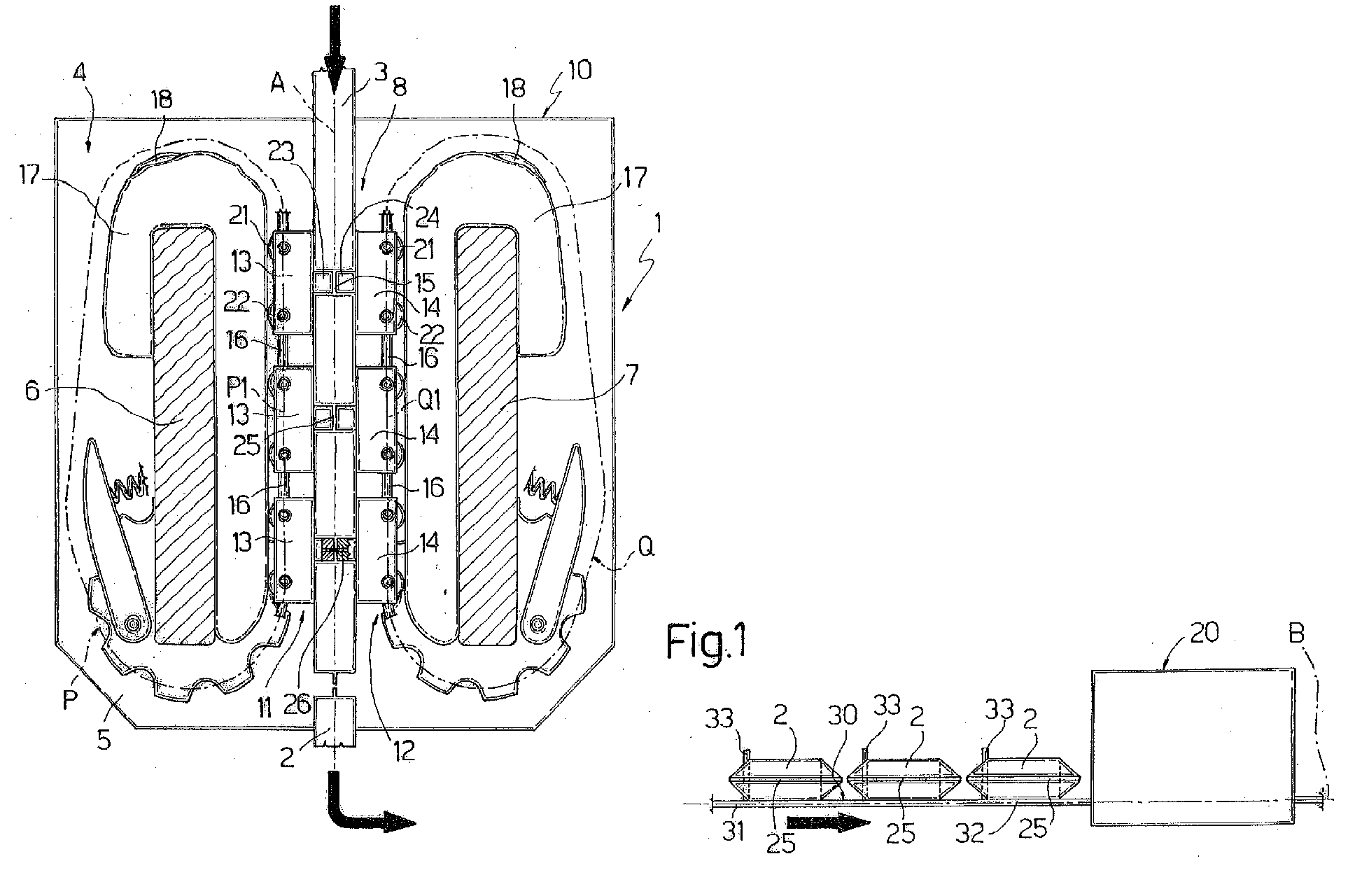
- Numbers 10 and 20 in Figure 1 indicate as a whole respective forming units of a packaging machine 1 (only shown as required to permit a clear understanding of the present invention) for continuously producing aseptic sealed packages 2 of a pourable food product, such as pasteurized or UHT milk, fruit juice, wine, etc., from a vertical tube 3 of packaging material.
- a packaging machine 1 for continuously producing aseptic sealed packages 2 of a pourable food product, such as pasteurized or UHT milk, fruit juice, wine, etc.
- Tube 3 is formed in known manner upstream from unit 10 by longitudinally folding and sealing a web of heat-seal sheet material, and is filled continuously from the top with the sterilized or sterile-processed food product.
- Unit 10 comprises a frame 4 defined by two sides 5 (only one shown) and by two transverse walls 6, 7 parallel to each other and fixed rigidly between sides 5 to define, with sides 5, a compartment 8; and two forming chains 11, 12 supported by frame 4 and respectively comprising first jaws 13 - hereinafter referred to simply as “jaws 13" - and second jaws or counterjaws 14, which cooperate with each other to interact with the tube 3 of packaging material fed through compartment 8 along a vertical path A.
- Chains 11 and 12 define respective endless paths P, Q along which jaws 13 and counterjaws 14 are fed.
- Paths P, Q extend respectively about walls 6, 7 of frame 4, and comprise respective substantially straight, parallel work portions P1, Q1 adjacent to and extending substantially symmetrically on opposite sides of path A of tube 3, so that respective equally spaced cross sections 15 of tube 3 are gripped between pairs of corresponding jaws 13 and counterjaws 14.
- Jaws 13 and counterjaws 14 are an integral part of, and define alternate links of, respective chains 11, 12, and are connected in articulated manner by pairs of rods 16.
- Jaws 13 and counterjaws 14 are elongated in a direction perpendicular to path A and parallel to walls 6, 7 of frame 4, and have respective pairs of guide rollers 21, 22 which roll along cams 17, 18.
- Each jaw 13 comprises, in known manner, an induction heating element 23 extending crosswise to path A and defining two straight, parallel, front active surfaces (not shown).
- each counterjaw 14 comprises a pressure bar 24; and the heating element 23 of each jaw 13 and the bar 24 of the corresponding counterjaw 14 cooperate with each other to grip a respective cross section 15 of tube 3 and heat seal the packaging material.
- the corresponding jaw 13, bar 24 has two pads (not shown) made of relatively flexible elastomeric material and which cooperate with the packaging material in opposition to the active surfaces of heating element 23.
- the heating element 23 of each jaw 13 and the bar 24 of the corresponding counterjaw 14 are held contacting the packaging material of tube 3 for a time T1 shorter than the time T required to completely seal cross sections 15, but sufficient to form respective aseptic transverse sealing bands 25 capable of withstanding the handling to which the packages 2 coming off unit 10 are subjected prior to reaching unit 20 where, as explained in detail later on, the sealing of transverse bands 25 is completed.
- Each counterjaw 14 comprises a knife 26 for cutting tube 3 at sealing bands 25 and so detaching from tube 3 the packages 2 coming off forming chains 11, 12 and to be folded into the finished shape.
- Knife 26 is flat, rectangular and elongated in the direction of the major dimension of counterjaw 14, is housed in sliding manner inside a mid slot in pressure bar 24, and is controlled by a known cam actuating device not shown.
- Jaws 13 and counterjaws 14 comprise respective devices for controlling the volume of packages 2 as they are being formed, and which are not described or shown by not forming part of the present invention.
- Unit 20 ( Figures 1 and 2) is located downstream from unit 10 and is run through by a belt conveyor 30 on to which the packages 2 coming off forming chains 11, 12 are fed by feed devices known, for example, from EP-A-887272 and therefore not described or shown.
- Conveyor 30 is located below and to one side of forming chains 11, 12, and comprises a conveyor belt 31 looped about two pulleys (not shown), and a horizontal top branch 32 of which defines a straight, horizontal path B along which packages 2 are fed.
- Packages 2 are positioned horizontally on belt 31, with respective sealing bands 25 projecting from opposite sides of belt 31 and extending parallel to path B.
- Conveyor 30 also comprises a number of paddles or push members 33 projecting perpendicularly outwards from, and equally spaced along, belt 31, and each of which cooperates with and pushes the upstream lateral wall of a respective package 2 to feed the package along path B.
- Unit 20 substantially comprises a hot-air heating station 34 and a jaw pressing station 35, which are known, for example, from GB 1370831, are located along the opposite sides of top branch 32 of belt 31, and interact successively with sealing bands 25 of the packages 2 on belt 31 to seal the bands completely.
- station 34 directs a stream of hot air on to sealing bands 25 to increase the temperature of the bands, and station 35 exerts pressure on and cools the heated sealing bands 25 to achieve a strong, long-lasting seal.
- unit 20 may comprise, on each side of conveyor 30, two forming chains of the same type as chains 11, 12 and having respective jaws interacting with one another to grip the sealing bands of packages 2 and seal the bands completely by means of heating elements or ultrasonic sealing elements carried by the jaws themselves.
- unit 20 may comprise, on each side of conveyor 30, two heated counter-rotating pressure rollers between which to press and completely seal sealing bands 25 of packages 2 on conveyor 30.
- Jaws 13 and counterjaws 14 interact cyclically with tube 3 of packaging material according to the movement imposed by cams 17, 18. Following initial impact and gradual compression of tube 3 along cross sections 15, jaws 13 and counterjaws 14 reach portions P1, Q1 of respective paths P, Q, along which maximum pressure is exerted on tube 3 and heating elements 23 of jaws 13 are powered to temporarily heat seal the packaging material. More specifically, heating element 23 is held contacting the packaging material of tube 3 for the time T1 it takes to form a respective aseptic sealing band 25 capable of withstanding the handling to which packages 2 are subjected prior to reaching unit 20, but not long enough to completely seal the packaging material.
- knife 26 remains in a rest position housed inside respective pressure bar 24 and not interacting with tube 3.
- the volume-control devices on jaws 13 and counterjaws 14 interact with the lateral surface of the package 2 being formed, so as to impose a predetermined shape, which is assisted by preformed crease lines on the packaging material.
- knife 26 is extracted from pressure bar 24 to cut the packaging material along a respective sealing band 25.
- jaw 13 and respective counterjaw 14 part and package 2 detached from the continuous tube 3 of packaging material and still in the form of a pillow pack, is guided towards and fed on to belt conveyor 30 in a horizontal position with sealing bands 25 projecting from opposite sides of belt 31.
- each package 2 travels successively through station 34, where it is hot-air heated locally along sealing bands 25, and through station 35, where pressure is exerted by jaws on the heated sealing bands 25 to seal them completely.
- packaging machine 1 According to the present invention will be clear from the foregoing description.
- the output rate of packaging machine 1 is made independent of the time (T) taken to completely seal packages 2. That is, by limiting the length of time heating element 23 is kept contacting the packaging material to the strict minimum required to obtain a temporary seal of tube 3 capable of ensuring the packages 2 coming off unit 10 remain aseptic at least until they arrive at unit 20, the output rate of packaging machine 1 may be increased to the limit imposed by the mechanics of the machine itself.
- the packaging material may be sealed ultrasonically; and the cutting operation may advantageously be performed prior to sealing by heating elements 23 of jaws 13.
Landscapes
- Engineering & Computer Science (AREA)
- Mechanical Engineering (AREA)
- Chemical & Material Sciences (AREA)
- Composite Materials (AREA)
- Containers And Plastic Fillers For Packaging (AREA)
- Package Closures (AREA)
Abstract
Description
- gripping means for gripping said tube at equally spaced cross sections; and
- sealing means for sealing the packaging material of said tube along said cross sections;
- gripping said tube at equally spaced cross sections; and
- sealing the packaging material of said tube along said cross sections;
Claims (10)
- A packaging machine (1) for producing sealed aseptic packages (2) of a pourable food product from a tube (3) of packaging material fed along a vertical path (A) and filled continuously with said food product, said machine (1) comprising:and being characterized in that said sealing means comprise a first and a second sealing device (23, 24; 34, 35) forming part of respective distinct, successive units (10, 20) of said machine (1); said first sealing device (23, 24) interacting with said cross sections (15) for a time (T1) shorter than the time (T) required to achieve complete sealing of the cross sections (15), but sufficient to form respective temporary aseptic transverse sealing bands (25); and said second sealing device (34, 35) interacting with said temporary sealing bands (25) to seal them completely.gripping means (13, 14) for gripping said tube (3) at equally spaced cross sections (15); andsealing means (23, 24; 34, 35) for sealing the packaging material of said tube (3) along said cross sections (15);
- A machine as claimed in Claim 1, characterized by comprising cutting means (26) located upstream from at least said second sealing device (34, 35) and selectively activated to detach the formed packages (2) from said tube (3) by a transverse cut along said cross sections (15).
- A machine as claimed in Claim 1 or 2, characterized in that said gripping means comprise at least two pairs of jaws (13, 14) acting cyclically and successively on said tube (3).
- A machine as claimed in Claim 3, characterized in that said first sealing device (23, 24) is carried by said jaws (13, 14).
- A machine as claimed in Claim 3 or 4, characterized by comprising a first and a second forming chain (11, 12) having respective numbers of said jaws (13, 14) and defining respective endless paths (P, Q) along which the jaws (13, 14) are fed, and which have respective adjacent work portions (P1, Q1) extending substantially symmetrically on opposite sides of said path (A) of said tube (3) of packaging material.
- A machine as claimed in Claim 5, characterized in that said cutting means (26) are carried by said jaws (14) of one (12) of said forming chains (11, 12).
- A method of producing sealed packages (2) of a pourable food product from a tube (3) of heat-seal sheet packaging material, fed along a vertical path (A) and filled continuously with said food product, said method comprising the steps of:and being characterized in that said sealing step comprises a first and a second sealing operation performed successively on distinct units (10, 20) of a packaging machine (1) for producing said packages (2); said first sealing operation being performed along said cross sections (15) for a time (T1) shorter than the time (T) required to achieve complete sealing of the cross sections (15), but sufficient to form respective temporary aseptic transverse sealing bands (25); and said second sealing operation being performed to finally seal said temporary sealing bands (25).gripping said tube (3) at equally spaced cross sections (15); andsealing the packaging material of said tube (3) along said cross sections (15);
- A method as claimed in Claim 7, characterized by comprising, prior to said second sealing operation, the step of cutting said tube (3) at each of said cross sections (15).
- A method as claimed in Claim 8, characterized in that said cutting step is performed after said first sealing operation.
- A method as claimed in any one of Claims 7 to 9, characterized in that said first and said second sealing operation comprise heat sealing the packaging material.
Priority Applications (6)
| Application Number | Priority Date | Filing Date | Title |
|---|---|---|---|
| DE60105257T DE60105257T2 (en) | 2001-02-23 | 2001-02-23 | Packaging machine and method for producing sealed packages containing free-flowing foodstuffs |
| EP01104376A EP1234772B1 (en) | 2001-02-23 | 2001-02-23 | Packaging machine and method for producing sealed packages of pourable food products |
| ES01104376T ES2227000T3 (en) | 2001-02-23 | 2001-02-23 | PACKING MACHINE AND METHOD TO PRODUCE OBTAINED PACKAGING OF VERTIBLE FOOD PRODUCTS. |
| AT01104376T ATE275069T1 (en) | 2001-02-23 | 2001-02-23 | PACKAGING MACHINE AND METHOD FOR PRODUCING SEALED PACKAGINGS WITH FLOWABLE FOODS |
| US10/073,219 US6810644B2 (en) | 2001-02-23 | 2002-02-13 | Packaging machine and method for producing sealed packages of pourable food products |
| JP2002045857A JP3833949B2 (en) | 2001-02-23 | 2002-02-22 | Packaging machine and method for producing hermetic package of fluid food products |
Applications Claiming Priority (1)
| Application Number | Priority Date | Filing Date | Title |
|---|---|---|---|
| EP01104376A EP1234772B1 (en) | 2001-02-23 | 2001-02-23 | Packaging machine and method for producing sealed packages of pourable food products |
Publications (2)
| Publication Number | Publication Date |
|---|---|
| EP1234772A1 true EP1234772A1 (en) | 2002-08-28 |
| EP1234772B1 EP1234772B1 (en) | 2004-09-01 |
Family
ID=8176574
Family Applications (1)
| Application Number | Title | Priority Date | Filing Date |
|---|---|---|---|
| EP01104376A Expired - Lifetime EP1234772B1 (en) | 2001-02-23 | 2001-02-23 | Packaging machine and method for producing sealed packages of pourable food products |
Country Status (6)
| Country | Link |
|---|---|
| US (1) | US6810644B2 (en) |
| EP (1) | EP1234772B1 (en) |
| JP (1) | JP3833949B2 (en) |
| AT (1) | ATE275069T1 (en) |
| DE (1) | DE60105257T2 (en) |
| ES (1) | ES2227000T3 (en) |
Cited By (8)
| Publication number | Priority date | Publication date | Assignee | Title |
|---|---|---|---|---|
| WO2005110855A1 (en) * | 2004-05-13 | 2005-11-24 | Ipi S.R.L. | A unit for packaging containers and a device for forming said containers produced continuously from a tubular wrapper |
| EP1785355A1 (en) * | 2005-11-09 | 2007-05-16 | Tetra Laval Holdings & Finance SA | Packaging unit for continuously producing sealed packages of pourable food products from a tube of packaging material |
| US7441390B2 (en) * | 2004-05-13 | 2008-10-28 | Ipi S.R.L. | Device for forming containers produced continuously from a tubular wrapper and unit for packaging the containers |
| ITTO20100917A1 (en) * | 2010-11-19 | 2012-05-20 | Minipack Torre Spa | AUTOMATIC VERTICAL PACKAGING MACHINE AND ITS OPERATING PROCEDURE. |
| CN102574594A (en) * | 2009-10-15 | 2012-07-11 | 利乐拉瓦尔集团及财务有限公司 | A packaging machine for producing sealed packages of pourable food products |
| US8844250B2 (en) | 2006-05-29 | 2014-09-30 | Tetra Laval Holdings & Finance S.A. | Sealing device and method for producing sealed packages of a pourable food product |
| CN106240943A (en) * | 2016-08-31 | 2016-12-21 | 辽宁春光制药装备股份有限公司 | Multiple row back of the body envelope machine horizontal sealing stepping traction apparatus |
| EP3456642A1 (en) * | 2017-09-15 | 2019-03-20 | Tetra Laval Holdings & Finance S.A. | A tensioning device for a chain driven jaw system |
Families Citing this family (4)
| Publication number | Priority date | Publication date | Assignee | Title |
|---|---|---|---|---|
| ITMO20020016A1 (en) * | 2002-01-24 | 2003-07-24 | Sarong Spa | CONTINUOUS STRIP OF CONTAINERS |
| SE533798C2 (en) * | 2009-04-01 | 2011-01-18 | Tetra Laval Holdings & Finance | Safety chamber to be used in a packaging machine |
| ES2503567T3 (en) * | 2011-10-03 | 2014-10-07 | Tetra Laval Holdings & Finance S.A. | Packaging machine and method for producing sealed containers of a food product from a tape of a packaging material |
| EP3141488B1 (en) * | 2015-09-09 | 2020-04-22 | Tetra Laval Holdings & Finance S.A. | Packaging machine for producing packages from a sheet of packaging material |
Citations (6)
| Publication number | Priority date | Publication date | Assignee | Title |
|---|---|---|---|---|
| CA592747A (en) | 1960-02-16 | Rado Leopold | Container making method and apparatus | |
| US3300944A (en) | 1963-07-18 | 1967-01-31 | Holstein & Kappert Maschf | Method and apparatus for making parallelepiped packages |
| EP0808772A1 (en) * | 1996-05-22 | 1997-11-26 | Natec Reich, Summer GmbH & Co. KG | Method and apparatus for heatsealing tubular sleeves |
| EP0887273A1 (en) * | 1997-06-27 | 1998-12-30 | Tetra Laval Holdings & Finance SA | Packaging unit for continuously producing sealed packages, containing pourable food products, from a tube of packaging material |
| EP0992431A1 (en) | 1998-10-07 | 2000-04-12 | Tetra Laval Holdings & Finance SA | Method of producing sealed packages containing pourable food products from a tube of packing material, and packing unit implementing such a method |
| EP1065142A1 (en) * | 1998-08-31 | 2001-01-03 | Nippon Seiki Co., Ltd. | Filling/packing machine |
Family Cites Families (11)
| Publication number | Priority date | Publication date | Assignee | Title |
|---|---|---|---|---|
| SE361857B (en) * | 1971-03-25 | 1973-11-19 | Tetra Pak Int | |
| JPS5219811Y2 (en) * | 1972-02-18 | 1977-05-07 | ||
| SE421519B (en) | 1975-05-29 | 1982-01-04 | Ziristor Ab | SET TO MAKE PARALLELLE PIPEDIC PACKAGING CONTAINERS |
| US4581874A (en) * | 1983-07-14 | 1986-04-15 | Franrica Mfg. Inc. | Apparatus and methods for filling and sealing an aseptic fitmentless pouch |
| US4853352A (en) * | 1984-07-20 | 1989-08-01 | Lanxide Technology Company, Lp | Method of making self-supporting ceramic materials and materials made thereby |
| JPH0771964B2 (en) * | 1989-11-13 | 1995-08-02 | 中央包装機株式会社 | Liquid exclusion sealing method and sealing mechanism for filling and packaging |
| JP2795832B2 (en) * | 1996-02-08 | 1998-09-10 | 東亜機工株式会社 | Sanitary article packaging device and packaging method |
| ES2248838T3 (en) | 1997-06-27 | 2006-03-16 | TETRA LAVAL HOLDINGS & FINANCE SA | HIGH SPEED FOLDING UNIT FOR PACKAGING MACHINES OF FOOD PRODUCTS THAT CAN BE VERTER. |
| ATE282551T1 (en) * | 1997-06-27 | 2004-12-15 | Tetra Laval Holdings & Finance | PACKAGING MACHINE FOR CONTINUOUSLY PRODUCING SEALED PACKAGINGS OF FLOWABLE FOODS FROM TUBULAR PACKAGING MATERIAL |
| EP0887272B1 (en) * | 1997-06-27 | 2006-02-15 | Tetra Laval Holdings & Finance SA | Reject device for a high-speed packaging machine |
| ATE301579T1 (en) * | 1999-10-13 | 2005-08-15 | Tetra Laval Holdings & Finance | PACKAGING UNIT FOR CONTINUOUS PRODUCTION OF PACKAGING FOR LIQUID FOODS |
-
2001
- 2001-02-23 DE DE60105257T patent/DE60105257T2/en not_active Expired - Fee Related
- 2001-02-23 EP EP01104376A patent/EP1234772B1/en not_active Expired - Lifetime
- 2001-02-23 AT AT01104376T patent/ATE275069T1/en not_active IP Right Cessation
- 2001-02-23 ES ES01104376T patent/ES2227000T3/en not_active Expired - Lifetime
-
2002
- 2002-02-13 US US10/073,219 patent/US6810644B2/en not_active Expired - Fee Related
- 2002-02-22 JP JP2002045857A patent/JP3833949B2/en not_active Expired - Fee Related
Patent Citations (6)
| Publication number | Priority date | Publication date | Assignee | Title |
|---|---|---|---|---|
| CA592747A (en) | 1960-02-16 | Rado Leopold | Container making method and apparatus | |
| US3300944A (en) | 1963-07-18 | 1967-01-31 | Holstein & Kappert Maschf | Method and apparatus for making parallelepiped packages |
| EP0808772A1 (en) * | 1996-05-22 | 1997-11-26 | Natec Reich, Summer GmbH & Co. KG | Method and apparatus for heatsealing tubular sleeves |
| EP0887273A1 (en) * | 1997-06-27 | 1998-12-30 | Tetra Laval Holdings & Finance SA | Packaging unit for continuously producing sealed packages, containing pourable food products, from a tube of packaging material |
| EP1065142A1 (en) * | 1998-08-31 | 2001-01-03 | Nippon Seiki Co., Ltd. | Filling/packing machine |
| EP0992431A1 (en) | 1998-10-07 | 2000-04-12 | Tetra Laval Holdings & Finance SA | Method of producing sealed packages containing pourable food products from a tube of packing material, and packing unit implementing such a method |
Cited By (15)
| Publication number | Priority date | Publication date | Assignee | Title |
|---|---|---|---|---|
| WO2005110855A1 (en) * | 2004-05-13 | 2005-11-24 | Ipi S.R.L. | A unit for packaging containers and a device for forming said containers produced continuously from a tubular wrapper |
| US7441390B2 (en) * | 2004-05-13 | 2008-10-28 | Ipi S.R.L. | Device for forming containers produced continuously from a tubular wrapper and unit for packaging the containers |
| US7441391B2 (en) | 2004-05-13 | 2008-10-28 | Ipi S.R.L. | Device for forming containers produced continuously from a tubular wrapper and unit for packaging the containers |
| EP1785355A1 (en) * | 2005-11-09 | 2007-05-16 | Tetra Laval Holdings & Finance SA | Packaging unit for continuously producing sealed packages of pourable food products from a tube of packaging material |
| WO2007054523A1 (en) * | 2005-11-09 | 2007-05-18 | Tetra Laval Holdings & Finance Sa | Packaging unit for continuously producing sealed packages of pourable food products from a tube of packaging material |
| CN101304922B (en) * | 2005-11-09 | 2011-09-07 | 利乐拉瓦尔集团及财务有限公司 | Packaging unit for continuously producing sealed packages of pourable food products from a tube of packaging material |
| US8844250B2 (en) | 2006-05-29 | 2014-09-30 | Tetra Laval Holdings & Finance S.A. | Sealing device and method for producing sealed packages of a pourable food product |
| CN102574594A (en) * | 2009-10-15 | 2012-07-11 | 利乐拉瓦尔集团及财务有限公司 | A packaging machine for producing sealed packages of pourable food products |
| CN102574594B (en) * | 2009-10-15 | 2013-11-20 | 利乐拉瓦尔集团及财务有限公司 | A packaging machine for producing sealed packages of pourable food products |
| ITTO20100917A1 (en) * | 2010-11-19 | 2012-05-20 | Minipack Torre Spa | AUTOMATIC VERTICAL PACKAGING MACHINE AND ITS OPERATING PROCEDURE. |
| CN106240943A (en) * | 2016-08-31 | 2016-12-21 | 辽宁春光制药装备股份有限公司 | Multiple row back of the body envelope machine horizontal sealing stepping traction apparatus |
| CN106240943B (en) * | 2016-08-31 | 2018-07-10 | 辽宁春光制药装备股份有限公司 | Multiple row carries on the back envelope machine horizontal sealing stepping draft gear |
| EP3456642A1 (en) * | 2017-09-15 | 2019-03-20 | Tetra Laval Holdings & Finance S.A. | A tensioning device for a chain driven jaw system |
| WO2019052923A1 (en) * | 2017-09-15 | 2019-03-21 | Tetra Laval Holdings & Finance S.A. | A tensioning device for a chain driven jaw system |
| US11530063B2 (en) | 2017-09-15 | 2022-12-20 | Tetra Laval Holdings & Finance S.A. | Tensioning device for a chain driven jaw system |
Also Published As
| Publication number | Publication date |
|---|---|
| ES2227000T3 (en) | 2005-04-01 |
| DE60105257D1 (en) | 2004-10-07 |
| US20020116904A1 (en) | 2002-08-29 |
| DE60105257T2 (en) | 2005-09-08 |
| JP3833949B2 (en) | 2006-10-18 |
| US6810644B2 (en) | 2004-11-02 |
| ATE275069T1 (en) | 2004-09-15 |
| EP1234772B1 (en) | 2004-09-01 |
| JP2002308204A (en) | 2002-10-23 |
Similar Documents
| Publication | Publication Date | Title |
|---|---|---|
| EP2586716B1 (en) | Folding unit for pourable food product packaging machines | |
| EP2631188B1 (en) | Folding unit for pourable food product packaging machines | |
| EP2586719B1 (en) | Folding unit and method for producing pourable food product packages | |
| EP2586718B1 (en) | Folding unit for producing folded packages of pourable food products from relative sealed packs | |
| EP2113371A1 (en) | Sealing jaw for producing sealed packages of a food product | |
| EP1234772B1 (en) | Packaging machine and method for producing sealed packages of pourable food products | |
| JPH1159603A (en) | Packaging unit that continuously manufactures sealed packages from tubes made of packaging material | |
| EP1832518B1 (en) | Packaging machine for producing sealed packages of pourable food products | |
| US10195790B2 (en) | Forming assembly and method for forming a plurality of sealed packs for pourable food products starting from a tube of packaging material | |
| EP1509453B1 (en) | Forming jaw for producing a succession of sealed packages from a tube of sheet packaging material | |
| DK2955117T3 (en) | Supply unit for supplying sealed packages of pourable food products | |
| EP2923959B1 (en) | Folding unit for producing packages of food products pourable into a tube of packaging material from sealed packs | |
| EP1325868A1 (en) | Packaging unit for continuously producing sealed packages, containing pourable food products, from a tube of packaging material | |
| CN101304922A (en) | Packaging unit for the continuous manufacture of hermetically sealed packages of liquid food from tubes of packaging material | |
| EP3020642A1 (en) | Folding unit for producing folded packages from sealed packs | |
| HK1086801B (en) | Packaging machine for producing sealed packages of pourable food products, and featuring an improved package fill device | |
| HK1086801A1 (en) | Packaging machine for producing sealed packages of pourable food products, and featuring an improved package fill device | |
| MXPA98004805A (en) | Packaging unit to produce continuously sealed containers, containing food products that can be poured, from a container material pipe |
Legal Events
| Date | Code | Title | Description |
|---|---|---|---|
| PUAI | Public reference made under article 153(3) epc to a published international application that has entered the european phase |
Free format text: ORIGINAL CODE: 0009012 |
|
| AK | Designated contracting states |
Kind code of ref document: A1 Designated state(s): AT BE CH CY DE DK ES FI FR GB GR IE IT LI LU MC NL PT SE TR |
|
| AX | Request for extension of the european patent |
Free format text: AL;LT;LV;MK;RO;SI |
|
| 17P | Request for examination filed |
Effective date: 20030227 |
|
| AKX | Designation fees paid |
Designated state(s): AT BE CH CY DE DK ES FI FR GB GR IE IT LI LU MC NL PT SE TR |
|
| 17Q | First examination report despatched |
Effective date: 20030530 |
|
| GRAP | Despatch of communication of intention to grant a patent |
Free format text: ORIGINAL CODE: EPIDOSNIGR1 |
|
| GRAS | Grant fee paid |
Free format text: ORIGINAL CODE: EPIDOSNIGR3 |
|
| GRAA | (expected) grant |
Free format text: ORIGINAL CODE: 0009210 |
|
| AK | Designated contracting states |
Kind code of ref document: B1 Designated state(s): AT BE CH CY DE DK ES FI FR GB GR IE IT LI LU MC NL PT SE TR |
|
| PG25 | Lapsed in a contracting state [announced via postgrant information from national office to epo] |
Ref country code: TR Free format text: LAPSE BECAUSE OF FAILURE TO SUBMIT A TRANSLATION OF THE DESCRIPTION OR TO PAY THE FEE WITHIN THE PRESCRIBED TIME-LIMIT Effective date: 20040901 Ref country code: NL Free format text: LAPSE BECAUSE OF FAILURE TO SUBMIT A TRANSLATION OF THE DESCRIPTION OR TO PAY THE FEE WITHIN THE PRESCRIBED TIME-LIMIT Effective date: 20040901 Ref country code: CH Free format text: LAPSE BECAUSE OF FAILURE TO SUBMIT A TRANSLATION OF THE DESCRIPTION OR TO PAY THE FEE WITHIN THE PRESCRIBED TIME-LIMIT Effective date: 20040901 Ref country code: BE Free format text: LAPSE BECAUSE OF FAILURE TO SUBMIT A TRANSLATION OF THE DESCRIPTION OR TO PAY THE FEE WITHIN THE PRESCRIBED TIME-LIMIT Effective date: 20040901 Ref country code: AT Free format text: LAPSE BECAUSE OF FAILURE TO SUBMIT A TRANSLATION OF THE DESCRIPTION OR TO PAY THE FEE WITHIN THE PRESCRIBED TIME-LIMIT Effective date: 20040901 Ref country code: LI Free format text: LAPSE BECAUSE OF FAILURE TO SUBMIT A TRANSLATION OF THE DESCRIPTION OR TO PAY THE FEE WITHIN THE PRESCRIBED TIME-LIMIT Effective date: 20040901 Ref country code: FI Free format text: LAPSE BECAUSE OF FAILURE TO SUBMIT A TRANSLATION OF THE DESCRIPTION OR TO PAY THE FEE WITHIN THE PRESCRIBED TIME-LIMIT Effective date: 20040901 |
|
| REG | Reference to a national code |
Ref country code: GB Ref legal event code: FG4D |
|
| REG | Reference to a national code |
Ref country code: CH Ref legal event code: EP |
|
| REG | Reference to a national code |
Ref country code: IE Ref legal event code: FG4D |
|
| REF | Corresponds to: |
Ref document number: 60105257 Country of ref document: DE Date of ref document: 20041007 Kind code of ref document: P |
|
| PG25 | Lapsed in a contracting state [announced via postgrant information from national office to epo] |
Ref country code: GR Free format text: LAPSE BECAUSE OF FAILURE TO SUBMIT A TRANSLATION OF THE DESCRIPTION OR TO PAY THE FEE WITHIN THE PRESCRIBED TIME-LIMIT Effective date: 20041201 Ref country code: DK Free format text: LAPSE BECAUSE OF FAILURE TO SUBMIT A TRANSLATION OF THE DESCRIPTION OR TO PAY THE FEE WITHIN THE PRESCRIBED TIME-LIMIT Effective date: 20041201 |
|
| REG | Reference to a national code |
Ref country code: SE Ref legal event code: TRGR |
|
| PG25 | Lapsed in a contracting state [announced via postgrant information from national office to epo] |
Ref country code: CY Free format text: LAPSE BECAUSE OF FAILURE TO SUBMIT A TRANSLATION OF THE DESCRIPTION OR TO PAY THE FEE WITHIN THE PRESCRIBED TIME-LIMIT Effective date: 20050223 Ref country code: LU Free format text: LAPSE BECAUSE OF NON-PAYMENT OF DUE FEES Effective date: 20050223 Ref country code: IE Free format text: LAPSE BECAUSE OF NON-PAYMENT OF DUE FEES Effective date: 20050223 |
|
| PG25 | Lapsed in a contracting state [announced via postgrant information from national office to epo] |
Ref country code: MC Free format text: LAPSE BECAUSE OF NON-PAYMENT OF DUE FEES Effective date: 20050228 |
|
| NLV1 | Nl: lapsed or annulled due to failure to fulfill the requirements of art. 29p and 29m of the patents act | ||
| REG | Reference to a national code |
Ref country code: CH Ref legal event code: PL |
|
| REG | Reference to a national code |
Ref country code: ES Ref legal event code: FG2A Ref document number: 2227000 Country of ref document: ES Kind code of ref document: T3 |
|
| ET | Fr: translation filed | ||
| PLBE | No opposition filed within time limit |
Free format text: ORIGINAL CODE: 0009261 |
|
| STAA | Information on the status of an ep patent application or granted ep patent |
Free format text: STATUS: NO OPPOSITION FILED WITHIN TIME LIMIT |
|
| 26N | No opposition filed |
Effective date: 20050602 |
|
| REG | Reference to a national code |
Ref country code: IE Ref legal event code: MM4A |
|
| PG25 | Lapsed in a contracting state [announced via postgrant information from national office to epo] |
Ref country code: PT Free format text: LAPSE BECAUSE OF NON-PAYMENT OF DUE FEES Effective date: 20050201 |
|
| PGFP | Annual fee paid to national office [announced via postgrant information from national office to epo] |
Ref country code: ES Payment date: 20090226 Year of fee payment: 9 |
|
| PGFP | Annual fee paid to national office [announced via postgrant information from national office to epo] |
Ref country code: GB Payment date: 20090227 Year of fee payment: 9 |
|
| PGFP | Annual fee paid to national office [announced via postgrant information from national office to epo] |
Ref country code: DE Payment date: 20090331 Year of fee payment: 9 Ref country code: IT Payment date: 20090224 Year of fee payment: 9 Ref country code: SE Payment date: 20090227 Year of fee payment: 9 |
|
| PGFP | Annual fee paid to national office [announced via postgrant information from national office to epo] |
Ref country code: FR Payment date: 20090217 Year of fee payment: 9 |
|
| EUG | Se: european patent has lapsed | ||
| GBPC | Gb: european patent ceased through non-payment of renewal fee |
Effective date: 20100223 |
|
| REG | Reference to a national code |
Ref country code: FR Ref legal event code: ST Effective date: 20101029 |
|
| PG25 | Lapsed in a contracting state [announced via postgrant information from national office to epo] |
Ref country code: FR Free format text: LAPSE BECAUSE OF NON-PAYMENT OF DUE FEES Effective date: 20100301 |
|
| PG25 | Lapsed in a contracting state [announced via postgrant information from national office to epo] |
Ref country code: DE Free format text: LAPSE BECAUSE OF NON-PAYMENT OF DUE FEES Effective date: 20100901 |
|
| PG25 | Lapsed in a contracting state [announced via postgrant information from national office to epo] |
Ref country code: GB Free format text: LAPSE BECAUSE OF NON-PAYMENT OF DUE FEES Effective date: 20100223 Ref country code: IT Free format text: LAPSE BECAUSE OF NON-PAYMENT OF DUE FEES Effective date: 20100223 |
|
| REG | Reference to a national code |
Ref country code: ES Ref legal event code: FD2A Effective date: 20110404 |
|
| PG25 | Lapsed in a contracting state [announced via postgrant information from national office to epo] |
Ref country code: ES Free format text: LAPSE BECAUSE OF NON-PAYMENT OF DUE FEES Effective date: 20110323 |
|
| PG25 | Lapsed in a contracting state [announced via postgrant information from national office to epo] |
Ref country code: ES Free format text: LAPSE BECAUSE OF NON-PAYMENT OF DUE FEES Effective date: 20100224 |
|
| PG25 | Lapsed in a contracting state [announced via postgrant information from national office to epo] |
Ref country code: SE Free format text: LAPSE BECAUSE OF NON-PAYMENT OF DUE FEES Effective date: 20100224 |