EP1234690A2 - A vehicle wheel end assembly - Google Patents
A vehicle wheel end assembly Download PDFInfo
- Publication number
- EP1234690A2 EP1234690A2 EP02251239A EP02251239A EP1234690A2 EP 1234690 A2 EP1234690 A2 EP 1234690A2 EP 02251239 A EP02251239 A EP 02251239A EP 02251239 A EP02251239 A EP 02251239A EP 1234690 A2 EP1234690 A2 EP 1234690A2
- Authority
- EP
- European Patent Office
- Prior art keywords
- spindle
- hub
- assembly
- wheel end
- wheel
- Prior art date
- Legal status (The legal status is an assumption and is not a legal conclusion. Google has not performed a legal analysis and makes no representation as to the accuracy of the status listed.)
- Granted
Links
- 239000012530 fluid Substances 0.000 claims abstract description 52
- 230000001050 lubricating effect Effects 0.000 claims abstract description 22
- 238000013022 venting Methods 0.000 claims abstract description 8
- 230000000903 blocking effect Effects 0.000 claims description 16
- 238000004891 communication Methods 0.000 claims description 3
- 238000012546 transfer Methods 0.000 claims description 2
- 238000005461 lubrication Methods 0.000 description 6
- 230000000712 assembly Effects 0.000 description 3
- 238000000429 assembly Methods 0.000 description 3
- 230000005540 biological transmission Effects 0.000 description 2
- 230000007423 decrease Effects 0.000 description 2
- 230000002028 premature Effects 0.000 description 2
- 239000000725 suspension Substances 0.000 description 2
- 241001246312 Otis Species 0.000 description 1
- 229910000831 Steel Inorganic materials 0.000 description 1
- 230000007812 deficiency Effects 0.000 description 1
- 239000000463 material Substances 0.000 description 1
- 238000000034 method Methods 0.000 description 1
- 238000012986 modification Methods 0.000 description 1
- 230000004048 modification Effects 0.000 description 1
- 238000013021 overheating Methods 0.000 description 1
- 239000010959 steel Substances 0.000 description 1
Images

Classifications
-
- B—PERFORMING OPERATIONS; TRANSPORTING
- B60—VEHICLES IN GENERAL
- B60B—VEHICLE WHEELS; CASTORS; AXLES FOR WHEELS OR CASTORS; INCREASING WHEEL ADHESION
- B60B27/00—Hubs
- B60B27/02—Hubs adapted to be rotatably arranged on axle
-
- B—PERFORMING OPERATIONS; TRANSPORTING
- B60—VEHICLES IN GENERAL
- B60C—VEHICLE TYRES; TYRE INFLATION; TYRE CHANGING; CONNECTING VALVES TO INFLATABLE ELASTIC BODIES IN GENERAL; DEVICES OR ARRANGEMENTS RELATED TO TYRES
- B60C23/00—Devices for measuring, signalling, controlling, or distributing tyre pressure or temperature, specially adapted for mounting on vehicles; Arrangement of tyre inflating devices on vehicles, e.g. of pumps or of tanks; Tyre cooling arrangements
- B60C23/001—Devices for manually or automatically controlling or distributing tyre pressure whilst the vehicle is moving
- B60C23/003—Devices for manually or automatically controlling or distributing tyre pressure whilst the vehicle is moving comprising rotational joints between vehicle-mounted pressure sources and the tyres
- B60C23/00309—Devices for manually or automatically controlling or distributing tyre pressure whilst the vehicle is moving comprising rotational joints between vehicle-mounted pressure sources and the tyres characterised by the location of the components, e.g. valves, sealings, conduits or sensors
- B60C23/00318—Devices for manually or automatically controlling or distributing tyre pressure whilst the vehicle is moving comprising rotational joints between vehicle-mounted pressure sources and the tyres characterised by the location of the components, e.g. valves, sealings, conduits or sensors on the wheels or the hubs
-
- B—PERFORMING OPERATIONS; TRANSPORTING
- B60—VEHICLES IN GENERAL
- B60C—VEHICLE TYRES; TYRE INFLATION; TYRE CHANGING; CONNECTING VALVES TO INFLATABLE ELASTIC BODIES IN GENERAL; DEVICES OR ARRANGEMENTS RELATED TO TYRES
- B60C23/00—Devices for measuring, signalling, controlling, or distributing tyre pressure or temperature, specially adapted for mounting on vehicles; Arrangement of tyre inflating devices on vehicles, e.g. of pumps or of tanks; Tyre cooling arrangements
- B60C23/001—Devices for manually or automatically controlling or distributing tyre pressure whilst the vehicle is moving
- B60C23/003—Devices for manually or automatically controlling or distributing tyre pressure whilst the vehicle is moving comprising rotational joints between vehicle-mounted pressure sources and the tyres
- B60C23/00345—Details of the rotational joints
-
- B—PERFORMING OPERATIONS; TRANSPORTING
- B60—VEHICLES IN GENERAL
- B60C—VEHICLE TYRES; TYRE INFLATION; TYRE CHANGING; CONNECTING VALVES TO INFLATABLE ELASTIC BODIES IN GENERAL; DEVICES OR ARRANGEMENTS RELATED TO TYRES
- B60C23/00—Devices for measuring, signalling, controlling, or distributing tyre pressure or temperature, specially adapted for mounting on vehicles; Arrangement of tyre inflating devices on vehicles, e.g. of pumps or of tanks; Tyre cooling arrangements
- B60C23/001—Devices for manually or automatically controlling or distributing tyre pressure whilst the vehicle is moving
- B60C23/003—Devices for manually or automatically controlling or distributing tyre pressure whilst the vehicle is moving comprising rotational joints between vehicle-mounted pressure sources and the tyres
- B60C23/0039—Devices for manually or automatically controlling or distributing tyre pressure whilst the vehicle is moving comprising rotational joints between vehicle-mounted pressure sources and the tyres specially adapted for driven wheels
-
- F—MECHANICAL ENGINEERING; LIGHTING; HEATING; WEAPONS; BLASTING
- F16—ENGINEERING ELEMENTS AND UNITS; GENERAL MEASURES FOR PRODUCING AND MAINTAINING EFFECTIVE FUNCTIONING OF MACHINES OR INSTALLATIONS; THERMAL INSULATION IN GENERAL
- F16H—GEARING
- F16H57/00—General details of gearing
- F16H57/02—Gearboxes; Mounting gearing therein
- F16H57/027—Gearboxes; Mounting gearing therein characterised by means for venting gearboxes, e.g. air breathers
Definitions
- This invention generally relates to a vehicle wheel end assembly and in particular to a method and apparatus for venting air from a wheel end assembly.
- Vehicle wheel end assemblies experience air pressure build-up within the wheel end during vehicle operation, which is undesirable. This air pressure is vented from the wheel end via an outlet. Air pressure build-up can occur within a wheel for various reasons.
- CTIS central tire inflation system
- the CTIS provides a separate air supply, or utilizes an existing air supply on the vehicle, which is connected to each tire.
- the CTIS includes multiple seals at each wheel end to provide a sealed system that allows air to be transferred from a stationary source on the vehicle to a rotating wheel component.
- Each wheel end includes oil or other similar fluid that lubricates wheel end components to prevent component wear and overheating. A certain level of fluid needs to be maintained in each wheel end to provide sufficient lubrication. During vehicle operation, CTIS seal leaks cause air pressure to build up in the wheel end assembly, which is undesirable.
- Air pressure build-up can also occur in wheel end assemblies for vehicles that do not include CTIS. For example, temperature increases within the wheel end assembly, due to vehicle braking operations, can cause air pressure to be built up within the wheel end-Also, the churning of the lubrication fluid within the wheel end assembly from a bearing and/or wheel end gear assembly can cause pressure build-up.
- This air pressure is vented from the wheel end assembly via an outlet port.
- some of the wheel end lubricating fluid is also vented out through the same outlet port. This causes lubrication fluid levels within the wheel end to decrease over time, resulting in potential premature component wear.
- a vehicle wheel end assembly includes a blocking member that reduces the amount of lubricating fluid in a wheel end assembly that is vented from the wheel end during exhaustion of air via a vent path.
- the blocking member is positioned within the wheel end such that lubrication fluid is prevented from entering the vent path.
- the wheel end assembly includes a wheel hub and a wheel end gear assembly in driving engagement with the wheel hub.
- a fluid chamber, formed within the wheel hub, defines a fluid path in communication with the wheel end gear assembly to provide lubricating fluid to the wheel end gear assembly.
- a vent path extends from the wheel end gear assembly, through the wheel hub to an outlet for venting air from the wheel end.
- the blocking member is positioned within the wheel hub to at least partially block the fluid path to reduce the amount of lubricating fluid that enters the vent path as air is vented from the vent path via the outlet.
- the wheel end includes a spindle that is mounted to an axle housing.
- the spindle has a bore that extends through the center of the spindle.
- the wheel hub is supported on the spindle via at least one bearing for rotation relative to the spindle.
- An axle shaft is mounted within the spindle bore for providing driving torque to the wheel hub.
- the wheel end gear assembly reacts between the wheel hub and the axle shaft to transfer driving torque from the axle shaft to the whcel hub.
- the vent path is defined within the hub and extends at least from the gear assembly through the bore to the outlet.
- the blocking member extends outwardly from one end of the spindle to at least partially block the fluid path to reduce the amount of lubricating fluid that enters the vent path as air is vented from the outlet.
- the blocking member is a cylindrical sleeve that has an outer surface and an inner surface.
- the outer surface is in engagement with the inner bore of the spindle.
- the axle shaft extends through the center of the sleeve and is spaced from the inner surface to define a gap that forms a portion of the vent path.
- the sleeve extends outwardly from one end of the spindle such that the outer surface blocks a portion of the fluid path.
- the subject invention allows air to be easily vented from the wheel end while still maintaining sufficient lubrication levels within the wheel end assembly.
- the subject invention relates to a vehicle wheel end assembly that experiences air pressure build-up.
- the wheel end assembly can be any type of wheel end assembly lcnown in the art.
- the Figures depict a wheel end assembly as used in a vehicle having a central tire inflation assembly (OTIS).
- OTIS central tire inflation assembly
- CTIS central tire inflation assembly
- the operation of CTIS is well known in the art and will not be discussed in detail. While a wheel end assembly as used in a vehicle having CTIS is shown, it should be understood that the subject invention could also be used in wheel end assemblies for vehicles that do not have CTIS.
- a wheel end assembly 10 designed according to the prior art, is shown in Figure 1.
- the wheel end assembly includes a spindle 12 that is mounted to a non-rotating axle component, such as an axle housing 14.
- the axle housing 14 is mounted to a vehicle structure or suspension component as is known in the art.
- a wheel hub 16 is supported on a bearing assembly 18 for rotation relative to the spindle 12.
- the hub 16 includes a main portion 16a and a cover portion 16b.
- a rim and tire assembly (not shown) is mounted to the wheel hub 16 as is known in the art.
- An axle shaft 20 extends through a bore 22 formed within the spindle 12 to provide driving torque to the wheel hub 16.
- the axle shaft 20 receives torque input from a vehicle engine/transmission (not shown).
- the bore 22 is centrally formed within the spindle 12 and extends through the length of the spindle 12.
- the axle shaft 20 drives a wheel end gear assembly 24 that is operably coupled to the wheel hub 16.
- a chamber 26 is formed within the hub 16, which includes a lubricating fluid for the wheel end components, such as the gear assembly 24 and bearing assembly 18.
- the chamber 26 defines a fluid path 28 that extends to the components in the gear assembly 24.
- the chamber 26 is formed within the body portion 16a of the hub 16 and is enclosed by the cover portion 16b.
- the axle shaft 20 rotates within the bore 22, relative to the spindle 12, about an axis of rotation 30.
- the axle shaft 20 is spaced apart from an inner surface of the bore 22 such that a gap 32 is formed between the axle shaft 20 and the spindle 12.
- the gap 32 forms a portion of a vent path 34 that extends from the gear assembly 24, through the spindle 12, and to an outlet 36.
- the fluid path 28 and the vent path 34 have a common path portion, generally indicated at 38.
- air pressure builds up within the wheel end 10. This air is vented at the outlet 36 via the vent path 34.
- the outlet 36 is typically at the axle housing 14.
- some of the lubricating fluid from the chamber 26 enters the vent path 34 at the common path portion 36 and is vented from the wheel end 10. This decreases lubrication levels within the wheel end 10, which may result in premature component wear.
- a wheel end assembly including the subject invention, is shown generally at 40 in Figure 2.
- the wheel end assembly 40 includes a spindle 42 that is mounted to a non-rotating axle component, such as an axle housing 44.
- the axle housing 44 is mounted to a vehicle structure or suspension component as discussed above.
- a wheel hub 46 is supported on a bearing assembly 48 for rotation relative to the spindle 42.
- the hub 46 includes a main body portion 46a and a cover portion 46b.
- a rim and tire assembly (not shown) is mounted to the wheel hub 46 as discussed above.
- An axle shaft 50 extends through a bore 52 formed within the spindle 42 to provide driving torque to the wheel hub 46.
- the axle shaft 50 receives torque input from a vehicle engine/transmission (not shown).
- the bore 52 is centrally formed within the spindle 42 and extends through the length of the spindle 42.
- the axle shaft 50 drives a wheel end gear assembly 54 that is operably coupled to the wheel hub 46.
- a chamber 56 is formed within the hub 46, which includes a lubricating fluid for the wheel end components, such as the gear assembly 54 and bearing assembly 48.
- the chamber 56 defines a fluid path 58 that extends to the components in the gear assembly 54.
- the chamber 56 is formed within the body portion 46a and is enclosed by the cover portion 46b.
- the axle shaft 50 rotates within the bore 52, relative to the spindle 42, about an axis of rotation 60.
- the axle shaft 50 is operably coupled to the wheel end gear assembly 54.
- the wheel end gear assembly 54 includes a first gear 62 splined to one end of the axle shaft 50.
- the first gear 62 is in meshing engagement with second 64 and third 66 gears supported on a wheel end cross member 68.
- the second 64 and third 66 gears are in meshing engagement with a fourth gear 70 that is splined to the spindle 42.
- the axle shaft 50 drives the first gear 62, which reacts with the second 64, third 66, and fourth 70 gears to drive the wheel hub 46. It should be understood that this specific gear configuration is used as an example of one gear configuration embodiment, and that the subject invention could be used with other types of gear assembly configurations.
- the lubricating fluid in the chamber 56 flows along the fluid path 58 to lubricate the various components of the gear assembly 54.
- the axle shaft 50 is spaced apart from an inner surface of the bore 52 such that a gap 74 is formed between the axle shaft 50 and the spindle 42.
- the gap 74 forms a portion of a vent path 76 that extends from the gear assembly 54, through the spindle 42, and to an outlet 78.
- the outlet 78 vents to the axle housing 44, however, the outlet 78 could also be to armosphere.
- a blocking member 80 is used to block at least a portion of the fluid path 58 to prevent the lubricating fluid from entering the vent path 76.
- the blocking member 80 is supported by the spindle 42 and extends beyond an end face of the spindle 42 at the mouth of the bore 52 to block the fluid path 58.
- blocking member 80 extends into the gear assembly 54 to block the fluid path 58. As shown in Figure 2, the blocking member 80 extends into a bore in the cross member 68.
- the blocking member 80 is preferably a cylindrical sleeve 82 that includes a central bore 84 having an inner bore surface 86.
- an outer surface 88 of the sleeve 82 is inserted within the bore 52 in the spindle 42 to engage the spindle bore surface.
- the sleeve 82 can be press-fit into the bore 52, threaded into the bore 52, snapped onto the end of the spindle 42, or attached by other similar means known in the art. Additionally, the sleeve 82 could also be inserted over the end of the spindle 42.
- the sleeve 82 could be made from steel, plastic, or any suitable material known in the art that can withstand the temperatures and fluid environment within the wheel end 40.
- the sleeve 82 could be formed as an integral part of the spindle 42.
- the sleeve 82 extends beyond the end of the spindle 42 such that the outer surface 86 blocks at least a portion of the fluid path 58.
- the length that the sleeve 82 extends beyond the spindle 42 can vary depending upon vehicle application and wheel end gear assembly configuration.
- the sleeve 82 allows air to be vented along the vent path 58 via gap 90 but limits or reduces the amount of fluid that enters the vent path 58.
- the subject invention provides a wheel end assembly for a vehicle that allows air to be easily vented from the wheel end while reducing venting of lubricating fluid.
Landscapes
- Engineering & Computer Science (AREA)
- Mechanical Engineering (AREA)
- General Details Of Gearings (AREA)
- Motor Power Transmission Devices (AREA)
Abstract
Description
- This invention generally relates to a vehicle wheel end assembly and in particular to a method and apparatus for venting air from a wheel end assembly.
- Vehicle wheel end assemblies experience air pressure build-up within the wheel end during vehicle operation, which is undesirable. This air pressure is vented from the wheel end via an outlet. Air pressure build-up can occur within a wheel for various reasons.
- For example, air pressure can build up within a wheel end for a vehicle having a central tire inflation system (CTIS). CTIS are typically connected to multiple wheel ends on a vehicle to maintain a desired optimal tire pressure at each wheel end during vehicle operation. The CTIS provides a separate air supply, or utilizes an existing air supply on the vehicle, which is connected to each tire. During vehicle operation, the pressure in each tire is monitored and when the tire pressure falls below a predetermined optimal pressure, the CTIS supplies air to inflate the tire back up to the optimal tire pressure. The CTIS includes multiple seals at each wheel end to provide a sealed system that allows air to be transferred from a stationary source on the vehicle to a rotating wheel component.
- Each wheel end includes oil or other similar fluid that lubricates wheel end components to prevent component wear and overheating. A certain level of fluid needs to be maintained in each wheel end to provide sufficient lubrication. During vehicle operation, CTIS seal leaks cause air pressure to build up in the wheel end assembly, which is undesirable.
- Air pressure build-up can also occur in wheel end assemblies for vehicles that do not include CTIS. For example, temperature increases within the wheel end assembly, due to vehicle braking operations, can cause air pressure to be built up within the wheel end-Also, the churning of the lubrication fluid within the wheel end assembly from a bearing and/or wheel end gear assembly can cause pressure build-up.
- This air pressure is vented from the wheel end assembly via an outlet port. In current wheel end configurations, as the air is vented, some of the wheel end lubricating fluid is also vented out through the same outlet port. This causes lubrication fluid levels within the wheel end to decrease over time, resulting in potential premature component wear.
- Thus, it is desirable to have a vehicle wheel end assembly that is capable of venting air pressure from the wheel end while maintaining sufficient levels of lubricating fluid, as well as overcoming the other above mentioned deficiencies with the prior art.
- A vehicle wheel end assembly includes a blocking member that reduces the amount of lubricating fluid in a wheel end assembly that is vented from the wheel end during exhaustion of air via a vent path. The blocking member is positioned within the wheel end such that lubrication fluid is prevented from entering the vent path.
- In the preferred embodiment, the wheel end assembly includes a wheel hub and a wheel end gear assembly in driving engagement with the wheel hub. A fluid chamber, formed within the wheel hub, defines a fluid path in communication with the wheel end gear assembly to provide lubricating fluid to the wheel end gear assembly. A vent path extends from the wheel end gear assembly, through the wheel hub to an outlet for venting air from the wheel end. The blocking member is positioned within the wheel hub to at least partially block the fluid path to reduce the amount of lubricating fluid that enters the vent path as air is vented from the vent path via the outlet.
- In a disclosed embodiment, the wheel end includes a spindle that is mounted to an axle housing. The spindle has a bore that extends through the center of the spindle. The wheel hub is supported on the spindle via at least one bearing for rotation relative to the spindle. An axle shaft is mounted within the spindle bore for providing driving torque to the wheel hub. The wheel end gear assembly reacts between the wheel hub and the axle shaft to transfer driving torque from the axle shaft to the whcel hub. The vent path is defined within the hub and extends at least from the gear assembly through the bore to the outlet. The blocking member extends outwardly from one end of the spindle to at least partially block the fluid path to reduce the amount of lubricating fluid that enters the vent path as air is vented from the outlet.
- Preferably, the blocking member is a cylindrical sleeve that has an outer surface and an inner surface. The outer surface is in engagement with the inner bore of the spindle. The axle shaft extends through the center of the sleeve and is spaced from the inner surface to define a gap that forms a portion of the vent path. The sleeve extends outwardly from one end of the spindle such that the outer surface blocks a portion of the fluid path.
- The subject invention allows air to be easily vented from the wheel end while still maintaining sufficient lubrication levels within the wheel end assembly. These and other features of the present invention can be best understood from the following specifications and drawings, the following of which is a brief description.
-
- Figure 1 is a cross-sectional view, partially broken away, of a prior art wheel end assembly.
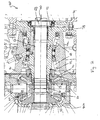
- Figure 2 is a cross-sectional view, partially broken away, of a wheel end incorporating the subject invention
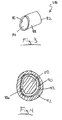
- Figure 3 is a perspective view of the blocking member of Figure 2.
- Figure 4 is a cross-section taken along lines 4-4 in Figure 2.
-
- The subject invention relates to a vehicle wheel end assembly that experiences air pressure build-up. The wheel end assembly can be any type of wheel end assembly lcnown in the art. The Figures depict a wheel end assembly as used in a vehicle having a central tire inflation assembly (OTIS). There are many different types of central tire inflation systems. It should be understood that the subject invention could be used on a wheel end for a vehicle using any of these various central tire inflation systems. The operation of CTIS is well known in the art and will not be discussed in detail. While a wheel end assembly as used in a vehicle having CTIS is shown, it should be understood that the subject invention could also be used in wheel end assemblies for vehicles that do not have CTIS.
- A
wheel end assembly 10, designed according to the prior art, is shown in Figure 1. The wheel end assembly includes aspindle 12 that is mounted to a non-rotating axle component, such as anaxle housing 14. Theaxle housing 14 is mounted to a vehicle structure or suspension component as is known in the art. A wheel hub 16 is supported on abearing assembly 18 for rotation relative to thespindle 12. The hub 16 includes a main portion 16a and a cover portion 16b. A rim and tire assembly (not shown) is mounted to the wheel hub 16 as is known in the art. - An
axle shaft 20 extends through abore 22 formed within thespindle 12 to provide driving torque to the wheel hub 16. Theaxle shaft 20 receives torque input from a vehicle engine/transmission (not shown). Thebore 22 is centrally formed within thespindle 12 and extends through the length of thespindle 12. - The
axle shaft 20 drives a wheelend gear assembly 24 that is operably coupled to the wheel hub 16. A chamber 26 is formed within the hub 16, which includes a lubricating fluid for the wheel end components, such as thegear assembly 24 andbearing assembly 18. The chamber 26 defines afluid path 28 that extends to the components in thegear assembly 24. The chamber 26 is formed within the body portion 16a of the hub 16 and is enclosed by the cover portion 16b. - The
axle shaft 20 rotates within thebore 22, relative to thespindle 12, about an axis ofrotation 30. Theaxle shaft 20 is spaced apart from an inner surface of thebore 22 such that a gap 32 is formed between theaxle shaft 20 and thespindle 12. The gap 32 forms a portion of a vent path 34 that extends from thegear assembly 24, through thespindle 12, and to anoutlet 36. - In the prior art
wheel end assembly 10 of Figure 1, thefluid path 28 and the vent path 34 have a common path portion, generally indicated at 38. During vehicle operation, as wheel end seals 35 of the CTIS leak or as temperature increases, air pressure builds up within thewheel end 10. This air is vented at theoutlet 36 via the vent path 34. Theoutlet 36 is typically at theaxle housing 14. During venting, some of the lubricating fluid from the chamber 26 enters the vent path 34 at thecommon path portion 36 and is vented from thewheel end 10. This decreases lubrication levels within thewheel end 10, which may result in premature component wear. - A wheel end assembly, including the subject invention, is shown generally at 40 in Figure 2. The
wheel end assembly 40 includes aspindle 42 that is mounted to a non-rotating axle component, such as anaxle housing 44. Theaxle housing 44 is mounted to a vehicle structure or suspension component as discussed above. Awheel hub 46 is supported on a bearingassembly 48 for rotation relative to thespindle 42. Thehub 46 includes a main body portion 46a and a cover portion 46b. A rim and tire assembly (not shown) is mounted to thewheel hub 46 as discussed above. - An
axle shaft 50 extends through a bore 52 formed within thespindle 42 to provide driving torque to thewheel hub 46. Theaxle shaft 50 receives torque input from a vehicle engine/transmission (not shown). The bore 52 is centrally formed within thespindle 42 and extends through the length of thespindle 42. - The
axle shaft 50 drives a wheel end gear assembly 54 that is operably coupled to thewheel hub 46. A chamber 56 is formed within thehub 46, which includes a lubricating fluid for the wheel end components, such as the gear assembly 54 and bearingassembly 48. The chamber 56 defines a fluid path 58 that extends to the components in the gear assembly 54. The chamber 56 is formed within the body portion 46a and is enclosed by the cover portion 46b. - The
axle shaft 50 rotates within the bore 52, relative to thespindle 42, about an axis of rotation 60. As described above, theaxle shaft 50 is operably coupled to the wheel end gear assembly 54. In the embodiment shown in Figure 2, the wheel end gear assembly 54 includes a first gear 62 splined to one end of theaxle shaft 50. The first gear 62 is in meshing engagement with second 64 and third 66 gears supported on a wheel end cross member 68. The second 64 and third 66 gears are in meshing engagement with a fourth gear 70 that is splined to thespindle 42. Theaxle shaft 50 drives the first gear 62, which reacts with the second 64, third 66, and fourth 70 gears to drive thewheel hub 46. It should be understood that this specific gear configuration is used as an example of one gear configuration embodiment, and that the subject invention could be used with other types of gear assembly configurations. - The lubricating fluid in the chamber 56 flows along the fluid path 58 to lubricate the various components of the gear assembly 54. The
axle shaft 50 is spaced apart from an inner surface of the bore 52 such that agap 74 is formed between theaxle shaft 50 and thespindle 42. Thegap 74 forms a portion of a vent path 76 that extends from the gear assembly 54, through thespindle 42, and to anoutlet 78. Preferably, theoutlet 78 vents to theaxle housing 44, however, theoutlet 78 could also be to armosphere. - To prevent the venting of lubricating fluid from the
wheel end 40, a blockingmember 80 is used to block at least a portion of the fluid path 58 to prevent the lubricating fluid from entering the vent path 76. Preferably, the blockingmember 80 is supported by thespindle 42 and extends beyond an end face of thespindle 42 at the mouth of the bore 52 to block the fluid path 58. Preferably, blockingmember 80 extends into the gear assembly 54 to block the fluid path 58. As shown in Figure 2, the blockingmember 80 extends into a bore in the cross member 68. - As shown in Figure 3, the blocking
member 80 is preferably acylindrical sleeve 82 that includes acentral bore 84 having aninner bore surface 86. Preferably, anouter surface 88 of thesleeve 82 is inserted within the bore 52 in thespindle 42 to engage the spindle bore surface. Thesleeve 82 can be press-fit into the bore 52, threaded into the bore 52, snapped onto the end of thespindle 42, or attached by other similar means known in the art. Additionally, thesleeve 82 could also be inserted over the end of thespindle 42. Thesleeve 82 could be made from steel, plastic, or any suitable material known in the art that can withstand the temperatures and fluid environment within thewheel end 40. Optionally, thesleeve 82 could be formed as an integral part of thespindle 42. - When the
sleeve 82 is installed within the bore 52, as shown in Figure 4, theouter surface 88 is engaged against the bore 52 of thespindle 42. Theinner surface 86 of thesleeve 82 is spaced apart from theaxle shaft 50 to form agap 90. Thisgap 90 forms a portion of the vent path 76. - As shown in Figure 2, the
sleeve 82 extends beyond the end of thespindle 42 such that theouter surface 86 blocks at least a portion of the fluid path 58. The length that thesleeve 82 extends beyond thespindle 42 can vary depending upon vehicle application and wheel end gear assembly configuration. Thesleeve 82 allows air to be vented along the vent path 58 viagap 90 but limits or reduces the amount of fluid that enters the vent path 58. - The subject invention provides a wheel end assembly for a vehicle that allows air to be easily vented from the wheel end while reducing venting of lubricating fluid. Although a preferred embodiment of this invention has been disclosed, a worker of ordinary skill in this art would recognize that certain modifications would come within the scope of this invention. For that reason, the following claims should be studied to determine the true scope and content of this invention.
Claims (17)
- A vehicle wheel end assembly (40) comprising:a non-rotating wheel component (42) defining an inner bore;a rotating wheel component (46) supported on at least one bearing (48) for rotation relative to said non-rotating wheel component;a driven member (54) operably coupled to said rotating wheel component;a drive member (50) positioned within said inner bore an in driving engagement with said driven member;a chamber (56) defined within said rotating wheel component, said chamber being at least partially filled with a lubricating fluid and defining a fluid path (58) in communication with said driven member;a vent path (76) extending through said inner bore between said drive member and said non-rotating wheel component; anda blocking member (80) supported by said non-rotating wheel component to at least partially block said fluid path to allow air pressure build-up within said rotating wheel component to be vented via said vent path while reducing the amount of said lubricating fluid that enters said vent path.
- An assembly according to claim 1 wherein said blocking member comprises a cylindrical sleeve (82) concentric with said non-rotating wheel component.
- An assembly according to claim 2 wherein said sleeve includes an outer surface (88) in engagement with said inner bore and an inner surface (86) spaced apart from said drive member to define a portion (90) of said vent path.
- An assembly according to claim 2 or 3 wherein said non-rotating component (42) includes an end face defining a mouth of said inner bore and wherein said sleeve (82) extends outwardly beyond said end face such that a portion of said outer surface is exposed to block said fluid path.
- An assembly according to any preceding claim wherein said non-rotating wheel component comprises a spindle (42) mounted to an axle housing and said rotating wheel component comprises a hub (46) mounted for rotation relative to said spindle.
- An assembly according to any preceding claim wherein said vent path vents air via an outlet to said axle housing.
- An assembly according to any preceding claim wherein said driven member is a wheel end gear assembly (54) and said drive member is an axle shaft (50) coupled to said gear assembly.
- A vehicle wheel end assembly (40) comprising:a wheel hub (46);a wheel end gear assembly (54) operably coupled to said wheel hub to rotate said wheel hub about an axis of rotation;a fluid chamber (56) formed within said wheel hub, said chamber being at least partially filled with a lubricating fluid and defining a fluid path (58) in communication with said wheel end gear assembly;a vent path (76) extending from said wheel end gear assembly and through said wheel hub to an outlet for venting air from the wheel end assembly resulting from air pressure build-up during vehicle operation; anda blocking member (80) positioned within said wheel hub to at least partially block said fluid path to reduce the amount of said lubricating fluid that enters said vent path as air is vented from said vent path via said outlet.
- An assembly according to claim 8 including a spindle (42) mounted to a non-rotating vehicle structure wherein said wheel hub is supported on said spindle with at least one bearing wherein a portion of said vent path extends through said spindle.
- An assembly according to claim 8 or 9 including an axle shaft (50) coupled to said wheel end gear assembly (54) to provide driving torque to said wheel hub wherein said axle shaft extends through a bore (52) formed within said spindle.
- An assembly according to claim 8 or 9 or 10 wherein said blocking member comprises a cylindrical sleeve (82) supported by said spindle such that said axle shaft extends through said sleeve.
- An assembly according to any one of claims 8 to 11 wherein said sleeve includes an outer surface (88) in engagement with a portion of said inner bore and an inner surface (86) spaced apart from said axle shaft to define a gap that forms a portion of said vent path.
- An assembly according to any one of claims 8 to 12 wherein said sleeve (82) extends outwardly from one end of said spindle such that a portion of said outer surface (88)blocks fluid in said fluid path from entering said vent path.
- As assembly according to claim 8 or 9 or 10 wherein said blocking member is integrally formed with said spindle as one piece.
- A vehicle wheel end assembly (40) comprising:a spindle (42) mounted to an axle housing and including a bore extending through the length of said spindle;a hub (46) supported on said spindle via at least one bearing for rotation relative to said spindle;an axle shaft (50) mounted within said bore for providing driving torque to said hub;a gear assembly (54) reacting between said hub and said axle shaft to transfer driving torque from said axle shaft to said hub;a fluid path (58) defined within said hub for supplying a lubricating fluid to said gear assembly;a vent path (76) defined within said hub and extending at least from said gear assembly through said bore to an outlet; anda sleeve (82) extending outwardly from one end of said spindle to at least partially block said fluid path to prevent said lubricating fluid from entering said vent path as air is vented from said outlet.
- An assembly according to claim 15 wherein air is vented via said outlet to said axle housing.
- An assembly according to claim 15 or 16 wherein said sleeve includes a cylindrical body defining an inner surface (86) and an outer surface (88) with said cylindrical body being mounted within said bore such that said outer surface engages said bore with said axle shaft extending through said sleeve such that a gap is formed between said axle shaft and said inner surface to define a portion of said vent
Applications Claiming Priority (2)
| Application Number | Priority Date | Filing Date | Title |
|---|---|---|---|
| US27065301P | 2001-02-22 | 2001-02-22 | |
| US270653P | 2001-02-22 |
Publications (3)
| Publication Number | Publication Date |
|---|---|
| EP1234690A2 true EP1234690A2 (en) | 2002-08-28 |
| EP1234690A3 EP1234690A3 (en) | 2004-08-18 |
| EP1234690B1 EP1234690B1 (en) | 2005-10-05 |
Family
ID=23032227
Family Applications (1)
| Application Number | Title | Priority Date | Filing Date |
|---|---|---|---|
| EP02251239A Expired - Lifetime EP1234690B1 (en) | 2001-02-22 | 2002-02-22 | A vehicle wheel end assembly |
Country Status (4)
| Country | Link |
|---|---|
| US (1) | US6719028B2 (en) |
| EP (1) | EP1234690B1 (en) |
| DE (1) | DE60206430T2 (en) |
| ES (1) | ES2251564T3 (en) |
Cited By (2)
| Publication number | Priority date | Publication date | Assignee | Title |
|---|---|---|---|---|
| WO2008000283A1 (en) * | 2006-06-27 | 2008-01-03 | Ab Skf | Drive section for use in a bearing arrangement |
| US8469460B2 (en) | 2010-06-29 | 2013-06-25 | Arvinmeritor Technology, Llc | Spindle nut assembly |
Families Citing this family (33)
| Publication number | Priority date | Publication date | Assignee | Title |
|---|---|---|---|---|
| US9845862B2 (en) * | 2006-04-17 | 2017-12-19 | W. L. Gore & Associates, Inc. | Axle vent |
| US8915274B2 (en) * | 2009-01-22 | 2014-12-23 | Arvinmeritor Technology, Llc | Spindle for controlling wheel end endplay and preload |
| EP2354603A1 (en) * | 2010-02-09 | 2011-08-10 | Carl Freudenberg KG | Seal between a fixed machine component and a second machine component rotating around it |
| JP5605196B2 (en) * | 2010-12-09 | 2014-10-15 | コベルコ建機株式会社 | Construction machine drive |
| WO2012159779A1 (en) * | 2011-05-23 | 2012-11-29 | Schaeffler Technologies AG & Co. KG | Rolling bearing arrangement with clamping means which support a positive locking action |
| CN107031275B (en) * | 2012-02-21 | 2020-09-22 | 横滨橡胶株式会社 | Wheel and air pressure adjusting device |
| US9126460B2 (en) | 2012-03-02 | 2015-09-08 | Dana Heavy Vehicle Systems Group, Llc | Tire inflation system having a sleeve shaped air passage |
| EP2653323B1 (en) * | 2012-04-19 | 2016-03-23 | DANA ITALIA S.p.A | Spindle assembly for a tire inflation system |
| DE102013205399A1 (en) * | 2013-03-27 | 2014-10-02 | Robert Bosch Gmbh | Wheel hub drive with a planetary gear |
| US9333813B2 (en) * | 2013-08-13 | 2016-05-10 | Arvinmeritor Technology, Llc | Tire inflation system having a passage for routing pressurized gas through a flange |
| US9452644B2 (en) * | 2013-09-18 | 2016-09-27 | Arvinmeritor Technology, Llc | Tire inflation system with a passage for routing pressurized gas |
| US9539865B2 (en) * | 2013-10-10 | 2017-01-10 | Arvinmeritor Technology, Llc | Tire inflation system having a sleeve assembly for routing pressurized gas |
| US9162539B2 (en) * | 2014-01-24 | 2015-10-20 | American Axle & Manufacturing, Inc. | Axle assembly having wheel hubs configured for use in vehicle with central tire inflation system |
| CA2954021A1 (en) | 2014-07-02 | 2016-01-07 | Dana Italia S.P.A. | Rotary seal for a central tire inflation system |
| US10639579B2 (en) | 2014-10-01 | 2020-05-05 | Donaldson Company, Inc. | Pleated tank vent |
| US20160152100A1 (en) * | 2014-10-24 | 2016-06-02 | Kyle Berkness | Apparatus for delivering air through powered axle assemblies |
| JP6781705B2 (en) | 2015-01-28 | 2020-11-04 | ドナルドソン カンパニー,インコーポレイティド | Barrier vent assembly |
| EP3075574B1 (en) | 2015-03-31 | 2017-11-08 | Meritor Heavy Vehicle Systems Cameri SpA | Actuator |
| US10562357B2 (en) | 2015-06-12 | 2020-02-18 | Dana Heavy Vehicle Systems Group, Llc | Rotary joint air collector ring and the tire inflation system made therewith |
| US10556469B2 (en) | 2015-09-17 | 2020-02-11 | Dana Heavy Vehicle Systems Group, Llc | Hub cap assembly and a wheel end assembly for a tire inflation system |
| EP3318427A1 (en) * | 2016-11-04 | 2018-05-09 | DANA ITALIA S.r.l. | Rotary joint assembly for a tire inflation system |
| US10052913B2 (en) | 2016-11-09 | 2018-08-21 | Arvinmeritor Technology, Llc | Wheel end assembly having a seal interface with a tone ring |
| US10807413B2 (en) * | 2017-02-02 | 2020-10-20 | Dana Heavy Vehicle Systems Group, Llc | Front axle wheel assembly and the tire inflation system made therewith |
| US10293636B2 (en) | 2017-05-03 | 2019-05-21 | Arvinmeritor Technology, Llc | Wheel end assembly having a deflector |
| US10899174B2 (en) | 2018-03-15 | 2021-01-26 | Arvinmeritor Technology, Llc | Wheel end assembly having a compression ring and method of assembly |
| DE102017211574A1 (en) * | 2017-07-06 | 2019-01-10 | Deere & Company | Rotary feedthrough for a tire inflation system |
| US11602952B2 (en) * | 2020-08-12 | 2023-03-14 | Arvinmeritor Technology, Llc | Wheel end assembly having a vent passage |
| US11117426B1 (en) * | 2021-03-24 | 2021-09-14 | Ptg Reifendruckregelsysteme Gmbh | Rotary transmission leadthrough as part of a tire pressure control system |
| US12583266B2 (en) | 2022-05-09 | 2026-03-24 | Deere & Company | Tire inflation system |
| US12311699B2 (en) * | 2022-06-29 | 2025-05-27 | Arvinmeritor Technology, Llc | Wheel end assembly |
| US12220941B2 (en) * | 2022-07-20 | 2025-02-11 | Arvinmeritor Technology, Llc | Axle assembly having a wheel end assembly and a gear reduction unit |
| AU2023324834A1 (en) * | 2022-08-19 | 2025-02-27 | Consolidated Metco, Inc. | Wheel hub with passageway |
| US12611894B2 (en) * | 2023-06-29 | 2026-04-28 | Rivian Ip Holdings, Llc | Automatic tire inflation system |
Family Cites Families (9)
| Publication number | Priority date | Publication date | Assignee | Title |
|---|---|---|---|---|
| US2543811A (en) * | 1946-02-01 | 1951-03-06 | Euclid Road Machinery Co | Axle with wheel-type planetary drive |
| US2529330A (en) * | 1948-02-20 | 1950-11-07 | Euclid Road Machinery Co | Double planetary drive axle |
| US5080156A (en) * | 1990-02-12 | 1992-01-14 | Bartos Josef A | Vehicle wheel and axle assembly for controlling air pressure in tires with spaces between the bearing elements and the race members included in the air flow path |
| US5190355A (en) * | 1991-07-05 | 1993-03-02 | Eaton Corporation | Seal for drive-wheel-hub assembly |
| US6017097A (en) * | 1997-12-29 | 2000-01-25 | Weir, Iii; Robert Spence | Wheel hub assembly |
| US6182727B1 (en) * | 1999-06-30 | 2001-02-06 | Dana Corporation | Rotary air coupling for tire inflation system |
| US6363985B1 (en) * | 2000-04-18 | 2002-04-02 | Spice Technology, Inc. | Rotary air coupling for tire inflation system |
| US6325123B1 (en) * | 1999-12-23 | 2001-12-04 | Dana Corporation | Tire inflation system for a steering knuckle wheel end |
| US6422369B1 (en) * | 2000-09-28 | 2002-07-23 | Warn Industries, Inc. | Vehicle wheel end clutch |
-
2002
- 2002-02-22 DE DE60206430T patent/DE60206430T2/en not_active Expired - Fee Related
- 2002-02-22 EP EP02251239A patent/EP1234690B1/en not_active Expired - Lifetime
- 2002-02-22 US US10/080,838 patent/US6719028B2/en not_active Expired - Fee Related
- 2002-02-22 ES ES02251239T patent/ES2251564T3/en not_active Expired - Lifetime
Non-Patent Citations (1)
| Title |
|---|
| None |
Cited By (2)
| Publication number | Priority date | Publication date | Assignee | Title |
|---|---|---|---|---|
| WO2008000283A1 (en) * | 2006-06-27 | 2008-01-03 | Ab Skf | Drive section for use in a bearing arrangement |
| US8469460B2 (en) | 2010-06-29 | 2013-06-25 | Arvinmeritor Technology, Llc | Spindle nut assembly |
Also Published As
| Publication number | Publication date |
|---|---|
| DE60206430D1 (en) | 2006-02-16 |
| EP1234690B1 (en) | 2005-10-05 |
| ES2251564T3 (en) | 2006-05-01 |
| US20020112802A1 (en) | 2002-08-22 |
| DE60206430T2 (en) | 2006-06-29 |
| US6719028B2 (en) | 2004-04-13 |
| EP1234690A3 (en) | 2004-08-18 |
Similar Documents
| Publication | Publication Date | Title |
|---|---|---|
| EP1234690B1 (en) | A vehicle wheel end assembly | |
| EP0379355B1 (en) | Rotary wheel-end assembly for tire inflation system | |
| US7967045B2 (en) | Drive axle with air passage for tire inflation system | |
| US8397774B2 (en) | Tire inflation system with integrated wheel seal | |
| US5520589A (en) | Differential | |
| US8915274B2 (en) | Spindle for controlling wheel end endplay and preload | |
| US5658053A (en) | Shaft re-greasing hub | |
| KR100190556B1 (en) | Seal of Drive Wheel Hub Assembly | |
| US5404963A (en) | Power divider lubrication in tandem driving axles | |
| AU660595B2 (en) | Lubricant pumping in tandem drive axles | |
| US7185688B2 (en) | Central tire inflation system for drive axle | |
| US20170072751A1 (en) | Apparatus for delivering air through powered axle assemblies | |
| US7958969B2 (en) | Transfer device for vehicle | |
| CN104245368A (en) | Tire inflation system with sleeve-like air path | |
| EP4452672B1 (en) | Rotor with breather and anti-rotation arrangement for tire calibration arrangements | |
| CA1267856A (en) | Compressor drive with oil distribution sleeve | |
| CS236889B2 (en) | Device for inflating of tyres of motor vehicle with planet hub wheel | |
| EP0084733A1 (en) | Drive axle fluid system | |
| RU240286U1 (en) | A vehicle hub assembly with adjustable tire pressure | |
| SU1047741A1 (en) | Arrangement for locking wheel vehicle differential gear | |
| JPS6212664Y2 (en) | ||
| PL241274B1 (en) | Reduction gear |
Legal Events
| Date | Code | Title | Description |
|---|---|---|---|
| PUAI | Public reference made under article 153(3) epc to a published international application that has entered the european phase |
Free format text: ORIGINAL CODE: 0009012 |
|
| AK | Designated contracting states |
Kind code of ref document: A2 Designated state(s): AT BE CH CY DE DK ES FI FR GB GR IE IT LI LU MC NL PT SE TR |
|
| AX | Request for extension of the european patent |
Free format text: AL;LT;LV;MK;RO;SI |
|
| RAP1 | Party data changed (applicant data changed or rights of an application transferred) |
Owner name: ARVINMERITOR TECHNOLOGY, LLC |
|
| PUAL | Search report despatched |
Free format text: ORIGINAL CODE: 0009013 |
|
| AK | Designated contracting states |
Kind code of ref document: A3 Designated state(s): AT BE CH CY DE DK ES FI FR GB GR IE IT LI LU MC NL PT SE TR |
|
| AX | Request for extension of the european patent |
Extension state: AL LT LV MK RO SI |
|
| RIC1 | Information provided on ipc code assigned before grant |
Ipc: 7B 60B 27/00 A Ipc: 7B 60C 23/00 B |
|
| 17P | Request for examination filed |
Effective date: 20040927 |
|
| GRAP | Despatch of communication of intention to grant a patent |
Free format text: ORIGINAL CODE: EPIDOSNIGR1 |
|
| AKX | Designation fees paid |
Designated state(s): DE ES FR GB IT |
|
| GRAS | Grant fee paid |
Free format text: ORIGINAL CODE: EPIDOSNIGR3 |
|
| GRAA | (expected) grant |
Free format text: ORIGINAL CODE: 0009210 |
|
| RBV | Designated contracting states (corrected) |
Designated state(s): DE ES FR GB IT |
|
| AK | Designated contracting states |
Kind code of ref document: B1 Designated state(s): DE ES FR GB IT |
|
| REG | Reference to a national code |
Ref country code: GB Ref legal event code: FG4D |
|
| REF | Corresponds to: |
Ref document number: 60206430 Country of ref document: DE Date of ref document: 20060216 Kind code of ref document: P |
|
| PGFP | Annual fee paid to national office [announced via postgrant information from national office to epo] |
Ref country code: FR Payment date: 20060217 Year of fee payment: 5 |
|
| PGFP | Annual fee paid to national office [announced via postgrant information from national office to epo] |
Ref country code: GB Payment date: 20060223 Year of fee payment: 5 |
|
| PGFP | Annual fee paid to national office [announced via postgrant information from national office to epo] |
Ref country code: ES Payment date: 20060224 Year of fee payment: 5 |
|
| PGFP | Annual fee paid to national office [announced via postgrant information from national office to epo] |
Ref country code: DE Payment date: 20060331 Year of fee payment: 5 |
|
| REG | Reference to a national code |
Ref country code: ES Ref legal event code: FG2A Ref document number: 2251564 Country of ref document: ES Kind code of ref document: T3 |
|
| ET | Fr: translation filed | ||
| PLBE | No opposition filed within time limit |
Free format text: ORIGINAL CODE: 0009261 |
|
| STAA | Information on the status of an ep patent application or granted ep patent |
Free format text: STATUS: NO OPPOSITION FILED WITHIN TIME LIMIT |
|
| 26N | No opposition filed |
Effective date: 20060706 |
|
| GBPC | Gb: european patent ceased through non-payment of renewal fee |
Effective date: 20070222 |
|
| REG | Reference to a national code |
Ref country code: FR Ref legal event code: ST Effective date: 20071030 |
|
| PGFP | Annual fee paid to national office [announced via postgrant information from national office to epo] |
Ref country code: IT Payment date: 20070630 Year of fee payment: 6 |
|
| PG25 | Lapsed in a contracting state [announced via postgrant information from national office to epo] |
Ref country code: DE Free format text: LAPSE BECAUSE OF NON-PAYMENT OF DUE FEES Effective date: 20070901 |
|
| PG25 | Lapsed in a contracting state [announced via postgrant information from national office to epo] |
Ref country code: FR Free format text: LAPSE BECAUSE OF NON-PAYMENT OF DUE FEES Effective date: 20070228 Ref country code: GB Free format text: LAPSE BECAUSE OF NON-PAYMENT OF DUE FEES Effective date: 20070222 |
|
| REG | Reference to a national code |
Ref country code: ES Ref legal event code: FD2A Effective date: 20070223 |
|
| PG25 | Lapsed in a contracting state [announced via postgrant information from national office to epo] |
Ref country code: ES Free format text: LAPSE BECAUSE OF NON-PAYMENT OF DUE FEES Effective date: 20070223 |
|
| PG25 | Lapsed in a contracting state [announced via postgrant information from national office to epo] |
Ref country code: IT Free format text: LAPSE BECAUSE OF NON-PAYMENT OF DUE FEES Effective date: 20080222 |