EP1234511A1 - Process for treating tobacco with catalytically active material for reducing toxic components in tobacco smoke - Google Patents
Process for treating tobacco with catalytically active material for reducing toxic components in tobacco smoke Download PDFInfo
- Publication number
- EP1234511A1 EP1234511A1 EP01810198A EP01810198A EP1234511A1 EP 1234511 A1 EP1234511 A1 EP 1234511A1 EP 01810198 A EP01810198 A EP 01810198A EP 01810198 A EP01810198 A EP 01810198A EP 1234511 A1 EP1234511 A1 EP 1234511A1
- Authority
- EP
- European Patent Office
- Prior art keywords
- tobacco
- catalytically active
- active material
- distributing
- conveyor belt
- Prior art date
- Legal status (The legal status is an assumption and is not a legal conclusion. Google has not performed a legal analysis and makes no representation as to the accuracy of the status listed.)
- Withdrawn
Links
- 241000208125 Nicotiana Species 0.000 title claims abstract description 79
- 235000002637 Nicotiana tabacum Nutrition 0.000 title claims abstract description 79
- 239000011149 active material Substances 0.000 title claims abstract description 29
- 238000000034 method Methods 0.000 title claims abstract description 23
- 239000000779 smoke Substances 0.000 title abstract description 15
- 231100000331 toxic Toxicity 0.000 title abstract description 3
- 230000002588 toxic effect Effects 0.000 title abstract description 3
- 239000011230 binding agent Substances 0.000 claims abstract description 6
- 238000003825 pressing Methods 0.000 claims abstract description 6
- 238000004519 manufacturing process Methods 0.000 claims abstract description 5
- 239000003054 catalyst Substances 0.000 claims description 22
- 239000010457 zeolite Substances 0.000 claims description 15
- 239000000463 material Substances 0.000 claims description 10
- 230000003197 catalytic effect Effects 0.000 claims description 8
- 239000011148 porous material Substances 0.000 claims description 7
- XAGFODPZIPBFFR-UHFFFAOYSA-N aluminium Chemical compound [Al] XAGFODPZIPBFFR-UHFFFAOYSA-N 0.000 claims description 5
- 229910052782 aluminium Inorganic materials 0.000 claims description 5
- 150000001875 compounds Chemical class 0.000 claims description 4
- 230000002378 acidificating effect Effects 0.000 claims description 2
- 230000003750 conditioning effect Effects 0.000 claims description 2
- 229910052710 silicon Inorganic materials 0.000 claims description 2
- 239000010703 silicon Substances 0.000 claims description 2
- 239000000853 adhesive Substances 0.000 claims 1
- 230000001070 adhesive effect Effects 0.000 claims 1
- 235000019504 cigarettes Nutrition 0.000 abstract description 9
- 239000002245 particle Substances 0.000 abstract description 8
- VYPSYNLAJGMNEJ-UHFFFAOYSA-N Silicium dioxide Chemical compound O=[Si]=O VYPSYNLAJGMNEJ-UHFFFAOYSA-N 0.000 description 9
- URGAHOPLAPQHLN-UHFFFAOYSA-N sodium aluminosilicate Chemical compound [Na+].[Al+3].[O-][Si]([O-])=O.[O-][Si]([O-])=O URGAHOPLAPQHLN-UHFFFAOYSA-N 0.000 description 8
- 239000002808 molecular sieve Substances 0.000 description 7
- 229910021536 Zeolite Inorganic materials 0.000 description 4
- HNPSIPDUKPIQMN-UHFFFAOYSA-N dioxosilane;oxo(oxoalumanyloxy)alumane Chemical group O=[Si]=O.O=[Al]O[Al]=O HNPSIPDUKPIQMN-UHFFFAOYSA-N 0.000 description 4
- 230000001473 noxious effect Effects 0.000 description 4
- 239000000377 silicon dioxide Substances 0.000 description 4
- 239000000126 substance Substances 0.000 description 4
- 239000004411 aluminium Substances 0.000 description 3
- 229910000323 aluminium silicate Inorganic materials 0.000 description 3
- 150000001768 cations Chemical class 0.000 description 3
- 239000000203 mixture Substances 0.000 description 3
- 230000000391 smoking effect Effects 0.000 description 3
- XUIMIQQOPSSXEZ-UHFFFAOYSA-N Silicon Chemical group [Si] XUIMIQQOPSSXEZ-UHFFFAOYSA-N 0.000 description 2
- 229910052681 coesite Inorganic materials 0.000 description 2
- 238000002485 combustion reaction Methods 0.000 description 2
- 229910052906 cristobalite Inorganic materials 0.000 description 2
- 239000013078 crystal Substances 0.000 description 2
- 239000012013 faujasite Substances 0.000 description 2
- 230000002209 hydrophobic effect Effects 0.000 description 2
- 229910052682 stishovite Inorganic materials 0.000 description 2
- 229910052905 tridymite Inorganic materials 0.000 description 2
- XLYOFNOQVPJJNP-UHFFFAOYSA-N water Substances O XLYOFNOQVPJJNP-UHFFFAOYSA-N 0.000 description 2
- 235000002918 Fraxinus excelsior Nutrition 0.000 description 1
- 150000001299 aldehydes Chemical class 0.000 description 1
- 238000013459 approach Methods 0.000 description 1
- 239000002956 ash Substances 0.000 description 1
- QVGXLLKOCUKJST-UHFFFAOYSA-N atomic oxygen Chemical compound [O] QVGXLLKOCUKJST-UHFFFAOYSA-N 0.000 description 1
- 229960000892 attapulgite Drugs 0.000 description 1
- 238000005341 cation exchange Methods 0.000 description 1
- 239000003795 chemical substances by application Substances 0.000 description 1
- 239000002734 clay mineral Substances 0.000 description 1
- 230000001143 conditioned effect Effects 0.000 description 1
- 230000018044 dehydration Effects 0.000 description 1
- 238000006297 dehydration reaction Methods 0.000 description 1
- 230000001419 dependent effect Effects 0.000 description 1
- 238000009826 distribution Methods 0.000 description 1
- 239000000428 dust Substances 0.000 description 1
- 230000000694 effects Effects 0.000 description 1
- 229920001971 elastomer Polymers 0.000 description 1
- 238000004924 electrostatic deposition Methods 0.000 description 1
- 230000009881 electrostatic interaction Effects 0.000 description 1
- 239000000835 fiber Substances 0.000 description 1
- 229910001679 gibbsite Inorganic materials 0.000 description 1
- 229910001387 inorganic aluminate Inorganic materials 0.000 description 1
- 229910052909 inorganic silicate Inorganic materials 0.000 description 1
- 238000005342 ion exchange Methods 0.000 description 1
- 239000013335 mesoporous material Substances 0.000 description 1
- 229910052680 mordenite Inorganic materials 0.000 description 1
- 150000004005 nitrosamines Chemical class 0.000 description 1
- 150000002892 organic cations Chemical class 0.000 description 1
- 238000006053 organic reaction Methods 0.000 description 1
- 229910052760 oxygen Inorganic materials 0.000 description 1
- 239000001301 oxygen Substances 0.000 description 1
- 125000004430 oxygen atom Chemical group O* 0.000 description 1
- 229910052625 palygorskite Inorganic materials 0.000 description 1
- 230000000704 physical effect Effects 0.000 description 1
- 230000008092 positive effect Effects 0.000 description 1
- 239000000843 powder Substances 0.000 description 1
- 230000000630 rising effect Effects 0.000 description 1
- 239000000523 sample Substances 0.000 description 1
- 229920006395 saturated elastomer Polymers 0.000 description 1
- 238000000926 separation method Methods 0.000 description 1
- 238000007873 sieving Methods 0.000 description 1
- 239000000741 silica gel Substances 0.000 description 1
- 229910002027 silica gel Inorganic materials 0.000 description 1
- 239000002594 sorbent Substances 0.000 description 1
- 238000001179 sorption measurement Methods 0.000 description 1
- 238000003860 storage Methods 0.000 description 1
- 238000003786 synthesis reaction Methods 0.000 description 1
- OSBSFAARYOCBHB-UHFFFAOYSA-N tetrapropylammonium Chemical compound CCC[N+](CCC)(CCC)CCC OSBSFAARYOCBHB-UHFFFAOYSA-N 0.000 description 1
- 231100000167 toxic agent Toxicity 0.000 description 1
- -1 zeolite compound Chemical class 0.000 description 1
Images

Classifications
-
- A—HUMAN NECESSITIES
- A24—TOBACCO; CIGARS; CIGARETTES; SIMULATED SMOKING DEVICES; SMOKERS' REQUISITES
- A24B—MANUFACTURE OR PREPARATION OF TOBACCO FOR SMOKING OR CHEWING; TOBACCO; SNUFF
- A24B15/00—Chemical features or treatment of tobacco; Tobacco substitutes, e.g. in liquid form
- A24B15/18—Treatment of tobacco products or tobacco substitutes
- A24B15/24—Treatment of tobacco products or tobacco substitutes by extraction; Tobacco extracts
- A24B15/241—Extraction of specific substances
- A24B15/246—Polycyclic aromatic compounds
-
- A—HUMAN NECESSITIES
- A24—TOBACCO; CIGARS; CIGARETTES; SIMULATED SMOKING DEVICES; SMOKERS' REQUISITES
- A24B—MANUFACTURE OR PREPARATION OF TOBACCO FOR SMOKING OR CHEWING; TOBACCO; SNUFF
- A24B15/00—Chemical features or treatment of tobacco; Tobacco substitutes, e.g. in liquid form
- A24B15/18—Treatment of tobacco products or tobacco substitutes
- A24B15/28—Treatment of tobacco products or tobacco substitutes by chemical substances
- A24B15/287—Treatment of tobacco products or tobacco substitutes by chemical substances by inorganic substances only
Definitions
- This invention relates to a process for treating tobacco with catalytically active material for reducing toxic components in tobacco smoke of smokers' articles, particularly of cigarettes.
- mainstream smoke is the smoke which enters the mouth of the smoker when he draws on the cigarette through the filter part
- sidestream smoke is the smoke which is released by the smoldering combustion of the cigarette in the interim phases. From technical literature it can be learned that approximately twice as much tobacco is burned during the glowing of a cigarette between the puffs than during the puffs.
- Described in EP-A-0740 907 are smokers' articles wherein the tobacco is comprises a catalyst of a zeolite compound. It is proposed that the catalyst in the tobacco be bound to the tobacco with or without a binding agent, such as silica gel or attapulgite, a meerschaum-like clay mineral. Attempts to fix catalyst particles on the tobacco by electrostatic deposition failed. The catalyst particles were observed to discharge on the tobacco fibers within seconds and sputtered. It was found that the use of binding agents has serious drawbacks because the catalytic activity of the material which is bound by the agent is affected. Without binding agent, the binding strength of the catalytically active material to the tobacco is not sufficient, and therefore a separation of the catalyst from the material can occur easily during the manufacturing process of smokers' articles or during transportation.
- a binding agent such as silica gel or attapulgite, a meerschaum-like clay mineral.
- the object of the present invention is therefore to propose a method for binding catalytically active material to tobacco without the above mentioned drawbacks.
- Zeolitic materials both natural and synthetic, in appropriate form, can have catalytic capabilities for various kinds of organic reactions.
- Zeolites are microporous crystalline aluminosilicates which have definite crystal structures having a large number of cavities connected to each other by channels. These cavities and channels are absolutely uniform in size, and their dimensions can be determined by probe molecules as well as by crystal structure analysis. In most cases these data are known and do not have to be determined further. Since the dimensions of these pores are such that they sorb molecules of particular dimensions while rejecting those of larger dimensions, these materials have come to be known as "molecular sieves" and are utilized in a variety of ways to take advantage of these properties.
- Such molecular sieves comprise a large variety of structural types (nearly 100; cf. W.M. Meier, D.H. Olson and Ch. Baerlocher, Atlas of Zeolite Structure Types, 4rd Edition, 1996, Elsevier) of crystalline aluminosilicates and isostructural materials with free pore diameters in the range of 0.3 to 1.3 nm or 3 to 13 ⁇ .
- These aluminosilicates can be described as a rigid three-dimensional network of SiO 4 and AlO 4 , wherein the tetrahedra are cross-linked by sharing of oxygen atoms, the ratio of all aluminium and silicon atoms to oxygen being 1:2.
- Such a network containing aluminium is negatively charged, and requires for charge balance one monovalent cation (e.g. Na or K) or half a divalent cation (e.g. Ca) for each Al in the network.
- monovalent cation e.g. Na or K
- divalent cation e.g. Ca
- Cation exchange is a possible means of fine tuning the critical pore diameter in a particular application.
- zeolite-like molecular sieves The pore volume of a typical zeolite is occupied by water molecules before dehydration.
- Dehydrated or activated zeolites are excellent sorbents for molecules which are small enough to pass through the apertures of the sieve.
- Syntheses using organic cations have led to "high silica zeolites", which contain only few Al in the network, if any at all, and the composition approaches that of SiO 2 .
- High silica zeolites are not unanimously considered to be zeolites; although they have the same kind of structure, their exchange capacities are comparatively low, their selectivities very different, and these materials are hydrophobic. Consequently they are referred to as zeolite-like molecular sieves in this specification, following widespread usage.
- the sieving effect of the molecular sieve is based on the pore size. Sorption is also controlled by electrostatic interactions. Many of the chemical and physical properties are dependent upon the Al content of the zeolite.
- a rising modulus means an increased temperature stability, up to 1000 °C in the case of silicalite, which is a molecular sieve with a pure SiO 2 framework structure.
- the selectivity of the inner surfaces changes from strongly polar and hydrophilic in the case of the molecular sieves rich in aluminium to a polar and hydrophobic in the case of a zeolite with a modulus > 400.
- the object of the present invention can be achieved by incorporating certain zeolites or zeolite-like molecular sieves or other catalytically active material, which fulfil the necessary catalytic criteria, into tobacco by distributing the catalytically active material regularly on conditioned tobacco and by pressing the catalytically active material on the tobacco.
- the catalytic properties of the material which is pressed on the tobacco can develop its catalytic activity completely.
- the advantage is that the pores of the material remain open.
- the method assures an even distribution of catalyst particles on the tobacco which is all-important.
- the subject matter of this invention is a process for treating of tobacco with catalytically active materials, e.g. zeolites as well as non-zeolites, like oxides of aluminum and silicon having a surface area of around 100 m2/g or more, consisting of the steps of
- the catalytic active material is distributed evenly on the smoking tobacco.
- the tobacco can comprise leaves or reconstituted tobacco sheets, cut or uncut.
- the tobacco is made reasonably soft by conditioning it, i.e. it has a defined degree of moisture. If the tobacco is too dry it is brittle and not suitable for receiving the catalytic material.
- the catalyst is pressed on the tobacco by a single or double layer cylinder press.
- a single or double layer cylinder press can work in combination with a conveyor belt.
- the process can be carried out with two or more distributing and pressing steps, e.g. on the upper and lower side of the tobacco.
- the catalyst content in relation to the tobacco is about 4 - 8 % (wt/wt).
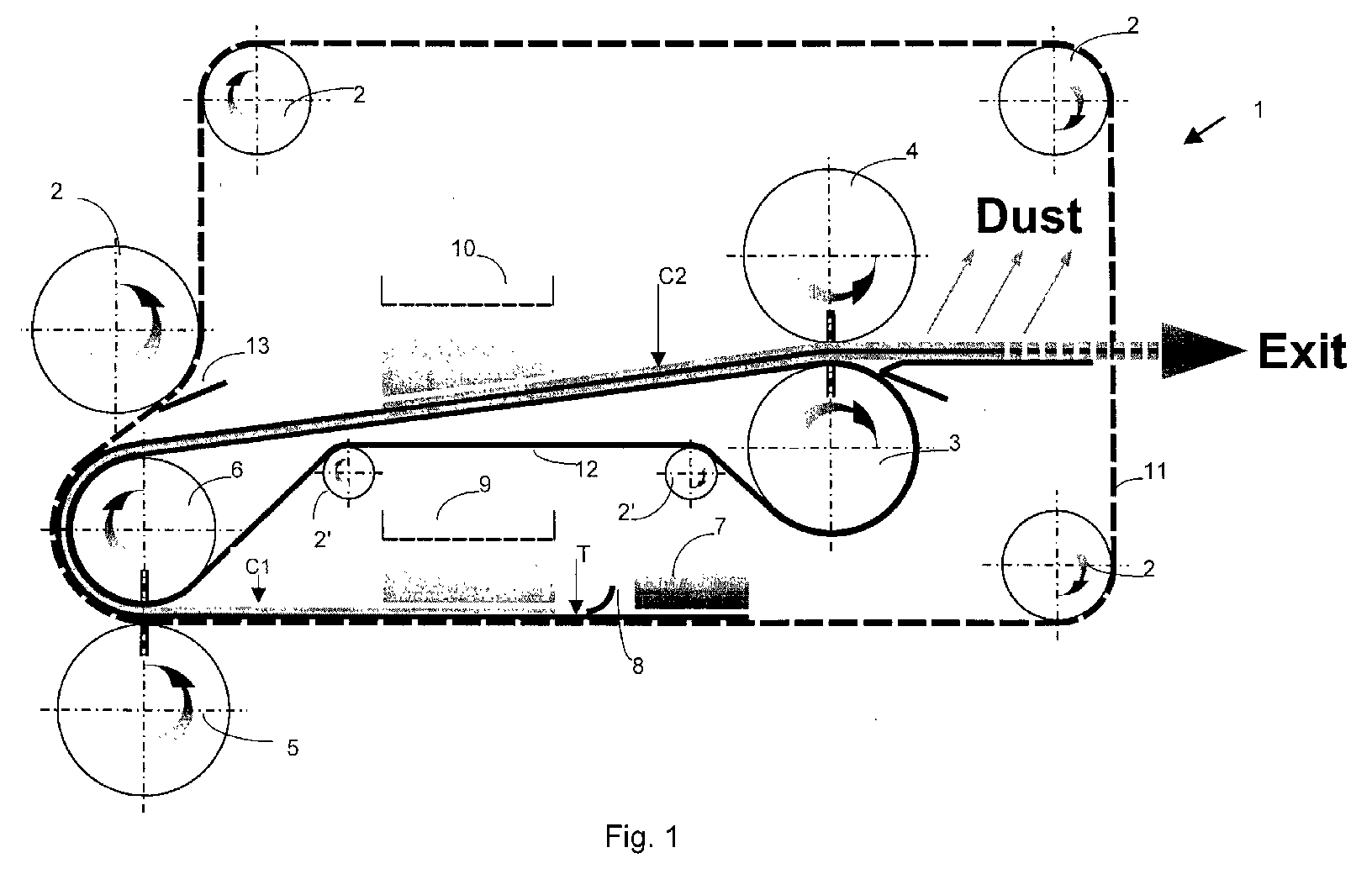
- the present invention is illustrated by the accompanying drawing showing a double layer cylinder press adapted to the method according to the present invention.
- FIG. 1 shows a double layer cylinder press 1 equipped with conveyor belts 11,12 and devices 7, 8, 9, 10 which are adapted to the present method.
- a first conveyor belt 11 is carried by the cylinders 2 and 6. Tobacco is distributed on the belt 11 by the tobacco dispenser 7.
- a flattener 8 is responsible for regularizing the distributed tobacco T.
- a suitable amount of catalytically active compound C1 is layered on the tobacco layer T by a catalyst supply device 9. After this step the belt 11 moves into a first cylinder press formed by the cylinders 5 and 6. These cylinders exercise an adjustable pressure on the tobacco/catalyst layer T, C1 for binding the catalyst on the soft tobacco particles.
- a second conveyor belt joins to the tobacco/catalyst layer at the catalyst side.
- the two conveyor belts carry the tobacco layer around the cylinder 6: the layer is now turned, i.e. the catalyst layer C1 is on the lower side of the layer and directly on the second conveyor belt 12, and is supported by this belt, whereas the first belt 11 is moving away from the tobacco layer.
- a scraper 13 is cleansing the first belt of tobacco particles, which fall back on the tobacco layer T.
- this layer moves on the second belt 12, passing a second catalyst supply 10, where a further layer C2 of catalytically active material is put on the tobacco layer T.
- the layers C1, T, C2 are introduced into a second cylinder press, formed by the cylinders 3 and 4, which exercise again a suitable pressure on the tobacco layer, carrying on both sides a catalyst layer.
- the loose catalyst is also bound on the tobacco particles of the layer on the belt 12.
- the dust of catalyst not bound is removed, and the tobacco carrying a catalytically active compound exits, and is ready for direct use or storage.
- acidic and hydrophilic zeolites saturated with water, including zeolites X, Y, L, mordenite and BETA, are used in the tobacco and are bound to the tobacco, without a binding agent, according to the present invention.
- these molecular sieves function as catalysts and, with respect to the noxious components of the smoke, have positive effects during combustion of the tobacco without a residue being left in the ashes which is harmful to the environment.
- the noxious substances such as lower aldehydes, nitrosamines and the like, are considerably reduced in the mainstream smoke and in the sidestream smoke, without affecting the taste.
- the tobacco blend type (Amercan blend Type) was received from a tobacco lot ready for cigarette manufacture and kept in a humidifier. 5% by weight of synthetic faujasite in powder form (obtained from CU Uetikon, Switzerland) were pressed on the tobacco in using a cylinder press rolled on a rubber belt. Hand rolled cigarettes of 1 g each were then prepared. In the sidestream a reduction of 50 % of PAH was observed using the method described by Meier and Siegmann, Microporous an Mesoporous Materials, 33 (1999) 307.
Landscapes
- Chemical & Material Sciences (AREA)
- Chemical Kinetics & Catalysis (AREA)
- General Chemical & Material Sciences (AREA)
- Health & Medical Sciences (AREA)
- General Health & Medical Sciences (AREA)
- Toxicology (AREA)
- Inorganic Chemistry (AREA)
- Cigarettes, Filters, And Manufacturing Of Filters (AREA)
Abstract
The process for preparing tobacco having bound catalytically active
materials on its surface, consists in treating tobacco with catalytically active
materials without the use of binding agents by the steps of distributing of
catalytically active material on tobacco particles and pressing the catalytically
active material on the tobacco particles. The treated tobacco is useful for
manufacturing smokers' articles, particularly of cigarettes having a reduced
amount of toxic components in the smoke.
For carrying out the process, a device (1) comprising the following
means is proposed:
Description
- This invention relates to a process for treating tobacco with catalytically active material for reducing toxic components in tobacco smoke of smokers' articles, particularly of cigarettes.
- As is well known, two kinds of smoke arise during the smoking of a cigarette, the mainstream smoke and the sidestream smoke. The mainstream smoke is the smoke which enters the mouth of the smoker when he draws on the cigarette through the filter part, while the sidestream smoke is the smoke which is released by the smoldering combustion of the cigarette in the interim phases. From technical literature it can be learned that approximately twice as much tobacco is burned during the glowing of a cigarette between the puffs than during the puffs.
- Although in the prior art many means of reducing the mainstream smoke of noxious substances have been proposed, there is still a need to improve the removal of the noxious substances from the main and sidestream smoke. Of particular significance is the reduction of toxic compounds in the sidestream.
- Described in EP-A-0740 907 are smokers' articles wherein the tobacco is comprises a catalyst of a zeolite compound. It is proposed that the catalyst in the tobacco be bound to the tobacco with or without a binding agent, such as silica gel or attapulgite, a meerschaum-like clay mineral. Attempts to fix catalyst particles on the tobacco by electrostatic deposition failed. The catalyst particles were observed to discharge on the tobacco fibers within seconds and sputtered. It was found that the use of binding agents has serious drawbacks because the catalytic activity of the material which is bound by the agent is affected. Without binding agent, the binding strength of the catalytically active material to the tobacco is not sufficient, and therefore a separation of the catalyst from the material can occur easily during the manufacturing process of smokers' articles or during transportation.
- The object of the present invention is therefore to propose a method for binding catalytically active material to tobacco without the above mentioned drawbacks.
- Zeolitic materials, both natural and synthetic, in appropriate form, can have catalytic capabilities for various kinds of organic reactions. Zeolites are microporous crystalline aluminosilicates which have definite crystal structures having a large number of cavities connected to each other by channels. These cavities and channels are absolutely uniform in size, and their dimensions can be determined by probe molecules as well as by crystal structure analysis. In most cases these data are known and do not have to be determined further. Since the dimensions of these pores are such that they sorb molecules of particular dimensions while rejecting those of larger dimensions, these materials have come to be known as "molecular sieves" and are utilized in a variety of ways to take advantage of these properties.
- Such molecular sieves comprise a large variety of structural types (nearly 100; cf. W.M. Meier, D.H. Olson and Ch. Baerlocher, Atlas of Zeolite Structure Types, 4rd Edition, 1996, Elsevier) of crystalline aluminosilicates and isostructural materials with free pore diameters in the range of 0.3 to 1.3 nm or 3 to 13 Å. These aluminosilicates can be described as a rigid three-dimensional network of SiO4 and AlO4, wherein the tetrahedra are cross-linked by sharing of oxygen atoms, the ratio of all aluminium and silicon atoms to oxygen being 1:2. Such a network containing aluminium is negatively charged, and requires for charge balance one monovalent cation (e.g. Na or K) or half a divalent cation (e.g. Ca) for each Al in the network. These cations can be exchanged either completely or partially using standard ion exchange techniques. Cation exchange is a possible means of fine tuning the critical pore diameter in a particular application.
- The pore volume of a typical zeolite is occupied by water molecules before dehydration. Dehydrated or activated zeolites are excellent sorbents for molecules which are small enough to pass through the apertures of the sieve. Syntheses using organic cations (such as tetrapropylammonium) have led to "high silica zeolites", which contain only few Al in the network, if any at all, and the composition approaches that of SiO2. High silica zeolites are not unanimously considered to be zeolites; although they have the same kind of structure, their exchange capacities are comparatively low, their selectivities very different, and these materials are hydrophobic. Consequently they are referred to as zeolite-like molecular sieves in this specification, following widespread usage.
- The sieving effect of the molecular sieve is based on the pore size. Sorption is also controlled by electrostatic interactions. Many of the chemical and physical properties are dependent upon the Al content of the zeolite. A rising modulus means an increased temperature stability, up to 1000 °C in the case of silicalite, which is a molecular sieve with a pure SiO2 framework structure. The selectivity of the inner surfaces changes from strongly polar and hydrophilic in the case of the molecular sieves rich in aluminium to a polar and hydrophobic in the case of a zeolite with a modulus > 400.
- It has been discovered that the object of the present invention can be achieved by incorporating certain zeolites or zeolite-like molecular sieves or other catalytically active material, which fulfil the necessary catalytic criteria, into tobacco by distributing the catalytically active material regularly on conditioned tobacco and by pressing the catalytically active material on the tobacco. When incorporated into the tobacco rod of a cigarette, the catalytic properties of the material which is pressed on the tobacco can develop its catalytic activity completely. The advantage is that the pores of the material remain open. Moreover the method assures an even distribution of catalyst particles on the tobacco which is all-important.
- The subject matter of this invention is a process for treating of tobacco with catalytically active materials, e.g. zeolites as well as non-zeolites, like oxides of aluminum and silicon having a surface area of around 100 m2/g or more, consisting of the steps of
- a) distributing of catalytically active material on tobacco,
- b) pressing the catalytically active material on the tobacco.
-
- Advantageously the catalytic active material is distributed evenly on the smoking tobacco. The tobacco can comprise leaves or reconstituted tobacco sheets, cut or uncut.
- Advantageously the tobacco is made reasonably soft by conditioning it, i.e. it has a defined degree of moisture. If the tobacco is too dry it is brittle and not suitable for receiving the catalytic material.
- Preferably the catalyst is pressed on the tobacco by a single or double layer cylinder press. For a continuous working process such a press can work in combination with a conveyor belt. The process can be carried out with two or more distributing and pressing steps, e.g. on the upper and lower side of the tobacco. Normally the catalyst content in relation to the tobacco is about 4 - 8 % (wt/wt).
- The present invention is illustrated by the accompanying drawing showing a double layer cylinder press adapted to the method according to the present invention.
- Figure 1 shows a double layer cylinder press 1 equipped with
conveyor belts devices first conveyor belt 11 is carried by thecylinders 2 and 6. Tobacco is distributed on thebelt 11 by the tobacco dispenser 7. Aflattener 8 is responsible for regularizing the distributed tobacco T. A suitable amount of catalytically active compound C1 is layered on the tobacco layer T by a catalyst supply device 9. After this step thebelt 11 moves into a first cylinder press formed by thecylinders 5 and 6. These cylinders exercise an adjustable pressure on the tobacco/catalyst layer T, C1 for binding the catalyst on the soft tobacco particles. In the first cylinder press, a second conveyor belt joins to the tobacco/catalyst layer at the catalyst side. The two conveyor belts carry the tobacco layer around the cylinder 6: the layer is now turned, i.e. the catalyst layer C1 is on the lower side of the layer and directly on thesecond conveyor belt 12, and is supported by this belt, whereas thefirst belt 11 is moving away from the tobacco layer. Ascraper 13 is cleansing the first belt of tobacco particles, which fall back on the tobacco layer T. Then this layer moves on thesecond belt 12, passing asecond catalyst supply 10, where a further layer C2 of catalytically active material is put on the tobacco layer T. Subsequently the layers C1, T, C2 are introduced into a second cylinder press, formed by the cylinders 3 and 4, which exercise again a suitable pressure on the tobacco layer, carrying on both sides a catalyst layer. In this step the loose catalyst is also bound on the tobacco particles of the layer on thebelt 12. After the passage of the second cylinder press, the dust of catalyst not bound is removed, and the tobacco carrying a catalytically active compound exits, and is ready for direct use or storage. Somewhat simpler devices based on the same principle can also be thought of. - For example, acidic and hydrophilic zeolites, saturated with water, including zeolites X, Y, L, mordenite and BETA, are used in the tobacco and are bound to the tobacco, without a binding agent, according to the present invention. At higher temperatures, these molecular sieves function as catalysts and, with respect to the noxious components of the smoke, have positive effects during combustion of the tobacco without a residue being left in the ashes which is harmful to the environment. During the smoking of tobacco articles which are equipped in the aforementioned way, the noxious substances, such as lower aldehydes, nitrosamines and the like, are considerably reduced in the mainstream smoke and in the sidestream smoke, without affecting the taste.
- The tobacco blend type (Amercan blend Type) was received from a tobacco lot ready for cigarette manufacture and kept in a humidifier. 5% by weight of synthetic faujasite in powder form (obtained from CU Uetikon, Switzerland) were pressed on the tobacco in using a cylinder press rolled on a rubber belt. Hand rolled cigarettes of 1 g each were then prepared. In the sidestream a reduction of 50 % of PAH was observed using the method described by Meier and Siegmann, Microporous an Mesoporous Materials, 33 (1999) 307.
- Following the same procedure as described in Example 1 but using synthetic gibbsite (obtained from Fluka, Switzerland) instead of faujasite was also tried. In the sidestream a reduction of 44 % of PAH was observed in this instance. In both instances the amount of loosely attached catalyst was found to be significantly below 10 % of the total amount of catalyst.
Claims (11)
- A process for preparing tobacco having bound catalytically active materials on its surface, consisting in treating of tobacco with catalytically active materials without the use of binding agents by the steps ofc) distributing catalytically active material on tobaccod) pressing the catalytically active material on the tobacco.
- The process of claim 1, wherein the tobacco consists of cut or uncut tobacco leaves or reconstituted tobacco sheets.
- The process of claim 1 or 2, wherein the catalytically active material is selected from a group consisting of zeolites and acidic oxides of aluminum and silicon.
- The process of one of the claims 1 to 3, wherein the tobacco is made reasonably soft by conditioning it, i.e. by conferring a defined degree of moisture.
- The process of one of the claims 1 to 4, wherein the catalyst is pressed on the tobacco by a single or double layer cylinder press.
- The process of claim 5, wherein the tobacco and the catalytically active material are moved with a conveyor belt into the cylinder press.
- The process of one of the claims 1 to 6, wherein additional distributing and pressing steps are carried out.
- The process of one of the claims 1 to 7, wherein the surface area of the catalytically active compound is about 100 m2/g.
- The process of one of the claims 1 to 8, wherein the content of catalytically active compound in relation to the tobacco is about 4 -8 % (wt/wt).
- A device (1) for carrying out the process of one of the claims 1 to 9 comprising the following means:a) at least one conveyor belt (11, 12) for carrying the tobacco Tb) a device (2) for supplying and distributing tobacco on the conveyor belt (11)c) at least one device (9, 10) for supplying and distributing catalytically active material (C1, C2) on the tobacco on the conveyor beltd) at least one driving means for driving simultaneously the conveyor belt(s) and the devices for supplying and distributing tobacco and catalytically active material.
- Tobacco material consisting of cut or uncut tobacco leaves or reconstituted tobacco sheets carrying a catalytic active material for improving the burning process wherein the catalytically active material is pressed into the tobacco surface for being bound without an adhesive, for avoiding that the catalytically active material is partially or completely inactivated by closed pores.
Priority Applications (3)
| Application Number | Priority Date | Filing Date | Title |
|---|---|---|---|
| EP01810198A EP1234511A1 (en) | 2001-02-26 | 2001-02-26 | Process for treating tobacco with catalytically active material for reducing toxic components in tobacco smoke |
| EP01810928A EP1234512A3 (en) | 2001-02-26 | 2001-09-24 | Tobacco product carrying catalytically active material, its use in a smokers' article and a process for preparing it |
| US10/078,492 US20020195115A1 (en) | 2001-02-26 | 2002-02-21 | Tobacco product carrying catalytically active material and its use in a smokers' article |
Applications Claiming Priority (1)
| Application Number | Priority Date | Filing Date | Title |
|---|---|---|---|
| EP01810198A EP1234511A1 (en) | 2001-02-26 | 2001-02-26 | Process for treating tobacco with catalytically active material for reducing toxic components in tobacco smoke |
Publications (1)
| Publication Number | Publication Date |
|---|---|
| EP1234511A1 true EP1234511A1 (en) | 2002-08-28 |
Family
ID=8183761
Family Applications (1)
| Application Number | Title | Priority Date | Filing Date |
|---|---|---|---|
| EP01810198A Withdrawn EP1234511A1 (en) | 2001-02-26 | 2001-02-26 | Process for treating tobacco with catalytically active material for reducing toxic components in tobacco smoke |
Country Status (1)
| Country | Link |
|---|---|
| EP (1) | EP1234511A1 (en) |
Cited By (1)
| Publication number | Priority date | Publication date | Assignee | Title |
|---|---|---|---|---|
| WO2008056011A1 (en) | 2006-11-07 | 2008-05-15 | Universidad De Alicante | Tobacco/catalyst mixtures for reducing toxic compounds in tobacco smoke |
Citations (5)
| Publication number | Priority date | Publication date | Assignee | Title |
|---|---|---|---|---|
| US3002863A (en) * | 1960-06-20 | 1961-10-03 | Richard J Shaw | Smoking tobacco mixture and method of making |
| US3703901A (en) * | 1971-03-11 | 1972-11-28 | Liggett & Myers Inc | Tobacco composition |
| US3840026A (en) * | 1972-08-23 | 1974-10-08 | Rosen Enterprises Inc | Method of treating tobacco |
| EP0740907A1 (en) * | 1995-05-03 | 1996-11-06 | F. J. Burrus SA | Smoker's article |
| US5671758A (en) * | 1994-12-13 | 1997-09-30 | Rongved; Paul I. | Catalytic cigarette smoke cleaning devise and process |
-
2001
- 2001-02-26 EP EP01810198A patent/EP1234511A1/en not_active Withdrawn
Patent Citations (5)
| Publication number | Priority date | Publication date | Assignee | Title |
|---|---|---|---|---|
| US3002863A (en) * | 1960-06-20 | 1961-10-03 | Richard J Shaw | Smoking tobacco mixture and method of making |
| US3703901A (en) * | 1971-03-11 | 1972-11-28 | Liggett & Myers Inc | Tobacco composition |
| US3840026A (en) * | 1972-08-23 | 1974-10-08 | Rosen Enterprises Inc | Method of treating tobacco |
| US5671758A (en) * | 1994-12-13 | 1997-09-30 | Rongved; Paul I. | Catalytic cigarette smoke cleaning devise and process |
| EP0740907A1 (en) * | 1995-05-03 | 1996-11-06 | F. J. Burrus SA | Smoker's article |
Cited By (1)
| Publication number | Priority date | Publication date | Assignee | Title |
|---|---|---|---|---|
| WO2008056011A1 (en) | 2006-11-07 | 2008-05-15 | Universidad De Alicante | Tobacco/catalyst mixtures for reducing toxic compounds in tobacco smoke |
Similar Documents
| Publication | Publication Date | Title |
|---|---|---|
| EP0740907B1 (en) | Smoker's article | |
| US4744374A (en) | Hydrophobic, crystalline, microporous silaceous materials of regular geometry | |
| RU2277364C2 (en) | Cigarette with reduced release of side-stream smoke, having burning paper | |
| US8381738B2 (en) | Composite materials and their use in smoking articles | |
| JP7121018B2 (en) | Particle sorbent material and method of making same | |
| RU2020112809A (en) | EVAPORATORS CONTAINING VEGETABLE MATERIAL | |
| US20060260626A1 (en) | Activated carbons with molecular sieve membranes and their use as adsorbents in smoking articles | |
| EP0166764B1 (en) | Hydrophobic, crystalline, microporous silaceous materials of regular geometry | |
| RU2291657C2 (en) | Smoking filter and smoking article | |
| US20120247491A1 (en) | Smoking articles comprising copper-exchanged molecular sieves | |
| CA2504850C (en) | Tobacco smoke filter | |
| EP1234512A2 (en) | Tobacco product carrying catalytically active material, its use in a smokers' article and a process for preparing it | |
| US20040056343A1 (en) | Getters | |
| US4246009A (en) | Smoke filter material and use thereof | |
| US20050161055A1 (en) | Filter unit for filter-cigarettes and filter cigarettes | |
| US7610920B2 (en) | Thiol-functionalized sorbent for smoking articles and filters for the removal of heavy metals from mainstream smoke | |
| US20050133049A1 (en) | Smoking articles and filters including zeolite molecular sieve sorbent | |
| WO1992005714A1 (en) | Filtration of tobacco smoke | |
| JPH10507630A (en) | Filter for cigarette smoke | |
| Gao et al. | New strategy to reduce the harmful effects of smoking: Reducing the level of N‐nitrosamines in mainstream smoke by NaA zeolite and in vitro and in vivo investigations | |
| MXPA96001643A (en) | Article for smoking | |
| Radojičić et al. | Effect of type and mode of zeolite application on the cigarette filters efficiency and sorption capacity | |
| JPH09169519A (en) | Silicon-rich zeolite, method for preparing the same and method for removing mercury from gas | |
| RU2668752C1 (en) | Cigarette filter | |
| KR19980021433A (en) | Porous body composed of cement and functional powder, its manufacturing method and product using the same |
Legal Events
| Date | Code | Title | Description |
|---|---|---|---|
| PUAI | Public reference made under article 153(3) epc to a published international application that has entered the european phase |
Free format text: ORIGINAL CODE: 0009012 |
|
| AK | Designated contracting states |
Kind code of ref document: A1 Designated state(s): AT BE CH CY DE DK ES FI FR GB GR IE IT LI LU MC NL PT SE TR |
|
| AX | Request for extension of the european patent |
Free format text: AL;LT;LV;MK;RO;SI |
|
| AKX | Designation fees paid | ||
| REG | Reference to a national code |
Ref country code: DE Ref legal event code: 8566 |
|
| STAA | Information on the status of an ep patent application or granted ep patent |
Free format text: STATUS: THE APPLICATION IS DEEMED TO BE WITHDRAWN |
|
| 18D | Application deemed to be withdrawn |
Effective date: 20030301 |