TECHNICAL FIELD AND INDUSTRIAL APPLICABILITY OF THE INVENTION
-
The present invention relates to an asymmetry organic peroxide, a crosslinking
agent comprising the same and a crosslinking process employing the same.
-
More particularly, the present invention relates to a crosslinking agent
for silicone rubber and to a crosslinking process which causes no sanitarily
problem and has excellent productivity, because the crosslinking efficiency
and the crosslinking speed thereof are high.
BACKGROUND OF THE INVENTION
-
Silicone rubber, natural rubber, ethylene-propylene rubber and
ethylene-propylene-diene rubber can be crosslinked by mixing organic peroxides
as crosslinking agents with the corresponding un-crosslinking compositions
and heating them. Crosslinked rubbers are used as automotive rubber parts such
as hose, cap, packing, oil seal and belt; golf balls, electrical wire and cable
coatings, tires, and so on.
Among the rubbers, silicone rubber is the most widely used rubber in the various
fields, as electrical wire and cable coatings, automotive parts, electronic
parts and medical products, because silicone rubber has excellent characters
such as high heat-resistance, wetherability and transparency as well as good
electrical properties.
-
Benzoyl peroxide, 4-chlorobenzoyl peroxide, 2,4-dichlorobenzoyl peroxide,
di-tert-butyl peroxide, dicumyl peroxide, tert-butylperoxy benzoate, and so
on are used as the above-described crosslinking agent.
-
Especially, only 2,4-dichlorobenzoyl peroxide has been used as a crosslinking
agent of silicone rubber for electrical wire and cable coatings and tubes produced
by extrusion molding applications in which previously shaped silicone rubber
is continuously extruded to an air oven and crosslinked by hot air.
-
However, the use of 2,4-dichlorobenzoyl peroxide as the crosslinking agent
for hot air crosslinking of silicone rubber moldings might cause blooming,
the gradual bleeding out of crosslinking agent decomposition products to whiten
the surfaces of the moldings. Therefore, the moldings require aftercrosslinking
at high temperature for a long time to prevent from blooming.
Furthermore, the use of 2,4-dichlorobenzoyl peroxide might also cause sanitary
problems because of the production of polychlorinatedbiphenyl as decomposition
products.
-
It was reported that organic peroxides such as 2-methylbenzoyl peroxide
(Japanese Published Unexamined Application No.59-18758),
substituted-dimethylbenzoyl peroxide (Japanese Published Unexamined
Application No.60-16968), substituted-trimethylbenzoyl peroxide (Japanese
Published Unexamined Application No.60-163860), 2-methoxbenzoyl peroxide
(Japanese Published Unexamined Application No. 59-232145), derivative of benzoyl
peroxide such as 4-methylbenzoyl peroxide (Japanese Published Unexamined
Application No.62-185750), and acylperoxy carboxylate (U.S. patent 4,051,310)
would be useful in place of the 2,4-dichlorobenzoyl peroxide as the crosslinking
agent.
-
However, there was a problem that in cases where 2-methylbenzoyl peroxide,
substituted dimethylbenzoyl peroxide, substituted trimethylbenzoyl peroxide,
4-methylbenzoyl peroxide or acylperoxy carboxylate were used, the crosslinking
speeds would become slower than the case where 2,4-dichlorobenzoyl peroxide
was used, which resulting in lower productivities.
On the other hand, there was a problem that in case where 2-methoxybenzoyl
peroxide is used, the crosslinking efficiency would become lower than that
in case where 2,4-dichlorobenzoyl peroxide is used. Therefore, neither of them
could be an alternative crosslinking agent to 2,4-dichlorobenzoyl peroxide.
-
In consideration of the above situations, the purpose of the present invention
is to provide an asymmetry organic peroxide having a specific structure, a
crosslinking agent for silicone rubber comprising the same and a crosslinking
process of silicone rubber employing the same.
According to the present invention, high productivity can be attained because
of the high crosslinking efficiency and the high crosslinking speed, and
aftercrosslinking is not necessary because no blooming, and no sanitarily
problems can be occur since there is no possibility of forming any high toxic
decomposition product.
SUMMARY OF THE INVENTION
-
After examining intensively the above-described problems, the inventors
found that they can be solved by what described hereinafter;
The asymmetry organic peroxide having at least one structure unit of
(substituted)benzoylperoxy carbonyloxy group represented by the following
formula (1) in the molecule thereof,
more particularly, the asymmetry organic peroxide comprising a
(substituted)benzoylperoxyalkyl carbonate, or a
(substituted)benzoylperoxyalkylene carbonate represented by the following
formula (2)
(wherein n stands for an integer of 1 to 6; m stands for an integer of 0 to
5; n and R corresponds to either of the following (a), (b) or (c), and m and
R' corresponds to either of the following (A), (B) or (C) :
- (a) in case of n is 1, R stands for an alkyl group of 1 to 20 carbon atoms,
whereas in case of n is in a range of 2 to 6, R stands for a linear or branched
hydrocarbon group of 1 to 20 carbon atoms.
- (b) in case of n is 1, R stands for a cycloalkyl group of 3 to 10 carbon
atoms, or a substituted cycloalkyl group of 4 to 10 carbon atoms substituted
by an alkyl group of 1 to 4 carbon atoms, whereas in case of n is in a range
of 2 to 4, R stands for a cyclohexanediyldimethylene group, a cyclohexylene
group, a bicyclohexylene group, or a hydrocarbon group of 13 to 25 carbon atoms
substituted by 2 to 4 of cyclohexylene groups.
- (c) in case of n is 1, R stands for an alkoxyalkyl group represented by
the formula -R1-O-R2 (wherein R1 stands for an alkylene group of 2 to 5 carbon
atoms, R2 stands for an alkyl group of 1 to 8 carbon aoms.), whereas in case
of n is 2, R stands for an oxoalkylene group represented by the formula - (R3-O-)k-R3-
(wherein k stands for 1 or 2, R3 stands for an alkylene group of 2 to 5 carbon
atoms).
- (A) m stands for 0, in other words, R' stands for a hydrogen atom.
- (B) m stands for an integer of 1 to 5, and R' stands for an alkyl group
of 1 to 6 carbon atoms, an alkoxy group of 1 to 6 carbon atoms, or a phenyl
group.
- (C) m stands for an integer of 1 to 5, and R' stands for a silyl group substituted
by either of an alkyl group of 1 to 6 carbon atoms, an alkoxy group of 1 to
6 carbon atoms, a phenyl group, or a vinyl group.
wherein, R' can be the same or different in each (substituted)benzoyl group,
and in each (substituted)benzoyl group ) in one molecule,
and the crosslinking agent comprising the above asymmetry organic peroxide,
and the crosslinking agent comprising the above asymmetry organic peroxide
and other conventional organic peroxide, and either one of the above-described
crosslinking agents further comprising silicone oil singly or in combination
with microparticulate silica.-
-
In case where either one of the above crosslinking agent was mixed with
a rubber and heated, unlike the case 2,4-dichlorobenzoyl peroxide was used,
aftercrosslinking was not necessary because no blooming and no sanitarily
problems could be occur since there was no possibility of forming any high
toxic decomposition product,
and higher productivity could be attained than in the case 2-methylbenzoyl
peroxide, dimethyl-substitutedbenzoyl peroxide, trimethyl-substitutedbenzoyl
peroxide, 4-methylbenzoyl peroxide or
acylperoxycarboxylate was used because of the high crosslinking speed , and
higher crosslinking efficiency could be attained than in the case
2-methoxybenzoyl peroxide was used, and further, the materiality of the obtained
rubber was excellent.
The present invention was completed as a result.
DETAILED DESCRIPTION OF THE PREFERED EMBODIMENTS
-
The present invention will be described hereinafter in detail.
-
The asymmetry organic peroxide of the present invention has at least one
structure unit of (substituted)benzoylperoxycarbonyloxy group represented by
the following formula (1) in the molecule thereof.
Herein, "an asymmetry organic peroxide" indicates an organic peroxide having
an asymmetrical structure in which different substituted groups of a
(substituted)benzoyl group and a carbonyloxy group are bonded to each peroxide
bond (-OO-) thereof, including an organic peroxide of a symmetrical structure
as the compound.
-
More particularly, the asymmetry organic peroxide comprises a
(substituted)benzoylperoxyalkyl carbonate, or a
(substituted)benzoylperoxyalkylene carbonate represented by the following
formula (2)
-
In the formula (2), n stands for an integer of 1 to 6; m stands for an integer
of 0 to 5; n and R correspond to either of the following (a), (b) or (c), and
m and R' correspond to either of the following (A), (B) or (C):
- (a) in case of n is 1, R stands for an alkyl group of 1 to 20 carbon atoms,
whereas in case of n is in a range of 2 to 6, R stands for a linear or branched
hydrocarbon group of 1 to 20 carbon atoms.
- (b) in case of n is 1, R stands for a cycloalkyl group of 3 to 10 carbon
atoms, or a substituted cycloalkyl group of 4 to 10 carbon atoms substituted
by an alkyl group of 1 to 4 carbon atoms, whereas in case of n is in a range
of 2 to 4, R stands for a cyclohexanediyldimethylene group, a cyclohexylene
group, a bicyclohexylene group, or a hydrocarbon group of 13 to 25 carbon atoms
substituted by 2 to 4 of cyclohexylene groups.
- (c) in case of n is 1, R stands for an alkoxyalkyl group represented by
the formula -R1-O-R2 (wherein R1 stands for an alkylene group of 2 to 5 carbon
atoms, R2 stands for an alkyl group of 1 to 8 carbon aoms), whereas in case
of n is 2, R stands for an oxoalkylene group represented by the formula- (R3-O-)k-R3-
(wherein k stands for 1 or 2, and R3 stands for an alkylene group of 2 to 5
carbon atoms).
- (A) m stands for 0, in other words, R' stands for a hydrogen atom.
- (B) m stands for an integer of 1 to 5, and R' stands for an alkyl group
of 1 to 6 carbon atoms, an alkoxy group of 1 to 6 carbon atoms, or a phenyl
group.
- (C) mstands for an integer of 1 to 5, and R' stands for a silyl group substituted
by either of an alkyl group having 1 to 6 carbon atoms, an alkoxy group of
1 to 6 carbon atoms, a phenyl group or a vinyl group.
wherein, R' can be the same or different in each (substituted) benzoyl group,
and in each (substituted)benzoyl group in one molecule.-
-
R in the above formula (2) will be described below in more detail.
-
In the compound that n and R correspond to the above (a), R in case of n
is 1 includes methyl, ethyl, n-propyl, isopropyl, n-butyl, sec-butyl, isobutyl,
n-pentyl, neopentyl, hexyl, heptyl, octyl, 1-methylheptyl, 2-ethylhexyl, nonyl,
decyl, myristyl, cetyl, stearyl, and so on.
-
R in case of (a) and n is in a range of 2 to 6 includes ethylene, trimethylene,
2-methyltrimethylene, 2,2-dimethyltrimethylene, 2,2-diethyltrimethylene,
tetramethylene, pentamethylene, 3-methylpentamethylene, hexamethylene,
heptamethylene, octamethylene, nonamethylene, decamethylene, dodecamethylene,
hexadecamethylene, 1,1,1-ethylidyne, 1,1,1-plopylidine, 1,2,3-propanetriyl,
1,1,1-butylidine, 1,1,1,1-tetramethylidenemethine, 1,2,3,4-butanetetrayl,
1,2,3,4,5-pentanepentayl, 1,2,3,4,5,6-hexanehexayl, and so on.
-
R in case of (b) and n is 1 includes cyclopentyl, cyclohexyl, 2-methylcyclohexyl,
3-methylcyclohexyl, 4-methylcyclohexyl, 2,3-dimethylcyclohexyl,
2,4-dimethylcyclohexyl, 2,5-dimethylcyclohexyl, 2,6-dimethylcyclohexyl,
3,4-dimethylcyclohexyl, 3,5-dimethylcyclohexyl, 2-ethylcyclohexyl,
4-ethylcyclohexyl, 4-butylcyclohexyl, 3,3,5-trimethylcyclohexyl,
2-tert-butylcyclohexyl, 4-tert-butylcyclohexyl, menthyl, cyclododecyl, and
so on.
-
R in case of (b) and n is in a range of 2 to 4 includes
1,2-cyclohexanediyldimethylene, 1,4-cyclohexanediyldimethylene,
1,2-cyclohexylene, 1,3-cyclohexylene, 1,4-cyclohexylene,
4,4'-bicyclohexylene, bis(1,4-cyclohexylene)methane,
2,2-bis(1,4-cyclohexylene)propane, tris(1,4-cyclohexylene)methane,
tetrakis(1,4-cyclohexylene)methane, and so on.
-
R in case of (c) and n is 1 includes 2-methoxyethyl, 2-ethoxyethyl,
2-propyloxyethyl, 2-butoxyethyl, 1-methyl-2-methoxyethyl, 3-methoxybutyl,
3-methoxy-3-methylbutyl, 2-tert-butoxy -1-methylethyl,
2-(2-ethylhexyloxy)ethyl, and so on.
-
R in case of (c) and n is 2 includes 3-oxapentamethylene,
3,6-dioxaoctamethylene, 4-oxaheptamethylene, 4,8-dioxaundecamethylene, and
so on.
-
Next, the (substituted)benzoyl group containing R' in the above formula
(2) will be described below in more detail.
-
R' is a hydrogen atom when m and R' correspond to the above (A), and the
applicable group in this case is benzoyl group.
-
When m and R' correspond to the above (B), R' includes methyl, ethyl, n-propyl,
isopropyl, n-butyl, isobutyl, sec-butyl, tert-butyl, n-octyl, methoxy, ethoxy,
butoxy, phenyl, and so on.
-
The substituted benzoyl group in this case includes 2-methylbenzoyl,
3-methylbenzoyl, 4-methylbenzoyl, 2-ethylbenzoyl, 3-ethylbenzoyl,
4-ethylbenzoyl, 2,3-dimethylbenzoyl, 2,4-dimethylbenzoyl,
2,5-dimethylbenzoyl, 2,6-dimethylbenzoyl, 3,4-dimethylbenzoyl,
3,5-dimethylbenzoyl, 2-n-propylbenzoyl, 3-n-propylbenzoyl, 4-n-propylbenzoyl,
2-isopropylbenzoyl, 3-isopropylbenzoyl, 4-isopropylbenzoyl,
2,3,4-trimethylbenzoyl, 2,3,5-trimethylbenzoyl, 2,3,6-trimethylbenzoyl,
2,4,5-trimethylbenzoyl, 2,4,6-trimethylbenzoyl, 3,4,5-trimethylbenzoyl,
2-n-butylbenzoyl, 3-n-butylbenzoyl, 4-n-butylbenzoyl, 2-tert-butylbenzoyl,
3-tert-butylbenzoyl, 4-tert-butylbenzoyl, 2-n-pentylbenzoyl,
3-n-pentylbenzoyl, 4-n-pentylbenzoyl, 2,3,4,5,6-pentamethylbenzoyl,
3-n-hexylbenzoyl, 4-n-hexylbenzoyl, 2-methoxybenzoyl, 3-methoxybenzoyl,
4-methoxybenzoyl, 2-ethoxybenzoyl, 3-ethoxybenzoyl, 4-ethoxybenzoyl,
2,3-dimethoxybenzoyl, 2,4-dimethoxybenzoyl, 2,5-dimethoxybenzoyl,
2,6-dimethoxybenzoyl, 3,4-dimethoxybenzoyl, 3,5-dimethoxybenzoyl,
2-n-propyloxybenzoyl, 3-n-propyloxybenzoyl, 4-n-propyloxybenzoyl,
2-isopropyloxybenzoyl, 3-isopropyloxybenzoyl, 4-isopropyloxybenzoyl,
2,3,4-trimethoxybenzoyl, 2,3,5-trimethoxybenzoyl, 2,3,6-trimethoxybenzoyl,
2,4,5-trimethoxybenzoyl, 2,4,6-trimethoxybenzoyl, 3,4,5-trimethoxybenzoyl,
2-n-butoxybenzoyl, 3-n-butoxybenzoyl, 4-n-butoxybenzoyl, 3-n-hexyloxybenzoyl,
4-n-hexyloxybenzoyl, 2-phenylbenzoyl, 3-phenylbenzoyl, 4-phenylbenzoyl, and
so on.
-
When m and R' correspond to the above (C), R' includes trimethylsilyl,
trimethoxysilyl, triphenylsilyl, dimethylvinylsilyl, diethylvinylsilyl,
dimethoxyvinylsilyl, diphenylvinylsilyl, methyldivinylsilyl,
ethyldivinylsilyl, methoxydivinylsilyl, phenyldivinylsilyl, trivinylsilyl,
and so on.
-
The substituted benzoyl group in this case includes 2-trimethylsilylbenzoyl,
3-trimethylsilylbenzoyl, 4-trimethylsilylbenzoyl,
2-dimethylvinylsilylbenzoyl, 3-dimethylvinylsilylbenzoyl,
4-dimethylvinylsilylbenzoyl, 2-diethylvinylsilylbenzoyl,
3-diethylvinylsilylbenzoyl, 4-diethylvinylsilylbenzoyl,
2-methyldivinylsilylbenzoyl, 3-methyldivinylsilylbenzoyl,
4-methyldivinylsilylbenzoyl, 2-ethyldivinylsilylbenzoyl,
3-ethyldivinylsilylbenzoyl, 4-ethyldivinylsilylbenzoyl, and so on.
-
Wherein, R' can be the same or different in each (substituted)benzoyl group,
and in each (substituted)benzoyl group in one molecule.
-
(Substituted)benzoylperoxy alkyl carbonate or (substituted)benzoylperoxy
alkylene carbonate represented by the above formula (2) will be described below
in more detail.
-
In the case of (a) and (A) including but not limited to the following,
benzoylperoxy methyl monocarbonate, benzoylperoxy ethyl monocarbonate,
benzoylperoxy n-propyl monocarbonate, benzoylperoxy isopropyl monocarbonate,
benzoylperoxy n-butyl monocarbonate, benzoylperoxy sec-butyl monocarbonate,
benzoylperoxy isobutyl monocarbonate, benzoylperoxy n-pentyl monocarbonate,
benzoylperoxy neopentyl monocarbonate, benzoylperoxy hexyl monocarbonate,
benzoylperoxy heptyl monocarbonate, benzoylperoxy octyl monocarbonate,
benzoylperoxy 1-methylheptyl monocarbonate, benzoylperoxy 2-ethylhexyl
monocarbonate, benzoylperoxy nonyl monocarbonate, benzoylperoxy decyl
monocarbonate, benzoylperoxy myristyl monocarbonate, benzoylperoxy cetyl
monocarbonate, benzoylperoxy stearyl monocarbonate, dibenzoylperoxy ethylene
biscarbonate, dibenzoylperoxy trimethylene biscarbonate, dibenzoylperoxy
2-methyltrimethylene biscarbonate, dibenzoylperoxy 2,2-dimethyltrimethylene
biscarbonate, dibenzoylperoxy 2,2-diethyltrimethylene biscarbonate,
dibenzoylperoxy tetramethylene biscarbonate, dibenzoylperoxy pentamethylene
biscarbonate, dibenzoylperoxy 3-methylpentamethylene biscarbonate,
dibenzoylperoxy hexamethylene biscarbonate, dibenzoylperoxy heptamethylene
biscarbonate, dibenzoylperoxy octamethylene biscarbonate, dibenzoylperoxy
nonamethylene biscarbonate, dibenzoylperoxy decamethylene biscarbonate,
dibenzoylperoxy dodecamethylene biscarbonate, dibenzoylperoxy
hexadecamethylene biscarbonate,
1,1,1-tris(benzoylperoxycarbonyloxymethyl)ethane,
1,1,1-tris(benzoylperoxycarbonyloxymethyl)propane,
1,2,3-tris(benzoylperoxycarbonyloxymethyl)propane,
1,1,1-tris(benzoylperoxycarbonyloxymethyl)butane,
1,1,1,1-tetrakis(benzoylperoxycarbonyloxymethyl)methane,
1,2,3,4-tetrakis(benzoylperoxycarbonyloxymethyl)butane,
1,2,3,4,5-penta(benzoylperoxycarbonyloxymethyl)pentane,
1,2,3,4,5,6-hexa(benzoylperoxycarbonyloxymethyl)hexane
-
In the cases of (a) and (B) including but not limited to the following,
2-methylbenzoylperoxy methyl monocarbonate, 2-methylbenzoylperoxy ethyl
monocarbonate, 2-methylbenzoylperoxy n-propyl monocarbonate,
2-methylbenzoylperoxy isopropyl monocarbonate, 2-methylbenzoylperoxy n-butyl
monocarbonate, 2-methylbenzoylperoxy sec-butyl monocarbonate,
2-methylbenzoylperoxy isobutyl monocarbonate, 2-methylbenzoylperoxy n-pentyl
monocarbonate, 2-methylbenzoylperoxy neopentyl monocarbonate,
2-methylbenzoylperoxy hexyl monocarbonate, 2-methylbenzoylperoxy heptyl
monocarbonate, 2-methylbenzoylperoxy octyl monocarbonate,
2-methylbenzoylperoxy 1-methylheptyl monocarbonate, 2-methylbenzoylperoxy
2-ethylhexyl monocarbonate, 2-methylbenzoylperoxy nonyl monocarbonate,
2-methylbenzoylperoxy decyl monocarbonate, 2-methylbenzoylperoxy myristyl
monocarbonate, 2-methylbenzoylperoxy cetyl monocarbonate,
2-methylbenzoylperoxy stearyl monocarbonate, di(2-methylbenzoylperoxy)
ethylene biscarbonate, di(2-methylbenzoylperoxy) trimethylene biscarbonate,
di(2-methylbenzoylperoxy) 2-methyltrimethylene biscarbonate,
di(2-methylbenzoylperoxy) 2,2-dimethyltrimethylene biscarbonate,
di(2-methylbenzoylperoxy) 2,2-diethyltrimethylene biscarbonate,
di(2-methylbenzoylperoxy) tetramethylene biscarbonate,
di(2-methylbenzoylperoxy) pentamethylene biscarbonate,
di(2-methylbenzoylperoxy) 3-methylpentamethylene biscarbonate,
di(2-methylbenzoylperoxy) hexamethylene biscarbonate,
di(2-methylbenzoylperoxy) heptamethylene biscarbonate,
di(2-methylbenzoylperoxy) octamethylene biscarbonate,
di(2-methylbenzoylperoxy) nonamethylene biscarbonate,
di(2-methylbenzoylperoxy) decamethylene biscarbonate,
di(2-methylbenzoylperoxy) dodecamethylene biscarbonate,
di(2-methylbenzoylperoxy) hexadecamethylene biscarbonate,
1,1,1-tris(2-methylbenzoylperoxycarbonyloxymethyl)ethane,
1,1,1-tris(2-methylbenzoylperoxycarbonyloxymethyl)propane,
1,2,3-tris(2-methylbenzoylperoxycarbonyloxymethyl)propane,
1,1,1-tris(2-methylbenzoylperoxycarbonyloxymethyl)butane,
1,1,1,1-tetrakis(2-methylbenzoylperoxycarbonyloxymethyl)methane,
1,2,3,4-tetrakis(2-methylbenzoylperoxycarbonyloxymethyl)butane,
1,2,3,4,5-penta-(2-methylbenzoylperoxycarbonyloxymethyl)pentane,
1,2,3,4,5,6-hexa(2-methylbenzoylperoxycarbonyloxymethyl)hexane,
3-methylbenzoylperoxy methyl monocarbonate, 3-methylbenzoylperoxy ethyl
monocarbonate, 3-methylbenzoylperoxy n-propyl monocarbonate,
3-methylbenzoylperoxy isopropyl monocarbonate, 3-methylbenzoylperoxy n-butyl
monocarbonate, 3-methylbenzoylperoxy sec-butyl monocarbonate,
3-methylbenzoylperoxy isobutyl monocarbonate, 3-methylbenzoylperoxy n-pentyl
monocarbonate, 3-methylbenzoylperoxy neopentyl monocarbonate,
3-methylbenzoylperoxy hexyl monocarbonate, 3-methylbenzoylperoxy heptyl
monocarbonate, 3-methylbenzoylperoxy octyl monocarbonate,
3-methylbenzoylperoxy 1-methylheptyl monocarbonate, 3-methylbenzoylperoxy
2-ethylhexyl monocarbonate, 3-methylbenzoylperoxy nonyl monocarbonate,
3-methylbenzoylperoxy decyl monocarbonate, 3-methylbenzoylperoxy myristyl
monocarbonate, 3-methylbenzoylperoxy cetyl monocarbonate,
3-methylbenzoylperoxy stearyl monocarbonate, di(3-methylbenzoylperoxy)
ethylene biscarbonate, di(3-methylbenzoylperoxy) trimethylene biscarbonate,
di(3-methylbenzoylperoxy) 2-methyltrimethylene biscarbonate,
di(3-methylbenzoylperoxy) 2,2-dimethyltrimethylene biscarbonate,
di(3-methylbenzoylperoxy) 2,2-diethyltrimethylene biscarbonate,
di(3-methylbenzoylperoxy) tetramethylene biscarbonate,
di(3-methylbenzoylperoxy) pentamethylene biscarbonate,
di(3-methylbenzoylperoxy) 3-methylpentamethylene biscarbonate,
di(3-methylbenzoylperoxy) hexamethylene biscarbonate,
di(3-methylbenzoylperoxy) heptamethylene biscarbonate,
di(3-methylbenzoylperoxy) octamethylene biscarbonate,
di(3-methylbenzoylperoxy) nonamethylene biscarbonate,
di(3-methylbenzoylperoxy) decamethylene biscarbonate,
di(3-methylbenzoylperoxy) dodecamethylene biscarbonate,
di(3-methylbenzoylperoxy) hexadecamethylene biscarbonate,
1,1,1-tris(3-methylbenzoylperoxycarbonyloxymethyl)ethane,
1,1,1-tris(3-methylbenzoylperoxycarbonyloxymethyl)propane,
1,2,3-tris(3-methylbenzoylperoxycarbonyloxymethyl)propane,
1,1,1-tris(3-methylbenzoylperoxycarbonyloxymethyl)butane,
1,1,1,1-tetrakis(3-methylbenzoylperoxycarbonyloxymethyl)methane,
1,2,3,4-tetrakis(3-methylbenzoylperoxycarbonyloxymethyl)butane,
1,2,3,4,5-penta(3-methylbenzoylperoxycarbonyloxymethyl)pentane,
1,2,3,4,5,6-hexa(3-methylbenzoylperoxycarbonyloxymethyl)hexane,
4-methylbenzoylperoxy methyl monocarbonate, 4-methylbenzoylperoxy ethyl
monocarbonate, 4-methylbenzoylperoxy n-propyl monocarbonate,
4-methylbenzoylperoxy isopropyl monocarbonate, 4-methylbenzoylperoxy n-butyl
monocarbonate, 4-methylbenzoylperoxy sec-butyl monocarbonate,
4-methylbenzoylperoxy isobutyl monocarbonate, 4-methylbenzoylperoxy n-pentyl
monocarbonate, 4-methylbenzoylperoxy neopentyl monocarbonate,
4-methylbenzoylperoxy hexyl monocarbonate, 4-methylbenzoylperoxy heptyl
monocarbonate, 4-methylbenzoylperoxy octyl monocarbonate,
4-methylbenzoylperoxy 1-methylheptyl monocarbonate, 4-methylbenzoylperoxy
2-ethylhexyl monocarbonate, 4-methylbenzoylperoxy nonyl monocarbonate,
4-methylbenzoylperoxy decyl monocarbonate, 4-methylbenzoylperoxy myristyl
monocarbonate, 4-methylbenzoylperoxy cetyl monocarbonate,
4-methylbenzoylperoxy stearyl monocarbonate, di(4-methylbenzoylperoxy)
ethylene biscarbonate, di(4-methylbenzoylperoxy) trimethylene biscarbonate,
di(4-methylbenzoylperoxy) 2-methyltrimethylene biscarbonate,
di(4-methylbenzoylperoxy) 2,2-dimethyltrimethylene biscarbonate,
di(4-methylbenzoylperoxy) 2,2-diethyltrimethylene biscarbonate,
di(4-methylbenzoylperoxy) tetramethylene biscarbonate,
di(4-methylbenzoylperoxy) pentamethylene biscarbonate,
di(4-methylbenzoylperoxy) 3-methylpentamethylene biscarbonate,
di(4-methylbenzoylperoxy) hexamethylene biscarbonate,
di(4-methylbenzoylperoxy) heptamethylene biscarbonate
di(4-methylbenzoylperoxy) octamethylene biscarbonate,
di(4-methylbenzoylperoxy) nonamethylene biscarbonate,
di(4-methylbenzoylperoxy) decamethylene biscarbonate,
di(4-methylbenzoylperoxy) dodecamethylene biscarbonate,
di(4-methylbenzoylperoxy) hexadecamethylene biscarbonate,
1,1,1-tris(4-methylbenzoylperoxycarbonyloxymethyl)ethane,
1,1,1-tris(4-methylbenzoylperoxycarbonyloxymethyl)propane,
1,2,3-tris(4-methylbenzoylperoxycarbonyloxymethyl)propane,
1,1,1-tris(4-methylbenzoylperoxycarbonyloxymethyl)butane,
1,1,1,1-tetrakis(4-methylbenzoylperoxycarbonyloxymethyl)methane,
1,2,3,4-tetrakis(4-methylbenzoylperoxycarbonyloxymethyl)butane,
1,2,3,4,5-penta(4-methylbenzoylperoxycarbonyloxymethyl)pentane,
1,2,3,4,5,6-hexa(4-methylbenzoylperoxycarbonyloxymethyl)hexane,
4-ethylbenzoylperoxy methyl monocarbonate, 4-ethylbenzoylperoxy ethyl
monocarbonate, 4-ethylbenzoylperoxy n-propyl monocarbonate,
4-ethylbenzoylperoxy isopropyl monocarbonate, 4-ethylbenzoylperoxy n-butyl
monocarbonate, 4-ethylbenzoylperoxy sec-butyl monocarbonate,
4-ethylbenzoylperoxy isobutyl monocarbonate, 4-ethylbenzoylperoxy n-pentyl
monocarbonate, 4-ethylbenzoylperoxy neopentyl monocarbonate,
4-ethylbenzoylperoxy hexyl monocarbonate, 4-ethylbenzoylperoxy heptyl
monocarbonate, 4-ethylbenzoylperoxy octyl monocarbonate,
4-ethylbenzoylperoxy 1-methylheptyl monocarbonate, 4-ethylbenzoylperoxy
2-ethylhexyl monocarbonate, 4-ethylbenzoylperoxy nonyl monocarbonate,
4-ethylbenzoylperoxy decyl monocarbonate, 4-ethylbenzoylperoxy myristyl
monocarbonate, 4-ethylbenzoylperoxy cetyl monocarbonate,
4-ethylbenzoylperoxy stearyl monocarbonate, di(4-ethylbenzoylperoxy)
ethylene biscarbonate, di(4-ethylbenzoylperoxy) trimethylene biscarbonate,
di(4-ethylbenzoylperoxy) 2-methyltrimethylene biscarbonate,
di(4-ethylbenzoylperoxy) 2,2-dimethyltrimethylene biscarbonate,
di(4-ethylbenzoylperoxy) 2,2-diethyltrimethylene biscarbonate,
di(4-ethylbenzoylperoxy) tetramethylene biscarbonate,
di(4-ethylbenzoylperoxy) pentamethylene biscarbonate,
di(4-ethylbenzoylperoxy) 3-methylpentamethylene biscarbonate,
di(4-ethylbenzoylperoxy) hexamethylene biscarbonate,
di(4-ethylbenzoylperoxy) heptamethylene biscarbonate,
di(4-ethylbenzoylperoxy) octamethylene biscarbonate,
di(4-ethylbenzoylperoxy) nonamethylene biscarbonate,
di(4-ethylbenzoylperoxy) decamethylene biscarbonate,
di(4-ethylbenzoylperoxy) dodecamethylene biscarbonate,
di(4-ethylbenzoylperoxy) hexadecamethylene biscarbonate,
1,1,1-tris(4-ethylbenzoylperoxycarbonyloxymethyl)ethane,
1,1,1-tris(4-ethylbenzoylperoxycarbonyloxymethyl)propane,
1,2,3-tris(4-ethylbenzoylperoxycarbonyloxymethyl)propane,
1,1,1-tris(4-ethylbenzoylperoxycarbonyloxymethyl)butane,
1,1,1,1-tetrakis(4-ethylbenzoylperoxycarbonyloxymethyl)methane,
1,2,3,4-tetrakis(4-ethylbenzoylperoxycarbonyloxymethyl)butane,
1,2,3,4,5-penta(4-ethylbenzoylperoxycarbonyloxymethyl)pentane,
1,2,3,4,5,6-hexa(4-ethylbenzoylperoxycarbonyloxymethyl)hexane,
2,3-dimethylbenzoylperoxymethylmonocarbonate, 2, 3-dimethylbenzoylperoxy
ethyl monocarbonate, 2,3-dimethylbenzoylperoxy n-propyl monocarbonate,
2,3-dimethylbenzoylperoxy isopropyl monocarbonate, 2,3-dimethylbenzoylperoxy
n-butyl monocarbonate, 2,3-dimethylbenzoylperoxy sec-butyl monocarbonate,
2,3-dimethylbenzoylperoxy isobutyl monocarbonate, 2,3-dimethylbenzoylperoxy
n-pentyl monocarbonate, 2,3-dimethylbenzoylperoxy neopentyl monocarbonate,
2,3-dimethylbenzoylperoxy 1-methylheptyl monocarbonate,
2,3-dimethylbenzoylperoxy 2-ethylhexyl monocarbonate,
2,3-dimethylbenzoylperoxy decyl monocarbonate, 2,3-dimethylbenzoylperoxy
myristyl monocarbonate, 2,3-dimethylbenzoylperoxy myristyl monocarbonate,
2,3-dimethylbenzoylperoxy stearyl monocarbonate,
di(2,3-dimethylbenzoylperoxy) ethylene biscarbonate,
di(2,3-dimethylbenzoylperoxy) trimethylene biscarbonate,
di(2,3-dimethylbenzoylperoxy) tetramethylene biscarbonate,
di(2,3-dimethylbenzoylperoxy) pentamethylene biscarbonate,
di(2,3-dimethylbenzoylperoxy) hexamethylene biscarbonate,
di(2,3-dimethylbenzoylperoxy) decamethylene biscarbonate,
di(2,3-dimethylbenzoylperoxy) dodecamethylene biscarbonate,
1,1,1-tris(2,3-dimethylbenzoylperoxycarbonyloxymethyl)ethane,
1,1,1-tris(2,3-dimethylbenzoylperoxycarbonyloxymethyl)propane,
1,2,3-tris(2,3-dimethylbenzoylperoxycarbonyloxymethyl)propane,
1,1,1-tris(2,3-dimethylbenzoylperoxycarbonyloxymethyl)butane,
1,1,1,1-tetrakis(2,3-dimethylbenzoylperoxycarbonyloxymethyl)methane,
1,2,3,4-tetrakis(2,3-dimethylbenzoylperoxycarbonyloxymethyl)butane,
1,2,3,4,5-penta(2,3-dimethylbenzoylperoxycarbonyloxymethyl)pentane,
1,2,3,4,5,6-hexa(2,3-dimethylbenzoylperoxycarbonyloxymethyl)hexane,
2,4-dimethylbenzoylperoxymethyl monocarbonate, 2,4-dimethylbenzoylperoxy
ethyl monocarbonate, 2,4-dimethylbenzoylperoxy n-propyl monocarbonate,
2,4-dimethylbenzoylperoxy isopropyl monocarbonate, 2,4-dimethylbenzoylperoxy
n-butyl monocarbonate, 2,4-dimethylbenzoylperoxy sec-butyl monocarbonate,
2,4-dimethylbenzoylperoxy isobutyl monocarbonate, 2,4-dimethylbenzoylperoxy
n-pentyl monocarbonate, 2,4-dimethylbenzoylperoxy neopentyl monocarbonate,
2,4-dimethylbenzoylperoxy hexyl monocarbonate, 2,4-dimethylbenzoylperoxy
heptyl monocarbonate, 2,4-dimethylbenzoylperoxy octyl monocarbonate,
2,4-dimethylbenzoylperoxy 1-methylheptyl monocarbonate,
2,4-dimethylbenzoylperoxy 2-ethylhexyl monocarbonate,
2,4-dimethylbenzoylperoxy nonyl monocarbonate, 2,4-dimethylbenzoylperoxy
decyl monocarbonate, 2,4-dimethylbenzoylperoxy myristyl monocarbonate,
2,4-dimethylbenzoylperoxy myristyl monocarbonate, 2,4-dimethylbenzoylperoxy
stearyl monocarbonate, di (2,4-dimethylbenzoylperoxy) ethylene biscarbonate,
di(2,4-dimethylbenzoylperoxy) trimethylene biscarbonate,
di(2,4-dimethylbenzoylperoxy) 2-methyltrimethylene biscarbonate,
di (2,4-dimethylbenzoylperoxy) 2,2-dimethyltrimethylene biscarbonate,
di(2,4dimethylbenzoylperoxy) 2,2-diethyltrimethylene biscarbonate,
di(2,4-dimethylbenzoylperoxy) tetramethylene biscarbonate,
di(2,4-dimethylbenzoylperoxy) pentamethylene biscarbonate,
di(2,4-dimethylbenzoylperoxy) 3-methylpentamethylene biscarbonate,
di (2,4-dimethylbenzoylperoxy) hexamethylene biscarbonate,
di(2,4-dimethylbenzoylperoxy) heptamethylene biscarbonate,
di (2,4-dimethylbenzoylperoxy) octamethylene biscarbonate,
di(2,4-dimethylbenzoylperoxy) nonamethylene biscarbonate,
di(2,4-dimethylbenzoylperoxy) decamethylene biscarbonate,
di(2,4-dimethylbenzoylperoxy) dodecamethylene biscarbonate,
di(2,4-dimethylbenzoylperoxy) hexadecamethylene biscarbonate, 1,1,1-tris
(2,4-dimethylbenzoylperoxycarbonyloxymethyl)ethane,
1,1,1-tris(2,4-dimethylbenzoylperoxycarbonyloxymethyl)propane,
1,2,3-tris(2,4-dimethylbenzoylperoxycarbonyloxymethyl)propane,
1,1,1-tris(2,4-dimethylbenzoylperoxycarbonyloxymethyl)butane,
1,1,1,1-tetrakis(2,4-dimethylbenzoylperoxycarbonyloxymethyl)methane,
1,2,3,4-tetrakis(2,4-dimethylbenzoylperoxycarbonyloxymethyl)butane,
1,2,3,4,5-,penta(2,4-dimethylbenzoylperoxycarbonyloxymethyl)pentane,
1,2,3,4,5,6-hexa(2,4-dimethylbenzoylperoxycarbonyloxymethyl)hexane,
2,5-dimethylbenzoylperoxy methyl monocarbonate, 2,5-dimethylbenzoylperoxy
ethyl monocarbonate, 2,5-dimethylbenzoylperoxy n-propyl monocarbonate,
2,5-dimethylbenzoylperoxy isopropylmonocarbonate, 2,5-dimethylbenzoylperoxy
n-butyl monocarbonate, 2,5-dimethylbenzoylperoxy sec-butyl monocarbonate,
2,5-dimethylbenzoylperoxy isobutyl monocarbonate, 2,5-dimethylbenzoylperoxy
n-pentyl monocarbonate, 2,5-dimethylbenzoylperoxy neopentyl monocarbonate,
2,5-dimethylbenzoylperoxy 1-methylheptyl monocarbonate,
2,5-dimethylbenzoylperoxy 2-ethylhexyl monocarbonate,
2,5-dimethylbenzoylperoxy decyl monocarbonate, 2,5-dimethylbenzoylperoxy
myristyl monocarbonate, 2,5-dimethylbenzoylperoxy myristyl monocarbonate,
2,5-dimethylbenzoylperoxy stearyl monocarbonate,
di(2,5-dimethylbenzoylperoxy) ethylene biscarbonate,
di(2,5-dimethylbenzoylperoxy) trimethylene biscarbonate,
di(2,5-dimethylbenzoylperoxy) tetramethylene biscarbonate,
di(2,5-dimethylbenzoylperoxy) pentamethylene biscarbonate,
di(2,5-dimethylbenzoylperoxy) hexamethylene biscarbonate,
di(2,5-dimethylbenzoylperoxy) decamethylene biscarbonate,
di(2,5-dimethylbenzoylperoxy) dodecamethylene biscarbonate,
1,1,1-tris(2,5-dimethylbenzoylperoxycarbonyloxymethyl)ethane,
1,1,1-tris(2,5-dimethylbenzoylperoxycarbonyloxymethyl)propane,
1,2,3-tris(2,5-dimethylbenzoylperoxycarbonyloxymethyl)propane,
1,1,1-tris(2,5-dimethylbenzoylperoxycarbonyloxymethyl)butane,
1,1,1,1-tetrakis(2,5-dimethylbenzoylperoxycarbonyloxymethyl)methane,
1,2,3,4-tetrakis(2,5-dimethylbenzoylperoxycarbonyloxymethyl)butane,
1,2,3,4,5-penta(2,5-dimethylbenzoylperoxycarbonyloxymethyl)pentane,
1,2,3,4,5,6-hexa(2,5-dimethylbenzoylperoxycarbonyloxymethyl)hexane,
2,6-dimethylbenzoylperoxymethyl monocarbonate, 2,6-dimethylbenzoylperoxy
ethyl monocarbonate, 2,6-dimethylbenzoylperoxy n-propyl monocarbonate,
2,6-dimethylbenzoylperoxy isopropyl monocarbonate, 2,6-dimethylbenzoylperoxy
n-butyl monocarbonate, 2,6-dimethylbenzoylperoxy sec-butyl monocarbonate,
2,6-dimethylbenzoylperoxy isobutyl monocarbonate, 2,6-dimethylbenzoylperoxy
n-pentyl monocarbonate, 2,6-dimethylbenzoylperoxy neopentyl monocarbonate,
2,6-dimethylbenzoylperoxy 1-methylheptyl monocarbonate,
2,6-dimethylbenzoylperoxy 2-ethylhexyl monocarbonate,
2,6-dimethylbenzoylperoxy decyl monocarbonate, 2,6-dimethylbenzoylperoxy
myristyl monocarbonate, 2,6-dimethylbenzoylperoxy myristyl monocarbonate,
2,6-dimethylbenzoylperoxy stearyl monocarbonate,
di(2,6-dimethylbenzoylperoxy) ethylene biscarbonate,
di(2,6-dimethylbenzoylperoxy) trimethylene biscarbonate,
di(2,6-dimethylbenzoylperoxy) tetramethylene biscarbonate,
di(2,6-dimethylbenzoylperoxy) pentamethylene biscarbonate,
di(2,6-dimethylbenzoylperoxy) hexamethylene biscarbonate,
di(2,6-dimethylbenzoylperoxy) decamethylene biscarbonate,
di(2,6-dimethylbenzoylperoxy) dodecamethylene biscarbonate,
1,1,1-tris(2,6-dimethylbenzoylperoxycarbonyloxymethyl)ethane,
1,1,1-tris(2,6-dimethylbenzoylperoxycarbonyloxymethyl)propane,
1,2,3-tris(2,6-dimethylbenzoylperoxycarbonyloxymethyl)propane,
1,1,1-tris(2,6-dimethylbenzoylperoxycarbonyloxymethyl)butane,
1,1,1,1-tetrakis(2,6-dimethylbenzoylperoxycarbonyloxymethyl)methane,
1,2,3,4-tetrakis(2,6-dimethylbenzoylperoxycarbonyloxymethyl)butane,
1,2,3,4,5-penta(2,6-dimethylbenzoylperoxycarbonyloxymethyl)pentane,
1,2,3,4,5,6-hexa(2,6-dimethylbenzoylperoxycarbonyloxymethyl)hexane,
3,4-dimethylbenzoylperoxymethyl monocarbonate, 3,4-dimethylbenzoylperoxy
ethyl monocarbonate, 3,4-dimethylbenzoylperoxy n-propyl monocarbonate,
3,4-dimethylbenzoylperoxy isopropyl monocarbonate, 3,4-dimethylbenzoylperoxy
n-butyl monocarbonate, 3,4-dimethylbenzoylperoxy sec-butyl monocarbonate,
3,4-dimethylbenzoylperoxy isobutyl monocarbonate, 3,4-dimethylbenzoylperoxy
n-pentyl monocarbonate, 3,4-dimethylbenzoylperoxy neopentyl monocarbonate,
3,4-dimethylbenzoylperoxy 1-methylheptyl monocarbonate,
3,4-dimethylbenzoylperoxy 2-ethylhexyl monocarbonate,
3,4-dimethylbenzoylperoxy decyl monocarbonate, 3,4-dimethylbenzoylperoxy
myristyl monocarbonate, 3,4-dimethylbenzoylperoxy myristyl monocarbonate,
3,4-dimethylbenzoylperoxy stearyl monocarbonate,
di(3,4-dimethylbenzoylperoxy) ethylene biscarbonate,
di (3,4-dimethylbenzoylperoxy) trimethylene biscarbonate,
di(3,4-dimethylbenzoylperoxy) tetramethylene biscarbonate,
di(3,4-dimethylbenzoylperoxy) pentamethylene biscarbonate,
di(3,4-dimethylbenzoylperoxy) hexamethylene biscarbonate,
di(3,4-dimethylbenzoylperoxy) decamethylene biscarbonate,
di(3,4-dimethylbenzoylperoxy) dodecamethylene biscarbonate,
1,1,1-tris(3,4-dimethylbenzoylperoxycarbonyloxymethyl)ethane,
1,1,1-tris(3,4-dimethylbenzoylperoxycarbonyloxymethyl)propane,
1,2,3-tris(3,4-dimethylbenzoylperoxycarbonyloxymethyl)propane,
1,1,1-tris(3,4-dimethylbenzoylperoxycarbonyloxymethyl)butane,
1,1,1,1-tetrakis(3,4-dimethylbenzoylperoxycarbonyloxymethyl)methane,
1,2,3,4-tetrakis(3,4-dimethylbenzoylperoxycarbonyloxymethyl)butane,
1,2,3,4,5-penta(3,4-dimethylbenzoylperoxycarbonyloxymethyl)pentane,
1,2,3,4,5,6-hexa(3,4-dimethylbenzoylperoxycarbonyloxymethyl)hexane,
3,5-dimethylbenzoylperoxymethyl monocarbonate, 3,5-dimethylbenzoylperoxy
ethyl monocarbonate, 3,5-dimethylbenzoylperoxy n-propyl monocarbonate,
3,5-dimethylbenzoylperoxy isopropyl monocarbonate, 3,5-dimethylbenzoylperoxy
n-butyl monocarbonate, 3,5-dimethylbenzoylperoxy sec-butyl monocarbonate,
3,5-dimethylbenzoylperoxy isobutyl monocarbonate, 3,5-dimethylbenzoylperoxy
n-pentyl monocarbonate, 3,5-dimethylbenzoylperoxy neopentyl monocarbonate,
3,5-dimethylbenzoylperoxy 1-methylheptyl monocarbonate,
3,5-dimethylbenzoylperoxy 2-ethylhexyl monocarbonate,
3,5-dimethylbenzoylperoxy decyl monocarbonate, 3,5-dimethylbenzoylperoxy
myristyl monocarbonate, 3,5-dimethylbenzoylperoxy myristyl monocarbonate,
3,5-dimethylbenzoylperoxy stearyl monocarbonate,
di (3,5-dimethylbenzoylperoxy) ethylene biscarbonate,
di(3,5-dimethylbenzoylperoxy) trimethylene biscarbonate,
di(3,5-dimethylbenzoylperoxy) tetramethylene biscarbonate,
di(3,5-dimethylbenzoylperoxy) pentamethylene biscarbonate,
di(3,5-dimethylbenzoylperoxy) hexamethylene biscarbonate,
di (3,5-dimethylbenzoylperoxy) decamethylene biscarbonate,
di (3,5-dimethylbenzoylperoxy) dodecamethylene biscarbonate,
1,1,1-tris(3,5-dimethylbenzoylperoxycarbonyloxymethyl)ethane,
1,1,1-tris(3,5-dimethylbenzoylperoxycarbonyloxymethyl)propane,
1,2,3-tris(3,5-dimethylbenzoylperoxycarbonyloxymethyl)propane,
1,1,1-tris(3,5-dimethylbenzoylperoxycarbonyloxymethyl)butane,
1,1,1,1-tetrakis(3,5-dimethylbenzoylperoxycarbonyloxymethyl)methane,
1,2,3,4-tetrakis(3,5-dimethylbenzoylperoxycarbonyloxymethyl)butane,
1,2,3,4,5-penta(3,5-dimethylbenzoylperoxycarbonyloxymethyl)pentane,
1,2,3,4,5,6-hexa(3,5-dimethylbenzoylperoxycarbonyloxymethyl)hexane,
4-n-propylbenzoylperoxy methyl monocarbonate, 4-n-propylbenzoylperoxy
ethyl monocarbonate, 4-n-propylbenzoylperoxy n-propyl monocarbonate,
4-n-propylbenzoylperoxy isopropyl monocarbonate, 4-n-propylbenzoylperoxy
n-butyl monocarbonate, 4-n-propylbenzoylperoxy sec-butyl monocarbonate,
4-n-propylbenzoylperoxy isobutyl monocarbonate, 4-n-propylbenzoylperoxy
n-pentyl monocarbonate, 4-n-propylbenzoylperoxy neopentyl monocarbonate,
4-n-propylbenzoylperoxy hexyl monocarbonate, 4-n-propylbenzoylperoxy heptyl
monocarbonate, 4-n-propylbenzoylperoxy octyl monocarbonate,
4-n-propylbenzoylperoxy 1-methylheptyl monocarbonate,
4-n-propylbenzoylperoxy 2-ethylhexyl monocarbonate, 4-n-propylbenzoylperoxy
nonyl monocarbonate, 4-n-propylbenzoylperoxy decyl monocarbonate,
4-n-propylbenzoylperoxy myristyl monocarbonate, 4-n-propylbenzoylperoxy
myristyl monocarbonate, 4-n-propylbenzoylperoxy stearyl monocarbonate,
di(4-n-propylbenzoylperoxy) ethylene biscarbonate,
di(4-n-propylbenzoylperoxy) trimethylene biscarbonate,
di(4-n-propylbenzoylperoxy) 2-methyltrimethylene biscarbonate,
di(4-n-propylbenzoylperoxy) 2,2-diethyltrimethylene biscarbonate,
di(4-n-propylbenzoylperoxy) tetramethylene biscarbonate,
di(4-n-propylbenzoylperoxy) pentamethylene biscarbonate,
di(4-n-propylbenzoylperoxy) 3-methylpentamethylene biscarbonate,
di(4-n-propylbenzoylperoxy) hexamethylene biscarbonate,
di(4-n-propylbenzoylperoxy) heptamethylene biscarbonate,
di(4-n-propylbenzoylperoxy) octamethylene biscarbonate,
di(4-n-propylbenzoylperoxy) nonamethylene biscarbonate,
di(4-n-propylbenzoylperoxy) decamethylene biscarbonate,
di(4-n-propylbenzoylperoxy) dodecamethylene biscarbonate,
di(4-n-propylbenzoylperoxy) hexadecamethylene biscarbonate, 1,1,1-tris
(4-n-propylbenzoylperoxycarbonyloxymethyl)ethane,
1,1,1-tris(4-n-propylbenzoylperoxycarbonyloxymethyl)propane,
1,2,3-tris(4-n-propylbenzoylperoxycarbonyloxymethyl)propane,
1,1,1-tris(4-n-propylbenzoylperoxycarbonyloxymethyl)butane,
1,1,1,1-tetrakis(4-n-propylbenzoylperoxycarbonyloxymethyl)methane,
1,2,3,4-tetrakis(4-n-propylbenzoylperoxycarbonyloxymethyl)butane,
1,2,3,4,5-penta(4-n-propylbenzoylperoxycarbonyloxymethyl)pentane,
1,2,3,4,5,6-hexa(4-n-propylbenzoylperoxycarbonyloxymethyl)hexane,
4-isopropylbenzoylperoxy methyl monocarbonate, 4-isopropylbenzoylperoxy
ethyl monocarbonate, 4-isopropylbenzoylperoxy n-propyl monocarbonate,
4-isopropylbenzoylperoxy isopropyl monocarbonate, 4-isopropylbenzoylperoxy
n-butyl monocarbonate, 4-isopropylbenzoylperoxy sec-butyl monocarbonate,
4-isopropylbenzoylperoxy isobutyl monocarbonate, 4-isopropylbenzoylperoxy
n-pentyl monocarbonate, 4-isopropylbenzoylperoxy neopentyl monocarbonate,
4-isopropylbenzoylperoxy hexyl monocarbonate, 4-isopropylbenzoylperoxy
heptyl monocarbonate, 4-isopropylbenzoylperoxy octyl monocarbonate,
4-isopropylbenzoylperoxy 1-methylheptyl monocarbonate,
4-isopropylbenzoylperoxy 2-ethylhexyl monocarbonate,
4-isopropylbenzoylperoxy nonyl monocarbonate, 4-isopropylbenzoylperoxy decyl
monocarbonate, 4-isopropylbenzoylperoxy myristyl monocarbonate,
4-isopropylbenzoylperoxy myristyl monocarbonate, 4-isopropylbenzoylperoxy
stearyl monocarbonate, di(4-isopropylbenzoylperoxy) ethylene biscarbonate,
di(4-isopropylbenzoylperoxy) trimethylene biscarbonate,
di(4-isopropylbenzoylperoxy) 2-methyltrimethylene biscarbonate,
di(4-isopropylbenzoylperoxy) 2,2-dimethyltrimethylene biscarbonate,
di(4-isopropylbenzoylperoxy) 2,2-diethyltrimethylene biscarbonate,
di(4-isopropylbenzoylperoxy) tetramethylene biscarbonate,
di(4-isopropylbenzoylperoxy) pentamethylene biscarbonate,
di(4-isopropylbenzoylperoxy) 3-methylpentamethylene biscarbonate,
di(4-isopropylbenzoylperoxy) hexamethylene biscarbonate,
di(4-isopropylbenzoylperoxy) heptamethylene biscarbonate,
di(4-isopropylbenzoylperoxy) octamethylene biscarbonate,
di(4-isopropylbenzoylperoxy) nonamethylene biscarbonate,
di(4-isopropylbenzoylperoxy) decamethylene biscarbonate,
di(4-isopropylbenzoylperoxy) dodecamethylene biscarbonate,
di(4-isopropylbenzoylperoxy) hexadecamethylene biscarbonate,
1,1,1-tris(4-isopropylbenzoylperoxycarbonyloxymethyl)ethane,
1,1,1-tris(4-isopropylbenzoylperoxycarbonyloxymethyl)propane,
1,2,3-tris(4-isopropylbenzoylperoxycarbonyloxymethyl)propane,
1,1,1-tris(4-isopropylbenzoylperoxycarbonyloxymethyl)butane,
1,1,1,1-tetrakis(4-isopropylbenzoylperoxycarbonyloxymethyl)methane,
1,2,3,4-tetrakis(4-isopropylbenzoylperoxycarbonyloxymethyl)butane,
1,2,3,4,5-penta(4-isopropylbenzoylperoxycarbonyloxymethyl)pentane,
1,2,3,4,5,6-hexa(4-isopropylbenzoylperoxycarbonyloxymethyl)hexane,
2,4,6-trimethylbenzoylperoxy methyl monocarbonate,
2,4,6-trimethylbenzoylperoxy ethyl monocarbonate,
2,4,6-trimethylbenzoylperoxy n-propyl monocarbonate,
2,4,6-trimethylbenzoylperoxy isopropyl monocarbonate,
2,4,6-trimethylbenzoylperoxy n-butyl monocarbonate,
2,4,6-trimethylbenzoylperoxy sec-butyl monocarbonate,
2,4,6-trimethylbenzoylperoxy isobutyl monocarbonate,
2,4,6-trimethylbenzoylperoxy n-pentyl monocarbonate,
2,4,6-trimethylbenzoylperoxy neopentyl monocarbonate,
2,4,6-trimethylbenzoylperoxy 1-methylheptyl monocarbonate,
2,4,6-trimethylbenzoylperoxy 2-ethylhexyl monocarbonate,
2,4,6-trimethylbenzoylperoxy decyl monocarbonate,
2,4,6-trimethylbenzoylperoxy myristyl monocarbonate,
2,4,6-trimethylbenzoylperoxy myristyl monocarbonate,
2,4,6-trimethylbenzoylperoxy stearyl monocarbonate,
di(2,4,6-trimethylbenzoylperoxy) ethylene biscarbonate,
di(2,4,6-trimethylbenzoylperoxy) trimethylene biscarbonate,
di(2,4,6-trimethylbenzoylperoxy) tetramethylene biscarbonate,
di(2,4,6-trimethylbenzoylperoxy) pentamethylene biscarbonate,
di(2,4,6-trimethylbenzoylperoxy) hexamethylene biscarbonate,
di(2,4,6-trimethylbenzoylperoxy) decamethylene biscarbonate,
di(2,4,6-trimethylbenzoylperoxy) dodecamethylene biscarbonate,
1,1,1-tris(2,4,6-trimethylbenzoylperoxycarbonyloxymethyl)ethane,
1,1,1-tris(2,4,6-trimethylbenzoylperoxycarbonyloxymethyl)propane,
1,2,3-tris (2,4,6-trimethylbenzoylperoxycarbonyloxymethyl)propane,
1,1,1-tris(2,4,6-trimethylbenzoylperoxycarbonyloxymethyl)butane,
1,1,1,1-tetrakis(2,4,6-trimethylbenzoylperoxycarbonyloxymethyl)methane,
1,2,3,4-tetrakis(2,4,6-trimethylbenzoylperoxycarbonyloxymethyl)butane,
1,2,3,4,5-penta(2,4,6-trimethylbenzoylperoxycarbonyloxymethyl)pentane,
1,2,3,4,5,6-hexa(2,4,6-trimethylbenzoylperoxycarbonyloxymethyl)hexane,
4-n-butylbenzoylperoxy methyl monocarbonate, 4-n-butylbenzoylperoxy ethyl
monocarbonate, 4-n-butylbenzoylperoxy n-propyl monocarbonate,
4-n-butylbenzoylperoxy isopropyl monocarbonate, 4-n-butybenzoylperoxy
n-butyl monocarbonate, 4-n-butylbenzoylperoxy sec-butyl monocarbonate,
4-n-butylbenzoylperoxy isobutyl monocarbonate, 4-n-butylbenzoylperoxy
n-pentyl monocarbonate, 4-n-butylbenzoylperoxy neopentyl monocarbonate,
4-n-butylbenzoylperoxy hexyl monocarbonate, 4-n-butylbenzoylperoxy heptyl
monocarbonate, 4-n-butylbenzoylperoxy octyl monocarbonate,
4-n-butylbenzoylperoxy 1-methylheptyl monocarbonate, 4-n-butylbenzoylperoxy
2-ethylhexyl monocarbonate, 4-n-butylbenzoylperoxy nonyl monocarbonate,
4-n-butylbenzoylperoxy decyl monocarbonate, 4-n-butylbenzoylperoxy myristyl
monocarbonate, 4-n-butylbenzoylperoxy myristyl monocarbonate,
4-n-butylbenzoylperoxy stearyl monocarbonate, di(4-n-butylbenzoylperoxy)
ethylene biscarbonate, di(4-n-butylbenzoylperoxy) trimethylene biscarbonate,
di(4-n-butylbenzoylperoxy) 2-methyltrimethylene biscarbonate,
di(4-n-butylbenzoylperoxy) 2,2-dimethyltrimethylene biscarbonate,
di(4-n-butylbenzoylperoxy) 2,2-diethyltrimethylene biscarbonate,
di (4-n-butylbenzoylperoxy) tetramethylene biscarbonate,
di(4-n-butylbenzoylperoxy) pentamethylene biscarbonate,
di(4-n-butylbenzoylperoxy) 3-methylpentamethylene biscarbonate,
di(4-n-butylbenzoylperoxy) hexamethylene biscarbonate,
di(4-n-butylbenzoylperoxy) heptamethylene biscarbonate,
di(4-n-butylbenzoylperoxy) octamethylene biscarbonate,
di(4-n-butylbenzoylperoxy) nonamethylene biscarbonate,
di(4-n-butylbenzoylperoxy) decamethylene biscarbonate,
di(4-n-butylbenzoylperoxy) dodecamethylene biscarbonate,
di(4-n-butylbenzoylperoxy) hexadecamethylene biscarbonate,
1,1,1-tris(4-n-butylbenzoylperoxycarbonyloxymethyl)ethan,
1,1,1-tris(4-n-butylbenzoylperoxycarbonyloxymethyl)propane,
1,2,3-tris(4-n-butylbenzoylperoxycarbonyloxymethyl)propane,
1,1,1-tris(4-n-butylbenzoylperoxycarbonyloxymethyl)butane,
1,1,1,1-tetrakis(4-n-butylbenzoylperoxycarbonyloxymethyl)methane,
1,2,3,4-tetrakis(4-n-butylbenzoylperoxycarbonyloxymethyl)butane,
1,2,3,4,5-penta (4-n-butylbenzoylperoxycarbonyloxymethyl)pentane,
1,2,3,4,5,6-hexa(4-n-butylbenzoylperoxycarbonyloxymethyl)hexane,
4-tert-butylbenzoylperoxy methyl monocarbonate, 4-tert-butylbenzoylperoxy
ethyl monocarbonate, 4-tert-butylbenzoylperoxy n-propyl monocarbonate,
4-tert-butylbenzoylperoxy isopropyl monocarbonate, 4-tert-butylbenzoylperoxy
n-butyl monocarbonate, 4-tert-butylbenzoylperoxy sec-butyl monocarbonate,
4-tert-butylbenzoylperoxy isobutyl monocarbonate, 4-tert-butylbenzoylperoxy
n-pentyl monocarbonate, 4-tert-butylbenzoylperoxy neopentyl monocarbonate,
4-tert-butylbenzoylperoxy hexyl monocarbonate, 4-tert-butylbenzoylperoxy
heptyl monocarbonate, 4-tert-butylbenzoylperoxy octyl monocarbonate,
4-tert-butylbenzoylperoxy 1-methylheptyl monocarbonate,
4-tert-butylbenzoylperoxy 2-ethylhexyl monocarbonate,
4-tert-butylbenzoylperoxy nonyl monocarbonate, 4-tert-butylbenzoylperoxy
decyl monocarbonate, 4-tert-butylbenzoylperoxy myristyl monocarbonate,
4-tert-butylbenzoylperoxy myristyl monocarbonate,
4-tert-butylbenzoylperoxy stearyl monocarbonate,
di(4-tert-butylbenzoylperoxy) ethylene biscarbonate,
di(4-tert-butylbenzoylperoxy) trimethylene biscarbonate,
di(4-tert-butylbenzoylperoxy) 2-methyltrimethylene biscarbonate,
di(4-tert-butylbenzoylperoxy) 2,2-dimethyltrimethylene biscarbonate,
di(4-tert-butylbenzoylperoxy) 2,2-diethyltrimethylene biscarbonate,
di(4-tert-butylbenzoylperoxy) tetramethylene biscarbonate,
di(4-tert-butylbenzoylperoxy) pentamethylene biscarbonate,
di(4-tert-butylbenzoylperoxy) 3-methylpentamethylene biscarbonate,
di(4-tert-butylbenzoylperoxy) hexamethylene biscarbonate,
di(4-tert-butylbenzoylperoxy) heptamethylene biscarbonate,
di(4-tert-butylbenzoylperoxy) octamethylene biscarbonate,
di(4-tert-butylbenzoylperoxy) nonamethylene biscarbonate,
di(4-tert-butylbenzoylperoxy) decamethylene biscarbonate,
di(4-tert-butylbenzoylperoxy) dodecamethylene biscarbonate,
di(4-tert-butylbenzoylperoxy) hexadecamethylene biscarbonate,
1,1,1-tris(4-tert-butylbenzoylperoxycarbonyloxymethyl)ethane,
1,1,1-tris(4-tert-butylbenzoylperoxycarbonyloxymethyl)propane,
1,2,3-tris(4-tert-butylbenzoylperoxycarbonyloxymethyl)propane,
1,1,1-tris(4-tert-butylbenzoylperoxycarbonyloxymethyl)butane,
1,1,1,1-tetrakis(4-tert-butylbenzoylperoxycarbonyloxymethyl)methane,
1,2,3,4-tetrakis(4-tert-butylbenzoylperoxycarbonyloxyethyl)butane,
1,2,3,4,5-penta(4-tert-butylbenzoylperoxycarbonyloxymethyl)pentane,
1,2,3,4,5,6-hexa(4-tert-butylbenzoylperoxycarbonyloxymethyl)hexane,
4-n-pentylbenzoylperoxy methyl monocarbonate, 4-n-pentylbenzoylperoxy
ethyl monocarbonate, 4-n-pentylbenzoylperoxy n-propyl monocarbonate,
4-n-pentylbenzoylperoxy isopropyl monocarbonate, 4-n-pentylbenzoylperoxy
n-butyl monocarbonate, 4-n-pentylbenzoylperoxy sec-butyl monocarbonate,
4-n-pentylbenzoylperoxy isobutyl monocarbonate, 4-n-pentylbenzoylperoxy
n-pentyl monocarbonate, 4-n-pentylbenzoylperoxy neopentyl monocarbonate,
4-n-pentylbenzoylperoxy hexyl monocarbonate, 4-n-pentylbenzoylperoxy heptyl
monocarbonate, 4-n-pentylbenzoylperoxy octyl monocarbonate,
4-n-pentylbenzoylperoxy 1-methylheptyl monocarbonate,
4-n-pentylbenzoylperoxy 2-ethylhexyl monocarbonate, 4-n-pentylbenzoylperoxy
nonyl monocarbonate, 4-n-pentylbenzoylperoxy decyl monocarbonate,
4-n-pentylbenzoylperoxy myristyl monocarbonate, 4-n-pentylbenzoylperoxy
myristyl monocarbonate, 4-n-pentylbenzoylperoxy stearyl monocarbonate,
di(4-n-pentylbenzoylperoxy) ethylene biscarbonate,
di(4-n-pentylbenzoylperoxy) trimethylene biscarbonate,
di(4-n-pentylbenzoylperoxy) 2-methyltrimethylene biscarbonate,
di(4-n-pentylbenzoylperoxy) 2,2-dimethyltrimethylene biscarbonate,
di(4-n-pentylbenzoylperoxy) 2,2-diethyltrimethylene biscarbonate,
di(4-n-pentylbenzoylperoxy) tetramethylene biscarbonate,
di(4-n-pentylbenzoylperoxy) pentamethylene biscarbonate,
di(4-n-pentylbenzoylperoxy) 3-methylpentamethylene biscarbonate,
di(4-n-pentylbenzoylperoxy) hexamethylene biscarbonate,
di(4-n-pentylbenzoylperoxy) heptamethylene biscarbonate,
di(4-n-pentylbenzoylperoxy) octamethylene biscarbonate,
di(4-n-pentylbenzoylperoxy) nonamethylene biscarbonate,
di(4-n-pentylbenzoylperoxy) decamethylene biscarbonate,
di(4-n-pentylbenzoylperoxy) dodecamethylene biscarbonate,
di(4-n-pentylbenzoylperoxy) hexadecamethylene biscarbonate, 1,1,1-tris
(4-n-pentylbenzoylperoxycarbonyloxymethyl)ethane,
1,1,1-tris(4-n-pentylbenzoylperoxycarbonyloxymethyl)propane,
1,2,3-tris(4-n-pentylbenzoylperoxycarbonyloxy methyl)propane,
1,1,1-tris(4-n-pentylbenzoylperoxycarbonyloxymethyl)butane,
1,1,1,1-tetrakis(4-n-pentylbenzoylperoxycarbonyloxymethyl)methane,
1,2,3,4-tetrakis(4-n-pentylbenzoylperoxycarbonyloxymethyl)butane,
1,2,3,4,5-penta(4-n-pentylbenzoylperoxycarbonyloxymethyl)pentane,
1,2,3,4,5,6-hexa(4-n-pentylbenzoylperoxycarbonyloxymethyl)hexane,
2,3,4,5,6-pentamethylbenzoylperoxy methyl monocarbonate,
2,3,4,5,6-pentamethylbenzoylperoxy ethyl monocarbonate,
2,3,4,5,6-pentamethylbenzoylperoxy n-propyl monocarbonate,
2,3,4,5,6-pentamethylbenzoylperoxy isopropyl monocarbonate,
2,3,4,5,6-pentamethylbenzoylperoxy n-butyl monocarbonate,
2,3,4,5,6-pentamethylbenzoylperoxy sec-butyl monocarbonate,
2,3,4,5,6-pentamethylbenzoylperoxy isobutyl monocarbonate,
2,3,4,5,6-pentamethylbenzoylperoxy n-pentyl monocarbonate,
2,3,4,5,6-pentamethylbenzoylperoxy neopentyl monocarbonate,
2,3,4,5,6-pentamethylbenzoylperoxy 1-methylheptyl monocarbonate,
2,3,4,5,6-pentamethylbenzoylperoxy 2-ethylhexyl monocarbonate,
2,3,4,5,6-pentamethylbenzoylperoxy decyl monocarbonate,
2,3,4,5,6-pentamethylbenzoylperoxy myristyl monocarbonate,
2,3,4,5,6-pentamethylbenzoylperoxy myristyl monocarbonate,
2,3,4,5,6-pentamethylbenzoylperoxy stearyl monocarbonate,
di(2,3,4,5,6-pentamethylbenzoylperoxy) ethylene biscarbonate,
di(2,3,4,5,6-pentamethylbenzoylperoxy) trimethylene biscarbonate,
di(2,3,4,5,6-pentamethylbenzoylperoxy) tetramethylene biscarbonate,
di(2,3,4,5,6-pentamethylbenzoylperoxy) pentamethylene biscarbonate,
di(2,3,4,5,6-pentamethylbenzoylperoxy) hexamethylene biscarbonate,
di(2,3,4,5,6-pentamethylbenzoylperoxy) decamethylene biscarbonate,
di(2,3,4,5,6-pentamethylbenzoylperoxy) dodecamethylene biscarbonate,
1,1,1-tris(2,3,4,5,6-pentamethylbenzoylperoxycarbonyloxymethyl)ethane,
1,1,1-tris(2,3,4,5,6-pentamethylbenzoylperoxycarbonyloxymethyl)propane,
1,2,3-tris(2,3,4,5,6-pentamethylbenzoylperoxycarbonyloxymethyl)propane,
1,1,1-tris(2,3,4,5,6-pentamethylbenzoylperoxycarbonyloxymethyl)butane,
1,1,1,1-tetrakis(2,3,4,5,6-pentamethylbenzoylperoxycarbonyloxymethyl)meth
ane,
1,2,3,4-tetrakis(2,3,4,5,6-pentamethylbenzoylperoxycarbonyloxymethyl)buta
ne,
1,2,3,4,5-penta(2,3,4,5,6-pentamethylbenzoylperoxycarbonyloxymethyl)penta
ne,
1,2,3,4,5,6-hexa(2,3,4,5,6-pentamethylbenzoylperoxycarbonyloxymethyl)hexa
ne,
4-n-hexylbenzoylperoxy methyl monocarbonate, 4-n-hexylbenzoylperoxy ethyl
monocarbonate, 4-n-hexylbenzoylperoxy n-propyl monocarbonate,
4-n-hexylbenzoylperoxy isopropyl monocarbonate, 4-n-hexylbenzoylperoxy
n-butyl monocarbonate, 4-n-hexylbenzoylperoxy sec-butyl monocarbonate,
4-n-hexylbenzoylperoxy isobutyl monocarbonate, 4-n-hexylbenzoylperoxy
n-pentyl monocarbonate, 4-n-hexylbenzoylperoxy neopentyl monocarbonate,
4-n-hexylbenzoylperoxy hexyl monocarbonate, 4-n-hexylbenzoylperoxy heptyl
monocarbonate, 4-n-hexylbenzoylperoxy octyl monocarbonate,
4-n-hexylbenzoylperoxy 1-methylheptyl monocarbonate, 4-n-hexylbenzoylperoxy
2-ethylhexyl monocarbonate, 4-n-hexylbenzoylperoxy nonyl monocarbonate,
4-n-hexylbenzoylperoxy decyl monocarbonate, 4-n-hexylbenzoylperoxy myristyl
monocarbonate, 4-n-hexylbenzoylperoxy myristyl monocarbonate,
4-n-hexylbenzoylperoxy stearyl monocarbonate, di(4-n- hexylbenzoylperoxy)
ethylene biscarbonate, di(4-n-hexylbenzoylperoxy) trimethylene biscarbonate,
di(4-n-hexylbenzoylperoxy) 2-methyltrimethylene biscarbonate,
di(4-n-hexylbenzoylperoxy) 2,2-dimethyltrimethylene biscarbonate,
di(4-n-hexylbenzoylperoxy) 2,2-diethyltrimethylene biscarbonate,
di(4-n-hexylbenzoylperoxy) tetramethylene biscarbonate,
di(4-n-hexylbenzoylperoxy) pentamethylene biscarbonate,
di(4-n-hexylbenzoylperoxy) 3-methylpentamethylene biscarbonate,
di(4-n-hexylbenzoylperoxy) hexamethylene biscarbonate,
di(4-n-hexylbenzoylperoxy) heptamethylene biscarbonate,
di(4-n-hexylbenzoylperoxy) octamethylene biscarbonate,
di(4-n-hexylbenzoylperoxy) nonamethylene biscarbonate,
di(4-n-hexylbenzoylperoxy) decamethylene biscarbonate,
di(4-n-hexylbenzoylperoxy) dodecamethylene biscarbonate,
di(4-n-hexylbenzoylperoxy) hexadecamethylene biscarbonate,
1,1,1-tris(4-n-hexylbenzoylperoxycarbonyloxymethyl)ethane,
1,1/1-tris(4-n-hexylbenzoylperoxycarbonyloxymethyl)propane,
1,2,3-tris(4-n-hexylbenzoylperoxycarbonyloxymethyl)propane,
1,1,1-tris(4-n-hexylbenzoylperoxycarbonyloxymethyl)butane,
1,1,1,1-tetrakis(4-n-hexylbenzoylperoxycarbonyloxymethyl)methane,
1,2,3,4-tetrakis(4-n-hexylbenzoylperoxycarbonyloxymethyl)butane,
1,2,3,4,5-penta(4-n-hexylbenzoylperoxycarbonyloxymethyl)pentane,
1,2,3,4,5,6-hexa(4-n-hexylbenzoylperoxycarbonyloxymethyl)hexane,
2-methoxybenzoylperoxy methyl monocarbonate, 2-methoxybenzoylperoxy ethyl
monocarbonate, 2-methoxybenzoylperoxy n-propyl monocarbonate,
2-methoxybenzoylperoxy isopropyl monocarbonate, 2-methoxybenzoylperoxy
n-butyl monocarbonate, 2-methoxybenzoylperoxy sec-butyl monocarbonate,
2-methoxybenzoylperoxy isobutyl monocarbonate, 2-methoxybenzoylperoxy
n-pentyl monocarbonate, 2-methoxybenzoylperoxy neopentyl monocarbonate,
2-methoxybenzoylperoxy hexyl monocarbonate, 2-methoxybenzoylperoxy heptyl
monocarbonate, 2-methoxybenzoylperoxy octyl monocarbonate,
2-methoxybenzoylperoxy 1-methylheptyl monocarbonate, 2-methoxybenzoylperoxy
2-ethylhexyl monocarbonate, 2-methoxybenzoylperoxy nonyl monocarbonate,
2-methoxybenzoylperoxy decyl monocarbonate, 2-methoxybenzoylperoxy myristyl
monocarbonate, 2-methoxybenzoylperoxy myristyl monocarbonate,
2-methoxybenzoylperoxy stearyl monocarbonate, di(2-methoxybenzoylperoxy)
ethylene biscarbonate, di(2-methoxybenzoylperoxy) trimethylene biscarbonate,
di(2-methoxybenzoylperoxy) 2-methyltrimethylene biscarbonate,
di(2-methoxybenzoylperoxy) 2,2-dimethyltrimethylene biscarbonate,
di(2-methoxybenzoylperoxy) 2,2-diethyltrimethylene biscarbonate,
di(2-methoxybenzoylperoxy) tetramethylene biscarbonate,
di(2-methoxybenzoylperoxy) pentamethylene biscarbonate,
di(2-methoxybenzoylperoxy) 3-methylpentamethylene biscarbonate,
di(2-methoxybenzoylperoxy) hexamethylene biscarbonate,
di(2-methoxybenzoylperoxy) heptamethylene biscarbonate,
di(2-methoxybenzoylperoxy) octamethylene biscarbonate,
di (2-methoxybenzoylperoxy) nonamethylene biscarbonate,
di (2-methoxybenzoylperoxy) decamethylene biscarbonate,
di(2-methoxybenzoylperoxy) dodecamethylene biscarbonate,
di(2-methoxybenzoylperoxy) hexadecamethylene biscarbonate,
1,1,1-tris(2-methoxybenzoylperoxycarbonyloxymethyl)ethane,
1,1,1-tris(2-methoxybenzoylperoxycarbonyloxymethyl)propane,
1,2,3-tris(2-methoxybenzoylperoxycarbonyloxymethyl)propane,
1,1,1-tris(2-methoxybenzoylperoxycarbonyloxymethyl)butane,
1,1,1,1-tetrakis(2-methoxybenzoylperoxycarbonyloxymethyl)methane,
1,2,3,4-tetrakis(2-methoxybenzoylperoxycarbonyloxymethyl)butane,
1,2,3,4,5-penta(2-methoxybenzoylperoxycarbonyloxymethyl)pentane,
1,2,3,4,5,6-hexa(2-methoxybenzoylperoxycarbonyloxymethyl) hexane,
3-methoxybenzoylperoxy methyl monocarbonate, 3-methoxybenzoylperoxy ethyl
monocarbonate, 3-methoxybenzoylperoxy n-propyl monocarbonate,
3-methoxybenzoylperoxy isopropyl monocarbonate, 3-methoxybenzoylperoxy
n-butyl monocarbonate, 3-methoxybenzoylperoxy sec-butyl monocarbonate,
3-methoxybenzoylperoxy isobutyl monocarbonate, 3-methoxybenzoylperoxy
n-pentyl monocarbonate, 3-methoxybenzoylperoxy neopentyl monocarbonate,
3-methoxybenzoylperoxy 1-methylheptyl monocarbonate, 3-methoxybenzoylperoxy
2-ethylhexyl monocarbonate, 3-methoxybenzoylperoxy decyl monocarbonate,
3-methoxybenzoylperoxy myristyl monocarbonate, 3-methoxybenzoylperoxy
myristyl monocarbonate, 3-methoxybenzoylperoxy stearyl monocarbonate,
di (3-methoxybenzoylperoxy)ethylenebiscarbonate, di(3-methoxybenzoylperoxy)
trimethylene biscarbonate, di(3-methoxybenzoylperoxy) tetramethylene
biscarbonate, di(3-methoxybenzoylperoxy) pentamethylene biscarbonate,
di(3-methoxybenzoylperoxy) hexamethylene biscarbonate,
di(3-methoxybenzoylperoxy) decamethylene biscarbonate,
di(3-methoxybenzoylperoxy) dodecamethylene biscarbonate,
1,1,1-tris(3-methoxybenzoylperoxycarbonyloxymethyl)ethane,
1,1,1-tris(3-methoxybenzoylperoxycarbonyloxymethyl)propane,
1,2,3-tris(3-methoxybenzoylperoxycarbonyloxymethyl)propane,
1,1,1-tris(3-methoxybenzoylperoxycarbonyloxymethyl)butane,
1,1,1,1-tetrakis(3-methoxybenzoylperoxycarbonyloxymethyl)methane,
1,2,3,4-tetrakis(3-methoxybenzoylperoxycarbonyloxymethyl)butane,
1,2,3,4,5-penta(3-methoxybenzoylperoxycarbonyloxymethyl)pentane,
1,2,3,4,5,6-hexa(3-methoxybenzoylperoxycarbonyloxymethyl)hexane,
4-methoxybenzoylperoxy methyl monocarbonate, 4-methoxybenzoylperoxy ethyl
monocarbonate, 4-methoxybenzoylperoxy n-propyl monocarbonate,
4-methoxybenzoylperoxy isopropyl monocarbonate, 4-methoxybenzoylperoxy
n-butyl monocarbonate, 4-methoxybenzoylperoxy sec-butyl monocarbonate,
4-methoxybenzoylperoxy isobutyl monocarbonate, 4-methoxybenzoylperoxy
n-pentyl monocarbonate, 4-methoxybenzoylperoxy neopentyl monocarbonate,
4-methoxybenzoylperoxy hexyl monocarbonate, 4-methoxybenzoylperoxy heptyl
monocarbonate, 4-methoxybenzoylperoxy octyl monocarbonate,
4-methoxybenzoylperoxy 1-methylheptyl monocarbonate, 4-methoxybenzoylperoxy
2-ethylhexyl monocarbonate, 4-methoxybenzoylperoxy nonyl monocarbonate,
4-methoxybenzoylperoxy decyl monocarbonate, 4-methoxybenzoylperoxy myristyl
monocarbonate, 4-methoxybenzoylperoxy myristyl monocarbonate,
4-methoxybenzoylperoxy stearyl monocarbonate, di(4-methoxybenzoylperoxy)
ethylene biscarbonate, di(4-methoxybenzoylperoxy) trimethylene biscarbonate,
di(4-methoxybenzoylperoxy) 2-methyltrimethylene biscarbonate,
di(4-methoxybenzoylperoxy) 2,2-dimethyltrimethylene biscarbonate,
di(4-methoxybenzoylperoxy) 2,2-diethyltrimethylene biscarbonate,
di(4-methoxybenzoylperoxy) tetramethylene biscarbonate,
di(4-methoxybenzoylperoxy) pentamethylene biscarbonate,
di(4-methoxybenzoylperoxy) 3-methylpentamethylene biscarbonate,
di(4-methoxybenzoylperoxy) hexamethylene biscarbonate,
di(4-methoxybenzoylperoxy) heptamethylene biscarbonate,
di(4-methoxybenzoylperoxy) octamethylene biscarbonate,
di(4-methoxybenzoylperoxy) nonamethylene biscarbonate,
di(4-methoxybenzoylperoxy) decamethylene biscarbonate,
di(4-methoxybenzoylperoxy) dodecamethylene biscarbonate,
di(4-methoxybenzoylperoxy) hexadecamethylene biscarbonate,
1,1,1-tris(4-methoxybenzoylperoxycarbonyloxymethyl)ethane,
1,1,1-tris(4-methoxybenzoylperoxycarbonyloxymethyl)propane,
1,2,3-tris(4-methoxybenzoylperoxycarbonyloxymethyl)propane,
1,1,1-tris(4-methoxybenzoylperoxycarbonyloxymethyl)butane,
1,1,1,1-tetrakis(4-methoxybenzoylperoxycarbonyloxymethyl)methane,
1,2,3,4-tetrakis(4-methoxybenzoylperoxycarbonyloxymethyl)butane,
1,2,3,4,5-penta(4-methoxybenzoylperoxycarbonyloxymethyl)pentane,
1,2,3,4,5,6-hexa(4-methoxybenzoylperoxycarbonyloxymethyl)hexane,
2-ethoxybenzoylperoxy methyl monocarbonate, 2-ethoxybenzoylperoxy ethyl
monocarbonate, 2-ethoxybenzoylperoxy n-propyl monocarbonate,
2-ethoxybenzoylperoxy isopropyl monocarbonate, 2-ethoxybenzoylperoxy n-butyl
monocarbonate, 2-ethoxybenzoylperoxy sec-butyl monocarbonate,
2-ethoxybenzoylperoxy isobutyl monocarbonate, 2-ethoxybenzoylperoxy n-pentyl
monocarbonate, 2-ethoxybenzoylperoxy neopentyl monocarbonate,
2-ethoxybenzoylperoxy 1-methylheptyl monocarbonate, 2-ethoxybenzoylperoxy
2-ethylhexyl monocarbonate, 2-ethoxybenzoylperoxy decyl monocarbonate,
2-ethoxybenzoylperoxy myristyl monocarbonate, 2-ethoxybenzoylperoxy myristyl
monocarbonate, 2-ethoxybenzoylperoxy stearyl monocarbonate,
di(2-ethoxybenzoylperoxy) ethylene biscarbonate, di(2-ethoxybenzoylperoxy)
trimethylene biscarbonate, di(2-ethoxybenzoylperoxy) tetramethylene
biscarbonate, di(2-ethoxybenzoylperoxy) pentamethylene biscarbonate,
di (2-ethoxybenzoylperoxy) hexamethylene biscarbonate,
di(2-ethoxybenzoylperoxy) decamethylene biscarbonate,
di(2-ethoxybenzoylperoxy) dodecamethylene biscarbonate,
1,1,1-tris(2-ethoxybenzoylperoxycarbonyloxymethyl)ethane,
1,1,1-tris(2-ethoxybenzoylperoxycarbonyloxymethyl)propane,
1,2,3-tris(2-ethoxybenzoylperoxycarbonyloxymethyl)propane,
1,1,1-tris(2-ethoxybenzoylperoxycarbonyloxymethyl)butane,
1,1,1,1-tetrakis(2-ethoxybenzoylperoxycarbonyloxymethyl)methane,
1,2,3,4-tetrakis(2-ethoxybenzoylperoxycarbonyloxymethyl)butane,
1,2,3,4,5-penta(2-ethoxybenzoylperoxycarbonyloxymethyl)pentane,
1,2,3,4,5,6-hexa(2-ethoxybenzoylperoxycarbonyloxymethyl)hexane,
3-ethoxybenzoylperoxy methyl monocarbonate, 3-ethoxybenzoylperoxy ethyl
monocarbonate, 3-ethoxybenzoylperoxy n-propyl monocarbonate,
3-ethoxybenzoylperoxy isopropyl monocarbonate, 3-ethoxybenzoylperoxy n-butyl
monocarbonate, 3-ethoxybenzoylperoxy sec-butyl monocarbonate,
3-ethoxybenzoylperoxy isobutyl monocarbonate, 3-ethoxybenzoylperoxy n-pentyl
monocarbonate, 3-ethoxybenzoylperoxy neopentyl monocarbonate,
3-ethoxybenzoylperoxy 1-methylheptyl monocarbonate, 3-ethoxybenzoylperoxy
2-ethylhexyl monocarbonate, 3-ethoxybenzoylperoxy decyl monocarbonate,
3-ethoxybenzoylperoxy myristyl monocarbonate, 3-ethoxybenzoylperoxy myristyl
monocarbonate, 3-ethoxybenzoylperoxy stearyl monocarbonate,
di(3-ethoxybenzoylperoxy) ethylene biscarbonate, di(3-ethoxybenzoylperoxy)
trimethylene biscarbonate, di(3-ethoxybenzoylperoxy) tetramethylene
biscarbonate, di(3-ethoxybenzoylperoxy) pentamethylene biscarbonate,
di(3-ethoxybenzoylperoxy) hexamethylene biscarbonate,
di(3-ethoxybenzoylperoxy) decamethylene biscarbonate,
di(3-ethoxybenzoylperoxy) dodecamethylene biscarbonate,
1,1,1-tris(3-ethoxybenzoylperoxycarbonyloxymethyl)ethane,
1,1,1-tris(3-ethoxybenzoylperoxycarbonyloxymethyl)propane,
1,2,3-tris(3-ethoxybenzoylperoxycarbonyloxymethyl)propane,
1,1,1-tris(3-ethoxybenzoylperoxycarbonyloxymethyl)butane,
1,1,1,1-tetrakis(3-ethoxybenzoylperoxycarbonyloxymethyl)methane,
1,2,3,4-tetrakis(3-ethoxybenzoylperoxycarbonyloxymethyl)butane,
1,2,3,4,5-penta(3-ethoxybenzoylperoxycarbonyloxymethyl)pentane,
1,2,3,4,5,6-hexa(3-ethoxybenzoylperoxycarbonyloxymethyl)hexane,
4-ethoxybenzoylperoxy methyl monocarbonate, 4-ethoxybenzoylperoxy ethyl
monocarbonate, 4-ethoxybenzoylperoxy n-propyl monocarbonate,
4-ethoxybenzoylperoxy isopropyl monocarbonate, 4-ethoxybenzoylperoxy n-butyl
monocarbonate, 4-ethoxybenzoylperoxy sec-butyl monocarbonate,
4-ethoxybenzoylperoxy isobutyl monocarbonate, 4-ethoxybenzoylperoxy n-pentyl
monocarbonate, 4-ethoxybenzoylperoxy neopentyl monocarbonate,
4-ethoxybenzoylperoxy 1-methylheptyl monocarbonate, 4-ethoxybenzoylperoxy
2-ethylhexyl monocarbonate, 4-ethoxybenzoylperoxy decyl monocarbonate,
4-ethoxybenzoylperoxy myristyl monocarbonate, 4-ethoxybenzoylperoxy myristyl
monocarbonate, 4-ethoxybenzoylperoxy stearyl monocarbonate,
di(4-ethoxybenzoylperoxy) ethylene biscarbonate, di(4-ethoxybenzoylperoxy)
trimethylene biscarbonate, di(4-ethoxybenzoylperoxy) tetramethylene
biscarbonate, di(4-ethoxybenzoylperoxy) pentamethylene biscarbonate,
di(4-ethoxybenzoylperoxy) hexamethylene biscarbonate,
di(4-ethoxybenzoylperoxy) decamethylene biscarbonate,
di(4-ethoxybenzoylperoxy) dodecamethylene biscarbonate,
1,1,1-tris(4-ethoxybenzoylperoxycarbonyloxymethyl)ethane,
1,1,1-tris(4-ethoxybenzoylperoxycarbonyloxymethyl)propane,
1,2,3-tris(4-ethoxybenzoylperoxycarbonyloxymethyl)propane,
1,1,1-tris(4-ethoxybenzoylperoxycarbonyloxymethyl)butane,
1,2,3,4-tetrakis(4-ethoxybenzoylperoxycarbonyloxymethyl)butane,
1,2,3,4,5-penta(4-ethoxybenzoylperoxycarbonyloxymethyl)pentane,
1,2,3,4,5,6-hexa(4-ethoxybenzoylperoxycarbonyloxymethyl)hexane,
2,3-dimethoxybenzoylperoxy methyl monocarbonate,
2,3-dimethoxybenzoylperoxy ethyl monocarbonate, 2,3-dimethoxybenzoylperoxy
n-propyl monocarbonate, 2,3-dimethoxybenzoylperoxy isopropyl monocarbonate,
2,3-dimethoxybenzoylperoxy n-butyl monocarbonate, 2,3-dimethoxybenzoylperoxy
sec-butyl monocarbonate, 2,3-dimethoxybenzoylperoxy isobutyl monocarbonate,
2,3-dimethoxybenzoylperoxy n-pentyl monocarbonate,
2,3-dimethoxybenzoylperoxy neopentyl monocarbonate,
2,3-dimethoxybenzoylperoxy 1-methylheptyl monocarbonate,
2,3-dimethoxybenzoylperoxy 2-ethylhexyl monocarbonate,
2,3-dimethoxybenzoylperoxy decyl monocarbonate, 2,3-dimethoxybenzoylperoxy
myristyl monocarbonate, 2,3-dimethoxybenzoylperoxy myristyl monocarbonate,
2,3-dimethoxybenzoylperoxy stearyl monocarbonate,
di (2,3-dimethoxybenzoylperoxy) ethylene biscarbonate,
di(2,3-dimethoxybenzoylperoxy) trimethylene biscarbonate,
di(2,3-dimethoxybenzoylperoxy) tetramethylene biscarbonate,
di (2,3-dimethoxybenzoylperoxy) pentamethylene biscarbonate,
di(2,3-dimethoxybenzoylperoxy) hexamethylene biscarbonate,
di(2,3-dimethoxybenzoylperoxy) decamethylene biscarbonate,
di (2,3-dimethoxybenzoylperoxy) dodecamethylene biscarbonate,
1,1,1-tris(2,3-dimethoxybenzoylperoxycarbonyloxymethyl)ethane,
1,1,1-tris(2,3-dimethoxybenzoylperoxycarbonyloxymethyl)propane,
1,2,3-tris(2,3-dimethoxybenzoylperoxycarbonyloxymethyl)propane,
1,1,1-tris(2,3-dimethoxybenzoylperoxycarbonyloxymethyl)butane,
1,1,1,1-tetrakis(2,3-dimethoxybenzoylperoxycarbonyloxymethyl)methane,
1,2,3,4-tetrakis(2,3-dimethoxybenzoylperoxycarbonyloxymethyl)butane,
1,2,3,4,5-penta(2,3-dimethoxybenzoylperoxycarbonyloxymethyl)pentane,
1,2,3,4,5,6-hexa(2,3-dimethoxybenzoylperoxycarbonyloxymethyl)hexane,
2,4-dimethoxybenzoylperoxy methyl monocarbonate,
2,4-dimethoxybenzoylperoxy ethyl monocarbonate, 2,4-dimethoxybenzoylperoxy
n-propyl monocarbonate, 2,4-dimethoxybenzoylperoxy isopropyl monocarbonate,
2,4-dimethoxybenzoylperoxy n-butyl monocarbonate, 2,4-dimethoxybenzoylperoxy
sec-butyl monocarbonate, 2,4-dimethoxybenzoylperoxy isobutyl monocarbonate,
2,4-dimethoxybenzoylperoxy n-pentyl monocarbonate,
2,4-dimethoxybenzoylperoxy neopentyl monocarbonate,
2,4-dimethoxybenzoylperoxy 1-methylheptyl monocarbonate,
2,4-dimethoxybenzoylperoxy 2-ethylhexyl monocarbonate,
2,4-dimethoxybenzoylperoxy decyl monocarbonate, 2,4-dimethoxybenzoylperoxy
myristyl monocarbonate, 2,4-dimethoxybenzoylperoxy myristyl monocarbonate,
2,4-dimethoxybenzoylperoxy stearyl monocarbonate,
di(2,4-dimethoxybenzoylperoxy) ethylene biscarbonate,
di(2,4-dimethoxybenzoylperoxy) trimethylene biscarbonate,
di(2,4-dimethoxybenzoylperoxy) tetramethylene biscarbonate,
di(2,4-dimethoxybenzoylperoxy) pentamethylene biscarbonate,
di(2,4-dimethoxybenzoylperoxy) hexamethylene biscarbonate, di(2,4-di
methoxybenzoylperoxy) decamethylene biscarbonate,
di (2,4-dimethoxybenzoylperoxy) dodecamethylene biscarbonate,
1,1,1-tris(2,4-dimethoxybenzoylperoxycarbonyloxymethyl)ethane,
1,1,1-tris(2,4-dimethoxybenzoylperoxycarbonyloxymethyl)propane,
1,2,3-tris(2,4-dimethoxybenzoylperoxycarbonyloxymethyl)propane,
1,1,1-tris(2,4-dimethoxybenzoylperoxycarbonyloxymethyl)butane,
1,1,1,1-tetrakis(2,4-dimethoxybenzoylperoxycarbonyloxymethyl)methane,
1,2,3,4-tetrakis(2,4-dimethoxybenzoylperoxycarbonyloxymethyl)butane,
1,2,3,4,5-penta(2,4-dimethoxybenzoylperoxycarbonyloxymethyl)pentane,
1,2,3,4,5,6-hexa(2,4-dimethoxybenzoylperoxycarbonyloxmethyl)hexane,
2,5-dimethoxybenzoylperoxy methyl monocarbonate,
2,5-dimethoxybenzoylperoxy ethyl monocarbonate, 2,5-dimethoxybenzoylperoxy
n-propyl monocarbonate, 2,5-dimethoxybenzoylperoxy isopropyl monocarbonate,
2,5-dimethoxybenzoylperoxy n-butyl monocarbonate, 2,5-dimethoxybenzoylperoxy
sec-butyl monocarbonate, 2,5-dimethoxybenzoylperoxy isobutyl monocarbonate,
2,5-dimethoxybenzoylperoxy n-pentyl monocarbonate,
2,5-dimethoxybenzoylperoxy neopentyl monocarbonate,
2,5-dimethoxybenzoylperoxy 1-methylheptyl monocarbonate,
2,5-dimethoxybenzoylperoxy 2-ethylhexyl monocarbonate,
2,5-dimethoxybenzoylperoxy decyl monocarbonate, 2,5-dimethoxybenzoylperoxy
myristyl monocarbonate, 2,5-dimethoxybenzoylperoxy myristyl monocarbonate,
2,5-dimethoxybenzoylperoxy stearyl monocarbonate,
di(2,5-dimethoxybenzoylperoxy) ethylene biscarbonate,
di(2,5-dimethoxybenzoylperoxy) trimethylene biscarbonate,
di(2,5-dimethoxybenzoylperoxy) tetramethylene biscarbonate,
di(2,5-dimethoxybenzoylperoxy) pentamethylene biscarbonate,
di(2,5-dimethoxybenzoylperoxy) hexamethylene biscarbonate,
di(2,5-dimethoxybenzoylperoxy) decamethylene biscarbonate,
di(2,5-dimethoxybenzoylperoxy) dodecamethylene biscarbonate,
1,1,1-tris(2,5-dimethoxybenzoylperoxycarbonyloxymethyl)ethane,
1,1,1-tris(2,5-dimethoxybenzoylperoxycarbonyloxymethyl)propane,
1,2,3-tris(2,5-dimethoxybenzoylperoxycarbonyloxymethyl)propane,
1,1,1-tris(2,5-dimethoxybenzoylperoxycarbonyloxymethyl)butane,
1,1,1,1-tetrakis(2,5-dimethoxybenzoylperoxycarbonyloxymethyl)methane,
1,2,3,4-tetrakis(2,5-dimethoxybenzoylperoxycarbonyloxymethyl)butane,
1,2,3,4,5-penta(2,5-dimethoxybenzoylperoxycarbonyloxymethyl)pentane,
1,2,3,4,5,6-hexa(2,5-dimethoxybenzoylperoxycarbonyloxymethyl)hexane,
2,6-dimethoxybenzoylperoxy methyl monocarbonate,
2,6-dimethoxybenzoylperoxy ethyl monocarbonate, 2,6-dimethoxybenzoylperoxy
n-propyl monocarbonate, 2,6-dimethoxybenzoylperoxy isopropyl monocarbonate,
2,6-dimethoxybenzoylperoxy n-butyl monocarbonate, 2,6-dimethoxybenzoylperoxy
sec-butyl monocarbonate, 2,6-dimethoxybenzoylperoxy isobutyl monocarbonate,
2,6-dimethoxybenzoylperoxy n-pentyl monocarbonate,
2,6-dimethoxybenzoylperoxy neopentyl monocarbonate,
2,6-dimethoxybenzoylperoxy 1-methylheptyl monocarbonate,
2,6-dimethoxybenzoylperoxy 2-ethylhexyl monocarbonate,
2,6-dimethoxybenzoylperoxy decyl monocarbonate, 2,6-dimethoxybenzoylperoxy
myristyl monocarbonate, 2,6-dimethoxybenzoylperoxy myristyl monocarbonate,
2,6-dimethoxybenzoylperoxy stearyl monocarbonate,
di(2,6-dimethoxybenzoylperoxy) ethylene biscarbonate,
di(2,6-dimethoxybenzoylperoxy) trimethylene biscarbonate,
di (2,6-dimethoxybenzoylperoxy) tetramethylene biscarbonate,
di(2,6-dimethoxybenzoylperoxy) pentamethylene biscarbonate,
di(2,6-dimethoxybenzoylperoxy) hexamethylene biscarbonate,
di(2,6-dimethoxybenzoylperoxy) decamethylene biscarbonate,
di(2,6-dimethoxybenzoylperoxy) dodecamethylene biscarbonate,
1,1,1-tris(2,6-dimethoxybenzoylperoxycarbonyloxymethyl)ethane,
1,1,1-tris(2,6-dimethoxybenzoylperoxycarbonyloxymethyl)propane,
1,2,3-tris(2,6-dimethoxybenzoylperoxycarbonyloxymethyl)propane,
1,1,1-tris(2,6-dimethoxybenzoylperoxycarbonyloxymethyl)butane,
1,1,1,1-tetrakis(2,6-dimethoxybenzoylperoxycarbonyloxymethyl)methane,
1,2,3,4-tetrakis(2,6-dimethoxybenzoylperoxycarbonyloxymethyl)butane,
1,2,3,4,5-penta(2,6-dimethoxybenzoylperoxycarbonyloxymethyl)pentane,
1,2,3,4,5,6-hexa(2,6-dimethoxybenzoylperoxycarbonyloxymethyl)hexane,
3,4-dimethoxybenzoylperoxy methyl monocarbonate,
3,4-dimethoxybenzoylperoxy ethyl monocarbonate, 3,4-dimethoxybenzoylperoxy
n-propyl monocarbonate, 3,4-dimethoxybenzoylperoxy isopropyl monocarbonate,
3,4-dimethoxybenzoylperoxy n-butylmonocarbonate, 3,4-dimethoxybenzoylperoxy
sec-butyl monocarbonate, 3,4-dimethoxybenzoylperoxy isobutyl monocarbonate,
3,4-dimethoxybenzoylperoxy n-pentyl monocarbonate,
3,4-dimethoxybenzoylperoxy neopentyl monocarbonate,
3,4-dimethoxybenzoylperoxy 1-methylheptyl monocarbonate,
3,4-dimethoxybenzoylperoxy 2-ethylhexyl monocarbonate,
3,4-dimethoxybenzoylperoxy decyl monocarbonate, 3,4-dimethoxybenzoylperoxy
myristyl monocarbonate, 3,4-dimethoxybenzoylperoxy myristyl monocarbonate,
di (3,4-dimethoxybenzoylperoxy) trimethylene biscarbonate,
di(3,4-dimethoxybenzoylperoxy) tetramethylene biscarbonate,
di(3,4-dimethoxybenzoylperoxy) pentamethylene biscarbonate,
di(3,4-dimethoxybenzoylperoxy) hexamethylene biscarbonate,
di(3,4-dimethoxybenzoylperoxy) decamethylene biscarbonate,
di (3,4-dimethoxybenzoylperoxy) dodecamethylene biscarbonate,
1,1,1-tris(3,4-dimethoxybenzoylperoxycarbonyloxymethyl)ethane,
1,1,1-tris(3,4-dimethoxybenzoylperoxycarbonyloxymethyl)propane,
1,2,3-tris(3,4-dimethoxybenzoylperoxycarbonyloxymethyl)propane,
1,1,1-tris(3,4-dimethoxybenzoylperoxycarbonyloxymethyl)butane,
1,1,1,1-tetrakis(3,4-dimethoxybenzoylperoxycarbonyloxymethyl)methane,
1,2,3,4-tetrakis(3,4-dimethoxybenzoylperoxycarbonyloxymethyl)butane,
1,2,3,4,5-penta(3,4-dimethoxybenzoylperoxycarbonyloxymethyl)pentane,
1,2,3,4,5,6-hexa(3,4-dimethoxybenzoylperoxycarbonyloxymethyl)hexane,
3,5-dimethoxybenzoylperoxy methyl monocarbonate,
3,5-dimethoxybenzoylperoxy ethyl monocarbonate, 3,5-dimethoxybenzoylperoxy
n-propyl monocarbonate, 3,5-dimethoxybenzoylperoxy isopropyl monocarbonate,
3,5-dimethoxybenzoylperoxy n-butylmonocarbonate, 3,5-dimethoxybenzoylperoxy
sec-butyl monocarbonate, 3,5-dimethoxybenzoylperoxy isobutyl monocarbonate,
3,5-dimethoxybenzoylperoxy n-pentyl monocarbonate,
3,5-dimethoxybenzoylperoxy neopentyl monocarbonate,
3,5-dimethoxybenzoylperoxy 1-methylheptyl monocarbonate,
3,5-dimethoxybenzoylperoxy 2-ethylhexyl monocarbonate,
3,5-dimethoxybenzoylperoxy decyl monocarbonate, 3,5-dimethoxybenzoylperoxy
myristyl monocarbonate, 3,5-dimethoxybenzoylperoxy myristyl monocarbonate,
3,5-dimethoxybenzoylperoxy stearyl monocarbonate,
di(3,5-dimethoxybenzoylperoxy) ethylene biscarbonate,
di(3,5-dimethoxybenzoylperoxy) trimethylene biscarbonate,
di(3,5-dimethoxybenzoylperoxy) tetramethylene biscarbonate,
di(3,5-dimethoxybenzoylperoxy) pentamethylene biscarbonate,
di(3,5-dimethoxybenzoylperoxy) hexamethylene biscarbonate,
di(3,5-dimethoxybenzoylperoxy) decamethylene biscarbonate,
di(3,5-dimethoxybenzoylperoxy) dodecamethylene biscarbonate,
1,1,1-tris(3,5-dimethoxybenzoylperoxycarbonyloxymethyl)ethane,
1,1,1-tris(3,5-dimethoxybenzoylperoxycarbonyloxymethyl)propane,
1,2,3-tris(3,5-dimethoxybenzoylperoxycarbonyloxymethyl)propane,
1,1,1-tris(3,5-dimethoxybenzoylperoxycarbonyloxymethyl)butane,
1,1,1,1-tetrakis(3,5-dimethoxybenzoylperoxycarbonyloxymethyl)methane,
1,2,3,4-tetrakis(3,5-dimethoxybenzoylperoxycarbonyloxymethyl)butane,
1,2,3,4,5-penta(3,5-dimethoxybenzoylperoxycarbonyloxymethyl)pentane,
1,2,3,4,5,6-hexa(3,5-dimethoxybenzoylperoxycarbonyloxymethyl)hexane,
4-n-propyloxybenzoylperoxy methyl monocarbonate,
4-n-propyloxybenzoylperoxy ethyl monocarbonate, 4-n-propyloxybenzoylperoxy
n-propyl monocarbonate, 4-n-propyloxybenzoylperoxy isopropyl monocarbonate,
4-n-propyloxybenzoylperoxy n-butyl monocarbonate, 4-n-propyloxybenzoylperoxy
sec-butyl monocarbonate, 4-n-propyloxybenzoylperoxy isobutyl monocarbonate,
4-n-propyloxybenzoylperoxy n-pentyl monocarbonate,
4-n-propyloxybenzoylperoxy neopentyl monocarbonate,
4-n-propyloxybenzoylperoxy 1-methylheptyl monocarbonate,
4-n-propyloxybenzoylperoxy 2-ethylhexyl monocarbonate,
4-n-propyloxybenzoylperoxy decyl monocarbonate, 4-n-propyloxybenzoylperoxy
myristyl monocarbonate, 4-n-propyloxybenzoylperoxy myristyl monocarbonate,
4-n-propyloxybenzoylperoxy stearyl monocarbonate,
di(4-n-propyloxybenzoylperoxy) ethylene biscarbonate,
di(4-n-propyloxybenzoylperoxy) trimethylene biscarbonate,
di(4-n-propyloxybenzoylperoxy) tetramethylene biscarbonate,
di(4-n-propyloxybenzoylperoxy) pentamethylene biscarbonate,
di(4-n-propyloxybenzoylperoxy) hexamethylene biscarbonate,
di(4-n-propyloxybenzoylperoxy) decamethylene biscarbonate,
di(4-n-propyloxybenzoylperoxy) dodecamethylene biscarbonate,
1,1,1-tris(4-n-propylbenzoylperoxycarbonyloxymethyl)ethane,
1,1,1-tris(4-n-propylbenzoylperoxycarbonyloxymethyl)propane,
1,2,3-tris(4-n-propylbenzoylperoxycarbonyloxymethyl)propane,
1,1,1-tris(4-n-propylbenzoylperoxycarbonyloxymethyl)butane,
1,1,1,1-tetrakis(4-n-propylbenzoylperoxycarbonyloxymethyl)methane,
1,2,3,4-tetrakis(4-n-propylbenzoylperoxycarbonyloxymethyl)butane,
1,2,3,4,5-penta(4-n-propylbenzoylperoxycarbonyloxymethyl)pentane,
1,2,3,4,5,6-hexa(4-n-propylbenzoylperoxycarbonyloxymethyl)hexane,
4-isopropyloxybenzoylperoxy methyl monocarbonate,
4-isopropyloxybenzoylperoxy ethyl monocarbonate, 4-isopropyloxybenzoylperoxy
n-propyl monocarbonate, 4-isopropyloxybenzoylperoxy isopropyl monocarbonate,
4-isopropyloxybenzoylperoxy n-butyl monocarbonate,
4-isopropyloxybenzoylperoxy sec-butyl monocarbonate,
4-isopropyloxybenzoylperoxy isobutyl monocarbonate,
4-isopropyloxybenzoylperoxy n-pentyl monocarbonate,
4-isopropyloxybenzoylperoxy neopentyl monocarbonate,
4-isopropyloxybenzoylperoxy 1-methylheptyl monocarbonate,
4-isopropyloxybenzoylperoxy 2-ethylhexyl monocarbonate,
4-isopropyloxybenzoylperoxy decylmonocarbonate, 4-isopropyloxybenzoylperoxy
myristyl monocarbonate, 4-isopropyloxybenzoylperoxy myristyl monocarbonate,
4-isopropyloxybenzoylperoxy stearyl monocarbonate,
di(4-isopropyloxybenzoylperoxy) ethylene biscarbonate,
di(4-isopropyloxybenzoylperoxy) trimethylene biscarbonate,
di(4-isopropyloxybenzoylperoxy) tetramethylene biscarbonate,
di(4-isopropyloxybenzoylperoxy) pentamethylene biscarbonate,
di(4-isopropyloxybenzoylperoxy) hexamethylene biscarbonate,
di(4-isopropyloxybenzoylperoxy) decamethylene biscarbonate,
di(4-isopropyloxybenzoylperoxy) dodecamethylene biscarbonate,
1,1,1-tris(4-isopropyloxybenzoylperoxycarbonyloxymethyl)ethane,
1,1,1-tris(4-isopropyloxybenzoylperoxycarbonyloxymethyl)propane
1,2,3-tris(4-isopropyloxybenzoylperoxycarbonyloxymethyl)propane,
1,1,1-tris(4-isopropyloxybenzoylperoxycarbonyloxymethyl)butane,
1,1,1,1-tetrakis(4-isopropyloxybenzoylperoxycarbonyloxymethyl)methane,
1,2,3,4-tetrakis(4-isopropyloxybenzoylperoxycarbonyloxymethyl)butane,
1,2,3,4,5-penta(4-isopropyloxybenzoylperoxycarbonyloxymethyl)pentane,
1,2,3,4,5,6-hexa(4-isopropyloxybenzoylperoxycarbonyloxymethyl)hexane,
2,3,4-trimethoxybenzoylperoxy methyl monocarbonate,
2,3,4-trimethoxybenzoylperoxy ethyl monocarbonate,
2,3,4-trimethoxybenzoylperoxy n-propyl monocarbonate,
2,3,4-trimethoxybenzoylperoxy isopropyl monocarbonate,
2,3,4-trimethoxybenzoylperoxy n-butyl monocarbonate,
2,3,4-trimethoxybenzoylperoxy sec-butyl monocarbonate,
2,3,4-trimethoxybenzoylperoxy isobutyl monocarbonate,
2,3,4-trimethoxybenzoylperoxy n-pentyl monocarbonate,
2,3,4-trimethoxybenzoylperoxy neopentyl monocarbonate,
2,3,4-trimethoxybenzoylperoxy 1-methylheptyl monocarbonate,
2,3,4-trimethoxybenzoylperoxy 2-ethylhexyl monocarbonate,
2,3,4-trimethoxybenzoylperoxy decyl monocarbonate,
2,3,4-trimethoxybenzoylperoxy myristyl monocarbonate,
2,3,4-trimethoxybenzoylperoxy myristyl monocarbonate,
2,3,4-trimethoxybenzoylperoxy stearyl monocarbonate,
di(2,3,4-trimethoxybenzoylperoxy) ethylene biscarbonate,
di(2,3,4-trimethoxybenzoylperoxy) trimethylene biscarbonate,
di(2,3,4-trimethoxybenzoylperoxy) tetramethylene biscarbonate,
di(2,3,4-trimethoxybenzoylperoxy) pentamethylene biscarbonate,
di(2,3,4-trimethoxybenzoylperoxy) hexamethylene biscarbonate,
di(2,3,4-trimethoxybenzoylperoxy) decamethylene biscarbonate,
di(2,3,4-trimethoxybenzoylperoxy) dodecamethylene biscarbonate,
1,1,1-tris(2,3,4-trimethoxybenzoylperoxycarbonyloxymethyl)ethane,
1,1,1-tris(2,3,4-trimethoxybenzoylperoxycarbonyloxymethyl)propane,
1,2, 3-tris (2,3,4-trimethoxybenzoylperoxycarbonyloxymethyl)propane,
1,1,1-tris(2,3,4-trimethoxybenzoylperoxycarbonyloxymethyl)butane,
1,1,1,1-tetrakis(2,3,4-trimethoxybenzoyperoxycarbonyloxymethyl)methane,
1,2,3,4-tetrakis(2,3,4-trimethoxybenzoylperoxycarbonyloxymethyl)butane,
1,2,3,4,5-penta(2,3,4-trimethoxybenzoylperoxycarbonyloxymethyl)pentane,
1,2,3,4,5,6-hexa(2,3,4-trimethoxybenzoylperoxycarbonyloxymethyl)hexane,
2,4,5-trimethoxybenzoylperoxy methyl monocarbonate,
2,4,5-trimethoxybenzoylperoxy ethyl monocarbonate,
2,4,5-trimethoxybenzoylperoxy n-propyl monocarbonate,
2,4,5-trimethoxybenzoylperoxy isopropyl monocarbonate,
2,4,5-trimethoxybenzoylperoxy n-butyl monocarbonate,
2,4,5-trimethoxybenzoylperoxy sec-butyl monocarbonate,
2,4,5-trimethoxybenzoylperoxy isobutyl monocarbonate,
2,4,5-trimethoxybenzoylperoxy n-pentyl monocarbonate,
2,4,5-trimethoxybenzoylperoxy neopentyl monocarbonate,
2,4,5-trimethoxybenzoylperoxy 1-methylheptyl monocarbonate,
2,4,5-trimethoxybenzoylperoxy 2-ethylhexyl monocarbonate,
2,4,5-trimethoxybenzoylperoxy decyl monocarbonate,
2,4,5-trimethoxybenzoylperoxy myristyl monocarbonate,
2,4,5-trimethoxybenzoylperoxy myristyl monocarbonate,
2,4,5-trimethoxybenzoylperoxy stearyl monocarbonate,
di (2,4,5-trimethoxybenzoylperoxy) ethylene biscarbonate,
di (2,4,5-trimethoxybenzoylperoxy) trimethylene biscarbonate,
di (2,4,5-trimethoxybenzoylperoxy) tetramethylene biscarbonate,
di(2,4,5-trimethoxybenzoylperoxy) pentamethylene biscarbonate,
di(2,4,5-trimethoxybenzoylperoxy) hexamethylene biscarbonate,
di (2,4,5-trimethoxybenzoylperoxy) decamethylene biscarbonate,
di(2,4,5-trimethoxybenzoylperoxy) dodecamethylene biscarbonate,
1,1,1-tris(2,4,5-trimethoxybenzoylperoxycarbonyloxymethyl)ethane,
1,1,1-tris(2,4,5-trimethoxybenzoylperoxycarbonyloxymethyl)propane,
1,2,3-tris(2,4,5-trimethoxybenzoylperoxycarbonyloxymethyl)propane,
1,1,1-tris(2,4,5-trimethoxybenzoylperoxycarbonyloxymethyl)butane,
1,1,1,1-tetrakis(2,4,5-trimethoxybenzoylperoxycarbonyloxymethyl)methane,
1,2,3,4-tetrakis(2,4,5-trimethoxybenzoylperoxycarbonyloxymethyl)butane,
1,2,3,4,5-penta(2,4,5-trimethoxybenzoylperoxycarbonyloxymethyl)pentane,
1,2,3,4,5,6-hexa(2,4,5-trimethoxybenzoylperoxycarbonyloxymethyl)hexane,
3,4,5-trimethoxybenzoylperoxy methyl monocarbonate,
3,4,5-trimethoxybenzoylperoxy ethyl monocarbonate,
3,4,5-trimethoxybenzoylperoxy n-propyl monocarbonate,
3,4,5-trimethoxybenzoylperoxy isopropyl monocarbonate,
3,4,5-trimethoxybenzoylperoxy n-butyl monocarbonate,
3,4,5-trimethoxybenzoylperoxy sec-butyl monocarbonate,
3,4,5-trimethoxybenzoylperoxy isobutyl monocarbonate,
3,4,5-trimethoxybenzoylperoxy n-pentyl monocarbonate,
3,4,5-trimethoxybenzoylperoxy neopentyl monocarbonate,
3,4,5-trimethoxybenzoylperoxy 1-methylheptyl monocarbonate,
3,4,5-trimethoxybenzoylperoxy 2-ethylhexyl monocarbonate,
3,4,5-trimethoxybenzoylperoxy decyl monocarbonate,
3,4,5-trimethoxybenzoylperoxy myristyl monocarbonate,
3,4,5-trimethoxybenzoylperoxy myristyl monocarbonate,
3,4,5-trimethoxybenzoylperoxy stearyl monocarbonate,
di(3,4,5-trimethoxybenzoylperoxy) ethylene biscarbonate,
di(3,4,5-trimethoxybenzoylperoxy) trimethylene biscarbonate,
di (3,4,5-trimethoxybenzoylperoxy) tetramethylene biscarbonate,
di (3,4,5-trimethoxybenzoylperoxy) pentamethylene biscarbonate,
di (3,4,5-trimethoxybenzoylperoxy) hexamethylene biscarbonate,
di (3,4,5-trimethoxybenzoylperoxy) decamethylene biscarbonate,
di(3,4,5-trimethoxybenzoylperoxy) dodecamethylene biscarbonate,
1,1,1-tris(3,4,5-trimethoxybenzoylperoxycarbonyloxymethyl)ethane,
1,1,1-tris(3,4,5-trimethoxybenzoylperoxycarbonyloxymethyl)propane,
1,2,3-tris(3,4,5-trimethoxybenzoylperoxycarbonyloxymethyl)propane,
1,1,1-tris(3,4,5-trimethoxybenzoylperoxycarbonyloxymethyl)butane,
1,1,1,1-tetrakis(3,4,5-trimethoxybenzoylperoxycarbonyloxymethyl)methane,
1,2,3,4-tetrakis(3,4,5-trimethoxybenzoylperoxycarbonyloxymethyl)butane,
1,2,3,4,5-penta(3,4,5-trimethoxybenzoylperoxycarbonyloxymethyl)pentane,
1,2,3,4,5,6-hexa(3,4,5-trimethoxybenzoylperoxycarbonyloxymethyl)hexane,
4-n-butoxybenzoylperoxy methyl monocarbonate, 4-n-butoxybenzoylperoxy
ethyl monocarbonate, 4-n-butoxybenzoylperoxy n-propyl monocarbonate,
4-n-butoxybenzoylperoxy isopropyl monocarbonate, 4-n-butoxybenzoylperoxy
n-butyl monocarbonate, 4-n-butoxybenzoylperoxy sec-butyl monocarbonate,
4-n-butoxybenzoylperoxy isobutyl monocarbonate, 4-n-butoxybenzoylperoxy
n-pentyl monocarbonate, 4-n-butoxybenzoylperoxy neopentyl monocarbonate,
4-n-butoxybenzoylperoxy 1-methylheptyl monocarbonate,
4-n-butoxybenzoylperoxy 2-ethylhexyl monocarbonate, 4-n-butoxybenzoylperoxy
decyl monocarbonate, 4-n-butoxybenzoylperoxy myristyl monocarbonate,
4-n-butoxybenzoylperoxy myristyl monocarbonate, 4-n-butoxybenzoylperoxy
stearyl monocarbonate, di(4-n-butoxybenzoylperoxy) ethylene biscarbonate,
di(4-n-butoxybenzoylperoxy) trimethylene biscarbonate,
di(4-n-butoxybenzoylperoxy) tetramethylene biscarbonate,
di(4-n-butoxybenzoylperoxy) pentamethylene biscarbonate,
di(4-n-butoxybenzoylperoxy) hexamethylene biscarbonate,
di(4-n-butoxybenzoylperoxy) decamethylene biscarbonate,
di(4-n-butoxybenzoylperoxy) dodecamethylene biscarbonate,
1,1,1-tris(4-n-butoxybenzoylperoxycarbonyloxymethyl)ethane,
1,1,1-tris(4-n-butoxybenzoylperoxycarbonyloxymethyl)propane,
1,2,3-tris(4-n-butoxybenzoylperoxycarbonyloxymethyl)propane,
1,1,1-tris(4-n-butoxybenzoylperoxycarbonyloxymethyl)butane,
1,1,1,1-tetrakis(4-n-butoxybenzoylperoxycarbonyloxymethyl)methane,
1,2,3,4-tetrakis(4-n-butoxybenzoylperoxycarbonyloxymethyl)butane,
1,2,3,4,5-penta(4-n-butoxybenzoylperoxycarbonyloxymethyl)pentane,
1,2,3,4,5,6-hexa(4-n-butoxybenzoylperoxycarbonyloxymethyl)hexane,
4-n-hexyloxybenzoylperoxymethyl monocarbonate, 4-n-hexyloxybenzoylperoxy
ethyl monocarbonate, 4-n-hexyloxybenzoylperoxy n-propyl monocarbonate,
4-n-hexyloxybenzoylperoxy isopropyl monocarbonate, 4-n-hexyloxybenzoylperoxy
n-butyl monocarbonate, 4-n-hexyloxybenzoylperoxy sec-butyl monocarbonate,
4-n-hexyloxybenzoylperoxy isobutyl monocarbonate, 4-n-hexyloxybenzoylperoxy
n-pentyl monocarbonate, 4-n-hexyloxybenzoylperoxy neopentyl monocarbonate,
4-n-hexyloxybenzoylperoxy 1-methylheptyl monocarbonate,
4-n-hexyloxybenzoylperoxy 2-ethylhexyl monocarbonate,
4-n-hexyloxybenzoylperoxy decyl monocarbonate, 4-n-hexyloxybenzoylperoxy
myristyl monocarbonate, 4-n-hexyloxybenzoylperoxy myristyl monocarbonate,
4-n-hexyloxybenzoylperoxy stearyl monocarbonate,
di (4-n-hexyloxybenzoylperoxy) ethylene biscarbonate,
di(4-n-hexyloxybenzoylperoxy) trimethylene biscarbonate,
di(4-n-hexyloxybenzoylperoxy) tetramethylene biscarbonate,
di(4-n-hexyloxybenzoylperoxy) pentamethylene biscarbonate,
di(4-n-hexyloxybenzoylperoxy) hexamethylene biscarbonate,
di(4-n-hexyloxybenzoylperoxy) decamethylene biscarbonate,
di(4-n-hexyloxybenzoylperoxy) dodecamethylene biscarbonate,
1,1,1-tris(4-n-hexyloxybenzoylperoxycarbonyloxymethyl)ethane,
1,1,1-tris(4-n-hexyloxybenzoylperoxycarbonyloxymethyl)propane,
1,2,3-tris(4-n-hexyloxybenzoylperoxycarbonyloxymethyl)propane,
1,1,1-tris(4-n-hexyloxybenzoylperoxycarbonyloxymethyl)butane,
1,1,1,1-tetrakis(4-n-hexyloxybenzoylperoxycarbonyloxymethyl)methane,
1,2,3,4-tetrakis(4-n-hexyloxybenzoylperoxycarbonyloxymethyl)butane,
1,2,3,4,5-penta(4-n-hexyloxybenzoylperoxycarbonyloxymethyl)pentane,
1,2,3,4,5,6-hexa(4-n-hexyloxybenzoylperoxycarbonyloxymethyl)hexane,
2-phenylbenzoylperoxy methyl monocarbonate, 2-phenylbenzoylperoxy ethyl
monocarbonate, 2-phenylbenzoylperoxy n-propyl monocarbonate,
2-phenylbenzoylperoxy isopropyl monocarbonate, 2-phenylbenzoylperoxy n-butyl
monocarbonate, 2-phenylbenzoylperoxy sec-butyl monocarbonate,
2-phenylbenzoylperoxy isobutyl monocarbonate, 2-phenylbenzoylperoxy n-pentyl
monocarbonate, 2-phenylbenzoylperoxy neopentyl monocarbonate,
2-phenylbenzoylperoxy 1-methylheptyl monocarbonate, 2-phenylbenzoylperoxy
2-ethylhexyl monocarbonate, 2-phenylbenzoylperoxy decyl monocarbonate,
2-phenylbenzoylperoxy myristyl monocarbonate, 2-phenylbenzoylperoxy myristyl
monocarbonate, 2-phenylbenzoylperoxy stearyl monocarbonate,
di(2-phenylbenzoylperoxy) ethylene biscarbonate, di(2-phenylbenzoylperoxy)
trimethylene biscarbonate, di(2-phenylbenzoylperoxy) tetramethylene
biscarbonate, di(2-phenylbenzoylperoxy) pentamethylene biscarbonate,
di(2-phenylbenzoylperoxy) hexamethylene biscarbonate,
di(2-phenylbenzoylperoxy) decamethylene biscarbonate,
di(2-phenylbenzoylperoxy) dodecamethylene biscarbonate,
1,1,1-tris(2-phenylbenzoylperoxycarbonyloxymethyl)ethane,
1,1,1-tris(2-phenylbenzoylperoxycarbonyloxymethyl)propane,
1,2,3-tris(2-phenylbenzoylperoxycarbonyloxymethyl)propane,
1,1,1-tris(2-phenylbenzoylperoxycarbonyloxymethyl)butane,
1,1,1,1-tetrakis(2-phenylbenzoylperoxycarbonyloxymethyl)methane,
1,2,3,4-tetrakis(2-phenylbenzoylperoxycarbonyloxymethyl)butane,
1,2,3,4,5-penta(2-phenylbenzoylperoxycarbonyloxymethyl)pentane,
1,2,3,4,5,6-hexa(2-phenylbenzoylperoxycarbonyloxymethyl)hexane,
3-phenylbenzoylperoxy methyl monocarbonate, 3-phenylbenzoylperoxy ethyl
monocarbonate, 3-phenylbenzoylperoxy n-propyl monocarbonate,
3-phenylbenzoylperoxy isopropyl monocarbonate, 3-phenylbenzoylperoxy n-butyl
monocarbonate, 3-phenylbenzoylperoxy sec-butyl monocarbonate,
3-phenylbenzoylperoxy isobutyl monocarbonate, 3-phenylbenzoylperoxy n-pentyl
monocarbonate, 3-phenylbenzoylperoxy neopentyl monocarbonate,
3-phenylbenzoylperoxy 1-methylheptyl monocarbonate, 3-phenylbenzoylperoxy
2-ethylhexyl monocarbonate, 3-phenylbenzoylperoxy decyl monocarbonate,
3-phenylbenzoylperoxy myristyl monocarbonate, 3-phenylbenzoylperoxy myristyl
monocarbonate, 3-phenylbenzoylperoxy stearyl monocarbonate,
di(3-phenylbenzoylperoxy) ethylene biscarbonate, di(3-phenylbenzoylperoxy)
trimethylene biscarbonate, di(3-phenylbenzoylperoxy) tetramethylene
biscarbonate, di(3-phenylbenzoylperoxy) pentamethylene biscarbonate,
di(3-phenylbenzoylperoxy) hexamethylene biscarbonate,
di(3-phenylbenzoylperoxy) decamethylene biscarbonate,
di(3-phenylbenzoylperoxy) dodecamethylene biscarbonate,
1,1,1-tris(3-phenylbenzoylperoxycarbonyloxymethyl)ethane,
1,1,1-tris(3-phenylbenzoylperoxycarbonyloxymethyl)propane,
1,2,3-tris(3-phenylbenzoylperoxycarbonyloxymethyl)propane,
1,1,1-tris(3-phenylbenzoylperoxycarbonyloxymethyl)butane,
1,1,1,1-tetrakis(3-phenylbenzoylperoxycarbonyloxymethyl)methane,
1,2,3,4-tetrakis(3-phenylbenzoylperoxycarbonyloxymethyl)butane,
1,2,3,4,5-penta(3-phenylbenzoylperoxycarbonyloxymethyl)pentane,
1,2,3,4,5,6-hexa(3-phenylbenzoylperoxycarbonyloxymethyl)hexane,
4-phenylbenzoylperoxy methyl monocarbonate, 4-phenylbenzoylperoxy ethyl
monocarbonate, 4-phenylbenzoylperoxy n-propyl monocarbonate,
4-phenylbenzoylperoxy isopropyl monocarbonate, 4-phenylbenzoylperoxy n-butyl
monocarbonate, 4-phenylbenzoylperoxy sec-butyl monocarbonate,
4-phenylbenzoylperoxy isobutyl monocarbonate, 4-phenylbenzoylperoxy n-pentyl
monocarbonate, 4-phenylbenzoylperoxy neopentyl monocarbonate,
4-phenylbenzoylperoxy hexyl monocarbonate, 4-phenylbenzoylperoxy heptyl
monocarbonate, 4-phenylbenzoylperoxy octyl monocarbonate,
4-phenylbenzoylperoxy 1-methylheptyl monocarbonate, 4-phenylbenzoylperoxy
2-ethylhexyl monocarbonate, 4-phenylbenzoylperoxy nonyl monocarbonate,
benzoylperoxy decyl monocarbonate, 4-phenylbenzoylperoxy myristyl
monocarbonate, 4-phenylbenzoylperoxy myristyl monocarbonate,
4-phenylbenzoylperoxy stearyl monocarbonate, di(4-phenylbenzoylperoxy)
ethylene biscarbonate, di(4-phenylbenzoylperoxy) trimethylene biscarbonate,
di (4-phenylbenzoylperoxy) 2-methyltrimethylene biscarbonate,
di(4-phenylbenzoylperoxy) 2,2-dimethyltrimethylene biscarbonate,
di(4-phenylbenzoylperoxy) 2,2-diethyltrimethylene biscarbonate,
di(4-phenylbenzoylperoxy) tetramethylene biscarbonate,
di(4-phenylbenzoylperoxy) pentamethylene biscarbonate,
di(4-phenylbenzoylperoxy) 3-methylpentamethylene biscarbonate,
di(4-phenylbenzoylperoxy) hexamethylene biscarbonate,
di(4-phenylbenzoylperoxy) heptamethylene biscarbonate,
di(4-phenylbenzoylperoxy) octamethylene biscarbonate,
di(4-phenylbenzoylperoxy) nonamethylene biscarbonate,
di(4-phenylbenzoylperoxy) decamethylene biscarbonate,
di(4-phenylbenzoylperoxy) dodecamethylene biscarbonate,
di(4-phenylbenzoylperoxy) hexadecamethylene biscarbonate,
1,1,1-tris(4-phenylbenzoylperoxycarbonyloxymethyl)ethane,
1,1,1-tris(4-phenylbenzoylperoxycarbonyloxymethyl)propane,
1,2,3-tris(4-phenylbenzoylperoxycarbonyloxymethyl)propane,
1,1,1-tris(4-phenylbenzoylperoxycarbonyloxymethyl)butane,
1,1,1,1-tetrakis(4-phenylbenzoylperoxycarbonyloxymethyl)methane,
1,2,3,4-tetrakis(4-phenylbenzoylperoxycarbonyloxymethyl)butane,
1,2,3,4,5-penta(4-phenylbenzoylperoxycarbonyloxymethyl)pentane,
1,2,3,4,5,6-hexa(4-phenylbenzoylperoxycarbonyloxymethyl)hexane.
-
In the cases of (a) and (C) including but not limited to the following,
4-trimethylsilylbenzoylperoxy methyl monocarbonate,
4-trimethylsilylbenzoylperoxy ethyl monocarbonate,
4-trimethylsilylbenzoylperoxy n-propyl monocarbonate,
4-trimethylsilylbenzoylperoxy isopropyl monocarbonate,
4-trimethylsilylbenzoylperoxy n-butyl monocarbonate,
4-trimethylsilylbenzoylperoxy sec-butyl monocarbonate,
4-trimethylsilylbenzoylperoxy isobutyl monocarbonate,
4-trimethylsilylbenzoylperoxy n-pentyl monocarbonate,
4-trimethylsilylbenzoylperoxy neopentyl monocarbonate,
4-trimethylsilylbenzoylperoxy hexyl monocarbonate,
4-trimethylsilylbenzoylperoxy heptyl monocarbonate,
4-trimethylsilylbenzoylperoxy octyl monocarbonate,
4-trimethylsilylbenzoylperoxy 1-methylheptyl monocarbonate,
4-trimethylsilylbenzoylperoxy 2-ethylhexyl monocarbonate,
4-trimethylsilylbenzoylperoxy nonyl monocarbonate,
4-trimethylsilylbenzoylperoxy decyl monocarbonate,
4-trimethylsilylbenzoylperoxy myristyl monocarbonate,
4-trimethylsilylbenzoylperoxy myristyl monocarbonate,
4-trimethylsilylbenzoylperoxy stearyl monocarbonate,
di(4-trimethylsilylbenzoylperoxy) ethylene biscarbonate,
di(4-trimethylsilylbenzoylperoxy) trimethylene biscarbonate,
di(4-trimethylsilylbenzoylperoxy) 2-methyltrimethylene biscarbonate,
di(4-trimethylsilylbenzoylperoxy) 2,2-dimethyltrimethylene biscarbonate,
di(4-trimethylsilylbenzoylperoxy) 2,2-diethyltrimethylene biscarbonate,
di(4-trimethylsilylbenzoylperoxy) tetramethylene biscarbonate,
di(4-trimethylsilylbenzoylperoxy) pentamethylene biscarbonate,
di(4-trimethylsilylbenzoylperoxy) 3-methylpentamethylene biscarbonate,
di(4-trimethylsilylbenzoylperoxy) hexamethylene biscarbonate,
di(4-trimethylsilylbenzoylperoxy) heptamethylene biscarbonate,
di(4-trimethylsilylbenzoylperoxy) octamethylene biscarbonate,
di(4-trimethylsilylbenzoylperoxy) nonamethylene biscarbonate,
di(4-trimethylsilylbenzoylperoxy) decamethylene biscarbonate,
di(4-trimethylsilylbenzoylperoxy) dodecamethylene biscarbonate,
di(4-trimethylsilylbenzoylperoxy) hexadecamethylene biscarbonate,
1,1,1-tris(4-trimethylsilylbenzoylperoxycarbonyloxymethyl)ethane,
1,1,1-tris(4-trimethylsilylbenzoylperoxycarbonyloxymethyl)propane,
1,2,3-tris(4-trimethylsilylbenzoylperoxycarbonyloxymethyl)propane,
1,1,1-tris(4-trimethylsilylbenzoylperoxycarbonyloxymethyl)butane,
1,1,1,1-tetrakis(4-trimethylsilylbenzoylperoxycarbonyloxymethyl)methane,
1,2,3,4-tetrakis(4-trimethylsilylbenzoylperoxycarbonyloxymethyl)butane,
1,2,3,4,5-penta(4-trimethylsilylbenzoylperoxycarbonyloxymethyl)pentane,
1,2,3,4,5,6-hexa(4-trimethylsilylbenzoylperoxycarbonyloxymethyl)hexane,
4-dimethylvinylsilylbenzoylperoxy methyl monocarbonate,
4-dimethylvinylsilylbenzoylperoxy ethyl monocarbonate,
4-dimethylvinylsilylbenzoylperoxy n-propyl monocarbonate,
4-dimethylvinylsilylbenzoylperoxy isopropyl monocarbonate,
4-dimethylvinylsilylbenzoylperoxy n-butyl monocarbonate,
4-dimethylvinylsilylbenzoylperoxy sec-butyl monocarbonate,
4-dimethylvinylsilylbenzoylperoxy isobutyl monocarbonate,
4-dimethylvinylsilylbenzoylperoxy n-pentyl monocarbonate,
4-dimethylvinylsilylbenzoylperoxy neopentyl monocarbonate,
4-dimethylvinylsilylbenzoylperoxy hexyl monocarbonate,
4-dimethylvinylsilylbenzoylperoxy heptyl monocarbonate,
4-dimethylvinylsilylbenzoylperoxy octyl monocarbonate,
4-dimethylvinylsilylbenzoylperoxy 1-methylheptyl monocarbonate,
4-dimethylvinylsilylbenzoylperoxy 2-ethylhexyl monocarbonate,
4-dimethylvinylsilylbenzoylperoxy nonyl monocarbonate,
4-dimethylvinylsilylbenzoylperoxy decyl monocarbonate,
4-dimethylvinylsilylbenzoylperoxy myristyl monocarbonate,
4-dimethylvinylsilylbenzoylperoxy myristyl monocarbonate,
4-dimethylvinylsilylbenzoylperoxy stearyl monocarbonate,
di(4-dimethylvinylsilylbenzoylperoxy) ethylene biscarbonate,
di(4-dimethylvinylsilylbenzoylperoxy) trimethylene biscarbonate,
di(4-dimethylvinylsilylbenzoylperoxy) 2-methyltrimethylene biscarbonate,
di(4-dimethylvinylsilylbenzoylperoxy) 2,2-dimethyltrimethylene
biscarbonate, di(4-dimethylvinylsilylbenzoylperoxy) 2,2-diethyltrimethylene
biscarbonate, di(4-dimethylvinylsilylbenzoylperoxy) tetramethylene
biscarbonate, di(4-dimethylvinylsilylbenzoylperoxy) pentamethylene
biscarbonate, di(4-dimethylvinylsilylbenzoylperoxy) 3-methylpentamethylene
biscarbonate, di(4-dimethylvinylsilylbenzoylperoxy) hexamethylene
biscarbonate, di(4-dimethylvinylsilylbenzoylperoxy) heptamethylene
biscarbonate, di(4-dimethylvinylsilylbenzoylperoxy) octamethylene
biscarbonate, di(4-dimethylvinylsilylbenzoylperoxy) nonamethylene
biscarbonate, di(4-dimethylvinylsilylbenzoylperoxy) decamethylene
biscarbonate, di(4-dimethylvinylsilylbenzoylperoxy) dodecamethylene
biscarbonate, di(4-dimethylvinylsilylbenzoylperoxy) hexadecamethylene
biscarbonate,
1,1,1-tris(4-dimethylvinylsilylbenzoylperoxycarbonyloxymethyl)ethane,
1,1,1-tris(4-dimethylvinylsilylbenzoylperoxycarbonyloxymethyl)propane,
1,2,3-tris(4-dimethylvinylsilylbenzoylperoxycarbonyloxymethyl)propane,
1,1,1-tris(4-dimethylvinylsilylbenzoylperoxycarbonyloxymethyl)butane,
1,1,1,1-tetrakis(4-dimethylvinylsilylbenzoylperoxycarbonyloxymethyl)methane,
1,2,3,4-tetrakis(4-dimethylvinylsilylbenzoylperoxycarbonyloxymethyl)butane,
1,2,3,4,5-penta(4-dimethylvinylsilylbenzoylperoxycarbonyloxymethyl)pentane,
1,2,3,4,5,6-hexa(4-dimethylvinylsilylbenzoylperoxycarbonyloxymethyl)hexane,
4-diethylvinylsilylbenzoylperoxy methyl monocarbonate,
4-diethylvinylsilylbenzoylperoxy ethyl monocarbonate,
4-diethylvinylsilylbenzoylperoxy n-propyl monocarbonate,
4-diethylvinylsilylbenzoylperoxy isopropyl monocarbonate,
4-diethylvinylsilylbenzoylperoxy n-butyl monocarbonate,
4-diethylvinylsilylbenzoylperoxy sec-butyl monocarbonate,
4-diethylvinylsilylbenzoylperoxy isobutyl monocarbonate,
4-diethylvinylsilylbenzoylperoxy n-pentyl monocarbonate,
4-diethylvinylsilylbenzoylperoxy neopentyl monocarbonate,
4-diethylvinylsilylbenzoylperoxy hexyl monocarbonate,
4-diethylvinylsilylbenzoylperoxy heptyl monocarbonate,
4-diethylvinylsilylbenzoylperoxy octyl monocarbonate,
4-diethylvinylsilylbenzoylperoxy 1-methylheptyl monocarbonate,
4-diethylvinylsilylbenzoylperoxy 2-ethylhexyl monocarbonate,
4-diethylvinylsilylbenzoylperoxy nonyl monocarbonate,
4-diethylvinylsilylbenzoylperoxy decyl monocarbonate,
4-diethylvinylsilylbenzoylperoxy myristyl monocarbonate,
4-diethylvinylsilylbenzoylperoxy myristyl monocarbonate,
4-diethylvinylsilylbenzoylperoxy stearyl monocarbonate,
di(4-diethylvinylsilylbenzoylperoxy) ethylene biscarbonate,
di(4-diethylvinylsilylbenzoylperoxy) trimethylene biscarbonate,
di(4-diethylvinylsilylbenzoylperoxy) 2-methyltrimethylene biscarbonate,
di (4-diethylvinylsilylbenzoylperoxy) 2,2-dimethyltrimethylene biscarbonate,
di(4-diethylvinylsilylbenzoylperoxy) 2,2-diethyltrimethylene biscarbonate,
di(4-diethylvinylsilylbenzoylperoxy) tetramethylenebiscarbonate,
di(4-diethylvinylsilylbenzoylperoxy) pentamethylene biscarbonate,
di(4-diethylvinylsilylbenzoylperoxy) 3-methylpentamethylenebiscarbonate,
di(4-diethylvinylsilylbenzoylperoxy) hexamethylene biscarbonate,
di(4-diethylvinylsilylbenzoylperoxy) heptamethylene biscarbonate,
di (4-diethylvinylsilylbenzoylperoxy) octamethylene biscarbonate,
di(4-diethylvinylsilylbenzoylperoxy) nonamethylene biscarbonate,
di(4-diethylvinylsilylbenzoylperoxy) decamethylene biscarbonate,
di(4-diethylvinylsilylbenzoylperoxy) dodecamethylene biscarbonate,
di(4-diethylvinylsilylbenzoylperoxy) hexadecamethylene biscarbonate,
1,1,1-tris(4-diethylvinylsilylbenzoylperoxycarbonyloxymethyl)ethane,
1,1,1-tris(4-diethylvinylsilylbenzoylperoxycarbonyloxymethyl)propane,
1,2,3-tris(4-diethylvinylsilylbenzoylperoxycarbonyloxymethyl)propane,
1,1,1-tris(4-diethylvinylsilylbenzoylperoxycarbonyloxymethyl)butane,
1,1,1,1-tetrakis(4-diethylvinylsilylbenzoylperoxycarbonyloxymethyl)methane,
1,2,3,4-tetrakis(4-diethylvinylsilylbenzoylperoxycarbonyloxymethyl)butane,
1,2,3,4,5-penta(4-diethylvinylsilylbenzoylperoxycarbonyloxymethyl)pentane,
1,2,3,4,5,6-hexa(4-diethylvinylsilylbenzoylperoxycarbonyloxymethyl)hexane
4-methyldivinylsilylbenzoylperoxy methyl monocarbonate,
4-methyldivinylsilylbenzoylperoxy ethyl monocarbonate,
4-methyldivinylsilylbenzoylperoxy n-propyl monocarbonate,
4-methyldivinylsilylbenzoylperoxy isopropyl monocarbonate,
4-methyldivinylsilylbenzoylperoxy n-butyl monocarbonate,
4-methyldivinylsilylbenzoylperoxy sec-butyl monocarbonate,
4-methyldivinylsilylbenzoylperoxy isobutyl monocarbonate,
4-methyldivinylsilylbenzoylperoxy n-pentyl monocarbonate,
4-methyldivinylsilylbenzoylperoxy neopentyl monocarbonate,
4-methyldivinylsilylbenzoylperoxy hexyl monocarbonate,
4-methyldivinylsilylbenzoylperoxy heptyl monocarbonate,
4-methyldivinylsilylbenzoylperoxy octyl monocarbonate,
4-methyldivinylsilylbenzoylperoxy 1-methylheptyl monocarbonate,
4-methyldivinylsilylbenzoylperoxy 2-ethylhexyl monocarbonate,
4-methyldivinylsilylbenzoylperoxy nonyl monocarbonate,
4-methyldivinylsilylbenzoylperoxy decyl monocarbonate,
4-methyldivinylsilylbenzoylperoxy myristyl monocarbonate,
4-methyldivinylsilylbenzoylperoxy myristyl monocarbonate,
4-methyldivinylsilylbenzoylperoxy stearyl monocarbonate,
di(4-methyldivinylsilylbenzoylperoxy) ethylene biscarbonate,
di(4-methyldivinylsilylbenzoylperoxy) trimethylene biscarbonate,
di (4-methyldivinylsilylbenzoylperoxy) 2-methyltrimethylene biscarbonate,
di(4-methyldivinylsilylbenzoylperoxy) 2,2-dimethyltrimethylene
biscarbonate, di(4-methyldivinylsilylbenzoylperoxy) 2,2-diethyltrimethylene
biscarbonate, di(4-methyldivinylsilylbenzoylperoxy) tetramethylene
biscarbonate, di(4-methyldivinylsilylbenzoylperoxy) pentamethylene
biscarbonate, di(4-methyldivinylsilylbenzoylperoxy) 3-methylpentamethylene
biscarbonate, di(4-methyldivinylsilylbenzoylperoxy) hexamethylene
biscarbonate, di(4-methyldivinylsilylbenzoylperoxy) heptamethylene
biscarbonate, di(4-methyldivinylsilylbenzoylperoxy) octamethylene
biscarbonate, di(4-methyldivinylsilylbenzoylperoxy) nonamethylene
biscarbonate, di(4-methyldivinylsilylbenzoylperoxy) decamethylene
biscarbonate, di (4-methyldivinylsilylbenzoylperoxy) dodecamethylene
biscarbonate, di(4-methyldivinylsilylbenzoylperoxy) hexadecamethylene
biscarbonate,
1,1,1-tris(4-methyldivinylsilylbenzoylperoxycarbonyloxymethyl)ethane,
1,1,1-tris(4-methyldivinylsilylbenzoylperoxycarbonyloxymethyl)propane,
1,2,3-tris(4-methyldivinylsilylbenzoylperoxycarbonyloxymethyl)propane,
1,1,1-tris(4-methyldivinylsilylbenzoylperoxycarbonyloxymethyl)butane,
1,1,1,1-tetrakis(4-methyldivinylsilylbenzoylperoxycarbonyloxymethyl)methane,
1,2,3,4-tetrakis(4-methyldivinylsilylbenzoylperoxycarbonyloxymethyl)butane,
1,2,3,4,5-penta(4-methyldivinylsilylbenzoylperoxycarbonyloxymethyl)pentane,
1,2,3,4,5,6-hexa(4-methyldivinylsilylbenzoylperoxycarbonyloxymethyl)hexane,
4-ethyldivinylsilylbenzoylperoxy methyl monocarbonate,
4-ethyldivinylsilylbenzoylperoxy ethyl monocarbonate,
4-ethyldivinylsilylbenzoylperoxy n-propyl monocarbonate,
4-ethyldivinylsilylbenzoylperoxy isopropyl monocarbonate,
4-ethyldivinylsilylbenzoylperoxy n-butyl monocarbonate,
4-ethyldivinylsilylbenzoylperoxy sec-butyl monocarbonate,
4-ethyldivinylsilylbenzoylperoxy isobutyl monocarbonate,
4-ethyldivinylsilylbenzoylperoxy n-pentyl monocarbonate,
4-ethyldivinylsilylbenzoylperoxy neopentyl monocarbonate,
4-ethyldivinylsilylbenzoylperoxy hexyl monocarbonate,
4-ethyldivinylsilylbenzoylperoxy heptyl monocarbonate,
4-ethyldivinylsilylbenzoylperoxy octyl monocarbonate,
4-ethyldivinylsilylbenzoylperoxy 1-methylheptyl monocarbonate,
4-ethyldivinylsilylbenzoylperoxy 2-ethylhexyl monocarbonate,
4-ethyldivinylsilylbenzoylperoxy nonyl monocarbonate,
4-ethyldivinylsilylbenzoylperoxy decyl monocarbonate,
4-ethyldivinylsilylbenzoylperoxy myristyl monocarbonate,
4-ethyldivinylsilylbenzoylperoxy myristyl monocarbonate,
4-ethyldivinylsilylbenzoylperoxy stearyl monocarbonate,
di(4-ethyldivinylsilylbenzoylperoxy) ethylene biscarbonate,
di(4-ethyldivinylsilylbenzoylperoxy) trimethylene biscarbonate,
di(4-ethyldivinylsilylbenzoylperoxy) 2-methyltrimethylene biscarbonate,
di (4-ethyldivinylsilylbenzoylperoxy) 2,2-dimethyltrimethylene biscarbonate,
di(4-ethyldivinylsilylbenzoylperoxy) 2,2-diethyltrimethylene biscarbonate,
di(4-ethyldivinylsilylbenzoylperoxy) tetramethylene biscarbonate,
di(4-ethyldivinylsilylbenzoylperoxy) pentamethylene biscarbonate,
di(4-ethyldivinylsilylbenzoylperoxy) 3-methylpentamethylene biscarbonate,
di(4-ethyldivinylsilylbenzoylperoxy) hexamethylene biscarbonate,
di(4-ethyldivinylsilylbenzoylperoxy) heptamethylene biscarbonate,
di(4-ethyldivinylsilylbenzoylperoxy) octamethylene biscarbonate,
di(4-ethyldivinylsilylbenzoylperoxy) nonamethylene biscarbonate,
di(4-ethyldivinylsilylbenzoylperoxy) decamethylene biscarbonate,
di(4-ethyldivinylsilylbenzoylperoxy) dodecamethylene biscarbonate,
di(4-ethyldivinylsilylbenzoylperoxy) hexadecamethylene biscarbonate,
1,1,1-tris(4-ethyldivinylsilylbenzoylperoxycarbonyloxymethyl)ethane,
1,1,1-tris(4-ethyldivinylsilylbenzoylperoxycarbonyloxymethyl)propane,
1,2,3-tris(4-ethyldivinylsilylbenzoylperoxycarbonyloxymethyl)propane,
1,1,1-tris(4-ethyldivinylsilylbenzoylperoxycarbonyloxyethyl)butane,
1,1,1,1-tetrakis(4-ethyldivinylsilylbenzoylperoxycarbonyloxymethyl)methane,
1,2,3,4-tetrakis(4-ethyldivinylsilylbenzoylperoxycarbonyloxymethyl)butane,
1,2,3,4,5-penta(4-ethyldivinylsilylbenzoylperoxycarbonyloxymethyl)pentane,
1,2,3,4,5,6-hexa(4-ethyldivinylsilylbenzoylperoxycarbonyloxymethyl)hexane
-
In the case of (b) and (A) including but not limited to the following,
benzoylperoxy cyclopentyl monocarbonate, benzoylperoxy cyclohexyl
monocarbonate, benzoylperoxy 2-methylcyclohexyl monocarbonate, benzoylperoxy
3-methylcyclohexyl monocarbonate, benzoylperoxy 4-methylcyclohexyl
monocarbonate, benzoylperoxy 2,3-dimethylcyclohexyl monocarbonate,
benzoylperoxy 2,4-dimethylcyclohexyl monocarbonate, benzoylperoxy
2,5-dimethylcyclohexyl monocarbonate, benzoylperoxy 2,6-dimethylcyclohexyl
monocarbonate, benzoylperoxy 3,4-dimethylcyclohexyl monocarbonate,
bbenzoylperoxy 3,5-dimethylcyclohexyl monocarbonate, benzoylperoxy
2-ethylcyclohexyl monocarbonate, benzoylperoxy 4-ethylcyclohexyl
monocarbonate, benzoylperoxy 4-butylcyclohexyl monocarbonate, benzoylperoxy
3,3,5-trimethylcyclohexyl monocarbonate, benzoylperoxy
2-tert-butylcyclohexyl monocarbonate, benzoylperoxy 4-tert-butylcyclohexyl
monocarbonate, benzoylperoxy menthyl monocarbonate, benzoylperoxy
cyclododecyl monocarbonate, dibenzoylperoxy-1,2-cyclohexanediyldimethylene
biscarbonate, dibenzoylperoxy-1,4-cyclohexanediyldimethylene biscarbonate,
dibenzoylperoxy-1,2-cyclohexylene biscarbonate,
dibenzoylperoxy-1,3-cyclohexylene biscarbonate,
dibenzoylperoxy-1,4-cyclohexylene biscarbonate,
dibenzoylperoxy-4,4'-bicyclohexylene biscarbonate,
bis(4-(benzoylperoxycarbonyloxy)cyclohexyl)methane,
2,2-bis(4-(benzoylperoxycarbonyloxy)cyclohexyl)propane,
tris(4-(benzoylperoxycarbonyloxy)cyclohexyl)methane,
tetrakis(4-(benzoylperoxycarbonyloxy)cyclohexyl)methane.
-
In the case of (b) and (B), including but not limited to the following,
2-methylbenzoylperoxy cyclopentyl monocarbonate, 2-methylbenzoylperoxy
cyclohexyl monocarbonate, 2-methylbenzoylperoxy 2-methylcyclohexyl
monocarbonate, 2-methylbenzoylperoxy 3-methylcyclohexyl monocarbonate,
2-methylbenzoylperoxy 4-methylcyclohexyl monocarbonate,
2-methylbenzoylperoxy 2,3-dimethylcyclohexyl monocarbonate,
2-methylbenzoylperoxy 2,4-dimethylcyclohexyl monocarbonate,
2-methylbenzoylperoxy 2,5-dimethylcyclohexyl monocarbonate,
2-methylbenzoylperoxy 2,6-dimethylcyclohexyl monocarbonate,
2-methylbenzoylperoxy 3,4-dimethylcyclohexyl monocarbonate,
2-methylbbenzoylperoxy 3,5-dimethylcyclohexyl monocarbonate,
2-methylbenzoylperoxy 2-ethylcyclohexyl monocarbonate, 2-methylbenzoylperoxy
4-ethylcyclohexyl monocarbonate, 2-methylbenzoylperoxy 4-butylcyclohexyl
monocarbonate, 2-methylbenzoylperoxy 3,3,5-trimethylcyclohexyl
monocarbonate, 2-methylbenzoylperoxy 2-tert-butylcyclohexyl monocarbonate,
2-methylbenzoylperoxy 4-tert-butylcyclohexyl monocarbonate,
2-methylbenzoylperoxy menthyl monocarbonate, 2-methylbenzoylperoxy
cyclododecyl monocarbonate, di(2-methylbenzoylperoxy)
1,2-cyclohexanediyldimethylene biscarbonate, di(2-methylbenzoylperoxy)
1,4-cyclohexanediyldimethylene biscarbonate, di(2-methylbenzoylperoxy)
1,2-cyclohexylene biscarbonate, di(2-methylbenzoylperoxy) 1,3-cyclohexylene
biscarbonate, di(2-methylbenzoylperoxy) 1,4-cyclohexylene biscarbonate,
di(2-methylbenzoylperoxy) 4,4'-bicyclohexylene biscarbonate,
bis(4-(2-methylbenzoylperoxycarbonyloxy)cyclohexyl)methane,
2,2-bis(4-(2-methylbenzoylperoxycarbonyloxy)cyclohexyl)propane,
tris(4-(2-methylbenzoylperoxycarbonyloxy)cyclohexyl)methane,
tetrakis(4-(2-methylbenzoylperoxycarbonyloxy)cyclohexyl)methane,
3-methylbenzoylperoxy cyclopentyl monocarbonate, 3-methylbenzoylperoxy
cyclohexyl monocarbonate, 3-methylbenzoylperoxy 2-methylcyclohexyl
monocarbonate, 3-methylbenzoylperoxy 3-methylcyclohexyl monocarbonate,
3-methylbenzoylperoxy 4-methylcyclohexyl monocarbonate,
3-methylbenzoylperoxy 2,3-dimethylcyclohexyl monocarbonate,
3-methylbenzoylperoxy 2,4-dimethylcyclohexyl monocarbonate,
3-methylbenzoylperoxy 2,5-dimethylcyclohexyl monocarbonate,
3-methylbenzoylperoxy 2,6-dimethylcyclohexyl monocarbonate,
3-methylbenzoylperoxy 3,4-dimethylcyclohexyl monocarbonate,
3-methylbbenzoylperoxy 3,5-dimethylcyclohexyl monocarbonate,
3-methylbenzoylperoxy 2-ethylcyclohexyl monocarbonate, 3-methylbenzoylperoxy
4-ethylcyclohexyl monocarbonate, 3-methylbenzoylperoxy 4-butylcyclohexyl
monocarbonate, 3-methylbenzoylperoxy 3,3,5-trimethylcyclohexyl
monocarbonate, 3-methylbenzoylperoxy 2-tert-butylcyclohexyl monocarbonate,
3-methylbenzoylperoxy 4-tert-butylcyclohexyl monocarbonate,
3-methylbenzoylperoxy menthyl monocarbonate, 3-methylbenzoylperoxy
cyclododecyl monocarbonate, di(3-methylbenzoylperoxy)
1,2-cyclohexanediyldimethylene biscarbonate, di(3-methylbenzoylperoxy)
1,4-cyclohexanediyldimethylene biscarbonate, di(3-methylbenzoylperoxy)
1,2-cyclohexylene biscarbonate, di(3-methylbenzoylperoxy) 1,3-cyclohexylene
biscarbonate, di(3-methylbenzoylperoxy) 1,4-cyclohexylene biscarbonate,
di(3-methylbenzoylperoxy) 4,4'-bicyclohexylene biscarbonate,
bis(4-(3-methylbenzoylperoxycarbonyloxy)cyclohexyl)methane,
2,2-bis(4-(3-methylbenzoylperoxycarbonyloxy)cyclohexyl)propane,
tris(4-(3-methylbenzoylperoxycarbonyloxy)cyclohexyl)methane,
tetrakis(4-(3-methylbenzoylperoxycarbonyloxy)cyclohexyl)methane,
4-methylbenzoylperoxy cyclopentyl monocarbonate,
4-methylbenzoylperoxy cyclohexyl monocarbonate, 4-methylbenzoylperoxy
2-methylcyclohexyl monocarbonate, 4-methylbenzoylperoxy 3-methylcyclohexyl
monocarbonate, 4-methylbenzoylperoxy 4-methylcyclohexyl monocarbonate,
4-methylbenzoylperoxy 2,3-dimethylcyclohexyl monocarbonate,
4-methylbenzoylperoxy 2,4-dimethylcyclohexyl monocarbonate,
4-methylbenzoylperoxy 2,5-dimethylcyclohexyl monocarbonate,
4-methylbenzoylperoxy 2,6-dimethylcyclohexyl monocarbonate,
4-methylbenzoylperoxy 3,4-dimethylcyclohexyl monocarbonate,
4-methylbbenzoylperoxy 3,5-dimethylcyclohexyl monocarbonate,
4-methylbenzoylperoxy 2-ethylcyclohexyl monocarbonate, 4-methylbenzoylperoxy
4-ethylcyclohexyl monocarbonate, 4-methylbenzoylperoxy 4-butylcyclohexyl
monocarbonate, 4-methylbenzoylperoxy 3,3,5-trimethylcyclohexyl
monocarbonate, 4-methylbenzoylperoxy 2-tert-butylcyclohexyl monocarbonate,
4-methylbenzoylperoxy 4-tert-butylcyclohexyl monocarbonate,
4-methylbenzoylperoxy menthyl monocarbonate, 4-methylbenzoylperoxy
cyclododecyl monocarbonate, di(4-methylbenzoylperoxy)
1,2-cyclohexanediyldimethylene biscarbonate, di(4-methylbenzoylperoxy)
1,4-cyclohexanediyldimethylene biscarbonate, di(4-methylbenzoylperoxy)
1,2-cyclohexylene biscarbonate, di(4-methylbenzoylperoxy) 1,3-cyclohexylene
biscarbonate, di(4-methylbenzoylperoxy) 1,4-cyclohexylene biscarbonate,
di(4-methylbenzoylperoxy) 4,4'-bicyclohexylene biscarbonate,
bis(4-(4-methylbenzoylperoxycarbonyloxy)cyclohexyl)methane,
2,2-bis(4-(4-methylbenzoylperoxycarbonyloxy)cyclohexyl)propane,
tris(4-(4-methylbenzoylperoxycarbonyloxy)cyclohexyl)methane,
tetrakis(4-(4-methylbenzoylperoxycarbonyloxy)cyclohexyl)methane,
4-ethylbenzoylperoxy cyclopentyl monocarbonate, 4-ethylbenzoylperoxy
cyclohexyl monocarbonate, 4-ethylbenzoylperoxy 2-methylcyclohexyl
monocarbonate, 4-ethylbenzoylperoxy 3-methylcyclohexyl monocarbonate,
4-ethylbenzoylperoxy 4-methylcyclohexyl monocarbonate, 4-ethylbenzoylperoxy
2,3-dimethylcyclohexyl monocarbonate, 4-ethylbenzoylperoxy
2,4-dimethylcyclohexyl monocarbonate, 4-ethylbenzoylperoxy
2,5-dimethylcyclohexyl monocarbonate, 4-ethylbenzoylperoxy
2,6-dimethylcyclohexyl monocarbonate, 4-ethylbenzoylperoxy
3,4-dimethylcyclohexyl monocarbonate, 4-ethylbbenzoylperoxy
3,5-dimethylcyclohexyl monocarbonate, 4-ethylbenzoylperoxy 2-ethylcyclohexyl
monocarbonate, 4-ethylbenzoylperoxy 4-ethylcyclohexyl monocarbonate,
4-ethylbenzoylperoxy 4-butylcyclohexyl monocarbonate, 4-ethylbenzoylperoxy
3,3,5-trimethylcyclohexyl monocarbonate, 4-ethylbenzoylperoxy
2-tert-butylcyclohexyl monocarbonate, 4-ethylbenzoylperoxy
4-tert-butylcyclohexyl monocarbonate, 4-ethylbenzoylperoxy menthyl
monocarbonate, 4-ethylbenzoylperoxy cyclododecyl monocarbonate,
di(4-ethylbenzoylperoxy) 1,2-cyclohexanediyldimethylene biscarbonate,
di(4-ethylbenzoylperoxy) 1,4-cyclohexanediyldimethylene biscarbonate,
di(4-ethylbenzoylperoxy) 1,2-cyclohexylene biscarbonate,
di(4-ethylbenzoylperoxy) 1,3-cyclohexylene biscarbonate,
di(4-ethylbenzoylperoxy) 1,4-cyclohexylene biscarbonate,
di(4-ethylbenzoylperoxy) 4,4'-bicyclohexylene biscarbonate,
bis(4-(4-ethylbenzoylperoxycarbonyloxy)cyclohexyl)methane,
2,2-bis(4-(4-ethylbenzoylperoxycarbonyloxy)cyclohexyl)propane,
tris(4-(4-ethylbenzoylperoxycarbonyloxy)cyclohexyl)methane,
tetrakis(4-(4-ethylbenzoylperoxycarbonyloxy)cyclohexyl)methane,
2,3-dimethylbenzoylperoxy cyclopentyl monocarbonate,
2,3-dimethylbenzoylperoxy cyclohexyl monocarbonate,
2,3-dimethylbenzoylperoxy 4-tert-butylcyclohexyl monocarbonate,
2,3-dimethylbenzoylperoxy menthyl monocarbonate, 2,3-dimethylbenzoylperoxy
cyclododecyl monocarbonate, di(2,3-dimethylbenzoylperoxy)
1,4-cyclohexanediyldimethylene biscarbonate, di(2,3-dimethylbenzoylperoxy)
1,4-cyclohexylene biscarbonate, di(2,3-dimethylbenzoylperoxy)
4,4'-bicyclohexylene biscarbonate,
bis(4-(2,3-dimethylbenzoylperoxycarbonyloxy)cyclohexyl)methane,
2,2-bis(4-(2,3-dimethylbenzoylperoxycarbonyloxy)cyclohexyl)propane,
tris(4-(2,3-dimethylbenzoylperoxycarbonyloxy)cyclohexyl)methane,
tetrakis(4-(2,3-dimethylbenzoylperoxycarbonyloxy)cyclohexyl)methane,
2,4-dimethylbenzoylperoxy cyclopentyl monocarbonate,
2,4-dimethylbenzoylperoxy cyclohexyl monocarbonate,
2,4-dimethylbenzoylperoxy 2-methylcyclohexyl monocarbonate,
2,4-dimethylbenzoylperoxy 3-methylcyclohexyl monocarbonate,
2,4-dimethylbenzoylperoxy 4-methylcyclohexyl monocarbonate,
2,4-dimethylbenzoylperoxy 2,3-dimethylcyclohexyl monocarbonate,
2,4-dimethylbenzoylperoxy 2,4-dimethylcyclohexyl monocarbonate,
2,4-dimethylbenzoylperoxy 2,5-dimethylcyclohexyl monocarbonate,
2,4-dimethylbenzoylperoxy 2,6-dimethylcyclohexyl monocarbonate,
2,4-dimethylbenzoylperoxy 3,4-dimethylcyclohexyl monocarbonate,
2,4-dimethylbbenzoylperoxy 3,5-dimethylcyclohexyl monocarbonate,
2,4-dimethylbenzoylperoxy 2-ethylcyclohexyl monocarbonate,
2,4-dimethylbenzoylperoxy 4-ethylcyclohexyl monocarbonate,
2,4-dimethylbenzoylperoxy 4-butylcyclohexyl monocarbonate,
2,4-dimethylbenzoylperoxy 3,3,5-trimethylcyclohexyl monocarbonate,
2,4-dimethylbenzoylperoxy 2-tert-butylcyclohexyl monocarbonate,
2,4-dimethylbenzoylperoxy 4-tert-butylcyclohexyl monocarbonate,
2,4-dimethylbenzoylperoxy menthyl monocarbonate, 2,4-dimethylbenzoylperoxy
cyclododecyl monocarbonate, di(2,4-dimethylbenzoylperoxy)
1,2-cyclohexanediyldimethylene biscarbonate, di(2,4-dimethylbenzoylperoxy)
1,4-cyclohexanediyldimethylene biscarbonate,di(2,4-dimethylbenzoylperoxy)
1,2-cyclohexylene biscarbonate, di(2,4-dimethylbenzoylperoxy)
1,3-cyclohexylene biscarbonate, di(2,4-dimethylbenzoylperoxy)
1,4-cyclohexylene biscarbonate, di(2,4-dimethylbenzoylperoxy)
4,4'-bicyclohexylene biscarbonate,
bis(4-(2,4-dimethylbenzoylperoxycarbonyloxy)cyclohexyl)methane,
2,2-bis(4-(2,4-dimethylbenzoylperoxycarbonyloxy)cyclohexyl)propane,
tris(4-(2,4-dimethylbenzoylperoxycarbonyloxy)cyclohexyl)methane,
tetrakis(4-(2,4-dimethylbenzoylperoxycarbonyloxy)cyclohexyl)methane,
2,5-dimethylbenzoylperoxy cyclopentyl monocarbonate,
2,5-dimethylbenzoylperoxy cyclohexyl monocarbonate,
2,5-dimethylbenzoylperoxy 4-tert-butylcyclohexyl monocarbonate,
2,5-dimethylbenzoylperoxy menthyl monocarbonate, 2,5-dimethylbenzoylperoxy
cyclododecyl monocarbonate, di(2,5-dimethylbenzoylperoxy)
1,4-cyclohexanediyldimethylene biscarbonate, di (2,5-dimethylbenzoylperoxy)
1,4-cyclohexylene biscarbonate, di(2,5-dimethylbenzoylperoxy)
4,4'-bicyclohexylene biscarbonate,
bis(4-(2,5-dimethylbenzoylperoxycarbonyloxy)cyclohexyl) methane,
2,2-bis(4-(2,5-dimethylbenzoylperoxycarbonyloxy)cyclohexyl)propane,
tris(4-(2,5-dimethylbenzoylperoxycarbonyloxy)cyclohexyl)methane,
tetrakis(4-(2,5-dimethylbenzoylperoxycarbonyloxy)cyclohexyl)methane,
2,6-dimethylbenzoylperoxy cyclopentyl monocarbonate,
2,6-dimethylbenzoylperoxy cyclohexyl monocarbonate,
2,6-dimethylbenzoylperoxy 4-tert-butylcyclohexyl monocarbonate,
2,6-dimethylbenzoylperoxy menthyl monocarbonate, 2,6-dimethylbenzoylperoxy
cyclododecyl monocarbonate, di(2,6-dimethylbenzoylperoxy)
1,4-cyclohexanediyldimethylene biscarbonate, di (2,6-dimethylbenzoylperoxy)
1,4-cyclohexylene biscarbonate, di(2,6-dimethylbenzoylperoxy)
4,4'-bicyclohexylene biscarbonate,
bis(4-(2,6-dimethylbenzoylperoxycarbonyloxy)cyclohexyl)methane,
2,2-bis(4-(2,6-dimethylbenzoylperoxycarbonyloxy)cyclohexyl)propane,
tris(4-(2,6-dimethylbenzoylperoxycarbonyloxy)cyclohexyl)methane,
tetrakis(4-(2,6-dimethylbenzoylperoxycarbonyloxy)cyclohexyl)methane,
3,4-dimethylbenzoylperoxy cyclopentyl monocarbonate,
3,4-dimethylbenzoylperoxy cyclohexyl monocarbonate,
3,4-dimethylbenzoylperoxy 4-tert-butylcyclohexyl monocarbonate,
3,4-dimethylbenzoylperoxy menthyl monocarbonate, 3,4-dimethylbenzoylperoxy
cyclododecyl monocarbonate, di(3,4-dimethylbenzoylperoxy)
1,4-cyclohexanediyldimethylene biscarbonate,di(3,4-dimethylbenzoylperoxy)
1,4-cyclohexylene biscarbonate, di(3,4-dimethylbenzoylperoxy)
4,4'-bicyclohexylene biscarbonate,
bis(4-(3,4-dimethylbenzoylperoxycarbonyloxy)cyclohexyl)methane,
2,2-bis(4-(3,4-dimethylbenzoylperoxycarbonyloxy)cyclohexyl)propane,
tris(4-(3,4-dimethylbenzoylperoxycarbonyloxy)cyclohexyl)methane,
tetrakis(4-(3,4-dimethylbenzoylperoxycarbonyloxy)cyclohexyl)methane,
3,5-dimethylbenzoylperoxy cyclopentyl monocarbonate,
3,5-dimethylbenzoylperoxy cyclohexyl monocarbonate,
3,5-dimethylbenzoylperoxy 4-tert-butylcyclohexyl monocarbonate,
3,5-dimethylbenzoylperoxy menthyl monocarbonate, 3,5-dimethylbenzoylperoxy
cyclododecyl monocarbonate, di(3,5-dimethylbenzoylperoxy)
1,4-cyclohexanediyldimethylene biscarbonate, di(3,5-dimethylbenzoylperoxy)
1,4-cyclohexylene biscarbonate, di(3,5-dimethylbenzoylperoxy)
4,4'-bicyclohexylene biscarbonate,
bis(4-(3,5-dimethylbenzoylperoxycarbonyloxy)cyclohexyl)methane,
2,2-bis(4-(3,5-dimethylbenzoylperoxycarbonyloxy)cyclohexyl)propane,
tris(4-(3,5-dimethylbenzoylperoxycarbonyloxy)cyclohexyl)methane,
tetrakis(4-(3,5-dimethylbenzoylperoxycarbonyloxy)cyclohexyl)methane,
4-n-propylbenzoylperoxy cyclopentyl monocarbonate,
4-n-propylbenzoylperoxy cyclohexyl monocarbonate, 4-n-propylbenzoylperoxy
2-methylcyclohexyl monocarbonate, 4-n-propylbenzoylperoxy 3-methylcyclohexyl
monocarbonate, 4-n-propylbenzoylperoxy 4-methylcyclohexyl monocarbonate,
4-n-propylbenzoylperoxy 2,3-dimethylcyclohexyl monocarbonate,
4-n-propylbenzoylperoxy 2,4-dimethylcyclohexyl monocarbonate,
4-n-propylbenzoylperoxy 2,5-dimethylcyclohexyl monocarbonate,
4-n-propylbenzoylperoxy 2,6-dimethylcyclohexyl monocarbonate,
4-n-propylbenzoylperoxy 3,4-dimethylcyclohexyl monocarbonate,
4-n-propylbbenzoylperoxy 3,5-dimethylcyclohexyl monocarbonate,
4-n-propylbenzoylperoxy 2-ethylcyclohexyl monocarbonate,
4-n-propylbenzoylperoxy 4-ethylcyclohexyl monocarbonate,
4-n-propylbenzoylperoxy 4-butylcyclohexyl monocarbonate,
4-n-propylbenzoylperoxy 3,3,5-trimethylcyclohexyl monocarbonate,
4-n-propylbenzoylperoxy 2-tert-butylcyclohexyl monocarbonate,
4-n-propylbenzoylperoxy 4-tert-butylcyclohexyl monocarbonate,
4-n-propylbenzoylperoxy menthyl monocarbonate, 4-n-propylbenzoylperoxy
cyclododecyl monocarbonate, di(4-n-propylbenzoylperoxy)
1,2-cyclohexanediyldimethylene biscarbonate, di(4-n-propylbenzoylperoxy)
1,4-cyclohexanediyldimethylene biscarbonate, di(4-n-propylbenzoylperoxy)
1,2-cyclohexylene biscarbonate, di(4-n-propylbenzoylperoxy)
1,3-cyclohexylene biscarbonate, di (4-n-propylbenzoylperoxy)
1,4-cyclohexylene biscarbonate, di(4-n-propylbenzoylperoxy)
4,4'-bicyclohexylene biscarbonate,
bis(4-(4-n-propylbenzoylperoxycarbonyloxy)cyclohexyl)methane,
2,2-bis(4-(4-n-propylbenzoylperoxycarbonyloxy)cyclohexyl)propane,
tris(4-(4-n-propylbenzoylperoxycarbonyloxy)cyclohexyl)methane,
tetrakis(4-(4-n-propylbenzoylperoxycarbonyloxy)cyclohexyl)methane,
4-isopropylbenzoylperoxy cyclopentyl monocarbonate,
4-isopropylbenzoylperoxy cyclohexyl monocarbonate, 4-isopropylbenzoylperoxy
2-methylcyclohexyl monocarbonate, 4-isopropylbenzoylperoxy
3-methylcyclohexyl monocarbonate, 4-isopropylbenzoylperoxy
4-methylcyclohexyl monocarbonate, 4-isopropylbenzoylperoxy
2,3-dimethylcyclohexyl monocarbonate, 4-isopropylbenzoylperoxy
2,4-dimethylcyclohexyl monocarbonate, 4-isopropylbenzoylperoxy
2,5-dimethylcyclohexyl monocarbonate, 4-isopropylbenzoylperoxy
2,6-dimethylcyclohexyl monocarbonate, 4-isopropylbenzoylperoxy
3,4-dimethylcyclohexyl monocarbonate, 4-isopropylbbenzoylperoxy
3,5-dimethylcyclohexyl monocarbonate,
4-isopropylbenzoylperoxy 2-ethylcyclohexyl monocarbonate,
4-isopropylbenzoylperoxy 4-ethylcyclohexyl monocarbonate,
4-isopropylbenzoylperoxy 4-butylcyclohexyl monocarbonate,
4-isopropylbenzoylperoxy 3,3,5-trimethylcyclohexyl monocarbonate,
4-isopropylbenzoylperoxy 2-tert-butylcyclohexyl monocarbonate,
4-isopropylbenzoylperoxy 4-tert-butylcyclohexyl monocarbonate,
4-isopropylbenzoylperoxy menthyl monocarbonate, 4-isopropylbenzoylperoxy
cyclododecyl monocarbonate, di(4-isopropylbenzoylperoxy)
1,2-cyclohexanediyldimethylene biscarbonate, di(4-isopropylbenzoylperoxy)
1,4-cyclohexanediyldimethylene biscarbonate, di(4-isopropylbenzoylperoxy)
1,2-cyclohexylene biscarbonate, di(4-isopropylbenzoylperoxy)
1,3-cyclohexylene biscarbonate, di(4-isopropylbenzoylperoxy)
1,4-cyclohexylene biscarbonate, di(4-isopropylbenzoylperoxy)
4,4'-bicyclohexylene biscarbonate,
bis(4-(4-isopropylbenzoylperoxycarbonyloxy)cyclohexyl)methane,
2,2-bis(4-(4-isopropylbenzoylperoxycarbonyloxy)cyclohexyl)propane,
tris(4-(4-isopropylbenzoylperoxycarbonyloxy)cyclohexyl)methane,
tetrakis(4-(4-isopropylbenzoylperoxycarbonyloxy)cyclohexyl)methane,
2,4,6-trimethylbenzoylperoxy cyclopentyl monocarbonate,
2,4,6-trimethylbenzoylperoxy cyclohexyl monocarbonate,
2,4,6-trimethylbenzoylperoxy 4-tert-butylcyclohexyl monocarbonate,
2,4,6-trimethylbenzoylperoxy menthyl monocarbonate,
2,4,6-trimethylbenzoylperoxy cyclododecyl monocarbonate,
di(2,4,6-trimethylbenzoylperoxy) 1,4-cyclohexanediyldimethylene
biscarbonate, di(2,4,6-trimethylbenzoylperoxy) 1,4-cyclohexylene
biscarbonate, di(2,4,6-trimethylbenzoylperoxy) 4,4'-bicyclohexylene
biscarbonate,
bis(4-(2,4,6-trimethylbenzoylperoxycarbonyloxy)cyclohexyl)methane,
2,2-bis(4-(2,4,6-trimethylbenzoylperoxycarbonyloxy)cyclohexyl)propane,
tris(4-(2,4,6-trimethylbenzoylperoxycarbonyloxy)cyclohexyl) methane,
tetrakis(4-(2,4,6-trimethylbenzoylperoxycarbonyloxy)cyclohexyl)methane,
4-n-butylbenzoylperoxy cyclopentyl monocarbonate, 4-n-butylbenzoylperoxy
cyclohexyl monocarbonate, 4-n-butylbenzoylperoxy 2-methylcyclohexyl
monocarbonate, 4-n-butylbenzoylperoxy 3-methylcyclohexyl monocarbonate,
4-n-butylbenzoylperoxy 4-methylcyclohexyl monocarbonate,
4-n-butylbenzoylperoxy 2,3-dimethylcyclohexyl monocarbonate,
4-n-butylbenzoylperoxy 2,4-dimethylcyclohexyl monocarbonate,
4-n-butylbenzoylperoxy 2,5-dimethylcyclohexyl monocarbonate,
4-n-butylbenzoylperoxy 2,6-dimethylcyclohexyl monocarbonate,
4-n-butylbenzoylperoxy 3,4-dimethylcyclohexyl monocarbonate,
4-n-butylbbenzoylperoxy 3,5-dimethylcyclohexyl monocarbonate,
4-n-butylbenzoylperoxy 2-ethylcyclohexyl monocarbonate,
4-n-butylbenzoylperoxy 4-ethylcyclohexyl monocarbonate,
4-n-butylbenzoylperoxy 4-butylcyclohexyl monocarbonate,
4-n-butylbenzoylperoxy 3,3,5-trimethylcyclohexyl monocarbonate,
4-n-butylbenzoylperoxy 2-tert-butylcyclohexyl monocarbonate,
4-n-butylbenzoylperoxy 4-tert-butylcyclohexyl monocarbonate,
4-n-butylbenzoylperoxy menthyl monocarbonate, 4-n-butylbenzoylperoxy
cyclododecyl monocarbonate, di(4-n-butylbenzoylperoxy)
1,2-cyclohexanediyldimethylene biscarbonate, di(4-n-butylbenzoylperoxy)
1,4-cyclohexanediyldimethylene biscarbonate, di(4-n-butylbenzoylperoxy)
1,2-cyclohexylene biscarbonate, di(4-n-butylbenzoylperoxy)1,3-cyclohexylene
biscarbonate, di(4-n-butylbenzoylperoxy) 1,4-cyclohexylene biscarbonate,
di(4-n-butylbenzoylperoxy) 4,4'-bicyclohexylene biscarbonate,
bis(4-(4-n-butylbenzoylperoxycarbonyloxy)cyclohexyl)methane,
2,2-bis(4-(4-n-butylbenzoylperoxycarbonyloxy)cyclohexyl)propane,
tris(4-(4-n-butylbenzoylperoxycarbonyloxy)cyclohexyl)methane,
tetrakis(4-(4-n-butylbenzoylperoxycarbonyloxy)cyclohexyl)methane,
4-tert-butylbenzoylperoxy cyclopentyl monocarbonate,
4-tert-butylbenzoylperoxy cyclohexyl monocarbonate,
4-tert-butylbenzoylperoxy 2-methylcyclohexyl monocarbonate,
4-tert-butylbenzoylperoxy 3-methylcyclohexyl monocarbonate,
4-tert-butylbenzoylperoxy 4-methylcyclohexyl monocarbonate,
4-tert-butylbenzoylperoxy 2,3-dimethylcyclohexyl monocarbonate,
4-tert-butylbenzoylperoxy 2,4-dimethylcyclohexyl monocarbonate,
4-tert-butylbenzoylperoxy 2,5-dimethylcyclohexyl monocarbonate,
4-tert-butylbenzoylperoxy 2,6-dimethylcyclohexyl monocarbonate,
4-tert-butylbenzoylperoxy 3,4-dimethylcyclohexyl monocarbonate,
4-tert-butylbbenzoylperoxy 3,5-dimethylcyclohexyl monocarbonate,
4-tert-butylbenzoylperoxy 2-ethylcyclohexyl monocarbonate,
4-tert-butylbenzoylperoxy 4-ethylcyclohexyl monocarbonate,
4-tert-butylbenzoylperoxy 4-butylcyclohexyl monocarbonate,
4-tert-butylbenzoylperoxy 3,3,5-trimethylcyclohexyl monocarbonate,
4-tert-butylbenzoy peroxy-2-tert-butylcyclohexyl monocarbonate,
4-tert-butylbenzoylperoxy 4-tert-butylcyclohexyl monocarbonate,
4-tert-butylbenzoylperoxy menthyl monocarbonate, 4-tert-butylbenzoylperoxy
cyclododecyl monocarbonate, di(4-tert-butylbenzoylperoxy)
1,2-cyclohexanediyldimethylene biscarbonate, di(4-tert-butylbenzoylperoxy)
1,4-cyclohexanediyldimethylene biscarbonate, di(4-tert-butylbenzoylperoxy)
1,2-cyclohexylene biscarbonate, di(4-tert-butylbenzoylperoxy)
1,3-cyclohexylene biscarbonate, di(4-tert-butylbenzoylperoxy)
1,4-cyclohexylene biscarbonate, di(4-tert-butylbenzoylperoxy)
4,4'-bicyclohexylene biscarbonate,
bis(4-(4-tert-butylbenzoylperoxycarbonyloxy)cyclohexyl)methane,
2,2-bis(4-(4-tert-butylbenzoylperoxycarbonyloxy)cyclohexyl)propane,
tris(4-(4-tert-butylbenzoylperoxycarbonyloxy)cyclohexyl)methane,
tetrakis(4-(4-tert-butylbenzoylperoxycarbonyloxy)cyclohexyl)methane,
4-n-pentylbenzoylperoxy cyclopentyl monocarbonate,
4-n-pentylbenzoylperoxy cyclohexyl monocarbonate, 4-n-pentylbenzoylperoxy
2-methylcyclohexyl monocarbonate, 4-n-pentylbenzoylperoxy 3-methylcyclohexyl
monocarbonate, 4-n-pentylbenzoylperoxy 4-methylcyclohexyl monocarbonate,
4-n-pentylbenzoylperoxy 2,3-dimethylcyclohexyl monocarbonate,
4-n-pentylbenzoylperoxy 2,4-dimethylcyclohexyl monocarbonate,
4-n-pentylbenzoylperoxy 2,5-dimethylcyclohexyl monocarbonate,
4-n-pentylbenzoylperoxy 2,6-dimethylcyclohexyl monocarbonate,
4-n-pentylbenzoylperoxy 3,4-dimethylcyclohexyl monocarbonate,
4-n-pentylbbenzoylperoxy 3,5-dimethylcyclohexyl monocarbonate,
4-n-pentylbenzoylperoxy 2-ethylcyclohexyl monocarbonate,
4-n-pentylbenzoylperoxy 4-ethylcyclohexyl monocarbonate,
4-n-pentylbenzoylperoxy 4-butylcyclohexyl monocarbonate,
4-n-pentylbenzoylperoxy 3,3,5-trimethylcyclohexyl monocarbonate,
4-n-pentylbenzoylperoxy 2-tert-butylcyclohexyl monocarbonate,
4-n-pentylbenzoylperoxy 4-tert-butylcyclohexyl monocarbonate,
4-n-pentylbenzoylperoxy menthyl monocarbonate, 4-n-pentylbenzoylperoxy
cyclododecyl monocarbonate, di(4-n-penthylbenzoylperoxy)
1,2-cyclohexanediyldimethylene biscarbonate, di(4-n-penthylbenzoylperoxy)
1,4-cyclohexanediyldimethylene biscarbonate, di(4-n-pentylbenzoylperoxy)
1,2-cyclohexylene biscarbonate, di(4-n-pentylbenzoylperoxy)
1,3-cyclohexylene biscarbonate, di(4-n-pentylbenzoylperoxy)
1,4-cyclohexylene biscarbonate, di(4-n-pentylbenzoylperoxy)
4,4'-bicyclohexylene biscarbonate,
bis(4-(4-n-pentylbenzoylperoxycarbonyloxy)cyclohexyl)methane,
2,2-bis(4-(4-n-pentylbenzoylperoxycarbonyloxy)cyclohexyl)propane,
tris(4-(4-n-pentylbenzoylperoxycarbonyloxy)cyclohexyl)methane,
tetrakis(4-(4-n-pentylbenzoylperoxycarbonyloxy)cyclohexyl)methane,
2,3,4,5,6-pentamethylbenzoylperoxy cyclopentyl monocarbonate,
2,3,4,5,6-pentamethylbenzoylperoxy cyclohexyl monocarbonate,
2,3,4,5,6-pentamethylbenzoylperoxy 4-tert-butylcyclohexyl monocarbonate,
2,3,4,5,6-pentamethylbenzoylperoxy menthyl monocarbonate,
2,3,4,5,6-pentamethylbenzoylperoxy cyclododecyl monocarbonate,
di(2,3,4,5,6-penthylbenzoylperoxy) 1,4-cyclohexanediyldimethylene
biscarbonate, di(2,3,4,5,6-pentamethylbenzoylperoxy) 1,4-cyclohexylene
biscarbonate, di(2,3,4,5,6-pentamethylbenzoylperoxy) 4,4'-bicyclohexylene
biscarbonate,
bis(4-(2,3,4,5,6-pentamethylbenzoylperoxycarbonyloxy)cyclohexyl)methane,
2,2-bis(4-(2,3,4,5,6-pentamethylbenzoylperoxycarbonyloxy)cyclohexyl)propane,
tris(4-(2,3,4,5,6-pentamethylbenzoylperoxycarbonyloxy)cyclohexyl)methane,
tetrakis(4-(2,3,4,5,6-pentamethylbenzoylperoxycarbonyloxy)cyclohexyl)methane,
4-n-hexylbenzoylperoxy cyclopentyl monocarbonate, 4-n-hexylbenzoylperoxy
cyclohexyl monocarbonate, 4-n-hexylbenzoylperoxy 2-methylcyclohexyl
monocarbonate, 4-n-hexylbenzoylperoxy 3-methylcyclohexyl monocarbonate,
4-n-hexylbenzoylperoxy 4-methylcyclohexyl monocarbonate,
4-n-hexylbenzoylperoxy 2,3-dimethylcyclohexyl monocarbonate,
4-n-hexylbenzoylperoxy 2,4-dimethylcyclohexyl monocarbonate,
4-n-hexylbenzoylperoxy 2,5-dimethylcyclohexyl monocarbonate,
4-n-hexylbenzoylperoxy 2,6-dimethylcyclohexyl monocarbonate,
4-n-hexylbenzoylperoxy 3,4-dimethylcyclohexyl monocarbonate,
4-n-hexylbbenzoylperoxy 3,5-dimethylcyclohexyl monocarbonate,
4-n-hexylbenzoylperoxy 2-ethylcyclohexyl monocarbonate,
4-n-hexylbenzoylperoxy 4-ethylcyclohexyl monocarbonate,
4-n-hexylbenzoylperoxy 4-butylcyclohexyl monocarbonate,
4-n-hexylbenzoylperoxy 3,3,5-trimethylcyclohexyl monocarbonate,
4-n-hexylbenzoylperoxy 2-tert-butylcyclohexyl monocarbonate,
4-n-hexylbenzoylperoxy 4-tert-butylcyclohexyl monocarbonate,
4-n-hexylbenzoylperoxy menthyl monocarbonate, 4-n-hexylbenzoylperoxy
cyclododecyl monocarbonate, di(4-n-hexylbenzoylperoxy)
1,2-cyclohexanediyldimethylene biscarbonate, di(4-n-hexylbenzoylperoxy)
1,4-cyclohexanediyldimethylene biscarbonate, di(4-n-hexylbenzoylperoxy)
1,2-cyclohexylene biscarbonate, di(4-n-hexylbenzoylperoxy) 1,3-cyclohexylene
biscarbonate, di(4-n-hexylbenzoylperoxy) 1,4-cyclohexylene biscarbonate,
di(4-n-hexylbenzoylperoxy) 4,4'-bicyclohexylene biscarbonate,
bis(4-(4-n-hexylbenzoylperoxycarbonyloxy)cyclohexyl)methane,
2,2-bis(4-(4-n-hexylbenzoylperoxycarbonyloxy)cyclohexyl)propane,
tris(4-(4-n-hexylbenzoylperoxycarbonyloxy)cyclohexyl)methane,
tetrakis(4-(4-n-hexylbenzoylperoxycarbonyloxy)cyclohexyl)methane,
2-methoxybenzoylperoxy cyclopentyl monocarbonate, 2-methoxybenzoylperoxy
cyclohexyl monocarbonate, 2-methoxybenzoylperoxy 2-methylcyclohexyl
monocarbonate, 2-methoxybenzoylperoxy 3-methylcyclohexyl monocarbonate,
2-methoxybenzoylperoxy 4-methylcyclohexyl monocarbonate,
2-methoxybenzoylperoxy 2,3-dimethylcyclohexyl monocarbonate,
2-methoxybenzoylperoxy 2,4-dimethylcyclohexyl monocarbonate,
2-methoxybenzoylperoxy 2,5-dimethylcyclohexyl monocarbonate,
2-methoxybenzoylperoxy 2,6-dimethylcyclohexyl monocarbonate,
2-methoxybenzoylperoxy 3,4-dimethylcyclohexyl monocarbonate,
2-methoxybbenzoylperoxy 3,5-dimethylcyclohexyl monocarbonate,
2-methoxybenzoylperoxy 2-ethylcyclohexyl monocarbonate,
2-methoxybenzoylperoxy 4-ethylcyclohexyl monocarbonate,
2-methoxybenzoylperoxy 4-butylcyclohexyl monocarbonate,
2-methoxybenzoylperoxy 3,3,5-trimethylcyclohexyl monocarbonate,
2-methoxybenzoylperoxy 2-tert-butylcyclohexyl monocarbonate,
2-methoxybenzoylperoxy 4-tert-butylcyclohexyl monocarbonate,
2-methoxybenzoylperoxy menthyl monocarbonate, 2-methoxybenzoylperoxy
cyclododecyl monocarbonate, di(2-methoxybenzoylperoxy)
1,2-cyclohexanediyldimethylene biscarbonate, di(2-methoxybenzoylperoxy)
1,4-cyclohexanediyldimethylene biscarbonate, di(2-methoxybenzoylperoxy)
1,2-cyclohexylene biscarbonate, di(2-methoxybenzoylperoxy)1,3-cyclohexylene
biscarbonate, di(2-methoxybenzoylperoxy) 1,4-cyclohexylene biscarbonate,
di(2-methoxybenzoylperoxy) 4,4'-bicyclohexylene biscarbonate,
bis(4-(2-methoxybenzoylperoxycarbonyloxy)cyclohexyl)methane,
2,2-bis(4-(2-methoxybenzoylperoxycarbonyloxy)cyclohexyl)propane,
tris(4-(2-methoxybenzoylperoxycarbonyloxy)cyclohexyl)methane,
tetrakis(4-(2-methoxybenzoylperoxycarbonyloxy)cyclohexyl) ethane,
3-methoxybenzoylperoxy cyclopentyl monocarbonate, 3-methoxybenzoylperoxy
cyclohexyl monocarbonate, 3-methoxybenzoylperoxy 4-tert-butylcyclohexyl
monocarbonate, 3-methoxybenzoylperoxy menthyl monocarbonate,
3-methoxybenzoylperoxy cyclododecyl monocarbonate,
di (3-methoxybenzoylperoxy) 1,4-cyclohexanediyldimethylene biscarbonate,
di(3-methoxybenzoylperoxy) 1,4-cyclohexylene biscarbonate,
di(3-methoxybenzoylperoxy) 4,4'-bicyclohexylene biscarbonate,
bis(4-(3-methoxybenzoylperoxycarbonyloxy)cyclohexyl)methane,
2,2-bis(4-(3-methoxybenzoylperoxycarbonyloxy)cyclohexyl)propane,
tris(4-(3-methoxybenzoylperoxycarbonyloxy)cyclohexyl)methane,
tetrakis(4-(3-methoxybenzoylperoxycarbonyloxy)cyclohexyl)methane,
4-methoxybenzoylperoxy cyclopentyl monocarbonate,
4-methoxybenzoylperoxy cyclohexyl monocarbonate, 4-methoxybenzoylperoxy
2-methylcyclohexyl monocarbonate, 4-methoxybenzoylperoxy 3-methylcyclohexyl
monocarbonate, 4-methoxybenzoylperoxy 4-methylcyclohexyl monocarbonate,
4-methoxybenzoylperoxy 2,3-dimethylcyclohexyl monocarbonate,
4-methoxybenzoylperoxy 2,4-dimethylcyclohexyl monocarbonate,
4-methoxybenzoylperoxy 2,5-dimethylcyclohexyl monocarbonate,
4-methoxybenzoylperoxy 2,6-dimethylcyclohexyl monocarbonate,
4-methoxybenzoylperoxy 3,4-dimethylcyclohexyl monocarbonate,
4-methoxybbenzoylperoxy 3,5-dimethylcyclohexyl monocarbonate,
4-methoxybenzoylperoxy 2-ethylcyclohexyl monocarbonate,
4-methoxybenzoylperoxy 4-ethylcyclohexyl monocarbonate,
4-methoxybenzoylperoxy 4-butylcyclohexyl monocarbonate,
4-methoxybenzoylperoxy 3,3,5-trimethylcyclohexyl monocarbonate,
4-methoxybenzoylperoxy 2-tert-butylcyclohexyl monocarbonate,
4-methoxybenzoylperoxy 4-tert-butylcyclohexyl monocarbonate,
4-methoxybenzoylperoxy menthyl monocarbonate, 4-methoxybenzoylperoxy
cyclododecyl monocarbonate, di(2-methoxybenzoylperoxy)
1,2-cyclohexanediyldimethylene biscarbonate, di(2-methoxybenzoylperoxy)
1,4-cyclohexanediyldimethylene biscarbonate, di(4-methoxybenzoylperoxy)
1,2-cyclohexylene biscarbonate, di(4-methoxybenzoylperoxy) 1,3-cyclohexylene
biscarbonate, di(4-methoxybenzoylperoxy) 1,4-cyclohexylene biscarbonate,
di(4-methoxybenzoylperoxy) 4,4'-bicyclohexylene biscarbonate,
bis(4-(4-methoxybenzoylperoxycarbonyloxy)cyclohexyl)methane,
2,2-bis(4-(4-methoxybenzoylperoxycarbonyloxy)cyclohexyl)propane,
tris(4-(4-methoxybenzoylperoxycarbonyloxy)cyclohexyl)methane,
tetrakis(4-(4-methoxybenzoylperoxycarbonyloxy)cyclohexyl)methane,
2-ethoxybenzoylperoxy cyclopentyl monocarbonate, 2-ethoxybenzoylperoxy
cyclohexyl monocarbonate, 2-ethoxybenzoylperoxy 4-tert-butylcyclohexyl
monocarbonate, 2-ethoxybenzoylperoxy menthyl monocarbonate,
2-ethoxybenzoylperoxy cyclododecyl monocarbonate, di (2-ethoxybenzoylperoxy)
1,4-cyclohexanediyldimethylene biscarbonate, di(2-ethoxybenzoylperoxy)
1,4-cyclohexylene biscarbonate, di(2-ethoxybenzoylperoxy)
4,4'-bicyclohexylene biscarbonate,
bis(4-(2-ethoxybenzoylperoxycarbonyloxy)cyclohexyl)methane,
2,2-bis(4-(2-ethoxybenzoylperoxycarbonyloxy)cyclohexyl)propane,
tris(4-(2-ethoxybenzoylperoxycarbonyloxy)cyclohexyl)methane,
tetrakis(4-(2-ethoxybenzoylperoxycarbonyloxy)cyclohexyl)methane,
3-ethoxybenzoylperoxy cyclopentyl monocarbonate, 3-ethoxybenzoylperoxy
cyclohexyl monocarbonate, 3-ethoxybenzoylperoxy 4-tert-butylcyclohexyl
monocarbonate, 3-ethoxybenzoylperoxy menthyl monocarbonate,
3-ethoxybenzoylperoxy cyclododecyl monocarbonate, di(3-ethoxybenzoylperoxy)
1,4-cyclohexanediyldimethylene biscarbonate, di(3-ethoxybenzoylperoxy)
1,4-cyclohexylene biscarbonate, di(3-ethoxybenzoylperoxy)
4,4'-bicyclohexylene biscarbonate,
bis(4-(3-ethoxybenzoylperoxycarbonyloxy)cyclohexyl)methane,
2,2-bis(4-(3-ethoxybenzoylperoxycarbonyloxy)cyclohexyl)propane,
tris(4-(3-ethoxybenzoylperoxycarbonyl oxy)cyclohexyl)methane,
tetrakis(4-(3-ethoxybenzoylperoxycarbonyloxy)cyclohexyl)methane,
4-ethoxybenzoylperoxy cyclopentyl monocarbonate, 4-ethoxybenzoylperoxy
cyclohexyl monocarbonate, 4-ethoxybenzoylperoxy 4-tert-butylcyclohexyl
monocarbonate, 4-ethoxybenzoylperoxy menthyl monocarbonate,
4-ethoxybenzoylperoxy cyclododecyl monocarbonate, di (4-ethoxybenzoylperoxy)
1,4-cyclohexanediyldimethylene biscarbonate, di(4-ethoxybenzoylperoxy)
1,4-cyclohexylene biscarbonate, di(4-ethoxybenzoylperoxy)
4,4'-bicyclohexylene biscarbonate,
bis(4-(4-ethoxybenzoylperoxycarbonyloxy)cyclohexyl)methane,
2,2-bis(4-(4-ethoxybenzoylperoxycarbonyloxy)cyclohexyl)propane,
tris(4-(4-ethoxybenzoylperoxycarbonyloxy)cyclohexyl)methane,
tetrakis(4-(4-ethoxybenzoylperoxycarbonyloxy)cyclohexyl)methane,
2,3-dimethoxybenzoylperoxy cyclopentyl monocarbonate,
2,3-dimethoxybenzoylperoxy cyclohexyl monocarbonate,
2,3-dimethoxybenzoylperoxy 4-tert-butylcyclohexyl monocarbonate,
2,3-dimethoxybenzoylperoxymenthyl monocarbonate, 2,3-dimethoxybenzoylperoxy
cyclododecyl monocarbonate, di(2,3-dimethoxybenzoylperoxy)
1,4-cyclohexanediyldimethylene biscarbonate,
di(2,3-dimethoxybenzoylperoxy) 1,4-cyclohexylene biscarbonate,
di(2,3-dimethoxybenzoylperoxy) 4,4'-bicyclohexylene biscarbonate,
bis(4-(2,3-dimethoxybenzoylperoxycarbonyloxy)cyclohexyl)methane,
2,2-bis(4-(2,3-dimethoxybenzoylperoxycarbonyloxy)cyclohexyl)propane,
tris(4-(2,3-dimethoxybenzoylperoxycarbonyloxy)cyclohexyl)methane,
tetrakis(4-(2,3-dimethoxybenzoylperoxycarbonyloxy)cyclohexyl)methane,
2,4-dimethoxybenzoylperoxy cyclopentyl monocarbonate,
2,4-dimethoxybenzoylperoxy cyclohexyl monocarbonate,
2,4-dimethoxybenzoylperoxy 4-tert-butylcyclohexyl monocarbonate,
2,4-dimethoxybenzoylperoxymenthylmonocarbonate, 2,4-dimethoxybenzoylperoxy
cyclododecyl monocarbonate, di(2,4-dimethoxybenzoylperoxy)
1,4-cyclohexanediyldimethylene biscarbonate,
di(2,4-dimethoxybenzoylperoxy) 1,4-cyclohexylene biscarbonate,
di(2,4-dimethoxybenzoylperoxy) 4,4'-bicyclohexylene biscarbonate,
bis(4-(2,4-dimethoxybenzoylperoxycarbonyloxy)cyclohexyl)methane,
2,2-bis(4-(2,4-dimethoxybenzoylperoxy arbonyloxy)cyclohexyl)propane,
tris(4-(2,4-dimethoxybenzoylperoxycarbonyloxy)cyclohexyl)methane,
tetrakis(4-(2,4-dimethoxybenzoylperoxycarbonyloxy)cyclohexyl)methane,
2,5-dimethoxybenzoylperoxy cyclopentyl monocarbonate,
2,5-dimethoxybenzoylperoxy cyclohexyl monocarbonate,
2,5-dimethoxybenzoylperoxy 4-tert-butylcyclohexyl monocarbonate,
2,5-dimethoxybenzoylperoxymenthylmonocarbonate,2,5-dimethoxybenzoylperoxy
cyclododecyl monocarbonate, di(2,5-dimethoxybenzoylperoxy)
1,4-cyclohexanediyldimethylene biscarbonate,
di(2,5-dimethoxybenzoylperoxy) 1,4-cyclohexylene biscarbonate,
di(2,5-dimethoxybenzoylperoxy) 4,4'-bicyclohexylene biscarbonate,
bis(4-(2,5-dimethoxybenzoylperoxycarbonyloxy)cyclohexyl)methane,
2,2-bis(4-(2,5-dimethoxybenzoylperoxycarbonyloxy)cyclohexyl)propane,
tris(4-(2,5-dimethoxybenzoylperoxycarbonyloxy)cyclohexyl)methane,
tetrakis(4-(2,5-dimethoxybenzoylperoxycarbonyloxy)cyclohexyl)methane,
2,6-dimethoxybenzoylperoxy cyclopentyl monocarbonate,
2,6-dimethoxybenzoylperoxy cyclohexyl monocarbonate,
2,6-dimethoxybenzoylperoxy 4-tert-butylcyclohexyl monocarbonate,
2,6-dimethoxybenzoylperoxy menthyl monocarbonate, 2,6-dimethoxybenzoylperoxy
cyclododecyl monocarbonate, di(2,6-dimethoxybenzoylperoxy)
1,4-cyclohexanediyldimethylene biscarbonate,
di(2,6-dimethoxybenzoylperoxy) 1,4-cyclohexylene biscarbonate,
di(2,6-dimethoxybenzoylperoxy) 4,4'-bicyclohexylene biscarbonate,
bis(4-(2,6-dimethoxybenzoylperoxycarbonyloxy)cyclohexyl)methane,
2,2-bis(4-(2,6-dimethoxybenzoylperoxycarbonyloxy)cyclohexyl)propane,
tris (4-(2,6-dimethoxybenzoylperoxycarbonyloxy)cyclohexyl)methane,
tetrakis(4-(2,6-dimethoxybenzoylperoxycarbonyloxy)cyclohexyl)methane,
3,4-dimethoxybenzoylperoxy cyclopentyl monocarbonate,
3,4-dimethoxybenzoylperoxy cyclohexyl monocarbonate,
3,4-dimethoxybenzoylperoxy 4-tert-butylcyclohexyl monocarbonate,
3,4-dimethoxybenzoylperoxy menthyl monocarbonate, 3,4-dimethoxybenzoylperoxy
cyclododecyl monocarbonate, di(3,4-dimethoxybenzoylperoxy)
1,4-cyclohexanediyldimethylene biscarbonate,
di(3,4-dimethoxybenzoylperoxy) 1,4-cyclohexylene biscarbonate,
di(3,4-dimethoxybenzoylperoxy) 4,4'-bicyclohexylene biscarbonate,
bis(4-(3,4-dimethoxybenzoylperoxycarbonyloxy)cyclohexyl)methane,
2,2-bis(4-(3,4-dimethoxybenzoylperoxycarbonyloxy)cyclohexyl)propane,
tris(4-(3,4-dimethoxybenzoylperoxycarbonyloxy)cyclohexyl)methane,
tetrakis(4-(3,4-dimethoxybenzoylperoxycarbonyloxy)cyclohexyl)methane,
3,5-dimethoxybenzoylperoxy cyclopentyl monocarbonate,
3,5-dimethoxybenzoylperoxy cyclohexyl monocarbonate,
3,5-dimethoxybenzoylperoxy 4-tert-butylcyclohexyl monocarbonate,
3,5-dimethoxybenzoylperoxymenthyl monocarbonate, 3,5-dimethoxybenzoylperoxy
cyclododecyl monocarbonate, di(3,5-dimethoxybenzoylperoxy)
1,4-cyclohexanediyldimethylene biscarbonate,
di(3,5-dimethoxybenzoylperoxy) 1,4-cyclohexylene biscarbonate,
di(3,5-dimethoxybenzoylperoxy) 4,4'-bicyclohexylene biscarbonate,
bis(4-(3,5-dimethoxybenzoylperoxycarbonyloxy)cyclohexyl)methane,
2,2-bis(4-(3,5-dimethoxybenzoylperoxycarbonyloxy)cyclohexyl)propane,
tris(4-(3,5-dimethoxybenzoylperoxycarbonyloxy)cyclohexyl)methane,
tetrakis(4-(3,5-dimethoxybenzoylperoxycarbonyloxy)cyclohexyl)methane,
4-n-propyloxybenzoylperoxy cyclopentyl monocarbonate,
4-n-propyloxybenzoylperoxy cyclohexyl monocarbonate,
4-n-propyloxybenzoylperoxy 4-tert-butylcyclohexyl monocarbonate,
4-n-propyloxybenzoylperoxymenthyl monocarbonate, 4-n-propyloxybenzoylperoxy
cyclododecyl monocarbonate, di(4-n-propyloxybenzoylperoxy)
1,4-cyclohexanediyldimethylene biscarbonate,
di(4-n-propyloxybenzoylperoxy) 1,4-cyclohexylene biscarbonate,
di(4-n-propyloxybenzoylperoxy) 4,4'-bicyclohexylene biscarbonate,
bis(4-(4-n-propyloxybenzoylperoxycarbonyloxy)cyclohexyl)methane,
2,2-bis(4-(4-n-propyloxybenzoylperoxycarbonyloxy)cyclohexyl)propane,
tris(4-(4-n-propyloxybenzoylperoxycarbonyloxy)cyclohexyl)methane,
tetrakis(4-(4-n-propyloxybenzoylperoxycarbonyloxy)cyclohexyl)methane,
4-isopropyloxybenzoylperoxy cyclopentyl monocarbonate,
4-isopropyloxybenzoylperoxy cyclohexyl monocarbonate,
4-isopropyloxybenzoylperoxy 4-tert-butylcyclohexyl monocarbonate,
4-isopropyloxybenzoylperoxy menthyl monocarbonate,
4-isopropyloxybenzoylperoxy cyclododecyl monocarbonate,
di(4-isopropyloxybenzoylperoxy) 1,4-cyclohexanediyldimethylene
biscarbonate, di(4-isopropyloxybenzoylperoxy) 1,4-cyclohexylene biscarbonate,
di(4-isopropyloxybenzoylperoxy) 4,4'-bicyclohexylene biscarbonate,
bis(4-(4-isopropyloxybenzoylperoxycarbonyloxy)cyclohexyl)methane,
2,2-bis(4-(4-isopropyloxybenzoylperoxycarbonyloxy)cyclohexyl)propane,
tris(4-(4-isopropyloxybenzoylperoxycarbonyloxy)cyclohexyl)methane,
tetrakis(4-(4-isopropyloxybenzoylperoxycarbonyloxy)cyclohexyl)methane,
2,3,4-trimethoxybenzoylperoxy cyclopentyl monocarbonate,
2,3,4-trimethoxybenzoylperoxy cyclohexyl monocarbonate,
2,3,4-trimethoxybenzoylperoxy 4-tert-butylcyclohexyl monocarbonate,
2,3,4-trimethoxybenzoylperoxy menthyl monocarbonate,
2,3,4-trimethoxybenzoylperoxy cyclododecyl monocarbonate,
di (2,3,4-trimethoxybenzoylperoxy) 1,4-cyclohexanediyldimethylene
biscarbonate, di(2,3,4-trimethoxybenzoylperoxy) 1,4-cyclohexylene
biscarbonate, di(2,3,4-trimethoxybenzoylperoxy) 4,4'-bicyclohexylene
biscarbonate,
bis(4-(2,3,4-trimethoxybenzoylperoxycarbonyloxy)cyclohexyl)methane,
2,2-bis(4-(2,3,4-trimethoxybenzoylperoxycarbonyloxy)cyclohexyl)propane,
tris(4-(2,3,4-trimethoxybenzoylperoxycarbonyloxy)cyclohexyl)methane,
tetrakis(4-(2,3,4-trimethoxybenzoylperoxycarbonyloxy)cyclohexyl)methane,
2,4,5-trimethoxybenzoylperoxy cyclopentyl monocarbonate,
2,4,5-trimethoxybenzoylperoxy cyclohexyl monocarbonate,
2,4,5-trimethoxybenzoylperoxy 4-tert-butylcyclohexyl monocarbonate,
2,4,5-trimethoxybenzoylperoxy menthyl monocarbonate,
2,4,5-trimethoxybenzoylperoxy cyclododecyl monocarbonate,
di (2,4,5-trimethoxybenzoylperoxy) 1,4-cyclohexanediyldimethylene
biscarbonate, di(2,4,5-trimethoxybenzoylperoxy) 1,4-cyclohexylene
biscarbonate, di(2,4,5-trimethoxybenzoylperoxy) 4,4'-bicyclohexylene
biscarbonate,
bis (4- (2,4, 5-trimethoxybenzoylperoxycarbonyloxy) cyclohexyl)methane,
2,2-bis(4-(2,4,5-trimethoxybenzoylperoxycarbonyloxy)cyclohexyl)propane,
tris(4-(2,4,5-trimethoxybenzoylperoxycarbonyloxy)cyclohexyl)methane,
tetrakis(4-(2,4,5-trimethoxybenzoylperoxycarbonyloxy)cyclohexyl)methane,
3,4,5-trimethoxybenzoylperoxy cyclopentyl monocarbonate,
3,4,5-trimethoxybenzoylperoxy cyclohexyl monocarbonate,
3,4,5-trimethoxybenzoylperoxy 4-tert-butylcyclohexyl monocarbonate,
3,4,5-trimethoxybenzoylperoxy menthyl monocarbonate,
3,4,5-trimethoxybenzoylperoxy cyclododecyl monocarbonate,
di(3,4,5-trimethoxybenzoylperoxy) 1,4-cyclohexanediyldimethylene
biscarbonate, di(3,4,5-trimethoxybenzoylperoxy) 1,4-cyclohexylene
biscarbonate, di(3,4,5-trimethoxybenzoylperoxy) 4,4'-bicyclohexylene
biscarbonate, bis(4-(3,4,5-trimethoxybenzoylperoxycarbonyloxy)cyclohexyl)
methane, 2,2-bis(4-(3,4,5-trimethoxybenzoylperoxycarbonyl
oxy)cyclohexyl)propane,
tris(4-(3,4,5-trimethoxybenzoylperoxycarbonyloxy)cyclohexyl)methane,
tetrakis(4-(3,4,5-trimethoxybenzoylperoxycarbonyloxy)cyclohexyl)methane,
4-n-butoxybenzoylperoxy cyclopentyl monocarbonate,
4-n-butoxybenzoylperoxy cyclohexyl monocarbonate, 4-n-butoxybenzoylperoxy
4-tert-butylcyclohexyl monocarbonate, 4-n-butoxybenzoylperoxy menthyl
monocarbonate, 4-n-butoxybenzoylperoxy cyclododecyl monocarbonate,
di(4-n-butoxybenzoylperoxy) 1,4-cyclohexanediyldimethylene biscarbonate,
di(4-n-butoxybenzoylperoxy) 1,4-cyclohexylene biscarbonate,
di(4-n-butoxybenzoylperoxy) 4,4'-bicyclohexylene biscarbonate,
bis(4-(4-n-butoxybenzoylperoxycarbonyloxy)cyclohexyl)methane,
2,2-bis(4-(4-n-butoxybenzoylperoxycarbonyloxy)cyclohexyl)propane,
tris(4-(4-n-butoxybenzoylperoxycarbonyloxy)cyclohexyl)methane,
tetrakis(4-(4-n-butoxybenzoylperoxycarbonyloxy)cyclohexyl)methane,
4-n-hexyloxybenzoylperoxy cyclopentyl monocarbonate,
4-n-hexyloxybenzoylperoxy cyclohexyl monocarbonate,
4-n-hexyloxybenzoylperoxy 4-tert-butylcyclohexyl monocarbonate,
4-n-hexyloxybenzoylperoxy menthyl monocarbonate, 4-n-hexyloxybenzoylperoxy
cyclododecyl monocarbonate, di(4-n-hexyloxybenzoylperoxy)
1,4-cyclohexanediyldimethylene biscarbonate, di(4-n-hexyloxybenzoylperoxy)
1,4-cyclohexylene biscarbonate, di(4-n-hexyloxybenzoylperoxy)
4,4'-bicyclohexylene biscarbonate,
bis(4-(4-n-hexyloxybenzoylperoxycarbonyloxy)cyclohexyl)methane,
2,2-bis(4-(4-n-hexyloxybenzoylperoxycarbonyloxy)cyclohexyl)propane,
tris(4-(4-n-hexyloxybenzoylperoxycarbonyloxy)cyclohexyl)methane,
tetrakis(4-(4-n-hexyloxybenzoylperoxycarbonyloxy)cyclohexyl)methane,
2-phenylbenzoylperoxy cyclopentyl monocarbonate, 2-phenylbenzoylperoxy
cyclohexyl monocarbonate, 2-phenylbenzoylperoxy 4-tert-butylcyclohexyl
monocarbonate, 2-phenylbenzoylperoxy menthyl monocarbonate,
2-phenylbenzoylperoxy cyclododecyl monocarbonate, di(2-phenylbenzoylperoxy)
1,4-cyclohexanediyldimethylene biscarbonate, di(2-phenylbenzoylperoxy)
1,4-cyclohexylene biscarbonate, di(2-phenylbenzoylperoxy)
4,4'-bicyclohexylene biscarbonate,
bis (4- (2-phenylbenzoylperoxycarbonyloxy)cyclohexyl)methane,
2,2-bis(4-(2-phenylbenzoylperoxycarbonyloxy)cyclohexyl)propane,
tris(4-(2-phenylbenzoyl peroxycarbonyloxy)cyclohexyl)methane,
tetrakis(4-(2-phenylbenzoylperoxycarbonyloxy)cyclohexyl)methane,
3-phenylbenzoylperoxy cyclopentyl monocarbonate, 3-phenylbenzoylperoxy
cyclohexyl monocarbonate, 3-phenylbenzoylperoxy 4-tert-butylcyclohexyl
monocarbonate, 3-phenylbenzoylperoxy menthyl monocarbonate,
3-phenylbenzoylperoxy cyclododecyl monocarbonate, di(3-phenylbenzoylperoxy)
1,4-cyclohexanediyldimethylene biscarbonate, di(3-phenylbenzoylperoxy)
1,4-cyclohexylene biscarbonate, di(3-phenylbenzoylperoxy)
4,4'-bicyclohexylene biscarbonate,
bis(4-(3-phenylbenzoylperoxycarbonyloxy)cyclohexyl)methane,
2,2-bis(4-(3-phenylbenzoylperoxycarbonyloxy)cyclohexyl)propane,
tris(4-(3-phenylbenzoylperoxycarbonyloxy)cyclohexyl)methane,
tetrakis(4-(3-phenylbenzoylperoxycarbonyloxy)cyclohexyl)methane,
4-phenylbenzoylperoxy cyclopentyl monocarbonate, 4-phenylbenzoylperoxy
cyclohexyl monocarbonate, 4-phenylbenzoylperoxy 2-methylcyclohexyl
monocarbonate, 4-phenylbenzoylperoxy 3-methylcyclohexyl monocarbonate,
4-phenylbenzoylperoxy 4-methylcyclohexyl monocarbonate,
4-phenylbenzoylperoxy 2,3-dimethylcyclohexyl monocarbonate,
4-phenylbenzoylperoxy 2,4-dimethylcyclohexyl monocarbonate,
4-phenylbenzoylperoxy 2,5-dimethylcyclohexyl monocarbonate,
4-phenylbenzoylperoxy 2,6-dimethylcyclohexyl monocarbonate,
4-phenylbenzoylperoxy 3,4-dimethylcyclohexyl monocarbonate,
4-phenylbbenzoylperoxy 3,5-dimethylcyclohexyl monocarbonate,
4-phenylbenzoylperoxy 2-ethylcyclohexyl monocarbonate, 4-phenylbenzoylperoxy
4-ethylcyclohexyl monocarbonate, 4-phenylbenzoylperoxy 4-butylcyclohexyl
monocarbonate,
4-phenylbenzoylperoxy 3,3,5-trimethylcyclohexyl monocarbonate,
4-phenylbenzoylperoxy 2-tert-butylcyclohexyl monocarbonate,
4-phenylbenzoylperoxy 4-tert-butylcyclohexyl monocarbonate,
4-phenylbenzoylperoxy menthyl monocarbonate, 4-phenylbenzoylperoxy
cyclododecyl monocarbonate, di(4-phenylbenzoylperoxy)
1,2-cyclohexanediyldimethylene biscarbonate, di(4-phenylbenzoylperoxy)
1,4-cyclohexanediyldimethylene biscarbonate, di(4-phenylbenzoylperoxy)
1,2-cyclohexylene biscarbonate, di(4-phenylbenzoylperoxy) 1,3-cyclohexylene
biscarbonate, di(4-phenylbenzoylperoxy) 1,4-cyclohexylene biscarbonate,
di(4-phenylbenzoylperoxy) 4,4'-bicyclohexylene biscarbonate,
bis(4-(4-phenylbenzoylperoxycarbonyloxy)cyclohexyl)methane,
2,2-bis(4-(4-phenylbenzoylperoxycarbonyloxy)cyclohexyl)propane,
tris(4-(4-phenylbenzoylperoxycarbonyloxy)cyclohexyl)methane,
tetrakis(4-(4phenylbenzoylperoxycarbonyloxy)cyclohexyl)methane.
-
In the cases of (b) and (C) including but not limited to the following,
4-trimethylsilylbenzoylperoxy cyclopentyl monocarbonate,
4-trimethylsilylbenzoylperoxy cyclohexyl monocarbonate,
4-trimethylsilylbenzoylperoxy 2-methylcyclohexyl monocarbonate,
4-trimethylsilylbenzoylperoxy 3-methylcyclohexyl monocarbonate,
4-trimethylsilylbenzoylperoxy 4-methylcyclohexyl monocarbonate,
4-trimethylsilylbenzoylperoxy 2,3-dimethylcyclohexyl monocarbonate,
4-trimethylsilylbenzoylperoxy 2,4-dimethylcyclohexyl monocarbonate,
4-trimethylsilylbenzoylperoxy 2,5-dimethylcyclohexyl monocarbonate,
4-trimethylsilylbenzoylperoxy 2,6-dimethylcyclohexyl monocarbonate,
4-trimethylsilylbenzoylperoxy 3,4-dimethylcyclohexyl monocarbonate,
4-trimethylsilylbbenzoylperoxy 3,5-dimethylcyclohexyl monocarbonate,
4-trimethylsilylbenzoylperoxy 2-ethylcyclohexyl monocarbonate,
4-trimethylsilylbenzoylperoxy 4-ethylcyclohexyl monocarbonate,
4-trimethylsilylbenzoylperoxy 4-butylcyclohexyl monocarbonate,
4-trimethylsilylbenzoylperoxy 3,3,5-trimethylcyclohexyl monocarbonate,
4-trimethylsilylbenzoylperoxy 2-tert-butylcyclohexyl monocarbonate,
4-trimethylsilylbenzoylperoxy 4-tert-butylcyclohexyl monocarbonate,
4-trimethylsilylbenzoylperoxy menthyl monocarbonate,
4-trimethylsilylbenzoylperoxy cyclododecyl monocarbonate,
di(4-trimethylsilylbenzoylperoxy) 1,2-cyclohexylene biscarbonate,
di(4-trimethylsilylbenzoylperoxy) 1,2-cyclohexanediyldimethylene
biscarbonate, di(4-trimethylsilylbenzoylperoxy)
1,4-cyclohexanediyldimethylene biscarbonate,
di(4-trimethylsilylbenzoylperoxy) 1,3-cyclohexylene biscarbonate,
di(4-trimethylsilylbenzoylperoxy) 1,4-cyclohexylene biscarbonate,
di(4-trimethylsilylbenzoylperoxy) 4,4'-bicyclohexylene biscarbonate,
bis(4-(4-trimethylsilylbenzoylperoxycarbonyloxy)cyclohexyl)methane,
2,2-bis(4-(4-trimethylsilylbenzoylperoxycarbonyloxy)cyclohexyl)propane,
tris(4-(4-trimethylsilylbenzoylperoxycarbonyloxy)cyclohexyl)methane,
tetrakis(4-(4-trimethylsilylbenzoylperoxycarbonyloxy)cyclohexyl)methane,
4-dimethylvinylsilylbenzoylperoxy cyclopentyl monocarbonate,
4-dimethylvinylsilylbenzoylperoxy cyclohexyl monocarbonate,
4-dimethylvinylsilylbenzoylperoxy 2-methylcyclohexyl monocarbonate,
4-dimethylvinylsilylbenzoylperoxy 3-methylcyclohexyl monocarbonate,
4-dimethylvinylsilylbenzoylperoxy 4-methylcyclohexyl monocarbonate,
4-dimethylvinylsilylbenzoylperoxy 2,3-dimethylcyclohexyl monocarbonate,
4-dimethylvinylsilylbenzoylperoxy 2,4-dimethylcyclohexyl monocarbonate,
-
4-dimethylvinylsilylbenzoylperoxy 2,5-dimethylcyclohexyl monocarbonate,
4-dimethylvinylsilylbenzoylperoxy 2,6-dimethylcyclohexyl monocarbonate,
4-dimethylvinylsilylbenzoylperoxy 3,4-dimethylcyclohexyl monocarbonate,
4-dimethylvinylsilylbbenzoylperoxy 3,5-dimethylcyclohexyl monocarbonate,
4-dimethylvinylsilylbenzoylperoxy 2-ethylcyclohexyl monocarbonate,
4-dimethylvinylsilylbenzoylperoxy 4-ethylcyclohexyl monocarbonate,
4-dimethylvinylsilylbenzoylperoxy 4-butylcyclohexyl monocarbonate,
4-dimethylvinylsilylbenzoylperoxy 3,3,5-trimethylcyclohexyl monocarbonate,
4-dimethylvinylsilylbenzoylperoxy 2-tert-butylcyclohexyl monocarbonate,
4-dimethylvinylsilylbenzoylperoxy 4-tert-butylcyclohexyl monocarbonate,
4-dimethylvinylsilylbenzoylperoxy menthyl monocarbonate,
4-dimethylvinylsilylbenzoylperoxy cyclododecyl monocarbonate,
di(4-dimethylvinylsilylbenzoylperoxy) 1,2-cyclohexanediyldimethylene
biscarbonate, di(4-dimethylvinylsilylbenzoylperoxy)
1,4-cyclohexanediyldimethylene biscarbonate,
di(4-dimethylvinylsilylbenzoylperoxy) 1,2-cyclohexylene biscarbonate,
di(4-dimethylvinylsilylbenzoylperoxy) 1,3-cyclohexylene biscarbonate,
di(4-dimethylvinylsilylbenzoylperoxy) 1,4-cyclohexylene biscarbonate,
di(4-dimethylvinylsilylbenzoylperoxy) 4,4'-bicyclohexylene biscarbonate,
bis(4-(4-dimethylvinylsilylbenzoylperoxycarbonyloxy)cyclohexyl)methane,
2,2-bis(4-(4-dimethylvinylsilylbenzoylperoxycarbonyloxy)cyclohexyl)propan
e, tris(4-(4-dimethylvinylsilylbenzoylperoxycarbonyloxy)cyclohexyl)methane,
tetrakis(4-(4-dimethylvinylsilylbenzoylperoxycarbonyloxy)cyclohexyl)metha
ne,
4-diethylvinylsilylbenzoylperoxy cyclopentyl monocarbonate,
4-diethylvinylsilylbenzoylperoxy cyclohexyl monocarbonate,
4-diethylvinylsilylbenzoylperoxy 2-methylcyclohexyl monocarbonate,
4-diethylvinylsilylbenzoylperoxy 3-methylcyclohexyl monocarbonate,
4-diethylvinylsilylbenzoylperoxy 4-methylcyclohexyl monocarbonate,
4-diethylvinylsilylbenzoylperoxy 2,3-dimethylcyclohexyl monocarbonate,
4-diethylvinylsilylbenzoylperoxy 2,4-dimethylcyclohexyl monocarbonate,
4-diethylvinylsilylbenzoylperoxy 2,5-dimethylcyclohexyl monocarbonate,
4-diethylvinylsilylbenzoylperoxy 2,6-dimethylcyclohexyl monocarbonate,
4-diethylvinylsilylbenzoylperoxy 3,4-dimethylcyclohexyl monocarbonate,
4-diethylvinylsilylbbenzoylperoxy 3,5-dimethylcyclohexyl monocarbonate,
4-diethylvinylsilylbenzoylperoxy 2-ethylcyclohexyl monocarbonate,
4-diethylvinylsilylbenzoylperoxy 4-ethylcyclohexyl monocarbonate,
4-diethylvinylsilylbenzoylperoxy 4-butylcyclohexyl monocarbonate,
4-diethylvinylsilylbenzoylperoxy 3,3,5-trimethylcyclohexyl monocarbonate,
4-diethylvinylsilylbenzoylperoxy 2-tert-butylcyclohexyl monocarbonate,
4-diethylvinylsilylbenzoylperoxy 4-tert-butylcyclohexyl monocarbonate,
4-diethylvinylsilylbenzoylperoxy menthyl monocarbonate,
4-diethylvinylsilylbenzoylperoxy cyclododecyl monocarbonate,
di(4-diethylvinylsilylbenzoylperoxy)
1,2-cyclohexanediyldimethylenebiscarbonate,
di(4-diethylvinylsilylbenzoylperoxy) 1,4-cyclohexanediyldimethylene
biscarbonate, di(4-diethylvinylsilylbenzoylperoxy) 1,2-cyclohexylene
biscarbonate, di(4-diethylvinylsilylbenzoylperoxy) 1,3-cyclohexylene
biscarbonate, di(4-diethylvinylsilylbenzoylperoxy) 1,4-cyclohexylene
biscarbonate, di(4-diethylvinylsilylbenzoylperoxy) 4,4'-bicyclohexylene
biscarbonate,
bis(4-(4-diethylvinylsilylbenzoylperoxycarbonyloxy)cyclohexyl)methane,
2,2-bis(4-(4-diethylvinylsilylbenzoylperoxycarbonyloxy)cyclohexyl)propane,
tris(4-(4-diethylvinylsilylbenzoylperoxycarbonyloxy)cyclohexyl)methane,
tetrakis(4-(4-diethylvinylsilylbenzoylperoxycarbonyloxy)cyclohexyl)methane,
4-methyldivinylsilylbenzoylperoxy cyclopentyl monocarbonate,
4-methyldivinylsilylbenzoylperoxy cyclohexyl monocarbonate,
4-methyldivinylsilylbenzoylperoxy 2-methylcyclohexyl monocarbonate,
4-methyldivinylsilylbenzoylperoxy 3-methylcyclohexyl monocarbonate,
4-methyldivinylsilylbenzoylperoxy 4-methylcyclohexyl monocarbonate,
4-methyldivinylsilylbenzoylperoxy 2, 3-dimethylcyclohexyl monocarbonate,
4-methyldivinylsilylbenzoylperoxy 2,4-dimethylcyclohexyl monocarbonate,
4-methyldivinylsilylbenzoylperoxy 2,5-dimethylcyclohexyl monocarbonate,
4-methyldivinylsilylbenzoylperoxy 2,6-dimethylcyclohexyl monocarbonate,
4-methyldivinylsilylbenzoylperoxy 3,4-dimethylcyclohexyl monocarbonate,
4-methyldivinylsilylbbenzoylperoxy 3,5-dimethylcyclohexyl monocarbonate,
4-methyldivinylsilylbenzoylperoxy 2-ethylcyclohexyl monocarbonate,
4-methyldivinylsilylbenzoylperoxy 4-ethylcyclohexyl monocarbonate,
4-methyldivinylsilylbenzoylperoxy 4-butylcyclohexyl monocarbonate,
4-methyldivinylsilylbenzoylperoxy 3,3,5-trimethylcyclohexyl monocarbonate,
4-methyldivinylsilylbenzoylperoxy 2-tert-butylcyclohexyl monocarbonate,
4-methyldivinylsilylbenzoylperoxy 4-tert-butylcyclohexyl monocarbonate,
4-methyldivinylsilylbenzoylperoxy menthyl monocarbonate,
4-methyldivinylsilylbenzoylperoxy cyclododecyl monocarbonate,
di(4-methyldivinylsilylbenzoylperoxy) 1,2-cyclohexanediyldimethylene
biscarbonate, di(4-methyldivinylsilylbenzoylperoxy)
1,4-cyclohexanediyldimethylene biscarbonate,
di(4-methyldivinylsilylbenzoylperoxy) 1,2-cyclohexylene biscarbonate,
di(4-methyldivinylsilylbenzoylperoxy) 1,3-cyclohexylene biscarbonate,
di(4-methyldivinylsilylbenzoylperoxy) 1,4-cyclohexylene biscarbonate,
di(4-methyldivinylsilylbenzoylperoxy) 4,4'-bicyclohexylene biscarbonate,
bis(4-(4-methyldivinylsilylbenzoylperoxycarbonyloxy)cyclohexyl)methane,
2,2-bis(4-(4-methyldivinylsilylbenzoylperoxycarbonyloxy)cyclohexyl)propan
e, tris(4-(4-methyldivinylsilylbenzoylperoxycarbonyloxy)cyclohexyl)methane,
tetrakis(4-(4-methyldivinylsilylbenzoylperoxycarbonyloxy)cyclohexyl)methane,
4-ethyldivinylsilylbenzoylperoxy cyclopentyl monocarbonate,
4-ethyldivinylsilylbenzoylperoxy cyclohexyl monocarbonate,
4-ethyldivinylsilylbenzoylperoxy 2-methylcyclohexyl monocarbonate,
4-ethyldivinylsilylbenzoylperoxy 3-methylcyclohexyl monocarbonate,
4-ethyldivinylsilylbenzoylperoxy 4-methylcyclohexyl monocarbonate,
4-ethyldivinylsilylbenzoylperoxy 2,3-dimethylcyclohexyl monocarbonate,
4-ethyldivinylsilylbenzoylperoxy 2,4-dimethylcyclohexyl monocarbonate,
4-ethyldivinylsilylbenzoylperoxy 2,5-dimethylcyclohexyl monocarbonate,
4-ethyldivinylsilylbenzoylperoxy 2,6-dimethylcyclohexyl monocarbonate,
4-ethyldivinylsilylbenzoylperoxy 3,4-dimethylcyclohexyl monocarbonate,
4-ethyldivinylsilylbbenzoylperoxy 3,5-dimethylcyclohexyl monocarbonate,
4-ethyldivinylsilylbenzoylperoxy 2-ethylcyclohexyl monocarbonate,
4-ethyldivinylsilylbenzoylperoxy 4-ethylcyclohexyl monocarbonate,
4-ethyldivinylsilylbenzoylperoxy 4-butylcyclohexyl monocarbonate,
4-ethyldivinylsilylbenzoylperoxy 3,3,5-trimethylcyclohexyl monocarbonate,
4-ethyldivinylsilylbenzoylperoxy 2-tert-butylcyclohexyl monocarbonate,
4-ethyldivinylsilylbenzoylperoxy 4-tert-butylcyclohexyl monocarbonate,
4-ethyldivinylsilylbenzoylperoxy menthyl monocarbonate,
4-ethyldivinylsilylbenzoylperoxy cyclododecyl monocarbonate,
di(4-ethyldivinylsilylbenzoylperoxy) 1,2-cyclohexanediyldimethylene
biscarbonate, di(4-ethyldivinylsilylbenzoylperoxy)
1,4-cyclohexanediyldimethylene biscarbonate,
di(4-ethyldivinylsilylbenzoylperoxy) 1,2-cyclohexylene biscarbonate,
di(4-ethyldivinylsilylbenzoylperoxy) 1,3-cyclohexylene biscarbonate,
di (4-ethyldivinylsilylbenzoylperoxy) 1,4-cyclohexylene biscarbonate,
di(4-ethyldivinylsilylbenzoylperoxy) 4,4'-bicyclohexylene biscarbonate,
bis(4-(4-ethyldivinylsilylbenzoylperoxycarbonyloxy)cyclohexyl)methane,
2,2-bis(4-(4-ethyldivinylsilylbenzoylperoxycarbonyloxy)cyclohexyl)propane,
tris(4-(4-ethyldivinylsilylbenzoylperoxycarbonyloxy)cyclohexyl)methane,
tetrakis(4-(4-ethyldivinylsilylbenzoylperoxycarbonyloxy)cyclohexyl)methane.
-
In the case of (c) and (A) including but not limited to the following,
benzoylperoxy 2-methoxyethyl monocarbonate, benzoylperoxy 2-ethoxyethyl
monocarbonate, benzoylperoxy 2-propyloxyethyl monocarbonate, benzoylperoxy
2-butoxyethyl monocarbonate, benzoylperoxy 1-methyl-2-methoxyethyl
monocarbonate, benzoylperoxy 3-methoxybutyl monocarbonate, benzoylperoxy
3-methoxy-3-methylbutyl monocarbonate, benzoylperoxy
2-tert-butoxy-1-methylethyl monocarbonate, benzoylperoxy
2- (2-ethylhexyloxy)ethyl monocarbonate, dibenzoylperoxy 3-oxapentamethylene
biscarbonate, dibenzoylperoxy 3,6-dioxaoctamethylene biscarbonate,
dibenzoylperoxy 4-oxaheptamethylene biscarbonate, dibenzoylperoxy
4,8-dioxaundecamethylene biscarbonate.
-
In the cases of (c) and (B) including but not limited to the following,
2-methylbenzoylperoxy 2-methoxyethyl monocarbonate, 2-methylbenzoylperoxy
2-ethoxyethyl monocarbonate, 2-methylbenzoylperoxy 2-propyloxyethyl
monocarbonate, 2-methylbenzoylperoxy 2-butoxyethyl monocarbonate,
2-methylbenzoylperoxy 1-methyl-2-methoxyethyl monocarbonate,
2-methylbenzoylperoxy 3-methoxybutyl monocarbonate, 2-methylbenzoylperoxy
3-methoxy-3-methylbutyl monocarbonate, 2-methylbenzoylperoxy
2-tert-butoxy-1-methylethyl monocarbonate, 2-methylbenzoylperoxy
2-(2-ethylhexyloxy)ethyl monocarbonate, di(2-methylbenzoylperoxy)
3-oxapentamethylene biscarbonate, di(2-methylbenzoylperoxy)
3,6-dioxaoctamethylene biscarbonate, di(2-methylbenzoylperoxy)
4-oxaheptamethylene biscarbonate, di(2-methylbenzoylperoxy)
4,8-dioxaundecamethylene biscarbonate,
3-methylbenzoylperoxy 2-methoxyethyl monocarbonate, 3-methylbenzoylperoxy
2-ethoxyethyl monocarbonate, 3-methylbenzoylperoxy 2-propyloxyethyl
monocarbonate, 3-methylbenzoylperoxy 2-butoxyethyl monocarbonate,
3-methylbenzoylperoxy 1-methyl-2-methoxyethyl monocarbonate,
3-methylbenzoylperoxy 3-methoxybutyl monocarbonate, 3-methylbenzoylperoxy
3-methoxy-3-methylbutyl monocarbonate, 3-methylbenzoylperoxy
2-tert-butoxy-1-methylethyl monocarbonate, 3-methylbenzoylperoxy
2-(2-ethylhexyloxy)ethyl monocarbonate, di(3-methylbenzoylperoxy)
3-oxapentamethylene biscarbonate, di(3-methylbenzoylperoxy)
3,6-dioxaoctamethylene biscarbonate, di(3-methylbenzoylperoxy)
4-oxaheptamethylene biscarbonate, di(3-methylbenzoylperoxy)
4,8-dioxaundecamethylene biscarbonate,
4-methylbenzoylperoxy 2-methoxyethyl monocarbonate, 4-methylbenzoylperoxy
2-ethoxyethyl monocarbonate, 4-methylbenzoylperoxy 2-propyloxyethyl
monocarbonate, 4-methylbenzoylperoxy 2-butoxyethyl monocarbonate,
4-methylbenzoylperoxy 1-methyl-2-methoxyethyl monocarbonate,
4-methylbenzoylperoxy 3-methoxybutyl monocarbonate, 4-methylbenzoylperoxy
3-methoxy-3-methylbutyl monocarbonate, 4-methylbenzoylperoxy
2-tert-butoxy-1-methylethyl monocarbonate, 4-methylbenzoylperoxy
2-(2-ethylhexyloxy)ethyl monocarbonate, di(4-methylbenzoylperoxy)
3-oxapentamethylene biscarbonate, di(4-methylbenzoylperoxy)
3,6-dioxaoctamethylene biscarbonate, di(4-methylbenzoylperoxy)
4-oxaheptamethylene biscarbonate, di(4-methylbenzoylperoxy)
4,8-dioxaundecamethylene biscarbonate,
4-ethylbenzoylperoxy 2-methoxyethyl monocarbonate, 4-ethylbenzoylperoxy
2-ethoxyethyl monocarbonate, 4-ethylbenzoylperoxy 2-propyloxyethyl
monocarbonate, 4-ethylbenzoylperoxy 2-butoxyethyl monocarbonate,
4-ethylbenzoylperoxy 1-methyl-2-methoxyethyl monocarbonate,
4-ethylbenzoylperoxy 3-methoxybutyl monocarbonate, 4-ethylbenzoylperoxy
3-methoxy-3-methylbutyl monocarbonate, 4-ethylbenzoylperoxy
2-tert-butoxy-1-methylethyl monocarbonate, 4-ethylbenzoylperoxy
2-(2-ethylhexyloxy)ethyl monocarbonate, di(4-ethylbenzoylperoxy)
3-oxapentamethylene biscarbonate, di(4-ethylbenzoylperoxy)
3,6-dioxaoctamethylene biscarbonate, di(4-ethylbenzoylperoxy)
4-oxaheptamethylene biscarbonate, di(4-ethylbenzoylperoxy)
4,8-dioxaundecamethylene biscarbonate,
2,3-dimethylbenzoylperoxy 2-ethoxyethyl monocarbonate,
2,3-dimethylbenzoylperoxy 2-propyloxyethyl monocarbonate,
2,3-dimethylbenzoylperoxy 2-butoxyethyl monocarbonate,
2,3-dimethylbenzoylperoxy 1-methyl-2-methoxyethyl monocarbonate,
2,3-dimethylbenzoylperoxy 3-methoxybutyl monocarbonate,
2,3-dimethylbenzoylperoxy 3-methoxy-3-methylbutyl monocarbonate,
di(2,3-dimethylbenzoylperoxy) 3-oxapentamethylene biscarbonate,
di(2,3-dimethylbenzoylperoxy) 3,6-dioxaoctamethylenebiscarbonate,
2,4-dimethylbenzoylperoxy 2-methoxyethyl monocarbonate,
2,4-dimethylbenzoylperoxy 2-ethoxyethyl monocarbonate,
2,4-dimethylbenzoylperoxy 2-propyloxyethyl monocarbonate,
2,4-dimethylbenzoylperoxy 2-butoxyethyl monocarbonate,
2,4-dimethylbenzoylperoxy 1-methyl-2-methoxyethyl monocarbonate,
2,4-dimethylbenzoylperoxy 3-methoxybutyl monocarbonate,
2,4-dimethylbenzoylperoxy 3-methoxy-3-methylbutyl monocarbonate,
2,4-dimethylbenzoylperoxy 2-tert-butoxy-1-methylethyl monocarbonate,
2,4-dimethylbenzoylperoxy 2-(2-ethylhexyloxy)ethyl monocarbonate,
di (2,4-dimethylbenzoylperoxy) 3-oxapentamethylene biscarbonate,
di(2,4-dimethylbenzoylperoxy) 3,6-dioxaoctamethylenebiscarbonate,
di(2,4-dimethylbenzoylperoxy) 4-oxaheptamethylene biscarbonate,
di(2,4-dimethylbenzoylperoxy) 4,8-dioxaundecamethylene biscarbonate,
2,5-dimethylbenzoylperoxy 2-ethoxyethyl monocarbonate,
2,5-dimethylbenzoylperoxy 2-propyloxyethyl monocarbonate,
2,5-dimethylbenzoylperoxy 2-butoxyethyl monocarbonate,
2,5-dimethylbenzoylperoxy 1-methyl-2-methoxyethyl monocarbonate,
2,5-dimethylbenzoylperoxy 3-methoxybutyl monocarbonate,
2,5-dimethylbenzoylperoxy 3-methoxy-3-methylbutyl monocarbonate,
di(2,5-dimethylbenzoylperoxy) 3-oxapentamethylene biscarbonate,
di(2,5-dimethylbenzoylperoxy) 3,6-dioxaoctamethylenebiscarbonate,
2,6-dimethylbenzoylperoxy 2-ethoxyethyl monocarbonate,
2,6-dimethylbenzoylperoxy 2-propyloxyethyl monocarbonate,
2,6-dimethylbenzoylperoxy 2-butoxyethyl monocarbonate,
2,6-dimethylbenzoylperoxy 1-methyl-2-methoxyethyl monocarbonate,
2,6-dimethylbenzoylperoxy 3-methoxybutyl monocarbonate,
2,6-dimethylbenzoylperoxy 3-methoxy-3-methylbutyl monocarbonate,
di(2,6-dimethylbenzoylperoxy) 3-oxapentamethylene biscarbonate,
di(2,6-dimethylbenzoylperoxy) 3,6-dioxaoctamethylenebiscarbonate,
3,4-dimethylbenzoylperoxy 2-ethoxyethyl monocarbonate,
3,4-dimethylbenzoylperoxy 2-propyloxyethyl monocarbonate,
3,4-dimethylbenzoylperoxy 2-butoxyethyl monocarbonate,
3,4-dimethylbenzoylperoxy 1-methyl-2-methoxyethyl monocarbonate,
3,4-dimethylbenzoylperoxy 3-methoxybutyl monocarbonate,
3,4-dimethylbenzoylperoxy 3-methoxy-3-methylbutyl monocarbonate,
di(3,4-dimethylbenzoylperoxy) 3-oxapentamethylene biscarbonate,
di(3,4-dimethylbenzoylperoxy) 3,6-dioxaoctamethylenebiscarbonate,
3,5-dimethylbenzoylperoxy 2-ethoxyethyl monocarbonate,
3,5-dimethylbenzoylperoxy 2-propyloxyethyl monocarbonate,
3,5-dimethylbenzoylperoxy 2-butoxyethyl monocarbonate,
3,5-dimethylbenzoylperoxy 1-methyl-2-methoxyethyl monocarbonate,
3,5-dimethylbenzoylperoxy 3-methoxybutyl monocarbonate,
3,5-dimethylbenzoylperoxy 3-methoxy-3-methylbutyl monocarbonate,
di(3,5-dimethylbenzoylperoxy) 3-oxapentamethylene biscarbonate,
di(3,5-dimethylbenzoylperoxy) 3,6-dioxaoctamethylenebiscarbonate,
4-n-propylbenzoylperoxy 2-methoxyethyl monocarbonate,
4-n-propylbenzoylperoxy 2-ethoxyethyl monocarbonate, 4-n-propylbenzoylperoxy
2-propyloxyethyl monocarbonate, 4-n-propylbenzoylperoxy 2-butoxyethyl
monocarbonate, 4-n-propylbenzoylperoxy 1-methyl-2-methoxyethyl monocarbonate,
4-n-propylbenzoylperoxy 3-methoxybutyl monocarbonate,
4-n-propylbenzoylperoxy 3-methoxy-3-methylbutyl monocarbonate,
4-n-propylbenzoylperoxy 2-tert-butoxy-1-methylethyl monocarbonate,
4-n-propylbenzoylperoxy 2-(2-ethylhexyloxy)ethyl monocarbonate,
di(4-n-propylbenzoylperoxy) 3-oxapentamethylene biscarbonate,
di(4-n-propylbenzoylperoxy) 3,6-dioxaoctamethylenebiscarbonate,
di(4-n-propylbenzoylperoxy) 4-oxaheptamethylene biscarbonate,
di(4-n-propylbenzoylperoxy) 4,8-dioxaundecamethylene biscarbonate,
4-isopropylbenzoylperoxy 2-methoxyethyl monocarbonate,
4-isopropylbenzoylperoxy 2-ethoxyethyl monocarbonate,
4-isopropylbenzoylperoxy 2-propyloxyethyl monocarbonate,
4-isopropylbenzoylperoxy 2-butoxyethyl monocarbonate,
4-isopropylbenzoylperoxy 1-methyl-2-methoxyethyl monocarbonate,
4-isopropylbenzoylperoxy 3-methoxybutyl monocarbonate,
4-isopropylbenzoylperoxy 3-methoxy-3-methylbutyl monocarbonate,
4-isopropylbenzoylperoxy 2-tert-butoxy-1-methylethyl monocarbonate,
4-isopropylbenzoylperoxy 2-(2-ethylhexyloxy)ethyl monocarbonate,
di(4-isopropylbenzoylperoxy) 3-oxapentamethylene biscarbonate,
di(4-isopropylbenzoylperoxy) 3,6-dioxaoctamethylene biscarbonate,
di(4-isopropylbenzoylperoxy) 4-oxaheptamethylene biscarbonate,
di(4-isopropylbenzoylperoxy) 4,8-dioxaundecamethylene biscarbonate,
2,4,6-trimethylbenzoylperoxy 2-ethoxyethyl monocarbonate,
2,4,6-trimethylbenzoylperoxy 2-propyloxyethyl monocarbonate,
2,4,6-trimethylbenzoylperoxy 2-butoxyethyl monocarbonate,
2,4,6-trimethylbenzoylperoxy 1-methyl-2-methoxyethyl monocarbonate,
2,4,6-trimethylbenzoylperoxy 3-methoxybutyl monocarbonate,
2,4,6-trimethylbenzoylperoxy 3-methoxy-3-methylbutyl monocarbonate,
di(2,4,6-trimethylbenzoylperoxy) 3-oxapentamethylene biscarbonate,
di(2,4,6-trimethylbenzoylperoxy) 3,6-dioxaoctamethylene biscarbonate,
4-n-butylbenzoylperoxy 2-methoxyethyl monocarbonate,
4-n-butylbenzoylperoxy 2-ethoxyethyl monocarbonate, 4-n-butylbenzoylperoxy
2-propyloxyethyl monocarbonate, 4-n-butylbenzoylperoxy 2-butoxyethyl
monocarbonate, 4-n-butylbenzoylperoxy 1-methyl-2-methoxyethyl monocarbonate,
4-n-butylbenzoylperoxy 3-methoxybutyl monocarbonate, 4-n-butylbenzoylperoxy
3-methoxy-3-methylbutyl monocarbonate, 4-n-butylbenzoylperoxy
2-tert-butoxy-1-methylethyl monocarbonate, 4-n-butylbenzoylperoxy
2-(2-ethylhexyloxy)ethyl monocarbonate, di(4-n-butylbenzoylperoxy)
3-oxapentamethylene biscarbonate, di(4-n-butylbenzoylperoxy)
3,6-dioxaoctamethylene biscarbonate, di(4-n-butylbenzoylperoxy)
4-oxaheptamethylene biscarbonate, di(4-n-butylbenzoylperoxy)
4,8-dioxaundecamethylene biscarbonate,
4-tert-butylbenzoylperoxy 2-methoxyethyl monocarbonate,
4-tert-butylbenzoylperoxy 2-ethoxyethyl monocarbonate,
4-tert-butylbenzoylperoxy 2-propyloxyethyl monocarbonate,
4-tert-butylbenzoylperoxy 2-butoxyethyl monocarbonate,
4-tert-butylbenzoylperoxy 1-methyl-2-methoxyethyl monocarbonate,
4-tert-butylbenzoylperoxy 3-methoxybutyl monocarbonate,
4-tert-butylbenzoylperoxy 3-methoxy-3-methylbutyl monocarbonate,
4-tert-butylbenzoylperoxy 2-tert-butoxy-1-methylethyl monocarbonate,
4-tert-butylbenzoylperoxy 2-(2-ethylhexyloxy)ethyl monocarbonate,
di(4-tert-butylbenzoylperoxy) 3-oxapentamethylene biscarbonate,
di(4-tert-butylbenzoylperoxy) 3,6-dioxaoctamethylene biscarbonate,
di(4-tert-butylbenzoylperoxy) 4-oxaheptamethylene biscarbonate,
di(4-tert-butylbenzoylperoxy) 4,8-dioxaundecamethylene biscarbonate,
4-n-pentylbenzoylperoxy 2-methoxyethyl monocarbonate,
4-n-pentylbenzoylperoxy 2-ethoxyethyl monocarbonate, 4-n-pentylbenzoylperoxy
2-propyloxyethyl monocarbonate, 4-n-pentylbenzoylperoxy 2-butoxyethyl
monocarbonate, 4-n-pentylbenzoylperoxyl-methyl-2-methoxyethylmonocarbonate,
4-n-pentylbenzoylperoxy 3-methoxybutyl monocarbonate,
4-n-pentylbenzoylperoxy 3-methoxy-3-methylbutyl monocarbonate,
4-n-pentylbenzoylperoxy 2-tert-butoxy-1-methylethyl monocarbonate,
4-n-pentylbenzoylperoxy 2-(2-ethylhexyloxy)ethyl monocarbonate,
di(4-n-pentylbenzoylperoxy) 3-oxapentamethylene biscarbonate,
di(4-n-pentylbenzoylperoxy) 3,6-dioxaoctamethylenebiscarbonate,
di(4-n-pentylbenzoylperoxy) 4-oxaheptamethylene biscarbonate,
di(4-n-pentylbenzoylperoxy) 4,8-dioxaundecamethylene biscarbonate,
2,3,4,5,6-pentamethylbenzoylperoxy 2-ethoxyethyl monocarbonate,
2,3,4,5,6-pentamethylbenzoylperoxy 2-propyloxyethyl monocarbonate,
2,3,4,5,6-pentamethylbenzoylperoxy 2-butoxyethyl monocarbonate,
2,3,4,5,6-pentamethylbenzoylperoxy 1-methyl-2-methoxyethyl monocarbonate,
2,3,4,5,6-pentamethylbenzoylperoxy 3-methoxybutyl monocarbonate,
2,3,4,5,6-pentamethylbenzoylperoxy 3-methoxy-3-methylbutyl monocarbonate,
di(2,3,4,5,6-pentamethylbenzoylperoxy) 3-oxapentamethylene biscarbonate,
di(2,3,4,5,6-penta-methylbenzoylperoxy) 3,6-dioxaoctamethylene
biscarbonate,
4-n-hexylbenzoylperoxy 2-methoxyethyl monocarbonate,
4-n-hexylbenzoylperoxy 2-ethoxyethyl monocarbonate, 4-n-hexylbenzoylperoxy
2-propyloxyethyl monocarbonate, 4-n-hexylbenzoylperoxy 2-butoxyethyl
monocarbonate, 4-n-hexylbenzoylperoxyl-methyl-2-methoxyethyl monocarbonate,
4-n-hexylbenzoylperoxy 3-methoxybutyl monocarbonate, 4-n-hexylbenzoylperoxy
3-methoxy-3-methylbutyl monocarbonate, 4-n-hexylbenzoylperoxy
2-tert-butoxy-1-methylethyl monocarbonate, 4-n-hexylbenzoylperoxy
2-(2-ethylhexyloxy)ethyl monocarbonate, di(4-n-hexylbenzoylperoxy)
3-oxapentamethylene biscarbonate, di(4-n-hexylbenzoylperoxy)
3,6-dioxaoctamethylene biscarbonate, di(4-n-hexylbenzoylperoxy)
4-oxaheptamethylene biscarbonate, di(4-n-hexylbenzoylperoxy)
4,8-dioxaundecamethylene biscarbonate,
2-methoxybenzoylperoxy 2-methoxyethyl monocarbonate,
2-methoxybenzoylperoxy 2-ethoxyethyl monocarbonate, 2-methoxybenzoylperoxy
2-propyloxyethyl monocarbonate, 2-methoxybenzoylperoxy 2-butoxyethyl
monocarbonate, 2-methoxybenzoylperoxy1-methyl-2-methoxyethylmonocarbonate,
2-methoxybenzoylperoxy 3-methoxybutyl monocarbonate, 2-methoxybenzoylperoxy
3-methoxy-3-methylbutyl monocarbonate, 2-methoxybenzoylperoxy
2-tert-butoxy-1-methylethyl monocarbonate, 2-methoxybenzoylperoxy
2-(2-ethylhexyloxy)ethyl monocarbonate, di(2-methoxybenzoylperoxy)
3-oxapentamethylene biscarbonate, di(2-methoxybenzoylperoxy)
3,6-dioxaoctamethylene biscarbonate, di(2-methoxybenzoylperoxy)
4-oxaheptamethylene biscarbonate, di(2-methoxybenzoylperoxy)
4,8-dioxaundecamethylene biscarbonate,
3-methoxybenzoylperoxy 2-ethoxyethyl monocarbonate,
3-methoxybenzoylperoxy 2-propyloxyethyl monocarbonate,
3-methoxybenzoylperoxy 2-butoxyethyl monocarbonate, 3-methoxybenzoylperoxy
1-methyl-2-methoxyethyl monocarbonate, 3-methoxybenzoylperoxy 3-methoxybutyl
monocarbonate, 3-methoxybenzoylperoxy 3-methoxy-3-methylbutyl monocarbonate,
di(3-methoxybenzoylperoxy) 3-oxapentamethylene biscarbonate,
di(3-methoxybenzoylperoxy) 3,6-dioxaoctamethylene biscarbonate,
4-methoxybenzoylperoxy 2-methoxyethyl monocarbonate,
4-methoxybenzoylperoxy 2-ethoxyethyl monocarbonate, 4-methoxybenzoylperoxy
2-propyloxyethyl monocarbonate, 4-methoxybenzoylperoxy 2-butoxyethyl
monocarbonate, 4-methoxybenzoylperoxy 1-methyl-2-methoxyethyl monocarbonate,
4-methoxybenzoylperoxy 3-methoxybutyl monocarbonate, 4-methoxybenzoylperoxy
3-methoxy-3-methylbutyl monocarbonate, 4-methoxybenzoylperoxy
2-tert-butoxy-1-methylethyl monocarbonate, 4-methoxybenzoylperoxy
2-(2-ethylhexyloxy)ethyl monocarbonate, di(4-methoxybenzoylperoxy)
3-oxapentamethylene biscarbonate, di(4-methoxybenzoylperoxy)
3,6-dioxaoctamethylene biscarbonate, di(4-methoxybenzoylperoxy)
4-oxaheptamethylene biscarbonate,
di(4-methoxybenzoylperoxy)-4,8-dioxaundecanmethylene biscarbonate,
2-ethoxybenzoylperoxy 2-ethoxyethyl monocarbonate, 2-ethoxybenzoylperoxy
2-propyloxyethyl monocarbonate, 2-ethoxybenzoylperoxy 2-butoxyethyl
monocarbonate, 2-ethoxybenzoylperoxy 1-methyl-2-methoxyethyl monocarbonate,
2-ethoxybenzoylperoxy 3-methoxybutyl monocarbonate, 2-ethoxybenzoylperoxy
3-methoxy-3-methylbutyl monocarbonate, di(2-ethoxybenzoylperoxy)
3-oxapentamethylene biscarbonate, di(2-ethoxybenzoylperoxy)
3,6-dioxaoctamethylene biscarbonate,
3-ethoxybenzoylperoxy 2-ethoxyethyl monocarbonate, 3-ethoxybenzoylperoxy
2-propyloxyethyl monocarbonate, 3-ethoxybenzoylperoxy 2-butoxyethyl
monocarbonate, 3-ethoxybenzoylperoxy 1-methyl-2-methoxyethyl monocarbonate,
3-ethoxybenzoylperoxy 3-methoxybutyl monocarbonate, 3-ethoxybenzoylperoxy
3-methoxy-3-methylbutyl monocarbonate, di(3-ethoxybenzoylperoxy)
3-oxapentamethylene biscarbonate, di(3-ethoxybenzoylperoxy)
3,6-dioxaoctamethylene biscarbonate, 4-ethoxybenzoylperoxy 2-ethoxyethyl
monocarbonate, 4-ethoxybenzoylperoxy 2-propyloxyethyl monocarbonate,
4-ethoxybenzoylperoxy 2-butoxyethyl monocarbonate, 4-ethoxybenzoylperoxy
1-methyl-2-methoxyethyl monocarbonate, 4-ethoxybenzoylperoxy 3-methoxybutyl
monocarbonate, 4-ethoxybenzoylperoxy 3-methoxy-3-methylbutyl monocarbonate,
di(4-ethoxybenzoylperoxy) 3-oxapentamethylene biscarbonate,
di(4-ethoxybenzoylperoxy) 3,6-dioxaoctamethylene biscarbonate,
2,3-dimethoxybenzoylperoxy 2-ethoxyethyl monocarbonate,
2,3-dimethoxybenzoylperoxy 2-propyloxyethyl monocarbonate,
2,3-dimethoxybenzoylperoxy 2-butoxyethyl monocarbonate,
2,3-dimethoxybenzoylperoxy 1-methyl-2-methoxyethyl monocarbonate,
2,3-dimethoxybenzoylperoxy 3-methoxybutyl monocarbonate,
2,3-dimethoxybenzoylperoxy 3-methoxy-3-methylbutyl monocarbonate,
di(2,3-dimethoxybenzoylperoxy) 3-oxapentamethylene biscarbonate,
di(2,3-dimethoxybenzoylperoxy) 3,6-dioxaoctamethylene biscarbonate,
2,4-dimethoxybenzoylperoxy 2-ethoxyethyl monocarbonate,
2,4-dimethoxybenzoylperoxy 2-propyloxyethyl monocarbonate,
2,4-dimethoxybenzoylperoxy 2-butoxyethyl monocarbonate,
2,4-dimethoxybenzoylperoxy 1-methyl-2-methoxyethyl monocarbonate,
2,4-dimethoxybenzoylperoxy 3-methoxybutyl monocarbonate,
2,4-dimethoxybenzoylperoxy 3-methoxy-3-methylbutyl monocarbonate,
di(2,4-dimethoxybenzoylperoxy) 3-oxapentamethylene biscarbonate,
di(2,4-dimethoxybenzoylperoxy) 3,6-dioxaoctamethylene biscarbonate,
2,5-dimethoxybenzoylperoxy 2-ethoxyethyl monocarbonate,
2,5-dimethoxybenzoylperoxy 2-propyloxyethyl monocarbonate,
2,5-dimethoxybenzoylperoxy 2-butoxyethyl monocarbonate,
2,5-dimethoxybenzoylperoxy 1-methyl-2-methoxyethyl monocarbonate,
2,5-dimethoxybenzoylperoxy 3-methoxybutyl monocarbonate,
2,5-dimethoxybenzoylperoxy 3-methoxy-3-methylbutyl monocarbonate,
di(2,5-dimethoxybenzoylperoxy) 3-oxapentamethylene biscarbonate,
di(2,5-dimethoxybenzoylperoxy) 3,6-dioxaoctamethylene biscarbonate,
2,6-dimethoxybenzoylperoxy 2-ethoxyethyl monocarbonate,
2,6-dimethoxybenzoylperoxy 2-propyloxyethyl monocarbonate,
2,6-dimethoxybenzoylperoxy 2-butoxyethyl monocarbonate,
2,6-dimethoxybenzoylperoxy 1-methyl-2-methoxyethyl monocarbonate,
2,6-dimethoxybenzoylperoxy 3-methoxybutyl monocarbonate,
2,6-dimethoxybenzoylperoxy 3-methoxy-3-methylbutyl monocarbonate,
di(2,6-dimethoxybenzoylperoxy) 3-oxapentamethylene biscarbonate,
di(2,6-dimethoxybenzoylperoxy) 3,6-dioxaoctamethylene biscarbonate,
3,4-dimethoxybenzoylperoxy 2-ethoxyethyl monocarbonate,
3,4-dimethoxybenzoylperoxy 2-propyloxyethyl monocarbonate,
3,4-dimethoxybenzoylperoxy 2-butoxyethyl monocarbonate,
3,4-dimethoxybenzoylperoxy 1-methyl-2-methoxyethyl monocarbonate,
3,4-dimethoxybenzoylperoxy 3-methoxybutyl monocarbonate,
3,4-dimethoxybenzoylperoxy 3-methoxy-3-methylbutyl monocarbonate,
di(3,4-dimethoxybenzoylperoxy) 3-oxapentamethylene biscarbonate,
di(3,4-dimethoxybenzoylperoxy) 3,6-dioxaoctamethylene biscarbonate,
3,5-dimethoxybenzoylperoxy-2-etoxyethyl monocarbonate,
3,5-dimethoxybenzoylperoxy 2-propyloxyethyl monocarbonate,
3,5-dimethoxybenzoylperoxy 2-butoxyethyl monocarbonate,
3,5-dimethoxybenzoylperoxy 1-methyl-2-methoxyethyl monocarbonate,
3,5-dimethoxybenzoylperoxy 3-methoxybutyl monocarbonate,
3,5-dimethoxybenzoylperoxy 3-methoxy-3-methylbutyl monocarbonate,
di(3,5-dimethoxybenzoylperoxy) 3-oxapentamethylene biscarbonate,
di(3,5-dimethoxybenzoylperoxy) 3,6-dioxaoctamethylene biscarbonate,
4-n-propyloxybenzoylperoxy 2-ethoxyethyl monocarbonate,
4-n-propyloxybenzoylperoxy 2-propyloxyethyl monocarbonate,
4-n-propyloxybenzoylperoxy 2-butoxyethyl monocarbonate,
4-n-propyloxybenzoylperoxy 1-methyl-2-methoxyethyl monocarbonate,
4-n-propyloxybenzoylperoxy 3-methoxybutyl monocarbonate,
4-n-propyloxybenzoylperoxy 3-methoxy-3-methylbutyl monocarbonate,
di(4-n-propyloxybenzoylperoxy) 3-oxapentamethylene biscarbonate,
di(4-n-propyloxybenzoylperoxy) 3,6-dioxaoctamethylene biscarbonate,
4-isopropyloxybenzoylperoxy 2-ethoxyethyl monocarbonate,
4-isopropyloxybenzoylperoxy 2-propyloxyethyl monocarbonate,
4-isopropyloxybenzoylperoxy 2-butoxyethyl monocarbonate,
4-isopropyloxybenzoylperoxy 1-methyl-2-methoxyethyl monocarbonate,
4-isopropyloxybenzoylperoxy 3-methoxybutyl monocarbonate,
4-isopropyloxybenzoylperoxy 3-methoxy-3-methylbutyl monocarbonate,
di(4-isopropyloxybenzoylperoxy) 3-oxapentamethylene biscarbonate,
di(4-isopropyloxybenzoylperoxy) 3,6-dioxaoctamethylene biscarbonate,
2,3,4-trimethoxybenzoylperoxy 2-ethoxyethyl monocarbonate,
2,3,4-trimethoxybenzoylperoxy 2-propyloxyethyl monocarbonate,
2,3,4-trimethoxybenzoylperoxy 2-butoxyethyl monocarbonate,
2,3,4-trimethoxybenzoylperoxy 1-methyl-2-methoxyethyl monocarbonate,
2,3,4-trimethoxybenzoylperoxy 3-methoxybutyl monocarbonate,
2,3,4-trimethoxybenzoylperoxy 3-methoxy-3-methylbutyl monocarbonate,
di(2,3,4-trimethoxybenzoylperoxy) 3-oxapentamethylene biscarbonate,
di(2,3,4-trimethoxybenzoylperoxy) 3,6-dioxaoctamethylene biscarbonate,
2,4,5-trimethoxybenzoylperoxy 2-ethoxyethyl monocarbonate,
2,4,5-trimethoxybenzoylperoxy 2-propyloxyethyl monocarbonate,
2,4,5-trimethoxybenzoylperoxy 2-butoxyethyl monocarbonate,
2,4,5-trimethoxybenzoylperoxy 1-methyl-2-methoxyethyl monocarbonate,
2,4,5-trimethoxybenzoylperoxy 3-methoxybutyl monocarbonate,
2,4,5-trimethoxybenzoylperoxy 3-methoxy-3-methylbutyl monocarbonate,
di(2,4,5-trimethoxybenzoylperoxy) 3-oxapentamethylene biscarbonate,
di(2,4,5-trimethoxybenzoylperoxy) 3,6-dioxaoctamethylene biscarbonate,
3,4,5-trimethoxybenzoylperoxy 2-ethoxyethyl monocarbonate,
3,4,5-trimethoxybenzoylperoxy 2-propyloxyethyl monocarbonate,
3,4,5-trimethoxybenzoylperoxy 2-butoxyethyl monocarbonate,
3,4,5-trimethoxybenzoylperoxy 1-methyl-2-methoxyethyl monocarbonate,
3,4,5-tri methoxybenzoylperoxy 3-methoxybutyl monocarbonate,
3,4,5-trimethoxybenzoylperoxy 3-methoxy-3-methylbutyl monocarbonate,
di(3,4,5-trimethoxybenzoylperoxy) 3-oxapentamethylene biscarbonate,
di(3,4,5-trimethoxybenzoylperoxy) 3,6-dioxaoctamethylene biscarbonate,
4-n-butoxybenzoylperoxy 2-ethoxyethyl monocarbonate,
4-n-butoxybenzoylperoxy 2-propyloxyethyl monocarbonate,
4-n-butoxybenzoylperoxy 2-butoxyethyl monocarbonate, 4-n-butoxybenzoylperoxy
1-methyl-2-methoxyethyl monocarbonate, 4-n-butoxybenzoylperoxy
3-methoxybutyl monocarbonate, 4-n-butoxybenzoylperoxy
3-methoxy-3-methylbutyl monocarbonate, di(4-n-butoxybenzoylperoxy)
3-oxapentamethylene biscarbonate, di(4-n-butoxybenzoylperoxy)
3,6-dioxaoctamethylene biscarbonate,
4-n-hexyloxybenzoylperoxy 2-ethoxyethyl monocarbonate,
4-n-hexyloxybenzoylperoxy 2-propyloxyethyl monocarbonate,
4-n-hexyloxybenzoylperoxy 2-butoxyethyl monocarbonate,
4-n-hexyloxybenzoylperoxy 1-methyl-2-methoxyethyl monocarbonate,
4-n-hexyloxybenzoylperoxy 3-methoxybutyl monocarbonate,
4-n-hexyloxybenzoylperoxy 3-methoxy-3-methylbutyl monocarbonate,
di(4-n-hexyloxybenzoylperoxy) 3-oxapentamethylene biscarbonate,
di(4-n-hexyloxybenzoylperoxy) 3,6-dioxaoctamethylene biscarbonate,
2-phenylbenzoylperoxy 2-ethoxyethyl monocarbonate, 2-phenylbenzoylperoxy
2-propyloxyethyl monocarbonate, 2-phenylbenzoylperoxy 2-butoxyethyl
monocarbonate, 2-phenylbenzoylperoxy 1-methyl-2-methoxyethyl monocarbonate,
2-phenylbenzoylperoxy 3-methoxybutyl monocarbonate, 2-phenylbenzoylperoxy
3-methoxy-3-methylbutyl monocarbonate, di(2-phenylbenzoylperoxy)
3-oxapentamethylene biscarbonate, di(2-phenylbenzoylperoxy)
3,6-dioxaoctamethylene biscarbonate,
3-phenylbenzoylperoxy 2-ethoxyethyl monocarbonate, 3-phenylbenzoylperoxy
2-propyloxyethyl monocarbonate, 3-phenylbenzoylperoxy 2-butoxyethyl
monocarbonate, 3-phenylbenzoylperoxy 1-methyl-2-methoxyethyl monocarbonate,
3-phenylbenzoylperoxy 3-methoxybutyl monocarbonate, 3-phenylbenzoylperoxy
3-methoxy-3-methylbutyl monocarbonate, di(3-phenylbenzoylperoxy)
3-oxapentamethylene biscarbonate, di(3-phenylbenzoylperoxy)
3,6-dioxaoctamethylene biscarbonate,
4-phenylbenzoylperoxy 2-methoxyethyl monocarbonate, 4-phenylbenzoylperoxy
2-ethoxyethyl monocarbonate, 4-phenylbenzoylperoxy 2-propyloxyethyl
monocarbonate, 4-phenylbenzoylperoxy 2-butoxyethyl monocarbonate,
4-phenylbenzoylperoxy 1-methyl-2-methoxyethyl monocarbonate,
4-phenylbenzoylperoxy 3-methoxybutyl monocarbonate, 4-phenylbenzoylperoxy
3-methoxy-3-methylbutyl monocarbonate, 4-phenylbenzoylperoxy
2-tert-butoxy-1-methylethyl monocarbonate, 4-phenylbenzoylperoxy
2-(2-ethylhexyloxy)ethyl monocarbonate, di(4-phenylbenzoylperoxy)
3-oxapentamethylene biscarbonate, di(4-phenylbenzoylperoxy)
3,6-dioxaoctamethylene biscarbonate, di(4-phenylbenzoylperoxy)
4-oxaheptamethylene biscarbonate, di(4-phenylbenzoylperoxy)
4,8-dioxaundecamethylene biscarbonate.
-
In the case of (c) and (C) including but not limited to the following,
4-trimethylsilylbenzoylperoxy 2-methoxyethyl monocarbonate,
4-trimethylsilylbenzoylperoxy 2-ethoxyethyl monocarbonate,
4-trimethylsilylbenzoylperoxy 2-propyloxyethyl monocarbonate,
4-trimethylsilylbenzoylperoxy 2-butoxyethyl monocarbonate,
4-trimethylsilylbenzoylperoxy 1-methyl-2-methoxyethyl monocarbonate,
4-trimethylsilylbenzoylperoxy 3-methoxybutyl monocarbonate,
4-trimethylsilylbenzoylperoxy 3-methoxy-3-methylbutyl monocarbonate,
4-trimethylsilylbenzoylperoxy 2-tert-butoxy-1-methylethyl monocarbonate,
4-trimethylsilylbenzoylperoxy 2-(2-ethylhexyloxy)ethyl monocarbonate,
di(4-trimethylsilylbenzoylperoxy) 3-oxapentamethylene biscarbonate,
di(4-trimethylsilylbenzoylperoxy) 3,6-dioxaoctamethylene biscarbonate,
di(4-trimethylsilylbenzoylperoxy) 4-oxaheptamethylene biscarbonate,
di(4-trimethylsilylbenzoylperoxy) 4,8-dioxaundecamethylene biscarbonate,
4-dimethylvinylsilylbenzoylperoxy 2-methoxyethyl monocarbonate,
4-dimethylvinylsilylbenzoylperoxy 2-ethoxyethyl monocarbonate,
4-dimethylvinylsilylbenzoylperoxy 2-propyloxyethyl monocarbonate,
4-dimethylvinylsilylbenzoylperoxy 2-butoxyethyl monocarbonate,
4-dimethylvinylsilylbenzoylperoxy 1-methyl-2-methoxyethyl monocarbonate,
4-dimethylvinylsilylbenzoylperoxy 3-methoxybutyl monocarbonate,
4-dimethylvinylsilylbenzoylperoxy 3-methoxy-3-methylbutyl monocarbonate,
4-dimethylvinylsilylbenzoylperoxy 2-tert-butoxy-1-methylethyl monocarbonate,
4-dimethylvinylsilylbenzoylperoxy 2-(2-ethylhexyloxy)ethyl monocarbonate,
di(4-dimethylvinylsilylbenzoylperoxy) 3-oxapentamethylene biscarbonate,
di(4-dimethylvinylsilylbenzoylperoxy) 3,6-dioxaoctamethylene biscarbonate,
di(4-dimethylvinylsilylbenzoylperoxy) 4-oxaheptamethylene biscarbonate,
di(4-dimethylvinylsilylbenzoylperoxy) 4,8-dioxaundecamethylene
biscarbonate,
4-diethylvinylsilylbenzoylperoxy 2-methoxyethyl monocarbonate,
4-diethylvinylsilylbenzoylperoxy 2-ethoxyethyl monocarbonate,
4-diethylvinylsilylbenzoylperoxy 2-propyloxyethyl monocarbonate,
4-diethylvinylsilylbenzoylperoxy 2-butoxyethyl monocarbonate,
4-diethylvinylsilylbenzoylperoxy 1-methyl-2-methoxyethyl monocarbonate,
4-diethylvinylsilylbenzoylperoxy 3-methoxybutyl monocarbonate,
4-diethylvinylsilylbenzoylperoxy 3-methoxy-3-methylbutyl monocarbonate,
4-diethylvinylsilylbenzoylperoxy 2-tert-butoxy-1-methylethyl monocarbonate,
4-diethylvinylsilylbenzoylperoxy 2-(2-ethylhexyloxy)ethyl monocarbonate,
di(4-diethylvinylsilylbenzoylperoxy) 3-oxapentamethylene biscarbonate,
di(4-diethylvinylsilylbenzoylperoxy) 3,6-dioxaoctamethylene biscarbonate,
di(4-diethylvinylsilylbenzoylperoxy) 4-oxaheptamethylene biscarbonate,
di(4-diethylvinylsilylbenzoylperoxy) 4,8-dioxaundecamethylene
biscarbonate,
4-methyldivinylsilylbenzoylperoxy 2-methoxyethyl monocarbonate,
4-methyldivinylsilylbenzoylperoxy 2-ethoxyethyl monocarbonate,
4-methyldivinylsilylbenzoylperoxy 2-propyloxyethyl monocarbonate,
4-methyldivinylsilylbenzoylperoxy 2-butoxyethyl monocarbonate,
4-methyldivinylsilylbenzoylperoxy 1-methyl-2-methoxyethyl monocarbonate,
4-methyldivinylsilylbenzoylperoxy 3-methoxybutyl monocarbonate,
4-methyldivinylsilylbenzoylperoxy 3-methoxy-3-methylbutyl monocarbonate,
4-methyldivinylsilylbenzoylperoxy 2-tert-butoxy-1-methylethyl monocarbonate,
4-methyldivinylsilylbenzoylperoxy 2-(2-ethylhexyloxy)ethyl monocarbonate,
di(4-methyldivinylsilylbenzoylperoxy) 3-oxapentamethylene biscarbonate,
di(4-methyldivinylsilylbenzoylperoxy) 3,6-dioxaoctamethylene biscarbonate,
di(4-methyldivinylsilylbenzoylperoxy) 4-oxaheptamethylene biscarbonate,
di(4-methyldivinylsilylbenzoylperoxy) 4,8-dioxaundecamethylene
biscarbonate,
4-ethyldivinylsilylbenzoylperoxy 2-methoxyethyl monocarbonate,
4-ethyldivinylsilylbenzoylperoxy 2-ethoxyethyl monocarbonate,
4-ethyldivinylsilylbenzoylperoxy 2-propyloxyethyl monocarbonate,
4-ethyldivinylsilylbenzoylperoxy 2-butoxyethyl monocarbonate,
4-ethyldivinylsilylbenzoylperoxy 1-methyl-2-methoxyethyl monocarbonate,
4-ethyldivinylsilylbenzoylperoxy 3-methoxybutyl monocarbonate,
4-ethyldivinylsilylbenzoylperoxy 3-methoxy-3-methylbutyl monocarbonate,
4-ethyldivinylsilylbenzoylperoxy 2-tert-butoxy-1-methylethyl monocarbonate,
4-ethyldivinylsilylbenzoylperoxy 2-(2-ethylhexyloxy)ethyl monocarbonate,
di(4-ethyldivinylsilylbenzoylperoxy)-3-oxapentamethylen biscarbonate,
di(4-ethyldivinylsilylbenzoylperoxy) 3,6-dioxaoctamethylene biscarbonate,
di(4-ethyldivinylsilylbenzoylperoxy)-4-oxaheptamethylen biscarbonate,
di(4-ethyldivinylsilylbenzoylperoxy) 4,8-dioxaundecamethylene
biscarbonate.
-
The present invention isn't limited by the above illustration.
-
The above asymmetry organic peroxide having the specific structure of the
present invention can be obtained by any well-known method.
-
For example, the reaction of (substituted)benzoyl chloride and alkyl
chloroformate with sodium peroxide, the reaction of aldehyde and alkyl
chloroformate in the oxygen under the existence of basic compounds, the reaction
of alkali salt of (substituted)perbenzoic acid and alkyl chloroformate, the
reaction of (substituted)perbenzoic acid and alkyl chloroformate under the
existence of basic compounds, and so on are applicable. (Substituted) perbenzoic
acid used in the above several methods can be obtained easily by the methods
reported in L.S.Silbert, E.Siegel, D.Swern, J.Org.Chem., 27, 1336 (1962), or
in J.R.Moyer, N.C.Manley, J.Org.Chem., 29, 2099 (1964), and so on.
-
The method of synthesizing the asymmetry organic peroxide of the present
invention isn't limited to the above.
-
The asymmetry organic peroxide of the present invention may be used singly
or as a mixture of two or more kinds of the asymmetry organic peroxides.
The mixture of two or more kinds of the asymmetry organic peroxides can be
obtained by mixing asymmetry organic peroxideds after preparing each of them
independently, or by preparing two or more kinds of the asymmetry organic peroxides
simultaneously, for example, by the reaction using a mixture of two or more
kinds of (substituted) benzoic peracids or aldehydes, or by the reaction using
two or more kinds of alkyl chloroformates.
-
In the case where an alkyl chloroformate having two or more chloroformate
group in one molecule thereof is allowed to react with the mixture of two or
more kinds of (substituted)perbenzoic acids, the asymmetry organic peroxide
having same (substituted) benzoyl groups in each molecule thereof can be obtained
at the same time with the one having different (substituted)benzoyl groups
in one molecule thereof. For example, the mixture consisting of dibenzoylperoxy
hexamethylene biscarbonate, di(4-methylbenzoylperoxy) hexamethylene
biscarnate, and 1-(benzoylperoxy)-6-(4-methylbenzoylperoxy) hexamethylene
biscarbonate was obtained when perbenzoic acid and 4-methylperbenzoic acid
were reacted with 1, 6-hexamethylene dichloroformate, and the mixture consisting
of 1,1,1-tris(benzoylperoxycarbonyloxymethyl)propane,
1,1,1-tris(4-methylbenzoylperoxycarbonyloxymethyl)propane,
1,1-bis(benzoylperoxycarbonyloxymethyl)-1-(4-methylbenzoylperoxycarbonylo
xymethyl)propane, and
1-(benzoylperoxycarbonyloxymethyl)-1,1-bis(4-methylbenzoylperoxycarbonylo
xymethyl) propane was obtained when perbenzoic acid and 4-methylperbenzoic acid
were reacted with trimethylolpropane trischloroformate.
The asymmetry organic peroxide having different (substituted)benzoyl groups
in one molecule thereof is not limited by the above examples.
-
The asymmetry organic peroxide of the present invention can be also used
as a mixture with the other conventional organic peroxide.
-
The other conventional organic peroxide that can be used with the asymmetory
organic peroxide simultaneously including but not limited to the following,
ketone peroxides such as acetylacetone peroxide, methylacetoacetate peroxide,
methylethylketone peroxide, methylisobutylketone peroxide, cyclohexanon
peroxide, methylcyclohexanone peroxide, 3,3,5-trimethylcyclohexanon
peroxide; peroxy ketals such as 1,1-bis(tert-butylperoxy)cyclohexane,
1,1-bis(tert-hexylperoxy)cyclohexane,
1,1-bis(tert-butylperoxy)-2-methylcyclohexane,
1,1-bis(tert-hexylperoxy)-2-methylcyclohexane,
1,1-bis(tert-butylperoxy)-3,3,5-trimethylcyclohexane,
1,1-bis(tert-hexylperoxy)-3,3,5-trimethylcyclohexane,
1,1-bis(tert-butylperoxy)cyclododecane,
2,2-bis(4,4-di-tert-butylperoxycyclohexyl)propane,
2,2-bis(tert-butylperoxy)butane, 2,2-bis(tert-hexylperoxy)butane,
2,2-bis(tert-butylperoxy)octane, 2,2-bis(tert-hexylperoxy)octane,
ethyl-3,3'-bis(tert-butylperoxy)butyrate,
n-butyl-4,4'-bis(tert-butylperoxy)valerate,
3,3,6,6,9,9-hexamethyl-1,2,4,5-tetraoxacyclohexane, hydroperoxide such as
tert-butyl hydroperoxide, tert-amyl hydroperoxide, tert-hexyl hydroperoxide,
1,1,3,3-tetra-methylbutyl hydroperoxide, cumene hydroperoxide,
diisopropylbenzene hydroperoxide, 2,5-dimethyl-2,5-bis(hydroperoxy)hexane,
2,5-dimethyl-2,5-bis(hydroperoxy)hexyne, para-menthane hydroperoxide and
pinene hydroperoxide, dialkyl peroxide such as di-tert-butyl peroxide,
di-tert-amyl peroxide, di-tert-hexyl peroxide, tert-butyl cumyl peroxide,
dicumyl peroxide, 2,5-dimethyl-2,5-bis(tert-butylperoxy)hexane,
2,5-dimethyl-2,5-bis(tert-butylperoxy)hexyne, α,α -bis(tert-butyl
peroxy)diisopropylbenzene and tris(tert-butylperoxy)triazine; diacyl
peroxides such as acetyl peroxide, isobutyryl peroxide, octanoyl peroxide,
isononanoyl peroxide, decanoyl peroxide, 3,5,5-trimethylhexanoyl peroxide,
lauroyl peroxide, stearoyl peroxide, benzoyl peroxide, 4-methylbenzoyl peroxide,
3-methylbenzoyl peroxide, 2-methylbenzoyl peroxide, 2-methoxybenzoyl peroxide,
succinic acid peroxide and caprylyl peroxide, peroxy dicarbonates such as
di-n-propyl peroxy dicarbonate, diisopropyl peroxy dicarbonate, di-sec-butyl
peroxy dicarbonate, di-2-ethylhexyl peroxy dicarbonate, dimyristyl peroxy
dicarbonate, dicetyl peroxy dicarbonate, dicyclohexyl peroxy dicarbonate,
bis(4-tert-butylcyclohexyl) peroxy dicarbonate, dicyclododecyl peroxy
dicarbonate, di(2-ethoxyethyl) peroxy dicarbonate, di(methoxyisopropyl)
peroxy dicarbonate, di(3-methoxybutyl) peroxy dicarbonate,
di(3-methyl-3-methoxybutyl) peroxy dicarbonate and di(2-phenoxylethyl)peroxy
dicarbonate; peroxy esters such as tert-amyl peroxy neodecanoate, tert-hexyl
peroxyneodecanoate, tert-butylperoxyneodecanoate, cumylperoxyneodecanoate,
1,1,3,3-tetra-methylbutyl peroxy neodecanoate, 1-cyclohexyl-1-methylethyl
peroxy neodecanoate, tert-amyl peroxy pivalate, tert-hexyl peroxy pivalate,
tert-butyl peroxy pivalate, tert-butyl peroxy 2-ethylhexanoate, tert-amyl
peroxy 2-ethylhexanoate, tert-hexyl peroxy 2-ethylhexanoate,
1,1,3,3-tetra-methylbutyl peroxy 2-ethylhexanoate,
1-cyclohexyl-1-methylethyl peroxy 2-ethylhexanoate, α, α-bis(neodecanoyl
peroxy)diisopropylbenzene, tert-butyl peroxy isobutyrate, tert-butyl peroxy
maleic acid, tert-butyl peroxy 3,5,5-trimethylhexanoate, tert-butyl peroxy
laurate, 2,5-dimethyl-2,5-bis(benzoylperoxy)hexane,
2,5-dimethyl-2,5-bis(3-toluoylperoxy)hexane,
2,5-dimethyl-2, 5-bis (2-ethylhexanoylperoxy) hexane, tert-butyl peroxy acetate,
tert-butyl peroxy benzoate, tert-amyl peroxy benzoate, tert-hexyl peroxy
benzoate, tert-octyl peroxy benzoate, tert-butyl peroxy 4-methylbenzoate,
tert-hexyl peroxy 4-methylbenzoate, di-tert-butyl peroxy isophthalate, cumyl
peroxy octoate, tert-butyl peroxy neohexanoate, tert-hexyl peroxy neohexanoate,
cumyl peroxy neohexanoate, di-tert-butyl peroxy hexahydroterephthalate,
bis(tert-butylperoxy)trimethyl adipate, tert-butyl peroxy neoheptanoate,
tert-hexyl peroxy 2-methylbenzoate; peroxy alkyl carbonates such as tert-butyl
peroxy isopropyl monocarbonate, tert-hexylperoxy isopropyl monocarbonate,
tert-butylperoxy 2-ethylhexyl monocarbonate, tert-butylperoxy myristyl
monocarbonate, tert-butylperoxy octadecyl monocarbonate, tert-amylperoxy
octadecyl carbonate, tert-butylperoxy allyl monocarbonate,
1,6-bis(tert-butylperoxycarbonyloxy)hexane,
1,5-bis(tert-butylperoxycarbonyloxy)-3-oxapentane, tert-amylperoxy
2,6,8-trimethyl-4-nonyl carbonate, tert-butyl trimethylsilyl peroxide,
1,6-bis(tert-butylperoxycarbonyloxy)hexane,
1,3-(tert-butylperoxycarbonyloxy)-2,2-dimethylpropane,
1,5-(tert-butylperoxycarbonyloxy)-3-oxapentane,
3,3',4,4'-tetra(tert-amylperoxycarbonyl)benzophenone, acetylcyclohexyl
sulfonyl peroxide.
-
(Substituted) benzoyl peroxides and peroxydicarbonates, having been produced
as by-products in the above-mentioned synthesizing methods of the asymmetry
organic peroxide in certain cases, can be used as the mixture with the asymmetry
ortganic peroxide. Theasymmetry organic peroxide and a (substituted)benzoyl
peroxide might have been synthesized independently and mixed thereafter, or
the mixture containing a (substituted) benzoyl peroxide formed as a by-product
in synthesizing the asymmetry organic peroxide may be used as the mixture of
the asymmetry organic peroxide and a (substituted)benzoyl peroxide such as
4-methylbenzoyl peroxide.
-
The other conventional organic peroxides such as a (substituted)benzoyl
peroxide can be used with the asymmetry organic peroxide at any desired
concentration.
When high crosslinking speed is required, the pure content of the asymmetry
organic peroxide in the mixtures of the crosslinking agent should be preferably
50 % by weight or more. A crosslinking speed would decrease when the asymmetry
organic peroxide content becomes less than 50 % by weight.
-
The asymmetry organic peroxide of the present invention can be used as a
pure material being solid or liquid. In addition, it can be used as a paste
diluted with an oil or plasticizers, a solution diluted with an organic solvent,
or a masterbatch diluted with an inorganic or an organic solid substance, to
keep safety and good workability as a crosslinking agent.
-
The content of the asymmetry organic peroxide in these paste and so on,
which depends on the kind of the asymmetry organic peroxide or the form, generally
falls in a range of 10-90 % by weight.
-
When the asymmetry organic peroxide of the present invention is used as
a paste and so on, all diluents, plasticizers, inorganic fillers, organic
compounds, polymers or the other available additives can be used as long as
that does not affect to the crosslinking characters and the properties of
crosslinked rubber moldings. These diluent and so on can be added to the organic
peroxide while or after manufacturing it.
-
As mentioned above, the asymmetry organic peroxide of the present invention
can be used as a paste diluted with oil or plasticizer.
For example, the paste, which was dispersed the asymmetry organic peroxide
to silicone oil or a plasticizers such as phthalate esters, can be used so
as to make it easier to mix with a silicone rubber base compound.
-
A silicone oil including organopolysiloxanes being generally added to
silicone rubber such as dimethylsilicone oil, methylhydrogensilicone oil, and
methylphenylsilicone oil, , and a phthalate ester including dimethylphthalate,
dibutylphthalate, and di-2-ethylhexylphthalate can be used.
-
A silica, which is generally used as a filler of silicone rubber composition,
can be contained into the paste.
The paste of the present invention can be obtained by synthesizing and drying
the asymmetry organic peroxide before mixing it with silicone oil, or by
synthesizing the asymmetry organic peroxide with using silicone oil or
plasticizer as a solvent before the obtained paste is passed through a two-roll
mill to disperse the particles of asymmetry organic peroxide uniformly.
-
The asymmetry organic peroxide of the present invention can be also used
as a product diluted with an organic solvent.
-
The above diluent is specifically exemplified but not limited including
aliphatic hydrocarbons such as pentane, heptane, dodecane, isododecane,
"Shellsol 71 (shell Japan)", "Solvesso 100 (exon chemical)", "Isoper L (exon
chemical)", "IP solvent 1620, 2028 (Idemitsu petrochemical)", and inorganic
spirit; aromatic hydrocarbons such as toluene, xylene, ethylbenzene, and cumene;
halogenated hydrocarbons such as carbontetrachloride, dichloromethylene,
dichlorobenzene; acetate esters such as methyl 2-ethylhexanoate, isoamyl
propionate, heptyl propionate, benzyl propionate, propyl caprylate, methyl
decanoate dimethyl succinate, diethyl succinate, pentyl acetate, hexyl acetate,
2-ethylhexyl acetate, cyclohexyl acetate, benzyl acetate; pivalates such as
butyl pivalate, isoamyl pivalate,and hexyl pivalate; adipic acid esters such
as dioctyl adipate, diisodecyl adipate; neodecanoic acid esters such as methyl
neodecanoate, and butylneodecanoate; glutaric acid esters such as dimethyl
glutarate, dibutyl glutarate anddi-2-ethylhexyl glutarate; succinic acidesters
such as dimethyl succinate, dibutyl succinate and di-2-ethylhexyl succinate;
adipic acid esters such as dimethyl adipate, dibutyl adipate and di-2-ethylhexyl
adipate; maleic acid esters such as dimethyl maleate, dibutyl maleate and
di-2-ethylhexyl maleate; fumaric acid esters such as dimethyl fumarate, dibutyl
fumarate and di-2-ethylhexyl fumarate; benzoic acid esters such as methyl
benzoate, ethyl benzoate and octyl benzoate; phthalate esters such as
dimethylphthalate, dibutylphthalate and di-2-ethylhexylphthalate; phosphates
such as triethyl phosphate, tributyl phosphate, tri(2-ethylhexyl) phosphate
and tricresyl phosphate; alkyleneglycol diacetates such as ethyleneglycol
diacetate, propyleneglycol diacetate and ethyleneglycol dipropionate; ketones
such as acetone, methylethylketone, methylisobutylketone, methylamylketone,
cyclohexanone and acetophenone; alcohols such as n-butanol and cyclohexanol;
alkyleneglycols such as ethyleneglycol, propyleneglycol; polyalkyleneglycols
such as polyethyleneglycol, polypropyleneglycol; alkyleneglycol
monoalkylethers such as cellosolve, 2-methoxyethanol, propyleneglycol
monoethylether and propyleneglycol monomethylether; dialkyleneglycol
monoalkylethers such as diethyleneglycol monoethylether, diethyleneglycol
monobutylether, dipropyleneglycol monomethylether; alkyleneglycol
monoalkylether acetates such as ethyleneglycol monoethylether acetate,
propyleneglycol monoethyl ether acetate, propyleneglycol monomethylether
acetate, 3-methoxybutyl acetate and 3-methyl-3-methoxybutyl acetate,
styreneoxide, dimethylformamide and N-methyl pyrolidone.
-
The asymmetry organic peroxide of the present invention can be also used
as a masterbatch diluted with solid of inorganic or organic compound.
-
The above diluent is specifically exemplified but not limited including
organic compound, which has comparatively low melting point but which is solid
at ordinaly temperature, such as dicyclohexylphtharate, dimethylfumarate,
triphenylphosphate, paraffin wax; inorganic compound such as silica, clay,
calcium carbonate, molecular sieve; polymers or rubbers such as chlorinated
polyethylene, chlorosulfonated polyethylene, ethylene-propylene rubber,
ethylene-propylene-diene rubber, fluororubber, polyethylene, polypropylene,
butylene rubber, isobutylene rubber, polycyclopentadiene,
polymethylcyclopentadiene, polynorbornene, polymethylpentene, polyethylene
terephthalate, polybutylene terephthalate, polyamide, acrylic rubber,
poly(meta)acrylamide, polysulfide, hydrogenated nitrilerubber,
ethylene-vinyl acetate copolymer, olefine-vinylalcohol copolymer,
propylene-diene-monomer copolymer, brominatedisoprene-isobutylene copolymer,
isoprene-styrene copolymer, allylglycidylether-epichlorohydrin copolymer,
ethyleneoxide-epichlorohydrin copolymer, copolymer of acrylic ester with the
monomer of a small quantity because of the crosslinking, butadiene rubber,
chloroprene rubber, isoprene rubber, natural rubber, acrylonitrile-butadiene
rubber, hydrogenated acrylonitrile-butadiene rubber, styrene butadiene rubber,
acrylonitrile-butadiene-styrene copolymer, urethane rubber.
-
The asymmetry organic peroxide of the present invention and the mixture
comprising the asymmetry organic peroxide can be used as a crosslinking agent
for silicone rubbers such as dimethylsilicone rubber, methylphenylsilicone
rubber and fluorosilicone rubber.
-
A silicone rubber is obtained by mixing a silicone rubber base compound,
which consists of organopolysiloxane gum having mainly continuous Ra2SiO unit,
a reinforce filler and other additives to give other functions and characters
to the objected silicone rubber, with a crosslinking agent, which is comprising
the asymmetry organic peroxide of the present invention, and then, the mixture
is allowed to crosslinking by heating or other methods.
-
The manufactured silicone rubber can be used for the various use such as
electrical wire and cable coatings, optical fiber coatings, high voltage
electrical insulators, sponges, gaskets for building, waterproof seals for
building, medical supplys, sound medium, sealants for food container, fixation
rubbers for roller, electrically conductive rubbers for roller, paper loading
rubbers for roller, rubber contacts, keyboards, diaphragms, wiper blades,
preventions of electrification, insulating radiation seats, potting materials,
protection seats for solar battery module, trilaminar resist intermediate layers,
extreme infrared rediation radiators, oil bleeds, parts for swimming articles,
and so on.
-
The crosslinking process of silicone rubber using the crosslinking agent,
comprising the asymmetry organic peroxide of the present invention or the mixture
of the asymmetry organic peroxide, will be described in the following. The
amounts of the reinforce fillar, additives and the crosslinking agents will
be shown as the amount added to 100 parts by weight of organopolysiloxane gum
unless otherwise indicated.
-
The above organopolysiloxane gum used for the manufacture of silicone rubber
is organopolysiloxane represented by the average component formula Ra2SiO.
-
Ra in the formula is specifically exemplified by linear or branched alkyl
groups such as methyl, ethyl, propyl, butyl, isobutyl, tert-butyl, pentyl,
2-methylbutyl, amyl, hexyl, 2,3-dimetybutyl, 3-methylpentyl, octyl,
2-ethylhexyl, decyl, dodecyl and octadecyl; cycloalkyl groups such as
cyclopentyl, cyclohexyl, cycloheptyl and cyclooctyl; aryl groups or
substituted-aryl groups such as phenyl, naphthyl, tolyl and mesityl; aralkyl
groups such as benzyl, 2-phenylethyl and 2-phenylpropyl; and halogenated-alkyl
groups, a part or all of the carbon-bonded hydrogen atoms of the above substituent
is substituted by halogen atoms (for example, chlorine atom, fluorine atom
and bromine atom) such as chloromethyl, bromoethyl, 3-chloropropyl,
trifluoropropyl, 3,3,3-trifluoropropyl, 3,3,4,4,4-pentafluorobutyl,
3,3,4,4,5,5,6,6,6-nonafluorohexyl; halogenated aryl groups such as
chlorophenyl and dibromophenyl; silyl group-containing groups substituted by
trimethylsilyl groups such as 2-trimethylsilylethyl and
3-trimethylsilylpropyl.
-
Ra, which has addition reactivity, condensation reactivity and radical
reactivity including hydrogen atom, in the formula is specifically exemplified
by the groups having carbon-carbon double bond such as vinyl, allyl, isopropenyl,
butenyl, cyclopentadienyl, cyclohexenyl, styryl, α-methylstyryl; the groups
having 3 or more carbon atoms and having carbon-carbon double bond at the
silicone-bonded carbon atom such as 1-hexenyl, 1-ethyl-1-butenyl, 1-octenyl,
1-methylene-2-propenyl; the groups having 5 or more carbon atoms and having
carbon-carbon double bond at the carbon atom apart through at least one carbon
atom from the silicone-bonded carbon atom such as ethylidenenorbornyl,
ethylenenorbornyl, dicyclopentenyl, 4-pentenyl, 4-hexenyl and cyclooctenyl;
(meth) acrylic group-containing groups such as 3- (meth) acryloxypropyl; hydroxyl
groups; alkoxy group-containing groups such as methoxy, ethoxy, propoxy and
methoxyethoxy; acetoxy groupcontaining groups; ketoxime group-containing
groups; alkenyloxygroup-containing groups; α-alkoxycarbonylgroup-containing
groups; alkoxysilylgroup-containing groups such as 2-trimethoxysilylethyl,
2-triethoxysilylethyl, 2-tripropoxysilylpropyl, 3-trimethoxysilylpropyl,
3-triethoxysilylpropyl, 3-tripropoxysilylpropyl,
2-methyldimethoxysilylethyl, 2-methyldiethoxysilylethyl,
3-methyldimethoxysilylpropyl and 3-methyldiethoxysilylpropyl; epoxy
group-containing groups such as 3-glycidoxypropyl and
2-(3,4-epoxycyclohexyl)ethyl; amino group-containing groups such as
3-aminopropyl; amino alkyl-substisuted amino group-containing groups such as
N-(2-aminoethyl)-3-aminopropyl; aminoxy group-containing groups; amide
group-containing groups; azido group-containing groups such as
4-azido-benzoyloxypropyl, 4-azido-3-methylbenzoyloxypropyl,
4-azido-3-ethylbenzoyloxypropyl, 4-azido-3-nitrobenzoyloxypropyl,
4-azido-3-methoxybenzoyloxypropyl, 4-azido-3-chlorobenzoyloxypropyl,
3-azidobenzoyloxypropyl and 2-azidobenzoyloxypropyl; mercapto
group-containing groups such as mercaptomethyl, mercaptoethyl, mercaptopropyl
and mercaptobutyl, cyclic hydrocarbon group having mercapto group; cyano
group-containing groups such as cyanomethyl, cyanoethyl and cyanopropyl. The
above Ra may be employed either singly or in suitable combination of two or
more.
-
The terminal of the molecule chain of the above organopolysiloxane can be
capped with a groups such as triorganosilyl groups (substituted by methyl,
ethyl, propyl, buthyl, phenyl such as trimethylsilyl group, dimethylvinylsilyl
group, dimethylallylsilyl group, dimethylpropenylsilyl group,
dimethylphenylsilyl group, dimethylhydroxysilyl group,
dimethyl-3,3,3-trifluoropropylsilyl group, methyldiphenylsilyl group,
methylphenylvinylsilyl group, methylvinylhydroxysilyl group,
methylvinyl-3,3,3-trifluoropropylsilyl group, methyldivinylsilyl group,
ethyldivinylsilyl group, phenyldivinylsilyl group, trivinylsilyl group);
alkoxy groups such as methoxy, ethoxy, propoxy and butoxy; lower ethylenically
unsaturated groups such as vinyl, allyl and butenyl.
-
Specifically such a organopolysiloxane, including siloxane having both
molecular terminals capped with siloxy groups, can be, trimethylsiloxy-capped
dimethylpolysiloxane, trimethylsiloxy-capped methylvinylpolysiloxane,
trimethylsiloxy-capped methylphenylpolysiloxane, trimethylsiloxy-capped
methyl(3,3,3-trifluoropropyl)polysiloxane, trimethylsiloxy-capped
dimethylsiloxane-methylvinylsiloxane copolymer, trimethylsiloxy-capped
dimethylsiloxane-methylphenylsiloxane copolymer, trimethylsiloxy-capped
dimethylsiloxane-methyl(3,3,3-trifluoropropyl)siloxane copolymer,
trimethylsiloxy-capped
dimethylsiloxane-methylvinylsiloxane-methylphenylsiloxane copolymer,
trimethylsiloxy-capped
methyl(3,3,3-trifluoropropyl)siloxane-methylvinylsiloxane copolymer,
trimethylsiloxy-capped
dimethylsiloxane-diphenylsiloxane-methylvinylsiloxane copolymer,
dimethylvinylsiloxy-capped dimethylpolysiloxane, dimethylvinylsiloxy-capped
methylvinylpolysiloxane, dimethylvinylsiloxy-capped
methylphenylpolysiloxane, dimethylvinylsiloxy-capped
methyl(3,3,3-trifluoropropyl)polysiloxane, dimethylvinylsiloxy-capped
dimethylsiloxane-methylvinylysiloxane copolymer, dimethylvinylsiloxy-capped
dimethylsiloxane-methylphenylsiloxane copolymer, dimethylvinylsiloxy-capped
dimethylsiloxane-methyl(3,3,3-trifluoropropyl)siloxane copolymer,
dimethylvinylsiloxy-capped
methyl(3,3,3-trifluoropropyl)siloxane-methylvinylsiloxane copolymer,
dimethylvinylsiloxy-capped
dimethylsiloxane-methylphenylsiloxane-methylvinylsiloxane copolymer,
dimethylvinylsiloxy-capped
dimethylsiloxane-diphenylsiloxane-methylvinylsiloxane copolymer,
methylvinylphenylsiloxy-capped dimethylpolysiloxane,
methylvinylphenylsiloxy-capped methylvinylpolysiloxane,
methylvinylphenylsiloxy-capped methylphenylpolysiloxane,
methylvinylphenylsiloxy-capped methyl(3,3,3-trifluoropropyl)polysiloxane,
methylvinylphenylsiloxy-capped dimethylsiloxane-methylvinylsiloxane
copolymer, methylvinylphenylsiloxy-capped
dimethylsiloxane-methylphenylsiloxane copolymer,
methylvinylphenylsiloxy-capped
dimethylsiloxane-methyl(3,3,3-trifluoropropyl)siloxane copolymer,
methylvinylphenylsiloxy-capped
methyl(3,3,3-trifluoropropyl)siloxane-methylvinylsiloxane copolymer,
methylvinylphenylsiloxy-capped
dimethylsiloxane-methylphenylsiloxane-methylvinylsiloxane copolymer,
methylvinylphenylsiloxy-capped
dimethylsiloxane-methylphenylsiloxane-methylvinylsiloxane copolymer,
methylvinylphenylsiloxy-capped
dimethylsiloxane-diphenylsiloxane-methylvinylsiloxane copolymer,
methylvinylhydroxysiloxy-capped dimethylpolysiloxane,
methylvinylhydroxysiloxy-capped methylvinylpolysiloxane,
methylvinylhydroxysiloxy-capped methylphenylpolysiloxane,
methylvinylhydroxysiloxy-capped methyl(3,3,3-trifluoropropyl)polysiloxane,
methylvinylhydroxysiloxy-capped dimethylsiloxane-methylvinylsiloxane
copolymer, methylvinylhydroxysiloxy-capped
dimethylsiloxane-methylphenylsiloxane copolymer,
methylvinylhydroxysiloxy-capped
dimethylsiloxane-methyl(3,3,3-trifluoropropyl)siloxane copolymer,
methylvinylhydroxysiloxy-capped
methyl(3,3,3-trifluoropropyl)siloxane-methylvinylsiloxane copolymer,
methylvinylhydroxysiloxy-capped
dimethylsiloxane-methylphenylsiloxane-methylvinylsiloxane copolymer,
methylvinylhydroxysiloxy-capped
dimethylsiloxane-diphenylsiloxane-methylvinylsiloxane copolymer,
silanol-cappeddimethylpolysiloxane, silanol-cappedmethylvinylpolysiloxane,
silanol-capped methylphenylpolysiloxane, silanol-capped
methyl(3,3,3-trifluoropropyl)polysiloxane, silanol-capped
dimethylsiloxane-methylvinylsiloxane copolymer, silanol-capped
dimethylsiloxane-methylphenylsiloxane copolymer, silanol-capped
dimethylsiloxane-methyl(3,3,3-trifluoropropyl)siloxane copolymer,
silanol-capped methyl(3,3,3-trifluoropropyl)siloxane-methylvinylsiloxane
copolymer, silanol-capped
dimethylsiloxane-methylphenylsiloxane-methylvinylsiloxane copolymer,
silanol-capped dimethylsiloxane-diphenylsiloxane-methylvinylsiloxane
copolymer, dimethylhydroxysiloxy-capped dimethylpolysiloxane,
dimethylhydroxysiloxy-capped methylvinylpolysiloxane,
dimethylhydroxysiloxy-capped methylphenylpolysiloxane,
dimethylhydroxysiloxy-capped methyl(3,3,3-trifluoropropyl)polysiloxane,
dimethylhydroxysiloxy-capped dimethylsiloxane-methylvinylsiloxane copolymer,
dimethylhydroxysiloxy-capped dimethylsiloxane-methylphenylsiloxane
copolymer, dimethylhydroxysiloxy-capped
dimethylsiloxane-methyl(3,3,3-trifluoropropyl)siloxane copolymer,
dimethylhydroxysiloxy-capped
methyl(3,3,3-trifluoropropyl)siloxane-methylvinylsiloxane copolymer,
dimethylhydroxysiloxy-capped
dimethylsiloxane-methylphenylsiloxane-methylvinylsiloxane copolymer,
dimethylhydroxysiloxy-capped
dimethylsiloxane-diphenylsiloxane-methylvinylsiloxane copolymer,
trimethoxysiloxy-capped dimethylpolysiloxane, trimethoxysiloxy-capped
methylvinylpolysiloxane, trimethoxysiloxy-capped methylphenylpolysiloxane,
trimethoxysiloxy-capped methyl(3,3,3-trifluoropropyl)polysiloxane,
trimethoxysiloxy-capped dimethylsiloxane-methylvinylsiloxane copolymer,
trimethoxysiloxy-capped dimethylsiloxane-methylphenylsiloxane copolymer,
trimethoxysiloxy-capped
dimethylsiloxane-methyl(3,3,3-trifluoropropyl)siloxane copolymer,
trimethoxysiloxy-capped
methyl(3,3,3-trifluoropropyl)siloxane-methylvinylsiloxane copolymer,
trimethoxysiloxy-capped
dimethylsiloxane-methylphenylsiloxane-methylvinylsiloxane copolymer,
trimethoxysiloxy-capped
dimethylsiloxane-diphenylsiloxane-methylvinylsiloxane copolymer, but not
limited to the above.
-
The molecular structure of the organopolysiloxane can be a straight, branched,
cyclic, or three-dimensional network polymer, a random copolymer, or a block
copolymer, and the organopolysiloxane gum can be a mixture of two or more kinds
of structures including all what is called organopolysiloxane gum in the art.
An organopolysiloxane gum having ethylenically unsaturated group in the range
of 0-30 % by mole in Ra and having the degree of polymerization in the range
of 10-1,000,000 and the viscosity in the range of 10-10,000,000 cst (25°C) can
be used, but the present invention isn't limited to the above.
-
As the above-mentioned organopolysiloxane gum, the one of suitable structure
can be selected in accordance with the intended use and the required nature.
-
For example, the above Ra of the organopolysiloxane gum can be used
3,3,3-trifluoropropyl group or cyanoethyl group to give oil resistance, solvent
resistance and chemical resistance; perfluoroalkyl group or
phenylmethylsiloxane unit to give low-temperature resistance;
phenylmethylsiloxane unit to give radiation resistance; and silanol
group-containing group to raise adhesive property.
-
The above Ra of the organopolysiloxane gum, containing 10-50 % by mol of
siloxane unit having perfluoroalkyl group such as 3-trifluoromethyl group and
0.02-0.5 % by mole of vinyl group to improve durability and hysteresis character,
can be used.
-
The above Ra of the solid organopolysiloxane gum, having methyl group in
the range of 0.40-0.80 % by mole and phenyl group in the range of 0.20-0.80 %
by mole and vinyl group in the range of 10-40 % by mole, and the total number
of methyl, phenyl and vinyl group bonded with a silicone atom in the range
of 1.0-1.8, and the ratio (the methyl group : vinyl group) in the range of
1.0-4.0 : 1.0, and the amount of hydroxyl group in the range of 0.2-4.5 % by
weight, can be used for injection molding.
-
The azido group-containing organopolysiloxane gum or azido group-containing
cyclic organopolysiloxane gum can be used as a photosensitive composition.
-
The organopolysiloxane gum, having the number of the above Ra bonded per
one silicone atom in the range of 1.98-2.01, the degree of polymerization in
the range of 1,000-10,000, and molecular weight distribution index (Mw/Mn)
of Mw/Mn<5, can be used as a coating agent for air bag.
-
The organopolysiloxane gum, having polysiloxane unit, which has
perfluoroalkyl group of 1 to 3 carbon atoms, in the range of 5-40 % by mole
and vinyl group in the range of 0.02-0.5 % by mole as the above Ra, and average
degree of polymerization in the range of 1,000-10,000, can be used for liquid
enclosure damper.
-
Two or more kinds of organopolysiloxane gum can be used in accordance with
the required nature and the aimed use as the above gum.
-
For example, two or more kinds of organopolysiloxane gum having different
content of vinyl group can be used together, or organopolysiloxane gum having
lower content of vinyl group and higher content of vinyl group can be used
together to improve tear strength.
-
50-90 parts by weight of organopolysiloxane gum, having the vinyl group
content in the range of 0.2-2 % by mole in the above Ra and the average degree
of polymerization of 3,000 or more, and 10-50 parts by weight of
dimethylpolysiloxane gum, having molecular terminal capped with trimethylsilyl
group and the average degree of polymerization in the range of 20-500, can
be used together to have high friction factor and a high durability for a loading
paper roller.
-
100 parts by weight of cyclic organopolysiloxane gum having azide group
and 20-1000 parts by weight of organopolysiloxane gum, having the average degree
of polymerization in the range of 1,000 or more and the content of vinyl group
in the range of 0.05-20 % by mole in the above Ra, can be used together as a
photoactive composition.
-
5-95 parts by weight of the organopolysiloxane gum, having aliphatic
unsaturated group-containing ratio in the range of 0.1-10 % by mole in the
above Ra and the viscosity of 10,000 centistokes (25°C) or more, and 95-5 parts
by weight of the organopolysiloxane gum, having aliphatic unsaturated
group-containing ratio of 0-5 % by mole in the above Ra, can be used together
as a medium to absorb impact force such as a damper.
-
The above reinforce filler, which is added to the above organopolysiloxane
gum while manufacturing silicone rubber, includes dry-process silicas such
as fumed silica, wet-process silicas such as precipitated silica, silica ealogel,
silica hydrogel, fired silica, quartz powder and diatomaceous earth and so
on.
A silica filler having the specific surface area of 1m2/g or more and the average
grain size in the range of 1-50nm can be exemplified.
Additionally, various conventional microgranular or fiber shaped fillers used
in conjunction with known silicone rubber compositions including carbon black,
magnesium oxide, calcium carbonate, mica, clay, hollow glassspheres, glass
powder, fiberglass, carbon fiber, polyester fiber and organopolysiloxane resin
powder can be added to silicone rubber base compound.
-
The reinforce filler can be used either singly or in combination of two
or more kinds, and the sum amount of them is generally in the range of 0-600
parts by weight based on 100 parts by weight of the organopolysiloxane gum.
The reinforce filler can be used with no limitation so far as it can achieve
the aimed materiality.
-
An excellent extrusion character and an excellent mechanical strength of
the crosslinked silicone rubber will be achieved by adding silica filler as
a reinforce filler to silicone rubber base compound.
-
It is desirable to choose a suitable silica fillers in accordance with the
aimed use and the required nature.
-
For example, silica filler having average diameter of the primary particles
of 18nm or more and specific surface area of 95m2/g or less can be used to improve
interlamellar exfoliation of silicone rubber composition wounded around a
roller.
-
A calcined silica having refractive index of more than 1.446 and ignition
loss of less than 3% can be used to improve electric characters such as voltage
resistance for electrical electrical wire and cable coatings, tracking
resistance, arc resistance and erosion resistants.
-
A dispersant so-called "softener" or "wetter", which is adsorbed on the
surface of silica fillers and promotes the dispersion of them to the
organopolysiloxane gum, such as low molecular weight polysiloxanes, silanol
group-containing silanes, silanol-capped low molecular weight siloxanes,
diphenylsilanediols, alkoxy group-containing silanes, and carbon functional
silanes can be used, if necessary at mixing the above silica fillers with the
organopolysiloxane gum.
-
A silane or an organopolysiloxane having organic groups such as methyl,
phenyl, vinyl, and 3,3,3-trifluoropropyl group bonded to a silicone atom and
polar groups such as hydroxyl and alkoxy group at terminal of molecule chain
can be used as such a dispersant.
The above organopolysiloxane used as a dispersant includes
hexamethyltripolysiloxane-1,5-diol; silanol group-containing
organopolysiloxanes such as diphenylsilanediol, α,ω-dimethylsiloxanediol,
organooligosiloxane having diphenyl siloxane unit and one molecular terminal
capped with silanol group; organopolysiloxanes such as dimethyldimethoxysilanes
having a lower alkoxy group including methoxy, ethoxy, propoxy and butoxy groups;
3,3,3-trifluoropropyl group-containing alkoxysilanes and a partially
hydrolyzed condensated products thereof; and linear or cyclic organosilazanized
compounds such as 3,3,3-trifluoropropyl group-containing siloxane oligomers,
hexamethyldisilazane, hexaorganodisilazane.
-
The hydrophobic surface-treated microparticulate silica may also be used
as the above silica filler.
-
The above microparticulate silica can be treated by silanol groups such
as diphenylsilanediol, 1,3-dipolysiloxanediol, methylvinylpolysiloxane
oligomer having molecular terminal capped with silanol, diorganopolysiloxane
having both molecular terminals capped with silanol group; organosiloxane
oligomer having ethylenically unsaturated group or alkoxy group; organosilicone
compound having character of resin; chain organopolysiloxanes such as
methylhydrogenpolysiloxane, and dimethylpolysiloxane; cyclic
organopolysiloxanes such as hexamethylcyclotrisiloxane and
octamethylcyclotetrapolysiloxane; silane compounds such as chlorosilane,
alkoxysilane and hexamethyldisilazane; reactive silanes such as silane coupling
agent; silanizing agents such as silazane having vinyl group, alkylaminosilane,
alkoxysilane. These may be used only a single or two or more kinds of compound
in combination.
-
A method of surface treatment of silica filler to hydrophobic treatment
include the method of causing the above silica filler to adsorb liquid phase
containing the above hydrophobic treatment agent and inert solvent such as
n-hexane at normal temperature or high temperature and thereafter heating,
or the method of causing the surface of microparticulate silica filler to react
with silane compounds such as halosilane, alkoxysilane and silazane; or low
molecular weight siloxanes such as
1,1,3,3,5,5,7,7-octamethylcyclotetrasiloxane at a temperature higher than
300°C, or the method of mixing silica filler and organopolysiloxane gum with
organosilicone compounds such as hexamethyldisilazane while heating.
-
Otherwise, the silica fillar, of which surface was treated by hot-kneading
with a organosilicon compound such as hexamethyldisilazane after having been
mixed with the organopolysiloxane gum, may also be used. The above hydrophobic
treatment of the surface of the silica filler can be done either in gas phase
or in liquid phase, and it is effective to use Fe or Sn salt of fatty acid
as the catalyst if necessary.
-
The characters of silicone rubber, like mechanical strength, dynamic fatigue
character, oil resistance, steam resistance or LLC resistance, may be improved
by using the above surface-treated silica filler.
-
For example, a tearing strength of silicone rubber can be improved by using
silica filler treated with a silane or a siloxane, or particularly with a silane
or a siloxane having alkoxy or silanol group, and a discoloration of silicone
rubber can be prevented by using silica filler treated with an organo silazane.
-
The silica filler, treated with the methyldiphenylsilyl group-containing
silane compound on the surface, provides damping depression, and the silica
filler, having the specific surface area of 50m2/g or more treated with
diphenylsilanediol on the surface, provides big loss factor and small temperature
dependency of the elastic modulus, and hydrophobic silica filler having the
specific surface area in the range of 50-600m2/g treated with silane compound
represented by CH3SiO3/2 provides oil resistance, steam resistance and machine
strength to the crosslinked silicone rubber moldings.
-
The hydrophobic silica filler treated with agent chosen from halosilane,
alkoxysilane, silazane and low molecular weight siloxane at a temperature higher
than 300°C(the specific surface area is 50m2/g or more hydrophobic group on
the surface of silica filler consists of CH3SiO3/2 group and (CH3)2SiO group,
the weight ratio of CH3SiO3/2 group to (CH3)2SiO group is in the range of 20/80-40/60,
and the total weight of carbon contained into the above CH3SiO3/2 group and (CH3)2SiO
group is 0.5 % by weight or more based on said silica filler) provides steam
resistance and LLC resistance to the crosslinked silicone rubber moldings.
-
The aminosilane treated silica fillers having a positive electrostatic charge
such as fumed silica having specific surface area of 10m2/g or more can control
the electrification on the surface of roller for use in loading paper roller
or developing roller.
-
The silica filler (having at least one organopolysiloxane units selected
from the group consisting of Ra3SiO1/2 units, Ra2SiO2/2 units and RaSiO3/2 units,
and SiO4/2 units (wherein the ratio of number of moles of organopolysiloxane
unit to the number of moles of the SiO4/2 unit is in the range of 0.08-2.0.),
and the specific surface area of 200m2/g or more) provides excellent character
to the crosslinked silicone rubber moldings like toner releasability, low
hardness, abrasion resistance, heat conductivity and heat-resistance for
fixation roller.
-
The above additives, being added to the organopolysiloxane gum together
with the above reinforce filler while manufacturing silicone rubber, such as
low compression set agent, flame retardant, conductive agent, heat conductive
agent, adhesive agent, adhesion accelerator, self-fusion agent, tear strength
improver, elasticmodulus improver, damping depression improver, friction factor
improver, radiation shielding agent, ultraviolet absorber, magnetic agent,
humidity conditioning agent, coloring agent, fungicides, anti-fungus, germicide,
blooming inhibitor, and surface non-adhesive agent, provide various functions,
and the above additives such as fatigue resistance improver, abrasion resistance
improver, radiation resistance agent, oil resistance agent, solvent resistance
agent, chemical resistance agent, water resistance agent, steam resistance
agent, heat-resistant agent, low-temperature resistance agent, antioxidant,
age resistor improve the durability to the crosslinked silicone rubber moldings.
The above additives can be used properly in accordance with the intended use,
and the required nature.
-
These concrete instances will be given in the following but the present
invention isn't specially limited. The above additives may be used either singly
or in combination of two or more.
-
The organohydrogenpolysiloxane having hydrogen atom in the above Ra and 0.1-10
parts by weight of calcium compounds such as calcium hydride, calcium hydroxide,
calcium oxide and calcium peroxide can be added together to 100 parts by weight
of organopolysiloxane gum to improve low compression set of the crosslinked
silicone rubber moldings.
-
An inorganic flame retardant, an organic halogen flame retardant, a platinum
compound or a platinum compound combinated with other compounds can be used
as a flame retardant.
-
A rare earth metal oxide or hydroxide and microparticulate copper can be
used as an inorganic flame retardant.
-
A chlorinated flame retardants such as chlorinated paraffin, chlorinated
polyethylene, chlorinated polyphenyl, chlorinated diphenyl,
vinylchloroacetate, diallyl chloroendate, head acid, anhydrous head acid and
tetrachlorophthalic anhydride; brominated flame retardants such as brominated
polyphenyl, tetrabromoethane, tetrabromobutane, tetrabromobenzene,
hexabromobenzene, hexabromocyclododecane, decabromodiphenyloxide,
tetrabromophthalic anhydride and 2,2-bis(4-hydroxy-3,5-dibromophenyl)propane
can be used as organic halogen flame retardant.
-
The microparticulated silicone-titanium compound (obtained by low boiling
point silicone compounds such as tetramethoxysilane to react with low boiling
point titanium compounds such as propyl titanate in the ratio of the number
of silicone atom to the number of titane atom of 1 : 1-1 : 20) can also be
used.
-
The above platinum compound which is ordinally used for silicone rubber
composition as platinum catalyst, include pigment platinum, chloroplatinic
acid, and platinumolefine complexes.
-
The subject compound used together with the above platinum compound include
carbon black, fumed titanium dioxide, rutile type titanium dioxide, titanium
dioxide treated with organosilane or organosiloxane, metal oxide, iron oxide,
antimony oxide, a palladium compound, ceric oxide, cerium hydroxide, cerium
carbonate, organic phosphite, microparticulate manganese carbonate, manganese
carbonate treated with organosilane or organosiloxane, -NHNH2 group-containing
compound, azo compound, carboxylic acid amide, chlorinated benzoic acids such
as 4-chlorobenzoic acid and 2,4-dichlorobenzoic acid, aromatic azido compound,
triazole compound, chain or cyclic organopolysiloxane.
-
The mixture consisting of carbon black,titanium dioxide, aromatic acid and
the compound (selected from the group consisting metal oxide belong to secondary
group in perodic table and rare earth metal oxide), the mixture consisting
of carbon black, fumed titanium dioxide and triazole compound, the mixture
consisting of fumed titanium dioxide and γ-Fe2O3, the mixture consisting of
titanium dioxide and zirconium dioxide and zinc oxide, the mixture consisting
of fumed titanium dioxide and cerium hydroxide and basic zinc carbonate, the
mixture consisting of titanium dioxide and substituted benzoic acid having
at least one halogen substituted group, the mixture consisting of zinc carbonate
and ceric oxide, the mixture consisting of hydration alumina and magnesium
oxide, the mixture consisting of aluminum hydroxide and ceric oxide, the miture
consisting of rare earth metal oxide or water and fatty acid and/or metal salt
of fatty acid, or the mixture consisting of heterosiloxane containing cerium
atom and titanate coupling agent can be used together with platinum compound.
-
The amount of Platinum compound is in the range of 0.01-5, 000 ppm as platinum
atom based on the organopolysiloxane gum and the other additive is in the range
of 0.01-200 parts by weight based on 100 parts by weight of organopolysiloxane
gum can be used as flameretargdant.
-
10-50 parts by weight of organic halogen flame retardant and a 10-100 parts
by weight of microparticulate aluminum hydroxide based on 100 parts by weight
of organopolysiloxane gum can be added to organopolysiloxane gum to improve
flame resistance and an electric insulation characters such as tracking
resistance and arc resistance.
-
A mixture obtained by platinum compound reacted with the compound, having
alkynyl group and alcoholic hydroxyl group in the molecule, such as 3, 5-dimethyl
-1-hexyne-3-ol, 2-methyl-3-butyne-2-ol, 2-methyl-3-butyne-2-ol,
1-ethynyl-1-cyclohexanol, or a mixture obtained by platinum compound reacted
with the compound having carbon-carbon double bond and carbon-carbon triple
bond such as 3,5-dimethyl-3-hexene-1-yne, or a mixture obtained by platinum
compound reacted with the alkynyl group-containing organosilicic compounds
such as methyl-tris(3-methyl-1-butyne-3-oxy)silane can be added to
organopolysiloxane gum in the amount of 1-1,000 ppm as platinum metal based
on organopolysiloxane gum.
-
The mixture, obtained by the above platinum compound reacted with alkynyl
group-containing organosilicone compound, and 1.0-50 parts by weight of
hydroxide aluminum powder and 0.01-100 parts by weight of triazole compound
can be added to organopolysiloxane gum based on 100 parts by weight of.
-
A conductive carbon black, a conductive metal oxide, nonmetallic conductive
filler and metal conductive filler can be added as the above conductive agent.
-
The above conductive carbon black include acetylene black, furnace black,
conductive furnace black, super conductive furnace black, extra conductive
furnace black, channel black, conductive channel black, thermal black, carbon
black having surface area of 900m2/g or more and hollow shell-shaped particles.
-
Cyclic or straight chain organopolysiloxanes, having degree of polymerization
of 10 or less, such as octamethylcyclotetrasiloxane and
decamethylcyclopentasiloxane as a diluent is preferably used to adding carbon
black to organopolysiloxane gum in the large quantities. The above diluent
can be removed by heating at the temperrature from room temperature to 400°C
under ordinary or reduced pressure within or after molding.
-
The above conductive metal oxide include metal oxides, the surface of which
is treated with metal conductive materials such as silver and stibium, such
as titanium dioxide, tin oxide and antimony oxide, solid solution of iron oxide
and titanium oxide, solid solution of magnesium oxide and aluminum oxide, solid
solution of tin oxide and antimony oxide, solid solution of metal oxides such
as aluminum, gallium, tin, indium and titanium and zinc oxide, and the compounds
covered with these above solid solution on the surface of metals such as magnesium,
zinc, calcium, strontium, barium and titane, metal oxides, metal hydroxides,
metal sulfides, or metal nitroxides.
-
The above nonmetallic conductive filler include a conductive materials such
as graphite and carbon fiber, nonmetallic inorganic powders such as silica,
activated carbon, mica, titanium oxide, potassium titanate whisker, silicone
carbide whisker, zinc oxide whisker, boric acid aluminum whisker and titania
whisker, and powder, flake or fiber formed nonconductive inorganic materials
such as glass, mica, alumina or carbon, covered on the surface with a metal
conductive materials such as silver and stibium or nickel.
-
The above metal conductive filler include powder, flake, or fiber formed
alloys or metals such as silver, nickel, aluminum, copper, zinc, iron, gold,
silicon, titanium, gallium, indium, magnesium, calcium, strontium, barium,
tin, and stibium.
-
These above conductive agent may be used singly or in the form of two or
more combination, for example, the combination of acetylene black and furnace
black, or the combination of carbon black and conductive fiber.
-
The amount of these conductive agent is generally in the range of 1-500
parts by weight to 100 parts by weight of organopolysiloxane gum, but in variable
in accordance with the desired conductive level, required materiality or
conditions.
-
The conductive silicone rubber having the above conductive agent can be
added to the following additives to prevent from crosslinking inhibition, change
the rate of volume resistivity and improve preservation stability.
-
5-150 parts by weight of carbon black having specific surface area of 80m2/g
or more and 1.0-20 parts by weight of organosilicone compounds having
silicone-bonded hydrogen atom such as (CH3)3Si(OSi(CH3)H)10OSi(CH3)3,
(CH3)3Si(OSi(CH3)H)30OSi(CH3)3 can be added to 100 parts by weight of
organopolysiloxane gum, or a fatty acids such as formic acid, acetic acid,
propionic acid, lauric acid, stearic acid, ricinoleic acid, naphthenic acid
and 2-ethylhexanoic acid; an acid anhydride, obtained by intermolecular
condensation, such as acetic anhydride; and an acid anhydrides such as maleic
anhydride and phthalic anhydride can be added in the range of 0.01-5 parts
by weight to 100 parts by weight of organopolysiloxane gum, or 1-150 parts
by weight of carbon black, having the amount of iodine adsorption in the range
of 1-50mg/g, and 1-150 parts by weight of acetylene black, having the amount
of iodine adsorption in the range of 1-50mg/g, the absorbed amount of hydrochloric
acid in the range of 1-12ml/5g and the specific surface area of 20-40m2/g, to
give conductivity effectively can be added to 100 parts by weight of
organopolysiloxane gum to prevent from crosslinking inhibition in the system
using carbon black.
-
Ethylene oxide adducts, having the amount of ethylene oxide adduct in the
range of 5-15 mole, such as polyoxyethylene alkylphenyl ether, polyoxyethylene
alkyl ether, polyoxyethylene sorbitan monooleate, polyoxyethylene sorbitan
trioleate, polyoxyethylene glycerin monooleate and polyoxyethylene glycerin
mono-stearate can be added 0.1-10 parts by weight to 100 parts by weight of
organopolysiloxane gum to change the rate of volume resistivity of conductive
silicone rubber.
-
Inorganic filler treated by surface active agent, 0.1-100 parts by weight
of surfactants such as cationic, anionic, amphoteric or nonionic surfactants,
0.1-10 parts by weight of phthalocyanine compound, or 5-200 parts by weight
of iron oxide powder represented by (FeO)a(Fe2O3)b (wherein a+b=1, 0.5≦a≦1
and 0≦b≦0.5) can be added to 100 parts by weight of organopolysiloxane gum
to minimize the voltage dependence of volume resistivity and yield stable electric
response even if voltage or electric current to conductive silicone rubber
was changed.
-
Non-formable azo cmpounds such as benzotriazole, benzotriazole-5-carboxylic
acid, 1,2,3-benzotriazine-4(3H)-on,
N-(1H)-benzotriazole-1-ylmethyl-formamide,
lH-benzotriazole-1-ylmethyl-isocyanide can be added in the range of 0.01-5
parts by weight to 100 parts by weight of organopolysiloxane gum to improve
preservation stability of conductive silicone rubber.
-
An acetylene black, having the absorbed amount of hydrochloric acid of 12ml/5g
or less and the amount of iodine adsorption of 50mg/g or less, can be added
in the range of 1-500 parts by weight to 100 parts by weight of organopolysiloxane
gum to extend the pot life of the compound to use for wire and cable coatings
having conductive silicone rubber layer on the surroundings of a conductor.
-
5-100 parts by weight of conductive carbon black and 0.1-50 parts by weight
of boric acid or boric acid compound can be added to 100 parts by weight of
organopolysiloxane gum to have self-fusion-adherence.
-
The above heat conductive agent include heat conductive inorganic compounds
of silicone carbide,metal oxide and metal powders such as alumina, magnesium
oxide, chinese white, aluminum oxide, aluminum hydroxide, aluminum nitride,
quartz, magnesium oxide, boron nitride, silicone nitride, zinc oxide and zinc
oxide having the average particle size of 2-50µm. The above heat conductive
agent is added at 100-1000 parts by weight to 100 parts by weight of
organopolysiloxane gum.
-
Boron nitride treated by silane coupling agent, having unsaturated double
bond group bonded to silicone atom through divalent organic group in the organic
functional group, or 10-500 parts by weight of heat conductive inorganic additive
and 0.01-50 parts by weight of organosilicone compound, having at least three
hydrogen atoms bonded to silicone atoms in one molecule, can be added to 100
parts by weight of organopolysiloxane gum to provide electrical insulation.
-
The above adhesive and adhesion accelerator include alkoxy silanes such
as tetramethoxysilane and tetraethoxysilane, one or more kind of silane coupling
agent and partially hydrolyzed and condensated product, alkylperoxysilanes
such as vinyltris(tert-butylperoxy)silane, triphenyl(tert-butylperoxy)silane,
trimethyl(tert-butylperoxy)silane, and
methylvinyldi(tert-butylperoxy)silane;
cyclic siloxanes such as 3-glycidoxypropyl group-containing cyclic
methylhydrogentetrasiloxane, 3-methacryloxypropyl group-containing cyclic
methylhydrogentetrasiloxane, 3-glycidoxypropyl group-containing cyclic
methylmethoxysiloxane, cyclic methylhydrogentetrasiloxane having
3-glycidoxypropyl group and 2-(trimethoxysilyl)ethyl group, cyclic
methylhydrogentetrasiloxane having 3-methacryloxypropyl and
2-(trimethoxysilyl)ethyl group;
2-((3-trimethoxysilyl)propyloxycarbonyl)propyl group-containing cyclic
methylhydrogensiloxane,
straight chain siloxanes such as 3-glycidoxypropyl group-containing
methylmethoxysiloxane, methylhydrogensiloxane having 3-glycidoxy and vinyl
group, methyl siloxane having 3-glycidoxy and 2-(trimethoxysilyl)ethyl group,
cyanurate ring-containing organosilicone compounds such as
tris(3-trimethoxysilylpropyl)isocyanurate.
-
A metal salt of carboxylic acid and condensation reaction catalyst such
as titanic acid ester can be added as adhesion accelerator.
-
The above self-adhesive is boron compounds, which is exemplified by boric
acids such as boric acid, boric acid anhydride, pyroboric acid, orthoboric
acid; derivatives of boric acid or boric acid anhydride such as trimethyl borate,
triethyl borate, trimethoxy boroxine; polyorganoborosiloxane having
boroxane-bond in polysiloxane chain (obtained by heating boric acid anhydrous
and organoalkoxysilanes such as dimethyldimethoxysilane and
dimethyldiethoxysilane to condensate).
-
0.1-30 parts by weight of the above boron compound and 0.01-10 parts by
weight of tin compound used as catalyst for condensation reaction can also
be added to 100 parts by weight of organopolysiloxane gum.
-
0.1-10 parts by weight of organopolysiloxane having the number of the above
R3 per one silicone atom of 0 or more and smaller than 2 and the number of vinyl
group of more than 1 and less than 4, and the degree of polymerization in the
range of 1-1,000 can be added to 100 parts by weight of organopolysiloxane
gum.
-
0.01-30 parts by weight of the organosilicone compound (the above Ra has
the group represented by the fomura -C(R1b) (R1c) (CR2)cCOOR1d (R1d represents
substituted or unsubstituted monovalent hydrocarbon group, R1b and R1c are the
same or different and stands for any group selected from hydrogen atom, methyl
group , and ethyl group, c stands for an integer selected from 0, land 2) can
be added to 100 parts by weight of organopolysiloxane gum to provide self-adhesive
property to the crosslinked silicone rubber moldings.
-
The above tear strength improver includes polytetrafluoroethylene and
asbestos fiber.
-
0.1-5 parts by weight of ethylene glycol, propylene glycol, glycerin or
polyalcohol derived from the above glycol or glycerine and 5-20 parts by weight
of organohydrogenpolysiloxane having vinyl group content of 0.2-2.5%, and the
degree of polymerization of 30-3, 000 to 100 parts by weight of organopolysiloxane
gum provides the crosslinked silicone rubber moldings having low modulus and
high elongation.
-
0.01-3 parts by weight of nonionic surface active agent to 100 parts by
weight of organopolysiloxane gum provides the crosslinked silicone rubber
moldings having excellent characters such as modulus, fatigue durability,
resilience and high tear strength.
-
0.1-50 parts by weight of organopolysiloxane, having at least one hydrogen
atom and hydroxyl group or alkyl group in the molecular terminal and the degree
of polymerization of 3-100, to 100 parts by weight of organopolysiloxane gum
provides the crosslinked silicone rubber moldings having lower hardness
arbitrarily with higher mechanical strength.
-
The composition consisting of one or more kind of vinyl group-containing
organopolysiloxane and organohydrogenpolysiloxane, or the composition
consisting of vinyl group-containing organopolysiloxane having higher degree
of polymerization, vinyl group-containing organopolysiloxane having lower
degree of polymerization, silica filler, organohydrogenpolysiloxane and
platinum catalyst, or the composition consisting of organopolysiloxane having
vinyl group in molecular terminal and high viscosity, vinyl group-containing
organopolysiloxane having low viscosity, silica filler, silane having
silicone-bonded hydrogen atom, polysiloxane having silicone-bonded hydrogen
atom, and platinum catalyst, or the composition consisting of 1-20 parts by
weight of liquid organopolysiloxane resin (consisting of 20-60 % by mole of
C6H5SiO1.5 unit, 0-20 % by mole of CH2CH2=CHSiO1.5 unit, 15-30 % by mole of
(CH3)(CH2=CH)SiO unit and 20-50 % by mole of (CH3)2SiO2 unit, and having the
total amount of C6H5SiO1.5 unit and the CH2=CHSiO1.5 unit in the range of 20-60 %
by mole per all siloxane units. ) and 10-100 parts by weight of polyester fiber
(having softening point of 200°C or higher, the degree of fiber at least one
denier and the length= of 0.5-5mm) and 0.5-10 parts by weight of organosilicone
compound (having hydroxyl group or hydrolyzable group and the group selected
from NH2-, NC-, HOCOCH2NH-, NH2CONH-, -(CH2CH2)O(CH2CH2)-N-, C6H5NH- and HS-),
or the composition consisting of 100 parts by weight of organopolysiloxane
having both molecular terminals capped with dimethylvinyl group (having 0-0.15%
of vinyl group and degree of polymerization of 3,000 or more) and 5-50 parts
by weight of organopolysiloxane having molecular terminal capped with trimethyl
group, dimethylvinyl group or dimethylhydroxy group (having 0.2-2.5% of vinyl
group and degree of polymerization of 1,000 or more) and 0.1-20 parts by weight
of organohydrogenpolysiloxane having two or more silicone-bonded hydrogen atom
in each molecule provides the crosslinked silicone rubber moldings of tear
strength.
-
The above elastic modulus improver include 0.5-300 parts by weight of
polymethylsilsesquioxane powder having average particle size of 0.1-100m and
5-200 parts by weight of polyorganosilsesquioxane powder, treated on the surface
by organosilicone compound having triorganosilyl group, hexamethyldisilazane
or disilazane having polyfluoroalkyl group, and having specific surface area
of 100m2/g or more to 100 parts by weight of organopolysiloxane gum. These can
also improve lower compression set and higher transparency.
-
The above damping depression improvor include polyols such as ethylene glycol,
propylene glycol and glycerin, phenyl group containing α , w
-dihydroxyorganopolysiloxane having low degree of polymerization, the mixture
consisting of 0.1-10 parts by weight of crosslinking aids and 0.1-20 parts
by weight of polytetrafluoroethylene powder, or a dispersion containing
polytetrafluoroethylene prepared by emulsion polymerization.
-
The above friction factor improver include glass bead, silicone powder (having
80-3 % by mole of Ra 3SiOSiO3/2 unit and 20-97 % by mole of RaSiO3/2 unit) having
average particle size of 0.05-20µm, spherical or right spherical shaped titanium
dioxide having average particle size of 0.1-10µm, or 0.01-500 parts by weight
of low molecular weight polyethylene having the density of 0.95 or smaller
at 20°C to 100 parts by weight of organopolysiloxane gum.
-
The above radiation shielding agent include lead compounds such as lead,
lead carbonate and lead hydroxide, the above ultraviolet absorber and impact
resistance improver include 3-20 parts by weight of organopolysiloxane
represented by the formula HO-((CH3) (C6H5)SiO)d-H to 100 parts by weight of
organopolysiloxane gum, the above magnetic agent include barium titanate and
ferrite, and the above humidity conditioning agent include natural zeolite,
respectively.
-
The above coloring agent include inorganic pigments such as red iron oxide,
yellow iron oxide, chromium oxide, chromium hydroxide, cobalt oxide, carbon
black, titane black and black iron oxide, organic pigments such as coal-tar
color, safflower pigment, β-carotene , cochenille and chlorophyll, anatase
type or rutile type titanium oxide, white pigments such as chinese white, white
lead, lithopone, talc, kaolin, calcium carbonate, magnesium carbonate, magnesium
silicate, silicic anhydride and zinc oxide, blue pigments such as ultramarine,
cobalt blue, copper phthalocyanine blue, ultramarine blue and procion blue,
pearl pigments such as color phosphorus foil, bismuth oxychloride, mica titane
and mica, dye pigments such as basic dye, acidic dye, vat dye and mordant color,
azo pigments such as soluble azo, insoluble azo, condensated azo, azo complex
salt and benzimidazolone azo, phthalocyanine pigment, fused-ring polycyclic
pigment, nitro pigment, nitrosopigment, fluorescent pigment and oxazole
brightener. The above coloring agent can be used with necessary amount.
-
The above fungicides include triazolyl group (such as 1,2,4-triazolyl-1-yl,
1,2,3-triazolyl-1-yl, 1,2,3-triazolyl-2-yl, 1,2,4-triazolyl-4-yl and
1,3,4-triazolyl-1-yl group) containing compounds, such as tebuconazole,
hexaconazole, myclobutanil, bitertanol, and 0.05-5 parts by weight of them
can be used to 100 parts by weight of organopolysiloxane gum.
-
The above antibacterial agent or germicide include inorganic antibacterial
agent supported a metals having antibacterial action such as silver, copper,
lead, zinc and nickel on powdery or microparticulate inorganic ion-exchanger
or porous materials such as zeolite, ziriconium phosphate and calcium phosphate;
or 0.1-30 parts by weight of organicsilicone-quaternary ammonium salts such
as octadecyldimethyl(3-(trimethoxysilyl)propyl) ammonium chloride or
partially hydrolyzed compound thereof to 100 parts by weight of
organopolysiloxane gum.
-
The above blooming inhibitor in hot water include the combination of 0.01-30
parts by weight of compound, having little compatibility with organopolysiloxane
and little solubility for water such as flame retardants (aromatic halogenated
compounds such as pentabromobenzene and decabromodiphenyl ether) and
mold-releasable agents (higher fatty acid or metal salts thereof such as stearic
acid or zinc stearate), and 0.01-20 parts by weight of oxide or hydroxide of
alkaline earth metals such as beryllium oxide, magnesium oxide, calcium oxide,
strontium oxide, barium oxide, calcium hydroxide, strontium hydroxide and barium
hydroxide to 100 parts by weight of organopolysiloxane gum.
-
The above surface non-adhesive agents include 0.5-300 parts by weight of
polymethylsilsesquioxane powder having average particle size of 0.1-100 µm to
100 parts by weight of crude rubbe, and epoxy resin non-adhesive agents include,
0.05-1 patrs by weight of phenyl group and methyl group-containing
organopolysiloxane having average degree of polymerization of 10-20 to 100
parts by weight of organopolysiloxane gum,
and deterioration inhibitor of silicone rubber under coexistence of synthetic
rubber or plastic include supermicroparticulate calcium carbonate having
virtually untreated surface and average particle size of 0.3µm or smaller and
specific surface area of 3m2/g or more.
-
The above fatigue resistance improver include phosphorus-containing organic
compound, fluorine-containing polymer having the low degree of polymerization,
the mixture of 10-100 parts by weight of silica filler (adsorbed water quantity
is 0.50 % by weight or less and specific surface area is 250m2/g or more) and
1-50 parts by weight of organopolysiloxane having both molecular terminals
capped with hydroxyl group containing group (having vinyl group of 0-75 % by
mole in the above Ra and degree of polymerization of 1-100), and 0.1-20 parts
by weight of silanol group-containing organooligosiloxane having at least one
ethylenically unsaturated group bonded to silicone atom and hydrolyzable group
in the molecule and degree of polymerization of 2-50 can be added to 100 parts
by weight of organopolysiloxane gum.
-
The composition consisting of 100 parts by weight of organopolysiloxane
gum having both molecular terminals capped with vinyl group containing group
and degree of polymerization is 3,000 or more, 50-150 parts by weight of
organopolysiloxane gum (having degree of polymerization of 3,000 or more and
vinyl group in the range of 0.1-2.0 % by mole), 0.5-10 parts by weight of
organohydrogenpolysiloxane having at least two hydrogen atoms in the above
Ra, 20-50 parts by weight of silica filler having the specific surface area
of at least 250m2/g, and 5-50 parts by weight of organopolysiloxane oil having
molecular terminals capped with hydroxyl group containing group (having degree
of polymerization in the range of 5-50 and vinyl group in the range of 10-75 %
by mole) can be used for fatigue resistanced silicone rubber moldings.
-
The above abrasion resistance improver include magnesium oxide, the mixture
containing magnesium oxide, mica powder, scale minerals such as talc powder,
5-100 parts by weight of hydrohobic treatment lamellar clay mineral powder
using siloxane obtained by mixing with organopolysiloxane (the molecular
terminal is substituted by the same or different functional group selected
from the group consisting of hydrogen atom, hydrolyzable groups such as hydroxy,
alkoxy, acetoxy and acyloxy group or the group having =NH or -NH group,) and
then heated under reduced pressure, and 5-40 parts by weight of fluorinated
plastic powder, having particle size of 0.1-100 µ m, such as
polytetrafluoroethylene, polychlorotrifluoroethylene, polyfluorinated
vinylidene, polytetrafluoroallene, tetrafluoroethylene and hexafluoropropene
to 100 parts by weight of organopolysiloxane gum.
-
The radiation resistance silicone rubber can be the composition consisting
of 100 parts by weight of organopolysiloxane having (halogenated)phenyl group
of 0.1-0.80 and vinyl group of 0.001-0.05 per one silicone atom, 0.5-2 parts
by weight of cyclopolysiloxane having (halogenated) phenyl group and vinyl group
and 10-20 parts by weight of silica filler, treated on the surface by
organosilicone having at least one (halogenated) phenyl, hydroxyl or hydrolyzable
group, having the specific surface area of 50m2/g or more.
-
The subject component, which imparts oil resistance, solvent resistance
and chemical resistance to silicone rubber moldings, include silica filler
with 0.2-3.5 parts by weight of organopolysiloxane oil, which has no ethylenically
unsaturated group in the molecule, having the viscosity in the range of 1-1,000
centipoise (25°C) to organopolysiloxane gum, or 0.5-50 parts by weight of metal
powder selected from the group consisting of magnesium (such as magnesium oxide
and magnesium carbonate), calcium, barium, manganese and aluminum, or 0.5-50
parts by weight in term of metal content of inorganic compounds powder 10-200
parts by weight of polyurethane having softening point of 100°C or higher, or
the mixture consisting of 10-50 parts by weight of silicone oil having average
degree of polymerization of 20-300, 0.1-5 parts by weight in terms of
polytetrafluoroethylene content of dispersion of polytetrafluoroethylene
obtained by emulsion polymerization and 1-100 parts by weight of silicic acid
or calcium silicate having oil absorption ability of 150cc/100g or more to
100 parts by weight of organopolysiloxane gum. And also, the composition
consisting of 100 parts by weight of organopolysiloxane, which is capped at
either or both of molecular terminal with vinyldiorganosiloxy group, represented
by the following formula ((CH2=CH-(R2b)2SiO((R2b)2SiO)e)- ((CH3) (CF3CH2CH2) SiO)f-X2
or (CH2=CH- (R2b)2SiO((R2b)2SiO)e)-((CH3) (CF3CH2CH2)SiO)f) g-SiR2c (4-g) (wherein R2b
stands for non-substituted monovalent hydrocarbon group having 1 to 8 carbon
atoms, R2c stands for non-substituted or substituted saturated monovalent
hydrocarbon group having 1to 8 carbon atoms, X stands for group or atom selected
from the group consisting of hydrogen atom, saturated monovalent hydrocarbon
group of the same with R2c or silyl group represented by the following formula
-Si(R2b)2CH=CH2 or -Si(R2c)3, e=1-30, f≧500, g stands for an integer of 2 to
4)) , 10-100 parts by weight of silica filler, and 0.5-20 parts by weight of
siloxaneoligomer having both molecular terminals capped with 3-trifluorpropyl
and hydroxyl group and viscosity in the range of 15-50cst (25°C), or the composition
consisting of 100 parts by weight of
dimethylsiloxane-methyl-3,3,3-trifluoropropylsiloxane-methylvinylsiloxane
copolymer gum (wherein the content of methylvinylsiloxane unit is in the range
of 0.001-5 % by mole in the above polymer), 10-100 parts by weight of silica
filler and 1-80 parts by weight of organopolysiloxane oil having less than
two functional group or silicone-bonded hydrogen atom to react with
organopolysiloxane gum and silica filler can be used.
-
The above water resistance agent include 0.1-200 parts by weight of calcium
oxide manufactured in wet-process, or 0.1-10 parts by weight of polyethylene
glycol having melting point of 25°C or higher and hydroxyl value of 10-100 to
100 parts by weight of organopolysiloxane gum.
-
The above steam resistance agent include calcium compounds such as calcium
hydride, calcium hydroxide, calcium oxideand calcium peroxide, or the
combination of 0.1-20 parts by weight of organopolysiloxane having hydroxyl
or alkoxy group and degree of polymerization of 2-50 and 10-100 parts by weight
of reinforce filler treated on the surface with organosiloxy group-containing
organosiloxane represented by (CH3)2SiO, (CH3)(CH2=CH)SiO, (CH3)(C6H5)SiO,
CH3SiO3/2 or (CH2=CH)SiO3/2 to 100 parts by weight of organopolysiloxane gum.
-
The above heat-resistant agent include iron oxides called colcothar red,
colcothar yellow and colcothar black, aerosol titanium oxide, rareearth fatty
acid salt, iron octylate, cerium zirconate, cerium silanolate, cerium siloxanate,
cerium fatty acid salt, iron oxide, red iron oxide, red iron oxide, caesium
oxide, cerium oxide, cerium hydroxide, barium zirconate, barium oxide, the
combination of barium oxide and iron oxide and 0.001-10 parts by weight of
iron oxide ferrites, which is solid solution in the range of 1-50 % by the
weight of metal oxide such as beryllium oxide, magnesium oxide, calcium oxide,
strontium oxide, barium oxide, cadmium oxide, mercury oxide, lead oxide, indium
oxidize, chromium oxide, molybdenum oxide, tungsten oxide, cobalt oxide, nickel
oxide, zinc oxide and copper oxide to 100 parts by weight of organopolysiloxane
gum.
-
The subject composition, which imparts low-temperature resistance to silicone
rubber moldings, include the composition consisting of 100 parts by weight
of organopolysiloxane having 20-90 % by mole of methyl group, 8-80 % by mole
of substituted or unsubstituted monovalent hydrocarbon group having 2 to 4
carbon atoms and 0-7 % by mole of aromatic monovalent hydrocarbon group in
all silicone-bonded substituted group, 1-20 parts by weight of
organopolysiloxane having viscosity (at 25°C) of 200cst or less and 20-100 parts
by weight of silica filler.
-
The above antioxidants include acid acceptabe agents such as chinese white
and calcium carbonate; or amine compounds such as naphthylamine, diphenylamine
and p-phenylene diamine; quinones such as 1,4-benzoquinone, naphthoquinone,
hydroquinone monomethylether and 2,5-di-tert-butylhydroquinone; catechols
such as catechol and 4-tert-butyl catechol; pyrogallols such as
4,6-diphenylpyrogallol; monophenol compounds such as
(3,5-tert-butyl-4-hydroxyphenyl)propionate and 2,6-di-tert-butyl-p-cresol;
polyphenol compounds such as bisphenols or trisphenols; sulfur compounds such
as 4,4-thiobis(3-methyl-6-tert-butylphenol),
bis(2-methyl-4-(3-n-alkylthiopropionyloxy)-5-tert-butylphenyl)sulfide,
2,2-thiodiethylenebis(3-(3,5-tert-butyl-4-hydroxyphenyl) propionate and
dilaurylthiopropionate; and benzoic acid derivatives such as benzoic acid,
4-chlorobenzoic acid, 2,4-dichlorobenzoic acid, sodium benzoate, ammonium
benzoate and benzoyl peroxide, which can form benzoic acid by thermal
decomposition.
-
The above age resistor include naphthylamine compounds such as
phenyl-2-naphthylamine; diphenylamine compounds such as N, N' -diphenylethylene
diamine; p-phenylene diamine compounds such as N,N'-diphenyl-p-phenylene
diamine; quinoline compounds; hydroquinone derivatives such as
6-ethoxy-2,2,4-trimethyl-1,2-dihydroquinone; monophenol compounds such as
2,6-di-tert-butyl-4-methylphenol; bis, tris or polyphenol compounds such as
2,2'-methylene-bis-(4-ethyl-6-tert-butylphenol); thiobisphenol compounds
such as 4,4'-thiobis-(6-tert-butyl-3-methylphenol); and
2-mercaptobenzimidazole, which can be used in the range of 0.1-10 parts by
weight to 100 parts by weight of organopolysiloxane gum.
-
The additives used while manufacturing silicone rubber in this invention
further include such additives that improve processability, productivity or
stability.
They are exemplified by the additives which provide the silicone rubber suitable
characters for extrusion molding or injection molding; which prevent foaming,
blooming or discoloration; which improve releasability, processability,
moldability, productivity and preservation stability. Still further, useful
additives as processing auxiliary, plasticizer, reversal inhibitor, stabilizer,
false crosslinking inhibitor or sagging inhibitor can be used.
-
The additives are illustrated in the following.
-
Silicone rubber base compound for extrusion molding is desirable to have
higher green strength and lower surface tackiness.
-
The subject component, which improve green strength to silicone rubber
moldings, include polytetrafluoroethylene, the paste obtained by impregnating
10-50% by weight of tetrafluoroethylene powder produced by emulsion
polymerization into wet-process silica-water suspension, or 0.001-10 parts
by weight of boric compounds such as boric acid, boric acid anhydride or alkyl
borate to 100 parts by weight of organopolysiloxane gum In addition, 5-50 parts
by weight of organopolysiloxane copolymer (the mole ratio of Ra 3SiO1/2 unit to
SiO2 unit (wherein 0.003-0.4 of Ra is vinyl group) is 0.6-1.2 : 1.0), or the
mixture consisting of the above organopolysiloxane copolymer and 5-50 parts
by weight of organopolysiloxane oil having degree of polymerization of 1,000
or less and vinyl group of 0.01-30 % by mole to 100 parts by weight of
organopolysiloxane gum provides crosslinked silicone rubber moldings having
higher hardness and higher modulus.
-
The subject component, which decreases tackiness on the surface of silicone
rubber moldings, include 3-100 parts by weight of silicone elastomer particles
having the ratio of hydrogen atom to vinyl group in the range of 0.8-5 : 1.0
in the above Ra and average particle size in the range of 0.1-250µm, or 0-10
parts by weight of organohydrogenpolysiloxane having 5% by mole of (CH3) SiO
unit, 50% by mole of (CH3)SiO unit and 45% by mole of (CH3)2SiO unit and the
viscosity of 18cst (25°C) to 100 parts by weight of organopolysiloxane gum.
-
The subject component, which imparts non-tacky surface, non-foaming and
non-yellowing within crosslinking and also crosslinked effectively in deep
part of thick moldings or surroundance of cable and wire coatings of silicone
rubber moldings, include the combination of 0.1-10 parts by weight of
organohydrogenpolysiloxane having at least two hydrogen atom in the above Ra
in each molecular with platinum catalyst can be added together, or the combination
of organohydrogenpolysiloxane having at least two hydrogen atom in the above
Ra in each molecular with 0.05-10 parts by weight of dialkylperoxide to 100
parts by weight of organopolysiloxane gum.
-
A silicone rubber base compound for injection molding is desirable to gelling
free and have excellent discharge (flow characteristics) with maintaining
suitable viscosity before it's crosslinking.
-
The subject component include 0.05-20 parts by weight of methyloligosiloxane
having one molecular terminal capped with silanol group and the other molecular
terminal capped with trimethylsiloxy group to 100 parts by weight of
organopolysiloxane gum and the composition consisting of 100 parts by weight
of vinyl group-containing block silicone resin having 0.3-1.0 parts by weight
of vinyl, phenyl or residual hydroxyl group, 250-400 parts by weight of silica
filler and condensation catalyst (which is either of powder, grain or fiber
solid at normal temperature, soften at 50°C or higher and has flowability at
further high temperature.
-
The subject component, which imparts prevent foaming in crosslinking of
silicone rubber, include calcium oxide, strontium oxide or barium oxide, which
imparts prevent blooming in crosslinking of silicone rubber include calcium
compounds, and also which prevents discoloration such as yellowing of silicone
rubber moldings include organohydrogenpolysiloxane, 0.01-10 parts by weight
of organohydrogenpolysiloxane having one or more hydroxyl or alkoxyl group
in each molecule and the viscosity of 5-1,000 cst (25°C) or 0.001-10 parts by
weight of blue or black pigments or organic pigments to 100 parts by weight
of organopolysiloxane gum.
-
The subject component, which improve releasability of silicone rubber
moldings from roller or metallic mold and improve workability, include
organic releasable compounds such as higher fatty acid, metal salt of higher
fatty acid, fatty acid ester, fatty alcohol ester, fatty acid amide and paraffin.
The above higher fatty acid include lauric acid, stearic acid, palmitic acid,
oleic acid, archic acid and caprylic acid.
-
The above metal salt of higher fatty acid include magnesium stearate, calcium
stearate, zinc stearate, cobalt stearate, aluminum stearate, barium stearate,
lithiumstearate, strontium stearate, lead stearate, cadmium stearate, calcium
chlorostearate, barium chlorostearate, cadmium chlorostearate, zinc laurate,
barium laurate, magnesium laurate, calcium laurate, cadmium laurate, zincoleate,
magnesiumoleate, manganese oleate, zinc myristate, aluminum myristate, barium
ricinoleate, zinc ricinoleate and cadmium ricinoleate.
-
The above fatty acid ester include the ester of fatty acids such as saturated
fatty acid of 4 to 9 carbon atoms, saturated fatty acid of 10 to 20 carbon
atoms, unsaturated fatty acid of 12 to 20 carbon atoms, with alcohols such
as methanol, ethanol, butanol, octanol, lauryl alcohol and cetyl alcohol or
polyols such as ethylene glycol, sorbitol, glycerin, methylcellosolve.
-
The above fatty alcohol ester include, esters of dibasic acid with fatty
alcohols such as ester of glutaric acid and ester of suberic acid, and esters
of tribasic acid with fatty alcohols such as ester of citric acid with fatty
alcohol such as saturated or unsaturated alcohol of 8 to 20 carbon atoms.
-
The above fatty acid amides include lauramide, stearamide, palmitamide,
oleamide, N-methylstearamide, N-ethyllauramide, N,N-diethylpalmitamide and
bis(lauric acid)ethylene amide.
-
The above paraffin include solid paraffin, paraffin wax, paraffin oil, liquid
paraffin and polyethylene wax.
-
The subject component, which improve releasability of silicone rubber
moldings from roller or metallic mold and improve workability, is usually added
at 0.01-10 parts by weight to 100 parts by weight of organopolysiloxane gum,
and may be used singly or as a suitable combination of two or more.
-
For example, the composition consisting of 0.025-5 parts by weight of higher
fatty acid or metal salt thereof and 0.05-5 parts by weight of water, the
composition consisting of 0.05-5 parts by weight of higher fatty acid or metal
salt thereof and 0.1-10 parts by weight of organohydrogenpolysiloxane supported
on reinforce filler, or the composition consisting of 1-20 parts by weight
of organopolysiloxane oils such as dimethlsiloxane oil having molecular terminal
capped with trimethylsiloxy group, dimethylsiloxane-methylphenylsiloxane
copolymer oil having molecular terminal capped with trimethylsiloxy group,
dimethylsiloxane-diphenylsiloxane copolymer oil having molecular terminal
capped with trimethylsiloxy group and 0.05-5 parts by weight of water, the
composition consisting of organic releasable compounds and
polytetrafluoroethylene, the composition consisting of 0.03-5 parts by weight
of organic releasable compounds and 0.01-5 parts by weight of
polytetrafluorinated ethylene resin powder, the composition consisting of
0.025-5 parts by weight of organic releasable compounds and 0.1-10 parts by
weight of organohydrogenpolysiloxane and 0.05-5 parts by weight of water, or
the composition consisting of 0.01-5 parts by weight of organic releasable
compounds and 0.1-10 parts by weight of organohydrogenpolysiloxane having two
or more hydrogen atom in the above Ra in each molecule can also be added to
100 parts by weight of organopolysiloxane gum.
-
Sphere microparticulate catalysts consisting of 0.1-10 parts by weight of
organohydrogenpolysiloxane having two or more hydrogen atoms in the above Ra
in each molecule and silicone resin containing 0.01 or more parts by weight
of platinum catalyst in term of platinum atom, 0.01-20 parts by weight of low
molecular weight polyethylene having density of 0.95 or lower at 20°C, 0.01-0.1
parts by weight of organic azo compounds such as
2,2 '-azobis(2,4,4-trimethylpentane) and
1,1'-azobis(cyclohexane-1-carbonitrile), or 0.2-20 parts by weight of liquid
polyisobutylene having average moecular weight of 250-4,000 and viscosity of
8-500,000 cst (at 25°C) can be added to 100 parts by weight of organopolysiloxane
gum.
-
The subject component, which improve releasability of fluorosilicone rubber
moldings, include the combination of perfluoroalkylsubstisuted-organosilicic
compound having hydroxyl group with organosilicone compound, which is inert
for fluorosilicone base polymer, soluble in benzene and having boiling point
of higher than 100°C, or with polydiorganosiloxane having vinyl group.
-
The composition consisting of 100 parts by weight of organopolysiloxane
having degree of polymerization of 1000 or more (the number of the above Ra
per one silicone atom is in the range of 1.98-2.002, 5-50 % by mole of
3,3,3-trifluoropropyl group and 0.01-2 % by mole of vinyl group is contained
in organic group thereof), 10-150 parts by weight of silica filler, 1-20 parts
by weight of organopolysiloxane having degree of polymerization of 100 or more
(the above R3 is monovalent hydrocarbon group selected from the group consistng
of alkyl, phenyl and vinyl group, the number of Ra per one silicone atom is
in the range of 1.98-2.02 and 2-25 % by mole of vinyl group is contained in
each molecule), and 0.5-10 parts by weight of 3,3,3-trifluoropropyl
group-containing silane represented by the formula CF3CH2CH2R3b hSi (OR3c)(3-h) (R3b
stands for substituted or unsubstituted monovalent hydrocarbon group, R3c stands
for alkyl or alkoxy group, h stands for 0, 1 or 2) or partially hydrolyzed
and condensated product thereof can also be used.
-
The subject component, which improve processability and moldability of
silicone rubber moldings, include 0.01-50 parts by weight of
polytetrafluoroethylene or fluororesin powder (tetrafluoroethylene,
hexafluoropropylene, chlorotrifluoroethylene, perfluoro(alkylvinylether),
perfluoro(alkoxyalkylvinylether), trifluoroethylene, perfluoroalkylethylene
or copolymer with the other monomers)
or in addition, 0.01-40 parts by weight of linear or cyclic organopolysiloxane
having the unit represented by the formula F(CF2)iCH2CH2(CH3)jSiO(3-j)/2 (wherein
i stands for an integer of 4 or more, j stands for 0, 1 or 2) for compatilizer
of organopolysiloxane with fluororesin powder, to 100 parts by weight of
organopolysiloxane gum.
-
The subject component, which increases crosslinking speed of silicone rubber
and improve productivity, include the mixture of 0.01-5 parts by weight of
silicone compound (having at least two hydrogen atoms in the above Ra in each
molecule) selected from the group of organopolysiloxane,
polysilalkylenesiloxane and polyphenylenesiloxane or the mixture thereof and
0.001-1parts by weight of iron salts of fatty acid such as iron acetate, ferrous
oxalate and iron octylate, or 0.01-5 parts by weight of polysilalkylene siloxane,
polysilane, polycarbosilane or the mixture thereof, which has at least two
hydrogen atoms in the above Ra in each molecule, or the mixture of
organohydrogenpolysiloxane and calcium compound to 100 parts by weight of
organopolysiloxane gum.
-
The subject component, which improve productivity without needs for
aftercrosslinking and yields silicone rubber moldings having excellent
characters of water resistance, humidity resistance, electric character and
mechanical strength by only precure or presscure, include the combination of
2-70 parts by weight of organoalkoxy group-containing silane or organoalkoxy
group-containing siloxane, 1-60 parts by weight of organoamino group-containing
silane or organoamino group-containing siloxane, 5-100 parts by weight of
hydrophilic organic solvent, and solvents such as benzene, toluene and xylene
for vinyl group-containing organopolysiloxane to 100 parts by weight of
organopolysiloxane gum.
-
The subject component, which improve preservation stability by prevent from
crosslinking inhibition responsible for the existence of microparticulate
transition metals such as iron, cobalt, nickel, copper, molybdenum, silver
and tungsten, include the combination of 0.1-1,000 ppm of chlorine atom free
platinum complex in term of platinum to 100 parts by weight of organopolysiloxane
gum and 2-1, 000 equivalent of the asymmetry organic peroxide to platinum complex.
-
The above plasticizer include phthalate, adipate, maleate, fumarate and
phosphate.
-
The above stabilizer include organophosphorus compound and organic amine.
-
The subject component, which minimize plasticization reversion of silicone
rubber, is
-
0.2-20 parts by weight of organohydrogenpolysiloxane having at least two
HRa 2SiO1/2 units in each molecule to 100 parts by weight of organopolysiloxane
gum,
the subject component, which improve reversion (softening of rubber), is
magnesium oxide
the subject component, which prevents from false-crosslinking, is alcohols
such as methanol, ethanol, isopropanol, propylene glycol and glycerin, and
sagging inhibitors as well can be added properly.
-
In addition to the above additives, the additives such as surface-active
agent, crosslinking auxiliary agent, silane compound, silane coupling agent,
organic solvent, silane, siloxane and water or the like can be added while
manufacturing silicone rubber.
-
Such additives are illustrated in the following.
-
The above surface-active agent includes all of various surface-active agents
having ability of surface-activie such as nonionic, cationic, anionic and
amphoteric surfactants.
-
The above nonionic surfactant is exemplified by sucrose fatty acid esters,
glycerin fatty acid esters, decaglycerin fatty acid esters, polyglyceryl fatty
acid esters, sorbitan fatty acid esters, propyleneglycol fatty acid esters,
propyleneglycol pentaerythritol fatty acid esters, propyleneglycol
pentaerythritol fatty acid esters, polyoxyethylene glycerin fatty acid esters,
polyoxyethylene sorbitan fatty acid esters, polyoxyethylene sorbitol fatty
acid esters, alkyl glyceryl ethers, polyoxyethylene alkyl ethers,
polyoxyethylene alkenyl ethers, polyoxyethylene alkyl phenyl ethers,
polyoxyethylene polystyryl phenyl ethers, polyoxyethylene polyoxy propylene
ethers, polyoxyethylene polyoxypropylene alkyl ethers, polyethyleneglycol
fatty acid esters, polyoxyethylene fatty acid esters, polyglyceryl fatty acid
esters, crosslinked polyoxyethylene castor oils, fatty acid diethanolamides,
polyoxyethylene alkylamines, triethanolamine fatty acids esterifiedpartially,
trialkylamine oxides, alkylalkanolamides, ethyleneglycol adducts of
acetyleneglycol, fluoroalkyl group-containing nonionic surfactants such as
polyoxyethylene perfluoroalkylether, fluoroalkylsiloxane group-containing
nonionic surfactant, and the analogue of nonionic sarfactant.
-
The above cationic surfactant is exemplified by alkylamine salt, alkyl
trimethyl ammonium salt, dialkyl dimethyl ammonium salt, tetra-alkyl ammonium
salt, trialkyl benzyl ammonium salt, alkyl pyridinium salt, N, N'-dialkyl
morpholinium salt, polyethylene polyamine fatty acid amide salt.
-
The above anionic surfactant is exemplified by salt of fatty acids,
alkylbenzene sulfonates, alkylnaphthalene sulfonates, alkyl sulfonates, α
-olefine sulfonates, dialkyl sulfosuccinates, salt of α-sulfonated fatty
acids, N-acyl-N-methyl taurates, alkyl sulfates, sulfonated fats,
polyoxyethylene alkyl phenyl ether sulfates, polyoxyethylene styrenatedphenyl
ether sulfates, alkyl phosphates, polyoxyethylene alkyl ether phosphates,
polyoxyethylene alkylphenyl ether phosphates, naphthalene sulfonate
formaldehyde polycondensation
-
The above Amphoteric surfactants is exemplified by N,
N-dimethyl-N-alkyl-N-carboxy methyl ammonium betaines, N,N-dialkyl amino
alkylene carboxylates, N,N,N-trialkyl-N-sulfoalkylene ammonium betaines,
N,N-dialkyl-N,N-bispolyoxyethylene ammonium sulfuric ester betaines,
2-alkyl-1-carboxymethyl-1-hydroxyethylimidazolinium betain.
-
The above crosslinking aids having doublebond or triplebond of carbon atom
in each molecule include (meth)acrylic group-containing compounds such as
trimethylolethane tri(meth)acrylate, trimethylolpropane tri(meth)acrylate,
glycerin tri(meth)acrylate, tetramethylolmethane tri(meth)acrylate,
pentaerythritol tri(meth)acrylate, pentaerythritol tetra(meth)acrylate,
ethylenedi(meth)acrylate, 1,3-propylene di(meth)acrylate, neopentylglycol
di(meth)acrylate, 1,4-butylene di(meth)acrylate, 1,6-hexanediol
di(meth)acrylate, ethyleneglycol di(meth)acrylate, butyleneglycol
di(meth)acrylate, 1,3-butyleneglycol di(meth)acrylate, triethyleneglycol
di (meta) acrylate, tetraethyleneglycol di (meth) acrylate, polyethyleneglycol
di (meth) acrylate, benzyl(meth)acrylate, N,N'-methylenebis(meth)acrylamide,
diallylphthalate, vinyl (meth) acrylate and allyl (meth) acrylate,
divinylbenzene, polybutadiene, diallylphthalate, vinyl crotonate,
2,4-diphenyl-4-methyl-1-pentene, N,N-m-phenylenebismaleimido,
triallylisocyanurate, triallylcyanurate, triallyltrimellitate,
dibenzoylquinonedioxime, 3-methacryloxypropyltrimethoxysilane,
vinyltriethoxysilane, polyalkylsiloxane having vinyl group of two or more in
each molecule, or a compound obtained by reaction of the compuonds having
triplebond of carbon atom in each molecule such as 3,5-dimethyl-1-hexyne-3-of
with organicsilicone compound.
-
These may be employed singly or as a suitable combination of two or more.
-
The above silane compound, which is a silicone compound such as chlorosilane,
alkoxy silane, silazane and specific silane used as silicone monomer, include
organochlorosilanes such as trimethylchlorosilane, dimethylbutylchlorosilane,
dimethyloctadecylchlorosilane, tert-butyldimethylchlorosilane,
methyldichlorosilane, dimethyldichlorosilane, methylphenyldichlorosilane,
diphenyldichlorosilane, methyltrichlorosilane and phenyltrichlorosilane;
organoalkoxysilanes such as tetramethoxysilane, tetraethoxysilane,
tetrapropoxysilane, methyltrimethoxysilane, methyltriethoxysilane,
methyltripropoxysilane, ethyltrimethoxysilane, ethyltriethoxysilane,
n-propyltrimethoxysilane, chloropropyltrimethoxysilane,
isobutyltrimethoxysilane, hexyltrimethoxysilane, decyltrimethoxysilane,
phenyltrimethoxysilane, dimethyldimethoxysilane, dimethyldiethoxysilane,
diethyldiethoxysilane, diphenyldimethoxysilane, diphenyldiethoxysilane,
trimethylmethoxysilane and trimethylethoxysilane; organosilazanes such as
hexamethyldisilazane, divinyltetramethyldisilazane,
diphenyltetramethyldisilazane,
1,3-bis(3,3,3-trifluoropropyl)tetramethyldisilazane, octamethyltrisilazane
and 1,1,3,3,5,5,7,7-octamethylcyclotetrasilazane, and
N,N-bis(trimethylsilyl)urea.
-
The above silane coupling agent, which has one or more different reactive
group selected from both reactive groups (one of the reactive group, such as
methoxy, ethoxy, 2-methoxyethoxy and 2-ethoxyethoxy group, is hydrolyzable
and possible to bond with inorganic material, and the other reactive group,
such as vinyl, epoxy, (meth) acrylic, (meth) acrylamide, mercapto and amino group,
is possible to bond with organic material) respectively, effects as a binder
of organic material with inorganic material.
-
The above silane coupling agent include vinyl group-containing alkoxysilanes
such as vinyltrimethoxysilane, vinyltriethoxysilane, vinyltripropoxysilane,
vinyltris(2-methoxyethoxy)silane, vinylmethyldimethoxysilane,
vinylmethyldiethoxysilane, vinyldimethylmethoxysilane,
vinyldimethylethoxysilane, vinyldimethylpropoxysilane,
allyltrimethoxysilane, allyltriethoxysilane, allylmethyldiethoxysilane,
butynyltrimethoxysilane, hexenyltrimethoxysilane and divinyldimethoxysilane;
epoxy group-containing alkoxysilanes such as
3-glycidoxypropyltrimethoxysilane, 3-glycidoxypropyltriethoxysilane,
3-glycidoxypropyl(methyl)dimethoxysilane,
2-(3,4-epoxycyclohexyl)ethyltrimethoxysilane,
2-(3,4-epoxycyclohexyl)ethyltriethoxysilane and
2-(3,4-epoxycyclohexyl)ethyl(methyl)dimethoxysilane; (meth)acrylic
group-containing alkoxysilanes such as
3-(meth)acryloxymethyltrimethoxysilane,
3-(meth)acryloxypropyltrimethoxysilane,
3-(meth)acryloxypropyltriethoxysilane,
3-(meth)acryloxypropylmethyldimethoxysilane and
3- (meth)acryloxypropylmethyldiethoxysilane; (meth)acrylamide
group-containing alkoxysilanes such as N-methylol(meth)acrylamide,
N,N'-dimethyl(meth)acrylamide, diacetone(meth)acrylamide,
N,N'-methylenebis(meth)acrylamide and
(N-(meth)acrylic)3-aminopropyltrimethoxysilane; mercapto group-containing
alkoxysilanes such as 3-mercaptopropyltrimethoxysilane,
3-mercaptopropylmethyldimethoxysilane,
3-mercaptopropylmethyldimethoxysilane and
3-mercaptopropylmethyldiethoxysilane; amino group-containing alkoxysilanes
such as 3-aminopropyltrimethoxysilane, 3-aminopropyltriethoxysilane,
N-(2-aminoethyl)-3-aminopropyltrimethoxysilane,
N-(2-aminoethyl)-3-aminopropylmethyldimethoxysilane and
N-2-(N-vinylbenzylaminoethyl) -3-aminopropyltrimethoxysilane; amino group and
vinyl group-containing silanes such as dimethylvinyl(aminoethyl)silane,
dimethylvinyl (aminopropyl) silane and dimethylvinyl (aminobutyl) silane; vinyl
group-containing alkoxysilazanes such as
1,1,3,3-tetramethyl-1,3-divinyldisilazane and
2,4,6-trimethyl-2,4,6-trivinylcyclosilazane,
trimethoxysilylethylvinylether, triethoxysilylethylvinylether,
methyldimethoxysilylethylvinylether, methyldiethoxysilylethylvinylether,
trimethoxysilylpropylvinylether, triethoxysilylpropylvinylether,
methyldimethoxysilylpropylvinylether, and
methyldiethoxysilylpropylvinylether.
-
The above organic solvent include hydrocarbons such as benzene, toluene,
xylene, n-hexane, cyclohexane, n-heptane, petroleum benzine and gasoline;
halogenated hydrocarbons such as 1,1,1-trichloroethane; alcohols such as
methanol, ethanol, propanol, isopropanol and tert-butanol; ketones such as
acetone, methylethylketone, methylisobutylketone and diethyl ketone; esters
such as ethyl acetate, butyl acetate, propyleneglycolmonomethylether acetate;
ethers such as diethyl ether, dioxane and tetrahydrofuran; polyols such as
ethyleneglycolmonomethylether, ethyleneglycolmonoethylether,
ethyleneglycolmonobutylether, diethyleneglycolmonomethylether,
diethyleneglycolmonoethylether, diethyleneglycolmonobutylether,
diethyleneglycoldiethylether, propyleneglycolmonomethylether,
propyleneglycoldimethylether, propyleneglycolmonoethylether,
dipropyleneglycoldimethylether, tripropyleneglycoldimethylether, aceticacid
2-methoxyethanol, acetic acid diethylene glycol monomethylether, acetic acid
diethyleneglycolmonoethylether and ether threof.
-
The above silane include tetraethylsilane, dimethyldiethylsilane,
trimethylbutylsilane, and the above siloxanes include linear siloxanes such
as hexamethyldisiloxane, octamethyltrisiloxane, decamethyltetrasiloxane and
dodecamethylpentasiloxane; branched siloxanes such as
3-trimethylsiloxy-1,1,1,3,7,7,7-heptamethyltrisiloxane; and cyclic siloxanes
such as hexamethylcyclotetrasiloxane, octamethylcyclotetrasiloxane,
decamethylcyclopentasiloxane and
1-ethyl-3,3,5,5,7,7-hexamethylcyclotetrasiloxane.
-
Water can also be used as mentioned above.
-
Suitable combinations of the above organopolysiloxane gum, reinforce fillers
and other additives would provide silicone rubber compositions used for
electrical wire and cable coatings, optical fiber coatings, high voltage
electrical insulators, sponges, gaskets for building, waterproof seals for
building, medical supplys, sound mediums, sealants for food container,
applications to fixing roller, electrically conductive rubber application to
electrically conductive rollers, loading paper rollers, rubber contacts,
keyboards, coating agents for airbag cloth, diaphragms, wiper blades, antistatic
materials, seats for insulation and releasing heat, potting materials,
protection seats for solar battery module, intermediate layers for trilaminar
resist, extreme infrared rediation radiators, oil bleeds and parts for swimming
articles and so on.
-
The suitable combination for each use will be mentioned in the following.
-
For example, the following additives can be added to silicone rubber for
electrical wire and cable coatings to improve electric characters, cut-strip
property and flame resistance of crosslinked silicone rubber moldings, and
to prevent them from discoloration.
-
The subject aditives, which improve electric characters such as voltage
resistance, tracking resistance, arc resistance and erosion resistance of
silicone rubber moldings for electrical wire and cable coatings, include boron
nitride powder, especially high purity boron nitride powder having average
particle size of 20µm or less, hydrotalcites and aluminum hydroxide powder.
-
The subject aditives, which improve the cut-strip property, in other words,
the nature that the edge of silicone rubber of silicone-rubber-covered electrical
wire can be striped off easily due to no joining or no adhesion of silicone
rubber to a conductor (the adhesion of silicone rubber to the core wire) in
use, and to improve electrical properties such as insulating property, include
diatomaceous earth; quartz powder; magnesium oxide; powder inorganic zinc
compounds such as zinc oxide, zinc carbonate, zinc hydroxide, zinc sulfide
and selenium-zinc; zinc compounds of fatty acid such as zinc stearate, zinc
palmitate, zinc caprylate, zinc laurate and zinc oleate; fatty acid metal salts
such as calcium stearate; fluororesin oil or wax; esters of monocarboxylic
acid of 6 or more carbon atoms with alcohol; esters of monocarboxylic acid
of 6 ormore carbon atoms with polyol; ester waxes such as esters of polycarboxylic
acid of 6 or more carbon atoms with monoalcohol of 6 or more carbon atoms having
melting point of 180°C or higher; fatty acid-modified organopolysiloxanes having
groups such as -CH2OCOC17H35, -(CH2)2OCOC15R31 and- (CH2)4OCOC17H35 or the combinations
of the above fatty acid-modified organopolysiloxanes with diatomaceous earth
or quartz powder; the combinations of fatty acid metal salt of 10-18 carbon
atoms with magnesium oxide; or 0.01-20 parts by weight of the combinations
of fatty acid or fatty acid metal salt with zinc oxide powder to 100 parts
by weight of organopolysiloxane gum.
The subject composition consisting 100 parts by weight of organopolysiloxane
gum having both molecular terminals capped with ethylenically unsaturated groups
and 5-200 parts by weight of diatomaceous earth and/or quartz powder can also
be used.
-
The subject aditives, which improve flame resistance of silicone rubber
moldings for electrical wire and cable coatings, include 0.1-10 parts by weight
of molybdenum compounds consisting zinc molybdate and powdery eutectic compound
of zinc molybdate with oxide of the metals belonging to secondary group in
the periodic table towards 100 parts by weight of organopolysiloxane gum. The
composition consisting 100 parts by weight of organopolysiloxane gum, 1-10
parts by weight of fumed titanium dioxide, 1-50 ppm of platinum compound expressed
in terms of the platinum atom content and 0.1-2 parts by weight of fatty acid
amide such as lauric acid, palmitic acid, stearic acid and oleic acid having
10 or more carbon atoms can also be used.
The subject additives for silicone rubber moldings for electrical wire and
cable coatings composed by glass cloth, which is interpenetrated with varnish
such as acrylate, polyester and silicone, include the composition of 0.1-1,000
ppm of platinum compound expressed in terms of the platinum atom content per
organopolysiloxane gum and 0.1-200 parts by weight of rutile-type titanium
dioxide towards 100 parts by weight of organopolysiloxane gum.
-
The composition consisting 100 parts by weight of polydiorganosiloxane gum
having the degree of polymerization of 2,000 or more (having 0-10 % by mole
of phenyl group-containing siloxane unit and 0-2 % by mole of vinyl
group-containing siloxane unit), 10-100 parts by weight of silica filler, 1-10
parts by weight of fumed titanium dioxide, 1-50 ppm of platinum compound expressed
in terms of the platinum atom content per organopolysiloxane gum, 0.1-5 parts
by weight of cerium hydroxide and 0.1-10 parts by weight of molybdenum compound
consisting zink compounds such as zinc ammonium and zinc molybdate and powdery
eutectic compounds of the above zink compounds with oxide of metals belonging
to secondary group in the periodic table can also be used.
The subject aditives, which prevent discoloration of silicone rubber moldings
for electrical wire and cable coatings, include 0.1-5 parts by weight of
crosslinking auxiliary agent having double bond or triple bond of carbon atom
in each molecule and molecular weight of 80-1,000 towards 100 parts by weight
of organopolysiloxane gum.
-
The subject aditive, which improve adherence to glass fiber with silicone
rubber moldings for optical fiber coatings, can be the composition consisting
of organopolysiloxane having vinyl group in the above Ra and
organohydrogenpolysiloxane having hydrogen atom in the above Ra, or the
composition consisting of organopolysiloxane (the number of the above Ra per
one silicone atom is more than 1 and 3 or less and containing 0.0004-3 % by
mole of aliphatic unsaturated group), organopolysiloxane (the number of the
above Ra is more than 1 and 3 or less per one silicone atom and containing 0.0004-3 %
by mole of mercaptoalkyl group), mercapto group-containing alkoxy silane and
sensitizer can be added to.
-
High voltage electrical insulators, is made of the composition consisting
of organopolysiloxane elastomer and crosslinkable resin, or the material
obtained by coating organopolysiloxane composition on outside surface of
electrical insulator, and the like.
A silicone rubber molding for high voltage electrical insulator is required
for resistance to weather, to pollution, to voltage, to tracking, to arc, and
to erosion, 50-200 parts by weight of zinc carbonate powder or basic zinc carbonate
powder, or 1-100 parts by weight of titanium dioxide powder for photocatalyst
having photocatalyst function, which can keep resistance characteristics to
voltage for a long time, and average particle size of 0.3µm or smaller and
crystal unit lattice of anatase type can be added to 100 parts by weight of
organopolysiloxane gum.
-
15-900 parts by weight of aluminum hydroxide represented by the formula
Al2O3(H2O)3, especially, aluminum hydroxide consisting of 10-95 parts by weight
of aluminum hydroxide having average particle size of 7-50µm and 90-5 parts
by weight of aluminum hydroxide having average particle size of 7µm or less,
the combination of 30-300 parts by weight of aluminum hydroxide and 0.1-20
parts by weight of metal oxide containing transition metal selected from the
group consisting of Co2O3, Co3O4, MoO3, CeO3, FeO · Fe2O3, Fe2O3, TiO2, V2O5, NiO3,
ZrO2, Cr2O3, CrO3, PdO2, MnO2, ZnO, RuO2, Ni3O4, Nb2O5, La2O3, WO2, or the combination
of 30-300 parts by weight of aluminum hydroxide and 0.1-50 parts by weight
of antimony trioxide can be added to 100 parts by weight of organopolysiloxane
gum.
-
Aluminum hydroxide, especially, hydrophobic treatmented aluminum hydroxide
having the content of water soluble-sodium ion of 0.01 % by weight or less,
ph value of 30% slurry in water of in the range of 6.5≦pH≦8.0 and electric
conductivity of 50µs/cm or less,
aluminum hydroxide surface-treated to have vinyl group of 1.0×10⁻⁶-2.0
×10-4 mole per 1g, or 10-500 parts by weight of aluminum hydroxide powder
surface-treated with silane or siloxane oligomer having ethylenically
unsaturated group and alkoxy or hydroxyl group can be added to 100 parts by
weight of organopolysiloxane gum.
-
The combination of 10-300 parts by weight of aluminum hydroxide powder and
0.1-30 parts by weight of silane coupling agent having ethylenically unsaturated
group and alkoxy or hydroxyl group, or the combination of 10-300 parts by weight
of aluminum hydroxide and dimethlpolysiloxane having molecular terminal of
silicone-bonded alkoxy group of 1 to 3 carbon atoms and average degree of
polymerization of 5-500 can be added to 100 parts by weight of organopolysiloxane
gum.
-
1-20 parts by weight of organosilane or organosiloxane oligomer having phenyl
group and having both molecular terminals capped with hydroxyl group, or
polymethylalkylpolysiloxane oil having both molecular terminals capped with
trialkylsiloxy group, or polymethylalkylpolysiloxane oil having both molecular
terminals capped with silanol group, or 0.5-50 parts by weight of one or more
polyoxyalkylene-containing compounds selected from the group consisting of
polyoxyalkylene derivatives represented by the formula
(R4b-O-(C2H4O)p-(C3H6O)q-R4c (wherein R4b and R4c stand for hydrogen atom or monovalent
hydrocarbon group having 1 to 18 carbon atoms, p stand for 1-50, q stand for
0-50)) and polyoxyalkylene-modified silicone oil represented by the formula
R4d (3-r)(A4)rSiO-( (R4d)2SiO)s-( (R4d) (A4)SiO)t-Si(A4)rR4d (3-r) (wherein R4d stand for
substituted or unsubstituted monovalent hydrocarbon group having 1 to 18 carbon
atoms and R4d can be the same or different, A4 stand for -(CH2)u-O-(C2H4O)p-(C3H6O)q-R4c,
u stand for an integer in the range of 0-5, r stand for an integer in the range
of 0-3, s stand for an integer in the range of 0-100, t stand for an integer
in the range of 0-100, r+t stand for an integer of 1 or more), or 1-100 parts
by weight of liquid organopolysiloxane having both molecular terminals capped
with (CH3)2(OH)SiO1/2 unit (silicone-bonded organic groups are monovalent
saturated hydrocarbon group, and have viscosity in the range of 100-100,000
centipoise at 25°C), or 1-20 parts by weight of organopolysiloxane represented
by the formula R5b v(OX5)wSiO(4-v-w)/2 (wherein, R5b stand for substituted or
unsubstituted monovalent hydrocarbon group, R5b can be the same or different
and R5b has at least 10 % by mole of phenyl group, X5 stand for hydrogen atoms
or substituted or unsubstituted monovalent hydrocarbon group, which can be
the same or different, v and w stand for an integer satisfiing 1.0≦v≦2.0,
1<v+w≦3, and 0.001≦w/ (v+w) ≦0.8 respectively), or 1-60 parts by weight of
phenyl silane having hydrolyzable groups such as phenyltrimethoxysilane,
phenyltriethoxysilane, phenyltrimethylethylketooxysilane,
phenyltriacetoxysilane, phenyltrivinyloxysilane and
phenyltri(diethylamino)silane can be added to 100 parts by weight of
organopolysiloxane gum.
-
1-100 parts by weight of non-sphere silica filler and 100-900 parts by weight
of sphere and meltable silica filler consisting of 50-95 parts by weight of
sphere and meltable silica having average particle size of 7-40 µm and 50-5
parts by weight of sphere and meltable silica having average particle size
of 0.1-6.5µm can be added to 100 parts by weight of organopolysiloxane gum
to improve filling property of filler.
-
A silicone rubber composition for high voltage electrical insulator is,
for example, exemplified by the composition consisting of 100 parts by weight
of organopolysiloxane (comprises 70 % by weight or more of organopolysiloxane
having both molecular terminals capped with trivinylsilyl, divinylmethylsilyl
or vinyldimethylsilyl group having viscosity of 400-100, 000 centipoise at 25°C,
1-100 parts by weight of silica filler, 50-300 parts by weight of aluminum
hydroxide represented by the formula Al2O3(H2O)3 and 0-20 parts by weight of
organopolysiloxane (both molecular terminals capped with (CH3)3SiO1/2 unit)
having viscosity of 30-100,000 centipoise at 25°Ccan be added to 100 parts by
weight of organopolysiloxane gum.
-
Silicone rubber sponge is sponge-shaped crosslinked silicone rubber molding
obtained by adding organic forming agents and foaming auxiliaries to
organopolysiloxane gum.
-
The above organic forming agenst, which is stable at room temperature but
which is decompose at decomposition temperature or higher to release N2 gas
or CO2 gas, include organic azo compounds such as azobisisobutyronitrile,
azobisformamide, diazoaminobenzene, azodicarvoneamide, barium
azodicarboxylate, 2,2'-azobis-2-methylbutyronitrile,
2,2'-azobis(2,4,4-trimethylpentane), 2,2'-azobis-2,4-dimethylvaleronitrile,
2,2'-azobis(4-methoxy-2,4-dimethylvaleronitrile),
1,1'-azobis(cyclohexane-1-carbonitrile),
1,1'-azobis(1-acetoxy-1-phenylethane) and terephthalamideazodicarbonamide;
nitroso compounds such as dinitrilopentamethylenetetramine and
N,N-dimethyl-N,N-dinitrosoterephthalamide; hydrazine derivatives such as
benzenesulfonylhydrazide, 4,4'-oxybis(benzenesulfonylhydrazide),
paratoluenesulfonylhydrazine and trihydrazinetriazine; tert-alkylhydrazinium
salts such as 5-phenyltetrazole, tert-butylhydrazinium chloride and
di-tert-butylhydrazinium sulfate; carbonyl hydrazines such as 2-propenate
hydrazide and acetyl hydrazine; inorganic foaming agents having decomposition
temperature in the range of 40-280°C such as ammonium carbonate and sodium
bicarbonate; foaming agents of plastic hollow microsphere packed volatile
compound into plastic shell, which swells by heating.
-
The above organic forming agents usually added 1-10 parts by weight to 100
parts by weight of organopolysiloxane gum.
-
The above foaming auxiliarie include urea, stearic acid and zinc oxide.
Organic peroxides such as dialkyl peroxide or peroxy ester can be added together
to raise foaming magnification and yields uniform cell of silicone rubber
moldings.
-
The method to obtain silicone rubber sponge without using the above foaming
agents include the method using condensation reaction of
hydroxyorganopolysiloxane with organohydrogenpolysiloxane under existence of
heavy metal salt of organic acid and quaternary ammonium salt; the method using
addition reaction of vinylorganopolysiloxane with organohydrogenpolysiloxane
under existence of platinum catalyst and then obtained silicone rubber
composition is foamed by decomposed gas of thermal decomposable foaming agent;
and the method using addition reaction of organohydrogenpolysiloxane under
existence of platinum catalyst to crosslinking and foaming.
-
In preparing silicone rubber sponge, the following additives can be added
alone or in combination of two or more into silicone rubber base compound to
yield sponge-shaped silicone rubber moldings having high foaming magnification,
uniform and microstructural cell, no problem of surface smothness and surface
tack, excellent property in heat-resistance, high strength, tear strength and
compression set, no necessity of long postcure, and no causing depolymerization.
-
The above additive, for example, 0.01-5 parts by weight of
polytetrafluoroethylene; the combination of organopolysiloxane having no
fluorine atom in the above Ra and 0.1-5 parts by weight of organopolysiloxane
having 10-50 % by mole of fluorine atom in the above Ra; the combination of
0.1-20 parts by weight of 1,1'-azobis(1-acetoxy-1-phenylethane) and 0.1-20
parts by weight of organosilicone compound having hydrogen atom in the above
Ra, the combination of 0.5-5 parts by weight of
organopolysiloxane-polyoxyalkylene copolymer and 1-20 parts by weight of silane
or siloxane having viscosity of 20cst at 25°C, the combination of 0.3-10 parts
by weight of foaming agents selected from the group consisting of
p-toluenesulfonylhydrazide and derivatives thereof and 0.01-30 parts by weight
of oxide or hydroxide of alkaline earth metal, the combination of 0.1-10 parts
by weight of organohydrogenpolysiloxane having two or more hydrogen atom in
the above Ra and 0-5 parts by weight of silicone regularizing bubble agent and
0.1-10 parts by weight of elastic recovery agents such as silicone resin having
melting point of 150°Cor lower and organopolysiloxane copolymer having at least
one silicone-bonded hydroxyl group in each molecule can be added to 100 parts
by weight of organopolysiloxane gum.
-
The combination of 0.1-20 parts by weight of
1,1'-azobis(1-acetoxy-1-phenylethane) and 0.01-10 parts by weight of oxides,
hydroxides, carbonates or hydrotalcite compounds of metal (which belongs to
first group or secondary group of the perodic table such as zinc oxide, calcium
oxide, magnesium oxide, barium oxide, barium peroxide, lithium hydroxide,
potassium hydroxide, sodium hydroxide, zinc hydroxide, calcium hydroxide,
magnesium hydroxide, barium hydroxide, zinc carbonate, calcium carbonate,
magnesium carbonate, barium carbonate, Mg4.5Al2(OH)13CO3 · (H2O)3.5, and
Mg4.5Al2(OH)13CO3), or the combination of 0.01-50 parts by weight of
dimethyl-2,2'-azobisisobutyrate and 1-1,000 ppm of platinum catalyst in term
of platinum atom and 0.01-10 parts by weight of organohydrogenpolysiloxane
having two or more hydrogen atom in the above Ra can be used to 100 parts by
weight of organopolysiloxane gum.
-
The subject aditive, which makes low temperature crosslinking of silicone
rubber moldings for sponge, include the combination of 0.01-5 parts by weight
of silicone compound, having two or more hydrogen atom in the above Ra, selected
from the group consisting of organopolysiloxane, polysilalkylenesiloxane and
polyphenylenesiloxane and 0.001-1 parts by weight of iron salt of fatty acid
to 100 parts by weight of organopolysiloxane gum.
-
The subject aditive, which prevents aging by heat of silicone rubber sponge,
include the combination of 4,4'-oxybis(benzenesulfonylhydrazide) as foaming
agenst and alkaline earth metal salts such as beryllium oxide, magnesium oxide,
calcium oxide, strontium oxide, barium oxide, magnesium hydroxide, calcium
hydroxide, strontium hydroxide, and barium hydroxide.
-
The subject aditive, which prevents corrosion of copper silicone rubber
sponge, include the combination of 0.5-20 parts by weight of
azobisisobutyronitrile or azodicarvone amide, and 0.1-10 parts by weight of
metals, belong to secondary group of the perodic table, such as zinc oxide,
calcium oxide, magnesium oxide, barium oxide, barium peroxide, zinc hydroxide,
calcium hydroxide, magnesium hydroxide, barium hydroxide, zinc carbonate,
calcium carbonate, magnesium carbonate and barium carbonate to 100 parts by
weight of organopolysiloxane gum.
-
The subject aditive, which provide character of adjust elastic recovery
and return gradually to original form after transforming under compression
to silicone rubber sponge, include 3-20 parts by weight of α , ω
-dihydroxyorganopolysiloxane having phenyl group or alkyl group having 2 to
10 carbon atoms to 100 parts by weight of organopolysiloxane gum.
-
The subject aditive, which raise smothness of silicone rubber sponge surface,
include 2-20 parts by weight of acrylic rubber to 100 parts by weight of
organopolysiloxane gum.
-
The subject aditive, which prevent formation of high toxic decomposition
product silicone rubber moldings for sponge, include azo compounds selected
from the group consisting of
2,2'-azobis(4-methoxy-2,4-dimethylvaleronitrile),
2,2'-azobis(dimethylvaleronitrile) and 2,2'-azobis(2-methylbutyronitrile),
and then obtained base compound crosslinked at 80-100°C.
-
The subject aditive, which provide conductivity to silicone rubber sponge,
include the combination of hydroxyl or alkoxy group-capped organosilicone
compounds having phenyl group and average degree of polymerization of 1,000
or less, 3-300 parts by weight of conductive agents, and 0.1-20 parts by weight
of organic forming agents to 100 parts by weight of organopolysiloxane gum.
-
In the case of using 2-50 parts by weight of
1,1'-azobis(1-acetoxy-1-phenylethane) as foaming agents, 100 parts by weight
of organopolysiloxane having 2-50 % by mole of phenyl group in the above Ra
and 0.5-40 parts by weight of organosilicone compound having phenyl group and
average degree of polymerization of 1,000 or less can be added together to
100 parts by weight of organopolysiloxane gum to prevent blooming.
-
A fireproof sponge gasket can be obtained by adhibit crosslinking using
double extrusion molding of the composition, consisting of 1-20 parts by weight
of cerium hydroxide, 10-50 parts by weight of tri-iron tetroxide powder, 5-45
parts by weight of laminal mineral clay powder having average primary particle
size of 20µm or less, 1-3,000 ppm of platinum or platinum compound in term
of platinum atom, foaming agents in required quantity and 0.01-10 parts by
weight of tetrazole compound, and silicone-modified EPDM.
-
The above laminal mineral clay powder include muscovite, paragonite,
fuloppite, biotite, lepidolite, zinnwaldite, fluorine phlogopite, kaolinite,
talc, sericite, montmorillonite, chlorite, halloysite, and the above tetrazole
compound include 5-phenyltetrazole, 5-aminotetrazole,
5,5-bistetrazole-2-ammonium salt, 5,5-bistetrazole-2-aminoguanidine salt,
5,5-bistetrazolepiperazine salt, and azobistetrazole-2-aminoguanidine salt.
-
To prepare wether-strip for automobile made of silicone rubber sponges having
excellent character in compression set, low-temperature resistance and tearing
strength, 0.01-5 parts by weight of polytetrafluoroethylene can be added to
100 parts by weight of organopolysiloxane gum, or to prepare fixed form of
seal having excellent character in fireproof, 1-2,000 ppm of platinum catalyst
in term of platinum atom and 5-45 parts by weight of ceramics agent can be
added to 100 parts by weight of organopolysiloxane gum.
-
The above ceramics agents include clay minerals such as glass, asbesto,
kaolin and montmorillonite; mica, talc, aluminium silicate, magnesium silicate,
zincsilicate, zirconium silicate, titanium silicate, alumina, magnesium oxide,
zirconia, tungsten carbide, titane carbide, molybdenum carbide, silicone carbide,
aluminum calcium silicate, aluminium magnesium silicate and aluminium lithium
silicate.
-
Silicone rubber for crosslinked sponge is obtained from the composition
consisting of 100 parts by weight of polymer (consisting of 50-95 parts by
weight of ethylene-α-olefine copolymer rubber and 50-5 parts by weight of
organopolysiloxane having vinyl group in the range of 0-3.0 % by mole in the
above Ra), 15-100 parts by weight of silica filler and 1-50 parts by weight
of fluororesin powder having melting point of 200°C or more.
-
5-50 parts by weight of additives (10-500 parts by weight of cyclic or linear
dimethylsiloxane having siloxane unit of 3-10 is supported on 100 parts by
weight of inorganic micropowder having average grain size of 1-50µm and oil
absorption of 300cc/100g or more and minute pore), or 0.5-10 parts by weight
of porous filler having ability of oil absorption of 300cc/100g or more can
be added to 100 parts by weight of organopolysiloxane gum to yield crosslinked
silicone rubber moldings used for silicone gasket for building having excellent
character in wetherability, low compression set, molding processability, creep
resistance and pollution resistance.
-
Silicone rubber zipper gasket for building, which has excellent wetherability,
creep resistance, high glass retention, wind resistance, temperature stability,
and coloration free, can be obtained by the composition consisting of 100 parts
by weight of ethylene-propylene polymer and/or ethylene-propylene-diene polymer,
10-500 parts by weight of organopolysiloxane and 10-150 parts by weight of
silica fillers silicone rubber zipper gasket for building, can also be used
of crosslinked silicone rubber moldings having crosslinked membrane consist
of ethylene-propylene-diene copolymer, organohydrogenpolysiloxane and
platinum on the surface.
-
Silicone adhesives, which has self-adhesive property used for waterproof
building seal, can be obtained by using the composition consisting of 100 parts
by weight of dimethylpolysiloxane having no ethylenically unsaturated group
in the above Ra and average degree of polymerization of 5,000-9,000 and 50-150
parts by weight of organopolysiloxane having two or more ethylenically
unsaturated group in the above Ra in each molecule and average degree of
polymerization of the range of 3,000-7,000 (which has lower degree of
polymerization than the above dimethylpolysiloxane),
or the composition consisting of organopolysiloxane copolymer (consisting
of Ra 3SiO1/2 unit and SiO2 unit, and the ratio of Ra 3SiO1/2 unit to SiO2 unit is
in the range of 0.6-0.9) and organopolysiloxane (the number of the above Ra
per one silicone atom is in the range of 1.95-2.05, the content of ethylenically
unsaturated group in each molecule is 0.0001-0.5% by mole, and the degree of
polymerization is 3,000 or more) having the weight ratio of organopolysiloxane
copolymer to organopolysiloxane of the range of 30/70-70/30 with 0.1-20 parts
by weight of carbon black as catalyst for promoting crosslinking speed under
anaerobic condition.
-
Silicone rubber for medical supply, which is desirable to have slightly
change at pH of extracted water, potassium permanganate consumption and
deterioration in the quality of material by γ -ray irradiation for sterilization,
can be added 0.1-100 parts by weight of precipitated silicic acid showing pH8-12
or 0.1-2.0 parts by weight of oxide, hydroxide or carbonate of calciumormagnesium
to 100 parts by weight of organopolysiloxane gum.
-
Crosslinked silicone rubber moldings for medical supply having excellent
character in covering for x-rays, ctheter for contrastradiography, intravascular
contrast medium, and anti-thrombus (anti-blood clotting) can be obtained by
adding 1-300 parts by weight of micropowder of tungsten or tungsten carbide
to 100 parts by weight of organopolysiloxane gum.
-
Silicone rubber for sound medium, which is used as acoustic lens for supersonic
probe of ultrasonic diagnostic equipment, can be obtained by the composition
consisting of 100 parts by weight of organopolysiloxane having
halogen-substituted alkyl group and 10-200 parts by weight of inorganic metal
oxide powder and/or metal powder having average particle size of 0.1-1.0µm
and density of 2.0g/cm2 or more.
-
Silicone rubber packing for food container, which needs to have higher
contamination resistance and mechanical strength, can be obtained by the
composition consisting of 5-350 parts by weight of titanium dioxide powder
and 0.01-10 parts by weight of carboxyl-modified silicone oil, which has at
least one carboxyl group or carboxyl group-containing group in organic group
bonded per one silicone atom of organopolysiloxane, or 0.1-4 parts by weight
of anatase type titanium dioxide micropowder can be added to 100 parts by weight
of organopolysiloxane gum.
-
Silione rubber molding for fixing roller used in printer or facsimile, which
needs to have toner releasability within low hardness, abrasion resistance,
heat conductivity and heat resistance, can be obtained by using
polymethylsilsesquioxane or 20-500 parts by weight of alumina having sodium
content of 50 ppm or less and particle size of 5-50µm to 100 parts by weight
of organopolysiloxane gum.
-
Conductive materials such as carbon black, silver and copper; electron
removers such as polyoxyalkylene and polyoxyalkylene adducts; fluorine compound;
or 0.05-5 parts by weight of fluorine-containing organosilicone compounds such
as C8F17CH2CH2Si (CH3) (OSi (CH3)2C10H21)3, C8F17CH2CH2Si (OSi (CH3)2(CH2)3O (CH2CH2O)3H)3,
F(CF(CF3)CF2O)2CF(CF3)CH2O(CH2)3Si(OSi(CH3)2C8H17)3 can be added to 100 parts by
weight of organopolysiloxane gum as antistat.
-
Silicone rubber composition for fixing roller can be obtained by the
composition consisting of two kinds of methylvinylpolysiloxane having different
viscosity respectively, organohydrogenpolysiloxane and platinum catalysts,
the composition consisting of organohydrogenpolysiloxane, non-crosslinkable
organopolysiloxane and platinum catalysts, or the composition consisting of
dimethylvinylsiloxy-capped dimethlpolysiloxane and organopolysiloxane resin
(consisting of resin segments having 4 functional group and/or 3 functional
group of two or more vinyl groups and oil segments having 2 functional group).
-
Fluororesin covered elastic roller can be manufactured by forming silicone
elastic layer on roller-shaped core such as aluminum, stainless steel and iron
and placing adhesion layer made from self-adhesive silicone rubber of addition
reaction type thereon and then covering with fluororesin consisting of
tetrafluoroethylene-hexafluoropropylene copolymer having melt flow rate of
2.0 or less to form extreme external layer, or forming layer of crosslinked
organopolysiloxane composition on the surface of roller substrate and then
covering with the fluororesin layer of fluororesin such as tetrafluoroethylene
resin-perfluoroalkoxyethylene resin copolymer, tetrafluoroethylene resin and
tetrafluoroethylene-hexafluoropropylene copolymer thereon.
-
Electrically conductive silicone sponge, which has microcell for conductive
roller, can be obtained by the composition of 5-100 parts by weight of furnace
black, 0-50 parts by weight of acetylene black and 2-30 parts by weight of
organic forming agent to 100 parts by weight of organopolysiloxane gum, the
composition of 5-100 parts by weight of reinforcing material consisting of
silica fillers obtained by subjecting surface-treated with using 0.05-10 parts
by weight of cationic surfactants such as chlorinatedstearyltrimethyl ammonium
and 5-50 parts by weight of conductive carbon black and 15-200 parts by weight
of sphere powder of silicone rubber having average particle size of 0.5-30
µm to 100 parts by weight of silica filler, or the composition of 5-100 parts
by weight of conductive carbon black, 0.05-10 parts by weight of
organohydrogenpolysiloxane, 0.1-1,000 ppm of platinum catalyst in term of
platinum atom and 1-10 parts by weight of foaming agent to 100 parts by weight
of organopolysiloxane gum.
-
Electrically conductive silicone sponge can be modified by 5-200 parts by
weight of silicone elastomer particles having average particle size of 0.1-250
µm obtained by reaction organohydrogenpolysiloxane with vinyl group-containing
organopolysiloxane (the molar ratio of silicone-bonded hydrogen atom to
silicone-bonded vinyl group is in the range of 1.2-5 : 1.0) to 100 parts by
weight of organopolysiloxane gum for lower hardness and surface condition.
-
Resistance value of electrically conductive roller can be stabilized by
using conductive silicone rubber composition mixed the composition consisting
of 100 parts by weight of organopolysiloxane (methyl group in the above Ra
is 95% by mole or less, phenyl group is in the range of 5-20 % by mole and
vinyl group is in the range of 0.001-10 % by mole) and 1-50 parts by weight
of carbon black with the composition consisting of organopolysiloxane (methyl
group in the above Ra is 98 % by mole or more and vinyl group is in the range
of 0.001-2% by mole) at the weight ratio (the former composition : the latter
composition) of the range of 5 : 95-95 : 5.
-
Silicone rubber molding for loading paper roller used in printer or facsimile
can be added to platinum or platinum compound as antistatic agent, or amorphous
silicone rubber powder (grounded silicone rubber) or diphenylsilanediol to
provide high friction factor.
-
Rubber contact made of silicone rubber moldings used for office work machine,
which is desirable to have excellent character in dynamic fatigue, low compression
set and low hysteresis loss, 10-150 parts by weight of solvent-soluble polymer
(organopolysiloxane resin consist of Ra 3SiO1/2 unit and Ra 2SiO2/2 unit and SiO4/2
unit, and have at least two ethylenically unsaturated group in each molecule,
and the ratio of the total of Ra 3SiO1/2 unit and Ra 2SiO2/2 unit to SiO4/2 unit is
in the range of 0.4-1.5:1.0 and the ratio of Ra 3SiO1/2 to Ra 2SiO2/2 is in the range
of 1 or more : 1.0) can be added to 100 parts by weight of organopolysiloxane
gum instead of inorganic filler.
-
Silicone rubber moldings for keyboard, which has small amount of oozing
constituent frommolded silicone rubber, can be obtained by using the composition
consisting of 3-100 parts by weight of microparticulate silica filler having
the amount of oil absorption of 200cc/100g or more, 0.03-5 parts by weight
of aliphatic metal salt having 10 carbon atoms or more and 0.5-30 parts by
weight of processing aid agents to 100 parts by weight of organopolysiloxane
gum.
-
Silicone rubber coating agent for air bag cloth is desirable to have adhesive
property to synthetic fiber cloth, flame resistance and excellent pliability.
-
An adhesive property to synthetic fiber cloth is improved by using
dimethylpolysiloxane having epoxy group and silicone-bonded methoxy group,
methylvinylpolysiloxane having epoxy group and silicone-bonded methoxy group,
dimethylsiloxane-methylvinylsiloxane copolymer having epoxy group and
silicone-bonded methoxy group, or methylhydrogensiloxane-dimethylsiloxane
copolymer having epoxy group and silicone-bonded methoxy group as
organopolysiloxane gum, in addition, flame resistance can be improved by adding
the combination of platinum compound and microparticulate manganese carbonate
or zinc carbonate thereto.
-
Surface tackiness of silicone rubber-coated air bag is improved by adding
0.1-20 parts by weight of organosilane having isocyanate group and hydrolysable
group in the molecule or partially hydrolyzed compound thereof and 0.1-10 parts
by weight of organohydrogenpolysiloxane having at least three hydrogen atoms
in the above Ra to 100 parts by weight of organopolysiloxane gum.
-
Pliability and flame resistance of silicone rubber-coated air bag is improved
by adding 1-1,000 ppm of platinum or platinum compound in term of platinum
atom per organopolysiloxane gum and 0.5-100 parts by weight of micriparticulate
manganese carbonate or zinc carbonate to 100 parts by weight of organopolysiloxane
gum, or 1-1,000 ppm of platinum or platinum compound in term of platinum atom
per organopolysiloxane gum and 1-100 parts by weight of organopolysiloxane
resin having siloxane unit represented by the formula RaSiO3/2 (wherein Ra stands
for substituted or unsubstituted monovalent hydrocarbon group ) and/or siloxane
unit represented by the formula SiO4/2 in each molecule to 100 parts by weight
of organopolysiloxane gum.
-
Air bag having excellent adhesive property, airtightness and mechanical
strength is obtained by the method that, silicone elastomer composition is
coated on cloth and silicone resin composition (the type crosslinking by addition
reaction, the average mole ratio of organic group to silicone atom is in the
range of 0.8-1.8) is coated on the above material and then crosslinked by heat
simultaneously, or the method emulsifyed silicone composition consisting of
100 parts by weight of colloidal silica-silicone core shell (consisting of
80-5 % by weight of core of colloidal silica and 20-95 % by weight of shell
of organopolysiloxane having 1 to 8 carbon atoms in the above Ra, the number
of the above Ra per one silicone atom in the range of 1.80-2.20 and 0.01-25 %
by mole of ethylenically unsaturated group), 1-20 parts by weight of emulsifier
and 50-1,000 parts by weight of water is coated thinly on cloth.
Silicone rubber moldings for diaphragm, which is useful for diaphragm of
automobile having excellent character in swelling resistance, oil resistance
and dynamic fatigue resistance, and coloration free, can be obtained by the
composition consisting of 100 parts by weight of organopolysiloxane having
average degree of polymerization of 1,000-10,000 (containing 5-40 % by mole
of siloxane unit having perfluoroalkyl group of 1 to 3 carbon atoms and 0.02-0.5 %
by mole of vinyl group) and 0.05-50 parts by weight of carbonate, hydroxides
or oxide of iron, cerium, manganese, zinc, magnesium, aluminum or calcium.
-
The following additives, 10-50 parts by weight of wetprocess silica, 10-50
parts by weight of diatomaceous earth, 0-50 parts by weight of mineral powders
able to be divided in parallel cleavage such as ferrosilicate salt powder and
graphite powder (mica minerals such as selfmica, paragonite, biotite and
lepidolite; stilpnomelane; pyrophyllite; talc; snake coat of arms stone;
chlorite; prehnite; clay minerals such as montmorillonite and illite; flokite),
and 0-10 parts by weight of fluororesin powder such as polytetrafluoroethylene
powder to 100 parts by weight of organopolysiloxane gum can be added to silicone
rubber moldings for wiper blade to prevent occurrence of chatter.
-
Silicone rubber moldings for antistatic material can be obtained by adding
the above conductive agent, or 0.1-100 parts by weight of conductive materials
such as carbon black, silver and copper; electron remover materials such as
polyoxyalkylene and polyoxyalkylene adduct; or organopolysiloxane having at
least one lower ethylenically unsaturated group and organic group represented
by the formula R6b-(OR6c)xOR6d- (wherein R6b stands for alkyl group, R6c and R6d
stands for same or different divalent organic group, x stands for an integer
in the range of 2 to 52.) in the above Ra to 100 parts by weight of organopolysiloxane
gum.
-
Silicone rubber seatmoldings for insulation and releasing heat can be obtained
by the composition consisting of polyolefine rubber (ethylene-propylene-diene
copolymer, ethylene-propylene copolymer, polyisoprene-isobutylene copolymer)
and organopolysiloxane (the ratio of polyolefine rubber to organopolysiloxane
is in the range of from 100/0 to 60/40).
-
Silicone rubber for potting material, which is desiable to crosslink with
strongly adhering to base material such as plastic at low temperature, can
be obtained by the composition consisting of 100 parts by weight of vinyl
group-capped organopolysiloxane gum having viscosity of 100-50,000 cst (at
25°C) , 0.5-10 parts by weight of siloxanes such as isopropenoxysilane or partially
hydrolyzed and condensed compound thereof, a quantity enough to react with
a vinyl group of organopolysiloxane gum (hydrogen atom of 0.5-1.2 in the above
Ra per one vinyl group of the above organopolysiloxane gum) of
organohydrogenpolysiloxane having at least two hydrogen atom in the above Ra,
and platinum or platinum compound as catalyst.
-
Silicone rubber composition having excellent flowability and low permeability
for moisture can be obtained by the composition consisting of organopolysiloxane
or polyorganosilsesquioxane having silphenylene-bond and straight-chain
organopolysiloxane having at least one cyclic siloxane unit.
-
Protective seat for solar battery module, which is desiable to have excellent
character in transparency, flame resistance, light resistance and processability
can be obtained by adding 40-130 parts by weight of microparticulate silica
surface-treated by hexamethyldisilazane and having primary particle size in
the range of 0.1-10nm to 100 parts by weight of organopolysiloxane gum, or
can be manufactured by the method of laminating powder or membrane of
thermoplasticity silicone resin having softening temperature of 30-200°Cto
either side or both sides of un-crosslinked silicone rubber seat.
-
The silicone rubber for intermediate layer in trilaminar resist is an
intermediate layer material for use in trilaminar resist lithography technology
to form precisely minute resist pattern on board within manufacturing solid
elements such as semiconductor integrated circuit.
-
The above intermediate layer material can be the composition using organic
solvent soluble organopolysiloxane having softening point of higher than normal
temperature.
-
Silicone rubber for extreme infrared rediation radiator can be used the
composition consisting of 20-200 parts by weight of boron nitride having grain
size in the range of 1-10 µm, 3-300 parts by weight of ceramics composed for
use in this aim having grain size in the range of 1-10µm and 100 parts by weight
of organopolysiloxane gum can be used.
-
Silicone rubber for oil bleeding can be added phenylmethylsilicone oil having
small degree of polymerization as a bleed element. Fluorosilicone rubber
composition consisting of 100 parts by weight of organopolysiloxane (the number
of the above Ra per one silicone atom is in the range of 1.98-2.02 and 25-50 %
by mole of Ra is containing the group represented by the formula -CH2CH2CFR7b
(wherein R7b stands for perfluoroalkyl group having 1 to 3 carbon atoms), another
75-50 % by mole of Ra is saturated or unsaturated monovalent hydrocarbon group
and viscosity is 1,000 centipoise (25°C) or more), and 3-15 parts by weight
of organopolysiloxane oil having the viscosity in the range of 20-10,000
centipoise (at 25°C) (the number of the above Ra per one silicone atom is in
the range of 1.98-2.02 and the content of the group represented by the formula
-CH2CH2CFR7b (wherein R7b stands for perfluoroalkyl group having 1 to 3 carbon
atoms) is 5-30 % by mole or less, wherein -CH2CH2CFR7b group content is 20-45 %
by mole less than the content of the above organopolysiloxane, and another
95-75 % by mole of the Ra is selected from methyl and phenyl group) can also
be used.
-
Silicone rubber for swimming or diving articles can be obtained by the
composition consisting of 0.1-50 parts by weight of white coloring agent, 0-0.02
parts by weight of blue coloring agent and 0.005-0.5 parts by weight of oxazole
brightener to 100 parts by weight of organopolysiloxane gum to be pure white
and no-yellowing.
-
Silicone-based composite rubber called as hybrid type rubber can be obtained
by mixing silicone rubber with another elastomer.
-
The above elastomer mixed with silicone rubber include polyolefine synthetic
rubbers such as butyl rubber, butadiene rubber, ethylene-propylene copolymer,
ethylene-propylene-diene copolymer, ethylene-vinyl acetate copolymer,
ethylene-methyl acrylate copolymer, ethylene-ethyl acrylate copolymer,
acrylonitrile-butadiene copolymer and isobutene-isobutylene copolymer;
nitrile rubber; epichlorohydrin rubber; acrylic rubber and fluororubber or
the like.
-
The above acrylic rubber is obtained by copolymerization of one or more
principal constituent selected from the group consisting of alkyl acrylates
such as ethyl acrylate and butyl acrylate; alkoxy acrylates such as ethoxyethyl
acrylate and methoxyethyl acrylate; alkylthioalkyl acrylate; and cyanoalkyl
acrylate with one or more diene monomers selected from the group consisting
of butadiene, methylbutadiene, isoprene, piperylene, pentadiene,
acetoxybutadiene, cyanobutadiene, ethylidenenorbornene, dicyclopentadienyl
acrylate, vinylidenenorbornene, cyclopentadiene and propenylnorbornane as
crosslinking constituent.
-
The above fluororubber is obtained by copolymerization of fluorinated
vinylidene homopolymer, fluorinated vinylidene-tetrafluoroethylene copolymer,
fluorinated vinylidene-hexafluoro propylene copolymer, fluorinated
vinylidene-tetrafluoroethylene-hexafluoropropylene copolymer,
tetrafluoroethylene-propylene copolymer,
tetrafluoroethylene-perfluoroalkylvinylether copolymer.
-
Composite rubber of silicone rubber and another elastomer can be obtained
by mechanically mixing silicone rubber with another elastomer or by bonding
organopolysiloxane gum with carbon-carbon double bond of elastomer.
-
Composite rubber can be obtained by the method of combining the rubber
composition obtained by reacting the asymmetry organic peroxide, under shear
deformation, with the composition consisting of 3-70 parts by weight of silicone
rubber, 30-97 parts by weight of saturated elastomer, that substantially fail
to be crosslinked with the asymmetry organic peroxide when it is alone, such
as fluororubber, epichlorohydrin rubber, acrylic rubber and ethylene-α-olefine
copolymerized rubber, and 0-20 parts by weight of another elastomer, that is
co-crosslinkable with silicone rubber in the presence of the asymmetry organic
peroxide and which is also co-crosslinkable or highly miscible with saturated
elastomer, such as fluororubber, unsaturated group-containing epichlorohydrin
rubber, acrylic rubber and ethylene-α-olefine-diene terpolymerizated rubber
with the crosslinking agent for saturated elastomer.
-
Silicone-polyolefine composite rubber of the above composite rubber can
be obtained by the composition of 0.1-10 parts by weight of age resistor and
1-30 parts by weight of calcium oxide to 100 parts by weight of the mixture
consisting of 100 parts by weight of synthetic polyolefine rubber and 1-70
parts by weight of organopolysiloxane.
-
Crosslinkable polybutadiene composition consisting of 100 parts by weight
of polybutadiene derivatives, which has organic silicone group bonded to
principal chain of polybutadiene or copolymer consists of polymerized butadiene
as main component through carbon atom-silicone atom, and 1-200 parts by weight
of organopolysiloxane having ethylenically unsaturated group and 0-900 parts
by weight of silica filler is suitable for casting so that they have a little
dependency of the viscosity for temperature.
-
A silicone-acrylic composite rubber as the above composite rubber can be
the mixture added siloxane-acrylate ester copolymer or aliphatic unsaturated
group-containing siloxane-acrylate ester copolymer to uncrsslinked
organopolysiloxane and uncrsslinked acrylic rubber, or the composition added
0.5-30 parts by weight of fluorine atom-containing polysiloxane having 15-50 %
by mole of fluorine atom in the above Ra and average degree of polymerization
of 5-10,000 as compatibilizer to 100 parts by weight of the mixture consisting
of 90-10 parts by weight of acrylicpolymer, which be omes elastmer by crosslinking,
and 10-90 parts by weight of organopolysiloxane as basepolymer, or the composition
consisting of 90-10 parts by weight of acrylic polymer and 10-90 parts by weight
of organopolysiloxane having degree of polymerization of 500-10,000 (having
15-50 % by mole of fluorine atom-containing organic group and 0.02-5 % by mole
of vinyl group in the above Ra).
-
Foamed material with microcell, which has excellent character in
heat-resistance, oil resistance, low-temperature resistance and resilience,
can be manufactured from the siloxane-modified acrylic rubber foaming
composition consisting of siloxane modified acrylic polymer (obtained by mixing
emulsified organopolysiloxane having 0.025-10 % by mole of mercapto group in
the above Ra with the mixture of acrylic monomer and 0.1-10 % by mole of monomer
having two ethylenically unsaturated group in the molecule and then polymerized
under existence of polymerization initiator) and foaming agents.
-
A silicone-acrylic composite rubber can be obtained by the method using
hydrosilanization, under shear deformation, of 0.005-50 parts by weight of
organohydrogenpolysiloxane and 0.00001-1 parts by weight of transition metal
compounds belonging to the eighth group of the periodic table to 100 parts
by weight of rubber-forming polymer (consist of 3-70 parts by weight of
organopolysiloxane and 97-30 parts by weight of elastomer such as acrylic rubber),
or the method obtained by compounding 100 parts by weight of rubber-forming
polymer (containing as main components of 3-70 parts by weight of
organopolysiloxane having 1.900-2.004 of the above Ra per one silicone atom
and 0.005-3% by mole of hydroxyl group and degree of polymerization of 50-10,000
and 97-30 parts by weight of elastomer) with 0.005-50 parts by weight of a
silicone compound having at least two hydrolyzable groups (which are able to
undergo hydrolysis and condensation reaction with silanols) per molecule and
0.0001-10 parts by weight of heavy metal compounds, amine or quaternary ammonium
salt, which catalyzes said hydrolysis and condensation reactions, and allowing
the resulting formulation to undergo hydrolysis and condensation reactions
under shear deformation.
-
A silicone-nitrile composite rubber as the above composite rubber can be
the composition, which has excellent character in roller workability and
processability before crosslinking and has excellent mechanical strength after
crosslinking, consisting of 100 parts by weight of nitrile rubber, 2-100 parts
by weight of organopolysiloxane gum, 0.1-20 parts by weight of chloroalkyl
group-containing organosilicone compound and 5-200 parts by weight of reinforce
filler.
-
The above chloroalkyl group-containing organosilicone compounds include
alkoxy silanes such as 3-chloropropyltrimethoxysilane,
3-chloropropylmethyldimethoxysilane and 3-chloropropyltriethoxysilane and
partially hydrolyzed and condensated product thereof; organopolysiloxane
represented by the formula ClCH2CH2CH2Si(OSiCH3)3;
dimethyl(3-chloropropyl)siloxy-capped dimethylpolysiloxane;
dimethyl(3-chloropropyl)siloxy-capped
dimethylpolysiloxane-methyl(3-chloropropyl)siloxane copolymer; and
trimethylsiloxy-capped dimethylsiloxane-methyl(3-chloropropyl)siloxane
copolymer.
-
Silicone-fluorine composite rubber as the above composite rubber can be
the composition, which has excellent workability before crosslinking and has
slightly declination of mechanical character, consisting of 100 parts by weight
of fluoro-rubbers synthesized from vinylidene fluoride such as chlorotrifluoro
ethylene-vinylidene fluoride copolymer, pentafluoropropene-vinylidene
fluoride copolymer and hexafluoropropene-vinylidene fluoride copolymer, 1-60
parts by weight of organopolysiloxane, 0.1-30 parts by weight of epoxy
group-containing organoalkoxysilane or partially hydrolyzed compound thereof,
and reinforce fillers, or the composition, which has slightly declination of
mechanical character at lower temperature, consisting of 100 parts by weight
of fluororubber, 2-200 parts by weight of fluoro-silicone gum having siloxane
unit represented by the formula CF3CH2CH2(CH3)SiO, 0.01-40 parts by weight of
fluorosilicone oil having siloxane units represented by the formula
F(CF2)3CH2CH2(CH3)ySiO(3-y)/2 and the formula CF3CH2CH2(CH3)SiO as compatibilizer
and 1-100 parts by weight of silica fillers, or-heat-shrinkable fluororubber
composition, which has hot-air-crosslinkable property and has excellent
mechanical strength, retention and residual shrinkage, obtained by adding 5-50
parts by weight of thermoplastic resin for heat-shrinkable property and 1-40
parts by weight of reinforce filler to the mixture of 95-60 parts by weight
of fluoro-rubber polymer and 5-40 parts by weight of fluoro-silicone rubber.
-
A silicone rubber can be used as composit with various plastics such as
addition type-polyimide resin and thermosetting polyester resin.
-
The above composition consisting of organopolysiloxane and addition
type-polyimide resin, which canbe used for thermally stable electronicmaterial,
especially for semiconductor sealant, include the composition consisting of
100 parts by weight of reaction product obtained by polymerizing additionally
N,N'-substitutedbismaleinimide with diamine in the range of the mole ratio
of N,N'-substituted bismaleinimide to diamine =0.5-2 : 1.0 and 100-600 parts
by weight of crystal or non-crystal quartz (98% or more in purity, average
particle size in the range of 5-50µm and 0.2% or less of the particles having
grain size of 200µm or more are contained) and 0.3-10 parts by weight of silicone
compound having silicone-bonded hydroxyl group or alkoxy group, and the
composition consisting of 100 parts by weight of maleinimide resin selected
from addition type-polyimide resin obtained by the reaction of
N,N'-substitutedbismaleinimide compound with diamine;
bismaleinimide-triazine resin obtained by the reaction of
N,N'-substitutedbismaleinimide compound with dicyanate; and
N,N'-substitutedbismaleinimide compound and 1-300 parts by weight of vinyl
group-containing silicone resin.
-
The above compositions consisting of organopolysiloxane and thermosetting
polyester resin, which also has excellent molding processability, include the
composition consisting of 100 parts by weight of polyester resin having radically
reactable group and 0.1-10 parts by weight of organopolysiloxane represented
by the average compositional formula R8b(R8cR8dSiO)zSiR8bR8cR8d (wherein R8b stands
for hydroxide group, or substituted or unsubstituted monovalent hydrocarbon
group of 1-6 carbon atoms, z stands for weight-average molecular weight, which
is converted to polystyrene molecular weight, of 100000 or more).
-
Silicone rubbers can be used for primer, self-bonding silicone insulation
in the form of sheets or tapes and adhesives or the like as well. These are
mentioned in the following.
-
Silicone rubbers for primer include the composition consisting of silicone
gum, vinyl group-containing silicone oil, and metal salt of fatty acid, or
the composition consisting of 100 parts by weight of organopolysiloxane having
the viscosity of 100,000 cs (at 25°C), 5-100 parts by weight of organopolysiloxane
having vinyl group of 0.05-1 in the above Ra and viscosity of 5-10,000 cs (25°C),
0.5-5 parts by weight of vinyl group-containing silane coupling agent and 0.5-5
parts by weight of phosphoric acid, or the composition obtained by adding 0.1-20
parts by weight of iron salt of fatty acid and 1-100 parts by weight of (meth) acrylic
group-containing silane coupling agent based on the total amount to the mixture
of 1-100 parts by weight of organopolysiloxane (having vinyl group of 0.5 %
by mole or more and the viscosity of 5 cst (at 25°C) or more) and 0-99 parts
by weight of organopolysiloxane (having vinyl group of 0.5 % by mole or less
and the viscosity of 100,000 cst (at 25°C) or more), or the composition having
film-formable ability obtained by adding 1-100 parts by weight of (meta)acrylic
group-containing silane coupling agent and 0.1-20 parts by weight of iron salt
of fatty acid to 100 parts by weight of vinyl group-containing polyorganosiloxane
(consisting of 0-70 parts by weight of organopolysiloxane and 30-100 parts
by weight of branched silicone resin (having the number of the above Ra per
one silicone atom in the range of 1.0-1.7 and having at least one vinyl group
in the molecule)), or the composition consisting of organopolysiloxane,
organopolysiloxane resin, organoalkoxysilane or siloxane, organic titanate
ester and organohydrogensiloxane, or the composition consisting of silane
coupling agent, titanate ester, metal salt of organic fatty acid and
organosilicone compound having silicone-bonded hydrogen atom, or the
composition consisting of 100 parts by weight of ethylenically unsaturated
group-containing organopolysiloxane (having the number of the above Ra per one
silicone atom in the range of 1.9-2.3 and at least 0.15 % by mole of ethylenically
unsaturated group in the molecule) having the viscosity of 5,000 cst (25°C)
or more, 5-200 parts by weight of organopolysiloxane resin having the number
of silicone-bonded substituted or unsubstituted monovalent hydrocarbon group
per one silicone atom in the range of 0.5-1.8, 5-500 parts by weight of silane
coupling agent, 5-500 parts by weight of organohydrogenpolysiloxane (the number
of hydrogen atoms of the above Ra per one silicone atom is an integer of 2 or
less and at least two hydrogen atoms in the molecule), 1-100 ppm of platinum
catalyst in term of platinum atom and 0.5-50 parts by weight of organic titanate
ester, or the composition consisting of 100 parts by weight of alkoxysiloxane
having at least one remained alkoxy group in the molecular (obtained by silane
coupling agent and partially hydrolyzed compound thereof), alkoxysilyl
group-containing organohydrogensiloxane represented by the formula
Ha'R9b b' (XSiR9c d' (OR9d)e')c'SiO (4-a'-b'-c')/2 (wherein R9b and R9c stand for unsubstituted
or substituted monovalent hydrocarbon group respectively, R9d stand for
unsubstituted or alkoxy group substituted alkyl group, X stand for unsubstituted
or substituted divalent organic group or oxygen atom, a', b', c' stand for
the number satisfiing each 0<a' ≦ 2, 0 ≦ b' ≦ 3, 0<c' ≦ 3 and 0<a'+b'+c' ≦ 4
respectively, d' stand for 0, 1 or 2, e' stand for 1, 2 or 3, and, d'+e'=3)
and organic titanate ester, or the composition consisting of 5-100 parts by
weight of organopolysiloxane having ethylenically unsaturated group in the
above Ra per one silicone atom of 0-0.005 and the viscosity of 10,000 cst (at
25°C) or more and/or vinyl group-containing organopolysiloxane having the
number of ethylenically unsaturated group in the above Ra per one silicone atom
of 0.05-1 and the viscosity of 5-10,000 cst or more (at 25°C), 0-100 parts by
weight of organopolysiloxane resin, 0.5-200 parts by weight of vinyl
group-containing silane coupling agent, 0-100 parts by weight of silica filler
having specific surface area of 100m2/g or more and 0.5-50 parts by weight of
catalyst for condensation reaction, or the composition consisting of 100 parts
by weight of organopolysiloxane having viscosity of 5,000 cst or more (at 25°C)
(having the number of substituted or unsubstituted monovalent silicone-bonded
hydrocarbon group per one silicone atom in the range of 1.9-2.3 and at least
0.15 % by mole of ethylenically unsaturated group in the molecule), 5-200 parts
by weight of organopolysiloxane resin (having the number of silicone-bonded
substituted or unsubstituted monovalent hydrocarbon group per one silicone
atom in the range of 0.5-1.8), 5-500 parts by weight of alkoxy siloxane obtained
by silane coupling agent or partially hydrolyzed compound thereof, 1-1,000
ppm of platinum catalyst in term of platinum atom per organopolysiloxane gum
and 0.5-50 parts by weight of organic titanate ester.
-
Organosiloxane (monovalent organic group having unsaturated bond are more
than 1 and less than 4, substituted or unsubstituted monovalent hydrocarbon
group are 0 or more and less than 2, the total number of these group are less
than 4, and the degree of polymerization is in the range of 1-1,000), or red
iron oxide, ceric oxide, titanium dioxide or the like, which improve adhesive
durability for long time, can also be added to the composition.
-
Use of silicone rubber primer causes adhesion of silicone rubber to aluminum
treated by black sulfuric acid alumite, which was difficult so far.
-
Apply the primer composition consisting of organoalkoxysilane or siloxane,
platinum compound and organic titanate ester to the surface of metal causes
adhesion of thermally crosslinkable silicone rubber containing
organohydrogenpolysiloxane to metal, in addition, adhesion heat resistance
will be improved.
-
Primers for adhering fluoro-silicone rubber (fluorine-containing
group-ccontaining organopolysiloxane) to various base materials include the
composition consisting of 100 parts by weight of organopolysiloxane having
the viscosity of 1,000,000 cst (at 25°C) or more (having the number of the above
Ra per one silicone atom in the range of 1.98-2.01 and perfluoroalkyl group
of 25-50 % by mole and vinyl group of 0.01-10 % by mole in the moleecule),
5-100 parts by weight of silica filler, 0.5-50 parts by weight of isocyanurate
group-containing organosilicone compound represented by the formula
-(-C(=O)-N(-(CH2)f, Si(OR10b)3)-)3- (wherein R10b stand for alkyl group of 1-5 carbon
atoms, fluoroalkyl group or alkoxyalkyl group, f' stand for an integer in the
range of 1 to 5) and organic solvent, or the composition consisting of 100
parts by weight of organopolysiloxane having the viscosity of 1,000,000 cst
or more (at 25°C) (having the number of the above Ra per one silicone atom in
the range of 1.98-2.01 and perfluoroalkyl group of 10-50 % by mole and vinyl
group of 0.01-10 % by mole in the molecule), 5-100 parts by weight of silica
filler, 0.5-50 parts by weight of (meth)acrylamide group-containing silane
coupling agent or partially condensated product of these alkoxysilane and organic
solvent.
-
Tightly adhesion of fluorosilicone rubber to metal or plastic and so on
can be yield by contacting the composition consisting of 100 parts by weight
of organopolysiloxane having the viscosity of 1,000 cst or more (at 25°C) (having
the number of the above Ra per one silicone atom in the range of 1.95-2.05 and
3,3,3-trifluoropropyl group of 20-50 % by mole), 5-100 parts by weight of silica
filler and 0.01-1 parts by weight of organohydrogenpolysiloxane having
silicone-bonded hydrogen atom of 0.8 % by weight or more with base material
treated the said composition with the primer (having ethylenically unsaturated
group-containing silane coupling agent as main ingredient) and is crosslinked
by heat.
-
The above self-bonding silicone insulation in the form of sheets or tapes
include silicone varnish obtained by mixing vinyl group-containing
organopolysiloxane (obtained by hydrolyzing the composition consisting of 2-25 %
by mole of vinyltrichlorosilane, 20-60 % by mole of phenyltrichlorosilane
(wherein at least 16 % by mole of phenyl group is in organic group) and methyl
trichlorosilane, and 30-70 % by mole of dichlorodimethyl-capped polysiloxane)
and the asymmetry organic peroxide is apply to insulating base material in
the form of sheets or tapes and then crosslinked by heat and adhered.
-
The above adhesives include roll-shaped adhesives formed by tape-shaped
laminates consisting differ layer of silicone rubber adhesives and base layer
having releasability for the said silicone rubber adhesives wounded to
cylinder-shaped core, or film-shaped silicone adhesives using
hydrophobic-treated wet-process silica or seat-shaped adhesives formed by
clay-shaped silicone composition consisting of organopolysiloxane gum,
reinforcement filler and the above isocyanurate compound or silane coupling
agent enlarged in thickness of 0.1-5mm.
-
Pressure-sensitive silicone adhesives, for example, include adhesives
obtained by adhering the composition consisting of 30-70 parts by weight of
organopolysiloxane represented by the formula R11cR11b 2SiO(R11b 2SiO)g,SiR11b 2R11c
(wherein R11b stand for monovalent hydrocarbon, each R11c stand for R11b group
or OH group, g' stand for the number of more than 0) and 70-30 parts by weight
of organopolysiloxane (having the ratio of R11dSiO1/2 unit to (R11eO) h,SiO(4-h')
/2 unit in the range of 0.6 ; 1-0.9 : 1, at least 50 % by mole of methyl group
in all R11b group, R11e stand for H or R11b, and h' stand for 0-0.3) with roller
exfoliatable liner, which is exfoliatable and protective seat or tape, and
they can be adhered easily by pressure due to have good tackiness and adhesion
in separating from liner, and can be removed if necessary.
-
Adhesion or lamination of silicone rubber with various substrates is mentioned
in the following.
-
The method of adhesion for silicone rubber to metals include the method
of thermal crosslinking in contact during its crosslinking of organopolysiloxane
composition containing organohydrogenpolysiloxane and having crosslinkable
property of organic peroxide with the metal treated on the surface by platinum
compound chemically, and the method of adhesion for silicone rubber to metals
or another substrates include the method of adherence of silicone rubber with
substrates after apply the solution containing platinum compound on the surface
of previously crosslinked organopolysiloxane composition and/or of metals or
another substrates.
-
The composition for adhering silicone rubber to thermoplastic resin include
the composition consisting of 100 parts by weight of ethylene-propylene copolymer
and 5-500 parts by weight of organopolysiloxane having at least two ethylenically
unsaturated group in the above Ra in the molecular and the average degree of
polymerization in the range of 10-10,000, (the value multiplying the amount
of the said organopolysiloxane by the mole ratio of ethylenically unsaturated
group to organic group in the molecule of the said organopolysiloxane is 0.1
or more), and the composition consisting of 100 parts by weight of
organopolysiloxane gum (consisting of organopolysiloxane having at least two
ethylenically unsaturated group in the above Ra in the molecular and
organohydrogenpolysiloxane having at least two hydrogen atom in the above Ra
in the molecular, and the amount of silicone-bonded hydrogen atom in the said
organohydrogenpolysiloxane to the total amount of silicone-bonded group in
organopolysiloxane gum is in the range of 1-4 % by mole) and 500 parts by weight
of silica filler.
-
Silicone rubber can be adhered to thermoplastic resins such as
ethylene-propylene rubber and ethylene-propylene-diene rubber in excellent
bond strength by these adhesives.
-
The method of adhering silicone rubber to thermoplastic resin include the
method of forming silane coupling layer on the surface of crosslinked silicone
rubber and forming silicone-polyolefine copolymer thereon and adhering while
melting thereafter, or the method of forming two adhesive layer of different
compositions such as adhesive layer of organopolysiloxane containing
polyorganohydrogensiloxane on the surface of silicone rubber and adhesive layer
consisting of ethylene-propylene copolymer and organopolysiloxane on the surface
of thermoplastic resin, and then crosslinked together.
-
Adhesives to adhesive silicone rubber with EPDM include the composition
containing 0.1-10 parts by weight of products obtained by addition reaction
of particular carboxylates represented by the formula
(R12bOCO)j'C6H(6-j'-k')(COOR12e(R12c) (OR12d)I' Si(3-I'))k, (wherein R12b stnds for
ethylenically unsaturated group, R12c stnds for monovalent hydrocarbon group
not having aliphatic unsaturated bond, R12d stnds for alkyl group, R12e studs
for alkylene group, I' stnds for the number of 1-3, j' stnds for the number
of 0-5, k' stnds for the number of 1-6, j'+k' stnds for the number of 1-6)
with alkoxysilane or reaction mixture thereof, or the composition containing
0.1-20 parts by weight of the compound having the group having at least two
phenyl skeletons in the molecule such as -C6H4-O-C6H4-, -C6H4-S(=O)-C6H4-,
-C6H4-C(=O) -C6H4- and -C6H4-S-C6H4- group, and the group having at least one
(meth)acrylic group in chain terminal of molecule, and uncrosslinked rubber
allow to crosslink with organic peroxide, or the composition consisting of
100 parts by weight of organopolysiloxane having at least two silanol group
in the above Ra, 0.5-20 parts by weight of organosilane (containing at least
two alkoxysilyl group in the above Ra and at least one sulfur atom bonded with
silicone atom through alkylene group) or partially hydrolyzed compound thereof,
0.1-10 parts by weight of amino group-containing silanes such as
C6H5CH2NHC3H6Si (OCH3)3 or partially hydrolyzed compound thereof and 0.01-10 parts
by weight of catalyst for condensation reaction, or the composition consisting
of 100 parts by weight of organopolysiloxane (the average number of the above
Ra is in the range of 1-3, the average number of alkyl group or aryl group is
in the range of 0-1.0, the average number of ethylenically unsaturated group
is in the range of 0.1-2.5 and the average number of hydroxy group or alkoxy
group is in the range of 0.1-2.5 per one silicone atom respectively) and 0.01-200
parts by weight of ester of organic titanate as catalyst for condensation reaction.
-
The method of adhesion for silicone rubber to unsaturated polyester resin
include the adhesion method of coating primer on the surface of molding resin
and then coating uncrosslinking silicone rubber thereon and crosslinking
together, or the crosslinking method of self-bonding silicone rubber on a molding
resin, or the crosslinking method of crosslinking either silicone rubber or
unsaturated polyester resin previously and then adherence with the other
uncrosslinked composition thereafter, or the unifying method by physically
adhere of silicon e rubber to organic resin, or the unifying method of adhering
silicone rubber to olefine resin grafted with the compound having aliphatic
unsaturated group and silicone-bonded hydrolyzable group, or the adhesion method
of organic resin containing organopolysiloxane having silicone-bonded hydrogen
atom of 30 % by mole or more to addition reaction crosslinking-type silicone
rubber. The method of adhesion for silicone rubber to epoxy polyester resin
include the crosslinking method while adhering directly of crosslinkable
silicone rubber composition by organic peroxide to crosslinkable epoxy resin
composition or crosslinkable silicone-epoxy resin composition (crosslinking
the other composition after crosslinking or half-crosslinking either of the
above compositions), or the crosslinking method =while adhering to silicone
rubber composition after crosslinking or half-crosslinking silicone resin
containing organopolysiloxane (having ethylenically unsaturated group of
0.1-50 % by mole in the above Ra, the total number of hydrocarbon group of 1
or more and less than 2, and the number of phenyl group of hydrocarbon group
of 5% or more and less than 80%. The above crosslinking aids, reactable vinyl
monomers such as hydroxyethyl (meth)acrylate, N-vinyl-2-pyrolidone, styrene,
2-chlorostyrene, methyl (meth)acrylate, ethyl (meth)acrylate and diallyl
benzene phosphonate or oligomer can be added to adjust a hardness or a viscosity
of the composition.
-
The composition to laminate silicone rubber and elastmer include the
composition consisting of 0.1-20 parts by weight of organopolysiloxane having
the degree of polymerization of 3,000 or more (having the number of Ra per one
silicone atom of more than 0 and less than 4, and containing vinyl group of
0-5 % by mole in each molecule), 0.1-20 parts by weight of
organohydrogenpolysiloxane having average hydrogen atom in the above Ra of more
than 2 in each molecule and 0.1-5,000 ppm of platinum catalysts to
organopolysiloxane gum.
-
The method of laminating silicone rubber and elastomer include the method
of inserting plural materials blended elastomer with silicone rubber in the
intermediate layer, for example, the method of forming silicone rubber layer
(the composition consisting of 100 parts by weight of the copolymer having
ethylene unit and propylene unit as main unit, 5-50 parts by weight of the
ethylenically unsaturated group-containing organopolysiloxane having degree
of polymerization of 10 or more and the amount of ethylenically unsaturated
group in the above Ra in the range of 0.3-50 % by mole and 10-200 parts by weight
of filler) on adjacency of uncrosslinked ethylene-propylene rubber layer,
thereafter forming layer of the composition consisting of 100 parts by weight
of the copolymer of ethylene unit and propylene unit as main unit, 40-150 parts
by weight of organopolysiloxane (either or both of the conditions (having at
least one ethylenically unsaturated group in the above Ra and average degree
of polymerization of 2,000 or more) is satisfied, and containing 5-80 parts
by weight of ethylenically unsaturated group-containing organopolysiloxane
having the degree of polymerization of 10 or more and the amount of ethylenically
unsaturated group in all organic group is in the range of 0.3-50 % by mole,
and 10-120 parts by weight of organopolysiloxane having the average degree
of polymerization of 2,000 or more) and 15-300 parts by weight of filler on
adjacency of the above uncrosslinked silicone rubber layer, or the method of
mixing 100 parts by weight of organopolysiloxane composition (consisting of
100 parts by weight of organopolysiloxane and 5-500 parts by weight of silica
filler) and/or polyolefine-organic polymer composition (consisting of 100 parts
by weight of ethylene-propylene-diene copolymer and/or ethylene-propylene
copolymer, 1-100 parts by weight of organopolysiloxane and 10-150 parts by
weight of silica filler) with 1-10 parts by weight of silica filler having
specific surface area of at least 50m2/g at a temperature of 80°C or lower,
thereafter crosslinking the above organopolysiloxane composition and
polyolefine-organic polymer composition as laminated structure.
-
The method of laminating conductive silicone rubber to insulating silicone
rubber include of molding crosslinked conductive silicone rubber obtained by
adding the asymmetry organic peroxide to carbon black containing uncrosslinked
silicone rubber by heat-compression molding with insulating silicone rubber
of essentially carbon black free uncrosslinked silicone rubber containing the
asymmetry organic peroxide by heat-compression molding together, or the thermal
crosslinking method of adherence uncrosslinked essentially carbon black
free-insulating silicone rubber composition containing the asymmetry organic
peroxide with carbon black containing conductive silicone rubber moldings having
addition-reactivity together, or the method of molding by heating with the
application of pressure while sticking conductive silicone rubber to
uncrosslinked insulating organopolysiloxane (consisting of ethylenically
unsaturated group-containing organopolysiloxane, organohydrogenpolysiloxane,
platinum catalyst and the asymmetry organic peroxide), or the method of molding
while adherence of conductive silicone rubber (consisting of 100 parts by weight
of one ormore kinds of organopolysiloxane having average degree of polymerization
in the range of 500-12,000 and at least two vinyl group in the above Ra, 5-75
parts by weight of carbon black, 0.1-5 parts by weight of
organohydrogenpolysiloxane having average hydrogen atom in the above Ra in the
molecule of more than 2, and 0.2-300 ppm per its composition of platinum atom
as the platinum or platinum compound) to essentially carbon black free
uncrosslinked silicone rubber (consisting 100 parts by weight of one or more
kinds of organopolysiloxane having average degree of polymerization in the
range of 500-12,000 and at least two vinyl group in the above Ra, 10-200 parts
by weight of reinforcement or unreinforcement filler, 0.1-10 parts by weight
of the asymmetry organic peroxide, and 0.1-5 parts by weight of
organohydrogenpolysiloxane having at least one hydrogen atom in the above Ra).
-
Insulation layer can be adhered to conductive layer by these methods.
-
Silicone rubber laminated board can be obtained by the thermal crosslinking
method with the application of pressure while adhering fabrics impregnating
semicrosslinked resin (obtained by coating silicone resin composition
represented by the average compositional formula
(CH2=CHSiO1.5)1'(R13bSiO1.5)m'((CH3)2SiO)n'(R13cR13dSiO)o' (wherein R13b stands for
methyl or phenyl group, having at least 16 % by mole of phenyl group, R13c and
R13d stands for methyl, phenyl or vinyl group, 1'=0.02-0.25, m'=0.3-0.7,
n'+o'=0.2-0.6 wherein l'+m'+n'+o'=1) to insulation base material having
heat-resistant, and then drying) to silicone rubber composition.
-
Laminating rubber of silicone resin and glass cloth as main component,can
be usd a silicone resin composition for laminating consisting of 100 parts
by weight of vinyl group-containing organopolysiloxane (represented by the
average compositional formula (R14bSiO1.5)p'(R14b 2SiO)q' (R14b 3SiO0.5)r' (SiO2)s'
(wherein R14b stands for same or different group selected from substituted or
unsubstituted monovalent hydrocarbon group of 1-10 carbon atoms, p'=0.5-0.9,
q'=0.1-0.5, r'=0-0.05 and s'=0-0.005), and having vinyl group in the above
R14b per one silicone atom of 0.05-0.3), 10-150 parts by weight of
organohydrogenpolysiloxane (represented by the average compositional formula
(R15bSiO1.5)t'(R15b 2SiO)u'(R15b 3SiO0.5)v'(wherein R15b stands for hydrogen atom, or same
or different group selected from substituted or unsubstituted monovalent
hydrocarbon group of 1-10 carbon atoms, t'=0.1-0.7, u'=0.2-0.5 and v'=0.1-0.7),
and having hydrogen atom of 0.05-0.3 a silicone atom in the above R15b), and
platinum compounds. Laminating rubber of silicone resin and glass cloth as
main component, can be obtained by laminating acrylic rubber composition
consisting of acrylic rubber containing unsaturated vinyl group-containing
organo silicone (obtained by copolymerizing (meth) acrylate with ethylenically
unsaturated monomer having vinyl group-containing organo silicone) and 10-200
parts by weight of reinforcement fillers on the silicone rubber composition
consisting of organopolysiloxane gum and microparticulate silica filler and
the asymmetry organic peroxide, and then crosslinking together by heat.
-
Silicone can also be used as aqueous emulsion.
-
The silicone aqueous emulsion include, for example, the composition
consisting of organopolysiloxane having both molecular terminals capped with
hydroxyl group, polyorganohydrogensiloxane, polyalkyl silicate and tin salt
of fatty acid, or the composition consisting of organopolysiloxane having both
terminals capped with hydroxyl group, silane having 3 or more functional group
and tin salt of fatty acid, or the composition obtained by adding tin salt
of fatty acid and alkaline colloidal silica to the emulsion of
polydiorganosiloxane having both terminals capped with hydroxyl group, or the
composition obtained by adding alkaline colloidal silica to the silicone emulsion
obtained by emulsion polymerization of hydroxyl group-capped diorganosiloxane
having low degree of polymerization and alkoxy silane having 3 or more functional
group, or the composition containing organopolysiloxane having silicone-bonded
hydroxyl group, or the composition consisting of polydiorganosiloxane having
both molecular terminals capped with vinyl group, polyorganohydrogensiloxane
and platinum compound, or the composition obtained by emulsion polymerization
of cyclic organo siloxane and functional group-containing organoalkoxy silane,
or the composition obtained by adding 1-20 parts by weight of emulsifier and
50-1,000 parts by weight of water to 100 parts by weight of colloidal
silica-silicone core shell (consisting of 80-5 % by weight of core of colloidal
silica and 20-95 % by weight of shell of organopolysiloxane (the above Ra containing
1-8 carbon atoms, having the above Ra per one silicone atom of 1.80-2.20 and
0.01-25 % by mole of ethylenically unsaturated group)).
-
The above silicone aqueous emulsion can be obtained by conventional method
of manufacturing emulsion, or the method of polymerizing diorganosiloxane
(having low degree of polymerization and both molecular terminals capped with
hydroxyl group) with alkoxy silane having 3 or more functional group under
presence of acidic colloidal silica by emulsion polymerization.
-
Sphere crosslinked silicone rubber moldings can be obtained by using such
silicone aqueous emulsion.
In other words, sphere crosslinkeded silicone rubber can be obtained by
the method of converting liquid silicone rubber composition into emulsion or
suspension and thereafter contacting with liquid or gas at high temperature.
-
Sphere crosslinked silicone rubber can be also obtained by the method of
atomizing liquid silicone rubber composition in hot air and crosslinking under
atomized condition.
-
Crosslinking systems such as ultraviolet rays crosslinking, anaerobic
crosslinking, high-frequency dielectric crosslinking, crosslinking by addition
reaction, and crosslinking by condensation reaction can be used together with
the crosslinking process of the present invention.
-
These will be mentioned in the following.
-
The above ultraviolet rays-crosslinkable silicone rubber containing
photosensitizer, which cause free radical by absorption of ultraviolet rays
and subsequent encouraging decomposition of the asymmetry organic peroxide
and forming free radical, can be provide crosslinked silicone rubber moldings
by ultraviolet rays effectively.
-
The above photosensitizers include, for example, acetophenone, propiophenone,
benzophenone, benzoin, benzoin ether, aromatic ketone, 2-benzoylbenzoate,
quinone compounds, xanthone, thioxanthone, amino or nitro or phenol compounds,
aromatic hydrocarbons, azo compounds, peroxides, disulfide compounds,
halogenated hydrocarbons, amines and derivative thereof.
-
The above photosensitizers can be Acetophenones such as acetophenone,
3-methylacetophenone, 4-methylacetophenone, 3-isopropylacetophenone,
4-isopropylacetophenone, 3-pentylacetophenone, 4-pentylacetophenone,
3-methoxyacetophenone, 4-methoxyacetophenone, 2,2-diethoxyacetophenone,
3-chloroacetophenone, 4-chloroacetophenone, 3-bromoacetophenone,
4-bromoacetophenone, 4-allylacetophenone, 4-dimethylaminoacetophenone,
4-tert-butyltrichloroacetophenone, 4-t-butyldichloroacetophenone, benzyl
methoxy ketal and benzyl dimethyl ketal, and the derivatives thereof;
propiophenones such as propiophenone, 2-methyl-2-hydroxypropiophenone and
4'-isopropyl-2-hydroxy-2-methylpropiophenone, and the derivatives thereof;
benzophenones such as benzophenone, 3-methylbenzophenone,
4-methylbenzophenone, 2,4-dimethylbenzophenone, 3-methoxybenzophenone,
4-methoxybenzophenone, 3-chlorobenzophenone, 4-chlorobenzophenone,
2,4-dichlorobenzophenone, 4-fluorobenzophenone, 4,4'-dichlorobenzophenone,
4,4'-dimethoxybenzophenone, 4-chloro-4'-benzylbenzophenone,
4,4'-bis(dimethylamino)benzophenone and
4,4'-tetra-methyldiaminobenzophenone, and the derivatives thereof; benzoins
and benzoin ether such as benzoin, benzoin methyl ether, benzoin ethyl ether,
benzoin propyl ether, benzoin isopropyl ether, benzoin butyl ether, benzoin
isobutyl ether andbenzoin triphenyl silyl ether, and these derivatives; aromatic
ketones such as benzyl, benzaldehyde, 2-hydroxy-2-methyl-1-phenylpropane-1-on,
1-(4-isopropylphenyl)-2-hydroxy-2-methylpropanone,
bis(4-dimethylaminophenol) ketone, benzoyl ethyl ether, benzoyl isopropyl
ether, benzoyl butyl ether and 4-diacetylbenzene; 2-benzoylbenzoates such as
methyl 2-benzoylbenzoate, ethyl 2-benzoylbenzoate and phenyl
2-benzoylbenzoate; quinone compounds such as benzoquinone, anthraquinone,
1,2-naphthoquinone, anthraquinone, 5,12-naphthacenedione and 2,7-pyrene
dione; xanthones such as xanthone, 2,4-dimethylxanthone, 2,4-dichloroxanthone,
2-chlorothioxanthone, 3-chloroxanthone, 3,9-dichloroxanthone and
3-chloro-8-nonylxanthone, and the derivatives thereof; thioxanthones such as
thioxanthone, 2,4-dimethylthioxanthone and 2,4-dichlorothioxanthone, and the
derivatives thereof; amino or nitro or phenol compounds such as nitrobenzene,
4-nitrodiphenyl, 4-nitroaniline, 2-chloro-4-nitroaniline, 4-nitrophenol and
2,4,6-trinitrophenol; aromatic hydrocarbons such as benzene, naphthalene,
biphenyl, fluorene, triphenylene, phenanthorene, azulene, pyrene, anthracene,
tetracene and pentacene; azo compounds such as azobisbutyronitrile; peroxides
such as benzoyl peroxide and tert-butyl peroxide; disulfide compounds;
halogenated hydrocarbons such as carbon tetrachloride, hexachloroethane and
carbon tetrabromide; amines such as diphenylamine, carbazole and triphenylamine.
-
The above photosensitizer is usually used in an amount of 0.1-20 parts by
weight for every 100 parts by weight of organopolysiloxane gum.
-
The effective crosslinking method of silicone rubber having fast crosslinking
speed and oxygen inhibition free to provide excellent characters such as electric
character, heat-resistance, low-temperature resistance and wetherability for
silicone rubber moldings can be the method of adding various radiosensitizers
to vinyl group-containing organopolysiloxane and then irradiating strong
ultraviolet rays, or the method of combining inorganic filler treated on the
surface by vinyl group-containing silanizing agent or phenon optical initiator
are effective.
-
The composition consisting of 100 parts by weight of organopolysiloxane
having ethylenically unsaturated group in the molelular terminal and 0.1-5
parts by weight of aromatic ketone photosensitizer, or the composition consisting
of vinyl group-containing organopolysiloxane, organohydrogenpolysiloxane and
sensitizer, or the composition consisting of acrylic unsaturated
group-containing organopolysiloxane and sensitizer, or the composition
consisting of photosensitizer and acrylic-dialkoxy silyl or
acrylic-diallyloxysilyl group-capped organopolysiloxane containing
moisture-crosslinking catalyst, or the composition consists of vinyl group
and hydrogen atom-containing organohydrogenpolysiloxane and
polyvinylmethylsiloxane having low molecular weight, or the composition
consisting of 100 parts by weight of organopolysiloxane having at least two
hydroxyl group or hydrolysable group in the above Ra in each molecule and viscosity
of 10-1,000,000 cst (at 25°C), 0-2,000 parts by weight of organopolysiloxane
having at least two ethylenically unsaturated group in the above Ra in each
molecule and viscosity of 10-1,000,000 cst (at 25°C), 0.5-20 parts by weight
of organosilicone compound having the average number of silicone-bonded
hydrolysable group in each molecule of more than 2 and 0-10 parts by weight
of catalysts for condensation reaction, or the composition consisting of
hydroxyl group-capped organopolysiloxane, hydrolysable group-containing vinyl
silane, mercapto group-containing organosiloxane and sensitizer, or the
composition consisting of 100 parts by weight of organopolysiloxane having
azido group-containing group in the above Ra and 20-1,000 parts by weight of
vinyl group-containing organopolysiloxane, or the composition consisting of
mercapto group-containing organopolysiloxane and methylvinylpolysiloxane or
the composition combined antigelling agent thereto, or the composition
consisting of mercapto group-containing organopolysiloxane and dihydric phenol
or alkyl derivatives thereof as antigelling agent, or the composition consisting
of dialkyl siloxane-alkyl epoxy siloxane copolymer having molecular terminal
of epoxy group-containing group and bis (aryl) iodonium salt, or the composition
consisting of 80-98 % by weight of organopolysiloxane having both of condensation
reactivity and ultraviolet rays-crosslinking reactivity in each molecule due
to double bond and 2-20 % by weight of crosslinking aids can also be used.
-
Ultraviolet rays curable silicone emulsion composition consisting of 100
parts by weight of organopolysiloxane obtained by emulsion polymerization of
one or more organopolysiloxane having low molecular weight and photoreactive
group by using organic sulfonic acid and 0.1-20 parts by weight of photoreaction
initiator can also be used.
-
Anaerobic-crosslinkable silicone rubber composition can be crosslinked
anaerobicly inside of jointing while no contact with air.
-
The anaerobic crosslinking accelerator include organic sulfone imidos such
as 2-benzoic sulfone imido, 1,2,3,4-tetrahydroquinoline salt of 2-benzoic
sulfone imido; amines such as diethylamine, triethylamine, triethylenediamine,
N,N-dimethyl p-toluidine, N,N,N',N'-tetramethyl 1,2-propanediamine; copper
salts represented by CuCl2(H2O)w'; halides such as hypochlorous acid, bromic
acid potassium or hydrogen chloride; thiocyanic acid and halogenated acetic
acid.
-
The anaerobic-crosslinkable silicone rubber composition can be the
composition containing of straight-chain organopolysiloxane having both
molecular terminals of acryloyl group and/or methacryloyl group and hydrolysable
group as main ingredient.
-
The composition consisting of 100 parts by weight of organopolysiloxane
consisting of siloxane unit represented by the following formula
CH2=C(R16b)COOR16cSi(R16d)x'O(3-x')/2 (wherein R16b stand for hydrogen atom or methyl
group, R16c stand for alkylene group of 1-4 carbon atoms, R16d stand for substituted
or unsubstituted monovalent hydrocarbon group containing no aliphatic
unsaturated group respectively, x' stand for 0, 1 or 2 ) and siloxane unit
represented by the following formula R17b y'SiO(4-y')/2 (wherein R17b stand for
substituted or unsubstituted monovalent hydrocarbon group containing no
aliphatic unsaturated group respectively, y' stand for 0, 1 or 2 ), and 10-500
parts by weight of the mixture of organopolysiloxane (consisting of SiO2 unit,
the unit represented by the following formula R18bSiO1/2 (R18b stand for substituted
or unsubstituted hydrocarbon group respectively), and hydroxyl group at the
content of 0.0004-1 per silicone atom in one mole of said SiO2 unit) and
polydiorganosiloxane (having both molecular terminals capped with silanol group
and having viscosity in the range of 30-2,000,000 cst (at 25°C)) or condensated
reaction product thereof (the amount of the above polydiorganosiloxane based
on the above organopolysiloxane is in the range of 10-1,000 parts by weight),
and 0.5-50 parts by weight of organosilicone compound having average
silicone-bonded hydrolyzable group in each molecule of more than 2, or the
composition combined additionally 0.1-20 parts by weight of anaerobic
crosslinking accelerator and 0.5-20 parts by weight of photopolymerization
initiator into the above composition can also be illustrated.
-
The composition, which comprises anaerobic-crosslinkable and ultraviolet
rays-crosslinkable organopolysiloxane, consisting of organopolysiloxane
having at least two hydroxyl group in the above Ra in each molecule,
organosilicone compound represented by the following formula
(R19b)a"Si(OC(CH3)=CH2)b"(OR19b)c" (wherein R19b stand for substituted or
unsubstituted monovalent hydrocarbon group of 1-8 carbon atoms and having no
aliphatic unsaturated bond, a'' stand for 0 or 1, b'' stand for 2 or 3, c''
stand for an integer in the range of 0 to 2, a''+b''+c' =4) and partially hydrolyzed
and condensated product thereof, photosensitizer and carbon black can also
be illustrated.
-
Such compositions can be crosslinked anaerobicly and promptly inside of
jointing while having no contact with air and crosslinked promptly by ultraviolet
irradiation for extruded part of the composition as well.
-
The method of crosslinking by high-frequency dielectric heating can be used
for obtaining thick molded silicone rubbers such as sponge.
-
A high-frequency dielectric heating method can be applicable of adding 0.1-5
parts by weight of carbon fiber, preferably minute carbon fiber having diameter
in the range of 3.0×10⁻³-1.0µm and aspect ratio in the range of 5-100,000,
or ferrite powder represented by the following formula M2+Fe3+ 2O4 or MO(Fe2O3)
(wherein M stand for metal atoms such as manganese, zinc, nickel and copper)
having the particle size of 1-50µm, or the mixture of 10-200 parts by weight
of ferrite powder, 0.5-10 parts by weight of foaming agent and 1-10 parts by
weight of silanol group-capped polydiorganosiloxane having viscosity in the
range of 500-10,000 cst (at 25°C) to 100 parts by weight of organopolysiloxane
gum.
-
Furthermore, flame resistance can be given by addition of platinum compound
of 1-1,000 ppm in term of platinum.
-
The crosslinking system by addition reaction, for example, the crosslinking
system obtaining crosslinked silicone rubber by causing the vinyl group of
organopolysiloxane having vinyl group to react additively with hydrogen atom
of organohydrogenpolysiloxane having silicone-bonded hydrogen atom under
existence of addition catalysts such as platinum and platinum compound can
be used together with the crosslinking system of the present invention.
-
The addition reaction crosslinking system is the crosslinking system
obtaining by the addition reaction of vinyl group of organopolysiloxane having
vinyl group with hydrogen atom of organohydrogenpolysiloxane having
silicone-bonded hydrogen atom under existence of addition reaction catalysts
such as platinum and platinum compound, that system can be used together with
crosslinking system of the present invention.
-
The above organohydrogenpolysiloxane have at least two or more hydrogen
atom, preferably have three or more hydrogen atom, which may be at molecular
terminal or at middle unit in each molecule. The substituted group bonded to
silicone atom except for hydrogen atom can be the same as the above Ra in the
above organopolysiloxane. Organohydrogenpolysiloxane can be any of
straight-chain, cyclic or three dimensional structure.
-
The above organohydrogenpolysiloxane include trimethylsiloxy-capped
methylhydrogenpolysiloxane, trimethylsiloxy-capped
dimethylsiloxane-methylhydrogensiloxane copolymer, trimethylsiloxy-capped
diphenylsiloxane-methylhydrogensiloxane copolymer, trimethylsiloxy-capped
dimethylsiloxane-methylhydrogensiloxane-diphenylsiloxane copolymer,
dimethylphenylsiloxy-capped dimethylsiloxane-methylhydrogensiloxane
copolymer, dimethylphenylsiloxy-capped
methylphenylsiloxane-methylhydrogensiloxane copolymer,
dimethylhydrogensiloxy-capped dimethylpolysiloxane,
dimethylhydrogensiloxy-capped methylvinylpolysiloxane,
dimethylhydrogensiloxy-capped dimethylsiloxane-methylvinylsiloxane
copolymer, dimethylhydrogensiloxy-capped
dimethylsiloxane-methylhydrogensiloxane copolymer,
dimethylhydrogensiloxy-capped
methylphenylsiloxane-methylhydrogenpolysiloxane copolymer,
dimethylhydrogensiloxy-capped
methylvinylsiloxane-methyl(3,3,3-trifluoropropyl)siloxane copolymer,
dimethylhydrogensiloxy-capped
dimethylsiloxane-methylvinylsiloxane-methylphenylsiloxane copolymer,
dimethylsiloxane-methylhydrogensiloxane cyclic copolymer, cyclic
methylhydrogenpolysiloxanes such as
tetramethyltetrahydrogencyclotetrasiloxane, cyclic
methylhydrogenpolysiloxane tetramer,
1,3,5,7-tetrahydrogen-1,3,5,7-tetra-methylcyclotetrasiloxane,
1-propyl-3,5,7-trihydrogen-1,3,5,7-tetramethylcyclotetrasiloxane,
1,5-dihydrogen-3,7-dihexyl-1,3,5,7-tetramethylcyclotetra-siloxane,
dimethylsiloxane-methylhydrogensiloxane copolymer having
methyl(trimethoxysilylpropyl)siloxane unit and
3-glycidoxypropylmethylsiloxane unit, copolymer having
dimethylhydrogensiloxane units and SiO2 units, copolymer having (CH3)2HSiO1/2
units and SiO4/2 units, copolymer having (CH3)2HSiO1/2 units, SiO4/2 units and
(CH3)3SiO1/2 units, copolymer having (CH3)2HSiO1/2 units, SiO4/2 units and (C6H5)SiO3/2
units, copolymer having RaHSiO2/2 units and SiO3/2 units, copolymer having RaHSiO2/2
units and HSiO3/2 units, pentasiloxane represented by the following formula
Si(OSi(CH3)2H)4, polysilalkylenesiloxane having silicone-bonded hydrogen atom,
polysilane, polycarbosilane.
-
For example, a microparticle of platinum, palladium or rhodium which was
adsorbed on a supports such as silica and alumina or silicagel, carbon black
and carbonpowder can be added to organopolysiloxane gum in the range of 0.01-5,000
ppm as the above catalyst for addition reaction.
-
The above addition reaction catalyst include platinium catalyst, palladium
catalyst or rhodium catalyst known as an addition reaction catalysts such as
microparticulate platinum, palladium or rhodium compound adsorbed on supports
such as silica, alumina, silicagel, carbon black and carbon powder. The above
addition reaction catalyst can be used in the range of 0.01-5,000 ppm to 100
parts by weight of organopolysiloxane gum.
-
The above platinum compounds include platinium compounds such as
microparticulate platinum catalyst; chloroplatinic acid; mixture obtained by
react platinum compound with alcohol; platinum-hydrocarbon complexs obtained
by react platinum compound with olefines such as ethylene, propylene, butadiene
and cyclohexene or with cyclic diene; platinum-aldehyde complex;
platinum-diketone complex; platinum-alkenylsiloxane complexs obtained by react
platinum compound with 3-divinyltetramethyldisiloxane or
1,1,3,3-tetramethyl-1,3-divinyldisiloxane; reactants obtained by react
platinum compound with
(alkyl/aryl) tris(3-(alkyl/aryl)-1-butyne-3-oxy)silanes such as
methyltris(3-methyl-1-butyne-3-oxy)silane, platinum-acetyl acetonate
complex; platinum-phosphorus complexs such as
tetrakis(triethylphosphine)platinum, tetrakis(tributylphosphine)platinum,
tetrakis(triphenylphosphine)platinum, tetrakis(trimethylphosphite)platinum,
tetrakis(triethylphosphite)platinum, tetrakis(tributylphosphite)platinum,
tetrakis(triphenylphosphite)platinum; platinum-vinyl siloxane complex such
as 2-platinum 1-unsaturated group-containing siloxane complex; platinum complex
with divinyltetramethyldisiloxane or divinyldimethylsilicone, palladium
catalysts such as tetrakis(triphenylphosphine)palladium, mixture of palladium
black with trihenylphosphine and palladium-phosphine complex, rhodium catalysts
such as rhodium-phosphine complex and cobalt carbonyl or the like.
-
Thermoplastic resins such as polycarbonate resin, polymethyl methacrylate
resin, polystyrene resin, nylon resin and silicone resin having softening point
in the range of 50-200°C, which contains the above platinum catalysts, can also
be used as sphere microparticlate catalyst.
-
The above platinum compounds can be used as solution of saturated concentration
or lower.
-
The above solvent for platinum compound include liquid and inert low molecular
weight organopolysiloxanes of straight-chain or cyclic dimethylsiloxane
oligomer of 1to 10 silicone atoms such as hexamethyldisiloxane,
octamethyltrisiloxane, decamethyltetrasiloxane, dodecamethylpentasiloxane,
octamethylcyclotetrasiloxane and decamethylcyclopentasiloxane; liquid
silanes such as dimethyldimethoxysilane; hydrocarbons such as n-hexane,
n-heptane, cyclohexane, toluene and hexylene; alcohols; ketones; esters; ethers;
halogenated hydrocarbon; and water on can be used, and these may be used singly
or as combination of two or more.
-
Silicone rubber composition of addition reaction system using platinium
catalyst can be used with the platinium catalyst such as divalent
platinum-phosphorus complex, zerovalent platinum-phosphorus complex, mixtures
or reaction producsts of platinum-phosphorus complex with the asymmetry organic
peroxide to restrain crosslinking reaction occurred at about normal temperature
or, if necessary, with crosslinking retardants to restrain addition reaction
properly.
-
The above crosslinking retardant include diallyl maleate; triallyl
isocyanurate; organic compound having acetylenic bonding and having no elements
such as nitrogen and phosphorus or sulfur in α-position thereof; en-yne compounds
such as 3-methyl-3-pentene-1-yne and 3,5-dimethyl-3-hexene-1-yne; acetylene
compounds such as ethynylcyclohexanol; acetylene alcohols such as
3-methyl-1-butyn-3-ol, 3-methyl-3-butyne-2-ol, 2-methyl-1-pentyn-3-ol,
3-methyl-1-pentene-3-ol, 3,5-dimethyl-1-hexyne-3-ol,
3,5-dimethyl-1-hexyne-2,5-diol, 3,6-dimethyl-4-octyne-3,6-diol,
2,4,7,9-tetra-methyl-5-decyne-4,7-diol and phenylbutynol or condensated
product of acetylenealcohol with siloxane unit; azo compound; triazoles such
as benzotriazole, 1-methyltriazole, 5,6-dimethylbenzotriazole,
2-phenylbenzotriazole, 1,2,3-triazole, 1-methyl-1,2,3-triazole,
1-phenyl-1,2,3-triazole, 4-methyl-2-phenyl-1,2,3-triazole, 1,2,4-triazole,
1-methyl-1,2,4-triazole and 1, 3-diphenyl-1,2,4-triazole; amine compounds such
as 2,2-biquinoline, 2-picoline, 4-picoline, 2,6-lutidine, 2,2'-piperidine,
pyridine, N,N-dimethylformamide, N,N-diethylformamide, ethylene thiourea and
N,N'-diethylthiourea; nitrile compounds; hydrazine compounds represented in
general formula RNH(NH2) to improve flame resistance such as methylhydrazine,
ethylhydrazine and phenylhydrazine; sulfonyl compounds; sulfur compounds;
mercaptan compounds; phosphorus compounds such as triethyl phosphate, tributyl
phosphate, triamyl phosphate, triphenyl phosphate, tritolyl phosphate,
trimethyl phosphite, triethyl phosphite, tributyl phosphite, triphenyl
phosphite and tribenzyl phosphite;
crosslinking inhibitor having -COOH group in the molecule; organic peroxides
having at least one hydroperoxy group in the molecule thereof such as methyl
ethyl ketone peroxide, tert-butyl hydroperoxide, cumene hydroperoxide,
1,1,3,3-tetramethylbutyl hydroperoxide, 2,5-dimethyl-2,5-dihydroperoxide,
1-hydroxycyclohexyl hydroperoxide, dekalin hydroperoxide,
1,1,2,2-tetra-methylpropyl hydroperoxide, p-menthane hydroperoxide and
pinane hydroperoxide; cyclic vinyl group-containing siloxanes such as
methyltris(methylisobutynoxy) silane, methylvinylcyclotetrasiloxane, for
example, 1,3,5,7-tetramethyl-1,3,5,7-tetravinylcyclotetrasiloxane,
1,3,5,7-tetramethyl-1,3,5,7-tetrahexenylcyclotetrasiloxane; tin salt; ion
compounds of heavy metal.
-
The condensation crosslinking system is the method of condensating reaction
of the crosslinking agent (having at least two silicone-bonded hydroxyl group
or hydrolyzable group in one molecule) under existence of condensation reaction
catalyst, that system can be used together with crosslinking system of the
present invention.
-
It is necessary that the condensation reaction-crosslinking agent have at
least two silicone-bonded hydroxyl group or hydrolysable group in one molecule
to crosslink by condensation reaction.
-
The above hydrolysable group include alkoxy groups such as methoxy, ethoxy,
propoxy and butoxy group; alkoxyalkoxy groups such as 2-methoxyethoxy and
2-ethoxyethoxy group; alkenyloxy groups such as propenoxy group; acyloxy groups
such as acetoxy and octanoyloxy group; ketoxime groups such as acetone oxime
and methylethylketoxime group; organo amino groups such as 1-methylvinyloxy,
diethylamino, butylamino, hexylamino and cyclohexylamino group;
diorganoaminoxy groups such as dimethylaminoxy and diethylaminoxy group;
organoamide groups such as N-methylacetamide group; imino group;and isocyanate
group, and organosilane or organopolysiloxane having these group can be used
for condensation reaction-crosslinking agent.
-
The above condensation reaction-crosslinking agent include the above silane
coupling agents, alkoxysilanes such as ethyl orthosilicate, ethyl polysilicate,
propyl orthosilicate and silane compound; and partially hydrolyzed and
condensated product of the above alkoxysilanes; alkenyloxysilanes such as
methyltris(methoxyethoxy)silane, vinyltris(methoxyethoxy)silane,
methyltripropenoxysilane, vinylpropenoxysilane and tetrapropenoxysilane; and
partially hydrolyzed and condensated product of the above alkenyloxysilanes;
acyloxysilanes such as methyltriacetoxysilane, vinyltriacetoxysilane and
diacetoxydibutoxysilane; and partially hydrolyzed and condensated product of
the above acyloxysilanes; acyloxysiloxanes such as
(CH3COO) (CH3)2SiOSi (CH3)2(OCOCH3) ; ketoximesilanes such as
methyltris(acetoneoxime)silane, methyltris (methylethylketoxime)silane,
vinyltri(acetoneoxime)silane and vinyltri(methylethylketoxime)silane; and
partially hydrolyzed and condensated product of the above ketoximesilanes;
organoaminosilanes such as methyltris(dimethylamino)silane,
methyltris (diethylamino)silane and methyltris(cyclohexylamino)silane; and
partially hydrolyzed and condensated product of the above organoaminosilanes;
organoaminosiloxanes such as (CH3)2N ((CH3)2SiO) (CH3)2SiN(CH3)2;
diorganoaminoxysilanes such as methyltris(diethylaminoxy)silane; and
partially hydrolyzed and condensated product of the above
diorganoaminoxysilanes; organoamidsilanes such as
methyltris (N-methylacetamide) silane; and partially hydrolyzed and condensated
product of the above organoamidsilanes; cyclic polysiloxanes such as
vinyltris(1-methylvinyloxy)silane,
hexamethylbis(diethylaminoxy)cyclotetrasiloxane,
tetramethyldibutylbis (diethylaminoxy)cyclotetrasiloxane and
heptamethyl(diethylaminoxy)cyclotetrasiloxane,
pentamethyltris(diethylaminoxy)cyclotetrasiloxane and
hexamethylbis (methylethylaminoxy) cyclotetrasiloxane,
tetramethyl-bis (diethylaminoxy) -mono (methylethylaminoxy) cyclotetrasiloxane.
-
The above condensation reaction catalyst include tin oxides, organic
carboxylate metal salt, titanate coupling agent, quaternary ammonium salt and
guanidine group containing compound.
-
The above tin oxides include stannic oxide; the above organic carboxylate
metal salt is consisting of organic carboxylic acids such as acetic acid, octylic
acid, lauric acid, stearic acid, oleic acid, linoleic acid, benzoic acid and
naphthoeic acid and metals such as tin, iron, lead, zirconium, stibium, cadmium,
cobalt andmanganese, especially exemplified by dimethyl tin dilaurate, dimethyl
tin dioleate, dibutyl tin di-2-ethylhexanoate, dibutyl tin dilaurate, dibutyl
tin diacetate, dibutyl tin dimethylate, dibutyl tin dioctoate, dibutyl tin
dilaurate, dibutyl tin dioleate, dibutylbis(triethoxysiloxy) tin, dibutyl tin
dibenzoylmaleate, dioctyl tin dilaurate, diphenyl tin diacetate, tin lactate,
tin octenoate, tin octanoate, tin decanoate, tin naphthenate, tin caprylate,
tin oleate, dibutyl tin dioxide, dibutyl tin dimethoxide, zinc octanoate, iron
stearate, iron octoate, cobalt octoate, manganese octoate and lead octylate.
-
The above titanate coupling agent include organic titanates, organic titanate
polymer, titanium complex and titanium chelate compounds such as tetramethyl
titanate, tetraethyl titanate, tetrapropyl titanate, tetraisopropyl titanate,
tetrabutyl titanate, tetraoctyl titanate, tetra-2-ethylhexyl titanate,
tetrastearyl titanate, dibutyl diisopropyl titanate, (2-methacryloxyethyl)
triisopropyl titanate, isopropyl tristearoyl titanate, isopropyl
tris(dioctylpyrophosphate) titanate, bis(dioctylpyrophosphate)ethylene
titanate, butyl titanate dimer, polytitanium acetylacetonato, titanium
acetylacetate, titanium ethylacetoacetate, dipropoxy bis(acetylacetonato)
titane, diisopropoxy bis(acetylacetonato) titane, dipropoxy
bis(ethylacetoacetonate) titane, diisopropoxy bis(ethylacetoacetonate)
titane, dibutoxy bis(acetylacetonato) titane, 1,3-dioxypropane
bis(acetylacetonato) titane, 1,3-dioxypropane bis(ethylacetoacetonate)
titane, titane tetrakis(bis-2,2(allyloxymethyl)butoxide),
tetrakis(trimethylsiloxy)titane, (triisopropyltitanoxy)tri-n-butyl tin,
titane diisopropoxide(bis-2,4-pentanedionate), titane
di-n-butoxidebis-(ethylacetoacetate), titane lactate, titane lactateethyl
ester, isopropyldodecylbenzenesulfonyl titanate, titane methacrylate
triisopropoxide, titane allylacetate triisopropoxide, titane
methacryloxyethylacetoacetate triisopropoxide, titanocene diphenoxide,
triethanolamine titanate, ethyleneglycol titanate and octyleneglycol titanate.
-
The above quaternary ammonium salt include amine compounds such as
dimethylhexylamine, di-n-butylamine, diethylhydroxylamine and
tetramethylguanidine; and quaternary ammonium salts such as tetramethylammonium
chloride and trimethylhexyl ammonium chloride.
-
The method of preparing silicone rubber compound comprising the asymmetry
organic peroxide of the present invention will be mentioned in the following.
-
In preparing silicone rubber compound, for example, the asymmetry organic
peroxide having a (substituted) benzoylperoxycarbonyloxy group of the present
invention can be added as the crosslinking agent to the silicone rubber base
compound obtained by mixing the prescribed quantity of organopolysiloxane gum,
silica filler and various additives uniformly.
-
The amount of the crosslinking agent to be added is usually in the range
of 0.1-10 mmole, more preferably 0.2-5 mmole expressed in terms of the peroxy
bond content based on 100g of silicone rubber base compound.
The present crosslinking agent provides insufficient crosslinking at additions
below 0.1 mmole, while resulting excess decomposition residue provides
undesiable influence to moldings and costs rises at additions more than 10mmole.
-
In kneading of raw materials to obtain silicone rubber base compound, it
can be heated if necessary.
For example, lower compression set can be attained by mixing organopolysiloxane,
silica filler and organohydrogenpolysiloxane while heating at 100°C or higher.
Green strength can be improved by mixing 0.005-5.0 parts by weight of orthoboric
acid or metaboric acid, 0.5-20 pars by weight of hydroxyl group-containing
organosilicone compound represented by the formula HO(R2SiO)d''H (where in R stands
for substituted or unsubstituted monovalent hydrocarbon group, d''=1-20),
and 100 parts by weight of organopolysiloxane gum while heating at 80°C or higher,
and releasability can be improved by mixing small quantity of metal salt of
higher fatty acid with silicone rubber base compound while heating, and electric
character of high voltage electrical insulators can be improved by mixing
organopolysiloxane gum and aluminum hydrate while heating for thirty minutes
or longer at 100°C or higher.
Fatigue resistance can be improved by mixing 1-30 parts by weight of the same
organopolysiloxane to the prekneaded mixture of 100 parts by weight of
organopolysiloxane gum, silica filler and dispersant.
Silicone-polyolefine composite rubbermoldings, which have excellent characters
in roller processability, heat-resistance and mechanical strength, can be
obtained by mixing organopolysiloxane and microparticulatesilica before mixing
ethylene-α-olefine copolymerization rubber, and optionally, microparticulate
silica.
-
Usual kneader machines , for example, a two-roll mill, a kneader, a banbury
mixer, an inter-blender, amixmaler, a henshell-mixer, a lossblender, aplanetary
mixer, a hovert-mixer, a Shinagawa mixer, a twin screw continuous
kneader-extruder, can be used in this invention.
-
Crosslinked silicone rubber moldings can be obtained from uncrosslinked
silicone rubber moldings such as tube-shaped moldings, rod-shaped moldings
and seat-shaped moldings obtained by using a kneader machine such as two-rolls,
a calendar roller or an extruder, by thermal crosslinking at a crosslinkable
temperature of the silicone rubber composition or higher under ordinary pressure.
-
The molding method of the present invention includes pressure molding methods
such as an extrusion molding, in which the moldings are crosslinked by hot
air, steam or the other heat medium under normal pressure, press molding methods
such as a compression molding, an injection molding, a liquid injection molding
and a transfer molding, and other methods of processing such as a calendar
processing, a hollow molding, and an impregnating or appliing of rubber solution.
Large size rollers or packings are subject to primary molding before finished
by crosslinking in a steam pot.
Flowability and crosslinking character of compounds are properly adjusted for
each process.
The crosslinking temperature can be in the range from room temperature to 550°C,
and crosslinking time can be in the range from 5 seconds to 10 hours, they
are suitably selected in accordance with the molding method.
-
The heating method in crosslinking silicone rubber of the present invention
includes a direct exposusre to an electric heater or an infrared rays heater,
and a hot air-circulation, or a combination of a high-frequency (UHF) crosslinking
furnace or a radiologic crosslinking furnace such as an electron
beam-crosslinking furnace using irradiation of beta ray or gamma ray with hot
air crosslinking after mixing carbon or ferrite powder into a silicone rubber
composition.
Other crosslinking processes such as a steam continuous crosslinking, a hot
liquid vulcanizing (HLV), fluidized bed vulcanizing (FBV), and a liquid curing
medium (LCM) are also applicable.
-
In an extrusion molding, for example, for manufacturing electric wire and
cable coatings, uncrosslinked moldings may be crosslinked by hot air for from
5 seconds to 1 hour in the range of 200-500°C under ordinary pressure, or may
be crosslinked for 1 hour at 200°C before subject to secondaly-crosslinking
for several minutes at 400°C.
-
In crosslinking method for sponge rubber allowed to sufficient heat at a
crosslinking temperature for silicone rubber composition or more besides a
thermal decomposition temperature for foaming agent or more. For example,
silicone rubber composition is heated to crosslink at 100-500°C for several
seconds to 1 hour if necessary, silicone rubber composition can be allowed
to secondaly-crosslinking by step-cure dividing heating condition into two
steps or more, for example, heating at 150-300°C for about from 10 minute to
10 hours subsequently.
-
A foaming method includes the method of aging at a low temperature before
foaming using a composition consisting of organohydrogenpolysiloxane, platinum
catalyst and organic foaming agent.
-
A molding method for conductive roller include the method of press molding
at a temperature of 90-170°C within the reaction ratio of crosslinkable group
in the ranges of 1-80%, then the moldings took out from mold, before foaming
and residual crosslinking at a temperature of 140 to 300°C.
-
In a compression molding, for example, uncrosslinked moldings may be heated
for 5-60 minutes under a pressure of about 50-100kg /cm2 at a temperature of
about 100-200°C, though the molding condition can be suitably selected depending
on the crosslinking system, the molding machine and so on.
Otherwise, the asymmetry organic peroxide may be added into a semicrosslinkable
organopolysiloxane composition and made into a particurate form before being
heated at a temperature below 100°C to produce a semicrosslinked, particulate
molding material which retains the activity of the asymmetry organic peroxide
and which contains residual crosslinkable functional group on the
organopolysiloxane. Then, after filling a mold, the molding material may be
completely crosslinked at a temperature of at least 100°C under suitable applied
pressure.
-
A method of molding unified material by adhering different silicone rubbers
include the method of applying liquid of the asymmetry organic peroxide on
the surface of unlcrossinked silicone rubber composition and then allowed to
compression molding at the decomposition temperature of the said asymmetry
organic peroxide or higher, or the method of coating or laminating a rubber
composition on the surface of uncrosslinked or crosslinked silicone rubber
and thereafter lying thermoplastic resin on and adhering at a temperature of
100-300°C under the application of pressure of 0.1-10kg /cm2, or the method
of filling a semicrosslinked silicone rubber particulate (consisting of
organohydrogenpolysiloxane having silicone-bonded hydrogen atom of 2 or more
in the molecule and organopolysiloxane having silicone-bonded vinyl group of
2 or more as main component, the ratio of the former silicone-bonded hydrogen
atom in organohydrogenpolysiloxane to the latter silicone-bonded vinyl group
in organopolysiloxane is combined to be in the range of 0.20-0.95) into the
cavity of a mold, then introducing a thermally crosslinkable silicone rubber
composition and closing the mold, and subsequently heating the above mold with
the application of pressure in order to form a single body or element by
crosslinking the above thermally crosslinkable silicone rubber composition
at the same time that crosslinking of the above semicrosslinked silicone rubber
particulate is brought to completion.
-
In a hollow molding, the process of a silicone rubber tube formation can
be applied, in which silicone rubber is extruded into a tube or a thin-film
by blowing a gas such as air, at the same time it is thermally crosslinked,
to produce sheet or film moldings.
-
A method of impregnating and coating rubber solution include the coating
by spray or dip method using uncrosslinked organopolysiloxane gum solution
with organic solvents such as benzene, toluene, xylene, hexane, heptane, kerosene,
methanol, ethanol, isopropanol, butanol, 1,1,1-trichloroethane,
perchloroethylene, methylene chloride and tetrachloroethylene of singly or
as a suitable combination of two or more.
-
A method of coating silicone elastomer onto cloth include the method of
knife coating, calendering, dip coating, spray, and brushing using
coating-machines such as knife coater, comma coater, gravure coater and offset
roller coater.
-
The various molding methods, besides the above-described methods, can be
used in accordance with the intended products.
-
For example, planar exotherm can be obtained by coating silicone rubber
composition on either surface of heat-resistant seat material such as metal
foil or glass cloth and adhering exotherm wire covered by silicone rubber to
the above surface by heating under the application of pressure to form heater
wire for froster in refrigerator, freezing warehouse, or show-case.
-
The forming method of conductive polymer coating include the method to contact
organopolysiloxane containing oxidizers such as ferric chloride, lead dioxide
and quinone with gas of monomer having heterocyclic groups of five-membered
ring or six-membered ring such as pyrroles or thiophenes, carbazole and
dibenzothiophene.
-
A illuminant in crosslinking method by irradiaton of ultraviolet rays include
lamps such as low-pressure mercury lamp, high-pressure mercury lamp or extra
high-pressure mercury lamp, xenon mercury lamp and metal halide lamp, either
of ozone generating type or ozoneless type, and The method of treating glass
fiber by irradiation of ultraviolet rays include the method of coating the
mixture consisting of ethylenically unsaturated group-containing
organopolysiloxane having molecular terminal capped with the group selected
fromdivinylmethylsilyl group, trivinylsilyl group andmethylphenylvinyl group,
and the asymmetry organic peroxide onto glass fibers such as glass sleeve,
glass cloth, glass roving, glass mat or braided glass wire, before crosslinking
by irradiating ultraviolet rays having wave number in the range of 100-300nm.
-
A silicone rubber-resin unified key-pad, which have excellent adhesion,
hard to cause contact-trouble caused by penetration of hand-sweat, excellent
durability of printed symbols and visibility at night, is obtained by the rubber
contact moldings method of coating cyanoacrylate adhesives on a crosslinked
silicone rubber and then crosslinking with uncrosslinked resin together.
-
Silicone rubber moldings obtained by the above methods can be used in the
fields such as electric or electronic instruments, office work machines,
automobiles, aircrafts, buildings, constructions, medical supplies and foods.
-
In the field of electric or electronic instrument, silicone rubber moldings
can be used for cable coatings such as electric power cable, control cable
for nuclear power generation or vessel, ignition cable for automobile, metal
sheath cable, plastic sheath cable, high voltage cable and optical fiber, internal
wire for electric instrument, lead wire, internal wire for parts having high
temperature of electric instruments such as oven range, electric heater and
electric pot, heater wire for defroster in refrigerator, warehouse for freezing
and show-case, heater wire for pipeline or cooking vessel, resistance heater
for mat or tape and clothes or bedclothes, far-infrared ray releasing materials,
cap, boots, packing, gasket and o-ring for household utensils such as
television, cathode-ray tube of television or display, iron, electronic jar,
electric pot, microwave oven, dripolator, hair curler, hot plate,
air-conditioning machine, flood light, electric parts, pressure pot and water
heater module material for electric or electronic instrument, conductive parts,
insulation-rubber tube, conductive-rubber tube, EMI shield gasket, gasket for
electromagnetic shield, waveguide gasket, concentric connector, diaphragm,
wire harness seeled connector, plates for supporting nichrome wire such as
hair drier, iron and toaster, heat-resistable-decorative-protective coated
material for household utensils such as heat-resistance washer, bulkhead board
for microwave oven, switch, microwave oven and drier,
electric motor coated to the glass cloth, dry type transformer, middle or
coil and rare or earth insulation for for household utensils, throat insulator
for H-type insulation machine, terminal assembly, microwave covering board
for microwave oven,
-
A radiation material instulled between integrated circuit elements such
as power transistor, thyristor, IC, LSI, CPU and MPU, which is used for personal
computer, word prosessor, especially for lap-top type or notebook type portable
personal computer generating considerable amount of heat, and materials or
radiation boad,
junction on the surface of the semiconductor devices such as electric or
electronicparts includingmesa type PNP transistor and planar type PNP transistor,
diode, IC and capacitor coil, junction coating and buffer coating for Aluminum
electrode, delicate bonding wire and optical fiber to protection,
masking agent to humidity proof, dust proof, heat resistant, insulating,
cold resistance and wetherability for sealant, solder resist and through hole
of print circuit board,
adhering sealing agent for electric or electronic parts such as fixation
of coil to circuit board, potting and adhering seal for sensor module,
pressure sensitive electro conductive mat switch for elasticic electrode
and automatic door, pressure sensitive electro conductive senser for robot,
electrode material for medical equipment, electronic device material for
temperature sensitive element, resistance element and capacitor element, contact
point material for electric or electronic parts, and electric instrument.
-
A glass material for high voltage electrical insulators such as electrical
insulating bushing and cable head, made of specific ruber composition based
on silicone rubber and silicone-EPDM or EVA hybrid rubber, for power distribution
and transmission lines is attracted attention as altanative to ceramics.
-
In the field of office work machine, silicone rubber moldings can be used
as rubber parts of rollers, forming silicone rubber molding layer on roller-shaped
core, such as conductive, developing, copying, loading paper, fixation,
pressurizing, electron remover, cleaning and applying oil roller, cleaning
belt and fixing belt for photocopy macine, facsimile and printer, utilizing
heat resistance and releasability of silicone rubber,
telephones such as push-button telephone, cordless telephone, cellular and
automobile telephon, keyboad switches (rubber contact) for calculator, computer
terminal keyboard, word processor, electric pocketbook, switch or remote
controller such as television, video and sound machine, electronic organ and
so on, and elastic parts for printing type utilizing elasticity, low strain
and fatigue resistance of silicone rubber.
-
In the field of automobile and aircraft, silicone rubber moldings can be
used as heat resistant, oil resistant, cold resistant, vibration resistant,
sound resistant and impact absorbing rubber include joint boots, plug boots,
anode cap, bellows boots , rocker cover gasket, o-ring, oil seal, oil packing,
oil filter, valve stem seal, sealing, shaft seal, connector, diaphragm, high
temperature gasket, rubber roll, hose, packing, wiper blade and weather strip
materials for vehicles such as automobile and train, industry machine, device,
aircraft, ship, harbor material and miniature motor, rubber parts for engine
or exhaust used with high temperature oil, packing for heating fireplace, rubber
packing parts for LNG carrier or environmental test vessel used at lower
temperature of lower than -50°C, vibration resistant rubber such as damping
parts for pick-up-arm used for sound instrument and electric or electronic
instrument, adhering fixation or seal for screw, bolt, fixing parts and flange,
and air bag made of silicone rubber-coated nylon cloth.
-
In the field of building or construction, silicone rubber moldings can be
used as gaskets such as corner gasket, lute sticker gasket and zipper gasket
having excellent wetherability, flame resistance and low compressionset to
seal for chink and joint of building or construction industry use, material
with excellent fire resistance, hybrid gasket for prevent pollution, sound
proof for institutions, impact absorbance, insulation, insulation for insulation
pipe of water supply, hot water supply and air conditioner system, steam pipe,
air film structuraling material, material for structures such as gymnasium
and garage, sponge seat for electrification prevention mat, conductive rubber
with electrification or electrostatic prevention of lute sticker wall and floor
for IC or LSI factory, electronic instrument plant, clean room and hospital,
and protection material installed on mooring institution to soften of shock
aused when vessel contact to pier, dock and quay.
-
In the field of medical supply or food industry, silicone rubber moldings
can be used as tube, balloon, medicine stopper, O-ring, pump, valve packing,
part for blood circuits, part for plasma skimming vessel, part for blood filter,
catheter, acoustic lens for supersonicprobe of supersonic diagnostic equipment,
orthopedics material, hollow fiber for artificial heart and lung, dialyzer
part for artificial kidney and artificial stomach seat, part of artificial
organ, wire coating for oral use in an orthodontic field, sponge for medical
supply, pad material for medical supply, X-rays covering, ctheter for
contrastradiography, contrast and opaque media of the intravascular, others
of the anti-thrombus (anti-blood clotting), nipple, sealant for lunch box or
food container between container and cap, tube for vending machine, toys, rubber
stopper, rubber gloves, part for kitchen instrument, base oil for cosmetics
to make-up, utilizing physiological inertness, light or gas permeability,
releasability and durability of silicone rubber.
-
In the field of rubber lining, silicone rubber moldings can be used as
anti-corrosion, soundproof and abrasion resistance material utilizing chemical
resistance and low liquid or gas permeability of silicone rubber. In the field
of chemical industry, water treatment device, air pollution control and rubber
coated fabric for food industry, as a product of rubber coated on fiber base
clothes, which is useful as known industrial materials, such as sheet, curtain,
raincoat, tent, ski wear, mountain climbing wear, gardening house material,
rubber raft, air mattress and liferaft.
-
Silicone rubber moldings can also be used as swimming, diving articles,
leisure articles such as a golf gripe, handle gripe, pen gripe, eye cap for
camera, head phone, skid of the glasses, thermal contraction tube, molding
goods (doorknob covering and handrail covering), fiberglass treatment, coupling
material for glass laminate, optical glass lens and silicone ceramics coupling
agent for fiber reinforced plastics obtained by filament winding and hand-lay
up form.
-
The present invention will be described by way of nonlimitative examples
and comparative examples.
<Example 1>
(The synthesis of 4-methylbenzoylperoxy isopropyl monocarbonate)
-
36.5g of diethyl ether, 18.3g (0.12mole) of 4-methylperbenzoic acid prepared
by well-known method, and 12.3g (0.1mole) of isopropyl chloroformate were placed
in a 300ml four-necked flask equipped with a stirrer and a thermometer, and
then 60. (0.15mole) of 10% NaOH aqueous solution was added dropwise at 5°C
for 30 minutes with stirring. After stirring was continued for an additional
60 minutes, the precipitate was filtered and washed with water until alkaline
was not shown in the filtrate, and then recrystallized from
dichloromethane/methylalcohol, dried under reduced pressure.
17.3g of white crystal of 4-methylbenzoylperoxy isopropyl monocarbonate (active
oxygen content: 6.68%, purity: 99.4%, yield: 72.3%) was obtained.
-
The obtained 4-methylbenzoylperoxy isopropyl monocarbonate was
characterized by the melting point and the nuclear magnetic resonance (NMR)
spectra as shown below.
melting point: 60.5-62°C, 1H-NMR(CDCl3) : 1.39(d, 6H), 2.42(s, 3H), 5.04(m,
1H), 7.28(d, 2H), 7.89(d, 2H)
<Example 2>
(The synthesis of 4-methylbenzoylperoxy ethyl monocarbonate)
-
7.8g of white crystal of 4-methylbenzoylperoxy ethyl monocarbonate (active
oxygen content: 6.81%, purity: 95.4%, yield: 33.2%) was obtained in the same
manner as in example 1 except that 10.9g (0.1mole) of ethyl chloroformate was
used instead of isopropyl chloroformate.
-
The obtained 4-methylbenzoylperoxy ethyl monocarbonate was characterized
as shown below.
melting point: 37-38°C, 1H-NMR(CDCl3) : 1.39(t, 3H), 2.43(s, 3H), 4.40(q, 2H),
7.28(d, 2H), 7.88(d, 2H)
<Example 3>
(The synthesis of 4-methylbenzoylperoxy n-propyl monocarbonate)
-
15.4g of white crystal of 4-methylbenzoylperoxy n-propyl monocarbonate
(active oxygen content: 6.63%, purity: 98.7%, yield: 63.8%) was obtained in
the same manner as in example 1 except that 12.3g (0.1mole) of n-propyl
chloroformate was used instead of isopropyl chloroformate.
-
The obtained 4-methylbenzoylperoxy n-propyl monocarbonate was characterized
as shown below.
melting point: 42-43°C, 1H-NMR (CDCl3): 0.98(t, 3H), 1.76(m, 2H), 2.41(s,
3H), 4.29(t, 2H), 7.27(d, 2H), 7.88(d, 2H)
<Example 4>
(The synthesis of 4-methylbenzoylperoxy 2-ethylhexyl monocarbonate)
-
30.2g of colorless liquid of 4-methylbenzoylperoxy 2-ethylhexyl
monocarbonate (active oxygen content: 5.10%, purity: 98.2%, yield: 96.2%) was
obtained in the same manner as in Example 1 except that 19.3g (0.1mole) of
2-ethylhexyl chloroformate was used instead of isopropyl chloroformate.
-
The obtained 4-methylbenzoylperoxy 2-ethylhexyl monocarbonate was
characterized as shown below.
-
1H-NMR (CDCl3) : 0.92(m, 6H), 1.38(m, 8H), 1.69(m, 1H), 2.42(s, 3H), 4.28(d,
2H), 7.26(d, 2H), 7.90(d, 2H)
<Example 5>
(The synthesis of 4-methylbenzoylperoxy cetyl monocarbonate)
-
37.8g of white crystal of 4-methylbenzoylperoxy cetyl monocarbonate (active
oxygen content: 3.76%, purity: 98.9%, yield: 65.5%) was obtained in the same
manner as in Example 1 except that 30.5g (0.1mole) of cetyl chloroformate was
used instead of isopropyl chloroformate.
-
The obtained 4-methylbenzoylperoxy cetyl monocarbonate was characterized
as shown below.
melting point: 46.5-47.5°C, 1H-NMR(CDCl3:) 0.88(t, 3H), 1.25(m, 26H), 1.74(q,
2H), 4.33(t, 2H), 2.43(s, 3H), 7.28(d, 2H), 7.89(d, 2H)
<Example 6>
(The synthesis of benzoylperoxy isopropyl monocarbonate)
-
16.6g of diethyl ether, 16.6g (0.12mole) of perbenzoic acid prepared by
well-known method, and 12.3g (0.1mole) of isopropyl chloroformate were placed
in a 300ml four-necked flask equipped with a stirrer and a thermometer, and
then 60. (0.15mole) of 10% NaOH aqueous solution was added dropwise at 5°C
for 30 minutes with stirring. After stirring was continued for an additional
60 minutes, the precipitate was filtered and washed with water until alkaline
was not shown in the filtrate, and then recrystallized from
dichloromethane/methylalcohol, dried under reduced pressure.
11.9g of white crystal of benzoylperoxy isopropyl monocarbonate (active oxygen
content: 6.99%, purity: 98.0%, yield: 52.0%) was obtained.
-
The obtained benzoylperoxy isopropyl monocarbonate was characterized as
shown below.
melting point: 57-58 °C, 1H-NMR (CDCl3) : 1.39(d, 6H), 5.02(m, 1H), 7.48(t,
2H), 7.60(t, 1H), 7.98(d, 2H)
<Example 7>
(The synthesis of benzoylperoxy 2-ethylhexyl monocarbonate)
-
27.88 of colorless liquid of benzoylperoxy 2-ethylhexyl monocarbonate (active
oxygen content: 5.02%, purity: 92.4%, yield: 87.3%) was obtained in the same
manner as in Example 6 except that 19.3g (0.1mole) of 2-ethylhexyl chloroformate
was used instead of isopropyl chloroformate.
-
The obtained benzoylperoxy 2-ethylhexyl monocarbonate was characterized
as shown below.
1H-NMR (CDCl3) : 0.92(m, 6H), 1.34(m, 8H) , 1.68(m, 1H), 4.20(d, 2H), 7.44(t,
2H), 7.58(t, 1H), 7.96(d, 2H)
<Example 8>
(The synthesis of benzoylperoxy cetyl monocarbonate)
-
30.8g of white crystal of benzoylperoxy cetyl monocarbonate (active oxygen
content: 3.88%, purity: 98.7%, yield: 74.8%) was obtained in the same manner
as in Example 6 except that 30.5g (0.1mole) of cetyl chloroformate was used
instead of isopropyl chloroformate.
-
The obtained benzoylperoxy cetyl monocarbonate was characterized as shown
below.
melting point: 42.5-43.5°C, 1H-NMR(CDCl3) : 0.88(t, 3H), 1.26(m, 26H), 1.74 (q,
2H), 4.34(t, 2H), 7.49(t, 2H), 7.64(t, 1H), 8.00(d, 2H)
<Example 9>
(The synthesis of di(4-methylbenzoylperoxy) hexamethylene biscarbonate)
-
73.2g of diethyl ether, 18.3g (0.12mole) of 4-methylperbenzoic acid prepared
by well-known method, and 12.2g (0.05mole) of 1, 6-hexamethylenedichloroformate
were placed in a 300ml four-necked flask equipped with a stirrer and a thermometer,
and then 60.0g (0.15mole) of 10% NaOH aqueous solution was added dropwise at
5°C for 30 minutes with stirring. After stirring was continued for an additional
60 minutes, the precipitate was filtered and washed with water until alkaline
was not shown in the filtrate, and then recrystallized from
chloroform/methylalcohol, dried under reduced pressure.
20.3g of white crystal of di (4-methylbenzoylperoxy) hexamethylene biscarbonate
(active oxygen content: 6.67%, purity: 98.9%, yield: 84.6%) was obtained.
-
The obtained di(4-methylbenzoylperoxy) hexamethylene biscarbonate was
characterized as shown below.
melting point: 85-88°C, 1H-NMP(CDCl3) 1.42(m, 4H), 1.74(m, 4H), 2.41(s, 6H),
4.32(t, 4H), 7.28(d, 4H), 7.88(d, 4H)
<Example 10>
(The synthesis of di(2-methylbenzoylperoxy) hexamethylene biscarbonate)
-
18.1g of white crystal of di(2-methylbenzoylperoxy) hexamethylene
biscarbonate (active oxygen content: 6.64%, purity: 98.4%, yield: 75.1%) was
obtained in the same manner as in Example 9 except that 18.3g (0.12mole) of
2-methylperbenzoic acid was used instead of 4-methylperbenzoic acid.
-
The obtained di(2-methylbenzoylperoxy) hexamethylene biscarbonate was
characterized as shown below.
meltingpoint: 61-63°C, 1H-NMP(CDCl3) : 1.46(m, 4H), 1.77(m, 4H), 2.58(s, 6H),
4.35(t, 4H), 7.28(m, 4H), 7.48(t, 2H), 7.83(d, 2H)
<Example 11>
(The synthesis of di(3-methylbenzoylperoxy) hexamethylene biscarbonate)
-
19.1g of white crystal of di(3-methylbenzoylperoxy) hexamethylene
biscarbonate (active oxygen content: 6.50%, purity: 96.4%, yield: 77.6%) was
obtained in the same manner as in Example 9 except that 18.3g (0.12mole) of
3-methylperbenzoic acid was used instead of 4-methylperbenzoic acid.
-
The obtained di(3-methybenzoylperoxy) hexamethylene biscarbonate was
characterized as shown below.
melting point: 85-88°C, 1H-NMR(CDCl3:) 1.43(m, 4H), 1.75(m, 4H), 2.40(s, 6H),
4.33(t, 4H), 7.39(m, 4H), 7.80(d, 4H)
<Example 12>
(The synthesis of di(3,5-dimethylbenzoylperoxy) hexamethylene biscarbonate)
-
20.4g of white crystal of di(3,5-dimethylbenzoylperoxy) hexamethylene
biscarbonate (active oxygen content: 6.05%, purity: 95.1%, yield: 77.2%) was
obtained in the same manner as in Example 9 except that 19.9g (0.12mole) of
3,5-dimethylperbenzoic acid was used instead of 4-methylperbenzoic acid.
-
The obtained di(3,5-dimethybenzoylperoxy) hexamethylene biscarbonate was
characterized as shown below.
meltingpoint: 90-93°C, 1H-NMR(CDCl3) : 1.44(m, 4H), 1.75(m, 4H), 2.35(s, 12H),
4.33(t, 4H), 7.26(s, 2H), 7.61(s, 4H)
<Example 13>
(The synthesis of di (4-tert-butyl benzoyl peroxy) hexamethylenebis carbonate)
-
18.4g of white crystal of di(4-tert-butylbenzoylperoxy) hexamethylene
biscarbonate (active oxygen content: 5.50%, purity: 96.1%, yield: 63.3%) was
obtained in the same manner as in Example 9 except that 23.3g (0.12mole) of
4-tert-butylperbenzoic acid was used instead of 4-methylperbenzoic acid.
-
The obtained di (4-tert-butylbenzoylperoxy) hexamethylene biscarbonate was
characterized as shown below.
melting point: 93-95°C, 1H-NMR(CDCl3): 1.34(s, 18H), 1.44(m, 4H), 1.75(m,
4H), 4.34(t, 4H), 7.51(d, 4H), 7.94(d, 4H)
<Example 14>
(The synthesis of di(4-methoxybenzoylperoxy) hexamethylene biscarbonate)
-
21.4g of white crystal of di(4-methoxybenzoylperoxy) hexamethylene
biscarbonate (active oxygen content: 6.15%, purity: 97.4%, yield: 82.3%)
was obtained in the same manner as in Example 9 except that 20.2g (0.12mole)
of 4-methoxyperbenzoic acid was used instead of 4-methylperbenzoic acid.
-
The obtained di(4-methoxybenzoylperoxy) hexamethylene biscarbonate was
characterized as shown below.
melting point: 75-78°C, 1H-NMR(CDCl3) 1.43(m, 4H), 1.75(m, 4H), 3.88(s, 6H),
4.33(t, 4H), 6.96(d, 4H), 7.97(d, 4H)
<Example 15>
(The synthesis of di(benzoylperoxy) hexamethylene biscarbonate)
-
17.8g of white crystal of di(benzoylperoxy) hexamethylene biscarbonate
(active oxygen content: 6.94% , purity: 96.9%, yield: 77.3%) was obtained in
the same manner as in Example 9 except that 16.6g (0.12mole) of perbenzoic
acid was used instead of 4-methylperbenzoic acid.
-
The obtained di(benzoylperoxy) hexamethylene biscarbonate was characterized
as shown below.
melting point: 73-75°C, 1H-NMR(CDCl3) : 1.42(m, 4H), 1.74(m, 4H), 4.33(t, 4H),
7.46(t, 4H), 7.64(t, 2H), 7.99(d, 2H)
<Example 16>
(The synthesis of 1,1,1-tris (4-methylbenzoylperoxycarbonyloxymethyl) propane)
-
123.1g of toluene, 27.4g (0.18mole) of 4-methylperbenzoic acid prepared
by well-known method, and 16.1g (0.05mole) of trimethylolpropane
trischloroformate were placed in a 300ml four-necked flask equipped with a
stirrer and a thermometer, and then 90.0g (0.225mole) of 10% NaOH aqueous solution
was added dropwise at 5°C for 30 minutes with stirring. After stirring was
continued for an additional 60 minutes, the precipitate was filtered and washed
with water until alkaline was not shown in the filtrate, and then recrystallized
from chloroform/methylalcohol, dried under reduced pressure.
17.7g of white crystal of
1,1,1-tris(4-methylbenzoylperoxycarbonyloxymethyl)propane (active oxygen
content: 6.65%, purity: 92.6%, yield: 49.0%) was obtained.
-
The obtained 1,1,1-tris(4-methylbenzoylperoxycarbonyloxymethyl)propane
was characterized as shown below.
melting point: 92-95 °C, 1H-NMR(CDCl3): 0.95(t, 3H), 1.56(q, 2H), 2.42(s,
9H), 4.34(s, 6H), 7.28(d, 6H), 7.88(d, 6H)
<Example 17>
(The synthesis of 4-methylbenzoylperoxy cyclohexyl monocarbonate)
-
13.7g of white crystal of 4-methylbenzoylperoxy cyclohexyl monocarbonate
(active oxygen content: 5.73%, purity: 99.7%, yield: 49.1%) was obtained in
the same manner as in Example 1 except that 16.3g (0.1mole) of cyclohexyl
chloroformate was used instead of isopropyl chloroformate.
-
The obtained 4-methylbenzoylperoxy cyclohexyl monocarbonate was
characterized as shown below.
melting point: 61-63.5°C, 1H-NMR(CDCl3): 1.37(m, 3H), 1.58(m, 3H), 1.74(m,
2H), 1.93(m, 2H), 2.42(s, 3H), 4.81(q, 1H), 7.28(d, 2H), 7.89(d, 2H)
<Example 18>
(The synthesis of 4-methylbenzoylperoxy 4-tert-butylcyclohexyl monocarbonate)
-
17.4g of white crystal of 4-methylbenzoylperoxy 4-tert-butylcyclohexyl
monocarbonate (active oxygen content: 4.76%, purity: 99.6%, yield: 51.8%) was
obtained in the same manner as in Example 1 except that 21.9g (0.1mole) of
4-tert-butylcyclohexyl chloroformate was used instead of isopropyl
chloroformate.
-
The obtained 4-methylbenzoylperoxy 4-tert-butycyclohexyl monocarbonate was
characterized as shown below.
melting point: 82-86°C, 1H-NM (CDCl3): 0.85(s, 9H), 1.10(m, 3H), 1.45(m, 3H),
1.83(m, 2H), 2.18(m, 2H), 2.42(s, 3H), 4.67(m, 1H), 7.28(d, 2H), 7.89(d, 2H)
<Example 19>
(The synthesis of
2,2-bis(4-(4-methylbenzoylperoxycarbonyloxy)cyclohexyl)propane)
-
3.2g of white crystal of 2,2-bis
(4-(4-methylbenzoylperoxycarbonyloxy)cyclohexyl)propane (active oxygen
content: 5.08%, purity: 94.6%, yield: 10.1%) was obtained in the same manner
as in Example 9 except that 191.0g of toluene was used instead of diethyl ether
and 18.3g (0.05mole) of 2,2-bis(4-chloroformyloxycyclohexyl)propane was used
instead of isopropyl chloroformate.
-
The obtained
2,2-bis(4-(4-methylbenzoylperoxycarbonyloxy)cyclohexyl)propane was
characterized as shown below.
melting point: 131-133°C, 1H-NMR(CDCl3): 0.73(s, 6H), 1.10-2.19(m, 18H),
2.43(s, 6H), 4.67(m, 2H), 7.27(d, 4H), 7.89(d, 4H)
<Example 20>
(The synthesis of 4-methylbenzoylperoxy 2-ethoxyethyl monocarbonate)
-
16.5g of white solid of 4-methylbenzoylperoxy 2-ethoxyethyl monocarbonate
(active oxygen content: 5.91%, purity: 99.1%, yield: 60.9%) was obtained in
the same manner as in Example 1 except that 15.3g (0.1mole) of 2-ethoxyethyl
chloroformate was used instead of isopropyl chloroformate.
-
The obtained 4-methylbenzoylperoxy 2-ethoxyethyl monocarbonate was
characterized as shown below.
melting point: 37.5-38.5°C, 1H-NMR(CDCl3:) 1.19(t, 3H), 2.42(s, 3H), 3.53(q,
2H), 3.70(t, 2H), 4.46(t, 2H), 7.27(d, 2H), 7.88(d, 2H)
<Example 21>
(The synthesis of 4-methylbenzoylperoxy 3-methoxybutyl monocarbonate)
-
21.0g of colorless liquid of 4-methylbenzoylperoxy 3-methoxybutyl
monocarbonate (active oxygen content: 5.49%, purity: 96.8%, yield: 72.0%) was
obtained in the same manner as in Example 1 except that 16.7g (0.1mole) of
3-methoxybutyl chloroformate was used instead of isopropyl chloroformate.
-
The obtained 4-methylbenzoylperoxy 3-methoxybutyl monocarbonate was
characterized as shown below.
1H-NMR(CDCl3): 1.17(d, 3H), 1.87(q, 2H), 2.41(s, 3H), 3.30(s, 3H), 3.45(m,
1H), 4.46(m, 2H), 7.28(d, 2H), 7.88(d, 2H)
<Example 22>
(The synthesis of benzoylperoxy 2-butoxyethyl monocarbonate)
-
27.0g of colorless liquid of benzoylperoxy 2-butoxyethyl monocarbonate
(active oxygen content: 5.40%, purity: 95.3%, yield: 91.1%) was obtained in
the same manner as in Example 6 except that 18.1g (0.1mole) of 2-butoxyethyl
chloroformate was used instead of isopropyl chloroformate.
-
The obtained benzoylperoxy 2-butoxyethyl monocarbonate was characterized
as shown below.
1H-NMP(CDCl3): 0.88(t, 3H), 1.48(m, 4H), 3.46(t, 2H), 3.70(t, 2H), 4.46(t,
2H), 7.48(t, 2H), 7.58(t, 1H), 8.02(d, 2H)
<Example 23>
(The synthesis of di(4-methylbenzoylperoxy) 3-oxapentamethylene biscarbonate)
-
73.0g of diethyl ether, 36.5g (0.24mole) of 4-methylperbenzoic acid prepared
by well-known method, and 23.1g (0.1mole) of diethyleneglycoldichloroformate
were placed in a 300ml four-necked flask equipped with a stirrer and a thermometer,
and then 120g (0.3mole) of 10% NaOH aqueous solution was added dropwise at
5°C for 30 minutes with stirring. After stirring was continued for an additional
60 minutes, organic layer was separated and washed with water until alkaline
was not shown in the layer before poured into petroleum ether, and then the
formed precipitate was filtered and dried under reduced pressure.
23.2g of white crystal of di(4-methylbenzoylperoxy) 3-oxapentamethylene
biscarbonate (active oxygen content: 6.85%, purity: 99.0%, yield: 49.7%) was
obtained.
-
The obtained di(4-methylbenzoylperoxy) 3-oxapentamethylene biscarbonate
was characterized as shown below.
melting point: 36.5-38°C, 1H-NMR(CDCl3:) 3.79(t, 2H), 2.42(s, 3H), 4.47(t,
2H), 7.28(d, 2H), 7.89(d, 2H)
<Example 24>
(The preparation of a crosslinking agent of silicone paste comprising the
asymmetry organic peroxide of the present invention and the preparation of
a silicone rubber compound employing the same)
-
The crosslinking agent of silicone oil paste was prepared by thoroughly
mixing 4-methylbenzoylperoxy isopropyl monocarbonate obtained in Example 1
with dimethylsilicone oil followed by homogenization using a three-roll mill.
-
The silicone rubber compound was prepared by adding the obtained crosslinking
agent of silicone oil paste comprising 4-methylbenzoylperoxy isopropyl carbonate
to a silicone rubber base compound for application in extrusion molding (silicone
rubber KE561-U obtainable from Shin-Etsu Chemical Co., Ltd. (Inc.)) in an amount
shown in Table 1 or Table 2, and thoroughly mixing it using a two-roll mill.
-
The crosslinking agent of silicone paste comprising 4-methylbenzoylperoxy
isopropyl carbonate in an amount shown in Table 2, and 2 parts by weight of
azobisbutyronitrile were added to 100 parts by weight of silicone rubber base
compound for sponge (silicone rubber KE904-FU obtainable from Shin-Etsu Chemical
Co.,Ltd. (Inc.)). Thereafter, it was thoroughly mixed using a two-roll mill
to produce a silicone rubber compound seat having thickness of 2mm.
(Evaluations of crosslinking characters of the silicone rubber and properties
of the crosslinked silicone rubber molding)
-
The crosslinking characters of the silicone rubber were evaluated at 120°C
using a curelastometer, and shown in Table 1.
Wherein MH is the maximum torque value, T10 is the time to the 10% of maximum
torque value, T90 is the time to the 90% of maximum torque value.
-
Properties of the crosslinked silicone rubber molding by press-molding were
evaluated using test pieces pressed at 110°C for 10 minutes, and shown in Table
1.
Tensile strength and elongation were measured in the same manner as JIS K6251,
hardness was measured in the same manner as JIS K6253.
-
The surface condition of the hot air crosslinked silicone rubber molding
was evaluated using test pieces, obtained by hot air crosslinking in a gear
oven at 250°C for 10 minutes, for tackiness and blooming after seven days. The
results were shown in Tabe 2.
-
The foaming rate and compression set (50% compression at 180°C/for 22 hours)
of sponge were evaluated using sponge rubbers obtained by hot air crosslinking
of silicone rubber compound seats at 250°C for 10 minutes in a gear oven. The
results were shown in Table 2. Compression set was measured in the same manner
as JIS K6262.
<Examples 25-46>
(The preparations of crosslinking agents of silicone paste comprising the
asymmetry organic peroxide of the present invention and the preparations of
silicone rubber compounds employing the same)
-
The crosslinking agents of silicone paste, comprising a
(substituted)benzoylperoxy alkyl monocarbonate or a
(substituted)benzoylperoxy alkylene carbonate obtained in Examples 2-23, and
the silicone rubber compounds were prepared in the same manner as Example 24.
The crosslinking characters of the silicone rubbers and the properties of the
crosslinked silicone rubber moldings were evaluated, and the results were shown
in Table 1 and Table 2.
<Example 47>
(The preparation of a crosslinking agent of silicone paste comprising several
kinds of the asymmetry organic peroxides of the present invention and the
preparation of a silicone rubber compound employing the same.)
-
The crosslinking agent of silicone paste comprising a
substitutedbenzoylperoxy alkyl monocarbonate and a
di(substitutedbenzoylperoxy) alkylene biscarbonate was prepared by mixing the
silicone paste comprising 4-methylbenzoylperoxy isopropyl monocarbonate
obtained in Example 24 with the silicone paste comprising
di(4-methylbenzoylperoxy) hexamethylene biscarbonate obtained in Example 32
at the content ratio shown in Table 3 and Table 4.
-
The silicone rubber compound was prepared in the same manner as in Example
24, and the crosslinking characters of the silicone rubber and the properties
of the crosslinked silicone rubber molding were evaluated. The results were
shown in Table 3 and Table 4.
<Example 48>
(The preparation of a crosslinking agent of silicone paste comprising several
kinds of the asymmetry organic peroxides of the present invention and the
preparation of a silicone rubber compound employing the same.)
-
The crosslinking agent of silicone paste comprising a
substitutedbenzoylperoxy alkyl monocarbonate and a benzoylperoxy alkyl
monocarbonate was prepared by mixing the silicone paste comprising
4-methylbenzoylperoxy isopropyl monocarbonate obtained in Example 24 with the
silicone paste comprising benzoylperoxy isopropyl monocarbonate obtained in
Example 29 at the content ratio shown in Table 3 and Table 4.
-
The silicone rubber compound was prepared in the same manner as in Example
24, and the crosslinking characters of the silicone rubber and the properties
of the crosslinked silicone rubber molding were evaluated. The results were
shown in Table 3 and Table 4.
<Example 49>
(The preparation of a crosslinking agent of silicone paste comprising the
asymmetry organic peroxide of the present invention and other conventional
organic peroxide, and the preparation of a silicone rubber compound employing
the same.)
-
4-Methylbenzoyl peroxide was prepared by the well-known reaction of
4-methylbenzoyl chloride and sodium peroxide, and then dried.
The silicone paste was prepared by thoroughly mixing 4-methylbenzoyl peroxide
with dimethylsilicone oil followed by homogenization using a three-roll mill.
-
The crosslinking agent of silicone paste comprising the asymmetry organic
peroxide of the present invention and a substitutedbenzoyl peroxide was prepared
by mixing the silicone paste comprising 4-methylbenzoylperoxy isopropyl
monocarbonate obtained in Example 24 with the obtained silicone paste of
4-methylbenzoyl peroxide at the content ratio shown in Table 3 and Table 4.
-
The silicone rubber compound was prepared using the crosslinking agent in
the same manner as in Example 24, and the crosslinking characters of the silicone
rubber and the properties of the crosslinked silicone rubber moldings were
evaluated. The results were shown in Table 3 and Table 4.
<Example 50>
(The prepartion of a crosslinking agent of silicone paste comprising the asymmetry
organic peroxide of the present invention and other conventional organic peroxide,
and the preparation of a silicone rubber compound employing the same.)
-
The crosslinking agent of silicone paste, comprising the asymmetry organic
peroxide of the present invention and a substitutedbenzoyl peroxide, was prepared
by mixing the silicone paste comprising di(4-methylbenzoylperoxy) hexamethylene
biscarbonate obtained in Example 32 with the silicone paste comprising
4-methylbenzoyl peroxide obtained in Example 49 at the content ratio shown
in Table 3 and Table 4.
-
The silicone rubber compound was prepared using the crosslinking agent in
the same manner as in Example 24, and the crosslinking characters of the silicone
rubber and the properties of the crosslinked silicone rubber molding were
evaluated. The results were shown in Table 3 and Table 4.
<Example 51>
(The preparation of a crosslinking agent of silicone paste comprising the
asymmetry organic peroxide of the present invention and other conventional
organic peroxide, and the preparation of a silicone rubber compound employing
the same.)
-
A silicone paste was prepared by thoroughly mixing dicumyl peroxide, which
was prepared by the well-known method and then dried, with dimethylsilicone
oil followed by homogenization using a three-roll mill.
The crosslinking agent of silicone paste comprising di(4-methylbenzoylperoxy)
hexamethylene biscarbonate and dicumyl peroxide was prepared by mixing the
silicone paste comprising di(4-methylbenzoylperoxy) hexamethylene
biscarbonate obtained in Example 32 with the obtained silicone paste of dicumyl
peroxide at the content ratio shown in Table 4.
-
The silicone rubber compound was prepared using the crosslinking agent in
the same manner as in Example 24, and the crosslinking characters of the silicone
rubber and the properties of the crosslinked silicone rubber molding were
evaluated. The results were shown in Table 4.
<Example 52>
(The preparation of a crosslinking agent of silicone paste comprising the
asymmetry organic peroxide of the present invention and other conventional
organic peroxide, and the preparation of a silicone rubber compound employing
the same.)
-
A silicone paste was prepared by thoroughly mixing
2,5-dimethyl-2,5-bis(tert-butylperoxy)hexane, which was prepared by
well-known method, with dimethylsilicone oil.
The crosslinking agent of silicone paste comprising di(4-methylbenzoylperoxy)
hexamethylene biscarbonate and 2,5-dimethyl-2,5-bis(tert-butylperoxy)hexane
was prepared by mixing the silicone paste comprising di (4-methylbenzoylperoxy)
hexamethylene biscarbonate obtained in Example 32 with the obtained silicone
paste of 2,5-dimethyl-2,5-bis(tert-butylperoxy)hexane at the content ratio
shown in Table 3.
-
The silicone rubber compound was prepared using the crosslinking agent in
the same manner as in Example 24, and the crosslinking characters of the silicone
rubber and the properties of the crosslinked silicone rubber molding were
evaluated. The results were shown in Table 4.
<Comparative Example 1>
(The preparation of a crosslinking agent of silicone paste comprising a
conventional organic peroxide, and the preparation of a silicone rubber compound
employing the same)
-
The crosslinking agent of silicone paste was prepared by thoroughly mixing
2,4-dichlorobenzoyl peroxide, which was prepared by the well-known reaction
of 2,4-dichlorobenzoyl chloride and sodiumperoxide and then dried, with dimethyl
silicone oil, followed by homogenization using a three-roll mill.
-
The silicone rubber compound was prepared by adding the crosslinking agent
of silicone paste comprising 2,4-dichlorobenzoyl peroxide to a silicone rubber
base compound for extrusion molding (silicone rubber KE-561-U obtainable from
Shin-Etsu Chemical Co., Ltd. (Inc.),) in an amount shown in Table 5 and mixing
fully using a two-roll mill.
-
The silicone rubber compound sheet having thickness of 2mm was prepared by
adding the crosslinking agent of silicone paste comprising 2,4-dichlorobenzoyl
peroxide in the amount shown in Table 6 together with 2 parts by weight of
azobisbutyronitrile to 100 parts by weight of a silicone rubber base compound
for sponge(silicone rubber KE904-FU obtainable from Shin-Etsu Chemical Co., Ltd.
(Inc.),) and mixing fully using a two-roll mill.
(Evaluations of crosslinking characters of the silicone rubber and the
properties of the crosslinked silicone rubber moldings)
-
The crosslinking characters of the silicone rubber and the properties of
the crosslinked silicone rubber moldings obtained by press molding, of the
silicone rubber moldings obtained by hot air crosslinking, and the sponge rubber
obtained by hot air-crosslinking were evaluated in the same manner as in Example
24. The results were shown in Table 5 and Table 6.
<Comparative Examples 2-5>
(The preprations of crosslinking agents of silicone paste comprising a
conventional organic peroxide, and the preparations of silicone rubber compounds
employing the same)
-
Benzoyl peroxide, 4-methylbenzoyl peroxide, 2-methylbenzoyl peroxide and
2-methoxybenzoyl peroxide were synthesized independently by well-known methods,
and the crosslinking agents of silicone paste were prepared in the same manner
as in Comparative Example 1.
-
The crosslinking characters of the silicone rubbers and the properties of
the crosslinked silicone rubber moldings were evaluated in the same manner
as in Comparative Example 1. The results were shown in Table 5 and Table 6.
<Comparative Example 6>
(The prepartion of a crosslinking agent of silicone paste comprising a
conventional organic peroxide, and the preparation of a silicone rubber compound
employing the same)
-
The crosslinking agent of silicone paste was prepared by throughly mixing
di(4-tert-butylcyclohexyl) peroxy dicarbonate, which was prepared by the
well-known reaction of 4-tert-butylcyclohexyl chloroformate and sodiumperoxide
and then dried, with dimethyl silicone oil, followed by homogenization using
a three-roll mill.
-
The crosslinking characters of the silicone rubber and the properties of
the crosslinked silicone rubber molding were evaluated in the same manner as
in Comparative Example 1. The results were shown in Table 5 and Table 6.
<Comparative Example 7>
(The preparation of a crosslinking agent of silicone paste comprising a
conventional organic peroxide and the preparation of a silicone rubber compound
employing the same)
-
The crosslinking agent of silicone paste comprising dimyristyl peroxy
dicarbonate was prepared in the same manner as in Comparative Example 6 except
that myristyl chloroformate was used instead of 4-tert-butylcyclohexyl
chloroformate.
-
The crosslinking characters of the silicone rubber and the properties of
the crosslinked silicone rubber molding were evaluated in the same manner as
in Comparative Example 1. The results were shown in Table 5 and Table 6.
<Comparative Example 8>
(The preparation of 4-methylbenzoylperoxy phenyl monocarbonate)
-
21.6g of white crystal of 4-methylbenzoylperoxy phenyl monocarbonate (active
oxygen content: 5.83%, purity: 99.1%, yield: 78.6%) was obtained in the same
manner as in Example 1 except that 15.7g (0.1mol.) of phenyl chloroformate
was used instead of isopropyl chloroformate.
-
The obtained 4-methylbenzoylperoxy phenyl monocarbonate was characterized
as shown below.
melting point: 70-72 °C, 1H-NMR(CDCl3): 2.37(s, 3H), 7.25(m, 5H), 7.36(d,
2H), 7.89(d, 2H)
-
The crosslinking agent of silicone paste and the silicone rubber compound
were prepared using the obtained 4-methylbenzoylperoxy phenyl monocarbonate,
before the crosslinking chracters of the silicone rubber and the properties
of the crosslinked silicone rubber molding were evaluated in the same manner
as in Comparative Example 1. The results were shown in Table 5 and Table 6.
<Comparative Example 9>
(The preparation of 4-methylbenzoylperoxy benzyl monocarbonate)
-
18.7g of white crystal of 4-methylbenzoylperoxy benzyl monocarbonate (active
oxygen content: 5.56%, purity: 99.5%, yield: 65.0%) was obtained in the same
manner as in Example 1 except that 48.8g of toluene solution containing 17.1g
(0.1mole) of benzyl chloroformate was used instead of isopropyl chloroformate.
-
The obtained 4-methylbenzoylperoxy benzyl monocarbonate was characterized
as shown below.
melting point: 96-98 °C, 1H-NMR(CDCl3): 2.38(s, 3H), 5.30(s, 2H), 7.24(d,
2H), 7.36(m, 5H), 7.86(d, 2H)
-
The crosslinking agent of silicone paste and the silicone rubber compound
were prepared using the obtained 4-methylbenzoylperoxy benzyl monocarbonate,
before the crosslinking characters of the silicone rubber and the properties
of the crosslinked silicone rubber molding were evaluated in the same manner
as in Comparative Example 1. The results were shown in Table 5 and Table 6.
<Comparative Example 10>
(The preparation of di(lauroylperoxy) hexamethylene biscarbonate)
-
19.0g of white crystal of di(lauroylperoxy) hexamethylene biscarbonate
( active oxygen content:5.08%, purity:95.7%, yield:60.3%) was obtained in the
same manner as in Example 9 except that 26.3g (0.12mole) of lauric peracid
was used instead of 4-methylperbenzoic acid.
-
The obtained di(lauroylperoxy) hexamethylene biscarbonate was characterized
as shown below.
melting point: 45-47°C, 1H-NMP(CDCl3): 0.88(t, 6H), 1.26(m, 36H), 1.70(m,
8H), 2.42(t, 4H), 4.30(t, 4H)
-
The crosslinking agent of silicone paste and the silicone rubber compound
were prepared using the obtained di(lauroylperoxy) hexamethylene biscarbonate,
before the crosslinking characters of the silicone rubber and the properties
of the crosslinked silicone rubber molding were evaluated in the same manner
as in Comparative Example 1. The results were shown in Table 5 and Table 6.
<Comparative Examples 11,12>
(The preparations of silicone rubber compounds employing crosslinking agents
of silicone paste comprising several kinds of conventional organic peroxides)
-
The silicone rubber compound was prepared by adding the crosslinking agent
of silicone paste comprising benzoyl peroxide obtained in Comparative Example
2 together with the crosslinking agent of silicone paste comprising
di(4-tert-butylcyclohexyl)peroxy dicarbonate obtained in Comparative Example
6 to a silicone rubber base compound in the amount shown in Table 3, followed
by thoroughly mixing it using a two-roll mill (Comparative Example 11).
-
The silicone rubber compound was prepared by adding the crosslinking agent
of silicone paste comprising benzoyl peroxide obtained in Comparative Example
2 togather with the crosslinking agent of silicone paste comprising dimyristyl
peroxy dicarbonate obtained in comparative Example 7 to a silicone rubber base
compound in the amount shown in Table 3, followed by thoroughly missing it
using a two-roll mill (Comparative Example 12).
The crosslinking characters of the silicone rubbers and and the properties
of the crosslinked silicone rubber moldings were evaluated in the same manner
as in Comparative Example 1. The results were shown in Table 5 and Table 6.
-
The crosslinking speeds of the silicone rubbers using the crosslinking agents
comprising the asymmetry organic peroxides of the present invention shown in
Examples 24-50 were at the same level with those of the silicone rubber using
the crosslinking agent comprising 2,4-dichlorobenzoyl peroxide shown in
Comparative Example 1, and were higher than those of the silicone rubbers using
the crosslinking agents comprising benzoyl peroxide, 4-methylbenzoyl peroxide
or 2-methylbenzoyl peroxide shown in Comparative Examples 2-4.
Hot air crosslinked silicone rubber moldings using the crosslinking agents
comprising the asymmetry organic peroxides of the present invention had no
tacky surface, and no foam were observed while their crosslinkings unlike in
Comparative Examples 2-4, and further, no blooming were observed on their surfaces
unlike the molding prepared in Comparative Example 1. In addition to that,
the properties of the press molded silicone rubbers and the sponge rubbers
were excellent.
Especially, it was confirmed that sponge shaped-crosslinked silicone rubber
moldings using the crosslinking agents of the present invention comprising
a (substituted) benzoylperoxy alkyl monocarbonate shown in Examples 24-28, 40, 41,
43 and 44, as well as those using the crosslinking agents comprising a
(substituted)benzoylperoxy alkylene carbonate shown in Examples 32-39, 42 and
46, had high foaming rate, low compression set, no coloration, homogeneous
cells smaller than 1mm, and smooth no tacky surface.
-
In cases where the crosslinking agents of the present invention were used,
the crosslinking efficiencies, which was shown as MH (maximum torque value),
were high and the crosslinked silicone rubber moldings had no tacky surface.
On the other hand, in cases where the crosslinking agents comprising
2-methoxybenzoyl peroxide, or a peroxy dicarbonate such as
di(4-tert-butylcyclohexyl)peroxy dicarbonate and dimyristylperoxy
dicarbonate were used shown in Comparative Example 5 and Comparative Examples
6 and 7 respectively, the crosslinking efficiencies were low and the crosslinked
silicone rubber moldings had tacky surfaces.
It was confirmed that the crosslinking agent comprising the asymmetry organic
peroxide having specific structure has excellent crosslinking characters.
-
Further, it was confirmed that the crosslinking speeds of silicone rubbers
were fast and the crosslinking efficiencies were high in cases where the
crosslinking agents of the present invention, which do not have any phenyl
group and benzyl group bonded to a monocarbonate group, were used. On the other
hand, in case where the crosslinking agent having the sutucture in which a
phenyl group is bonded to a monocarbonate group such as
(substituted)benzoylperoxy phenyl monocarbonates was used as shown in
Comparative Example 8 where the crosslinking agent comprising
4-methylbenzoylperoxy phenyl monocarbonate was used, the crosslinking speed
of silicone rubber was slow and the crosslinking efficiency was low and in
case where the crosslinking agent having the sutucture in which a benyl group
is bonded to a monocarbonate group such as (substituted)benzoylperoxy benzyl
monocarbonates was used, as shown in Comparative Example 9 where the cross
linking agent comprising 4-methylbenzoylperoxy benyl monocarbonate was used,
the crosslinking efficiency was low.
-
Still, it was confirmed that the crosslinking speed of silicone rubber was
fast and the crosslinking efficiency was high in case where the crosslinking
agent of the present invention having the structure of (substituted)benzoyl
group was used. On the other hand, in case where a peroxy alkylene biscarbonate
having the structure of aliphatic acyl group was used, like shown in Comparative
Example 10 where di(lauroylperoxy) hexamethylene biscarbonate was used, the
crosslinking speed of silicone rubber was slow and the crosslinking efficiency
was low.
-
Still further, it was confirmed that the crosslinking agents of the present
invention comprising the specific asymmetry organic peroxides have excellent
crosslinking characters, because the crosslinking speeds of silicone rubbers
using the crosslinking agents of the present invention were faster and the
crosslinking efficiencies were higher than those in cases where the crosslinking
agents comprising a diacyl peroxide together with a peroxy dicarbonate (the
ratio of diacyl peroxide to peroxy dicarbonate is 1:1) were used, as shown
in Comparative Examples 11 and 12 where benzoyl peroxide was used with
di (4-tert-butylcyclohexyl)peroxy dicarbonate or dimyristylperoxy dicarbonate,
respectively were used as shown in.
-
That is to say, it was confirmed that the crosslinking agent comprising
the asymmetry organic peroxide of the present invention is applicable to
press-molding, or any other conventional methods for crosslinking of silicone
rubber.
Specifically, use of the crosslinking agent of the present invention, which
has high crosslinking efficiency and high crosslinking speed, in hot
air-crosslinking of silicone rubber for electrical wire and cable coatings
and tubes would greatly improve the productivity, which mainly reflects the
crosslinking speed. Furthermore, the crosslinked silicone rubber moldings
obtainable from the process will have no tacky surface, no foaming (except
sponge rubbers), and no blooming, and the sponge rubbers obtainable from the
process will have excellent quality (such as lower compression set).
APPLICABILITY OF THE INVENTION
-
As described above, the asymmetry organic peroxide of the present invention,
which has no chlorine atom in the molecule, does not cause any anxiety for
sanitary problems of crosslinked silicone rubber moldings, unlike the case
2,4-dichlorobenzoyl peroxide is used where high toxity compounds like
polychlorinated biphenyl can be formed as by-products.
The present crosslinking process of silicone rubber moldings using the
crosslinking agent as described above has excellent productivity because of
the high crosslinking efficiency and the high crosslinking speed.
And the silicone rubber moldings obtained by using the crosslinking agent of
the present invention as described above will have no blooming unlike those
obtained by using 2,4-dichlorobenzoyl peroxide. Thus, higher production
efficiency can be attained because of no needs of aftercrosslinking.
 (wherein n stands for an integer of 1 to 6; m stands for an integer of 0 to 5; n and R corresponds to either of the following (a), (b) or (c), and m and R' corresponds to either of the following (A), (B) or (C) :
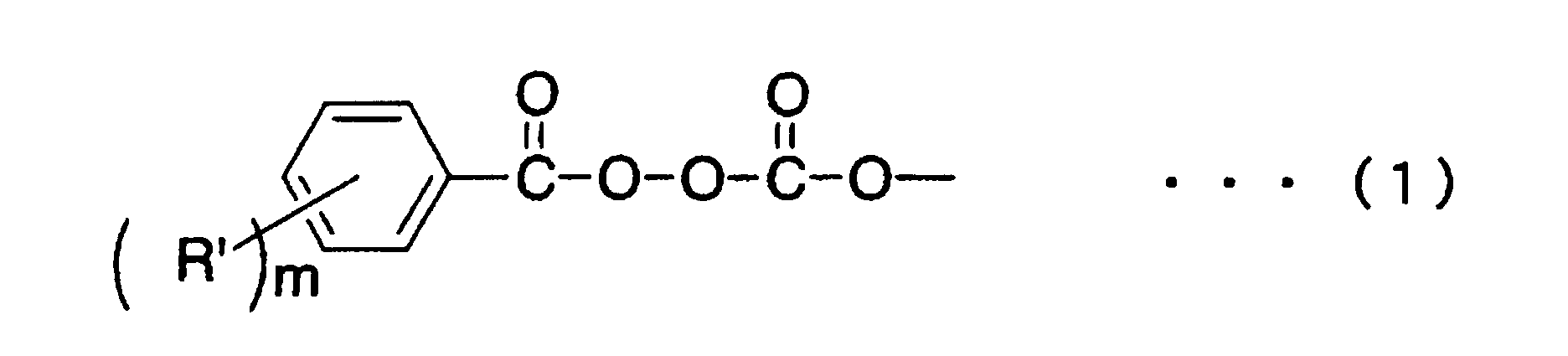


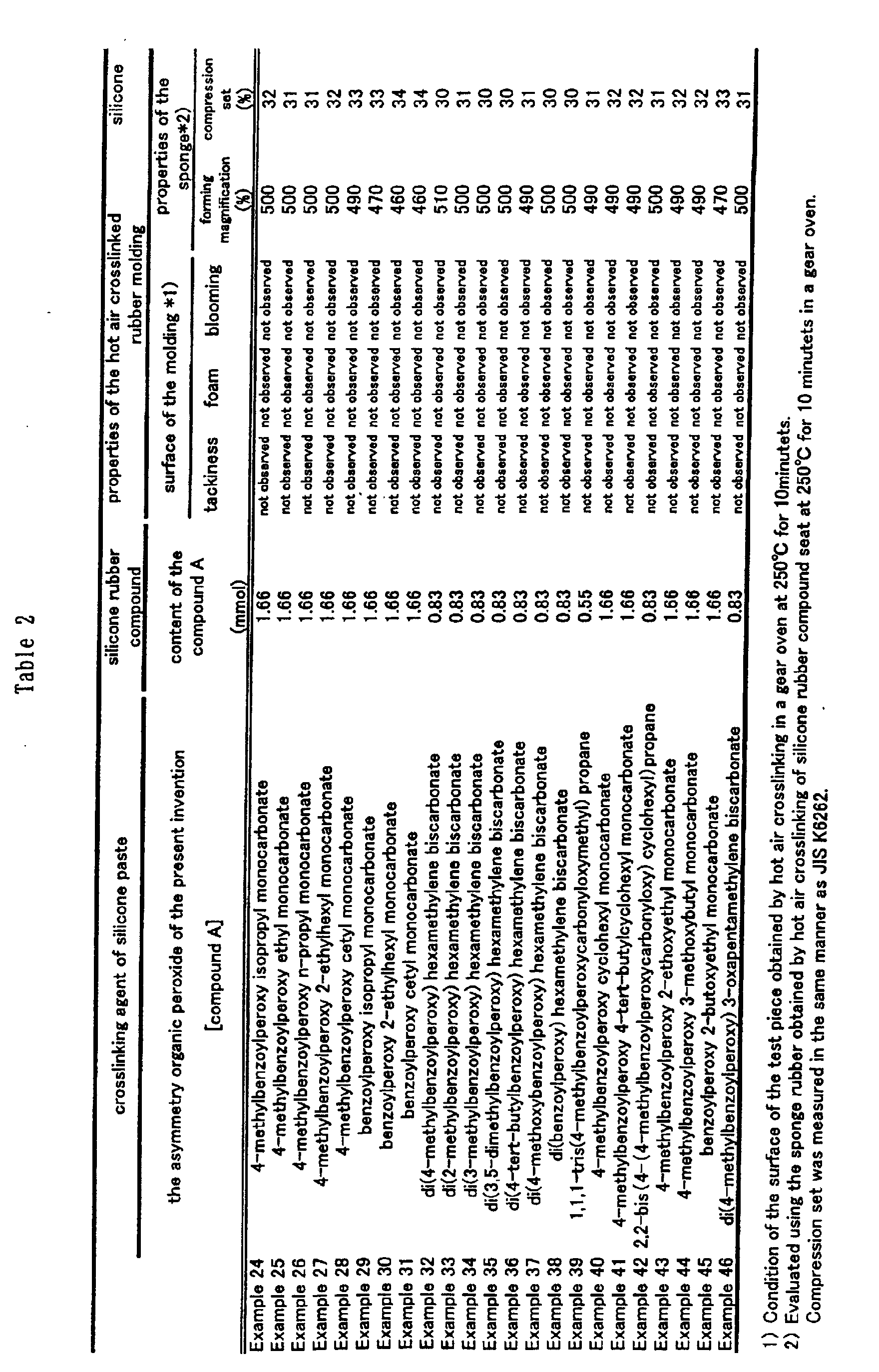
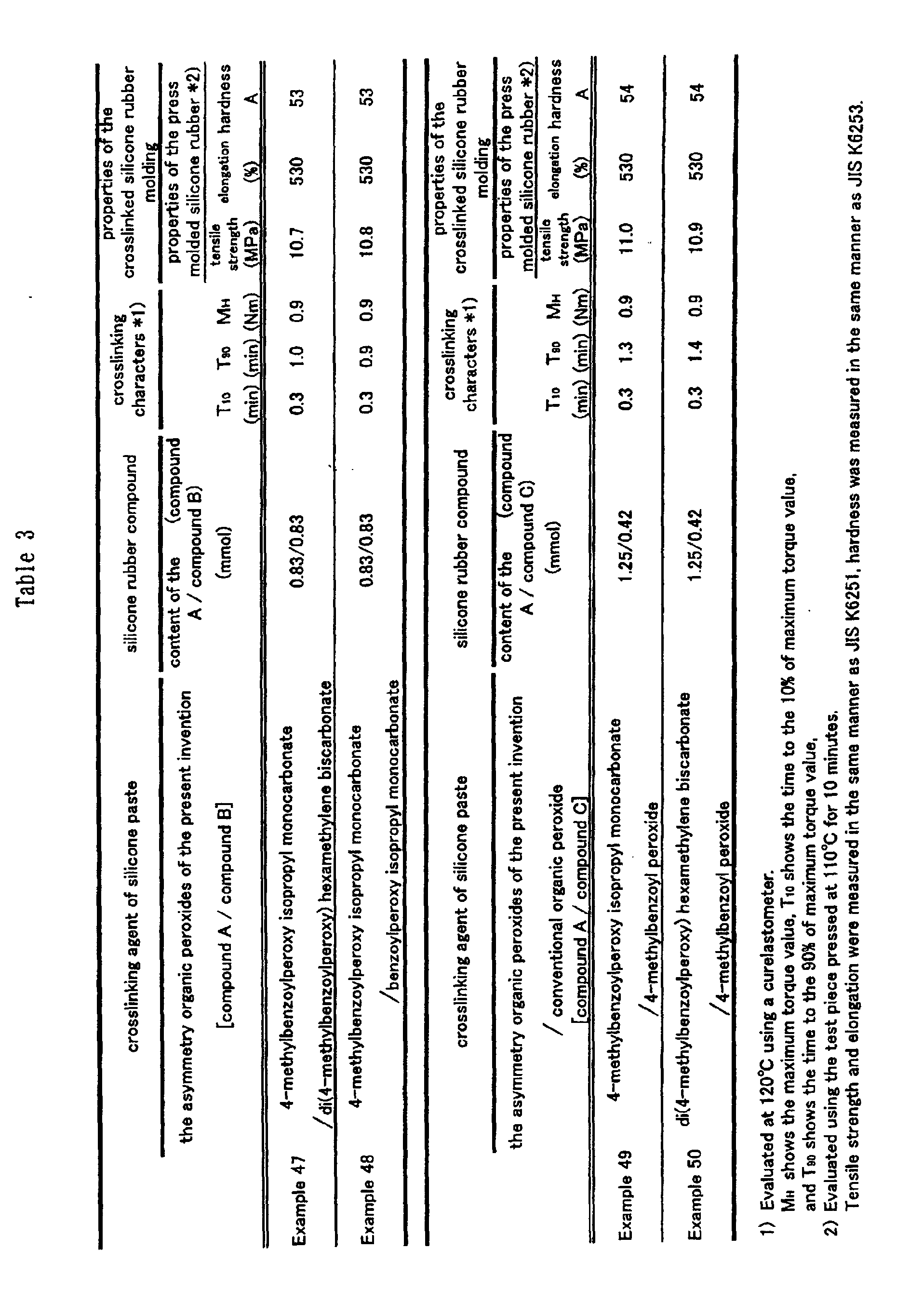

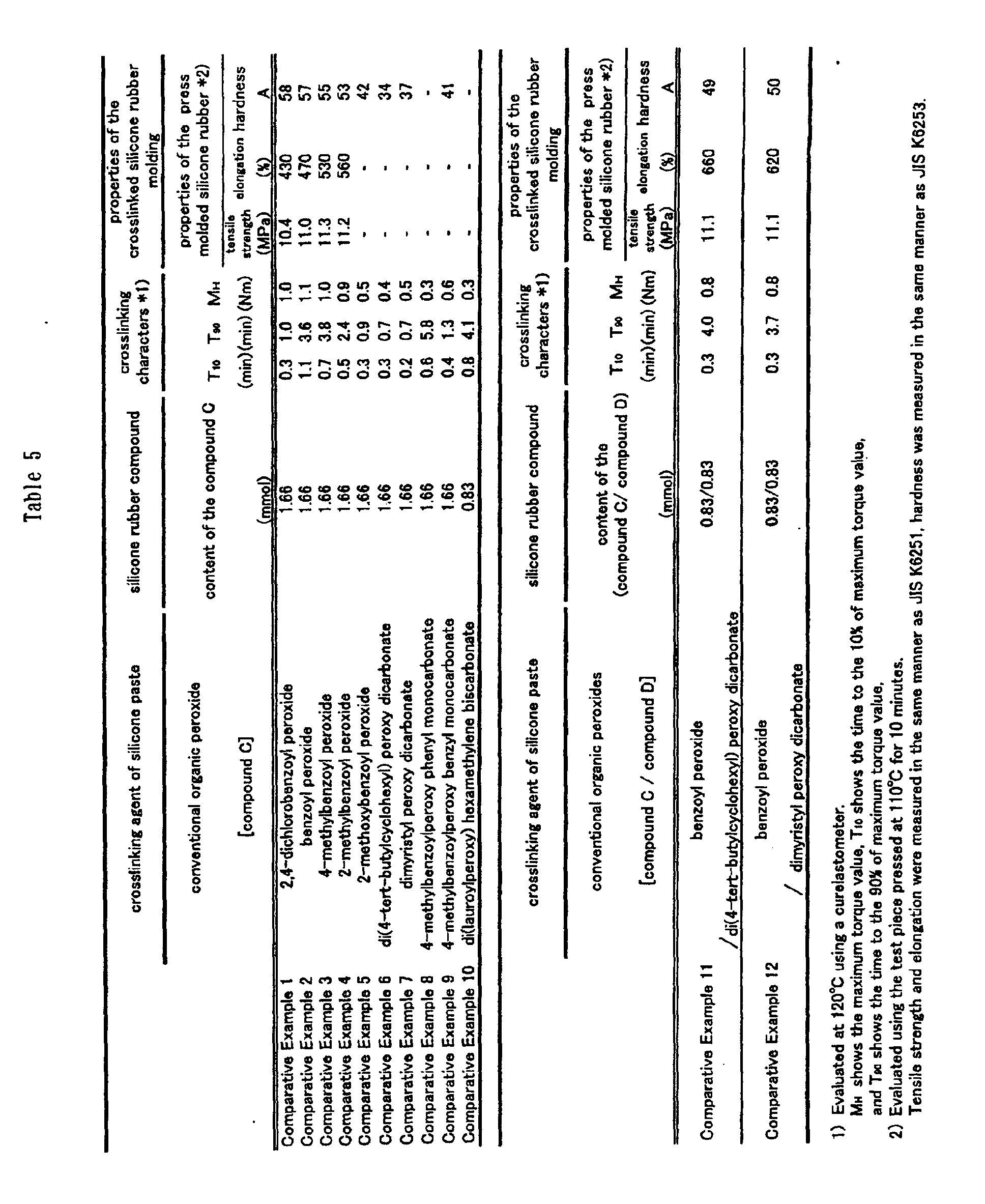

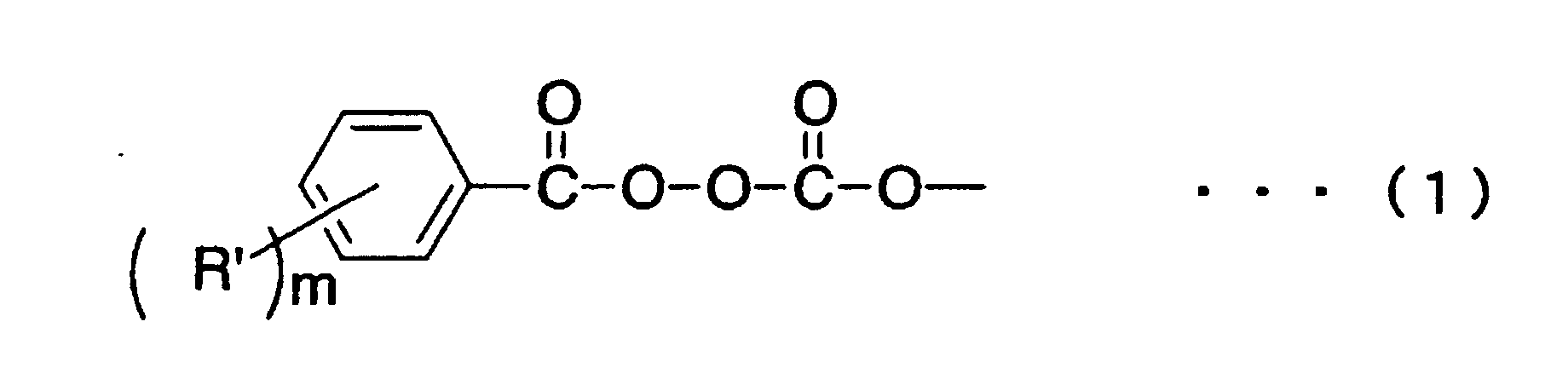 wherein R' can be the same or different in each (substituted)benzoyl group).(A) m stands for 0, in other words, R' stands for a hydrogen atom.(B) m stands for an integer in a range of 1 to 5, and R' stands for an alkyl group of 1 to 6 carbon atoms, an alkoxy group of 1 to 6 carbon atoms or a phenyl group.(C) m stands for an integer in a range of 1 to 5, and R' stands for a silyl group substituted by either of an alkyl group of 1 to 6 carbon atoms, an alkoxy group of 1 to 6 carbon atoms, a phenyl group or a vinyl group.
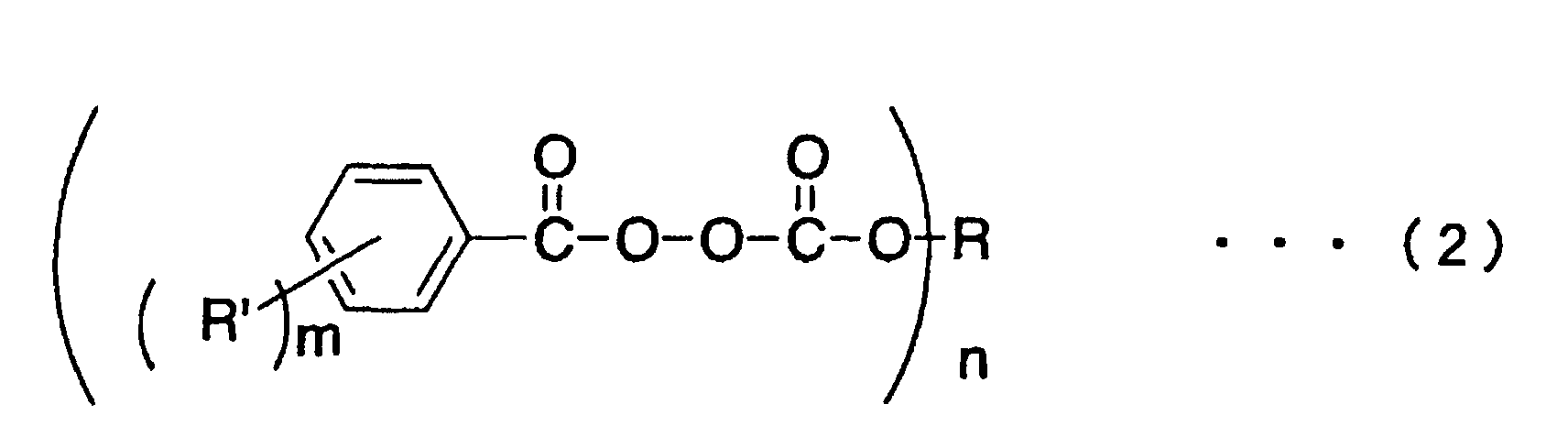 (a) in case of n is 1, R stands for an alkyl group of 1 to 20 carbon atoms, whreas in case of n is in a range of 2 to 6, R stands for a linear or branched hydrocarbon group of 1 to 20 carbon atoms.(b) in case of n is 1, R stands for a cycloalkyl group of 3 to 10 carbon atoms or a substituted cycloalkyl group of 4 to 10 carbon atoms substituted by an alkyl group of 1 to 4 carbon atoms, whereas in case of n is in a range of 2 to 4, R stands for a cyclohexanediyldimethylene group, a cyclohexylene group, a bicyclohexylene group or a hydrocarbon group of 13 to 25 carbon atoms substituted by 2 to 4 of cyclohexylene groups.(c) in case of n is 1, R stands for an alkoxyalkyl group represented by the formula -R1-O-R2 (wherein, R1 stands for an alkylene group of 2 to 5 carbon atoms, R2 stands for an alkyl group of 1 to 8 carbon atoms), whereas in case of n is 2, R stands for an oxoalkylene group represented by the formula -(R3-O-)k-R3- (wherein k stands for 1 or 2, and R3 stands for an alkylene group of 2 to 5 carbon atoms).wherein R' can be the same or different in each (substituted)benzoyl group, and in each (substituted)benzoyl group in one molecule.(A) m stands for 0, in other words, R' stands for a hydrogen atom.(B) m stands for an integer of 1 to 5, and R' stands for an alkyl group of 1 to 6 carbon atoms, an alkoxy group of 1 to 6 carbon atoms or a phenyl group.(C) m stands for an integer of 1 to 5, and R' stands for a silyl group substituted by either of an alkyl group of 1 to 6 carbon atoms, an alkoxy group of 1 to 6 carbon atoms, a phenyl group or a vinyl group.
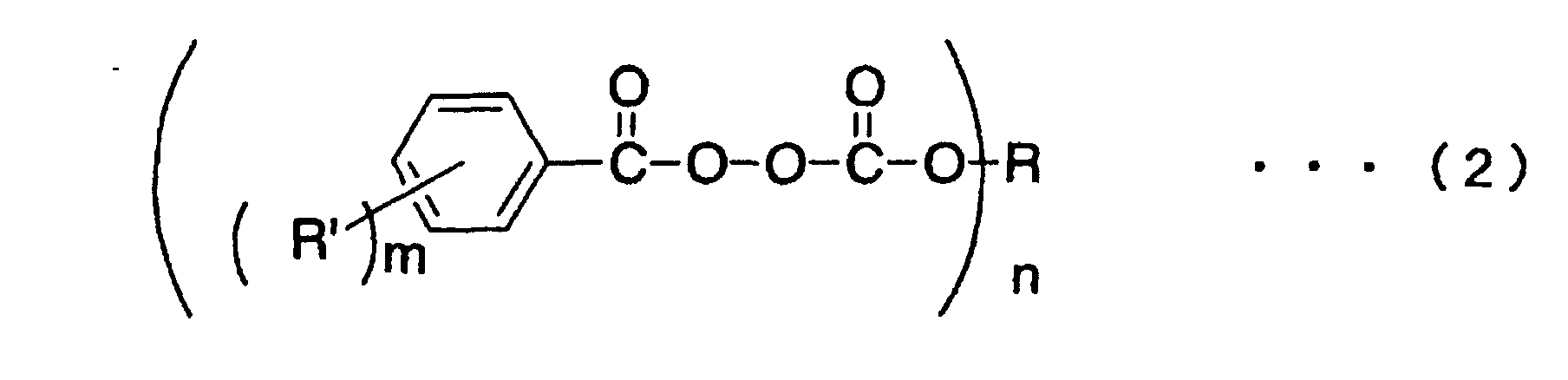 (a)R stands for an alkyl group of 1 to 20 carbon atoms.(b)R stands for a cycloalkyl group of 3 to 10 carbon atoms or a substitutedcycloalkyl group of 4 to 10 carbon atoms substituted by an alkyl group of 1 to 4 carbon atoms.(c) R stands for an alkoxyalkyl group represented by the formula -R1-O-R2 (wherein R1 stands for an alkylene group of 2 to 5 carbon atoms, R2 stands for an alkyl group of 1 to 8 carbon atoms)wherein R' can be the same or different in each (substituted)benzoyl group.(B) R' stands for an alkyl group of 1 to 6 carbon atoms, an alkoxy group of 1 to 6 carbon atoms or a phenyl group.(C) R' stands for a silyl group substituted by either of an alkyl group of 1 to 6 carbon atoms, an alkoxy groupof 1 to 6 carbon atoms, a phenyl group or a vinyl group.
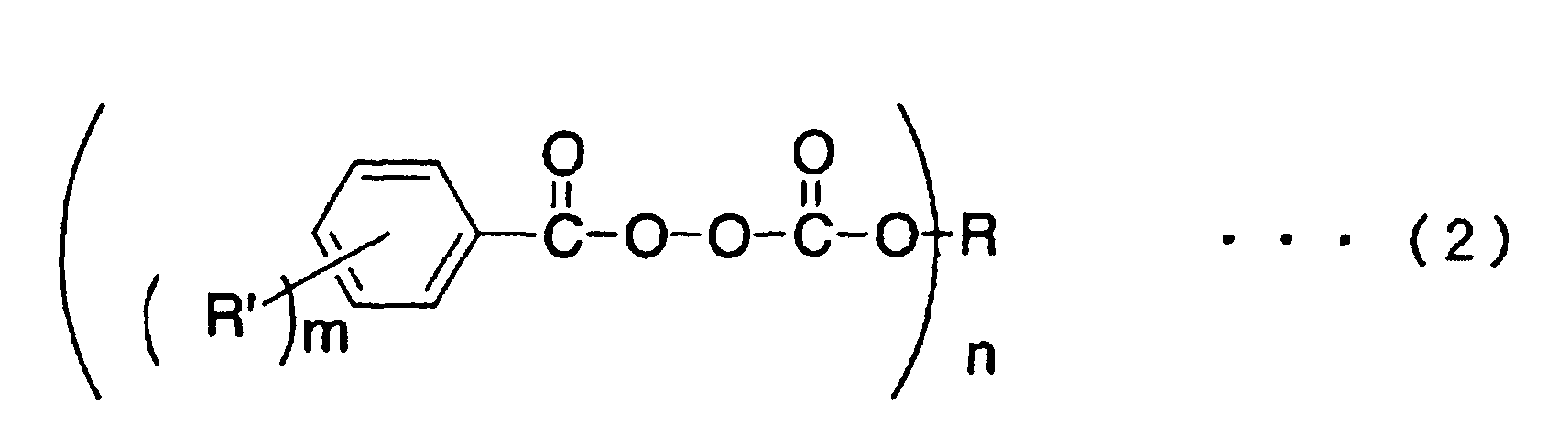 (a)R stands for a linear or branched hydrocarbon group of 1 to 20 carbon atoms.(c) R stands for an oxoalkylene group represented by the formula -(R3-O-)k-R3- (wherein k stands for 1 or 2, and R3 stands for an alkylene group of 2 to 5 carbon atoms) .wherein R' can be the same or different in each (substituted)benzoyl group, and in each (substituted)benzoyl group in one molecule.(A) m stands for 0, in other words, R' stands for a hydrogen atom.(B) m stands for an integer in a range of 1 to 5, and R' stands for an alkyl group of 1 to 6 carbon atoms, an alkoxy group of 1 to 6 carbon atoms or a phenyl group.(C) m stands for an integer in a range of 1 to 5, and R' stands for a silyl group substituted by either of an alkyl group of 1 to 6 carbon atoms, an alkoxy group of 1 to 6 carbon atoms, a phenyl group or a vinyl group.