EP1232758A1 - Polynucléotide formulé en vue d'un transfert intracellulaire amélioré - Google Patents
Polynucléotide formulé en vue d'un transfert intracellulaire amélioré Download PDFInfo
- Publication number
- EP1232758A1 EP1232758A1 EP01420041A EP01420041A EP1232758A1 EP 1232758 A1 EP1232758 A1 EP 1232758A1 EP 01420041 A EP01420041 A EP 01420041A EP 01420041 A EP01420041 A EP 01420041A EP 1232758 A1 EP1232758 A1 EP 1232758A1
- Authority
- EP
- European Patent Office
- Prior art keywords
- polynucleotide
- copolymer
- weight
- composition according
- ch2ch2o
- Prior art date
- Legal status (The legal status is an assumption and is not a legal conclusion. Google has not performed a legal analysis and makes no representation as to the accuracy of the status listed.)
- Withdrawn
Links
- 108091033319 polynucleotide Proteins 0.000 title claims abstract description 52
- 102000040430 polynucleotide Human genes 0.000 title claims abstract description 52
- 239000002157 polynucleotide Substances 0.000 title claims abstract description 51
- 238000012546 transfer Methods 0.000 title claims abstract description 9
- 230000003834 intracellular effect Effects 0.000 title 1
- 229920001577 copolymer Polymers 0.000 claims abstract description 36
- 239000000203 mixture Substances 0.000 claims abstract description 36
- -1 polyoxypropylene Polymers 0.000 claims abstract description 22
- 230000014509 gene expression Effects 0.000 claims abstract description 20
- 229920003171 Poly (ethylene oxide) Polymers 0.000 claims abstract description 10
- 229920001451 polypropylene glycol Polymers 0.000 claims abstract description 9
- WSFSSNUMVMOOMR-UHFFFAOYSA-N Formaldehyde Chemical compound O=C WSFSSNUMVMOOMR-UHFFFAOYSA-N 0.000 claims abstract description 8
- 235000019256 formaldehyde Nutrition 0.000 claims abstract description 8
- 210000003527 eukaryotic cell Anatomy 0.000 claims abstract description 6
- 239000008194 pharmaceutical composition Substances 0.000 claims abstract description 5
- 239000001488 sodium phosphate Substances 0.000 claims abstract description 4
- 229910000162 sodium phosphate Inorganic materials 0.000 claims abstract description 4
- RYFMWSXOAZQYPI-UHFFFAOYSA-K trisodium phosphate Chemical compound [Na+].[Na+].[Na+].[O-]P([O-])([O-])=O RYFMWSXOAZQYPI-UHFFFAOYSA-K 0.000 claims abstract description 4
- 210000004027 cell Anatomy 0.000 claims description 23
- 108090000765 processed proteins & peptides Proteins 0.000 claims description 12
- FAPWRFPIFSIZLT-UHFFFAOYSA-M Sodium chloride Chemical compound [Na+].[Cl-] FAPWRFPIFSIZLT-UHFFFAOYSA-M 0.000 claims description 11
- 238000000034 method Methods 0.000 claims description 11
- 230000028993 immune response Effects 0.000 claims description 10
- 239000003814 drug Substances 0.000 claims description 9
- 229920001184 polypeptide Polymers 0.000 claims description 9
- 102000004196 processed proteins & peptides Human genes 0.000 claims description 9
- 230000001225 therapeutic effect Effects 0.000 claims description 9
- 239000012678 infectious agent Substances 0.000 claims description 8
- TWRXJAOTZQYOKJ-UHFFFAOYSA-L Magnesium chloride Chemical compound [Mg+2].[Cl-].[Cl-] TWRXJAOTZQYOKJ-UHFFFAOYSA-L 0.000 claims description 6
- 208000015181 infectious disease Diseases 0.000 claims description 6
- WCUXLLCKKVVCTQ-UHFFFAOYSA-M Potassium chloride Chemical compound [Cl-].[K+] WCUXLLCKKVVCTQ-UHFFFAOYSA-M 0.000 claims description 5
- 150000001875 compounds Chemical class 0.000 claims description 5
- 229940079593 drug Drugs 0.000 claims description 5
- 239000011780 sodium chloride Substances 0.000 claims description 5
- 238000004519 manufacturing process Methods 0.000 claims description 4
- 230000002068 genetic effect Effects 0.000 claims description 3
- 229910001629 magnesium chloride Inorganic materials 0.000 claims description 3
- 241000206602 Eukaryota Species 0.000 claims description 2
- 239000004480 active ingredient Substances 0.000 claims description 2
- 230000000692 anti-sense effect Effects 0.000 claims description 2
- 230000007812 deficiency Effects 0.000 claims description 2
- 239000001103 potassium chloride Substances 0.000 claims description 2
- 235000011164 potassium chloride Nutrition 0.000 claims description 2
- 239000002773 nucleotide Substances 0.000 claims 2
- 125000003729 nucleotide group Chemical group 0.000 claims 2
- 238000002255 vaccination Methods 0.000 abstract description 7
- 238000001415 gene therapy Methods 0.000 abstract description 6
- 238000009169 immunotherapy Methods 0.000 abstract description 4
- 108090000623 proteins and genes Proteins 0.000 description 28
- 239000013612 plasmid Substances 0.000 description 14
- 102000004169 proteins and genes Human genes 0.000 description 14
- 108020004414 DNA Proteins 0.000 description 12
- 239000000047 product Substances 0.000 description 12
- 238000011282 treatment Methods 0.000 description 10
- 241000699670 Mus sp. Species 0.000 description 8
- 238000001727 in vivo Methods 0.000 description 7
- 238000001890 transfection Methods 0.000 description 7
- 241001465754 Metazoa Species 0.000 description 6
- 239000000243 solution Substances 0.000 description 6
- 102000002260 Alkaline Phosphatase Human genes 0.000 description 5
- 108020004774 Alkaline Phosphatase Proteins 0.000 description 5
- 241000699666 Mus <mouse, genus> Species 0.000 description 5
- 230000000694 effects Effects 0.000 description 5
- 238000002347 injection Methods 0.000 description 5
- 239000007924 injection Substances 0.000 description 5
- 238000012360 testing method Methods 0.000 description 5
- 241000701022 Cytomegalovirus Species 0.000 description 4
- 206010028980 Neoplasm Diseases 0.000 description 4
- 239000000427 antigen Substances 0.000 description 4
- 102000036639 antigens Human genes 0.000 description 4
- 108091007433 antigens Proteins 0.000 description 4
- 125000002091 cationic group Chemical group 0.000 description 4
- 201000010099 disease Diseases 0.000 description 4
- 208000037265 diseases, disorders, signs and symptoms Diseases 0.000 description 4
- 229920001983 poloxamer Polymers 0.000 description 4
- 229960005486 vaccine Drugs 0.000 description 4
- JKMHFZQWWAIEOD-UHFFFAOYSA-N 2-[4-(2-hydroxyethyl)piperazin-1-yl]ethanesulfonic acid Chemical compound OCC[NH+]1CCN(CCS([O-])(=O)=O)CC1 JKMHFZQWWAIEOD-UHFFFAOYSA-N 0.000 description 3
- 239000012979 RPMI medium Substances 0.000 description 3
- 241000700605 Viruses Species 0.000 description 3
- 230000005875 antibody response Effects 0.000 description 3
- 239000007864 aqueous solution Substances 0.000 description 3
- 238000009472 formulation Methods 0.000 description 3
- 239000007788 liquid Substances 0.000 description 3
- 238000002360 preparation method Methods 0.000 description 3
- 210000002966 serum Anatomy 0.000 description 3
- 239000007787 solid Substances 0.000 description 3
- 241000712461 unidentified influenza virus Species 0.000 description 3
- 239000013598 vector Substances 0.000 description 3
- CURLTUGMZLYLDI-UHFFFAOYSA-N Carbon dioxide Chemical compound O=C=O CURLTUGMZLYLDI-UHFFFAOYSA-N 0.000 description 2
- 208000035473 Communicable disease Diseases 0.000 description 2
- 238000002965 ELISA Methods 0.000 description 2
- 102100037850 Interferon gamma Human genes 0.000 description 2
- 108010074328 Interferon-gamma Proteins 0.000 description 2
- 241000124008 Mammalia Species 0.000 description 2
- 108091061960 Naked DNA Proteins 0.000 description 2
- 230000001594 aberrant effect Effects 0.000 description 2
- 230000000890 antigenic effect Effects 0.000 description 2
- 230000001580 bacterial effect Effects 0.000 description 2
- 210000004369 blood Anatomy 0.000 description 2
- 239000008280 blood Substances 0.000 description 2
- 239000012895 dilution Substances 0.000 description 2
- 238000010790 dilution Methods 0.000 description 2
- 238000003114 enzyme-linked immunosorbent spot assay Methods 0.000 description 2
- 238000011156 evaluation Methods 0.000 description 2
- 238000002474 experimental method Methods 0.000 description 2
- 230000008348 humoral response Effects 0.000 description 2
- 238000002649 immunization Methods 0.000 description 2
- 230000003053 immunization Effects 0.000 description 2
- 238000011534 incubation Methods 0.000 description 2
- 238000007918 intramuscular administration Methods 0.000 description 2
- 210000004962 mammalian cell Anatomy 0.000 description 2
- 239000013642 negative control Substances 0.000 description 2
- 229920000642 polymer Polymers 0.000 description 2
- 230000002265 prevention Effects 0.000 description 2
- 210000004989 spleen cell Anatomy 0.000 description 2
- 238000007920 subcutaneous administration Methods 0.000 description 2
- 230000003612 virological effect Effects 0.000 description 2
- XLYOFNOQVPJJNP-UHFFFAOYSA-N water Substances O XLYOFNOQVPJJNP-UHFFFAOYSA-N 0.000 description 2
- LDGWQMRUWMSZIU-LQDDAWAPSA-M 2,3-bis[(z)-octadec-9-enoxy]propyl-trimethylazanium;chloride Chemical compound [Cl-].CCCCCCCC\C=C/CCCCCCCCOCC(C[N+](C)(C)C)OCCCCCCCC\C=C/CCCCCCCC LDGWQMRUWMSZIU-LQDDAWAPSA-M 0.000 description 1
- OXEUETBFKVCRNP-UHFFFAOYSA-N 9-ethyl-3-carbazolamine Chemical compound NC1=CC=C2N(CC)C3=CC=CC=C3C2=C1 OXEUETBFKVCRNP-UHFFFAOYSA-N 0.000 description 1
- 108020004491 Antisense DNA Proteins 0.000 description 1
- 108020005544 Antisense RNA Proteins 0.000 description 1
- 238000012935 Averaging Methods 0.000 description 1
- 241000283690 Bos taurus Species 0.000 description 1
- 108091003079 Bovine Serum Albumin Proteins 0.000 description 1
- 108020004635 Complementary DNA Proteins 0.000 description 1
- 238000011238 DNA vaccination Methods 0.000 description 1
- QXNVGIXVLWOKEQ-UHFFFAOYSA-N Disodium Chemical compound [Na][Na] QXNVGIXVLWOKEQ-UHFFFAOYSA-N 0.000 description 1
- 108010051696 Growth Hormone Proteins 0.000 description 1
- 102000018997 Growth Hormone Human genes 0.000 description 1
- 102000000588 Interleukin-2 Human genes 0.000 description 1
- 108010002350 Interleukin-2 Proteins 0.000 description 1
- 241001529936 Murinae Species 0.000 description 1
- 239000000020 Nitrocellulose Substances 0.000 description 1
- 108091028043 Nucleic acid sequence Proteins 0.000 description 1
- 102000011931 Nucleoproteins Human genes 0.000 description 1
- 108010061100 Nucleoproteins Proteins 0.000 description 1
- 102000003992 Peroxidases Human genes 0.000 description 1
- 108010039918 Polylysine Proteins 0.000 description 1
- 229920001213 Polysorbate 20 Polymers 0.000 description 1
- 108010090804 Streptavidin Proteins 0.000 description 1
- 108020004566 Transfer RNA Proteins 0.000 description 1
- QWXOJIDBSHLIFI-UHFFFAOYSA-N [3-(1-chloro-3'-methoxyspiro[adamantane-4,4'-dioxetane]-3'-yl)phenyl] dihydrogen phosphate Chemical compound O1OC2(C3CC4CC2CC(Cl)(C4)C3)C1(OC)C1=CC=CC(OP(O)(O)=O)=C1 QWXOJIDBSHLIFI-UHFFFAOYSA-N 0.000 description 1
- 125000002947 alkylene group Chemical group 0.000 description 1
- 239000003242 anti bacterial agent Substances 0.000 description 1
- 229940088710 antibiotic agent Drugs 0.000 description 1
- 239000003816 antisense DNA Substances 0.000 description 1
- 238000003556 assay Methods 0.000 description 1
- 244000052616 bacterial pathogen Species 0.000 description 1
- 230000004071 biological effect Effects 0.000 description 1
- 108010006025 bovine growth hormone Proteins 0.000 description 1
- 239000000872 buffer Substances 0.000 description 1
- 238000010804 cDNA synthesis Methods 0.000 description 1
- 239000001569 carbon dioxide Substances 0.000 description 1
- 229910002092 carbon dioxide Inorganic materials 0.000 description 1
- 239000006285 cell suspension Substances 0.000 description 1
- 230000001413 cellular effect Effects 0.000 description 1
- 230000036755 cellular response Effects 0.000 description 1
- 239000003795 chemical substances by application Substances 0.000 description 1
- 239000011248 coating agent Substances 0.000 description 1
- 238000000576 coating method Methods 0.000 description 1
- 239000000084 colloidal system Substances 0.000 description 1
- 239000002299 complementary DNA Substances 0.000 description 1
- 239000003184 complementary RNA Substances 0.000 description 1
- 210000001151 cytotoxic T lymphocyte Anatomy 0.000 description 1
- DIOQZVSQGTUSAI-UHFFFAOYSA-N decane Chemical compound CCCCCCCCCC DIOQZVSQGTUSAI-UHFFFAOYSA-N 0.000 description 1
- 230000002950 deficient Effects 0.000 description 1
- 239000013024 dilution buffer Substances 0.000 description 1
- 230000004064 dysfunction Effects 0.000 description 1
- 238000005516 engineering process Methods 0.000 description 1
- 230000007717 exclusion Effects 0.000 description 1
- 239000012894 fetal calf serum Substances 0.000 description 1
- 239000000122 growth hormone Substances 0.000 description 1
- 230000001024 immunotherapeutic effect Effects 0.000 description 1
- 238000000338 in vitro Methods 0.000 description 1
- 230000006698 induction Effects 0.000 description 1
- 230000001939 inductive effect Effects 0.000 description 1
- 230000002458 infectious effect Effects 0.000 description 1
- 206010022000 influenza Diseases 0.000 description 1
- 208000037797 influenza A Diseases 0.000 description 1
- 230000010354 integration Effects 0.000 description 1
- 238000010255 intramuscular injection Methods 0.000 description 1
- 239000007927 intramuscular injection Substances 0.000 description 1
- 239000002502 liposome Substances 0.000 description 1
- 238000005259 measurement Methods 0.000 description 1
- 239000002609 medium Substances 0.000 description 1
- 108020004999 messenger RNA Proteins 0.000 description 1
- 239000000693 micelle Substances 0.000 description 1
- 239000011859 microparticle Substances 0.000 description 1
- 238000002156 mixing Methods 0.000 description 1
- 229920001220 nitrocellulos Polymers 0.000 description 1
- 230000007170 pathology Effects 0.000 description 1
- 108040007629 peroxidase activity proteins Proteins 0.000 description 1
- CMPQUABWPXYYSH-UHFFFAOYSA-N phenyl phosphate Chemical compound OP(O)(=O)OC1=CC=CC=C1 CMPQUABWPXYYSH-UHFFFAOYSA-N 0.000 description 1
- 239000008363 phosphate buffer Substances 0.000 description 1
- 239000013600 plasmid vector Substances 0.000 description 1
- 229920001987 poloxamine Polymers 0.000 description 1
- 229920001606 poly(lactic acid-co-glycolic acid) Polymers 0.000 description 1
- 229920000656 polylysine Polymers 0.000 description 1
- 229920005862 polyol Polymers 0.000 description 1
- 150000003077 polyols Chemical class 0.000 description 1
- 239000000256 polyoxyethylene sorbitan monolaurate Substances 0.000 description 1
- 235000010486 polyoxyethylene sorbitan monolaurate Nutrition 0.000 description 1
- 229920000136 polysorbate Polymers 0.000 description 1
- 239000013641 positive control Substances 0.000 description 1
- 230000001737 promoting effect Effects 0.000 description 1
- 125000001436 propyl group Chemical group [H]C([*])([H])C([H])([H])C([H])([H])[H] 0.000 description 1
- 230000004044 response Effects 0.000 description 1
- 108020004418 ribosomal RNA Proteins 0.000 description 1
- 230000003248 secreting effect Effects 0.000 description 1
- 230000000087 stabilizing effect Effects 0.000 description 1
- 239000013589 supplement Substances 0.000 description 1
- 239000004094 surface-active agent Substances 0.000 description 1
- 210000001519 tissue Anatomy 0.000 description 1
- 238000004448 titration Methods 0.000 description 1
- 230000000699 topical effect Effects 0.000 description 1
- 238000013518 transcription Methods 0.000 description 1
- 230000035897 transcription Effects 0.000 description 1
- SZYJELPVAFJOGJ-UHFFFAOYSA-N trimethylamine hydrochloride Chemical compound Cl.CN(C)C SZYJELPVAFJOGJ-UHFFFAOYSA-N 0.000 description 1
- 239000003981 vehicle Substances 0.000 description 1
- 239000013603 viral vector Substances 0.000 description 1
Images


Classifications
-
- A—HUMAN NECESSITIES
- A61—MEDICAL OR VETERINARY SCIENCE; HYGIENE
- A61K—PREPARATIONS FOR MEDICAL, DENTAL OR TOILETRY PURPOSES
- A61K47/00—Medicinal preparations characterised by the non-active ingredients used, e.g. carriers or inert additives; Targeting or modifying agents chemically bound to the active ingredient
- A61K47/06—Organic compounds, e.g. natural or synthetic hydrocarbons, polyolefins, mineral oil, petrolatum or ozokerite
- A61K47/08—Organic compounds, e.g. natural or synthetic hydrocarbons, polyolefins, mineral oil, petrolatum or ozokerite containing oxygen, e.g. ethers, acetals, ketones, quinones, aldehydes, peroxides
- A61K47/10—Alcohols; Phenols; Salts thereof, e.g. glycerol; Polyethylene glycols [PEG]; Poloxamers; PEG/POE alkyl ethers
-
- A—HUMAN NECESSITIES
- A61—MEDICAL OR VETERINARY SCIENCE; HYGIENE
- A61K—PREPARATIONS FOR MEDICAL, DENTAL OR TOILETRY PURPOSES
- A61K9/00—Medicinal preparations characterised by special physical form
- A61K9/0012—Galenical forms characterised by the site of application
- A61K9/0019—Injectable compositions; Intramuscular, intravenous, arterial, subcutaneous administration; Compositions to be administered through the skin in an invasive manner
-
- A—HUMAN NECESSITIES
- A61—MEDICAL OR VETERINARY SCIENCE; HYGIENE
- A61P—SPECIFIC THERAPEUTIC ACTIVITY OF CHEMICAL COMPOUNDS OR MEDICINAL PREPARATIONS
- A61P31/00—Antiinfectives, i.e. antibiotics, antiseptics, chemotherapeutics
-
- A—HUMAN NECESSITIES
- A61—MEDICAL OR VETERINARY SCIENCE; HYGIENE
- A61P—SPECIFIC THERAPEUTIC ACTIVITY OF CHEMICAL COMPOUNDS OR MEDICINAL PREPARATIONS
- A61P35/00—Antineoplastic agents
-
- A—HUMAN NECESSITIES
- A61—MEDICAL OR VETERINARY SCIENCE; HYGIENE
- A61P—SPECIFIC THERAPEUTIC ACTIVITY OF CHEMICAL COMPOUNDS OR MEDICINAL PREPARATIONS
- A61P37/00—Drugs for immunological or allergic disorders
- A61P37/02—Immunomodulators
- A61P37/04—Immunostimulants
-
- C—CHEMISTRY; METALLURGY
- C12—BIOCHEMISTRY; BEER; SPIRITS; WINE; VINEGAR; MICROBIOLOGY; ENZYMOLOGY; MUTATION OR GENETIC ENGINEERING
- C12N—MICROORGANISMS OR ENZYMES; COMPOSITIONS THEREOF; PROPAGATING, PRESERVING, OR MAINTAINING MICROORGANISMS; MUTATION OR GENETIC ENGINEERING; CULTURE MEDIA
- C12N15/00—Mutation or genetic engineering; DNA or RNA concerning genetic engineering, vectors, e.g. plasmids, or their isolation, preparation or purification; Use of hosts therefor
- C12N15/09—Recombinant DNA-technology
- C12N15/87—Introduction of foreign genetic material using processes not otherwise provided for, e.g. co-transformation
-
- A—HUMAN NECESSITIES
- A61—MEDICAL OR VETERINARY SCIENCE; HYGIENE
- A61K—PREPARATIONS FOR MEDICAL, DENTAL OR TOILETRY PURPOSES
- A61K48/00—Medicinal preparations containing genetic material which is inserted into cells of the living body to treat genetic diseases; Gene therapy
Definitions
- the subject of the invention is a method for transferring a polynucleotide into cells. eukaryotes and its application to various therapeutic fields, including vaccination.
- lipids such as DOTMA (N- [1-2,2- (dioleyloxy) propyl] chloride -N, N, N-trimethylammonium), lipopolyamines and polymers cationic polylysine type.
- DOTMA N- [1-2,2- (dioleyloxy) propyl] chloride -N, N, N-trimethylammonium
- lipopolyamines and polymers cationic polylysine type.
- a second product such as a non-ionic surface stabilizing cationic transfection agents / polynucleotides complexes (WO98 / 34648).
- This surfactant can in particular be a polooxyalkylene such as Pluronics TM F68 marketed by BASF, also known as Lutrol name.
- the subject of the invention is a pharmaceutical composition
- a pharmaceutical composition comprising a polynucleotide and at least 2% (weight / volume) of a nonionic copolymer of formula (I) OH (CH2CH2O) a (CH (CH3) CH2O) b (CH2CH2O) cH in which a, b and c are such that the polyoxypropylene portion has a molecular weight of between 1450 and 2050 and the polyoxyethylene portions constitute between 75 and 85% (weight: weight) of the copolymer.
- the invention also relates to the use of a nonionic copolymer of formula (I) OH (CH2CH2O) a (CH (CH3) CH2O) b (CH2CH2O) cH in which a, b and c are such that the polyoxypropylene portion has a molecular weight of between 1450 and 2050 and the polyoxyethylene portions constitute between 75 and 85% (weight: weight) of the copolymer in the manufacture of a medicament containing a polynucleotide as active ingredient; the copolymer being added to the polynucleotide at the concentration of at least 2% (weight: volume) to improve the transfer and / or expression of the polynucleotide to inside the cells of the individual in need of said drug.
- a nonionic copolymer of formula (I) OH (CH2CH2O) a (CH (CH3) CH2O) b (CH2CH2O) cH in which a, b and c are such
- the invention also relates to a method for transferring a polynucleotide into eukaryotic cells according to which the cells and the polynucleotide are brought into contact; the polynucleotide being formulated with at least 2% (weight: volume) of a nonionic copolymer of formula (I) OH (CH2CH2O) a (CH (CH3) CH2O) b (CH2CH2O) cH in which a, b and c are such that the polyoxypropylene portion has a molecular weight between 1450 and 2050 and the polyoxyethylene portions constitute between 75 and 85% (weight: weight) of the copolymer.
- a nonionic copolymer of formula (I) OH (CH2CH2O) a (CH (CH3) CH2O) b (CH2CH2O) cH in which a, b and c are such that the polyoxypropylene portion has a molecular weight between 1450 and 2050 and
- it may be (i) an in vivo polynucleotide transfer method according to which a composition according to the invention is administered to a mammal or any other animal; and (ii) an in vitro or ex vivo polynucleotide transfer method in which mammalian cells (or cells from any other animal) are brought into contact with a composition according to the invention.
- mammalian cells or cells from any other animal are brought into contact with a composition according to the invention.
- mammalian cells have been previously removed from an organism and have the virtue of being reimplanted there after incorporating the polynucleotide.
- a composition according to the invention is free of lipid cationic and sodium phosphate.
- a composition according to the invention may further comprise a compound selected from the group consisting of sodium chloride, potassium chloride and magnesium chloride; preferably in isotonic or hypertonic quantity.
- a nonionic copolymer corresponding to the description given above is typically Pluronic TM F68 sold by BASF. Its average molecular weight is estimated at 8,400 and the hydrophilic parts of polyoxyethylene represent approximately 80% of the total weight. This product is in solid form at 20 ° C.
- a copolymer of formula (I) form spherical micelles in a fairly wide concentration range (for example between 1 and 15%).
- an aqueous solution containing eg 1 to 15% of a copolymer of formula (I) is in the form of a liquid. At higher temperatures, the solution evolves into a gel, then a paste.
- a pharmaceutical composition according to the invention comprises of 2 at 15%; preferably 2 to 10%; most preferably, about 5% of a copolymer of formula (I).
- the polynucleotide may be as well a polydesoxyribonucleotide than a polyribonucleotide.
- Their origin does not matter: natural or artificial; Genomic or complementary DNA; Transfer or ribosomal RNA. They may in particular be of animal, human, plant, bacterial, viral, etc. origin.
- Their function as a therapeutic principle can notably consist in acting as a antisense molecule by coming to control gene expression or mRNA transcription. in the host cell. It can also be a polynucleotide capable of governing the expression in a eukaryotic cell of a protein product of interest.
- the polynucleotide codes for a protein, a polypeptide or a peptide having a therapeutic interest whose expression by the host cell makes it possible to compensate for a dysfunction of the receptive organism.
- a composition according to the invention therefore finds use in gene therapy in vivo or ex vivo .
- the polynucleotide can also code for a protein product capable of generating an immune response against it in humans or animals. According to this particular embodiment, the invention therefore leads to the production of vaccines or immunotherapeutic treatments applied to humans or animals, in particular for treating or preventing infections, eg viral or bacterial, or conditions cancerous.
- the polynucleotide is advantageously DNA and is preferably in the form of vector ia . of plasmid vector.
- a vector must be non-infectious and must not replicate in the host organism.
- it must be substantially devoid of capacity for integration into the genome of the host organism.
- the DNA sequence coding for the therapeutic or antigenic polypeptide must be placed under the control of elements necessary for its expression in the host organism. To this end, it is very common to use the early promoter of Cytomegalovirus (CMV).
- CMV Cytomegalovirus
- a pharmaceutical composition according to the invention can be used for gene therapy in vivo or ex vivo .
- the invention also relates to a method of treatment of a disease resulting from the absence or deficiency of a gene, according to which (i) is administered to a patient having need for such treatment a composition comprising a polynucleotide including the gene capable of correcting the disease and at least 2% (weight / volume) of a nonionic copolymer of formula (I); or (ii) sick cells are taken from a patient in need of such treatment, these cells are brought into contact with a composition comprising a polynucleotide including the gene capable of correcting the disease and at least 2% (weight / volume) of a nonionic copolymer of formula (I) and the cells thus transfected are reimplanted in the patient.
- a composition useful in the field of gene therapy employs a polynucleotide containing a therapeutic gene, that is to say a gene coding for a protein product having a therapeutic effect.
- This protein product can be homologous with respect to target cell (i.e. a product that is normally expressed in the target cell when it presents no pathology).
- target cell i.e. a product that is normally expressed in the target cell when it presents no pathology.
- the therapeutic gene can also code for a mutant of a cellular protein having increased stability, altered activity, etc.
- the protein product can be also heterologous towards the target cell and for example supplement, provide or modify a deficient or aberrant activity.
- a composition according to the invention can be administered by the route most suitable for treatment without particular exclusion and in general, it can be the topical, cutaneous, oral, rectal route, vaginal, parenteral, intranasal, intramuscular, subcutaneous, intraocular, intradermal, etc.
- a composition according to the invention can also be useful in the field of vaccination and immunotherapy.
- a polynucleotide comprising a sequence coding for an antigenic product of protein nature (protein, polypeptide, peptide 3) which can be for example a polypeptide expressed under natural conditions by any infectious agent (eg pathogenic bacteria or virus) or a mammalian polypeptide whose aberrant expression is characteristic of a cancerous state (antigen associated with the tumor).
- infectious agent eg pathogenic bacteria or virus
- a mammalian polypeptide whose aberrant expression is characteristic of a cancerous state (antigen associated with the tumor).
- composition according to the invention to the field of vaccination is particularly interesting insofar as it has been found that the nonionic copolymer of formula (I) makes it possible to significantly increase the antibody response towards of the antigen by comparison with what is observed with an unformulated polynucleotide.
- the low level of induced antibodies is one of the limitations of DNA vaccination; this mode of vaccination generally induces preferentially a cell-type immune response.
- Nonionic copolymers of various types also make it possible to produce the same effect.
- it may in particular be polyoxyalkylene with alkylene groups of length or of different conformation or not within the polymer; in particular of polyoxyethylene / polyoxypropylene copolymer blocks such as those described in Paschalis P.
- the invention also relates to the use of a polynucleotide coding for a protein product specific for an infectious agent or a cancerous state and a nonionic copolymer, in particular those of formula (I) or (II), in the manufacture of a medication for the treatment or prevention of an infectious disease or condition cancerous.
- This drug or vaccine composition is in particular indicated for inducing an immune response, in particular of the humoral type, aimed at treatment or prevention an infectious disease or a cancerous condition.
- a composition according to the invention useful in the field of vaccination and immunotherapy can be administered by any route used in the aforementioned fields; in particular by the mucous route, eg oral, intragastric and intranasal, or parenteral, eg intramuscular, intradermal, intraepidermal and subcutaneous.
- a composition useful for the treatment of a cancerous condition is administered as close as possible to the site or to the tumor tissue.
- the administration can be carried out at the site of the tumor, in particular by direct injection.
- the quantity of polynucleotide intended to be administered depends on very many factors such as the disease to be treated or prevented, the very nature of the polynucleotide eg, antisense DNA / RNA or plasmid DNA, the strength of the vector promoter plasmid, the biological activity of the product expressed by the gene, the physical condition of the individual or animal ia . the mammal for which the composition is intended (weight, age, etc.), the method of administration and the type of formulation.
- a therapeutically or prophylactically effective dose of from about 10 ⁇ g to about 5 mg, preferably from about 100 ⁇ g to about 5 mg; very particularly preferably from about 250 ⁇ g to about 3 mg can be administered to adult humans. Administration can be done as a single dose or repeated at intervals.
- a composition according to the invention can be produced in a conventional manner according to the rules in use in the field of gene therapy, vaccines or immunotherapy.
- a composition contains a vehicle which is acceptable from a pharmaceutical point of view and can be in solid form, eg lyophilized, or liquid. If necessary, the solid form can be reconstituted in a liquid medium for administration.
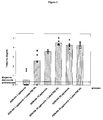
- Figure 1 shows the level of expression of secreted alkaline phosphatase (SeAP) in mice having received an intramuscular injection of the plasmid VR-SeAP formulated or not in the presence of F68 at 5%.
- SeAP secreted alkaline phosphatase
- Figure 2 shows the ELISA evaluation of the anti-hemaglutinin antibody response in mice given two injections intramuscularly of various doses of plasmid VR-HA formulated or not in the presence of F68 at 5%.
- Figure 3 shows the ELISPOT evaluation of the cell-type immune response induced in mice given two injections intramuscularly of various doses of the plasmid VR-HA formulated or not in the presence of F68 at 5%.
- Example 1 In vivo transfection in the presence of F68, of the gene coding for the secreted alkaline phosphatase.
- the level of expression of the gene coding for secreted alkaline phosphatase is simply studied, after transfection in vivo in the presence or absence of F68 at 5%.
- the plasmid VR-SeAP coding for the secreted alkaline phosphastase is used.
- This plasmid was constructed from the plasmid VR1012 described in Hartikka et al, Hum. Gene Ther. (1996) 7 (10) 1205. It contains the sequence coding for SeAP placed under the control of the IE1 promoter of the cytomegalovirus and of the polyA signal of the bovine growth hormone gene.
- a DNA solution at 200 ⁇ g / ml in 1.8% NaCl 50 mM Hepes buffer (2X DNA) which is volume-to-volume mixing with a solution of F68 2X in water.
- a sample of control is also carried out (naked DNA in 0.9% NaCl and 25 mM Hepes).
- mice Two groups of 6 female Balb / C mice aged 8 to 10 weeks are formed. The mice are anesthetized. Then they are injected intramuscularly 50 ⁇ l of a sample into each of the previous Tibialis .
- the groups are: Group ⁇ g DNA Dose / mouse Volume ( ⁇ l) Dose / mouse Formulation 1 10 100 Naked DNA 2 10 100 5% F68
- the SeAP assay is carried out using the Clontech Ref kit. Great Escape K-2041-1. Briefly, 15 ⁇ l of serum are distributed per well in a 96-well plate and 45 ⁇ l of 1 ⁇ dilution buffer are added. Incubation is carried out for 30 min at 65 ° C. in order to inactivate the endogenous alkaline phosphatase and then cooled to 4 ° C. and allowed to return to room temperature. 60 ⁇ l are then added per well of test buffer and the mixture is left to incubate for 5 min at room temperature. The content of the wells is transferred to a black 96-well plate (Microfluor, Dynatech).
- CSPD disodium 3- (4-methoxy-spiro (1,2-dioxetane-3,2 '- (5'-chloro) tricyclo [3,3.1.1 3.7 ] decan) -4-yl ) phenyl phosphate
- CSPD disodium 3- (4-methoxy-spiro (1,2-dioxetane-3,2 '- (5'-chloro) tricyclo [3,3.1.1 3.7 ] decan) -4-yl ) phenyl phosphate
- a standard range (dilutions of 10 -7 to 10 -1 or 0.01 to 10,000 pg / ⁇ l) of SeAP is carried out using the recombinant SeAP at 0.1 mg / ml supplied in the kit.
- the regression line of this standard range makes it possible to translate the expression of SeAP in pg / ml, from light units (RLU).
- Example 2 Study of the immune response induced by different doses of DNA coding for the hemaglutinin of the influenza virus (HA) formulated or not with F68 at 5%.
- HA hemaglutinin of the influenza virus
- the plasmid VR-HA coding for the hemaglutinin of the virus is used. influenza.
- This plasmid was constructed from the plasmid VR1012 described in Hartikka and al, Hum. Gene Ther. (1996) 7 (10) 1205. It contains the sequence coding for influenza virus hemaglutinin (A / PR8 / 34, H1N1) under the control of IE1 promoter of cytomegalovirus and polyA signal of the growth hormone gene bovine.
- mice Six groups of 6 female Balb / C mice aged 8 to 10 weeks are formed. The mice are anesthetized. Then they are injected intramuscularly 50 ⁇ l of a sample into each of the previous Tibialis . Two series of identical injections are carried out on D0 and D21.
- the groups are: Groups VR-HA ( ⁇ g) Dose / mouse Volume ( ⁇ l) Dose / mouse Formulation AT 1 100 - B 10 100 - VS 50 100 - D 1 100 5% F68 E 10 100 5% F68 F 50 100 5% F68
- Antibody titers are calculated from a 4-parameter regression line from a standard consisting of a mouse haemaglutinin A / PR / 8/34 serum (Softmax software, Molecular devices, BioTimes). The standard titer was previously determined from 10 independent measurements from each other according to the formula OD (490 - 650 nm) x 10/1 / dilution. A serum is considered positive if its specific titer is higher after immunization by at least 0.5 log 10 compared to the average titer before immunization. The results are presented in Figure 2.
- mice are sacrificed on D35 and the spleen cells are recovered to carry out the following ELISPOT test: Nitrocellulose titration plates (96 wells Multiscreen MA, Millipore) are incubated with an anti-IFN-gamma antibody (Ref 18181 , BD Pharmingen) at a rate of 10 ⁇ g / ml in phosphate buffer (PBS) for one hour at room temperature. The plates are blocked with RPMI medium (Gibco BRL, Life technologies) for one hour and then washed in PBS.
- PBS phosphate buffer
- the spleen cells are suspended at the rate of 2 ⁇ 10 5 cells / ml in RPMI medium containing 10% fetal calf serum, 20 U / ml of murine IL-2 and antibiotics.
- RPMI medium containing 10% fetal calf serum, 20 U / ml of murine IL-2 and antibiotics.
- One hundred ⁇ l of cell suspensions are distributed in triplicate in the plates, the preparation of which is described above.
- the peptide corresponding to the CTL epitope (cytotoxic T lymphocyte) of hemaglutinin A / PR / 8/34 restricted by the H-2K d complex (IYSTVASSLVL) or that corresponding to the CTL epitope of the nucleoprotein of the virus influenza A / PR / 8/34 (TYQRTRALVTG, negative control) are added to the cells, each at a rate of 20 ⁇ g / ml. The final volume is 200 ⁇ l.
- the plates are incubated for 18 h at 37 ° C. in an incubator humidified with 5% carbon dioxide.
- the plates are then washed with PBS containing 0.05% Tween 20 and covered with a biotinylated anti-IFN-gamma antibody (BD Pharmingen) at a rate of 1 ⁇ g / ml. After 2 h of incubation at room temperature, the plates are washed in PBS Tween and treated with streptavidin conjugated to peroxidase (Southern Biotechnology, Clinisciences). The plates are incubated for one hour at room temperature, then washed thoroughly. After a final wash, the IFN-gamma secreting cells are visualized by adding a solution of 3-amino-9-ethylcarbazole.
- BD Pharmingen biotinylated anti-IFN-gamma antibody
- the spots are counted with an image analyzer (Microvision Instruments) and the values are confirmed by manual counting.
- the frequency of IFN-gamma producing cells is calculated by averaging the number of spots on the 3 copies. The average of the spots in the wells containing no antigen is subtracted.
- the results are presented in Figure 3. Obviously positive (ConcanavalineA) and negative (simple RPMI medium without cells) controls are also performed: Less than 10 spots / million cells are observed for this negative control and around 500 spots / million cells for the positive control.
- F68 slightly stimulates the cellular response. This effect is mostly visible at DNA doses of 1 and 10 ⁇ g. There is no longer any effect at the dose of 50 ⁇ g of DNA.
Landscapes
- Health & Medical Sciences (AREA)
- Life Sciences & Earth Sciences (AREA)
- Chemical & Material Sciences (AREA)
- Engineering & Computer Science (AREA)
- General Health & Medical Sciences (AREA)
- Genetics & Genomics (AREA)
- Public Health (AREA)
- Organic Chemistry (AREA)
- Animal Behavior & Ethology (AREA)
- Pharmacology & Pharmacy (AREA)
- Veterinary Medicine (AREA)
- Medicinal Chemistry (AREA)
- Bioinformatics & Cheminformatics (AREA)
- Chemical Kinetics & Catalysis (AREA)
- General Chemical & Material Sciences (AREA)
- Zoology (AREA)
- Wood Science & Technology (AREA)
- Biotechnology (AREA)
- General Engineering & Computer Science (AREA)
- Epidemiology (AREA)
- Biomedical Technology (AREA)
- Nuclear Medicine, Radiotherapy & Molecular Imaging (AREA)
- Immunology (AREA)
- Physics & Mathematics (AREA)
- Biochemistry (AREA)
- Dermatology (AREA)
- Molecular Biology (AREA)
- Plant Pathology (AREA)
- Microbiology (AREA)
- Oil, Petroleum & Natural Gas (AREA)
- Biophysics (AREA)
- Communicable Diseases (AREA)
- Oncology (AREA)
- Pharmaceuticals Containing Other Organic And Inorganic Compounds (AREA)
- Medicines That Contain Protein Lipid Enzymes And Other Medicines (AREA)
- Medicines Containing Antibodies Or Antigens For Use As Internal Diagnostic Agents (AREA)
- Medicinal Preparation (AREA)
Abstract
L'invention a pour objet une composition pharmaceutique comprenant un polynucléotide et au moins 2 % (poids / volume), de préférence 2 à 10 %, d'un copolymère non-ionique de formule (I) OH(CH2CH2O)a(CH(CH3)CH2O)b(CH2CH2O)cH dans laquelle a, b et c sont tels que la portion polyoxypropylène possède un poids moléculaire compris entre 1450 et 2050 et les portions polyoxyethylène constituent entre 75 et 85 % (poids : poids) du copolymère. La composition est de préférence exempte de lipide cationique ou de phosphate de sodium. Le copolymère est destiné à l'amélioration du transfert ou de l'expression du polynucléotide dans ces cellules eucaryotes. Un exemple de copolymère répondant à la formule (I) est de manière typique le F68. Une composition selon l'invention est notamment utile dans les domaines de la thérapie génique, de la vaccination et de l'immunothérapie.
Description
L'invention a pour objet une méthode pour transférer un polynucléotide dans des cellules
eucaryotes et son application à divers champs thérapeutiques, y compris la vaccination.
Jusqu'à la fin des années 90, on s'accordait à penser que des transferts d'information
génétique in vivo ne pouvaient avoir lieu que si le matériel génétique était soit encapsulé
dans des liposomes, soit intégré dans un vecteur viral. Puis on a montré que de l'ADN en
solution aqueuse isotonique une fois injecté par voie intramusculaire ou intradermique à
l'aide d'une simple seringue pouvait exprimer chez le receveur l'information génétique
pour laquelle il codait (Wolff et al, Science (1990) 247 : 1465). Néanmoins, il est apparu
très vite que l'application directe de cette découverte à la thérapie génique ou à la
vaccination n'était pas en pratique très aisée notamment dans la mesure où les quantités
d'ADN requises étaient très importantes. On a donc alors songé à formuler le matériel
génétique afin d'augmenter l'efficacité de transfection à l'intérieur des cellules et/ou dans
le noyau.
Au cours de ces dix dernières années toute une gamme de produits ont été testés à cette fin.
Il serait fastidieux de les nommer tous mais les plus connus d'entre eux sont notamment les
microparticules de PLGA, les lipides cationiques tels que le DOTMA (chlorure de N-[1-2,2-(dioleyloxy)propyl]-N,N,N-triméthylammonium),
les lipopolyamines et les polymères
cationiques de type polylysine. Ces composés se complexent aux polynucléotides et sont
sensés favoriser leur transfection. Néanmoins aucun résultat réellement satisfaisant n'a été
enregistré ; les performances des polynucléotides formulés étant tout au plus équivalentes à
celles des polynucléotides non-formulés.
On a par ailleurs constaté que certains de ces complexes pouvaient manquer de stabilité et
une piste d'amélioration a consisté dans l'emploi d'un deuxième produit, tel qu'un agent de
surface non-ionique venant stabiliser des complexes agents de transfection cationiques /polynucléotides
(WO98/34648). Cet agent de surface peut notamment être un
polooxyalkylène tel que le Pluronics™ F68 commercialisé par BASF, aussi connu sous le
nom de Lutrol.
On a maintenant constaté qu'un composé tel que le F68 pouvait tout aussi bien agir
directement sur le niveau de transfection et cela bien sûr en l'absence de toute molécule
cationique, à condition qu'il soit ajouté en quantité suffisante pour que l'on puisse observer
un taux de transfection accru par rapport à du matériel génétique non-formulé.
C'est pourquoi l'invention a pour objet une composition pharmaceutique comprenant un
polynucléotide et au moins 2 % (poids / volume) d'un copolymère non-ionique de formule
(I) OH(CH2CH2O)a(CH(CH3)CH2O)b(CH2CH2O)cH dans laquelle a, b and c sont tels
que la portion polyoxypropylène possède un poids moléculaire compris entre 1450 and
2050 et les portions polyoxyethylène constituent entre 75 and 85 % (poids : poids) du
copolymère.
Sous un autre aspect, l'invention a également pour objet l'usage d'un copolymère non-ionique
de formule (I) OH(CH2CH2O)a(CH(CH3)CH2O)b(CH2CH2O)cH dans laquelle a,
b et c sont tels que la portion polyoxypropylène possède un poids moléculaire compris entre
1450 et 2050 et les portions polyoxyethylène constituent entre 75 et 85 % (poids : poids) du
copolymère dans la fabrication d'un médicament contenant un polynucléotide à titre de
principe actif; le copolymère étant ajouté au polynucléotide à la concentration d'au moins
2 % (poids : volume) pour améliorer le transfert et/ou de l'expression du polynucléotide à
l'intérieur des cellules de l'individu ayant besoin dudit médicament.
L'invention concerne également un procédé pour transférer un polynucléotide dans des
cellules eucaryotes selon lequel on met en présence les cellules et le polynucléotide ; le
polynucléotide étant formulé avec au moins 2 % (poids : volume) d'un copolymère non-ionique
de formule (I) OH(CH2CH2O)a(CH(CH3)CH2O)b(CH2CH2O)cH dans laquelle a,
b et c sont tels que la portion polyoxypropylène possède un poids moléculaire compris entre
1450 et 2050 et les portions polyoxyethylène constituent entre 75 et 85 % (poids : poids) du
copolymère. De manière typique, il peut s'agir (i) d'une méthode de transfert de
polynucléotide in vivo selon laquelle on administre une composition selon l'invention à un
mammifère ou tout autre animal ; et (ii) une méthode de transfert de polynucléotide in vitro
ou ex vivo selon laquelle on met en contact des cellules de mammifères (ou issues de tout
autre animal) avec une composition selon l'invention. Dans le cas d'une méthode de
transfert ex vivo, les cellules de mammifères ont été au préalable prélevées à partir d'un
organisme et ont vertu à y être réimplantées après avoir incorporé le polynucléotide.
De manière avantageuse, une composition selon l'invention est exempte de lipide
cationique et de phosphate de sodium. De manière optionnelle, une composition selon
l'invention peut comprendre en outre un composé sélectionné dans le groupe constitué par
le chlorure de sodium, le chlorure de potassium et le chlorure de magnésium ; de préférence
en quantité isotonique ou hypertonique.
Pour usage aux fins de la présente invention, un copolymère non-ionique répondant à la
description donnée ci-avant est de manière typique le Pluronic™ F68 commercialisé par
BASF. Son poids moléculaire moyen est estimé à 8,400 et les parties hydrophiles de
polyoxyethylène représentent environ 80 % du poids total. Ce produit se présente sous
forme solide à 20°C. En solution aqueuse et à température ambiante, un copolymère de
formule (I) forment des micelles sphériques dans une gamme assez large de concentration
(par exemple entre 1 et 15 %). A température ambiante, une solution aqueuse contenant e.g.
1 à 15 % d'un copolymère de formule (I) se présente sous forme de liquide. A des
températures plus élevées, la solution évolue vers une forme de gel, puis de pâte. Pour plus
de renseignements, on peut consulter Alexandridis P., Current Opinion in Colloid &
Interface Science (1997) 2 : 478 que l'on incorpore par référence.
De manière avantageuse, une composition pharmaceutique selon l'invention comprend de 2
à 15 % ; de préférence de 2 à 10 % ; de manière tout à fait préférée, environ 5 % d'un
copolymère de formule (I).
Aux fins de la présente invention, le polynucléotide peut être aussi bien un
polydesoxyribonucléotide qu'un polyribonucléotide. Leur origine importe peu : naturelle ou
artificielle ; ADN génomique ou complémentaire ; ARN de transfert ou ribosomaux. Ils
peuvent notamment être d'origine animale, humaine, végétale, bactérienne, virale, etc.
Leur fonction à titre de principe thérapeutique peut notamment consister à agir en tant que
molécule anti-sens en venant contrôler l'expression des gènes ou la transcription d'ARNm.
dans la cellule-hôte. Il peut aussi s'agir de polynucléotide capable de gouverner
l'expression dans une cellule eucaryote d'un produit protéique d'intérêt.
Selon un mode particulier, le polynucléotide code pour une protéine, un polypeptide ou un
peptide ayant un intérêt thérapeutique dont l'expression par la cellule-hôte permet de pallier
un disfonctionnement de l'organisme récepteur. Une composition selon l'invention trouve
donc un emploi en thérapie génique in vivo ou ex vivo.
Le polynucléotide peut aussi coder pour un produit protéique capable de générer une
réponse immune à son encontre chez l'homme ou l'animal. Selon ce mode particulier de
mise en oeuvre, l'invention conduit donc à la réalisation de vaccins ou de traitements
immunothérapeutiques appliqués à l'homme ou à l'animal, notamment pour traiter ou
prévenir des infections, e.g. virales ou bactériennes, ou des états cancéreux.
Pour usage dans les deux derniers modes de mise en oeuvre cités, le polynucléotide est
avantageusement de l'ADN et se présente de préférence sous forme de vecteur i.a. de
vecteur plasmidique. Un tel vecteur doit être non-infectieux et ne doit pas se répliquer chez
l'organisme-hôte. Enfin, il doit être substantiellement dépourvu de capacité d'intégration
dans le génome de l'organisme hôte. La séquence d'ADN codant pour le polypeptide
thérapeutique ou antigénique doit être placée sous le contrôle d'éléments nécessaires à son
expression dans l'organisme-hôte. A cette fin, il est très courant d'employer le promoteur
précoce du Cytomégalovirus (CMV).
Comme vu précédemment, une composition pharmaceutique selon l'invention peut être
utilisée à des fins de thérapie génique in vivo ou ex vivo. C'est pourquoi, selon un autre
aspect, l'invention a aussi pour objet une méthode de traitement d'une maladie résultant de
l'absence ou de la déficience d'un gène, selon laquelle (i) on administre à un patient ayant
besoin d'un tel traitement une composition comprenant un polynucléotide incluant le gène
apte à corriger la maladie et au moins 2 % (poids / volume) d'un copolymère non-ionique
de formule (I) ; ou (ii) on prélève des cellules malades à partir d'un patient ayant besoin
d'un tel traitement, on met ces cellules en contact avec une composition comprenant un
polynucléotide incluant le gène apte à corriger la maladie et au moins 2 % (poids / volume)
d'un copolymère non-ionique de formule (I) et on réimplante les cellules ainsi transfectées
chez le patient.
Une composition utile dans le domaine de la thérapie génique emploie un polynucléotide
comportant un gène thérapeutique c'est-à-dire un gène codant pour un produit protéique
ayant un effet thérapeutique. Ce produit protéique peut être homologue vis-à-vis de la
cellule cible (c'est-à-dire un produit qui est normalement exprimé dans la cellule cible
lorsque celle-ci ne présente aucune pathologie). Dans ce cas là, l'expression de ce dernier
consécutive à l'administration d'une composition selon l'invention, permet de pallier par
exemple une expression insuffisante ou l'expression d'une protéine inactive ou faiblement
active. Le gène thérapeutique peut aussi coder pour un mutant d'une protéine cellulaire
ayant une stabilité accrue, une activité modifiée, etc. Le produit protéique peut être
également hétérologue vis-à-vis de la cellule cible et par exemple compléter, apporter ou
modifier une activité déficiente ou aberrante.
Dans des traitements thérapeutiques in vivo, une composition selon l'invention peut être
administrée par la voie la plus appropriée au traitement sans exclusion particulière et d'une
manière générale, il peut s'agir de la voie topique, cutanée, orale, rectale, vaginale,
parentérale, intra nasale, intramusculaire, sous-cutanée, intraoculaire, intradermique, etc.
Une composition selon l'invention peut être aussi utile dans le domaine de la vaccination et
de l'immunothérapie. Dans ce cas-là, elle emploie un polynucléotide comportant une
séquence codant pour un produit antigénique de nature protéique (protéine, polypeptide,
peptide ...) qui peut être par exemple un polypeptide exprimé dans les conditions naturelles
par un agent infectieux quelconque (e.g. bactérie ou virus pathogène) ou un polypeptide de
mammifères dont l'expression aberrante est caractéristique d'un état cancéreux (antigène
associé à la tumeur). On parle alors de polypeptide spécifique d'un agent infectieux ou d'un
état cancéreux.
L'application d'une composition selon l'invention au domaine de la vaccination est
particulièrement intéressant dans la mesure où l'on a constaté que le copolymère non-ionique
de formule (I) permet d'augmenter significativement la réponse anticorps vis-à-vis
de l'antigène par comparaison avec ce qui est observé avec un polynucléotide non-formulé.
On sait que le faible taux d'anticorps induits constitue l'une des limitations de la
vaccination ADN ; ce mode de vaccination induisant en général de manière préférentielle
une réponse immune de type cellulaire.
La propriété qui consiste à favoriser l'induction d'une réponse anticorps à un niveau
convenable n'est pas propre au copolymère de formule (I). Des copolymères non-ioniques
de type varié (polyols non-ioniques ou dérivés) permettent également de produire le même
effet. A cette fin, il peut notamment s'agir de polyoxyalkylène avec des groupements
alkylènes de longueur ou de conformation différente ou non au sein du polymère; en
particulier de blocks copolymères de polyoxyethylène / polyoxypropylène tels que ceux
décrits dans Paschalis P. (supra) e.g., poloxamères et poloxamines, et notamment ceux
répondant à la formule (II) OH(CH2CH2O)a(CH(CH3)CH2O)b(CH2CH2O)cH dans
laquelle a, b et c sont tels que la portion polyoxypropylène possède un poids moléculaire
compris entre 1000 et 4000 et les portions polyoxyethylène constituent entre 10 et 85 %
(poids : poids) du copolymère.
C'est pourquoi l'invention a aussi pour objet l'usage d'un polynucléotide codant pour un
produit protéique spécifique d'un agent infectieux ou d'un état cancéreux et d'un
copolymère non-ionique, notamment ceux de formule (I) ou (II), dans la fabrication d'un
médicament destiné au traitement ou à la prévention d'une maladie infectieuse ou d'un état
cancéreux. Ce médicament ou composition vaccinale est en particulier indiqué pour induire
une réponse immune notamment de type humoral visant au traitement ou à la prévention
d'une maladie infectieuse ou d'un état cancéreux.
Une composition selon l'invention utile dans le domaine de la vaccination et de
l'immunothérapie peut être administrée par toute voie en usage dans les domaines pré-cités
; notamment par voie muqueuse e.g. orale, intragastrique et intranasale, ou parentérale, e.g.
intramusculaire, intradermique intra-épidermique et sous-cutanée. De manière avantageuse,
une composition utile au traitement d'un état cancéreux est administrée au plus proche du
site ou du tissu tumoral. Lorsque la composition vise au traitement d'une tumeur solide,
l'administration peut s'effectuer au site même de la tumeur, notamment par injection
directe..
D'une manière générale, la quantité de polynucléotide destinée à être administrée dépend
de très nombreux facteurs tels que la maladie à traiter ou à prévenir, la nature même du
polynucléotide e.g., ADN / ARN antisens ou ADN plasmidique, la force du promoteur du
vecteur plasmidique, l'activité biologique du produit exprimé par le gène, de la condition
physique de l'individu ou de l'animal i.a. du mammifère auquel est destinée la composition
(poids, âge, etc.), du mode d'administration et du type de formulation. En général, une dose
efficace d'un point de vue thérapeutique ou prophylactique d'environ 10 µg à environ 5
mg, de préférence d'environ 100 µg à environ 5 mg ; de manière tout particulièrement
préférée d'environ 250 µg à environ 3 mg peut être administrée à des humains adultes.
L'administration peut être effectuée en dose unique ou répétée par intervalle.
Une composition selon l'invention peut être fabriquée de manière conventionnelle selon les
règles en usage dans le domaine de la thérapie génique, des vaccins ou de
l'immunothérapie. En particulier, une composition contient un véhicule acceptable d'un
point de vue pharmaceutique et peut être sous forme solide e.g. lyophilisée, ou liquide. Si
nécessaire, la forme solide peut être reconstituée en milieu liquide pour administration.
L'invention est illustrée ci-après par référence aux figures suivantes.
La Figure 1 présente le niveau d'expression de la phosphatase alcaline sécrétée (SeAP)
chez des souris ayant reçu une injection par voie intra musculaire du plasmide VR-SeAP
formulé ou non en présence de F68 à 5 %.
La Figure 2 présente l'évaluation par ELISA de la réponse anticorps anti-hémaglutinine
chez des souris ayant reçu deux injections par voie intra musculaire de diverses doses du
plasmide VR-HA formulé ou non en présence de F68 à 5 %.
La Figure 3 présente l'évaluation par ELISPOT de la réponse immune de type cellulaire
induite chez des souris ayant reçu deux injections par voie intra musculaire de diverses
doses du plasmide VR-HA formulé ou non en présence de F68 à 5 %.
Dans l'expérience rapportée ci-après, on étudie simplement le niveau d'expression du gène
codant pour la phosphatase alcaline sécrétée (SeAP), après transfection in vivo en présence
ou absence de F68 à 5 %. Pour ce faire, on utilise le plasmide VR-SeAP codant pour la
phosphastase alcaline sécrétée. Ce plasmide a été construit à partir du plasmide VR1012
décrit dans Hartikka et al, Hum. Gene Ther. (1996) 7 (10) 1205. Il contient la séquence
codant pour la SeAP placée sous le contrôle du promoteur IE1 du cytomégalovirus et du
signal polyA du gène de l'hormone de croissance bovine.
Pour la préparation des échantillons entrant dans la mise en oeuvre du test on utilise une
solution d'ADN à 200 µg / ml en NaCl 1,8 % 50 mM tampon Hepes (ADN 2X) que l'on
mélange volume à volume avec une solution de F68 2X dans de l'eau. Un échantillon de
contrôle est aussi réalisé (ADN nu en 0,9 % NaCl et 25 mM Hepes).
On constitue deux groupes de 6 souris femelles Balb/C âgées de 8 à 10 semaines. Les souris
sont anesthésiées. Puis on leur injecte par voie intramusculaire 50 µl d'un échantillon dans
chacun des Tibialis antérieurs. Les groupes sont les suivants :
| Groupe | µg ADN Dose / souris | Volume (µl) Dose / souris | Formulation |
| 1 | 10 | 100 | ADN nu |
| 2 | 10 | 100 | 5 % F68 |
Sept jours après l'injection, on effectue des prélèvements sanguins et à partir des séra on
mesure l'expression du gène transfecté comme suit.
Le dosage de la SeAP est mis en oeuvre à l'aide du kit Clontech Ref. Great Escape K-2041-1.
Brièvement, on distribue 15 µl de sérum par puits dans une plaque de 96 et on rajoute 45
µl de tampon de dilution 1X On laisse incuber 30 min à 65°C afin d'inactiver la
phosphatase alcaline endogène puis on refroidit à 4°C et on laisse revenir à température
ambiante. On ajoute alors 60 µl par puits de tampon test et on laisse incuber 5 min à
température ambiante. Le contenu des puits est transféré dans une plaque noire de 96 puits
(Microfluor, Dynatech). On ajoute alors 60 µl de CSPD (disodium 3-(4-methoxy-spiro(1,2-dioxetane-3,2'-(5'-chloro)tricyclo[3,3.1.13.7]decan)-4-yl)phenyl
phosphate) dilué au 1/20 et
on incube 20 min à température ambiante. Le signal de chemioluminescence témoignant de
l'activité phosphatase alcaline est mesuré au luminomètre Victor-1420 (Wallac).
Une gamme étalon (dilutions de 10-7 à 10-1 soit de 0.01 à 10000 pg/µl) de la SeAP est
réalisée en utilisant la SeAP recombinante à 0.1 mg/ml fournie dans le kit. La droite de
régression de cette gamme étalon permet de traduire l'expression de la SeAP en pg/ml, à
partir des unités de lumière (RLU).
Les résultats sont présentés à la Figure 1 et indiquent que la présence de F68 5 % améliore
d'environ 11 fois le niveau d'expression de la SeAP.
Dans l'expérience rapportée ci-après, on étudie les réponses immunes de type humoral et
cellulaire induites par différentes doses de plasmide VR-HA formulé ou non avec du F68 à
5 %. Pour ce faire, on utilise le plasmide VR-HA codant pour l'hémaglutinine du virus de
la grippe. Ce plasmide a été construit à partir du plasmide VR1012 décrit dans Hartikka et
al, Hum. Gene Ther. (1996) 7 (10) 1205. Il contient la séquence codant pour
l'hémaglutinine du virus de la grippe (A/PR8/34,H1N1) placé sous le contrôle du
promoteur IE1 du cytomégalovirus et du signal polyA du gène de l'hormone de croissance
bovine.
On constitue six groupes de 6 souris femelles Balb/C âgées de 8 à 10 semaines. Les souris
sont anesthésiées. Puis on leur injecte par voie intramusculaire 50 µl d'un échantillon dans
chacun des Tibialis antérieurs. On réalise deux séries d'injections identiques à J0 et J21.
Les groupes sont les suivants :
| Groupes | VR-HA (µg) Dose / souris | Volume (µl) Dose / souris | Formulation |
| A | 1 | 100 | - |
| B | 10 | 100 | - |
| C | 50 | 100 | - |
| D | 1 | 100 | 5 % F68 |
| E | 10 | 100 | 5 % F68 |
| F | 50 | 100 | 5 % F68 |
Pour la préparation des échantillons entrant dans la mise en oeuvre du test on utilise une
solution d'ADN 2X en NaCl 1,8 % 50 mM tampon Hepes (ADN 2X) que l'on mélange
volume à volume avec une solution de F68 10 % dans l'eau.
A J0, 14 et 35, on effectue des prélèvements sanguins, les sera sont recueillis et l'étude de
la réponse humorale est mise en oeuvre par test ELISA tel que décrit dans Haensler et al,
Vaccine (1999) 17 (7-8) : 628 en utilisant comme antigène de coating un virus de la grippe
inactivé (A/PR/8/34). Les titres en anticorps sont calculés à partir d'une droite de régression
à 4 paramètres d'un standard constitué par un sérum de souris anti-hémaglutinine
A/PR/8/34 (Softmax software, Molecular devices, BioTimes). Le titre du standard a été au
préalable déterminé à partir de 10 mesures indépendantes les unes des autres selon la
formule OD(490 - 650 nm) x 10 / 1 /dilution. Un sérum est considéré comme positif si son
titre spécifique est supérieur après immunisation d'au moins 0,5 log10 par rapport à la
moyenne du titre avant immunisation. Les résultats sont présentés dans la Figure 2.
On constate que le F68 à 5 % augmente notablement la réponse humorale induite par le
plasmide VR-HA injecté à de faibles doses (1 et 10 µg). Quand la dose est importante (50
µg de plasmide) la réponse semble être au plafond et le F68 perd de son efficacité.
Les souris sont sacrifiées à J35 et les cellules de la rate sont récupérées pour mettre en
oeuvre le test ELISPOT suivant : Des plaques de titrage en nitrocellulose (96 puits
Multiscreen MA, Millipore) sont incubés avec un anticorps anti-IFN-gamma (Ref 18181,
BD Pharmingen) à raison de 10 µg/ml en tampon phosphate (PBS) pendant une heure à
température ambiante. Les plaques sont bloquées avec du milieu RPMI (Gibco BRL, Life
technologies) pendant une heure puis lavées en PBS. Les cellules de la rate sont mise en
suspension à raison de 2 x 10⁵ cellules/ml dans du milieu RPMI contenant 10 % de sérum
de veau foetal, 20 U/ml d'IL-2 murine et des antibiotiques. Cent µl des suspensions
cellulaires sont distribuées en trois exemplaires dans les plaques dont la préparation est
décrite ci-avant. Le peptide correspondant à l'épitope CTL (lymphocyte T cytotoxique) de
l'hémaglutinine A/PR/8/34 restreint par le complexe H-2Kd (IYSTVASSLVL) ou celui
correspondant à l'épitope CTL de la nucléoprotéine du virus de la grippe A/PR/8/34
(TYQRTRALVTG, contrôle négatif) sont ajoutés aux cellules, chacun à raison de 20
µg/ml. Le volume final est de 200 µl. Les plaques sont incubées 18 h à 37°C dans un
incubateur humidifié à 5 % de gaz carbonique. Les plaques sont ensuite lavées avec du PBS
contenant 0,05 % de Tween 20 et recouvertes avec un anticorps biotinylé anti-IFN-gamma
(BD Pharmingen) à raison de 1 µg/ml. Après 2 h d'incubation à température ambiante, les
plaques sont lavées en PBS Tween et traitées avec de la streptavidine conjuguée à de la
peroxydase (Southern Biotechnology, Clinisciences). Les plaques sont incubées pendant
une heure à température ambiante, puis lavées amplement. Après un dernier lavage, les
cellules sécrétrices d'IFN-gamma sont visualisées en ajoutant une solution de 3-amino-9-ethylcarbazole.
Les spots sont décomptés avec un analyseur d'image (Microvision
Instruments) et les valeurs sont confirmées par comptage manuel. La fréquence des cellules
productrices d'IFN-gamma est calculée en faisant la moyenne du nombre de spots sur les 3
exemplaires. La moyenne des spots dans les puits ne contenant pas d'antigène est soustrait.
Les résultats sont présentés dans la Figure 3. Bien évidemment des contrôles positif
(ConcanavalineA) et négatif (simple milieu RPMI sans cellule) sont aussi réalisés : On
observe moins de 10 spots / million de cellules pour ce contrôle négatif et environ 500 spots
/ million de cellules pour le contrôle positif.
On constate que le F68 stimule légèrement la réponse cellulaire. Cet effet est surtout visible
aux doses d'ADN de 1 et 10 µg. On n'observe plus d'effet à la dose de 50 µg d'ADN.
Claims (27)
- Une composition pharmaceutique comprenant un polynucléotide et au moins 2 % (poids / volume) d'un copolymère non-ionique de formule (I) OH(CH2CH2O)a(CH(CH3)CH2O)b(CH2CH2O)cH dans laquelle a, b and c sont tels que la portion polyoxypropylène possède un poids moléculaire compris entre 1450 and 2050 et les portions polyoxyethylène constituent entre 75 and 85 % (poids : poids) du copolymère.
- Une composition selon la revendication 1, exempte de lipide cationique.
- Une composition selon la revendication 1 ou 2, exempte de phosphate de sodium.
- Une composition selon la revendication 3, comprenant un polynucléotide et 2 à 10 % (poids / volume) d'un copolymère non-ionique de formule (I).
- Une composition selon l'une des revendications 1 à 4, comprenant un polynucléotide et environ 5 % (poids / volume) d'un copolymère non-ionique de formule (I).
- Une composition selon l'une des revendications 1 à 5, qui comprend en outre un composé sélectionné dans le groupe constitué par le chlorure de sodium, le chlorure de potassium et le chlorure de magnésium, en quantité isotonique ou hypertonique.
- Une composition selon l'une des revendications 1 à 6, dans laquelle le copolymère non-ionique est le F68.
- Une composition selon l'une des revendications 1 à 7, dans laquelle le polynucléotide est un polynucléotide antisens.
- Une composition selon l'une des revendications 1 à 7, dans laquelle le polynucléotide est capable de gouverner l'expression d'un polypeptide d'intérêt dans une cellule eucaryote.
- Une composition selon la revendication 9, dans laquelle le polynucléotide est capable de gouverner l'expression dans une cellule eucaryote, d'un polypeptide spécifique d'un agent infectieux ou d'un état cancéreux.
- Une composition selon la revendication 9, dans laquelle le polynucléotide est capable de gouverner l'expression d'un polypeptide capable de remédier à une déficience génétique.
- Une composition selon l'une des revendications 8 à 11, dans laquelle le polynucléotide est de l'ADN.
- L'usage d'un copolymère non-ionique de formule (I) OH(CH2CH2O)a(CH(CH3)CH2O)b(CH2CH2O)cH dans laquelle a, b et c sont tels que la portion polyoxypropylène possède un poids moléculaire compris entre 1450 et 2050 et les portions polyoxyethylène constituent entre 75 et 85 % (poids : poids) du copolymère dans la fabrication d'un médicament contenant un polynucléotide à titre de principe actif; le copolymère étant ajouté au polynucléotide à la concentration d'au moins 2 % (poids : volume) pour améliorer le transfert et/ou de l'expression du polynucléotide à l'intérieur des cellules de l'individu ayant besoin dudit médicament.
- L'usage selon la revendication 13, dans lequel le copolymère est ajouté au nucléotide à la concentration de 2 à 10 %.
- L'usage selon la revendication 14, dans lequel le copolymère est ajouté au nucléotide à la concentration d'environ 5 %.
- L'usage selon l'une des revendications 13 à 15, dans lequel le médicament est exempt de lipide cationique ou de phosphate de sodium.
- L'usage selon l'une des revendications 13 à 16, dans lequel le médicament comprend en outre un composé sélectionné dans le groupe constitué par le chlorure de sodium, le chlorure de potassium et le chlorure de magnésium, en quantité isotonique ou hypertonique.
- L'usage selon l'une des revendications 13 à 17, dans lequel le copolymère y est defini selon la revendication 7.
- L'usage selon l'une des revendications 13 à 18, dans lequel le polynucléotide y est défini selon l'une des revendications 8 à 12.
- L'usage selon l'une des revendications 13 à 19, dans lequel le polynucléotide est capable de gouverner l'expression dans une cellule eucaryote d'un polynucléotide spécifique d'un agent infectieux ou d'un état cancéreux et dans lequel le médicament est destiné à induire une réponse immune à l'encontre de l'agent infectieux ou de l'état cancéreux.
- L'usage selon la revendication 20, dans lequel la réponse immune est notamment de type humoral.
- L'usage selon la revendication 20 ou 21, dans lequel la réponse immune protège contre une infection engendrée par l'agent infectieux ou contre un état cancéreux.
- L'usage selon la revendication 20 ou 21, dans lequel la réponse immune a une action thérapeutique à l'encontre d'une infection engendrée par l'agent infectieux ou d'un état cancéreux.
- Un procédé pour transférer un polynucléotide dans des cellules eucaryotes selon lequel on met en présence les cellules et le polynucléotide ; le polynucléotide étant formulé avec au moins 2 % (poids : volume) d'un copolymère non-ionique de formule (I) OH(CH2CH2O)a(CH(CH3)CH2O)b(CH2CH2O)cH dans laquelle a, b et c sont tels que la portion polyoxypropylène possède un poids moléculaire compris entre 1450 et 2050 et les portions polyoxyethylène constituent entre 75 et 85 % (poids : poids) du copolymère.
- Un procédé selon la revendication 24, dans lequel le polynucléotide est formulé selon l'un des critères définis aux revendications 2 à 6.
- Un procédé selon la revendication 24 ou 25, dans lequel le copolymère y est défini selon la revendication 7.
- Un procédé selon la revendication 24, 25 ou 26, dans lequel le polynucléotide y est défini selon l'une des revendications 8 à 12.
Priority Applications (6)
| Application Number | Priority Date | Filing Date | Title |
|---|---|---|---|
| EP01420041A EP1232758A1 (fr) | 2001-02-19 | 2001-02-19 | Polynucléotide formulé en vue d'un transfert intracellulaire amélioré |
| EP02704745A EP1363670A1 (fr) | 2001-02-19 | 2002-02-19 | Formulation de polynucleotide assurant un transfert intracellulaire ameliore |
| CA002438696A CA2438696A1 (fr) | 2001-02-19 | 2002-02-19 | Formulation de polynucleotide assurant un transfert intracellulaire ameliore |
| JP2002567355A JP2004518752A (ja) | 2001-02-19 | 2002-02-19 | 強化された細胞内輸送のためのポリヌクレオチド配合物 |
| US10/467,714 US20040132676A1 (en) | 2001-02-19 | 2002-02-19 | Polynucleotide formulation for enhanced intracellular transfer |
| PCT/EP2002/002617 WO2002067990A1 (fr) | 2001-02-19 | 2002-02-19 | Formulation de polynucleotide assurant un transfert intracellulaire ameliore |
Applications Claiming Priority (1)
| Application Number | Priority Date | Filing Date | Title |
|---|---|---|---|
| EP01420041A EP1232758A1 (fr) | 2001-02-19 | 2001-02-19 | Polynucléotide formulé en vue d'un transfert intracellulaire amélioré |
Publications (1)
| Publication Number | Publication Date |
|---|---|
| EP1232758A1 true EP1232758A1 (fr) | 2002-08-21 |
Family
ID=8183141
Family Applications (2)
| Application Number | Title | Priority Date | Filing Date |
|---|---|---|---|
| EP01420041A Withdrawn EP1232758A1 (fr) | 2001-02-19 | 2001-02-19 | Polynucléotide formulé en vue d'un transfert intracellulaire amélioré |
| EP02704745A Withdrawn EP1363670A1 (fr) | 2001-02-19 | 2002-02-19 | Formulation de polynucleotide assurant un transfert intracellulaire ameliore |
Family Applications After (1)
| Application Number | Title | Priority Date | Filing Date |
|---|---|---|---|
| EP02704745A Withdrawn EP1363670A1 (fr) | 2001-02-19 | 2002-02-19 | Formulation de polynucleotide assurant un transfert intracellulaire ameliore |
Country Status (5)
| Country | Link |
|---|---|
| US (1) | US20040132676A1 (fr) |
| EP (2) | EP1232758A1 (fr) |
| JP (1) | JP2004518752A (fr) |
| CA (1) | CA2438696A1 (fr) |
| WO (1) | WO2002067990A1 (fr) |
Cited By (1)
| Publication number | Priority date | Publication date | Assignee | Title |
|---|---|---|---|---|
| EP1304352A3 (fr) * | 2001-10-19 | 2003-09-17 | Matsushita Electric Industrial Co., Ltd. | Composition de polymère |
Families Citing this family (2)
| Publication number | Priority date | Publication date | Assignee | Title |
|---|---|---|---|---|
| FR2868953B1 (fr) * | 2004-04-16 | 2006-06-30 | Inst Nat Sante Rech Med | Composition pour le transfert intracellulaire d'un acide nucleique. |
| WO2010026537A1 (fr) | 2008-09-05 | 2010-03-11 | Institut National De La Sante Et De La Recherche Medicale (Inserm) | Nouvel ensemble multimodulaire utile à une administration intracellulaire |
Citations (2)
| Publication number | Priority date | Publication date | Assignee | Title |
|---|---|---|---|---|
| WO1995010265A1 (fr) * | 1993-10-15 | 1995-04-20 | Cytrx Corporation | Compositions d'apport therapeutique et leurs modes d'utilisation |
| WO1998034648A1 (fr) * | 1997-02-10 | 1998-08-13 | Rhone-Poulenc Rorer S.A. | Formulation de particules agent(s) de transfection cationique(s)/acides nucleiques stabilisees |
Family Cites Families (2)
| Publication number | Priority date | Publication date | Assignee | Title |
|---|---|---|---|---|
| AU2001241958A1 (en) * | 2000-03-03 | 2001-09-17 | Valentis, Inc. | Improved poloxamer and poloxamine compositions for nucleic acid delivery |
| EP1278551A2 (fr) * | 2000-04-21 | 2003-01-29 | Vical Incorporated | Compositions pour l'administration i in vivo /i d'agents therapeutiques derives de polynucleotides et methodes associees |
-
2001
- 2001-02-19 EP EP01420041A patent/EP1232758A1/fr not_active Withdrawn
-
2002
- 2002-02-19 WO PCT/EP2002/002617 patent/WO2002067990A1/fr not_active Ceased
- 2002-02-19 CA CA002438696A patent/CA2438696A1/fr not_active Abandoned
- 2002-02-19 US US10/467,714 patent/US20040132676A1/en not_active Abandoned
- 2002-02-19 EP EP02704745A patent/EP1363670A1/fr not_active Withdrawn
- 2002-02-19 JP JP2002567355A patent/JP2004518752A/ja active Pending
Patent Citations (2)
| Publication number | Priority date | Publication date | Assignee | Title |
|---|---|---|---|---|
| WO1995010265A1 (fr) * | 1993-10-15 | 1995-04-20 | Cytrx Corporation | Compositions d'apport therapeutique et leurs modes d'utilisation |
| WO1998034648A1 (fr) * | 1997-02-10 | 1998-08-13 | Rhone-Poulenc Rorer S.A. | Formulation de particules agent(s) de transfection cationique(s)/acides nucleiques stabilisees |
Non-Patent Citations (4)
| Title |
|---|
| DATABASE BIOSIS [online] BIOSCIENCES INFORMATION SERVICE, PHILADELPHIA, PA, US; 1 May 1998 (1998-05-01), VAN BELLE ERIC ET AL: "Effects of poloxamer 407 on transfection time and percutaneous adenovirus-mediated gene transfer in native and stented vessels.", XP002172200, Database accession no. PREV199800271241 * |
| HUMAN GENE THERAPY, vol. 9, no. 7, 1 May 1998 (1998-05-01), pages 1013 - 1024, ISSN: 1043-0342 * |
| LEMIEUX P ET AL: "A combination of poloxamers increases gene expression of plasmid DNA in skeletal muscle.", GENE THERAPY, vol. 7, no. 11, June 2000 (2000-06-01), pages 986 - 991, XP001012541, ISSN: 0969-7128 * |
| WALDMAN AS ET AL.: "Stable transfection of mammalian cells by syringe-mediated mechanical loading of DNA.", ANALYTICAL BIOCHEMISTRY, vol. 258, no. 2, 1 May 1998 (1998-05-01), pages 216 - 222, XP002172199, ISSN: 0003-2697 * |
Cited By (2)
| Publication number | Priority date | Publication date | Assignee | Title |
|---|---|---|---|---|
| EP1304352A3 (fr) * | 2001-10-19 | 2003-09-17 | Matsushita Electric Industrial Co., Ltd. | Composition de polymère |
| US6987139B2 (en) | 2001-10-19 | 2006-01-17 | Matsushita Electric Industrial Co., Ltd. | Polymer composition |
Also Published As
| Publication number | Publication date |
|---|---|
| JP2004518752A (ja) | 2004-06-24 |
| EP1363670A1 (fr) | 2003-11-26 |
| WO2002067990A1 (fr) | 2002-09-06 |
| CA2438696A1 (fr) | 2002-09-06 |
| US20040132676A1 (en) | 2004-07-08 |
Similar Documents
| Publication | Publication Date | Title |
|---|---|---|
| EP1326635B1 (fr) | Composition pharmaceutique pour l'immunisation contre le sida | |
| EP1294400B1 (fr) | Vaccin contre la fievre aphteuse | |
| US20130012450A1 (en) | Virion Derived Protein Nanoparticles For Delivering Diagnostic Or Therapeutic Agents For The Treatment Of Dermatology Related Genetic Diseases | |
| EP1409692B1 (fr) | Nouveaux peptides derives de la proteine g du vrs et leur utilisation dans un vaccin | |
| JPH09501936A (ja) | 生物活性ペプチドをコードする裸のポリヌクレオチドを投与するための方法、組成物および装置 | |
| JP2000503853A (ja) | 抗原特異的免疫応答を生起させる遺伝子発現ベクターおよびその使用方法 | |
| WO2005060966A1 (fr) | Composition immunostimulante comprenant au moins un agoniste des recepteurs toll-like 7 ou du recepteur toll-like 8 et un agoniste du recepteur toll-like 4 | |
| TWI853485B (zh) | 核酸-脂質奈米粒子及使用其之方法 | |
| JP2019519515A (ja) | アルツハイマー病およびアルツハイマー病に関係する疾病を処置または予防する方法 | |
| US20240115693A1 (en) | Sars-cov-2 antigen nanoparticles and uses there of | |
| US20240277791A1 (en) | Device and methods for acne therapeutics: antibacterial bacteriophages and engineered lysins | |
| US11252957B2 (en) | Nucleic acid-peptide capsule complexes | |
| EP1696954B1 (fr) | Composition vaccinale adjuvantée par une alkylphosphatidylcholine | |
| JP2023509101A (ja) | 細胞透過性核酸複合体を有効成分として含有する黄斑変性の予防又は治療用組成物 | |
| EP2196216A1 (fr) | Nouvelle composition vaccinale et utilisation d'agents tensioactifs comme adjuvants d'immunité | |
| KR102629203B1 (ko) | 별아교세포 선택적 펩타이드가 결합된 나노입자 및 이의 용도 | |
| Kimoto | Development of a safe and effective novel synthetic mucosal adjuvant SF-10 derived from physiological metabolic pathways and function of human pulmonary surfactant | |
| EP0817799A1 (fr) | Vaccin plasmidique contre le virus pseudorabique | |
| US20190254997A1 (en) | Methods for inducing stereocilia on hair cells | |
| Harshitha et al. | Oral delivery of recombinant outer membrane protein 23-based nanovaccine can minimize Aeromonas hydrophila infection in Oreochromis niloticus | |
| EP2448594B1 (fr) | La dermaseptine b2 comme inhibiteur de la croissance tumorale | |
| US20040132676A1 (en) | Polynucleotide formulation for enhanced intracellular transfer | |
| WO2002053587A2 (fr) | Polypeptide induisant des anticorps neutralisant le vih | |
| CA3031778A1 (fr) | Augmentation de la fertilite chez les especes bovines | |
| EP1161251B1 (fr) | Utilisation d'une composition bacterienne comprenant des proteoglycanes de klebsiella pneumoniae et des ribosomes ou des arn ribosomaux bacteriens, pour la preparation d'un medicament pour le traitement des maladies parodontales |
Legal Events
| Date | Code | Title | Description |
|---|---|---|---|
| PUAI | Public reference made under article 153(3) epc to a published international application that has entered the european phase |
Free format text: ORIGINAL CODE: 0009012 |
|
| AK | Designated contracting states |
Kind code of ref document: A1 Designated state(s): AT BE CH CY DE DK ES FI FR GB GR IE IT LI LU MC NL PT SE TR |
|
| AX | Request for extension of the european patent |
Free format text: AL;LT;LV;MK;RO;SI |
|
| RIN1 | Information on inventor provided before grant (corrected) |
Inventor name: PITARD, BRUNO |
|
| AKX | Designation fees paid | ||
| REG | Reference to a national code |
Ref country code: DE Ref legal event code: 8566 |
|
| STAA | Information on the status of an ep patent application or granted ep patent |
Free format text: STATUS: THE APPLICATION IS DEEMED TO BE WITHDRAWN |
|
| 18D | Application deemed to be withdrawn |
Effective date: 20030222 |