Background of the Invention
The present invention relates to a hair-growing
agent comprising a phosphatidic acid as an active
ingredient.
A known example of a cosmetic or drug relating to
hair which comprises a phosphatidic acid is a hair-nourishing
agent comprising a phosphatidic acid having
straight-chain fatty acid residues having an odd number of
carbon atoms, that is, a phosphatidic acid represented by
formula (II):
(wherein R
3 and R
4 each represents an aliphatic
hydrocarbon group; and at least one of R
3 and R
4 is a
straight-chain aliphatic hydrocarbon group having an even
number of carbon atoms) (Japanese Published Examined
Patent Application No. 41363/88). Japanese Published
Unexamined Patent Application No. 7205/86 describes a cell
activator comprising a phosphatidic acid having two
branched-chain fatty acid residues as an active ingredient.
However, there has not been known a hair-growing agent
comprising a phosphatidic acid having at least one ether
group. Japanese Published Unexamined Patent Application
No. 15809/86 describes a cell activator comprising a fatty
acid having an odd number of carbon atoms, and biotin or
vitamin B
12 as active ingredients.
It is known that a phosphatidic acid is used as a
vehicle for liposome preparation added to minoxidil which
is a hair growth-activating component (US 5030442).
A mixture of some phospholipids including a
phosphatidic acid is known to have hair loss-inhibiting
activity (WO 97/09989). Also known is a hair-growing
agent comprising a phospholipid mixture (DE 3222016, DE
4113346).
WO 96/00561 describes a hair-growing agent
comprising proanthocyanidin. It is known that tocopherol
["Ke no Igaku" (Medical Science of Hair), p. 283, Bunkodo
(1987); Hair Science, p. 80, Japan Hair Science
Association (1986)], pantothenic acid and biotin
[Fragrance Journal, p. 95-103, Fragrance Journal (1989)],
and a protein kinase C-specific inhibitor [Skin
Pharmacology and Applied Skin Physiology, 13, 133-142
(2000)] each have hair-growing activity.
Japanese Published Unexamined Patent Application No.
263711/99 describes the hair-growing activity of 1-O-hexadecyl-2-O-methylglycerol.
However, there is no report on a hair-growing agent
comprising, as active ingredients, a phosphatidic acid
represented by formula (I) shown hereinbelow, and one or
more members selected from the group consisting of
proanthocyanidin, tocopherol, derivatives of tocopherol,
pantothenic acid, derivatives of pantothenic acid, protein
kinase C-specific inhibitors or pharmaceutically
acceptable salts thereof and biotin; a hair-growing agent
comprising, as active ingredients, a phosphatidic acid,
and one or more members selected from the group consisting
of proanthocyanidin, tocopherol, derivatives of tocopherol,
pantothenic acid, derivatives of pantothenic acid and
protein kinase C-specific inhibitors or pharmaceutically
acceptable salts thereof; or a hair-growing agent
comprising, as active ingredients, a phosphatidic acid and
biotin, and one or more members selected from the group
consisting of proanthocyanidin, tocopherol, derivatives of
tocopherol, pantothenic acid, derivatives of pantothenic
acid and protein kinase C-specific inhibitors or
pharmaceutically acceptable salts thereof.
Summary of the Invention
The present invention provides a hair-growing agent
comprising a phosphatidic acid as an active ingredient,
which has an excellent hair-growing effect; a hair-growing
agent comprising, as active ingredients, a phosphatidic
acid, and one or more members selected from the group
consisting of proanthocyanidin, tocopherol, derivatives of
tocopherol, pantothenic acid, derivatives of pantothenic
acid, protein kinase C-specific inhibitors or
pharmaceutically acceptable salts thereof and biotin; and
the like.
The present invention relates to the following
subject matters.
Detailed Description of the Invention
In the definitions of each group in formula (I), the
alkyl includes alkyl groups having 1 to 24, preferably 7
to 19 carbon atoms, such as methyl, ethyl, propyl, butyl,
pentyl, hexyl, heptyl, octyl, nonyl, decyl, undecyl,
dodecyl, tridecyl, tetradecyl, pentadecyl, hexadecyl,
heptadecyl, octadecyl, nonadecyl, eicosyl, heneicosyl,
docosyl, tricosyl and tetracosyl. The alkenyl includes
alkenyl groups having 2 to 24, preferably 7 to 19 carbon
atoms, such as vinyl, allyl, butenyl, 2-pentenyl, 4-pentenyl,
hexenyl, heptenyl, octenyl, nonenyl, decenyl,
undecenyl, dodecenyl, tridecenyl, tetradecenyl,
pentadecenyl, hexadecenyl, heptadecenyl, octadecenyl,
nonadecenyl, eicosenyl, heneicosenyl, docosenyl,
tricosenyl and tetracosenyl. The number and position of
unsaturated bonds in the alkenyl are not specifically
restricted. The alkanoyl includes alkanoyl groups having
2 to 24, preferably 7 to 20 carbon atoms, such as acetyl,
propionyl, butyryl, valeryl, hexanoyl, heptanoyl, octanoyl,
nonanoyl, decanoyl, undecanoyl, dodecanoyl, tridecanoyl,
tetradecanoyl, pentadecanoyl, hexadecanoyl, heptadecanoyl,
octadecanoyl, nonadecanoyl, eicosanoyl, heneicosanoyl,
docosanoyl, tricosanoyl and tetracosanoyl. The alkenoyl
includes alkenoyl groups having 3 to 24, preferably 7 to
20 carbon atoms, such as propenoyl, butenoyl, 2-pentenoyl,
4-pentenoyl, hexenoyl, heptenoyl, octenoyl, nonenoyl,
decenoyl, undecenoyl, dodecenoyl, tridecenoyl,
tetradecenoyl, pentadecenoyl, hexadecenoyl, heptadecenoyl,
cis-9-octadecenoyl, cis-9-cis-12-octadecadienoyl, 9,12,15-octadecatrienoyl,
nonadecenoyl, 5,8,11,14-eicosatetraenoyl,
heneicosenoyl, docosenoyl, tricosenoyl and tetracosenoyl.
The number and position of unsaturated bonds in the
alkenoyl are not specifically restricted.
The phosphatidic acids to be used in the present
invention can be obtained mainly by chemical synthesis,
that is, by introducing a fatty acid or alcohol to the 1-position
of glycerin and then introducing the same or
another fatty acid or alcohol to the 2-position of
glycerin, followed by phosphorylation of glycerin at the
3-position. In each step of the synthesis, a protecting
group may be introduced as may be required. For example,
the desired phosphatidic acids can be obtained in the
following manner. To a mixture of 1 to 5 equivalents of
phosphorus oxychloride, 1 to 5 equivalents of
triethylamine and hexane is added dropwise 1 to 5
equivalents of a derivative of glycerol in an inert
solvent. The resulting mixture is stirred at a
temperature below the boiling point of the solvent,
preferably under ice cooling, for 10 to 20 hours, and
purified water is added thereto. After the resulting
mixture is stirred at room temperature for one hour, the
organic layer is washed and concentrated under reduced
pressure, whereby the desired phosphatidic acid is
obtained. The inert solvent includes chloroform and
hexane. The desired phosphatidic acids can also be
obtained by enzymatic hydrolysis of a phospholipid
derivative containing a fatty acid residue or an alcohol
residue. For example, when a derivative of phosphatidyl
choline is employed as a starting material, the desired
phosphatidic acid can be obtained by hydrolyzing the
phosphate bond with choline using an enzyme such as
phospholipase D [Harumi Okuyama, Biochemistry of Lipids
(Lectures on Biochemical Experiments 3), The Japanese
Biochemical Society, p. 289, Tokyo Kagaku Dojin (1974)].
However, the methodology for the production of
phosphatidic acids is not limited to the above-mentioned
methods, and the above phosphatidic acids obtained by any
methods may be used in the present invention.
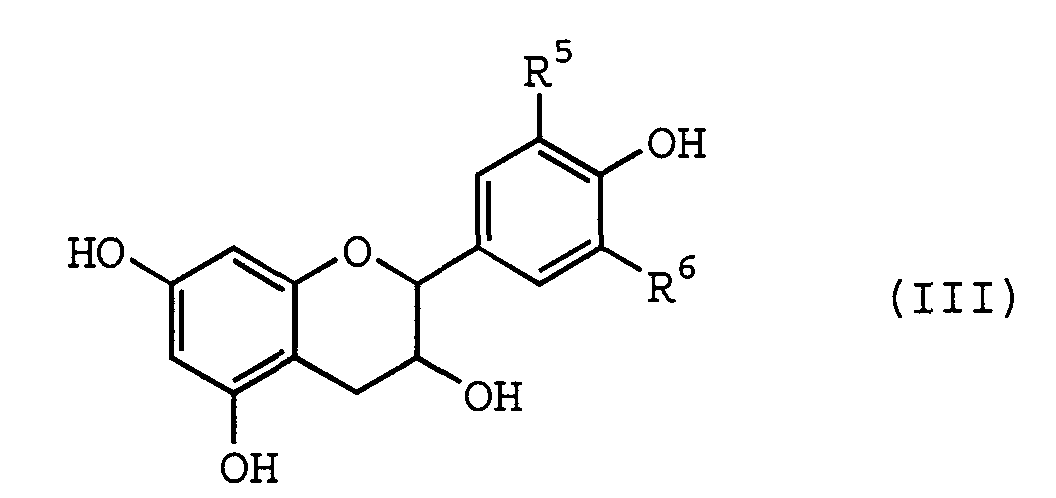
The proanthocyanidin used in the present invention
is a polymer composed of flavan-7-ol derivatives
represented by formula (III):
(wherein R
5 and R
6, which may be the same or different,
each represents a hydrogen atom or a hydroxyl group) or
the like as constitutive units.
Examples of the flavan-7-ol derivatives include
catechin, epicatechin, gallocatechin, epigallocatechin,
afzelechin, epiafzelechin and any optical isomers thereof.
Proanthocyanidin composed of epicatechin or catechin as a
constitutive unit is preferably used in the present
invention.
The bonding mode of the flavan-7-ol derivatives
represented by formula (III) may be any mode. An example
of a dimer composed of two flavan-7-ol derivatives is the
one which has a bonding mode represented by formula (IV):
(wherein R
7 and R
7a have the same significance as the above
R
5, and R
8 and R
8a have the same significance as the above
R
6). In trimers and higher polymers, the flavan-7-ol
derivatives may be bonded in the same or different bonding
modes.
The proanthocyanidin to be used in the present
invention may be any dimer or higher polymer of flavan-7-ol
derivatives, and is preferably a 2- to 10-mer, more
preferably a 2- to 5-mer, further preferably a dimer or
trimer. Examples of the dimers of flavan-7-ol derivatives
include epicatechin-catechin co-dimers such as
epicatechin-(4β→8)-catechin, epicatechin dimers such as
epicatechin-(4β→8)-epicatechin, and catechin dimers such
as catechin-(4α→8)-catechin. Examples of the trimers of
flavan-7-ol derivatives include epicatechin trimers such
as epicatechin-(4β→8)-epicatechin-(4β→8)-epicatechin,
catechin trimers such as catechin-(4α→8)-catechin-(4α→
8)-catechin, and epicatechin-catechin co-trimers such as
epicatechin-(4β→8)-epicatechin-(4β→8)-catechin.
The proanthocyanidin to be used in the present
invention also includes compounds wherein gallic acid or a
sugar such as glucose or rhamnose is attached to the above
proanthocyanidin.
Proanthocyanidin can be obtained by extraction and
purification from various plants such as grape, apple,
barley, Japanese persimmon, coconut, cacao, pine, azuki
bean and peanut belonging to the genera Vitis, Malus,
Hordeum, Diospyros, Cocos, Theobroma, Pinus, Phaseolus,
Arachis and the like, or by chemical synthesis.
For instance, proanthocyanidin can be extracted and
purified from plants according to the following known
method.
Fruits, seeds, leaves, stalks, roots, rootstocks,
etc. of the plants as starting materials are harvested at
a suitable stage and used, as such or usually after being
subjected to drying such as air drying, as materials for
extraction. Extraction of proanthocyanidin from dry plants
can be carried out in a manner similar to known methods
[Chemical & Pharmaceutical Bulletin, 3, 3218 (1990); ibid.,
40, 889-898 (1992)].
That is, the materials are ground or cut into fine
pieces, followed by extraction with a solvent. Suitable
solvents for extraction include hydrophilic or lipophilic
solvents such as water, alcohols (e.g. ethanol, methanol
and isopropyl alcohol), ketones (e.g. acetone and methyl
ethyl ketone) and esters (e.g. methyl acetate and ethyl
acetate), which can be used alone or as a mixture. The
temperature for extraction is usually 0 to 100°C,
preferably 5 to 50°C. The time for extraction is about one
hour to 10 days, and the amount of the solvent is usually
1 to 30 times by weight, preferably 5 to 10 times by
weight based on the dry material. Extraction is carried
out by stirring or by dipping followed by standing, and is
repeated twice or 3 times, as may be required.
The crude extract obtained in the above manner is
filtered or centrifuged to remove the insoluble residue.
Purification of proanthocyanidin from the thus treated
extract, or from juice or sap of the plants can be carried
out by any known purification methods. It is preferred to
employ the two-phase solvent partitioning method, column
chromatography, preparative high-performance liquid
chromatography, etc. alone or in combination. The two-phase
solvent partitioning methods include, for example, a
method in which oil-soluble components and pigments are
removed from the above extract by extraction with n-hexane,
petroleum ether, etc., and a method in which
proanthocyanidin is collected from the extract into the
solvent phase by partition between a solvent such as n-butanol
or methyl ethyl ketone and water. Column
chromatography includes a method using normal phase silica
gel, a method using reversed phase silica gel, adsorption
column chromatography using as a carrier Diaion HP-20,
Sepabeads SP-207 or the like, and gel filtration using as
a carrier Sephadex LH-20 or the like. They are employed
alone or in combination, if necessary repeatedly.
Preparative high-performance liquid chromatography
includes a method using a reversed phase column packed
with octadecyl silica or the like, and a method using a
normal phase column packed with silica gel or the like.
Proanthocyanidin can be purified by removing watersoluble
ionic substances such as salts, nonionic
substances such as saccharides and polysaccharides, oils,
pigments, etc. from the above extract according to the
above purification methods.
Grape-derived proanthocyanidin can be extracted and
purified according to the method described in Acta Dermato
Venereologica, 78, 428-432 (1998) or a similar method.
Procyanidin B-1 [epicatechin-(4β→8)-catechin],
procyanidin B-2 [epicatechin-(4β→8)-epicatechin],
procyanidin B-3 [catechin-(4α→8)-catechin], procyanidin
C-1 [epicatechin-(4β→8)-epicatechin-(4β→8)-epicatechin]
and procyanidin C-2 [catechin-(4α→8)-catechin-(4α→8)-catechin]
can be extracted and purified according to the
method described in The Journal of Investigative
Dermatology, 112, 310-316 (1999) or a similar method.
Production of proanthocyanidin by chemical synthesis
can be carried out according to the method described in
Journal of Chemical Society, Perkin Transaction I, 1535-1543
(1983) in which a process of producing dimers of
epicatechin or catechin is described, the method described
in Phytochemistry, 25, 1209-1215 (1986) or similar methods.
When proanthocyanidin is used as an active
ingredient in the present invention, one or more kinds of
proanthocyanidin may be used alone or as a mixture. It is
preferred to use one or more members selected from the
group consisting of grape-seed-derived proanthocyanidin,
apple-derived proanthocyanidin, barley-derived
proanthocyanidin, pine-derived proanthocyanidin, purified
procyanidin oligomers, procyanidin B-1, procyanidin B-2,
procyanidin B-3, procyanidin C-1 and procyanidin C-2.
Specifically it is preferred to use one or more members
selected from the group consisting of procyanidin B-1,
procyanidin B-2, procyanidin B-3, procyanidin C-1 and
procyanidin C-2.
The tocopherol and derivatives of tocopherol to be
used in the present invention include any natural and
synthetic ones that are commercially available, and
derivatives such as acetic acid esters and nicotinic acid
esters. Examples thereof include dl-α-tocopherol, d-α-tocopherol,
dl-α-tocopherol acetate, d-α-tocopherol
acetate and dl-α-tocopherol nicotinate.
The pantothenic acid and derivatives of pantothenic
acid to be used in the present invention include any
natural and synthetic ones that are commercially available
and any other ones. Examples thereof include calcium
pantothenate, sodium pantothenate, D-pantothenyl alcohol,
DL-pantothenyl alcohol and pantothenyl ethyl ether.
As the protein kinase C-specific inhibitor in the
present invention, any inhibitor that specifically
inhibits protein kinase C can be used. It is preferred to
use protein kinase inhibitors of which the ratio of the
50% protein kinase A (PKA) inhibition constant
(hereinafter referred to as PKA-IC50) to the 50% protein
kinase C (PKC) inhibition constant (hereinafter referred
to as PKC-IC50) (the ratio is hereinafter referred to as
PKA-IC50/PKC-IC50) is 3 or more, preferably 3 to 109, more
preferably 10 to 109, when PKC-inhibiting activity and PKA-inhibiting
activity are measured by the following methods
for measuring PKC-inhibiting activity and PKA-inhibiting
activity. Examples thereof are one or more members
selected from the group consisting of calphostin C,
hexadecylphosphocholine, palmitoyl-DL-carnitine, polymyxin
B and pharmaceutically acceptable salts thereof.
Examples of the pharmaceutically acceptable salts
are hydrochlorides, hydrobromides, sulfates, nitrates,
formates, acetates, benzoates, maleates, fumarates,
succinates, tartrates, citrates, oxalates,
methanesulfonates, toluenesulfonates, aspartates and
glutamates.
The methods for measuring PKC-inhibiting activity
and PKA-inhibiting activity are described below.
(1) Method for Measuring PKC-inhibiting Activity
Measurement of PKC-inhibiting activity can be
carried out in a manner similar to the method of Kikkawa,
et al. [Journal of Biological Chemistry, 257, 13341
(1982)].
To 250 µl of an aqueous solution comprising 2.5
µmol of magnesium acetate, 50 µg of histone Type IIIS
(Sigma Chemical Co., Ltd.), 20 µg of phosphatidylserine,
0.8 µg of diolein, 25 nmol of calcium chloride, 5 µg of a
crude enzyme (partially purified from rat brain by the
method of Kikkawa, et al.) and 5 µ mol of Tris-HCl buffer
(pH 7.5) is added the above aqueous solution containing a
test compound (10 µl), followed by incubation at 30°C for
3 minutes. After the incubation, 1.25 nmol of [γ-32P]ATP
(5-10 x 103 cpm/nmol) is added thereto, followed by
phosphorylation reaction at 30°C for 3 minutes. The
reaction is terminated by addition of 25% trichloroacetic
acid and the reaction mixture is filtered through a
cellulose acetate membrane (pore size: 0.45 µm, Toyo
Filter Co., Ltd.) After the membrane is washed four times
with 5% trichloroacetic acid, the radioactivity remaining
on the membrane is measured as a test compound value.
Separately, the above procedure is carried out in the same
manner without addition of the test compound and the
radioactivity is measured as a control value.
The molar concentration of the test compound giving
a test compound value which is 50% of the control value is
regarded as the 50% PKC inhibition constant (PKC-IC50).
(2) Method for Measuring PKA-inhibiting Activity
Measurement of PKA-inhibiting activity can be
carried out in a manner similar to the method of Kuo, et
al. [Biochemistry, 64, 1349 (1969)].
To 250 µl of an aqueous solution comprising 5 µ mol
of Tris-HCl buffer (pH 6.8), 2.5 µ mol of magnesium
acetate, 100 µg of histone Type IIS (Sigma Chemical Co.,
Ltd.), 0.25 nmol of c-AMP and 200 µg of a crude enzyme
(partially purified from calf heart by the method of Kuo,
et al.) is added the above aqueous solution containing a
test compound (10 µl), followed by incubation at 30°C for
3 minutes. After the incubation, 1.25 nmol of [γ-32P]ATP
(5-10 x 103 cpm/nmol) is added thereto, followed by
phosphorylation reaction at 30°C for 3 minutes. The
reaction is terminated by addition of 25% trichloroacetic
acid and the reaction mixture is filtered through a
cellulose acetate membrane (pore size: 0.45 µm, Toyo
Filter Co., Ltd.) After the membrane is washed four times
with 5% trichloroacetic acid, the radioactivity remaining
on the membrane is measured as a test compound value.
Separately, the above procedure is carried out in the same
manner without addition of the test compound and the
radioactivity is measured as a control value.
The molar concentration of the test compound giving
a test compound value which is 50% of the control value is
regarded as the 50% PKA inhibition constant (PKA-IC50).
As the biotin, any natural or synthetic biotin that
is commercially available can be used. Suitable examples
thereof include D-biotin.
The hair-growing agent of the present invention may
be in any preparation form so long as it can contain a
phosphatidic acid represented by formula (I); the
phosphatidic acid, and one or more members selected from
the group consisting of proanthocyanidin, tocopherol,
derivatives of tocopherol, pantothenic acid, derivatives
of pantothenic acid, protein kinase C-specific inhibitors
or pharmaceutically acceptable salts thereof and biotin; a
phosphatidic acid, and one or more members selected from
the group consisting of proanthocyanidin, tocopherol,
derivatives of tocopherol, pantothenic acid, derivatives
of pantothenic acid and protein kinase C-specific
inhibitors or pharmaceutically acceptable salts thereof;
or a phosphatidic acid and biotin, and one or more members
selected from the group consisting of proanthocyanidin,
tocopherol, derivatives of tocopherol, pantothenic acid,
derivatives of pantothenic acid and protein kinase C-specific
inhibitors or pharmaceutically acceptable salts
thereof. For example, it can be used in the form of a
liquid or solid hair-growing preparation containing a
suitable pharmaceutical vehicle.
Examples of the liquid or solid hair-growing
preparations include liquid preparations such as hair
liquid, hair tonic and hair lotion, and solid preparations
such as ointment and hair cream. These preparations can
be produced by adding to a suitable vehicle a phosphatidic
acid represented by formula (I); the phosphatidic acid,
and one or more members selected from the group consisting
of proanthocyanidin, tocopherol, derivatives of tocopherol,
pantothenic acid, derivatives of pantothenic acid, protein
kinase C-specific inhibitors or pharmaceutically
acceptable salts thereof and biotin; a phosphatidic acid,
and one or more members selected from the group consisting
of proanthocyanidin, tocopherol, derivatives of tocopherol,
pantothenic acid, derivatives of pantothenic acid and
protein kinase C-specific inhibitors or pharmaceutically
acceptable salts thereof; or a phosphatidic acid and
biotin, and one or more members selected from the group
consisting of proanthocyanidin, tocopherol, derivatives of
tocopherol, pantothenic acid, derivatives of pantothenic
acid and protein kinase C-specific inhibitors or
pharmaceutically acceptable salts thereof, according to a
conventional method.
The content of a phosphatidic acid in the hair-growing
agent of the present invention widely varies
depending upon the kind of the phosphatidic acid and the
percutaneous absorbability derived from physical
properties, but it is usually, alone or as a mixture, 0.01
to 5.0 wt% (hereinafter referred to merely as %),
preferably 0.01 to 3.0%, more preferably 0.1 to 1.0%. The
content of proanthocyanidin varies depending upon the
purification degree, but is usually 0.01 to 10.0%,
preferably 0.1 to 5.0%, more preferably 0.3 to 2.0%. The
content of tocopherol or a derivative of tocopherol is
usually 0.01 to 2%, preferably 0.05 to 2%, more preferably
0.05 to 1%. The content of pantothenic acid or a
derivative of pantothenic acid is usually 0.01 to 2%,
preferably 0.05 to 1%, more preferably 0.1 to 0.5%. The
content of a protein kinase C-specific inhibitor or a
pharmaceutically acceptable salt thereof widely varies
depending upon the inhibitory activity and the
percutaneous absorbability derived from physical
properties, but it is usually, alone or as a mixture,
0.00001 to 1%, preferably 0.0001 to 1%, more preferably
0.001 to 0.1%. The content of biotin is usually 0.0001 to
0.1%, preferably 0.001 to 0.1%, more preferably 0.001 to
0.05%.
Preferred vehicles for liquid preparations are those
which are generally used in hair-growing agents such as
purified water, ethyl alcohol and polyvalent alcohols. If
necessary, additives may be added thereto.
Examples of the polyvalent alcohols are glycerol,
1,3-butylene glycol and propylene glycol.
Additives include surfactants, vitamins, anti-inflammatory
agents, microbicides, hormones, crude drug
extracts, tinctures, refrigerants, moisturizers,
antioxidants, sequestering agents and perfumes.
Examples of the surfactants are polyoxyethylene (60)
hardened castor oil, polyoxyethylene (8) oleyl ether,
polyoxyethylene (10) oleyl ether, polyoxyethylene (10)
monooleate, polyoxyethylene (30) glyceryl monostearate,
sorbitan monostearate, polyoxyethylene (20) sorbitan
monooleate, sucrose fatty acid esters, hexaglycerin
monooleate, hexaglycerin monolaurate, polyoxyethylene
reduced lanolin, polyoxyethylene (20) lanolin alcohol,
polyoxyethylene (25) glyceryl pyroglutamate isostearate,
and N-acetylglutamine isostearyl ester.
Examples of the vitamins are benzyl nicotinate,
nicotinamide, pyridoxine hydrochloride and riboflavin.
Examples of the anti-inflammatory agents are
dipotassium glycyrrhizinate, β-glycyrrhetinic acid,
allantoin, diphenhydramine hydrochloride, guaiazulene and
1-menthol.
Examples of the microbicides are
trichlorohydroxydiphenyl ether, hinokitiol, triclosan,
chlorohexidine gluconate, phenoxyethanol, resorcin,
isopropylmethylphenol, azulene, salicylic acid, zinc
pyrithione, benzalkonium chloride, photosensitizing dye No.
301 and sodium mononitroguaiacol.
Examples of the hormones are ethynylestradiol,
estrone and estradiol.
Examples of the crude drug extracts are extract of
Swertia japonica Makino, garlic extract, ginseng extract,
aloe extract, cinchona extract, plant worm extract and
saffron extract.
Examples of the tinctures are capsicum tincture,
ginger tincture and cantharis tincture.
Examples of the refrigerants are capsicum tincture,
1-menthol and camphor.
Examples of the moisturizers are L-pyrrolidonecarboxylic
acid, sodium hyaluronate and
chondroitin sulfate.
Examples of the antioxidants are butylhydroxyanisole,
isopropyl gallate, propyl gallate and erythorbic acid.
Examples of the sequestering agents are
ethylenediamine tetraacetate and salts thereof.
Examples of the perfumes are natural perfumes such
as orange oil, lemon oil, bergamot oil, lime oil,
lemongrass oil and lavender oil, and synthetic perfumes
such as menthol, rose oxide, linalool, citral and linalyl
acetate.
When the above liquid preparations are used as spray,
they can be used in combination with combustible gas,
incombustible gas, or the like. Examples of the
combustible gas are LPG (a liquefied petroleum gas) and
dimethyl ether, and examples of the incombustible gas are
a nitrogen gas and a carbon dioxide gas.
Vehicles for solid preparations include Vaseline,
solid paraffin, vegetable oils, mineral oils, lanolin, wax
and macrogol. Further, the above additives, and lower
alcohols such as ethyl alcohol and isopropyl alcohol may
be added thereto, if necessary.
The dose of the hair-growing agent of the present
invention varies depending upon the age or the body weight
of a patient, the symptom of the disease, the therapeutic
effect, the mode of administration, the time of treatment
or the like. The agent is percutaneously administered in
an amount of 0.1 to 250 mg, preferably 1 to 100 mg in
terms of phosphatidic acid per adult once to several times
per day.
Certain embodiments of the present invention are
illustrated in the following examples.
Example 1 Preparation of Compositions 1 and 2
| 1-O-Hexadecyl-2-O-methylglyceryl-3-phosphoric acid |
0.4% |
| Ethyl alcohol |
70% |
| 1,3-Butylene glycol |
3% |
| N-Acetylglutamine isostearyl ester |
0.25% |
| Polyoxyethylene (25) glyceryl pyroglutamate |
0.25% |
| isostearate |
To the above mixture was added purified water to
make up to 100%. The mixture was made homogeneous with
stirring to prepare composition 1.
Composition 2 was prepared in the same manner as
above except that purified water was used instead of 1-O-hexadecyl-2-O-methylglyceryl-3-phosphoric
acid.
Example 2 Preparation of Compositions 3 and 4
| 1-O-Hexadecyl-2-O-methylglyceryl-3-phosphoric acid |
0.4% |
| Procyanidin B-2 |
1% |
| Ethyl alcohol |
70% |
| 1,3-Butylene glycol |
3% |
| N-Acetylglutamine isostearyl ester |
0.25% |
| Polyoxyethylene (25) glyceryl pyroglutamate |
0.25% |
| isostearate |
Procyanidin B-2 was produced according to the method
described in The Journal of Investigative Dermatology, 112,
310-316 (1999).
To the above mixture was added purified water to
make up to 100%. The mixture was made homogeneous with
stirring to prepare composition 3.
Composition 4 was prepared in the same manner as
above except that purified water was used instead of 1-O-hexadecyl-2-O-methylglyceryl-3-phosphoric
acid.
Example 3 Preparation of Compositions 5 and 6
| 1-O-Hexadecyl-2-O-methylglyceryl-3-phosphoric acid |
0.4% |
| dl-α-Tocopherol |
1.0% |
| Ethyl alcohol |
70% |
| 1,3-Butylene glycol |
3% |
| N-Acetylglutamine isostearyl ester |
0.25% |
| Polyoxyethylene (25) glyceryl pyroglutamate |
0.25% |
| isostearate |
To the above mixture was added purified water to
make up to 100%. The mixture was made homogeneous with
stirring to prepare composition 5.
Composition 6 was prepared in the same manner as
above except that purified water was used instead of 1-O-hexadecyl-2-O-methylglyceryl-3-phosphoric
acid.
Example 4 Preparation of Compositions 7 and 8
| 1-O-Hexadecyl-2-O-methylglyceryl-3-phosphoric acid |
0.4% |
| Pantothenyl ethyl ether |
0.3% |
| Ethyl alcohol |
70% |
| 1,3-Butylene glycol |
3% |
| N-Acetylglutamine isostearyl ester |
0.25% |
| Polyoxyethylene (25) glyceryl pyroglutamate |
0.25% |
| isostearate |
To the above mixture was added purified water to
make up to 100%. The mixture was made homogeneous with
stirring to prepare composition 7.
Composition 8 was prepared in the same manner as
above except that purified water was used instead of 1-O-hexadecyl-2-O-methylglyceryl-3-phosphoric
acid.
Example 5 Preparation of Compositions 9 and 10
| 1-O-Hexadecyl-2-O-methylglyceryl-3-phosphoric acid |
0.4% |
| Biotin |
0.05% |
| Ethyl alcohol |
70% |
| 1,3-Butylene glycol |
3% |
| N-Acetylglutamine isostearyl ester |
0.25% |
| Polyoxyethylene (25) glyceryl pyroglutamate |
0.25% |
| isostearate |
To the above mixture was added purified water to
make up to 100%. The mixture was made homogeneous with
stirring to prepare composition 9.
Composition 10 was prepared in the same manner as
above except that purified water was used instead of 1-O-hexadecyl-2-O-methylglyceryl-3-phosphoric
acid.
Example 6 Preparation of Composition 11
| 1-O-Oleoyl-2-O-methylglyceryl-3-phosphoric acid |
0.4% |
| Ethyl alcohol |
70% |
| 1,3-Butylene glycol |
3% |
| N-Acetylglutamine isostearyl ester |
0.25% |
| Polyoxyethylene (25) glyceryl pyroglutamate |
0.25% |
| isostearate |
To the above mixture was added purified water to
make up to 100%. The mixture was made homogeneous with
stirring to prepare composition 11.
Example 7 Preparation of Composition 12
| 1-O-Hexadecyl-2-O-acetylglyceryl-3-phosphoric acid |
0.4% |
| Ethyl alcohol |
70% |
| 1,3-Butylene glycol |
3% |
| N-Acetylglutamine isostearyl ester |
0.25% |
| Polyoxyethylene (25) glyceryl pyroglutamate |
0.25% |
| isostearate |
To the above mixture was added purified water to
make up to 100%. The mixture was made homogeneous with
stirring to prepare composition 12.
Reference Example 1 Synthesis of 1-O-hexadecyl-2-O-methylglyceryl-3-phosphoric
acid (1-O-hexadecyl-2-O-methylphosphatidic
acid)
Synthesis of 1-O-hexadecyl-2-O-methylglyceryl-3-phosphoric
acid can be carried out according to the method
described in Journal of Medicinal Chemistry, 2038-2044
(1986) or a similar method.
In 10 ml of hexane was dissolved 165 mg of 1-O-hexadecyl-2-O-methylglycerol
(Sigma Chemical Co., Ltd.),
and the resulting solution was added dropwise to a mixture
of phosphorus oxychloride (700 µl), triethylamine (1000
µl) and hexane (50 ml) with stirring at room temperature.
After 15 hours of stirring, 10 ml of purified water was
added thereto, followed by further stirring at room
temperature for one hour. The organic layer was separated
and developed on a silica gel thin layer chromatography
plate with a mobile phase of chloroform:methanol:acetic
acid:water = 170:25:25:6. A band of silica gel containing
the desired product was scraped off and diethyl ether was
added to this silica gel powder. The organic layer was
separated and concentrated under reduced pressure to
obtain 52 mg of 1-O-hexadecyl-2-O-methylglyceryl-3-phosphoric
acid.
Reference Example 2 Synthesis of 1-O-oleoyl-2-O-methylglyceryl-3-phosphoric
acid (1-O-oleoyl-2-O-methylphosphatidic
acid)
Synthesis of 1-O-oleoyl-2-O-methylglyceryl-3-phosphoric
acid can be carried out according to the method
described in Ann. N. Y. Acad. Sci., 279-281 (2000) or WO
99/47101 or a similar method.
Monoolein (1020 mg, Kishida Chemical Co., Ltd.) as a
starting material was reacted with triphenylchloromethane
to protect the alcohol residue at the 3-position with a
triphenylmethyl group, and then reacted with methyl iodide
and sodium hydride to introduce a methyl group to the
alcohol residue at the 2-position. The formed 1-O-oleoyl-2-O-methyl-3-O-triphenylmethylglycerol
was treated with
acetic acid to remove the triphenylmethyl group. The
obtained 1-O-oleoyl-2-O-methylglycerol was reacted with
phosphorus oxychloride and triethylamine to obtain 271 mg
of the desired 1-O-oleoyl-2-O-methylglyceryl-3-phosphoric
acid.
Reference Example 3 Synthesis of 1-O-hexadecyl-2-O-acetylglyceryl-3-phosphoric
acid (1-O-hexadecyl-2-O-acetylphosphatidic
acid)
Synthesis of 1-O-hexadecyl-2-O-acetylglyceryl-3-phosphoric
acid can be carried out according to the method
described in Journal of Medicinal Chemistry, 2038-2044
(1986) or a similar method.
In 17.9 ml of hexane was dissolved 179 mg of 1-O-hexadecyl-2-O-acetylglycerol
(Funakoshi Co., Ltd.), and
the resulting solution was added dropwise to a mixture of
phosphorus oxychloride (700 µl), triethylamine (1000 µl)
and hexane (50 ml) with stirring at room temperature.
After 15 hours of stirring, 10 ml of purified water was
added thereto, followed by further stirring at room
temperature for one hour. The organic layer was separated
and developed on a silica gel thin layer chromatography
plate with a mobile phase of chloroform:methanol:acetic
acid:water = 170:25:25:6. A band of silica gel containing
the desired product was scraped off and diethyl ether was
added to this silica gel powder, followed by thorough
mixing. The organic layer was separated and concentrated
under reduced pressure to obtain 42 mg of 1-O-hexadecyl-2-O-acetylglyceryl-3-phosphoric
acid.
The activity of the hair-growing agent of the
present invention is shown in detail by the following test
examples.
Test Example 1 Cell Growth-Promoting Effect on Cultured
Mouse Hair Follicle Epithelial Cells
Mouse hair follicle epithelial cells were separated
and cultured according to a modification of the method of
Tanigaki, et al. [Archives of Dermatological Research,
284, 290-296 (1992)].
The skin on the back of a 4-days-old C3H mouse
(Charles River Japan, Inc.) was cut off and treated with
MEM (Eagle's Minimum Essential Medium) containing 500
units/ml Dispase (Godo Shusei Co., Ltd.) and 5% fetal calf
serum (FCS) at 4°C for 16 hours.
Then, the epidermis was stripped from the skin
section, and the obtained dermis layer was treated with
DMEM (Dulbecco's modified Eagle Medium) containing 0.25%
Collagenase N-2 (Nitta Gelatin Co., Ltd.) and 10% FCS at
37°C for one hour to obtain a dermis suspension. The
dermis suspension was filtered through a 212-µm nylon
mesh (Nippon Rikagaku Kikai Co., Ltd.) and the filtrate
was centrifuged at 1000 rpm for 5 minutes to obtain
pellets containing hair follicle tissue. To the pellets
was added calcium/magnesium-free PBS (Dulbecco's
Phosphate-Buffered Saline) and the pellets were suspended
therein using a pipette. The resulting suspension was
allowed to stand for 15 minutes to precipitate hair
follicle tissue. The same procedure as above (addition of
calcium/magnesium-free PBS, suspending by use of a pipette,
and precipitation by allowing the suspension to stand for
15 minutes) was repeated three times using the obtained
hair follicle tissue.
Then, the hair follicle tissue was treated with a
solution containing 0.1% ethylenediaminetetraacetic acid
(EDTA) and 0.25% trypsin (Gibco) at 37°C for 5 minutes.
To the resulting mixture was added DMEM containing 10% FCS
to prepare a hair follicle tissue cell suspension having a
density of 3 x 10⁵ cells/ml. The hair follicle tissue cell
suspension was put into wells of a 24-well collagen-coated
plate (Iwaki Glass Co., Ltd.) in an amount of 1 ml/well,
followed by culturing in 5% CO2 at 37°C for 24 hours.
After culturing, the medium was replaced by a medium
prepared by adding to MCDB153 medium (Kyokuto
Pharmaceutical Ind. Co., Ltd.) DMSO containing 5 mg/l
bovine insulin (Sigma Chemical Co., Ltd.); 5 µg/l mouse
epidermal growth factor (EGF) (Takara Shuzo Co., Ltd.); 40
mg/l bovine pituitary extract (Kyokuto Pharmaceutical Ind.
Co., Ltd.); 10 mg/l human transferrin (Sigma Chemical Co.,
Ltd.); 0.4 mg/l hydrocortisone (Sigma Chemical Co., Ltd.);
0.63 µg/l progesterone (Collaborative Research Co.); 14
mg/l O-phosphoethanolamine (Sigma Chemical Co., Ltd.); 6.1
mg/l ethanolamine (Sigma Chemical Co., Ltd.); 50 U/ml
penicillin (Wako Pure Chemical Industries, Ltd.);
50 µg/ml streptomycin (Wako Pure Chemical Industries,
Ltd.); a phosphatidic acid (1-O-hexadecyl-2-O-methylglyceryl-3-phosphoric
acid, 1-O-oleoyl-2-O-methylglyceryl-3-phosphoric
acid or 1-O-hexadecyl-2-O-acetylglyceryl-3-phosphoric
acid), and/or procyanidin B-2
or dl-α-tocopherol (added in an amount of 1/100 by
volume), followed by further culturing in 5% CO2 at 37°C
for 5 days. During the culturing, the medium was replaced
with a fresh one every other day.
As a control, the cells were cultured in the same
medium as above except that DMSO alone was added in an
amount of 1/100 by volume in place of DMSO containing a
phosphatidic acid, and/or procyanidin B-2 or dl-α-tocopherol.
The degree of cell growth was measured according to
the method using MTT [3-(4,5-dimethylthiazol-2-yl)-2,5-diphenyl
tetrazolium bromide] [Experimental Medicine
(extra number), Bio Manual UP Series, Experimental Method
of Cell Culture for Molecular Biological Studies, p. 89-92,
Yodosha (1995)].
To each well of the 24-well microplate (2 cm2/well)
was added a PBS solution of MTT (5 mg/ml) in an amount of
1/10 by volume based on 1 ml of the culture. The plate
was shaken to make the mixture homogeneous, followed by
culturing in 5% CO2 at 37°C for 4 hours. Four hours later,
the culture was sucked and 1 ml of a 0.04 mol/l solution
of HCl in isopropyl alcohol was added to each well to
completely dissolve formazan formed in the wells.
The degree of cell growth was determined by
measuring the absorbance at 570 nm based on that at 650 nm
as a control.
The cell growth-promoting activity of the compounds
used in the present invention is shown in Table 1.
| Test group | Active ingredient (concentration) | Relative cell growth rate based on the control as 100 |
| 1 | 1-O-Hexadecyl-2-O-methylglyceryl-3-phosphoric acid (1 µmol/l) | 177 |
| 2 | 1-O-Oleoyl-2-O-methylglyceryl-3-phosphoric acid (1 µmol/l) | 163 |
| 3 | 1-O-Hexadecyl-2-O-acetylglyceryl-3-phosphoric acid (1 µmol/l) | 155 |
| 4 | Procyanidin B-2 (30 µmol/l) | 310 |
| 5 | dl-α-Tocopherol (30 µmol/l) | 184 |
| 6 | Compound of test group 1 (1 µmol/l) + procyanidin B-2 (30 µmol/l) | 369 |
| 7 | Compound of test group 1 (1 µmol/l) + d1-α-tocopherol (30 µmol/l) | 251 |
| 8 | Compound of test group 2 (1 µmol/l) + procyanidin B-2 (30 µmol/l) | 352 |
| 9 | Compound of test group 2 (1 µmol/l) + d1-α-tocopherol (30 µmol/l) | 244 |
| 10 | Compound of test group 3 (1 µmol/l) + procyanidin B-2 (30 µmol/l) | 358 |
| 11 | Compound of test group 3 (1 µmol/l) + dl-α-tocopherol (30 µmol/l) | 229 |
As shown in Table 1, the phosphatidic acids used in
the present invention exhibited a significant growth-promoting
activity on mouse hair follicle epithelial cells.
The growth-promoting activity of proanthocyanidin and
tocopherol on mouse hair follicle epithelial cells was
reinforced by using them together with the above
phosphatidic acids.
Test Example 2 Effect on Hair Growth of Mouse
A test of the effect on hair growth of mice was
carried out referring to the method of Ogawa, et al. [The
Journal of Dermatology, 10, 45-54, (1983)].
Nine-weeks-old male C3H/HeSlc mice whose hair cycle
was in the telogen were divided into groups each
consisting of 4 or 5 mice. Hair on the back of each mouse
was shaven using electric hair clippers and an electric
shaver. Then, compositions 1 to 12 prepared in Examples 1
to 7 were applied on the shaven part in an amount of 200
µl once per day. To the mice of control group was
applied composition 2 in the same manner.
On the 18th day after the start of the test, the
skin on the back of each mouse was cut off and
photographed. Using an image processor (Avionics Co.,
Spicca II), the percentage of the hair-grown area to the
total area of the skin on the back was calculated. The
rate of the increased hair-grown area (%) was obtained by
subtracting the hair-growing rate of the control group
from the hair-growing rate of the test group.
The results are shown in Table 2.
| Composition | Rate of increased hair-grown area (%) |
| 2 (Control group) | 0 |
| 1 | 49 |
| 3 | 62 |
| 4 | 46 |
| 5 | 60 |
| 6 | 42 |
| 7 | 55 |
| 8 | 18 |
| 9 | 56 |
| 10 | 15 |
| 11 | 48 |
| 12 | 45 |
As shown in Table 2, the hair-growing agents
comprising a phosphatidic acid of the present invention
exhibited a significant promoting effect on the hair
growth of mouse. The promoting effect of proanthocyanidin,
tocopherol, a derivative of pantothenic acid, and biotin
on the hair growth of mouse was reinforced by using them
together with a phosphatidic acid.