EP1229994B1 - Reduction of n2o emissions - Google Patents
Reduction of n2o emissions Download PDFInfo
- Publication number
- EP1229994B1 EP1229994B1 EP00963134A EP00963134A EP1229994B1 EP 1229994 B1 EP1229994 B1 EP 1229994B1 EP 00963134 A EP00963134 A EP 00963134A EP 00963134 A EP00963134 A EP 00963134A EP 1229994 B1 EP1229994 B1 EP 1229994B1
- Authority
- EP
- European Patent Office
- Prior art keywords
- catalyst
- ppmv
- iron
- promoted
- containing zeolite
- Prior art date
- Legal status (The legal status is an assumption and is not a legal conclusion. Google has not performed a legal analysis and makes no representation as to the accuracy of the status listed.)
- Expired - Lifetime
Links
Images
Classifications
-
- B—PERFORMING OPERATIONS; TRANSPORTING
- B01—PHYSICAL OR CHEMICAL PROCESSES OR APPARATUS IN GENERAL
- B01D—SEPARATION
- B01D53/00—Separation of gases or vapours; Recovering vapours of volatile solvents from gases; Chemical or biological purification of waste gases, e.g. engine exhaust gases, smoke, fumes, flue gases, aerosols
- B01D53/34—Chemical or biological purification of waste gases
- B01D53/74—General processes for purification of waste gases; Apparatus or devices specially adapted therefor
- B01D53/86—Catalytic processes
- B01D53/8621—Removing nitrogen compounds
- B01D53/8625—Nitrogen oxides
- B01D53/8628—Processes characterised by a specific catalyst
-
- Y—GENERAL TAGGING OF NEW TECHNOLOGICAL DEVELOPMENTS; GENERAL TAGGING OF CROSS-SECTIONAL TECHNOLOGIES SPANNING OVER SEVERAL SECTIONS OF THE IPC; TECHNICAL SUBJECTS COVERED BY FORMER USPC CROSS-REFERENCE ART COLLECTIONS [XRACs] AND DIGESTS
- Y02—TECHNOLOGIES OR APPLICATIONS FOR MITIGATION OR ADAPTATION AGAINST CLIMATE CHANGE
- Y02C—CAPTURE, STORAGE, SEQUESTRATION OR DISPOSAL OF GREENHOUSE GASES [GHG]
- Y02C20/00—Capture or disposal of greenhouse gases
- Y02C20/10—Capture or disposal of greenhouse gases of nitrous oxide (N2O)
Definitions
- Nitrous oxide (dinitrogen oxide, N 2 O) makes a substantial contribution to the greenhouse effect.
- the global warming potential (the extent to which a molecule contributes to the greenhouse effect compared to one molecule of CO 2 ) of N 2 O is approx. 310.
- the present invention can make a significant contribution to this policy.
- Various significant sources of N 2 O emissions have been identified: agriculture, industrial production of nylon precursors (adipic acid and caprolactam), the production of nitric acid and motor vehicles fitted with a three-way catalyst.
- the present invention relates to a catalyst which enables N 2 O to be converted into nitrogen at a relatively low temperature and which allows very low emissions of CO and hydrocarbons to be achieved.
- JP 05103953 and JP 07213864 describe the removal of N 2 O in the presence of, respectively, methane and propane with the aid of (inter alia) and iron-zeolite catalyst. However, these methods take no account of the emission of CO and unreacted hyrocarbons.
- Japanese patent publication JP 09000884 describes the mechanical mixing of an iron-zeolite catalyst with a supported platinum or palladium catalyst.
- the N 2 O conversion is around 60% at 450°C in a gas which contains oxygen and water.
- the conversion of N 2 O achieved with the mechanically mixed catalyst is significantly worse than with the iron-zeolite catalyst alone.
- JP 05103953, JP 07213864 and JP 09000884 all lack information about the effectiveness of the invention under pressure and/or in the presence of sulphur compounds. This is essential for use in the production of nitric acid and caprolactam, respectively.
- One object of the present invention is to provide a method for the removal of N 2 O from industrial gas streams which contain O 2 , H 2 O, NO x and possibly sulphur and which may be at elevated pressure.
- a further object of the present invention is to bring about the abovementioned removal of N 2 O by the addition of saturated hydrocarbons at a reaction temperature of lower than 400°C, with very low emissions of CO and unreacted hydrocarbons.
- the method according to the invention is characterized in that the catalyst used is a promoted, iron-containing zeolite.
- the zeolite catalyst is promoted with a precious metal, comprising Ru, Rh, Pd or Au or a combination of two or more of these metals.
- iron-containing zeolite catalyst which has been promoted with precious metal reduces the emissions of CO and residual hydrocarbons very considerably at the operating temperature compared to an unpromoted iron-containing zeolite catalyst.
- the catalyst described is also very active in the desired conversion at elevated process pressure, at which it is even more active than at atmospheric pressure. This is an important fact with regard to its application in the nitric acid industry.
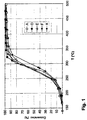
- Figure 1 shows the degree of conversion of N 2 O as a function of temperature for four iron-containing zeolite catalysts promoted with precious metal (A, D, E and F). For comparison purposes, the N 2 O conversion achieved by an unpromoted iron-containing zeolite catalyst (X) is also shown.
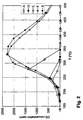
- Figure 2 shows the CO emissions which occur during the conversion of N 2 O using the same catalysts and under the same conditions as in Figure 1.
- the catalysts according to the present invention are produced by adding zeolite Na-ZSM-5 or NH 4 -ZSM-5 to a solution of (NH 4 ) 2 Fe(SO 4 ) 2 .6H 2 O (Mohr's salt). After they have been combined, ion exchange is carried out for 8 hours at 80°C. The resulting suspension is filtered, the solid material is washed, is dried at 80°C and is calcined at 550°C.
- the Fe-ZSM-5 base material obtained in this way is then impregnated with a volume of a solution of a precious metal precursor in demineralized water which is such that the pores of the base material are precisely filled (so-called incipient wetness impregnation).
- concentration of the precious metal precursor is set in such a manner that the desired quantity of precious metal on the base material is obtained.
- the catalyst is dried at 80°C and calcined at 550°C.
- the catalyst powder obtained is pressed into a tablet, is ground and is screened.
- Catalyst Base Precious metal
- Fe-ZSM-5 from Mohr's salt 0.05%
- Pd B Fe-ZSM-5 from Mohr's salt 0.1%
- Pd C Fe-ZSM-5 from Mohr's salt 0.3%
- Pd D Fe-ZSM-5 from Mohr's salt 0.3%
- Rh E Fe-ZSM-5 from Mohr's salt 0.3%
- Ru F Fe-ZSM-5 from Mohr's salt 0.3% Au X Fe-ZSM-5 from Mohr's salt none
- N 2 O The conversion of N 2 O by means of SCR using propane and methane was studied in an automated flow arrangement.
- the gases N 2 , air, N 2 O, C 3 H 8 , CH 4 , NO, NO 2 are introduced by means of calibrated mass flow controllers (Brooks), Water is added via a Liquiflow controller and a controlled Evaporator Mixer (Bronkhorst).
- the gases emerging are analysed by means of a calibrated FTIR spectrophotometer (Elsag, Bailey, Hartmann & Brown, type MB 100).
- the catalyst is in a stainless steel reactor,
- the gases are passed through a preheating section before they come into contact with the catalyst.
- the temperature at the entry to and exit from the catalyst bed is measured using thermocouples. The mean of these two temperatures is shown in the results of the tests.
- the pressure in the test arrangement can be set at levels of between 1 and 5 bar absolute (bara).
- the gas composition in the examples is representative for use of the catalyst according to the present invention in the nitric acid industry.
- the general test conditions are as follows: Weight of catalyst 6 - 15 g Screening fraction 0,71 - 1.4 mm Volume of catalyst 10 - 23 ml Total gas flow rate 5 - 7.5 l/min (STP) Space velocity 13,000 - 45,000 h -1 Total pressure 1- 5 bara Temperature of catalyst 150 - 500 °C O 2 concentration 2.5% v/v H 2 O concentration 0.5% v/v N 2 O concentration 1500 ppmv C 3 H 8 concentration 1500 - 2500 ppmv NO 2 concentration 100 ppmv NO concentration 100 ppmvvv NO concentration 100 ppmvv
- the promoted catalyst (A,D,E,F) are more active than the unpromoted iron-containing zeolite catalyst X. This is evident from the shift of the N 2 O conversion curves towards a lower temperature compared to the unpromoted Fe-ZSM-5 catalyst X.
- Figure 2 shows the CO concentrations as a function of temperature for the same catalysts under the same conditions.
- catalyst X and catalyst F When using catalyst X and catalyst F, CO is formed throughout the entire temperature range.
- the other catalysts are excellent at eliminating CO emissions: if catalyst E is used, the amount of CO at over 350°C is lower than 10 ppmv, and with catalysts A and D this level is already achieved from 304°C.
- the N 2 O and C 3 H 8 conversion levels are higher than 90% at 350°C.
- the CO emission is negligible. Another surprise is that the catalysts also remove from 60 to 75% of the NO x .
- the stability of the catalyst is tested for 50 hours in the conditions as described in Table 2. No deterioration in the activity was detected.
- Table 5 demonstrates that the catalyst according to the present invention also functions well with higher water concentrations and higher oxygen concentrations.
- Feed Reaction T 350°C N 2 O (ppmv) C 3 H 8 (ppmv) O 2 (% v/v) H 2 O (% v/v) N 2 O- conversion CO (ppmv) 500 1000 6 0.5 97% 3 500 1000 3 0.5 97% 2 500 1000 2 0.5 84% 3 1000 1000 2 0.5 90% 2 1000 500 2 0.5 82% 2 500 1000 6 2 94% 2 1000 1000 2 0.5 73% 1
Landscapes
- Engineering & Computer Science (AREA)
- Chemical & Material Sciences (AREA)
- Environmental & Geological Engineering (AREA)
- Chemical Kinetics & Catalysis (AREA)
- Biomedical Technology (AREA)
- Analytical Chemistry (AREA)
- General Chemical & Material Sciences (AREA)
- Oil, Petroleum & Natural Gas (AREA)
- Health & Medical Sciences (AREA)
- Catalysts (AREA)
- Treating Waste Gases (AREA)
- Exhaust Gas Treatment By Means Of Catalyst (AREA)
- Paper (AREA)
- Superconductors And Manufacturing Methods Therefor (AREA)
- Magnetic Resonance Imaging Apparatus (AREA)
- Organic Low-Molecular-Weight Compounds And Preparation Thereof (AREA)
Abstract
Description
| Catalyst | Base | Precious metal |
| A | Fe-ZSM-5 from Mohr's salt | 0.05% Pd |
| B | Fe-ZSM-5 from Mohr's salt | 0.1% Pd |
| C | Fe-ZSM-5 from Mohr's salt | 0.3% Pd |
| D | Fe-ZSM-5 from Mohr's salt | 0.3% Rh |
| E | Fe-ZSM-5 from Mohr's salt | 0.3% Ru |
| F | Fe-ZSM-5 from Mohr's salt | 0.3% Au |
| X | Fe-ZSM-5 from Mohr's salt | none |
| Weight of catalyst | 6 - 15 g |
| Screening fraction | 0,71 - 1.4 mm |
| Volume of catalyst | 10 - 23 ml |
| Total gas flow rate | 5 - 7.5 l/min (STP) |
| Space velocity | 13,000 - 45,000 h-1 |
| Total pressure | 1- 5 bara |
| Temperature of catalyst | 150 - 500 °C |
| O2 concentration | 2.5% v/v |
| H2O concentration | 0.5% v/v |
| N2O concentration | 1500 ppmv |
| C3H8 concentration | 1500 - 2500 ppmv |
| NO2 | 100 ppmv |
| NO | 100 ppmv |
| Catalyst | N2O (ppmv) | C3H8 (ppmv) | CO (ppmv) | NOx (ppmv) |
| | 70 | 62 | 3 | 85 |
| D | 55 | 33 | 1 | 85 |
| E | 130 | 75 | 37 | 82 |
| F | 42 | 70 | 2180 | 45 |
| X | 123 | 167 | 2267 | 46 |
| Pressure (bara) | N2O (ppmv) | C3H8 (ppmv) | CO (ppmv) | NOx (ppmv) |
| 1 | 95 | 200 | 14 | 137 |
| 3 | 128 | 124 | 3 | 135 |
| 5 | 100 | 54 | 2 | 122 |
| Feed | Reaction T = 350°C | ||||
| N2O (ppmv) | C3H8 (ppmv) | O2 (% v/v) | H2O (% v/v) | N2O- conversion | CO (ppmv) |
| 500 | 1000 | 6 | 0.5 | 97% | 3 |
| 500 | 1000 | 3 | 0.5 | 97% | 2 |
| 500 | 1000 | 2 | 0.5 | 84% | 3 |
| 1000 | 1000 | 2 | 0.5 | 90% | 2 |
| 1000 | 500 | 2 | 0.5 | 82% | 2 |
| 500 | 1000 | 6 | 2 | 94% | 2 |
| 1000 | 1000 | 2 | 0.5 | 73% | 1 |
Claims (6)
- Method for the selective catalytic reduction of nitrous oxide (N2O) in the presence of a solid catalyst, with the addition of a saturated hydrocarbon as a reducing agent, characterised in that the catalyst used is a promoted iron-containing zeolite, wherein the catalyst is promoted with a precious metal, and wherein the precious metal comprises rhutenium, rhodium, palladium or gold, or a combination of two or more of these metals.
- Method according to Claim 1, characterised in that the reducing agent used is natural gas or methane (CH4) or propane (C3H8) or LPG (C3H8/C4H10), or a combination thereof.
- Method according to Claims 1 or 2, characterised in that the concentration of the reducing agent is set in such a way that the hydrocarbon/N2O molar ratio is in the range from 0.2 to 20, preferably in the range from 0.5 to 5.
- Method according to any one of Claims 1-3, characterised in that the reduction takes place at an inlet temperature of less than 400°C.
- Method according to any one of Claims 1-4, characterised in that the emission of carbonmonoxide (CO) and of hydrocarbon is in each case separately less than 100 ppmv.
- Method according to any one of Claims 1-5, characterised in that the process pressure at which the reduction takes place is between 1 and 50 bar absolute.
Applications Claiming Priority (5)
| Application Number | Priority Date | Filing Date | Title |
|---|---|---|---|
| NL1012983 | 1999-09-06 | ||
| NL1012983 | 1999-09-06 | ||
| NL1013862A NL1013862C2 (en) | 1999-09-06 | 1999-12-15 | Reduction of N # 2O emissions. |
| NL1013862 | 1999-12-15 | ||
| PCT/NL2000/000626 WO2001021288A1 (en) | 1999-09-06 | 2000-09-06 | Reduction of n2o emissions |
Publications (2)
| Publication Number | Publication Date |
|---|---|
| EP1229994A1 EP1229994A1 (en) | 2002-08-14 |
| EP1229994B1 true EP1229994B1 (en) | 2004-06-16 |
Family
ID=26643044
Family Applications (1)
| Application Number | Title | Priority Date | Filing Date |
|---|---|---|---|
| EP00963134A Expired - Lifetime EP1229994B1 (en) | 1999-09-06 | 2000-09-06 | Reduction of n2o emissions |
Country Status (13)
| Country | Link |
|---|---|
| US (1) | US6872372B1 (en) |
| EP (1) | EP1229994B1 (en) |
| AT (1) | ATE269144T1 (en) |
| AU (1) | AU7458500A (en) |
| BG (1) | BG65640B1 (en) |
| DE (1) | DE60011665T2 (en) |
| DK (1) | DK1229994T3 (en) |
| ES (1) | ES2222924T3 (en) |
| NL (1) | NL1013862C2 (en) |
| NO (1) | NO330641B1 (en) |
| PL (1) | PL199528B1 (en) |
| PT (1) | PT1229994E (en) |
| WO (1) | WO2001021288A1 (en) |
Cited By (3)
| Publication number | Priority date | Publication date | Assignee | Title |
|---|---|---|---|---|
| WO2024099945A1 (en) * | 2022-11-11 | 2024-05-16 | Topsoe A/S | A process for the removal of nox and dinitrogen oxide in a sulfur oxides containing off-gas |
| WO2025262188A1 (en) | 2024-06-21 | 2025-12-26 | Thyssenkrupp Uhde Gmbh | Device comprising catalyst modules and method for catalytically reducing nitrogen oxides |
| BE1032714A1 (en) | 2024-06-21 | 2026-01-22 | Thyssenkrupp Uhde Gmbh | Device with catalyst modules and method for the catalytic reduction of nitrogen oxides |
Families Citing this family (7)
| Publication number | Priority date | Publication date | Assignee | Title |
|---|---|---|---|---|
| NL1017245C2 (en) * | 2001-01-31 | 2002-08-01 | Stichting Energie | Method for simultaneously removing nitrogen oxides and nitrous oxide from a gas stream containing nitrogen oxides and nitrous oxide. |
| WO2002068117A1 (en) * | 2001-02-28 | 2002-09-06 | Showa Denko K. K. | Decomposition catalyst for nitrous oxide, process for producing the same and process for decomposing nitrous oxide |
| NL1023360C2 (en) * | 2003-05-08 | 2004-11-09 | Stichting Energie | Method for desulfurizing fuel gas streams. |
| DE102007034284A1 (en) * | 2007-07-20 | 2009-01-22 | Leibniz-Institut Für Katalyse E.V. An Der Universität Rostock | Process for catalytic N2O reduction with simultaneous recovery of hydrogen and light alkenes |
| KR101047362B1 (en) * | 2008-05-26 | 2011-07-07 | 한국에너지기술연구원 | Simultaneous Reduction of Nitrous Oxide and Nitrogen Monoxide Using Carbon Monoxide Reductants on Precious Metal Catalysts Supported on Mixed Metal Oxides |
| US9517457B2 (en) | 2013-10-30 | 2016-12-13 | Cummins Inc. | Aftertreatment systems with reduced N2O generation |
| CN108187732B (en) * | 2017-12-12 | 2021-04-02 | 哈尔滨工业大学深圳研究生院 | A kind of CH4-SCR denitration catalyst with resistance to sulfur and water and preparation method thereof |
Family Cites Families (7)
| Publication number | Priority date | Publication date | Assignee | Title |
|---|---|---|---|---|
| US5524432A (en) * | 1991-08-01 | 1996-06-11 | Air Products And Chemicals, Inc. | Catalytic reduction of nitrogen oxides in methane-fueled engine exhaust by controlled methane injections |
| US5149512A (en) * | 1991-08-01 | 1992-09-22 | Air Products And Chemicals, Inc. | Catalytic reduction of NOx using methane in the presence of oxygen |
| DE4128629A1 (en) * | 1991-08-29 | 1993-03-04 | Basf Ag | SILVER-CONTAINING CARRIER CATALYST AND METHOD FOR THE CATALYTIC DECOMPOSITION OF NITROGEN MONOXIDE |
| JPH05103953A (en) * | 1991-10-15 | 1993-04-27 | Babcock Hitachi Kk | Method for removing nitrogen oxide in exhaust gas and removal catalyst |
| JPH07213864A (en) * | 1994-01-31 | 1995-08-15 | Ishikawajima Harima Heavy Ind Co Ltd | How to remove nitrous oxide |
| JP4203926B2 (en) * | 1995-06-16 | 2009-01-07 | バブコック日立株式会社 | Method and apparatus for removing nitrous oxide, etc. from exhaust gas |
| NL1008746C2 (en) * | 1998-03-30 | 1999-10-01 | Stichting Energie | Method for converting nitrous oxide. |
-
1999
- 1999-12-15 NL NL1013862A patent/NL1013862C2/en not_active IP Right Cessation
-
2000
- 2000-09-06 DE DE60011665T patent/DE60011665T2/en not_active Expired - Lifetime
- 2000-09-06 DK DK00963134T patent/DK1229994T3/en active
- 2000-09-06 PL PL353829A patent/PL199528B1/en unknown
- 2000-09-06 PT PT00963134T patent/PT1229994E/en unknown
- 2000-09-06 ES ES00963134T patent/ES2222924T3/en not_active Expired - Lifetime
- 2000-09-06 EP EP00963134A patent/EP1229994B1/en not_active Expired - Lifetime
- 2000-09-06 AT AT00963134T patent/ATE269144T1/en active
- 2000-09-06 AU AU74585/00A patent/AU7458500A/en not_active Abandoned
- 2000-09-06 US US10/070,317 patent/US6872372B1/en not_active Expired - Lifetime
- 2000-09-06 WO PCT/NL2000/000626 patent/WO2001021288A1/en not_active Ceased
-
2002
- 2002-02-27 NO NO20020940A patent/NO330641B1/en not_active IP Right Cessation
- 2002-03-06 BG BG106486A patent/BG65640B1/en unknown
Cited By (4)
| Publication number | Priority date | Publication date | Assignee | Title |
|---|---|---|---|---|
| WO2024099945A1 (en) * | 2022-11-11 | 2024-05-16 | Topsoe A/S | A process for the removal of nox and dinitrogen oxide in a sulfur oxides containing off-gas |
| WO2025262188A1 (en) | 2024-06-21 | 2025-12-26 | Thyssenkrupp Uhde Gmbh | Device comprising catalyst modules and method for catalytically reducing nitrogen oxides |
| WO2025262187A1 (en) | 2024-06-21 | 2025-12-26 | Thyssenkrupp Uhde Gmbh | Device comprising catalyst modules and method for catalytically reducing nitrogen oxides |
| BE1032714A1 (en) | 2024-06-21 | 2026-01-22 | Thyssenkrupp Uhde Gmbh | Device with catalyst modules and method for the catalytic reduction of nitrogen oxides |
Also Published As
| Publication number | Publication date |
|---|---|
| US6872372B1 (en) | 2005-03-29 |
| DK1229994T3 (en) | 2004-10-18 |
| ES2222924T3 (en) | 2005-02-16 |
| PT1229994E (en) | 2004-11-30 |
| PL199528B1 (en) | 2008-09-30 |
| DE60011665D1 (en) | 2004-07-22 |
| WO2001021288A1 (en) | 2001-03-29 |
| DE60011665T2 (en) | 2004-10-14 |
| NL1013862C2 (en) | 2001-03-08 |
| BG65640B1 (en) | 2009-04-30 |
| NO330641B1 (en) | 2011-05-30 |
| NO20020940L (en) | 2002-05-03 |
| EP1229994A1 (en) | 2002-08-14 |
| AU7458500A (en) | 2001-04-24 |
| BG106486A (en) | 2002-12-29 |
| ATE269144T1 (en) | 2004-07-15 |
| PL353829A1 (en) | 2003-12-01 |
| NO20020940D0 (en) | 2002-02-27 |
Similar Documents
| Publication | Publication Date | Title |
|---|---|---|
| Amiridis et al. | Selective catalytic reduction of nitric oxide by hydrocarbons | |
| US4046888A (en) | Methods for catalytic reduction of nitrogen oxides | |
| US20080044331A1 (en) | Method for Reducing the Content of N2O and NOx in Gases | |
| EP2358465B2 (en) | Method for the catalytic decomposition of n2o and prparation of the catalyst | |
| NL1017245C2 (en) | Method for simultaneously removing nitrogen oxides and nitrous oxide from a gas stream containing nitrogen oxides and nitrous oxide. | |
| Stegenga et al. | Nitric oxide reduction and carbon monoxide oxidation over carbon-supported copper-chromium catalysts | |
| KR20050055690A (en) | Method for the removal of nox and catalyst therefor | |
| JP2008540094A (en) | Method for reducing nitrogen oxide concentration in gas | |
| JP2005527350A (en) | Method for removing nitrogen oxides | |
| US6872372B1 (en) | Reduction of N2O emissions | |
| US4973457A (en) | Method for the reduction of nitrogen oxide | |
| EP0945166A1 (en) | Catalyst for reducing NOx in combustion exhaust gases | |
| JP3550653B2 (en) | Method for treating nitrous oxide gas-containing gas and catalyst for treating the same | |
| KR20150095359A (en) | Simultaneous Removal Method of Nitrous Oxide and Nitrogen Monoxide from Exhausted Gas with Catalytic Reactior | |
| Qi et al. | Low-temperature SCR of NO with NH3 over noble metal promoted Fe-ZSM-5 catalysts | |
| Muraki et al. | Reduction of nitric oxide by carbon monoxide over alumina-supported palladium catalyst | |
| WO1999049954A1 (en) | Method for the conversion of dinitrogen oxide | |
| US4303625A (en) | Treatment of reducing gas for suppression of corrosiveness | |
| JP2001501533A (en) | Catalyst, in particular, a catalyst for reducing NO x and a method for reducing NO x | |
| Dümpelmann et al. | The role of gaseous and surface isocyanates in the reaction of mixtures of H2, NO and CO over supported platinum catalysts | |
| KR100193380B1 (en) | Manufacturing Method of Denitrification Catalyst | |
| Myrdal et al. | Selective reduction of nitric oxide over zeolite-supported iridium catalyst | |
| de Correa et al. | Cooperation of Pt and Pd over H-mordenite for the lean SCR of NOx by methane | |
| Jing et al. | Selective catalytic reduction of NO by propane over bifunctional catalyst of transition metal Al2O3/H-USY in excess oxygen | |
| Karge et al. | ROAR MYRDALa) and STEIN KOLBOE |
Legal Events
| Date | Code | Title | Description |
|---|---|---|---|
| PUAI | Public reference made under article 153(3) epc to a published international application that has entered the european phase |
Free format text: ORIGINAL CODE: 0009012 |
|
| 17P | Request for examination filed |
Effective date: 20020219 |
|
| AK | Designated contracting states |
Kind code of ref document: A1 Designated state(s): AT BE CH CY DE DK ES FI FR GB GR IE IT LI LU MC NL PT SE |
|
| AX | Request for extension of the european patent |
Free format text: AL;LT;LV;MK;RO;SI |
|
| GRAP | Despatch of communication of intention to grant a patent |
Free format text: ORIGINAL CODE: EPIDOSNIGR1 |
|
| GRAS | Grant fee paid |
Free format text: ORIGINAL CODE: EPIDOSNIGR3 |
|
| GRAA | (expected) grant |
Free format text: ORIGINAL CODE: 0009210 |
|
| AK | Designated contracting states |
Kind code of ref document: B1 Designated state(s): AT BE CH CY DE DK ES FI FR GB GR IE IT LI LU MC NL PT SE |
|
| PG25 | Lapsed in a contracting state [announced via postgrant information from national office to epo] |
Ref country code: CY Free format text: LAPSE BECAUSE OF FAILURE TO SUBMIT A TRANSLATION OF THE DESCRIPTION OR TO PAY THE FEE WITHIN THE PRESCRIBED TIME-LIMIT Effective date: 20040616 |
|
| RAP1 | Party data changed (applicant data changed or rights of an application transferred) |
Owner name: STICHTING ENERGIEONDERZOEK CENTRUM NEDERLAND |
|
| REG | Reference to a national code |
Ref country code: GB Ref legal event code: FG4D |
|
| REG | Reference to a national code |
Ref country code: CH Ref legal event code: EP |
|
| REG | Reference to a national code |
Ref country code: CH Ref legal event code: NV Representative=s name: A. BRAUN, BRAUN, HERITIER, ESCHMANN AG PATENTANWAE |
|
| REF | Corresponds to: |
Ref document number: 60011665 Country of ref document: DE Date of ref document: 20040722 Kind code of ref document: P |
|
| REG | Reference to a national code |
Ref country code: IE Ref legal event code: FG4D |
|
| REG | Reference to a national code |
Ref country code: GR Ref legal event code: EP Ref document number: 20040402216 Country of ref document: GR |
|
| PG25 | Lapsed in a contracting state [announced via postgrant information from national office to epo] |
Ref country code: LU Free format text: LAPSE BECAUSE OF NON-PAYMENT OF DUE FEES Effective date: 20040906 |
|
| REG | Reference to a national code |
Ref country code: SE Ref legal event code: TRGR |
|
| PG25 | Lapsed in a contracting state [announced via postgrant information from national office to epo] |
Ref country code: MC Free format text: LAPSE BECAUSE OF NON-PAYMENT OF DUE FEES Effective date: 20040930 |
|
| REG | Reference to a national code |
Ref country code: DK Ref legal event code: T3 |
|
| LTIE | Lt: invalidation of european patent or patent extension |
Effective date: 20040616 |
|
| REG | Reference to a national code |
Ref country code: PT Ref legal event code: SC4A Free format text: AVAILABILITY OF NATIONAL TRANSLATION Effective date: 20040916 |
|
| ET | Fr: translation filed | ||
| REG | Reference to a national code |
Ref country code: ES Ref legal event code: FG2A Ref document number: 2222924 Country of ref document: ES Kind code of ref document: T3 |
|
| PLBE | No opposition filed within time limit |
Free format text: ORIGINAL CODE: 0009261 |
|
| STAA | Information on the status of an ep patent application or granted ep patent |
Free format text: STATUS: NO OPPOSITION FILED WITHIN TIME LIMIT |
|
| 26N | No opposition filed |
Effective date: 20050317 |
|
| REG | Reference to a national code |
Ref country code: CH Ref legal event code: PFA Owner name: STICHTING ENERGIEONDERZOEK CENTRUM NEDERLAND Free format text: STICHTING ENERGIEONDERZOEK CENTRUM NEDERLAND#WESTERDUINWEG 3#1755 LE PETTEN (NL) -TRANSFER TO- STICHTING ENERGIEONDERZOEK CENTRUM NEDERLAND#WESTERDUINWEG 3#1755 LE PETTEN (NL) |
|
| REG | Reference to a national code |
Ref country code: CH Ref legal event code: PCAR Free format text: NEW ADDRESS: HOLBEINSTRASSE 36-38, 4051 BASEL (CH) |
|
| REG | Reference to a national code |
Ref country code: FR Ref legal event code: PLFP Year of fee payment: 17 |
|
| PGFP | Annual fee paid to national office [announced via postgrant information from national office to epo] |
Ref country code: FI Payment date: 20160921 Year of fee payment: 17 Ref country code: IE Payment date: 20160926 Year of fee payment: 17 Ref country code: DK Payment date: 20160926 Year of fee payment: 17 |
|
| PGFP | Annual fee paid to national office [announced via postgrant information from national office to epo] |
Ref country code: GR Payment date: 20160928 Year of fee payment: 17 Ref country code: SE Payment date: 20160923 Year of fee payment: 17 |
|
| PGFP | Annual fee paid to national office [announced via postgrant information from national office to epo] |
Ref country code: IT Payment date: 20160922 Year of fee payment: 17 |
|
| REG | Reference to a national code |
Ref country code: FR Ref legal event code: PLFP Year of fee payment: 18 |
|
| REG | Reference to a national code |
Ref country code: DK Ref legal event code: EBP Effective date: 20170930 |
|
| PG25 | Lapsed in a contracting state [announced via postgrant information from national office to epo] |
Ref country code: FI Free format text: LAPSE BECAUSE OF NON-PAYMENT OF DUE FEES Effective date: 20170906 |
|
| REG | Reference to a national code |
Ref country code: SE Ref legal event code: EUG |
|
| REG | Reference to a national code |
Ref country code: IE Ref legal event code: MM4A |
|
| PG25 | Lapsed in a contracting state [announced via postgrant information from national office to epo] |
Ref country code: IE Free format text: LAPSE BECAUSE OF NON-PAYMENT OF DUE FEES Effective date: 20170906 |
|
| PG25 | Lapsed in a contracting state [announced via postgrant information from national office to epo] |
Ref country code: GR Free format text: LAPSE BECAUSE OF NON-PAYMENT OF DUE FEES Effective date: 20180403 Ref country code: IT Free format text: LAPSE BECAUSE OF NON-PAYMENT OF DUE FEES Effective date: 20170906 |
|
| REG | Reference to a national code |
Ref country code: FR Ref legal event code: PLFP Year of fee payment: 19 |
|
| PG25 | Lapsed in a contracting state [announced via postgrant information from national office to epo] |
Ref country code: DK Free format text: LAPSE BECAUSE OF NON-PAYMENT OF DUE FEES Effective date: 20170930 |
|
| REG | Reference to a national code |
Ref country code: NL Ref legal event code: PD Owner name: NEDERLANDSE ORGANISATIE VOOR TOEGEPAST-NATUURWETEN Free format text: DETAILS ASSIGNMENT: CHANGE OF OWNER(S), ASSIGNMENT; FORMER OWNER NAME: STICHTING ENERGIEONDERZOEK CENTRUM NEDERLAND Effective date: 20190220 |
|
| REG | Reference to a national code |
Ref country code: CH Ref legal event code: NV Representative=s name: FELBER UND PARTNER AG, CH Ref country code: CH Ref legal event code: PUE Owner name: NEDERLANDSE ORGANISATIE VOOR TOEGEPAST-NATUURW, NL Free format text: FORMER OWNER: STICHTING ENERGIEONDERZOEK CENTRUM NEDERLAND, NL |
|
| REG | Reference to a national code |
Ref country code: BE Ref legal event code: PD Owner name: NEDERLANDSE ORGANISATIE VOOR TOEGEPAST- NATUURWETE Free format text: DETAILS ASSIGNMENT: CHANGE OF OWNER(S), CESSION; FORMER OWNER NAME: STICHTING ENERGIEONDERZOEK CENTRUM NEDERLAND Effective date: 20190420 |
|
| REG | Reference to a national code |
Ref country code: ES Ref legal event code: PC2A Owner name: NEDERLANDSE ORGANISATIE VOOR TOEGEPAST-NATUURWETEN Effective date: 20190614 |
|
| PG25 | Lapsed in a contracting state [announced via postgrant information from national office to epo] |
Ref country code: SE Free format text: LAPSE BECAUSE OF NON-PAYMENT OF DUE FEES Effective date: 20170907 |
|
| REG | Reference to a national code |
Ref country code: GB Ref legal event code: 732E Free format text: REGISTERED BETWEEN 20190725 AND 20190731 |
|
| PGFP | Annual fee paid to national office [announced via postgrant information from national office to epo] |
Ref country code: PT Payment date: 20190903 Year of fee payment: 20 Ref country code: FR Payment date: 20190925 Year of fee payment: 20 Ref country code: NL Payment date: 20190918 Year of fee payment: 20 Ref country code: DE Payment date: 20190918 Year of fee payment: 20 |
|
| PGFP | Annual fee paid to national office [announced via postgrant information from national office to epo] |
Ref country code: BE Payment date: 20190918 Year of fee payment: 20 |
|
| PGFP | Annual fee paid to national office [announced via postgrant information from national office to epo] |
Ref country code: GB Payment date: 20190920 Year of fee payment: 20 Ref country code: AT Payment date: 20190919 Year of fee payment: 20 |
|
| PGFP | Annual fee paid to national office [announced via postgrant information from national office to epo] |
Ref country code: CH Payment date: 20190919 Year of fee payment: 20 |
|
| PGFP | Annual fee paid to national office [announced via postgrant information from national office to epo] |
Ref country code: ES Payment date: 20191022 Year of fee payment: 20 |
|
| REG | Reference to a national code |
Ref country code: DE Ref legal event code: R071 Ref document number: 60011665 Country of ref document: DE |
|
| REG | Reference to a national code |
Ref country code: NL Ref legal event code: MK Effective date: 20200905 |
|
| REG | Reference to a national code |
Ref country code: CH Ref legal event code: PL |
|
| REG | Reference to a national code |
Ref country code: GB Ref legal event code: PE20 Expiry date: 20200905 |
|
| REG | Reference to a national code |
Ref country code: BE Ref legal event code: MK Effective date: 20200906 Ref country code: AT Ref legal event code: MK07 Ref document number: 269144 Country of ref document: AT Kind code of ref document: T Effective date: 20200906 |
|
| PG25 | Lapsed in a contracting state [announced via postgrant information from national office to epo] |
Ref country code: PT Free format text: LAPSE BECAUSE OF EXPIRATION OF PROTECTION Effective date: 20200916 Ref country code: GB Free format text: LAPSE BECAUSE OF EXPIRATION OF PROTECTION Effective date: 20200905 |
|
| PG25 | Lapsed in a contracting state [announced via postgrant information from national office to epo] |
Ref country code: ES Free format text: LAPSE BECAUSE OF EXPIRATION OF PROTECTION Effective date: 20200907 |