EP1229696A1 - Estimation des paramètres de canal au moyen d'estimation de maximum de vraisemblance - Google Patents
Estimation des paramètres de canal au moyen d'estimation de maximum de vraisemblance Download PDFInfo
- Publication number
- EP1229696A1 EP1229696A1 EP02290235A EP02290235A EP1229696A1 EP 1229696 A1 EP1229696 A1 EP 1229696A1 EP 02290235 A EP02290235 A EP 02290235A EP 02290235 A EP02290235 A EP 02290235A EP 1229696 A1 EP1229696 A1 EP 1229696A1
- Authority
- EP
- European Patent Office
- Prior art keywords
- signal
- parameters
- signals
- received
- sensor
- Prior art date
- Legal status (The legal status is an assumption and is not a legal conclusion. Google has not performed a legal analysis and makes no representation as to the accuracy of the status listed.)
- Granted
Links
Images

Classifications
-
- H—ELECTRICITY
- H04—ELECTRIC COMMUNICATION TECHNIQUE
- H04L—TRANSMISSION OF DIGITAL INFORMATION, e.g. TELEGRAPHIC COMMUNICATION
- H04L25/00—Baseband systems
- H04L25/02—Details ; arrangements for supplying electrical power along data transmission lines
- H04L25/0202—Channel estimation
- H04L25/0224—Channel estimation using sounding signals
- H04L25/0228—Channel estimation using sounding signals with direct estimation from sounding signals
-
- H—ELECTRICITY
- H04—ELECTRIC COMMUNICATION TECHNIQUE
- H04L—TRANSMISSION OF DIGITAL INFORMATION, e.g. TELEGRAPHIC COMMUNICATION
- H04L25/00—Baseband systems
- H04L25/02—Details ; arrangements for supplying electrical power along data transmission lines
- H04L25/0202—Channel estimation
- H04L25/0204—Channel estimation of multiple channels
Definitions
- the invention relates to a method for estimating the response. of a propagation channel, in particular its parameters such as that the delay values, the directions of arrival, as well as the values of complex amplitudes associated with these parameters, with knowledge a priori of the signal.
- the invention is used to estimate propagation channels in the field of radiocommunications, but also in general, it applies to any signal filtered by a linear response filter impulse finished.
- a transmitter transmits a signal in a transmission channel to a receiver.
- the transmitted signal undergoes amplitude and phase fluctuations in the transmission channel.
- the signal received by the receiver consists of copies of the signal transmitted temporally shifted and modified. Fluctuations of the signal and the offsets generate what the skilled person calls intersymbol interference. Interference comes in particular from the law of modulation used for the transmission and also the propagation of multi-path in the canal.
- the signal received generally comes from a large number of reflections in the channel, the different paths taken by the signal emitted thus leading to various delays at the receiver.
- the answer of the channel represents the set of fluctuations at which the transmitted signal is subject.
- Figure 1 shows different techniques for Maximum likelihood can be used based on assumptions.
- the present invention relates to a method which allows, in particular, to estimate the parameters of a propagation channel, by working on correlated signals, selecting a number samples and searching for the values of the delay and / or directions of arrival, for example, which allow the best reconstruction of the signal received.
- It also relates to a process integrating techniques of pulse compression as pretreatment.
- the invention relates to a method for estimating one or more parameters of a propagation channel with a priori knowledge of the signal in a system with one or more sensors.
- the characteristics of the sensor system are for example the response to the antenna.
- the signal correlation step is carried out with a signal c (t) different from 1, in that the characteristics of the sensor system are known and in that it includes a step of estimating the parameters ⁇ and ⁇ from of
- the invention also relates to a device for estimating one or more several parameters of a propagation channel with knowledge a signal a priori in a system comprising one or more sensors.
- the method is applied for example in applications of type MIMO (Multiple Input Multiple output) or SIMO (Single Input Single Output).
- type MIMO Multiple Input Multiple output
- SIMO Single Input Single Output
- the description is given by way of illustration and in no way limitative in the field of mobile radiocommunications, in a cooperative context where the receiver has certain information, for example, knowledge, in a certain measure, of the signal emitted (a priori knowledge of the signal).
- the receiver is for example made up of N identical and omnidirectional sensors.
- the signals s (t) received by each of the sensors are sampled regularly at the rate T e . This example does not prevent the application of the method according to the invention to other types of receptors.
- the U signals s u (t) with 1 ⁇ u ⁇ U propagate through different channels before being received by a set of sensors indexed k.
- the impulse response of the channel between user u and sensor k is denoted h u k (t, ⁇ ), where t is the time of arrival of the signal and ⁇ its delay.
- b (t) is the noise vector of dimension ( N ⁇ 1).
- the specular model is a widely used channel model for which, it is considered that the paths are seen by the antenna as being temporally punctual paths.
- the signal received is written in the case of the specular channel (3)
- the model can be modified by adding an arrival direction lobe width which will be estimated by the method proposed according to the invention by adding the parameters of this lobe in the parameters to be estimated.
- a first variant embodiment of the method according to the invention uses a maximum likelihood method suitable for signals emitted, in case the signals emitted are partly known, and the response antenna for all directions of arrival is known.
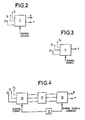
- FIG. 2 represents a block diagram where the processing block 1, comprising for example a microprocessor, adapted to implement the method according to the invention, receives on the one hand the different signals received by the antennas 2i, as well as a known signal corresponding to the transmitted signal.
- the processing block 1 comprising for example a microprocessor, adapted to implement the method according to the invention, receives on the one hand the different signals received by the antennas 2i, as well as a known signal corresponding to the transmitted signal.
- the method according to the invention has at least the estimated directions of arrival ⁇ and the vectors of delay ⁇ which are for example used to deduce the response impulse of the channel h (t), this for a given use or for all users.
- the signals received on the antenna network are versions delayed, dilated and possibly transposed in frequency of the signals emitted by the users present in a cell (or a channel of spread). These signals are therefore expressed as a combination linear of a set of known basic functions from which we want to extract the settings.
- This formulation has the advantage of expressing the observations as a linear model as a function of the complex amplitudes h and of the noise.
- the expression of the log-likelihood (12) authorizes the analytical determination of the vector of the complex amplitudes h and of the noise power ⁇ 2 as a function of ⁇ and ⁇ . These estimates are both obtained by canceling the derivatives of the log-likelihood respectively with respect to ⁇ 2 and with respect to h .
- FIG 3 shows schematically an example of implementation of the method according to the invention in the case where the characteristics of the receiver or the antenna is not known, the antenna is formed by several sensors, whose answer is not known, often referred to as "unstructured antennas".
- the antennas 2i receive the signals which are transmitted to a block 4 adapted to implement the steps of the method, and which itself receives a known signal.
- the processing block equipped for example with a microprocessor programmed accordingly delivers at least the estimated vector value of delays ⁇ and the estimated value of the impulse response of the channel spread.
- These Ne samples of dimension N ⁇ 1 are concatenated in a vector Y of dimension NeN ⁇ 1 such that (18): Where xi (nTe) is the sample n from sensor i.
- the vector N of dimension NeN ⁇ 1 contains the concatenation of the noise samples (19) Where bi (nTe) is the noise sample n of the index sensor i.
- the analytical expressions of the complex amplitudes ⁇ , as well as the noise power ⁇ 2 can be expressed as a function of the set of parameters of the delay vectors. ⁇ .
- the two variant embodiments which have been previously exposed deal with sampled signals at sensor output or for a signal correlated with a known signal of value 1.
- the matrices to to treat are of size NeN ⁇ P.
- the method according to the invention uses signals correlated.
- FIG. 4 represents a block diagram in which a correlator 10 receives on the one hand the signals received by the antennas and on the other hand the known signal.
- the correlator 10 has a number of outputs identical to the number of inputs, each signal if (t) arriving on an antenna being correlated by a known signal c (t).
- the different correlated signals if (t) * ci (t) where i is the index of the sensor are then transmitted to a device 11 adapted to select a number of samples, in particular to work on a previously defined time interval.
- Correlated and belonging signals at the selected time interval are then transmitted to a processing block 12 comprising for example a microprocessor adapted to estimate the values ⁇ and ⁇ , when the characteristics of the antenna are known or the value of ⁇ for an antenna with unknown characteristics. From these values it is possible to determine the estimate of the impulse response of the propagation channel.
- the correlator 10 can be of analog or digital type, the sampling step being carried out before or after the correlation step.
- the processing block also receives the known transmitted signal itself correlated for example by means of a correlator 13.
- the signals considered at the process level correspond to signals at the output of the correlation by the filter adapted to the transmitted signal.
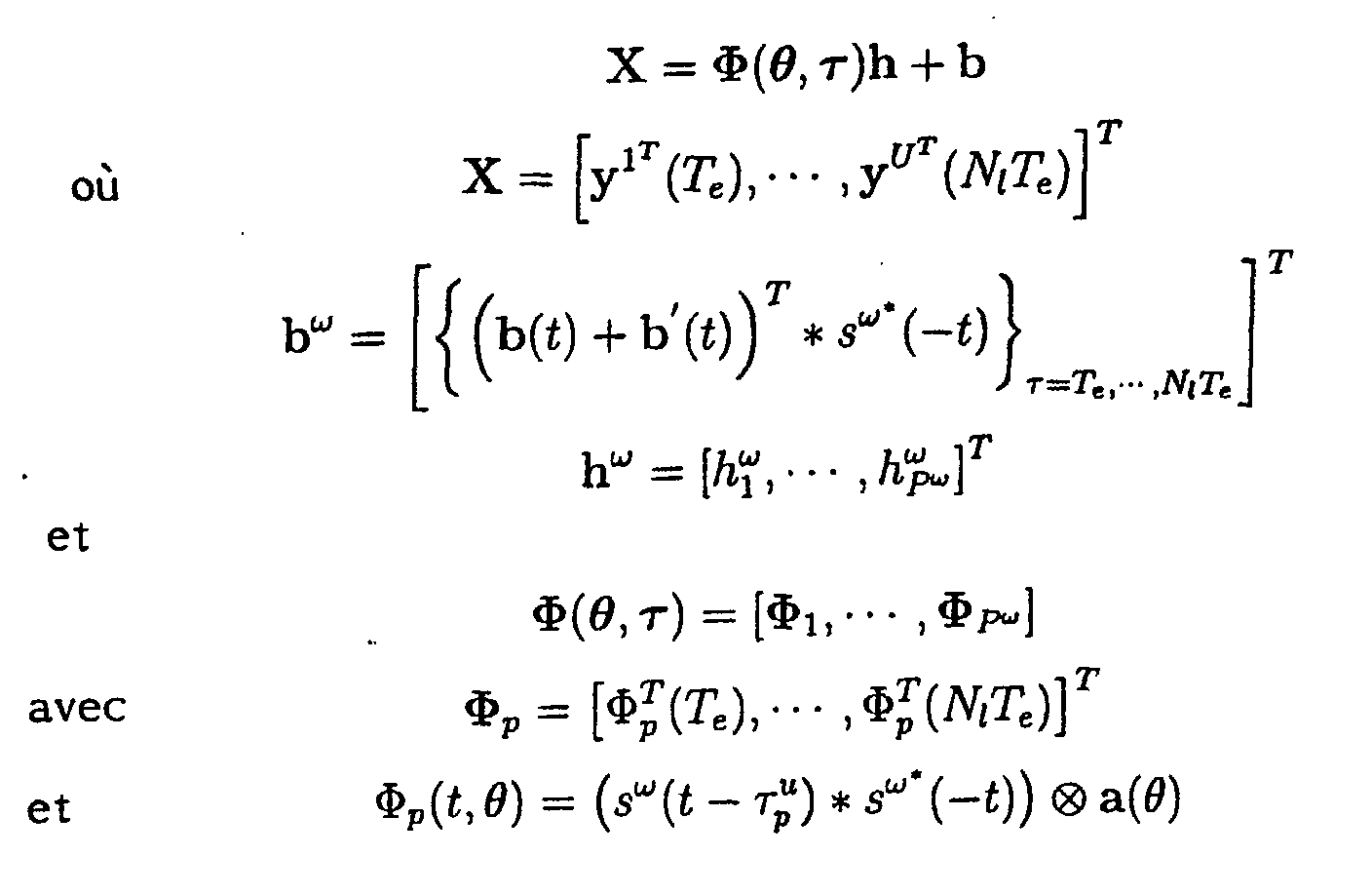
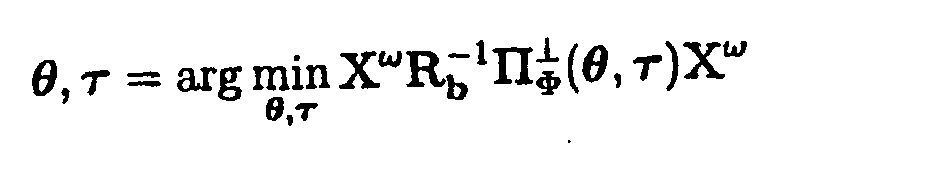
- the signal X can be modeled as follows (33):
- the likelihood of the signal X ⁇ is given by (35): hence the log-likelihood (36): L (X ⁇
- ⁇ ( ⁇ , ⁇ ), h ⁇ , ⁇ 2 T , R b ) -NOT l NOT log ( ⁇ 2 T ) -Log (
- ⁇ ⁇ ⁇ I - ⁇ ( ⁇ , ⁇ ) ( ⁇ ⁇ ( ⁇ , ⁇ ) R -1 b ⁇ ( ⁇ , ⁇ )) -1 ⁇ ⁇ ( ⁇ , ⁇ ) R -1 b
- the estimated spatio-temporal parameters are for example used to determine the estimated impulse response of the spread.
- the received signal is filtered by s ⁇ ⁇ (- f ) (40):
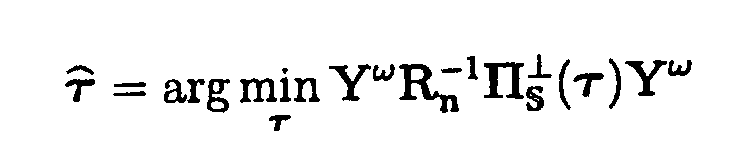
- the likelihood of the signal Y ⁇ is given by (42): hence the log-likelihood (43): By canceling the derivative of the log-likelihood with respect to ⁇ 2 / T and with respect to ⁇ ⁇ , we obtain the estimators of ⁇ 2 / T (43) and of ⁇ ⁇ (44): and
- the estimated value of the delay ⁇ is then used for example for estimate the value of the impulse response of the propagation channel.
- the different implementation variants of the method according to the invention is applicable in many fields of signal processing.
- communications systems it is often necessary to know the propagation channel in order to demodulate the signals transmitted.
- the filter estimation technique with complexity reduction applies in the MIMO and SIMO (Single Input Multiple Output) context. In the case of radar processing, these techniques also apply. They can be used in a multi-target or mono-target context with echo.
- the method can take into account of the Doppler effect.
- One way to do this is, for example, to estimate the speeds by minimizing a multidimensional function integrating all model parameters, other than complex amplitudes and power noise.
- the method according to the invention is particularly applicable in a UMTS telecommunications system comprising an antenna array.
Landscapes
- Engineering & Computer Science (AREA)
- Power Engineering (AREA)
- Computer Networks & Wireless Communication (AREA)
- Signal Processing (AREA)
- Mobile Radio Communication Systems (AREA)
- Variable-Direction Aerials And Aerial Arrays (AREA)
- Radio Transmission System (AREA)
- Stereo-Broadcasting Methods (AREA)
- Error Detection And Correction (AREA)
- Radar Systems Or Details Thereof (AREA)
- Monitoring And Testing Of Transmission In General (AREA)
Abstract
Description
- Les démodulateurs nécessitent généralement la connaissance des canaux afin de remédier aux effets néfastes qu'ils ont induits,
- Un deuxième intérêt est la localisation urbaine ou extra-urbaine par exemple le principe de localisation d'urgence « 911 » aux Etats-Unis,
- Enfin, la connaissance des canaux de propagation peut également servir à l'utilisation d'antennes intelligentes (de type smart antennas) tant à la réception qu'à l'émission.
- E. Strom, S. Parkvall, S. Miller, and B. Ottersen intitulé "Propagation delay estimation in asynchronous direct-sequence code-division multiple access systems", IEEE Trans on Communications, Vol: 44:pp: 84-93, January 1996
- S. Parkvall intitulé "Near-Far Resistant DS-CDMA Systems : Parameter estimation and Data Detection", PhD thesis, Royal Institute of Technology Stockholm, Sweden, 1996.
- S. E. Bensley and B. Aazhang intitulé "Maximum likelihood estimation of a single user's delay for code division multiple acess communication systems", Conf. Information Sciences ans Systems, 1994.
- J. Grouffaud, "Identification spatio-temporelle de canaux de propagation à trajets multiples", PhD thesis, École Normale Supérieure de Cachan, Juin 1997.
- M. Wax and A. Leshem, "Joint estimation of delays and directions of
arrivai of multiple reflections of a known signal.", IEEE Trans. on Signal
Processing, Vol: 45(No: 10):pp: 2477-248, October 1997.
mais elle ne traite pas le contexte MIMO (abrégé anglo-saxon de Multiple Input Multiple Output).
- corréler le ou les signal x(t) reçu par le ou les capteurs avec un signal connu c(t),
- échantillonner ledit signal après corrélation à une période d'échantillonnage Te et sélectionner un nombre d'échantillons par concaténation,
- déterminer au moins un paramètre du canal de propagation tel que τ et/ou qui permettent de reconstruire au mieux les signaux reçus en utilisant une méthode au maximum de vraisemblance.
- une étape de corrélation avec un signal connu c(t) égal à 1,
- les signaux reçus sur l'antenne s'exprime sous la forme X=S(,τ)h+B
- les estimées des paramètres τ et s'expriment sous la forme :

Selon un autre mode de réalisation les caractéristiques du système de capteurs ne sont pas connues et il comporte par exemple :
- une étape de corrélation des signaux reçus par le réseau de capteurs avec un signal connu c(t) égal à 1,
- une étape où les signaux reçus s'expriment sous une forme concaténée Y =Ψ(τ)α+N où Ψ(τ) est égal au produit convolué de la matrice unité IN avec la matrice S(τ) = [s1(τ 1 / 1),···, s1(τ 1 / P1),···,s(τ U / PU )] et α contient les réponses des trajets des différents utilisateurs,
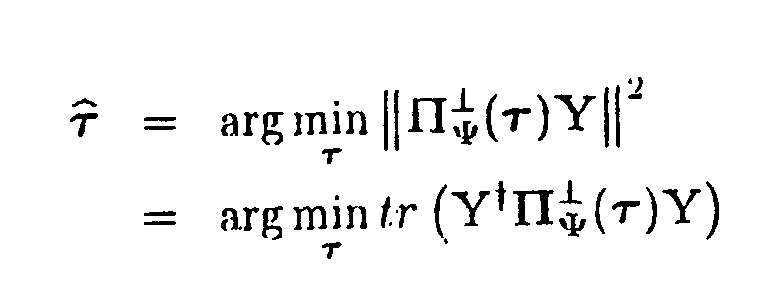
- une étape d'estimation du vecteur retard τ à partir de

- un dispositif adapté à corréler le signal reçu par le ou les capteurs s(t) avec un signal connu c(t),
- un dispositif adapté à sélectionner un nombre d'échantillons du signal obtenu après l'étape de corrélation, et
- un dispositif adapté à déterminer les paramètres du canal par une méthode au maximum de vraisemblance.
- dans le contexte MIMO coopératif, l'estimateur utilisé dans le cadre d'une antenne connue, fait appel à un modèle paramétrique des signaux reçus sur l'antenne, contrairement au maximum de vraisemblance déterministe qui estime chaque échantillon du signal sans a priori,
- en limitant le domaine d'analyse dans certains cas d'application, elle conduit à une réduction de la taille des données traitées d'où un traitement plus rapide.
- La figure 1 représente différentes approches d'estimation paramétriques au sens du Maximum de vraisemblance,
- La figure 2 schématise une première variante du procédé selon l'invention pour laquelle les caractéristiques des antennes de réception sont connues,
- La figure 3 représente un schéma d'une deuxième variante de réalisation où les caractéristiques des antennes de réception ne sont pas connues,
- La figure 4 schématise une autre variante du procédé comportant une étape préalable pouvant s'appliquer aux méthodes décrites aux figures 2 et 3 précédemment.
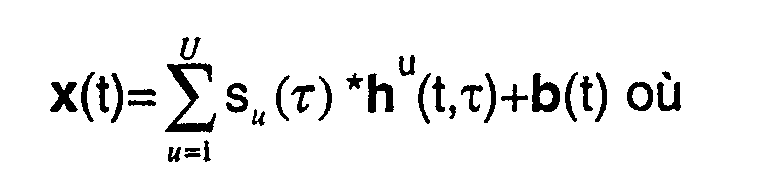
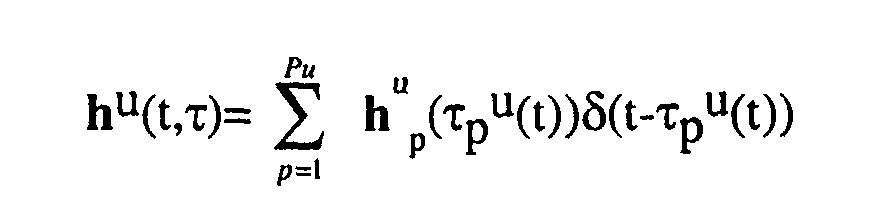
- Pu le nombre de trajets de propagation de l'utilisateur u,
- h u p(τp u(t)) le (N×1) vecteur contenant le produit des réponses de l'antenne au trajet p par l'amplitude complexe du trajet.
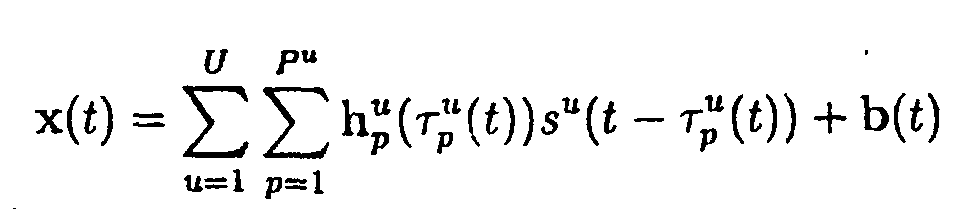

- p u est la direction d'arrivée du trajet p de l'utilisateur u,
- hu p (τp u(t)) est le gain complexe du trajet p de l'utilisateur u reçu sur le premier capteur.
- "Estimation of the number of signais in the presence of unknown correlated sensor noise" de J.J.Fuchs, IEEE Trans.on signal Processing, Vol 40(N° : 5) pages 351-360, 1994;
- "Méthodes à Haute résolution pour le traitement d'antenne et l'analyse spectrale" de J.Gouffraud, P.Larzabal et H.Clergeot, chapitre 6, Sélection d'ordre de modèle, aux Editions Hermes, Février 1998;
- "A new look at the statistical model identification" de H.Akaike, IEEE Trans. On Automatic Control, Vol 19(N°6), december 1974,
- "Detection of signais by information theoric criteria" de M.Wax et T.Kailath, IEEE Trans.on ASSP, Vol 33(N°2), pages 387-392, April 1985.
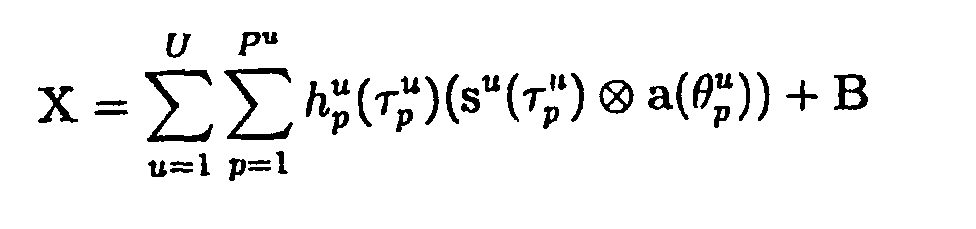

- est le vecteur réel de taille P des directions d'arrivée
- τ est le vecteur réel de taille P des retards, (P étant le nombre de trajets)






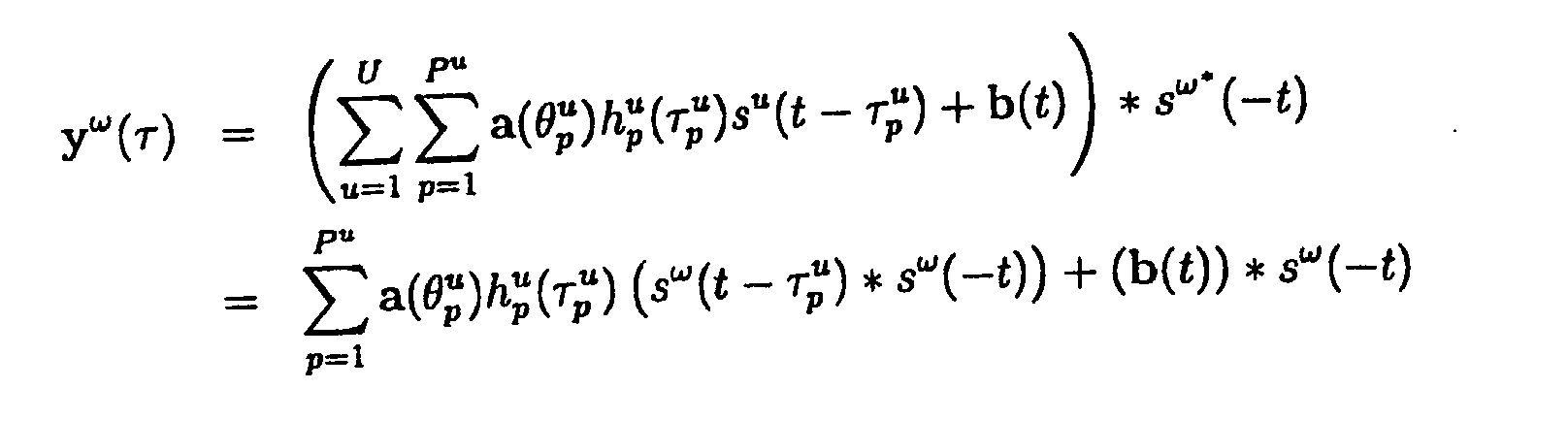


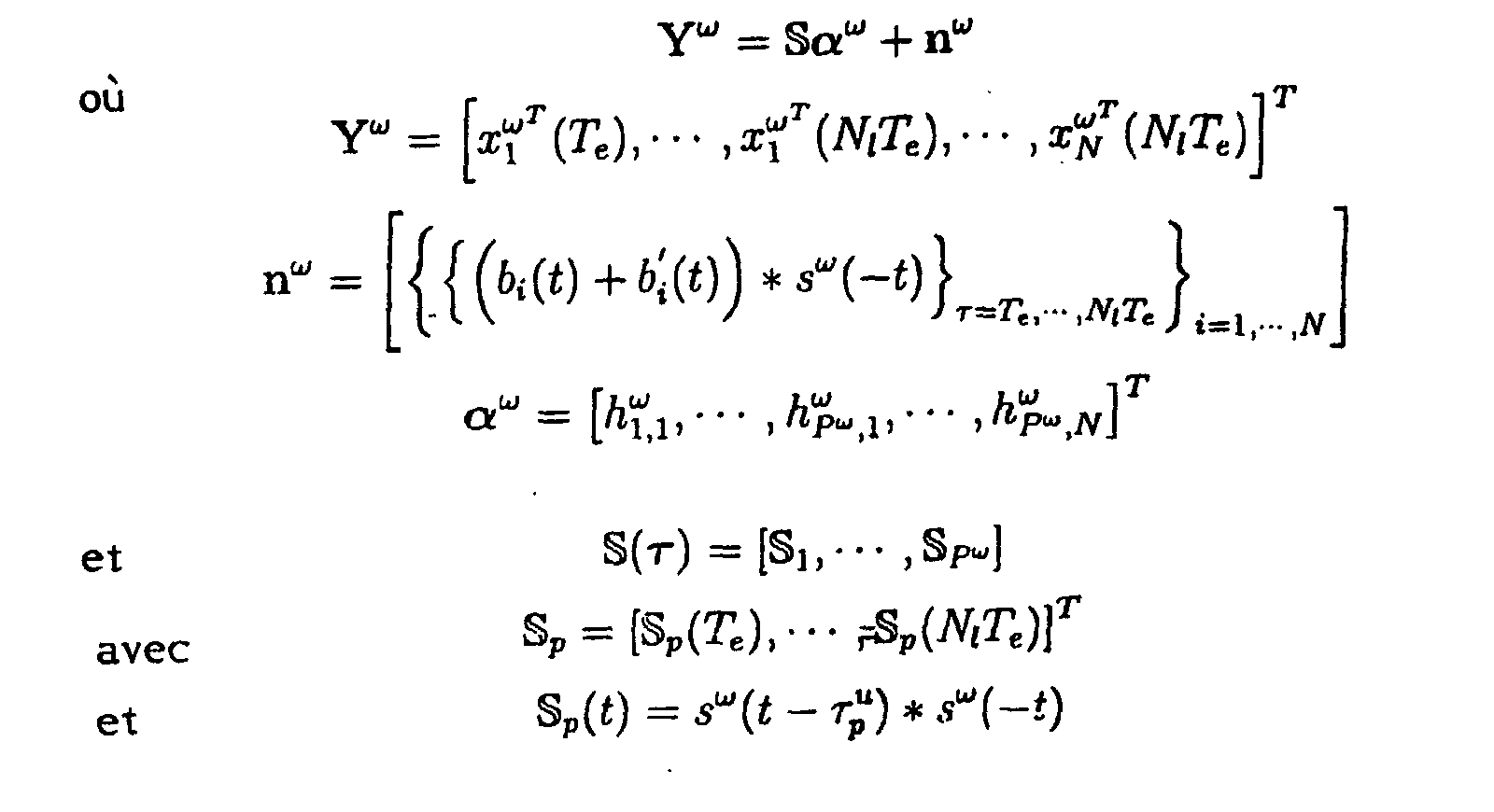
La vraisemblance du signal Yω est donnée par (42) :




Dans le cas d'un traitement radar, ces techniques s'appliquent également.
Elles peuvent être utilisées dans un contexte multi-cible où mono-cible avec écho.
Claims (9)
- Procédé pour estimer un ou plusieurs paramètres d'un canal de propagation avec une connaissance a priori du signal dans un système comportant un ou plusieurs capteurs caractérisé en ce qu'il comporte au moins les étapes suivantes :corréler le ou les signal x(t) reçu par le ou les capteurs avec un signal connu c(t),échantillonner ledit signal après corrélation à une période d'échantillonnage Te et sélectionner un nombre d'échantillons par concaténation,déterminer au moins un paramètre du canal de propagation tel que τ et/ou qui permettent de reconstruire au mieux les signaux reçus en utilisant une méthode au maximum de vraisemblance.
- Procédé selon la revendication 1 caractérisé en ce que les caractéristiques du système de capteurs sont connues et en ce queoù II⊥ S est le projecteur orthogonal à l'image engendrée par les vecteurs colonnes de S(,τ)le signal connu c(t) est égal à 1,les signaux reçus sur l'antenne s'expriment sous la forme X=S(,τ)h+Bles estimées des paramètres τ et s'expriment sous la forme

- Procédé selon l'une des revendications 1 ou 2 caractérisé en ce qu'il comporte une étape de détermination des amplitudes complexes h de la réponse impulsionnelle du canal de propagation à partir des estimées des paramètres τ et .
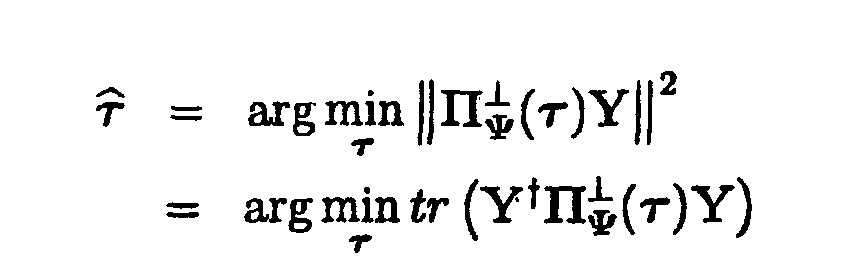
- Procédé selon la revendication 1 caractérisé en ce que les caractéristiques du système de capteurs ne sont pas connues et en qu'il comporte :où Π⊥Ψ est le projecteur orthogonal à l'image engendrée par les vecteurs lignes de Ψ(τ).une étape de corrélation des signaux reçus par le réseau de capteurs avec un signal connu c(t) égal à 1,une étape où les signaux reçus s'expriment sous une forme concaténée Y =Ψ(τ)α+N où Ψ(τ) est égal au produit convolué de la matrice unité IN avec la matrice S (τ) = [s 1(τ 1 / 1),···,s1(τ 1 / P1),···,s(τ U / Pu)] et α contient les réponses des trajets des différents utilisateurs,une étape d'estimation du vecteur retard τ à partir de

- Procédé selon la revendication 1 caractérisé en ce qu'il comporte une étape de corrélation des signaux avec un signal c(t) différent de 1, en ce que les caractéristiques du système de capteurs sont connues et en ce qu'il comporte une étape d'estimation des paramètres τ et à partir de

- Procédé selon la revendication 1 caractérisé en ce qu'il comporte une étape de corrélation des signaux reçus avec c(t) différent de 1 et en ce que les caractéristiques du système de capteurs étant inconnues, l'estimation du vecteur retard s'exprime à l'aide de


- Procédé selon l'une des revendications 1 à 6 caractérisé en ce qu'il est appliqué dans des applications de type MIMO (Multiple Input Multiple output) ou SIMO (Single Input Single Output).
- Dispositif pour estimer un ou plusieurs paramètres d'un canal de propagation avec une connaissance a priori du signal dans un système comportant un ou plusieurs capteurs caractérisé en ce qu'il comporte au moins :un dispositif adapté à corréler le signal reçu par le ou les capteurs s(t) avec un signal connu c(t),un dispositif adapté à sélectionner un nombre d'échantillons du signal obtenu après l'étape de corrélation, etun dispositif adapté à déterminer les paramètres du canal par une méthode au maximum de vraisemblance.
- Récepteur de radiocommunication comportant les caractéristiques du dispositif selon la revendication 8.
Applications Claiming Priority (2)
| Application Number | Priority Date | Filing Date | Title |
|---|---|---|---|
| FR0101429 | 2001-02-02 | ||
| FR0101429A FR2820580B1 (fr) | 2001-02-02 | 2001-02-02 | Procede pour estimer les parametres d'un canal de propagation |
Publications (2)
| Publication Number | Publication Date |
|---|---|
| EP1229696A1 true EP1229696A1 (fr) | 2002-08-07 |
| EP1229696B1 EP1229696B1 (fr) | 2006-04-19 |
Family
ID=8859553
Family Applications (1)
| Application Number | Title | Priority Date | Filing Date |
|---|---|---|---|
| EP02290235A Expired - Lifetime EP1229696B1 (fr) | 2001-02-02 | 2002-02-01 | Estimation des paramètres de canal au moyen d'estimation de maximum de vraisemblance |
Country Status (7)
| Country | Link |
|---|---|
| US (1) | US6807517B2 (fr) |
| EP (1) | EP1229696B1 (fr) |
| AT (1) | ATE323995T1 (fr) |
| CA (1) | CA2369564A1 (fr) |
| DE (1) | DE60210686T2 (fr) |
| FR (1) | FR2820580B1 (fr) |
| IL (1) | IL147914A0 (fr) |
Cited By (1)
| Publication number | Priority date | Publication date | Assignee | Title |
|---|---|---|---|---|
| CN104079511A (zh) * | 2014-06-17 | 2014-10-01 | 华为技术有限公司 | 最大似然ml接收机数据处理的方法及装置 |
Families Citing this family (5)
| Publication number | Priority date | Publication date | Assignee | Title |
|---|---|---|---|---|
| US7952511B1 (en) | 1999-04-07 | 2011-05-31 | Geer James L | Method and apparatus for the detection of objects using electromagnetic wave attenuation patterns |
| US7616698B2 (en) | 2003-11-04 | 2009-11-10 | Atheros Communications, Inc. | Multiple-input multiple output system and method |
| US8599957B2 (en) * | 2005-05-13 | 2013-12-03 | Ems Technologies, Inc. | Method and system for communicating information in a digital signal |
| US9507017B2 (en) | 2013-03-15 | 2016-11-29 | Src, Inc. | Simultaneous multi-frequency signal processing method |
| CN120811471B (zh) * | 2025-09-12 | 2025-11-07 | 西安电子科技大学广州研究院 | 基于信道估计的自适应多无人机信息传输系统及方法 |
Family Cites Families (8)
| Publication number | Priority date | Publication date | Assignee | Title |
|---|---|---|---|---|
| FR2715488B1 (fr) | 1994-01-21 | 1996-03-22 | Thomson Csf | Procédé et dispositif permettant à un modem de se synchroniser sur un transmetteur de données numériques par voie hertzienne en présence de brouilleurs. |
| FR2732490B1 (fr) | 1995-03-28 | 1997-04-25 | Thomson Csf | Procede de reception multicapteur d'une station de base d'un reseau de communication echangeant des donnees avec des mobiles, et dispositif pour sa mise en oeuvre |
| DE69604595T2 (de) | 1995-08-22 | 2000-05-31 | Thomson-Csf, Paris | Verfahren und anordnung zur räumlichen multiplexierung/demultiplexierung von funksignalen in einem sdma-mobilfunksystem |
| FR2742619B1 (fr) | 1995-12-15 | 1998-02-06 | Thomson Csf | Procede d'egalisation multicapteur permettant une reception multicapteur en presence d'interferences et de multitrajets de propagation, et recepteur pour sa mise en oeuvre |
| US5870430A (en) * | 1996-12-26 | 1999-02-09 | Thomson-Csf | Process for multi-sensor equalisation in a radio receiver in the presence of interference and multiple propagation paths |
| FR2758926B1 (fr) | 1997-01-24 | 1999-04-30 | France Telecom | Procede d'egalisation multicapteurs dans un recepteur radioelectrique comportant un nombre determine de voies de reception et recepteur correspondant |
| FR2764074B1 (fr) * | 1997-06-03 | 1999-08-20 | Thomson Csf | Procede et dispositif de radiogoniometrie cooperative en transmission |
| FR2766320B1 (fr) | 1997-07-15 | 1999-10-15 | Thomson Csf | Procede et dispositif d'analyse des interferences dans un systeme de radiocommunication cellulaire |
-
2001
- 2001-02-02 FR FR0101429A patent/FR2820580B1/fr not_active Expired - Fee Related
-
2002
- 2002-01-30 IL IL14791402A patent/IL147914A0/xx unknown
- 2002-02-01 AT AT02290235T patent/ATE323995T1/de not_active IP Right Cessation
- 2002-02-01 US US10/060,249 patent/US6807517B2/en not_active Expired - Fee Related
- 2002-02-01 DE DE60210686T patent/DE60210686T2/de not_active Expired - Lifetime
- 2002-02-01 CA CA002369564A patent/CA2369564A1/fr not_active Abandoned
- 2002-02-01 EP EP02290235A patent/EP1229696B1/fr not_active Expired - Lifetime
Non-Patent Citations (5)
| Title |
|---|
| LASENBY J ET AL: "A BAYESIAN APPROACH TO HIGH-RESOLUTION BEAMFORMING", IEE PROCEEDINGS F. COMMUNICATIONS, RADAR & SIGNAL PROCESSING, INSTITUTION OF ELECTRICAL ENGINEERS. STEVENAGE, GB, vol. 138, no. 6 PART F, 1 December 1991 (1991-12-01), pages 539 - 544, XP000271798, ISSN: 0956-375X * |
| MADYASTHA R ET AL: "DELAY AND DOA ESTIMATION IN CDMA COMMUNICATION SYSTEMS VIA MAXIMUM LIKELIHOOD TECHNIQUES", PROCEEDINGS OF THE 1997 IEEE INTERNATIONAL SYMPOSIUM ON INFORMATION THEORY. ISIT '97. ULM, JUNE 29 - JULY 4, 1997, IEEE INTERNATIONAL SYMPOSIUM ON INFORMATION THEORY, NEW YORK, NY: IEEE, US, 29 June 1997 (1997-06-29), pages 350, XP000950940, ISBN: 0-7803-3957-6 * |
| WAX M ET AL: "Joint estimation of time delays and directions of arrival of multiple reflections of a known signal", 1996 IEEE INTERNATIONAL CONFERENCE ON ACOUSTICS, SPEECH, AND SIGNAL PROCESSING CONFERENCE PROCEEDINGS (CAT. NO.96CH35903), 1996 IEEE INTERNATIONAL CONFERENCE ON ACOUSTICS, SPEECH, AND SIGNAL PROCESSING CONFERENCE PROCEEDINGS, ATLANTA, GA, USA, 7-10 M, 1996, New York, NY, USA, IEEE, USA, pages 2622 - 2625 vol. 5, XP002177399, ISBN: 0-7803-3192-3 * |
| WAX M ET AL: "Joint estimation of time delays and directions of arrival of multiple reflections of a known signal", IEEE TRANSACTIONS ON SIGNAL PROCESSING, OCT. 1997, IEEE, USA, vol. 45, no. 10, pages 2477 - 2484, XP002177398, ISSN: 1053-587X * |
| YLITALO J: "PERFORMANCE OF A DIGITAL BEAMFORMING CONCEPT IN A GSM1800 DOWNLINK: A SIMULATION STUDY", WIRELESS PERSONAL COMMUNICATIONS, KLUWER ACADEMIC PUBLISHERS, NL, vol. 11, no. 1, October 1999 (1999-10-01), pages 31 - 42, XP000835060, ISSN: 0929-6212 * |
Cited By (2)
| Publication number | Priority date | Publication date | Assignee | Title |
|---|---|---|---|---|
| CN104079511A (zh) * | 2014-06-17 | 2014-10-01 | 华为技术有限公司 | 最大似然ml接收机数据处理的方法及装置 |
| CN104079511B (zh) * | 2014-06-17 | 2017-09-12 | 华为技术有限公司 | 最大似然ml接收机数据处理的方法及装置 |
Also Published As
| Publication number | Publication date |
|---|---|
| FR2820580B1 (fr) | 2004-06-04 |
| US6807517B2 (en) | 2004-10-19 |
| EP1229696B1 (fr) | 2006-04-19 |
| IL147914A0 (en) | 2002-08-14 |
| FR2820580A1 (fr) | 2002-08-09 |
| US20020161538A1 (en) | 2002-10-31 |
| DE60210686D1 (de) | 2006-05-24 |
| CA2369564A1 (fr) | 2002-08-02 |
| DE60210686T2 (de) | 2007-04-05 |
| ATE323995T1 (de) | 2006-05-15 |
Similar Documents
| Publication | Publication Date | Title |
|---|---|---|
| EP0991952B1 (fr) | Procede et dispositif de radiogoniometrie cooperative en transmission | |
| EP0665665B1 (fr) | Procédé et dispositif permettant à un modem de se synchroniser sur un transmetteur de données numériques par voie hertzienne en présence de brouilleurs | |
| EP0735702B1 (fr) | Procédé et dispositif de réception multicapteur d'une station de base fixe pour un système de communication mobile | |
| EP0858181A1 (fr) | Procédé d'égalisation multicapteurs dans un récepteur radioélectrique comportant un nombre déterminé de voies de réception et récepteur correspondant | |
| EP1185004A1 (fr) | Méthode d'estimation conjointe de canal et de direction d'arrivée | |
| EP1260071B1 (fr) | Procede et dispositif d'estimation d'un canal de propagation | |
| EP1266302B1 (fr) | PROCEDE D'ESTIMATION D'UNE MATRICE DE CORRELATION DE SIGNAUX INTERFERENTS REçUS PAR UN RESEAU DE CAPTEUR | |
| EP1229696B1 (fr) | Estimation des paramètres de canal au moyen d'estimation de maximum de vraisemblance | |
| EP1235399B1 (fr) | Procédé et dispositif d'estimation de la matrice de covariance du canal de transmission d'un système UMTS | |
| EP1221773A1 (fr) | Méthode et dispositif de détection multi-utilisateur en mode DS-CDMA | |
| EP1085341B1 (fr) | Procédé de traitement de signaux de navigation à trajets multiples dans un récepteur présentant une pluralité d'antennes | |
| EP1283605A1 (fr) | Procédé pour augmenter le débit dans un système de communication comportant N émetteurs et M récepteurs | |
| FR2757330A1 (fr) | Procede de transmission d'informations par reponse impulsionnelle et recepteur correspondant | |
| EP1296460B1 (fr) | Procédé et dispositif de détermination des coefficients d'évanouissement des trajets d'un canal de transmission multi-trajets reliant en particulier une station de base et un téléphone mobile cellulaire | |
| EP1288675A1 (fr) | Procédé et dispositif d'estimation de la vitesse de déplacement d'un terminal mobile, en particulier un téléphone mobile cellulaire | |
| FR2882479A1 (fr) | Procede et dispositif de synchronisation de liaisons rectilignes ou quasi-rectilignes en presence d'interferences | |
| EP1240759B1 (fr) | Dispositifs d'estimation de canal radio et de demodulation | |
| EP3345357B1 (fr) | Procede et dispositif de synchronisation mimo en presence d'interferences | |
| EP1221792A1 (fr) | Procédé et récepteur autodidacte pour déterminer les paramètres spatio-temporels d'un canal de propagation | |
| EP1292047B1 (fr) | Procédé et dispositif de détection de sources dans un système de communications | |
| WO2005088999A1 (fr) | Procede d'optimisation de la planification dans un systeme de communications de type cdma | |
| FR2789832A1 (fr) | Procede d'egalisation d'un canal de communication | |
| WO2012042182A1 (fr) | Limitation de bruit pour une transmission dans un canal a voies multiples | |
| WO2000074329A1 (fr) | Procedes d'estimation des retards de propagation pour un systeme de transmission |
Legal Events
| Date | Code | Title | Description |
|---|---|---|---|
| PUAI | Public reference made under article 153(3) epc to a published international application that has entered the european phase |
Free format text: ORIGINAL CODE: 0009012 |
|
| AK | Designated contracting states |
Kind code of ref document: A1 Designated state(s): AT BE CH CY DE DK ES FI FR GB GR IE IT LI LU MC NL PT SE TR |
|
| AX | Request for extension of the european patent |
Free format text: AL;LT;LV;MK;RO;SI |
|
| 17P | Request for examination filed |
Effective date: 20030203 |
|
| AKX | Designation fees paid |
Designated state(s): AT BE CH CY DE DK ES FI FR GB GR IE IT LI LU MC NL PT SE TR |
|
| 17Q | First examination report despatched |
Effective date: 20030429 |
|
| GRAP | Despatch of communication of intention to grant a patent |
Free format text: ORIGINAL CODE: EPIDOSNIGR1 |
|
| GRAS | Grant fee paid |
Free format text: ORIGINAL CODE: EPIDOSNIGR3 |
|
| GRAA | (expected) grant |
Free format text: ORIGINAL CODE: 0009210 |
|
| AK | Designated contracting states |
Kind code of ref document: B1 Designated state(s): AT BE CH CY DE DK ES FI FR GB GR IE IT LI LU MC NL PT SE TR |
|
| PG25 | Lapsed in a contracting state [announced via postgrant information from national office to epo] |
Ref country code: IT Free format text: LAPSE BECAUSE OF FAILURE TO SUBMIT A TRANSLATION OF THE DESCRIPTION OR TO PAY THE FEE WITHIN THE PRESCRIBED TIME-LIMIT;WARNING: LAPSES OF ITALIAN PATENTS WITH EFFECTIVE DATE BEFORE 2007 MAY HAVE OCCURRED AT ANY TIME BEFORE 2007. THE CORRECT EFFECTIVE DATE MAY BE DIFFERENT FROM THE ONE RECORDED. Effective date: 20060419 Ref country code: AT Free format text: LAPSE BECAUSE OF FAILURE TO SUBMIT A TRANSLATION OF THE DESCRIPTION OR TO PAY THE FEE WITHIN THE PRESCRIBED TIME-LIMIT Effective date: 20060419 Ref country code: IE Free format text: LAPSE BECAUSE OF FAILURE TO SUBMIT A TRANSLATION OF THE DESCRIPTION OR TO PAY THE FEE WITHIN THE PRESCRIBED TIME-LIMIT Effective date: 20060419 Ref country code: FI Free format text: LAPSE BECAUSE OF FAILURE TO SUBMIT A TRANSLATION OF THE DESCRIPTION OR TO PAY THE FEE WITHIN THE PRESCRIBED TIME-LIMIT Effective date: 20060419 Ref country code: NL Free format text: LAPSE BECAUSE OF FAILURE TO SUBMIT A TRANSLATION OF THE DESCRIPTION OR TO PAY THE FEE WITHIN THE PRESCRIBED TIME-LIMIT Effective date: 20060419 |
|
| REG | Reference to a national code |
Ref country code: GB Ref legal event code: FG4D Free format text: NOT ENGLISH |
|
| REF | Corresponds to: |
Ref document number: 60210686 Country of ref document: DE Date of ref document: 20060524 Kind code of ref document: P |
|
| REG | Reference to a national code |
Ref country code: IE Ref legal event code: FG4D Free format text: LANGUAGE OF EP DOCUMENT: FRENCH |
|
| PG25 | Lapsed in a contracting state [announced via postgrant information from national office to epo] |
Ref country code: SE Free format text: LAPSE BECAUSE OF FAILURE TO SUBMIT A TRANSLATION OF THE DESCRIPTION OR TO PAY THE FEE WITHIN THE PRESCRIBED TIME-LIMIT Effective date: 20060719 Ref country code: DK Free format text: LAPSE BECAUSE OF FAILURE TO SUBMIT A TRANSLATION OF THE DESCRIPTION OR TO PAY THE FEE WITHIN THE PRESCRIBED TIME-LIMIT Effective date: 20060719 |
|
| PG25 | Lapsed in a contracting state [announced via postgrant information from national office to epo] |
Ref country code: ES Free format text: LAPSE BECAUSE OF FAILURE TO SUBMIT A TRANSLATION OF THE DESCRIPTION OR TO PAY THE FEE WITHIN THE PRESCRIBED TIME-LIMIT Effective date: 20060730 |
|
| GBT | Gb: translation of ep patent filed (gb section 77(6)(a)/1977) |
Effective date: 20060814 |
|
| PG25 | Lapsed in a contracting state [announced via postgrant information from national office to epo] |
Ref country code: PT Free format text: LAPSE BECAUSE OF FAILURE TO SUBMIT A TRANSLATION OF THE DESCRIPTION OR TO PAY THE FEE WITHIN THE PRESCRIBED TIME-LIMIT Effective date: 20060919 |
|
| NLV1 | Nl: lapsed or annulled due to failure to fulfill the requirements of art. 29p and 29m of the patents act | ||
| REG | Reference to a national code |
Ref country code: IE Ref legal event code: FD4D |
|
| PLBE | No opposition filed within time limit |
Free format text: ORIGINAL CODE: 0009261 |
|
| STAA | Information on the status of an ep patent application or granted ep patent |
Free format text: STATUS: NO OPPOSITION FILED WITHIN TIME LIMIT |
|
| PG25 | Lapsed in a contracting state [announced via postgrant information from national office to epo] |
Ref country code: CH Free format text: LAPSE BECAUSE OF NON-PAYMENT OF DUE FEES Effective date: 20070228 Ref country code: LI Free format text: LAPSE BECAUSE OF NON-PAYMENT OF DUE FEES Effective date: 20070228 Ref country code: MC Free format text: LAPSE BECAUSE OF NON-PAYMENT OF DUE FEES Effective date: 20070228 |
|
| 26N | No opposition filed |
Effective date: 20070122 |
|
| REG | Reference to a national code |
Ref country code: CH Ref legal event code: PL |
|
| BERE | Be: lapsed |
Owner name: THALES Effective date: 20070228 |
|
| PG25 | Lapsed in a contracting state [announced via postgrant information from national office to epo] |
Ref country code: BE Free format text: LAPSE BECAUSE OF NON-PAYMENT OF DUE FEES Effective date: 20070228 |
|
| PG25 | Lapsed in a contracting state [announced via postgrant information from national office to epo] |
Ref country code: GR Free format text: LAPSE BECAUSE OF FAILURE TO SUBMIT A TRANSLATION OF THE DESCRIPTION OR TO PAY THE FEE WITHIN THE PRESCRIBED TIME-LIMIT Effective date: 20060720 |
|
| PG25 | Lapsed in a contracting state [announced via postgrant information from national office to epo] |
Ref country code: LU Free format text: LAPSE BECAUSE OF NON-PAYMENT OF DUE FEES Effective date: 20070201 Ref country code: CY Free format text: LAPSE BECAUSE OF FAILURE TO SUBMIT A TRANSLATION OF THE DESCRIPTION OR TO PAY THE FEE WITHIN THE PRESCRIBED TIME-LIMIT Effective date: 20060419 |
|
| PG25 | Lapsed in a contracting state [announced via postgrant information from national office to epo] |
Ref country code: TR Free format text: LAPSE BECAUSE OF FAILURE TO SUBMIT A TRANSLATION OF THE DESCRIPTION OR TO PAY THE FEE WITHIN THE PRESCRIBED TIME-LIMIT Effective date: 20060419 |
|
| PGFP | Annual fee paid to national office [announced via postgrant information from national office to epo] |
Ref country code: IT Payment date: 20140220 Year of fee payment: 13 Ref country code: FR Payment date: 20140211 Year of fee payment: 13 |
|
| PGFP | Annual fee paid to national office [announced via postgrant information from national office to epo] |
Ref country code: DE Payment date: 20150127 Year of fee payment: 14 |
|
| PGFP | Annual fee paid to national office [announced via postgrant information from national office to epo] |
Ref country code: GB Payment date: 20150128 Year of fee payment: 14 |
|
| REG | Reference to a national code |
Ref country code: FR Ref legal event code: ST Effective date: 20151030 |
|
| PG25 | Lapsed in a contracting state [announced via postgrant information from national office to epo] |
Ref country code: IT Free format text: LAPSE BECAUSE OF NON-PAYMENT OF DUE FEES Effective date: 20150201 |
|
| PG25 | Lapsed in a contracting state [announced via postgrant information from national office to epo] |
Ref country code: FR Free format text: LAPSE BECAUSE OF NON-PAYMENT OF DUE FEES Effective date: 20150302 |
|
| REG | Reference to a national code |
Ref country code: DE Ref legal event code: R119 Ref document number: 60210686 Country of ref document: DE |
|
| GBPC | Gb: european patent ceased through non-payment of renewal fee |
Effective date: 20160201 |
|
| PG25 | Lapsed in a contracting state [announced via postgrant information from national office to epo] |
Ref country code: GB Free format text: LAPSE BECAUSE OF NON-PAYMENT OF DUE FEES Effective date: 20160201 Ref country code: DE Free format text: LAPSE BECAUSE OF NON-PAYMENT OF DUE FEES Effective date: 20160901 |