EP1229520A2 - Bestimmung von Signalrahmen zur Pausenbeschreibung (sid) mit Kompensation des menschlichen Gehörs - Google Patents
Bestimmung von Signalrahmen zur Pausenbeschreibung (sid) mit Kompensation des menschlichen Gehörs Download PDFInfo
- Publication number
- EP1229520A2 EP1229520A2 EP01000577A EP01000577A EP1229520A2 EP 1229520 A2 EP1229520 A2 EP 1229520A2 EP 01000577 A EP01000577 A EP 01000577A EP 01000577 A EP01000577 A EP 01000577A EP 1229520 A2 EP1229520 A2 EP 1229520A2
- Authority
- EP
- European Patent Office
- Prior art keywords
- sid
- hap
- calculating
- spectral distance
- changes
- Prior art date
- Legal status (The legal status is an assumption and is not a legal conclusion. Google has not performed a legal analysis and makes no representation as to the accuracy of the status listed.)
- Withdrawn
Links
Images



Classifications
-
- G—PHYSICS
- G10—MUSICAL INSTRUMENTS; ACOUSTICS
- G10L—SPEECH ANALYSIS TECHNIQUES OR SPEECH SYNTHESIS; SPEECH RECOGNITION; SPEECH OR VOICE PROCESSING TECHNIQUES; SPEECH OR AUDIO CODING OR DECODING
- G10L19/00—Speech or audio signals analysis-synthesis techniques for redundancy reduction, e.g. in vocoders; Coding or decoding of speech or audio signals, using source filter models or psychoacoustic analysis
- G10L19/012—Comfort noise or silence coding
Definitions
- This invention relates to bandwidth improvements in digitized voice applications when no voice is present.
- the invention suggests that improved estimation of background noise during interruptions in speech leads to less bandwidth consumption.
- Voice over packet networks require that the voice or audio signal be packetized and then be transmitted.
- the analog voice signal is first converted to a digital signal and is compressed in the form of a pulse code modulated (PCM) digital stream.
- PCM pulse code modulated
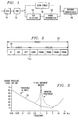
- the PCM stream is processed by modules of the gateway, such as echo cancellation (EC) 10, voice activity detection (VAD) 12, voice compression (CODEC) 14, protocol configuration 16, etc.
- VAD 12 makes the "voice/no voice" selection as illustrated in Figure 1. Either one of these two choices is the VAD algorithm's output. If voice (active) is detected, a regular voice path is followed in the CODEC 14 and the voice information is compressed into a set of parameters.
- SID Silence Insertion Descriptor
- the decoder If the decoder receives no information, it generates noise with noise parameters embedded in the previously received SID packet. This process is called Comfort Noise Generation (CNG). If the decoder is muted during the silent period, there will be sudden drops of the signal energy level, which causes unpleasant conversation. Therefore, CNG is essential to mimic the background noise on the transmitting side. If the decoder receives a new SID packet, it updates its noise parameters for the current and future CNG until the next SID is received.
- CNG Comfort Noise Generation
- the DTX and CNG algorithms are designed to operate under a variety of levels and characteristics of speech and noise, ensuring bit rate savings and no degradation in the perceived quality of sound.
- the G.729 Annex B SID frame detection algorithm yields smooth background noise during non-active periods, it detects a significant percentage of SID frames even when the background noise is almost stationary.
- G.729 Annex B generates numerous SID packets continuously, even when the background noise level is very low in dB.
- the SID detection algorithm is too sensitive to very low level background noise.
- Another reason is the effects of imperfect EC.
- the output signal of EC may have bursts or non-stationary characteristics in low level noise, even when its input noise is stationary.
- both voice and SID packets 22 must have packet headers 24 in VOPN applications ( Figure 2.).
- the header length is the same for voice and SID packets.
- the header 24 occupies most of the bandwidth in a SID packet 22.
- the header length is 12 bytes.
- One SID frame contains 2 bytes and a voice frame requires 10 bytes in a G.729 codec.
- SID frame bit rate is 20% of the full bit rate in G.729 codec
- the SID packet length with RTP header is about 70% of voice packet length with header. Therefore, it is very important for bandwidth savings to reduce the number of SID packets while preserving sound quality
- the SID detection algorithm of G.729 Annex B is based on spectral and energy changes of background noise characteristics after the last transmitted SID frame.
- the Itakura distance on the linear prediction filters is used to represent the spectral changes. When this measure exceeds a fixed threshold, it indicates a significant change of the spectrum.
- the energy change is defined as the difference between the quantized energy levels of the residual signal in the current inactive frame and in the last SID frame. The energy difference is significant if it is exceeds 2dB. Since the thresholds of SID detection are fixed and on a crude basis, the generation of an excess number of SID frames is anticipated. Therefore, a SID update delay scheme is used to save bandwidth during non-stationary noise; a minimum spacing of two frames is imposed between the transmission of two consecutive SID frames. This method artificially limits the generation of SID frames.
- the present invention creates a method to determine if a background noise update is warranted, and is based upon human auditory perception (HAP) factors, instead of an artificial limiter on the excessive SID packets.
- HAP human auditory perception
- the acoustic factors which characterize the unique aspects of HAP, have been known and studied.
- the applicability of perception, or psycho acoustic modeling, to complex compression algorithms is discussed in IEEE transactions on signal processing, volume 46, No. 4, April 1998; and in the AES papers of Frank Baumgarte, which relate to the applicability of HAP to digitizing audio signals for compressed encoded transmission. Other papers recognize the applicability of HAP to masking techniques for applicability to encoding of audio signals.
- HAP high fidelity acoustic files for efficient encoding
- SID detection i.e. background noise perceptual change identification, in voice communications
- the present invention observes that modeling transitions, based upon HAP, can reduce the encoding of changes in background noise estimation, by eliminating the need to encode changes imperceptible to the HAP system.
- the present invention does not analyze speech for improved audio compression, but instead searches for characteristics in the perceptual changes of background noise.
- HAP is often modeled as a nonlinear preprocessing system. It simulates the mechanical and electrical events in the inner ear, and explains not only the level of dependent frequency selectivity, but also the effects of suppression and simultaneous masking. Many factors can affect the perception of sound, including: frequency masking, temporal masking, loudness perception based on tone, and auditory perception differential based upon tone.
- the factors of HAP can cause masking, which occurs when a factor apart from the background noise renders any change in the background noise imperceptible to the human ear. In a situation where masking occurs, it is not necessary to update background noise, because the changes are not perceptible.
- the present invention accounts for these factors, by identifying and weighing each factor to determine the appropriate level of SID packet generation, thus increasing SID detection efficiency.
- the most responsive frequency for human perception is around 4.5kHz.
- the threshold in quiet line 26 For example, a sound at 2kHz would have to be 3dB louder to be heard; a sound at 10kHz would have to be 10dB louder, while a sound at a frequency of 0.05 would have to be 47 dB greater.
- the threshold in quiet line, 26, illustrates the dB level necessary for audible perception.
- Simultaneous masking is a frequency domain phenomenon where a high level signal (masker) suppresses a low level signal (maskee) when they are in close range of frequency.
- Figure 3 illustrates a 1KHz pure tone masker and its masking threshold.
- the masking threshold below which no signals are audible, depends on the sound pressure level and the frequencies of the masker and of the maskee. In Figure 3, if a tone is generated at 1kHz, it will not only block out any sound at the same frequency, but also blocks signals near 1kHz.
- the masking threshold depicts the greatest masking near the generated tone, which diminishes rapidly as the sound departs from the detectable tone sound.
- Temporal masking is a time domain phenomenon, which occurs before and after a masking signal. Independent of any of the conditions of the masker, the premasking lasts about 20 ms. However, the postmasking depends on the duration of the masker. In Figure 4, a masking signal is initiated at time 0, and is maintained for 200ms. The background noise is inaudible, by human perception, for the duration of the masking signal. Additionally, masking occurs prior to the signal for approximately 20ms and last 50 to 200ms after the signal.
- the human ear exhibits different levels of response to various levels of loudness. As sound level increases, sensitivity becomes more uniform with frequency. This behavior is explained in Figure 5.
- the present invention utilizes this principle as another masking feature.
- HAP-based SID frame detection is to detect the perceptible background noise change by measuring the HAP-based spectral distance changes as well as the energy level changes between the current frame and the previous SID frame.
- the present invention defines HAP-based spectral distance (D) as the weighted Line Spectral Frequency (LSF) distance between the current inactive frame and the previous SID frame.
- D the weighted Line Spectral Frequency
- LSF Line Spectral Frequency
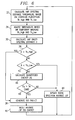
- the flow diagram of this SID detection algorithm is illustrated in Figure 6.
- the first step 30 in the beginning of the process is to calculate HAP-based spectral distance thresholds and signal energy levels for each frame by using equations (1), (2) and (3):
- Weighting factors w m (i) are the weighting factors used in ITU-T G729 Annex B standard. The weighting factors are derived from Figure 5. For low energy levels, thus low loudness levels, weighting factors increase as the frequency increases to balance the effects of different frequencies. As the loudness level increases, weighting factors become flat.
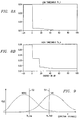
- the w m (i) values in Figure 7 are experimentally selected.
- the algorithm establishes a set of criteria for the evaluation of signal changes to determine if the signal changes will be perceptible and/or significant to the human auditory response system.
- One pair in this decision is the HAP spectral distance thresholds based on loudness perception. They are denoted by th_h and th_l and vary depending on the energy of the frame as shown in Figure 8. These figures are also derived by the arguments in Figure 5. It is trivial to see that as the signal energy drops, the loudness drops, too. Thresholds at low loudness levels should be higher to compensate for the low sensitivity. Maximum sensitivity is at high loudness levels, therefore lower thresholds are selected for high loudness levels.
- the th_l and th_h values in Figure 8 are experimentally selected.
- Thlow ( n + 1) ⁇ Thlow ( n ) + (1 - ⁇ ) Th _l
- Thhigh (n + 1) ⁇ Thhigh ( n ) + (1 - ⁇ ) Th _ h
- Th_high 50 and Th_low 52 are used in Bayes classifier as illustrated in Figure 9.
- Figure 6 further illustrates that if the HAP-based spectral distance 30 is greater than the higher threshold th_high 36, a SID frame is detected 38.
- the average LSF energy is then reset 40 and is updated based on loudness perception 32 and temporary masking 34. If the distance 30 is less than the lower threshold th_low 42, the current frame is considered as a non-SID frame. If the spectral distance falls between th_high and th_low, then the quantized energy feature q 46 is introduced to decide if the current frame is a SID. If E q > 2dB, then a SID packet 38 is detected. If E q ⁇ 2dB, then average LSF noise spectrum is updated 44 prior to returning to re-calculating HAP spectral distance thresholds 32 and adjusting the thresholds 34.
- FIG. 10 illustrates simulation results of the HAP-based SID detection and G.729 Annex B SID detection for clean speech, with/without various added noise (babble, office or street noise) under different background noise levels.
- PAMS is used for objective measurements.
- the new algorithm either performs the same or outperforms the standard G729 Annex B SID detection algorithm in terms of YLQ in noisy conditions (Rows 7 through 15) with a significant SID percentage reduction.
Landscapes
- Engineering & Computer Science (AREA)
- Physics & Mathematics (AREA)
- Signal Processing (AREA)
- Health & Medical Sciences (AREA)
- Audiology, Speech & Language Pathology (AREA)
- Human Computer Interaction (AREA)
- Computational Linguistics (AREA)
- Acoustics & Sound (AREA)
- Multimedia (AREA)
- Transmission Systems Not Characterized By The Medium Used For Transmission (AREA)
- Telephonic Communication Services (AREA)
- Cable Transmission Systems, Equalization Of Radio And Reduction Of Echo (AREA)
- Reduction Or Emphasis Of Bandwidth Of Signals (AREA)
- Data Exchanges In Wide-Area Networks (AREA)
Applications Claiming Priority (2)
| Application Number | Priority Date | Filing Date | Title |
|---|---|---|---|
| US699366 | 1991-05-13 | ||
| US09/699,366 US6807525B1 (en) | 2000-10-31 | 2000-10-31 | SID frame detection with human auditory perception compensation |
Publications (2)
| Publication Number | Publication Date |
|---|---|
| EP1229520A2 true EP1229520A2 (de) | 2002-08-07 |
| EP1229520A3 EP1229520A3 (de) | 2004-01-21 |
Family
ID=24808998
Family Applications (1)
| Application Number | Title | Priority Date | Filing Date |
|---|---|---|---|
| EP01000577A Withdrawn EP1229520A3 (de) | 2000-10-31 | 2001-10-29 | Bestimmung von Signalrahmen zur Pausenbeschreibung (sid) mit Kompensation des menschlichen Gehörs |
Country Status (3)
| Country | Link |
|---|---|
| US (1) | US6807525B1 (de) |
| EP (1) | EP1229520A3 (de) |
| JP (1) | JP2002237785A (de) |
Cited By (7)
| Publication number | Priority date | Publication date | Assignee | Title |
|---|---|---|---|---|
| WO2006136901A3 (en) * | 2005-06-18 | 2007-03-08 | Nokia Corp | System and method for adaptive transmission of comfort noise parameters during discontinuous speech transmission |
| WO2008016942A3 (en) * | 2006-07-31 | 2008-04-10 | Qualcomm Inc | Systems, methods, and apparatus for signal change detection |
| WO2008016935A3 (en) * | 2006-07-31 | 2008-06-12 | Qualcomm Inc | Systems, methods, and apparatus for wideband encoding and decoding of inactive frames |
| RU2440674C1 (ru) * | 2008-02-19 | 2012-01-20 | Сименс Энтерпрайз Коммьюникейшнз Гмбх Унд Ко.Кг | Способ и средство для кодирования информации фонового шума |
| WO2014096279A1 (en) * | 2012-12-21 | 2014-06-26 | Fraunhofer-Gesellschaft zur Förderung der angewandten Forschung e.V. | Generation of a comfort noise with high spectro-temporal resolution in discontinuous transmission of audio signals |
| TWI467979B (zh) * | 2006-07-31 | 2015-01-01 | Qualcomm Inc | 用於信號改變偵測之系統、方法及裝置 |
| US10147432B2 (en) | 2012-12-21 | 2018-12-04 | Fraunhofer-Gesellschaft Zur Foerderung Der Angewandten Forschung E.V. | Comfort noise addition for modeling background noise at low bit-rates |
Families Citing this family (23)
| Publication number | Priority date | Publication date | Assignee | Title |
|---|---|---|---|---|
| US7386447B2 (en) * | 2001-11-02 | 2008-06-10 | Texas Instruments Incorporated | Speech coder and method |
| US7177304B1 (en) * | 2002-01-03 | 2007-02-13 | Cisco Technology, Inc. | Devices, softwares and methods for prioritizing between voice data packets for discard decision purposes |
| US7454331B2 (en) * | 2002-08-30 | 2008-11-18 | Dolby Laboratories Licensing Corporation | Controlling loudness of speech in signals that contain speech and other types of audio material |
| KR101164937B1 (ko) * | 2003-05-28 | 2012-07-12 | 돌비 레버러토리즈 라이쎈싱 코오포레이션 | 오디오 신호의 인식된 라우드니스를 계산 및 조정하는방법, 장치 및 컴퓨터 프로그램 |
| CN1299521C (zh) * | 2003-10-28 | 2007-02-07 | 中兴通讯股份有限公司 | 一种无线通讯系统中基带至射频信号传输的装置和方法 |
| CA2581810C (en) | 2004-10-26 | 2013-12-17 | Dolby Laboratories Licensing Corporation | Calculating and adjusting the perceived loudness and/or the perceived spectral balance of an audio signal |
| US8199933B2 (en) | 2004-10-26 | 2012-06-12 | Dolby Laboratories Licensing Corporation | Calculating and adjusting the perceived loudness and/or the perceived spectral balance of an audio signal |
| ES2435012T3 (es) * | 2005-04-18 | 2013-12-18 | Basf Se | Copolímeros CP para la producción de preparaciones que contienen por lo menos un fungicida de conazol |
| US20070019931A1 (en) * | 2005-07-19 | 2007-01-25 | Texas Instruments Incorporated | Systems and methods for re-synchronizing video and audio data |
| KR100735246B1 (ko) * | 2005-09-12 | 2007-07-03 | 삼성전자주식회사 | 오디오 신호 전송 장치 및 방법 |
| US7546125B2 (en) * | 2005-10-03 | 2009-06-09 | Divitas Networks, Inc. | Enhancing user experience during handoffs in wireless communication |
| EP2002426B1 (de) * | 2006-04-04 | 2009-09-02 | Dolby Laboratories Licensing Corporation | Lautstärkemessung von tonsignalen und änderung im mdct-bereich |
| TWI517562B (zh) | 2006-04-04 | 2016-01-11 | 杜比實驗室特許公司 | 用於將多聲道音訊信號之全面感知響度縮放一期望量的方法、裝置及電腦程式 |
| MY141426A (en) | 2006-04-27 | 2010-04-30 | Dolby Lab Licensing Corp | Audio gain control using specific-loudness-based auditory event detection |
| CN101087319B (zh) * | 2006-06-05 | 2012-01-04 | 华为技术有限公司 | 一种发送和接收背景噪声的方法和装置及静音压缩系统 |
| US20080317241A1 (en) * | 2006-06-14 | 2008-12-25 | Derek Wang | Code-based echo cancellation |
| US20080140767A1 (en) * | 2006-06-14 | 2008-06-12 | Prasad Rao | Divitas description protocol and methods therefor |
| US20090016333A1 (en) * | 2006-06-14 | 2009-01-15 | Derek Wang | Content-based adaptive jitter handling |
| BRPI0717484B1 (pt) | 2006-10-20 | 2019-05-21 | Dolby Laboratories Licensing Corporation | Método e aparelho para processar um sinal de áudio |
| US8521314B2 (en) | 2006-11-01 | 2013-08-27 | Dolby Laboratories Licensing Corporation | Hierarchical control path with constraints for audio dynamics processing |
| US8571853B2 (en) * | 2007-02-11 | 2013-10-29 | Nice Systems Ltd. | Method and system for laughter detection |
| ATE535906T1 (de) * | 2007-07-13 | 2011-12-15 | Dolby Lab Licensing Corp | Tonverarbeitung mittels auditorischer szenenanalyse und spektraler asymmetrie |
| JP5332733B2 (ja) * | 2009-03-03 | 2013-11-06 | 沖電気工業株式会社 | エコーキャンセラ |
Family Cites Families (2)
| Publication number | Priority date | Publication date | Assignee | Title |
|---|---|---|---|---|
| CA2110090C (en) * | 1992-11-27 | 1998-09-15 | Toshihiro Hayata | Voice encoder |
| FR2739995B1 (fr) * | 1995-10-13 | 1997-12-12 | Massaloux Dominique | Procede et dispositif de creation d'un bruit de confort dans un systeme de transmission numerique de parole |
-
2000
- 2000-10-31 US US09/699,366 patent/US6807525B1/en not_active Expired - Lifetime
-
2001
- 2001-10-29 EP EP01000577A patent/EP1229520A3/de not_active Withdrawn
- 2001-10-30 JP JP2001332962A patent/JP2002237785A/ja active Pending
Cited By (21)
| Publication number | Priority date | Publication date | Assignee | Title |
|---|---|---|---|---|
| US7693708B2 (en) | 2005-06-18 | 2010-04-06 | Nokia Corporation | System and method for adaptive transmission of comfort noise parameters during discontinuous speech transmission |
| WO2006136901A3 (en) * | 2005-06-18 | 2007-03-08 | Nokia Corp | System and method for adaptive transmission of comfort noise parameters during discontinuous speech transmission |
| CN101213591B (zh) * | 2005-06-18 | 2013-07-24 | 诺基亚公司 | 用于非连续语音传输期间的舒适噪声参数自适应传输的系统和方法 |
| US8725499B2 (en) | 2006-07-31 | 2014-05-13 | Qualcomm Incorporated | Systems, methods, and apparatus for signal change detection |
| RU2417456C2 (ru) * | 2006-07-31 | 2011-04-27 | Квэлкомм Инкорпорейтед | Системы, способы и устройства для обнаружения изменения сигналов |
| RU2428747C2 (ru) * | 2006-07-31 | 2011-09-10 | Квэлкомм Инкорпорейтед | Системы, способы и устройство для широкополосного кодирования и декодирования неактивных кадров |
| US8260609B2 (en) | 2006-07-31 | 2012-09-04 | Qualcomm Incorporated | Systems, methods, and apparatus for wideband encoding and decoding of inactive frames |
| WO2008016935A3 (en) * | 2006-07-31 | 2008-06-12 | Qualcomm Inc | Systems, methods, and apparatus for wideband encoding and decoding of inactive frames |
| US9324333B2 (en) | 2006-07-31 | 2016-04-26 | Qualcomm Incorporated | Systems, methods, and apparatus for wideband encoding and decoding of inactive frames |
| WO2008016942A3 (en) * | 2006-07-31 | 2008-04-10 | Qualcomm Inc | Systems, methods, and apparatus for signal change detection |
| TWI467979B (zh) * | 2006-07-31 | 2015-01-01 | Qualcomm Inc | 用於信號改變偵測之系統、方法及裝置 |
| RU2440674C1 (ru) * | 2008-02-19 | 2012-01-20 | Сименс Энтерпрайз Коммьюникейшнз Гмбх Унд Ко.Кг | Способ и средство для кодирования информации фонового шума |
| US8949121B2 (en) | 2008-02-19 | 2015-02-03 | Unify Gmbh & Co. Kg | Method and means for encoding background noise information |
| WO2014096279A1 (en) * | 2012-12-21 | 2014-06-26 | Fraunhofer-Gesellschaft zur Förderung der angewandten Forschung e.V. | Generation of a comfort noise with high spectro-temporal resolution in discontinuous transmission of audio signals |
| CN104871242A (zh) * | 2012-12-21 | 2015-08-26 | 弗兰霍菲尔运输应用研究公司 | 在音频信号的不连续传输中具有高频谱时间分辨率的舒缓噪声的生成 |
| US9583114B2 (en) | 2012-12-21 | 2017-02-28 | Fraunhofer-Gesellschaft Zur Foerderung Der Angewandten Forschung E.V. | Generation of a comfort noise with high spectro-temporal resolution in discontinuous transmission of audio signals |
| CN104871242B (zh) * | 2012-12-21 | 2017-10-24 | 弗劳恩霍夫应用研究促进协会 | 在音频信号的不连续传输中具有高频谱时间分辨率的舒缓噪声的生成 |
| RU2650025C2 (ru) * | 2012-12-21 | 2018-04-06 | Фраунхофер-Гезелльшафт Цур Фердерунг Дер Ангевандтен Форшунг Е.Ф. | Генерирование комфортного шума с высоким спектрально-временным разрешением при прерывистой передаче аудиосигналов |
| US10147432B2 (en) | 2012-12-21 | 2018-12-04 | Fraunhofer-Gesellschaft Zur Foerderung Der Angewandten Forschung E.V. | Comfort noise addition for modeling background noise at low bit-rates |
| US10339941B2 (en) | 2012-12-21 | 2019-07-02 | Fraunhofer-Gesellschaft Zur Foerderung Der Angewandten Forschung E.V. | Comfort noise addition for modeling background noise at low bit-rates |
| US10789963B2 (en) | 2012-12-21 | 2020-09-29 | Fraunhofer-Gesellschaft Zur Foerderung Der Angewandten Forschung E.V. | Comfort noise addition for modeling background noise at low bit-rates |
Also Published As
| Publication number | Publication date |
|---|---|
| EP1229520A3 (de) | 2004-01-21 |
| US6807525B1 (en) | 2004-10-19 |
| JP2002237785A (ja) | 2002-08-23 |
Similar Documents
| Publication | Publication Date | Title |
|---|---|---|
| US6807525B1 (en) | SID frame detection with human auditory perception compensation | |
| US6889187B2 (en) | Method and apparatus for improved voice activity detection in a packet voice network | |
| US7043428B2 (en) | Background noise estimation method for an improved G.729 annex B compliant voice activity detection circuit | |
| US7171357B2 (en) | Voice-activity detection using energy ratios and periodicity | |
| US4672669A (en) | Voice activity detection process and means for implementing said process | |
| US9401160B2 (en) | Methods and voice activity detectors for speech encoders | |
| CN101379548B (zh) | 语音检测器和用于其中抑制子频带的方法 | |
| CN100508028C (zh) | 将释放延迟帧添加到由声码器编码的多个帧的方法和装置 | |
| JP4307557B2 (ja) | 音声活性度検出器 | |
| JP3363336B2 (ja) | フレーム音声決定方法および装置 | |
| US8447617B2 (en) | Method and system for speech bandwidth extension | |
| JP5006279B2 (ja) | 音声活性検出装置及び移動局並びに音声活性検出方法 | |
| US20010034601A1 (en) | Voice activity detection apparatus, and voice activity/non-activity detection method | |
| US20050108004A1 (en) | Voice activity detector based on spectral flatness of input signal | |
| JP3255584B2 (ja) | 有音検知装置および方法 | |
| JPH1097292A (ja) | 音声信号伝送方法および不連続伝送システム | |
| US6381568B1 (en) | Method of transmitting speech using discontinuous transmission and comfort noise | |
| EP1224660A1 (de) | Hervorhebung von transient-sprachmerkmalen kurzer dauer | |
| JP4551215B2 (ja) | 音声の聴覚明瞭度分析を実施する方法 | |
| RU2440674C1 (ru) | Способ и средство для кодирования информации фонового шума | |
| Sakhnov et al. | Dynamical energy-based speech/silence detector for speech enhancement applications | |
| US20050228647A1 (en) | Method and system for controlling potentially harmful signals in a signal arranged to convey speech | |
| US20050267745A1 (en) | System and method for babble noise detection | |
| Payton et al. | Computing the STI using speech as a probe stimulus | |
| Beritelli et al. | A low‐complexity speech‐pause detection algorithm for communication in noisy environments |
Legal Events
| Date | Code | Title | Description |
|---|---|---|---|
| PUAI | Public reference made under article 153(3) epc to a published international application that has entered the european phase |
Free format text: ORIGINAL CODE: 0009012 |
|
| AK | Designated contracting states |
Kind code of ref document: A2 Designated state(s): AT BE CH CY DE DK ES FI FR GB GR IE IT LI LU MC NL PT SE TR |
|
| AX | Request for extension of the european patent |
Free format text: AL;LT;LV;MK;RO;SI |
|
| PUAL | Search report despatched |
Free format text: ORIGINAL CODE: 0009013 |
|
| AK | Designated contracting states |
Kind code of ref document: A3 Designated state(s): AT BE CH CY DE DK ES FI FR GB GR IE IT LI LU MC NL PT SE TR |
|
| AX | Request for extension of the european patent |
Extension state: AL LT LV MK RO SI |
|
| AKX | Designation fees paid | ||
| REG | Reference to a national code |
Ref country code: DE Ref legal event code: 8566 |
|
| STAA | Information on the status of an ep patent application or granted ep patent |
Free format text: STATUS: THE APPLICATION IS DEEMED TO BE WITHDRAWN |
|
| 18D | Application deemed to be withdrawn |
Effective date: 20040722 |