EP1229139A2 - Smelting method for separating metal and inorganic particles from metal-inorganic particle composite material - Google Patents
Smelting method for separating metal and inorganic particles from metal-inorganic particle composite material Download PDFInfo
- Publication number
- EP1229139A2 EP1229139A2 EP02002711A EP02002711A EP1229139A2 EP 1229139 A2 EP1229139 A2 EP 1229139A2 EP 02002711 A EP02002711 A EP 02002711A EP 02002711 A EP02002711 A EP 02002711A EP 1229139 A2 EP1229139 A2 EP 1229139A2
- Authority
- EP
- European Patent Office
- Prior art keywords
- metal
- melt
- composite material
- particle composite
- inorganic particles
- Prior art date
- Legal status (The legal status is an assumption and is not a legal conclusion. Google has not performed a legal analysis and makes no representation as to the accuracy of the status listed.)
- Withdrawn
Links
Images

Classifications
-
- C—CHEMISTRY; METALLURGY
- C22—METALLURGY; FERROUS OR NON-FERROUS ALLOYS; TREATMENT OF ALLOYS OR NON-FERROUS METALS
- C22B—PRODUCTION AND REFINING OF METALS; PRETREATMENT OF RAW MATERIALS
- C22B9/00—General processes of refining or remelting of metals; Apparatus for electroslag or arc remelting of metals
- C22B9/10—General processes of refining or remelting of metals; Apparatus for electroslag or arc remelting of metals with refining or fluxing agents; Use of materials therefor, e.g. slagging or scorifying agents
-
- C—CHEMISTRY; METALLURGY
- C22—METALLURGY; FERROUS OR NON-FERROUS ALLOYS; TREATMENT OF ALLOYS OR NON-FERROUS METALS
- C22B—PRODUCTION AND REFINING OF METALS; PRETREATMENT OF RAW MATERIALS
- C22B7/00—Working up raw materials other than ores, e.g. scrap, to produce non-ferrous metals and compounds thereof; Methods of a general interest or applied to the winning of more than two metals
- C22B7/001—Dry processes
- C22B7/003—Dry processes only remelting, e.g. of chips, borings, turnings; apparatus used therefor
-
- C—CHEMISTRY; METALLURGY
- C22—METALLURGY; FERROUS OR NON-FERROUS ALLOYS; TREATMENT OF ALLOYS OR NON-FERROUS METALS
- C22B—PRODUCTION AND REFINING OF METALS; PRETREATMENT OF RAW MATERIALS
- C22B7/00—Working up raw materials other than ores, e.g. scrap, to produce non-ferrous metals and compounds thereof; Methods of a general interest or applied to the winning of more than two metals
- C22B7/001—Dry processes
- C22B7/004—Dry processes separating two or more metals by melting out (liquation), i.e. heating above the temperature of the lower melting metal component(s); by fractional crystallisation (controlled freezing)
-
- Y—GENERAL TAGGING OF NEW TECHNOLOGICAL DEVELOPMENTS; GENERAL TAGGING OF CROSS-SECTIONAL TECHNOLOGIES SPANNING OVER SEVERAL SECTIONS OF THE IPC; TECHNICAL SUBJECTS COVERED BY FORMER USPC CROSS-REFERENCE ART COLLECTIONS [XRACs] AND DIGESTS
- Y02—TECHNOLOGIES OR APPLICATIONS FOR MITIGATION OR ADAPTATION AGAINST CLIMATE CHANGE
- Y02P—CLIMATE CHANGE MITIGATION TECHNOLOGIES IN THE PRODUCTION OR PROCESSING OF GOODS
- Y02P10/00—Technologies related to metal processing
- Y02P10/20—Recycling
Definitions
- the present invention relates to a method for separating metal and inorganic particles from a metal-inorganic particle composite material generated because of dispersion of inorganic particles in base metal.
- Metal-inorganic particle composite materials generated by dispersing inorganic particles in base metal have been used widely for various kinds of members for the purpose of reduction in material weight, improvement in mechanical strength, and provision of functionality.
- waste disposal of such metal-inorganic particle composite materials have come into a problem.
- measures such that the metal-inorganic particle composite materials are simply ground and mixed into other materials as they are, and stored or disposed of by landfills.
- Unexamined Japanese Patent Hei. 7-41874 discloses the following method. That is, a molten slag containing metal and inorganic particles is dry-ground into fine particles having a moderate particle size. The fine slag powder is subjected to low magnetic force selection under magnetic flux density not higher than 1,000 gauss. Thus, iron-component particles in the slag powder is selectively recovered by magnetic attraction.
- the residual slag powder after the low magnetic force selection is subjected to high magnetic force selection under magnetic flux density ranging from 1,000 gauss to 13,000 gauss. Further, aluminum-component particles or copper-component particles remaining after the high magnetic force selection are recovered individually by separation based on specific gravity.
- the method it is necessary to form slag into fine powder.
- the process includes many steps and is complicated.
- the method is applicable only to metal-inorganic composite materials containing magnetic materials. Therefore, the application of the method is limited to some extent.
- Oxides or nonferrous metal mediators generated at the time of manufacturing are generally mixed into metal-inorganic composite materials.
- any method including the method described above it is difficult to eliminate such components and separate metal therefrom. Accordingly, the purity of metal recovered is generally so low that an additional refining work may be required to use the metal as a fresh metal raw material.
- An object of the invention is to provide a method for separating metal and inorganic particles from a metal-inorganic particle composite material, by which high-purity metal can be recovered efficiently with a simple and easy operation regardless of the composition of the metal-inorganic particle composite material, particularly regardless of the kind of metal.
- the invention provides a method for separating metal and inorganic particles from a metal-inorganic particle composite material generated because of dispersion of inorganic particles in base metal, the method including the steps of heating the metal-inorganic particle composite material into a melt; throwing flux into the melt and bringing the flux into contact with the melt sufficiently; subsequently leaving the melt at rest to thereby separate the melt into an upper layer containing the inorganic particles and a lower layer composed of the metal; and subsequently recovering the upper layer and the lower layer individually.
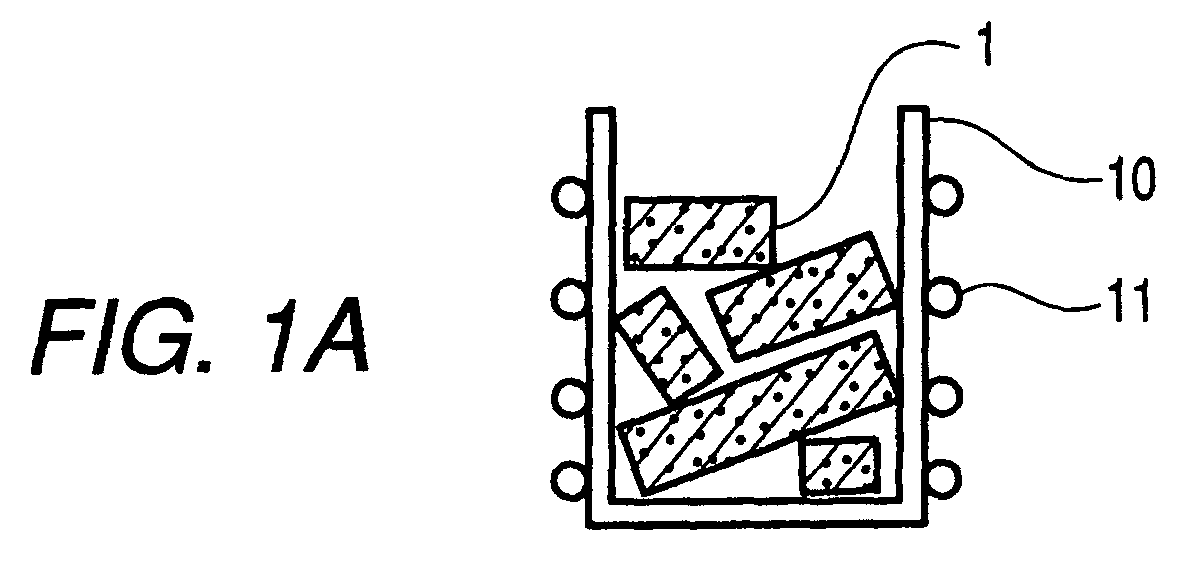
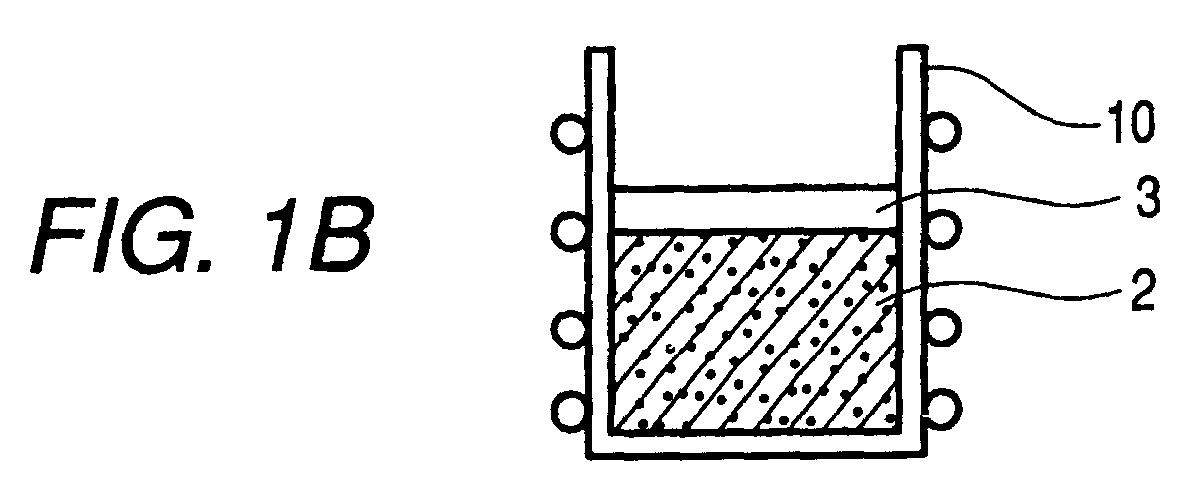
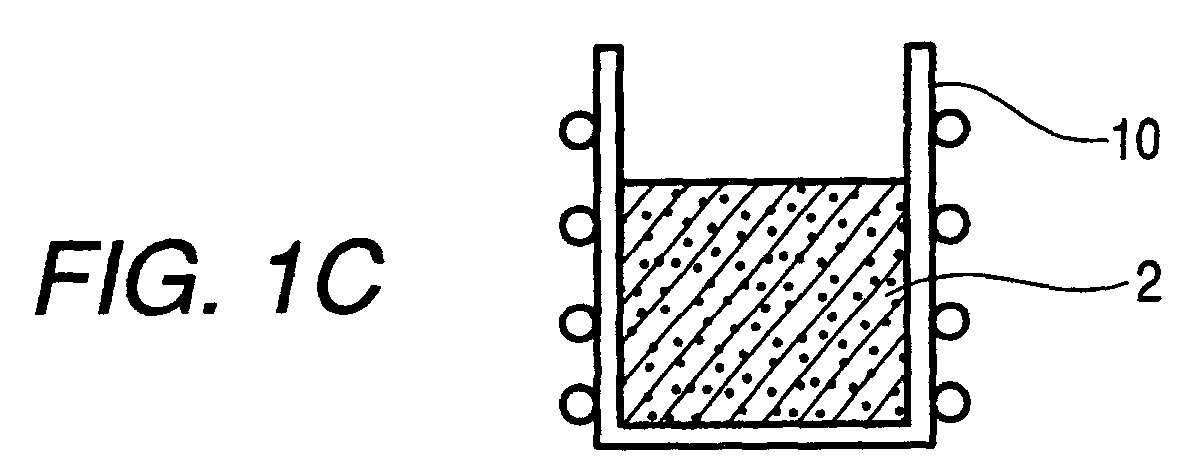
- Figs. 1A to 1D are views of steps for explaining a separation method according to the invention.
- Figs. 1A to 1D are schematic views respectively showing steps A to D for explaining a separation method according to the invention.
- a metal-inorganic particle composite material 1 to be treated is crushed into suitable lumps, and thrown into a heating vessel 10 having a suitable heating unit 11 such as a high frequency coil.
- the heating vessel 10 is heated to form the metal-inorganic particle composite material 1 into a melt 2.
- Flux 3 is placed on the liquid level of the melt 2.
- the flux 3 is, for example, a mixture of NaCl, KCl, Na 3 AlF 6 , etc.
- the components of the metal-inorganic particle composite material 1 are analyzed in advance, and the flux 3 is selected suitably in accordance with oxides or nonferrous metal mediators contained in the metal-inorganic particle composite material 1.
- the loading of the flux 3 is set to be in a range of from 0.2 parts to 2.0 parts by weight per 100 parts by weight of the metal-inorganic particle composite material.
- the flux 3 is softly pressed into the melt 2, and mixed by stirring the melt 2 and flux 3 as a whole.
- the flux 3 is brought into contact with metal oxides, hydrogen, nonferrous metal mediators, and the like, contained in the metal-inorganic particle composite material 1 so that coagula of those components are produced in the melt 2. Therefore, in order to increase the purity of recovered metal, it is important to bring the melt 2 and the flux 3 into contact with each other sufficiently to thereby produce coagula as much as possible.
- the coagula are smaller in specific gravity than metal. Accordingly, by stirring, the coagula float in the melt 2 together with inorganic particles.
- the melt 2 After being stirred, the melt 2 is left at rest while being heated. Thus, the coagula, the inorganic particles and the flux 3 come to the surface in the form of dross 4. After the dross 4 floats up to the surface sufficiently, heating is stopped, and the melt 2 is kept at rest. As a result, as shown in Fig. 1D, the melt 2 as a whole is solidified so that a solid separated into an upper layer composed of the dross 4 containing the inorganic particles 2a and a lower layer composed of metal 2b can be obtained.
- the solid is extracted from the heating vessel 10, and cut in a border 5 between the upper layer and the lower layer.
- the solid can be separated into the metal 2b and the inorganic particles 2a in the dross 4.
- respective components of the dross 4 are residual in the vicinity of the cut surface of the lower layer. It is therefore preferable that a predetermined thickness of the cut surface is eliminated to increase the purity of the metal 2b recovered.
- the inorganic particles 2b are recovered from the dross 4 in accordance with the kind of the flux 3 used in the step shown in Fig. 1B.
- the inorganic particles 2b can be recovered by dissolving the flux 3 in water or a suitable solvent.
- the inorganic particles 2b can be recovered by baking the whole of the dross 4.
- the dross 4 may be separated from the metal 2b in the following manner. That is, in the step shown in Fig. 1D, the flux 3 is added, and the melt 2 is stirred and left at rest to make the dross 4 come to the surface. Then, while being heated, the dross 4 in the upper layer is skimmed with a net-like member. According to this method, it can be confirmed that the separation between the dross 4 and the metal 2b is completed when there is nothing to come to the surface, that is, when the dross 4 disappears. Then, the metal 2b, which is in a melt state, is poured into a mold as it is, cooled and recovered as an ingot. On the other hand, the inorganic particles 2a is recovered in the same manner as above.
- the respective steps described above can be carried out by very easy operations of heating, stirring, leaving at rest, and cutting (or skimming).
- a series of steps can be carried out in the same heating vessel 10, and can be carried out in the atmosphere because the flux 3 is used. Therefore, the method according to the invention is superior also in workability.
- metal and inorganic particles can be separated from each other regardless of the composition of the metal-inorganic particle composite material, particularly regardless of the kind of the metal.
Landscapes
- Engineering & Computer Science (AREA)
- Chemical & Material Sciences (AREA)
- Metallurgy (AREA)
- Manufacturing & Machinery (AREA)
- Materials Engineering (AREA)
- Mechanical Engineering (AREA)
- Organic Chemistry (AREA)
- Geology (AREA)
- General Life Sciences & Earth Sciences (AREA)
- Environmental & Geological Engineering (AREA)
- Life Sciences & Earth Sciences (AREA)
- Manufacture And Refinement Of Metals (AREA)
- Processing Of Solid Wastes (AREA)
Abstract
Description
Claims (2)
- A method for separating metal and inorganic particles from a metal-inorganic particle composite material generated because of dispersion of inorganic particles in base metal, comprising the steps of:heating said metal-inorganic particle composite material into a melt;throwing flux into said melt and bringing said flux into contact with said melt sufficiently;leaving said melt at rest to separate said melt into an upper layer containing said inorganic particles and a lower layer composed of said metal; andrecovering said upper layer and said lower layer individually.
- A method for separating metal and inorganic particles from a metal-inorganic particle composite material according to Claim 1, wherein said flux is in a range of from 0.2 parts to 2.0 parts by weight per 100 parts by weight of said metal-inorganic particle composite material.
Applications Claiming Priority (2)
| Application Number | Priority Date | Filing Date | Title |
|---|---|---|---|
| JP2001029755 | 2001-02-06 | ||
| JP2001029755A JP2002233846A (en) | 2001-02-06 | 2001-02-06 | Method for separating metal and inorganic particles from metal-inorganic particle composite |
Publications (2)
| Publication Number | Publication Date |
|---|---|
| EP1229139A2 true EP1229139A2 (en) | 2002-08-07 |
| EP1229139A3 EP1229139A3 (en) | 2003-06-04 |
Family
ID=18894061
Family Applications (1)
| Application Number | Title | Priority Date | Filing Date |
|---|---|---|---|
| EP20020002711 Withdrawn EP1229139A3 (en) | 2001-02-06 | 2002-02-06 | Smelting method for separating metal and inorganic particles from metal-inorganic particle composite material |
Country Status (3)
| Country | Link |
|---|---|
| US (1) | US6755887B2 (en) |
| EP (1) | EP1229139A3 (en) |
| JP (1) | JP2002233846A (en) |
Cited By (1)
| Publication number | Priority date | Publication date | Assignee | Title |
|---|---|---|---|---|
| DE102004055131A1 (en) * | 2004-11-16 | 2006-05-18 | Volkswagen Ag | Melting magnesium alloys, used in the production of vehicle, components comprises feeding magnesium or magnesium alloy in the form of wire or thin strip into a melt through a device containing a protective gas |
Families Citing this family (1)
| Publication number | Priority date | Publication date | Assignee | Title |
|---|---|---|---|---|
| JP4840369B2 (en) * | 2008-01-08 | 2011-12-21 | 株式会社デンソー | Nanoparticle production method and separation method |
Family Cites Families (7)
| Publication number | Priority date | Publication date | Assignee | Title |
|---|---|---|---|---|
| US3661737A (en) | 1969-10-29 | 1972-05-09 | Kaiser Aluminium Chem Corp | Recovery of valuable components from magnesium cell sludge |
| US5080715A (en) * | 1990-11-05 | 1992-01-14 | Alcan International Limited | Recovering clean metal and particulates from metal matrix composites |
| CA2085056A1 (en) | 1992-12-10 | 1994-06-11 | Edward J. Daniels | Process to recycle aluminum salt cake waste and to convert aluminum oxide to hydrated aluminum |
| US6053959A (en) | 1997-10-30 | 2000-04-25 | Cargill, Incorporated | Method and composition for aluminum recycle using salt flux |
| US6129134A (en) | 1999-03-11 | 2000-10-10 | The United States Of America As Represented By The Secretary Of The Navy | Synthesis of metal matrix composite |
| JP2001059120A (en) * | 1999-08-19 | 2001-03-06 | Aisin Takaoka Ltd | Recycling method of metal matrix composite material |
| US6089479A (en) | 1999-09-28 | 2000-07-18 | Cleanenv' Engineeering Consultant Co., Ltd. | Method for treating waste printed circuit boards with molten mixture of inorganic salts |
-
2001
- 2001-02-06 JP JP2001029755A patent/JP2002233846A/en not_active Abandoned
-
2002
- 2002-02-05 US US10/062,411 patent/US6755887B2/en not_active Expired - Fee Related
- 2002-02-06 EP EP20020002711 patent/EP1229139A3/en not_active Withdrawn
Cited By (1)
| Publication number | Priority date | Publication date | Assignee | Title |
|---|---|---|---|---|
| DE102004055131A1 (en) * | 2004-11-16 | 2006-05-18 | Volkswagen Ag | Melting magnesium alloys, used in the production of vehicle, components comprises feeding magnesium or magnesium alloy in the form of wire or thin strip into a melt through a device containing a protective gas |
Also Published As
| Publication number | Publication date |
|---|---|
| JP2002233846A (en) | 2002-08-20 |
| US20020112568A1 (en) | 2002-08-22 |
| US6755887B2 (en) | 2004-06-29 |
| EP1229139A3 (en) | 2003-06-04 |
Similar Documents
| Publication | Publication Date | Title |
|---|---|---|
| US9057118B2 (en) | Plasma method and apparatus for recovery of precious metals | |
| JP3003749B2 (en) | Metal recovery method from waste molten slag | |
| AU2011335037A1 (en) | Magnetic recovery of valuables from slag material | |
| JP2014534349A (en) | A method of separating and recovering iron from waste nonferrous slag discharged in the smelting process of nonferrous metals such as copper, zinc and lead by physicochemical sorting | |
| EP0079179B1 (en) | Dore slag treatment | |
| EP1431464B1 (en) | Method for recycling of a counterweight | |
| JP3384270B2 (en) | Recovery of valuable metals from incinerated ash from municipal waste | |
| US6755887B2 (en) | Method of separating metal and inorganic particles from metal-inorganic particle composite material | |
| US4302245A (en) | Method for recovering zinc and zinc alloys from automobile scrap | |
| JPS60135533A (en) | Treatment of stainless steel slag | |
| US3049305A (en) | Process for recovering substantially clean magnetic metal pieces and magnetic oxides from steel plant debris | |
| US2327153A (en) | Recovery of magnesium from halide fluxes | |
| US5439503A (en) | Process for treatment of volcanic igneous rocks to recover gold, silver and platinum | |
| DeBarbadillo et al. | Process for recovering chromium and other metals from superalloy scrap | |
| US5238485A (en) | Method for the assay and recovery of precious metals | |
| KR200278865Y1 (en) | Powder omitted | |
| RU2071976C1 (en) | Method of producing metals and their alloys | |
| WO2016014110A1 (en) | Recovering heavy rare earth metals from magnet scrap | |
| KR20030074492A (en) | manufacture method for aluminum chip and Powder from aluminum dros | |
| JP2014533327A (en) | Slag ladle that separates and recovers molten iron from slag | |
| RU2230805C1 (en) | Method of a complex processing 0f foundry waste products of magnesium production | |
| Edlund et al. | Recovery of copper from converter slags by flotation | |
| TW200920855A (en) | Method and apparatus for separating aluminum dross | |
| KR0177555B1 (en) | Aluminum press-molded body, deoxidizer for steel and raw material for redissolved aluminum | |
| JP4414967B2 (en) | Manufacturing method of backing flux for submerged arc welding |
Legal Events
| Date | Code | Title | Description |
|---|---|---|---|
| PUAI | Public reference made under article 153(3) epc to a published international application that has entered the european phase |
Free format text: ORIGINAL CODE: 0009012 |
|
| AK | Designated contracting states |
Kind code of ref document: A2 Designated state(s): AT BE CH CY DE DK ES FI FR GB GR IE IT LI LU MC NL PT SE TR |
|
| AX | Request for extension of the european patent |
Free format text: AL;LT;LV;MK;RO;SI |
|
| PUAL | Search report despatched |
Free format text: ORIGINAL CODE: 0009013 |
|
| AK | Designated contracting states |
Designated state(s): AT BE CH CY DE DK ES FI FR GB GR IE IT LI LU MC NL PT SE TR |
|
| AX | Request for extension of the european patent |
Extension state: AL LT LV MK RO SI |
|
| AKX | Designation fees paid | ||
| REG | Reference to a national code |
Ref country code: DE Ref legal event code: 8566 |
|
| STAA | Information on the status of an ep patent application or granted ep patent |
Free format text: STATUS: THE APPLICATION IS DEEMED TO BE WITHDRAWN |
|
| 18D | Application deemed to be withdrawn |
Effective date: 20031205 |