EP1229124A1 - Nucleic acid transporter containing polypeptide and recombinant virus vector - Google Patents
Nucleic acid transporter containing polypeptide and recombinant virus vector Download PDFInfo
- Publication number
- EP1229124A1 EP1229124A1 EP00969954A EP00969954A EP1229124A1 EP 1229124 A1 EP1229124 A1 EP 1229124A1 EP 00969954 A EP00969954 A EP 00969954A EP 00969954 A EP00969954 A EP 00969954A EP 1229124 A1 EP1229124 A1 EP 1229124A1
- Authority
- EP
- European Patent Office
- Prior art keywords
- gene
- nucleic acid
- vector
- cells
- acid
- Prior art date
- Legal status (The legal status is an assumption and is not a legal conclusion. Google has not performed a legal analysis and makes no representation as to the accuracy of the status listed.)
- Withdrawn
Links
Images




Classifications
-
- C—CHEMISTRY; METALLURGY
- C12—BIOCHEMISTRY; BEER; SPIRITS; WINE; VINEGAR; MICROBIOLOGY; ENZYMOLOGY; MUTATION OR GENETIC ENGINEERING
- C12N—MICROORGANISMS OR ENZYMES; COMPOSITIONS THEREOF; PROPAGATING, PRESERVING, OR MAINTAINING MICROORGANISMS; MUTATION OR GENETIC ENGINEERING; CULTURE MEDIA
- C12N15/00—Mutation or genetic engineering; DNA or RNA concerning genetic engineering, vectors, e.g. plasmids, or their isolation, preparation or purification; Use of hosts therefor
- C12N15/09—Recombinant DNA-technology
- C12N15/63—Introduction of foreign genetic material using vectors; Vectors; Use of hosts therefor; Regulation of expression
- C12N15/79—Vectors or expression systems specially adapted for eukaryotic hosts
- C12N15/85—Vectors or expression systems specially adapted for eukaryotic hosts for animal cells
- C12N15/86—Viral vectors
-
- A—HUMAN NECESSITIES
- A61—MEDICAL OR VETERINARY SCIENCE; HYGIENE
- A61K—PREPARATIONS FOR MEDICAL, DENTAL OR TOILETRY PURPOSES
- A61K48/00—Medicinal preparations containing genetic material which is inserted into cells of the living body to treat genetic diseases; Gene therapy
-
- C—CHEMISTRY; METALLURGY
- C12—BIOCHEMISTRY; BEER; SPIRITS; WINE; VINEGAR; MICROBIOLOGY; ENZYMOLOGY; MUTATION OR GENETIC ENGINEERING
- C12N—MICROORGANISMS OR ENZYMES; COMPOSITIONS THEREOF; PROPAGATING, PRESERVING, OR MAINTAINING MICROORGANISMS; MUTATION OR GENETIC ENGINEERING; CULTURE MEDIA
- C12N2740/00—Reverse transcribing RNA viruses
- C12N2740/00011—Details
- C12N2740/10011—Retroviridae
- C12N2740/16011—Human Immunodeficiency Virus, HIV
- C12N2740/16041—Use of virus, viral particle or viral elements as a vector
- C12N2740/16043—Use of virus, viral particle or viral elements as a vector viral genome or elements thereof as genetic vector
-
- C—CHEMISTRY; METALLURGY
- C12—BIOCHEMISTRY; BEER; SPIRITS; WINE; VINEGAR; MICROBIOLOGY; ENZYMOLOGY; MUTATION OR GENETIC ENGINEERING
- C12N—MICROORGANISMS OR ENZYMES; COMPOSITIONS THEREOF; PROPAGATING, PRESERVING, OR MAINTAINING MICROORGANISMS; MUTATION OR GENETIC ENGINEERING; CULTURE MEDIA
- C12N2740/00—Reverse transcribing RNA viruses
- C12N2740/00011—Details
- C12N2740/10011—Retroviridae
- C12N2740/16011—Human Immunodeficiency Virus, HIV
- C12N2740/16041—Use of virus, viral particle or viral elements as a vector
- C12N2740/16045—Special targeting system for viral vectors
-
- C—CHEMISTRY; METALLURGY
- C12—BIOCHEMISTRY; BEER; SPIRITS; WINE; VINEGAR; MICROBIOLOGY; ENZYMOLOGY; MUTATION OR GENETIC ENGINEERING
- C12N—MICROORGANISMS OR ENZYMES; COMPOSITIONS THEREOF; PROPAGATING, PRESERVING, OR MAINTAINING MICROORGANISMS; MUTATION OR GENETIC ENGINEERING; CULTURE MEDIA
- C12N2800/00—Nucleic acids vectors
- C12N2800/10—Plasmid DNA
- C12N2800/108—Plasmid DNA episomal vectors
-
- C—CHEMISTRY; METALLURGY
- C12—BIOCHEMISTRY; BEER; SPIRITS; WINE; VINEGAR; MICROBIOLOGY; ENZYMOLOGY; MUTATION OR GENETIC ENGINEERING
- C12N—MICROORGANISMS OR ENZYMES; COMPOSITIONS THEREOF; PROPAGATING, PRESERVING, OR MAINTAINING MICROORGANISMS; MUTATION OR GENETIC ENGINEERING; CULTURE MEDIA
- C12N2810/00—Vectors comprising a targeting moiety
- C12N2810/50—Vectors comprising as targeting moiety peptide derived from defined protein
- C12N2810/60—Vectors comprising as targeting moiety peptide derived from defined protein from viruses
- C12N2810/6045—RNA rev transcr viruses
- C12N2810/6054—Retroviridae
-
- C—CHEMISTRY; METALLURGY
- C12—BIOCHEMISTRY; BEER; SPIRITS; WINE; VINEGAR; MICROBIOLOGY; ENZYMOLOGY; MUTATION OR GENETIC ENGINEERING
- C12N—MICROORGANISMS OR ENZYMES; COMPOSITIONS THEREOF; PROPAGATING, PRESERVING, OR MAINTAINING MICROORGANISMS; MUTATION OR GENETIC ENGINEERING; CULTURE MEDIA
- C12N2830/00—Vector systems having a special element relevant for transcription
- C12N2830/42—Vector systems having a special element relevant for transcription being an intron or intervening sequence for splicing and/or stability of RNA
Definitions
- This invention relates to nucleic acid carriers containing recombinant viral vectors for use in gene therapy.
- the present inventors found that when a nucleic acid carrier comprising a polypeptide comprising diaminobutyric acid and/or a pharmaceutically acceptable salt thereof and a recombinant viral vector was used, the therapeutic gene could be transferred into cells efficiently and safely and thus, this invention was accomplished.
- this invention provides a nucleic acid carrier comprising a polypeptide comprising a diaminobutyric acid and/or a pharmaceutically acceptable salt thereof and a recombinant viral vector.
- the invention provides a nucleic acid carrier as described above wherein the polypeptide comprises a block copolymer of a polypeptide comprising diaminobutyric acid and/or a pharmaceutically acceptable salt thereof and polyethylene glycol.
- the invention provides a nucleic acid carrier as described above wherein the polypeptide comprises diaminobutyric acid and/or a pharmaceutically acceptable salt thereof, each having a residue number of from 20 to 280.
- the invention provides any nucleic acid carrier as described above wherein the recombinant viral vector contains a therapeutic gene.
- the invention provides any nucleic acid carrier as described above wherein the recombinant viral vector is a HIV vector.
- the invention provides a nucleic acid carrier as described above wherein the HIV vector is a pseudo-type HIV vector with VSV-G.
- an agent for improving the gene transfer of a recombinant viral vector comprising as the effective agent, a polypeptide comprising a diaminobutyric acid and/or a pharmaceutically acceptable salt thereof.
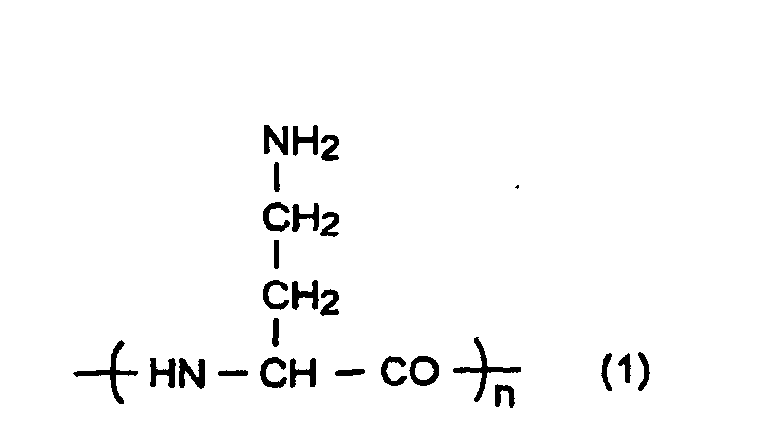
- a polypeptide comprising diaminobutyric acid according to this invention has the structure represented by formula (1) wherein "n” represents a natural number and it may optionally contain an additional monomer unit.
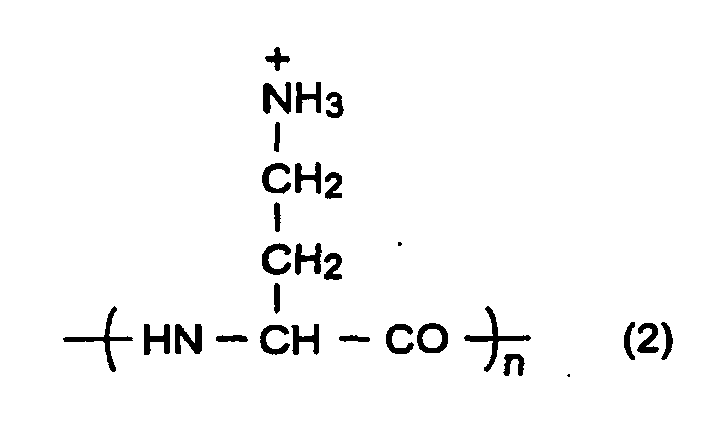
- a polypeptide comprising a pharmaceutically acceptable salt of diaminobutyric acid diaminobutyric acid according to this invention has the structure represented by formula (2) wherein "n" represents a natural number and it may optionally contain an additional monomer unit.
- polypeptide comprising diaminobutyric acid and/or a pharmaceutically acceptable salt thereof may be such that it has a structure including the two structures described above in any proportion. Namely, embraced is that which exists in the form of diaminobutyric acid or a pharmaceutically acceptable salt thereof in any proportion.
- D-form and L-form can exist which are optical isomers.
- the polypeptide comprising diaminobutyric acid and/or a pharmaceutically acceptable salt thereof according to this invention includes D-form, L-form or a polypeptide that is a mixture of the foregoing in any proportion. In other words, it may be a polypeptide containing any of poly-L-diaminobutyric acid, poly-D-diaminobutyric acid, and poly-DL-diaminobutyric acid.
- the "residue of a polypeptide comprising diaminobutyric acid and/or a pharmaceutically acceptable salt thereof” refers to a diaminobutyric acid (or a pharmaceutically acceptable salt thereof) moiety which is a monomer forming the polypeptide; and the number of residues refers to the number of the molecules (represented by "n" in the above formulae).
- the preferred number of residues of the polypeptide according to the invention comprising diaminobutyric acid and/or a pharmaceutically acceptable salt thereof is at least 10 residues. More preferably, the number of residues is at least 20 residues, and most preferably at least 25 residues.
- the preferred number of residues of the polypeptide according to the invention comprising diaminobutyric acid and/or a pharmaceutically acceptable salt is 280 residues or less. More preferably, the number of residues is 250 residues or less. When the number of residues is too large, the synthesis will be difficult and handling will also be inconvenient. On the other hand, when the number of residues is too small, performance as a nucleic acid carrier will be inadequate. Further, an optimal selection can be made as to the preferred number of residues depending on the recombinant viral vector to be used and the properties of components that can be used concurrently.
- the pharmaceutically acceptable salt of diaminobutyric acid is not particularly limited insofar as it does not exhibit toxicity or it is a salt exhibiting toxicity at such a level that is tolerable.
- inorganic acids such as hydrochloric acid, sulfuric acid, nitric acid, and phosphoric acid
- organic acids such as acetic acid, propionic acid, citric acid, lactic acid, oxalic acid, succinic acid, tartaric acid, malonic acid, fumaric acid, and malic acid.
- acetate is particularly preferred.
- the number of residues described above can possibly be expressed in terms of molecular weight because the polydiaminobutyric acid acetate has a molecular weight of 160.
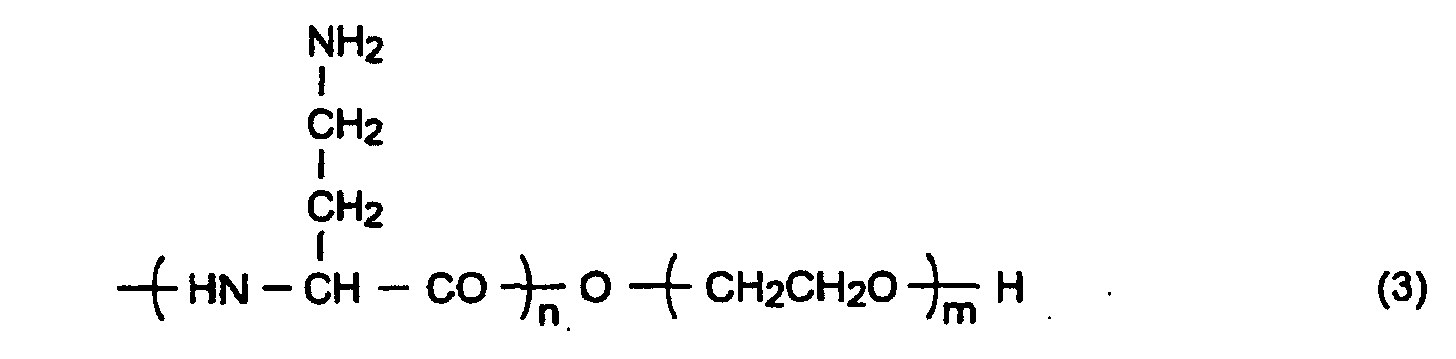
- polypeptide according to this invention comprising diaminobutyric acid and/or a pharmaceutically acceptable salt thereof (which will be referred to as "the polypeptide according to this invention” hereafter) includes one having a block copolymer structure where polyethylene glycol is further linked to the polypeptide comprising diaminobutyric acid described above and having formula (3) wherein "n" and "m” represent a natural number, respectively.
- polypeptide has a carboxylic acid moiety
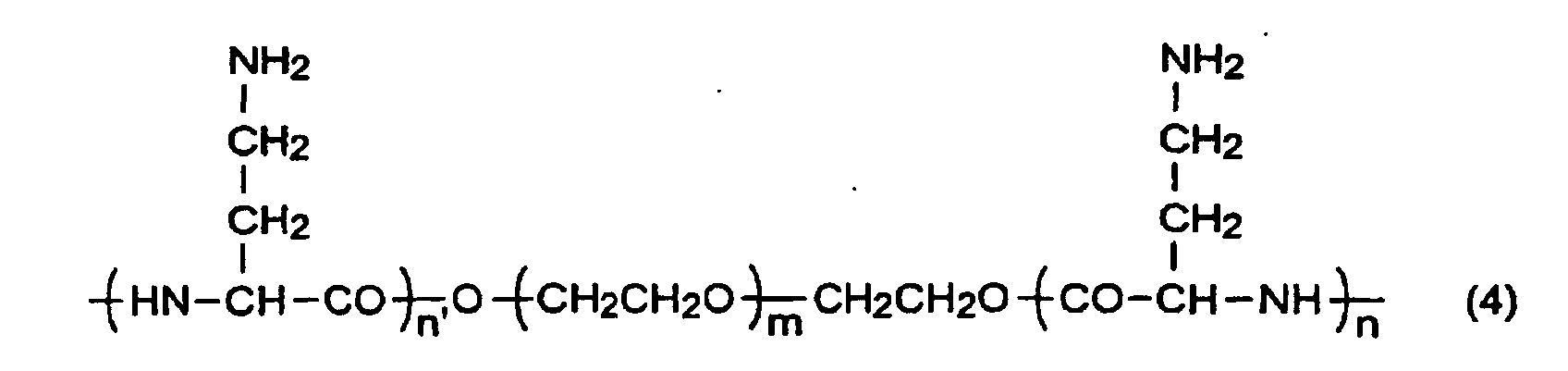
- a copolymer represented by formula (4) wherein "m,” “n,” and “n' " represent a natural number, respectively is possibly one of those having the block copolymer structure.
- the molecular weight of ethylene glycol is not particularly limited, but it is normally on the order of from 200 to 25,000 for the reasons that will be described later.
- a tissue-specific ligand can be linked to the polypeptide according to this invention.
- the nucleic acid carrier of this invention containing such a tissue-specific ligand is effectively or in a tissue-specific manner incorporated into a particular tissue to which the ligand is specific.
- a sugar glactose, lactose, acyloglycoprotein, oligoglactose, hyaluronic acid, etc.
- a block copolymer of diaminobutyric acid and polyethylene glycol (PEG) as represented by formula (3) or formula (4) be employed as the polypeptide according to this invention.
- PEG having a molecular weight of 200 or more is preferably used. More preferably, PEG having a molecular weight of 1,000 or more is used.
- the molecular weight of PEG is preferably 25,000 or less, more preferably 10,000 or less, and most preferably 5,000 or less.
- the molecular weight of PEG is 25,000 or more, affinity to the cell surface decreases, thus resulting in lowered efficiency of nucleic acid (gene) transfer; if the molecular weight is 200 or less, the intended effect by polyethylene glycol will be small, which is undesirable.
- the monomers to be used may preferably employ diaminobutyric acid, diaminobutyric acid where a protective group has been introduced into the ⁇ -amino group, or diaminobutyric acid having activated amino groups and/or carboxylic acid groups for peptide group formation.
- diaminobutyric acid preferably employs diaminobutyric acid, diaminobutyric acid where a protective group has been introduced into the ⁇ -amino group, or diaminobutyric acid having activated amino groups and/or carboxylic acid groups for peptide group formation.
- the ⁇ -amino group of diaminobutyric acid is protected and the diaminobutyric acid is then converted to an acid anhydride thereof in order to render the peptide bond formation easy (New Experimental Chemistry Monograph No. 19, Polymer Chemistry I, published in 1980, Maruzen Co. Ltd.).
- amine and alcohol compounds are usable.
- the amine compounds include alkylamines; particularly, butylamine is preferable.
- polyethylene glycols are used as alcohols
- the polypeptides according to this invention (which comprises a block copolymer of diaminobutyric acid and polyethylene glycol) may be obtained that have polyethylene glycol moieties attached.
- the particularly preferred synthetic pathway is illustrated in Fig. 1.
- the ⁇ -amino group be protected with a suitable protecting group and the amino acid portion be converted, using phosgene, into an acid anhydride which is to be used as a monomer in polycondensation ((10) in Fig. 1).
- the polycondensation reaction allows suitable initiators to be used; and it becomes possible to introduce a preferable number of monomers.
- the initiator is not particularly limited, various amine compounds are preferable, and the use of butylamine is particularly preferable.
- suitable ethylene glycols are used as initiators, it will be possible to obtain block copolymers having ethylene glycol moieties which are polypeptides having preferable numbers of monomers.
- polypeptides according to this invention have the characteristics described previously. Therefore, it will be possible to detect the polypeptides according to this invention comprising diaminobutyric acid and/or a pharmaceutically acceptable salt thereof based on such structural characteristics. Even if the polypeptides according to this invention themselves, or the nucleic acid carriers or pharmaceutical compositions for gene therapy using them are used in different forms, the detection of polypeptides according to this invention will be likewise possible when suitable pretreatment is performed. One skilled in the art can readily select the necessary treatment.
- the method of detection is not particularly limited; and a variety of ordinarily known polypeptide analysis methods can be used (Young H. C. J. Controlled Release 54, 39-48, 1998). Concretely usable are the qualitative and quantitative analysis of diaminobutryic acid following the amino acid assay method in peptides, the determination of the number of residues based on molecular weight measurement using various kinds of liquid chromatography, various spectral analyses for detecting the presence of polyethylene glycol moieties (infrared absorption spectroscopy and nuclear resonance absorption spectroscopy), mass spectroscopy, and chemical qualitative analysis methods.
- the recombinant viral vectors according to this invention may be prepared from DNA viruses or RNA viruses.
- the virus species from which the recombinant viral vector is derived is not particularly limited and it may be any viral vector of an MoMLV vector, a herpes virus vector, an Adenovirus vector, an AAV vector, a HIV vector, a Seidai virus vector and the like. Further, viruses having a host spectrum other than human are usable as the viral vector insofar as they will be efficacious.
- a HIV vector is used most preferably. Because the HIV vector incorporates a transferred nucleic acid into its chromosome, it allows the nucleic acid (i.e., a therapeutic gene) to be expressed over a prolonged period of time. The HIV vector also allows for the selective gene transfer into CD4 positive T cells which are cell surface molecules. Furthermore, the HIV vector allows for the chromosome incorporation even at the resting phase when the cells are not dividing; therefore, it will be possible to efficiently transfer a therapeutic gene into any of bone marrow stem cells, hematopoietic stem cells, nerve cells and muscle cells at their respective resting phases.
- One or more proteins among the constituent protein group for the viral vector are substituted by the constituent proteins of a different species of virus, or alternatively a part of the nucleic acid sequence constituting genetic information is substituted by the nucleic acid sequence of a different species of virus to form a viral vector of the pseudo-type, which can be used as a recombinant viral vector according to this invention.
- a pseudo-type viral vector wherein the Env protein (an envelop protein of HIV) is substituted by the VSV-G protein (an envelop protein of vesicular stomatitis virus or VSV) (Naldini L., et al., Science 272, 263-267, 1996).
- a helper plasmid (pCMV-R9) is constructed according to genetic manipulations known in the art: a group of genes are prepared that contain the gag, pol, and env genes of HIV and that lack packaging signals and the promoter of cytomegalovirus (CMV) is arranged at their upstream to form a gene construct which is then inserted into an expression vector containing the ampicilin-resistant gene and the replication origin of SV40.
- CMV-R8.2 that does not express the Env protein is further constructed according to genetic manipulations known in the art by deleting a portion of the env gene of pCMV-R9.
- the aforementioned gene group can be constructed from the genome sequence of a mammalian immunodeficiency virus, including HIV-1, HIV-2, simian immunodeficiency virus, and feline immunodeficiency virus.
- a recombinant HIV virus of the pseudo-type the envelope protein of which is VSV-G can be prepared by co-transfecting cells with the helper plasmid, the pMD.G plasmid that expresses VSV-G protein, and the vector plasmid described below.
- the promoters used to express HIV genes are not limited to CMV and , for example, there may be used promoters such as CAG, RSV, TK, SV40, SR- ⁇ , ⁇ -actin, and EF1- ⁇ .
- a recombinant HIV vector can be constructed by co-transfection with a plasmid encoding any of these proteins.
- the cells for preparing a recombinant vector can employ any cell line insofar as they are cells capable of producing HIV proteins.
- mammalian cell lines such as CV-1, HeLa, Raji, RD, SW480, CHO, COS, 293 cells, and 293T cells obtained from the transformation of SV40 large T antigen.
- COS and 293T cells are preferable and the 293T cells are most preferable.
- the fragment required to have the therapeutic gene expressed is packaged into HIV virions, subjected to reverse transcription by target cells and incorporated into the chromosome. It is represented in the 5'-end to 3'-end direction by the following: HIV-LTR (or Long-Terminal-repeats consisting of U3, R, and U5 regions), packaging signals, any promoter to express a therapeutic gene, the therapeutic gene and HIV-LTR.
- HIV-LTR Long-Terminal-repeats consisting of U3, R, and U5 regions
- a vector plasmid is constructed according to gene manipulations known in the art: the gene construct where the foregoing are arranged is, for example, inserted into an expression vector containing the ampicilin-resistant gene and the replication origin of SV40.
- the vector plasmid can be constructed from the genome sequences of a mammalian immunodeficiency virus, including HIV-1, HIV-2, simian immunodeficiency virus (SIV), and feline immunodeficiency virus (FIV).
- a mammalian immunodeficiency virus including HIV-1, HIV-2, simian immunodeficiency virus (SIV), and feline immunodeficiency virus (FIV).
- a polyadenylation signaling sequence may be appended to the therapeutic gene if necessary.
- the promoter may be arbitrarily selected that allows the therapeutic gene to be expressed. Specifically, there may be used promoters such as CAG, CMV, RSV, TK, SV40, SR- ⁇ , MBP, ⁇ -actin, and EF1- ⁇ .
- promoters such as CAG, CMV, RSV, TK, SV40, SR- ⁇ , MBP, ⁇ -actin, and EF1- ⁇ .
- a LTR of the chimera type wherein the U3 region of LTR has been replaced by a prompter such as CAG, CMV, RSV, TK, SV40, SR- ⁇ , MBP, ⁇ -actin, or EF1- ⁇ .
- the plasmids thus constructed are subjected to co-transfection into COS cells, for example, by the known technique such as the calcium phosphate method, the lipofection methods using various cationic lipids or the electroporation method.
- the infected cells are cultured at an optimal temperature for the host cells used for 24 to 72 hours; culturing at least 48 hours is preferable.
- the recombinant HIV vector released into the culture supernatant can be prepared into a recombinant HIV vector solution by centrifuging the culture supernatant at 2,000 rpm for 10 minutes, or alternatively by removing contaminants derived from the host cells through a 0.45 ⁇ m-filter. Further, the contaminants may be removed by the density gradient centrifugation, the PEG (polyethylene glycol) precipitation method, or column techniques using columns such as cellulose sulfate column and affinity column.
- PEG polyethylene glycol
- the therapeutic gene to be inserted into the recombinant viral vector according to this invention and other genes are comprised of various nucleic acids and/or nucleotide derivatives; and there are no particular limitations to their kinds, molecular weights, shapes, and sequences.
- nucleic acid a single-stranded gene, a double-stranded gene, a triple-stranded forming gene, DNA, RNA, a DNA/RNA chimera-type gene, a phosphothioate-type gene, a straight-chain gene, a circular gene, and the like may be used without any restriction.
- the sequence of gene to be encoded within the recombinant viral vector can employ, in addition to the therapeutic gene, any sequence among a promoter or enhancer for the transcription of the therapeutic gene, a poly-A signal, a marker gene for labeling and/or selecting the cell into which the gene has been introduced, a virus-derived gene sequence for the efficient insertion of gene into cellular genomic DNA sequences, and a signal sequence for extracellularly secreting the substance that acts as drug and/or for having the substance remained at localized sites within a cell.
- genes corresponding to disorders namely genes that act against the disorders in an antagonistic manner or genes that supplement those lacking in the disorders may be used.
- genes encoding a pharmacologically active compound selected from the group consisting of a cytokine, a growth factor, antibody, an antibody fragment, a receptors against cytokine or growth factor, a proteins having proliferation preventive or cell proliferation inhibitory action, enzyme, a pulse-related suppressor, a thrombus-inducing substance, a coagulation suppressor, a protein having fibrin-dissolving action, a viral coat protein, a bacterial antigen and a host animal antigen, a tumor antigen, a protein effective for blood circulation, a peptide hormone, ribozyme, and a ribonucleic acid such as antisense RNA.
- genes against specific disorders include: SOD, anti-inflammatory cytokines, and a gene encoding the peptide that act on a cell-adhesion factor in an antagonistic manner for an inflammatory disorder; a gene encoding a normal enzyme for an enzyme-deficient disorder; a gene encoding a normal receptor for a receptor-deficient disorder; a thymidine kinase that kills virus-infected cells, a gene encoding a toxin such as diphtheria toxin, a gene encoding antisense, triplehelix, ribozyme, a decoy, or a transdominant mutant each of which inhibits the replication of virus for a virus infection; a thymidine kinase that kills cancer cells, a gene encoding a toxin such as diphtheria toxin, a gene encoding antisense, triplehelix, or ribozyme each of which inactivates a cancer gene,
- any cassettes without any particular limitations may be used insofar as they can cause genes to express in the target cells.
- One skilled in the art can readily select such expression cassettes.
- they are expression cassettes capable of gene expression in the cells derived from an animal, more preferably, expression cassettes capable of gene expression in the cells derived from a mammal, and most preferably expression cassettes capable of gene expression in the cells derived from human.
- the gene promoters that can be used as expression cassettes include: for example, virus-derived promoters from Adenovirus, cytomegalovirus, human immunodeficiency virus, simian virus 40, Rous sarcoma virus, herpes simplex virus, murine leukemia virus, sinbis virus, Sendai virus, hepatitis type A virus, hepatitis type B virus, hepatitis type C virus, papilloma virus, human T cell leukemia virus, influenza virus, Japanese encephalitis virus, JC virus, parbovirus B19, poliovirus, and the like; mammal-derived promoters such as albumin and a heat shock protein; and chimera type promoters such as a CAG promoter.
- virus-derived promoters from Adenovirus, cytomegalovirus, human immunodeficiency virus, simian virus 40, Rous sarcoma virus, herpes simplex virus, murine leukemia virus, sinbis
- the nucleic acid carrier of this invention is characterized in that it contains the aforementioned polypeptide comprising diaminobutyric acid and/or a pharmaceutically acceptable salt and the aforementioned recombinant viral vector.
- a recombinant viral vector of the invention already contains a suitable therapeutic gene as described above.
- the therapeutic composition for gene therapy may be prepared by mixing the recombinant viral vector containing a therapeutic gene and the polypeptide comprising diaminobutyric acid and/or a pharmaceutically acceptable salt.
- the scope of this invention encompasses the therapeutic composition for gene therapy thus produced.
- the recombinant viral vector containing a therapeutic gene and the polypeptide comprising diaminobutyric acid and/or a pharmaceutically acceptable salt are separately dissolved in appropriate solvents such as water, physiological saline water, or an isotonicated buffer, they are mixed, thus enabling the preparation of a therapeutic composition for gene therapy.
- the mixing ratio of the recombinant viral vector containing a therapeutic gene for use to the polypeptide according to this invention is not particularly limited.
- the polypeptide according to this invention is used at a concentration of from 5 ⁇ g/ml to 20 ⁇ g/ml, preferably from 5 ⁇ g/ml to 10 ⁇ g/ml relative to 1 ml of the recombinant viral solution at from 1x10 2 to 1x10 13 IU/ml, preferably 1x10 3 to 1x10 12 IU/ml, more preferably 1x10 4 to 1x10 11 IU/ml.
- IU infectious unit
- IU refers to the gene transfer efficiency (or titer) of a recombinant viral vector and represents the number of cells into which one milliliter of the viral vector solution can transfer gene. After arbitrary cells are subjected to gene transfer by the recombinant viral vector containing the neomycin drug-resistant gene, the cells are grown in a culture containing the drug. The gene transfer efficiency is then obtained by counting the number of drug-resistant cells that have grown.
- the nucleic acid carrier of this invention forms a complex even one minute after mixing the polypeptide and the recombinant viral vector, and this complex exists in the mixed solution stably after a lapse of one hour upon its formation.
- the nucleic acid carrier of this invention does not form precipitates after mixing and complex formation. Therefore, when the nucleic acid carrier of this invention is directly administered to the blood vessels, there is no danger of thrombus formation, thus allowing for efficient and precise administration of the therapeutic gene.
- the nucleic acid carrier of this invention may further contain additives as required.
- additives may be added to the peptide of this invention as required for the purpose of the promotion of cell-adhesion, stabilization of the recombinant viral vector, accelerated transfer of the therapeutic gene into the cell or the nucleus, or the controlled release of the recombinant viral vector.
- additives are not particularly limited insofar as they accomplish the above-mentioned objects, and there may be mentioned among others glycine, sodium glutamate, chondroitin sulfate, gelatin, albumin, cytokine, a HMG-1 and HMG-2 mixture, chloroquine, VSV-G (an envelop protein of vesicular stomatitis virus), and penton (Adenovirus structural protein).
- the nucleic acid carrier of this invention allows the therapeutic gene to be transferred into the target cells and to be expressed efficiently over about three-fold as compared to when the recombinant viral vector alone is used to transfer the therapeutic gene.
- the nucleic acid carrier of this invention can be used in the gene therapy through autologous implantation (ex vivo gene therapy) where the target cells are first removed outside the body from the patient and the cells are then returned to the body of the patient after the therapeutic gene has been transferred into the cells.
- the therapeutic gene can also be used in the gene therapy where the therapeutic gene is directly administered to the patient (in vivo gene therapy).
- Gene therapy is largely classified into “Augmentation Gene Therapy” in which aberrant (causative) genes are left intact and new (normal) genes are augmented and “Replacement Therapy” in which aberrant genes are replaced with normal genes.
- the nucleic acid carriers of this invention can be used in both types of therapy.
- Methods for administering the nucleic carrier of this invention to the body are not particularly limited. They may preferably be carried out by, for example, parental administration such as administration through injection.
- the dosages for the nucleic acid carrier of this invention differ depending on the intended methods, the intended objects, etc., and one skilled in the art can readily determine an optimal dosage for the subject to be treated. Specifically, where administration by injection is used, preferably administration is done in a daily dose of from about 0.1 ⁇ g/kg to about 1,000 mg/kg, and more preferably in a daily dose of from about 1 ⁇ g/kg to about 100 mg/kg.
- polydiaminobutyric acid poly(2,4-diaminobutyric acid)
- polydiaminobutyric acid acetate are abbreviated as "pDBA.”
- the pDBA is defined to encompass those based on all possible optical isomers.
- block copolymers with polyethylene glycol are abbreviated as “pDBApeg” (or pDBA-PEG).
- DL-2,4-diamino-n-butyric acid dihydrochloride (1) (15 g, Sigma-Aldrich Corporation) was dissolved in 75 ml of water. To this was added basic cupper carbonate (2) (11.7 g), and it was allowed to stand. Then it was boiled at reflux, and it was filtered. Sodium bicarbonate (16.6 g) and carbobenzoxyl chloride (4) (17.8 ml, Wako Pure Chemical Industries, Ltd.) were added to the filtrate and stirred to obtain product as a precipitate. The resulting product was filtered and washed with acetone and diethyl ether.
- the resulting complex (5) 11 g, was added to a mixed solution of 35% HCl (9.3 ml), water (22 ml) and methanol (11 ml) and stirred in the presence of hydrogen sulfide (H 2 S) gas. After allowing the solution to stand at room temperature, excessive hydrogen sulfide was removed and then insoluble materials were removed by filtration. The filtrate was subjected to reduced pressure and was cooled after addition of water and methanol under. After further addition of methanol, the pH of the solution was adjusted to 7 by addition of diethylamine (7). The precipitated crystals were separated by filtration and washed on a filter funnel with diethyl ether.
- H 2 S hydrogen sulfide
- triphosgene (9) bis (tricholoromethyl) carbonate available from Sigma-Aldrich Corporation
- Polypeptides comprising various numbers of residues were obtained by subjecting the obtained N- ⁇ -carbobenzoxy-DL-diaminobutyric acid NCA (10) to condensation polymerization using initiators in different proportions and thereafter, by deprotecting the protecting groups for the amino groups.
- the number of residues according to this invention refers to that calculated following the equation below (Arieh Yaron et al., Biochim. Biophys. Acta, 69, 397-399, 1963): multiplication by 0.9 at the end of equation has such reason that the molecular weight decreases about 10% under the reaction conditions for removing protective groups.
- the molecular weights in this invention refer to those expressed by the following equation:
- N- ⁇ -carbobenzoxy-DL-diaminobutyric acid NCA (10) (1 g, 3.6 mmol) was dissolved in 19 ml of acetonitrile.
- Butylamine (4.38 mg, 0.06 mmol) was added as an initiator to the solution, which was then allowed to stand at 30 °C for 307 hours.
- the mixed solution was dialyzed with running water using a dialysis tube that would remove materials with a molecular weight of 1,000 or less. Then, centrifugation was carried out at 20,000G for 1 hour to remove precipitates. The resulting solution was lyophilized to produce 0.34 g of poly-DL-diaminobutryic acid acetate (13)(yield 91%).
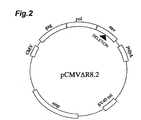
- a gene construct containing the gag and pol genes of HIV as well as the promoter of cytomegalovirus arranged at the upstream of the group of genes lacking packaging signals was inserted into an expression vector containing the ampicilin-resistant gene and the replication origin of SV40 to form pCMV-R8.2 (Naldini L., et al., Proc. Natl. Acad. Sci. USA., 93, 11382-11388, 1996: Fig. 2).
- a gene construct containing the promoter of cytomegalovirus arranged at the upstream of the gene encoding VSV-G which was the envelop protein of vesicular stomatitis virus was incorporated into an expression vector pXF3 to form plasmid pMD.G (Naldini L., et al., Proc. Natl. Acad. Sci. USA., 93, 11382-11388, 1996: Fig. 3).
- a gene construct where HIV-LTR, the CAG promoter, enhanced green fluorescence protein (EGFP) gene and HIV-LTR were arranged from the 5'-end to 3'-end direction was inserted into an expression vector containing the ampicillin-resistant gene the replication origin of SV40 to form a vector plasmid pHXCAGEGFP (Fig. 4).
- pCMV-R8.2, pMD.G and pHXCAGEGFP were subjected to co-transfection into COS cells by the calcium phosphate method. After growing for 2 days, the resultant culture supernatant was centrifuged at 2,000 rpm for 10 minutes and the precipitates were removed to produce a GFP/HIV vector solution.
- GFP/HIV vector prepared in Preparation 2 and PDBA solutions prepared at twice the desired concentrations were mixed in equal amounts just. prior to administration to prepare GFP/HIV vector /PDBA complex solutions that are nucleic acid carriers of this invention.
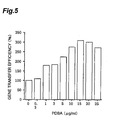
- Preparation was made such that the final concentrations of PDBA 0, 0.3, 1.0, 3.0, 5.0, 10.0, 15.0, 20.0, and 25.0 ⁇ g/ml, respectively.
- DMEM medium Sigma-Aldrich Corporation
- PDBA having a molecular weight of 7,800 obtained in Synthetic Example 3 in Table 2 was used. Even when the complex was prepared at the final PDBA concentration of 25 ⁇ g/ml, no precipitates were formed in solution.
- HeLa cells were inoculated onto a 12-well multi-well plate (Coaster Inc.) at 1x10 5 cells/well one day prior to testing.
- Administration of the GFP/HIV vector/PDBA complex solution was carried out in the presence of 10% fetal bovine serum (Sanko Junyaku Co. Ltd.), and incubation was carried out at 37 °C for 4 hours. Medium was exchanged with a fresh culture medium and incubation continued for 48 hours.
- Fig. 5 shows the proportions of the cells into which the marker gene (EGFP) was transferred among 10,000 cells. It was confirmed that genes had been transferred into about 30% of cells in the case of the recombinant HIV vector (PDBA 0 ⁇ g/ml) alone as control.
- GFP/HIV vector prepared in Preparation 2 and a PDBA solution prepared at 20.0 ⁇ g/ml were mixed in equal amounts 1, 3, 10, 15, 30, or 60 minutes prior to administration to prepare GFP/HIV vector /PDBA complex solutions (the final concentration of PDBA: 10.0 ⁇ g/ml).
- DMEM medium (Sigma-Aldrich Corporation) was used as solvent.
- PDBA having a molecular weight of 7,800 obtained in Synthetic Example 3 in Table 2 was used.
- a flow cytometer FACS Calibur available from Becton Dickinson.
- Fig. 6 shows the proportions of the cells into which the EGFP gene was transferred among 10,000 cells. From Fig. 6 it was confirmed that PDBA and the recombinant viral vector formed a stable complex immediately after mixing and the gene transfer efficiency experienced no change even after allowing standing for one hour at room temperature.
- the unit of ordinate is percentage and the graph represents gene transfer efficiency in terms of percentage at each concentration when the control is taken as 100%.
- the nucleic acid carrier of this invention is such that a polypeptide comprising diaminobutyric acid and/or a recombinant viral vector forms a complex and it allows a therapeutic gene to be transferred into cells efficiently and safely. Since the nucleic acid carrier guarantees a high level of gene transfer into the cells, it is useful for gene therapy.
Landscapes
- Life Sciences & Earth Sciences (AREA)
- Health & Medical Sciences (AREA)
- Genetics & Genomics (AREA)
- Engineering & Computer Science (AREA)
- Bioinformatics & Cheminformatics (AREA)
- Wood Science & Technology (AREA)
- Biomedical Technology (AREA)
- Organic Chemistry (AREA)
- Biotechnology (AREA)
- General Engineering & Computer Science (AREA)
- Chemical & Material Sciences (AREA)
- Zoology (AREA)
- Microbiology (AREA)
- Physics & Mathematics (AREA)
- Virology (AREA)
- Plant Pathology (AREA)
- Molecular Biology (AREA)
- Biochemistry (AREA)
- General Health & Medical Sciences (AREA)
- Biophysics (AREA)
- Medicines That Contain Protein Lipid Enzymes And Other Medicines (AREA)
- Medicines Containing Material From Animals Or Micro-Organisms (AREA)
- Medicinal Preparation (AREA)
- Micro-Organisms Or Cultivation Processes Thereof (AREA)
Abstract
Description


Claims (9)
- A nucleic acid carrier comprising a polypeptide comprising diaminobutyric acid and/or a pharmaceutically acceptable salt thereof and a recombinant viral vector.
- The nucleic acid carrier according to claim 1, wherein the polypeptide comprises a block copolymer of a polypeptide comprising diaminobutyric acid and/or a pharmaceutically acceptable salt thereof and polyethylene glycol.
- The nucleic acid carrier according to claim 1, wherein the peptide comprises diaminobutyric acid and/or a pharmaceutically acceptable salt thereof, each having a residue number of from 20 to 280.
- The nucleic acid carrier according to claim 1, wherein the peptide comprises diaminobutyric acid having a residue number of from 20 to 280.
- The nucleic acid carrier according to any of claims 1 to 4, wherein the recombinant viral vector comprises a therapeutic gene.
- The nucleic acid carrier according to any of claims 1 to 4, wherein the recombinant viral vector is a HIV vector.
- The nucleic acid carrier according to claim 5, wherein the recombinant viral vector is a HIV vector.
- The nucleic acid carrier according to claim 6, wherein the HIV vector is a HIV vector of the psuedo-type with VSV-G.
- The nucleic acid carrier according to claim 7, wherein the HIV vector is a HIV vector of the psuedo-type with VSV-G.
Applications Claiming Priority (3)
| Application Number | Priority Date | Filing Date | Title |
|---|---|---|---|
| JP29843399A JP2001120268A (en) | 1999-10-20 | 1999-10-20 | Nucleic acid carriers containing polypeptides and recombinant viral vectors |
| JP29843399 | 1999-10-20 | ||
| PCT/JP2000/007337 WO2001029244A1 (en) | 1999-10-20 | 2000-10-20 | Nucleic acid transporter containing polypeptide and recombinant virus vector |
Publications (2)
| Publication Number | Publication Date |
|---|---|
| EP1229124A1 true EP1229124A1 (en) | 2002-08-07 |
| EP1229124A4 EP1229124A4 (en) | 2002-12-04 |
Family
ID=17859654
Family Applications (1)
| Application Number | Title | Priority Date | Filing Date |
|---|---|---|---|
| EP00969954A Withdrawn EP1229124A4 (en) | 1999-10-20 | 2000-10-20 | Nucleic acid transporter containing polypeptide and recombinant virus vector |
Country Status (5)
| Country | Link |
|---|---|
| EP (1) | EP1229124A4 (en) |
| JP (1) | JP2001120268A (en) |
| CN (1) | CN1164756C (en) |
| AU (1) | AU7952600A (en) |
| WO (1) | WO2001029244A1 (en) |
Families Citing this family (3)
| Publication number | Priority date | Publication date | Assignee | Title |
|---|---|---|---|---|
| JP4535229B2 (en) * | 2003-05-08 | 2010-09-01 | 国立大学法人 東京大学 | Polyethylene glycol-polycation block copolymer |
| CN102086266B (en) * | 2010-12-24 | 2013-04-10 | 华东理工大学 | Polypeptide-containing asymmetric hyperbranched amphoteric polyelectrolyte and preparation method thereof |
| CN102199674A (en) * | 2011-03-17 | 2011-09-28 | 中国疾病预防控制中心病毒病预防控制所 | Enveloped ribonucleic acid (RNA) virus nucleic acid detection reference/standard platform and application method thereof |
Family Cites Families (1)
| Publication number | Priority date | Publication date | Assignee | Title |
|---|---|---|---|---|
| EP0834572A3 (en) * | 1996-10-02 | 1999-08-25 | F. Hoffmann-La Roche Ag | Alpha, gamma-diaminobutyric acid (DAB) containing oligopeptide derivatives |
-
1999
- 1999-10-20 JP JP29843399A patent/JP2001120268A/en active Pending
-
2000
- 2000-10-20 EP EP00969954A patent/EP1229124A4/en not_active Withdrawn
- 2000-10-20 WO PCT/JP2000/007337 patent/WO2001029244A1/en not_active Ceased
- 2000-10-20 AU AU79526/00A patent/AU7952600A/en not_active Abandoned
- 2000-10-20 CN CNB008145326A patent/CN1164756C/en not_active Expired - Fee Related
Also Published As
| Publication number | Publication date |
|---|---|
| EP1229124A4 (en) | 2002-12-04 |
| WO2001029244A1 (en) | 2001-04-26 |
| AU7952600A (en) | 2001-04-30 |
| JP2001120268A (en) | 2001-05-08 |
| CN1164756C (en) | 2004-09-01 |
| CN1379821A (en) | 2002-11-13 |
Similar Documents
| Publication | Publication Date | Title |
|---|---|---|
| JP3587538B2 (en) | Synthetic polypeptides as inhibitors of HIV-1 | |
| US20230257706A1 (en) | T lymphocyte and use thereof | |
| JP2006517916A (en) | Methods for treating and preventing apoptosis-related diseases using RNA interference substances | |
| WO2024000223A1 (en) | Modified viral envelope protein and use thereof | |
| CN110996980B (en) | A virus for treating tumor | |
| AU749059B2 (en) | Therapeutic use of lentiviral vectors | |
| EP2201028A2 (en) | Novel methods of synthesis for therapeutic antiviral peptides | |
| US20220403416A1 (en) | Polymer-Encapsulated Viral Vectors for In Vivo Genetic Therapy | |
| EP1676590A1 (en) | Oncogene therapeutic drug | |
| Devitt et al. | Optimized protocol for the large scale production of HIV pseudovirions by transient transfection of HEK293T cells with linear fully deacylated polyethylenimine | |
| JP2001120268A (en) | Nucleic acid carriers containing polypeptides and recombinant viral vectors | |
| US20030148929A1 (en) | Nucleic acid carriers and pharmaceutical compositions for gene therapy | |
| JP3938954B2 (en) | Novel graft copolymer, drug using the same, and method for incorporating a drug into specific cells using the same | |
| JP3808938B2 (en) | Nucleic acid carrier | |
| AU765127B2 (en) | Nucleic acid transporters and medicinal compositions for gene therapy | |
| JP2000210079A (en) | Nucleic acid transporter and drug for gene therapy | |
| CN119912531B (en) | CB2 agonistic peptide for promoting bone formation and application thereof | |
| US20040005708A1 (en) | Polypeptide derivatives and nucleic acid carriers containing the same | |
| WO2026008069A1 (en) | Use of cytokine antagonist in preparation of drug for preventing and/or treating crs | |
| US20090325870A1 (en) | Foamy viral envelope genes | |
| EP2138584A1 (en) | Foamy viral envelope genes | |
| US20040156830A1 (en) | Vector and pharmaceutical composition containing cell death inducing gene | |
| CN114540349A (en) | Nucleic acid molecules binding to YB-1 proteins | |
| US20070264281A1 (en) | Vaccination Vectors Derived From Lymphotropic Human Herpes Viruses 6 and 7 | |
| JP2003501066A (en) | SIV-based packaging-defective vector |
Legal Events
| Date | Code | Title | Description |
|---|---|---|---|
| PUAI | Public reference made under article 153(3) epc to a published international application that has entered the european phase |
Free format text: ORIGINAL CODE: 0009012 |
|
| 17P | Request for examination filed |
Effective date: 20020508 |
|
| AK | Designated contracting states |
Kind code of ref document: A1 Designated state(s): AT BE CH CY DE DK ES FI FR GB GR IE IT LI LU MC NL PT SE |
|
| A4 | Supplementary search report drawn up and despatched |
Effective date: 20021018 |
|
| AK | Designated contracting states |
Kind code of ref document: A4 Designated state(s): AT BE CH CY DE DK ES FI FR GB GR IE IT LI LU MC NL PT SE |
|
| RIC1 | Information provided on ipc code assigned before grant |
Free format text: 7C 12N 15/867 A, 7C 12N 15/90 B, 7C 12N 15/86 B |
|
| RBV | Designated contracting states (corrected) |
Designated state(s): AT BE CH CY DE FR GB IT LI |
|
| GRAP | Despatch of communication of intention to grant a patent |
Free format text: ORIGINAL CODE: EPIDOSNIGR1 |
|
| RBV | Designated contracting states (corrected) |
Designated state(s): DE FR GB IT |
|
| STAA | Information on the status of an ep patent application or granted ep patent |
Free format text: STATUS: THE APPLICATION IS DEEMED TO BE WITHDRAWN |
|
| 18D | Application deemed to be withdrawn |
Effective date: 20061019 |