EP1229079A1 - Thermosetting resin composition and use thereof - Google Patents
Thermosetting resin composition and use thereof Download PDFInfo
- Publication number
- EP1229079A1 EP1229079A1 EP20020001902 EP02001902A EP1229079A1 EP 1229079 A1 EP1229079 A1 EP 1229079A1 EP 20020001902 EP20020001902 EP 20020001902 EP 02001902 A EP02001902 A EP 02001902A EP 1229079 A1 EP1229079 A1 EP 1229079A1
- Authority
- EP
- European Patent Office
- Prior art keywords
- component
- thermosetting resin
- resin composition
- hydrocarbon group
- composition according
- Prior art date
- Legal status (The legal status is an assumption and is not a legal conclusion. Google has not performed a legal analysis and makes no representation as to the accuracy of the status listed.)
- Granted
Links
- 239000011342 resin composition Substances 0.000 title claims abstract description 33
- 229920001187 thermosetting polymer Polymers 0.000 title claims abstract description 31
- 229920006026 co-polymeric resin Polymers 0.000 claims abstract description 48
- 229920005989 resin Polymers 0.000 claims abstract description 45
- 239000011347 resin Substances 0.000 claims abstract description 45
- XLJMAIOERFSOGZ-UHFFFAOYSA-M cyanate Chemical compound [O-]C#N XLJMAIOERFSOGZ-UHFFFAOYSA-M 0.000 claims abstract description 27
- 239000000178 monomer Substances 0.000 claims abstract description 24
- 125000001183 hydrocarbyl group Chemical group 0.000 claims abstract 4
- 239000003822 epoxy resin Substances 0.000 claims description 33
- 229920000647 polyepoxide Polymers 0.000 claims description 33
- 230000009477 glass transition Effects 0.000 claims description 20
- -1 isocyanurate compound Chemical class 0.000 claims description 20
- HIDBROSJWZYGSZ-UHFFFAOYSA-N 1-phenylpyrrole-2,5-dione Chemical compound O=C1C=CC(=O)N1C1=CC=CC=C1 HIDBROSJWZYGSZ-UHFFFAOYSA-N 0.000 claims description 17
- 239000000203 mixture Substances 0.000 claims description 15
- 125000004432 carbon atom Chemical group C* 0.000 claims description 14
- 125000005843 halogen group Chemical group 0.000 claims description 14
- 238000007334 copolymerization reaction Methods 0.000 claims description 13
- 125000002887 hydroxy group Chemical group [H]O* 0.000 claims description 11
- 125000001931 aliphatic group Chemical group 0.000 claims description 9
- 125000002029 aromatic hydrocarbon group Chemical group 0.000 claims description 9
- 238000000465 moulding Methods 0.000 claims description 9
- 125000004435 hydrogen atom Chemical group [H]* 0.000 claims description 8
- 125000003178 carboxy group Chemical group [H]OC(*)=O 0.000 claims description 4
- 125000003396 thiol group Chemical group [H]S* 0.000 claims description 4
- 239000000463 material Substances 0.000 abstract description 20
- 229910052736 halogen Inorganic materials 0.000 abstract description 3
- 150000002367 halogens Chemical class 0.000 abstract description 3
- 150000002431 hydrogen Chemical group 0.000 abstract 1
- 229910052739 hydrogen Inorganic materials 0.000 abstract 1
- 239000001257 hydrogen Substances 0.000 abstract 1
- PPBRXRYQALVLMV-UHFFFAOYSA-N Styrene Chemical compound C=CC1=CC=CC=C1 PPBRXRYQALVLMV-UHFFFAOYSA-N 0.000 description 65
- YXFVVABEGXRONW-UHFFFAOYSA-N Toluene Chemical compound CC1=CC=CC=C1 YXFVVABEGXRONW-UHFFFAOYSA-N 0.000 description 42
- 239000000243 solution Substances 0.000 description 37
- FPYJFEHAWHCUMM-UHFFFAOYSA-N maleic anhydride Chemical compound O=C1OC(=O)C=C1 FPYJFEHAWHCUMM-UHFFFAOYSA-N 0.000 description 27
- RYGMFSIKBFXOCR-UHFFFAOYSA-N Copper Chemical compound [Cu] RYGMFSIKBFXOCR-UHFFFAOYSA-N 0.000 description 25
- 230000015572 biosynthetic process Effects 0.000 description 22
- 238000003786 synthesis reaction Methods 0.000 description 22
- 239000011889 copper foil Substances 0.000 description 19
- 238000010438 heat treatment Methods 0.000 description 19
- ATUOYWHBWRKTHZ-UHFFFAOYSA-N Propane Chemical compound CCC ATUOYWHBWRKTHZ-UHFFFAOYSA-N 0.000 description 17
- 239000007787 solid Substances 0.000 description 17
- 238000001723 curing Methods 0.000 description 16
- 150000001875 compounds Chemical class 0.000 description 14
- JHIVVAPYMSGYDF-UHFFFAOYSA-N cyclohexanone Chemical compound O=C1CCCCC1 JHIVVAPYMSGYDF-UHFFFAOYSA-N 0.000 description 14
- LNEPOXFFQSENCJ-UHFFFAOYSA-N haloperidol Chemical compound C1CC(O)(C=2C=CC(Cl)=CC=2)CCN1CCCC(=O)C1=CC=C(F)C=C1 LNEPOXFFQSENCJ-UHFFFAOYSA-N 0.000 description 14
- 238000010992 reflux Methods 0.000 description 14
- 238000001816 cooling Methods 0.000 description 13
- 238000002360 preparation method Methods 0.000 description 13
- 239000011369 resultant mixture Substances 0.000 description 13
- ZWEHNKRNPOVVGH-UHFFFAOYSA-N 2-Butanone Chemical compound CCC(C)=O ZWEHNKRNPOVVGH-UHFFFAOYSA-N 0.000 description 12
- 238000006243 chemical reaction Methods 0.000 description 10
- 230000000052 comparative effect Effects 0.000 description 10
- 229920000642 polymer Polymers 0.000 description 10
- ZMANZCXQSJIPKH-UHFFFAOYSA-N Triethylamine Chemical compound CCN(CC)CC ZMANZCXQSJIPKH-UHFFFAOYSA-N 0.000 description 9
- 238000005259 measurement Methods 0.000 description 9
- ISWSIDIOOBJBQZ-UHFFFAOYSA-N phenol group Chemical group C1(=CC=CC=C1)O ISWSIDIOOBJBQZ-UHFFFAOYSA-N 0.000 description 9
- WSFQLUVWDKCYSW-UHFFFAOYSA-M sodium;2-hydroxy-3-morpholin-4-ylpropane-1-sulfonate Chemical compound [Na+].[O-]S(=O)(=O)CC(O)CN1CCOCC1 WSFQLUVWDKCYSW-UHFFFAOYSA-M 0.000 description 9
- PAYRUJLWNCNPSJ-UHFFFAOYSA-N Aniline Chemical compound NC1=CC=CC=C1 PAYRUJLWNCNPSJ-UHFFFAOYSA-N 0.000 description 8
- IISBACLAFKSPIT-UHFFFAOYSA-N bisphenol A Chemical compound C=1C=C(O)C=CC=1C(C)(C)C1=CC=C(O)C=C1 IISBACLAFKSPIT-UHFFFAOYSA-N 0.000 description 8
- GYZLOYUZLJXAJU-UHFFFAOYSA-N diglycidyl ether Chemical compound C1OC1COCC1CO1 GYZLOYUZLJXAJU-UHFFFAOYSA-N 0.000 description 8
- 238000011156 evaluation Methods 0.000 description 8
- 239000011521 glass Substances 0.000 description 8
- ZFSLODLOARCGLH-UHFFFAOYSA-N isocyanuric acid Chemical class OC1=NC(O)=NC(O)=N1 ZFSLODLOARCGLH-UHFFFAOYSA-N 0.000 description 8
- QBDSZLJBMIMQRS-UHFFFAOYSA-N p-Cumylphenol Chemical compound C=1C=C(O)C=CC=1C(C)(C)C1=CC=CC=C1 QBDSZLJBMIMQRS-UHFFFAOYSA-N 0.000 description 8
- 238000006116 polymerization reaction Methods 0.000 description 8
- 239000001294 propane Substances 0.000 description 8
- 238000005476 soldering Methods 0.000 description 8
- 239000013638 trimer Substances 0.000 description 8
- 238000010521 absorption reaction Methods 0.000 description 7
- 239000003054 catalyst Substances 0.000 description 7
- OZAIFHULBGXAKX-UHFFFAOYSA-N 2-(2-cyanopropan-2-yldiazenyl)-2-methylpropanenitrile Chemical compound N#CC(C)(C)N=NC(C)(C)C#N OZAIFHULBGXAKX-UHFFFAOYSA-N 0.000 description 6
- IJGRMHOSHXDMSA-UHFFFAOYSA-N Atomic nitrogen Chemical compound N#N IJGRMHOSHXDMSA-UHFFFAOYSA-N 0.000 description 6
- UHOVQNZJYSORNB-UHFFFAOYSA-N Benzene Chemical compound C1=CC=CC=C1 UHOVQNZJYSORNB-UHFFFAOYSA-N 0.000 description 6
- UFWIBTONFRDIAS-UHFFFAOYSA-N Naphthalene Chemical compound C1=CC=CC2=CC=CC=C21 UFWIBTONFRDIAS-UHFFFAOYSA-N 0.000 description 6
- 229910052802 copper Inorganic materials 0.000 description 6
- 239000010949 copper Substances 0.000 description 6
- 229910001873 dinitrogen Inorganic materials 0.000 description 6
- 238000000034 method Methods 0.000 description 6
- 239000002966 varnish Substances 0.000 description 6
- XLYOFNOQVPJJNP-UHFFFAOYSA-N water Substances O XLYOFNOQVPJJNP-UHFFFAOYSA-N 0.000 description 6
- 239000003795 chemical substances by application Substances 0.000 description 5
- 238000005530 etching Methods 0.000 description 5
- 239000007788 liquid Substances 0.000 description 5
- 150000002989 phenols Chemical class 0.000 description 5
- 238000012360 testing method Methods 0.000 description 5
- JYEUMXHLPRZUAT-UHFFFAOYSA-N 1,2,3-triazine Chemical group C1=CN=NN=C1 JYEUMXHLPRZUAT-UHFFFAOYSA-N 0.000 description 4
- KOMNUTZXSVSERR-UHFFFAOYSA-N 1,3,5-tris(prop-2-enyl)-1,3,5-triazinane-2,4,6-trione Chemical compound C=CCN1C(=O)N(CC=C)C(=O)N(CC=C)C1=O KOMNUTZXSVSERR-UHFFFAOYSA-N 0.000 description 4
- 239000005062 Polybutadiene Substances 0.000 description 4
- WYURNTSHIVDZCO-UHFFFAOYSA-N Tetrahydrofuran Chemical compound C1CCOC1 WYURNTSHIVDZCO-UHFFFAOYSA-N 0.000 description 4
- 239000012777 electrically insulating material Substances 0.000 description 4
- 239000003063 flame retardant Substances 0.000 description 4
- 238000005227 gel permeation chromatography Methods 0.000 description 4
- 229910052751 metal Inorganic materials 0.000 description 4
- 239000002184 metal Substances 0.000 description 4
- 239000003960 organic solvent Substances 0.000 description 4
- 229920002857 polybutadiene Polymers 0.000 description 4
- 239000000843 powder Substances 0.000 description 4
- 239000011541 reaction mixture Substances 0.000 description 4
- CSCPPACGZOOCGX-UHFFFAOYSA-N Acetone Chemical compound CC(C)=O CSCPPACGZOOCGX-UHFFFAOYSA-N 0.000 description 3
- ZMXDDKWLCZADIW-UHFFFAOYSA-N N,N-Dimethylformamide Chemical compound CN(C)C=O ZMXDDKWLCZADIW-UHFFFAOYSA-N 0.000 description 3
- 239000004793 Polystyrene Substances 0.000 description 3
- 239000012298 atmosphere Substances 0.000 description 3
- WNAHIZMDSQCWRP-UHFFFAOYSA-N dodecane-1-thiol Chemical compound CCCCCCCCCCCCS WNAHIZMDSQCWRP-UHFFFAOYSA-N 0.000 description 3
- 239000011888 foil Substances 0.000 description 3
- 150000002430 hydrocarbons Chemical group 0.000 description 3
- 239000003999 initiator Substances 0.000 description 3
- 125000002496 methyl group Chemical group [H]C([H])([H])* 0.000 description 3
- 229920003986 novolac Polymers 0.000 description 3
- 229920002223 polystyrene Polymers 0.000 description 3
- 239000004810 polytetrafluoroethylene Substances 0.000 description 3
- 229920001343 polytetrafluoroethylene Polymers 0.000 description 3
- 239000002994 raw material Substances 0.000 description 3
- 239000002904 solvent Substances 0.000 description 3
- 125000003903 2-propenyl group Chemical group [H]C([*])([H])C([H])=C([H])[H] 0.000 description 2
- BAPJBEWLBFYGME-UHFFFAOYSA-N Methyl acrylate Chemical compound COC(=O)C=C BAPJBEWLBFYGME-UHFFFAOYSA-N 0.000 description 2
- CTQNGGLPUBDAKN-UHFFFAOYSA-N O-Xylene Chemical compound CC1=CC=CC=C1C CTQNGGLPUBDAKN-UHFFFAOYSA-N 0.000 description 2
- 239000004698 Polyethylene Substances 0.000 description 2
- 239000004743 Polypropylene Substances 0.000 description 2
- 239000006087 Silane Coupling Agent Substances 0.000 description 2
- VYPSYNLAJGMNEJ-UHFFFAOYSA-N Silicium dioxide Chemical compound O=[Si]=O VYPSYNLAJGMNEJ-UHFFFAOYSA-N 0.000 description 2
- 125000003647 acryloyl group Chemical group O=C([*])C([H])=C([H])[H] 0.000 description 2
- 239000003963 antioxidant agent Substances 0.000 description 2
- PXKLMJQFEQBVLD-UHFFFAOYSA-N bisphenol F Chemical compound C1=CC(O)=CC=C1CC1=CC=C(O)C=C1 PXKLMJQFEQBVLD-UHFFFAOYSA-N 0.000 description 2
- 238000009529 body temperature measurement Methods 0.000 description 2
- 239000007809 chemical reaction catalyst Substances 0.000 description 2
- 239000011248 coating agent Substances 0.000 description 2
- 238000000576 coating method Methods 0.000 description 2
- 229920001577 copolymer Polymers 0.000 description 2
- ZUOUZKKEUPVFJK-UHFFFAOYSA-N diphenyl Chemical compound C1=CC=CC=C1C1=CC=CC=C1 ZUOUZKKEUPVFJK-UHFFFAOYSA-N 0.000 description 2
- 229920001971 elastomer Polymers 0.000 description 2
- 239000000806 elastomer Substances 0.000 description 2
- 125000003700 epoxy group Chemical group 0.000 description 2
- 239000004744 fabric Substances 0.000 description 2
- 239000000835 fiber Substances 0.000 description 2
- 239000000945 filler Substances 0.000 description 2
- 238000009472 formulation Methods 0.000 description 2
- 238000001879 gelation Methods 0.000 description 2
- 238000013007 heat curing Methods 0.000 description 2
- SGGOJYZMTYGPCH-UHFFFAOYSA-L manganese(2+);naphthalene-2-carboxylate Chemical compound [Mn+2].C1=CC=CC2=CC(C(=O)[O-])=CC=C21.C1=CC=CC2=CC(C(=O)[O-])=CC=C21 SGGOJYZMTYGPCH-UHFFFAOYSA-L 0.000 description 2
- AUHZEENZYGFFBQ-UHFFFAOYSA-N mesitylene Substances CC1=CC(C)=CC(C)=C1 AUHZEENZYGFFBQ-UHFFFAOYSA-N 0.000 description 2
- 125000001827 mesitylenyl group Chemical group [H]C1=C(C(*)=C(C([H])=C1C([H])([H])[H])C([H])([H])[H])C([H])([H])[H] 0.000 description 2
- VNWKTOKETHGBQD-UHFFFAOYSA-N methane Chemical compound C VNWKTOKETHGBQD-UHFFFAOYSA-N 0.000 description 2
- 229920002239 polyacrylonitrile Polymers 0.000 description 2
- 229920000573 polyethylene Polymers 0.000 description 2
- 229920001721 polyimide Polymers 0.000 description 2
- 229920001955 polyphenylene ether Polymers 0.000 description 2
- 229920001155 polypropylene Polymers 0.000 description 2
- 230000000630 rising effect Effects 0.000 description 2
- 239000000126 substance Substances 0.000 description 2
- YLQBMQCUIZJEEH-UHFFFAOYSA-N tetrahydrofuran Natural products C=1C=COC=1 YLQBMQCUIZJEEH-UHFFFAOYSA-N 0.000 description 2
- 229920005992 thermoplastic resin Polymers 0.000 description 2
- 229920002554 vinyl polymer Polymers 0.000 description 2
- 239000008096 xylene Substances 0.000 description 2
- YAOMHRRYSRRRKP-UHFFFAOYSA-N 1,2-dichloropropyl 2,3-dichloropropyl 3,3-dichloropropyl phosphate Chemical compound ClC(Cl)CCOP(=O)(OC(Cl)C(Cl)C)OCC(Cl)CCl YAOMHRRYSRRRKP-UHFFFAOYSA-N 0.000 description 1
- HECLRDQVFMWTQS-RGOKHQFPSA-N 1755-01-7 Chemical compound C1[C@H]2[C@@H]3CC=C[C@@H]3[C@@H]1C=C2 HECLRDQVFMWTQS-RGOKHQFPSA-N 0.000 description 1
- CMQUQOHNANGDOR-UHFFFAOYSA-N 2,3-dibromo-4-(2,4-dibromo-5-hydroxyphenyl)phenol Chemical compound BrC1=C(Br)C(O)=CC=C1C1=CC(O)=C(Br)C=C1Br CMQUQOHNANGDOR-UHFFFAOYSA-N 0.000 description 1
- BYLSIPUARIZAHZ-UHFFFAOYSA-N 2,4,6-tris(1-phenylethyl)phenol Chemical compound C=1C(C(C)C=2C=CC=CC=2)=C(O)C(C(C)C=2C=CC=CC=2)=CC=1C(C)C1=CC=CC=C1 BYLSIPUARIZAHZ-UHFFFAOYSA-N 0.000 description 1
- XNWFRZJHXBZDAG-UHFFFAOYSA-N 2-METHOXYETHANOL Chemical compound COCCO XNWFRZJHXBZDAG-UHFFFAOYSA-N 0.000 description 1
- SBYMUDUGTIKLCR-UHFFFAOYSA-N 2-chloroethenylbenzene Chemical compound ClC=CC1=CC=CC=C1 SBYMUDUGTIKLCR-UHFFFAOYSA-N 0.000 description 1
- BTOVVHWKPVSLBI-UHFFFAOYSA-N 2-methylprop-1-enylbenzene Chemical compound CC(C)=CC1=CC=CC=C1 BTOVVHWKPVSLBI-UHFFFAOYSA-N 0.000 description 1
- DGUJJOYLOCXENZ-UHFFFAOYSA-N 4-[2-[4-(oxiran-2-ylmethoxy)phenyl]propan-2-yl]phenol Chemical compound C=1C=C(OCC2OC2)C=CC=1C(C)(C)C1=CC=C(O)C=C1 DGUJJOYLOCXENZ-UHFFFAOYSA-N 0.000 description 1
- CNGYZEMWVAWWOB-VAWYXSNFSA-N 5-[[4-anilino-6-[bis(2-hydroxyethyl)amino]-1,3,5-triazin-2-yl]amino]-2-[(e)-2-[4-[[4-anilino-6-[bis(2-hydroxyethyl)amino]-1,3,5-triazin-2-yl]amino]-2-sulfophenyl]ethenyl]benzenesulfonic acid Chemical compound N=1C(NC=2C=C(C(\C=C\C=3C(=CC(NC=4N=C(N=C(NC=5C=CC=CC=5)N=4)N(CCO)CCO)=CC=3)S(O)(=O)=O)=CC=2)S(O)(=O)=O)=NC(N(CCO)CCO)=NC=1NC1=CC=CC=C1 CNGYZEMWVAWWOB-VAWYXSNFSA-N 0.000 description 1
- OUVFWIHVZPQHJF-UHFFFAOYSA-N 5-ethenyl-5-methylcyclohexa-1,3-diene Chemical compound C=CC1(C)CC=CC=C1 OUVFWIHVZPQHJF-UHFFFAOYSA-N 0.000 description 1
- NIXOWILDQLNWCW-UHFFFAOYSA-M Acrylate Chemical compound [O-]C(=O)C=C NIXOWILDQLNWCW-UHFFFAOYSA-M 0.000 description 1
- NLHHRLWOUZZQLW-UHFFFAOYSA-N Acrylonitrile Chemical compound C=CC#N NLHHRLWOUZZQLW-UHFFFAOYSA-N 0.000 description 1
- 239000004342 Benzoyl peroxide Substances 0.000 description 1
- OMPJBNCRMGITSC-UHFFFAOYSA-N Benzoylperoxide Chemical compound C=1C=CC=CC=1C(=O)OOC(=O)C1=CC=CC=C1 OMPJBNCRMGITSC-UHFFFAOYSA-N 0.000 description 1
- 229920002799 BoPET Polymers 0.000 description 1
- LWBBESPHFALNIF-ALCCZGGFSA-N CCC(C)C(C(/C(/C)=C\C)C(O1)=O)C1=O Chemical compound CCC(C)C(C(/C(/C)=C\C)C(O1)=O)C1=O LWBBESPHFALNIF-ALCCZGGFSA-N 0.000 description 1
- NIYOYWLIMXMKAL-UHFFFAOYSA-N CCC(C)C(C(C(C)CC)C(O1)=O)C1=O Chemical compound CCC(C)C(C(C(C)CC)C(O1)=O)C1=O NIYOYWLIMXMKAL-UHFFFAOYSA-N 0.000 description 1
- 0 CCCC(C)*[N+]([O-])O[N+](N(C)C(C)(C)CC)O Chemical compound CCCC(C)*[N+]([O-])O[N+](N(C)C(C)(C)CC)O 0.000 description 1
- YOCMGXHERXFERY-UHFFFAOYSA-N CCCCC(C)(C)C(C(C(C)C(CC=C)C=C)C(O1)=O)C1=O Chemical compound CCCCC(C)(C)C(C(C(C)C(CC=C)C=C)C(O1)=O)C1=O YOCMGXHERXFERY-UHFFFAOYSA-N 0.000 description 1
- 239000004129 EU approved improving agent Substances 0.000 description 1
- 239000004593 Epoxy Substances 0.000 description 1
- OTMSDBZUPAUEDD-UHFFFAOYSA-N Ethane Chemical compound CC OTMSDBZUPAUEDD-UHFFFAOYSA-N 0.000 description 1
- LFQSCWFLJHTTHZ-UHFFFAOYSA-N Ethanol Chemical compound CCO LFQSCWFLJHTTHZ-UHFFFAOYSA-N 0.000 description 1
- 238000005727 Friedel-Crafts reaction Methods 0.000 description 1
- VQTUBCCKSQIDNK-UHFFFAOYSA-N Isobutene Chemical group CC(C)=C VQTUBCCKSQIDNK-UHFFFAOYSA-N 0.000 description 1
- WHXSMMKQMYFTQS-UHFFFAOYSA-N Lithium Chemical compound [Li] WHXSMMKQMYFTQS-UHFFFAOYSA-N 0.000 description 1
- CERQOIWHTDAKMF-UHFFFAOYSA-M Methacrylate Chemical compound CC(=C)C([O-])=O CERQOIWHTDAKMF-UHFFFAOYSA-M 0.000 description 1
- NTIZESTWPVYFNL-UHFFFAOYSA-N Methyl isobutyl ketone Chemical compound CC(C)CC(C)=O NTIZESTWPVYFNL-UHFFFAOYSA-N 0.000 description 1
- UIHCLUNTQKBZGK-UHFFFAOYSA-N Methyl isobutyl ketone Natural products CCC(C)C(C)=O UIHCLUNTQKBZGK-UHFFFAOYSA-N 0.000 description 1
- VVQNEPGJFQJSBK-UHFFFAOYSA-N Methyl methacrylate Chemical compound COC(=O)C(C)=C VVQNEPGJFQJSBK-UHFFFAOYSA-N 0.000 description 1
- FXHOOIRPVKKKFG-UHFFFAOYSA-N N,N-Dimethylacetamide Chemical compound CN(C)C(C)=O FXHOOIRPVKKKFG-UHFFFAOYSA-N 0.000 description 1
- SECXISVLQFMRJM-UHFFFAOYSA-N N-Methylpyrrolidone Chemical compound CN1CCCC1=O SECXISVLQFMRJM-UHFFFAOYSA-N 0.000 description 1
- IGFHQQFPSIBGKE-UHFFFAOYSA-N Nonylphenol Natural products CCCCCCCCCC1=CC=C(O)C=C1 IGFHQQFPSIBGKE-UHFFFAOYSA-N 0.000 description 1
- 229910019142 PO4 Inorganic materials 0.000 description 1
- OAICVXFJPJFONN-UHFFFAOYSA-N Phosphorus Chemical compound [P] OAICVXFJPJFONN-UHFFFAOYSA-N 0.000 description 1
- 239000004642 Polyimide Substances 0.000 description 1
- YSMRWXYRXBRSND-UHFFFAOYSA-N TOTP Chemical compound CC1=CC=CC=C1OP(=O)(OC=1C(=CC=CC=1)C)OC1=CC=CC=C1C YSMRWXYRXBRSND-UHFFFAOYSA-N 0.000 description 1
- BZHJMEDXRYGGRV-UHFFFAOYSA-N Vinyl chloride Chemical compound ClC=C BZHJMEDXRYGGRV-UHFFFAOYSA-N 0.000 description 1
- YMOONIIMQBGTDU-VOTSOKGWSA-N [(e)-2-bromoethenyl]benzene Chemical compound Br\C=C\C1=CC=CC=C1 YMOONIIMQBGTDU-VOTSOKGWSA-N 0.000 description 1
- NOHQTLHHNIKWBA-UHFFFAOYSA-N [SiH4].NC(=O)N Chemical compound [SiH4].NC(=O)N NOHQTLHHNIKWBA-UHFFFAOYSA-N 0.000 description 1
- 239000006096 absorbing agent Substances 0.000 description 1
- 239000002253 acid Substances 0.000 description 1
- 150000008065 acid anhydrides Chemical class 0.000 description 1
- 239000000654 additive Substances 0.000 description 1
- 239000005456 alcohol based solvent Substances 0.000 description 1
- 125000002723 alicyclic group Chemical group 0.000 description 1
- 229910052782 aluminium Inorganic materials 0.000 description 1
- XAGFODPZIPBFFR-UHFFFAOYSA-N aluminium Chemical compound [Al] XAGFODPZIPBFFR-UHFFFAOYSA-N 0.000 description 1
- WNROFYMDJYEPJX-UHFFFAOYSA-K aluminium hydroxide Chemical compound [OH-].[OH-].[OH-].[Al+3] WNROFYMDJYEPJX-UHFFFAOYSA-K 0.000 description 1
- 125000003277 amino group Chemical group 0.000 description 1
- 229910052787 antimony Inorganic materials 0.000 description 1
- WATWJIUSRGPENY-UHFFFAOYSA-N antimony atom Chemical compound [Sb] WATWJIUSRGPENY-UHFFFAOYSA-N 0.000 description 1
- 230000003078 antioxidant effect Effects 0.000 description 1
- 239000003849 aromatic solvent Substances 0.000 description 1
- 239000012965 benzophenone Substances 0.000 description 1
- 150000008366 benzophenones Chemical class 0.000 description 1
- 150000001565 benzotriazoles Chemical class 0.000 description 1
- 235000019400 benzoyl peroxide Nutrition 0.000 description 1
- 239000004305 biphenyl Substances 0.000 description 1
- 235000010290 biphenyl Nutrition 0.000 description 1
- 238000005266 casting Methods 0.000 description 1
- 239000003431 cross linking reagent Substances 0.000 description 1
- 150000001913 cyanates Chemical class 0.000 description 1
- 238000011161 development Methods 0.000 description 1
- 239000003085 diluting agent Substances 0.000 description 1
- 239000004205 dimethyl polysiloxane Substances 0.000 description 1
- 238000004090 dissolution Methods 0.000 description 1
- 239000004210 ether based solvent Substances 0.000 description 1
- XUCNUKMRBVNAPB-UHFFFAOYSA-N fluoroethene Chemical group FC=C XUCNUKMRBVNAPB-UHFFFAOYSA-N 0.000 description 1
- 125000003055 glycidyl group Chemical group C(C1CO1)* 0.000 description 1
- 150000004820 halides Chemical class 0.000 description 1
- CAYGQBVSOZLICD-UHFFFAOYSA-N hexabromobenzene Chemical compound BrC1=C(Br)C(Br)=C(Br)C(Br)=C1Br CAYGQBVSOZLICD-UHFFFAOYSA-N 0.000 description 1
- 150000002460 imidazoles Chemical class 0.000 description 1
- 238000010348 incorporation Methods 0.000 description 1
- 239000012784 inorganic fiber Substances 0.000 description 1
- 239000012796 inorganic flame retardant Substances 0.000 description 1
- 239000005453 ketone based solvent Substances 0.000 description 1
- 229910052744 lithium Inorganic materials 0.000 description 1
- 238000013035 low temperature curing Methods 0.000 description 1
- VTHJTEIRLNZDEV-UHFFFAOYSA-L magnesium dihydroxide Chemical compound [OH-].[OH-].[Mg+2] VTHJTEIRLNZDEV-UHFFFAOYSA-L 0.000 description 1
- 239000000347 magnesium hydroxide Substances 0.000 description 1
- 229910001862 magnesium hydroxide Inorganic materials 0.000 description 1
- 239000010445 mica Substances 0.000 description 1
- 229910052618 mica group Inorganic materials 0.000 description 1
- 239000003607 modifier Substances 0.000 description 1
- 239000004745 nonwoven fabric Substances 0.000 description 1
- SNQQPOLDUKLAAF-UHFFFAOYSA-N nonylphenol Chemical compound CCCCCCCCCC1=CC=CC=C1O SNQQPOLDUKLAAF-UHFFFAOYSA-N 0.000 description 1
- 150000001451 organic peroxides Chemical class 0.000 description 1
- 239000003208 petroleum Substances 0.000 description 1
- 229920001568 phenolic resin Polymers 0.000 description 1
- 239000005011 phenolic resin Substances 0.000 description 1
- 229920006287 phenoxy resin Polymers 0.000 description 1
- 239000013034 phenoxy resin Substances 0.000 description 1
- NBIIXXVUZAFLBC-UHFFFAOYSA-K phosphate Chemical compound [O-]P([O-])([O-])=O NBIIXXVUZAFLBC-UHFFFAOYSA-K 0.000 description 1
- 239000010452 phosphate Substances 0.000 description 1
- 229920000435 poly(dimethylsiloxane) Polymers 0.000 description 1
- 229920006122 polyamide resin Polymers 0.000 description 1
- 229920000515 polycarbonate Polymers 0.000 description 1
- 239000004417 polycarbonate Substances 0.000 description 1
- 229920005668 polycarbonate resin Polymers 0.000 description 1
- 239000004431 polycarbonate resin Substances 0.000 description 1
- 229920000728 polyester Polymers 0.000 description 1
- 229920001225 polyester resin Polymers 0.000 description 1
- 239000004645 polyester resin Substances 0.000 description 1
- 239000009719 polyimide resin Substances 0.000 description 1
- 229920001296 polysiloxane Polymers 0.000 description 1
- 230000002265 prevention Effects 0.000 description 1
- HJWLCRVIBGQPNF-UHFFFAOYSA-N prop-2-enylbenzene Chemical compound C=CCC1=CC=CC=C1 HJWLCRVIBGQPNF-UHFFFAOYSA-N 0.000 description 1
- 150000003242 quaternary ammonium salts Chemical class 0.000 description 1
- 150000003254 radicals Chemical class 0.000 description 1
- 239000000377 silicon dioxide Substances 0.000 description 1
- 229920002050 silicone resin Polymers 0.000 description 1
- 229910000679 solder Inorganic materials 0.000 description 1
- PJANXHGTPQOBST-UHFFFAOYSA-N stilbene Chemical class C=1C=CC=CC=1C=CC1=CC=CC=C1 PJANXHGTPQOBST-UHFFFAOYSA-N 0.000 description 1
- 125000001424 substituent group Chemical group 0.000 description 1
- 239000000454 talc Substances 0.000 description 1
- 229910052623 talc Inorganic materials 0.000 description 1
- 150000003512 tertiary amines Chemical class 0.000 description 1
- 150000003568 thioethers Chemical class 0.000 description 1
- YRHRIQCWCFGUEQ-UHFFFAOYSA-N thioxanthen-9-one Chemical compound C1=CC=C2C(=O)C3=CC=CC=C3SC2=C1 YRHRIQCWCFGUEQ-UHFFFAOYSA-N 0.000 description 1
- 239000010936 titanium Substances 0.000 description 1
- 229910052719 titanium Inorganic materials 0.000 description 1
- 239000006097 ultraviolet radiation absorber Substances 0.000 description 1
- 150000003672 ureas Chemical class 0.000 description 1
- 125000000391 vinyl group Chemical group [H]C([*])=C([H])[H] 0.000 description 1
- 239000002759 woven fabric Substances 0.000 description 1
Classifications
-
- C—CHEMISTRY; METALLURGY
- C08—ORGANIC MACROMOLECULAR COMPOUNDS; THEIR PREPARATION OR CHEMICAL WORKING-UP; COMPOSITIONS BASED THEREON
- C08L—COMPOSITIONS OF MACROMOLECULAR COMPOUNDS
- C08L25/00—Compositions of, homopolymers or copolymers of compounds having one or more unsaturated aliphatic radicals, each having only one carbon-to-carbon double bond, and at least one being terminated by an aromatic carbocyclic ring; Compositions of derivatives of such polymers
- C08L25/02—Homopolymers or copolymers of hydrocarbons
- C08L25/04—Homopolymers or copolymers of styrene
- C08L25/08—Copolymers of styrene
-
- C—CHEMISTRY; METALLURGY
- C08—ORGANIC MACROMOLECULAR COMPOUNDS; THEIR PREPARATION OR CHEMICAL WORKING-UP; COMPOSITIONS BASED THEREON
- C08L—COMPOSITIONS OF MACROMOLECULAR COMPOUNDS
- C08L79/00—Compositions of macromolecular compounds obtained by reactions forming in the main chain of the macromolecule a linkage containing nitrogen with or without oxygen or carbon only, not provided for in groups C08L61/00 - C08L77/00
- C08L79/04—Polycondensates having nitrogen-containing heterocyclic rings in the main chain; Polyhydrazides; Polyamide acids or similar polyimide precursors
-
- C—CHEMISTRY; METALLURGY
- C08—ORGANIC MACROMOLECULAR COMPOUNDS; THEIR PREPARATION OR CHEMICAL WORKING-UP; COMPOSITIONS BASED THEREON
- C08L—COMPOSITIONS OF MACROMOLECULAR COMPOUNDS
- C08L35/00—Compositions of homopolymers or copolymers of compounds having one or more unsaturated aliphatic radicals, each having only one carbon-to-carbon double bond, and at least one being terminated by a carboxyl radical, and containing at least one other carboxyl radical in the molecule, or of salts, anhydrides, esters, amides, imides or nitriles thereof; Compositions of derivatives of such polymers
- C08L35/06—Copolymers with vinyl aromatic monomers
-
- C—CHEMISTRY; METALLURGY
- C08—ORGANIC MACROMOLECULAR COMPOUNDS; THEIR PREPARATION OR CHEMICAL WORKING-UP; COMPOSITIONS BASED THEREON
- C08L—COMPOSITIONS OF MACROMOLECULAR COMPOUNDS
- C08L63/00—Compositions of epoxy resins; Compositions of derivatives of epoxy resins
-
- H—ELECTRICITY
- H05—ELECTRIC TECHNIQUES NOT OTHERWISE PROVIDED FOR
- H05K—PRINTED CIRCUITS; CASINGS OR CONSTRUCTIONAL DETAILS OF ELECTRIC APPARATUS; MANUFACTURE OF ASSEMBLAGES OF ELECTRICAL COMPONENTS
- H05K1/00—Printed circuits
- H05K1/02—Details
- H05K1/03—Use of materials for the substrate
- H05K1/0313—Organic insulating material
- H05K1/0353—Organic insulating material consisting of two or more materials, e.g. two or more polymers, polymer + filler, + reinforcement
-
- Y—GENERAL TAGGING OF NEW TECHNOLOGICAL DEVELOPMENTS; GENERAL TAGGING OF CROSS-SECTIONAL TECHNOLOGIES SPANNING OVER SEVERAL SECTIONS OF THE IPC; TECHNICAL SUBJECTS COVERED BY FORMER USPC CROSS-REFERENCE ART COLLECTIONS [XRACs] AND DIGESTS
- Y10—TECHNICAL SUBJECTS COVERED BY FORMER USPC
- Y10T—TECHNICAL SUBJECTS COVERED BY FORMER US CLASSIFICATION
- Y10T428/00—Stock material or miscellaneous articles
- Y10T428/31504—Composite [nonstructural laminate]
- Y10T428/31855—Of addition polymer from unsaturated monomers
-
- Y—GENERAL TAGGING OF NEW TECHNOLOGICAL DEVELOPMENTS; GENERAL TAGGING OF CROSS-SECTIONAL TECHNOLOGIES SPANNING OVER SEVERAL SECTIONS OF THE IPC; TECHNICAL SUBJECTS COVERED BY FORMER USPC CROSS-REFERENCE ART COLLECTIONS [XRACs] AND DIGESTS
- Y10—TECHNICAL SUBJECTS COVERED BY FORMER USPC
- Y10T—TECHNICAL SUBJECTS COVERED BY FORMER US CLASSIFICATION
- Y10T428/00—Stock material or miscellaneous articles
- Y10T428/31504—Composite [nonstructural laminate]
- Y10T428/31855—Of addition polymer from unsaturated monomers
- Y10T428/31938—Polymer of monoethylenically unsaturated hydrocarbon
Definitions
- the present invention relates to a thermosetting resin composition, and a prepreg and a laminated sheet for electrically insulating material using the thermosetting resin composition.
- Japanese Unexamined Patent Publication No. 109476/1974 has a description about a flexible printed wiring board from a flexible epoxy resin and a copolymer resin which comprises styrene and maleic anhydride, wherein a reactive epoxy diluent and an acrylonitrile-butadiene copolymer are necessary for imparting flexibility to the printed wiring board.
- Japanese Unexamined Patent Publication No. 109476/1974 has a description about a flexible printed wiring board from a flexible epoxy resin and a copolymer resin which comprises styrene and maleic anhydride, wherein a reactive epoxy diluent and an acrylonitrile-butadiene copolymer are necessary for imparting flexibility to the printed wiring board.
- Japanese Unexamined Patent Publication No. 109476/1974 has a description about a flexible printed wiring board from a flexible epoxy resin and a copolymer resin which comprises styrene and maleic anhydride, wherein a reactive epoxy
- Japanese Unexamined Patent Publication No. 25349/1997 has descriptions about a prepreg and a laminated sheet material for electrical appliance, comprising a brominated epoxy resin, a copolymer resin comprising styrene and maleic anhydride (epoxy resin curing agent), a styrene compound, and a solvent.
- 17686/1998 have descriptions about a prepreg and a laminated sheet material for electrical appliance, comprising an epoxy resin, a copolymer resin of an aromatic vinyl compound and maleic anhydride, and a phenolic compound.
- Japanese Unexamined national Patent Publication (kohyo) No. 505376/1998 has descriptions about a resin composition, a laminated sheet, and a printed wiring board, comprising an epoxy resin, a cross-linking agent for carboxylic anhydride-type epoxy resin, and an allyl network-forming compound.
- these prior art materials do not have performance required for the tendency that the pattern becomes finer and the frequency of the signal becomes higher, that is, they do not have low dielectric loss, excellent heat resistance, excellent moisture resistance, and excellent adhesion to a copper foil.
- thermosetting rein composition free of the above-stated problems, which composition is excellent in all, low dielectric loss, heat resistance, moisture resistance, and adhesion to a copper foil, and the use thereof, for example, a prepreg and a laminated sheet.
- thermosetting resin composition comprising:
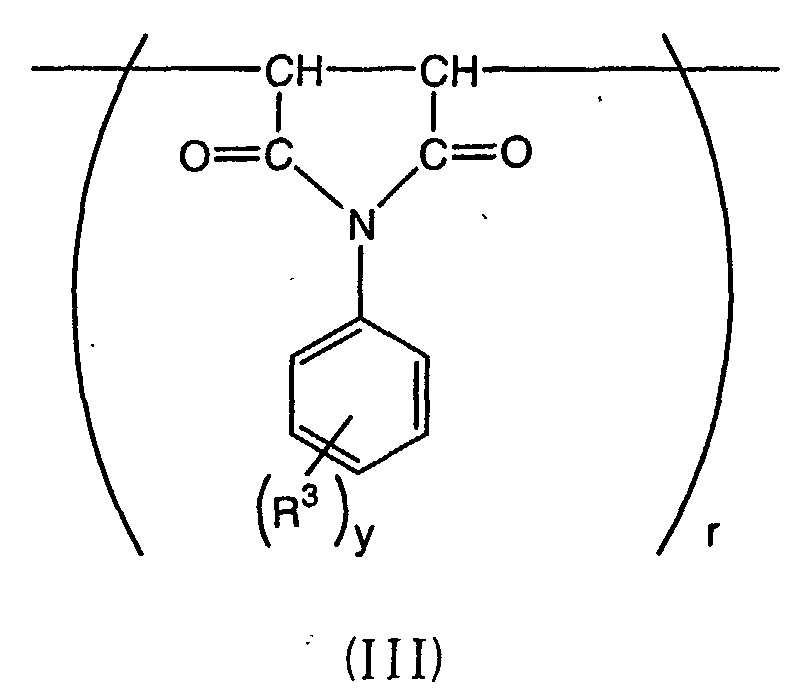
- thermosetting resin composition wherein the said component (1) is replaced by (1)' a copolymer resin comprising the said monomer unit (a) and (b), and further comprises, as a monomer unit (c), N-phenylmaleimide represented by the following general formula (III): wherein R 3 represents a halogen atom, an aliphatic hydrocarbon group having 1 to 5 carbon atoms, an aromatic hydrocarbon group, a hydroxyl group, a thiol group, or a carboxyl group; y is an integer of 0 to 3, preferably 0; and r is a natural number, and/or a derivative thereof.
- the component (2) a thermosetting resin is (2)' a cyanate resin having at least two cyanate groups per molecule.
- thermosetting resin composition comprising:
- thermosetting resin composition wherein the said component (1) is replaced by (1)' a copolymer resin comprising the said monomer unit (a) and (b), and further comprises, as a monomer unit (c), N-phenylmaleimide represented by the following general formula (III): wherein R 3 represents a halogen atom, an aliphatic hydrocarbon group having 1 to 5 carbon atoms, an aromatic hydrocarbon group, a hydroxyl group, a thiol group, or a carboxyl group; y is an integer of 0 to 3, preferably 0; and r is a natural number and/or a derivative thereof.
- R 3 represents a halogen atom, an aliphatic hydrocarbon group having 1 to 5 carbon atoms, an aromatic hydrocarbon group, a hydroxyl group, a thiol group, or a carboxyl group
- y is an integer of 0 to 3, preferably 0
- r is a natural number and/or a derivative thereof.
- component (1) or (1)' is a copolymer resin comprising styrene and maleic anhydride.
- the monomer unit (a) is obtained from a compound, such as styrene, 1-methylstyrene, vinyltoluene, dimethylstyrene, chlorostyrene, or bromostyrene, and these compounds can be used individually or in combination.
- various polymerizable components other than the above-stated monomer units may be copolymerized, and examples of these polymerizable components include vinyl compounds, such as ethylene, propylene, butadiene, isobutylene, acrylonitrile, vinyl chloride, and fluoroethylene, and compounds having a methacryloyl group or an acryloyl group, such as methacrylate such as methyl methacrylate, and acrylate such as methyl acrylate.
- vinyl compounds such as ethylene, propylene, butadiene, isobutylene, acrylonitrile, vinyl chloride, and fluoroethylene
- compounds having a methacryloyl group or an acryloyl group such as methacrylate such as methyl methacrylate, and acrylate such as methyl acrylate.
- a substituent such as an allyl group, a methacryloyl group, an acryloyl group, or a hydroxyl group, can be optionally introduced into the component (a) through a Friedel-Crafts reaction or a reaction using a metal catalyst, such as lithium.
- various hydroxyl group-containing compounds, amino group-containing compounds, cyanate group-containing compounds, and epoxy group-containing compounds can be introduced into the monomer unit (b).
- N-phenylmaleimide and derivatives of N-phenylmaleimide which have a phenolic hydroxyl group, from the viewpoint of obtaining excellent dielectric property and an appropriate glass transition temperature, and especially preferred is N-phenylmaleimide from the viewpoint of obtaining excellent heat resistance and excellent moisture resistance.
- derivatives of N-phenylmaleimide include compounds represented by general formulae (IV) to (IX): wherein w or each of w's independently represents an integer of 1 to 3.
- the component (1) is a copolymer resin represented by the following general formula (X): wherein R 1 , R 2 , m, n and x have the same meanings as stated above.
- R 1 includes a hydrogen atom, a halogen atom, or a hydrocarbon group having 1 to 5 carbon atoms, preferably a hydrogen atom or a methyl group.
- R 2 or each of R 2 's include a halogen atom, an aliphatic hydrocarbon group having 1 to 5 carbon atoms, an aromatic hydrocarbon group including a group which forms a naphthalene together with the benzene entity of the monomer (a), or a hydroxyl, preferably a hydrogen atom or a methyl group.
- the component (1) is a copolymer resin represented by the following general formula (XI): wherein R 1 , m and n have the same meanings as stated above.
- m/n indicating the copolymerization ratio for component (1) is 0.8 to 19.
- the component (1)' is a copolymer resin represented by the following general formula (XII): wherein R 1 , R 2 , R 3 , m, n, r, x and y have the same meanings as stated above.
- R 3 includes a halogen atom, an aliphatic hydrocarbon group having 1 to 5 carbon atoms, an aromatic hydrocarbon group including a group which forms a naphthalene together with the benzene entity of the monomer (c), a hydroxyl group, a thiol group, or a carboxyl group, preferably a hydrogen atom or a methyl group.
- component (1)' is a copolymer resin represented by the following general formula (XIII): wherein R 1 , m, n and r have the same meanings as stated above.
- m/(n+r) indicating the copolymerization ratio for the component (1)' is 0.8 to 19, and it is more preferred that the ratio is from 1 to 3.
- n/r indicating the copolymerization ratio for the component (1)' is 1/49 to 49, and it is more preferred that the ratio is from 1/9 to 9.
- the weight average molecular weight of the component (1) or (1)' is 1,000 to 300,000.
- the weight average molecular weight is measured by gel permeation chromatography using tetrahydrofuran as a solvent, in which a standard polystyrene is used for molecular weight calibration.
- a resin cured product which comprises the component (1) or (1)' and a thermosetting resin, has preferably a dielectric constant of 3.0 or less at a frequency of 1 GHz or more and has a glass transition temperature of 170°C or more.
- the dielectric constant is more preferably 2.2 to 3.0, especially preferably 2.4 to 2.9.
- the glass transition temperature is more preferably 170 to 230°C, especially preferably 175 to 220°C.
- the resin composition of the present invention contains, in addition to the component (1) or (1)', a thermosetting resin component which is cured together with the copolymer resin.
- a resin having a low dielectric constant and a high glass transition temperature which is cured together with the copolymer resin, can be used, and, by combining this resin with the component (1) or (1)' in the present invention, a composition having a dielectric constant of 3.0 or less and having a glass transition temperature of 170°C or more can be obtained.
- thermosetting resin there is no particular limitation with respect to (2) a thermosetting resin provided that the resin achieves the object of the present invention.
- thermosetting resin include a cyanate resin having two or more cyanate groups per molecule.
- cyanate compounds for (2)' a cyanate resin include 2,2-di(cyanatephenyl)propane, di(4-cyanate-3,5-dimethylphenyl)methane, di(4-cyanatephenyl)thioether, 2,2-di(4-cyanatephenyl)hexafluoropropane, di(cyanatephenyl)ethane, and a cyanate and a phenolic novolak cyanate of a copolymer of phenol and dicyclopentadiene, and these compounds can be used individually or in combination.
- 2,2-di(cyanatephenyl)propane from the viewpoint of obtaining excellent dielectric property and excellent heat resistance, further preferred is a compound containing a mixture of a trimer and a larger oligomer (polymer) having a triazine ring preliminarily formed by self-polymerization, and, from the viewpoint of achieving a good balance of a dielectric constant and a dielectric dissipation factor with heat resistance and prevention of gelation, especially preferred is a compound in which 10 to 90 mol% of 2,2-di(cyanatephenyl)propane forms a trimer and/or a larger oligomer (polymer).
- a trimer and/or a larger oligomer (polymer) having a triazine ring is formed by self-polymerization, it is effective that a cyanate resin is preliminarily mixed with the component (1) and dissolved to form a semi-interpenetrating polymer network (semi-IPN) structure between the component (1) and a trimer and/or a larger polymer having a'triazine ring derived from the cyanate resin, and, by virtue of having the semi-IPN structure, the resin composition can be improved in glass transition temperature, adhesion to a copper foil, and dielectric property.
- si-IPN semi-interpenetrating polymer network
- curing catalysts for (2)' the cyanate resin include organometal catalysts, such as zinc naphthenate, manganese naphthenate, and titanium naphthenate
- curing accelerators include monohydric phenolic compounds, such as phenol, nonylphenol, and para-cumylphenol, and polyhydric phenolic compounds, such as bisphenol A and phenol novolak resins.
- the amount of the curing catalyst used is 0.01 to 1.00 % by weight, based on the weight of the cyanate resin from view point of achieving a good balance of a high reaction rate of the heat curing reaction, excellent dielectric property and excellent heat resistance with occurrence of gelation during the synthesis and lack of stability in resultant varnish.
- the curing accelerator monohydric phenolic compounds are preferred from the viewpoint of obtaining excellent heat resistance, and especially preferred is para-cumylphenol from the viewpoint of obtaining excellent dielectric property and excellent heat resistance. It is preferred that the amount of the curing accelerator used is 0.01 to 1.00, in terms of the ratio of the equivalent amount of phenolic hydroxyl group to the equivalent amount of cyanate group in the cyanate resin.
- the thermosetting resin composition of the present invention preferably comprises 10 to 300 parts by weight of component (2), more preferably comprises 50 to 300 parts by weight of the component (2), especially preferably comprises 50 to 250 parts by weight of the component (2) per 100 parts by weight of component (1) or (1)'.
- thermoplastic resins elastomers, flame retardants, and filler can be optionally used individually or in combination.
- an epoxy resin of the component (3) is used as a modifier.
- the resultant resin composition is improved in moisture resistance and heat resistance, especially in heat resistance after absorbing water.
- the epoxy resin can be added to the resin composition in an amount of 0 to 300 parts by weight, relative to 100 parts by weight of the component (1).
- component (3) there is no particular limitation as long as it is an epoxy resin having two or more epoxy groups per molecule, and examples include bisphenol A glycidyl ether, bisphenol F glycidyl ether, biphenyl glycidyl ether, novolak glycidyl ether, multifunctional phenolic glycidyl ether, naphthalene glycidyl ether, alicyclic glycidyl ether, alcohol glycidyl ether, and halides of these glycidyl ethers, glycidyl amines, and glycidyl esters, and these can be used individually or in combination.
- dicyclopentadiene-type epoxy resins preferred are dicyclopentadiene-type epoxy resins, bisphenol A novolak-type epoxy resins, biphenyl-type epoxy resins, tetrabromobisphenol A-type epoxy resins, and polydimethylsiloxane-containing epoxy resins, and especially preferred are dicyclopentadiene-type epoxy resins, biphenyl-type epoxy resins, and bisphenol A novolak-type epoxy resins from the viewpoint of obtaining excellent moisture resistance and excellent adhesion to a copper foil.
- examples of curing agents for epoxy resins include acid anhydrides, amine compounds, and phenolic compounds.
- examples of curing accelerators for epoxy resins include imidazoles and derivatives thereof, tertiary amines, and quaternary ammonium salts.
- examples of isocyanurate compounds include triallyl isocyanurate, trimetaallyl isocyanurate, diallylmonoglycidyl isocyanurate, monoallyldiglycidyl isocyanurate, triacryloylethyl isocyanurate, and trimethacryloylethyl isocyanurate.
- examples of curing catalysts include organic peroxides, such as benzoyl peroxide and 2,5-dimethyl-2,5-di(t-butylperoxy)-3-hexene-3, which are radical initiators.
- thermoplastic resins include polytetrafluoroethylene, polyethylene, polypropylene, polystyrene, polyphenylene ether reins, phenoxy resins, polycarbonate resins, polyester resins, polyamide resins, polyimide resins, xylene resins, petroleum resins, and silicone resins.
- examples of elastomers include polybutadiene, polyacrylonitrile, epoxy-modified polybutadiene, maleic anhydride-modified polybutadiene, phenol-modified polybutadiene, and carboxy-modified polyacrylonitrile.
- examples of flame retardants include halogen flame retardants, such as hexabromobenzene, brominated polycarbonate, brominated epoxy resins, and brominated phenolic resins; phosphate flame retardants, such as tricresyl phosphate and tris(dichloropropyl) phosphate; and inorganic flame retardants, such as red phosphorus, antimony trioxdie, aluminum hydroxide, and magnesium hydroxide.
- halogen flame retardants such as hexabromobenzene, brominated polycarbonate, brominated epoxy resins, and brominated phenolic resins
- phosphate flame retardants such as tricresyl phosphate and tris(dichloropropyl) phosphate
- inorganic flame retardants such as red phosphorus, antimony trioxdie, aluminum hydroxide, and magnesium hydroxide.
- examples of the filler include inorganic substance powder, such as silica, mica, talc, glass short fiber or fine powder, and hollow glass, and organic substance powder, such as silicone powder, polytetrafluoroethylene, polyethylene, polypropylene, polystyrene, and polyphenylene ether.
- inorganic substance powder such as silica, mica, talc, glass short fiber or fine powder, and hollow glass
- organic substance powder such as silicone powder, polytetrafluoroethylene, polyethylene, polypropylene, polystyrene, and polyphenylene ether.
- an organic solvent can be optionally used, and there is no particular limitation with respect to the organic solvent.
- organic solvents include ketone solvents, such as acetone, methyl ethyl ketone, methyl isobutyl ketone, and cyclohexanone; alcohol solvents, such as ethylene glycol monomethyl ether; ether solvents, such as tetrahydrofuran; aromatic solvents, such as toluene, xylene, and mesitylene; dimethylformamide; dimethylacetamide; and N-methylpyrrolidone, and these organic solvents can be used individually or in combination.
- an ultraviolet absorber an antioxidant, a photopolymerization initiator, a fluorescent brightener, and an adhesion improving agent can be optionally added to the resin composition, and there is no particular limitation with respect to these additives.
- ultraviolet absorbers include benzotriazoles; examples of antioxidants include hindered phenol and styrenated phenol; examples of photopolymerization initiators include benzophenones, benzylketals, and thioxanthone; examples of fluorescent brighteners include stilbene derivatives; and examples of adhesion improving agents include urea compounds, such as urea silane, and silane coupling agents.
- the prepreg of the present invention comprises a base material impregnated or coated with the above-stated thermosetting resin composition of the present invention.
- the prepreg of the present invention is described below in detail.
- the prepreg of the present invention can be produced by impregnating or coating a base material with the thermosetting resin composition, which comprises the component (1) or (1)' and the component (2), and optionally the component (3), then semicuring the resin composition (so as to be in a B-stage) by, for example, heating.
- a base material such as E-glass, D-glass, S-glass, and Q-glass
- organic fiber such as polyimide, polyester, and polytetrafluoroethylene, and mixtures thereof.
- base materials have forms of, for example, woven fabric, non-woven fabric, roving, chopped strand mat, and surfacing mat, but the material and forms of the base material are appropriately selected depending on the application and performance of a desired shaped product, and, if desired, two or more materials and forms can be used individually or in combination.
- the thickness of the base material there is no particular limitation, and, for example, a base material having a thickness of about 0.03 to 0.5 mm can be used. From the viewpoint of achieving excellent heat resistance and excellent moisture resistance as well as excellent processability, a base material having a surface treated with a silane coupling agent or a base material treated by mechanically splitting is preferred.
- a base material is impregnated or coated with the resin composition so that the content of the resin in the prepreg dried becomes from 20 to 90 % by weight, and then, generally dried by heating at 100 to 200°C for 1 to 30 minutes to semicure the resin composition (so as to be in a B-stage) to obtain the prepreg of the present invention.
- the laminated sheet can be produced by, for example, stacking on one another 1 to 20 pieces of the prepreg of the present invention, placing on one surface or both surfaces of the stacked prepreg a metal foil or metal foils of copper or aluminum, and subjecting the resultant prepreg to laminate molding.
- a metal foil or metal foils of copper or aluminum With respect to the type of metal foil, there is no particular limitation as long as it can be used in the application of electrically insulating materials.
- conditions for molding for example, those used in methods for laminated sheet and multilayer sheet for electrically insulating materials can be employed, and, for example, molding can be conducted using a multi-stage press, a multi-stage vacuum press, a continuous molding machine, or an autoclave molding machine by heating at 100 to 250°C at a pressure of 2 to 100 kg/cm 2 for 0.1 to 5 hours.
- the prepreg of the present invention can be combined with a wiring board for inner layer and subjected to laminate molding to produce a multilayer sheet.
- Component (1) Preparation of copolymer resin solution (1-1)
- Component (1) Preparation of copolymer resin solution (1-2)
- Component (1) Preparation of copolymer resin solution (1-3)
- Component (1)' Preparation of copolymer resin solution (1-4)
- a reaction was effected at 110°C for 4 hours, and then, the reaction mixture was heated to 165°C and reacted under reflux for 12 hours. Then, the reaction mixture was cooled to about 100°C, and 398 g of toluene was added thereto to obtain a solution (1-4) of a copolymer resin comprising styrene, maleic anhydride, and N-phenylmaleimide.
- the solid content of the solution (1-4) was 40 % by weight, and a copolymerization ratio among styrene, maleic anhydride, and N-phenylmaleimide was such that m/(n+r) is 3 and n/r is 1 in the component (1-4).
- the weight average molecular weight was 10,000.
- Component (1)' Preparation of copolymer resin solution (1-5)
- a reaction was effected at 100°C for 4 hours, and then, the reaction mixture was heated to 155 to 160°C and reacted under reflux for 12 hours. Then, the reaction mixture was cooled to about 100°C, and 159 g of toluene was added thereto to obtain a solution (1-5) of a copolymer resin comprising styrene, maleic anhydride, and N-phenylmaleimide.
- the solid content of the solution (1-5) was 45 % by weight, and a copolymerization ratio among styrene, maleic anhydride, and N-phenylmaleimide was such that m/(n+r) is 1 and n/r is 1 in the component (1-5).
- the weight average molecular weight was 9,000.
- Component (1)' Preparation of copolymer resin solution (1-6)
- the solid content of the solution (1-6) was 41 % by weight, and a copolymerization ratio among styrene, maleic anhydride, and N-phenylmaleimide was such that m/(n+r) is 1 and n/r is 1/4 in the component (I).
- the weight average molecular weight was 20,000.
- Component (1) Preparation of copolymer resin (1-7)
- the solid content of the solution (1-7) was 38 % by weight, and a copolymerization ratio between styrene and maleic anhydride was such that m/n is 11.5 in component (1-7).
- the weight. average molecular weight was 200,000.
- Component (1) Preparation of copolymer resin (1-8)
- a copolymer resin comprising styrene and maleic anhydride (trade name: Dylark D-332; manufactured by Dylark) and 273 g of cyclohexanone, and heated to 150 to 160°C under reflux for 2 hours to remove water therefrom. Then, the resultant mixture was cooled to about 100°C, and 398 g of toluene was added thereto to obtain a solution (1-8) of a copolymer resin comprising styrene and maleic anhydride.
- the solid content of the solution (1-8) was 38 % by weight, and a copolymerization ratio between styrene and maleic anhydride was such that m/n is 7.0 in the component (1-8).
- the weight average molecular weight was 150,000.
- the solid content of the solution (2-1) was 61 % by weight, and a measurement using gel permeation chromatography confirmed that 45 mol% of 2,2-di(cyanatephenyl)propane, which is the raw material, formed a trimer and/or a larger polymer by self-polymerization.
- Component (2) Preparation of cyanate resin (2-2)
- the solid content of the solution (2-2) was 61 % by weight, and a measurement using gel permeation chromatography confirmed that 20 mol% of 2,2-di(cyanatephenyl)propane, which is the raw material, formed a trimer and/or a larger polymer by self-polymerization.
- the solid content of the solution (2-3) was 67 % by weight, and a measurement using gel permeation chromatography confirmed that 60 mol% of 2,2-di(cyanatephenyl)propane, which is the raw material, formed a trimer and/or a larger polymer by self-polymerization.
- a copolymerization ratio between styrene and maleic anhydride was such that m/n is 7.0 in the component (1).
- a reactor equipped with a thermometer, a stirrer, a condenser, and a nitrogen gas introducing tube, being capable of heating and cooling and having a capacity of 2 liters were placed 277 g of styrene, 4.0 g of azobisisobutyronitrile, 0.4 g of dodecanethiol, 216 g of methyl ethyl ketone, and 200 g of toluene, and the resultant mixture was subjected to polymerization reaction in a nitrogen gas atmosphere at 70°C for 4 hours to obtain a solution (a-1) of a styrene resin.
- the solid content of the solution (a-1) was 41 % by weight.
- the weight average molecular weight was 20,000.
- a reactor equipped with a thermometer, a stirrer, a condenser, and a nitrogen gas introducing tube being capable of heating and cooling and having a capacity of 2 liters, were placed 104 g of styrene, 173 g of N-phenylmaleimide, 4.0 g of azobisisobutyronitrile, 0.4 g of dodecanethiol, 216 g of methyl ethyl ketone, and 200 g of toluene, and the resultant mixture was subjected to polymerization reaction in a nitrogen gas atmosphere at 70°C for 4 hours to obtain a solution (a-2) of a copolymer resin comprising styrene and N-phenylmaleimide.
- the solid content of the solution (a-2) was 41 % by weight, and a copolymerization ratio between styrene and N-phenylmaleimide was 1:1.
- the weight average molecular weight was 200,000.
- Synthesis Examples 1 to 8 (1-1 to 1-8) and Comparative Synthesis Examples 1 and 2 (a-1 or a-2), Synthesis Examples 9 and 10 (2-1 or 2-2), Synthesis Example 11 (semi-IPN), optionally component (3) epoxy resin and/or isocyanurate compound, and triethylamine, zinc naphthenate, 2,5-dimethyl-2,5-di(t-butylperoxy)-3-hex-3-en and para-cumylphenol as curing reaction catalysts were mixed together in accordance with the formulations (part(s) by weight) shown in Tables 1 to 4 to obtain uniform varnishes.
- E-glass cloth having a thickness of 0.1 mm was impregnated with each of the above-obtained varnishes, and dried by heating at 160°C for 10 minutes to obtain a prepreg having a resin content of 55 % by weight.
- a dielectric constant (1 GHz), a dielectric dissipation factor (1 GHz), a moisture absorption (water absorption), resistance to soldering heat, adhesion (peel strength), and a glass transition temperature were measured or evaluated according to the following methods.
- the obtained resin sheets and copper-clad laminated sheets were individually immersed in a copper etching liquid to remove the copper foils to obtain specimens for evaluation, and a dielectric constant and a dielectric dissipation factor of each specimen were measured at a frequency of 1 GHz using a dielectric constant measurement apparatus (trade name: HP4291B), manufactured by Hewlett-Packard Company.
- the copper-clad laminated sheets were individually immersed in a copper etching liquid to remove the copper foils to obtain specimens for evaluation, and the obtained specimens were individually subjected to pressure cooker treatment at 121°C at 2 atm. for 4 hours using a pressure cooker test machine, manufactured,by Hirayama Corporation, and then a moisture absorption of each of the resultant specimens was measured.
- the copper-clad laminated sheets were individually immersed in a copper etching liquid to remove the copper foils to obtain specimens for evaluation, the obtained specimens were individually immersed in a solder bath at 288°C for 20 seconds, and then resistance to soldering heat of each of the resultant specimens was evaluated by observing the appearance of each specimen.
- the copper-clad laminated sheets were individually immersed in a copper etching liquid to form copper foils with a width of 1 cm to obtain specimens for evaluation, and peel strength of each of the obtained specimens was measured using a rheometer.
- the copper-clad laminated sheets were individually immersed in a copper etching liquid to remove the copper foils to obtain specimens for evaluation, and the thermal expansion properties of each specimen was observed under a condition of temperature rising speed 5 °C/min, load 0.05N, Expansion Method, range of temperature measurement from 2-to 250°C using a TMA (Test Mechanical Analyzer) test machine, TMA2940 manufactured by DuPont. The temperature at the refraction point of the thermal expansion curve was deemed to be a glass transition temperature of each of the obtained specimens.
- Synthesis Examples 1 to 8 (1-1 to 1-8) and Comparative Synthesis Examples 1 and 2 (a-1 or a-2), Synthesis Examples 9 and 10 (2-1 or 2-2), Synthesis Example 11 (semi-IPN), optionally component (3) epoxy resin and/or isocyanurate compound, and triethylamine, zinc naphthenate, 2,5-dimethyl-2,5-di(t-butylperoxy)-3-hex-3-en, and/or para-cumylphenol as curing reaction catalysts were mixed together in accordance with the formulations (part(s) by weight) shown in Tables 5 and 6 to obtain uniform varnishes.
- the obtained varnishes were individually applied to a PET film, and dried by heating at 160°C for 10 minutes and the solids were removed by casting. Then, the solids removed were pressed at a pressure of 25 kg/cm 2 at 185°C for 90 minutes to obtain a resin plate.
- a dielectric constant (1 GHz), a dielectric dissipation factor (1 GHz), and a glass transition temperature were measured according to the following methods.
- a dielectric constant and a dielectric dissipation factor were measured at a frequency of 1 GHz using a dielectric constant measurement apparatus (trade name: HP4291B), manufactured by Hewlett-Packard Company.
- the thermal expansion properties for each of the obtained resin sheets was observed for the thermal expansion properties of the specimens under a condition of temperature rising speed 5 °C/min, load 0.05N, Expansion Method, range of temperature measurement from 20 to 250°C using a TMA (Test Mechanical Analyzer) test machine, TMA2940 manufactured by DuPont.
- TMA Transmission Mechanical Analyzer
- E-glass cloth having a thickness of 0.1 mm was impregnated with each of the above varnishes, and dried by heating at 160°C for 10 minutes to obtain a prepreg having a resin content of 55 % by weight. Then, four pieces of each prepreg were stacked on one another, and disposed between 18 ⁇ m electrolytic copper foils and pressed at a pressure of 25 kg/cm 2 at 185°C for 90 minutes to obtain a copper-clad laminated sheet.
- a dielectric constant (1 GHz), a dielectric dissipation factor (1 GHz), a moisture absorption (water absorption), resistance to soldering heat, adhesion (peel strength), and a glass transition temperature were measured or evaluated according to the same methods as those used in the above Examples 1.
- components (1) to (3) are indicated by part(s) by weight, in terms of solid content.
- Examples of the present invention are excellent in all low dielectric constant, low dielectric dissipation factor, heat resistance, moisture resistance, and adhesion to a copper foil.
- Comparative Examples are not satisfactory in all low dielectric constant, low dielectric dissipation factor, heat resistance, moisture resistance, and adhesion to a copper foil.
- thermosetting resin composition of the present invention is excellent in low dielectric constant, low dielectric dissipation factor, heat resistance, moisture resistance, and adhesion to a copper foil
- the prepreg obtained by impregnating or coating a base material with the above composition and the laminated sheet produced by subjecting the above prepreg to laminate molding are excellent in low dielectric constant, low dielectric dissipation factor, heat resistance, moisture resistance, and adhesion to a copper foil, and therefore they are useful as a printed wiring board for electronic appliance.
Landscapes
- Chemical & Material Sciences (AREA)
- Health & Medical Sciences (AREA)
- Chemical Kinetics & Catalysis (AREA)
- Medicinal Chemistry (AREA)
- Polymers & Plastics (AREA)
- Organic Chemistry (AREA)
- Reinforced Plastic Materials (AREA)
- Compositions Of Macromolecular Compounds (AREA)
- Laminated Bodies (AREA)
- Macromolecular Compounds Obtained By Forming Nitrogen-Containing Linkages In General (AREA)
- Macromonomer-Based Addition Polymer (AREA)
Abstract
and (2) a cyanate resin having at least two cyanate groups per molecule.
Description
- The present invention relates to a thermosetting resin composition, and a prepreg and a laminated sheet for electrically insulating material using the thermosetting resin composition.
- As printed wiring boards for electronic appliance, laminated sheets mainly using an epoxy resin have been widely used. However, in accordance with tendencies that a pattern becomes finer due to the increase in the mounting density in electronic appliance, the surface mount system is generally employed, the signal propagation velocity becomes higher, and the frequency of the signal used becomes higher, a development of printed wiring board materials having a low dielectric loss and an improved heat resistance are strongly desired.
- As a prior art of a resin composition or laminated sheet using an epoxy resin as a curing agent and using a copolymer resin comprising styrene and maleic anhydride, for example, Japanese Unexamined Patent Publication No. 109476/1974 has a description about a flexible printed wiring board from a flexible epoxy resin and a copolymer resin which comprises styrene and maleic anhydride, wherein a reactive epoxy diluent and an acrylonitrile-butadiene copolymer are necessary for imparting flexibility to the printed wiring board. In addition, Japanese Unexamined Patent Publication No. 221413/1989 has descriptions about a copolymer resin having an acid value of 280 or more, which is obtained from an epoxy resin, an aromatic vinyl compound, and maleic anhydride, and about an epoxy resin compound containing dicyanamide. Further, Japanese Unexamined Patent Publication No. 25349/1997 has descriptions about a prepreg and a laminated sheet material for electrical appliance, comprising a brominated epoxy resin, a copolymer resin comprising styrene and maleic anhydride (epoxy resin curing agent), a styrene compound, and a solvent. Japanese Unexamined Patent Publications No. 17685/1998 and No. 17686/1998 have descriptions about a prepreg and a laminated sheet material for electrical appliance, comprising an epoxy resin, a copolymer resin of an aromatic vinyl compound and maleic anhydride, and a phenolic compound. Japanese Unexamined national Patent Publication (kohyo) No. 505376/1998 has descriptions about a resin composition, a laminated sheet, and a printed wiring board, comprising an epoxy resin, a cross-linking agent for carboxylic anhydride-type epoxy resin, and an allyl network-forming compound. However, these prior art materials do not have performance required for the tendency that the pattern becomes finer and the frequency of the signal becomes higher, that is, they do not have low dielectric loss, excellent heat resistance, excellent moisture resistance, and excellent adhesion to a copper foil.
- It is an object of the present invention to provide a thermosetting rein composition free of the above-stated problems, which composition is excellent in all, low dielectric loss, heat resistance, moisture resistance, and adhesion to a copper foil, and the use thereof, for example, a prepreg and a laminated sheet.
- In one aspect, the present invention is directed to a thermosetting resin composition comprising:
- (1) a copolymer resin comprising
(a) a monomer unit
represented by the following general formula (I):
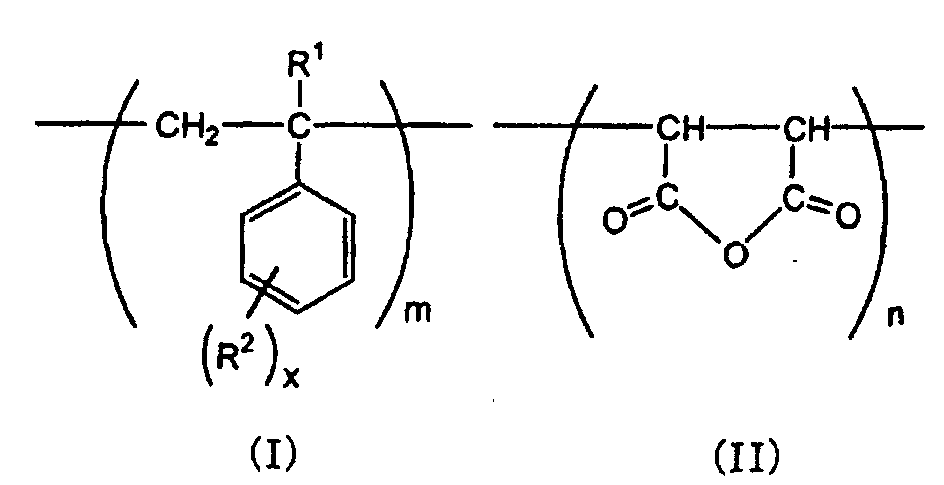
wherein R1 represents a hydrogen atom, a halogen atom, or a hydrocarbon group having 1 to 5 carbon atoms; R2 or each of R2's independently represents a halogen atom, an aliphatic hydrocarbon group having 1 to 5 carbon atoms, or an aromatic hydrocarbon group; x is an integer of 0 to 3, preferably 0; and m is a natural number, and

(b) a monomer unit represented by the following general formula (II):wherein n is a natural number; and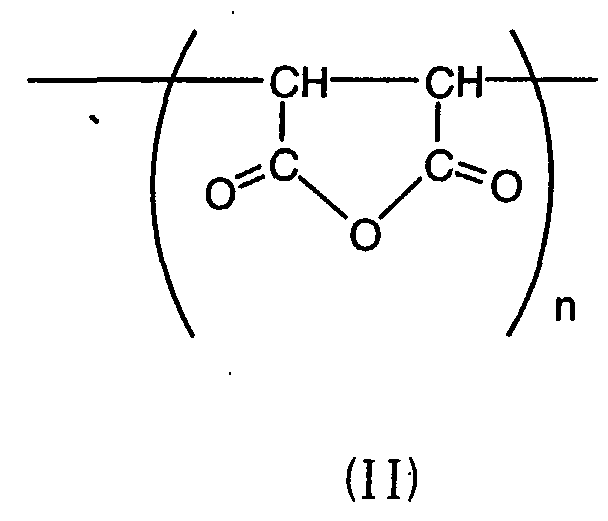
- (2) a thermosetting resin which is cured together with said component (1), wherein a cured product of said composition has a dielectric constant of 3.0 or less at a frequency of 1 GHz or more and has a glass transition temperature of 170°C or more, and the composition is not constituted only by said (1).
-
- In one aspect of the present invention, it is preferred to use a thermosetting resin composition wherein the said component (1) is replaced by (1)' a copolymer resin comprising the said monomer unit (a) and (b), and further comprises, as a monomer unit (c), N-phenylmaleimide represented by the following general formula (III):wherein R3 represents a halogen atom, an aliphatic hydrocarbon group having 1 to 5 carbon atoms, an aromatic hydrocarbon group, a hydroxyl group, a thiol group, or a carboxyl group; y is an integer of 0 to 3, preferably 0; and r is a natural number,

and/or a derivative thereof. In addition, it is also preferred that the component (2) a thermosetting resin is (2)' a cyanate resin having at least two cyanate groups per molecule. - In another aspect, the present invention is directed to a thermosetting resin composition comprising:
- (1) a copolymer resin comprising
- (a) a monomer unit represented by the following general
formula (I):
wherein R1 represents a hydrogen atom, a halogen atom, or a hydrocarbon group having 1 to 5 carbon atoms; R2 or each of R2's independently represents a halogen atom, an aliphatic hydrocarbon group having 1 to 5 carbon atoms, an aromatic hydrocarbon group, or a hydroxyl group; x is an integer of 0 to 3, preferably 0; and m is a natural number, and
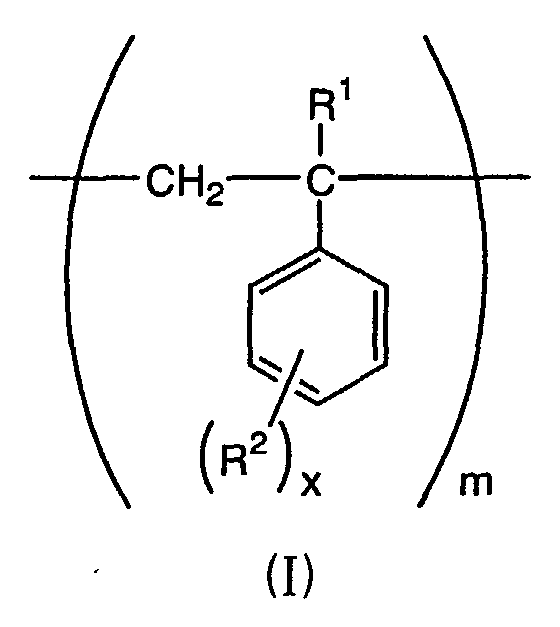
- (b) a monomer unit represented by the following general
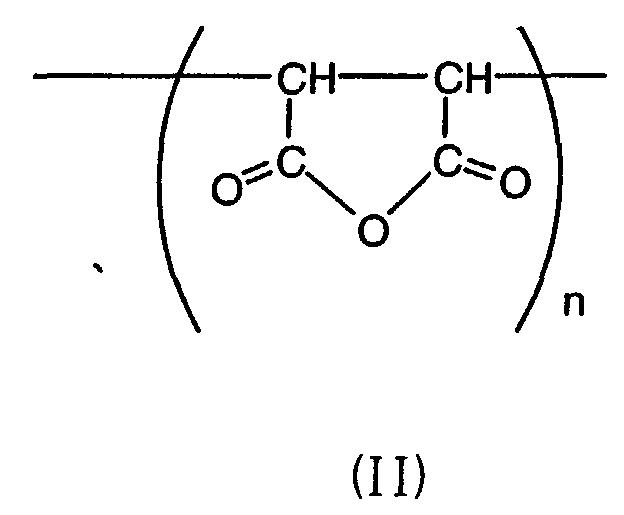
formula (II):
wherein n is a natural number; and
- (2)' a cyanate resin having at least two cyanate groups per molecule.
-
- In another aspect of the present invention, it is preferred to use a thermosetting resin composition wherein the said component (1) is replaced by (1)' a copolymer resin comprising the said monomer unit (a) and (b), and further comprises, as a monomer unit (c), N-phenylmaleimide represented by the following general formula (III):wherein R3 represents a halogen atom, an aliphatic hydrocarbon group having 1 to 5 carbon atoms, an aromatic hydrocarbon group, a hydroxyl group, a thiol group, or a carboxyl group; y is an integer of 0 to 3, preferably 0; and r is a natural number
and/or a derivative thereof. - Hereinafter, the present invention will be described in more detail.
- In the present invention, component (1) or (1)' is a copolymer resin comprising styrene and maleic anhydride. In the present invention, the monomer unit (a) is obtained from a compound, such as styrene, 1-methylstyrene, vinyltoluene, dimethylstyrene, chlorostyrene, or bromostyrene, and these compounds can be used individually or in combination. Further, various polymerizable components other than the above-stated monomer units may be copolymerized, and examples of these polymerizable components include vinyl compounds, such as ethylene, propylene, butadiene, isobutylene, acrylonitrile, vinyl chloride, and fluoroethylene, and compounds having a methacryloyl group or an acryloyl group, such as methacrylate such as methyl methacrylate, and acrylate such as methyl acrylate. A substituent, such as an allyl group, a methacryloyl group, an acryloyl group, or a hydroxyl group, can be optionally introduced into the component (a) through a Friedel-Crafts reaction or a reaction using a metal catalyst, such as lithium.
- In the present invention, various hydroxyl group-containing compounds, amino group-containing compounds, cyanate group-containing compounds, and epoxy group-containing compounds can be introduced into the monomer unit (b).
- In the present invention, as the monomer units (c), preferred are N-phenylmaleimide and derivatives of N-phenylmaleimide, which have a phenolic hydroxyl group, from the viewpoint of obtaining excellent dielectric property and an appropriate glass transition temperature, and especially preferred is N-phenylmaleimide from the viewpoint of obtaining excellent heat resistance and excellent moisture resistance. Examples of derivatives of N-phenylmaleimide include compounds represented by general formulae (IV) to (IX):
 wherein w or each of w's independently represents an integer of 1 to 3.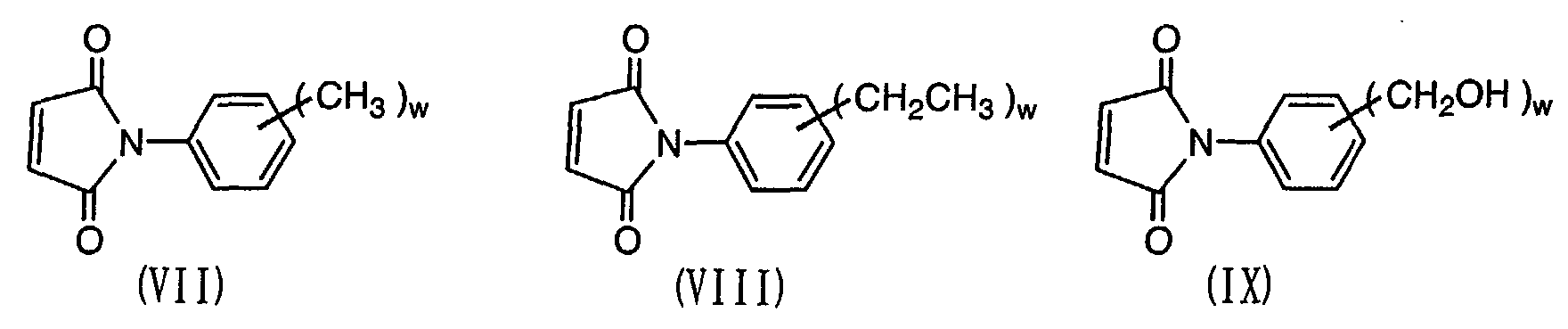
- In the present invention, it is preferred that the component (1) is a copolymer resin represented by the following general formula (X):wherein R1, R2, m, n and x have the same meanings as stated above. The examples of R1 includes a hydrogen atom, a halogen atom, or a hydrocarbon group having 1 to 5 carbon atoms, preferably a hydrogen atom or a methyl group. The examples of R2 or each of R2's include a halogen atom, an aliphatic hydrocarbon group having 1 to 5 carbon atoms, an aromatic hydrocarbon group including a group which forms a naphthalene together with the benzene entity of the monomer (a), or a hydroxyl, preferably a hydrogen atom or a methyl group.

- In the present invention, it is preferred that the component (1) is a copolymer resin represented by the following general formula (XI):wherein R1, m and n have the same meanings as stated above.

- In the present invention, from the viewpoint of achieving a good balance of a dielectric constant and a dielectric dissipation factor with a glass transition temperature, resistance to soldering heat, and adhesion to a copper foil, it is preferred that m/n indicating the copolymerization ratio for component (1) is 0.8 to 19.
- In the present invention, it is preferred that the component (1)' is a copolymer resin represented by the following general formula (XII):wherein R1, R2, R3, m, n, r, x and y have the same meanings as stated above. The examples of R3 includes a halogen atom, an aliphatic hydrocarbon group having 1 to 5 carbon atoms, an aromatic hydrocarbon group including a group which forms a naphthalene together with the benzene entity of the monomer (c), a hydroxyl group, a thiol group, or a carboxyl group, preferably a hydrogen atom or a methyl group.

- In the present invention, it is'more preferred that component (1)' is a copolymer resin represented by the following general formula (XIII):wherein R1, m, n and r have the same meanings as stated above.
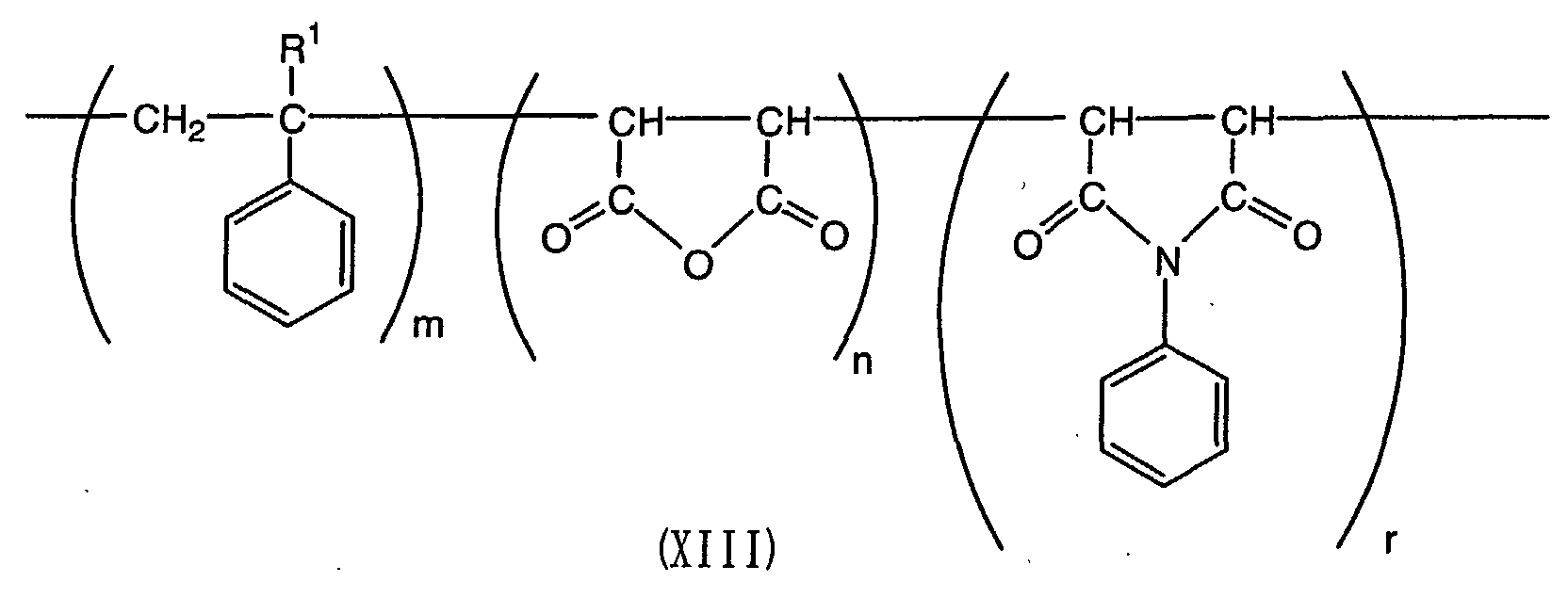
- In the present invention, from the viewpoint of achieving a good balance of a dielectric constant and a dielectric dissipation factor with a glass transition temperature, resistance to soldering heat, and adhesion to a copper foil, it is preferred that m/(n+r) indicating the copolymerization ratio for the component (1)' is 0.8 to 19, and it is more preferred that the ratio is from 1 to 3.
- In the present invention, from the viewpoint of achieving a good balance of a dielectric constant and a dielectric dissipation factor with a glass transition temperature, resistance to soldering heat, and adhesion to a copper foil, it is preferred that n/r indicating the copolymerization ratio for the component (1)' is 1/49 to 49, and it is more preferred that the ratio is from 1/9 to 9.
- In addition, from the viewpoint of achieving a good balance of heat resistance and a mechanical strength with formability at 200°C or lower, it is preferred that the weight average molecular weight of the component (1) or (1)' is 1,000 to 300,000. The weight average molecular weight is measured by gel permeation chromatography using tetrahydrofuran as a solvent, in which a standard polystyrene is used for molecular weight calibration.
- In the present invention, a resin cured product, which comprises the component (1) or (1)' and a thermosetting resin, has preferably a dielectric constant of 3.0 or less at a frequency of 1 GHz or more and has a glass transition temperature of 170°C or more. From the viewpoint of achieving a good balance of low dielectric loss with heat resistance and moisture resistance, the dielectric constant is more preferably 2.2 to 3.0, especially preferably 2.4 to 2.9. From the viewpoint of achieving a good balance of heat resistance with incorporation of a resin component, moisture resistance, and low dielectric loss, the glass transition temperature is more preferably 170 to 230°C, especially preferably 175 to 220°C.
- For obtaining a resin cured product containing the above copolymer resin, which has a dielectric constant adjusted to be 3.0 or less and has a glass transition temperature of 170°C or more, the resin composition of the present invention contains, in addition to the component (1) or (1)', a thermosetting resin component which is cured together with the copolymer resin. As such a component, a resin having a low dielectric constant and a high glass transition temperature, which is cured together with the copolymer resin, can be used, and, by combining this resin with the component (1) or (1)' in the present invention, a composition having a dielectric constant of 3.0 or less and having a glass transition temperature of 170°C or more can be obtained.
- In the present invention, there is no particular limitation with respect to (2) a thermosetting resin provided that the resin achieves the object of the present invention. Examples of the thermosetting resin include a cyanate resin having two or more cyanate groups per molecule.
- In an example of the present invention, specific examples of cyanate compounds for (2)' a cyanate resin include 2,2-di(cyanatephenyl)propane, di(4-cyanate-3,5-dimethylphenyl)methane, di(4-cyanatephenyl)thioether, 2,2-di(4-cyanatephenyl)hexafluoropropane, di(cyanatephenyl)ethane, and a cyanate and a phenolic novolak cyanate of a copolymer of phenol and dicyclopentadiene, and these compounds can be used individually or in combination. Of these, more preferred is 2,2-di(cyanatephenyl)propane from the viewpoint of obtaining excellent dielectric property and excellent heat resistance, further preferred is a compound containing a mixture of a trimer and a larger oligomer (polymer) having a triazine ring preliminarily formed by self-polymerization, and, from the viewpoint of achieving a good balance of a dielectric constant and a dielectric dissipation factor with heat resistance and prevention of gelation, especially preferred is a compound in which 10 to 90 mol% of 2,2-di(cyanatephenyl)propane forms a trimer and/or a larger oligomer (polymer).
- When a trimer and/or a larger oligomer (polymer) having a triazine ring is formed by self-polymerization, it is effective that a cyanate resin is preliminarily mixed with the component (1) and dissolved to form a semi-interpenetrating polymer network (semi-IPN) structure between the component (1) and a trimer and/or a larger polymer having a'triazine ring derived from the cyanate resin, and, by virtue of having the semi-IPN structure, the resin composition can be improved in glass transition temperature, adhesion to a copper foil, and dielectric property.
- Examples of curing catalysts for (2)' the cyanate resin include organometal catalysts, such as zinc naphthenate, manganese naphthenate, and titanium naphthenate, and examples of curing accelerators include monohydric phenolic compounds, such as phenol, nonylphenol, and para-cumylphenol, and polyhydric phenolic compounds, such as bisphenol A and phenol novolak resins. Among these curing catalysts, preferred are zinc naphthenate and manganese naphthenate from the viewpoint of obtaining excellent dielectric property and excellent heat resistance, and especially preferred is zinc naphthenate from the viewpoint of obtaining a high reaction rate of the heat curing reaction. It is preferred that the amount of the curing catalyst used is 0.01 to 1.00 % by weight, based on the weight of the cyanate resin from view point of achieving a good balance of a high reaction rate of the heat curing reaction, excellent dielectric property and excellent heat resistance with occurrence of gelation during the synthesis and lack of stability in resultant varnish. As the curing accelerator, monohydric phenolic compounds are preferred from the viewpoint of obtaining excellent heat resistance, and especially preferred is para-cumylphenol from the viewpoint of obtaining excellent dielectric property and excellent heat resistance. It is preferred that the amount of the curing accelerator used is 0.01 to 1.00, in terms of the ratio of the equivalent amount of phenolic hydroxyl group to the equivalent amount of cyanate group in the cyanate resin.
- From the viewpoint of achieving a good balance between a glass transition temperature, resistance to soldering heat, adhesion to a copper foil, a dielectric constant, and a dielectric dissipation factor, the thermosetting resin composition of the present invention preferably comprises 10 to 300 parts by weight of component (2), more preferably comprises 50 to 300 parts by weight of the component (2), especially preferably comprises 50 to 250 parts by weight of the component (2) per 100 parts by weight of component (1) or (1)'.
- In the present invention, as component (3), well known epoxy resins, curing agents for epoxy resins, curing accelerators for epoxy resins, isocyanurate compounds and curing catalysts therefore, thermoplastic resins, elastomers, flame retardants, and filler can be optionally used individually or in combination.
- In the present invention, it is preferred that an epoxy resin of the component (3) is used as a modifier. By adding the epoxy resin to the composition, the resultant resin composition is improved in moisture resistance and heat resistance, especially in heat resistance after absorbing water. The epoxy resin can be added to the resin composition in an amount of 0 to 300 parts by weight, relative to 100 parts by weight of the component (1). With respect to the component (3), there is no particular limitation as long as it is an epoxy resin having two or more epoxy groups per molecule, and examples include bisphenol A glycidyl ether, bisphenol F glycidyl ether, biphenyl glycidyl ether, novolak glycidyl ether, multifunctional phenolic glycidyl ether, naphthalene glycidyl ether, alicyclic glycidyl ether, alcohol glycidyl ether, and halides of these glycidyl ethers, glycidyl amines, and glycidyl esters, and these can be used individually or in combination. Of these, from the viewpoint of obtaining excellent dielectric property and excellent heat resistance, preferred are dicyclopentadiene-type epoxy resins, bisphenol A novolak-type epoxy resins, biphenyl-type epoxy resins, tetrabromobisphenol A-type epoxy resins, and polydimethylsiloxane-containing epoxy resins, and especially preferred are dicyclopentadiene-type epoxy resins, biphenyl-type epoxy resins, and bisphenol A novolak-type epoxy resins from the viewpoint of obtaining excellent moisture resistance and excellent adhesion to a copper foil.
- In the present invention, examples of curing agents for epoxy resins include acid anhydrides, amine compounds, and phenolic compounds. Examples of curing accelerators for epoxy resins include imidazoles and derivatives thereof, tertiary amines, and quaternary ammonium salts.
- In the present invention, examples of isocyanurate compounds include triallyl isocyanurate, trimetaallyl isocyanurate, diallylmonoglycidyl isocyanurate, monoallyldiglycidyl isocyanurate, triacryloylethyl isocyanurate, and trimethacryloylethyl isocyanurate. Of these, from the viewpoint of achieving low-temperature curing property, preferred are triallyl isocyanurate and triacryloylethyl isocyanurate. From the viewpoint of obtaining excellent dielectric property, especially preferred is triallyl isocyanurate. Examples of curing catalysts include organic peroxides, such as benzoyl peroxide and 2,5-dimethyl-2,5-di(t-butylperoxy)-3-hexene-3, which are radical initiators.
- In the present invention, examples of thermoplastic resins include polytetrafluoroethylene, polyethylene, polypropylene, polystyrene, polyphenylene ether reins, phenoxy resins, polycarbonate resins, polyester resins, polyamide resins, polyimide resins, xylene resins, petroleum resins, and silicone resins.
- In the present invention, examples of elastomers include polybutadiene, polyacrylonitrile, epoxy-modified polybutadiene, maleic anhydride-modified polybutadiene, phenol-modified polybutadiene, and carboxy-modified polyacrylonitrile.
- In the present invention, examples of flame retardants include halogen flame retardants, such as hexabromobenzene, brominated polycarbonate, brominated epoxy resins, and brominated phenolic resins; phosphate flame retardants, such as tricresyl phosphate and tris(dichloropropyl) phosphate; and inorganic flame retardants, such as red phosphorus, antimony trioxdie, aluminum hydroxide, and magnesium hydroxide.
- In the present invention, examples of the filler include inorganic substance powder, such as silica, mica, talc, glass short fiber or fine powder, and hollow glass, and organic substance powder, such as silicone powder, polytetrafluoroethylene, polyethylene, polypropylene, polystyrene, and polyphenylene ether.
- In the present invention, an organic solvent can be optionally used, and there is no particular limitation with respect to the organic solvent. Examples of organic solvents include ketone solvents, such as acetone, methyl ethyl ketone, methyl isobutyl ketone, and cyclohexanone; alcohol solvents, such as ethylene glycol monomethyl ether; ether solvents, such as tetrahydrofuran; aromatic solvents, such as toluene, xylene, and mesitylene; dimethylformamide; dimethylacetamide; and N-methylpyrrolidone, and these organic solvents can be used individually or in combination.
- In the present invention, an ultraviolet absorber, an antioxidant, a photopolymerization initiator, a fluorescent brightener, and an adhesion improving agent can be optionally added to the resin composition, and there is no particular limitation with respect to these additives. Examples of ultraviolet absorbers include benzotriazoles; examples of antioxidants include hindered phenol and styrenated phenol; examples of photopolymerization initiators include benzophenones, benzylketals, and thioxanthone; examples of fluorescent brighteners include stilbene derivatives; and examples of adhesion improving agents include urea compounds, such as urea silane, and silane coupling agents.
- The prepreg of the present invention comprises a base material impregnated or coated with the above-stated thermosetting resin composition of the present invention. The prepreg of the present invention is described below in detail.
- The prepreg of the present invention can be produced by impregnating or coating a base material with the thermosetting resin composition, which comprises the component (1) or (1)' and the component (2), and optionally the component (3), then semicuring the resin composition (so as to be in a B-stage) by, for example, heating. As the base material in the present invention, well known ones for use in various laminated sheets for electrically insulating material can be used. Examples of materials for the base material include inorganic fiber, such as E-glass, D-glass, S-glass, and Q-glass, organic fiber, such as polyimide, polyester, and polytetrafluoroethylene, and mixtures thereof. These base materials have forms of, for example, woven fabric, non-woven fabric, roving, chopped strand mat, and surfacing mat, but the material and forms of the base material are appropriately selected depending on the application and performance of a desired shaped product, and, if desired, two or more materials and forms can be used individually or in combination. With respect to the thickness of the base material, there is no particular limitation, and, for example, a base material having a thickness of about 0.03 to 0.5 mm can be used. From the viewpoint of achieving excellent heat resistance and excellent moisture resistance as well as excellent processability, a base material having a surface treated with a silane coupling agent or a base material treated by mechanically splitting is preferred. A base material is impregnated or coated with the resin composition so that the content of the resin in the prepreg dried becomes from 20 to 90 % by weight, and then, generally dried by heating at 100 to 200°C for 1 to 30 minutes to semicure the resin composition (so as to be in a B-stage) to obtain the prepreg of the present invention.
- Subjecting the above-stated prepreg of the present invention to laminate molding can form the laminated sheet of the present invention. The laminated sheet can be produced by, for example, stacking on one another 1 to 20 pieces of the prepreg of the present invention, placing on one surface or both surfaces of the stacked prepreg a metal foil or metal foils of copper or aluminum, and subjecting the resultant prepreg to laminate molding. With respect to the type of metal foil, there is no particular limitation as long as it can be used in the application of electrically insulating materials. In addition, as conditions for molding, for example, those used in methods for laminated sheet and multilayer sheet for electrically insulating materials can be employed, and, for example, molding can be conducted using a multi-stage press, a multi-stage vacuum press, a continuous molding machine, or an autoclave molding machine by heating at 100 to 250°C at a pressure of 2 to 100 kg/cm2 for 0.1 to 5 hours. Further, the prepreg of the present invention can be combined with a wiring board for inner layer and subjected to laminate molding to produce a multilayer sheet.
- Hereinafter, the present invention will be described in more detail with reference to the following Examples, which should not be construed as limiting the scope of the present invention. In the following Examples, "part(s)" is given by part(s) by weight unless otherwise specified.
- Into a reactor equipped with a thermometer, a stirrer, and a reflux condenser, being capable of heating and cooling and having a capacity of 2 liters, were placed 410 g of a copolymer resin comprising styrene and maleic anhydride (trade name: SMA1000; manufactured by Elf Atochem; m/n in formula (X) is 1.3; weight average molecular weight: 8,000) and 273 g of cyclohexanone, and heated to 150 to 160°C under reflux for 24 hours. Then, the resultant mixture was cooled to about 100°C, and 398 g of toluene was added thereto to obtain a copolymer resin solution (1-1) (solid content: 38 % by weight).
- Into a reactor equipped with a thermometer, a stirrer, and a reflux condenser, being capable of heating and cooling and having a capacity of 2 liters, were placed 410 g of a copolymer resin comprising styrene and maleic anhydride (trade name: SMA2000; manufactured by Elf Atochem; m/n in the formula (X) is 2.0; weight average molecular weight: 9,000) and 273 g of cyclohexanone, and heated to 150 to 160°C under reflux for 24 hours. Then, the resultant mixture was cooled to about 100°C, and 398 g of toluene was added thereto to obtain a copolymer resin solution (1-2) (solid content: 39 % by weight).
- Into a reactor equipped with a thermometer, a stirrer, and a reflux condenser, being capable of heating and cooling and having a capacity of 2 liters, were placed 410 g of a copolymer resin comprising styrene and maleic anhydride (trade name: SMA3000; manufactured by Elf Atochem; m/n in formula (X) is 3.0; weight average molecular weight: 10,000) and 273 g of cyclohexanone, and heated to 150 to 160°C under reflux for 24 hours. Then, the resultant mixture was cooled to about 100°C, and 398 g of toluene was added thereto to obtain a copolymer resin solution (1-3) (solid content: 38 % by weight).
- Into a reactor equipped with a thermometer, a stirrer, and a water-content keeping apparatus having a reflux condenser, being capable of heating and cooling and having a capacity of 2 liters, were placed 410 g of a copolymer resin comprising styrene and maleic anhydride (trade name: SMA3000; manufactured by Elf Atochem) and 273 g of mesitylene, and heated to 110°C, and then 46.5 g of aniline was added thereto dropwise while maintaining the temperature of the resultant mixture at 107 to 113°C.
After completion of the addition of aniline, a reaction was effected at 110°C for 4 hours, and then, the reaction mixture was heated to 165°C and reacted under reflux for 12 hours. Then, the reaction mixture was cooled to about 100°C, and 398 g of toluene was added thereto to obtain a solution (1-4) of a copolymer resin comprising styrene, maleic anhydride, and N-phenylmaleimide. The solid content of the solution (1-4) was 40 % by weight, and a copolymerization ratio among styrene, maleic anhydride, and N-phenylmaleimide was such that m/(n+r) is 3 and n/r is 1 in the component (1-4). The weight average molecular weight was 10,000. - Into a reactor equipped with a thermometer, a stirrer, and a water-content keeping apparatus having a reflux condenser, being capable of heating and cooling and having a capacity of 1 liter, were placed 202 g of a copolymer resin comprising styrene and maleic anhydride (trade name: SMA1000; manufactured by Elf Atochem) and 134 g of cyclohexanone, and heated to 100°C, and then 46.5 g of aniline was added thereto dropwise while maintaining the temperature of the resultant mixture at 97 to 103°C. After completion of the addition of aniline, a reaction was effected at 100°C for 4 hours, and then, the reaction mixture was heated to 155 to 160°C and reacted under reflux for 12 hours. Then, the reaction mixture was cooled to about 100°C, and 159 g of toluene was added thereto to obtain a solution (1-5) of a copolymer resin comprising styrene, maleic anhydride, and N-phenylmaleimide. The solid content of the solution (1-5) was 45 % by weight, and a copolymerization ratio among styrene, maleic anhydride, and N-phenylmaleimide was such that m/(n+r) is 1 and n/r is 1 in the component (1-5). The weight average molecular weight was 9,000.
- Into a reactor equipped with a thermometer, a stirrer, a condenser, and a nitrogen gas introducing tube, being capable of heating and cooling and having a capacity of 2 liters, were placed 104 g of styrene, 19.6 g of maleic anhydride, 138.4 g of N-phenylmaleimide, 4.0 g of azobisisobutyronitrile, 0.4 g of dodecanethiol, 193 g of methyl ethyl ketone, and 200 g of toluene, and the resultant mixture was subjected to polymerization reaction in a nitrogen gas atmosphere at 70°C for 4 hours to obtain a solution (1-6) of a copolymer resin comprising styrene, maleic anhydride, and N-phenylmaleimide. The solid content of the solution (1-6) was 41 % by weight, and a copolymerization ratio among styrene, maleic anhydride, and N-phenylmaleimide was such that m/(n+r) is 1 and n/r is 1/4 in the component (I). The weight average molecular weight was 20,000.
- Into a reactor equipped with a thermometer, a stirrer, and a water-content keeping apparatus having a reflux condenser, being capable of heating and cooling and having a capacity of 2 liters, were placed 410 g of a copolymer resin comprising styrene and maleic anhydride (trade name: Dylark D-232; manufactured by Dylark) and 273 g of cyclohexanone, and heated to 150 to 160°C under reflux for 2 hours to remove water therefrom. Then, the resultant mixture was cooled to about 100°C, and 398 g of toluene was added thereto to obtain a solution (1-7) of a copolymer resin styrene and maleic anhydride. The solid content of the solution (1-7) was 38 % by weight, and a copolymerization ratio between styrene and maleic anhydride was such that m/n is 11.5 in component (1-7). The weight. average molecular weight was 200,000.
- Into a reactor equipped with a thermometer, a stirrer, and a water-content keeping apparatus having a reflux condenser, being capable of heating and cooling and having a capacity of 2 liters, were placed 410 g of a copolymer resin comprising styrene and maleic anhydride (trade name: Dylark D-332; manufactured by Dylark) and 273 g of cyclohexanone, and heated to 150 to 160°C under reflux for 2 hours to remove water therefrom. Then, the resultant mixture was cooled to about 100°C, and 398 g of toluene was added thereto to obtain a solution (1-8) of a copolymer resin comprising styrene and maleic anhydride. The solid content of the solution (1-8) was 38 % by weight, and a copolymerization ratio between styrene and maleic anhydride was such that m/n is 7.0 in the component (1-8). The weight average molecular weight was 150,000.
- Into a reactor equipped with a thermometer, a stirrer, and a condenser, being capable of heating and cooling and having a capacity of 3 liters, were placed 1,519 g of 2,2-di(cyanatephenyl)propane, 23.1 g of para-cumylphenol, and 1,022 g of toluene, and the mixture was heated to 80°C, and 0.22 g of an 8 wt% solution of zinc naphthenate was added thereto while maintaining the temperature of the resultant mixture at 77 to 83°C. After completion of the addition of the solution, a reaction was effected at 80°C for 3.5 hours to obtain a solution (2-1) of a cyanate resin. The solid content of the solution (2-1) was 61 % by weight, and a measurement using gel permeation chromatography confirmed that 45 mol% of 2,2-di(cyanatephenyl)propane, which is the raw material, formed a trimer and/or a larger polymer by self-polymerization.
- Into a reactor equipped with a thermometer, a stirrer, and a condenser, being capable of heating and cooling and having a capacity of 3 liters, were placed 1,519 g of 2,2-di(cyanatephenyl)propane, 23.1 g of para-cumylphenol, and 1,022 g of toluene, and the mixture was heated to 80°C, and 0.22 g of an 8 wt% solution of zinc naphthenate was added thereto while maintaining the temperature of the resultant mixture at,77 to 83°C. After completion of the addition of the solution, a reaction was effected at 80°C for 1 hour to obtain a solution (2-2) of a cyanate resin. The solid content of the solution (2-2) was 61 % by weight, and a measurement using gel permeation chromatography confirmed that 20 mol% of 2,2-di(cyanatephenyl)propane, which is the raw material, formed a trimer and/or a larger polymer by self-polymerization.
- Into a reactor equipped with a thermometer, a stirrer, and a condenser, being capable of heating and cooling and having a capacity of 5 liters, were placed 1,519 g of 2,2-di(cyanatephenyl)propane, 23.1 g of para-cumylphenol, 1,519 g of a copolymer resin comprising styrene and maleic anhydride (trade name: Dylark D-332; manufactured by Dylark), and 1,022 g of toluene, and the mixture was heated to 100°C to dissolve the solids in the solvent. After dissolution, 0.88 g of an 8 wt% solution of zinc naphthenate was added to the resultant solution while maintaining the temperature of the resultant mixture at 97 to 103°C. After completion of the addition of the solution, a reaction was effected at 120°C for 5 hours to obtain a solution (2-3) of a resin having a semi-IPN (interpenetrating polymer network) structure among the copolymer resin comprising styrene and maleic anhydride, and a trimer and/or a larger polymer having a triazine ring derived from the cyanate resin. The solid content of the solution (2-3) was 67 % by weight, and a measurement using gel permeation chromatography confirmed that 60 mol% of 2,2-di(cyanatephenyl)propane, which is the raw material, formed a trimer and/or a larger polymer by self-polymerization. A copolymerization ratio between styrene and maleic anhydride was such that m/n is 7.0 in the component (1).
- Into a reactor equipped with a thermometer, a stirrer, a condenser, and a nitrogen gas introducing tube, being capable of heating and cooling and having a capacity of 2 liters, were placed 277 g of styrene, 4.0 g of azobisisobutyronitrile, 0.4 g of dodecanethiol, 216 g of methyl ethyl ketone, and 200 g of toluene, and the resultant mixture was subjected to polymerization reaction in a nitrogen gas atmosphere at 70°C for 4 hours to obtain a solution (a-1) of a styrene resin. The solid content of the solution (a-1) was 41 % by weight. The weight average molecular weight was 20,000.
- Into a reactor equipped with a thermometer, a stirrer, a condenser, and a nitrogen gas introducing tube, being capable of heating and cooling and having a capacity of 2 liters, were placed 104 g of styrene, 173 g of N-phenylmaleimide, 4.0 g of azobisisobutyronitrile, 0.4 g of dodecanethiol, 216 g of methyl ethyl ketone, and 200 g of toluene, and the resultant mixture was subjected to polymerization reaction in a nitrogen gas atmosphere at 70°C for 4 hours to obtain a solution (a-2) of a copolymer resin comprising styrene and N-phenylmaleimide. The solid content of the solution (a-2) was 41 % by weight, and a copolymerization ratio between styrene and N-phenylmaleimide was 1:1. The weight average molecular weight was 200,000.
- Those obtained from Synthesis Examples 1 to 8 (1-1 to 1-8) and Comparative Synthesis Examples 1 and 2 (a-1 or a-2), Synthesis Examples 9 and 10 (2-1 or 2-2), Synthesis Example 11 (semi-IPN), optionally component (3) epoxy resin and/or isocyanurate compound, and triethylamine, zinc naphthenate, 2,5-dimethyl-2,5-di(t-butylperoxy)-3-hex-3-en and para-cumylphenol as curing reaction catalysts were mixed together in accordance with the formulations (part(s) by weight) shown in Tables 1 to 4 to obtain uniform varnishes. E-glass cloth having a thickness of 0.1 mm was impregnated with each of the above-obtained varnishes, and dried by heating at 160°C for 10 minutes to obtain a prepreg having a resin content of 55 % by weight.
- Then, four pieces of each prepreg were stacked on one another, and disposed between 18 µm electrolytic copper foils and pressed at a pressure of 25 kg/cm2 at 185°C for 90 minutes to obtain a copper-clad laminated sheet. Using the thus obtained copper-clad laminated sheet, a dielectric constant (1 GHz), a dielectric dissipation factor (1 GHz), a moisture absorption (water absorption), resistance to soldering heat, adhesion (peel strength), and a glass transition temperature were measured or evaluated according to the following methods.
- The obtained resin sheets and copper-clad laminated sheets were individually immersed in a copper etching liquid to remove the copper foils to obtain specimens for evaluation, and a dielectric constant and a dielectric dissipation factor of each specimen were measured at a frequency of 1 GHz using a dielectric constant measurement apparatus (trade name: HP4291B), manufactured by Hewlett-Packard Company.
- The copper-clad laminated sheets were individually immersed in a copper etching liquid to remove the copper foils to obtain specimens for evaluation, and the obtained specimens were individually subjected to pressure cooker treatment at 121°C at 2 atm. for 4 hours using a pressure cooker test machine, manufactured,by Hirayama Corporation, and then a moisture absorption of each of the resultant specimens was measured.
- The copper-clad laminated sheets were individually immersed in a copper etching liquid to remove the copper foils to obtain specimens for evaluation, the obtained specimens were individually immersed in a solder bath at 288°C for 20 seconds, and then resistance to soldering heat of each of the resultant specimens was evaluated by observing the appearance of each specimen.
- The copper-clad laminated sheets were individually immersed in a copper etching liquid to form copper foils with a width of 1 cm to obtain specimens for evaluation, and peel strength of each of the obtained specimens was measured using a rheometer.
- The copper-clad laminated sheets were individually immersed in a copper etching liquid to remove the copper foils to obtain specimens for evaluation, and the thermal expansion properties of each specimen was observed under a condition of temperature rising speed 5 °C/min, load 0.05N, Expansion Method, range of temperature measurement from 2-to 250°C using a TMA (Test Mechanical Analyzer) test machine, TMA2940 manufactured by DuPont. The temperature at the refraction point of the thermal expansion curve was deemed to be a glass transition temperature of each of the obtained specimens.
- The results were shown in Tables 1 and 2 (Examples) and Tables 3 and 4 (Comparative Examples).
- Those obtained from Synthesis Examples 1 to 8 (1-1 to 1-8) and Comparative Synthesis Examples 1 and 2 (a-1 or a-2), Synthesis Examples 9 and 10 (2-1 or 2-2), Synthesis Example 11 (semi-IPN), optionally component (3) epoxy resin and/or isocyanurate compound, and triethylamine, zinc naphthenate, 2,5-dimethyl-2,5-di(t-butylperoxy)-3-hex-3-en, and/or para-cumylphenol as curing reaction catalysts were mixed together in accordance with the formulations (part(s) by weight) shown in Tables 5 and 6 to obtain uniform varnishes.
- Then, the obtained varnishes were individually applied to a PET film, and dried by heating at 160°C for 10 minutes and the solids were removed by casting. Then, the solids removed were pressed at a pressure of 25 kg/cm2 at 185°C for 90 minutes to obtain a resin plate. Using the thus obtained resin plate, a dielectric constant (1 GHz), a dielectric dissipation factor (1 GHz), and a glass transition temperature were measured according to the following methods.
- With respect to each of the obtained resin sheets, a dielectric constant and a dielectric dissipation factor were measured at a frequency of 1 GHz using a dielectric constant measurement apparatus (trade name: HP4291B), manufactured by Hewlett-Packard Company.
- The thermal expansion properties for each of the obtained resin sheets was observed for the thermal expansion properties of the specimens under a condition of temperature rising speed 5 °C/min, load 0.05N, Expansion Method, range of temperature measurement from 20 to 250°C using a TMA (Test Mechanical Analyzer) test machine, TMA2940 manufactured by DuPont. The temperature at the refraction point of the thermal expansion curve was deemed to be a glass transition temperature of each of the obtained specimens.
- Separately, E-glass cloth having a thickness of 0.1 mm was impregnated with each of the above varnishes, and dried by heating at 160°C for 10 minutes to obtain a prepreg having a resin content of 55 % by weight. Then, four pieces of each prepreg were stacked on one another, and disposed between 18 µm electrolytic copper foils and pressed at a pressure of 25 kg/cm2 at 185°C for 90 minutes to obtain a copper-clad laminated sheet. Using the thus obtained copper-clad laminated sheet, a dielectric constant (1 GHz), a dielectric dissipation factor (1 GHz), a moisture absorption (water absorption), resistance to soldering heat, adhesion (peel strength), and a glass transition temperature were measured or evaluated according to the same methods as those used in the above Examples 1.
- The results were shown in Table 5 (Examples) and Table 6 (Comparative Examples).
- In the Tables below, components (1) to (3) are indicated by part(s) by weight, in terms of solid content.
- In the Tables below, notes have the following meanings: *1: dicyclopentadiene-type epoxy resin; *2: bisphenol A novolak-type epoxy resin; *3: triethylamine; *4: 8 wt% solution of zinc naphthenate; *5: para-cumylphenol; *6: biphenyl-type epoxy resin; *7: triallyl isocyanurate; and *8: 2,5-dimethyl-2,5-di(t-butylperoxy)-3-hex-3-en.
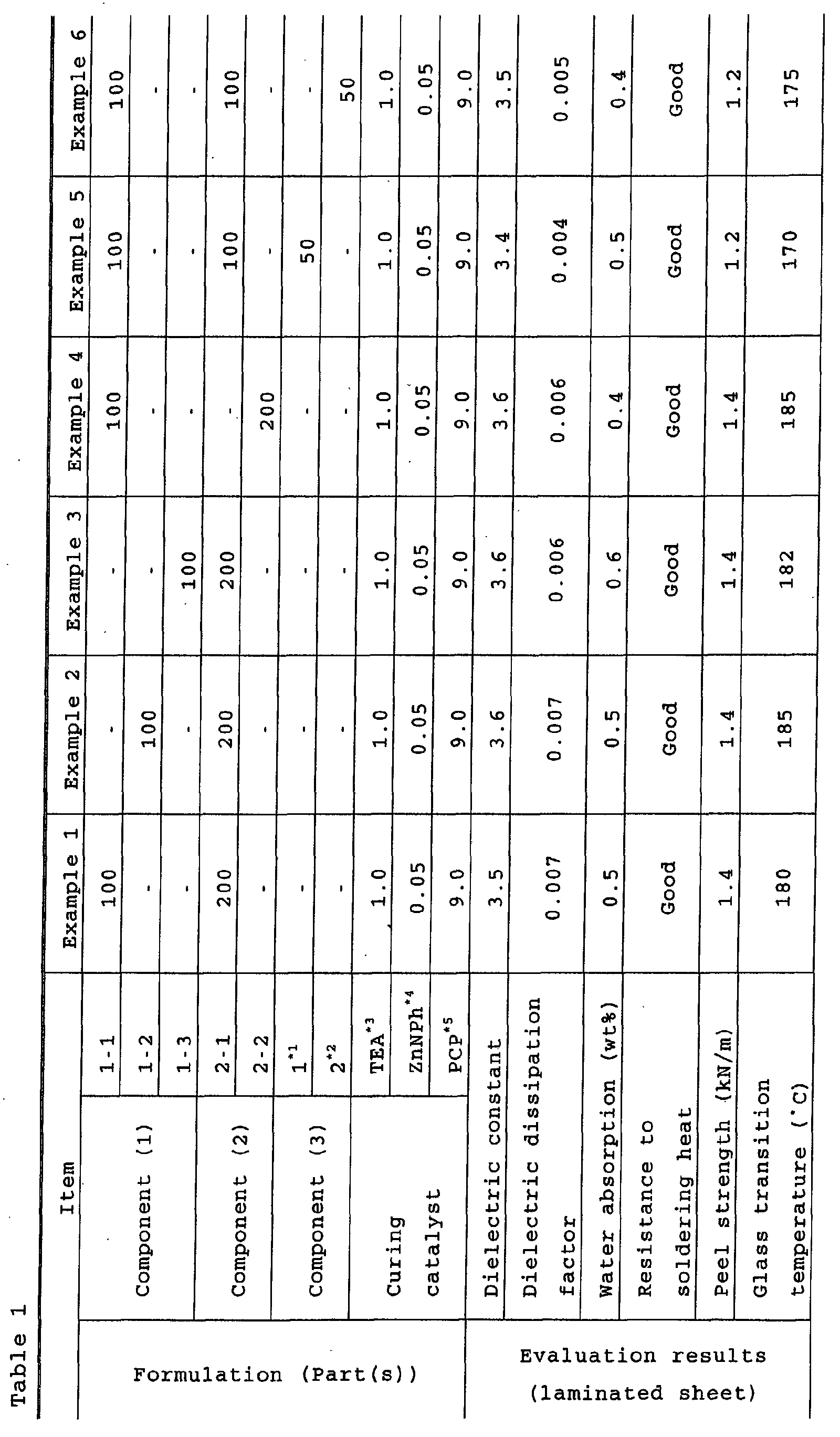
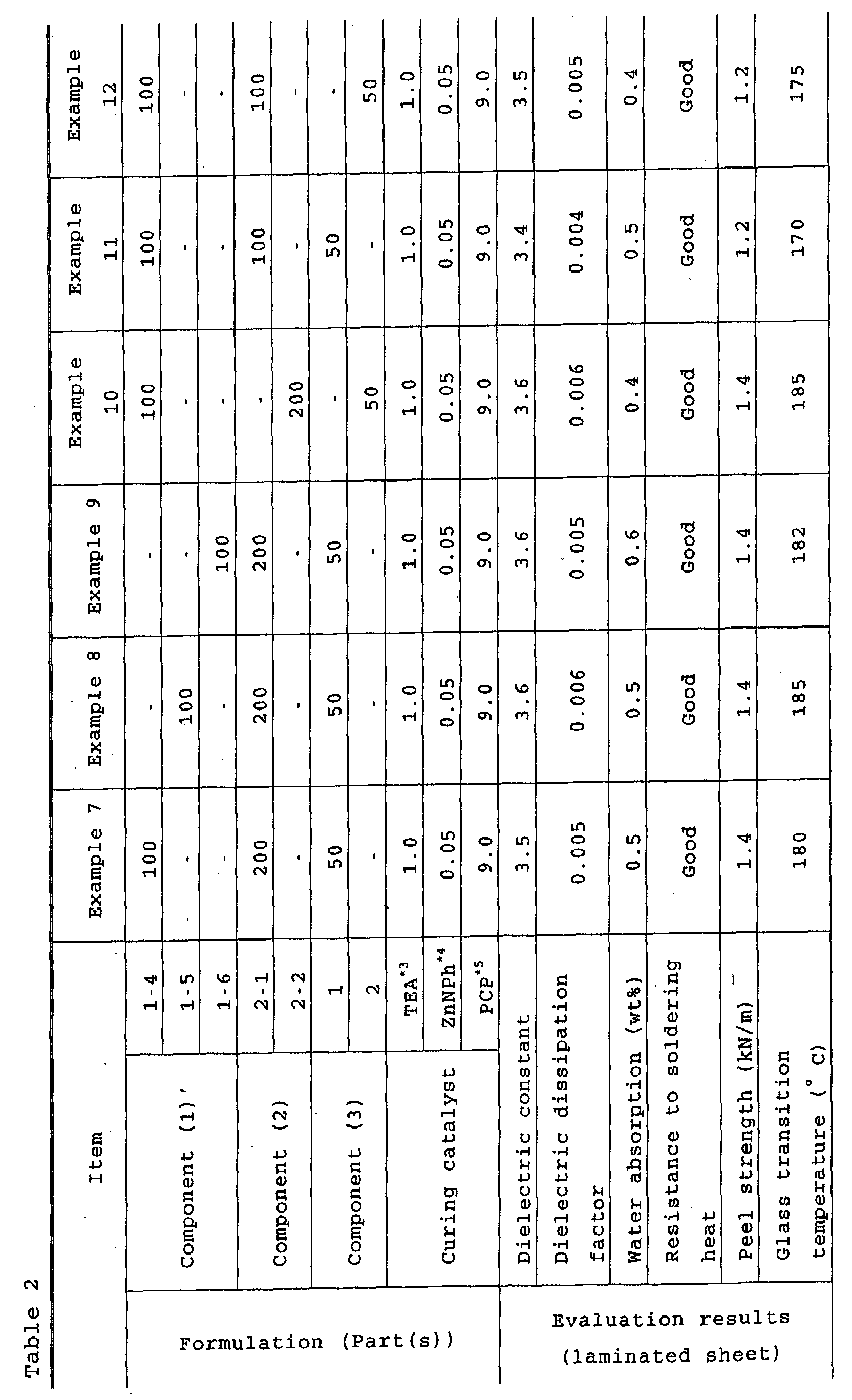


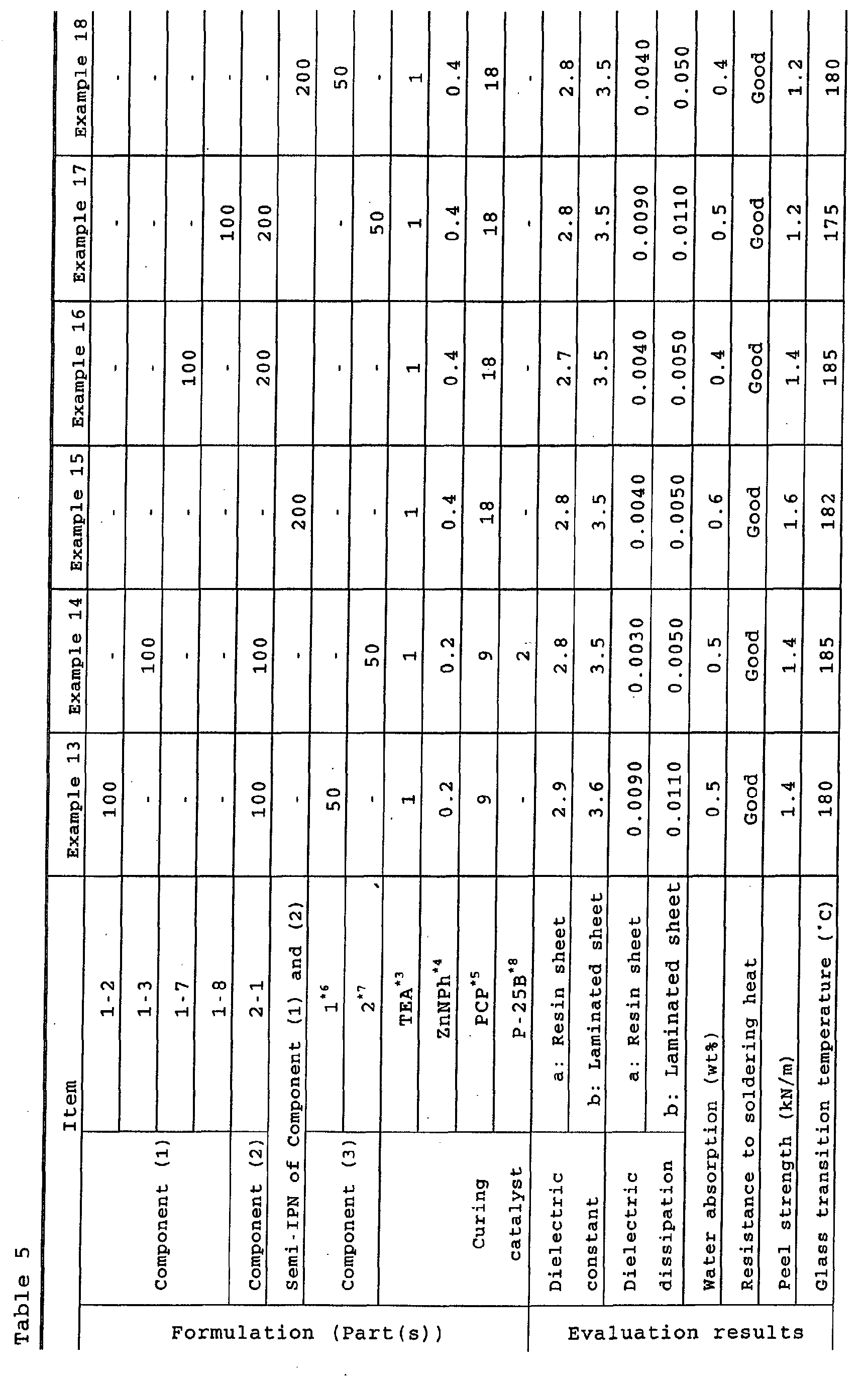

- As is apparent from Tables, Examples of the present invention are excellent in all low dielectric constant, low dielectric dissipation factor, heat resistance, moisture resistance, and adhesion to a copper foil.
- In contrast, Comparative Examples are not satisfactory in all low dielectric constant, low dielectric dissipation factor, heat resistance, moisture resistance, and adhesion to a copper foil.
- The thermosetting resin composition of the present invention is excellent in low dielectric constant, low dielectric dissipation factor, heat resistance, moisture resistance, and adhesion to a copper foil, and the prepreg obtained by impregnating or coating a base material with the above composition and the laminated sheet produced by subjecting the above prepreg to laminate molding are excellent in low dielectric constant, low dielectric dissipation factor, heat resistance, moisture resistance, and adhesion to a copper foil, and therefore they are useful as a printed wiring board for electronic appliance.
Claims (12)
- A thermosetting resin composition comprising:(1) a copolymer resin comprising (a) a monomer unit represented by the following general formula (I):wherein R1 represents a hydrogen atom, a halogen atom, or a hydrocarbon group having 1 to 5 carbon atoms; R2 or each of R2's independently represents a halogen atom, an aliphatic hydrocarbon group having 1 to 5 carbon atoms, or an aromatic hydrocarbon group; x is an integer of 0 to 3; and m is a natural number, and

(b) a monomer unit represented by the following general formula (II):wherein n is a natural number; and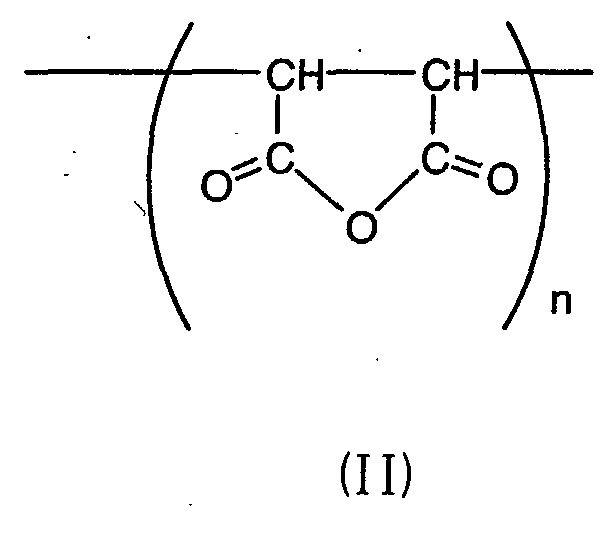 (2) a thermosetting resin which is cured together with said component (1),
wherein a cured product of said composition has a dielectric constant of 3.0 or less at a frequency of 1 GHz or more and has a glass transition temperature of 170°C or more. - The thermosetting resin composition according to Claim 1, wherein said component (2) is (2)' a cyanate resin having two or more cyanate groups per molecule.
- A thermosetting resin composition comprising:(1) a copolymer resin comprising(a) a monomer unit represented by the following general formula (I):wherein R1 represents a hydrogen atom, a halogen atom, or a hydrocarbon group having 1 to 5 carbon atoms; R2 or each of R2's independently represents a halogen atom, an aliphatic hydrocarbon group having 1 to 5 carbon atoms, an aromatic hydrocarbon group, or a hydroxyl group; x is an integer of 0 to 3; and m is a natural number, and
 (b) a monomer unit represented by the following general formula (II):wherein n is a natural number; and
 (2)' a cyanate resin having at least two cyanate groups per molecule.
 - The thermosetting resin composition according to any one of Claims 1 to 3, which comprises 100 parts by weight of said component (1) and 10 to 300 parts by weight of said component (2) or (2)'.
- The thermosetting resin composition according to any one of Claims 1 to 4, wherein the copolymerization ratio m/n between the monomer units in said component (1) is from 0.8 to 19.
- The thermosetting resin composition according to any one of Claims 1 to 5, wherein said x in said component (1) is 0.
- The thermosetting resin composition according to any one of Claims 1 to 6, wherein
the said component (1) is (1)' a copolymer resin comprising a said component (1) according to any one of Claims 1 to 6 and further comprises, as a monomer unit, (c) N-phenylmaleimide represented by the following general formula (III):wherein R3 represents a halogen atom, an aliphatic hydrocarbon group having 1 to 5 carbon atoms, an aromatic hydrocarbon group, a hydroxyl group, a thiol group, or a carboxyl group; y is an integer of 0 to 3; and r is a natural number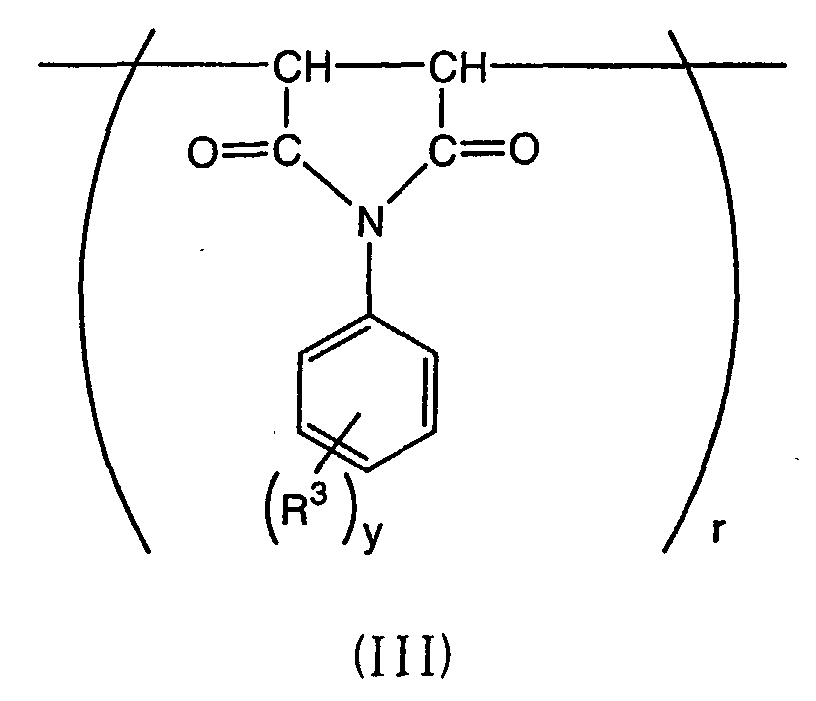
and/or a derivative thereof. - The thermosetting resin composition according to any one of Claims 1 to 7, wherein the copolymerization ratio m/(n+r) between the monomer units in said component (1)' is form 0.8 to 19.
- The thermosetting resin composition according to any one of Claims 1 to 8, wherein the copolymerization ratio n/r between the monomer units in said component (1)' is from 1/49 to 49.
- The thermosetting resin composition according to any one of Claims 1 to 9, further comprising (3) an epoxy resin and/or an isocyanurate compound.
- A prepreg using the thermosetting resin composition according to any one of Claims 1 to 10.
- A laminated sheet formed using the prepreg according to Claim 11 by laminate molding.
Applications Claiming Priority (4)
| Application Number | Priority Date | Filing Date | Title |
|---|---|---|---|
| JP2001022266 | 2001-01-30 | ||
| JP2001022266 | 2001-01-30 | ||
| JP2001040301 | 2001-02-16 | ||
| JP2001040301 | 2001-02-16 |
Publications (2)
| Publication Number | Publication Date |
|---|---|
| EP1229079A1 true EP1229079A1 (en) | 2002-08-07 |
| EP1229079B1 EP1229079B1 (en) | 2004-09-01 |
Family
ID=26608564
Family Applications (1)
| Application Number | Title | Priority Date | Filing Date |
|---|---|---|---|
| EP20020001902 Expired - Lifetime EP1229079B1 (en) | 2001-01-30 | 2002-01-30 | Thermosetting resin composition and use thereof |
Country Status (7)
| Country | Link |
|---|---|
| US (2) | US6667107B2 (en) |
| EP (1) | EP1229079B1 (en) |
| KR (1) | KR100792099B1 (en) |
| CN (2) | CN1289594C (en) |
| AT (1) | ATE275170T1 (en) |
| DE (1) | DE60201097T2 (en) |
| TW (1) | TW583256B (en) |
Cited By (3)
| Publication number | Priority date | Publication date | Assignee | Title |
|---|---|---|---|---|
| WO2013000151A1 (en) * | 2011-06-30 | 2013-01-03 | Dow Global Technologies Llc | Curable compositions |
| EP2597114A1 (en) * | 2011-11-22 | 2013-05-29 | Hitachi Ltd. | Organic-inorganic composite materials containing triazine rings and electrical devices using the same |
| EP2915848A4 (en) * | 2012-10-31 | 2016-05-25 | Shengyi Technology Co Ltd | THERMOSETTING RESIN COMPOSITION AND USES THEREOF |
Families Citing this family (22)
| Publication number | Priority date | Publication date | Assignee | Title |
|---|---|---|---|---|
| KR100792099B1 (en) * | 2001-01-30 | 2008-01-04 | 히다치 가세고교 가부시끼가이샤 | Thermosetting resin composition and uses thereof |
| TWI278481B (en) * | 2002-04-16 | 2007-04-11 | Hitachi Chemical Co Ltd | Thermosetting resin composition, prepreg and laminate using the same |
| US20040101689A1 (en) * | 2002-11-26 | 2004-05-27 | Ludovic Valette | Hardener composition for epoxy resins |
| US20060116492A1 (en) * | 2004-12-01 | 2006-06-01 | 3M Innovative Properties Company | Branched polymer |
| US20060116476A1 (en) * | 2004-12-01 | 2006-06-01 | 3M Innovative Properties Company | Hybrid thermosetting composition |
| DE602008006294D1 (en) * | 2007-03-01 | 2011-06-01 | Prs Mediterranean Ltd | METHOD FOR PRODUCING COMPATIBILIZED POLYMER MIXTURES AND ARTICLES |
| US8600357B2 (en) * | 2007-11-02 | 2013-12-03 | Dustin J. Sterlino | Mass notification system |
| DE102008057240A1 (en) * | 2008-11-10 | 2010-05-12 | Brose Fahrzeugteile Gmbh & Co. Kommanditgesellschaft, Hallstadt | Composition for producing an adjusting device of a motor vehicle |
| CN101602881B (en) * | 2009-05-12 | 2013-01-23 | 东莞联茂电子科技有限公司 | Thermosetting resin composition and application thereof |
| TWI494340B (en) * | 2010-08-02 | 2015-08-01 | Taiwan Union Technology Corp | Epoxy resin composition, and prepreg and printed wiring board using the same |
| US20120129414A1 (en) * | 2010-11-24 | 2012-05-24 | Chung-Hao Chang | Thermosetting resin composition and prepreg or laminate using the same |
| CN102964775B (en) * | 2012-10-16 | 2015-09-16 | 广东生益科技股份有限公司 | A kind of compositions of thermosetting resin and uses thereof |
| TWI478982B (en) * | 2013-03-25 | 2015-04-01 | Elite Materials Co Ltd | Resin composition, the prepreg, the laminate and the printed circuit board using the same |
| CN103436059A (en) * | 2013-08-23 | 2013-12-11 | 江苏中威重工机械有限公司 | Resin composition |
| US20170226275A1 (en) * | 2014-06-26 | 2017-08-10 | Blue Cube Ip Llc | Curable compositions |
| WO2017142094A1 (en) * | 2016-02-19 | 2017-08-24 | 日立化成株式会社 | Adhesive film for multilayer printed wiring boards |
| CN105859942B (en) * | 2016-04-21 | 2018-09-18 | 河南工程学院 | A kind of heat resistant type epoxy resin cure modifying agent and preparation method thereof |
| WO2018031103A1 (en) | 2016-08-11 | 2018-02-15 | Icl-Ip America Inc. | Curable epoxy composition |
| TWI733145B (en) * | 2019-07-24 | 2021-07-11 | 宏泰電工股份有限公司 | Resin composition for printed circuit board, prepreg, metal clad laminate and printed circuit board |
| JP7388235B2 (en) * | 2020-02-20 | 2023-11-29 | 味の素株式会社 | resin composition |
| CN116997627A (en) * | 2021-03-16 | 2023-11-03 | 东洋纺Mc株式会社 | Adhesive composition and adhesive sheet, laminate and printed wiring board containing the same |
| JP2025519526A (en) * | 2022-06-09 | 2025-06-26 | ルブリゾル アドバンスド マテリアルズ, インコーポレイテッド | Coupling Agent |
Citations (2)
| Publication number | Priority date | Publication date | Assignee | Title |
|---|---|---|---|---|
| US4780507A (en) * | 1985-04-09 | 1988-10-25 | Mitsubishi Gas Chemical Co. Inc. | Curable thermosetting cyanate ester composition |
| US5091476A (en) * | 1989-01-11 | 1992-02-25 | The Dow Chemical Company | Cyanate ester resin blends with brominated styrene-containing polymers |
Family Cites Families (4)
| Publication number | Priority date | Publication date | Assignee | Title |
|---|---|---|---|---|
| DE69505410T2 (en) * | 1994-09-08 | 1999-05-20 | Akzo Nobel N.V., Arnheim/Arnhem | COMPOSITIONS CONTAINING ALLYL GROUPS OF EPOXY RESIN AND THE COPOLYMER OF AN ETHYLENICALLY UNSATURATED ANHYDRID AND A VINYL COMPOUND |
| EP0935628B1 (en) * | 1996-10-29 | 2001-12-05 | Isola Laminate Systems Corporation | Copolymer of styrene and maleic anhydride comprising an epoxy resin composition and a co-cross-linking agent |
| US6387990B1 (en) * | 1999-09-10 | 2002-05-14 | General Electric Company | Curable epoxy resin compositions with brominated triazine flame retardants |
| KR100792099B1 (en) * | 2001-01-30 | 2008-01-04 | 히다치 가세고교 가부시끼가이샤 | Thermosetting resin composition and uses thereof |
-
2002
- 2002-01-29 KR KR1020020005183A patent/KR100792099B1/en not_active Expired - Fee Related
- 2002-01-30 CN CNB02103317XA patent/CN1289594C/en not_active Expired - Fee Related
- 2002-01-30 CN CNB2005100638920A patent/CN100341934C/en not_active Expired - Fee Related
- 2002-01-30 TW TW91101524A patent/TW583256B/en active
- 2002-01-30 EP EP20020001902 patent/EP1229079B1/en not_active Expired - Lifetime
- 2002-01-30 US US10/058,919 patent/US6667107B2/en not_active Expired - Fee Related
- 2002-01-30 AT AT02001902T patent/ATE275170T1/en active
- 2002-01-30 DE DE2002601097 patent/DE60201097T2/en not_active Expired - Lifetime
-
2003
- 2003-10-31 US US10/697,116 patent/US7078106B2/en not_active Expired - Fee Related
Patent Citations (2)
| Publication number | Priority date | Publication date | Assignee | Title |
|---|---|---|---|---|
| US4780507A (en) * | 1985-04-09 | 1988-10-25 | Mitsubishi Gas Chemical Co. Inc. | Curable thermosetting cyanate ester composition |
| US5091476A (en) * | 1989-01-11 | 1992-02-25 | The Dow Chemical Company | Cyanate ester resin blends with brominated styrene-containing polymers |
Cited By (4)
| Publication number | Priority date | Publication date | Assignee | Title |
|---|---|---|---|---|
| WO2013000151A1 (en) * | 2011-06-30 | 2013-01-03 | Dow Global Technologies Llc | Curable compositions |
| EP2597114A1 (en) * | 2011-11-22 | 2013-05-29 | Hitachi Ltd. | Organic-inorganic composite materials containing triazine rings and electrical devices using the same |
| US9090796B2 (en) | 2011-11-22 | 2015-07-28 | Hitachi, Ltd. | Organic-inorganic composite materials containing triazine rings and electrical devices using the same |
| EP2915848A4 (en) * | 2012-10-31 | 2016-05-25 | Shengyi Technology Co Ltd | THERMOSETTING RESIN COMPOSITION AND USES THEREOF |
Also Published As
| Publication number | Publication date |
|---|---|
| DE60201097T2 (en) | 2005-09-01 |
| DE60201097D1 (en) | 2004-10-07 |
| CN1673269A (en) | 2005-09-28 |
| ATE275170T1 (en) | 2004-09-15 |
| EP1229079B1 (en) | 2004-09-01 |
| US20020147277A1 (en) | 2002-10-10 |
| US7078106B2 (en) | 2006-07-18 |
| US6667107B2 (en) | 2003-12-23 |
| CN1289594C (en) | 2006-12-13 |
| US20040091726A1 (en) | 2004-05-13 |
| KR100792099B1 (en) | 2008-01-04 |
| CN100341934C (en) | 2007-10-10 |
| KR20020063828A (en) | 2002-08-05 |
| CN1369521A (en) | 2002-09-18 |
| TW583256B (en) | 2004-04-11 |
Similar Documents
| Publication | Publication Date | Title |
|---|---|---|
| EP1229079B1 (en) | Thermosetting resin composition and use thereof | |
| US7208539B2 (en) | Thermosetting resin composition, and prepreg and laminated board using the same | |
| KR101398731B1 (en) | Thermosetting resin composition and prepreg and laminate obtained with the same | |
| JP5320699B2 (en) | Thermosetting resin composition, prepreg and laminate using the same | |
| KR20140133892A (en) | Method for producing curing agent having acidic substituent and unsaturated maleimide group, thermosetting resin composition, prepreg, and laminate | |
| JP5023877B2 (en) | Flame retardant resin compound, thermosetting resin composition using the same, prepreg and laminate | |
| JP2005248147A (en) | Thermosetting resin composition, and prepreg, metal-laminated lamination plate and printed wire board using the same | |
| JP4055424B2 (en) | Thermosetting resin composition and use thereof | |
| JP5736944B2 (en) | Thermosetting resin composition, prepreg and laminate | |
| JP5266685B2 (en) | Thermosetting resin composition, prepreg and laminate using the same | |
| JP6977241B2 (en) | Thermosetting resin composition, prepreg, laminated board and printed wiring board | |
| JP2004307761A (en) | Thermosetting resin composition, and prepreg, metal-clad laminate and printed wiring board all using the same | |
| JP2008133353A (en) | Thermosetting resin composition, and prepreg and laminate using the resin composition | |
| JPH1160692A (en) | Resin composition for printed wiring board and printed wiring board using the same | |
| JP3261061B2 (en) | Resin composition for laminate, prepreg and laminate using the composition | |
| JP5028971B2 (en) | (Modified) Guanamine compound solution, thermosetting resin composition, and prepreg and laminate using the same | |
| TWI884048B (en) | Resin composition and its products | |
| JP2009155654A (en) | Thermosetting resin composition, and prepreg, metal-clad laminate, and printed wiring board, using the same | |
| HK1169428A (en) | Thermosetting resin composition and prepreg and laminate obtained with the same | |
| HK1131176B (en) | Thermosetting resin composition and prepreg and laminate obtained with the same | |
| HK1134312A1 (en) | Resin composition, prepreg and laminate using the same | |
| HK1151548A1 (en) | Thermosetting resin composition and prepreg and laminate both made with the same |
Legal Events
| Date | Code | Title | Description |
|---|---|---|---|
| PUAI | Public reference made under article 153(3) epc to a published international application that has entered the european phase |
Free format text: ORIGINAL CODE: 0009012 |
|
| AK | Designated contracting states |
Kind code of ref document: A1 Designated state(s): AT BE CH CY DE DK ES FI FR GB GR IE IT LI LU MC NL PT SE TR |
|
| AX | Request for extension of the european patent |
Free format text: AL;LT;LV;MK;RO;SI |
|
| 17P | Request for examination filed |
Effective date: 20021211 |
|
| 17Q | First examination report despatched |
Effective date: 20030313 |
|
| AKX | Designation fees paid |
Designated state(s): AT DE GB |
|
| GRAP | Despatch of communication of intention to grant a patent |
Free format text: ORIGINAL CODE: EPIDOSNIGR1 |
|
| GRAS | Grant fee paid |
Free format text: ORIGINAL CODE: EPIDOSNIGR3 |
|
| GRAA | (expected) grant |
Free format text: ORIGINAL CODE: 0009210 |
|
| AK | Designated contracting states |
Kind code of ref document: B1 Designated state(s): AT DE GB |
|
| REG | Reference to a national code |
Ref country code: GB Ref legal event code: FG4D |
|
| REG | Reference to a national code |
Ref country code: IE Ref legal event code: FG4D |
|
| REF | Corresponds to: |
Ref document number: 60201097 Country of ref document: DE Date of ref document: 20041007 Kind code of ref document: P |
|
| PLBE | No opposition filed within time limit |
Free format text: ORIGINAL CODE: 0009261 |
|
| STAA | Information on the status of an ep patent application or granted ep patent |
Free format text: STATUS: NO OPPOSITION FILED WITHIN TIME LIMIT |
|
| 26N | No opposition filed |
Effective date: 20050602 |
|
| PGFP | Annual fee paid to national office [announced via postgrant information from national office to epo] |
Ref country code: GB Payment date: 20100202 Year of fee payment: 9 |
|
| GBPC | Gb: european patent ceased through non-payment of renewal fee |
Effective date: 20110130 |
|
| PG25 | Lapsed in a contracting state [announced via postgrant information from national office to epo] |
Ref country code: GB Free format text: LAPSE BECAUSE OF NON-PAYMENT OF DUE FEES Effective date: 20110130 |
|
| PGFP | Annual fee paid to national office [announced via postgrant information from national office to epo] |
Ref country code: AT Payment date: 20130111 Year of fee payment: 12 |
|
| PGFP | Annual fee paid to national office [announced via postgrant information from national office to epo] |
Ref country code: DE Payment date: 20140122 Year of fee payment: 13 |
|
| REG | Reference to a national code |
Ref country code: AT Ref legal event code: MM01 Ref document number: 275170 Country of ref document: AT Kind code of ref document: T Effective date: 20140130 |
|
| PG25 | Lapsed in a contracting state [announced via postgrant information from national office to epo] |
Ref country code: AT Free format text: LAPSE BECAUSE OF NON-PAYMENT OF DUE FEES Effective date: 20140130 |
|
| REG | Reference to a national code |
Ref country code: DE Ref legal event code: R119 Ref document number: 60201097 Country of ref document: DE |
|
| PG25 | Lapsed in a contracting state [announced via postgrant information from national office to epo] |
Ref country code: DE Free format text: LAPSE BECAUSE OF NON-PAYMENT OF DUE FEES Effective date: 20150801 |