EP1229001A1 - Synthesis of zeolites - Google Patents
Synthesis of zeolites Download PDFInfo
- Publication number
- EP1229001A1 EP1229001A1 EP00938828A EP00938828A EP1229001A1 EP 1229001 A1 EP1229001 A1 EP 1229001A1 EP 00938828 A EP00938828 A EP 00938828A EP 00938828 A EP00938828 A EP 00938828A EP 1229001 A1 EP1229001 A1 EP 1229001A1
- Authority
- EP
- European Patent Office
- Prior art keywords
- synthesis
- fewer
- zeolites
- alkyl
- source
- Prior art date
- Legal status (The legal status is an assumption and is not a legal conclusion. Google has not performed a legal analysis and makes no representation as to the accuracy of the status listed.)
- Withdrawn
Links
- 230000015572 biosynthetic process Effects 0.000 title claims abstract description 104
- 239000010457 zeolite Substances 0.000 title claims abstract description 101
- 238000003786 synthesis reaction Methods 0.000 title claims abstract description 92
- 239000004094 surface-active agent Substances 0.000 claims abstract description 86
- 238000000034 method Methods 0.000 claims abstract description 53
- HNPSIPDUKPIQMN-UHFFFAOYSA-N dioxosilane;oxo(oxoalumanyloxy)alumane Chemical compound O=[Si]=O.O=[Al]O[Al]=O HNPSIPDUKPIQMN-UHFFFAOYSA-N 0.000 claims abstract description 42
- 229910021536 Zeolite Inorganic materials 0.000 claims abstract description 41
- 230000007935 neutral effect Effects 0.000 claims abstract description 28
- 125000000129 anionic group Chemical group 0.000 claims abstract description 19
- 125000002091 cationic group Chemical group 0.000 claims abstract description 16
- 239000011541 reaction mixture Substances 0.000 claims abstract description 12
- 239000013078 crystal Substances 0.000 claims abstract description 10
- 238000002425 crystallisation Methods 0.000 claims description 41
- 239000000203 mixture Substances 0.000 claims description 36
- 125000000217 alkyl group Chemical group 0.000 claims description 34
- 125000003118 aryl group Chemical group 0.000 claims description 34
- -1 polyethylene Polymers 0.000 claims description 34
- XLYOFNOQVPJJNP-UHFFFAOYSA-N water Substances O XLYOFNOQVPJJNP-UHFFFAOYSA-N 0.000 claims description 30
- IJGRMHOSHXDMSA-UHFFFAOYSA-N nitrogen Substances N#N IJGRMHOSHXDMSA-UHFFFAOYSA-N 0.000 claims description 27
- OAICVXFJPJFONN-UHFFFAOYSA-N Phosphorus Chemical group [P] OAICVXFJPJFONN-UHFFFAOYSA-N 0.000 claims description 23
- 125000004432 carbon atom Chemical group C* 0.000 claims description 23
- 229910052698 phosphorus Chemical group 0.000 claims description 23
- 239000011574 phosphorus Chemical group 0.000 claims description 23
- 229910052757 nitrogen Inorganic materials 0.000 claims description 21
- 239000003795 chemical substances by application Substances 0.000 claims description 17
- 229910052739 hydrogen Inorganic materials 0.000 claims description 15
- 239000001257 hydrogen Substances 0.000 claims description 15
- 125000004435 hydrogen atom Chemical group [H]* 0.000 claims description 15
- QJGQUHMNIGDVPM-UHFFFAOYSA-N nitrogen group Chemical group [N] QJGQUHMNIGDVPM-UHFFFAOYSA-N 0.000 claims description 15
- 238000010899 nucleation Methods 0.000 claims description 14
- 230000006911 nucleation Effects 0.000 claims description 14
- 238000002360 preparation method Methods 0.000 claims description 13
- 150000002892 organic cations Chemical class 0.000 claims description 11
- 229910052782 aluminium Inorganic materials 0.000 claims description 10
- 238000006243 chemical reaction Methods 0.000 claims description 10
- 239000004698 Polyethylene Substances 0.000 claims description 8
- 229920001577 copolymer Polymers 0.000 claims description 8
- 150000002222 fluorine compounds Chemical class 0.000 claims description 8
- 229920000573 polyethylene Polymers 0.000 claims description 8
- 150000001298 alcohols Chemical class 0.000 claims description 7
- 150000001767 cationic compounds Chemical class 0.000 claims description 7
- 239000003093 cationic surfactant Substances 0.000 claims description 7
- 229910001411 inorganic cation Inorganic materials 0.000 claims description 7
- 150000003839 salts Chemical class 0.000 claims description 7
- 229910052710 silicon Inorganic materials 0.000 claims description 7
- 229910052719 titanium Inorganic materials 0.000 claims description 7
- 150000002576 ketones Chemical class 0.000 claims description 6
- 150000001335 aliphatic alkanes Chemical class 0.000 claims description 5
- 150000001336 alkenes Chemical class 0.000 claims description 5
- 150000001412 amines Chemical class 0.000 claims description 5
- 238000004517 catalytic hydrocracking Methods 0.000 claims description 5
- 150000004679 hydroxides Chemical class 0.000 claims description 5
- 238000007254 oxidation reaction Methods 0.000 claims description 5
- QAOWNCQODCNURD-UHFFFAOYSA-L sulfate group Chemical group S(=O)(=O)([O-])[O-] QAOWNCQODCNURD-UHFFFAOYSA-L 0.000 claims description 5
- 229910021653 sulphate ion Inorganic materials 0.000 claims description 5
- 229910052784 alkaline earth metal Inorganic materials 0.000 claims description 4
- 150000001342 alkaline earth metals Chemical class 0.000 claims description 4
- 238000005804 alkylation reaction Methods 0.000 claims description 4
- 229910052796 boron Inorganic materials 0.000 claims description 4
- 229910052804 chromium Inorganic materials 0.000 claims description 4
- 229910001657 ferrierite group Inorganic materials 0.000 claims description 4
- 229910052733 gallium Inorganic materials 0.000 claims description 4
- 229910052732 germanium Inorganic materials 0.000 claims description 4
- 150000002500 ions Chemical class 0.000 claims description 4
- 229910052742 iron Inorganic materials 0.000 claims description 4
- 238000006317 isomerization reaction Methods 0.000 claims description 4
- 150000002902 organometallic compounds Chemical class 0.000 claims description 4
- 125000002467 phosphate group Chemical group [H]OP(=O)(O[H])O[*] 0.000 claims description 4
- 229910052718 tin Inorganic materials 0.000 claims description 4
- 229910052726 zirconium Inorganic materials 0.000 claims description 4
- 125000004429 atom Chemical group 0.000 claims 12
- OKTJSMMVPCPJKN-UHFFFAOYSA-N Carbon Chemical compound [C] OKTJSMMVPCPJKN-UHFFFAOYSA-N 0.000 claims 6
- KRHYYFGTRYWZRS-UHFFFAOYSA-N Fluorane Chemical compound F KRHYYFGTRYWZRS-UHFFFAOYSA-N 0.000 claims 6
- 229910052799 carbon Inorganic materials 0.000 claims 6
- DDFHBQSCUXNBSA-UHFFFAOYSA-N 5-(5-carboxythiophen-2-yl)thiophene-2-carboxylic acid Chemical compound S1C(C(=O)O)=CC=C1C1=CC=C(C(O)=O)S1 DDFHBQSCUXNBSA-UHFFFAOYSA-N 0.000 claims 3
- ULUAUXLGCMPNKK-UHFFFAOYSA-N Sulfobutanedioic acid Chemical group OC(=O)CC(C(O)=O)S(O)(=O)=O ULUAUXLGCMPNKK-UHFFFAOYSA-N 0.000 claims 3
- 238000007171 acid catalysis Methods 0.000 claims 3
- 230000029936 alkylation Effects 0.000 claims 3
- 238000005336 cracking Methods 0.000 claims 3
- FBELJLCOAHMRJK-UHFFFAOYSA-L disodium;2,2-bis(2-ethylhexyl)-3-sulfobutanedioate Chemical compound [Na+].[Na+].CCCCC(CC)CC(C([O-])=O)(C(C([O-])=O)S(O)(=O)=O)CC(CC)CCCC FBELJLCOAHMRJK-UHFFFAOYSA-L 0.000 claims 3
- 229930195733 hydrocarbon Natural products 0.000 claims 3
- 150000002430 hydrocarbons Chemical class 0.000 claims 3
- 230000033444 hydroxylation Effects 0.000 claims 3
- 238000005805 hydroxylation reaction Methods 0.000 claims 3
- 230000003647 oxidation Effects 0.000 claims 3
- 150000003573 thiols Chemical class 0.000 claims 3
- 238000010555 transalkylation reaction Methods 0.000 claims 3
- 239000012013 faujasite Substances 0.000 claims 1
- 229910052680 mordenite Inorganic materials 0.000 claims 1
- VYPSYNLAJGMNEJ-UHFFFAOYSA-N Silicium dioxide Chemical compound O=[Si]=O VYPSYNLAJGMNEJ-UHFFFAOYSA-N 0.000 abstract description 35
- 239000000463 material Substances 0.000 abstract description 20
- 239000000377 silicon dioxide Substances 0.000 abstract description 13
- 238000001308 synthesis method Methods 0.000 abstract description 6
- 239000003153 chemical reaction reagent Substances 0.000 abstract description 5
- 239000011148 porous material Substances 0.000 abstract description 2
- 239000012229 microporous material Substances 0.000 abstract 2
- 230000008570 general process Effects 0.000 abstract 1
- 239000000499 gel Substances 0.000 description 43
- 239000007787 solid Substances 0.000 description 25
- LZZYPRNAOMGNLH-UHFFFAOYSA-M Cetrimonium bromide Chemical compound [Br-].CCCCCCCCCCCCCCCC[N+](C)(C)C LZZYPRNAOMGNLH-UHFFFAOYSA-M 0.000 description 20
- 238000002474 experimental method Methods 0.000 description 19
- 238000010438 heat treatment Methods 0.000 description 17
- 239000010936 titanium Substances 0.000 description 10
- XAGFODPZIPBFFR-UHFFFAOYSA-N aluminium Chemical compound [Al] XAGFODPZIPBFFR-UHFFFAOYSA-N 0.000 description 9
- PNEYBMLMFCGWSK-UHFFFAOYSA-N aluminium oxide Inorganic materials [O-2].[O-2].[O-2].[Al+3].[Al+3] PNEYBMLMFCGWSK-UHFFFAOYSA-N 0.000 description 9
- 239000002609 medium Substances 0.000 description 9
- 239000000243 solution Substances 0.000 description 9
- 229910052681 coesite Inorganic materials 0.000 description 8
- 229910052906 cristobalite Inorganic materials 0.000 description 8
- 230000000694 effects Effects 0.000 description 8
- 238000003756 stirring Methods 0.000 description 8
- 229910052682 stishovite Inorganic materials 0.000 description 8
- 229910052905 tridymite Inorganic materials 0.000 description 8
- 229910052593 corundum Inorganic materials 0.000 description 7
- 238000010586 diagram Methods 0.000 description 7
- 229910001845 yogo sapphire Inorganic materials 0.000 description 7
- 239000012153 distilled water Substances 0.000 description 6
- 238000010348 incorporation Methods 0.000 description 6
- 229940073455 tetraethylammonium hydroxide Drugs 0.000 description 6
- LRGJRHZIDJQFCL-UHFFFAOYSA-M tetraethylazanium;hydroxide Chemical compound [OH-].CC[N+](CC)(CC)CC LRGJRHZIDJQFCL-UHFFFAOYSA-M 0.000 description 6
- XUIMIQQOPSSXEZ-UHFFFAOYSA-N Silicon Chemical compound [Si] XUIMIQQOPSSXEZ-UHFFFAOYSA-N 0.000 description 5
- 239000003054 catalyst Substances 0.000 description 5
- 238000001035 drying Methods 0.000 description 5
- 238000001914 filtration Methods 0.000 description 5
- 239000010703 silicon Substances 0.000 description 5
- 238000005406 washing Methods 0.000 description 5
- GWEVSGVZZGPLCZ-UHFFFAOYSA-N Titan oxide Chemical compound O=[Ti]=O GWEVSGVZZGPLCZ-UHFFFAOYSA-N 0.000 description 4
- POULHZVOKOAJMA-UHFFFAOYSA-N dodecanoic acid Chemical compound CCCCCCCCCCCC(O)=O POULHZVOKOAJMA-UHFFFAOYSA-N 0.000 description 4
- WGTYBPLFGIVFAS-UHFFFAOYSA-M tetramethylammonium hydroxide Chemical compound [OH-].C[N+](C)(C)C WGTYBPLFGIVFAS-UHFFFAOYSA-M 0.000 description 4
- JMXKSZRRTHPKDL-UHFFFAOYSA-N titanium ethoxide Chemical compound [Ti+4].CC[O-].CC[O-].CC[O-].CC[O-] JMXKSZRRTHPKDL-UHFFFAOYSA-N 0.000 description 4
- 229910002016 Aerosil® 200 Inorganic materials 0.000 description 3
- HEMHJVSKTPXQMS-UHFFFAOYSA-M Sodium hydroxide Chemical compound [OH-].[Na+] HEMHJVSKTPXQMS-UHFFFAOYSA-M 0.000 description 3
- RTAQQCXQSZGOHL-UHFFFAOYSA-N Titanium Chemical compound [Ti] RTAQQCXQSZGOHL-UHFFFAOYSA-N 0.000 description 3
- 239000013504 Triton X-100 Substances 0.000 description 3
- 229920004890 Triton X-100 Polymers 0.000 description 3
- 239000002253 acid Substances 0.000 description 3
- 125000001424 substituent group Chemical group 0.000 description 3
- FTVFPPFZRRKJIH-UHFFFAOYSA-N 2,2,6,6-tetramethylpiperidin-4-amine Chemical compound CC1(C)CC(N)CC(C)(C)N1 FTVFPPFZRRKJIH-UHFFFAOYSA-N 0.000 description 2
- LFQSCWFLJHTTHZ-UHFFFAOYSA-N Ethanol Chemical compound CCO LFQSCWFLJHTTHZ-UHFFFAOYSA-N 0.000 description 2
- KRHYYFGTRYWZRS-UHFFFAOYSA-M Fluoride anion Chemical compound [F-] KRHYYFGTRYWZRS-UHFFFAOYSA-M 0.000 description 2
- 239000003945 anionic surfactant Substances 0.000 description 2
- 239000007864 aqueous solution Substances 0.000 description 2
- 150000001491 aromatic compounds Chemical class 0.000 description 2
- ZSIQJIWKELUFRJ-UHFFFAOYSA-N azepane Chemical compound C1CCCNCC1 ZSIQJIWKELUFRJ-UHFFFAOYSA-N 0.000 description 2
- 239000008119 colloidal silica Substances 0.000 description 2
- 150000001875 compounds Chemical class 0.000 description 2
- 230000007547 defect Effects 0.000 description 2
- 238000009826 distribution Methods 0.000 description 2
- 230000007062 hydrolysis Effects 0.000 description 2
- 238000006460 hydrolysis reaction Methods 0.000 description 2
- XLYOFNOQVPJJNP-UHFFFAOYSA-M hydroxide Chemical compound [OH-] XLYOFNOQVPJJNP-UHFFFAOYSA-M 0.000 description 2
- FAHBNUUHRFUEAI-UHFFFAOYSA-M hydroxidooxidoaluminium Chemical compound O[Al]=O FAHBNUUHRFUEAI-UHFFFAOYSA-M 0.000 description 2
- 239000012535 impurity Substances 0.000 description 2
- 235000015097 nutrients Nutrition 0.000 description 2
- 150000002978 peroxides Chemical class 0.000 description 2
- 229920000642 polymer Polymers 0.000 description 2
- 239000002243 precursor Substances 0.000 description 2
- 229910052665 sodalite Inorganic materials 0.000 description 2
- 230000003068 static effect Effects 0.000 description 2
- OGIDPMRJRNCKJF-UHFFFAOYSA-N titanium oxide Inorganic materials [Ti]=O OGIDPMRJRNCKJF-UHFFFAOYSA-N 0.000 description 2
- JNYAEWCLZODPBN-JGWLITMVSA-N (2r,3r,4s)-2-[(1r)-1,2-dihydroxyethyl]oxolane-3,4-diol Chemical compound OC[C@@H](O)[C@H]1OC[C@H](O)[C@H]1O JNYAEWCLZODPBN-JGWLITMVSA-N 0.000 description 1
- POILWHVDKZOXJZ-ARJAWSKDSA-M (z)-4-oxopent-2-en-2-olate Chemical compound C\C([O-])=C\C(C)=O POILWHVDKZOXJZ-ARJAWSKDSA-M 0.000 description 1
- FJLUATLTXUNBOT-UHFFFAOYSA-N 1-Hexadecylamine Chemical compound CCCCCCCCCCCCCCCCN FJLUATLTXUNBOT-UHFFFAOYSA-N 0.000 description 1
- IDOQDZANRZQBTP-UHFFFAOYSA-N 2-[2-(2,4,4-trimethylpentan-2-yl)phenoxy]ethanol Chemical compound CC(C)(C)CC(C)(C)C1=CC=CC=C1OCCO IDOQDZANRZQBTP-UHFFFAOYSA-N 0.000 description 1
- HUVAFPHSQFFCID-UHFFFAOYSA-N 5-chlorocyclopenta-1,3-diene titanium(2+) Chemical compound [Ti++].Cl[c-]1cccc1.Cl[c-]1cccc1 HUVAFPHSQFFCID-UHFFFAOYSA-N 0.000 description 1
- QGZKDVFQNNGYKY-UHFFFAOYSA-O Ammonium Chemical compound [NH4+] QGZKDVFQNNGYKY-UHFFFAOYSA-O 0.000 description 1
- BVKZGUZCCUSVTD-UHFFFAOYSA-L Carbonate Chemical compound [O-]C([O-])=O BVKZGUZCCUSVTD-UHFFFAOYSA-L 0.000 description 1
- DGAQECJNVWCQMB-PUAWFVPOSA-M Ilexoside XXIX Chemical compound C[C@@H]1CC[C@@]2(CC[C@@]3(C(=CC[C@H]4[C@]3(CC[C@@H]5[C@@]4(CC[C@@H](C5(C)C)OS(=O)(=O)[O-])C)C)[C@@H]2[C@]1(C)O)C)C(=O)O[C@H]6[C@@H]([C@H]([C@@H]([C@H](O6)CO)O)O)O.[Na+] DGAQECJNVWCQMB-PUAWFVPOSA-M 0.000 description 1
- 239000005639 Lauric acid Substances 0.000 description 1
- 229910002651 NO3 Inorganic materials 0.000 description 1
- NHNBFGGVMKEFGY-UHFFFAOYSA-N Nitrate Chemical compound [O-][N+]([O-])=O NHNBFGGVMKEFGY-UHFFFAOYSA-N 0.000 description 1
- BPQQTUXANYXVAA-UHFFFAOYSA-N Orthosilicate Chemical compound [O-][Si]([O-])([O-])[O-] BPQQTUXANYXVAA-UHFFFAOYSA-N 0.000 description 1
- 239000004743 Polypropylene Substances 0.000 description 1
- 239000004372 Polyvinyl alcohol Substances 0.000 description 1
- 239000004115 Sodium Silicate Substances 0.000 description 1
- 235000021355 Stearic acid Nutrition 0.000 description 1
- 229920002359 Tetronic® Polymers 0.000 description 1
- 229920004929 Triton X-114 Polymers 0.000 description 1
- 238000002441 X-ray diffraction Methods 0.000 description 1
- 150000003973 alkyl amines Chemical group 0.000 description 1
- 229940024548 aluminum oxide Drugs 0.000 description 1
- ANBBXQWFNXMHLD-UHFFFAOYSA-N aluminum;sodium;oxygen(2-) Chemical compound [O-2].[O-2].[Na+].[Al+3] ANBBXQWFNXMHLD-UHFFFAOYSA-N 0.000 description 1
- 150000001413 amino acids Chemical class 0.000 description 1
- LDDQLRUQCUTJBB-UHFFFAOYSA-N ammonium fluoride Chemical compound [NH4+].[F-] LDDQLRUQCUTJBB-UHFFFAOYSA-N 0.000 description 1
- 239000012736 aqueous medium Substances 0.000 description 1
- 238000004523 catalytic cracking Methods 0.000 description 1
- 230000003197 catalytic effect Effects 0.000 description 1
- 150000001768 cations Chemical class 0.000 description 1
- NEUSVAOJNUQRTM-UHFFFAOYSA-N cetylpyridinium Chemical compound CCCCCCCCCCCCCCCC[N+]1=CC=CC=C1 NEUSVAOJNUQRTM-UHFFFAOYSA-N 0.000 description 1
- 229960004830 cetylpyridinium Drugs 0.000 description 1
- RLGQACBPNDBWTB-UHFFFAOYSA-N cetyltrimethylammonium ion Chemical compound CCCCCCCCCCCCCCCC[N+](C)(C)C RLGQACBPNDBWTB-UHFFFAOYSA-N 0.000 description 1
- 230000000052 comparative effect Effects 0.000 description 1
- 230000001143 conditioned effect Effects 0.000 description 1
- 150000001923 cyclic compounds Chemical class 0.000 description 1
- 230000007423 decrease Effects 0.000 description 1
- 235000014113 dietary fatty acids Nutrition 0.000 description 1
- ZBCBWPMODOFKDW-UHFFFAOYSA-N diethanolamine Chemical compound OCCNCCO ZBCBWPMODOFKDW-UHFFFAOYSA-N 0.000 description 1
- 150000002009 diols Chemical class 0.000 description 1
- MOTZDAYCYVMXPC-UHFFFAOYSA-N dodecyl hydrogen sulfate Chemical compound CCCCCCCCCCCCOS(O)(=O)=O MOTZDAYCYVMXPC-UHFFFAOYSA-N 0.000 description 1
- JRBPAEWTRLWTQC-UHFFFAOYSA-N dodecylamine Chemical compound CCCCCCCCCCCCN JRBPAEWTRLWTQC-UHFFFAOYSA-N 0.000 description 1
- 125000003700 epoxy group Chemical group 0.000 description 1
- 150000002148 esters Chemical class 0.000 description 1
- 239000000194 fatty acid Substances 0.000 description 1
- 229930195729 fatty acid Natural products 0.000 description 1
- 150000004665 fatty acids Chemical class 0.000 description 1
- 239000012530 fluid Substances 0.000 description 1
- 238000001879 gelation Methods 0.000 description 1
- 238000000227 grinding Methods 0.000 description 1
- 150000004820 halides Chemical class 0.000 description 1
- TXPMUPUOSOZCCS-UHFFFAOYSA-N hexadecyl(trimethyl)phosphanium Chemical compound CCCCCCCCCCCCCCCC[P+](C)(C)C TXPMUPUOSOZCCS-UHFFFAOYSA-N 0.000 description 1
- 238000000265 homogenisation Methods 0.000 description 1
- 230000002209 hydrophobic effect Effects 0.000 description 1
- 125000002887 hydroxy group Chemical group [H]O* 0.000 description 1
- 229910017053 inorganic salt Inorganic materials 0.000 description 1
- 238000004519 manufacturing process Methods 0.000 description 1
- 229910052751 metal Inorganic materials 0.000 description 1
- 239000002184 metal Substances 0.000 description 1
- 150000002739 metals Chemical class 0.000 description 1
- 239000013081 microcrystal Substances 0.000 description 1
- QIQXTHQIDYTFRH-UHFFFAOYSA-N octadecanoic acid Chemical compound CCCCCCCCCCCCCCCCCC(O)=O QIQXTHQIDYTFRH-UHFFFAOYSA-N 0.000 description 1
- OQCDKBAXFALNLD-UHFFFAOYSA-N octadecanoic acid Natural products CCCCCCCC(C)CCCCCCCCC(O)=O OQCDKBAXFALNLD-UHFFFAOYSA-N 0.000 description 1
- 239000002245 particle Substances 0.000 description 1
- 150000003904 phospholipids Chemical class 0.000 description 1
- 229920001983 poloxamer Polymers 0.000 description 1
- 229920002401 polyacrylamide Polymers 0.000 description 1
- 229920000647 polyepoxide Polymers 0.000 description 1
- 229920001155 polypropylene Polymers 0.000 description 1
- 229920002451 polyvinyl alcohol Polymers 0.000 description 1
- 239000010453 quartz Substances 0.000 description 1
- 239000012429 reaction media Substances 0.000 description 1
- 230000036632 reaction speed Effects 0.000 description 1
- 238000006722 reduction reaction Methods 0.000 description 1
- 238000004626 scanning electron microscopy Methods 0.000 description 1
- 229910002027 silica gel Inorganic materials 0.000 description 1
- 239000000741 silica gel Substances 0.000 description 1
- 150000004760 silicates Chemical class 0.000 description 1
- 229910052708 sodium Inorganic materials 0.000 description 1
- 239000011734 sodium Substances 0.000 description 1
- 229910001388 sodium aluminate Inorganic materials 0.000 description 1
- APSBXTVYXVQYAB-UHFFFAOYSA-M sodium docusate Chemical compound [Na+].CCCCC(CC)COC(=O)CC(S([O-])(=O)=O)C(=O)OCC(CC)CCCC APSBXTVYXVQYAB-UHFFFAOYSA-M 0.000 description 1
- NTHWMYGWWRZVTN-UHFFFAOYSA-N sodium silicate Chemical compound [Na+].[Na+].[O-][Si]([O-])=O NTHWMYGWWRZVTN-UHFFFAOYSA-N 0.000 description 1
- 229910052911 sodium silicate Inorganic materials 0.000 description 1
- 230000002269 spontaneous effect Effects 0.000 description 1
- 239000008117 stearic acid Substances 0.000 description 1
- 239000000126 substance Substances 0.000 description 1
- 235000000346 sugar Nutrition 0.000 description 1
- 150000008163 sugars Chemical class 0.000 description 1
- 125000001174 sulfone group Chemical group 0.000 description 1
- 150000003512 tertiary amines Chemical class 0.000 description 1
- CBXCPBUEXACCNR-UHFFFAOYSA-N tetraethylammonium Chemical compound CC[N+](CC)(CC)CC CBXCPBUEXACCNR-UHFFFAOYSA-N 0.000 description 1
- 150000003568 thioethers Chemical class 0.000 description 1
- 150000003608 titanium Chemical class 0.000 description 1
- 230000009466 transformation Effects 0.000 description 1
- 238000004627 transmission electron microscopy Methods 0.000 description 1
- 239000006163 transport media Substances 0.000 description 1
- PTMFUWGXPRYYMC-UHFFFAOYSA-N triethylazanium;formate Chemical compound OC=O.CCN(CC)CC PTMFUWGXPRYYMC-UHFFFAOYSA-N 0.000 description 1
- 229910052720 vanadium Inorganic materials 0.000 description 1
- 239000012690 zeolite precursor Substances 0.000 description 1
Images









Classifications
-
- C—CHEMISTRY; METALLURGY
- C01—INORGANIC CHEMISTRY
- C01B—NON-METALLIC ELEMENTS; COMPOUNDS THEREOF; METALLOIDS OR COMPOUNDS THEREOF NOT COVERED BY SUBCLASS C01C
- C01B39/00—Compounds having molecular sieve and base-exchange properties, e.g. crystalline zeolites; Their preparation; After-treatment, e.g. ion-exchange or dealumination
- C01B39/02—Crystalline aluminosilicate zeolites; Isomorphous compounds thereof; Direct preparation thereof; Preparation thereof starting from a reaction mixture containing a crystalline zeolite of another type, or from preformed reactants; After-treatment thereof
- C01B39/44—Ferrierite type, e.g. types ZSM-21, ZSM-35 or ZSM-38
- C01B39/445—Ferrierite type, e.g. types ZSM-21, ZSM-35 or ZSM-38 using at least one organic template directing agent
-
- B—PERFORMING OPERATIONS; TRANSPORTING
- B01—PHYSICAL OR CHEMICAL PROCESSES OR APPARATUS IN GENERAL
- B01J—CHEMICAL OR PHYSICAL PROCESSES, e.g. CATALYSIS OR COLLOID CHEMISTRY; THEIR RELEVANT APPARATUS
- B01J29/00—Catalysts comprising molecular sieves
- B01J29/04—Catalysts comprising molecular sieves having base-exchange properties, e.g. crystalline zeolites
-
- C—CHEMISTRY; METALLURGY
- C01—INORGANIC CHEMISTRY
- C01B—NON-METALLIC ELEMENTS; COMPOUNDS THEREOF; METALLOIDS OR COMPOUNDS THEREOF NOT COVERED BY SUBCLASS C01C
- C01B39/00—Compounds having molecular sieve and base-exchange properties, e.g. crystalline zeolites; Their preparation; After-treatment, e.g. ion-exchange or dealumination
- C01B39/02—Crystalline aluminosilicate zeolites; Isomorphous compounds thereof; Direct preparation thereof; Preparation thereof starting from a reaction mixture containing a crystalline zeolite of another type, or from preformed reactants; After-treatment thereof
- C01B39/04—Crystalline aluminosilicate zeolites; Isomorphous compounds thereof; Direct preparation thereof; Preparation thereof starting from a reaction mixture containing a crystalline zeolite of another type, or from preformed reactants; After-treatment thereof using at least one organic template directing agent, e.g. an ionic quaternary ammonium compound or an aminated compound
-
- C—CHEMISTRY; METALLURGY
- C01—INORGANIC CHEMISTRY
- C01B—NON-METALLIC ELEMENTS; COMPOUNDS THEREOF; METALLOIDS OR COMPOUNDS THEREOF NOT COVERED BY SUBCLASS C01C
- C01B39/00—Compounds having molecular sieve and base-exchange properties, e.g. crystalline zeolites; Their preparation; After-treatment, e.g. ion-exchange or dealumination
- C01B39/02—Crystalline aluminosilicate zeolites; Isomorphous compounds thereof; Direct preparation thereof; Preparation thereof starting from a reaction mixture containing a crystalline zeolite of another type, or from preformed reactants; After-treatment thereof
- C01B39/20—Faujasite type, e.g. type X or Y
- C01B39/205—Faujasite type, e.g. type X or Y using at least one organic template directing agent; Hexagonal faujasite; Intergrowth products of cubic and hexagonal faujasite
-
- C—CHEMISTRY; METALLURGY
- C01—INORGANIC CHEMISTRY
- C01B—NON-METALLIC ELEMENTS; COMPOUNDS THEREOF; METALLOIDS OR COMPOUNDS THEREOF NOT COVERED BY SUBCLASS C01C
- C01B39/00—Compounds having molecular sieve and base-exchange properties, e.g. crystalline zeolites; Their preparation; After-treatment, e.g. ion-exchange or dealumination
- C01B39/02—Crystalline aluminosilicate zeolites; Isomorphous compounds thereof; Direct preparation thereof; Preparation thereof starting from a reaction mixture containing a crystalline zeolite of another type, or from preformed reactants; After-treatment thereof
- C01B39/46—Other types characterised by their X-ray diffraction pattern and their defined composition
- C01B39/48—Other types characterised by their X-ray diffraction pattern and their defined composition using at least one organic template directing agent
Definitions
- the crystallisation of zeolites and zeotypes is a process involving an enormous number of variables that can affect not just the crystalline structure that is obtained but also the properties of the resulting material.
- the parameters controlling the synthesis of this type of material are far from being understood in their entirety and, in general, purely empirical procedures are applied to obtain new structures the properties of those already in existence are modified. This can be understood when taking into account the enormous complexity of the chemical systems involved in the synthesis gels of zeolites and zeotypes.
- zeolites crystallise under hydrothermal conditions, in other words, in the presence of water at temperatures between 50 and 400 °C.
- the water acts as a transport medium for the species giving rise to the microporous solid; it also promotes hydrolysis of the T-O-T bonds of the zeolite precursors and the formation of others; and finally it fills the empty spaces in the material.
- Three stages are generally differentiated during the crystallisation of zeolites, these stages overlapp in time: nucleation, growth and decay process.
- An initial stage of reorganisation of the synthesis gel during the initial heating can also be included.
- Nucleation is the stage in which the crystallisation nuclei of feasible zeolites are formed, these nuclei being particles that have exceeded a critical size. Such nuclei can be described as small crystalline groupings, generally not detectable by means of X-ray diffraction and which can grow spontaneously, while smaller groupings are unstable in the synthesis medium and dissolve before they can grow.
- the growth stage starts before the nucleation ends, in other words, there exists a period in which nucleation and growth compete for the incorporation of nutrients. This causes the nucleation curve to display a maximum.
- the distribution of the size of zeolite crystals and the average size of them will depend on the competition between nucleation speed and growth speed. The final distribution will be narrower when the nucleation speed is greater, and the greater the number of nuclei that are formed the smaller the crystal size will be.
- the decay stage occurs when the concentration of reagents in solution is no longer sufficiently high for the crystallisation process to continue.
- the profile of the crystallisation curve has a sigmoid shape as a consequence of the overlapping of all the processes involved in the synthesis of zeolites.
- the synthesis of zeolites and zeotypes is generally undertaken in an aqueous medium under hydrothermal conditions.
- hydroxide or fluoride anions as mineralising agents, i.e., as silicon mobiliser agents (or phosphorus and aluminum).
- the pH is generally greater than 10 in the synthesis of zeolites since under these conditions sufficient solubility is achieved of the silicon species that will form the zeolite.
- the working pH can be very much lower, closer to neutral or even slightly acid.
- the formation of the zeolitic material requires very long crystallisation times, which implies a major cost in the production of them.
- This fact has been seen in the synthesis of zeolite ZSM-5, the synthesis of which is shortened when tetrapropylammonium cations are introduced into the composition of the synthesis gel.
- the use of organic cations has been widely studied in the synthesis of new zeolites since they can display a director effect on the structure, which not only accelerates the formation process of zeolite structures but in some cases also leads to the formation of new microporous structures. Nevertheless, in general, tetraalkylammonium cations used in the synthesis of zeolites are expensive and imply a considerable cost in the final price of the catalyst.
- Another method for accelerating the crystallisation of zeolites is the incorporation of microcrystals of zeolite into the synthesis gel which act as crystallisation nuclei in the formation process of the zeolite.
- This invention claims a new method for the preparation of zeolites that permits their crystallisation times to be reduced, characterised by the incorporation of a cationic, anionic or neutral surfactant into the reaction mixture of which the zeolite is crystallised out.
- the method consists of heating to 50-250 °C a reaction mixture containing a source of at least one tetravalent element T(IV), optionally a source of a trivalent element T(III), at least one organic or inorganic cation, a source of the ions OH or F, and water, for times of between 5 hours and 180 days.
- the surfactant is introduced into the synthesis gel from the start of the synthesis, but it can also be incorporated into the reaction mixture during the nucleation stage of the zeolite, the moment at which it is incorporated being between 0 and 140 days.
- the surfactant can be cationic, anionic or neutral.
- this method can be used for increasing the purity of a zeolite phase in the case of simultaneous growth of more than one phase by means of a proper selection of surfactant since, although the increase in the crystallisation speed of zeolites in the presence of surfactants is a general fact, this increase is not identical for different structures, and this permits kinetic control to be exercised over the growth of zeolites in the case of competition among different phases.
- This invention refers to a new method of synthesis of zeolites with pores formed from ducts with openings of 9 or more silica tetrahedra, permitting crystallisation times to be reduced by means of the use of cationic, anionic or neutral surfactants.
- Cationic surfactants have the formula R 1 R 2 R 3 R 4 Q + wherein Q is nitrogen or phosphorus and where at least one of the substituents R 1, R 2, R 3, or R 4 is an aryl or alkyl group containing more than 6 carbon atoms and fewer than 36, and each of the remaining groups R 1, R 2, R 3, or R 4 is a hydrogen or an alkyl or aryl group with fewer than 5 carbons.
- cationic surfactants that can be incorporated into the composition of the gel are those known as geminal surfactants R 1 R 2 R 3 QR 4 QR 1 R 2 R 3 or R 1 R 2 R 3 Q(R 4 R 5 QR 6 QR 4 R 5 )Q n R 1 R 2 R 3 where Q is a nitrogen or phosphorus and at least one of the substituents R 1 - R 6 is an aryl or alkyl group containing more than 6 carbon atoms and fewer than 36, and each of the remaining groups R 1 - R 6 is a hydrogen or an alkyl or aryl group with fewer than 5 carbon atoms or mixtures of them.
- the groups R 1, R 2, R 3, or R 4 can be interconnected giving rise to cyclic compounds.
- Cationic surfactants can be used in the form of hydroxide, halide, nitrate, sulphate, carbonate or silicate, or mixtures thereof. Examples of these, though without being limiting, include cetyltrimethylammonium, docdecyltrimethylammonium, cetylpyridinium, cetyltrimethyl-phosphonium, etc.
- the surfactants can also be a neutral surfactant, in which case it has the formula R 1 R 2 R 3 Q wherein Q is nitrogen or phosphorus and wherein at least one of the substituents R 1, R 2, or R 3 is an aryl or alkyl group containing more than 6 carbon atoms and fewer than 36, and each of the remaining groups R 1, R 2 or R 3 is a hydrogen or an alkyl or aryl group with fewer than 5 carbons, being dodecylamine, cetylamine and cetylpyridine non-limiting examples thereof.
- Neutral compounds of the formula nR-EO consisting of oxides of alkylpolyethylene, oxides of alkyl-aryl-polyethylene and copolymers of alkylpolypropylene and alkylethelene, are also able to act as surfactants being the commercial surfactants known as Tergitol 15-S-9, Triton X-114, Igepal RC-760, Pluronic 64 L, Tetronic and Sorbitan non-limiting examples thereof.
- Esters derived from fatty acids obtained by reaction with short chain alcohols, sugars, amino acids, amines and polymers or copolymers derived from polypropylene, polyethylene, polyacrylamide or polyvinyl alcohol are also able to be used as surfactants.
- Lisolecitine, lecitine, pentaoxyethylene dodecyl ether, phosphatyldilauryldiethanolamine, digalactose diglyceride and monogalactose diglyceride are non-limiting examples thereof.
- the surfactant can also be an anionic surfactant with the formula RQ - , wherein R is an aryl or alkyl group containing more than 6 carbon atoms and fewer than 36, and Q is a sulphate, carboxylic or phosphate group, non-limiting examples of these being dodecylsulphate, stearic acid, Aerosol OT and phospholipids such as phosphatylcoline and diethanolamine phosphatyl.
- RQ - an anionic surfactant with the formula RQ - , wherein R is an aryl or alkyl group containing more than 6 carbon atoms and fewer than 36, and Q is a sulphate, carboxylic or phosphate group, non-limiting examples of these being dodecylsulphate, stearic acid, Aerosol OT and phospholipids such as phosphatylcoline and diethanolamine phosphatyl.
- the method of preparation is based on the heating under hydrothermal conditions at temperatures between 50 and 250 °C of a reaction mixture containing a source of silicon, such as for example, without being limiting, amorphous silica, colloidal silica, silica gel, tetraalkylorthosilicate or sodium silicate, optionally a source of aluminum such as for example, without being limiting, aluminum oxyhydroxides, aluminum alkoxides, metallic aluminum or any inorganic salt of aluminum, or other trivalent element such as for example, without being limiting, Fe, Ga, B, Cr, etc.
- a source of silicon such as for example, without being limiting, amorphous silica, colloidal silica, silica gel, tetraalkylorthosilicate or sodium silicate
- a source of aluminum such as for example, without being limiting, aluminum oxyhydroxides, aluminum alkoxides, metallic aluminum or any inorganic salt of aluminum, or other trivalent element such as for example,
- the reaction mixture can also optionally contain a source of Ti, such as for example, without being limiting, titanium halides, titanium alcoxides, dichlorotitanocene or titanium complexes wherein the titanium atom is coordinated by a dionate group such as acetylacetonate, ammonium or sodium hexafluorotitanate or any ionic complex or salt containing titanium in its composition, or other tetravalent element such as for example, without being limiting, Ge, Zr, V or Sn.
- a source of Ti such as for example, without being limiting, titanium halides, titanium alcoxides, dichlorotitanocene or titanium complexes wherein the titanium atom is coordinated by a dionate group such as acetylacetonate, ammonium or sodium hexafluorotitanate or any ionic complex or salt containing titanium in its composition, or other tetravalent element such as for example, without being limiting, Ge
- a director agent of the structure can be incorporated into the synthesis gel, this agent being characterised by being an organic cation or an amine, preferably tertiary amines, quaternary alkylamines or organometallic compounds.
- a source of hydroxyl groups can also be added such as for example, without being limiting, hydroxides of alkaline or alkaline earth metals, or hydroxides of organic alkylammonium cations; or a source of fluoride ions can be added such as for example, without being limiting, fluorides of alkaline metals or fluorides of alkylammonium cations and water.
- the surfactant is added to the reaction medium wherein the growth of the zeolite takes place. The addition of the surfactant is preferably done during the nucleation stage or in the organisation of the synthesis gel.
- the method claimed in this invention permits zeolitic materials to be obtained with controlled sizes of crystal, which are more stable to heat treatment or treatments at high temperature in the presence of steam.
- the synthesis method that is claimed permits to reduce the crystallisation times of zeolites, and it also increases the efficiency of the reagents used in the synthesis of zeolites and enables zeolites to be obtained with a higher concentration of active centres, such as for example, without being limiting, it allows to obtain zeolites with a lower Si/Al ratio, i.e., with a higher content of aluminum and therefore with a higher number of active acid centres in various reactions of industrial interest.
- a ferrierite type zeolite is prepared with a ratio of approximately 25 in the presence of cetyltrimethylammonium bromide using 4-amino-2,2,6,6-tetramethylpiperidine as structure director agent and in the presence of F - ions (pH close to neutral) as mineralising agent. It is compared with an analogous experiment performed in tne absence of cetyltrimethylammonium bromide.
- This example illustrates the formation of a zeolite known as Nu-1 prepared in basic medium (OH - as mineralising agent) and in the presence of tetramethylammonium hydroxide as structure director agent.
- a zeolite known as Nu-1 prepared in basic medium (OH - as mineralising agent) and in the presence of tetramethylammonium hydroxide as structure director agent.
- surfactant in the crystallisation medium promotes the obtention of a pure phase thereby preventing competition from sodalite which generally appears as an impurity in conventional syntheses in the absence of surfactants.
- a basic synthesis medium is used along with tetraethylammonium hydroxide (TEAOH) as structure director agent and source of hydroxide anions, and cetyltrimethylammonium bromide as surfactant.
- TEAOH tetraethylammonium hydroxide
- amorphous silica (Aerosil 200). are added to an aqueous solution containing 37.84 g of TEAOH (35% by weight) and 39.19 g of water. The resulting gel is stirred for 30 minutes at room temperature. Afterwards a solution obtained by reacting 0.80 g of metallic aluminum in 55.56 g of TEAOH (35% by weight) is added.
- the final molar relation of the synthesis gel is as follows: 25 SiO 2 : Al 2 O 3 : 7.5 TEA 2 O : 375 H 2 O
- the reaction mixture is stirred at room temperature for 30 minutes.
- the gel is introduced into autoclaves at 140 °C with constant stirring at 60 r.p.m. for 3 days. Once this time has elapsed, 16.14 g of cetyltrimethylammonium bromide (CTABr) are added to the synthesis gel to give the following molar composition of the synthesis gel: 25 SiO 2 : Al 2 O 3 : 7.5 TEA 2 O : 3 CTABr : 375 H 2 O
- the crystallisation lasts for 1 day.
- a solid is recovered by filtration, exhaustive washing with distilled water and drying at 60 °C for 12 hours.
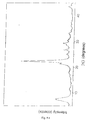
- This solid displays an X-ray diagram shown in figure 4a, which is characteristic of a beta type structure with a crystallinity of 94% referred to standard commercial Beta zeolite.
- a control experiment wherein the surfactant is not introduced gives rise to the formation of an amorphous solid following 4 days of crystallisation (figure 4b), 7 days of heating of the synthesis gel being necessary in order to obtain Beta zeolite of similar crystallinity (figure 4c).
- the Beta zeolite obtained in the presence of surfactants has a crystal size measured by scanning electron microscopy of approximately 100 nm, while the sample obtained in the absence of surfactant has a crystal size of 20 nm determined by transmission electron microscopy.
- Beta zeolite was obtained with a crystallinity of 95% (figure 5a) upon four days of heating (3 days without surfactant + 1 day with surfactant).
- a comparative experiment in the absence of surfactant shows that an amorphous solid is obtained under these conditions after 4 days of heating (figure 5b), with 12 days being needed in order to be able to form a material of similar crystallinity to that formed in the presence of surfactant (figure 5c).
- the surfactant was added at 3 and 17 days of crystallisation.
- the syntheses procedure was similar to that described in example 5.
- the growth curves of beta zeolite of the different experiments are shown in figure 8.
- an amorphous solid was obtained upon 80 days of heating the gel.
- the molar composition of the gels used in this study was: 25 SiO 2 : Al 2 O 3 : 7.5 TEA 2 O : 3 Triton X-100 : 375 H 2 O
- the surfactant was added after three days of static heating of the gel at 140 °C.
- the crystallisation needed further four days and a solid was recovered that displayed a diffraction diagram characteristic of a beta zeolite with a crystallinity of 107% as shown in figure 10a.
- a control experiment in which no surfactant was added gave rise to an amorphous solid after seven days of heating the gel under the same conditions (figure 10b).
- H 2 O 2 was added to the gel in order to promote the incorporation of Ti into the siliceous structure. It is compared with an analogous experiment performed in the absence of surfactant.
- the gel is introduced into autoclaves at 140 °C without stirring for 3 days. Once this time has elapsed, 8.4 g of cetyltrimethylammonium bromide (CTABr) are added to this gel and the crystallisation lasts 14 days.
- CABr cetyltrimethylammonium bromide
- the solid is recovered by filtration, exhaustive washing with distilled water and drying at 60 °C for 12 hours.
- This solid displays an X-ray diagram shown in figure 11a, which is characteristic of a beta type structure with a crystallinity of 100%, referred to standard commercial Beta zeolite.
- the Ti content of the sample is of 4.9%, expressed as titanium oxide.
Landscapes
- Chemical & Material Sciences (AREA)
- Organic Chemistry (AREA)
- Life Sciences & Earth Sciences (AREA)
- General Life Sciences & Earth Sciences (AREA)
- Geology (AREA)
- Engineering & Computer Science (AREA)
- Chemical Kinetics & Catalysis (AREA)
- Materials Engineering (AREA)
- Inorganic Chemistry (AREA)
- Crystallography & Structural Chemistry (AREA)
- Silicates, Zeolites, And Molecular Sieves (AREA)
- Organic Low-Molecular-Weight Compounds And Preparation Thereof (AREA)
Abstract
This invention describes a general process in which, by means of the use of
tensioactives, it permits a reduction of the synthesis times for crystalline microporous
materials based on silica with ducts with a pore opening formed of 10 or 12 tetrahedra of
silica. This procedure is based on the addition of a tensioactive, which can be cationic,
anionic or neutral, to the reaction mixture wherein the zeolite is formed.
In addition, this new synthesis method increases the efficiency of the reagents used in the
synthesis of zeolites and the stability of the materials formed, permitting the size of
crystal to be controlled. And in cases wherein there exists competition for the growth of
different microporous materials, it is possible to promote the appearance of one phase
with respect to another competing with it by a proper selection of surfactant.
Description
- Preparation of zeolitic materials of catalytic interest
- The crystallisation of zeolites and zeotypes is a process involving an enormous number of variables that can affect not just the crystalline structure that is obtained but also the properties of the resulting material. The parameters controlling the synthesis of this type of material are far from being understood in their entirety and, in general, purely empirical procedures are applied to obtain new structures the properties of those already in existence are modified. This can be understood when taking into account the enormous complexity of the chemical systems involved in the synthesis gels of zeolites and zeotypes.
- In general, zeolites crystallise under hydrothermal conditions, in other words, in the presence of water at temperatures between 50 and 400 °C. The water acts as a transport medium for the species giving rise to the microporous solid; it also promotes hydrolysis of the T-O-T bonds of the zeolite precursors and the formation of others; and finally it fills the empty spaces in the material.
- Three stages are generally differentiated during the crystallisation of zeolites, these stages overlapp in time: nucleation, growth and decay process. An initial stage of reorganisation of the synthesis gel during the initial heating can also be included.
- Nucleation is the stage in which the crystallisation nuclei of feasible zeolites are formed, these nuclei being particles that have exceeded a critical size. Such nuclei can be described as small crystalline groupings, generally not detectable by means of X-ray diffraction and which can grow spontaneously, while smaller groupings are unstable in the synthesis medium and dissolve before they can grow.
- The most widely accepted theory is that the zeolite crystallisation nuclei are formed in the interface between the solution and the amorphous solid that is formed during the reorganisation stage of the gel, with nutrients being transported towards the crystal that is being formed. Nevertheless, evidence exists that could point to the fact that spontaneous nucleation in the solution takes place and that in some cases direct transformation of the gel into zeolite could occur.
- The growth stage starts before the nucleation ends, in other words, there exists a period in which nucleation and growth compete for the incorporation of nutrients. This causes the nucleation curve to display a maximum. The distribution of the size of zeolite crystals and the average size of them will depend on the competition between nucleation speed and growth speed. The final distribution will be narrower when the nucleation speed is greater, and the greater the number of nuclei that are formed the smaller the crystal size will be.
- The decay stage occurs when the concentration of reagents in solution is no longer sufficiently high for the crystallisation process to continue. The profile of the crystallisation curve has a sigmoid shape as a consequence of the overlapping of all the processes involved in the synthesis of zeolites.
- As mentioned earlier, the synthesis of zeolites and zeotypes is generally undertaken in an aqueous medium under hydrothermal conditions. In addition to the sources of silicon (or phosphorus and aluminum), alkaline cations and organic cations, use is also made of hydroxide or fluoride anions as mineralising agents, i.e., as silicon mobiliser agents (or phosphorus and aluminum). In the case of synthesis in which the mineralising agent are hydroxide groups, the pH is generally greater than 10 in the synthesis of zeolites since under these conditions sufficient solubility is achieved of the silicon species that will form the zeolite. In the case of microporous aluminophosphates the working pH can be very much lower, closer to neutral or even slightly acid.
- When a fluoride medium is used for the synthesis of zeolites, the pH is generally close to 7 since fluorosilicates are much more soluble at lower pH than are silicates, which means that sufficient mobility of the silicon species is obtained for forming the zeolite at lower pH than in the case of synthesis in OH- medium. The use of fluoride medium in the synthesis of zeolites gives rise to the formation of zeolitic materials of large crystal size and with a very small number of defects, which confers on them a markedly hydrophobic nature, while synthesis in a basic medium generally gives rise to zeolites with a smaller crystal size and a large number of defects, and therefore with a hydrophilic nature.
- In some cases, the formation of the zeolitic material requires very long crystallisation times, which implies a major cost in the production of them. There exist various possibilities for reduce those times, such as for example the use of organic cations in the synthesis of zeolites. This fact has been seen in the synthesis of zeolite ZSM-5, the synthesis of which is shortened when tetrapropylammonium cations are introduced into the composition of the synthesis gel. The use of organic cations has been widely studied in the synthesis of new zeolites since they can display a director effect on the structure, which not only accelerates the formation process of zeolite structures but in some cases also leads to the formation of new microporous structures. Nevertheless, in general, tetraalkylammonium cations used in the synthesis of zeolites are expensive and imply a considerable cost in the final price of the catalyst.
- Another method for accelerating the crystallisation of zeolites is the incorporation of microcrystals of zeolite into the synthesis gel which act as crystallisation nuclei in the formation process of the zeolite.
- Finally, increasing the crystallisation temperature or reducing the amount of water in the gel increases the crystallisation speed of the zeolites. Nevertheless, both parameters can influence the zeolite phase that crystallises out and in general one sees that increasing the temperature or the concentration of reagents promotes the formation of denser phases.
- To end, it can be emphasised that the enthalpy of formation of quartz with respect to that of most zeolites is very low, which suggests that at the crystallisation temperatures that one works at the formation of zeolites is conditioned by the kinetics of the process rather than by purely thermodynamic factors. This makes it possible to talk of kinetic control in the formation of zeolites, due to which it can be expected that by modifying the reaction speed of a system the appearance of one structure rather than another will be promoted.
- This invention claims a new method for the preparation of zeolites that permits their crystallisation times to be reduced, characterised by the incorporation of a cationic, anionic or neutral surfactant into the reaction mixture of which the zeolite is crystallised out.
- The method consists of heating to 50-250 °C a reaction mixture containing a source of at least one tetravalent element T(IV), optionally a source of a trivalent element T(III), at least one organic or inorganic cation, a source of the ions OH or F, and water, for times of between 5 hours and 180 days. The surfactant is introduced into the synthesis gel from the start of the synthesis, but it can also be incorporated into the reaction mixture during the nucleation stage of the zeolite, the moment at which it is incorporated being between 0 and 140 days. The surfactant can be cationic, anionic or neutral. The addition of the tensioactive reduces the crystallisation times of zeolites, basically during the nucleation stage. Moreover, in the synthesis carried out in the presence of surfactants, it is observed that the efficiency in the incorporation of T(IV) and optionally T(III) increases with respect to conventional syntheses in the absence of tensioactives. Finally, is has been demonstrated that this method can be used for increasing the purity of a zeolite phase in the case of simultaneous growth of more than one phase by means of a proper selection of surfactant since, although the increase in the crystallisation speed of zeolites in the presence of surfactants is a general fact, this increase is not identical for different structures, and this permits kinetic control to be exercised over the growth of zeolites in the case of competition among different phases.
- This invention refers to a new method of synthesis of zeolites with pores formed from ducts with openings of 9 or more silica tetrahedra, permitting crystallisation times to be reduced by means of the use of cationic, anionic or neutral surfactants. Cationic surfactants have the formula R1R2R3R4Q+ wherein Q is nitrogen or phosphorus and where at least one of the substituents R1, R2, R3, or R4 is an aryl or alkyl group containing more than 6 carbon atoms and fewer than 36, and each of the remaining groups R1, R2, R3, or R4 is a hydrogen or an alkyl or aryl group with fewer than 5 carbons. Also included among cationic surfactants that can be incorporated into the composition of the gel are those known as geminal surfactants R1R2R3QR4QR1R2R3 or R1R2R3Q(R4R5QR6QR4R5)QnR1R2R3 where Q is a nitrogen or phosphorus and at least one of the substituents R1- R6 is an aryl or alkyl group containing more than 6 carbon atoms and fewer than 36, and each of the remaining groups R1 - R6 is a hydrogen or an alkyl or aryl group with fewer than 5 carbon atoms or mixtures of them. In these cases, the groups R1, R2, R3, or R4 can be interconnected giving rise to cyclic compounds. Cationic surfactants can be used in the form of hydroxide, halide, nitrate, sulphate, carbonate or silicate, or mixtures thereof. Examples of these, though without being limiting, include cetyltrimethylammonium, docdecyltrimethylammonium, cetylpyridinium, cetyltrimethyl-phosphonium, etc.
- The surfactants can also be a neutral surfactant, in which case it has the formula R1R2R3Q wherein Q is nitrogen or phosphorus and wherein at least one of the substituents R1, R2, or R3 is an aryl or alkyl group containing more than 6 carbon atoms and fewer than 36, and each of the remaining groups R1, R2 or R3 is a hydrogen or an alkyl or aryl group with fewer than 5 carbons, being dodecylamine, cetylamine and cetylpyridine non-limiting examples thereof. Neutral compounds of the formula nR-EO, consisting of oxides of alkylpolyethylene, oxides of alkyl-aryl-polyethylene and copolymers of alkylpolypropylene and alkylethelene, are also able to act as surfactants being the commercial surfactants known as Tergitol 15-S-9, Triton X-114, Igepal RC-760, Pluronic 64 L, Tetronic and Sorbitan non-limiting examples thereof. Esters derived from fatty acids obtained by reaction with short chain alcohols, sugars, amino acids, amines and polymers or copolymers derived from polypropylene, polyethylene, polyacrylamide or polyvinyl alcohol are also able to be used as surfactants. Lisolecitine, lecitine, pentaoxyethylene dodecyl ether, phosphatyldilauryldiethanolamine, digalactose diglyceride and monogalactose diglyceride are non-limiting examples thereof.
- The surfactant can also be an anionic surfactant with the formula RQ-, wherein R is an aryl or alkyl group containing more than 6 carbon atoms and fewer than 36, and Q is a sulphate, carboxylic or phosphate group, non-limiting examples of these being dodecylsulphate, stearic acid, Aerosol OT and phospholipids such as phosphatylcoline and diethanolamine phosphatyl.
- Materials prepared in this manner are characterised by being obtained in crystallisation times very much shorter than in conventional syntheses in the absence of surfactants.
- The method of preparation is based on the heating under hydrothermal conditions at temperatures between 50 and 250 °C of a reaction mixture containing a source of silicon, such as for example, without being limiting, amorphous silica, colloidal silica, silica gel, tetraalkylorthosilicate or sodium silicate, optionally a source of aluminum such as for example, without being limiting, aluminum oxyhydroxides, aluminum alkoxides, metallic aluminum or any inorganic salt of aluminum, or other trivalent element such as for example, without being limiting, Fe, Ga, B, Cr, etc. The reaction mixture can also optionally contain a source of Ti, such as for example, without being limiting, titanium halides, titanium alcoxides, dichlorotitanocene or titanium complexes wherein the titanium atom is coordinated by a dionate group such as acetylacetonate, ammonium or sodium hexafluorotitanate or any ionic complex or salt containing titanium in its composition, or other tetravalent element such as for example, without being limiting, Ge, Zr, V or Sn. Optionally, a director agent of the structure can be incorporated into the synthesis gel, this agent being characterised by being an organic cation or an amine, preferably tertiary amines, quaternary alkylamines or organometallic compounds. A source of hydroxyl groups can also be added such as for example, without being limiting, hydroxides of alkaline or alkaline earth metals, or hydroxides of organic alkylammonium cations; or a source of fluoride ions can be added such as for example, without being limiting, fluorides of alkaline metals or fluorides of alkylammonium cations and water. Finally, the surfactant is added to the reaction medium wherein the growth of the zeolite takes place. The addition of the surfactant is preferably done during the nucleation stage or in the organisation of the synthesis gel.
- Unlike other methods of synthesis of zeolites, the method claimed in this invention permits zeolitic materials to be obtained with controlled sizes of crystal, which are more stable to heat treatment or treatments at high temperature in the presence of steam.
- The synthesis method that is claimed permits to reduce the crystallisation times of zeolites, and it also increases the efficiency of the reagents used in the synthesis of zeolites and enables zeolites to be obtained with a higher concentration of active centres, such as for example, without being limiting, it allows to obtain zeolites with a lower Si/Al ratio, i.e., with a higher content of aluminum and therefore with a higher number of active acid centres in various reactions of industrial interest.
- Some of the applications of the zeolitic materials obtained according to this new synthesis method, and which are claimed in this invention, are:
- Use of these materials in catalytic cracking reactions of gasoil.
- Use of these materials in isomerisation reactions of light alkanes.
- Use of these materials in alkylation reactions of olefins and aromatic compounds with paraffins and alcohols.
- Use of these materials in hydrocracking and mild hydrocracking reactions.
- Use of these materials in hydroparaffining and isoparaffining reactions.
- Use of these materials as selective catalysts in selective oxidation reactions of alkanes to alcohols or ketones, alkenes to epoxys or diols or aromatic compounds to compounds hydroxylated with organic or inorganic peroxides.
- Use of these materials as selective catalysts in oxidation reactions of organic sulphides to sulphoxides and sulphones in the presence of organic or inorganic peroxides.
- Use of these materials as selective catalysts in amoximation reactions of ketones.
- Use of these materials as selective catalysts in reduction reactions of ketones with alcohols.
- In this example, an MCM-22 type zeolite is prepared with an Si/Al ratio = 50 in the presence of cetyltrimethylammonium bromide using hexamethylenimine as structure director agent and in the presence of OH- (basic medium) as mineralising agent. It is compared with an analogous experiment performed in the absence of cetyltrimethylammonium bromide.
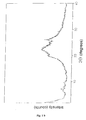
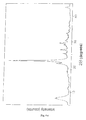
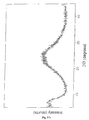
- 0.0906 g of sodium aluminate and 0.3096 g of NaOH are dissolved in 40.4682 g of water. To this solution 2.48 g of hexamethylenimine are added and it is then stirred for 15 minutes at room temperature. Finally, 3.25 g of colloidal silica are added and the stirring is continued for 30 minutes before introducing the resulting gel into autoclaves which are heated to 135 °C while being stirred at a speed of 60 r.p.m. After five days of heating, 2.37 g of cetyltrimethyl-ammonium bromide are added. The resulting mixture is stirred and again introduced into autoclaves at 135 °C and then stirred for other 24 hours. Afterwards the reaction mixture is cooled down to room temperature and a solid is recovered by means of filtration, exhaustive washing with distilled water and drying at 60 °C for 12 hours. The resulting solid displays an X-ray diagram shown in figure 1a, which is characteristic of the laminar precursor of the MCM-22 structure. A control experiment wherein the surfactant is not introduced gives rise to the formation of a practically amorphous solid upon 6 days of crystallisation (figure 1b).
- In this example, a ferrierite type zeolite is prepared with a ratio of approximately 25 in the presence of cetyltrimethylammonium bromide using 4-amino-2,2,6,6-tetramethylpiperidine as structure director agent and in the presence of F- ions (pH close to neutral) as mineralising agent. It is compared with an analogous experiment performed in tne absence of cetyltrimethylammonium bromide.
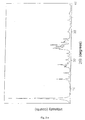
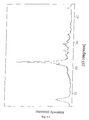
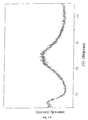
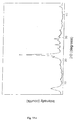
- 1.38 g of pseudobohemite (Catapal Alumina) are dispersed in 9.72 g of distilled water, with the reagents added in the following order: a solution of 5.55 g of NH4F in 6.95 g of water, and then an aqueous solution of HF of 46.9% by weight. The mixture is stirred for 15 minutes and then 15.65 g of 4-amino-2,2,6,6-tetramethylpiperidine are added along with 6 g of silica (Aerosil 200). The resulting mixture is stirred until complete homogenisation for 90 minutes. Once that time has elapsed, the synthesis gel is introduced into autoclaves at 135 °C with constant stirring at r.p.m. for 3 days. To this gel 4.37 g of cetyltrimethylammonium bromide are added. The resulting gel is again introduced into autoclaves at 135 °C with constant stirring at 60 r.p.m. for 24 hours. The solid is recovered by filtration, exhaustive washing with distilled water and drying at 60 °C for 12 hours. This solid displays an X-ray diagram shown in figure 2a, which is characteristic of the laminar precursor of a ferrierite type structure. A control experiment wherein the surfactant is not introduced gives rise to the formation of an amorphous solid upon 4 days of crystallisation (figure 2b), and 10 days of heating of the synthesis gel are needed in order obtain to form ferrierite with a similar crystallinity in the absence of surfactant (figure 2c).
- This example illustrates the formation of a zeolite known as Nu-1 prepared in basic medium (OH- as mineralising agent) and in the presence of tetramethylammonium hydroxide as structure director agent. In this example it can also be seen how the presence of surfactant in the crystallisation medium promotes the obtention of a pure phase thereby preventing competition from sodalite which generally appears as an impurity in conventional syntheses in the absence of surfactants.
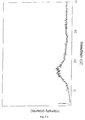
- 0.62 g of pseudobohemite (Catapal Alumina) are dispersed in a solution of 21.87 g of tetramethylammonium hydroxide in 55.43 g of water. The mixture is stirred for 1 hour and 6 g of silica (Aerosil 200) are then added and the stirring is continued for a further hour. The resulting gel is introduced into autoclaves at 175 °C for 24 hours. Once that time has elapsed, 4.37 g of cetyltrimethylammonium bromide are added to the synthesis gel and crystallisation continues during 4 days. A solid is recovered by filtration, exhaustive washing with distilled water and drying at 60 °C for 12 hours. This solid displays an X-ray diagram shown in figure 3a, which is characteristic of a Nu-1 type structure. A control experiment wherein the surfactant is not introduced gives rise to the formation of an amorphous solid upon 5 days of crystallisation (figure 3b), and 7 days of heating of the synthesis gel are needed in order to be able to form Nu-1 (figure 3c). Nevertheless, in this case it is observed that considerable quantities of sodalite impurities are also formed.
- This example illustrates the effect of the presence of cationic surfactants during the synthesis of Beta zeolite containing aluminum in its composition for a Si/Al ratio = 12.5 In this case a basic synthesis medium is used along with tetraethylammonium hydroxide (TEAOH) as structure director agent and source of hydroxide anions, and cetyltrimethylammonium bromide as surfactant.
- 22.2 g of amorphous silica (Aerosil 200). are added to an aqueous solution containing 37.84 g of TEAOH (35% by weight) and 39.19 g of water. The resulting gel is stirred for 30 minutes at room temperature. Afterwards a solution obtained by reacting 0.80 g of metallic aluminum in 55.56 g of TEAOH (35% by weight) is added. The final molar relation of the synthesis gel is as follows:
25 SiO2 : Al2O3 : 7.5 TEA2O : 375 H2O - The reaction mixture is stirred at room temperature for 30 minutes. The gel is introduced into autoclaves at 140 °C with constant stirring at 60 r.p.m. for 3 days. Once this time has elapsed, 16.14 g of cetyltrimethylammonium bromide (CTABr) are added to the synthesis gel to give the following molar composition of the synthesis gel:
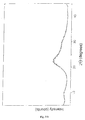
25 SiO2 : Al2O3 : 7.5 TEA2O : 3 CTABr : 375 H2O - The crystallisation lasts for 1 day. A solid is recovered by filtration, exhaustive washing with distilled water and drying at 60 °C for 12 hours. This solid displays an X-ray diagram shown in figure 4a, which is characteristic of a beta type structure with a crystallinity of 94% referred to standard commercial Beta zeolite. A control experiment wherein the surfactant is not introduced gives rise to the formation of an amorphous solid following 4 days of crystallisation (figure 4b), 7 days of heating of the synthesis gel being necessary in order to obtain Beta zeolite of similar crystallinity (figure 4c).
- The Beta zeolite obtained in the presence of surfactants has a crystal size measured by scanning electron microscopy of approximately 100 nm, while the sample obtained in the absence of surfactant has a crystal size of 20 nm determined by transmission electron microscopy.
- This example describes the synthesis of Beta zeolite with an Si/Al ratio = 12.5 using a similar synthesis method to that described in example 4, but the crystallisation is done without stirring. In this case Beta zeolite was obtained with a crystallinity of 95% (figure 5a) upon four days of heating (3 days without surfactant + 1 day with surfactant). A comparative experiment in the absence of surfactant shows that an amorphous solid is obtained under these conditions after 4 days of heating (figure 5b), with 12 days being needed in order to be able to form a material of similar crystallinity to that formed in the presence of surfactant (figure 5c).
- In this example the effect the presence of surfactant during the synthesis of Beta zeolites of different Si/Al ratio is studied. This synthesis procedure was similar to that described in example 4 but the quantities of aluminum and TEAOH were modified in order to obtain the following molar compositions:
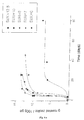
x SiO2 : Al2O3 : (0.26x + 1) TEA2O : 0.12x CTABr : 15x H2O being the values of x used 12, 14, 16, 20, 25. The crystallisation curves of the different experiments are shown in figure 6a. Control experiments were conducted wherein no surfactant was added, and the crystallisation curves are shown in figure 6b. In all cases a considerable increase can be seen in the crystallisation speed of all the gels containing surfactant, this increase being the increase greater when the Si/Al ratio in the synthesis gel is lower. - In this example the effect of the concentration of surfactant on the synthesis of Beta zeolites with Si/Al ratio = 8 is studied. The experimental procedure was similar to that described in example 5 but the amount of surfactant added after 3 days of crystallisation was varied. The molar composition of the gels used was:
16 SiO2 : Al2O3 : 5.16 TEA2O : 16m CTABr : 15x H2O where m took thevalues 0, 0.03, 0.06 and 0.12. The crystallisation curves of the different experiments are shown in figure 7. It can be seen that the crystallisation speed decreases when the concentration of tensioactive in the synthesis gel falls. Nevertheless, the accelerating effect on crystallisation is appreciable even with CTABr/Si ratios as low as 0.03. - In this example the effect of the time at which the surfactant is added during the crystallisation of Beta zeolite with Si/Al ratio = 6 is studied. The molar composition of the gels used was:
12 SiO2 : Al2O3 : 4.12 TEA2O : 1.44 CTABr : 180 H2O - The surfactant was added at 3 and 17 days of crystallisation. The syntheses procedure was similar to that described in example 5. The growth curves of beta zeolite of the different experiments are shown in figure 8. In a control experiment wherein no surfactant was added an amorphous solid was obtained upon 80 days of heating the gel.
- In this example the effect of the presence of a neutral surfactant during the crystallisation of a Beta zeolite with Si/Al ratio = 12.5 is studied. The synthesis method was similar to that described in example 5 but Triton X-100 was used as surfactant instead of CTABr. Triton X-100 is a commercial brand of polymer surfactant polyoxoethylene(10) isoctylphenylether with a formula 4-(C8H17)C6H4(OCH2CH2)nOH of average molecular weight 646 g/mol (calculated for n = 10). The molar composition of the gels used in this study was:
25 SiO2 : Al2O3 : 7.5 TEA2O : 3 Triton X-100 : 375 H2O - The surfactant as added after three days of static heating of the gel at 140 °C. The crystallisation took a further four days and a solid was recovered displayed a diffraction diagram characteristic of a beta zeolite with a crystallinity of 85% as shown in figure 9a. A control experiment wherein no surfactant was added gave rise to an amorphous solid after seven days of heating the gel under the same conditions (figure 9b).
- In this example the effect of the presence of an anionic surfactant during the crystallisation of a Beta zeolite with Si/Al ratio = 12.5 is studied. The synthesis method was similar to that described in example 5 but lauric acid (Lau) was used as surfactant instead of CTABr. This acid has a formula CH3(CH2)10COOH of molecular weight 200.32 g/mol. The molar composition of the gel used in this study was:
25 SiO2: Al2O3 : 7.5 TEA2O : 3 Lau : 375 H2O - The surfactant was added after three days of static heating of the gel at 140 °C. The crystallisation needed further four days and a solid was recovered that displayed a diffraction diagram characteristic of a beta zeolite with a crystallinity of 107% as shown in figure 10a. A control experiment in which no surfactant was added gave rise to an amorphous solid after seven days of heating the gel under the same conditions (figure 10b).
- In this example, a Beta zeolite containing Ti in its composition, with an Si/Al ratio = 25 is prepared, in the presence of cetyltrimethylammonium bromide using the tetraethylammonium cation as structure director agent and in the presence of F- ions (average close to neutral) as mineralising agent. In addition, H2O2 was added to the gel in order to promote the incorporation of Ti into the siliceous structure. It is compared with an analogous experiment performed in the absence of surfactant.
- 40 g of tratraethylorthosilicate are hydrolysed in a solution containing 45.40 g of TEAOH (35% by weight) and 6.40 g of H2O2 (35% by weight). This solution is stirred at 25 °C for 2 hours, forming a fluid gel to which 1.75 g of tetraethylorthotitanate is added and the reaction mixture is left at 25 °C with constant stirring until the ethanol formed during the hydrolysis of the tratraethylorthosilicate and the tetraethylorthotitanate has completely evaporated. To the gel obtained, 4.49 g of HF (48.1% by weight) are added and a damp solid is formed that is completely homogenised by grinding. The molar composition of the synthesis gel is:
25 SiO2 : TiO2 : 14.05 TEAF : 8.575 H2O2 : 190 H2O - The gel is introduced into autoclaves at 140 °C without stirring for 3 days. Once this time has elapsed, 8.4 g of cetyltrimethylammonium bromide (CTABr) are added to this gel and the crystallisation lasts 14 days. The solid is recovered by filtration, exhaustive washing with distilled water and drying at 60 °C for 12 hours. This solid displays an X-ray diagram shown in figure 11a, which is characteristic of a beta type structure with a crystallinity of 100%, referred to standard commercial Beta zeolite. The Ti content of the sample is of 4.9%, expressed as titanium oxide.
- A control experiment wherein no surfactant is introduced gives rise to the formation of a solid displaying a crystallinity of 100% (figure 11b), with the Ti content of the sample being 2.5%, expressed as titanium oxide. This experiment shows that the presence of surfactant under these synthesis conditions increases the degree of incorporation of Ti. In this way, if an attempt is made to obtain Ti-Beta with a high Ti content in the absence of surfactant, one has to start with low Si/Al ratios, which entails long synthesis times. Thus, an experiment with Si/Al ratio = 15 without adding surfactant gives rise to an amorphous solid after 31 days of heating and the appearance of 15% of zeolite is observed following 45 days of synthesis.
Claims (30)
- A process for the preparation of zeolites that permits crystallisation times to be reduced and the size of crystal to be controlled, characterised by incorporating a cationic, anionic or neutral surfactant to the synthesis mixture of the zeolite.
- A process for the preparation of zeolites with ducts and/or cavities formed by rings of 9 or more members, characterised by incorporating a cationic, anionic or neutral surfactant to the synthesis mixture of the zeolite.
- A process for the preparation of zeolites with ducts and/or cavities formed by rings of 11 or more members, characterised by incorporating a cationic, anionic or neutral surfactant to the synthesis mixture of the zeolite.
- A process for the preparation of zeolites with Beta type structure, characterised by incorporating a cationic, anionic or neutral surfactant to the synthesis mixture of the zeolite.
- A process for the preparation of zeolites with Faujasite and EMT type structure, characterised by incorporating a cationic, anionic or neutral surfactant to the synthesis mixture of the zeolite.
- A process for the preparation of zeolites with structure of the type MCM-22, ITQ-1, ITQ-3, ITQ-4, ITQ-5, ITQ-7, ITQ-8, ITQ-9, ITQ-10, ITQ-11, ITQ-12, ITQ-13 and ITQ-14, characterised by incorporating a cationic, anionic or neutral surfactant to the synthesis mixture of the zeolite.
- A process for the preparation of zeolites with Ferrierite type structure, characterised by incorporating a cationic, anionic or neutral surfactant to the synthesis mixture of the zeolite.
- A process for the preparation of zeolites with Mordenite type structure, characterised by incorporating a cationic, anionic or neutral surfactant to the synthesis mixture of the zeolite.
- A process for the preparation of zeolites with NU-1 type structure, characterised by incorporating a cationic, anionic or neutral surfactant to the synthesis mixture of the zeolite.
- A process for the preparation of zeolites according to claim 1, characterised in that the synthesis mixture contains at least one tetravalent element (T(IV)), optionally a source of one or more trivalent elements (T(III)) or mixtures of T(IV) and T(III), at least one organic and/or inorganic cation, a source of the ions OR and/or F-, water and a cationic, anionic or neutral surfactant.
- A process for the synthesis of zeolites according to claim 2, characterised in that the synthesis mixture contains at least one tetravalent element (T(IV)), optionally a source of one or more trivalent elements (T(III)) or mixtures of T(IV) and T(III), at least one organic and/or inorganic cation, a source of the ions OH- and/or F-, water and a cationic, anionic or neutral surfactant.
- A process for the synthesis of zeolites according to claims 3 to 9, characterised in that the synthesis mixture contains at least one tetravalent element (T(IV)), optionally a source of one or more trivalent elements (T(III)) or mixtures of T(IV) and T(III), at least one organic and/or inorganic cation, a source of the ions OH- and/or F-, water and a cationic, anionic or neutral surfactant.
- A process for the synthesis of zeolites according to claim 10, characterised in that the synthesis temperature lies between 50 and 250 °C and that the synthesis time is between 5 hours and 120 days, preferably being between 15 hours and 60 days.
- A process for the synthesis of zeolites according to claim 11, characterised in that the synthesis temperature lies between 50 and 250 °C and that the synthesis time is between 5 hours and 120 days, preferably being between 15 hours and 60 days.
- A process for the synthesis of zeolites according to claim 12, characterised in that the synthesis temperature lies between 50 and 250 °C and that the synthesis time is between 5 hours and 120 days, preferably being between 15 hours and 60 days.
- A process for the synthesis of zeolites according to claim 13 and characterised in that the cationic surfactants used have the formula [QR1R2R3R4]+ wherein Q is nitrogen or phosphorus and wherein at least one of the groups R1, R2, R3, or R4 is an aryl or alkyl group containing more than 6 carbon atoms and fewer than 36, and each of the remaining groups R1, R2, R3, or R4 is a hydrogen or an alkyl or aryl group with fewer than 5 carbons. Those known as geminal surfactants [R1R2R3QR4Q R1R2R3]2+ or {R1R2R3Q[R4Q(R5R6)R4Q(R5R6)R4]nQ R1R2R3}(n+2)+ wherein Q is a nitrogen or phosphorus and at least one of the groups R1, R2, R3, R4, R5 or R6 is an aryl or alkyl group containing more than 6 carbon atoms and fewer than 36, and each of the remaining groups R1, R2, R3, R4, R5 or R6 is a hydrogen or an alkyl or aryl group with fewer than 5 carbon atoms and R4 is a bridge group between two atoms of nitrogen or phosphorus which contains at least one atom of carbon and fewer than 36 are also included.
- A process for the synthesis of zeolites according to claim 14 and characterised in that cationic surfactants used have the formula [QR1R2R3R4]+ wherein Q is nitrogen or phosphorus and wherein at least one of the groups R1, R2, R3, or R4 is an aryl or alkyl group containing more than 6 carbon atoms and fewer than 36, and each of the remaining groups R1, R2, R3, or R4 is a hydrogen or an alkyl or aryl group with fewer than 5 carbons. Those known as geminal surfactants [R1R2R3QR4Q R1R2R3]2+ or {R1R2R3Q[R4Q(R5R6)R4Q(R5R6)R4]nQ R1R2R3}(n+2)+ wherein Q is a nitrogen or phosphorus and at least one of the groups R1, R2, R3, R4, R5 or R6 is an aryl or alkyl group containing more than 6 carbon atoms and fewer than 36, and each of the remaining groups R1, R2, R3, R4, R5 or R6 is a hydrogen or an alkyl or aryl group with fewer than 5 carbon atoms and R4 is a bridge group between two atoms of nitrogen or phosphorus which contains at least one atom of carbon and fewer than 36 are also included.
- A process for the synthesis of zeolites according to claim 15, characterised in that the cationic surfactants used have the formula [QR1R2R3R4]+ wherein Q is nitrogen or phosphorus and wherein at least one of the groups R1, R2, R3, or R4 is an aryl or alkyl group containing more than 6 carbon atoms and fewer than 36, and each of the remaining groups R1, R2, R3, or R4 is a hydrogen or an alkyl or aryl group with fewer than 5 carbons. Those known as geminal surfactants [R1R2R3QR4Q R1R2R3]2+ or {R1R2R3Q[R4Q(R5R6)R4Q(R5R6)R4]nQ R1R2R3}(n+2)+ wherein Q is a nitrogen or phosphorus and at least one of the groups R1, R2, R3, R4, R5 or R6 is an aryl or alkyl group containing more than 6 carbon atoms and fewer than 36, and each of the remaining groups R1, R2, R3, R4, R5 or R6 is a hydrogen or an alkyl or aryl group with fewer than 5 carbon atoms and R4 is a bridge group between two atoms of nitrogen or phosphorus which contains at least one atom of carbon and fewer than 36 are also included.
- A process for the synthesis of zeolites according to claim 13, characterised in that the neutral surfactants used have the formula [QR1R2R3] wherein Q is nitrogen or phosphorus and wherein at least one of the groups R1, R2 or R3, is an aryl or alkyl group containing more than 6 carbon atoms and fewer than 36, and each of the remaining groups R1, R2 or R3 is a hydrogen or an alkyl or aryl group with fewer than 5 carbons. Those known as geminal surfactants [R1R2QR3Q R1R2] or {R1R2Q[R3Q(R4)R3Q(R4)R3]nQ R1R2} wherein Q is a nitrogen or phosphorus and at least one of the groups R1, R2, R3 or R4 is an aryl or alkyl group containing more than 6 carbon atoms and fewer than 36, and each of the remaining groups R1, R2, R3 or R4 is a hydrogen or an alkyl or aryl group with fewer than 5 carbon atoms and R3 is a bridge group between two atoms of nitrogen or phosphorus which contains at least one atom of carbon and fewer than 36 are also included. Also included in this claim are neutral surfactants with formula nR-EO consisting of an alkylpolyethyelene oxide, alkylarylpolyethylene oxides, copolymers of alkylpolypropylene and polyethylene and copolymers of alkylarylpolypropylene and polyethylene.
- A process for the synthesis of zeolites according to claim 14, characterised in that the neutral surfactants used have the formula [QR1R2R3] wherein Q is nitrogen or phosphorus and wherein at least one of the groups R1, R2 or R3, is an aryl or alkyl group containing more than 6 carbon atoms and fewer than 36, and each of the remaining groups R1, R2 or R3 is a hydrogen or an alkyl or aryl group with fewer than 5 carbons. Those known as geminal surfactants [R1R2QR3Q R1R2] or {R1R2Q[R3Q(R4)R3Q(R4)R3]nQ R1R2} wherein Q is a nitrogen or phosphorus and at least one of the groups R1, R2, R3 or R4 is an aryl or alkyl group containing more than 6 carbon atoms and fewer than 36, and each of the remaining groups R1, R2, R3 or R4 is a hydrogen or an alkyl or aryl group with fewer than 5 carbon atoms and R3 is a bridge group between two atoms of nitrogen or phosphorus which contains at least one atom of carbon and fewer than 36 are also included. Also included in this claim are neutral surfactants with formula nR-EO consisting of an alkylpolyethyelene oxide, alkylarylpolyethylene oxides, copolymers of alkylpolypropylene and polyethylene and copolymers of alkylarylpolypropylene and polyethylene.
- A process for the synthesis of zeolites according to claim 15, characterised in that the neutral surfactants used have the formula [QR1R2R3] wherein Q is nitrogen or phosphorus and wherein at least one of the groups R1. R2 or R3. is an aryl or alkyl group containing more than 6 carbon atoms and fewer than 36, and each of the remaining groups R1, R2 or R3 is a hydrogen or an alkyl or aryl group with fewer than 5 carbons. Those known as geminal surfactants [R1R2QR3Q R1R2] or {R1R2Q[R3Q(R4)R3Q(R4)R3]nQ R1R2} wherein Q is a nitrogen or phosphorus and at least one of the groups R1, R2, R3 or R4 is an aryl or alkyl group containing more than 6 carbon atoms and fewer than 36, and each of the remaining groups R1, R2, R3 or R4 is a hydrogen or an alkyl or aryl group with fewer than 5 carbon atoms and R3 is a bridge group between two atoms of nitrogen or phosphorus which contains at least one atom of carbon and fewer than 36 are also included. Also included in this claim are neutral surfactants with formula nR-EO consisting of an alkylpolyethyelene oxide, alkylarylpolyethylene oxides, copolymers of alkylpolypropylene and polyethylene and copolymers of alkylarylpolypropylene and polyethylene.
- A process for the synthesis of zeolites according to claim 13, characterised in that the added surfactant is anionic and has the formula RQ- wherein R is an alkyl or aryl group containing more than 6 carbons and fewer than 36. Q is a sulphate, carboxylic or phosphate group or surfactants containing the sulphosuccinate group such as sodium bis-(2ethylhexyl)sulphosuccinate.
- A process for the synthesis of zeolites according to claim 14, in that the added surfactant is anionic and has the formula RQ- where R is an alkyl or aryl group containing more than 6 carbons and fewer than 36. Q is a sulphate, carboxylic or phosphate group or surfactants containing the sulphosuccinate group such as sodium bis-(2ethylhexyl)sulphosuccinate.
- A process for the synthesis of zeolites according to claim 15, characterised in that the added surfactant is anionic and has the formula RQ- where R is an alkyl or aryl group containing more than 6 carbons and fewer than 36. Q is a sulphate, carboxylic or phosphate group or surfactants containing the sulphosuccinate group such as sodium bis-(2ethylhexyl)sulphosuccinate.
- A synthesis process according to claims 1, 10, 13, 16, 19 and 22, characterised in that the reaction mixture contains a source of T(IV) such as for example, without being limiting, oxides, oxyhydroxide, derived tetraalkyl derivatives and organic or inorganic salts of Si, Ti, Ge, Sn or Zr among others, and optionally as a source of T(III), though without being limiting, oxides, oxyhydroxide, tetraalkyl derivatives and organic or inorganic salts of Al, Ga, Cr, Fe or B among others. Optionally a source of V could also be used. As structure director agents organic or inorganic cations or amines are preferably used, more preferably tertiary ones or organometallic compounds. In addition, a source of hydroxide groups can be added such as for example hydroxides of organic alkylammonium cations, or a source of fluoride ions such as for example, without being limiting, fluorides of alkaline or alkaline earth metals, ammonium fluoride, hydrofluoric acid or fluorides of alkylammonium cations. The surfactant is preferably added to the mixture during the nucleation stage or in the organisation stage of the synthesis gel.
- A synthesis process according to claims 2, 11, 14, 17, 20 and 23, characterised in that the reaction mixture contains a source of T(IV) such as for example, without being limiting, oxides, oxyhydroxide, derived tetraalkyls and organic or inorganic salts of Si, Ti, Ge, Sn or Zr among others, and optionally as a source of T(III), without being limiting, oxides, oxyhydroxide, derived tetraalkyls and organic or inorganic salts of Al, Ga, Cr, Fe or B among others. A source of V could also optionally be used. As director agents of the structure, organic or inorganic cations or amines are preferably used, more preferably tertiary ones or organometallic compounds. In addition, a source of hydroxide groups can be added such as for example hydroxides of organic alkylammonium cations, or a source of fluoride ions such as for example, though without being limiting, fluorides of alkaline or alkaline earth metals, ammonium fluoride, hydrofluoric acid or fluorides of alkylammonium cations. The surfactant is preferably added to the mixture during the nucleation stage or in the organisation stage of the synthesis gel.
- A synthesis process according to claims 3, 4, 5, 6, 7, 8, 9, 12, 15, 18, 21 and 24, characterised by the fact that the reaction mixture contains a source of T(IV) such as for example, though without being limiting, oxides, oxyhydroxide, tetraalkyl derivatives and organic or inorganic salts of Si, Ti, Ge, Sn or Zr among others, and optionally as a source of T(III), without being limiting, oxides, oxyhydroxide, tetraalkyl derivativcs and organic or inorganic salts of Al, Ga, Cr, Fe or B among others. Optionally a source of V could also be used. As structure director agents organic or inorganic cations or amines are preferably used, more prfererably tertiary ones or organometallic compounds. In addition, a source of hydroxide groups can be added such as for example hydroxides of organic alkylammonium cations, or a source of fluoride ions such as for example, without being limiting, fluorides of alkaline or alkaline earth metals, ammonium fluoride, hydrofluoric acid or fluorides of alkylammonium cations. The surfactant is preferably added to the mixture during the nucleation stage or in the organisation stage of the synthesis gel.
- Application of zeolites obtained according to claims 1 and 25 in acid catalysis processes such as for example, without being limiting, cracking, hydrocracking, isomerisation, hydroisomerisation, alkylation, transalkylation of hydrocarbons and in oxidation processes of alkanes, alkenes, alcohols, thiols, hydroxylation of aromatics, amoxidation of ketones and Bayer-Williger reactions.
- Application of zeolites obtained according to claims 2 and 26 in acid catalysis processes such as for example, without being limiting, cracking, hydrocracking, isomerisation, hydroisomerisation, alkylation, transalkylation of hydrocarbons and in oxidation processes of alkanes, alkenes, alcohols, thiols, hydroxylation of aromatics, amoxidation of ketones and Bayer-Williger reactions.
- Application of zeolites obtained according to claims 3, 4, 5, 6, 7, 8, 9 and 27 in acid catalysis processes such as for example, without being limiting, cracking, hydrocracking, isomerisation, hydroisomerisation, alkylation, transalkylation of hydrocarbons and in oxidation processes of alkanes, alkenes, alcohols, thiols, hydroxylation of aromatics, amoxidation of ketones and Bayer-Williger reactions.
Applications Claiming Priority (3)
| Application Number | Priority Date | Filing Date | Title |
|---|---|---|---|
| ES009901403A ES2160058B1 (en) | 1999-06-17 | 1999-06-17 | SYNTHESIS OF ZEOLITES. |
| ES9901403 | 1999-06-17 | ||
| PCT/ES2000/000217 WO2000078677A1 (en) | 1999-06-17 | 2000-06-15 | Synthesis of zeolites |
Publications (1)
| Publication Number | Publication Date |
|---|---|
| EP1229001A1 true EP1229001A1 (en) | 2002-08-07 |
Family
ID=8308959
Family Applications (1)
| Application Number | Title | Priority Date | Filing Date |
|---|---|---|---|
| EP00938828A Withdrawn EP1229001A1 (en) | 1999-06-17 | 2000-06-15 | Synthesis of zeolites |
Country Status (5)
| Country | Link |
|---|---|
| US (1) | US20020090337A1 (en) |
| EP (1) | EP1229001A1 (en) |
| JP (1) | JP2003502267A (en) |
| ES (1) | ES2160058B1 (en) |
| WO (1) | WO2000078677A1 (en) |
Cited By (4)
| Publication number | Priority date | Publication date | Assignee | Title |
|---|---|---|---|---|
| WO2005040041A1 (en) * | 2003-10-14 | 2005-05-06 | Consejo Superior De Investigaciones Cientificas | Process for the synthesis of zeolite itq-13 in a basic medium and in the absence of fluoride ions |
| CN110038580A (en) * | 2018-01-16 | 2019-07-23 | 中国石油化工股份有限公司 | The preparation method of Hydrobon catalyst |
| CN110038583A (en) * | 2018-01-16 | 2019-07-23 | 中国石油化工股份有限公司 | A kind of preparation method of Hydrobon catalyst |
| CN110038624A (en) * | 2018-01-16 | 2019-07-23 | 中国石油化工股份有限公司 | The preparation method of hydrocracking catalyst |
Families Citing this family (23)
| Publication number | Priority date | Publication date | Assignee | Title |
|---|---|---|---|---|
| US7220350B2 (en) | 2002-10-08 | 2007-05-22 | Exxonmobil Research And Engineering Company | Wax isomerate yield enhancement by oxygenate pretreatment of catalyst |
| US7077947B2 (en) | 2002-10-08 | 2006-07-18 | Exxonmobil Research And Engineering Company | Process for preparing basestocks having high VI using oxygenated dewaxing catalyst |
| US7125818B2 (en) | 2002-10-08 | 2006-10-24 | Exxonmobil Research & Engineering Co. | Catalyst for wax isomerate yield enhancement by oxygenate pretreatment |
| US7087152B2 (en) | 2002-10-08 | 2006-08-08 | Exxonmobil Research And Engineering Company | Wax isomerate yield enhancement by oxygenate pretreatment of feed |
| US7282137B2 (en) | 2002-10-08 | 2007-10-16 | Exxonmobil Research And Engineering Company | Process for preparing basestocks having high VI |
| US20050113250A1 (en) | 2003-11-10 | 2005-05-26 | Schleicher Gary P. | Hydrotreating catalyst system suitable for use in hydrotreating hydrocarbonaceous feedstreams |
| ES2275422B1 (en) * | 2005-07-25 | 2008-06-01 | Universidad Politecnica De Valencia | GAS SEPARATION USING THE ITQ-32 ZEOLITE. |
| US9023541B2 (en) * | 2006-08-24 | 2015-05-05 | Intelligent Energy Inc. | Liquid phase desulfurization of fuels at mild operating conditions |
| JP5142123B2 (en) * | 2007-03-28 | 2013-02-13 | 義弘 杉 | Method for synthesizing beta (β) -zeolite |
| FR2914636B1 (en) * | 2007-04-05 | 2009-06-26 | Inst Francais Du Petrole | PROCESS FOR THE PREPARATION OF A BETA ZEOLITHE |
| CN101514004B (en) * | 2008-02-20 | 2011-04-27 | 中国石油化工股份有限公司 | Coexisting molecular sieve and synthesis method thereof |
| DE102010053054A1 (en) * | 2010-12-01 | 2012-06-06 | Süd-Chemie AG | Mechanochemical production of zeolites |
| WO2012106675A2 (en) * | 2011-02-03 | 2012-08-09 | University Of Houston System | Zeolite compositions and methods for tailoring zeolite crystal habits with growth modifiers |
| BR112019011548A2 (en) | 2016-12-08 | 2019-10-15 | Basf Corp | Method for crystallization of zeolites |
| US11111153B2 (en) | 2018-08-27 | 2021-09-07 | Exxonmobil Research And Engineering Company | Process for making molecular sieves |
| JP2021535060A (en) * | 2018-08-27 | 2021-12-16 | エクソンモービル リサーチ アンド エンジニアリング カンパニーExxon Research And Engineering Company | Molecular sheaves and methods for manufacturing molecular sheaves |
| SG11202100060UA (en) | 2018-08-27 | 2021-03-30 | Exxonmobil Res & Eng Co | Dewaxing using a molecular sieve catalyst |
| CN112585092B (en) | 2018-08-27 | 2025-03-04 | 埃克森美孚科技工程公司 | Molecular sieve and method for producing molecular sieve |
| KR101994765B1 (en) * | 2018-09-21 | 2019-07-01 | 에스케이이노베이션 주식회사 | Hierarchical zeolite and method of preparing the same |
| JP7380987B2 (en) * | 2018-12-13 | 2023-11-15 | 国立大学法人 東京大学 | Zeolite and its manufacturing method |
| JP7636213B2 (en) * | 2020-03-13 | 2025-02-26 | 三菱ケミカル株式会社 | CON ZEOLITE, PROCESS FOR PRODUCING CON ZEOLITE, AND PROCESS FOR PRODUCING LOWER OLEFINS |
| CN113307284A (en) * | 2021-07-09 | 2021-08-27 | 山东亮剑环保新材料有限公司 | Preparation method of nanoscale composite molecular sieve |
| US12410062B2 (en) | 2023-01-10 | 2025-09-09 | Saudi Arabian Oil Company | Method to synthesize crystalline materials in the presence of ODSO with improved zeolite crystallization rates and enhanced relative crystallinity |
Family Cites Families (4)
| Publication number | Priority date | Publication date | Assignee | Title |
|---|---|---|---|---|
| AU568400B2 (en) * | 1983-08-31 | 1987-12-24 | E.I. Du Pont De Nemours And Company | Preparation of silica polymorphs from silicon |
| CN1083399C (en) * | 1998-03-30 | 2002-04-24 | 中国石油化工总公司 | Synthesis of high-silicon mordenite |
| CN1101339C (en) * | 1998-07-01 | 2003-02-12 | 复旦大学 | Composite medium and micro porous molecular sieve and synthesis method therefor |
| CN1093086C (en) * | 1999-09-08 | 2002-10-23 | 复旦大学 | Process for synthesizing surfactant of EMT zeolite |
-
1999
- 1999-06-17 ES ES009901403A patent/ES2160058B1/en not_active Expired - Fee Related
-
2000
- 2000-06-15 WO PCT/ES2000/000217 patent/WO2000078677A1/en not_active Ceased
- 2000-06-15 EP EP00938828A patent/EP1229001A1/en not_active Withdrawn
- 2000-06-15 JP JP2001504852A patent/JP2003502267A/en active Pending
-
2001
- 2001-12-17 US US10/023,211 patent/US20020090337A1/en not_active Abandoned
Non-Patent Citations (1)
| Title |
|---|
| See references of WO0078677A1 * |
Cited By (6)
| Publication number | Priority date | Publication date | Assignee | Title |
|---|---|---|---|---|
| WO2005040041A1 (en) * | 2003-10-14 | 2005-05-06 | Consejo Superior De Investigaciones Cientificas | Process for the synthesis of zeolite itq-13 in a basic medium and in the absence of fluoride ions |
| CN110038580A (en) * | 2018-01-16 | 2019-07-23 | 中国石油化工股份有限公司 | The preparation method of Hydrobon catalyst |
| CN110038583A (en) * | 2018-01-16 | 2019-07-23 | 中国石油化工股份有限公司 | A kind of preparation method of Hydrobon catalyst |
| CN110038624A (en) * | 2018-01-16 | 2019-07-23 | 中国石油化工股份有限公司 | The preparation method of hydrocracking catalyst |
| CN110038580B (en) * | 2018-01-16 | 2021-11-09 | 中国石油化工股份有限公司 | Preparation method of hydrofining catalyst |
| CN110038624B (en) * | 2018-01-16 | 2022-01-04 | 中国石油化工股份有限公司 | Preparation method of hydrocracking catalyst |
Also Published As
| Publication number | Publication date |
|---|---|
| US20020090337A1 (en) | 2002-07-11 |
| ES2160058B1 (en) | 2002-06-16 |
| WO2000078677A1 (en) | 2000-12-28 |
| JP2003502267A (en) | 2003-01-21 |
| ES2160058A1 (en) | 2001-10-16 |
Similar Documents
| Publication | Publication Date | Title |
|---|---|---|
| US20020090337A1 (en) | Synthesis of zeolites | |
| US10730756B2 (en) | Colloidal compositions and methods of preparing same | |
| EP1010667B1 (en) | Stannosilicate molecular sieves having the zeolite beta structure | |
| US5599520A (en) | Synthesis of crystalline porous solids in ammonia | |
| JP2026048686A (en) | Molecular sieves and methods for producing molecular sieves | |
| US5688484A (en) | Non-hydrothermal method of making a titanium-containing zeolite | |
| Fegan et al. | Effect of alkalinity on the crystallisation of silicalite-1 precursors | |
| US11111153B2 (en) | Process for making molecular sieves | |
| JP7544689B2 (en) | Method for preparing molecular sieves | |
| EP2236461A1 (en) | Method for synthesizing all-silica zeolite beta with small crystal size | |
| EP1590296A1 (en) | Modified layered metallosilicate material and production process thereof | |
| EP0851837B1 (en) | Synthesis of zeolite and zeotypes isomorphous with zeolite beta | |
| US20040220045A1 (en) | Solid crystalline IM-10, and a process for its preparation | |
| CN109153577A (en) | Pass through Synthesis aluminosilicate zeolite SSZ-26 between zeolite | |
| US7056489B2 (en) | Synthesis of zeolite ITQ-16 in an alkaline medium | |
| US6409986B1 (en) | Zeolite ITQ-5 | |
| EP0307060B1 (en) | Process for the preparation of crystalline (metallo) silicates | |
| JP3371527B2 (en) | Method for producing zeolite beta | |
| De Luca et al. | Synthesis and characterization of Al, B-levyne type crystals from gels containing methyl-quinuclidinium ions | |
| CA3108901C (en) | Preparation of molecular sieves using anionic surfactants | |
| CA2474304C (en) | Process for synthesizing molecular sieves | |
| EP0753482A1 (en) | Zeolites and processes for their manufacture | |
| JPH1067513A (en) | Method for producing mesoporous molecular sieve and porous crystalline material |
Legal Events
| Date | Code | Title | Description |
|---|---|---|---|
| PUAI | Public reference made under article 153(3) epc to a published international application that has entered the european phase |
Free format text: ORIGINAL CODE: 0009012 |
|
| 17P | Request for examination filed |
Effective date: 20020117 |
|
| AK | Designated contracting states |
Kind code of ref document: A1 Designated state(s): AT BE CH CY DE DK ES FI FR GB GR IE IT LI LU MC NL PT SE |
|
| 17Q | First examination report despatched |
Effective date: 20020910 |
|
| STAA | Information on the status of an ep patent application or granted ep patent |
Free format text: STATUS: THE APPLICATION IS DEEMED TO BE WITHDRAWN |
|
| 18D | Application deemed to be withdrawn |
Effective date: 20031028 |