EP1227370A1 - Method for restoring black-and-white photographs - Google Patents
Method for restoring black-and-white photographs Download PDFInfo
- Publication number
- EP1227370A1 EP1227370A1 EP01300795A EP01300795A EP1227370A1 EP 1227370 A1 EP1227370 A1 EP 1227370A1 EP 01300795 A EP01300795 A EP 01300795A EP 01300795 A EP01300795 A EP 01300795A EP 1227370 A1 EP1227370 A1 EP 1227370A1
- Authority
- EP
- European Patent Office
- Prior art keywords
- black
- solution
- water
- silver
- negative film
- Prior art date
- Legal status (The legal status is an assumption and is not a legal conclusion. Google has not performed a legal analysis and makes no representation as to the accuracy of the status listed.)
- Withdrawn
Links
- 238000000034 method Methods 0.000 title claims abstract description 118
- BQCADISMDOOEFD-UHFFFAOYSA-N Silver Chemical compound [Ag] BQCADISMDOOEFD-UHFFFAOYSA-N 0.000 claims abstract description 43
- 239000000243 solution Substances 0.000 claims abstract description 43
- XLYOFNOQVPJJNP-UHFFFAOYSA-N water Substances O XLYOFNOQVPJJNP-UHFFFAOYSA-N 0.000 claims abstract description 42
- 229910052709 silver Inorganic materials 0.000 claims abstract description 37
- 239000004332 silver Substances 0.000 claims abstract description 37
- 238000005406 washing Methods 0.000 claims abstract description 25
- 239000004848 polyfunctional curative Substances 0.000 claims abstract description 23
- 239000007788 liquid Substances 0.000 claims abstract description 22
- 230000032683 aging Effects 0.000 claims abstract description 15
- 239000007844 bleaching agent Substances 0.000 claims abstract description 11
- 238000004061 bleaching Methods 0.000 claims abstract description 10
- 238000004140 cleaning Methods 0.000 claims abstract description 10
- 150000003378 silver Chemical class 0.000 claims abstract description 10
- 108010010803 Gelatin Proteins 0.000 claims abstract description 7
- 229920000159 gelatin Polymers 0.000 claims abstract description 7
- 239000008273 gelatin Substances 0.000 claims abstract description 7
- 235000019322 gelatine Nutrition 0.000 claims abstract description 7
- 235000011852 gelatine desserts Nutrition 0.000 claims abstract description 7
- LFQSCWFLJHTTHZ-UHFFFAOYSA-N Ethanol Chemical compound CCO LFQSCWFLJHTTHZ-UHFFFAOYSA-N 0.000 claims abstract description 6
- 229940100890 silver compound Drugs 0.000 claims abstract description 5
- 150000003379 silver compounds Chemical class 0.000 claims abstract description 5
- 239000012089 stop solution Substances 0.000 claims abstract description 5
- 150000001875 compounds Chemical class 0.000 claims abstract description 4
- 235000019441 ethanol Nutrition 0.000 claims abstract description 3
- OKKJLVBELUTLKV-UHFFFAOYSA-N Methanol Chemical compound OC OKKJLVBELUTLKV-UHFFFAOYSA-N 0.000 claims description 6
- 239000000203 mixture Substances 0.000 claims description 4
- 235000011194 food seasoning agent Nutrition 0.000 claims description 3
- FAPWRFPIFSIZLT-UHFFFAOYSA-M Sodium chloride Chemical compound [Na+].[Cl-] FAPWRFPIFSIZLT-UHFFFAOYSA-M 0.000 claims 2
- 239000011780 sodium chloride Substances 0.000 claims 1
- 238000001035 drying Methods 0.000 abstract 1
- LYCAIKOWRPUZTN-UHFFFAOYSA-N Ethylene glycol Chemical compound OCCO LYCAIKOWRPUZTN-UHFFFAOYSA-N 0.000 description 11
- QTBSBXVTEAMEQO-UHFFFAOYSA-N Acetic acid Chemical compound CC(O)=O QTBSBXVTEAMEQO-UHFFFAOYSA-N 0.000 description 4
- 229920000742 Cotton Polymers 0.000 description 4
- 230000007774 longterm Effects 0.000 description 4
- 238000002845 discoloration Methods 0.000 description 3
- 241000219146 Gossypium Species 0.000 description 2
- VEXZGXHMUGYJMC-UHFFFAOYSA-N Hydrochloric acid Chemical compound Cl VEXZGXHMUGYJMC-UHFFFAOYSA-N 0.000 description 2
- 229960000583 acetic acid Drugs 0.000 description 2
- 230000018109 developmental process Effects 0.000 description 2
- 239000012362 glacial acetic acid Substances 0.000 description 2
- 239000000463 material Substances 0.000 description 2
- GEHJYWRUCIMESM-UHFFFAOYSA-L sodium sulfite Chemical compound [Na+].[Na+].[O-]S([O-])=O GEHJYWRUCIMESM-UHFFFAOYSA-L 0.000 description 2
- AKHNMLFCWUSKQB-UHFFFAOYSA-L sodium thiosulfate Chemical compound [Na+].[Na+].[O-]S([O-])(=O)=S AKHNMLFCWUSKQB-UHFFFAOYSA-L 0.000 description 2
- 235000019345 sodium thiosulphate Nutrition 0.000 description 2
- BMYNFMYTOJXKLE-UHFFFAOYSA-N 3-azaniumyl-2-hydroxypropanoate Chemical compound NCC(O)C(O)=O BMYNFMYTOJXKLE-UHFFFAOYSA-N 0.000 description 1
- DGAQECJNVWCQMB-PUAWFVPOSA-M Ilexoside XXIX Chemical compound C[C@@H]1CC[C@@]2(CC[C@@]3(C(=CC[C@H]4[C@]3(CC[C@@H]5[C@@]4(CC[C@@H](C5(C)C)OS(=O)(=O)[O-])C)C)[C@@H]2[C@]1(C)O)C)C(=O)O[C@H]6[C@@H]([C@H]([C@@H]([C@H](O6)CO)O)O)O.[Na+] DGAQECJNVWCQMB-PUAWFVPOSA-M 0.000 description 1
- 235000011126 aluminium potassium sulphate Nutrition 0.000 description 1
- 239000000428 dust Substances 0.000 description 1
- 239000002932 luster Substances 0.000 description 1
- 230000008520 organization Effects 0.000 description 1
- 238000012805 post-processing Methods 0.000 description 1
- 229940050271 potassium alum Drugs 0.000 description 1
- GRLPQNLYRHEGIJ-UHFFFAOYSA-J potassium aluminium sulfate Chemical compound [Al+3].[K+].[O-]S([O-])(=O)=O.[O-]S([O-])(=O)=O GRLPQNLYRHEGIJ-UHFFFAOYSA-J 0.000 description 1
- RWPGFSMJFRPDDP-UHFFFAOYSA-L potassium metabisulfite Chemical compound [K+].[K+].[O-]S(=O)S([O-])(=O)=O RWPGFSMJFRPDDP-UHFFFAOYSA-L 0.000 description 1
- 229940043349 potassium metabisulfite Drugs 0.000 description 1
- 235000010263 potassium metabisulphite Nutrition 0.000 description 1
- 239000012286 potassium permanganate Substances 0.000 description 1
- 238000007781 pre-processing Methods 0.000 description 1
- 238000004321 preservation Methods 0.000 description 1
- 238000012545 processing Methods 0.000 description 1
- 150000003839 salts Chemical class 0.000 description 1
- 229910052708 sodium Inorganic materials 0.000 description 1
- 239000011734 sodium Substances 0.000 description 1
- 235000010265 sodium sulphite Nutrition 0.000 description 1
Images







Classifications
-
- G—PHYSICS
- G03—PHOTOGRAPHY; CINEMATOGRAPHY; ANALOGOUS TECHNIQUES USING WAVES OTHER THAN OPTICAL WAVES; ELECTROGRAPHY; HOLOGRAPHY
- G03C—PHOTOSENSITIVE MATERIALS FOR PHOTOGRAPHIC PURPOSES; PHOTOGRAPHIC PROCESSES, e.g. CINE, X-RAY, COLOUR, STEREO-PHOTOGRAPHIC PROCESSES; AUXILIARY PROCESSES IN PHOTOGRAPHY
- G03C11/00—Auxiliary processes in photography
- G03C11/06—Smoothing; Renovating; Roughening; Matting; Cleaning; Lubricating; Flame-retardant treatments
Definitions
- the present invention relates generally to a method of restoring the black-and-white picture under aging phenomena, the method restoring the aging phenomena such as silver mirror (" Gin Kaburi” in Japanese), discoloration or the like of the photograph dry plate, negative film or black-and-white picture which is taken a picture of the black-and-white and is preserved for a long term.
- Figs. 1 to 4 illustrates the method of restoring the black-and-white picture under aging phenomena of a first embodiment of the present invention.
- the numeral 1 is a method of restoring the black-and-white picture under aging phenomena of this invention.
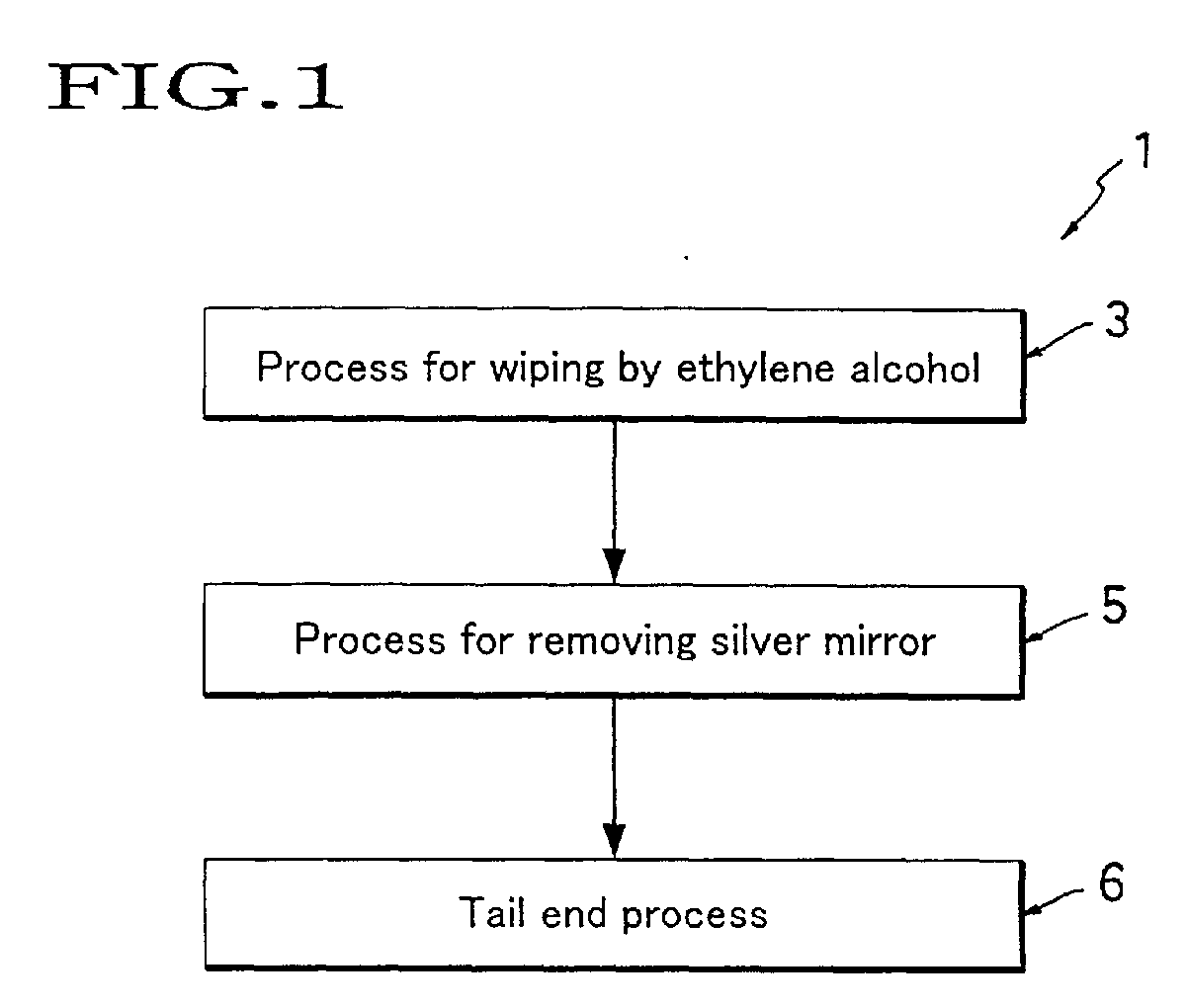
- the above restoring method 1 is composed of ethylene alcohol wipe process 3, silver mirror removal process 5, and tail end process 6.
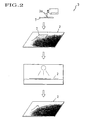
- the ethylene alcohol wipe process 3 is proceeded to wipe the surface of photograph dry plate or negative film 2 which are taken a picture of the black-and-white picture and preserved for a long term by ethylene alcohol 3a and allow it to dry.
- the silver mirror removal process 5 is proceeded to wipe and drop the silver part 4 of the surface of the image of the photograph dry plate or negative film 2A by the silver mirror removal liquid 5a.
- the tail end process 6 is proceeded such that the photograph dry plate or negative film 2B which removed the silver mirror of the removal process 5 is washed in clear water by water or stream 6a and it can be dried.
- the dirt of the surface of the photograph dry plate or negative film 2 is washed by the wipe material 7 such as cotton, cloths including absorbent cottons to contain ethylene alcohol 3a enough. Then it dries the ethylene alcohol that adheres to the photograph dry plate or negative film 2 with natural seasoning or a heater, etc.
- the wipe material 7A such as cotton and cloths including the absorbent cottons contains a small amount of the silver mirror removal liquid 5a.
- the silver mirror part 4 is wiped until the sliver mirror can be removed and dropped.
- the silver mirror removal liquid 5a used in the silver mirror removal process 5 is a mixture - one to ten part methanol and one part solution of salt of 0.5 to 25 percent.
- the tail end process 6 is proceeded to remove the removal liquid 5a used in the above-mentioned removal process 5, the removal liquid 5a is dried by natural seasoning in the place without dust and where it is well ventilated after it washes in clear water to flush the silver mirror removal liquid 5a in stream 6a.
- a second embodiment of the present invention is shown in Figs. 5 to 15. It is distinguished from the first embodiment by the fact that the restoring method 1 is replaced from another method including a head end process 8, process for spreading hardener 9, process for removing hardener 10, process for bleaching 11, process for removing bleacher 12, process for exposuring 13, process for developing 14, fixation process 15, process for removing hypo 16 and tail end process 6A.
- water 8a cleans up the surface of photograph dry plate or negative film 2 and this process 8 makes the surface thereof to contain water.
- the process 8 is proceeded in about two minutes.
- the surface of photograph dry plate or negative film is spread hardener 9a or the photograph dry plate or negative film itself dipped into the hardener 9a in about eight minutes such that the gelatin of the photograph dry plate or the image of the negative film 2C is hardened in the hardener spreading process 9.
- the hardener 9a is removed from photograph dry plate or negative film 2D by washing in clear water about ten minutes in the hardener removal process 10.
- the silver compound in discoloring discoloration of the image and silver mirror part are bleached at bleacher 11a in the bleaching process 11 about two to five minutes.
- the bleacher 11a is removed by washing in clear water about three minutes, and the cleaning solution 12a washes in clear water for about thirty minutes, after the bleacher 11 a which remains in the image part which cannot be removed by the washing in clear water is decomposed by cleaning solution 12a about five minutes.
- the halogenated silver produced in the bleaching part according to the bleacher removal process 12 is exposed at the state that light is applied and exposed enough.
- develop solution 14a used in general in the development process 14 After that, it develops with develop solution 14a used in general in the development process 14 at about two to three minutes.
- the exposed negative film soaks to stop solution 15a for about thirty seconds, the develop solution 14a is neutralized, and halogenated silver which remains on the photograph dry plate or negative film is decomposed for about five minutes by fixing solution 15b. After that, the fixing solution 15b is removed by washing in clear water for about three minutes.
- hypo means for sodium thiosulfate
- photograph dry plate or negative film 2E is decomposed and removed by hypo removal liquid 16a at about six minutes in the hypo removal process 16.
- a restoring method according to the second embodiment may be proceeded.
- the hardener 9a, as used at 20, which is the liquid used by this restoring method in processing temperature is composed of sodium sulfite of fifty gram, glacial acetic acid of twenty milliliter, and potassium alum of fifty gram.
- the bleacher 11a is composed of A liquid which adds potassium permanganate of five gram to water of one liter, B liquid which adds hydrochloric acid of 100 milliliter of thirty-five percent to the water of one liter at the same amount of the A liquid, and liquid making to mixture liquid of twenty liter which mixes three to thirty-eight times is added to hydrobromic acid of 0.2 to 2 milliliter.
- Cleaning solution 12a is potassium metabisulfite of one to ten percent by weight.
- Developer 14a uses the one used in general.
- Stop solution 15a is the glacial acetic acid of three percent by weight.
- Fixing solution 15b is the mixture that sodium thiosulfate (hypo) of 240 gram is added to the water of one liter.
- Hypo removal liquid 16a is sodium metasulfate of two percent by weight.
- a third embodiment of the present invention is shown in Figs. 16 and 17. It is distinguished from the second embodiment by the fact that the tail end process 6A is replaced from with another method 6B.
- this method 6B a similar process of the second embodiment of the above-mentioned is done by using black-and-white picture 3, the black-and-white picture 3A which is naturally dry is placed between two flat pressurizing boards 17 and 17, and it pressurizes with a weight 18 or the like and is flattened.
- a restoring method with the tail end process 6B according to the third embodiment may be proceeded.
Landscapes
- Physics & Mathematics (AREA)
- General Physics & Mathematics (AREA)
- Silver Salt Photography Or Processing Solution Therefor (AREA)
Abstract
The present invention provides a method of restoring a black-and-white picture which
has undergone aging phenomena, the method including wiping with ethyl alcohol,
allowing to dry, subsequently dropping a silver mirror removal liquid onto a silver part
of the image, washing in water and drying.
In the further embodiment, the method includes cleaning with water, whereby the
surface becomes wet, spreading hardener on the surface such that gelatin of the picture
is hardened, removing the hardener by washing in water, bleaching the discolouring
silver compound of the image and silver mirror part using a bleach solution, removing
the bleach solution by washing in water, decomposing any bleach solution which
remains in the image part which cannot be removed by washing in water using a
cleaning solution, removing the cleaning solution by washing in water, exposing
halogenated silver which is produced in the bleaching step, with sufficient light to
decompose the halogenated silver, developing the image with developer solution,
fixing the developed image by using a stop solution followed by a fixing solution,
whereby halogenated silver which remains is decomposed by the fixing solution,
removing the fixing solution by washing in water, decomposing and removing the fixing
solution remaining by a fixing solution removal liquid and washing in water to remove
any compound remaining after which the photograph dry plate, negative film or black
and white picture is allowed to dry.
Description
- The present invention relates generally to a method of restoring the black-and-white picture under aging phenomena, the method restoring the aging phenomena such as silver mirror ("Gin Kaburi" in Japanese), discoloration or the like of the photograph dry plate, negative film or black-and-white picture which is taken a picture of the black-and-white and is preserved for a long term.
- In the conventional photograph dry plate, negative film or black-and-white picture taken the black-and-white picture, silver formed the image comes to shoot metallic luster on the surface of the image and it changes to the silver mirror by the preservation of a long term so far, and the silver mirror appears remarkably in the shade part of the image. Accordingly, the decrease in the picture quality is invited, and there is a fault of ruining original consideration to which the photograph is involved and the meaning
- Accordingly, it is an object of the present invention to provide the method of restoring the black-and-white picture under aging phenomena that can be made an original black-and-white picture, photograph dry plate or negative film with silver which makes original in the silver part black by disarranging a metallic uniting the removal or silver and replacing the silver part on the surface of the image of the black-and-white picture changed.
- The novel features which are believed to be characteristic of the invention, both as to its organization and method of operation, together with further objects and advantages thereof, are described below with reference to the accompanying drawings in which a presently preferred embodiment of the invention is illustrated as an example.
- It is to be expressly understood, however, that the drawings are for the purpose of illustration and description only, and are not intended as a definition of the limits of the invention.
-
- Fig. 1 is a view of a process showing a first embodiment of the present invention;
- Fig. 2 is an explanation view of a process for wiping by ethylene alcohol;
- Fig. 3 is an explanation view of a process for removing silver mirror;
- Fig. 4 is an explanation view of a tail end process;
- Fig. 5 is a view of a process showing a second embodiment of the present invention;
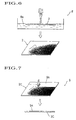
- Fig. 6 is an explanation view of a preprocessing process;
- Fig. 7 is an explanation view of a process for spreading hardener;
- Fig. 8 is an explanation view of a process for removing hardener;
- Fig. 9 is an explanation view of a process for bleaching;
- Fig. 10 is an explanation view of a process for removing bleacher;
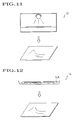
- Fig. 11 is an explanation view of process for exposuring;
- Fig. 12 is an explanation view of process for developing;
- Fig. 13 is an explanation view of a fixation process;
- Fig. 14 is an explanation view of a process for removing hypo;
- Fig. 15 is an explanation view of a tail end process;
- Fig. 16 is a view of a process showing a third embodiment of the present invention; and
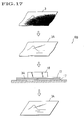
- Fig. 17 is an explanation view of a tail end process.
-
- Preferred embodiments of the present invention are described in more detail below referring to the accompanying drawings.
- An understanding of the present invention may be best gained by reference Figs. 1 to 4. Figs. 1 to 4 illustrates the method of restoring the black-and-white picture under aging phenomena of a first embodiment of the present invention. The numeral 1 is a method of restoring the black-and-white picture under aging phenomena of this invention. The above restoring method 1 is composed of ethylene
alcohol wipe process 3, silvermirror removal process 5, andtail end process 6. - The ethylene
alcohol wipe process 3 is proceeded to wipe the surface of photograph dry plate ornegative film 2 which are taken a picture of the black-and-white picture and preserved for a long term byethylene alcohol 3a and allow it to dry. - After the ethylene
alcohol wipe process 3 is proceeded, the silvermirror removal process 5 is proceeded to wipe and drop thesilver part 4 of the surface of the image of the photograph dry plate or negative film 2A by the silvermirror removal liquid 5a. - After the silver
mirror removal process 5 is proceeded, thetail end process 6 is proceeded such that the photograph dry plate or negative film 2B which removed the silver mirror of theremoval process 5 is washed in clear water by water orstream 6a and it can be dried. - In the ethylene
alcohol wipe process 3, the dirt of the surface of the photograph dry plate ornegative film 2 is washed by thewipe material 7 such as cotton, cloths including absorbent cottons to containethylene alcohol 3a enough. Then it dries the ethylene alcohol that adheres to the photograph dry plate ornegative film 2 with natural seasoning or a heater, etc. - In the silver
mirror removal process 5, thewipe material 7A such as cotton and cloths including the absorbent cottons contains a small amount of the silvermirror removal liquid 5a. Thesilver mirror part 4 is wiped until the sliver mirror can be removed and dropped. - The silver
mirror removal liquid 5a used in the silvermirror removal process 5 is a mixture - one to ten part methanol and one part solution of salt of 0.5 to 25 percent. - The
tail end process 6 is proceeded to remove theremoval liquid 5a used in the above-mentionedremoval process 5, theremoval liquid 5a is dried by natural seasoning in the place without dust and where it is well ventilated after it washes in clear water to flush the silvermirror removal liquid 5a instream 6a. - Other embodiments of the present invention will now be described referring to Figs. 5 to 17. Through the drawings of the embodiments, like components are denoted by like numerals as of the first embodiment and will not be further explained in great detail.
- A second embodiment of the present invention is shown in Figs. 5 to 15. It is distinguished from the first embodiment by the fact that the restoring method 1 is replaced from another method including a
head end process 8, process for spreadinghardener 9, process for removinghardener 10, process for bleaching 11, process for removingbleacher 12, process for exposuring 13, process for developing 14,fixation process 15, process for removinghypo 16 andtail end process 6A. - In the
head end process 8,water 8a cleans up the surface of photograph dry plate ornegative film 2 and thisprocess 8 makes the surface thereof to contain water. Theprocess 8 is proceeded in about two minutes. - After the
head end process 8 is proceeded, the surface of photograph dry plate or negative film is spreadhardener 9a or the photograph dry plate or negative film itself dipped into thehardener 9a in about eight minutes such that the gelatin of the photograph dry plate or the image of thenegative film 2C is hardened in thehardener spreading process 9. - After the gelatin of the image hardens in the
hardener spreading process 9, thehardener 9a is removed from photograph dry plate ornegative film 2D by washing in clear water about ten minutes in thehardener removal process 10. - After the
hardener removal process 10 is proceeded, the silver compound in discoloring discoloration of the image and silver mirror part are bleached atbleacher 11a in thebleaching process 11 about two to five minutes. - In the
bleacher removal process 12, thebleacher 11a is removed by washing in clear water about three minutes, and thecleaning solution 12a washes in clear water for about thirty minutes, after thebleacher 11 a which remains in the image part which cannot be removed by the washing in clear water is decomposed bycleaning solution 12a about five minutes. - In the
exposuring process 13, the halogenated silver produced in the bleaching part according to thebleacher removal process 12 is exposed at the state that light is applied and exposed enough. - After that, it develops with develop solution 14a used in general in the
development process 14 at about two to three minutes. - In the
fixation process 15, after thedevelopment process 14 is proceeded, the exposed negative film soaks to stopsolution 15a for about thirty seconds, the develop solution 14a is neutralized, and halogenated silver which remains on the photograph dry plate or negative film is decomposed for about five minutes byfixing solution 15b. After that, thefixing solution 15b is removed by washing in clear water for about three minutes. - After the
fixation process 15 is proceeded, hypo ("hypo" means for sodium thiosulfate) which remained on photograph dry plate ornegative film 2E is decomposed and removed byhypo removal liquid 16a at about six minutes in thehypo removal process 16. - After that, in the
tail end process 6A, after the compound that remains on the photograph dry plate or negative film is removed almost completely by washing in clear water for about thirty minutes or more and it dries generally or naturally. - A restoring method according to the second embodiment may be proceeded.
- In addition, the
hardener 9a, as used at 20, which is the liquid used by this restoring method in processing temperature is composed of sodium sulfite of fifty gram, glacial acetic acid of twenty milliliter, and potassium alum of fifty gram. - The
bleacher 11a is composed of A liquid which adds potassium permanganate of five gram to water of one liter, B liquid which adds hydrochloric acid of 100 milliliter of thirty-five percent to the water of one liter at the same amount of the A liquid, and liquid making to mixture liquid of twenty liter which mixes three to thirty-eight times is added to hydrobromic acid of 0.2 to 2 milliliter. -
Cleaning solution 12a is potassium metabisulfite of one to ten percent by weight. - Developer 14a uses the one used in general.
-
Stop solution 15a is the glacial acetic acid of three percent by weight. -
Fixing solution 15b is the mixture that sodium thiosulfate (hypo) of 240 gram is added to the water of one liter. -
Hypo removal liquid 16a is sodium metasulfate of two percent by weight. - A third embodiment of the present invention is shown in Figs. 16 and 17. It is distinguished from the second embodiment by the fact that the
tail end process 6A is replaced from with anothermethod 6B. In thismethod 6B, a similar process of the second embodiment of the above-mentioned is done by using black-and-white picture 3, the black-and-white picture 3A which is naturally dry is placed between twoflat pressurizing boards weight 18 or the like and is flattened. - A restoring method with the
tail end process 6B according to the third embodiment may be proceeded. - As set forth above, the advantages of the invention are as follows:
- (1) Method of restoring black-and-white picture under aging phenomena includes ethylene alcohol wipe process proceeded to wipe a surface of one of photograph dry plate and negative film which is taken the black-and-white picture and preserved for a long term by ethylene alcohol and allow it to dry; silver mirror removal process proceeded to wipe and drop a silver part on the surface of image of the photograph dry plate and the negative film by silver mirror removal liquid after the ethylene alcohol wipe process is proceeded; and tail end process proceeded such that one of the photograph dry plate and negative film which removed the silver mirror in the removal process is washed in clear water by water or stream and it can be dried. Accordingly, the silver mirror part on the surface of the image of the photograph dry plate and the negative film of the black-and-white picture under aging phenomena is removed, or a metallic uniting silver is disarranged, and the silver mirror part can be replaced with silver which makes original black. Therefore, it is possible to restore it to the photograph dry plate and the negative film that obtains an original black-and-white picture.
- (2) As discussed above, because it is possible to restore it to an original black-and-white picture in the ethyl alcohol wipe process, the silver mirror removal process, and the postprocessing process where dryness of washing in clear water is done, the work is easy comparing it, and it is possible to do in short course.
- (3) Method of restoring black-and-white picture under aging phenomena includes head tail process proceeded that a surface of one of photograph dry plate, negative film and black-and-white picture is cleaned up by the water and it makes the surface thereof to contain water; process for spreading hardener proceeded that the hardener is spread on the surface of one of photograph dry plate, negative film and black-and-white picture or receives one of the photograph dry plate, negative film and black-and-white picture such that gelatin of one of the photograph dry plate and an image of the negative film is hardened after the head tail process is proceeded; process for removing the hardener proceeded that after the gelatin of the image hardens in the hardener spreading process, the hardener is removed from one of the photograph dry plate and negative film by washing in clear water; process for bleaching proceeded that, silver compound in discoloring discoloration of the image and silver mirror part are bleached at a bleach solution after the hardener removal process is proceeded; process for removing the bleach solution proceeded that the bleach solution is removed by washing in clear water, and cleaning solution is removed by washing in clear water after the bleach solution which remains in the image part which cannot be removed by the washing in clear water is decomposed by the cleaning solution; process for exposuring proceeded that halogenated silver which produced in the bleaching part according to the bleach solution removal process is exposed at the state that light is applied enough; process for developing proceeded that develops with develop solution after the exposuring process is proceeded; fixation process proceeded that the develop solution is neutralized by stop solution, and halogenated silver which remains on one of the photograph dry plate, negative film and black-and-white picture is decomposed by fixing solution, and after that, the fixing solution is removed by washing in clear water; process for removing hypo proceeded that, hypo remained on one of the photograph dry plate, negative film and black-and-white picture is decomposed and removed by hypo removal liquid after the fixation process is proceeded; and tail end process proceeded that compound remains on one of the photograph dry plate, negative film and black-and-white picture is removed almost completely by washing in clear water and then allowing to dry after the hypo removal process is proceeded, so that it is possible to replace it with silver which makes original black by removing the silver mirror part on the surface of the image of the photograph dry plate of the black-and-white picture changed under aging phenomena, the negative film, and the black-and-white picture and the silver compounds.
-
- Therefore, it is possible to restore it to the black-and-white picture, the photograph dry plate and the negative film that obtains an original black-and-white picture.
Claims (5)
- A method of restoring a black-and-white picture which has undergone aging phenomena, the method including wiping with ethyl alcohol a surface of one of a photograph dry plate, black and white negative film and black and white picture which has been preserved for a long time and allowing to dry, subsequently dropping a silver mirror removal liquid onto a silver part of the image on the photograph dry plate, negative film or picture and wiping the silver mirror removal liquid over the surface of the image of the photograph, dry plate picture or negative film; and a tail end process wherein the photograph dry plate, negative film or picture from which the silver mirror has been removed is washed in water and is dried.
- The method of restoring a black-and-white picture which has undergone aging phenomena according to claim 1, wherein the silver mirror removal liquid is a mixture of 1 to 10 parts by weight methanol and 1 to 10 parts by weight of a solution comprising 0.5-25% by weight sodium chloride.
- The method of restoring a black-and-white picture which has undergone aging phenomena according to claim 1, wherein the photograph dry plate, negative film or picture is washed under flowing water.
- A method of restoring a black-and-white picture which has undergone aging phenomena, including:a head process, wherein a surface of one of a photograph dry plate, negative film and black-and-white picture is cleaned up by water, whereby the surface becomes wet; spreading hardener on the surface of the photograph dry plate, negative film or black and white picture such that gelatin of the photograph dry plate, negative film or black and white picture is hardened;after the gelatin of the image is hardened in the hardener spreading process, removing the hardener from the photograph dry plate, negative film or black and white picture by washing in water;bleaching the discolouring silver compound of the image and silver mirror part using a bleach solution;removing the bleach solution by washing in water;decomposing any bleach solution which remains in the image part which cannot be removed by washing in water using a cleaning solution,removing the cleaning solution by washing in water;exposing halogenated silver which is produced in the bleaching step, with sufficient light to decompose the halogenated silver;developing the image with developer solution;fixing the developed image by using a stop solution followed by a fixing solution, whereby halogenated silver which remains on one of photograph dry plate, negative film or black and white picture is decomposed by the fixing solution;removing the fixing solution by washing in water;decomposing and removing the fixing solution remaining on the photograph dry plate, negative film or black and white picture by a fixing solution removal liquid;and tail end process, wherein any compound remaining on the photograph dry plate, negative or black and white picture is removed substantially completely by washing in water, after which the photograph dry plate, negative film or black and white picture is allowed to dry.
- The method of restoring a black and white picture which has undergone aging phenomena according to claim 4, wherein the tail end process occurs before a natural seasoning.
Priority Applications (1)
| Application Number | Priority Date | Filing Date | Title |
|---|---|---|---|
| EP01300795A EP1227370A1 (en) | 2001-01-30 | 2001-01-30 | Method for restoring black-and-white photographs |
Applications Claiming Priority (1)
| Application Number | Priority Date | Filing Date | Title |
|---|---|---|---|
| EP01300795A EP1227370A1 (en) | 2001-01-30 | 2001-01-30 | Method for restoring black-and-white photographs |
Publications (1)
| Publication Number | Publication Date |
|---|---|
| EP1227370A1 true EP1227370A1 (en) | 2002-07-31 |
Family
ID=8181671
Family Applications (1)
| Application Number | Title | Priority Date | Filing Date |
|---|---|---|---|
| EP01300795A Withdrawn EP1227370A1 (en) | 2001-01-30 | 2001-01-30 | Method for restoring black-and-white photographs |
Country Status (1)
| Country | Link |
|---|---|
| EP (1) | EP1227370A1 (en) |
Citations (1)
| Publication number | Priority date | Publication date | Assignee | Title |
|---|---|---|---|---|
| JP2001042489A (en) * | 1999-07-27 | 2001-02-16 | Photo Murabayashi:Kk | Method for restoring aged black-and-white photograph |
-
2001
- 2001-01-30 EP EP01300795A patent/EP1227370A1/en not_active Withdrawn
Patent Citations (1)
| Publication number | Priority date | Publication date | Assignee | Title |
|---|---|---|---|---|
| JP2001042489A (en) * | 1999-07-27 | 2001-02-16 | Photo Murabayashi:Kk | Method for restoring aged black-and-white photograph |
Non-Patent Citations (5)
| Title |
|---|
| E.WEYDE: "A simple test to identify gases which destroy silver images", PHOTOGRAPHIC SCIENCE AND ENGINEERING., vol. 16, no. 4, July 1972 (1972-07-01), SOCIETY OF PHOTOGRAPHIC SCIENTISTS AND ENGINEERS. WASHINGTON., US, pages 283 - 286, XP002182331 * |
| J.S.JOHNSEN: "Image Quality of Chemically Restored Black and White Negatives", JOURNAL OF IMAGING SCIENCE AND TECHNOLOGY., vol. 36, no. 1, January 1992 (1992-01-01), SOC. FOR IMAGING SCIENCE AND TECHNOLOGY, SPRINGFIELD, VA., US, pages 46 - 55, XP002182332, ISSN: 1062-3701 * |
| KLAUS B. HENDRIKS: "Über die chemische Restaurierung des Silberbildes vergilbter oder verfärbter Photographien", WIENER BERICHTE ÜBER NATURWISSENSCHAFT IN DER KUNST, vol. 4/5, 1987 - 1988, Wien, pages 372 - 389, XP001039912 * |
| M.S.BARGER ET AL.: "Thiourea and Ammonium Thiosulfate Treatments for the Removal of "Silvering" from Aged Negative Materials", JOURNAL OF IMAGING TECHNOLOGY., vol. 14, no. 2, April 1988 (1988-04-01), SOC. FOR IMAGING SCIENCE AND TECHNOLOGY, SPRINGFIELD, VA., US, pages 43 - 46, XP002182333 * |
| PATENT ABSTRACTS OF JAPAN vol. 2000, no. 19 5 June 2001 (2001-06-05) * |
Similar Documents
| Publication | Publication Date | Title |
|---|---|---|
| US6558052B2 (en) | System and method for latent film recovery in electronic film development | |
| EP0359803B1 (en) | Process for stabilizing photographic elements | |
| DE69029927T2 (en) | Process for stabilizing photographic elements | |
| US6573034B2 (en) | Method of restoring black-and-white picture under aging phenomena | |
| DE3810348C2 (en) | Process for the rapid development of color materials | |
| JP3446174B2 (en) | Restoring aging black and white photos | |
| JPH11271947A (en) | Finish rinsing solution for photography and its use method | |
| Crabtree | The development of motion picture film by the reel and tank systems | |
| DE69813167T2 (en) | Image information recording method | |
| Moor | The ambrotype—research into its restoration and conservation—part 1 | |
| DE1772945A1 (en) | Rapid stabilization process for color photographic materials | |
| US1770352A (en) | Manufacture of diazotype sensitive papers and the like | |
| CA2612774C (en) | Color film developer composition and process therefor | |
| DE1597600A1 (en) | Copying process | |
| JPS5832701B2 (en) | How to color sulfur print photos | |
| DE526148C (en) | Process for producing images on inhomogeneous layers | |
| Gagnon | Monochromatic color with black and white slides | |
| RU2009535C1 (en) | Method for silver pattern beefing-up | |
| DE3008266A1 (en) | METHOD FOR VISUALIZING REMAINING HUMIDITY DISTRIBUTIONS IN FLOWED, PHOTOGRAPHIC WET FILM LAYERS | |
| US3558313A (en) | Water wash for stabilized silver halide photographic materials | |
| EP0657775B1 (en) | Image toning of black-and-white images formed utilizing color dye forming couplers | |
| JP3432960B2 (en) | Processing method of silver halide color photographic light-sensitive material | |
| PL163539B1 (en) | The method of regeneration of printing templates | |
| JPS6028653A (en) | Automatic developing device | |
| EP1016918A3 (en) | Photographic fixing composition and method of rapid photographic processing |
Legal Events
| Date | Code | Title | Description |
|---|---|---|---|
| PUAI | Public reference made under article 153(3) epc to a published international application that has entered the european phase |
Free format text: ORIGINAL CODE: 0009012 |
|
| AK | Designated contracting states |
Kind code of ref document: A1 Designated state(s): AT BE CH CY DE DK ES FI FR GB GR IE IT LI LU MC NL PT SE TR |
|
| AX | Request for extension of the european patent |
Free format text: AL;LT;LV;MK;RO;SI |
|
| AKX | Designation fees paid | ||
| REG | Reference to a national code |
Ref country code: DE Ref legal event code: 8566 |
|
| STAA | Information on the status of an ep patent application or granted ep patent |
Free format text: STATUS: THE APPLICATION IS DEEMED TO BE WITHDRAWN |
|
| 18D | Application deemed to be withdrawn |
Effective date: 20030201 |