EP1227144A1 - Oil-soluble additive compositions for lubricating oils comprising imidazolidine thione - Google Patents
Oil-soluble additive compositions for lubricating oils comprising imidazolidine thione Download PDFInfo
- Publication number
- EP1227144A1 EP1227144A1 EP02250438A EP02250438A EP1227144A1 EP 1227144 A1 EP1227144 A1 EP 1227144A1 EP 02250438 A EP02250438 A EP 02250438A EP 02250438 A EP02250438 A EP 02250438A EP 1227144 A1 EP1227144 A1 EP 1227144A1
- Authority
- EP
- European Patent Office
- Prior art keywords
- alkyl
- alkenyl
- composition
- oil
- aryl
- Prior art date
- Legal status (The legal status is an assumption and is not a legal conclusion. Google has not performed a legal analysis and makes no representation as to the accuracy of the status listed.)
- Granted
Links
- 239000000203 mixture Substances 0.000 title claims abstract description 61
- 239000010687 lubricating oil Substances 0.000 title claims description 10
- 239000000654 additive Substances 0.000 title description 8
- 230000000996 additive effect Effects 0.000 title description 6
- PDQAZBWRQCGBEV-UHFFFAOYSA-N Ethylenethiourea Chemical compound S=C1NCCN1 PDQAZBWRQCGBEV-UHFFFAOYSA-N 0.000 title description 2
- 125000000217 alkyl group Chemical group 0.000 claims abstract description 24
- 125000003342 alkenyl group Chemical group 0.000 claims abstract description 18
- 150000001875 compounds Chemical class 0.000 claims abstract description 16
- 125000003118 aryl group Chemical group 0.000 claims abstract description 14
- 125000003710 aryl alkyl group Chemical group 0.000 claims abstract description 10
- 229910052739 hydrogen Inorganic materials 0.000 claims abstract description 10
- 239000001257 hydrogen Substances 0.000 claims abstract description 10
- 239000002253 acid Substances 0.000 claims abstract description 9
- 125000004432 carbon atom Chemical group C* 0.000 claims abstract description 9
- 125000004435 hydrogen atom Chemical class [H]* 0.000 claims abstract description 9
- 239000003879 lubricant additive Substances 0.000 claims abstract description 9
- 229910052799 carbon Inorganic materials 0.000 claims abstract description 6
- 238000002156 mixing Methods 0.000 claims description 2
- JHIVVAPYMSGYDF-UHFFFAOYSA-N cyclohexanone Chemical compound O=C1CCCCC1 JHIVVAPYMSGYDF-UHFFFAOYSA-N 0.000 description 28
- ZWEHNKRNPOVVGH-UHFFFAOYSA-N 2-Butanone Chemical compound CCC(C)=O ZWEHNKRNPOVVGH-UHFFFAOYSA-N 0.000 description 27
- CSCPPACGZOOCGX-UHFFFAOYSA-N Acetone Chemical compound CC(C)=O CSCPPACGZOOCGX-UHFFFAOYSA-N 0.000 description 24
- HEDRZPFGACZZDS-MICDWDOJSA-N Trichloro(2H)methane Chemical compound [2H]C(Cl)(Cl)Cl HEDRZPFGACZZDS-MICDWDOJSA-N 0.000 description 24
- 239000007787 solid Substances 0.000 description 22
- 239000003921 oil Substances 0.000 description 16
- 239000004576 sand Substances 0.000 description 13
- NLXLAEXVIDQMFP-UHFFFAOYSA-N Ammonia chloride Chemical compound [NH4+].[Cl-] NLXLAEXVIDQMFP-UHFFFAOYSA-N 0.000 description 12
- XLYOFNOQVPJJNP-UHFFFAOYSA-N water Substances O XLYOFNOQVPJJNP-UHFFFAOYSA-N 0.000 description 12
- NTIZESTWPVYFNL-UHFFFAOYSA-N Methyl isobutyl ketone Chemical compound CC(C)CC(C)=O NTIZESTWPVYFNL-UHFFFAOYSA-N 0.000 description 9
- UIHCLUNTQKBZGK-UHFFFAOYSA-N Methyl isobutyl ketone Natural products CCC(C)C(C)=O UIHCLUNTQKBZGK-UHFFFAOYSA-N 0.000 description 9
- YPIFGDQKSSMYHQ-UHFFFAOYSA-N 7,7-dimethyloctanoic acid Chemical compound CC(C)(C)CCCCCC(O)=O YPIFGDQKSSMYHQ-UHFFFAOYSA-N 0.000 description 8
- HEDRZPFGACZZDS-UHFFFAOYSA-N Chloroform Chemical compound ClC(Cl)Cl HEDRZPFGACZZDS-UHFFFAOYSA-N 0.000 description 8
- 239000013256 coordination polymer Substances 0.000 description 8
- BWHMMNNQKKPAPP-UHFFFAOYSA-L potassium carbonate Chemical compound [K+].[K+].[O-]C([O-])=O BWHMMNNQKKPAPP-UHFFFAOYSA-L 0.000 description 8
- 238000010438 heat treatment Methods 0.000 description 7
- 238000001644 13C nuclear magnetic resonance spectroscopy Methods 0.000 description 6
- 238000005160 1H NMR spectroscopy Methods 0.000 description 6
- 235000019270 ammonium chloride Nutrition 0.000 description 6
- UYJXRRSPUVSSMN-UHFFFAOYSA-P ammonium sulfide Chemical compound [NH4+].[NH4+].[S-2] UYJXRRSPUVSSMN-UHFFFAOYSA-P 0.000 description 6
- 239000007864 aqueous solution Substances 0.000 description 6
- HUMNYLRZRPPJDN-UHFFFAOYSA-N benzaldehyde Chemical compound O=CC1=CC=CC=C1 HUMNYLRZRPPJDN-UHFFFAOYSA-N 0.000 description 6
- KXZJHVJKXJLBKO-UHFFFAOYSA-N chembl1408157 Chemical compound N=1C2=CC=CC=C2C(C(=O)O)=CC=1C1=CC=C(O)C=C1 KXZJHVJKXJLBKO-UHFFFAOYSA-N 0.000 description 6
- 238000000034 method Methods 0.000 description 6
- 238000002360 preparation method Methods 0.000 description 5
- XMIIGOLPHOKFCH-UHFFFAOYSA-N 3-phenylpropionic acid Chemical compound OC(=O)CCC1=CC=CC=C1 XMIIGOLPHOKFCH-UHFFFAOYSA-N 0.000 description 4
- 238000012935 Averaging Methods 0.000 description 4
- 235000021355 Stearic acid Nutrition 0.000 description 4
- 125000003545 alkoxy group Chemical group 0.000 description 4
- 125000003368 amide group Chemical group 0.000 description 4
- WPYMKLBDIGXBTP-UHFFFAOYSA-N benzoic acid Chemical compound OC(=O)C1=CC=CC=C1 WPYMKLBDIGXBTP-UHFFFAOYSA-N 0.000 description 4
- 125000001589 carboacyl group Chemical group 0.000 description 4
- 150000002576 ketones Chemical class 0.000 description 4
- QIQXTHQIDYTFRH-UHFFFAOYSA-N octadecanoic acid Chemical compound CCCCCCCCCCCCCCCCCC(O)=O QIQXTHQIDYTFRH-UHFFFAOYSA-N 0.000 description 4
- OQCDKBAXFALNLD-UHFFFAOYSA-N octadecanoic acid Natural products CCCCCCCC(C)CCCCCCCCC(O)=O OQCDKBAXFALNLD-UHFFFAOYSA-N 0.000 description 4
- WLJVXDMOQOGPHL-UHFFFAOYSA-N phenylacetic acid Chemical compound OC(=O)CC1=CC=CC=C1 WLJVXDMOQOGPHL-UHFFFAOYSA-N 0.000 description 4
- 229910000027 potassium carbonate Inorganic materials 0.000 description 4
- 238000000935 solvent evaporation Methods 0.000 description 4
- 239000008117 stearic acid Substances 0.000 description 4
- QNGNSVIICDLXHT-UHFFFAOYSA-N para-ethylbenzaldehyde Natural products CCC1=CC=C(C=O)C=C1 QNGNSVIICDLXHT-UHFFFAOYSA-N 0.000 description 3
- 238000000425 proton nuclear magnetic resonance spectrum Methods 0.000 description 3
- 238000006467 substitution reaction Methods 0.000 description 3
- KKOLLCGNDRMSSZ-UHFFFAOYSA-N 4,4,5,5-tetramethylimidazolidine-2-thione Chemical compound CC1(C)NC(=S)NC1(C)C KKOLLCGNDRMSSZ-UHFFFAOYSA-N 0.000 description 2
- IJGRMHOSHXDMSA-UHFFFAOYSA-N Atomic nitrogen Chemical compound N#N IJGRMHOSHXDMSA-UHFFFAOYSA-N 0.000 description 2
- 239000005711 Benzoic acid Substances 0.000 description 2
- OAICVXFJPJFONN-UHFFFAOYSA-N Phosphorus Chemical compound [P] OAICVXFJPJFONN-UHFFFAOYSA-N 0.000 description 2
- HCHKCACWOHOZIP-UHFFFAOYSA-N Zinc Chemical compound [Zn] HCHKCACWOHOZIP-UHFFFAOYSA-N 0.000 description 2
- 150000001299 aldehydes Chemical class 0.000 description 2
- 235000010233 benzoic acid Nutrition 0.000 description 2
- 125000001743 benzylic group Chemical group 0.000 description 2
- 125000001475 halogen functional group Chemical group 0.000 description 2
- 125000004356 hydroxy functional group Chemical group O* 0.000 description 2
- 229960003424 phenylacetic acid Drugs 0.000 description 2
- 239000003279 phenylacetic acid Substances 0.000 description 2
- 229910052698 phosphorus Inorganic materials 0.000 description 2
- 239000011574 phosphorus Substances 0.000 description 2
- 239000011541 reaction mixture Substances 0.000 description 2
- 125000001424 substituent group Chemical group 0.000 description 2
- 239000011701 zinc Substances 0.000 description 2
- 229910052725 zinc Inorganic materials 0.000 description 2
- URGJOYDECMYFMJ-UHFFFAOYSA-N 7,14-diazadispiro[5.1.5^{8}.2^{6}]pentadecane-15-thione Chemical compound N1C2(CCCCC2)C(=S)NC21CCCCC2 URGJOYDECMYFMJ-UHFFFAOYSA-N 0.000 description 1
- OKTJSMMVPCPJKN-UHFFFAOYSA-N Carbon Chemical group [C] OKTJSMMVPCPJKN-UHFFFAOYSA-N 0.000 description 1
- UFHFLCQGNIYNRP-UHFFFAOYSA-N Hydrogen Chemical compound [H][H] UFHFLCQGNIYNRP-UHFFFAOYSA-N 0.000 description 1
- 238000005481 NMR spectroscopy Methods 0.000 description 1
- NINIDFKCEFEMDL-UHFFFAOYSA-N Sulfur Chemical compound [S] NINIDFKCEFEMDL-UHFFFAOYSA-N 0.000 description 1
- 150000007513 acids Chemical class 0.000 description 1
- 125000001931 aliphatic group Chemical group 0.000 description 1
- 125000000304 alkynyl group Chemical group 0.000 description 1
- 150000001491 aromatic compounds Chemical class 0.000 description 1
- 125000006615 aromatic heterocyclic group Chemical group 0.000 description 1
- QVGXLLKOCUKJST-UHFFFAOYSA-N atomic oxygen Chemical compound [O] QVGXLLKOCUKJST-UHFFFAOYSA-N 0.000 description 1
- 239000002199 base oil Substances 0.000 description 1
- 150000001721 carbon Chemical group 0.000 description 1
- 150000001728 carbonyl compounds Chemical class 0.000 description 1
- 125000003178 carboxy group Chemical group [H]OC(*)=O 0.000 description 1
- 230000003197 catalytic effect Effects 0.000 description 1
- 238000006243 chemical reaction Methods 0.000 description 1
- 125000004122 cyclic group Chemical group 0.000 description 1
- 125000005843 halogen group Chemical group 0.000 description 1
- 125000005842 heteroatom Chemical group 0.000 description 1
- 125000001183 hydrocarbyl group Chemical group 0.000 description 1
- 239000000314 lubricant Substances 0.000 description 1
- 230000001050 lubricating effect Effects 0.000 description 1
- 238000002844 melting Methods 0.000 description 1
- 230000008018 melting Effects 0.000 description 1
- 125000002496 methyl group Chemical group [H]C([H])([H])* 0.000 description 1
- 229910052757 nitrogen Inorganic materials 0.000 description 1
- 229910052760 oxygen Inorganic materials 0.000 description 1
- 239000001301 oxygen Substances 0.000 description 1
- 239000000843 powder Substances 0.000 description 1
- 125000006413 ring segment Chemical group 0.000 description 1
- 239000000243 solution Substances 0.000 description 1
- 238000010183 spectrum analysis Methods 0.000 description 1
- 239000012258 stirred mixture Substances 0.000 description 1
- 229910052717 sulfur Inorganic materials 0.000 description 1
- 239000011593 sulfur Substances 0.000 description 1
Classifications
-
- C—CHEMISTRY; METALLURGY
- C07—ORGANIC CHEMISTRY
- C07D—HETEROCYCLIC COMPOUNDS
- C07D235/00—Heterocyclic compounds containing 1,3-diazole or hydrogenated 1,3-diazole rings, condensed with other rings
- C07D235/02—Heterocyclic compounds containing 1,3-diazole or hydrogenated 1,3-diazole rings, condensed with other rings condensed with carbocyclic rings or ring systems
-
- C—CHEMISTRY; METALLURGY
- C07—ORGANIC CHEMISTRY
- C07D—HETEROCYCLIC COMPOUNDS
- C07D233/00—Heterocyclic compounds containing 1,3-diazole or hydrogenated 1,3-diazole rings, not condensed with other rings
- C07D233/04—Heterocyclic compounds containing 1,3-diazole or hydrogenated 1,3-diazole rings, not condensed with other rings having one double bond between ring members or between a ring member and a non-ring member
- C07D233/28—Heterocyclic compounds containing 1,3-diazole or hydrogenated 1,3-diazole rings, not condensed with other rings having one double bond between ring members or between a ring member and a non-ring member with hetero atoms or with carbon atoms having three bonds to hetero atoms with at the most one bond to halogen, e.g. ester or nitrile radicals, directly attached to ring carbon atoms
- C07D233/30—Oxygen or sulfur atoms
- C07D233/42—Sulfur atoms
-
- C—CHEMISTRY; METALLURGY
- C10—PETROLEUM, GAS OR COKE INDUSTRIES; TECHNICAL GASES CONTAINING CARBON MONOXIDE; FUELS; LUBRICANTS; PEAT
- C10M—LUBRICATING COMPOSITIONS; USE OF CHEMICAL SUBSTANCES EITHER ALONE OR AS LUBRICATING INGREDIENTS IN A LUBRICATING COMPOSITION
- C10M135/00—Lubricating compositions characterised by the additive being an organic non-macromolecular compound containing sulfur, selenium or tellurium
- C10M135/32—Heterocyclic sulfur, selenium or tellurium compounds
-
- C—CHEMISTRY; METALLURGY
- C10—PETROLEUM, GAS OR COKE INDUSTRIES; TECHNICAL GASES CONTAINING CARBON MONOXIDE; FUELS; LUBRICANTS; PEAT
- C10M—LUBRICATING COMPOSITIONS; USE OF CHEMICAL SUBSTANCES EITHER ALONE OR AS LUBRICATING INGREDIENTS IN A LUBRICATING COMPOSITION
- C10M141/00—Lubricating compositions characterised by the additive being a mixture of two or more compounds covered by more than one of the main groups C10M125/00 - C10M139/00, each of these compounds being essential
- C10M141/08—Lubricating compositions characterised by the additive being a mixture of two or more compounds covered by more than one of the main groups C10M125/00 - C10M139/00, each of these compounds being essential at least one of them being an organic sulfur-, selenium- or tellurium-containing compound
-
- C—CHEMISTRY; METALLURGY
- C10—PETROLEUM, GAS OR COKE INDUSTRIES; TECHNICAL GASES CONTAINING CARBON MONOXIDE; FUELS; LUBRICANTS; PEAT
- C10M—LUBRICATING COMPOSITIONS; USE OF CHEMICAL SUBSTANCES EITHER ALONE OR AS LUBRICATING INGREDIENTS IN A LUBRICATING COMPOSITION
- C10M2207/00—Organic non-macromolecular hydrocarbon compounds containing hydrogen, carbon and oxygen as ingredients in lubricant compositions
- C10M2207/08—Aldehydes; Ketones
-
- C—CHEMISTRY; METALLURGY
- C10—PETROLEUM, GAS OR COKE INDUSTRIES; TECHNICAL GASES CONTAINING CARBON MONOXIDE; FUELS; LUBRICANTS; PEAT
- C10M—LUBRICATING COMPOSITIONS; USE OF CHEMICAL SUBSTANCES EITHER ALONE OR AS LUBRICATING INGREDIENTS IN A LUBRICATING COMPOSITION
- C10M2207/00—Organic non-macromolecular hydrocarbon compounds containing hydrogen, carbon and oxygen as ingredients in lubricant compositions
- C10M2207/10—Carboxylix acids; Neutral salts thereof
-
- C—CHEMISTRY; METALLURGY
- C10—PETROLEUM, GAS OR COKE INDUSTRIES; TECHNICAL GASES CONTAINING CARBON MONOXIDE; FUELS; LUBRICANTS; PEAT
- C10M—LUBRICATING COMPOSITIONS; USE OF CHEMICAL SUBSTANCES EITHER ALONE OR AS LUBRICATING INGREDIENTS IN A LUBRICATING COMPOSITION
- C10M2207/00—Organic non-macromolecular hydrocarbon compounds containing hydrogen, carbon and oxygen as ingredients in lubricant compositions
- C10M2207/10—Carboxylix acids; Neutral salts thereof
- C10M2207/12—Carboxylix acids; Neutral salts thereof having carboxyl groups bound to acyclic or cycloaliphatic carbon atoms
- C10M2207/121—Carboxylix acids; Neutral salts thereof having carboxyl groups bound to acyclic or cycloaliphatic carbon atoms having hydrocarbon chains of seven or less carbon atoms
- C10M2207/122—Carboxylix acids; Neutral salts thereof having carboxyl groups bound to acyclic or cycloaliphatic carbon atoms having hydrocarbon chains of seven or less carbon atoms monocarboxylic
-
- C—CHEMISTRY; METALLURGY
- C10—PETROLEUM, GAS OR COKE INDUSTRIES; TECHNICAL GASES CONTAINING CARBON MONOXIDE; FUELS; LUBRICANTS; PEAT
- C10M—LUBRICATING COMPOSITIONS; USE OF CHEMICAL SUBSTANCES EITHER ALONE OR AS LUBRICATING INGREDIENTS IN A LUBRICATING COMPOSITION
- C10M2207/00—Organic non-macromolecular hydrocarbon compounds containing hydrogen, carbon and oxygen as ingredients in lubricant compositions
- C10M2207/10—Carboxylix acids; Neutral salts thereof
- C10M2207/12—Carboxylix acids; Neutral salts thereof having carboxyl groups bound to acyclic or cycloaliphatic carbon atoms
- C10M2207/125—Carboxylix acids; Neutral salts thereof having carboxyl groups bound to acyclic or cycloaliphatic carbon atoms having hydrocarbon chains of eight up to twenty-nine carbon atoms, i.e. fatty acids
- C10M2207/126—Carboxylix acids; Neutral salts thereof having carboxyl groups bound to acyclic or cycloaliphatic carbon atoms having hydrocarbon chains of eight up to twenty-nine carbon atoms, i.e. fatty acids monocarboxylic
-
- C—CHEMISTRY; METALLURGY
- C10—PETROLEUM, GAS OR COKE INDUSTRIES; TECHNICAL GASES CONTAINING CARBON MONOXIDE; FUELS; LUBRICANTS; PEAT
- C10M—LUBRICATING COMPOSITIONS; USE OF CHEMICAL SUBSTANCES EITHER ALONE OR AS LUBRICATING INGREDIENTS IN A LUBRICATING COMPOSITION
- C10M2207/00—Organic non-macromolecular hydrocarbon compounds containing hydrogen, carbon and oxygen as ingredients in lubricant compositions
- C10M2207/10—Carboxylix acids; Neutral salts thereof
- C10M2207/14—Carboxylix acids; Neutral salts thereof having carboxyl groups bound to carbon atoms of six-membered aromatic rings
- C10M2207/141—Carboxylix acids; Neutral salts thereof having carboxyl groups bound to carbon atoms of six-membered aromatic rings monocarboxylic
-
- C—CHEMISTRY; METALLURGY
- C10—PETROLEUM, GAS OR COKE INDUSTRIES; TECHNICAL GASES CONTAINING CARBON MONOXIDE; FUELS; LUBRICANTS; PEAT
- C10M—LUBRICATING COMPOSITIONS; USE OF CHEMICAL SUBSTANCES EITHER ALONE OR AS LUBRICATING INGREDIENTS IN A LUBRICATING COMPOSITION
- C10M2219/00—Organic non-macromolecular compounds containing sulfur, selenium or tellurium as ingredients in lubricant compositions
- C10M2219/09—Heterocyclic compounds containing no sulfur, selenium or tellurium compounds in the ring
Definitions
- This invention relates generally to compositions useful as ashless oil-soluble additives for lubricating oils.
- Zinc dialkyldithiophosphates are widely used as lubricant additives.
- the principal disadvantages of these compounds are that an ash residue is produced by the zinc as the additive is consumed, and that phosphorus is known to affect the efficiency of catalytic converters in motor vehicles, thereby causing emissions problems.
- An ashless, non-phosphorus alternative to ZDDP would be extremely useful.
- the problem addressed by this invention is to find improved phosphorus-free ashless oil-soluble additives for lubricating oils.
- the present invention is directed to an oil-soluble lubricant additive composition
- an oil-soluble lubricant additive composition comprising:
- the present invention is further directed to a lubricating oil composition
- a lubricating oil composition comprising a lubricating oil and from 0.1% to 20% by weight of the lubricant additive composition described above.
- alkyl is a hydrocarbyl group having, unless otherwise specified, from one to twenty-five carbon atoms in a linear, branched or cyclic arrangement. Substitution on alkyl groups of one or more halo, hydroxy, alkoxy, alkanoyl or amido groups is permitted; alkoxy, alkanoyl and amido groups may in turn be substituted by one or more halo substituents.
- An "alkenyl” group is an “alkyl” group having at least two carbon atoms in which at least one single bond has been replaced with a double bond.
- An “alkynyl” group is an "alkyl” group having at least two carbon atoms in which at least one single bond has been replaced with a triple bond.
- aryl is a substituent derived from an aromatic compound, including heterocyclic aromatic compounds having heteroatoms chosen from among nitrogen, oxygen and sulfur.
- An aryl group has a total of from five to twenty-five ring atoms, unless specified otherwise, and has one or more rings which are separate or fused. Substitution on aryl groups of one or more halo, alkyl, alkenyl, hydroxy, alkoxy, alkanoyl or amido groups is permitted, with substitution by one or more halo groups being possible on alkyl, alkenyl, alkoxy, alkanoyl or amido groups.
- An “aralkyl” group is an "alkyl” group substituted by an "aryl” group.
- the additive composition of the present invention includes at least one compound of formula (I). It is preferred that none of R 1 , R 2 , R 3 or R 4 is hydrogen, i.e., four alkyl, alkenyl, aryl or aralkyl groups are present; in the case where the groups are alkyl, the compound of formula (I) is a tetraalkylimidazolidinethione (TAIT).
- TAIT tetraalkylimidazolidinethione
- the compound in which R 1 , R 2 , R 3 and R 4 are all methyl, i.e., tetramethylimidazolidinethione is also known as TMIT, and has the following structure:
- the additive composition contains a mixture of TAIT compounds produced from a mixture of ketones.
- the composition contains a mixture of tetrasubstituted compounds and compounds having less than four alkyl groups, i.e., those in which one or more of the substituents is hydrogen; such a mixture would be produced from a mixture of ketones and aldehydes, or from a mixture of aldehydes.
- R in the acid has from five to 17 carbon atoms.
- R is alkyl or alkenyl, it is further preferred that R has from nine to 17 carbon atoms.
- the molar ratio of the compound of formula (I) to the acid RCO 2 H is preferably in the range from 3:1 to 1:5, and most preferably, from 2:1 to 1:2.
- an approximate molecular weight is determined for the mixture using NMR spectral analysis of the product mixture, and averaging the molecular weights of the two predominant products.
- the lubricant additive composition is added to a lubricating oil in an amount from 0.1% to 20% by weight. It is preferred that the additive composition is added in an amount from 0.1% to 10%, more preferably from 0.5% to 10%, and most preferably from 0.5% to 3%.
- a lubricating oil is a natural or synthetic oil, having suitable viscosity for use as a lubricant, or a mixture thereof.
- TMIT and stearic acid were mixed at a 1:1 mole ratio and heated in a sand bath at about 140°C for one hour and cooled to room temperature.
- DDPT and stearic acid were mixed at a 1:1 mole ratio and heated in a sand bath at about 140°C for one hour and cooled to room temperature.
- TMIT 1.0 g, 6.33 mmol
- SYLFAT FA-1 naturally occurring mixture of unsaturated C-18 acids, available from Arizona Chemical Co., Jacksonville, FL, 1.83 g, ca. 6.33 mmol
- DDPT and SYLFAT FA-1 were mixed at a 1:1 mole ratio and heated in a sand bath at about 140°C for one hour and cooled to room temperature.
- Example 5 TAIT Mixture Prepared from Acetone/Methyl Isobutyl Ketone/Cyclohexanone Combined with SYLFAT FA-1
- a TAIT mixture was prepared from an equimolar mixture of the three title ketones according to the procedure used for preparation of TMIT, using ammonium sulfide (136 mL, 0.4 moles, 20 wt% aqueous solution), sodium cyanide (14.7 g, 0.3 moles), ammonium chloride (16.1 g, 0.3 moles), water (80 mL), cyclohexanone (19.6 g, 0.2 moles), acetone (11.6 g, 0.2 moles) and methyl isobutyl ketone (20.3 g, 0.2 moles) to obtain a oily layer at the end of the heating period.
- the average molecular weight of 219 was calculated by averaging the molecular weights of the acetone/cyclohexanone cross-product (198) and the methyl isobutyl ketone/cyclohexanone cross-product (240), these being the two predominant products among the 4-5 products detected by proton NMR.
- the product was mixed with SYLFAT FA-1 at approximately a 1:1 molar ratio, based on the average molecular weight determined above, and heated in a sand bath at about 140°C for one hour and cooled to room temperature.
- Example 6 TAIT Mixture Prepared from Acetone/Methyl Isobutyl Ketone/Methyl Ethyl Ketone/Cyclohexanone Combined with SYLFAT FA-1
- a TAIT mixture was prepared from an equimolar mixture of the four title ketones according to the procedure used for preparation of TMIT, using ammonium sulfide (136 mL, 0.4 moles, 20 wt% aqueous solution), sodium cyanide (14.7 g, 0.3 moles), ammonium chloride (16.1 g, 0.3 moles), water (80 mL), cyclohexanone (14.7 g, 0.15 moles), acetone (8.7 g, 0.15 moles) ethyl methyl ketone (10.8 g, 0.15 moles), and methyl isobutyl ketone (15.0 g, 0.15 moles) to obtain an oily layer at the end of the heating period.
- the average molecular weight of 219 was calculated by averaging the molecular weights of the acetone/cyclohexanone cross-product (198) and the methyl isobutyl ketone/cyclohexanone cross-product (240), these being the two predominant products among the 8-10 products detected by proton NMR.
- the product was mixed with SYLFAT FA-1 at approximately a 1:1 molar ratio, based on the average molecular weight determined above, and heated in a sand bath at about 140°C for one hour and cooled to room temperature.
- TMIT and neo-DECANOIC ACID PRIME (a branched C-10 acid with the COOH group attached to a tertiary carbon, available from Exxon Chemical Co., Houston, TX) were mixed in equimolar amounts and heated in a sand bath at about 140°C for one hour and cooled to room temperature.
- Example 8 TAIT Mixture Prepared from Methyl Ethyl Ketone Combined with neo-DECANOIC ACID PRIME
- a cis-trans mixture was obtained by applying the procedure used for preparation of TMIT to ammonium sulfide (136 mL, 0.4 moles, 20 wt% aqueous solution), sodium cyanide (14.7 g, 0.3 moles), ammonium chloride (16.1 g, 0.3 moles), water (80 mL), and ethyl methyl ketone (54.1 g, 0.75 moles) to obtain an oily layer at the end of the heating period.
- the oil layer was extracted into chloroform (350 mL), washed with water and dried with anhydrous potassium carbonate. Solvent evaporation yielded the product as a thick oil that turned into a sticky dirty-white solid.
- the product was mixed with neo-DECANOIC ACID PRIME at a 1:1 molar ratio and heated in a sand bath at about 140°C for one hour and cooled to room temperature.
- Example 9 TAIT Mixture Prepared from Acetone/Methyl Isobutyl Ketone/Methyl Ethyl Ketone/Cyclohexanone/Benzaldehyde Combined with neo-DECANOIC ACID PRIME
- a TAIT mixture was prepared from an equimolar mixture of the five title carbonyl compounds according to the procedure used for preparation of TMIT, using ammonium sulfide (136 mL, 0.4 moles, 20 wt% aqueous solution), sodium cyanide (14.7 g, 0.3 moles), ammonium chloride (16.1 g, 0.3 moles), water (80 mL), cyclohexanone (11.8 g, 0.12 moles), acetone (6.9 g, 0.12 moles) ethyl methyl ketone (8.7 g, 0.12 moles), methyl isobutyl ketone (12.0 g, 0.12 moles), and benzaldehyde (12.7 g, 0.12 moles) to obtain an oily layer at the end of the heating period.
- the average molecular weight of 222 was calculated by averaging the molecular weights of the acetone/cyclohexanone cross-product (198) and the cyclohexanone/benzaldehyde cross-product (246), these being the two predominant products among the 8-10 products detected by proton NMR.
- the product was mixed with neo-DECANOIC ACID PRIME at a 1:1 molar ratio, based on the average molecular weight determined above, and heated in a sand bath at about 140°C for one hour and cooled to room temperature.
- Example 10 TAIT Mixture Prepared from Acetone/Methyl Isobutyl Ketone/Methyl Ethyl Ketone/Cyclohexanone Combined with neo-DECANOIC ACID PRIME
- the TAIT mixture described in Example 6 was mixed with neo-DECANOIC ACID PRIME at approximately a 1:1 molar ratio, based on the average molecular weight determined therein, and heated in a sand bath at about 140°C for one hour and cooled to room temperature.
- Example 11 TAIT Mixture Prepared from Methyl Ethyl Ketone Combined with Hydrocinnamic Acid
- the TAIT mixture described in Example 8 was mixed with hydrocinnamic acid at a 1:1 molar ratio and heated in a sand bath at about140°C for one hour and cooled to room temperature.
- Example 12 TAIT Mixture Prepared from Methyl Ethyl Ketone Combined with Phenylacetic Acid
- the TAIT mixture described in Example 8 was mixed with phenylacetic acid at a 1:1 molar ratio and heated in a sand bath at about140°C for one hour and cooled to room temperature.
- Example 13 TAIT Mixture Prepared from Methyl Ethyl Ketone Combined with Benzoic Acid
- the TAIT mixture described in Example 8 was mixed with benzoic acid at a 1:1 molar ratio and heated in a sand bath at about140°C for one hour and cooled to room temperature.
- Solubility data for the compositions prepared in the Examples in two different lubricating base oils are presented in Tables 1 and 2 by Example number (Ex. No.).
- the oils used were 105 Coastal Pale FN 1502 oil (CP, available from Exxon Corp.) and Excel 100 HC (EHC, available from Pennzoil Corp.). Also tabulated are the concentration of the composition in the oil as a weight percent (Conc.), the temperature in °C to which the composition and oil were heated (T), whether the composition was soluble (Sol.) in the oil and the time after mixing at which haze or solid appeared, given in hours or as an overnight period ("o.n.”).
Landscapes
- Chemical & Material Sciences (AREA)
- Organic Chemistry (AREA)
- Chemical Kinetics & Catalysis (AREA)
- General Chemical & Material Sciences (AREA)
- Oil, Petroleum & Natural Gas (AREA)
- Lubricants (AREA)
- Organic Low-Molecular-Weight Compounds And Preparation Thereof (AREA)
Abstract

Description
- This invention relates generally to compositions useful as ashless oil-soluble additives for lubricating oils.
- Zinc dialkyldithiophosphates (ZDDP) are widely used as lubricant additives. The principal disadvantages of these compounds are that an ash residue is produced by the zinc as the additive is consumed, and that phosphorus is known to affect the efficiency of catalytic converters in motor vehicles, thereby causing emissions problems. An ashless, non-phosphorus alternative to ZDDP would be extremely useful.
- A limited number of alkyl-substituted imidazolidinethione compounds is disclosed in A.E. Oberster et al. in Rubber Chem. Technol., vol. 41, page 255 (1968), but there is no suggestion therein that such compounds would be effective as a component in additive compositions for lubricating oils.
- The problem addressed by this invention is to find improved phosphorus-free ashless oil-soluble additives for lubricating oils.
- The present invention is directed to an oil-soluble lubricant additive composition comprising:
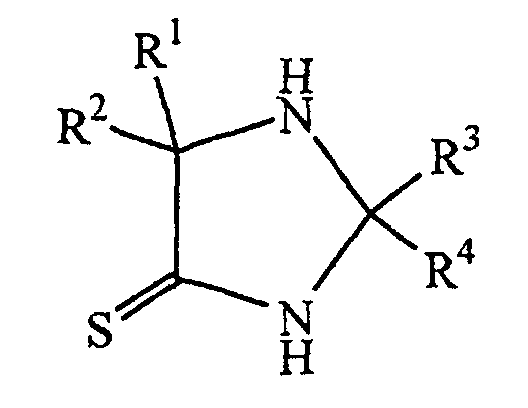
- (a) at least one compound of formula I:
wherein R1, R2, R3 and R4 are independently hydrogen, alkyl, alkenyl, aryl or aralkyl; or R1 and R2, or R3 and R4, combine with the carbon atom to which they are attached to form an alkyl or alkenyl ring; and

- (b) an acid having the formula RCO2H, wherein R is C1-C25 alkyl, C2-C25 alkenyl, C2-C25 alkynyl, C5-C25 aryl or C5-C25 aralkyl.
-
- The present invention is further directed to a lubricating oil composition comprising a lubricating oil and from 0.1% to 20% by weight of the lubricant additive composition described above.
- An "alkyl" group is a hydrocarbyl group having, unless otherwise specified, from one to twenty-five carbon atoms in a linear, branched or cyclic arrangement. Substitution on alkyl groups of one or more halo, hydroxy, alkoxy, alkanoyl or amido groups is permitted; alkoxy, alkanoyl and amido groups may in turn be substituted by one or more halo substituents. An "alkenyl" group is an "alkyl" group having at least two carbon atoms in which at least one single bond has been replaced with a double bond. An "alkynyl" group is an "alkyl" group having at least two carbon atoms in which at least one single bond has been replaced with a triple bond. An "aryl" group is a substituent derived from an aromatic compound, including heterocyclic aromatic compounds having heteroatoms chosen from among nitrogen, oxygen and sulfur. An aryl group has a total of from five to twenty-five ring atoms, unless specified otherwise, and has one or more rings which are separate or fused. Substitution on aryl groups of one or more halo, alkyl, alkenyl, hydroxy, alkoxy, alkanoyl or amido groups is permitted, with substitution by one or more halo groups being possible on alkyl, alkenyl, alkoxy, alkanoyl or amido groups. An "aralkyl" group is an "alkyl" group substituted by an "aryl" group.
- The additive composition of the present invention includes at least one compound of formula (I). It is preferred that none of R1, R2, R3 or R4 is hydrogen, i.e., four alkyl, alkenyl, aryl or aralkyl groups are present; in the case where the groups are alkyl, the compound of formula (I) is a tetraalkylimidazolidinethione (TAIT). The compound in which R1, R2, R3 and R4 are all methyl, i.e., tetramethylimidazolidinethione is also known as TMIT, and has the following structure:In one aspect of this invention, the additive composition contains a mixture of TAIT compounds produced from a mixture of ketones. In another aspect of this invention, the composition contains a mixture of tetrasubstituted compounds and compounds having less than four alkyl groups, i.e., those in which one or more of the substituents is hydrogen; such a mixture would be produced from a mixture of ketones and aldehydes, or from a mixture of aldehydes.

- It is preferred that the group R in the acid, RCO2H, has from five to 17 carbon atoms. When R is alkyl or alkenyl, it is further preferred that R has from nine to 17 carbon atoms.
- In the lubricant additive composition, the molar ratio of the compound of formula (I) to the acid RCO2H is preferably in the range from 3:1 to 1:5, and most preferably, from 2:1 to 1:2. For the purpose of calculating molar ratios in a case where multiple compounds of formula (I) are present, an approximate molecular weight is determined for the mixture using NMR spectral analysis of the product mixture, and averaging the molecular weights of the two predominant products.
- In one aspect of this invention, the lubricant additive composition is added to a lubricating oil in an amount from 0.1% to 20% by weight. It is preferred that the additive composition is added in an amount from 0.1% to 10%, more preferably from 0.5% to 10%, and most preferably from 0.5% to 3%. A lubricating oil is a natural or synthetic oil, having suitable viscosity for use as a lubricant, or a mixture thereof.
- This compound was prepared according to the procedure given in U.S. Pat. No. 5,057,612, as follows.
- To a mechanically-stirred mixture of ammonium sulfide (0.4 moles, 136 mL, 20 wt% aqueous solution), sodium cyanide (14.7 g, 0.3 moles), ammonium chloride (16.1 g, 0.3 moles) and water (80 mL), acetone (44 mL, 0.6 moles) was added drop-wise over a period of 30 min.; during the addition of acetone, the reaction temperature rose to about 36°C. The reaction mixture was then externally heated to 65°C for a period of 6-7 hours. The reaction mixture was cooled to 0-5°C using an ice bath, and the product (obtained as a white solid) was filtered, washed with cold water and suction-dried. The yield of TMIT was 44.6 grams (94 %); melting point: 155°C. IR: 3521, 2976, 1657, 1524, 1462 cm-1; 1H NMR (CDCl3, 500 MHz): δ 1.46 (s, 6 H), 1.44 (s, 6 H) ppm; 13C NMR (CDCl3, 125 MHz): δ 207.7, 78.4, 70.9, 29.9, 29.9 ppm.
-

- The procedure described for preparation of TMIT was used, starting with a mixture of ammonium sulfide (0.4 moles, 136 mL, 20 wt% aqueous solution), sodium cyanide (14.7 g, 0.3 moles), ammonium chloride (16.1 g, 0.3 moles) and water (80 mL); with addition of cyclohexanone (58.8 g, 0.6 moles). The product was obtained as a white solid (69.8 grams, 98%), and melted at 229°C. IR: 3127, 2925, 2855, 1516, 1454 cm-1; 1H NMR (CDCl3, 500 MHz): δ 9.8 (bs, 1H), 1.9(dt, 2H), 1.8-1.2 (m, 18H) ppm; 13C NMR (CDCl3, 125 MHz): δ 207.8, 81.0, 72.9, 39.6, 37.8, 24.9, 24.6, 23.0, 21.9 ppm.
- TMIT and stearic acid were mixed at a 1:1 mole ratio and heated in a sand bath at about 140°C for one hour and cooled to room temperature.
- DDPT and stearic acid were mixed at a 1:1 mole ratio and heated in a sand bath at about 140°C for one hour and cooled to room temperature.
- TMIT (1.0 g, 6.33 mmol) and SYLFAT FA-1 (naturally occurring mixture of unsaturated C-18 acids, available from Arizona Chemical Co., Jacksonville, FL, 1.83 g, ca. 6.33 mmol) were added to a sample vial and heated in a sand bath at about 140°C for one hour and cooled to room temperature ("r.t.") to produce a clear, thick oil.
- DDPT and SYLFAT FA-1 were mixed at a 1:1 mole ratio and heated in a sand bath at about 140°C for one hour and cooled to room temperature.
- A TAIT mixture was prepared from an equimolar mixture of the three title ketones according to the procedure used for preparation of TMIT, using ammonium sulfide (136 mL, 0.4 moles, 20 wt% aqueous solution), sodium cyanide (14.7 g, 0.3 moles), ammonium chloride (16.1 g, 0.3 moles), water (80 mL), cyclohexanone (19.6 g, 0.2 moles), acetone (11.6 g, 0.2 moles) and methyl isobutyl ketone (20.3 g, 0.2 moles) to obtain a oily layer at the end of the heating period. The oil layer was extracted into chloroform (350 mL), washed with water and dried (anhydrous potassium carbonate). Solvent evaporation yielded the product as a thick oil that slowly turned into a sticky gray solid (20 grams, yield: 30% for an average molecular weight of 219). IR: 3533, 3137, 2925, 1599, 1516, 1450, 1379 cm-1; 1H NMR (CDCl3, 500 MHz): δ 2.12 (d), 1.94 (s), 1.8 (m), 1.62-1.20 (m), 1.12-0.98 (broad m), 0.89 (dd), 0.82-0.76 (m), 0.72 (d) ppm; 13C NMR (CDCl3, 125 MHz): δ 208.6, 207.2, 206.9, 206.8, 206.6, 124.5, 123.7, 80.7, 80.3, 78.4, 77.9, 77.3, 76.9, 76.7, 73.1, 72.4, 70.3, 69.7, 52.1, 51.0, 49.5, 48.3, 39.3, 38.7, 38.2, 37.4, 36.9, 30.2, 29.5, 24.1, 22.4, 22.1, 21.6, 21.4 ppm. The average molecular weight of 219 was calculated by averaging the molecular weights of the acetone/cyclohexanone cross-product (198) and the methyl isobutyl ketone/cyclohexanone cross-product (240), these being the two predominant products among the 4-5 products detected by proton NMR.
- The product was mixed with SYLFAT FA-1 at approximately a 1:1 molar ratio, based on the average molecular weight determined above, and heated in a sand bath at about 140°C for one hour and cooled to room temperature.
- A TAIT mixture was prepared from an equimolar mixture of the four title ketones according to the procedure used for preparation of TMIT, using ammonium sulfide (136 mL, 0.4 moles, 20 wt% aqueous solution), sodium cyanide (14.7 g, 0.3 moles), ammonium chloride (16.1 g, 0.3 moles), water (80 mL), cyclohexanone (14.7 g, 0.15 moles), acetone (8.7 g, 0.15 moles) ethyl methyl ketone (10.8 g, 0.15 moles), and methyl isobutyl ketone (15.0 g, 0.15 moles) to obtain an oily layer at the end of the heating period. The oil layer was extracted into chloroform (350 mL), washed with water and dried with anhydrous potassium carbonate. Solvent evaporation yielded the product as a thick oil that slowly turned into a sticky gray solid (36 grams, yield: 55 % for an average molecular weight of 219). IR: 3361, 2962, 2874, 1605, 1520, 1459 cm-1; 1H NMR (CDCl3, 500 MHz): δ 2.24 (d), 2.06 (s), 1.85-1.91 (m), 1.86-1.56 (m), 1.50-1.46 (m), 1.45-1.34 (m), 1.26-1.11 (bm), 1.39 (t), 0.99 (dd), 0.95-0.84 (m) ppm; 13C NMR (CDCl3, 125 MHz): δ 207.8, 207.62, 207.60, 207.43, 207.40, 207.01, 206.89, 206.68, 206.66, 81.6, 81.18, 81.14, 80.70, 80.65, 78.38, 78.31, 73.95, 73.30, 72.82, 70.79, 70.46, 70.18 and several peaks between 40-10 ppm. The average molecular weight of 219 was calculated by averaging the molecular weights of the acetone/cyclohexanone cross-product (198) and the methyl isobutyl ketone/cyclohexanone cross-product (240), these being the two predominant products among the 8-10 products detected by proton NMR.
- The product was mixed with SYLFAT FA-1 at approximately a 1:1 molar ratio, based on the average molecular weight determined above, and heated in a sand bath at about 140°C for one hour and cooled to room temperature.
- TMIT and neo-DECANOIC ACID PRIME (a branched C-10 acid with the COOH group attached to a tertiary carbon, available from Exxon Chemical Co., Houston, TX) were mixed in equimolar amounts and heated in a sand bath at about 140°C for one hour and cooled to room temperature.
- A cis-trans mixture was obtained by applying the procedure used for preparation of TMIT to ammonium sulfide (136 mL, 0.4 moles, 20 wt% aqueous solution), sodium cyanide (14.7 g, 0.3 moles), ammonium chloride (16.1 g, 0.3 moles), water (80 mL), and ethyl methyl ketone (54.1 g, 0.75 moles) to obtain an oily layer at the end of the heating period. The oil layer was extracted into chloroform (350 mL), washed with water and dried with anhydrous potassium carbonate. Solvent evaporation yielded the product as a thick oil that turned into a sticky dirty-white solid. This solid was washed quickly with cold water and suction dried to give a white powder (23 g, yield: 41%) that melted at 72°C. IR: 3320, 3128, 2966, 1533, 1457, 1371 cm-1; 1H NMR (CDCl3, 500 MHz): δ 1.85-1.65 (m, 4H), 1.44-1.36 (4s, 6H), 0.99-0.91 (m, 6H) ppm; 13C NMR (CDCl3, 125 MHz): δ 207.15, 207.07, 81.24, 81.17, 73.69, 73.51, 35.49, 34.99, 33.85, 33.56, 28,56, 28.29, 27.82, 27.24, 8.55, 8.46, 8.25 ppm.
- The product was mixed with neo-DECANOIC ACID PRIME at a 1:1 molar ratio and heated in a sand bath at about 140°C for one hour and cooled to room temperature.
- A TAIT mixture was prepared from an equimolar mixture of the five title carbonyl compounds according to the procedure used for preparation of TMIT, using ammonium sulfide (136 mL, 0.4 moles, 20 wt% aqueous solution), sodium cyanide (14.7 g, 0.3 moles), ammonium chloride (16.1 g, 0.3 moles), water (80 mL), cyclohexanone (11.8 g, 0.12 moles), acetone (6.9 g, 0.12 moles) ethyl methyl ketone (8.7 g, 0.12 moles), methyl isobutyl ketone (12.0 g, 0.12 moles), and benzaldehyde (12.7 g, 0.12 moles) to obtain an oily layer at the end of the heating period. The oil layer was extracted into chloroform (350 mL), washed with water and dried with anhydrous potassium carbonate. Solvent evaporation yielded the product as a thick and dark gum (41.5 g, yield: 63% for an average molecular weight of 222). IR: 3140, 2935, 2858, 1656, 1520, 1452, 1376 cm-1; 1H NMR (CDCl3, 500 MHz): δ 7.35-7.15 (m, aromatic), 5.56 (m, benzylic H), 4.97 (m, benzylic H), 2.25-0.8 (several multiplets) ppm; 13C NMR (CDCl3, 125 MHz): δ 210.4, 210.1, 209.59, 209.54, 208.88, 207.4, 207.2, 206.98, 206.8, 206.50, 206.19, 201.82, 206.72 (and several other peaks in the aliphatic region) ppm. The average molecular weight of 222 was calculated by averaging the molecular weights of the acetone/cyclohexanone cross-product (198) and the cyclohexanone/benzaldehyde cross-product (246), these being the two predominant products among the 8-10 products detected by proton NMR.
- The product was mixed with neo-DECANOIC ACID PRIME at a 1:1 molar ratio, based on the average molecular weight determined above, and heated in a sand bath at about 140°C for one hour and cooled to room temperature.
- The TAIT mixture described in Example 6 was mixed with neo-DECANOIC ACID PRIME at approximately a 1:1 molar ratio, based on the average molecular weight determined therein, and heated in a sand bath at about 140°C for one hour and cooled to room temperature.
- The TAIT mixture described in Example 8 was mixed with hydrocinnamic acid at a 1:1 molar ratio and heated in a sand bath at about140°C for one hour and cooled to room temperature.
- The TAIT mixture described in Example 8 was mixed with phenylacetic acid at a 1:1 molar ratio and heated in a sand bath at about140°C for one hour and cooled to room temperature.
- The TAIT mixture described in Example 8 was mixed with benzoic acid at a 1:1 molar ratio and heated in a sand bath at about140°C for one hour and cooled to room temperature.
- Solubility data for the compositions prepared in the Examples in two different lubricating base oils are presented in Tables 1 and 2 by Example number (Ex. No.). The oils used were 105 Coastal Pale FN 1502 oil (CP, available from Exxon Corp.) and Excel 100 HC (EHC, available from Pennzoil Corp.). Also tabulated are the concentration of the composition in the oil as a weight percent (Conc.), the temperature in °C to which the composition and oil were heated (T), whether the composition was soluble (Sol.) in the oil and the time after mixing at which haze or solid appeared, given in hours or as an overnight period ("o.n."). Times preceded by a "greater than" symbol (>) indicate that, at the listed time, no more than traces of solid or haze were observed, and that observation of the sample was not continued thereafter.
Ex. No. Oil Conc. T Sol. time Notes 1 CP 3 80 Y 1 hour 5-10 min. to dissolve solid 1 CP 2 80 Y o.n. 5-10 min. to dissolve solid 1 CP 1 80 Y o.n. 5-10 min. to dissolve solid 2 CP 3 80 N -- 2 CP 2 80 N -- 2 CP 1 80 N -- 3 CP 10 120 Y 1 hour 3 CP 5 120 Y 4-5 hours 3 CP 2.5 120 Y 24 hours 3 CP 1 120 Y 3 days 3 EHC 10 160-180 Y 10 min. haze after 3-5 min. at r.t. 3 EHC 5 160-180 Y 15 min. haze after 5-7 min. at r.t. 3 EHC 2.5 160-180 Y 1 hour haze after 15 min. at r.t. 3 EHC 1 160-180 Y 4 hours haze after 1 hour at r.t. 4 CP 5 140 N -- partly insoluble after heating for 20 min. 4 CP 2.5 140 Y 1 hour 4 CP 1 140 Y 5 hours 4 EHC 10 160-180 N -- only ca. 50% soluble after heating 20 min. 4 EHC 5 160-180 N -- ca. 10% solid not dissolved after heating 20 min. 4 EHC 2.5 160-180 Y 10 min. 4 EHC 1 160-180 Y 1 hour 5 CP 20 140-160 Y 4 days only 40% precipitated 5 CP 10 140-160 Y >3 weeks no haze 5 EHC 20 140-160 Y 2 days ca. 50% precipitated 5 EHC 10 140-160 Y 4 days ca. 20% precipitated 6 CP 20 100-120 Y >3 weeks no haze 6 CP 10 100-120 Y >3 weeks no haze 6 EHC 20 120-140 Y 2 weeks small amount precipitated 6 EHC 10 120-140 Y >2 weeks small amount precipitated Ex. No. Oil Conc. T Sol. time Notes 7 EHC 10 140-160 Y 5 min. 7 EHC 5 140-160 Y 30 min. 7 EHC 1 140-160 Y 1 hour 8 EHC 10 140-160 Y 8 days hazy, no solid 8 EHC 5 140-160 Y 8 days hazy, no solid 8 EHC 1 140-160 Y >8 days 9 EHC 10 140-160 N -- 9 EHC 5 140-160 Y 4 days hazy, no solid 9 EHC 1 140-160 Y >4 days 10 EHC 10 140-160 Y 3 days hazy, no solid 10 EHC 5 140-160 Y 3 days hazy, no solid 10 EHC 1 140-160 Y >4 days 11 EHC 10 145 Y 1 day some solid 11 EHC 5 145 Y 1 day hazy, no solid 11 EHC 1 145 Y 5 days 12 EHC 10 145 N -- hazy solution formed 12 EHC 5 145 Y 1 day some solid 12 EHC 1 145 Y >7 days hazy, no solid 13 EHC 10 145 Y 30 min. 13 EHC 5 145 Y 1 day some solid 13 EHC 1 145 Y >2 weeks
Claims (10)
- An oil-soluble lubricant additive composition comprising:(a) at least one compound of formulawherein R1, R2, R3 and R4 are independently hydrogen, alkyl, alkenyl, aryl or aralkyl; or R1 and R2, or R3 and R4, combine with the carbon atom to which they are attached to form an alkyl or alkenyl ring; and
 (b) an acid having the formula RCO2H, wherein R is C1-C25 alkyl, C2-C25 alkenyl, C2-C25 alkynyl, C5-C25 aryl or C5-C25 aralkyl.
 - The oil-soluble lubricant additive composition of claim 1 in which R is C5-C17 alkyl, C5-C17 alkenyl, C5-C17 aryl or C5-C17 aralkyl, and a molar ratio of component (a) to component (b) is from 3:1 to 1:5.
- The oil-soluble lubricant additive composition of claim 2 in which none of R1, R2, R3 or R4 is hydrogen.
- A composition comprising:wherein components (a) and (b) are present in a total amount from 0.1% to 20% based on total weight of the composition.(a) at least one compound of formulawherein R1, R2, R3 and R4 are independently hydrogen, alkyl, alkenyl, aryl or aralkyl; or R1 and R2, or R3 and R4, combine with the carbon atom to which they are attached to form an alkyl or alkenyl ring;
 (b) an acid having the formula RCO2H, wherein R is C1-C25 alkyl, C2-C25 alkenyl, C2-C25 alkynyl, C5-C25 aryl or C5-C25 aralkyl; and(c) a lubricating oil;
 - The composition of claim 4 in which R is C5-C17 alkyl, C5-C17 alkenyl, C5-C17 aryl or C5-C17 aralkyl, and a molar ratio of component (a) to component (b) is from 3:1 to 1:5.
- The composition of claim 5 in which none of R1, R2, R3 or R4 is hydrogen.
- The composition of claim 6 in which components (a) and (b) are present in a total amount from 0.5% to 3% based on total weight of the composition.
- A composition produced by blending:wherein components (a) and (b) are added in a total amount from 0.1% to 20% based on total weight of the composition.(a) at least one compound of formulawherein R1, R2, R3 and R4 are independently hydrogen, alkyl, alkenyl, aryl or aralkyl; or R1 and R2, or R3 and R4, combine with the carbon atom to which they are attached to form an alkyl or alkenyl ring;
 (b) an acid having the formula RCO2H, wherein R is C1-C25 alkyl, C2-C25 alkenyl, C2-C25 alkynyl, C5-C25 aryl or C5-C25 aralkyl; and(c) a lubricating oil;
 - The composition of claim 8 in which R is C5-C17 alkyl, C5-C17 alkenyl, C5-C17 aryl or C5-C17 aralkyl, and component (a) and component (b) are added in a molar ratio from 3:1 to 1:5.
- The composition of claim 9 in which none of R1, R2, R3 or R4 is hydrogen, and components (a) and (b) are added in a total amount from 0.5% to 3% based on total weight of the composition.
Applications Claiming Priority (2)
| Application Number | Priority Date | Filing Date | Title |
|---|---|---|---|
| US26377501P | 2001-01-24 | 2001-01-24 | |
| US263775P | 2001-01-24 |
Publications (2)
| Publication Number | Publication Date |
|---|---|
| EP1227144A1 true EP1227144A1 (en) | 2002-07-31 |
| EP1227144B1 EP1227144B1 (en) | 2005-05-25 |
Family
ID=23003175
Family Applications (1)
| Application Number | Title | Priority Date | Filing Date |
|---|---|---|---|
| EP02250438A Expired - Lifetime EP1227144B1 (en) | 2001-01-24 | 2002-01-22 | Oil-soluble additive compositions for lubricating oils comprising imidazolidine thione |
Country Status (4)
| Country | Link |
|---|---|
| US (1) | US6602832B2 (en) |
| EP (1) | EP1227144B1 (en) |
| JP (1) | JP2002309277A (en) |
| DE (1) | DE60204245T2 (en) |
Cited By (1)
| Publication number | Priority date | Publication date | Assignee | Title |
|---|---|---|---|---|
| EP1413577A1 (en) * | 2002-10-24 | 2004-04-28 | Rohm and Haas | Process for production of additives for lubricating oils |
Families Citing this family (5)
| Publication number | Priority date | Publication date | Assignee | Title |
|---|---|---|---|---|
| US6734149B2 (en) * | 2001-01-24 | 2004-05-11 | Rohm And Haas Company | Combination of additives for lubricating oils |
| EP1394243A1 (en) * | 2002-08-07 | 2004-03-03 | Rohm and Haas | Cyclic aminothioureas as additives for lubricating oils |
| US6998368B2 (en) * | 2002-08-07 | 2006-02-14 | Rohm And Haas Company | Cyclic nitroxyl compounds as additives for lubricating oils |
| US7879774B2 (en) * | 2004-07-19 | 2011-02-01 | Afton Chemical Corporation | Titanium-containing lubricating oil composition |
| KR101120699B1 (en) * | 2006-11-20 | 2012-03-22 | 나노스텔라 인코포레이티드 | Method for producing heterogeneous catalysts containing metal nanoparticles |
Citations (5)
| Publication number | Priority date | Publication date | Assignee | Title |
|---|---|---|---|---|
| GB1053716A (en) * | 1964-08-20 | |||
| US2842553A (en) * | 1955-07-13 | 1958-07-08 | Monsanto Chemicals | Process of preparing imidazolidinethiones |
| US3108071A (en) * | 1959-05-08 | 1963-10-22 | Commercial Solvents Corp | Non-corrosive lubricating compositions |
| US5057612A (en) * | 1990-01-22 | 1991-10-15 | Auburn Research Foundation | N,n'-dihaloimidazolidin-4-ones |
| WO2001007543A1 (en) * | 1999-07-22 | 2001-02-01 | Uniroyal Chemical Company, Inc. | Imidazole thione additives for lubricants |
Family Cites Families (6)
| Publication number | Priority date | Publication date | Assignee | Title |
|---|---|---|---|---|
| US2868727A (en) * | 1959-01-13 | Method and composition for inhibiting | ||
| US2767143A (en) * | 1952-06-05 | 1956-10-16 | Texas Co | Lubricating compositions containing metal derivatives of 1, 3-bis (hydroxy-aralkyl)-2-imidazolidinethiones |
| DE2814256A1 (en) * | 1977-04-05 | 1978-10-12 | Ciba Geigy Ag | LUBRICANT ADDITIVES |
| US5188745A (en) * | 1991-12-23 | 1993-02-23 | Texaco Inc. | Viton seal compatible dispersant and lubricating oil composition containing same |
| US6013200A (en) * | 1997-05-13 | 2000-01-11 | Baker Hughes Incorporated | Low toxicity corrosion inhibitor |
| US5935913A (en) * | 1998-10-16 | 1999-08-10 | Uniroyal Chemical Company, Inc. | Cyclic thiourea additives for lubricants |
-
2002
- 2002-01-22 EP EP02250438A patent/EP1227144B1/en not_active Expired - Lifetime
- 2002-01-22 US US10/054,064 patent/US6602832B2/en not_active Expired - Lifetime
- 2002-01-22 DE DE60204245T patent/DE60204245T2/en not_active Expired - Lifetime
- 2002-01-24 JP JP2002015592A patent/JP2002309277A/en active Pending
Patent Citations (5)
| Publication number | Priority date | Publication date | Assignee | Title |
|---|---|---|---|---|
| US2842553A (en) * | 1955-07-13 | 1958-07-08 | Monsanto Chemicals | Process of preparing imidazolidinethiones |
| US3108071A (en) * | 1959-05-08 | 1963-10-22 | Commercial Solvents Corp | Non-corrosive lubricating compositions |
| GB1053716A (en) * | 1964-08-20 | |||
| US5057612A (en) * | 1990-01-22 | 1991-10-15 | Auburn Research Foundation | N,n'-dihaloimidazolidin-4-ones |
| WO2001007543A1 (en) * | 1999-07-22 | 2001-02-01 | Uniroyal Chemical Company, Inc. | Imidazole thione additives for lubricants |
Cited By (2)
| Publication number | Priority date | Publication date | Assignee | Title |
|---|---|---|---|---|
| EP1413577A1 (en) * | 2002-10-24 | 2004-04-28 | Rohm and Haas | Process for production of additives for lubricating oils |
| US7074937B2 (en) | 2002-10-24 | 2006-07-11 | Rohm And Haas Company | Method for production of additives for lubricating oils |
Also Published As
| Publication number | Publication date |
|---|---|
| US20020137638A1 (en) | 2002-09-26 |
| US6602832B2 (en) | 2003-08-05 |
| DE60204245T2 (en) | 2006-02-02 |
| DE60204245D1 (en) | 2005-06-30 |
| EP1227144B1 (en) | 2005-05-25 |
| JP2002309277A (en) | 2002-10-23 |
Similar Documents
| Publication | Publication Date | Title |
|---|---|---|
| FI86740B (en) | Lubricant composition and method for production thereof | |
| US5514189A (en) | Dithiocarbamate-derived ethers as multifunctional additives | |
| US4876374A (en) | Process for manufacturing amides | |
| EP1227144B1 (en) | Oil-soluble additive compositions for lubricating oils comprising imidazolidine thione | |
| EP0218816B1 (en) | Thiadiazole compounds and lubricant additives thereof | |
| JP2003512505A (en) | Thiadiazole dimer derivative and lubricant composition containing the same | |
| US20070106030A1 (en) | Novel dendritic polymers having biphosphonic terminations, derivatives thereof, method for preparing them, and their use | |
| US4990273A (en) | Lubrication anti-wear additive | |
| EP1229023B1 (en) | Thioimidazolidine derivatives as oil-soluble additives for lubricating oils | |
| US4978786A (en) | Chemical process for the preparation of oxamide derivatives and compounds prepared thereby | |
| EP0291236A2 (en) | Lubricating oil compositions containing anti-wear/extreme pressure additives | |
| US5102568A (en) | Thiadiazole compounds and lubricant additives thereof | |
| US4859355A (en) | Phenolic-containing Mannich base reaction products and lubricant compositions containing same | |
| US7074937B2 (en) | Method for production of additives for lubricating oils | |
| US6734149B2 (en) | Combination of additives for lubricating oils | |
| CN102101869A (en) | Method for preparing oil soluble ternary rare earth complex | |
| EP1361217B1 (en) | 4-Thionoimidazolidine derivatives as oil-soluble additives for lubricating oils | |
| US4921992A (en) | Process for manufacturing amides | |
| KR900004216B1 (en) | Method for producing dialkyldithiophosphate zinc salt | |
| JPS5941483A (en) | Manufacture of metal dithiobenzoate | |
| JP2000044549A (en) | Benzotriazole derivative | |
| US5981793A (en) | Slightly water-soluble metal salts, a process for the preparation thereof, and the use thereof as gloss additives in the electrolytic deposition of metals | |
| EP1394243A1 (en) | Cyclic aminothioureas as additives for lubricating oils | |
| JPH05125377A (en) | Ash-free, antiabrading and oxidation-resistant lubricant additive | |
| EP1394242A2 (en) | Cyclic thioureas and their use as additives for lubricating oils |
Legal Events
| Date | Code | Title | Description |
|---|---|---|---|
| PUAI | Public reference made under article 153(3) epc to a published international application that has entered the european phase |
Free format text: ORIGINAL CODE: 0009012 |
|
| 17P | Request for examination filed |
Effective date: 20020209 |
|
| AK | Designated contracting states |
Kind code of ref document: A1 Designated state(s): AT BE CH CY DE DK ES FI FR GB GR IE IT LI LU MC NL PT SE TR |
|
| AX | Request for extension of the european patent |
Free format text: AL;LT;LV;MK;RO;SI |
|
| RAP1 | Party data changed (applicant data changed or rights of an application transferred) |
Owner name: CROMPTON CORPORATION |
|
| AKX | Designation fees paid |
Designated state(s): DE FR GB IT |
|
| 17Q | First examination report despatched |
Effective date: 20030422 |
|
| GRAP | Despatch of communication of intention to grant a patent |
Free format text: ORIGINAL CODE: EPIDOSNIGR1 |
|
| GRAS | Grant fee paid |
Free format text: ORIGINAL CODE: EPIDOSNIGR3 |
|
| GRAA | (expected) grant |
Free format text: ORIGINAL CODE: 0009210 |
|
| AK | Designated contracting states |
Kind code of ref document: B1 Designated state(s): DE FR GB IT |
|
| PG25 | Lapsed in a contracting state [announced via postgrant information from national office to epo] |
Ref country code: IT Free format text: LAPSE BECAUSE OF FAILURE TO SUBMIT A TRANSLATION OF THE DESCRIPTION OR TO PAY THE FEE WITHIN THE PRESCRIBED TIME-LIMIT;WARNING: LAPSES OF ITALIAN PATENTS WITH EFFECTIVE DATE BEFORE 2007 MAY HAVE OCCURRED AT ANY TIME BEFORE 2007. THE CORRECT EFFECTIVE DATE MAY BE DIFFERENT FROM THE ONE RECORDED. Effective date: 20050525 |
|
| REG | Reference to a national code |
Ref country code: GB Ref legal event code: FG4D |
|
| REG | Reference to a national code |
Ref country code: IE Ref legal event code: FG4D |
|
| REF | Corresponds to: |
Ref document number: 60204245 Country of ref document: DE Date of ref document: 20050630 Kind code of ref document: P |
|
| RAP2 | Party data changed (patent owner data changed or rights of a patent transferred) |
Owner name: CHEMTURA CORPORATION |
|
| ET | Fr: translation filed | ||
| PLBE | No opposition filed within time limit |
Free format text: ORIGINAL CODE: 0009261 |
|
| STAA | Information on the status of an ep patent application or granted ep patent |
Free format text: STATUS: NO OPPOSITION FILED WITHIN TIME LIMIT |
|
| 26N | No opposition filed |
Effective date: 20060228 |
|
| PGFP | Annual fee paid to national office [announced via postgrant information from national office to epo] |
Ref country code: FR Payment date: 20130128 Year of fee payment: 12 |
|
| REG | Reference to a national code |
Ref country code: FR Ref legal event code: ST Effective date: 20140930 |
|
| PG25 | Lapsed in a contracting state [announced via postgrant information from national office to epo] |
Ref country code: FR Free format text: LAPSE BECAUSE OF NON-PAYMENT OF DUE FEES Effective date: 20140131 |
|
| PGFP | Annual fee paid to national office [announced via postgrant information from national office to epo] |
Ref country code: GB Payment date: 20190116 Year of fee payment: 18 Ref country code: DE Payment date: 20190108 Year of fee payment: 18 |
|
| REG | Reference to a national code |
Ref country code: DE Ref legal event code: R119 Ref document number: 60204245 Country of ref document: DE |
|
| GBPC | Gb: european patent ceased through non-payment of renewal fee |
Effective date: 20200122 |
|
| PG25 | Lapsed in a contracting state [announced via postgrant information from national office to epo] |
Ref country code: GB Free format text: LAPSE BECAUSE OF NON-PAYMENT OF DUE FEES Effective date: 20200122 Ref country code: DE Free format text: LAPSE BECAUSE OF NON-PAYMENT OF DUE FEES Effective date: 20200801 |