EP1227121A1 - Rubber composition and solid golf ball - Google Patents
Rubber composition and solid golf ball Download PDFInfo
- Publication number
- EP1227121A1 EP1227121A1 EP02001246A EP02001246A EP1227121A1 EP 1227121 A1 EP1227121 A1 EP 1227121A1 EP 02001246 A EP02001246 A EP 02001246A EP 02001246 A EP02001246 A EP 02001246A EP 1227121 A1 EP1227121 A1 EP 1227121A1
- Authority
- EP
- European Patent Office
- Prior art keywords
- parts
- weight
- rubber
- rubber composition
- solid golf
- Prior art date
- Legal status (The legal status is an assumption and is not a legal conclusion. Google has not performed a legal analysis and makes no representation as to the accuracy of the status listed.)
- Granted
Links
- 239000007787 solid Substances 0.000 title claims abstract description 80
- 229920001971 elastomer Polymers 0.000 title claims abstract description 73
- 239000000203 mixture Substances 0.000 title claims abstract description 73
- 239000005060 rubber Substances 0.000 title claims abstract description 73
- 229920002857 polybutadiene Polymers 0.000 claims abstract description 41
- 150000001875 compounds Chemical class 0.000 claims abstract description 38
- 125000005370 alkoxysilyl group Chemical group 0.000 claims abstract description 18
- 150000001451 organic peroxides Chemical class 0.000 claims abstract description 14
- 239000000178 monomer Substances 0.000 claims abstract description 12
- 239000011256 inorganic filler Substances 0.000 claims abstract description 11
- 229910003475 inorganic filler Inorganic materials 0.000 claims abstract description 11
- 229920002554 vinyl polymer Polymers 0.000 claims abstract description 11
- 229920003244 diene elastomer Polymers 0.000 claims abstract description 6
- 239000003054 catalyst Substances 0.000 claims description 19
- KAKZBPTYRLMSJV-UHFFFAOYSA-N Butadiene Chemical compound C=CC=C KAKZBPTYRLMSJV-UHFFFAOYSA-N 0.000 claims description 18
- 229910052761 rare earth metal Inorganic materials 0.000 claims description 16
- 239000005062 Polybutadiene Substances 0.000 claims description 12
- 238000004132 cross linking Methods 0.000 claims description 8
- 239000000126 substance Substances 0.000 claims description 7
- 238000000465 moulding Methods 0.000 claims description 6
- BPSIOYPQMFLKFR-UHFFFAOYSA-N trimethoxy-[3-(oxiran-2-ylmethoxy)propyl]silane Chemical compound CO[Si](OC)(OC)CCCOCC1CO1 BPSIOYPQMFLKFR-UHFFFAOYSA-N 0.000 claims description 5
- 125000003700 epoxy group Chemical group 0.000 claims description 4
- IQPQWNKOIGAROB-UHFFFAOYSA-N isocyanate group Chemical group [N-]=C=O IQPQWNKOIGAROB-UHFFFAOYSA-N 0.000 claims description 4
- 229910052779 Neodymium Inorganic materials 0.000 claims description 3
- QEFYFXOXNSNQGX-UHFFFAOYSA-N neodymium atom Chemical group [Nd] QEFYFXOXNSNQGX-UHFFFAOYSA-N 0.000 claims description 3
- 230000000379 polymerizing effect Effects 0.000 claims description 3
- 230000015572 biosynthetic process Effects 0.000 description 23
- 238000003786 synthesis reaction Methods 0.000 description 23
- 230000000052 comparative effect Effects 0.000 description 22
- 229920000642 polymer Polymers 0.000 description 20
- YXFVVABEGXRONW-UHFFFAOYSA-N Toluene Chemical compound CC1=CC=CC=C1 YXFVVABEGXRONW-UHFFFAOYSA-N 0.000 description 15
- 239000000243 solution Substances 0.000 description 14
- XLOMVQKBTHCTTD-UHFFFAOYSA-N Zinc monoxide Chemical compound [Zn]=O XLOMVQKBTHCTTD-UHFFFAOYSA-N 0.000 description 10
- 238000006116 polymerization reaction Methods 0.000 description 9
- AQZWEFBJYQSQEH-UHFFFAOYSA-N 2-methyloxaluminane Chemical compound C[Al]1CCCCO1 AQZWEFBJYQSQEH-UHFFFAOYSA-N 0.000 description 8
- 238000011156 evaluation Methods 0.000 description 7
- 238000000034 method Methods 0.000 description 7
- 239000003607 modifier Substances 0.000 description 7
- 238000004519 manufacturing process Methods 0.000 description 6
- 239000011787 zinc oxide Substances 0.000 description 6
- GWEVSGVZZGPLCZ-UHFFFAOYSA-N Titan oxide Chemical compound O=[Ti]=O GWEVSGVZZGPLCZ-UHFFFAOYSA-N 0.000 description 5
- -1 alumoxane Chemical class 0.000 description 5
- SIPUZPBQZHNSDW-UHFFFAOYSA-N bis(2-methylpropyl)aluminum Chemical compound CC(C)C[Al]CC(C)C SIPUZPBQZHNSDW-UHFFFAOYSA-N 0.000 description 5
- 150000001735 carboxylic acids Chemical class 0.000 description 5
- 238000006243 chemical reaction Methods 0.000 description 5
- 150000002603 lanthanum Chemical class 0.000 description 5
- UPMLOUAZCHDJJD-UHFFFAOYSA-N 4,4'-Diphenylmethane Diisocyanate Chemical compound C1=CC(N=C=O)=CC=C1CC1=CC=C(N=C=O)C=C1 UPMLOUAZCHDJJD-UHFFFAOYSA-N 0.000 description 4
- XDTMQSROBMDMFD-UHFFFAOYSA-N Cyclohexane Chemical compound C1CCCCC1 XDTMQSROBMDMFD-UHFFFAOYSA-N 0.000 description 4
- VYPSYNLAJGMNEJ-UHFFFAOYSA-N Silicium dioxide Chemical compound O=[Si]=O VYPSYNLAJGMNEJ-UHFFFAOYSA-N 0.000 description 4
- YRKCREAYFQTBPV-UHFFFAOYSA-N acetylacetone Chemical compound CC(=O)CC(C)=O YRKCREAYFQTBPV-UHFFFAOYSA-N 0.000 description 4
- TZCXTZWJZNENPQ-UHFFFAOYSA-L barium sulfate Chemical compound [Ba+2].[O-]S([O-])(=O)=O TZCXTZWJZNENPQ-UHFFFAOYSA-L 0.000 description 4
- 229910052751 metal Inorganic materials 0.000 description 4
- 239000002184 metal Substances 0.000 description 4
- 229920005989 resin Polymers 0.000 description 4
- 239000011347 resin Substances 0.000 description 4
- 150000003839 salts Chemical class 0.000 description 4
- 239000002904 solvent Substances 0.000 description 4
- 239000002841 Lewis acid Substances 0.000 description 3
- 239000002879 Lewis base Substances 0.000 description 3
- OKKJLVBELUTLKV-UHFFFAOYSA-N Methanol Chemical compound OC OKKJLVBELUTLKV-UHFFFAOYSA-N 0.000 description 3
- 125000004432 carbon atom Chemical group C* 0.000 description 3
- 238000000576 coating method Methods 0.000 description 3
- 238000007906 compression Methods 0.000 description 3
- 230000006835 compression Effects 0.000 description 3
- PKTOVQRKCNPVKY-UHFFFAOYSA-N dimethoxy(methyl)silicon Chemical compound CO[Si](C)OC PKTOVQRKCNPVKY-UHFFFAOYSA-N 0.000 description 3
- 238000009472 formulation Methods 0.000 description 3
- 150000002430 hydrocarbons Chemical group 0.000 description 3
- 238000001746 injection moulding Methods 0.000 description 3
- 229920000554 ionomer Polymers 0.000 description 3
- 150000007517 lewis acids Chemical class 0.000 description 3
- 150000007527 lewis bases Chemical class 0.000 description 3
- 238000012360 testing method Methods 0.000 description 3
- 239000002023 wood Substances 0.000 description 3
- SMZOUWXMTYCWNB-UHFFFAOYSA-N 2-(2-methoxy-5-methylphenyl)ethanamine Chemical compound COC1=CC=C(C)C=C1CCN SMZOUWXMTYCWNB-UHFFFAOYSA-N 0.000 description 2
- XMNIXWIUMCBBBL-UHFFFAOYSA-N 2-(2-phenylpropan-2-ylperoxy)propan-2-ylbenzene Chemical compound C=1C=CC=CC=1C(C)(C)OOC(C)(C)C1=CC=CC=C1 XMNIXWIUMCBBBL-UHFFFAOYSA-N 0.000 description 2
- NIXOWILDQLNWCW-UHFFFAOYSA-N 2-Propenoic acid Natural products OC(=O)C=C NIXOWILDQLNWCW-UHFFFAOYSA-N 0.000 description 2
- VTYYLEPIZMXCLO-UHFFFAOYSA-L Calcium carbonate Chemical compound [Ca+2].[O-]C([O-])=O VTYYLEPIZMXCLO-UHFFFAOYSA-L 0.000 description 2
- 229920002943 EPDM rubber Polymers 0.000 description 2
- CERQOIWHTDAKMF-UHFFFAOYSA-N Methacrylic acid Chemical compound CC(=C)C(O)=O CERQOIWHTDAKMF-UHFFFAOYSA-N 0.000 description 2
- 229920003182 Surlyn® Polymers 0.000 description 2
- 239000002253 acid Substances 0.000 description 2
- 150000007513 acids Chemical class 0.000 description 2
- AZDRQVAHHNSJOQ-UHFFFAOYSA-N alumane Chemical class [AlH3] AZDRQVAHHNSJOQ-UHFFFAOYSA-N 0.000 description 2
- 229910052782 aluminium Inorganic materials 0.000 description 2
- 239000003963 antioxidant agent Substances 0.000 description 2
- 230000003078 antioxidant effect Effects 0.000 description 2
- 239000011248 coating agent Substances 0.000 description 2
- 238000013329 compounding Methods 0.000 description 2
- 230000006866 deterioration Effects 0.000 description 2
- WHGNXNCOTZPEEK-UHFFFAOYSA-N dimethoxy-methyl-[3-(oxiran-2-ylmethoxy)propyl]silane Chemical compound CO[Si](C)(OC)CCCOCC1CO1 WHGNXNCOTZPEEK-UHFFFAOYSA-N 0.000 description 2
- 239000000945 filler Substances 0.000 description 2
- 230000005484 gravity Effects 0.000 description 2
- 229910052736 halogen Inorganic materials 0.000 description 2
- 150000002367 halogens Chemical class 0.000 description 2
- 239000003999 initiator Substances 0.000 description 2
- 238000004898 kneading Methods 0.000 description 2
- 239000000463 material Substances 0.000 description 2
- 229910044991 metal oxide Inorganic materials 0.000 description 2
- 150000004706 metal oxides Chemical class 0.000 description 2
- 238000012986 modification Methods 0.000 description 2
- 230000004048 modification Effects 0.000 description 2
- ARWCRSVRKCNEDI-UHFFFAOYSA-K neodymium(3+);octanoate Chemical compound [Nd+3].CCCCCCCC([O-])=O.CCCCCCCC([O-])=O.CCCCCCCC([O-])=O ARWCRSVRKCNEDI-UHFFFAOYSA-K 0.000 description 2
- 239000000377 silicon dioxide Substances 0.000 description 2
- 239000004408 titanium dioxide Substances 0.000 description 2
- 238000012549 training Methods 0.000 description 2
- 125000000391 vinyl group Chemical group [H]C([*])=C([H])[H] 0.000 description 2
- 239000001124 (E)-prop-1-ene-1,2,3-tricarboxylic acid Substances 0.000 description 1
- WBYWAXJHAXSJNI-VOTSOKGWSA-M .beta-Phenylacrylic acid Natural products [O-]C(=O)\C=C\C1=CC=CC=C1 WBYWAXJHAXSJNI-VOTSOKGWSA-M 0.000 description 1
- NALFRYPTRXKZPN-UHFFFAOYSA-N 1,1-bis(tert-butylperoxy)-3,3,5-trimethylcyclohexane Chemical compound CC1CC(C)(C)CC(OOC(C)(C)C)(OOC(C)(C)C)C1 NALFRYPTRXKZPN-UHFFFAOYSA-N 0.000 description 1
- UBRWPVTUQDJKCC-UHFFFAOYSA-N 1,3-bis(2-tert-butylperoxypropan-2-yl)benzene Chemical compound CC(C)(C)OOC(C)(C)C1=CC=CC(C(C)(C)OOC(C)(C)C)=C1 UBRWPVTUQDJKCC-UHFFFAOYSA-N 0.000 description 1
- XPUJOEOXHUYRPJ-UHFFFAOYSA-N 2,4-ditert-butyl-4-methylcyclohexa-1,5-dien-1-ol Chemical compound CC(C)(C)C1=C(O)C=CC(C)(C(C)(C)C)C1 XPUJOEOXHUYRPJ-UHFFFAOYSA-N 0.000 description 1
- DMWVYCCGCQPJEA-UHFFFAOYSA-N 2,5-bis(tert-butylperoxy)-2,5-dimethylhexane Chemical compound CC(C)(C)OOC(C)(C)CCC(C)(C)OOC(C)(C)C DMWVYCCGCQPJEA-UHFFFAOYSA-N 0.000 description 1
- JAHNSTQSQJOJLO-UHFFFAOYSA-N 2-(3-fluorophenyl)-1h-imidazole Chemical compound FC1=CC=CC(C=2NC=CN=2)=C1 JAHNSTQSQJOJLO-UHFFFAOYSA-N 0.000 description 1
- UIERETOOQGIECD-ARJAWSKDSA-M 2-Methyl-2-butenoic acid Natural products C\C=C(\C)C([O-])=O UIERETOOQGIECD-ARJAWSKDSA-M 0.000 description 1
- VXEGSRKPIUDPQT-UHFFFAOYSA-N 4-[4-(4-methoxyphenyl)piperazin-1-yl]aniline Chemical compound C1=CC(OC)=CC=C1N1CCN(C=2C=CC(N)=CC=2)CC1 VXEGSRKPIUDPQT-UHFFFAOYSA-N 0.000 description 1
- UIERETOOQGIECD-UHFFFAOYSA-N Angelic acid Natural products CC=C(C)C(O)=O UIERETOOQGIECD-UHFFFAOYSA-N 0.000 description 1
- WBYWAXJHAXSJNI-SREVYHEPSA-N Cinnamic acid Chemical compound OC(=O)\C=C/C1=CC=CC=C1 WBYWAXJHAXSJNI-SREVYHEPSA-N 0.000 description 1
- 229920001875 Ebonite Polymers 0.000 description 1
- 244000043261 Hevea brasiliensis Species 0.000 description 1
- UFHFLCQGNIYNRP-UHFFFAOYSA-N Hydrogen Chemical compound [H][H] UFHFLCQGNIYNRP-UHFFFAOYSA-N 0.000 description 1
- PXHVJJICTQNCMI-UHFFFAOYSA-N Nickel Chemical compound [Ni] PXHVJJICTQNCMI-UHFFFAOYSA-N 0.000 description 1
- OFOBLEOULBTSOW-UHFFFAOYSA-N Propanedioic acid Natural products OC(=O)CC(O)=O OFOBLEOULBTSOW-UHFFFAOYSA-N 0.000 description 1
- 235000021355 Stearic acid Nutrition 0.000 description 1
- 229910021627 Tin(IV) chloride Inorganic materials 0.000 description 1
- YKTSYUJCYHOUJP-UHFFFAOYSA-N [O--].[Al+3].[Al+3].[O-][Si]([O-])([O-])[O-] Chemical compound [O--].[Al+3].[Al+3].[O-][Si]([O-])([O-])[O-] YKTSYUJCYHOUJP-UHFFFAOYSA-N 0.000 description 1
- 229940091181 aconitic acid Drugs 0.000 description 1
- 239000000654 additive Substances 0.000 description 1
- 230000032683 aging Effects 0.000 description 1
- 125000000217 alkyl group Chemical group 0.000 description 1
- XAGFODPZIPBFFR-UHFFFAOYSA-N aluminium Chemical compound [Al] XAGFODPZIPBFFR-UHFFFAOYSA-N 0.000 description 1
- PNEYBMLMFCGWSK-UHFFFAOYSA-N aluminium oxide Inorganic materials [O-2].[O-2].[O-2].[Al+3].[Al+3] PNEYBMLMFCGWSK-UHFFFAOYSA-N 0.000 description 1
- DIZPMCHEQGEION-UHFFFAOYSA-H aluminium sulfate (anhydrous) Chemical compound [Al+3].[Al+3].[O-]S([O-])(=O)=O.[O-]S([O-])(=O)=O.[O-]S([O-])(=O)=O DIZPMCHEQGEION-UHFFFAOYSA-H 0.000 description 1
- 150000001408 amides Chemical class 0.000 description 1
- 125000003710 aryl alkyl group Chemical group 0.000 description 1
- 125000003118 aryl group Chemical group 0.000 description 1
- 229910052788 barium Inorganic materials 0.000 description 1
- 239000002585 base Substances 0.000 description 1
- 238000012662 bulk polymerization Methods 0.000 description 1
- 229910052791 calcium Inorganic materials 0.000 description 1
- 239000011575 calcium Substances 0.000 description 1
- 229910000019 calcium carbonate Inorganic materials 0.000 description 1
- 150000007942 carboxylates Chemical class 0.000 description 1
- 229930016911 cinnamic acid Natural products 0.000 description 1
- 235000013985 cinnamic acid Nutrition 0.000 description 1
- GTZCVFVGUGFEME-IWQZZHSRSA-N cis-aconitic acid Chemical compound OC(=O)C\C(C(O)=O)=C\C(O)=O GTZCVFVGUGFEME-IWQZZHSRSA-N 0.000 description 1
- 229910017052 cobalt Inorganic materials 0.000 description 1
- 239000010941 cobalt Substances 0.000 description 1
- GUTLYIVDDKVIGB-UHFFFAOYSA-N cobalt atom Chemical compound [Co] GUTLYIVDDKVIGB-UHFFFAOYSA-N 0.000 description 1
- 230000000536 complexating effect Effects 0.000 description 1
- 238000007796 conventional method Methods 0.000 description 1
- 238000005859 coupling reaction Methods 0.000 description 1
- LDHQCZJRKDOVOX-NSCUHMNNSA-N crotonic acid Chemical compound C\C=C\C(O)=O LDHQCZJRKDOVOX-NSCUHMNNSA-N 0.000 description 1
- 238000000354 decomposition reaction Methods 0.000 description 1
- GAURFLBIDLSLQU-UHFFFAOYSA-N diethoxy(methyl)silicon Chemical compound CCO[Si](C)OCC GAURFLBIDLSLQU-UHFFFAOYSA-N 0.000 description 1
- OTARVPUIYXHRRB-UHFFFAOYSA-N diethoxy-methyl-[3-(oxiran-2-ylmethoxy)propyl]silane Chemical compound CCO[Si](C)(OCC)CCCOCC1CO1 OTARVPUIYXHRRB-UHFFFAOYSA-N 0.000 description 1
- YNLAOSYQHBDIKW-UHFFFAOYSA-M diethylaluminium chloride Chemical compound CC[Al](Cl)CC YNLAOSYQHBDIKW-UHFFFAOYSA-M 0.000 description 1
- FKVWCNMFQCMZON-UHFFFAOYSA-N dimethoxy-[2-(7-oxabicyclo[4.1.0]heptan-3-yl)ethyl]silane Chemical compound C1C(CC[SiH](OC)OC)CCC2OC21 FKVWCNMFQCMZON-UHFFFAOYSA-N 0.000 description 1
- 238000009826 distribution Methods 0.000 description 1
- BEFDCLMNVWHSGT-UHFFFAOYSA-N ethenylcyclopentane Chemical compound C=CC1CCCC1 BEFDCLMNVWHSGT-UHFFFAOYSA-N 0.000 description 1
- KSEBMYQBYZTDHS-HWKANZROSA-N ferulic acid Chemical compound COC1=CC(\C=C\C(O)=O)=CC=C1O KSEBMYQBYZTDHS-HWKANZROSA-N 0.000 description 1
- 239000012847 fine chemical Substances 0.000 description 1
- 238000012685 gas phase polymerization Methods 0.000 description 1
- 150000004820 halides Chemical class 0.000 description 1
- 150000002366 halogen compounds Chemical class 0.000 description 1
- 125000005843 halogen group Chemical group 0.000 description 1
- 229910052739 hydrogen Inorganic materials 0.000 description 1
- 239000001257 hydrogen Substances 0.000 description 1
- 230000002401 inhibitory effect Effects 0.000 description 1
- 239000004611 light stabiliser Substances 0.000 description 1
- 239000000314 lubricant Substances 0.000 description 1
- 229910052749 magnesium Inorganic materials 0.000 description 1
- 239000011777 magnesium Substances 0.000 description 1
- HCWCAKKEBCNQJP-UHFFFAOYSA-N magnesium orthosilicate Chemical compound [Mg+2].[Mg+2].[O-][Si]([O-])([O-])[O-] HCWCAKKEBCNQJP-UHFFFAOYSA-N 0.000 description 1
- 239000000391 magnesium silicate Substances 0.000 description 1
- 229910052919 magnesium silicate Inorganic materials 0.000 description 1
- 235000019792 magnesium silicate Nutrition 0.000 description 1
- VZCYOOQTPOCHFL-UPHRSURJSA-N maleic acid Chemical compound OC(=O)\C=C/C(O)=O VZCYOOQTPOCHFL-UPHRSURJSA-N 0.000 description 1
- 239000011976 maleic acid Substances 0.000 description 1
- 229910001507 metal halide Inorganic materials 0.000 description 1
- 150000005309 metal halides Chemical class 0.000 description 1
- 150000002739 metals Chemical class 0.000 description 1
- WBYWAXJHAXSJNI-UHFFFAOYSA-N methyl p-hydroxycinnamate Natural products OC(=O)C=CC1=CC=CC=C1 WBYWAXJHAXSJNI-UHFFFAOYSA-N 0.000 description 1
- LVHBHZANLOWSRM-UHFFFAOYSA-N methylenebutanedioic acid Natural products OC(=O)CC(=C)C(O)=O LVHBHZANLOWSRM-UHFFFAOYSA-N 0.000 description 1
- 238000002156 mixing Methods 0.000 description 1
- 229920003052 natural elastomer Polymers 0.000 description 1
- 229920001194 natural rubber Polymers 0.000 description 1
- 150000002798 neodymium compounds Chemical class 0.000 description 1
- 229910052757 nitrogen Inorganic materials 0.000 description 1
- IJGRMHOSHXDMSA-UHFFFAOYSA-N nitrogen Substances N#N IJGRMHOSHXDMSA-UHFFFAOYSA-N 0.000 description 1
- 239000012299 nitrogen atmosphere Substances 0.000 description 1
- QJGQUHMNIGDVPM-UHFFFAOYSA-N nitrogen group Chemical group [N] QJGQUHMNIGDVPM-UHFFFAOYSA-N 0.000 description 1
- QIQXTHQIDYTFRH-UHFFFAOYSA-N octadecanoic acid Chemical compound CCCCCCCCCCCCCCCCCC(O)=O QIQXTHQIDYTFRH-UHFFFAOYSA-N 0.000 description 1
- OQCDKBAXFALNLD-UHFFFAOYSA-N octadecanoic acid Natural products CCCCCCCC(C)CCCCCCCCC(O)=O OQCDKBAXFALNLD-UHFFFAOYSA-N 0.000 description 1
- 239000000049 pigment Substances 0.000 description 1
- 230000037048 polymerization activity Effects 0.000 description 1
- 239000005049 silicon tetrachloride Substances 0.000 description 1
- 229910052708 sodium Inorganic materials 0.000 description 1
- 239000004334 sorbic acid Substances 0.000 description 1
- 229940075582 sorbic acid Drugs 0.000 description 1
- 235000010199 sorbic acid Nutrition 0.000 description 1
- 239000008117 stearic acid Substances 0.000 description 1
- 238000003860 storage Methods 0.000 description 1
- 229910052712 strontium Inorganic materials 0.000 description 1
- 229910001631 strontium chloride Inorganic materials 0.000 description 1
- 229920003048 styrene butadiene rubber Polymers 0.000 description 1
- 229920003051 synthetic elastomer Polymers 0.000 description 1
- UIERETOOQGIECD-ONEGZZNKSA-N tiglic acid Chemical compound C\C=C(/C)C(O)=O UIERETOOQGIECD-ONEGZZNKSA-N 0.000 description 1
- UAXOELSVPTZZQG-UHFFFAOYSA-N tiglic acid Natural products CC(C)=C(C)C(O)=O UAXOELSVPTZZQG-UHFFFAOYSA-N 0.000 description 1
- 150000003606 tin compounds Chemical class 0.000 description 1
- HPGGPRDJHPYFRM-UHFFFAOYSA-J tin(iv) chloride Chemical compound Cl[Sn](Cl)(Cl)Cl HPGGPRDJHPYFRM-UHFFFAOYSA-J 0.000 description 1
- OGIDPMRJRNCKJF-UHFFFAOYSA-N titanium oxide Inorganic materials [Ti]=O OGIDPMRJRNCKJF-UHFFFAOYSA-N 0.000 description 1
- XJDNKRIXUMDJCW-UHFFFAOYSA-J titanium tetrachloride Chemical compound Cl[Ti](Cl)(Cl)Cl XJDNKRIXUMDJCW-UHFFFAOYSA-J 0.000 description 1
- GTZCVFVGUGFEME-UHFFFAOYSA-N trans-aconitic acid Natural products OC(=O)CC(C(O)=O)=CC(O)=O GTZCVFVGUGFEME-UHFFFAOYSA-N 0.000 description 1
- VZCYOOQTPOCHFL-UHFFFAOYSA-N trans-butenedioic acid Natural products OC(=O)C=CC(O)=O VZCYOOQTPOCHFL-UHFFFAOYSA-N 0.000 description 1
- LDHQCZJRKDOVOX-UHFFFAOYSA-N trans-crotonic acid Natural products CC=CC(O)=O LDHQCZJRKDOVOX-UHFFFAOYSA-N 0.000 description 1
- JXUKBNICSRJFAP-UHFFFAOYSA-N triethoxy-[3-(oxiran-2-ylmethoxy)propyl]silane Chemical compound CCO[Si](OCC)(OCC)CCCOCC1CO1 JXUKBNICSRJFAP-UHFFFAOYSA-N 0.000 description 1
- QQQSFSZALRVCSZ-UHFFFAOYSA-N triethoxysilane Chemical compound CCO[SiH](OCC)OCC QQQSFSZALRVCSZ-UHFFFAOYSA-N 0.000 description 1
- YUYCVXFAYWRXLS-UHFFFAOYSA-N trimethoxysilane Chemical compound CO[SiH](OC)OC YUYCVXFAYWRXLS-UHFFFAOYSA-N 0.000 description 1
- 229910052725 zinc Inorganic materials 0.000 description 1
- 239000011701 zinc Substances 0.000 description 1
- XKMZOFXGLBYJLS-UHFFFAOYSA-L zinc;prop-2-enoate Chemical compound [Zn+2].[O-]C(=O)C=C.[O-]C(=O)C=C XKMZOFXGLBYJLS-UHFFFAOYSA-L 0.000 description 1
Images
Classifications
-
- C—CHEMISTRY; METALLURGY
- C08—ORGANIC MACROMOLECULAR COMPOUNDS; THEIR PREPARATION OR CHEMICAL WORKING-UP; COMPOSITIONS BASED THEREON
- C08L—COMPOSITIONS OF MACROMOLECULAR COMPOUNDS
- C08L9/00—Compositions of homopolymers or copolymers of conjugated diene hydrocarbons
-
- C—CHEMISTRY; METALLURGY
- C08—ORGANIC MACROMOLECULAR COMPOUNDS; THEIR PREPARATION OR CHEMICAL WORKING-UP; COMPOSITIONS BASED THEREON
- C08K—Use of inorganic or non-macromolecular organic substances as compounding ingredients
- C08K3/00—Use of inorganic substances as compounding ingredients
- C08K3/01—Use of inorganic substances as compounding ingredients characterized by their specific function
- C08K3/013—Fillers, pigments or reinforcing additives
-
- C—CHEMISTRY; METALLURGY
- C08—ORGANIC MACROMOLECULAR COMPOUNDS; THEIR PREPARATION OR CHEMICAL WORKING-UP; COMPOSITIONS BASED THEREON
- C08K—Use of inorganic or non-macromolecular organic substances as compounding ingredients
- C08K5/00—Use of organic ingredients
- C08K5/04—Oxygen-containing compounds
- C08K5/14—Peroxides
Definitions
- the present invention relates to a rubber composition and a solid golf ball. More particularly, the present invention relates to a rubber composition giving a solid golf ball good in the feeling of ball hitting, long in flight (carry) and excellent in durability, and a solid golf ball obtained therefrom.
- Solid golf balls include one-piece solid golf balls integrally molded from crosslinked products of rubber compositions, and multiple-pieces solid golf balls such as two-pieces solid golf balls, three-pieces solid golf balls and four-pieces solid golf balls in which solid cores having one- to three-layers structure composed of crosslinked products of hard rubber compositions are coated with covers.
- the multiple-pieces solid golf balls are particularly excellent in flight, so that in recent years, they have mainly been used as golf balls for playing rounds of golf.
- the multiple-pieces solid golf balls have the disadvantage that the feeling of ball hitting is hard, compared with conventional thread-wound structure golf balls.
- the cores are softened, and moreover, portions nearer to the centers of the cores are more softened to increase the deformation of the cores on hitting, thereby improving the feeling of ball hitting of the multiple-pieces solid golf balls.
- the softening of the cores deteriorates durability and resilience (carry). It has been therefore desired that multiple-pieces solid golf balls good in the feeling of ball hitting, long in flight and excellent in durability appear.
- the one-piece solid golf balls have mainly been used as golf balls for training fields, and are liable to be cracked or chipped by repeated hitting. Accordingly, excellent durability is required so as to prevent the balls from being cracked or chipped as far as possible. Further, golf training players require that the feeling of ball hitting is also good.
- Rubber compositions containing polybutadiene having a 1, 4-cis bond content of 80 mol% or more, which is synthesized using a nickel catalyst or a cobalt catalyst, have hitherto suitably been used for cores of the multiple-pieces solid golf balls and core portions (solid centers) of the one-piece solid golf balls, because of their high resilience and durability. It is further known that polybutadiene synthesized using a rare earth element catalyst can be used for a similar purpose.
- Examined Japanese Patent Publication (Hei) 3-59931, Examined Japanese Patent Publication (Hei) 6-80123, Japanese Patent No. 2678240, Japanese Patent Laid-open Publication (Hei) 6-79018 and Japanese Patent Laid-open Publication (Hei) 11-319148 disclose that rubber compositions containing polybutadiene synthesized using rare earth element catalysts are suitable for the golf ball purpose. However, the resilience and durability of the resulting golf balls are insufficient. Further, the production workability thereof is also insufficient.
- Japanese Patent Laid-open Publication (Hei) 7-268132 discloses a golf ball composed of a rubber composition mainly containing polybutadiene synthesized using a rare earth element catalyst modified with a tin compound.
- the ratio (Mw/Mn) of weight average molecular weight (Mw) to number average molecular weight (Mn) is high, so that the resilience and durability are insufficient.
- Japanese Patent Laid-open Publication (Hei) 11-164912 discloses the use of modified polybutadiene rubber having a 1,4-cis bond content of 80 mol% or more, a 1,2-vinyl bond content of 2 mol% or less and a low ratio (Mw/Mn) of weight average molecular weight (Mw) to number average molecular weight (Mn) of 3.5 or less.
- Mw/Mn weight average molecular weight
- Mn number average molecular weight
- Another object of the present invention is to provide a solid golf ball improved in flight, durability and the feeling of ball hitting.
- component (a) of the rubber composition of the present invention will be described.
- the modified polybutadiene rubber modified with the alkoxysilyl group-containing compound, component (a) has a 1,4-cis bond content (cis content) of 80 mol% to 100 mol%, preferably 90 mol% to 100 mol%, and a 1,2-vinyl bond content (vinyl content) of 0 mol% to 2 mol%, preferably 0 mol% to 1.5 mol%.
- the ratio (Mw/Mn) of weight average molecular weight (Mw) to number average molecular weight (Mn) is preferably from 1.0 to 3.5, and more preferably from 1.0 to 3.3;
- the Mooney viscosity (ML 1+4 (100°C)) is preferably from 30 to 100, and more preferably from 50 to 90;
- the viscosity of a 5-wt% toluene solution (SV: solvent viscosity) is preferably from 150 to 1,500 cPs, and more preferably from 200 to 1,500 cPs.
- a 1,4-cis bond content (cis content) of modified polybutadiene rubber (a) of less than 80 mol% results in inferior resilience. Further, a 1,2-vinyl bond content (vinyl content) exceeding 2 mol% also results in inferior resilience.
- an Mw/Mn of component (a) exceeding 3.5 results in inferior resilience and durability.
- a Mooney viscosity (ML 1+4 (100°C)) of component (a) of less than 30 results in inferior resilience and durability, whereas exceeding 100 results in inferior production workability.
- the viscosity of a 5-wt% solution of component (a) in toluene at 25°C (SV) is less than 150 cPs, the resilience is deteriorated.
- the modification of polybutadiene with the alkoxysilyl group-containing compound is conducted, for example, by adding the alkoxysilyl group-containing compound to a polybutadiene rubber solution after polymerization to allow the compound to react with polybutadiene.
- the above-mentioned modified polybutadiene rubber is preferably produced by polymerizing butadiene in the presence of a rare earth element catalyst showing quasi-living polymerizability, and subsequently allowing the alkoxysilyl group-containing compound to react with the resulting polybutadiene.
- the rubber composition of the present invention contains polybutadiene having mostly 1,4-cis bonds, as a main rubber component, moreover, narrow in molecular weight distribution and high in solution viscosity, and the polybutadiene is modified with the alkoxysilyl group-containing compound, thereby obtaining the rubber composition excellent in production workability.
- the solid golf ball having a rubber substance constituted by a crosslinked molded article of the rubber composition of the present invention shows long flight, and is excellent in the feeling of ball hitting and durability.
- the rare earth element catalyst used in the polymerization of butadiene a known catalyst can be used.
- lanthanum series rare earth element compounds organic aluminum compounds, alumoxane, halogen-containing compounds and a combination with Lewis bases in option.
- the lanthanum series rare earth element compounds include halides of metals of atomic numbers 57 to 71, carboxylates, alcoholates, thioalcoholates and amides.
- organic aluminum compounds there are used compounds represented by AlR 1 R 2 R 3 (wherein R 1 , R 2 and R 3 , which may be the same or different, each represent hydrogen or hydrocarbon residues each having 1 to 8 carbon atoms).
- the alumoxanes are compounds having a structure represented by the following formula (I) or (II). Aggregates of the alumoxanes described in Fine Chemical, 23 (9), 5 (1994), J. Am. Chem. Soc., 115, 4971 (1993), and J. Am. Chem. Soc., 117, 6465 (1995) may be used.
- R 4 is a hydrocarbon group having 1 to 20 carbon atoms
- n is an integer of 2 or more.
- halogen-containing compounds there are used aluminum halides represented by AlX n R 5 3-n (wherein X is a halogen atom, R 5 is a hydrocarbon residue having 1 to 20 carbon atoms such as an alkyl group, an aryl group or an aralkyl group, and n is 1, 1.5, 2 or 3); strontium halides such as Me 3 SrCl, Me 2 SrCl 2 , MeSrHCl 2 and MeSrCl 3 ; and metal halides such as silicon tetrachloride, tin tetrachloride and titanium tetrachloride.
- the Lewis bases are used for complexing the lanthanum series rare earth element compounds.
- acetylacetone and ketone alcohols are suitably used.
- neodymium catalysts in which neodymium compounds are used as the lanthanum series rare earth element compounds are preferably used, because polybutadiene rubber high in the 1,4-cis bond content and low in the 1,2-vinyl bond content is obtained with excellent polymerization activity.
- rare earth element catalysts are described in Examined Japanese Patent Publication (Sho) 62-1404, Examined Japanese Patent Publication (Sho) 63-64444, and Japanese Patent Laid-open Publication (Hei) 11-35633, Japanese Patent Laid-open Publication (Hei) 10-306113 and Japanese Patent Laid-open Publication 2000-34320 filed by the present applicant, and can be used.
- the molar ratio of butadiene to the La type compound is preferably from 1, 000 to 2,000,000, and particularly preferably from 5,000 to 1,000,000, and the molar ratio of AlR 1 R 2 R 3 to the La type compound is preferably from 1 to 1,000, and particularly preferably from 3 to 500, for obtaining a cis content and a Mw/Mn ratio within the above-mentioned ranges.
- the molar ratio of the halogen compound to the La type compound is preferably from 0.1 to 30, and particularly preferably from 0.2 to 15.
- the molar ratio of the Lewis base to the La type compound is preferably from 0 to 30, and particularly preferably from 1 to 10.
- a solvent may be used, or bulk polymerization or gas phase polymerization using no solvent may be employed.
- the polymerization temperature is usually from -30°C to 150°C, and preferably from 10°C to 100°C.
- the modified polybutadiene rubber is obtained by allowing the alkoxysilyl group-containing compound (terminal modifier) to react with an active terminal of the polymer, following after the above polymerization.
- an alkoxysilane compound having at least one epoxy group or isocyanate group in its molecule there is suitably used an alkoxysilane compound having at least one epoxy group or isocyanate group in its molecule.
- epoxy group-containing alkoxysilane compounds such as 3-glycidyloxypropyltrimethoxysilane, 3-glycidyloxypropyltriethoxysilane, (3-glycidyloxypropyl)methyldimethoxysilane, (3-glycidyloxypropyl)methyldiethoxysilane, ⁇ -(3,4-epoxycyclohexyl) trimethoxysilane, ⁇ -(3,4-epoxycyclohexyl)triethoxysilane, ⁇ -(3,4-epoxycyclohexyl)methyldimethoxysilane, ⁇ -(3,4-epoxycyclohexyl)ethyldimethoxysilane, a con
- a Lewis acid can also be added for accelerating the reaction.
- the Lewis acid accelerates the coupling reaction as a catalyst thereby improving the cold flow of the modified polymer, resulting in the improved storage stability thereof.
- Lewis acids include dialkyltin dialkylmaleates, dialkyltin dicarboxylates and aluminum trialkoxides.
- Component (b) is not indispensable to the rubber composition of the present invention, and a component optionally added within the range not inhibiting the achievement of the objects of the present invention.
- Specific examples of components (b) include unmodified or modified polybutadiene rubber having a cis content of less than 80 mol% or an Mw/Mn ratio exceeding 3.5, styrenebutadiene rubber (SBR), natural rubber, synthetic polyisoprene rubber and ethylene-propylene-diene rubber (EPDM).
- crosslinkable monomer, component (c) will be described below.
- Crosslinkable monomer (c) is polymerized by radicals produced by decomposition of organic peroxides described below and functioning as radical initiators, and acts so as to accelerate the crosslinking of component (a) and component (b).
- crosslinkable monomers added to the rubber compositions of the present invention are preferably monovalent or divalent metal salts of ⁇ , ⁇ -ethylenic unsaturated carboxylic acids, and specific examples thereof include the following:
- the unsaturated acids of the above (i) and the metal salts of the above (ii) can be used in combination.
- the above-mentioned metal salts of the ⁇ , ⁇ -ethylenic unsaturated carboxylic acids may be either mixed as such with base rubber by conventional methods, or formed by adding the ⁇ , ⁇ -ethylenic unsaturated carboxylic acids such as acrylic acid and methacrylic acid to the rubber compositions with which metal oxides such as zinc oxide have previously been mixed by kneading them, and kneading the ⁇ , ⁇ -ethylenic unsaturated carboxylic acids and the rubber compositions together to allow the ⁇ , ⁇ -ethylenic unsaturated carboxylic acids to react with the metal oxides in the rubber compositions.
- the crosslinkable monomers (c) can be used either alone or as a combination of two or more of them.
- the inorganic filler, component (d) will be illustrated below.
- Inorganic filler (d) can reinforce the crosslinked rubber to improve the strength, and adjust the weight of the solid golf ball by the amount thereof added.
- the inorganic fillers include zinc oxide, barium sulfate, silica, alumina, aluminum sulfate, calcium carbonate, aluminum silicate and magnesium silicate. Zinc oxide, barium sulfate and silica are preferably used among others. These inorganic fillers can be used either alone or as a combination of two or more of them.
- Organic peroxide (e) added to the rubber composition of the present invention acts as an initiator for crosslinking reaction, graft reaction and polymerization reaction of rubber components comprising component (a) and component (b), and crosslinkable monomer (c).
- organic peroxides include dicumyl peroxide, 1,1-bis(t-butylperoxy)-3,3,5-trimethylcyclohexane, 2,5-dimethyl-2,5-di-(t-butylperoxy)hexane and 1,3-bis(t-butylperoxyisopropyl)benzene.
- component (a), component (b), crosslinkable monomer (c), inorganic filler (d) and organic peroxide (e) is as follows.
- the amount of modified polybutadiene rubber (a) is from 50 parts to 100 parts by weight, and preferably from 60 parts to 100 parts by weight, and the amount of diene rubber (b) other than the above-mentioned component (a) is from 0 part to 50 parts by weight, and preferably from 0 part to 40 parts by weight (wherein the total amount of component (a) and component (b) is 100 parts by weight).
- the amount of component (a) added when the amount of component (a) added is less than 50 parts by weight, the resilience of the solid golf ball is insufficient, which unfavorably causes no increase in initial velocity of the ball and no prolongation in flight (carry).
- the amount of crosslinkable monomer (c) added is from 10 parts to 50 parts by weight, and preferably from 10 parts to 40 parts by weight, based on 100 parts by weight of the total amount of components (a) and (b). Less than 10 parts by weight results in insufficient resilience of the solid golf ball, which causes a decrease in initial velocity of the golf ball and a decrease in flight, whereas exceeding 50 parts by weight results in so hard a golf ball that the feeling of ball hitting is deteriorated.
- the amount of inorganic filler (d) added is from 5 parts to 80 parts by weight, and preferably from 5 parts to 70 parts by weight, based on 100 parts by weight of the total amount of components (a) and (b). Less than 5 parts by weight results in too light a solid golf ball obtained, whereas exceeding 80 parts by weight results in too heavy a solid golf ball obtained.
- the amount of organic peroxide (e) added is from 0.1 part to 10 parts by weight, and preferably from 0.2 part to 5 parts by weight, based on 100 parts by weight of the total amount of components (a) and (b). Less than 0.1 part by weight results in too soft a golf ball, which causes deterioration in the resilience to decrease flight (carry), whereas exceeding 10 parts by weight results in too hard a golf ball, which causes deterioration in the feeling of ball hitting.
- the solid golf ball excellent in flight, durability and the feeling of ball hitting is obtained from the rubber composition of the present invention.
- the rubber composition of the present invention may contain a crosslinking assistant such as zinc oxide, a lubricant such as stearic acid, and an antioxidant, as desired, in addition to the above-mentioned components (a) and (b), crosslinkable monomer (c), inorganic filler (d) and organic peroxide (e).
- a crosslinking assistant such as zinc oxide
- a lubricant such as stearic acid
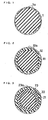
- Fig. 1 is a schematic cross sectional view showing a one-piece solid golf ball.
- the reference numeral 1 designates a main body portion, and the reference numeral 1a designates dimples.
- the main body portion 1 is constituted by a rubber substance (that is to say, a rubber substance composed of a crosslinked molded article of the rubber composition of the present invention).
- Fig. 2 is a schematic cross sectional view showing a two-pieces solid golf ball.
- the reference numeral 11 designates a core
- the reference numeral 12 designates a cover.
- the core 11 is coated with the cover 12, and the reference numeral 12a designates dimples.
- the core 11 is constituted by a rubber substance.
- Fig. 3 is a schematic cross sectional view showing a three-pieces solid golf ball.
- the reference numeral 21 designates an inner core
- the reference numeral 22 designates an outer core
- the reference numeral 23 designates a cover
- the reference numeral 23a designates dimples.
- the inner core 21 and the outer core 22 constitute a solid core.
- the inner core 21 or the outer core 22, or both the inner core 21 and the outer core 22 are constituted by a rubber substance. It is preferred in terms of flight and rotation keeping properties that the density of the outer core 22 of the three-pieces solid golf ball is higher than that of the inner core 21.
- the above can be achieved by adding a filler having a higher specific gravity such as W 2 O 5 to the outer core 22 and a filler having a lower specific gravity such as ZnO 2 to the inner core 21.
- the rubber composition of the present invention is placed in a required mold, and crosslinked and molded with a press to form each of the main body portion of the one-piece solid golf ball, the core of the two-pieces solid golf ball and the inner core of three-pieces solid golf ball.
- the crosslinking is preferably conducted at a temperature of 130°C to 180°C for 10 minutes to 50 minutes.
- the temperature in crosslinking and molding may be changed in two or more steps.
- a sheet of the rubber composition for the outer layer which is formed to a desired thickness, is adhered to the outside of the inner core obtained as described above, and crosslinked and molded with a press to form a solid core having a two-layers structure.
- either the rubber composition used for the inner core or the rubber composition used in the outer core should be the rubber composition of the present invention. However, it is preferred that both are the rubber composition of the present invention.
- the covers of the two-pieces solid golf ball and the three-pieces solid golf ball are formed by coating the above-mentioned cores with cover compositions in which additives, for example, inorganic white pigments such as titanium oxide, and light stabilizers, are appropriately mixed with resin components mainly composed of ionomer resins or the like.
- additives for example, inorganic white pigments such as titanium oxide, and light stabilizers
- resin components mainly composed of ionomer resins or the like are appropriately mixed with resin components mainly composed of ionomer resins or the like.
- the injection molding method is usually employed.
- the coating method is not limited thereto.
- desired dimples are formed as needed, in molding the main body portion for the one-piece solid golf ball, and in molding the cover for the two-pieces solid golf ball or the three-pieces solid golf ball.
- a four-pieces solid golf ball can also be produced from the composition of the present invention in the same manner as with the three-pieces solid golf ball.
- the solid golf balls obtained from the rubber compositions of the present invention are excellent in production workability, good in the feeling of ball hitting, long in flight and excellent in durability.
- a catalyst was prepared by previously mixing a solution of neodymium octanoate (0.18 mmol) and acetylacetone (0.37 mmol) in cyclohexane, a solution of methylalumoxane (18.5 mmol) in toluene, a solution of diisobutylaluminum hydride (3.9 mmol) in cyclohexane and a solution of diethylaluminum chloride (0.370 mmol) in cyclohexane, and reacting the resulting mixture with 5-fold moles of 1,3-butadiene (0.90 mmol) in relation to neodymium octanoate and aging the resulting product at 25°C for 30 minutes.
- the above prepared catalyst was added to the mixture in the autoclave, followed by polymerization at 50°C for 30 minutes.
- the degree of conversion of 1,3-butadiene was approximately 100%.
- the temperature of the polymerization solution was kept at 50°C, and 3-glycidyloxypropyltrimethoxysilane (5.40 mmol) was added thereto. Thereafter, the solution was allowed to stand for 30 minutes, and a solution of 2,4-di-t-butyl-p-cresol (1.5 g) in methanol was added.
- the solvents were removed by steam stripping, and the resulting product was dried on a roll heated at 110°C to obtain a polymer.
- the 1,4-cis bond content of the obtained polymer was 97.8 mol%, the 1,2-vinyl bond content was 1.0 mol%, the Mw/Mn ratio was 2.4, the Mooney viscosity (ML 1+4 (100°C)) was 41, and the toluene solution viscosity was 210.
- a polymer was prepared in the same manner as with the synthesis example of HPB (A) with the exception that the amount of methylalumoxane added was changed to 9.2 mmol.
- the property values of the polymer are shown in Table 1.
- a polymer was prepared in the same manner as with the synthesis example of HPB (A) with the exception that the amount of methylalumoxane added was changed to 9.2 mmol, and the amount of diisobutylaluminum hydride added was changed to 4.5 mmol.
- the property values of the polymer are shown in Table 1.
- a polymer was prepared in the same manner as with the synthesis example of HPB (A) with the exception that the amount of methylalumoxane added was changed to 9.2 mmol, and the amount of diisobutylaluminum hydride added was changed to 3.2 mmol.
- the property values of the polymer are shown in Table 1.
- a polymer was prepared in the same manner as with the synthesis example of HPB (A) with the exception that the amount of methylalumoxane added was changed to 9.2 mmol, and the amount of diisobutylaluminum hydride added was changed to 5.0 mmol.
- the property values of the polymer are shown in Table 1.
- a polymer was prepared in the same manner as with the synthesis example of HPB (A) with the exception that the amount of methylalumoxane added was changed to 9.2 mmol, and the amount of diisobutylaluminum hydride added was changed to 1.6 mmol.
- the property values of the polymer are shown in Table 1.
- a polymer was prepared in the same manner as with the synthesis example of HPB (A) with the exception that the amount of methylalumoxane added was changed to 5.1 mmol.
- the property values of the polymer are shown in Table 1.
- a polymer was prepared in the same manner as with the synthesis example of HPB (A) with the exception that the amount of methylalumoxane added was changed to 9.2 mmol, and the modifier was changed to polymeric type diphenylmethane diisocyanate (5.4 mmol).
- the property values of the polymer are shown in Table 1.
- HPB (H) is modified polybutadiene rubber for comparison using the modifier (polymeric type diphenylmethane diisocyanate) described in Japanese Patent Laid-open Publication (Hei) 11-164912.
- BR01, BR03, BR11 and BR18 in Table 1 are unmodified polybutadiene rubber using no modifier.
- the rubber composition finely wraps around the roll, and a surface thereof is smooth.
- the rubber composition wraps around the roll, and a surface thereof does not feel rough.
- the rubber composition wraps around the roll, but a surface thereof feels rough.
- the rubber composition wraps around the roll, but one or more holes are formed on a surface thereof to cause a poor appearance.
- the resulting core was coated by the injection molding method with a cover composition composed of a mixture of 100 parts by weight of an ionomer resin (trade name: Surlyn, manufactured by du Pont) and 2 parts by weight of titanium dioxide to form a cover, thereby preparing a two-pieces solid golf ball having an outer diameter of 42.7 mm.
- a cover composition composed of a mixture of 100 parts by weight of an ionomer resin (trade name: Surlyn, manufactured by du Pont) and 2 parts by weight of titanium dioxide to form a cover, thereby preparing a two-pieces solid golf ball having an outer diameter of 42.7 mm.
- an ionomer resin trade name: Surlyn, manufactured by du Pont
- titanium dioxide titanium dioxide
- the balls of Examples 1 to 6 showed long flight (carry) and were excellent in durability, compared with the balls of Comparative Examples 1 to 3, and moreover, good in the feeling of ball hitting, compared with the ball of Comparative Example 4, a conventional standard two-pieces solid golf ball.
- the one-piece solid golf balls thus obtained, their weight, compression (PGA indication), initial velocity, flight (carry) and hammering durability were measured, and the feeling of ball hitting was evaluated, in the same manner as with Example 1. Results thereof are shown in Table 3. In the evaluation of the feeling of ball hitting, the feeling of ball hitting was compared with that of the ball of Comparative Example 8, a conventional standard one-piece solid golf ball.
- the balls of Examples 7 to 12 showed long flight and were excellent in durability, compared with the balls of Comparative Examples 5 to 7, and moreover, good in the feeling of ball hitting, compared with the ball of Comparative Example 8, a conventional standard one-piece solid golf ball.
- the solid golf balls of Examples 13 to 16 showed long flight and were excellent in durability, compared with the solid golf balls of Comparative Examples 4 and 9 to 11, and moreover, good in the feeling of ball hitting, compared with the solid golf ball of Comparative Example 4, a conventional standard two-pieces solid golf ball.
- a rubber composition containing (a) 50 parts to 100 parts by weight of polybutadiene rubber having a 1,4-cis bond content of 80 mol% to 100 mol% and a 1,2-vinyl bond content of 0 mol% to 2 mol%, which is modified with an alkoxysilyl group-containing compound, (b) 0 part to 50 parts by weight of diene rubber other than the above-mentioned component (a) (wherein the total amount of component (a) and component (b) is 100 parts by weight), (c) 10 parts to 50 parts by weight of a crosslinkable monomer, (d) 5 parts to 80 parts by weight of an inorganic filler and (e) 0.1 part to 10 parts by weight of an organic peroxide, and a solid golf ball improved in flight, durability and the feeling of ball hitting can be produced from the rubber composition.
Landscapes
- Chemical & Material Sciences (AREA)
- Health & Medical Sciences (AREA)
- Chemical Kinetics & Catalysis (AREA)
- Medicinal Chemistry (AREA)
- Polymers & Plastics (AREA)
- Organic Chemistry (AREA)
- Compositions Of Macromolecular Compounds (AREA)
Abstract
Description
- The present invention relates to a rubber composition and a solid golf ball. More particularly, the present invention relates to a rubber composition giving a solid golf ball good in the feeling of ball hitting, long in flight (carry) and excellent in durability, and a solid golf ball obtained therefrom.
- Solid golf balls include one-piece solid golf balls integrally molded from crosslinked products of rubber compositions, and multiple-pieces solid golf balls such as two-pieces solid golf balls, three-pieces solid golf balls and four-pieces solid golf balls in which solid cores having one- to three-layers structure composed of crosslinked products of hard rubber compositions are coated with covers.
- Of these solid golf balls, the multiple-pieces solid golf balls are particularly excellent in flight, so that in recent years, they have mainly been used as golf balls for playing rounds of golf. However, the multiple-pieces solid golf balls have the disadvantage that the feeling of ball hitting is hard, compared with conventional thread-wound structure golf balls. Then, it has been attempted that the cores are softened, and moreover, portions nearer to the centers of the cores are more softened to increase the deformation of the cores on hitting, thereby improving the feeling of ball hitting of the multiple-pieces solid golf balls. However, the softening of the cores deteriorates durability and resilience (carry). It has been therefore desired that multiple-pieces solid golf balls good in the feeling of ball hitting, long in flight and excellent in durability appear.
- On the other hand, the one-piece solid golf balls have mainly been used as golf balls for training fields, and are liable to be cracked or chipped by repeated hitting. Accordingly, excellent durability is required so as to prevent the balls from being cracked or chipped as far as possible. Further, golf training players require that the feeling of ball hitting is also good.
- Rubber compositions containing polybutadiene having a 1, 4-cis bond content of 80 mol% or more, which is synthesized using a nickel catalyst or a cobalt catalyst, have hitherto suitably been used for cores of the multiple-pieces solid golf balls and core portions (solid centers) of the one-piece solid golf balls, because of their high resilience and durability. It is further known that polybutadiene synthesized using a rare earth element catalyst can be used for a similar purpose.
- For example, Examined Japanese Patent Publication (Hei) 3-59931, Examined Japanese Patent Publication (Hei) 6-80123, Japanese Patent No. 2678240, Japanese Patent Laid-open Publication (Hei) 6-79018 and Japanese Patent Laid-open Publication (Hei) 11-319148 disclose that rubber compositions containing polybutadiene synthesized using rare earth element catalysts are suitable for the golf ball purpose. However, the resilience and durability of the resulting golf balls are insufficient. Further, the production workability thereof is also insufficient.
- Japanese Patent Laid-open Publication (Hei) 7-268132 discloses a golf ball composed of a rubber composition mainly containing polybutadiene synthesized using a rare earth element catalyst modified with a tin compound. However, the ratio (Mw/Mn) of weight average molecular weight (Mw) to number average molecular weight (Mn) is high, so that the resilience and durability are insufficient.
- Japanese Patent Laid-open Publication (Hei) 11-164912 discloses the use of modified polybutadiene rubber having a 1,4-cis bond content of 80 mol% or more, a 1,2-vinyl bond content of 2 mol% or less and a low ratio (Mw/Mn) of weight average molecular weight (Mw) to number average molecular weight (Mn) of 3.5 or less. However, this is insufficient in production workability, and there is still room for improvement in resilience and durability.
- It is therefore an object of the present invention to provide a rubber composition which can give a solid golf ball improved in flight, durability and the feeling of ball hitting.
- Another object of the present invention is to provide a solid golf ball improved in flight, durability and the feeling of ball hitting.
- According to the present invention, there are provided the following rubber composition and solid golf ball, thereby achieving the above-mentioned objects of the present invention.
- (1) A rubber composition containing (a) 50 parts to 100 parts by weight of polybutadiene rubber having a 1,4-cis bond content of 80 mol% to 100 mol% and a 1,2-vinyl bond content of 0 mol% to 2 mol%, which is modified with an alkoxysilyl group-containing compound, (b) 0 part to 50 parts by weight of diene rubber other than the above-mentioned component (a) (wherein the total amount of component (a) and component (b) is 100 parts by weight), (c) 10 parts to 50 parts by weight of a crosslinkable monomer, (d) 5 parts to 80 parts by weight of an inorganic filler and (e) 0.1 part to 10 parts by weight of an organic peroxide;
- (2) The rubber composition described in the above (1), wherein modified polybutadiene rubber (a) has a ratio (Mw/Mn) of weight average molecular weight (Mw) to number average molecular weight (Mn) of 1.0 to 3.5;
- (3) The rubber composition described in the above (1) or (2), wherein modified polybutadiene rubber (a) has a Mooney viscosity (ML1+4 (100°C)) of 30 to 100;
- (4) The rubber composition described in any one of the above (1) to (3), wherein component (a) is modified polybutadiene rubber obtained by polymerizing butadiene using a rare earth element catalyst, and subsequently allowing the alkoxysilyl group-containing compound to react with the resulting polybutadiene;
- (5) The rubber composition described in the above (4), wherein the rare earth element catalyst is a neodymium catalyst;
- (6) The rubber composition described in any one of the above (1) to (5), wherein the alkoxysilyl group-containing compound is an alkoxysilane compound having at least one epoxy group or isocyanate group in a molecule thereof;
- (7) The rubber composition described in any one of the above (1) to (6), wherein the alkoxysilyl group-containing compound is 3-glycidyloxypropyltrimethoxysilane; and
- (8) A solid golf ball in which a part or the whole of a rubber substance constituting the solid golf ball is obtained by crosslinking and molding the rubber composition described in any one of the above (1) to (7).
-
-
- Fig. 1 is a schematic cross sectional view showing an example of one-piece solid golf balls;
- Fig. 2 is a schematic cross sectional view showing an example of two-pieces solid golf balls; and
- Fig. 3 is a schematic cross sectional view showing an example of three-pieces solid golf balls.
-
- First, component (a) of the rubber composition of the present invention will be described.
- As described above, the modified polybutadiene rubber modified with the alkoxysilyl group-containing compound, component (a), has a 1,4-cis bond content (cis content) of 80 mol% to 100 mol%, preferably 90 mol% to 100 mol%, and a 1,2-vinyl bond content (vinyl content) of 0 mol% to 2 mol%, preferably 0 mol% to 1.5 mol%. As to component (a), the ratio (Mw/Mn) of weight average molecular weight (Mw) to number average molecular weight (Mn) is preferably from 1.0 to 3.5, and more preferably from 1.0 to 3.3; the Mooney viscosity (ML1+4 (100°C)) is preferably from 30 to 100, and more preferably from 50 to 90; and the viscosity of a 5-wt% toluene solution (SV: solvent viscosity) is preferably from 150 to 1,500 cPs, and more preferably from 200 to 1,500 cPs.
- A 1,4-cis bond content (cis content) of modified polybutadiene rubber (a) of less than 80 mol% results in inferior resilience. Further, a 1,2-vinyl bond content (vinyl content) exceeding 2 mol% also results in inferior resilience.
- Still further, an Mw/Mn of component (a) exceeding 3.5 results in inferior resilience and durability. A Mooney viscosity (ML1+4 (100°C)) of component (a) of less than 30 results in inferior resilience and durability, whereas exceeding 100 results in inferior production workability. Furthermore, when the viscosity of a 5-wt% solution of component (a) in toluene at 25°C (SV) is less than 150 cPs, the resilience is deteriorated.
- The modification of polybutadiene with the alkoxysilyl group-containing compound is conducted, for example, by adding the alkoxysilyl group-containing compound to a polybutadiene rubber solution after polymerization to allow the compound to react with polybutadiene.
- The above-mentioned modified polybutadiene rubber is preferably produced by polymerizing butadiene in the presence of a rare earth element catalyst showing quasi-living polymerizability, and subsequently allowing the alkoxysilyl group-containing compound to react with the resulting polybutadiene.
- The rubber composition of the present invention contains polybutadiene having mostly 1,4-cis bonds, as a main rubber component, moreover, narrow in molecular weight distribution and high in solution viscosity, and the polybutadiene is modified with the alkoxysilyl group-containing compound, thereby obtaining the rubber composition excellent in production workability. Further, the solid golf ball having a rubber substance constituted by a crosslinked molded article of the rubber composition of the present invention shows long flight, and is excellent in the feeling of ball hitting and durability.
- As the rare earth element catalyst used in the polymerization of butadiene, a known catalyst can be used.
- For example, there can be used lanthanum series rare earth element compounds, organic aluminum compounds, alumoxane, halogen-containing compounds and a combination with Lewis bases in option.
- The lanthanum series rare earth element compounds include halides of metals of atomic numbers 57 to 71, carboxylates, alcoholates, thioalcoholates and amides.
- Further, as the organic aluminum compounds, there are used compounds represented by AlR1R2R3 (wherein R1, R2 and R3, which may be the same or different, each represent hydrogen or hydrocarbon residues each having 1 to 8 carbon atoms). The alumoxanes are compounds having a structure represented by the following formula (I) or (II). Aggregates of the alumoxanes described in Fine Chemical, 23 (9), 5 (1994), J. Am. Chem. Soc., 115, 4971 (1993), and J. Am. Chem. Soc., 117, 6465 (1995) may be used.
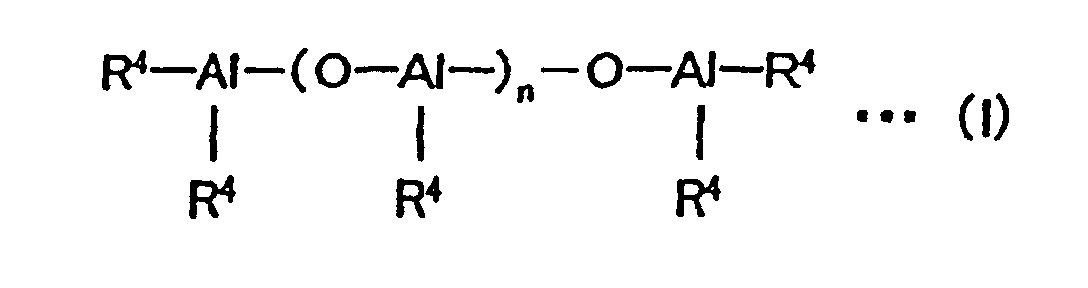 wherein R4 is a hydrocarbon group having 1 to 20 carbon atoms, and n is an integer of 2 or more.
- As the halogen-containing compounds, there are used aluminum halides represented by AlXnR5 3-n (wherein X is a halogen atom, R5 is a hydrocarbon residue having 1 to 20 carbon atoms such as an alkyl group, an aryl group or an aralkyl group, and n is 1, 1.5, 2 or 3); strontium halides such as Me3SrCl, Me2SrCl2, MeSrHCl2 and MeSrCl3; and metal halides such as silicon tetrachloride, tin tetrachloride and titanium tetrachloride. The Lewis bases are used for complexing the lanthanum series rare earth element compounds. For example, acetylacetone and ketone alcohols are suitably used. Above all, neodymium catalysts in which neodymium compounds are used as the lanthanum series rare earth element compounds are preferably used, because polybutadiene rubber high in the 1,4-cis bond content and low in the 1,2-vinyl bond content is obtained with excellent polymerization activity.
- Specific examples of these rare earth element catalysts are described in Examined Japanese Patent Publication (Sho) 62-1404, Examined Japanese Patent Publication (Sho) 63-64444, and Japanese Patent Laid-open Publication (Hei) 11-35633, Japanese Patent Laid-open Publication (Hei) 10-306113 and Japanese Patent Laid-open Publication 2000-34320 filed by the present applicant, and can be used.
- When butadiene is polymerized in the presence of the rare earth element catalyst using the lanthanum series rare earth element compound (La type compound), the molar ratio of butadiene to the La type compound is preferably from 1, 000 to 2,000,000, and particularly preferably from 5,000 to 1,000,000, and the molar ratio of AlR1R2R3 to the La type compound is preferably from 1 to 1,000, and particularly preferably from 3 to 500, for obtaining a cis content and a Mw/Mn ratio within the above-mentioned ranges. Further, the molar ratio of the halogen compound to the La type compound is preferably from 0.1 to 30, and particularly preferably from 0.2 to 15. The molar ratio of the Lewis base to the La type compound is preferably from 0 to 30, and particularly preferably from 1 to 10. In polymerization, a solvent may be used, or bulk polymerization or gas phase polymerization using no solvent may be employed. The polymerization temperature is usually from -30°C to 150°C, and preferably from 10°C to 100°C.
- The modified polybutadiene rubber is obtained by allowing the alkoxysilyl group-containing compound (terminal modifier) to react with an active terminal of the polymer, following after the above polymerization.
- As the alkoxysilyl group-containing compound, there is suitably used an alkoxysilane compound having at least one epoxy group or isocyanate group in its molecule. Specific examples thereof include epoxy group-containing alkoxysilane compounds such as 3-glycidyloxypropyltrimethoxysilane, 3-glycidyloxypropyltriethoxysilane, (3-glycidyloxypropyl)methyldimethoxysilane, (3-glycidyloxypropyl)methyldiethoxysilane, β-(3,4-epoxycyclohexyl) trimethoxysilane, β-(3,4-epoxycyclohexyl)triethoxysilane, β-(3,4-epoxycyclohexyl)methyldimethoxysilane, β-(3,4-epoxycyclohexyl)ethyldimethoxysilane, a condensate of 3-glycidyloxypropyltrimethoxysilane and a condensate of (3-glycidyloxypropyl)methyldimethoxysilane; and isocyanate group-containing alkoxysilane compounds such as 3-isocyanatepropyltrimethoxysilane, 3-isocyanatepropyltriethoxysilane, (3-isocyanatepropyl)methyldimethoxysilane, (3-isocyanatepropyl)methyldiethoxysilane, a condensate of 3-isocyanatepropyltrimethoxysilane and a condensate of (3-isocyanatepropyl)methyldimethoxysilane.
- Further, when the above-mentioned alkoxysilyl group-containing compound is allowed to react with the active terminal of the polymer, a Lewis acid can also be added for accelerating the reaction. The Lewis acid accelerates the coupling reaction as a catalyst thereby improving the cold flow of the modified polymer, resulting in the improved storage stability thereof.
- Specific examples of the Lewis acids include dialkyltin dialkylmaleates, dialkyltin dicarboxylates and aluminum trialkoxides.
- As reaction methods of modification with the above-mentioned terminal modifiers, there can be used known methods per se. for example, a method described in Japanese Patent Laid-open Publication (Hei) 11-35633 filed by the present applicant and a method described in Japanese Patent Laid-open Publication (Hei) 7-268132 can be employed.
- Then, the diene rubber other than the above-mentioned component (a), component (b), will be illustrated below.
- Component (b) is not indispensable to the rubber composition of the present invention, and a component optionally added within the range not inhibiting the achievement of the objects of the present invention. Specific examples of components (b) include unmodified or modified polybutadiene rubber having a cis content of less than 80 mol% or an Mw/Mn ratio exceeding 3.5, styrenebutadiene rubber (SBR), natural rubber, synthetic polyisoprene rubber and ethylene-propylene-diene rubber (EPDM).
- These can be used either alone or as a combination of two or more of them.
- Then, the crosslinkable monomer, component (c), will be described below.
- Crosslinkable monomer (c) is polymerized by radicals produced by decomposition of organic peroxides described below and functioning as radical initiators, and acts so as to accelerate the crosslinking of component (a) and component (b).
- The crosslinkable monomers added to the rubber compositions of the present invention are preferably monovalent or divalent metal salts of α,β-ethylenic unsaturated carboxylic acids, and specific examples thereof include the following:
- (i) Acrylic acid, methacrylic acid, itaconic acid, maleic acid, fumalic acid, crotonic acid, sorbic acid, tiglic acid, cinnamic acid and aconitic acid (these can be used either alone or as a combination of two or more of them); and
- (ii) Zn, Ca, Mg, Ba and Na salts of the unsaturated acids described in the above (i) (these can be used either alone or as a combination of two or more of them).
-
- The unsaturated acids of the above (i) and the metal salts of the above (ii) can be used in combination. The above-mentioned metal salts of the α,β-ethylenic unsaturated carboxylic acids may be either mixed as such with base rubber by conventional methods, or formed by adding the α,β-ethylenic unsaturated carboxylic acids such as acrylic acid and methacrylic acid to the rubber compositions with which metal oxides such as zinc oxide have previously been mixed by kneading them, and kneading the α,β-ethylenic unsaturated carboxylic acids and the rubber compositions together to allow the α,β-ethylenic unsaturated carboxylic acids to react with the metal oxides in the rubber compositions. The crosslinkable monomers (c) can be used either alone or as a combination of two or more of them.
- The inorganic filler, component (d) will be illustrated below.
- Inorganic filler (d) can reinforce the crosslinked rubber to improve the strength, and adjust the weight of the solid golf ball by the amount thereof added.
- Specifically, the inorganic fillers include zinc oxide, barium sulfate, silica, alumina, aluminum sulfate, calcium carbonate, aluminum silicate and magnesium silicate. Zinc oxide, barium sulfate and silica are preferably used among others. These inorganic fillers can be used either alone or as a combination of two or more of them.
- Then, the organic peroxide, component (e), will be illustrated below.
- Organic peroxide (e) added to the rubber composition of the present invention acts as an initiator for crosslinking reaction, graft reaction and polymerization reaction of rubber components comprising component (a) and component (b), and crosslinkable monomer (c).
- Suitable specific examples of the organic peroxides include dicumyl peroxide, 1,1-bis(t-butylperoxy)-3,3,5-trimethylcyclohexane, 2,5-dimethyl-2,5-di-(t-butylperoxy)hexane and 1,3-bis(t-butylperoxyisopropyl)benzene.
- The amount ratio of component (a), component (b), crosslinkable monomer (c), inorganic filler (d) and organic peroxide (e) is as follows.
- The amount of modified polybutadiene rubber (a) is from 50 parts to 100 parts by weight, and preferably from 60 parts to 100 parts by weight, and the amount of diene rubber (b) other than the above-mentioned component (a) is from 0 part to 50 parts by weight, and preferably from 0 part to 40 parts by weight (wherein the total amount of component (a) and component (b) is 100 parts by weight). In components (a) and (b), when the amount of component (a) added is less than 50 parts by weight, the resilience of the solid golf ball is insufficient, which unfavorably causes no increase in initial velocity of the ball and no prolongation in flight (carry).
- The amount of crosslinkable monomer (c) added is from 10 parts to 50 parts by weight, and preferably from 10 parts to 40 parts by weight, based on 100 parts by weight of the total amount of components (a) and (b). Less than 10 parts by weight results in insufficient resilience of the solid golf ball, which causes a decrease in initial velocity of the golf ball and a decrease in flight, whereas exceeding 50 parts by weight results in so hard a golf ball that the feeling of ball hitting is deteriorated.
- The amount of inorganic filler (d) added is from 5 parts to 80 parts by weight, and preferably from 5 parts to 70 parts by weight, based on 100 parts by weight of the total amount of components (a) and (b). Less than 5 parts by weight results in too light a solid golf ball obtained, whereas exceeding 80 parts by weight results in too heavy a solid golf ball obtained.
- The amount of organic peroxide (e) added is from 0.1 part to 10 parts by weight, and preferably from 0.2 part to 5 parts by weight, based on 100 parts by weight of the total amount of components (a) and (b). Less than 0.1 part by weight results in too soft a golf ball, which causes deterioration in the resilience to decrease flight (carry), whereas exceeding 10 parts by weight results in too hard a golf ball, which causes deterioration in the feeling of ball hitting.
- By allowing the above-mentioned respective components to be contained in amounts within the above-mentioned ranges, the solid golf ball excellent in flight, durability and the feeling of ball hitting is obtained from the rubber composition of the present invention.
- The rubber composition of the present invention may contain a crosslinking assistant such as zinc oxide, a lubricant such as stearic acid, and an antioxidant, as desired, in addition to the above-mentioned components (a) and (b), crosslinkable monomer (c), inorganic filler (d) and organic peroxide (e).
- Typical examples of the solid golf balls produced from the rubber compositions of the present invention by crosslinking and molding will be illustrated with reference to the drawings.
- Fig. 1 is a schematic cross sectional view showing a one-piece solid golf ball. The reference numeral 1 designates a main body portion, and the reference numeral 1a designates dimples. The main body portion 1 is constituted by a rubber substance (that is to say, a rubber substance composed of a crosslinked molded article of the rubber composition of the present invention).
- Fig. 2 is a schematic cross sectional view showing a two-pieces solid golf ball. The reference numeral 11 designates a core, and the
reference numeral 12 designates a cover. The core 11 is coated with thecover 12, and thereference numeral 12a designates dimples. The core 11 is constituted by a rubber substance. - Fig. 3 is a schematic cross sectional view showing a three-pieces solid golf ball. The
reference numeral 21 designates an inner core, thereference numeral 22 designates an outer core, thereference numeral 23 designates a cover, and thereference numeral 23a designates dimples. In this three-pieces solid golf ball, theinner core 21 and theouter core 22 constitute a solid core. Theinner core 21 or theouter core 22, or both theinner core 21 and theouter core 22 are constituted by a rubber substance. It is preferred in terms of flight and rotation keeping properties that the density of theouter core 22 of the three-pieces solid golf ball is higher than that of theinner core 21. For example, the above can be achieved by adding a filler having a higher specific gravity such as W2O5 to theouter core 22 and a filler having a lower specific gravity such as ZnO2 to theinner core 21. - Then, methods for producing the solid golf balls using the rubber compositions of the present invention will be described. First, the rubber composition of the present invention is placed in a required mold, and crosslinked and molded with a press to form each of the main body portion of the one-piece solid golf ball, the core of the two-pieces solid golf ball and the inner core of three-pieces solid golf ball. The crosslinking is preferably conducted at a temperature of 130°C to 180°C for 10 minutes to 50 minutes. The temperature in crosslinking and molding may be changed in two or more steps.
- In the three-pieces solid golf ball, a sheet of the rubber composition for the outer layer, which is formed to a desired thickness, is adhered to the outside of the inner core obtained as described above, and crosslinked and molded with a press to form a solid core having a two-layers structure. In the three-pieces solid golf ball, either the rubber composition used for the inner core or the rubber composition used in the outer core should be the rubber composition of the present invention. However, it is preferred that both are the rubber composition of the present invention.
- The covers of the two-pieces solid golf ball and the three-pieces solid golf ball are formed by coating the above-mentioned cores with cover compositions in which additives, for example, inorganic white pigments such as titanium oxide, and light stabilizers, are appropriately mixed with resin components mainly composed of ionomer resins or the like. In coating, the injection molding method is usually employed. However, the coating method is not limited thereto.
- Further, desired dimples are formed as needed, in molding the main body portion for the one-piece solid golf ball, and in molding the cover for the two-pieces solid golf ball or the three-pieces solid golf ball.
- A four-pieces solid golf ball can also be produced from the composition of the present invention in the same manner as with the three-pieces solid golf ball.
- The solid golf balls obtained from the rubber compositions of the present invention are excellent in production workability, good in the feeling of ball hitting, long in flight and excellent in durability.
- This invention will be illustrated with reference to examples in more details below, but the following disclosure shows preferred embodiments of the invention and not intended to limit the scope of the invention.
- An autoclave having an inner volume of 5 liters, the inside of which was replaced with nitrogen, was charged with 2.5 kg of cyclohexane and 300 g of 1,3-butadiene under a nitrogen atmosphere. A catalyst was prepared by previously mixing a solution of neodymium octanoate (0.18 mmol) and acetylacetone (0.37 mmol) in cyclohexane, a solution of methylalumoxane (18.5 mmol) in toluene, a solution of diisobutylaluminum hydride (3.9 mmol) in cyclohexane and a solution of diethylaluminum chloride (0.370 mmol) in cyclohexane, and reacting the resulting mixture with 5-fold moles of 1,3-butadiene (0.90 mmol) in relation to neodymium octanoate and aging the resulting product at 25°C for 30 minutes. The above prepared catalyst was added to the mixture in the autoclave, followed by polymerization at 50°C for 30 minutes. The degree of conversion of 1,3-butadiene was approximately 100%. Then, the temperature of the polymerization solution was kept at 50°C, and 3-glycidyloxypropyltrimethoxysilane (5.40 mmol) was added thereto. Thereafter, the solution was allowed to stand for 30 minutes, and a solution of 2,4-di-t-butyl-p-cresol (1.5 g) in methanol was added. After the termination of polymerization, the solvents were removed by steam stripping, and the resulting product was dried on a roll heated at 110°C to obtain a polymer. The 1,4-cis bond content of the obtained polymer was 97.8 mol%, the 1,2-vinyl bond content was 1.0 mol%, the Mw/Mn ratio was 2.4, the Mooney viscosity (ML1+4 (100°C)) was 41, and the toluene solution viscosity was 210.
- A polymer was prepared in the same manner as with the synthesis example of HPB (A) with the exception that the amount of methylalumoxane added was changed to 9.2 mmol. The property values of the polymer are shown in Table 1.
- A polymer was prepared in the same manner as with the synthesis example of HPB (A) with the exception that the amount of methylalumoxane added was changed to 9.2 mmol, and the amount of diisobutylaluminum hydride added was changed to 4.5 mmol. The property values of the polymer are shown in Table 1.
- A polymer was prepared in the same manner as with the synthesis example of HPB (A) with the exception that the amount of methylalumoxane added was changed to 9.2 mmol, and the amount of diisobutylaluminum hydride added was changed to 3.2 mmol. The property values of the polymer are shown in Table 1.
- A polymer was prepared in the same manner as with the synthesis example of HPB (A) with the exception that the amount of methylalumoxane added was changed to 9.2 mmol, and the amount of diisobutylaluminum hydride added was changed to 5.0 mmol. The property values of the polymer are shown in Table 1.
- A polymer was prepared in the same manner as with the synthesis example of HPB (A) with the exception that the amount of methylalumoxane added was changed to 9.2 mmol, and the amount of diisobutylaluminum hydride added was changed to 1.6 mmol. The property values of the polymer are shown in Table 1.
- A polymer was prepared in the same manner as with the synthesis example of HPB (A) with the exception that the amount of methylalumoxane added was changed to 5.1 mmol. The property values of the polymer are shown in Table 1.
- A polymer was prepared in the same manner as with the synthesis example of HPB (A) with the exception that the amount of methylalumoxane added was changed to 9.2 mmol, and the modifier was changed to polymeric type diphenylmethane diisocyanate (5.4 mmol). The property values of the polymer are shown in Table 1.
- HPB (H) is modified polybutadiene rubber for comparison using the modifier (polymeric type diphenylmethane diisocyanate) described in Japanese Patent Laid-open Publication (Hei) 11-164912. BR01, BR03, BR11 and BR18 in Table 1 are unmodified polybutadiene rubber using no modifier.
- As to the solution viscosity (SV) in Table 1, the viscosity of a 5-wt% solution of a previously prepared polymer in toluene was measured with a Cannon-Fenske viscometer in a thermostat at 25°C.

- According to a formulation described in Table 2 shown below, polybutadiene shown in Table 1, zinc diacrylate, zinc oxide, dicumyl peroxide and the antioxidant were kneaded with rolls, and the resulting rubber composition was crosslinked and molded under pressure at 150°C for 30 minutes to obtain a core having a diameter of 38.5 mm. For comparing production workability, the wrapping test was carried out using 6-inch rolls to evaluate roll processability.
- Conditions of the wrapping test; temperature: 70°C, nip width: 1.4 mm, revolutions: 20 rpm/24 rpm
- Here, the roll processability was evaluated as follows. The larger numerical value indicates the better roll processability (the same applies in Tables 3 and 4).
- 5: The rubber composition finely wraps around the roll, and a surface thereof is smooth.
- 4: The rubber composition wraps around the roll, and a surface thereof does not feel rough.
- 3: The rubber composition wraps around the roll, but a surface thereof feels rough.
- 2: The rubber composition wraps around the roll, but one or more holes are formed on a surface thereof to cause a poor appearance.
- 1: The rubber composition does not wrap around the roll.
- Results shown in Table 2 reveal that Examples 1 to 6 are superior to Comparative Examples 1 to 4 in roll processability.
- Then, the resulting core was coated by the injection molding method with a cover composition composed of a mixture of 100 parts by weight of an ionomer resin (trade name: Surlyn, manufactured by du Pont) and 2 parts by weight of titanium dioxide to form a cover, thereby preparing a two-pieces solid golf ball having an outer diameter of 42.7 mm. In Comparative Examples 2 and 3, the modifier (polymeric type diphenylmethane diisocyanate) described in Japanese Patent Laid-open Publication (Hei) 11-164912 was used. The ball obtained in Comparative Example 4 is a conventional standard two-pieces solid golf ball.
- As to the two-pieces solid golf balls thus obtained, their weight, compression (PCA indication), initial velocity, flight and hammering durability were measured. Results thereof are shown in Table 2. Further, ten top professional golf players actually hit the resulting solid golf balls with a wood No. 1 club to examine their feeling of ball hitting. Results thereof are also shown in Table 2.
- Methods for measuring the above-mentioned initial velocity, flight and hammering durability and a method for evaluating the feeling of ball hitting are as follows.
- (1) Initial Velocity: A ball was hit at a head speed of 45 m/second with a wood No. 1 club attached to a swing robot manufactured by True Temper Co., and the initial velocity (m/second) of the ball at that time was measured.
- (2) Flight (carry) : When a ball was hit at a head speed of 45 m/second with a wood No. 1 club attached to a swing robot manufactured by True Temper Co., Ltd., the distance (yard) to a position on which the ball fell was measured.
- (3) Hammering Durability: A ball was repeatedly collided against a collision plate at a speed of 45 m/second, and the number of collisions required until the ball was broken was examined. The hammering durability was indicated by the index taking as 100 the number of collisions required until the ball of Comparative Example 4 was broken.
- (4) Feeling of Ball Hitting: The feeling of ball hitting was evaluated by an actual hitting test by ten top professional golf players. In the evaluation of the feeling of ball hitting, the feeling of ball hitting was compared with that of the ball of Comparative Example 4, a conventional standard two-pieces solid golf ball. Criteria for the evaluation are as follows and are indicated by the same symbols when they are shown in Table 2 to 4 as results of the evaluation. In this case, it indicates that 8 players of the ten players made the same evaluation.
-
-
- ○: The feeling of ball hitting is softer and better than that of the ball of Comparative Example 4.
- Δ: The feeling of ball hitting is equivalent to that of the ball of Comparative Example 4.
- ×: The feeling of ball hitting is harder and worse than that of the ball of Comparative Example 4.
-
- From the results shown in Table 2, the balls of Examples 1 to 6 showed long flight (carry) and were excellent in durability, compared with the balls of Comparative Examples 1 to 3, and moreover, good in the feeling of ball hitting, compared with the ball of Comparative Example 4, a conventional standard two-pieces solid golf ball.

- Compounding materials of each formulation shown in Table 3 were kneaded with a kneader and rolls to prepare a rubber composition. The prepared rubber composition was charged into a mold, and crosslinked and molded under pressure at 168 °C for 25 minutes to prepare a one-piece solid golf ball having an outer diameter of 42.7 mm, which was formed of a crosslinked molded article integrally molded. In Comparative Examples 6 and 7, the modifier (polymeric type diphenylmethane diisocyanate) described in Japanese Patent Laid-open Publication (Hei) 11-164912 was used. The ball obtained in Comparative Example 8 is a conventional standard two-pieces solid golf ball.
- Results shown Table 3 indicate that the roll processability of Examples 7 to 12 is excellent, compared with that of Comparative Examples 5 to 8.
- As to the one-piece solid golf balls thus obtained, their weight, compression (PGA indication), initial velocity, flight (carry) and hammering durability were measured, and the feeling of ball hitting was evaluated, in the same manner as with Example 1. Results thereof are shown in Table 3. In the evaluation of the feeling of ball hitting, the feeling of ball hitting was compared with that of the ball of Comparative Example 8, a conventional standard one-piece solid golf ball.
- As apparent from the results shown in Table 3, the balls of Examples 7 to 12 showed long flight and were excellent in durability, compared with the balls of Comparative Examples 5 to 7, and moreover, good in the feeling of ball hitting, compared with the ball of Comparative Example 8, a conventional standard one-piece solid golf ball.

- Compounding materials of each formulation shown in Table 4 were kneaded with a kneader and rolls to prepare a rubber composition. The prepared rubber composition was crosslinked and molded under pressure at 150 °C for 30 minutes to obtain a core having a diameter of 38.5 mm. Then, the resulting core was coated by the injection molding method with a cover composition composed of a mixture of 100 parts by weight of an ionomer resin (trade name: Surlyn, manufactured by du Pont) and 2 parts by weight of titanium dioxide to form a cover, thereby preparing a two-pieces solid golf ball having an outer diameter of 42.7 mm.
- As to the two-pieces solid golf balls thus obtained, their weight, compression (PGA indication), initial velocity, flight (carry) and hammering durability were measured, and the feeling of ball hitting was evaluated, in the same manner as with Example 1. Results thereof are shown in Table 4. In the evaluation of the feeling of ball hitting, the feeling of ball hitting was compared with that of the ball of Comparative Example 4, a conventional standard one-piece solid golf ball.
- As apparent from the results shown in Table 4, also in these two-pieces solid golf balls, the solid golf balls of Examples 13 to 16 showed long flight and were excellent in durability, compared with the solid golf balls of Comparative Examples 4 and 9 to 11, and moreover, good in the feeling of ball hitting, compared with the solid golf ball of Comparative Example 4, a conventional standard two-pieces solid golf ball.

- Disclosed is a rubber composition containing (a) 50 parts to 100 parts by weight of polybutadiene rubber having a 1,4-cis bond content of 80 mol% to 100 mol% and a 1,2-vinyl bond content of 0 mol% to 2 mol%, which is modified with an alkoxysilyl group-containing compound, (b) 0 part to 50 parts by weight of diene rubber other than the above-mentioned component (a) (wherein the total amount of component (a) and component (b) is 100 parts by weight), (c) 10 parts to 50 parts by weight of a crosslinkable monomer, (d) 5 parts to 80 parts by weight of an inorganic filler and (e) 0.1 part to 10 parts by weight of an organic peroxide, and a solid golf ball improved in flight, durability and the feeling of ball hitting can be produced from the rubber composition.
Claims (8)
- A rubber composition containing (a) 50 parts to 100 parts by weight of polybutadiene rubber having a 1,4-cis bond content of 80 mol% to 100 mol% and a 1,2-vinyl bond content of 0 mol% to 2 mol%, which is modified with an alkoxysilyl group-containing compound, (b) 0 part to 50 parts by weight of diene rubber other than the above-mentioned component (a) (wherein the total amount of component (a) and component (b) is 100 parts by weight), (c) 10 parts to 50 parts by weight of a crosslinkable monomer, (d) 5 parts to 80 parts by weight of an inorganic filler and (e) 0.1 part to 10 parts by weight of an organic peroxide.
- The rubber composition according to claim 1, wherein modified polybutadiene rubber (a) has a ratio (Mw/Mn) of weight average molecular weight (Mw) to number average molecular weight (Mn) of 1.0 to 3.5.
- The rubber composition according to claim 1 or 2, wherein modified polybutadiene rubber (a) has a Mooney viscosity (ML1+4 (100°C)) of 30 to 100.
- The rubber composition according to any one of claims 1 to 3, wherein component (a) is modified polybutadiene rubber obtained by polymerizing butadiene using a rare earth element catalyst, and subsequently allowing the alkoxysilyl group-containing compound to react with the resulting polybutadiene.
- The rubber composition according to claim 4, wherein the rare earth element catalyst is a neodymium catalyst.
- The rubber composition according to any one of claims 1 to 5, wherein the alkoxysilyl group-containing compound is an alkoxysilane compound having at least one epoxy group or isocyanate group in a molecule thereof.
- The rubber composition according to any one of claims 1 to 6, wherein the alkoxysilyl group-containing compound is 3-glycidyloxypropyltrimethoxysilane.
- A solid golf ball in which a part or the whole of a rubber substance constituting the solid golf ball is obtained by crosslinking and molding the rubber composition according to any one of claims 1 to 7.
Applications Claiming Priority (2)
| Application Number | Priority Date | Filing Date | Title |
|---|---|---|---|
| JP2001015317 | 2001-01-24 | ||
| JP2001015317 | 2001-01-24 |
Publications (2)
| Publication Number | Publication Date |
|---|---|
| EP1227121A1 true EP1227121A1 (en) | 2002-07-31 |
| EP1227121B1 EP1227121B1 (en) | 2003-11-26 |
Family
ID=18881886
Family Applications (1)
| Application Number | Title | Priority Date | Filing Date |
|---|---|---|---|
| EP02001246A Expired - Lifetime EP1227121B1 (en) | 2001-01-24 | 2002-01-17 | Rubber composition and solid golf ball |
Country Status (3)
| Country | Link |
|---|---|
| US (1) | US6642314B2 (en) |
| EP (1) | EP1227121B1 (en) |
| DE (1) | DE60200095T2 (en) |
Cited By (1)
| Publication number | Priority date | Publication date | Assignee | Title |
|---|---|---|---|---|
| GB2376637A (en) * | 2001-05-30 | 2002-12-24 | Bridgestone Sports Co Ltd | Golf ball rubber composition |
Families Citing this family (83)
| Publication number | Priority date | Publication date | Assignee | Title |
|---|---|---|---|---|
| US6837803B2 (en) | 2002-07-29 | 2005-01-04 | Bridgestone Sports Co., Ltd. | Golf ball |
| JP2004180727A (en) * | 2002-11-29 | 2004-07-02 | Bridgestone Sports Co Ltd | One piece golf ball |
| JP4336958B2 (en) * | 2003-10-09 | 2009-09-30 | ブリヂストンスポーツ株式会社 | Golf ball |
| US6923735B1 (en) | 2004-02-04 | 2005-08-02 | Bridgestone Sports Co., Ltd. | Golf ball |
| US7066836B2 (en) * | 2004-02-04 | 2006-06-27 | Bridgestone Sports Co., Ltd. | Golf ball |
| JP2005218618A (en) * | 2004-02-05 | 2005-08-18 | Sumitomo Rubber Ind Ltd | Solid golf balls |
| US7175542B2 (en) * | 2005-04-07 | 2007-02-13 | Bridgestone Sports Co., Ltd. | Multi-piece solid golf ball |
| US20070072701A1 (en) * | 2005-09-26 | 2007-03-29 | Bridgestone Sports Co., Ltd. | Golf ball |
| US7294070B2 (en) * | 2005-11-02 | 2007-11-13 | Bridgestone Sports Co., Ltd. | Golf ball |
| US7267623B2 (en) * | 2005-11-14 | 2007-09-11 | Bridgestone Sports Co., Ltd. | Golf ball |
| US7273425B2 (en) * | 2005-12-05 | 2007-09-25 | Bridgestone Sports Co., Ltd. | Solid golf ball |
| US8846794B2 (en) * | 2006-01-23 | 2014-09-30 | Bridgestone Sports Co., Ltd. | Golf ball |
| US7534835B2 (en) * | 2006-01-23 | 2009-05-19 | Bridgestone Sports Co., Ltd. | Golf ball |
| US7850548B2 (en) * | 2006-05-31 | 2010-12-14 | Bridgestone Sports Co., Ltd. | Multi-piece solid golf ball |
| US8771103B2 (en) * | 2006-06-13 | 2014-07-08 | Bridgestone Sports Co., Ltd. | Multi-piece solid golf ball |
| US8523707B2 (en) * | 2006-05-31 | 2013-09-03 | Bridgestone Sports Co., Ltd. | Multi-piece solid golf ball |
| US7481721B2 (en) | 2006-05-31 | 2009-01-27 | Bridgestone Sports Co., Ltd. | Multi-piece solid golf ball |
| US7300362B1 (en) | 2006-11-13 | 2007-11-27 | Bridgestone Sports Co., Ltd. | Golf ball |
| US20080146377A1 (en) * | 2006-12-13 | 2008-06-19 | Bridgestone Sports Co., Ltd. | Multi-piece solid golf ball |
| US7445567B2 (en) * | 2006-12-13 | 2008-11-04 | Bridgestone Sports Co., Ltd. | Multi-piece solid golf ball |
| US20080153627A1 (en) * | 2006-12-21 | 2008-06-26 | Bridgestone Sports Co., Ltd | Multi-piece solid golf ball |
| US20080161128A1 (en) * | 2006-12-29 | 2008-07-03 | Bridgestone Sports Co., Ltd. | Golf ball |
| US7344455B1 (en) | 2007-02-13 | 2008-03-18 | Bridgestone Sports Co., Ltd | Solid golf ball |
| US7481722B2 (en) | 2007-02-13 | 2009-01-27 | Bridgestone Sports Co., Ltd. | Solid golf ball |
| US7510488B2 (en) | 2007-02-13 | 2009-03-31 | Bridgestone Sports Co., Ltd. | Solid golf ball |
| US7727085B2 (en) | 2007-02-13 | 2010-06-01 | Bridgestone Sports Co., Ltd. | Solid golf ball |
| US7695379B2 (en) * | 2007-02-13 | 2010-04-13 | Bridgestone Sports Co., Ltd. | Solid golf ball |
| US7935285B2 (en) * | 2007-04-04 | 2011-05-03 | Bridgestone Sports Co., Ltd. | Method of manufacturing a golf ball |
| US20090111608A1 (en) * | 2007-10-29 | 2009-04-30 | Bridgestone Sports Co., Ltd. | Multi-piece solid golf ball |
| US7625302B2 (en) * | 2007-10-29 | 2009-12-01 | Bridgestone Sports Co., Ltd. | Multi-piece solid golf ball |
| US7727084B2 (en) * | 2007-10-29 | 2010-06-01 | Bridgestone Sports Co., Ltd. | Multi-piece solid golf ball |
| US8827838B2 (en) * | 2007-10-29 | 2014-09-09 | Bridgestone Sports Co., Ltd. | Multi-piece solid golf ball |
| US7722480B2 (en) * | 2007-11-01 | 2010-05-25 | Bridgestone Sports Co., Ltd. | Golf ball |
| US8435138B2 (en) * | 2007-11-02 | 2013-05-07 | Bridgestone Sports Co., Ltd. | Golf ball |
| US7604553B2 (en) * | 2007-11-02 | 2009-10-20 | Bridgestone Sports Co., Ltd. | Golf ball |
| US20090124758A1 (en) * | 2007-11-09 | 2009-05-14 | Bridgestone Sports Co., Ltd. | Golf ball |
| US7614965B2 (en) * | 2007-11-09 | 2009-11-10 | Bridgestone Sports Co., Ltd. | Golf ball |
| US20090124761A1 (en) * | 2007-11-09 | 2009-05-14 | Bridgestone Sports Co., Ltd. | Method of manufacturing a golf ball |
| US8039529B2 (en) * | 2007-11-09 | 2011-10-18 | Bridgestone Sports Co., Ltd. | Method of manufacturing a golf ball |
| KR100962626B1 (en) | 2008-09-26 | 2010-06-11 | 한국타이어 주식회사 | Rubber composition for tire tread |
| US8545346B2 (en) * | 2009-01-28 | 2013-10-01 | Bridgestone Sports Co., Ltd. | Multi-piece solid golf ball |
| US8133136B2 (en) * | 2009-01-28 | 2012-03-13 | Bridgestone Sports Co., Ltd. | Multi-piece solid golf ball |
| US7850547B2 (en) * | 2009-02-26 | 2010-12-14 | Bridgestone Sports Co., Ltd. | Multi-piece solid golf ball |
| US8834296B2 (en) * | 2009-02-26 | 2014-09-16 | Bridgestone Sports Co., Ltd. | Multi-piece solid golf ball |
| US8123628B2 (en) * | 2009-02-26 | 2012-02-28 | Bridgestone Sports Co., Ltd. | Multi-piece solid golf ball |
| US8827840B2 (en) * | 2009-02-26 | 2014-09-09 | Bridgestone Sports Co., Ltd. | Multi-piece solid golf ball |
| US7938744B2 (en) * | 2009-02-26 | 2011-05-10 | Bridgestone Sports Co., Ltd. | Multi-piece solid golf ball |
| US8808111B2 (en) * | 2009-02-26 | 2014-08-19 | Bridgestone Sports Co., Ltd. | Multi-piece solid golf ball |
| US8808110B2 (en) * | 2009-02-26 | 2014-08-19 | Bridgestone Sports Co., Ltd. | Multi-piece solid golf ball |
| US8814726B2 (en) | 2009-02-26 | 2014-08-26 | Bridgestone Sports Co., Ltd. | Multi-piece solid golf ball |
| US8585515B2 (en) * | 2009-02-26 | 2013-11-19 | Bridgestone Sports Co., Ltd. | Multi-piece solid golf ball |
| US7909710B2 (en) * | 2009-03-12 | 2011-03-22 | Bridgestone Sports Co., Ltd. | Multi-piece solid golf ball |
| US8672775B2 (en) * | 2009-03-12 | 2014-03-18 | Bridgestone Sports Co., Ltd. | Multi-piece solid golf ball |
| US8672776B2 (en) * | 2009-03-12 | 2014-03-18 | Bridgestone Sports Co., Ltd. | Multi-piece solid golf ball |
| US8216090B2 (en) | 2009-05-21 | 2012-07-10 | Bridgestone Sports Co., Ltd. | Golf ball |
| US8393978B2 (en) | 2009-12-10 | 2013-03-12 | Bridgestone Sports Co., Ltd. | Multi-piece solid golf ball |
| US8227553B2 (en) | 2010-07-14 | 2012-07-24 | Bridgestone Sports Co., Ltd. | Rubber composition for golf ball and golf ball |
| US9039545B2 (en) | 2010-10-22 | 2015-05-26 | Bridgestone Sports Co., Ltd. | Multi-piece solid golf ball |
| US8764583B2 (en) | 2010-10-26 | 2014-07-01 | Bridgestone Sports Co., Ltd. | Multi-piece solid golf ball |
| US8758167B2 (en) | 2011-09-15 | 2014-06-24 | Acushnet Company | Compositions for golf balls based on oriented nanostructures |
| US8845458B2 (en) | 2011-11-09 | 2014-09-30 | Bridgestone Sports Co., Ltd. | Solid golf ball |
| US9044644B2 (en) | 2011-12-30 | 2015-06-02 | Bridgestone Sports Co., Ltd. | Solid golf ball |
| US9005049B2 (en) * | 2011-12-30 | 2015-04-14 | Bridgestone Sports Co., Ltd. | Solid golf ball |
| US8905859B2 (en) | 2011-12-30 | 2014-12-09 | Bridgestone Sports Co., Ltd. | Solid golf ball |
| US8932151B2 (en) | 2011-12-30 | 2015-01-13 | Bridgestone Sports Co., Ltd. | Solid golf ball |
| DE102012200166A1 (en) * | 2012-01-06 | 2013-07-11 | Evonik Industries Ag | rubber compounds |
| US9022883B2 (en) | 2012-03-09 | 2015-05-05 | Bridgestone Sports Co., Ltd. | Multi-piece solid golf ball |
| US9022882B2 (en) | 2012-03-09 | 2015-05-05 | Bridgestone Sports Co., Ltd. | Multi-piece solid golf ball |
| US9205306B2 (en) | 2012-04-04 | 2015-12-08 | Bridgestone Sports Co., Ltd. | Multi-piece solid golf ball |
| US9364721B2 (en) | 2012-05-01 | 2016-06-14 | Bridgestone Sports Co., Ltd. | Golf ball |
| US9873024B2 (en) | 2012-05-01 | 2018-01-23 | Bridgestone Sports Co., Ltd. | Golf ball |
| US8906508B2 (en) | 2012-05-30 | 2014-12-09 | Nike, Inc. | Method of toughening thermoplastic polyurethane and articles comprising toughened thermoplastic polyurethane |
| US9233279B2 (en) | 2012-07-13 | 2016-01-12 | Bridgestone Sports Co., Ltd. | Multi-piece solid golf ball |
| US8905863B2 (en) | 2012-07-13 | 2014-12-09 | Bridgestone Sports Co., Ltd. | Multi-piece solid golf ball |
| US9168424B2 (en) | 2012-07-13 | 2015-10-27 | Bridgestone Sports Co., Ltd. | Multi-piece solid golf ball |
| JP6135132B2 (en) | 2013-01-09 | 2017-05-31 | ブリヂストンスポーツ株式会社 | Multi-piece solid golf ball |
| JP6635642B2 (en) | 2013-07-09 | 2020-01-29 | ブリヂストンスポーツ株式会社 | Multi-piece solid golf ball |
| JP6287030B2 (en) | 2013-10-10 | 2018-03-07 | ブリヂストンスポーツ株式会社 | Golf ball manufacturing method |
| JP6675140B2 (en) | 2014-07-08 | 2020-04-01 | ブリヂストンスポーツ株式会社 | Multi-piece solid golf ball |
| JP6772539B2 (en) * | 2016-05-16 | 2020-10-21 | 住友ゴム工業株式会社 | Manufacturing method of rubber composition for tires and rubber composition for tires |
| US10899718B2 (en) | 2016-09-02 | 2021-01-26 | Bridgestone Corporation | Polymers functionalized with N-protected hydantoin compounds |
| JP7772594B2 (en) | 2019-05-07 | 2025-11-18 | ブリヂストン アメリカズ タイヤ オペレーションズ、 エルエルシー | Modified high cis polybutadiene polymers, related methods and rubber compositions |
| US20240350868A1 (en) * | 2023-04-18 | 2024-10-24 | Acushnet Company | Golf ball including natural rubber additive |
Citations (6)
| Publication number | Priority date | Publication date | Assignee | Title |
|---|---|---|---|---|
| GB1349853A (en) * | 1970-07-10 | 1974-04-10 | Dunlop Holdings Ltd | Playballs |
| EP0386915A1 (en) * | 1989-03-06 | 1990-09-12 | Acushnet Company | Polybutadiene golf ball product |
| EP0920886A2 (en) * | 1997-12-03 | 1999-06-09 | JSR Corporation | Rubber composition for solid golf ball and solid golf ball |
| EP1072442A1 (en) * | 1999-07-30 | 2001-01-31 | JSR Corporation | Rubber composition and tire made by using the same |
| EP1152030A2 (en) * | 2000-05-01 | 2001-11-07 | JSR Corporation | Rubber mixtures based on crosslinked rubber particles and non-crosslinked rubbers |
| US6315684B1 (en) * | 1992-04-24 | 2001-11-13 | Spalding Sports Worldwide, Inc. | Golf ball with soft core |
-
2001
- 2001-12-31 US US10/032,068 patent/US6642314B2/en not_active Expired - Lifetime
-
2002
- 2002-01-17 EP EP02001246A patent/EP1227121B1/en not_active Expired - Lifetime
- 2002-01-17 DE DE60200095T patent/DE60200095T2/en not_active Expired - Lifetime
Patent Citations (6)
| Publication number | Priority date | Publication date | Assignee | Title |
|---|---|---|---|---|
| GB1349853A (en) * | 1970-07-10 | 1974-04-10 | Dunlop Holdings Ltd | Playballs |
| EP0386915A1 (en) * | 1989-03-06 | 1990-09-12 | Acushnet Company | Polybutadiene golf ball product |
| US6315684B1 (en) * | 1992-04-24 | 2001-11-13 | Spalding Sports Worldwide, Inc. | Golf ball with soft core |
| EP0920886A2 (en) * | 1997-12-03 | 1999-06-09 | JSR Corporation | Rubber composition for solid golf ball and solid golf ball |
| EP1072442A1 (en) * | 1999-07-30 | 2001-01-31 | JSR Corporation | Rubber composition and tire made by using the same |
| EP1152030A2 (en) * | 2000-05-01 | 2001-11-07 | JSR Corporation | Rubber mixtures based on crosslinked rubber particles and non-crosslinked rubbers |
Cited By (3)
| Publication number | Priority date | Publication date | Assignee | Title |
|---|---|---|---|---|
| GB2376637A (en) * | 2001-05-30 | 2002-12-24 | Bridgestone Sports Co Ltd | Golf ball rubber composition |
| US6786836B2 (en) | 2001-05-30 | 2004-09-07 | Bridgestone Sports Co., Ltd. | Golf ball |
| GB2376637B (en) * | 2001-05-30 | 2004-11-10 | Bridgestone Sports Co Ltd | Golf Ball |
Also Published As
| Publication number | Publication date |
|---|---|
| US6642314B2 (en) | 2003-11-04 |
| DE60200095D1 (en) | 2004-01-08 |
| DE60200095T2 (en) | 2004-08-19 |
| EP1227121B1 (en) | 2003-11-26 |
| US20020137848A1 (en) | 2002-09-26 |
Similar Documents
| Publication | Publication Date | Title |
|---|---|---|
| EP1227121B1 (en) | Rubber composition and solid golf ball | |
| JP3928406B2 (en) | Rubber composition for solid golf ball and solid golf ball | |
| EP0920886B1 (en) | Rubber composition for solid golf ball and solid golf ball | |
| US6837803B2 (en) | Golf ball | |
| US6277924B1 (en) | Solid golf ball | |
| US8039529B2 (en) | Method of manufacturing a golf ball | |
| US6695716B2 (en) | Golf ball | |
| US20030013553A1 (en) | Golf ball | |
| US20030013555A1 (en) | Golf ball | |
| US6712715B2 (en) | Golf ball | |
| JP5057031B2 (en) | Golf ball | |
| JP2004121815A (en) | Golf ball | |
| EP1262516A1 (en) | Golf ball | |
| US7230053B2 (en) | Golf ball | |
| EP1262515B1 (en) | Golf ball | |
| US7723427B2 (en) | Golf ball | |
| US20090124758A1 (en) | Golf ball | |
| US7722480B2 (en) | Golf ball | |
| JP4835195B2 (en) | Rubber composition for golf ball and golf ball | |
| US7189786B2 (en) | Golf ball | |
| US7199190B2 (en) | Golf ball | |
| US20090124761A1 (en) | Method of manufacturing a golf ball | |
| JP2004180716A (en) | Golf ball | |
| JP2002143348A (en) | One piece solid golf ball | |
| JP2004180720A (en) | Golf ball |
Legal Events
| Date | Code | Title | Description |
|---|---|---|---|
| PUAI | Public reference made under article 153(3) epc to a published international application that has entered the european phase |
Free format text: ORIGINAL CODE: 0009012 |
|
| AK | Designated contracting states |
Kind code of ref document: A1 Designated state(s): AT BE CH CY DE DK ES FI FR GB GR IE IT LI LU MC NL PT SE TR |
|
| AX | Request for extension of the european patent |
Free format text: AL;LT;LV;MK;RO;SI |
|
| 17P | Request for examination filed |
Effective date: 20021009 |
|
| GRAH | Despatch of communication of intention to grant a patent |
Free format text: ORIGINAL CODE: EPIDOS IGRA |
|
| AKX | Designation fees paid |
Designated state(s): DE FR GB IT NL |
|
| GRAH | Despatch of communication of intention to grant a patent |
Free format text: ORIGINAL CODE: EPIDOS IGRA |
|
| GRAS | Grant fee paid |
Free format text: ORIGINAL CODE: EPIDOSNIGR3 |
|
| GRAA | (expected) grant |
Free format text: ORIGINAL CODE: 0009210 |
|
| AK | Designated contracting states |
Kind code of ref document: B1 Designated state(s): DE FR GB IT NL |
|
| REG | Reference to a national code |
Ref country code: GB Ref legal event code: FG4D |
|
| REF | Corresponds to: |
Ref document number: 60200095 Country of ref document: DE Date of ref document: 20040108 Kind code of ref document: P |
|
| REG | Reference to a national code |
Ref country code: IE Ref legal event code: FG4D |
|
| RAP2 | Party data changed (patent owner data changed or rights of a patent transferred) |
Owner name: JSR CORPORATION |
|
| NLT2 | Nl: modifications (of names), taken from the european patent patent bulletin |
Owner name: JSR CORPORATION |
|
| ET | Fr: translation filed | ||
| PLBE | No opposition filed within time limit |
Free format text: ORIGINAL CODE: 0009261 |
|
| STAA | Information on the status of an ep patent application or granted ep patent |
Free format text: STATUS: NO OPPOSITION FILED WITHIN TIME LIMIT |
|
| REG | Reference to a national code |
Ref country code: IE Ref legal event code: MM4A |
|
| 26N | No opposition filed |
Effective date: 20040827 |
|
| PGFP | Annual fee paid to national office [announced via postgrant information from national office to epo] |
Ref country code: IT Payment date: 20120124 Year of fee payment: 11 |
|
| PGFP | Annual fee paid to national office [announced via postgrant information from national office to epo] |
Ref country code: GB Payment date: 20130122 Year of fee payment: 12 Ref country code: FR Payment date: 20130213 Year of fee payment: 12 Ref country code: DE Payment date: 20130122 Year of fee payment: 12 |
|
| PGFP | Annual fee paid to national office [announced via postgrant information from national office to epo] |
Ref country code: NL Payment date: 20130122 Year of fee payment: 12 |
|
| REG | Reference to a national code |
Ref country code: DE Ref legal event code: R119 Ref document number: 60200095 Country of ref document: DE |
|
| REG | Reference to a national code |
Ref country code: NL Ref legal event code: V1 Effective date: 20140801 |
|
| GBPC | Gb: european patent ceased through non-payment of renewal fee |
Effective date: 20140117 |
|
| PG25 | Lapsed in a contracting state [announced via postgrant information from national office to epo] |
Ref country code: NL Free format text: LAPSE BECAUSE OF NON-PAYMENT OF DUE FEES Effective date: 20140801 Ref country code: DE Free format text: LAPSE BECAUSE OF NON-PAYMENT OF DUE FEES Effective date: 20140801 |
|
| REG | Reference to a national code |
Ref country code: FR Ref legal event code: ST Effective date: 20140930 |
|
| REG | Reference to a national code |
Ref country code: DE Ref legal event code: R119 Ref document number: 60200095 Country of ref document: DE Effective date: 20140801 |
|
| PG25 | Lapsed in a contracting state [announced via postgrant information from national office to epo] |
Ref country code: FR Free format text: LAPSE BECAUSE OF NON-PAYMENT OF DUE FEES Effective date: 20140131 Ref country code: GB Free format text: LAPSE BECAUSE OF NON-PAYMENT OF DUE FEES Effective date: 20140117 |
|
| PG25 | Lapsed in a contracting state [announced via postgrant information from national office to epo] |
Ref country code: IT Free format text: LAPSE BECAUSE OF NON-PAYMENT OF DUE FEES Effective date: 20140117 |