TECHNICAL FIELD
The present invention relates to novel amine
derivatives. In further detail, the present invention
relates to a compound which has a somatostatin receptor
binding inhibition activity, and is useful for
preventing and/or treating diseases associated with
somatostatin.
BACKGROUND ART
Somatostatin was found to be a growth hormone
inhibiting factor (somatotropin release inhibiting
factor; SRIF) in 1973.
Somatostatin receptors were found to comprise five
subtypes that have been named as SSTR1, SSTR2, SSTR3,
SSTR4 and SSTR5 respectively (e.g., Endocrinology,
vol.136, pp.3695-3697, 1995; Trends in Pharmacological
Sciences, pp.87-94, Vol.18, 1997; Life Science, Vol.57,
pp.1249-1265, 1995).
Somatostatin is known to inhibit production and/or
secretion of various hormones, growth factors, and
physiologically active substances. As the hormones
inhibited by somatostatin, mentioned are growth hormone
(GH), thyroid-stimulating hormones (TSH), prolactin,
insulin, and glucagon. Therefore, somatostatin has
various functions in endocrine systems, exocrine systems
and nerve systems, and drugs targeting somatostatin are
being developed (e.g., Endocrinology, vol.136, p.3695-3697,
1995; Trends in Pharmacological Sciences, pp.87-94,
vol.18, 1997).
Diseases caused by somatostatin include life-style
related diseases such as diabetes; central nervous
system diseases, immune system diseases, and hormone-dependent
tumors. Trials to develop somatostatin itself
or somatostatin analogues as a drug have been conducted.
For instance, octreotide known as a somatostatin
receptor agonist has been marketed as a drug for
treating hormone-dependent tumors.
As a compound having a somatostatin receptor binding
activity, especially a selective SSTR1 antagonist
activity, there is known a compound represented by the
formula:
wherein X represents O or H, H; Y represents -CH
2-,
-O-, -NH- or -S-; R
1 represents H or C
1-4 alkyl; R
2
represents H, benzyl, etc.; R
3 represents H, C
1-4 alkyl,
etc.; and R
4 represents hydrogen atom or halogen
(WO97/03054).
As a compound which has a selective SSTR4 binding
activity and is expected to have a glaucoma treating
activity, there is known a compound represented by the
formula:
(J. Am. Chem. Soc., vol.120, pp.1368-1373, 1998;
WO97/43278).
As a compound having a somatostatin receptor binding
activity, especially a selective SSTR2 agonist activity,
a compound represented by the formula:
wherein R
1 represents C
1-10alkyl, etc.; R
1a
represents H, etc.; Z
1 represents -O-, etc.; E represents
-SO
2-, etc.; B represents
etc.;
represents 5- or 6-membered aromatic or non-aromatic
ring; G represents N, CH or C; Y represents -C(O)-,
etc.; X represents -N(R
11)- (R
11 represents H, etc.),
etc.;
represents 5- to 10-membered condensed aryl, etc.; Z
2
represents -O-, etc.; R
1c represents H, etc.; W
represents H, etc.; k represents 0 or 1; Q represents
-(CH
2)
x-V-(CH
2)
y- (x and y each represent 0, 1, 2, 3, 4, 5
or 6; V represents 6- to 12-membered aromatic monocyclic
or bi-cyclic ring), etc.; and R
8 represents H, etc.
(WO98/44921); and a compound represented by the formula:
wherein R
1 represents C
1-10 alkyl, etc.; R
1a
represents H, etc.; Z
1 represents -O-, etc., E represents
-SO
2-, etc.; B represents
etc.,
represents 5- or 6-membered aromatic or non-aromatic
ring; G represents N, CH or C; Y represents -C(O)-,
etc.; X represents -N(R
11)- (R
11 represents H, etc.),
etc.;
represents 5- to 10-membered condensed aryl, etc.; Z
2
represents -O-, etc.; R
1c represents H, etc.; W
represents H, etc.; k represents 0 or 1; Q represents
-(CH
2)
x-V-(CH
2)
y- (x and y each represent 0, 1, 2, 3, 4, 5
or 6; V represents C
3-10 saturated or partially saturated
aromatic monocyclic or bi-cyclic ring containing 1 to 4
nitrogen atoms and 0 to 2 oxygen atoms or sulfur atoms),
etc.; and R
8 represents H, etc.; (WO98/45285).
On the other hand, the following compounds are known
as amine derivatives.
wherein at least one of R
1, R
2 and R
5 represents
alkyl or alkenyl which is substituted by hydroxy, an
acidic group, alkoxycarbonyl or -NR
9R
10 (R
9 and R
10 each
represent hydrogen atom or lower alkyl), etc., and the
remaining two groups independently represent hydrogen
atom, lower alkyl or lower alkoxy; either R
2 or R
5
represents a group represented by the formula: -NHCOR
7
wherein R
7 represents alkyl, etc., and the remaining
group represents hydrogen atom, lower alkyl or lower
alkoxy; R
6 represents alkyl, alkenyl, alkoxyalkyl,
alkylthioalkyl, cycloalkyl, cycloalkylalkyl or
arylalkyl; Z represents nitrogen atom substituted by R
6,
or a linker group forming 5-membered ring or 6-membered
ring together with a carbon atom of benzene ring
attached to the nitrogen atom and a carbon atom adjacent
to the carbon atom, or a pharmaceutically acceptable
salt thereof.
Conventional somatostatin and its analogues are all
peptides. They are problematic in their oral
absorbability, pharmacokinetics, etc. and are therefore
unsatisfactory as medicines. It is desired to develop a
compound which is different from conventional known
compounds in its chemical structure, and which has a
selective or nonselective affinity to somatostatin
receptor subtypes, or an excellent somatostatin receptor
binding inhibitory activity, etc., and which has
satisfactory properties as a medicine.
DISCLOSURE OF INVENTION
The present inventors have studied various compounds
having a somatostatin receptor binding inhibitory
activity, and, as a result, have found, for the first
time, that a compound of the formula:
wherein X and X' are the same or different, and each
represents a hydrogen atom, a fluorine atom, a chlorine
atom or an amino optionally having substituents, and at
least one of X and X' represents a fluorine atom, a
chlorine atom or an amino optionally having
substituents;
Specifically, the present invention relates to:
N-[(1R)-2-[(3R)-6-chloro-3-[(dimethylamino)methyl]-1,2,3,4-tetrahydro-1-quinolinyl]-1-(1H-indol-3-ylmethyl)-2-oxoethyl]-1-(3-isoquinolylcarbonyl)-4-piperidinecarboxamide
(Example 118),
N-[(1R)-2-[(3R)-6-chloro-3-[(dimethylamino)methyl]-1,2,3,4-tetrahydro-1-quinolinyl]-1-(1-indol-3-ylmethyl)-2-oxoethyl]-4-(4-fluorobenzoyl)-1-piperidinecarboxamide
(Example 129),
4-(4-chlorobenzoyl)-N-[(1R)-2-[(3R)-6-chloro-3-[(dimethylamino)methyl]-1,2,3,4-tetrahydro-1-quinolinyl]-1-(1-indol-3-ylmethyl)-2-oxoethyl]-1-piperidinecarboxamide
(Example 130),
N-[(1R)-2-[(3R)-6-chloro-3-[(dimethylamino)methyl]-1,2,3,4-tetrahydro-1-quinolinyl]-1-(1H-indol-3-ylmethyl)-2-oxoethyl]-4-(4-chlorophenoxy)-1-piperidinecarboxamide
(Example 142),
N-[(1R)-2-[(3R)-6-chloro-3-[(dimethylamino)methyl]-1,2,3,4-tetrahydro-1-quinolinyl]-1-(1H-indol-3-ylmethyl)-2-oxoethyl]-4-phenoxy-l-piperidinecarboxamide
(Example 145),
N-[(1R)-2-[(3R)-6-chloro-3-[(dimethylamino)methyl]-1,2,3,4-tetrahydro-1-quinolinyl]-1-(1H-indol-3-ylmethyl)-2-oxoethyl]-4-[(4-fluorophenyl)sulfonyl]-1-piperidinecarboxamide
(Example 148),
N-[(1R)-2-[(3R)-6-chloro-3-[(dimethylamino)methyl]-1,2,3,4-tetrahydro-1-quinolinyl]-1-(1H-indol-3-ylmethyl)-2-oxoethyl]-4-[(4-chlorophenyl)sulfonyl]-1-piperidinecarboxamide
(Example 150),
3-(1-benzoyl-4-piperidinyl)-N-[(1R)-2-[(3R)-6-chloro-3-[(dimethylamino)methyl]-1,2,3,4-tetrahydro-1-quinolinyl]-1-(1-indol-3-ylmethyl)-2-oxoethyl]propanamide
(Example 31),
2-[(1-benzoyl-4-piperidinyl)oxy]-N-[(1R)-2-[(3R)-6-chloro-3-[dimethylamino]methyl]-1,2,3,4-tetrahydro-1-quinolinyl]-1-(1-indol-3-ylmethyl)-2-oxoethyl]acetamide
(Example 33), or a salt thereof; [25] a prodrug of the compound according to any of
items [1] - [3]; [26] a method for producing a compound of item [1]
or a salt thereof, which comprises reacting a compound
of the formula:
wherein each symbol has the same meaning as in item
[1], or a salt thereof, and a compound of the formula:
wherein each symbol has the same meaning as in item
[1], or a salt thereof; [27] a method for producing a compound of the
formula:
wherein each symbol has the same meaning as in item
[1], or a salt thereof, which comprises reacting a
compound of the formula:
wherein each symbol has the same meaning as above,
or a salt thereof, and a compound of the formula:
L1-Q-Ar
wherein L1 is a leaving group, and other symbols
have the same meanings as in item [1], or a salt
thereof; [28] a pharmaceutical composition which comprises
the compound according to any of items [1] - [3], a salt
thereof or a prodrug thereof; [29] the composition according to item [28], which
is a somatostatin receptor binding inhibitor; [30] the composition according to item [29], which
is a somatostatin subtype 2 receptor binding inhibitor; [31] the composition according to item [28], which
is a somatostatin receptor agonist; [32] the composition according to item [31], which
is a somatostatin subtype 2 receptor agonist; [33] the composition according to item [28], which
is a prophylactic or therapeutic agent for diabetes or
diabetic nephropathy; [34] the composition according to item [28], which
is a prophylactic or therapeutic agent for tumors such
as acromegaly, TSH-producing tumors, nonsecretory
(afunctional) hypophysial tumors, ectopic ACTH
(adrenocorticotrophic hormone)-producing tumors,
medullar thyroid carcinoma, VIP-producing tumors,
glucagon-producing tumors, gastrin-producing tumors,
insulinoma and carotinoid; [35] the composition according to item [28], which
is a prophylactic or therapeutic agent for diarrhea due
to neuroendocrine tumors, or diarrhea due to AIDS; [36] a method for inhibiting somatostatin receptor
binding, which comprises administering to a mammal an
effective amount of the compound according to any of
items [1] - [3], a salt thereof or a prodrug thereof; [37] use of the compound according to any of items
[1] - [3], a salt thereof or a prodrug thereof for
manufacturing a somatostatin receptor binding inhibitor;
and [38] a compound of the formula:
wherein each symbol has the same meaning as in item
[1], or a salt thereof.
BEST MODE FOR CARRYING OUT THE INVENTION
In the above formula, X and X' are the same or
different, they represent a hydrogen atom, a fluorine
atom, a chlorine atom or an amino optionally having
substituents and at least one of X and X' represents a
fluorine atom, a chlorine atom or an amino optionally
having substituents.
Preferably, X and X' are the same or different, they
represent a hydrogen atom, a fluorine atom or a chlorine
atom, and at least one of X and X' represents a fluorine
atom or a chlorine atom. More preferably, X represents a
fluorine atom or a chlorine atom and X' represents a
hydrogen atom.
The substituent in the "amino optionally having
substituents" represented by X and X' includes an
optionally halogenated C1-6 alkyl, formyl, an optionally
halogenated C1-6 alkyl-carbonyl, C1-6 alkoxy-carbonyl, and
an optionally halogenated C1-6 alkylsulfonyl.
The "optionally halogenated C1-6 alkyl" is
exemplified by those mentioned as the "substituent" in
the later-described "nitrogen-containing heterocyclic
ring optionally having substituents" formed by R1 and R2
together with the adjacent nitrogen atom.
The "optionally halogenated C1-6 alkyl-carbonyl",
"optionally halogenated C1-6 alkoxy-carbonyl" and
"optionally halogenated C1-6 alkylsulfonyl" are
exemplified by those mentioned as the later described
"substituent" in "C1-6 alkyl optionally having
substituents" represented by R1 and R2.
In the above formula, the "C1-6 alkyl" in the "C1-6
alkyl optionally having substituents" includes, for
example, methyl, ethyl, propyl, isopropyl, butyl,
isobutyl, sec-butyl, tert-butyl, pentyl, hexyl, etc.
Among those, methyl, ethyl, propyl are preferred.
The "substituent" in said "C1-6 alkyl optionally
having substituents" includes, for example, halogen
atoms (e.g., fluorine, chlorine, bromine, iodine, etc.),
C1-3 alkylenedioxy (e.g., methylenedioxy, ethylenedioxy,
etc.), nitro, cyano, optionally halogenated C3-6
cycloalkyl, optionally halogenated C1-6 alkoxy, optionally
halogenated C1-6 alkylthio, hydroxy, amino, mono-C1-6
alkylamino (e.g., methylamino, ethylamino, propylamino,
isopropylamino, butylamino, etc.), di-C1-6 alkylamino
(e.g., dimethylamino, diethylamino, dipropylamino,
dibutylamino, ethylmethylamino, etc.), formyl, carboxy,
carbamoyl, thiocarbamoyl, optionally halogenated C1-6
alkyl-carbonyl, C1-6 alkoxy-carbonyl (e.g.,
methoxycarbonyl, ethoxycarbonyl, propoxycarbonyl, tert-butoxycarbonyl,
etc.), mono-C1-6 alkyl-carbamoyl (e.g.,
methylcarbamoyl, ethylcarbamoyl, etc.), di-C1-6 alkyl-carbamoyl
(e.g., dimethylcarbamoyl, diethylcarbamoyl,
ethylmethylcarbamoyl, etc.), optionally halogenated C1-6
alkylsulfonyl, formylamino, optionally halogenated C1-6
alkyl-carboxamide, C1-6 alkoxy-carboxamide (e.g.,
methoxycarboxamide, ethoxycarboxamide,
propoxycarboxamide, butoxycarboxamide, etc.), C1-6
alkylsulfonylamino (e.g., methylsulfonylamino,
ethylsulfonylamino, etc.), C1-6 alkyl-carbonyloxy (e.g.,
acetoxy, propanoyloxy, etc.), C1-6 alkoxy-carbonyloxy
(e.g., methoxycarbonyloxy, ethoxycarbonyloxy,
propoxycarbonyloxy, butoxycarbonyloxy, etc.), mono-C1-6
alkyl-carbamoyloxy (e.g., methylcarbamoyloxy,
ethylcarbamoyloxy, etc.), di-C1-6 alkyl-carbamoyloxy (e.g.,
dimethylcarbamoyloxy, diethylcarbamoyloxy, etc.),
aromatic group optionally having substituents, etc. The
number of the substituents is, for example, 1 to 5,
preferably, 1 to 3. When the number of the substituents
is 2 or more, these substituents may be the same or
different.
The above-mentioned "optionally halogenated C3-6
cycloalkyl" includes, for example, a C3-6 cycloalkyl (e.g.,
cyclopropyl, cyclobutyl, cyclopentyl, cyclohexyl) which
may have 1 to 5, preferably, 1 to 3 halogen atoms (e.g.,
fluorine, chlorine, bromine, iodine, etc.). Concrete
examples are cyclopropyl, cyclobutyl, cyclopentyl,
cyclohexyl, 4,4-dichlorocyclohexyl, 2,2,3,3-tetrafluorocyclopentyl,
4-chlorocyclohexyl, etc.
The above-mentioned "optionally halogenated C1-6
alkoxy" includes, for example, C1-6 alkoxy (e.g., methoxy,
ethoxy, propoxy, butoxy, pentyloxy, etc.) which may have
1 to 5, preferably, 1 to 3 halogen atoms (e.g., fluorine,
chlorine, bromine, iodine, etc.). Concrete examples are
methoxy, difluoromethoxy, trifluoromethoxy, ethoxy,
2,2,2-trifluoroethoxy, propoxy, isopropoxy, butoxy,
4,4,4-trifluorobutoxy, isobutoxy, sec-butoxy, pentyloxy,
hexyloxy, etc.
The above-mentioned "optionally halogenated C1-6
alkylthio" includes, for example, C1-6 alkylthio (e.g.,
methylthio, ethylthio, propylthio, isopropylthio,
butylthio, sec-butylthio, tert-butylthio, etc.) which
may have 1 to 5, preferably, 1 to 3 halogen atoms (e.g.,
fluorine, chlorine, bromine, iodine, etc.). Concrete
examples are methylthio, difluoromethylthio,
trifluoromethylthio, ethylthio, propylthio,
isopropylthio, butylthio, 4,4,4-trifluorobutylthio,
pentylthio, hexylthio, etc.
The above-mentioned "optionally halogenated C1-6
alkyl-carbonyl" includes, for example, C1-6 alkyl-carbonyl
(e.g., acetyl, propanoyl, butanoyl, pentanoyl, hexanoyl,
etc.) which may have 1 to 5, preferably, 1 to 3 halogen
atoms (e.g., fluorine, chlorine, bromine, iodine, etc.).
Concrete examples are acetyl, monochloroacetyl,
trifluoroacetyl, trichloroacetyl, propanoyl, butanoyl,
pentanoyl, hexanoyl, etc.
The above-mentioned "optionally halogenated C1-6
alkylsulfonyl" includes, for example, C1-6 alkylsulfonyl
(e.g., methylsulfonyl, ethylsulfonyl, propylsulfonyl,
isopropylsulfonyl, butylsulfonyl, sec-butylsulfonyl,
tert-butylsulfonyl, etc.) which may have 1 to 5,
preferably, 1 to 3 halogen atoms (e.g., fluorine,
chlorine, bromine, iodine, etc.). Concrete examples are
methylsulfonyl, difluoromethylsulfonyl,
trifluoromethylsulfonyl, ethylsulfonyl, propylsulfonyl,
isopropylsulfonyl, butylsulfonyl, 4,4,4-trifluorobutylsulfonyl,
pentylsulfonyl, hexylsulfonyl,
etc.
The above-mentioned "optionally halogenated C1-6
alkyl-carboxamide" includes, for example, C1-6
alkylcarboxamide (e.g., acetamide, propanamide,
butanamide, etc.) which may have 1 to 5, preferably, 1
to 3 halogen atoms (e.g., fluorine, chlorine, bromine,
iodine, etc.). Concrete examples are acetamide,
trifluoroacetoamide, propanamide, and butanamide.
The above-mentioned "aromatic group optionally
having substituents" is exemplified by one mentioned as
the later-described Ar.
The "nitrogen-containing heterocyclic ring" for the
"nitrogen-containing heterocyclic ring optionally having
substituents" as formed by R1 and R2 together with the
adjacent nitrogen atom includes, for example, 3- to 8-membered
nitrogen-containing heterocyclic rings
containing, in addition to carbon atoms, at least one
nitrogen atom and optionally 1 to 3 heteroatoms selected
from the group consisting of nitrogen, sulfur and oxygen
atoms. Concretely mentioned are aziridine, azetidine,
morpholine, thiomorpholine, piperidine, piperazine,
pyrrolidine, hexamethyleneimine, heptamethyleneimine,
hexahydropyrimidine, 1,4-diazepane, and unsaturated
cyclic amines thereof (e.g., 1,2,5,6-tetrahydropyridine,
etc.), etc. Among these, preferred are morpholine,
piperidine, piperazine, pyrrolidine, etc. More preferred
is 5- or 6-membered cyclic amino group (e.g.,
pyrrolidine, piperidine).
The "substituent" in said "nitrogen-containing
heterocyclic ring optionally having substituents"
includes, for example, oxo, optionally halogenated C1-6
alkyl, optionally halogenated C1-6 alkyl-carbonyl,
optionally halogenated C1-6 alkylsulfonyl, C6-14 aryl
optionally having substituents, C7-19 aralkyl optionally
having substituents, C6-14 aryl-carbonyl optionally having
substituents, 5- to 10-membered aromatic heterocyclic
group optionally having substituents, etc. The number of
the substituents is, for example, 1 to 5, preferably, 1
to 3. When the number of the substituents is 2 or more,
these substituents may be the same or different.
The above "optionally halogenated C1-6 alkyl"
includes, for example, C1-6 alkyl (e.g., methyl, ethyl,
propyl, isopropyl, butyl, isobutyl, sec-butyl, tert-butyl,
pentyl, hexyl, etc.) which may have 1 to 5,
preferably, 1 to 3 halogen atoms (e.g., fluorine,
chlorine, bromine, iodine, etc.). Concrete examples are
methyl, chloromethyl, difluoromethyl, trichloromethyl,
trifluoromethyl, ethyl, 2-bromoethyl, 2,2,2-trifluoroethyl,
pentafluoroethyl, propyl, 3,3,3-trifluoropropyl,
isopropyl, butyl, 4,4,4-trifluorobutyl,
isobutyl, sec-butyl, tert-butyl, pentyl, isopentyl,
neopentyl, 5,5,5-trifluoropentyl, hexyl, 6,6,6-trifluorohexyl,
etc.
The "optionally halogenated C1-6 alkyl-carbonyl",
"optionally halogenated C1-6 alkylsulfonyl" are
exemplified by those mentioned as the "substituent" in
the above "C1-6 alkyl optionally having substituents".
The "C6-14 aryl" in the "C6-14 aryl optionally having
substituents" includes, for example, phenyl, 1-naphthyl,
2-naphthyl, 2-indenyl, and 2-anthryl. Among those,
phenyl is preferred.
The "C7-19 aralkyl" in the "C7-19 aralkyl optionally
having substituents" includes, for example, benzyl,
phenethyl, diphenylmethyl, triphenylmethyl, 1-naphthylmethyl,
2-naphthylmethyl, 2,2-diphenylethyl, 3-phenylpropyl,
4-phenylbutyl, 5-phenylpentyl, etc. Among
those, benzyl is preferred.
The "C6-14 aryl-carbonyl" in the "C6-14 aryl-carbonyl
optionally having substituents" includes, for example,
benzoyl, 1-naphthoyl, 2-naphthoyl, etc.
The "5- to 10-membered aromatic heterocyclic group"
in the "5- to 10-membered aromatic heterocyclic group
optionally having substituents" includes, for example,
5- to 10-membered (monocyclic or bicyclic) aromatic
heterocyclic group containing, in addition to carbon
atoms, preferably 1 to 4 of 1 or 2 kinds of heteroatoms
selected from the group consisting of nitrogen, sulfur
and oxygen atoms. Concretely, for example, 2- or 3-thienyl;
2-, 3- or 4-pyridyl; 2- or 3-furyl; 2-, 4- or
5-thiazolyl; 2-, 4- or 5-oxazolyl; 1-, 3- or 4-pyrazolyl;
2-pyrazinyl; 2-, 4- or 5-pyrimidinyl; 1-, 2-or
3-pyrrolyl; 1-, 2- or 4-imidazolyl; 3- or 4-pyridazinyl;
3-isothiazolyl; 3-isooxazolyl; 1,2,4-oxadiazol-5-yl;
1,2,4-oxadiazol-3-yl; 2-, 3-, 4-, 5- or
8-quinolyl; 1-, 3-, 4-, 5-, 6-, 7- or 8-isoquinolyl; 1-,
2-, 3-, 4-, 5-, 6- or 7-indolyl; 1-, 2-, 4- or 5-isoindolyl;
1-, 5- or 6-phthalazinyl; 2-, 3- or 5-quinoxalinyl;
2-, 3-, 4-, 5- or 6-benzofuranyl; 2-, 4-,
5- or 6-benzothiazolyl; 1-, 2-, 4-, 5- or 6-benzimidazolyl,
etc.
The "substituents" of the above "C6-14 aryl
optionally having substituents", "C7-19 aralkyl optionally
having substituents", "C6-14 aryl-carbonyl optionally
having substituents" and "5- to 10-membered aromatic
heterocyclic group optionally having substituents"
includes, for example, halogen atoms (e.g., fluorine,
chlorine, bromine, iodine, etc.), C1-3 alkylenedioxy (e.g.,
methylenedioxy, ethylenedioxy, etc.), nitro, cyano,
optionally halogenated C1-6 alkyl, optionally halogenated
C3-6 cycloalkyl, optionally halogenated C1-6 alkoxy,
optionally halogenated C1-6 alkylthio, hydroxy, amino,
mono-C1-6 alkylamino (e.g., methylamino, ethylamino,
propylamino, isopropylamino, butylamino, etc.), di-C1-6
alkylamino (e.g., dimethylamino, diethylamino,
dipropylamino, dibutylamino, ethylmethylamino, etc.),
formyl, carboxy, carbamoyl, thiocarbamoyl, optionally
halogenated C1-6 alkyl-carbonyl, C1-6 alkoxy-carbonyl (e.g.,
methoxycarbonyl, ethoxycarbonyl, propoxycarbonyl, tert-butoxycarbonyl,
etc.), mono-C1-6 alkylcarbamoyl (e.g.,
methylcarbamoyl, ethylcarbamoyl, etc.), di-C1-6 alkyl-carbamoyl
(e.g., dimethylcarbamoyl, diethylcarbamoyl,
ethylmethylcarbamoyl, etc.), optionally halogenated C1-6
alkylsulfonyl, formylamino, optionally halogenated C1-6
alkylcarboxamide, C1-6 alkoxy-carboxamide (e.g.,
methoxycarboxamide, ethoxycarboxamide,
propoxycarboxamide, butoxycarboxamide, etc.), C1-6
alkylsulfonylamino (e.g., methylsulfonylamino,
ethylsulfonylamino, etc.), C1-6 alkyl-carbonyloxy (e.g.,
acetoxy, propanoyloxy, etc.), C1-6 alkoxy-carbonyloxy
(e.g., methoxycarbonyloxy, ethoxycarbonyloxy,
propoxycarbonyloxy, butoxycarbonyloxy, etc.), mono-C1-6
alkyl-carbamoyloxy (e.g., methylcarbamoyloxy,
ethylcarbamoyloxy, etc.), di-C1-6 alkyl-carbamoyloxy
(e.g., dimethylcarbamoyloxy, diethylcarbamoyloxy, etc.),
etc. The number of the substituents is, for example, 1
to 5, preferably, 1 to 3. When the number of the
substituents is 2 or more, these substituents may be the
same or different.
The "optionally halogenated C1-6 alkyl" is
exemplified by those mentioned as the "substituent" in
the above "nitrogen-containing heterocyclic ring
optionally having substituents".
The "optionally halogenated C3-6 cycloalkyl",
"optionally halogenated C1-6 alkoxy", "optionally
halogenated C1-6 alkylthio", "optionally halogenated C1-6
alkyl-carbonyl", "optionally halogenated C1-6
alkylsulfonyl" and "optionally halogenated C1-6 alkyl-carboxamide"
are exemplified by those mentioned as the
"substituent" in the above "C1-6 alkyl optionally having
substituents".
For R1 and R2, preferred are C1-6 alkyl, more
preferred are methyl, ethyl and propyl; the most
preferred is methyl.
In the above formula, the "spacer having a main
chain of 1 to 6 atoms" represented by Y and Q means a
spacer in which 1 to 6 atoms of a main chain are
combined in a straight-chain form. The "number of atoms
of a main chain" is counted so as the number of atoms of
the main chain is minimum.
The "spacer having a main chain of 1 to 6 atoms"
includes, for example, divalent group comprising 1 to 3
groups selected from -O-, -S-, -CO-, -SO-, -SO2-, -NR8-(R8
is hydrogen atom, optionally halogenated C1-6 alkyl,
optionally halogenated C1-6 alkyl-carbonyl, optionally
halogenated C1-6 alkylsulfonyl) and optionally halogenated
divalent C1-6 non-cyclic hydrocarbon group.
The "optionally halogenated C1-6 alkyl" is
exemplified by those mentioned as the "substituent" in
the above "nitrogen-containing heterocyclic ring
optionally having substituents".
The "optionally halogenated C1-6 alkyl-carbonyl" and
"optionally halogenated C1-6 alkylsulfonyl" are each
exemplified by those mentioned as the "substituent" in
the above-mentioned "C1-6 alkyl optionally having
substituents".
The "divalent C
1-6 non-cyclic hydrocarbon group" in
the "optionally halogenated divalent C
1-6 non-cyclic
hydrocarbon group" includes, for example,
each of which may have 1 to 5, preferably 1 to 3
halogen atoms (e.g., fluorine, chlorine, bromine, iodine,
etc.), etc.
The preferable examples of said "spacer having a
main chain of 1 to 6 atoms" are
-CH=CH-CH2-CH2-CH2-, etc.); (3) C2-6 alkynylene which may 1 to 3 halogen atoms,
(e.g., -C≡C-, -CH2-C≡C-, -CH2-C≡C-CH2-CH2-, etc.); (4) -(CH2)w1O(CH2)w2-, -(CH2)w1S(CH2)w2-,
-(CH2)w1CO(CH2)w2-, -(CH2)w1SO(CH2)w2-, -(CH2)w1SO2 (CH2)w2-,
- (CH2)w1NR8 (CH2)w2- ; (5) -(CH2)w3CO NR8 (CH2)w4-, -(CH2)w3NR8CO(CH2)w4-,
-(CH2)w3SO2 NR8(CH2)w4-, -(CH2)w3 NR8SO2 (CH2)w4-,
-(CH2)w3COO(CH2)w4-; (6) -(CH2)w5 NR8CO NR8b(CH2)w6-;
(R
8 has the same meanings as above; R
8b has the same
meanings as R
8; w1 and w2 represent an integer of 0 to 5
and w1 + w2 represents 0 to 5; w3 and w4 represent an
integer of 0 to 4 and w3 + w4 represents 0 to 4; w5 and
w6 represent an integer of 0 to 3 and w5 + w6 represents
0 to 3)
The "spacer having a main chain of 1 to 6 atoms"
represented by Y is, preferably, C1-2 alkylene (e.g.,
-CH2-, -(CH2)2-, etc.), -(CH2)w1O(CH2)w2- (the symbols have
the same meanings as above), etc. More preferred is C1-2
alkylene (e.g., -CH2-, -(CH2)2-, etc.), etc.
The "spacer having a main chain of 1 to 6 atoms"
represented Q is, preferably, C
1-2 alkylene (e.g., -CH
2-,
- (CH
2)
2-, etc.), -(CH
2)
w1CO(CH
2)
w2-, -(CH
2)
w3COO (CH
2)
w4-,
-(CH
2)
w3NR
8CO(CH
2)
w4-, -(CH
2)
w1SO
2(CH
2)
w2- (the symbols have
the same meanings as above); more preferably,
-(CH
2)
w1CO(CH
2)
w2-, -(CH
2)
w3COO(CH
2)
w4- (the symbols have
the same meanings as above), etc.
In the above formula, ... represents a single bond
or a double bond, preferably, a single bond.
In the above formula, when each of adjacent ...is a
single bond, T1 and T2 are the same or different, they
represent C(R9) (R9 represents a hydrogen atom, a hydroxy
or C1-6 alkyl) or N and when each of the adjacent ... is
a double bond, T1 and T2 represent C.
The "C1-6 alkyl" represented by R9 is exemplified by
those mentioned in the "C1-6 alkyl optionally having
substituents" represented by the above-mentioned R1 and
R2.
When each of adjacent ... is a single bond, T1 and
T2 are the same or different, and they represent CH or N.
Among those, preferred is the case in which T1 is =CH-
and T2 is =N-.
Also, preferred are the case in which T1 is N and T2
is CH, and the case in which both T1 and T2 represent N.
In the above formula, the "aromatic group" in the
"aromatic group optionally having substituents" includes,
for example, monocyclic aromatic group, fused aromatic
group, aromatic ring assembly group, etc.
Said monocyclic aromatic group includes, for example,
a monovalent group which is derived by removing an
optional hydrogen atom from monocyclic aromatic group.
The "monocyclic aromatic ring" includes, for example,
benzene and a 5- or 6-membered aromatic heterocyclic
ring.
The "5- or 6-membered aromatic heterocyclic ring"
includes, for example, 5- or 6-membered aromatic
heterocyclic rings containing, in addition to carbon
atoms, one or more (e.g., 1 to 3) heteroatoms selected
from the group consisting of nitrogen, sulfur and oxygen
atoms, etc. Concretely mentioned are thiophene, furan,
pyrrole, imidazole, pyrazole, thiazole, isothiazole,
oxazole, isoxazole, pyridine, pyrazine, pyrimidine,
pyridazine, 1,2,4-oxadiazole, 1,3,4-oxadiazole, 1,2,4-thiadiazole,
1,3,4-thiadiazole, furazane, etc.
The concrete examples of "monocyclic aromatic group"
are phenyl, 2- or 3-thienyl, 2- or 3-furyl, 2-, 3- or 4-pyridyl,
2-, 4- or 5-thiazolyl, 2-, 4- or 5-oxazolyl, 3-or
4-pyrazolyl, 2-pyrazinyl, 2-, 4- or 5-pyrimidinyl, 1-,
2- or 3-pyrrolyl, 1-, 2- or 4-imidazolyl, 3- or 4-pyridazinyl,
3-isothiazolyl, 3-isooxazolyl, 1,2,4-oxadiazol-5-yl,
1,2,4-oxadiazol-3-yl, etc.
The "fused aromatic group" includes, for example, a
monovalent group derived by removing an optional
hydrogen atom from a fused polycyclic (preferably bi- to
tetra-cyclic, preferably bi- or tri-cyclic) aromatic
ring. The "fused polycyclic aromatic ring" includes, for
example, a fused polycyclic aromatic hydrocarbon, a
fused polycyclic aromatic heterocyclic ring, etc.
Said "fused polycyclic aromatic hydrocarbon"
includes, for example, a C9-14 fused polycyclic (bi- or
tri-cyclic) aromatic hydrocarbon (e.g., naphthalene,
indene, fluorene, anthracene, etc.), etc.
Said "fused polycyclic aromatic heterocyclic ring"
includes, for example, 9- to 14-membered, preferably 9-or
10-membered fused polycyclic aromatic heterocyclic
rings containing, in addition to carbon atoms, one or
more (e.g., 1 to 4) heteroatoms selected from the group
consisting of nitrogen, sulfur and oxygen atoms, etc.
The concrete examples of "fused polycyclic aromatic
heterocyclic ring" are benzofuran, benzothiophene,
benzimidazole, benzoxazole, benzothiazole,
benzisothiazole, naphtho[2,3-b]thiophene, isoquinoline,
quinoline, indole, quinoxaline, phenanthridine,
phenothiazine, phenoxazine, phthalazine, naphthyridine,
quinazoline, cinnoline, carbazole, β-carboline, acridine,
phenadine, phthalimido, etc.
Specific examples of the "fused aromatic group"
includes, for example, 1-naphthyl; 2-naphthyl; inden-1-yl;
inden-2-yl; 2-, 3-, 4-, 5- or 8-quinolyl; 1-, 3-, 4-,
5-, 6-, 7- or 8-isoquinolyl; 1-, 2-, 3-, 4-, 5-, 6- or
7-indolyl; 1-, 2-, 4- or 5-isoindolyl; 1-, 5- or 6-phthalazinyl;
2-, 3- or 5-quinoxalinyl; 2-, 3-, 4-, 5-or
6-benzothienyl; 2-, 3-, 4-, 5- or 6-benzofuranyl; 2-,
4-, 5- or 6-benzothiazolyl; 1-, 2-, 4-, 5- or 6-benzimidazolyl,
2-oxo-2,3-dihydro-1H-benzimidazol-1-yl;
etc.
The "aromatic ring assembly group" includes, for
example, a group derived by removing an optional
hydrogen atom from aromatic ring assemblies in which two
or more, preferably two or three aromatic rings are
directly connected with each other by single bond(s) and
the number of such direct ring junctions is one less
than the number of the aromatic rings involved.
The above-mentioned aromatic ring assemblies include,
for example, aromatic ring assemblies formed by two or
three (preferably two) groups selected from a C6-14
monocyclic or fused polycyclic aromatic hydrocarbon
(e.g., benzene ring, naphthalene ring, etc.) and 5- to
10-membered (preferably 5- or 6-membered) aromatic
heterocyclic rings.
Preferred examples of the aromatic ring assemblies
include one composed of two or three aromatic rings
selected from the group consisting of benzene,
naphthalene, pyridine, pyrimidine, thiophene, furan,
thiazole, isothiazole, oxazole, 1,2,4-oxadiazole, 1,3,4-oxadiazole,
1,2,4-thiadiazole, 1,3,4-thiadiazole,
quinoline, isoquinoline, indole, benzothiophene,
benzoxazole, benzothiazole, and benzofuran.
As specific examples of the "aromatic ring assembly
group", mentioned are 2-, 3- or 4-biphenylyl; 3-(1-naphthyl)-1,2,4-oxadiazol-5-yl;
3-(2-naphthyl)-1,2,4-oxadiazol-5-yl;
3-(2-benzofuranyl)-1,2,4-oxadiazol-5-yl;
3-phenyl-1,2,4-oxadiazol-5-yl; 3-(2-benzoxazolyl)-1,2,4-oxadiazol-5-yl;
3-(3-indolyl)-1,2,4-oxadiazol-5-yl; 3-(2-indolyl)-1,2,4-oxadiazol-5-yl;
4-phenylthiazol-2-yl;
4-(2-benzofuranyl)thiazol-2-yl; 4-phenyl-1,3-oxazol-5-yl;
5-phenyl-isothiazol-4-yl; 5-phenyloxazol-2-yl; 4-(2-thienyl)phenyl;
4-(3-thienyl)phenyl; 3-(3-pyridyl)phenyl;
4-(3-pyridyl)phenyl; 6-phenyl-3-pyridyl;
5-phenyl-1,3,4-oxadiazol-2-yl; 4-(2-naphthyl)phenyl; 4-(2-benzofuranyl)phenyl;
4,4'-terphenyl; etc.
Among the "aromatic group" described in the above,
preferred is "monocyclic aromatic group" and "fused
aromatic group".
Said "monocyclic aromatic group" is, preferably,
phenyl, 2- or 3-thienyl, 2-, 3- or 4-pyridyl.
Said "fused aromatic group" is, preferably, fused
polycyclic aromatic heterocyclic group and more
preferably, 2-benzothienyl, 2-benzofuranyl, indol-2-yl,
indol-3-yl.
The "substituent" in the "aromatic group optionally
having substituents" represented by Ar includes, for
example, oxo, halogen atoms (e.g., fluorine, chlorine,
bromine, iodine, etc.), C1-3 alkylenedioxy (e.g.,
methylenedioxy, ethylenedioxy, etc.), nitro, cyano,
optionally halogenated C1-6 alkyl, C6-14 aryloxy-C1-6 alkyl
(e.g., phenoxymethyl, etc.), C1-6 alkyl-C6-14 aryl-C2-6
alkenyl (e.g., methylphenylethenyl, etc.), optionally
halogenated C3-6 cycloalkyl, C7-19 aralkyl optionally
having substituents, optionally halogenated C1-6 alkoxy,
optionally halogenated C1-6 alkylthio, hydroxy, C6-14
aryloxy optionally having substituents, C7-19 aralkyloxy
optionally having substituents, amino, mono-C1-6
alkylamino (e.g., methylamino, ethylamino, propylamino,
isopropylamino, butylamino, etc.), di-C1-6 alkylamino
(e.g., dimethylamino, diethylamino, dipropylamino,
dibutylamino, ethylmethylamino, etc.), 5- to 7-membered
saturated cyclic amino optionally having substituents,
acyl, acylamino, acyloxy, etc.
The "aromatic group" represented by Ar may have 1 to
5, preferably 1 to 3 of the above substituents at
substitutable positions on the aromatic group. When the
number of the substituents is two or more, those
substituents may be the same or different.
The "optionally halogenated C1-6 alkyl" and "C7-19
aralkyl optionally having substituents" are exemplified
by those mentioned as the "substituent" in the above
"nitrogen-containing heterocyclic ring optionally having
substituents".
The "optionally halogenated C3-6 cycloalkyl",
"optionally halogenated C1-6 alkoxy" and "optionally
halogenated C1-6 alkylthio" are exemplified by those
mentioned as the "substituent" in the above "C1-6 alkyl
optionally having substituents".
The "C6-14 aryloxy" in the "C6-14 aryloxy optionally
having substituents" mentioned above includes, for
example, phenyloxy, 1-naphthyloxy, 2-naphthyloxy, etc.
The "C7-19 aralkyloxy" in the "C7-19 aralkyloxy
optionally having substituents" mentioned above includes,
for example, benzyloxy, phenethyloxy, diphenylmethyloxy,
triphenylmethyloxy, 1-naphthylmethyloxy, 2-naphthylmethyloxy,
2,2-diphenylethyloxy, 3-phenylpropyloxy,
4-phenylbutyloxy, 5-phenylpentyloxy,
etc.
The "substituents" in the "C6-14 aryloxy optionally
having substituents" and "C7-19 aralkyloxy optionally
having substituents" are exemplified by those mentioned
as the "substituent" in the above "C6-14 aryl optionally
having substituents". The number of the substituents is,
for example, 1 to 5, preferably, 1 to 3. When the number
of the substituents is 2 or more, these substituents may
be the same or different.
The "5- to 7-membered saturated cyclic amino" for
the above "5- to 7-membered saturated cyclic amino
optionally having substituents" includes, for example,
morpholino, thiomorpholino, piperazin-1-yl, piperidino,
pyrrolidin-1-yl, etc. The "5- to 7-membered saturated
cyclic amino" may be condensed with benzene ring.
The "substituent" in said "5- to 7-membered
saturated cyclic amino" is exemplified by those
mentioned as the "substituent" in the above "nitrogen-containing
heterocyclic ring optionally having
substituents". The number of the substituents is, for
example, 1 to 5, preferably, 1 to 3. When the number of
the substituents is 2 or more, these substituents may be
the same or different.
The "acyl" mentioned above includes, for example, an
acyl represented by the following formulas: -CO-R
3,
-CO-OR
3, -CO-NR
3R
4, -CS-NR
3R
4, -SO
2-R
3a, -SO-R
3a and
-SO
2-NR
3R
4,
wherein R
3 is (i) hydrogen atom, (ii) hydrocarbon
group optionally having substituents, or (iii)
heterocyclic group optionally having substituents;
The "hydrocarbon group" represented by R
3 and R
3a in
the "hydrocarbon group optionally having substituents"
include, for example, chain or cyclic hydrocarbon group
such as alkyl, alkenyl, alkynyl, cycloalkyl, aryl,
aralkyl, etc. Among them, the following C
1-19 chain or
cyclic hydrocarbon groups are preferable:
The "substituent" in the "hydrocarbon group
optionally having substituents" includes, for example,
halogen atoms, (e.g., fluorine, chlorine, bromine,
iodine, etc.), C1-3 alkylenedioxy (e.g., methylenedioxy,
ethylenedioxy, etc.), nitro, cyano, optionally
halogenated C1-6 alkoxy, optionally halogenated C1-6
alkylthio, hydroxy, amino, mono-C1-6 alkylamino (e.g.,
methylamino, ethylamino, propylamino, isopropylamino,
butylamino, etc.), di-C1-6 alkylamino (e.g., dimethylamino,
diethylamino, dipropylamino, dibutylamino,
ethylmethylamino, etc.), 5- to 7-membered saturated
cyclic amino optionally having substituents, formyl,
carboxy, carbamoyl, thiocarbamoyl, optionally
halogenated C1-6 alkyl-carbonyl, C1-6 alkoxy-carbonyl (e.g.,
methoxycarbonyl, ethoxycarbonyl, propoxycarbonyl, tert-butoxycarbonyl,
etc.), C6-14 aryl-carbonyl (e.g., benzoyl,
1-naphthoyl, 2-naphthoyl, etc.), 5- or 6-membered
heterocyclic carbonyl (e.g., nicotinoyl, isonicotinoyl,
2-thenoyl, 3-thenoyl, 2-furoyl, 3-furoyl,
morpholinocarbonyl, piperidinocarbonyl, pyrrolidin-1-ylcarbonyl,
etc.), C6-14 aryloxy-carbonyl (e.g.,
phenyloxycarbonyl, 1-naphthyloxycarbonyl, 2-naphthyloxycarbonyl,
etc.), C7-19 aralkyloxy-carbonyl
(e.g., benzyloxycarbonyl, phenethyloxycarbonyl,
diphenylmethyloxycarbonyl, triphenylmethyloxycarbonyl,
1-naphthylmethyloxycarbonyl, 2-naphthylmethyloxycarbonyl,
2,2-diphenylethyloxycarbonyl, 3-phenylpropyloxycarbonyl,
4-phenylbutyloxycarbonyl, 5-phenylpentyloxycarbonyl,
etc.), mono-C1-6 alkyl-carbamoyl (e.g., methylcarbamoyl,
ethylcarbamoyl, etc.), di-C1-6 alkyl-carbamoyl (e.g.,
dimethylcarbamoyl, diethylcarbamoyl,
ethylmethylcarbamoyl, etc.), C6-14 aryl-carbamoyl (e.g.,
phenylcarbamoyl, etc.), 5- or 6-membered heterocyclic
carbamoyl (e.g., morpholinocarbamonyl,
piperidinocarbamoyl, 2-pyridylcarbamoyl, 3-pyridylcarbamoyl,
4-pyridylcarbamoyl, 2-thienylcarbamoyl,
3-thienylcarbamoyl, etc.), optionally halogenated C1-6
alkylsulfonyl, C6-14 arylsulfonyl (e.g., phenylsulfonyl,
1-naphthylsulfonyl, 2-naphthylsulfonyl, etc.),
formylamino, optionally halogenated C1-6 alkyl-carboxamide,
C6-14 aryl-carboxamide (e.g., phenylcarboxamide,
naphthylcarboxamide, etc.), C1-6 alkoxy-carboxamide (e.g.,
methoxycarboxamide, ethoxycarboxamide,
propoxycarboxamide, butoxycarboxamide, etc.), C1-6
alkylsulfonylamino (e.g., methylsulfonylaminol,
ethylsulfonylamino, etc.), C1-6 alkyl-carbonyloxy (e.g.,
acetoxy, propanoyloxy, etc.), C6-14 aryl-carbonyloxy (e.g.,
benzoyloxy, 1-naphthoyloxy, 2-naphthoyloxy, etc.), C1-6
alkoxy-carbonyloxy (e.g., methoxycarbonyloxy,
ethoxycarbonyloxy, propoxycarbonyloxy, butoxycarbonyloxy,
etc.), mono-C1-6 alkyl-carbamoyloxy (e.g.,
methylcarbamoyloxy, ethylcarbamoyloxy, etc.), di-C1-6
alkyl-carbamoyloxy (e.g., dimethylcarbamoyloxy,
diethylcarbamoyloxy, etc.), C6-14 aryl-carbamoyloxy (e.g.,
phenylcarbamoyloxy, naphthylcarbamoyloxy, etc.), 5- or
6-membered heterocyclic carbonyloxy (e.g., nicotinoyloxy,
etc.), C6-14 aryloxy (e.g., phenoxy, naphthoxy, etc.), etc.
The number of the substituents is, for example, 1 to 5,
preferably, 1 to 3. When the number of the substituents
is 2 or more, these substituents may be the same or
different.
The "optionally halogenated C1-6 alkoxy", "optionally
halogenated C1-6 alkylthio", "optionally halogenated C1-6
alkyl-carbonyl", "optionally halogenated C1-6
alkylsulfonyl" and "optionally halogenated C1-6 alkyl-carboxamide"
are exemplified by those mentioned as the
"substituent" in the above "C1-6 alkyl optionally having
substituents".
The "5- to 7-membered saturated cyclic amino
optionally having substituents" is exemplified by those
mentioned as the "substituent" in the above "aromatic
group optionally having substituents".
The "heterocyclic group" in the "heterocyclic group
optionally having substituents" represented by R3 or R3a
includes, for example, a monovalent group derived by
removing an optional hydrogen atom from 5- to 14-membered
(monocyclic, di- or tri-cyclic) heterocyclic
rings containing, in addition to carbon atoms, 1 to 4 of
1 or 2 kinds of heteroatoms selected from the group
consisting of nitrogen, sulfur and oxygen atoms, etc.,
preferably (i) aromatic heterocyclic rings, (ii) 5- to
10-membered non-aromatic heterocyclic rings, and (iii)
7- to 10-membered bridged heterocyclic rings.
The "aromatic heterocyclic ring" includes, for
example, 5- to 14-membered, preferably 5- to 10-membered
aromatic heterocyclic rings containing, in addition to
carbon atoms, one or more (e.g., 1 to 4) heteroatoms
selected from the group consisting of nitrogen, sulfur
and oxygen atoms, etc. Concretely mentioned is an
aromatic heterocyclic ring such as thiophene, furan,
pyrrole, imidazole, pyrazole, thiazole, isothiazole,
oxazole, isooxazole, pyridine, pyrazine, pyrimidine,
pyridazine, 1,2,4-oxadiazole, 1,3,4-oxadiazole, 1,2,4-thiadiazole,
1,3,4-thiadiazole, furazan, benzothiophene,
benzofuran, benzimidazole, benzoxazole, benzothiazole,
benzisothiazole, naphtho[2,3-b]thiophene, phenoxathine,
indole, isoindole, 1H-indazole, purine, 4H-quinolidine,
isoquinoline, quinoline, phthalazine, naphthyridine,
quinoxaline, quinazoline, cinnoline, carbazole, β-carboline,
phenanthridine, acridine,
phenazinephenothiazine, phenoxazine, phthalimide, etc.;
and a ring as formed through condensation of the above
ring, preferably monocyclic ring, with one or more,
preferably one or two aromatic rings (e.g., benzene ring,
etc.), etc.
The above-mentioned "5- to 10-membered non-aromatic
heterocyclic rings" includes, for example, 2- or 3-pyrroline,
pyrrolidine, 2- or 3-imidazoline, 2-oxazoline,
oxazolidine, 2- or 3-pyrazoline, pyrazolidine, 2-thiazoline,
piperidine, piperazine, hexamethyleneimine,
morpholine, thiomorpholine, etc.
The above-mentioned "7- to 10-membered bridged
heterocyclic ring" includes, for example, quinuclidine,
7-azabicyclo[2.2.1]heptane, etc.
Said "heterocyclic group" is preferably 5- to 10-membered
(monocyclic or dicyclic) heterocyclic groups
containing, in addition to carbon atoms, preferably 1 to
4 of 1 or 2 kinds of heteroatoms selected from the group
consisting of nitrogen, sulfur and oxygen atoms, etc.
Concretely mentioned are aromatic heterocyclic groups
such as 2- or 3-thienyl; 2-, 3- or 4-pyridyl; 2- or 3-furyl;
2-, 4- or 5-thiazolyl; 2-, 4- or 5-oxazolyl; 1-3-
or 4-pyrazolyl; 2-pyrazinyl, 2-, 4- or 5-pyrimidinyl;
1-, 2- or 3-pyrrolyl; 1-, 2- or 4-imidazolyl; 3- or 4-pyridazinyl;
3-isothiazolyl; 3-isooxazolyl; 1,2,4-oxadiazol-5-yl;
1,2,4-oxadiazol-3-yl; 2-, 3-, 4-, 5- or
8-quinolyl; 1-, 3-, 4-, 5-, 6-, 7-, or 8-isoquinolyl; 1-,
2-, 3-, 4-, 5-, 6- or 7-indolyl; 1-, 2-, 4- or 5-isoindolyl;
1-, 5- or 6-phthalazinyl; 2-, 3- or 5-quinoxalinyl;
2-, 3-, 4-, 5- or 6-benzofuranyl; 2-, 3-,
4-, 5- or 6-benzothienyl; 2-, 4-, 5- or 6-benzothiazolyl;
1-, 2-, 4-, 5- or 6-benzimidazolyl; etc;
non-aromatic heterocyclic group such as 1-, 2- or 3-pyrrolidinyl;
1-, 2- 4- or 5-imidazolidinyl; 2- or 4-imidazolinyl;
2-, 3- or 4-pyrazolydinyl; piperidino; 2-,
3- or 4-piperidyl; 1- or 2-piperazinyl; morpholino;
thiomorpholino; etc.
The "substituent" in the "heterocyclic group
optionally having substituents" is exemplified by those
mentioned as the "substituent" in the above "C6-14 aryl
optionally having substituents". The number of the
substituents is, for example, 1 to 5, preferably, 1 to 3.
When the number of the substituents is 2 or more, these
substituents may be the same or different.
The "C1-6 alkyl" represented by R4 include, for
example, methyl, ethyl, propyl, isopropyl, butyl,
isobutyl, sec-butyl, tert-butyl, pentyl, hexyl, etc.
For the "nitrogen-containing heterocyclic ring
optionally having substituents" formed by R3 and R4
together with the adjacent nitrogen atom, those similar
to the nitrogen-containing heterocyclic ring optionally
having substituents formed by R1 and R2 as mentioned
above can be used.
Said "acyl" is, preferably, formyl, carboxy,
carbamoyl, optionally halogenated C1-6 alkyl-carbonyl
(e.g., acetyl, etc.), C1-6 alkoxy-carbonyl (e.g.,
methoxycarbonyl, ethoxycarbonyl, propoxycarbonyl, tert-butoxycarbonyl,
etc.), C6-14 aryl-carbonyl optionally
having substituents (e.g., benzoyl, 1-naphthoyl, 2-naphthoyl,
etc.), C6-14 aryloxy-carbonyl optionally having
substituents (e.g., phenoxycarbonyl, etc.), C7-19
aralkyloxy-carbonyl optionally having substituents (e.g.,
benzyloxycarbonyl, phenethyloxycarbonyl, etc.), 5- or 6-membered
heterocyclic carbonyl optionally having
substituents (e.g., nicotinoyl, isonicotinoyl, 2-thenoyl,
3-thenoyl, 2-furoyl, 3-furoyl, morpholinocarbonyl,
piperidinocarbonyl, pyrrolidin-1-ylcarbonyl, etc.),
mono-C1-6 alkyl-carbamoyl (e.g., methylcarbamoyl,
ethylcarbamoyl, etc.), di-C1-6 alkyl-carbamoyl (e.g,
dimethylcarbamoyl, diethylcarbamoyl,
ethylmethylcarbamoyl, etc.), C6-14 aryl-carbamoyl
optionally having substituents (e.g., phenylcarbamoyl,
1-naphthylcarbamoyl, 2-naphthylcarbamoyl, etc.), 5- or
6-membered heterocyclic carbamoyl optionally having
substituents (e.g., 2-pyridylcarbamoyl, 3-pyridylcarbamoyl,
4-pyridylcarbamoyl, 2-thienylcarbamoyl,
3-thienylcarbamoyl, etc.), optionally halogenated C1-6
alkylsulfonyl (e.g., methylsulfonyl, etc.), C6-14
arylsulfonyl optionally having substituents, sulfamoyl,
etc. and more preferably, optionally halogenated C1-6
alkyl-carbonyl, C1-6 alkoxy-carbonyl, C6-14 aryl-carbonyl
optionally having substituents, C6-14 arylsulfonyl
optionally having substituents (e.g., benzenesulfonyl,
1-naphthalenesulfonyl, 2-naphthalenesulfonyl, etc.), etc.
Furthermore, the "substituent" in the "C6-14 aryl-carbonyl
optionally having substituents", "C6-14 aryloxy-carbonyl
optionally having substituents", "C7-19
aralkyloxy-carbonyl optionally having substituents", "5-or
6-membered heterocyclic carbonyl optionally having
substituents", "C6-14 aryl-carbamoyl optionally having
substituents", "5- or 6-membered heterocyclic carbamoyl
optionally having substituents" and "C6-14 arylsulfonyl
optionally having substituents" is exemplified by those
mentioned as the "substituent" in the above "C6-14 aryl
optionally having substituents". The number of the
substituents is, for example, 1 to 5, preferably, 1 to 3.
When the number of the substituents is 2 or more, these
substituents may be the same or different.
The above-mentioned "acylamino" includes, for
example, amino which is substituted by 1 or 2 of the
above-mentioned "acyl" and preferably, acylamino
represented by the formula: -NR5-COR6, -NR5-COOR6a, -NR5-SO2R6a
or -NR5-CONR6aR6b,
wherein, R5 represents hydrogen atoms or C1-6 alkyl;
R6 has the same meanings as the above R3; R6a has the same
meanings as the above R3a; R6b has the same meanings as
the above R4; etc.
For the "C1-6 alkyl" represented by R5, those similar
to the "C1-6 alkyl" represented by R4 as mentioned above
can be used.
Said "acylamino" is, preferably, formylamino,
optionally halogenated C1-6 alkyl-carboxamide (e.g.,
acetylamino), C6-14 aryl-carboxamide optionally having
substituents (e.g., phenylcarboxamide,
naphthylcarboxamide, etc.), optionally halogenated C1-6
alkoxy-carboxamide (e.g., methoxycarboxamide,
ethoxycarboxamide, propoxycarboxamide, butoxycarboxamide,
etc.), optionally halogenated C1-6 alkylsulfonylamino
(e.g., methylsulfonylamino, ethylsulfonylamino, etc.),
etc.
Furthermore, the "substituent" in the "C6-14 aryl-carboxamide
optionally having substituents" is
exemplified by those mentioned as the "substituent" in
the above "C6-14 aryl optionally having substituents". The
number of the substituents is, for example, 1 to 5,
preferably, 1 to 3. When the number of the substituents
is 2 or more, these substituents may be the same or
different.
The above-mentioned "acyloxy" includes, for example,
oxy which is substituted by one of the above-mentioned
"acyl", and preferably, acyloxy represented by the
formula: -O-COR7, -O-COOR7, -O-CONHR7,
wherein, R7 has the same meanings as the above-mentioned
R3; etc.
Said "acyloxy" is preferably, C1-6 alkyl-carbonyloxy
(e.g., acetoxy, propanoyloxy, isobutanoyloxy,
pivaloyloxy, etc.), C6-14 aryl-carbonyloxy optionally
having substituents (e.g., benzoyloxy, 1-naphthoyloxy,
2-naphthoyloxy, etc.), optionally halogenated C1-6 alkoxy-carbonyloxy
(e.g., methoxycarbonyloxy,
trifluoromethoxycarbonyloxy, ethoxycarbonyloxy,
propoxycarbonyloxy, butoxycarbonyloxy, etc.), mono-C1-6
alkyl-carbamoyloxy (e.g, methylcarbamoyloxy,
ethylcarbamoyloxy, etc.), di-C1-6 alkyl-carbamoyloxy
(e.g.,dimethylcarbamoyloxy, diethylcarbamoyloxy, etc.),
C6-14 aryl-carbamoyloxy optionally having substituents
(e.g., phenylcarbamoyloxy, naphthylcarbamoyloxy, etc.),
nicotinoyloxy, etc.
Furthermore, the "substituent" in the "C6-14 aryl-carbonyloxy
optionally having substituents" and "C6-14
aryl-carbamoyloxy optionally having substituents" is
exemplified by those mentioned as the "substituent" in
the above "C6-14 aryl optionally having substituents". The
number of the substituents is, for example, 1 to 5,
preferably, 1 to 3. When the number of the substituents
is 2 or more, these substituents may be the same or
different.
The "C3-9 cycloalkyl group" in the "C3-9 cycloalkyl
group optionally having substituents" represented by Ar
includes, for example, cyclopropyl, cyclobutyl,
cyclopentyl, cyclohexyl, cycloheptyl, cyclooctyl,
cyclononyl, etc.
The "substituent" in said "C3-9 cycloalkyl group
optionally having substituents" includes, for example,
oxo, optionally halogenated C1-6 alkyl, halogen atom, C1-3
alkylenedioxy, nitro, cyano, optionally halogenated C3-6
cycloalkyl, optionally halogenated C1-6 alkoxy, optionally
halogenated C1-6 alkylthio, hydroxy, amino, mono- C1-6
alkylamino, di-C1-6 alkylamino, formyl, carboxy, carbamoyl,
thiocarbamoyl, optionally halogenated C1-6 alkyl-carbonyl,
C1-6 alkoxy-carbonyl, mono-C1-6 alkyl-carbamoyl, di-C1-6
alkyl-carbamoyl, optionally halogenated C1-6 alkylsulfonyl,
formylamino, optionally halogenated C1-6 alkyl-carboxamide,
C1-6 alkoxy-carboxamide, C1-6 alkylsulfonylamino, C1-6
alkyl-carbonyloxy, C1-6 alkoxy-carbonyloxy, mono-C1-6
alkyl-carbamoyloxy, di-C1-6 alkyl-carbamoyloxy, etc.
Said "optionally halogenated C1-6 alkyl" is
exemplified by those mentioned as the "substituent" in
the "nitrogen-containing heterocyclic ring optionally
having substituents" formed by R1 and R2 together with
the adjacent nitrogen atom.
The above-mentioned "halogen atom", "C1-3
alkylenedioxy", "optionally halogenated C3-6 cycloalkyl",
"optionally halogenated C1-6 alkoxy", "optionally
halogenated C1-6 alkylthio", "mono-C1-6 alkylamino", "di-C1-6
alkylamino", "optionally halogenated C1-6 alkyl-carbonyl",
"C1-6 alkoxy-carbonyl", "mono-C1-6 alkyl-carbamoyl",
"di-C1-6 alkyl-carbamoyl", "optionally
halogenated C1-6 alkylsulfonyl", "optionally halogenated
C1-6 alkyl-carboxamide", "C1-6 alkoxy-carboxamide", "C1-6
alkylsulfonylamino", "C1-6 alkyl-carbonyloxy", "C1-6
alkoxy-carbonyloxy", "mono-C1-6 alkyl-carbamoyloxy" and
"di-C1-6 alkyl-carbamoyloxy" are exemplified by those
mentioned as the "substituent" in the "C1-6 alkyl
optionally having substituents" represented by R1 and R2.
The number of the substituents is, for example, 1 to
5, preferably, 1 to 3. When the number of the
substituents is 2 or more, these substituents may be the
same or different.
The preferable examples of the "C3-9 cycloalkyl group
optionally having substituents" include, for example,
cyclopentyl, cyclohexyl, 4,4-dimethylcyclohexyl, 4-oxocyclohexyl,
etc.
The "3- to 9-membered saturated heterocyclic group"
in the "3- to 9-membered saturated heterocyclic group
optionally having substituents" represented by Ar
includes, for example, 3- to 9-membered saturated
nitrogen-containing heterocyclic groups containing, in
addition to carbon atoms, one or more (e.g., 1 to 3)
heteroatoms selected from the group consisting of oxygen,
nitrogen and sulfur atoms, etc. Concretely mentioned are
tetrahydrofuranyl, tetrahydropyranyl, pyrrolidinyl,
piperidinyl, morpholinyl, thiomorpholinyl,
tetrahydrothienyl, tetrahydrothiopyranyl, etc.
For the "substituent" in said "3- to 9-membered
saturated heterocyclic group optionally having
substituents", those similar to the substituent in the
"C3-9 cycloalkyl group optionally having substituents" as
mentioned above can be used.
The number of the substituents is, for example, 1 to
5, preferably, 1 to 3. When the number of the
substituents is 2 or more, these substituents may be the
same or different.
The preferable examples of the "3- to 9-membered
saturated heterocyclic group optionally having
substituents" include, 2- or 3-tetrahydrofuranyl; 2-, 3-or
4-tetrahydropyranyl; 1-, 2- or 3-pyrrolidinyl; 1-, 2-,
3- or 4-piperidinyl; etc.
The "halogen atom" represented by Ar includes, for
example, fluorine, chlorine, bromine, iodine, etc.
Ar represents, preferably, "aromatic group
optionally having substituents", more preferably,
"monocyclic aromatic group optionally having
substituents" or "fused aromatic group optionally having
substituents".
The "monocyclic aromatic group" in the "monocyclic
aromatic group optionally having substituents" includes,
preferably, phenyl, 2- or 3-thienyl, or 2-, 3- or 4-pyridyl.
Moreover, "fused aromatic group" in the "fused
aromatic group optionally having substituents" includes,
preferably, fused polycyclic aromatic heterocyclic group,
more preferably, 2-benzothienyl, 2-benzofuranyl, indol-2-yl,
and indol-3-yl.
The "substituent" in the "monocyclic aromatic group
optionally having substituents" and "fused aromatic
group optionally having substituents" includes,
preferably, 1 or 2 substituents selected from halogen
atoms, optionally halogenated C1-6 alkyl and optionally
halogenated C1-6 alkoxy.
The most preferably, Ar represents phenyl, indol-2-yl
or indol-3-yl, each of which may have 1 or 2
substituents selected from halogen atoms, optionally
halogenated C1-6 alkyl and optionally halogenated C1-6
alkoxy.
Above all, preferred are phenyl and indol-2-yl, each
of which may have 1 or 2 substituents selected from
halogen atoms, optionally halogenated C1-6 alkyl and
optionally halogenated C1-6 alkoxy.
The preferable examples of compound (I), (I') or
(I'') of the present invention include the following
compounds:
wherein either X or X' represents fluorine atoms and
the other represents hydrogen atoms;
R1 and R2 each represent C1-6 alkyl (preferably,
methyl); Y represents a bond or C1-2 alkylene; Q represents a bond,-(CH2)w1CO(CH2)w2- or
-(CH2)w3COO(CH2)w4-
(wherein the symbols have the same meanings as
above); ... represents a single bond; T1 represents CH, T2 represents N; and Ar represents monocyclic aromatic group (preferably,
phenyl, 2- or 3-thienyl, 2-, 3- or 4-pyridyl) or fused
aromatic group (preferably, 2-benzothienyl, 2-benzofuranyl,
indol-2-yl, indol-3-yl), each of which may
have 1 or 2 substituents selected from halogen atoms,
optionally halogenated C1-6 alkyl and optionally
halogenated C1-6 alkoxy, 2) a compound:
wherein X represents chlorine atom, X' represents
hydrogen atoms;
R1 and R2 each represent C1-6 alkyl (preferably,
methyl) ; Y represents C1-2 alkylene; Q represents a bond,-(CH2)w1CO(CH2)w2- or
-(CH2)w3COO(CH2)w4- (wherein the symbols have the same
meanings as above); ... represents a single bond; T1 represents CH, T2 represents N; and Ar represents monocyclic aromatic group (preferably,
phenyl, 2- or 3-thienyl, 2-, 3- or 4-pyridyl) or fused
aromatic group (preferably, 2-benzothienyl, 2-benzofuranyl,
indol-2-yl, indol-3-yl), each of which may
have 1 or 2 substituents selected from halogen atoms,
optionally halogenated C1-6 alkyl and optionally
halogenated C1-6 alkoxy, 3) a compound:
wherein X represents hydrogen atom, X' represents
chlorine atom;
R1 and R2 each represents C1-6 alkyl (preferably,
methyl) ; Y represents a bond or C1-2 alkylene; Q represents a bond,-(CH2)w1CO(CH2)w2- or
-(CH2)w3COO(CH2)w4- (wherein the symbols have the same
meanings as above); ... represents a single bond; T1 represents CH, T2 represents N; and Ar represents monocyclic aromatic group (preferably,
phenyl, 2- or 3-thienyl, 2-,3- or 4-pyridyl) or fused
aromatic group (preferably, 2-benzothienyl, 2-benzofuranyl,
indol-2-yl, indol-3-yl), each of which may
have 1 or 2 substituents selected from halogen atoms,
optionally halogenated C1-6 alkyl and optionally
halogenated C1-6 alkoxy, 4) a compound:
wherein X represents chlorine atom, X' represents
hydrogen atom;
R1 and R2 each represents C1-6 alkyl (preferably,
methyl); Y represents a bond; Q represents a bond,-(CH2)w1CO(CH2)w2- or
-(CH2)w3COO(CH2)w4- (wherein the symbols have the same
meanings as above); ... represents a single bond; T1 represents CH, T2 represents N; and Ar represents monocyclic aromatic group (preferably,
phenyl, 2- or 3-thienyl, 2-,3- or 4-pyridyl) or fused
aromatic group (preferably, 2-benzothienyl, 2-benzofuranyl,
indol-2-yl, indol-3-yl), each of which may
have 1 or 2 substituents selected from halogen atoms,
optionally halogenated C1-6 alkyl and optionally
halogenated C1-6 alkoxy, 5) a compound:
wherein X represents chlorine atom, X' represents
hydrogen atom;
R1 and R2 each represents C1-6 alkyl (preferably,
methyl); Y represents a bond; Q represents a bond,-(CH2)w1CO(CH2)w2- or
-(CH2)w3COO(CH2)w4-
(wherein the symbols have the same meanings as
above) ; ... represents a single bond; T1 represents CH, T2 represents N; and Ar represents monocyclic aromatic group (preferably,
phenyl, 2- or 3-thienyl, 2-,3- or 4-pyridyl) or fused
aromatic group (preferably, 2-benzothienyl, 2-benzofuranyl,
indol-2-yl, indol-3-yl), each of which may
have 1 or 2 substituents selected from halogen atoms,
optionally halogenated C1-6 alkyl and optionally
halogenated C1-6 alkoxy, 6) a compound of the formula:
or
wherein, X1 represents hydrogen atom, fluorine atom,
chlorine atom or amino optionally having substituents;
R1' and R2' represent hydrogen atom or C1-6 alkyl; R10 represents C1-6 alkyl; and R11 represents halogen atoms.
The amino optionally having substituents represented
by X' has the same meanings as the above-mentioned amino
optionally having substituents represented by X. The C
1-6
alkyl represented by R
1', R
2' and R
10 has the same meaning
as the above-mentioned C
1-6 alkyl represented by R
1. The
halogen atoms represented by R
11 include fluorine atom,
chlorine atom, etc. Above all, preferably, X
1 represents
chlorine atom, R
1' and R
2' represent C
1-3 alkyl (e.g.,
methyl, ethyl, etc. and especially, methyl), R
10
represents C
1-3 alkyl (e.g., methyl, ethyl, etc. and
especially, methyl) and R
11 represents halogen atom
(especially, chlorine atoms),
As the salts of compound (I), (I') or (I"), for
example, inorganic salts, ammonium salts, salts with
organic bases, salts with inorganic acids, salts with
organic acids and salts with basic or acidic amino acids
can be mentioned. Preferable examples of inorganic salts
include alkali metal salts such as sodium salt and
potassium salt, etc; alkaline earth metal salts such as
calcium salts, magnesium salts and barium salts, etc;
aluminum salts, etc. Preferred salts with organic bases
are exemplified by salts with trimethylamine,
triethylamine, pyridine, picoline, ethanolamine,
diethanolamine, triethanolamine, dicyclohexylamine,
N,N'-dibenzylethylenediamine, etc. Preferred salts with
inorganic acids are exemplified by salts with
hydrochloric acid, hydrobromic acid, nitric acid,
sulfuric acid, phosphoric acid, etc. Preferred salts
with organic acids are exemplified by salts with formic
acid, acetic acid, trifluoroacetic acid, fumaric acid,
oxalic acid, tartaric acid, maleic acid, citric acid,
succinic acid, malic acid, methanesulfonic acid,
benzenesulfonic acid, p-toluenesulfonic acid, etc.
Preferred salts with basic amino acids are exemplified
by salts with arginine, lysine, ornithine, etc.
Preferred salts with acidic amino acids are exemplified
by salts with aspartic acid, glutamic acid, etc.
Among these, pharmaceutically acceptable salts are
preferable. Preferable examples include, when compound
(I), (I') or (I'') has an acidic functional group,
inorganic salts such as alkali metal salts (e.g., sodium
salt, potassium salt, etc.), alkaline earth metal salts
(e.g., calcium salt, magnesium salt, barium salt, etc.)
and ammonium salts, etc; and when compound of the
present invention has a basic functional group,
inorganic salts such as hydrochloride, sulfate,
phosphate and hydrobromide, or, organic salts such as
acetate, maleate, fumarate, succinate, methanesulfonate,
p-toluenesulfonate, citrate and tartarate.
The prodrugs of the compound (I), (I'), (I'') or
salts thereof (hereinafter abbreviated as the compound
of the present invention) means a compound which is
converted into the compound of the present invention
through a reaction due to an enzyme, a gastric acid, etc.
under the physiological condition in the living body,
that is, a compound which is enzymatically converted
into the compound of the present invention with
oxidation, reduction, hydrolysis, etc.; a compound which
is converted into the compound of the present invention
with gastric acid, etc.; etc. Examples of the prodrug of
the compound of the present invention include a compound
wherein an amino group of the compound of the present
invention is substituted with acyl, alkyl, phosphoric
acid, etc. (e.g., a compound wherein an amino group of
the compound of the present invention is substituted
with eicosanoyl, alanyl, pentylaminocarbonyl, (5-methyl-2-oxo-1,3-dioxolen-4-yl)methoxycarbonyl,
tetrahydrofuranyl, pyrrolidylmethyl, pivaloyloxymethyl,
tert-butyl, etc.); a compound wherein a hydroxy group of
the compound of the present invention is substituted
with acyl, alkyl, phosphoric acid, boric acid, etc.
(e.g., a compound wherein a hydroxy group the compound
of the present invention is substituted with acetyl,
palmitoyl, propanoyl, pivaloyl, succinyl, fumaryl,
alanyl, dimethylaminomethylcarbonyl, etc.); a compound
wherein a carboxyl group of the compound of the present
invention is modified with ester, amide, etc. (e.g., a
compound wherein a carboxyl group of the compound of the
present invention is modified with ethyl ester, phenyl
ester, carboxymethyl ester, dimethylaminomethyl ester,
pivaloyloxymethyl ester, ethoxycarbonyloxyethyl ester,
phthalidyl ester, (5-methyl-2-oxo-1,3-dioxolen-4-yl)methyl
ester, cyclohexyloxycarbonylethyl ester,
methyl amide, etc.); etc. These compounds can be
produced by per se known methods from the compound of
the present invention.
The prodrug of the compound of the present invention
may be a compound which is converted into the compound
of the present invention under the physiological
conditions as described in "Pharmaceutical Research and
Development", Vol. 7 (Drug Design), pages 163-198
published in 1990 by Hirokawa Publishing Co. (Tokyo,
Japan).
Process for producing the compound (I) is mentioned
below.
The compound (I) can be produced by per se known
means, for example, by the methods exemplified by the
following schemes or a similar method thereto, etc.
Compounds described in the following schemes may be
in the form of salts. These salts are exemplified by
those similar to the salts of the compound (I).
"Room temperature" is normally meant to indicate a
temperature falling between 0°C and 30°C in the present
specification.
The following reaction such as alkylation,
hydrolysis, amination, esterification, amidation,
etherification, oxidation, reduction, urea reaction, etc.
may be conducted according to per se known methods, for
example, those described in Organic Functional Group
Preparations, 2nd Ed., Academic Press Inc., 1989 and in
Comprehensive Organic Transformations, VCH Publishers
Inc., 1989. or a similar method thereto.
[scheme 1]
wherein, G
1 represents the protective group of amino
group (e.g., 9-fluorenylmethoxycarbonyl, etc.) and the
other symbols have the same meanings as above.
The protective group of amino group represented by
G1 includes the same protective group as those for amino
group which will be later described. Among those,
preferred is 9-fluorenylmethoxycarbonyl, etc.
Process 1: amidation
Said "amidation" includes, for example, the below
mentioned method such as i) the method using a
dehydrating/condensing agent, ii) the method in which
carboxy is converted into the reactive derivative and
then, condensed.
i) The method using a dehydrating/condensing agent
Compound (II), about 1 to about 5 equivalents of
Compound (III), and about 1 to about 2 equivalents of a
dehydrating/consensing agent are reacted in an inert
solvent under room temperature for about 10 to 24 hours.
Said "dehydrating/condensing agent" includes, for
example, dicyclohexylcarbodiimide (DCC), 1-ethyl-3-(3-dimethylaminopropyl)carbodiimide
hydrochloride (WSC),
etc. Among those, WSC is preferred.
The "inert solvent" includes, for example, nitriles,
amides, halogenated hydrocarbons, ethers, etc., which
may be used as a mixture of two or more species. Among
those, preferred is acetonitrile, DMF, dichloromethane,
THF, etc.
In the present reaction, about one equivalent to
about 1.5 equivalents of 1-hydroxybenzotriazole (HOBt)
and/or about one equivalent to 5 equivalents of a base
may be added if necessary.
Said base includes, for example;
ii) The method using the reactive derivative of
carboxy
The reactive derivative of Compound (III) and about
1 to about 5 equivalents (preferably about 1 to about 3
equivalents) of Compound (II) are reacted in an inert
solvent.
The reactive derivatives in the "reactive derivative
of Compound (III)" include acid halide (e.g., acid
chloride, acid bromide, etc.), mixed acid anhydride
(e.g., anhydride with C1-6 alkyl carboxylic acid, C6-10
aryl carboxylic acid or C1-6 alkyl carbonic acid, etc.),
active ester (e.g., ester with phenol optionally having
substituents, 1-hydroxybenzotriazole or N-hydroxysuccinimide,
etc.). The "substituent" in said
"phenol optionally having substituents" includes, 1 to 5
of halogen atoms, nitro, optionally halogenated C1-6 alkyl
or optionally halogenated C1-6 alkoxy. The concrete
examples of "phenol optionally having substituents" are
phenol, pentachlorophenol, pentafluorophenol, p-nitrophenol,
etc. The reactive derivative is preferably
acid halide.
The "inert solvent" includes, for example, ethers,
halogenated hydrocarbons, aromatic solvents, nitriles,
amides, ketones, sulfoxides, water, esters, etc., which
may be used as a mixture of two or more species. Among
these, preferred are tetrahydrofuran (THF), acetonitrile,
dichloromethane, chloroform, ethyl acetate, etc.
The reaction temperature may be between about -20°C
and about 50°C, preferably at room temperature.
The reaction time falls between about 5 minutes and
about 40 hours, preferably about 1 to about 5 hours.
In the present reaction, about 1 to about 10
equivalents, preferably about 1 to about 3 equivalents
of a base is used if necessary.
As said "base", those exemplified in the above-mentioned
"the method using a dehydrating/condensing
agent" are used. Among them, preferred is sodium hydride,
potassium carbonate, sodium carbonate, sodium hydroxide,
potassium hydroxide, sodium hydrogen carbonate,
potassium hydrogen carbonate, triethylamine, pyridine,
etc.
In the present reaction, about 0.1 to about 1
equivalent, preferably about 0.1 to about 0.5
equivalents of phase-transfer catalyst is used if
necessary.
Said "phase-transfer catalyst" includes, for example,
quaternary ammonium salt such as tetrabutylammonium
hydrogensulfate, benzyltriethylammonium chloride, etc.
Among those, preferred is tetrabutylammonium
hydrogensulfate.
Process 2: deprotection
The present reaction is carried out by per se known
method according to the kind of G1 which is a protective
group of amino group.
Process 3: amidation
Compound (I) can be produced according to amidation
in the same manner as in Process 1 by reacting Compound
(IV) and Compound (V).
Compound of the general formula (I) where T2 is =N-and
... is a single bond can be also produced according
to the method represented by Scheme 2 and Scheme 3.
[Scheme 2]
wherein G
2 represents a protective group of an amino
group (e.g., acetyl, trifluoroacetyl or
benzyloxycarbonyl, etc.), L
1 represents a leaving group,
the other symbols have the same meanings as above.
The "leaving group" represented by L1 includes, for
example, (1) halogen atoms (e.g., chlorine, bromine,
iodine, etc.), (2) optionally halogenated C1-6 alkyl
sulfonyloxy (e.g., methane sulfonyloxy, ethane
sulfonyloxy, trifluoromethane sulfonyloxy, etc.), (3) C6-10
aryl sulfonyloxy optionally having substituents, (4)
hydroxy, etc.
The substituent in said "C6-10 aryl sulfonyloxy
optionally having substituents" includes, for example, 1
to 3 of halogen atoms, optionally halogenated C1-6 alkyl,
optionally halogenated C1-6 alkoxy, etc. The concrete
examples of "C6-10 aryl sulfonyloxy optionally having
substituents" are benzenesulfonyloxy, p-toluene
sulfonyloxy, 1-naphthalene sulfonyloxy, 2-naphthalene
sulfonyloxy, etc.
Process 4: amidation
According to the same amidation as in the above-mentioned
Process 1, Compound (IV) and Compound (VI) are
reacted.
Process 5: Deprotection
Compound (VII) can be produced by deprotecting the
amide compound obtained in the above-mentioned Process 4.
The present reaction can be carried out by per se known
methods according to the kind of G2 which is a protective
group of amino group.
For example, when G2 is trifluoroacetyl, the amide
compound obtained in the above-mentioned process 4 is
reacted with 1 to 20 equivalents (preferably 1 to 5
equivalents) of base in an inert solvent.
As said "base", those exemplified in the above-mentioned
Process 1 are used. The base is, preferably
potassium carbonate, sodium carbonate, sodium hydroxide,
potassium hydroxide, etc., more preferably, potassium
carbonate.
The "inert solvent" includes, for example, alcohols,
ethers, halogenated hydrocarbons, aromatic solvents,
nitriles, amides, ketones, sulfoxides, water, etc.,
which may be used as a mixture of two or more species.
Among those, preferred are alcohols (e.g., methanol,
ethanol, etc.), water or the mixture of these.
For example, when G2 is benzyloxycarbonyl, catalytic
reduction is conducted on the amide compound obtained in
the above-mentioned Process 4.
Said catalytic reduction is carried out under the
presence of a catalyst in an inert solvent under 1 to
100 torr (preferably 1 to 5 torr) of the hydrogen
pressure.
The "catalyst" includes, for example, palladium
catalysts (e.g., palladium-carbon, palladium-metal,
etc.), platinum catalyst (e.g., platinum oxide, etc.),
nickel catalysts (e.g, raney nickel, etc.), etc. Among
those, preferred is palladium-carbon.
The amount of the catalyst used is generally about
0.01 to about 1 equivalent, preferably about 0.01 to
about 0.5 equivalent of the amide compound.
The "inert solvent" includes, for example, alcohols,
ethers, halogenated hydrocarbons, aromatic solvents,
nitriles, amides, ketones, sulfoxides, water, etc.,
which may be used as a mixture of two or more species.
Among these, preferred is alcohols (e.g., methanol,
ethanol, etc.), etc.
The reaction temperature may be between room
temperature and 100°C, preferably at room temperature.
The reaction time falls between 0.1 hour and 24
hours, preferably 0.1 to 5 hours.
Further, Compound (VII) is a novel synthetic
intermediate for producing Compound (I).
Process 6: Induction of the group represented by the
formula -Q-Ar (wherein the symbols have the same
meanings as above).
Compound (VII) and Compound (VIII) are reacted to
obtain Compound (Ia). The present reaction can be
carried out by per se known methods according to the
kind of G2 which is a protective group of amino group.
When a functional group adjacent to the leaving
group L1 is CO, SO or SO2 at Q in Compound (VIII), the
present reaction is conducted in the same manner as the
amidation in the above-mentioned Process 1.
Moreover, when a functional group adjacent to the
leaving group L1 is non-carbonyl carbon atom at Q in
Compound (VIII), the present reaction is conducted by
alkylation.
Said alkylation is conducted by, for example,
reacting Compound (VII) and about 1 to about 5
equivalents (preferably about 1 to about 2 equivalents)
of compound (VIII) under the presence of base in an
inert solvent.
As said "base", those exemplified in the above-mentioned
Process 1 are used. Among those, preferred is
potassium carbonate, sodium hydride, potassium hydroxide,
etc.
The "inert solvent" includes, for example, alcohols,
ethers, halogenated hydrocarbons, aromatic solvents,
nitriles, amides, ketones, sulfoxides, water, etc.,
which may be used as a mixture of two or more species.
Among these, preferred are acetonitrile, N,N-dimethyl
formamide (DMF), acetone, ethanol, pyridine, water, etc.
The reaction temperature may be between about -20°C
and about 100°C, preferably between room temperature and
80°C.
The reaction time falls between 0.5 hour and 1 day.
The aldehyde compound represented by the formula:
OHC-Q'-Ar (Q' represents a spacer having a main chain of
1 to 5 atoms) can be used in the above-mentioned Process
6 instead of Compound (VIII).
The "spacer having a main chain of 1 to 5 atoms"
represented by Q' includes, one obtained by removing a
"spacer having a main chain of 1 atom" from the above-mentioned
"spacer having a main chain of 1 to 6 atoms"
exemplified as Q.
The "spacer having a main chain of 1 to 5 atoms"
represented by Q' includes, for example, preferably
-(CH2)w7CO(CH2)w8-, -(CH2)w9COO(CH2)w10-
(w7 and w8 represent an integer of 0 to 4, and w7 +
w8 represents 0 to 4; w9 and w10 represent an integer of
0 to 3, and w9 + w10 represents 0 to 3), etc.
When an aldehyde compound is used in Process 6,
Compound (Ia) is produced by subjecting the aldehyde
compound and Compound (VII) to a reductive alkylation.
The present reaction may be conducted according to per
se known methods.
For said reductive alkylation, for example, Compound
(VII) and about 1 to about 5 equivalents (preferably 1
to 2 equivalents) of the aldehyde compound are reacted
under the presence of metal hydride in an inert solvent.
The "metal hydride" includes, for example, aluminum
hydride, lithium aluminum hydride, sodium borohydride,
lithium borohydride, sodium cyanoborohydride, lithium
cyanoborohydride, sodium triacetoxyborohydride, borane
complexes (e.g., borane-THF complex, catechol-borane,
etc.), dibutyl aluminum hydride, and the mixtures of
these metal hydrides and Lewis acids (e.g., aluminum
chloride, titanium tetrachloride, cobalt chloride, etc.)
or phosphorus oxychloride, etc. Preferred metal hydrides
are sodium cyanoborohydride and sodium
triacetoxyborohydride.
The reaction temperature varies, depending on the
metal hydride used, but normally falls between about
- 70°C and about 100°C, preferably between room
temperature and 80°C.
The reaction time falls between about 0.1 hour and
about 48 hours.
The inert solvent includes, for example, alcohols
(preferably ethanol), ethers (preferably THF), nitriles
(preferably acetonitrile), acetic acid, etc., which may
be used as a mixture of two or more species.
wherein the symbols have the same meanings as above
The compound where T2 is =N-, ... is a single bond
and Q is -CONH- in the general formula (I), that is,
Compound (Ib), can be produced by subjecting the
Compound (VII) to urea reaction.
For said urea reaction, for example, Compound (VII)
and 1 to 2 equivalents of Compound (IX) (e.g.,
phenylisocyanate, etc.) are reacted in an inert solvent.
The "inert solvent" includes, for example, ethers,
halogenated hydrocarbons, aromatic solvents, nitriles,
amides, ketones, sulfoxides, water, etc., which may be
used as a mixture of two or more species. Among those,
preferred are acetonitrile, N,N-dimethylformamide (DMF),
acetone, pyridine, water, etc.
The reaction temperature is between about -20°C and
about 100°C, preferably between room temperature and 80°C.
The reaction time falls between 0.5 hour and 1 day.
The present reaction can be conducted under the
presence of a base if necessary. Said "base" includes
those exemplified in the above-mentioned Process 1.
Among those, preferred are sodium hydride, potassium
carbonate, carbonic acid, sodium hydroxide, potassium
hydroxide, sodium hydrogen carbonate, potassium hydrogen
carbonate, triethylamine, pyridine, etc. The amount of
the base used is, for example, catalyst amount to 2
equivalents of Compound (VII).
Process 8: thiourea reaction
The compound where T2 is =N-, ... is a single bond
and Q is -CSNH- in the general formula (I), that is,
Compound (Ic), can be produced by subjecting Compound
(VII) to thiourea reaction.
For said thiourea reaction, for example, Compound
(VII) and 1 to 2 equivalents of Compound (X) (e.g.,
phenylisothiocyanate, etc.) are reacted in an inert
solvent. The present reaction is conducted in the same
manner as in the above-mentioned urea reaction.
The compound where Y is a bond and T
1 is =N- in the
general formula (I), that is, Compound (Id), can be also
produced according to Scheme 4.
wherein L
2 and L
3 represent a leaving group; the
other symbols have the same meanings as above.
The leaving group represented by L2 and L3 includes
those exemplified as the above-mentioned L1. Among those,
preferred are chlorine or succinimideoxy and especially
succinimideoxy is preferred.
Process 9: urea reaction
Compound (IV) and 1 to 2 equivalents of Compound
(XI) are reacted in an inert solvent at room temperature
for about 0.5 to 5 hours, and then 1 to 2 equivalents of
Compound (XII) is reacted in an inert solvent at room
temperature for about 0.5 to 24 hours.
The "inert solvent" includes, for example, nitriles,
ethers, halogenated hydrocarbons, etc., which may be
used as a mixture of two or more species. Among those,
acetonitrile, THF, dichloromethane are preferred.
In the present reaction, about 1 to about 5
equivalents of a base (e.g., N-ethyldiisopropylamine,
etc.) may be added if necessary.
In the thus obtained compound (I), intermolecular
functional groups can be converted into the desired
functional groups by combination of per se known
chemical reactions. Examples of the chemical reactions
include oxidation, reduction, alkylation, hydrolysis,
amination, esterification, aryl-coupling reaction,
deprotection, etc.
The above-mentioned "alcohols" includes, for example,
methanol, ethanol, isopropanol, tert-butanol, etc.
The above-mentioned "ethers" includes, for example,
diethyl ether, tetrahydrofuran (THF), 1,4-dioxane, 1,2-dimethoxyethane,
etc.
The above-mentioned "halogenated hydrocarbons"
includes, for example, dichloromethane, chloroform, 1,2-dichloroethane,
carbon tetrachloride, etc.
The above-mentioned "aromatic solvents" includes,
for example, benzene, toluene, xylene, pyridine, etc.
The above-mentioned "amides" includes, for example,
N,N-dimethylformamide (DMF), N,N-dimethylacetamide, N-methylpyrrolidone,
etc.
The above-mentioned "ketones" includes, for example,
acetone, methylethylketone, etc.
The above-mentioned "sulfoxides" includes for
example, dimethylsulfoxide (DMSO), etc.
The above-mentioned "nitriles" includes, for example,
acetonitrile, propionitrile, etc.
The above-mentioned "esters" includes, for example,
ethyl acetate, etc.
In the above-mentioned reactions where the starting
compounds are substituted by any of amino, carboxy,
hydroxy or carbonyl, those groups may be protected by
ordinary protective groups which are generally used in
peptide chemistry, etc. The protective groups may be
removed after the reaction, if necessary, to give the
desired compounds.
The protective group of amino includes, for example,
formyl, C1-6 alkyl-carbonyl (e.g., acetyl, propionyl,
etc.), C1-6 alkoxy-carbonyl (e.g., methoxycarbonyl,
ethoxycarbonyl, tert-butoxycarbonyl, etc.), benzoyl, C7-10
aralkyl-carbonyl (e.g., benzylcarbonyl, etc.), C7-14
aralkyloxy-carbonyl (e.g., benzyloxycarbonyl, 9-fluorenylmethoxycarbonyl,
etc.), trithyl, phthaloyl,
N,N-dimethylaminomethylene, silyl (e.g., trimethylsilyl,
triethylsilyl, dimethylphenylsilyl, tert-butyldimethylsilyl,
tert-butyldiethylsilyl, etc.), C2-6
alkenyl (e.g., 1-allyl, etc.), etc. These groups may be
substituted by 1 to 3 of halogen atoms (e.g., fluorine,
chlorine, bromine, iodine, etc.), C1-6 alkoxy (e.g.,
methoxy, ethoxy, propoxy, etc.) or nitro, etc.
The protective group of carboxy includes, for
example, C1-6 alkyl (e.g., methyl, ethyl, propyl,
isopropyl, butyl, tert-butyl, etc.), C7-11 aralkyl (e.g.,
benzyl, etc.), phenyl, trithyl, silyl (e.g.,
trimethylsilyl, triethylsilyl, dimethylphenylsilyl,
tert-butyldimethylsilyl, tert-butyldiethylsilyl, etc.),
C2-6 alkenyl (e.g., 1-allyl, etc.), etc. These groups may
be substituted by 1 to 3 of halogen atoms (e.g.,
fluorine, chlorine, bromine, iodine, etc.), C1-6 alkoxy
(e.g., methoxy, ethoxy, propoxy, etc.) or nitro, etc.
The protective group of hydroxy includes, for
example, C1-6 alkyl (e.g., methyl, ethyl, propyl,
isopropyl, butyl, tert-butyl, etc.), phenyl, trithyl, C7-10
aralkyl (e.g., benzyl, etc.), formyl, C1-6 alkyl-carbonyl
(e.g., acetyl, propionyl, etc.), benzoyl, C7-10
aralkyl-carbonyl (e.g., benzylcarbonyl, etc.), 2-tetrahydropyranyl,
2-tetrahydrofuranyl, silyl (e.g.,
trimethylsilyl, triethylsilyl, dimethylphenylsilyl,
tert-butyldimethylsilyl, tert-butyldiethylsilyl, etc.),
C2-6 alkenyl (e.g., 1-allyl, etc.), etc. These groups may
be substituted by 1 to 3 of halogen atoms (e.g.,
fluorine, chlorine, bromine, iodine, etc.), C1-6 alkyl
(e.g., methyl, ethyl, propyl, etc.), C1-6 alkoxy (e.g.,
methoxy, ethoxy, propoxy, etc.), or nitro, etc.
The protective group of carbonyl includes, for
example, cyclic acetal (e.g., 1,3-dioxane, etc.), non-cyclic
acetal (e.g., di-C1-6 alkylacetal, etc.), etc.
Those protective groups may be removed by per se
known methods, for example, the methods described in
Protective Groups in Organic Synthesis, published by
John Wiley and Sons, 1980, etc. For example, employed
are the methods using acids, bases, ultraviolet ray,
hydrazine, phenylhydrazine, sodium N-methyldithiocarbamate,
tetrabutylammonium fluoride,
palladium acetate, trialkylsilylhalide (e.g.,
trimethylsilyliodide, trimethylsilylbromide, etc.),
etc.; and reduction, etc.
Compound (I) can be isolated and purified by any
known procedures, for example, through solvent
extraction, pH adjustment, redistribution,
crystallization, recrystallization, chromatography, etc.
The starting compounds for compound (I) and their salts
can be also isolated and purified according to the same
known procedures as above, but without any isolation
procedure, they may be used in the next step while they
are in reaction mixtures.
Compound (I') or (I'') of the present invention can
be produced according to the same method as that of the
above-mentioned Compound (I).
The compound of the present invention may also be in
the form of hydrates or non-hydrates thereof.
Where compound (I) includes optical isomers, stereo
isomers, regio isomers and rotational isomers, those are
within the scope of compound (I), and can be isolated as
their single compound through per se known synthesis or
separation. For example, where optical isomers of
compound (I) exist, those resolved from their mixtures
through optical resolution are within the scope of
compound (I).
The optical isomers can be produced by per se known
methods. Concretely, optically active synthetic
intermediates or mixtures of racemate of the final
product are subjected to ordinary optical resolution to
give the corresponding optical isomers.
For the optical resolution, employable are per se
known methods, such as a fractional recrystallization
method, a chiral column method, a diastereomer method,
etc.
1) Fractional Recrystallization Method
The method which comprises allowing a racemate to
react with an optically active compound (e.g., (+)-mandelic
acid, (-)-mandelic acid, (+)-tartaric acid,
(-)-tartaric acid, (+)-1-phenethylamine, (-)-1-phenethylamine,
cinchonine, (-)-cinchonidine, brucine,
etc.) to give a salt, which is then isolated through
fractional recrystallization method, followed by, when
desired, subjecting the isolated compound to
neutralization to obtain free optical isomers.
2) Chiral Column Method
The method of separating a racemate or a salt
thereof, which comprises utilizing a column for
fractionating optical isomers (chiral column). In the
case of liquid column chromatography, for example, a
mixture of optical isomers is applied to a chiral column,
such as ENANTIO-OVM (manufactured by Tosoh Corp.),
CHIRAL SERIES (manufactured by Daicel Co.), etc., which
is then eluted with water, various buffers (e.g.,
phosphate buffer) and organic solvents (e.g., ethanol,
methanol, isopropanol, acetonitrile, trifluoroacetic
acid, diethylamine, etc.), singly or as a suitable
mixture of them, to isolate the individual optical
isomers. In the case of gas chromatography, for example,
a chiral column such as CP-Chirasil-DeX CB (manufactured
by GL Science Co.), etc. is used for isolation.
3) Diastereomer Method
A racemic mixture is chemically reacted with an
optically-active reagent to give a mixture of
diastereomer, which is subjected to ordinary separation
means (e.g., fractional recrystallization,
chromatography, etc.) to give single compounds. The
thus-isolated single compounds are then chemically
processed, for example, through hydrolysis to thereby
remove the optically-active reagent site from the
compounds to obtain optical isomers. For example, where
compound (I) has a hydroxy group or a primary or
secondary amino group in the molecule, it is condensed
with an optically-active organic acid (e.g., MTPA [α-methoxy-α-(trifluoromethyl)phenyl-acetic
acid], (-)-menthoxyacetic
acid, etc.) or the like to give the
corresponding ester-type or amide-type diastereomer. On
the other hand, where compound (I) has a carboxylic acid
group, it is condensed with an optically-active amine or
alcohol reagent to give the corresponding amide-type or
ester-type diastereomer. The thus-isolated diastereomer
is then subjected to acidic or basic hydrolysis, through
which it is converted into the optical isomer of the
original compound.
Compound (I) has an optical active center at 2-position
in 3-(indol-3-yl)propanoyl group or(and) 3-position
in 1,2,3,4-tetrahydroquinolin-1-yl. And in said
optical active center, there exist (R)-isomer and (S)-isomer.
Among those, preferred is Compound (I') or
Compound (I'') of (R)-isomer.
The compound of the present invention has an
excellent somatostatin receptor binding inhibition
activity.
In the present invention, somatostatin receptor
binding inhibition activity means the activity which
inhibits binding between a somatostatin and a
somatostatin receptor. It includes a somatostatin
receptor agonist activity (agonist activity) and a
somatostatin receptor antagonist activity (antagonist
activity) , etc.
The compound of the present invention, especially
the compound of the present invention has a selective
somatostatin subtype 2 receptor (SSTR2) binding
inhibition activity. Among those, it has a somatostatin
subtype 2 receptor agonist activity.
The compound of the present invention through
various intracellular signal transduction systems with
which somatostatin is associated. The "intracellular
signal transduction systems" include, for example, that
which involves adenylate cyclase, K+ channels, Ca2+
channels, dephosphorylation of protein, phospholipase
C/inositol trisphosphate production systems, MAP kinase,
Na+/H+ exchanger, phospholipase A2, a transcription
factor such as NF-κB. The compound of the present
invention modulates a direct or indirect cell
proliferation inhibitory action or apoptosis both of
which are associated with somatostatin.
Further, the compound of the present invention is
low in its toxicity, and enhances or inhibits production
and/or secretion of a variety of hormones, growth
factors and physiologically active substances, etc. by
effecting on somatostatin receptors in mammals (e.g.,
human, cattle, horse, dog, cat, monkey, mouse and rat,
especially, human).
The "hormones" include, for example, growth hormone
(GH), growth hormone-releasing hormones (GHRH), thyroid
stimulating hormone (TSH), prolactin, insulin, glucagon,
etc. The "growth factors" include, for example, insulin-like
growth factor-1 (IGF-1) and vascular endothelial
cell growth factor (VEGF). Said "physiologically active
substances" include, for example, vasoactive intestinal
polypeptide (VIP), gastrin, glucagon-like peptide-1,
amylin, substance-P, CCK (cholecystokinin), amylase,
interleukins such as interleukin-6 (IL-6), interleukin-1
(IL-1), etc., cytokines such as TNF-α, etc.,
cardiotropin, etc.
Therefore, the compound of the present invention is
safe, and useful for diseases associated with disorders
of the above intracellular signal transduction systems
(e.g., diseases accompanied by excess sthenia or
suppression, etc.); disorders of regulating cell
proliferation; diseases accompanied by disorders of
production and/or secretion of hormones, growth factors,
physiologically active substances, etc.; or facilitating
growth, immune, gastroenteric or metabolic functions,
etc; and the like.
For example, the compounds of the present invention
are useful (1) for drugs for treatment of tumors such as
acromegaly, TSH-producing tumors, nonsecretory
(afunctional) hypophysial tumors, ectopic ACTH
(adrenocorticotrophic hormone)-producing tumors,
medullar thyroid carcinoma, VIP-producing tumors,
glucagon-producing tumors, gastrin-producing tumors,
insulinoma and carotinoid, (2) for drugs for treatment
of diabetes such as insulin-dependent (type I) and non-insulin
dependent (type II) diabetes mellitus or a
variety of diseases associated with them, namely
diabetic complications such as diabetic retinopathy,
diabetic nephropathy, diabetic neuropathy, Doan syndrome
and orthostatic hypotension, (3) for drugs for treatment
of obesity or overeating, etc caused by improvement of
hyperinsulinemia or inhibition of appetite, etc. (4) for
drugs for treatment of acute pancreatitis, chronic
pancreatitis, pancreal/intestinal fistula, hemorrhagic
ulcer, peptic ulcer, gastritis, hyperchylia, regurgitant
esophagitis, etc. (5) for drugs for improvement of
various symptoms accompanied by the Helicobacter pylori
infection, for example, inhibitors of gastrin
hypersecretion, etc (6) for drugs for inhibition of
amylase secretion accompanied by endoscopic
cholangiopancreatography, and drugs for prognostic
treatment of surgical operation of pancreas, (7) for
drugs for treatment of diarrhea due to intestinal
malabsorption, promotion of secretion or dyskinesia of
the digestive tracts (for example, short bowel syndrome,
etc.), diarrhea due to the drugs for cancer chemotherapy,
diarrhea due to congenital small intestine atrophy,
diarrhea due to neuroendocrine tumors such as VIP-producing
tumors, diarrhea due to AIDS, diarrhea due to
graft versus host reaction accompanied by bone marrow
transplantation, diarrhea due to diabetes mellitus,
diarrhea due to celiac plexus blocking, diarrhea due to
systemic sclerosis and diarrhea due to eosinophilia, etc.
(8) for drugs for treatment of dumping syndrome,
irritable colitis, Crohn disease and inflammatory bowel
disease, etc. (9) for drugs for treatment of tumors or
cancers (e.g., thyroid cancer, large bowel cancer,
breast cancer, prostatic cancer, small cell lung cancer,
non-small cell lung cancer, pancreatic cancer, stomach
cancer, cholangiocarcinoma, hepatic cancer, vesical
cancer, ovarian cancer, melanoma, osteosarcoma,
chondrosarcoma, malignant pheochromocytoma, neuroblastoma,
brain tumors, thymoma, renal cancers, etc.),
leukemia (e.g., leukemia of basophilic leukemia, chronic
lymphocytic leukemia, chronic myeloid leukemia, Hodgkin
disease, and non-Hodgkin lymphoma, etc.); the drugs can
be used for monotherapy or concomitant therapy with
other anticancer drugs such as Tamoxifen, LHRH agonists,
LHRH antagonists, interferon-α, β and γ, interleukin-2,
etc.), (10) for drugs for prevention or treatment of
hypertrophic cardiomyopathy, arteriosclerosis, valvular
disease, myocardiac infarction (especially, myocardiac
infarction post percutaneous transluminal coronary
arterioplasty) and reangioplasty, (11) for drugs for
treatment of hemorrhage of esophageal varicosis,
cirrhosis and peripheral blood vessel disorders, (12)
for drugs for treatment of diseases accompanied by
general or local inflammation, for example,
polyarteritis, rheumatoid arthritis, psoriasis, sunburn,
eczema and allergy (e.g., asthma, atopic dermatitis and
allergic rhinitis, etc.), because they modulate the
secretion of physiologically active substances acting on
the immune system (e.g., Substance P, tachykinin and
cytokines), (13) for drugs for treatment of dementia
(e.g., Alzheimer's disease, Alzheimer-type senile
dementia, vascular/multi-infarct dementia, etc.),
schizophrenia, epilepsy, depression, generalized anxiety
disorder, sleep disorder, and multiple sclerosis,
because they give influence on the production or
secretion of nerve regulators, (14) for drugs for
treatment of oculopathy (e.g., glaucoma, etc.), (15) for
drugs for prevention or treatment of acute bacterial
meningitis, acute virus encephalitis, adult respiratory
distress syndrome, bacterial pneumonia, severe systemic
mycotic infection, tuberculosis, spinal damage, bone
fracture, hepatic failure, pneumonia, alcoholic
hepatitis, virus A hepatitis, virus B hepatitis, virus C
hepatitis, AIDS infection, human papilloma virus
infection, influenza infection, metastasis of cancer,
multiple myeloma, osteomalacia, osteoporosis, bone Paget
disease, nephritis, renal failure, sepsis, septic shock,
hypercalcemia, hypercholesterolemia,
hypertriglyceridemia, hyperlipemia, systemic lupus
erythematosus, transient ischemic attack and alcoholic
hepatitis, etc., (16) for cure of organ transplantation,
burns, trauma, and alopecia, etc. (17) as analgesics to
suppress or relieve chronic or acute pain (e.g.,
postoperative pain, inflammatory pain, dental pain, bone
disease (e.g., arthritis, rheumatism, osteoporosis,
etc.) derived pain), (18) for imaging of tumors having
somatostatin receptors after introducing radioactive
substance (e.g., 123I, 125I, 111In, etc.) to compound (I)
directly or via a suitable spacer, and (19) for
targeting tumors having somatostatin receptors after
introducing anti-cancer drugs to compound (I) directly
or via a suitable spacer.
Somatostatin is associated with secretion of growth
hormone (especially in the case of SSTR2), therefore,
the compound of the present invention, when it is used
directly or for the purpose of promoting secretion of
growth hormone, can provide the same effect and use as
growth hormone itself. Thus, the compounds of the
present invention can be used for prevention or
treatment of diseases or symptoms caused by
insufficiency of growth hormone or IGF-1.
The "prevention or treatment of diseases or symptoms
caused by insufficiency of growth hormone or IGF-1"
includes, for example, treatment of insulin-dependent
(type I) and non-insulin dependent (type II) diabetes
mellitus or a variety of diseases associated with them,
namely diabetic complications such as diabetic
retinopathy, diabetic nephropathy, diabetic neuropathy,
Doan syndrome and orthostatic hypotension, etc.;
prevention of adverse effects caused by disassimilation
of glucocorticoid; prevention or treatment of
osteoporosis; stimulation of immune system (e.g.,
promotion of increase in hemocytes such as lymphocyte;
strengthening of an antimicrobial activity or an
antiviral activity); promotion of cure of burns and
trauma; acceleration in the treatment of bone fracture;
treatment of acute or chronic renal diseases; treatment
or improvement of diseases or symptoms (short stature,
delayed growth) associated with insufficiency of growth
hormone in adults or infants; treatment of obesity;
promotion of recovery after surgical operations;
improvement of delayed growth associated with Prader-Willi
syndrome and Turner's syndrome; treatment of
delayed intrauterine growth and skeletogenous disorders;
treatment of peripheral neuropathy; treatment of
Noonan's syndrome, schizophrenia and depression;
treatment or prevention of neurodegenerative diseases
such as Alzheimer's disease and Parkinson's disease;
treatment of pulmonary insufficiency and ventilation
dependence; treatment of malabsorption syndrome;
improvement of cachexia or protein loss caused by cancer
or AIDS; promotion of weight increase or proteopexis in
patients in the case of TPN (total parenteral
nutrition); treatment of hyperinsulinemia; promotion of
induction of ovulation; improvement of menopausal
disorders; improvement of senile constitution.
Further, the compound of the present invention is
useful in mammals such as domestic animals for promotion
of growth; increase in milk production; strengthening of
an antimicrobial or antiviral activity by stimulation of
immune system; stimulation in growth of wool in sheeps.
The compound of the present invention can be used
with various concomitant drugs.
Examples of the concomitant drugs include a "agents
for treating diabetes", "agents for treating diabetic
complications", "agents for treating obesity", "agents
for treating hypertension", "agents for treating
hyperlipidemia", "agents for treating arthritis",
"antianxiety agents", "antidepressant", "agents for
treating osteoporosis", etc. Two or more kinds of these
concomitant drugs can be combined in an appropriate
ratio for use.
Examples of the above "agents for treating diabetes"
include insulin sensitizers, insulin secretagogues,
biguanides, insulins, α-glucosidase inhibitors, β3
adrenaline receptor agonists.
Examples of the insulin sensitizers include
pioglitazone or its salt (preferably hydrochloride),
troglitazone, rosiglitazone or its salt (preferably
maleate), JTT-501, GI-262570, MCC-555, YM-440, DRF-2593,
BM-13-1258, KRP-297, R-119702, CS-011, etc.
Examples of the insulin secretagogues include
sulfonylureas. Concrete examples of the sulfonylureas
include tolbutamide, chlorpropamide, tolazamide,
acetohexamide, glyclopyramide and its ammonium salt,
glibenclamide, gliclazide, glimepiride.
Other than the above, examples of insulin
secretagogues include repaglinide, nateglinide,
mitiglinide (KAD-1229), JTT-608.
Examples of biguanides include metformin, buformin,
phenformin.
Examples of insulins include animal insulins
extracted from bovine or porcine pancreas; semisynthetic
human insulin which is enzymatically
synthesized from insulin extracted from porcine
pancreas; human insulin synthesized by genetic
engineering, using Escherichi Coil or yeast. As insulin,
also employed are insulin-zinc containing 0.45 to 0.9
(w/w)% of zinc; protamine-insulin-zinc produced from
zinc chloride, protamine sulfate and insulin; etc. In
addition, insulin can be an insulin fragment or
derivative (e.g., INS-1, etc.).
Insulin can also include various types such as ultra
immediate action type, immediate action type, two-phase
type, intermediate type, prolonged action type, etc.,
and these can be selected depending on the pathological
conditions of patients.
Examples of α-glucosidase inhibitors include
acarbose, voglibose, miglitol, emiglitate, etc.
Examples of β3 adrenaline receptor agonists include
AJ-9677, BMS-196085, SB-226552, AZ40140, etc.
Other than the above, examples of the "agents for
treating diabetes" include ergoset, pramlintide, leptin,
BAY-27-9955.
Examples of the above "agents for treating diabetic
complications" include aldose reductase inhibitors,
glycation inhibitors, protein kinase C inhibitors, etc.
Examples of aldose reductase inhibitors include
torulestat; eparlestat; imirestat; zenarestat; SNK-860;
zopolrestat; ARI-509; AS-3201, etc.
Examples of glycation inhibitors include pimagedine,
etc.
Examples of protein kinase C inhibitors include NGF,
LY-333531, etc.
Other than the above, examples of "agents for
treating diabetic complications" include alprostadil,
thiapride hydrochloride, cilostazol, mexiletine
hydrochloride, ethyl eicosapentate, memantine,
pimagedline (ALT-711), etc.
Examples of the above "agents for treating obesity"
include lipase inhibitors and anorectics, etc.
Examples of lipase inhibitors include orlistat, etc.
Examples of anorectics include mazindol,
dexfenfluramine, fluoxetine, sibutramine, baiamine, etc.
Other than the above, examples of "agents for
treating obesity" include lipstatin, etc.
Examples of the above "agents for treating
hypertension" include angiotensin converting enzyme
inhibitors, calcium antagonists, potassium channel
openers, angiotensin II antagonists, etc.
Examples of angiotensin converting enzyme inhibitors
include captopril, enarapril, alacepril, delapril
(hydrochloride), lisinopril, imidapril, benazepril,
cilazapril, temocapril, trandolapril, manidipine
(hydrochloride), etc.
Examples of calcium antagonists include nifedipine,
amlodipine, efonidipine, nicardipine, etc.
Examples of potassium channel openers include
levcromakalim, L-27152, AL0671, NIP-121, etc.
Examples of angiotensin II antagonists include
losartan, candesartan cilexetil, valsartan, irbesartan,
CS-866, E4177, etc.
Examples of the above "agents for treating
hyperlipidemia" include HMG-CoA reductase inhibitors,
fibrate compounds, etc.
Examples of HMG-CoA reductase inhibitors include
pravastatin, simvastatin, lovastatin, atorvastatin,
fluvastatin, lipantil, cerivastatin, itavastatin, ZD-4522,
or their salts (e.g., sodium salts, etc.), etc.
Examples of fibrate compounds include bezafibrate,
clinofibrate, clofibrate, simfibrate, etc.
Examples of the above "agents for treating
arthritis" include ibuprofen, etc.
Examples of the above "antianxiety agents" include
chlordiazepoxide, diazepam, oxazolam, medazepam,
cloxazolam, bromazepam, lorazepam, alprazolam,
fludiazepam, etc.
Examples of the above "antidepressants" include
fluoxetine, fluvoxamine, imipramine, paroxetine,
sertraline, etc.
Examples of "agents for treating osteoporosis"
include, for example, bisphosphonates, vitamin D
preparations, calcitonin preparations, PTH preparations,
Osten, etc.
Other than the above, the concomitant drugs include
"hormones promoting other growth hormone secretion (e.g.,
GHRH), GH or IGF-1", "cytokines or cytokine activity
enhancing agents", etc.
A pharmaceutical composition of the invention can be
produced according to a per se known method. Said
pharmaceutical composition can be produced by mixing the
compound of the present invention and a
pharmacologically acceptable carrier according to any
per se known method.
The dosage forms of the pharmaceutical composition
include, for example, tablets (including sugar-coated
tablets, film-coated tablets), powders, granules,
capsules (including soft capsules), liquids, injections,
suppositories, sustained release preparations (e.g.,
sustained-release microcapsules, etc.), etc. The
compound of the present invention and the pharmaceutical
composition of the present invention can be safely
administered orally or parenterally (e.g., by local,
rectal and intravenous administration, etc.).
The content of the compound of the present invention
in a pharmaceutical composition of the present invention
is, for instance, 0.1 to 100 weight percent of the whole
composition. The dose of the pharmaceutical composition
can be appropriately selected depending on the subject
of administration, route of administration, disease, etc
For instance, the dose per administration when a
pharmaceutical composition of the invention is orally
administered as an agent for treating glaucoma to an
adult patient (body weight: about 60 kg), is about 0.1
to about 500 mg, preferably about 1 to about 100 mg,
more preferably about 5 to about 100 mg in terms of an
effective ingredient (compound of the present invention).
These amounts can be divided into one to several doses
per day for administration.
Here, examples of the pharmacologically acceptable
carriers used for production of a pharmaceutical
composition of the present invention include various
organic or inorganic carrier substances which are
commonly used as materials for pharmaceutical
preparations, such as excipients, lubricants, binders,
and disintegrators in solid preparations; solvents,
solubilizing agents, suspending agents, isotonizing
agents, buffering agents, soothing agents, in liquid
preparations. In addition, additives such as antiseptics,
antioxidants, coloring agents, sweeteners, absorbents,
moistening agents, can be used, if necessary.
Examples of the excipients include lactose, sucrose,
D-mannitol, starch, cornstarch, crystalline cellulose,
light anhydrous silicic acid, etc.
Examples of the lubricants include magnesium
stearate, calcium stearate, talc, colloidal silica, etc.
Examples of the binders include crystalline
cellulose, sucrose, D-mannitol, dextrin,
hydroxypropylcellulose, hydroxypropylmethylcellulose,
polyvinylpyrrolidone, starch, saccharose, gelatin,
methylcellulose, carboxymethylcellulose sodium, etc.
Examples of the disintegrators include starch,
carboxymethylcellulose, carboxymethylcellulose calcium,
crosscarmellose sodium, carboxymethylstarch sodium, L-hydroxypropylcellulose,
etc.
Examples of the solvents include water for injection,
alcohol, propylene glycol, macrogol, sesame oil, corn
oil, etc.
Examples of the solubilizing agents include
polyethylene glycol, propylene glycol, D-mannitol,
benzyl benzoate, ethanol, trisaminomethane, cholesterol,
triethanolamine, sodium carbonate, sodium citrate, etc.
Examples of the suspending agents include
surfactants such as stearyltriethanolamine, sodium
lauryl sulfate, lauryl amino propionic acid, lecithin,
benzalkonium chloride, benzethonium chloride, glyceryl
monostearate, etc.; or hydrophilic polymers such as
polyvinyl alcohol, polyvinylpyrrolidone,
carboxymethylcellulose sodium, methylcellulose,
hydroxymethylcellulose, hydroxyethylcellulose,
hydroxypropylcellulose, etc.
Examples of the isotonizing agents include glucose,
D-sorbitol, sodium chloride, glycerin, D-mannitol, etc.
Examples of the buffering agents include buffer
solutions of phosphate, acetate, carbonate and citrate,
etc.
Examples of the soothing agents include benzyl
alcohol, etc.
Examples of the antiseptics include paraoxybenzoates,
chlorobutanol, benzyl alcohol, phenethylalcohol,
dehydroacetic acid, and sorbic acid, etc.
Examples of the antioxidants include sulfite,
ascorbic acid, etc.
The present invention will be explained in more
detail by the following Reference Examples, Examples,
Formulation Example and Experimental Examples. These are
not intended to restrict the present invention, and may
be modified within the range of not deviating the scope
of this invention.
"Room temperature" in the following Reference
Examples and Examples means a temperature of 0°C to 30°C.
For drying an organic layer, anhydrous magnesium sulfate
or anhydrous sodium sulfate was employed. Unless
otherwise specifically indicated, "%" means percent by
weight.
The IR absorption spectra were measured in a
diffused reflection method using a Fourier transform
infrared spectrophotometer.
The meanings of the abbreviations used in the
present specification are as follows:
Examples
Reference Example 1
2-[(2-chloro-6-nitrophenyl)methylidene]malonic diethyl
To a solution of 2-chloro-6-nitrobenzaldehyde(20.23
g) and malonic diethyl (17.63 g) in acetic anhydride (36
ml) was added potassium hydrogen carbonate (16.48 g).
The mixture was stirred at 110°C for two hours. After
the reaction solution was cooled down, the reaction
solution was poured into water and extracted with ethyl
acetate. The organic layer was washed with water and
saturated brine. After drying, the solution was
concentrated. The residue was purified by silica gel
column chromatography (developing solvent: ethyl
acetate/hexane = 4/1) and gave the title compound (34.89
g).
1H-NMR δ: 1.00(3H,t), 1.37(3H,t), 4.03(2H,q),
4.36(2H,q), 7.48(1H,dt), 7.71(1H,dd), 8.00(1H,s),
8.04(1H,dd).
Reference Example 2
2- [(5-fluoro-2-nitrophenyl)methylidene]malonic diethyl
The title compound was obtained according to the
same method as Reference Example 1.
1H-NMR(CDCl3)δ: 1.10(3H,t), 1.36(3H,t), 4.15(2H,q),
4.35(2H,q), 7.10-7.30(2H,m), 8.13(1H,s), 8.28(1H,dd).
Reference Example 3
5-chloro-2-oxo-1,2,3,4-tetrahydro-3-quinoline carboxylic
acid ethyl
To a solution of 2-[(2-chloro-6-nitrophenyl)-methylidene]malonic
diethyl (34.89 g) in ethanol (200
ml) was added sodium boron hydride (2.02 g) at 0°C. The
mixture was stirred at 0°C for 30 minutes. Then, water
was added to the mixture and extracted with ethyl
acetate. The organic layer was washed with saturated
brine, dried and concentrated. To the residue in the
aqueous solution of acetic acid (200 ml) was added iron
(25.7 g). The mixture was refluxed under heating for 90
minutes. Insoluble material was filtered off and the
filtrate was concentrated. Water was added to the
residue and extracted with ethyl acetate. The organic
layer was washed with water and saturated brine, dried
and concentrated. The obtained crude crystals were
washed with IPE and the title compound (16.84 g) was
obtained.
melting point: 174-176°C.
Reference Example 4
6-fluoro-2-oxo-1,2,3,4-tetrahydro-3-quinoline carboxylic
acid ethyl
The title compound was obtained according to the
same method as Reference Example 3.
melting point 166-168°C.
Reference Example 5
5-chloro-2-oxo-1,2,3,4-tetrahydro-3-quinoline carboxylic
acid
To a mixture of 5-chloro-2-oxo-1,2,3,4-tetrahydro-3-quinolinecarboxylic
acid ethyl (15.23 g) in THF (180 ml)
and methanol (120 ml) was dropwise added an aqueous
solution of 1N sodium hydroxide (65 ml) at 0°C. The
mixture was stirred at room temperature for 18 hours. To
the reaction solution was dropwise added 1N hydrochloric
acid (70 ml) at 0°C. Then, the mixture was extracted
with ethyl acetate. The organic layer was washed with
saturated brine, dried and concentrated. The obtained
crude crystals were washed with IPE and the title
compound (15.89 g) was obtained.
melting point: 179-186°C.
Reference Example 6
6-fluoro-2-oxo-1,2,3,4-tetrahydro-3-quinoline carboxylic
acid
The title compound was obtained according to the
same method as Reference Example 5.
melting point 144-147°C.
Reference Example 7
5-chloro-N,N-dimethyl-2-oxo-1,2,3,4-tetrahydro-3-quinolinecarboxamide
To a mixture of acetonitrile (100 ml) and THF (100
ml) was added 5-chloro-2-oxo-1,2,3,4-tetrahydro-3-quinolinecarboxylic
acid (11.34 g), dimethylamine
hydrochloride (4.95 g), HOBt (7.83 g), WSC (10.71 g) and
triethylamine (17 ml). The reaction mixture was stirred
at room temperature for 18 hours. To the reaction
solution was added 10% of an aqueous solution of citric
acid and extracted with ethyl acetate. The organic layer
was washed with water, a saturated aqueous solution of
sodium hydrogen carbonate and saturated brine, dried and
concentrated. The residue was washed with IPE and the
title compound (6.601 g) was obtained.
melting point: 257-261°C.
Reference Example 8
6-fluoro-N,N-dimethyl-2-oxo-1,2,3,4-tetrahydro-3-quinolinecarboxamide
The title compound was obtained according to the
same method as Reference Example 7.
melting point: 289-291°C. (decomposition)
Reference Example 9
5-chloro-3-(N,N-dimethylamino)methyl-1,2,3,4-tetrahydroquinoline
To a suspension of 5-chloro-N,N-dimethyl-2-oxo-1,2,3,4-tetrahydro-3-quinolinecarboxamide
(5.059 g) in
THF (180 ml) was added 1M borane-THF complex (80 ml).
The reaction solution was refluxed under heating for 6
hours and left aside until it was cooled. The reaction
solution was cooled down by ice, water (2 ml) and 6N
hydrochloric acid (50 ml) was added thereto, stirred at
room temperature for 15 hours and concentrated. The
residue in methanol solution (50 ml) was refluxed under
heating for 24 hours, to the residue was added an
aqueous solution of 3N sodium hydroxide to make it as a
base and extracted with ethyl acetate. The organic layer
was washed with water and saturated brine, dried and
concentrated. The residue was purified by alumina column
chromatography (developing solvent: ethyl acetate/hexane
= 1/10). The obtained crystals were washed with hexane
and the title compound (3.52 g) was obtained.
melting point: 107~112°C.
Reference Example 10
3-(N,N-dimethylamino)methyl-6-fluoro-1,2,3,4-tetrahydroquinoline
The title compound was obtained according to the
same method as Reference Example 9.
melting point 104-105°C.
Reference Example 11
1-[2-(R)-amino-3-(indol-3-yl)propanoyl]-5-chloro-3-(R,S)-(N,N-dimethylamino)methyl-1,2,3,4-tetrahydroquinoline
To a solution of N-(9-fluorenylmethoxycarbonyl)-D-triptophan
(6.44 g) and DMF (0.14 ml) in THF (50 ml) was
dropwise added oxalylchloride (1.6 ml) in THF (15 ml)
solution at 0°C. The mixture was stirred at room
temperature for 30 minutes. Then, to a mixture of a
solution of 5-chloro-3-(N,N-dimethylamino)methyl-1,2,3,4-tetrahydroquinoline
(1.13 g) in ethyl acetate
(50 ml) and a saturated aqueous solution of sodium
hydrogen carbonate (25 ml) was dropwise added the
reaction solution at 0°C and stirred at room temperature
for an hour, the organic layer was then separated. The
organic layer was washed with saturated brine, dried and
concentrated. The residue was purified by alumina column
chromatography (developing solvent; ethyl acetate/hexane
= 1:2 - 1:1) and concentrated. The residue was dissolved
in methanol (60 ml), piperidine (2 ml) was added thereto
and stirred for at room temperature for 12 hours. The
reaction solution was concentrated and purified by
alumina column chromatography (developing solvent; ethyl
acetate/hexane = 1:2 - ethyl acetate/methanol = 20:1),
the title compound was obtained as amorphous powders
(0.828 g).
IR(KBr):3283, 2934, 2820, 2774, 1647, 1568, 1460,
1354, 1186, 741 cm-1.
Reference Example 12
1-[2-(R)-amino-3-(indol-3-yl)propanoyl]-3-(R, S)-(N,N-dimethylamino)methyl-6-fluoro-1,2,3,4-tetrahydroquinoline
The title compound was obtained according to the
same method as Reference Example 11.
IR(KBr):3289, 2928, 1644, 1497, 1456, 1244, 742 cm-1.
MASS (APCIMASS), m/z 395[(M+H)+].
Reference Example 13
2-(5-chloro-2-nitrobenzyl)malonic diethyl
To a mixture of 5-chloro-2-nitrobenzaldehyde (25 g),
malonic diethyl (21.6 g) in acetic anhydride (50 ml) was
added potassium hydrogen carbonate (11.9 g) and the
mixture was stirred at 110°C for 45 minutes. The
reaction solution was poured into water and extracted
with ethyl acetate. The organic layer was washed with
water and saturated brine, dried and concentrated. The
crude product of 2-(5-chloro-2-nitrobenzylidene)malonic
diethyl was obtained.
To a solution of a crude product of 2-(5-chloro-2-nitrobenzylidene)
malonic diethyl in ethanol (250 ml)
was added sodium boron hydride (3.3 g) under ice cooling
and the solution was stirred for 30 minutes. Then, to
the reaction solution was added 10% of an aqueous
solution of citric acid. The solution was acidulated and
concentrated. To the residue was added water and the
mixture was extracted with ethyl acetate. The organic
layer was washed with water and saturated brine, dried
and concentrated. The residue was purified with silica
gel column chromatography (developing solvent; hexane -
hexane:ethyl acetate = 4:1) and the title compound (43
g) was obtained.
oily substance:
1H-NMR (CDCl3) δ: 1.23(6H, t), 3.49(2H, d), 3.84(1H,
t) , 4.19(4H, q), 7.10-7.46(2H, m), 7.99(1H, d).
Reference Example 14
2-(5-chloro-2-nitrobenzyl)-1,3-propanediol
To a solution of a crude product of 2-(5-chloro-2-nitrobenzyl)malonic
diethyl (30.0 g) in ethanol (300 ml)
was added sodium boron hydride (10.3 g) under ice
cooling. The mixture was stirred at room temperature for
12 hours. To the reaction solution was added 1N
hydrochloric acid under ice cooling, stirred for 2 hours
at room temperature and concentrated. The residue was
extracted with ethyl acetate. The organic layer was
washed with 1N hydrochloric acid, water and saturated
brine, dried and concentrated. The residue was purified
by silica gel column chromatography (developing solvent;
hexane - ethyl acetate), the title compound (17 g) was
obtained.
melting point: 56-58°C.
1H-NMR (CDCl3) δ: 1.90-2.20 (1H, m) , 2.80(2H, br s),
2.98(2H, d), 3.69(2H, dd), 3.85(2H, dd), 7.35(1H, dd),
7.43(1H, d), 7.92 (1H, d).
Reference Example 15
2-(R)-(5-chloro-2-nitrobenzyl)-3-hydroxypropyl hexanoate
A mixture of 2-(5-chloro-2-nitrobenzyl)-1,3-propanediol
(5.08 g), lipase PS-10527 (amano
pharmaceuticals; 0.75 g), and vinyl hexanoate(10 ml) was
shaked in IPE (500 ml) at 35°C for 21.5 hours. Enzyme
was filtered off and the filtrate was concentrated. The
residue was purified by silica gel chromatography
(developing solvent: hexane/ethyl acetate = 3/1), the
title compound 6.64 g (99% ee) was obtained.
1H-NMR (400 MHz, DMSO-d6) δ: 0.91 (3H, t), 1.25-1.35
(4H, m), 1.63 (2H, m), 2.19 (1H, m), 2.33 (2H, t), 2.93
(1H, dd), 3.03 (1H, dd), 3.51 (1H, dd), 3.62 (1H, dd),
4.13-4.23 (2H, m), 7.36-7.40 (2H, m), 7.94 (1H, dd).
IR (KBr): 3450, 2957, 1734, 1525, 1343, 1175, 832
cm-1.
[α]D 27=+24.6° (c=1.02, ethyl acetate).
Reference Example 16
2-(R)-(5-chloro-2-nitrobenzyl)-3-hydroxypropyl
propionate
A mixture of 2-(5-chloro-2-nitrobenzyl)-1,3-propanediol
(5.02 g), lipase PS-10527 (amano
pharmaceuticals: 1.7 g), and vinyl propionate (20 ml)
was shaked in IPE (500 ml) at 35°C for 11 hours. High-performance
chromatography analysis was performed on
this reaction solution. According to the analysis, the
yield of monoacyl body was 91%, the enantiomer excess
was 98% ee. Enzyme was filtered off and the filtrate was
concentrated to dryness to give the oily substance. This
product was employed silica gel chromatography (silica
gel 200 g, hexane/ethyl acetate = 3/1) and the title
compound was obtained as a yellowish oily substance
(4.21 g, 98% ee).
1H-NMR (400 MHz, DMSO-d
6) δ: 1.16 (3H, t, J = 7.6 Hz),
1.68 (1H, br s,), 2.2 (2H, m), 2.37 (2H, q, J = 7.6 Hz),
2.94 (1H, dd, J = 7.1 and 13.4 Hz), 3.02 (1H, dd, J =
7.6 and 13.4 Hz), 3.51 (1H, dd, J = 5.7 and 11.5 Hz),
3.62 (1H, dd, J = 4.1 and 11.5 Hz), 4.16 (1H, dd, J =
6.1 and 11.5 Hz), 4.21 (1H, dd, J = 4.9 and 11.5 Hz),
7.39 (2H, m, Ph), 7.94 (1H, d, J = 8.5 Hz).
IR (KBr) 3452, 1735, 1525, 1344, 1196, 833 cm
-1.
[α]
D 28=+7.35° (c=1.02, ethanol)
HPLC condition: column; CHIRALPAK AD (Daicel
chemical industries)
Reference Example 17
6-chloro-3-(R)-hexanoyloxymethyl-1,2,3,4-tetrahydroquinoline
To a solution of 2-(R)-(5-chloro-2-nitrobenzyl)-3-hydroxypropyl
hexanoate (400 mg) in acetonitrile (8 ml)
was added triethylamine (0.3 ml) under ice cooling. Then,
methanesulfonyl chloride (0.11 ml) was added thereto and
stirred for 15 minutes. To the reaction solution was
added a saturated aqueous solution of sodium hydrogen
carbonate under ice cooling and the mixture was
extracted with ethyl acetate. The organic layer was
washed with water, saturated brine, dried and
concentrated.
The crude product of 2-(S)-(5-chloro-2-nitrobenzyl)-3-[(methylsulfonyl)oxy]propyl
hexanoate was obtained.
The crude product of 2-(S)-(5-chloro-2-nitrobenzyl)-3-[(methylsulfonyl)oxy]propyl
hexanoate was dissolved in
THF (3 ml), acetic acid (1.5 ml)was added thereto under
ice cooling. Then, zinc powders (760 mg) was added
thereto under ice cooling and stirred under ice cooling
for 30 minutes. The mixture was stirred at room
temperature for two hours, zinc powders (760 mg) was
added thereto and stirred for one hour. The reaction
solution was filtered, the filtrate was concentrated
under reduced pressure and the crude product of 2-(S)-(2-amino-5-chlorobenzyl)-3-[(methylsulfonyl)oxy]propyl
hexanoate was obtained.
The crude product of 2-(S)-(2-amino-5-chlorobenzyl)-3-[(methylsulfonyl)oxy]propyl
hexanoate was dissolved in
THF (8 ml) and diisopropylethylamine (1 ml) was added
thereto, stirred at 60°C for 12 hours under argon stream.
To the reaction solution was added a saturated aqueous
solution of sodium hydrogen carbonate and the mixture
was extracted with ethyl acetate. The organic layer was
washed with water and saturated brine, dried,
concentrated. The residue was purified with alumina
column chromatography (developing solvent; hexane -
hexane:ethyl acetate = 10:1) and the title compound (234
mg) was obtained.
oily substance:
[α]D 20 = -25.1° (c = 0.505, methanol).
Reference Example 18
1-benzyloxycarbonyl-6-chloro-3-(R)-(hydroxymethyl)-1,2,3,4-tetrahydroquinoline
To a solution of 6-chloro-3-(R)-hexanoyloxymethyl-1,2,3,4-tetrahydroquinoline
(3.86 g) in pyridine (20 ml)
was dropwise added benzyl chloroformate (3.0 ml). After
stirring at room temperature for 30 minutes, water was
added to the reaction solution and the mixture was
extracted with ethyl acetate. The organic layer was
washed with 1N hydrochloric acid, water, a saturated
aqueous solution of sodium hydrogen carbonate, water,
saturated brine, dried and concentrated. The crude
product of 1-benzyloxycarbonyl-6-chloro-3-(R)-hexanoyloxymethyl-1,2,3,4-tetrahydroquinoline
was
obtained.
The crude product of 1-benzyloxycarbonyl-6-chloro-3-(R)-hexanoyloxymethyl-1,2,3,4-tetrahydroquinoline
was
dissolved in a mixture of methanol (40 ml) and THF (40
ml) and an aqueous solution of 1N sodium hydroxide (20
ml) was added under ice cooling. The mixture was stirred
at room temperature for 30 minutes, water was added to
the reaction solution and concentrated. The residue was
extracted with ethyl acetate. The organic layer was
washed with water and saturated brine, dried and then
concentrated. The residue was purified by silica gel
column chromatography (developing solvent; hexane -
hexane:ethyl acetate = 2:1), the title compound (4.30 g)
was obtained.
oily substance:
1H-NMR (CDCl3) δ: 1.95(1H, br s), 2.12-2.34(1H, m),
2.50(1H, dd), 2.89(1H, dd), 3.40-3.70(2H, m), 3.71(1H,
dd), 3.85(1H, dd), 5.20(1H, d), 5.27(1H, d), 7.04-7.20(2H,
m), 7.24-7.52(5H, m), 7.61(1H, d).
[α]D 20 = -19.3° (c = 0.502, methanol).
Reference Example 19
1-benzyloxycarbonyl-6-chloro-3-(S)-[(N,N-dimethylamino)methyl]-1,2,3,4-tetrahydroquinoline
To a solution of 1-benzyloxycarbonyl-6-chloro-3-(R)-(hydroxymethyl)-1,2,3,4-tetrahydroquinoline
(4.20 g) in
acetonitrile (84 ml) was added triethylamine (3 ml)
under ice cooling. Methanesulfonyl chloride (1.2 ml) was
added thereto and stirred for 15 minutes. To the
reaction solution was added a saturated aqueous solution
of sodium hydrogen carbonate and water under ice cooling
and the solution was extracted with ethyl acetate. The
organic layer was washed water and saturated brine,
dried and concentrated. The crude product of 1-benzyloxycarbonyl-6-chloro-3-(R)-[[(methylsulfonyl)oxy]methyl]-1,2,3,4-tetrahydroquinoline
was obtained.
The crude product of 1-benzyloxycarbonyl-6-chloro-3-(R)-[[(methylsulfonyl)oxy]methyl]-1,2,3,4-tetrahydroquinoline
was dissolved in DMSO (50 ml), an
aqueous solution of 50% dimethylamine (25 ml) was added
thereto and the solution was stirred at room temperature
for 36 hours. To the reaction solution was added an
aqueous solution of 5% potassium carbonate and the
solution was extracted with ethyl acetate. The organic
layer was washed with water and saturated brine, dried
and concentrated. The residue was purified by alumina
column chromatography (developing solvent; hexane -
hexane:ethyl acetate = 10:1) the title compound (4.09 g)
was obtained.
oily substance:
1H-NMR (CDCl3) δ: 2.0-2.4(3H, m), 2.20(6H, s),
2.46(1H, dd), 2.87(1H, dd), 3.25(1H, dd), 4.04-4.20(1H,
m), 5.20(1H, d), 5.27(1H, d), 7.04-7.20(2H, m), 7.24-7.52(5H,
m), 7.68(1H, d).
[α]D 20 = -26.0° (c = 0.503, methanol).
Reference Example 20
6-chloro-3-(R)-[(N,N-dimethylamino)methyl]-1,2,3,4-tetrahydroquinoline
1-benzyloxycarbonyl-6-chloro-3-(S)-[(N,N-dimethylamino)methyl]-1,2,3,4-tetrahydroquinoline
(3.89
g)was dissolved in 48% hydrobromic acid (20 ml) and the
solution was stirred at room temperature for 18 hours.
The reaction solution was diluted with water and the
solution was extracted with hexane. To the aqueous layer
was added an aqueous solution of 8N sodium hydroxide to
adjust pH to 5. Then, potassium carbonate was added
thereto to make the solution to become basic and the
solution was extracted with ethyl acetate. The organic
layer was washed with water and saturated brine, dried
and concentrated. The residue was purified by recrystallizing
(hexane-ethyl acetate) and the title
compound (1.47 g) was obtained.
melting point: 112-114°C
[α]D 20 = -46.7° (c = 0.503, methanol).
Reference Example 21
3-[[tert-butyl(diphenyl)silyl]oxy]-2-(S)-(5-chloro-2-nitrobenzyl)-1-propanol
To a solution of 2-(R)-(5-chloro-2-nitrobenzyl)-3-hydroxypropyl
propionate (4.21 g) in DMF (20 ml) was
added imidazole (2.0 g) and tert-butylchlorodiphenylsilane(4.0
ml) successively under ice
cooling. The mixture was stirred at room temperature for
30 minutes. Then, water was added thereto and the
reaction solution was extracted with ethyl acetate. The
organic layer was washed with water and saturated brine,
dried and concentrated. The crude product of 3-[[tert-butyl(diphenyl)silyl]oxy]-2-(S)-(5-chloro-2-nitrobenzyl)propyl
propionate was obtained.
To the solution of the crude product of 3-[[tert-butyl(diphenyl)silyl]oxy]-2-(S)-(5-chloro-2-nitrobenzyl)propyl
propionate in methanol (40 ml) was
added potassium carbonate (2.0 g) and stirred for 4
hours. Water was added to the reaction solution and the
solution was extracted with ethyl acetate. The organic
layer was washed with water and saturated brine, dried,
and concentrated. The residue was purified by silica gel
column chromatography (developing solvent; hexane -
hexane:ethyl acetate = 5:1) and the title compound (6.15
g) was obtained.
oily substance:
1H-NMR (CDCl3) δ: 1.09(9H, s), 1.94-2.16(1H, m),
2.09(1H, t), 2.90(1H, dd), 3.03(1H, dd), 3.60-3.88 (4H,
m) , 7.26-7.56(8H, m), 7.62-7.74(4H, m), 7.89(1H, d).
[α]D 20 = +1.2° (c = 0.376, methanol).
Reference Example 22
3-(S)-[[[tert-butyl(diphenyl)silyl]oxy]methyl]-6-chloro-1,2,3,4-tetrahydroquinoline
To a solution of 3-[[tert-butyl(diphenyl)silyl]oxy]-2-(S)-(5-chloro-2-nitrobenzyl)-1-propanol
(6.00 g) in
acetonitrile (120 ml) was added triethylamine (3.0 ml)
and methanesulfonyl chloride (1.2 ml) successively under
ice cooling. The mixture was stirred for 15 minutes, a
saturated aqueous solution of sodium hydrogen carbonate
was added thereto under ice cooling and water was also
added thereto. The solution was extracted with ethyl
acetate. The organic layer was washed with water and
saturated brine, dried and concentrated. The crude
product of 3-[[tert-butyl(diphenyl)silyl]oxy]-2-(R)-(5-chloro-2-nitrobenzyl)propyl
methanesulfonate was
obtained.
To the crude product of 3-[[tert-butyl(diphenyl)-silyl]oxy]-2-(R)-(5-chloro-2-nitrobenzyl)propyl
methanesulfonate in THF (60 ml) was added acetic acid
(60 ml) and zinc powders(12.2 g) successively under ice
cooling. The mixture was stirred for 15 minutes under
ice cooling. Moreover, the solution was stirred at room
temperature for 30 minutes. Zinc powders (8.1 g) was
added to the reaction solution and stirred for 30
minutes. The reaction solution was filtered, the
filtrate was concentrated under reduced pressure and the
crude product of 2-(R)-(2-amino-5-chlorobenzyl)-3-[[tert-butyl(diphenyl)silyl]oxy]propyl
methanesulfonate
was obtained.
To the crude product of 2-(R)-(2-amino-5-chlorobenzyl)-3-[[tert-butyl(diphenyl)silyl]oxy]propyl
methanesulfonate was added THF (80 ml) and
diisopropylethylamine (10 ml). The mixture was stirred
at 60°C for 10 hours under argon stream. An aqueous
solution of saturated sodium hydrogen carbonate was
added to the reaction solution and extracted with ethyl
acetate. The organic layer was washed with water and
saturated brine, dried and concentrated. The residue was
purified silica gel column chromatography (developing
solvent; hexane - hexane:ethyl acetate = 10:1) and the
title compound (5.14 g) was obtained.
oily substance:
1H-NMR (CDCl3) δ: 1.06(9H, s), 1.34-1.80(1H, m),
2.08-2.32 (1H, m), 2.50(1H, dd), 2.71(1H, dd), 3.07(1H,
dd), 3.34-3.50(1H, m), 3.52-3.76(2H, m), 6.30-6.42(1H,
m), 7.84-7.96(2H, m), 7.20-7.80(10H, m).
[α]D 20 = +13.3° (c = 0.433, methanol).
Reference Example 23
1-benzyloxycarbonyl-6-chloro-3-(S)-(hydroxymethyl)-1,2,3,4-tetrahydroquinoline
To a solution of 3-(S)-[[[tert-butyl(diphenyl)-silyl]oxy]methyl]-6-chloro-1,2,3,4-tetrahydroquinoline
(4.63 g) in ethyl acetate (50 ml) was added an aqueous
solution (50 ml) of potassium carbonate (7.3 g). To the
reaction solution was dropwise added benzyl
chloroformate (3.0 ml) for 15 minutes under ice cooling.
Then, the reaction solution was stirred at room
temperature for 30 minutes. Water was added to the
reaction solution and the solution was extracted with
ethyl acetate. The organic layer was washed with water
and saturated brine, dried and concentrated. The crude
product of 1-benzyloxycarbonyl-3-(S)-[[[tert-butyl(diphenyl)silyl]oxy]methyl]-6-chloro-1,2,3,4-tetrahydroquinoline
was obtained.
To the solution of the crude product of 1-benzyloxycarbonyl-3-(S)-[[[tert-butyl(diphenyl)silyl]-oxy]methyl]-6-chloro-1,2,3,4-tetrahydroquinoline
in THF
(60 ml) was added a solution of tetra-n-butylammonium
fluoride in THF (1 M, 30 ml) under ice cooling. The
mixture was stirred at room temperature for 6 hours,
water was added thereto and extracted with ethyl acetate.
The organic layer was washed with water and saturated
brine, dried and concentrated. The residue was purified
by silica gel column chromatography (developing solvent;
hexane - ethyl acetate) and the title compound (3.40 g)
was obtained.
oily substance:
1H-NMR (CDCl3) δ: 1.95(1H, br s), 2.12-2.34(1H, m),
2.50(1H, dd), 2.89(1H, dd), 3.40-3.70(2H, m), 3.71(1H,
dd), 3.85(1H, dd), 5.20(1H, d), 5.27(1H, d), 7.04-7.20(2H,
m), 7.24-7.52(5H, m) , 7.61(1H, d).
[α]D 20 = +20.3° (c = 0.381, methanol).
Reference Example 24
1-benzyloxycarbonyl-6-chloro-3-(R)-[(N,N-dimethylamino)-methyl]-1,2,3,4-tetrahydroquinoline
To the solution of 1-benzyloxycarbonyl-6-chloro-3-(S)-(hydroxymethyl)-1,2,3,4-tetrahydroquinoline
(3.3 g)
in acetonitrile (66 ml) was added triethylamine (3 ml)
and methanesulfonyl chloride (1.0 ml) successively under
ice cooling. After stirring for 15 minutes, to the
reaction solution was added a saturated aqueous solution
of sodium hydrogen carbonate under ice cooling.
Furthermore, water was added thereto, the reaction
solution was extracted with ethyl acetate. The organic
layer was washed with water and saturated brine, dried
and concentrated. The crude product of 1-benzyloxycarbonyl-6-chloro-3-(S)-[[(methylsulfonyl)oxy]-methyl]-1,2,3,4-tetrahydroquinoline
was obtained.
To the mixture of the crude product of 1-benzyloxycarbonyl-6-chloro-3-(S)-[[(methylsulfonyl)-oxy]methyl]-1,2,3,4-tetrahydroquinoline
in DMSO (40 ml)
was added an aqueous solution of 50% dimethylamine (20
ml). The mixture was stirred at room temperature for 48
hours. An aqueous solution of sodium hydrogen carbonate
and water was added to the reaction solution and the
solution was extracted with ethyl acetate. The organic
layer was washed with water and saturated brine, dried
and concentrated. The residue was purified by alumina
column chromatography (developing solvent; hexane -
hexane:ethyl acetate = 10:1) and the title compound (3.3
g) was obtained.
oily substance:
1H-NMR (CDCl3) δ: 2.0-2.4(3H, m), 2.20(6H, s),
2.46(1H, dd), 2.87(1H, dd), 3.25(1H, dd), 4.04-4.20 (1H,
m), 5.20(1H, d), 5.27(1H, d), 7.04-7.20(2H, m), 7.24-7.52
(5H, m), 7.68(1H, d).
[α]D 20 = +30.5° (c = 0.158, methanol).
Reference Example 25
6-chloro-3-(S)-[(N,N-dimethylamino)methyl]-1,2,3,4-tetrahydroquinoline
1-benzyloxycarbonyl-6-chloro-3-(R)-[(N,N-dimethylamino)methyl]-1,2,3,4-tetrahydroquinoline
(3.2
g) was dissolved in 48% hydrobromic acid (16 ml) and the
mixture was stirred at room temperature for 24 hours.
The reaction solution was diluted with water and
extracted with hexane. To the aqueous layer was added an
aqueous solution of 8N sodium hydroxide to adjust its pH
to approximately pH 5. Then, potassium carbonate was
added thereto to make the solution to become basic. The
solution was extracted with ethyl acetate. The organic
layer was washed with water and saturated brine, dried
and concentrated. The precipitate crystals were washed
with hexane and the title compound (1.85 g) was obtained.
melting point: 110-114°C
[α]D 20 = +46.7° (c = 0.502, methanol).
Reference Example 26
2-[(2-nitrophenyl)methylidene]malonic diethyl
By azeotropic distillation, water was removed from a
mixture of 2-nitrobenzaldehyde (10.0 g), malonic diethyl
(15 ml), piperidine (1.3 ml) in benzene (90 ml) and
while the distillation, the mixture was refluxed under
heating for 25 hours. The reaction solution was
concentrated and the residue was purified by silica gel
chromatography (developing solvent: hexane/ethyl acetate
= 4/1) and the title compound (7.16 g) was obtained.
1H-NMR (DMSO-d6) δ: 1.03 (3H, t), 1.36 (3H, t), 4.08
(2H, q), 4.34 (2H, q), 7.43 (1H, d), 7.64 (1H, dt), 7.57
(1H, dt), 8.19(1H, s), 8.21 (1H, dd).
IR (KBr): 1731, 1721, 1526, 1344, 1260, 1214, 1203 cm-1.
Reference Example 27
2-(2-nitrobenzyl)-1,3-propanediol
2-[(2-Nitrophenyl)methylidene]malonic diethyl (7.16
g) was dissolved in methanol (25 ml), sodium boron
hydride (0.929 g) was added thereto and stirred at room
temperature for 1.5 hours. To the reaction solution was
added 1 N hydrochloric acid and the mixture was
concentrated. The residue was dissolved in ethyl acetate
and the solution was washed with water and saturated
brine, dried and concentrated. The residue was dissolved
in 0.1M phosphate buffer (pH 7.0) 30 ml and THF 30 ml.
To the reaction solution was added sodium boron hydride
(4.59 g) and the solution was stirred at room
temperature for 4.5 hours. Then, to the reaction
solution was added saturated ammonium chloride, acetic
acid and 1N hydrochloric acid successively and the
mixture was extracted with ethyl acetate. The organic
layer was washed with saturated brine, dried and
concentrated. The residue was purified by silica gel
chromatography (developing solvent: hexane/ethyl acetate
= 1/5) and the title compound (1.45 g) was obtained.
melting point: 103-104°C (re-crystallized solvent:
hexane/ethyl acetate).
Reference Example 28
3-hydroxy-2-(2-nitrobenzyl)propyl acetate
The mixture of 2-(2-nitrobenzyl)-1,3-propanediol
(1.02 g), lipase P (amano pharmaceuticals; 1.0 g), vinyl
acetate (1.0 ml) was shaked in IPE (300 ml) at 35°C for
5.5 hours. High-performance chromatography analysis was
performed on the reaction solution. According to the
analysis, the yield of monoacyl body is 92%, the
enantiomer excess is 90% ee.
HPLC condition: column; CHIRALPAK AD (Daicel
chemical industries)
Reference Example 29
2-(bromomethyl)-1-chloro-3-nitrobenzene
To a solution of 2-chloro-6-nitrobenzaldehyde (25 g)
in methanol (600 ml) was added sodium boron hydride (5.1
g) at 0°C and the solution was stirred at the same
temperature for 30 minutes. Then, diluted hydrochloric
acid was gradually poured into the reaction solution.
The mixture was stirred at room temperature and
concentrated. To the residue was added ethyl acetate and
water to perform separating extraction. The organic
layer was washed with saturated brine, dried,
concentrated. The residue was purified by silica gel
chromatography (developing solvent: hexane/ethyl acetate
= 3/1). The obtained crystals were washed with ice-cooled
hexane and (2-chloro-6-nitrophenyl)methanol (23.0
g) was obtained.
Under nitrogen stream, to 2-chloro-6-nitrophenylmethanol
(22 g) was added 48% hydrobromic
acid (250 ml) and the mixture was stirred at 90°C for 30
minutes. The reaction solution was extracted with IPE.
The organic layer was washed with saturated brine, dried
and concentrated. The residue was purified by silica gel
chromatography (developing solvent: hexane/ethyl acetate
= 6/1). The obtained solid was washed with hexane and
the title compound was obtained (27.2 g).
1H-NMR (CDCl3) δ: 4.88 (2H, s), 7.44 (1H, t), 7.70
(1H, d), 7.87 (1H, d).
IR (KBr): 1523, 1351 cm-1.
Reference Example 30
2-(2-chloro-6-nitrobenzyl)malonic diethyl
To a solution of malonic diethyl (19.3 ml) in
dimethoxyethane (400 ml) was added sodium hydride
(oiliness 60%, 5.1 g) at 0°C and added a mixture of 2-(bromomethyl)-1-chloro-3-nitrobenzene
(26.5 g) in
dimethoxyethane (100 ml) at 0°C successively. The
solution was stirred at the same temperature for 30
minutes. Then, cold water was added to the reaction
solution, stirred and concentrated. To the residue was
added water and ethyl acetate to perform separating
extraction. The organic layer was washed with saturated
brine, dried and concentrated. The residue was purified
by silica gel chromatography (developing solvent:
hexane/ethyl acetate = 5/1) and the title compound (35.7
g) was obtained.
1H-NMR (CDCl3) δ: 1.23 (6H, t), 3.67 (2H, d), 3.81
(1H, t), 4.17 (4H, q), 7.36 (1H, t), 7.63 (1H, d), 7.76
(1H, d).
IR (neat): 1733, 1534 cm-1.
Reference Example 31
2-(2-chloro-6-nitrobenzyl)-1,3-propanediol
To a solution of 2-(2-chloro-6-nitrobenzyl)malonic
diethyl (35 g) in diethylether (275 ml)was added
methanol (11.5 ml). To the reaction solution was added
lithium boron hydride (6.0 g) at room temperature. The
reaction solution was gradually poured into cold diluted
hydrochloric acid and the solution was extracted with
ethyl acetate. The organic layer was washed with
saturated brine, dried and concentrated. The obtained
crude product was purified by silica gel chromatography
(developing solvent: hexane/ethyl acetate = 2/2.5 -
1/1.5) and the title compound (15.9 g) was obtained.
amorphous powders:
1H-NMR (CDCl3) δ: 2.05-2.20 (1H, m), 2.25 (2H, br s),
3.10 (2H, d), 3.09-3.80 (4H, m), 7.33 (1H, t), 7.63 (1H,
d), 7.69 (1H, d).
IR (KBr): 3508, 3431, 1526, 1359 cm-1.
Reference Example 32
(+)-2-(2-chloro-6-nitrobenzyl)-3-hydroxypropyl-1-propionate
A mixture of 2-(2-chloro-6-nitrobenzyl)-1,3-propanediol
(11.02 g), MEITO Lipase AL (Meito
Industries; 0.3 g), vinyl propionate (50 ml) was shaked
in IPE (1000 ml) at 35°C for 24 hours. High-performance
chromatography analysis was performed on the reaction
solution. According to the analysis, the yield of
monoacyl body was 90% and the enantiomer excess was 98%
ee. Enzyme was filtered off and the filtrate was
concentrated. The residue was purified by silica gel
chromatography (developing solvent: hexane/ethyl acetate
= 3/1) and 12.59 g (93%, 96% ee) of the title compound
was obtained.
1H-NMR (DMSO-d
6) δ: 1.14 (3H, t), 1.8 (1H, br s),
2.28 (1H, m), 2.34 (2H, q), 3.14 (2H, d), , 3.55 (1H, dd),
3.61 (1H, dd), 4.11 (1H, m), 4.21 (1H, dd), 7.34 (1H, t),
7.63 (1H, t), 7.69 (1H, t).
IR (KBr): 3456, 1736, 1531, 1358, 1193, 801 cm
-1.
[α]
D 28=+13.3° (c=1.11,ethanol)
HPLC condition: column; CHIRALPAK AD (Daicel
chemical industries)
Reference Example 33
2-(5-chloro-2-nitrobenzyl)-1,3-propanediol bispropionate
To a solution of 2-(5-chloro-2-nitrobenzyl)-1,3-propanediol
(150 mg) in THF (5.0 ml) was added propionyl
chloride (0.212 ml) and triethylamine (0.344 ml)
successively. The mixture was stirred at room
temperature for 5 hours. Then, the reaction solution was
concentrated and IPE was added thereto. The organic
layer was washed with water, saturated brine, dried and
concentrated. The residue was purified by silica gel
chromatography (developing solvent: hexane/ethyl acetate
= 4/1) and the title compound (219 mg) was obtained.
IR (KBr): 1740, 1526, 1346, 1180, 835 cm-1.
Reference Example 34
2-(5-chloro-2-nitrobenzyl)-3-hydroxypropyl-1-propionate
A mixture of 2- (5-chloro-2-nitrobenzyl)-1,3-propanediol-1-propionate
(20 mg), Lipase PS (amano
pharmaceuticals; 20 mg) and water(0.1 ml) was shaked in
IPE (2.0 ml) at 35°C for 24 hours. High-performance
chromatography analysis was performed on the reaction
solution. According to the analysis, the yield of
monoacyl body was 67% and the enantiomer excess was 91%
ee.
HPLC condition: column; CHIRALPAK AD (Daicel
chemical industries)
Reference Example 35
1-[2-(R)-amino-3-(indol-3-yl)propanoyl]-6-chloro-3-(S)-(N,N-dimethylamino)methyl-1,2,3,4-tetrahydroquinoline
The title compound was obtained according to the
same method as Reference Example 11.
IR(KBr): 3280, 2928, 1653, 1487, 1356, 1235, 1098,
743 cm-1.
[α]D 20 = -240° (c = 0.501, methanol).
MASS (APCIMASS): m/z 411 [(M+H)+].
Reference Example 36
3-(R,S)-(N,N-dimethylamino)methyl-1-[3-(indol-3-yl)-2-[(R)-4-(3-methyl-2-oxo-2,3-dihydro-1H-benzimidazol-1-yl)piperidylcarbonylamino]propanoyl]-1,2,3,4-tetrahydroquinoline
The title compound was obtained according to the
same method as the later described Example 21.
IR(KBr): 3252, 2936, 1694, 1634, 1495, 1435, 1246,
750 cm-1.
MASS (APCIMASS), m/z 634[(M+H)+].
Reference Example 37
1-benzoyl-N-[(1R)-2-[3-(dimethylamino)methyl]-1,2,3,4-tetrahydro-1-quinolinyl]-1-(indol-3-ylmethyl)-2-oxoethyl]-4-piperidine
carboxamide
To a mixture of 1-[2-(R)-amino-3-(indol-3-yl)propanoyl]-3-(R,S)-(N,N-dimethylamino)methyl-1,2,3,4-tetrahydroquinoline
(151 mg), 1-benzoyl-4-piperidinecarboxylic
acid (104 mg) and HOBt (68 mg) in
acetonitrile (5 ml) was added WSC (84 mg) and
triethylamine (0.07 ml) at room temperature. The mixture
was stirred at room temperature for 16 hours. Then, to
the reaction solution was added an aqueous solution of
10% potassium carbonate. The solution was extracted with
ethyl acetate. The organic layer was washed with
saturated brine, dried and concentrated. The residue was
purified by alumina column chromatography (developing
solvent: ethyl acetate/methanol = 10/1) and the title
compound was obtained as amorphous powders (205 mg).
IR(KBr): 3285, 2942, 1634, 1493, 1447, 743, 708 cm-1.
Reference Example 38
3-(4-piperidinyl)propionic acid hydrochloride
3-[1-(acetyl)-4-piperidinyl]propionic acid (10.34
g)was added to concentrated hydrochloric acid (30 ml)
and the mixture was refluxed under heating for 6 hours.
The mixture was concentrated and washed with ethanol and
IPE. The title compound (9.195 g) was obtained.
melting point: 247-250°C
Reference Example 39
3-[1-(trifluoroacetyl)-4-piperidinyl]propionic acid
To a solution of 3-(4-piperidinyl)propionic acid
hydrochloride (7.77 g) in methanol (40 ml) was added
ethyl trifluoroacetate(6 ml) and triethylamine (11.2 ml)
and, the solution was stirred at room temperature for 24
hours. A mixture of 4N hydrochloric acid/ethyl acetate
(12 ml) was added thereto and concentrated. Ethyl
acetate was added to the residue. Insoluble material was
filtered off. The filtrate was concentrated. The
residue was purified by silica gel column chromatography
(developing solvent: ethyl acetate) and the title
compound (9.132 g) was obtained.
melting point: 55-60°C.
Reference Example 40
(4-hydroxy-1-piperidinyl)(phenyl)methanone
Under ice cooling, to a solution of 4-hydroxy-1-piperidine
(10.12 g) and triethylamine (13.9 ml) in THF
(100 ml) was added benzoyl chloride (14.06 g). The
solution was stirred at room temperature for 12 hours,
water was added thereto and extracted with ethyl acetate.
The organic layer was washed with saturated brine, dried
and concentrated. The residue was purified by silica gel
column chromatography (developing solvent: ethyl
acetate/hexane = 1/1) and the obtained crystals were
washed with IPE. The title compound (14.24 g) was
obtained.
melting point: 86-89°C.
Reference Example 41
tert-butyl 2-[(1-benzoyl-4-piperidinyl)oxy]acetic acid
To a solution of (4-hydroxy-1-piperidinyl)-(phenyl)methanone
(8.2 g) and tert-butyl bromoacetic
acid (11.7 g) in toluene(80 ml) was added an aqueous
solution (40 ml) of tetra-butylammonium
hydrogensulfate (11.7 g) and NaOH (40 g). The mixture was
stirred at room temperature for 24 hours. Then, water
was added thereto and the solution was extracted with
ethyl acetate. The organic layer was washed with
saturated brine, dried and concentrated. The residue was
purified by silica gel column chromatography (developing
solvent: ethyl acetate/hexane = 1/1) and the obtained
crystals were washed with IPE. The title compound was
obtained (13.4 g).
1H-NMR (CDCl3) δ: 1.48 (9H, s), 1.54-2.08 (4H, m),
3.10-3.80 (4H, m), 3.84-4.20 (1H, m),4.02 (2H, s), 7.40
(5H, s).
Reference Example 42
2-[(1-benzoyl-4-piperidinyl)oxy]acetic acid
Tert-butyl 2-[(1-benzoyl-4-piperidinyl)oxy]acetic
acid (11.46 g) was added to trifluoroacetic acid (35 ml),
stirred at room temperature for 3 hours and concentrated.
Ethyl acetate was added to the residue. The mixture was
washed with water and saturated brine, dried and
concentrated. The obtained crystals were washed with
diethylether and the title compound was obtained (6.03
g).
melting point: 100-103°C
Reference Example 43
cis-4-(benzoylamino)cyclohexanecarboxylic acid
Under ice cooling, to a mixture of ethyl acetate (50
ml), an aqueous solution of 10% sodium carbonate (50 ml)
and water (50 ml) was added a mixture of cis-4-aminocyclohexanecarboxylic
acid (5.19 g) and benzoyl
chloride (14.06 g) in ethyl acetate (20 ml). The mixture
was stirred at room temperature for 12 hours and 1N
hydrochloric acid (60 ml) was added thereto. The
solution was extracted with a mixture of ethyl
acetate/THF. The organic layer was washed with saturated
brine, dried and concentrated. The obtained crystals
were washed with IPE. The title compound (6.86 g) was
obtained was obtained.
melting point: 194-196°C.
The compounds mentioned in the following Reference
Examples were synthesized according to the same method
as Reference Example 13.
Reference Example 44
2-(2,6-dinitrobenzyl)malonic diethyl
1H-NMR (CDCl
3) δ: 1.23 (6H, t, J = 7.1 Hz), 3.71 -
3.75 (3H, m), 4.18 (4H, q, J = 7.1 Hz), 7.60 (1H, d, J =
8.2 Hz), 8.06 (2H, d, J = 8.1 Hz).
Reference Example 45
5-amino-2-oxo-1,2,3,4-tetrahydro-3-quinolinecarboxylic
acid ethyl
2-(2,6-dinitrobenzyl)malonic diethyl (6.47 g) was
dissolved in ethanol (60 ml) and THF (60 ml). 10%
Palladium-carbon (0.65 g) was added to the solution and
the mixture was stirred at room temperature for 64 hours
under 1 torr hydrogen atmosphere. Catalyst was filtered
off and the solvent was concentrated. The obtained
residue was washed with ethyl acetate/IPE, the title
compound was obtained as yellowish powders (4.97 g).
1H-NMR (CDCl3) δ: 1.26 (3H, t, J = 7.1 Hz), 2.93 (1H,
dd, J = 6.7, 15.8 Hz), 3.17 (1H, dd, J = 8.9, 15.8 Hz),
3.62 (1H, dd, J = 6.7, 9.0 Hz), 3.72 (2H, s), 4.23 (2H,
q, J = 7.2 Hz), 6.24 (1H, d, J = 8.0 Hz), 6.42 (1H, d, J
= 8.0 Hz), 6.99 (1H, t, J = 8.0 Hz), 8.10 (1H, s).
Reference Example 46
benzyl 3-[(dimethylamino)carbonyl]-2-oxo-1,2,3,4-tetrahydro-5-quinolylcarbamate
To a suspension of 5-amino-2-oxo-1,2,3,4-tetrahydro-3-quinolinecarboxylic
acid ethyl (4.97 g) in THF (70 ml)
was added an aqueous solution (70 ml) of sodium
carbonate (7.15 g). The solution was cooled by ice and
benzyl chloroformate (2.90 ml) was dropwise added
thereto. The mixture was stirred for an hour. Then,
water was added to the reaction solution and the
solution was extracted with ethyl acetate.
To the suspension of the obtained residue in ethanol
(50 ml) was added an aqueous solution (13 ml) of 2N
sodium hydroxide. The mixture was stirred at 50°C for
1.5 hours and the solution was cooled down. 1N
Hydrochloric acid (26 ml) was added thereto and stirred
for an hour. The precipitates from the reaction were
filtered and collected, washed with water and hexane and
dried.
The obtained residue was added to a solution of
dimethylamine hydrochloride (0.98 g), HOBt (2.23 g), WSC
(2.88 g) and triethylamine (1.67 ml) in acetonitrile (70
ml). The reaction mixture was stirred at 50°C for 12
hours. After the solution was cooled down, an aqueous
solution of 10% sodium hydrogen carbonate was added
thereto. The precipitates from the reaction were
filtered and collected, washed with water and IPE
successively and dried. The title compound was obtained
as light brown powders (3.19 g).
1H-NMR (DMSO-d6) δ: 2.87 - 3.30 (8H, m), 3.92 (1H, dd,
J = 7.1, 12.0 Hz), 5.12 (2H, s), 6.70 (1H, d, J = 7.6
Hz), 7.00 (1H, d, J = 7.3 Hz), 7.11 (1H, t, J = 7.9 Hz),
7.35 - 7.44 (5H, m), 9.17 (1H, s), 10.32 (1H, s).
Reference Example 47
5-amino-N,N-dimethy-2-oxo-1,2,3,4-tetrahydro-3-quinolinecarboxamide
Benzyl 3-[(dimethylamino)carbonyl]-2-oxo-1,2,3,4-tetrahydro-5-quinolinyl
carbamate(3.17 g) was dissolved
in the mixture solvent of THF (120 ml)/methanol(120 ml)
at 70°C. 10% Palladium-carbon (0.65 g) was added to this
solution and stirred at 70°C for 12 hours under 1 torr
hydrogen atmosphere. The solution was cooled down.
Catalyst was filtered off and the solvent was
concentrated. The obtained residue was washed with
THF/diethylether and the title compound was obtained as
light yellowish powders (2.01 g).
1H-NMR (DMSO-d6) δ: 2.78 - 2.88 (5H, m), 3.02 (3H, s),
3.94 (1H, t, J = 10.3 Hz), 5.00 (2H, s), 6.11 (1H, d, J
= 7.3 Hz), 6.27 (1H, d, J = 8.0 Hz), 6.80 (1H, t, J =
7.9 Hz), 10.04 (1H, s).
Reference Example 48
3-[(dimethylamino)methyl]-1,2,3,4-tetrahydro-5-quinolineamine
To a solution of 5-amino-N,N-dimethyl-2-oxo-1,2,3,4-tetrahydro-3-quinolinecarboxamide
(2.01 g) in THF (20
ml) was added a solution of borane-THF complex in THF
(1M, 100 ml). The reaction solution was refluxed under
heating for 3.5 hours, water was added to the reaction
solution under ice cooling and concentrated. The residue
was dissolved in methanol (15 ml), 6N hydrochloric acid
(60 ml) was added thereto and refluxed under heating for
12 hours. The reaction solution was cooled down then, an
aqueous solution of sodium hydroxide was added thereto
to make the solution to become basic. The solution was
extracted with THF/ethyl acetate = 1/1. The organic
layer was dried and concentrated. The residue was
purified by alumina column chromatography (developing
solvent; hexane/ethyl acetate = 2/1 - 1/1 - 1/2) and the
title compound was obtained as a yellowish oily
substance (1.02 g).
1H-NMR (CDCl3) δ: 2.09 - 2.25 (10H, m), 2.58 - 2.68
(1H, m), 2.87 - 2.97 (1H, m), 3.30 - 3.38 (1H, m), 3.55
(2H, s), 6.01 (1H, dd, J = 1.1, 7.9 Hz), 6.08 (1H, dd, J
= 1.1, 8.9 Hz), 6.81 (1H, t, J = 7.9 Hz).
Reference Example 49
N-{3-[(dimethylamino)methyl]-1,2,3,4-tetrahydro-5-quinolinyl}acetamide
To a solution of 3-[(dimethylamino)methyl]-1,2,3,4-tetrahydro-5-quinolineamine
(1.02 g) in pyridine (10 ml)
was dropwise added a solution of acetic anhydride (0.472
ml) in THF (3 ml)under ice cooling. The solution was
stirred for two hours. The reaction solution was
concentrated and the residue was purified by alumina
column chromatography (developing solvent: hexane/ethyl
acetate = 1/1 - ethyl acetate - ethyl
acetate/ethanol=20/1). The title compound was obtained
as amorphous powders (1.04 g).
1H-NMR (CDCl3) δ: 2.17 - 2.33 (13H, m) , 2.72 (1H, dd,
J = 2.6, 14.4 Hz), 2.89 - 2.99 (1H, m), 3.30 - 3.38 (1H,
m), 3.95 (1H, s), 6.36 (1H, d, J = 7.3 Hz), 6.92 - 7.08
(3H, m).
The compounds mentioned in the following Reference
Example 50-52 were synthesized according to the same
method as Reference Example 11.
Reference Example 50
N-{1-[(2R)-2-amino-3-(1-indol-3-yl)propanoyl]-3-[(dimethylamino)methyl]-1,2,3,4-tetrahydro-5-quinolinyl}acetamide
IR(KBr): 3287, 2940, 1651, 1456, 1289, 745 cm
-1.
MASS (APCIMASS), m/z 434 [(M+H)
+].
Reference Example 51
1-[2-(R)-amino-3-(indol-3-yl)propanoyl]-6-chloro-3-(R)-(N,N-dimethylamino)methyl-1,2,3,4-tetrahydroquinoline
To a solution of N-(9-fluorenylmethoxycarbonyl)-D-triptophan
(6.5 g) and DMF (0.57 ml) in THF (200 ml) was
dropwise added a solution of oxalylchloride (8.20 ml) in
THF (50 ml) at 0°C. The mixture was stirred at 0°C for
90 minutes and concentrated. The residue was dissolved
in THF (300 ml). This reaction solution was dropwise
added to a solution of 6-chloro-3-(N,N-dimethylamino)methyl-1,2,3,4-tetrahydroquinoline
(6.50
g),tetrabutylammonium hydrogensulfate (0.50 g) and
sodium hydroxide (powder, 4.00 g) in THF (80 ml) at 0°C.
The mixture was stirred at room temperature for 30
minutes. The reaction solution was poured into ice-cold
water (400 ml) and extracted with ethyl acetate (500 ml).
The organic layer was washed with water (400 ml) and
saturated brine (300 ml), dried and concentrated. The
residue was purified by alumina column chromatography
(developing solvent; ethyl acetate) and silica gel
column chromatography (developing solvent; hexane -
ethyl acetate 1:1, ethyl acetate, ethyl acetate-methanol
10:1). The obtained light yellow amorphous was dissolved
in methanol (200 ml), piperidine (2 ml) was added
thereto and stirred at room temperature for 24 hours.
The reaction solution was concentrated and purified by
alumina column chromatography (developing solvent; ethyl
acetate/hexane = 1:2 - ethyl acetate/methanol = 10:1).
The title compound was obtained as amorphous powders
(8.91 g).
IR(KBr): 2942, 1645, 1487, 1456, 743 cm-1.
[α]D 20=-198.4° (c=0.301, MeOH)
Reference Example 52
1-[2-(S)-amino-3-(indol-3-yl)propanoyl]-5-chloro-3-(R,S)-(N,N-dimethylamino)methyl-1,2,3,4-tetrahydroquinoline
To a solution of N-(9-fluorenylmethoxycarbonyl)-L-tryptophan(3.30
g) and DMF(0.10 ml) in THF (30 ml) was
dropwise added a solution of oxalylchloride(0.75 ml) in
THF (20 ml) at 0°C. The mixture was stirred at room
temperature for two hours, and then concentrated. The
residue was dissolved in THF (30 ml). To this solution
was dropwise added to 5-chloro-3-(N,N-dimethylamino)methyl-1,2,3,4-tetrahydroquinoline
(0.50
g) and a solution of triethylamine (0.75 ml) in THF (15
ml) at 0°C. The mixture was stirred at 0°C for 30
minutes. Then, to the reaction solution was added to
ice-cold water (50 ml) and extracted with ethyl acetate
(50 ml). The organic layer was washed with saturated
brine, dried and concentrated. The residue was purified
by alumina column chromatography (developing solvent;
ethyl acetate/hexane = 1:2 - 1:1). The obtained light
yellow amorphous was dissolved in methanol (10 ml) and
piperidine (0.5 ml) was added thereto. The solution was
stirred at room temperature for 12 hours. The reaction
solution was concentrated and purified with alumina
column chromatography (developing solvent; ethyl
acetate/hexane = 1:2 - ethyl acetate/methanol = 10:1).
The title compound was obtained as amorphous powders
(0.51 g).
1H-NMR (CDCl3) δ: 1.99-2.17(4H,m), 2.15(6H, s),
2.5(1H, br m), 2.8-3.2(2H, br m), 3.5(1H, br m), 4.5(2H,
m), 6.9-7.4(8H, m), 7.9(1H, br m).
Reference Example 53
1-[2-(R)-amino-3-(1-indol-3-yl)-3-propanoyl] 6-chloro-3-(R)-(1-pyrrolidinylmethyl)-1,2,3,4-tetrahydroquinoline
The title compound was obtained according to the
same method as Reference Example 51.
IR(KBr): 2965, 2793, 1647, 1487, 741 cm-1.
MASS (FAB), m/z 625.2[(M+H)+]
Reference Example 54
6-chloro-3-(S)-(1-pyrrolidinylmethyl)-1,2,3,4-tetrahydroquinoline
The title compound was obtained according to the
same method as Reference Example 25.
IR(KBr): 3250, 2913, 2793, 1607, 1495, 1304, 1283,
1121, 801 cm-1.
MASS (FAB), m/z 625.2[(M+H)+]
Reference Example 55
1-benzyloxycarbonyl-6-chloro-3-(R)-(1-pyrrolidinylmethyl)-1,2,3,4-tetrahydroquinoline
The title compound was obtained according to the
same method as Reference Example 24.
IR(KBr): 2957, 2786, 1713, 1485, 1024, 816, 762, 737
cm-1.
MASS (FAB), m/z 625.2[(M+H)+]
Reference Example 56
1-[(1-methyl-1-indol-2-yl)carbonyl]-4-piperidinecarboxylic
acid
To the mixture of isonipecotic acid ethyl (5.50 g)
in acetonitrile (70 ml)-THF(35 ml) was added (1-methyl-1-indol-2-yl)carboxylic
acid (6.13 g), WSC (8.03 g),
HOBt (5.39 g). The mixture was stirred at room
temperature for over night. To the reaction solution was
added a saturated aqueous solution of sodium hydrogen
carbonate and the mixture was extracted with ethyl
acetate. The ethyl acetate layer was washed with 1N
hydrochloric acid, dried and concentrated. The obtained
residue was dissolved in a mixture solution of methanol
(50 ml)-THF (100 ml), an aqueous solution of 1N sodium
hydroxide (50 ml) was added thereto and stirred at room
temperature for over night. To the reaction solution was
added 1N hydrochloric acid (70 ml) and the mixture was
extracted with ethyl acetate. The ethyl acetate layer
was washed with saturated brine, dried and concentrated.
The obtained crude crystals were washed with IPE and the
title compound (9.505 g) was obtained.
melting point: 190-192°C
Reference Example 57
1-[(5-fluoro-1-methyl-1-indol-2-yl)carbonyl]-4-piperidinecarboxylic
acid
The title compound was obtained according to the
same method as Reference Example 56.
IR(KBr): 2928, 1720, 1613, 1468, 1190, 787 cm-1
Reference Example 58
4-[(benzoylamino)methyl]cyclohexane carboxylic acid
Under ice cooling, to a mixture of tranexamic acid
(3.14 g), potassium carbonate (8.29 g) and water (120
ml) was added a solution of benzoyl chloride (2.81 g) in
ethyl acetate (12 ml). The solution was stirred at room
temperature for 12 hours. Then, 1N hydrochloric acid was
added thereto and the pH of the solution was adjusted to
approximately pH 4. The obtained precipitates were
filtered and collected, washed with water and dried. The
obtained crystals were washed with hexane and the title
compound (4.76 g) was obtained.
1H-NMR (DMSO-d6) δ: 0.96 - 1.16 (2H, m), 1.34 - 1.70
(3H, m), 1.87 - 1.95 (2H, m), 2.02 - 2.10 (2H, m), 2.21
- 2.35 (1H, m), 3.33 (2H, t, J = 6.5 Hz), 6.26 (1H, t, J
= 5.4 Hz), 7.38 - 7.54 (3H, m), 7.74 - 7.79 (2H, m).
Reference Example 59
tert-butyl N-(4-benzylidenepiperidin-1-yl)carbamate
The mixture of benzylbromide (2.58 g) and
phosphorous acid triethyl (2.49 g) was stirred at 100°C
for 8 hours under heating. The reaction mixture was
cooled down and dried under reduced pressure.
Benzylphosphoric acid diethyl was obtained as a
colorless oily substance.
To the solution of N-Boc-piperidone (2.99 g) and the
above-mentioned product in THF (40 ml) was added sodium
hydride and 60% oily substance (1.76 g) at room
temperature. The solution was stirred at 80°C for 1.5
hours and cooled down. Then, the reaction mixture was
poured into water and extracted with ethyl acetate. The
organic layer was dried and the solvent was removed by
evaporation. The residue was purified by silica gel
column chromatography (developing solvent; hexane/ethyl
acetate = 20:1 - 10:1) and the title compound (1.58 g)
was obtained.
1H-NMR (CDCl3) δ: 1.47 (9H, s), 2.33 (2H, dt, J = 0.8,
5.9 Hz), 2.46 (2H, dt, J = 1.0, 5.9 Hz), 3.40 (2H, t, J
= 6.2 Hz), 3.51 (2H, t, J = 5.9 Hz), 6.36 (1H, s), 7.17
- 7.33 (5H, m).
Reference Example 60
tert-butyl N-[4-[(2-fluorophenyl)methylidene]piperidin-1-yl]carbamate
The title compound was obtained according to the
same method as Reference Example 59.
1H-NMR (CDCl3) δ: 1.48 (9H, s), 2.31-2.39 (4H, m),
3.41 (2H, t, J = 6.0 Hz), 3.52 (2H, t, J = 5.7 Hz), 6.27
(1H, s), 6.96 - 7.18 (4H, m).
Reference Example 61
tert-butyl N-[4-(2-fluorobenzyl)piperidin-1-yl]carbamate
To a solution of tert-butyl N-[4-[(2-fluorophenyl)methylidene]piperidin-1-yl]carbamate
(2.67
g) in methanol (50 ml) was added 10% palladium-carbon
(0.27 g) and the solution was stirred at room
temperature for 12 hours under hydrogen atmosphere.
Insoluble material was filtered off and the mother
liquid was concentrated. The residue was purified by
silica gel column chromatography (developing solvent;
hexane/ethyl acetate = 10:1) and the title compound
(2.65 g) was obtained.
1H-NMR (CDCl3) δ: 1.08-1.27 (2H, m), 1.45 (9H, s),
1.69-1.79 (3H, m), 2.63-2.77 (4H, m), 3.30 (2H, d, J =
6.1 Hz), 4.05 -4.14 (2H, m), 4.50 (2H, s), 7.26-7.35(5H,
s) .
Reference Example 62
tert-butyl N-[4-(4-chlorophenoxy)piperidin-1-yl]carbamate
To a suspension of sodium hydride, 60% oily
substance (1.0 g) in N,N-dimethylformamide (100 ml) was
added 4-chlorophenol (3.21 g) at room temperature and
the solution was stirred for 15 minutes. To the reaction
mixture was added tert-butyl 4-[(methylsulfonyl)oxy]-1-piperidine
carboxylate (6.98 g) at room temperature. The
reaction mixture was stirred at 80°C for 8 hours and
cooled down. Then, the reaction mixture was poured into
water and extracted with ethyl acetate. The organic
layer was washed with water, dried and the solvent was
removed by evaporation. The residue was purified by
silica gel column chromatography (developing solvent;
hexane/ethyl acetate = 10:1 - 5:1) and the title
compound (3.52 g) was obtained.
1H-NMR (CDCl3) δ: 1.47 (9H, s), 1.65-1.96 (4H, m),
3.29-3.39 (2H, m), 3.62-3.76 (2H, m), 4.36-4.46 (1H, m),
6.84 (2H, dd, J = 2.2, 6.8 Hz), 7.23 (2H, dd, J = 2.4,
6.8 Hz).
The compounds of the following Reference Example 63-64
were synthesized by the same method as Reference Example
62.
Reference Example 63
tert-butyl N-[4-(4-methoxyphenoxy)piperidin-1-yl]carbamate
1H-NMR (CDCl
3) δ: 1.47 (9H, s), 1.63-1.96 (4H, m),
3.23-3.35 (2H, m), 3.65-3.77 (5H, m), 4.26-4.38 (1H, m),
6.78 (2H, s), 6.84-6.85 (2H, m).
Reference Example 64
tert-butyl N-[4-(4-fluorophenoxy)piperidin-1-yl]carbamate
1H-NMR (CDCl
3) δ: 1.47 (9H, s), 1.67-1.96 (4H, m),
3.25-3.37 (2H, m), 3.64-3.74 (2H, m), 4.32-4.42 (1H, m),
6.78-7.01 (4H, s).
Reference Example 65
tert-butyl N-[4-(4-cyanophenoxy)piperidin-1-yl]carbamate
To a suspension of sodium hydride, 60% oily
substance (0.44 g) in N,N-dimethylformamide (20 ml) was
added tert-butyl 4-hydroxymethyl-1-piperidinecarboxylate
(2.01 g) at room temperature and the solution was
stirred for 15 minutes. To the reaction mixture was
added 4-fluorobenzonitrile (1.45 g) at room temperature,
and the mixture was stirred for 4 hours. The reaction
mixture was poured into water and extracted with ethyl
acetate. The organic layer was washed with water, dried
and the solvent was removed by evaporation. The residue
was purified by silica gel column chromatography
(developing solvent; hexane/ethyl acetate = 10:1 - 5:1)
and the title compound (2.12 g) was obtained.
1H-NMR (CDCl3) δ: 1.47 (9H, s), 1.67-2.02 (4H, m),
3.30-3.43 (2H, m), 3.63-3.75 (2H, m), 4.50-4.60 (1H, m),
6.95 (2H, dd, J = 2.0, 6.9 Hz), 7.58 (2H, dd, J = 2.1,
7.0 Hz).
Reference Example 66
tert-butyl N-[4-(benzyloxymethyl)piperidin-1-yl]carbamate
To a suspension of sodium hydride, 60% oily
substance (2.2 g) in THF (120 ml) was added N-Boc-4-(hydroxymethyl)piperidine
(5.38 g) at room temperature.
The solution was stirred for 15 minutes. To the reaction
mixture was added benzyl bromide (6.54 ml) at room
temperature. The mixture was stirred at 80°C for two
hours under heating. After cooling down, the reaction
mixture was poured into water and extracted with ethyl
acetate. The organic layer was dried and the solvent was
removed by evaporation. The residue was purified with
silica gel column chromatography (developing solvent;
hexane/ethyl acetate = 20:1 - 10:1 - 5:1) and the title
compound (5.26 g) was obtained.
1H-NMR (CDCl3) δ: 1.47 (9H, s), 2.33 (2H, dt, J = 0.8,
5.9 Hz), 2.46 (2H, dt, J = 1.0, 5.9 Hz), 3.40 (2H, t, J
= 6.2 Hz), 3.51 (2H, t, J = 5.9 Hz), 6.36 (1H, s), 7.17
- 7.33 (5H, m).
Reference Example 67
tert-butyl N-[4-(phenoxy)piperidin-1-yl]carbamate
To a solution of tert-butyl N-[4-(4-chlorophenoxy)piperidin-1-yl]carbamate
(2.73 g) in
methanol (40 ml) was added 10% palladium-carbon (0.54 g)
and the mixture was stirred at room temperature for 12
hours under hydrogen atmosphere. Insoluble material was
filtered off. Then, the mother liquid was concentrated.
The residue was purified with silica gel column
chromatography (developing solvent; hexane/ethyl acetate
= 10:1) and the title compound (1.94 g) was obtained.
1H-NMR (CDCl3) δ: 1.47 (9H, s), 1.64-1.96 (4H, m),
3.26-3.39 (2H, m), 3.63-3.76 (2H, m), 4.40-4.50 (1H, m),
6.83-6.98 (3H, m), 7.16-7.31 (2H, m).
Reference Example 68
tert-butyl N -[4-[(4-chlorophenyl)thio]piperidin-1-yl]carbamate
To a suspension of 4-chlorothiophenol (2.82 g) and
potassium carbonate (3.11 g) in N,N-dimethylformamide
(70 ml) was added tert-butyl 4-[(methylsulfonyl)oxy]-1-piperidinecarboxylate
(4.19 g) at room temperature and
the mixture was stirred at 70°C for 12 hours under
heating. After cooling down, the reaction mixture was
poured into water and extracted with ethyl acetate. The
organic layer was washed with an aqueous solution of 2N
sodium hydroxide and saturated brine successively. The
layer was dried and the solvent was removed by
evaporation. The residue was purified by silica gel
column chromatography (developing solvent; hexane/ethyl
acetate = 10:1 - 5:1) and the title compound (4.23 g)
was obtained.
1H-NMR (CDCl3) δ: 1.45 (9H, s), 1.50-1.60 (2H, m),
1.84-2.05 (2H, m), 2.84-2.98 (2H, m), 3.11-3.22 (1H, m),
3.93-4.00 (2H, m), 7.25-7.38 (4H, m).
Reference Example 69
tert-butyl N-[4-[(4-fluorophenyl)thio]piperidin-1-yl]carbamate
The title compound was obtained by the same method
as Reference Example 68.
1H-NMR (CDCl3) δ: 1.44 (9H, s), 1.50-1.60 (2H, m),
1.82-1.94 (2H, m), 2.80-2.95 (2H, m), 3.02-3.16 (1H, m),
4.92-4.05 (2H, m), 6.97-7.05 (2H, m), 7.39-7.46 (2H, m).
Reference Example 70
tert-butyl N-[4-[(4-chlorophenyl)sulfonyl]piperidin-1-yl]carbamate
To a solution of tert-butyl N-[4-[(4-chlorophenyl)sulfonyl]piperidin-1-yl]carbamate
(2.26 g)
in acetone (50 ml) was added 70% m-chloroperbenzoic acid
(3.45 g) at 0°C. The mixture was stirred at room
temperature for 3 hours. The reaction mixture was poured
into saturated aqueous solution of sodium hydrogen
carbonate and extracted with ethyl acetate. The organic
layer was washed with an aqueous solution of 2N sodium
hydroxide and saturated brine successively, dried and
the solvent was removed by evaporation. The residue was
purified by silica gel column chromatography (developing
solvent; hexane/ethyl acetate = 10:1 - 5:1 - 2:1) and
the title compound (1.30 g) was obtained.
1H-NMR (CDCl3) δ: 1.43 (9H, s), 1.50-1.70 (2H, m),
1.94-2.00 (2H, m), 2.59-2.72 (2H, m), 2.94-3.10 (1H, m),
4.20-4.27 (2H, m), 7.56 (2H, dd, J = 2.1, 6.8 Hz), 7.81
(2H, dd, J = 2.0, 6.7 Hz).
Reference Example 71
tert-butyl N-[4-[(4-fluorophenyl)sulfonyl]piperidin-1-yl]carbamate
The title compound was obtained by the same method
as Reference Example 70.
1H-NMR (CDCl3) δ: 1.43 (9H, s), 1.50-1.70 (2H, m),
1.94-2.05 (2H, m), 2.58-2.74 (2H, m), 2.94-3.10 (1H, m),
4.19-4.27 (2H, m), 7.22-7.31 (2H, m), 7.85-7.92 (2H, m).
Reference Example 72
4-benzylidenepiperidine• hydrochloride
To a solution of tert-butyl N-(4-benzylidenepiperidin-1-yl)carbamate
(1.58 g) in methanol
(25 ml) was added concentrated hydrochloric acid (1.5
ml) at room temperature. The mixture was stirred at 60°C
for 1.5 hours. After cooling down, the solvent was
removed by evaporation. The obtained residue was washed
with methanol/diethylether and dried. The title compound
was obtained (1.08 g).
1H-NMR (DMSO-d6) δ: 2.51-2.68 (4H, m), 3.05-3.37 (4H,
m), 6.46 (1H, s), 7.22 - 7.41 (5H, m), 9.39 (2H, s).
The following compounds mentioned in Reference
Examples 73-84 were synthesized by the same method as
Reference Example 72.
Reference Example 73
4-[(2-fluorophenyl)methylidene]piperidine • hydrochloride
1H-NMR (DMSO-d
6) δ: 2.50-2.65 (4H, m), 3.07-3.38 (4H,
m), 6.38 (1H, s), 7.16 - 7.35 (4H, m), 9.39 (2H, s).
Reference Example 74
4-(2-fluorobenzyl)piperidine• hydrochloride
1H-NMR (DMSO-d6) δ: 1.33-1.52 (2H, m), 1.66-1.90 (3H,
m), 2.57 (2H, d, J = 7.0 Hz), 2.68-2.86 (2H, m), 3.17-3.28
(2H, m), 7.10 - 7.32 (4H, m), 8.91 (1H, s), 9.15
(1H, s).
Reference Example 75
4-(benzyloxymethyl)piperidine• hydrochloride
1H-NMR (DMSO-d
6) δ: 1.71-1.90 (2H, m), 2.16-2.38 (3H,
m), 3.11-3.29 (2H, m), 3.57-3.76 (4H, m), 4.85 (2H, s),
7.63 - 7.78 (5H, m), 9.24 (1H, s), 9.53 (1H, s).
Reference Example 76
4-(4-chlorophenoxy)piperidine• hydrochloride
1H-NMR (DMSO-d
6) δ: 1.78-1.93 (2H, m), 2.08-2.17 (2H,
m), 2.98-3.27 (4H, m), 4.62-4.69 (1H, m), 7.02-7.08 (2H,
m), 7.30 - 7.39 (2H, m), 9.26 (2H, s).
Reference Example 77
4-(4-methoxyphenoxy)piperidine• hydrochloride
1H-NMR (DMSO-d
6) δ: 1.73-1.90 (2H, m), 2.02-2.12 (2H,
m), 2.96-3.27 (4H, m), 3.70 (3H, s), 4.45-4.58 (1H, m) ,
6.83-6.97 (4H, m), 9.11 (2H, s).
Reference Example 78
4-(4-cyanophenoxy)piperidine• hydrochloride
1H-NMR (DMSO-d
6) δ: 1.82-1.97 (2H, m), 2.10-2.20 (2H,
m), 3.00-3.27 (4H, m), 4.79-4.87 (1H, m), 7.19 (2H, d, J
= 8.9 Hz), 7.79 (2H, d, J = 8.9 Hz), 9.30 (2H, s).
Reference Example 79
4-(4-fluorophenoxy)piperidine• hydrochloride
1H-NMR (DMSO-d
6) δ: 1.82-1.97 (2H, m), 2.10-2.20 (2H,
m), 3.00-3.27 (4H, m), 4.79-4.87 (1H, m), 7.19 (2H, d, J
= 8.9 Hz), 7.79 (2H, d, J = 8.9 Hz), 9.30 (2H, s).
Reference Example 80
4-phenoxypiperidine hydrochloride
1H-NMR (DMSO-d
6) δ: 1.80-1.93 (2H, m) , 2.05-2.17 (2H,
m), 3.00-3.27 (4H, m), 4.62-4.72 (1H, m), 6.91-7.02 (3H,
m), 7.26-7.34 (2H, m), 9.21 (2H, s).
Reference Example 81
4-[(4-chlorophenyl)thio]piperidine• hydrochloride
1H-NMR (DMSO-d
6) δ: 1.64-1.82 (2H, m), 2.00-2.09 (2H,
m), 2.88-3.00 (2H, m), 3.20-3.27 (2H, m), 3.47-3.60 (1H,
m), 7.39-7.49 (4H, m), 9.24 (2H, s).
Reference Example 82
4-[(4-fluorophenyl)thio]piperidine hydrochloride
IR(KBr): 2730, 1491, 1219, 845, 544 cm
-1
Reference Example 83
4-[(4-chlorophenyl)sulfonyl]piperidine• hydrochloride
1H-NMR (DMSO-d
6) δ: 1.65-1.86 (2H, m), 1.97-2.03 (2H,
m) , 2.77-2.88 (2H, m), 3.28-3.37 (2H, m), 3.58-3.73 (1H,
m), 7.77-7.90 (4H, m), 8.91 (1H, s), 9.42 (1H, s).
Reference Example 84
4-[(4-fluorophenyl)sulfonyl]piperidine• hydrochloride
IR(KBr):2912, 2786, 1588, 1279, 1236, 1142, 590 cm
-1
Example 1
1-benzoyl-N-[(1R)-2-[3-(R,S)-[(dimethylamino)methyl]-6-fluoro-1,2,3,4-tetrahydro-1-quinolinyl]-1-(1-indol-3-ylmethyl)-2-oxoethyl]-4-piperidinecarboxamide
To a solution of 1-[2-(R)-amino-3-(indol-3-yl)propanoyl]-3-(R,S)-(N,N-dimethylamino)methyl-6-fluoro-1,2,3,4-tetrahydroquinoline
(150 mg) in
acetonitrile (3 ml) was added N-benzoylisonipecotic acid
(115 mg), WSC (110 mg) and HOBt (61 mg). The mixture was
stirred at room temperature for 3 hours. To the reaction
solution was added a saturated aqueous solution of
sodium hydrogen carbonate. The mixture was extracted
with ethyl acetate. The ethyl acetate layer was washed
with saturated brine, dried and concentrated. The
residue was purified by alumina column chromatography
(developing solvent; ethyl acetate - ethyl
acetate/methanol = 10:1) and the title compound was
obtained as amorphous powders (195 mg).
IR(KBr): 3289, 2942, 1632, 1497, 1447, 743, 708 cm-1.
MASS (APCIMASS), m/z 610[(M+H)+].
The following compounds mentioned in Examples 2-7
were synthesized by the same method as Example 1.
Example 2
3-(R,S)-(1-benzoyl-4-piperidinyl)-N-[(1R)-2-[5-chloro-3-[(dimethylamino)methyl]-1,2,3,4-tetrahydro-1-quinolinyl]-1-(1-indol-3-ylmethyl)-2-oxoethyl]propanamide
IR(KBr): 3260, 2932, 1636, 1456, 1281, 741, 710 cm
-1.
Example 3
1-benzoyl-N-[(1R)-2-[6-chloro-3-(S)-[(dimethylamino)methyl]-1,2,3,4-tetrahydro-1-quinolinyl]-1-(1-indol-3-ylmethyl)-2-oxoethyl]-4-piperidinecarboxamide
IR(KBr): 3283, 2942, 1624, 1487, 1447, 1281, 1231,
1096, 743 cm
-1.
[α]
D 20 = -153° (c = 0.496, methanol).
MASS (APCIMASS): m/z 626 [(M+H)
+].
Example 4
3-(1-benzoyl-4-piperidinyl)-N-[(1R)-2-[6-chloro-3-(R,S)-[(dimethylamino)methyl]-1,2,3,4-tetrahydro-1-quinolinyl]-1-(1-indol-3-ylmethyl)-2-oxoethyl]propanamide
IR(KBr): 3287, 2934, 2863, 1634, 1487, 1445, 1279,
743 cm
-1.
MASS (APCIMASS), m/z 654[(M+H)
+].
Example 5
benzyl 4-[[[(1R)-2-[6-chloro-3-(R,S)-[(dimethylamino)methyl]-1,2,3,4-tetrahydro-1-quinolinyl]-1-(1-indol-3-ylmethyl)-2-oxoethyl]amino]carbonyl]-1-piperidinecarboxylate
IR(KBr): 3308, 2948, 1686, 1634, 1487, 1433, 1215,
743 cm
-1.
MASS (APCIMASS), m/z 656[(M+H)
+].
Example 6
2-(1-benzoyl-4-piperidinyl)-N-[(1R)-2-[6-chloro-3-(R,S)-[(dimethylamino)methyl]-1,2,3,4-tetrahydro-1-quinolinyl]-1-(1-indol-3-ylmethyl)-2-oxoethyl]acetamide
IR(KBr):3283, 2936, 1634, 1487, 1445, 1279, 743 cm
-1.
MASS (APCIMASS), m/z 640[(M+H)
+].
Example 7
1-benzoyl-N-[(1R)-2-[6-chloro-3-(R)-[(dimethylamino)methyl]-1,2,3,4-tetrahydro-1-quinolinyl]-1-(1-indol-3-ylmethyl)-2-oxoethyl]-4-piperidinecarboxamide
IR(KBr): 3289, 2944, 1634, 1487, 1435, 1280, 1094,
743 cm
-1.
MASS (APCIMASS), m/z 626[(M+H)
+].
[α]
D 20 = -147°(c=0.498% methanol)
Example 8
N-[(1R)-2-[6-chloro-3-(R,S)-[(dimethylamino)methyl]-1,2,3,4-tetrahydro-1-quinolinyl]-1-(1-indol-3-ylmethyl)-2-oxoethyl]-1-(4-methoxybenzoyl)-4-piperidinecarboxamide
To a solution of 3-(R,S)-(N,N-dimethylamino)methyl-6-chloro-1-[3-(indol-3-yl)-2-[(R)-4-piperidylcarbonylamino]propanoyl]-1,2,3,4-tetrahydroquinoline
(150 mg) in acetonitrile (3 ml) was
added p-methoxy benzoic acid (57 mg), WSC (83 mg) and
HOBt (46 mg). The mixture was stirred at room
temperature for 2 hours. To the reaction solution was
added a saturated aqueous solution of sodium hydrogen
carbonate. The mixture was extracted with ethyl acetate.
The ethyl acetate layer was washed with saturated brine,
dried and concentrated. The residue was purified by
alumina column chromatography (developing solvent; ethyl
acetate/hexane = 1:4 - ethyl acetate/methanol = 20:1)
and the title compound was obtained as amorphous powders
(150 mg).
IR(KBr): 3289, 2942, 1634, 1613, 1487, 1439, 1250,
743 cm-1.
MASS (APCIMASS), m/z 656[(M+H)+].
The following compounds mentioned in Examples 9-20
were synthesized by the same method as Example 8.
Example 9
N-[(1R)-2-[6-chloro-3-(R,S)-[(dimethylamino)methyl]-1,2,3,4-tetrahydro-1-quinolinyl]-1-(1-indol-3-ylmethyl)-2-oxoethyl]-1-(2-methylbenzoyl)-4-piperidinecarboxamide
IR(KBr):3285, 2946, 1634, 1487, 1456, 1230, 743 cm
-1.
MASS (APCIMASS), m/z 640[(M+H)
+].
Example 10
N-[(1R)-2-[6-chloro-3-(R,S)-[(dimethylamino)methyl]-1,2,3,4-tetrahydro-1-quinolinyl]-1-(1-indol-3-ylmethyl)-2-oxoethyl]-1-(2-methoxybenzoyl)-4-piperidinecarboxamide
IR(KBr):3297, 2944, 1626, 1489, 1435, 1246, 743 cm
-1.
MASS (APCIMASS), m/z 656[(M+H)
+].
Example 11
1-(2-chlorobenzoyl)-N-[(1R)-2-[6-chloro-3-(R,S)-[(dimethylamino)methyl]-1,2,3,4-tetrahydro-1-quinolinyl]-1-(1-indol-3-ylmethyl)-2-oxoethyl]-4-piperidinecarboxamide
IR(KBr):3304, 2944, 2861, 1634, 1487, 1445, 743 cm
-1.
MASS (APCIMASS), m/z 660[(M+H)
+].
Example 12
1-(1-benzothiophen-2-ylcarbonyl)-N-[(1R)-2-[6-chloro-3-(R,S)-[(dimethylamino)methyl]-1,2,3,4-tetrahydro-1-quinolinyl)-1-(1-indol-3-ylmethyl)-2-oxoethyl]-4-piperidinecarboxamide
IR(KBr):3289, 2944, 1632, 1487, 1456, 1273, 743 cm
-1.
MASS (APCIMASS), m/z 682[(M+H)
+].
Example 13
N-[(1R)-2-[6-chloro-3-(R,S)-[(dimethylamino)methyl]-1,2,3,4-tetrahydro-1-quinolinyl]-1-(1-indol-3-ylmethyl)-2-oxoethyl]-1-(2-phenylacetyl)-4-piperidinecarboxamide
IR(KBr): 3297, 2944, 1632, 1487, 1456, 1100, 741,
729 cm
-1.
MASS (APCIMASS), m/z 640[(M+H)
+].
Example 14
N-[(1R)-2-[6-chloro-3-(R,S)-[(dimethylamino)methyl]-1,2,3,4-tetrahydro-1-quinolinyl]-1-(1-indol-3-ylmethyl)-2-oxoethyl]-1-(1-indol-2-ylcarbonyl)-4-piperidinecarboxamide
IR(KBr): 3283, 2938, 1638, 1601, 1528, 1487, 1439,
745 cm
-1.
MASS (APCIMASS), m/z 665[(M+H)
+].
Example 15
N-[(1R)-2-[6-chloro-3-(R,S)-[(dimethylamino)methyl]-1,2,3,4-tetrahydro-1-quinolinyl]-1-(1-indol-3-ylmethyl)-2-oxoethyl]-1-(1-indol-3-ylcarbonyl)-4-piperidinecarboxamide
IR(KBr): 3283, 2942, 1636, 1595, 1532, 1487, 1439,
743 cm
-1.
MASS (APCIMASS), m/z 665[(M+H)
+].
Example 16
1-(1-benzofuran-2-ylcarbonyl)-N-(1R)-2-[6-chloro-3-(R,S)-[(dimethylamino)methyl]-1,2,3,4-tetrahydro-1-quinolinyl]-1-(1-indol-3-ylmethyl)-2-oxoethyl]-4-piperidinecarboxamide
IR(KBr):3285, 2938, 1632, 1487, 1437, 1177, 745 cm
-1.
MASS (APCIMASS), m/z 666[(M+H)
+].
Example 17
N-[(1R)-2-[6-chloro-3-(R,S)-[(dimethylamino)methyl]-1,2,3,4-tetrahydro-1-quinolinyl]-1-(1-indol-3-ylmethyl)-2-oxoethyl]-1-(2-thienylcarbonyl)-4-piperidinecarboxamide
IR(KBr): 3291, 2938, 1636, 1522, 1487, 1439, 1273,
741 cm
-1.
MASS (APCIMASS), m/z 632[(M+H)
+].
Example 18
N-[(1R)-2-[6-chloro-3-(R,S)-[(dimethylamino)methyl]-1,2,3,4-tetrahydro-1-quinolinyl]-1-(1-indol-3-ylmethyl)-2-oxoethyl]-1-(3-thienylcarbonyl)-4-piperidinecarboxamide
IR(KBr): 3293, 2942, 1634, 1526, 1487, 1445, 1275,
741 cm
-1.
MASS (APCIMASS), m/z 632[(M+H)
+].
Example 19
N-[(1R)-2-[6-chloro-3-(R,S)-[(dimethylamino)methyl]-1,2,3,4-tetrahydro-1-quinolinyl]-1-(1-indol-3-ylmethyl)-2-oxoethyl]-1-(3-pyridinylcarbonyl)-4-piperidinecarboxamide
IR(KBr):3293, 2944, 1634, 1487, 1441, 1283, 741 cm
-1.
MASS (APCIMASS), m/z 627[(M+H)
+].
Example 20
N-[(1R)-2-[6-chloro-3-(R,S)-[(dimethylamino)methyl]-1,2,3,4-tetrahydro-1-quinolinyl)-1-(1-indol-3-ylmethyl)-2-oxoethyl]-1-[2-(4-chlorophenyl)acetyl]-4-piperidinecarboxamide
IR(KBr):3297, 2969, 1634, 1487, 1456, 1092, 743 cm
-1.
MASS (APCIMASS), m/z 674[(M+H)
+].
Example 21
N-[(1R)-2-[5-chloro-3-(R,S)-[(dimethylamino)methyl]-1,2,3,4-tetrahydro-1-quinolinyl]-1-(1-indol-3-ylmethyl)-2-oxoethyl]-4-phenyl-1-piperazinecarboxamide
To a solution of 1-[2-(R)-amino-3-(indol-3-yl)propanoyl]-5-chloro-3-(R,S)-(N,N-dimethylamino)methyl-1,2,3,4-tetrahydroquinoline
(154
mg) and N-ethyldiisopropylamine (0.07 ml) in
acetonitrile (5 ml) was added N,N'-disuccinimidyl
carbonate (96 mg). The mixture was stirred at room
temperature for 30 minutes. To the reaction solution was
added 1-phenylpiperazine (62 mg) and a solution of N-ethyldiisopropylamine
(0.07 ml) in acetonitrile (5 ml).
Furthermore, the reaction solution was stirred at room
temperature for 3 hours. Then, to the reaction solution
was added an aqueous solution of 10% potassium carbonate.
The reaction solution was extracted with ethyl acetate.
The organic layer was washed with saturated brine, dried
and concentrated. The residue was purified by alumina
column chromatography (developing solvent; ethyl
acetate/methanol = 10/1) and the title compound was
obtained as amorphous powders (136 mg).
IR(KBr):3266, 2971, 2820, 1636, 1458, 1233, 743 cm-1
The following compounds mentioned in Examples 22-25
were synthesized according to the same method as
Example 21.
Example 22
N-[(1R)-2-[3-(R,S)-[(dimethylamino)methyl]-6-fluoro-1,2,3,4-tetrahydro-1-quinolinyl]-1-(1-indol-3-ylmethyl)-2-oxoethyl]-4-phenyl-1-piperazinecarboxamide
IR(KBr):3268, 2857, 2822, 1632, 1497, 1233, 760 cm
-1.
MASS (APCIMASS), m/z 583[(M+H)
+].
Example 23
N-[(1R)-2-[3-(R,S)-[(dimethylamino)methyl]-6-fluoro-1,2,3,4-tetrahydro-1-quinolinyl]-1-(1-indol-3-ylmethyl)-2-oxoethyl]-4-(2-oxo-2,3-dihydro-1-benzimidazol-1-yl)-1-piperidinecarboxamide
IR(KBr):3252, 2940, 1694, 1632, 1495, 1244, 756 cm
-1.
MASS (APCIMASS), m/z 638[(M+H)
+].
Example 24
N-[(1R)-2-[3-(R,S)-[(dimethylamino)methyl]-6-fluoro-1,2,3,4-tetrahydro-1-quinolinyl]-1-(1-indol-3-ylmethyl)-2-oxoethyl]-4-(3-methyl-2-oxo-2,3-dihydro-1-benzimidazol-1-yl)-1-piperidinecarboxamide
IR(KBr): 3254, 2938, 1694, 1634, 1497, 1435, 1242,
752 cm
-1.
MASS (APCIMASS), m/z 652[(M+H)
+].
Example 25
N-[(1R)-2-[5-chloro-3-(R,S)-[(dimethylamino)methyl]-1,2,3,4-tetrahydro-1-quinolinyl]-1-(1-indol-3-ylmethyl)-2-oxoethyl]-4-(2-oxo-2,3-dihydro-1-benzimidazol-1-yl)-1-piperidinecarboxamide
IR(KBr): 3272, 2971, 1694, 1634, 1483, 1464, 1246,
741 cm
-1.
Example 26
1-benzoyl-N-[(1R)-2-[5-chloro-3-(R,S)-[(dimethylamino)methyl]-1,2,3,4-tetrahydroquinolin-1-yl]-1-(1-indol-3-ylmethyl)-2-oxoethyl]-4-piperidinecarboxamide
To a mixture of 1-[2-(R)-amino-3-(indol-3-yl)propanoyl]-5-chloro-3-(R,S)-(N,N-dimethylamino)methyl-1,2,3,4-tetrahydroquinoline
(151
mg), 1-benzoyl-4-piperidinecarboxylic acid (94 mg) and
HOBt (60 mg) in acetonitrile (5 ml) was added WSC (101
mg) at room temperature. The mixture was stirred at room
temperature for 16 hours. Then, to the reaction solution
was added an aqueous solution of 10% potassium carbonate.
The mixture was extracted with ethyl acetate. The
organic layer was washed with saturated brine, dried and
concentrated. The residue was purified by alumina column
chromatography (developing solvent: ethyl
acetate/methanol = 10/1) and the title compound was
obtained as amorphous powders (218 mg).
IR(KBr): 3283, 2934, 1634, 1281, 739, 708 cm-1.
Example 27
N-[(1R)-2-[(3R,S)-6-chloro-3-[(dimethylamino)methyl]-1,2,3,4-tetrahydro-1-quinolinyl]-1-(1-indol-3-ylmethyl)-2-oxoethyl]-1-trifluoroacetyl-4-piperidinecarboxamide
The title compound was obtained according to the
same method as Example 1.
IR(KBr): 3308, 2946, 1694, 1634, 1487, 1175, 1144,
745 cm-1.
MASS (APCIMASS), m/z 618 [(M+H)+].
Example 28
N-[(1R)-2-[(3R,S)-6-chloro-3-[(dimethylamino)methyl]-1,2,3,4-tetrahydro-1-quinolinyl]-1-(1-indol-3-ylmethyl)-2-oxoethyl]-4-piperidinecarboxamide
To a solution of N-[(1R)-2-[(3R,S)-6-chloro-3-[(dimethylamino)methyl]-1,2,3,4-tetrahydro-1-quinolinyl]-1-(1-indol-3-ylmethyl)-2-oxoethyl]-1-trifluoroacetyl-4-piperidinecarboxamide
(200 mg) in
methanol (4 ml) was added an aqueous solution of 10%
potassium carbonate (2 ml). The mixture was stirred at
room temperature for 2 hours. The reaction solution was
concentrated under reduced pressure. To the residue was
added water. The mixture was extracted with ethyl
acetate. The ethyl acetate layer was washed with
saturated brine, dried and concentrated under reduced
pressure. The title compound was obtained as amorphous
powders (155 mg).
IR(KBr):3279, 2944, 2822, 1636, 1487, 1233, 743 cm-1.
MASS (APCIMASS), m/z 522[(M+H)+].
Example 29
1-acetyl-N-[(1R)-2-[(3R,S)-6-chloro-3-[(dimethylamino)methyl]-1,2,3,4-tetrahydro-1-quinolinyl]-1-(1-indol-3-ylmethyl)-2-oxoethyl]-4-piperidinecarboxamide
To a solution of N-[(1R)-2-[(3R,S)-6-chloro-3-[(dimethylamino)methyl]-1,2,3,4-tetrahydro-1-quinolinyl]-1-(1-indol-3-ylmethyl)-2-oxoethyl]-4-piperidinecarboxamide
(150 mg) in ethyl acetate (1.5 ml)
was added a saturated aqueous solution of sodium
hydrogencarbonate. Under ice cooling, acetyl chloride
(0.031 ml) was dropwise added thereto. The mixture was
stirred for 30 minutes. Then, the ethyl acetate layer
was separated. The ethyl acetate layer was washed with
saturated brine, dried and concentrated under reduced
pressure. The title compound was obtained as amorphous
powders (80 mg).
The following compounds mentioned in Examples 30-36
were synthesized according to the same method as
Example 1.
Example 30
3-(1-benzoyl-4-piperidinyl)-N-[(1R)-2-[(3S)-6-chloro-3-[(dimethylamino)methyl]-1,2,3,4-tetrahydro-1-quinolinyl]-1-(1-indol-3-ylmethyl)-2-oxoethyl]propanamide
IR(KBr) : 3289, 2932, 1632, 1487, 1447, 741, 710 cm
-1.
MASS (APCIMASS), m/z 654[(M+H)
+].
Example 31
3-(1-benzoyl-4-piperidinyl)-N-[(1R)-2-[(3R)-6-chloro-3-[(dimethylamino)methyl]-1,2,3,4-tetrahydro-1-quinolinyl]-1-(1-indol-3-ylmethyl)-2-oxoethyl]propanamide
IR(KBr): 3289, 2936, 1634, 1487, 1445, 743, 710 cm
-1.
[α]
D 20=-135.2°(c=0.302, MeOH)
Example 32
1-benzyl-N-[(1R)-2-[(3R)-6-chloro-3-[(dimethylamino)methyl]-1,2,3,4-tetrahydro-1-quinolinyl]-1-(1-indol-3-ylmethyl)-2-oxoethyl]-4-piperidinecarboxamide
IR(KBr):3306, 2940, 2768, 1634, 1487, 1456, 741 cm
-1
Example 33
2-[(1-benzoyl-4-piperidinyl)oxy]-N-[(1R)-2-[(3R)-6-chloro-3-
[dimethylamino]methyl]-1,2,3,4-tetrahydro-1-quinolinyl]-1-(1-indol-3-ylmethyl)-2-oxoethyl]acetamide
IR(KBr):3274, 2936, 1651, 1487, 1441, 1100, 743 cm
-1
Example 34
N-[cis-4-({[(1R)-2-[6-chloro-3-(R)-[(dimethylamino)methyl]-1,2,3,4-tetrahydro-1-quinolinyl]-1-(1-indol-3-ylmethyl)-2-oxoethyl]
amino}carbonyl)cyclohexyl]benzamide
IR(KBr) : 3297, 2936, 1636, 1528, 1487, 743 cm
-1
Example 35
N-[(1R)-2-[(3R)-6-chloro-3-[(dimethylamino)methyl]-1,2,3,4-tetrahydro-1-quinolinyl]-1-(1-indol-3-ylmethyl)-2-oxoethyl]-1-trifluoroacetyl-4-piperidinecarboxamide
IR(KBr):3318, 2944, 1694, 1632, 1175, 1144, 743 cm
-1.
[α]
D 20=-139.7°(c=0.308, MeOH)
Example 36
N-[(1R)-2-[(3R)-6-chloro-3- [(dimethylamino)methyl]-1,2,3,4-tetrahydro-1-quinolinyl]-1-(1-indol-3-ylmethyl)-2-oxoethyl]-3-[1-(trifluoroacetyl)-4-piperidinyl]propanamide
IR(KBr): 3301, 2938, 1688, 1344, 1487, 1204, 1146,
745, 667 cm
-1
Example 37
N-[(1R)-2-[(3R)-6-chloro-3-[(dimethylamino)methyl]-1,2,3,4-tetrahydro-1-quinolinyl]-1-(1-indol-3-ylmethyl)-2-oxoethyl]-4-piperidinecarboxamide
The title compound was obtained according to the
same method as Example 28.
IR(KBr): 3285, 2942, 1634, 1487, 743 cm-1.
[α]D 20 = -167.0°(c = 0.308, methanol).
The following compounds mentioned in Examples 38-50
were synthesized according to the same method as
Example 8.
Example 38
N-[(1R)-2-[(3S)-6-chloro-3-[(dimethylamino)methyl]-1,2,3,4-tetrahydro-1-quinolinyl]-1-(1-indol-3-ylmethyl)-2-oxoethyl]-1-(4-methoxybenzoyl)-4-piperidinecarboxamide
IR(KBr): 3289, 2946, 1609, 1487, 1435, 1250, 841,
743 cm
-1.
MASS (APCIMASS), m/z 656 [(M+H)
+].
Example 39
N-[(1R)-2-[(3R)-6-chloro-3-[(dimethylamino)methyl]-1,2,3,4-tetrahydro-1-quinolinyl]-1-(1-indol-3-ylmethyl)-2-oxoethyl]-1-(4-methylbenzoyl)-4-piperidinecarboxamide
IR(KBr): 3303, 2942, 1630, 1439, 743 cm
-1.
MASS (FAB), m/z 640.3[(M+H)
+]
Example 40
N-[(1R)-2-[(3R)-6-chloro-3-[(dimethylamino)methyl]-1,2,3,4-tetrahydro-1-quinolinyl)-1-(1-indol-3-ylmethyl)-2-oxoethyl]-1-(4-fluorobenzoyl)-4-piperidinecarboxamide
IR(KBr): 3297, 2944, 1636, 1437, 1227, 745 cm
-1.
MASS (FAB), m/z 644.2[(M+H)
+]
Example 41
1-(4-chlorobenzoyl)-N-[(1R)-2-[(3R)-6-chloro-3-[(dimethylamino)methyl]-1,2,3,4-tetrahydro-1-quinolinyl]-1-(1-indol-3-ylmethyl)-2-oxoethyl]-4-piperidinecarboxamide
IR(KBr) : 3303, 2942, 1630, 1439, 743 cm
-1.
MASS (FAB), m/z 660.2[(M+H)
+]
Example 42
N-[(1R)-2-[(3R)-6-chloro-3- [(dimethylamino)methyl]-1,2,3,4-tetrahydro-1-quinolinyl]-1-(1-indol-3-ylmethyl)-2-oxoethyl]-1-(tetrahydro-2H-pyran-4-ylacetyl)-4-piperidinecarboxamide
IR(KBr):3294, 2932, 1634, 1487, 1186, 1094, 741 cm
-1
Example 43
N-[(1R)-2-[(3R)-6-chloro-3- [(dimethylamino)methyl]-1,2,3,4-tetrahydro-1-quinolinyl]-1-(1-indol-3-ylmethyl)-2-oxoethyl]-1-(4-methoxybenzoyl)-4-piperidinecarboxamide
IR(KBr): 3277, 2938, 1634, 1613, 1487, 1435, 1250,
841, 743 cm
-1.
[α]
D 20=-143.7°(c=0.309, MeOH)
Example 44
N-[(1R)-2-[(3R)-6-chloro-3- [(dimethylamino)methyl]-1,2,3,4-tetrahydro-1-quinolinyl]-1-(1-indol-3-ylmethyl)-2-oxoethyl]-1-(2-methoxybenzoyl)-4-piperidinecarboxamide
IR(KBr): 3283, 2940, 1632, 1487, 1250, 743 cm
-1.
[α]
D 20=-140.2°(c=0.308, MeOH)
Example 45
N-[(1R)-2-[(3R)-6-chloro-3- [(dimethylamino)methyl]-1,2,3,4-tetrahydro-1-quinolinyl]-1-(1-indol-3-ylmethyl)-2-oxoethyl]-1-(2-methylbenzoyl)-4-piperidinecarboxamide
IR(KBr): 3300, 2946, 1634, 1487, 1441, 743 cm
-1.
[α]
D 20=-143.3°(c=0.307, MeOH)
Example 46
1-(2-chlorobenzoyl)-N-[(1R)-2-[(3R)-6-chloro-3-[(dimethylamino)methyl]-1,2,3,4-tetrahydro-1-quinolinyl]-1-(1-indol-3-ylmethyl)-2-oxoethyl]-4-piperidinecarboxamide
IR(KBr): 3287, 2944, 1634, 1487, 1445, 741 cm
-1.
[α]
D 20=-139.9°(c=0.303, MeOH)
Example 47
N-[(1R)-2-[(3R)-6-chloro-3- [(dimethylamino)methyl]-1,2,3,4-tetrahydro-1-quinolinyl]-1-(1-indol-3-ylmethyl)-2-oxoethyl]-1-(indol-2-ylcarbonyl)-4-piperidinecarboxamide
IR(KBr):3291, 2942, 1636, 1605, 1487, 1437, 747 cm
-1.
[α]
D 20=-140.4°(c=0.307, MeOH)
Example 48
1-[4-(aminosulfonyl)benzoyl]-N-[(1R)-2-[(3R)-6-chloro-3-[(dimethylamino)methyl]-1,2,3,4-tetrahydro-1-quinolinyl]-1-(1-indol-3-ylmethyl)-2-oxoethyl]-4-piperidinecarboxamide
IR(KBr): 3268, 2942, 1634, 1487, 1339, 1165, 1096,
745, 608 cm
-1
Example 49
1- [4-(acetylamino)benzoyl]-N-[(1R)-2-[(3R) -6-chloro-3-[(dimethylamino)methyl]-1,2,3,4-tetrahydro-1-quinolinyl]-1-(1-indol-3-ylmethyl)-2-oxoethyl]-4-piperidinecarboxamide
IR(KBr):3301, 2938, 1634, 1532, 1487, 1441, 743 cm
-1
Example 50
1-[(5-acetyl-2-thienyl)carbonyl]-N-[(1R)-2-[(3R)-6-chloro-3-
[(dimethylamino)methyl]-1,2,3,4-tetrahydro-1-quinolinyl]-1-(1-indol-3-ylmethyl)-2-oxoethyl]-4-piperidinecarboxamide
IR(KBr):3308, 2942, 1634, 1487, 1424, 1271, 743 cm-1
Example 51-1
N-[(1R)-2-[(3R)-6-chloro-3-[(dimethylamino)methyl]-1,2,3,4-tetrahydro-1-quinolinyl]-1-(1-indol-3-ylmethyl)-2-oxoethyl]-1-(1-methylindol-2-ylcarbonyl)-4-piperidinecarboxamide
To a mixture of N-methylindole-2-carboxylic acid (60
mg) in acetonitrile (3 ml) and THF (3 ml) was added HOBt
(54 mg), WSC (70 mg) and N-[(1R)-2-[(3R)-6-chloro-3-[(dimethylamino)methyl]-1,2,3,4-tetrahydro-1-quinolinyl)-1-(1-indol-3-ylmethyl)-2-oxoethyl]-4-piperidinecarboxamide
(160 mg). The mixture was stirred
at room temperature for 12 hours. To the reaction
solution was added an aqueous solution of 10% potassium
carbonate. The mixture was extracted with ethyl acetate.
The ethyl acetate layer was washed with saturated brine,
dried and concentrated. The residue was purified by
alumina column chromatography (developing solvent; ethyl
acetate/methanol = 50:1) and the title compound was
obtained as amorphous powders (161 mg).
IR(KBr): 3303, 2968, 2942, 1632, 1487, 741 cm-1
Example 51-2
To a mixture of 1-[2-(R)-amino-3-(indol-3-yl)propanoyl]-3-(R)-6-chloro-(N,N-dimethylamino)methyl-1,2,3,4-tetrahydroquinoline
(7.29 g) in acetonitrile (50
ml) - THF (50 ml) was added 1-[(1-methyl-1-indol-2-yl)carbonyl]-4-piperidinecarboxylic
acid (5.323 g), WSC
(4.28 g) and HOBt (2.872 g). The mixture was stirred at
room temperature for 3 hours. To the reaction solution
was added a saturated aqueous solution of sodium
hydrogencarbonate. The mixture was extracted with ethyl
acetate. The ethyl acetate layer was washed with
saturated brine, dried and concentrated. The residue was
purified by alumina column chromatography (developing
solvent; ethyl acetate - ethyl acetate/methanol = 50:1)
and then, silica gel column chromatography (developing
solvent; ethyl acetate/methanol = 50:1 - 10:1). The
title compound was obtained as amorphous powders (8.98
g).
Example 52
N-[(1R)-2-[(3R)-6-chloro-3-[(dimethylamino)methyl]-1,2,3,4-tetrahydro-1-quinolinyl]-1-(1-indol-3-ylmethyl)-2-oxoethyl]-3-(4-piperidinyl)propanamide
To a solution of N-[(1R)-2-[(3R)-6-chloro-3-[(dimethylamino)methyl]-1,2,3,4-tetrahydro-1-quinolinyl]-1-(1-indol-3-ylmethyl)-2-oxoethyl]-3-[1-(trifluoroacetyl)-4-piperidinyl]propanamide
(194 mg) in
methanol (4 ml) was added an aqueous solution of 10%
potassium carbonate. The mixture was stirred at room
temperature for 12 hours. To the reaction solution was
added water. The mixture was extracted with ethyl
acetate. The organic layer was washed with saturated
brine, dried and concentrated. The obtained amorphous
powders were washed with IPE and the title compound (146
mg) was obtained.
IR(KBr): 3287, 2924, 1636, 1487, 741 cm-1
The following compounds mentioned in Examples 53-78
were synthesized by the same method as Example 8.
Example 53
N-[(1R)-2-[(3R)-6-chloro-3-[(dimethylamino)methyl]-1,2,3,4-tetrahydro-1-quinolinyl]-1-(1-indol-3-ylmethyl)-2-oxoethyl]-3-[1-(2-thienylcarbonyl)-4-piperidinyl]propanamide
IR(KBr): 3299, 2926, 1634, 1487, 1443, 739 cm
-1.
MASS (APCIMASS), m/z 660[(M+H)
+].
Example 54
N-[(1R)-2-[(3R)-6-chloro-3-[(dimethylamino)methyl]-1,2,3,4-tetrahydro-1-quinolinyl]-1-(1-indol-3-ylmethyl)-2-oxoethyl]-3-[1-(2-pyridylcarbonyl)-4-piperidinyl]propanamide
IR(KBr): 3287, 2928, 1634, 1487, 745 cm
-1.
MASS (APCIMASS), m/z 655[(M+H)
+].
Example 55
3-[1-(2-benzothiophenecarbonyl)-4-piperidinyl]-N-[(1R)-2-[(3R)-6-chloro-3-[(dimethylamino)methyl]-1,2,3,4-tetrahydro-1-quinolinyl]-1-(1-indol-3-ylmethyl)-2-oxoethyl]propanamide
IR(KBr): 3297, 2934, 1635, 1487, 743 cm
-1.
MASS (APCIMASS), m/z 710[(M+H)
+].
Example 56
N-[(1R)-2-[(3R)-6-chloro-3-[(dimethylamino)methyl]-1,2,3,4-tetrahydro-1-quinolinyl]-1-(1-indol-3-ylmethyl)-2-oxoethyl]-3-[1-(2-methoxybenzoyl)-4-piperidinyl]propanamide
IR(KBr): 3272, 2934, 1634, 1487, 1248, 743 cm
-1.
MASS (APCIMASS), m/z 684[(M+H)
+].
Example 57
N-[(1R)-2-[(3R)-6-chloro-3-[(dimethylamino)methyl]-1,2,3,4-tetrahydro-1-quinolinyl]-1-(1-indol-3-ylmethyl)-2-oxoethyl]-3-[1-[2-(methylsulfonyl)benzoyl]-4-piperidinyl]propanamide
IR(KBr) : 3299, 2930, 1634, 1487, 1314, 1154, 781,
743 cm
-1.
MASS (APCIMASS), m/z 732[(M+H)
+].
Example 58
N-[(1R)-2-[(3R)-6-chloro-3-[(dimethylamino)methyl]-1,2,3,4-tetrahydro-1-quinolinyl]-1-(1-indol-3-ylmethyl)-2-oxoethyl]-3-[1-(cyclopentylcarbonyl)-4-piperidinyl]propanamide
IR(KBr): 3285, 2944, 1638, 1487, 1439, 743 cm
-1.
MASS (APCIMASS), m/z 646[(M+H)
+].
Example 59
N-[(1R)-2-[(3R)-6-chloro-3-[(dimethylamino)methyl]-1,2,3,4-tetrahydro-1-quinolinyl]-1-(1-indol-3-ylmethyl)-2-oxoethyl]-3-[1-[(4-chlorophenyl)acetyl]-4-piperidinyl]propanamide
IR(KBr): 3287, 2934, 1640, 1489, 1092, 808, 743 cm
-1.
MASS (APCIMASS), m/z 702[(M+H)
+].
Example 60
N-[(1R]-2-[(3R)-6-chloro-3-[(dimethylamino)methyl]-1,2,3,4-tetrahydro-1-quinolinyl]-1-(1-indol-3-ylmethyl)-2-oxoethyl]-3-[1-[(3-chlorophenyl)acetyl]-4-piperidinyl]propanamide
IR(KBr): 3299, 2930, 1636, 1487, 743, 685 cm
-1.
MASS (APCIMASS), m/z 702[(M+H)
+].
Example 61
N-(1R)-2-[(3R)-6-chloro-3-[(dimethylamino)methyl]-1,2,3,4-tetrahydro-1-quinolinyl]-1-(1-indol-3-ylmethyl)-2-oxoethyl]-3-[1-[(2-chlorophenyl)acetyl]-4-piperidinyl]propanamide
IR(KBr): 3291, 2934, 1636, 1487, 1040, 747 cm
-1.
MASS (APCIMASS), m/z 702[(M+H)
+].
Example 62
3-{1-[4-(aminosulfonyl)benzoyl]-4-piperidinyl}-N-[(1R)-2-[(3R)-6-chloro-3-[(dimethylamino)methyl]-1,2,3,4-tetrahydro-1-quinolinyl]-1-(1-indol-3-ylmethyl)-2-oxoethyl]propanamide
IR(KBr): 2936, 1632, 1489, 1456, 1339, 1165, 743,
667 cm
-1
Example 63
3-[1-(2-chlorobenzoyl)-4-piperidinyl]-N-[(1R)-2-[(3R)-6-chloro-3-[(dimethylamino)methyl]-1,2,3,4-tetrahydro-1-quinolinyl]-1-(1-indol-3-ylmethyl)-2-oxoethyl]propanamide
IR(KBr):3290, 2932, 2861, 1634, 1487, 1445
, 743 cm
-1
Example 64
3-[1-(3-chlorobenzoyl)-4-piperidinyl]-N-[(1R)-2-[(3R)-6-chloro-3-[(dimethylamino)methyl]-1,2,3,4-tetrahydro-1-quinolinyl]-1-(1-indol-3-ylmethyl)-2-oxoethyl]propanamide
IR(KBr):3289, 2932, 1634, 1487, 1443, 1281, 741 cm
-1
Example 65
3-[1-(4-chlorobenzoyl)-4-piperidinyl]-N-[(1R)-2-[(3R)-6-chloro-3-[(dimethylamino)methyl]-1,2,3,4-tetrahydro-1-quinolinyl]-1-(1-indol-3-ylmethyl)-2-oxoethyl]propanamide
IR(KBr):3287, 2934, 1634, 1487, 1445, 1279, 1090,
837, 743 cm
-1
Example 66
N-[(1R)-2-[(3R)-6-chloro-3-[(dimethylamino)methyl]-1,2,3,4-tetrahydro-1-quinolinyl]-1-(1-indol-3-ylmethyl)-2-oxoethyl]-3-{1-[2-(trifluoromethyl)benzoyl]-4-piperidinyl}propanamide
IR(KBr): 3289, 2936, 1634, 1489, 1441, 1318, 1175,
1130, 743 cm
-1
Example 67
3-{1-[3-(aminosulfonyl)-4-chlorobenzoyl]-4-piperidinyl}-N-[(1R)-2-[(3R)-6-chloro-3-[(dimethylamino)methyl]-1,2,3,4-tetrahydro-1-quinolinyl]-1-(1-indol-3-ylmethyl)-2-oxoethyl]propanamide
IR(KBr): 3275, 2971, 2934, 1634, 1487, 1445, 1339,
1167, 1042, 745, 594 cm
-1
Example 68
N-[(1R)-2-[(3R)-6-chloro-3-[(dimethylamino)methyl]-1,2,3,4-tetrahydro-1-quinolinyl]-1-(1-indol-3-ylmethyl)-2-oxoethyl]-3-[1-(4-methylbenzoyl)-4-piperidinyl]propanamide
IR(KBr): 3266, 2934, 1638, 1439, 743 cm
-1.
MASS (FAB), m/z 668.3[(M+H)
+]
Example 69
N-[(1R)-2-[(3R)-6-chloro-3-[(dimethylamino)methyl]-1,2,3,4-tetrahydro-1-quinolinyl]-1-(1-indol-3-ylmethyl)-2-oxoethyl]-3-
[1- (4-methoxybenzoyl)-4-piperidinyl]propanamide
IR(KBr): 3285, 2936, 1638, 1439, 1250, 743 cm
-1.
MASS (FAB), m/z 684.2[(M+H)
+]
Example 70
N-[(1R)-2-[(3R)-6-chloro-3-[(dimethylamino)methyl]-1,2,3,4-tetrahydro-1-quinolinyl)-1-(1-indol-3-ylmethyl)-2-oxoethyl]-3-
[1-(4-fluorobenzoyl)-4-piperidinyl]propanamide
IR(KBr): 3287, 2932, 1636, 1443, 1233, 743 cm
-1.
MASS (FAB), m/z 672.2 [(M+H)
+]
Example 71
3-{1-[4-(acetylamino)benzoyl]-4-piperidinyl}-N-[(1R)-2-[(3R)-6-chloro-3-[(dimethylamino)methyl]-1,2,3,4-tetrahydro-1-quinolinyl]-1-(1-indol-3-ylmethyl)-2-oxoethyl]propanamide
IR(KBr): 3303, 2934, 1638, 1530, 849, 723 cm
-1.
MASS (FAB), m/z 711.2[(M+H)
+]
Example 72
N-[(1R)-2-[(3R)-6-chloro-3-[(dimethylamino)methyl]-1,2,3,4-tetrahydro-1-quinolinyl]-1-(1-indol-3-ylmethyl)-2-oxoethyl]-3-[1-(2-methylbenzoyl)-4-piperidinyl]propanamide
IR(KBr): 3291, 2930, 1636, 1441, 743 cm
-1.
MASS (FAB), m/z 668.3[(M+H)
+]
Example 73
N-[(1R)-2-[(3R)-6-chloro-3-[(dimethylamino)methyl]-1,2,3,4-tetrahydro-1-quinolinyl]-1-(1-indol-3-ylmethyl)-2-oxoethyl]-3-[1-(2-fluorobenzoyl)-4-piperidinyl]propanamide
IR(KBr): 3304, 2934, 1632, 1456, 743 cm
-1.
MASS (FAB), m/z 672.2[(M+H)
+]
Example 74
3-[1-(2-acetylbenzoyl)-4-piperidinyl]-N-[(1R)-2-[(3R)-6-chloro-3-[(dimethylamino)methyl]-1,2,3,4-tetrahydro-1-quinolinyl]-1-(1-indol-3-ylmethyl)-2-oxoethyl]propanamide
IR(KBr): 3303, 2932, 1636, 1437, 1260, 743 cm
-1.
MASS (FAB), m/z 696.2[(M+H)
+]
Example 75
N-[(1R)-2-[(3R)-6-chloro-3-[(dimethylamino)methyl]-1,2,3,4-tetrahydro-1-quinolinyl]-1-(1-indol-3-ylmethyl)-2-oxoethyl]-3-[1-(3-hydroxy-3-methylbutanoyl)-4-piperidinyl]propanamide
IR(KBr): 3277, 2932, 1640, 1487, 743 cm
-1.
MASS (FAB), m/z 650.3[(M+H)
+]
Example 76
N-[(1R)-2-[(3R)-6-chloro-3-[(dimethylamino)methyl]-1,2,3,4-tetrahydro-1-quinolinyl]-1-(1-indol-3-ylmethyl)-2-oxoethyl]-3-[1-[(2-fluorophenyl)acetyl]-4-piperidinyl]propanamide
IR(KBr): 3301, 2932, 1638, 1491, 1233, 745 cm
-1.
MASS (FAB), m/z 686.2[(M+H)
+]
Example 77
N-[(1R)-2-[(3R)-6-chloro-3-[(dimethylamino)methyl]-1,2,3,4-tetrahydro-1-quinolinyl]-1-(1-indol-3-ylmethyl)-2-oxoethyl]-3-[1-[(2-methylphenyl)acetyl]-4-piperidinyl]propanamide
IR(KBr): 3281, 2930, 1636, 1456, 743 cm
-1.
MASS (FAB), m/z 682.2[(M+H)
+]
Example 78
N-[(1R)-2-[(3R)-6-chloro-3-[(dimethylamino)methyl]-1,2,3,4-tetrahydro-1-quinolinyl]-1-(1-indol-3-ylmethyl)-2-oxoethyl]-3-[1-[(2-methoxyphenyl)acetyl]-4-piperidinyl]propanamide
IR(KBr): 3281, 2938, 1638, 1491, 1246, 743 cm
-1.
MASS (FAB), m/z 698.3[(M+H)
+]
Example 79
N-(1R)-2-[(3R)-6-chloro-3-(dimethylamino)methyl]-1,2,3,4-tetrahydro-1-quinolinyl]-1-(1-indol-3-ylmethyl)-2-oxoethyl]-3-[1-(cyclohexylcarbonyl)-4-piperidinyl]propanamide
To a solution of 3-(4-piperidinyl)-N-[(1R)-2-[(3R)-6-chloro-3-[(dimethylamino)methyl]-1,2,3,4-tetrahydro-1-quinolinyl]-1-(1-indol-3-ylmethyl)-2-oxoethyl]propanamide
(180 mg) and triethyl amine (40 mg)
in THF (6 ml) was added cyclohexanecarbonylchloride (58
mg) at 0°C. The mixture was stirred at 0°C for an hour.
An aqueous solution of saturated sodium
hydrogencarbonate was added thereto. The mixture was
extracted with THF/ethyl acetate = 1/1. The organic
layer was washed with saturated brine, dried and
concentrated. The residue was purified by alumina column
chromatography (developing solvent: hexane/ethyl acetate
= 1/1 - ethyl acetate - ethyl acetate/ethanol = 20/1)
and the title compound was obtained as amorphous powders
(144 mg).
IR(KBr): 3285, 2932, 1636, 1487, 1447, 741 cm-1.
MASS (APCIMASS), m/z 660[(M+H)+].
The following compounds mentioned in Examples 80-86
were synthesized according to the same method as Example
79.
Example 80
N-[(1R)-2-[(3R)-6-chloro-3-[(dimethylamino)methyl]-1,2,3,4-tetrahydro-1-quinolinyl]-1-(1-indol-3-ylmethyl)-2-oxoethyl]-3-[1-(2,2-dimethylpropanoyl)-4-piperidinyl]propanamide
IR(KBr): 3287, 2932, 1634, 1487, 743 cm
-1.
MASS (FAB), m/z 634.2[(M+H)
+]
Example 81
2-[4-(3-[(1R)-2-[(3R)-6-chloro-3-[(dimethylamino)methyl]-1,2,3,4-tetrahydro-1-quinolinyl]-1-(1-indol-3-ylmethyl)-2-oxoethyl]amino-3-oxopropyl)-1-piperidinyl]-1,1-dimethyl-2-oxoethyl
acetate
IR(KBr): 3275, 2934, 1576, 1437, 743 cm
-1.
MASS (FAB), m/z 678.3[(M+H)
+]
Example 82
N-[(1R)-2-[(3R)-6-chloro-3-[(dimethylamino)methyl]-1,2,3,4-tetrahydro-1-quinolinyl]-1-(1-indol-3-ylmethyl)-2-oxoethyl]-3-[1-(phenylsulfonyl)-4-piperidinyl]propanamide
IR(KBr): 2934, 1645, 1489, 1339, 1167, 741, 579 cm
-1
Example 83
N-[(1R)-2-[(3R)-6-chloro-3-[(dimethylamino)methyl]-1,2,3,4-tetrahydro-1-quinolinyl]-1-(1-indol-3-ylmethyl)-2-oxoethyl]-3-[1-(phenylacetyl)-4-piperidinyl]propanamide
IR(KBr): 3272, 2934, 1634, 1487, 1456, 1271, 1233,
741 cm
-1
Example 84
N-[(1R)-2-[(3R)-6-chloro-3-[(dimethylamino)methyl]-1,2,3,4-tetrahydro-1-quinolinyl]-1-(1-indol-3-ylmethyl)-2-oxoethyl]-3-(1-isobutyryl-4-piperidinyl)propanamide
IR(KBr): 3282, 2932, 1640, 1487, 743 cm
-1
Example 85
N-[(1R)-2-[(3R)-6-chloro-3-[(dimethylamino)methyl]-1,2,3,4-tetrahydro-1-quinolinyl]-1-(1-indol-3-ylmethyl)-2-oxoethyl]-3-(1-propionyl-4-piperidinyl)propanamide
IR(KBr): 3279,2936, 1634, 1487, 1233, 743 cm
-1
Example 86
3- (1-acetyl-4-piperidinyl)-N-[(1R)-2-[(3R)-6-chloro-3-[(dimethylamino)methyl]-1,2,3,4-tetrahydro-1-quinolinyl]-1-(1-indol-3-ylmethyl)-2-oxoethyl]propanamide
IR(KBr): 3268, 2934, 1634, 1487, 1456, 1271, 1235,
743 cm
-1
Example 87
3-(1-benzyl-4-piperidinyl)-N-[(lR)-2-[(3R)-6-chloro-3-[(dimethylamino)methyl]-1,2,3,4-tetrahydro-1-quinolinyl]-1-(1-indol-3-ylmethyl)-2-oxoethyl]propanamide
To a solution of 3-(4-piperidinyl)-N-[(1R)-2-[(3R)-6-chloro-3-[(dimethylamino)methyl]-1,2,3,4-tetrahydro-1-quinolinyl]-1-(1-indol-3-ylmethyl)-2-oxoethyl]propanamide
(193 mg) in ethanol (6 ml) was
added benzaldehyde (39 µl) at room temperature. The
reaction mixture was stirred for 15 minutes. To the
reaction mixture was added sodium triacetoxyborohydride
(82 mg) at room temperature. The reaction mixture was
stirred at room temperature for 12 hours. Then, the
solvent was removed by evaporation. To the residue was
added a saturated aqueous solution of sodium
hydrogencarbonate. The mixture was extracted with
THF/ethyl acetate = 1/1. The organic layer was washed
with saturated brine, dried and concentrated. The
residue was purified by alumina column chromatography
(developing solvent: hexane/ethyl acetate = 1/1 - ethyl
acetate) and the title compound was obtained as
amorphous powders (108 mg).
IR(KBr): 3299, 2934, 1487, 741 cm-1.
MASS (APCIMASS), m/z 640[(M+H)+].
The following compounds mentioned in Examples 88-95
were synthesized by the same method as Example87.
Example 88
3- [1-(2-chlorobenzyl)-4-piperidinyl]-N-[(1R)-2-[(3R)-6-chloro-3-[(dimethylamino)methyl]-1,2,3,4-tetrahydro-1-quinolinyl]-1-(1-indol-3-ylmethyl)
-2-oxoethyl]propanamide
IR(KBr): 3289, 2932, 1636, 1487, 743 cm
-1.
MASS (APCIMASS), m/z 674[(M+H)
+].
Example 89
N-[(1R)-2-[(3R)-6-chloro-3-[(dimethylamino)methyl]-1,2,3,4-tetrahydro-1-quinolinyl]-1-(1-indol-3-ylmethyl)-2-oxoethyl]-3-[1-(2-fluorobenzyl)-4-piperidinyl]propanamide
IR(KBr): 3302, 2924, 1636, 1487, 758, 743 cm
-1.
MASS (APCIMASS), m/z 658[(M+H)
+].
Example 90
N-[(1R)-2-[(3R)-6-chloro-3-[(dimethylamino)methyl]-1,2,3,4-tetrahydro-1-quinolinyl]-1-(1-indol-3-ylmethyl)-2-oxoethyl]-3-[1-[2-(trifluoromethyl)benzyl]-4-piperidinyl]propanamide
IR(KBr): 3301, 2926, 1634, 1487, 1314, 1121, 772,
743 cm
-1.
MASS (APCIMASS), m/z 708[(M+H)
+].
Example 91
N-[(1R)-2-[(3R)-6-chloro-3-[(dimethylamino)methyl]-1,2,3,4-tetrahydro-1-quinolinyl]-1-(1-indol-3-ylmethyl)-2-oxoethyl]-3-[1-(2-methoxybenzyl)-4-piperidinyl]
propanamide
IR(KBr):3293, 2934, 1632, 1489, 1240, 1100, 741 cm
-1
Example 92
N-[(1R)-2-[(3R)-6-chloro-3-[(dimethylamino)methyl]-1,2,3,4-tetrahydro-1-quinolinyl]-1-(1-indol-3-ylmethyl)-2-oxoethyl]-3-[1-(3-methoxybenzyl)-4-piperidinyl]
propanamide
IR(KBr): 3301, 2922, 2768, 1632, 1487, 1456, 1265,
743 cm
-1
Example 93
N-[(1R)-2-[(3R)-6-chloro-3-[(dimethylamino)methyl]-1,2,3,4-tetrahydro-1-quinolinyl]-1-(1-indol-3-ylmethyl)-2-oxoethyl]-3-[1-(4-methoxybenzyl)-4-piperidinyl]
propanamide
IR(KBr): 3289, 2926, 2768, 1634, 1512, 1487, 1456,
1246, 1179, 1101, 1038, 822, 741 cm
-1
Example 94
N-[(1R)-2-[(3R)-6-chloro-3-[(dimethylamino)methyl]-1,2,3,4-tetrahydro-1-quinolinyl]-1-(1-indol-3-ylmethyl)-2-oxoethyl]-3-[1-(2-methylbenzyl)-4-piperidinyl]propanamide
IR(KBr): 3291, 2922, 1632, 1487, 743 cm
-1.
MASS (FAB), m/z 654.3[(M+H)
+]
Example 95
N-[(1R)-2-[(3R)-6-chloro-3-[(dimethylamino)methyl]-1,2,3,4-tetrahydro-1-quinolinyl]-1-(1-indol-3-ylmethyl)-2-oxoethyl]-3-[1-
(3-pyridinylmethyl) -4-piperidinyl]propanamide
IR(KBr): 3270, 2932, 1638, 1487, 743 cm
-1.
MASS (FAB), m/z 641.2[(M+H)
+]
The following compounds mentioned in Examples 96-102
were synthesized according to the same method as
Example 21.
Example 96
N-[(1S)-2-[(3R,S)-5-chloro-3-[(dimethylamino)methyl]-1,2,3,4-tetrahydro-1-quinolinyl]-1-(1-indol-3-ylmethyl)-2-oxoethyl]-4-(2-oxo-2,3-dihydro-1H-benzimidazol-1-yl)-1-piperidinecarboxamide
IR(KBr): 3248, 2938, 1696, 1460, 1373, 741 cm
-1.
MASS (FAB), m/z 654.2[(M+H)
+]
Example 97
4-benzyl-N-[(1R)-2-[(3R)-6-chloro-3-[(dimethylamino)methyl]-1,2,3,4-tetrahydro-1-quinolinyl]]]]-1-(1-indol-3-ylmethyl)-2-oxoethyl]-1-piperazinecarboxamide
IR(KBr): 3268, 2938, 1632, 1487, 1233, 741 cm
-1.
MASS (FAB), m/z 613.3[(M+H)
+]
Example 98
N-[(1R)-2-[(3R)-6-chloro-3-[(dimethylamino)methyl]-1,2,3,4-tetrahydro-1-quinolinyl]-1-(1-indol-3-ylmethyl)-2-oxoethyl]-4-phenyl-1-piperidinecarboxamide
IR(KBr): 2934, 1630, 1487, 1229, 743 cm
-1.
MASS (FAB), m/z 598.2[(M+H)
+]
Example 99
4-benzoyl-N-[(1R)-2-[(3R)-6-chloro-3-[(dimethylamino)methyl]-1,2,3,4-tetrahydro-1-quinolinyl]-1-(1-indol-3-ylmethyl)-2-oxoethyl]-1-piperidinecarboxamide
IR(KBr): 3254, 2946, 1636, 1487, 1209, 743 cm
-1.
MASS (FAB), m/z 626.3[(M+H)
+]
Example 100
N-[(1R)-2-[(3R)-6-chloro-3-[(dimethylamino)methyl]-1,2,3,4-tetrahydro-1-quinolinyl]-1-(1-indol-3-ylmethyl)-2-oxoethyl]-4-(4-chlorophenyl)-4-hydroxy-1-piperidinecarboxamide
IR(KBr): 3303, 2942, 1624, 1487, 743 cm
-1.
MASS (FAB), m/z 648.2[(M+H)
+]
Example 101
N-[(1R)-2-[(3R)-6-chloro-3-[(dimethylamino)methyl]-1,2,3,4-tetrahydro-1-quinolinyl]-1-(1-indol-3-ylmethyl)-2-oxoethyl]-4-phenyl-1-piperazinecarboxamide
IR(KBr): 3279, 2820, 1634, 1489, 1231, 743 cm
-1
Example 102
4-benzoyl-N-[(1R)-2-[(3R)-6-chloro-3-[(dimethylamino)methyl]-1,2,3,4-tetrahydro-1-quinolinyl]-1-(1-indol-3-ylmethyl)-2-oxoethyl]-1-piperazinecarboxamide
IR(KBr): 3274, 2971, 2934, 1634, 1487, 1435, 1256,
1009, 743, 710 cm
-1
The following compounds mentioned in Examples 103-104
were synthesized according to the same method as
Example 1.
Example 103
1-benzoyl-N-[(1S)-2-[(3R,S)-5-chloro-3-[(dimethylamino)methyl]-1,2,3,4-tetrahydro-1-quinolinyl]-1-(1-indol-3-ylmethyl)-2-oxoethyl]-4-piperidinecarboxamide
IR(KBr): 3299, 2944, 1636, 1458, 743 cm
-1.
MASS (FAB), m/z 626.2[(M+H)
+]
Example 104
3-(1-benzoyl-4-piperidinyl)-N-[(1S)-2-[(3R,S)-5-chloro-3-[(dimethylamino)methyl]-1,2,3,4-tetrahydro-1-quinolinyl]-1-(1-indol-3-ylmethyl)-2-oxoethyl]propanamide
IR(KBr): 3272, 2928, 1636, 1458, 1281, 741 cm
-1.
MASS (FAB), m/z 654.3[(M+H)
+]
Example 105
N-[(1R)-2-[(3R)-6-chloro-3-[(dimethylamino)methyl]-1,2,3,4-tetrahydro-1-quinolinyl]-1-(1-indol-3-ylmethyl)-2-oxoethyl]-3-[1-(2-hydroxybenzoyl)-4-piperidinyl]
propanamide
To a solution of acetyl salycylate (137 mg) in
acetonitrile (15 ml) was added HOBt (142 mg), N-[(1R)-2-[(3R)-6-chloro-3-[(dimethylamino)methyl]-1,2,3,4-tetrahydro-1-quinolinyl]-1-(1-indol-3-ylmethyl)-2-oxoethyl]-3-(4-piperidinyl)propanamide
(400 mg) and WSC
(177 mg). The mixture was stirred at room temperature
for 16 hours. Water was added thereto and the mixture
was extracted with ethyl acetate. The organic layer was
washed with a saturated aqueous solution of sodium
hydrogencarbonate and saturated brine, dried and
concentrated. To the mixture of the residue in methanol
(2 ml) and ethyl acetate (2 ml) was added an aqueous
solution of 10% potassium carbonate (2 ml) and the
mixture was stirred for 48 hours. To the reaction
solution was added water. The mixture was extracted with
ethyl acetate. The organic layer was washed with
saturated brine, dried and concentrated. The residue was
purified by alumina column chromatography (developing
solvent: ethyl acetate/methanol = 4/1). The purified
amorphous powders were washed with IPE and the title
compound (134 mg) was obtained.
IR(KBr): 3263, 2934, 1632, 1487, 1454, 743 cm-1
The following compounds mentioned in Examples 106-107
were synthesized by the same method as Example 1.
Example 106
N-[(1R)-2-(5- (acetylamino) -3-[(dimethylamino) methyl]-1,2,3,4-tetrahydro-1-quinolinyl)-1-(1-indol-3-ylmethyl)-2-oxoethyl]-1-(trifluoroacetyl)-4-piperazinecarboxamide
IR(KBr): 3299, 2934, 1686, 1458, 1204, 1175, 1144,
745 cm
-1.
MASS (APCIMASS), m/z 641 [(M+H)
+].
Example 107
N-[(1R)-2-(5-(acetylamino)-3-[(dimethylamino)methyl]-1,2,3,4-tetrahydro-1-quinolinyl)-1-(1-indol-3-ylmethyl)-2-oxoethyl]-3-(1-benzoyl-4-piperidinyl)propanamide
IR(KBr): 3272, 2930, 1634, 1456, 1283, 741, 710 cm
-1.
MASS (APCIMASS), m/z 677 [(M+H)
+].
Example 108
N-[(1R)-2-(5-(acetylamino)-3-[(dimethylamino)methyl]-1,2,3,4-tetrahydro-1-quinolinyl)-1-(1-indol-3-ylmethyl)-2-oxoethyl]-4-piperazinecarboxamide
The title compound was obtained according to the
same method as Example 28.
IR(KBr): 3291, 2934, 1647, 1458, 1202, 1177, 745,
613 cm-1.
MASS (APCIMASS), m/z 545 [(M+H)+].
Example 109
N-[(1R)-2-(5-(acetylamino)-3-[(dimethylamino)methyl]-1,2,3,4-tetrahydro-1-quinolinyl)-1-(1-indol-3-ylmethyl)-2-oxoethyl]-1-benzoyl-1-piperidinecarboxamide
The title compound was obtained according to the
same method as Example 79.
IR(KBr): 3289, 2944, 1636, 1456, 1283, 789, 743, 710
cm-1.
MASS (APCIMASS), m/z 649 [(M+H)+].
The following compounds mentioned in Examples 110-111
were synthesized according to the same method as
Example 21.
Example 110
N-[(1R)-2-(5-(acetylamino)-3-[(dimethylamino)methyl]-1,2,3,4-tetrahydro-1-quinolinyl)-1-(1-indol-3-ylmethyl)-2-oxoethyl]-4-(2-oxo-2,3-dihydro-lH-benzimidazol-1-yl)-1-piper
idinecarboxamide
IR(KBr): 3300, 2944, 14634, 1456, 1233, 995, 743,
694 cm
-1.
MASS (APCIMASS), m/z 622 [(M+H)
+].
Example 111
N-[(1R)-2-(5-(acetylamino)-3-[(dimethylamino)methyl]-1,2,3,4-tetrahydro-1-quinolinyl)-1-(1-indol-3-ylmethyl)-2-oxoethyl]-4-phenyl-1-piperazinecarboxamide
IR(KBr): 3260, 2940, 1694, 1372, 1246, 741 cm
-1.
MASS (APCIMASS), m/z 677 [(M+H)
+].
The following compounds mentioned in Examples 112-150
were synthesized by the same method as Example 1.
Example 112
N-[(1R)-2-((3R)-6-chloro-3-[(dimethylamino)methyl]-1,2,3,4-tetrahydro-1-quinolinyl)-1-(1-indol-3-ylmethyl)-2-oxoethyl]-2-[[1-(trifluoroacetyl)-4-piperidinyl]oxy]acetamide
IR(KBr) :3310, 2941, 1680, 1180, 1140, 1103, 745 cm
-1.
MASS (FAB), m/z 654[(M+H)
+].
Example 113
N-[[4-[[[(1R)-2-[(3R)-6-chloro-3-[(dimethylamino)methyl]-1,2,3,4-tetrahydro-1-quinolinyl]-1-(1-indol-3-ylmethyl)-2-oxoethyl]
amino]carbonyl]cyclohexyl]methyl]benzamide
IR(KBr): 3304, 2928, 1640, 1487, 743 cm
-1.
MASS (FAB), m/z 654[(M+H)
+].
Example 114
1-benzoyl-N-[(1R)-2-[(3R)-6-chloro-3-(1-pyrrolidinylmethyl)-1,2,3,4-tetrahydro-1-quinolinyl]-1-(1H-indol-3-ylmethyl)-2-oxoethyl]-4-piperidinecarboxamide
IR(KBr): 3291, 2926, 1628, 1437, 741 cm
-1.
MASS (FAB), m/z 652.2[(M+H)
+]
Example 115
3-(1-benzoyl-4-piperidinyl)-N-[(1R)-2-((3R)-6-chloro-3-(1-pyrrolidinylmethyl)-1,2,3,4-tetrahydro-1-quinolinyl)-1-(1H-indol-3-ylmethyl)-2-oxoethyl]propanamide
IR(KBr): 3293, 2926, 1632, 1445, 741 cm
-1.
MASS (FAB), m/z 692.9[(M+H)
+]
Example 116
N-[(1R)-2-((3R)-6-chloro-3-[(dimethylamino)methyl]-3,4-dihydro-1(2H)-quinolinyl)-1-(1H-indol-3-ylmethyl)-2-oxoethyl]-1-[(5-fluoro-1-methyl-1H-indol-2-yl)carbonyl]-4-piperidinecarboxamide
IR(KBr): 3304, 2942, 1628, 1192, 743 cm
-1.
MASS (FAB), m/z [(M+H)
+]
The following compounds mentioned in Examples 117-123
were synthesized according to the same method as
Example 8.
Example 117
N-[(1R)-2-[(3R)-6-chloro-3-[(dimethylamino)methyl]-1,2,3,4-tetrahydro-1-quinolinyl]-1-(1H-indol-3-ylmethyl)-2-oxoethyl]-1-(2,3-dihydro-1-inden-2-ylcarbonyl)-4-piperidinecarboxamide
IR(KBr): 2923, 1629, 1487, 1204, 742.cm
-1.
Example 118
N-[(1R)-2-[(3R)-6-chloro-3-[(dimethylamino)methyl]-1,2,3,4-tetrahydro-1-quinolinyl]-1-(1H-indol-3-ylmethyl)-2-oxoethyl]-1-(3-isoquinolylcarbonyl)-4-piperidinecarboxamide
IR(KBr): 2923, 1624, 1488, 1092, 952, 743 cm
-1.
Example 119
N-[(1R)-2-[(3R)-6-chloro-3-[(dimethylamino)methyl]-1,2,3,4-tetrahydro-1-quinolinyl]-1-(1H-indol-3-ylmethyl)-2-oxoethyl]-1-(1-indol-3-ylcarbonyl)-4-piperidinecarboxamide
IR(KBr):3279, 1631, 1597, 1434, 1193, 1098, 745 cm
-1.
Example 120
N-[(1R)-2-[(3R)-6-chloro-3-[(dimethylamino)methyl]-1,2,3,4-tetrahydro-1-quinolinyl]-1-(1H-indol-3-ylmethyl)-2-oxoethyl]-1-(phenylacetyl)-4-piperidinecarboxamide
IR(KBr): 3274, 2932, 1634, 1488, 1099, 741 cm
-1.
Example 121
N-[(1R)-2-[(3R)-6-chloro-3-[(dimethylamino)methyl]-1,2,3,4-tetrahydro-1-quinolinyl]-1-(1H-indol-3-ylmethyl)-2-oxoethyl]-1-[(1-methyl-1-indol-3-yl)carbonyl]-4-piperidinecarboxamide
IR(KBr) :3294, 2933, 1636, 1488, 1231, 1097, 744.cm
-1.
Example 122
N-[(1R)-2-((3R)-6-chloro-3-[(dimethylamino)methyl]-1,2,3,4-tetrahydro-1-quinolinyl)-1-(1-indol-3-ylmethyl)-2-oxoethyl]-4-[(1-indol-2-yl)carbonyl]-1-piperazinecarboxamide
IR(KBr): 3283, 2938, 1628, 1250, 747 cm
-1.
MASS (FAB), m/z 666.4[(M+H)
+]
Example 123
N-[(1R)-2-((3R)-6-chloro-3-[(dimethylamino)methyl]-1,2,3,4-tetrahydro-1-quinolinyl)-1-(1-indol-3-ylmethyl)-2-oxoethyl]-4-[(1-methyl-1-indol-2-yl)carbonyl]-1-piperazinecarboxamide
IR(KBr): 3293, 2938, 1628, 1227, 1007, 741 cm
-1.
MASS (FAB), m/z 680.4[(M+H)
+]
Example 124
2-{[1-(2-chlorobenzoyl)-4-piperidinyl]oxy}-N-[(1R)-2-((3R)-6-chloro-3-[(dimethylamino)methyl]-1,2,3,4-tetrahydro-1-quinolinyl)-1-(1-indol-3-ylmethyl)-2-oxoethyl]acetamide
To a solution of N-[(1R)-2-((3R)-6-chloro-3-[(dimethylamino)methyl]-1,2,3,4-tetrahydro-1-quinolinyl)-1-(1-indol-3-ylmethyl)-2-oxoethyl]-2-(4-piperidinyloxy)acetamide
(300 mg) in acetonitrile (10
ml) was added p-chlorobenzoic acid (100 mg), WSC (120
mg) and HOBt (100 mg). The solution was stirred at room
temperature for 16 hours. To the reaction solution was
added a saturated aqueous solution of sodium
hydrogencarbonate. The mixture was extracted with ethyl
acetate. The ethyl acetate layer was washed with
saturated brine, dried and concentrated. The residue was
purified by alumina column chromatography (developing
solvent; ethyl acetate/hexane = 1/1 - ethyl
acetate/methanol = 20/1) and the title compound was
obtained as amorphous powders (210 mg).
IR(KBr): 3291, 2940, 1653, 1001, 743 cm-1.
MASS (FAB), m/z 690.2[(M+H)+]
The following compounds mentioned in Examples 125-128
were synthesized according to the same method as
Example 124.
Example 125
N-[(1R)-2-((3R)-6-chloro-3-[(dimethylamino)methyl]-1,2,3,4-tetrahydro-1-quinolinyl)-1-(1-indol-3-ylmethyl)-2-oxoethyl]-2-[[1-(2-methylbenzoyl)-4-piperidinyl]oxy]acetamide
IR(KBr): 3275, 1638, 1096, 743 cm
-1.
MASS (FAB), m/z 670.3[(M+H)
+]
Example 126
N-[(1R)-2-((3R)-6-chloro-3-[(dimethylamino)methyl]1,2,3,4-tetrahydro-1-quinolinyl)-1-(1-indol-3-ylmethyl)-2-oxoethyl]-2-[[1-(4-fluorobenzoyl)-4-piperidinyl]oxy]acetamide
IR(KBr): 3291, 2942, 1640, 1100, 743 cm
-1.
MASS (FAB), m/z 674.2[(M+H)
+]
Example 127
N-[(1R)-2-((3R)-6-chloro-3-[(dimethylamino)methyl]1,2,3,4-tetrahydro-1-quinolinyl)-1-(1-indol-3-ylmethyl)-2-oxoethyl]-2-[[1-(4-methylbenzoyl)-4-piperidinyl]oxy]acetamide
IR(KBr): 3289, 2928, 1638, 1437, 1100, 743 cm
-1.
MASS (FAB), m/z 670.2[(M+H)
+]
Example 128
N-[(1R)-2-((3R)-6-chloro-3-[(dimethylamino)methyl]1,2,3,4-tetrahydro-1-quinolinyl)-1-(1-indol-3-ylmethyl)-2-oxoethyl]-2-[[1-(phenylacetyl)-4-piperidinyl]oxy]acetamide
IR(KBr): 3291, 2942, 1638, 1437, 1101, 743 cm
-1.
MASS (FAB), m/z 670.2[(M+H)
+]
The following compounds mentioned in Examples 129-150
were synthesized according to the same method as
Example 21.
Example 129
N-[(1R)-2-[(3R)-6-chloro-3-[(dimethylamino)methyl]-1,2,3,4-tetrahydro-1-quinolinyl]-1-(1-indol-3-ylmethyl)-2-oxoethyl]-4-(4-fluorobenzoyl)-1-piperidinecarboxamide
IR(KBr): 3275, 2944, 1636, 1487, 1231, 968, 743 cm
-1.
MASS (FAB), m/z 644[(M+H)
+].
Example 130
4-(4-chlorobenzoyl)-N-[(1R)-2-[(3 R)-6-chloro-3-[(dimethylamino)methyl]-1,2,3,4-tetrahydro-1-quinolinyl]-1-(1-indol-3-ylmethyl)-2-oxoethyl]-1-piperidinecarboxamide
IR(KBr): 3270, 2944, 1636, 1287, 1092, 968, 741 cm
-1.
MASS (FAB), m/z 660[(M+H)
+].
Example 131
N-[(1R)-2-[(3 R)-6-chloro-3-[(dimethylamino)methyl]-1,2,3,4-tetrahydro-1-quinolinyl]-1-(1-indol-3-ylmethyl)-2-oxoethyl]-4-(2-fluorobenzylidene)-1-piperidinecarboxamide
IR(KBr): 3274, 2940, 1485, 1229, 756, 743 cm
-1.
MASS (FAB), m/z 628 [(M+H)
+].
Example 132
4-[(benzyloxy)methyl]-N-[(1R)-2-[(3 R)-6-chloro-3-[(dimethylamino)methyl]-1,2,3,4-tetrahydro-1-quinolinyl]-1-(1-indol-3-ylmethyl)-2-oxoethyl]-1-piperidinecarboxamide
IR(KBr): 3274, 2938, 1632, 1487, 1100, 741 cm
-1.
MASS (FAB), m/z 642[(M+H)
+].
Example 133
4-benzylidene-N-[(1R)-2-[(3 R) -6-chloro-3-[(dimethylamino)methyl]-1,2,3,4-tetrahydro-1-quinolinyl]-1-(1-indol-3-ylmethyl)-2-oxoethyl]-1-piperidinecarboxamide
IR(KBr): 3274, 2940, 1632, 1487, 1229, 741 cm
-1.
MASS (FAB), m/z 610[(M+H)
+].
Example 134
4-benzyl-N-[(1R)-2-((3R)-6-chloro-3-[(dimethylamino)methyl]-1,2,3,4-tetrahydro-1-quinolinyl)-1-(1-indol-3-ylmethyl)-2-oxoethyl]-1-piperidinecarboxamide
IR(KBr): 3268, 2928, 1628, 1485, 1233
, 741 cm
-1.
MASS (FAB), m/z 612.3[(M+H)
+]
Example 135
N-[(1R)-2-((3R)-6-chloro-3-[(dimethylamino)methyl]-1,2,3,4-tetrahydro-1-quinolinyl)-1-(1-indol-3-ylmethyl)-2-oxoethyl]-4-(4-methoxybenzyl)-1-piperidinecarboxamide
IR(KBr): 3256, 2913, 1624, 1508, 1244, 743 cm
-1.
MASS (FAB), m/z 642.2[(M+H)
+]
Example 136
N-[(1R)-2-((3R)-6-chloro-3-[(dimethylamino)methyl]-1,2,3,4-tetrahydro-1-quinolinyl)-1-(1-indol-3-ylmethyl)-2-oxoethyl]-4-
(2-fluorobenzyl)-1-piperidinecarboxamide
IR(KBr): 1638, 1491, 1229, 741 cm
-1.
MASS (FAB), m/z 630.3[(M+H)
+]
Example 137
N-[(1R)-2-((3R)-6-chloro-3-(1-pyrrolidinylmethyl)-1,2,3,4-tetrahydro-1-quinolinyl)-1-(1-indol-3-ylmethyl)-2-oxoethyl]-4-phenyll-1-piperazinecayboxamide
IR(KBr): 3268, 2911, 1630, 1485, 1231, 743 cm
-1.
MASS (FAB), m/z 625.2[(M+H)
+]
Example 138
4-benzyl-N-[(1R)-2-[(3R)-6-chloro-3-(1-pyrrolidinylmethyl)-1,2,3,4-tetrahydro-1-quinolinyl]-1-(1-indol-3-ylmethyl)-2-oxoethyl]-1-piperazinecarboxamide
IR(KBr): 3285, 2928, 2801, 1630, 1485, 999, 741 cm
-1.
MASS (FAB), m/z 639.2[(M+H)
+]
Example 139
N-[(1R)-2-((3R)-6-chloro-3-(1-pyrrolidinylmethyl)-1,2,3,4-tetrahydro-1-quinolinyl)-1-(1-indol-3-ylmethyl)-2-oxoethyl]-4-(2-oxo-2,3-dihydro-lH-benzimidazol-1-yl)-1-piperidinecarboxamide
IR(KBr): 3247, 2930, 1692, 1483, 739 cm
-1.
MASS (FAB), m/z 680.2[(M+H)
+]
Example 140
N-[(1R)-2-[(3R)-6-chloro-3-[(dimethylamino)methyl]-1,2,3,4-tetrahydro-1-quinolinyl]-1-(1H-indol-3-ylmethyl)
-2-oxoethyl] -4- (4-methoxybenzoyl)-1-piperidinecarboxamide
IR(KBr): 3316, 2942, 1634, 1258, 968, 743 cm
-1.
MASS (FAB),m/z656.3 [(M+H)
+]
Example 141
N-[(1R)-2-[(3R)-6-chloro-3-[(dimethylamino)methyl]-1,2,3,4-tetrahydro-1-quinolinyl]-1-(1H-indol-3-ylmethyl)-2-oxoethyl]-4-(3,4-dimethoxybenzoyl)-1-piperidinecarboxamide
IR(KBr): 3310, 2938, 1632, 1514, 1265, 1161, 1022,
743 cm
-1.
MASS (FAB),m/z686.3 [(M+H)
+]
Example 142
N-[(1R)-2-[(3R)-6-chloro-3-[(dimethylamino)methyl]-1,2,3,4-tetrahydro-1-quinolinyl]-1-(1H-indol-3-ylmethyl)-2-oxoethyl]-4-[(1-methyl-1-indol-2-yl)carbonyl]-1-piperidinecarboxamide
IR(KBr): 3293, 2944, 1632, 1485, 1184, 968, 741 cm
-1.
MASS (FAB), m/z679.3 [(M+H)
+]
Example 143
N-[(1R)-2-[(3R)-6-chloro-3-[(dimethylamino)methyl]-1,2,3,4-tetrahydro-1-quinolinyl]-1-(1H-indol-3-ylmethyl)-2-oxoethyl]-4-(4-chlorophenoxy)-1-piperidinecarboxamide
IR(KBr): 3274, 2942, 1632, 1487, 1235, 826, 743 cm
-1.
Example 144
N-[(1R)-2-[(3R)-6-chloro-3-[(dimethylamino)methyl]-1,2,3,4-tetrahydro-1-quinolinyl]-1-(1H-indol-3-ylmethyl)-2-oxoethyl]-4-(4-methoxyphenoxy)-1-piperidinecarboxamide
IR(KBr): 3274, 2944, 1632, 1505, 1227, 1038, 824,
745 cm
-1.
IR(KBr): 3306, 2944, 2222, 1634, 1505, 1254, 1034,
835, 743 cm
-1.
Example 145-2
N-[(1R)-2-[(3R)-6-chloro-3-[(dimethylamino)methyl]-1,2,3,4-tetrahydro-1-quinolinyl]-1-(1H-indol-3-ylmethyl)-2-oxoethyl]-4-phenoxyl-1-piperidinecarboxamide
IR(KBr): 3275, 2942, 1632, 1487, 1229, 1042, 743,
693 cm
-1.
Example 146
N-[(1R)-2-[(3R)-6-chloro-3-[(dimethylamino)methyl]-1,2,3,4-tetrahydro-1-quinolinyl]-1-(1H-indol-3-ylmethyl)-2-oxoethyl]-4-(4-fluorophenoxy)-1-piperidinecarboxamide
IR(KBr): 3295, 2942, 1632, 1503, 1206, 828, 762 cm
-1.
Example 147
N-[(1R)-2-[(3R)-6-chloro-3-[(dimethylamino)methyl]-1,2,3,4-tetrahydro-1-quinolinyl]-1-(1H-indol-3-ylmethyl)-2-oxoethyl]-4-[(4-fluorophenyl)thio]-1-piperidinecarboxamide
IR(KBr): 3277, 2971, 1632, 1487, 1233, 833, 743 cm
-1.
MASS (FAB),m/z648.2 [(M+H)
+]
Example 148
N-[(1R)-2-[(3R)-6-chloro-3-[(dimethylamino)methyl]-1,2,3,4-tetrahydro-1-quinolinyl]-1-(1H-indol-3-ylmethyl)-2-oxoethyl]-4-[(4-fluorophenyl)sulfonyl]-1-piperidinecarboxamide
IR(KBr): 3293, 2936, 1630, 1489, 1230, 1144, 839,
743 cm
-1.
MASS (FAB),m/z680.2 [(M+H)
+]
Example 149
N-[(1R)-2-[(3R)-6-chloro-3-[(dimethylamino)methyl]-1,2,3,4-tetrahydro-1-quinolinyl]-1-(1H-indol-3-ylmethyl)-2-oxoethyl]-4-[(4-chlorophenyl)thio]-1-piperidinecarboxamide
IR(KBr): 3291, 2942, 1632, 1487, 1096, 1011, 822,
743 cm
-1.
Example 150
N-[(1R)-2-[(3R)-6-chloro-3-[(dimethylamino)methyl]-1,2,3,4-tetrahydro-1-quinolinyl]-1-(1H-indol-3-ylmethyl)-2-oxoethyl]-4-[(4-chlorophenyl)sulfonyl]-1-piperidinecarboxamide
IR(KBr):3306, 2938, 1636, 1487, 1148, 1090, 752 cm
-1.
The title compound was obtained according to the
same method as Example 28.
IR(KBr): 3399, 2940, 1642, 1487, 1101, 743 cm-1.
MASS (FAB), m/z 552.3[(M+H)+]
Example 152
N-[(1R)-2-((3R)-6-chloro-3-[(dimethylamino)methyl]-1,2,3,4-tetrahydro-1-quinolinyl)-1-(1-indol-3-ylmethyl)-2-oxoethyl]-3-[1-(2-hydroxy-2-methylpropanoyl-4-piperidinyl)propanamide
To a solution of 2-[4-(3-[(1R)-2-[(3R)-6-chloro-3-[(dimethylamino)methyl]-1,2,3,4-tetrahydro-1-quinolinyl]-1-(1-indol-3-ylmethyl)-2-oxoethyl]amino-3-oxopropyl)-1-piperidinyl]-1,1-dimethyl-2-oxoethyl
acetate (80 mg) in ethanol (6 ml) was added 5N sodium
hydroxide (0.1 ml). The mixture was stirred at room
temperature for 16 hours. To the reaction solution was
added water. The mixture was extracted with ethyl
acetate. The organic layer was washed with saturated
brine, dried and concentrated. The residue was purified
by alumina chromatography (developing solvent:
hexane/ethyl acetate = 1/1, ethyl acetate/methanol 10/1 -
5/1, methanol) and the title compound was obtained as
amorphous powders (50 mg).
IR(KBr): 3275, 2934, 1576, 1437, 743 cm-1.
MASS (FAB), m/z 636.3[(M+H)+]
Example 153
N-[(1R)-2-(3R)-6-chloro-3-[(dimethylamino)methyl]-1,2,3,4-tetrahydro-1-quinolinyl]-1-(1-indol-3-ylmethyl)-2-oxoethyl]-1-piperazinecarboxamide
To a solution of 1-[2-(R)-amino-3-(indol-3-yl)propanoyl]-6-chloro-3-(R)-(N,N-dimethylamino)methyl-1,2,3,4-tetrahydroquinoline
(300 mg) and N-ethyldiisopropylamine
(0.14 ml) in acetonitrile (10 ml)
was added N,N'-disuccinimidyl carbonate (200 mg). The
mixture was stirred at room temperature for 30 minutes.
Then, to the reaction solution was added a solution of
1-trifluoroacetylpiperazine (150 mg) and N-ethyldiisopropylamine
(0.14 ml) in acetonitrile (5 ml).
Furthermore, the mixture was stirred at room temperature
for 48 hours. Then, to the reaction solution was added
water. The mixture was extracted with ethyl acetate.
The organic layer was washed with saturated brine, dried
and concentrated. The residue was purified by alumina
column chromatography (developing solvent; hexane/ethyl
acetate = 4/1 - 1/1) and the title compound was obtained
as amorphous powders (250 mg).
1H-NMR (CDCl
3) δ: 1.93-2.17(4H, m), 2.13(6H, s),
2.8(4H, br m) , 3.0(1H, br m), 3.3(1H, br m), 3.4(4H, br
m) , 3.5(1H, br m), 5.2(1H, br m), 5.6(2H, br m), 6.8-7.5(8H,
br m), 7.9(1H, br s) .
MASS (FAB), m/z 523.2[(M+H)
+]
| Formulation Example 1 |
| (1) Compound obtained in Example 1 | 50.0 mg |
| (2) Lactose | 34.0 mg |
| (3) Corn Starch | 10.6 mg |
| (4) Corn Starch (pasty) | 5.0 mg |
| (5) Magnesium Stearate | 0.4 mg |
| (6) Carboxymethyl Cellulose Calcium | 20.0 mg |
| Total | 120.0 mg |
The above (1) to (6) were admixed in an ordinary
manner, and tabletted using a tabletting machine, to
obtain tablets.
Experimental Example 1
The followings are some examples of the
pharmacological actions of the compounds of the present
invention, which should not be construed as being
limiting to them. The gene manipulation using E. coli
was conducted in accordance with the method described in
the 1989 Edition of Molecular Cloning.
(1) Cloning of human somatostatin receptor protein
subtype 4 (hSSTR4) DNA
DNA oligomers S4-1 and S4-2 were synthesized based
on the known human SSTR4 DNA sequence (Rohrer etal.,
Proc. Natl, Acad. Sci., USA 90, 4196-4200, 1993). The
sequence of S4-1 is 5'-GGCTCGAGTCACCATGAGCGCCCCCTCG-3'
(Sequence No. 1) and that of S4-2 is 5'-GGGCTCGAGCTCCTCAGAAGGTGGTGG-3'
(Sequence No. 2).
Human chromosomal DNA (Clonetech Inc. Catalog No.
CL6550-1) was used as the template. To 0.5 ng of said
DNA was added 25 pmol of each of the above-mentioned DNA
oligomers and the polymerase chain reaction was carried
out using 2.5 units of PfuDNA polymerase (Strata gene).
The composition of the reaction mixture was in
accordance with the directions attached to said Pfu DNA
polymerase.
The conditions of the reaction were as follows: One
cycle consisting of the reactions at 94°C for 1 minute,
at 66°C for 1 minute and at 75°C for 2 minutes, and 35
cycles were repeated. The reaction mixture was subjected
to electrophoresis on 1% agarose gel to find that the
DNA fragments of the intended size (about 1.2 kb) were
specifically amplified. Said DNA fragments were
recovered from the agarose gel in the usual manner and
ligated to pUC118 cleaved at the Hinc II site to
transform into the competent cells, Escherichia coli
JM109. The transformant having plasmid containing said
DNA fragments was selected out and the sequence of the
inserted DNA fragments was confirmed by the automatic
sequence analyzer employing fluorochroming, ALF DNA
Sequencer (Pharmacia). As the results, the amino acid
sequence expected from the nucleotide sequence was
completely in agreement with the sequence described in
the above-mentioned reports by Rohrer et al.
(2) Construction of the expression plasmid of human
somatostatin receptor protein subtype 4 (hSSTR4) DNA
pAKKO-111 was used as the expression vector in CHO
(Chinese Hamster Ovary) cells. pAKKO-111 was constructed
as follows: The 1.4 kb DNA fragment containing SRα
promoter and poly A appositional signal was obtained
from pTB1417 described in JP-A-H5(1993)-076385 by the
treatment with a restriction enzyme (Hind III) and a
restriction enzyme (Cla I). On the other hand, the 4.5
kb DNA fragment containing dihydrofolic acid reductase
gene (dhfr) was obtained from pTB348 [Naruo, K. et al.,
Biochem. Biophys. Res. Commun., 128, 256-264, 1985] by
the treatment with a restriction enzyme (Cla I) and a
restriction enzyme (Sal I). These DNA fragments were
treated with T4 polymerase to make the terminal blunt-ended
and ligated with T4 ligase to construct pAKKO-111
plasmid.
Then, 5 µg of the plasmid having human SSTR4 DNA
fragment was digested with a restriction enzyme (XhoI)
and subjected to electrophoresis on 1% agarose gel to
recover the 1.2 kb DNA fragment encoding human SSTR4.
Next, 1 µg of the above-mentioned expression vector
pAKKO-111 (5.5 kb) was digested with Sal I to prepare
the cloning site for insertion of human SSTR4 DNA
fragment. Said expression vector fragment and the 1.2 kb
DNA fragment were ligated with T4DNA ligase. The
reaction mixture was introduced into E. coli JM 109 by
the calcium chloride method to obtain the expression
plasmid pA1-11-hSSTR4 in which human SSTR4 DNA fragment
was inserted in regular direction against the promoter
from the transformants. This transformant is expressed
as Escherichia coli JM109/pA-1-11-hSSTR4.
(3) Transfection and expression of human
somatostatin receptor protein subtype 4 (hSSTR4) DNA in
CHO (dhfr-) cells
1 x 10⁶ CHO (dhfr-) cells were cultured for 24 hours
in HAM F12 medium containing 10% bovine fetal serum on a
laboratory dish of 8 cm in diameter. The cells were
transfected by 10 µg of the human SSTR4 DNA expression
plasmid, pA-1-11-hSSTR4 obtained above using the calcium
phosphate method (Cell Phect Transfection Kit;
Pharmacia). The medium was switched to Dulbecco's
Modified Eagle Medium (DMEM) containing 10% dialyzed
bovine fetal serum 24 hours after the transfection to
select the colony-forming cells (i.e. dhfr+ cells) in
this medium. Further, the selected cells were cloned
from a single cell by the limiting dilution method and
the somatostatin receptor protein expression activity of
these cells was measured as follows: Human SSTR4
receptor expression cell strain was diluted with a
buffer solution for assay [50 mM of Tris hydrochloride,
1 mM of EDTA, 5 mM of magnesium chloride, 0.1% of BSA,
0.2 mg/ml of bacitracin, 10 µg/ml of leupeptin, 1 µg/ml
of pepstatin and 200 units/ml of aprotinin (pH 7.5)] to
adjust the cell number to 2 x 10⁴/200 µl. 200 µl of the
dilution was placed in a tube and to this was added 2 µl
of 5 nM [125I]-somatostatin-14 (2000 Ci/mmol, Amersham).
The mixture was incubated at 25°C for 60 minutes. For
measurement of non-specific binding (NSB), the tube to
which 2 µl of somatostatin-14 (10-4 M) was added was also
incubated. To the tube was added 1.5 ml of a buffer
solution for washing [50 mM of Tris-hydrochloride, 1 mM
of EDTA and 5 mM of magnesium chloride (pH 7.5)] and the
mixture was filtered by GF/F glass fiber filter paper
(Whatman) and washed further with 1.5 ml of the same
buffer solution. The amount of [125I] of the filter was
measured by a γ-counter. Thus, a highly somatostatin-binding
cell strain, hSSTR4-1-2, was selected.
(4) Cloning of rat somatostatin receptor protein
subtype 4 (rSSTR4) DNA
DNA oligomers S4-3 and S4-4 were synthesized based
on the known rat SSTR4 DNA sequence (Bito.H etal., J.
Biol. Chem., 269, 12722-12730, 1994).
The sequence of S4-3 is 5'-AAGCATGAACACGCCTGCAACTC-3'
(Sequence No. 3) and that of S4-4 is 5'-GGTTTTCAGAAAGTAGTGGTCTT-3'
(Sequence No. 4).
As the template, a chromosomal DNA prepared from
Sprague-Dawley rats by using Easy-DNA™ KIT (Invitrogen)
was used. To 0.5 ng of said DNA was added 25 pmol of
each of the above-mentioned DNA oligomers and the
polymerase chain reaction was carried out using TaKaRa
LAPCR KIT (TaKaRa).
The conditions of the reaction were as follows: One
cycle consisting of the reactions at 95°C for 30 seconds,
at 65°C for 2 minutes and 30 seconds, and 30 cycles were
repeated. The reaction mixture was subjected to
electrophoresis on 1% agarose gel to find that the DNA
fragments of the intended size (about 1.2 kb) were
specifically amplified. Said DNA fragments were
recovered from the agarose gel in the usual manner and
ligated to a vector (pCR™ 2.1 (Trade name)) of
ORIGINALTA CLONINGKIT (Invitrogen) to transform into the
competent cells, Escherichia coli JM109. The
transformant having plasmid containing said DNA
fragments was selected out and the sequence of the
inserted DNA fragments was confirmed by the automatic
sequence analyzer employing fluorochroming, ALF DNA
Sequencer (Pharmacia). As the results, the amino acid
sequence expected from the nucleotide sequence was
completely in agreement with the sequence described in
the above-mentioned reports by Bito. H et al.
(5) Construction of the expression plasmid of rat
somatostatin receptor protein subtype 4 (rSSTR4) DNA
pAKKO-111 was used as the expression vector in CHO
cells. 5 µg of the plasmid having rat SSTR4 DNA fragment
obtained above was digested with a restriction enzyme
(EcoRI), treated with T4 DNA polymerase, and subjected
to electrophoresis on 1% agarose gel to recover the 1.2
kb DNA fragment encoding rat SSTR4. Next, 1 µg of the
above-mentioned expression vector pAKKO-111 (5.5 kb) was
digested with a restriction enzyme (ClaI), treated with
T4 DNA polymerase and Alikaline Phosphatase, to prepare
the cloning site for insertion of rat SSTR4 DNA fragment.
Said expression vector fragment and the 1.2 kb DNA
fragment were ligated with T4 DNA ligase. The reaction
mixture was introduced into E. coli JM 109 by the
calcium chloride method to obtain the expression plasmid
pA1-11-rSSTR4 in which rat SSTR4 DNA fragment was
inserted in regular direction against the promoter from
the transformants. This transformant is expressed as
Escherichia coli JM109/pA-1-11-rSSTR4.
(6) Transfection and expression of rat somatostatin
receptor protein subtype 4 (rSSTR4) DNA in CHO (dhfr-)
cells
1 x 10⁶ CHO (dhfr-) cells were cultured for 24 hours
in α-MEM medium (containing ribonucleoside and
deoxynucleoside) containing 10% bovine fetal serum on a
laboratory dish of 8 cm in diameter. The cells were
transfected by 10 µg of the rat SSTR4 DNA expression
plasmid 1 pA-1-11-rSSTR4 obtained above using the
calcium phosphate method (Cell Phect Transfection Kit;
Pharmacia). The medium was switched to α-MEM medium
(free of ribonucleoside and deoxynucleoside) containing
10% dialyzed bovine fetal serum 24 hours after the
transfection to select the colony-forming cells (i.e.
dhfr+ cells) in this medium. Further, the selected cells
were cloned from a single cell by the limiting dilution
method and the somatostatin receptor protein expression
activity of these cells was measured by the binding
method mentioned above. Thus, a highly somatostatin-binding
cell strain, rSSTR4-20-25, was selected.
(7) Preparation of CHO cell membrane fractions
containing somatostatin receptor 4
Human and rat somatostatin receptor 4 expressing CHO
cell strain, hSSTR4-1-2 or rSSTR4-20-25 (1 x 10⁹) was
floated on a phosphate buffered saline supplemented with
5 mM EDTA (PBS-EDTA) and centrifuged. To the cell
pellets was added 10 ml of a homogenate buffer for cells
(10 mM NaHCO3, 5 mM EDTA, pH 7.5), which was homogenated
using a Politron homogenizer. The supernatant obtained
by centrifugation at 400 x g for 15 minutes was further
centrifuged at 10,000 µg for 1 hour to give a
precipitate of the membrane fraction. The precipitates
were suspended in 2 ml of a buffer solution for assay
[25 mM of Tris-HCl, 1 mM of EDTA
(Ethylenediaminetetraacetic Acid), 0.1% of BSA (Bovine
Serum Albumin), 0.25 mM of PMSF (Phenylmethylsulfonyl
Fluoride), 1 µg/ml pepstatin, 20 µg/ml leupeptin, 10
µg/ml Phosphoramidone, pH7.5], which was centrifuged at
100,000 x g for 1 hour. The membrane fraction recovered
as precipitates was suspended again in 20 ml of the
buffer solution for assay, which was placed in tubes and
stored at -80°C. The suspension was thawed and used at
every use.
Experimental Example 2
(1) Cloning of human somatostatin receptor protein
subtype 1 (SSTR1) DNA
DNA oligomers S1-1 and S1-2 were synthesized based
on the known human SSTR1 cDNA sequence (Proc. Natl. Acad.
Sci., USA vol.89, p.251-255, 1992). The sequence of S1-1
is 5'-GGTCGACCTCAGCT AGGATGTTCCCCAATG-3' (Sequence No.
5) and that of S1-2 is 5'-GGTCGACCCGGGCTCAGAGCGTCGTGAT-3'
(Sequence No. 6). Human chromosomal DNA (Clonetech
Inc. Catalog No. CL 6550-1) was used as the template. To
0.5 ng of said DNA was added 25 pmol of each of the
above-mentioned DNA oligomers and the polymerase chain
reaction was carried out using 2.5 units of Pfu DNA
polymerase (Stratagene). The composition of the reaction
mixture was in accordance with the directions attached
to said Pfu DNA polymerase. The conditions of the
reaction were as follows: One cycle consisting of the
reactions at 94°C for 1 minute, at 63°C for 1 minute and
at 75°C for 2 minutes, and 35 cycles were repeated. The
reaction mixture was subjected to electrophoresis on 1%
agarose gel to find that the DNA fragments of the
intended size (about 1.2 kb) were specifically amplified.
Said DNA fragments were recovered from the agarose gel
in the usual manner and ligated to pUC118 cleaved at the
Hinc II site to transform into the competent cells,
Escherichia coli JM109. The transformant having plasmid
containing said DNA fragments was selected out and the
sequence of the inserted DNA fragments was confirmed by
the automatic sequence analyzer employing fluorochroming,
ALF DNA Sequencer (Pharmacia). As the results, the amino
acid sequence expected from the nucleotide sequence was
completely in agreement with the sequence described in
the above-mentioned literature.
(2) Construction of the expression plasmid of human
somatostatin receptor protein subtype 1 (SSTR1) DNA
pAKKO-111 was used as the expression vector in CHO
(Chinese Hamster Ovary) cells. PAKKO-111 was constructed
as follows: The 1.4 kb DNA fragment containing SRα
promoter and poly A appositional signal was obtained
from pTB1417 described in JP-A-H5 (1993)-076385 by
treatment with Hind III and Cla I. On the other hand,
the 4.5 kb DNA fragment containing dihydrofolic acid
reductase (DHFR) gene was obtained from pTB348 [Biochem.
Biophys. Res. Commun., 128, p.256-264, 1985] by
treatment with Cla I and Sal I. These DNA fragments were
treated with T4 polymerase to make the terminal blunt-ended
and ligated with T4 ligase to construct pAKKO-111
plasmid. Then, 5 µg of the plasmid having human SSTR1
DNA fragment obtained under the above (1) was digested
with the restriction enzyme Sal I and subjected to
electrophoresis on 1% agarose gel to recover the 1.2 kb
DNA fragment encoding human SSTR1. Next, 1 µg of the
above-mentioned expression vector pAKKO-111 (5.5 kb) was
digested with Sal I to prepare the cloning site for
insertion of human SSTR1 DNA fragment. Said expression
vector fragment and the 1.2 kb DNA fragment were ligated
with T4 DNA ligase. The reaction mixture was introduced
into E. coli JM 109 by the calcium chloride method to
obtain the expression plasmid pA1-11-SSTR1 in which
human SSTR1 DNA fragment was inserted in regular
direction against the promoter from the transformants.
This transformant is expressed as Escherichia coli
JM109/pA-1-11-SSTR1.
(3) Transfection and expression of human
somatostatin receptor protein subtype 1 (SSTR1) DNA in
CHO (dhfr-) cells
1 x 10⁶ CHO (dhfr-) cells were cultured for 24 hours
in HAM F12 medium containing 10% bovine fetal serum on a
laboratory dish of 8 cm in diameter. The cells were
transfected by 10 µg of the human SSTR1 cDNA expression
plasmid 1 pA-1-11-SSTR1, obtained under the above (2)
using the calcium phosphate method (Cell Phect
Transfection Kit: Pharmacia). The medium was switched to
DMEM medium containing 10% dialyzed bovine fetal serum
24 hours after the transfection to select the colony-forming
cells (i.e. DHFR+ cells) in this medium. Further,
the selected cells were cloned from a single cell by the
limiting dilution method and the somatostatin protein
activity was measured as follows: Human SSTR cDNA
expression cell strain was diluted with a buffer
solution for assay [50 mM of Tris hydrochloride, 1 mM of
EDTA, 5 mM of magnesium chloride, 0.1% of BSA, 0.2 mg/ml
of bacitracin, 10 µg/ml of leupeptin, 1 µg/ml of
pepstatin and 200 units/ml of aprotinin (pH 7.5)] to
adjust the cell number to 2 x 10⁴/200 µl. 200 µl of the
dilution was placed in a tube and to this was added 2 µl
of 5 nM [125I]-somatostatin-14 (2000 Ci/mmol, Amersham).
The mixture was incubated at 25°C for 60 minutes. For
measurement of non-specific binding (NSB), the tube to
which 2 µl of somatostatin-14 (10-4 M) was added was also
incubated. To the tube was added 1.5 ml of a buffer
solution for washing [50 mM of Tris hydrochloride, 1 mM
of EDTA and 5 mM of magnesium chloride (pH 7.5)] and the
mixture was filtered by GF/F glass fiber filter paper
(Whatman) and washed further with 1.5 ml of the same
buffer solution. The amount of [125I] of the filter was
measured by a γ-counter. Thus, a highly somatostatin-binding
cell strain, SSTR1-8-3, was selected.
(4) Cloning of human somatostatin receptor protein
subtype 2 (SSTR2) DNA
DNA oligomers PT-1 and PT-2 were synthesized based
on the known human SSTR2c DNA sequence (Proc. Natl. Acad.
Sci., USA vol.89, p.251-255, 1992). The sequence of PT-1
is 5'-GGTCGACACCATGGACATGGCGGATGAG-3' (Sequence No. 7)
and that of PT-2 is 5'-GGTCGACAGTTCAGATACTGGTTTGG-3'
(Sequence No. 8). Human pituitary gland cDNA (Clonetech
Inc. Catalog No. 7173-1) was used as the template. To 1
ng of said cDNA was added 25 pmol of each of the above-mentioned
DNA oligomers and the polymerase chain
reaction was carried out using 2.5 units of Taq DNA
polymerase (TaKaRa Shuzo). The composition of the
reaction mixture was in accordance with the directions
attached to said Taq DNA polymerase. The conditions of
the reaction were as follows: One cycle consisting of
the reactions at 94°C for 30 seconds, at 52°C for 20
seconds and at 72°C for 60 seconds, and 30 cycles were
repeated. The reaction mixture was subjected to
electrophoresis on 1% agarose gel to find that the DNA
fragments of the intended size (about 1.1 kb) was
specifically amplified. Said DNA fragments were
recovered from the agarose gel in the usual manner and
ligated to pUC118 cleaved at the Hinc II site to
transform into the competent cells, Escherichia coli
JM109. Two strains (No. 5 and No. 7) of the transformant
having plasmid containing said DNA fragments were
selected out and the sequence of the inserted DNA
fragments was confirmed by the automatic sequence
analyzer employing fluorochroming, 373A DNA Sequencer
(Applied Biosystem). As the results, point mutation was
confirmed at one site between Sal I and Bst PI in the
sequence of the 770 base fragment of No. 5 strain, and
point mutation was also confirmed at one site between
Bst PI and Sal I in the sequence of the 360 base
fragment of No. 7 strain. Therefore, the fragments
remaining after removing the Bst PI-Sal I fragment of No.
5 strain and the Bst PI-Sal I fragment of No. 7 strain
were purified by electrophoresis on agarose to construct
a plasmid in which these fragments were ligated by the
ligation reaction. Confirmation of the insertion
sequence of the DNA fragment of this plasmid revealed
that it was completely in agreement with the sequence
described in the above literature.
(5) Construction of the expression plasmid of human
somatostatin receptor protein subtype 2 (SSTR2) DNA
pAKKO-111 mentioned under the above (2) was used as
the expression vector in CHO (Chinese Hamster Ovary)
cells. 5 µg of the plasmid having human SSTR2 cDNA
fragment obtained under the above (4) was digested with
the restriction enzyme Sal I and subjected to
electrophoresis on 1% agarose gel to recover the 1.1 kb
DNA fragment encoding human SSTR2. Next, 1 µg of the
above-mentioned expression vector pAKKO-111 (5.5 kb) was
digested with Sal I to prepare the cloning site for
insertion of human SSTR2 DNA fragment. Said expression
vector fragment and the 1.1 kb DNA fragment were ligated
with T4 DNA ligase. The reaction mixture was introduced
into E. coli JM 109 by the calcium chloride method to
obtain the expression plasmid pAC01 in which human SSTR2
DNA fragment was inserted in regular direction against
the promoter from the transformants. This transformant
is expressed as Escherichia coli JM109/pAC-01.
(6) Transfection and expression of human
somatostatin receptor protein subtype 2 (SSTR2) DNA in
CHO (dhfr-) cells
1 x 10⁶ CHO (dhfr-) cells were cultured for 24 hours
in HAM F12 medium containing 10% bovine fetal serum on a
laboratory dish of 8 cm in diameter. To the cells was
transfected 10 µg of the human SSTR2 cDNA expression
plasmid, pA-C01, obtained under the above (5) by the
calcium phosphate method (Cell Phect Transfection Kit:
Pharmacia). The medium was switched to DMEM medium
containing 10% dialyzed bovine fetal serum 24 hours
after the transfection to select the colony-forming
cells (i.e. DHFR+ cells) in this medium. Further, the
selected cells were cloned from a single cell by the
limiting dilution method and a cell strain which highly
expresses human SSTR2, SSTR2-HS5-9, was selected.
(7) Cloning of human somatostatin receptor protein
subtype 3 (SSTR3) DNA
DNA oligomers S3-1 and S3-2 were synthesized based
on the known human SSTR3c DNA sequence (Mol. Endocrinol.,
vol.6, p.2136-2142, 1992). The sequence of S3-1 is 5'-GGTCGACCTCAACCATGGACATGCTTCATC-3'
(Sequence No. 9) and
that of S3-2 is 5'-GGTCGACTTTCCCCAGGCCCCTACAGGTA-3'
(Sequence No. 10). Human chromosomal DNA (Clone Tech Inc.
Catalog No. CL6550-1) was used as the template. To 0.5
ng of said DNA was added 25 pmol of each of the above-mentioned
DNA oligomers and the polymerase chain
reaction was carried out using 2.5 units of Pfu DNA
polymerase (Strata gene). The composition of the
reaction mixture was in accordance with the directions
attached to said Pfu DNA polymerase. The conditions of
the reaction were as follows: One cycle consisting of
the reactions at 94°C for 1 minute, at 63°C for 1 minute
and at 75°C for 2 minutes, and 35 cycles were repeated.
The reaction mixture was subjected to electrophoresis on
1% agarose gel to find that the DNA fragments of the
intended size (about 1.3 kb) was specifically amplified.
As the results, the amino acid sequence expected from
the nucleotide sequence was completely in agreement with
the sequence described in the above-mentioned literature.
(8) Construction of the expression plasmid of human
somatostatin receptor protein subtype 3 (SSTR3) DNA
pAKKO-111 mentioned under the above (2) was used as
the expression vector in CHO cells. 5 µg of the plasmid
having human SSTR3 DNA fragment obtained under the above
(7) was digested with the restriction enzyme Sal I and
subjected to electrophoresis on 1% agarose gel to
recover the 1.3 kb DNA fragment encoding human SSTR3.
Next, 1 µg of the above-mentioned expression vector
pAKKO-111 (5.5 kb) was digested with Sal I to prepare
the cloning site for insertion of human SSTR3 DNA
fragment. Said expression vector and the 1.3 kb DNA
fragment were ligated with T4DNA ligase. The reaction
mixture was introduced into E. coli JM 109 by the
calcium chloride method to obtain the expression plasmid
pA1-11-SSTR3 in which human SSTR3 DNA fragment was
inserted in regular direction against the promoter from
the transformants. This transformant is expressed as
Escherichia coli JM109/pA-1-11-SSTR3.
(9) Transfection and expression of human
somatostatin receptor protein subtype 3 (SSTR3) DNA in
CHO (dhfr-) cells
1 x 10⁶ CHO (dhfr-) cells were cultured for 24 hours
in HAM F12 medium containing 10% bovine fetal serum on a
laboratory dish of 8 cm in diameter. The cells were
transfected by 10 µg of the human SSTR3 DNA expression
plasmid, pA-1-11-SSTR3, obtained under the above (5)
using the calcium phosphate method. The medium was
switched to DMEM medium containing 10% dialyzed bovine
fetal serum 24 hours after the transfection to select
the colony-forming cells (i.e. DHFR+ cells) in this
medium. Further, the selected cells were cloned from a
single cell by the limiting dilution method and the
somatostatin receptor protein expression activity of
these cells was measured by the binding assay mentioned
under the above (3). Thus, a highly somatostatin-binding
cell strain, SSTR3-15-19, was selected.
(10) Cloning of human somatostatin receptor protein
subtype (SSTR5) DNA
DNA oligomers S5-1 and S5-2 were synthesized based
on the known human SSTR5c DNA sequence (Biochem Biophys.
Res. Commun., vol.195, p.844-852, 1993). The sequence of
S5-1 is 5'-GGTCGACCACCATGGAGCCCCTGTTCCC-3' (Sequence No.
11) and that of S5-2 is 5'-CCGTCGACACTCTCACAGCTTGCTGG-3'
(Sequence No. 12). Human chromosomal DNA (Clonetech Inc.
Catalog No. CL6550-1) was used as the template. To 0.5
ng of said DNA was added 25 pmol of each of the above-mentioned
DNA oligomers and the polymerase chain
reaction was carried out using 2.5 units of Pfu DNA
polymerase (Stratagene). The composition of the reaction
mixture was in accordance with the directions attached
to PfuDNA polymerase. The conditions of the reaction
were as follows: One cycle consisting of the reactions
at 94°C for 1 minute, at 66°C for 1 minute and at 75°C
for 2 minutes, and 35 cycles were repeated. The reaction
mixture was subjected to electrophoresis on 1% agarose
gel to find that the DNA fragments of the intended size
(about 1.1 kb) were specifically amplified. Confirmation
of the insertion sequence of said DNA fragment by the
method mentioned under the above (1) revealed that the
amino acid sequence expected from the nucleotide
sequence was completely in agreement with the sequence
described in the above-mentioned literature.
(11) Construction of the expression plasmid of human
somatostatin receptor protein subtype 5 (SSTR5) DNA.
pAKKO-111 mentioned under the above (2) was used as
the expression vector in CHO cells. 5 µg of the plasmid
having human SSTR5 DNA fragment obtained under the above
(10) was digested with the restriction enzyme Sal I and
subjected to electrophoresis on 1% agarose gel to
recover the 1.1 kb DNA fragment encoding human SSTR5.
Next, 1 µg of the above-mentioned expression vector
pAKKO-111 (5.5 kb) was digested with Sal I to prepare
the cloning site for insertion of human SSTR5 DNA
fragment. Said expression vector fragment and the 1.1 kb
DNA fragment were ligated with T4 DNA ligase. The
reaction mixture was introduced into E. coli JM 109 by
the calcium chloride method to obtain the expression
plasmid pA1-11-SSTR5 in which human SSTR5 DNA fragment
was inserted in regular direction against the promoter
from the transformants. This transformant is expressed
as Escherichia coli JM109/pA-1-11-SSTR5.
(12) Transfection and expression of human
somatostatin receptor protein subtype 5 (SSTR5) DNA in
CHO (dhfr-) cells
1 x 10⁶ CHO (dhfr-) cells were cultured for 24 hours
in HAM F12 medium containing 10% bovine fetal serum on a
laboratory dish of 8 cm in diameter. To the cells was
transfected 10 µg of the human SSTR5 cDNA expression
plasmid, pA-1-11-SSTR5, obtained under the above (11) by
the calcium phosphate method. The medium was switched to
DMEM medium containing 10% dialyzed bovine fetal serum
24 hours after the transfection to select the colony-forming
cells (i.e. DHFR+ cells) in this medium. Further,
the selected cells were cloned from a single cell by the
limiting dilution method and the somatostatin receptor
protein expression activity of these cells was measured
by binding assay mentioned under the above (3). Thus, a
highly somatostatin-biding cell strain, SSTR5-32-4, was
selected.
Experimental Example 3
Measurement of the binding inhibition rate of 125I-Somatostatin
The receptor binding inhibition rate (%) of the
subject compound was calculated using each of the
membrane fractions prepared in Experimental Examples 1
and 2.
The membrane fraction was diluted with a buffer
solution for assay to adjust the concentration to 3
µg/ml. The diluate was placed in tubes each in quantity
of 173 µl. To this were simultaneously added 2 µl of a
solution of a subject compound in DMSO and 25 µl of a
200 pM radioisotope-labeled somatostatin-14 (125I-somatostatin-14:
Amersham). For measurement of the
maximum binding, a reaction mixture added with 2 µl of
DMSO and 25 µl of a 200 pM 125I-somatostatin was prepared.
For measurement of non-specific binding, a reaction
mixture added with 2 µl of a 100 µM somatostatin
solution in DMSO and 25 µl of a 200 pM 125I-somatostatin
solution was prepared at the same time. The mixtures
were allowed to react at 25°C for 60 minutes. Then, the
reaction mixture was filtered by aspiration using a
Whatman glass filter (GF-B) treated with
polyethylenimine. After filtration, the radioactivity of
125I-somatostatin-14 remaining on the filter paper was
measured by a γ-counter. The binding inhibition rate (%)
of each subject compound was calculated by the following
formula:
(TB-SB)/(TB-NSB) x 100
- SB:
- radioactivity when a compound was added
- TB:
- maximum binding radioactivity
- NSB:
- non-specific binding radioactivity
The binding inhibition rates were measured by
changing the concentrations of the subject compound, and
the 50% inhibiting concentration of the subject compound
(IC
50 value) was calculated by the Hill plots.
| [Results] |
| | IC50 (nM) |
| Example No | SSTR2 | SSTR3 | SSTR5 |
| 14 | 0.6 | 70 | 300 |
| 31 | 2 | 60 | 300 |
| 51 | 0.3 | 80 | 400 |
| 130 | 2 | 40 | 400 |
| 145-2 | 1 | 10 | 200 |
This shows that the compound (I) of the present
invention, salts thereof or prodrugs thereof have a
binding inhibition effect on the human and rat
somatostatin receptor.
Industrial Applicability
Compound (I), (I') and (I'') of the present
invention, salts thereof or prodrugs thereof have an
excellent somatostatin receptor binding inhibition
action with low toxicity. Therefore, compounds (I), (I')
and (I'') of the present invention, salts thereof or
prodrugs thereof are useful for disorders of an
intracellular signal transduction system (e.g., diseases
accompanied by excess sthenia or suppression, etc.);
diseases accompanied by disorders of regulating cell
proliferation; diseases accompanied by disorders of
production and/or secretion of hormones, growth factors,
or physiologically active substances, etc.; in a mammal.
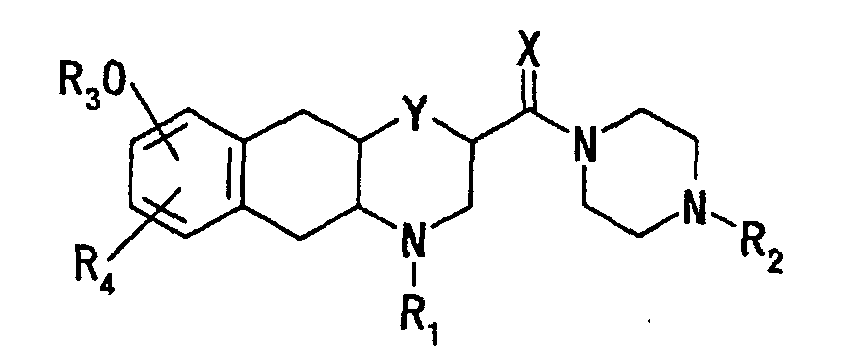
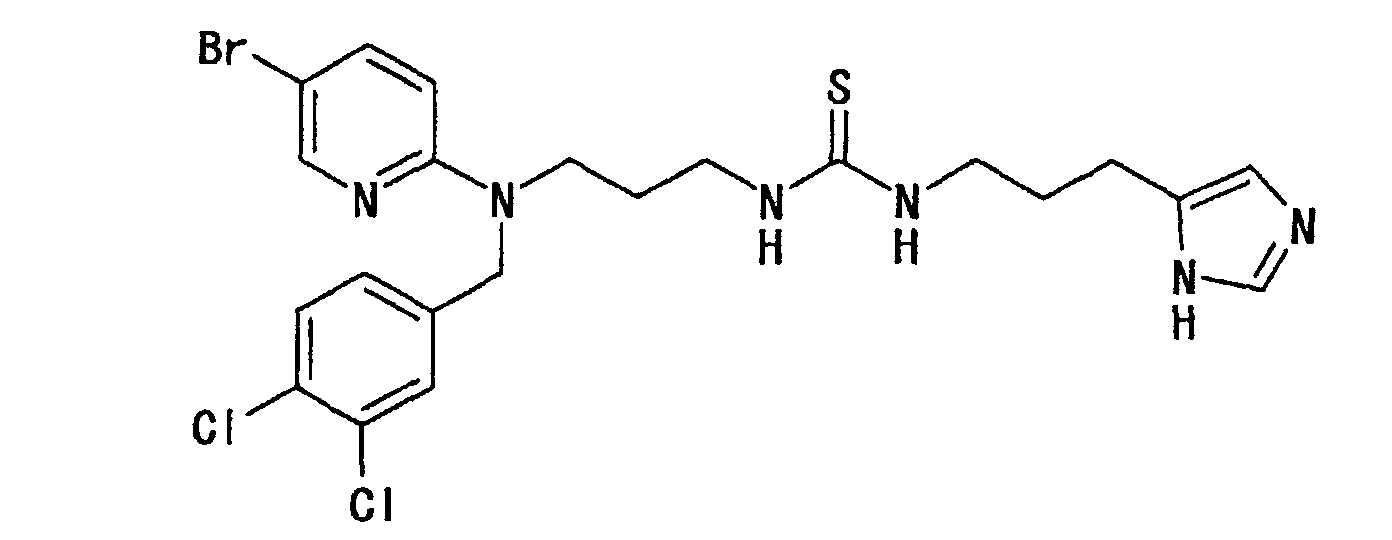


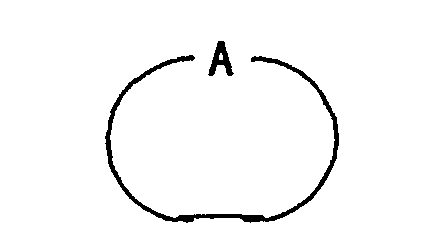

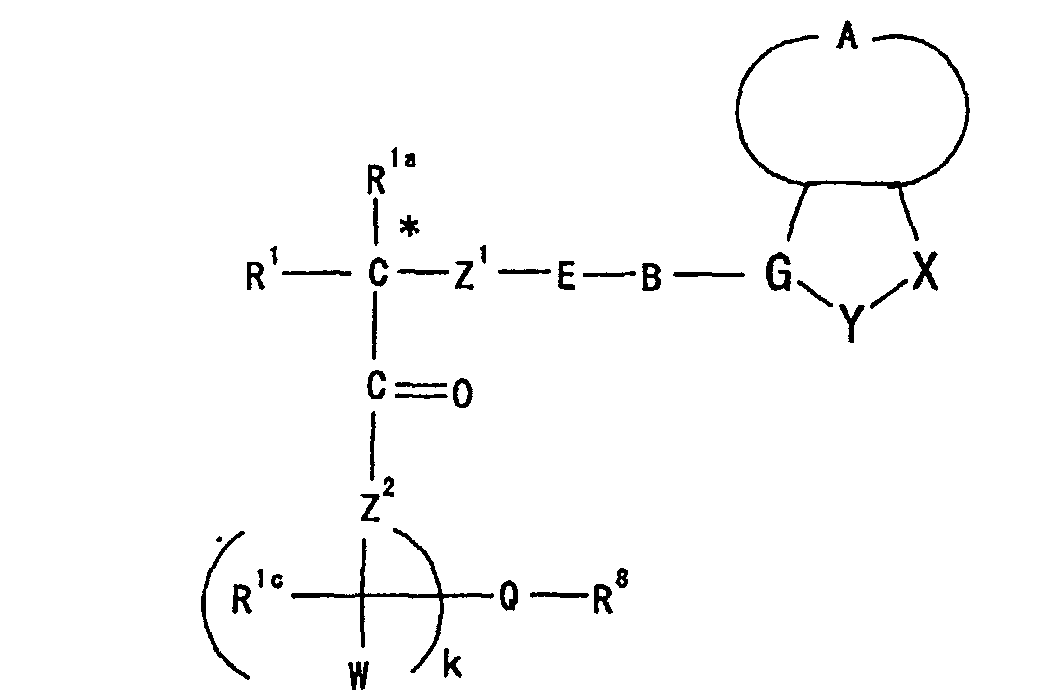
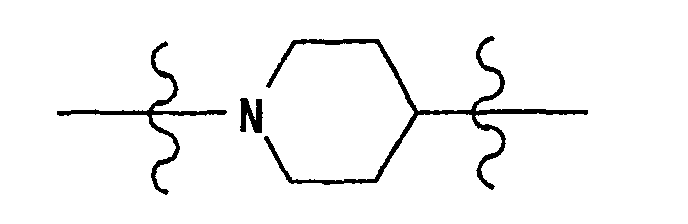
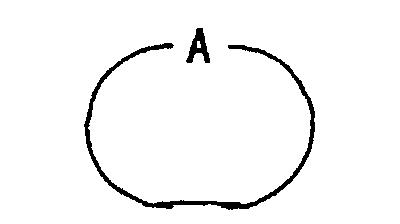
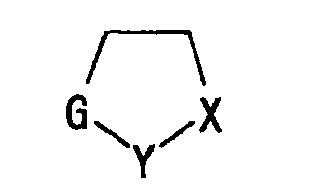
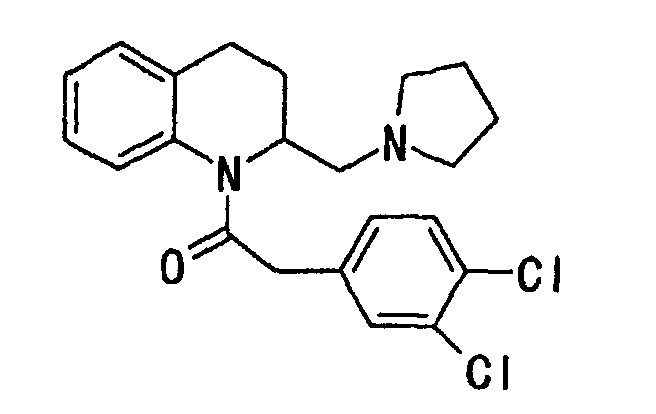
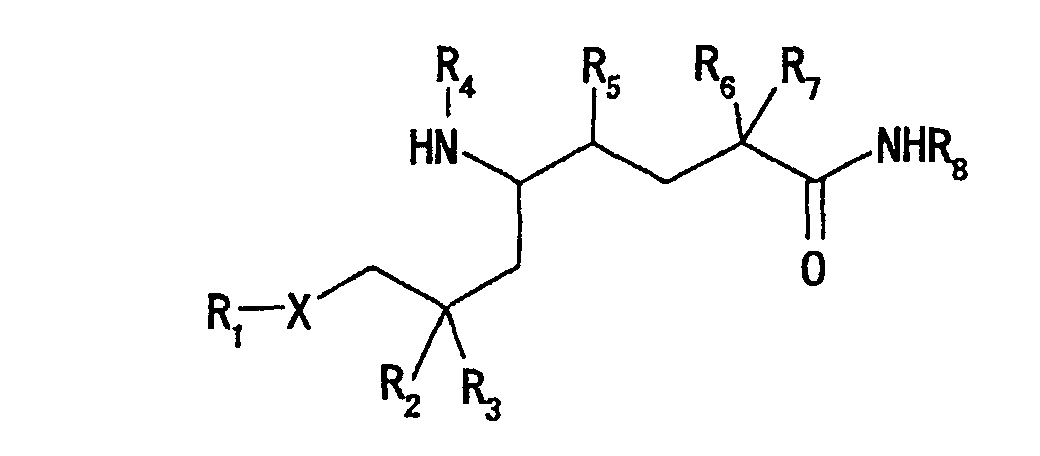

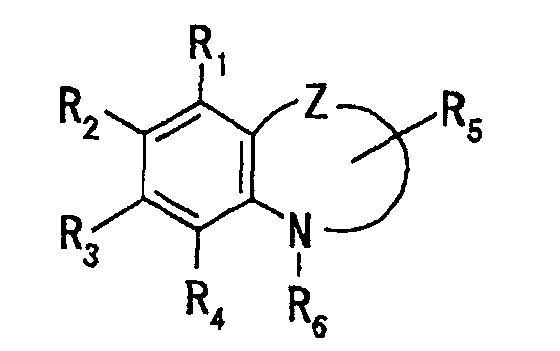
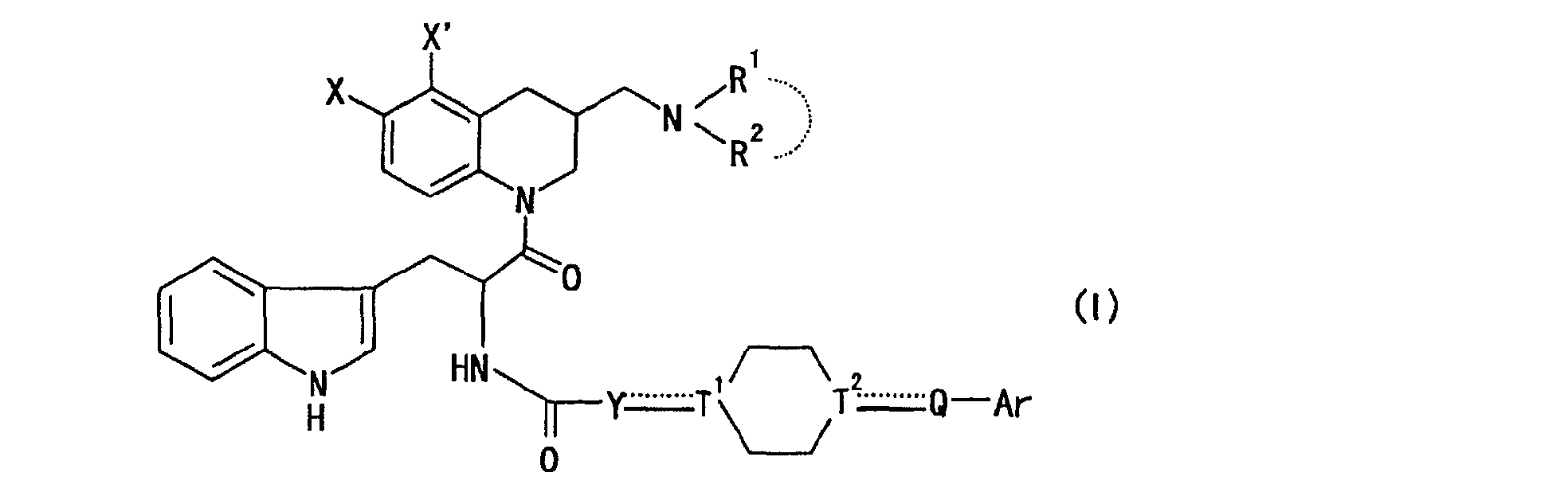


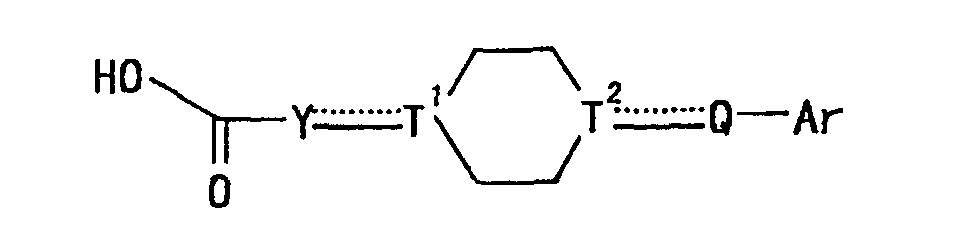
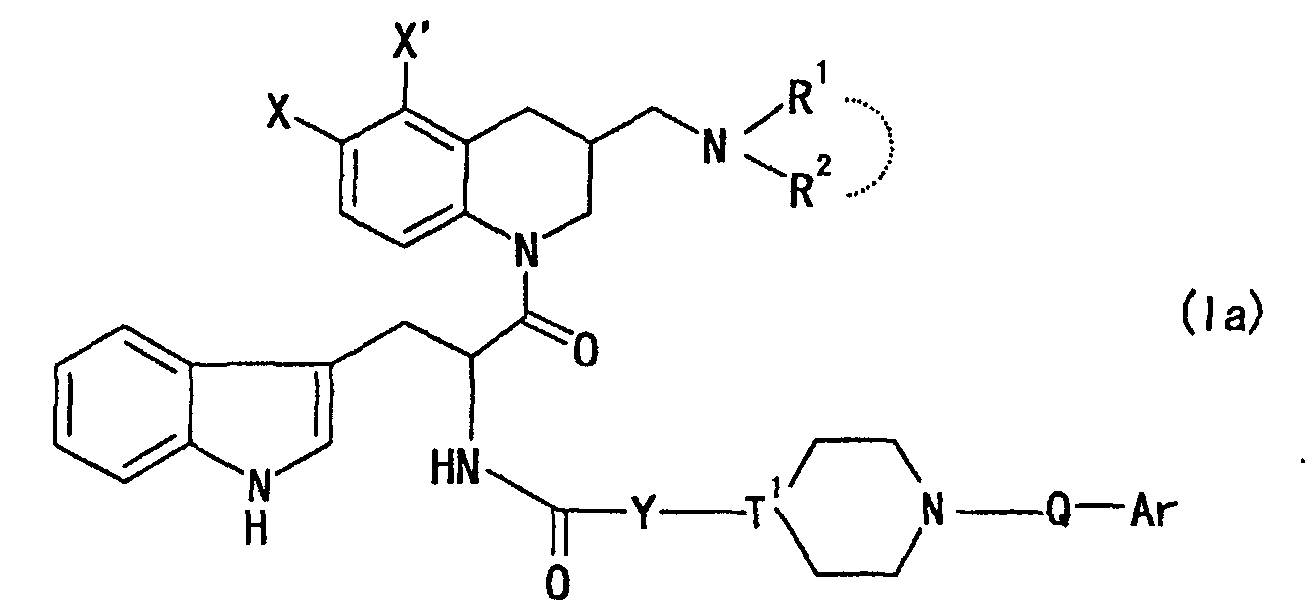
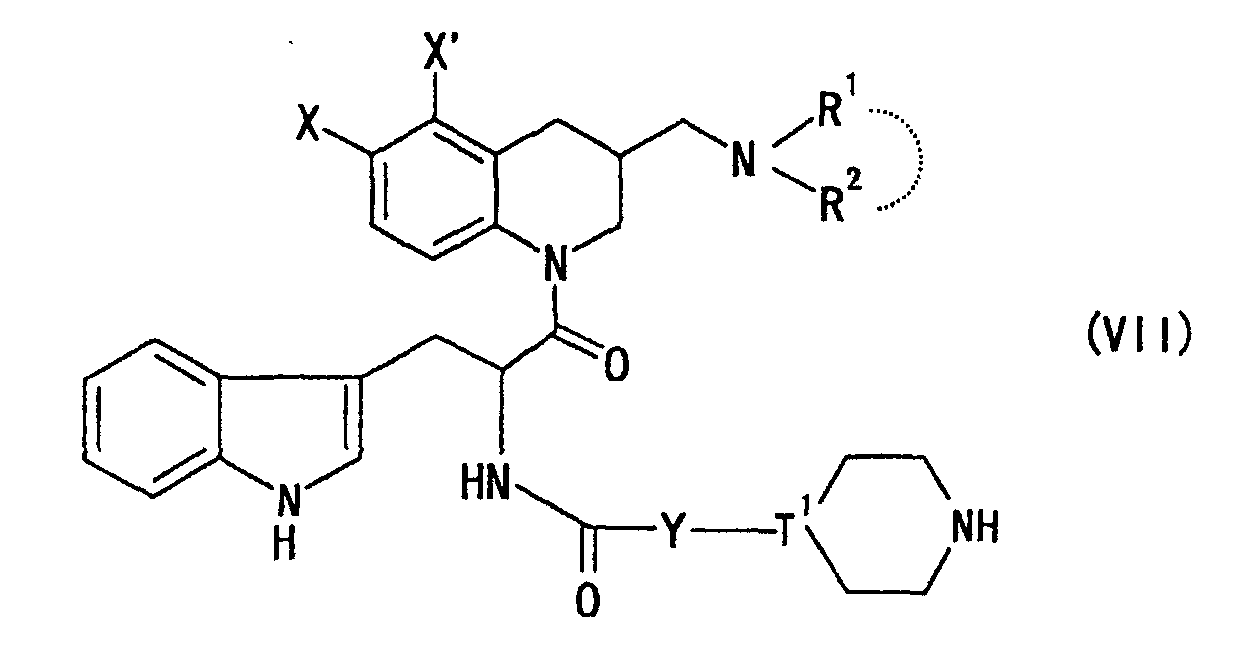
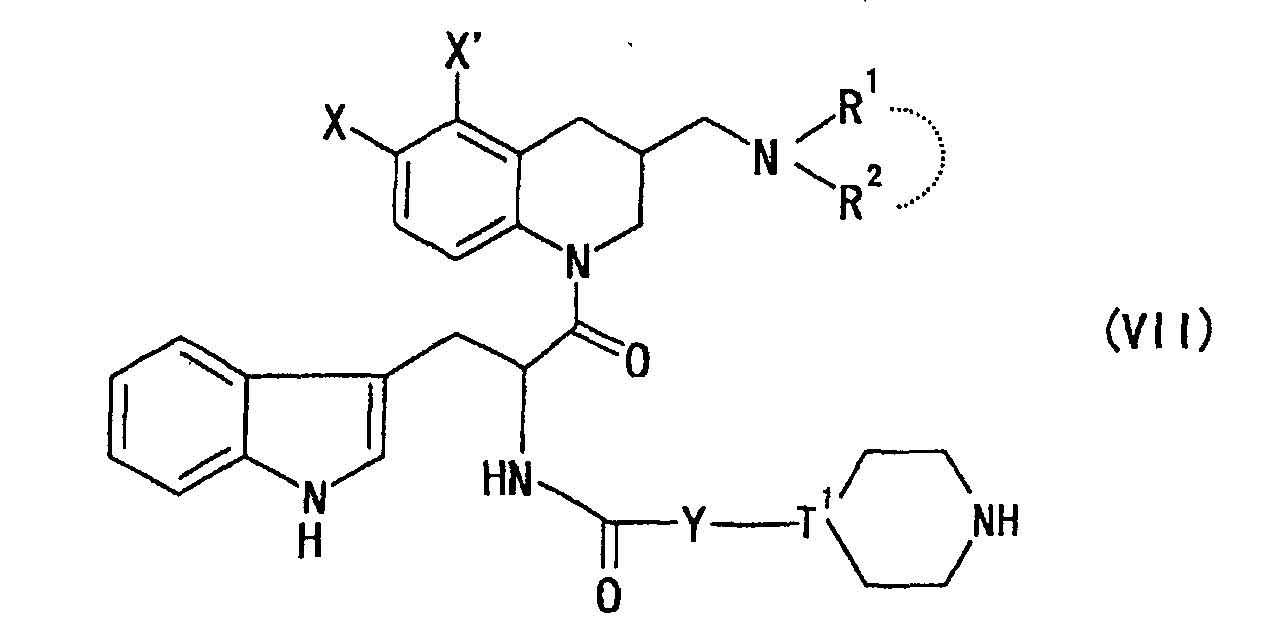
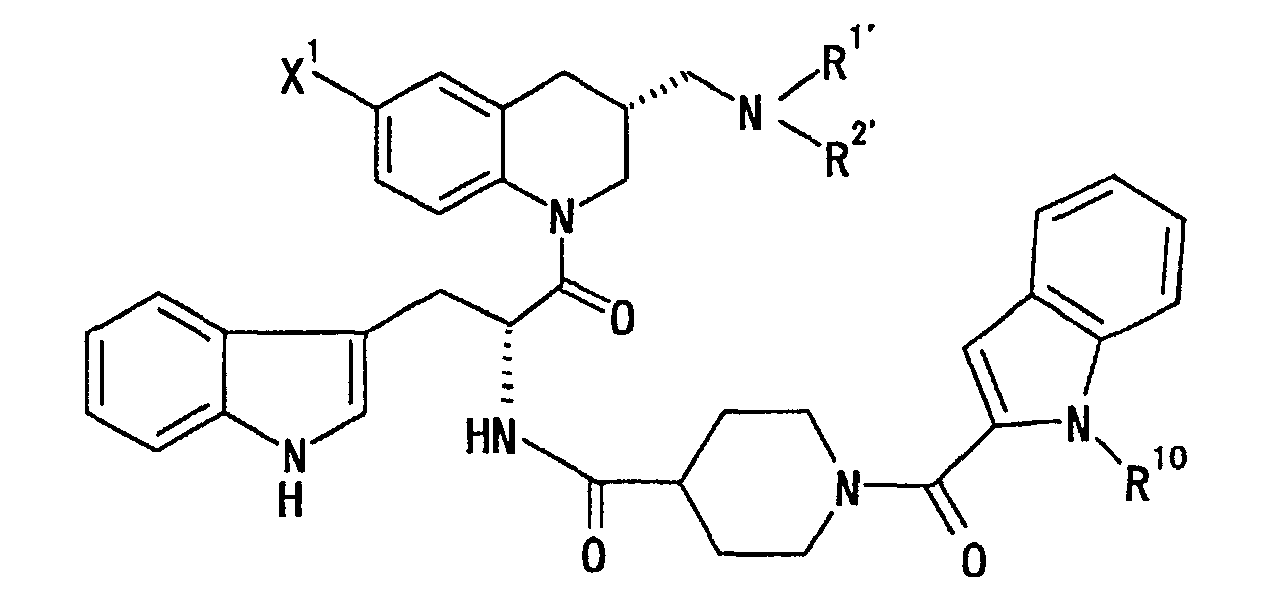


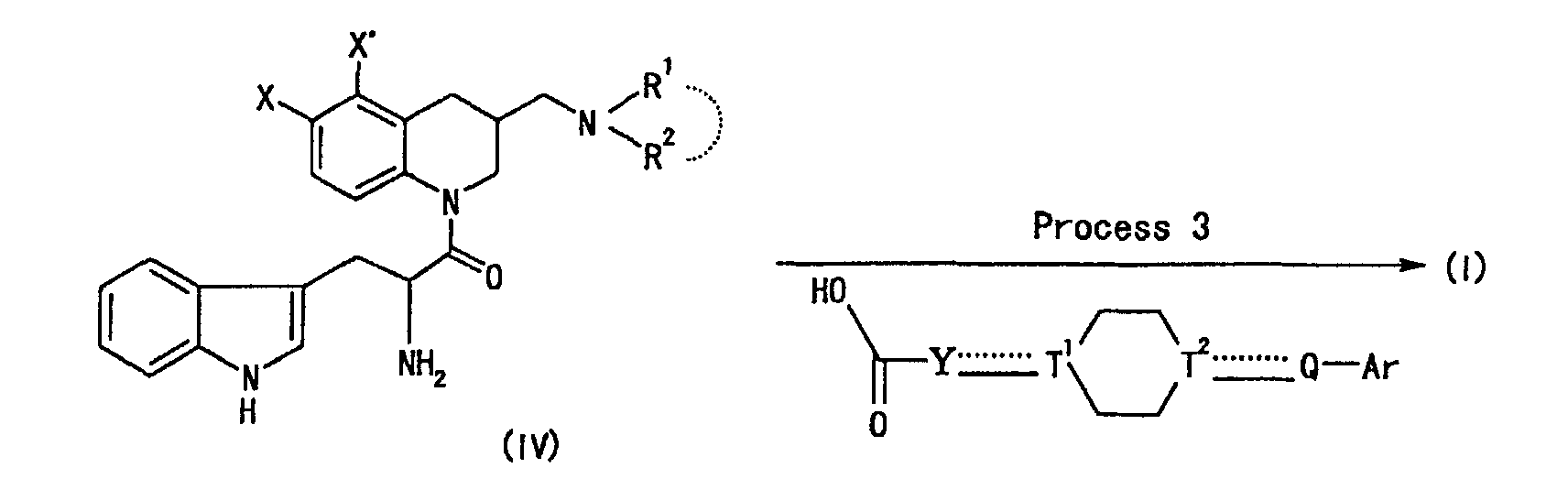
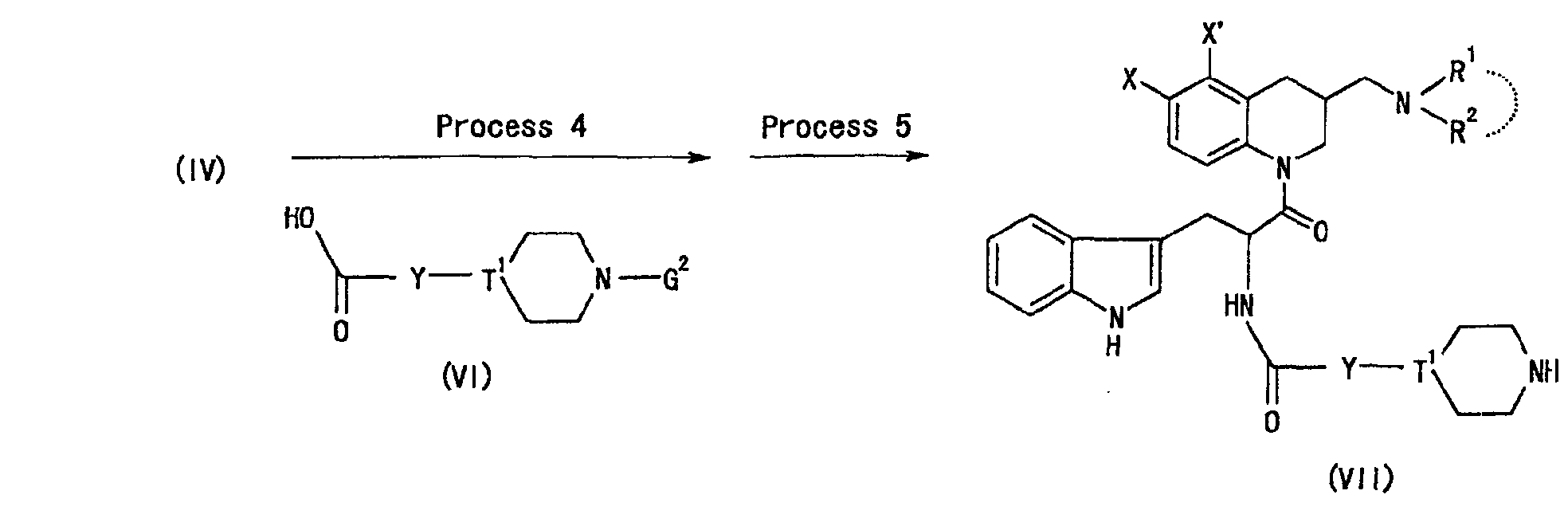

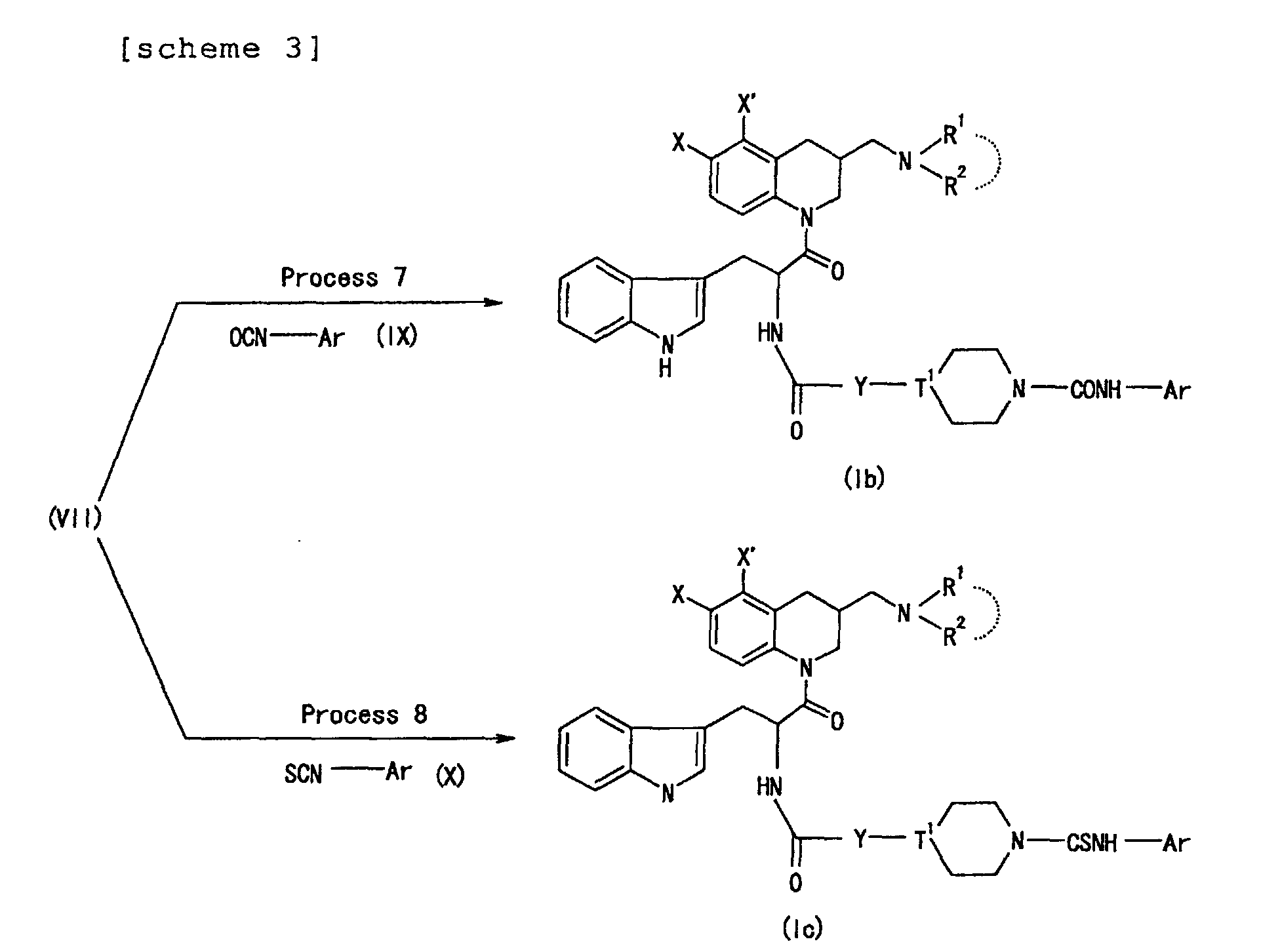


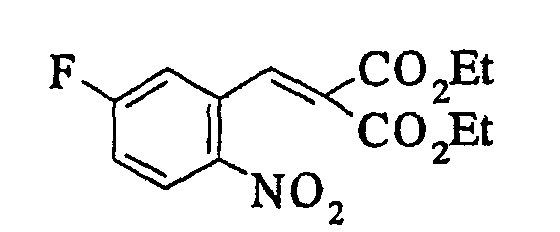
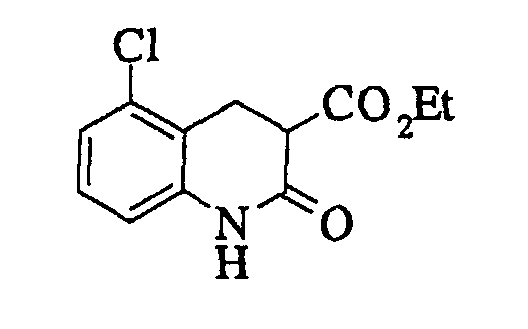

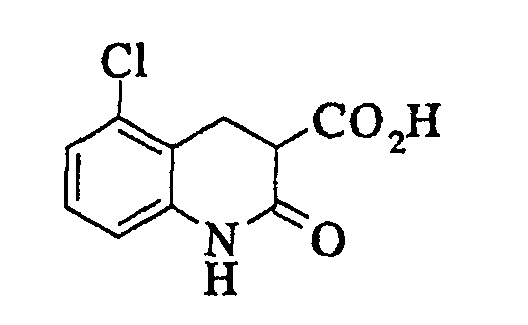
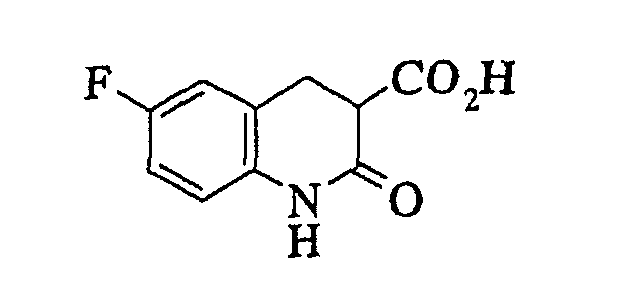


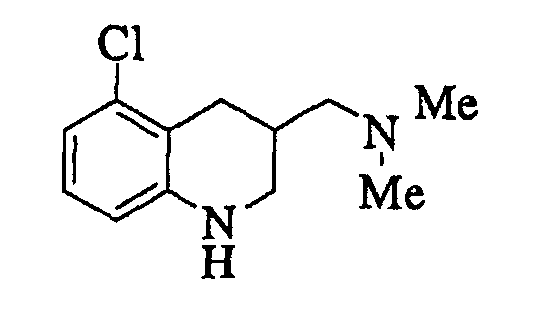
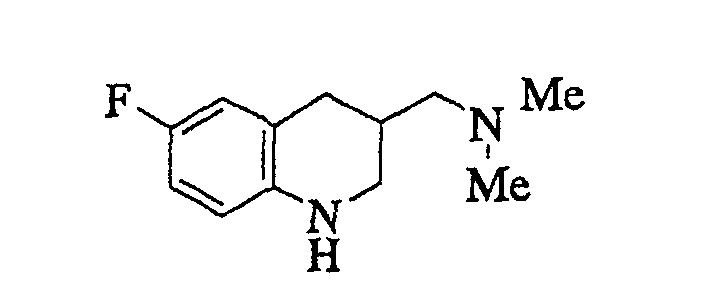
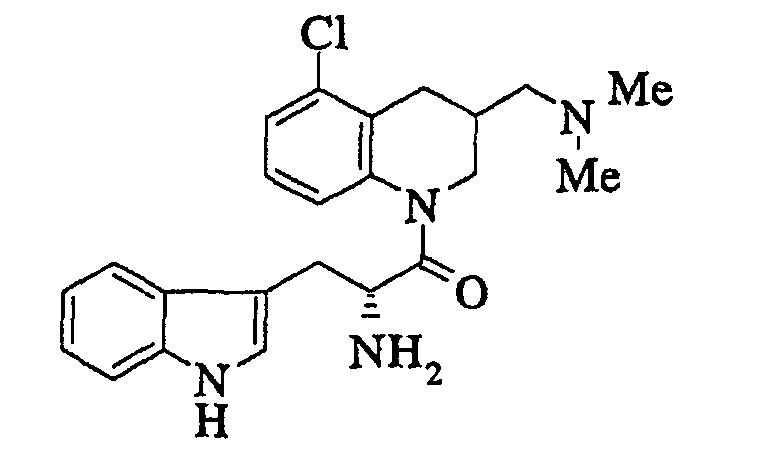
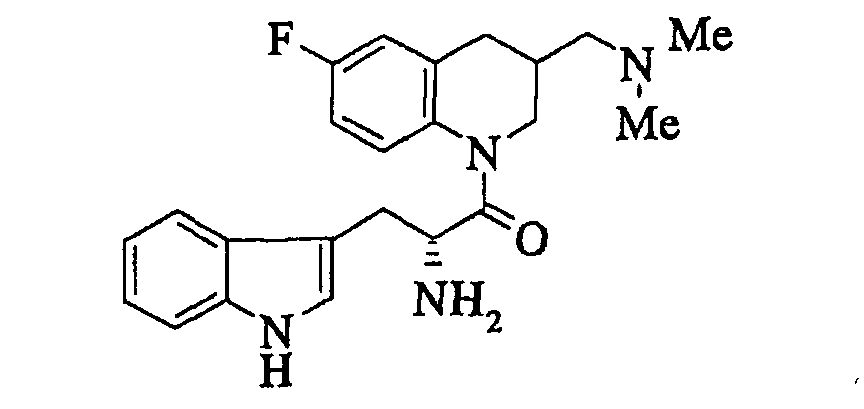
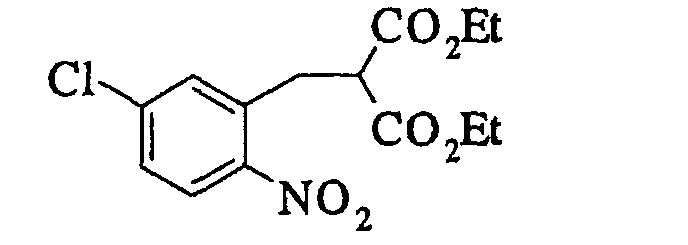
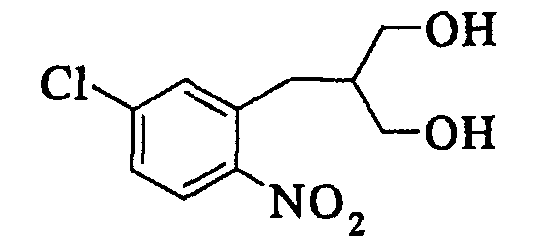
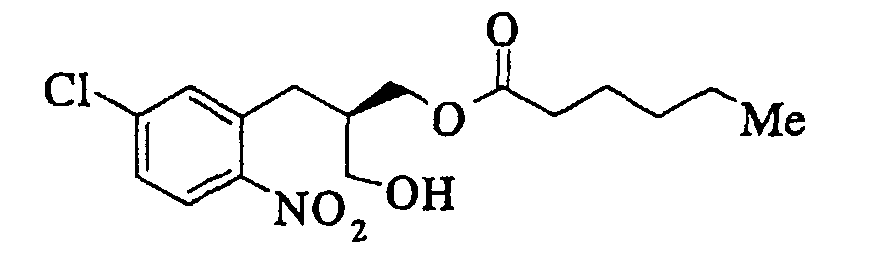
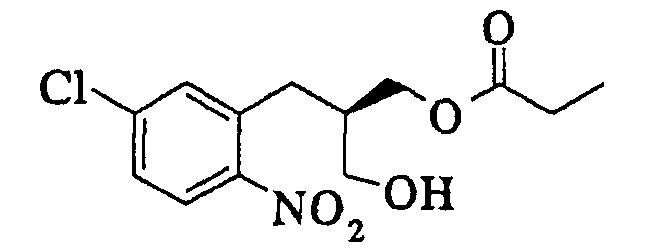
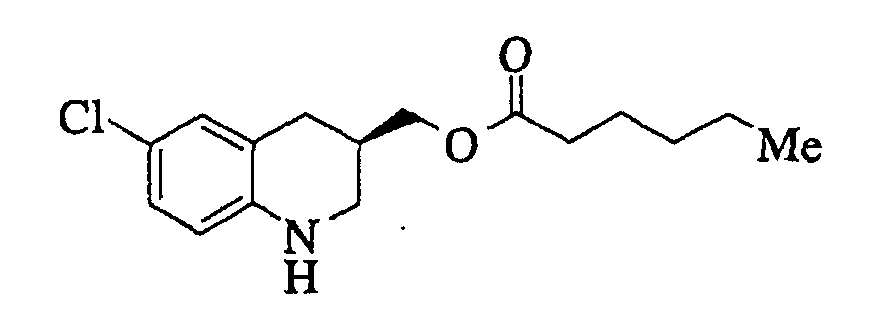
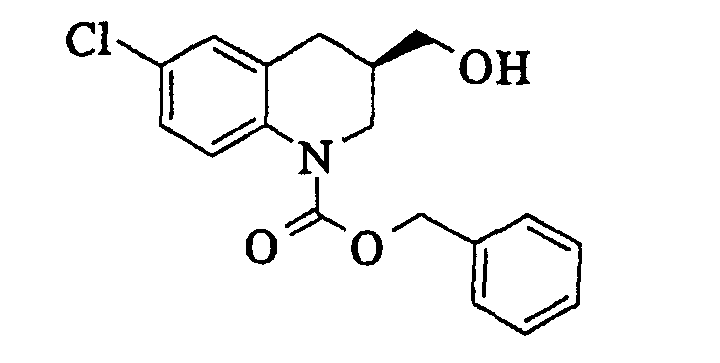


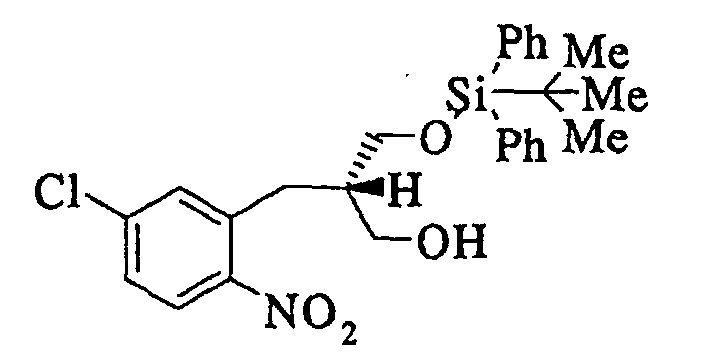
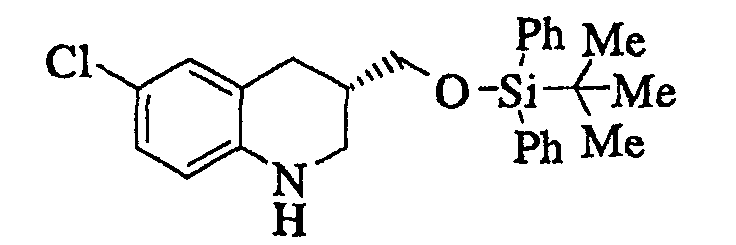
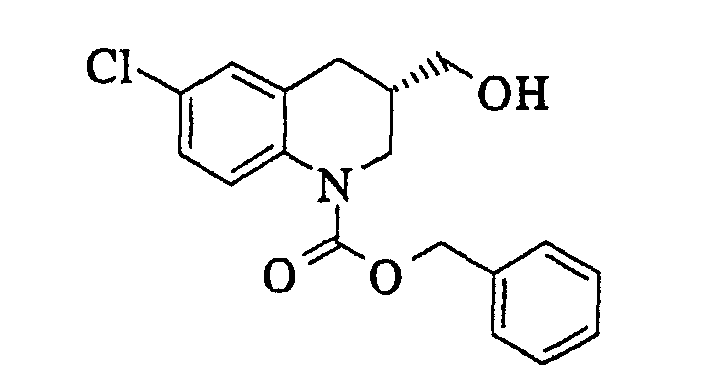


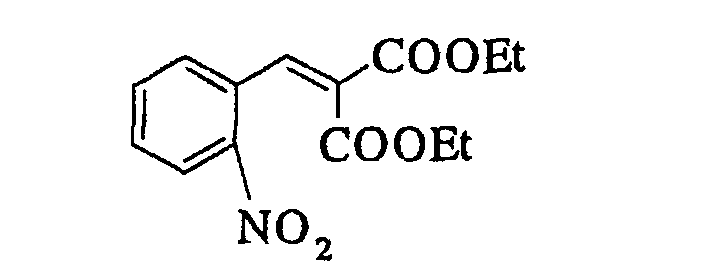
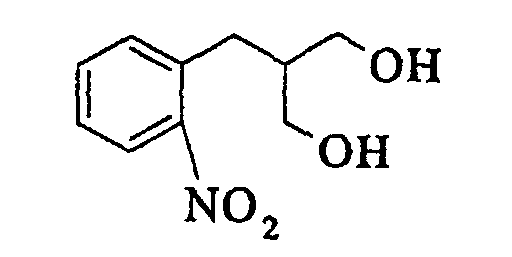

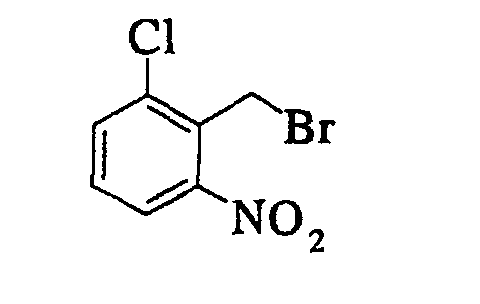
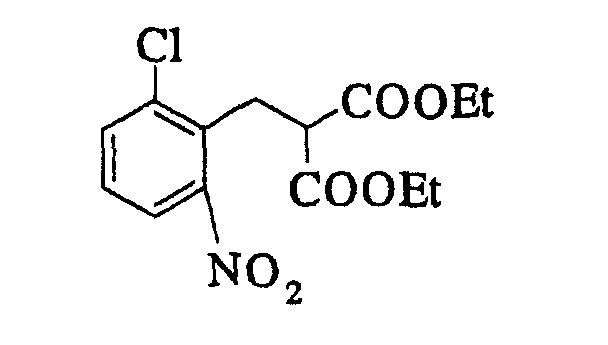


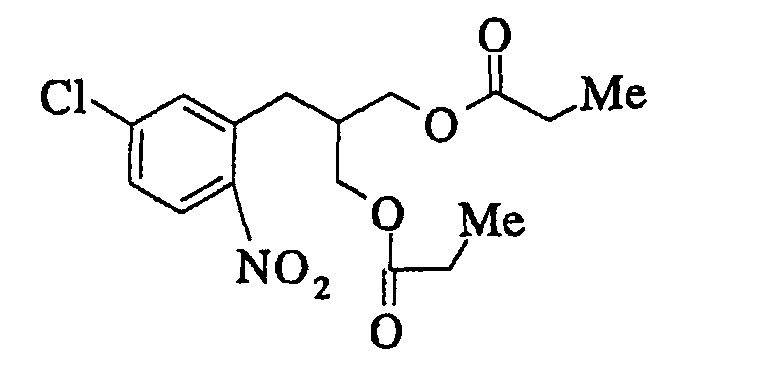
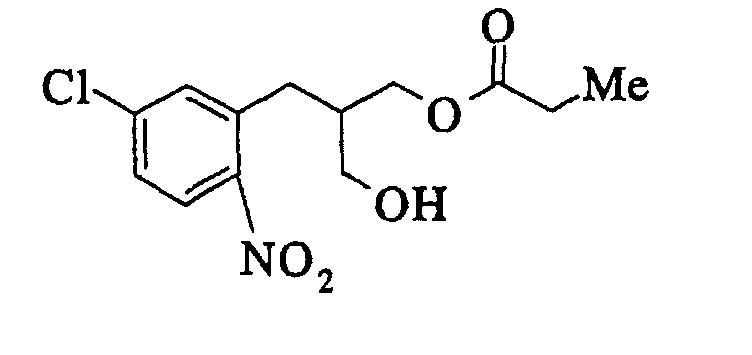

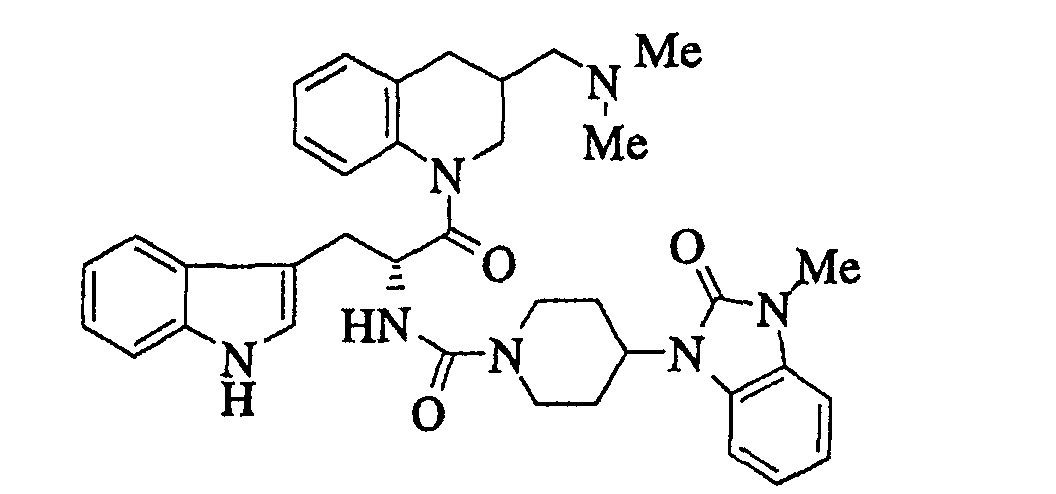
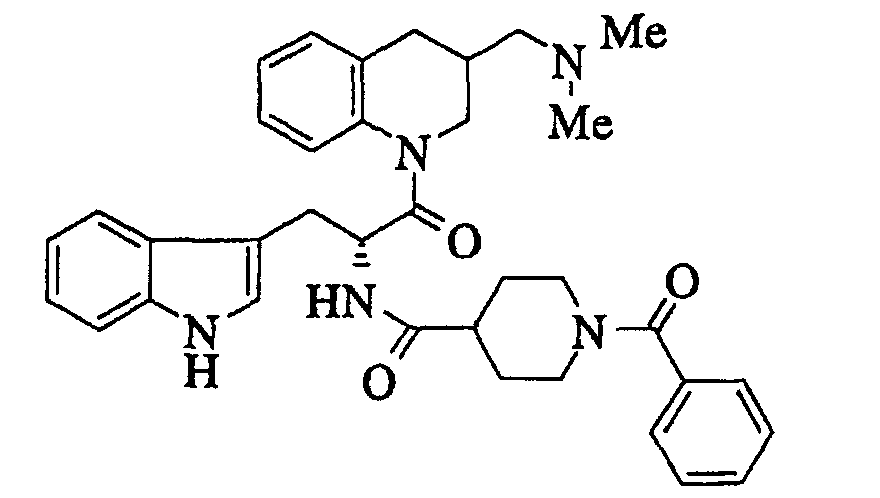


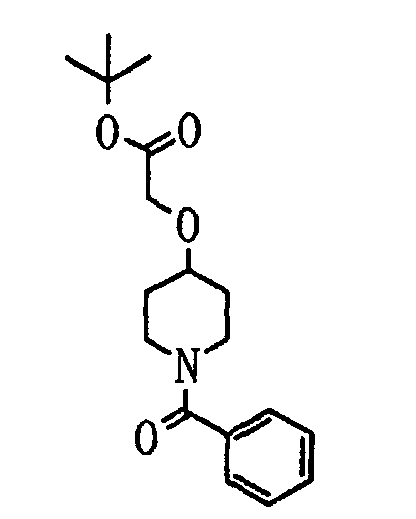

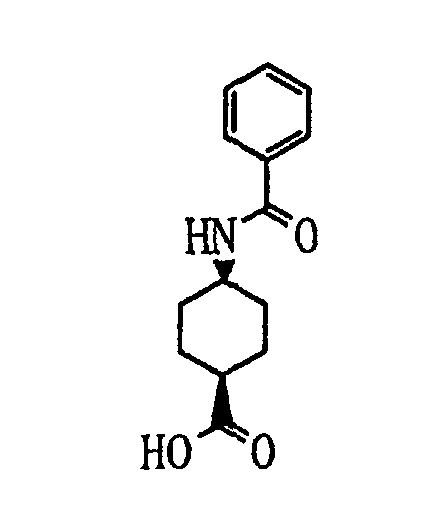

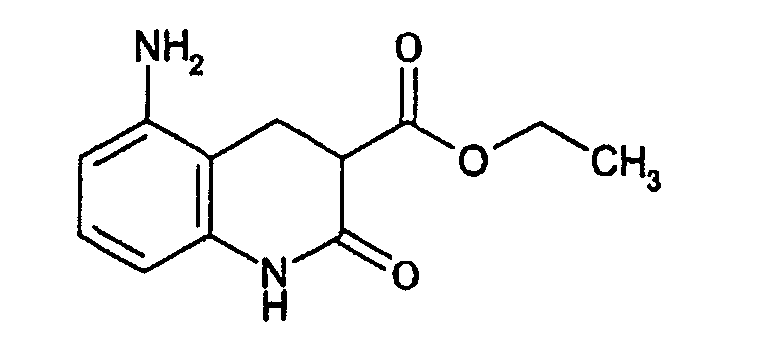
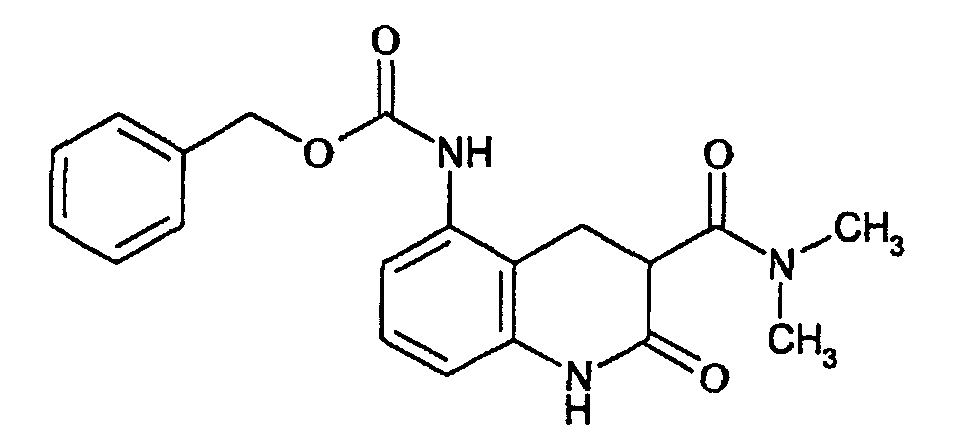
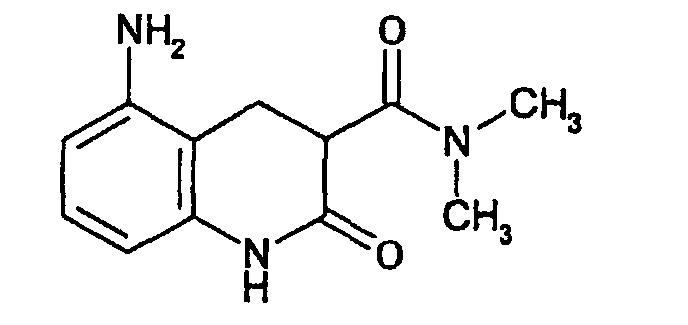
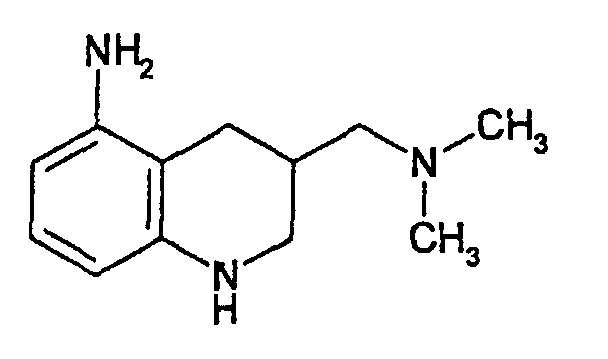
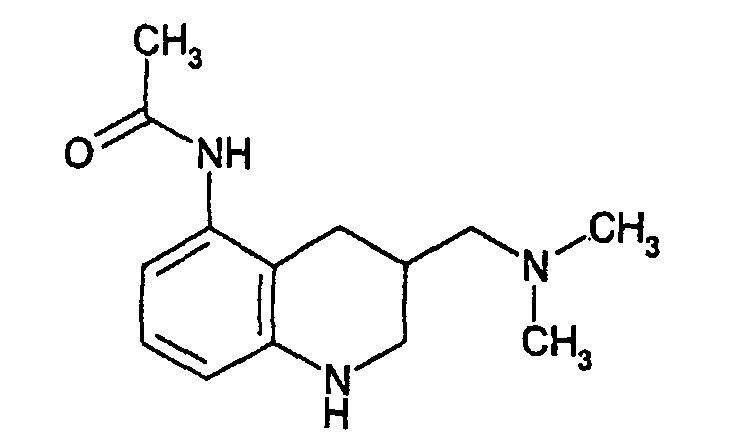
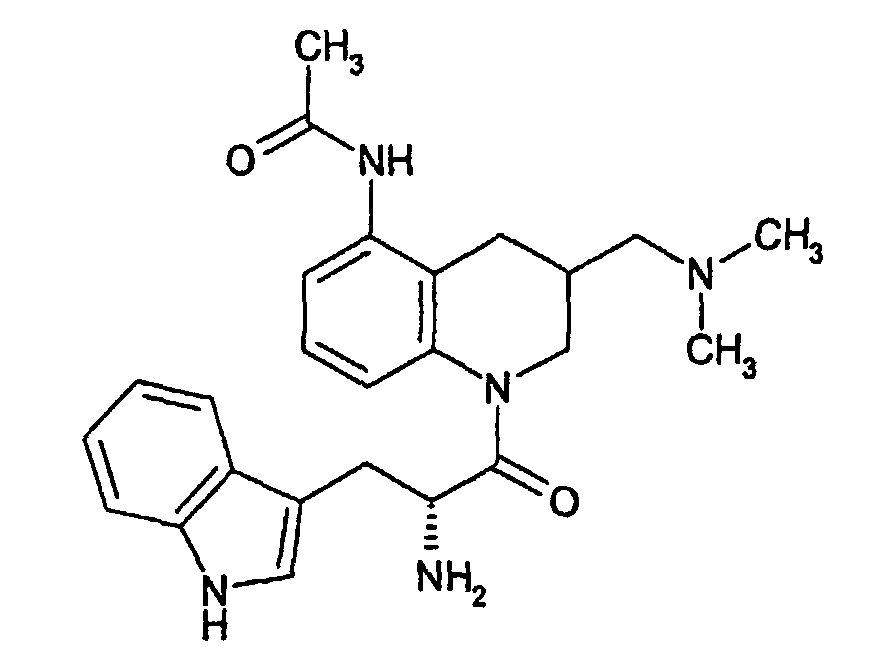

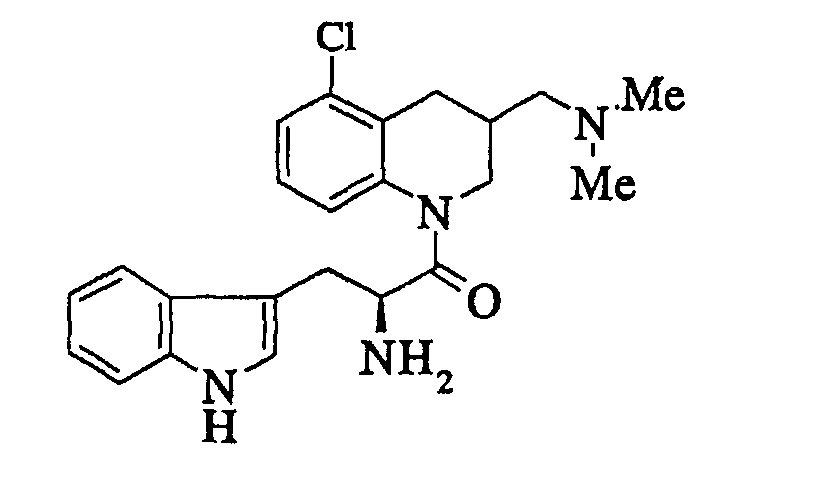
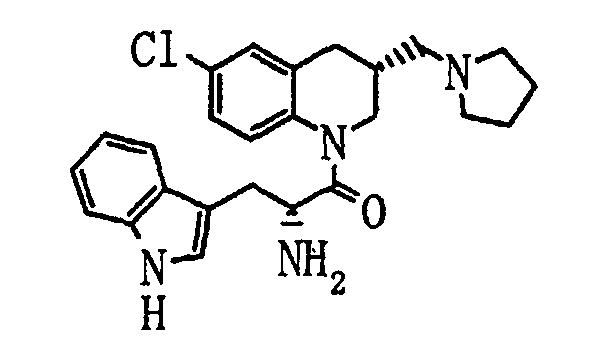
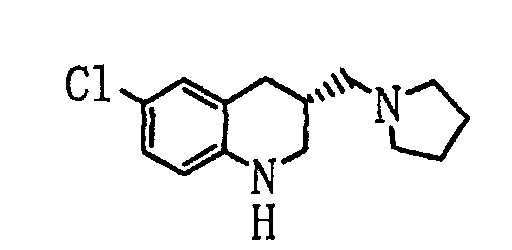

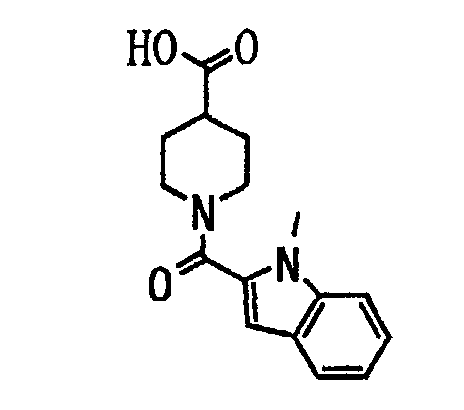
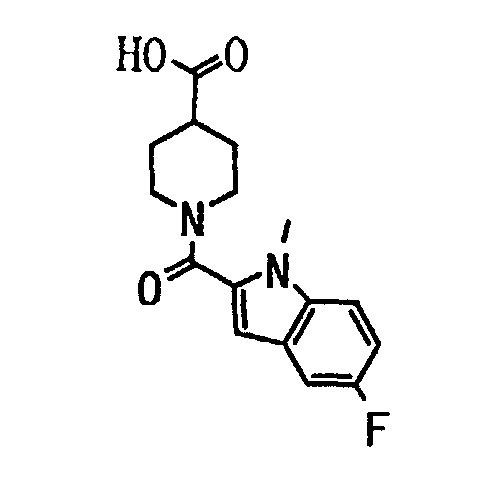
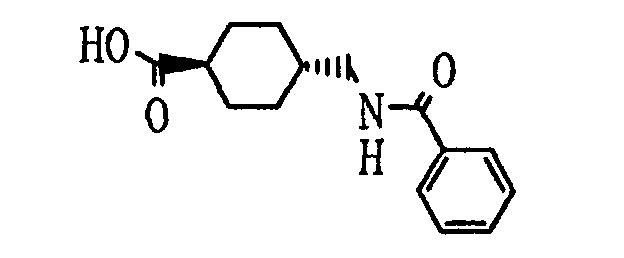

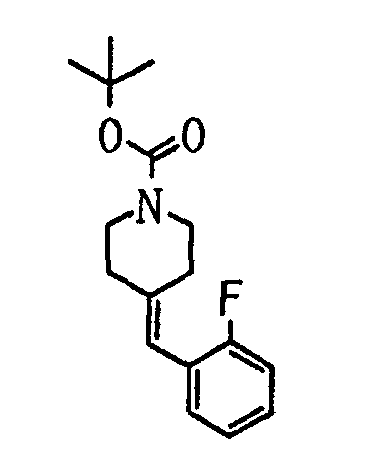


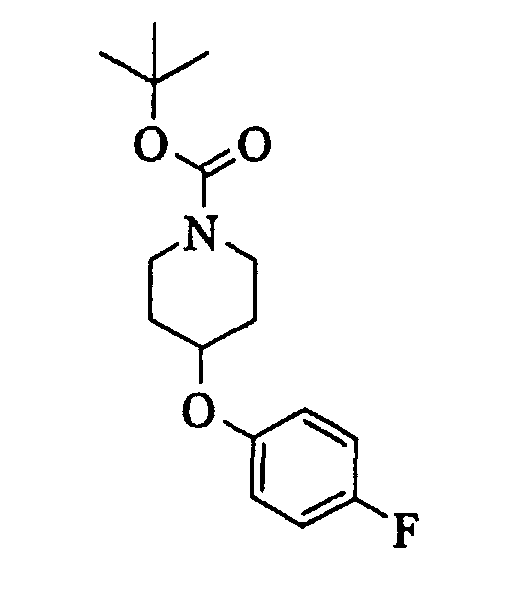
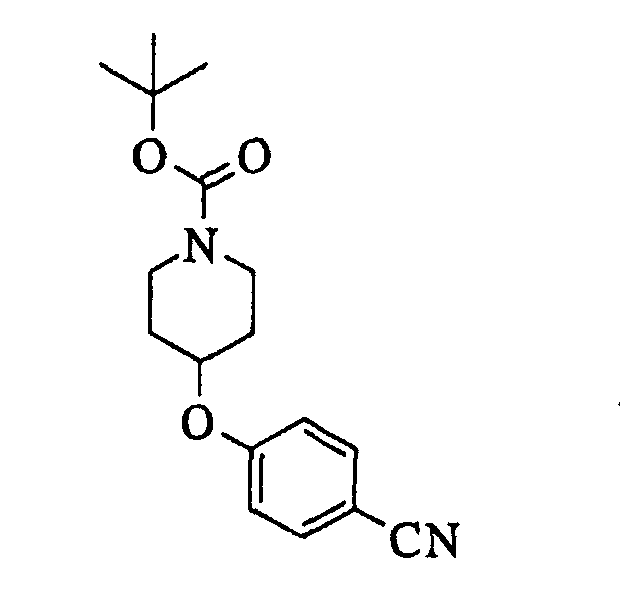


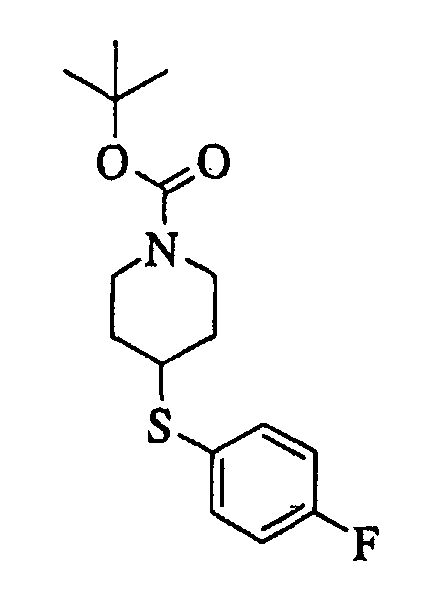
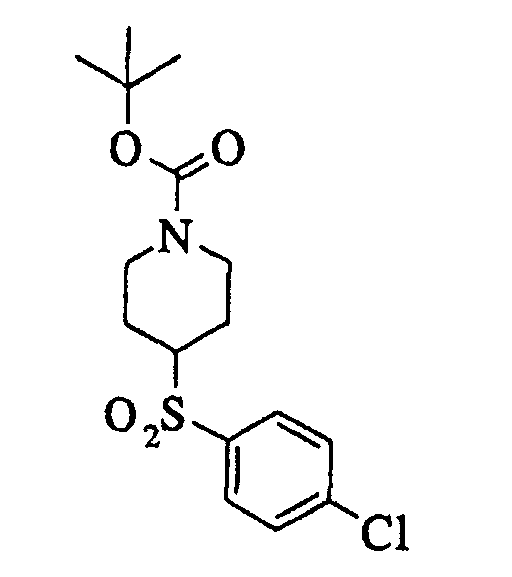

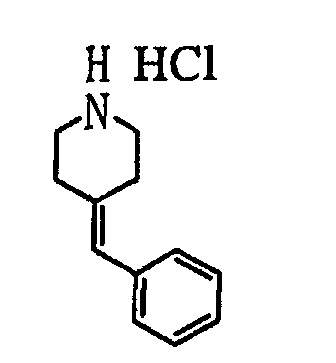

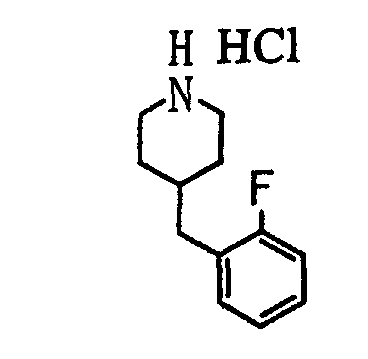
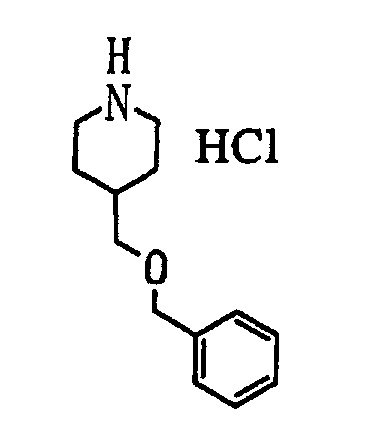
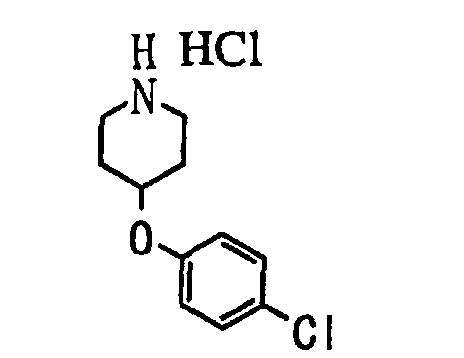
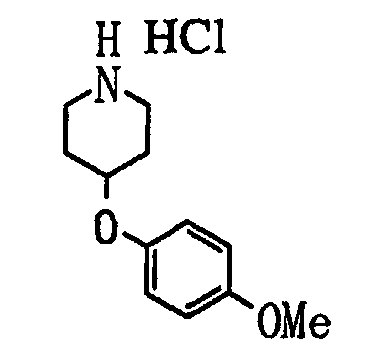


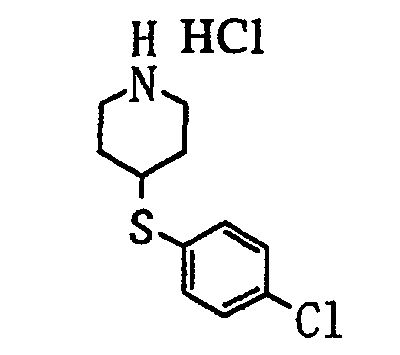
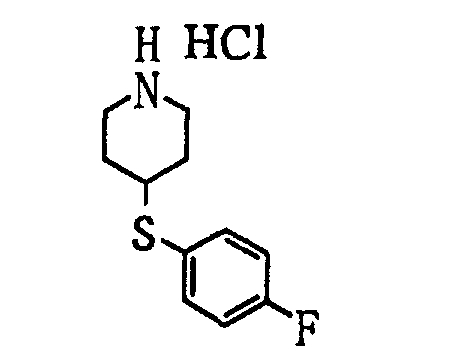
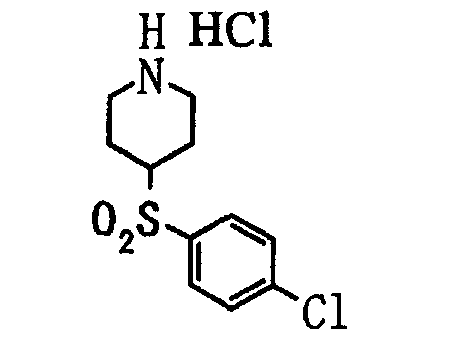
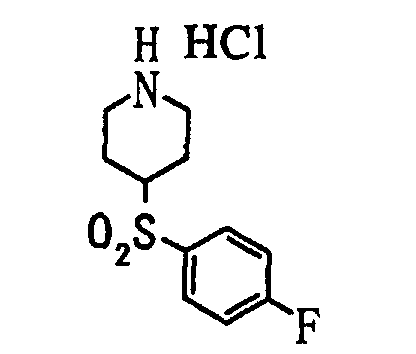
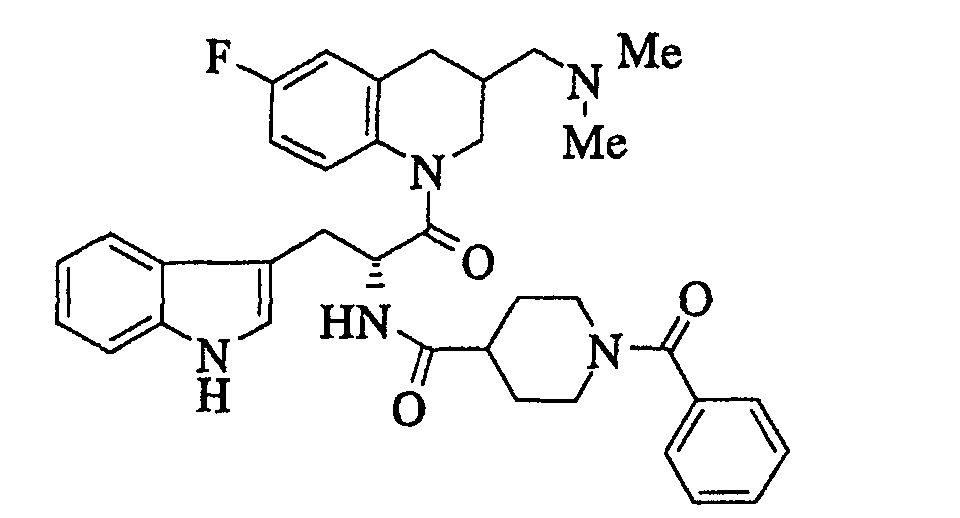

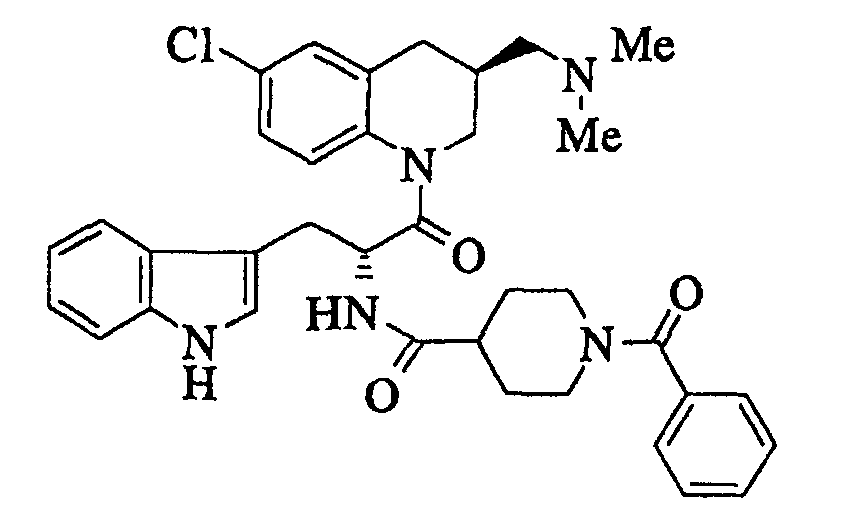
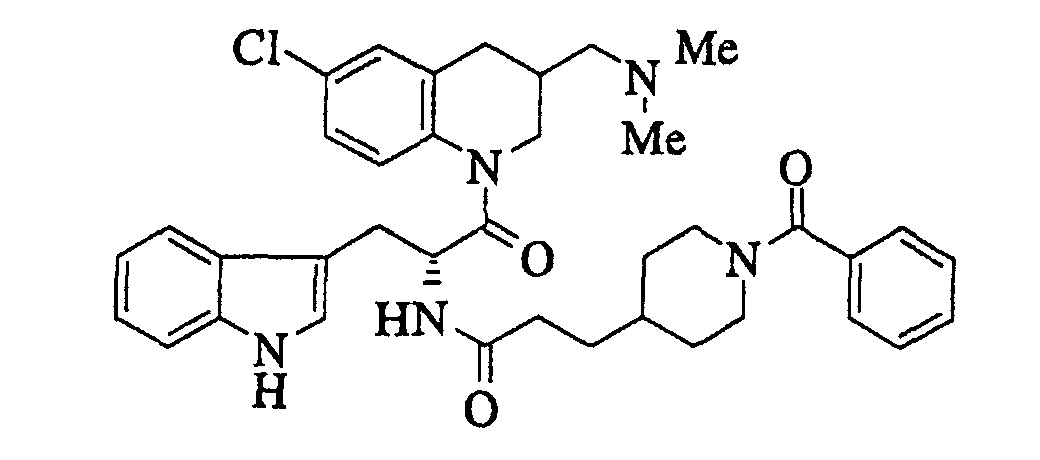
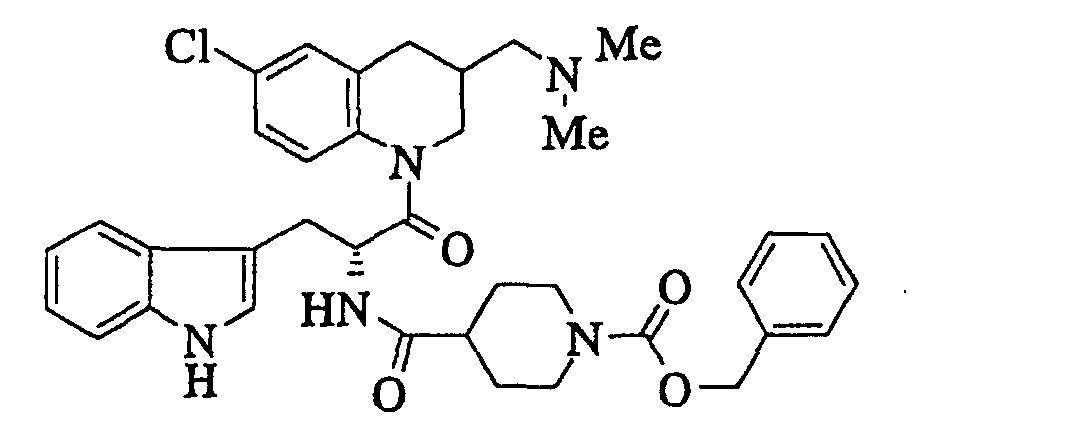
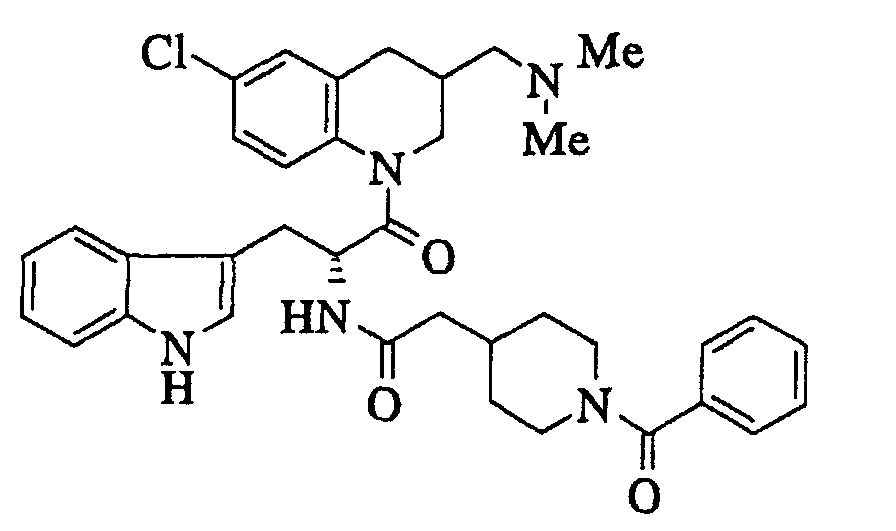


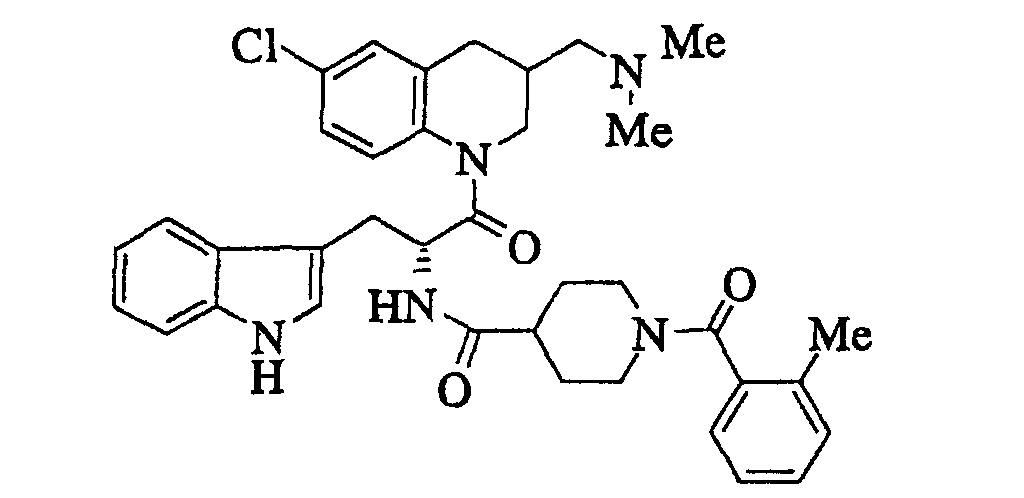


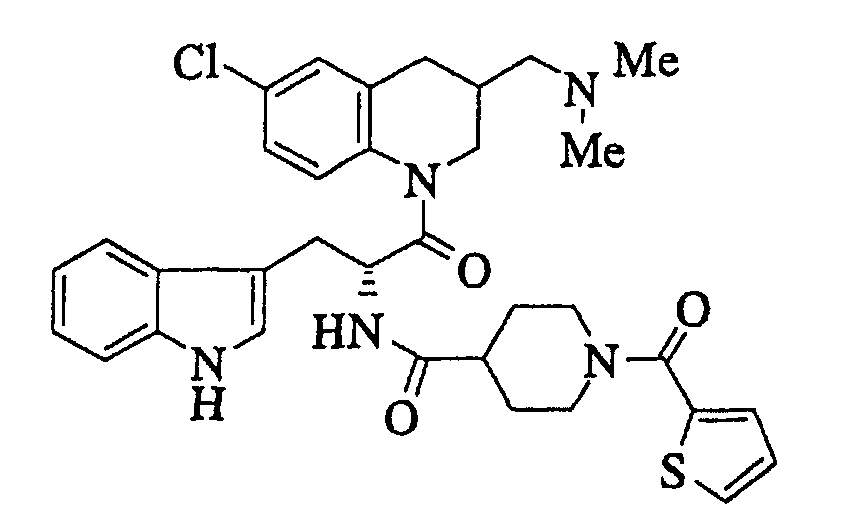
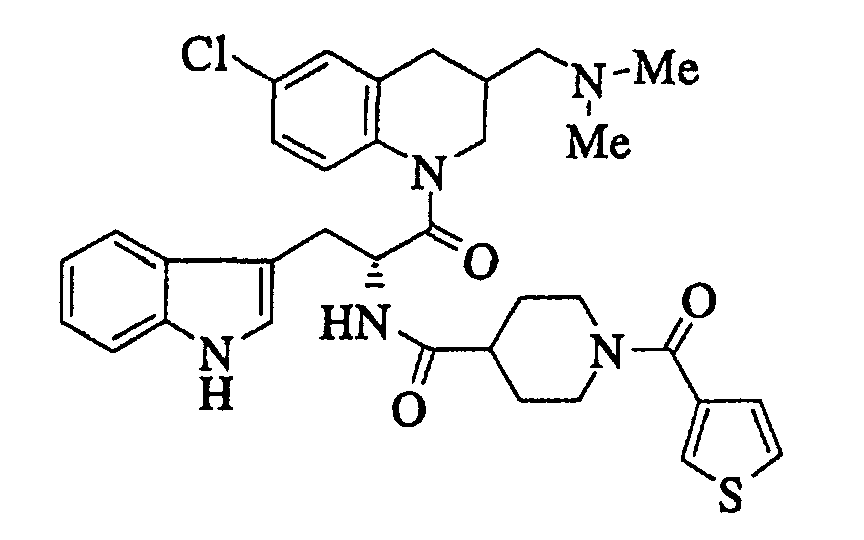
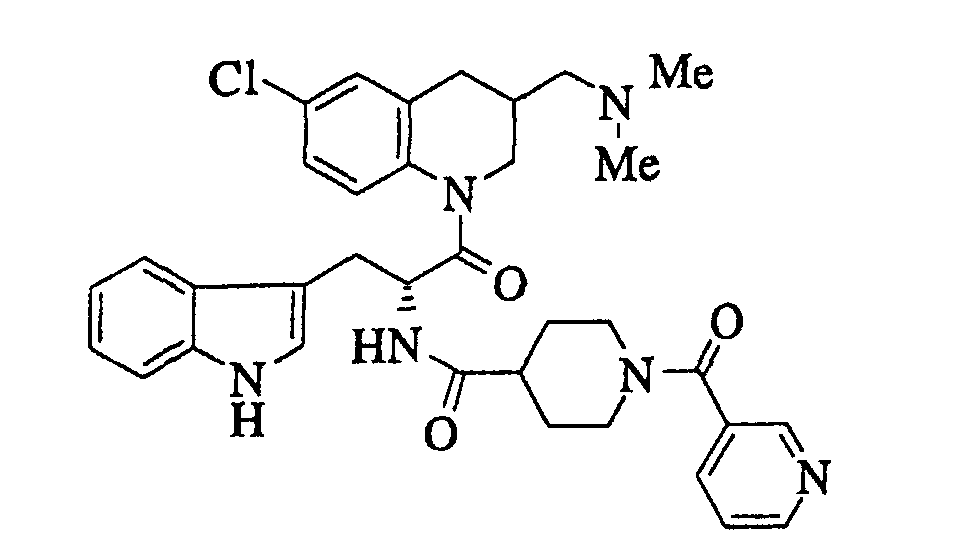
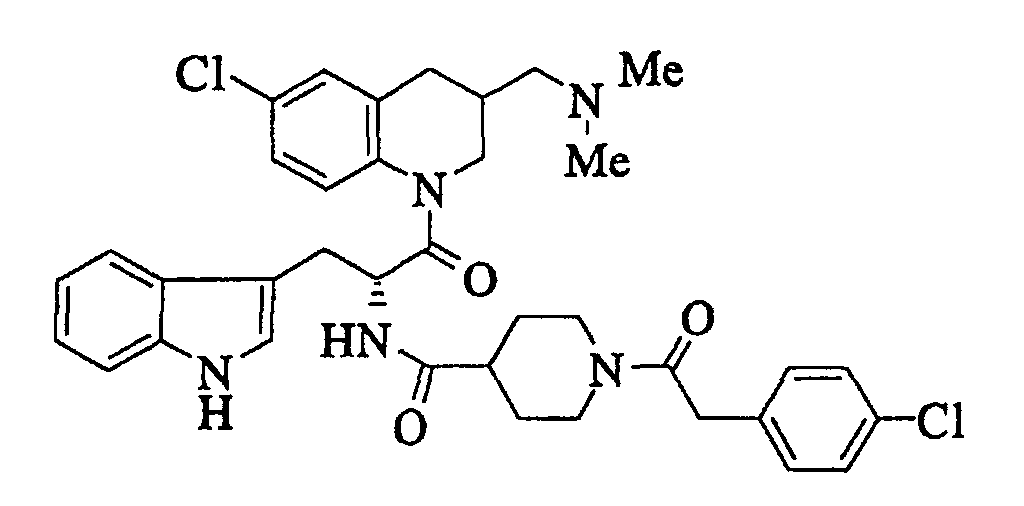


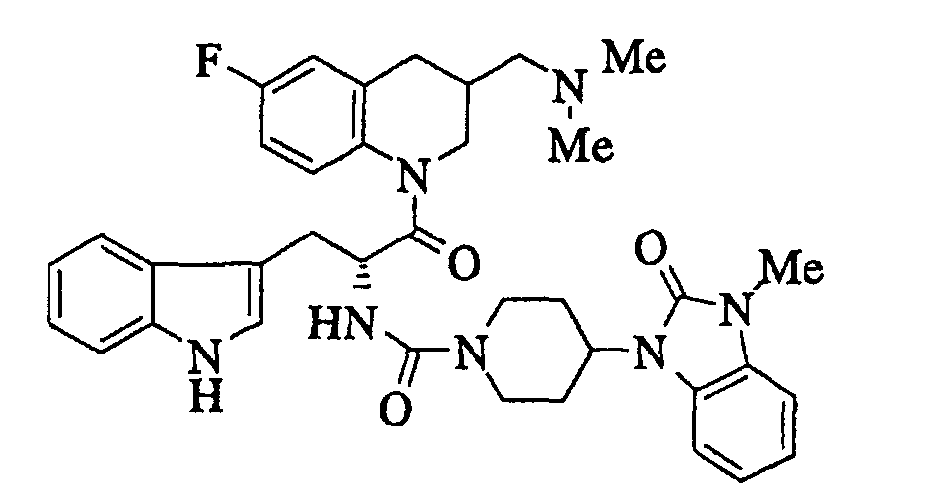

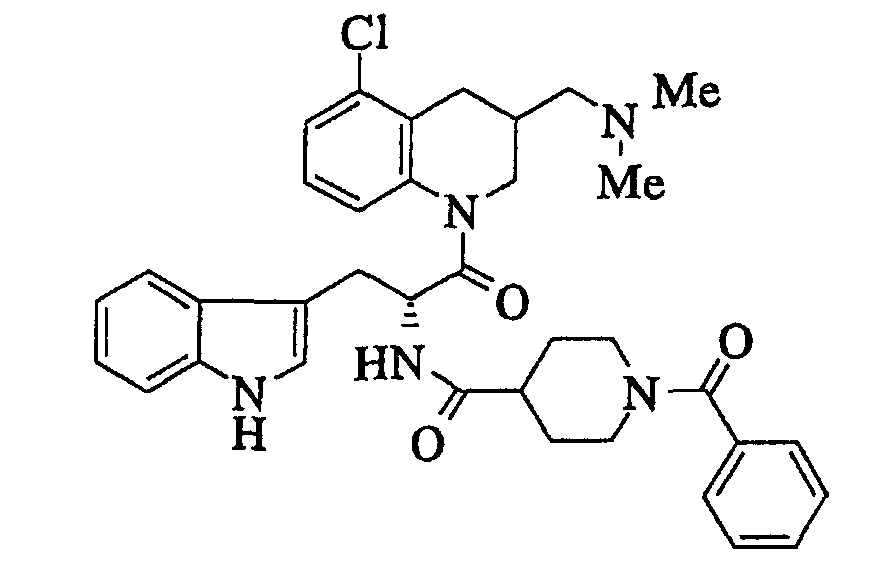
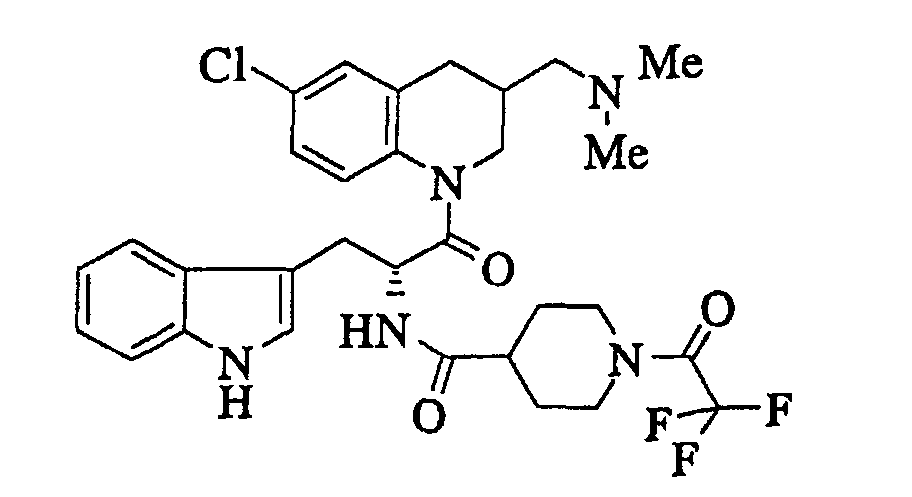


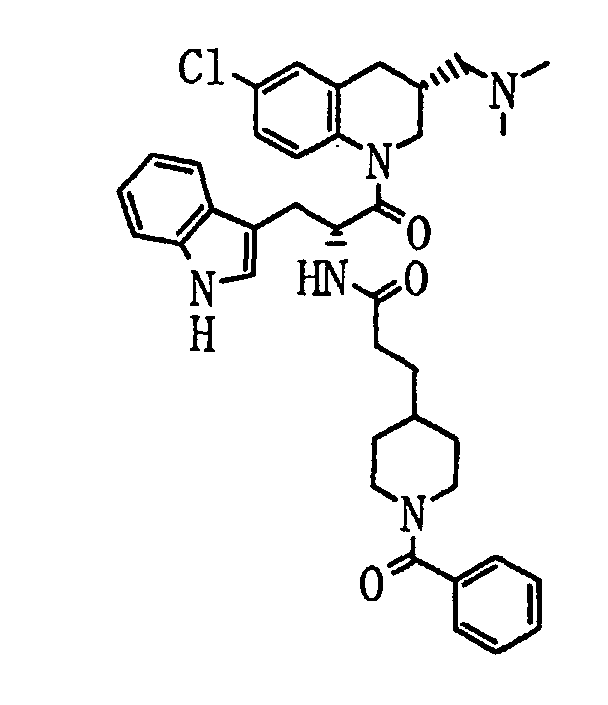
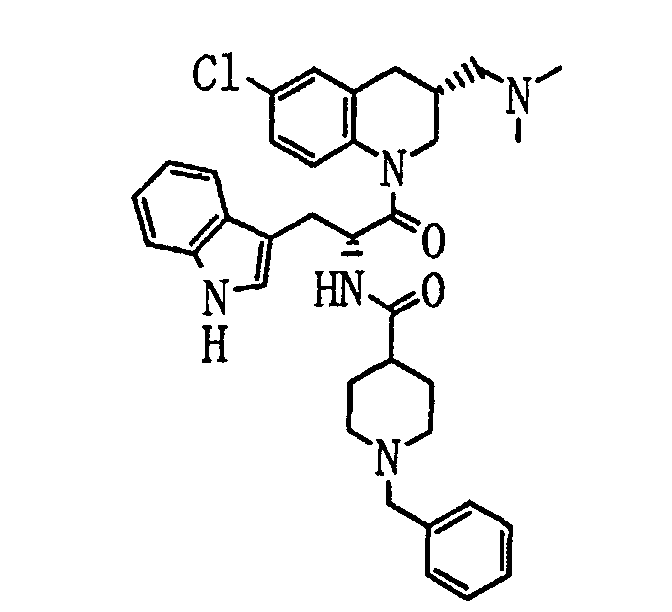
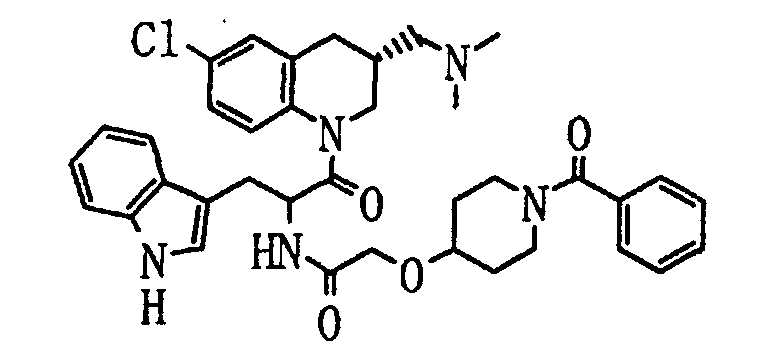
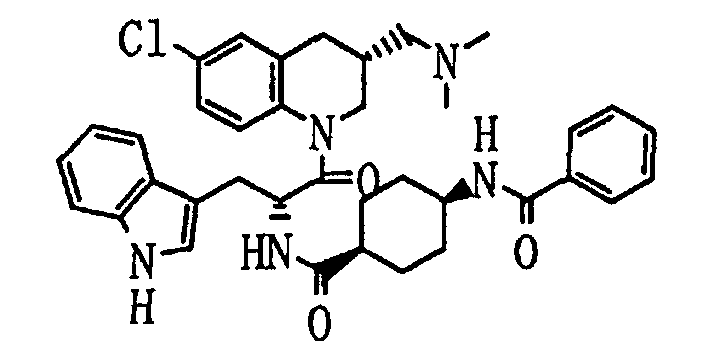

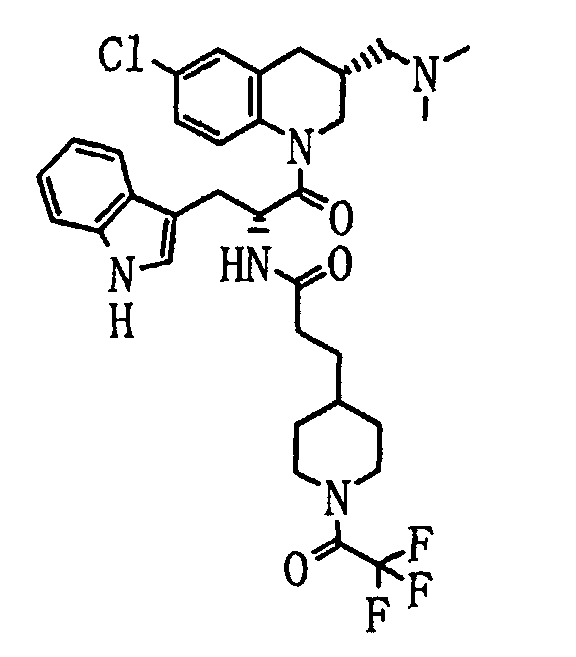

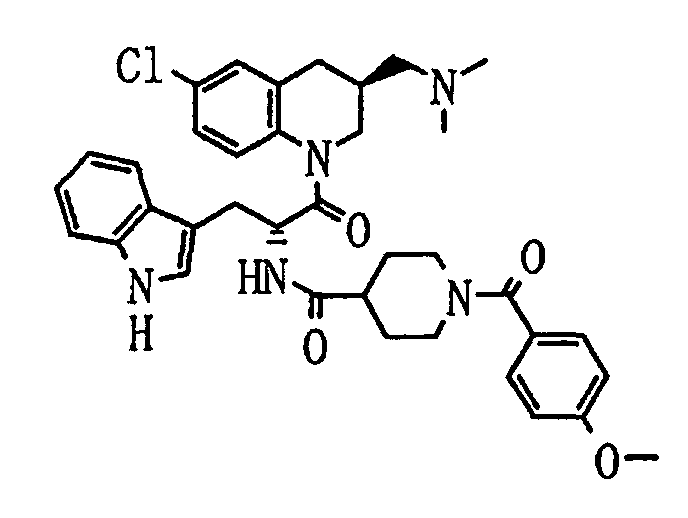
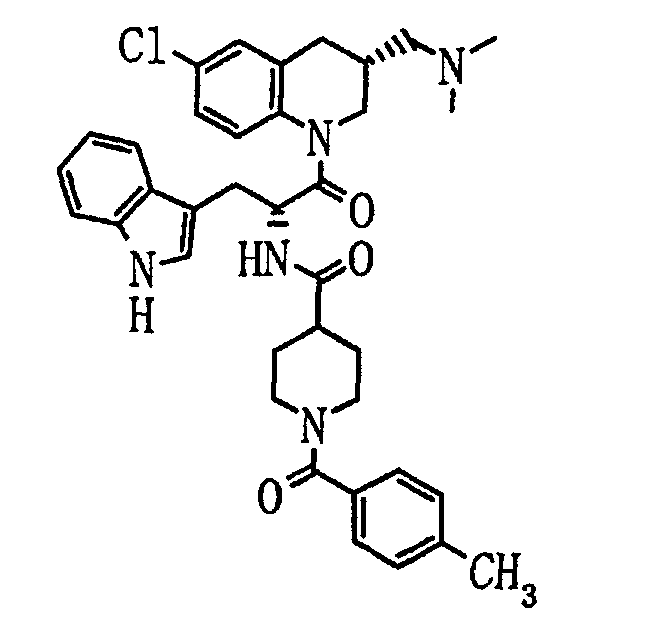
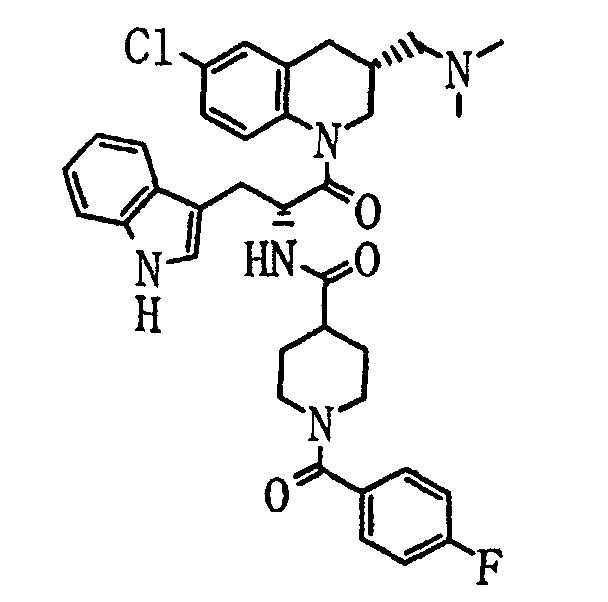

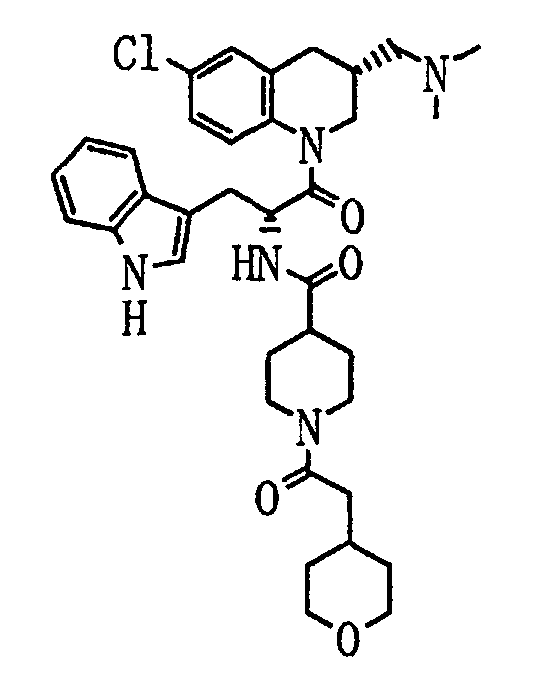


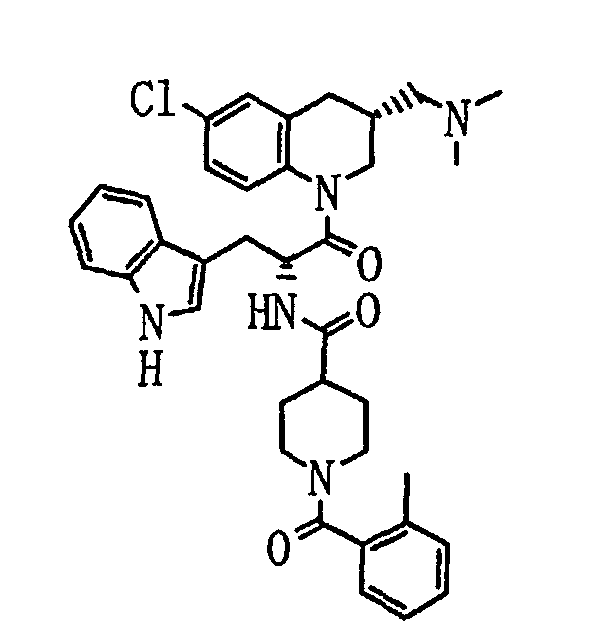
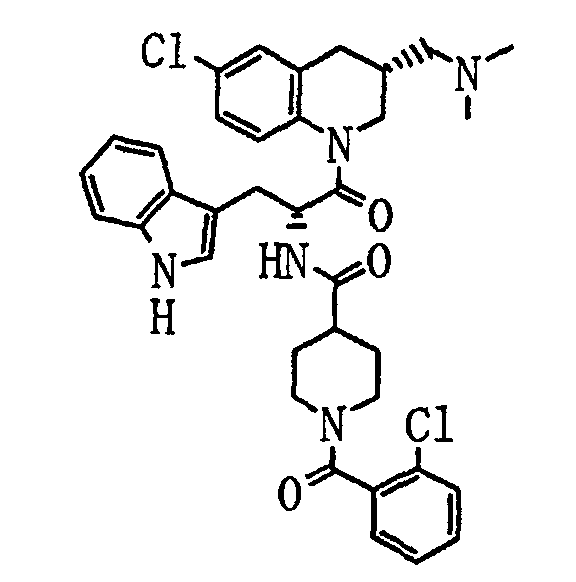

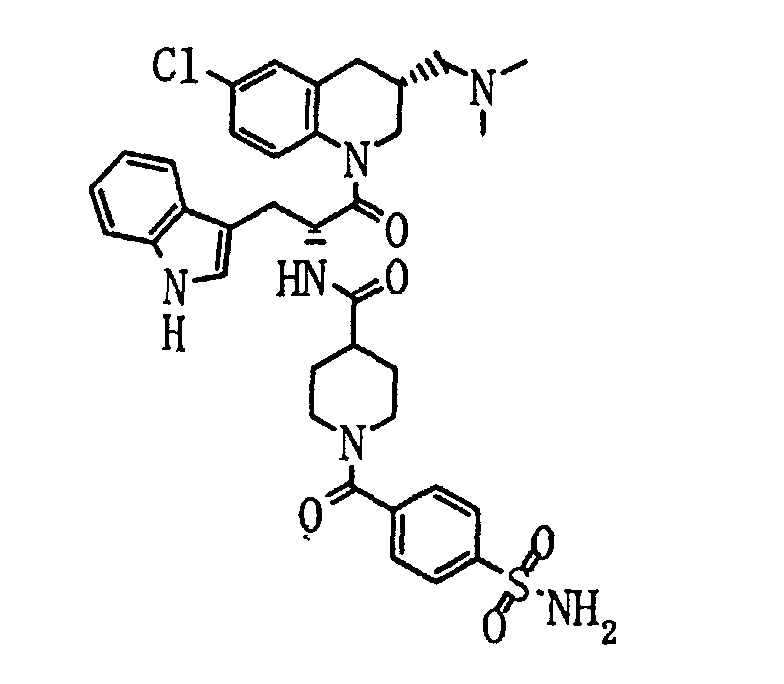

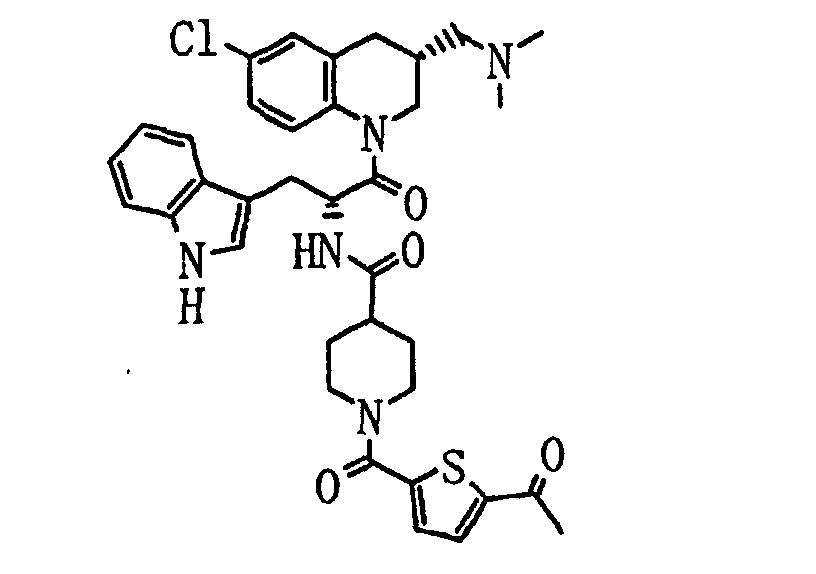
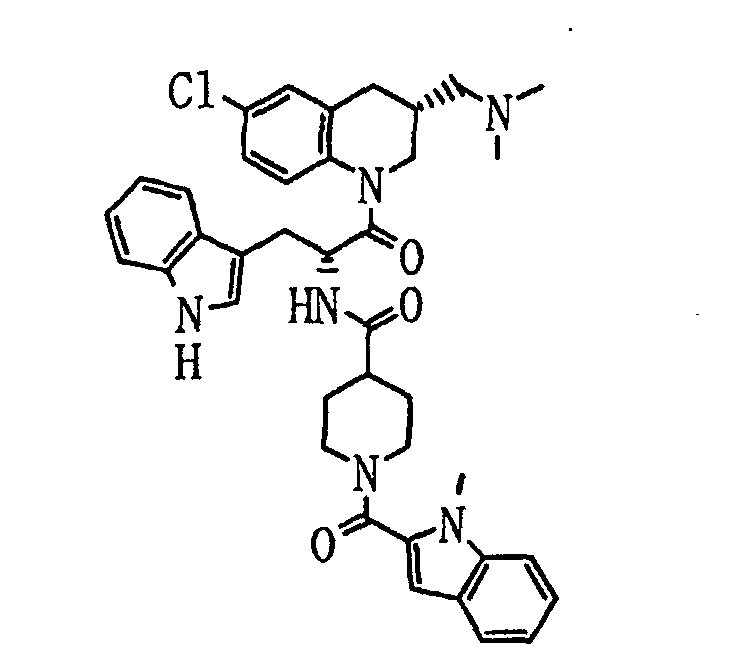
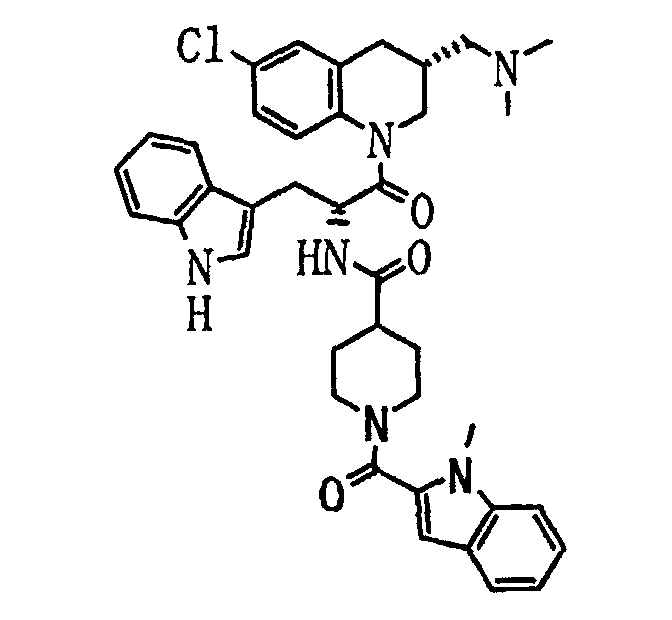
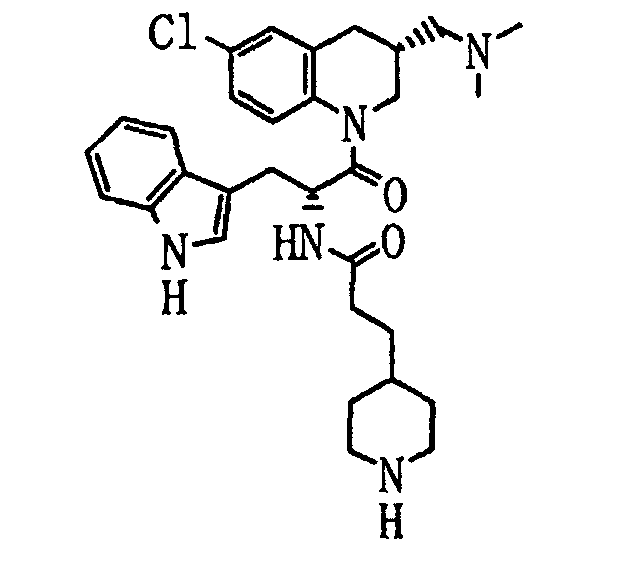
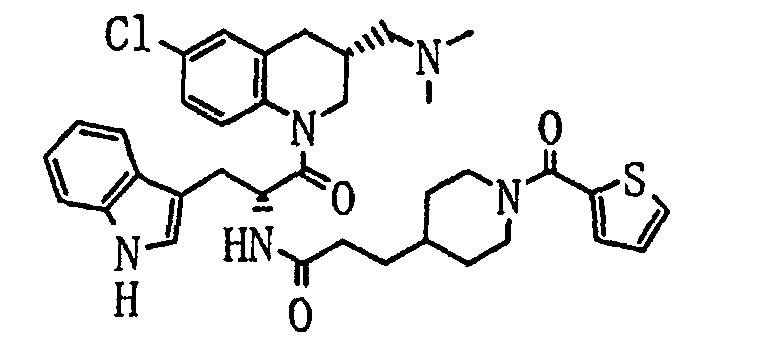
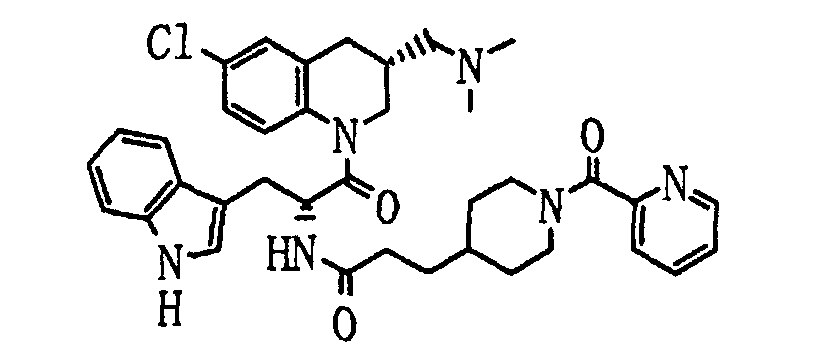
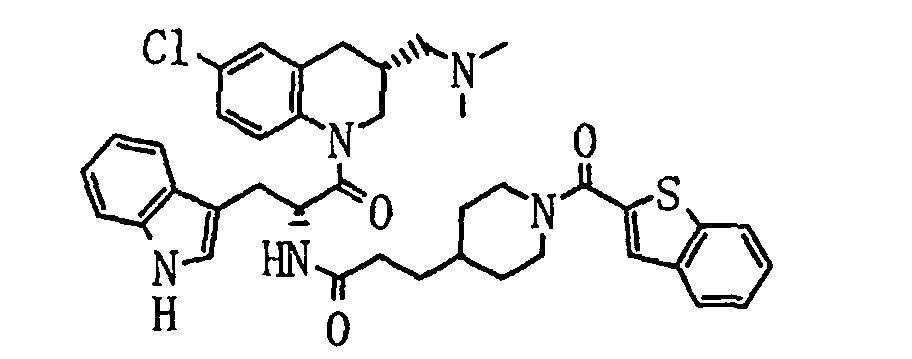
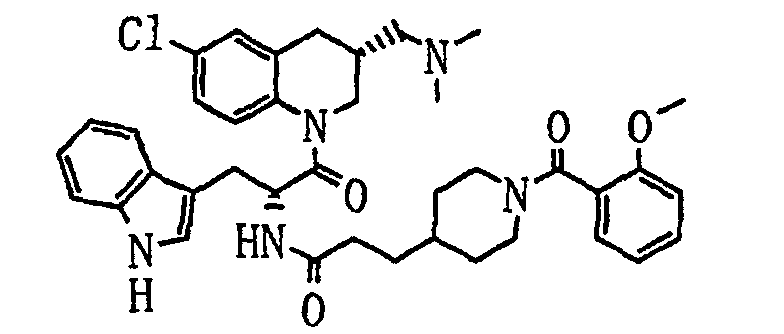
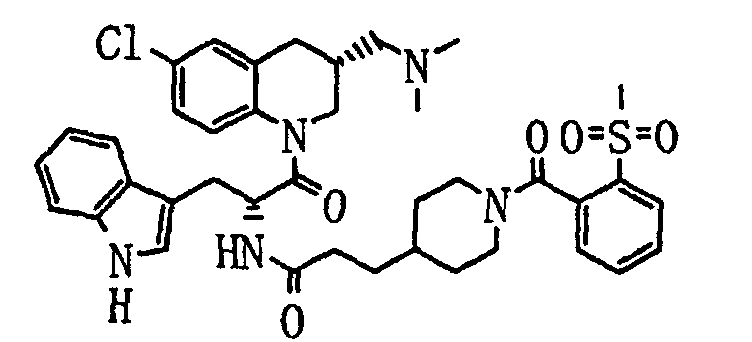


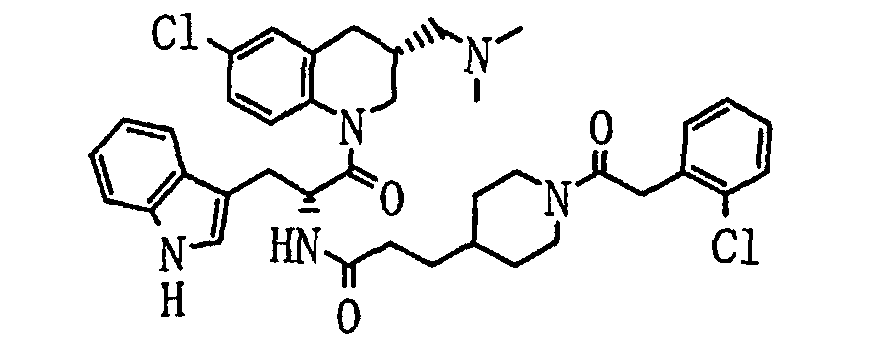
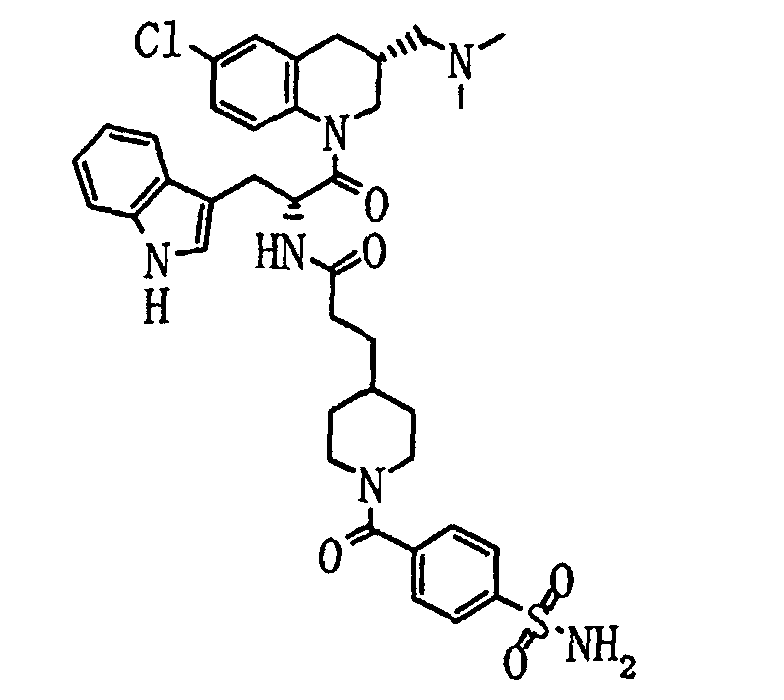
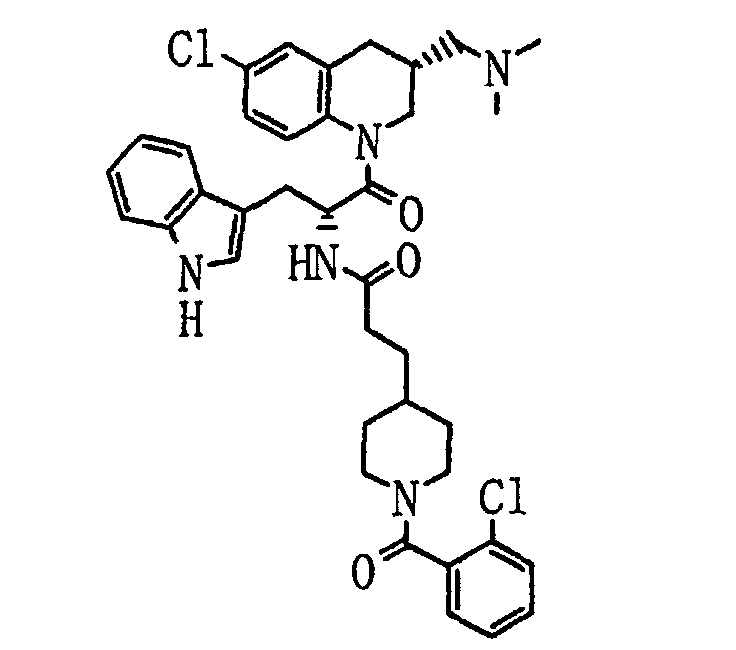


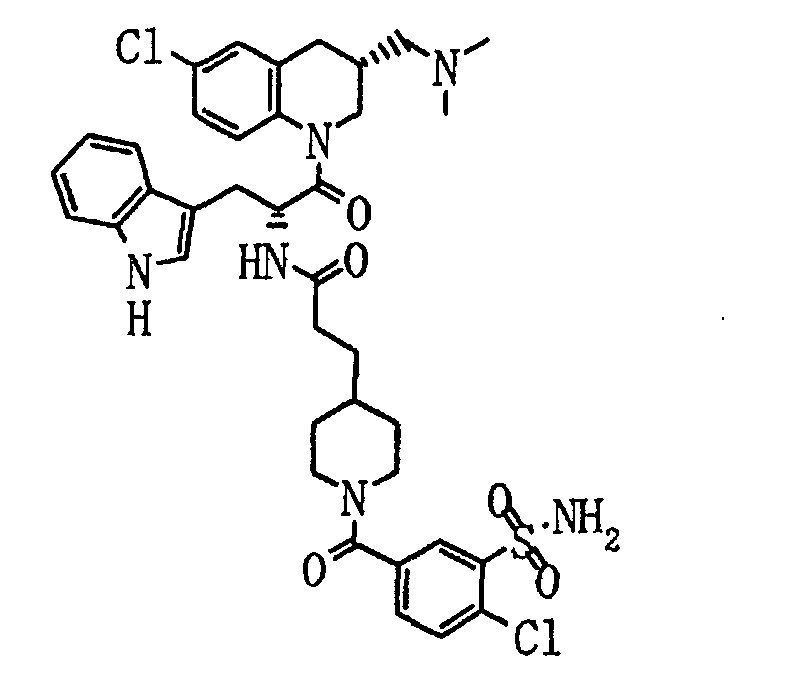


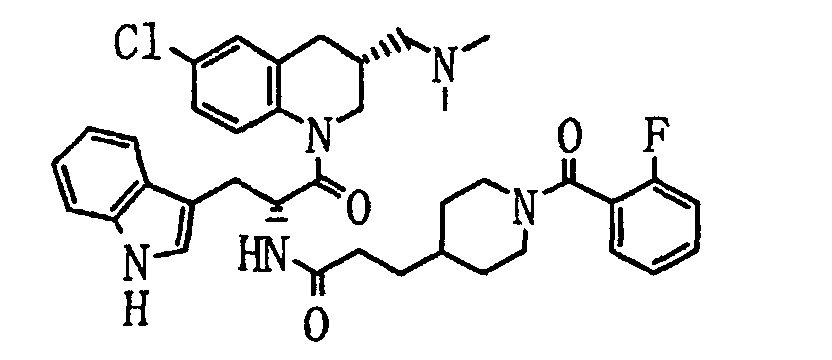
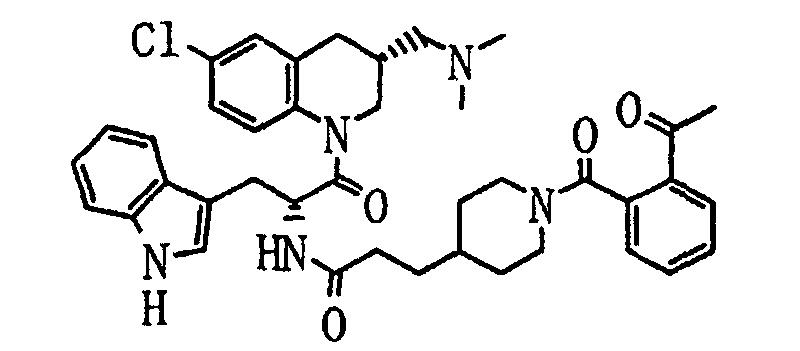
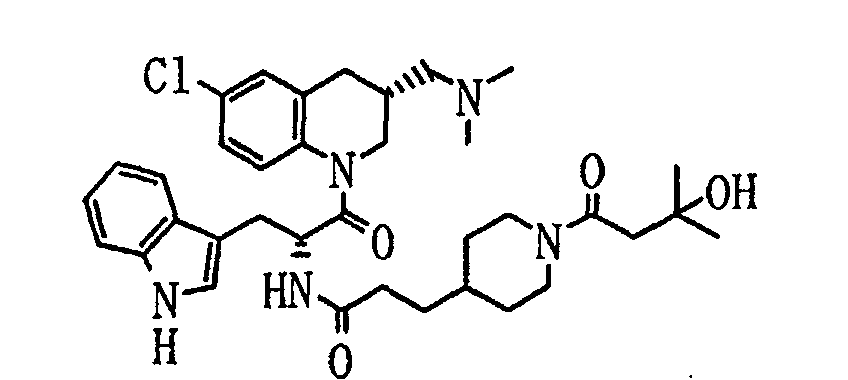
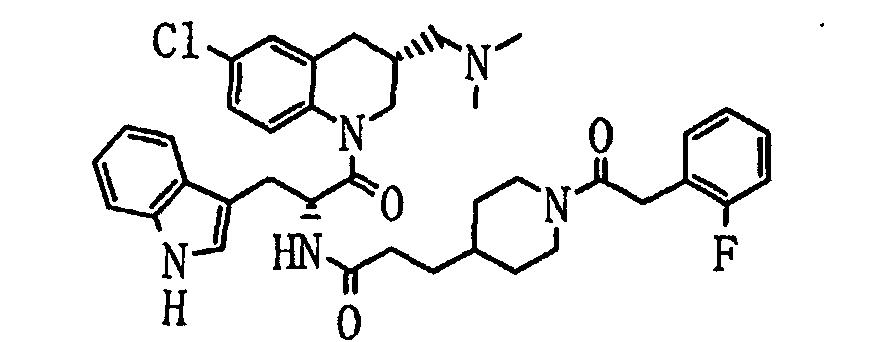
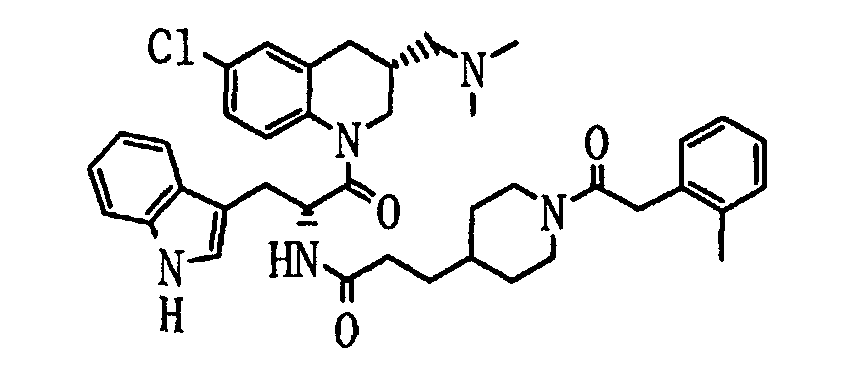
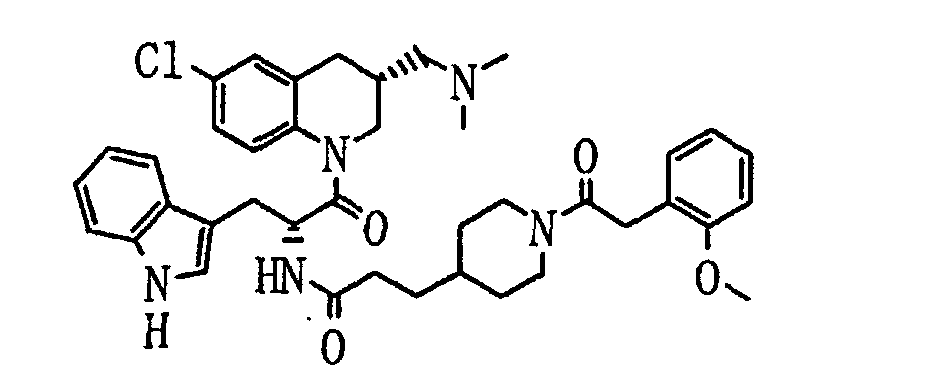
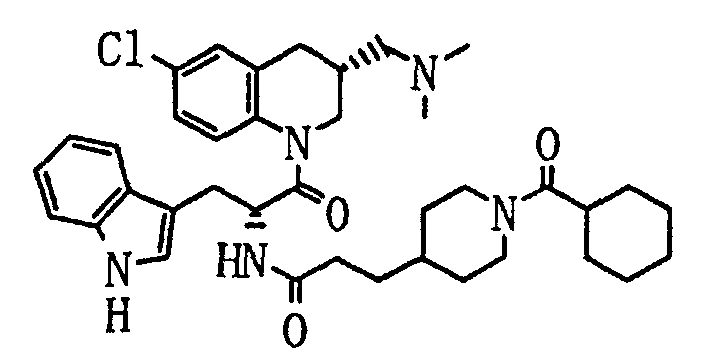
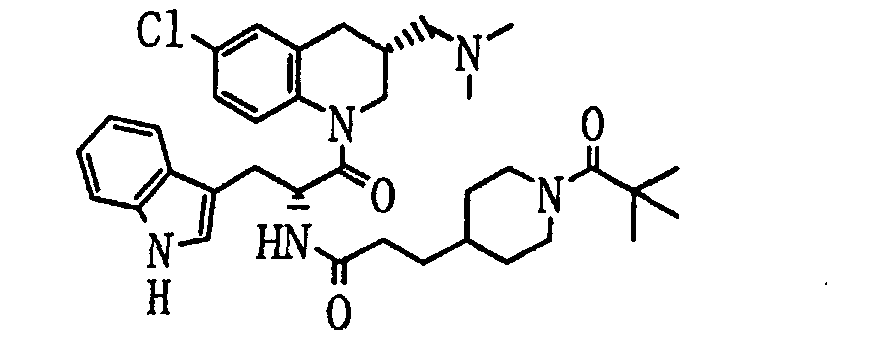

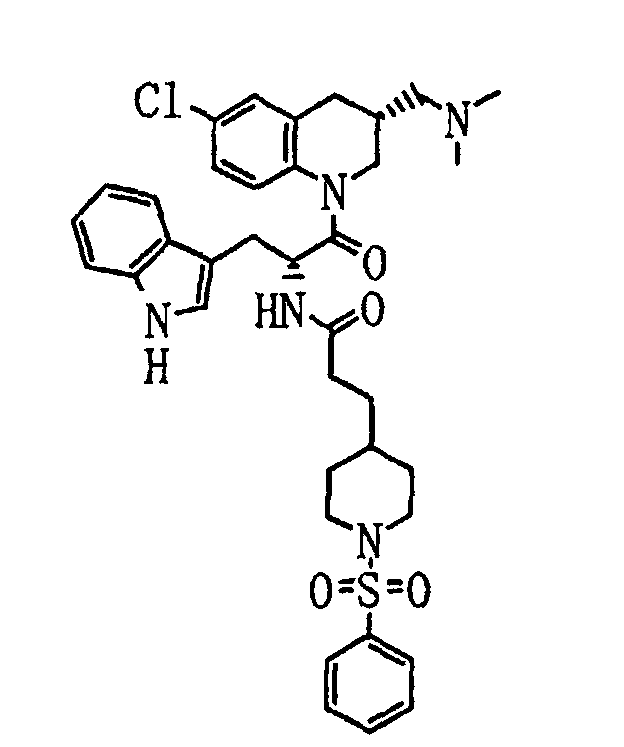
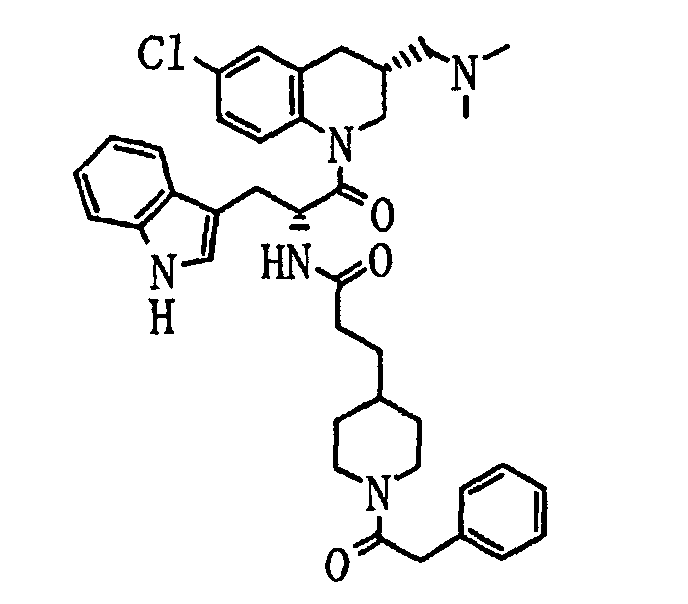


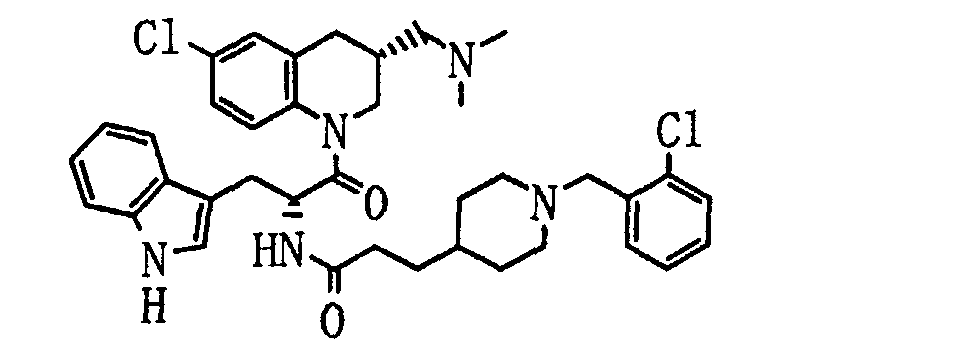


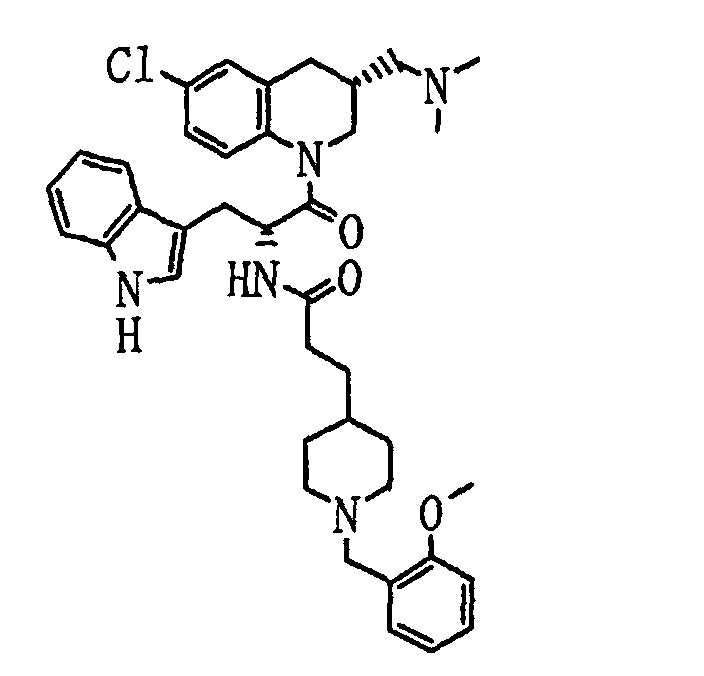
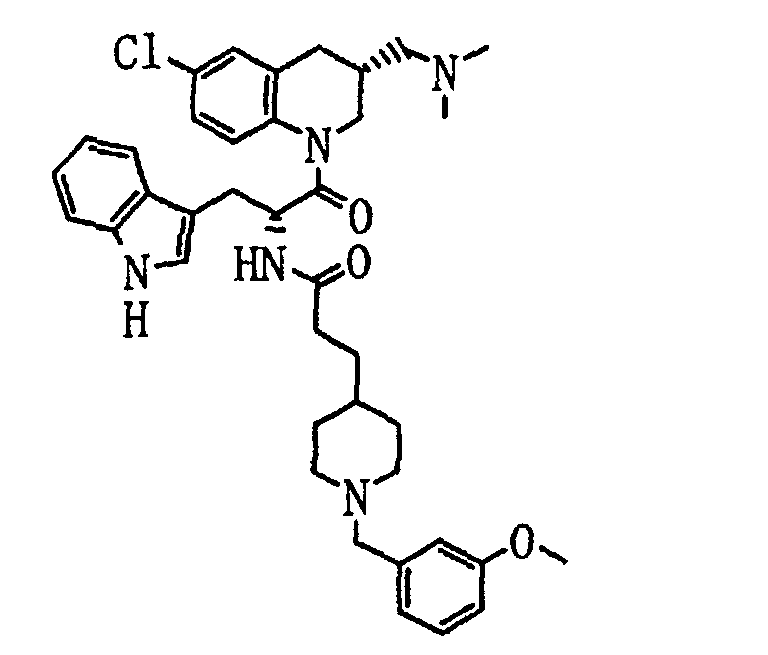
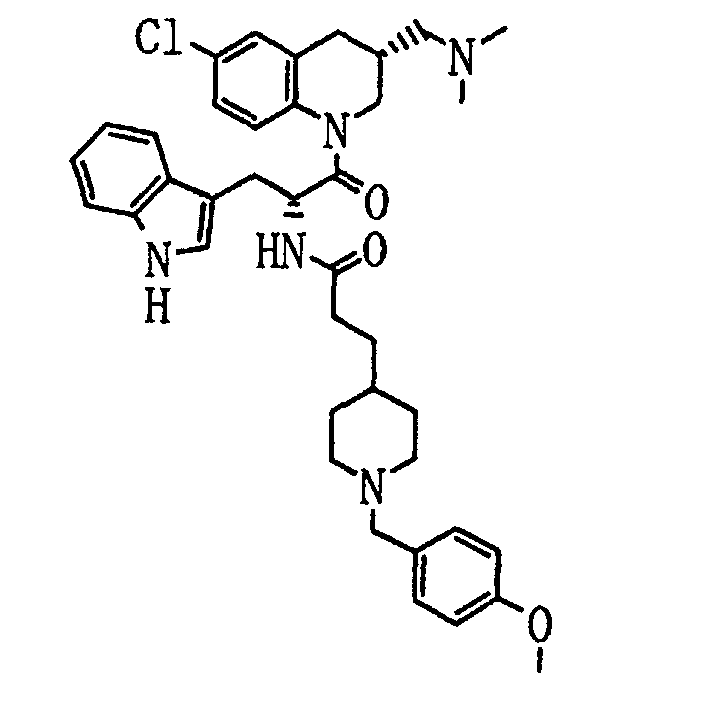

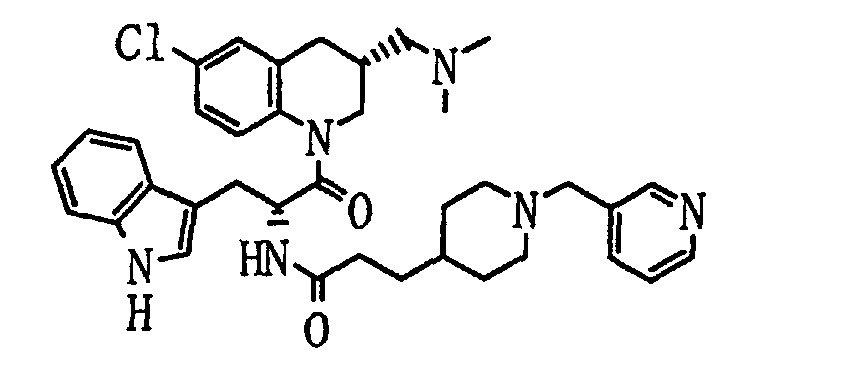

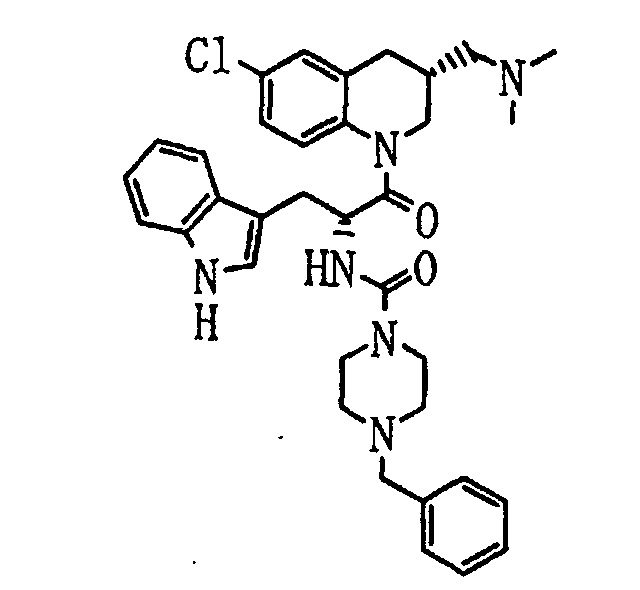

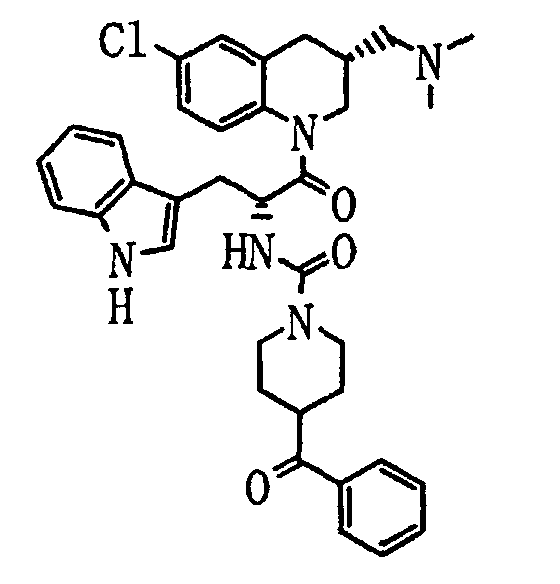


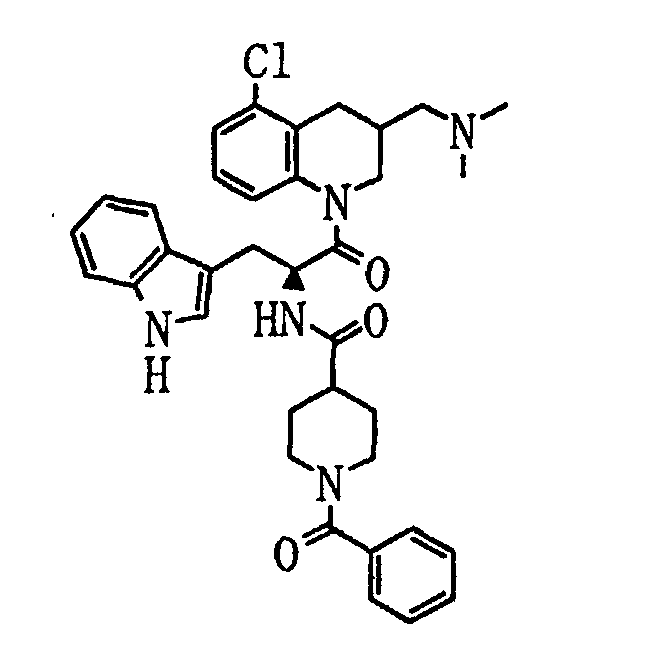
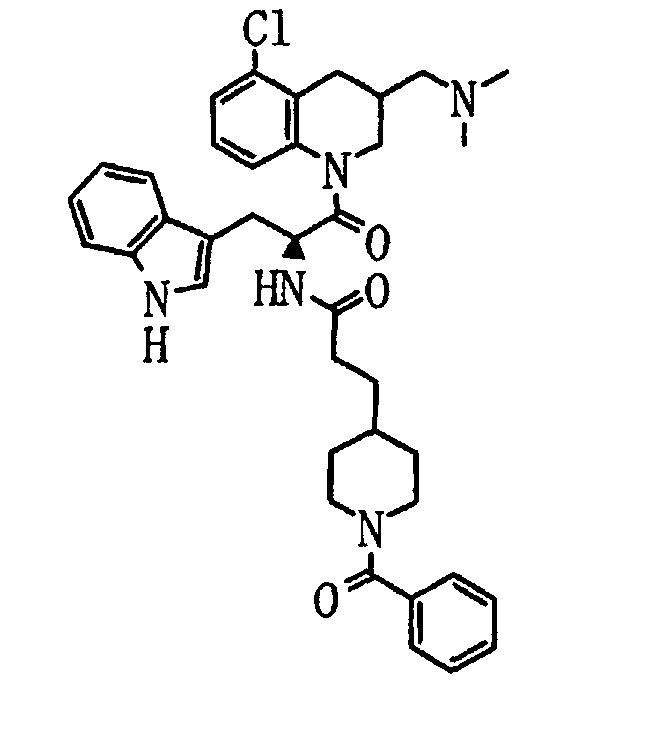


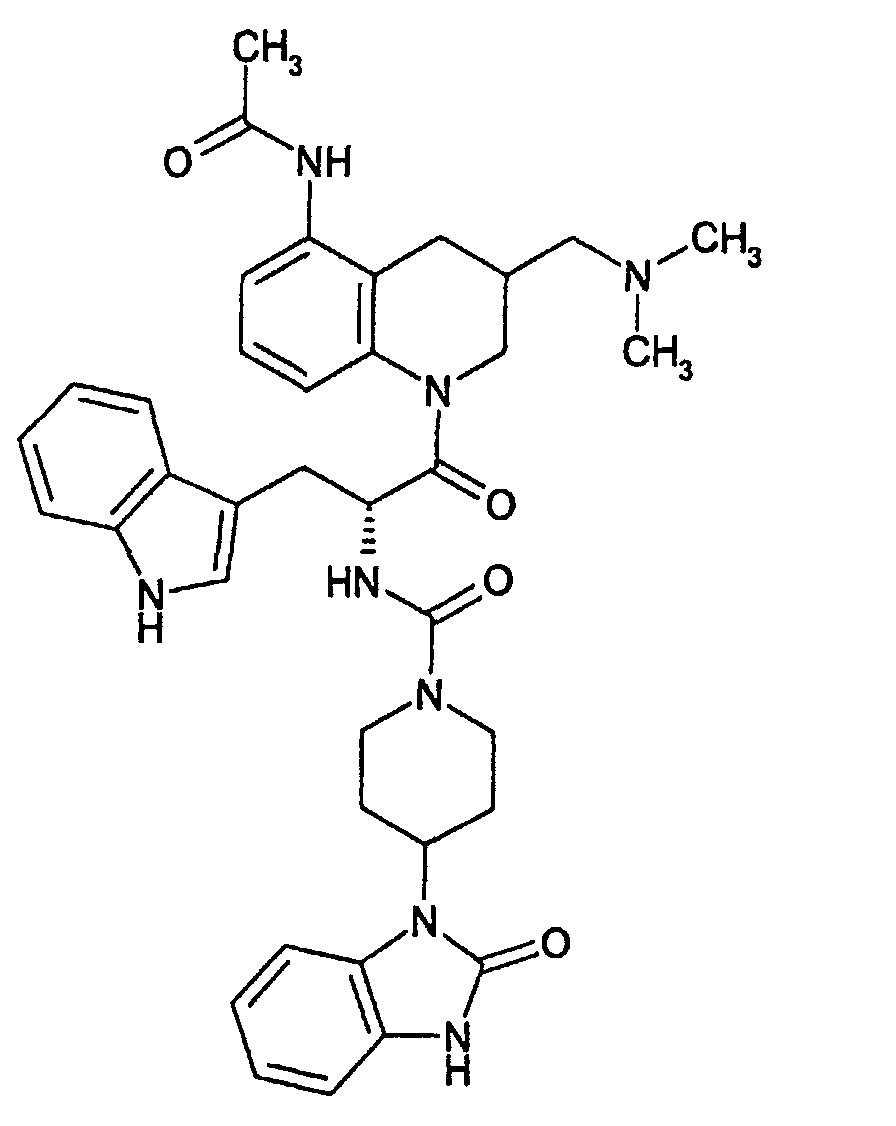
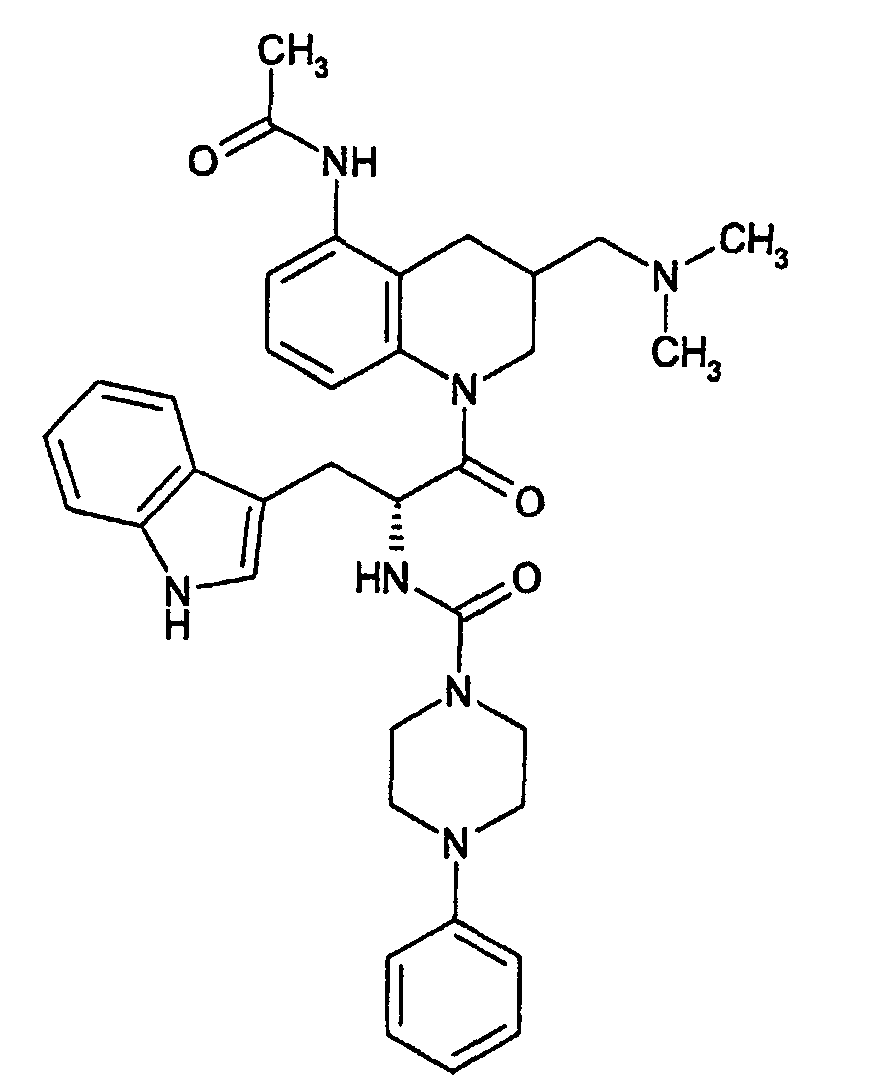
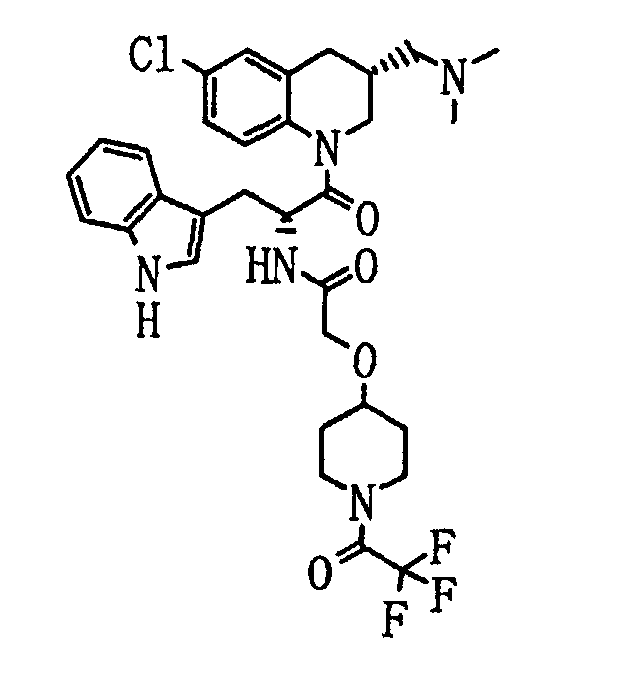
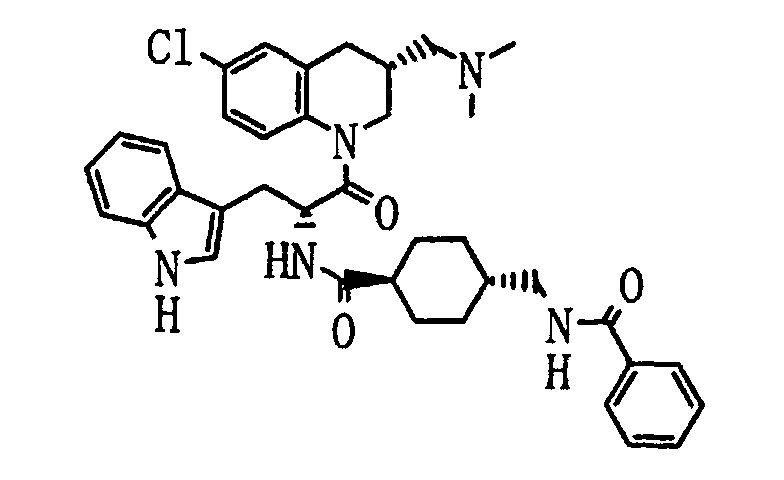
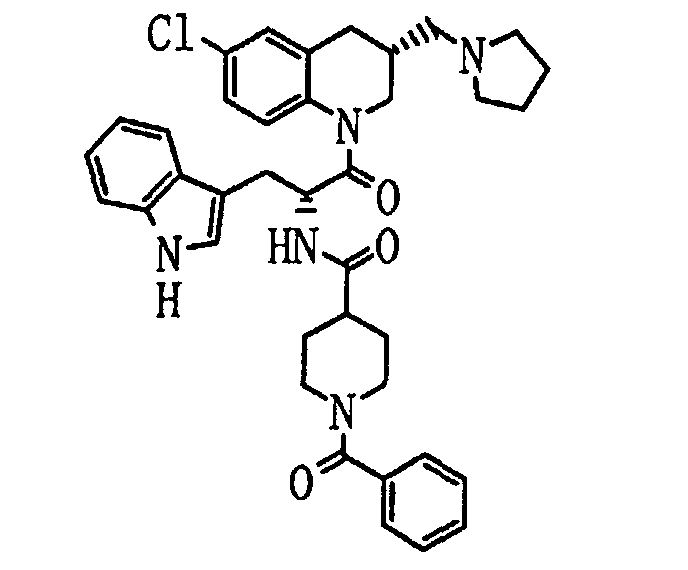

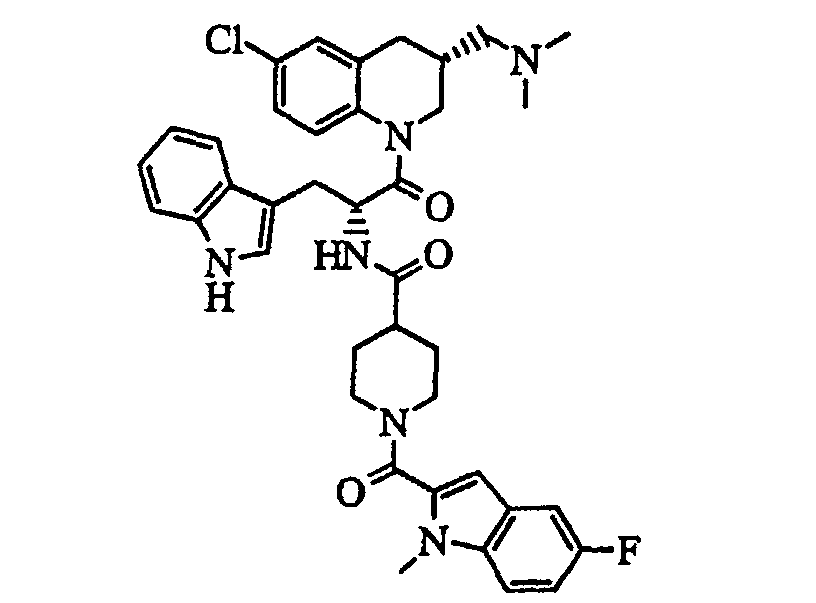
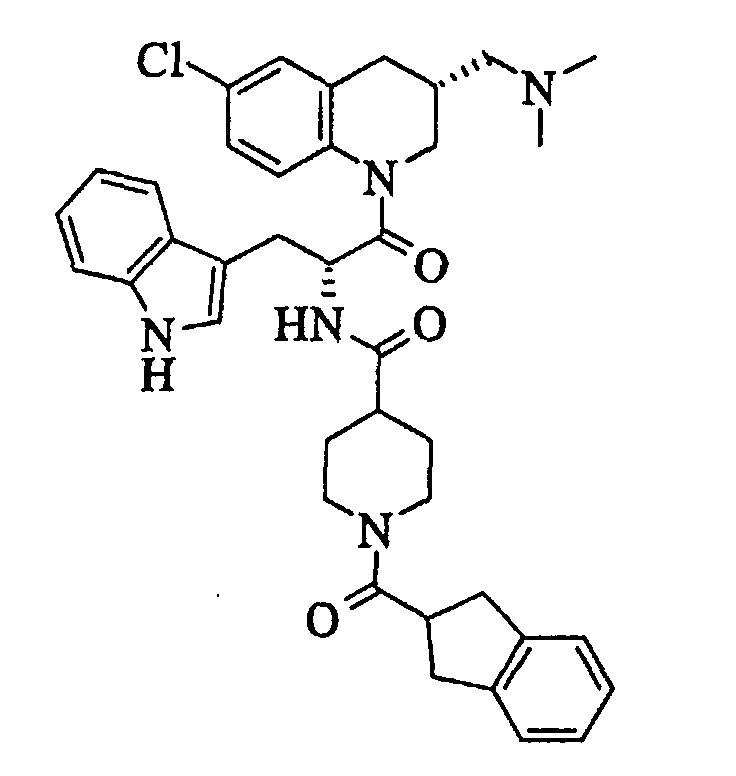
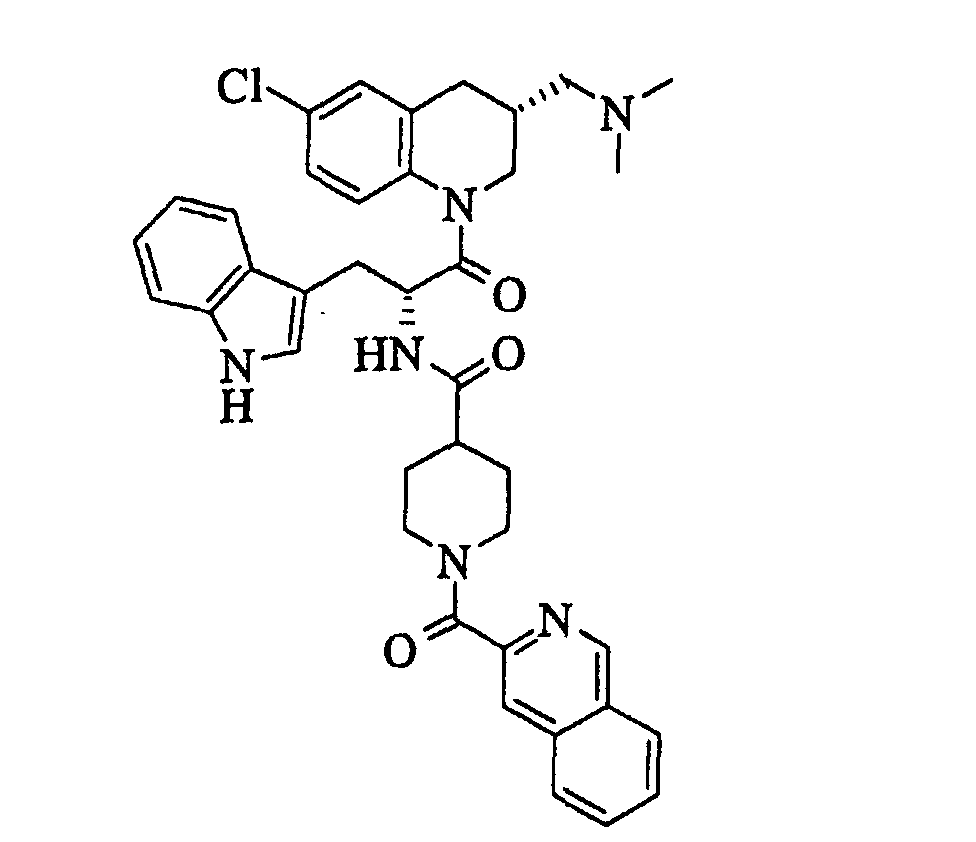


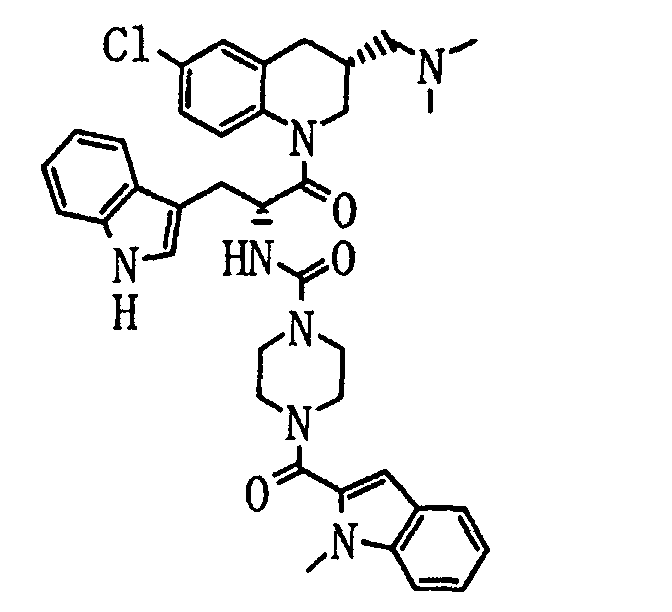
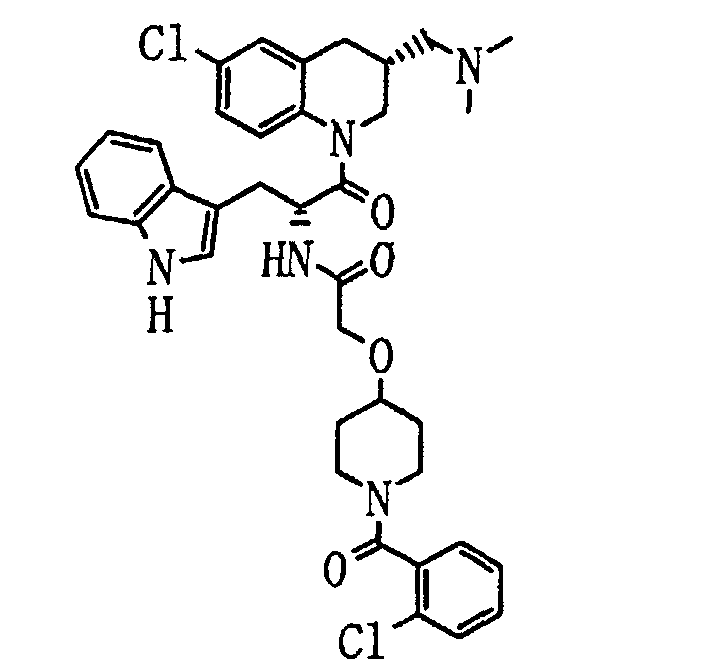
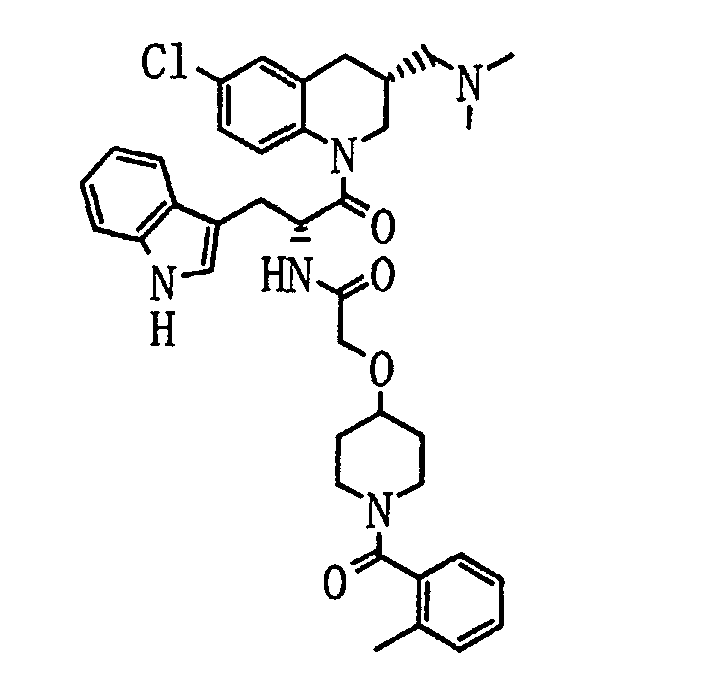
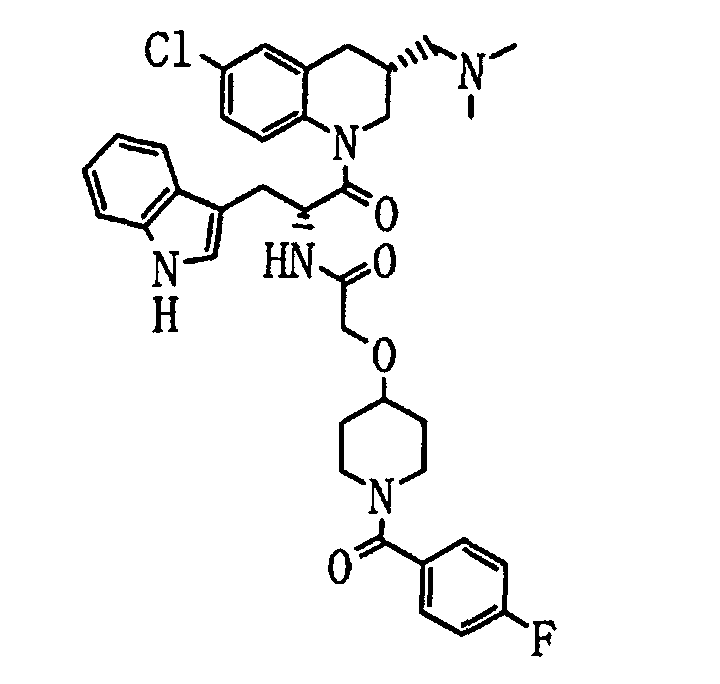
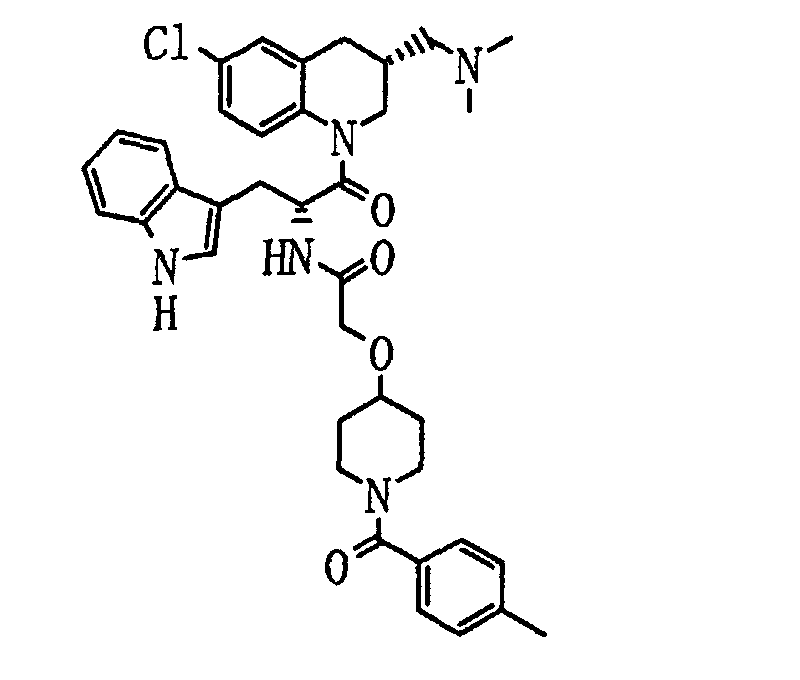
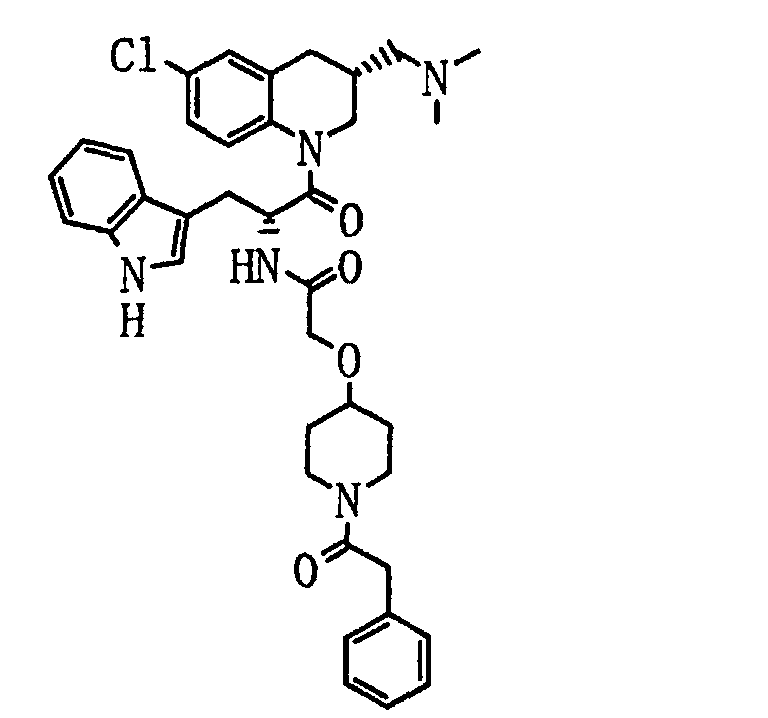

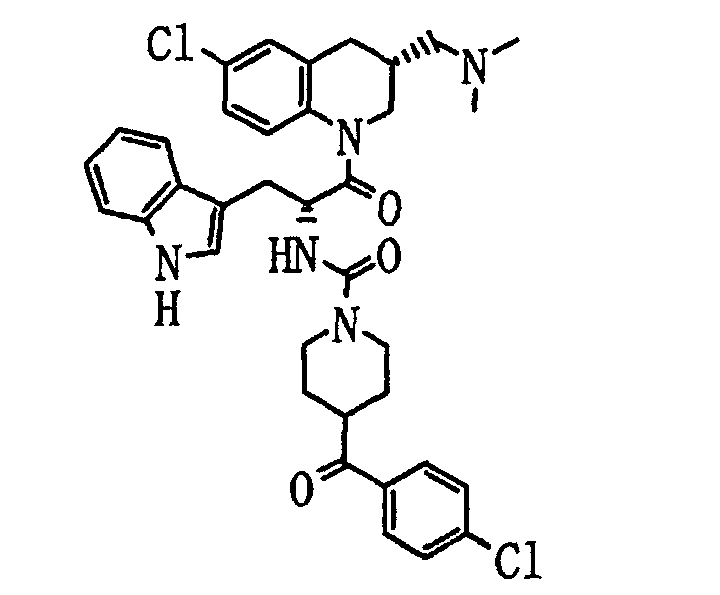
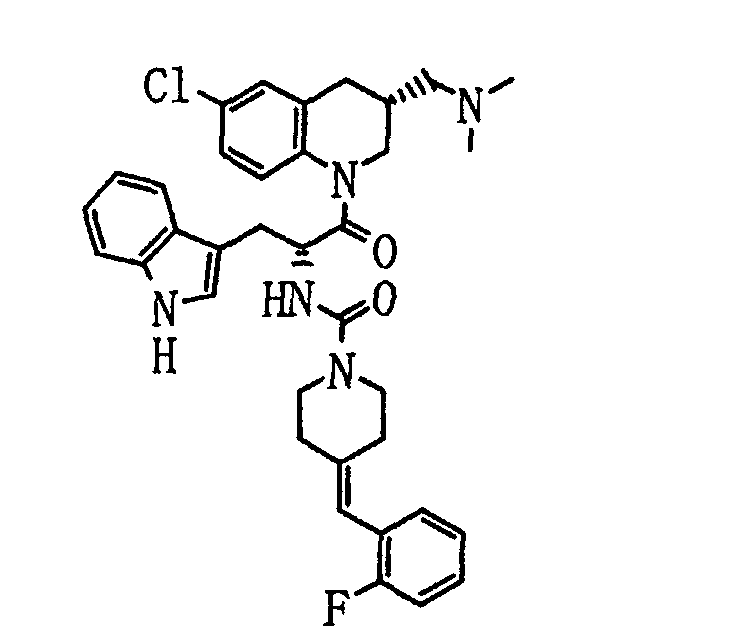
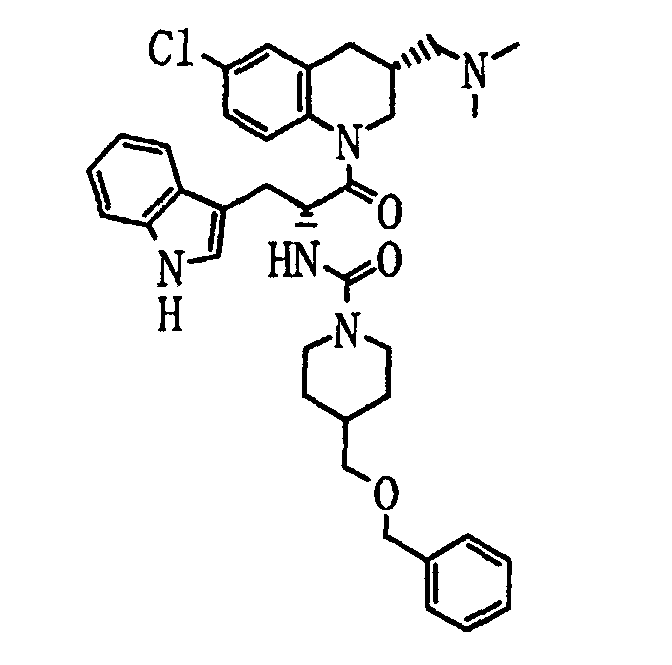


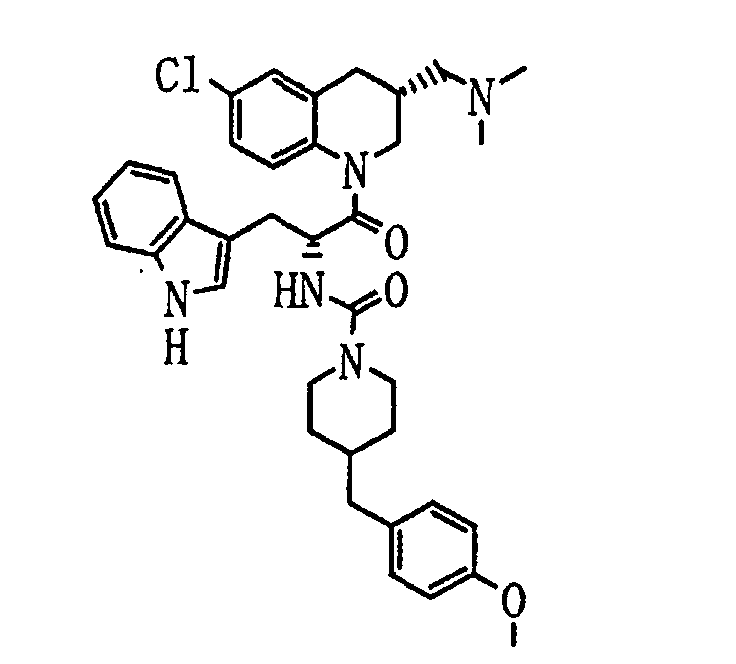
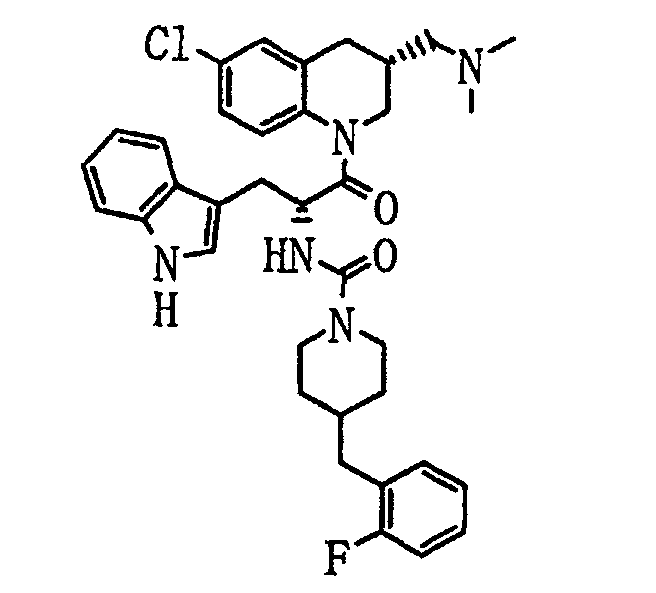


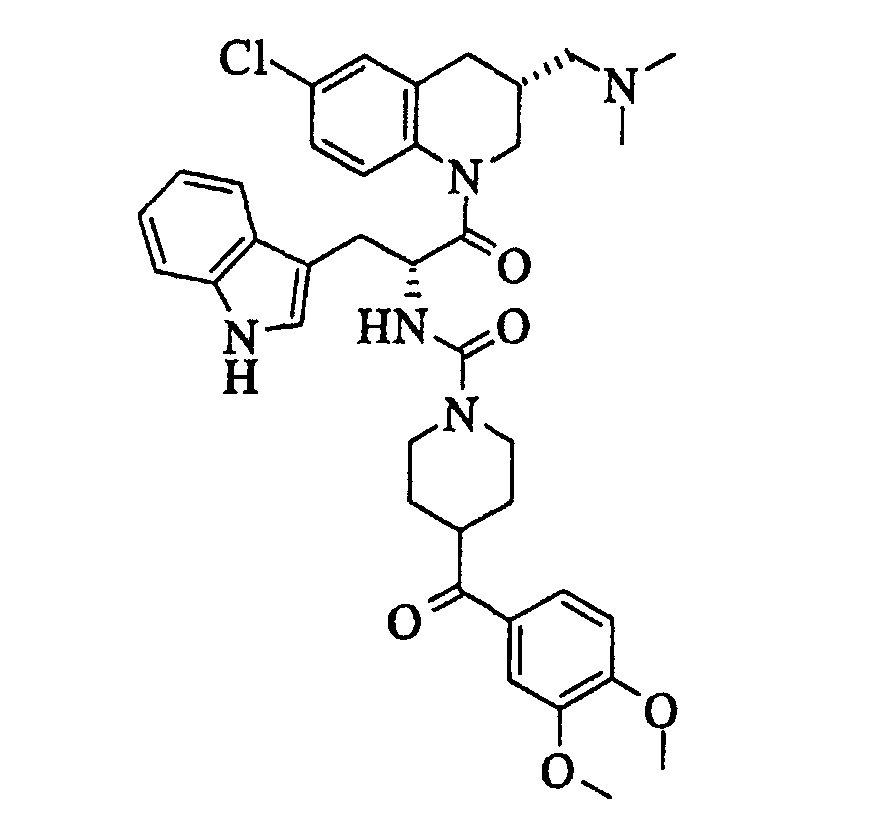

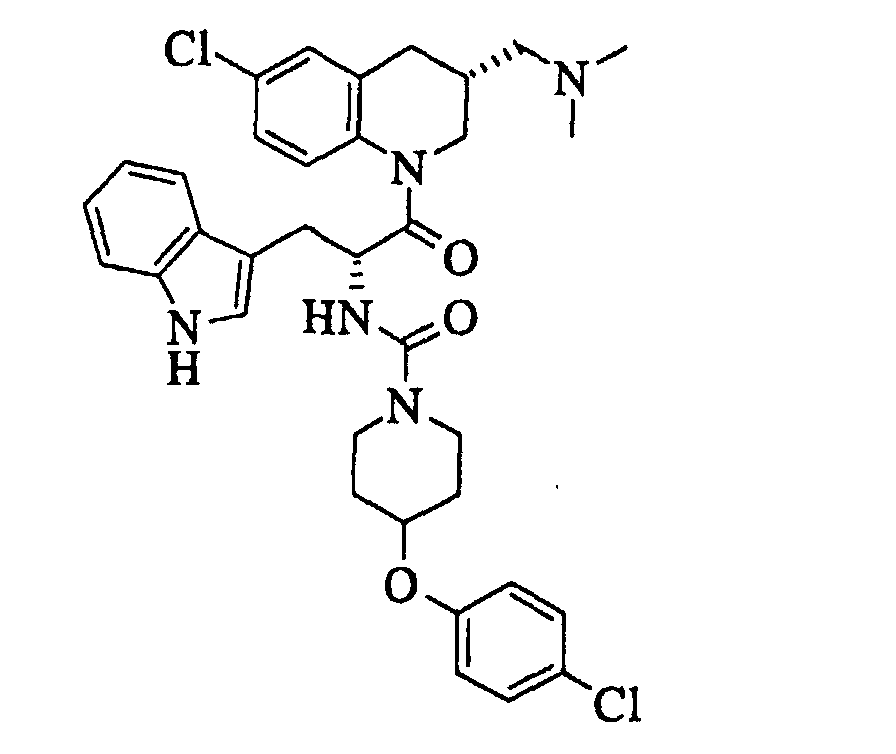

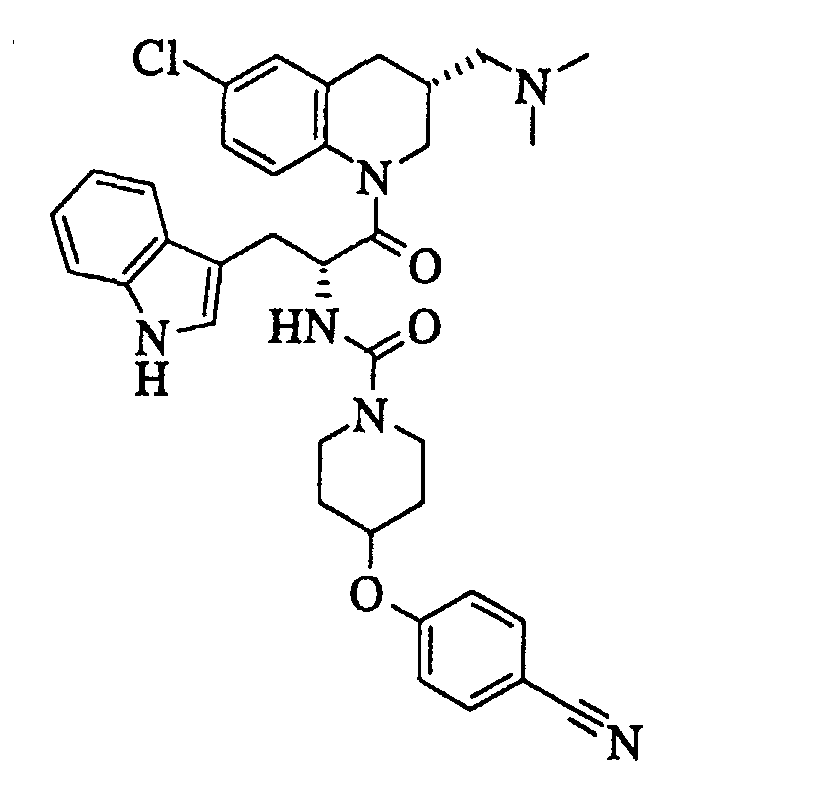
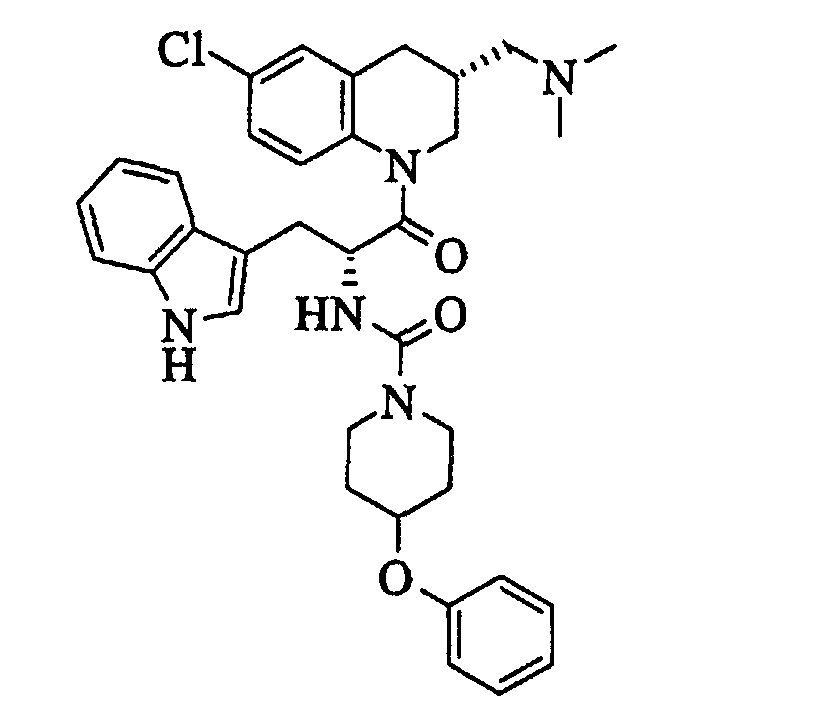
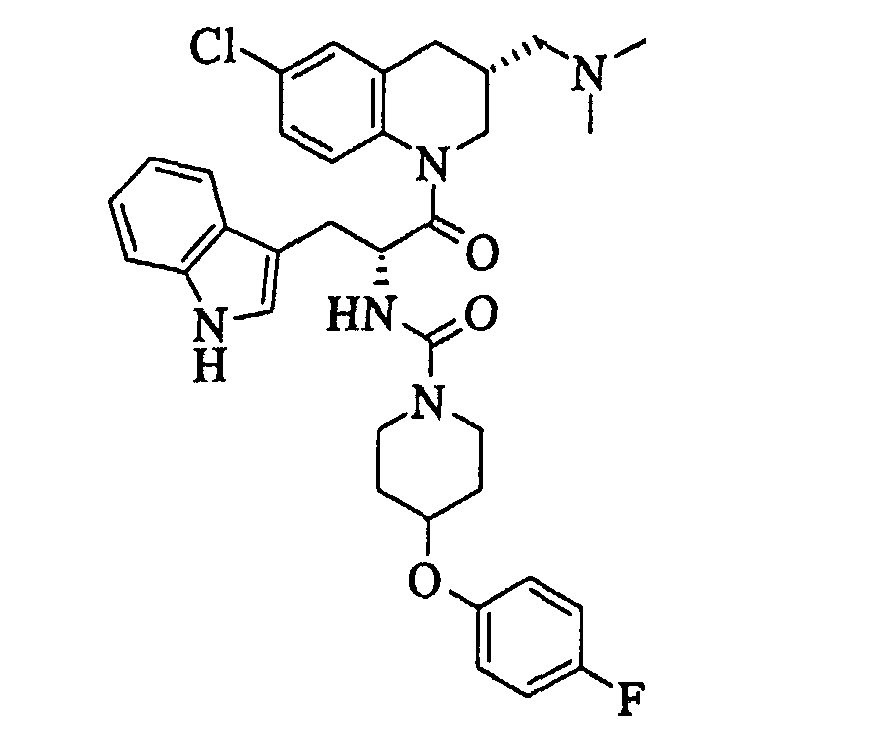
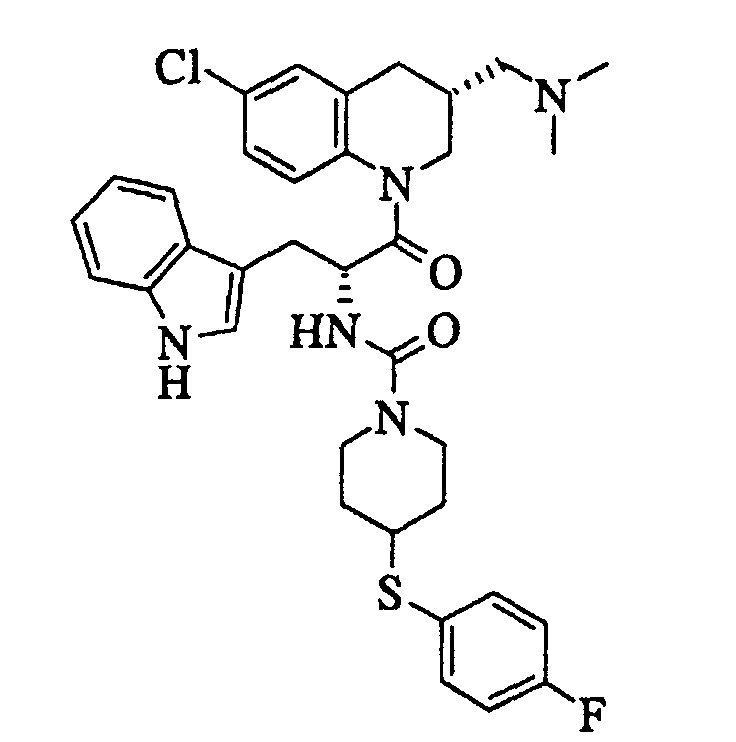

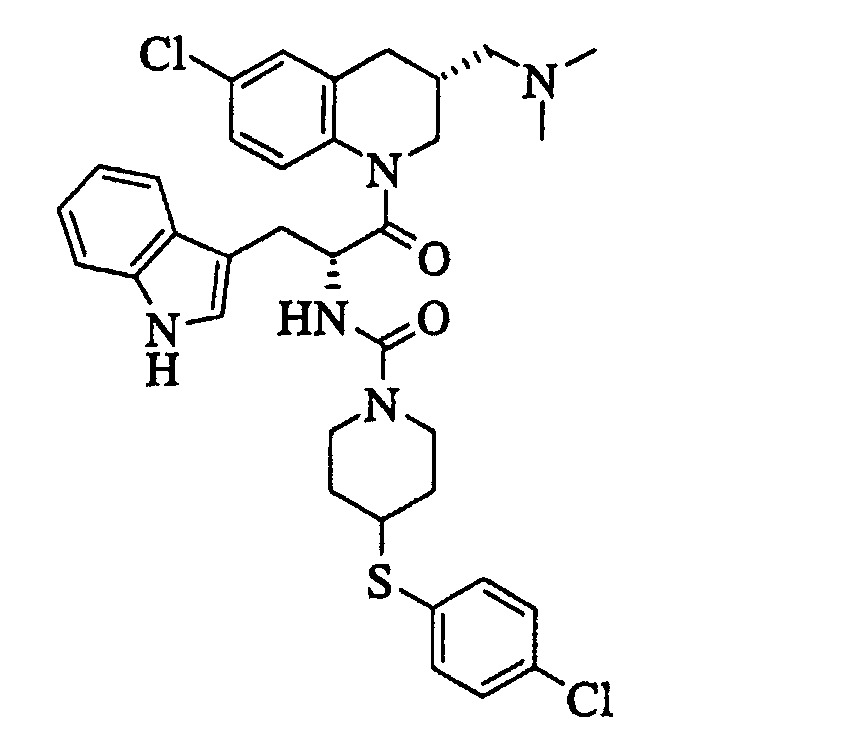

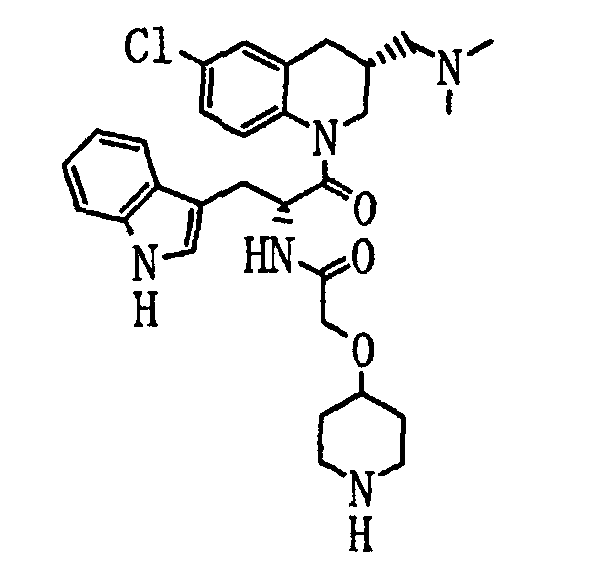
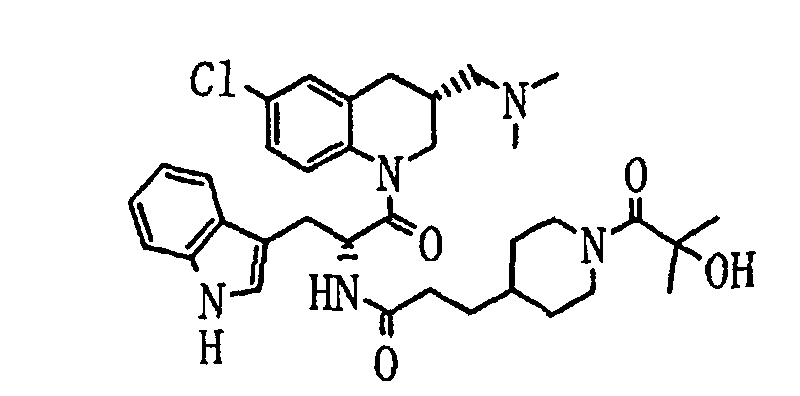


 R1 and R2 represent a hydrogen atom or C1-6 alkyl optionally having substituents, or R1 and R2, together with the adjacent nitrogen atom, form a nitrogen-containing heterocyclic ring optionally having substituents;Y and Q are the same or different, and each represents a bond or a spacer having a main chain of 1 to 6 atoms;... represents a single bond or a double bond;T1 and T2 are the same or different, and each represents C(R9) (R9 represents a hydrogen atom, a hydroxy or C1-6 alkyl) or N, when each of the adjacent ... is a single bond, and C when the adjacent ... is a double bond; andAr represents an aromatic group optionally having substituents, a C3-9 cycloalkyl group optionally having substituents, a 3 to 9-membered saturated heterocyclic group optionally having substituents, a hydrogen atom or a halogen atom; provided that 6-chloro-3-(R,S)-(N,N-dimethylamino)methyl-1-[3-(indol-3-yl)-2-[(R)-(4-phenylpiperazin-1-yl)carbonylamino]propanoyl]-1,2,3,4-tetrahydroquinoline; 6-chloro-3-(R,S)-(N,N-dimethylamino)methyl-1-[3-(indol-3-yl)-2-[(R)-4-(2-oxo-2,3-dihydro-lH-benzimidazol-1-yl)piperidinocarbonylamino]propanoyl]-1,2,3,4-tetrahydroquinoline and 1-benzoyl-N-[(R)-2-[6-chloro-3-[(N,N-dimethylamino)methyl]-1,2,3,4-tetrahydroquinolin-1-yl]-1-[3-(indol-3-yl)propanoyl]-4-piperidinecarboxamide are excluded; or a salt thereof.
 R1 and R2 represent a hydrogen atom or C1-6 alkyl optionally having substituents, or R1 and R2, together with the adjacent nitrogen atom, form a nitrogen-containing heterocyclic ring optionally having substituents;Y and Q are the same or different, and each represents a bond or a spacer having a main chain of 1 to 6 atoms;... represents a single bond or a double bond;T1 and T2 are the same or different, and each represents C(R9) (R9 represents a hydrogen atom, a hydroxy or C1-6 alkyl) or N, when each of the adjacent ... is a single bond, and C when the adjacent ... is a double bond; andAr represents an aromatic group optionally having substituents, a C3-9 cycloalkyl group optionally having substituents, a 3 to 9-membered saturated heterocyclic group optionally having substituents, a hydrogen atom or a halogen atom; or a salt thereof.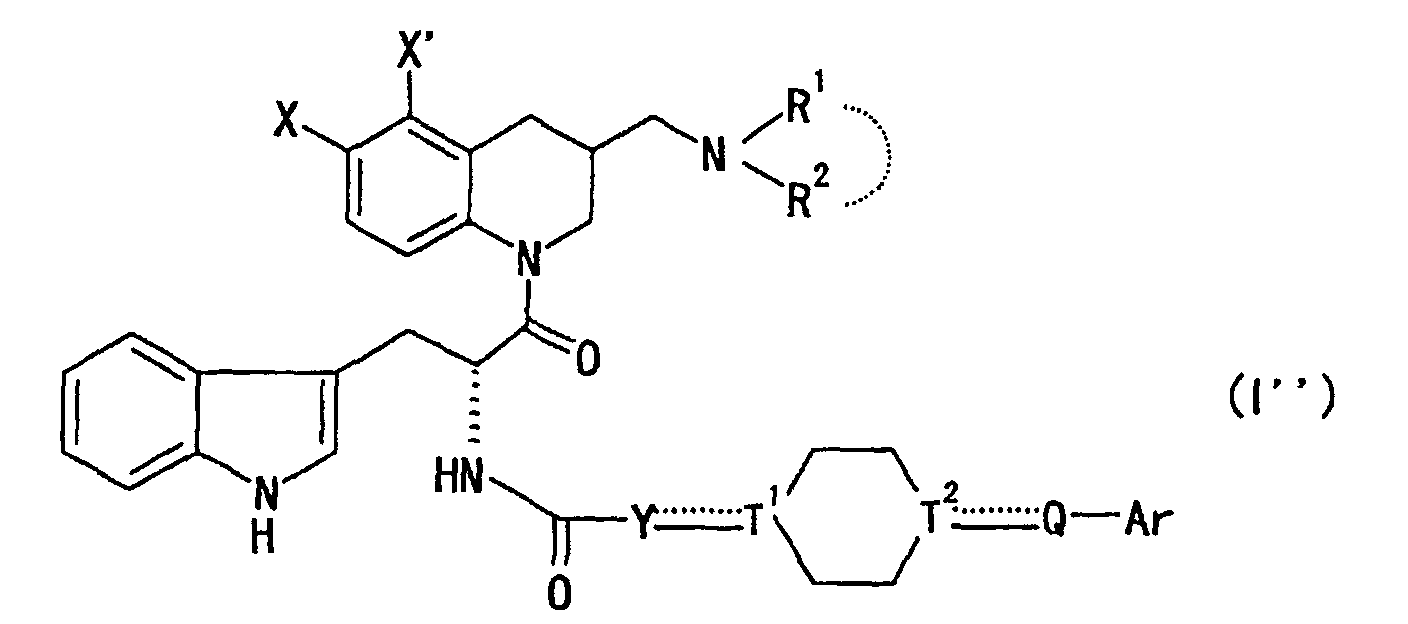
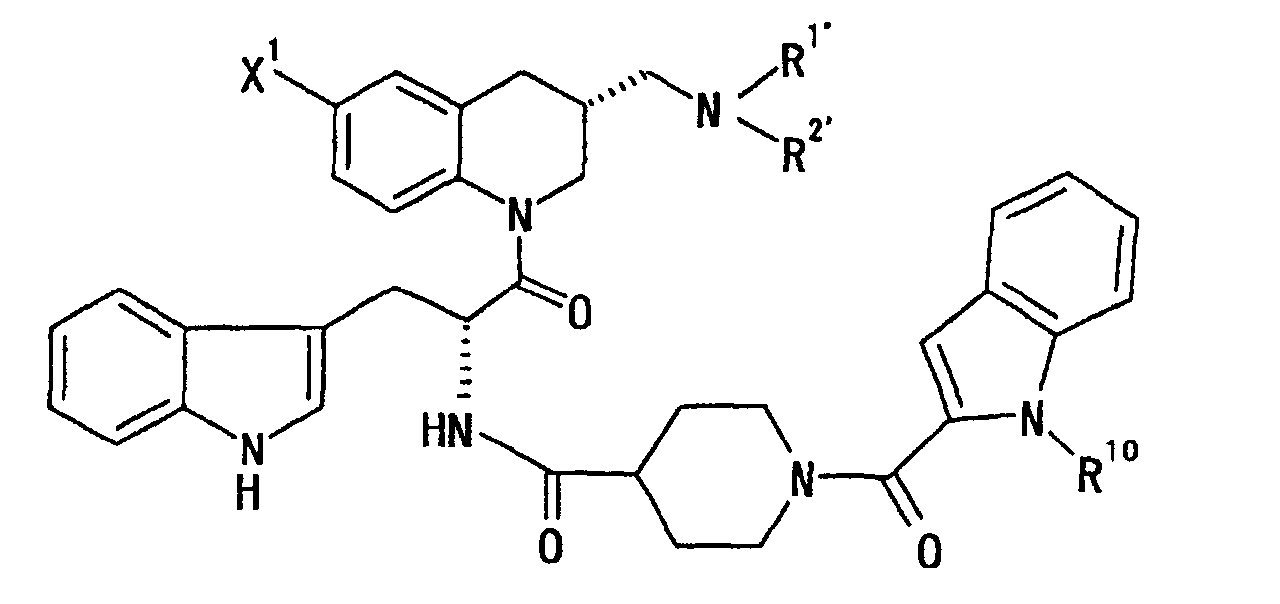 wherein X1 represents a hydrogen atom, a fluorine atom, a chlorine atom or an amino optionally having substituents;
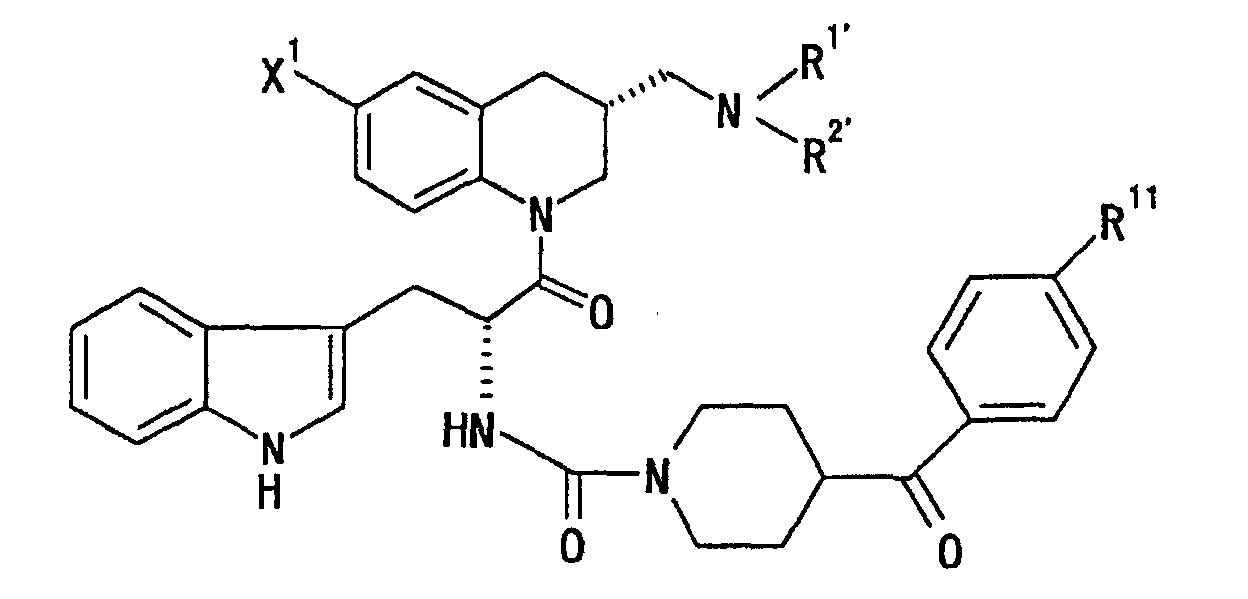 R1' and R2' each represent a hydrogen atom or a C1-6 alkyl;R10 represents a C1-6 alkyl; andR11 represents a halogen atom.
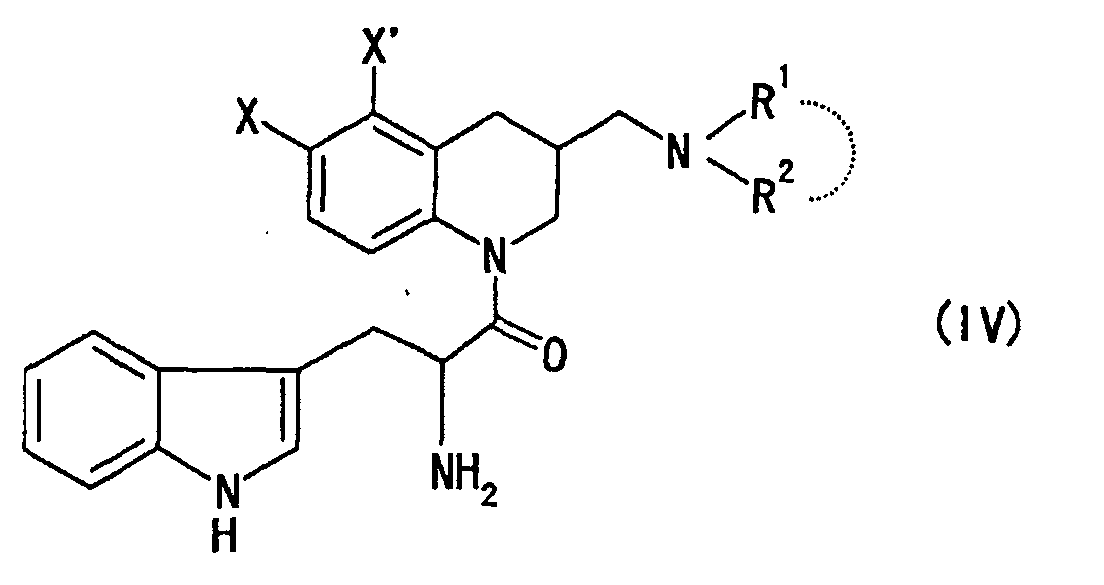 wherein each symbol has the same meaning as in claim 1, or a salt thereof.
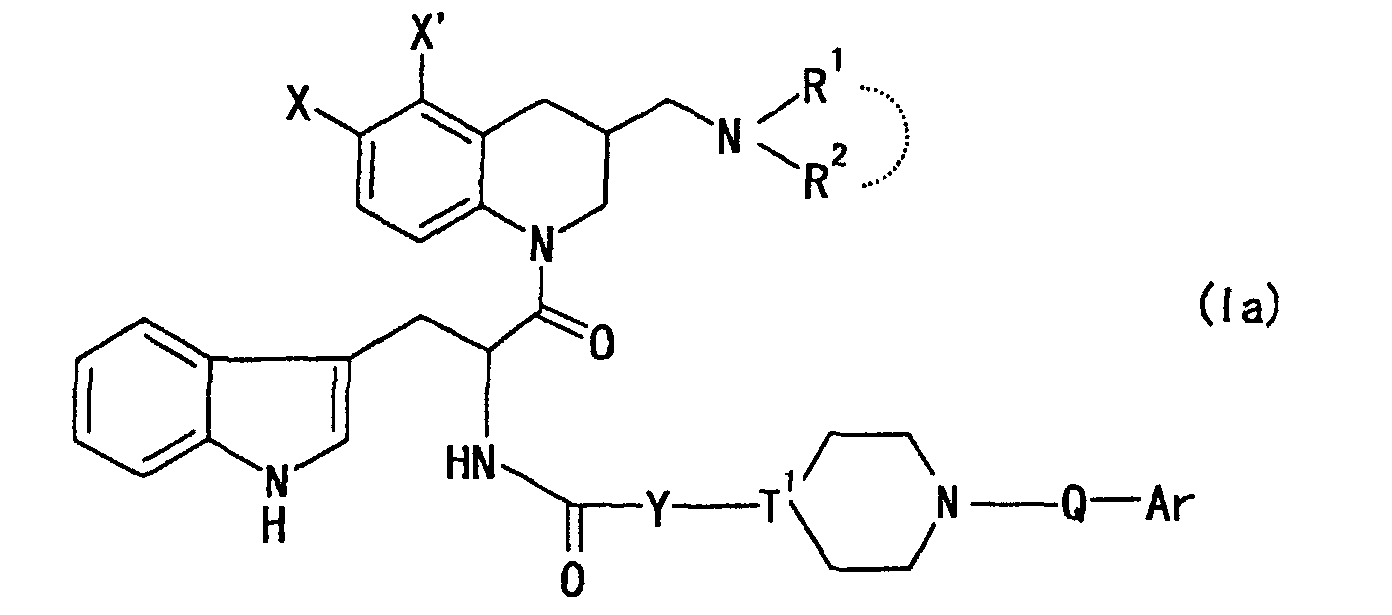 wherein each symbol has the same meaning as above, or a salt thereof, and a compound of the formula:
