EP1226997A2 - Trolleybus power supply system based upon a trolley with traverse rods and a aerial single line with alternating poles - Google Patents
Trolleybus power supply system based upon a trolley with traverse rods and a aerial single line with alternating poles Download PDFInfo
- Publication number
- EP1226997A2 EP1226997A2 EP02425020A EP02425020A EP1226997A2 EP 1226997 A2 EP1226997 A2 EP 1226997A2 EP 02425020 A EP02425020 A EP 02425020A EP 02425020 A EP02425020 A EP 02425020A EP 1226997 A2 EP1226997 A2 EP 1226997A2
- Authority
- EP
- European Patent Office
- Prior art keywords
- rods
- aerial
- trolley
- line
- choice
- Prior art date
- Legal status (The legal status is an assumption and is not a legal conclusion. Google has not performed a legal analysis and makes no representation as to the accuracy of the status listed.)
- Withdrawn
Links
Images



Classifications
-
- B—PERFORMING OPERATIONS; TRANSPORTING
- B60—VEHICLES IN GENERAL
- B60L—PROPULSION OF ELECTRICALLY-PROPELLED VEHICLES; SUPPLYING ELECTRIC POWER FOR AUXILIARY EQUIPMENT OF ELECTRICALLY-PROPELLED VEHICLES; ELECTRODYNAMIC BRAKE SYSTEMS FOR VEHICLES IN GENERAL; MAGNETIC SUSPENSION OR LEVITATION FOR VEHICLES; MONITORING OPERATING VARIABLES OF ELECTRICALLY-PROPELLED VEHICLES; ELECTRIC SAFETY DEVICES FOR ELECTRICALLY-PROPELLED VEHICLES
- B60L5/00—Current collectors for power supply lines of electrically-propelled vehicles
- B60L5/42—Current collectors for power supply lines of electrically-propelled vehicles for collecting current from individual contact pieces connected to the power supply line
-
- B—PERFORMING OPERATIONS; TRANSPORTING
- B60—VEHICLES IN GENERAL
- B60M—POWER SUPPLY LINES, AND DEVICES ALONG RAILS, FOR ELECTRICALLY- PROPELLED VEHICLES
- B60M1/00—Power supply lines for contact with collector on vehicle
- B60M1/12—Trolley lines; Accessories therefor
- B60M1/13—Trolley wires
-
- B—PERFORMING OPERATIONS; TRANSPORTING
- B60—VEHICLES IN GENERAL
- B60M—POWER SUPPLY LINES, AND DEVICES ALONG RAILS, FOR ELECTRICALLY- PROPELLED VEHICLES
- B60M1/00—Power supply lines for contact with collector on vehicle
- B60M1/36—Single contact pieces along the line for power supply
Definitions
- trolleybuses use, in order to draw the electrical power, a bifilar aerial wire line, carrying the two polarities of a remote generator, and a trolley equipped with two articulated poles guided by the aerial wire line itself.
- This system involves several drawbacks, that have limited the diffusion of trolleybuses in modern public transport.
- the deployment of the trolley after every contact interruption has to be done with a stationary vehicle, either manually or with the aid of complex electromechanical devices.
- aerial pair wire lines represent an important landscape pollution in the historical towns centre, mainly due to aerial exchanges and crossings.
- the present patent concerns a power supply system for trolleybuses, composed by a special single aerial line, carrying both poles of a remote generator, and a trolley equipped with traverse rods. Both the solutions overcome the described drawbacks, allowing a more flexible system for electric public transport.
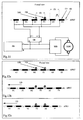
- the first component of the proposed power supply system consists of a single aerial wire line Fig.1 (AWL), which is composed by a sequence of pairs of conductive segments Fig.1 (N 1 , P 1 ; N 2 , P 2 ; N 3 , P 3 ; ...N n , P n ).
- ADL aerial wire line
- Each segment is ( D - d ) long (e.g. 1 m ), and every segment is separated from the following by an insulating gap Fig.1 (IG) of length d .
- IG insulating gap
- each N segment is connected to a pole of the Remote Electrical Power Supply Fig.1 (REPS) and each P segment is connected to the other pole.
- REPS Remote Electrical Power Supply Fig.1
- the trolley in his upper side is made of two single-segment parallel rods Fig.2 (RDN, RDP), insulated from each other, lying perpendicularly across the Aerial Wire Line Fig.2 (AWL).
- the traverse rods are set, through an electric insulating mounting Fig.2 (IM), at the distance D , equal to the interval between the starting points of contiguous segments Fig.2 (N n , P n ) of the aerial wire line.
- IM electric insulating mounting Fig.2
- the rods' length affecting only the lateral displacements possible for the vehicle, can be as large as the the total width of the trolleybus.
- each rod touches alternately the two poles of the remote power supply generator and, at the same time, the other rod touches the complementary pole.
- Fig.3a, Fig.3b and Fig.3c show, in a temporal sequence, the positions of this Double Traverse Rod Trolley Fig.3 (DTRT) referred to the aerial wire line Fig.3 (AWL).
- DTRT Double Traverse Rod Trolley Fig.3
- ANL aerial wire line
- bi-modal equipment connecting the outputs of the Graetz bridge in parallel with a Rechargeable Battery set Fig.4 (RB) a bi-modal equipment is obtained. It is well known that bi-modal systems present several advantages, such as simplifying buses' movement in and out the depots, or avoiding the line wiring in the historical town centres, limiting the line wiring to the suburbs.
- the trolley system for trolleybuses needs a guiding system either mechanical or electronic, to ensure contact with the aerial wire line.
- the trolley here described works as a tramway trolley Fig.5a (DTRT): as outlined in Fig.5a, Fig.5b, Fig.5c it allows lateral displacements, as large as the rod's length, referred to the aerial wire path Fig.5b (LD) and Fig.5c (LD), without any mechanical or electronic guiding.
- the special alternate polarities aerial single line can be built with two wires superimposed one upon the other, inverting their reciprocal position referred to the Physical Ground Fig.6 (PG) every D distance.
- Insulated d-long gap holders Fig.6 (IGH) placed in sequence at distance D, work as insulators and mechanical separation bearings for the two wires. Connecting the two wires to the remote power generator poles, this aerial single line will supply the electrical power to the trolleybus equipped with a Double Traverse Rods Trolley.
- the described trolley during the motion of the trolleybus, undergoes periodical blackouts of the electrical power, due to the passage of the rods through the insulating gaps.
- This disadvantage is not a true problem, for the accumulators can supply the electrical power during the short lacks of contact between the rods and the conductive elements of the aerial line and recharge themselves while the rods do contact the conductive elements.
- Double Traverse Rods Trolley can be transformed in a Quadruple Traverse Rods Trolley.
- the latter is composed by two equipments similar to the Double Traverse Rods Trolley, shifted each other by a length d * along the path of the aerial line, and held jointly by the same insulating mounting Fig.7 (IM).
- At least one pair of rods Fig.7 (RDN1), and Fig.7 (RDP1), or Fig.7 (RDN2), and Fig.7 (RDP2) will be in electrical contact with the two poles of the aerial wire line during the vehicle motion.
- Fig.8a, Fig.8b and Fig.8c the different positions of the QTRT rods during the trolleybus motion, referred to the alternating poles of the aerial wire line, are shown. In every position at least one of the elementary DTRT pair making up the QTRT is in electrical contact with the two poles of the aerial single line.
- the secondary rods are insulated from the rechargeable batteries and the engine (main users), and connected to an AND electronic circuit: during the motion, the signal revealing the incoming interruption in the main circuits is send to an electronic device, that switches off the current in the main users some milliseconds before the interruption, avoiding the sparks between the trolley and the aerial electrical line and any consequential damage.
- the signal can activate an actuator to lower automatically the trolley to its rest position, and a simple manual switch can rise the trolley back at the beginning of a new aerial wired path, restoring the electrical contacts with the aerial wire line without any mechanical or electronic guiding.
- Fig.9 (T1) and Fig.9 (T2) having their secondary windings connected in series, provide a simple circuit to detect the absence of the electrical contacts between the secondary rods of the trolley and any aerial wire line A.C. powered. Zero signal is present at the outputs Fig.9 (A), and Fig.9 (B) only when both the pairs of secondary rods are disconnected from the aerial wire line.
- a further possible improvement for the QTRT is the segmentation of the primary or the secondary traverse rods, as shown in Fig. 10.
- Each secondary rod is composed by a set of conducting elements Fig.10 (S1, S2, S3, S4, S5), separated by an insulated holder Fig.10 (IH).
- Fig.10 S1, S2, S3, S4, S5
- IH insulated holder
- the trolley drawing electrical power from a common bifilar wire line is composed by a traverse segmented rod Fig.11 (APRT), in which the conductive segments are set, through an electric insulating mounting, at the distance D1 , equal to the distance between the two wires Fig.11 (WP) and Fig.11 (WN) of the aerial bifilar line.
- APRT traverse segmented rod Fig.11
- each aerial line wire cannot touch two contiguous segments at the same time.
- Fig. 11 connecting each set of N or P segments in parallel, and both sets to a Graetz bridge Fig. 11 (GB), the outputs of the bridge present the same polarities whichever is the position between the rod and the aerial bifilar wire line (assuming the contact exists).
- Such an equipment is able to feed the rechargeable batteries Fig. 11 (RB), the switching electronic device Fig.11 (SED) and the engine Fig.11 (EGN), and does not need any guiding, either mechanical or electronic, to compensate for lateral displacements of the trolleybus during the motion.
- Fig.12a, Fig.12b, Fig.12c show the positions of the segmented rod, referred to the bifilar aerial wire line, for different lateral displacements Fig.12b (LD) and Fig.12c (LD): relative displacements equal to the total length of the traverse rod still keep the trolley in contact with the wires.
- Fig.12b LD
- Fig.12c LD
- This solution as well as the Quadruple Traverse Rod Trolley used for the aerial single line, can be futher improved adding a pair of secondary rods detecting the wire interruption due to unwired paths, and activating an actuator which automatically lowers the trolley in its rest position.
- the latter improvement is very important for it allows, together to the described bi-modal system, to avoid line wiring at the crossing and in the historical town centres, limiting the landscape pollution.
Landscapes
- Engineering & Computer Science (AREA)
- Mechanical Engineering (AREA)
- Power Engineering (AREA)
- Transportation (AREA)
- Current-Collector Devices For Electrically Propelled Vehicles (AREA)
Abstract
Description
Claims (7)
- The invention of a special aerial single line to supply electrical power to trolleybuses, characterized by a regular sequence of conductive segments alternately connected to the two polarities of a remote electrical power generator, and separated each other by an insulated holder. The aerial line presents the two polarities in alternate sequence, referred to the physical ground, along the trolleybus motion path.
The claim is stated independently from any choice of the distance D between contiguous conductive segments, from any choice of the width d of the insulating gap, from any choice of the materials compounding the wires and the gap holders. - The solution invented to carry out an alternate polarities aerial single line, facing the physical ground, AS CLAIMED IN CLAIM 1, starting from two wires superinposed one upon the other, which invert periodically their relative positions every distance D, and are held by insulator bearings set at the same distance D of the inverting period. The insulator bearings are designed to held everywhere separate the two poles, and to avoid electrical contact between the two polarities where each wire crosses the other inverting the reciprocal positions.
The claim is stated independently from any choice of the materials compounding the wires and the insulating bearings, from any choice of the specific distance D of the polarities invention and from any geometrical solution of the insulating bearings. - The invention of the Double Traverse Rods Trolley, acting as electrical collector joining to the single alternated segments aerial line, AS CLAIMED IN CLAIM 1, equipped with two single segment parallel rods, which lie perpendicularly across the aerial wire-line and, through an electric insulating mounting, are set at the distance D, equal to the interval between the starting points of contiguous elements of the aerial single line. To correctly power the motion devices of the trolleybus, each rod of the Double Traverse Rods Trolley has to be connected to a Graetz bridge (prior art portion) in order to rectify the alternate current, and the rods width has to be much smaller than the insulating gap d between the elements of the aerial single line AS CLAIMED IN CLAIM 1.
The claim is stated independently from any choice of both the width and the length of the rods, from any geometrical shape of the single rod, from any choice of the materials compounding the rods and the insulating mounting and from any electronic device added to the Graetz bridge or sostituting them. - The invention of a Quadruple Traverse Rods Trolley composed by two trolleys similar to the Double Traverse Rods Trolley AS CLAIMED IN CLAIM 3, shifted each other by a length d*, along the path of the aerial single line AS CLAIMED IN CLAIM 1, and held by the same insulating mounting. The length d* of the shift has to be fixed smaller than the distance D and greater than the insulating gap d of the aerial single line AS CLAIMED IN CLAIM 1, so that, during the vehicle motion, at least one pair of rods Fig.7 (RDN1) and Fig.7 (RDP1), or Fig.7 (RDN2) and Fig.7 (RDP2), will be in electrical contact with the two poles of the aerial single line AS CLAIMED IN CLAIM 1.
To complete the invention each single elementary trolley constituent the Quadruple Traverse Rods Trolley has to be connected to two different Graetz bridges Fig.7 (GB #1) and Fig.7 (GB #2), with the homologous outputs connected in parallel in order to avoid any lack of electrical contact, and provide a more efficient power supply to the engine and the rechargeable batteries of the trolleybus.
The claim is stated independently from any choice of the value of the shift between the single Double Traverse Rods Trolley constituting the Quadruple Traverse Rods Trolley, from any choice of the number of pairs of rods composing the trolley and from any electronic device added to the two Graetz bridges or sostituting them. - The invention of the secondary rods, set parallel to the main rods of the Double Traverse Rods Trolley AS CLAIMED IN CLAIM 3, or of the Quadruple Traverse Rods Trolley AS CLAIMED IN CLAIM 4, connected to an electronic circuit capable of detecting the interruption of the electrical contacts due to unwired paths, and acting on an electronic switch in order to drop the current in the main power device before the incoming event, avoiding sparks and damages in the rods and in the aerial single line AS CLAIMED IN CLAIM 1.
The claim is stated independently from any shape of the secondary rods - The invention of the segmentation of the secondary rods AS CLAIMED IN CLAIM 5, in order to pick-up from every segment a signal revealing the relative lateral position between the Double Traverse Rods Trolley AS CLAIMED IN CLAIM 3, or the Quadruple Traverse Rods Trolley AS CLAIMED IN CLAIM 4, and the aerial single line AS CLAIMED IN CLAIM 1, in order to control an actuator capable of correcting the transversal relative positions.
The claim is stated independently from any specific way to either detect or process the signal and from any choice of the specific actuator's control. - The invention of a Double Segmented Traverse Rods Trolley to collect electrical power from traditional bifilar aerial wire-line in which two rods are fixed on the same insulating mounting sequentially along the path of the aerial line. Each rod is composed by conductive segments, separated each other by an insulating gap d1 much larger than the diameter of the wires constituting the bifilar electrical aerial line. The distance D1 between two contiguous conductive segments of the same rod can be set in such a way that each rod is composed by more than 4 or 5 segments covering the whole rod length.
The conductive elements of the two rods have to be shifted each other of a distance equal to (D1)/2, being D1 the distance between the two starting point (or ending point) of two contiguous segments of the same rod.
The claim is stated independently from any choice of the distance D1, from any choice of the number of segments composing the rods and from any number of rods more than two.
Applications Claiming Priority (6)
| Application Number | Priority Date | Filing Date | Title |
|---|---|---|---|
| ITRM010036 | 2001-01-25 | ||
| IT2001RM000036A ITRM20010036A1 (en) | 2001-01-25 | 2001-01-25 | SINGLE AIR WIRE POWER SUPPLY SYSTEM WITH LONGITUDINAL TROLLEY FOR ELECTRIC VEHICLES ON TIRES AND WITH ACCUMULATION |
| ITRM20010398 ITRM20010398A1 (en) | 2001-07-05 | 2001-07-05 | QUADRUPLE TROLLEY WITH SEGMENTED ELEMENTS FOR THE COLLECTION OF ENERGY-DRIVER WITH SINGLE-LINE AERIAL POLARITY LINE ALTERNAL FOR TROLLEYS WITH |
| ITRM20010397 ITRM20010397A1 (en) | 2001-07-05 | 2001-07-05 | DOUBLE TRANSVERSAL TROLLEY WITH STAGGERED SEGMENTS FOR THE CAPACITY OF TWO-WIRE AERIAL LINE FOR TROLLEYS WITH ACCUMULAT |
| ITRM010397 | 2001-07-05 | ||
| ITRM010398 | 2001-07-05 |
Publications (2)
| Publication Number | Publication Date |
|---|---|
| EP1226997A2 true EP1226997A2 (en) | 2002-07-31 |
| EP1226997A3 EP1226997A3 (en) | 2002-09-18 |
Family
ID=27274251
Family Applications (1)
| Application Number | Title | Priority Date | Filing Date |
|---|---|---|---|
| EP02425020A Withdrawn EP1226997A3 (en) | 2001-01-25 | 2002-01-22 | Trolleybus power supply system based upon a trolley with traverse rods and a aerial single line with alternating poles |
Country Status (1)
| Country | Link |
|---|---|
| EP (1) | EP1226997A3 (en) |
Cited By (4)
| Publication number | Priority date | Publication date | Assignee | Title |
|---|---|---|---|---|
| DE102007011753A1 (en) * | 2007-03-10 | 2008-09-11 | Mozanowski, Eric | Current supply for hybrid drive heavy freight vehicles, has current-carrying lines arranged in plastics molding over motorway |
| CN106080269A (en) * | 2016-06-21 | 2016-11-09 | 西南交通大学 | Band return wire direct feeding system tunnel impedance of traction electric network computational methods |
| CN107202945A (en) * | 2017-06-22 | 2017-09-26 | 中通客车控股股份有限公司 | A kind of insulation detecting method of double source trolleybus |
| RU2701364C1 (en) * | 2018-12-13 | 2019-09-25 | Альберт Джемалович Аджикелямов | Combined supply and current-collecting circuit for multichannel active system of current collectors with series-alternating poles of current-carrying conductors |
Family Cites Families (2)
| Publication number | Priority date | Publication date | Assignee | Title |
|---|---|---|---|---|
| FR2277694A1 (en) * | 1974-07-09 | 1976-02-06 | Tregie | Electric power rail for ground vehicle - has different polarity segments separated by insulation |
| DE9116017U1 (en) * | 1991-12-23 | 1992-02-27 | Müller, Steffen, O-4900 Zeitz | Monorail transport system |
-
2002
- 2002-01-22 EP EP02425020A patent/EP1226997A3/en not_active Withdrawn
Cited By (5)
| Publication number | Priority date | Publication date | Assignee | Title |
|---|---|---|---|---|
| DE102007011753A1 (en) * | 2007-03-10 | 2008-09-11 | Mozanowski, Eric | Current supply for hybrid drive heavy freight vehicles, has current-carrying lines arranged in plastics molding over motorway |
| CN106080269A (en) * | 2016-06-21 | 2016-11-09 | 西南交通大学 | Band return wire direct feeding system tunnel impedance of traction electric network computational methods |
| CN106080269B (en) * | 2016-06-21 | 2018-09-21 | 西南交通大学 | Band return wire direct feeding system tunnel impedance of traction electric network computational methods |
| CN107202945A (en) * | 2017-06-22 | 2017-09-26 | 中通客车控股股份有限公司 | A kind of insulation detecting method of double source trolleybus |
| RU2701364C1 (en) * | 2018-12-13 | 2019-09-25 | Альберт Джемалович Аджикелямов | Combined supply and current-collecting circuit for multichannel active system of current collectors with series-alternating poles of current-carrying conductors |
Also Published As
| Publication number | Publication date |
|---|---|
| EP1226997A3 (en) | 2002-09-18 |
Similar Documents
| Publication | Publication Date | Title |
|---|---|---|
| TW201004814A (en) | System and method for transferring electric energy to a vehicle | |
| RU2017108943A (en) | ELECTRICIZED RAILWAY POWER SYSTEM WITHOUT REVERSE SEQUENCE IN THE WHOLE PROCESS AND WITHOUT POWER SUPPLY NETWORKS ON INTERVALS | |
| CN102821999A (en) | A system adapted for one or more electrically propellable vehicles (rail structure) | |
| TW201022061A (en) | Producing electromagnetic fields for transferring electric energy to a vehicle | |
| AU2009200431B2 (en) | Ground-level power supply circuit, especially for a tramway | |
| JP4437135B2 (en) | Transportation system | |
| GB2080255A (en) | Stacking folded sheets into sets | |
| CN102822000A (en) | Systems (detector devices) for one or more electrically driven vehicles | |
| EP1226997A2 (en) | Trolleybus power supply system based upon a trolley with traverse rods and a aerial single line with alternating poles | |
| CN103192741B (en) | Rail-side conductor rail power switching system | |
| EP0042690A1 (en) | Current collection apparatus for electric vehicles and their supply systems | |
| CN100352688C (en) | Power supply system based on bus/current collector | |
| KR101230608B1 (en) | Power supply apparatus for segmentization of power supply line with minimal power supply line usage | |
| CN203093779U (en) | Roof electrode staggered electromobile system | |
| JP2000118271A (en) | Charge rail for linear motor car | |
| US508069A (en) | Allen hart w kiting | |
| JP3116952B2 (en) | Power supply method of bogie type linear motor | |
| US837889A (en) | Means for commutating motor and other electric currents. | |
| US509002A (en) | Eleotbic bail way | |
| US551537A (en) | Closed-conduit system for electric railways | |
| RU2701364C1 (en) | Combined supply and current-collecting circuit for multichannel active system of current collectors with series-alternating poles of current-carrying conductors | |
| JP2026046498A (en) | Induction electromotive force generator and self-generating monitoring device for electric mobility | |
| US461969A (en) | Electric railway | |
| US523165A (en) | And robert lundell | |
| GB189720499A (en) | Improvements in and relating to Closed Conduit or Surface Contact Electric Railways. |
Legal Events
| Date | Code | Title | Description |
|---|---|---|---|
| PUAI | Public reference made under article 153(3) epc to a published international application that has entered the european phase |
Free format text: ORIGINAL CODE: 0009012 |
|
| AK | Designated contracting states |
Kind code of ref document: A2 Designated state(s): AT BE CH CY DE DK ES FI FR GB GR IE IT LI LU MC NL PT SE TR |
|
| AX | Request for extension of the european patent |
Free format text: AL;LT;LV;MK;RO;SI |
|
| PUAL | Search report despatched |
Free format text: ORIGINAL CODE: 0009013 |
|
| AK | Designated contracting states |
Kind code of ref document: A3 Designated state(s): AT BE CH CY DE DK ES FI FR GB GR IE IT LI LU MC NL PT SE TR |
|
| AX | Request for extension of the european patent |
Free format text: AL;LT;LV;MK;RO;SI |
|
| AKX | Designation fees paid | ||
| REG | Reference to a national code |
Ref country code: DE Ref legal event code: 8566 |
|
| STAA | Information on the status of an ep patent application or granted ep patent |
Free format text: STATUS: THE APPLICATION IS DEEMED TO BE WITHDRAWN |
|
| 18D | Application deemed to be withdrawn |
Effective date: 20030319 |