EP1226819A1 - Inhibitor for 20-hete-yielding enzyme - Google Patents
Inhibitor for 20-hete-yielding enzyme Download PDFInfo
- Publication number
- EP1226819A1 EP1226819A1 EP00971721A EP00971721A EP1226819A1 EP 1226819 A1 EP1226819 A1 EP 1226819A1 EP 00971721 A EP00971721 A EP 00971721A EP 00971721 A EP00971721 A EP 00971721A EP 1226819 A1 EP1226819 A1 EP 1226819A1
- Authority
- EP
- European Patent Office
- Prior art keywords
- group
- alkyl
- substituted
- groups
- ring
- Prior art date
- Legal status (The legal status is an assumption and is not a legal conclusion. Google has not performed a legal analysis and makes no representation as to the accuracy of the status listed.)
- Granted
Links
- 0 *Cc1c(C*)c(I)c(*)c(*=C)c1NC=NO Chemical compound *Cc1c(C*)c(I)c(*)c(*=C)c1NC=NO 0.000 description 1
Classifications
-
- A—HUMAN NECESSITIES
- A61—MEDICAL OR VETERINARY SCIENCE; HYGIENE
- A61K—PREPARATIONS FOR MEDICAL, DENTAL OR TOILETRY PURPOSES
- A61K31/00—Medicinal preparations containing organic active ingredients
- A61K31/13—Amines
- A61K31/155—Amidines (), e.g. guanidine (H2N—C(=NH)—NH2), isourea (N=C(OH)—NH2), isothiourea (—N=C(SH)—NH2)
-
- A—HUMAN NECESSITIES
- A61—MEDICAL OR VETERINARY SCIENCE; HYGIENE
- A61K—PREPARATIONS FOR MEDICAL, DENTAL OR TOILETRY PURPOSES
- A61K31/00—Medicinal preparations containing organic active ingredients
- A61K31/16—Amides, e.g. hydroxamic acids
- A61K31/165—Amides, e.g. hydroxamic acids having aromatic rings, e.g. colchicine, atenolol, progabide
- A61K31/166—Amides, e.g. hydroxamic acids having aromatic rings, e.g. colchicine, atenolol, progabide having the carbon of a carboxamide group directly attached to the aromatic ring, e.g. procainamide, procarbazine, metoclopramide, labetalol
-
- A—HUMAN NECESSITIES
- A61—MEDICAL OR VETERINARY SCIENCE; HYGIENE
- A61K—PREPARATIONS FOR MEDICAL, DENTAL OR TOILETRY PURPOSES
- A61K31/00—Medicinal preparations containing organic active ingredients
- A61K31/16—Amides, e.g. hydroxamic acids
- A61K31/18—Sulfonamides
-
- A—HUMAN NECESSITIES
- A61—MEDICAL OR VETERINARY SCIENCE; HYGIENE
- A61K—PREPARATIONS FOR MEDICAL, DENTAL OR TOILETRY PURPOSES
- A61K31/00—Medicinal preparations containing organic active ingredients
- A61K31/21—Esters, e.g. nitroglycerine, selenocyanates
- A61K31/215—Esters, e.g. nitroglycerine, selenocyanates of carboxylic acids
- A61K31/235—Esters, e.g. nitroglycerine, selenocyanates of carboxylic acids having an aromatic ring attached to a carboxyl group
- A61K31/24—Esters, e.g. nitroglycerine, selenocyanates of carboxylic acids having an aromatic ring attached to a carboxyl group having an amino or nitro group
- A61K31/245—Amino benzoic acid types, e.g. procaine, novocaine
-
- A—HUMAN NECESSITIES
- A61—MEDICAL OR VETERINARY SCIENCE; HYGIENE
- A61K—PREPARATIONS FOR MEDICAL, DENTAL OR TOILETRY PURPOSES
- A61K31/00—Medicinal preparations containing organic active ingredients
- A61K31/275—Nitriles; Isonitriles
-
- A—HUMAN NECESSITIES
- A61—MEDICAL OR VETERINARY SCIENCE; HYGIENE
- A61K—PREPARATIONS FOR MEDICAL, DENTAL OR TOILETRY PURPOSES
- A61K31/00—Medicinal preparations containing organic active ingredients
- A61K31/33—Heterocyclic compounds
- A61K31/335—Heterocyclic compounds having oxygen as the only ring hetero atom, e.g. fungichromin
- A61K31/34—Heterocyclic compounds having oxygen as the only ring hetero atom, e.g. fungichromin having five-membered rings with one oxygen as the only ring hetero atom, e.g. isosorbide
- A61K31/341—Heterocyclic compounds having oxygen as the only ring hetero atom, e.g. fungichromin having five-membered rings with one oxygen as the only ring hetero atom, e.g. isosorbide not condensed with another ring, e.g. ranitidine, furosemide, bufetolol, muscarine
-
- A—HUMAN NECESSITIES
- A61—MEDICAL OR VETERINARY SCIENCE; HYGIENE
- A61K—PREPARATIONS FOR MEDICAL, DENTAL OR TOILETRY PURPOSES
- A61K31/00—Medicinal preparations containing organic active ingredients
- A61K31/33—Heterocyclic compounds
- A61K31/335—Heterocyclic compounds having oxygen as the only ring hetero atom, e.g. fungichromin
- A61K31/34—Heterocyclic compounds having oxygen as the only ring hetero atom, e.g. fungichromin having five-membered rings with one oxygen as the only ring hetero atom, e.g. isosorbide
- A61K31/343—Heterocyclic compounds having oxygen as the only ring hetero atom, e.g. fungichromin having five-membered rings with one oxygen as the only ring hetero atom, e.g. isosorbide condensed with a carbocyclic ring, e.g. coumaran, bufuralol, befunolol, clobenfurol, amiodarone
-
- A—HUMAN NECESSITIES
- A61—MEDICAL OR VETERINARY SCIENCE; HYGIENE
- A61K—PREPARATIONS FOR MEDICAL, DENTAL OR TOILETRY PURPOSES
- A61K31/00—Medicinal preparations containing organic active ingredients
- A61K31/33—Heterocyclic compounds
- A61K31/335—Heterocyclic compounds having oxygen as the only ring hetero atom, e.g. fungichromin
- A61K31/35—Heterocyclic compounds having oxygen as the only ring hetero atom, e.g. fungichromin having six-membered rings with one oxygen as the only ring hetero atom
- A61K31/351—Heterocyclic compounds having oxygen as the only ring hetero atom, e.g. fungichromin having six-membered rings with one oxygen as the only ring hetero atom not condensed with another ring
-
- A—HUMAN NECESSITIES
- A61—MEDICAL OR VETERINARY SCIENCE; HYGIENE
- A61K—PREPARATIONS FOR MEDICAL, DENTAL OR TOILETRY PURPOSES
- A61K31/00—Medicinal preparations containing organic active ingredients
- A61K31/33—Heterocyclic compounds
- A61K31/335—Heterocyclic compounds having oxygen as the only ring hetero atom, e.g. fungichromin
- A61K31/35—Heterocyclic compounds having oxygen as the only ring hetero atom, e.g. fungichromin having six-membered rings with one oxygen as the only ring hetero atom
- A61K31/352—Heterocyclic compounds having oxygen as the only ring hetero atom, e.g. fungichromin having six-membered rings with one oxygen as the only ring hetero atom condensed with carbocyclic rings, e.g. methantheline
-
- A—HUMAN NECESSITIES
- A61—MEDICAL OR VETERINARY SCIENCE; HYGIENE
- A61K—PREPARATIONS FOR MEDICAL, DENTAL OR TOILETRY PURPOSES
- A61K31/00—Medicinal preparations containing organic active ingredients
- A61K31/33—Heterocyclic compounds
- A61K31/335—Heterocyclic compounds having oxygen as the only ring hetero atom, e.g. fungichromin
- A61K31/357—Heterocyclic compounds having oxygen as the only ring hetero atom, e.g. fungichromin having two or more oxygen atoms in the same ring, e.g. crown ethers, guanadrel
-
- A—HUMAN NECESSITIES
- A61—MEDICAL OR VETERINARY SCIENCE; HYGIENE
- A61K—PREPARATIONS FOR MEDICAL, DENTAL OR TOILETRY PURPOSES
- A61K31/00—Medicinal preparations containing organic active ingredients
- A61K31/33—Heterocyclic compounds
- A61K31/335—Heterocyclic compounds having oxygen as the only ring hetero atom, e.g. fungichromin
- A61K31/357—Heterocyclic compounds having oxygen as the only ring hetero atom, e.g. fungichromin having two or more oxygen atoms in the same ring, e.g. crown ethers, guanadrel
- A61K31/36—Compounds containing methylenedioxyphenyl groups, e.g. sesamin
-
- A—HUMAN NECESSITIES
- A61—MEDICAL OR VETERINARY SCIENCE; HYGIENE
- A61K—PREPARATIONS FOR MEDICAL, DENTAL OR TOILETRY PURPOSES
- A61K31/00—Medicinal preparations containing organic active ingredients
- A61K31/33—Heterocyclic compounds
- A61K31/38—Heterocyclic compounds having sulfur as a ring hetero atom
- A61K31/381—Heterocyclic compounds having sulfur as a ring hetero atom having five-membered rings
-
- A—HUMAN NECESSITIES
- A61—MEDICAL OR VETERINARY SCIENCE; HYGIENE
- A61K—PREPARATIONS FOR MEDICAL, DENTAL OR TOILETRY PURPOSES
- A61K31/00—Medicinal preparations containing organic active ingredients
- A61K31/33—Heterocyclic compounds
- A61K31/395—Heterocyclic compounds having nitrogen as a ring hetero atom, e.g. guanethidine or rifamycins
- A61K31/40—Heterocyclic compounds having nitrogen as a ring hetero atom, e.g. guanethidine or rifamycins having five-membered rings with one nitrogen as the only ring hetero atom, e.g. sulpiride, succinimide, tolmetin, buflomedil
-
- A—HUMAN NECESSITIES
- A61—MEDICAL OR VETERINARY SCIENCE; HYGIENE
- A61K—PREPARATIONS FOR MEDICAL, DENTAL OR TOILETRY PURPOSES
- A61K31/00—Medicinal preparations containing organic active ingredients
- A61K31/33—Heterocyclic compounds
- A61K31/395—Heterocyclic compounds having nitrogen as a ring hetero atom, e.g. guanethidine or rifamycins
- A61K31/40—Heterocyclic compounds having nitrogen as a ring hetero atom, e.g. guanethidine or rifamycins having five-membered rings with one nitrogen as the only ring hetero atom, e.g. sulpiride, succinimide, tolmetin, buflomedil
- A61K31/403—Heterocyclic compounds having nitrogen as a ring hetero atom, e.g. guanethidine or rifamycins having five-membered rings with one nitrogen as the only ring hetero atom, e.g. sulpiride, succinimide, tolmetin, buflomedil condensed with carbocyclic rings, e.g. carbazole
-
- A—HUMAN NECESSITIES
- A61—MEDICAL OR VETERINARY SCIENCE; HYGIENE
- A61K—PREPARATIONS FOR MEDICAL, DENTAL OR TOILETRY PURPOSES
- A61K31/00—Medicinal preparations containing organic active ingredients
- A61K31/33—Heterocyclic compounds
- A61K31/395—Heterocyclic compounds having nitrogen as a ring hetero atom, e.g. guanethidine or rifamycins
- A61K31/40—Heterocyclic compounds having nitrogen as a ring hetero atom, e.g. guanethidine or rifamycins having five-membered rings with one nitrogen as the only ring hetero atom, e.g. sulpiride, succinimide, tolmetin, buflomedil
- A61K31/403—Heterocyclic compounds having nitrogen as a ring hetero atom, e.g. guanethidine or rifamycins having five-membered rings with one nitrogen as the only ring hetero atom, e.g. sulpiride, succinimide, tolmetin, buflomedil condensed with carbocyclic rings, e.g. carbazole
- A61K31/4035—Isoindoles, e.g. phthalimide
-
- A—HUMAN NECESSITIES
- A61—MEDICAL OR VETERINARY SCIENCE; HYGIENE
- A61K—PREPARATIONS FOR MEDICAL, DENTAL OR TOILETRY PURPOSES
- A61K31/00—Medicinal preparations containing organic active ingredients
- A61K31/33—Heterocyclic compounds
- A61K31/395—Heterocyclic compounds having nitrogen as a ring hetero atom, e.g. guanethidine or rifamycins
- A61K31/40—Heterocyclic compounds having nitrogen as a ring hetero atom, e.g. guanethidine or rifamycins having five-membered rings with one nitrogen as the only ring hetero atom, e.g. sulpiride, succinimide, tolmetin, buflomedil
- A61K31/403—Heterocyclic compounds having nitrogen as a ring hetero atom, e.g. guanethidine or rifamycins having five-membered rings with one nitrogen as the only ring hetero atom, e.g. sulpiride, succinimide, tolmetin, buflomedil condensed with carbocyclic rings, e.g. carbazole
- A61K31/404—Indoles, e.g. pindolol
-
- A—HUMAN NECESSITIES
- A61—MEDICAL OR VETERINARY SCIENCE; HYGIENE
- A61K—PREPARATIONS FOR MEDICAL, DENTAL OR TOILETRY PURPOSES
- A61K31/00—Medicinal preparations containing organic active ingredients
- A61K31/33—Heterocyclic compounds
- A61K31/395—Heterocyclic compounds having nitrogen as a ring hetero atom, e.g. guanethidine or rifamycins
- A61K31/41—Heterocyclic compounds having nitrogen as a ring hetero atom, e.g. guanethidine or rifamycins having five-membered rings with two or more ring hetero atoms, at least one of which being nitrogen, e.g. tetrazole
- A61K31/415—1,2-Diazoles
-
- A—HUMAN NECESSITIES
- A61—MEDICAL OR VETERINARY SCIENCE; HYGIENE
- A61K—PREPARATIONS FOR MEDICAL, DENTAL OR TOILETRY PURPOSES
- A61K31/00—Medicinal preparations containing organic active ingredients
- A61K31/33—Heterocyclic compounds
- A61K31/395—Heterocyclic compounds having nitrogen as a ring hetero atom, e.g. guanethidine or rifamycins
- A61K31/41—Heterocyclic compounds having nitrogen as a ring hetero atom, e.g. guanethidine or rifamycins having five-membered rings with two or more ring hetero atoms, at least one of which being nitrogen, e.g. tetrazole
- A61K31/415—1,2-Diazoles
- A61K31/416—1,2-Diazoles condensed with carbocyclic ring systems, e.g. indazole
-
- A—HUMAN NECESSITIES
- A61—MEDICAL OR VETERINARY SCIENCE; HYGIENE
- A61K—PREPARATIONS FOR MEDICAL, DENTAL OR TOILETRY PURPOSES
- A61K31/00—Medicinal preparations containing organic active ingredients
- A61K31/33—Heterocyclic compounds
- A61K31/395—Heterocyclic compounds having nitrogen as a ring hetero atom, e.g. guanethidine or rifamycins
- A61K31/41—Heterocyclic compounds having nitrogen as a ring hetero atom, e.g. guanethidine or rifamycins having five-membered rings with two or more ring hetero atoms, at least one of which being nitrogen, e.g. tetrazole
- A61K31/4192—1,2,3-Triazoles
-
- A—HUMAN NECESSITIES
- A61—MEDICAL OR VETERINARY SCIENCE; HYGIENE
- A61K—PREPARATIONS FOR MEDICAL, DENTAL OR TOILETRY PURPOSES
- A61K31/00—Medicinal preparations containing organic active ingredients
- A61K31/33—Heterocyclic compounds
- A61K31/395—Heterocyclic compounds having nitrogen as a ring hetero atom, e.g. guanethidine or rifamycins
- A61K31/41—Heterocyclic compounds having nitrogen as a ring hetero atom, e.g. guanethidine or rifamycins having five-membered rings with two or more ring hetero atoms, at least one of which being nitrogen, e.g. tetrazole
- A61K31/42—Oxazoles
-
- A—HUMAN NECESSITIES
- A61—MEDICAL OR VETERINARY SCIENCE; HYGIENE
- A61K—PREPARATIONS FOR MEDICAL, DENTAL OR TOILETRY PURPOSES
- A61K31/00—Medicinal preparations containing organic active ingredients
- A61K31/33—Heterocyclic compounds
- A61K31/395—Heterocyclic compounds having nitrogen as a ring hetero atom, e.g. guanethidine or rifamycins
- A61K31/41—Heterocyclic compounds having nitrogen as a ring hetero atom, e.g. guanethidine or rifamycins having five-membered rings with two or more ring hetero atoms, at least one of which being nitrogen, e.g. tetrazole
- A61K31/4245—Oxadiazoles
-
- A—HUMAN NECESSITIES
- A61—MEDICAL OR VETERINARY SCIENCE; HYGIENE
- A61K—PREPARATIONS FOR MEDICAL, DENTAL OR TOILETRY PURPOSES
- A61K31/00—Medicinal preparations containing organic active ingredients
- A61K31/33—Heterocyclic compounds
- A61K31/395—Heterocyclic compounds having nitrogen as a ring hetero atom, e.g. guanethidine or rifamycins
- A61K31/41—Heterocyclic compounds having nitrogen as a ring hetero atom, e.g. guanethidine or rifamycins having five-membered rings with two or more ring hetero atoms, at least one of which being nitrogen, e.g. tetrazole
- A61K31/425—Thiazoles
- A61K31/426—1,3-Thiazoles
-
- A—HUMAN NECESSITIES
- A61—MEDICAL OR VETERINARY SCIENCE; HYGIENE
- A61K—PREPARATIONS FOR MEDICAL, DENTAL OR TOILETRY PURPOSES
- A61K31/00—Medicinal preparations containing organic active ingredients
- A61K31/33—Heterocyclic compounds
- A61K31/395—Heterocyclic compounds having nitrogen as a ring hetero atom, e.g. guanethidine or rifamycins
- A61K31/41—Heterocyclic compounds having nitrogen as a ring hetero atom, e.g. guanethidine or rifamycins having five-membered rings with two or more ring hetero atoms, at least one of which being nitrogen, e.g. tetrazole
- A61K31/425—Thiazoles
- A61K31/428—Thiazoles condensed with carbocyclic rings
-
- A—HUMAN NECESSITIES
- A61—MEDICAL OR VETERINARY SCIENCE; HYGIENE
- A61K—PREPARATIONS FOR MEDICAL, DENTAL OR TOILETRY PURPOSES
- A61K31/00—Medicinal preparations containing organic active ingredients
- A61K31/33—Heterocyclic compounds
- A61K31/395—Heterocyclic compounds having nitrogen as a ring hetero atom, e.g. guanethidine or rifamycins
- A61K31/41—Heterocyclic compounds having nitrogen as a ring hetero atom, e.g. guanethidine or rifamycins having five-membered rings with two or more ring hetero atoms, at least one of which being nitrogen, e.g. tetrazole
- A61K31/425—Thiazoles
- A61K31/429—Thiazoles condensed with heterocyclic ring systems
-
- A—HUMAN NECESSITIES
- A61—MEDICAL OR VETERINARY SCIENCE; HYGIENE
- A61K—PREPARATIONS FOR MEDICAL, DENTAL OR TOILETRY PURPOSES
- A61K31/00—Medicinal preparations containing organic active ingredients
- A61K31/33—Heterocyclic compounds
- A61K31/395—Heterocyclic compounds having nitrogen as a ring hetero atom, e.g. guanethidine or rifamycins
- A61K31/41—Heterocyclic compounds having nitrogen as a ring hetero atom, e.g. guanethidine or rifamycins having five-membered rings with two or more ring hetero atoms, at least one of which being nitrogen, e.g. tetrazole
- A61K31/433—Thidiazoles
-
- A—HUMAN NECESSITIES
- A61—MEDICAL OR VETERINARY SCIENCE; HYGIENE
- A61K—PREPARATIONS FOR MEDICAL, DENTAL OR TOILETRY PURPOSES
- A61K31/00—Medicinal preparations containing organic active ingredients
- A61K31/33—Heterocyclic compounds
- A61K31/395—Heterocyclic compounds having nitrogen as a ring hetero atom, e.g. guanethidine or rifamycins
- A61K31/435—Heterocyclic compounds having nitrogen as a ring hetero atom, e.g. guanethidine or rifamycins having six-membered rings with one nitrogen as the only ring hetero atom
- A61K31/44—Non condensed pyridines; Hydrogenated derivatives thereof
-
- A—HUMAN NECESSITIES
- A61—MEDICAL OR VETERINARY SCIENCE; HYGIENE
- A61K—PREPARATIONS FOR MEDICAL, DENTAL OR TOILETRY PURPOSES
- A61K31/00—Medicinal preparations containing organic active ingredients
- A61K31/33—Heterocyclic compounds
- A61K31/395—Heterocyclic compounds having nitrogen as a ring hetero atom, e.g. guanethidine or rifamycins
- A61K31/435—Heterocyclic compounds having nitrogen as a ring hetero atom, e.g. guanethidine or rifamycins having six-membered rings with one nitrogen as the only ring hetero atom
- A61K31/44—Non condensed pyridines; Hydrogenated derivatives thereof
- A61K31/4402—Non condensed pyridines; Hydrogenated derivatives thereof only substituted in position 2, e.g. pheniramine, bisacodyl
-
- A—HUMAN NECESSITIES
- A61—MEDICAL OR VETERINARY SCIENCE; HYGIENE
- A61K—PREPARATIONS FOR MEDICAL, DENTAL OR TOILETRY PURPOSES
- A61K31/00—Medicinal preparations containing organic active ingredients
- A61K31/33—Heterocyclic compounds
- A61K31/395—Heterocyclic compounds having nitrogen as a ring hetero atom, e.g. guanethidine or rifamycins
- A61K31/435—Heterocyclic compounds having nitrogen as a ring hetero atom, e.g. guanethidine or rifamycins having six-membered rings with one nitrogen as the only ring hetero atom
- A61K31/44—Non condensed pyridines; Hydrogenated derivatives thereof
- A61K31/445—Non condensed piperidines, e.g. piperocaine
-
- A—HUMAN NECESSITIES
- A61—MEDICAL OR VETERINARY SCIENCE; HYGIENE
- A61K—PREPARATIONS FOR MEDICAL, DENTAL OR TOILETRY PURPOSES
- A61K31/00—Medicinal preparations containing organic active ingredients
- A61K31/33—Heterocyclic compounds
- A61K31/395—Heterocyclic compounds having nitrogen as a ring hetero atom, e.g. guanethidine or rifamycins
- A61K31/435—Heterocyclic compounds having nitrogen as a ring hetero atom, e.g. guanethidine or rifamycins having six-membered rings with one nitrogen as the only ring hetero atom
- A61K31/44—Non condensed pyridines; Hydrogenated derivatives thereof
- A61K31/445—Non condensed piperidines, e.g. piperocaine
- A61K31/4453—Non condensed piperidines, e.g. piperocaine only substituted in position 1, e.g. propipocaine, diperodon
-
- A—HUMAN NECESSITIES
- A61—MEDICAL OR VETERINARY SCIENCE; HYGIENE
- A61K—PREPARATIONS FOR MEDICAL, DENTAL OR TOILETRY PURPOSES
- A61K31/00—Medicinal preparations containing organic active ingredients
- A61K31/33—Heterocyclic compounds
- A61K31/395—Heterocyclic compounds having nitrogen as a ring hetero atom, e.g. guanethidine or rifamycins
- A61K31/435—Heterocyclic compounds having nitrogen as a ring hetero atom, e.g. guanethidine or rifamycins having six-membered rings with one nitrogen as the only ring hetero atom
- A61K31/44—Non condensed pyridines; Hydrogenated derivatives thereof
- A61K31/445—Non condensed piperidines, e.g. piperocaine
- A61K31/45—Non condensed piperidines, e.g. piperocaine having oxo groups directly attached to the heterocyclic ring, e.g. cycloheximide
-
- A—HUMAN NECESSITIES
- A61—MEDICAL OR VETERINARY SCIENCE; HYGIENE
- A61K—PREPARATIONS FOR MEDICAL, DENTAL OR TOILETRY PURPOSES
- A61K31/00—Medicinal preparations containing organic active ingredients
- A61K31/33—Heterocyclic compounds
- A61K31/395—Heterocyclic compounds having nitrogen as a ring hetero atom, e.g. guanethidine or rifamycins
- A61K31/435—Heterocyclic compounds having nitrogen as a ring hetero atom, e.g. guanethidine or rifamycins having six-membered rings with one nitrogen as the only ring hetero atom
- A61K31/47—Quinolines; Isoquinolines
- A61K31/472—Non-condensed isoquinolines, e.g. papaverine
-
- A—HUMAN NECESSITIES
- A61—MEDICAL OR VETERINARY SCIENCE; HYGIENE
- A61K—PREPARATIONS FOR MEDICAL, DENTAL OR TOILETRY PURPOSES
- A61K31/00—Medicinal preparations containing organic active ingredients
- A61K31/33—Heterocyclic compounds
- A61K31/395—Heterocyclic compounds having nitrogen as a ring hetero atom, e.g. guanethidine or rifamycins
- A61K31/495—Heterocyclic compounds having nitrogen as a ring hetero atom, e.g. guanethidine or rifamycins having six-membered rings with two or more nitrogen atoms as the only ring heteroatoms, e.g. piperazine or tetrazines
- A61K31/50—Pyridazines; Hydrogenated pyridazines
- A61K31/502—Pyridazines; Hydrogenated pyridazines ortho- or peri-condensed with carbocyclic ring systems, e.g. cinnoline, phthalazine
-
- A—HUMAN NECESSITIES
- A61—MEDICAL OR VETERINARY SCIENCE; HYGIENE
- A61K—PREPARATIONS FOR MEDICAL, DENTAL OR TOILETRY PURPOSES
- A61K31/00—Medicinal preparations containing organic active ingredients
- A61K31/33—Heterocyclic compounds
- A61K31/395—Heterocyclic compounds having nitrogen as a ring hetero atom, e.g. guanethidine or rifamycins
- A61K31/495—Heterocyclic compounds having nitrogen as a ring hetero atom, e.g. guanethidine or rifamycins having six-membered rings with two or more nitrogen atoms as the only ring heteroatoms, e.g. piperazine or tetrazines
- A61K31/505—Pyrimidines; Hydrogenated pyrimidines, e.g. trimethoprim
-
- A—HUMAN NECESSITIES
- A61—MEDICAL OR VETERINARY SCIENCE; HYGIENE
- A61K—PREPARATIONS FOR MEDICAL, DENTAL OR TOILETRY PURPOSES
- A61K31/00—Medicinal preparations containing organic active ingredients
- A61K31/33—Heterocyclic compounds
- A61K31/395—Heterocyclic compounds having nitrogen as a ring hetero atom, e.g. guanethidine or rifamycins
- A61K31/495—Heterocyclic compounds having nitrogen as a ring hetero atom, e.g. guanethidine or rifamycins having six-membered rings with two or more nitrogen atoms as the only ring heteroatoms, e.g. piperazine or tetrazines
- A61K31/505—Pyrimidines; Hydrogenated pyrimidines, e.g. trimethoprim
- A61K31/519—Pyrimidines; Hydrogenated pyrimidines, e.g. trimethoprim ortho- or peri-condensed with heterocyclic rings
- A61K31/52—Purines, e.g. adenine
- A61K31/522—Purines, e.g. adenine having oxo groups directly attached to the heterocyclic ring, e.g. hypoxanthine, guanine, acyclovir
-
- A—HUMAN NECESSITIES
- A61—MEDICAL OR VETERINARY SCIENCE; HYGIENE
- A61K—PREPARATIONS FOR MEDICAL, DENTAL OR TOILETRY PURPOSES
- A61K31/00—Medicinal preparations containing organic active ingredients
- A61K31/33—Heterocyclic compounds
- A61K31/395—Heterocyclic compounds having nitrogen as a ring hetero atom, e.g. guanethidine or rifamycins
- A61K31/535—Heterocyclic compounds having nitrogen as a ring hetero atom, e.g. guanethidine or rifamycins having six-membered rings with at least one nitrogen and one oxygen as the ring hetero atoms, e.g. 1,2-oxazines
- A61K31/5375—1,4-Oxazines, e.g. morpholine
-
- A—HUMAN NECESSITIES
- A61—MEDICAL OR VETERINARY SCIENCE; HYGIENE
- A61P—SPECIFIC THERAPEUTIC ACTIVITY OF CHEMICAL COMPOUNDS OR MEDICINAL PREPARATIONS
- A61P13/00—Drugs for disorders of the urinary system
- A61P13/12—Drugs for disorders of the urinary system of the kidneys
-
- A—HUMAN NECESSITIES
- A61—MEDICAL OR VETERINARY SCIENCE; HYGIENE
- A61P—SPECIFIC THERAPEUTIC ACTIVITY OF CHEMICAL COMPOUNDS OR MEDICINAL PREPARATIONS
- A61P43/00—Drugs for specific purposes, not provided for in groups A61P1/00-A61P41/00
-
- A—HUMAN NECESSITIES
- A61—MEDICAL OR VETERINARY SCIENCE; HYGIENE
- A61P—SPECIFIC THERAPEUTIC ACTIVITY OF CHEMICAL COMPOUNDS OR MEDICINAL PREPARATIONS
- A61P7/00—Drugs for disorders of the blood or the extracellular fluid
- A61P7/02—Antithrombotic agents; Anticoagulants; Platelet aggregation inhibitors
-
- A—HUMAN NECESSITIES
- A61—MEDICAL OR VETERINARY SCIENCE; HYGIENE
- A61P—SPECIFIC THERAPEUTIC ACTIVITY OF CHEMICAL COMPOUNDS OR MEDICINAL PREPARATIONS
- A61P9/00—Drugs for disorders of the cardiovascular system
-
- A—HUMAN NECESSITIES
- A61—MEDICAL OR VETERINARY SCIENCE; HYGIENE
- A61P—SPECIFIC THERAPEUTIC ACTIVITY OF CHEMICAL COMPOUNDS OR MEDICINAL PREPARATIONS
- A61P9/00—Drugs for disorders of the cardiovascular system
- A61P9/10—Drugs for disorders of the cardiovascular system for treating ischaemic or atherosclerotic diseases, e.g. antianginal drugs, coronary vasodilators, drugs for myocardial infarction, retinopathy, cerebrovascula insufficiency, renal arteriosclerosis
-
- C—CHEMISTRY; METALLURGY
- C07—ORGANIC CHEMISTRY
- C07C—ACYCLIC OR CARBOCYCLIC COMPOUNDS
- C07C311/00—Amides of sulfonic acids, i.e. compounds having singly-bound oxygen atoms of sulfo groups replaced by nitrogen atoms, not being part of nitro or nitroso groups
- C07C311/15—Sulfonamides having sulfur atoms of sulfonamide groups bound to carbon atoms of six-membered aromatic rings
- C07C311/21—Sulfonamides having sulfur atoms of sulfonamide groups bound to carbon atoms of six-membered aromatic rings having the nitrogen atom of at least one of the sulfonamide groups bound to a carbon atom of a six-membered aromatic ring
-
- C—CHEMISTRY; METALLURGY
- C07—ORGANIC CHEMISTRY
- C07C—ACYCLIC OR CARBOCYCLIC COMPOUNDS
- C07C311/00—Amides of sulfonic acids, i.e. compounds having singly-bound oxygen atoms of sulfo groups replaced by nitrogen atoms, not being part of nitro or nitroso groups
- C07C311/30—Sulfonamides, the carbon skeleton of the acid part being further substituted by singly-bound nitrogen atoms, not being part of nitro or nitroso groups
- C07C311/45—Sulfonamides, the carbon skeleton of the acid part being further substituted by singly-bound nitrogen atoms, not being part of nitro or nitroso groups at least one of the singly-bound nitrogen atoms being part of any of the groups, X being a hetero atom, Y being any atom, e.g. N-acylaminosulfonamides
- C07C311/46—Y being a hydrogen or a carbon atom
-
- C—CHEMISTRY; METALLURGY
- C07—ORGANIC CHEMISTRY
- C07C—ACYCLIC OR CARBOCYCLIC COMPOUNDS
- C07C317/00—Sulfones; Sulfoxides
- C07C317/26—Sulfones; Sulfoxides having sulfone or sulfoxide groups and nitrogen atoms, not being part of nitro or nitroso groups, bound to the same carbon skeleton
- C07C317/32—Sulfones; Sulfoxides having sulfone or sulfoxide groups and nitrogen atoms, not being part of nitro or nitroso groups, bound to the same carbon skeleton with sulfone or sulfoxide groups bound to carbon atoms of six-membered aromatic rings of the carbon skeleton
- C07C317/34—Sulfones; Sulfoxides having sulfone or sulfoxide groups and nitrogen atoms, not being part of nitro or nitroso groups, bound to the same carbon skeleton with sulfone or sulfoxide groups bound to carbon atoms of six-membered aromatic rings of the carbon skeleton having sulfone or sulfoxide groups and amino groups bound to carbon atoms of six-membered aromatic rings being part of the same non-condensed ring or of a condensed ring system containing that ring
- C07C317/38—Sulfones; Sulfoxides having sulfone or sulfoxide groups and nitrogen atoms, not being part of nitro or nitroso groups, bound to the same carbon skeleton with sulfone or sulfoxide groups bound to carbon atoms of six-membered aromatic rings of the carbon skeleton having sulfone or sulfoxide groups and amino groups bound to carbon atoms of six-membered aromatic rings being part of the same non-condensed ring or of a condensed ring system containing that ring with the nitrogen atom of at least one amino group being part of any of the groups, X being a hetero atom, Y being any atom, e.g. N-acylaminosulfones
- C07C317/40—Y being a hydrogen or a carbon atom
-
- C—CHEMISTRY; METALLURGY
- C07—ORGANIC CHEMISTRY
- C07C—ACYCLIC OR CARBOCYCLIC COMPOUNDS
- C07C323/00—Thiols, sulfides, hydropolysulfides or polysulfides substituted by halogen, oxygen or nitrogen atoms, or by sulfur atoms not being part of thio groups
- C07C323/10—Thiols, sulfides, hydropolysulfides or polysulfides substituted by halogen, oxygen or nitrogen atoms, or by sulfur atoms not being part of thio groups containing thio groups and singly-bound oxygen atoms bound to the same carbon skeleton
- C07C323/11—Thiols, sulfides, hydropolysulfides or polysulfides substituted by halogen, oxygen or nitrogen atoms, or by sulfur atoms not being part of thio groups containing thio groups and singly-bound oxygen atoms bound to the same carbon skeleton having the sulfur atoms of the thio groups bound to acyclic carbon atoms of the carbon skeleton
- C07C323/12—Thiols, sulfides, hydropolysulfides or polysulfides substituted by halogen, oxygen or nitrogen atoms, or by sulfur atoms not being part of thio groups containing thio groups and singly-bound oxygen atoms bound to the same carbon skeleton having the sulfur atoms of the thio groups bound to acyclic carbon atoms of the carbon skeleton the carbon skeleton being acyclic and saturated
-
- C—CHEMISTRY; METALLURGY
- C07—ORGANIC CHEMISTRY
- C07C—ACYCLIC OR CARBOCYCLIC COMPOUNDS
- C07C323/00—Thiols, sulfides, hydropolysulfides or polysulfides substituted by halogen, oxygen or nitrogen atoms, or by sulfur atoms not being part of thio groups
- C07C323/10—Thiols, sulfides, hydropolysulfides or polysulfides substituted by halogen, oxygen or nitrogen atoms, or by sulfur atoms not being part of thio groups containing thio groups and singly-bound oxygen atoms bound to the same carbon skeleton
- C07C323/18—Thiols, sulfides, hydropolysulfides or polysulfides substituted by halogen, oxygen or nitrogen atoms, or by sulfur atoms not being part of thio groups containing thio groups and singly-bound oxygen atoms bound to the same carbon skeleton having the sulfur atom of at least one of the thio groups bound to a carbon atom of a six-membered aromatic ring of the carbon skeleton
- C07C323/19—Thiols, sulfides, hydropolysulfides or polysulfides substituted by halogen, oxygen or nitrogen atoms, or by sulfur atoms not being part of thio groups containing thio groups and singly-bound oxygen atoms bound to the same carbon skeleton having the sulfur atom of at least one of the thio groups bound to a carbon atom of a six-membered aromatic ring of the carbon skeleton with singly-bound oxygen atoms bound to acyclic carbon atoms of the carbon skeleton
-
- C—CHEMISTRY; METALLURGY
- C07—ORGANIC CHEMISTRY
- C07C—ACYCLIC OR CARBOCYCLIC COMPOUNDS
- C07C323/00—Thiols, sulfides, hydropolysulfides or polysulfides substituted by halogen, oxygen or nitrogen atoms, or by sulfur atoms not being part of thio groups
- C07C323/23—Thiols, sulfides, hydropolysulfides or polysulfides substituted by halogen, oxygen or nitrogen atoms, or by sulfur atoms not being part of thio groups containing thio groups and nitrogen atoms, not being part of nitro or nitroso groups, bound to the same carbon skeleton
- C07C323/39—Thiols, sulfides, hydropolysulfides or polysulfides substituted by halogen, oxygen or nitrogen atoms, or by sulfur atoms not being part of thio groups containing thio groups and nitrogen atoms, not being part of nitro or nitroso groups, bound to the same carbon skeleton at least one of the nitrogen atoms being part of any of the groups, X being a hetero atom, Y being any atom
- C07C323/40—Y being a hydrogen or a carbon atom
- C07C323/41—Y being a hydrogen or an acyclic carbon atom
-
- C—CHEMISTRY; METALLURGY
- C07—ORGANIC CHEMISTRY
- C07C—ACYCLIC OR CARBOCYCLIC COMPOUNDS
- C07C323/00—Thiols, sulfides, hydropolysulfides or polysulfides substituted by halogen, oxygen or nitrogen atoms, or by sulfur atoms not being part of thio groups
- C07C323/50—Thiols, sulfides, hydropolysulfides or polysulfides substituted by halogen, oxygen or nitrogen atoms, or by sulfur atoms not being part of thio groups containing thio groups and carboxyl groups bound to the same carbon skeleton
- C07C323/51—Thiols, sulfides, hydropolysulfides or polysulfides substituted by halogen, oxygen or nitrogen atoms, or by sulfur atoms not being part of thio groups containing thio groups and carboxyl groups bound to the same carbon skeleton having the sulfur atoms of the thio groups bound to acyclic carbon atoms of the carbon skeleton
- C07C323/52—Thiols, sulfides, hydropolysulfides or polysulfides substituted by halogen, oxygen or nitrogen atoms, or by sulfur atoms not being part of thio groups containing thio groups and carboxyl groups bound to the same carbon skeleton having the sulfur atoms of the thio groups bound to acyclic carbon atoms of the carbon skeleton the carbon skeleton being acyclic and saturated
-
- C—CHEMISTRY; METALLURGY
- C07—ORGANIC CHEMISTRY
- C07C—ACYCLIC OR CARBOCYCLIC COMPOUNDS
- C07C323/00—Thiols, sulfides, hydropolysulfides or polysulfides substituted by halogen, oxygen or nitrogen atoms, or by sulfur atoms not being part of thio groups
- C07C323/64—Thiols, sulfides, hydropolysulfides or polysulfides substituted by halogen, oxygen or nitrogen atoms, or by sulfur atoms not being part of thio groups containing thio groups and sulfur atoms, not being part of thio groups, bound to the same carbon skeleton
- C07C323/65—Thiols, sulfides, hydropolysulfides or polysulfides substituted by halogen, oxygen or nitrogen atoms, or by sulfur atoms not being part of thio groups containing thio groups and sulfur atoms, not being part of thio groups, bound to the same carbon skeleton containing sulfur atoms of sulfone or sulfoxide groups bound to the carbon skeleton
-
- C—CHEMISTRY; METALLURGY
- C07—ORGANIC CHEMISTRY
- C07C—ACYCLIC OR CARBOCYCLIC COMPOUNDS
- C07C335/00—Thioureas, i.e. compounds containing any of the groups, the nitrogen atoms not being part of nitro or nitroso groups
- C07C335/04—Derivatives of thiourea
- C07C335/24—Derivatives of thiourea containing any of the groups, X being a hetero atom, Y being any atom
- C07C335/26—Y being a hydrogen or a carbon atom, e.g. benzoylthioureas
-
- C—CHEMISTRY; METALLURGY
- C07—ORGANIC CHEMISTRY
- C07D—HETEROCYCLIC COMPOUNDS
- C07D237/00—Heterocyclic compounds containing 1,2-diazine or hydrogenated 1,2-diazine rings
- C07D237/26—Heterocyclic compounds containing 1,2-diazine or hydrogenated 1,2-diazine rings condensed with carbocyclic rings or ring systems
- C07D237/30—Phthalazines
- C07D237/32—Phthalazines with oxygen atoms directly attached to carbon atoms of the nitrogen-containing ring
-
- C—CHEMISTRY; METALLURGY
- C07—ORGANIC CHEMISTRY
- C07C—ACYCLIC OR CARBOCYCLIC COMPOUNDS
- C07C2601/00—Systems containing only non-condensed rings
- C07C2601/06—Systems containing only non-condensed rings with a five-membered ring
- C07C2601/08—Systems containing only non-condensed rings with a five-membered ring the ring being saturated
-
- C—CHEMISTRY; METALLURGY
- C07—ORGANIC CHEMISTRY
- C07C—ACYCLIC OR CARBOCYCLIC COMPOUNDS
- C07C2601/00—Systems containing only non-condensed rings
- C07C2601/12—Systems containing only non-condensed rings with a six-membered ring
- C07C2601/14—The ring being saturated
Definitions
- the present invention relates to hydroxyformamidinobenzene derivatives inhibiting a synthase of 20-hydroxyeicosatetraenoic acid (20-HETE) biosynthesized from arachidonic acid.
- Prostaglandins produced by cyclooxygenase and lypoxygenases produced by lipoxygenase have been well known as physiologically active substances synthesized from arachidonic acid. Recently, it has been elucidated that 20-HETE, which is produced from arachidonic acid by the cytochrome P450 family enzymes, functions in various manner in vivo ( J. Vascular Research, vol. 32, p.79 (1995)). It has been reported that 20-HETE induces constriction or dilation of important organs such as the kidneys and the cerebral blood vessels, and causes cell proliferation, and it is suggested that 20-HETE plays important physiological roles in vivo, and participates in various kidney diseases, cerebrovascular diseases, or circulatory diseases ( J. Vascular Research , vol. 32, p. 79 (1995) ; Am. J. Physiol. , vol. 277, p. R607 (1999); and the like).
- An object of the present invention is to provide an inhibitor for production of 20-HETE, which participates in constriction or dilation of microvessels in the important organs such as the kidneys and the cerebral blood vessels, or in causing cell proliferation.
- aromatic compounds having a specific substructure unexpectedly possess the inhibitory activity for 20-HETE synthase, to accomplish the present invention.
- one mode of the present invention corresponds to an inhibitor of 20-hydroxyeicosatetraenoic acid synthase, comprising, as an effective ingredient, a hydroxyformamidine derivative represented by the general formula (1) as follows: [wherein R 1 to R 5 are identical or different and represent a hydrogen atom; a hydroxyl group; a carboxyl group; a halogen atom; a C 1-14 alkyl group; a C 1-14 alkyl group substituted with 1 to 6 halogen atoms; a C 2-6 alkenyl group; a C 1-6 alkoxy C 1-6 alkyl group; a C 3-8 cycloalkyl C 1-6 alkyl group; a C 2-6 alkynyl group; a C 3-8 cycloalkyl group; a C 3-8 cycloalkoxy group; a C 2-10 alkanoyl group; a C 1-6 hydroxyalkyl group; a C 1-6 hydroxyalkyl group substituted with 1 to
- R 1 to R 5 be identical or different and represent a hydrogen atom; a hydroxyl group; a carboxyl group; a halogen atom; a C 1-14 alkyl group; a C 1-14 alkyl group substituted with 1 to 6 halogen atoms; a C 2-6 alkynyl group; a C 3-8 cycloalkyl group; a C 3-8 cycloalkoxy group; a C 2-10 alkanoyl group; a C 1-6 hydroxyalkyl group; a C 1-6 hydroxyalkyl group substituted with 1 to 6 halogen atoms; a C 2-6 alkoxycarbonyl group; a 3-phenyl-2-propenyloxycarbonyl group; a C 2-6 alkoxycarbonyl C 1-6 alkyl group; a di(C 1-6 alkyl) amino C 2-6 alkoxycarbonyl group; a mono- or di(C 1-6 alkyl)
- the other mode of the present invention corresponds to hydroxyformamidine derivatives having a novel chemical structure in the compounds of the general formula (1) described above or a pharmaceutically-acceptable salt thereof.
- the other mode of the present invention corresponds to a hydroxyformamidine derivative represented by the general formula (2) as follows: [wherein at least one of R 11 to R 55 represents a C 5-14 alkyl group; a C 2-6 alkenyl group; a C 3-8 cycloalkyl C 1-6 alkyl group; a C 2-6 alkynyl group; a C 3-8 cycloalkyl group; a C 3-8 cycloalkoxy group; a C 2-10 alkanoyl group; a C 1-6 hydroxyalkyl group; a C 1-6 hydroxyalkyl group substituted with 1 to 6 halogen atoms; a C 2-6 alkoxycarbonyl group; a 3-phenyl-2-propenyloxycarbonyl group; a C 2-6 alkoxycarbonyl C 1-6 alkyl group; a di(C 1-6 alkyl)amino C 2-6 alkoxycarbonyl group; a mono- or di(C 1-6 alkyl
- R 11 to R 55 may represent a C 5-14 alkyl group; a C 2-6 alkynyl group; a C 3-8 cycloalkyl group; a C 3-8 cycloalkoxy group; a C 2-10 alkanoyl group; a C 1-6 hydroxyalkyl group; a C 1-6 hydroxyalkyl group substituted with 1 to 6 halogen atoms; a C 2-6 alkoxycarbonyl group; a 3-phenyl-2-propenyloxycarbonyl group; a C 2-6 alkoxycarbonyl C 1-6 alkyl group; a di(C 1-6 alkyl) amino C 2-6 alkoxycarbonyl group; a mono- or di(C 1-6 alkyl)amino group; a C 2-10 alkanoylamino group; a C 2-6 alkanoylamino group substituted with a C 1-6 alkyl group; a benzoylamin
- R 11 to R 55 represent a C 5-14 alkyl group; a C 2-6 alkynyl group; a C 3-8 cycloalkyl group; a C 3-8 cycloalkoxy group; a C 2-10 alkanoyl group; a C 1-6 hydroxyalkyl group; a C 1-6 hydroxyalkyl group substituted with 1 to 6 halogen atoms; a C 2-6 alkoxycarbonyl group; a 3-phenyl-2-propenyloxycarbonyl group; a C 2-6 alkoxycarbonyl C 1-6 alkyl group; a di(C 1-6 alkyl) amino C 2-6 alkoxycarbonyl group; a mono- or di(C 1-6 alkyl) amino group; a C 2-10 alkanoylamino group; a C 2-6 alkanoylamino group substituted with a C 1-6 alkyl group; a carbamoyl group;
- R 11 to R 55 may represent a group represented by the formula: -Y-(CR 61 R 62 ) m -(CR 63 R 64 ) n -R 77
- Y represents an oxygen or sulfur atom
- R 61 , R 62 , R 63 , and R 64 are identical or different and represent a hydrogen atom, a halogen atom, a C 1-4 alkyl group, or a trifluoromethyl group
- R 77 represents a halogen atom; a C 4-14 alkyl group; a C 3-8 cycloalkyl group; a C 2-10 alkenyl group; a C 2-6 alkynyl group; aphenyl group; a phenyl group substituted with 1 to 3 substituents selected from the group consisting of nitro groups, cyano groups, C 1-6 alkyl groups, C 1-6 alkoxy groups, C 1-6 alkyl
- R 11 to R 55 represent a group represented by the formula: -O-(CR 61 R 62 ) m -(CR 63 R 64 ) n -R 77
- R 61 , R 62 , R 63 , and R 64 are identical or different and represent a hydrogen atom, a halogen atom, a C 1-4 alkyl group, or a trifluoromethyl group
- R 77 represents a di (C 1-6 alkyl) amino group; a di(C 1-6 alkyl)amino C 1-6 alkoxy group; a piperidyl group; a piperidinyl group substituted with a C 1-6 alkyl group; a piperidino group; a piperidino group substituted with a C 1-6 alkyl group; a pyridyl group; a pyridinyl group substituted with a C 1-6 alkyl group; a pyridin
- C x-y means that the group following the "C x-y " has the number of x - y of carbon atoms.
- halogen atom refers to a fluorine, chlorine, bromine, or iodine atom.
- C 1-4 , C 1-6 , C 1-8 , and C 1-14 alkyl group means straight-chain or branched alkyl groups having 1 to 4, 1 to 6, 1 to 8, and 1 to 14 carbon atoms, respectively.
- a C 1-14 alkyl group mention may be made of a methyl group, an ethyl group, a propyl group, an isopropyl group, a butyl group, an isobutyl group, a tert-butyl group, a pentyl group, an isopentyl group, a hexyl group, an isohexyl group, a heptyl group, an octyl group, a nonyl group, or a decyl group, or the like.
- C 1-14 alkyl group substituted with 1 to 6 halogen atoms means a straight-chain or branched alkyl group having 1 to 14 carbon atoms, substituted with 1 to 6 halogen atoms.
- a methyl or ethyl group substituted with 1 to 4 halogen atoms is preferred.
- a trifluoromethyl group is preferable.
- C 2-6 alkenyl means a straight-chain or branched alkynyl group having a double bond, and 2 to 6 carbon atoms.
- C 2-6 alkynyl group means a straight-chain or branched alkynyl group having a triple bond, and 2 to 6 carbon atoms.
- C 3-8 cycloalkyl group means a cyclic alkyl group having 3 to 8 carbon atoms, including, for example, a cyclopropyl group, a cyclopentyl group, or a cyclohexyl group, or the like.
- C 3-8 cycloalkyl C 1-6 alkyl group means a group having a combined structure of a C 3-8 cycloalkyl group and a C 1-6 alkyl group, including, for example, a cyclopropylmethyl group, a cyclobutylmethyl group, a cyclopentylmethyl group, or a cyclohexylmethyl group, or the like.
- C 1-6 alkoxy group means a straight-chain or branched alkoxy group having 1 to 6 carbon atoms.
- a methoxy group an ethoxy group, a propoxy group, an isopropoxy group, a 2,2-dimethylpropoxy group, a butoxy group, a tert-butoxy group, a 3-methylbutoxy group, a 3,3-dimethylbutoxy group, a 3-methylpentoxy group, or a 4-methylpentoxy group, or the like.
- C 1-6 alkoxy C 1-6 alkyl group means a group having a combined structure of a C 1-6 alkoxy group and a C 1-6 alkyl group.
- a methoxymethyl group an ethoxymethyl group, a methoxyethyl group, an ethoxyethyl group, a propoxyethyl group, an isopropoxyethyl group, a butoxyethyl group, or a tert-butoxyethyl group, or the like.
- C 3-8 cycloalkoxy group means a cyclic alkoxy group having 3 to 8 carbon atoms, including, for example, a cyclopropyloxy group, a cyclopentyloxy group, or a cyclohexyloxy group, or the like.
- C 2-10 alkanoyl group means a straight-chain or branched alkanoyl group having 2 to 10 carbon atoms.
- an acetyl group is preferable.
- C 1-6 hydroxyalkyl means a C 1-6 alkyl group substituted with hydroxyl group (s).
- a hydroxymethyl group a 1-hydroxyethyl group, a 2-hydroxyethyl group, a 3-hydroxypropyl group, a 2,3-dihydroxyethyl group, or the like.
- a hydroxymethyl group, a 1-hydroxyethylgroup, a 2-hydroxyethylgroup, or a 3-hydroxypropyl group is in particular, preferable.
- C 2-6 alkanoyloxy C 1-6 alkyl group means a group wherein the hydroxyl group(s) of above C 1-6 hydroxyalkyl group is/are substituted with C 2-6 alkanoyloxy group(s), including, for example, a 2,3-diacetoxyethyl group.
- C 1-6 hydroxyalkyl group substituted with 1 to 6 halogen atoms means a C 1-6 hydroxyalkyl group substituted with 1 to 6 halogen atoms.
- a hydroxyfluoromethyl group a 1-hydroxy-2-fluoroethyl group, a 2-hydroxy-2-fluoroethyl group, a 3-hydroxy-2-chloropropyl group, a 2,3-dihydroxy-3-bromopropyl group, a 1,1,1,3,3,3-hexafluoro-2-hydroxypropyl group, or the like.
- a 1,1,1,3,3,3-hexafluoro-2-hydroxypropyl group is preferable.
- C 2-6 alkoxycarbonyl group means a group having a combined structure of a straight-chain or branched C 1-5 alkoxy group and a carbonyl group.
- a methoxycarbonyl group an ethoxycarbonyl group, a propoxycarbonyl group, an isopropoxycarbonyl group, or a butoxycarbonyl group, or the like, and among these groups, a methoxycarbonyl group or a propoxycarbonyl group is preferable.
- C 2-6 alkoxycarbonyl C 1-6 alkyl group means a group having a combined structure of a C 2-6 alkoxycarbonyl group and a C 1-6 alkoxy group. Therefore, a C 1-6 alkoxycarbonyl C 1-6 alkyl group may be represented by the general formula: -(CH 2 ) k -COOR 14 (wherein k is an integer of 1 to 6; R 14 is a C 1-6 alkyl group), including, for example, -CH 2 COOCH 3 (a methoxycarbonylmethyl group), -CH 2 COOCH 2 CH 3 (an ethoxycarbonylmethyl group), -CH 2 CH 2 COOCH 3 (a methoxycarbonylethyl group), -CH 2 CH 2 COOCH 2 CH 3 (an ethoxycarbonylethyl group), or the like. Among these groups, an ethoxycarbonylmethyl group is particularly preferable.
- di(C 1-6 alkyl)amino C 2-6 alkoxycarbonyl means a group having a combined structure of an amino group substituted with two C 1-6 alkyl groups and a C 2-6 alkoxycarbonyl group.
- an N,N-diethylaminoethoxycarbonyl group is preferable.
- the term "mono- or di(C 1-6 alkyl)amino group” means an amino group substituted with one or two C 1-6 alkyl groups. As an example thereof, mention may be made of a methylamino group, an ethylamino group, a dimethylamino group, or a diethylamino group, or the like. Among these groups, a dimethylamino group is preferable.
- C 2-10 alkanoylamino group means an amino group substituted with a C 2-10 alkanoyl group, and as an example thereof, an acetylamino group may be given.
- C 2-10 alkanoylamino group substituted with C 1-6 alkyl mention may be made of an N-acetyl-N-methylamino group.
- carbamoyl group mono- or di-substituted with C 1-6 alkyl or phenyl groups mention may be made of an N-methylcarbamoyl group, a N-butylcarbamoyl group, or an N-phenylcarbamoyl group.
- N-(N',N'-di(C 1-6 alkyl)amino C 1-6 alkyl)carbamoyl group mention may be made of an N-(N',N'-diethylaminoethyl)carbamoyl group.
- cyano C 1-6 alkyl group means a group having a combined structure of a cyano group and a C 1-6 alkyl group.
- a cyanomethyl group a group having a combined structure of a cyano group and a C 1-6 alkyl group.
- a cyanomethyl group is particularly preferable.
- phenoxy group substituted with 1 to 3 substituents selected from the group consisting of nitro groups, thiol groups, phenoxy groups, C 1-6 alkyl groups, C 1-6 alkoxy groups, and halogen atoms mention may be made of a 2-methylphenoxy group, a 3-methylphenoxy group, a 4-methylphenoxy group, a 2-methoxyphenoxy group, a 3-methoxyphenoxy group, a 4-methoxyphenoxy group, a 2-chlorophenoxy group, a 3-chlorophenmoxy group, or a 4-chlorophenoxy group, or the like.
- a 2-methylphenoxy group, a 4-methylphenoxy group, a 2-methoxyphenoxy group, a 4-methoxyphenoxy group, or a 4-chlorophenoxy group is preferable.
- C 1-6 alkylsulfonyl group means a group having a combined structure of a C 1-6 alkyl group and a sulfonyl group (-SO 2 -).
- a methylsulfonyl group an ethylsulfonyl group, a propylsulfonyl group, an isopropylsulfonyl group, a butylsulfonyl group, an isobutylsulfonyl group, a tert -butylsulfonyl group, a pentylsulfonyl group, or an isopentylsulfonyl group, or the like.
- a methylsulfonyl group is preferable.
- C 1-6 alkylthio C 1-6 alkyl group means a group having a combined structure of a C 1-6 alkylthio group and a C 1-6 alkyl group.
- a methylthiomethyl group, or a 2-methylthioethyl group, or the like may be given, and a methylthiomethy group is preferable.
- phenylsulfonyl C 1-6 alkylthio wherein the benzene ring is substituted with 1 to 5 halogen atoms means a group having a combined structure of a substituted phenylsulfonyl group and a C 1-6 alkylthio group.
- a 4-chlorophenylsulfonylmethylthio group or the like may be given.
- phenyl group substituted with 1 to 3 substituents selected from the group consisting of cyano groups, halogen atoms, C 1-6 alkyl groups, and C 1-6 alkoxy groups mention may be made of a 4-cyanophenyl group, a 4-chlorophenyl group, a 4-methylphenyl group, or a 4-methoxyphenyl group, or the like. Among these groups, a 4-cyanophenyl group is preferable.
- ⁇ -cyanobenzyl group substituted with 1 to 5 halogen atoms for example, an ⁇ -cyano-4-chlorobenzyl group or the like maybe given.
- styryl group substituted with 1 to 5 substituents selected from the group consisting of C 1-6 alkoxy groups and di (C 1-6 alkyl) amino alkyl groups mention may be made of a 4-methoxystyryl group, or an 4-N,N-dimethylaminostyryl group, or the like.
- pyrimidinyl group substituted with 1 to 3 substituents selected from the group consisting of C 1-6 alkyl groups and C 1-6 alkoxy groups mention may be made of a 6-methoxypyrimidin-4-yl group, or a 2-methylpyrimidin-4-yl group, or the like.
- a 5-chloro-N-phthalimidoyl group or the like may be given.
- a 2,-6-dioxo-3-ethylpiperidin-3-yl group or the like may be given.
- a 4-methylphenylsulfonylamino group or the like may be given.
- C 1-6 alkylaminosulfonyl C 1-6 alkyl group a methylaminosulfonylmethyl group or the like may be given.
- oxadiazolyl group substituted with substituted phenyl group wherein the substituents in the substituted phenyl group are 1 to 3 substituents selected from the group consisting of halogen atoms, C 1-6 alkyl groups, and C 1-6 alkoxy groups mention may be made of a group wherein an oxadiazole ring is substituted with a phenyl group substituted with a tert-butyl group, or a methoxy group, or a bromine atom.
- a 5-(p- tert -butylphenyl)oxadiazolin-2-yl group, a 5-(m-methoxyphenyl)oxadiazolin-2-yl group, or a 5-(5-bromo-3-methoxyphenyl)oxadiazolin-2-yl group, or the like may be given.
- pyrazolyl group substituted with 1 to 3 substituents selected from the group consisting of halogen atoms, C 1-6 alkyl groups, and trifluoromethyl groups a 3-trifluoromethylpyrazolyl group or the like may be given.
- furyl group substituted with 1 to 3 substituents selected from the group consisting of halogen atoms, C 1-6 alkyl groups, and C 2-6 alkoxycarbonyl groups mention may be made of a furyl group substituted with a methyl group, or an ethoxycarbonyl group, or the like, and more particularly, a 5-methyl-4-ethoxycarbonyl-2-furyl group or the like.
- thienopyrimidinylthio group substituted with 1 to 3 C 1-6 alkyl groups a substituted thienopyrimidinylthio group wherein the fused ring is substituted with one methyl or ethyl group is preferable, and more particularly, a group wherein a thiophene ring is substituted with amethyl group is more preferable.
- thienopyridylthio group substituted with 1 to 3 C 1-6 alkyl groups a substituted thienopyridylthio group wherein the fused ring is substituted with one methyl or ethyl group is preferable, and more particularly, a group wherein a thiophene ring is substituted with a methyl group is more preferable.
- benzothiazolylthio group substituted with 1 to 3 halogen atoms a benzothiazolylthio group wherein the fused ring is substituted with one halogen atom is preferable, and more particularly, a group wherein the benzene ring is substituted with a chlorine atom is more preferable.
- isoxazolyl group substituted with 1 to 3 C 1-6 alkyl groups an isoxazolyl group substituted with one or two methyl or ethyl groups is preferable, and more particularly, a 5-methylisoxazolyl-3-yl group is more preferable.
- thiazolyl group substituted with 1 to 3 C 1-6 alkyl groups a thiazolyl group substituted with one or two methyl or ethyl groups is preferable.
- pyridyl group substituted with 1 to 3 C 1-6 alkyl groups a pyridyl group substituted with one or two methyl or ethyl groups, and in particular, a 2-methylpyridin-6-yl group is preferable.
- pyrimidinyl group substituted with 1 to 3 C 1-6 alkyl groups a pyrimidinyl group substituted with one or two methyl or ethyl groups is preferable, and more particularly, a 2,4-dimethylpyrimidin-6-yl group is more preferable.
- pyrimidinyl group substituted with 1 to 3 C 1-6 alkoxy groups a pyrimidinyl group substituted with one or two methoxy or ethoxy groups is preferable, and more particularly, a 4-methoxypyrimidin-6-yl group, or a 2,4-dimethylpyrimidin-6-yl group is more preferable.
- pyridazinyl group substituted with 1 to 3 C 1-6 alkoxy groups a pyridazinyl group substituted with one or two methoxy or ethoxy groups is preferable.
- C 2-10 alkenyl group means a straight-chain or branched alkenyl group having a double bond, and 2 to 10 carbon atoms.
- C 1-6 alkylthio group means a straight-chain or branched alkylthio group having 1 to 6 carbon atoms.
- a methylthio group an ethylthio group, a propylthio group, an isopropylthio group, a butylthio group, an isobutylthio group, a tert -butylthio group, a pentylthio group, or an isopentylthio group, or the like
- a methylthio group is particularly preferable.
- C 2-6 alkanoyloxy group means a group having a combined structure of a C 2-6 alkanoyl group and an oxy group (-O-).
- oxy group e.g., a propionyloxy group, a butyryloxy group, an isobutyryloxy group, or a valeryloxy group, or the like.
- phenyl group substituted with 1 to 3 substituents selected from the group consisting of nitro groups, cyano groups, C 1-6 alkyl groups, C 1-6 alkoxy groups, C 1-6 alkylthio groups, phenyl groups, phenoxy groups, phenethyl groups, C 2-6 alkoxycarbonyl groups, and halogen atoms mention may be made of a 4-chlorophenyl group, a 4-fluorophenyl group, a 2,5-difluorophenyl group, a 2,5-dichlorophenyl group, an o-phenethylphenyl group, a 4-methylthiophenyl group, a m-phenoxyphenyl group, a 4-methylphenyl group, a 3-methylphenyl group, a 2-methylphenyl group, a 2-methoxyphenyl group, a 3-methoxyphenyl group, a 4-methoxyphenyl group, a 2,3
- C 1-6 alkoxy C 1-6 alkoxy group means a group having a combined structure of a C 1-6 alkoxy group and a C 1-6 alkoxy group.
- a methoxymethoxy group a methoxyethoxy group, an ethoxyethoxy group, or a methoxypropoxy group, or the like.
- C 1-6 alkoxy C 1-6 alkoxy C 1-6 alkoxy group examples include CH 3 OCH 2 CH 2 OCH 2 CH 2 O- and the like.
- Examples of the "di (C 1-6 alkyl) amino group" include -N(CH 3 ) 2 , -N(CH 2 CH 3 ) 2 , -N(CH 2 CH 2 CH 3 ) 2 , and the like.
- Examples of the "di (C 1-6 alkyl) amino C 1-6 alkoxy group" include -OCH 2 N(CH 3 ) 2 , -OCH 2 CH 2 N(CH 3 ) 2 , -OCH 2 CH 2 N(CH 2 CH 3 ) 2 , and the like.
- N-(C 1-6 alkyl) toluidino group means a group having a structure wherein a toluidino group (CH 3 -C 6 H 4 -NH-) is substituted with a C 1-6 alkyl group and preferably is substituted with a methyl or ethyl group. In particular, an N-ethyl-m-toluidino group is preferable.
- the "furyl group” includes a 2-furyl or 3-furyl group.
- the "oxetanyl group” has a structure of a saturated 4-membered ring having one oxygen atom as a hetero atom, and includes a 2-oxetanyl group, or a 3-oxetanyl group.
- the "oxolanyl group” has a structure of a saturated 5-membered ring having one oxygen atom as a hetero atom, and includes a 2-oxolanyl group, or a 3-oxolanyl group.
- dioxolanyl group refers to a mono-valent group derived by eliminating hydrogen atom from a saturated 5-membered ring having two oxygen atoms as hetero atoms (dioxolane), preferably from a 1, 3-dioxolane ring.
- the ring thereof may be substituted with C 1-6 alkyl group(s).
- a 2,2-dimethyl-1,3-dioxolan-4-yl group or the like may be given.
- the "oxanyl group” has a structure of a saturated 6-membered ring having one oxygen atom as a hetero atom, and includes a 2-oxanyl, a 3-oxanyl group, or a 4-oxanyl group.
- dioxanyl group refers to a mono-valent group derived by eliminating hydrogen atom from a saturated 6-membered ring having two oxygen atoms as hetero atoms (dioxane), preferably from a 1, 3-dioxane ring.
- the ring thereof may be substituted with C 1-6 alkyl group(s).
- a 5,5-dimethyl-1,3-dioxan-2-yl group or the like may be given.
- the "benzodioxanyl group” refers to a mono-valent group derived by eliminating hydrogen atom from a benzodioxane ring, preferably a 1,4-benzodioxane ring. As an example thereof, a 1,4-benzodioxan-2-yl group or the like may be given.
- the "piperidinyl group” includes a 2-piperidinyl, a 3-piperidinyl group, or a 4-piperidinyl group.
- the nitrogen atom present therein may be substituted with a C 1-6 alkyl group, and an N-methyl-piperidinyl group is preferred.
- the "piperidino group” refers to a mono-valent group derived by eliminating a hydrogen atom present on the nitrogen atom of piperidine.
- the "pyridyl group” includes a 2-pyridyl group, a 3-pyridyl group, or a 4-pyridyl group.
- the ring thereof maybe substituted with a C 1-6 alkyl group, preferably a methyl group.
- a 6-methyl-2-pyridyl group may be given.
- the "pyridylthio group” has a combined structure of a pyridyl group and one thio group, and includes a pyridin-2-ylthio group, a pyridin-3-ylthio group, or a pyridin-4-ylthio group, and a pyridin-2-yl group is preferable.
- pyrrolidino group refers to a mono-valent group derived by eliminating a hydrogen atom present on the nitrogen atom of pyrrolidine.
- the "pyrrolidon-1-yl group” includes a 2-pyrrolidon-1-yl or 3-pyrrolidon-1-yl group.
- the "pyrrolidinyl group” includes a 2-pyrrolidinyl group or 3-pyrrolidinyl group.
- the nitrogen atom present thereon may be substituted with a C 1-6 alkyl group.
- an N-methyl-2-pyrrolidinyl group or the like may be given.
- the "quinolyl” includes a 2-quinolyl group, a 3-quinolyl group, a 4-quinolyl group, a 5-quinolyl group, a 6-quinolyl group, a 7-quinolyl group, or a 8-quinolyl group, and a 2-quinolyl group is preferable.
- the "pyrrolyl group” includes a 1-pyrrolyl group, a 2-pyrrolyl group, or a 3-pyrrolyl group, and a 1-pyrrolyl group (N-pyrrolyl group) is preferable.
- the "thienyl group” includes a 2-thienyl group, or a 3-thienyl group.
- the "thiazolyl group” includes a 2-thiazolyl group, a 4-thiazolyl group, or a 5-thiazolyl group.
- the ring thereof may be substituted with a C 1-6 alkyl group.
- a 4-methyl-5-thiazolyl group or the like may be given.
- morpholino group refers to a mono-valent group derived by eliminating a hydrogen atom present on the nitrogen atom of morpholine.
- the "furfuryl group” means a 2-furfuryl group.
- the "2,6-purindion-7-yl substituted with C 1-6 alkyl group(s)” it is preferable that one or two nitrogen atoms on the group be substituted with a C 1-6 alkyl group, and in particular, a methyl group.
- a 1,3-dimethyl-2,6-purindion-7-yl group or the like may be given.
- a ring substituted with a methyl or ethyl group is preferable, and more particularly, for example, a ring substituted with a methyl group such as an N-methyl-phthalimide ring is more preferable.
- a ring substituted with a methoxy or ethoxy group is preferable, and particularly, a ring substituted with a methoxy group is more preferable.
- fluorene ring substituted with a halogen atom a ring substituted with a chlorine or bromine atom is preferred, and furthermore, a ring substituted with a bromine atom is more preferable.
- a ring substituted with a methyl or ethyl group is preferable and furthermore, a ring substituted with a methyl group is more preferable.
- naphthalene ring substituted with 1 to 3 substituents selected from the group consisting of cyano groups, halogen atoms, nitro groups, and C 1-6 alkyl groups a ring substituted with 1 to 3 cyano groups, halogen atoms, nitro groups, methyl groups or ethyl groups is preferable, and particularly, a ring substituted with a cyano group, a bromine or chlorine atom, a nitro group or a methyl group is more preferable.
- quinoline ring substituted with a C 1-6 alkyl group a ring substituted with a methyl or ethyl group is preferred, and in particular, a quinoline ring substituted with a methyl group is more preferable.
- a ring substituted with a methyl group, an ethyl group, a methoxy group, an ethoxy group, a methoxymethyl group, a methoxyethyl group, an ethoxymethyl group, or an ethoxyethyl group is preferred, and in particular, a ring substituted with a methyl or methoxymethyl group is more preferable.
- a ring substituted with a C 1-6 alkyl group a ring substituted with a methyl or ethyl group is preferred, and in particular, a ring substituted with a methyl group is more preferable.
- the ring substituted with a methyl or ethyl group is preferred and furthermore, a ring substituted with a methyl group is more preferable.
- the term "pharmaceutically-acceptable salt” refers to a salt with an alkali metal, an alkali earth metal, ammonium, an alkylammonium, or the like, as well as, a salt with a mineral acid or an organic acid.
- the compounds represented by the general formula (1) of the present invention may be prepared by or according to the methods described in Japanese Patent Application, Toku-Kai-Sho 61-165360 (which is incorporated herein by reference.)
- the compounds of the present invention may be synthesized by reacting aniline derivatives substituted with R 1 to R 5 described below with orthoformates such as trimethyl orthoformate, triethyl orthoformate, or the like in the presence or absence of a catalytic amount of an organic acid such as acetic acid, a mineral acid such as hydrochloric acid, or a salt of a mineral acid and an amine such as pyridine hydrochloride, for 2 to 72 hours at a temperature preferably in the range of room temperature to 150°C, and more preferably in the range of 70 to 100°C to obtain an intermediate, and subsequently treating the intermediate, after isolation or in the state as produced, with hydroxylamine in a solvent such as ethanol.
- orthoformates such as trimethyl orthoformate, triethyl orthoformate, or the like
- an organic acid such as acetic acid, a mineral acid such as hydrochloric acid, or a salt of a mineral acid and an amine such as pyridine hydrochloride
- aniline derivatives described above may be prepared, for example, by the following method.
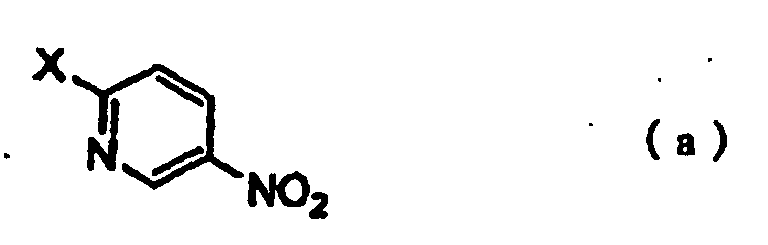
- the aniline derivatives wherein R 1 , R 2 , R 4 , and R 5 are hydrogen atoms and R 3 is a group represented by the formula: -Y-(CR 61 R 62 ) m -(CR 63 R 64 ) n -R 7 are employed.
- the compound represented by the formula (c) described above is derived to an aniline derivative represented by the following formula (d) by means of a general method for reducing an aromatic nitro group to an aromatic amino group.
- the inhibitors for production of 20-HETE according to the present invention comprise compounds represented by the general formula (1) or the pharmaceutically-acceptable salts thereof as active ingredients, and effectively inhibit the production of 20-HETE.
- inhibitors for production of 20-HETE of the present invention are useful as medicines, and in particular, therapeutic agents for kidney diseases, cerebrovascular diseases, or circulatory diseases.
- the dose of the medicines is preferably in a range of 1 to 2000 mg per day as the compounds represented by the general formula (1) or the pharmaceutically-acceptable salts thereof, in the case of an adult human subject to be treated. They may be administered in a single dose or divided into several doses per day. The doses may vary depending on the usage, as well as, the age, weight, and conditions of each individual patient, and the like.
- the medicines may be administered orally or parenterally, in the form of tablets, capsules, granules, powders, troches, ointments, creams, emulsions, suspensions, suppositories, injectable solutions, or the like, each of which may be produced according to the conventional formulation methods (for example, methods defined in the 12 th revision of Japanese Pharmacopeia).
- These preparation forms may be selected depending on the conditions and ages of the patients, as well as the purpose of the treatment.
- fillers for example, crystalline cellulose, starch, lactose, mannitol, or the like
- binders for example, hydroxypropylcellulose, polyvinylpyrrolidone, or the like
- lubricants for example, magnesium stearate, talc, or the like
- disintegrants for example, carboxymethylcellulose calcium, or the like
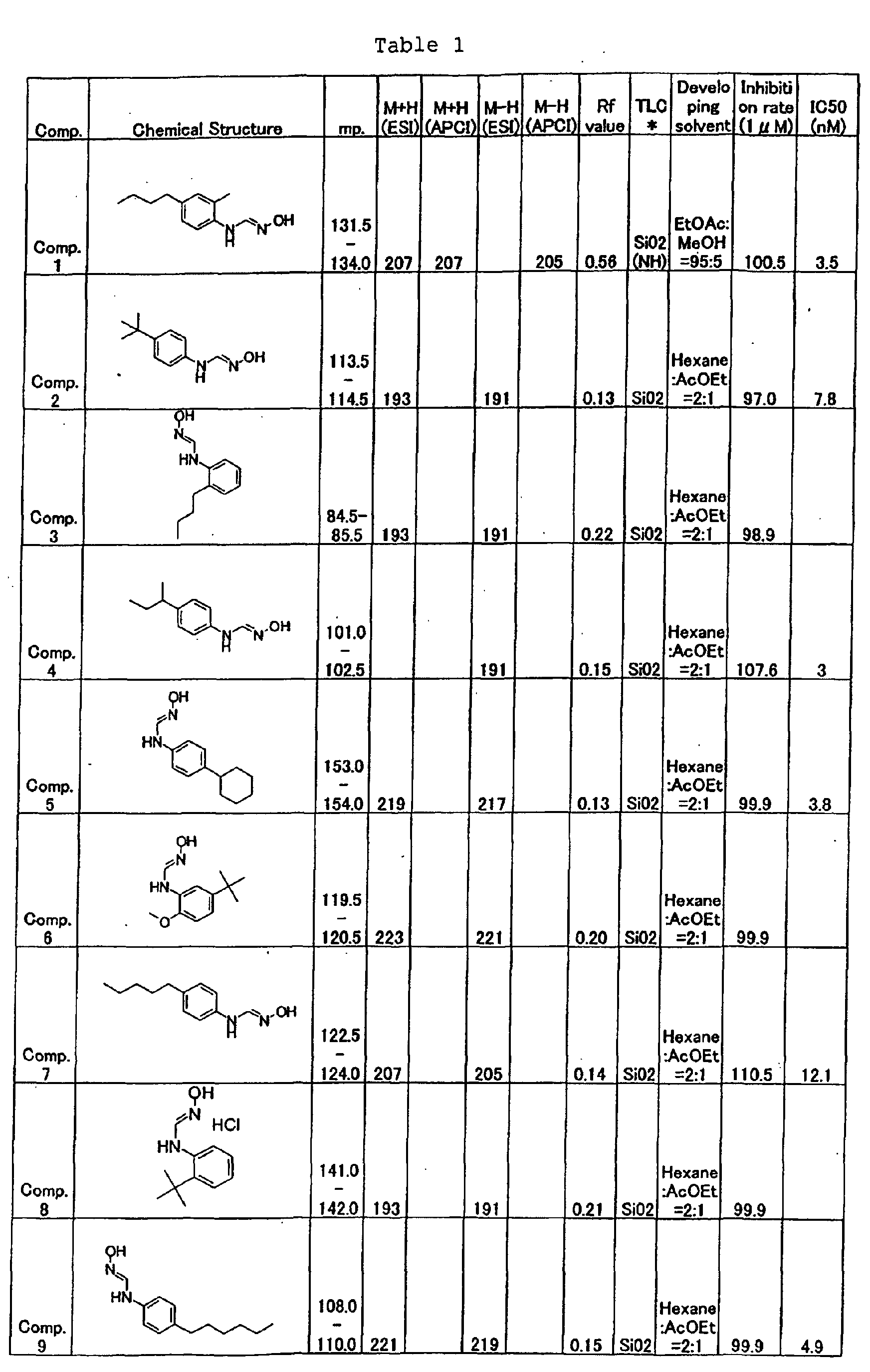
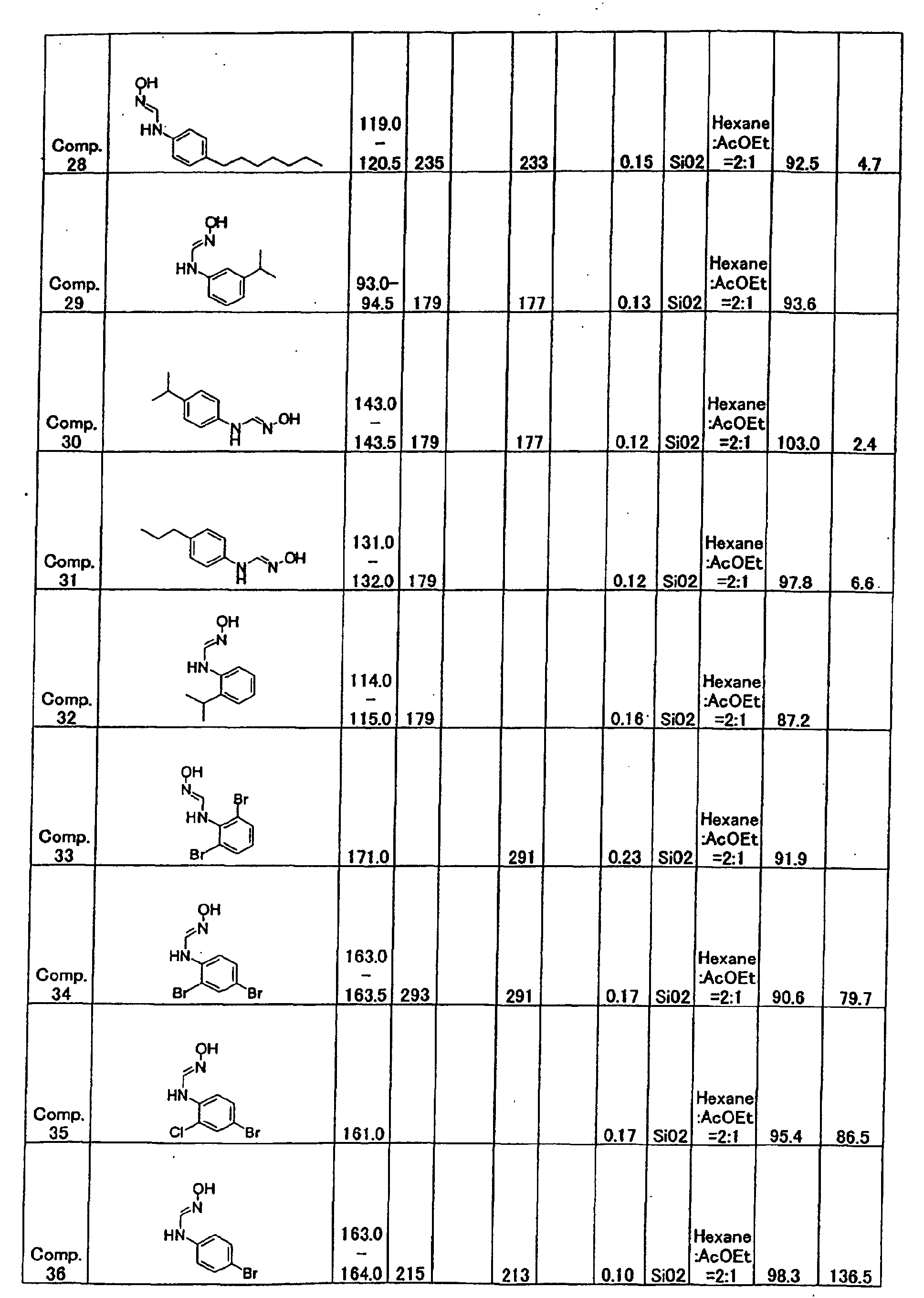
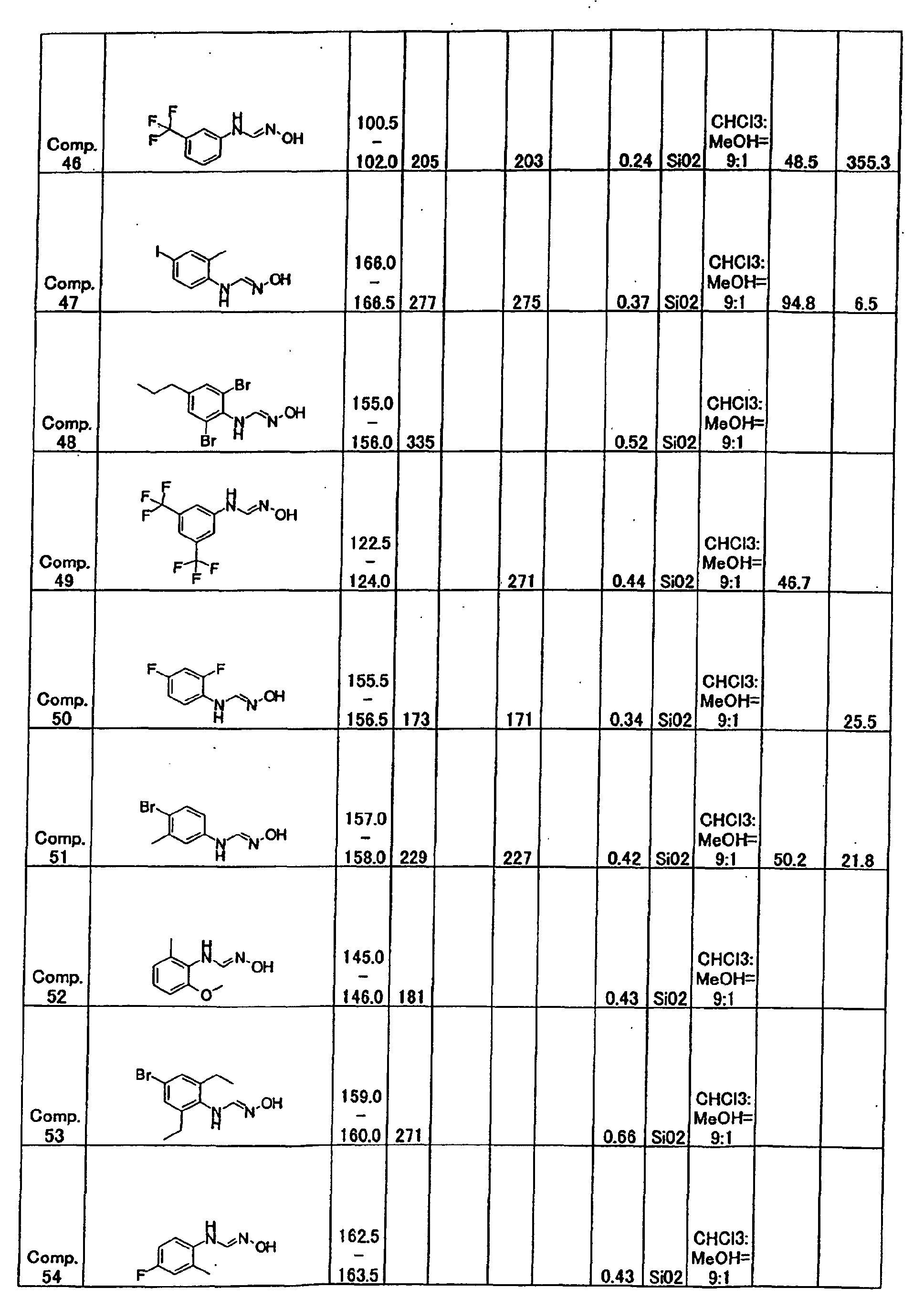
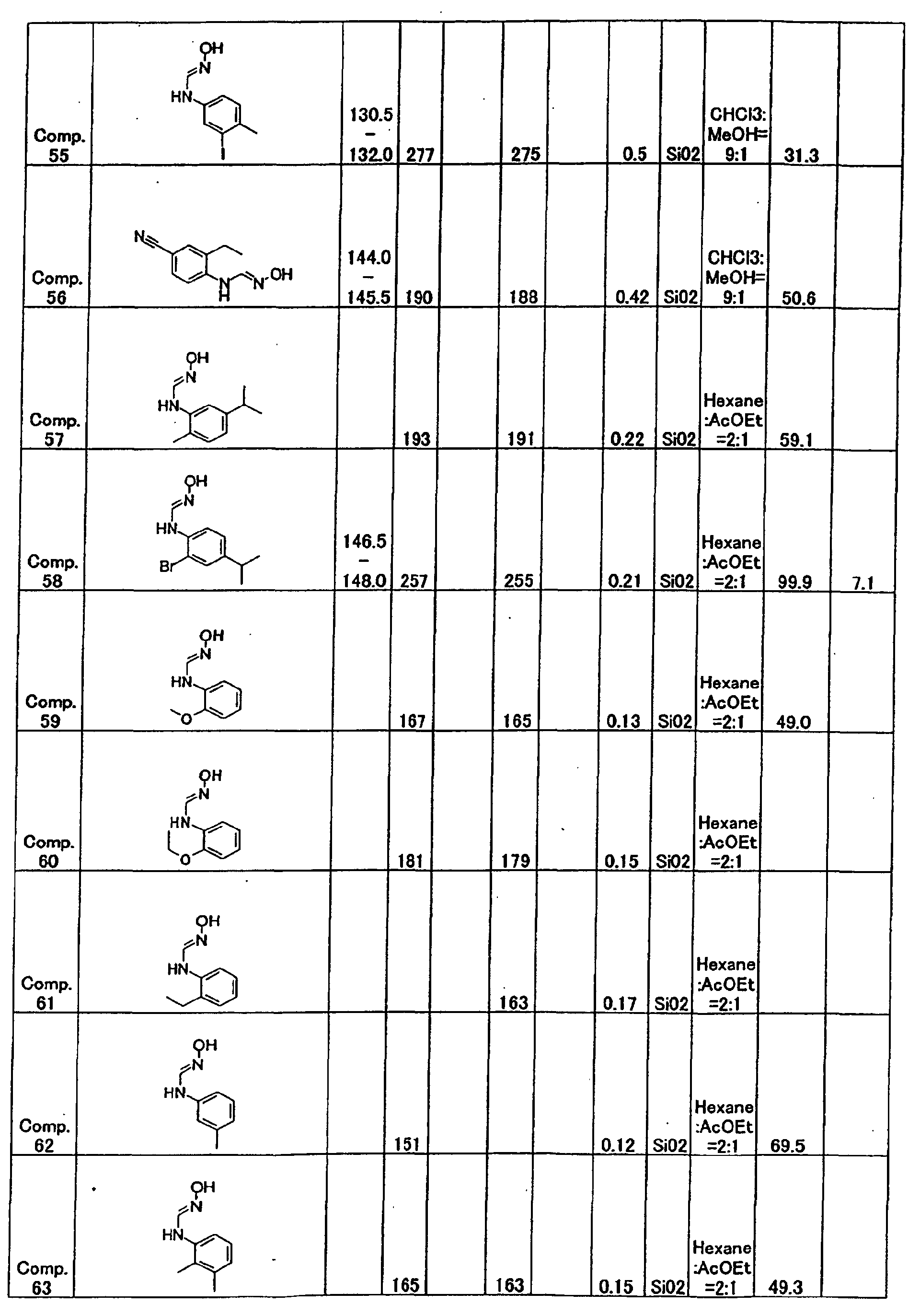
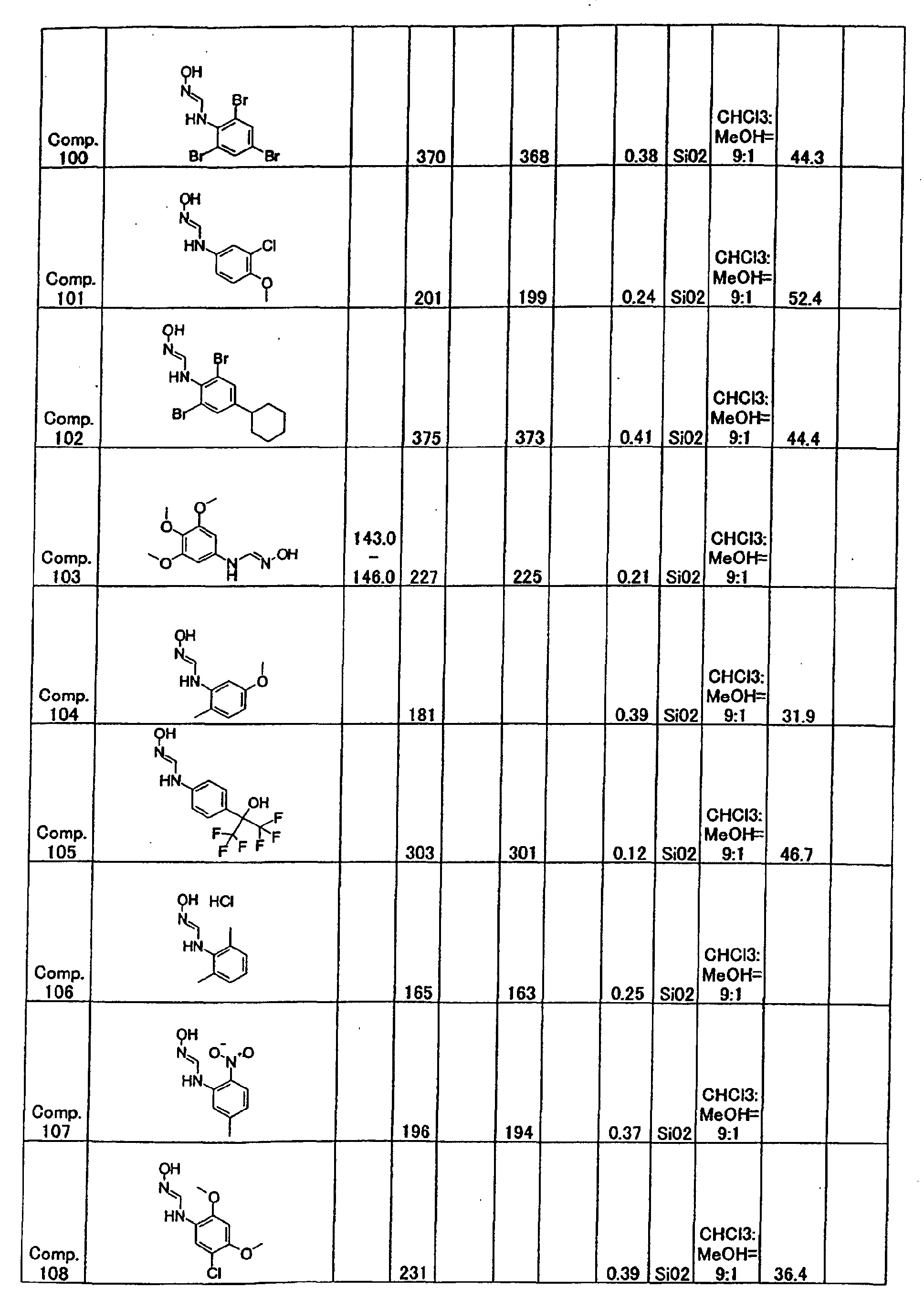
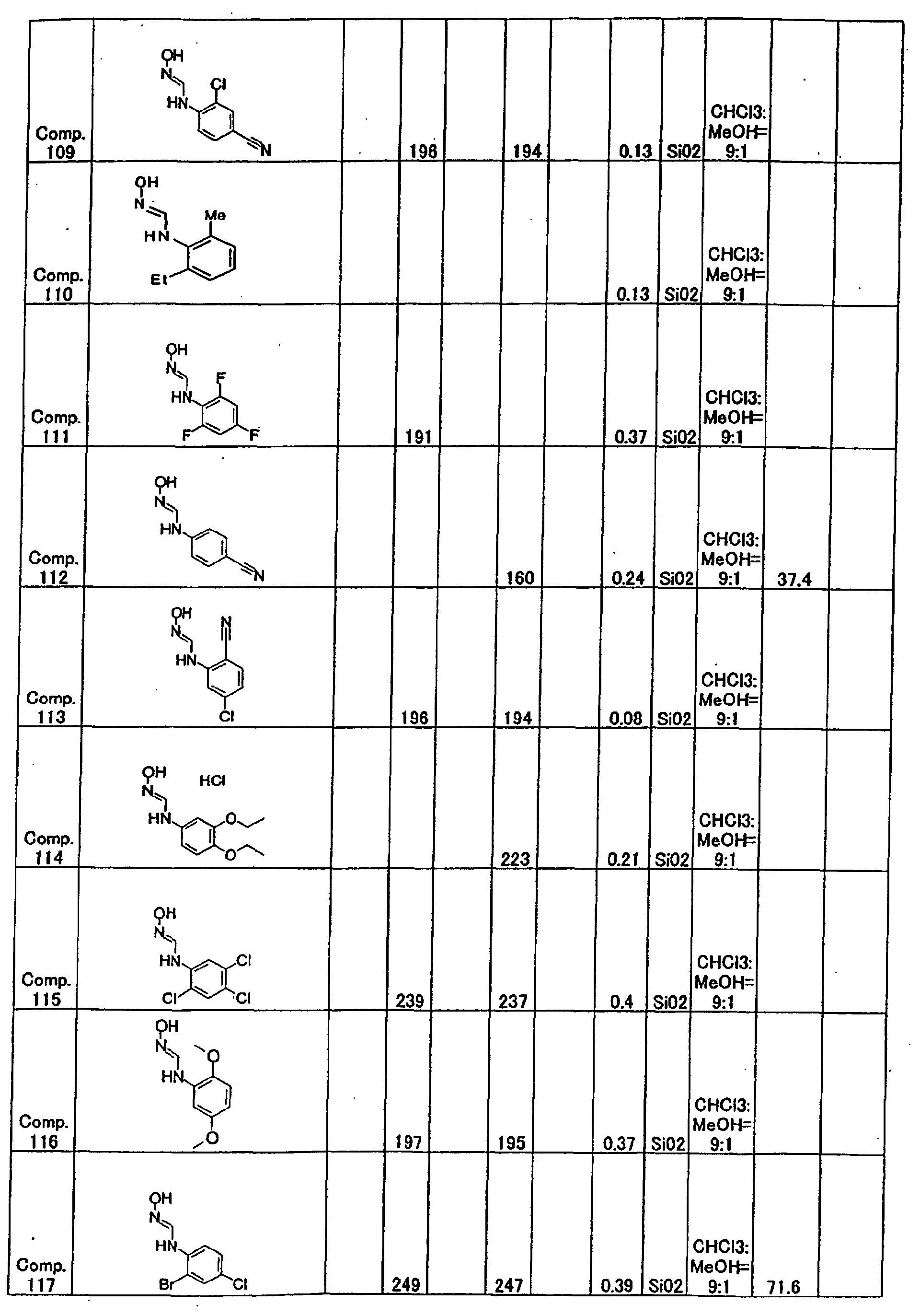
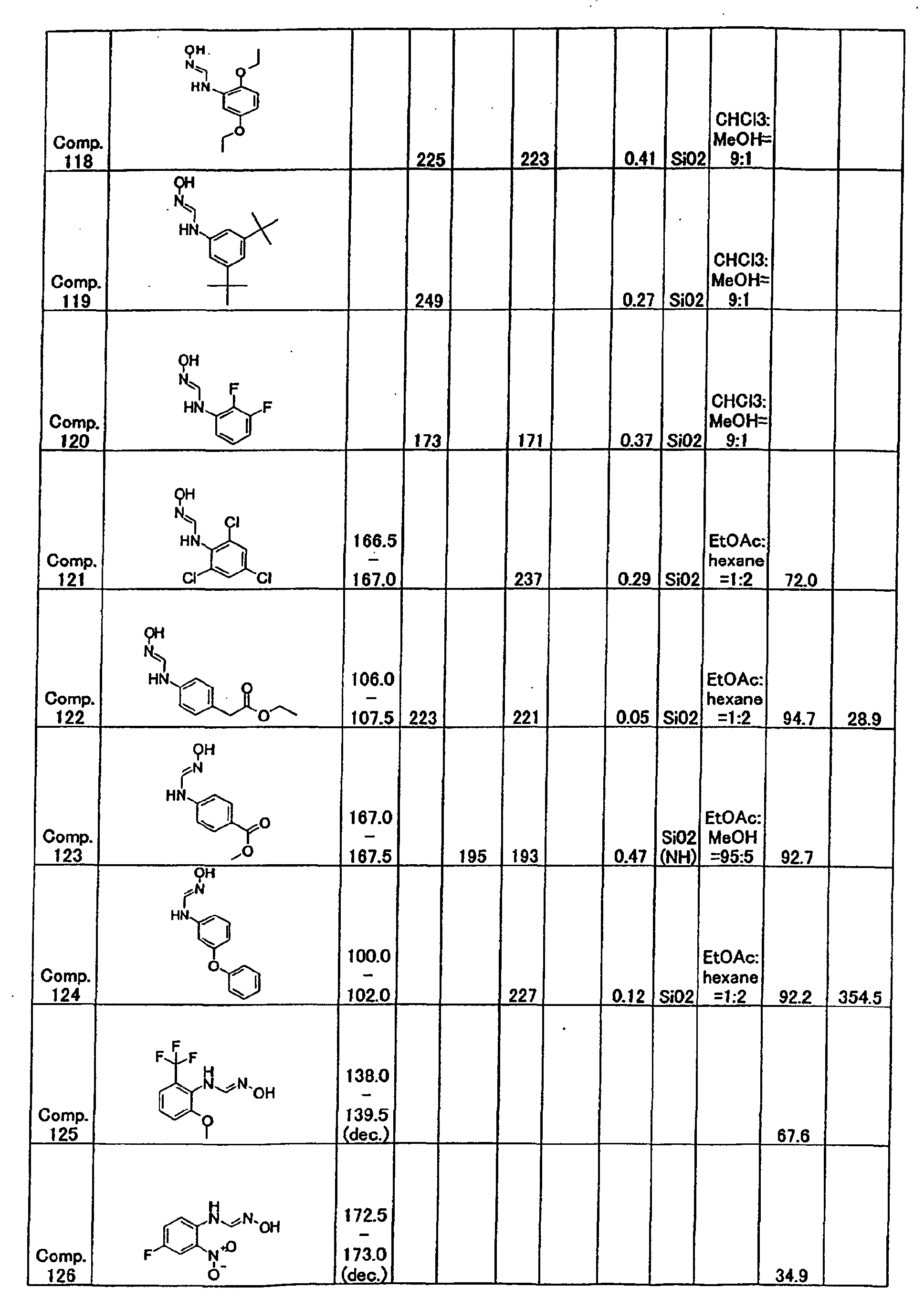
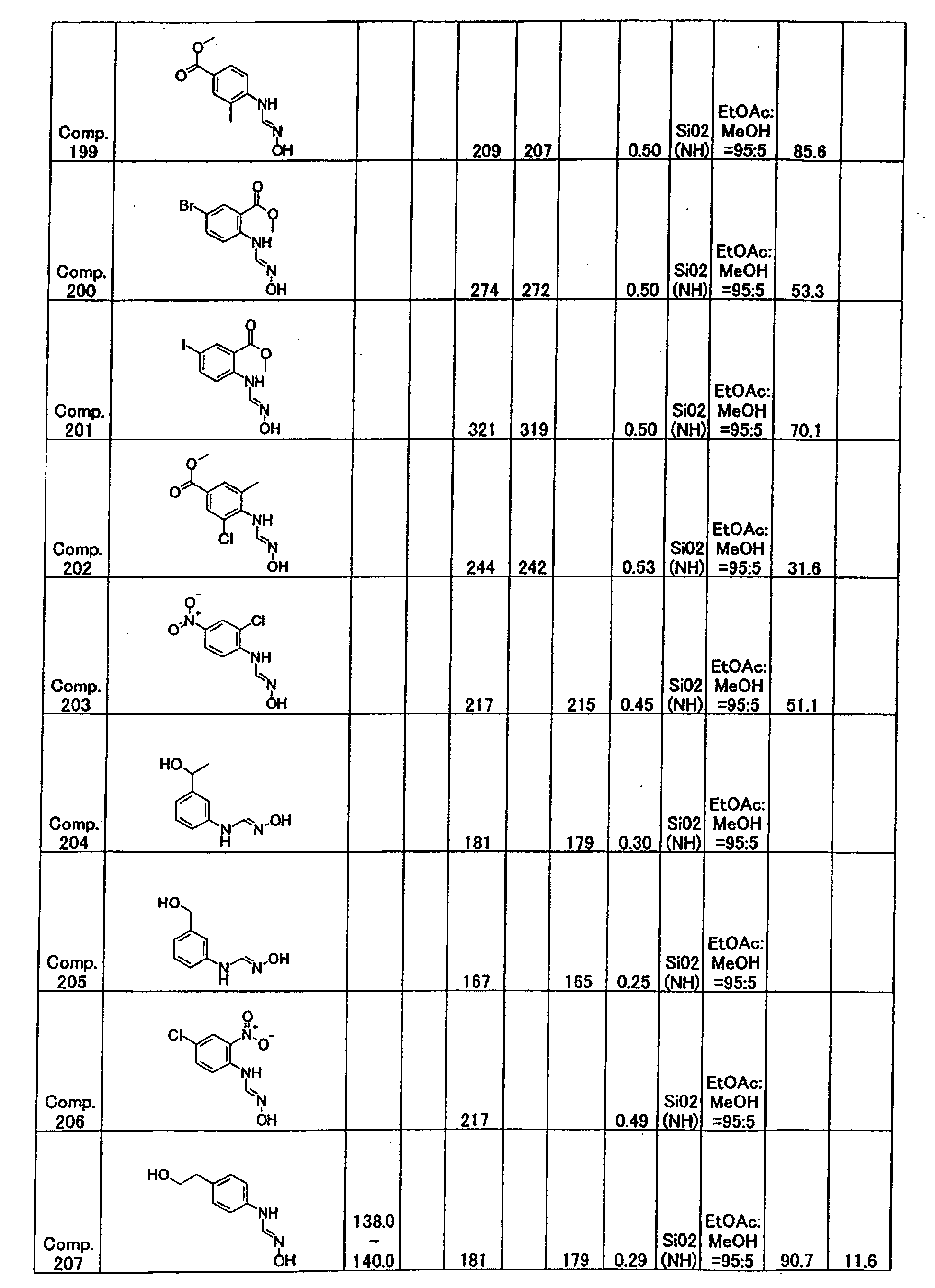
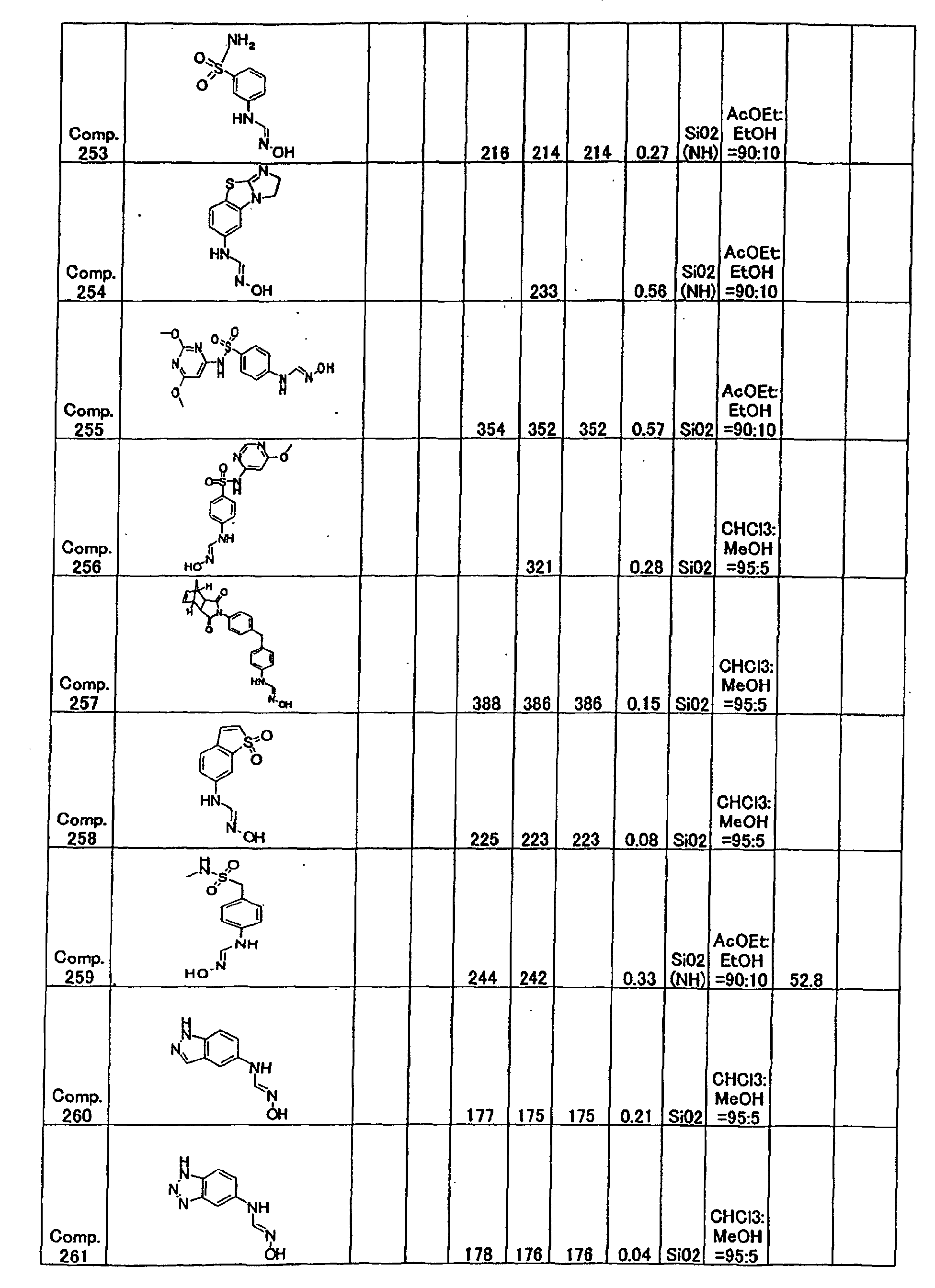
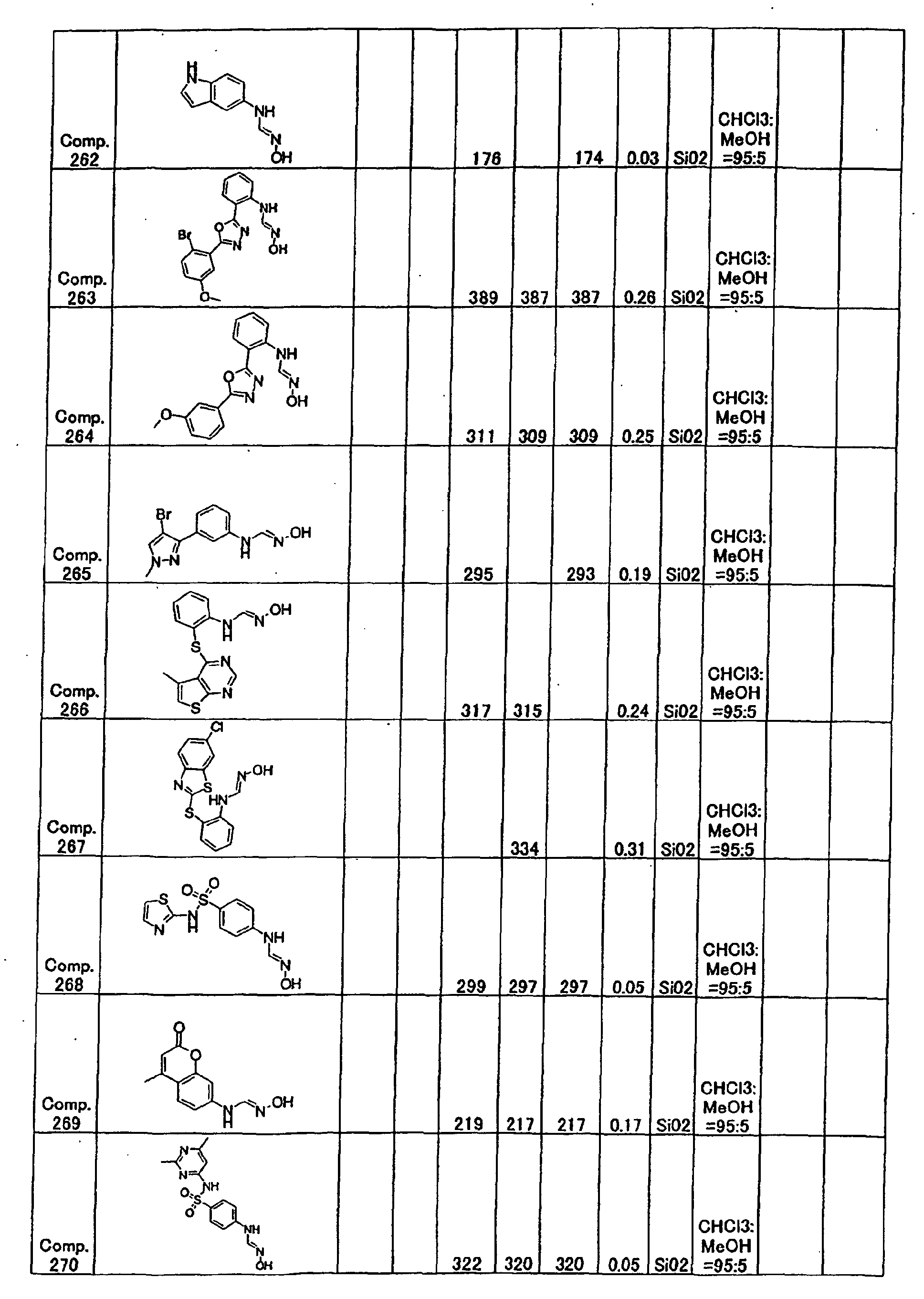
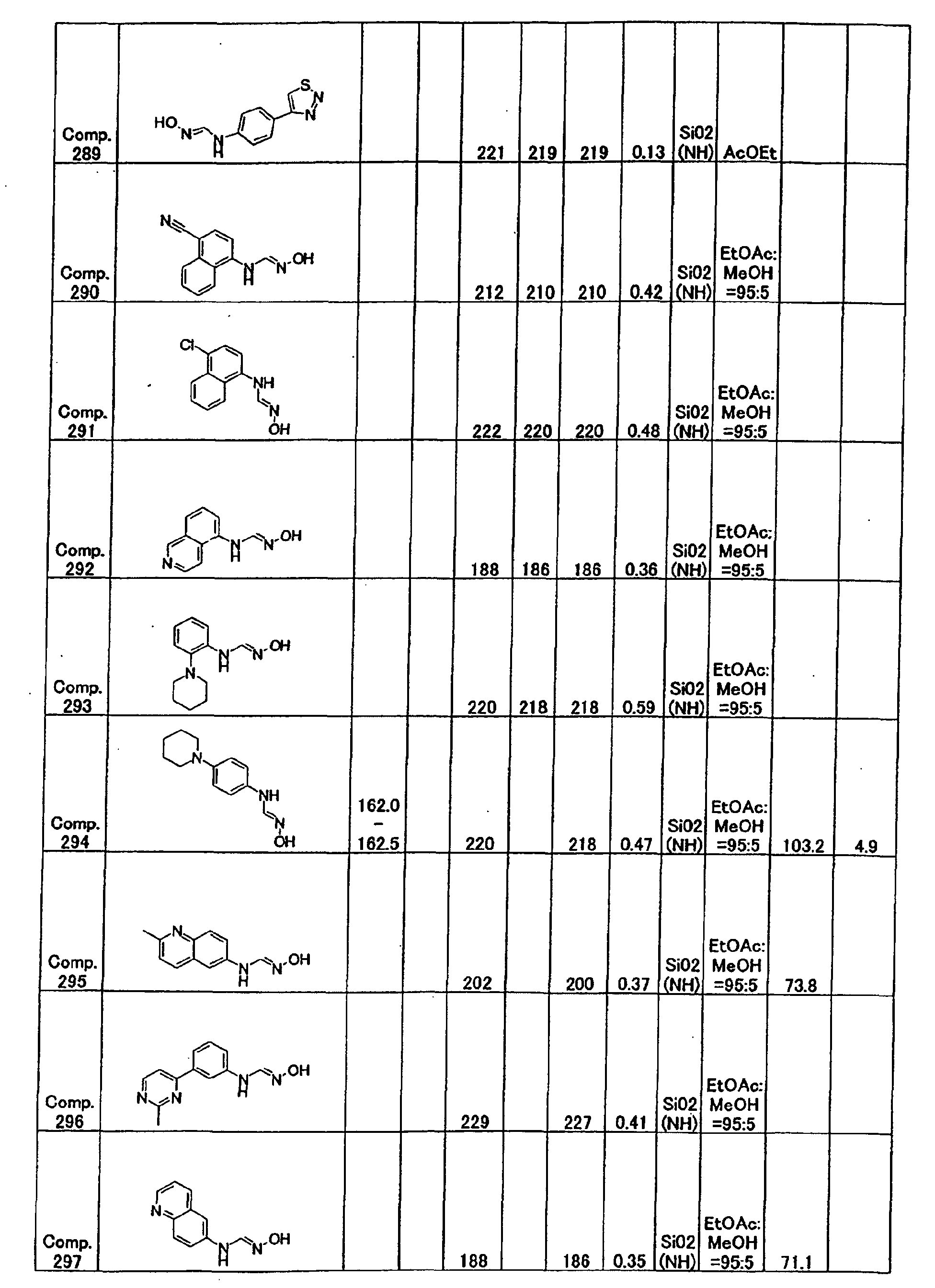
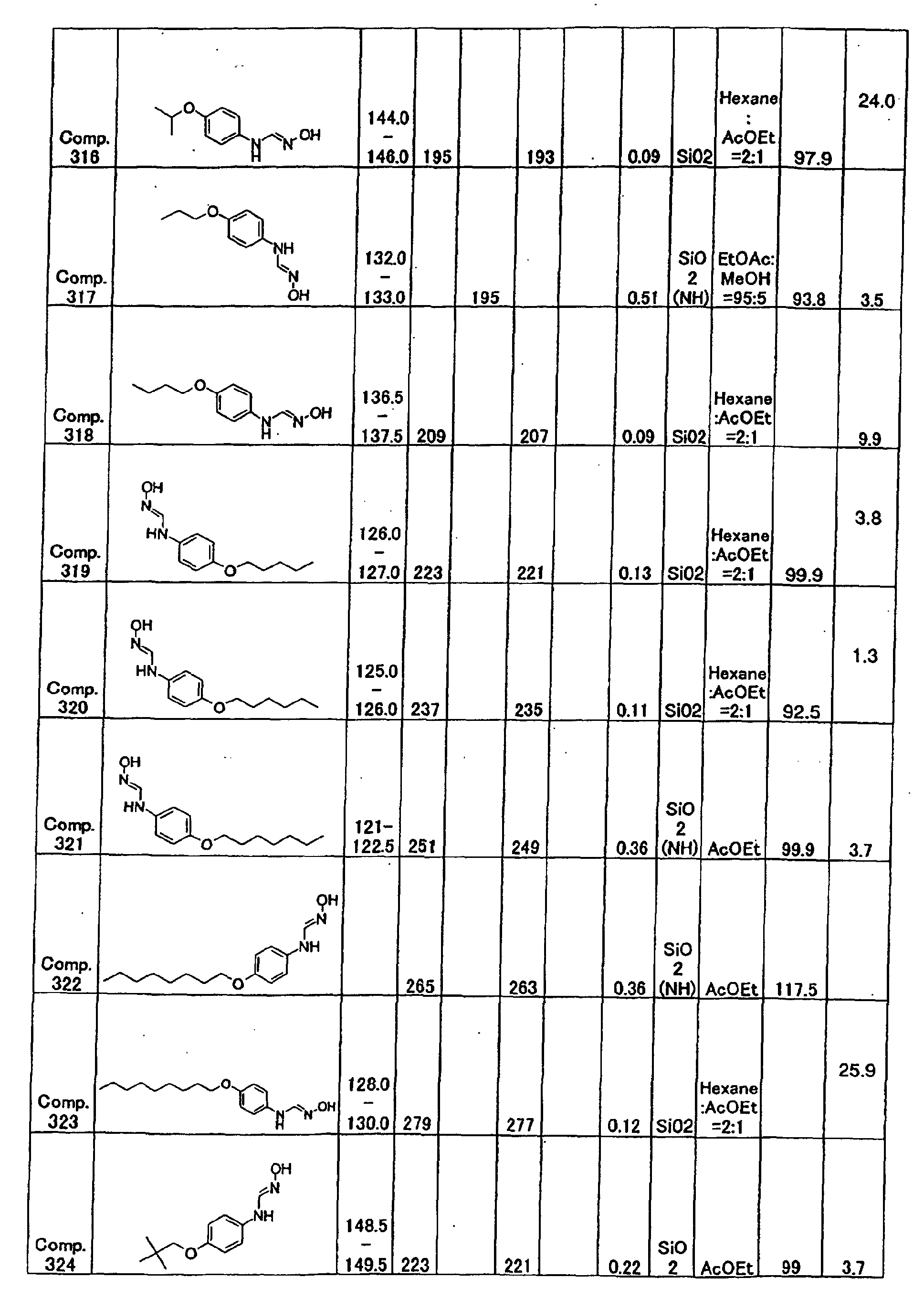
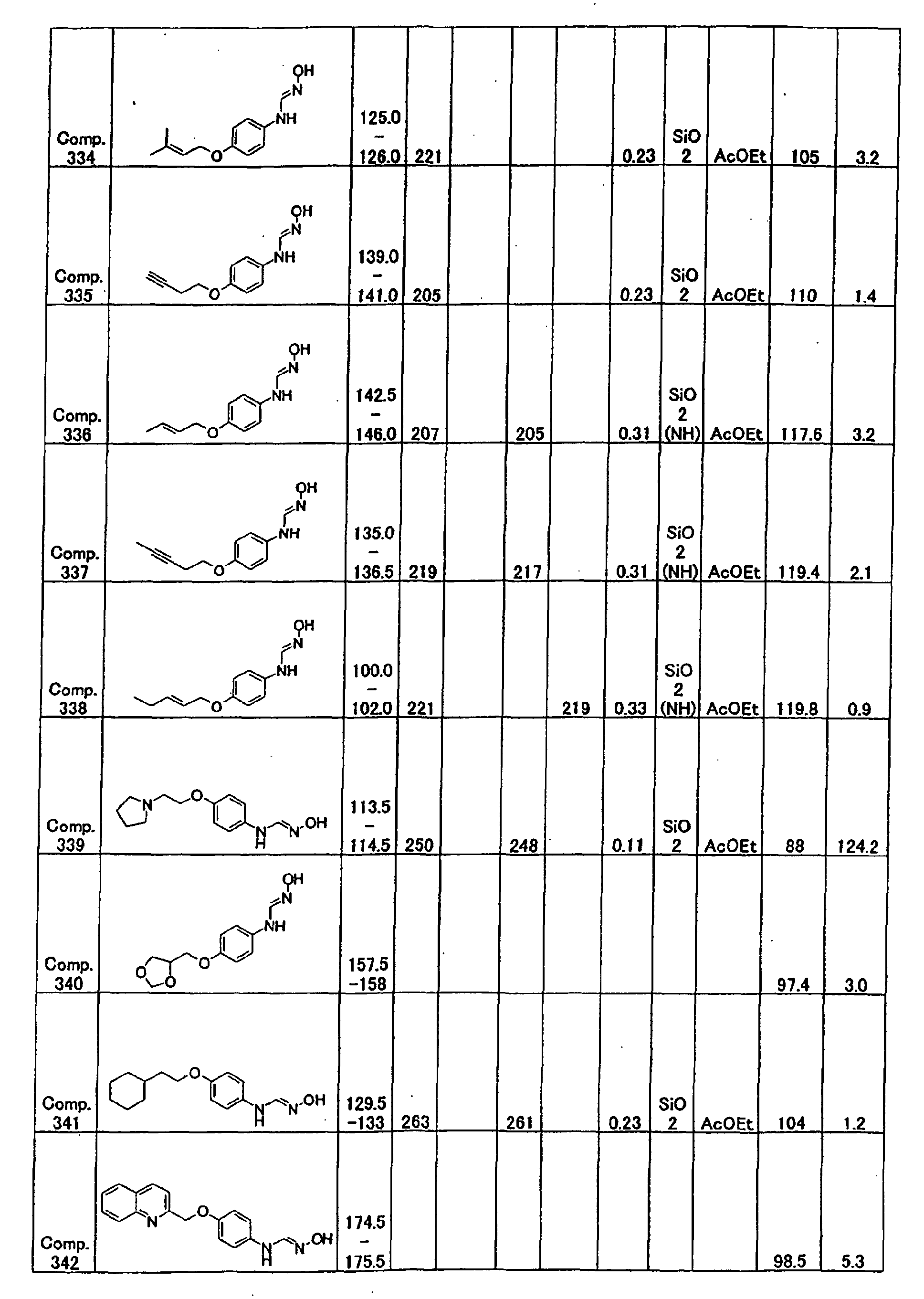
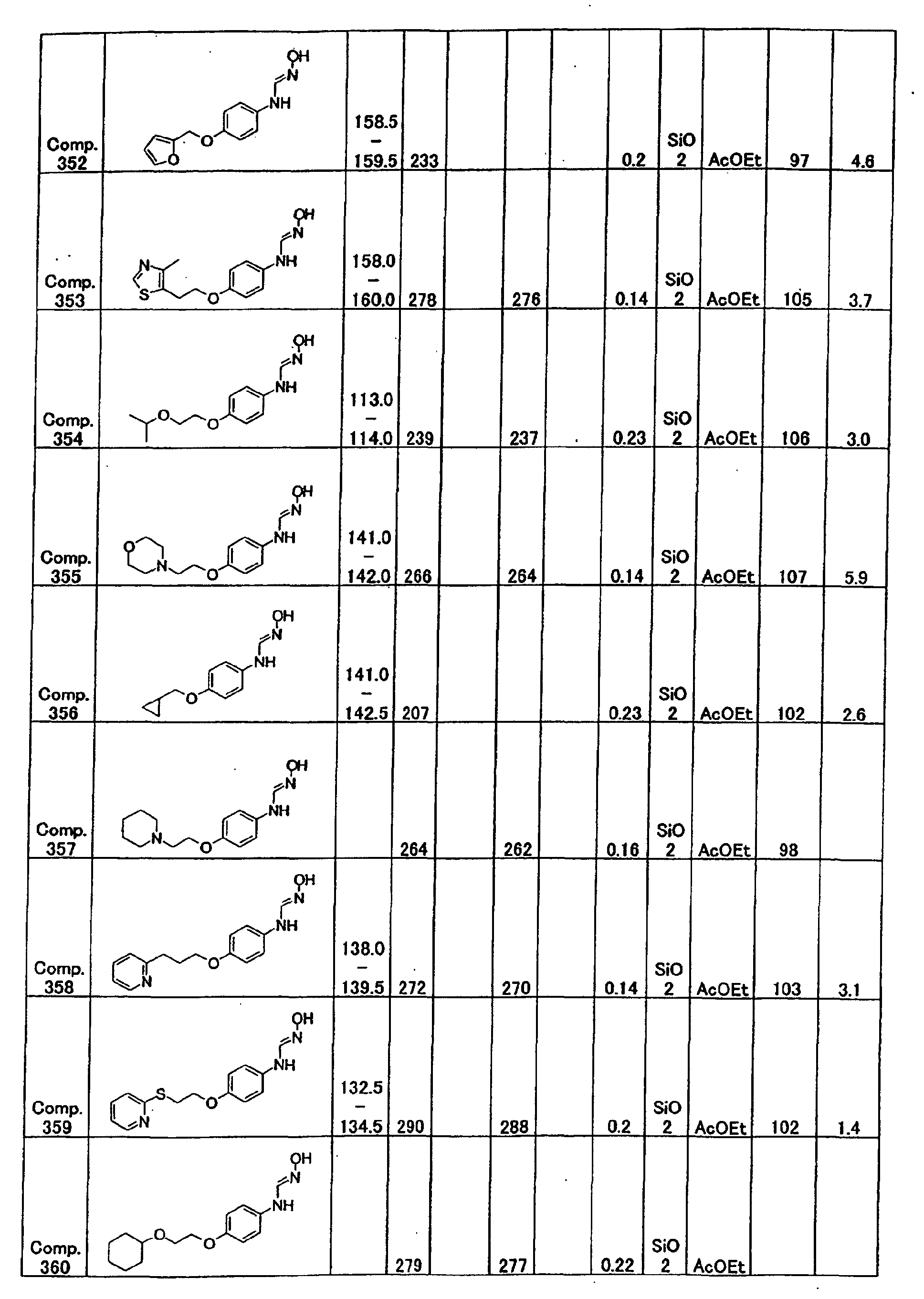
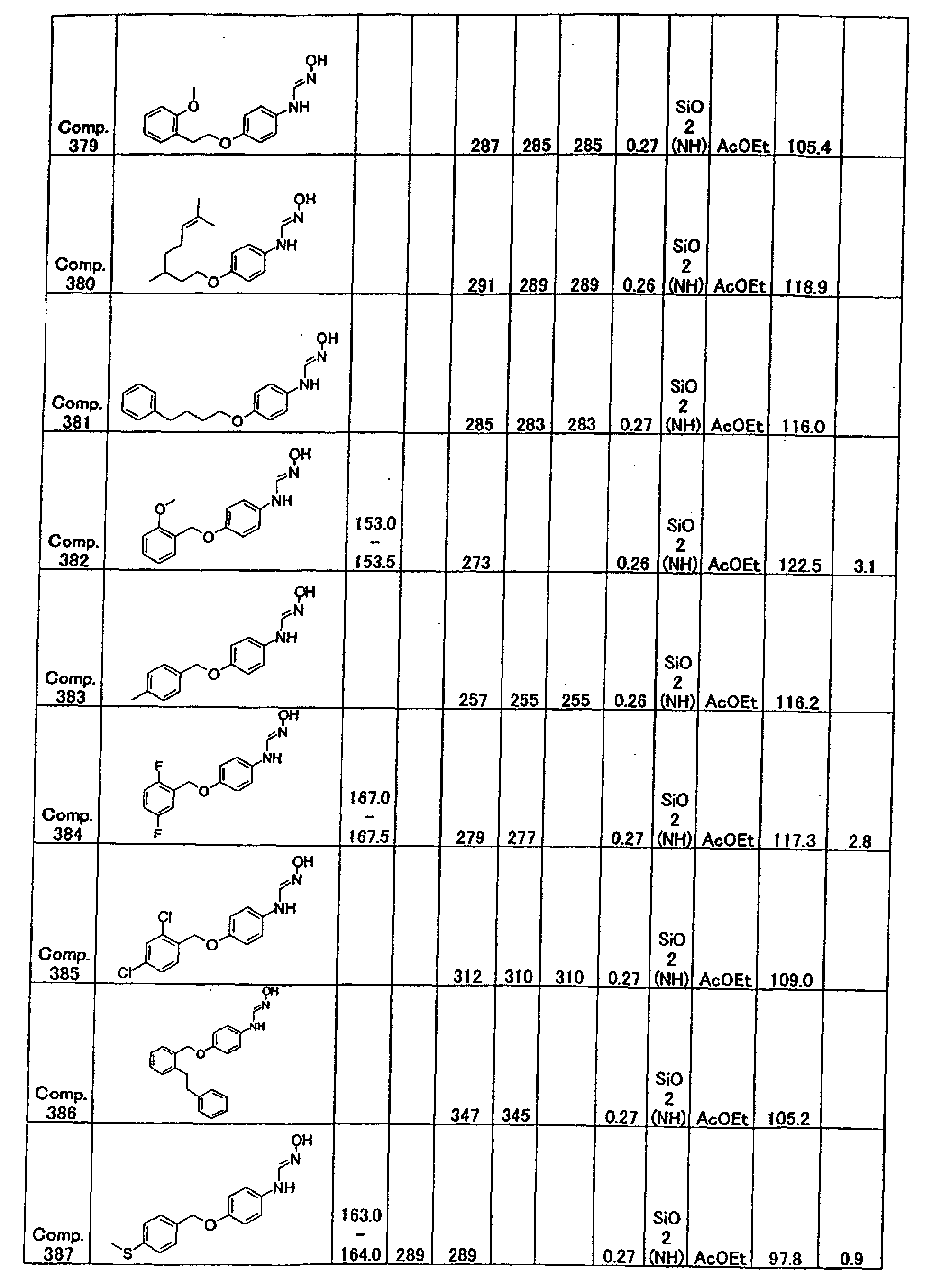
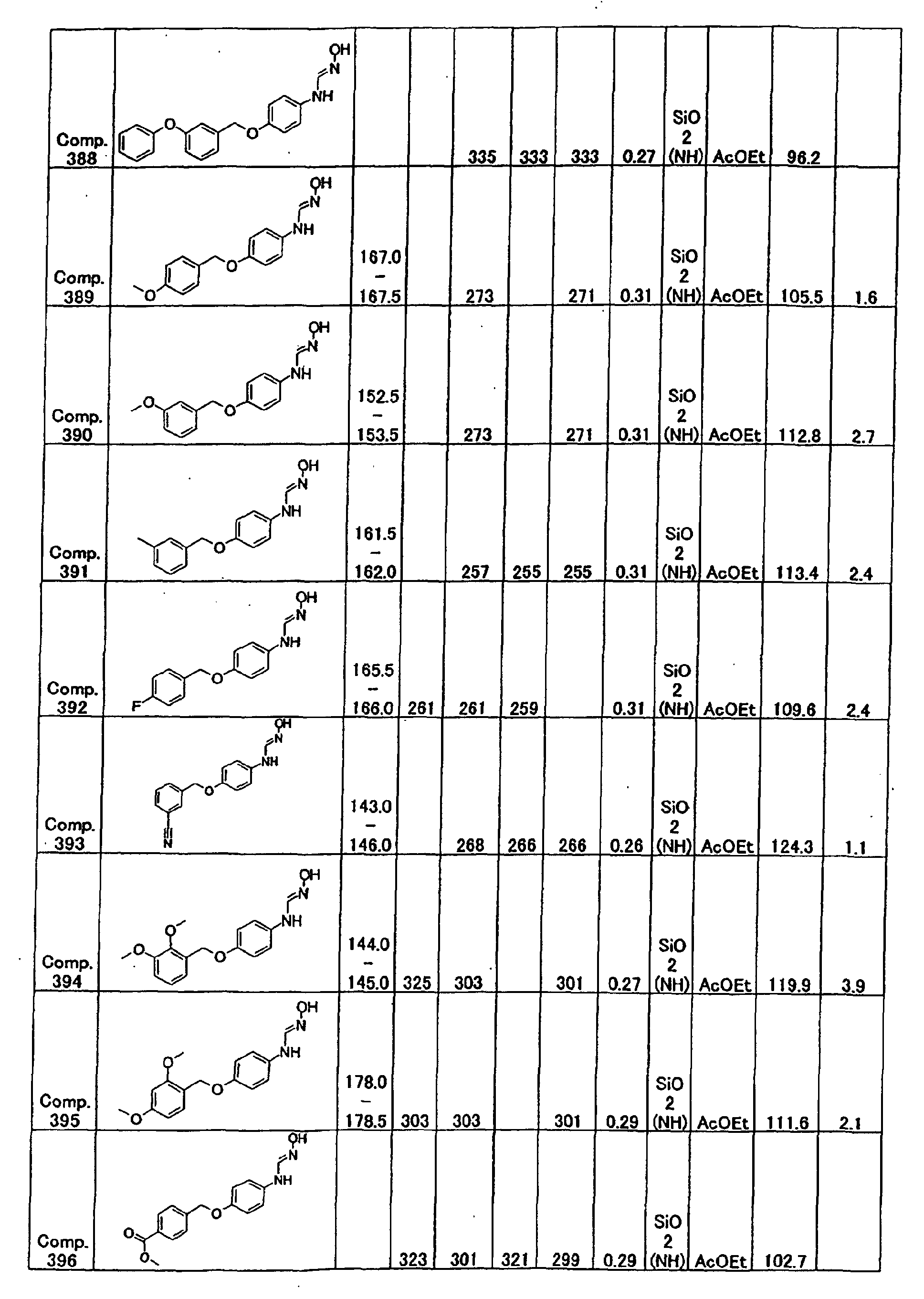
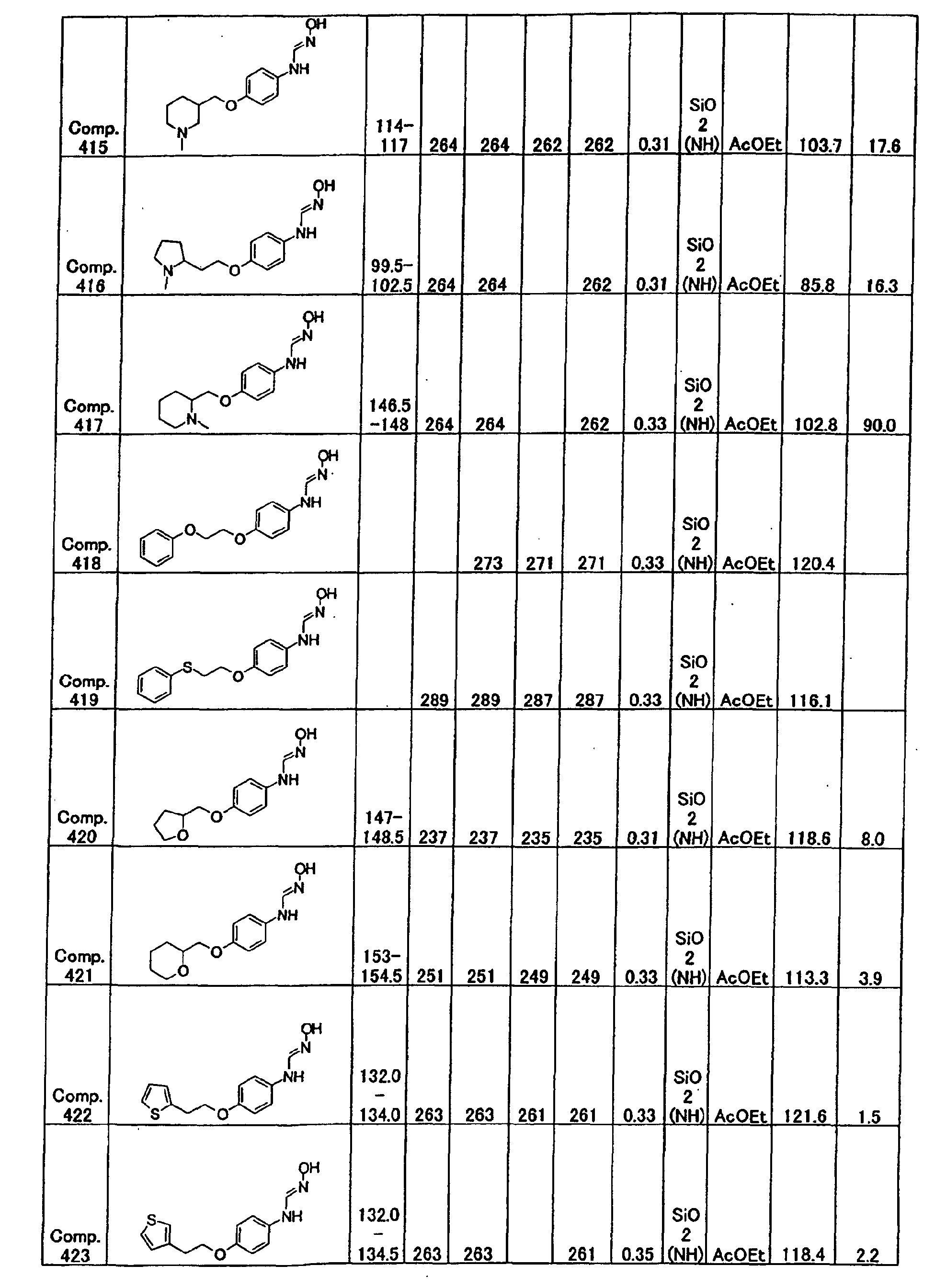
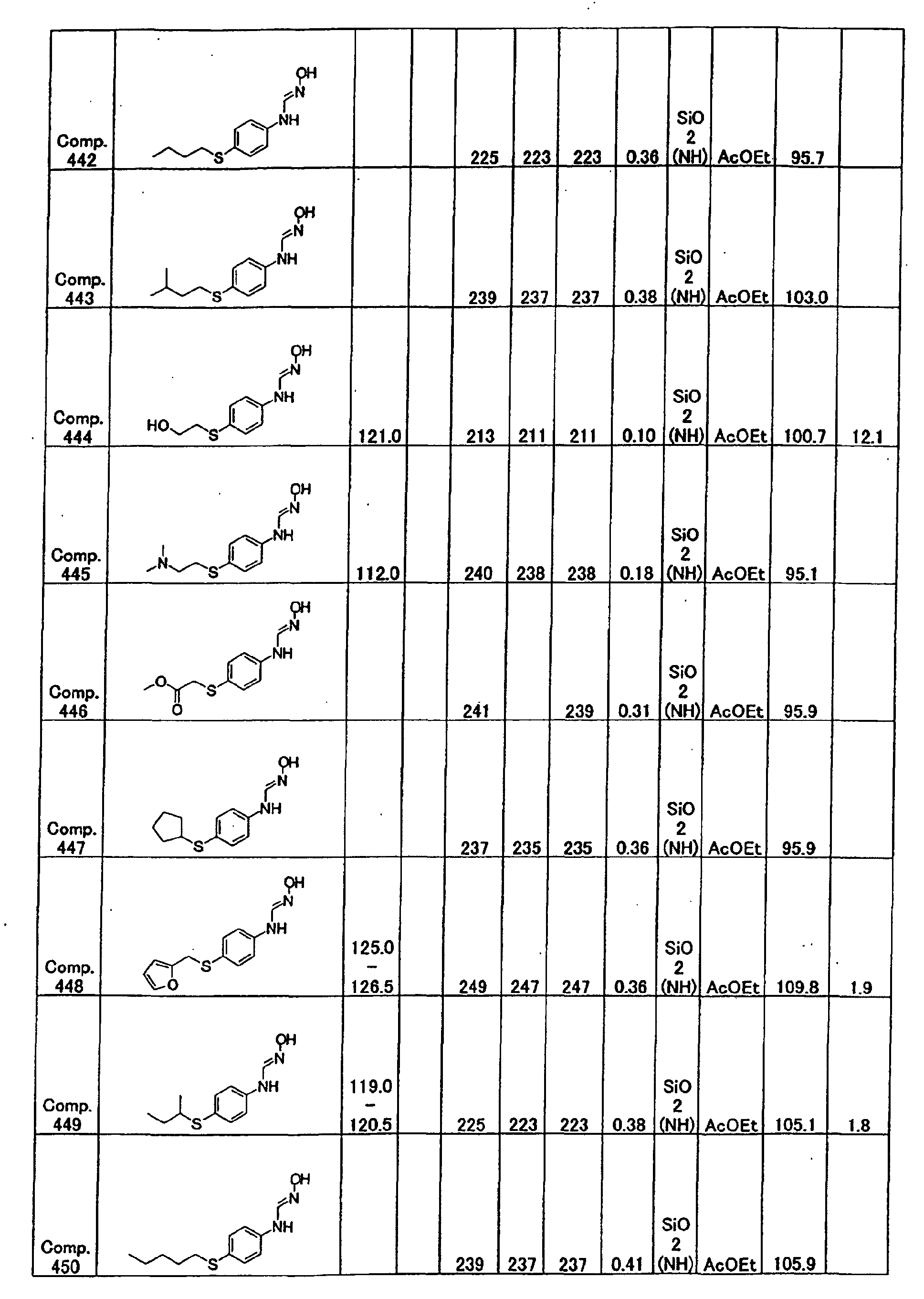
- the Rf values in Table 1 corresponds to the Rf values in the case of development with a mixture of ethyl acetate : hexane (1:2) (no mark) or in the case of development with a mixture of chloroform : methanol (9:1) (marked as *), employing thin layer chromatography Silica gel 60 F 254 , produced by Merck, or NH-TLC plates, produced by Fuji Silysia Chemical Ltd.
- the term "posi” or “nega” denotes data of the cation peak (M+H) or the anion peak (M-H), observed in a positive mode or a negative mode upon measurement of mass spectrum by means of the ESI method.
- the subject compound for this examination was added to a buffer comprising 50mM of 3-morpholinopropanesulfonic acid (pH7.4), 5mM of magnesium chloride and 1mM of ethylenediaminetetraacetic acid (EDTA) disodium salt.
- a buffer comprising 50mM of 3-morpholinopropanesulfonic acid (pH7.4), 5mM of magnesium chloride and 1mM of ethylenediaminetetraacetic acid (EDTA) disodium salt.
- rat kidney microsome microsome fraction prepared from the kidney of a spontaneous hypertension rat (male, 6 weeks of age)
- [5, 6, 8, 9, 11, 12, 14, 15] tritium-arachidonic acid supplied by Amasham
- NADPH supplied by Sigma
- the activity of 20-HETE synthase was measured by using a high performance liquid chromatograph having a detector for radioactive substances (supplied by Gilson), and equipped with a C18 reversed phase column (Biocyl C18, supplied by Bio-rad).
- the compounds represented by the general formula (1) or the pharmaceutically-acceptable salts thereof according to the present invention are useful as inhibitors for production of 20-HETE. Therefore, they are useful as medicines, and in particular, therapeutic agents for various diseases in human subjects and animals, which 20-HETE is implicated in, such as kidney diseases, cerebrovascular diseases, or circulatory diseases.
- the compounds represented by the general formula (1) or the pharmaceutically-acceptable salts thereof are, in particular, preferable.
Landscapes
- Health & Medical Sciences (AREA)
- Chemical & Material Sciences (AREA)
- Pharmacology & Pharmacy (AREA)
- Veterinary Medicine (AREA)
- Public Health (AREA)
- General Health & Medical Sciences (AREA)
- Medicinal Chemistry (AREA)
- Animal Behavior & Ethology (AREA)
- Life Sciences & Earth Sciences (AREA)
- Epidemiology (AREA)
- Organic Chemistry (AREA)
- Engineering & Computer Science (AREA)
- Bioinformatics & Cheminformatics (AREA)
- Nuclear Medicine, Radiotherapy & Molecular Imaging (AREA)
- General Chemical & Material Sciences (AREA)
- Chemical Kinetics & Catalysis (AREA)
- Emergency Medicine (AREA)
- Urology & Nephrology (AREA)
- Heart & Thoracic Surgery (AREA)
- Cardiology (AREA)
- Diabetes (AREA)
- Hematology (AREA)
- Vascular Medicine (AREA)
- Pharmaceuticals Containing Other Organic And Inorganic Compounds (AREA)
- Plural Heterocyclic Compounds (AREA)
- Medicines That Contain Protein Lipid Enzymes And Other Medicines (AREA)
- Acyclic And Carbocyclic Compounds In Medicinal Compositions (AREA)
- Organic Low-Molecular-Weight Compounds And Preparation Thereof (AREA)
- Preparation Of Compounds By Using Micro-Organisms (AREA)
Abstract
Description
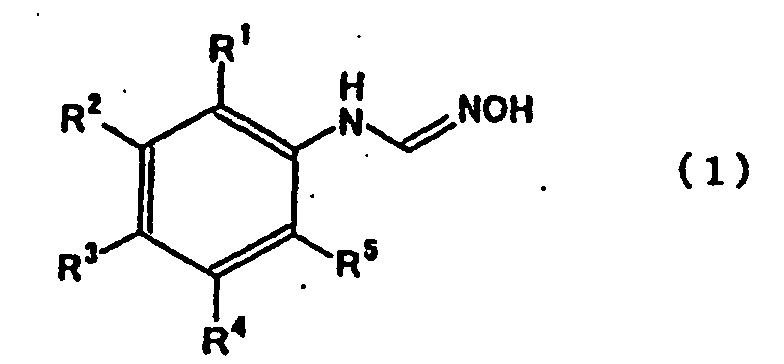
the two groups adjacent to each other of R1 to R5 , taken together with the benzene ring to which they are bonded, form a phthalimide ring; a phthalimide ring substituted with a C1-6 alkyl group; an indole ring; an indane ring; an indazole ring; a benzotriazole ring; an S,S-dioxobenzothiophene ring; a 2,3-dihydroimidazo[2,1-b]benzothiazole ring; a dibenzofuran ring; a dibenzofuran ring substituted with a C1-6 alkoxy group; a fluorene ring; a fluorene ring substituted with a halogen atom; a pyrene ring; a carbostyryl ring; a carbostyryl ring substituted with a C1-6 alkyl group; a naphthalene ring; a naphthalene ring substituted with 1 to 3 substituents selected from the group consisting of cyano groups, halogen atoms, nitro groups, and C1-6 alkyl groups; a 1,2,3,4-tetrahydronaphthalene ring; a quinoline ring; a quinoline ring substituted with a C1-6 alkyl group; an isoquinoline ring; a 2-oxo-α-chromene ring; a 2-oxo-α-chromene ring substituted with 1 to 3 substituents selected from the group consisting of C1-6 alkyl groups, C1-6 alkoxy groups, and C1-6 alkoxy C1-6 alkyl groups; a cinnolin ring; a cinnolin ring substituted with a C1-6 alkyl group; a phthalazindione ring; a benzothiazol ring; a benzothiazol ring substituted with a C1-6 alkyl group; a benzodioxorane ring; or a benzobutyrolactone ring] or a pharmaceutically-acceptable salt thereof.
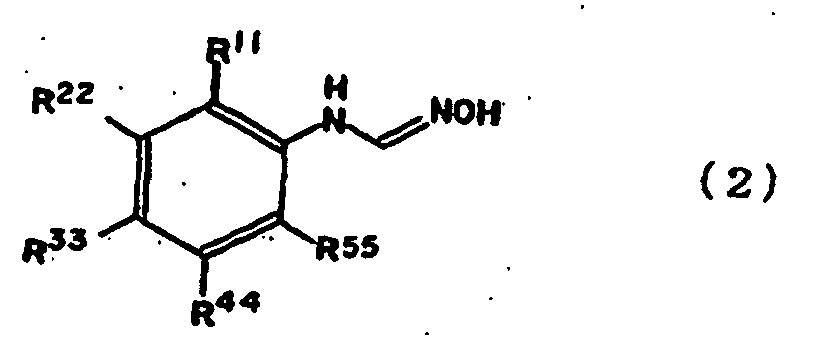
the two groups adjacent to each other of R11 to R55, taken together with the benzene ring to which they are bonded, form a phthalimide ring; a phthalimide ring substituted with a C1-6 alkyl group; an indole ring; an indane ring; an indazole ring; a benzotriazole ring; an S,S-dioxobenzothiophene ring; a 2,3-dihydroimidazo[2,1-b]benzothiazole ring; a dibenzofuran ring; a dibenzofuran ring substituted with a C1-6 alkoxy group; a fluorene ring; a fluorene ring substituted with a halogen atom; a pyrene ring; a carbostyryl ring; a carbostyryl ring substituted with a C1-6 alkyl group; a naphthalene ring; a naphthalene ring substituted with 1 to 3 substituents selected from the group consisting of cyano groups, halogen atoms, nitro groups, and C1-6 alkyl groups; a 1,2,3,4-tetrahydronaphthalene ring; a quinoline ring; a quinoline ring substituted with a C1-6 alkyl group; an isoquinoline ring; a 2-oxo-α-chromene ring; a 2-oxo-α-chromene ring substituted with 1 to 3 substituents selected from the group consisting of C1-6 alkyl groups, C1-6 alkoxy groups, and C1-6 alkoxy C1-6 alkyl groups; a cinnolin ring; a cinnolin ring substituted with a C1-6 alkyl group; a phthalazindione ring; a benzothiazol ring; a benzothiazol ring substituted with a C1-6 alkyl group; a benzodioxorane ring; or a benzobutyrolactone ring, and the remaining groups of R11 to R55 are identical or different and represent a hydrogen atom, a C1-4 alkyl group, a C1-4 alkoxy group, a trifluoromethyl group, a nitro group, or a halogen atom] or a pharmaceutically-acceptable salt thereof.
the two groups adjacent to each other of R11 to R55, taken together with the benzene ring to which they are bonded, may form a phthalimide ring; a phthalimide ring substituted with a C1-6 alkyl group; an indole ring; an indane ring; an indazole ring; a benzotriazole ring; an S,S-dioxobenzothiophene ring; a 2,3-dihydroimidazo[2,1-b]benzothiazole ring; a dibenzofuran ring; a dibenzofuran ring substituted with a C1-6 alkoxy group; a fluorene ring; a fluorene ring substituted with a halogen atom; a pyrene ring; a carbostyryl ring; a carbostyryl ring substituted with a C1-6 alkyl group; a naphthalene ring; a naphthalene ring substituted with 1 to 3 substituents selected from the group consisting of cyano groups, halogen atoms, nitro groups, and C1-6 alkyl groups; a 1,2,3,4-tetrahydronaphthalene ring; a quinoline ring; a quinoline ring substituted with a C1-6 alkyl group; an isoquinoline ring; a 2-oxo-α-chromene ring; a 2-oxo-α-chromene ring substituted with 1 to 3 substituents selected from the group consisting of C1-6 alkyl groups, C1-6 alkoxy groups, and C1-6 alkoxy C1-6 alkyl groups; a cinnolin ring; a cinnolin ring substituted with a C1-6 alkyl group; a phthalazindione ring; a benzothiazol ring; a benzothiazol ring substituted with a C1-6 alkyl group; a benzodioxorane ring; or a benzobutyrolactone ring, and the remaining groups of R11 to R55 may be identical or different and represent a hydrogen atom, a C1-4 alkyl group, a C1-4 alkoxy group, a trifluoromethyl group, a nitro group, or a halogen atom.
and the remaining groups of R11 to R55 be identical or different and represent a hydrogen atom, a C1-4 alkyl group, a C1-4 alkoxy group, a trifluoromethyl group, a nitro group, or a halogen atom.



Melting point: 131.5 - 134.0°C
Melting point: 113.5 - 114.5°C
Melting point: 167.0 - 167.5°C
Melting point: 130.5 - 131.5°C
Melting point: 159.5 - 161.0°C
Melting point: 166°C






















Claims (12)
- An inhibitor for production of 20-hydroxyeicosatetraenoic acid, comprising, as an effective ingredient, a hydroxyformamidine derivative represented by the formula:wherein R1 to R5 are identical or different and represent a hydrogen atom; a hydroxyl group; a carboxyl group; a halogen atom; a C1-14 alkyl group; a C1-14 alkyl group substituted with 1 to 6 halogen atoms; a C2-6 alkenyl group; a C1-6 alkoxy C1-6 alkyl group; a C3-8 cycloalkyl C1-6 alkyl group; a C2-6 alkynyl group; a C3-8 cycloalkyl group; a C3-8 cycloalkoxy group; a C2-10 alkanoyl group; a C1-6 hydroxyalkyl group; a C1-6 hydroxyalkyl group substituted with 1 to 6 halogen atoms; a C2-6 alkoxycarbonyl group; a 3-phenyl-2-propenyloxycarbonyl group; a C2-6 alkoxycarbonyl C1-6 alkyl group; a di(C1-6 alkyl)amino C2-6 alkoxycarbonyl group; a mono- or di(C1-6 alkyl)amino group; a C2-10 alkanoylamino group; a C2-6 alkanoylamino group substituted with a C1-6 alkyl group; a benzoylamino group; a carbamoyl group; a carbamoyl group mono- or di-substituted with C1-6 alkyl or phenyl groups; an N-(N',N'-di(C1-6 alkyl)amino C1-6 alkyl)carbamoyl group; a cyano group; a cyano C1-6 alkyl group; a nitro group; a thiol group; a phenoxy group; a phenoxy group substituted with 1 to 3 substituents selected from the group consisting of C1-6 alkyl groups, C1-6 alkoxy groups, and halogen atoms; a phenylthio group; a nitrophenylthio group; a C1-6 alkylsulfonyl group; a phenylsulfonyl group; a C1-6 alkylthio C1-6 alkyl group; a phenylsulfonyl C1-6 alkylthio wherein the benzene ring is substituted with 1 to 5 halogen atoms; a phenyl group; a benzyl group; a phenyl group substituted with 1 to 3 substituents selected from the group consisting of cyano groups, halogen atoms, C1-6 alkyl groups, and C1-6 alkoxy groups; a biphenyl group; an α-cyanobenzyl group; an α-cyanobenzyl group substituted with 1 to 5 halogen atoms; a benzyl group substituted with a bicyclo[2.2.1]-hept-5-en-2,3-dicarboxyimidyl group; a benzoyl group; a styryl group; a styryl group substituted with 1 to 5 substituents selected from the group consisting of C1-6 alkoxy groups and di(C1-6 alkyl)amino alkyl groups; a pyrrolidino group; a piperidino group; a morpholino group; a pyridyl groups a pyrimidinyl group; a pyrimidinyl group substituted with 1 to 3 substituents selected from the group consisting of C1-6 alkyl groups and C1-6 alkoxy groups; a phthalimidoyl group; a phthalimidoyl group substituted with 1 to 3 halogen atoms; an N-carbazolyl group; a dioxopiperidinyl group substituted with 1 to 3 C1-6 alkyl groups; a phenylsulfonylamino group; a phenylsulfonylamino group substituted with 1 to 3 C1-6 alkyl groups; a C1-6 alkylaminosulfonyl C1-6 alkyl group; a thiadiazolyl group; an oxadiazolyl group; an oxadiazolyl group substituted with a substituted phenyl group wherein the substituents in the substituted phenyl group are 1 to 3 substituents selected from the group consisting of halogen atoms, C1-6 alkyl groups, and C1-6 alkoxy groups; a pyrrolidinyl group; a pyrazolyl group; a pyrazolyl group substituted with 1 to 3 substituents selected from the group consisting of halogen atoms, C1-6 alkyl groups, and trifluoromethyl groups; a furyl group; a furyl group substituted with 1 to 3 substituents selected from the group consisting of halogen atoms, C1-6 alkyl groups, and C2-6 alkoxycarbonyl groups; a thienopyrimidinylthio group; a thienopyrimidinylthio group substituted with 1 to 3 C1-6 alkyl groups; a thienopyridylthio group; a thienopyridylthio group substituted with 1 to 3 C1-6 alkyl groups; a benzothiazolylthio group; a benzothiazolylthio group substituted with 1 to 3 halogen atoms; a group represented by the formula: -Y-(CR61R62)m-(CR63R64)n-R7 [wherein Y represents an oxygen or sulfur atom; R61, R62, R63, and R64 are identical or different and represent a hydrogen atom, a halogen atom, a C1-4 alkyl group, or a trifluoromethyl group; R7 represents a hydrogen atom; a halogen atom; a C1-14 alkyl group; a C3-8 cycloalkyl group; a C2-10 alkenyl group; a C2-6 alkynyl group; a phenyl group; a phenyl group substituted with 1 to 3 substituents selected from the group consisting of nitro groups, cyano groups, C1-6 alkyl groups, C1-6 alkoxy groups, C1-6 alkylthio groups, phenyl groups, phenoxy groups, phenethyl groups, C2-6 alkoxycarbonyl groups, and halogen atoms; a cyano group; a carboxyl group; a C1-6 alkoxy group; a C1-6 hydroxyalkyl group; a C3-8 cycloalkoxy group; a C1-6 alkoxy C1-6 alkoxy group; a C1-6 alkoxy C1-6 alkoxy C1-6 alkoxy group; a C1-6 alkylthio group; a C2-6 alkanoyloxy group; a C2-6 alkanoyloxy C1-6 alkyl group; a phenoxy group; a phenylthio group; an N-(C1-6 alkyl)toluidino group; a pyrrolidino group; a piperidino group; a morpholino group; a pyridyl group; a pyridyl group substituted with a C1-6 alkyl group; a piperidino group substituted with a C1-6 alkyl group; a pyridyl group substituted with a C1-6 alkoxy group; a pyrrolidino group substituted with a C1-6 alkyl group; a morpholino group substituted with a C1-6 alkyl group; a morpholinyl group; a morpholinyl group substituted with a C1-6 alkyl group; a homomorpholinyl group; a thiomorpholino group; a thiomorpholino group substituted with a C1-6 alkyl group; a thiomorpholinyl group; a thiomorpholinyl group substituted with a C1-6 alkyl group; a piperadinyl group; a piperadin-1-yl group substituted with a C1-6 alkyl group at the 4-position; a homopiperidinyl group; a homopiperidinyl group substituted with a C1-6 alkyl group; a pyridylthio group; a quinolyl group; a furyl group; an oxetanyl group; an oxolanyl group; a dioxolanyl group; a dioxolanyl group substituted with a C1-6 alkyl group; an oxanyl group; a dioxanyl group; a dioxanyl group substituted with a C1-6 alkyl group; a benzodioxanyl group; a pyrrolidon-1-yl group; a pyrrolidinyl group; an N-(C1-6 alkyl)pyrrolidinyl group; a piperidinyl group; an N-(C1-6 alkyl)piperidinyl group; a pyrrolyl group; a thienyl group; a thiazolyl group; a thiazolyl group substituted with 1 to 3 C1-6 alkyl groups; a 2,6-purindion-7-yl group substituted with C1-6 alkyl group(s); a furfuryl group; a di(C1-6 alkyl)amino group; a C2-6 alkoxycarbonyl group; or a di(C1-6 alkyl)amino C1-6 alkoxy group; m is an integer of 1 to 6; and n is an integer of 0 to 6]; or a group represented by the formula: -SO2NR8R9 [wherein R8 and R9 are identical or different and represent a hydrogen atom, a C1-10 alkyl group, a C2-6 alkanoyl group, an isoxazolyl group, an isoxazolyl group substituted with 1 to 3 C1-6 alkyl groups, a thiadiazolyl group, a thiadiazolyl group substituted with 1 to 3 C1-6 alkyl groups, a thiazolyl group, a thiazolyl group substituted with 1 to 3 C1-6 alkyl groups, a pyridyl group, a pyridyl group substituted with 1 to 3 C1-6 alkyl groups, a pyrimidinyl group, a pyrimidinyl group substituted with 1 to 3 C1-6 alkyl groups, a pyrimidinyl group substituted with 1 to 3 C1-6 alkoxy groups, a pyridazinyl group, a pyridazinyl group substituted with 1 to 3 C1-6 alkoxy groups, an indazolyl group, or a carbamoyl group mono- or di-substituted with C1-6 alkyl groups, or alternatively, taken together with the nitrogen atom to which they are bonded, form a 3,5-dioxopiperadino group, a pyrrolidinyl group, a piperidino group, or a morpholino group], or alternatively,
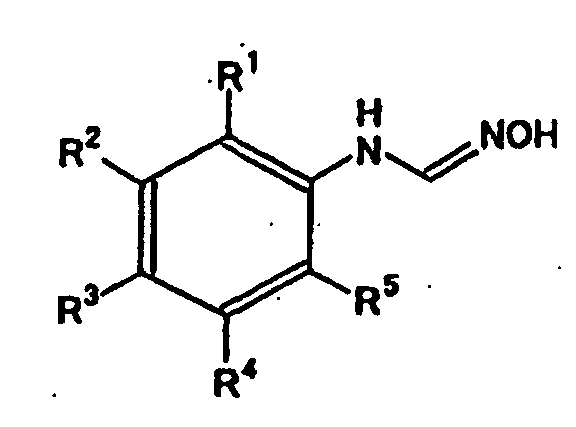
the two groups adjacent to each other of R1 to R5, taken together with the benzene ring to which they are bonded, form a phthalimide ring; a phthalimide ring substituted with a C1-6 alkyl group; an indole ring; an indane ring; an indazole ring; a benzotriazole ring; an S,S-dioxobenzothiophene ring; a 2,3-dihydroimidazo[2,1-b]benzothiazole ring; a dibenzofuran ring; a dibenzofuran ring substituted with a C1-6 alkoxy group; a fluorene ring; a fluorene ring substituted with a halogen atom; a pyrene ring; a carbostyryl ring; a carbostyryl ring substituted with a C1-6 alkyl group; a naphthalene ring; a naphthalene ring substituted with 1 to 3 substituents selected from the group consisting of cyano groups, halogen atoms, nitro groups, and C1-6 alkyl groups; a 1,2,3,4-tetrahydronaphthalene ring; a quinoline ring; a quinoline ring substituted with a C1-6 alkyl group; an isoquinoline ring; a 2-oxo-α-chromene ring; a 2-oxo-α-chromene ring substituted with 1 to 3 substituents selected from the group consisting of C1-6 alkyl groups, C1-6 alkoxy groups, and C1-6 alkoxy C1-6 alkyl groups; a cinnolin ring; a cinnolin ring substituted with a C1-6 alkyl group; a phthalazindione ring; a benzothiazol ring; a benzothiazol ring substituted with a C1-6 alkyl group; a benzodioxorane ring; or a benzobutyrolactone ring, or a pharmaceutically-acceptable salt thereof. - The inhibitor for production of 20-hydroxyeicosatetraenoic acid, comprising, as an effective ingredient, a hydroxyformamidine derivative, according to Claim 1, wherein R1 to R5 are identical or different and represent a hydrogen atom; a hydroxyl group; a carboxyl group; a halogen atom; a C1-14 alkyl group; a C1-14 alkyl group substituted with 1 to 6 halogen atoms; a C2-6 alkynyl group; a C3-8 cycloalkyl group; a C3-8 cycloalkoxy group; a C2-10 alkanoyl group; a C1-6 hydroxyalkyl group; a C1-6 hydroxyalkyl group substituted with 1 to 6 halogen atoms; a C2-6 alkoxycarbonyl group; a 3-phenyl-2-propenyloxycarbonyl group; a C2-6 alkoxycarbonyl C1-6 alkyl group; a di(C1-6 alkyl)amino C2-6 alkoxycarbonyl group; a mono- or di(C1-6 alkyl) amino group; a C2-10 alkanoylamino group; a C2-6 alkanoylamino group substituted with a C1-6 alkyl group; a benzoylamino group; a carbamoyl group; a carbamoyl group mono- or di-substituted with C1-6 alkyl or phenyl groups; an N-(N',N'-di(C1-6 alkyl ) amino C1-6 alkyl)carbamoyl group; a cyano group; a cyano C1-6 alkyl group; a nitro group; a thiol group; a phenoxy group; a phenoxy group substituted with 1 to 3 substituents selected from the group consisting of C1-6 alkyl groups, C1-6 alkoxy groups, and halogen atoms; a phenylthio group; a nitrophenylthio group; a C1-6 alkylsulfonyl group; a phenylsulfonyl group; a C1-6 alkylthio C1-6 alkyl group; a phenylsulfonyl C1-6 alkylthio group wherein the benzene ring is substituted with 1 to 5 halogen atoms; a phenyl group; a benzyl group; a phenyl group substituted with 1 to 3 substituents selected from the group consisting of cyano groups, halogen atoms, C1-6 alkyl groups, and C1-6 alkoxy groups; a biphenyl group; an α-cyanobenzyl group; an α-cyanobenzyl group substituted with 1 to 5 halogen atoms; a benzyl group substituted with a bicyclo[2.2.1]-hept-5-en-2,3-dicarboxyimidyl group; a benzoyl group; a styryl group; a styryl group substituted with 1 to 5 substituents selected from the group consisting of C1-6 alkoxy groups and di(C1-6 alkyl)amino alkyl groups; a pyrrolidino group; a piperidino group; a morpholino group; a pyridyl group; a pyrimidinyl. group; a pyrimidinyl group substituted with 1 to 3 substituents selected from the group consisting of C1-6 alkyl groups and C1-6 alkoxy groups; a phthalimidoyl group: a phthalimidoyl group substituted with 1 to 3 halogen atoms; an N-carbazolyl group; a dioxopiperidinyl group substituted with 1 to 3 C1-6 alkyl groups; a phenylsulfonylamino group; a phenylsulfonylamino group substituted with 1 to 3 C1-6 alkyl groups; a C1-6 alkylaminosulfonyl C1-6 alkyl group; a thiadiazolyl group; an oxadiazolyl group; an oxadiazolyl group substituted with a substituted phenyl group wherein the substituents in the substituted phenyl group are 1 to 3 substituents selected from the group consisting of halogen atoms, C1-6 alkyl groups, and C1-6 alkoxy groups; a pyrrolidinyl group; a pyrazolyl group; a pyrazolyl group substituted with 1 to 3 substituents selected from the group consisting of halogen atoms, C1-6 alkyl groups, and trifluoromethyl groups; a furyl group; a furyl group substituted with 1 to 3 substituents selected from the group consisting of halogen atoms, C1-6 alkyl groups, and C2-6 alkoxycarbonyl groups; a thienopyrimidinylthio group; a thienopyrimidinylthio group substituted with 1 to 3 C1-6 alkyl groups; a thienopyridylthio group; a thienopyridylthio group substituted with 1 to 3 C1-6 alkyl groups; a benzothiazolylthio group; a benzothiazolylthio group substituted with 1 to 3 halogen atoms; or a group represented by the formula: -Y-(CR61R62)m-(CR63R64)n-R7 [wherein Y represents an oxygen or sulfur atom; R61, R62, R63, and R64 are identical or different and represent a hydrogen atom, a halogen atom, a C1-4 alkyl group, or a trifluoromethyl group; R7 represents a hydrogen atom; a halogen atom; a C1-14 alkyl group; a C3-8 cycloalkyl group; a C2-10 alkenyl group; a C2-6 alkynyl group; a phenyl group; a phenyl group substituted with 1 to 3 substituents selected from the group consisting of nitro groups, cyano groups, C1-6 alkyl groups, C1-6 alkoxy groups, C1-6 alkylthio groups, phenyl groups, phenoxy groups, phenethyl groups, C2-6 alkoxycarbonyl groups, and halogen atoms; a cyano group; a carboxyl group; a C1-6 alkoxy group; a C1-6 hydroxyalkyl group; a C3-8 cycloalkoxy group; a C1-6 alkoxy C1-6 alkoxy group; a C1-6 alkoxy C1-6 alkoxy C1-6 alkoxy group; a C1-6 alkylthio group; a C2-6 alkanoyloxy group; a C2-6 alkanoyloxy C1-6 alkyl group; a phenoxy group; a phenylthio group; an N-(C1-6 alkyl)toluidino group; a pyrrolidino group; a piperidino group; a morpholino group; a pyridyl group; a pyridyl group substituted with a C1-6 alkyl group; a piperidino group substituted with a C1-6 alkyl group; a pyridyl group substituted with a C1-6 alkoxy group; a pyrrolidino group substituted with a C1-6 alkyl group; a morpholino group substituted with a C1-6 alkyl group; a morpholinyl group; a morpholinyl group substituted with a C1-6 alkyl group; a homomorpholinyl group; a thiomorpholino group; a thiomorpholino group substituted with a C1-6 alkyl group; a thiomorpholinyl group; a thiomorpholinyl group substituted with a C1-6 alkyl group; a piperadinyl group; a piperadin-1-yl group substituted with a C1-6 alkyl group at the 4-position; a homopiperidinyl group; a homopiperidinyl group substituted with a C1-6 alkyl group; a pyridylthio group; a quinolyl group; a furyl group; an oxetanyl group; an oxolanyl group; a dioxolanyl group; a dioxolanyl group substituted with a C1-6 alkyl group; an oxanyl group; a dioxanyl group; a dioxanyl group substituted with a C1-6 alkyl group; a benzodioxanyl group; a pyrrolidon-1-yl group; a pyrrolidinyl group; an N-(C1-6 alkyl)pyrrolidinyl group; a piperidinyl group; an N-(C1-6 alkyl)piperidinyl group; a pyrrolyl group; a thienyl group; a thiazolyl group; a thiazolyl group substituted with 1 to 3 C1-6 alkyl groups; a 2, 6-purindion-7-yl group substituted with C1-6 alkyl group(s); a furfuryl group; a di(C1-6 alkyl)amino group; a C2-6 alkoxycarbonyl group; or a di(C1-6 alkyl)amino C1-6 alkoxy group; m is an integer of 1 to 6; and n is an integer of 0 to 6], or a pharmaceutically-acceptable salt thereof.
- The inhibitor for production of 20-hydroxyeicosatetraenoic acid, comprising, as an effective ingredient, a hydroxyformamidine derivative or a pharmaceutically-acceptable salt thereof, according to Claim 2, wherein R1, R2, R4, and R5 represent hydrogen atoms.
- The inhibitor for production of 20-hydroxyeicosatetraenoic acid, according to any one of Claims 1 to 3, which is a therapeutic agent for kidney diseases, cerebrovascular diseases, or circulatory diseases.
- A hydroxyformamidine derivative represented by the formula:wherein at least one of R11 to R55 represents a C5-14 alkyl group; a C2-6 alkenyl group; a C3-8 cycloalkyl C1-6 alkyl group; a C2-6 alkynyl group; a C3-8 cycloalkyl group; a C3-8 cycloalkoxy group; a C2-10 alkanoyl group; a C1-6 hydroxyalkyl group; a C1-6 hydroxyalkyl group substituted with 1 to 6 halogen atoms; a C2-6 alkoxycarbonyl group; a 3-phenyl-2-propenyloxycarbonyl group; a C2-6 alkoxycarbonyl C1-6 alkyl group; a di(C1-6 alkyl)amino C2-6 alkoxycarbonyl group; a mono- or di(C1-6 alkyl)amino group; a C2-10 alkanoylamino group; a C2-6 alkanoylamino group substituted with a C1-6 alkyl group; a benzoylamino group; a carbamoyl group; a carbamoyl group mono- or di-substituted with C1-6 alkyl or phenyl groups; an N-(N',N'-di(C1-6 alkyl)amino C1-6 alkyl)carbamoyl group; a cyano group; a cyano C1-6 alkyl group; a C1-6 alkylsulfonyl group; a phenylsulfonyl group; a C1-6 alkylthio C1-6 alkyl group; a phenylsulfonyl C1-6 alkylthio group wherein the benzene ring is substituted with 1 to 5 halogen atoms; a phenyl group; a benzyl group; a phenyl group substituted with 1 to 3 substituents selected from the group consisting of cyano groups, halogen atoms, C1-6 alkyl groups, and C1-6 alkoxy groups; a biphenyl group; an α-cyanobenzyl group; an α-cyanobenzyl group substituted with 1 to 5 halogen atoms; a benzyl group substituted with a bicyclo[2.2.1]-hept-5-en-2,3-dicarboxyimidyl group; a benzoyl group; a styryl group; a styryl group substituted with 1 to 5 substituents selected from the group consisting of C1-6 alkoxy groups and di(C1-6 alkyl)amino alkyl groups; a pyrrolidino group; a piperidino group; a morpholino group; a pyridyl group; a pyrimidinyl group; a pyrimidinyl group substituted with 1 to 3 substituents selected from the group consisting of C1-6 alkyl groups and C1-6 alkoxy groups; a phthalimidoyl group; a phthalimidoyl group substituted with 1 to 3 halogen atoms; an N-carbazolyl group; a dioxopiperidinyl group substituted with 1 to 3 C1-6 alkyl groups; a phenylsulfonylamino group; a phenylsulfonylamino group substituted with 1 to 3 C1-6 alkyl groups; a C1-6 alkylaminosulfonyl C1-6 alkyl group; a thiadiazolyl group; an oxadiazolyl group; an oxadiazolyl group substituted with a substituted phenyl group wherein the substituents in the substituted phenyl group are 1 to 3 substituents selected from the group consisting of halogen atoms, C1-6 alkyl groups, and C1-6 alkoxy groups; a pyrrolidinyl group; a pyrazolyl group; a pyrazolyl group substituted with 1 to 3 substituents selected from the group consisting of halogen atoms, C1-6 alkyl groups, and trifluoromethyl groups; a furyl group; a furyl group substituted with 1 to 3 substituents selected from the group consisting of halogen atoms, C1-6 alkyl groups, and C2-6 alkoxycarbonyl groups; a thienopyrimidinylthio group; a thienopyrimidinylthio group substituted with 1 to 3 C1-6 alkyl groups; a thienopyridylthio group; a thienopyridylthio group substituted with 1 to 3 C1-6 alkyl groups; a benzothiazolylthio group; a benzothiazolylthio group substituted with 1 to 3 halogen atoms; a group represented by the formula: -Y-(CR61R62)m-(CR63R64)n-R77 [wherein Y represents an oxygen or sulfur atom; R61, R62, R63, and R64 are identical or different and represent a hydrogen atom, a halogen atom, a C1-4 alkyl group, or a trifluoromethyl group; R77 represents a halogen atom; a C4-14 alkyl group; a C3-8 cycloalkyl group; a C2-10 alkenyl group; a C2-6 alkynyl group; a phenyl group; a phenyl group substituted with 1 to 3 substituents selected from the group consisting of nitro groups, cyano groups, C1-6 alkyl groups, C1-6 alkoxy groups, C1-6 alkylthio groups, phenyl groups, phenoxy groups, phenethyl groups, C2-6 alkoxycarbonyl groups, and halogen atoms; a cyano group; a carboxyl group; a C1-6 alkoxy group; a C1-6 hydroxyalkyl group; a C3-8 cycloalkoxy group; a C1-6 alkoxy C1-6 alkoxy group; a C1-6 alkoxy C1-6 alkoxy C1-6 alkoxy group; a C1-6 alkylthio group; a C2-6 alkanoyloxy group; a phenoxy group; a phenylthio group; an N-(C1-6 alkyl)toluidino group; a pyrrolidino group; a piperidino group; a morpholino group; a pyridyl group; a pyridyl group substituted with a C1-6 alkyl group; a piperidino group substituted with a C1-6 alkyl group; a pyridyl group substituted with a C1-6 alkoxy group; a pyrrolidino group substituted with a C1-6 alkyl group; a morpholino group substituted with a C1-6 alkyl group; a morpholinyl group; a morpholinyl group substituted with a C1-6 alkyl group; a homomorpholinyl group; a thiomorpholino group; a thiomorpholino group substituted with a C1-6 alkyl group; a thiomorpholinyl group; a thiomorpholinyl group substituted with a C1-6 alkyl group; a piperadinyl group; a piperadin-1-yl group substituted with a C1-6 alkyl group at the 4-position; a homopiperidinyl group; a homopiperidinyl group substituted with a C1-6 alkyl group; a pyridylthio group; a quinolyl group; a furyl group; an oxetanyl group; an oxolanyl group; a dioxolanyl group; a dioxolanyl group substituted with a C1-6 alkyl group; an oxanyl group; a dioxanyl group; a dioxanyl group substituted with a C1-6 alkyl group; a benzodioxanyl group; a pyrrolidon-1-yl group; a pyrrolidinyl group; an N-(C1-6 alkyl)pyrrolidinyl group; a piperidinyl group; an N-(C1-6 alkyl)piperidinyl group; a pyrrolyl group; a thienyl group; a thiazolyl group; a thiazolyl group substituted with 1 to 3 C1-6 alkyl groups; a 2,6-purindion-7-yl group substituted with at least one C1-6 alkyl group; a furfuryl group; a di(C1-6 alkyl)amino group; a C2-6 alkoxycarbonyl group; or a di(C1-6 alkyl)amino C1-6 alkoxy group; m is an integer of 1 to 6; and n is an integer of 0 to 6]; or a group represented by the formula: -SO2NR8R9 [wherein R8 and R9 are identical or different and represent a hydrogen atom, a C1-10 alkyl group, a C2-6 alkanoyl group, an isoxazolyl group, an isoxazolyl group substituted with 1 to 3 C1-6 alkyl groups, a thiadiazolyl group, a thiadiazolyl group substituted with 1 to 3 C1-6 alkyl groups, a thiazolyl group, a thiazolyl group substituted with 1 to 3 C1-6 alkyl groups, a pyridyl group, a pyridyl group substituted with 1 to 3 C1-6 alkyl groups, a pyrimidinyl group, a pyrimidinyl group substituted with 1 to 3 C1-6 alkyl groups, a pyrimidinyl group substituted with 1 to 3 C1-6 alkoxy groups, a pyridazinyl group, a pyridazinyl group substituted with 1 to 3 C1-6 alkoxy groups, an indazolyl group, or a carbamoyl group mono- or di-substituted with C1-6 alkyl groups, or alternatively, taken together with the nitrogen atom to which they are bonded, form a 3,5-dioxopiperadino group, a pyrrolidinyl group, a piperidino group, or a morpholino group], or alternatively,

the two groups adjacent to each other of R11 to R55, taken together with the benzene ring to which they are bonded, form a phthalimide ring; a phthalimide ring substituted with a C1-6 alkyl group; an indole ring; an indane ring; an indazole ring; a benzotriazole ring; an S,S-dioxobenzothiophene ring; a 2,3-dihydroimidazo[2,1-b]benzothiazole ring; a dibenzofuran ring; a dibenzofuran ring substituted with a C1-6 alkoxy group; a fluorene ring; a fluorene ring substituted with a halogen atom; a pyrene ring; a carbostyryl ring; a carbostyryl ring substituted with a C1-6 alkyl group; a naphthalene ring; a naphthalene ring substituted with 1 to 3 substituents selected from the group consisting of cyano groups, halogen atoms, nitro groups, and C1-6 alkyl groups; a 1,2,3,4-tetrahydronaphthalene ring; a quinoline ring; a quinoline ring substituted with a C1-6 alkyl group; an isoquinoline ring; a 2-oxo-α-chromene ring; a 2-oxo-α-chromene ring substituted with 1 to 3 substituents selected from the group consisting of C1-6 alkyl groups, C1-6 alkoxy groups, and C1-6 alkoxy C1-6 alkyl groups; a cinnolin ring; a cinnolin ring substituted with a C1-6 alkyl group; a phthalazindione ring; a benzothiazol ring; a benzothiazol ring substituted with a C1-6 alkyl group; a benzodioxorane ring; and a benzobutyrolactone ring, and the remaining groups of R11 to R55 are identical or different and represent a hydrogen atom, a C1-4 alkyl group, a C1-4 alkoxy group, a trifluoromethyl group, a nitro group, or a halogen atom, or a pharmaceutically-acceptable salt thereof. - The hydroxyformamidine derivative or a pharmaceutically-acceptable salt thereof, according to Claim 5, wherein at least one of R11 to R55 represents a C5-14 alkyl group; a C3-8 cycloalkoxy group; a C2-6 alkynyl group; a C3-8 cycloalkyl group; a C2-10 alkanoyl group; a C1-6 hydroxyalkyl group; a C1-6 hydroxyalkyl group substituted with 1 to 6 halogen atoms; a C2-6 alkoxycarbonyl group; a 3-phenyl-2-propenyloxycarbonyl group; a C2-6 alkoxycarbonyl C1-6 alkyl group; a di(C1-6 alkyl) amino C2-6 alkoxycarbonyl group; a mono- or di(C1-6 alkyl)amino group; a C2-10 alkanoylamino group; a C2-6 alkanoylamino group substituted with a C1-6 alkyl group; a benzoylamino group; a carbamoyl group; a carbamoyl group mono- or di-substituted with C1-6 alkyl or phenyl groups; an N-(N',N'-di(C1-6 alkyl) amino C1-6 alkyl) carbamoyl group; a cyano group; a cyano C1-6 alkyl group; a C1-6 alkylsulfonyl group; a phenylsulfonyl group; a C1-6 alkylthio C1-6 alkyl group; a phenylsulfonyl C1-6 alkylthio group wherein the benzene ring is substituted with 1 to 5 halogen atoms; a phenyl group; a benzyl group; a phenyl group substituted with 1 to 3 substituents selected from the group consisting of cyano groups, halogen atoms, C1-6 alkyl groups, and C1-6 alkoxy groups; a biphenyl group; an α-cyanobenzyl group; an α-cyanobenzyl group substituted with 1 to 5 halogen atoms; a benzyl group substituted with a bicyclo[2.2.1]-hept-5-en-2,3-dicarboxyimidyl group; a benzoyl group; a styryl group; a styryl group substituted with 1 to 5 substituents selected from the group consisting of C1-6 alkoxy groups and di(C1-6 alkyl)amino alkyl groups; a pyrrolidino group; a piperidino group; a morpholino group; a pyridyl group; a pyrimidinyl group; a pyrimidinyl group substituted with 1 to 3 substituents selected from the group consisting of C1-6 alkyl groups and C1-6 alkoxy groups; a phthalimidoyl group; a phthalimidoyl group substituted with 1 to 3 halogen atoms; an N-carbazolyl group; a dioxopiperidinyl group substituted with 1 to 3 C1-6 alkyl groups; a phenylsulfonylamino group; a phenylsulfonylamino group substituted with 1 to 3 C1-6 alkyl groups; a C1-6 alkylaminosulfonyl C1-6 alkyl group; a thiadiazolyl group; an oxadiazolyl group; an oxadiazolyl group substituted with a substituted phenyl group wherein the substituents in the substituted phenyl group are 1 to 3 substituents selected from the group consisting of halogen atoms, C1-6 alkyl groups, and C1-6 alkoxy groups; a pyrrolidinyl group; a pyrazolyl group; a pyrazolyl group substituted with 1 to 3 substituents selected from the group consisting of halogen atoms, C1-6 alkyl groups, and trifluoromethyl groups; a furyl group; a furyl group substituted with 1 to 3 substituents selected from the group consisting of halogen atoms, C1-6 alkyl groups, and C2-6 alkoxycarbonyl groups; a thienopyrimidinylthio group; a thienopyrimidinylthio group substituted with 1 to 3 C1-6 alkyl groups; a thienopyridylthio group; a thienopyridylthio group substituted with 1 to 3 C1-6 alkyl groups; a benzothiazolylthio group; a benzothiazolylthio group substituted with 1 to 3 halogen atoms; or a group represented by the formula: -SO2NR8R9 [wherein R8 and R9 are identical or different and represent a hydrogen atom, a C1-10 alkyl group, a C2-6 alkanoyl group, an isoxazolyl group, an isoxazolyl group substituted with 1 to 3 C1-6 alkyl groups, a thiadiazolyl group, a thiadiazolyl group substituted with 1 to 3 C1-6 alkyl groups, a thiazolyl group, a thiazolyl group substituted with 1 to 3 C1-6 alkyl groups, a pyridyl group, a pyridyl group substituted with 1 to 3 C1-6 alkyl groups, a pyrimidinyl group, a pyrimidinyl group substituted with 1 to 3 C1-6 alkyl groups, a pyrimidinyl group substituted with 1 to 3 C1-6 alkoxy groups, a pyridazinyl group, a pyridazinyl group substituted with 1 to 3 C1-6 alkoxy groups, an indazolyl group, or a carbamoyl group mono- or di-substituted with C1-6 alkyl groups, or alternatively, taken together with the nitrogen atom to which they are bonded, form a 3,5-dioxopiperadino group, a pyrrolidinyl group, a piperidino group, or a morpholino group], or alternatively,
the two groups adjacent to each other of R11 to R55, taken together with the benzene ring to which they are bonded, form a phthalimide ring; a phthalimide ring substituted with a C1-6 alkyl group; an indole ring; an indane ring; an indazole ring; a benzotriazole ring; an S,S-dioxobenzothiophene ring; a 2,3-dihydroimidazo[2,1-b]benzothiazole ring; a dibenzofuran ring; a dibenzofuran ring substituted with a C1-6 alkoxy group; a fluorene ring; a fluorene ring substituted with a halogen atom; a pyrene ring; a carbostyryl ring; a carbostyryl ring substituted with a C1-6 alkyl group; a naphthalene ring; a naphthalene ring substituted with 1 to 3 substituents selected from the group consisting of cyano groups, halogen atoms, nitro groups, and C1-6 alkyl groups; a 1,2,3,4-tetrahydronaphthalene ring; a quinoline ring; a quinoline ring substituted with a C1-6 alkyl group; an isoquinoline ring; a 2-oxo-α-chromene ring; a 2-oxo-α-chromene ring substituted with 1 to 3 substituents selected from the group consisting of C1-6 alkyl groups, C1-6 alkoxy groups, and C1-6 alkoxy C1-6 alkyl groups; a cinnolin ring; a cinnolin ring substituted with a C1-6 alkyl group; a phthalazindione ring; a benzothiazol ring; a benzothiazol ring substituted with a C1-6 alkyl group; a benzodioxorane ring; and a benzobutyrolactone ring, and the remaining groups of R11 to R55 are identical or different and represent a hydrogen atom, a C1-4 alkyl group, a C1-4 alkoxy group, a trifluoromethyl group, a nitro group, or a halogen atom. - The hydroxyformamidine derivative or a pharmaceutically-acceptable salt thereof, according to Claim 6, wherein at least one of R11 to R55 represents a C5-14 alkyl group; a C2-6 alkynyl group; a C3-8 cycloalkyl group; a C3-8 cycloalkoxy group; a C2-10 alkanoyl group; a C1-6 hydroxyalkyl group; a C1-6 hydroxyalkyl group substituted with 1 to 6 halogen atoms; a C2-6 alkoxycarbonyl group; a 3-phenyl-2-propenyloxycarbonyl group; a C2-6 alkoxycarbonyl C1-6 alkyl group; a di(C1-6 alkyl) amino C2-6 alkoxycarbonyl group; a mono- or di(C1-6 alkyl) amino group; a C2-10 alkanoylamino group; a C2-6 alkanoylamino group substituted with a C1-6 alkyl group; a carbamoyl group; a carbamoyl group mono- or di-substituted with C1-6 alkyl or phenyl groups; an N-(N',N'-di(C1-6 alkyl) amino C1-6 alkyl)carbamoyl group; a cyano group; a cyano C1-6 alkyl group; a C1-6 alkylsulfonyl group; a phenylsulfonyl group; a C1-6 alkylthio C1-6 alkyl group; a phenyl group; a benzyl group; a phenyl group substituted with 1 to 3 substituents selected from the group consisting of cyano groups, halogen atoms, C1-6 alkyl groups, and C1-6 alkoxy groups; a biphenyl group; an α-cyanobenzyl group; an α-cyanobenzyl group substituted with 1 to 5 halogen atoms; a benzoyl group; a pyrrolidino group; a piperidino group; a morpholino group; a pyridyl group; a pyrimidinyl group; a pyrimidinyl group substituted with 1 to 3 substituents selected from the group consisting of C1-6 alkyl groups and C1-6 alkoxy groups; a pyrrolidinyl group; a pyrazolyl group; a pyrazolyl group substituted with 1 to 3 substituents selected from the group consisting of halogen atoms, C1-6 alkyl groups, and trifluoromethyl groups; a furyl group; a furyl group substituted with 1 to 3 substituents selected from the group consisting of halogen atoms, C1-6 alkyl groups, and C2-6 alkoxycarbonyl groups; or a group represented by the formula: -SO2NR8R9 [wherein R8 and R9 are identical or different and represent a hydrogen atom, a C1-10 alkyl group, a C2-6 alkanoyl group, an isoxazolyl group, an isoxazolyl group substituted with 1 to 3 C1-6 alkyl groups, a thiadiazolyl group, a thiadiazolyl group substituted with 1 to 3 C1-6 alkyl groups, a thiazolyl group, a thiazolyl group substituted with 1 to 3 C1-6 alkyl groups, a pyridyl group, a pyridyl group substituted with 1 to 3 C1-6 alkyl groups, a pyrimidinyl group, a pyrimidinyl group substituted with 1 to 3 C1-6 alkyl groups, a pyrimidinyl group substituted with 1 to 3 C1-6 alkoxy groups, a pyridazinyl group, a pyridazinyl group substituted with 1 to 3 C1-6 alkoxy groups, an indazolyl group, or a carbamoyl group mono- or di-substituted with C1-6 alkyl groups, or alternatively, taken together with the nitrogen atom to which they are bonded, form a 3,5-dioxopiperadino group, a pyrrolidinyl group, a piperidino group, or a morpholino group] and the remaining groups of R11 to R55 are identical or different and represent a hydrogen atom, a C1-4 alkyl group, a C1-4 alkoxy group, a trifluoromethyl group, a nitro group, or a halogen atom.
- The hydroxyformamidine derivative or a pharmaceutically-acceptable salt thereof, according to Claim 5, wherein at least one of R11 to R55 represents a group represented by the formula: -Y-(CR61R62)m-(CR63R64)n-R77 [wherein Y represents an oxygen or sulfur atom; R61, R62, R63, and R64 are identical or different and represent a hydrogen atom, a halogen atom, a C1-4 alkyl group, or a trifluoromethyl group; R77 represents a halogen atom; a C4-14 alkyl group; a C3-8 cycloalkyl group; a C2-10 alkenyl group; a C2-6 alkynyl group; a phenyl group; a phenyl group substituted with 1 to 3 substituents selected from the group consisting of nitro groups, cyano groups, C1-6 alkyl groups, C1-6 alkoxy groups, C1-6 alkylthio groups, phenyl groups, phenoxy groups, phenethyl groups, C2-6 alkoxycarbonyl groups, and halogen atoms; a cyano group; a carboxyl group; a C1-6 alkoxy group; a C1-6 hydroxyalkyl group; a C3-8 cycloalkoxy group; a C1-6 alkoxy C1-6 alkoxy group; a C1-6 alkoxy C1-6 alkoxy C1-6 alkoxy group: a C1-6 alkylthio group; a C2-6 alkanoyloxy group; a C2-6 alkanoyloxy C1-6 alkyl group; a phenoxy group; a phenylthio group; an N-(C1-6 alkyl)toluidino group; a pyrrolidino group; a piperidino group; a morpholino group; a pyridyl group; a pyridyl group substituted with a C1-6 alkyl group; a piperidino group substituted with a C1-6 alkyl group; a pyridyl group substituted with a C1-6 alkoxy group; a pyrrolidino group substituted with a C1-6 alkyl group; a morpholino group substituted with a C1-6 alkyl group; a morpholinyl group; a morpholinyl group substituted with a C1-6 alkyl group; a homomorpholinyl group; a thiomorpholino group; a thiomorpholino group substituted with a C1-6 alkyl group; a thiomorpholinyl group; a thiomorpholinyl group substituted with a C1-6 alkyl group; a piperadinyl group; a piperadin-1-yl group substituted with a C1-6 alkyl group at the 4-position; a homopiperidinyl group; a homopiperidinyl group substituted with a C1-6 alkyl group; a pyridylthio group; a quinolyl group; a furyl group; an oxetanyl group; an oxolanyl group; an dioxolanyl group; a dioxolanyl group substituted with a C1-6 alkyl group; an oxanyl group; a dioxanyl group; a dioxanyl group substituted with a C1-6 alkyl group; a benzodioxanyl group; a pyrrolidon-1-yl group; a pyrrolidinyl group; an N-(C1-6 alkyl)pyrrolidinyl group; a piperidinyl group; an N-(C1-6 alkyl)piperidinyl group; a pyrrolyl group; a thienyl group; a thiazolyl group; a thiazolyl group substituted with 1 to 3 C1-6 alkyl groups; a 2,6-purindion-7-yl group substituted with C1-6 alkyl group(s); a furfuryl group; a di(C1-6 alkyl) amino group; a C2-6 alkoxycarbonyl group; or a di(C1-6 alkyl)amino C1-6 alkoxy group; m is an integer of 1 to 6; and n is an integer of 0 to 6], and the remaining groups of R11 to R55 are identical or different and represent a hydrogen atom, a C1-4 alkyl group, a C1-4 alkoxy group, a trifluoromethyl group, a nitro group, or a halogen atom.
- The hydroxyformamidine derivative or a pharmaceutically-acceptable salt thereof, according to Claim 8, wherein at least one of R11 to R55 represents a group represented by the formula: -O-(CR61R62)m-(CR63R64)n-R77 [wherein R61, R62, R63, and R64 are identical or different and represent a hydrogen atom, a halogen atom, a C1-4 alkyl group, or a trifluoromethyl group; R77 represents a di(C1-6 alkyl) amino group; a di(C1-6 alkyl) amino C1-6 alkoxy group; a piperidyl group; a piperidinyl group substituted with a C1-6 alkyl group; a piperidino group; a piperidino group substituted with a C1-6 alkyl group; a pyridyl group; a pyridinyl group substituted with a C1-6 alkyl group; a pyridinyl group substituted with a C1-6 alkoxy group; a pyridylthio group; a pyrrolidino group; a pyrrolidino group substituted with a C1-6 alkyl group; a pyrrolidon-1-yl group; a pyrrolidinyl group; a pyrrolidinyl group substituted with a C1-6 alkyl group; a pyrrolyl group; a thienyl group; a thiazolyl group; a morpholino group; a morpholino group substituted with a C1-6 alkyl group; a morpholinyl group; a morpholinyl group substituted with a C1-6 alkyl group; a homomorpholinyl group; a thiomorpholino group; a thiomorpholino group substituted with a C1-6 alkyl group; a thiomorpholinyl group; a thiomorpholinyl group substituted with a C1-6 alkyl group; a piperadinyl group; a piperadin-1-yl group substituted with a C1-6 alkyl group at the 4-position; a homopiperidinyl group; or a homopiperidinyl group substituted with a C1-6 alkyl group; m is an integer of 1 to 6; and n is an integer of 0 to 6], and the remaining groups of R11 to R55 are identical or different and represent a hydrogen atom, a C1-4 alkyl group, a C1-4 alkoxy group, a trifluoromethyl group, a nitro group, or a halogen atom.
- The hydroxyformamidine derivative or a pharmaceutically-acceptable salt thereof, according to any one of Claims 7 to 9, wherein R11, R22, R44, and R55 represent hydrogen atoms.
- An inhibitor for production of 20-hydroxyeicosatetraenoic acid, comprising, as an effective ingredient, the hydroxyformamidine derivative or a pharmaceutically-acceptable salt thereof according to any one of Claims 5 to 10.
- The inhibitor for production of 20-hydroxyeicosatetraenoic acid, according to Claim 11, which is a therapeutic agent for kidney diseases, cerebrovascular diseases, or circulatory diseases.
Applications Claiming Priority (13)
| Application Number | Priority Date | Filing Date | Title |
|---|---|---|---|
| JP31113799 | 1999-11-01 | ||
| JP31113799 | 1999-11-01 | ||
| JP37234799 | 1999-12-28 | ||
| JP37234799 | 1999-12-28 | ||
| JP2000180478 | 2000-06-15 | ||
| JP2000180476 | 2000-06-15 | ||
| JP2000180473 | 2000-06-15 | ||
| JP2000180472 | 2000-06-15 | ||
| JP2000180472 | 2000-06-15 | ||
| JP2000180476 | 2000-06-15 | ||
| JP2000180473 | 2000-06-15 | ||
| JP2000180478 | 2000-06-15 | ||
| PCT/JP2000/007694 WO2001032164A1 (en) | 1999-11-01 | 2000-11-01 | Inhibitor for 20-hete-yielding enzyme |
Publications (3)
| Publication Number | Publication Date |
|---|---|
| EP1226819A1 true EP1226819A1 (en) | 2002-07-31 |
| EP1226819A4 EP1226819A4 (en) | 2003-06-04 |
| EP1226819B1 EP1226819B1 (en) | 2006-01-18 |
Family
ID=27554564
Family Applications (1)
| Application Number | Title | Priority Date | Filing Date |
|---|---|---|---|
| EP00971721A Expired - Lifetime EP1226819B1 (en) | 1999-11-01 | 2000-11-01 | Inhibitor for 20-hete-yielding enzyme |
Country Status (13)
| Country | Link |
|---|---|
| US (2) | US6864254B1 (en) |
| EP (1) | EP1226819B1 (en) |
| JP (1) | JP4045099B2 (en) |
| KR (2) | KR100767508B1 (en) |
| CN (1) | CN1250209C (en) |
| AT (1) | ATE315932T1 (en) |
| AU (1) | AU759604B2 (en) |
| CA (1) | CA2389378C (en) |
| CY (1) | CY1105591T1 (en) |
| DE (1) | DE60025644T8 (en) |
| DK (1) | DK1226819T3 (en) |
| ES (1) | ES2256053T3 (en) |
| WO (1) | WO2001032164A1 (en) |
Cited By (3)
| Publication number | Priority date | Publication date | Assignee | Title |
|---|---|---|---|---|
| WO2004024677A1 (en) * | 2002-09-12 | 2004-03-25 | Taisho Pharmaceutical Co.,Ltd. | N-hydroxyformamidine derivative |
| EP1291343A4 (en) * | 2000-06-15 | 2004-04-07 | Taisho Pharmaceutical Co Ltd | HYDROXYFORMAMIDINE DERIVATIVES AND MEDICINES CONTAINING THEM |
| WO2008034011A2 (en) | 2006-09-13 | 2008-03-20 | Mcw Research Foundation, Inc. | Methods of modulating cell proliferation and cyst formation in polycystic kidney and liver diseases |
Families Citing this family (5)
| Publication number | Priority date | Publication date | Assignee | Title |
|---|---|---|---|---|
| CA2427557A1 (en) | 2000-11-03 | 2002-05-10 | Mcw Research Foundation, Inc. | Use of 20-hete synthesizing enzyme inhibitors as therapy for cerebral vascular diseases |
| CA2445329C (en) | 2001-04-26 | 2010-02-16 | Taisho Pharmaceutical Co., Ltd. | 20-hydroxyeicosatetraenoic acid production inhibitors |
| US6818662B2 (en) * | 2002-05-28 | 2004-11-16 | Taisho Pharmaceutical Co., Ltd. | Pharmaceutical composition |
| JP2008230968A (en) * | 2005-06-30 | 2008-10-02 | Taisho Pharmaceutical Co Ltd | Medicine for the treatment of cerebral infarction |
| JP7052798B2 (en) | 2017-08-10 | 2022-04-12 | 大正製薬株式会社 | Pyridine compound substituted with azole |
Family Cites Families (8)
| Publication number | Priority date | Publication date | Assignee | Title |
|---|---|---|---|---|
| CH609024A5 (en) * | 1974-09-30 | 1979-02-15 | Lafon Labor | Process for the preparation of new sulphur-containing diaryl and oxygen-containing diaryl compounds |
| DE2717437A1 (en) * | 1977-04-20 | 1978-10-26 | Hoechst Ag | SUBSTITUTED N-PHENYLFORMAMIDOXIME AND METHOD FOR THE PRODUCTION THEREOF |
| US4237168A (en) * | 1979-06-11 | 1980-12-02 | The Dow Chemical Company | N-(4-Chloro-2-methylphenyl)-N-hydroxy methanimidamide and its pesticidal use |
| IT1209431B (en) * | 1980-11-28 | 1989-07-16 | Angeli Inst Spa | IMIDAZOLYLPHENYL AMIDINE, PROCESSES FOR THEIR PREPARATION AND PHARMACEUTICAL USE, AND INTERMEDIATE PREPARATION. |
| AU3022984A (en) * | 1983-07-15 | 1985-01-17 | Nippon Soda Co., Ltd. | Formamidoxime derivatives |
| JPS60132881A (en) | 1983-12-21 | 1985-07-15 | 三菱電機株式会社 | Controller for hydraulic elevator |
| US5238964A (en) * | 1990-04-05 | 1993-08-24 | Torii & Co., Ltd. | Agent for treatment of cerebrovascular contraction |
| US6395781B1 (en) * | 1998-02-26 | 2002-05-28 | Mcw Research Foundation | 20-HETE antagonists and agonists |
-
2000
- 2000-11-01 DK DK00971721T patent/DK1226819T3/en active
- 2000-11-01 KR KR1020027005444A patent/KR100767508B1/en not_active Expired - Fee Related
- 2000-11-01 CN CNB008148562A patent/CN1250209C/en not_active Expired - Fee Related
- 2000-11-01 US US09/869,103 patent/US6864254B1/en not_active Expired - Fee Related
- 2000-11-01 JP JP2001534369A patent/JP4045099B2/en not_active Expired - Fee Related
- 2000-11-01 WO PCT/JP2000/007694 patent/WO2001032164A1/en not_active Ceased
- 2000-11-01 KR KR1020077015915A patent/KR100785148B1/en not_active Expired - Fee Related
- 2000-11-01 CA CA002389378A patent/CA2389378C/en not_active Expired - Fee Related
- 2000-11-01 DE DE60025644T patent/DE60025644T8/en active Active
- 2000-11-01 AT AT00971721T patent/ATE315932T1/en active
- 2000-11-01 EP EP00971721A patent/EP1226819B1/en not_active Expired - Lifetime
- 2000-11-01 ES ES00971721T patent/ES2256053T3/en not_active Expired - Lifetime
- 2000-11-01 AU AU10533/01A patent/AU759604B2/en not_active Ceased
-
2003
- 2003-07-01 US US10/609,547 patent/US7078400B2/en not_active Expired - Fee Related
-
2006
- 2006-02-22 CY CY20061100256T patent/CY1105591T1/en unknown
Cited By (8)
| Publication number | Priority date | Publication date | Assignee | Title |
|---|---|---|---|---|
| EP1291343A4 (en) * | 2000-06-15 | 2004-04-07 | Taisho Pharmaceutical Co Ltd | HYDROXYFORMAMIDINE DERIVATIVES AND MEDICINES CONTAINING THEM |
| WO2004024677A1 (en) * | 2002-09-12 | 2004-03-25 | Taisho Pharmaceutical Co.,Ltd. | N-hydroxyformamidine derivative |
| CN1293049C (en) * | 2002-09-12 | 2007-01-03 | 大正制药株式会社 | N-Hydroxyformamidine Derivatives |
| US7288566B2 (en) | 2002-09-12 | 2007-10-30 | Taisho Pharmaceutical Co., Ltd. | N-hydroxyformamidine derivatives |
| WO2008034011A2 (en) | 2006-09-13 | 2008-03-20 | Mcw Research Foundation, Inc. | Methods of modulating cell proliferation and cyst formation in polycystic kidney and liver diseases |
| WO2008034011A3 (en) * | 2006-09-13 | 2008-05-29 | Mcw Res Found Inc | Methods of modulating cell proliferation and cyst formation in polycystic kidney and liver diseases |
| US8846764B2 (en) | 2006-09-13 | 2014-09-30 | The Medical College Of Wisconsin, Inc. | Methods of modulating cell proliferation and cyst formation in polycystic kidney and liver diseases |
| US9511072B2 (en) | 2006-09-13 | 2016-12-06 | The Medical College Of Wisconsin, Inc. | Methods of modulating cell proliferation and cyst formation in polycystic kidney and liver diseases |
Also Published As
| Publication number | Publication date |
|---|---|
| WO2001032164A1 (en) | 2001-05-10 |
| KR100785148B1 (en) | 2007-12-11 |
| AU759604B2 (en) | 2003-04-17 |
| US7078400B2 (en) | 2006-07-18 |
| CN1250209C (en) | 2006-04-12 |
| DK1226819T3 (en) | 2006-05-22 |
| JP4045099B2 (en) | 2008-02-13 |
| EP1226819A4 (en) | 2003-06-04 |
| DE60025644D1 (en) | 2006-04-06 |
| KR100767508B1 (en) | 2007-10-17 |
| KR20020050248A (en) | 2002-06-26 |
| ATE315932T1 (en) | 2006-02-15 |
| DE60025644T8 (en) | 2007-03-29 |
| CA2389378A1 (en) | 2001-05-10 |
| AU1053301A (en) | 2001-05-14 |
| DE60025644T2 (en) | 2006-09-07 |
| ES2256053T3 (en) | 2006-07-16 |
| EP1226819B1 (en) | 2006-01-18 |
| KR20070087044A (en) | 2007-08-27 |
| HK1050141A1 (en) | 2003-06-13 |
| CA2389378C (en) | 2009-11-24 |
| US6864254B1 (en) | 2005-03-08 |
| CY1105591T1 (en) | 2010-07-28 |
| US20040110830A1 (en) | 2004-06-10 |
| CN1382045A (en) | 2002-11-27 |
Similar Documents
| Publication | Publication Date | Title |
|---|---|---|
| CN103038231B (en) | Modulators of HEC1 activity and methods thereof | |
| AU2016316278B2 (en) | Carboxy substituted (hetero) aromatic ring derivatives and preparation method and uses thereof | |
| MXPA02001565A (en) | INHIBITORS OF c-JUN N-TERMINAL KINASES (JNK) AND OTHER PROTEIN KINASES. | |
| JP2002529503A (en) | Nitrosated and nitrosylated H2 receptor antagonist compounds and compositions and methods of use | |
| EP3795566A1 (en) | Ppar agonists, compounds, pharmaceutical compositions, and methods of use thereof | |
| WO2022214691A1 (en) | Deuterated dhodh inhibitors | |
| EP1226819B1 (en) | Inhibitor for 20-hete-yielding enzyme | |
| RU2512547C2 (en) | Derivative, containing condensed ring structure, and its application in medicine | |
| CN109988202A (en) | Therapeutic agent for use in the prevention and/or treatment of diabetic foot disease | |
| CA2411418C (en) | Hydroxyformamidine derivatives and medicines containing the same | |
| CN112939947A (en) | Compound of PARP7 small molecule inhibitor and application thereof | |
| JPWO2001032164A1 (en) | 20-HETE-producing enzyme inhibitor | |
| JPWO2001096309A1 (en) | Hydroxyformamidine derivatives and medicines containing them | |
| JP4604147B2 (en) | Coumarin derivative | |
| JPWO2008032665A1 (en) | New phenylacetic acid derivatives | |
| RU2846274C2 (en) | Novel compounds, derivatives of isoindolinone, as caspase inhibitors | |
| KR102670554B1 (en) | Novel isoindolinone derivative compounds as caspase inhibitors | |
| HK40110666A (en) | Novel isoindolinone derivative compounds as caspase inhibitors | |
| RS62656B1 (en) | Ethynyl compounds, their preparation and their therapeutic use for the treatment of malaria | |
| AU2003272099A1 (en) | Large conductance calcium-activated k channel opener |
Legal Events
| Date | Code | Title | Description |
|---|---|---|---|
| PUAI | Public reference made under article 153(3) epc to a published international application that has entered the european phase |
Free format text: ORIGINAL CODE: 0009012 |
|
| 17P | Request for examination filed |
Effective date: 20020417 |
|
| AK | Designated contracting states |
Kind code of ref document: A1 Designated state(s): AT BE CH CY DE DK ES FI FR GB GR IE IT LI LU MC NL PT SE TR |
|
| A4 | Supplementary search report drawn up and despatched |
Effective date: 20030423 |
|
| 17Q | First examination report despatched |
Effective date: 20030812 |
|
| GRAP | Despatch of communication of intention to grant a patent |
Free format text: ORIGINAL CODE: EPIDOSNIGR1 |
|
| GRAP | Despatch of communication of intention to grant a patent |
Free format text: ORIGINAL CODE: EPIDOSNIGR1 |
|
| GRAS | Grant fee paid |
Free format text: ORIGINAL CODE: EPIDOSNIGR3 |
|
| GRAA | (expected) grant |
Free format text: ORIGINAL CODE: 0009210 |
|
| AK | Designated contracting states |
Kind code of ref document: B1 Designated state(s): AT BE CH CY DE DK ES FI FR GB GR IE IT LI LU MC NL PT SE TR |
|
| PG25 | Lapsed in a contracting state [announced via postgrant information from national office to epo] |
Ref country code: IT Free format text: LAPSE BECAUSE OF FAILURE TO SUBMIT A TRANSLATION OF THE DESCRIPTION OR TO PAY THE FEE WITHIN THE PRE;WARNING: LAPSES OF ITALIAN PATENTS WITH EFFECTIVE DATE BEFORE 2007 MAY HAVE OCCURRED AT ANY TIME BEFORE 2007. THE CORRECT EFFECTIVE DATE MAY BE DIFFERENT FROM THE ONE RECORDED.SCRIBED TIME-LIMIT Effective date: 20060118 |
|
| REG | Reference to a national code |
Ref country code: GB Ref legal event code: FG4D |
|
| REG | Reference to a national code |
Ref country code: CH Ref legal event code: EP |
|
| REG | Reference to a national code |
Ref country code: IE Ref legal event code: FG4D |
|
| REG | Reference to a national code |
Ref country code: GR Ref legal event code: EP Ref document number: 20060400420 Country of ref document: GR |
|
| REG | Reference to a national code |
Ref country code: CH Ref legal event code: NV Representative=s name: NOVAGRAAF INTERNATIONAL SA |
|
| REF | Corresponds to: |
Ref document number: 60025644 Country of ref document: DE Date of ref document: 20060406 Kind code of ref document: P |
|
| REG | Reference to a national code |
Ref country code: SE Ref legal event code: TRGR |
|
| REG | Reference to a national code |
Ref country code: DK Ref legal event code: T3 |
|
| REG | Reference to a national code |
Ref country code: ES Ref legal event code: FG2A Ref document number: 2256053 Country of ref document: ES Kind code of ref document: T3 |
|
| ET | Fr: translation filed | ||
| PLBE | No opposition filed within time limit |
Free format text: ORIGINAL CODE: 0009261 |
|
| STAA | Information on the status of an ep patent application or granted ep patent |
Free format text: STATUS: NO OPPOSITION FILED WITHIN TIME LIMIT |
|
| 26N | No opposition filed |
Effective date: 20061019 |
|
| REG | Reference to a national code |
Ref country code: CH Ref legal event code: PFA Owner name: TAISHO PHARMACEUTICAL CO., LTD Free format text: TAISHO PHARMACEUTICAL CO., LTD#24-1 TAKATA 3-CHOME, TOSHIMA-KU#TOKYO 170-8633 (JP) -TRANSFER TO- TAISHO PHARMACEUTICAL CO., LTD#24-1 TAKATA 3-CHOME, TOSHIMA-KU#TOKYO 170-8633 (JP) |
|
| REG | Reference to a national code |
Ref country code: FR Ref legal event code: PLFP Year of fee payment: 16 |
|
| PGFP | Annual fee paid to national office [announced via postgrant information from national office to epo] |
Ref country code: GR Payment date: 20151015 Year of fee payment: 16 Ref country code: DK Payment date: 20151110 Year of fee payment: 16 Ref country code: DE Payment date: 20151028 Year of fee payment: 16 Ref country code: GB Payment date: 20151028 Year of fee payment: 16 Ref country code: LU Payment date: 20151130 Year of fee payment: 16 Ref country code: IT Payment date: 20151124 Year of fee payment: 16 Ref country code: TR Payment date: 20151008 Year of fee payment: 16 Ref country code: FI Payment date: 20151111 Year of fee payment: 16 Ref country code: CH Payment date: 20151111 Year of fee payment: 16 Ref country code: IE Payment date: 20151109 Year of fee payment: 16 |
|
| PGFP | Annual fee paid to national office [announced via postgrant information from national office to epo] |
Ref country code: BE Payment date: 20151111 Year of fee payment: 16 Ref country code: CY Payment date: 20151014 Year of fee payment: 16 Ref country code: PT Payment date: 20151102 Year of fee payment: 16 Ref country code: FR Payment date: 20151008 Year of fee payment: 16 Ref country code: SE Payment date: 20151111 Year of fee payment: 16 Ref country code: ES Payment date: 20151014 Year of fee payment: 16 Ref country code: AT Payment date: 20151027 Year of fee payment: 16 Ref country code: NL Payment date: 20151012 Year of fee payment: 16 Ref country code: MC Payment date: 20151009 Year of fee payment: 16 |
|
| PG25 | Lapsed in a contracting state [announced via postgrant information from national office to epo] |
Ref country code: BE Free format text: LAPSE BECAUSE OF NON-PAYMENT OF DUE FEES Effective date: 20161130 |
|
| REG | Reference to a national code |
Ref country code: DE Ref legal event code: R119 Ref document number: 60025644 Country of ref document: DE |
|
| REG | Reference to a national code |
Ref country code: DK Ref legal event code: EBP Effective date: 20161130 |
|
| REG | Reference to a national code |
Ref country code: CH Ref legal event code: PL |
|
| REG | Reference to a national code |
Ref country code: SE Ref legal event code: EUG |
|
| REG | Reference to a national code |
Ref country code: NL Ref legal event code: MM Effective date: 20161201 |
|
| REG | Reference to a national code |
Ref country code: AT Ref legal event code: MM01 Ref document number: 315932 Country of ref document: AT Kind code of ref document: T Effective date: 20161101 |
|
| GBPC | Gb: european patent ceased through non-payment of renewal fee |
Effective date: 20161101 |
|
| PG25 | Lapsed in a contracting state [announced via postgrant information from national office to epo] |
Ref country code: CY Free format text: LAPSE BECAUSE OF NON-PAYMENT OF DUE FEES Effective date: 20161101 Ref country code: LI Free format text: LAPSE BECAUSE OF NON-PAYMENT OF DUE FEES Effective date: 20161130 Ref country code: GR Free format text: LAPSE BECAUSE OF NON-PAYMENT OF DUE FEES Effective date: 20170612 Ref country code: CH Free format text: LAPSE BECAUSE OF NON-PAYMENT OF DUE FEES Effective date: 20161130 Ref country code: FI Free format text: LAPSE BECAUSE OF NON-PAYMENT OF DUE FEES Effective date: 20161101 |
|
| REG | Reference to a national code |
Ref country code: IE Ref legal event code: MM4A |
|
| REG | Reference to a national code |
Ref country code: FR Ref legal event code: ST Effective date: 20170731 |
|
| PG25 | Lapsed in a contracting state [announced via postgrant information from national office to epo] |
Ref country code: SE Free format text: LAPSE BECAUSE OF NON-PAYMENT OF DUE FEES Effective date: 20161102 Ref country code: AT Free format text: LAPSE BECAUSE OF NON-PAYMENT OF DUE FEES Effective date: 20161101 Ref country code: PT Free format text: LAPSE BECAUSE OF NON-PAYMENT OF DUE FEES Effective date: 20170502 |
|
| PG25 | Lapsed in a contracting state [announced via postgrant information from national office to epo] |
Ref country code: LU Free format text: LAPSE BECAUSE OF NON-PAYMENT OF DUE FEES Effective date: 20161130 Ref country code: NL Free format text: LAPSE BECAUSE OF NON-PAYMENT OF DUE FEES Effective date: 20161201 |
|
| PG25 | Lapsed in a contracting state [announced via postgrant information from national office to epo] |
Ref country code: IT Free format text: LAPSE BECAUSE OF NON-PAYMENT OF DUE FEES Effective date: 20161101 Ref country code: FR Free format text: LAPSE BECAUSE OF NON-PAYMENT OF DUE FEES Effective date: 20161130 |
|
| PG25 | Lapsed in a contracting state [announced via postgrant information from national office to epo] |
Ref country code: IE Free format text: LAPSE BECAUSE OF NON-PAYMENT OF DUE FEES Effective date: 20161101 Ref country code: GB Free format text: LAPSE BECAUSE OF NON-PAYMENT OF DUE FEES Effective date: 20161101 Ref country code: DE Free format text: LAPSE BECAUSE OF NON-PAYMENT OF DUE FEES Effective date: 20170601 Ref country code: DK Free format text: LAPSE BECAUSE OF NON-PAYMENT OF DUE FEES Effective date: 20161130 |
|
| REG | Reference to a national code |
Ref country code: BE Ref legal event code: MM Effective date: 20161130 |
|
| PG25 | Lapsed in a contracting state [announced via postgrant information from national office to epo] |
Ref country code: ES Free format text: LAPSE BECAUSE OF FAILURE TO SUBMIT A TRANSLATION OF THE DESCRIPTION OR TO PAY THE FEE WITHIN THE PRESCRIBED TIME-LIMIT Effective date: 20060118 |
|
| REG | Reference to a national code |
Ref country code: ES Ref legal event code: FD2A Effective date: 20180627 |
|
| PG25 | Lapsed in a contracting state [announced via postgrant information from national office to epo] |
Ref country code: MC Free format text: LAPSE BECAUSE OF NON-PAYMENT OF DUE FEES Effective date: 20161130 |
|
| PG25 | Lapsed in a contracting state [announced via postgrant information from national office to epo] |
Ref country code: ES Free format text: LAPSE BECAUSE OF FAILURE TO SUBMIT A TRANSLATION OF THE DESCRIPTION OR TO PAY THE FEE WITHIN THE PRESCRIBED TIME-LIMIT Effective date: 20161102 |
|
| PG25 | Lapsed in a contracting state [announced via postgrant information from national office to epo] |
Ref country code: TR Free format text: LAPSE BECAUSE OF NON-PAYMENT OF DUE FEES Effective date: 20161101 |