EP1225250A2 - Metal surface-treating method - Google Patents
Metal surface-treating method Download PDFInfo
- Publication number
- EP1225250A2 EP1225250A2 EP02001002A EP02001002A EP1225250A2 EP 1225250 A2 EP1225250 A2 EP 1225250A2 EP 02001002 A EP02001002 A EP 02001002A EP 02001002 A EP02001002 A EP 02001002A EP 1225250 A2 EP1225250 A2 EP 1225250A2
- Authority
- EP
- European Patent Office
- Prior art keywords
- zinc
- ion
- aqueous
- solution
- chemical conversion
- Prior art date
- Legal status (The legal status is an assumption and is not a legal conclusion. Google has not performed a legal analysis and makes no representation as to the accuracy of the status listed.)
- Withdrawn
Links
Images
Classifications
-
- C—CHEMISTRY; METALLURGY
- C23—COATING METALLIC MATERIAL; COATING MATERIAL WITH METALLIC MATERIAL; CHEMICAL SURFACE TREATMENT; DIFFUSION TREATMENT OF METALLIC MATERIAL; COATING BY VACUUM EVAPORATION, BY SPUTTERING, BY ION IMPLANTATION OR BY CHEMICAL VAPOUR DEPOSITION, IN GENERAL; INHIBITING CORROSION OF METALLIC MATERIAL OR INCRUSTATION IN GENERAL
- C23C—COATING METALLIC MATERIAL; COATING MATERIAL WITH METALLIC MATERIAL; SURFACE TREATMENT OF METALLIC MATERIAL BY DIFFUSION INTO THE SURFACE, BY CHEMICAL CONVERSION OR SUBSTITUTION; COATING BY VACUUM EVAPORATION, BY SPUTTERING, BY ION IMPLANTATION OR BY CHEMICAL VAPOUR DEPOSITION, IN GENERAL
- C23C22/00—Chemical surface treatment of metallic material by reaction of the surface with a reactive liquid, leaving reaction products of surface material in the coating, e.g. conversion coatings, passivation of metals
- C23C22/05—Chemical surface treatment of metallic material by reaction of the surface with a reactive liquid, leaving reaction products of surface material in the coating, e.g. conversion coatings, passivation of metals using aqueous solutions
- C23C22/06—Chemical surface treatment of metallic material by reaction of the surface with a reactive liquid, leaving reaction products of surface material in the coating, e.g. conversion coatings, passivation of metals using aqueous solutions using aqueous acidic solutions with pH less than 6
- C23C22/07—Chemical surface treatment of metallic material by reaction of the surface with a reactive liquid, leaving reaction products of surface material in the coating, e.g. conversion coatings, passivation of metals using aqueous solutions using aqueous acidic solutions with pH less than 6 containing phosphates
-
- C—CHEMISTRY; METALLURGY
- C23—COATING METALLIC MATERIAL; COATING MATERIAL WITH METALLIC MATERIAL; CHEMICAL SURFACE TREATMENT; DIFFUSION TREATMENT OF METALLIC MATERIAL; COATING BY VACUUM EVAPORATION, BY SPUTTERING, BY ION IMPLANTATION OR BY CHEMICAL VAPOUR DEPOSITION, IN GENERAL; INHIBITING CORROSION OF METALLIC MATERIAL OR INCRUSTATION IN GENERAL
- C23C—COATING METALLIC MATERIAL; COATING MATERIAL WITH METALLIC MATERIAL; SURFACE TREATMENT OF METALLIC MATERIAL BY DIFFUSION INTO THE SURFACE, BY CHEMICAL CONVERSION OR SUBSTITUTION; COATING BY VACUUM EVAPORATION, BY SPUTTERING, BY ION IMPLANTATION OR BY CHEMICAL VAPOUR DEPOSITION, IN GENERAL
- C23C22/00—Chemical surface treatment of metallic material by reaction of the surface with a reactive liquid, leaving reaction products of surface material in the coating, e.g. conversion coatings, passivation of metals
- C23C22/05—Chemical surface treatment of metallic material by reaction of the surface with a reactive liquid, leaving reaction products of surface material in the coating, e.g. conversion coatings, passivation of metals using aqueous solutions
- C23C22/06—Chemical surface treatment of metallic material by reaction of the surface with a reactive liquid, leaving reaction products of surface material in the coating, e.g. conversion coatings, passivation of metals using aqueous solutions using aqueous acidic solutions with pH less than 6
- C23C22/34—Chemical surface treatment of metallic material by reaction of the surface with a reactive liquid, leaving reaction products of surface material in the coating, e.g. conversion coatings, passivation of metals using aqueous solutions using aqueous acidic solutions with pH less than 6 containing fluorides or complex fluorides
- C23C22/36—Chemical surface treatment of metallic material by reaction of the surface with a reactive liquid, leaving reaction products of surface material in the coating, e.g. conversion coatings, passivation of metals using aqueous solutions using aqueous acidic solutions with pH less than 6 containing fluorides or complex fluorides containing also phosphates
- C23C22/364—Chemical surface treatment of metallic material by reaction of the surface with a reactive liquid, leaving reaction products of surface material in the coating, e.g. conversion coatings, passivation of metals using aqueous solutions using aqueous acidic solutions with pH less than 6 containing fluorides or complex fluorides containing also phosphates containing also manganese cations
- C23C22/365—Chemical surface treatment of metallic material by reaction of the surface with a reactive liquid, leaving reaction products of surface material in the coating, e.g. conversion coatings, passivation of metals using aqueous solutions using aqueous acidic solutions with pH less than 6 containing fluorides or complex fluorides containing also phosphates containing also manganese cations containing also zinc and nickel cations
-
- C—CHEMISTRY; METALLURGY
- C23—COATING METALLIC MATERIAL; COATING MATERIAL WITH METALLIC MATERIAL; CHEMICAL SURFACE TREATMENT; DIFFUSION TREATMENT OF METALLIC MATERIAL; COATING BY VACUUM EVAPORATION, BY SPUTTERING, BY ION IMPLANTATION OR BY CHEMICAL VAPOUR DEPOSITION, IN GENERAL; INHIBITING CORROSION OF METALLIC MATERIAL OR INCRUSTATION IN GENERAL
- C23C—COATING METALLIC MATERIAL; COATING MATERIAL WITH METALLIC MATERIAL; SURFACE TREATMENT OF METALLIC MATERIAL BY DIFFUSION INTO THE SURFACE, BY CHEMICAL CONVERSION OR SUBSTITUTION; COATING BY VACUUM EVAPORATION, BY SPUTTERING, BY ION IMPLANTATION OR BY CHEMICAL VAPOUR DEPOSITION, IN GENERAL
- C23C22/00—Chemical surface treatment of metallic material by reaction of the surface with a reactive liquid, leaving reaction products of surface material in the coating, e.g. conversion coatings, passivation of metals
- C23C22/05—Chemical surface treatment of metallic material by reaction of the surface with a reactive liquid, leaving reaction products of surface material in the coating, e.g. conversion coatings, passivation of metals using aqueous solutions
- C23C22/06—Chemical surface treatment of metallic material by reaction of the surface with a reactive liquid, leaving reaction products of surface material in the coating, e.g. conversion coatings, passivation of metals using aqueous solutions using aqueous acidic solutions with pH less than 6
- C23C22/07—Chemical surface treatment of metallic material by reaction of the surface with a reactive liquid, leaving reaction products of surface material in the coating, e.g. conversion coatings, passivation of metals using aqueous solutions using aqueous acidic solutions with pH less than 6 containing phosphates
- C23C22/08—Orthophosphates
- C23C22/12—Orthophosphates containing zinc cations
- C23C22/13—Orthophosphates containing zinc cations containing also nitrate or nitrite anions
-
- C—CHEMISTRY; METALLURGY
- C23—COATING METALLIC MATERIAL; COATING MATERIAL WITH METALLIC MATERIAL; CHEMICAL SURFACE TREATMENT; DIFFUSION TREATMENT OF METALLIC MATERIAL; COATING BY VACUUM EVAPORATION, BY SPUTTERING, BY ION IMPLANTATION OR BY CHEMICAL VAPOUR DEPOSITION, IN GENERAL; INHIBITING CORROSION OF METALLIC MATERIAL OR INCRUSTATION IN GENERAL
- C23C—COATING METALLIC MATERIAL; COATING MATERIAL WITH METALLIC MATERIAL; SURFACE TREATMENT OF METALLIC MATERIAL BY DIFFUSION INTO THE SURFACE, BY CHEMICAL CONVERSION OR SUBSTITUTION; COATING BY VACUUM EVAPORATION, BY SPUTTERING, BY ION IMPLANTATION OR BY CHEMICAL VAPOUR DEPOSITION, IN GENERAL
- C23C22/00—Chemical surface treatment of metallic material by reaction of the surface with a reactive liquid, leaving reaction products of surface material in the coating, e.g. conversion coatings, passivation of metals
- C23C22/05—Chemical surface treatment of metallic material by reaction of the surface with a reactive liquid, leaving reaction products of surface material in the coating, e.g. conversion coatings, passivation of metals using aqueous solutions
- C23C22/06—Chemical surface treatment of metallic material by reaction of the surface with a reactive liquid, leaving reaction products of surface material in the coating, e.g. conversion coatings, passivation of metals using aqueous solutions using aqueous acidic solutions with pH less than 6
- C23C22/07—Chemical surface treatment of metallic material by reaction of the surface with a reactive liquid, leaving reaction products of surface material in the coating, e.g. conversion coatings, passivation of metals using aqueous solutions using aqueous acidic solutions with pH less than 6 containing phosphates
- C23C22/08—Orthophosphates
- C23C22/18—Orthophosphates containing manganese cations
- C23C22/182—Orthophosphates containing manganese cations containing also zinc cations
-
- C—CHEMISTRY; METALLURGY
- C23—COATING METALLIC MATERIAL; COATING MATERIAL WITH METALLIC MATERIAL; CHEMICAL SURFACE TREATMENT; DIFFUSION TREATMENT OF METALLIC MATERIAL; COATING BY VACUUM EVAPORATION, BY SPUTTERING, BY ION IMPLANTATION OR BY CHEMICAL VAPOUR DEPOSITION, IN GENERAL; INHIBITING CORROSION OF METALLIC MATERIAL OR INCRUSTATION IN GENERAL
- C23C—COATING METALLIC MATERIAL; COATING MATERIAL WITH METALLIC MATERIAL; SURFACE TREATMENT OF METALLIC MATERIAL BY DIFFUSION INTO THE SURFACE, BY CHEMICAL CONVERSION OR SUBSTITUTION; COATING BY VACUUM EVAPORATION, BY SPUTTERING, BY ION IMPLANTATION OR BY CHEMICAL VAPOUR DEPOSITION, IN GENERAL
- C23C22/00—Chemical surface treatment of metallic material by reaction of the surface with a reactive liquid, leaving reaction products of surface material in the coating, e.g. conversion coatings, passivation of metals
- C23C22/73—Chemical surface treatment of metallic material by reaction of the surface with a reactive liquid, leaving reaction products of surface material in the coating, e.g. conversion coatings, passivation of metals characterised by the process
Definitions
- the present invention relates to a method for zinc phosphate chemical conversion treatment of metallic shaped products, such as automotive bodies, household electrical appliances, steel furniture and so forth.
- Metallic shaped products such as automotive bodies, household electrical appliances, and steel furniture are generally subjected to zinc phosphate chemical conversion treatment prior to coating.
- This treatment process is generally carried out by a spray technique or a dip technique but in cases where, as it is true of an automotive body, the substrate has an intricate multiple-pocket structure and the corrosion resistance after coating is an important quality parameter, it is common practice to serially apply dip chemical conversion and coating with cationic electrodeposition coating.
- the substrate as such, one having both an iron type surface and a zinc type surface is usually applied thereto.
- the conventional zinc phosphating of metals is generally carried out in a sequence of degreasing-aqueous washing-aqueous washing-chemical conversion-aqueous washing-aqueous washing.
- the reagents are replenished to make up for the consumption of chemical conversion bath components due to the chemical conversion film formation and the carry-over in order that the concentrations of zinc and other metal ions, total acidity, acid ratio, and other parameters in the treating bath may be controlled at constant values.
- the concentration of NO 2 in the treating bath is controlled so as to be constant by supplying an aqueous solution of sodium nitrite as a chemical conversion accelerator.
- the above control technology is tantamount to adding a sodium ion which is unnecessary for chemical conversion and, as such, is uneconomical and, in addition, as the sodium ion concentration is increased, the pH of the treating bath is elevated so that the conversion reagent components are precipitated in the treating bath. Moreover, NO 2 in the treating bath is oxidized to nitrate ion so that the nitrate ion concentration of the treating bath is increased.
- the treating bath is partially carried over to the aqueous washing step as mentioned above but if supplementations are made to make up for the losses due to such carry-overs, it will not happen that the sodium and nitrate ions accumulate in the treating bath, thus allowing the balance of ion concentrations in the treating bath to be successfully maintained.
- the quantity of the above treating bath which is carried over to the downstream aqueous washing step is small and the composition of the reagent replenished is not compatible with the parameter settings of the chemical conversion treatment line and hence, leads to the buildup of some of the components, the balance of consumption and supply of ions of the treating bath composition is disturbed.
- the sodium ion and nitrate ion accumulate abnormally, with the result that chemical conversion defects such as yellow rust and thin spots may develop. Therefore, if nitric acid instead of sodium nitrite can be used as a chemical conversion accelerator, the accumulation of sodium ion may be avoided.
- nitric acid is so unstable that it does not exist under normal conditions and, hence, cannot be utilized.
- the carry-overs of the treating bath are washed off with a large quantity of water and discharged from the equipment but this poses a problem from the standpoint of protection of water quality and environment. Therefore, for resolving the above problem, there has been utilized the method which comprises constituting the aqueous washing step as a multi-stage system and recycling the overflowing washing water from a downstream stage to an upstream stage for use as washing water to thereby cut down on the supply of fresh washing water or the method which comprises treating the washing water from the chemical conversion line by reverse osmosis membrane treatment or evaporation in a closed system to recover the washing water and reuse it as a supplement to the chemical conversion treating bath or as washing water.
- the inventors of the present invention proposed in JP Application 2000-141893 an aqueous zinc nitrite solution which is obtainable by reacting zinc nitrate with calcium nitrite followed by purification and is of use as a substantially sodium ion- and sulfate ion-free chemical conversion accelerator for metal surface treatment.
- the object of the present invention is to provide a metal surface-treating method which is capable of forming a zinc phosphate coat suitable for the cationic electrodeposition coating of a metallic shaped product, particularly a metallic shaped product having both an iron type metallic surface and a zinc type metallic surface and is suited to a closed system.
- the present invention is directed to a metal surface-treating method which comprises a chemical conversion step of dipping a substrate in an acidic aqueous zinc phosphate solution, and using an aqueous zinc nitrite solution as an accelerator, said aqueous zinc nitrite solution being substantially free of calcium ion and containing 0 to 6500 ppm of sodium ion and 0 to 20 ppm of sulfate ion in case of assuming the concentration of zinc nitrite [Zn(NO 2 ) 2 ] therein to be 10 weight % as NO 2 .
- the acidic aqueous zinc phosphate solution mentioned above may contain 0.5 to 2 g/L of zincion, 5 to 30 g/L of phosphate ion, 0.2 to 2 g/L of manganese ion, and 0.05 to 0.3 g/L as NO 2 of zinc nitrite.
- the acidic aqueous zinc phosphate solution mentioned above may contain 0.3 to 2 g/L of nickel ion.
- the acidic aqueous zinc phosphate solution mentioned above may contain 3 to 30 g/L of nitrate ion.
- the substrate mentioned above is preferably a metal product having an iron type surface and a zinc type surface or one having an iron type surface, a zinc type surface and an aluminum type surface.
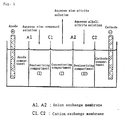
- Fig. 1 is a schematic diagram showing the electrodialyzer used in Preparation Example 1.
- the metal surface-treating method according to the present invention employs an aqueous zinc nitrite [Zn(NO 2 ) 2 ] solution.
- said aqueous zinc nitrite solution is used as an accelerator to be added to an acidic aqueous zinc phosphate solution and replenished as needed.
- an accelerator is generally added to a chemical conversion treating bath for promoting the chemical conversion reaction forming a chemical conversion coat on a metal surface, with the effect of enabling a chemical conversion treatment even at low temperature and reducing the conversion treatment time.
- the above aqueous zinc nitrite solution contains 5 to 40 weight % of NO 2 based on its weight. If the NO 2 content is less than 5 weight %, the quantity of the accelerator solution to be replenished during a chemical conversion treatment is undesirably increased. If the content exceeds 40 weight %, the levels of sodium ion and sulfate ion as impurities are increased during the production of said aqueous zinc nitrite solution, with the result that the chemical conversion coat is adversely affected.
- the preferred range is 9 to 20 weight %.
- the concentration of NO 2 in said aqueous zinc nitrite solution is 5 to 40 weight %, preferably 9 to 20 weight %
- the zinc ion concentration is 4 to 28 weight %, preferably 6 to 14 weight %
- the zinc nitrite concentration is 9 to 68 weight %, preferably 15 to 34 weight %.
- the above aqueous zinc nitrite solution is substantially free of calcium ions. If a calcium ion is present during acceleration of the chemical conversion, blending the accelerator with a zinc phosphating bath results in the formation of calcium phosphate sludges in the surface-treating bath and although these sludges are usually recovered periodically to prevent accumulation in the treating bath, the recovery of sludges is a troublesome procedure and not commercially recommendable.
- the term "substantially free of calcium ion” is used in this specification to mean that the concentration of calcium ion in said aqueous zinc nitrite solution as measured by ICP emission spectrometry is not more than 100 ppm, preferably not more than 10 ppm.
- the above aqueous zinc nitrite solution contains sodium ion and/or sulfate ion as impurity in some cases.
- the permissible range for sodium ion and sulfate ion in said aqueous zinc nitrite solution is 0 to 6500 ppm, preferably 0 to 4000 ppm, usually 500 to 2000 ppm for sodium ion and 0 to 20 ppm, preferably 0 to 15 ppm for sulfate ion in case assuming the concentration of zinc nitrite in said aqueous zinc nitrite solution to be 10 weight % as NO 2 .
- the sodium ion concentration referred to above is determined by atomic absorption spectrometry.
- sulfur (S) is measured by ICP emission spectrometry and the result is converted to sulfate ion concentration.
- the method of producing said aqueous zinc nitrite solution comprises a first step in which a soluble zinc compound and a soluble alkali nitrite compound are subjected, as starting materials, to double decomposition using ion exchange membranes as diaphragms to electrolytically synthesize an aqueous zinc nitrite solution, and a second step in which the aqueous zinc nitrite solution thus obtained is purified.
- the above first step is carried out preferably as follows.
- an electrodialyzer equipped with unit cells each having one concentrating chamber and two desalting chambers flanking said concentrating chamber as constructed by disposing cation exchange and anion exchange membranes between the cathode and anode in an alternating manner is employed.
- each desalting chamber being constructed by an anion exchange membrane on the anode side and a cation exchange membrane on the cathode side, the aqueous zinc compound solution is fed to the desalting chamber on the anode side while an aqueous alkali nitrite solution is fed to the desalting chamber on the cathode side and an electric current is supplied to the device.
- the zinc ion is caused to diffuse into the concentration chamber, flanked by desalting chambers, through a cation exchange membrane while NO 2 is caused to diffuse into the concentrating chamber through an anion exchange membrane to give the objective aqueous zinc nitrite solution.
- the reaction temperature is 10 to 50°C
- the current density is 1.0 A/dm 3 to limiting current density
- the current time is about 10 to 50 hours, although it is not particularly restricted.
- the above aqueous zinc compound solution is an aqueous solution prepared by dissolving a soluble zinc compound in water.
- the zinc compound mentioned above is not particularly restricted but includes, for example, zinc sulfate, zinc nitrate, zinc chloride and zinc acetate. These may be used each independently or two or more of them may be used in combination. From commercial availability points of view, zinc sulfate among them is preferred.
- the concentration of said aqueous zinc compound solution is not particularly restricted but is preferably not more than the saturation concentration at room temperature, more preferably 0.5 to 2.0 mol/L, still more preferably 0.9 to 1.3 mol/L.
- the aqueous alkali nitrite solution is an aqueous solution prepared by dissolving an alkali nitrite in water.
- the above alkali nitrite is not particularly restricted but includes, for example, sodium nitrite, potassium nitrite and lithium nitrite, and these may be used each independently or two or more of them may be used in combination. From commercial availability points of view, sodium nitrite among them is preferred.
- the concentration of said aqueous soluble alkali nitrite solution is not particularly restricted but is preferably not more than the saturation concentration at room temperature, more preferably 1.5 to 6.0 mol/L, still more preferably 3.0 to 4.5 mol/L.
- the cation exchange membrane mentioned above is not particularly restricted but those cation exchange membranes which are generally used in electrolytic synthesis, for instance, can be employed.
- Selemion CMV product of Asahi Glass Co.
- Neocepta CM-1 product of Tokuyama Soda Co.
- Nafion 324 product of DuPont
- anion exchange membrane mentioned above is not particularly restricted but those anion exchange membranes which are generally used in electrolytic synthesis, for instance, can be employed.
- Selemion AMV product of Asahi Glass Co.
- Neosepta AM-1 product of Tokuyama Soda Co.
- anode and cathode for use in the above electrodialyzer, their material and configuration are properly selected according to starting materials and the configuration of the electrodialyzer to be employed.
- metallic materials such as platinum, iron, copper, lead, etc. and carbonaceous materials can be mentioned as examples.
- the anode chamber containing said anode as defined by the above electrodialyzer and an anion exchange membrane and the cathode chamber containing said cathode as defined by said electrodialyzer housing and a cation exchange membrane are supplied with an electrolyte such as Na 2 SO 4 , NaCl, or NH 4 Br.
- the concentration of the aqueous zinc nitrite solution obtained in said concentrating chamber is higher with an increasing current time but since the sodium ion concentration and sulfate ion concentration in the aqueous zinc nitrite solution, in case of assuming the concentration of zinc nitrite therein to be 10 weight % as NO 2 , tend to become higher, the current time is preferably controlled so that the sodium ion concentration will be 0 to 6500 pm and the sulfate ion concentration will be 0 to 20 ppm.
- the above second step may be carried out by the routine purification method.
- the function of this second step in terms of purification includes the removal of excess ions so as to bring the various ions mentioned above in said aqueous nitrite solution into permissible ranges, for example the removal of excess sulfate ion in the event that, in case of assuming the concentration of the aqueous zinc nitrite solution obtained in the above-mentioned first step to be 10 weight % as NO 2 , the concentration of sulfate ion in said aqueous zinc nitrite solution exceeds 20 ppm, so as to bring the residual sulfate ion concentration into the range of 0 to 20 ppm.
- the purification technology for said removal of excess ions includes, for example, taking the purification for the removal of sulfate ion as an example, (1) the method which comprises adding a barium ion so as to precipitate barium sulfate, (2) the method which comprises passing the solution through a cation exchange resin or an anion exchange resin, and (3) the solvent extraction method, although the above method (1) is preferred.
- a barium ion need be added only in slight stoichiometric excess over the residual sulfate ion; thus, the level of addition may for example be 1.05 to 1.5 equivalents, preferably 1.05 to 1.2 equivalents, relative to the residual sulfate ion.
- the above aqueous zinc nitrite solution obtained by the above method is added, as a chemical conversion accelerator, to an acidic aqueous zinc phosphate solution which is a chemical conversion treating bath for the formation of a zinc phosphate coat on the metal surface.
- the acidic aqueous zinc phosphate solution mentioned above is not particularly restricted but may for example be the conventional acidic zinc phosphating bath.
- the preferred bath contains 0.5 to 2 g/L, preferably 0.7 to 1.2 g/L, of zinc ion, 5 to 30 g/L, preferably 10 to 20 g/L, of phosphate ion, and 0.2 to 2 g/L, preferably 0.3 to 1.2 g/L of manganese ion.
- the phosphate coat may develop thin spots and yellow rust so that the corrosion resistance after coating tends to be sacrificed. If the level of 2 g/L is exceeded, the coating adhesion tends to be decreased when the substrate is a shaped product having a zinc type metallic surface.
- the phosphate ion level is less than 5 g/L, the variation in bath composition will be increased to prevent stable formation of a satisfactory coat. If the level of 30 g/L is exceeded, an improved effect commensurate with the content may not be expected but rather the increased consumption of the reagent will lead to an economic disadvantage.
- the coating adhesion and corrosion resistance after coating may possibly be decreased when a zinc type metallic surface is involved. If the level of 2 g/L is exceeded, no extraordinary effect commensurate with the content will be obtained, leading to an economic disadvantage.
- An enhanced corrosion resistance can be insured by further supplementing said acidic aqueous zinc phosphate solution with 0.3 to 2 g/L, preferably 0.5 to 1.5 g/L, of nickel ion and/or 0.05 to 3 g/L, preferably 0.3 to 1.5 g/L, on an HF basis, of a fluorine compound.
- the fluorine compound content (on an HF basis) is less than 0.05 g/L, the variation in bath composition may possibly be increased to interfere with the stable formation of a satisfactory coat. On the other hand, if the level exceeds 3 g/L, no extraordinary effect commensurate with the content will be obtained and, rather, an economic disadvantage will result.
- the above acidic zinc phosphate bath may contain 3 to 30 g/L, preferably 3 to 15 g/L, of nitrate ion. If the level of 30 g/L is exceeded, the phosphate coat may develop thin spots and yellow rust in some cases.
- the ion concentrations in said acidic zinc phosphate bath are measured with Ion Chromatograph Series 4000 (manufactured by Dionex) or Atomic Absorption Spectometer 3300 (manufactured by Perkin Elmer).
- the free acidity of the treating bath is preferably 0.5 to 2.0 points.
- the free acidity of the treating bath can be determined by sampling 10 mL of the treating bath and titrating it with 0.1 N-sodium hydroxide using bromophenol blue as the indicator. If the acidity is less than 0.5 point, the stability of the treating bath tends to be decreased. If the acidity exceeds 2.0 points, the corrosion resistance according to the salt spray test tends to be decreased.
- the aqueous zinc nitrite solution as said accelerator is preferably formulated so that it will be occurring at a level of 0.05 to 0.3 g/L as NO 2 in said acidic aqueous zinc phosphate solution. If the level is below 0.05 g/L, the chemical conversion becomes insufficient in some cases. If the level of 0.3 g/L is exceeded, the contents of sodium ion and sulfate ion as impurities in the treating bath becomes so high that the chemical conversion coat may be adversely affected in some cases.
- the concentration management of NO 2 in the treating bath in the metal surface-treating method according to the present invention it is necessary to maintain NO 2 in a definite concentration range suited to the particular treating line using said aqueous zinc nitrite solution and this is accomplished by adding said aqueous zinc nitrite solution for supplementation either continuously or periodically.
- the proportion of said zinc nitrite for supplementation to be added is usually determined by measuring the NO 2 concentration of the acidic zinc phosphate treating bath.
- NO 2 can be generally quantitated using an Einhorn's tube, a device in use in fermentation industry, or a structural equivalent thereof in accordance with the protocol which is used as a practical technique in the field of phosphating industry based on the principle that nitrogen can be easily and quantitatively released from zinc nitrite and captured by using solid sulfamic acid and the concentration of NO 2 in the above treating bath can be calculated from the captured amount of nitrogen (Japanese Kokai Publication Sho-51-88442).
- the toner value found by the above method is such that a toner value of 1 point corresponds to a NO 2 concentration of about 44 mg/L.
- an aqueous sodium nitrite solution which is inexpensive, can be added in admixture with said aqueous zinc nitrite solution provided that the sodium ion concentration in the chemical conversion tank is within the above range.
- the accelerator to be added is substantially free of calcium ion and contains 0 to 20 ppm of sulfate ion in case of assuming the concentration of the aqueous accelerator solution to be 10 weight % as NO 2 .
- the metal surface-treating method according to the invention can be applied to metal panels and shaped products thereof and is particularly suitable for the metal surface treatment of shaped products having heterogeneous metal surfaces, such as a zinc type metallic surface and an iron type metallic surface or an iron type surface, a zinc type surface and an aluminum type surface, or having a intricate multiple-pocket structure, such as automotive bodies.
- heterogeneous metal surfaces such as a zinc type metallic surface and an iron type metallic surface or an iron type surface, a zinc type surface and an aluminum type surface, or having a intricate multiple-pocket structure, such as automotive bodies.
- the use of said aqueous zinc nitrite solution as an accelerator helps to eliminate accumulation of sodium ion and stabilize the chemical conversion reaction, thus precluding the deterioration of corrosion resistance due to the difference in the receptivity to the treatment between different metals and the poor reactivity of the recessed parts of the substrate.
- said chemical conversion bath and, as an accelerator, said aqueous zinc nitrite solution are used to treat metal surfaces by the dip technique for chemical conversion.
- the temperature at which the above metal surface treatment is carried out may be an ordinary treating temperature which can appropriately be selected within the range of, for example, 20 to 70°C.
- the time necessary for said metal surface treatment may usually be not less than 10 seconds, preferably not less than 30 seconds, more preferably 1 to 3 minutes.
- the above dip treatment is preferably followed by a spray treatment lasting not less than 2 seconds, preferably 5 to 45 seconds.
- This spray treatment is preferably conducted for a sufficiently long time to wash off the sludges deposited during the above dip treatment.
- the present invention encompasses not only the above dip treatment but also the above spray treatment performed thereafter.
- any of the pretreating equipment heretofore available can be employed but a pretreating equipment implementing a closed system involving reverse osmosis membrane treatment or evaporation or a pretreating equipment designed to cut down on the consumption of washing water is particularly suitable.
- a pretreating equipment implementing a closed system involving reverse osmosis membrane treatment or evaporation or a pretreating equipment designed to cut down on the consumption of washing water is particularly suitable.
- the above aqueous zinc nitrite solution is such that, in a case of assuming the concentration of aqueous zinc nitrite solution to be 10 weight % as NO 2 , its sodium ion and sulfate ion concentrations have been reduced to not more than 6500 ppm and not more than 20 ppm, respectively, and, moreover, is substantially free of calcium ion, and in accordance with the metal surface-treating method according to the present invention which comprises the use of the above aqueous zinc nitrite solution as an accelerator, the sludge formation is decreased and a very efficient metal surface treatment can be carried out even in cases where a closed system is adopted for metal surface treatment.
- this method is particularly suitable for the metal surface treatment of shaped products having a zinc type metallic surface and an iron type metallic surface or an iron type surface, a zinc type surface, and an aluminum type surface or shaped products having an intricate multiple-pocket structure, such as automotive bodies.
- the metal surface-treating method according to the present invention is not only capable of providing satisfactory zinc phosphate coats but also can be applied with advantage to a closed system.
- the zinc phosphate coat obtainable by the metal surface-treating method according to the invention is suitable for the cationic electrodeposition coating of metallic shaped products, particularly metallic shaped products having an iron type metallic surface and a zinc type metallic surface or metallic shaped products having an iron type surface, a zinc type surface and an aluminum type surface.
- an anion exchange membrane (product of Asahi Glass Co.; Selemion AMV) A1 a cation exchange membrane (product of Asahi Glass Co.; Selemion CMV) C1
- said anion exchange membrane A2 and said cation exchange membrane C2 were serially disposed from the anode side to the cathode side to define an anode chamber, a desalting chamber (I), a concentrating chamber (I), a desalting chamber (II), and a cathode chamber, and NO 2 and Zn ions only were selectively caused to migrate through the anion exchange membrane and the cation exchange membrane, respectively, to give an aqueous zinc nitrite solution.
- the experiment protocol was as follows.
- the concentrating chamber (I) was supplied with a 1.7% aqueous zinc nitrite solution.
- the anode chamber and cathode chamber were supplied with a 3% aqueous Na 2 SO 4 solution.
- As the anion exchange membrane and cation exchange membrane those having an effective membrane area of about 120 cm 2 each were used. While the solution in each chamber was circulated with a pump so as to maintain the concentration of the solution in each chamber uniform, a voltage of 5V was applied to each ion exchange membrane to carry out a double decomposition reaction by ion exchange membrane for 40 hours to give an aqueous zinc nitrite solution sample.
- aqueous zinc nitrite [Zn(NO 2 ) 2 ] solution the concentration of zinc nitrite was 17.7% and, in a case of assuming the concentration of this aqueous zinc nitrite solution to be 10% as NO 2 , the sodium ion concentration was 1188 ppm, that of sulfate ion was 10 ppm, and that of calcium ion was not more than 1 ppm.
- the free acidity of the treating bath was determined by sampling 10 mL of the treating bath and titrating the sample with 0.1 N-sodium hydroxide using bromophenol blue as an indicator.
- the total acid of the treating bath was determined by sampling 10 mL of the treating bath with pipette, titrating it with 0.1 N-sodium hydroxide using phenolphthalein as an indicator, and regarding the amount (mL) of 0.1 N-sodium hydroxide required till a transition point of developing a pink color as the total acid.
- Iron sheets size/type: 70 mm x 150 mm/SPC (cold-rolled steel sheet) and GA (galvanized steel sheet)
- SPC substrates 70 mm x 150 mm were treated under the above conditions, supplementing for the components consumed for the formation of coats (phosphoric acid, zinc, etc.).
- the above step as 1 turnover, was repeated 3 times (3 turnovers) to treat a total of 7500 panels.
- the aqueous NaNO 2 solution showed a NO 2 ion concentration of 27 weight % and a sodium ion concentration of 13 weight % and the sodium ion concentration in the chemical conversion tank was steady at 3900 ppm. It was clear from the results of Example 1 that at sodium ion concentration of 3900 ppm, a satisfactory chemical conversion coat could be obtained.
- a 5 L portion of the chemical conversion bath carry-over in Reference Example 1 was diluted with 45 L of industrial water with a pH value of 6.8 and an electrical conductivity of 234 ⁇ S/cm for use as an overflow washing water model.
- This dilution was adjusted to pH 3 with phosphoric acid and subjected to reverse osmosis membrane treatment using Membrane Master RUW-5A (manufactured by Nitto Denko) equipped with the commercial LF10 membrane module as a reverse osmosis system at a treating temperature of 25 to 30°C, a pressure of 1.0 to 1.1 MPa, a concentrate circulation flow rate of 6.2 to 6.3 L/min, and an effluent flow rate of 0.3 to 0.6 L/min to give 5 L of concentrate and 45 L of effluent.
- the sodium ion recovery rate of the above concentrate was 93%.
- Example 3 Determination of the accumulated amount of Na ion (aqueous NaNO 2 solution and aqueous Zn(NO 2 ) 2 solution)
- the sodium ion concentration in the chemical conversion tank could be controlled within a suitable range (3600-7500 ppm).
Landscapes
- Chemical & Material Sciences (AREA)
- General Chemical & Material Sciences (AREA)
- Chemical Kinetics & Catalysis (AREA)
- Engineering & Computer Science (AREA)
- Materials Engineering (AREA)
- Mechanical Engineering (AREA)
- Metallurgy (AREA)
- Organic Chemistry (AREA)
- Chemical Treatment Of Metals (AREA)
Abstract
Description
which comprises a chemical conversion step of dipping a substrate in an acidic aqueous zinc phosphate solution,
and using an aqueous zinc nitrite solution as an accelerator,
said aqueous zinc nitrite solution being
substantially free of calcium ion and containing 0 to 6500 ppm of sodium ion and 0 to 20 ppm of sulfate ion in case of assuming the concentration of zinc nitrite [Zn(NO2)2] therein to be 10 weight % as NO2.
| Zinc ion | 1000 ppm |
| Nickel ion | 1000 ppm |
| Manganese ion | 600 ppm |
| SiF6 | 1000 ppm |
| Nitrate ion | 6000 ppm |
| Phosphate ion | 15000 ppm |
| (Treating conditions) | |
| Free acidity | 0.8 Point |
| Total acid | 20 to 22 mL |
| Treating temperature | 43±2°C |
| Toner value | 2.5 to 3.0 Points |
Iron sheets (size/type): 70 mm x 150 mm/SPC (cold-rolled steel sheet) and GA (galvanized steel sheet)
| Investigation of the relation between sodium ion concentration and chemical conversion coat (SPC steel panel) | ||||
| Sodium conc. | 3600 ppm | 5000 ppm | 7500 ppm | 10000 ppm |
| Appearance, visual | Wholesome | Wholesome | Wholesome | Poor |
| Coat weight | 2.12 | 2.37 | 2.28 | 2.72 |
| Crystal size | Uniform, good | Uniform, good | Uniform, good | Not uniform, large |
| Investigation of the relation between sodium ion concentration and chemical conversion coat (GA steel panel) | ||||
| Sodium conc. | 3600 ppm | 5000 ppm | 7500 ppm | 10000 ppm |
| Appearance, visual | Wholesome | Wholesome | Wholesome | Poor |
| Coat weight | 3.82 | 3.58 | 3.57 | 4.50 |
| Crystal size | Uniform, good | Uniform, good | Uniform, good | Large |
Claims (5)
- A metal surface-treating method
which comprises a chemical conversion step of dipping a substrate in an acidic aqueous zinc phosphate solution,
and using an aqueous zinc nitrite solution as an accelerator,
said aqueous zinc nitrite solution being substantially free of calcium ion and containing 0 to 6500 ppm of sodium ion and 0 to 20 ppm of sulfate ion in case of assuming the concentration of zinc nitrite [Zn(NO2)2] therein to be 10 weight % as NO2. - The metal surface-treating method according to Claim 1
wherein the acidic aqueous zinc phosphate solution contains 0.5 to 2 g/L of zinc ion, 5 to 30 g/L of phosphate ion, 0.2 to 2 g/L of manganese ion, and 0.05 to 0.3 g/L as NO2 of zinc nitrite. - The metal surface-treating method according to Claim 1 or 2
wherein the acidic aqueous zinc phosphate solution contains 0.3 to 2 g/L of nickel ion. - The metal surface-treating method according to Claim 1, 2 or 3
wherein the acidic aqueous zinc phosphate solution contains 3 to 30 g/L of nitrate ion. - The metal surface-treating method according to Claims 1, 2, 3 or 4
wherein the substrate is a shaped product having an iron type surface and a zinc type surface or one having an iron type surface, a zinc type surface and an aluminum type surface.
Applications Claiming Priority (2)
| Application Number | Priority Date | Filing Date | Title |
|---|---|---|---|
| JP2001008717A JP4658339B2 (en) | 2001-01-17 | 2001-01-17 | Metal surface treatment method |
| JP2001008717 | 2001-01-17 |
Publications (2)
| Publication Number | Publication Date |
|---|---|
| EP1225250A2 true EP1225250A2 (en) | 2002-07-24 |
| EP1225250A3 EP1225250A3 (en) | 2003-07-16 |
Family
ID=18876295
Family Applications (1)
| Application Number | Title | Priority Date | Filing Date |
|---|---|---|---|
| EP02001002A Withdrawn EP1225250A3 (en) | 2001-01-17 | 2002-01-16 | Metal surface-treating method |
Country Status (6)
| Country | Link |
|---|---|
| US (1) | US20030010627A1 (en) |
| EP (1) | EP1225250A3 (en) |
| JP (1) | JP4658339B2 (en) |
| KR (1) | KR20020061542A (en) |
| CN (1) | CN1279212C (en) |
| CA (1) | CA2367675A1 (en) |
Cited By (1)
| Publication number | Priority date | Publication date | Assignee | Title |
|---|---|---|---|---|
| EP1550740A1 (en) * | 2003-12-29 | 2005-07-06 | Henkel Kommanditgesellschaft auf Aktien | Multiple step conversion coating process |
Families Citing this family (5)
| Publication number | Priority date | Publication date | Assignee | Title |
|---|---|---|---|---|
| JP4828108B2 (en) * | 2004-10-14 | 2011-11-30 | タマティーエルオー株式会社 | Physical vapor deposition equipment |
| JP2006299379A (en) * | 2005-04-25 | 2006-11-02 | Nippon Paint Co Ltd | Surface conditioning agent and surface conditioning method |
| WO2006119800A1 (en) * | 2005-05-09 | 2006-11-16 | Technische Universität Braunschweig | Light emitting compound for electroluminescent applications |
| EP2126156A4 (en) * | 2006-12-01 | 2012-03-07 | Henkel Kgaa | High peroxide autodeposition bath |
| CN104746065A (en) * | 2015-04-23 | 2015-07-01 | 鸿运汽车有限公司 | Vehicle accessory surface phosphating process |
Family Cites Families (17)
| Publication number | Priority date | Publication date | Assignee | Title |
|---|---|---|---|---|
| US3939014A (en) * | 1974-11-20 | 1976-02-17 | Amchem Products, Inc. | Aqueous zinc phosphating solution and method of rapid coating of steel for deforming |
| JPS5554576A (en) * | 1978-10-13 | 1980-04-21 | Nippon Parkerizing Co Ltd | Forming method for phosphate film of steel |
| JPS5910994B2 (en) * | 1980-12-26 | 1984-03-13 | 日本ペイント株式会社 | Chemical replenishment method for zinc phosphate treatment |
| DE3871031D1 (en) * | 1987-08-19 | 1992-06-17 | Metallgesellschaft Ag | METHOD FOR PHOSPHATING METALS. |
| JPH01240671A (en) * | 1988-03-17 | 1989-09-26 | Nippon Paint Co Ltd | Zinc phosphate treatment for metallic surface for coating |
| JPH01162780A (en) * | 1987-12-18 | 1989-06-27 | Nippon Paint Co Ltd | Zinc phosphate treatment of surface of metal for coating |
| JPH0730455B2 (en) * | 1988-09-27 | 1995-04-05 | 日本パーカライジング株式会社 | Phosphate chemical treatment liquid |
| JPH0819532B2 (en) * | 1988-12-16 | 1996-02-28 | 日本ペイント株式会社 | Zinc phosphate treatment method for metal surface |
| JPH0633464B2 (en) * | 1989-01-31 | 1994-05-02 | 日産自動車株式会社 | Phosphate treatment liquid for composite structure and treatment method |
| DE3927613A1 (en) * | 1989-08-22 | 1991-02-28 | Metallgesellschaft Ag | METHOD FOR PRODUCING PHOSPHATE COATINGS ON METAL SURFACES |
| JP2571632B2 (en) * | 1990-02-17 | 1997-01-16 | 日本ペイント株式会社 | Zinc phosphate treatment method for metal surface |
| JPH0699815B2 (en) * | 1989-12-19 | 1994-12-07 | 日本ペイント株式会社 | Method for treating metal surface with zinc phosphate |
| JPH05287549A (en) * | 1992-04-03 | 1993-11-02 | Nippon Paint Co Ltd | Method of zinc phosphate treatment of metal surface for cationic electrodeposition coating |
| JPH05331658A (en) * | 1992-04-03 | 1993-12-14 | Nippon Paint Co Ltd | Method for treating zinc phosphate on metal surface |
| JPH08246161A (en) * | 1995-03-07 | 1996-09-24 | Mazda Motor Corp | Phosphate treatment method for metal surface |
| CA2345929C (en) * | 2000-05-15 | 2008-08-26 | Nippon Paint Co., Ltd. | Metal surface-treating method |
| JP4225523B2 (en) * | 2000-05-15 | 2009-02-18 | 日本化学工業株式会社 | Zinc nitrite aqueous solution and method for producing the same |
-
2001
- 2001-01-17 JP JP2001008717A patent/JP4658339B2/en not_active Expired - Fee Related
-
2002
- 2002-01-16 EP EP02001002A patent/EP1225250A3/en not_active Withdrawn
- 2002-01-16 KR KR1020020002620A patent/KR20020061542A/en not_active Withdrawn
- 2002-01-16 CA CA002367675A patent/CA2367675A1/en not_active Abandoned
- 2002-01-17 CN CNB021023352A patent/CN1279212C/en not_active Expired - Fee Related
- 2002-01-17 US US10/052,606 patent/US20030010627A1/en not_active Abandoned
Cited By (1)
| Publication number | Priority date | Publication date | Assignee | Title |
|---|---|---|---|---|
| EP1550740A1 (en) * | 2003-12-29 | 2005-07-06 | Henkel Kommanditgesellschaft auf Aktien | Multiple step conversion coating process |
Also Published As
| Publication number | Publication date |
|---|---|
| CN1279212C (en) | 2006-10-11 |
| CA2367675A1 (en) | 2002-07-17 |
| US20030010627A1 (en) | 2003-01-16 |
| EP1225250A3 (en) | 2003-07-16 |
| CN1366092A (en) | 2002-08-28 |
| JP4658339B2 (en) | 2011-03-23 |
| JP2002212751A (en) | 2002-07-31 |
| KR20020061542A (en) | 2002-07-24 |
Similar Documents
| Publication | Publication Date | Title |
|---|---|---|
| KR100197145B1 (en) | Method for phosphating metal surface with zinc phosphate | |
| EP2054539A2 (en) | Method for deposition of chromium layers as hard- chrome plating, electroplating bath and hard- chrome surfaces | |
| JP2604387B2 (en) | Method of forming phosphate film on metal surface | |
| US5203930A (en) | Process of forming phosphate coatings on metal surfaces | |
| EP1156137B1 (en) | Metal surface-treating method | |
| US7833404B2 (en) | Electrolytic phosphate chemical treatment method | |
| US20030010627A1 (en) | Metal surface-treating method | |
| EP0564287A2 (en) | Method for zinc-phosphating metal surface to be treated by the cationic electrodeposition coating | |
| RU2481424C2 (en) | Method of regenerating solution from black chromating of zinc coats | |
| US3969207A (en) | Method for the cyclic electrochemical processing of sulfuric acid-containing pickle waste liquors | |
| US20070119520A1 (en) | Method for treating or pre-treating components comprising aluminum surfaces | |
| US4113519A (en) | Phosphating of metallic substrate with electrolytic reduction of nitrate ions | |
| WO2000036191A1 (en) | Electrolytic phosphating process and composite coating formed on steel surface | |
| JP2000234200A (en) | Electrolytic phosphate chemical conversion method and composite coating formed on steel surface | |
| US3015594A (en) | Phosphate coating process | |
| US20110287186A1 (en) | Method for making a phoshate-treated galvanized steel sheet | |
| CA1133418A (en) | Process for electrodialytically controlling the alkali metal ions in a tin-plating process | |
| JP2002356784A (en) | Metal surface treatment method | |
| JP2001323384A (en) | Metal surface treatment method | |
| EP0055615B1 (en) | A method for forming a conversion coating on a metal surface | |
| US20040052717A1 (en) | Aqueous solution of zinc nitrite and method for production thereof | |
| US11124880B2 (en) | Method for nickel-free phosphating metal surfaces | |
| RU2712325C1 (en) | Method of extracting cadmium from flush water containing cyanides | |
| KR100779594B1 (en) | How to recover zinc contained in the galvanized layer chemical polishing solution with high efficiency | |
| JP2004083323A (en) | Nickel nitrite aqueous solution and method for producing the same |
Legal Events
| Date | Code | Title | Description |
|---|---|---|---|
| PUAI | Public reference made under article 153(3) epc to a published international application that has entered the european phase |
Free format text: ORIGINAL CODE: 0009012 |
|
| AK | Designated contracting states |
Kind code of ref document: A2 Designated state(s): AT BE CH CY DE DK ES FI FR GB GR IE IT LI LU MC NL PT SE TR |
|
| AX | Request for extension of the european patent |
Free format text: AL;LT;LV;MK;RO;SI |
|
| PUAL | Search report despatched |
Free format text: ORIGINAL CODE: 0009013 |
|
| AK | Designated contracting states |
Designated state(s): AT BE CH CY DE DK ES FI FR GB GR IE IT LI LU MC NL PT SE TR |
|
| AX | Request for extension of the european patent |
Extension state: AL LT LV MK RO SI |
|
| RIC1 | Information provided on ipc code assigned before grant |
Ipc: 7C 23C 22/18 B Ipc: 7C 23C 22/13 B Ipc: 7C 23C 22/73 A |
|
| 17P | Request for examination filed |
Effective date: 20031124 |
|
| 17Q | First examination report despatched |
Effective date: 20040219 |
|
| AKX | Designation fees paid |
Designated state(s): DE FR GB IT |
|
| STAA | Information on the status of an ep patent application or granted ep patent |
Free format text: STATUS: THE APPLICATION HAS BEEN WITHDRAWN |
|
| 18W | Application withdrawn |
Effective date: 20040712 |