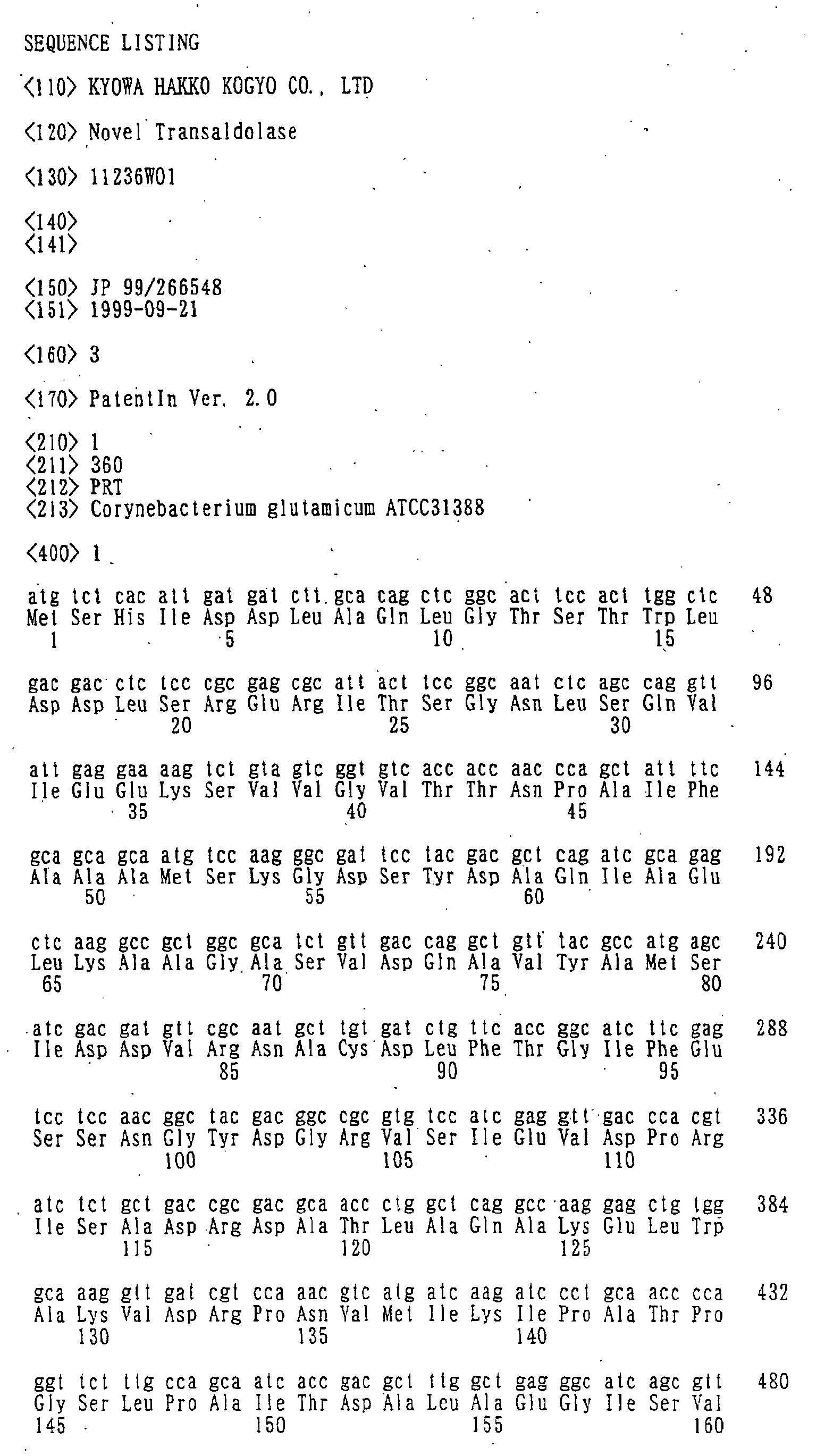
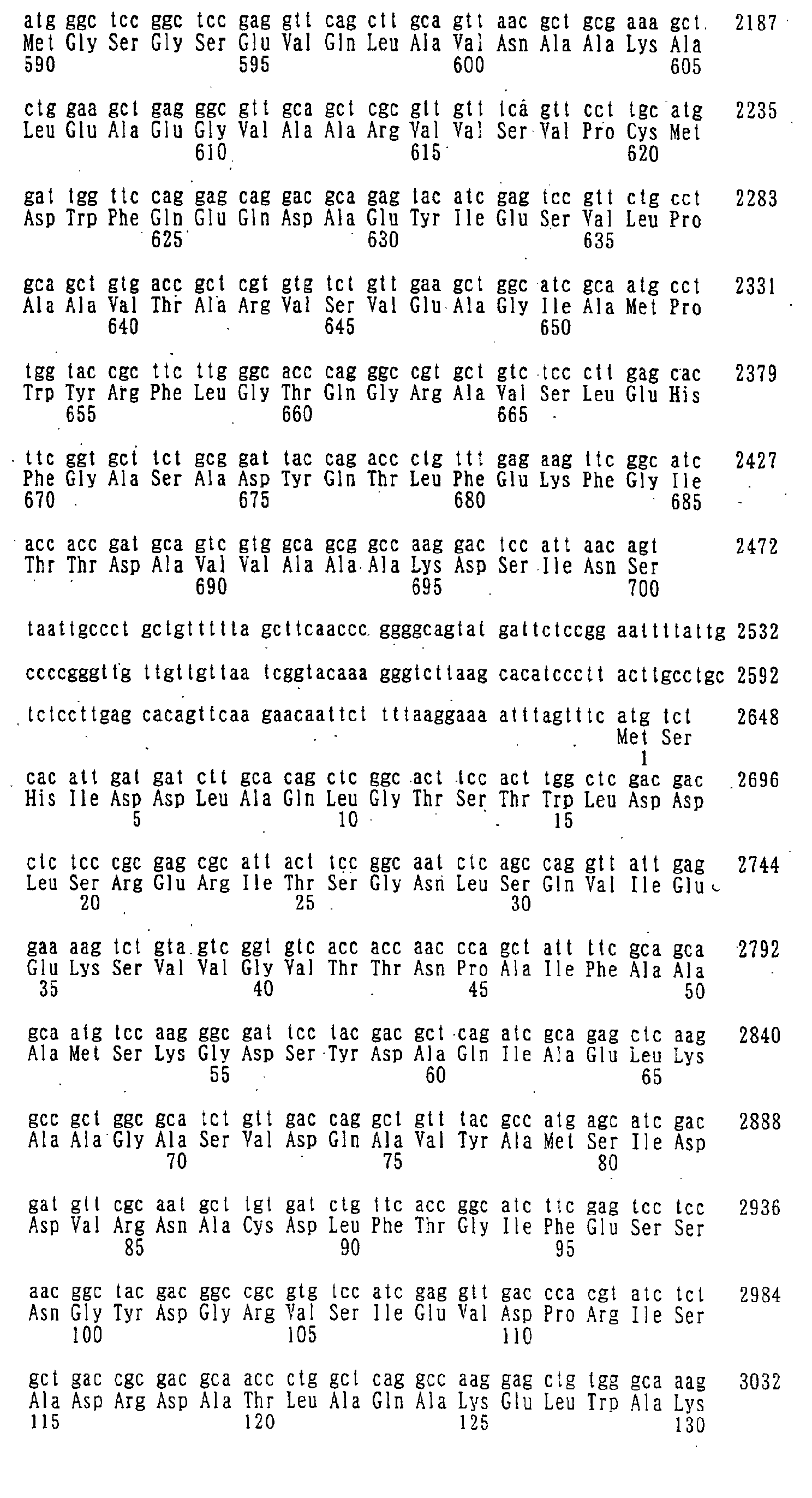
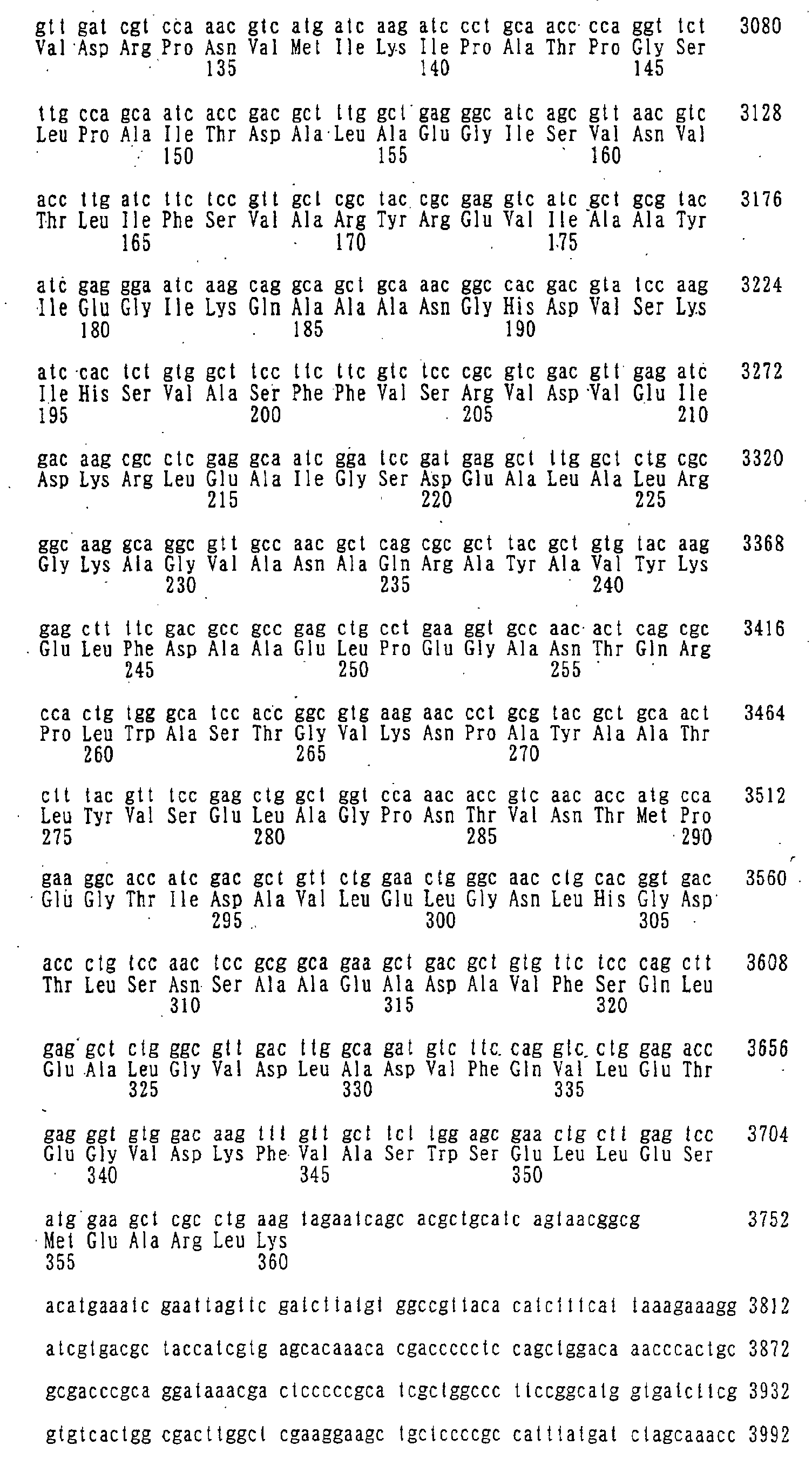
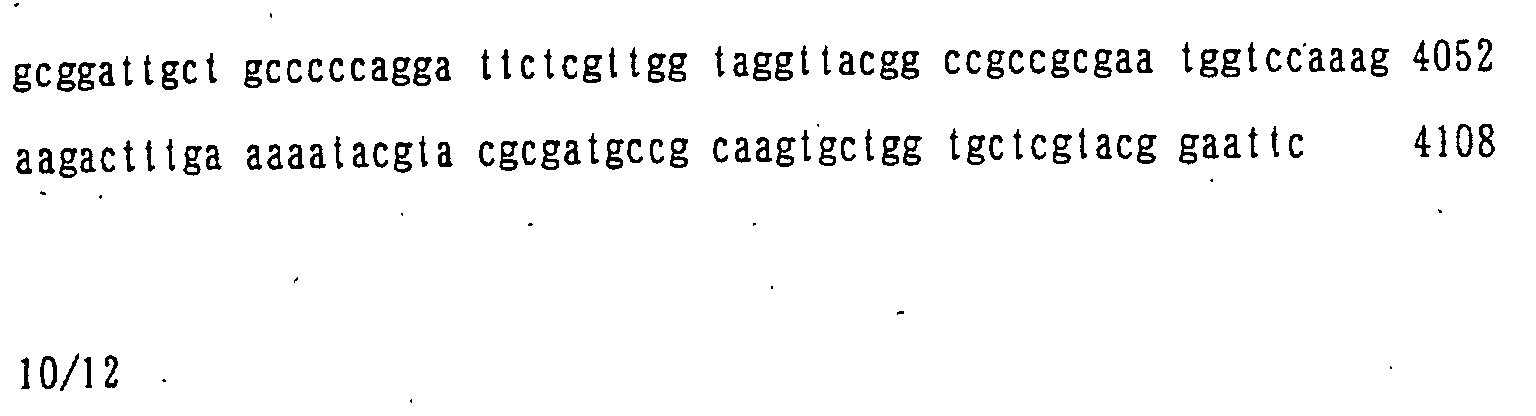
TECHNICAL FIELD
The present invention relates to a novel transaldolase
gene, and to a polypeptide encoded by the gene, a recombinant
DNA obtained by ligating the gene, a transformant carrying the
recombinant DNA, and a process for producing the polypeptide,
aromatic amino acids, aromatic vitamins, L-histidine,
riboflavin, nucleic acids, nucleic acid-associated substances,
novel saccharides and others by utilizing the transformant.
BACKGROUND ART
Transaldolase is an enzyme involved in pentose phosphate
pathways, and plays an important role in biosynthesis and
metabolism of aromatic compounds such as aromatic amino acids
and aromatic vitamins, nucleic acid-associated substances such
as purine-nucleotide and pyrimidine-nucleotide, as well as
L-histidine, riboflavin and others [Arch. Microbiol., 164, 324
(1995)]. Accordingly, a transaldolase gene and its gene
products are useful as the target in breeding microorganisms
for efficient fermentation and production of the metabolites.
As for transaldolase-encoding DNAs, an Escherichia
coli-derived gene [Gene Bank Accession Number D13159], a
Mycobacterium tuberculosis-derived gene [Nature, 393, 537
(1998)], and a Cinecococcus-derived gene [Plant Mol. Biol., 30,
213 (1996)] were isolated; and their nucleotide sequences were
determined.
It is reported that the productivity of aromatic compounds
in Escherichia coli is increased when its transaldolase activity
is increased (WO98/18936).
However, for microorganisms belonging to the genus
Corynebacterium that are widely used in amino acid fermentation
of industrial importance, there is no report relating to the
transaldolase gene and the enzyme encoded by the gene, and the
nucleotide sequence of that gene is not known at all.
Regarding saccharide synthesis using transaldolase, an
example is reported in which the enzyme is used for producing
D-fructose from processed starch [J. Am. Chem. Soc., 114, 6980
(1992)].
DISCLOSURE OF THE INVENTION
The object of the present invention is to provide a novel
transaldolase gene, as well as a polypeptide encoded by the gene,
a recombinant DNA obtained by ligating the gene, a transformant
carrying the recombinant DNA, and a process for producing the
polypeptide, aromatic amino acids, aromatic vitamins,
L-histidine, riboflavin, nucleic acids, nucleic
acid-associated substances, novel saccharides and others by
using the transformant.
To achieve the object as mentioned above, the present
inventors have used various techniques of DNA recombination and
extensively studied the chromosomal genes of microorganisms
belonging to the genus
Corynebacterium. As a result, the present
inventors have found that a transaldolase gene exists adjacent
to the 3'-downstream site of a gene encoding transketolase, an
enzyme differing from transaldolase, in a pentose phosphate
pathway, and the present inventors have found the fact first.
On the basis of this finding, the present invention has been
completed. Specifically, the invention relates to the
following subject matters (1) to (16):
The invention is described in detail hereinafter.
(1) Polypeptide of the present invention:
The polypeptide of the present invention has the amino
acid sequence of SEQ ID NO: 1. Polypeptides having the amino
acid sequence of SEQ ID NO: 1 in which one or more amino acids
have been substituted, deleted or added, and having trans aldolase
activity is within the scope of the polypeptide of the present,
invention.
The polypeptide having the amino acid sequence which has
been substituted, deleted or added, and having transaldolase
activity can be obtained according to the site-specific mutation
method described in Molecular Cloning, A Laboratory Manual,
Second Edition, Cold Spring Harbor Laboratory Press (1989)
(hereinafter referred to as Molecular Cloning, 2nd Ed.), Current
Protocols in Molecular Biology, John Wiley & Sons (1987-1997)
(hereinafter referred to as Current Protocols in Molecular
Biology), Nucleic Acids Research, 10, 6487 (1982), Proc. Natl.
Acad. Sci. USA, 79, 6409 (1982), Gene, 34, 315 (1985), Nucleic
Acids Research, 13, 4431 (1985), Proc. Natl, Acad. Sci. USA,
82, 488 (1985); for example, by introducing site-specific
mutation into the DNA that codes for a polypeptide having the
amino acid sequence of SEQ ID NO: 1.
The number of amino acids to be deleted, substituted or
added is not, specifically defined, but preferably from 1 to tens
of amino acids, more preferably from 1 to a few amino acids are
deleted, substituted or added. In order that the polypeptide
of the present invention has transaldolase activity, it is
desirable that its amino acid sequence is at least 60 %, generally
at least 80 %, especially at least 95 % homologous to the amino
acid sequence of SEQ ID NO: 1.
However, the polypeptide of the present invention does
not include known polypeptides having transaldolase activity.
(2) DNA of the present invention:
The DNA of the present invention is a DNA which codes for
the polypeptide of the present invention. For example, the DNA
of the present invention has the nucleotide sequence of SEQ ID
NO: 2.
DNAs that hybridize with the DNA of SEQ ID NO: 2 under
stringent conditions are within the scope of the DNA of the present
invention. The DNAs which hybridize with the DNA of SEQ ID NO:
2 under stringent conditions mean that it can be obtained through
colony hybridization, plaque hybridization or southern
hybridization using the DNA having the nucleotide sequence of
SEQ ID NO: 2 or the internal fragment of the DNA as a probe.
A specific example includes a DNA which can be identified through
hybridization at 65°C on a filter on which a colony or
plaque-derived DNA or its fragment is fixed, in the presence
of from 0.7 to 1.0 mol/liter of NaCl, followed by washing the
filter at 65°C with an SSC solution of about 0.1 to 2-fold
concentration (the SSC solution of 1-fold concentration
comprises 150 mmol/l of sodium chloride and 15 mmol/l of sodium
citrate).
The hybridization may be conducted according to the method
described in, for example, the laboratory manual, Molecular
Cloning, 2nd Ed. Specifically, the hybridizable DNA is, for
example, a DNA having the nucleotide sequence which is at least
80 %, preferably at least 95 % homologous to the nucleotide
sequence of SEQ ID NO: 2.
However, the DNA of the present invention does not include
known DNAs that code for polypeptides having transaldolase
activity.
The DNA of the present invention can be isolated from the
chromosomal DNA of a microorganism that belongs to the genus
Corynebacterium, according to the method mentioned hereinafter.
As for the gene source, any microorganism belonging to the genus
Corynebacterium can be used so long as it belongs to the genus
Corynebacterium or
Brevibacterium. Specific examples of such
microorganisms are the following strains:
| Corynebacterium glutamicum | ATCC 31833 |
| Corynebacterium glutamicum | ATCC 13032 |
| Corynebacterium acetoacidophilum | ATCC 13870 |
| Corynebacterium callunae | ATCC 15991 |
| Corynebacterium herculis | ATCC 13868 |
| Corynebacterium mellacecola | ATCC 17965 |
| Corynebacterium lilium | ATCC 15990 |
| Corynebacterium ammoniagenes | ATCC 6872 |
| Brevibacterium immariophilum | ATCC 14068 |
| Brevibacterium saccharolyticum | ATCC 14066 |
| Brevibacterium thiogenitalis | ATCC 19240 |
| Brevibacterium divaricutum | ATCC 14020 |
| Brevibacterium flavum | ATCC 14067 |
| Brevibacterium lactofermentum | ATCC 13869 |
The chromosomal DNA of a microorganism belonging to genus
Corynebacterium is extracted by using its culture, according
to an ordinary method (for example, according to the method
described in Japanese Published Unexamined Patent Application
No. 126789/1983). The isolation of the DNA of the present
invention from the chromosomal DNA comprises selecting a DNA
which can complement the transketolase-deficient mutant [Appl.
Microboiol. Biotechnol., 50, 375 (1998)] obtained as a shikimic
acid-requiring mutant.
Specifically, the chromosomal DNA is cleaved with suitable
restriction enzymes and ligated with a vector plasmid, then a
transketolase gene-deficient mutant [e.g., Corynebacterium
glutamicumTKT6 (FERMBP-6399)] is transformed with the resulting
plasmid, and the transformant having recovered the requirement
for shikimic acid is selected. By selecting the plasmid carried
by the transformant, the DNA of the present invention can be
obtained along with a transketolase gene.
After the DNA of the present invention having the
nucleotide sequence of SEQ ID NO: 2 is obtained, and the nucleotide
sequence of the DNA is determined, primers are prepared based
on the 5'-terminal nucleotide sequence and the 3'-terminal
nucleotide sequence of the DNA. By using the chromosomal DNA
obtained from a microorganism belonging to the genus
Corynebacterium as a template along with the primer, PCR [PCR
Protocols, Academic Press (1990)] is conducted to amplify a DNA
to obtain the DNA of the present invention from other
microorganism belonging to the genus Corynebacterium.
The DNA of the present invention can also be obtained from
other microorganisms belonging to the genus Corynebacterium
through colony hybridization or plaque hybridization (Molecular
Cloning, 2nd Ed.) with chromosomal DNA prepared from a
microorganism belonging to the genus Corynebacterium, wherein
the full length or a part of the DNA of SEQ ID NO: 2 is used
as a probe
Furthermore, based on the nucleotide sequence represented
by SEQ ID NO: 2, the DNA of the present invention can also be
obtained through chemical synthesis with a Parkin Elmer's DNA
synthesizer using phosphoamidation method.
(3) Production of Polypeptide of the present invention:
The polypeptide of the present invention can be produced
according to the method described in Molecular Cloning, 2nd Ed.
or Current Protocols in Molecular Biology, for example, by
expressing the DNA of the present invention in host cells in
the manner mentioned below.
A DNA fragment containing the part that codes for the
polypeptide and having a suitable length is prepared. If desired,
the nucleotide sequence coding for the polypeptide of the present
invention is partly substituted with other nucleotides so as
to be a codon most suitable for expression of the resulting DNA
in host cells. The DNA is useful in efficient production of
the polypeptide of the present invention.
The DNA fragment is inserted into the downstream site of
the promoter of a suitable expression vector to construct a
recombinant vector.
The recombinant vector is introduced into host cells
suitable to the expression vector.
As a host cell, any cell can be used as long as it can
express the intended gene, including bacteria, yeast cells,
animal cells, insect cells and plant cells.
The expression vector shall be self-replicable in host
cells or integrable with the chromosome therein, and shall have
a promoter in the site in which the DNA coding for the polypeptide
of the present invention can be transcribed.
In case where prokaryotes such as bacteria are used for
host cells, it is desirable that the recombinant vector
containing the DNA coding for the polypeptide of the present
invention is self-replicable in prokaryotes and comprises a
promoter, a ribosome-binding sequence, the DNA of the present
invention and a transcription termination sequence. If desired,
the recombinant vector may contain a promoter control gene.
The expression vector includes, for example, pBTrp2,
pBTac1, pBTac2 (all commercial products of Boehringer Mannheim),
pKK233-2 (produced by Pharmacia), pSE280 (produced by
Invitrogen), pGEMEX-1 (produced by Promega), pQE-8 (produced
by QIAGEN), pKYP10 (Japanese Published Unexamined Patent
Application No. 110600/1983), pKYP200 [Agric. Biol. Chem., 48,
669 (1984)], pLSA1 [Agric. Biol. Chem., 53, 277 (1989)], pGEL1
[Proc. Natl. Acad. Sci. USA, 82, 4306 (1985)], pBluescript II
SK(-) (by Stratagene), pTrs30 [prepared from Escherichia coli
JM109/pTrS30 (FERMBP-5407)], pTrs32 [prepared from Escherichia
coli JM109/pTrS32 (FERM BP-5408)], pGHA2 [prepared from
Escherichia coli IGHA2 (FERM B-400), Japanese Published
Unexamined Patent Application No. 221091/1985], pGKA2 [prepared
from Escherichia coli IGKA2 (FERM BP-6798), Japanese Published
Unexamined Patent Application No. 221091/1985], pTerm2 (USP
4,686,191, 4,939,094, and 5,160,735), pSupex, pUB110, pTP5,
pC194, pEG400 [J. Bacteriol., 172, 2392 (1990)], pGEX (produced
by Pharmacia), and pET system (produced by Novagen).
Any promoter may be used, so long as it is capable of
functioning in the host cells. For example, it is derived from
Escherichia coli or phages, including trp promoter (Ptrp), lac
promoter, PL promoter, PR promoter and T7 promoter.
Artificially-designed or modified promoters, such as Ptrp × 2
having two promoters in tandem, lacT7 promoter, and letI
promoter.
A plasmid in which the distance between a Shine-Dalgarno
sequence and an initiation codon is adjusted to an appropriate
distance (e.g. 6 to 18 nucleotides) may be preferably used.
In the present invention, the recombinant vector does not
always require a transcription termination sequence for
expression of the DNA of the present invention. In the
recombinant vector, however, it is desirable that a transcription
termination sequence is just downstream the structural gene.
The host cells include microorganisms belonging to the
genus Escherichia, Serratia, Bacillus, Brevibacterium,
Corynebacterium, Microbacterium or Pseudomonas, including, for
example, Escherichia coli XL1-Blue, Escherichia coli XL2-Blue,
Escherichia coli DH1, Escherichia coli MC1000, Escherichia coli
KY3276, Escherichia coli W1485, Escherichia coli JM109,
Escherichia coli HB101, Escherichia coli No. 49, Escherichia
coli W3110, Escherichia coli NY49, Escherichia coli GI698,
Escherichia coli TB1, Serratia ficaria, Serratia fonticola,
Serratia liquefaciens, Serratia marcescens, Bacillus subtilis,
Bacillus amyloliquefacines, Brevibacterium ammoniagenes,
Brevibacterium immariophilum ATCC 14068, Brevibacterium
saccharolyticum ATCC 14066, Brevibacterium flavum ATCC 14067,
Brevibacterium lactofermentum ATCC 13869, Corynebacterium
glutamicum ATCC 13032, Corynebacterium glutamicum ATCC 13869,
Corynebacterium acetoacidophilum ATCC 13870, Microbacterium
ammoniaphilum ATCC 15354, Pseudomonas putida and Pseudomonas
sp. D-0110.
For introducing the recombinant vector into the host cells,
any method of introducing DNA thereinto can be used, including
the method by using calcium ions [Proc. Natl. Acad. Sci. USA,
69, 2110 (1972)], the protoplast method (Japanese Published
Unexamined Patent Application No. 2483942/1988), and the methods
described in Gene, 17, 107 (1982) and Molecular & General Genetics,
168, 111 (1979).
In case where yeast is used for host cells, the recombinant
vector to be used in the case includes, for example, YEP13 (ATCC
37115), YEp24 (ATCC 37051), YCp50 (ATCC 37419), pHS19 and pHS15.
Any promoter may be used so long as it is capable of working
in yeast cells, including, for example, promoters of genes
participating in glycolysis such as hexose-kinase, as well as
PH05 promoter, PGK promoter, GAP promoter, ADH promoter, gal
1 promoter, gal 10 promoter, heat-shock polypeptide promoter,
MF α1 promoter, and CUP 1 promoter.
The host cells include microorganisms belonging to the
genus Saccharomyces, Schizosaccharomyces, Kluyveromyces,
Trichosporon, Schwanniomyces, Pichia and Candida, including,
for example, Saccharomyces cerevisiae, Schizosaccharomyces
pombe, Kluyveromyces lactis, Trichosporon pullulans,
Schwanniomyces alluvius and Candida utilis.
For introducing the recombinant vector into the host cells,
any method of introducing DNA into yeast cells can be used. For
example, the electroporation method [Methods Enzymol., 194, 182
(1990)], the spheroplast method [Proc. Natl. Acad. Sci. USA,
75, 1929 (1978)], the lithium acetate method [J. Bacteriology,
153, 163 (1983)], the method described in Proc. Natl. Acad. Sci.
USA, 75, 1929 (1978) and the like, can be mentioned.
In case where animal cells are used for host cells, the
expression vector to be used in the case includes, for example,
pcDNAI, pcDM8 (produced by Funakoshi), pAGE107 [Japanese
Published Unexamined Patent Application No. 22979/1991,
Cytotechnology, 3, 133 (1990)], pAS3-3 (Japanese Published
Unexamined Patent Application No. 22.7075/1990), pCDM8 [Nature,
329, 840 (1987)], pcDNAI/Amp (produced by Invitrogen), pREP4
(produced by Invitrogen), pAGE103 [J. Biochem., 101, 1307 (1987)],
and pAGE210.
Any promoter may be used as long as it is capable of
functioning in animal cells, including, for example, the promoter
of IE (immediate early) gene of cytomegalovirus (CMV), the early
promoter of SV40 and the promoter of retrovirus, as well as
metallothione in promoter, heat-shock promoter, and SRα promoter.
The enhancer of the IE gene of human CMV may be used together
with the promoter.
The host cells include, for example, Namalwa cells that
are human cells, COS cells that are monkey cells, CHO cells and
HBT5637 cells that are Chinese hamster cells (Japanese Published
Unexamined Patent Application No. 299/1988).
For introducing the recombinant vector into the animal
cells, any method of introducing DNA into animal cells can be
used. For example, the electroporation method [Cytotechnology,
3, 133 (1990)], the calcium phosphate method (Japanese Published
Unexamined Patent Application No. 227075/1990), the lipofection
method [Proc. Natl. Acad. Sci. USA, 84, 7413 (1987)], the method
described in Virology, 52, 456 (1973) and the like, can be
mentioned.
In case where insect cells are used for host cells, the
polypeptide may be expressed, for example, according to the
methods described in Current Protocols in Molecular Biology;
Baculovirus Expression Vectors, A Laboratory Manual, W. H.
Freeman and Company, New York (1992); and Bio/Technology, 6,
47 (1988).
That is, a recombinant gene-introduction vector and a
Baculovirus are simultaneously introduced into insect cells to
form a recombinant virus in the supernatant of the insect cell
culture, and then insect cells are infected with the recombinant
virus so as to express the polypeptide.
The gene-introduction vector to be used in the method
includes, for example, pVL1392, pVL1393 and pBlueBacIII (all
produced by Invitrogen).
The Baculovirus is, for example, Autographa californica
nuclear polyhedrosis virus that infects insects of the family
Barathra.
The insect cells include, for example, Spodopetera
frugiperda oocytes, Sf9, Sf21 [Baculovirus Expression Vectors,
A Laboratory Manual, W. H. Freeman and Company, New York (1992)],
and Trichoplusia ni oocytes, High 5 (produced by Invitrogen).
For the simultaneously introduction of the recombinant
gene-introduction vector and the Baculovirus into insect cells
to prepare the recombinant virus, for example, a calcium
phosphate method (Japanese Published Unexamined Patent
Application No. 227075/1990), the lipofection method [Proc. Natl.
Acad. Sci. USA, 84, 7413 (1987)] and the like, can be mentioned.
In case where plant cells are used for host cells, the
expression vector includes, for example, Ti plasmid and tobacco
mosaic virus vector.
Any promoter may be used, so long as it is capable of being
expressed in plant cells, including, for example, 35S promoter
of cauliflower mosaic virus (CaMV), and rice actin 1 promoter.
The plant cells for host cells include, for example, those
of tobacco, potato, tomato, carrot, soybean, rape, alfalfa, rice,
wheat, and barley.
For introducing the recombinant vector into such plant
cells, any method of introducing DNA thereinto, including, for
example, the method of introducing it into Agrobacterium
(Japanese Published Unexamined Patent Application No.
140885/1984 and 70080/1985, WO94/00977), the electroporation
method (Japanese Published Unexamined Patent Application No.
251887/1985), and the method by using a particle gun (gene gun)
(Japanese Patent No. 2,606,856, 2,517,813) can be mentioned.
The gene expression may be conducted in a mode of direct
expression, or alternatively, in a mode of secretion production
or fused protein expression according to the method described
in Molecular Cloning, 2nd Ed.
In case where the gene is expressed in yeast cells, animal
cells, insect cells or plant cells, it gives a polypeptide with
a saccharide or sugar chain added thereto.
The transformant of the present invention prepared in the
manner as above is cultured in a medium, and the polypeptide
of the present invention is produced and accumulated in the
culture, and recovered from the culture.
For culturing the transformant of the present invention
in a medium, any method as conventionally used for host
cultivation in the art can be used.
In case where the transformant of the present invention
is prepared by the use of prokaryotic cells such as Escherichia
coli or eukaryotic cells such as yeast as a host cell, the medium
in which the transformant is cultured may be any natural or
synthetic medium containing carbon sources, nitrogen sources
and inorganic salts which can be assimilated by the transformant
and in which the transformant can be efficiently cultured.
The carbon sources may be any ones which can be assimilated
by the transformant, including, for example, carbohydrates such
as glucose, fructose, sucrose, molasses containing them, starch
or starch hydrolyzates; organic acids such as acetic acid,
propionic acid and the like; and alcohols such as ethanol,
propanol and the like.
The nitrogen sources include, for example, ammonia,
ammonium salts of various inorganic acids and organic acids,
such as ammonium chloride, ammonium sulfate, ammonium acetate,
ammonium phosphate; other nitrogen-containing compounds; and
peptone, meat extracts, yeast extracts, corn steep liquor, casein
hydrolyzates, soy bean meal, soybean meal hydrolyzates, various
cells obtained by fermentation and their digested products.
The inorganic salts include, for example, potassium
dihydrogenphosphate, dipotassium hydrogenphosphate, magnesium
phosphate, magnesium sulfate, sodium chloride, ferrous sulfate,
manganese sulfate, copper sulfate, and calcium carbonate.
Culturing the transformant in the medium is conducted under
aerobic conditions, for example, in a mode of shaking culture
or deep aeration stirring culture. The culturing temperature
is preferably from 15 to 40°C, and the culturing period is
generally from 16 hours to 7 days. Preferably, the pH of the
culture is from 3.0 to 9.0. For the pH control, any of inorganic
or organic acids, alkali solutions, urea, calcium carbonate,
ammonia or the like can be used.
If desired, antibiotics such as ampicillin and
tetracycline may be added to the medium in which the transformant
is cultured.
In case where microorganisms transformed with a
recombinant vector having an inductive promoter are cultured,
an inducer may be added to the medium, if desired. For example,
when microorganisms transformed with a recombinant vector having
lac promoter are cultured, isopropyl-β-D-thiogalactopyranoside
may be added to the medium; and when microorganisms transformed
with a recombinant vector having trp promoter are cultured,
indole-acrylic acid may be added to the medium.
The medium in which the transformant prepared by the use
of animal cells as a host cell is cultured may be any ordinary
one, including, for example, RPMI1640 medium [The Journal of
the American Medical Association, 199, 519 (1967)], Eagle's MEM
medium [Science, 122, 501 (1952)], Dulbecco's modified MEM medium
[Virology, 8, 396 (1959)], 199 medium [Proceeding of the Society
for the Biological Medicine, 73, 1 (1950)], and those media with
fetal calf serum therein.
Culturing the transformant in the medium is conducted
generally at pH of from 6 to 8, at 30 to 40°C in the presence
of 5 % CO2 for 1 to 7 days.
If desired, antibiotics such as kanamycin and penicillin
may be added to the medium in which the transformant is cultured.
The medium in which the transformant prepared by the use
of insect cells as a host cell is cultured may be any ordinary
one, including, for example, TNM-FH medium (produced by
PharMingen), Sf-900 II SFMmedium (produced byLife Technologies),
ExCell 400 and ExCell 405 [both produced by JRH Biosciences],
Grace's Insect Medium [Nature, 195, 788 (1962)].
Culturing the transformant in the medium is conducted
generally at pH of from 6 to 7, at 25 to 30°C for 1 to 5 days.
If desired, antibiotics such as gentamycin may be added
to the medium in which the transformant is cultured.
The transformant cells prepared by the use of plant cells
as a host cell may be cultured as they are, or after differentiated
into plant cells or organs. The medium in which the transformant
is cultured may be any ordinary one, including, for example,
Murashige & Skoog (MS) medium, White medium, and those media
with a plant hormone such as auxin or cytokinin therein.
Culturing the transformant in the medium is conducted
generally at pH of from 5 to 9, at 20 to 40°C for 3 to 60 days.
If desired, antibiotics such as kanamycin and hygromycin
may be added to the medium in which the transformant is cultured.
As described above, the transformant derived from
microorganisms, animal cells or plant cells carrying a
recombinant vector ligated with the DNA coding for the
polypeptide of the present invention is recovered according to
conventional method to thereby produce and accumulate the
polypeptide, and the polypeptide is recovered from the culture.
The gene expression may be conducted in a mode of direct
expression, or in a mode of secretion production or fused
polypeptide expression according to the method described in
Molecular Cloning, 2nd Ed.
The method of producing the polypeptide of the present
invention includes intracellular production, extracellular
secretion and production on outer membrane of host cells. The
method can be selected depending on the host cells used or on
alternation of the structure of the polypeptide to be produced.
In case where the polypeptide of the present invention
is produced inside host cells or on the outer membrane of host
cells, it can be positively secreted to the extracellular portion
from the host cells, according to the method of Paulson, et al.
[J. Biol. Chem., 264, 17619 (1989)], the method of Lowe, et al.
[Proc. Natl. Acad. Sci., USA, 86, 8227 (1989), Genes Develop.,
4, 1288 (1990)] or the methods described in Japanese Published
Unexamined Patent Application No. 336963/1993 and WO94/23021.
That is, the polypeptide of the present invention can be
positively secreted in the extracellular portion from the host
cells, by expressing it in the form of a polypeptide containing
the active site of the polypeptide of the present invention and
having a signal peptide upstream it, according to the genetic
recombinant technology.
The yield of the polypeptide to be produced can be increased
in a gene amplification system using a dihydrofolate reductase
gene or the like, according to the method described in Japanese
Published Unexamined Patent Application No. 227075/1990.
In addition, the gene-introduced animal or plant cells
may be re-differentiated to construct gene-introduced animal
individuals (transgenic non-human animals) or plant individuals
(transgenic plants). Using these individuals, the polypeptide
of the present invention may be produced.
In case where the transformant is an animal individual
or plant individual, it may be raised or cultivated according
to a conventional method to thereby produce and accumulate the
intended polypeptide therein, and the polypeptide is recovered
from the animal or plant individual.
For producing the polypeptide of the present invention
in animal individuals, for example, an animal is transformed
with the gene of the present invention introduced thereinto and
the polypeptide is produced in the transformant animal according
to known methods [American Journal of Clinical Nutrition, 63,
639S (1996), American Journal of Clinical Nutrition, 63, 627S
(1996), Bio/Technology, 9, 830 (1991)].
For animal individuals, for example, the transgenic
non-human animals carrying the DNA coding for the polypeptide
of the present invention are raised to thereby produce and
accumulate the polypeptide in the animals, and the polypeptide
is recovered from the animals. The site of the animals in which
the polypeptide is produced and accumulated is, for example,
milk (Japanese Published Unexamined Patent Application No.
309192/1988, eggs of the animals, and the like. Any promoter
may be used so long as it is capable of being expressed in animals.
Its preferred examples are mammary gland cell-specific promoters
such as α-casein promoter, β-casein promoter, β-lactoglobulin
promoter, whey acidic protein promoter, and the like.
For producing the polypeptide of the present invention
in plant individuals, for example, a transgenic plant carrying
the DNA coding for the polypeptide of the present invention is
cultivated according to known methods [Tissue Culture, 20(1994),
Tissue Culture, 21 (1995), Trends in Biotechnology, 15, 45
(1997)] to thereby produce and accumulate the polypeptide in
the plant, and the polypeptide is recovered from the plant.
For isolating and purifying the polypeptide produced by
the transformant of the present invention, any conventional
method for enzyme isolation and purification can be used. For
example, when the polypeptide of the present invention is
expressed in soluble forms inside the transformant cells, the
cells are cultured, recovered from the culture by centrifuging
the culture, then suspended in an aqueous buffer, and disrupted
with an ultrasonic disrupter, French Press, Manton-Gaulin
homogenizer, Dynomill or the like to obtain a cell-free extract.
The cell-free extract is centrifuged, and the resulting
supernatant is purified through conventional enzyme isolation
and purification. Specifically, for example, the supernatant
is purified through solvent extraction, salting-out or desalting
with sulfate ammonium or the like, precipitation with organic
solvent, anion-exchange chromatography on resin such as
diethylaminoethyl (DEAE)-Sepharose or DIAION HPA-75 (produced
by Mitsubishi Chemical Industries), or the like, cation-exchange
chromatography on resin such as S-Sepharose FF (produced by
Pharmacia) or the like, hydrophobic chromatography on resin such
as butyl Sepharose or phenyl Sepharose, gel filtration through
molecular sieve, affinity chromatography, chromatofocusing, or
electrophoresis such as isoelectric focusing, or the like. The
purification methods may be used either singly or as combined
to obtain the intended pure product.
In case where the polypeptide is expressed as an inclusion
body in the cells, the cells are similarly recovered, disrupted
and centrifuged to give a precipitated fraction as the inclusion
body including the polypeptide of the present invention . The
thus-recovered insoluble polypeptide is solubilized with a
protein denaturing agent. The solubilized solution is then
diluted or dialyzed to thereby lower the concentration of the
protein denaturing agent in the solution. Through the process,
the solubilized polypeptide is renatured to have its own normal
tertiary structure. After thus processed, a pure product of
the polypeptide is obtained through the same isolation and
purification methods as in the above.
In case where the polypeptide of the present invention
or the polypeptide derivative with a sugar chain added thereto
is secreted outside from the cells, the polypeptide or the
polypeptide derivative can be recovered in the culture
supernatant. Specifically, the culture is centrifuged in the
same manner as above to obtain the culture supernatant, and then
a pure product of the polypeptide is obtained through the same
isolation and purification methods as in the above from the
culture supernatant.
The polypeptide thus obtained in the manner as above is,
for example, the polypeptide having the amino acid sequence of
SEQ ID NO: 1.
The polypeptide of the present invention can be produced
through chemical synthesis of, for example, the Fmoc method
(fluorenylmethyloxycarbonyl method) or the tBoc method
(b-butyloxycarbonyl method). It may also be produced through
chemical synthesis using peptide synthesizers such as those
produced by Advanced ChemTech, Parkin-Elmer, Pharmacia, Protein
Technology Instrument, Synthecell-Vega, PerSeptive, and
Shimadzu.
(4) Method for producing substances using the DNA of the present
invention:
(a) Production of aromatic compounds such as aromatic amino acids
and aromatic vitamins; nucleic acid-associated substances such
as purine-nucleotide and pyrimidine-nucleotide; and
L-histidine and riboflavin:
Using the DNA of the present invention or based on its
nucleotide sequence information, the transaldolase activity of
the transformants having an ability to produce aromatic compounds
such as aromatic amino acids and aromatic vitamins, nucleic
acid-associated substances such as purine-nucleotide and
pyrimidine-nucleotide, and L-histidine and riboflavin can be
modified in any desired manner, and industrial methods for
producing their metabolites can be thereby provided.
The aromatic amino acids capable of being obtained in the
invention include, for example, phenylalanine, tyrosine and
tryptophan; the aromatic vitamins include, for example, folic
acid (vitamin M), menaquinone (vitamin K2), p-hydroxybenzoic
acid and ubiquinone derived from it, p-aminobenzoic acid (vitamin
H'), anthranilic acid (vitamin L), tocopherol (vitamin E); and
the nucleic acid-associated substances include, for example,
purine-nucleotide, pyrimidine-nucleotide, purine-nucleoside,
pyrimidine-nucleoside, purine base, pyrimidine base and
flavin-nucleotide.
Methods for producing these substances are described
below.
In the transformants prepared in the above (3), the DNA
of the present invention or a DNA existing upstream the DNA of
the present invention and participating the transcription and
translation of the DNA is modified such that one or more
nucleotides are deleted, substituted or added in its nucleotide
sequence to thereby construct transformants that carry the
thus-modified DNA (these are hereinunder referred to as
transformant variants). From the transformant variants,
transformant variants having enhanced transaldolase activity,
or those having reduced or no transaldolase activity are selected.
The nucleotides deletion, substitution and addition may be
conducted in the known method (for example, described in
Molecular Cloning, 2nd Ed., Current Protocols in Molecular
Biology).
The transaldolase activity can be measured according to
the process of Example (4) mentioned hereinafter.
That is, each transformant variant is cultured according
to the method of above (3) to prepare a crude enzyme solution.
The crude enzyme solution is added to a reaction solution
[containing 40 mmol/l Tris (pH 7.6), 0.1mmol/l diphosphopyridine,
2.8 mmol/l fructose 6-phosphate, 0.2 mmol/l erythrose
4-phosphate, 10 µg of glycerol 3-phosphate dehydrogenase and
triose phosphate isomerase mixture (produced by Boehringer
Mannheim)] to make 1 ml, and the reaction is carried out at 25°C.
The enzymatic activity of the transformant variant can be
measured, by measuring the reduction in the absorbance at 340
nm of the reaction mixture with a spectrophotometer to determine
the amount of glyceraldehyde 3-phosphate produced in the reaction
mixture.
According to the method as above, the transaldolase
activity of transformant variants is measured, and the intended
transformant variants having increased, reduced or lost
transaldolase activity can be selected from all the transformant
variants.
When using cells which can produce aromatic amino acids
or aromatic vitamins as a host cell, their ability to produce
the intended aromatic compounds can be increased, by increasing
their transaldolase activity.
When using cells which can produce nucleic acid-associated
substances such as purine-nucleotide and pyrimidine-nucleotide,
L-histidine or riboflavin as a host cell, their ability to produce
the substances can be increased, by lowering or deleting their
transaldolase activity.
The transformant obtained in the manner as above is
cultured in a medium to thereby produce and accumulate the
intended product of aromatic amino acids, aromatic vitamins,
L-histidine, riboflavin, purine-nucleotide,
pyrimidine-nucleotide and other nucleic acid-associated
substances, in the culture, and the product is isolated and
purified from the culture according to known methods including
concentration crystallization, activated charcoal treatment
and ion-exchange resin treatment [Isao Endo et al's Bioseparation
Process Handbook, edited by the Chemical Engineering Society
of Japan, published by Kyoritsu Publishing (1996)]. Through
the process, the intended substance can be obtained efficiently.
Culturing the transformant may be conducted in the same
manner as in the above (3) that indicates the method for culturing
transformants for producing the polypeptide of the present
invention.
(b) Production of novel saccharides:
A ketose and an aldose are allowed to exist in an aqueous
medium containing, as an enzyme source, the transformant obtained
according to the method mentioned above, a culture of the
transformant or a processed product of the culture, to thereby
produce and accumulate in the aqueous medium a saccharide having
the dihydroxyacetone moiety of the ketose transferred into the
aldose owing to the transaldolase activity of the enzyme source,
and the saccharide is recovered from the aqueous medium.
The ketose includes, for example, sedoheptulose
7-phosphate, fructose 6-phosphate and the like; and the aldose
includes, for example, erythrose 4-phosphate, glyceraldehyde
3-phosphate and the like.
The processed product of the transformant culture includes,
for example, cultured cells; processed cells such as dried cells,
lyophilized cells, surfactant-processed cells,
enzyme-processed cells, ultrasonically-processed cells,
mechanically disrupted cells, solvent-processed cells; as well
as enzyme products extracted from cultured cells, such as protein
fractions of cultured cells, and immobilized products of cultured
cells and processed cells.
The concentration of the enzyme source to be used in
producing the saccharides of the present invention may be from
1 mU/liter to 1,000 U/liter, preferably from 10 mU/liter to 100
U/liter. One unit (U) is meant to indicate the activity of the
enzyme source that produces 1 mmol of the saccharide at 37°C
for 1 minute.
The aqueous medium to be used in producing the saccharides
of the present invention includes, for example, water; buffers
such as phosphates, carbonates, acetates, borates, citrates,
Tris, or the like; alcohols such as methanol, ethanol, or the
like; esters such as ethyl acetate, or the like; ketones such
as acetone, or the like; and amides such as acetamide, or the
like. The culture of the transformant serving as the enzyme
source may also be used for the aqueous medium.
If desired, surfactant and organic solvent may be added
to the system of producing the saccharides of the present
invention. Any surfactant may be used so long as it is capable
of promoting the production of galactose-containing saccharides,
including, for example, nonionic surfactants such as
polyoxyethylene-octadecylamine (e.g., Naimeen S-215 produced
by Nippon Yushi); cationic surfactants such as
cetyltrimethylammonium bromide and
alkyldimethylbenzylammonium chlorides (e.g., Cation F2-40E
produced by Nippon Yushi); anionic surfactants such as lauroyl
sarcosinate; and tertiary amines such as alkyldimethylamines
(e.g., Tertiary Amine FB, produced by Nippon Yushi). One or
more such surfactants may be used either singly or as combined.
The surfactant concentration is usually from 0.1 to 50 g/l. The
organic solvent includes, for example, xylene, toluene,
aliphatic alcohols, acetone, and ethyl acetate. The solvent
concentration is usually from 0.1 to 50 ml/liter.
The quantification of the saccharide formed in the aqueous
medium according to the invention can be conducted, for example,
with a Dionex's saccharide analyzer [Anal. Biochem., 189, 151
(1990)].
The saccharides formed in the reaction mixture according
to the present invention can be recovered by a conventional method,
using activated charcoal or ion-exchange resin, or the like.
The method of the present invention makes it easy to produce
saccharides which have heretofore been difficult to produce,
and makes it possible to produce novel saccharides.
Examples of the present invention are described below,
to which, however, the invention is not limited.
BEST MODES FOR CARRYING OUT THE INVENTION
(1) Acquisition of a transketolase-deficient mutant of
Corynebacterium glutamicum:
Corynebacterium glutamicum L22 [a lysozyme-sensitive
mutant derived from a wild type strain ATCC 31833; R. Katsumata
et al., Proc. 4th Eur. Congr. Biotechnol., 4, 767 (1987)] was
inoculated in 3ml of NB medium [containing 20 g of bouillon powder
and 5 g of yeast extract in water 1 liter and having pH 7.2]
and cultured therein at 30°C until OD660 of the culture reached
to 0.6.
After culturing, the cells were recovered through
centrifugation, and washed once with 50 mmol/l Tris maleate
buffer (pH 6.0), and subjected to a mutational treatment in 3
ml of the buffer containing 400 mg/l of NTG, at room temperature
for 20 minutes. The treated cells were centrifuged and washed
twice with the buffer, and then cultured in 3 ml of NB medium
at 30°C for 1 hour.
The culture was diluted with physiological saline to 10-5
to 10-6, and 0.1 ml of the resulting dilution was spread on NB-agar
medium [NB medium with 1.4 % agar, pH 7.2], and cultured thereon
at 30°C for 2 days.
Each of the colonies grown on the agar medium were spread
on minimal agar medium M1 [containing 10 g of glucose, 1 g of
(NH4)H2PO4, 0.2 g of KCl, 0.2 g of MgSO4·7H2O, 10 mg of FeSO4·7H2O,
0.2 mg of MnSO4·4-6H2O, 0.9 mg of ZnSO4·7H2O, 0.4 mg of CuSO4·5H2O,
0.09 mg of Na2B4O7·10H2O, 0.04 mg of (NH4)6Mo7O24·4H2O, 50 mg of
biotin, 2.5 mg of p-aminobenzoic acid, 1 mg of thiamin
hydrochloride and 16 g of agar in water 1 liter, and adjusted
pH 7.2] and on M1 agar medium containing 50 mg/l shikimic acid,
and cultured thereon at 30°C.
The colonies grown on the M1-agar medium containing 50
mg/l of shikimic acid, but not growing on the minimal agar medium
M1 were separated as shikimic acid-requiring mutants. The
thus-separated shikimic acid-requiring mutant were spread on
M1-agar medium containing 50 mg/l of shikimic acid and onto the
medium in which the glucose was substituted with ribose, and
cultured thereon at 30°C.
The shikimic acid-requiring mutant grown on the M1-agar
medium containing 50 mg/l of shikimic acid, but not growing on
the medium containing ribose in place of glucose were separated
as shikimic acid-requiring and ribose-non-assimilating
mutants.
The thus-separated, shikimic acid-requiring and
ribose-non-assimilating mutant cells were cultured in 40 ml of
M1 medium containing 50 mg/l of shikimic acid, at 30°C for 24
hours. The cells were collected through centrifugation,
ultrasonically disrupted, and again centrifuged to prepare a
cell-free extract. The transketolase activity of the cell-free
extract was determined as follows, using the cell-free extract
as a crude enzyme solution.
The crude enzyme solution was added to a reaction solution
[containing 50 mmol/l Tris (pH 7.5), 0.2 mmol/l NADH, 0.01 mmol/l
thiamin pyrophosphate, 1 mmol/l MgCl2, 0.5 mmol/l xylulose
5-phosphate, 0.5 mmol/l ribulose 5-phosphate, and 10 µg of a
mixture of glycerol 3-phosphate dehydrogenase and triose
phosphate isomerase (produced by Boehringer Mannheim)] to make
1.5 ml, and the reaction was carried out at 30°C.
The amount of glyceraldehyde 3-phosphate produced in the
reaction mixture was determined by measuring the reduction in
the absorbance at 340 nm of NADH in the reaction medium with
spectrophotometer.
From the result of the measurement, a transketolase
activity-deficient mutant TKT6, not being capable of producing
glyceraldehyde 3-phosphate at all was selected, from the
separated shikimic acid-requiring and ribose-non-assimilating
mutants.
Corynebacterium glutamicum TKT6 has been depositedas FERM
BP-6399 since June 30, 1998 with the International Patent
Organism Deopsitary National Institute of Advanced Industrial
Science and Technology, Tsukuba Central 6, 1-1, Higashi 1-Chome
Tsukuba-shi, Ibaraki-ken 305-8566 Japan (National Institute of
Bioscience and Human-Technology, Agency of Industrial Science
and Technology, 1-3, Higashi 1-chome, Tsukuba city, Ibaragi
prefecture, 305-8566, Japan), under the Budapest Treaty.
(2) Cloning of DNA fragments containing transketolase gene and
transaldolase gene:
For the source of the two genes, a chromosomal DNA of
Corynebacterium glutamicum ATCC 31833 was used; and for the
recipient of the genes, the transketolase gene-deficient
Corynebacterium glutamicum TKT6 (FERM BP-6399) obtained in
Example 1 was used. For the vector, a plasmid pCSEK20 replicable
in Corynebacterium glutamicum was used. The plasmid pCSEK20
comprises a replication origin of plasmid pCG2 derived from
Corynebacterium glutamicum (Japanese Published Unexamined
Patent Application No. 35197/1983), a spectinomycin and
streptomycin-resistant gene of plasmid pCG4 derived from
Corynebacterium glutamicum (Japanese Published Unexamined
Patent Application No. 183799/1982) and a kanamycin-resistant
gene of an conventionally-using-vector pGA22 [J. Bacteriol.,
140, 400 (1979)] for Escherichia coli[Appl. Microbiol.
Biotechnol., 51, 201 (1999)].
Culturing of Corynebacterium glutamicum ATCC 31833 and
preparation of the chromosomal DNA from the culture was conducted
according to the method described in Japanese Published
Unexamined Patent Application No. 169785/1994. Plasmid pCSEK20
was isolated from the cultured cells of Corynebacterium
glutamicum ATCC 31833 carrying it, according to the vector
preparation method described in Japanese Published Unexamined
Patent Application No. 169785/1994.
The cloning of the fragment containing transketolase gene
and transaldolase gene from the chromosomal DNA of
Corynebacterium glutamicum ATCC 31833 was conducted as follows.
The chromosomal DNA and the pCSEK20 plasmid DNA prepared
as in the above, 1 µg each, were cleaved with EcoRI (5 units),
and their fragments were ligated with a ligation kit (produced
by Takara Shuzo). Using the thus-constructed plasmid, the
shikimic acid-requiring, transketolase gene-deficient
Corynebacterium glutamicum TKT6 (FERM BP-6399) was transformed
as follows.
Corynebacterium glutamicum TKT6 was inoculated in 5 ml
of NB medium, and cultured therein at 30°C for 1 day. The obtained
seed culture (4 ml) was inoculated in 40 ml of SSM medium
[containing 20 g of glucose, 10 g of (NH4)2SO4, 3 g of urea, 1
g of yeast extract, 1 g of KH2PO4, 0.4 g of MgCl2·6H2O, 10 mg
of FeSO4·7H2O, 0.2 mg of MnSO4·4-6H2O, 0.9 mg of ZnSO4·7H2O, 0.4
mg of CuSO4·5H2O, 0.09 mg of Na2B4O7·10H2O, 0.04 mg (NH4)6Mo7O24·4H2O,
30 µg of biotin and 1 mg of thiamin hydrochloride in water 1
liter, and adjusted pH 7.2] containing 100 µg/ml shikimic acid,
and cultured with shaking at 30°C until OD660 of the culture reached
to 0.6.
The cells were collected, and suspended in 10 ml of
lysozyme-containing RCGP medium [containing 5 g of glucose, 5
g of casamino acid, 2.5 g of yeast extract, 1.5 g of KH2PO4,
0.41 g of MgCl2·6H2O, 10 mg of FeSO4·7H2O, 2 mg of MnSO4·4-6H2O,
0.9 mg of ZnSO4·7H2O, 0.04 mg of (NH4)6Mo7O24·4H2O, 30 µg of biotin,
2 mg of thiamin hydrochloride, 135 g of disodium succinate and
30 g of polyvinylpyrrolidone (molecular weight 10,000) in water
1 liter] to have a cell concentration of about 109 cells/ml.
The cell suspension was transferred into an L-shaped test tube
and reacted therein with gently stirring at 30°C for 6 hours
to obtain protoplast.
The thus-obtained 0.5 ml of the protoplast was put into
a small test tube, centrifuged at 2,500 × g for 5 minutes,
re-suspended in 1 ml of TSMC buffer (10 mmol/l MgCl2, 30 mmol/l
CaCl2, 50 mmol/l Tris, 400 mmol/l sucrose, pH 7.5), centrifuged
and washed, and then re-suspended in 0.1 ml of TSMC buffer. The
cell suspension was mixed with 100 µl of a 1/1 mixture of TSMC
buffer of 2-fold concentration and the above-mentioned ligation
mixture, followed by adding of 0.8 ml of 20 % PEG
(6,000)-containing TSMC buffer, and further mixed. After 3
minutes, 2 ml of RCGP medium (pH 7.2) was added to the mixture,
and centrifuged at 2,500 × g for 5 minutes to remove the supernatant.
The precipitated protoplast was suspended in 1 ml of RCGP medium.
The cell suspension (0.2ml) was spread on RCGP-agar medium (1.4%
agar-containing RCGP medium, pH 7.2) containing 200 µg/ml
kanamycin, and cultured thereon at 30°C for 10 days.
The colonies grown on the agar medium were scraped up,
centrifuged and washed twice with physiological saline, and
suspended in 1 ml of physiological saline. The cell suspension
was again spread on minimal agar medium M1 [containing 10 g of
glucose, 1 g of (NH4)H2PO4, 0.2 g of KCl, 1 g of KH2PO4, 0.2 g
of MgSO4·7H2O, 10 mg of FeSO4·7H2O, 0.2 mg of MnSO4·4-6H2O, 0.9
mg of ZnSO4·7H2O, 0.4 mg of CuSO4·5H2O, 0.09 mg of Na2B4O7·10H2O,
0.04 mg of (NH4)6Mo7O24·4H2O, 50 µg of biotin, 2.5 mg of
p-aminobenzoic acid, 1 mg of thiamin hydrochloride and 16 g of
agar in water 1 liter, and adjusted pH 7.2] containing 20 µg/ml
kanamycin, and cultured thereon at 30°C for 3 days. Through
the process, a kanamycin-resistant and shikimic
acid-non-requiring transformant was selected.
From transformants, plasmid DNAs were isolated according
to the vector preparation method described in Japanese Published
Unexamined Patent Application No. 169785/1994. A plasmid was
obtained from one strain of the transformant, and named pCTK60.
DNA fragments cleaved with restriction enzymes were analyzed
through agarose gel electrophoresis, which confirmed that the
plasmid has a structure of about 7.6 kb EcoRI DNA fragment inserted
into the EcoRI site of pCSEK20. Through subcloning and
complementation test, it was found that at least a transketolase
gene exist on about 4.1 kb XhoI-EcoRI DNA fragment contained
in the EcoRI DNA fragment.
(3) Sequencing of XhoI-EcoRI DNA fragment:
From the plasmid having approximately 4.1 kb XhoI-EcoRI
DNA fragment, the DNA fragment was recovered according to a
conventional method. The DNA fragment and a vector pUC19
(produced by Takara Shuzo) were cleaved with various restriction
enzymes, and the vector DNA fragment was ligated with the
decomposed DNA fragment by using a T4DNA ligase. Escherichia
coli DH5α (produced by Toyobo) was transformed with the ligated
mixture according to a conventional method. The resulting
transforman cells were spread on LB-agar medium [containing
10 g of tryptone, 5 g of yeast extract, 10 g of NaCl and 20 g
of agar dissolved in water 1 liter] containing ampicillin to
a final concentration 100 µg/ml, and cultured thereon at 37°C
for 16 hours.
The strains grown on the selective medium were inoculated
in LB medium containing ampicillin to a final concentration of
100 µg/ml, and cultured therein at 30°C for 12 hours. From the
cultured cells, a plasmid was isolated through alkali-SDS method
(Molecular Cloning, 2nd Ed.).
By using the thus-isolated plasmid DNA, the nucleotide
sequence of the DNA fragments inserted into the vector pUC19
was analyzed and determined, according to the dideoxynucleotide
enzyme method. Specifically, the plasmid DNA was processed with
Thermo Sequenace cycle sequencing kit (produced by Amersham)
according to the protocol, and the inserted DNA fragments were
sequenced with a DNA sequencer, LONG READER 4200 (by LI-COR).
The nucleotide sequence of the inserted DNA fragments is shown
by SEQ ID NO: 3.
The nucleotide sequence was analyzed with a sequence-analyzing
soft, GENETYX MAC ATSQ 3.0 by Software Development.
As a result, it was found that two open reading frames
exist in the nucleotide sequence of the 4.1 kb XhoI-EcoRI DNA
fragment.
The primary structure of the amino acid sequence estimated
from the nucleotide sequence of the DNA fragment was compared
with that of the amino acid sequence of transketolase and
transaldolase of Mycobacterium tuberculosis which is
taxonomically similar to the genus Corynebacterium, and it was
confirmed that the open reading frame existing at 373rd to 2472nd
in the nucleotide sequence of SEQ ID NO: 3 is a transketolase
gene, and the open reading frame existing at 2643rd to 3722nd
is a transaldolase gene. The amino acid sequence estimated from
the open reading frame of the transaldolase gene is shown by
SEQ ID NO: 1; and the nucleotide sequence thereof is shown by
SEQ ID NO:2.
(4) Determination of transketolase activity and transaldolase
activity:
The XhoI-EcoRI DNA fragment of approximately 4.1 kb was,
after its both ends had been repaired to be blunt according to
the conventional method, inserted into the SmaI site of a vector
pCG116 replicable in Corynebacterium glutamicum [Appl.
Microbiol. Biotechnol., 51, 201 (1999)] to construct a
recombinant plasmid pHTK65. Corynebacterium glutamicum ATCC
31833 was transformed with the recombinant plasmid, and the
transketolase and transaldolase activity of the transformant
was measured. The transketolase activity of the transformant
was measured according to the method described in Japanese
Published Unexamined Patent Application No. 169785/1994; and
the transaldolase activity thereof was measured as follows.
A crude enzyme solution was added to a reaction solution
[containing 40 mmol/l Tris (pH 7.6), 0.1mmol/l diphosphopyridine.
fructose 6-phosphate 2.8 mmol/l, 0.2 mmol/l erythrose
4-phosphate, 10 µg of a mixture of glycerol 3-phosphate
dehydrogenase and triose phosphate isomerase mixture (produced
by Boehringer Mannheim)] to make 1ml, and the reaction was carried
out at 25°C. The amount of glyceraldehyde 3-phosphate produced
in the reaction mixture was quantified by measuring the reduction
in the absorbance at 340 nm of the reaction medium by using a
spectrophotometer. Both of the transketolase activity and the
transaldolase activity of the pHTK65-carrying transformant
increased at least 5 times more than those of ATCC31833, when
those of ATCC 31833 per unit protein weight and unit time is
defined to be one.
INDUSTRIAL APPLICABILITY
The novel transaldolase gene of the present invention and
its nucleotide sequence information, as well as the polypeptide
encoded by the gene and its amino acid sequence information make
it possible to modify the transaldolase activity of
microorganisms belonging to the genus
Corynebacterium which are
widely used in amino acid fermentation of industrial importance,
to breed the microorganisms for amino acid fermentation. In
addition, they also make it possible to breed strain having high
transaldolase activity and are useful in stereospecific
carbon-carbon bond forming reaction for production of
saccharides and their derivatives.