EP1225167A1 - Process for producing perfluoro(vinyl ether)sulfonic acid derivative - Google Patents
Process for producing perfluoro(vinyl ether)sulfonic acid derivative Download PDFInfo
- Publication number
- EP1225167A1 EP1225167A1 EP00969886A EP00969886A EP1225167A1 EP 1225167 A1 EP1225167 A1 EP 1225167A1 EP 00969886 A EP00969886 A EP 00969886A EP 00969886 A EP00969886 A EP 00969886A EP 1225167 A1 EP1225167 A1 EP 1225167A1
- Authority
- EP
- European Patent Office
- Prior art keywords
- formula
- preparation process
- catalyst
- pyrolysis
- metal ion
- Prior art date
- Legal status (The legal status is an assumption and is not a legal conclusion. Google has not performed a legal analysis and makes no representation as to the accuracy of the status listed.)
- Withdrawn
Links
- 0 C*(*(*)[N+]([O-])O)O Chemical compound C*(*(*)[N+]([O-])O)O 0.000 description 2
Classifications
-
- C—CHEMISTRY; METALLURGY
- C07—ORGANIC CHEMISTRY
- C07C—ACYCLIC OR CARBOCYCLIC COMPOUNDS
- C07C303/00—Preparation of esters or amides of sulfuric acids; Preparation of sulfonic acids or of their esters, halides, anhydrides or amides
- C07C303/02—Preparation of esters or amides of sulfuric acids; Preparation of sulfonic acids or of their esters, halides, anhydrides or amides of sulfonic acids or halides thereof
- C07C303/22—Preparation of esters or amides of sulfuric acids; Preparation of sulfonic acids or of their esters, halides, anhydrides or amides of sulfonic acids or halides thereof from sulfonic acids, by reactions not involving the formation of sulfo or halosulfonyl groups; from sulfonic halides by reactions not involving the formation of halosulfonyl groups
-
- C—CHEMISTRY; METALLURGY
- C07—ORGANIC CHEMISTRY
- C07C—ACYCLIC OR CARBOCYCLIC COMPOUNDS
- C07C303/00—Preparation of esters or amides of sulfuric acids; Preparation of sulfonic acids or of their esters, halides, anhydrides or amides
- C07C303/32—Preparation of esters or amides of sulfuric acids; Preparation of sulfonic acids or of their esters, halides, anhydrides or amides of salts of sulfonic acids
Definitions
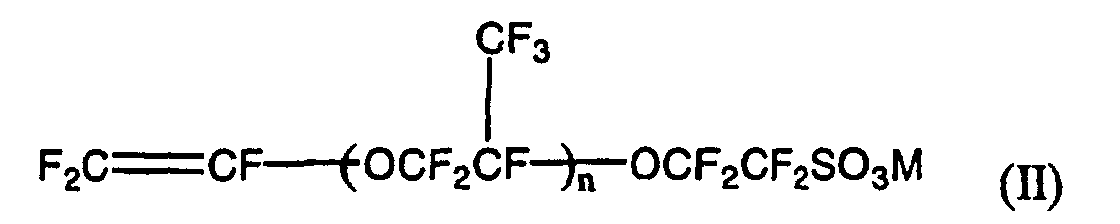
- the present invention relates to an efficient process for producing a perfluorovinyl ethersulfonic acid derivative represented by formula (II) below: [wherein M represents an alkali metal or 1/2(alkaline earth metal); n is 0, 1 or 2.]
- fluorine-based ionomers include copolymers which have a perfluoro polymer chain and a sulfonate group or carboxyl group bonded thereto, such as Nafion®, Flemion®, etc. These ionomers have been developed chiefly as ion-exchange membranes for use in electrolysis of sodium chloride. researchers are also studying their uses as chemical sensors, separation membranes, polymeric superacid catalysts, polyelectrolytes for conducting protons in fuel cells, among others.
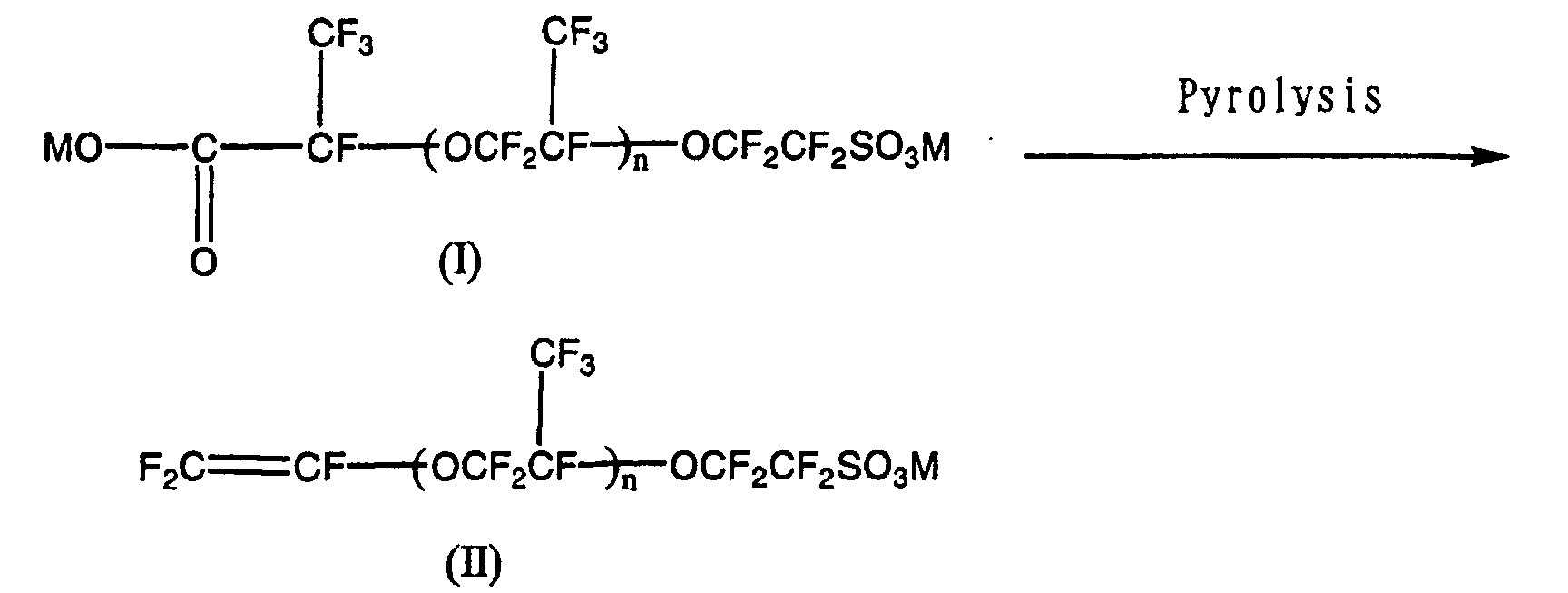
- perfluorovinyl ethersulfonic acid derivatives (II) which are raw materials for these fluorine-based ionomers, can be prepared by pyrolysis of a corresponding starting compound (I) according to the scheme below (refer to WO98/43952 pamphlet). [wherein M and n are as defined above.]
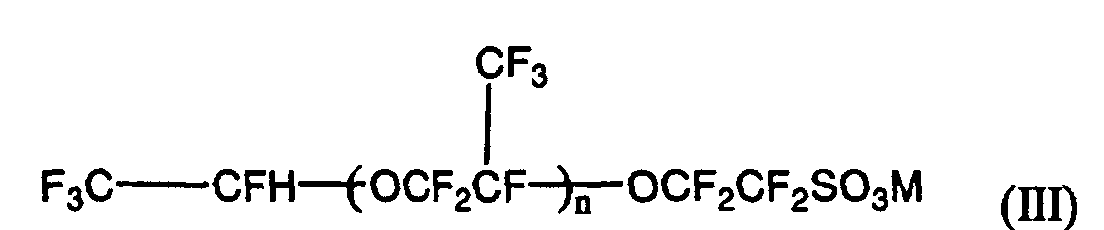
- the above pyrolysis has the following problem: if the heating time is too short, the starting compound remains in the product, whereas if the heating time is too long, by-products such as oligomers which are further polymerized substances of the desired product and compounds represented by formula (III) below [wherein M and n are as defined above.] and the like. Because a large amount of the starting compound (I) requires considerable time for reaction and post-treatment, the remaining starting compound and generation of by-products are especially problematic.
- An object of the present invention is to provide a process for preparing the monomer compound represented by formula (II) [wherein M and n are as defined above.] in a high yield.
- the inventors of the present invention conducted extensive research on the above problems. Consequently, they found that conducting pyrolysis in the presence of a catalyst which has coordinating properties to a metal ion M, such as diglyme, can promote the reaction, inhibit remaining of raw materials and generation of by-products.
- a catalyst which has coordinating properties to a metal ion M such as diglyme
- the present invention provides the following processes for preparing a perfluorovinyl ethersulfonic acid derivative.
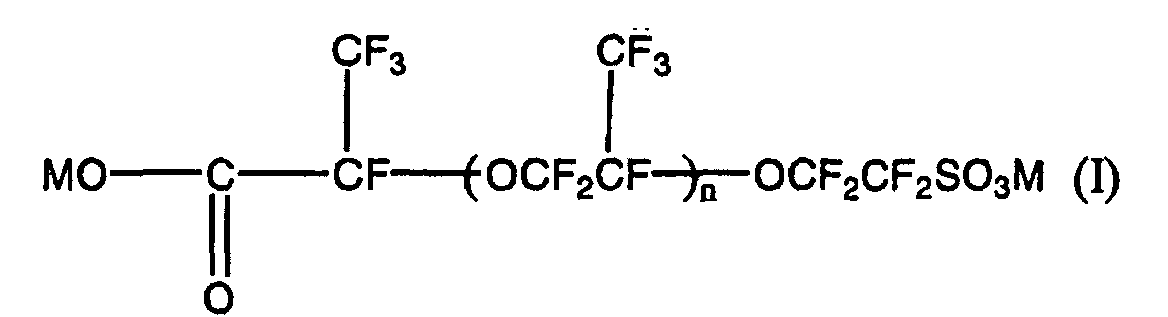
- Item 1 A process for preparing a perfluorovinyl ethersulfonic acid derivative represented by formula (II): [wherein M represents an alkali metal or alkaline earth metal; and n is 0, 1 or 2.] by pyrolysis of a compound represented by formula (I) below: [wherein M and n are as defined above.], the pyrolysis being conducted in the presence of a catalyst which has coordinating properties to a metal ion M.
- Item 2 The process of item 1 for preparing a perfluorovinyl ethersulfonic acid derivative represented by formula (II) : [wherein M represents an alkali metal or alkaline earth metal; and n is 0, 1 or 2.] by pyrolysis of a compound represented by formula (I) below: [wherein M and n are as defined above.] in an inert solvent, the pyrolysis being conducted in the presence of a catalyst which has coordinating properties to a metal ion M.
- Item 3 The preparation process of item 1, wherein the catalyst which has coordinating properties to a metal ion M is a glyme-based compound.
- Item 4 The preparation process of item 3, wherein the glyme-based compound is at least one member selected from the group consisting of diethylene glycol dimethyl ether, diethylene glycol diethyl ether, dimethoxyethane, diethoxyethane, tetraglyme and crown ether.
- Item 5 The preparation process of item 4, wherein the glyme-based compound is diglyme.
- Item 7 The preparation process of item 1, wherein the catalyst which has coordinating properties to a metal ion M is added in an amount of about 0.1 to about 1000 parts by weight relative to 100 parts by weight of a starting compound represented by formula (I).
- Item 8 The preparation process of item 1, wherein the catalyst which has coordinating properties to a metal ion M is added in an amount of about 0.1 to about 10 parts by weight relative to 100 parts by weight of a starting compound represented by formula (I).
- Item 9 The preparation process of item 1, wherein M is an alkali metal.
- Item 10 The preparation process of item 1, wherein M is sodium.
- the starting compound represented by formula (I) used in the process of the present invention is a known one, and can be produced, for example, by the process disclosed in WO98/43952 pamphlet.
- the compound of formula (I) can be obtained by dissolving or suspending 1 mole of the starting compound of formula (IV) in water or alcohol (methanol, ethanol, etc.) and allowing the mixture to react in the presence of 2 equivalents to an excess amount of MOH (NaOH, KOH, LiOH, CsOH, etc.) or M(OH) 2 (Ca(OH) 2 , Mg(OH) 2 , Ba(OH) 2 , etc.) at a temperature of about 20 to 80°C for 1 to 24 hours.
- MOH NaOH, KOH, LiOH, CsOH, etc.
- M(OH) 2 Ca(OH) 2 , Mg(OH) 2 , Ba(OH) 2 , etc.
- Examples of catalysts which has coordinating properties to a metal ion M include glyme-based compounds such as diethylene glycol dimethyl ether (diglyme), diethylene glycol diethyl ether, dimethoxyethane, diethoxyethane, tetraglyme and crown ether, dioxane, dimethyl acetamide, dimethyl sulfoxide, among others. Examples also include alcohol-, ester- and ketone-based compounds.
- glyme-based compounds are hydrocarbon-type ether compounds which are represented by the following formula: (wherein R represents C m H 2m+1 ; m is 1 to 5; and n is 1 to 10.)
- the starting compound may be subjected to pyrolysis in the solid state, or after being dispersed or dissolved in a solvent.
- the solvent used may be the above-mentioned catalyst itself or an inert liquid. Because it is difficult to completely dehydrate catalysts which have coordinating properties to a metal ion, preferable inert solvents are fluorocarbons which can be dehydrated relatively easily.
- preferable inert solvents used in pyrolysis are, but are not limited to, fluorocarbons which have been perfluorinated, perfluorochlorinated or partially hydrogenated or etherified.
- n 0, 1 or 2, preferably 0 or 1, more preferably 0.
- the amount of the catalyst which has coordinating properties to a metal ion M is preferably about 0.1 to about 1000 parts by weight, more preferably about 0.1 to about 10 parts by weight, particularly preferably about 1 to about 5 parts by weight, relative to 100 parts by weight of the starting compound represented by formula (I).
- This catalyst may be used in a large amount.
- the amount of the catalyst is about 200 to 1000 parts by weight, preferably about 200 to 300 parts by weight, relative to 100 parts by weight of the starting compound.
- the amount of the catalyst is about 500 to 1000 parts by weight relative to 100 parts by weight of the starting compound.
- metal ion M denotes an alkali metal ion such as Na + , K + , Li + , Cs + and the like or an alkaline earth metal ion such as 1/2 Ca 2+ , 1/2 Mg 2+ and the like.
- pyrolysis is conducted generally at about 100°C or higher, preferably about 150°C to about 250°C, particularly preferably about 170 to about 230°C. In order to limit the generation of by-products, it is advantageous to complete the reaction at about 170°C or higher in a short period of time.
- Preferable reaction time is 10 to 120 minutes after a predetermined reaction temperature has been reached.
- the atmosphere inside the reaction system is preferably replaced with an inert gas such as nitrogen, argon, etc.
- a preferable embodiment comprises the following steps: continuously feeding a mixture of the starting compound represented by formula (I), an inert solvent and a catalyst which has coordinating properties to a metal ion M into a cylindrical reactor whose temperature is controlled to about 170°C to about 230°C; heating the mixture for a certain period of time; drawing the reaction liquid from the reactor; cooling the reaction liquid; separating and collecting the reaction products from the solvent; and reusing the solvent.
- the process of the present invention is preferably conducted under anhydrous conditions, and the starting compound (I), inert solvent, catalyst which has coordinating properties to a metal ion M and other materials used in the reaction are preferably anhydrous.
- the perfluorovinyl ethersulfonic acid derivative of formula (II), which is a raw material for strongly acidic fluorine-based polyelectrolyte, can be obtained in a high yield while inhibiting the generation of by-products.
- a brown granular powder dispersed in Cl(CF 2 CFCl) 3 Cl was filtrated with a glass filter.
- the powder was washed with a small amount of CF 3 CHCl 2 and air-dried, giving a slightly colored granular powder.
- the granular powder was dissolved in 200 ml of deionized water.
- the pH of the solution was adjusted to 7 with a 10% aqueous solution of NaOH, the solution was filtrated again to collect a filtrate.
- the white residue remained on the filter was NaF.
- the filtrate was placed in an evaporator to evaporate water therein. When the entire filtrate became almost solid but wet, it was cooled in a refrigerator at 5°C for 1 hour.
- the raw material and oligomers have low crystallizabilities, they could be removed from the obtained reaction mixture by crystallization of the reaction mixture in the same post-treatment as in Example 1.
Landscapes
- Chemical & Material Sciences (AREA)
- Organic Chemistry (AREA)
- Chemical Kinetics & Catalysis (AREA)
- Organic Low-Molecular-Weight Compounds And Preparation Thereof (AREA)
- Low-Molecular Organic Synthesis Reactions Using Catalysts (AREA)
Abstract

Description


Item 1: A process for preparing a perfluorovinyl


Item 2: The process of item 1 for preparing a perfluorovinyl ethersulfonic acid derivative represented by formula (II) :

Item 3: The preparation process of item 1, wherein the catalyst which has coordinating properties to a metal ion M is a glyme-based compound.
Item 4: The preparation process of item 3, wherein the glyme-based compound is at least one member selected from the group consisting of diethylene glycol dimethyl ether, diethylene glycol diethyl ether, dimethoxyethane, diethoxyethane, tetraglyme and crown ether.
Item 5: The preparation process of item 4, wherein the glyme-based compound is diglyme.
Item 6: The preparation process of item 1, wherein n=0. Item 7: The preparation process of item 1, wherein the catalyst which has coordinating properties to a metal ion M is added in an amount of about 0.1 to about 1000 parts by weight relative to 100 parts by weight of a starting compound represented by formula (I).
Item 8: The preparation process of item 1, wherein the catalyst which has coordinating properties to a metal ion M is added in an amount of about 0.1 to about 10 parts by weight relative to 100 parts by weight of a starting compound represented by formula (I).
Item 9: The preparation process of item 1, wherein M is an alkali metal.
Item 10: The preparation process of item 1, wherein M is sodium.


Claims (10)
- A process for preparing a perfluorovinyl ethersulfonic acid derivative represented by formula (II):[wherein M represents an alkali metal or alkaline earth metal; and n is 0, 1 or 2.] by pyrolysis of a compound represented by formula (I) below:
 [wherein M and n are as defined above.], the pyrolysis being conducted in the presence of a catalyst which has coordinating properties to a metal ion M.
- The process of claim 1 for preparing a perfluorovinyl ethersulfonic acid derivative represented by formula (II):[wherein M represents an alkali metal or alkaline earth metal; and n is 0, 1 or 2.] by pyrolysis of a compound represented by formula (I) below:
 [wherein M and n are as defined above.] in an inert solvent, the pyrolysis being conducted in the presence of a catalyst which has coordinating properties to a metal ion M.
- The preparation process of claim 1, wherein the catalyst which has coordinating properties to a metal ion M is a glyme-based compound.
- The preparation process of claim 3, wherein the glyme-based compound is at least one member selected from the group consisting of diethylene glycol dimethyl ether, diethylene glycol diethyl ether, dimethoxyethane, diethoxyethane, tetraglyme and crown ether.
- The preparation process of claim 4, wherein the glyme-based compound is diglyme.
- The preparation process of claim 1, wherein n=0.
- The preparation process of claim 1, wherein the catalyst which has coordinating properties to a metal ion M is added in an amount of about 0.1 to about 1000 parts by weight relative to 100 parts by weight of a starting compound represented by formula (I).
- The preparation process of claim 1, wherein the catalyst which has coordinating properties to a metal ion M is added in an amount of about 0.1 to about 10 parts by weight relative to 100 parts by weight of a starting compound represented by formula (I).
- The preparation process of claim 1, wherein M is an alkali metal.
- The preparation process of claim 1, wherein M is sodium.
Applications Claiming Priority (3)
| Application Number | Priority Date | Filing Date | Title |
|---|---|---|---|
| JP29663999A JP2001114750A (en) | 1999-10-19 | 1999-10-19 | Method for producing perfluorovinyl ether sulfonic acid derivative |
| JP29663999 | 1999-10-19 | ||
| PCT/JP2000/007266 WO2001028989A1 (en) | 1999-10-19 | 2000-10-19 | Process for producing perfluoro(vinyl ether)sulfonic acid derivative |
Publications (2)
| Publication Number | Publication Date |
|---|---|
| EP1225167A1 true EP1225167A1 (en) | 2002-07-24 |
| EP1225167A4 EP1225167A4 (en) | 2004-11-24 |
Family
ID=17836150
Family Applications (1)
| Application Number | Title | Priority Date | Filing Date |
|---|---|---|---|
| EP00969886A Withdrawn EP1225167A4 (en) | 1999-10-19 | 2000-10-19 | PROCESS FOR PRODUCTION OF PERFLUORO (VINYL ETHER) SULFONIC ACID DERIVATIVE |
Country Status (4)
| Country | Link |
|---|---|
| US (1) | US6649790B1 (en) |
| EP (1) | EP1225167A4 (en) |
| JP (1) | JP2001114750A (en) |
| WO (1) | WO2001028989A1 (en) |
Cited By (3)
| Publication number | Priority date | Publication date | Assignee | Title |
|---|---|---|---|---|
| EP1325906A1 (en) * | 2002-01-03 | 2003-07-09 | Solvay Solexis S.p.A. | Alkyl esters of 2-(2-fluorosulphonyl)-perfluoroethylenoxy-3-halogen-propionic acid |
| US7321071B2 (en) | 2002-06-14 | 2008-01-22 | Daikin Industries, Ltd. | Process for the production of water-soluble fluorine-containing vinyl ethers |
| CN108084063A (en) * | 2017-11-25 | 2018-05-29 | 山东华夏神舟新材料有限公司 | The preparation method of perfluorovinyl sulfide ether sulfonate |
Families Citing this family (2)
| Publication number | Priority date | Publication date | Assignee | Title |
|---|---|---|---|---|
| CN102993059A (en) * | 2012-12-17 | 2013-03-27 | 江南大学 | Preparation method of N, N-dimethyl-N-fatty alcohol-polyoxyethylene ether hydroxypropyl sulpho glycine betaine |
| JP7603425B2 (en) | 2020-11-27 | 2024-12-20 | 旭化成株式会社 | Method for producing fluorine-containing vinyl compound salt |
Family Cites Families (5)
| Publication number | Priority date | Publication date | Assignee | Title |
|---|---|---|---|---|
| US3144778A (en) * | 1962-04-05 | 1964-08-18 | American Mfg Company Of Texas | Pumping unit with improved flexibly connected beam |
| US4358412A (en) | 1980-06-11 | 1982-11-09 | The Dow Chemical Company | Preparation of vinyl ethers |
| IT1246357B (en) * | 1990-07-12 | 1994-11-17 | Ausimont Spa | PROCESS FOR THE PREPARATION OF PERFLUOROALCOXYSULPHONIC COMPOUNDS |
| WO1998043952A1 (en) | 1997-03-31 | 1998-10-08 | Daikin Industries, Ltd. | Process for producing perfluorovinyl ethersulfonic acid derivatives and copolymer of the same |
| IT1313597B1 (en) * | 1999-08-04 | 2002-09-09 | Ausimont Spa | FLUOROPOLYEREOUS LUBRICANTS CONTAINING SULPHONYLFLUORIDE GROUPS |
-
1999
- 1999-10-19 JP JP29663999A patent/JP2001114750A/en not_active Withdrawn
-
2000
- 2000-10-19 US US10/111,079 patent/US6649790B1/en not_active Expired - Fee Related
- 2000-10-19 EP EP00969886A patent/EP1225167A4/en not_active Withdrawn
- 2000-10-19 WO PCT/JP2000/007266 patent/WO2001028989A1/en not_active Ceased
Cited By (4)
| Publication number | Priority date | Publication date | Assignee | Title |
|---|---|---|---|---|
| EP1325906A1 (en) * | 2002-01-03 | 2003-07-09 | Solvay Solexis S.p.A. | Alkyl esters of 2-(2-fluorosulphonyl)-perfluoroethylenoxy-3-halogen-propionic acid |
| US6703521B2 (en) | 2002-01-03 | 2004-03-09 | Ausimont S.P.A. | Alkyl esters of the 2-(2-fluorosulphonyl)-perfluoroethylenoxy-3-halogen-propionic acid |
| US7321071B2 (en) | 2002-06-14 | 2008-01-22 | Daikin Industries, Ltd. | Process for the production of water-soluble fluorine-containing vinyl ethers |
| CN108084063A (en) * | 2017-11-25 | 2018-05-29 | 山东华夏神舟新材料有限公司 | The preparation method of perfluorovinyl sulfide ether sulfonate |
Also Published As
| Publication number | Publication date |
|---|---|
| US6649790B1 (en) | 2003-11-18 |
| EP1225167A4 (en) | 2004-11-24 |
| JP2001114750A (en) | 2001-04-24 |
| WO2001028989A1 (en) | 2001-04-26 |
Similar Documents
| Publication | Publication Date | Title |
|---|---|---|
| KR101936966B1 (en) | Process for the synthesis of 2,5-furandicarboxylic acid | |
| JPWO1998043952A1 (en) | Method for producing perfluorovinyl ether sulfonic acid derivatives and copolymers thereof | |
| CN111116429B (en) | Method for synthesizing alkali metal trifluoromethanesulfonate or alkali metal methanesulfonate | |
| US4769492A (en) | Method for production of 2,3,4,5-tetrafluorobenzoic acid | |
| KR20140097370A (en) | Method for preparing fluorine-containing vinyl ether | |
| US6649790B1 (en) | Process for producing perfluoro(vinyl ether) sulfonic acid derivative | |
| CN114210365B (en) | Catalyst for synthesizing methyl ethyl carbonate and diethyl carbonate and method thereof | |
| CA2979587C (en) | Method for manufacturing furan-2,5-dicarboxylic acid (fdca) from a solid salt | |
| US20120065421A1 (en) | Novel method of synthesizing fenofibrate | |
| US4434273A (en) | Perfluoroketovinyl ethers and copolymers therefrom | |
| US12623995B2 (en) | Method of preparing heterogeneous linear carbonate using amine-based compound catalyst | |
| CN117088842B (en) | Synthesis method of 2, 4-butane sultone | |
| JPH05271154A (en) | Synthesis of dialkyl succinylsuccinate ester and its conversion to dialkyl 2,5-diarylamino-3,6-dihydroterephthalate ester | |
| CN104262332A (en) | Preparation method of olmesartan medoxomil | |
| CN104478715A (en) | Preparation method of compound | |
| CA3250837A1 (en) | Method for producing 4,4’-dihydroxybiphenyl-3,3’-dicarboxylic acid | |
| JP4817542B2 (en) | Production method of fluorinated vinyl ether | |
| CN113354587A (en) | Drying method of imidazolyl fluorine-containing lithium salt | |
| FI88028B (en) | FOERFARANDE FOER FRAMSTAELLNING AV -HYDROXISMOERSYRA OCH DESS SALTER MEDELST HYDROLYSERING AV OLIGOMERER AV -HYDROXISMOERSYRA VID BASISKA BETINGELSER | |
| JPH0250088B2 (en) | ||
| CN116143624A (en) | Imidazole is used as a catalyst to prepare the method for fluorine-containing linear carbonate lithium battery additive | |
| US4385187A (en) | Perfluoroketovinyl ethers and copolymers therefrom | |
| CA1079298A (en) | Preparation of 3.5-dialkyl-4-hydroxybenzoic acid | |
| JPH06228227A (en) | Production of polyvinyl acetal resin | |
| CN114835584B (en) | Method for post-treatment of esterification reaction of 3-methyl-4-nitrobenzoic acid and alcohol |
Legal Events
| Date | Code | Title | Description |
|---|---|---|---|
| PUAI | Public reference made under article 153(3) epc to a published international application that has entered the european phase |
Free format text: ORIGINAL CODE: 0009012 |
|
| 17P | Request for examination filed |
Effective date: 20020506 |
|
| AK | Designated contracting states |
Kind code of ref document: A1 Designated state(s): AT BE CH CY DE DK ES FI FR GB GR IE IT LI LU MC NL PT SE |
|
| RBV | Designated contracting states (corrected) |
Designated state(s): AT BE CH CY DE FR GB IT LI |
|
| RIC1 | Information provided on ipc code assigned before grant |
Ipc: 7C 07C 303/32 A Ipc: 7C 07C 309/10 B Ipc: 7C 07C 303/22 B |
|
| A4 | Supplementary search report drawn up and despatched |
Effective date: 20041013 |
|
| STAA | Information on the status of an ep patent application or granted ep patent |
Free format text: STATUS: THE APPLICATION IS DEEMED TO BE WITHDRAWN |
|
| 18D | Application deemed to be withdrawn |
Effective date: 20060628 |