EP1225162A1 - Synthesis of vicinal difluoro aromatics and intermediates thereof - Google Patents
Synthesis of vicinal difluoro aromatics and intermediates thereof Download PDFInfo
- Publication number
- EP1225162A1 EP1225162A1 EP02001040A EP02001040A EP1225162A1 EP 1225162 A1 EP1225162 A1 EP 1225162A1 EP 02001040 A EP02001040 A EP 02001040A EP 02001040 A EP02001040 A EP 02001040A EP 1225162 A1 EP1225162 A1 EP 1225162A1
- Authority
- EP
- European Patent Office
- Prior art keywords
- tetrafluoro
- aromatic compound
- solvent
- derivative
- alkyl
- Prior art date
- Legal status (The legal status is an assumption and is not a legal conclusion. Google has not performed a legal analysis and makes no representation as to the accuracy of the status listed.)
- Granted
Links
- 239000000543 intermediate Substances 0.000 title abstract description 10
- 230000015572 biosynthetic process Effects 0.000 title description 22
- 238000003786 synthesis reaction Methods 0.000 title description 13
- PQIOSYKVBBWRRI-UHFFFAOYSA-N methylphosphonyl difluoride Chemical group CP(F)(F)=O PQIOSYKVBBWRRI-UHFFFAOYSA-N 0.000 title description 2
- 238000000034 method Methods 0.000 claims abstract description 46
- -1 difluoro aromatic compounds Chemical group 0.000 claims abstract description 25
- 238000006467 substitution reaction Methods 0.000 claims abstract description 13
- 125000003118 aryl group Chemical group 0.000 claims abstract description 9
- 125000005842 heteroatom Chemical group 0.000 claims abstract description 5
- 125000002887 hydroxy group Chemical group [H]O* 0.000 claims abstract description 4
- YXFVVABEGXRONW-UHFFFAOYSA-N Toluene Chemical compound CC1=CC=CC=C1 YXFVVABEGXRONW-UHFFFAOYSA-N 0.000 claims description 52
- ZMXDDKWLCZADIW-UHFFFAOYSA-N N,N-Dimethylformamide Chemical compound CN(C)C=O ZMXDDKWLCZADIW-UHFFFAOYSA-N 0.000 claims description 48
- WYURNTSHIVDZCO-UHFFFAOYSA-N Tetrahydrofuran Chemical compound C1CCOC1 WYURNTSHIVDZCO-UHFFFAOYSA-N 0.000 claims description 34
- 239000002904 solvent Substances 0.000 claims description 32
- 239000000203 mixture Substances 0.000 claims description 29
- VHUUQVKOLVNVRT-UHFFFAOYSA-N Ammonium hydroxide Chemical compound [NH4+].[OH-] VHUUQVKOLVNVRT-UHFFFAOYSA-N 0.000 claims description 23
- QGZKDVFQNNGYKY-UHFFFAOYSA-N ammonia Natural products N QGZKDVFQNNGYKY-UHFFFAOYSA-N 0.000 claims description 22
- 150000001491 aromatic compounds Chemical class 0.000 claims description 19
- WEVYAHXRMPXWCK-UHFFFAOYSA-N Acetonitrile Chemical compound CC#N WEVYAHXRMPXWCK-UHFFFAOYSA-N 0.000 claims description 18
- HCHKCACWOHOZIP-UHFFFAOYSA-N Zinc Chemical group [Zn] HCHKCACWOHOZIP-UHFFFAOYSA-N 0.000 claims description 17
- IYRWEQXVUNLMAY-UHFFFAOYSA-N carbonyl fluoride Chemical class FC(F)=O IYRWEQXVUNLMAY-UHFFFAOYSA-N 0.000 claims description 17
- YLQBMQCUIZJEEH-UHFFFAOYSA-N tetrahydrofuran Natural products C=1C=COC=1 YLQBMQCUIZJEEH-UHFFFAOYSA-N 0.000 claims description 17
- 239000003638 chemical reducing agent Substances 0.000 claims description 16
- NLXLAEXVIDQMFP-UHFFFAOYSA-N Ammonia chloride Chemical compound [NH4+].[Cl-] NLXLAEXVIDQMFP-UHFFFAOYSA-N 0.000 claims description 14
- 239000011701 zinc Substances 0.000 claims description 14
- 229910052725 zinc Inorganic materials 0.000 claims description 14
- 125000000753 cycloalkyl group Chemical group 0.000 claims description 13
- 125000001153 fluoro group Chemical group F* 0.000 claims description 12
- LFQSCWFLJHTTHZ-UHFFFAOYSA-N Ethanol Chemical compound CCO LFQSCWFLJHTTHZ-UHFFFAOYSA-N 0.000 claims description 11
- JMMWLWZXTQWMKQ-HDJSIYSDSA-N C1C[C@@H](CCC)CC[C@@H]1C1=CC=C2C(F)(F)C(F)(F)C=CC2=C1 Chemical compound C1C[C@@H](CCC)CC[C@@H]1C1=CC=C2C(F)(F)C(F)(F)C=CC2=C1 JMMWLWZXTQWMKQ-HDJSIYSDSA-N 0.000 claims description 10
- 239000003960 organic solvent Substances 0.000 claims description 10
- 239000000725 suspension Substances 0.000 claims description 9
- RTZKZFJDLAIYFH-UHFFFAOYSA-N ether Substances CCOCC RTZKZFJDLAIYFH-UHFFFAOYSA-N 0.000 claims description 8
- RYGMFSIKBFXOCR-UHFFFAOYSA-N Copper Chemical compound [Cu] RYGMFSIKBFXOCR-UHFFFAOYSA-N 0.000 claims description 7
- 125000000008 (C1-C10) alkyl group Chemical group 0.000 claims description 6
- BZLVMXJERCGZMT-UHFFFAOYSA-N Methyl tert-butyl ether Chemical compound COC(C)(C)C BZLVMXJERCGZMT-UHFFFAOYSA-N 0.000 claims description 6
- 235000019270 ammonium chloride Nutrition 0.000 claims description 6
- FYYHWMGAXLPEAU-UHFFFAOYSA-N Magnesium Chemical compound [Mg] FYYHWMGAXLPEAU-UHFFFAOYSA-N 0.000 claims description 5
- 239000010949 copper Substances 0.000 claims description 5
- 229910052802 copper Inorganic materials 0.000 claims description 5
- 239000011777 magnesium Substances 0.000 claims description 5
- 229910052749 magnesium Inorganic materials 0.000 claims description 5
- 229910021529 ammonia Inorganic materials 0.000 claims description 4
- 150000003863 ammonium salts Chemical class 0.000 claims description 4
- 239000003795 chemical substances by application Substances 0.000 claims description 4
- 239000012025 fluorinating agent Substances 0.000 claims description 4
- 125000005843 halogen group Chemical group 0.000 claims description 4
- 125000000449 nitro group Chemical group [O-][N+](*)=O 0.000 claims description 4
- 125000002924 primary amino group Chemical group [H]N([H])* 0.000 claims description 4
- 229920006395 saturated elastomer Polymers 0.000 claims description 4
- 150000003568 thioethers Chemical class 0.000 claims description 4
- 125000004417 unsaturated alkyl group Chemical group 0.000 claims description 4
- UUPAQCOFXUHZCP-UHFFFAOYSA-N 1,1,2,2-tetrafluoronaphthalene Chemical compound C1=CC=C2C(F)(F)C(F)(F)C=CC2=C1 UUPAQCOFXUHZCP-UHFFFAOYSA-N 0.000 claims description 3
- HYEPGSDVXXXEIA-UHFFFAOYSA-N 6-bromo-1,1,2,2-tetrafluoronaphthalene Chemical compound BrC1=CC=C2C(F)(F)C(F)(F)C=CC2=C1 HYEPGSDVXXXEIA-UHFFFAOYSA-N 0.000 claims description 3
- ZTJJUXMRRLYLMS-UHFFFAOYSA-N 9,9,10,10-tetrafluorophenanthrene Chemical compound C1=CC=C2C(F)(F)C(F)(F)C3=CC=CC=C3C2=C1 ZTJJUXMRRLYLMS-UHFFFAOYSA-N 0.000 claims description 3
- IOIPFCQWKLBXEJ-SHTZXODSSA-N C1C[C@@H](CCC)CC[C@@H]1C1=CC=C(C=C(O)C=C2)C2=C1 Chemical compound C1C[C@@H](CCC)CC[C@@H]1C1=CC=C(C=C(O)C=C2)C2=C1 IOIPFCQWKLBXEJ-SHTZXODSSA-N 0.000 claims description 3
- 239000011261 inert gas Substances 0.000 claims description 2
- 239000003880 polar aprotic solvent Substances 0.000 claims description 2
- OKTJSMMVPCPJKN-UHFFFAOYSA-N Carbon Chemical compound [C] OKTJSMMVPCPJKN-UHFFFAOYSA-N 0.000 claims 2
- UFWIBTONFRDIAS-UHFFFAOYSA-N Naphthalene Chemical compound C1=CC=CC2=CC=CC=C21 UFWIBTONFRDIAS-UHFFFAOYSA-N 0.000 claims 2
- 229910052799 carbon Inorganic materials 0.000 claims 2
- 150000002576 ketones Chemical class 0.000 claims 2
- YNPNZTXNASCQKK-UHFFFAOYSA-N phenanthrene Chemical compound C1=CC=C2C3=CC=CC=C3C=CC2=C1 YNPNZTXNASCQKK-UHFFFAOYSA-N 0.000 claims 2
- JNZXJXKEOGUJOH-SHTZXODSSA-N C1C[C@@H](CCC)CC[C@@H]1C1=CC=C(CC(=O)C=C2)C2=C1 Chemical group C1C[C@@H](CCC)CC[C@@H]1C1=CC=C(CC(=O)C=C2)C2=C1 JNZXJXKEOGUJOH-SHTZXODSSA-N 0.000 claims 1
- 125000006615 aromatic heterocyclic group Chemical group 0.000 claims 1
- IJGRMHOSHXDMSA-UHFFFAOYSA-N Atomic nitrogen Chemical compound N#N IJGRMHOSHXDMSA-UHFFFAOYSA-N 0.000 abstract description 6
- 229910052757 nitrogen Inorganic materials 0.000 abstract description 4
- 229910052760 oxygen Inorganic materials 0.000 abstract description 3
- 229910052717 sulfur Inorganic materials 0.000 abstract description 3
- NINIDFKCEFEMDL-UHFFFAOYSA-N Sulfur Chemical compound [S] NINIDFKCEFEMDL-UHFFFAOYSA-N 0.000 abstract description 2
- QVGXLLKOCUKJST-UHFFFAOYSA-N atomic oxygen Chemical compound [O] QVGXLLKOCUKJST-UHFFFAOYSA-N 0.000 abstract description 2
- 239000001301 oxygen Substances 0.000 abstract description 2
- 239000011593 sulfur Substances 0.000 abstract description 2
- VLKZOEOYAKHREP-UHFFFAOYSA-N n-Hexane Chemical compound CCCCCC VLKZOEOYAKHREP-UHFFFAOYSA-N 0.000 description 47
- 239000000047 product Substances 0.000 description 36
- 238000006243 chemical reaction Methods 0.000 description 29
- XEKOWRVHYACXOJ-UHFFFAOYSA-N Ethyl acetate Chemical compound CCOC(C)=O XEKOWRVHYACXOJ-UHFFFAOYSA-N 0.000 description 26
- OKKJLVBELUTLKV-UHFFFAOYSA-N Methanol Chemical compound OC OKKJLVBELUTLKV-UHFFFAOYSA-N 0.000 description 24
- 239000003153 chemical reaction reagent Substances 0.000 description 21
- CSNNHWWHGAXBCP-UHFFFAOYSA-L Magnesium sulfate Chemical compound [Mg+2].[O-][S+2]([O-])([O-])[O-] CSNNHWWHGAXBCP-UHFFFAOYSA-L 0.000 description 20
- VYPSYNLAJGMNEJ-UHFFFAOYSA-N Silicium dioxide Chemical compound O=[Si]=O VYPSYNLAJGMNEJ-UHFFFAOYSA-N 0.000 description 16
- 238000002290 gas chromatography-mass spectrometry Methods 0.000 description 15
- UIIMBOGNXHQVGW-UHFFFAOYSA-M Sodium bicarbonate Chemical compound [Na+].OC([O-])=O UIIMBOGNXHQVGW-UHFFFAOYSA-M 0.000 description 10
- 235000019439 ethyl acetate Nutrition 0.000 description 10
- 229910052943 magnesium sulfate Inorganic materials 0.000 description 10
- 239000000741 silica gel Substances 0.000 description 10
- 229910002027 silica gel Inorganic materials 0.000 description 10
- XLYOFNOQVPJJNP-UHFFFAOYSA-N water Substances O XLYOFNOQVPJJNP-UHFFFAOYSA-N 0.000 description 10
- APOYTRAZFJURPB-UHFFFAOYSA-N 2-methoxy-n-(2-methoxyethyl)-n-(trifluoro-$l^{4}-sulfanyl)ethanamine Chemical compound COCCN(S(F)(F)F)CCOC APOYTRAZFJURPB-UHFFFAOYSA-N 0.000 description 9
- 235000011114 ammonium hydroxide Nutrition 0.000 description 9
- 238000001816 cooling Methods 0.000 description 8
- 239000012363 selectfluor Substances 0.000 description 8
- 239000007858 starting material Substances 0.000 description 8
- 239000012044 organic layer Substances 0.000 description 7
- RRSFREKZTNVCSV-UHFFFAOYSA-N 1,2-difluoro-6-(4-propylcyclohexyl)naphthalene Chemical compound C1CC(CCC)CCC1C1=CC=C(C(F)=C(F)C=C2)C2=C1 RRSFREKZTNVCSV-UHFFFAOYSA-N 0.000 description 6
- JWAZRIHNYRIHIV-UHFFFAOYSA-N 2-naphthol Chemical compound C1=CC=CC2=CC(O)=CC=C21 JWAZRIHNYRIHIV-UHFFFAOYSA-N 0.000 description 6
- KZMGYPLQYOPHEL-UHFFFAOYSA-N Boron trifluoride etherate Chemical compound FB(F)F.CCOCC KZMGYPLQYOPHEL-UHFFFAOYSA-N 0.000 description 6
- CURLTUGMZLYLDI-UHFFFAOYSA-N Carbon dioxide Chemical compound O=C=O CURLTUGMZLYLDI-UHFFFAOYSA-N 0.000 description 6
- 239000004809 Teflon Substances 0.000 description 6
- 229920006362 Teflon® Polymers 0.000 description 6
- 238000004587 chromatography analysis Methods 0.000 description 6
- 238000004817 gas chromatography Methods 0.000 description 6
- 239000011541 reaction mixture Substances 0.000 description 6
- PDHDZHIJGXQIIH-UHFFFAOYSA-N 1,2-difluoronaphthalene Chemical group C1=CC=CC2=C(F)C(F)=CC=C21 PDHDZHIJGXQIIH-UHFFFAOYSA-N 0.000 description 5
- 238000000746 purification Methods 0.000 description 5
- PIPHPCIPVQDKDV-HDJSIYSDSA-N C1C[C@@H](CCC)CC[C@@H]1C1=CC2=CC=CC=C2C(F)(F)C1=O Chemical compound C1C[C@@H](CCC)CC[C@@H]1C1=CC2=CC=CC=C2C(F)(F)C1=O PIPHPCIPVQDKDV-HDJSIYSDSA-N 0.000 description 4
- 150000001875 compounds Chemical class 0.000 description 4
- 238000003682 fluorination reaction Methods 0.000 description 4
- 239000012074 organic phase Substances 0.000 description 4
- QTBSBXVTEAMEQO-UHFFFAOYSA-N Acetic acid Chemical compound CC(O)=O QTBSBXVTEAMEQO-UHFFFAOYSA-N 0.000 description 3
- PFNLBZSZQIKTOA-JOCQHMNTSA-N C1C[C@@H](CCC)CC[C@@H]1C1=CC=C(C(F)=C(F)C=C2F)C2=C1 Chemical compound C1C[C@@H](CCC)CC[C@@H]1C1=CC=C(C(F)=C(F)C=C2F)C2=C1 PFNLBZSZQIKTOA-JOCQHMNTSA-N 0.000 description 3
- 0 CC1CCC(*c2ccc(C)cc2)CC1 Chemical compound CC1CCC(*c2ccc(C)cc2)CC1 0.000 description 3
- YMWUJEATGCHHMB-UHFFFAOYSA-N Dichloromethane Chemical compound ClCCl YMWUJEATGCHHMB-UHFFFAOYSA-N 0.000 description 3
- 239000000908 ammonium hydroxide Substances 0.000 description 3
- 239000006227 byproduct Substances 0.000 description 3
- 239000006184 cosolvent Substances 0.000 description 3
- 230000001419 dependent effect Effects 0.000 description 3
- 230000008034 disappearance Effects 0.000 description 3
- 150000002170 ethers Chemical class 0.000 description 3
- 238000001704 evaporation Methods 0.000 description 3
- 239000000706 filtrate Substances 0.000 description 3
- 238000003818 flash chromatography Methods 0.000 description 3
- 239000010410 layer Substances 0.000 description 3
- 239000012071 phase Substances 0.000 description 3
- 230000002829 reductive effect Effects 0.000 description 3
- 239000000377 silicon dioxide Substances 0.000 description 3
- RRFBVUABDWLHRP-UHFFFAOYSA-N 1,1-difluoronaphthalen-2-one Chemical compound C1=CC=C2C(F)(F)C(=O)C=CC2=C1 RRFBVUABDWLHRP-UHFFFAOYSA-N 0.000 description 2
- CGGXKLYWOWJNIV-UHFFFAOYSA-N 1,2,3,4-tetrafluoronaphthalene Chemical compound C1=CC=CC2=C(F)C(F)=C(F)C(F)=C21 CGGXKLYWOWJNIV-UHFFFAOYSA-N 0.000 description 2
- OMWXPSVTLBZMBN-UHFFFAOYSA-N 10,10-difluorophenanthren-9-one Chemical compound C1=CC=C2C(F)(F)C(=O)C3=CC=CC=C3C2=C1 OMWXPSVTLBZMBN-UHFFFAOYSA-N 0.000 description 2
- ILMUVRURIPPLHY-UHFFFAOYSA-N 6-bromo-1,1-difluoronaphthalen-2-one Chemical compound BrC1=CC=C2C(F)(F)C(=O)C=CC2=C1 ILMUVRURIPPLHY-UHFFFAOYSA-N 0.000 description 2
- YLDFTMJPQJXGSS-UHFFFAOYSA-N 6-bromo-2-naphthol Chemical compound C1=C(Br)C=CC2=CC(O)=CC=C21 YLDFTMJPQJXGSS-UHFFFAOYSA-N 0.000 description 2
- WNCFAOAWHBXELI-UHFFFAOYSA-N 9,10-difluorophenanthrene Chemical compound C1=CC=C2C(F)=C(F)C3=CC=CC=C3C2=C1 WNCFAOAWHBXELI-UHFFFAOYSA-N 0.000 description 2
- DZKIUEHLEXLYKM-UHFFFAOYSA-N 9-phenanthrol Chemical compound C1=CC=C2C(O)=CC3=CC=CC=C3C2=C1 DZKIUEHLEXLYKM-UHFFFAOYSA-N 0.000 description 2
- RDYNRIVHJUKBGA-HDJSIYSDSA-N C1C[C@@H](CCC)CC[C@@H]1C1=CC=C2C(F)(F)C(=O)C=CC2=C1 Chemical compound C1C[C@@H](CCC)CC[C@@H]1C1=CC=C2C(F)(F)C(=O)C=CC2=C1 RDYNRIVHJUKBGA-HDJSIYSDSA-N 0.000 description 2
- ZTIDISDIQSHOOT-IILDZGFYSA-N C1C[C@@H](CCC)CC[C@@H]1C1=CC=C2C(F)(F)C(F)C=C(F)C2=C1 Chemical compound C1C[C@@H](CCC)CC[C@@H]1C1=CC=C2C(F)(F)C(F)C=C(F)C2=C1 ZTIDISDIQSHOOT-IILDZGFYSA-N 0.000 description 2
- HEDRZPFGACZZDS-UHFFFAOYSA-N Chloroform Chemical compound ClC(Cl)Cl HEDRZPFGACZZDS-UHFFFAOYSA-N 0.000 description 2
- IMNFDUFMRHMDMM-UHFFFAOYSA-N N-Heptane Chemical compound CCCCCCC IMNFDUFMRHMDMM-UHFFFAOYSA-N 0.000 description 2
- 238000004458 analytical method Methods 0.000 description 2
- 150000004945 aromatic hydrocarbons Chemical class 0.000 description 2
- 229950011260 betanaphthol Drugs 0.000 description 2
- 238000009835 boiling Methods 0.000 description 2
- TVZPLCNGKSPOJA-UHFFFAOYSA-N copper zinc Chemical compound [Cu].[Zn] TVZPLCNGKSPOJA-UHFFFAOYSA-N 0.000 description 2
- 230000008020 evaporation Effects 0.000 description 2
- 235000019341 magnesium sulphate Nutrition 0.000 description 2
- 229910052751 metal Inorganic materials 0.000 description 2
- 239000002184 metal Substances 0.000 description 2
- 150000002825 nitriles Chemical class 0.000 description 2
- 239000000843 powder Substances 0.000 description 2
- 229910000030 sodium bicarbonate Inorganic materials 0.000 description 2
- 125000003837 (C1-C20) alkyl group Chemical group 0.000 description 1
- DSLKOTQBUFGMQY-UHFFFAOYSA-N 1,2,3-trifluoronaphthalene Chemical compound C1=CC=C2C(F)=C(F)C(F)=CC2=C1 DSLKOTQBUFGMQY-UHFFFAOYSA-N 0.000 description 1
- YHSUZQMVYUELOQ-UHFFFAOYSA-N 3,3,4,4-tetrafluoro-1,2-dihydronaphthalene Chemical compound C1=CC=C2C(F)(F)C(F)(F)CCC2=C1 YHSUZQMVYUELOQ-UHFFFAOYSA-N 0.000 description 1
- IOIPFCQWKLBXEJ-UHFFFAOYSA-N 6-(4-propylcyclohexyl)naphthalen-2-ol Chemical compound C1CC(CCC)CCC1C1=CC=C(C=C(O)C=C2)C2=C1 IOIPFCQWKLBXEJ-UHFFFAOYSA-N 0.000 description 1
- 229910017518 Cu Zn Inorganic materials 0.000 description 1
- 229910017752 Cu-Zn Inorganic materials 0.000 description 1
- 229910017943 Cu—Zn Inorganic materials 0.000 description 1
- 150000001298 alcohols Chemical class 0.000 description 1
- 150000001335 aliphatic alkanes Chemical class 0.000 description 1
- 150000001338 aliphatic hydrocarbons Chemical class 0.000 description 1
- 150000001350 alkyl halides Chemical class 0.000 description 1
- SMZOGRDCAXLAAR-UHFFFAOYSA-N aluminium isopropoxide Chemical compound [Al+3].CC(C)[O-].CC(C)[O-].CC(C)[O-] SMZOGRDCAXLAAR-UHFFFAOYSA-N 0.000 description 1
- 150000001408 amides Chemical class 0.000 description 1
- 150000004982 aromatic amines Chemical class 0.000 description 1
- 229910052794 bromium Inorganic materials 0.000 description 1
- 150000001735 carboxylic acids Chemical class 0.000 description 1
- 239000003054 catalyst Substances 0.000 description 1
- 229910052801 chlorine Inorganic materials 0.000 description 1
- 238000004440 column chromatography Methods 0.000 description 1
- JZCCFEFSEZPSOG-UHFFFAOYSA-L copper(II) sulfate pentahydrate Chemical compound O.O.O.O.O.[Cu+2].[O-]S([O-])(=O)=O JZCCFEFSEZPSOG-UHFFFAOYSA-L 0.000 description 1
- 238000006115 defluorination reaction Methods 0.000 description 1
- 238000006704 dehydrohalogenation reaction Methods 0.000 description 1
- 238000004821 distillation Methods 0.000 description 1
- 230000008030 elimination Effects 0.000 description 1
- 238000003379 elimination reaction Methods 0.000 description 1
- 150000002148 esters Chemical class 0.000 description 1
- 238000001914 filtration Methods 0.000 description 1
- 150000003948 formamides Chemical class 0.000 description 1
- 150000008282 halocarbons Chemical class 0.000 description 1
- 125000001072 heteroaryl group Chemical group 0.000 description 1
- 125000004435 hydrogen atom Chemical group [H]* 0.000 description 1
- 239000012535 impurity Substances 0.000 description 1
- 239000011968 lewis acid catalyst Substances 0.000 description 1
- 239000004973 liquid crystal related substance Substances 0.000 description 1
- 239000012280 lithium aluminium hydride Substances 0.000 description 1
- 238000004519 manufacturing process Methods 0.000 description 1
- 239000000463 material Substances 0.000 description 1
- 150000002739 metals Chemical class 0.000 description 1
- 150000002790 naphthalenes Chemical class 0.000 description 1
- 150000004780 naphthols Chemical class 0.000 description 1
- LYGJENNIWJXYER-UHFFFAOYSA-N nitromethane Chemical compound C[N+]([O-])=O LYGJENNIWJXYER-UHFFFAOYSA-N 0.000 description 1
- 230000000269 nucleophilic effect Effects 0.000 description 1
- BDERNNFJNOPAEC-UHFFFAOYSA-N propan-1-ol Chemical compound CCCO BDERNNFJNOPAEC-UHFFFAOYSA-N 0.000 description 1
- 239000012429 reaction media Substances 0.000 description 1
- 230000035484 reaction time Effects 0.000 description 1
- 238000001953 recrystallisation Methods 0.000 description 1
- 239000002002 slurry Substances 0.000 description 1
- 239000007787 solid Substances 0.000 description 1
- 241000894007 species Species 0.000 description 1
- 238000003756 stirring Methods 0.000 description 1
- 239000008096 xylene Substances 0.000 description 1
- 150000003738 xylenes Chemical class 0.000 description 1
Classifications
-
- C—CHEMISTRY; METALLURGY
- C07—ORGANIC CHEMISTRY
- C07C—ACYCLIC OR CARBOCYCLIC COMPOUNDS
- C07C19/00—Acyclic saturated compounds containing halogen atoms
- C07C19/08—Acyclic saturated compounds containing halogen atoms containing fluorine
-
- C—CHEMISTRY; METALLURGY
- C07—ORGANIC CHEMISTRY
- C07C—ACYCLIC OR CARBOCYCLIC COMPOUNDS
- C07C49/00—Ketones; Ketenes; Dimeric ketenes; Ketonic chelates
- C07C49/587—Unsaturated compounds containing a keto groups being part of a ring
- C07C49/687—Unsaturated compounds containing a keto groups being part of a ring containing halogen
- C07C49/697—Unsaturated compounds containing a keto groups being part of a ring containing halogen containing six-membered aromatic rings
-
- C—CHEMISTRY; METALLURGY
- C07—ORGANIC CHEMISTRY
- C07B—GENERAL METHODS OF ORGANIC CHEMISTRY; APPARATUS THEREFOR
- C07B39/00—Halogenation
-
- C—CHEMISTRY; METALLURGY
- C07—ORGANIC CHEMISTRY
- C07C—ACYCLIC OR CARBOCYCLIC COMPOUNDS
- C07C17/00—Preparation of halogenated hydrocarbons
- C07C17/093—Preparation of halogenated hydrocarbons by replacement by halogens
- C07C17/18—Preparation of halogenated hydrocarbons by replacement by halogens of oxygen atoms of carbonyl groups
-
- C—CHEMISTRY; METALLURGY
- C07—ORGANIC CHEMISTRY
- C07C—ACYCLIC OR CARBOCYCLIC COMPOUNDS
- C07C17/00—Preparation of halogenated hydrocarbons
- C07C17/23—Preparation of halogenated hydrocarbons by dehalogenation
-
- C—CHEMISTRY; METALLURGY
- C07—ORGANIC CHEMISTRY
- C07C—ACYCLIC OR CARBOCYCLIC COMPOUNDS
- C07C25/00—Compounds containing at least one halogen atom bound to a six-membered aromatic ring
- C07C25/18—Polycyclic aromatic halogenated hydrocarbons
- C07C25/22—Polycyclic aromatic halogenated hydrocarbons with condensed rings
-
- C—CHEMISTRY; METALLURGY
- C07—ORGANIC CHEMISTRY
- C07C—ACYCLIC OR CARBOCYCLIC COMPOUNDS
- C07C45/00—Preparation of compounds having >C = O groups bound only to carbon or hydrogen atoms; Preparation of chelates of such compounds
- C07C45/51—Preparation of compounds having >C = O groups bound only to carbon or hydrogen atoms; Preparation of chelates of such compounds by pyrolysis, rearrangement or decomposition
- C07C45/511—Preparation of compounds having >C = O groups bound only to carbon or hydrogen atoms; Preparation of chelates of such compounds by pyrolysis, rearrangement or decomposition involving transformation of singly bound oxygen functional groups to >C = O groups
- C07C45/512—Preparation of compounds having >C = O groups bound only to carbon or hydrogen atoms; Preparation of chelates of such compounds by pyrolysis, rearrangement or decomposition involving transformation of singly bound oxygen functional groups to >C = O groups the singly bound functional group being a free hydroxyl group
Definitions
- Aromatic compounds especially naphthalene derivatives, bearing fluorine atoms on adjacent carbons (i.e., vicinal) have been found to be useful as liquid crystal materials. They are typically made by a multi-step process, starting from the aromatic amine via a fluoro-dediazoniation process (N. Yoneda and T. Fukuhara, Tetrahedron, vol. 52, No. 1 (1996), pages 23-36).
- JP 2001-10995A (Ogawa, et al.) describes a four-step process for synthesis of vicinal difluoro aromatic compounds involving fluorination of a hydroxy aromatic compound to form a tetrafluoro intermediate in two steps followed by hydrogenation and defluorination under basic conditions. It also discloses reduction of a difluoroketone intermediate with aluminum isopropoxide and then base-catalyzed dehydrohalogenation to form a difluoro aromatic compound.
- a third method involves reaction of the difluoroketone with lithium aluminum hydride to form a fluoroepoxide, addition of HF, and elimination of water to give a vicinal difluoro aromatic compound. The best overall yield shown is ⁇ 50%.
- This invention is directed to a method of preparing vicinal difluoro aromatic compounds in high yield from hydroxy aromatic compounds and to preparing intermediates thereof.
- the hydroxy aromatic compound can be a mono-, bi- or tricyclic aromatic in which the rings are separate or fused.
- One or more of the rings can contain heteroatoms, such as oxygen, nitrogen, or sulfur, and can contain substitutions, in addition to the hydroxy substitution.
- Substitutions on one or more of the rings can include a halogen atom, a C1 to C20 alkyl, a C5-C10 cycloalkyl, a C6 to C12 aryl, an amino, a nitro, a C1 to C10 alkyl ether or thioether, a C1 to C10 alkyl ester, a CF 3 , a R'SO 2 O, where R' is CF 3 , a C1 to C20 alkyl, a substituted or unsubstituted C5 to C10 cycloalkyl, or a substituted or unsubstituted C6 to C12 aryl, in which the substitution on the cycloalkyl or aryl can be a C1 to C20 alkyl or a C5 to C8 cycloalkyl; R" is a C1-C10 saturated or unsaturated alkyl; x is an integer from 0 to 10, and y is an integer from
- R is a hydrogen atom, a halogen atom (Cl, Br, 1, F), R'SO 2 O, CF 3 , a fused aryl, a C1-C20 alkyl, amino, nitro, a C1 to C10 ether or thioether, a C1 to C10 ester, a heteroaryl , wherein the heteroatom can be O, N, S, or R forms an aryl.
- R' is CF 3 , a C1 to C20 alkyl, a substituted or unsubstituted C5 to C10 cycloalkyl, or a substituted or unsubstituted C6 to C12 aryl, wherein the substitution on the cycloalkyl or aryl can be a C1 to C20 alkyl or a C5 to C8 cycloalkyl;
- R" is a C1-C10 saturated or unsaturated alkyl;
- x is an integer from 0 to 10
- y is an integer from 0 to 10.
- the preferred R group is trans -4-propylcyclohexyl.
- reaction step (1) The yields obtained from reactions (1) and (2) are highly dependent on the solvents employed for these steps.
- Polar aprotic solvents are desirable for the electrophilic fluorination in step (1) and dimethylformamide (DMF) is particularly preferred because it unexpectedly resulted in yields of greater than 95 % difluoro ketone product.
- Reaction step (2) can be conducted in various solvents including aliphatic and aromatic hydrocarbons, halocarbons, ethers, etc.; however, toluene unexpectedly gives much higher yields of the tetrafluoro product compared to other organic solvents.
- Step (3) involves reacting the tetrafluoro compound with a reducing agent, such as metallic zinc, copper, magnesium, or a mixture thereof, to form the vicinal difluoro aromatic compound in high yields (e.g., 90 % or more).
- a reducing agent such as metallic zinc, copper, magnesium, or a mixture thereof
- This reaction is preferably carried out in buffered aqueous ammonia in the presence of an organic solvent such as tetrahydrofuran (THF), methyl tert -butyl ether, acetonitrile, ethanol, or DMF.
- THF tetrahydrofuran
- methyl tert -butyl ether acetonitrile
- ethanol or DMF.
- the pH of the aqueous ammonia is buffered to ⁇ 14 by addition of an ammonium salt, particularly NH 4 Cl. Under these conditions, the selectivity to the desired vicinal difluoronaphthalene product is significantly increased.
- This method of preparing vicinal difluoro aromatic compounds has the following advantages over known methods:
- vicinal difluoro aromatic compounds can be prepared in three steps from hydroxy aromatic compounds by electrophilic fluorination using a fluorination reagent such as Selectfluor® reagent (1-chloromethyl-4-fluoro-1,4-diazabicyclo[2.2.2]octane bis-tetrafluoroborate) to form a difluoroketone intermediate.
- a fluorination reagent such as Selectfluor® reagent (1-chloromethyl-4-fluoro-1,4-diazabicyclo[2.2.2]octane bis-tetrafluoroborate
- the difluoro ketone undergoes nucleophilic fluorination by reaction with a deoxofluorinating reagent such as Deoxo-Fluor® reagent (bis(2-methoxyethyl)-aminosulfur trifluoride) to give a tetrafluoro intermediate species.
- the tetrafluoro intermediate is defluorinated by a metallic reducing agent in the presence of ammonium hydroxide, preferably buffered ammonium hydroxide, to provide the desired vicinal difluoro aromatic compound in high yield.
- a metallic reducing agent preferably buffered ammonium hydroxide
- a hydroxy aromatic compound e.g., ⁇ -naphthol or substituted naphthol
- an electrophilic fluorinating agent such as Selectfluor reagent
- This reaction can be conducted in various solvents including nitriles such as acetonitrile (CH 3 CN), formamides such as dimethylformamide (DMF), CH 3 NO 2 , carboxylic acids such as acetic acid, water, and an alcohol such as methanol, ethanol, and propanol.
- the reaction can be carried out at temperatures ranging from 0 °C to the boiling point of the solvent.
- the fluorinating agent can be added to a solution or suspension of the hydroxy aromatic compound in one or more portions, or dropwise as a solution.
- the hydroxy aromatic compound solution or suspension can be added to a solution or suspension of fluorinating agent.
- the carbonyl oxygen of the difluoroketone is replaced by two fluorine atoms using a deoxofluorinating agent such as Deoxo-Fluor reagent.
- a deoxofluorinating agent such as Deoxo-Fluor reagent.
- the reaction is carried out by reacting the difluoroketone with the deoxofluorinating agent in an organic solvent in an anhydrous atmosphere.
- Solvents include alkanes such as hexane, heptane, etc.; aromatic hydrocarbons such as toluene, xylenes, etc.; haloalkanes such as methylene chloride, chloroform, etc.; ethers, such as diethyl ether, THF, etc.; and any other solvent that will not react with the fluorinating reagent.
- the reaction temperature can range from 0 °C to 90 °C.
- the difluoroketone can be mixed with the entire charge of the fluorinating reagent or the reagent can be added dropwise to a solution of the difluoroketone.
- Lewis acid catalysts such as boron trifluoride etherate (BF 3 .Et 2 O) or HF can be used to accelerate the reaction.
- the product obtained is usually a mixture of the desired 1,1,2,2-tetrafluoro compound and the corresponding 1,1,2,4-tetrafluoro isomer. We have found that both the yield and the isomer ratio are highly dependent on the solvent used.
- Toluene is unexpectedly superior to other organic solvents in producing a high yield of the desired isomer.
- THF 1,1,2,2-tetrafluoro-6- trans -4-propylcyclohexyl)-1,2-dihydronaphthalene
- toluene was used as solvent at the same temperature
- the mixture of tetrafluoro isomers is reductively defluorinated using a reducing agent in an aqueous ammonia solution, preferably a buffered aqueous ammonia medium. Both tetrafluoro isomers react to form the same vicinal difluoro aromatic product.
- the reducing agent in this method can be metallic zinc or other known reducing agents, such as copper, magnesium, or mixtures thereof.
- the metals typically are used in powder form, but other forms should also be effective. Reducing agents that do not react rapidly with water are preferred. At least one molar equivalent of the reducing agent, based on the amount of starting compound, is needed.
- the process of reductive defluorination is preferably carried out in buffered aqueous ammonia with an organic co-solvent, such as THF.
- the organic co-solvent can be used to make a solution of the tetrafluoro aromatic compound.
- Other cosolvents that can be used include ethers such as methyl tert -butyl ether; nitriles such as acetonitrile; alcohols such as ethanol; and amides such as DMF.
- the aqueous ammonia is buffered to a pH ⁇ 14 and preferably ⁇ 11 with an ammonium salt; preferably ammonium chloride. Maintaining a pH below 14, minimizes the production of unwanted by-products.
- reaction medium is too basic (i.e., a pH of 14)
- 1,1,2,2-tetrafluoro dihydronaphthalene is converted to a 1,2,4-trifluoronaphthalene compound as shown in the reaction below:
- the rate of this reaction has been found to be pH-dependent, and consequently the selectivity to this impurity is significantly reduced as the pH is reduced below 14, especially below 11.
- the reaction can be carried out at temperatures ranging from 0 °C to the boiling point of the solvent; preferably 25 to 45 °C.
- the reaction can be run in air or more preferably under an inert gas, such as nitrogen.
- reaction can be monitored by methods known in the art to determine completion.
- GC or GC/MS gas chromatography/mass spectrometry
- Reaction times typically range from 2-48 hours.
- the vicinal difluoro aromatic product can be isolated from the reaction mixture by methods known in the art.
- the product can be isolated by filtering the reducing metal, extracting the aqueous layer into an immiscible organic solvent, evaporating the solvent, and purifying the product using chromatography, distillation, and/or recrystallization.
- 1,1-Difluoro-6-( trans -4-propylcyclohexyl)-1,2-dihydronaphthalene-2-one (47.9 g, 0.16 mole) was dissolved in toluene and charged to a Teflon vessel.
- the reactor was purged with N 2 , then sealed and heated to 60 °C.
- Deoxo-Fluor reagent 49.4 ml (0.27 mole) was added via syringe.
- the reaction mixture was stirred at 60-65 °C until GC analysis showed that the starting material had been consumed.
- the mixture was cooled to 10 °C, and quenched by adding methanol then neutralized by adding 10% KOH.
- the mixture was transferred to a separatory funnel, and the aqueous layer was withdrawn.
- the organic layer was washed with 5% NaHCO 3 solution.
- the product 48.5 g, was isolated as an oil after evaporation of the solvent and was analyzed by GC and NMR.
- 1,1,2,2-Tetrafluoro-6-( trans -4-propylcyclohexyl)-1,2-dihydronaphthalene 10.0 g (30.6 mmol) in THF was stirred at ambient temperature with zinc dust (10 g, 153 mmol), copper powder (5.0 g, 79 mmol), and a solution containing ammonium chloride dissolved in aqueous 30% NH 4 OH.
- the copper powder was prepared by reduction of copper sulfate pentahydrate with zinc. After 24 h, the reaction was terminated. The mixture was filtered, and the copper-zinc was washed with hexanes.
Landscapes
- Chemical & Material Sciences (AREA)
- Organic Chemistry (AREA)
- Organic Low-Molecular-Weight Compounds And Preparation Thereof (AREA)
- Low-Molecular Organic Synthesis Reactions Using Catalysts (AREA)
Abstract
Description
- This application is a continuation-in-part of application serial no. 09/767,636, filed on January 23, 2001.
- Aromatic compounds, especially naphthalene derivatives, bearing fluorine atoms on adjacent carbons (i.e., vicinal) have been found to be useful as liquid crystal materials. They are typically made by a multi-step process, starting from the aromatic amine via a fluoro-dediazoniation process (N. Yoneda and T. Fukuhara, Tetrahedron, vol. 52, No. 1 (1996), pages 23-36).
- No simple methods are known for producing vicinal difluoro aromatic compounds. Methods for defluorinating highly fluorinated compounds are known; but, none of the methods have been shown to produce vicinal difluoro compounds in high yield. For example:
- C. Hu, et al., Journal of Fluorine Chemistry, Vol. 48 (1990), pages 29-35, disclosed a method of synthesizing perfluoroaromatics, such as tetradecafluorobicyclo[4.4.0]dec-1(2),6(7)-diene and perfluorotetralin, by defluorination of hexadecafluorobicyclo[4.4.0]dec-1(6)-ene in an aprotic solvent using activated zinc powder as a catalyst. The extent of defluorination depended on the polarity of the aprotic solvent used.
- J. Burdon and I. W. Parsons, Journal of Fluorine Chemistry, Vol. 13 (1979), pages 159-162, disclose the formation of 2,5-difluorothiophen by pyrolysis of 2,2,5,5-tetrafluoro-3-thiolen over sodium fluoride.
- Sergey S. Laev and Vitalii D Shteingarts, Journal of Fluorine Chemistry, Vol. 96 (1999) pages 175-185, disclose the reductive dehalogenation of polyfluoroarenes by zinc in aqueous ammonia. In the reaction, hydrogen atoms replace fluorine atoms in the polyfluoroarenes.
- JP 2001-10995A (Ogawa, et al.) describes a four-step process for synthesis of vicinal difluoro aromatic compounds involving fluorination of a hydroxy aromatic compound to form a tetrafluoro intermediate in two steps followed by hydrogenation and defluorination under basic conditions. It also discloses reduction of a difluoroketone intermediate with aluminum isopropoxide and then base-catalyzed dehydrohalogenation to form a difluoro aromatic compound. A third method involves reaction of the difluoroketone with lithium aluminum hydride to form a fluoroepoxide, addition of HF, and elimination of water to give a vicinal difluoro aromatic compound. The best overall yield shown is <50%.
- There remains a need for an effective and simple method for preparing vicinal difluoro aromatic compounds in high yield.
- This invention is directed to a method of preparing vicinal difluoro aromatic compounds in high yield from hydroxy aromatic compounds and to preparing intermediates thereof. The hydroxy aromatic compound can be a mono-, bi- or tricyclic aromatic in which the rings are separate or fused. One or more of the rings can contain heteroatoms, such as oxygen, nitrogen, or sulfur, and can contain substitutions, in addition to the hydroxy substitution. Substitutions on one or more of the rings can include a halogen atom, a C1 to C20 alkyl, a C5-C10 cycloalkyl, a C6 to C12 aryl, an amino, a nitro, a C1 to C10 alkyl ether or thioether, a C1 to C10 alkyl ester, a CF3, a R'SO2O,



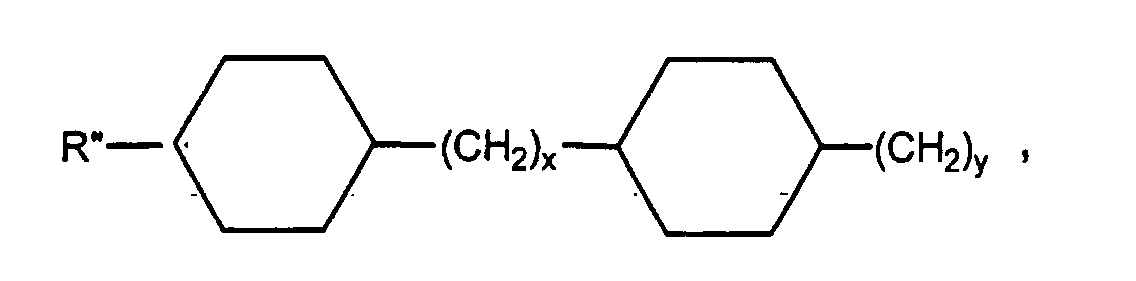 where R' is CF3, a C1 to C20 alkyl, a substituted or unsubstituted C5 to C10 cycloalkyl, or a substituted or unsubstituted C6 to C12 aryl, in which the substitution on the cycloalkyl or aryl can be a C1 to C20 alkyl or a C5 to C8 cycloalkyl; R" is a C1-C10 saturated or unsaturated alkyl; x is an integer from 0 to 10, and y is an integer from 0 to 10.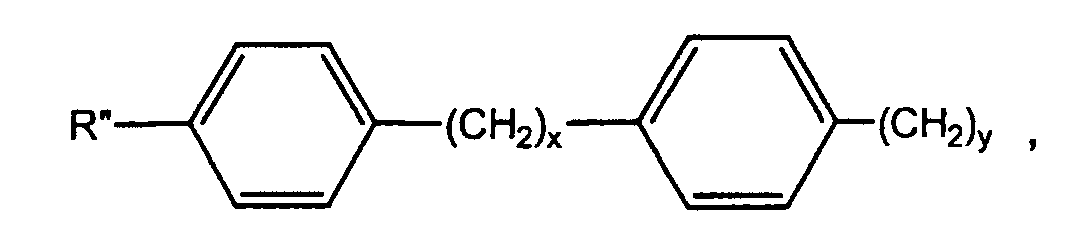
- The process can be described by the following reaction steps:

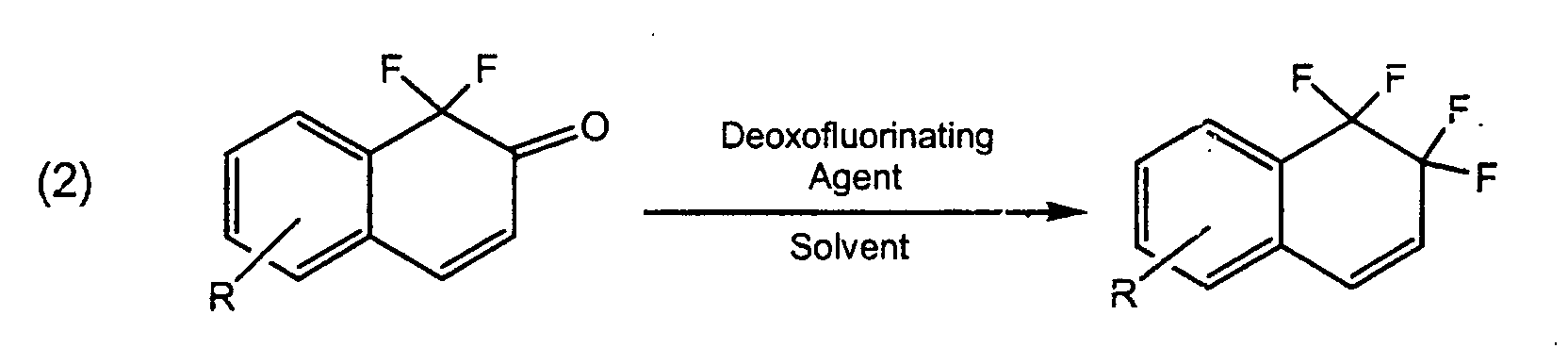 where R is a hydrogen atom, a halogen atom (Cl, Br, 1, F), R'SO2O, CF3, a fused aryl, a C1-C20 alkyl, amino, nitro, a C1 to C10 ether or thioether, a C1 to C10 ester, a heteroaryl , wherein the heteroatom can be O, N, S,



 or R forms an aryl.
R' is CF3, a C1 to C20 alkyl, a substituted or unsubstituted C5 to C10 cycloalkyl, or a substituted or unsubstituted C6 to C12 aryl, wherein the substitution on the cycloalkyl or aryl can be a C1 to C20 alkyl or a C5 to C8 cycloalkyl; R" is a C1-C10 saturated or unsaturated alkyl; x is an integer from 0 to 10, and y is an integer from 0 to 10. The preferred R group is trans-4-propylcyclohexyl. - The yields obtained from reactions (1) and (2) are highly dependent on the solvents employed for these steps. Polar aprotic solvents are desirable for the electrophilic fluorination in step (1) and dimethylformamide (DMF) is particularly preferred because it unexpectedly resulted in yields of greater than 95 % difluoro ketone product. Reaction step (2) can be conducted in various solvents including aliphatic and aromatic hydrocarbons, halocarbons, ethers, etc.; however, toluene unexpectedly gives much higher yields of the tetrafluoro product compared to other organic solvents. Step (3) involves reacting the tetrafluoro compound with a reducing agent, such as metallic zinc, copper, magnesium, or a mixture thereof, to form the vicinal difluoro aromatic compound in high yields (e.g., 90 % or more). This reaction is preferably carried out in buffered aqueous ammonia in the presence of an organic solvent such as tetrahydrofuran (THF), methyl tert-butyl ether, acetonitrile, ethanol, or DMF. Since the tetrafluoro compound reacts under basic conditions to form a trifluoronaphthalene by-product, the pH of the aqueous ammonia is buffered to <14 by addition of an ammonium salt, particularly NH4Cl. Under these conditions, the selectivity to the desired vicinal difluoronaphthalene product is significantly increased.
- This method of preparing vicinal difluoro aromatic compounds has the following advantages over known methods:
- the difluoro ketone and tetrafluoro intermediates do not need to be purified prior to subsequent reaction,
- the product is produced in high selectivity,
- the overall yield is 70% or more, and
- the product easily can be separated and purified by known methods.
- In the method of this invention, vicinal difluoro aromatic compounds can be prepared in three steps from hydroxy aromatic compounds by electrophilic fluorination using a fluorination reagent such as Selectfluor® reagent (1-chloromethyl-4-fluoro-1,4-diazabicyclo[2.2.2]octane bis-tetrafluoroborate) to form a difluoroketone intermediate. The difluoro ketone undergoes nucleophilic fluorination by reaction with a deoxofluorinating reagent such as Deoxo-Fluor® reagent (bis(2-methoxyethyl)-aminosulfur trifluoride) to give a tetrafluoro intermediate species. The tetrafluoro intermediate is defluorinated by a metallic reducing agent in the presence of ammonium hydroxide, preferably buffered ammonium hydroxide, to provide the desired vicinal difluoro aromatic compound in high yield. An example of the reaction chemistry is described above in the Brief Summary of the Invention.
- In the first step, a hydroxy aromatic compound (e.g., β -naphthol or substituted naphthol) is reacted with an electrophilic fluorinating agent such as Selectfluor reagent, to generate a difluoroketone intermediate. This reaction can be conducted in various solvents including nitriles such as acetonitrile (CH3CN), formamides such as dimethylformamide (DMF), CH3NO2, carboxylic acids such as acetic acid, water, and an alcohol such as methanol, ethanol, and propanol.
- The reaction can be carried out at temperatures ranging from 0 °C to the boiling point of the solvent.
- The fluorinating agent can be added to a solution or suspension of the hydroxy aromatic compound in one or more portions, or dropwise as a solution. Alternatively, the hydroxy aromatic compound solution or suspension can be added to a solution or suspension of fluorinating agent.
- In the second step, the carbonyl oxygen of the difluoroketone is replaced by two fluorine atoms using a deoxofluorinating agent such as Deoxo-Fluor reagent. The reaction is carried out by reacting the difluoroketone with the deoxofluorinating agent in an organic solvent in an anhydrous atmosphere. Solvents include alkanes such as hexane, heptane, etc.; aromatic hydrocarbons such as toluene, xylenes, etc.; haloalkanes such as methylene chloride, chloroform, etc.; ethers, such as diethyl ether, THF, etc.; and any other solvent that will not react with the fluorinating reagent.
- The reaction temperature can range from 0 °C to 90 °C. In carrying out the reaction, the difluoroketone can be mixed with the entire charge of the fluorinating reagent or the reagent can be added dropwise to a solution of the difluoroketone. Lewis acid catalysts such as boron trifluoride etherate (BF3.Et2O) or HF can be used to accelerate the reaction. The product obtained is usually a mixture of the desired 1,1,2,2-tetrafluoro compound and the corresponding 1,1,2,4-tetrafluoro isomer. We have found that both the yield and the isomer ratio are highly dependent on the solvent used. Toluene is unexpectedly superior to other organic solvents in producing a high yield of the desired isomer. For example, when THF was used as solvent at 60 °C, a 65% yield of 1,1,2,2-tetrafluoro-6-trans-4-propylcyclohexyl)-1,2-dihydronaphthalene was obtained (1,1,2,2-tetrafluoro/1,1,2,4-tetrafluoro = 51/49), while when toluene was used as solvent at the same temperature, an 85% yield was obtained (1,1,2,2-tetrafluoro/1,1,2,4-tetrafluoro = 90/10) under the same reaction conditions.
- In the third step of the process, the mixture of tetrafluoro isomers is reductively defluorinated using a reducing agent in an aqueous ammonia solution, preferably a buffered aqueous ammonia medium. Both tetrafluoro isomers react to form the same vicinal difluoro aromatic product.
- The reducing agent in this method can be metallic zinc or other known reducing agents, such as copper, magnesium, or mixtures thereof. The metals typically are used in powder form, but other forms should also be effective. Reducing agents that do not react rapidly with water are preferred. At least one molar equivalent of the reducing agent, based on the amount of starting compound, is needed.
- The process of reductive defluorination is preferably carried out in buffered aqueous ammonia with an organic co-solvent, such as THF. The organic co-solvent can be used to make a solution of the tetrafluoro aromatic compound. Other cosolvents that can be used include ethers such as methyl tert-butyl ether; nitriles such as acetonitrile; alcohols such as ethanol; and amides such as DMF. The aqueous ammonia is buffered to a pH <14 and preferably <11 with an ammonium salt; preferably ammonium chloride. Maintaining a pH below 14, minimizes the production of unwanted by-products. For example, when the reaction medium is too basic (i.e., a pH of 14), 1,1,2,2-tetrafluoro dihydronaphthalene is converted to a 1,2,4-trifluoronaphthalene compound as shown in the reaction below:The rate of this reaction has been found to be pH-dependent, and consequently the selectivity to this impurity is significantly reduced as the pH is reduced below 14, especially below 11.

- Typically 3.2 ml of ammonium hydroxide and 1.6 ml of organic solvent per mmol of starting compound are appropriate for the reaction.
- The reaction can be carried out at temperatures ranging from 0 °C to the boiling point of the solvent; preferably 25 to 45 °C.
- The reaction can be run in air or more preferably under an inert gas, such as nitrogen.
- The reaction can be monitored by methods known in the art to determine completion. For example GC or GC/MS (gas chromatography/mass spectrometry) can be used to determine when the reaction is complete. Reaction times typically range from 2-48 hours.
- The vicinal difluoro aromatic product can be isolated from the reaction mixture by methods known in the art. For example, the product can be isolated by filtering the reducing metal, extracting the aqueous layer into an immiscible organic solvent, evaporating the solvent, and purifying the product using chromatography, distillation, and/or recrystallization.
- The invention will be further clarified by a consideration of the following examples, which are intended to be purely exemplary of the invention.
- A suspension of 6-(trans-4-propylcyclohexyl)naphthalene-2-ol (30 g, 111.9 mmol) in DMF (180 ml) was treated with Selectfluor reagent (79.9 g, 224.4 mmol) in 5 equal portions at 15 minute intervals. The mixture was stirred for a further 4 hours (h) at room temperature (RT). On completion, the reaction mixture was washed with water (2 x 100 ml) and NaHCO3 (100 ml), dried (MgSO4), filtered, and evaporated in vacuo. After purification by column chromatography on silica gel (ethyl acetate/hexanes 1/9), the product (33.6 g, 98%) was obtained. Use of DMF unexpectedly resulted in a substantially higher yield of product compared to use of CH3CN in Example 2.
- A suspension of 6-(trans-4-propylcyclohexyl)naphthalene-2-ol (30 g, 111.9 mmol) in CH3CN (225 ml) was treated with Selectfluor reagent (79.9 g, 224.4 mmol) in 5 equal portions at 15 mln intervals. The mixture was stirred for a further 4 h at RT. On completion, the reaction mixture was extracted with 100 ml of toluene, washed with water (2 x 100 ml) and saturated NaHCO3 (100 ml), dried (MgSO4), filtered, and evaporated in vacuo. The residue was chromatographed on silica gel (ethyl acetate/hexanes 1/9) to obtain the product (25.37 g, 74%). MS: m/e = 304 (M+)
- A solution of 1,1-difluoro-(trans-4-propylcyclohexyl)-1H-naphthalene-2-one (2.0 g, 6.6 mmol) in toluene (5 ml) was heated to 60 °C in a teflon tube under N2. To this solution was added the Deoxo-Fluor reagent dropwise (2.48 g, 2.1 ml, 11.22 mmol). The mixture was heated for a further 5 h. On cooling to 0 °C ,the solution was treated with 0.5 ml of methanol (MeOH) and saturated NaHCO3. After CO2 evolution ceased the solution was diluted with 20 ml toluene and the organic layer was separated, dried (MgSO4), filtered, and evaporated in vacuo. The residue was purified by chromatography on silica gel (hexanes as solvent) to obtain the pure product (1.82 g, 85% yield as a 90/10 mixture of the title product and the 1,1,2,4-tetrafluoro isomer). MS: m/e 326 (M+).
- A solution of 1,1-difluoro-(trans-4-propylcyclohexyl)-1H-naphthalene-2-one (2.0 g, 6.6 mmol) and Deoxo-Fluor reagent (2.48 g, 2.1 ml, 11.22 mmol) in THF (4 mL) was heated for 3 h at 60 °C in a teflon tube under N2. On cooling to 0 °C, the solution was treated with MeOH (0.5 ml) and saturated NaHCO3. After CO2 evolution ceased, the solution was diluted with 20 ml EtOAc and the organic layer was separated, dried (MgSO4), filtered, and evaporated in vacuo. The residue was purified by chromatography on silica gel (hexanes as solvent) to obtain the pure product (1.39 g, 65% yield as a 51/49 mixture of the title product and the 1,1,2,4-tetrafluoro isomer). MS: m/e 326 (M+).
- A solution containing 6-(trans-4-propylcyclohexyl)-2-naphthol, 100.3 g (0.37 mole), in 200 ml of DMF was added dropwise to a slurry of Selectfluor reagent, 304.5 g (0.86 mole) in 250 ml of DMF while stirring under N2. The temperature of the reaction mixture was maintained below 30 °C. After the addition was completed, the reaction mixture was stirred at ambient temperature, and sampled periodically for analysis by gas chromatography. When the GC results showed no detectable starting material, the reaction was terminated. Toluene, 450 ml, and water, 375 ml, were added. The mixture was stirred and then transferred to a separatory funnel. the aqueous layer was withdrawn, and the organic layer was washed with 2 x 400 ml of water. An orange solid, 106.7 g (94% yield) was recovered after evaporation of the solvent from the organic phase. The product was characterized by GC and NMR analyses. This example shows that purification of the intermediate is not required.
- 1,1-Difluoro-6-(trans-4-propylcyclohexyl)-1,2-dihydronaphthalene-2-one (47.9 g, 0.16 mole) was dissolved in toluene and charged to a Teflon vessel. The reactor was purged with N2, then sealed and heated to 60 °C. When the temperature reached 60 °C, Deoxo-Fluor reagent, 49.4 ml (0.27 mole), was added via syringe. The reaction mixture was stirred at 60-65 °C until GC analysis showed that the starting material had been consumed. The mixture was cooled to 10 °C, and quenched by adding methanol then neutralized by adding 10% KOH. The mixture was transferred to a separatory funnel, and the aqueous layer was withdrawn. The organic layer was washed with 5% NaHCO3 solution. The product, 48.5 g, was isolated as an oil after evaporation of the solvent and was analyzed by GC and NMR.
- A mixture of 1,1,2,2-tetrafluoro-6-(trans-4-propylcyclohexyl)-1,2-dihydronaphthalene and 1,1,2,4-tetrafluoro-6-(trans-4-propylcyclohexyl)-1,2-dihydronaphthalene, 10.0 g (30.6 mmol) in THF was stirred with zinc dust (10 g, 153 mmol) and aqueous 30% NH4OH at ambient temperature. After 27 h, GC analysis showed that the mixture contained <1% of the starting material. The mixture was filtered, and the zinc was washed with hexanes. The filtrate was transferred to a separatory funnel, the phases were separated, and the solvent was evaporated from the organic phase. The weight of product recovered was 8.6 g. GC analysis of the product showed that it contained 0.9% 1,1,2,2-tetrafluoro-6-(trans-4-propylcyclohexyl)-1,2-dihydronaphthalene, 13.4% 1,2,4-trifluoro-6-(trans-4-propylcyclohexyl)naphthalene, and 82% 1,2-difluoro-6-(trans-4-propylcyclohexyl)naphthalene. This example shows that when ammonia is not buffered to reduce the pH, more by-products are formed compared to the reaction in which buffered ammonia is used (Example 8).
- A mixture of 1,1,2,2-tetrafluoro-6-(trans-4-propylcyclohexyl)-1,2-dihydronaphthalene and 1,1,2,4-tetrafluoro-6-(trans-4-propylcyclohexyl)-1,2-dihydronaphthalene, 25.6 g (78.4 mmol) in THF was stirred at ambient temperature with zinc dust (25.0 g, 382 mmol) and a solution containing ammonium chloride dissolved in aqueous 30% NH4OH. The reaction was terminated after 48 h. The mixture was filtered, and the zinc was washed with hexanes. The filtrate was transferred to a separatory funnel, the phases were separated, and the solvent was evaporated from the organic phase. The weight of product recovered was 21.9 g. GC analysis of the product showed that it contained 0.2% 1,1,2,2-tetrafluoro-6-(trans-4-propylcyclohexyl)-1,2-dihydronaphthalene, 2.1% 1,2,4-trifluoro-6-(trans-4-propylcyclohexyl)naphthalene, and 93.1% 1,2-difluoro-6-(trans-4-propylcyclohexyl)naphthalene.
- 1,1,2,2-Tetrafluoro-6-(trans-4-propylcyclohexyl)-1,2-dihydronaphthalene, 10.0 g (30.6 mmol) in THF was stirred at ambient temperature with zinc dust (10 g, 153 mmol), copper powder (5.0 g, 79 mmol), and a solution containing ammonium chloride dissolved in aqueous 30% NH4OH. The copper powder was prepared by reduction of copper sulfate pentahydrate with zinc. After 24 h, the reaction was terminated. The mixture was filtered, and the copper-zinc was washed with hexanes. The filtrate was transferred to a separatory funnel, the phases were separated, and the solvent was evaporated from the organic phase. The weight of product recovered was 8.2 g. GC analysis of the product showed that it contained 0.1% 1,1,2,2-tetrafluoro-6-(trans-4-propylcyclohexyl)-1,2-dihydronaphthalene, 1.7% 1,2,4-trifluoro-6-(trans-4-propylcyclohexyl)-naphthalene, and 94% 1,2-difluoro-6-(trans-4-propylcyclohexyl)naphthalene.
- A suspension of 2-hydroxynaphthalene (5.0 g, 34.72 mmol) in DMF (50 ml) under N2 was treated with Selectfluor reagent (24.58 g, 69.44 mmol) in eight equal portions at 15 min intervals. The mixture was stirred for a further 1 h, diluted with 50 ml of ethyl acetate (EtOAc), washed with water (2 x 25 ml), dried (MgSO4), filtered, and evaporated in vacuo. Purification by flash chromatography on silica gel (1:9 ethyl acetate/hexanes) furnished the product (6.12 g, 98% yield). MS: m/e 180 (M+)
- To a solution of 1,1-difluoro-1H-naphthalene-2-one (6.12 g, 34 mmol) in toluene (5 ml) under N2 in a teflon tube was added the Deoxo-Fluor reagent (13.15 g, 10.9 ml, 59.5 mmol) and BF3.Et2O (440 µL). The mixture was heated at 60 °C for 3 h. On cooling to 0 °C, the solution was treated with MeOH (0.5 ml) and saturated NaHCO3 (100 ml). After CO2 evolution ceased, the solution was diluted with 20 ml toluene and the organic layer was separated, dried (MgSO4), filtered, and evaporated in vacuo. The residue was purified by chromatography on silica gel (hexanes as solvent) to obtain the pure product (5.84 g, 85% yield as a 90/10 mixture of the title product and the 1,1,2,4-tetrafluoro isomer). MS: m/e 202 (M+)
- A solution of the tetrafluoro naphthalene, 1,1,2,2-tetrafluoro-1,2-dihydronaphthalene (5.25 g, 25.66 mmol) in THF (15 ml) was treated with 30% aqueous NH4OH (30 ml) and zinc ( 8.45 g, 130 mmol) (powder) and stirred under N2 for 4 hours at RT. The reaction was monitored by GC/MS for disappearance of the starting material and found to be complete. The solution was filtered, extracted with hexane (30 ml), and filtered through a short silica column (20 g). The hexane solution was evaporated in vacuo to afford an oil. This crystallized on cooling to room temperature to afford 3.99 g (95% yield) of product. MS: m/e 164 (M+)
- A suspension of 6-bromo-2-hydroxynaphthalene (5.0 g, 22.42 mmol) in DMF (25 ml) under N2 was treated with Selectfluor reagent (15.87 g, 44.84 mmol) in eight equal portions at 15 min intervals. The mixture was stirred for a further 1 h, diluted with EtOAc (50 ml), washed with water (2 x 25 ml), dried (MgSO4), filtered, and evaporated in vacuo. Purification by flash chromatography on silica gel (1:9 ethyl acetate/hexanes) furnished the product (5.51 g, 95 % yield). MS: m/e 259 (M+)
- To a solution of 6-bromo-1,1-difluoro-1H-naphthalene-2-one (5.51 g, 21.27 mmol) in toluene (5 ml) under N2 in a teflon tube was added the Deoxo-Fluor reagent (8.42 g, 7.01 ml, 38.11 mmol) and BF3.Et2O (282 µL, 2.24 mmol). The mixture was heated at 60 °C for 3 h. On cooling to 0 °C, the solution was treated with MeOH (0.5 ml) and saturated NaHCO3 (100 ml). After CO2 evolution ceased, the solution was diluted with 20 ml toluene, and the organic layer was separated, dried (MgSO4), filtered, and evaporated in vacuo. The residue was purified by chromatography on silica gel (hexanes as solvent) to obtain the pure product (4.78 g, 80% yield as a 85/15 mixture of the title product and the 1,1,2,4-tetrafluoro isomer). MS: m/e 281 (M+)
- A solution of the tetrafluoro naphthalene, 6-bromo-1,1,2,2-tetrafluoro-1,2-dihydronaphthalene (4.74 g, 16.80 mmol) in THF (15 ml) was treated with 30% aqueous NH4OH (30 ml) and zinc ( 8.45 g, 130 mmol) and stirred under N2 for 24 hours at RT. The reaction was monitored by GC/MS for disappearance of the starting material and found to be complete. The solution was filtered, extracted with hexane (30 ml), and filtered through a short silica column (20 g). The hexane solution was evaporated in vacuo to afford an oil. This crystallized on cooling to room temperature to afford 2.62 g (95% yield) of product.
- A suspension of 9-phenanthrol (2.0 g, 10.31 mmol) in DMF (20 ml) under N2 was treated with Selectfluor reagent (7.30 g, 20.62 mmol) in eight equal portions at 15 min intervals. The mixture was stirred for a further 1 h, diluted with EtOAc (50 ml), washed with water (2 x 25 ml), dried (MgSO4), filtered, and evaporated in vacuo. Purification by flash chromatography on silica gel (1:9 ethyl acetate/hexanes) furnished the product (2.13 g, 90% yield). MS: m/e 230 (M+)
- To a solution of 10,10-difluoro-10H-phenanthrene-9-one (2.13 g, 9.28 mmol) in toluene (5 ml) under N2 in a teflon tube was added the Deoxo-Fluor reagent (3.87 g, 3.2 ml, 17.50 mmol) and BF3.Et2O (126 µL, 1.0 mmol). The mixture was heated at 60 °C for 3 h. On cooling to 0 °C, the solution was treated with MeOH (0.5 ml) and saturated NaHCO3 (100 ml). After CO2 evolution ceased, the solution was diluted with 20 ml toluene and the organic layer was separated, dried (MgSO4), filtered, and evaporated in vacuo. The residue was purified by chromatography on silica gel (hexanes as solvent) to obtain the pure product (1.96 g 84% yield). MS: m/e 252 (M+)
- A solution of the 9,9,10,10-tetrafluoro-9,10-dihydrophenanthrene (1.96 g, 7.75 mmol) in THF (15 ml) was treated with 30% aqueous NH4OH (30 ml) and zinc (2.52 g, 38.75 mmol) and stirred under N2 for 24 hours at room temperature. The reaction was monitored by GC/MS for disappearance of the starting material and found to be complete. The solution was filtered, extracted with hexane (30 ml), and filtered through a short silica column (20 g). The hexane solution was evaporated in vacuo to afford an oil. This crystallized on cooling to room temperature to afford 1.58 g (95% yield) of product.
Claims (26)
- A method for making aromatic compounds having two vicinal fluorine atoms comprising
mixing a solution of a tetrafluoro derivative of an aromatic compound in an organic solvent with a reducing agent in aqueous ammonia, under an inert gas, for a time needed to form an aromatic compound containing two vicinal fluorine atoms, said tetrafluoro aromatic compound having two fluorine atoms on each of two adjacent carbons on the ring. - The method of claim 1 wherein said organic solvent is selected from the group consisting of tetrahydrofuran, methyl tert-butyl ether, acetonitrile, ethanol, and dimethylformamide.
- The method of claim 1 wherein the solvent is tetrahydrofuran and the ammonia is buffered to maintain a pH below 14.
- The method of claim 1 wherein the mixing is carried out at 25 to 45 °C.
- The method of claim 1 wherein the tetrafluoro derivative of an aromatic compound is one or more of a substituted or unsubstituted tetrafluoro derivative of a naphthalene, a phenanthrene, a monocyclic aromatic, a bicyclic aromatic, a tricyclic aromatic, or a heterocyclic aromatic having one to three rings.
- The method of claim 5 wherein the tetrafluoro derivative of an aromatic compound is selected from the group consisting of 1,1,2,2-tetrafluoro-1,2-dihydronaphthalene, 6-bromo-1,1,2,2-tetrafluoro-1,2-dihydronaphthalene, 9,9,10,10-tetrafluoro-9,10-dihydrophenanthrene, and 1,1,2,2-tetrafluoro-6-(trans-4-propylcyclohexyl)-1,2-dihydronaphthalene.
- The method of claim 1 wherein the yield of the aromatic compound containing two vicinal fluorine atoms is 90 % or more.
- The method of claim 1 wherein the reducing agent is zinc, copper, magnesium, or mixtures thereof.
- The method of claim 1 wherein the reducing agent is zinc.
- The method of claim 1 wherein the aqueous ammonia is buffered with ammonium chloride to maintain a pH of less than 11.
- A method for making aromatic compounds having two vicinal fluorine atoms comprising:(a) mixing an electrophilic fluorinating agent with a solution or suspension of a hydroxy aromatic compound in a polar aprotic solvent to form a difluoroketone derivative of an aromatic compound, said hydroxy aromatic compound having one, two or three rings, said rings being separate or fused and said rings optionally containing one or more heteroatoms and one or more substitutions in addition to hydroxy, said difluoroketone derivative having both fluorine atoms on a carbon vicinal to the ketone;(b) mixing a deoxofluorinating agent with the difluoroketone derivative of (a) in a solvent to form a tetrafluoro derivative of an aromatic compound; and(c) mixing the tetrafluoro derivative of an aromatic compound of (b) in an organic solvent with a reducing agent in aqueous ammonia to form an aromatic compound containing two vicinal fluorine atoms.
- The method of claim 11 wherein said one or more optional substitutions on said rings is one or more of a halogen atom, a C1 to C20 alkyl, a C5-C10 cycloalkyl, a C6 to C12 aryl, an amino, a nitro, a C1 to C10 alkyl ether or thioether, a C1 to C10 alkyl ester, a CF3, a R'SO2O,


 where R' is CF3, a C1 to C20 alkyl, a substituted or unsubstituted C5 to C10 cycloalkyl, or a substituted or unsubstituted C6 to C12 aryl, wherein the substitution on the cycloalkyl or aryl can be a C1 to C20 alkyl or a C5 to C8 cycloalkyl; R" is a C1-C10 saturated or unsaturated alkyl; x is an integer from 0 to 10, and y is an integer from 0 to 10.
- The method of claim 11 wherein the solvent in (a) is dimethylformamide, the solvent in step (b) is toluene, and the solvent in step (c) is tetrahydrofuran.
- The method of claim 11 wherein the reducing agent in step (c) is zinc, magnesium, copper, or mixtures thereof.
- The method of claim 14 wherein the reducing agent is zinc.
- The method of claim 11 wherein the aqueous ammonia in step (c) is buffered with an ammonium salt to maintain a pH of less than 14.
- The method of claim 16 wherein the aqueous ammonia is buffered with ammonium chloride to maintain a pH of less than 11.
- The method of claim 11 wherein the hydroxy aromatic compound is 6-(trans-4-propylcyclohexyl)naphthalene-2-ol.
- A method for making aromatic compounds having two vicinal fluorine atoms comprising:(a) mixing a deoxofluorinating agent with a difluoroketone derivative of an aromatic compound in a solvent to form a tetrafluoro derivative of an aromatic compound, said difluoroketone compound having one, two or three rings, said rings being separate or fused and said rings optionally containing one or more heteroatoms and one or more substitutions in addition to hydroxy, said difluoroketone derivative having both fluorine atoms on a carbon vicinal to the ketone;(b) mixing the tetrafluoro derivative of an aromatic compound of (a) in an organic solvent with a reducing agent in aqueous ammonia to form an aromatic compound containing two vicinal fluorine atoms.
- The method of claim 19 wherein, said one or more optional substitutions on said rings is one or more of a halogen atom, a C1 to C20 alkyl, a C5-C20 cycloalkyl, a C6 to C12 aryl, an amino, a nitro, a C1 to C10 alkyl ether or thioether, a C1 to C10 alkyl ester, a CF3, a R'SO2O,



 where R' is CF3, a C1 to C20 alkyl, a substituted or unsubstituted C5 to C10 cycloalkyl, or a substituted or unsubstituted C6 to C12 aryl, wherein the substitution on the cycloalkyi or aryl can be a C1 to C20 alkyl or a C5 to C8 cycloalkyl: R" is a C1-C10 saturated or unsaturated alkyl; x is an integer from 0 to 10, and y is an integer from 0 to 10.
- The method of claim 19 wherein the solvent in step (a) is toluene, and the solvent in step (b) is tetrahydrofuran.
- The method of claim 19 wherein the reducing agent in step (b) is zinc, magnesium, copper, or mixtures thereof.
- The method of claim 22 wherein the reducing agent is zinc.
- The method of claim 19 wherein the aqueous ammonia in step (c) is buffered with an ammonium salt to maintain a pH of less than 14.
- The method of claim 24 wherein the aqueous ammonia is buffered with ammonium chloride to maintain a pH of less than 11.
- The method of claim 19 wherein the difluoroketone is 6-(trans-4-propylcyclohexyl)naphthalene-2-one.
Applications Claiming Priority (4)
| Application Number | Priority Date | Filing Date | Title |
|---|---|---|---|
| US76763601A | 2001-01-23 | 2001-01-23 | |
| US767636 | 2001-01-23 | ||
| US09/985,786 US6455744B1 (en) | 2001-01-23 | 2001-11-06 | Synthesis of vicinal difluoro aromatics and intermediates thereof |
| US985786 | 2001-11-06 |
Publications (2)
| Publication Number | Publication Date |
|---|---|
| EP1225162A1 true EP1225162A1 (en) | 2002-07-24 |
| EP1225162B1 EP1225162B1 (en) | 2005-03-16 |
Family
ID=27117937
Family Applications (1)
| Application Number | Title | Priority Date | Filing Date |
|---|---|---|---|
| EP02001040A Expired - Lifetime EP1225162B1 (en) | 2001-01-23 | 2002-01-18 | Synthesis of vicinal difluoro aromatics and intermediates thereof |
Country Status (7)
| Country | Link |
|---|---|
| US (3) | US6455744B1 (en) |
| EP (1) | EP1225162B1 (en) |
| JP (1) | JP3898515B2 (en) |
| KR (1) | KR100462665B1 (en) |
| AT (1) | ATE291003T1 (en) |
| DE (1) | DE60203200T2 (en) |
| TW (1) | TWI245031B (en) |
Cited By (1)
| Publication number | Priority date | Publication date | Assignee | Title |
|---|---|---|---|---|
| CN108191647A (en) * | 2018-02-22 | 2018-06-22 | 江苏尚莱特医药化工材料有限公司 | The synthetic method of 2,2- difluoro dicarboxylic acid dialkyl esters |
Families Citing this family (9)
| Publication number | Priority date | Publication date | Assignee | Title |
|---|---|---|---|---|
| US6894200B2 (en) * | 2001-01-23 | 2005-05-17 | Air Products And Chemicals, Inc. | Synthesis of vicinal difluoro aromatics and intermediates thereof |
| US7259150B2 (en) * | 2001-08-07 | 2007-08-21 | Isis Pharmaceuticals, Inc. | Modulation of apolipoprotein (a) expression |
| DE10225427A1 (en) * | 2002-06-07 | 2003-12-18 | Merck Patent Gmbh | Fluorinated naphthalenes, liquid crystal mixtures containing them and liquid crystal displays |
| DE102004022728B4 (en) * | 2004-05-07 | 2018-08-23 | Merck Patent Gmbh | Fluorinated phenanthrenes and their use in liquid crystal mixtures |
| CN100372519C (en) * | 2005-01-06 | 2008-03-05 | 辽宁绿丹药业有限公司 | Medicine filling method of levonorgestrel silica gel stick |
| WO2008103494A2 (en) * | 2007-02-23 | 2008-08-28 | Dentsply International Inc. | Methods for making dental restorations using two-phase light-curing materials |
| US9574193B2 (en) | 2012-05-17 | 2017-02-21 | Ionis Pharmaceuticals, Inc. | Methods and compositions for modulating apolipoprotein (a) expression |
| WO2013173789A2 (en) | 2012-05-17 | 2013-11-21 | Isis Pharmaceuticals, Inc. | Antisense oligonucleotide compositions |
| EP3091010A4 (en) * | 2013-12-31 | 2017-10-04 | Nanjing Sanhome Pharmaceutical Co., Ltd. | 9,9,10,10-tetrafluoro-9,10-dihydrophenanthrene hepatitis c virus inhibitor and application thereof |
Citations (6)
| Publication number | Priority date | Publication date | Assignee | Title |
|---|---|---|---|---|
| DE19653008A1 (en) * | 1996-12-19 | 1998-06-25 | Hoechst Ag | Fluorinated phenanthrene derivatives and their use in liquid crystalline mixtures |
| EP0952135A1 (en) * | 1998-04-22 | 1999-10-27 | Dainippon Ink And Chemicals, Inc. | Naphthalene derivative and liquid crystal composition comprising the same |
| JP2001010995A (en) * | 1999-06-30 | 2001-01-16 | Dainippon Ink & Chem Inc | Liquid crystal intermediate and manufacturing method |
| JP2001026561A (en) * | 1999-07-09 | 2001-01-30 | Dainippon Ink & Chem Inc | Fluoronaphthalene derivative |
| WO2001010803A1 (en) * | 1999-08-03 | 2001-02-15 | Dainippon Ink And Chemicals, Inc. | Fused ring compound |
| JP2001354600A (en) * | 2000-06-14 | 2001-12-25 | Dainippon Ink & Chem Inc | Method for producing 6-bromo-1,2-difluoronaphthalene |
Family Cites Families (3)
| Publication number | Priority date | Publication date | Assignee | Title |
|---|---|---|---|---|
| US5498807A (en) * | 1992-11-18 | 1996-03-12 | Hoechst Aktiengesellschaft | Process for the preparation of aromatic fluoro compounds |
| GB9325757D0 (en) * | 1993-12-16 | 1994-02-16 | Zeneca Ltd | Fluorination process |
| US6008407A (en) * | 1998-11-03 | 1999-12-28 | Zelinsky Institute Of Organic Chemistry | Method of preparing fluoroaromatic compounds |
-
2001
- 2001-11-06 US US09/985,786 patent/US6455744B1/en not_active Expired - Lifetime
-
2002
- 2002-01-18 AT AT02001040T patent/ATE291003T1/en not_active IP Right Cessation
- 2002-01-18 DE DE60203200T patent/DE60203200T2/en not_active Expired - Lifetime
- 2002-01-18 EP EP02001040A patent/EP1225162B1/en not_active Expired - Lifetime
- 2002-01-22 KR KR10-2002-0003589A patent/KR100462665B1/en not_active Expired - Fee Related
- 2002-01-22 TW TW091101004A patent/TWI245031B/en not_active IP Right Cessation
- 2002-01-23 JP JP2002014235A patent/JP3898515B2/en not_active Expired - Fee Related
- 2002-07-17 US US10/197,969 patent/US6515191B2/en not_active Expired - Fee Related
- 2002-12-30 US US10/334,183 patent/US6706933B2/en not_active Expired - Lifetime
Patent Citations (6)
| Publication number | Priority date | Publication date | Assignee | Title |
|---|---|---|---|---|
| DE19653008A1 (en) * | 1996-12-19 | 1998-06-25 | Hoechst Ag | Fluorinated phenanthrene derivatives and their use in liquid crystalline mixtures |
| EP0952135A1 (en) * | 1998-04-22 | 1999-10-27 | Dainippon Ink And Chemicals, Inc. | Naphthalene derivative and liquid crystal composition comprising the same |
| JP2001010995A (en) * | 1999-06-30 | 2001-01-16 | Dainippon Ink & Chem Inc | Liquid crystal intermediate and manufacturing method |
| JP2001026561A (en) * | 1999-07-09 | 2001-01-30 | Dainippon Ink & Chem Inc | Fluoronaphthalene derivative |
| WO2001010803A1 (en) * | 1999-08-03 | 2001-02-15 | Dainippon Ink And Chemicals, Inc. | Fused ring compound |
| JP2001354600A (en) * | 2000-06-14 | 2001-12-25 | Dainippon Ink & Chem Inc | Method for producing 6-bromo-1,2-difluoronaphthalene |
Non-Patent Citations (2)
| Title |
|---|
| CHEMICAL ABSTRACTS, vol. 136, Columbus, Ohio, US; abstract no. 53585, KUSUMOTO, AKIO ET AL: "Preparation of 6-bromo-1,2-difluoronaphthalene" XP002198040 * |
| HU, CHANGMING ET AL: "Defluorination of hexadecafluorobicyclo[4.4.0]dec-1(6)- ene: a facile synthesis of perfluoroaromatics", J. FLUORINE CHEM. (1990), 48(1), 29-35, XP002198039 * |
Cited By (1)
| Publication number | Priority date | Publication date | Assignee | Title |
|---|---|---|---|---|
| CN108191647A (en) * | 2018-02-22 | 2018-06-22 | 江苏尚莱特医药化工材料有限公司 | The synthetic method of 2,2- difluoro dicarboxylic acid dialkyl esters |
Also Published As
| Publication number | Publication date |
|---|---|
| DE60203200D1 (en) | 2005-04-21 |
| US6706933B2 (en) | 2004-03-16 |
| JP2002255870A (en) | 2002-09-11 |
| EP1225162B1 (en) | 2005-03-16 |
| KR20020062696A (en) | 2002-07-29 |
| ATE291003T1 (en) | 2005-04-15 |
| DE60203200T2 (en) | 2005-08-04 |
| TWI245031B (en) | 2005-12-11 |
| KR100462665B1 (en) | 2004-12-20 |
| JP3898515B2 (en) | 2007-03-28 |
| US20030100806A1 (en) | 2003-05-29 |
| US6515191B2 (en) | 2003-02-04 |
| US6455744B1 (en) | 2002-09-24 |
| US20020099247A1 (en) | 2002-07-25 |
| US20020198417A1 (en) | 2002-12-26 |
Similar Documents
| Publication | Publication Date | Title |
|---|---|---|
| JP2009102433A (en) | Synthesis of vicinal difluoro aromatic compound and intermediate thereof | |
| JP3357608B2 (en) | Fluorination method with aminosulfur trifluoride | |
| EP1225162B1 (en) | Synthesis of vicinal difluoro aromatics and intermediates thereof | |
| Hassner et al. | Stereochemistry. LVII. Synthesis of. alpha.-azidovinyl ketones. Mechanism and stereochemistry of vinyl bromide substitution | |
| WO2013118915A1 (en) | Processes for isolating fluorinated products | |
| US4212815A (en) | Preparation of vinylene fluorides | |
| JPH09506609A (en) | Fluorination method | |
| EP1468983B1 (en) | Process for producing 2,5-bis(trifluoromethyl)nitrobenzene | |
| EP0497990B1 (en) | Process for producing trifluorinated hydrocarbon compound | |
| EP0883589A1 (en) | A process for the synthesis of hexafluoropropanes | |
| EP1466884A1 (en) | Process for the preparation of resveratrol and its uses | |
| EP1362843B1 (en) | N-cyclopropyl-2-difluoromethoxy-3-bromoaniline and intermediate used for production thereof | |
| HU200439B (en) | Process for production of substituated acetilen compositions | |
| JPH06247953A (en) | Process for producing optically active 3,3,3-trifluoropropene oxide | |
| JPH05194293A (en) | Process for producing tert. tri-and tetra-fluorophenyl- benzyl alcohols | |
| Zajc | Application of xenon difluoride in synthesis | |
| JP4448318B2 (en) | Fluorinated naphthacene derivatives and methods for their production | |
| HU214161B (en) | Process for producing halogenated alcohols | |
| NZ200350A (en) | Preparation of long chain acids and alcohols | |
| EP1772448A1 (en) | Synthesis of pentafluorosulfanylnaphthalene | |
| JPH05294884A (en) | Production of biphenyl compound | |
| JPH07300432A (en) | Method for alkylating organic compound |
Legal Events
| Date | Code | Title | Description |
|---|---|---|---|
| PUAI | Public reference made under article 153(3) epc to a published international application that has entered the european phase |
Free format text: ORIGINAL CODE: 0009012 |
|
| AK | Designated contracting states |
Kind code of ref document: A1 Designated state(s): AT BE CH CY DE DK ES FI FR GB GR IE IT LI LU MC NL PT SE TR |
|
| AX | Request for extension of the european patent |
Free format text: AL;LT;LV;MK;RO;SI |
|
| 17P | Request for examination filed |
Effective date: 20020827 |
|
| AKX | Designation fees paid |
Designated state(s): AT BE CH CY DE DK ES FI FR GB GR IE IT LI LU MC NL PT SE TR |
|
| 17Q | First examination report despatched |
Effective date: 20030502 |
|
| GRAP | Despatch of communication of intention to grant a patent |
Free format text: ORIGINAL CODE: EPIDOSNIGR1 |
|
| GRAS | Grant fee paid |
Free format text: ORIGINAL CODE: EPIDOSNIGR3 |
|
| GRAA | (expected) grant |
Free format text: ORIGINAL CODE: 0009210 |
|
| AK | Designated contracting states |
Kind code of ref document: B1 Designated state(s): AT BE CH CY DE DK ES FI FR GB GR IE IT LI LU MC NL PT SE TR |
|
| PG25 | Lapsed in a contracting state [announced via postgrant information from national office to epo] |
Ref country code: NL Free format text: LAPSE BECAUSE OF FAILURE TO SUBMIT A TRANSLATION OF THE DESCRIPTION OR TO PAY THE FEE WITHIN THE PRESCRIBED TIME-LIMIT Effective date: 20050316 Ref country code: FI Free format text: LAPSE BECAUSE OF FAILURE TO SUBMIT A TRANSLATION OF THE DESCRIPTION OR TO PAY THE FEE WITHIN THE PRESCRIBED TIME-LIMIT Effective date: 20050316 Ref country code: CH Free format text: LAPSE BECAUSE OF FAILURE TO SUBMIT A TRANSLATION OF THE DESCRIPTION OR TO PAY THE FEE WITHIN THE PRESCRIBED TIME-LIMIT Effective date: 20050316 Ref country code: BE Free format text: LAPSE BECAUSE OF FAILURE TO SUBMIT A TRANSLATION OF THE DESCRIPTION OR TO PAY THE FEE WITHIN THE PRESCRIBED TIME-LIMIT Effective date: 20050316 Ref country code: LI Free format text: LAPSE BECAUSE OF FAILURE TO SUBMIT A TRANSLATION OF THE DESCRIPTION OR TO PAY THE FEE WITHIN THE PRESCRIBED TIME-LIMIT Effective date: 20050316 Ref country code: AT Free format text: LAPSE BECAUSE OF FAILURE TO SUBMIT A TRANSLATION OF THE DESCRIPTION OR TO PAY THE FEE WITHIN THE PRESCRIBED TIME-LIMIT Effective date: 20050316 |
|
| REG | Reference to a national code |
Ref country code: GB Ref legal event code: FG4D |
|
| REG | Reference to a national code |
Ref country code: CH Ref legal event code: EP |
|
| REG | Reference to a national code |
Ref country code: IE Ref legal event code: FG4D |
|
| REF | Corresponds to: |
Ref document number: 60203200 Country of ref document: DE Date of ref document: 20050421 Kind code of ref document: P |
|
| PG25 | Lapsed in a contracting state [announced via postgrant information from national office to epo] |
Ref country code: GR Free format text: LAPSE BECAUSE OF FAILURE TO SUBMIT A TRANSLATION OF THE DESCRIPTION OR TO PAY THE FEE WITHIN THE PRESCRIBED TIME-LIMIT Effective date: 20050616 Ref country code: DK Free format text: LAPSE BECAUSE OF FAILURE TO SUBMIT A TRANSLATION OF THE DESCRIPTION OR TO PAY THE FEE WITHIN THE PRESCRIBED TIME-LIMIT Effective date: 20050616 |
|
| PG25 | Lapsed in a contracting state [announced via postgrant information from national office to epo] |
Ref country code: ES Free format text: LAPSE BECAUSE OF FAILURE TO SUBMIT A TRANSLATION OF THE DESCRIPTION OR TO PAY THE FEE WITHIN THE PRESCRIBED TIME-LIMIT Effective date: 20050627 |
|
| NLV1 | Nl: lapsed or annulled due to failure to fulfill the requirements of art. 29p and 29m of the patents act | ||
| PG25 | Lapsed in a contracting state [announced via postgrant information from national office to epo] |
Ref country code: PT Free format text: LAPSE BECAUSE OF FAILURE TO SUBMIT A TRANSLATION OF THE DESCRIPTION OR TO PAY THE FEE WITHIN THE PRESCRIBED TIME-LIMIT Effective date: 20050907 |
|
| REG | Reference to a national code |
Ref country code: CH Ref legal event code: PL |
|
| PG25 | Lapsed in a contracting state [announced via postgrant information from national office to epo] |
Ref country code: IE Free format text: LAPSE BECAUSE OF NON-PAYMENT OF DUE FEES Effective date: 20060118 |
|
| PLBE | No opposition filed within time limit |
Free format text: ORIGINAL CODE: 0009261 |
|
| STAA | Information on the status of an ep patent application or granted ep patent |
Free format text: STATUS: NO OPPOSITION FILED WITHIN TIME LIMIT |
|
| PG25 | Lapsed in a contracting state [announced via postgrant information from national office to epo] |
Ref country code: MC Free format text: LAPSE BECAUSE OF NON-PAYMENT OF DUE FEES Effective date: 20060131 Ref country code: LU Free format text: LAPSE BECAUSE OF NON-PAYMENT OF DUE FEES Effective date: 20060131 |
|
| ET | Fr: translation filed | ||
| 26N | No opposition filed |
Effective date: 20051219 |
|
| REG | Reference to a national code |
Ref country code: IE Ref legal event code: MM4A |
|
| PGFP | Annual fee paid to national office [announced via postgrant information from national office to epo] |
Ref country code: GB Payment date: 20061213 Year of fee payment: 6 |
|
| PGFP | Annual fee paid to national office [announced via postgrant information from national office to epo] |
Ref country code: IT Payment date: 20070523 Year of fee payment: 6 |
|
| PG25 | Lapsed in a contracting state [announced via postgrant information from national office to epo] |
Ref country code: SE Free format text: LAPSE BECAUSE OF FAILURE TO SUBMIT A TRANSLATION OF THE DESCRIPTION OR TO PAY THE FEE WITHIN THE PRESCRIBED TIME-LIMIT Effective date: 20050616 |
|
| PGFP | Annual fee paid to national office [announced via postgrant information from national office to epo] |
Ref country code: FR Payment date: 20070103 Year of fee payment: 6 |
|
| PG25 | Lapsed in a contracting state [announced via postgrant information from national office to epo] |
Ref country code: TR Free format text: LAPSE BECAUSE OF FAILURE TO SUBMIT A TRANSLATION OF THE DESCRIPTION OR TO PAY THE FEE WITHIN THE PRESCRIBED TIME-LIMIT Effective date: 20050316 |
|
| GBPC | Gb: european patent ceased through non-payment of renewal fee |
Effective date: 20080118 |
|
| PG25 | Lapsed in a contracting state [announced via postgrant information from national office to epo] |
Ref country code: CY Free format text: LAPSE BECAUSE OF FAILURE TO SUBMIT A TRANSLATION OF THE DESCRIPTION OR TO PAY THE FEE WITHIN THE PRESCRIBED TIME-LIMIT Effective date: 20050316 |
|
| REG | Reference to a national code |
Ref country code: FR Ref legal event code: ST Effective date: 20081029 |
|
| PG25 | Lapsed in a contracting state [announced via postgrant information from national office to epo] |
Ref country code: GB Free format text: LAPSE BECAUSE OF NON-PAYMENT OF DUE FEES Effective date: 20080118 |
|
| PG25 | Lapsed in a contracting state [announced via postgrant information from national office to epo] |
Ref country code: FR Free format text: LAPSE BECAUSE OF NON-PAYMENT OF DUE FEES Effective date: 20080131 |
|
| PG25 | Lapsed in a contracting state [announced via postgrant information from national office to epo] |
Ref country code: IT Free format text: LAPSE BECAUSE OF NON-PAYMENT OF DUE FEES Effective date: 20080118 |
|
| PGFP | Annual fee paid to national office [announced via postgrant information from national office to epo] |
Ref country code: DE Payment date: 20100129 Year of fee payment: 9 |
|
| REG | Reference to a national code |
Ref country code: DE Ref legal event code: R119 Ref document number: 60203200 Country of ref document: DE Effective date: 20110802 |
|
| PG25 | Lapsed in a contracting state [announced via postgrant information from national office to epo] |
Ref country code: DE Free format text: LAPSE BECAUSE OF NON-PAYMENT OF DUE FEES Effective date: 20110802 |