EP1224867A1 - Fermented foods containing bifidobacterium - Google Patents
Fermented foods containing bifidobacterium Download PDFInfo
- Publication number
- EP1224867A1 EP1224867A1 EP00963042A EP00963042A EP1224867A1 EP 1224867 A1 EP1224867 A1 EP 1224867A1 EP 00963042 A EP00963042 A EP 00963042A EP 00963042 A EP00963042 A EP 00963042A EP 1224867 A1 EP1224867 A1 EP 1224867A1
- Authority
- EP
- European Patent Office
- Prior art keywords
- bifidobacterium
- milk
- bifidobacteria
- fermented
- food
- Prior art date
- Legal status (The legal status is an assumption and is not a legal conclusion. Google has not performed a legal analysis and makes no representation as to the accuracy of the status listed.)
- Withdrawn
Links
Classifications
-
- A—HUMAN NECESSITIES
- A23—FOODS OR FOODSTUFFS; TREATMENT THEREOF, NOT COVERED BY OTHER CLASSES
- A23C—DAIRY PRODUCTS, e.g. MILK, BUTTER OR CHEESE; MILK OR CHEESE SUBSTITUTES; PREPARATION THEREOF
- A23C11/00—Milk substitutes, e.g. coffee whitener compositions
- A23C11/02—Milk substitutes, e.g. coffee whitener compositions containing at least one non-milk component as source of fats or proteins
- A23C11/10—Milk substitutes, e.g. coffee whitener compositions containing at least one non-milk component as source of fats or proteins containing or not lactose but no other milk components as source of fats, carbohydrates or proteins
- A23C11/103—Milk substitutes, e.g. coffee whitener compositions containing at least one non-milk component as source of fats or proteins containing or not lactose but no other milk components as source of fats, carbohydrates or proteins containing only proteins from pulses, oilseeds or nuts, e.g. nut milk
- A23C11/106—Addition of, or treatment with, microorganisms
-
- A—HUMAN NECESSITIES
- A23—FOODS OR FOODSTUFFS; TREATMENT THEREOF, NOT COVERED BY OTHER CLASSES
- A23C—DAIRY PRODUCTS, e.g. MILK, BUTTER OR CHEESE; MILK OR CHEESE SUBSTITUTES; PREPARATION THEREOF
- A23C9/00—Milk preparations; Milk powder or milk powder preparations
- A23C9/12—Fermented milk preparations; Treatment using microorganisms or enzymes
- A23C9/123—Fermented milk preparations; Treatment using microorganisms or enzymes using only microorganisms of the genus lactobacteriaceae; Yoghurt
- A23C9/1234—Fermented milk preparations; Treatment using microorganisms or enzymes using only microorganisms of the genus lactobacteriaceae; Yoghurt characterised by using a Lactobacillus sp. other than Lactobacillus Bulgaricus, including Bificlobacterium sp.
-
- A—HUMAN NECESSITIES
- A23—FOODS OR FOODSTUFFS; TREATMENT THEREOF, NOT COVERED BY OTHER CLASSES
- A23L—FOODS, FOODSTUFFS OR NON-ALCOHOLIC BEVERAGES, NOT OTHERWISE PROVIDED FOR; PREPARATION OR TREATMENT THEREOF
- A23L11/00—Pulses, i.e. fruits of leguminous plants, for production of food; Products from legumes; Preparation or treatment thereof
- A23L11/50—Fermented pulses or legumes; Fermentation of pulses or legumes based on the addition of microorganisms
-
- A—HUMAN NECESSITIES
- A23—FOODS OR FOODSTUFFS; TREATMENT THEREOF, NOT COVERED BY OTHER CLASSES
- A23L—FOODS, FOODSTUFFS OR NON-ALCOHOLIC BEVERAGES, NOT OTHERWISE PROVIDED FOR; PREPARATION OR TREATMENT THEREOF
- A23L11/00—Pulses, i.e. fruits of leguminous plants, for production of food; Products from legumes; Preparation or treatment thereof
- A23L11/60—Drinks from legumes, e.g. lupine drinks
- A23L11/65—Soy drinks
-
- A—HUMAN NECESSITIES
- A23—FOODS OR FOODSTUFFS; TREATMENT THEREOF, NOT COVERED BY OTHER CLASSES
- A23L—FOODS, FOODSTUFFS OR NON-ALCOHOLIC BEVERAGES, NOT OTHERWISE PROVIDED FOR; PREPARATION OR TREATMENT THEREOF
- A23L29/00—Foods or foodstuffs containing additives; Preparation or treatment thereof
- A23L29/065—Microorganisms
-
- A—HUMAN NECESSITIES
- A23—FOODS OR FOODSTUFFS; TREATMENT THEREOF, NOT COVERED BY OTHER CLASSES
- A23V—INDEXING SCHEME RELATING TO FOODS, FOODSTUFFS OR NON-ALCOHOLIC BEVERAGES AND LACTIC OR PROPIONIC ACID BACTERIA USED IN FOODSTUFFS OR FOOD PREPARATION
- A23V2400/00—Lactic or propionic acid bacteria
- A23V2400/51—Bifidobacterium
- A23V2400/521—Catenulatum
-
- A—HUMAN NECESSITIES
- A23—FOODS OR FOODSTUFFS; TREATMENT THEREOF, NOT COVERED BY OTHER CLASSES
- A23V—INDEXING SCHEME RELATING TO FOODS, FOODSTUFFS OR NON-ALCOHOLIC BEVERAGES AND LACTIC OR PROPIONIC ACID BACTERIA USED IN FOODSTUFFS OR FOOD PREPARATION
- A23V2400/00—Lactic or propionic acid bacteria
- A23V2400/51—Bifidobacterium
- A23V2400/535—Pseudocatenulatum
Definitions
- This invention relates to bifidobacteria-containing fermented foods, and more specifically to bifidobacteria-containing fermented foods each of which is available from fermentation of a culture medium, which comprises milk or soybean milk as a principal ingredient, by a bifidobacterium belonging to the species of Bifidobacterium catenulatum or Bifidobacterium pseudocatenulatum.
- Bifidobacteria are useful bacteria, which are found in the intestinal tract of humans and are known to have growth inhibiting effects on pathogenic germs owing to a drop in the intestinal pH by formation of organic acid and physiological effects such as suppression of formation of toxic substances, promotion of digestion and absorption and immunopotentiation ("Study on Bifidobacteria" compiled and edited by Tomotari Mitsuoka; etc.).
- bifidobacteria are generally accompanied by a problem in that, compared with production of fermented milk foods by fermentation of milk by lactobacilli or the like, difficulties are involved in the production and quality control of fermented foods.
- Bifidobacteria use of which for fermented foods such as fermented milk foods or fermented soybean milk foods has been proposed to date, are primarily Bifidobacterium breve, Bifidobacterium bifidum, Bifidobacterium longum, Bifidobacterium infantis, and Bifidobacterium adolescentis .
- soybean milk has its own characteristic flavor and many of such fermented soybean milk products involve flavor problems to be solved although compared with animal milk, soybean milk tends to permit relatively easier retention of a viable cell count and its fermentation itself tends to be easier.
- Bifidobacteria which belong to the above-described species of Bifidobacterium catenulatum or Bifidobacterium pseudocatenulatum and exist in the intestinal tract, are also expected to bring about such effects when they are taken. All the same, absolutely no reports have been made on the production of fermented foods making use of the bacteria, much less their use as fermented foods.
- An object of the present invention is therefore to produce a novel fermented food, which is easy to deal with and has excellent flavor, by using the above-described bifidobacterium which has not been used for fermented foods.
- the present invention provides bifidobacteria-containing fermented food which is available from fermentation of a culture medium, which comprises milk or soybean milk as a principal ingredient, by a bifidobacterium selected from the species of Bifidobacterium catenulatum or Bifidobacterium pseudocatenulatum.
- the present invention also provides bifidobacteria-containing fermented food as described above, wherein after filled in a sealed container and stored at 10°C for 14 days, a cell count of the bifidobacterium selected from the species of Bifidobacterium catenulatum or Bifidobacterium pseudocatenulatum is 1 x 10 7 CFU/mL or greater.
- the present invention also provides bifidobacteria-containing fermented milk food, wherein a culture medium comprising milk as a principal ingredient is fermented under anaerobic conditions such that pH does not drop beyond 3.6.
- the present invention also provides bifidobacteria-containing fermented soybean milk food, wherein a culture medium comprising soybean milk as a principal ingredient is fermented under anaerobic conditions such that pH does not drop beyond 3.0.
- the present invention also provides bifidobacteria-containing fermented food as described above, which is filled in a sealed container.
- Bifidobacterium catenulatum usable for the bifidobacteria-containing fermented food according to the present invention is a strain isolated from human adult feces or the like and identified by Scardovi et al in 1974 [Scardovi Y. and F. Crociani; "Int. J. Syst. Bacteriol.”, 24 , 6-20, (1974)], while Bifidobacterium pseudocatenulatum is a strain isolated from human infant feces or the like and identified also by Scardovi et al in 1979 [Scardovi Y., L.D. Trovatelli, B. Biavati and G. Zani; "Int. J. Syst. Bacteriol.”, 291-311, (1979)].
- the bifidobacterium which is usable for the production of the fermented food and belongs to the species of Bifidobacterium catenulatum or Bifidobacterium pseudocatenulatum (hereinafter, both of the species may collectively called "the bifidobacterium useful in the present invention"), and any bifidobacterium can be used insofar as it has milk or soybean milk fermenting ability and no problem is involved in the flavor of the resultant fermented food.
- the above-described bifidobacterium useful in the present invention all have growth capacity sufficient to produce fermented foods when inoculated to and incubated in a culture medium comprising milk as a principal ingredient or a culture medium comprising soybean milk as a principal ingredient, and moreover, the fermented foods have excellent flavor.
- This primer was prepared by being interested in the strain-specific gene arrangements at the areas V2,V3 out of the variable regions which exist at nine locations in total in the 16SrRNA gene of the genus of Bifidobacterium .
- Use of this primer makes it possible to easily differentiate the species of Bifidobacterium catenulatum or Bifidobacterium pseudocatenulatum from the other strains, although this differentiation is difficult by the saccharolytic property test which has been used conventionally.
- a bifidobacterium which is useful in the present invention, in a culture medium comprising milk as a principal ingredient (hereinafter called a "milk medium”) or a culture medium comprising soybean milk as a principal ingredient (hereinafter called a "soybean milk medium”) by a general fermentation process for bifidobacteria.
- milk medium milk, whole milk powder, skim milk, milks reconstituted from these milk powders, which are generally employed to culture lactobacilli and have milk solid contents of from 8 to 25 wt.% or so, are all usable.
- soybean milk medium soybean milk which is generally used as a soybean milk drink and has a solid content of from 3.0 to 15 wt.% or so can be used.
- a bifidobacterium growth promoting substance such as a yeast extract, said substances being to serve as a fermentation aid, and a reducing agent such as L-ascorbic acid can also be used in the milk or soybean milk medium to extents not adversely affecting the flavor.
- a reducing agent such as L-ascorbic acid
- soybean peptide it is also possible to use soybean peptide as the fermentation aid.
- culture conditions for obtaining the fermented food of the present invention because fermentation can be conducted under either aerobic conditions or anaerobic conditions irrespective of the culture medium.
- the oxygen content of which is preferably about 10 ppm or lower at a temperature of from 30 to 40°C or so until the pH falls within a range up to 3.6, preferably within a range of from 4.3 to 5.5 or so.
- the oxygen content of which is preferably about 10 ppm or lower, at a temperature of from 33 to 38°C or so until the pH falls within a range up to 3.0, preferably within a range of from 4.5 to 5.5 or so.
- bifidobacteria useful in the present invention that is, bifidobacteria of the species of Bifidobacterium catenulatum and bifidobacteria of the species of Bifidobacterium pseudocatenulatum can be used either singly or in combination in the present invention.
- bifidobacterium useful in the present invention it is also possible to conduct mix culture by making combined use of one or more of other bifidobacteria ( Bifidobacterium breve, Bifidobacterium bifidum, Bifidobacterium longum, Bifidobacterium infants, Bifidobacterium adolescentis , and the like), lactobacilli ( Lactobacillus casei, Lactobacillus bulgaricus, Lactobacillus acidophilus, Lactobacillus delbrueckii ss.
- other bifidobacteria Bifidobacterium breve, Bifidobacterium bifidum, Bifidobacterium longum, Bifidobacterium infants, Bifidobacterium adolescentis , and the like
- lactobacilli Lactobacillus casei, Lactobacillus bulgaricus
- Lactobacillus fermentum Lactobacillus helveticus, Lactobacillus plantum
- Lactoccus lactis ss. cremoris, Lactoccus lactis ss. lactis, Leuconostoc lactis, Leuconostoc cremoris, Leuconostoc mesenteroides, Streptococcus thermophilus, and the like)
- yeasts Candida kefir, Candida sterata, Candida tropicalis, Candida utilis, Candida zeylanoides, Kluyveromyces marxianus var.
- a fermented product which has been obtained by fermentation with a bifidobacterium useful in the present invention, can be provided for food by filling it in various containers, desirably containers having a low oxygen permeability (for example, 100 mL/m 2 /24 hr or lower, more preferably 10 mL/m 2 /24 hr or lower) either as is or after adding separately-cultured fermented milk, sweetener (sucrose, fructose, oligosaccharide, sugar alcohol or the like), fruit juice, water, flavor or essence, stabilizer, gelling agent and/or the like as needed.
- a low oxygen permeability for example, 100 mL/m 2 /24 hr or lower, more preferably 10 mL/m 2 /24 hr or lower
- sweetener saccharide, fructose, oligosaccharide, sugar alcohol or the like
- fruit juice water, flavor or essence, stabilizer, gelling agent and/or the like as
- the fermented product can be provided as yoghurt, drink yoghurt, lactobacillus beverages, cheese, frozen yoghurt, soybean milk yoghurt, drink soybean milk yoghurt, soybean milk cheese, frozen soybean milk yoghurt and the like.
- the resulting fermentation product can also be processed into powder or tablets by adding an excipient to the fermentation product as needed and then drying the thus-obtained mixture in a manner not causing death of the bacteria.
- a milk medium which had been prepared by adding 0.03% of an yeast extract to 10% skim milk powder, was sterilized at 100°C for 30 minutes, and was then poured in 250-mL aliquots into 300-mL culture bottles. After the milk medium in the respective culture bottles was inoculated at 1% by various bifidobacteria shown below in Table 1, cotton plugs were applied to the culture bottles, followed by static incubation at 37°C for 24 hours. Their viable cell counts were then determined. Further, those samples were stored at 10°C for 15 days. During the storage, their viable cell counts were also determined on Day 3, Day 7 and Day 15. With respect to the samples stored for 15 days, their pH measurement and flavor evaluation were also conducted. The results of these tests are also shown in Table 1.
- the bifidobacterium of the species of Bifidobacterium catenulatum and the bifidobacteria of the species of Bifidobacterium pseudocatenulatum all grew well in the milk medium and had good viability even after storage. Further, the samples had flavor with only a slight acetic acid taste and were excellent as fermented milk food.
- Bifidobacterium pseudocatenulatum (JCM1200) was inoculated at 1% to a milk medium (whole milk powder: 6 W/V%, skim milk powder: 13 W/V%) to which 0.05% of a yeast extract had been added. After a cotton plug was applied, the milk medium was statically cultured at 37°C for 24 hours. The fermentation product so obtained had pH 5.3 and a viable cell count of 4.52 x 10 7 CFU/mL.
- the resultant mixture was filled in a sealable container, whereby fermented milk food was prepared.
- the fermented milk food so obtained was found to have good flavor with only slight acetic acid smell. Further, its viable cell count was good even after storage.
- Soybean milk the solid content of which was 12% was sterilized with steam at 100°C for 90 minutes, and then poured in 300-mL aliquots in 500-mL culture bottles.
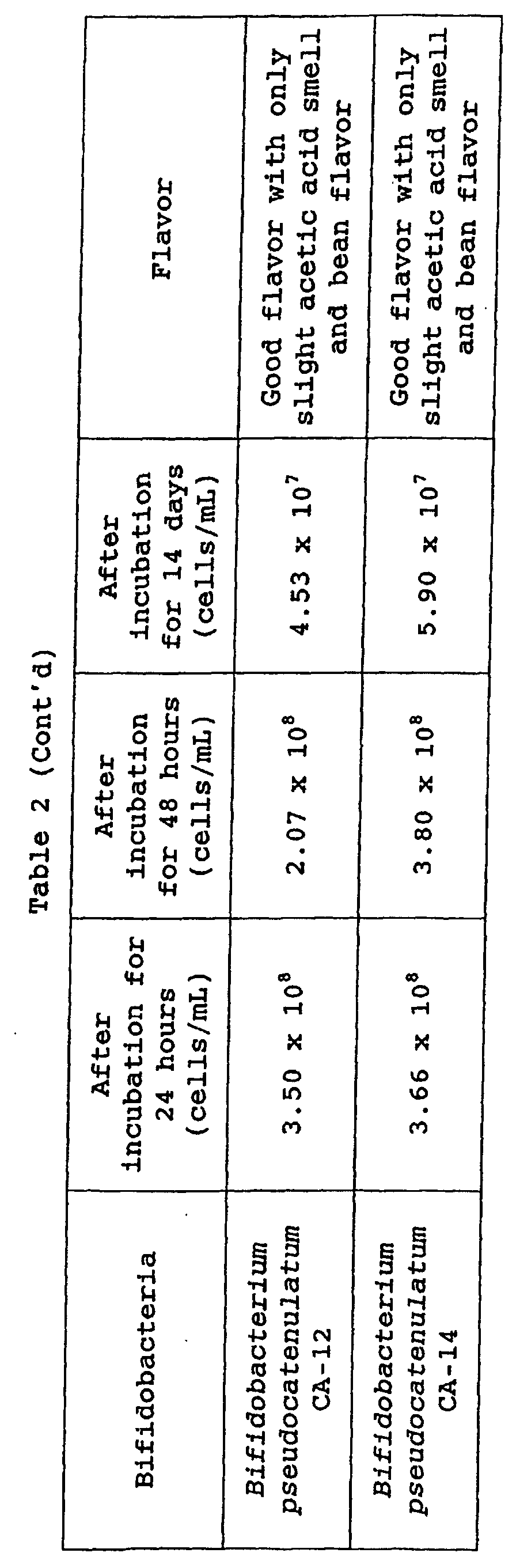
- soybean milk medium in the respective culture bottles was inoculated at 1.0% by various bifidobacteria useful in the present invention and shown below in Table 2, the culture bottles were sealed with butyl rubber plugs, followed by static incubation at 37°C for 24 hours or 48 hours. Their viable cell counts were then determined after the respective incubation times. Further, those incubated for 24 hours were stored at 10°C for 14 days. With respect to the samples after the storage, their viable cell count determination and flavor evaluation were conducted. The results of these tests are also shown in Table 2.
- the bifidobacteria useful in the present invention all grew well in the soybean milk medium and had good viability even after storage.
- the samples had flavor without any soybean flavor of soybean milk and with refreshing yoghurt-like flavor and had only a slight puckery taste of soybean milk, and were excellent as fermented soybean milk foods.
- soybean milk which had been obtained by sterilizing soybean milk (solid content: 12%) with steam at 100°C for 90 minutes, Bifidobacterium catenulatum (ATCC27593) which had been subcultured beforehand through several cycles was inoculated at 1%.
- the culture bottle was sealed with a butyl rubber plug, followed by static incubation 37°C for 24 hours.
- the fermented product so obtained had pH 4.6 and a viable cell count of 3 x 10 8 CFU/mL.
- fermented soybean milk food was prepared.
- a flavor evaluation was conducted.
- the fermented soybean milk food so obtained was found to have refreshing yoghurt-like flavor of fermentation with only slight bean flavor.
- the viable cell count was 2 x 10 8 CFU/mL.
- the present invention has made it possible to obtain fermented foods, which can be very easily dealt with and have excellent flavor, by using a bifidobacterium which is classified to either the species of Bifidobacterium catenulatum or the species of Bifidobacterium pseudocatenulatum and has not been used in foods to date.
- fermented products according to the present invention contain a bifidobacterium which is useful in the present invention and is a most dominant strain in the intestinal tract of human adults. By eating or drinking the fermented products, the bifidobacterium useful in the present invention can therefore be taken alive, so that excellent physiological effects can be expected.
Landscapes
- Life Sciences & Earth Sciences (AREA)
- Chemical & Material Sciences (AREA)
- Engineering & Computer Science (AREA)
- Food Science & Technology (AREA)
- Polymers & Plastics (AREA)
- Microbiology (AREA)
- Nutrition Science (AREA)
- Health & Medical Sciences (AREA)
- Agronomy & Crop Science (AREA)
- Botany (AREA)
- Oil, Petroleum & Natural Gas (AREA)
- Biotechnology (AREA)
- Dairy Products (AREA)
- Coloring Foods And Improving Nutritive Qualities (AREA)
- Beans For Foods Or Fodder (AREA)
Abstract
Description


Claims (7)
- Bifidobacteria-containing fermented food available from fermentation of a culture medium, which comprises milk or soybean milk as a principal ingredient, by a bifidobacterium selected from the species of Bifidobacterium catenulatum or Bifidobacterium pseudocatenulatum.
- Bifidobacteria-containing fermented food as described in claim 1, wherein said culture medium is a culture medium comprising milk as a principal ingredient.
- Bifidobacteria-containing fermented food as described in claim 1, wherein said culture medium is a culture medium comprising soybean milk as a principal ingredient.
- Bifidobacteria-containing fermented food as described in claim 1, wherein after filled in a sealed container and stored at 10°C for 14 days, acell count of said bifidobacterium selected from the species of Bifidobacterium catenulatum or Bifidobacterium pseudocatenulatum is 1 x 10⁷ CFU/mL or greater.
- Bifidobacteria-containing fermented milk food according to claim 2, wherein fermentation is conducted under anaerobic conditions such that pH does not drop beyond 3.6.
- Bifidobacteria-containing fermented milk food according to claim 3, wherein fermentation is conducted under anaerobic conditions such that pH does not drop beyond 3.0.
- Bifidobacteria-containing fermented food as described in any one of claims 1-6, which is filled in a sealed container.
Applications Claiming Priority (5)
| Application Number | Priority Date | Filing Date | Title |
|---|---|---|---|
| JP30738299 | 1999-10-28 | ||
| JP30738199 | 1999-10-28 | ||
| JP30738299A JP2001120180A (en) | 1999-10-28 | 1999-10-28 | Fermented soymilk containing bifidobacteria |
| JP30738199A JP2001120178A (en) | 1999-10-28 | 1999-10-28 | Milk fermented food containing bifidobacteria |
| PCT/JP2000/006841 WO2001030167A1 (en) | 1999-10-28 | 2000-10-02 | Fermented foods containing bifidobacterium |
Publications (2)
| Publication Number | Publication Date |
|---|---|
| EP1224867A1 true EP1224867A1 (en) | 2002-07-24 |
| EP1224867A4 EP1224867A4 (en) | 2005-01-19 |
Family
ID=26565082
Family Applications (1)
| Application Number | Title | Priority Date | Filing Date |
|---|---|---|---|
| EP00963042A Withdrawn EP1224867A4 (en) | 1999-10-28 | 2000-10-02 | FERMENTED FOODS CONTAINING BIFIDOBACTERIUM |
Country Status (5)
| Country | Link |
|---|---|
| EP (1) | EP1224867A4 (en) |
| KR (1) | KR20020043228A (en) |
| CN (1) | CN1384711A (en) |
| AU (1) | AU778951B2 (en) |
| WO (1) | WO2001030167A1 (en) |
Families Citing this family (10)
| Publication number | Priority date | Publication date | Assignee | Title |
|---|---|---|---|---|
| KR100449146B1 (en) * | 2001-12-19 | 2004-09-18 | 씨제이 주식회사 | Method for making fermented food and fermented food made thereby having suppressive effect against helicobactor-pylori and food-poisoning bacillus |
| KR100485267B1 (en) * | 2002-06-20 | 2005-04-27 | 전기숙 | Fermented soymilk having totally hydrolyzed isoflavones and method for preparation of same |
| CN100457889C (en) * | 2006-02-15 | 2009-02-04 | 李建文 | Method for preparing microbial feed addictive by multiple bacteria strain mixed culture |
| KR100843332B1 (en) * | 2006-12-05 | 2008-07-03 | 주식회사동방아그로 | Medium and large pesticide granules having sleep-floating diffusivity and preparation method thereof |
| WO2011114182A1 (en) * | 2010-03-17 | 2011-09-22 | Compagnie Gervais Danone | Dried fermented dairy product containing a high density of living bifidobacteria |
| CN106148230B (en) * | 2016-07-12 | 2019-04-09 | 江南大学 | A strain of Bifidobacterium pseudominis and its application for preparing conjugated linoleic acid or conjugated linolenic acid |
| CN110959676B (en) * | 2018-09-30 | 2022-11-25 | 内蒙古伊利实业集团股份有限公司 | Fermented milk product containing bifidobacterium lactis and application thereof |
| US11141442B2 (en) * | 2019-06-06 | 2021-10-12 | Compound Solutions, Inc. | Tributyrin compositions and methods therefor |
| CN110200078A (en) * | 2019-06-25 | 2019-09-06 | 吉林农业大学 | A kind of preparation method of lipid-loweringing composite probiotics ferment soy yogurt |
| CN114304513A (en) * | 2022-02-11 | 2022-04-12 | 仙婷(广州)科技研发有限公司 | A kind of oral compound strain fermentation product and its application |
Family Cites Families (5)
| Publication number | Priority date | Publication date | Assignee | Title |
|---|---|---|---|---|
| DE3406772A1 (en) * | 1984-02-24 | 1986-03-13 | Angelo 8137 Berg Schuler | Dietetic composition for reducing the urea concentration in body fluids and its preparation |
| JP2922013B2 (en) * | 1991-04-17 | 1999-07-19 | 雪印ローリー株式会社 | Novel bifidobacteria with acid and oxygen tolerance |
| JPH0827011A (en) * | 1994-07-12 | 1996-01-30 | Yakult Honsha Co Ltd | Fetal colonization enhancer and maternal diet |
| TW357191B (en) * | 1996-06-04 | 1999-05-01 | Food Industry Development Res Institute | Bifidobacteria strains with acid, bile salt and oxygen tolerance and their culture method the invention relates to bifidobacteria strains with acid, bile salt and oxygen tolerance and their culture method |
| JP3359827B2 (en) * | 1996-10-29 | 2002-12-24 | 株式会社ヤクルト本社 | Lipid metabolism improver and food containing it |
-
2000
- 2000-10-02 WO PCT/JP2000/006841 patent/WO2001030167A1/en not_active Ceased
- 2000-10-02 CN CN00815106A patent/CN1384711A/en active Pending
- 2000-10-02 AU AU74524/00A patent/AU778951B2/en not_active Ceased
- 2000-10-02 EP EP00963042A patent/EP1224867A4/en not_active Withdrawn
- 2000-10-02 KR KR1020027004787A patent/KR20020043228A/en not_active Ceased
Also Published As
| Publication number | Publication date |
|---|---|
| AU778951B2 (en) | 2004-12-23 |
| WO2001030167A1 (en) | 2001-05-03 |
| KR20020043228A (en) | 2002-06-08 |
| AU7452400A (en) | 2001-05-08 |
| EP1224867A4 (en) | 2005-01-19 |
| CN1384711A (en) | 2002-12-11 |
Similar Documents
| Publication | Publication Date | Title |
|---|---|---|
| TWI495722B (en) | Novel bacteria belonging to the genus bifidobacterium, food or drink comprising the same, use of dna fragment and primer for detecting or quantifying the same, and method for detecting or quantifying the same | |
| JP5518178B2 (en) | Novel lactic acid bacteria belonging to Lactobacillus plantarum and their use | |
| KR101018274B1 (en) | Fermented Milk Production Method | |
| EP2547214B1 (en) | Dried fermented dairy product containing a high density of living bifidobacteria | |
| KR101730191B1 (en) | Method for culturing lactic acid bacterium, and food or beverage | |
| CN107580454A (en) | The preparation of the clear fermented dairy product of demulsification | |
| RU2451067C2 (en) | Method for enhancement of bifidobacteria viability in the process of fermented food product storage | |
| AU778951B2 (en) | Fermented foods containing bifidobacterium | |
| EP3328208B1 (en) | Methods for the preparation of fermented products comprising bifidobacteria | |
| CN116656569A (en) | Alcohol-containing fermented milk direct-vat-set starter, and preparation method and application thereof | |
| JP2022188291A (en) | Medium for lactic acid bacteria | |
| KR20100010556A (en) | A method for preparing a herbal fermented functional liquid having a excellent sense effect and economical efficiency | |
| CN109007049A (en) | A kind of collaboration probiotics fermention and the sour cream and preparation method thereof rich in active bacteria | |
| EP4255203B1 (en) | Acetobacter for use in preparation of fermented products | |
| JP2001120180A (en) | Fermented soymilk containing bifidobacteria | |
| JP6966275B2 (en) | How to improve the survival of lactic acid bacteria | |
| JP2001120178A (en) | Milk fermented food containing bifidobacteria | |
| US20240032568A1 (en) | Fermented beverages and processes of preparing the same | |
| CN117916358A (en) | Lactic acid bacteria, lactic acid bacteria starter, fermented milk, method for producing fermented milk, and method for screening lactic acid bacteria | |
| Phetsomphou et al. | Dairy Foods: Microbiology | |
| HK1174952B (en) | Method for constructing novel bacterium belonging to the genus bifidobacterium | |
| HK1181420B (en) | Lactobacillus classified as lactobacillus plantarum and use thereof |
Legal Events
| Date | Code | Title | Description |
|---|---|---|---|
| PUAI | Public reference made under article 153(3) epc to a published international application that has entered the european phase |
Free format text: ORIGINAL CODE: 0009012 |
|
| 17P | Request for examination filed |
Effective date: 20020416 |
|
| AK | Designated contracting states |
Kind code of ref document: A1 Designated state(s): AT BE CH CY DE DK ES FI FR GB GR IE IT LI LU MC NL PT SE |
|
| RIC1 | Information provided on ipc code assigned before grant |
Ipc: 7A 23C 9/12 A Ipc: 7A 23C 11/10 B Ipc: 7A 23C 9/123 B Ipc: 7A 23L 1/03 B |
|
| A4 | Supplementary search report drawn up and despatched |
Effective date: 20041206 |
|
| 17Q | First examination report despatched |
Effective date: 20050218 |
|
| STAA | Information on the status of an ep patent application or granted ep patent |
Free format text: STATUS: THE APPLICATION IS DEEMED TO BE WITHDRAWN |
|
| 18D | Application deemed to be withdrawn |
Effective date: 20061005 |