EP1222538B1 - System and method for persistence-vector-based modification of usage rates - Google Patents
System and method for persistence-vector-based modification of usage rates Download PDFInfo
- Publication number
- EP1222538B1 EP1222538B1 EP00965532A EP00965532A EP1222538B1 EP 1222538 B1 EP1222538 B1 EP 1222538B1 EP 00965532 A EP00965532 A EP 00965532A EP 00965532 A EP00965532 A EP 00965532A EP 1222538 B1 EP1222538 B1 EP 1222538B1
- Authority
- EP
- European Patent Office
- Prior art keywords
- users
- user
- resource
- usage
- rates
- Prior art date
- Legal status (The legal status is an assumption and is not a legal conclusion. Google has not performed a legal analysis and makes no representation as to the accuracy of the status listed.)
- Expired - Lifetime
Links
Images

Classifications
-
- G—PHYSICS
- G06—COMPUTING OR CALCULATING; COUNTING
- G06F—ELECTRIC DIGITAL DATA PROCESSING
- G06F9/00—Arrangements for program control, e.g. control units
- G06F9/06—Arrangements for program control, e.g. control units using stored programs, i.e. using an internal store of processing equipment to receive or retain programs
- G06F9/46—Multiprogramming arrangements
-
- H—ELECTRICITY
- H04—ELECTRIC COMMUNICATION TECHNIQUE
- H04W—WIRELESS COMMUNICATION NETWORKS
- H04W28/00—Network traffic management; Network resource management
- H04W28/16—Central resource management; Negotiation of resources or communication parameters, e.g. negotiating bandwidth or QoS [Quality of Service]
- H04W28/18—Negotiating wireless communication parameters
-
- G—PHYSICS
- G06—COMPUTING OR CALCULATING; COUNTING
- G06F—ELECTRIC DIGITAL DATA PROCESSING
- G06F9/00—Arrangements for program control, e.g. control units
- G06F9/06—Arrangements for program control, e.g. control units using stored programs, i.e. using an internal store of processing equipment to receive or retain programs
- G06F9/46—Multiprogramming arrangements
- G06F9/50—Allocation of resources, e.g. of the central processing unit [CPU]
Definitions
- This invention relates to distribution of the use of a limited resource among multiple users. More specifically, this invention relates to the modification of usage rates according to a set of persistence vectors.
- a shared resource is one which may be used by multiple users.
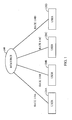
- Shared resources which have limited availabilities or capacities include such diverse examples as electric power stations and other energy plants, water sources such as reservoirs and flowing bodies, supply systems for the distribution of goods and/or material, and data communications networks and pathways. Problems associated with allocating the use of a shared resource among multiple users may therefore arise in many different contexts. Regardless of the particular context, however, such resources may be found in many systems in which at least the following conditions hold:
- An overload condition arises when the sum of the n usage rates u i at any one time exceeds the value R.
- an overload condition may arise when the total current draw exceeds the rated capacity.
- an overload condition may arise when the total data transfer rate exceeds the pathway's actual capacity, thereby corrupting the data in transmission.
- an overload condition may also indicate that although user demands are currently being met, reserve or buffer capacity is being depleted.
- an overload condition will vary, possibly including the need for an offline period for resource recovery (e.g. cooling of an power generation system or replenishment of a reservoir) or the need to expend present capacity in order to repeat a use that was attempted in the past but failed because of the overload (e.g. retransmission of a data packet corrupted by a collision).
- the resource may even become temporarily or permanently unable to regain its former capacity. In any case, it is generally desirable to avoid overload conditions whenever possible.
- United States Patent No. 5,857,147 describes a method and apparatus for determining the transmission data rate in a multi-user communication system.
- a system includes a resource and a number of users of the resource.
- Each user of the resource has a usage rate and a set of persistence vectors, and the user's use of the resource is determined at least in part by the user's usage rate.
- a predetermined relationship arises between a sum of the usage rates and a certain measure of the capacity of the resource, then at least one of the users changes its usage rate according to at least its set of persistence vectors.
- the users 120 may not be aware that an overload has occurred, especially if the resource is consuming reserve capacity in order to meet user demands. Even if the overload condition causes the resource's availability to a user to drop below a user's expectation or demand, the user may be unable to verify whether the shortcoming is due to a resource overload or to the failure of another component in the supply path. Moreover, in certain applications such as wireless data communications, it is possible that no feedback mechanism exists whereby a user may obtain timely notification of an overload. Therefore, the user may continue to use the resource, unaware of the problem. In such a situation, it is desirable for the system to include a capability for notifying the users of the overload condition via, e.g., a warning signal.
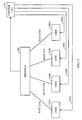
- FIG. 2 shows an example of such a system, wherein control unit 230 receives information related to usage of resource 200 by users 220a-d and sends feedback information such as a warning signal to users 220a-d over respective communications pathways 240a-d. Note that it is possible for control unit 230 to be implemented as a part of resource 200 or alternatively as a part of one of the users 220a-d.
- a decentralized system may be designed wherein control is shared with the users.
- the control unit in such a system concentrates on the prediction and avoidance of overload conditions while issuing enough feedback information to allow the users to control their own usage to some extent.
- a method according to an embodiment of the invention may be implemented in any system that fits the model of FIG. 1 wherein the users may obtain notification of an overload condition (as in the modified system of FIG. 2 ).
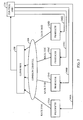
- An exemplary application of such a system is shown in FIG. 3 wherein users 320a-d are data producers, resource 300 is a common transmission channel linking the producers with data consumer 350, and control unit 330 receives usage information from the consumer.
- the producers use resource 300 by transmitting data to consumer 350 at or below rates 310a-d, respectively, and they receive respective signals 340a-d (which may include feedback and/or other control information) from the control unit.
- each producer may comprise 1) a transmitter, such as a mobile telephone or a WLL (wireless local loop) station, connected to 2) a data-producing device, such as a laptop computer or a point-of-sale terminal, through a PCMCIA card or a similar interface, and outputting data encapsulated in packets over IP or any other suitable protocol.
- Consumer 350 and control unit 330 may be parts of a base station, and control signals 340 may be carried over a forward link.
- CDMA telecommunications systems have already been implemented. While most of these CDMA systems have been designed to carry digitized voice communications, however, the method herein described is especially well-suited to a network serving producers with widely varying transmission rates, such as a data-only network or a mixed voice-data network.
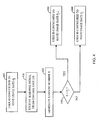
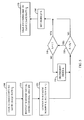
- a method according to a first embodiment of the invention is described in FIG. 4 with reference to the system of FIG. 2 .
- a user's use of the resource at any particular time is determined in relation to a predetermined usage rate.
- a particular user is configured to have a usage rate r j .
- the usage rate r j is one among a set of m predetermined available rates r l to r m , where the relation a ⁇ b implies that r a ⁇ r b . It is not necessary for all users to have the same set of available rates, but the set for each user should be known to control unit 230 so that it may reliably predict the state of resource use and issue a warning signal appropriately.
- each user's set of available rates may be updated by control unit 230 whether periodically or otherwise.
- Schemes of rate selection, assignment, and allocation that may be used in systems incorporating an embodiment of the invention include those described in the copending Patent Applications Nos. 09/264,297 , entitled “METHOD OF RATE ALLOCATION IN A DATA COMMUNICATIONS NETWORK,” filed March 4, 1999 and assigned to the assignee of the present invention, and, 09/410, 199 entitled “SYSTEM AND METHOD FOR PERSISTENCE-VECTOR-BASED RATE ASSIGNMENT,” filed concurrently herewith, assigned to the assignee of the present invention, and the disclosure of which application is hereby incorporated by reference.
- the usage rate r j may indicate a maximum allowable rate, i.e. a permission rather than a requirement to use the resource at the given rate.
- the actual rate at which the user uses the resource may depend upon other factors in addition to the usage rate, such as a user's current need and/or ability to use the resource. Likewise, note that the actual rate at which the user uses the resource need not be a member of the set of available rates.
- each user has the same fixed set of available rates, wherein each rate is expressed in kilobits per second (Kb/s) and the set of rates is designed to increment in powers of two. Because a doubling in rate requires a doubling in power to maintain the same ratio of energy per bit to noise power spectral density (E b /N 0 ), each rate step thus corresponds to a power step of 3 dB.
- the available rate values in this example include 4.8, 9.6, 19.2, 38.4, 76.8, 153.6, and 307.2 Kb/s.
- each user also has a set of persistence vectors, although it is possible to have other users in the system that lack a set of persistence vectors.
- the length of each such vector may be any integer greater than zero, and each vector element corresponds to one among the set of available rates and represents a probability that the usage rate will be the corresponding one among the set of available rates.
- each vector element is a persistence value which represents a probability from 0 to 1.
- the set of persistence vectors may be unique to each user, or the same set may be assigned to all users in a particular class, or the same set may be assigned to all of the users in the system.
- the set of persistence vectors may be a permanent aspect of the operation of the user, or it may be issued by control unit 230, in which case it may be updated periodically or otherwise.
- Other relevant aspects of persistence vector distribution and use are discussed in the co-pending Application No. 09/XXX,XXX entitled “METHOD AND APPARATUS FOR PERSISTENCE-VECTOR-BASED RATE ASSIGNMENT," the disclosure of which application is incorporated by reference above.
- the vector P may be the only vector in the set of persistence vectors, or vector P may be selected from among others in the set according to such criteria as the most recent usage rate or the most recent actual rate for this user.
- Vector P may (but is not required to) have the form of a probability density function, wherein the sum of its elements (or of the values represented by its elements) is equal or substantially equal to one.
- the user receives a warning signal from control unit 230.
- This warning signal may issue, for example, when an actual or impending overload condition is detected, and it may be sent to all users or only to a subset of the users (e.g. only to the users who have persistence vectors).
- Various embodiments and applications of a system wherein the warning signal is indicated by a busy bit in a reverse link signal are described in co-pending Application No. 09/346,882 entitled "METHOD AND APPARATUS FOR SIGNAL COMBINING IN A HIGH DATA RATE COMMUNICATION SYSTEM,” filed July 2, 1999 and assigned to the assignee of the present invention.
- x represents a value drawn from a set having a uniform distribution over the range 0 to 1.
- the value of x is tested against the persistence value P j , where P j is the element of persistence vector P that corresponds to usage rate r j . If the test fails (i.e. x is not less than P j ), then the user's usage rate is not affected by the overload condition, as shown in block 440. If the test succeeds (i.e.
- x is less than P j ), however, then the user's usage rate is decreased from r j to r j-1 , as shown in block 450. If the user's usage rate is already the lowest rate in the user's set of available rates, then success in block 450 may indicate a reduction to a predetermined lower rate or even a denial of service.
- This method may be altered to allow the use of one among many other relations between the values of x and P j in place of the test condition shown in block 430, depending on the particular characteristics of the values chosen for x and P j .
- the values given to the elements of persistence vector P will in part influence how the redistribution of resource usage is biased among users starting with different usage rates. For example, a redistribution which is more equitable may be achieved by choosing large values for elements of persistence vector P which correspond to high usage rates and low values for elements of P which correspond to low usage rates. Such a scheme will make it more likely that a user currently having a high usage rate will reduce its rate, while making it less likely that a user already having a low usage rate will have to reduce its rate any further. Note as well that in a case where each persistence vector is associated with a particular member of the set of available rates, the relations between these vectors will also bias the redistribution of resource usage. Also note that use of the rate doubling scheme described above (or a similar non-constant distribution within the set of usage rates) will allow usage rate reductions by high-rate users to free up more resource capacity than usage rate reductions by low-rate users.
- the users may share the same set of persistence vectors, or different sets of persistence vectors may be assigned to allow the implementation of a priority scheme among the users.
- the first element of each persistence vector may be eliminated (or set to represent a probability of 1) so that users already having the lowest usage rate will not suffer a further rate reduction.
- more than one among the first elements of the persistence vectors may be so treated to protect users of other low rates.
- the rate at which the user actually uses or accesses the shared resource may be limited by factors such as the user's present capacity or power. Therefore, it is possible that the user may use or may be permitted to use a rate lower than the usage rate granted by this or a similar method.
- rate R (a capacity measure of the shared resource) to be a threshold value rather than the actual capacity of the shared resource so that the warning signal is generated before an overload condition occurs, thereby allowing the system to react to avoid the condition.
- the threshold R should be selected to take into account at least (1) the longest possible delay in system response, as characterized by the maximum time between generation of the warning signal and the consequent reduction in total resource usage, and (2) the maximum possible increase in resource usage during the period of such delay.
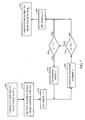
- FIG. 5 A method according to a second embodiment of the invention is described in FIG. 5 with reference to FIG. 2 .
- this method allows the user's usage rate to be reduced to any other rate in the set of available rates rather than to only one particular rate.
- a user is configured to have a usage rate r j from the user's set of available rates r l to r m (as noted in block 500) and an (m-1)-element persistence vector P which may be selected from a set according to, for example, the index j.
- a warning signal is received from control unit 230, and in block 520 the user generates a random number x as described above.
- the user also sets an index k to be equal to the index j.
- the value of x is tested against the persistence value P k , where P k is the element of persistence vector P that corresponds to usage rate u k . If the test fails (i.e. x is not less than P k ), then the index j is set to be equal to k in block 560, and the method ends in block 570 with the user being configured to have the usage rate r j . In this case, in other words, the user's usage rate is not affected by the overload condition.
- test in block 530 succeeds (i.e. x is less than P k ), then the value of the index k is tested. If k is already at its minimum value (i.e. one in this example), then the procedure continues to blocks 560 and 570 as above. Otherwise, the value of k is decremented (i.e. reduced by one) and the test is repeated. Under this method, when block 570 is finally reached, the user may be configured to have any usage rate in the set which is equal to or less than the usage rate indicated in block 500. Again, this method may be altered to allow the use of one among many other relations between the values of x and P k in place of the test condition shown in block 530, depending on the particular characteristics of the values chosen for x and P k .
- Block 540 is replaced with block 542, which allows the index k to reach a value of zero.
- the user is configured to have a null usage rate in block 580.
- This null usage rate may represent some predetermined rate outside the set of available rates (e.g. a minimal rate which draws from reserved capacity) or it may represent a usage rate of zero and thus a complete denial of usage.
- FIG. 7 shows an additional variation of the method of FIG. 5 , wherein a new random number x is generated in block 526 at every iteration of the loop (in this variation, block 520 may be reduced as in block 522 to include only the initialization of index k).
- a minimum bound of the selected usage rate may be established by setting elements of the persistence vector which correspond to that rate and to any lesser rates to indicate a probability of 1 (i.e. setting these elements to zero in the examples of FIGs. 4-7 ).
- the tests in blocks 430 and 530 will fail when that rate is reached (or when the procedure is called with the user already having a lower usage rate), and no further reduction in usage rate will occur.
- indices such as those for the set of available rates and the persistence vector being referenced may begin at zero, or at any other number or symbol, rather than beginning at one.
- indices such as those for the set of available rates and the persistence vector being referenced may begin at zero, or at any other number or symbol, rather than beginning at one.
- the relation a ⁇ b may imply that r a > r b , or the various rates may be arranged in some other order instead.
- the invention may be implemented in part or in whole as hardwired circuits, as circuit configurations fabricated into application-specific integrated circuits, or as firmware programs loaded into non-volatile storage or software programs loaded from or into data storage media as machine-readable code, such code being instructions executable by arrays of logic elements such as microprocessors or other digital signal processing units.
Landscapes
- Engineering & Computer Science (AREA)
- Software Systems (AREA)
- Theoretical Computer Science (AREA)
- Physics & Mathematics (AREA)
- General Engineering & Computer Science (AREA)
- General Physics & Mathematics (AREA)
- Quality & Reliability (AREA)
- Computer Networks & Wireless Communication (AREA)
- Signal Processing (AREA)
- Mobile Radio Communication Systems (AREA)
- Data Exchanges In Wide-Area Networks (AREA)
- Management, Administration, Business Operations System, And Electronic Commerce (AREA)
- Complex Calculations (AREA)
- Dc Digital Transmission (AREA)
- Small-Scale Networks (AREA)
- Control Of Ac Motors In General (AREA)
- Measurement Of Resistance Or Impedance (AREA)
- Financial Or Insurance-Related Operations Such As Payment And Settlement (AREA)
- Supply And Distribution Of Alternating Current (AREA)
- Measurement And Recording Of Electrical Phenomena And Electrical Characteristics Of The Living Body (AREA)
Priority Applications (2)
| Application Number | Priority Date | Filing Date | Title |
|---|---|---|---|
| EP10177715A EP2270660A3 (en) | 1999-09-30 | 2000-09-29 | System and method for persistance-vector based modification of usage rates |
| EP07111455A EP1845445A3 (en) | 1999-09-30 | 2000-09-29 | System and method for persistance-vector-based modification of usage rates |
Applications Claiming Priority (3)
| Application Number | Priority Date | Filing Date | Title |
|---|---|---|---|
| US09/410,204 US6665272B1 (en) | 1999-09-30 | 1999-09-30 | System and method for persistence-vector-based modification of usage rates |
| US410204 | 1999-09-30 | ||
| PCT/US2000/026879 WO2001024004A2 (en) | 1999-09-30 | 2000-09-29 | System and method for persistence-vector-based modification of usage rates |
Related Child Applications (2)
| Application Number | Title | Priority Date | Filing Date |
|---|---|---|---|
| EP07111455A Division EP1845445A3 (en) | 1999-09-30 | 2000-09-29 | System and method for persistance-vector-based modification of usage rates |
| EP07111455.7 Division-Into | 2007-06-29 |
Publications (2)
| Publication Number | Publication Date |
|---|---|
| EP1222538A2 EP1222538A2 (en) | 2002-07-17 |
| EP1222538B1 true EP1222538B1 (en) | 2010-05-12 |
Family
ID=23623713
Family Applications (3)
| Application Number | Title | Priority Date | Filing Date |
|---|---|---|---|
| EP00965532A Expired - Lifetime EP1222538B1 (en) | 1999-09-30 | 2000-09-29 | System and method for persistence-vector-based modification of usage rates |
| EP10177715A Withdrawn EP2270660A3 (en) | 1999-09-30 | 2000-09-29 | System and method for persistance-vector based modification of usage rates |
| EP07111455A Withdrawn EP1845445A3 (en) | 1999-09-30 | 2000-09-29 | System and method for persistance-vector-based modification of usage rates |
Family Applications After (2)
| Application Number | Title | Priority Date | Filing Date |
|---|---|---|---|
| EP10177715A Withdrawn EP2270660A3 (en) | 1999-09-30 | 2000-09-29 | System and method for persistance-vector based modification of usage rates |
| EP07111455A Withdrawn EP1845445A3 (en) | 1999-09-30 | 2000-09-29 | System and method for persistance-vector-based modification of usage rates |
Country Status (17)
| Country | Link |
|---|---|
| US (1) | US6665272B1 (enExample) |
| EP (3) | EP1222538B1 (enExample) |
| JP (1) | JP4790955B2 (enExample) |
| KR (2) | KR100740475B1 (enExample) |
| CN (2) | CN101894043B (enExample) |
| AT (1) | ATE467867T1 (enExample) |
| AU (1) | AU776201B2 (enExample) |
| BR (1) | BR0014296A (enExample) |
| CA (1) | CA2384472C (enExample) |
| DE (1) | DE60044397D1 (enExample) |
| ES (1) | ES2344099T3 (enExample) |
| HK (1) | HK1047807A1 (enExample) |
| IL (2) | IL148529A0 (enExample) |
| MX (1) | MXPA02003109A (enExample) |
| NO (1) | NO20021505L (enExample) |
| TW (1) | TW539999B (enExample) |
| WO (1) | WO2001024004A2 (enExample) |
Families Citing this family (23)
| Publication number | Priority date | Publication date | Assignee | Title |
|---|---|---|---|---|
| US7596098B2 (en) | 1999-09-30 | 2009-09-29 | Qualcomm Incorporated | System and method for persistence-vector-based rate assignment |
| US7933249B2 (en) | 2000-02-08 | 2011-04-26 | Ipr Licensing, Inc. | Grade of service and fairness policy for bandwidth reservation system |
| CA2372557C (en) * | 2000-04-10 | 2008-08-05 | Samsung Electronics Co., Ltd. | Method for measuring confusion rate of a common packet channel in a cdma communication system |
| AU2001293564A1 (en) * | 2000-09-20 | 2002-04-02 | Soma Networks, Inc. | Point of sale terminal |
| KR100800884B1 (ko) | 2001-03-29 | 2008-02-04 | 삼성전자주식회사 | 이동통신 시스템에서 역방향 링크의 송신 제어 방법 |
| US6983153B2 (en) * | 2001-06-07 | 2006-01-03 | Qualcomm Incorporated | Method and apparatus for congestion control in a wireless communication system |
| US7961616B2 (en) | 2001-06-07 | 2011-06-14 | Qualcomm Incorporated | Method and apparatus for congestion control in a wireless communication system |
| GB2366891B (en) * | 2001-12-06 | 2002-11-20 | Appsense Ltd | Improvements in and relating to computer apparatus terminal server apparatus & performance management methods therefor |
| JP4508874B2 (ja) * | 2002-11-14 | 2010-07-21 | クゥアルコム・インコーポレイテッド | 無線通信レート形成 |
| US7411923B2 (en) | 2002-11-14 | 2008-08-12 | Qualcomm Incorporated | Wireless communication rate shaping |
| US7411974B2 (en) | 2002-11-14 | 2008-08-12 | Qualcomm Incorporated | Wireless communication rate shaping |
| US7324460B2 (en) * | 2002-11-28 | 2008-01-29 | International Business Machines Corporation | Event-driven flow control for a very high-speed switching node |
| US20060155555A1 (en) * | 2004-12-30 | 2006-07-13 | International Business Machines Corporation | Utility computing method and apparatus |
| US8817606B2 (en) * | 2006-07-13 | 2014-08-26 | Alcatel Lucent | Managing overload of an access medium for a communication system |
| CN102123444B (zh) * | 2010-12-31 | 2014-04-16 | 华为技术有限公司 | 异系统之间共享传输带宽的方法及设备、系统 |
| US10432272B1 (en) | 2018-11-05 | 2019-10-01 | XCOM Labs, Inc. | Variable multiple-input multiple-output downlink user equipment |
| US10659112B1 (en) | 2018-11-05 | 2020-05-19 | XCOM Labs, Inc. | User equipment assisted multiple-input multiple-output downlink configuration |
| US10756860B2 (en) | 2018-11-05 | 2020-08-25 | XCOM Labs, Inc. | Distributed multiple-input multiple-output downlink configuration |
| US10812216B2 (en) | 2018-11-05 | 2020-10-20 | XCOM Labs, Inc. | Cooperative multiple-input multiple-output downlink scheduling |
| US11063645B2 (en) | 2018-12-18 | 2021-07-13 | XCOM Labs, Inc. | Methods of wirelessly communicating with a group of devices |
| US10756795B2 (en) | 2018-12-18 | 2020-08-25 | XCOM Labs, Inc. | User equipment with cellular link and peer-to-peer link |
| US11330649B2 (en) | 2019-01-25 | 2022-05-10 | XCOM Labs, Inc. | Methods and systems of multi-link peer-to-peer communications |
| US10756767B1 (en) | 2019-02-05 | 2020-08-25 | XCOM Labs, Inc. | User equipment for wirelessly communicating cellular signal with another user equipment |
Family Cites Families (18)
| Publication number | Priority date | Publication date | Assignee | Title |
|---|---|---|---|---|
| US5115429A (en) | 1990-08-02 | 1992-05-19 | Codex Corporation | Dynamic encoding rate control minimizes traffic congestion in a packet network |
| ZA931077B (en) | 1992-03-05 | 1994-01-04 | Qualcomm Inc | Apparatus and method for reducing message collision between mobile stations simultaneously accessing a base station in a cdma cellular communications system |
| ZA946674B (en) * | 1993-09-08 | 1995-05-02 | Qualcomm Inc | Method and apparatus for determining the transmission data rate in a multi-user communication system |
| AU671040B2 (en) * | 1993-09-20 | 1996-08-08 | Motorola Mobility, Inc. | Dynamic rate adjustment for overload control in communication networks |
| US5608727A (en) * | 1995-05-02 | 1997-03-04 | Motorola, Inc. | Method and system for management of frequency spectrum among multiple applications on a shared medium |
| US5619492A (en) | 1995-06-16 | 1997-04-08 | Unisys Corporation | CDMA communication system in which bit rates are dynamically allocated |
| US5729542A (en) | 1995-06-28 | 1998-03-17 | Motorola, Inc. | Method and apparatus for communication system access |
| US5805577A (en) * | 1995-07-20 | 1998-09-08 | Jain; Raj | Erica: explicit rate indication for congestion avoidance in ATM networks |
| US5596576A (en) * | 1995-11-03 | 1997-01-21 | At&T | Systems and methods for sharing of resources |
| US5745520A (en) * | 1996-03-15 | 1998-04-28 | Motorola, Inc. | Method and apparatus for power control in a spread spectrum communication system using threshold step-down size adjustment |
| US5737313A (en) * | 1996-03-15 | 1998-04-07 | Nec Usa, Inc. | Design of a closed loop feed back control for ABR service |
| US6097722A (en) * | 1996-12-13 | 2000-08-01 | Nortel Networks Corporation | Bandwidth management processes and systems for asynchronous transfer mode networks using variable virtual paths |
| US5953338A (en) * | 1996-12-13 | 1999-09-14 | Northern Telecom Limited | Dynamic control processes and systems for asynchronous transfer mode networks |
| KR100259905B1 (ko) * | 1997-09-18 | 2000-06-15 | 정선종 | 코드분할다중접속환경의트래픽과부하상태에서호시도제어방법 |
| US6226277B1 (en) * | 1997-10-14 | 2001-05-01 | Lucent Technologies Inc. | Method for admitting new connections based on usage priorities in a multiple access system for communications networks |
| US6055571A (en) * | 1997-11-20 | 2000-04-25 | Nec Usa, Inc. | Computer network with microeconomic flow control |
| US6233222B1 (en) * | 1998-03-06 | 2001-05-15 | Telefonaktiebolaget Lm Ericsson | Telecommunications inter-exchange congestion control |
| US6240287B1 (en) * | 1998-10-06 | 2001-05-29 | Lucent Technologies Inc. | Processing overload control at base stations of cellular wireless communication systems |
-
1999
- 1999-09-30 US US09/410,204 patent/US6665272B1/en not_active Expired - Lifetime
-
2000
- 2000-09-29 DE DE60044397T patent/DE60044397D1/de not_active Expired - Lifetime
- 2000-09-29 WO PCT/US2000/026879 patent/WO2001024004A2/en not_active Ceased
- 2000-09-29 ES ES00965532T patent/ES2344099T3/es not_active Expired - Lifetime
- 2000-09-29 EP EP00965532A patent/EP1222538B1/en not_active Expired - Lifetime
- 2000-09-29 AT AT00965532T patent/ATE467867T1/de not_active IP Right Cessation
- 2000-09-29 BR BR0014296-4A patent/BR0014296A/pt not_active Application Discontinuation
- 2000-09-29 JP JP2001526706A patent/JP4790955B2/ja not_active Expired - Lifetime
- 2000-09-29 CN CN2010102443472A patent/CN101894043B/zh not_active Expired - Lifetime
- 2000-09-29 IL IL14852900A patent/IL148529A0/xx active IP Right Grant
- 2000-09-29 KR KR1020027004120A patent/KR100740475B1/ko not_active Expired - Lifetime
- 2000-09-29 HK HK03100041.6A patent/HK1047807A1/zh unknown
- 2000-09-29 MX MXPA02003109A patent/MXPA02003109A/es active IP Right Grant
- 2000-09-29 EP EP10177715A patent/EP2270660A3/en not_active Withdrawn
- 2000-09-29 KR KR1020077005950A patent/KR100739387B1/ko not_active Expired - Lifetime
- 2000-09-29 AU AU76234/00A patent/AU776201B2/en not_active Ceased
- 2000-09-29 CN CN008135673A patent/CN1377484B/zh not_active Expired - Lifetime
- 2000-09-29 CA CA2384472A patent/CA2384472C/en not_active Expired - Fee Related
- 2000-09-29 EP EP07111455A patent/EP1845445A3/en not_active Withdrawn
-
2001
- 2001-01-17 TW TW089120383A patent/TW539999B/zh not_active IP Right Cessation
-
2002
- 2002-03-05 IL IL148529A patent/IL148529A/en not_active IP Right Cessation
- 2002-03-26 NO NO20021505A patent/NO20021505L/no not_active Application Discontinuation
Also Published As
| Publication number | Publication date |
|---|---|
| ATE467867T1 (de) | 2010-05-15 |
| EP2270660A2 (en) | 2011-01-05 |
| JP4790955B2 (ja) | 2011-10-12 |
| MXPA02003109A (es) | 2002-11-07 |
| WO2001024004A3 (en) | 2001-12-13 |
| CA2384472A1 (en) | 2001-04-05 |
| IL148529A (en) | 2007-10-31 |
| KR20070036195A (ko) | 2007-04-02 |
| TW539999B (en) | 2003-07-01 |
| JP2003510928A (ja) | 2003-03-18 |
| CN1377484A (zh) | 2002-10-30 |
| DE60044397D1 (de) | 2010-06-24 |
| CN101894043B (zh) | 2013-08-14 |
| ES2344099T3 (es) | 2010-08-18 |
| EP1845445A2 (en) | 2007-10-17 |
| CN101894043A (zh) | 2010-11-24 |
| NO20021505L (no) | 2002-05-29 |
| NO20021505D0 (no) | 2002-03-26 |
| AU7623400A (en) | 2001-04-30 |
| EP1222538A2 (en) | 2002-07-17 |
| CN1377484B (zh) | 2010-09-15 |
| EP2270660A3 (en) | 2012-05-30 |
| AU776201B2 (en) | 2004-09-02 |
| KR100740475B1 (ko) | 2007-07-19 |
| EP1845445A3 (en) | 2010-11-10 |
| HK1047807A1 (zh) | 2003-03-07 |
| US6665272B1 (en) | 2003-12-16 |
| IL148529A0 (en) | 2002-09-12 |
| KR20020035623A (ko) | 2002-05-11 |
| WO2001024004A2 (en) | 2001-04-05 |
| BR0014296A (pt) | 2002-08-27 |
| KR100739387B1 (ko) | 2007-07-13 |
| CA2384472C (en) | 2011-05-10 |
Similar Documents
| Publication | Publication Date | Title |
|---|---|---|
| EP1222538B1 (en) | System and method for persistence-vector-based modification of usage rates | |
| US6965613B2 (en) | System and method for persistence-vector-based rate assignment | |
| US7599329B2 (en) | System and method for persistence vector based rate assignment | |
| HK1111776A (en) | System and method for persistence-vector-based rate assignment | |
| HK1104627B (en) | System and method for persistence-vector-based rate assignment |
Legal Events
| Date | Code | Title | Description |
|---|---|---|---|
| PUAI | Public reference made under article 153(3) epc to a published international application that has entered the european phase |
Free format text: ORIGINAL CODE: 0009012 |
|
| 17P | Request for examination filed |
Effective date: 20020311 |
|
| AK | Designated contracting states |
Kind code of ref document: A2 Designated state(s): AT BE CH CY DE DK ES FI FR GB GR IE IT LI LU MC NL PT SE |
|
| AX | Request for extension of the european patent |
Free format text: AL;LT;LV;MK;RO;SI |
|
| 17Q | First examination report despatched |
Effective date: 20061124 |
|
| GRAP | Despatch of communication of intention to grant a patent |
Free format text: ORIGINAL CODE: EPIDOSNIGR1 |
|
| GRAS | Grant fee paid |
Free format text: ORIGINAL CODE: EPIDOSNIGR3 |
|
| GRAA | (expected) grant |
Free format text: ORIGINAL CODE: 0009210 |
|
| AK | Designated contracting states |
Kind code of ref document: B1 Designated state(s): AT BE CH CY DE DK ES FI FR GB GR IE IT LI LU MC NL PT SE |
|
| REG | Reference to a national code |
Ref country code: GB Ref legal event code: FG4D |
|
| REG | Reference to a national code |
Ref country code: CH Ref legal event code: EP |
|
| REG | Reference to a national code |
Ref country code: IE Ref legal event code: FG4D |
|
| REF | Corresponds to: |
Ref document number: 60044397 Country of ref document: DE Date of ref document: 20100624 Kind code of ref document: P |
|
| REG | Reference to a national code |
Ref country code: SE Ref legal event code: TRGR |
|
| REG | Reference to a national code |
Ref country code: NL Ref legal event code: T3 |
|
| REG | Reference to a national code |
Ref country code: ES Ref legal event code: FG2A Ref document number: 2344099 Country of ref document: ES Kind code of ref document: T3 |
|
| REG | Reference to a national code |
Ref country code: SE Ref legal event code: RPOT |
|
| PG25 | Lapsed in a contracting state [announced via postgrant information from national office to epo] |
Ref country code: AT Free format text: LAPSE BECAUSE OF FAILURE TO SUBMIT A TRANSLATION OF THE DESCRIPTION OR TO PAY THE FEE WITHIN THE PRESCRIBED TIME-LIMIT Effective date: 20100512 |
|
| PGFP | Annual fee paid to national office [announced via postgrant information from national office to epo] |
Ref country code: FI Payment date: 20100906 Year of fee payment: 11 Ref country code: SE Payment date: 20100715 Year of fee payment: 11 |
|
| PG25 | Lapsed in a contracting state [announced via postgrant information from national office to epo] |
Ref country code: GR Free format text: LAPSE BECAUSE OF FAILURE TO SUBMIT A TRANSLATION OF THE DESCRIPTION OR TO PAY THE FEE WITHIN THE PRESCRIBED TIME-LIMIT Effective date: 20100813 Ref country code: CY Free format text: LAPSE BECAUSE OF FAILURE TO SUBMIT A TRANSLATION OF THE DESCRIPTION OR TO PAY THE FEE WITHIN THE PRESCRIBED TIME-LIMIT Effective date: 20100512 |
|
| PG25 | Lapsed in a contracting state [announced via postgrant information from national office to epo] |
Ref country code: PT Free format text: LAPSE BECAUSE OF FAILURE TO SUBMIT A TRANSLATION OF THE DESCRIPTION OR TO PAY THE FEE WITHIN THE PRESCRIBED TIME-LIMIT Effective date: 20100913 Ref country code: DK Free format text: LAPSE BECAUSE OF FAILURE TO SUBMIT A TRANSLATION OF THE DESCRIPTION OR TO PAY THE FEE WITHIN THE PRESCRIBED TIME-LIMIT Effective date: 20100512 |
|
| PGFP | Annual fee paid to national office [announced via postgrant information from national office to epo] |
Ref country code: NL Payment date: 20100928 Year of fee payment: 11 |
|
| PG25 | Lapsed in a contracting state [announced via postgrant information from national office to epo] |
Ref country code: BE Free format text: LAPSE BECAUSE OF FAILURE TO SUBMIT A TRANSLATION OF THE DESCRIPTION OR TO PAY THE FEE WITHIN THE PRESCRIBED TIME-LIMIT Effective date: 20100512 |
|
| PLBE | No opposition filed within time limit |
Free format text: ORIGINAL CODE: 0009261 |
|
| STAA | Information on the status of an ep patent application or granted ep patent |
Free format text: STATUS: NO OPPOSITION FILED WITHIN TIME LIMIT |
|
| 26N | No opposition filed |
Effective date: 20110215 |
|
| PG25 | Lapsed in a contracting state [announced via postgrant information from national office to epo] |
Ref country code: MC Free format text: LAPSE BECAUSE OF NON-PAYMENT OF DUE FEES Effective date: 20100930 |
|
| REG | Reference to a national code |
Ref country code: CH Ref legal event code: PL |
|
| REG | Reference to a national code |
Ref country code: DE Ref legal event code: R097 Ref document number: 60044397 Country of ref document: DE Effective date: 20110214 |
|
| PG25 | Lapsed in a contracting state [announced via postgrant information from national office to epo] |
Ref country code: IE Free format text: LAPSE BECAUSE OF NON-PAYMENT OF DUE FEES Effective date: 20100929 Ref country code: CH Free format text: LAPSE BECAUSE OF NON-PAYMENT OF DUE FEES Effective date: 20100930 Ref country code: LI Free format text: LAPSE BECAUSE OF NON-PAYMENT OF DUE FEES Effective date: 20100930 |
|
| REG | Reference to a national code |
Ref country code: NL Ref legal event code: V1 Effective date: 20120401 |
|
| PG25 | Lapsed in a contracting state [announced via postgrant information from national office to epo] |
Ref country code: FI Free format text: LAPSE BECAUSE OF NON-PAYMENT OF DUE FEES Effective date: 20110929 |
|
| REG | Reference to a national code |
Ref country code: SE Ref legal event code: EUG |
|
| PG25 | Lapsed in a contracting state [announced via postgrant information from national office to epo] |
Ref country code: NL Free format text: LAPSE BECAUSE OF NON-PAYMENT OF DUE FEES Effective date: 20120401 |
|
| PG25 | Lapsed in a contracting state [announced via postgrant information from national office to epo] |
Ref country code: LU Free format text: LAPSE BECAUSE OF NON-PAYMENT OF DUE FEES Effective date: 20100929 |
|
| PG25 | Lapsed in a contracting state [announced via postgrant information from national office to epo] |
Ref country code: SE Free format text: LAPSE BECAUSE OF NON-PAYMENT OF DUE FEES Effective date: 20110930 |
|
| REG | Reference to a national code |
Ref country code: FR Ref legal event code: PLFP Year of fee payment: 17 |
|
| REG | Reference to a national code |
Ref country code: FR Ref legal event code: PLFP Year of fee payment: 18 |
|
| REG | Reference to a national code |
Ref country code: FR Ref legal event code: PLFP Year of fee payment: 19 |
|
| PGFP | Annual fee paid to national office [announced via postgrant information from national office to epo] |
Ref country code: FR Payment date: 20190819 Year of fee payment: 20 Ref country code: DE Payment date: 20190813 Year of fee payment: 20 Ref country code: IT Payment date: 20190924 Year of fee payment: 20 |
|
| PGFP | Annual fee paid to national office [announced via postgrant information from national office to epo] |
Ref country code: GB Payment date: 20190827 Year of fee payment: 20 |
|
| PGFP | Annual fee paid to national office [announced via postgrant information from national office to epo] |
Ref country code: ES Payment date: 20191001 Year of fee payment: 20 |
|
| REG | Reference to a national code |
Ref country code: DE Ref legal event code: R071 Ref document number: 60044397 Country of ref document: DE |
|
| REG | Reference to a national code |
Ref country code: GB Ref legal event code: PE20 Expiry date: 20200928 |
|
| PG25 | Lapsed in a contracting state [announced via postgrant information from national office to epo] |
Ref country code: GB Free format text: LAPSE BECAUSE OF EXPIRATION OF PROTECTION Effective date: 20200928 |
|
| REG | Reference to a national code |
Ref country code: ES Ref legal event code: FD2A Effective date: 20210108 |
|
| PG25 | Lapsed in a contracting state [announced via postgrant information from national office to epo] |
Ref country code: ES Free format text: LAPSE BECAUSE OF EXPIRATION OF PROTECTION Effective date: 20200930 |