EP1221791A2 - Wireless communication device, wireless communication system using the same, and communication method therefor - Google Patents
Wireless communication device, wireless communication system using the same, and communication method therefor Download PDFInfo
- Publication number
- EP1221791A2 EP1221791A2 EP01307155A EP01307155A EP1221791A2 EP 1221791 A2 EP1221791 A2 EP 1221791A2 EP 01307155 A EP01307155 A EP 01307155A EP 01307155 A EP01307155 A EP 01307155A EP 1221791 A2 EP1221791 A2 EP 1221791A2
- Authority
- EP
- European Patent Office
- Prior art keywords
- address
- packet
- slave
- destination
- slave device
- Prior art date
- Legal status (The legal status is an assumption and is not a legal conclusion. Google has not performed a legal analysis and makes no representation as to the accuracy of the status listed.)
- Granted
Links
Images


Classifications
-
- H—ELECTRICITY
- H04—ELECTRIC COMMUNICATION TECHNIQUE
- H04W—WIRELESS COMMUNICATION NETWORKS
- H04W84/00—Network topologies
- H04W84/18—Self-organising networks, e.g. ad-hoc networks or sensor networks
- H04W84/20—Leader-follower arrangements
-
- H—ELECTRICITY
- H04—ELECTRIC COMMUNICATION TECHNIQUE
- H04W—WIRELESS COMMUNICATION NETWORKS
- H04W8/00—Network data management
- H04W8/26—Network addressing or numbering for mobility support
-
- H—ELECTRICITY
- H04—ELECTRIC COMMUNICATION TECHNIQUE
- H04W—WIRELESS COMMUNICATION NETWORKS
- H04W88/00—Devices specially adapted for wireless communication networks, e.g. terminals, base stations or access point devices
- H04W88/02—Terminal devices
-
- H—ELECTRICITY
- H04—ELECTRIC COMMUNICATION TECHNIQUE
- H04W—WIRELESS COMMUNICATION NETWORKS
- H04W76/00—Connection management
- H04W76/10—Connection setup
-
- H—ELECTRICITY
- H04—ELECTRIC COMMUNICATION TECHNIQUE
- H04W—WIRELESS COMMUNICATION NETWORKS
- H04W84/00—Network topologies
- H04W84/18—Self-organising networks, e.g. ad-hoc networks or sensor networks
Definitions
- the present invention relates to a wireless communication device, a wireless communication system using the same, and a communication method therefor, and in particular to a wireless communication device supporting a peer-to-peer communication, a wireless communication system using the same, and a communication method therefor.
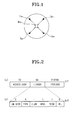
- Figure 1 illustrates a structure of a Piconet in a conventional Bluetooth communication system.
- a plurality of slave devices S 10 , S 20 , S 30 , S 40 are connected to one master device M 10 .
- a network where at least one slave device is connected to one master device is called a Piconet. In the Piconet, seven slave devices can be maximally connected to the master device in an active state.
- the master device M 10 communicates with the slave devices S 10 , S 20 , S 30 , S 40 through packets in the Piconet.
- the current Bluetooth communication employs a master driven time division duplex (TDD) type wherein the master device transmits a designated packet to a specific slave device, and the slave device transmits a data-recorded packet to the master device. Since the slave devices transmit data exclusively to the master device, the slave devices do not record a designation address in the packet to be transmitted. Only a source address, i.e., a transmission source of the slave device is recorded in the packet.
- TDD time division duplex
- Figure 2a illustrates a structure of a conventional packet transmitted in the Piconet in Figure 1
- Figure 2b illustrates in detail a header region of Figure 2a.
- the conventional packet includes an access region, a head region and a payload region.
- An address of the slave device transmitting the packet namely an active member address AM_ADDR allocated by the master device is recorded in the header region.
- the active member address is a 3-bit address which the master device allocates to distinguish the respective slave devices, when the slave devices are connected in the active state in the Piconet.
- the master device transmits the packet where the address of the slave device is recorded in the AM_ADDR portion of the header region
- the corresponding slave device transmits to the master device a response packet where its slave address is recorded in the AM_ADDR portion of the header region. Therefore, the master device or slave device judges whether the packet is transmitted to itself, by analyzing the header region of the packet received.
- the Bluetooth communication system uses the master driven TDD type. When one slave device intends to transmit data to another slave device, the slave device cannot record its destination address in the header region of the packet.
- the master device must analyze the payload region, which increases a data processing load.
- the payload region has 6 bytes of overhead among 17 bytes, thus reducing a data recording rate of each packet. As a result, communication speed is also decreased.
- the present invention is proposed with a view to reduce or to solve the foregoing problems, and it is therefore an aim of the invention to provide a wireless communication device supporting a peer-to-peer communication without increasing a packet analysis load, a wireless communication system using the same, and a communication method therefor.
- the communication device includes a transceiving unit for receiving external data, and transmitting a transmission-destined signal; and a controller, when the wireless communication device is operated as a slave device connected to the master device and the slave device intends to communicate with another slave device, for generating a packet where an address of a destination slave device received from the master device through the transceiving unit is recorded in a destination address region, and for transmitting the packet through the transceiving unit to the destination slave device through the master device.
- the controller records the address of the destination slave device which is a destination address in a header region of the packet.
- the controller records a source address in a payload region of the packet.
- the wireless communication device in a wireless communication device of a wireless communication system having at least one slave device, and a master device that is connected to the slave device and that has information of addresses allocated to the slave devices, includes a transceiving unit for receiving external data, and transmitting a transmission-destined signal; and a controller, when the wireless communication device is operated as a master device connected to at least one slave device, for reading the packet received from the transceiving unit and transmitting the packet to the corresponding slave device through the transceiving unit if there is an address of the slave device recorded in a destination address region of the packet.
- the controller recognizes the address recorded in a header region of the packet as a destination address.
- a wireless communication system having at least one slave device, and a master device that is connected to the slave device and that has information of addresses allocated to the slave devices, wherein the slave device obtains an address of the destination slave device from the master device, generates a packet including the address of the destination slave device as a destination address and its address as a source address, and transmits the packet to the master device, and the master device reads the received packet, and transmits the packet to the slave device of the destination address, when the address recorded in a destination address region of the packet is the address of the slave device.
- the slave device records the address of the destination slave device in a header region of the packet, and the master device recognizes the information recorded in the header region of the packet as the destination address.
- a communication method for a wireless communication system having at least one slave device, and a master device that is connected to the slave device and that has information of addresses allocated to the slave devices, the communication method including the steps of: obtaining an address of the destination slave device from the master device; generating a packet including the address of the destination slave device as a destination address and its address as a source address; and transmitting the packet to the master device so that the packet can be transmitted to the destination slave device through the master device according to the destination address recorded on the packet.
- a communication method for a wireless communication system having at least one slave device, and a master device that is connected to the slave device and that has information of addresses allocated to the slave devices, the communication method including the step of the master device analyzing a packet from the slave device; and the step of the master device transmitting the packet to the slave device of a destination address, when an address recorded in a destination address region of the packet is the address of the slave device.
- a wireless communication device, a wireless communication system using the same, and a communication method therefor in accordance with a preferred embodiment of the present invention will now be described in detail with reference to the accompanying drawings.
- the wireless communication device is operated as a master or slave.
- the wireless communication device is operated as the master, it is called a master device.
- the wireless communication device is operated as the slave, it is called a slave device.
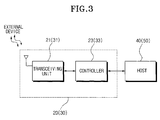
- FIG. 3 is a block diagram illustrating a wireless communication device in accordance with the present invention.
- a wireless communication devices 20, 30 respectively include transceiving units 21, 31 and controllers 23, 33.
- reference numerals 20, 21, 23, 40 denote the wireless communication device operated as the slave, and components thereof
- reference numerals 30, 31, 33, 50 denote the wireless communication device operated as the master, and components thereof.
- the transceiving unit 21 processes an external signal, for example an RF signal, and externally transmits a transmission destination packet.
- an external signal for example an RF signal
- the controller 23 is connected to a host 40 through a communication interface.
- various types of communication terminals such as a laptop computer, a cellular phone and a printer may be used as the host 40.
- the controller 23 processes a signal demanded by the host 40, and a signal received through the transceiving unit 21.
- the controller 23 when the wireless communication device 20 forms a wireless network with another wireless communication device, and is operated as the active slave for communicating with the destination slave device, namely for performing the peer-to-peer communication, the controller 23 generates a packet where an address of the destination slave device received from the master device through the transceiving unit 21 is recorded as a destination address, and externally transmits the packet through the transceiving unit 21. As illustrated in Figure 4, the controller 23 preferably generates the packet having an access code region, a header region and a payload region, and records the destination address in the header region of the packet.
- the controller 23 records a source address allocated by the master device, namely an active member address AM_ADDR in the payload region of the packet.
- the active member address is represented by less than 3 bits.
- Figure 5 is a flowchart showing the peer-to-peer communication performed by the wireless communication device 20 operating as a slave device.
- the slave device obtains the address of the destination slave device from the master device (S100).
- the slave device generates a packet where the address of the destination slave device is recorded in the header region (S110), and transmits the packet to the master device (S120).
- the transceiving unit 31 processes an external signal, for example an RF signal, and externally transmits a transmission destination packet.
- an external signal for example an RF signal
- the controller 33 is connected to a host 50 through a communication interface.
- various types of communication terminals such as a laptop computer, a cellular phone and a printer may be used as the host 50.
- the controller 33 processes a signal requested by the host 50, and a signal received through the transceiving unit 31.
- the controller 33 maintains a connection state with at least one slave device, and is operated as the master for reading the packet received from the transmission slave device through the transceiving unit 31.
- the controller 33 transmits the packet to the corresponding slave device through the transceiving unit 31.
- the controller 33 analyzes the received packet as having a structure shown in Figure 4. That is, the controller 33 recognizes the address recorded in the header region of the packet as the destination address, and recognizes the 3-bit information in the payload region of the packet as the address of the transmission slave device. Actually, when the address of the slave device is recorded in the header region, the controller 33 does not need to analyze the payload region.
- Figure 6 is a flowchart showing the peer-to-peer communication supported by the wireless communication device 30 operating as the master.
- the master device analyzes the packet received from the slave device 20 (S210).
- the master device When the master device recognizes the address of the destination slave device, without the address of the master or the source slave device, recorded in the destination address region, namely the header region of the packet (S220), the master device transmits the packet to the slave device of the destination address (S230).
- the master device When the address of the destination slave device is not recorded in the destination address region, the master device is operated according to the contents of the packet (S240). That is, when the source address or a designated code is recorded in the destination address region, the master device performs the corresponding process.
- the wireless communication devices 20, 30 perform the communication by using a new type of packet, the following items are preferably suggested.
- the AM_ADDR of the master device is set up as '111', and the AM_ADDR of the broadcast packet is set up as '000'.
- the master device allocates the addresses except for '111' and '000' to the respective active slave devices.
- the slave device obtains the AM_ADDR of the destination slave device from the master device.
- the master or slave device records the address of the final destination slave device in the AM_ADDR portion of the header region of the packet.
- the address of the slave device transmitting the packet is recorded in the payload region of the packet.
- the master device transmits the packet to the destination slave device.
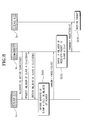
- Figure 7 illustrates the peer-to-peer communication in a wireless communication system where the wireless communication devices shown in Figure 3 form the Piconet.
- reference numeral M 1 denotes the wireless communication device 30 operated as the master (abbreviated as 'master device'), and S 1 to S 4 denote the wireless communication devices 20 operated as the slaves (abbreviated as 'slave devices').
- the master device M 1 is connected to the plurality of slave devices S 1 , S 2 , S 3 , S 4 to form the Piconet.
- the master device M 1 designates the slave device S 2 as an active slave (S502).
- the slave device S 2 When the active slave device S 2 intends to communicate with the slave device S 4 , the slave device S 2 requests the master device M 1 for the AM_ADDR of the slave device S 4 (S504).
- the master device M 1 provides the slave device S 2 with the AM_ADDR of the slave device S 4 (S506).
- the slave device S 2 generates a packet where the address of the destination slave device S 4 is recorded in the AM_ADDR portion of the header region, and the source address allocated by the master device M 1 is recorded in the payload region (S508).
- the slave device S 2 transmits the packet to the master device M 1 (S510).
- the master device M 1 confirms that the address of the slave device S 4 is recorded in the AM_ADDR portion of the header region in the packet received (S512), and transmits the packet to the slave device S 4 (S514).
- the slave device S 4 receives the packet from the slave device S 2 through the master device M 1 (S516).
- the slave device S 4 confirms its address in the header region of the packet, and processes reception of the packet. In addition, the slave device S 4 can recognize the slave device transmitting the packet by the source address recorded in the payload region of the packet.
- the communication is performed by using the address recorded in the header region of the packet as the destination address.
- the peer-to-peer communication between the slave devices can be performed, not increasing a data processing load in the Bluetooth communication.
Landscapes
- Engineering & Computer Science (AREA)
- Computer Networks & Wireless Communication (AREA)
- Signal Processing (AREA)
- Databases & Information Systems (AREA)
- Mobile Radio Communication Systems (AREA)
- Small-Scale Networks (AREA)
Abstract
Description
Claims (18)
- A wireless communication device of a wireless communication system having a plurality of slaves devices, including a source slave device and a destination slave device, and a master device that is connected to the plurality of slave devices and that has information of addresses allocated to the plurality of slave devices, the wireless communication device comprising:a transceiving unit (21; 31) for receiving external data, and transmitting a packet; anda controller (23; 33) for generating the packet where an address of the destination slave device received from the master device through the transceiving unit (21; 31) is recorded in a destination address region, and for transmitting the packet through the transceiving unit to the destination slave device through the master device, when the wireless communication device is operated as the source slave device.
- The device according to claim 1, wherein the controller (23; 33) records the address of the destination slave device in a header region of the packet.
- The device according to claim 1 or 2, wherein the controller (23; 33) records a source address in a payload region of the packet.
- The device according to claim 3, wherein the source address is allocated by the master device.
- The device according to claim 1, wherein the destination address is an active member address which the master device allocates to distinguish the plurality of slave devices.
- A wireless communication device of a wireless communication system having a plurality of slave devices, including a source slave device and a destination slave device, and a master device that is connected to the plurality of slave devices and that has information of addresses allocated to the plurality of slave devices, the wireless communication device comprising:a transceiving unit (21; 31) for receiving external data, and transmitting a packet; anda controller (23; 33) for reading the packet received from the transceiving unit, and transmitting the packet to the destination slave device through the transceiving unit (21; 31) if there is an address of the destination slave device recorded in a destination address region of the packet, when the wireless communication device is operated as the master device.
- The device according to claim 6, wherein the controller (23; 33) recognizes an address recorded in a header region of the packet as a destination address.
- The device according to claim 6, wherein the controller (23; 33) recognizes an address recorded in a payload region of the packet as an address of the source slave device.
- A wireless communication system having a plurality of slave devices, including a source slave device and a destination slave device; and a master device that is connected to the plurality of slave devices and that has information of addresses allocated to the plurality of slave devices;
wherein the source slave device obtains an address of the destination slave device from the master device, generates a packet including the address of the destination slave device as a destination address and an address of the source slave device as a source address, and transmits the packet to the master device; and
wherein the master device reads the received packet, and transmits the packet to the destination slave device, when the address recorded in a destination address region of the packet is the address of the destination slave device. - The system according to claim 9, wherein the source slave device records the address of the destination slave device in a header region of the packet, and the master device recognizes information recorded in the header region of the packet as the destination address.
- The system according to claim 9, wherein the source slave device records the source address in a payload region of the packet.
- The system according to claim 9, wherein the destination address is an active member address which the master device allocates to distinguish the plurality of slave devices.
- A communication method for a wireless communication system having a plurality of slave devices, including a source slave device and a destination slave device, and a master device that is connected to the plurality of slave devices and that has information of addresses allocated to the plurality of slave devices, the method comprising the steps of:obtaining an address of the destination slave device from the master device;generating a packet including the address of the destination slave device as a destination address and an address of the source slave device as a source address; andtransmitting the packet to the master device so that the packet can be transmitted to the destination slave device through the master device according to the destination address recorded in the packet.
- The method according to claim 13, wherein the address of the destination slave device is recorded in a header region of the packet.
- The method according to claim 13, wherein the source address is recorded in a payload region of the packet.
- The method according to claim 13, wherein the destination address is an active member address which the master device allocates to distinguish the plurality of slave devices.
- A communication method for a wireless communication system having a plurality of slave devices, including a source slave device and a destination slave device, and a master device that is connected to the plurality of slave devices and that has information of addresses allocated to the plurality of slave devices, the method comprising the steps of:analyzing a packet from the source slave device; andtransmitting the packet to the destination slave device, when an address recorded in a destination address region of the packet is an address of the destination slave device.
- The method according to claim 17, wherein the master device performs the analyzing and transmitting steps.
Applications Claiming Priority (2)
| Application Number | Priority Date | Filing Date | Title |
|---|---|---|---|
| KR2001000964 | 2001-01-08 | ||
| KR20010000964A KR100555664B1 (en) | 2001-01-08 | 2001-01-08 | Wireless communication device, wireless communication system using same and communication method thereof |
Publications (3)
| Publication Number | Publication Date |
|---|---|
| EP1221791A2 true EP1221791A2 (en) | 2002-07-10 |
| EP1221791A3 EP1221791A3 (en) | 2003-08-27 |
| EP1221791B1 EP1221791B1 (en) | 2006-02-08 |
Family
ID=36120887
Family Applications (1)
| Application Number | Title | Priority Date | Filing Date |
|---|---|---|---|
| EP20010307155 Expired - Lifetime EP1221791B1 (en) | 2001-01-08 | 2001-08-22 | Wireless communication device, wireless communication system using the same, and communication method therefor |
Country Status (5)
| Country | Link |
|---|---|
| US (1) | US7450557B2 (en) |
| EP (1) | EP1221791B1 (en) |
| JP (1) | JP3612050B2 (en) |
| KR (1) | KR100555664B1 (en) |
| DE (1) | DE60117109T2 (en) |
Cited By (4)
| Publication number | Priority date | Publication date | Assignee | Title |
|---|---|---|---|---|
| WO2004077918A3 (en) * | 2003-03-07 | 2005-01-06 | Koninkl Philips Electronics Nv | Maintaining uplink control via the interception of signals for mobile terminals in direct mode peer-to-peer communication |
| KR100755711B1 (en) | 2006-05-04 | 2007-09-05 | 삼성전자주식회사 | Wireless communication device and method |
| CN103120017A (en) * | 2010-09-23 | 2013-05-22 | 捷讯研究有限公司 | Mobile wireless communications device establishing wireless communication links based upon near field communication and related methods |
| CN103546697A (en) * | 2013-10-12 | 2014-01-29 | 中央电视台 | Peer-to-peer control playing method of star structure |
Families Citing this family (16)
| Publication number | Priority date | Publication date | Assignee | Title |
|---|---|---|---|---|
| KR100598078B1 (en) * | 2001-01-05 | 2006-07-10 | 삼성전자주식회사 | Wireless communication device, wireless communication system using same and communication method thereof |
| US7532862B2 (en) * | 2002-03-19 | 2009-05-12 | Apple Inc. | Method and apparatus for configuring a wireless device through reverse advertising |
| US8554915B2 (en) * | 2002-05-15 | 2013-10-08 | Telcordia Technologies Inc. | Management of communication among network devices having multiple interfaces |
| FR2841669B1 (en) * | 2002-06-27 | 2006-01-06 | St Microelectronics Sa | METHOD FOR TRANSMITTING DATA PACKETS BETWEEN TWO SLAVE UNITS AND A MASTER UNIT COMPRISING TWO PROCESSORS |
| JP2004064341A (en) * | 2002-07-26 | 2004-02-26 | Uniden Corp | Wireless terminal device, communication system and communication control method |
| US7808939B2 (en) * | 2003-03-28 | 2010-10-05 | Lenovo (Singapore) Pte Ltd. | Routing in wireless ad-hoc networks |
| DE102004003549B4 (en) * | 2004-01-23 | 2007-03-29 | Siemens Ag | Communication system and method for processing a request message supplied by a mobile radio terminal of a mobile radio communication network to a message filter computer |
| US20060018319A1 (en) * | 2004-07-20 | 2006-01-26 | Arto Palin | Multicast and broadcast data transmission in a short-range wireless communications network |
| JP4318693B2 (en) * | 2006-01-27 | 2009-08-26 | 京セラ株式会社 | Mobile communication system, base station apparatus, and mobile communication method |
| JP5320918B2 (en) * | 2008-09-09 | 2013-10-23 | 富士通株式会社 | Network system and system test program |
| EP2725749B1 (en) * | 2011-07-14 | 2017-11-15 | Huawei Technologies Co., Ltd. | Method, apparatus and system for processing service flow |
| KR101266039B1 (en) | 2011-08-10 | 2013-05-21 | 엘지전자 주식회사 | Mobile terminal and communication system having the same |
| JP6119481B2 (en) * | 2013-07-23 | 2017-04-26 | ブラザー工業株式会社 | Function execution device |
| JP2021106317A (en) * | 2019-12-26 | 2021-07-26 | 双葉電子工業株式会社 | Communication device, communication system, and communication control method |
| CN111835882B (en) * | 2020-07-01 | 2023-03-03 | 上海橙群微电子有限公司 | Device address list acquisition method, network device and readable storage medium |
| US12314211B2 (en) * | 2022-05-24 | 2025-05-27 | Sony Semiconductor Solutions Corporation | Communication device and communication system |
Family Cites Families (23)
| Publication number | Priority date | Publication date | Assignee | Title |
|---|---|---|---|---|
| KR960011971B1 (en) * | 1993-12-09 | 1996-09-06 | 재단법인 한국전자통신연구소 | Packet switching and its method of mobile communication control station using self routing |
| KR950022481A (en) * | 1993-12-21 | 1995-07-28 | 양승택 | Packet Structure and Processing Method in Base Station Packet Router |
| KR970008170B1 (en) * | 1994-12-15 | 1997-05-21 | 재단법인 한국전자통신연구소 | Network of packet exchange / treatment device in bss |
| JP3047767B2 (en) * | 1995-03-20 | 2000-06-05 | 株式会社日立製作所 | Wireless LAN system |
| US5761430A (en) * | 1996-04-12 | 1998-06-02 | Peak Audio, Inc. | Media access control for isochronous data packets in carrier sensing multiple access systems |
| US6590928B1 (en) | 1997-09-17 | 2003-07-08 | Telefonaktiebolaget Lm Ericsson (Publ) | Frequency hopping piconets in an uncoordinated wireless multi-user system |
| US6691173B2 (en) * | 1999-07-06 | 2004-02-10 | Widcomm, Inc. | Distributed management of an extended network containing short-range wireless links |
| US6819681B1 (en) * | 1999-08-06 | 2004-11-16 | Shrikumar Hariharasubrahmanian | Systems and methods for predicting data fields in layered protocols |
| US6275500B1 (en) * | 1999-08-09 | 2001-08-14 | Motorola, Inc. | Method and apparatus for dynamic control of talk groups in a wireless network |
| ATE290283T1 (en) * | 1999-12-06 | 2005-03-15 | Ericsson Telefon Ab L M | METHOD AND ARRANGEMENTS IN A TELECOMMUNICATIONS NETWORK |
| EP1107520A1 (en) | 1999-12-06 | 2001-06-13 | Telefonaktiebolaget Lm Ericsson | Method and arrangement in a communication network |
| US6704293B1 (en) * | 1999-12-06 | 2004-03-09 | Telefonaktiebolaget Lm Ericsson (Publ) | Broadcast as a triggering mechanism for route discovery in ad-hoc networks |
| US7161941B1 (en) * | 2000-03-01 | 2007-01-09 | Texas Instruments Incorporated | Wireless packet communications with extended addressing capability |
| US6775258B1 (en) * | 2000-03-17 | 2004-08-10 | Nokia Corporation | Apparatus, and associated method, for routing packet data in an ad hoc, wireless communication system |
| AU4219601A (en) * | 2000-03-31 | 2001-10-15 | Classwave Wireless Inc. | Dynamic protocol selection and routing of content to mobile devices |
| US20020044549A1 (en) * | 2000-06-12 | 2002-04-18 | Per Johansson | Efficient scatternet forming |
| US6452910B1 (en) * | 2000-07-20 | 2002-09-17 | Cadence Design Systems, Inc. | Bridging apparatus for interconnecting a wireless PAN and a wireless LAN |
| US7016336B2 (en) * | 2000-11-22 | 2006-03-21 | Telefonaktiebolaget L M Ericsson (Publ) | Administrative domains for personal area networks |
| US7058050B2 (en) * | 2000-12-01 | 2006-06-06 | Telefonaktiebolaget L M Ericsson (Publ) | Flexible inter-network communication scheduling |
| US6829288B2 (en) * | 2000-12-11 | 2004-12-07 | Nokia Corporation | Communication system having wireless devices supporting ad hoc connections independent of the protocol version |
| US6754250B2 (en) * | 2000-12-15 | 2004-06-22 | Telefonaktiebolaget Lm Ericsson (Publ) | Networking in uncoordinated frequency hopping piconets |
| US7164885B2 (en) * | 2000-12-18 | 2007-01-16 | Telefonaktiebolaget L M Ericsson (Publ) | Method and apparatus for selective service access |
| US6651751B2 (en) * | 2001-01-19 | 2003-11-25 | Michael W. Kluczynski | Device for attaching fire extinguisher to a welding tank |
-
2001
- 2001-01-08 KR KR20010000964A patent/KR100555664B1/en not_active Expired - Fee Related
- 2001-07-10 US US09/901,153 patent/US7450557B2/en not_active Expired - Fee Related
- 2001-08-22 DE DE2001617109 patent/DE60117109T2/en not_active Expired - Fee Related
- 2001-08-22 EP EP20010307155 patent/EP1221791B1/en not_active Expired - Lifetime
- 2001-09-07 JP JP2001272495A patent/JP3612050B2/en not_active Expired - Fee Related
Cited By (6)
| Publication number | Priority date | Publication date | Assignee | Title |
|---|---|---|---|---|
| WO2004077918A3 (en) * | 2003-03-07 | 2005-01-06 | Koninkl Philips Electronics Nv | Maintaining uplink control via the interception of signals for mobile terminals in direct mode peer-to-peer communication |
| KR100755711B1 (en) | 2006-05-04 | 2007-09-05 | 삼성전자주식회사 | Wireless communication device and method |
| CN103120017A (en) * | 2010-09-23 | 2013-05-22 | 捷讯研究有限公司 | Mobile wireless communications device establishing wireless communication links based upon near field communication and related methods |
| CN103120017B (en) * | 2010-09-23 | 2016-02-24 | 黑莓有限公司 | Mobile radio communication apparatus and the correlation technique of wireless communication link is set up based on near-field communication |
| CN103546697A (en) * | 2013-10-12 | 2014-01-29 | 中央电视台 | Peer-to-peer control playing method of star structure |
| CN103546697B (en) * | 2013-10-12 | 2016-09-28 | 中央电视台 | Peer-to-peer control playing method of star structure |
Also Published As
| Publication number | Publication date |
|---|---|
| JP3612050B2 (en) | 2005-01-19 |
| US7450557B2 (en) | 2008-11-11 |
| DE60117109D1 (en) | 2006-04-20 |
| EP1221791A3 (en) | 2003-08-27 |
| DE60117109T2 (en) | 2006-08-03 |
| EP1221791B1 (en) | 2006-02-08 |
| KR20020059530A (en) | 2002-07-13 |
| JP2002223215A (en) | 2002-08-09 |
| US20020089963A1 (en) | 2002-07-11 |
| KR100555664B1 (en) | 2006-03-03 |
Similar Documents
| Publication | Publication Date | Title |
|---|---|---|
| EP1221791A2 (en) | Wireless communication device, wireless communication system using the same, and communication method therefor | |
| EP1592177A1 (en) | Method and system for communication between coordinator-based wireless networks | |
| US20080259902A1 (en) | Header compression and packet transmission method in sensor network and apparatus therefor | |
| JP4843097B2 (en) | Protocol showing enhanced capabilities for use by short-range wireless connectivity devices | |
| CN1843004A (en) | Method for operating a wireless network | |
| US20040266424A1 (en) | Method and apparatus for interfacing wired and wireless data | |
| US8341466B2 (en) | Method and apparatus for generating acknowledgement frame | |
| EP2081315A3 (en) | A method of transmitting feedback information using an extended subheader | |
| EP1331763A2 (en) | Bluetooth system capable of communicating in a scatternet and a communication method thereof | |
| EP1683307B1 (en) | System for providing tunnel service capable of data communication between different types of networks | |
| US7321552B2 (en) | Wireless communication apparatus, wireless communication system employing the same and control method thereof | |
| JP2006128949A (en) | Wireless communication apparatus, communication system, wireless communication method, and computer program | |
| US7417998B2 (en) | Wireless network device and communication method using the wireless network device | |
| EP1229693A2 (en) | Wireless communication apparatus, method thereof, and wireless communication system employing the same | |
| EP1601144A1 (en) | Method for communication between coordinator-based wireless networks | |
| US20060109816A1 (en) | Wireless access control station and wireless access control method | |
| US20050100023A1 (en) | Isochronous audio network software interface | |
| US8917655B2 (en) | Method and apparatus for allowing device supporting multiple PHY communication mode to communicate with device in wireless personal area network | |
| WO2006031016A1 (en) | Wireless network device and method for reassociation bwteen wireless networks using the wireless network device | |
| EP1589701A2 (en) | System and method for relaying data in coordinator-based wireless network | |
| KR100654453B1 (en) | Method for transceiving data in coordinator-based wireless network and wireless network apparatus using the same | |
| KR20100007679A (en) | Method and apparatus for allowing a device which supports multiple phy communication modes to communicate with other devices in wireless personal area network | |
| KR100468575B1 (en) | A method and a device of connection with lan for bsc in wll | |
| JP2006108732A (en) | Frame transfer apparatus, transmission / reception system, and frame transfer method | |
| JPH1155747A (en) | Wireless packet transmission method |
Legal Events
| Date | Code | Title | Description |
|---|---|---|---|
| PUAI | Public reference made under article 153(3) epc to a published international application that has entered the european phase |
Free format text: ORIGINAL CODE: 0009012 |
|
| 17P | Request for examination filed |
Effective date: 20010904 |
|
| AK | Designated contracting states |
Kind code of ref document: A2 Designated state(s): AT BE CH CY DE DK ES FI FR GB GR IE IT LI LU MC NL PT SE TR |
|
| AX | Request for extension of the european patent |
Free format text: AL;LT;LV;MK;RO;SI |
|
| RIN1 | Information on inventor provided before grant (corrected) |
Inventor name: JANG, KYUNG-HUN Inventor name: KANG, HYUN-SOOK Inventor name: LEE, TAE-JIN Inventor name: PARK, JONG-HUN |
|
| PUAL | Search report despatched |
Free format text: ORIGINAL CODE: 0009013 |
|
| AK | Designated contracting states |
Designated state(s): AT BE CH CY DE DK ES FI FR GB GR IE IT LI LU MC NL PT SE TR |
|
| AX | Request for extension of the european patent |
Extension state: AL LT LV MK RO SI |
|
| 17Q | First examination report despatched |
Effective date: 20031021 |
|
| AKX | Designation fees paid |
Designated state(s): DE FR GB NL SE |
|
| GRAP | Despatch of communication of intention to grant a patent |
Free format text: ORIGINAL CODE: EPIDOSNIGR1 |
|
| GRAS | Grant fee paid |
Free format text: ORIGINAL CODE: EPIDOSNIGR3 |
|
| GRAA | (expected) grant |
Free format text: ORIGINAL CODE: 0009210 |
|
| AK | Designated contracting states |
Kind code of ref document: B1 Designated state(s): DE FR GB NL SE |
|
| REG | Reference to a national code |
Ref country code: GB Ref legal event code: FG4D |
|
| REF | Corresponds to: |
Ref document number: 60117109 Country of ref document: DE Date of ref document: 20060420 Kind code of ref document: P |
|
| REG | Reference to a national code |
Ref country code: SE Ref legal event code: TRGR |
|
| ET | Fr: translation filed | ||
| PLBE | No opposition filed within time limit |
Free format text: ORIGINAL CODE: 0009261 |
|
| STAA | Information on the status of an ep patent application or granted ep patent |
Free format text: STATUS: NO OPPOSITION FILED WITHIN TIME LIMIT |
|
| 26N | No opposition filed |
Effective date: 20061109 |
|
| PGFP | Annual fee paid to national office [announced via postgrant information from national office to epo] |
Ref country code: DE Payment date: 20080905 Year of fee payment: 8 Ref country code: NL Payment date: 20080803 Year of fee payment: 8 |
|
| PGFP | Annual fee paid to national office [announced via postgrant information from national office to epo] |
Ref country code: FR Payment date: 20080818 Year of fee payment: 8 |
|
| PGFP | Annual fee paid to national office [announced via postgrant information from national office to epo] |
Ref country code: GB Payment date: 20080903 Year of fee payment: 8 |
|
| PGFP | Annual fee paid to national office [announced via postgrant information from national office to epo] |
Ref country code: SE Payment date: 20080807 Year of fee payment: 8 |
|
| REG | Reference to a national code |
Ref country code: NL Ref legal event code: V1 Effective date: 20100301 |
|
| GBPC | Gb: european patent ceased through non-payment of renewal fee |
Effective date: 20090822 |
|
| REG | Reference to a national code |
Ref country code: FR Ref legal event code: ST Effective date: 20100430 |
|
| PG25 | Lapsed in a contracting state [announced via postgrant information from national office to epo] |
Ref country code: DE Free format text: LAPSE BECAUSE OF NON-PAYMENT OF DUE FEES Effective date: 20100302 Ref country code: NL Free format text: LAPSE BECAUSE OF NON-PAYMENT OF DUE FEES Effective date: 20100301 Ref country code: FR Free format text: LAPSE BECAUSE OF NON-PAYMENT OF DUE FEES Effective date: 20090831 |
|
| PG25 | Lapsed in a contracting state [announced via postgrant information from national office to epo] |
Ref country code: GB Free format text: LAPSE BECAUSE OF NON-PAYMENT OF DUE FEES Effective date: 20090822 |
|
| PG25 | Lapsed in a contracting state [announced via postgrant information from national office to epo] |
Ref country code: SE Free format text: LAPSE BECAUSE OF NON-PAYMENT OF DUE FEES Effective date: 20090823 |