EP1221286A1 - Oil having increased polyphenol content - Google Patents
Oil having increased polyphenol content Download PDFInfo
- Publication number
- EP1221286A1 EP1221286A1 EP01204537A EP01204537A EP1221286A1 EP 1221286 A1 EP1221286 A1 EP 1221286A1 EP 01204537 A EP01204537 A EP 01204537A EP 01204537 A EP01204537 A EP 01204537A EP 1221286 A1 EP1221286 A1 EP 1221286A1
- Authority
- EP
- European Patent Office
- Prior art keywords
- oil
- olive
- acid
- mixture
- fruit material
- Prior art date
- Legal status (The legal status is an assumption and is not a legal conclusion. Google has not performed a legal analysis and makes no representation as to the accuracy of the status listed.)
- Granted
Links
- 235000013824 polyphenols Nutrition 0.000 title claims abstract description 38
- 150000008442 polyphenolic compounds Chemical class 0.000 title claims abstract description 37
- 240000007817 Olea europaea Species 0.000 claims abstract description 43
- 238000000034 method Methods 0.000 claims abstract description 34
- 235000013399 edible fruits Nutrition 0.000 claims abstract description 33
- 239000000463 material Substances 0.000 claims abstract description 23
- KRKNYBCHXYNGOX-UHFFFAOYSA-N citric acid Chemical compound OC(=O)CC(O)(C(O)=O)CC(O)=O KRKNYBCHXYNGOX-UHFFFAOYSA-N 0.000 claims abstract description 21
- QTBSBXVTEAMEQO-UHFFFAOYSA-N Acetic acid Chemical compound CC(O)=O QTBSBXVTEAMEQO-UHFFFAOYSA-N 0.000 claims abstract description 18
- VEXZGXHMUGYJMC-UHFFFAOYSA-N Hydrochloric acid Chemical compound Cl VEXZGXHMUGYJMC-UHFFFAOYSA-N 0.000 claims abstract description 15
- 239000002253 acid Substances 0.000 claims abstract description 15
- CIWBSHSKHKDKBQ-JLAZNSOCSA-N Ascorbic acid Chemical compound OC[C@H](O)[C@H]1OC(=O)C(O)=C1O CIWBSHSKHKDKBQ-JLAZNSOCSA-N 0.000 claims abstract description 6
- NBIIXXVUZAFLBC-UHFFFAOYSA-N Phosphoric acid Chemical compound OP(O)(O)=O NBIIXXVUZAFLBC-UHFFFAOYSA-N 0.000 claims abstract description 6
- JVTAAEKCZFNVCJ-UHFFFAOYSA-N lactic acid Chemical compound CC(O)C(O)=O JVTAAEKCZFNVCJ-UHFFFAOYSA-N 0.000 claims abstract description 6
- 229910000147 aluminium phosphate Inorganic materials 0.000 claims abstract description 3
- 235000010323 ascorbic acid Nutrition 0.000 claims abstract description 3
- 239000011668 ascorbic acid Substances 0.000 claims abstract description 3
- 229960005070 ascorbic acid Drugs 0.000 claims abstract description 3
- 239000004310 lactic acid Substances 0.000 claims abstract description 3
- 235000014655 lactic acid Nutrition 0.000 claims abstract description 3
- 239000002245 particle Substances 0.000 claims abstract description 3
- 239000003921 oil Substances 0.000 claims description 61
- 235000019198 oils Nutrition 0.000 claims description 61
- 239000000203 mixture Substances 0.000 claims description 27
- JUUBCHWRXWPFFH-UHFFFAOYSA-N Hydroxytyrosol Chemical compound OCCC1=CC=C(O)C(O)=C1 JUUBCHWRXWPFFH-UHFFFAOYSA-N 0.000 claims description 22
- YCCILVSKPBXVIP-UHFFFAOYSA-N 2-(4-hydroxyphenyl)ethanol Chemical group OCCC1=CC=C(O)C=C1 YCCILVSKPBXVIP-UHFFFAOYSA-N 0.000 claims description 18
- 238000004128 high performance liquid chromatography Methods 0.000 claims description 14
- 235000013305 food Nutrition 0.000 claims description 13
- 235000003248 hydroxytyrosol Nutrition 0.000 claims description 11
- 229940095066 hydroxytyrosol Drugs 0.000 claims description 11
- 239000004006 olive oil Substances 0.000 claims description 11
- 239000011260 aqueous acid Substances 0.000 claims description 10
- 235000008390 olive oil Nutrition 0.000 claims description 10
- OKKJLVBELUTLKV-UHFFFAOYSA-N Methanol Chemical compound OC OKKJLVBELUTLKV-UHFFFAOYSA-N 0.000 claims description 9
- DBLDQZASZZMNSL-QMMMGPOBSA-N L-tyrosinol Natural products OC[C@@H](N)CC1=CC=C(O)C=C1 DBLDQZASZZMNSL-QMMMGPOBSA-N 0.000 claims description 8
- 235000015067 sauces Nutrition 0.000 claims description 8
- 235000004330 tyrosol Nutrition 0.000 claims description 8
- 235000015112 vegetable and seed oil Nutrition 0.000 claims description 7
- 239000008158 vegetable oil Substances 0.000 claims description 7
- XLYOFNOQVPJJNP-UHFFFAOYSA-N water Substances O XLYOFNOQVPJJNP-UHFFFAOYSA-N 0.000 claims description 7
- 239000002904 solvent Substances 0.000 claims description 6
- 230000014759 maintenance of location Effects 0.000 claims description 4
- 235000010746 mayonnaise Nutrition 0.000 claims description 4
- 235000014438 salad dressings Nutrition 0.000 claims description 4
- 238000010828 elution Methods 0.000 claims description 3
- 239000008268 mayonnaise Substances 0.000 claims description 3
- 238000002156 mixing Methods 0.000 claims description 3
- 235000007688 Lycopersicon esculentum Nutrition 0.000 claims description 2
- 240000003768 Solanum lycopersicum Species 0.000 claims description 2
- 238000005119 centrifugation Methods 0.000 claims description 2
- 238000001914 filtration Methods 0.000 claims description 2
- 239000003925 fat Substances 0.000 description 20
- 235000019197 fats Nutrition 0.000 description 20
- 239000000243 solution Substances 0.000 description 9
- DKVBOUDTNWVDEP-NJCHZNEYSA-N teicoplanin aglycone Chemical compound N([C@H](C(N[C@@H](C1=CC(O)=CC(O)=C1C=1C(O)=CC=C2C=1)C(O)=O)=O)[C@H](O)C1=CC=C(C(=C1)Cl)OC=1C=C3C=C(C=1O)OC1=CC=C(C=C1Cl)C[C@H](C(=O)N1)NC([C@H](N)C=4C=C(O5)C(O)=CC=4)=O)C(=O)[C@@H]2NC(=O)[C@@H]3NC(=O)[C@@H]1C1=CC5=CC(O)=C1 DKVBOUDTNWVDEP-NJCHZNEYSA-N 0.000 description 7
- 239000003963 antioxidant agent Substances 0.000 description 6
- 235000006708 antioxidants Nutrition 0.000 description 6
- 239000010464 refined olive oil Substances 0.000 description 6
- 239000010463 virgin olive oil Substances 0.000 description 5
- 239000007787 solid Substances 0.000 description 4
- QAIPRVGONGVQAS-DUXPYHPUSA-N trans-caffeic acid Chemical compound OC(=O)\C=C\C1=CC=C(O)C(O)=C1 QAIPRVGONGVQAS-DUXPYHPUSA-N 0.000 description 4
- 241000207836 Olea <angiosperm> Species 0.000 description 3
- 238000004458 analytical method Methods 0.000 description 3
- 150000001875 compounds Chemical class 0.000 description 3
- 239000007788 liquid Substances 0.000 description 3
- 235000015097 nutrients Nutrition 0.000 description 3
- 239000003643 water by type Substances 0.000 description 3
- ACEAELOMUCBPJP-UHFFFAOYSA-N (E)-3,4,5-trihydroxycinnamic acid Natural products OC(=O)C=CC1=CC(O)=C(O)C(O)=C1 ACEAELOMUCBPJP-UHFFFAOYSA-N 0.000 description 2
- 229940074360 caffeic acid Drugs 0.000 description 2
- 235000004883 caffeic acid Nutrition 0.000 description 2
- QAIPRVGONGVQAS-UHFFFAOYSA-N cis-caffeic acid Natural products OC(=O)C=CC1=CC=C(O)C(O)=C1 QAIPRVGONGVQAS-UHFFFAOYSA-N 0.000 description 2
- 235000015165 citric acid Nutrition 0.000 description 2
- 239000010462 extra virgin olive oil Substances 0.000 description 2
- 238000011835 investigation Methods 0.000 description 2
- 238000004519 manufacturing process Methods 0.000 description 2
- 238000007670 refining Methods 0.000 description 2
- 238000000926 separation method Methods 0.000 description 2
- RFWGABANNQMHMZ-UHFFFAOYSA-N 8-acetoxy-7-acetyl-6,7,7a,8-tetrahydro-5H-benzo[g][1,3]dioxolo[4',5':4,5]benzo[1,2,3-de]quinoline Natural products CC=C1C(CC(=O)OCCC=2C=C(O)C(O)=CC=2)C(C(=O)OC)=COC1OC1OC(CO)C(O)C(O)C1O RFWGABANNQMHMZ-UHFFFAOYSA-N 0.000 description 1
- 235000019737 Animal fat Nutrition 0.000 description 1
- 235000002566 Capsicum Nutrition 0.000 description 1
- 240000008574 Capsicum frutescens Species 0.000 description 1
- 208000024172 Cardiovascular disease Diseases 0.000 description 1
- 235000005979 Citrus limon Nutrition 0.000 description 1
- 244000131522 Citrus pyriformis Species 0.000 description 1
- HKVGJQVJNQRJPO-UHFFFAOYSA-N Demethyloleuropein Natural products O1C=C(C(O)=O)C(CC(=O)OCCC=2C=C(O)C(O)=CC=2)C(=CC)C1OC1OC(CO)C(O)C(O)C1O HKVGJQVJNQRJPO-UHFFFAOYSA-N 0.000 description 1
- RFWGABANNQMHMZ-HYYSZPHDSA-N Oleuropein Chemical compound O([C@@H]1OC=C([C@H](C1=CC)CC(=O)OCCC=1C=C(O)C(O)=CC=1)C(=O)OC)[C@@H]1O[C@H](CO)[C@@H](O)[C@H](O)[C@H]1O RFWGABANNQMHMZ-HYYSZPHDSA-N 0.000 description 1
- 239000006002 Pepper Substances 0.000 description 1
- 235000016761 Piper aduncum Nutrition 0.000 description 1
- 235000017804 Piper guineense Nutrition 0.000 description 1
- 244000203593 Piper nigrum Species 0.000 description 1
- 235000008184 Piper nigrum Nutrition 0.000 description 1
- 235000019484 Rapeseed oil Nutrition 0.000 description 1
- 235000011054 acetic acid Nutrition 0.000 description 1
- -1 aglycons Chemical compound 0.000 description 1
- 239000010775 animal oil Substances 0.000 description 1
- 230000003078 antioxidant effect Effects 0.000 description 1
- 239000007864 aqueous solution Substances 0.000 description 1
- 230000009286 beneficial effect Effects 0.000 description 1
- 210000000748 cardiovascular system Anatomy 0.000 description 1
- 239000003153 chemical reaction reagent Substances 0.000 description 1
- 239000002285 corn oil Substances 0.000 description 1
- 235000005687 corn oil Nutrition 0.000 description 1
- 230000006866 deterioration Effects 0.000 description 1
- 230000000694 effects Effects 0.000 description 1
- 235000021010 extra-virgin olive oil Nutrition 0.000 description 1
- 235000021323 fish oil Nutrition 0.000 description 1
- 239000000796 flavoring agent Substances 0.000 description 1
- 235000013355 food flavoring agent Nutrition 0.000 description 1
- 235000012631 food intake Nutrition 0.000 description 1
- 238000005194 fractionation Methods 0.000 description 1
- 235000011389 fruit/vegetable juice Nutrition 0.000 description 1
- 125000002887 hydroxy group Chemical group [H]O* 0.000 description 1
- 239000004615 ingredient Substances 0.000 description 1
- 238000002347 injection Methods 0.000 description 1
- 239000007924 injection Substances 0.000 description 1
- 238000009884 interesterification Methods 0.000 description 1
- 239000000401 methanolic extract Substances 0.000 description 1
- 235000016709 nutrition Nutrition 0.000 description 1
- 235000011576 oleuropein Nutrition 0.000 description 1
- RFWGABANNQMHMZ-CARRXEGNSA-N oleuropein Natural products COC(=O)C1=CO[C@@H](O[C@H]2O[C@@H](CO)[C@H](O)[C@@H](O)[C@@H]2O)C(=CC)[C@H]1CC(=O)OCCc3ccc(O)c(O)c3 RFWGABANNQMHMZ-CARRXEGNSA-N 0.000 description 1
- ISWSIDIOOBJBQZ-UHFFFAOYSA-N phenol group Chemical group C1(=CC=CC=C1)O ISWSIDIOOBJBQZ-UHFFFAOYSA-N 0.000 description 1
- 235000011007 phosphoric acid Nutrition 0.000 description 1
- 238000002360 preparation method Methods 0.000 description 1
- 238000011002 quantification Methods 0.000 description 1
- 235000012424 soybean oil Nutrition 0.000 description 1
- 239000003549 soybean oil Substances 0.000 description 1
- 238000010561 standard procedure Methods 0.000 description 1
- 238000003756 stirring Methods 0.000 description 1
- 239000000126 substance Substances 0.000 description 1
- 235000020238 sunflower seed Nutrition 0.000 description 1
- 238000012546 transfer Methods 0.000 description 1
- 150000003626 triacylglycerols Chemical class 0.000 description 1
- UFTFJSFQGQCHQW-UHFFFAOYSA-N triformin Chemical compound O=COCC(OC=O)COC=O UFTFJSFQGQCHQW-UHFFFAOYSA-N 0.000 description 1
- 235000013311 vegetables Nutrition 0.000 description 1
Images


Classifications
-
- A—HUMAN NECESSITIES
- A23—FOODS OR FOODSTUFFS; TREATMENT THEREOF, NOT COVERED BY OTHER CLASSES
- A23D—EDIBLE OILS OR FATS, e.g. MARGARINES, SHORTENINGS OR COOKING OILS
- A23D9/00—Other edible oils or fats, e.g. shortenings or cooking oils
- A23D9/007—Other edible oils or fats, e.g. shortenings or cooking oils characterised by ingredients other than fatty acid triglycerides
-
- A—HUMAN NECESSITIES
- A23—FOODS OR FOODSTUFFS; TREATMENT THEREOF, NOT COVERED BY OTHER CLASSES
- A23D—EDIBLE OILS OR FATS, e.g. MARGARINES, SHORTENINGS OR COOKING OILS
- A23D7/00—Edible oil or fat compositions containing an aqueous phase, e.g. margarines
- A23D7/005—Edible oil or fat compositions containing an aqueous phase, e.g. margarines characterised by ingredients other than fatty acid triglycerides
- A23D7/0056—Spread compositions
-
- A—HUMAN NECESSITIES
- A23—FOODS OR FOODSTUFFS; TREATMENT THEREOF, NOT COVERED BY OTHER CLASSES
- A23L—FOODS, FOODSTUFFS OR NON-ALCOHOLIC BEVERAGES, NOT OTHERWISE PROVIDED FOR; PREPARATION OR TREATMENT THEREOF
- A23L27/00—Spices; Flavouring agents or condiments; Artificial sweetening agents; Table salts; Dietetic salt substitutes; Preparation or treatment thereof
- A23L27/60—Salad dressings; Mayonnaise; Ketchup
Definitions
- the present invention relates to a method for increasing the polyphenol content of a triglyceride oil, in particular a vegetable oil and to the oil obtained with such a method.
- the invention relates also to food products containing a certain amount of such oil, such as spreads, mayonnaises, salad dressings and sauces.
- polyphenols are compounds which share a phenolic hydroxyl group. Usually polyphenols are present not as a single compound but as a mixture of different polyphenols. One of the sources of polyphenols are olives. Olive fruit originating polyphenols are for example oleuropein, aglycons, tyrosol or hydroxytyrosol.
- a novel method has been found to increase the level of antioxidants such as polyphenols in (refined) oils and fat based products such as spreads, mayonnaise, salad dressings and sauces.
- a further object is to increase the level of such antioxidants in an oil without deterioration of colour and taste of the oil.
- the method of the present invention comprises the steps of mixing the oil with olive fruit material and an aqueous acid solution obtaining a mixture, maintaining the mixture for at least 1 minute and separating the oil from the olive fruit material and the aqueous acid solution.
- the beneficial antioxidant components present in olive fruit material are released from the olive fruit material and extracted into the oil. After separation of the olive fruit material and the aqueous acid solution a clear oil is obtained having good taste and color properties and an increased polyphenol level.
- the acid to be used for this method is in particular hydrochloric acid or a food grade acid such as citric acid, phosphoric acid, acetic acid, lactic acid, ascorbic acid or any other food grade acid.
- the acid is added to the mixture of oil and olive fruit material, preferably as a concentrated aqueous solution, for instance containing more than 30 % (w/w) acid.
- the aqueous acid solution has a pH of 4 or less, preferably 2 or less. Most preferably the pH is between 0 and 1.
- the amount of acid added is 0.1 to 30 wt. %, preferably 0.5 to 5 wt.%, based on pure acid and the weight of the mixture of oil and olive fruit material.
- the olive fruit material can be whole olive fruits, olive fruit particles or olive residue.
- olive residue is meant the residue that remains after production of olive oil by malaxation of olive fruits.
- Such a residue usually has a water content of about 50 to 70 wt.% and can have a polyphenol content of e.g. 2000 to 30,000 ppm (wt/wt).
- the polyphenol content varies for instance depending on the ripeness or the origin of the olives.
- the amount of olive fruit material in the oil is 0.1 to 50 wt.%, preferably 1 to 30 wt.%, based on the weight of the oil.
- the temperature at which the oil is contacted with the olive fruit material is at least 10 °C.
- the method according to the invention is carried out preferably at elevated temperatures. This increases the amount of polyphenols transferred to the oil.
- the oil is contacted with the olive fruit material at a temperature of at least 50 °C, more preferably at least 70 °C, most preferably 90 to 100 °C.
- the optimal time for contacting oil and olive fruit material can be determined by a skilled person. In general this period will be at least 30 minutes, preferably at least 90 minutes.
- the mixture of oil, olive fruit material and aqueous acid solution is stirred during the contact time. Increasing the stirring rate will increase contact area and thus mass transfer of the polyphenols to the oil.
- the oil is separated from the olive fruit material and aqueous acid solution such as by filtration or decanting, preferably by centrifugation.
- the method according to the present invention is used to fortify vegetable oils.
- vegetable oils which can be fortified according to the invention are olive oil, rapeseed oil, sunflowerseed oil, soybean oil and corn oil.
- olive oil is fortified.
- the invention is not limited to fortification of oils which are devoid of any polyphenol, either by nature or because of a refining process, but also relates to oils which contain polyphenols of their own such as (extra) virgin olive oils.
- Examples of other olive oils which can be fortified according to the present invention are an extra virgin olive oil, a fine virgin olive oil, a semi-fine or regular virgin olive oil, a refined virgin olive oil, such as a Lampante oil, or an olive residue oil but also an olive oil blend, which contains part virgin olive oil and part refined olive oil.
- the present invention thus also relates to the oil obtained with the above described method.
- the oil will have a polyphenol content of more than 150 ppm (wt/wt).
- the total content of polyphenols in oil can be established by standard methods, e.g. by the colorimetric Gutfinger method as described in J.Am.Oil.Chem.Soc. 1981, 11, pp. 966-968, which method is based on the reaction of a methanolic extract of olive oil and the Folin-Ciocalteau reagent. Polyphenol content can also be determined by HPLC.
- Another characteristic of the oil of this invention is that it is a clear oil, even though it contains a high amount of polyphenols.
- the invention provides a clear, pure olive oil having a polyphenol content higher than 150 ppm (wt) (expressed as mg/kg caffeic acid equivalents).
- the oil obtained with the invention can also be characterised by its HPLC chromatogram. It has appeared, as will be shown in the examples, that the oil of the invention is novel because its HPLC profile is different from the HPLC profile of current extra virgin olive oils or oils contacted with olive fruit material without the presence of acid.
- the profile of the oil of the invention is characterised by at least one distinguished peak situated between the peaks originating from aglycons which contain hydroxytyrosol or tyrosol moieties and the group of peaks originating from hydroxytyrosol and tyrosol themselves of which at least one peak corresponds to a concentration of at least 1 ppm. In particular three peaks are present in this area.
- the concentration of the component corresponding with the peak obtained can be estimated using known peak area/concentration relationships for tyrosol and hydroxy tyrosol.
- the present invention also relates to food products containing the fortified oil.
- These food products can be mixtures of the fortified oil and another oil, but also products such as a spread, salad dressing, mayonnaise or sauce.
- Spreads are food compositions which usually contain a substantial amount of fat, often 40 wt.% or more.
- the fat consists of a liquid oil and a structuring fat which gives the fat blend a proper consistency.
- Sauces are meant to include any type of sauce, for instance sauces that are ready to use, in particularly after having been heated, such as for instance tomato sauces. Processes for the manufacture of these products are well known in the art and need no illustration.
- oils which only have a vegetable origin.
- Animal oils including fish oil, can also be used.
- a fat blend which partly consists of animal fat and/or marine oils or fats derived from such fats/oils by fractionation or interesterification.
- Fat and oil are terms which are used interchangeably in this specification.
- the term oil is generally used when the fat is liquid at ambient temperature.
Landscapes
- Chemical & Material Sciences (AREA)
- Life Sciences & Earth Sciences (AREA)
- Engineering & Computer Science (AREA)
- Food Science & Technology (AREA)
- Polymers & Plastics (AREA)
- Oil, Petroleum & Natural Gas (AREA)
- Health & Medical Sciences (AREA)
- Nutrition Science (AREA)
- Edible Oils And Fats (AREA)
- Seasonings (AREA)
- Coloring Foods And Improving Nutritive Qualities (AREA)
Abstract
Description
- The present invention relates to a method for increasing the polyphenol content of a triglyceride oil, in particular a vegetable oil and to the oil obtained with such a method. The invention relates also to food products containing a certain amount of such oil, such as spreads, mayonnaises, salad dressings and sauces.
- Fats and oils form a substantial part of the average human food consumption. Since fat consumption is associated with an increased risk of cardiovascular disorders, the nutritional value of different types of fat as well as methods for reducing the amount of fat in food products has been the object of extensive investigation.
- Recently, also the nature and the effects on health of fat attributes, the so-called minor nutrients which are present in small amounts in non-refined natural fats is subject of such investigations. It has been found that the minor nutrients which are denoted as anti-oxidants, including fat polyphenols, positively interfere with the body's cardiovascular system. Polyphenols are compounds which share a phenolic hydroxyl group. Usually polyphenols are present not as a single compound but as a mixture of different polyphenols. One of the sources of polyphenols are olives. Olive fruit originating polyphenols are for example oleuropein, aglycons, tyrosol or hydroxytyrosol.
- Traditionally, most natural fats are refined before they are used as an ingredient for the preparation of food. However, traditional fat refining aims at the removal of all substances other than triglycerides, including minor nutrients. such as natural anti-oxidants, particularly the typical olive oil polyphenols. Therefore, there exists a need for increasing the level of anti-oxidants in oils or fats.
- Several methods are proposed in the prior art to attain said goal. In WO 00/38541 it is for instance described to incorporate solid matter derived from non-debittered olive fruit in a food product such as a vegetable oil. In US 6,162,480 olive fruits are soaked in vegetable oil, preferably olive oil to diffuse polyphenols into the surrounding oil.
- It is known to mix an olive fruit material with an acid when preparing certain food products such as for instance "tapenade" like products. In FR A 2 337 509 and FR A 2 499 368 products based on olives are described which are prepared by mixing olive pulp with flavouring agents such as pepper, chillies, etc., oil and citric acid or lemon juice. In these products it is intended to maintain the mixture of olive pulp and oil.
- According to the invention a novel method has been found to increase the level of antioxidants such as polyphenols in (refined) oils and fat based products such as spreads, mayonnaise, salad dressings and sauces. A further object is to increase the level of such antioxidants in an oil without deterioration of colour and taste of the oil.
- Those and other objects are attained by the method of the present invention, which comprises the steps of mixing the oil with olive fruit material and an aqueous acid solution obtaining a mixture, maintaining the mixture for at least 1 minute and separating the oil from the olive fruit material and the aqueous acid solution.
- By means of this method the beneficial antioxidant components present in olive fruit material are released from the olive fruit material and extracted into the oil. After separation of the olive fruit material and the aqueous acid solution a clear oil is obtained having good taste and color properties and an increased polyphenol level.
- The acid to be used for this method is in particular hydrochloric acid or a food grade acid such as citric acid, phosphoric acid, acetic acid, lactic acid, ascorbic acid or any other food grade acid. The acid is added to the mixture of oil and olive fruit material, preferably as a concentrated aqueous solution, for instance containing more than 30 % (w/w) acid. The aqueous acid solution has a pH of 4 or less, preferably 2 or less. Most preferably the pH is between 0 and 1. In general to obtain such pH, the amount of acid added is 0.1 to 30 wt. %, preferably 0.5 to 5 wt.%, based on pure acid and the weight of the mixture of oil and olive fruit material.
- The olive fruit material can be whole olive fruits, olive fruit particles or olive residue. With olive residue is meant the residue that remains after production of olive oil by malaxation of olive fruits. Such a residue usually has a water content of about 50 to 70 wt.% and can have a polyphenol content of e.g. 2000 to 30,000 ppm (wt/wt). The polyphenol content varies for instance depending on the ripeness or the origin of the olives. The amount of olive fruit material in the oil is 0.1 to 50 wt.%, preferably 1 to 30 wt.%, based on the weight of the oil.
- The temperature at which the oil is contacted with the olive fruit material is at least 10 °C. However, the method according to the invention is carried out preferably at elevated temperatures. This increases the amount of polyphenols transferred to the oil. Preferably, the oil is contacted with the olive fruit material at a temperature of at least 50 °C, more preferably at least 70 °C, most preferably 90 to 100 °C.
- The optimal time for contacting oil and olive fruit material can be determined by a skilled person. In general this period will be at least 30 minutes, preferably at least 90 minutes. Preferably the mixture of oil, olive fruit material and aqueous acid solution is stirred during the contact time. Increasing the stirring rate will increase contact area and thus mass transfer of the polyphenols to the oil. At the end of the contact time the oil is separated from the olive fruit material and aqueous acid solution such as by filtration or decanting, preferably by centrifugation.
- Preferably, the method according to the present invention is used to fortify vegetable oils. Examples of vegetable oils which can be fortified according to the invention are olive oil, rapeseed oil, sunflowerseed oil, soybean oil and corn oil. Preferably olive oil is fortified. The invention is not limited to fortification of oils which are devoid of any polyphenol, either by nature or because of a refining process, but also relates to oils which contain polyphenols of their own such as (extra) virgin olive oils. Examples of other olive oils which can be fortified according to the present invention are an extra virgin olive oil, a fine virgin olive oil, a semi-fine or regular virgin olive oil, a refined virgin olive oil, such as a Lampante oil, or an olive residue oil but also an olive oil blend, which contains part virgin olive oil and part refined olive oil.
- The present invention thus also relates to the oil obtained with the above described method. The oil will have a polyphenol content of more than 150 ppm (wt/wt). The total content of polyphenols in oil can be established by standard methods, e.g. by the colorimetric Gutfinger method as described in J.Am.Oil.Chem.Soc. 1981, 11, pp. 966-968, which method is based on the reaction of a methanolic extract of olive oil and the Folin-Ciocalteau reagent. Polyphenol content can also be determined by HPLC. Another characteristic of the oil of this invention is that it is a clear oil, even though it contains a high amount of polyphenols. In particular the invention provides a clear, pure olive oil having a polyphenol content higher than 150 ppm (wt) (expressed as mg/kg caffeic acid equivalents).
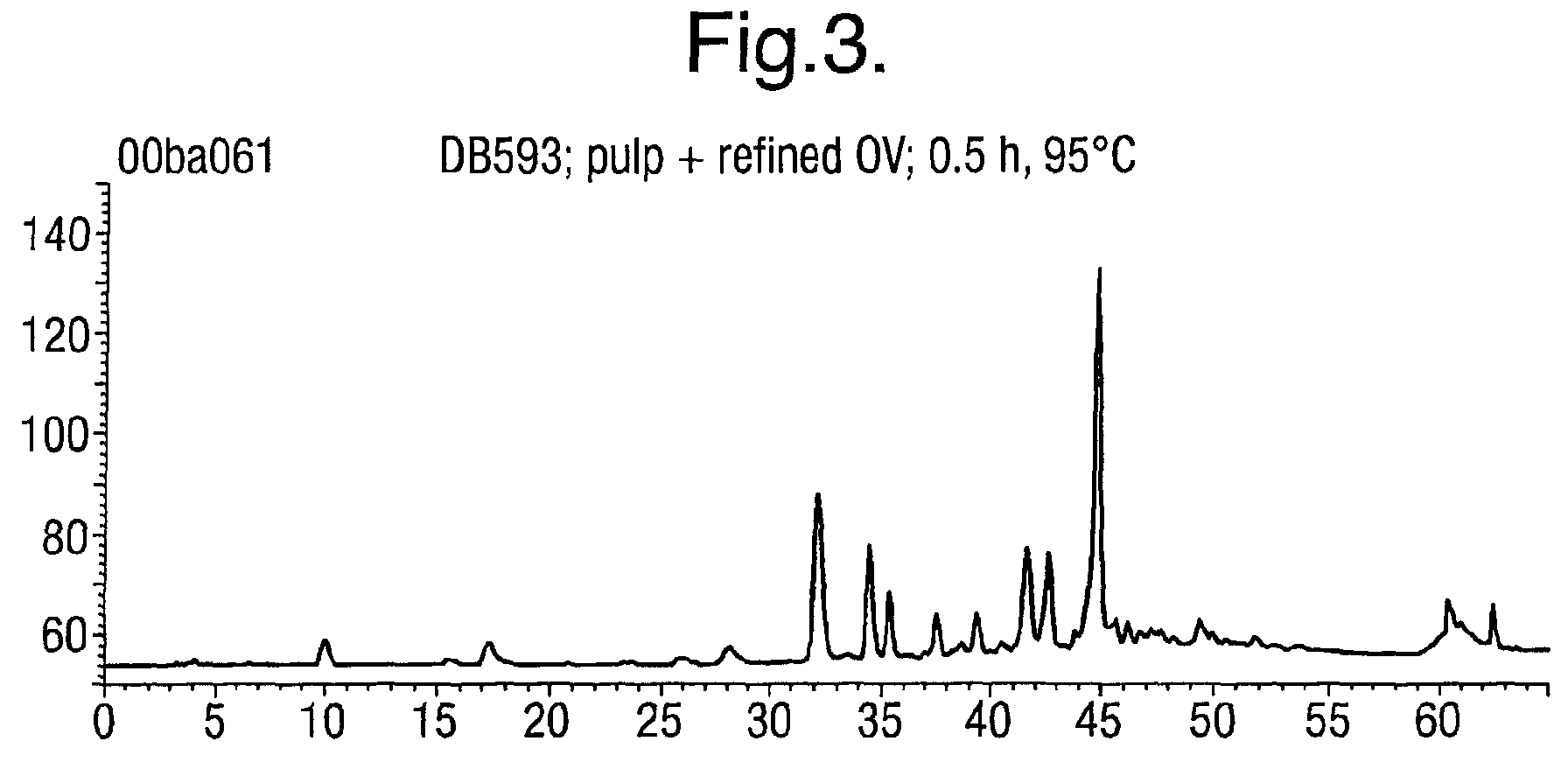
- The oil obtained with the invention can also be characterised by its HPLC chromatogram. It has appeared, as will be shown in the examples, that the oil of the invention is novel because its HPLC profile is different from the HPLC profile of current extra virgin olive oils or oils contacted with olive fruit material without the presence of acid. The profile of the oil of the invention is characterised by at least one distinguished peak situated between the peaks originating from aglycons which contain hydroxytyrosol or tyrosol moieties and the group of peaks originating from hydroxytyrosol and tyrosol themselves of which at least one peak corresponds to a concentration of at least 1 ppm. In particular three peaks are present in this area. The concentration of the component corresponding with the peak obtained can be estimated using known peak area/concentration relationships for tyrosol and hydroxy tyrosol.
- When the following HPLC conditions are applied:
- a Chrompack Intersil5 ODS column (reversed phase column), a gradient flow rate of 1 ml/min and an elution system consisting of solvent A (2% acetic acid in water) and solvent B
- (methanol), gradient: 0-20 min., A/B 85/15 %; 20-50 min., 15-75
B in A; 50-55 min., A/
B 25/75, 55-56 min 75-100 B in A; 56-65 min., 100% B - the chromatogram of the oil shows at least one peak, in particular three peaks, in the area of a retention time of 15 to 30 minutes.
-
- The present invention also relates to food products containing the fortified oil. These food products can be mixtures of the fortified oil and another oil, but also products such as a spread, salad dressing, mayonnaise or sauce. Spreads are food compositions which usually contain a substantial amount of fat, often 40 wt.% or more. Usually the fat consists of a liquid oil and a structuring fat which gives the fat blend a proper consistency. Sauces are meant to include any type of sauce, for instance sauces that are ready to use, in particularly after having been heated, such as for instance tomato sauces. Processes for the manufacture of these products are well known in the art and need no illustration.
- It goes without saying that the invention is not restricted to oils which only have a vegetable origin. Animal oils, including fish oil, can also be used. It might be advantageous to use a fat blend which partly consists of animal fat and/or marine oils or fats derived from such fats/oils by fractionation or interesterification. Fat and oil are terms which are used interchangeably in this specification. The term oil is generally used when the fat is liquid at ambient temperature.
- The invention will now be further described by means of the nonlimiting examples and the attached figures, wherein
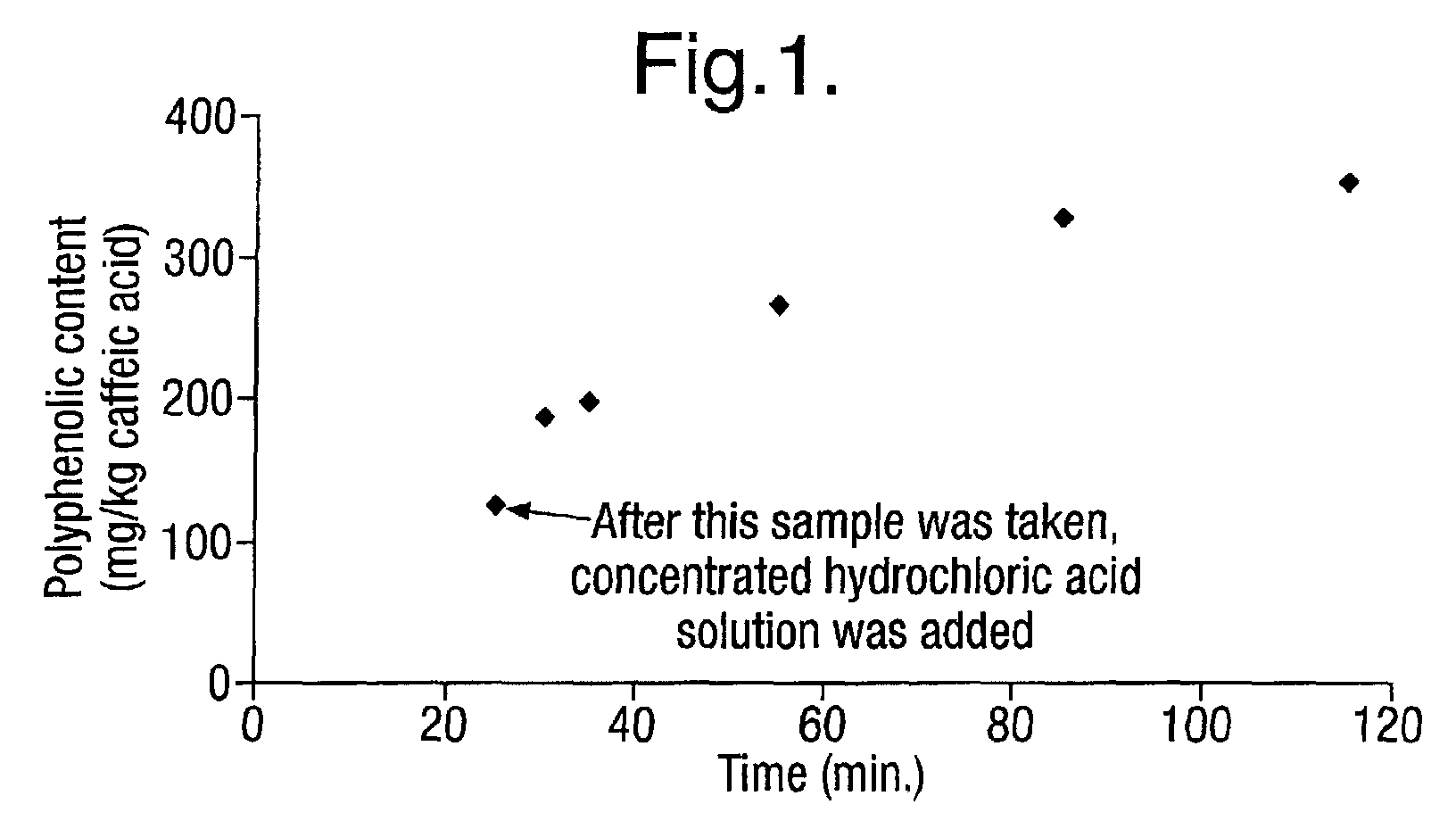
- Figure 1 shows the increase of polyphenols in refined olive oil using concentrated hydrochloric acid;
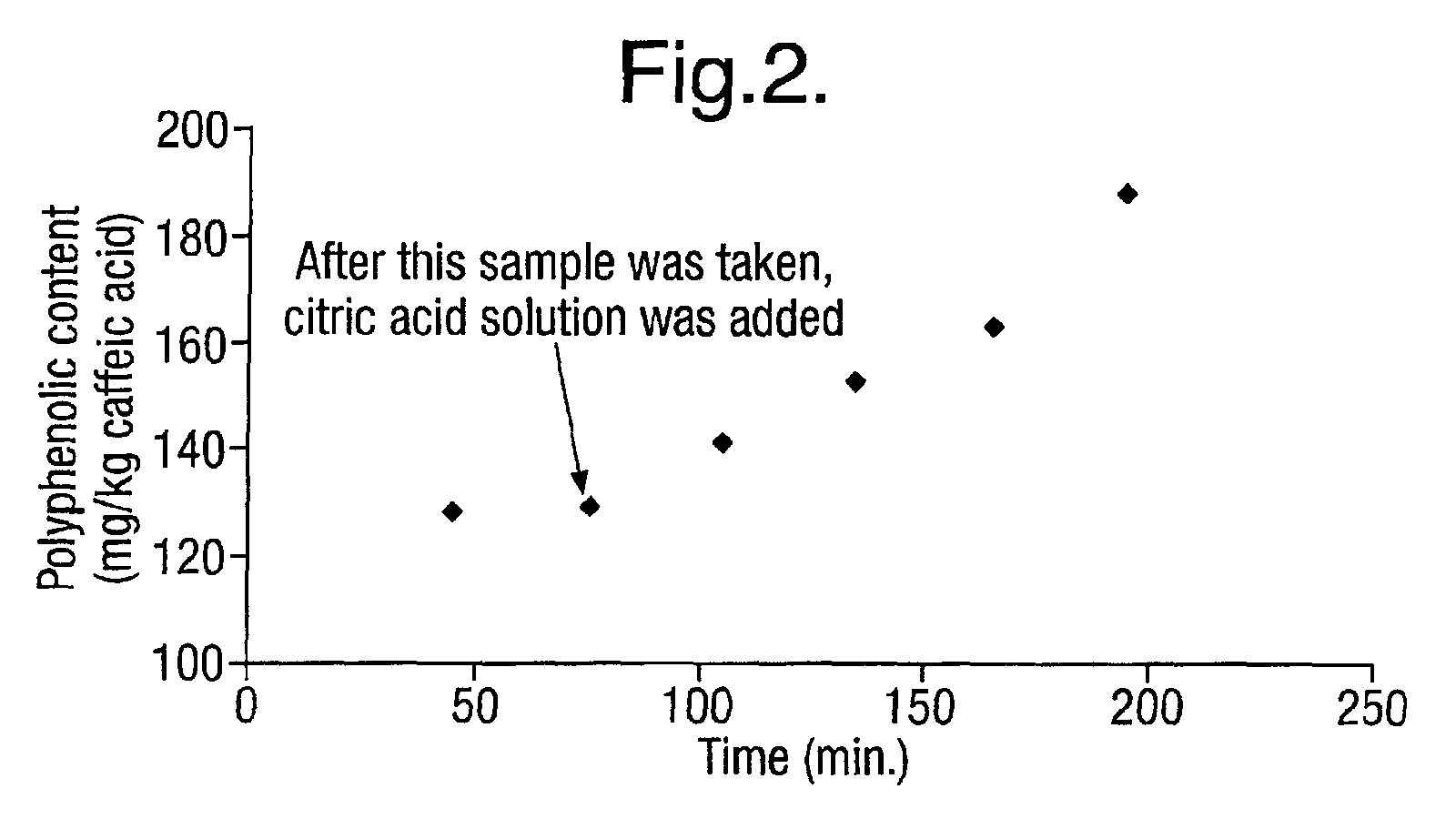
- Figure 2 shows the increase of polyphenols in refined olive oil using citric acid;
- Figure 3 shows a HPLC analysis of a sample according to example 3 after 30 minutes; and
- Figure 4 shows a HPLC analysis of a sample according to example 3 after 126 minutes and the addition of HCl.
-
- To 101.6 grams of olive residue, 205.5 grams of refined olive oil was added. The mixture was stirred mechanically and the temperature was subsequently raised to 95°C. The mixture was allowed to equilibrate. After 25 minutes a sample was taken and analysed for polyphenols using the Gutfinger method. Then 5 ml of a concentrated hydrochloric acid solution (37%) was added to the mixture. After several time intervals samples were taken and subsequently analysed for polyphenols using the Gutfinger method. In order to remove solids and water from the samples, the samples were centrifuged at 3500 rpm for 30 minutes. Results of the Gutfinger analysis are reported in figure 1. Polyphenol content increases quickly after addition of concentrated hydrochloric acid.
- To 101.4 grams of olive residue, 206.1 grams of refined olive oil was added. The mixture was stirred mechanically and the temperature was subsequently raised to 95°C. The mixture was allowed to equilibrate. After 50 minutes and 80 minutes a sample was taken and analysed for polyphenols using the Gutfinger method. Then 10 ml of a citric acid solution (60% w/w) was added to the mixture. After several time intervals samples were taken and subsequently analysed for polyphenols using the Gutfinger method. In order to remove solids and water from the samples, the samples were centrifuged at 3500 rpm for 30 minutes. Results of the Gutfinger analysis are reported in figure 2. Polyphenol content increases quickly after addition of citric acid.
- To 154.8 grams of olive residue, 303.5 grams of refined olive oil was added. The mixture was stirred mechanically and the temperature was subsequently raised to 95°C. The mixture was allowed to equilibrate. After 30 minutes a sample was taken and analysed for polyphenols using the Gutfinger method and analysed for the polyphenols composition using the HPLC method. Then 7.5 ml of a concentrated hydrochloric acid solution (37%) was added to the mixture. After 126 minutes a samples was taken and subsequently analysed for polyphenols using the Gutfinger method and analysed for the polyphenols composition using the HPLC method. In order to remove solids and water from the samples, the samples were centrifuged at 3500 rpm for 30 minutes. Results of the Gutfinger analysis are reported in table 1. The results of the HPLC analysis are reported in table 2. Table 2 also shows concentrations of compounds of which the retention time and the relationship concentration/peak area are known. The chromatograms are shown in figures 3 and 4.
- For HPLC analysis the following method was used. The analytical separations were performed on a Waters 600 S liquid chromatograph equipped with a waters 616 pump and a waters 490 UV multiwavelength detector. Injection of the samples was carried out by a 10 ul Rheodyne sample loop. A chrompack 25 cm * 4.6 mm * ¼ inch Intersil5 ODS column was applied using a gradient flow rate of 1 ml/min. The elution system consisted of solvent A (2% acetic acid in water) and solvent B (methanol). Gradient: 0-20 min., A/B 85/15 %; 20-50 min., 15-75 B in A; 50-55 min., A/
B 25/75, 55-56 min 75-100 B in A; 56-65 min., 100% B. UV was measured at 280 nm (for quantification) and 239 nm.Polyphenolic content Sample Polyphenolic content
(mg/kg caffeic acid)30 minutes at 95°C 146 126 minutes after adding acid 397 HPLC results Retention Time (minutes) 30 min. at 95°C (area) 30 min. at 95 °C (concentration) (mg/kg) 126 min. after adding acid (area) 126 min. after adding acid (concentration) (mg/kg) Component 4.04 21923 6.65 8742 4178232 7.76 135771 9.27 128361 1.7 145286 2.0 Hydroxy tyrosol 10.92 63763 14.88 36113 607732 15.45 235714 16.37 149375 4.0 1832740 48.9 Tyrosol 21.47 221384 3-6 25.32 58590 241784 3-7 27.67 128080 168907 2-5 30.44 1023006 31.70 903041 298597 33.46 50968 3231294 34.05 502165 716243 35.37 247782 50434 36.71 28473 82153 37.25 190364 103863 38.40 54189 1351964 39.05 165608 98697 39.92 6239 600276 40.10 37375 28175 40.96 520092 18.0 244570 5.0 Hydroxy tyrosol related aglycon 41.78 403506 28754 42.50 84376 42.83 380553 43.50 19008 43.94 59003 266661 44.42 174534 3 49.0 943163 23.8 Tyrosol related aglycon 45.60 124423 45.30 81431 45.80 55349 1.5 744871 9.7 Hydroxy tyrosol related aglycon 46.42 81431 46.93 56294 19.5 189785 6.6 Hydroxy tyrosol related aglycon 47.46 21635 0.9 33105 0.9 Hydroxy tyrosol related aglycon 49.26 114016 4.5 183249 7.5 Tyrosol related aglycon 49.74 34295 50.29 11411 0.5 87843 3.2 Tyrosol related aglycon 51.74 33161 1616271 52.10 1616271 52.37 19644 64896 52.90 64896 53.57 76154
Claims (14)
- Method for increasing the polyphenol content in an oil, comprising the steps of mixing the oil with olive fruit material and maintaining the mixture for at least one minute and separating the oil from the mixture, characterised in that also an aqueous acid solution is incorporated in the mixture.
- Method according to claim 1, wherein the aqueous acid solution has a pH of 4 or less, preferably 2 or less.
- Method according to claim 2, wherein the aqueous acid solution has a pH of 0 to 1.
- Method according to claim 1, wherein the acid is hydrochloric acid, citric acid, phosphoric acid, acetic acid, lactic acid or ascorbic acid.
- Method according to any of the preceding claims, wherein the olive fruit material is selected from the group consisting of whole olive fruits, olive fruit particles and olive residue.
- Method according to any of the preceding claims, wherein the oil is contacted with the olive fruit material at a temperature of at least 50°C.
- Method according to claim 6, wherein the temperature is at least 70°C, preferably 90 to 100°C.
- Method according to any of the preceding claims, wherein the oil is separated from the olive fruit material and the aqueous acid solution by centrifugation, filtration, decanting.
- Method according to any of the preceding claims, wherein the oil is a vegetable oil, preferably an olive oil.
- Oil, which when subjected to a HPLC analysis shows at least one peak situated between the group of peaks originating from aglycons which contain hydroxytyrosol or tyrosol moieties and the group of peaks originating from hydroxytyrosol and tyrosol themselves, of which at least one peak corresponds to a concentration of at least 1 ppm.
- Oil according to claim 10, which when subjected to HPLC analysis under the following conditions
a Chrompack Intersil5 ODS column, a gradient flow rate of 1 ml/min and an elution system consisting of solvent A (2% acetic acid in water) and solvent B (methanol), gradient: 0-20 min., A/B 85/15 %; 20-50 min., 15-75 B in A; 50-55 min., A/B 25/75, 55-56 min 75-100 B in A; 56-65 min. 100% B shows at least one peak in the area of a retention time of 15 to 30 minutes. - Food product containing an oil according to claim 10 or 11.
- Food product according to claim 12, which is a mixture of a vegetable oil, preferably an olive oil and the oil according to claim 10 or 11.
- Food product according to claim 12, which is a spread, mayonnaise, salad dressing or tomato sauce.
Priority Applications (1)
| Application Number | Priority Date | Filing Date | Title |
|---|---|---|---|
| EP01204537A EP1221286B1 (en) | 2000-12-22 | 2001-11-26 | Method for the preparation of oil having increased polyphenol content |
Applications Claiming Priority (3)
| Application Number | Priority Date | Filing Date | Title |
|---|---|---|---|
| EP00204714 | 2000-12-22 | ||
| EP00204714 | 2000-12-22 | ||
| EP01204537A EP1221286B1 (en) | 2000-12-22 | 2001-11-26 | Method for the preparation of oil having increased polyphenol content |
Publications (2)
| Publication Number | Publication Date |
|---|---|
| EP1221286A1 true EP1221286A1 (en) | 2002-07-10 |
| EP1221286B1 EP1221286B1 (en) | 2005-01-26 |
Family
ID=26072922
Family Applications (1)
| Application Number | Title | Priority Date | Filing Date |
|---|---|---|---|
| EP01204537A Expired - Lifetime EP1221286B1 (en) | 2000-12-22 | 2001-11-26 | Method for the preparation of oil having increased polyphenol content |
Country Status (1)
| Country | Link |
|---|---|
| EP (1) | EP1221286B1 (en) |
Cited By (5)
| Publication number | Priority date | Publication date | Assignee | Title |
|---|---|---|---|---|
| EP1430781A1 (en) * | 2002-12-18 | 2004-06-23 | Unilever N.V. | Process for the production of olive oil |
| EP1922933A1 (en) * | 2006-11-14 | 2008-05-21 | DSMIP Assets B.V. | Food product containing an olive extract |
| WO2010116392A1 (en) * | 2009-04-10 | 2010-10-14 | Costa D'oro S.P.A. | Method of preparing an edible oil, characterized by an increased shelf-life, and edible oil obtainable by such method |
| WO2012175780A1 (en) * | 2011-06-22 | 2012-12-27 | Servicio Andaluz De Salud | Phenolic compositions of olive oil in a determined concentration and uses thereof |
| WO2026087576A1 (en) | 2024-10-23 | 2026-04-30 | Universitaet Wien | A method for producing edible oil and edible oil |
Families Citing this family (1)
| Publication number | Priority date | Publication date | Assignee | Title |
|---|---|---|---|---|
| ES2325515B1 (en) * | 2007-10-26 | 2010-06-28 | Universida De Cordoba | ENRICHMENT PROCEDURE OF A FOOD. |
Citations (9)
| Publication number | Priority date | Publication date | Assignee | Title |
|---|---|---|---|---|
| FR2337509A1 (en) * | 1976-01-06 | 1977-08-05 | Chazalet Henri | PROCESS FOR MANUFACTURING A STABILIZED NATURAL ENERGY FOOD |
| FR2499368A1 (en) * | 1981-02-11 | 1982-08-13 | Froment Michel De | Prodn. of olive-based culinary compsns. - from olives, olive oil, brine and spices |
| WO1997032947A1 (en) * | 1996-03-05 | 1997-09-12 | Comiter Trading & Services S.R.L. | A product based on olive oil, enriched and supplemented with antioxidants |
| EP0849353A1 (en) * | 1996-12-20 | 1998-06-24 | Unilever N.V. | Debittering of olive oil |
| US5998641A (en) * | 1997-01-31 | 1999-12-07 | Unilever Patent Holdings | Debittering of olive oil |
| EP1013752A1 (en) * | 1998-12-23 | 2000-06-28 | Unilever N.V. | Process for preparing food products fortified with oleanolic acid |
| WO2000036936A2 (en) * | 1998-12-22 | 2000-06-29 | Unilever N.V. | Food compositions fortified with anti-oxidants |
| WO2000038541A1 (en) * | 1998-12-23 | 2000-07-06 | Unilever N.V. | Fortification of food products with olive fruit ingredients |
| US6162480A (en) * | 1998-04-14 | 2000-12-19 | Lipton, Division Of Conopco, Inc. | Fortification of a vegetable fat with antioxidants |
-
2001
- 2001-11-26 EP EP01204537A patent/EP1221286B1/en not_active Expired - Lifetime
Patent Citations (9)
| Publication number | Priority date | Publication date | Assignee | Title |
|---|---|---|---|---|
| FR2337509A1 (en) * | 1976-01-06 | 1977-08-05 | Chazalet Henri | PROCESS FOR MANUFACTURING A STABILIZED NATURAL ENERGY FOOD |
| FR2499368A1 (en) * | 1981-02-11 | 1982-08-13 | Froment Michel De | Prodn. of olive-based culinary compsns. - from olives, olive oil, brine and spices |
| WO1997032947A1 (en) * | 1996-03-05 | 1997-09-12 | Comiter Trading & Services S.R.L. | A product based on olive oil, enriched and supplemented with antioxidants |
| EP0849353A1 (en) * | 1996-12-20 | 1998-06-24 | Unilever N.V. | Debittering of olive oil |
| US5998641A (en) * | 1997-01-31 | 1999-12-07 | Unilever Patent Holdings | Debittering of olive oil |
| US6162480A (en) * | 1998-04-14 | 2000-12-19 | Lipton, Division Of Conopco, Inc. | Fortification of a vegetable fat with antioxidants |
| WO2000036936A2 (en) * | 1998-12-22 | 2000-06-29 | Unilever N.V. | Food compositions fortified with anti-oxidants |
| EP1013752A1 (en) * | 1998-12-23 | 2000-06-28 | Unilever N.V. | Process for preparing food products fortified with oleanolic acid |
| WO2000038541A1 (en) * | 1998-12-23 | 2000-07-06 | Unilever N.V. | Fortification of food products with olive fruit ingredients |
Cited By (9)
| Publication number | Priority date | Publication date | Assignee | Title |
|---|---|---|---|---|
| EP1430781A1 (en) * | 2002-12-18 | 2004-06-23 | Unilever N.V. | Process for the production of olive oil |
| EP1922933A1 (en) * | 2006-11-14 | 2008-05-21 | DSMIP Assets B.V. | Food product containing an olive extract |
| WO2008058599A1 (en) * | 2006-11-14 | 2008-05-22 | Dsm Ip Assets B.V. | Food products containing an olive extract |
| WO2010116392A1 (en) * | 2009-04-10 | 2010-10-14 | Costa D'oro S.P.A. | Method of preparing an edible oil, characterized by an increased shelf-life, and edible oil obtainable by such method |
| US8679559B2 (en) | 2009-04-10 | 2014-03-25 | Costa D'oro S.P.A. | Method of preparing an edible oil, characterized by an increased shelf-life, and edible oil obtainable by such method |
| US10092018B2 (en) | 2009-04-10 | 2018-10-09 | Costa D'oro S.P.A. | Edible oil having an increased shelf-life and a clear appearance |
| WO2012175780A1 (en) * | 2011-06-22 | 2012-12-27 | Servicio Andaluz De Salud | Phenolic compositions of olive oil in a determined concentration and uses thereof |
| ES2397175A1 (en) * | 2011-06-22 | 2013-03-05 | Servicio Andaluz De Salud | Phenolic compounds of olive oil in a given concentration and its uses |
| WO2026087576A1 (en) | 2024-10-23 | 2026-04-30 | Universitaet Wien | A method for producing edible oil and edible oil |
Also Published As
| Publication number | Publication date |
|---|---|
| EP1221286B1 (en) | 2005-01-26 |
Similar Documents
| Publication | Publication Date | Title |
|---|---|---|
| Pinelli et al. | Minor polar compound and fatty acid analyses in monocultivar virgin olive oils from Tuscany | |
| EP1071338B1 (en) | Fortification of a vegetable fat with antioxidants | |
| Nissiotis et al. | Changes in antioxidant concentration of virgin olive oil during thermal oxidation | |
| Andrikopoulos et al. | The tocopherol content of Greek olive oils | |
| Dabbou et al. | Comparison of the chemical composition and the organoleptic profile of virgin olive oil from two wild and two cultivated Tunisian Olea europaea | |
| EP1139796B1 (en) | Fortification of food products with olive fruit ingredients | |
| CN115915935A (en) | Pseudomonas oil composition and preparation method and use thereof | |
| Haddada et al. | Analytical evaluation of six monovarietal virgin olive oils from Northern Tunisia | |
| US5612077A (en) | Method of processing garlic and preparing ajoene-containing edible oil products | |
| EA035348B1 (en) | Composition containing vegetable oil, caramel and phenolic compounds | |
| Mallek-Ayadi et al. | Cucumis melo L. seeds as a promising source of oil naturally rich in biologically active substances: compositional characteristics, phenolic compounds and thermal properties. | |
| El-Deab et al. | Nutritional evaluation of roselle seeds oil and production of mayonnaise | |
| EP1221286B1 (en) | Method for the preparation of oil having increased polyphenol content | |
| US20020172751A1 (en) | Oil having increased polyphenol content | |
| Sánchez‐Muniz et al. | A non‐extractable condensed‐tannins fiber reduces thermal oxidation in oils at frying temperature | |
| AlJuhaimi et al. | Effect of Chufa (Cyperus esculentus L.) Flour Added at Different Concentrations on the Bioactive Compounds, Fatty Acid Composition, and Mineral Contents of Flour Cookies | |
| Kostadinovic Velickovska et al. | Physicochemical characterization and quality of cold-pressed peanut oil obtained from organically produced peanuts from Macedonian “Virginia” variety | |
| JP2019004829A (en) | Oil / fat composition for cooking, method for producing oil / fat composition for cooking, method for producing cooked food, and oiliness reducing agent for cooked food | |
| EP1161879B1 (en) | Blends of ursolic acid/oleanolic acid | |
| Arvanitoyannis et al. | 5 Lipids, Fats, and Oils | |
| Soliman et al. | Comparative Characteristics Study of Moringa (Moringa peregrina), Terminalia (Terminalia Billerica) and Tiger nut (Cyperus esculentus) Oils | |
| Ouni et al. | Characterization and quantification of phenolic compounds of extra-virgin olive oils according to their blending proportions | |
| CA2463170A1 (en) | Antiradicals and fat compositions, foods, drinks, drugs or feeds containing the antiradicals | |
| Koseoglu et al. | The effect of phenolic compounds on the quality and stability of virgin olive oil | |
| MXPA01006507A (en) | Fortification of food products with olive fruit ingredients |
Legal Events
| Date | Code | Title | Description |
|---|---|---|---|
| PUAI | Public reference made under article 153(3) epc to a published international application that has entered the european phase |
Free format text: ORIGINAL CODE: 0009012 |
|
| AK | Designated contracting states |
Kind code of ref document: A1 Designated state(s): AT BE CH CY DE DK ES FI FR GB GR IE IT LI LU MC NL PT SE TR |
|
| AX | Request for extension of the european patent |
Free format text: AL;LT;LV;MK;RO;SI |
|
| 17P | Request for examination filed |
Effective date: 20020622 |
|
| AKX | Designation fees paid |
Designated state(s): AT BE CH CY DE DK ES FI FR GB GR IE IT LI LU MC NL PT SE TR |
|
| 17Q | First examination report despatched |
Effective date: 20040225 |
|
| GRAP | Despatch of communication of intention to grant a patent |
Free format text: ORIGINAL CODE: EPIDOSNIGR1 |
|
| RTI1 | Title (correction) |
Free format text: METHOD FOR THE PREPARATION OF OIL HAVING INCREASED POLYPHENOL CONTENT |
|
| GRAS | Grant fee paid |
Free format text: ORIGINAL CODE: EPIDOSNIGR3 |
|
| GRAA | (expected) grant |
Free format text: ORIGINAL CODE: 0009210 |
|
| AK | Designated contracting states |
Kind code of ref document: B1 Designated state(s): AT BE CH CY DE DK ES FI FR GB GR IE IT LI LU MC NL PT SE TR |
|
| PG25 | Lapsed in a contracting state [announced via postgrant information from national office to epo] |
Ref country code: CH Free format text: LAPSE BECAUSE OF FAILURE TO SUBMIT A TRANSLATION OF THE DESCRIPTION OR TO PAY THE FEE WITHIN THE PRESCRIBED TIME-LIMIT Effective date: 20050126 Ref country code: BE Free format text: LAPSE BECAUSE OF FAILURE TO SUBMIT A TRANSLATION OF THE DESCRIPTION OR TO PAY THE FEE WITHIN THE PRESCRIBED TIME-LIMIT Effective date: 20050126 Ref country code: AT Free format text: LAPSE BECAUSE OF FAILURE TO SUBMIT A TRANSLATION OF THE DESCRIPTION OR TO PAY THE FEE WITHIN THE PRESCRIBED TIME-LIMIT Effective date: 20050126 Ref country code: NL Free format text: LAPSE BECAUSE OF FAILURE TO SUBMIT A TRANSLATION OF THE DESCRIPTION OR TO PAY THE FEE WITHIN THE PRESCRIBED TIME-LIMIT Effective date: 20050126 Ref country code: FI Free format text: LAPSE BECAUSE OF FAILURE TO SUBMIT A TRANSLATION OF THE DESCRIPTION OR TO PAY THE FEE WITHIN THE PRESCRIBED TIME-LIMIT Effective date: 20050126 Ref country code: LI Free format text: LAPSE BECAUSE OF FAILURE TO SUBMIT A TRANSLATION OF THE DESCRIPTION OR TO PAY THE FEE WITHIN THE PRESCRIBED TIME-LIMIT Effective date: 20050126 |
|
| REG | Reference to a national code |
Ref country code: GB Ref legal event code: FG4D |
|
| REG | Reference to a national code |
Ref country code: CH Ref legal event code: EP |
|
| RAP2 | Party data changed (patent owner data changed or rights of a patent transferred) |
Owner name: UNILEVER PLC Owner name: UNILEVER N.V. |
|
| REG | Reference to a national code |
Ref country code: IE Ref legal event code: FG4D |
|
| REF | Corresponds to: |
Ref document number: 60108602 Country of ref document: DE Date of ref document: 20050303 Kind code of ref document: P |
|
| REG | Reference to a national code |
Ref country code: GB Ref legal event code: ERR Free format text: NOTIFICATION HAS NOW BEEN RECEIVED FROM THE EUROPEAN PATENT OFFICE THAT ONLY THE SECOND APPLICANT/PROPRIETOR WAS GB DESIGNATED. THE DETAILS OF THE FIRST APPLICANT/PROPRIETOR HAVE THEREFORE BEEN DELETED FROM THE REGISTER. THIS CORRECTION WILL BE PUBLISHED IN THE EUROPEAN PATENT BULLETIN 05/08 DATED 20050223. |
|
| REG | Reference to a national code |
Ref country code: GR Ref legal event code: EP Ref document number: 20050400711 Country of ref document: GR |
|
| PG25 | Lapsed in a contracting state [announced via postgrant information from national office to epo] |
Ref country code: DK Free format text: LAPSE BECAUSE OF FAILURE TO SUBMIT A TRANSLATION OF THE DESCRIPTION OR TO PAY THE FEE WITHIN THE PRESCRIBED TIME-LIMIT Effective date: 20050426 Ref country code: SE Free format text: LAPSE BECAUSE OF FAILURE TO SUBMIT A TRANSLATION OF THE DESCRIPTION OR TO PAY THE FEE WITHIN THE PRESCRIBED TIME-LIMIT Effective date: 20050426 |
|
| PG25 | Lapsed in a contracting state [announced via postgrant information from national office to epo] |
Ref country code: DE Free format text: LAPSE BECAUSE OF FAILURE TO SUBMIT A TRANSLATION OF THE DESCRIPTION OR TO PAY THE FEE WITHIN THE PRESCRIBED TIME-LIMIT Effective date: 20050427 |
|
| NLT2 | Nl: modifications (of names), taken from the european patent patent bulletin |
Owner name: UNILEVER N.V. |
|
| REG | Reference to a national code |
Ref country code: PT Ref legal event code: SC4A Free format text: AVAILABILITY OF NATIONAL TRANSLATION Effective date: 20050407 |
|
| NLV1 | Nl: lapsed or annulled due to failure to fulfill the requirements of art. 29p and 29m of the patents act | ||
| REG | Reference to a national code |
Ref country code: ES Ref legal event code: FG2A Ref document number: 2236130 Country of ref document: ES Kind code of ref document: T3 |
|
| REG | Reference to a national code |
Ref country code: CH Ref legal event code: PL |
|
| PG25 | Lapsed in a contracting state [announced via postgrant information from national office to epo] |
Ref country code: GB Free format text: LAPSE BECAUSE OF NON-PAYMENT OF DUE FEES Effective date: 20051126 Ref country code: CY Free format text: LAPSE BECAUSE OF FAILURE TO SUBMIT A TRANSLATION OF THE DESCRIPTION OR TO PAY THE FEE WITHIN THE PRESCRIBED TIME-LIMIT Effective date: 20051126 |
|
| PG25 | Lapsed in a contracting state [announced via postgrant information from national office to epo] |
Ref country code: IE Free format text: LAPSE BECAUSE OF NON-PAYMENT OF DUE FEES Effective date: 20051128 |
|
| PG25 | Lapsed in a contracting state [announced via postgrant information from national office to epo] |
Ref country code: MC Free format text: LAPSE BECAUSE OF NON-PAYMENT OF DUE FEES Effective date: 20051130 Ref country code: LU Free format text: LAPSE BECAUSE OF NON-PAYMENT OF DUE FEES Effective date: 20051130 |
|
| PLBE | No opposition filed within time limit |
Free format text: ORIGINAL CODE: 0009261 |
|
| STAA | Information on the status of an ep patent application or granted ep patent |
Free format text: STATUS: NO OPPOSITION FILED WITHIN TIME LIMIT |
|
| ET | Fr: translation filed | ||
| 26N | No opposition filed |
Effective date: 20051027 |
|
| GBPC | Gb: european patent ceased through non-payment of renewal fee |
Effective date: 20051126 |
|
| REG | Reference to a national code |
Ref country code: IE Ref legal event code: MM4A |
|
| PGFP | Annual fee paid to national office [announced via postgrant information from national office to epo] |
Ref country code: TR Payment date: 20081105 Year of fee payment: 8 |
|
| PGFP | Annual fee paid to national office [announced via postgrant information from national office to epo] |
Ref country code: ES Payment date: 20081126 Year of fee payment: 8 Ref country code: PT Payment date: 20081031 Year of fee payment: 8 |
|
| PGFP | Annual fee paid to national office [announced via postgrant information from national office to epo] |
Ref country code: IT Payment date: 20081125 Year of fee payment: 8 |
|
| PGFP | Annual fee paid to national office [announced via postgrant information from national office to epo] |
Ref country code: FR Payment date: 20081117 Year of fee payment: 8 |
|
| PGFP | Annual fee paid to national office [announced via postgrant information from national office to epo] |
Ref country code: GR Payment date: 20081127 Year of fee payment: 8 |
|
| REG | Reference to a national code |
Ref country code: PT Ref legal event code: MM4A Free format text: LAPSE DUE TO NON-PAYMENT OF FEES Effective date: 20100526 |
|
| PG25 | Lapsed in a contracting state [announced via postgrant information from national office to epo] |
Ref country code: PT Free format text: LAPSE BECAUSE OF NON-PAYMENT OF DUE FEES Effective date: 20100526 |
|
| REG | Reference to a national code |
Ref country code: FR Ref legal event code: ST Effective date: 20100730 |
|
| PG25 | Lapsed in a contracting state [announced via postgrant information from national office to epo] |
Ref country code: GR Free format text: LAPSE BECAUSE OF NON-PAYMENT OF DUE FEES Effective date: 20100602 Ref country code: FR Free format text: LAPSE BECAUSE OF NON-PAYMENT OF DUE FEES Effective date: 20091130 |
|
| REG | Reference to a national code |
Ref country code: ES Ref legal event code: FD2A Effective date: 20110329 |
|
| PG25 | Lapsed in a contracting state [announced via postgrant information from national office to epo] |
Ref country code: IT Free format text: LAPSE BECAUSE OF NON-PAYMENT OF DUE FEES Effective date: 20091126 |
|
| PG25 | Lapsed in a contracting state [announced via postgrant information from national office to epo] |
Ref country code: ES Free format text: LAPSE BECAUSE OF NON-PAYMENT OF DUE FEES Effective date: 20110316 |
|
| PG25 | Lapsed in a contracting state [announced via postgrant information from national office to epo] |
Ref country code: ES Free format text: LAPSE BECAUSE OF NON-PAYMENT OF DUE FEES Effective date: 20091127 |
|
| PG25 | Lapsed in a contracting state [announced via postgrant information from national office to epo] |
Ref country code: TR Free format text: LAPSE BECAUSE OF NON-PAYMENT OF DUE FEES Effective date: 20091126 |