EP1220521A2 - Portable communications device and operation method for the same according to user's schedule - Google Patents
Portable communications device and operation method for the same according to user's schedule Download PDFInfo
- Publication number
- EP1220521A2 EP1220521A2 EP01306480A EP01306480A EP1220521A2 EP 1220521 A2 EP1220521 A2 EP 1220521A2 EP 01306480 A EP01306480 A EP 01306480A EP 01306480 A EP01306480 A EP 01306480A EP 1220521 A2 EP1220521 A2 EP 1220521A2
- Authority
- EP
- European Patent Office
- Prior art keywords
- user
- response
- call
- unit
- schedule
- Prior art date
- Legal status (The legal status is an assumption and is not a legal conclusion. Google has not performed a legal analysis and makes no representation as to the accuracy of the status listed.)
- Granted
Links
Images



Classifications
-
- H—ELECTRICITY
- H04—ELECTRIC COMMUNICATION TECHNIQUE
- H04M—TELEPHONIC COMMUNICATION
- H04M1/00—Substation equipment, e.g. for use by subscribers
- H04M1/72—Mobile telephones; Cordless telephones, i.e. devices for establishing wireless links to base stations without route selection
- H04M1/724—User interfaces specially adapted for cordless or mobile telephones
- H04M1/72448—User interfaces specially adapted for cordless or mobile telephones with means for adapting the functionality of the device according to specific conditions
- H04M1/72451—User interfaces specially adapted for cordless or mobile telephones with means for adapting the functionality of the device according to specific conditions according to schedules, e.g. using calendar applications
-
- H—ELECTRICITY
- H04—ELECTRIC COMMUNICATION TECHNIQUE
- H04B—TRANSMISSION
- H04B1/00—Details of transmission systems, not covered by a single one of groups H04B3/00 - H04B13/00; Details of transmission systems not characterised by the medium used for transmission
- H04B1/38—Transceivers, i.e. devices in which transmitter and receiver form a structural unit and in which at least one part is used for functions of transmitting and receiving
- H04B1/40—Circuits
-
- H—ELECTRICITY
- H04—ELECTRIC COMMUNICATION TECHNIQUE
- H04M—TELEPHONIC COMMUNICATION
- H04M1/00—Substation equipment, e.g. for use by subscribers
- H04M1/66—Substation equipment, e.g. for use by subscribers with means for preventing unauthorised or fraudulent calling
- H04M1/663—Preventing unauthorised calls to a telephone set
-
- H—ELECTRICITY
- H04—ELECTRIC COMMUNICATION TECHNIQUE
- H04M—TELEPHONIC COMMUNICATION
- H04M19/00—Current supply arrangements for telephone systems
- H04M19/02—Current supply arrangements for telephone systems providing ringing current or supervisory tones, e.g. dialling tone or busy tone
- H04M19/04—Current supply arrangements for telephone systems providing ringing current or supervisory tones, e.g. dialling tone or busy tone the ringing-current being generated at the substations
- H04M19/045—Call privacy arrangements, e.g. timely inhibiting the ring signal
Definitions
- the present invention relates to a portable communications device, such as a cellular phone, and more particularly, to a portable communications device and an operation method for the same according to a user's schedule.
- Figure 1 is a flowchart explaining the operation method of a conventional portable communications device.
- the operation method is formed of steps 10-18 for alerting a user according to preset user conditions.
- a conventional portable communications device determines whether or not it is necessary to alert a user in step 10. If alerting the user is necessary, the device determines how to alert the user in step 12. Here, if an outside caller calls the user or an alarm is desired, it is considered necessary to alert the user.
- the user is alerted by a sound such as a ring in step 14. If it is desired to alert the user by vibration instead of sound, the user is alerted by a vibration in step 16. Likewise, if it is desired to alert the user by the lamp, the user is alerted by a light in step 18.
- steps 14 through 18 of the operation method of a conventional portable communications device shown in Figure 1 the user is called by using a mode preset by the user. Specifically, the user is alerted by the calling mode preset by the user regardless of whether the user is in a conference or absent, that is, regardless of the user's schedule. Therefore, the user has to laboriously manipulate the portable communications device when he has a scheduled event so that the scheduled event is not disturbed. If the user does not prevent a portable communications device from alerting the user using sound prior to a scheduled event, an incoming call during the scheduled event can cause a disruption.
- an aim of embodiments of the present invention to provide an operation method according to a user's prerecorded schedule of an intelligent portable communications device which can intelligently process a call to a user who is participating in a scheduled event according to the user's prerecorded schedule.
- an operation method of a portable communications device having the steps of (a) recording the schedule; (b) continuously determining if it is necessary to alert the user; (c) determining if the user has a scheduled event if it is determined that alerting the user is necessary; (d) determining if the user can be alerted if it is determined that the user has a scheduled event; (e) automatically performing a response corresponding to the recorded schedule for a call if it is determined that the user cannot be alerted; and (f) calling the user if it is determined that the user can be alerted, or if the user does not have a scheduled event.
- the schedule recorded in step (a) can be updated.
- the operation method may further comprise the steps of: determining if the calling number which called the user exists if it is determined that alerting the user is necessary and proceeding to step (c) if the calling number does not exist; and determining if the calling number is identical to a desired calling number if the calling number exists, and proceeding to step (e) if the calling number is not a desired calling number, and proceeding to step (c) if the calling number is a desired calling number, wherein a desired calling number is a number which is recorded in the schedule because the user desires to receive a call from the number.
- step (b) comprises the sub-steps of: (b1) after step (a), determining whether a call connection to the user is requested, and proceeding to step (c) if it is determined that a call connection to the user is requested; (b2) determining if a message is desired to be sent to the user if it is determined that a call connection to the user is not requested, and proceeding to step (c) if it is determined that the message is desired to be sent to the user; (b3) determining if a predetermined message is desired to inform the user if it has been determined that the message is not desired to be sent to the user, and proceeding to step (c) if it is determined that the predetermined message is desired to inform the user and proceeding to step (b1) if it is determined that the predetermined message is not desired to inform the user.
- Step (e) may comprise the sub-steps of: (e1) determining if the response is a refusal to receive the call; (e2) performing the response that the call is refused if the response is a refusal to receive the call; (e3) determining if the response is a voice form if the response is not a refusal to receive the call; (e4) responding in the form of voice if the response is the voice form; (e5) determining if the response is a text form if the response does not take the voice form; (e6) responding in the form of a text if the response is the text form; and (e7) responding in the form of a picture if the response is not the text form; wherein the steps (e1), (e3) and (e5) are determined based on the recorded schedule.
- Step (e) may further comprise a step for displaying the response form to the user after step (e2), (e4), (e6), or (e7), and the response form is a call refusal form, the voice form, the text form, or the picture form.
- Step (f) may comprise the sub-steps of: (f1) determining whether or not the user is alerted without sound based on the recorded schedule; (f2) alerting the user without sound if it is determined that the user is to be alerted without sound; and (f3) alerting the user by sound if it is determined that the user is alerted with sound.
- Step (f2) may comprise the sub-steps of: determining if the user is alerted by a vibration if it is determined that the user is alerted without sound; alerting the user by a vibration if it is determined that the user is alerted by vibration; andalerting the user with a lamp if it is determined that the user is not alerted by vibration.
- a portable communications device performing an operation method according to a user's schedule
- the portable communications device having a storage unit for externally receiving and storing the schedule; a signal generating unit for generating a call input signal for calling the user; an automatic response unit for generating a response message corresponding to the response to the call from response data, and outputting the generated response message; a calling unit for outputting a call output signal in the form determined from call data to the user; and a main controller for analyzing the schedule read from the storage unit in response to the call input signal, outputting the response and call data, extracted from the schedule in response to the analyzed result to the automatic response unit and the calling unit, respectively.
- the signal generating unit may comprise: a signal receiving unit for receiving an outside wireless signal and outputting the received signal; and an alarm unit for outputting an alarm signal at a time determined from received alarm information, wherein the main controller outputs externally input the alarm information to the alarm unit, and the wireless signal or the alarm signal is output as the call input signal.
- the automatic response unit may comprise: a response unit for determining the response message and its form from the response data input from the main controller and outputting the response message in the determined form; and a form display unit for displaying the response message form to the user, wherein the determined form corresponds to a call refusal form, a voice form, a text form, or a picture form.
- the calling unit may comprise: a form determining unit for determining the form based on the call data and outputting the determined form as a form information signal; a voice output unit for outputting the call output signal in the form of voice in response to the form information signal; a lamp for outputting the call output signal in the form of light in response to the form information signal; and a vibration unit for outputting the call output signal in the form of vibration in response to the form information signal.
- the calling unit preferably further comprises a display unit for displaying the call output signal in the form of a picture in response to the form information signal.
- the main controller may comprise: a calling number detection unit for detecting the calling number from the wireless signal sent from the signal receiving unit, and outputting the detected result; a comparison unit for comparing the calling number, which can be included in the detected result, with a desired calling number, and outputting the compared result; and a subcontroller for extracting the desired calling number from the result detected in the calling number detection unit and the schedule read from the storage unit in response to the call input signal, outputting the extracted the desired calling number to the comparison unit, analyzing the schedule, and extracting the response and call data from the schedule in response to the analyzed result, wherein the desired calling number is a number which is recorded in the schedule because the user desires to receive the call.
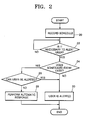
- Figure 2 is a flowchart explaining a first preferred embodiment of an operation method according to a user's schedule in an intelligent portable communications device of the present invention.
- the operation method is formed of steps 20-30 for processing a call according to a prerecorded schedule by itself in the apparatus.
- a user's personal schedule of daily, weekly, monthly, or yearly events are entered into the intelligent portable communication device in step 20.
- the recorded schedule can be updated and can be stored after categorized into themes.
- themes of the schedule may include a conference period, an absent period, an appointment period, a public performance period, a religious activity period, a sleep period, a work period, a holiday period, an expected phone call period, a memorial day, a statutory holiday, a mealtime, a journey period, a recreational and sport activity period, etc.
- step 22 the intelligent portable communications device continuously checks whether or not it needs to call the user.
- step 22 A preferred embodiment of step 22 according to the present invention will now be explained.
- Step 22 is formed of steps 40-44 for calling the user inside or outside the intelligent portable communications device.
- step 40 the intelligent portable communications device determines whether or not an outside caller requests to be connected to the user. If the outside caller requests to be connected to the user, step 24 is performed. If the outside caller does not request to be connected to the user, it is determined whether the outside caller desires to send a message or the caller has already sent a message to the user in step 42. If the caller desires to send a message or the caller has already sent a message to the user, step 24 is performed. That is, in steps 40 and 42, it is determined whether a call outside the intelligent portable communications device has been made to the user.
- step 44 it is determined if an internal alarm for informing the user about a specific instant or predetermined message inside the intelligent portable communications device is desired in step 44. If an internal alarm is desired, step 24 is performed. However, if an internal alarm is not desired, steps 40-44 are repeatedly performed in order to determine where the user is called. That is, in step 44, it is determined whether the user is called inside the intelligent portable communications device.
- step 24 if alerting the user is necessary, the intelligent portable communications device checks through the prerecorded schedule if the user has a scheduled event. That is, if alerting the user is necessary, it is determined whether the intelligent portable communications device is presently in a state of schedule management.
- step 26 it is determined by the prerecorded schedule whether or not the user can receive the call in step 26. That is, if it is determined that the user currently is in a prerecorded scheduled event, it is determined by analyzing the recorded schedule whether or not the user can be alerted. At this time, if the user cannot receive the call, a response appropriate to the prerecorded scheduled event is automatically informed in step 28.
- step 28 according to the present invention.
- Step 28 is formed of steps 70-82 for automatically responding to an outside caller with a response form that is determined by analyzing the prerecorded schedule and step 84 for displaying the response form.
- the automatic response to the caller should be a refusal to receive the call by analyzing the prerecorded schedule in step 70. If the automatic response is a refusal to receive the call, an automatic response is given for refusing the receipt of the call in step 72. For example, a message, "At present, the user cannot receive the call," may be automatically responded. If the automatic response is not a refusal to receive the call, it is determined whether or not the automatic response is a voice form in step 74. If the automatic response is a voice form, a voice message is automatically responded to the caller in step 76. However, if the automatic response is not a voice form, it is determined whether or not the automatic response is a text form in step 78.
- the automatic response is a text form
- a text message is automatically responded to the caller in step 80.
- the text message can be a short message.
- an automatic response in the form of a picture is sent to the caller in step 82.
- the picture may be an animation. Steps 70, 74, and 78 are performed based on the prerecorded schedule and the automatic response messages in steps 72, 76, 80, and 82 are contained in the prerecorded schedule.
- the automatic response form that is, a call refusal, a voice message, a text message, or a picture, is displayed to the user in step 84.
- the first scheduled event is recorded as a team conference period from 2 p.m. to 4 p.m. every Friday with a set automatic response in text form of a message saying, "It is conference time now.
- the call can be connected after 4 p.m.”
- the second scheduled event is recorded as a daily sleeping period from midnight to 6 a.m. with a set automatic response in picture form of an animation indicating sleeping. It is noted in the schedule that the user cannot receive call during the team conference period or the sleeping period.
- the intelligent portable communications device wants to call the user during the team conference period, the automatic response of a text message, "It is conference time now. The call can be connected after 4 p.m.” is automatically sent to the caller. If the device wants to call the user during the sleeping period, the automatic response of an animation indicating sleeping is automatically sent to the caller. The automatic response form, the automatic response message, and/or the time when the automatic response is sent are displayed so that the user is made aware of the missed call after the team conference or the sleeping period.
- step 26 if it is determined in step 26 that the user can be alerted, or if it is determined in step 24 that the user has no event scheduled, by analyzing the prerecorded schedule, the user is alerted in step 30.
- step 30 a preferred embodiment of step 30 according to the present invention will now be explained.
- Step 30 is formed of steps 100-108 for alerting the user by a mode according to the prerecorded schedule.
- step 100 It is first determined by analyzing the prerecorded schedule whether the user is to be alerted without sound in step 100. If the user is to be alerted by sound, the user is called by a sound prescheduled in the prerecorded schedule in step 102. However, if the user is to be alerted without sound, it is determined by analyzing the prerecorded schedule whether or not the caller is to be alerted by vibration in step 104. At this time, if it is determined that the user is to be alerted by vibration, the user is alerted by a vibration having a strength and length as set in the prerecorded schedule in step 106.
- a message predetermined in the prerecorded schedule may be displayed in the form of a text message or a picture (e.g., an animation) for the user.
- the calling modes during a scheduled event will be explained with the following example, assuming the scheduled events are previously recorded as follows.
- the first scheduled event is a sport time from 6 a.m. to 7 a.m. every morning and the calling mode is a sound.
- the second event is a work period from 9 a.m. to 12 a.m. on Monday and Friday and the calling mode is vibration.
- the third event is mealtime from noon to 1 p.m. everyday and the calling mode is light.
- the fourth event is a movie watching time from 3 p.m. to 6 p.m. every Saturday and the calling mode is vibration.
- the user has programmed that intelligent portable communications device with the above events and conditions.
- the intelligent portable terminal apparatus needs to alert the user during the sport time, the user is alerted by a sound in step 102. If it is necessary to alert the user during the work period or movie watching time, the user is alerted by a vibration in step 106. If it is needed to alert the user during the mealtime, the user is alerted by a light in step 108.
- Figure 6 is a flowchart explaining a second preferred embodiment of an operation method according to user's schedule in an intelligent portable communications device of the present invention.
- the method is formed of step 20 for previously recording the schedule and steps 22-30, 120, and 122 for processing the call depending on whether or not the caller is a desired caller by analyzing a prerecorded schedule.
- the second preferred embodiment of the operation method according to user's schedule of the present invention shown in Figure 6 further includes steps 120 and 122 between steps 22 and 24. If steps 120 and 122 are excluded, the second embodiment is the same as the first embodiment shown in Figure 2. Therefore, explanation of steps 20 through 30, except for steps 120 and 122, will be omitted.
- step 22 if it is determined that alerting the user is necessary, the intelligent portable communications device determines whether or not a calling number from which the user is called exists in step 120. That is, it is determined whether or not the alert is an outside call. If a calling number does not exist, step 24 is performed because if there is no calling number, it is an internal alert by the intelligent portable communications device, and thus, there is no need to select a caller.
- step 122 it is determined whether the calling number is identical to a desired calling number entered into the prerecorded schedule.
- the desired calling number means a calling number which has been prerecorded in the schedule because the user desires to receive a call from that calling number even during a scheduled event. If the calling number is not identical to the desired calling number, step 28 is performed so that an automatic response is sent to the caller because the caller is not desired by the user. However, if the calling number is identical to the desired calling number, step 24 is performed so that the user is alerted or an automatic response is sent to the caller according to the prerecorded schedule because the caller is desired by the user.
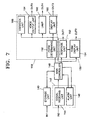
- FIG 7 is a block diagram of a first preferred embodiment of an intelligent portable communications device according to the present invention for performing the operation method shown in Figure 2.
- the intelligent portable communications device is formed of a storage unit 140, a signal generating unit 142, a main controller 148, an automatic response unit 150, and a calling unit 156.
- the storage unit 140 receives and stores a schedule, which is externally provided through an input terminal IN1, and is used to perform step 20.
- the signal generating unit 142 generates a call input signal, which indicates that a call to the user is needed, and outputs the call input signal to the main controller 148.
- the signal generating unit 142 may be formed of a signal receiving unit 144 and an alarm unit 146.
- the signal receiving unit 144 externally receives a wireless signal through an input terminal IN2 and outputs the received wireless signal to the main controller 148 as the call input signal.
- the alarm unit 146 outputs an alarm signal to the main controller 148 as the call input at this point of time determined from an alarm information input from the main controller 148.
- the main controller 148 outputs the alarm information read out from the storage unit 140 through the input terminal IN1, to the alarm unit 146.
- the automatic response unit 150 generates an automatic response message for an outside call, based on response data sent from the main controller 148 and provides a generated automatic response message by way of a call refusal form, a picture form, a character form, or a voice form to the caller.
- the automatic response unit 150 may be formed of a response unit 152 and a form display unit 154.
- the response unit 152 determines an automatic response message and form of the message based on the response data input from the main controller 148, sends the automatic response message in the determined form through an output terminal OUT1, and outputs the determined form of the automatic response message to the form display unit 154.
- the determined form may be a call refusal form, a voice form, a text form, or a picture form.
- the form display unit 154 displays the determined form of the automatic response message input from the response unit 152 and/or the calling form input from the calling unit 156 to the user through an output terminal OUT2.
- the calling unit 156 outputs a call output signal to the user in the determined form based on call data input from the main controller 148.
- the calling unit 156 may be formed of a form determining unit 158, a display unit 160, a lamp 162, a voice output unit 164, and a vibration unit 166.
- the form determining unit 158 determines, based on call data input from the main controller 148, the form of a call output signal to be sent to the user and outputs the determined form as a form information signal to each of the display unit 160, the lamp 162, the voice output unit 164, and the form display unit 154.
- the display unit 160 displays the call output signal in the form of a picture, to the user through an output terminal OUT3.
- the lamp 162 provides the call output signal in the form of light, to the user through an output terminal OUT4.
- the voice output unit 164 provides the call output signal in the form of a sound, to the user through an output terminal OUT5.
- the vibration unit 166 provides the call output signal in the form of a vibration to the user.
- the main controller 148 analyzes the schedule stored in the storage unit 140 and outputs a response data and a call data, both of which are extracted from the schedule in response to the analyzed result, to the automatic response unit 150 and the calling unit 156, respectively. For example, to perform step 22, the main controller 148 determines whether or not the call input signal is sent from the signal generating unit 142. If the call input signal is sent, the main controller 148 analyzes the schedule stored in the storage unit 140 to perform step 24.
- the main controller 148 extracts call data related to the calling form from the schedule and sends the extracted call data to the calling unit 156. However, if the receipt time of the call input signal is included in a schedule having events in which the user cannot be called, the main controller 148 extracts response data related to the automatic response message and the automatic response form from the schedule and sends the extracted response data to the automatic response unit 150.
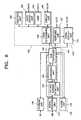
- FIG 8 is a block diagram of a second preferred embodiment of an intelligent portable communications device according to the present invention for performing the method shown in Figure 6.
- the embodiment is formed of a storage unit 140, a signal generating unit 142, a main controller 180, an automatic response unit 150, and a calling unit 156.
- the structure and operation of the main controller 180 is different from the main controller 148 shown in Figure 7. However, apart from the main controller 180, the intelligent portable communications device shown in Figure 8 has the same structure and operation as the intelligent portable communications device shown in Figure 7.
- the storage unit 140, the signal generating unit 142 formed of the signal receiving unit 144 and the alarm unit 146, the automatic response unit 150 formed of the response unit 152 and the form display unit 154, and the calling unit 156 formed of the form determining unit 158, the display unit 160, the lamp 162, the voice output unit 164, and the vibration unit 166, shown in Figure 8 correspond to and perform the same functions as the storage unit 140, the signal generating unit 142 formed of the signal receiving unit 144 and the alarm unit 146, the automatic response unit 150 formed of the response unit 152 and the form display unit 154, and the calling unit 156 formed of the form determining unit 158, the display unit 160, the lamp 162, the voice output unit 164, and the vibration unit 166 shown in Figure 7, respectively, and therefore their explanation will be omitted.
- the main controller 180 shown in Figure 8 is formed of a calling number detection unit 182, a comparison unit 184, and a subcontroller 186.
- the calling number detection unit 182 detects the calling number from a wireless signal sent from the signal receiving unit 144 and outputs the detected result to the comparison unit 184.
- the subcontroller 186 does not extract a desired calling number from the schedule stored in the storage unit 140. That is, after step 120 shown in Figure 6, step 24 is performed. Therefore, the subcontroller 186 performs the same operation as the main controller 148 shown in Figure 2. That is, in response to the call input signal sent from the signal generating unit 142, the subcontroller 186 analyzes the schedule stored in the storage unit 140, and extracts response and call data from the schedule in response to the analyzed result and then transmit the extracted response and call data to the automatic response unit 150 and the calling unit 156, respectively.
- the subcontroller 186 extracts the desired calling number from the schedule stored in the storage unit 140 and sends the extracted number to the comparison unit 184. That is, after step 120, step 122 is performed. To perform step 122, the comparison unit 184 compares the calling number, which can be included in the detected result output from the calling number detection unit 182, with the desired calling number sent from the subcontroller 186 and then outputs the compared result to the subcontroller 186. At this time, if it is determined, by the compared result input from the comparison unit 184, that the calling number is not identical to the desired calling number, the subcontroller 186 extracts response data from the schedule stored in the storage unit 140 and outputs the extracted data to the automatic response unit 150.
- the subcontroller 186 analyzes the schedule stored in the storage unit 140, extracts a response and call data from the schedule in response to the analyzed result, and outputs the extracted response and call data to the automatic response unit 150 and the calling unit 156, respectively.
- the subcontroller 186 of the main controller 180 shown in Figure 8 performs the same operation as the main controller 148 shown in Figure 7 in a situation where a calling signal is not included in the wireless signal sent through the input terminal IN2 or a call input signal is generated through the alarm unit 146, that is, in a situation where a calling signal is not detected.
- the call is intelligently processed according to a schedule prerecorded by the user. Therefore, even though the user has not manipulated the portable communications device before a scheduled event, the user is not disturbed, a noise interruption can be prevented, and the caller can be led to conform to the user's schedule through the automatic response function.
Landscapes
- Engineering & Computer Science (AREA)
- Signal Processing (AREA)
- Computer Security & Cryptography (AREA)
- Computer Networks & Wireless Communication (AREA)
- Human Computer Interaction (AREA)
- Telephone Function (AREA)
- Mobile Radio Communication Systems (AREA)
- Telephonic Communication Services (AREA)
- Management, Administration, Business Operations System, And Electronic Commerce (AREA)
Abstract
Description
Claims (14)
- An operation method of a portable communications device according to a user's schedule, the operation method comprising the steps of:(a) recording the schedule;(b) continuously determining if it is necessary to alert the user;(c) determining if the user has a scheduled event if it is determined that alerting the user is necessary;(d) determining if the user can be alerted if it is determined that the user has a scheduled event;(e) automatically performing a response corresponding to the recorded schedule for a call if it is determined that the user cannot be alerted; and(f) calling the user if it is determined that the user can be alerted, or if the user does not have a scheduled event.
- The operation method of claim 1 or 2, wherein the schedule recorded in step (a) can be updated.
- The operation method of claim 1, further comprising steps of:determining if the calling number which called the user exists if it is determined that alerting the user is necessary and proceeding to step (c) if the calling number does not exist; anddetermining if the calling number is identical to a desired calling number if the calling number exists, and proceeding to step (e) if the calling number is not a desired calling number, and proceeding to step (c) if the calling number is a desired calling number, wherein a desired calling number is a number which is recorded in the schedule because the user desires to receive a call from the number.
- The operation method of either of claim 1, 2 or 3, wherein step (b) comprises the sub-steps of:(b1) after step (a), determining whether a call connection to the user is requested, and proceeding to step (c) if it is determined that a call connection to the user is requested;(b2) determining if a message is desired to be sent to the user if it is determined that a call connection to the user is not requested, and proceeding to step (c) if it is determined that the message is desired to be sent to the user;(b3) determining if a predetermined message is desired to inform the user if it has been determined that the message is not desired to be sent to the user, and proceeding to step (c) if it is determined that the predetermined message is desired to inform the user and proceeding to step (b1) if it is determined that the predetermined message is not desired to inform the user.
- The operation method of either of claim 1 or 3, wherein step (e) comprises the sub-steps of:wherein the steps (e1), (e3) and (e5) are determined based on the recorded schedule.(e1) determining if the response is a refusal to receive the call;(e2) performing the response that the call is refused if the response is a refusal to receive the call;(e3) determining if the response is a voice form if the response is not a refusal to receive the call;(e4) responding in the form of voice if the response is the voice form;(e5) determining if the response is a text form if the response does not take the voice form;(e6) responding in the form of a text if the response is the text form; and(e7) responding in the form of a picture if the response is not the text form;
- The operation method of claim 5, wherein step (e) further comprises a step for displaying the response form to the user after step (e2), (e4), (e6), or (e7), and the response form is a call refusal form, the voice form, the text form, or the picture form.
- The operation method of either of claim 1 or 3, wherein step (f) comprises the sub-steps of:(f1) determining whether or not the user is alerted without sound based on the recorded schedule;(f2) alerting the user without sound if it is determined that the user is to be alerted without sound; and(f3) alerting the user by sound if it is determined that the user is alerted with sound.
- The operation method of claim 7, wherein step (f2) comprises the sub-steps of:determining if the user is alerted by a vibration if it is determined that the user is alerted without sound;alerting the user by a vibration if it is determined that the user is alerted by vibration; andalerting the user with a lamp if it is determined that the user is not alerted by vibration.
- A portable communications device performing an operation method according to user's schedule, the portable communications device comprising:a storage unit (140) for externally receiving and storing the schedule;a signal generating unit (142) for generating a call input signal for calling the user;an automatic response unit (150) for generating a response message corresponding to the response to the call from response data, and outputting the generated response message;a calling unit (156) for outputting a call output signal in a form determined from call data to the user; anda main controller (148) for analyzing the schedule read from the storage unit (140) in response to the call input signal, outputting the response and call data, extracted from the schedule in response to the analyzed result to the automatic response unit (150) and the calling unit (156), respectively.
- The portable communications device of claim 9, wherein the signal generating unit (142) comprises:a signal receiving unit (144) for receiving an outside wireless signal and outputting the received signal; andan alarm unit (146) for outputting an alarm signal at a time determined from received alarm information, wherein the main controller (148) outputs externally input the alarm information to the alarm unit (146), and the wireless signal or the alarm signal is output as the call input signal.
- The portable communications device of claim 9 or 10, wherein the automatic response unit (150) comprises:wherein the determined form corresponds to a call refusal form, a voice form, a text form, or a picture form.a response unit (152) for determining the response message and its form from the response data input from the main controller and outputting the response message in the determined form; anda form display unit (154) for displaying the response message form to the user,
- The portable communications device of claim 9, 10 or 11, wherein the calling unit (156) comprises:a form determining unit (158) for determining the form based on the call data and outputting the determined form as a form information signal;a voice output unit (164) for outputting the call output signal in the form of voice in response to the form information signal;a lamp (162) for outputting the call output signal in the form of light in response to the form information signal; anda vibration unit (166) for outputting the call output signal in the form of vibration in response to the form information signal.
- The portable communications device of claim 12,
wherein the calling unit (160) further comprises a display unit for displaying the call output signal in the form of a picture in response to the form information signal. - The portable communications device of claim 10,
wherein the main controller (148) comprises:a calling number detection unit (182) for detecting the calling number from the wireless signal sent from the signal receiving unit, and outputting the detected result;a comparison unit (184) for comparing the calling number, which can be included in the detected result, with a desired calling number, and outputting the compared result; anda subcontroller (186) for extracting the desired calling number from the result detected in the calling number detection unit and the schedule read from the storage unit in response to the call input signal, outputting the extracted the desired calling number to the comparison unit, analyzing the schedule, and extracting the response and call data from the schedule in response to the analyzed result, wherein the desired calling number is a number which is recorded in the schedule because the user desires to receive the call.
Applications Claiming Priority (2)
| Application Number | Priority Date | Filing Date | Title |
|---|---|---|---|
| KR2000082755 | 2000-12-27 | ||
| KR1020000082755A KR100350991B1 (en) | 2000-12-27 | 2000-12-27 | Intelligent portable terminal apparatus and operation method according to user's schedule thereof |
Publications (3)
| Publication Number | Publication Date |
|---|---|
| EP1220521A2 true EP1220521A2 (en) | 2002-07-03 |
| EP1220521A3 EP1220521A3 (en) | 2004-01-28 |
| EP1220521B1 EP1220521B1 (en) | 2006-11-15 |
Family
ID=19703659
Family Applications (1)
| Application Number | Title | Priority Date | Filing Date |
|---|---|---|---|
| EP01306480A Expired - Lifetime EP1220521B1 (en) | 2000-12-27 | 2001-07-27 | Portable communications device and operation method for the same according to user's schedule |
Country Status (6)
| Country | Link |
|---|---|
| US (1) | US7092925B2 (en) |
| EP (1) | EP1220521B1 (en) |
| JP (1) | JP2002218023A (en) |
| KR (1) | KR100350991B1 (en) |
| CN (1) | CN1361616A (en) |
| DE (1) | DE60124497T2 (en) |
Cited By (7)
| Publication number | Priority date | Publication date | Assignee | Title |
|---|---|---|---|---|
| FR2880501A1 (en) * | 2004-12-30 | 2006-07-07 | Cit Alcatel | METHOD FOR RECONFIGURING A MOBILE TERMINAL |
| EP1737202A1 (en) * | 2005-06-23 | 2006-12-27 | Research In Motion Limited | System and method for automatically responding to a received communication |
| US7673055B2 (en) | 2005-06-23 | 2010-03-02 | Research In Motion Limited | System and method for automatically responding to a received communication |
| US7730404B2 (en) | 2006-07-31 | 2010-06-01 | Research In Motion Limited | Electronic device and method of messaging meeting invitees |
| US7873646B2 (en) | 2004-02-25 | 2011-01-18 | Research In Motion Limited | Method for modifying notifications in an electronic device |
| US7917127B2 (en) | 2004-02-26 | 2011-03-29 | Research In Motion Limited | Apparatus for changing the behavior of an electronic device |
| US8145200B2 (en) | 2006-07-31 | 2012-03-27 | Research In Motion Limited | Method and apparatus for configuring unique profile settings for multiple services |
Families Citing this family (9)
| Publication number | Priority date | Publication date | Assignee | Title |
|---|---|---|---|---|
| KR100417878B1 (en) * | 2001-08-24 | 2004-02-11 | 서성환 | Auto Response System using schedule and method thereof |
| KR20040033200A (en) * | 2002-10-11 | 2004-04-21 | 엘지전자 주식회사 | A method of displaying information with automation for mobile phone |
| US7974399B2 (en) * | 2005-11-15 | 2011-07-05 | Alcatel Lucent | Enhanced whisper feature |
| US7688850B2 (en) * | 2006-11-14 | 2010-03-30 | Avaya Inc. | Media independent out-of office manager |
| US8284913B2 (en) * | 2007-06-21 | 2012-10-09 | International Business Machines Corporation | Adaptive call monitoring |
| JP2009021671A (en) * | 2007-07-10 | 2009-01-29 | Toshiba Corp | Mobile phone |
| US9571533B2 (en) * | 2012-12-28 | 2017-02-14 | Avaya Inc. | Graphical environment for adding liaison agents to a communication session |
| US10771419B2 (en) * | 2016-11-28 | 2020-09-08 | Facebook, Inc. | Providing context-aware visual elements in a communication setting |
| CN112770005A (en) * | 2020-12-08 | 2021-05-07 | 深圳传音控股股份有限公司 | Intelligent response method, mobile terminal and storage medium |
Family Cites Families (14)
| Publication number | Priority date | Publication date | Assignee | Title |
|---|---|---|---|---|
| JPH01248858A (en) | 1988-03-30 | 1989-10-04 | Omron Tateisi Electron Co | Telephone set |
| US5128981A (en) * | 1989-05-24 | 1992-07-07 | Hitachi, Ltd. | Radio communication system and a portable wireless terminal |
| JPH0574056U (en) | 1992-03-04 | 1993-10-08 | 沖電気工業株式会社 | Answering machine with answer message switching function |
| US5973612A (en) * | 1996-09-19 | 1999-10-26 | Microsoft Corporation | Flexible object notification |
| US6209011B1 (en) * | 1997-05-08 | 2001-03-27 | Microsoft Corporation | Handheld computing device with external notification system |
| JPH1198224A (en) | 1997-09-18 | 1999-04-09 | Sharp Corp | Receiving device with incoming call notifying function, incoming call notifying method, and recording medium recording incoming call notifying control program of receiving device |
| US6418309B1 (en) * | 1997-10-22 | 2002-07-09 | Ericsson Inc. | Apparatus and method for configuring settings of a portable intelligent communications device during a meeting |
| US6052563A (en) * | 1997-12-10 | 2000-04-18 | Motorola | Communication device controlled by appointment information stored therein, and method therefor |
| JP3148174B2 (en) * | 1998-01-14 | 2001-03-19 | 日本電気株式会社 | Radio selective call receiver |
| US6574471B1 (en) * | 1998-02-03 | 2003-06-03 | Ericsson Inc. | Apparatus and method for handling incoming calls received by a portable intelligent communications device during a meeting |
| JPH11252220A (en) | 1998-03-05 | 1999-09-17 | Sony Corp | Telephone terminal device |
| JP2000115838A (en) * | 1998-09-30 | 2000-04-21 | Mitsubishi Electric Corp | Mobile communication terminal |
| JP2000295342A (en) | 1999-04-01 | 2000-10-20 | Sukurudo Enterprise Kk | Communication equipment and communication control method |
| SE9904103D0 (en) * | 1999-11-12 | 1999-11-12 | Ericsson Telefon Ab L M | Mobile terminal |
-
2000
- 2000-12-27 KR KR1020000082755A patent/KR100350991B1/en not_active Expired - Fee Related
-
2001
- 2001-07-27 DE DE60124497T patent/DE60124497T2/en not_active Expired - Fee Related
- 2001-07-27 EP EP01306480A patent/EP1220521B1/en not_active Expired - Lifetime
- 2001-08-23 CN CN01125732A patent/CN1361616A/en active Pending
- 2001-09-27 JP JP2001298443A patent/JP2002218023A/en active Pending
- 2001-10-03 US US09/968,774 patent/US7092925B2/en not_active Expired - Fee Related
Cited By (11)
| Publication number | Priority date | Publication date | Assignee | Title |
|---|---|---|---|---|
| US7873646B2 (en) | 2004-02-25 | 2011-01-18 | Research In Motion Limited | Method for modifying notifications in an electronic device |
| US8306989B2 (en) | 2004-02-25 | 2012-11-06 | Research In Motion Limited | Method for modifying notifications in an electronic device |
| US7917127B2 (en) | 2004-02-26 | 2011-03-29 | Research In Motion Limited | Apparatus for changing the behavior of an electronic device |
| US8498620B2 (en) | 2004-02-26 | 2013-07-30 | Research In Motion Limited | Apparatus for changing the behavior of an electronic device |
| FR2880501A1 (en) * | 2004-12-30 | 2006-07-07 | Cit Alcatel | METHOD FOR RECONFIGURING A MOBILE TERMINAL |
| EP1737202A1 (en) * | 2005-06-23 | 2006-12-27 | Research In Motion Limited | System and method for automatically responding to a received communication |
| US7673055B2 (en) | 2005-06-23 | 2010-03-02 | Research In Motion Limited | System and method for automatically responding to a received communication |
| US8661142B2 (en) | 2005-06-23 | 2014-02-25 | Blackberry Limited | System and method for automatically responding to a received communication |
| US7730404B2 (en) | 2006-07-31 | 2010-06-01 | Research In Motion Limited | Electronic device and method of messaging meeting invitees |
| US8145200B2 (en) | 2006-07-31 | 2012-03-27 | Research In Motion Limited | Method and apparatus for configuring unique profile settings for multiple services |
| US9177300B2 (en) | 2006-07-31 | 2015-11-03 | Blackberry Limited | Electronic device and method of messaging meeting invitees |
Also Published As
| Publication number | Publication date |
|---|---|
| EP1220521A3 (en) | 2004-01-28 |
| US7092925B2 (en) | 2006-08-15 |
| KR20020053256A (en) | 2002-07-05 |
| DE60124497T2 (en) | 2007-06-14 |
| KR100350991B1 (en) | 2002-08-29 |
| US20020083028A1 (en) | 2002-06-27 |
| DE60124497D1 (en) | 2006-12-28 |
| CN1361616A (en) | 2002-07-31 |
| JP2002218023A (en) | 2002-08-02 |
| EP1220521B1 (en) | 2006-11-15 |
Similar Documents
| Publication | Publication Date | Title |
|---|---|---|
| EP1220521A2 (en) | Portable communications device and operation method for the same according to user's schedule | |
| US9326267B1 (en) | Communication device | |
| US20040266399A1 (en) | Method and apparatus for providing selected status announcements from a wireless telephone user to a caller | |
| JP2004242321A (en) | Context-based communication method and context-based mobile communication system | |
| CN1665261B (en) | Mobile terminal for transmitting emergency messages and method thereof | |
| JP4409501B2 (en) | Use of a PIM calendar in a mobile device for switching profiles and a schedule management device | |
| JP3706381B2 (en) | Information providing device, provided information presenting device, and information providing method | |
| US7426269B2 (en) | System and method for identifying a caller using associated sounds | |
| JPH07250132A (en) | Awareness controller | |
| US5493611A (en) | User configurable telephone with alarm feature | |
| KR100408563B1 (en) | Method for preferential incoming call alarm in the mobile phone and mobile phone implementing the same | |
| EP1047253A2 (en) | Method for controlling a user profile and a wireless communication device | |
| JP2003338855A (en) | Operation mode setting method for communication terminal device and communication terminal device | |
| US20060168089A1 (en) | Controlling incoming communication by issuing tokens | |
| CN101141724B (en) | Incoming call answering management method of mobile communication device | |
| KR100986576B1 (en) | Schedule registration method of mobile communication terminal | |
| JPH1042008A (en) | Radio selective calling receiver | |
| JP2005151332A (en) | Key telephone system | |
| KR100755975B1 (en) | Information display method of mobile terminal | |
| KR20040044715A (en) | Schedule information inform method for mobile communication terminal | |
| JP2001501393A (en) | Pager with voice and data messages | |
| KR101014715B1 (en) | Mobile terminal and its schedule alarm and incoming notification signal automatic change method | |
| KR101216707B1 (en) | Apparatus and method for display of memorial day in portable communication terminal | |
| KR100452924B1 (en) | Mobile Terminal Sleeping Method for Manners | |
| JP2005303892A (en) | Communication device |
Legal Events
| Date | Code | Title | Description |
|---|---|---|---|
| PUAI | Public reference made under article 153(3) epc to a published international application that has entered the european phase |
Free format text: ORIGINAL CODE: 0009012 |
|
| 17P | Request for examination filed |
Effective date: 20010820 |
|
| AK | Designated contracting states |
Kind code of ref document: A2 Designated state(s): AT BE CH CY DE DK ES FI FR GB GR IE IT LI LU MC NL PT SE TR |
|
| AX | Request for extension of the european patent |
Free format text: AL;LT;LV;MK;RO;SI |
|
| PUAL | Search report despatched |
Free format text: ORIGINAL CODE: 0009013 |
|
| AK | Designated contracting states |
Kind code of ref document: A3 Designated state(s): AT BE CH CY DE DK ES FI FR GB GR IE IT LI LU MC NL PT SE TR |
|
| AX | Request for extension of the european patent |
Extension state: AL LT LV MK RO SI |
|
| RIC1 | Information provided on ipc code assigned before grant |
Ipc: 7H 04M 1/725 A Ipc: 7H 04M 1/663 B |
|
| 17Q | First examination report despatched |
Effective date: 20040315 |
|
| AKX | Designation fees paid |
Designated state(s): DE FR GB |
|
| GRAP | Despatch of communication of intention to grant a patent |
Free format text: ORIGINAL CODE: EPIDOSNIGR1 |
|
| GRAS | Grant fee paid |
Free format text: ORIGINAL CODE: EPIDOSNIGR3 |
|
| GRAA | (expected) grant |
Free format text: ORIGINAL CODE: 0009210 |
|
| AK | Designated contracting states |
Kind code of ref document: B1 Designated state(s): DE FR GB |
|
| REG | Reference to a national code |
Ref country code: GB Ref legal event code: FG4D |
|
| REF | Corresponds to: |
Ref document number: 60124497 Country of ref document: DE Date of ref document: 20061228 Kind code of ref document: P |
|
| ET | Fr: translation filed | ||
| PLBE | No opposition filed within time limit |
Free format text: ORIGINAL CODE: 0009261 |
|
| STAA | Information on the status of an ep patent application or granted ep patent |
Free format text: STATUS: NO OPPOSITION FILED WITHIN TIME LIMIT |
|
| 26N | No opposition filed |
Effective date: 20070817 |
|
| PGFP | Annual fee paid to national office [announced via postgrant information from national office to epo] |
Ref country code: DE Payment date: 20080807 Year of fee payment: 8 |
|
| PGFP | Annual fee paid to national office [announced via postgrant information from national office to epo] |
Ref country code: FR Payment date: 20080718 Year of fee payment: 8 |
|
| PGFP | Annual fee paid to national office [announced via postgrant information from national office to epo] |
Ref country code: GB Payment date: 20080806 Year of fee payment: 8 |
|
| GBPC | Gb: european patent ceased through non-payment of renewal fee |
Effective date: 20090727 |
|
| REG | Reference to a national code |
Ref country code: FR Ref legal event code: ST Effective date: 20100331 |
|
| PG25 | Lapsed in a contracting state [announced via postgrant information from national office to epo] |
Ref country code: FR Free format text: LAPSE BECAUSE OF NON-PAYMENT OF DUE FEES Effective date: 20090731 |
|
| PG25 | Lapsed in a contracting state [announced via postgrant information from national office to epo] |
Ref country code: GB Free format text: LAPSE BECAUSE OF NON-PAYMENT OF DUE FEES Effective date: 20090727 |
|
| PG25 | Lapsed in a contracting state [announced via postgrant information from national office to epo] |
Ref country code: DE Free format text: LAPSE BECAUSE OF NON-PAYMENT OF DUE FEES Effective date: 20100202 |