EP1220384A1 - Optical waveguide amplifier and dual-wavelength optical pumping scheme - Google Patents
Optical waveguide amplifier and dual-wavelength optical pumping scheme Download PDFInfo
- Publication number
- EP1220384A1 EP1220384A1 EP00440337A EP00440337A EP1220384A1 EP 1220384 A1 EP1220384 A1 EP 1220384A1 EP 00440337 A EP00440337 A EP 00440337A EP 00440337 A EP00440337 A EP 00440337A EP 1220384 A1 EP1220384 A1 EP 1220384A1
- Authority
- EP
- European Patent Office
- Prior art keywords
- waveguide
- pump
- amplifying
- amplifier
- wavelength
- Prior art date
- Legal status (The legal status is an assumption and is not a legal conclusion. Google has not performed a legal analysis and makes no representation as to the accuracy of the status listed.)
- Withdrawn
Links
- 238000005086 pumping Methods 0.000 title claims abstract description 28
- 230000003287 optical effect Effects 0.000 title claims abstract description 14
- 239000000835 fiber Substances 0.000 claims abstract description 29
- 238000001069 Raman spectroscopy Methods 0.000 claims abstract description 12
- 150000002500 ions Chemical class 0.000 claims description 10
- 239000000463 material Substances 0.000 claims description 6
- 230000001902 propagating effect Effects 0.000 claims description 5
- 230000008878 coupling Effects 0.000 claims description 4
- 238000010168 coupling process Methods 0.000 claims description 4
- 238000005859 coupling reaction Methods 0.000 claims description 4
- 229910052775 Thulium Inorganic materials 0.000 abstract description 7
- FRNOGLGSGLTDKL-UHFFFAOYSA-N thulium atom Chemical compound [Tm] FRNOGLGSGLTDKL-UHFFFAOYSA-N 0.000 abstract description 4
- 238000010521 absorption reaction Methods 0.000 description 10
- 239000011521 glass Substances 0.000 description 5
- 239000011159 matrix material Substances 0.000 description 5
- 229910052761 rare earth metal Inorganic materials 0.000 description 5
- BPQQTUXANYXVAA-UHFFFAOYSA-N Orthosilicate Chemical compound [O-][Si]([O-])([O-])[O-] BPQQTUXANYXVAA-UHFFFAOYSA-N 0.000 description 4
- 230000005283 ground state Effects 0.000 description 4
- 150000002910 rare earth metals Chemical class 0.000 description 4
- -1 rare earth ions Chemical class 0.000 description 3
- 239000004065 semiconductor Substances 0.000 description 3
- 238000000862 absorption spectrum Methods 0.000 description 2
- 230000005540 biological transmission Effects 0.000 description 2
- 239000005383 fluoride glass Substances 0.000 description 2
- 239000003365 glass fiber Substances 0.000 description 2
- 238000011835 investigation Methods 0.000 description 2
- 238000004519 manufacturing process Methods 0.000 description 2
- 239000000203 mixture Substances 0.000 description 2
- 238000001228 spectrum Methods 0.000 description 2
- 238000012546 transfer Methods 0.000 description 2
- 229910052691 Erbium Inorganic materials 0.000 description 1
- 229910052779 Neodymium Inorganic materials 0.000 description 1
- 229910052777 Praseodymium Inorganic materials 0.000 description 1
- BUGBHKTXTAQXES-UHFFFAOYSA-N Selenium Chemical compound [Se] BUGBHKTXTAQXES-UHFFFAOYSA-N 0.000 description 1
- VYPSYNLAJGMNEJ-UHFFFAOYSA-N Silicium dioxide Chemical compound O=[Si]=O VYPSYNLAJGMNEJ-UHFFFAOYSA-N 0.000 description 1
- NINIDFKCEFEMDL-UHFFFAOYSA-N Sulfur Chemical compound [S] NINIDFKCEFEMDL-UHFFFAOYSA-N 0.000 description 1
- 229910052769 Ytterbium Inorganic materials 0.000 description 1
- 230000003321 amplification Effects 0.000 description 1
- 229910052785 arsenic Inorganic materials 0.000 description 1
- RQNWIZPPADIBDY-UHFFFAOYSA-N arsenic atom Chemical compound [As] RQNWIZPPADIBDY-UHFFFAOYSA-N 0.000 description 1
- 238000006243 chemical reaction Methods 0.000 description 1
- 239000013078 crystal Substances 0.000 description 1
- 239000002019 doping agent Substances 0.000 description 1
- 238000000295 emission spectrum Methods 0.000 description 1
- UYAHIZSMUZPPFV-UHFFFAOYSA-N erbium Chemical compound [Er] UYAHIZSMUZPPFV-UHFFFAOYSA-N 0.000 description 1
- 230000005281 excited state Effects 0.000 description 1
- 238000001914 filtration Methods 0.000 description 1
- 229910052732 germanium Inorganic materials 0.000 description 1
- GNPVGFCGXDBREM-UHFFFAOYSA-N germanium atom Chemical group [Ge] GNPVGFCGXDBREM-UHFFFAOYSA-N 0.000 description 1
- 239000005283 halide glass Substances 0.000 description 1
- 150000004820 halides Chemical class 0.000 description 1
- 230000006872 improvement Effects 0.000 description 1
- 238000010348 incorporation Methods 0.000 description 1
- 230000003993 interaction Effects 0.000 description 1
- 238000000034 method Methods 0.000 description 1
- QEFYFXOXNSNQGX-UHFFFAOYSA-N neodymium atom Chemical compound [Nd] QEFYFXOXNSNQGX-UHFFFAOYSA-N 0.000 description 1
- 238000003199 nucleic acid amplification method Methods 0.000 description 1
- 230000010287 polarization Effects 0.000 description 1
- PUDIUYLPXJFUGB-UHFFFAOYSA-N praseodymium atom Chemical compound [Pr] PUDIUYLPXJFUGB-UHFFFAOYSA-N 0.000 description 1
- 238000002360 preparation method Methods 0.000 description 1
- 230000008569 process Effects 0.000 description 1
- 229910052711 selenium Inorganic materials 0.000 description 1
- 239000011669 selenium Substances 0.000 description 1
- 239000005368 silicate glass Substances 0.000 description 1
- 230000003595 spectral effect Effects 0.000 description 1
- 239000002203 sulfidic glass Substances 0.000 description 1
- 229910052717 sulfur Inorganic materials 0.000 description 1
- 239000011593 sulfur Substances 0.000 description 1
- 150000003568 thioethers Chemical class 0.000 description 1
- 230000007704 transition Effects 0.000 description 1
- NAWDYIZEMPQZHO-UHFFFAOYSA-N ytterbium Chemical compound [Yb] NAWDYIZEMPQZHO-UHFFFAOYSA-N 0.000 description 1
Images



Classifications
-
- H—ELECTRICITY
- H01—ELECTRIC ELEMENTS
- H01S—DEVICES USING THE PROCESS OF LIGHT AMPLIFICATION BY STIMULATED EMISSION OF RADIATION [LASER] TO AMPLIFY OR GENERATE LIGHT; DEVICES USING STIMULATED EMISSION OF ELECTROMAGNETIC RADIATION IN WAVE RANGES OTHER THAN OPTICAL
- H01S3/00—Lasers, i.e. devices using stimulated emission of electromagnetic radiation in the infrared, visible or ultraviolet wave range
- H01S3/09—Processes or apparatus for excitation, e.g. pumping
- H01S3/091—Processes or apparatus for excitation, e.g. pumping using optical pumping
- H01S3/094—Processes or apparatus for excitation, e.g. pumping using optical pumping by coherent light
- H01S3/094003—Processes or apparatus for excitation, e.g. pumping using optical pumping by coherent light the pumped medium being a fibre
-
- H—ELECTRICITY
- H01—ELECTRIC ELEMENTS
- H01S—DEVICES USING THE PROCESS OF LIGHT AMPLIFICATION BY STIMULATED EMISSION OF RADIATION [LASER] TO AMPLIFY OR GENERATE LIGHT; DEVICES USING STIMULATED EMISSION OF ELECTROMAGNETIC RADIATION IN WAVE RANGES OTHER THAN OPTICAL
- H01S2303/00—Pumping wavelength
-
- H—ELECTRICITY
- H01—ELECTRIC ELEMENTS
- H01S—DEVICES USING THE PROCESS OF LIGHT AMPLIFICATION BY STIMULATED EMISSION OF RADIATION [LASER] TO AMPLIFY OR GENERATE LIGHT; DEVICES USING STIMULATED EMISSION OF ELECTROMAGNETIC RADIATION IN WAVE RANGES OTHER THAN OPTICAL
- H01S3/00—Lasers, i.e. devices using stimulated emission of electromagnetic radiation in the infrared, visible or ultraviolet wave range
- H01S3/05—Construction or shape of optical resonators; Accommodation of active medium therein; Shape of active medium
- H01S3/06—Construction or shape of active medium
- H01S3/063—Waveguide lasers, i.e. whereby the dimensions of the waveguide are of the order of the light wavelength
-
- H—ELECTRICITY
- H01—ELECTRIC ELEMENTS
- H01S—DEVICES USING THE PROCESS OF LIGHT AMPLIFICATION BY STIMULATED EMISSION OF RADIATION [LASER] TO AMPLIFY OR GENERATE LIGHT; DEVICES USING STIMULATED EMISSION OF ELECTROMAGNETIC RADIATION IN WAVE RANGES OTHER THAN OPTICAL
- H01S3/00—Lasers, i.e. devices using stimulated emission of electromagnetic radiation in the infrared, visible or ultraviolet wave range
- H01S3/05—Construction or shape of optical resonators; Accommodation of active medium therein; Shape of active medium
- H01S3/06—Construction or shape of active medium
- H01S3/063—Waveguide lasers, i.e. whereby the dimensions of the waveguide are of the order of the light wavelength
- H01S3/067—Fibre lasers
- H01S3/06754—Fibre amplifiers
-
- H—ELECTRICITY
- H01—ELECTRIC ELEMENTS
- H01S—DEVICES USING THE PROCESS OF LIGHT AMPLIFICATION BY STIMULATED EMISSION OF RADIATION [LASER] TO AMPLIFY OR GENERATE LIGHT; DEVICES USING STIMULATED EMISSION OF ELECTROMAGNETIC RADIATION IN WAVE RANGES OTHER THAN OPTICAL
- H01S3/00—Lasers, i.e. devices using stimulated emission of electromagnetic radiation in the infrared, visible or ultraviolet wave range
- H01S3/05—Construction or shape of optical resonators; Accommodation of active medium therein; Shape of active medium
- H01S3/06—Construction or shape of active medium
- H01S3/063—Waveguide lasers, i.e. whereby the dimensions of the waveguide are of the order of the light wavelength
- H01S3/067—Fibre lasers
- H01S3/06754—Fibre amplifiers
- H01S3/06758—Tandem amplifiers
-
- H—ELECTRICITY
- H01—ELECTRIC ELEMENTS
- H01S—DEVICES USING THE PROCESS OF LIGHT AMPLIFICATION BY STIMULATED EMISSION OF RADIATION [LASER] TO AMPLIFY OR GENERATE LIGHT; DEVICES USING STIMULATED EMISSION OF ELECTROMAGNETIC RADIATION IN WAVE RANGES OTHER THAN OPTICAL
- H01S3/00—Lasers, i.e. devices using stimulated emission of electromagnetic radiation in the infrared, visible or ultraviolet wave range
- H01S3/09—Processes or apparatus for excitation, e.g. pumping
- H01S3/091—Processes or apparatus for excitation, e.g. pumping using optical pumping
- H01S3/094—Processes or apparatus for excitation, e.g. pumping using optical pumping by coherent light
- H01S3/094092—Upconversion pumping
-
- H—ELECTRICITY
- H01—ELECTRIC ELEMENTS
- H01S—DEVICES USING THE PROCESS OF LIGHT AMPLIFICATION BY STIMULATED EMISSION OF RADIATION [LASER] TO AMPLIFY OR GENERATE LIGHT; DEVICES USING STIMULATED EMISSION OF ELECTROMAGNETIC RADIATION IN WAVE RANGES OTHER THAN OPTICAL
- H01S3/00—Lasers, i.e. devices using stimulated emission of electromagnetic radiation in the infrared, visible or ultraviolet wave range
- H01S3/09—Processes or apparatus for excitation, e.g. pumping
- H01S3/091—Processes or apparatus for excitation, e.g. pumping using optical pumping
- H01S3/094—Processes or apparatus for excitation, e.g. pumping using optical pumping by coherent light
- H01S3/094096—Multi-wavelength pumping
-
- H—ELECTRICITY
- H01—ELECTRIC ELEMENTS
- H01S—DEVICES USING THE PROCESS OF LIGHT AMPLIFICATION BY STIMULATED EMISSION OF RADIATION [LASER] TO AMPLIFY OR GENERATE LIGHT; DEVICES USING STIMULATED EMISSION OF ELECTROMAGNETIC RADIATION IN WAVE RANGES OTHER THAN OPTICAL
- H01S3/00—Lasers, i.e. devices using stimulated emission of electromagnetic radiation in the infrared, visible or ultraviolet wave range
- H01S3/14—Lasers, i.e. devices using stimulated emission of electromagnetic radiation in the infrared, visible or ultraviolet wave range characterised by the material used as the active medium
- H01S3/16—Solid materials
- H01S3/1601—Solid materials characterised by an active (lasing) ion
- H01S3/1603—Solid materials characterised by an active (lasing) ion rare earth
- H01S3/1616—Solid materials characterised by an active (lasing) ion rare earth thulium
Definitions
- the invention is related to a waveguide amplifier with an input for optical signals and an output for optical signals with at least one piece of amplifying waveguide with at least one mean (4) for coupling pump laser modules to the amplifying waveguide which contains Tm ions.
- the invention is also related to a pumping scheme for waveguide amplifier feeding two different wavelengths in to the waveguide .
- a number of waveguide amplifiers especially fiber amplifiers for amplifying signals in an optical transmission network are well established or under investigation.
- the glass is a passive host and the medium polarization responsible for the field interaction is generated by the doping ions.
- the rare earth concentration can be made large, up to 10 weight % the fiber lengths can be relatively short.
- Signal amplification is due to stimulated emission accompanied by relaxation of the excited ion to the ground state.
- the pump and the signals bands are fixed by the rare earth atomic resonances. Therefore the amplifiers have a gain spectrum with fixed center wavelength several discrete pump bands.
- the rare earth doped amplifiers the gain spectrum can be modified by the co dopants in the matrix.
- the glass host also affects the Stark level positions, transition homogeneous and inhomogeneous line widths and the non-radiative decay characteristics.
- US 5,973,824 describes the production and use of an amplifying fiber composed of a glass composition of germanium, arsenic, selenium and sulfur. It is also known to use other non-oxidic types of glass as material for amplifying fibers. In particular, the use of materials consisting of halides and sulfides doped with rare earths, as amplifying fibers seems promising. Compared to silica glass, halide- and in particular fluoride glass has transparent properties, which extend spectrally substantially further into the long-wave range. This is due to the spectral shift of the multi-phonon absorption edge as a result of the incorporation of substantially heavier ions. However, these types of glass present technological difficulties in respect of material production and fiber preparation.
- thulium-doped fibers are under investigation for extending the usable bandwidth of optical communications.
- the intention is to create a broadband amplifier and to open the transmission window around 1480 nm, in the S-band, for data transfer.
- thulium doped silicate fiber amplifier Samson et al. Tech. Dig. Optical Amplifier and their Application, OAA, Paper PD1, 2000 describes a fiber amplifier doped with thulium in a silicate matrix.
- silicate glass instead of ZBLAN avoids some problems of the ZBLAN material.
- the thulium ion is pumped in a scheme shown in Fig. 1. From the ground state 3 H 6 the first excited level 3 F 4 is pumped.
- This pumping needs a 1560 pump source (ground state absorption GSA).
- ground state absorption GSA ground state absorption
- ESA excited state absorption
- the problem with this pumping scheme is the efficiency of the GSA related to the absorption cross section of the excited level.
- Another problem occurs with the pumping wavelength of 1560 nm, which is in the range of the L-band signals. Therefore filtering problems for pump light occurs.
- the invention proposes a waveguide amplifier with a hybrid pumping scheme for thulium-doped ions and a use of a more effective and better-adapted wavelengths.
- the invention allows the to build a Tm waveguide for example a fiber amplifier with two pump sources of 1200 nm and 1400 nm.
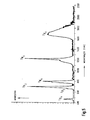
- Figure 5 shows an absorption spectrum for tm ions in a ZBLAN matrix.
- 3 F 4 which is the ground state absorption.
- This absorption peak is broad and can be easily pumped by a semiconductor amplifier.
- the peak with the next higher energy level is related to the 3 H 5 level.
- This absorption peak has a higher absorption cross section and a smaller absorption line.
- Using a laser pump with 1200 nm can very effectively pumping this level of the Tm 3+ ion.
- the intermediate state converts the energy very fast in a non-radiative decay to the 3 F 4 level.
- the second pump laser converts the energy of the 3 F 4 level to the 3 F 4 level with a wavelength of 1400 nm.
- the ratio of the pump powers is important. Good result can be obtained with a ratio between the 1.2- ⁇ m pump power and the 1.4- ⁇ m pump power about 10%.
- Figure 3 shows the power conversion efficiency versus the launched pump power as a comparison between the prior art pumping scheme and the pumping scheme of the invention.
- Figure 4a shows an amplifier using the new pumping scheme:
- Fig. 4b shows the co propagating pumping scheme with a pumping in direction of the incoming optical signal.
- the coupling means 4 can be on e single coupler with a path to both lasers pump modules.
- Another solution uses two couplers for feeding the two necessary wavelengths to the amplifying fiber.
- the amplifying fiber exists in one preferred embodiment of a silicate fiber doped with at least Tm.
- Another preferred embodiment uses ZBLAN glass fiber with Tm dopes.
- Fig. 4c shows a co/counter propagating pumping scheme where either the 1200 nm or the 1400 pump module is connected before or after the amplifying fiber.
- Fig. 6 shows a Raman laser that provides both 1.2- ⁇ m and 1.4- ⁇ m pump wavelength.
- An incoming pump signal of 1064 nm is fed into a Raman fiber 5.
- Reflective elements 6 create resonator environment for different Raman wavelengths. The first Stokes shift increases the wavelength of the optical signal up to 1176 nm. After three Raman shifts the signal ism1242nm and after 5 shifts the wavelength is 1400 nm. Therefore the requires pump wavelengths are available.
- the pump wavelength of 1242 nm and 1400 nm are extracted via partial reflective filters 7 from the Raman laser.
- Fig. 7 shows a two-stage fiber amplifier whose first stage is pumped by a combination of two wavelengths: the first wavelength is located at about 1.2 ⁇ m and the second wavelength is located at about 1.1 ⁇ m.
- the second stage is a fiber amplifier as described in Fig. 4.
- the pump mean of this two-stage amplifier is also shows in Fig. 5.
- a 1.1 ⁇ m source for instance an Yb fiber laser
- This Raman laser provides light at two wavelengths: at 1.2 ⁇ m and at 1.4 ⁇ m.
- the 1.2- ⁇ m power is used to pump the two stages of the amplifier and the 1.4 ⁇ m is used to pump the second stage.
- the fiber amplifiers as described in the figures and the description is an example for the realization of a waveguide amplifier doped with Tm.
- the waveguide structure can also be realized in a planar structure.
Landscapes
- Physics & Mathematics (AREA)
- Electromagnetism (AREA)
- Engineering & Computer Science (AREA)
- Plasma & Fusion (AREA)
- Optics & Photonics (AREA)
- Lasers (AREA)
- Optical Communication System (AREA)
Abstract
A thulium (Tm) doped waveguide amplifier (2), e.g. Tm-doped fiber amplifier (TDFA), with dual-wavelength optical pumping, wherein the two pump wavelengths are about 1200nm and about 1400nm. A dual-wavelength Raman laser source (8) pumped at about 1100nm can be used as a single pumping module. In one embodiment, the novel TDFA (22) is comprised in a double-stage TDFA (21,22) using a dual-wavelength Raman laser (8) as pumping module. <IMAGE>
Description
The invention is related to a waveguide amplifier with an input for optical signals
and an output for optical signals with at least one piece of amplifying waveguide
with at least one mean (4) for coupling pump laser modules to the amplifying
waveguide which contains Tm ions. The invention is also related to a pumping
scheme for waveguide amplifier feeding two different wavelengths in to the
waveguide .
A number of waveguide amplifiers especially fiber amplifiers for amplifying signals
in an optical transmission network are well established or under investigation. There
is a category using the principle of doping glass fibers with rare earth ions such as
praseodymium (PR3+), neodymium (Nd3+), erbium (ER3+) thulium (Tm3+), ytterbium
(Yb3+)
In this rare earth doped fiber amplifiers the glass is a passive host and the medium polarization responsible for the field interaction is generated by the doping ions. As the rare earth concentration can be made large, up to 10 weight % the fiber lengths can be relatively short. Signal amplification is due to stimulated emission accompanied by relaxation of the excited ion to the ground state. In this type of amplifiers the pump and the signals bands are fixed by the rare earth atomic resonances. Therefore the amplifiers have a gain spectrum with fixed center wavelength several discrete pump bands. The rare earth doped amplifiers the gain spectrum can be modified by the co dopants in the matrix. The glass host also affects the Stark level positions, transition homogeneous and inhomogeneous line widths and the non-radiative decay characteristics.
In this rare earth doped fiber amplifiers the glass is a passive host and the medium polarization responsible for the field interaction is generated by the doping ions. As the rare earth concentration can be made large, up to 10 weight % the fiber lengths can be relatively short. Signal amplification is due to stimulated emission accompanied by relaxation of the excited ion to the ground state. In this type of amplifiers the pump and the signals bands are fixed by the rare earth atomic resonances. Therefore the amplifiers have a gain spectrum with fixed center wavelength several discrete pump bands. The rare earth doped amplifiers the gain spectrum can be modified by the co dopants in the matrix. The glass host also affects the Stark level positions, transition homogeneous and inhomogeneous line widths and the non-radiative decay characteristics.
For example, US 5,973,824 is known, which describes the production and use of an
amplifying fiber composed of a glass composition of germanium, arsenic, selenium
and sulfur. It is also known to use other non-oxidic types of glass as material for
amplifying fibers. In particular, the use of materials consisting of halides and
sulfides doped with rare earths, as amplifying fibers seems promising. Compared
to silica glass, halide- and in particular fluoride glass has transparent properties,
which extend spectrally substantially further into the long-wave range. This is due to
the spectral shift of the multi-phonon absorption edge as a result of the
incorporation of substantially heavier ions. However, these types of glass present
technological difficulties in respect of material production and fiber preparation.
Their unfavorable mechanical properties and unfavorable behavior in humid
atmospheres have so far prevented their large-scale use. Recently it has been
possible to produce fibber amplifiers operating with fibers composed of ZBLAN (Zr-Ba-La-Al-Na)
fluoride glass. Due to its relatively high refractive index and the
flexibility of its composition, sulfide glass can be considered as a promising
candidate for use as amplifying material. Therefore great efforts are being
undertaken worldwide to produce many different types of halide glass with low
phonon energies.
Especially thulium-doped fibers are under investigation for extending the usable
bandwidth of optical communications. The intention is to create a broadband
amplifier and to open the transmission window around 1480 nm, in the S-band, for
data transfer.
Recent publications are dealing with another kind of thulium doped fiber. The
document "thulium doped silicate fiber amplifier." Samson et al. Tech. Dig. Optical
Amplifier and their Application, OAA, Paper PD1, 2000 describes a fiber amplifier
doped with thulium in a silicate matrix. The use of silicate glass instead of ZBLAN
avoids some problems of the ZBLAN material. As an improvement the FWHM of the
emission spectrum of the thulium increase in the silicate matrix to 100 nm with a
broadening on the long wavelength side.
The thulium ion is pumped in a scheme shown in Fig. 1. From the ground state 3H6 the first excited level 3F4 is pumped. This pumping needs a 1560 pump source (ground state absorption GSA). Than the excited level 3F4 is pumped with around 1400 nm pump to the level 3H4 state in a process called excited state absorption ESA.
The problem with this pumping scheme is the efficiency of the GSA related to the absorption cross section of the excited level. Another problem occurs with the pumping wavelength of 1560 nm, which is in the range of the L-band signals. Therefore filtering problems for pump light occurs.
The thulium ion is pumped in a scheme shown in Fig. 1. From the ground state 3H6 the first excited level 3F4 is pumped. This pumping needs a 1560 pump source (ground state absorption GSA). Than the excited level 3F4 is pumped with around 1400 nm pump to the level 3H4 state in a process called excited state absorption ESA.
The problem with this pumping scheme is the efficiency of the GSA related to the absorption cross section of the excited level. Another problem occurs with the pumping wavelength of 1560 nm, which is in the range of the L-band signals. Therefore filtering problems for pump light occurs.
The invention proposes a waveguide amplifier with a hybrid pumping scheme for
thulium-doped ions and a use of a more effective and better-adapted wavelengths.
In detail the invention allows the to build a Tm waveguide for example a fiber
amplifier with two pump sources of 1200 nm and 1400 nm.
The invention is shown in the figures and described in the following description:
- Figure 1:
- Prior art pumping scheme
- Figure 2:
- Pumping scheme of the invention
- Figure 3:
- Comparison of different pumping schemes
- Figure 4:
- examples for a Tm fiber amplifier
- Figure 5:
- absorption spectrum of Tm in ZBLAN matrix
- Figure 6:
- Pump means related to the invention
- Figure 7:
- Double stage amplifier
Figure 5 shows an absorption spectrum for tm ions in a ZBLAN matrix. One can see
strong absorption peaks for the transfer to 3F4 which is the ground state absorption.
This absorption peak is broad and can be easily pumped by a semiconductor
amplifier. The peak with the next higher energy level is related to the 3H5 level. This
absorption peak has a higher absorption cross section and a smaller absorption
line. Using a laser pump with 1200 nm can very effectively pumping this level of the
Tm3+ ion. The intermediate state converts the energy very fast in a non-radiative
decay to the 3F4 level. The second pump laser converts the energy of the 3F4 level to
the 3F4 level with a wavelength of 1400 nm. For the best performance the ratio of
the pump powers is important. Good result can be obtained with a ratio between
the 1.2-µm pump power and the 1.4-µm pump power about 10%.
Figure 3 shows the power conversion efficiency versus the launched pump power as
a comparison between the prior art pumping scheme and the pumping scheme of
the invention.
Figure 4a shows an amplifier using the new pumping scheme:
Fig. 4b shows the co propagating pumping scheme with a pumping in direction of
the incoming optical signal. The coupling means 4 can be on e single coupler with a
path to both lasers pump modules. Another solution uses two couplers for feeding
the two necessary wavelengths to the amplifying fiber. The amplifying fiber exists in
one preferred embodiment of a silicate fiber doped with at least Tm. Another
preferred embodiment uses ZBLAN glass fiber with Tm dopes.
Fig. 4c shows a co/counter propagating pumping scheme where either the 1200
nm or the 1400 pump module is connected before or after the amplifying fiber.
Fig. 6 shows a Raman laser that provides both 1.2-µm and 1.4-µm pump
wavelength. An incoming pump signal of 1064 nm is fed into a Raman fiber 5.
Reflective elements 6 create resonator environment for different Raman
wavelengths. The first Stokes shift increases the wavelength of the optical signal up
to 1176 nm. After three Raman shifts the signal ism1242nm and after 5 shifts the
wavelength is 1400 nm. Therefore the requires pump wavelengths are available.
The pump wavelength of 1242 nm and 1400 nm are extracted via partial reflective
filters 7 from the Raman laser.
Fig. 7 shows a two-stage fiber amplifier whose first stage is pumped by a
combination of two wavelengths: the first wavelength is located at about 1.2 µm
and the second wavelength is located at about 1.1 µm. The second stage is a fiber
amplifier as described in Fig. 4. The pump mean of this two-stage amplifier is also
shows in Fig. 5. A 1.1 µm source (for instance an Yb fiber laser) pump first stage of
the amplifier and the Raman laser. This Raman laser provides light at two
wavelengths: at 1.2 µm and at 1.4 µm. The 1.2-µm power is used to pump the two
stages of the amplifier and the 1.4 µm is used to pump the second stage.
The fiber amplifiers as described in the figures and the description is an example for
the realization of a waveguide amplifier doped with Tm. The waveguide structure
can also be realized in a planar structure.
Claims (9)
- A waveguide amplifier with an input (1) for optical signals and an output (3) for optical signals with at least one piece of amplifying fiber (2) with at least one mean (4) for coupling pump laser modules (P1, P2) to the amplifying waveguide characterized in that the amplifying waveguide (2) consists of a material doped with Tm ions and the pump laser modules (P1, P2) emit a first wavelength of about 1200 nm and a second wavelength of about 1400 nm.
- Waveguide amplifier (1) according to claim 1 characterized in that one pump module (P1, P2) is connected to the amplifying waveguide before the amplifying fiber and one pump module (P1, P2) after the amplifying waveguide .
- Waveguide amplifier (1) according to claim 1 characterized in that both pump module (P1, P2) are connected to the amplifying waveguide before the amplifying waveguide for co propagating pumping.
- Waveguide amplifier (1) according to claim 1 characterized in that both pump module (P1, P2) are connected to the amplifying waveguide after the amplifying waveguide for counter propagating pumping.
- Waveguide amplifier (1) according to claim 1 with pumping scheme for pumping Tm ions in a waveguide by feeding two pump wavelengths of about 1200 nm and 1400 nm simultaneously in the waveguide .
- Waveguide amplifier (1) according to claim 1 whose pump is a Raman laser emitting simultaneously at two wavelengths pumped by a single pump laser.
- Waveguide amplifier consisting of a first stage (21) with a first piece of Tm doped waveguide connected to a pump device (8, 9) connected with a second stage (22) with a second piece of TM doped waveguide connected to a pump device (8,9,) where the first stage is pumped by a combination of two wavelengths about 1.2 (m and about 1.1 (m and the second stage is pumped with wavelength about 1,4 and 1,2 (m and the pump device consists of a Raman laser (8) pumped by a pump laser (9) emitting at pump about 1.1 µm.
- Telecom systems with at least a waveguide amplifier according to claim1 or 8.
- Pumping scheme for pumping Tm ions in a waveguide by feeding two pump wavelength of about 1200 nm and 1400 nm simultaneously in the waveguide .
Priority Applications (3)
| Application Number | Priority Date | Filing Date | Title |
|---|---|---|---|
| EP00440337A EP1220384A1 (en) | 2000-12-29 | 2000-12-29 | Optical waveguide amplifier and dual-wavelength optical pumping scheme |
| US10/022,895 US20020085269A1 (en) | 2000-12-29 | 2001-12-20 | Fiber amplifier and pumping scheme for a fiber amplifier |
| JP2001390917A JP2002270932A (en) | 2000-12-29 | 2001-12-25 | Waveguide amplifiers and pumping schemes for waveguide amplifiers |
Applications Claiming Priority (1)
| Application Number | Priority Date | Filing Date | Title |
|---|---|---|---|
| EP00440337A EP1220384A1 (en) | 2000-12-29 | 2000-12-29 | Optical waveguide amplifier and dual-wavelength optical pumping scheme |
Publications (1)
| Publication Number | Publication Date |
|---|---|
| EP1220384A1 true EP1220384A1 (en) | 2002-07-03 |
Family
ID=8174198
Family Applications (1)
| Application Number | Title | Priority Date | Filing Date |
|---|---|---|---|
| EP00440337A Withdrawn EP1220384A1 (en) | 2000-12-29 | 2000-12-29 | Optical waveguide amplifier and dual-wavelength optical pumping scheme |
Country Status (3)
| Country | Link |
|---|---|
| US (1) | US20020085269A1 (en) |
| EP (1) | EP1220384A1 (en) |
| JP (1) | JP2002270932A (en) |
Cited By (4)
| Publication number | Priority date | Publication date | Assignee | Title |
|---|---|---|---|---|
| US6556342B1 (en) * | 2002-05-31 | 2003-04-29 | Corning Incorporated | Thulium doped fiber pump for pumping Raman amplifiers |
| EP1246320A3 (en) * | 2001-02-21 | 2004-04-14 | Nippon Telegraph and Telephone Corporation | Thulium-doped fiber amplifier |
| WO2014176639A1 (en) * | 2013-05-03 | 2014-11-06 | Adelaide Research & Innovation Pty Ltd | Dual wavelength pumped laser system and method |
| CN109411999A (en) * | 2018-09-11 | 2019-03-01 | 电子科技大学 | A kind of efficient all -fiber long wave mid-infrared laser device |
Families Citing this family (2)
| Publication number | Priority date | Publication date | Assignee | Title |
|---|---|---|---|---|
| US6950232B1 (en) * | 2003-03-17 | 2005-09-27 | Sprint Communications Company L.P. | Gain clamped thulium-doped fiber amplification |
| KR100584717B1 (en) * | 2004-02-26 | 2006-05-30 | 한국전자통신연구원 | Optical Fiber and Hybrid Fiber Amplifier Using It |
-
2000
- 2000-12-29 EP EP00440337A patent/EP1220384A1/en not_active Withdrawn
-
2001
- 2001-12-20 US US10/022,895 patent/US20020085269A1/en not_active Abandoned
- 2001-12-25 JP JP2001390917A patent/JP2002270932A/en not_active Withdrawn
Non-Patent Citations (3)
| Title |
|---|
| KASAMATSU T ET AL: "1.50- mu m-band gain-shifted thulium-doped fiber amplifier with 1.05- and 1.56- mu m dual-wavelength pumping", OPTICS LETTERS, 1 DEC. 1999, OPT. SOC. AMERICA, USA, vol. 24, no. 23, pages 1684 - 1686, XP000903969, ISSN: 0146-9592 * |
| KASAMATSU T ET AL: "Laser-diode pumping (1.4 and 1.56 mu m) of gain-shifted thulium-doped fibre amplifier", ELECTRONICS LETTERS, 14 SEPT. 2000, IEE, UK, vol. 36, no. 19, pages 1607 - 1609, XP000994603, ISSN: 0013-5194 * |
| ROY F ET AL: "Novel pumping schemes for thulium doped fiber amplifier", OFC 2000 - OPTICAL FIBER COMMUNICATION CONFERENCE; TECHNICAL DIGEST POSTCONFERENCE EDITION; TRENDS IN OPTICS AND PHOTONICS VOL.37 - PAPER WA6, 7 March 2000 (2000-03-07) - 10 March 2000 (2000-03-10), BALTIMORE, MD, USA, pages 14 - 16, XP002166804, ISBN: 1-55752-630-3 * |
Cited By (6)
| Publication number | Priority date | Publication date | Assignee | Title |
|---|---|---|---|---|
| EP1246320A3 (en) * | 2001-02-21 | 2004-04-14 | Nippon Telegraph and Telephone Corporation | Thulium-doped fiber amplifier |
| US6556342B1 (en) * | 2002-05-31 | 2003-04-29 | Corning Incorporated | Thulium doped fiber pump for pumping Raman amplifiers |
| WO2014176639A1 (en) * | 2013-05-03 | 2014-11-06 | Adelaide Research & Innovation Pty Ltd | Dual wavelength pumped laser system and method |
| US9559485B2 (en) | 2013-05-03 | 2017-01-31 | Adelaide Research & Innovation Pty Ltd. | Dual wavelength pumped laser system and method |
| AU2014262132B2 (en) * | 2013-05-03 | 2018-04-12 | Adelaide Research & Innovation Pty Ltd | Dual wavelength pumped laser system and method |
| CN109411999A (en) * | 2018-09-11 | 2019-03-01 | 电子科技大学 | A kind of efficient all -fiber long wave mid-infrared laser device |
Also Published As
| Publication number | Publication date |
|---|---|
| JP2002270932A (en) | 2002-09-20 |
| US20020085269A1 (en) | 2002-07-04 |
Similar Documents
| Publication | Publication Date | Title |
|---|---|---|
| EP1483811B1 (en) | Methods and arrangements in a pumped fiber amplifier | |
| Kasamatsu et al. | Laser-diode pumping (1.4 and 1.56 µm) of gain-shifted thulium-doped fibre amplifier | |
| EP1039593B1 (en) | Laser amplifier and laser oscillator | |
| EP1650840B1 (en) | Fiber laser, spontaneous emission light source and optical fiber amplifier | |
| Kasamatsu et al. | Gain-shifted dual-wavelength-pumped thulium-doped fiber amplifier for WDM signals in the 1.48-1.51-μm wavelength region | |
| US5936762A (en) | Doped optical waveguide amplifier | |
| US5991314A (en) | Design for a Yb-doped CP fiber laser for operating near EDFA absorption band | |
| IE73454B1 (en) | Optical fibre amplifier and laser | |
| EP1220384A1 (en) | Optical waveguide amplifier and dual-wavelength optical pumping scheme | |
| KR100196086B1 (en) | Optical power amplifier with doped active fiber | |
| Roy et al. | Noise and gain band management of thulium-doped fiber amplifier with dual-wavelength pumping schemes | |
| Roy et al. | Optimal pumping schemes for gain-band management of thulium-doped fiber amplifiers | |
| EP1241747A1 (en) | Pumping scheme for waveguide amplifier | |
| Ohara et al. | Bi2O3-based glass for S-band amplification | |
| US6650400B2 (en) | Optical fibre amplifiers | |
| US6829082B2 (en) | Erbium doped crystal amplifier | |
| Grubb et al. | + 20dBm erbium power amplifier pumped by a diode-pumped Nd: YAG laser | |
| JP3635065B2 (en) | Optical fiber amplifier | |
| JP3514203B2 (en) | Optical fiber amplifier | |
| JP2004247466A (en) | Hybrid optical fiber amplifier | |
| Lauzon et al. | Optical fiber amplifiers: a comparative study of oxide-and non-oxide-doped glass fibers | |
| Tropper | Fluoride Glass Fiber Lasers | |
| Brierley | Prospects for Fiber Amplifiers at 1.3 μm | |
| Bousselet et al. | silica octagonal Yb-free double-clad fiber for WDM applications in the C band. | |
| Jedrzejewski et al. | by a Diode-Pumped Nd: YAG Laser |
Legal Events
| Date | Code | Title | Description |
|---|---|---|---|
| PUAI | Public reference made under article 153(3) epc to a published international application that has entered the european phase |
Free format text: ORIGINAL CODE: 0009012 |
|
| 17P | Request for examination filed |
Effective date: 20010613 |
|
| AK | Designated contracting states |
Kind code of ref document: A1 Designated state(s): AT BE CH CY DE DK ES FI FR GB GR IE IT LI LU MC NL PT SE TR |
|
| AX | Request for extension of the european patent |
Free format text: AL;LT;LV;MK;RO;SI |
|
| AKX | Designation fees paid |
Designated state(s): AT BE CH CY DE DK ES FI FR GB GR IE IT LI LU MC NL PT SE TR |
|
| STAA | Information on the status of an ep patent application or granted ep patent |
Free format text: STATUS: THE APPLICATION HAS BEEN WITHDRAWN |
|
| 18W | Application withdrawn |
Effective date: 20030220 |