EP1219613A1 - Process for preparing 2-chloro-5-chloromethylthiazole - Google Patents
Process for preparing 2-chloro-5-chloromethylthiazole Download PDFInfo
- Publication number
- EP1219613A1 EP1219613A1 EP20010130397 EP01130397A EP1219613A1 EP 1219613 A1 EP1219613 A1 EP 1219613A1 EP 20010130397 EP20010130397 EP 20010130397 EP 01130397 A EP01130397 A EP 01130397A EP 1219613 A1 EP1219613 A1 EP 1219613A1
- Authority
- EP
- European Patent Office
- Prior art keywords
- chloromethylthiazole
- chloro
- substituents
- toluene
- chlorinating agent
- Prior art date
- Legal status (The legal status is an assumption and is not a legal conclusion. Google has not performed a legal analysis and makes no representation as to the accuracy of the status listed.)
- Withdrawn
Links
Classifications
-
- C—CHEMISTRY; METALLURGY
- C07—ORGANIC CHEMISTRY
- C07D—HETEROCYCLIC COMPOUNDS
- C07D277/00—Heterocyclic compounds containing 1,3-thiazole or hydrogenated 1,3-thiazole rings
- C07D277/02—Heterocyclic compounds containing 1,3-thiazole or hydrogenated 1,3-thiazole rings not condensed with other rings
- C07D277/20—Heterocyclic compounds containing 1,3-thiazole or hydrogenated 1,3-thiazole rings not condensed with other rings having two or three double bonds between ring members or between ring members and non-ring members
- C07D277/32—Heterocyclic compounds containing 1,3-thiazole or hydrogenated 1,3-thiazole rings not condensed with other rings having two or three double bonds between ring members or between ring members and non-ring members with hetero atoms or with carbon atoms having three bonds to hetero atoms with at the most one bond to halogen, e.g. ester or nitrile radicals, directly attached to ring carbon atoms
Definitions
- the present invention relates to a novel process for preparing 2-chloro-5-chloromethylthiazole.
- 2-chloro-5-chloromethylthiazole is an important compound as an intermediate product in a process for preparing biologically active compounds such as insecticides (see, for example, Japanese Patent Application Laid-Open No. 3-157308 (1991)). It can be prepared by, for example, the following processes.
- Japanese Patent Application Laid-Open No. 63-83079 (1988) discloses a process for preparing 2-chloro-5-chloromethylthiazole by allowing allyl isothiocyanate to react with chlorinating agent as described in the following scheme (A):
- This process requires a large amount of chlorinating agent and the reaction has to be performed under a high temperature, which produces many by-products. Therefore, it is not so suitable for industrial application.
- Japanese Patent Application Laid-Open No. 4-234864 discloses a process for preparing 2-chloro-5-chloromethylthiazole by allowing allyl isothiocyanate derivative to react with chlorinating agent as described in the following scheme (B):
- Japanese Patent Application Laid-Open No. 2000-247963 (2000) discloses a process which involves allowing 2-halogenoallyl isothiocyanate to react with chlorinating agent in a dipolar aprotic solvent such as acetonitrile.
- This process has a disadvantage that the solvent cannot be reused since it is difficult to separate and collect the solvent such as acetonitrile from water.
- the object of the present invention to provide a novel process for preparing 2-chloro-5-chloromethylthiazole which is suitable for industrial application.
- Aromatic hydrocarbons and derivatives thereof are reactive with chlorinating agent.
- the present inventors unexpectedly found, as a result of intense studies, that 2-chloro-5-chloromethylthiazole can be obtained at a high yield by allowing 2-halogeno-allyl isothiocyanate to react with chlorinating agent in the presence of aromatic hydrocarbons which may have one or more substituents, and accomplished the present invention based on the findings.
- the present invention provides:
- One unlimiting example of such process involves heating a mixture of 2,3-dihalogeno-1-propene (e.g., 2,3-dichloro-1-propene) with thiocyanate represented by M(SCN)n (wherein M represents metal or ammonium group, and n indicates the valence of M) in the presence of water (see, Japanese Patent Application Laid-Open No. 9-136874 (1997)).
- the process according to the present invention may be performed in the presence of an "aromatic hydrocarbons which may have one or more substituents".
- aromatic hydrocarbon in the "aromatic hydrocarbon which may have one or more substituents" herein may include, for example, benzene, naphthalene and phenanthrene.
- aromatic hydrocarbon may be substituted with , for example, C 1-4 alkyl group (e.g., methyl, ethyl, propyl, isopropyl, butyl, isobutyl, s-butyl or t-butyl) and/or halogen (e.g., fluorine, chlorine, bromine or iodine) and number of substituents is preferably 1 to 3.
- C 1-4 alkyl group e.g., methyl, ethyl, propyl, isopropyl, butyl, isobutyl, s-butyl or t-butyl
- halogen e.g., fluorine, chlorine, bromine or iodine
- aromatic hydrocarbons which may have one or more substituents
- toluene, o-, m-, p-xylene and xylene isomeric mixtures ethylbenzene, cumene, cymene, mesitylene, chlorobenzene, as well as o-, m- or p-dichlorobenzene and isomeric mixtures of dichlorobenzene.
- aromatic hydrocarbons which may have one or more substituents are chlorobenzene, dichlorobenzene (o-, m- or p-dichlorobenzene or mixtures thereof) and toluene, among them toluene is particularly preferable.
- the "aromatic hydrocarbons which may have one or more substituents” may be used alone or in combination of two or more thereof.
- 0.1 to 20 parts and more preferably 0.5 to 5 parts by weight of the "aromatic hydrocarbons which may have one or more substituents" may be used relative to 1 part by weight of the above-described 2-halogenoallyl isothiocyanate.
- chlorinating agent refers to chlorine or a compound which releases chlorine under reaction conditions, such as sulfuryl chloride or phosgene.
- the chlorinating agent is typically used in an amount of 0.8 to 2 equivalents, preferably 1.0 to 1.5 equivalents, and more preferably 1.05 to 1.30 equivalents relative to the above-described 2-halogenoallyl isothiocyanate.
- the process according to the present invention can be performed, for example, under the following conditions.
- the reaction may typically be performed at -60 to 60°C, preferably at -10 to 50°C and more preferably at 10 to 40°C though a wide range of temperature may be selected.
- the reaction may preferably be performed under atmospheric pressure though reduced, atmospheric or pressurized pressure may be used.
- the reaction may typically be performed for from 10 minutes to 50 hours and preferably for 1 to 20 hours.
- reaction mixture may be washed with a suitable amount of water, oil layer may be separated and collected, and then the "aromatic hydrocarbons which may have one or more substituents" may be removed by, for example, vacuum distillation.
- the "aromatic hydrocarbons which may have one or more substituents” may be collected for recycling.
- 2-chloroallyl isothiocyanate (30 g) was mixed with toluene (40 mL), and added dropwise with sulfuryl chloride (45 g) at room temperature for 1 hour. After stirring at room temperature for 2 hours, the mixture was heated to 40°C, stirred for 1 hour, and then added dropwise with water (5 mL). Then, aqueous solution of 38 % potassium carbonate (16 g) was added at room temperature to adjust pH to approximately 2. Then, water (10 mL) was added and separated.
Landscapes
- Chemical & Material Sciences (AREA)
- Organic Chemistry (AREA)
- Thiazole And Isothizaole Compounds (AREA)
Abstract
Description
- The present invention relates to a novel process for preparing 2-chloro-5-chloromethylthiazole.
- 2-chloro-5-chloromethylthiazole is an important compound as an intermediate product in a process for preparing biologically active compounds such as insecticides (see, for example, Japanese Patent Application Laid-Open No. 3-157308 (1991)). It can be prepared by, for example, the following processes.
- Japanese Patent Application Laid-Open No. 63-83079 (1988) discloses a process for preparing 2-chloro-5-chloromethylthiazole by allowing allyl isothiocyanate to react with chlorinating agent as described in the following scheme (A):
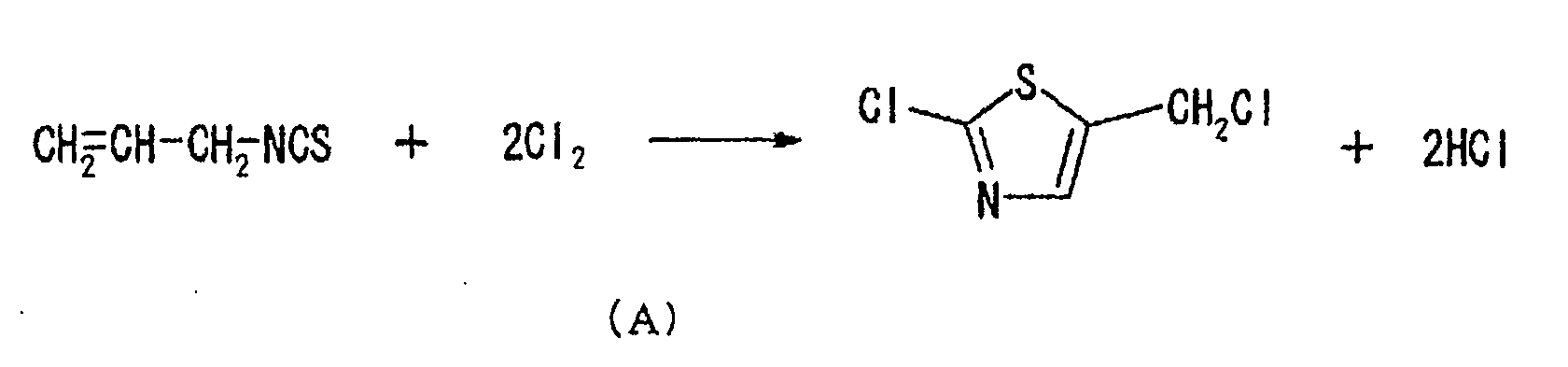
- This process requires a large amount of chlorinating agent and the reaction has to be performed under a high temperature, which produces many by-products.
Therefore, it is not so suitable for industrial application. - Alternatively, Japanese Patent Application Laid-Open No. 4-234864 discloses a process for preparing 2-chloro-5-chloromethylthiazole by allowing allyl isothiocyanate derivative to react with chlorinating agent as described in the following scheme (B):
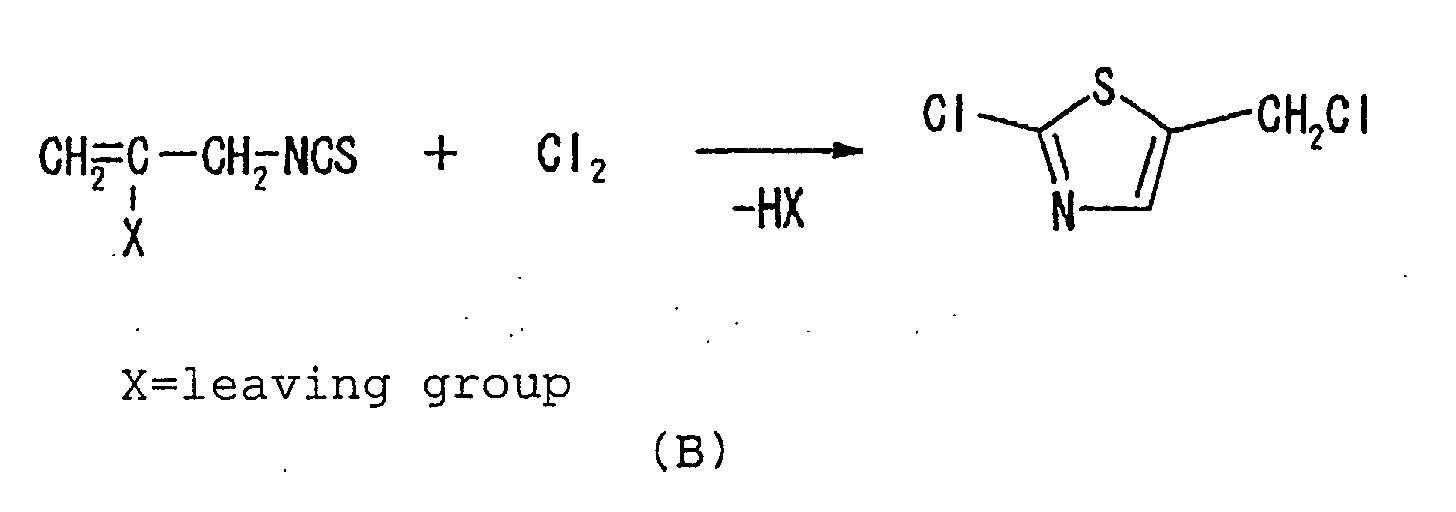
- This process is suitable for industrial application which can be performed using approximately an equal amount of chlorinating agent under moderate condition to give a high yield. However, inert solvent (diluent) such as halocarbon may preferably be used to give a high yield, which requires high production cost.
- Japanese Patent Application Laid-Open No. 2000-247963 (2000) discloses a process which involves allowing 2-halogenoallyl isothiocyanate to react with chlorinating agent in a dipolar aprotic solvent such as acetonitrile. This process, however, has a disadvantage that the solvent cannot be reused since it is difficult to separate and collect the solvent such as acetonitrile from water.
- Accordingly, a novel process for preparing 2-chloro-5-chloromethylthiazole suitable for industrial application is still needed in which an excess amount of chlorinating agent is not required, moderate conditions can be used to give a high yield, and solvent can be collected easily.
- The object of the present invention to provide a novel process for preparing 2-chloro-5-chloromethylthiazole which is suitable for industrial application.
- Aromatic hydrocarbons and derivatives thereof (particularly toluene) are reactive with chlorinating agent. The present inventors unexpectedly found, as a result of intense studies, that 2-chloro-5-chloromethylthiazole can be obtained at a high yield by allowing 2-halogeno-allyl isothiocyanate to react with chlorinating agent in the presence of aromatic hydrocarbons which may have one or more substituents, and accomplished the present invention based on the findings.
- In other words, the present invention provides:
- (1) a process for preparing 2-chloro-5-chloromethylthiazole of the following formula (I):by allowing 2-halogeno-allyl isothiocyanate of the following formula (II):
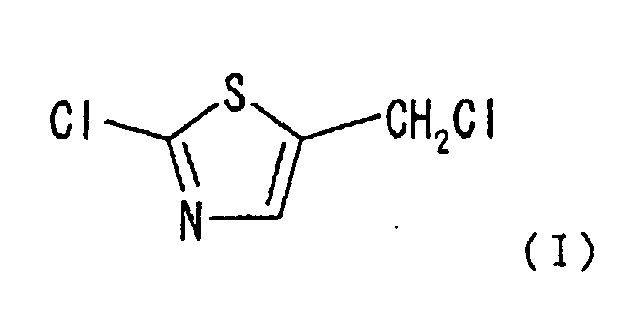 (wherein Hal represents chlorine or bromine) to react with chlorinating agent in the presence of an aromatic hydrocarbons which may have one or more substituents;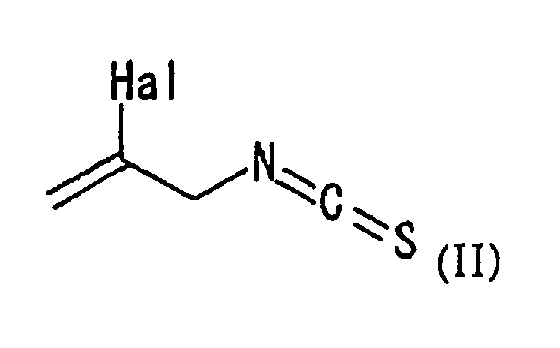
- (2) the process according to (1) above wherein the aromatic hydrocarbons which may have one or more substituents is toluene, chlorobenzene or dichlorobenzene; and
- (3) the process according to (1) above wherein the aromatic hydrocarbons which may have one or more substituents is toluene.
- (4) the process according to (1) above wherein Hal in the formula (II) is chlorine.
- A 2-halogenoallyl isothiocyanate of the following formula (II):(wherein Hal represents chlorine or bromine) is a known compound which can be prepared by any known processes. One unlimiting example of such process involves heating a mixture of 2,3-dihalogeno-1-propene (e.g., 2,3-dichloro-1-propene) with thiocyanate represented by M(SCN)n (wherein M represents metal or ammonium group, and n indicates the valence of M) in the presence of water (see, Japanese Patent Application Laid-Open No. 9-136874 (1997)).

- The process according to the present invention may be performed in the presence of an "aromatic hydrocarbons which may have one or more substituents". The aromatic hydrocarbon in the "aromatic hydrocarbon which may have one or more substituents" herein may include, for example, benzene, naphthalene and phenanthrene. The "aromatic hydrocarbon" may be substituted with , for example, C1-4 alkyl group (e.g., methyl, ethyl, propyl, isopropyl, butyl, isobutyl, s-butyl or t-butyl) and/or halogen (e.g., fluorine, chlorine, bromine or iodine) and number of substituents is preferably 1 to 3. Examples of such "aromatic hydrocarbons which may have one or more substituents" are toluene, o-, m-, p-xylene and xylene isomeric mixtures, ethylbenzene, cumene, cymene, mesitylene, chlorobenzene, as well as o-, m- or p-dichlorobenzene and isomeric mixtures of dichlorobenzene. Preferable examples of "aromatic hydrocarbons which may have one or more substituents" are chlorobenzene, dichlorobenzene (o-, m- or p-dichlorobenzene or mixtures thereof) and toluene, among them toluene is particularly preferable. The "aromatic hydrocarbons which may have one or more substituents" may be used alone or in combination of two or more thereof.
- Preferably 0.1 to 20 parts and more preferably 0.5 to 5 parts by weight of the "aromatic hydrocarbons which may have one or more substituents" may be used relative to 1 part by weight of the above-described 2-halogenoallyl isothiocyanate.
- The term "chlorinating agent " herein refers to chlorine or a compound which releases chlorine under reaction conditions, such as sulfuryl chloride or phosgene. The chlorinating agent is typically used in an amount of 0.8 to 2 equivalents, preferably 1.0 to 1.5 equivalents, and more preferably 1.05 to 1.30 equivalents relative to the above-described 2-halogenoallyl isothiocyanate.
- For example, a reaction process according to the present invention using 2-chloroallyl isothiocyanate as the starting material and sulfuryl chloride as the chlorinating agent can be particularly described with reference to the following scheme.

- The process according to the present invention can be performed, for example, under the following conditions.
- The reaction may typically be performed at -60 to 60°C, preferably at -10 to 50°C and more preferably at 10 to 40°C though a wide range of temperature may be selected.
- The reaction may preferably be performed under atmospheric pressure though reduced, atmospheric or pressurized pressure may be used.
- The reaction may typically be performed for from 10 minutes to 50 hours and preferably for 1 to 20 hours.
- After reaction completed, 2-chloro-5-chloromethylthiazole can be isolated by any known methods. For example, reaction mixture may be washed with a suitable amount of water, oil layer may be separated and collected, and then the "aromatic hydrocarbons which may have one or more substituents" may be removed by, for example, vacuum distillation. The "aromatic hydrocarbons which may have one or more substituents" may be collected for recycling.
- Hereinafter, the present invention will be described in more detail with reference to the following examples though they are not intended to limit the scope of the present invention.
- 2-chloroallyl isothiocyanate (75 g) was mixed with chlorobenzene (136 mL), heated to 30°C and added dropwise with sulfuryl chloride (84 g) for 3 hours. After stirring at 30°C for 2 hours, the reaction mixture was added to water (94 g). Separated chlorobenzene layer was added with water (18 g) followed by aqueous solution of 38 % potassium carbonate (48 g), and stirred for 30 minutes. Thereafter, oil layer was separated from aqueous layer. The oil layer was distilled under reduced pressure to collect chlorobenzene. The residue was further distilled under reduced pressure to give 77g of 2-chloro-5-chloromethylthiazole (purity=80 %, yield=75 %).
- 2-chloroallyl isothiocyanate (86 g) was mixed with chlorobenzene (136 mL), heated to 30°C and added dropwise with sulfuryl chloride (83 g) for 3 hours. After stirring at room temperature for 15 hours, the reaction mixture was added to water (94 g). Additionally, chlorobenzene (40mL) was added to the mixture which was then heated to 40°C and stirred for 1 hour. Thereafter, separated chlorobenzene layer was added with water (18 g) followed by dropwise aqueous solution of 38 % potassium carbonate (75 g) and stirred for 30 minutes, and oil phase was then separated from aqueous layer. The oil layer was enriched under reduced pressure to collect chlorobenzene. The enriched residue was further distilled under reduced pressure to give 75 g of 2-chloro-5-chloromethylthiazole (purity=95 %, yield=76 %).
- 2-chloroallyl isothiocyanate (30 g) was mixed with toluene (40 mL), and added dropwise with sulfuryl chloride (45 g) at room temperature for 1 hour. After stirring at room temperature for 2 hours, deposited crystal was collected by filtration, washed with toluene (40 mL), mixed with water (40 mL), heated to 40°C and then cooled to room temperature, and added with aqueous solution of 38 % potassium carbonate (16 g) to adjust pH to approximately 2. Then, oil layer was separated from aqueous layer. The oil layer was distilled under reduced pressure to give 26.0 g of 2-chloro-5-chloromethylthiazole (purity =95 %, yield=73 %).
- 2-chloroallyl isothiocyanate (30 g) was mixed with toluene (40 mL), and added dropwise with sulfuryl chloride (45 g) at room temperature for 1 hour. After stirring at room temperature for 2 hours, the mixture was heated to 40°C, stirred for 1 hour, and then added dropwise with water (5 mL). Then, aqueous solution of 38 % potassium carbonate (16 g) was added at room temperature to adjust pH to approximately 2. Then, water (10 mL) was added and separated. Toluene layer was enriched under reduced pressure to collect toluene (80 %) and then the enriched residue was further distilled under reduced pressure to give 27.1 g of 2-chloro-5-chloromethylthiazole (purity=98.0 %, yield=79 %).
- 2-chloroallyl isothiocyanate (purity=95.5%, 94.2 kg) was mixed with chlorobenzene (181.8 kg), heated to 30°C and added dropwise with sulfuryl chloride (101.3 kg) for 4 hours. After stirring at 30°C overnight, the reaction mixture was added to water (113.6 kg). Separated chlorobenzene layer was added with water (22.2 kg) followed by aqueous solution of 38 % potassium carbonate (39.1 kg), stirred for 1 hour, and allowed to stand overnight. Thereafter, organic layer was separated from aqueous layer. The organic layer was distilled under reduced pressure to collect chlorobenzene. The residue was further distilled under reduced pressure (102-104°C / 16-14 mmHg) to give 87.4 kg of 2-chloro-5-chloromethylthiazole (purity=97.4 %, yield=75.2 %).
- 2-chloroallyl isothiocyanate (purity=94.3%, 1740 kg) was mixed with toluene (1958 kg), heated to 30°C and added dropwise with sulfuryl chloride (1892 kg) for 4 hours. After stirring at 40°C for 2 hours, the mixture was added with water (1538 kg) followed by aqueous solution of 38 % potassium carbonate (2393 kg), and stirred for 30 minutes, and oil layer was then separated from aqueous layer. The oil layer was enriched under reduced pressure to collect toluene. The enriched residue was further distilled under reduced pressure (86-90°C / 4-2 mmHg) to give 1692 kg of 2-chloro-5-chloromethylthiazole (purity=95.0 %, yield=77.9 %).
- As described above, a novel process for preparing 2-chloro-5-chloromethylthiazole is provided according to the present invention in which an excess amount of chlorinating agent is not required, moderate conditions can be used to give a high yield, and solvent can be collected easily after reaction completed.
Claims (4)
- A process for preparing 2-chloro-5-chloromethylthiazole of the following formula (I):by allowing 2-halogeno-allyl isothiocyanate of the following formula (II):
 (wherein Hal represents chlorine or bromine) to react with chlorinating agent in the presence of an aromatic hydrocarbon which may have one or more substituents.
- The process according to claim 1 wherein the aromatic hydrocarbon which may have one or more substituents is toluene, chlorobenzene or dichlorobenzene.
- The process according to claim 1 wherein the aromatic hydrocarbon which may have one or more substituents is toluene.
- The process according to claim 1 wherein Hal in the formula (II) is chlorine.
Applications Claiming Priority (2)
| Application Number | Priority Date | Filing Date | Title |
|---|---|---|---|
| JP2000400802 | 2000-12-28 | ||
| JP2000400802 | 2000-12-28 |
Publications (1)
| Publication Number | Publication Date |
|---|---|
| EP1219613A1 true EP1219613A1 (en) | 2002-07-03 |
Family
ID=18865322
Family Applications (1)
| Application Number | Title | Priority Date | Filing Date |
|---|---|---|---|
| EP20010130397 Withdrawn EP1219613A1 (en) | 2000-12-28 | 2001-12-20 | Process for preparing 2-chloro-5-chloromethylthiazole |
Country Status (2)
| Country | Link |
|---|---|
| US (1) | US6407251B1 (en) |
| EP (1) | EP1219613A1 (en) |
Cited By (4)
| Publication number | Priority date | Publication date | Assignee | Title |
|---|---|---|---|---|
| US7531067B2 (en) | 2004-03-22 | 2009-05-12 | Toyo Kasei Kogyo Company, Limited | Process for purification of 2-chloro-5-chloromethyl-1,3-thiazole |
| EP1972621A4 (en) * | 2006-01-13 | 2011-12-28 | Sumitomo Chemical Co | PROCESS FOR PRODUCING THIAZOLE COMPOUND |
| CN105254583A (en) * | 2015-11-20 | 2016-01-20 | 河北德瑞化工有限公司 | Method for preparing 2-chloro-5-chloromethylthiazole by jet loop reactor |
| CN110252211A (en) * | 2019-07-15 | 2019-09-20 | 宁夏贝利特生物科技有限公司 | The method of 2- chloro-5-chloromethyl thiazole is continuously synthesized in a kind of tube type falling-film reactor |
Families Citing this family (5)
| Publication number | Priority date | Publication date | Assignee | Title |
|---|---|---|---|---|
| US6265553B1 (en) * | 1999-08-10 | 2001-07-24 | Syngenta Crop Protection, Inc. | Intermediate thiazoles and process for the preparation of 2-chloro-5-chloromethyl-thiazole |
| CN103741163B (en) * | 2013-12-20 | 2016-06-29 | 哈尔滨理工大学 | A kind of synthetic method of 2-chloro-5-chloromethyl-1,3-thiazole |
| CN113004218A (en) * | 2020-12-10 | 2021-06-22 | 怀仁市普惠生物科技有限公司 | Preparation method of dichloro pentachloromethyl thiazole |
| CN113754609A (en) * | 2021-10-11 | 2021-12-07 | 邯郸市瑞田农药有限公司 | 2-chloro-5-chloromethyl thiazole prepared by aqueous phase method and synthesis process thereof |
| CN115109008B (en) * | 2022-07-05 | 2024-02-06 | 山西玉龙化工有限公司 | Method for prolonging toluene solvent application in preparation of 2-chloro-5-chloromethylthiazole |
Citations (5)
| Publication number | Priority date | Publication date | Assignee | Title |
|---|---|---|---|---|
| EP0260560A1 (en) * | 1986-09-17 | 1988-03-23 | Bayer Ag | Process for the preparation of 2-chlor-5-chlormethyl thiazole |
| EP0446913A1 (en) * | 1990-03-16 | 1991-09-18 | Takeda Chemical Industries, Ltd. | Process for the preparation of chlorothiazole derivatives |
| WO1997010226A1 (en) * | 1995-09-11 | 1997-03-20 | Novartis Ag | Process for preparing a 2-chloro-5-chloromethyl-thiazole compound |
| EP0794180A1 (en) * | 1996-02-21 | 1997-09-10 | Kuraray Co., Ltd. | Process for the preparation of 2-chloro-5-chloromethyl-1,3-thiazole |
| EP1031566A1 (en) * | 1999-02-26 | 2000-08-30 | Bayer Aktiengesellschaft | Process for the preparation of 2-chloro-5-chloromethyl-thiazole |
Family Cites Families (4)
| Publication number | Priority date | Publication date | Assignee | Title |
|---|---|---|---|---|
| JP2546003B2 (en) | 1988-12-27 | 1996-10-23 | 武田薬品工業株式会社 | Guanidine derivative, its production method and insecticide |
| IE960441L (en) | 1988-12-27 | 1990-06-27 | Takeda Chemical Industries Ltd | Guanidine derivatives, their production and insecticides |
| JP3157308B2 (en) | 1992-09-11 | 2001-04-16 | 三洋電機株式会社 | Absorption chiller / heater |
| JP3323753B2 (en) | 1995-09-12 | 2002-09-09 | 武田薬品工業株式会社 | Improved production method of isothiocyanic acid derivative |
-
2001
- 2001-12-07 US US10/004,829 patent/US6407251B1/en not_active Expired - Lifetime
- 2001-12-20 EP EP20010130397 patent/EP1219613A1/en not_active Withdrawn
Patent Citations (5)
| Publication number | Priority date | Publication date | Assignee | Title |
|---|---|---|---|---|
| EP0260560A1 (en) * | 1986-09-17 | 1988-03-23 | Bayer Ag | Process for the preparation of 2-chlor-5-chlormethyl thiazole |
| EP0446913A1 (en) * | 1990-03-16 | 1991-09-18 | Takeda Chemical Industries, Ltd. | Process for the preparation of chlorothiazole derivatives |
| WO1997010226A1 (en) * | 1995-09-11 | 1997-03-20 | Novartis Ag | Process for preparing a 2-chloro-5-chloromethyl-thiazole compound |
| EP0794180A1 (en) * | 1996-02-21 | 1997-09-10 | Kuraray Co., Ltd. | Process for the preparation of 2-chloro-5-chloromethyl-1,3-thiazole |
| EP1031566A1 (en) * | 1999-02-26 | 2000-08-30 | Bayer Aktiengesellschaft | Process for the preparation of 2-chloro-5-chloromethyl-thiazole |
Cited By (8)
| Publication number | Priority date | Publication date | Assignee | Title |
|---|---|---|---|---|
| US7531067B2 (en) | 2004-03-22 | 2009-05-12 | Toyo Kasei Kogyo Company, Limited | Process for purification of 2-chloro-5-chloromethyl-1,3-thiazole |
| US7846304B2 (en) | 2004-03-22 | 2010-12-07 | Toyo Boseki Kabushiki Kaisha | Process for purification of 2-chloro-5-chloromethyl-1,3-thiazole |
| EP1728787B1 (en) * | 2004-03-22 | 2011-01-26 | Toyo Boseki Kabushiki Kaisha | Process for purification of 2-chloro-5-chloromethyl -1,3-thiazole |
| EP1972621A4 (en) * | 2006-01-13 | 2011-12-28 | Sumitomo Chemical Co | PROCESS FOR PRODUCING THIAZOLE COMPOUND |
| US8304558B2 (en) | 2006-01-13 | 2012-11-06 | Sumitomo Chemical Company, Limited | Method for producing thiazole compound |
| CN105254583A (en) * | 2015-11-20 | 2016-01-20 | 河北德瑞化工有限公司 | Method for preparing 2-chloro-5-chloromethylthiazole by jet loop reactor |
| CN105254583B (en) * | 2015-11-20 | 2017-12-26 | 河北德瑞化工有限公司 | The method that the 5-chloromethyl thiazole of 2 chlorine 5 is prepared using injection circulation reactor |
| CN110252211A (en) * | 2019-07-15 | 2019-09-20 | 宁夏贝利特生物科技有限公司 | The method of 2- chloro-5-chloromethyl thiazole is continuously synthesized in a kind of tube type falling-film reactor |
Also Published As
| Publication number | Publication date |
|---|---|
| US20020087008A1 (en) | 2002-07-04 |
| US6407251B1 (en) | 2002-06-18 |
Similar Documents
| Publication | Publication Date | Title |
|---|---|---|
| CA1302419C (en) | Process for the preparation of 5-chloromethylpyridines | |
| EP0763531B1 (en) | Preparation of substituted thiazoles | |
| US5099025A (en) | Preparation of 2-chloro-5-methyl-pyridine | |
| US6407251B1 (en) | Process for preparing 2-chloro-5-chloromethylthiazole | |
| JP4838924B2 (en) | Process for producing 2-chloro-5-chloromethylthiazole | |
| US5679796A (en) | Process for the preparation of 2-chloro-5-chloromethylthiazole | |
| JP2008516005A (en) | Improved preparation of letrozole | |
| US4897488A (en) | Process for the preparation of 2-chloro-5-methylpyridine | |
| KR0178542B1 (en) | Salts of dithiocarbamic acid, a method for producing the same, and a method for producing isothiocyanates using the salts of the dithiocarbamic acid | |
| US6787654B2 (en) | Method for producing 2-chloro-5-chloromethyl-1,3-thiazole | |
| KR100244880B1 (en) | Method for the preparation of 2-chloro-5-alkylaminomethyl-pyridine | |
| US4675447A (en) | Method for preparation of alkylsulfonyl alkylchlorobenzenes | |
| JPH04270260A (en) | Preparation of isothiocyanate | |
| KR100674098B1 (en) | Process for preparing N-alk (en) oxy (or aryloxy) carbonylisothiocyanate and derivatives thereof in the presence of N, N-dialkylarylamine catalyst | |
| JP2002255948A (en) | Method for producing 2-chloro-5-chloromethylthiazole | |
| US20060122426A1 (en) | Method for producing phthalic acid dichloride | |
| US5026864A (en) | Preparation of 2-chloro-5-aminomethyl-pyridine | |
| US3869509A (en) | N-alkyl-N(trihalomethylthio)-sulfamic acid chloride | |
| DE69421137T2 (en) | Process for the preparation of 1,2-diacyl-2-t-alkylhydroziden | |
| JP2000143649A (en) | Method for producing 2-chloro-5-chloromethyl-1,3-thiazole | |
| JP2991832B2 (en) | Method for producing pyrimidine derivative | |
| NOGUCHI et al. | Convenient One-pot Syntheses of Sulfinates, Sulfinamides, and Thiosulfinates by Sulfinylation with p-Toluenesulfinic Acid and Activating Reagents | |
| JP3213775B2 (en) | Method for producing 2-cyano-4,6-dimethoxypyrimidine | |
| US5502201A (en) | Process for preparing 2-chloro-benzothiazoles or 2-chloro-benzoxazoles | |
| KR960010101B1 (en) | Manufacturing method of 4-ortho toryl thiemicarbazide |
Legal Events
| Date | Code | Title | Description |
|---|---|---|---|
| PUAI | Public reference made under article 153(3) epc to a published international application that has entered the european phase |
Free format text: ORIGINAL CODE: 0009012 |
|
| AK | Designated contracting states |
Kind code of ref document: A1 Designated state(s): AT BE CH CY DE DK ES FI FR GB GR IE IT LI LU MC NL PT SE TR |
|
| AX | Request for extension of the european patent |
Free format text: AL;LT;LV;MK;RO;SI |
|
| 17P | Request for examination filed |
Effective date: 20020905 |
|
| 17Q | First examination report despatched |
Effective date: 20021111 |
|
| AKX | Designation fees paid |
Designated state(s): AT BE CH CY DE DK ES FI FR GB GR IE IT LI LU MC NL PT SE TR |
|
| RAP1 | Party data changed (applicant data changed or rights of an application transferred) |
Owner name: SUMITOMO CHEMICAL TAKEDA AGRO COMPANY, LIMITED |
|
| STAA | Information on the status of an ep patent application or granted ep patent |
Free format text: STATUS: THE APPLICATION IS DEEMED TO BE WITHDRAWN |
|
| 18D | Application deemed to be withdrawn |
Effective date: 20031022 |