EP1219601A1 - Prostaglandin derivatives - Google Patents
Prostaglandin derivatives Download PDFInfo
- Publication number
- EP1219601A1 EP1219601A1 EP00957063A EP00957063A EP1219601A1 EP 1219601 A1 EP1219601 A1 EP 1219601A1 EP 00957063 A EP00957063 A EP 00957063A EP 00957063 A EP00957063 A EP 00957063A EP 1219601 A1 EP1219601 A1 EP 1219601A1
- Authority
- EP
- European Patent Office
- Prior art keywords
- group
- alkyl group
- compound
- hydroxy
- alkyl
- Prior art date
- Legal status (The legal status is an assumption and is not a legal conclusion. Google has not performed a legal analysis and makes no representation as to the accuracy of the status listed.)
- Withdrawn
Links
Classifications
-
- C—CHEMISTRY; METALLURGY
- C07—ORGANIC CHEMISTRY
- C07C—ACYCLIC OR CARBOCYCLIC COMPOUNDS
- C07C405/00—Compounds containing a five-membered ring having two side-chains in ortho position to each other, and having oxygen atoms directly attached to the ring in ortho position to one of the side-chains, one side-chain containing, not directly attached to the ring, a carbon atom having three bonds to hetero atoms with at the most one bond to halogen, and the other side-chain having oxygen atoms attached in gamma-position to the ring, e.g. prostaglandins ; Analogues or derivatives thereof
-
- A—HUMAN NECESSITIES
- A61—MEDICAL OR VETERINARY SCIENCE; HYGIENE
- A61P—SPECIFIC THERAPEUTIC ACTIVITY OF CHEMICAL COMPOUNDS OR MEDICINAL PREPARATIONS
- A61P43/00—Drugs for specific purposes, not provided for in groups A61P1/00-A61P41/00
-
- A—HUMAN NECESSITIES
- A61—MEDICAL OR VETERINARY SCIENCE; HYGIENE
- A61P—SPECIFIC THERAPEUTIC ACTIVITY OF CHEMICAL COMPOUNDS OR MEDICINAL PREPARATIONS
- A61P9/00—Drugs for disorders of the cardiovascular system
- A61P9/08—Vasodilators for multiple indications
Definitions
- the present invention relates to novel prostaglandin derivatives, pharmaceutically acceptable salts thereof and hydrates thereof.
- prostaglandin exhibits various important physiological actions in a trace amount
- the biological activities of a great number of natural PGs and synthesized PG derivatives have been investigated with the intention of a practical use as medicines and have been reported in many literatures, for example, Japanese Patent Kokai No. 52-100446 and U.S. Patent No. 4,131,738.
- Natural PGs and PG derivatives have biological actions such as a vasodilating action, a prophlogistic action, an inhibitory action of blood platelet aggregation, a uterine muscle contraction action, an intestine contraction action or a lowering action of intraocular pressure, and are useful for treatment or prevention of myocardial infarction, angina pectoris, arteriosclerosis, hypertension or duodenal ulcer, and further useful for labor induction, artificial termination of pregnancy, etc.
- PTCA percutaneous transluminal coronary angioplasty
- PTCA percutaneous transluminal coronary angioplasty
- the compounds which can control not only the migration from intima to mesothelium of vascular smooth muscle cells deeply associating with the onset of restenosis but also their growth in the mesothelium are greatly expected as drugs for prevention of the restenosis caused after PTCA.
- no clinically available drugs have been found.
- An object of the present invention is to provide novel PG derivatives which have an excellent action in inhibiting the growth of vascular smooth muscle and are greatly expected as drugs for prevention or treatment of the restenosis after PTCA.
- the present invention is directed to a prostaglandin derivative represented by Formula (I): [wherein X is CH 2 , O or a group represented by the formula:
- the present invention is directed to a pharmaceutical preparation which comprises as an effective ingredient the compound represented by formula (I), the pharmaceutically acceptable salt thereof or the hydrate thereof.
- the vinylene group refers to a cis- or a trans-vinylene group.
- the halogen atom refers to a fluorine atom, a chlorine atom, a bromine atom or an iodine atom.
- the C 1-10 alkyl group means a straight or branched alkyl group having 1 to 10 carbon atoms, and examples of which are a methyl group, an ethyl group, a propyl group, an isopropyl group, a butyl group, an isobutyl group, a tert-butyl group, a pentyl group, a 2-ethylpropyl group, a hexyl group, an octyl group and a decanyl group.
- the C 1-10 alkoxy group means a straight or branched alkoxy group having 1 to 10 carbon atoms, and examples of which are a methoxy group, an ethoxy group, a propoxy group, an isopropoxy group, a butoxy group, an isobutoxy group a tert-butoxy group, a pentyloxy group and an octyloxy group.
- the C 2-10 alkenyl group means a straight or branched alkenyl group having 2 to 10 carbon atoms, and examples of which are a vinyl group, an allyl group, a 3-pentenyl group, a 4-hexenyl group, a 5-heptenyl group, a 4-methyl-3-pentenyl group, a 2,4-dimethylpentenyl group, a 6-methyl-5-heptenyl group and a 2,6-dimethyl-5-heptenyl group.
- the C 2-10 alkynyl group means a straight or branched alkynyl group having 2 to 10 carbon atoms, examples of which are an ethynyl group, a propargyl group, a 3-pentynyl group, a 4-hexynyl group, a 5-heptynyl group, a 4-methyl-3-pentynyl group, a 2,4-dimethylpentynyl group, a 6-methyl-5-heptynyl group and a 2,6-dimethyl-5-heptynyl group.
- the C 3-10 cycloalkyl group means a cycloalkyl group having 3 to 10 carbon atoms, examples of which are a cyclopropyl group, a cyclobutyl group, a cyclopentyl group, a cyclohexyl group and a cycloheptyl group.
- the C 1-5 alkyl-C 3-10 cycloalkyl group means a cycloalkyl group having 3 to 10 carbon atoms substituted with a straight or branched alkyl group having 1 to 5 carbon atoms, examples of which are a methylcyclopropyl group, a methylcyclohexyl group and an ethylcyclohexyl group.
- the C 3-10 cycloalkyl-C 1-5 alkyl group means a straight or branched alkyl group having 1 to 5 carbon atoms substituted with a cycloalkyl group having 3 to 10 carbon atoms, examples of which are a cyclopropylmethyl group, a cyclobutylmethyl group, a cyclopentylmethyl group, a cyclopentylethyl group, a cyclohexylmethyl group, a cyclohexylethyl group and a cycloheptylmethyl group.
- the hydroxy-C 1-5 alkyl group means a straight or branched alkyl group having 1 to 5 carbon atoms substituted with a hydroxyl group, examples of which are a hydroxymethyl group, a hydroxyethyl group, a 2-hydroxypropyl group, a 3-hydroxypropyl group, a 4-hydroxybutyl group and a 5-hydroxypentyl group.
- the halogeno-C 1-5 alkyl group means a straight or branched alkyl group having 1 to 5 carbon atoms substituted with at least one of a fluorine atom, a chlorine atom and a bromine atom, examples of which are a chloroethyl group, a 2-bromopropyl group, a 3-chloropropyl group, a 4-fluorobutyl group, a 5-chloropentyl group and a trifluoromethyl group.
- the C 1-5 alkoxy-C 1-5 alkyl group means a straight or branched alkyl group having 1 to 5 carbon atoms substituted with a straight or branched alkoxy group having 1 to 5 carbon atoms, examples of which are an ethoxymethyl group, a methoxyethyl group, a 2-ethoxypropyl group, a 3-methoxypropyl group and a tert-butoxyethyl group.
- the C 2-4 alkoxycarbonyl-C 1-5 alkyl group means a straight or branched C 1-5 alkyl group substituted with a straight or branched C 2-4 alkoxycarbonyl group, examples of which are a methoxycarbonylmethyl group, an ethoxycarbonylmethyl group, a 1-ethoxycarbonylethyl group and a 3-methoxycarbonylpropyl group.
- the carboxyl-C 1-5 alkyl group means a straight or branched alkyl group having 1 to 5 carbon atoms substituted with a carboxyl group, examples of which are a carboxylmethyl group, a 1-carboxylethyl group, a 2-carboxylethyl group and a 3-carboxylpropyl group.
- the cyano-C 1-5 alkyl group means a straight or branched alkyl group having 1 to 5 carbon atoms substituted with a cyano group, examples of which are a cyanomethyl group, a 2-cyanoethyl group, a 2-cyanopropyl group and a 3-cyanopropyl group.
- Examples of the C 1-5 alkyl group substituted with a group represented by the formula: -NR 7 R 8 are a 2-aminoethyl group, a 3-aminopropyl group, a 2-N,N-dimethylaminoethyl group, a 3-N,N-diethylaminopropyl group and a 2-piperidinoethyl group.
- the acyl group includes both of an aliphatic and aromatic acyl group, and the aliphatic acyl group includes a C 2-10 alkanoyl group, a C 2-10 alkenoyl group and a C 3-10 cycloalkenoyl group, and the aromatic acyl group includes an acyl group having a benzene ring which is unsubstituted or substituted with hydroxyl group(s) or halogen atom(s), examples of which are an acetyl group, a propionyl group, an isobutyryl group, a pivaloyl group, a propioloyl group, crotonyl group, a benzoyl group, a nicotinoyl group and a cyclohexylcarbonyl group.
- Examples of the pharmaceutically acceptable salt are salts with alkali metals (e.g., sodium or potassium), alkali earth metals (e.g., calcium or magnesium), ammonia, methylamine, dimethylamine, cyclopentylamine, benzylamine, piperidine, monoethanolamine, diethanolamine, monomethylmonoethanolamine, tromethamine, lysine, a tetraalkyl ammonium or tris(hydroxymethyl)aminomethane.
- alkali metals e.g., sodium or potassium
- alkali earth metals e.g., calcium or magnesium
- ammonia methylamine, dimethylamine, cyclopentylamine, benzylamine, piperidine, monoethanolamine, diethanolamine, monomethylmonoethanolamine, tromethamine, lysine, a tetraalkyl ammonium or tris(hydroxymethyl)aminomethane.
- a preferable group as defined for X is CH 2 and a group represented by the formula: S(O) q1 (wherein q1 is as defined above), and a more preferable group is CH 2 .
- a preferable group as defined for Y is an ethylene group, a vinylene group, an ethynylene group, a group represented by the formula: O(CH 2 ) tl or S(O) q2 (CH 2 ) tl (wherein q2 and tl are as defined above), and a more preferable group is an ethylene group, a vinylene group, OCH 2 or SCH 2 .
- a preferable group as defined for Z is a vinylene group or a ethynylene group.
- a preferable group as defined for R 1 is a hydrogen atom or a C 1-10 alkyl group.
- a preferable group as defined for R 2 is a C 1-10 alkyl group, a hydroxy-C 1-5 alkyl group, a C 1-5 alkoxy-C 1-5 alkyl group, a C 2-4 alkoxycarbonyl-C 1-5 alkyl group, a cyano-C 1-5 alkyl group, a C 1-5 alkyl group substituted with a group represented by the formula: -NR 77 R 88 (wherein R 77 and R 88 are the same or different, and each a hydrogen atom or a C 1-5 alkyl group), an acyl group, a group represented by the formula: -(CH 2 ) t2 CH(NH 2 )COOR 9 (wherein R 9 and t2 are as defined above) or a group represented by the formula: (wherein R 44 is a hydrogen atom, a halogen atom, a C 1-10 alkyl group, a C 1-10 alkoxy group, a nitro group or an amino group, and
- a preferable group as defined for R 3 is a hydrogen atom, a C 1-10 alkyl group, a C 3-10 cycloalkyl group, a C 3-10 cycloalkyl-C 1-5 alkyl group or a C 2-10 alkenyl group, and a more preferable group is a hydrogen atom or a C 1-10 alkyl group.
- the compounds of Formula (I) can be prepared, for example, by the methods summarized by the following reaction scheme.
- TBS is a tert-butyldimethylsilyl group
- Z' is an ethylene group or a vinylene group
- Et is an ethyl group
- R 6 is a straight or branched C 1-10 alkyl group or a C 3-10 cycloalkyl group
- q3 is 1 or 2
- X, Y, Z, R 2 , R 3 , m, n and p are as defined above.
- the compound wherein Z is an ethylene group or a vinylene group i.e., the compound wherein Z is Z'
- the compound wherein Z is an ethynylene group can be obtained by a reaction using a compound of Formula (III') at 0 to 30°C.
- the compound represented by Formula (III) or (III') can be prepared using a compound obtained according to the method of Skotnicki et al., in J. Med. Chem ., vol. 20, page 1042 (1977).
- the compound of Formula (VII) is subjected to dehydration using an organic acid (e.g., formic acid or acetic acid) or an inorganic acid (e.g., sulfuric acid or hydrochloric acid) in an organic solvent (e.g., methanol, ethanol, ethyl acetate or dioxane), water or a mixture thereof at 0 to 60°C to give a compound of Formula (VIII).
- an organic acid e.g., formic acid or acetic acid
- an inorganic acid e.g., sulfuric acid or hydrochloric acid
- an organic solvent e.g., methanol, ethanol, ethyl acetate or dioxane
- the compound of Formula (Ia) or (Ia') is hydrolyzed by a reaction with an enzyme in a buffer solution such as phosphate buffer or tris-hydrochloride buffer, if necessary, by using an organic solvent (e.g. a water-miscible solvent such as acetone, methanol or ethanol) to give a PG derivative of Formula (Ib) or (Ib').
- a buffer solution such as phosphate buffer or tris-hydrochloride buffer
- an organic solvent e.g. a water-miscible solvent such as acetone, methanol or ethanol
- enzymes produced by microorganisms e.g. enzymes produced by microorganisms belonging to Candida sp. or Pseudomonas sp.
- enzymes prepared from animal organs e.g. enzymes prepared from pig liver or pig pancreas.
- lipase VII derived from microorganism of Candida sp.; Sigma Co.
- lipase AY derived from microorganism of Candida sp.; Amano Pharmaceutical Co.
- lipase PS derived from microorganism of Pseudomonas sp.; Amano Pharmaceutical Co.
- lipase MF derived from microorganism of Pseudomonas sp.; Amano Pharmaceutical Co.
- PLE prepared from pig liver; Sigma Co.
- lipase II prepared from pig pancreas; Sigma Co.
- lipoprotein lipase prepared from pig pancreas; Tokyo Kasei Kogyo Co.
- the amount of the enzyme to be used while depending on the potency of the enzyme and the amount of the substrate (the compound of Formula (Ia)), is usually 0.1 to 20 parts by weight based on the substrate, and the reaction temperature is from 25 to 50°C, preferably 30 to 40°C.
- the compound of Formula (Ia) or (Ia') is oxidized using an oxidant such as sodium metaperiodate, hydrogen peroxide, peracetic acid, m-chloroperbenzoic acid or tert-butyl hydroxyperoxide in diethyl ether, methanol, ethanol, methylene chloride, water or a mixture thereof at -20 to 50°C to give a PG derivative of Formula (Ic) or (Ic').
- an oxidant such as sodium metaperiodate, hydrogen peroxide, peracetic acid, m-chloroperbenzoic acid or tert-butyl hydroxyperoxide in diethyl ether, methanol, ethanol, methylene chloride, water or a mixture thereof at -20 to 50°C to give a PG derivative of Formula (Ic) or (Ic').
- the compounds of the present invention can be administered systemically or topically; orally or parenterally such as rectally, subcutaneously, intramuscularly or intravenously, and preferably orally or intravenously.
- the dosage form for oral administration includes tablets, powders, granules, dusting powders, capsules, solutions, emulsions or suspensions, each of which can be prepared according to conventional methods.
- the dosage form for intravenous administration includes aqueous or non-aqueous solutions, emulsions, suspensions or solid preparations to be dissolved in a solvent for injection immediately before use.
- the compounds of the present invention can be formulated into the form of inclusion compounds with ⁇ -, ⁇ - or ⁇ -cyclodextrin, or methylated cyclodextrin.
- the compounds of the present invention can be administered by injection in the form of aqueous or non-aqueous solutions, emulsions, suspensions, etc. The dose is varied by the age, body weight, etc., but it is generally from 1 ng to 1 mg/day per adult, which can be administered in a single dose or divided doses.
- Example 1(5) Following the substantially same manner as in Example 1(5) using the compound obtained in Example 3(1) and 3-mercaptopropanol in place of 2-mercaptoethanol in Example 1(5), thereby the title compounds were obtained.
- Example 1(5) Following the substantially same manner as in Example 1(5) using the compound obtained in Example 3(1) and methyl thioglycolate in place of 2-mercaptoethanol in Example 1(5), thereby the title compounds were obtained.
- Example 1(5) Following the substantially same manner as in Example 1(5) using the compound obtained in Example 3(1) and 2-(N,N-diethylamino)ethanethiol in place of 2-mercaptoethanol in Example 1(5), thereby the title compound was obtained.
- IR(neat) cm -1 3523,2930,2858,1740,1456,1436,1375,1198,1173,1068,1030, 970,876,785,726
- Example 1(5) Following the substantially same manner as in Example 1(5) using the compound obtained in Example 3(1) and 1-propanethiol in place of 2-mercaptoethanol in Example 1(5), thereby the title compounds were obtained.
- Example 1(5) Following the substantially same manner as in Example 1(5) using the compound obtained in Example 3(1) and thioacetic acid in place of 2-mercaptoethanol in Example 1(5), thereby the title compound was obtained.
- Example 1(5) Following the substantially same manner as in Example 1(5) using the compound obtained in Example 3(1) and L-cysteine methyl ester in place of 2-mercaptoethanol in Example 1(5), thereby the title compounds were obtained.
- Example 1(5) Following the substantially same manner as in Example 1(5) using the compound obtained in Example 3(1) and 4-methoxy- ⁇ -toluenethiol in place of 2-mercaptoethanol in Example 1(5), thereby the title compounds were obtained.
- a toluene solution (12 ml) of (4RS)-4-(tert-butyldimethylsiloxy)-5,5-trimethylene-1-octyne (1.09 g) was added n-butyl lithium (2.5 M, hexane solution, 1.44 ml) under an argon stream at 0°C, followed by stirring at room temperature for 30 minutes.
- n-butyl lithium 2.5 M, hexane solution, 1.44 ml
- diethylaluminum chloride (0.95 M, hexane solution, 4.42 ml) at 0°C, followed by stirring at room temperature for 30 minutes.
- Example 2 Following the substantially same manner as in Example 1(2) using the compound obtained in (1) in place of (3R,4R)-2-methylene-3-[(1E,4RS)-4-tert-butyldimethylsiloxy-5,5-trimethyleneoct-1-enyl]-4-(tert-butyldimethylsiloxy)cyclopentan-1-one in Example 1(2), thereby (16RS)-15-deoxy-16-hydroxy-17,17-trimethylene-13,14-didehydro-PGE 1 methyl ester 11,16-bis(tert-butyldimethylsilyl ether) was obtained.
- Example 2 Following the substantially same manner as in Example 1(2) using the compound obtained in (1) in place of (3R,4R)-2-methylene-3-[(1E,4RS)-4-tert-butyldimethylsiloxy-5,5-trimethyleneoct-1-enyl]-4-(tert-butyldimethylsiloxy)cyclopentan-1-one in Example 1(2) and using 5-methoxycarbonyl-4-oxapentyl zinc (II) iodide in place of 5-methoxycarbonylpentyl zinc (II) iodide in Example 1(2), thereby (16RS)-3-oxa-15-deoxy-16-hydroxy-17,17-tetramethylene-13,14-didehydro-PGE 1 methyl ester 11,16-bis(tert-butyldimethylsilyl ether) was obtained.
- Example 31 Following the substantially same manner as in Example 30 using (2E,11R,16S)-11,15-dideoxy-11-(2-hydroxyethylthio)-16-hydroxy-17,17-trimethylene-2,3-didehydro-PGE 1 methyl ester obtained in Example 31, thereby the title compound was obtained.
- Example 33 Following the substantially same manner as in Example 2 using (11R,16R)-3-thia-11,15-dideoxy-11-(2-hydroxyethylthio)-16-hydroxy-17,17-trimethylene-PGE 1 methyl ester obtained in Example 33, thereby the title compound was obtained.
- Example 35 Following the substantially same manner as in Example 2 using (11R,16S)-3-thia-11,15-dideoxy-11-(2-hydroxyethylthio)-16-hydroxy-17,17-trimethylene-PGE 1 methyl ester obtained in Example 35, thereby the title compound was obtained.
- 3 H-Thymidine (produced by Daiichi Chemicals Co.) was added in an amount of 0.01 mci/well and, after culturing for 24 hours, the cultured supernatant was removed by suction, followed by washing with a phosphate buffer solution (PBS).
- PBS phosphate buffer solution
- TCA Trichloroacetic acid
- test compounds were each used as an ethanol solution and compared with a vehicle-treated group as control.
- the present invention provides PG derivatives which exhibit an excellent action in inhibiting the growth of vascular smooth muscle cells.
- the PG derivatives of the present invention are useful as drugs for prevention or treatment of vascular thickening which leads to the restenosis after percutaneous transluminal coronary angioplasty and vascular occlusion.
Landscapes
- Organic Chemistry (AREA)
- Chemical & Material Sciences (AREA)
- Health & Medical Sciences (AREA)
- Nuclear Medicine, Radiotherapy & Molecular Imaging (AREA)
- Life Sciences & Earth Sciences (AREA)
- Chemical Kinetics & Catalysis (AREA)
- General Chemical & Material Sciences (AREA)
- Medicinal Chemistry (AREA)
- Engineering & Computer Science (AREA)
- Pharmacology & Pharmacy (AREA)
- Bioinformatics & Cheminformatics (AREA)
- Animal Behavior & Ethology (AREA)
- General Health & Medical Sciences (AREA)
- Public Health (AREA)
- Veterinary Medicine (AREA)
- Cardiology (AREA)
- Heart & Thoracic Surgery (AREA)
- Pharmaceuticals Containing Other Organic And Inorganic Compounds (AREA)
- Organic Low-Molecular-Weight Compounds And Preparation Thereof (AREA)
Abstract
A prostaglandin derivative represented by the
formula:
 [wherein X is CH2, O or S(O)q1, Y is an ethylene group, a
vinylene group, an ethynylene group, O(CH2)tl or
S(O)q2(CH2)tl, Z is an ethylene group, a vinylene group or
an ethynylene group, R1 is a hydrogen atom, a C1-10 alkyl
group or a C3-10 cycloalkyl group, R2 is a C1-10 alkyl
group, a C2-10 alkenyl group, a C2-10 alkynyl group, a C3-10
cycloalkyl group, a C1-5 alkyl-C3-10 cycloalkyl group, a
C3-10 cycloalkyl-C1-5 alkyl group, a hydroxy-C1-5 alkyl
group, a halogeno-C1-5 alkyl group, a C1-5 alkoxy-C1-5
alkyl group, a C2-4 alkoxycarbonyl-C1-5 alkyl group, a
carboxyl-C1-5 alkyl group, a cyano-C1-5 alkyl group, a C1-5
alkyl group substituted with a group represented by the
formula: -NR7R8, an acyl group, a group represented by the
formula: -(CH2)t2CH(NH2)COOR9, etc., and R3 is a hydrogen
atom, a C1-10 alkyl group, etc.], a pharmaceutically
acceptable salt thereof or a hydrate thereof.
[wherein X is CH2, O or S(O)q1, Y is an ethylene group, a
vinylene group, an ethynylene group, O(CH2)tl or
S(O)q2(CH2)tl, Z is an ethylene group, a vinylene group or
an ethynylene group, R1 is a hydrogen atom, a C1-10 alkyl
group or a C3-10 cycloalkyl group, R2 is a C1-10 alkyl
group, a C2-10 alkenyl group, a C2-10 alkynyl group, a C3-10
cycloalkyl group, a C1-5 alkyl-C3-10 cycloalkyl group, a
C3-10 cycloalkyl-C1-5 alkyl group, a hydroxy-C1-5 alkyl
group, a halogeno-C1-5 alkyl group, a C1-5 alkoxy-C1-5
alkyl group, a C2-4 alkoxycarbonyl-C1-5 alkyl group, a
carboxyl-C1-5 alkyl group, a cyano-C1-5 alkyl group, a C1-5
alkyl group substituted with a group represented by the
formula: -NR7R8, an acyl group, a group represented by the
formula: -(CH2)t2CH(NH2)COOR9, etc., and R3 is a hydrogen
atom, a C1-10 alkyl group, etc.], a pharmaceutically
acceptable salt thereof or a hydrate thereof.
Novel prostaglandin derivatives of the present
invention have an excellent action in inhibiting the growth
of vascular smooth muscle, and are useful as drugs for
prevention or treatment of the restenosis after PTCA, etc.
Description
The present invention relates to novel prostaglandin
derivatives, pharmaceutically acceptable salts thereof and
hydrates thereof.
Since prostaglandin (PG) exhibits various important
physiological actions in a trace amount, the biological
activities of a great number of natural PGs and synthesized
PG derivatives have been investigated with the intention of
a practical use as medicines and have been reported in many
literatures, for example, Japanese Patent Kokai No. 52-100446
and U.S. Patent No. 4,131,738. Natural PGs and PG
derivatives have biological actions such as a vasodilating
action, a prophlogistic action, an inhibitory action of
blood platelet aggregation, a uterine muscle contraction
action, an intestine contraction action or a lowering
action of intraocular pressure, and are useful for
treatment or prevention of myocardial infarction, angina
pectoris, arteriosclerosis, hypertension or duodenal ulcer,
and further useful for labor induction, artificial
termination of pregnancy, etc.
On the other hand, percutaneous transluminal coronary
angioplasty (PTCA) has low invasiveness to the patient as a
therapeutic modality of ischemic heart diseases and has an
excellent initial treatment effect, therefore, it is a
plasty which recently has rapidly been developed. However,
there has been an unsolved drawback of causing restenosis
of coronary artery at a frequency of 30 - 40% within a few
months after PTCA. The compounds which can control not
only the migration from intima to mesothelium of vascular
smooth muscle cells deeply associating with the onset of
restenosis but also their growth in the mesothelium are
greatly expected as drugs for prevention of the restenosis
caused after PTCA. However, no clinically available drugs
have been found.
An object of the present invention is to provide
novel PG derivatives which have an excellent action in
inhibiting the growth of vascular smooth muscle and are
greatly expected as drugs for prevention or treatment of
the restenosis after PTCA.
As a result of the continued extensive studies, the
present inventors have found that novel prostaglandin
derivatives having an alkylthio group, an arylthio group or
the like at the 11-position represented by the following
Formula (I) achieve the above-objects, and thereby the
present invention has been accomplished.
That is, the present invention is directed to a
prostaglandin derivative represented by Formula (I):
 [wherein X is CH2, O or a group represented by the formula:

R3 is a hydrogen atom, a C1-10 alkyl group, a C3-10 cycloalkyl group, a C1-5 alkyl-C3-10 cycloalkyl group, a C3-10 cycloalkyl-C1-5 alkyl group, a C2-10 alkenyl group or a C2-10 alkynyl group,
m is an integer of 0 to 3, n is an integer of 1 to 3, p is an integer of 0 to 5 and q is an integer of 0 to 2], a pharmaceutically acceptable salt thereof or a hydrate thereof.
Furthermore, the present invention is directed to a
pharmaceutical preparation which comprises as an effective
ingredient the compound represented by formula (I), the
pharmaceutically acceptable salt thereof or the hydrate
thereof.
In the present invention, the vinylene group refers
to a cis- or a trans-vinylene group. The halogen atom
refers to a fluorine atom, a chlorine atom, a bromine atom
or an iodine atom.
The C1-10 alkyl group means a straight or branched
alkyl group having 1 to 10 carbon atoms, and examples of
which are a methyl group, an ethyl group, a propyl group,
an isopropyl group, a butyl group, an isobutyl group, a
tert-butyl group, a pentyl group, a 2-ethylpropyl group,
a hexyl group, an octyl group and a decanyl group.
The C1-10 alkoxy group means a straight or branched
alkoxy group having 1 to 10 carbon atoms, and examples of
which are a methoxy group, an ethoxy group, a propoxy group,
an isopropoxy group, a butoxy group, an isobutoxy group a
tert-butoxy group, a pentyloxy group and an octyloxy group.
The C2-10 alkenyl group means a straight or branched
alkenyl group having 2 to 10 carbon atoms, and examples of
which are a vinyl group, an allyl group, a 3-pentenyl group,
a 4-hexenyl group, a 5-heptenyl group, a 4-methyl-3-pentenyl
group, a 2,4-dimethylpentenyl group, a 6-methyl-5-heptenyl
group and a 2,6-dimethyl-5-heptenyl group.
The C2-10 alkynyl group means a straight or branched
alkynyl group having 2 to 10 carbon atoms, examples of
which are an ethynyl group, a propargyl group, a 3-pentynyl
group, a 4-hexynyl group, a 5-heptynyl group, a 4-methyl-3-pentynyl
group, a 2,4-dimethylpentynyl group, a 6-methyl-5-heptynyl
group and a 2,6-dimethyl-5-heptynyl group.
The C3-10 cycloalkyl group means a cycloalkyl group
having 3 to 10 carbon atoms, examples of which are a
cyclopropyl group, a cyclobutyl group, a cyclopentyl group,
a cyclohexyl group and a cycloheptyl group.
The C1-5 alkyl-C3-10 cycloalkyl group means a
cycloalkyl group having 3 to 10 carbon atoms substituted
with a straight or branched alkyl group having 1 to 5
carbon atoms, examples of which are a methylcyclopropyl
group, a methylcyclohexyl group and an ethylcyclohexyl
group.
The C3-10 cycloalkyl-C1-5 alkyl group means a
straight or branched alkyl group having 1 to 5 carbon atoms
substituted with a cycloalkyl group having 3 to 10 carbon
atoms, examples of which are a cyclopropylmethyl group, a
cyclobutylmethyl group, a cyclopentylmethyl group, a
cyclopentylethyl group, a cyclohexylmethyl group, a
cyclohexylethyl group and a cycloheptylmethyl group.
The hydroxy-C1-5 alkyl group means a straight or
branched alkyl group having 1 to 5 carbon atoms substituted
with a hydroxyl group, examples of which are a
hydroxymethyl group, a hydroxyethyl group, a 2-hydroxypropyl
group, a 3-hydroxypropyl group, a 4-hydroxybutyl
group and a 5-hydroxypentyl group.
The halogeno-C1-5 alkyl group means a straight or
branched alkyl group having 1 to 5 carbon atoms substituted
with at least one of a fluorine atom, a chlorine atom and a
bromine atom, examples of which are a chloroethyl group, a
2-bromopropyl group, a 3-chloropropyl group, a 4-fluorobutyl
group, a 5-chloropentyl group and a
trifluoromethyl group.
The C1-5 alkoxy-C1-5 alkyl group means a straight or
branched alkyl group having 1 to 5 carbon atoms substituted
with a straight or branched alkoxy group having 1 to 5
carbon atoms, examples of which are an ethoxymethyl group,
a methoxyethyl group, a 2-ethoxypropyl group, a 3-methoxypropyl
group and a tert-butoxyethyl group.
The C2-4 alkoxycarbonyl-C1-5 alkyl group means a
straight or branched C1-5 alkyl group substituted with a
straight or branched C2-4 alkoxycarbonyl group, examples of
which are a methoxycarbonylmethyl group, an
ethoxycarbonylmethyl group, a 1-ethoxycarbonylethyl group
and a 3-methoxycarbonylpropyl group.
The carboxyl-C1-5 alkyl group means a straight or
branched alkyl group having 1 to 5 carbon atoms substituted
with a carboxyl group, examples of which are a
carboxylmethyl group, a 1-carboxylethyl group, a 2-carboxylethyl
group and a 3-carboxylpropyl group.
The cyano-C1-5 alkyl group means a straight or
branched alkyl group having 1 to 5 carbon atoms substituted
with a cyano group, examples of which are a cyanomethyl
group, a 2-cyanoethyl group, a 2-cyanopropyl group and a 3-cyanopropyl
group.
Examples of the C1-5 alkyl group substituted with a
group represented by the formula: -NR7R8 are a 2-aminoethyl
group, a 3-aminopropyl group, a 2-N,N-dimethylaminoethyl
group, a 3-N,N-diethylaminopropyl group and a 2-piperidinoethyl
group.
The acyl group includes both of an aliphatic and
aromatic acyl group, and the aliphatic acyl group includes
a C2-10 alkanoyl group, a C2-10 alkenoyl group and a C3-10
cycloalkenoyl group, and the aromatic acyl group includes
an acyl group having a benzene ring which is unsubstituted
or substituted with hydroxyl group(s) or halogen atom(s),
examples of which are an acetyl group, a propionyl group,
an isobutyryl group, a pivaloyl group, a propioloyl group,
crotonyl group, a benzoyl group, a nicotinoyl group and a
cyclohexylcarbonyl group.
Examples of the pharmaceutically acceptable salt
are salts with alkali metals (e.g., sodium or potassium),
alkali earth metals (e.g., calcium or magnesium), ammonia,
methylamine, dimethylamine, cyclopentylamine, benzylamine,
piperidine, monoethanolamine, diethanolamine,
monomethylmonoethanolamine, tromethamine, lysine, a
tetraalkyl ammonium or tris(hydroxymethyl)aminomethane.
In the present invention, a preferable group as
defined for X is CH2 and a group represented by the
formula: S(O)q1 (wherein q1 is as defined above), and a
more preferable group is CH2.
A preferable group as defined for Y is an ethylene
group, a vinylene group, an ethynylene group, a group
represented by the formula: O(CH2)tl or S(O)q2(CH2)tl
(wherein q2 and tl are as defined above), and a more
preferable group is an ethylene group, a vinylene group,
OCH2 or SCH2.
A preferable group as defined for Z is a vinylene
group or a ethynylene group.
A preferable group as defined for R1 is a hydrogen
atom or a C1-10 alkyl group.
A preferable group as defined for R2 is a C1-10
alkyl group, a hydroxy-C1-5 alkyl group, a C1-5 alkoxy-C1-5
alkyl group, a C2-4 alkoxycarbonyl-C1-5 alkyl group, a
cyano-C1-5 alkyl group, a C1-5 alkyl group substituted with
a group represented by the formula: -NR77R88 (wherein R77
and R88 are the same or different, and each a hydrogen atom
or a C1-5 alkyl group), an acyl group, a group represented
by the formula: -(CH2)t2CH(NH2)COOR9 (wherein R9 and t2 are
as defined above) or a group represented by the formula:
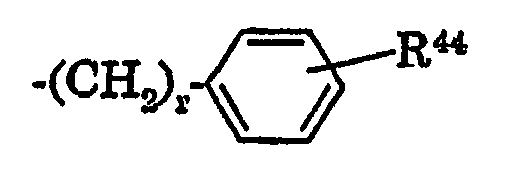 (wherein R44 is a hydrogen atom, a halogen atom, a C1-10
alkyl group, a C1-10 alkoxy group, a nitro group or an
amino group, and r is an integer of 0 to 3), and more
preferable groups are a hydroxy-C1-5 alkyl group, a C2-4
alkoxycarbonyl-C1-5 alkyl group, a C1-5 alkyl group
substituted with a di-C1-5 alkylamino group, a C2-10
alkanoyl group, a group represented by the formula:
-(CH2)t2CH(NH2)COOR9 (wherein R9 and t2 are as defined
above) and a group represented by the formula:
(wherein R44 is a hydrogen atom, a halogen atom, a C1-10
alkyl group, a C1-10 alkoxy group, a nitro group or an
amino group, and r is an integer of 0 to 3), and more
preferable groups are a hydroxy-C1-5 alkyl group, a C2-4
alkoxycarbonyl-C1-5 alkyl group, a C1-5 alkyl group
substituted with a di-C1-5 alkylamino group, a C2-10
alkanoyl group, a group represented by the formula:
-(CH2)t2CH(NH2)COOR9 (wherein R9 and t2 are as defined
above) and a group represented by the formula:
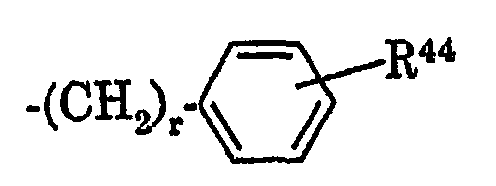 (wherein R44 is as defined above).
A preferable group as defined for R3 is a hydrogen
atom, a C1-10 alkyl group, a C3-10 cycloalkyl group, a C3-10
cycloalkyl-C1-5 alkyl group or a C2-10 alkenyl group,
and a more preferable group is a hydrogen atom or a C1-10
alkyl group.
The compounds of Formula (I) can be prepared, for
example, by the methods summarized by the following
reaction scheme.
In the reaction scheme, TBS is a tert-butyldimethylsilyl
group, Z' is an ethylene group or a
vinylene group, Et is an ethyl group, R6 is a straight or
branched C1-10 alkyl group or a C3-10 cycloalkyl group, q3
is 1 or 2, and X, Y, Z, R2, R3, m, n and p are as defined
above.


The above-mentioned reaction scheme is illustrated as
follows:
(1) At first, a known compound of Formula (II) is
reacted with 0.8 to 2.0 equivalents of an organic aluminum
compound represented by Formula (III) or (III') in an inert
solvent (e.g., benzene, toluene, tetrahydrofuran, diethyl
ether, methylene chloride or n-hexane) at -78 to 30°C
according to the method of Sato et al. (Journal of Organic
Chemistry, vol. 53, page 5590 (1988)) to stereospecifically
give a compound of Formula (IV). Herein, the compound
wherein Z is an ethylene group or a vinylene group (i.e.,
the compound wherein Z is Z') can be obtained by a reaction
using a compound of Formula (III) at -78 to 0°C, and the
compound wherein Z is an ethynylene group can be obtained
by a reaction using a compound of Formula (III') at 0 to
30°C. The compound represented by Formula (III) or (III')
can be prepared using a compound obtained according to the
method of Skotnicki et al., in J. Med. Chem., vol. 20, page
1042 (1977).
(2) The compound of Formula (IV) is reacted with
0.5 to 4 equivalents of an organic copper compound
represented by Formula (V) and 0.5 to 4 equivalents of
trimethylchlorosilane in an inert solvent (e.g., benzene,
toluene, tetrahydrofuran, diethyl ether, methylene chloride,
n-hexane or n-pentane) at -78 to 40°C, followed by
hydrolysis using an inorganic acid (e.g., hydrochloric acid,
sulfuric acid or nitric acid), an organic acid (e.g.,
acetic acid or p-toluenesulfonic acid) or an amine salt
thereof (e.g., pyridinium p-toluenesulfonate) in an organic
solvent (e.g., acetone, methanol, ethanol, isopropanol,
diethyl ether or a mixture thereof) at 0 to 40°C to
stereoselectively give a compound of Formula (VI).
(3) The tert-butyldimethylsilyl group of the compound
of Formula (VI) is removed using hydrofluoric acid,
pyridinium poly(hydrogenfluoride) or hydrochloric acid in
methanol, ethanol, acetonitrile, a mixture thereof or a
mixture of these solvents and water under conventional
conditions to give a compound of Formula (VII).
(4) The compound of Formula (VII) is subjected to
dehydration using an organic acid (e.g., formic acid or
acetic acid) or an inorganic acid (e.g., sulfuric acid or
hydrochloric acid) in an organic solvent (e.g., methanol,
ethanol, ethyl acetate or dioxane), water or a mixture
thereof at 0 to 60°C to give a compound of Formula (VIII).
(5) The compound of Formula (VIII) is reacted with 1
to 5 equivalents of a compound represented by Formula (IX)
and, if necessary, an amine (e.g., triethylamine or
diisobutylamine) or 0.05 to 2 equivalents of a radical
generating agent (e.g., azobisisobutyronitrile,
azobiscyclohexanecarbonitrile, benzoyl peroxide or triethyl
borane) in an inert solvent (e.g., chloroform, benzene,
toluene, xylene, n-hexane, n-pentane or acetone) at -78 to
100°C to give PG derivatives of formulae (Ia) and (Ia') of
the present invention, which are stereroisomerically
different from each other at the 11-position. These
compounds of formulae (Ia) and (Ia') can be purified
according to a conventional separation procedure such as
column chromatography.
(6) The compound of Formula (Ia) or (Ia') is
hydrolyzed by a reaction with an enzyme in a buffer
solution such as phosphate buffer or tris-hydrochloride
buffer, if necessary, by using an organic solvent (e.g. a
water-miscible solvent such as acetone, methanol or
ethanol) to give a PG derivative of Formula (Ib) or (Ib').
Examples of the enzyme to be used are enzymes
produced by microorganisms (e.g. enzymes produced by
microorganisms belonging to Candida sp. or Pseudomonas sp.)
and enzymes prepared from animal organs (e.g. enzymes
prepared from pig liver or pig pancreas). Commercially
available enzymes are, for example, lipase VII (derived
from microorganism of Candida sp.; Sigma Co.), lipase AY
(derived from microorganism of Candida sp.; Amano
Pharmaceutical Co.), lipase PS (derived from microorganism
of Pseudomonas sp.; Amano Pharmaceutical Co.), lipase MF
(derived from microorganism of Pseudomonas sp.; Amano
Pharmaceutical Co.), PLE (prepared from pig liver; Sigma
Co.), lipase II (prepared from pig pancreas; Sigma Co.) or
lipoprotein lipase (prepared from pig pancreas; Tokyo Kasei
Kogyo Co.).
The amount of the enzyme to be used, while depending
on the potency of the enzyme and the amount of the
substrate (the compound of Formula (Ia)), is usually 0.1 to
20 parts by weight based on the substrate, and the reaction
temperature is from 25 to 50°C, preferably 30 to 40°C.
(7) The compound of Formula (Ia) or (Ia') is oxidized
using an oxidant such as sodium metaperiodate, hydrogen
peroxide, peracetic acid, m-chloroperbenzoic acid or tert-butyl
hydroxyperoxide in diethyl ether, methanol, ethanol,
methylene chloride, water or a mixture thereof at -20 to
50°C to give a PG derivative of Formula (Ic) or (Ic').
(8) The compound of Formula (Ic) or (Ic') is
hydrolyzed using an enzyme in the similar manner as
described in the above (6) to give a PG derivative of
Formula (Id) or (Id'). In addition, oxidation using the
compound of Formula (Ib) or (Ib') in the similar manner as
described in the above (7) gives a PG derivative of Formula
(Id) or (Id').
Representative compounds of the present invention are
shown as follows.
| Compound | X | Y | Z | m | n | p | g | R1 | R2 | R3 | 11-position | 16-OH |
| 1 | CH2 | CH2CH2 | CH2CH2 | 2 | 0 | 1 | 0 | Me | HO(CH2)2 | nPr | α | β |
| 2 | CH2 | CH2CH2 | CH2CH2 | 2 | 0 | 1 | 0 | Me | HO(CH2)2 | nPr | β | β |
| 3 | CH2 | CH2CH2 | CH2CH2 | 2 | 0 | 1 | 0 | H | HO(CH2)2 | nPr | α | β |
| 4 | CH2 | CH2CH2 | CH2CH2 | 2 | 0 | 2 | 0 | Me | HO(CH2)2 | cHex | α | β |
| 5 | CH2 | CH2CH2 | CH2CH2 | 2 | 0 | 2 | 0 | Me | HO(CH2)2 | cHex | β | β |
| 6 | CH2 | CH2CH2 | CH2CH2 | 2 | 0 | 2 | 0 | H | HO(CH2)2 | cHex | α | β |
| 7 | CH2 | (E)CH=CH | CH2CH2 | 3 | 0 | 1 | 0 | Me | HO(CH2)2 | nPr | α | β |
| 8 | CH2 | (E)CH=CH | CH2CH2 | 3 | 0 | 1 | 0 | Me | HO(CH2)2 | nPr | β | β |
| 9 | CH2 | (E)CH=CH | CH2CH2 | 3 | 0 | 1 | 0 | H | HO(CH2)2 | nPr | α | β |
| 10 | CH2 | CH2CH2 | CH2CH2 | 2 | 0 | 1 | 0 | Me | NC(CH2)2 | nPr | α | β |
| 11 | CH2 | CH2CH2 | CH2CH2 | 2 | 0 | 1 | 0 | Me | NC(CH2)2 | nPr | β | β |
| 12 | CH2 | CH2CH2 | CH2CH2 | 2 | 0 | 1 | 0 | H | NC(CH2)2 | nPr | α | β |
| 13 | CH2 | CH2CH2 | (E)CH=CH | 3 | 0 | 1 | 0 | Me | HO(CH2)2 | H | α | β |
| 14 | CH2 | CH2CH2 | (E)CH=CH | 3 | 0 | 1 | 0 | Me | HO(CH2)2 | H | β | β |
| 15 | CH2 | CH2CH2 | (E)CH=CH | 3 | 0 | 1 | 0 | H | HO(CH2)2 | H | α | β |
| 16 | CH2 | CH2CH2 | (E)CH=CH | 2 | 0 | 1 | 0 | Me | HO(CH2)2 | Me | α | β |
| 17 | CH2 | CH2CH2 | (E)CH=CH | 2 | 0 | 1 | 0 | Me | HO(CH2)2 | Me | β | β |
| 18 | CH2 | CH2CH2 | (E)CH=CH | 2 | 0 | 1 | 0 | H | HO(CH2)2 | Me | α | β |
| 19 | CH2 | CH2CH2 | (E)CH=CH | 2 | 0 | 1 | 0 | Me | HO(CH2)2 | nPr | α | β |
| 20 | CH2 | CH2CH2 | (E)CH=CH | 2 | 0 | 1 | 0 | Me | HO(CH2)2 | nPr | β | β |
| 21 | CH2 | CH2CH2 | (E)CH=CH | 2 | 0 | 1 | 0 | H | HO(CH2)2 | nPr | α | β |
| 22 | CH2 | CH2CH2 | (E)CH=CH | 2 | 0 | 1 | 0 | Me | HO(CH2)2 | nPr | α | α |
| 23 | CH2 | CH2CH2 | (E)CH=CH | 2 | 0 | 1 | 0 | Me | HO(CH2)2 | nPr | β | α |
| 24 | CH2 | CH2CH2 | (E)CH=CH | 2 | 0 | 1 | 0 | H | HO(CH2)2 | nPr | α | α |
| 25 | CH2 | CH2CH2 | (E)CH=CH | 2 | 0 | 1 | 0 | H | HO(CH2)2 | nPr | β | α |
| 26 | CH2 | (Z)CH=CH | (E)CH=CH | 2 | 0 | 1 | 0 | Me | HO(CH2)2 | nPr | α | β |
| 27 | CH2 | (Z)CH=CH | (E)CH=CH | 2 | 0 | 1 | 0 | Me | HO(CH2)2 | nPr | β | β |
| 28 | CH2 | (Z)CH=CH | (E)CH=CH | 2 | 0 | 1 | 0 | H | HO(CH2)2 | nPr | α | β |
| 29 | CH2 | (E)CH=CH | (E)CH=CH | 2 | 0 | 1 | 0 | Me | HO(CH2)2 | nPr | α | β |
| 30 | CH2 | (E)CH=CH | (E)CH=CH | 2 | 0 | 1 | 0 | Me | HO(CH2)2 | nPr | β | β |
| 31 | CH2 | (E)CH=CH | (E)CH=CH | 2 | 0 | 1 | 0 | H | HO(CH2)2 | nPr | α | β |
| 32 | CH2 | (E)CH=CH | (E)CH=CH | 2 | 0 | 1 | 0 | Me | HO(CH2)2 | nPr | α | α |
| 33 | CH2 | (E)CH=CH | (E)CH=CH | 2 | 0 | 1 | 0 | Me | HO(CH2)2 | nPr | β | α |
| 34 | CH2 | (E)CH=CH | (E)CH=CH | 2 | 0 | 1 | 0 | H | HO(CH2)2 | nPr | α | α |
| 35 | CH2 | C≡C | (E)CH=CH | 2 | 0 | 1 | 0 | Me | HO(CH2)2 | nPr | α | β |
| 36 | CH2 | C≡C | (E)CH=CH | 2 | 0 | 1 | 0 | Me | HO(CH2)2 | nPr | β | β |
| 37 | CH2 | C≡C | (E)CH=CH | 2 | 0 | 1 | 0 | H | HO(CH2)2 | nPr | α | β |
| 38 | CH2 | C≡C | (E)CH=CH | 2 | 0 | 1 | 0 | Me | HO(CH2)2 | nPr | α | α |
| 39 | CH2 | C≡C | (E)CH=CH | 2 | 0 | 1 | 0 | Me | HO(CH2)2 | nPr | β | α |
| 40 | CH2 | C≡C | (E)CH=CH | 2 | 0 | 1 | 0 | H | HO(CH2)2 | nPr | α | α |
| 41 | CH2 | CH2CH2 | (E)CH=CH | 2 | 0 | 1 | 0 | Me | HO(CH2)3 | nPr | α | α |
| 42 | CH2 | CH2CH2 | (E)CH=CH | 2 | 0 | 1 | 0 | Me | HO(CH2)3 | nPr | β | α |
| 43 | CH2 | CH2CH2 | (E)CH=CH | 2 | 0 | 1 | 0 | H | HO(CH2)3 | nPr | α | α |
| 44 | CH2 | CH2CH2 | (E)CH=CH | 2 | 0 | 1 | 0 | iPr | HO(CH2)3 | nPr | α | α |
| 45 | CH2 | CH2CH2 | (E)CH=CH | 2 | 0 | 1 | 0 | Me | MeO2CCH2 | nPr | α | α |
| 46 | CH2 | CH2CH2 | (E)CH=CH | 2 | 0 | 1 | 0 | Me | MeO2CCH2 | nPr | β | α |
| 47 | CH2 | CH2CH2 | (E)CH=CH | 2 | 0 | 1 | 0 | Me | HO2CCH2 | nPr | α | α |
| 48 | CH2 | CH2CH2 | (E)CH=CH | 2 | 0 | 1 | 0 | Me | Et2N(CH2)2 | nPr | αβ | α |
| 49 | CH2 | CH2CH2 | (E)CH=CH | 2 | 0 | 1 | 0 | cHex | nPr | nPr | α | α |
| 50 | CH2 | CH2CH2 | (E)CH=CH | 2 | 0 | 1 | 0 | Me | nPr | nPr | α | α |
| 51 | CH2 | CH2CH2 | (E)CH=CH | 2 | 0 | 1 | 0 | Me | nPr | nPr | β | α |
| 52 | CH2 | CH2CH2 | (E)CH=CH | 2 | 0 | 1 | 0 | H | nPr | nPr | α | α |
| 53 | CH2 | CH2CH2 | (E)CH=CH | 2 | 0 | 1 | 0 | Me | CH3CO | nPr | αβ | α |
| 54 | CH2 | CH2CH2 | (E)CH=CH | 2 | 0 | 1 | 0 | Me | Cys(OMe) | nPr | α | α |
| 55 | CH2 | CH2CH2 | (E)CH=CH | 2 | 0 | 1 | 0 | Me | Cys(OMe) | nPr | β | α |
| 56 | CH2 | CH2CH2 | (E)CH=CH | 2 | 0 | 1 | 0 | Me | m-NO2Ph | nPr | α | α |
| 57 | CH2 | CH2CH2 | (E)CH=CH | 2 | 0 | 1 | 0 | Me | p-MeOBn | nPr | α | α |
| 58 | CH2 | CH2CH2 | (E)CH=CH | 2 | 0 | 1 | 0 | Me | p-MeOBn | nPr | β | α |
| 59 | CH2 | CH2CH2 | (E)CH=CH | 2 | 0 | 1 | 0 | H | p-MeOBn | nPr | α | α |
| 60 | CH2 | CH2CH2 | (E)CH=CH | 2 | 0 | 1 | 0 | Me | p-ClPh | nPr | α | α |
| 61 | CH2 | CH2CH2 | (E)CH=CH | 2 | 0 | 1 | 0 | H | p-ClPh | nPr | α | α |
| 62 | CH2 | CH2CH2 | (E)CH=CH | 2 | 0 | 1 | 0 | Me | HO(CH2)2 | cPrCH2 | α | β |
| 63 | CH2 | CH2CH2 | (E)CH=CH | 2 | 0 | 1 | 0 | H | HO(CH2)2 | cPrCH2 | a | β |
| 64 | CH2 | OCH2 | (E)CH=CH | 2 | 0 | 1 | 0 | Me | HO(CH2)2 | nPr | α | β |
| 65 | CH2 | OCH2 | (E)CH=CH | 2 | 0 | 1 | 0 | Me | HO(CH2)2 | nPr | β | β |
| 66 | CH2 | OCH2 | (E)CH=CH | 2 | 0 | 1 | 0 | H | HO(CH2)2 | nPr | α | β |
| 67 | CH2 | OCH2 | (E)CH=CH | 2 | 0 | 1 | 0 | Me | HO(CH2)2 | nPr | α | α |
| 68 | CH2 | OCH2 | (E)CH=CH | 2 | 0 | 1 | 0 | Me | HO(CH2)2 | nPr | β | α |
| 69 | CH2 | OCH2 | (E)CH=CH | 2 | 0 | 1 | 0 | H | HO(CH2)2 | nPr | α | α |
| 70 | CH2 | OCH2 | (E)CH=CH | 2 | 0 | 2 | 0 | Me | HO(CH2)2 | nPr | α | α |
| 71 | CH2 | OCH2 | (E)CH=CH | 2 | 0 | 2 | 0 | Me | HO(CH2)2 | nPr | β | α |
| 72 | CH2 | OCH2 | (E)CH=CH | 2 | 0 | 2 | 0 | H | HO(CH2)2 | nPr | α | α |
| 73 | CH2 | OCH2 | (E)CH=CH | 2 | 0 | 2 | 0 | Me | HO(CH2)2 | nPr | α | β |
| 74 | CH2 | OCH2 | (E)CH=CH | 2 | 0 | 2 | 0 | Me | HO(CH2)2 | nPr | β | β |
| 75 | CH2 | OCH2 | (E)CH=CH | 2 | 0 | 2 | 0 | H | HO(CH2)2 | nPr | α | β |
| 76 | CH2 | OCH2 | (E)CH=CH | 1 | 1 | 3 | 0 | Me | HO(CH2)2 | nPr | α | β |
| 77 | CH2 | OCH2 | (E)CH=CH | 1 | 1 | 3 | 0 | Me | HO(CH2)2 | nPr | β | β |
| 78 | CH2 | OCH2 | (E)CH=CH | 1 | 1 | 3 | 0 | H | HO(CH2)2 | nPr | α | β |
| 79 | CH2 | SCH2 | (E)CH=CH | 2 | 0 | 1 | 0 | Me | HO(CH2)2 | nPr | α | β |
| 80 | CH2 | SCH2 | (E)CH=CH | 2 | 0 | 1 | 0 | Me | HO(CH2)2 | nPr | β | β |
| 81 | CH2 | SCH2 | (E)CH=CH | 2 | 0 | 1 | 0 | H | HO(CH2)2 | nPr | α | β |
| 82 | CH2 | SCH2 | (E)CH=CH | 2 | 0 | 1 | 0 | Me | HO(CH2)2 | nPr | α | α |
| 83 | CH2 | SCH2 | (E)CH=CH | 2 | 0 | 1 | 0 | Me | HO(CH2)2 | nPr | β | α |
| 84 | CH2 | SCH2 | (E)CH=CH | 2 | 0 | 1 | 0 | H | HO(CH2)2 | nPr | α | α |
| 85 | CH2 | CH2CH2 | C≡C | 2 | 0 | 1 | 0 | Me | HO(CH2)2 | nPr | α | αβ |
| 86 | CH2 | CH2CH2 | C≡C | 2 | 0 | 1 | 0 | Me | HO(CH2)2 | nPr | β | αβ |
| 87 | CH2 | CH2CH2 | C≡C | 2 | 0 | 1 | 0 | H | HO(CH2)2 | nPr | α | αβ |
| 88 | CH2 | CH2CH2 | C≡C | 2 | 0 | 1 | 0 | H | HO(CH2)2 | nPr | β | αβ |
| 89 | CH2 | (E)CH=CH | C≡C | 2 | 0 | 1 | 0 | Me | HO(CH2)2 | nPr | α | αβ |
| 90 | CH2 | (E)CH=CH | C≡C | 2 | 0 | 1 | 0 | Me | HO(CH2)2 | nPr | β | αβ |
| 91 | CH2 | (E)CH=CH | C≡C | 2 | 0 | 1 | 0 | H | HO(CH2)2 | nPr | α | αβ |
| 92 | CH2 | C≡C | C=C | 2 | 0 | 1 | 0 | Me | HO(CH2)2 | nPr | α | αβ |
| 93 | CH2 | C≡C | C≡C | 2 | 0 | 1 | 0 | Me | HO(CH2)2 | nPr | β | αβ |
| 94 | CH2 | C≡C | C≡C | 2 | 0 | 1 | 0 | H | HO(CH2)2 | nPr | α | αβ |
| 95 | CH2 | O(CH2)2 | C≡C | 1 | 0 | 1 | 0 | Me | HO(CH2)2 | nPr | α | αβ |
| 96 | CH2 | O(CH2)2 | C≡C | 1 | 0 | 1 | 0 | Me | HO(CH2)2 | nPr | β | αβ |
| 97 | CH2 | O(CH2)2 | C≡C | 1 | 0 | 1 | 0 | H | HO(CH2)2 | nPr | α | αβ |
| 98 | CH2 | OCH2 | C≡C | 2 | 0 | 2 | 0 | Me | HO(CH2)2 | nPr | α | αβ |
| 99 | CH2 | OCH2 | C≡C | 2 | 0 | 2 | 0 | Me | HO(CH2)2 | nPr | β | αβ |
| 100 | CH2 | OCH2 | C≡C | 2 | 0 | 2 | 0 | H | HO(CH2)2 | nPr | α | αβ |
| 101 | CH2 | OCH2 | C≡C | 2 | 0 | 2 | 0 | Me | MeO(CH2)2 | nPr | α | αβ |
| 102 | CH2 | OCH2 | C≡C | 2 | 0 | 2 | 0 | Me | MeO(CH2)2 | nPr | β | αβ |
| 103 | CH2 | OCH2 | C≡C | 2 | 0 | 2 | 0 | H | MeO(CH2)2 | nPr | α | αβ |
| 104 | CH2 | OCH2 | C≡C | 2 | 0 | 2 | 0 | Me | HO(CH2)2 | CH=CH2 | α | αβ |
| 105 | CH2 | OCH2 | C≡C | 2 | 0 | 2 | 0 | Me | HO(CH2)2 | CH=CH2 | β | αβ |
| 106 | CH2 | OCH2 | C≡C | 2 | 0 | 2 | 0 | H | HO(CH2)2 | CH=CH2 | α | αβ |
| 107 | CH2 | SCH2 | C≡C | 2 | 0 | 1 | 0 | Me | HO(CH2)2 | nPr | α | αβ |
| 108 | CH2 | SCH2 | C≡C | 2 | 0 | 1 | 0 | Me | HO(CH2)2 | nPr | β | αβ |
| 109 | S | CH2CH2 | C≡C | 0 | 2 | 1 | 0 | H | HO(CH2)2 | nPr | α | αβ |
| 110 | S | CH2CH2 | C≡C | 0 | 2 | 1 | 0 | H | HO(CH2)3 | nPr | α | αβ |
| 111 | S | CH2CH2 | CH2CH2 | 0 | 3 | 1 | 0 | Me | HO(CH2)2 | nPr | α | α |
| 112 | S | CH2CH2 | CH2CH2 | 0 | 3 | 1 | 0 | H | HO(CH2)2 | nPr | α | β |
| 113 | S | CH2CH2 | CH2CH2 | 0 | 3 | 2 | 0 | Me | HO(CH2)2 | cHex | α | β |
| 114 | S | (E)CH=CH | CH2CH2 | 0 | 2 | 1 | 0 | tBu | HO(CH2)2 | nPr | α | β |
| 115 | S | (E)CH=CH | CH2CH2 | 0 | 2 | 1 | 0 | Me | HO(CH2)2 | nPr | α | β |
| 116 | S | CH2CH2 | (E)CH=CH | 0 | 3 | 1 | 0 | Me | HO(CH2)2 | H | α | β |
| 117 | S | CH2CH2 | (E)CH=CH | 0 | 3 | 1 | 0 | cHex | HO(CH2)2 | Me | α | β |
| 118 | S | CH2CH2 | (E)CH=CH | 0 | 2 | 1 | 0 | Me | HO(CH2)2 | nPr | α | β |
| 119 | S | CH2CH2 | (E)CH=CH | 0 | 2 | 1 | 0 | H | HO(CH2)2 | nPr | α | β |
| 120 | S | CH2CH2 | (E)CH=CH | 0 | 2 | 1 | 0 | Me | HO(CH2)2 | nPr | α | α |
| 121 | S | CH2CH2 | (E)CH=CH | 0 | 2 | 1 | 0 | H | HO(CH2)2 | nPr | α | α |
| 122 | S | CH2CH2 | (E)CH=CH | 0 | 3 | 1 | 0 | Me | HO(CH2)3 | nPr | α | α |
| 123 | S | CH2CH2 | (E)CH=CH | 0 | 3 | 1 | 0 | H | HO(CH2)3 | nPr | α | α |
| 124 | S | (Z)CH=CH | CH2CH2 | 0 2 | 1 | 0 | H | HO(CH2)2 | nPr | α | β | |
| 125 | S | (E)CH=CH | CH2CH2 | 0 | 2 | 1 | 0 | Me | HO(CH2)2 | nPr | α | α |
| 126 | S | (E)CH=CH | CH2CH2 | 0 | 2 | 1 | 0 | Me | HO(CH2)2 | nPr | β | α |
| 127 | S | C≡C | (E)CH=CH | 0 | 2 | 1 | 0 | H | HO(CH2)2 | nPr | α | β |
| 128 | S | OCH2 | (E)CH=CH | 0 | 2 | 1 | 0 | Me | HO(CH2)2 | nPr | α | α |
| 129 | S | OCH2 | (E)CH=CH | 0 | 2 | 1 | 0 | H | HO(CH2)2 | nPr | α | α |
| 130 | S | OCH2 | (E)CH=CH | 0 | 3 | 2 | 0 | Me | HO(CH2)2 | nPr | α | β |
| 131 | S | OCH2 | (E)CH=CH | 0 | 3 | 2 | 0 | Me | HO(CH2)2 | nPr | β | β |
| 132 | S | SCH2 | (E)CH=CH | 0 | 2 | 1 | 0 | Me | HO(CH2)2 | nPr | α | α |
| 133 | S | SCH2 | (E)CH=CH | 0 | 2 | 1 | 0 | H | HO(CH2)2 | nPr | α | α |
| 134 | S(O) | S(O)CH2 | (E)CH=CH | 0 | 2 | 1 | 1 | Me | HO(CH2)2 | Me | α | αβ |
| 135 | S(O)2 | S(O)2CH2 | (E)CH=CH | 0 | 2 | 1 | 2 | Me | HO(CH2)2 | Me | α | αβ |
| 136 | S | CH2CH2 | C≡C | 0 | 2 | 1 | 0 | H | HO(CH2)2 | nPr | α | αβ |
| 137 | S | CH2CH2 | C≡C | 0 | 2 | 1 | 0 | H | HO(CH2)2 | nPr | β | αβ |
| 138 | S | (E)CH=CH | C≡C | 0 | 2 | 1 | 0 | Me | HO(CH2)2 | nPr | α | αβ |
| 139 | S | (E)CH=CH | C≡C | 0 | 2 | 1 | 0 | H | HO(CH2)2 | nPr | α | αβ |
| 140 | S | C≡C | C≡C | 0 | 3 | 1 | 0 | Me | HO(CH2)2 | nPr | α | αβ |
| 141 | S | C≡C | C≡C | 0 | 3 | 1 | 0 | H | HO(CH2)2 | nPr | α | αβ |
| 142 | S | C≡C | C≡C | 0 | 2 | 1 | 0 | Me | HO(CH2)2 | nPr | α | αβ |
| 143 | S | OCH2 | C≡C | 0 | 2 | 1 | 0 | H | HO(CH2)2 | nPr | α | αβ |
| 144 | S | OCH2 | C≡C | 0 | 2 | 2 | 0 | H | HO(CH2)2 | nPr | α | αβ |
| 145 | S | OCH2 | C≡C | 0 | 2 | 2 | 0 | Me | HO(CH2)2 | CH=CH2 | α | αβ |
| 146 | S | OCH2 | C≡C | 0 | 2 | 2 | 0 | H | HO(CH2)2 | CH=CH2 | α | αβ |
| 147 | S | S(CH2)2 | C≡C | 0 | 2 | 1 | 0 | Me | HO(CH2)2 | nPr | α | αβ |
| 148 | S | SCH2 | C≡C | 0 | 2 | 1 | 0 | Me | HO(CH2)2 | nPr | β | αβ |
| 149 | S | SCH2 | C≡C | 0 | 2 | 1 | 0 | H | HO(CH2)2 | nPr | α | αβ |
| 150 | S | O(CH2)2 | C≡C | 0 | 2 | 1 | 0 | H | HO(CH2)3 | nPr | α | αβ |
| nPr: n-propyl, iPr: isopropyl, cHex: cyclohexyl, cPrCH2: cyclopropylmethyl, m-NO2Ph: m-nitrophenyl, p-MeOBn: p-methoxybenzyl, p-ClPh: p-chlorophenyl, Cys-OMe: MeO2CCH(NH2)CH2, 11 position: binding of the R2 group to the cyclopentane ring, 16 position: binding of the carbon atom and the hydroxyl group at the 16-position. (E)CH=CH: trans-vinylene, (Z)CH=CH: cis-vinylene. |
The compounds of the present invention can be
administered systemically or topically; orally or
parenterally such as rectally, subcutaneously,
intramuscularly or intravenously, and preferably orally or
intravenously. For example, the dosage form for oral
administration includes tablets, powders, granules, dusting
powders, capsules, solutions, emulsions or suspensions,
each of which can be prepared according to conventional
methods. The dosage form for intravenous administration
includes aqueous or non-aqueous solutions, emulsions,
suspensions or solid preparations to be dissolved in a
solvent for injection immediately before use. Furthermore,
the compounds of the present invention can be formulated
into the form of inclusion compounds with α-, β- or γ-cyclodextrin,
or methylated cyclodextrin. In addition, the
compounds of the present invention can be administered by
injection in the form of aqueous or non-aqueous solutions,
emulsions, suspensions, etc. The dose is varied by the age,
body weight, etc., but it is generally from 1 ng to 1
mg/day per adult, which can be administered in a single
dose or divided doses.
The present invention is illustrated in more details
by the following examples and experiment, but it is not
limited by these descriptions.
(1) To a diethyl ether solution (117 ml) of (1E,4RS)-1-iodo-4-(tert-butyldimethylsiloxy)-5,5-trimethylene-1-octene
(11.94 g) was added tert-butyl lithium (2.13 M,
pentane solution, 27.5 ml) under an argon stream at -78°C,
followed by stirring at the same temperature for 30 minutes.
To the solution was added lithium 2-thienylcyanocuprate
(0.25 M, tetrahydrofuran solution, 140.3 ml) at -78°C,
followed by stirring at the same temperature for 20 minutes.
To the solution was added dropwise (4R)-2-(N,N-diethylamino)methyl-4-(tert-butyldimethylsiloxy)cyclopent-2-en-1-one
(0.25 M, diethyl ether solution, 117 ml) at
-78°C, and the temperature was raised to 0°C over about an
hour. The reaction solution was poured into a mixture of
hexane (300 ml) and a saturated aqueous ammonium chloride
solution (300 ml) with stirring, the organic layer was
separated, and the aqueous layer was extracted with hexane
(150 ml). The resulting organic layers were combined,
dried over anhydrous magnesium sulfate and filtered. The
filtrate was concentrated under reduced pressure, and the
resulting crude product was purified by a silica gel column
chromatography (developing solvent; hexane : ethyl acetate
=49:1) to give (3R,4R)-2-methylene-3-[(1E,4RS)-4-tert-butyldimethylsiloxy-5,5-trimethyleneoct-1-enyl]-4-(tert-butyldimethylsiloxy)cyclopentan-1-one
(9.28 g).
1H-NMR(CDCl3,200MHz)δppm;
0.05(s,9H),0.06(s,3H),0.70-1.10(m,3H),0.87(s,9H),0.91 and 0.92(2S,9H),1.15-2.52(m,13H),
2.63(dd,J=17.9,6.3Hz,1H),3.18-3.31(m,1H),3.52-3.62(m,1H),3.98-4.12(m,1H),5.18-5.38(m,2H),5.54-5.79(m,1H),6.07-6.13(m,1H)
IR(neat) cm-1;
2957,2930,2897,2858,1734,1643,1472,1362,1256,1090,1007, 972,939,837,812,776,670
1H-NMR(CDCl3,200MHz)δppm;
0.05(s,9H),0.06(s,3H),0.70-1.10(m,3H),0.87(s,9H),0.91 and 0.92(2S,9H),1.15-2.52(m,13H),
2.63(dd,J=17.9,6.3Hz,1H),3.18-3.31(m,1H),3.52-3.62(m,1H),3.98-4.12(m,1H),5.18-5.38(m,2H),5.54-5.79(m,1H),6.07-6.13(m,1H)
IR(neat) cm-1;
2957,2930,2897,2858,1734,1643,1472,1362,1256,1090,1007, 972,939,837,812,776,670
(2) Under an argon stream, copper (I) cyanidedilithium
dichloride (1.0 M, tetrahydrofuran solution, 27.6
ml) was added to 5-methoxycarbonylpentyl zinc (II) iodide
(0.77 M, tetrahydrofuran solution, 33.6 ml) at -70°C,
followed by stirring at the same temperature for 20 minutes.
To the solution were added the compound obtained in the
above (1) (0.25 M, diethyl ether solution, 69.2 ml) and
chlorotrimethylsilane (3.8 ml) at -70°C, and the
temperature was raised to 0°C with stirring over about 2
hours. To the reaction solution was added a saturated
aqueous ammonium chloride solution, followed by extraction
with hexane. The organic layer was washed with a saturated
aqueous sodium bicarbonate solution and a saturated aqueous
sodium chloride solution, dried over anhydrous magnesium
sulfate and filtered. The filtrate was concentrated, the
resulting residue was dissolved in diethyl ether (3.5 ml) -
isopropyl alcohol (13.8 ml), and pyridinium
p-toluenesulfonate (100 mg) was added, followed by stirring
at room temperature overnight. The reaction solution,
after addition of hexane (150 ml), was washed with a
saturated aqueous sodium bicarbonate solution and a
saturated aqueous sodium chloride solution, dried, filtered
and concentrated, and the resulting crude product was
purified by a silica gel column chromatography (developing
solvent; hexane : ethyl acetate =49:1 to 9:1) to give
(16RS)-15-deoxy-16-hydroxy-17,17-trimethylene-PGE1 methyl
ester 11,16-bis(tert-butyldimethylsilyl ether) (7.56 g).
1H-NMR(CDCl3,200MHz)δppm;
0.02(s,3H),0.05(s,3H),0.06(s,3H),0.07(s,3H),0.70-1.00(m,3H),0.89(s,9H),0.92 and 0.93(2s,9H),1.10-2.50(m,27H),2.51-2.68(m,1H),3.55-3.64(m,1H), 3.68(s,3H), 3.92-4.06(m,1H),5.23-5.39(m,1H),5.53-5.74(m,1H)
IR(neat) cm-1;
2955,2931,2857,1746,1606,1464,1436,1361,1256,1159,1098, 1007,973,939,837,775,670
1H-NMR(CDCl3,200MHz)δppm;
0.02(s,3H),0.05(s,3H),0.06(s,3H),0.07(s,3H),0.70-1.00(m,3H),0.89(s,9H),0.92 and 0.93(2s,9H),1.10-2.50(m,27H),2.51-2.68(m,1H),3.55-3.64(m,1H), 3.68(s,3H), 3.92-4.06(m,1H),5.23-5.39(m,1H),5.53-5.74(m,1H)
IR(neat) cm-1;
2955,2931,2857,1746,1606,1464,1436,1361,1256,1159,1098, 1007,973,939,837,775,670
(3) To an acetonitrile solution (396 ml) of the
compound obtained in (2) (7.56 g) was added 46% aqueous
hydrofluoric acid solution (89 ml) at 0°C, followed by
stirring at the same temperature for 3 hours. The reaction
solution was poured into a mixture of ethyl acetate (2000
ml) and a saturated aqueous sodium bicarbonate solution
(2670 ml) with stirring, the organic layer was separated,
and the aqueous layer was extracted with ethyl acetate.
The organic layers were combined, washed with a saturated
aqueous sodium bicarbonate solution and a saturated aqueous
sodium chloride solution, dried over anhydrous magnesium
sulfate and filtered. The filtrate was concentrated under
reduced pressure, and the resulting crude product was
purified by a silica gel column chromatography (developing
solvent; hexane : ethyl acetate =1:1) to give (16R)-15-deoxy-16-hydroxy-17,17-trimethylene-PGE1
methyl ester (2.07
g) and (16S)-15-deoxy-16-hydroxy-17,17-trimethylene-PGE1
methyl ester (2.15 g).
1H-NMR(CDCl3,300MHz)δppm;
0.95(t,J=6.8Hz,3H),1.20-2.12(m,22H),2.16-2.42(m,4H), 2.23(dd,J=18.4,9.6Hz,1H),2.29(t,J=7.5Hz,2H), 2.74(ddd,J=18.4,7.5,1.2Hz,1H),3.58(dd,J=10.0,2.4Hz,1H), 3.66(s,3H),4.00-4.12(m,1H),5.48(dd,J=15.3,8.5Hz,1H), 5.75(ddd,J=15.3,7.8,6.4Hz,1H)
IR(neat) cm-1;
3436,2932,2859,1742,1437,1244,1167,1075,972
0.95(t,J=6.8Hz,3H),1.20-2.12(m,22H),2.16-2.42(m,4H), 2.23(dd,J=18.4,9.6Hz,1H),2.29(t,J=7.5Hz,2H), 2.74(ddd,J=18.4,7.5,1.2Hz,1H),3.58(dd,J=10.0,2.4Hz,1H), 3.66(s,3H),4.00-4.12(m,1H),5.48(dd,J=15.3,8.5Hz,1H), 5.75(ddd,J=15.3,7.8,6.4Hz,1H)
IR(neat) cm-1;
3436,2932,2859,1742,1437,1244,1167,1075,972
1H-NMR(CDCl3,300MHz)δppm:
0.95(t,J=6.9Hz,3H),1.22-2.10(m,22H),2.20-2.41(m,3H), 2.22(dd,J=18.4,9.8Hz,1H),2.29(t,J=7.4Hz,2H),2.62-2.86(br,1H), 2.73(ddd,J=18.4,7.4,1.2Hz,1H),
3.56(dd,J=10.2,2.4Hz,1H), 3.66(s,3H),3.98-4.08(m,1H), 5.43(dd,J=15.2,8.8Hz,1H), 5.72(ddd,J=15.2,8.3,5.8Hz,1H)
IR(neat) cm-1;
3401,2932,2859,1742,1437,1244,1168,1074,969
0.95(t,J=6.9Hz,3H),1.22-2.10(m,22H),2.20-2.41(m,3H), 2.22(dd,J=18.4,9.8Hz,1H),2.29(t,J=7.4Hz,2H),2.62-2.86(br,1H), 2.73(ddd,J=18.4,7.4,1.2Hz,1H),
3.56(dd,J=10.2,2.4Hz,1H), 3.66(s,3H),3.98-4.08(m,1H), 5.43(dd,J=15.2,8.8Hz,1H), 5.72(ddd,J=15.2,8.3,5.8Hz,1H)
IR(neat) cm-1;
3401,2932,2859,1742,1437,1244,1168,1074,969
(4) To an ethyl acetate solution (52 ml) of (16R)-15-deoxy-16-hydroxy-17,17-trimethylene-PGE1
methyl ester
(640 mg) obtained in (3) was added an ethyl acetate
solution (4 M, 2.35 ml) of hydrochloric acid at room
temperature, followed by stirring for 1.5 hours. The
reaction solution was neutralized with a saturated aqueous
sodium bicarbonate solution, and the organic layer was
separated, washed with a saturated aqueous sodium chloride
solution, dried over anhydrous magnesium sulfate and
filtered. The filtrate was concentrated under reduced
pressure, and the resulting crude product was purified by a
silica gel column chromatography (developing solvent;
hexane : ethyl acetate =5:1) to give (16R)-15-deoxy-16-hydroxy-17,17-trimethylene-PGA1
methyl ester (447 mg).
1H-NMR(CDCl3,200MHz)δppm;
0.94(t,J=6.9Hz,3H),1.25-2.38(m,23H),1.60(d,J=4.9Hz,1H), 2.30(t,J=7.5Hz,2H),3.15-3.30(m,1H),3.48-3.71(m,1H), 3.67(s,3H),5.42-5.76(m,1H),5.50(dd,J=15.6,7.5Hz,1H), 6.15(dd,J=5.7,2.0Hz,1H), 7.49(dd,J=5.7,2.4Hz,1H)
IR(neat) cm-1;
3496,2930,2858,1739,1707,1587,1465,1436,1351,1197,1174, 1068,1030,971,881,800,430
1H-NMR(CDCl3,200MHz)δppm;
0.94(t,J=6.9Hz,3H),1.25-2.38(m,23H),1.60(d,J=4.9Hz,1H), 2.30(t,J=7.5Hz,2H),3.15-3.30(m,1H),3.48-3.71(m,1H), 3.67(s,3H),5.42-5.76(m,1H),5.50(dd,J=15.6,7.5Hz,1H), 6.15(dd,J=5.7,2.0Hz,1H), 7.49(dd,J=5.7,2.4Hz,1H)
IR(neat) cm-1;
3496,2930,2858,1739,1707,1587,1465,1436,1351,1197,1174, 1068,1030,971,881,800,430
(5) To a chloroform solution (5.6 ml) of the
compound obtained in (4) (438 mg) were added 2-mercaptoethanol
(0.157 ml) and diisopropylamine (0.031 ml),
followed by stirring at room temperature overnight, The
reaction solution was applied to a short silica gel column
chromatography (developing solvent; ethyl acetate), and the
resulting crude product was purified by a silica gel column
chromatography (developing solvent; hexane : ethyl acetate
=1:1 to ethyl acetate) to give Compound 19 (293 mg) and
Compound 20 (198 mg).
1H-NMR(CDCl3,300MHz)δppm;
0.95(t,J=7.1Hz,3H),1.21-2.45(m,26H),
2.19(dd,J=18.6,11.3Hz,1H),2.29(t,J=7.5Hz,2H),2.73-2.90(m,3H),2.96-3.09(m,1H),3.54-3.63(m,1H),3.65-3.82(m,2H),3.66(s,3H),5.47(dd,J=15.2,8.6Hz,1H),5.66-5.80(m,1H)
IR(neat) cm-1;
3435,2930,2859,1739,1460,1436,1278,1202,1173,1065,1046, 971,847,742,500
0.95(t,J=7.1Hz,3H),1.21-2.45(m,26H),
2.19(dd,J=18.6,11.3Hz,1H),2.29(t,J=7.5Hz,2H),2.73-2.90(m,3H),2.96-3.09(m,1H),3.54-3.63(m,1H),3.65-3.82(m,2H),3.66(s,3H),5.47(dd,J=15.2,8.6Hz,1H),5.66-5.80(m,1H)
IR(neat) cm-1;
3435,2930,2859,1739,1460,1436,1278,1202,1173,1065,1046, 971,847,742,500
1H-NMR(CDCl3,300MHz)δppm;
0.94(t,J=6.9Hz,3H),1.20-2.91(m,30H),2.29(t,J=7.5Hz,2H), 3.53-3.63(m,2H),3.65-3.82(m,2H),3.66(s,3H),
5.61(ddd,J=15.5,7.5,5.5Hz,1H),5.71(dd,J=15.5,7.1Hz,1H)
IR(neat) cm-1;
3435,2930,2859,1739,1436,1384,1276,1199,1169,1066,973, 772
0.94(t,J=6.9Hz,3H),1.20-2.91(m,30H),2.29(t,J=7.5Hz,2H), 3.53-3.63(m,2H),3.65-3.82(m,2H),3.66(s,3H),
5.61(ddd,J=15.5,7.5,5.5Hz,1H),5.71(dd,J=15.5,7.1Hz,1H)
IR(neat) cm-1;
3435,2930,2859,1739,1436,1384,1276,1199,1169,1066,973, 772
To an acetone solution (2 ml) of (11R,16R)-11,15-dideoxy-11-(2-hydroxyethylthio)-16-hydroxy-17,17-trimethylene-PGE1
methyl ester obtained in Example 1 (187
mg) were added water (10 ml) and phosphate buffer solution
(pH=8.0, 0.2 M, 10 ml), and further PLE (produced by Sigma
Co., 3.36 unit/µl, aqueous ammonium sulfate solution, 59
µl) was added, followed by stirring at room temperature for
2 days. The mixture was adjusted to pH 4 with 1 M
hydrochloric acid, salted out with ammonium sulfate and
extracted with ethyl acetate. The organic layer was washed
with a saturated aqueous sodium chloride solution, dried
over anhydrous magnesium sulfate and filtered. The
filtrate was concentrated under reduced pressure, and the
resulting crude product was purified by a silica gel column
chromatography (developing solvent; ethyl acetate) to give
the title compound (130 mg).
1H-NMR(CDCl3,300MHz)δppm;
0.94(t,J=7.0Hz,3H),1.20-2.45(m,27H),
2.20(dd,J=18.5,11.2Hz,1H),2.33(t,J=7.2Hz,2H),2.71-2.89(m,3H),2.96-3.09(m,1H),3.62(dd,J=9.6,2.5Hz,1H), 3.74(t,J=6.0Hz,2H),5.46(dd,J=15.3,8.6Hz,1H),5.66-5.80(m,1H)
IR(neat) cm-1;
3455,2930,2859,1739,1465,1429,1402,1278,1239,1180,1160, 1047,970,757
1H-NMR(CDCl3,300MHz)δppm;
0.94(t,J=7.0Hz,3H),1.20-2.45(m,27H),
2.20(dd,J=18.5,11.2Hz,1H),2.33(t,J=7.2Hz,2H),2.71-2.89(m,3H),2.96-3.09(m,1H),3.62(dd,J=9.6,2.5Hz,1H), 3.74(t,J=6.0Hz,2H),5.46(dd,J=15.3,8.6Hz,1H),5.66-5.80(m,1H)
IR(neat) cm-1;
3455,2930,2859,1739,1465,1429,1402,1278,1239,1180,1160, 1047,970,757
(1) Following the substantially same manner as in
Example 1(4) using (16S)-15-deoxy-16-hydroxy-17,17-trimethylene-PGE1
methyl ester which was the compound
obtained in Example 1(3) in place of (16R)-15-deoxy-16-hydroxy-17,17-trimethylene-PGE1
methyl ester in Example
1(4), thereby (16S)-15-deoxy-16-hydroxy-17,17-trimethylene-PGA1
methyl ester was obtained.
1H-NMR(CDCl3,200MHz)δppm;
0.94(t,J=6.9Hz,3H),1.20-2.37(m,24H),2.30(t,J=7.5Hz,2H), 3.18-3.29(m,1H),3.48-3.61(m,1H),3.67(s,3H), 5.48(dd,J=15.2,7.9Hz,1H), 5.68(dt,J=15.2,6.9Hz,1H), 6.15(dd,J=5.7,2.2Hz,1H), 7.48(dd,J=5.7,2.4Hz,1H)
IR(neat) cm-1;
3468,2930,2858,1739,1707,1587,1436,1351,1173,1069,1030, 972,881,809,504
1H-NMR(CDCl3,200MHz)δppm;
0.94(t,J=6.9Hz,3H),1.20-2.37(m,24H),2.30(t,J=7.5Hz,2H), 3.18-3.29(m,1H),3.48-3.61(m,1H),3.67(s,3H), 5.48(dd,J=15.2,7.9Hz,1H), 5.68(dt,J=15.2,6.9Hz,1H), 6.15(dd,J=5.7,2.2Hz,1H), 7.48(dd,J=5.7,2.4Hz,1H)
IR(neat) cm-1;
3468,2930,2858,1739,1707,1587,1436,1351,1173,1069,1030, 972,881,809,504
(2) Following the substantially same manner as in
Example 1(5) using the compound obtained in (1), thereby
the title compounds were obtained.
1H-NMR(CDCl3,300MHz)δppm;
0.94(t,J=6.9Hz,3H),1.20-2.11(m,23H),2.13-2,43(m,2H), 2.20(dd,J=18.6,11.3Hz,1H),2.29(t,J=7.5Hz,2H),2.52-2.66(m,1H),2.71-2.90(m,3H),2.95-3.08(m,1H),3.52-3.61(m,1H),3.63-3.81(m,2H),3.66(s,3H),
5.41(dd,J=15.0,9.3Hz,1H),5.66(ddd,J=15.0,9.5,5.2Hz,1H)
IR(neat) cm-1;
3435,2930,2859,1740,1457,1436,1401,1364,1275,1205,1173, 1065,1048,970,847,742
0.94(t,J=6.9Hz,3H),1.20-2.11(m,23H),2.13-2,43(m,2H), 2.20(dd,J=18.6,11.3Hz,1H),2.29(t,J=7.5Hz,2H),2.52-2.66(m,1H),2.71-2.90(m,3H),2.95-3.08(m,1H),3.52-3.61(m,1H),3.63-3.81(m,2H),3.66(s,3H),
5.41(dd,J=15.0,9.3Hz,1H),5.66(ddd,J=15.0,9.5,5.2Hz,1H)
IR(neat) cm-1;
3435,2930,2859,1740,1457,1436,1401,1364,1275,1205,1173, 1065,1048,970,847,742
1H-NMR(CDCl3,300MHz)δppm;
0.94(t,J=6.9Hz,3H),1.20-2.91(m,30H),2.29(t,J=7.5Hz,2H), 3.44-3.68(m,1H),3.53(dd,J=10.3,2.1Hz,1H),3.66(s,3H), 3.76(t,J=5.5Hz,2H),5.57-5.73(m,2H)
IR(neat) cm-1;
3436,2930,2859,1739,1436,1384,1277,1199,1170,1066,973, 875,726
0.94(t,J=6.9Hz,3H),1.20-2.91(m,30H),2.29(t,J=7.5Hz,2H), 3.44-3.68(m,1H),3.53(dd,J=10.3,2.1Hz,1H),3.66(s,3H), 3.76(t,J=5.5Hz,2H),5.57-5.73(m,2H)
IR(neat) cm-1;
3436,2930,2859,1739,1436,1384,1277,1199,1170,1066,973, 875,726
Following the substantially same manner as in Example
2 using (11R,16S)-11,15-dideoxy-11-(2-hydroxyethylthio)-16-hydroxy-17,17-trimethylene-PGE1
methyl ester obtained in
Example 3, thereby the title compound was obtained.
1H-NMR(CDCl3,300MHz)δppm;
0.94(t,J=6.9Hz,3H),1.19-2.10(m,25H), 2.20(dd,J=18.5,11.3Hz,1H),2.23-2.44(m,2H), 2.33(t,J=7.4Hz,2H),2.71-2.89(m,1H), 2.80(dt,J=8.5,5.9Hz,1H),2.96-3.08(m,1H), 3.58(dd,J=10.4,2.2Hz,1H),3.74(t,J=5.9Hz,2H), 5.42(dd,J=15.1,8.8Hz,1H),5.67(ddd,J=15.1,9.1,5.3Hz,1H)
IR(neat) cm-1;
3432,2930,2859,1739,1465,1402,1279,1180,1065,970,876,757, 667
1H-NMR(CDCl3,300MHz)δppm;
0.94(t,J=6.9Hz,3H),1.19-2.10(m,25H), 2.20(dd,J=18.5,11.3Hz,1H),2.23-2.44(m,2H), 2.33(t,J=7.4Hz,2H),2.71-2.89(m,1H), 2.80(dt,J=8.5,5.9Hz,1H),2.96-3.08(m,1H), 3.58(dd,J=10.4,2.2Hz,1H),3.74(t,J=5.9Hz,2H), 5.42(dd,J=15.1,8.8Hz,1H),5.67(ddd,J=15.1,9.1,5.3Hz,1H)
IR(neat) cm-1;
3432,2930,2859,1739,1465,1402,1279,1180,1065,970,876,757, 667
Following the substantially same manner as in Example
2 using (11S,16S)-11,15-dideoxy-11-(2-hydroxyethylthio)-16-hydroxy-17,17-trimethylene-PGE1
methyl ester obtained in
Example 3, thereby the title compound was obtained.
1H-NMR(CDCl3,300MHz)δppm;
0.94(t,J=6.9Hz,3H),1.17-2.09(m,25H),2.24-2.38(m,2H), 2.34(t,J=7.2Hz,2H),2.45-2.92(m,4H),3.52-3.64(m,1H), 3.55(dd,J=10.3,2.1Hz,1H),3.76(t,J=5.8Hz,2H),5.63-5.69(m,2H)
IR(neat) cm-1;
3400,2930,2859,1734,1465,1401,1281,1164,1046,1013,972, 875,805,756,666
1H-NMR(CDCl3,300MHz)δppm;
0.94(t,J=6.9Hz,3H),1.17-2.09(m,25H),2.24-2.38(m,2H), 2.34(t,J=7.2Hz,2H),2.45-2.92(m,4H),3.52-3.64(m,1H), 3.55(dd,J=10.3,2.1Hz,1H),3.76(t,J=5.8Hz,2H),5.63-5.69(m,2H)
IR(neat) cm-1;
3400,2930,2859,1734,1465,1401,1281,1164,1046,1013,972, 875,805,756,666
Following the substantially same manner as in
Example 1(5) using the compound obtained in Example 3(1)
and 3-mercaptopropanol in place of 2-mercaptoethanol in
Example 1(5), thereby the title compounds were obtained.
1H-NMR(CDCl3,300MHz)δppm;
0.94(t,J=7.0Hz,3H),1.22-2.46(m,28H), 2.20(dd,J=18.4,11.2Hz,1H),2.29(t,J=7.5Hz,2H), 2.74(t,J=7.1Hz,2H),2.82(ddd,J=18.4,7.7,1.2Hz,1H),2.91-3.04(m,1H),3.50-3.59(m,1H),3.65-3.80(m,2H),3.66(s,3H), 5.42(dd,J=15.2,8.9Hz,1H),5.63(ddd,J=15.2,9.6,5.1Hz,1H)
IR(neat) cm-1;
3454,2930,2859,1740,1734,1436,1363,1262,1174,1065,970, 876,724
0.94(t,J=7.0Hz,3H),1.22-2.46(m,28H), 2.20(dd,J=18.4,11.2Hz,1H),2.29(t,J=7.5Hz,2H), 2.74(t,J=7.1Hz,2H),2.82(ddd,J=18.4,7.7,1.2Hz,1H),2.91-3.04(m,1H),3.50-3.59(m,1H),3.65-3.80(m,2H),3.66(s,3H), 5.42(dd,J=15.2,8.9Hz,1H),5.63(ddd,J=15.2,9.6,5.1Hz,1H)
IR(neat) cm-1;
3454,2930,2859,1740,1734,1436,1363,1262,1174,1065,970, 876,724
1H-NMR(CDCl3,300MHz)δppm;
0.94(t,J=6.8Hz,3H),1.23-2.90(m,32H),2.29(t,J=7.5Hz,2H), 3.49-3.58(m,2H),3.65-3.80(m,2H),3.66(s,3H),5.55-5.72(m,2H)
IR(neat) cm-1;
3453,2930,2859,1739,1734,1436,1363,1262,1201,1170,1066, 973
0.94(t,J=6.8Hz,3H),1.23-2.90(m,32H),2.29(t,J=7.5Hz,2H), 3.49-3.58(m,2H),3.65-3.80(m,2H),3.66(s,3H),5.55-5.72(m,2H)
IR(neat) cm-1;
3453,2930,2859,1739,1734,1436,1363,1262,1201,1170,1066, 973
Following the substantially same manner as in
Example 2 using (11R,16S)-11,15-dideoxy-11-(3-hydroxypropylthio)-16-hydroxy-17,17-trimethylene-PGE1
methyl ester obtained in Example 6, thereby the title
compound was obtained.
1H-NMR(CDCl3,300MHz)δppm;
0.94(t,J=6.9Hz,3H),1.21-2.10(m,28H), 2.20(dd,J=18.4,11.3Hz,1H),2.23-2.44(m,1H), 2.33(t,J=7.3Hz,2H),2.73(t,J=7.1Hz,2H), 2.82(ddd,J=18.4,7.8,0.9Hz,1H),2.91-3.04(m,1H), 3.56(dd,J=10.5,2.1Hz,1H),3.74(dt,J=0.8,6.0Hz,2H), 5.43(dd,J=15.1,8.9Hz,1H),5.65(ddd,J=15.1,9.3,5.4Hz,1H)
IR(neat) cm-1;
3432,2930,2859,1739,1465,1434,1402,1268,1182,1065,970, 907,876,765,666
1H-NMR(CDCl3,300MHz)δppm;
0.94(t,J=6.9Hz,3H),1.21-2.10(m,28H), 2.20(dd,J=18.4,11.3Hz,1H),2.23-2.44(m,1H), 2.33(t,J=7.3Hz,2H),2.73(t,J=7.1Hz,2H), 2.82(ddd,J=18.4,7.8,0.9Hz,1H),2.91-3.04(m,1H), 3.56(dd,J=10.5,2.1Hz,1H),3.74(dt,J=0.8,6.0Hz,2H), 5.43(dd,J=15.1,8.9Hz,1H),5.65(ddd,J=15.1,9.3,5.4Hz,1H)
IR(neat) cm-1;
3432,2930,2859,1739,1465,1434,1402,1268,1182,1065,970, 907,876,765,666
Following the substantially same manner as in Example
1(5) using the compound obtained in Example 3(1) and methyl
thioglycolate in place of 2-mercaptoethanol in Example 1(5),
thereby the title compounds were obtained.
1H-NMR(CDCl3,300MHz)δppm;
0.94(t,J=6.8Hz,3H),1.20-2.44(m,25H), 2.19(dd,J=18.5,11,1Hz,1H),2.29(t,J=7.5Hz,2H), 2.86(ddd,J=18.5,7.6,0.9Hz,1H),3.16(dt,J=7.6,11.1Hz,1H), 3.29(d,J=14.8Hz,1H),3.36(d,J=14.8Hz,1H),3.49-3.58(m,1H),3.66(s,3H),3.75(s,3H),
5.43(dd,J=15.2,8.7Hz,1H), 5.65(ddd,J=15.2,9.0,5.4Hz,1H)
IR(neat) cm-1;
3543,2930,2858,1740,1436,1279,1159,1009,970,876
0.94(t,J=6.8Hz,3H),1.20-2.44(m,25H), 2.19(dd,J=18.5,11,1Hz,1H),2.29(t,J=7.5Hz,2H), 2.86(ddd,J=18.5,7.6,0.9Hz,1H),3.16(dt,J=7.6,11.1Hz,1H), 3.29(d,J=14.8Hz,1H),3.36(d,J=14.8Hz,1H),3.49-3.58(m,1H),3.66(s,3H),3.75(s,3H),
5.43(dd,J=15.2,8.7Hz,1H), 5.65(ddd,J=15.2,9.0,5.4Hz,1H)
IR(neat) cm-1;
3543,2930,2858,1740,1436,1279,1159,1009,970,876
1H-NMR(CDCl3,300MHz)δppm;
0.94(t,J=6.8Hz,3H),1.22-2.14(m,21H),2.11(d,J=3.4Hz,1H), 2.23-2.35(m,2H),2.29(t,J=7.5Hz,2H),2.43-2.54(m,1H), 2.64(dd,J=18.7,7.2Hz,1H),2.82-2.93(m,1H), 3.22(d,J=14.8Hz,1H),3.34(d,J=14.8Hz,1H), 3.49-3.57(m,1H),3.65-3.79(m,1H),3.66(s,3H),3.74(s,3H),5.55-5.73(m,2H)
IR(neat) cm-1;
3543,2930,2858,1739,1436,1281,1197,1160,1070,1010,974, 876
0.94(t,J=6.8Hz,3H),1.22-2.14(m,21H),2.11(d,J=3.4Hz,1H), 2.23-2.35(m,2H),2.29(t,J=7.5Hz,2H),2.43-2.54(m,1H), 2.64(dd,J=18.7,7.2Hz,1H),2.82-2.93(m,1H), 3.22(d,J=14.8Hz,1H),3.34(d,J=14.8Hz,1H), 3.49-3.57(m,1H),3.65-3.79(m,1H),3.66(s,3H),3.74(s,3H),5.55-5.73(m,2H)
IR(neat) cm-1;
3543,2930,2858,1739,1436,1281,1197,1160,1070,1010,974, 876
Following the substantially same manner as in Example
1(5) using the compound obtained in Example 3(1) and 2-(N,N-diethylamino)ethanethiol
in place of 2-mercaptoethanol
in Example 1(5), thereby the title compound was obtained.
1H-NMR(CDCl3,300MHz)δppm;
0.94(t,J=6.8Hz,3H),1.02(t,J=7.2Hz,6H),1.20-3.64(m,37H), 2.29(t,J=7.5Hz,2H),3.66(s,3H),5.38-5.74(m,2H)
IR(neat) cm-1:
3523,2930,2858,1740,1456,1436,1375,1198,1173,1068,1030, 970,876,785,726
1H-NMR(CDCl3,300MHz)δppm;
0.94(t,J=6.8Hz,3H),1.02(t,J=7.2Hz,6H),1.20-3.64(m,37H), 2.29(t,J=7.5Hz,2H),3.66(s,3H),5.38-5.74(m,2H)
IR(neat) cm-1:
3523,2930,2858,1740,1456,1436,1375,1198,1173,1068,1030, 970,876,785,726
Following the substantially same manner as in Example
1(5) using the compound obtained in Example 3(1) and 1-propanethiol
in place of 2-mercaptoethanol in Example 1(5),
thereby the title compounds were obtained.
1H-NMR(CDCl3,300MHz)δppm;
0.94(t,J=6.8Hz,3H),0.98(t,J=7.3Hz,3H),1.20-2.42(m,26H), 2.17(d,J=2.8Hz,1H),2.20(dd,J=18.3,11.2Hz,1H),2.29(t,J=7. 5Hz,2H),2.53(dt,J=1.4,7.9Hz,2H),2.81(dd,J=18.3,7.6Hz,1H), 2.96(dt,J=7.6,-11.2Hz,1H),3.48-3.57(m,1H),3.66(s,3H), 5.42(dd,J=14.8,9.0Hz,1H),5.62(ddd,J=14.8,9,0,5.4Hz,1H)
IR(neat) cm-1;
3535,2930,2859,1740,1456,1436,1376,1243,1173,1067,1029, 970,876,724
0.94(t,J=6.8Hz,3H),0.98(t,J=7.3Hz,3H),1.20-2.42(m,26H), 2.17(d,J=2.8Hz,1H),2.20(dd,J=18.3,11.2Hz,1H),2.29(t,J=7. 5Hz,2H),2.53(dt,J=1.4,7.9Hz,2H),2.81(dd,J=18.3,7.6Hz,1H), 2.96(dt,J=7.6,-11.2Hz,1H),3.48-3.57(m,1H),3.66(s,3H), 5.42(dd,J=14.8,9.0Hz,1H),5.62(ddd,J=14.8,9,0,5.4Hz,1H)
IR(neat) cm-1;
3535,2930,2859,1740,1456,1436,1376,1243,1173,1067,1029, 970,876,724
1H-NMR(CDCl3,300MHz)δppm;
0.94(t,J=6.9Hz,3H),0.98(t,J=7.4Hz,3H),1.20-2.13(m,27H), 2.11(d,J=3.3Hz,1H),2.29(t,J=7.5Hz,2H),2.48(t,J=7.2Hz,2H), 2.59(dd,J=18.6,6.6Hz,1H),2.77-2.88(m,1H),3.47-3.56(m,1H),3.66(s,3H),5.54-5.70(m,2H)
IR(neat) cm-1;
3523,2930,2859,1740,1456,1436,1376,1198,1170,1070,972, 726
0.94(t,J=6.9Hz,3H),0.98(t,J=7.4Hz,3H),1.20-2.13(m,27H), 2.11(d,J=3.3Hz,1H),2.29(t,J=7.5Hz,2H),2.48(t,J=7.2Hz,2H), 2.59(dd,J=18.6,6.6Hz,1H),2.77-2.88(m,1H),3.47-3.56(m,1H),3.66(s,3H),5.54-5.70(m,2H)
IR(neat) cm-1;
3523,2930,2859,1740,1456,1436,1376,1198,1170,1070,972, 726
Following the substantially same manner as in Example
2 using (11R,16S)-11,15-dideoxy-11-propylthio-16-hydroxy-17,17-trimethylene-PGE1
methyl ester obtained in Example 10,
thereby the title compound was obtained.
1H-NMR(CDCl3,300MHz)δppm;
0.94(t,J=6.7Hz,3H),0.98(t,J=7.3Hz,3H),1.20-2.13(m,26H), 2.20(dd,J=18.3,11.2Hz,1H),2.23-2.42(m,2H), 2.34(t,J=7.5Hz,2H),2.53(dt,J=1.4,7.3Hz,2H), 2.81(dd,J=18.3,7.5Hz,1H),2.89-3.03(m,1H), 3.55(dd,J=9.9,2.2Hz,1H),5.43(dd,J=15.3,8.8Hz,1H), 5.63(ddd,J=15.3,8.5,5.1Hz,1H)
IR(neat) cm-1;
3467,2930,2859,1740,1708,1456,1402,1282,1239,1180,1067, 1030,969,875,724
1H-NMR(CDCl3,300MHz)δppm;
0.94(t,J=6.7Hz,3H),0.98(t,J=7.3Hz,3H),1.20-2.13(m,26H), 2.20(dd,J=18.3,11.2Hz,1H),2.23-2.42(m,2H), 2.34(t,J=7.5Hz,2H),2.53(dt,J=1.4,7.3Hz,2H), 2.81(dd,J=18.3,7.5Hz,1H),2.89-3.03(m,1H), 3.55(dd,J=9.9,2.2Hz,1H),5.43(dd,J=15.3,8.8Hz,1H), 5.63(ddd,J=15.3,8.5,5.1Hz,1H)
IR(neat) cm-1;
3467,2930,2859,1740,1708,1456,1402,1282,1239,1180,1067, 1030,969,875,724
Following the substantially same manner as in
Example 1(5) using the compound obtained in Example 3(1)
and thioacetic acid in place of 2-mercaptoethanol in
Example 1(5), thereby the title compound was obtained.
1H-NMR(CDCl3,300MHz)δppm;
0.94(t,J=6.9Hz,3H),1.20-2.50(m,26H), 2.13(dd,J=18.9,11.4Hz,1H),2.29(t,J=7.5Hz,2H),2.34(s,3H), 2.84-3.00(m,1H),3.46-3.56(m,1H),3.59-3.74(m,1H), 3.66(s,3H), 5.40(dd,J=15.3,8.9Hz,1H),
5.63(ddd,J=15.3,8.6,5.8Hz,1H)
IR(neat) cm-1;
3544,2930,2858,1741,1692,1435,1384,1355,1171,1126,969, 631
1H-NMR(CDCl3,300MHz)δppm;
0.94(t,J=6.9Hz,3H),1.20-2.50(m,26H), 2.13(dd,J=18.9,11.4Hz,1H),2.29(t,J=7.5Hz,2H),2.34(s,3H), 2.84-3.00(m,1H),3.46-3.56(m,1H),3.59-3.74(m,1H), 3.66(s,3H), 5.40(dd,J=15.3,8.9Hz,1H),
5.63(ddd,J=15.3,8.6,5.8Hz,1H)
IR(neat) cm-1;
3544,2930,2858,1741,1692,1435,1384,1355,1171,1126,969, 631
Following the substantially same manner as in Example
1(5) using the compound obtained in Example 3(1) and L-cysteine
methyl ester in place of 2-mercaptoethanol in
Example 1(5), thereby the title compounds were obtained.
1H-NMR(CDCl3,300MHz)δppm;
0.94(t,J=6.9Hz,3H),1.18-2.06(m,25H), 2.14(dd,J=18.5,11.5Hz,1H),2.22-2.43(m,2H), 2.29(t,J=7.5Hz,2H),2.75-2.87(m,1H),2.91-3.08(m,3H), 3.53(dd,J=10.4,2.0Hz,1H),3.66(s,3H),3.67(dd,J=6.5,4.9Hz, 1H),3.75(s,3H),5.34-5.45(m,1H),5.59-5.72(m,1H)
IR(neat) cm-1;
3368,2930,2858,1740,1594,1436,1198,1174,1071,1011,970, 876
0.94(t,J=6.9Hz,3H),1.18-2.06(m,25H), 2.14(dd,J=18.5,11.5Hz,1H),2.22-2.43(m,2H), 2.29(t,J=7.5Hz,2H),2.75-2.87(m,1H),2.91-3.08(m,3H), 3.53(dd,J=10.4,2.0Hz,1H),3.66(s,3H),3.67(dd,J=6.5,4.9Hz, 1H),3.75(s,3H),5.34-5.45(m,1H),5.59-5.72(m,1H)
IR(neat) cm-1;
3368,2930,2858,1740,1594,1436,1198,1174,1071,1011,970, 876
1H-NMR(CDCl3,300MHz)δppm;
0.94(t,J=6.8Hz,3H),1.20-2.07(m,25H),2.24-2.34(m,2H), 2.29(t,J=7.5Hz,2H),2.44-2.55(m,1H), 2.61(dd,J=18.8,7.2Hz,1H),2.77-2.88(m,1H), 2.84(dd,J=13.2,7.1Hz,1H),2.96(dd,J=13.2,5.2Hz,1H),3.48-3.70(m,2H),3.66(s,3H),3.76(s,3H),5.57-5.71(m,2H)
IR(neat) cm-1;
3377,2930,2858,1739,1436,1198,1174,1071,1101,973
0.94(t,J=6.8Hz,3H),1.20-2.07(m,25H),2.24-2.34(m,2H), 2.29(t,J=7.5Hz,2H),2.44-2.55(m,1H), 2.61(dd,J=18.8,7.2Hz,1H),2.77-2.88(m,1H), 2.84(dd,J=13.2,7.1Hz,1H),2.96(dd,J=13.2,5.2Hz,1H),3.48-3.70(m,2H),3.66(s,3H),3.76(s,3H),5.57-5.71(m,2H)
IR(neat) cm-1;
3377,2930,2858,1739,1436,1198,1174,1071,1101,973
Following the substantially same manner as in Example
1(5) using the compound obtained in Example 3(1) and 3-nitrobenzenethiol
in place of 2-mercaptoethanol in Example
1(5), thereby the title compound was obtained.
1H-NMR(CDCl3,300MHz)δppm;
0.94(t,J=6.8Hz,3H),1.18-2.16(m,23H),2.19-2.36(m,1H), 2.26(dd,J=18.7,10.7Hz,1H),2.30(t,J=7.4Hz,2H),2.44-2.58(m,1H),2.98(dd,J=18.7,7.6Hz,1H),3.50-3.69(m,2H),3.67(s,3H),5.48(dd,J=15.0,9.6Hz,1H),5.66-5.80(m,1H),7.32-7.66(m,2H),8.08-8.24(m,2H)
IR(neat) cm-1;
3523,2930,1740,1577,1514,1436,1338,1091,852,742
1H-NMR(CDCl3,300MHz)δppm;
0.94(t,J=6.8Hz,3H),1.18-2.16(m,23H),2.19-2.36(m,1H), 2.26(dd,J=18.7,10.7Hz,1H),2.30(t,J=7.4Hz,2H),2.44-2.58(m,1H),2.98(dd,J=18.7,7.6Hz,1H),3.50-3.69(m,2H),3.67(s,3H),5.48(dd,J=15.0,9.6Hz,1H),5.66-5.80(m,1H),7.32-7.66(m,2H),8.08-8.24(m,2H)
IR(neat) cm-1;
3523,2930,1740,1577,1514,1436,1338,1091,852,742
Following the substantially same manner as in Example
1(5) using the compound obtained in Example 3(1) and 4-methoxy-α-toluenethiol
in place of 2-mercaptoethanol in
Example 1(5), thereby the title compounds were obtained.
1H-NMR(CDCl3,300MHz)δppm;
0.95(t,J=6.9Hz,3H),1.16-2.17(m,23H), 2.10(dd,J=18.7,11.3Hz,1H),2.12(d,J=2.8Hz,1H),2.22-2.41(m,2H),2.28(t,J=7.5Hz,1H),2.54-2.66(m,1H), 2.81(dt,J=7.5,11.3Hz,1H),3.48-3.57(m,1H),3.66(s,3H), 3.74(s,2H),3.80(s,3H),5.33(dd,J=15.2,9.4Hz,1H),5.58(ddd, J=15.2,9.2,5.4Hz,1H),6.80-6.87(m,2H),7.18-7.25(m,2H)
IR(neat) cm-1;
3535,2930,2858,1739,1610,1584,1510,1465,1438,1362,1301, 1250,1174,1098,1067,1034,970,877,831,745,675,546,517
0.95(t,J=6.9Hz,3H),1.16-2.17(m,23H), 2.10(dd,J=18.7,11.3Hz,1H),2.12(d,J=2.8Hz,1H),2.22-2.41(m,2H),2.28(t,J=7.5Hz,1H),2.54-2.66(m,1H), 2.81(dt,J=7.5,11.3Hz,1H),3.48-3.57(m,1H),3.66(s,3H), 3.74(s,2H),3.80(s,3H),5.33(dd,J=15.2,9.4Hz,1H),5.58(ddd, J=15.2,9.2,5.4Hz,1H),6.80-6.87(m,2H),7.18-7.25(m,2H)
IR(neat) cm-1;
3535,2930,2858,1739,1610,1584,1510,1465,1438,1362,1301, 1250,1174,1098,1067,1034,970,877,831,745,675,546,517
1H-NMR(CDCl3,300MHz)δppm;
0.95(t,J=6.9Hz,3H),1.18-2.16(m,21H),2.12(d,J=3.3Hz,1H), 2.20-2.34(m,2H),2.29(t,J=7.5Hz,2H),2.38-2.55(m,2H), 2.72-2.83(m,1H),3.28-3.38(m,1H),3.45-3.54(m,1H), 3.64(d,J=13.4Hz,1H),3.73(d,J=13.4Hz,1H),3.66(s,3H),3.80( s,3H),5.49-5.67(m,2H),6.80-6.88(m,2H),7.17-7.24(m,2H)
IR(neat) cm-1;
3523,2930,2858,1739,1610,1584,1510,1465,1438,1362,1301, 1250,1174,1107,1070,1034,973,832,735
0.95(t,J=6.9Hz,3H),1.18-2.16(m,21H),2.12(d,J=3.3Hz,1H), 2.20-2.34(m,2H),2.29(t,J=7.5Hz,2H),2.38-2.55(m,2H), 2.72-2.83(m,1H),3.28-3.38(m,1H),3.45-3.54(m,1H), 3.64(d,J=13.4Hz,1H),3.73(d,J=13.4Hz,1H),3.66(s,3H),3.80( s,3H),5.49-5.67(m,2H),6.80-6.88(m,2H),7.17-7.24(m,2H)
IR(neat) cm-1;
3523,2930,2858,1739,1610,1584,1510,1465,1438,1362,1301, 1250,1174,1107,1070,1034,973,832,735
Following the substantially same manner as in Example
2 using (11R,16S)-11,15-dideoxy-11-(4-methoxybenzylthio)-16-hydroxy-17,17-trimethylene-PGE1
methyl ester (Compound
57) obtained in Example 15, thereby the title compound was
obtained.
1H-NMR(CDCl3,300MHz)δppm;
0.95(t,J=6.8Hz,3H),1.21-2.13(m,25H), 2.11(dd,J=18.6,11.1Hz,1H),2.22-2.41(m,1H), 2.33(t,J=7.5Hz,2H),2.54-2.66(m,1H),2.75-2.87(m,1H), 3.54(dd,J=10.3,2.3Hz,1H),3.74(s,2H),3.80(s,3H),5.28-5.40(m,1H),5.51-5.64(m,1H),6.80-6.88(m,2H),7.17-7.27(m,2H)
IR(neat) cm-1;
3467,2930,2858,1739,1708,1610,1584,1510,1465,1440,1301, 1249,1175,1067,1034,970,875,831,745,675,516
1H-NMR(CDCl3,300MHz)δppm;
0.95(t,J=6.8Hz,3H),1.21-2.13(m,25H), 2.11(dd,J=18.6,11.1Hz,1H),2.22-2.41(m,1H), 2.33(t,J=7.5Hz,2H),2.54-2.66(m,1H),2.75-2.87(m,1H), 3.54(dd,J=10.3,2.3Hz,1H),3.74(s,2H),3.80(s,3H),5.28-5.40(m,1H),5.51-5.64(m,1H),6.80-6.88(m,2H),7.17-7.27(m,2H)
IR(neat) cm-1;
3467,2930,2858,1739,1708,1610,1584,1510,1465,1440,1301, 1249,1175,1067,1034,970,875,831,745,675,516
(1) Following the substantially same manner as in
Example 1(2) using 5-methoxycarbonyl-4-oxapentyl zinc (II)
iodide in place of 5-methoxycarbonylpentyl zinc (II) iodide
in Example 1(2), thereby (16RS)-3-oxa-15-deoxy-16-hydroxy-17,17-trimethylene-PGE1
methyl ester 11,16-bis(tert-butyldimethylsilyl
ether) was obtained.
1H-NMR(CDCl3,200MHz)δppm;
0.01-0.08(m,12H),0.78-0.98(m,3H),0.88(s,9H),0.91(s,9/2H), 0.92(s,9/2H), 1.15-2.25(m,19H),2.16(dd,J=18.1,8.0Hz,1H), 2.32-2.50(m,1H),2.60(ddd,J=18.1,7.0,1.0Hz,1H),3.43-3.65(m,1H),3.50(t,J=6.5Hz,2H),3.75(s,3H),3.91-4.08(m,1H),4.06(s,2H),5.21-5.38(m,1H),5.51-5.73(m,1H)
IR(neat) cm-1;
2955,2930,2857,1745,1472,1463,1436,1406,1361,1256,1207, 1142,1099,1006,972,938,881,836,811,775,705,669,577
1H-NMR(CDCl3,200MHz)δppm;
0.01-0.08(m,12H),0.78-0.98(m,3H),0.88(s,9H),0.91(s,9/2H), 0.92(s,9/2H), 1.15-2.25(m,19H),2.16(dd,J=18.1,8.0Hz,1H), 2.32-2.50(m,1H),2.60(ddd,J=18.1,7.0,1.0Hz,1H),3.43-3.65(m,1H),3.50(t,J=6.5Hz,2H),3.75(s,3H),3.91-4.08(m,1H),4.06(s,2H),5.21-5.38(m,1H),5.51-5.73(m,1H)
IR(neat) cm-1;
2955,2930,2857,1745,1472,1463,1436,1406,1361,1256,1207, 1142,1099,1006,972,938,881,836,811,775,705,669,577
(2) Following the substantially same manner as in
Example 1(3) using the compound obtained in (1), thereby
the compounds described below were obtained.
1H-NMR(CDCl3,300MHz)δppm;
0.94(t,J=6.9Hz,3H),1.23-2.43(m,22H),
2.24(dd,J=18.5,9.6Hz,1H),
2.75(ddd,J=18.5,7.4,1.3Hz,1H),3.47-3.64(m,1H),3.52(t,J=6.1Hz,2H), 3.75(s,3H),3.99-4.17(m,1H),4.07(s,2H),5.49(dd,J=15,1,8.5Hz,1H), 5.75(ddd,J=15.1,8.3,6.1Hz,1H)
IR(neat) cm-1;
3435,2953,2869,1741,1438,1282,1214,1139,1075,1032,973, 882,706,579
0.94(t,J=6.9Hz,3H),1.23-2.43(m,22H),
2.24(dd,J=18.5,9.6Hz,1H),
2.75(ddd,J=18.5,7.4,1.3Hz,1H),3.47-3.64(m,1H),3.52(t,J=6.1Hz,2H), 3.75(s,3H),3.99-4.17(m,1H),4.07(s,2H),5.49(dd,J=15,1,8.5Hz,1H), 5.75(ddd,J=15.1,8.3,6.1Hz,1H)
IR(neat) cm-1;
3435,2953,2869,1741,1438,1282,1214,1139,1075,1032,973, 882,706,579
1H-NMR(CDCl3,300MHz)δppm;
0.95(t,J=6.9Hz,3H),1.28-2.44(m,21H), 2.22(dd,J=18.5,9.6Hz,1H),2.67-2.85(br,1H), 2.73(dd,J=18.5,8.0Hz,1H),3.51(t,J=6.3Hz,2H),
3.57(dd,J=10.3,2.3Hz,1H),3.75(s,3H),3.97-4.10(m,1H),4.07(s,2H),5.44(dd,J=15.1,8.4Hz,1H),5.73(ddd, J=15.1,8.4,6.2Hz,1H)
IR(neat) cm-1;
3400,2952,2869,1740,1437,1348,1282,1213,1140,1074,1032, 969,881,706,579
0.95(t,J=6.9Hz,3H),1.28-2.44(m,21H), 2.22(dd,J=18.5,9.6Hz,1H),2.67-2.85(br,1H), 2.73(dd,J=18.5,8.0Hz,1H),3.51(t,J=6.3Hz,2H),
3.57(dd,J=10.3,2.3Hz,1H),3.75(s,3H),3.97-4.10(m,1H),4.07(s,2H),5.44(dd,J=15.1,8.4Hz,1H),5.73(ddd, J=15.1,8.4,6.2Hz,1H)
IR(neat) cm-1;
3400,2952,2869,1740,1437,1348,1282,1213,1140,1074,1032, 969,881,706,579
(3) Following the substantially same manner as in
Example 1(4) using (16R)-3-oxa-15-deoxy-16-hydroxy-17,17-trimethylene-PGE1
methyl ester obtained in (2), thereby
(16R)-3-oxa-15-deoxy-16-hydroxy-17,17-trimethylene-PGA1
methyl ester was obtained.
1H-NMR(CDCl3,300MHz)δppm;
0.90-0.98(m,3H),1.23-2.29(m,18H),3.23-3.30(m,1H),3.48-3.59(m,1H),3.53(t,J=6.3Hz,2H),3.75(s,3H),4.08(s,2H),5.43 -5.55(m,1H),5.58-5.74(m,1H),6.15(dd,J=5.6,2.0Hz,1H), 7.48(dd,J=5.6Hz,2.4Hz,1H)
IR(neat) cm-1;
3501,2933,2869,1755,1703,1587,1456,1437,1397,1351,1281, 1211,1140,1068,1031,972,886,802,741,706,580
1H-NMR(CDCl3,300MHz)δppm;
0.90-0.98(m,3H),1.23-2.29(m,18H),3.23-3.30(m,1H),3.48-3.59(m,1H),3.53(t,J=6.3Hz,2H),3.75(s,3H),4.08(s,2H),5.43 -5.55(m,1H),5.58-5.74(m,1H),6.15(dd,J=5.6,2.0Hz,1H), 7.48(dd,J=5.6Hz,2.4Hz,1H)
IR(neat) cm-1;
3501,2933,2869,1755,1703,1587,1456,1437,1397,1351,1281, 1211,1140,1068,1031,972,886,802,741,706,580
(4) Following the substantially same manner as in
Example 1(5) using the compound obtained in (3), thereby
the title compounds were obtained.
1H-NMR(CDCl3,300MHz)δppm;
0.94(t,J=7.0Hz,3H),1.22-2.46(m,22H),
2.20(dd,J=18.7,11.2Hz,1H),2.73-2.89(m,3H),2.96-3.09(m,1H),3.47-3.62(m,1H),3.51(t,J=6.2Hz,2H),
3.68-3.79(m,2H),3.75(s,3H),4.07(s,2H),5.42-5.53(m,1H),5.67-5.80(m,1H)
IR(neat) cm-1;
3459,2952,2869,1740,1437,1401,1283,1214,1138,1047,972, 885,706
0.94(t,J=7.0Hz,3H),1.22-2.46(m,22H),
2.20(dd,J=18.7,11.2Hz,1H),2.73-2.89(m,3H),2.96-3.09(m,1H),3.47-3.62(m,1H),3.51(t,J=6.2Hz,2H),
3.68-3.79(m,2H),3.75(s,3H),4.07(s,2H),5.42-5.53(m,1H),5.67-5.80(m,1H)
IR(neat) cm-1;
3459,2952,2869,1740,1437,1401,1283,1214,1138,1047,972, 885,706
1H-NMR(CDCl3,300MHz)δppm;
0.94(t,J=6.9Hz,3H),1.23-2.92(m,26H),3.47-3.62(m,2H), 3.51(t,J=6.2Hz,2H),3.69-3.80(m,2H),3.75(s,3H),4.07(s,2H), 5.55-5.77(m,2H)
IR(neat) cm-1;
3459,2930,2869,1740,1436,1400,1283,1214,1138,1048,975, 885,706,580
0.94(t,J=6.9Hz,3H),1.23-2.92(m,26H),3.47-3.62(m,2H), 3.51(t,J=6.2Hz,2H),3.69-3.80(m,2H),3.75(s,3H),4.07(s,2H), 5.55-5.77(m,2H)
IR(neat) cm-1;
3459,2930,2869,1740,1436,1400,1283,1214,1138,1048,975, 885,706,580
Following the substantially same manner as in Example
2 using (11R,16R)-3-oxa-11,15-dideoxy-11-(2-hydroxyethylthio)-16-hydroxy-17,17-trimethylene-PGE1
methyl
ester obtained in Example 17, thereby the title compound
was obtained.
1H-NMR(CDCl3,300MHz)δppm;
0.94(t,J=6.8Hz,3H),1.22-2.47(m,20H), 2.21(dd,J=18.5,11.2Hz,1H),2.72-3.78(m,7H), 3.55(t,J=5.5Hz,2H),3.66(dd,J=10.0,2.4Hz,1H), 3.74(t,J=6.0Hz,2H),4.06(s,2H),5.41-5.52(m,1H),5.62-5.79(m,1H)
IR(neat) cm-1;
3437,2930,2870,1739,1455,1430,1402,1279,1223,1134,1048, 970,876,755,675
1H-NMR(CDCl3,300MHz)δppm;
0.94(t,J=6.8Hz,3H),1.22-2.47(m,20H), 2.21(dd,J=18.5,11.2Hz,1H),2.72-3.78(m,7H), 3.55(t,J=5.5Hz,2H),3.66(dd,J=10.0,2.4Hz,1H), 3.74(t,J=6.0Hz,2H),4.06(s,2H),5.41-5.52(m,1H),5.62-5.79(m,1H)
IR(neat) cm-1;
3437,2930,2870,1739,1455,1430,1402,1279,1223,1134,1048, 970,876,755,675
(1) Following the substantially same manner as in
Example 1(4) using (16S)-3-oxa-15-deoxy-16-hydroxy-17,17-trimethylene-PGE1
methyl ester obtained in Example 17(2),
thereby (16S)-3-oxa-15-deoxy-16-hydroxy-17,17-trimethylene-PGA1
methyl ester was obtained.
1H-NMR(CDCl3,300MHz)δppm;
0.94(t,J=6.9Hz,3H),1.23-2.28(m,20H),3.22-3.30(m,1H), 3.48-3.58(m,1H),3.53(t,J=6.3Hz,2H), 3.75(s,3H), 4.08(s,2H),5.48(dd,J=15.4,8.1Hz,1H),5.63-5.76(m,1H), 6.15(dd,J=5.7,2.1Hz,1H),7.48(dd, J=5.7Hz,2.4Hz,1H)
IR(neat) cm-1;
3498,2933,2869,1755,1706,1587,1437,1384,1350,1281,1210, 1140,1068,1031,973,886,809,705,579
1H-NMR(CDCl3,300MHz)δppm;
0.94(t,J=6.9Hz,3H),1.23-2.28(m,20H),3.22-3.30(m,1H), 3.48-3.58(m,1H),3.53(t,J=6.3Hz,2H), 3.75(s,3H), 4.08(s,2H),5.48(dd,J=15.4,8.1Hz,1H),5.63-5.76(m,1H), 6.15(dd,J=5.7,2.1Hz,1H),7.48(dd, J=5.7Hz,2.4Hz,1H)
IR(neat) cm-1;
3498,2933,2869,1755,1706,1587,1437,1384,1350,1281,1210, 1140,1068,1031,973,886,809,705,579
(2) Following the substantially same manner as in
Example 1(5) using the compound obtained in (1), thereby
the title compounds were obtained.
1H-NMR(CDCl3,200MHz)δppm;
0.94(t,J=6.8Hz,3H),1.21-2.48(m,21H),
2.20(dd,J=18.5,11.2Hz,1H),2.52-3.11(m,5H),3.45-3.64(m,1H),3.51(t,J=6.3Hz,2H),3.67-3.86(m,2H), 3.75(s,3H),4.07(s,2H),5.42(dd,J=15.2,9.1Hz,1H), 5.68(ddd,J=15.2,9.2,5.2Hz,1H)
IR(neat) cm-1;
3467,2952,2869,1740,1437,1401,1384,1282,1213,1138,1048, 971,876,741
0.94(t,J=6.8Hz,3H),1.21-2.48(m,21H),
2.20(dd,J=18.5,11.2Hz,1H),2.52-3.11(m,5H),3.45-3.64(m,1H),3.51(t,J=6.3Hz,2H),3.67-3.86(m,2H), 3.75(s,3H),4.07(s,2H),5.42(dd,J=15.2,9.1Hz,1H), 5.68(ddd,J=15.2,9.2,5.2Hz,1H)
IR(neat) cm-1;
3467,2952,2869,1740,1437,1401,1384,1282,1213,1138,1048, 971,876,741
1H-NMR(CDCl3,200MHz)δppm;
0.87-1.00(m,3H),1.21-2.95(m,26H),3.43-3.66(m,1H), 3.54(t,J=6.3Hz,2H),3.67-3.83(m,2H),3.76(s,3H),3.85-3.98(m,1H),4.07(s,2H),5.55-5.77(m,2H)
IR(neat) cm-1;
3453,2930,2869,1740,1437,1399,1282,1214,1139,1048,974, 885,706,580
0.87-1.00(m,3H),1.21-2.95(m,26H),3.43-3.66(m,1H), 3.54(t,J=6.3Hz,2H),3.67-3.83(m,2H),3.76(s,3H),3.85-3.98(m,1H),4.07(s,2H),5.55-5.77(m,2H)
IR(neat) cm-1;
3453,2930,2869,1740,1437,1399,1282,1214,1139,1048,974, 885,706,580
Following the substantially same manner as in Example
2 using (11R,16S)-3-oxa-11,15-dideoxy-11-(2-hydroxyethylthio)-16-hydroxy-17,17-trimethylene-PGE1
methyl
ester obtained in Example 19, thereby the title compound
was obtained.
1H-NMR(CDCl3,300MHz)δppm;
0.94(t,J=6.9Hz,3H),1.22-3.43(m,27H), 2.21(dd,J=18.7,11.3Hz,1H),3.52-3.63(m,1H), 3.56(t,J=5.8Hz,2H),3.74(t,J=5.9Hz,2H),4.01-4.15(m,2H), 5.38-5.51(m,1H),5.63-5.75(m,1H)
IR(neat) cm-1;
3443,2930,2870,1739,1455,1430,1402,1278,1223,1135,1049, 970,876,756,667,577
1H-NMR(CDCl3,300MHz)δppm;
0.94(t,J=6.9Hz,3H),1.22-3.43(m,27H), 2.21(dd,J=18.7,11.3Hz,1H),3.52-3.63(m,1H), 3.56(t,J=5.8Hz,2H),3.74(t,J=5.9Hz,2H),4.01-4.15(m,2H), 5.38-5.51(m,1H),5.63-5.75(m,1H)
IR(neat) cm-1;
3443,2930,2870,1739,1455,1430,1402,1278,1223,1135,1049, 970,876,756,667,577
(1) Following the substantially same manner as in
Example 1(1) using (1E,4RS)-1-iodo-4-(tert-butyldimethylsiloxy)-5,5-tetramethylene-1-octene
in place
of (1E,4RS)-1-iodo-4-(tert-butyldimethylsiloxy)-5,5-trimethylene-1-octene
in Example 1(1), thereby (3R,4R)-2-methylene-3-[(1E,4RS)-4-tert-butyldimethylsiloxy-5,5-tetramethyleneoct-1-enyl]-4-(tert-butyldimethylsiloxy)cyclopentan-1-one
was obtained.
1H-NMR(CDCl3,200MHz)δppm;
0.04(s,9H),0.05(s,9H),0.79-1.72(m,15H), 0.88(s,9H), 0.89(s,9H),2.15-2.47(m,3H),2.56-2.72(m,1H),3.19-3.33(m,1H),3.50-3.64(m,1H), 3.98-4.14(m,1H),5.21-5.37(m,2H),5.63-5.85(m,1H),6.06-6.14(m,1H)
IR(neat) cm-1;
2955,2930,2858,1734,1641,1472,1463,1387,1361,1255,1190, 1087,1006,972,939,880,836,812,774,669
1H-NMR(CDCl3,200MHz)δppm;
0.04(s,9H),0.05(s,9H),0.79-1.72(m,15H), 0.88(s,9H), 0.89(s,9H),2.15-2.47(m,3H),2.56-2.72(m,1H),3.19-3.33(m,1H),3.50-3.64(m,1H), 3.98-4.14(m,1H),5.21-5.37(m,2H),5.63-5.85(m,1H),6.06-6.14(m,1H)
IR(neat) cm-1;
2955,2930,2858,1734,1641,1472,1463,1387,1361,1255,1190, 1087,1006,972,939,880,836,812,774,669
(2) Following the substantially same manner as in
Example 1(2) using the compound obtained in (1) and 5-methoxycarbonyl-4-oxapentyl
zinc (II) iodide in place of 5-methoxycarbonylpentyl
zinc (II) iodide in Example 1(2),
thereby (16RS)-3-oxa-15-deoxy-16-hydroxy-17,17-tetramethylene-PGE1
methyl ester 11,16-bis(tert-butyldimethylsilyl
ether) was obtained.
1H-NMR(CDCl3,200MHz)δppm;
0.03(s,3H),0.04(s,6H),0.06(s,3H),0.78-1.72(m,21H), 0.88(s,9H),0.89(s,9H),1.86-2.04(m,1H),2.06-2.51(m,3H), 2.17(dd,J=18.2,8.1Hz,1H),2.61(ddd,J=18.2,6.9,1.2Hz,1H), 3.42-3.65(m,3H),3.75(s,3H),3.92-4.13(m,1H),4.07(s,2H), 5.22-5.39(m,1H),5.61-5.80(m,1H)
IR(neat) cm-1;
2954,2930,2858,1745,1472,1462,1438,1361,1255,1207,1142, 1099,1006,973,938,881,837,812,775,669
1H-NMR(CDCl3,200MHz)δppm;
0.03(s,3H),0.04(s,6H),0.06(s,3H),0.78-1.72(m,21H), 0.88(s,9H),0.89(s,9H),1.86-2.04(m,1H),2.06-2.51(m,3H), 2.17(dd,J=18.2,8.1Hz,1H),2.61(ddd,J=18.2,6.9,1.2Hz,1H), 3.42-3.65(m,3H),3.75(s,3H),3.92-4.13(m,1H),4.07(s,2H), 5.22-5.39(m,1H),5.61-5.80(m,1H)
IR(neat) cm-1;
2954,2930,2858,1745,1472,1462,1438,1361,1255,1207,1142, 1099,1006,973,938,881,837,812,775,669
(3) Following the substantially same manner as in
Example 1(3) using the compound obtained in (2), thereby
the compounds described below were obtained.
1H-NMR(CDCl3+D2O,300MHz)δppm;
0.90(t,J=6.8Hz,3H),1.20-1.76(m,18H),1.96-2.14(m,2H), 2.23(dd,J=18.3,9.6Hz,1H),2.30-2.45(m,2H), 2.74(dd,J=18.3,7.5Hz,1H),3.46-3.57(m,1H), 3.51(t,J=6.2Hz,2H),3.75(s,3H),3.98-4.17(m,1H), 4.07(s,2H),5.48(dd,J=15.4,8.7Hz,1H),5.71(ddd,J=15.4,7.9, 5.5Hz,1H)
IR(neat) cm-1;
3436,2952,2869,1740,1455,1439,1283,1213,1138,1075,974, 883,706,579,429
0.90(t,J=6.8Hz,3H),1.20-1.76(m,18H),1.96-2.14(m,2H), 2.23(dd,J=18.3,9.6Hz,1H),2.30-2.45(m,2H), 2.74(dd,J=18.3,7.5Hz,1H),3.46-3.57(m,1H), 3.51(t,J=6.2Hz,2H),3.75(s,3H),3.98-4.17(m,1H), 4.07(s,2H),5.48(dd,J=15.4,8.7Hz,1H),5.71(ddd,J=15.4,7.9, 5.5Hz,1H)
IR(neat) cm-1;
3436,2952,2869,1740,1455,1439,1283,1213,1138,1075,974, 883,706,579,429
1H-NMR(CDCl3+D2O,300MHz)δppm;
0.91(t,J=6.8Hz,3H),1.20-1.73(m,18H),1.93-2.13(m,2H), 2.22(dd,J=18.4,9.9Hz,1H),2.30-2.43(m,2H), 2.72(ddd,J=18.4,7.5,1.2Hz,1H),3.46-3.54(m,1H), 3.51(t,J=6.4Hz,2H),3.75(s,3H),3.97-4.17(m,1H),4.07(s,2H), 5.42(dd,J=15.3,8.5Hz,1H),5.71(ddd,J=15.3,8.8,5.7Hz,1H)
IR(neat) cm-1;
3400,2952,2869,1742,1438,1282,12-11,1140,1073,967,883, 705,579
0.91(t,J=6.8Hz,3H),1.20-1.73(m,18H),1.93-2.13(m,2H), 2.22(dd,J=18.4,9.9Hz,1H),2.30-2.43(m,2H), 2.72(ddd,J=18.4,7.5,1.2Hz,1H),3.46-3.54(m,1H), 3.51(t,J=6.4Hz,2H),3.75(s,3H),3.97-4.17(m,1H),4.07(s,2H), 5.42(dd,J=15.3,8.5Hz,1H),5.71(ddd,J=15.3,8.8,5.7Hz,1H)
IR(neat) cm-1;
3400,2952,2869,1742,1438,1282,12-11,1140,1073,967,883, 705,579
(4) Following the substantially same manner as in
Example 1(4) using (16S)-3-oxa-15-deoxy-16-hydroxy-17,17-tetramethylene-PGE1
methyl ester obtained in (3), thereby
(16S)-3-oxa-15-deoxy-16-hydroxy-17,17-tetramethylene-PGA1
methyl ester was obtained.
1H-NMR(CDCl3+D2O,300MHz)δppm;
0.89(t,J=6.8Hz,3H),1.19-1.90(m,18H),1.96-2.13(m,2H), 2.29(dd,J=14.6,6.4Hz,1H),3.22-3.30(m,1H), 3.46(dd,J=10.4,2.2Hz,1H),3.53(t,J=6.4Hz,2H), 3.75(s,3H),4.07(s,2H),5.47(dd,J=15.4,8.3Hz,1H), 5.70(dt,J=15.4,7.1Hz,1H),6.14(dd,J=5.7,2.0Hz,1H),
7.48(dd,J=5.7,2.6Hz,1H)
IR(neat) cm-1;
3519,2951,2869,1756,1704,1587,1455,1438,1376,1350,1281, 1210,1141,1062,974,885,809,742,706,579
1H-NMR(CDCl3+D2O,300MHz)δppm;
0.89(t,J=6.8Hz,3H),1.19-1.90(m,18H),1.96-2.13(m,2H), 2.29(dd,J=14.6,6.4Hz,1H),3.22-3.30(m,1H), 3.46(dd,J=10.4,2.2Hz,1H),3.53(t,J=6.4Hz,2H), 3.75(s,3H),4.07(s,2H),5.47(dd,J=15.4,8.3Hz,1H), 5.70(dt,J=15.4,7.1Hz,1H),6.14(dd,J=5.7,2.0Hz,1H),
7.48(dd,J=5.7,2.6Hz,1H)
IR(neat) cm-1;
3519,2951,2869,1756,1704,1587,1455,1438,1376,1350,1281, 1210,1141,1062,974,885,809,742,706,579
(5) Following the substantially same manner as in
Example 1(5) using the compound obtained in (4), thereby
the title compounds were obtained.
1H-NMR(CDCl3+D2O,300MHz)δppm;
0.90(t,J=6.8Hz,3H),1.20-1.71(m,18H),1.95-2.11(m,1H), 2.20(dd,J=18.6,11.3Hz,1H),2.30-2.44(m,2H),2.69-2.90(m,4H),2.95-3.09(m,1H),3.41-3.56(m,1H), 3.51(t,J=6.3Hz,2H),3.72(t,J=6.0Hz,2H),3.75(s,3H), 4.07(s,2H),5.41(dd,J=15.2,9.4Hz,1H), 5.66(ddd,J=15.2,9.5,5.2Hz,1H)
IR(neat) cm-1;
3464,2952,2869,1740,1438,1401,1283,1212,1139,1046,971, 882,706
0.90(t,J=6.8Hz,3H),1.20-1.71(m,18H),1.95-2.11(m,1H), 2.20(dd,J=18.6,11.3Hz,1H),2.30-2.44(m,2H),2.69-2.90(m,4H),2.95-3.09(m,1H),3.41-3.56(m,1H), 3.51(t,J=6.3Hz,2H),3.72(t,J=6.0Hz,2H),3.75(s,3H), 4.07(s,2H),5.41(dd,J=15.2,9.4Hz,1H), 5.66(ddd,J=15.2,9.5,5.2Hz,1H)
IR(neat) cm-1;
3464,2952,2869,1740,1438,1401,1283,1212,1139,1046,971, 882,706
1H-NMR(CDCl3+D2O,300MHz)δppm;
0.90(t,J=6.9Hz,3H),1.19-1.69(m,18H),1.96-2.10(m,1H), 2.24-2.93(m,7H), 3.46(dd,J=11.0,2.0Hz,1H), 3.51(t,J=6.4Hz,2H),3.55-3.64(m,1H),3.74(t,J=5.8Hz,2H), 3.75(s,3H),4.07(s,2H),5.57-5.73(m,2H)
IR(neat) cm-1;
3436,2951,2869,1740,1438,1400,1282,1214,1139,1046,976, 705,579
0.90(t,J=6.9Hz,3H),1.19-1.69(m,18H),1.96-2.10(m,1H), 2.24-2.93(m,7H), 3.46(dd,J=11.0,2.0Hz,1H), 3.51(t,J=6.4Hz,2H),3.55-3.64(m,1H),3.74(t,J=5.8Hz,2H), 3.75(s,3H),4.07(s,2H),5.57-5.73(m,2H)
IR(neat) cm-1;
3436,2951,2869,1740,1438,1400,1282,1214,1139,1046,976, 705,579
Following the substantially same manner as in Example
2 using (11R,16S)-3-oxa-11,15-dideoxy-11-(2-hydroxyethylthio)-16-hydroxy-17,17-tetramethylene-PGE1
methyl ester obtained in Example 21, thereby the title
compound was obtained.
1H-NMR(CDCl3+D2O,300MHz)δppm;
0.90(t,J=6.9Hz,3H),1.18-1.70(m,21H),1.98-2.13(m,1H), 2.20(dd,J=18.4,11.3Hz,1H),2.31-2.46(m,2H),2.70-2.92(m,4H),2.94-3.08(m,1H),3.47-3.61(m,1H), 3.56(t,3=5.4Hz,2H),3.74(t,J=5.8Hz,2H),
4.07(s,2H),5.43(dd,J=14.8,8.9Hz,1H),5.60-5.76(m,1H)
IR(neat) cm-1;
3453,2952,2869,1739,1455,1430,1402,1223,1135,1046,970, 880,756,676
1H-NMR(CDCl3+D2O,300MHz)δppm;
0.90(t,J=6.9Hz,3H),1.18-1.70(m,21H),1.98-2.13(m,1H), 2.20(dd,J=18.4,11.3Hz,1H),2.31-2.46(m,2H),2.70-2.92(m,4H),2.94-3.08(m,1H),3.47-3.61(m,1H), 3.56(t,3=5.4Hz,2H),3.74(t,J=5.8Hz,2H),
4.07(s,2H),5.43(dd,J=14.8,8.9Hz,1H),5.60-5.76(m,1H)
IR(neat) cm-1;
3453,2952,2869,1739,1455,1430,1402,1223,1135,1046,970, 880,756,676
(1) Following the substantially same manner as in
Example 1(4) using (16R)-3-oxa-15-deoxy-16-hydroxy-17,17-tetramethylene-PGE1
methyl ester obtained in Example 21(3),
thereby (16R)-3-oxa-15-deoxy-16-hydroxy-17,17-tetramethylene-PGA1
methyl ester was obtained.
1H-NMR(CDCl3+D2O,300MHz)δppm;
0.89(t,J=6.8Hz,3H),1.18-1.92(m,18H),1.97-2.13(m,2H), 2.30(dd,J=14.1,5.4Hz,1H),3.22-3.30(m,1H), 3.46(dd,J=10.4,1.9Hz,1H),3.53(t,J=6.2Hz,2H), 3.76(s,3H),4.08(s,2H),5.49(dd,J=15.3,8.0Hz,1H), 5.66(ddd,J=15,3,7.8,5.9Hz,1H),6.15(dd,J=5.7,1.9Hz,1H), 7.48(dd,J=5.7,2.4Hz,1H)
IR(neat) cm-1;
3497,2952,2868,1755,1702,1587,1546,1438,1384,1350,1281, 1210,1139,1062,972,884,806,705
1H-NMR(CDCl3+D2O,300MHz)δppm;
0.89(t,J=6.8Hz,3H),1.18-1.92(m,18H),1.97-2.13(m,2H), 2.30(dd,J=14.1,5.4Hz,1H),3.22-3.30(m,1H), 3.46(dd,J=10.4,1.9Hz,1H),3.53(t,J=6.2Hz,2H), 3.76(s,3H),4.08(s,2H),5.49(dd,J=15.3,8.0Hz,1H), 5.66(ddd,J=15,3,7.8,5.9Hz,1H),6.15(dd,J=5.7,1.9Hz,1H), 7.48(dd,J=5.7,2.4Hz,1H)
IR(neat) cm-1;
3497,2952,2868,1755,1702,1587,1546,1438,1384,1350,1281, 1210,1139,1062,972,884,806,705
(2) Following the substantially same manner as in
Example 1(5) using the compound obtained in (1), thereby
the title compounds were obtained.
1H-NMR(CDCl3+D2O,300MHz)δppm;
0.90(t,J=6.8Hz,3H),1.18-1.70(m,18H),1.98-2.16(m,2H), 2.20(dd,J=18.5,11.2Hz,1H),2.27-2.46(m,2H),2.72-2.89(m,3H),2.96-3.09(m,1H),3.47-3.56(m,1H), 3.51(t,J=6.2Hz,2H),3.72(t,J=6.0Hz,2H),3.75(s,3H),4.07(s, 2H),5.47(dd,J=15.2,8.6Hz,1H),
5.75(ddd,J=15.2,8.1,5.8Hz,1H)
IR(neat) cm-1;
3459,2952,2869,1740,1455,1438,1401,1283,1213,1138,1046, 974,884,706
0.90(t,J=6.8Hz,3H),1.18-1.70(m,18H),1.98-2.16(m,2H), 2.20(dd,J=18.5,11.2Hz,1H),2.27-2.46(m,2H),2.72-2.89(m,3H),2.96-3.09(m,1H),3.47-3.56(m,1H), 3.51(t,J=6.2Hz,2H),3.72(t,J=6.0Hz,2H),3.75(s,3H),4.07(s, 2H),5.47(dd,J=15.2,8.6Hz,1H),
5.75(ddd,J=15.2,8.1,5.8Hz,1H)
IR(neat) cm-1;
3459,2952,2869,1740,1455,1438,1401,1283,1213,1138,1046, 974,884,706
1H-NMR(CDCl3+D2O,300MHz)δppm;
0.90(t,J=6.8Hz,3H),1.19-1.69(m,18H),2.00-2.14(m,1H), 2.30-2.43(m,2H), 2.49-2.93(m,4H),2.74(dt,J=4.2,5.9Hz,1H), 3.44-3.55(m,1H),3.51(t,J=6.2Hz,2H),3.56-3.63(m,1H), 3.74(t,J=5.9Hz,2H),3.75(s,3H),4.07(s,2H),5.62(ddd,J=15.5, 7.8,5.1Hz,1H),5.72(dd,J=15.5,6.7Hz,1H)
IR(neat) cm-1;
3453,2951,2869,1740,1455,1438,1400,1282,1214,1138,1046, 977,884,706,580
0.90(t,J=6.8Hz,3H),1.19-1.69(m,18H),2.00-2.14(m,1H), 2.30-2.43(m,2H), 2.49-2.93(m,4H),2.74(dt,J=4.2,5.9Hz,1H), 3.44-3.55(m,1H),3.51(t,J=6.2Hz,2H),3.56-3.63(m,1H), 3.74(t,J=5.9Hz,2H),3.75(s,3H),4.07(s,2H),5.62(ddd,J=15.5, 7.8,5.1Hz,1H),5.72(dd,J=15.5,6.7Hz,1H)
IR(neat) cm-1;
3453,2951,2869,1740,1455,1438,1400,1282,1214,1138,1046, 977,884,706,580
Following the substantially same manner as in Example
2 using (11R,16R)-3-oxa-11,15-dideoxy-11-(2-hydroxyethylthio)-16-hydroxy-17,17-tetramethylene-PGE1
methyl ester obtained in Example 23, thereby the title
compound was obtained.
1H-NMR(CDCl3,300MHz)δppm;
0.90(t,J=6.9Hz,3H),1.18-1.72(m,21H),1.98-2.18(m,1H), 2.21(dd,J=18.6,11.3Hz,1H),2.29-2.47(m,2H),2.72-2.93(m,2H),2.80(dt,J=1.9,6.0Hz,2H),2.95-3.08(m,1H), 3.54(t,J=5.6Hz,2H),3.59(dd,J=10.6,1.9Hz,1H), 3.74(t,J=6.0Hz,2H),4.06(s,2H),5.46(dd,J=15.3,9,2Hz,1H), 5.73(ddd,J=15.3,8.5,5.6Hz,1H)
IR(neat) cm-1;
3435,2951,2869,1739,1455,1402,1281,1223,1133,1046,969, 881,676
1H-NMR(CDCl3,300MHz)δppm;
0.90(t,J=6.9Hz,3H),1.18-1.72(m,21H),1.98-2.18(m,1H), 2.21(dd,J=18.6,11.3Hz,1H),2.29-2.47(m,2H),2.72-2.93(m,2H),2.80(dt,J=1.9,6.0Hz,2H),2.95-3.08(m,1H), 3.54(t,J=5.6Hz,2H),3.59(dd,J=10.6,1.9Hz,1H), 3.74(t,J=6.0Hz,2H),4.06(s,2H),5.46(dd,J=15.3,9,2Hz,1H), 5.73(ddd,J=15.3,8.5,5.6Hz,1H)
IR(neat) cm-1;
3435,2951,2869,1739,1455,1402,1281,1223,1133,1046,969, 881,676
(1) A toluene solution (12 ml) of (4RS)-4-(tert-butyldimethylsiloxy)-5,5-trimethylene-1-octyne
(1.09 g) was
added n-butyl lithium (2.5 M, hexane solution, 1.44 ml)
under an argon stream at 0°C, followed by stirring at room
temperature for 30 minutes. To the solution was added
diethylaluminum chloride (0.95 M, hexane solution, 4.42 ml)
at 0°C, followed by stirring at room temperature for 30
minutes. To the solution was added dropwise (4R)-2-(N,N-diethylamino)methyl-4-(tert-butyldimethylsiloxy)cyclopent-2-en-1-one
(0.25 M, toluene solution, 12.0 ml) at 0°C,
followed by stirring at room temperature for 20 minutes.
The reaction solution was poured into a mixture of hexane
(32 ml), a saturated aqueous ammonium chloride solution (32
ml) and hydrochloric acid (3M) (9 ml) with stirring, the
organic layer was separated, and the aqueous layer was
extracted with hexane (150 ml). The resulting organic
layers were combined, washed with a saturated aqueous
sodium bicarbonate solution and a saturated aqueous sodium
chloride solution, dried over anhydrous magnesium sulfate
and filtered. The filtrate was concentrated under reduced
pressure, and the resulting crude product was purified by a
silica gel column chromatography (developing solvent;
hexane : ethyl acetate =49:1) to give (3R,4R)-2-methylene-3-[(4RS)-4-tert-butyldimethylsiloxy-5,5-trimethyleneoct-1-ynyl]-4-(tert-butyldimethylsiloxy)cyclopentan-1-one
(620
mg).
1H-NMR(CDCl3,300MHz)δppm;
0.08(s,3H),0.10(s,3H),0.11(s,3H),0.13(s,3H),0.80-0.98(m,3H),0.89(s,9H),0.90(s,9H),1.20-2.39(m,12H), 2.31(dd,J=18.0,7.1Hz,1H),2.70(dd,J=18.0,6.2Hz,1H), 3.42-3.50(m,1H),3.71(t,J=5.0Hz,1H),4.21-4.30(m,1H),5.53(d,J=2.7Hz,1H),6.12(d,J=2.9Hz,1H)
IR(CHCl3) cm-1;
2956,2931,2895,2858,2218,1735,1713,1622,1472,1464,1362, 1256,1094,1006,931,837,776,671
1H-NMR(CDCl3,300MHz)δppm;
0.08(s,3H),0.10(s,3H),0.11(s,3H),0.13(s,3H),0.80-0.98(m,3H),0.89(s,9H),0.90(s,9H),1.20-2.39(m,12H), 2.31(dd,J=18.0,7.1Hz,1H),2.70(dd,J=18.0,6.2Hz,1H), 3.42-3.50(m,1H),3.71(t,J=5.0Hz,1H),4.21-4.30(m,1H),5.53(d,J=2.7Hz,1H),6.12(d,J=2.9Hz,1H)
IR(CHCl3) cm-1;
2956,2931,2895,2858,2218,1735,1713,1622,1472,1464,1362, 1256,1094,1006,931,837,776,671
(2) Following the substantially same manner as in
Example 1(2) using the compound obtained in (1) in place of
(3R,4R)-2-methylene-3-[(1E,4RS)-4-tert-butyldimethylsiloxy-5,5-trimethyleneoct-1-enyl]-4-(tert-butyldimethylsiloxy)cyclopentan-1-one
in Example 1(2),
thereby (16RS)-15-deoxy-16-hydroxy-17,17-trimethylene-13,14-didehydro-PGE1
methyl ester 11,16-bis(tert-butyldimethylsilyl
ether) was obtained.
1H-NMR(CDCl3,200MHz)δppm;
0.08(s,3H),0.09(s,3H),0.12(s,3H),0.13(s,3H),0.8-1.01(m,3H),0.90(s,9H),0.91(s,9H),1.18-2.41(m,23H), 2.15(dd,J=18.1,6.7Hz,1H),2.30(t,J=7.5Hz,2H),2.56-2.76(m,2H),3.65-3.77(m,1H),3.67(s,3H),4.19-4.36(m,1H)
IR(neat) cm-1;
2954,2931,2858,1747,1471,1464,1436,1362,1255,1165,1098, 1007,938,838,777,670
1H-NMR(CDCl3,200MHz)δppm;
0.08(s,3H),0.09(s,3H),0.12(s,3H),0.13(s,3H),0.8-1.01(m,3H),0.90(s,9H),0.91(s,9H),1.18-2.41(m,23H), 2.15(dd,J=18.1,6.7Hz,1H),2.30(t,J=7.5Hz,2H),2.56-2.76(m,2H),3.65-3.77(m,1H),3.67(s,3H),4.19-4.36(m,1H)
IR(neat) cm-1;
2954,2931,2858,1747,1471,1464,1436,1362,1255,1165,1098, 1007,938,838,777,670
(3) Following the substantially same manner as in
Example 1(3) using the compound obtained in (2), thereby
(16RS)-15-deoxy-16-hydroxy-17,17-trimethylene-13,14-didehydro-PGE1
methyl ester was obtained.
1H-NMR(CDCl3,300MHz)δppm;
0.94(t,J=7.0Hz,3H),1.23-2.45(m,25H), 2.22(dd,J=18.4,9.2Hz,1H),2.31(t,J=7.5Hz,2H),2.56-2.67(m,1H),2.75(ddd,J=18.4,7.3,1.2Hz,1H),
3.67(s,3H),3.69(dd,J=9.0,3.4Hz,1H),4.25-4.36(m,1H)
IR(neat) cm-1;
3435,2932,2860,2237,1741,1437,1362,1321,1201,1168,1104, 1076,931,848,726
1H-NMR(CDCl3,300MHz)δppm;
0.94(t,J=7.0Hz,3H),1.23-2.45(m,25H), 2.22(dd,J=18.4,9.2Hz,1H),2.31(t,J=7.5Hz,2H),2.56-2.67(m,1H),2.75(ddd,J=18.4,7.3,1.2Hz,1H),
3.67(s,3H),3.69(dd,J=9.0,3.4Hz,1H),4.25-4.36(m,1H)
IR(neat) cm-1;
3435,2932,2860,2237,1741,1437,1362,1321,1201,1168,1104, 1076,931,848,726
(4) Following the substantially same manner as in
Example 1(4) using the compound obtained in (3), thereby
(16RS)-15-deoxy-16-hydroxy-17,17-trimethylene-13,14-didehydro-PGA1
methyl ester was obtained.
1H-NMR(CDCl3,300MHz)δppm:
0.93(t,J=7.0Hz,3H),1.22-2.43(m,23H), 2.23(ddd,J=16.6,9.0,2.3Hz,1H),2.31(t,J=7.4Hz,2H), 3.36-3.43(m,1H),3.59-3.70(m,1H),3.67(s,3H), 6.16(dd,J=5.6,2.3Hz,1H),7.47(dd,J=5.6,2.4Hz,1H)
IR(neat) cm-1;
3468,2932,2859,2242,1736,1712,1590,1437,1346,1198,1174, 1073,885
1H-NMR(CDCl3,300MHz)δppm:
0.93(t,J=7.0Hz,3H),1.22-2.43(m,23H), 2.23(ddd,J=16.6,9.0,2.3Hz,1H),2.31(t,J=7.4Hz,2H), 3.36-3.43(m,1H),3.59-3.70(m,1H),3.67(s,3H), 6.16(dd,J=5.6,2.3Hz,1H),7.47(dd,J=5.6,2.4Hz,1H)
IR(neat) cm-1;
3468,2932,2859,2242,1736,1712,1590,1437,1346,1198,1174, 1073,885
(5) Following the substantially same manner as in
Example 1(5) using the compound obtained in (4), thereby
the title compounds were obtained.
1H-NMR(CDCl3,300MHz)δppm;
0.94(t,J=7.0Hz,3H),1.21-2.44(m,24H),2.30(t,J=7.5Hz,2H), 2.55-2.97(m,4H),2.86(dt,J=13.9,6.1Hz,1H), 3.10(dt,J=13.9,6.2Hz,1/2H),3.11(dt,J=13.9,6.3Hz,1/2H), 3.18-3.36(m,1H),3.56-3.75(m,1H),3.67(s,3H),3.78-3.89(m,2H)
IR(neat) cm-1;
3435,2930,2859,2242,1740,1437,1352,1202,1170,1045,725
0.94(t,J=7.0Hz,3H),1.21-2.44(m,24H),2.30(t,J=7.5Hz,2H), 2.55-2.97(m,4H),2.86(dt,J=13.9,6.1Hz,1H), 3.10(dt,J=13.9,6.2Hz,1/2H),3.11(dt,J=13.9,6.3Hz,1/2H), 3.18-3.36(m,1H),3.56-3.75(m,1H),3.67(s,3H),3.78-3.89(m,2H)
IR(neat) cm-1;
3435,2930,2859,2242,1740,1437,1352,1202,1170,1045,725
1H-NMR(CDCl3,300MHz)δppm;
0.93(t,J=7.0Hz,3H),1.20-2.64(m,26H),2.30(t,J=7.4Hz,2H), 2.80(dt,J=13.8,5.6Hz,1/2H),2.81(dt,J=13.8,5.6Hz,1/2H), 2.86-2.98(m,2H),3.02-3.12(m,1H),3.60-3.74(m,1H), 3.67(s,3H), 3.70(dt,J=9.7,3.2Hz,1H),3.76-3.86(m,2H)
IR(neat) cm-1;
3464,2931,2860,2242,1740,1436,1277,1202,1169,1070,847, 726
0.93(t,J=7.0Hz,3H),1.20-2.64(m,26H),2.30(t,J=7.4Hz,2H), 2.80(dt,J=13.8,5.6Hz,1/2H),2.81(dt,J=13.8,5.6Hz,1/2H), 2.86-2.98(m,2H),3.02-3.12(m,1H),3.60-3.74(m,1H), 3.67(s,3H), 3.70(dt,J=9.7,3.2Hz,1H),3.76-3.86(m,2H)
IR(neat) cm-1;
3464,2931,2860,2242,1740,1436,1277,1202,1169,1070,847, 726
Following the substantially same manner as in Example
2 using (11R,16RS)-11,15-dideoxy-11-(2-hydroxyethylthio)-16-hydroxy-17,17-trimethylene-13,14-didehydro-PGE1
methyl
ester obtained in Example 25, thereby the title compound
was obtained.
1H-NMR(CDCl3,300MHz)δppm;
0.94(t,J=7.0Hz,3H),1.21-2.44(m,26H), 2.11(ddd,J=18.9,11.7,2.3Hz,1H),2.35(t,J=7.3Hz,2H), 2.56-2.69(m,1H),2.73-2.92(m,2H),3.04-3.16(m,1H), 3.21-3.36(m,1H),3.72(ddd,J=9.7,6.9,3.0Hz,1H),3.80-3.88(m,2H)
IR(neat) cm-1;
3414,2931,2860,2242,1741,1465,1402,1348,1280,1216,1045, 932,757,666
1H-NMR(CDCl3,300MHz)δppm;
0.94(t,J=7.0Hz,3H),1.21-2.44(m,26H), 2.11(ddd,J=18.9,11.7,2.3Hz,1H),2.35(t,J=7.3Hz,2H), 2.56-2.69(m,1H),2.73-2.92(m,2H),3.04-3.16(m,1H), 3.21-3.36(m,1H),3.72(ddd,J=9.7,6.9,3.0Hz,1H),3.80-3.88(m,2H)
IR(neat) cm-1;
3414,2931,2860,2242,1741,1465,1402,1348,1280,1216,1045, 932,757,666
Following the substantially same manner as in Example
2 using (11S,16RS)-11,15-dideoxy-11-(2-hydroxyethylthio)-16-hydroxy-17,17-trimethylene-13,14-didehydro-PGE1
methyl
ester obtained in Example 25, thereby the title compound
was obtained.
1H-NMR(CDCl3,300MHz)δppm;
0.93(t,J=7.0Hz,3H),1.22-2.65(m,28H),2.35(t,J=7.3Hz,2H), 2.77-2.99(m,2H),3.03-3.14(m,1H),3.60-3.71(m,1H), 3.71(dd,J=9.6,3.2Hz,1H),3.78-3.85(m,2H)
IR(neat) cm-1;
3436,2932,2860,2237,1739,1465,1402,1281,1227,1165,1069, 932,726
1H-NMR(CDCl3,300MHz)δppm;
0.93(t,J=7.0Hz,3H),1.22-2.65(m,28H),2.35(t,J=7.3Hz,2H), 2.77-2.99(m,2H),3.03-3.14(m,1H),3.60-3.71(m,1H), 3.71(dd,J=9.6,3.2Hz,1H),3.78-3.85(m,2H)
IR(neat) cm-1;
3436,2932,2860,2237,1739,1465,1402,1281,1227,1165,1069, 932,726
(1) Following the substantially same manner as in
Example 25(1) using (4RS)-4-(tert-butyldimethylsiloxy)-5,5-tetramethylene-1-octyne
in place of (4RS)-4-(tert-butyldimethylsiloxy)-5,5-trimethylene-1-octyne
in Example
25(1), thereby (3R,4R)-2-methylene-3-[(4RS)-4-tert-butyldimethylsiloxy-5,5-tetramethyleneoct-1-ynyl]-4-(tert-butyldimethylsiloxy)cyclopentan-1-one
was obtained.
1H-NMR(CDCl3,200MHz)δppm;
0.04-0.16(m,12H),0.81-0.99(m,3H),0.89(s,9H),0.90(s,9H), 1.16-1.75(m,12H),2.20-2.40(m,1H), 2.32(dd,J=15.0,7.1Hz,1H),2.51(ddd,J=17.2,4.7,2.6Hz,1H), 2.71(dd,J=18.0,6.4Hz,1H),3.43-3.58(m,1H), 3.67(t,J=4.8Hz,2H),4.20-4.35(m,1H),5.54(d,J=2.6Hz,1H), 6.13(d,J=3.1Hz,1H)
IR(neat) cm-1;
2955,2930,2858,2235,1736,1646,1472,1463,1387,1361,1283, 1252,1221,1186,1121,1089,1006,940,919,837,776,670,525
1H-NMR(CDCl3,200MHz)δppm;
0.04-0.16(m,12H),0.81-0.99(m,3H),0.89(s,9H),0.90(s,9H), 1.16-1.75(m,12H),2.20-2.40(m,1H), 2.32(dd,J=15.0,7.1Hz,1H),2.51(ddd,J=17.2,4.7,2.6Hz,1H), 2.71(dd,J=18.0,6.4Hz,1H),3.43-3.58(m,1H), 3.67(t,J=4.8Hz,2H),4.20-4.35(m,1H),5.54(d,J=2.6Hz,1H), 6.13(d,J=3.1Hz,1H)
IR(neat) cm-1;
2955,2930,2858,2235,1736,1646,1472,1463,1387,1361,1283, 1252,1221,1186,1121,1089,1006,940,919,837,776,670,525
(2) Following the substantially same manner as in
Example 1(2) using the compound obtained in (1) in place of
(3R,4R)-2-methylene-3-[(1E,4RS)-4-tert-butyldimethylsiloxy-5,5-trimethyleneoct-1-enyl]-4-(tert-butyldimethylsiloxy)cyclopentan-1-one
in Example 1(2) and
using 5-methoxycarbonyl-4-oxapentyl zinc (II) iodide in
place of 5-methoxycarbonylpentyl zinc (II) iodide in
Example 1(2), thereby (16RS)-3-oxa-15-deoxy-16-hydroxy-17,17-tetramethylene-13,14-didehydro-PGE1
methyl ester
11,16-bis(tert-butyldimethylsilyl ether) was obtained.
1H-NMR(CDCl3,200MHz)δppm;
0.07(s,3H),0.09(s,3H),0.12(s,6H),0.86-0.96(m,3H), 0.89(s,18H),115-1.79(m,18H),2.06-2.78(m,5H), 2.16(dd,J=18.0,6.4Hz,1H), 3.52(t,J=6.5Hz,2H), 3.65(t,J=4.9Hz,1H),3.76(s,3H),4.07(s,2H),4.21-4.35(m,1H)
IR(neat) cm-1;
2954,2930,2858,1746,1472,1463,1438,1406,1375,1361,1252, 1206,1141,1094,1006,920,885,837,811,776,670,577
1H-NMR(CDCl3,200MHz)δppm;
0.07(s,3H),0.09(s,3H),0.12(s,6H),0.86-0.96(m,3H), 0.89(s,18H),115-1.79(m,18H),2.06-2.78(m,5H), 2.16(dd,J=18.0,6.4Hz,1H), 3.52(t,J=6.5Hz,2H), 3.65(t,J=4.9Hz,1H),3.76(s,3H),4.07(s,2H),4.21-4.35(m,1H)
IR(neat) cm-1;
2954,2930,2858,1746,1472,1463,1438,1406,1375,1361,1252, 1206,1141,1094,1006,920,885,837,811,776,670,577
(3) Following the substantially same manner as in
Example 1(3) using the compound obtained in (2), thereby
(16RS)-3-oxa-15-deoxy-16-hydroxy-17,17-tetramethylene-13,14-didehydro-PGE1
methyl ester was obtained.
1H-NMR(CDCl3,300MHz)δppm;
0.90(t,J=6.8Hz,3H),1.14-1.89(m,18H),2.16-2.50(m,4H), 2.23(dd,J=18.6,9.0Hz,1H),2.58-2.74(m,2H), 2.74(ddd,J=18.6,7.0,1.2Hz,1H),3.54(t,J=6.1Hz,2H),3.60-3.69(m,1H),3.76(s,3H),4.08(s,2H),4.25-4.37(m,1H)
IR(neat) cm-1;
3435,2952,2869,1745,1455,1439,1283,1214,1139,1080,772, 706,580
1H-NMR(CDCl3,300MHz)δppm;
0.90(t,J=6.8Hz,3H),1.14-1.89(m,18H),2.16-2.50(m,4H), 2.23(dd,J=18.6,9.0Hz,1H),2.58-2.74(m,2H), 2.74(ddd,J=18.6,7.0,1.2Hz,1H),3.54(t,J=6.1Hz,2H),3.60-3.69(m,1H),3.76(s,3H),4.08(s,2H),4.25-4.37(m,1H)
IR(neat) cm-1;
3435,2952,2869,1745,1455,1439,1283,1214,1139,1080,772, 706,580
(4) Following the substantially same manner as in
Example 1(4) using the compound obtained in (3), thereby
(16RS)-3-oxa-15-deoxy-16-hydroxy-17,17-tetramethylene-13,14-didehydro-PGA1
methyl ester was obtained.
1H-NMR(CDCl3,300MHz)δppm;
0.85-0.95(m,3H),1.18-2.80(m,23H),3.40-3.60(m,2H),3.73-3.77(m,1H), 3.75(s,3H),4.02-4.10(m,2H), 5.85(d,J=5.9Hz,1H),7.78(d,J=5.3Hz,1H)
IR(neat) cm-1;
3468,2952,2869,2217,1755,1698,1610,1519,1438,1383,1286, 1209,1138,1060,706
1H-NMR(CDCl3,300MHz)δppm;
0.85-0.95(m,3H),1.18-2.80(m,23H),3.40-3.60(m,2H),3.73-3.77(m,1H), 3.75(s,3H),4.02-4.10(m,2H), 5.85(d,J=5.9Hz,1H),7.78(d,J=5.3Hz,1H)
IR(neat) cm-1;
3468,2952,2869,2217,1755,1698,1610,1519,1438,1383,1286, 1209,1138,1060,706
(5) Following the substantially same manner as in
Example 1(5) using the compound obtained in (4), thereby
the title compound was obtained.
1H-NMR(CDCl3,200MHz)δppm;
0.75-3.02(m,30H),3.20-3.34(m,1H),3.41-3.88(m,6H),3.75(s,3H),4.08(s,2H)
IR(neat) cm-1;
3466,2952,2869,1742,1660,1445,1439,1399,1352,1284,1212, 1138,1048,943,756,706,579
0.75-3.02(m,30H),3.20-3.34(m,1H),3.41-3.88(m,6H),3.75(s,3H),4.08(s,2H)
IR(neat) cm-1;
3466,2952,2869,1742,1660,1445,1439,1399,1352,1284,1212, 1138,1048,943,756,706,579
(1) Following the substantially same manner as in
Example 1(2) using (4E)-5-methoxycarbonyl-4-pentenyl zinc
(II) iodide in place of 5-methoxycarbonylpentyl zinc (II)
iodide in Example 1(2), thereby (2E,16RS)-15-deoxy-16-hydroxy-17,17-trimethylene-2,3-didehydro-PGE1
methyl ester
11,16-bis(tert-butyldimethylsilyl ether) was obtained.
1H-NMR(CDCl3,200MHz)δppm;
0.04(s,3H),0.05(s,3H),0.06(2s,6H),0.81-0.98(m,3H), 0.88(s,9H),0.91 and 0.92(2s,9H),1.14-2.69(m,24H),3.50-3.63(m,1H),3.73(s,3H),3.90-4.09(m,1H),5.21-5.37(m,1H), 5.51-5.89(m,2H),6.95(dt,J=15.8,6.8Hz,1H)
IR(neat) cm-1;
2955,2930,2857,1746,1728,1659,1472,1464,1436,1361,1257, 1155,1095,1006,974,939,837,775,670
1H-NMR(CDCl3,200MHz)δppm;
0.04(s,3H),0.05(s,3H),0.06(2s,6H),0.81-0.98(m,3H), 0.88(s,9H),0.91 and 0.92(2s,9H),1.14-2.69(m,24H),3.50-3.63(m,1H),3.73(s,3H),3.90-4.09(m,1H),5.21-5.37(m,1H), 5.51-5.89(m,2H),6.95(dt,J=15.8,6.8Hz,1H)
IR(neat) cm-1;
2955,2930,2857,1746,1728,1659,1472,1464,1436,1361,1257, 1155,1095,1006,974,939,837,775,670
(2) Following the substantially same manner as in
Example 1(3) using the compound obtained in (1), thereby
the compounds described below were obtained.
1H-NMR(CDCl3,300MHz)δppm;
0.95(t,J=6.8Hz,3H),1.23-2.43(m,25H),2.69-2.81(m,1H), 3.54-3.63(m,1H),3.73(s,3H),4.01-4.17(m,1H),5.40-5.54(m,1H),5.67-5.82(m,1H),5.82(dt,J=15.7,1.6Hz,1H), 6.95(dt,J=15.7,7.0Hz,1H)
IR(neat) cm-1;
3432,2930,2860,1740,1734,1654,1436,1274,1202,1175,1076, 974,860,720
0.95(t,J=6.8Hz,3H),1.23-2.43(m,25H),2.69-2.81(m,1H), 3.54-3.63(m,1H),3.73(s,3H),4.01-4.17(m,1H),5.40-5.54(m,1H),5.67-5.82(m,1H),5.82(dt,J=15.7,1.6Hz,1H), 6.95(dt,J=15.7,7.0Hz,1H)
IR(neat) cm-1;
3432,2930,2860,1740,1734,1654,1436,1274,1202,1175,1076, 974,860,720
1H-NMR(CDCl3,300MHz)δppm;
0.95(t,J=7.0Hz,3H),1.22-2.42(m,24H), 2.22(dd,J=18.3,9.6Hz,1H),2.74(ddd,J=18.3,7.6,1.1Hz,1H), 3.57(dd,J=10.1,2.3Hz,1H),3.72(s,3H),3.98-4.10(m,1H), 5.38-5.49(m,1H),5.66-5.81(m,1H),5.81(dt,J=15.6,1.6Hz,1H), 6.94(dt,J=15.6,7.0Hz,1H)
IR(neat) cm-1;
3400,2930,2860,1740,1728,1436,1273,1202,1158,1072,969, 876,720
0.95(t,J=7.0Hz,3H),1.22-2.42(m,24H), 2.22(dd,J=18.3,9.6Hz,1H),2.74(ddd,J=18.3,7.6,1.1Hz,1H), 3.57(dd,J=10.1,2.3Hz,1H),3.72(s,3H),3.98-4.10(m,1H), 5.38-5.49(m,1H),5.66-5.81(m,1H),5.81(dt,J=15.6,1.6Hz,1H), 6.94(dt,J=15.6,7.0Hz,1H)
IR(neat) cm-1;
3400,2930,2860,1740,1728,1436,1273,1202,1158,1072,969, 876,720
(3) Following the substantially same manner as in
Example 1(4) using (2E,16R)-15-deoxy-16-hydroxy-17,17-trimethylene-2,3-didehydro-PGE1
methyl ester obtained in
(2), thereby (2E,16R)-15-deoxy-16-hydroxy-17,17-trimethylene-2,3-didehydro-PGA1
methyl ester was obtained.
1H-NMR(CDCl3,200MHz)δppm;
0.94(t,J=6.9Hz,3H),1.16-2.32(m,22H),3.15-3.30(m,1H), 3.55(dd,J=9.8,2.7Hz,1H),3.73(s,3H),5.49(dd,J=15.4,7.5Hz, 1H), 5.66(ddd,J=15.4,7.0,5.9Hz,1H), 5.83(dt,J=15.6,1.6Hz,1H),6.16(dd,J=5.7,2.0Hz,1H), 6.96(dt,J=15.6,7.0Hz,1H),7.49(dd,J=5.7,2.5Hz,1H)
IR(neat) cm-1;
3503,2930,2860,1708,1702,1654,1588,1540,1457,1436,1346, 1314,1273,1199,1177,1070,1034,977,930,870,805
1H-NMR(CDCl3,200MHz)δppm;
0.94(t,J=6.9Hz,3H),1.16-2.32(m,22H),3.15-3.30(m,1H), 3.55(dd,J=9.8,2.7Hz,1H),3.73(s,3H),5.49(dd,J=15.4,7.5Hz, 1H), 5.66(ddd,J=15.4,7.0,5.9Hz,1H), 5.83(dt,J=15.6,1.6Hz,1H),6.16(dd,J=5.7,2.0Hz,1H), 6.96(dt,J=15.6,7.0Hz,1H),7.49(dd,J=5.7,2.5Hz,1H)
IR(neat) cm-1;
3503,2930,2860,1708,1702,1654,1588,1540,1457,1436,1346, 1314,1273,1199,1177,1070,1034,977,930,870,805
(4) Following the substantially same manner as in
Example 1(5) using the compound obtained in (3), thereby
the title compounds were obtained.
1H-NMR(CDCl3,200MHz)δppm;
0.95(t,J=6.8Hz,3H),1.16-2.47(m,23H), 2.20(dd,J=18.6,11.0Hz,1H),2.37(ddd,J=11.4,10.5,8.6Hz,1H), 2.81(dt,J=2.6,5.9Hz,2H), 2.84(dd,J=18.6,7.8,1.2Hz,1H), 3.04(ddd,J=11.0,10.5,7.8Hz,1H),3.59(dd,J=9.7,2.9Hz,1H), 3.73(s,3H),3.74(t,J=5.9Hz,2H),5.47(dd,J=15.6,8.6Hz,1H), 5.61-5.88(m,1H),5.82(dt,J=15.6,1.5Hz,1H), 6.95(dt,J=15.6,7.0Hz,1H)
IR(neat) cm-1;
3459,2930,2870,1740,1734,1654,1456,1436,1402,1315,1278, 1202,1176,1045,975,930,876,848,740,720,666
0.95(t,J=6.8Hz,3H),1.16-2.47(m,23H), 2.20(dd,J=18.6,11.0Hz,1H),2.37(ddd,J=11.4,10.5,8.6Hz,1H), 2.81(dt,J=2.6,5.9Hz,2H), 2.84(dd,J=18.6,7.8,1.2Hz,1H), 3.04(ddd,J=11.0,10.5,7.8Hz,1H),3.59(dd,J=9.7,2.9Hz,1H), 3.73(s,3H),3.74(t,J=5.9Hz,2H),5.47(dd,J=15.6,8.6Hz,1H), 5.61-5.88(m,1H),5.82(dt,J=15.6,1.5Hz,1H), 6.95(dt,J=15.6,7.0Hz,1H)
IR(neat) cm-1;
3459,2930,2870,1740,1734,1654,1456,1436,1402,1315,1278, 1202,1176,1045,975,930,876,848,740,720,666
1H-NMR(CDCl3,200MHz)δppm;
0.95(t,J=6.8Hz,3H),1.16-2.44(m,23H),2.52-2.93(m,5H), 3.47-3.67(m,1H),3.58(dd,J=9.8,2.3Hz,1H),3.73(s,3H), 3.76(t,J=5.9Hz,2H),5.52-5.81(m,2H), 5.82(dt,J=15.6,1.5Hz,1H),6.95(dt,J=15.6,7.0Hz,1H)
IR(neat) cm-1;
3454,2930,2870,1740,1734,1654,1456,1436,1401,1315,1278, 1202,1176,1046,980,930,876,848,757,720,669
0.95(t,J=6.8Hz,3H),1.16-2.44(m,23H),2.52-2.93(m,5H), 3.47-3.67(m,1H),3.58(dd,J=9.8,2.3Hz,1H),3.73(s,3H), 3.76(t,J=5.9Hz,2H),5.52-5.81(m,2H), 5.82(dt,J=15.6,1.5Hz,1H),6.95(dt,J=15.6,7.0Hz,1H)
IR(neat) cm-1;
3454,2930,2870,1740,1734,1654,1456,1436,1401,1315,1278, 1202,1176,1046,980,930,876,848,757,720,669
To an aqueous suspension (20.8 ml) of lipase PS (3.70
g) were added an acetone solution (7.1 ml) of (2E,11R,16R)-11,15-dideoxy-11-(2-hydroxyethylthio)-16-hydroxy-17,17-trimethylene-2,3-didehydro-PGE1
methyl ester obtained in
Example 29 (153 mg), phosphate buffer solution (pH=7.0, 0.2
M, 3.56 ml) and water (50.9 ml), followed by stirring at
30°C overnight. The reaction solution was filtered, and the
filtrate was adjusted to pH 5 with 1 N hydrochloric acid,
salted out with ammonium sulfate and extracted with ethyl
acetate. The organic layer was washed with a saturated
aqueous sodium chloride solution, dried over anhydrous
magnesium sulfate and filtered. The filtrate was
concentrated under reduced pressure, and the resulting
crude product was purified by a silica gel column
chromatography (developing solvent; hexane : ethyl acetate
=1:2 to ethyl acetate) to give the title compound (92 mg).
1H-NMR(CDCl3,300MHz)δppm;
0.94(t,J=6.8Hz,3H),1.18-2.46(m,24H), 2.20(dd,J=18.7,11.2Hz,1H),2.62-3.15(m,5H), 3.60(dd,J=9.7,2.7Hz,1H),3.74(t,J=5.9Hz,2H), 5.47(dd,J=15.3,8.9Hz,1H),5.63-5.90(m,2H), 7.03(dt,J=15.5,7.0Hz,1H)
IR(neat) cm-1;
3414,2930,2870,1740,1702,1654,1466,1424,1402,1283,1246, 1218,1202,1065,1047,1012,976,930,876,854,757,666
1H-NMR(CDCl3,300MHz)δppm;
0.94(t,J=6.8Hz,3H),1.18-2.46(m,24H), 2.20(dd,J=18.7,11.2Hz,1H),2.62-3.15(m,5H), 3.60(dd,J=9.7,2.7Hz,1H),3.74(t,J=5.9Hz,2H), 5.47(dd,J=15.3,8.9Hz,1H),5.63-5.90(m,2H), 7.03(dt,J=15.5,7.0Hz,1H)
IR(neat) cm-1;
3414,2930,2870,1740,1702,1654,1466,1424,1402,1283,1246, 1218,1202,1065,1047,1012,976,930,876,854,757,666
(1) Following the substantially same manner as in
Example 1(4) using (2E,16S)-15-deoxy-16-hydroxy-17,17-trimethylene-2,3-didehydro-PGE1
methyl ester obtained in
Example 29(2), thereby (2E,16S)-15-deoxy-16-hydroxy-17,17-trimethylene-2,3-didehydro-PGA1
methyl ester was obtained.
1H-NMR(CDCl3,200MHz)δppm;
0.94(t,J=6.9Hz,3H),1.18-2.44(m,22H),3.15-3.30(m,1H), 3.55(dd,J=9.7,2.6Hz,1H),3.73(s,3H),5.47(dd,J=15.2,8.1Hz, 1H),5.68(dt,J=15.2,6.9Hz,1H),5.83(dt,J=15.7,1.5Hz,1H), 6.15(dd,J=5.7,2.0Hz,1H),6.96(dt,J=15.7,7.0Hz,1H), 7.48(dd,J=5.7,2.5Hz,1H)
IR(neat) cm-1;
3468,2931,2860,1708,1702,1654,1588,1456,1436,1384,1346, 1314,1273,1199,1176,1034,977,930,870,806,719
1H-NMR(CDCl3,200MHz)δppm;
0.94(t,J=6.9Hz,3H),1.18-2.44(m,22H),3.15-3.30(m,1H), 3.55(dd,J=9.7,2.6Hz,1H),3.73(s,3H),5.47(dd,J=15.2,8.1Hz, 1H),5.68(dt,J=15.2,6.9Hz,1H),5.83(dt,J=15.7,1.5Hz,1H), 6.15(dd,J=5.7,2.0Hz,1H),6.96(dt,J=15.7,7.0Hz,1H), 7.48(dd,J=5.7,2.5Hz,1H)
IR(neat) cm-1;
3468,2931,2860,1708,1702,1654,1588,1456,1436,1384,1346, 1314,1273,1199,1176,1034,977,930,870,806,719
(2) Following the substantially same manner as in
Example 1(5) using the compound obtained in (1), thereby
the title compounds were obtained.
1H-NMR(CDCl3,200MHz)δppm;
0.94(t,J=6.8Hz,3H),1.12-2.46(m,24H), 2.20(dd,J=18.3,11.1Hz,1H),2.54-3.16(m,2H), 2.80(dt,J=4.4,5.9Hz,1H),3.57(dd,J=10.2,2.1Hz,1H), 3.73(s,3H),3.74(t,J=5.9Hz,2H),5.41(dd,J=15.1,9.1Hz,1H), 5.67(ddd,J=15.1,9.4,5.4Hz,1H),5.81(dt,J=15.6,1,5Hz,1H), 6.95(dt,J=15.6,7.0Hz,1H)
IR(neat) cm-1;
3448,2930,2870,1740,1734,1654,1456,1436,1402,1385,1314, 1274,1201,1176,1062,1045,974,930,876,848,720
0.94(t,J=6.8Hz,3H),1.12-2.46(m,24H), 2.20(dd,J=18.3,11.1Hz,1H),2.54-3.16(m,2H), 2.80(dt,J=4.4,5.9Hz,1H),3.57(dd,J=10.2,2.1Hz,1H), 3.73(s,3H),3.74(t,J=5.9Hz,2H),5.41(dd,J=15.1,9.1Hz,1H), 5.67(ddd,J=15.1,9.4,5.4Hz,1H),5.81(dt,J=15.6,1,5Hz,1H), 6.95(dt,J=15.6,7.0Hz,1H)
IR(neat) cm-1;
3448,2930,2870,1740,1734,1654,1456,1436,1402,1385,1314, 1274,1201,1176,1062,1045,974,930,876,848,720
1H-NMR(CDCl3,200MHz)δppm;
0.94(t,J=6.8Hz,3H),1.16-2.94(m,26H), 2.75(dt,J=11.9,5.8Hz,2H),3.47-3.67(m,1H), 3.54(dd,J=10.3,2.2Hz,1H),3.73(s,3H),3.76(t,J=5.8Hz,2H), 5.55-5.89(m,2H),5.81(dt,J=15.7,1.5Hz,1H), 6.95(dt,J=15.7,7.0Hz,1H)
IR(neat) cm-1;
3459,2930,2870,1740,1734,1654,1436,1401,1315,1278,1202, 1175,1046,979,930,876,848,720,670
0.94(t,J=6.8Hz,3H),1.16-2.94(m,26H), 2.75(dt,J=11.9,5.8Hz,2H),3.47-3.67(m,1H), 3.54(dd,J=10.3,2.2Hz,1H),3.73(s,3H),3.76(t,J=5.8Hz,2H), 5.55-5.89(m,2H),5.81(dt,J=15.7,1.5Hz,1H), 6.95(dt,J=15.7,7.0Hz,1H)
IR(neat) cm-1;
3459,2930,2870,1740,1734,1654,1436,1401,1315,1278,1202, 1175,1046,979,930,876,848,720,670
Following the substantially same manner as in Example
30 using (2E,11R,16S)-11,15-dideoxy-11-(2-hydroxyethylthio)-16-hydroxy-17,17-trimethylene-2,3-didehydro-PGE1
methyl ester obtained in Example 31, thereby
the title compound was obtained.
1H-NMR(CDCl3,300MHz)δppm;
0.94(t,J=6.8Hz,3H),1.21-2.45(m,25H), 2.20(dd,J=18.7,11.2Hz,1H),2.66-3.12(m,3H), 2.80(dt,J=9.8,5.9Hz,1H),3.57(dd,J=10.5,2.3Hz,1H), 3.74(t,J=5.9Hz,2H),5.42(dd,J=14.8,8.6Hz,1H), 5.66(ddd,J=14.8,9.7,5.2Hz,1H),5.81(dt,J=15.5,1.5Hz,1H), 7.04(dt,J=15.5,7.0Hz,1H)
IR(neat) cm-1;
3436,2930,2870,1740,1697,1648,1466,1424,1402,1283,1223, 1180,1065,1049,974,930,876,756,670
1H-NMR(CDCl3,300MHz)δppm;
0.94(t,J=6.8Hz,3H),1.21-2.45(m,25H), 2.20(dd,J=18.7,11.2Hz,1H),2.66-3.12(m,3H), 2.80(dt,J=9.8,5.9Hz,1H),3.57(dd,J=10.5,2.3Hz,1H), 3.74(t,J=5.9Hz,2H),5.42(dd,J=14.8,8.6Hz,1H), 5.66(ddd,J=14.8,9.7,5.2Hz,1H),5.81(dt,J=15.5,1.5Hz,1H), 7.04(dt,J=15.5,7.0Hz,1H)
IR(neat) cm-1;
3436,2930,2870,1740,1697,1648,1466,1424,1402,1283,1223, 1180,1065,1049,974,930,876,756,670
(1) Following the substantially same manner as in
Example 1(2) using 5-methoxycarbonyl-4-thiapentyl zinc (II)
iodide in place of 5-methoxycarbonylpentyl zinc (II) iodide
in Example 1(2), thereby (16RS)-3-thia-15-deoxy-16-hydroxy-17,17-trimethylene-PGE1
methyl ester 11,16-bis(tert-butyldimethylsilyl
ether) was obtained.
1H-NMR(CDCl3,200MHz)δppm;
0.04(s,3H),0.05(s,3H),0.06(s,3H),0.07(s,3H),0.70-1.03(m,3H),0.88(s,9H),0.91 and(2s,9H),1.13-2.24(m,19H),2.16(dd,J=18.0,8.1Hz,1H),2.32-2.82(m,4H),3.21(s,2H),3.51-3.63(m,1H),3.74(s,3H),3.90-4.08(m,1H),5.20-5.38(m,1H),5.52-5.74(m,1H)
IR(neat) cm-1;
2955,2930,2857,1746,1472,1436,1385,1257,1094,1007,939, 837,775,670
1H-NMR(CDCl3,200MHz)δppm;
0.04(s,3H),0.05(s,3H),0.06(s,3H),0.07(s,3H),0.70-1.03(m,3H),0.88(s,9H),0.91 and(2s,9H),1.13-2.24(m,19H),2.16(dd,J=18.0,8.1Hz,1H),2.32-2.82(m,4H),3.21(s,2H),3.51-3.63(m,1H),3.74(s,3H),3.90-4.08(m,1H),5.20-5.38(m,1H),5.52-5.74(m,1H)
IR(neat) cm-1;
2955,2930,2857,1746,1472,1436,1385,1257,1094,1007,939, 837,775,670
(2) Following the substantially same manner as in
Example 1(3) using the compound obtained in (1), thereby
the compounds described below were obtained.
1H-NMR(CDCl3,300MHz)δppm;
0.94(t,J=7.0Hz,3H),1.23-2.13(m,20H),2.17-2.43(m,2H), 2.23(dd,J=18.5,9.6Hz,1H),2.52-2.81(m,2H), 2.75(ddd,J=18.5,7.5,1.2Hz,1H),3.22(bs,2H),3.59(dd,J=9.9, 2.6Hz,1H),3.74(s,3H),4.01-4.13(m,1H), 5.48(dd,J=15.2,8.6Hz,1H),5.75(ddd,J=15.2,8.2,6.2Hz,1H)
IR(neat) cm-1;
3432,2952,2930,2870,1740,1734,1456,1436,1284,1154,1073, 1011,971,594
0.94(t,J=7.0Hz,3H),1.23-2.13(m,20H),2.17-2.43(m,2H), 2.23(dd,J=18.5,9.6Hz,1H),2.52-2.81(m,2H), 2.75(ddd,J=18.5,7.5,1.2Hz,1H),3.22(bs,2H),3.59(dd,J=9.9, 2.6Hz,1H),3.74(s,3H),4.01-4.13(m,1H), 5.48(dd,J=15.2,8.6Hz,1H),5.75(ddd,J=15.2,8.2,6.2Hz,1H)
IR(neat) cm-1;
3432,2952,2930,2870,1740,1734,1456,1436,1284,1154,1073, 1011,971,594
1H-NMR(CDCl3,300MHz)δppm;
0.95(t,J=6.8Hz,3H),1.22-2.11(m,20H), 2.23(dd,J=18.5,9.5Hz,1H),2.23-2.42(m,1H), 2.36(dt,J=12.3,8.7Hz,1H),2.54-2.70(m,2H), 2.74(ddd,J=18.5,7.4,1.1Hz,1H),3.22(s,2H),3.58(dd,J=10.3, 2.6Hz,1H), 3.74(s,3H),4.04(ddd,J=9.5,8.7,7.4Hz,1H), 5.44(dd,J=14.8,8.7Hz,1H),5.67-5.83(m,1H)
IR(neat) cm-1;
3400,2952,2930,2870,1740,1734,1456,1436,1283,1154,1075, 1011,968,876,736
0.95(t,J=6.8Hz,3H),1.22-2.11(m,20H), 2.23(dd,J=18.5,9.5Hz,1H),2.23-2.42(m,1H), 2.36(dt,J=12.3,8.7Hz,1H),2.54-2.70(m,2H), 2.74(ddd,J=18.5,7.4,1.1Hz,1H),3.22(s,2H),3.58(dd,J=10.3, 2.6Hz,1H), 3.74(s,3H),4.04(ddd,J=9.5,8.7,7.4Hz,1H), 5.44(dd,J=14.8,8.7Hz,1H),5.67-5.83(m,1H)
IR(neat) cm-1;
3400,2952,2930,2870,1740,1734,1456,1436,1283,1154,1075, 1011,968,876,736
(3) Following the substantially same manner as in
Example 1(4) using (16R)-3-thia-15-deoxy-16-hydroxy-17,17-trimethylene-PGE1
methyl ester obtained in (2), thereby
(16R)-3-thia-15-deoxy-16-hydroxy-17,17-trimethylene-PGA1
methyl ester was obtained.
1H-NMR(CDCl3,200MHz)δppm;
0.94(t,J=6.9Hz,3H),1.18-2.32(m,19H),2.55-2.76(m,1H), 2.65(t,J=7.0Hz,2H),3.18-3.31(m,1H),3.23(s,2H), 3.56(dd,J=9.8,2.7Hz,1H),3.74(s,3H),5.49-5.75(m,1H), 5.50(dd,J=15.4,7.7Hz,1H),6.16(dt,J=5.7,2.2Hz,1H), 7.49(dd,J=5.7,2.5Hz,1H)
IR(neat) cm-1;
3497,2930,2860,1735,1702,1588,1436,1384,1351,1279,1133, 1070,1010,972,930,880,800
1H-NMR(CDCl3,200MHz)δppm;
0.94(t,J=6.9Hz,3H),1.18-2.32(m,19H),2.55-2.76(m,1H), 2.65(t,J=7.0Hz,2H),3.18-3.31(m,1H),3.23(s,2H), 3.56(dd,J=9.8,2.7Hz,1H),3.74(s,3H),5.49-5.75(m,1H), 5.50(dd,J=15.4,7.7Hz,1H),6.16(dt,J=5.7,2.2Hz,1H), 7.49(dd,J=5.7,2.5Hz,1H)
IR(neat) cm-1;
3497,2930,2860,1735,1702,1588,1436,1384,1351,1279,1133, 1070,1010,972,930,880,800
(4) Following the substantially same manner as in
Example 1(5) using the compound obtained in (3), thereby
the title compounds were obtained.
1H-NMR(CDCl3,200MHz)δppm;
0.85-1.06(m,3H),1.18-2.50(m,22H), 2.20(dd,J=18.3,11.1Hz,1H),2.62(t,J=6.8Hz,2H),2.72-3.13(m,4H),3.22(s,2H),3.60(dd,J=9.7,2.6Hz,1H),3.69-3.84(m,2H),3.74(s,3H),5.47(dd,J=15.2,8.6Hz,1H), 5.75(ddd,J=15.2,7.7,6.3Hz,1H)
IR(neat) cm-1;
3460,2952,2930,2870,1740,1734,1456,1436,1406,1283,1217, 1190,1154,1148,1062,1046,1011,971,930,876
0.85-1.06(m,3H),1.18-2.50(m,22H), 2.20(dd,J=18.3,11.1Hz,1H),2.62(t,J=6.8Hz,2H),2.72-3.13(m,4H),3.22(s,2H),3.60(dd,J=9.7,2.6Hz,1H),3.69-3.84(m,2H),3.74(s,3H),5.47(dd,J=15.2,8.6Hz,1H), 5.75(ddd,J=15.2,7.7,6.3Hz,1H)
IR(neat) cm-1;
3460,2952,2930,2870,1740,1734,1456,1436,1406,1283,1217, 1190,1154,1148,1062,1046,1011,971,930,876
1H-NMR(CDCl3,200MHz)δppm;
0.94(t,J=6.8Hz,3H),1.14-2.94(m,28H),3.22(s,2H),3.48-3.66(m,2H),3.74(s,3H),3.76(t,J=5.8Hz,2H),5.51-5.80(m,2H)
IR(neat) cm-1;
3436,2952,2930,2870,1740,1734,1456,1436,1402,1283,1218, 1195,1158,1137,1062,1046,1011,974
0.94(t,J=6.8Hz,3H),1.14-2.94(m,28H),3.22(s,2H),3.48-3.66(m,2H),3.74(s,3H),3.76(t,J=5.8Hz,2H),5.51-5.80(m,2H)
IR(neat) cm-1;
3436,2952,2930,2870,1740,1734,1456,1436,1402,1283,1218, 1195,1158,1137,1062,1046,1011,974
Following the substantially same manner as in Example
2 using (11R,16R)-3-thia-11,15-dideoxy-11-(2-hydroxyethylthio)-16-hydroxy-17,17-trimethylene-PGE1
methyl
ester obtained in Example 33, thereby the title compound
was obtained.
1H-NMR(CDCl3,200MHz)δppm;
0.94(t,J=6.7Hz,3H),1.20-4.26(m,25H), 2.20(dd,J=18.5,11.0Hz,1H),2.66(t,J=6.2Hz,2H), 2.81(t,J=5.9,2H),2.83(dd,J=18.5,7.9,1.2Hz,1H), 3.19(s,1H),3.75(t,J=5.9Hz,2H),5.44(dd,J=15.2,8.6Hz,1H), 5.75(ddd,J=15,2,8.4,5.6Hz,1H)
IR(neat) cm-1;
3436,2930,2870,1740,1734,1456,1402,1352,1284,1179,1153, 1062,1047,1009,970,931,876,670
1H-NMR(CDCl3,200MHz)δppm;
0.94(t,J=6.7Hz,3H),1.20-4.26(m,25H), 2.20(dd,J=18.5,11.0Hz,1H),2.66(t,J=6.2Hz,2H), 2.81(t,J=5.9,2H),2.83(dd,J=18.5,7.9,1.2Hz,1H), 3.19(s,1H),3.75(t,J=5.9Hz,2H),5.44(dd,J=15.2,8.6Hz,1H), 5.75(ddd,J=15,2,8.4,5.6Hz,1H)
IR(neat) cm-1;
3436,2930,2870,1740,1734,1456,1402,1352,1284,1179,1153, 1062,1047,1009,970,931,876,670
(1) Following the substantially same manner as in
Example 1(4) using (16S)-3-thia-15-deoxy-16-hydroxy-17,17-trimethylene-PGE1
methyl ester obtained in Example 33(2),
thereby (16S)-3-thia-15-deoxy-16-hydroxy-17,17-trimethylene-PGA1
methyl ester was obtained.
1H-NMR(CDCl3,200MHz)δppm;
0.94(t,J=6.8Hz,3H),1.21-2.32(m,19H),2.60-2.84(m,3H), 3.14-3.32(m,1H),3.23(bs,2H),3.56(dd,J=9.7,2.6Hz,1H), 3.74(s,3H),5.48(dd,J=15.4,8.1Hz,1H),5.58-5.80(m,1H), 6.15(dt,J=5.7,2.0Hz,1H), 7.49(dd,J=5.7,2.4Hz,1H)
IR(neat) cm-1;
3486,2930,2860,1740,1702,1588,1436,1346,1279,1133,1009, 972
1H-NMR(CDCl3,200MHz)δppm;
0.94(t,J=6.8Hz,3H),1.21-2.32(m,19H),2.60-2.84(m,3H), 3.14-3.32(m,1H),3.23(bs,2H),3.56(dd,J=9.7,2.6Hz,1H), 3.74(s,3H),5.48(dd,J=15.4,8.1Hz,1H),5.58-5.80(m,1H), 6.15(dt,J=5.7,2.0Hz,1H), 7.49(dd,J=5.7,2.4Hz,1H)
IR(neat) cm-1;
3486,2930,2860,1740,1702,1588,1436,1346,1279,1133,1009, 972
(2) Following the substantially same manner as in
Example 1(5) using the compound obtained in (1), thereby
the title compounds were obtained.
1H-NMR(CDCl3,200MHz)δppm;
0.94(t,J=6.7Hz,3H),1.16-2.47(m,22H), 2.20(dd,J=18.5,11.0Hz,1H),2,55-3.12(m,4H), 2.62(t,J=7.0Hz,2H),3.22(s,2H),3.57(dd,J=10.3,2.0Hz,1H), 3.65-3.85(m,2H),3.74(s,3H),5.42(dd,J=15.2,8.4Hz,1H), 5.68(ddd,J=15.2,9.3,5.5Hz,1H)
IR(neat) cm-1;
3460,2952,2930,2870,1740,1735,1457,1436,1406,1396,1282, 1218,1153,1137,1065,1049,1011,970,930,876,741
0.94(t,J=6.7Hz,3H),1.16-2.47(m,22H), 2.20(dd,J=18.5,11.0Hz,1H),2,55-3.12(m,4H), 2.62(t,J=7.0Hz,2H),3.22(s,2H),3.57(dd,J=10.3,2.0Hz,1H), 3.65-3.85(m,2H),3.74(s,3H),5.42(dd,J=15.2,8.4Hz,1H), 5.68(ddd,J=15.2,9.3,5.5Hz,1H)
IR(neat) cm-1;
3460,2952,2930,2870,1740,1735,1457,1436,1406,1396,1282, 1218,1153,1137,1065,1049,1011,970,930,876,741
1H-NMR(CDCl3,200MHz)δppm;
0.94(t,J=6.8Hz,3H),1.20-2.16(m,19H),2.22-2.96(m,5H), 2.62(t,J=7.0Hz,2H),2.75(dt,J=11.6,5.7Hz,2H),3.22(s,2H), 3.48-3.66(m,1H),3.54(dd,J=10.3,2.2Hz,1H),3.74(s,3H), 3.76(t,J=5.7Hz,2H),5.53-5.82(m,2H)
IR(neat) cm-1;
3436,2952,2930,2870,1740,1734,1456,1436,1402,1283,1218, 1195,1158,1136,1065,1046,1011,974,876,742,590
0.94(t,J=6.8Hz,3H),1.20-2.16(m,19H),2.22-2.96(m,5H), 2.62(t,J=7.0Hz,2H),2.75(dt,J=11.6,5.7Hz,2H),3.22(s,2H), 3.48-3.66(m,1H),3.54(dd,J=10.3,2.2Hz,1H),3.74(s,3H), 3.76(t,J=5.7Hz,2H),5.53-5.82(m,2H)
IR(neat) cm-1;
3436,2952,2930,2870,1740,1734,1456,1436,1402,1283,1218, 1195,1158,1136,1065,1046,1011,974,876,742,590
Following the substantially same manner as in Example
2 using (11R,16S)-3-thia-11,15-dideoxy-11-(2-hydroxyethylthio)-16-hydroxy-17,17-trimethylene-PGE1
methyl
ester obtained in Example 35, thereby the title compound
was obtained.
1H-NMR(CDCl3,200MHz)δppm;
0.95(t,J=6.8Hz,3H),1.16-2.52(m,20H), 2.21(dd,J=18.3,11.1Hz,1H),2.53-4.00(m,7H), 2.81(dt,J=2.5,5.9Hz,2H),3.18(d,J=14.9,1H), 3.26(d,J=14.9Hz,1H),3.63(dd,J=10.4,2.1Hz,1H), 3.75(t,J=5.9Hz,2H),5.45(dd,J=15.3,8.7Hz,1H), 5.74(ddd,J=15.3,8.4,6.4Hz,1H)
IR(neat) cm-1;
3436,2930,1734,1456,1424,1402,1284,1179,1158,1049,1009, 971,930,876,757,670
1H-NMR(CDCl3,200MHz)δppm;
0.95(t,J=6.8Hz,3H),1.16-2.52(m,20H), 2.21(dd,J=18.3,11.1Hz,1H),2.53-4.00(m,7H), 2.81(dt,J=2.5,5.9Hz,2H),3.18(d,J=14.9,1H), 3.26(d,J=14.9Hz,1H),3.63(dd,J=10.4,2.1Hz,1H), 3.75(t,J=5.9Hz,2H),5.45(dd,J=15.3,8.7Hz,1H), 5.74(ddd,J=15.3,8.4,6.4Hz,1H)
IR(neat) cm-1;
3436,2930,1734,1456,1424,1402,1284,1179,1158,1049,1009, 971,930,876,757,670
(1) To a toluene solution (2.0 ml) of the compound
obtained in Example 1(1) (1.03 g) was added methyl 5-mercaptopentanoate
(363 mg) at room temperature, followed
by stirring at room temperature overnight. Subsequently,
diisopropylamine (3 µl) was added, followed by stirring at
room temperature for 3 hours. The reaction solution was
applied to a silica gel column chromatography (developing
solvent; hexane : ethyl acetate =49:1 to 9:1) to give
(16RS)-6-thia-15-deoxy-16-hydroxy-17,17-trimethylene-PGE1
methyl ester 11,16-bis(tert-butyldimethylsilyl ether) (818
mg).
1H-NMR(CDCl3,200MHz)δppm;
0.04(s,3H),0.06(s,3H),0.07(2s,6H),0.75-1.02(m,3H), 0.88(s,9H),0.91and0.92(2s,9H),1.16-2.38(m,20H),2.41-2.93(m,4H),2.50(t,J=6.9Hz,2H),3.52-3.76(m,1H), 3.67(s,3H),3.98-4.13(m,1H),5.24-5.42(m,1H),5.52-5.77(m,1H)
IR(neat) cm-1;
2955,2930,2857,1746,1472,1435,1361,1257,1154,1089,1006, 939,836,775,669
1H-NMR(CDCl3,200MHz)δppm;
0.04(s,3H),0.06(s,3H),0.07(2s,6H),0.75-1.02(m,3H), 0.88(s,9H),0.91and0.92(2s,9H),1.16-2.38(m,20H),2.41-2.93(m,4H),2.50(t,J=6.9Hz,2H),3.52-3.76(m,1H), 3.67(s,3H),3.98-4.13(m,1H),5.24-5.42(m,1H),5.52-5.77(m,1H)
IR(neat) cm-1;
2955,2930,2857,1746,1472,1435,1361,1257,1154,1089,1006, 939,836,775,669
(2) Following the substantially same manner as in
Example 1(3) using the compound obtained in (1), thereby
the compounds described below were obtained.
1H-NMR(CDCl3,300MHz)δppm;
0.94(t,J=6.8Hz,3H),1.23-2.11(m,18H),2.24-2.36(m,2H), 2.28(dd,J=18.5,9.3Hz,1H),2.33(t,J=7.2Hz,2H),2.52(t,J=7.2 Hz,2H),2.58-2.70(m,1H),2.71-2.90(m,3H), 3.58(dd,J=10.2,2.4Hz,1H),3.67(s,3H),4.06-4.17(m,1H), 5.47-5.52(m,1H),5.70-5.83(m,1H)
IR(neat) cm-1;
3436,2952,2930,2870,1740,1436,1277,1208,1158,1073,973, 757
0.94(t,J=6.8Hz,3H),1.23-2.11(m,18H),2.24-2.36(m,2H), 2.28(dd,J=18.5,9.3Hz,1H),2.33(t,J=7.2Hz,2H),2.52(t,J=7.2 Hz,2H),2.58-2.70(m,1H),2.71-2.90(m,3H), 3.58(dd,J=10.2,2.4Hz,1H),3.67(s,3H),4.06-4.17(m,1H), 5.47-5.52(m,1H),5.70-5.83(m,1H)
IR(neat) cm-1;
3436,2952,2930,2870,1740,1436,1277,1208,1158,1073,973, 757
1H-NMR(CDCl3,300MHz)δppm;
0.94(t,J=6.9Hz,3H),1.23-2.12(m,17H),2.24-2.36(m,2H), 2.27(dd,J=18.3,9.4Hz,1H),2.33(t,J=7.2Hz,2H),2.47-2.58(m,2H),2.62-2.90(m,4H),3.59(dd,J=9.6,2.4Hz,1H), 3.67(s,3H),4.04-4.17(m,1H),5.48(dd,J=15.2,8.2Hz,1H), 5.72-5.84(m,1H)
IR(neat) cm-1;
3400,2952,2871,1740,1436,1342,1262,1207,1158,1076,969, 877,806
0.94(t,J=6.9Hz,3H),1.23-2.12(m,17H),2.24-2.36(m,2H), 2.27(dd,J=18.3,9.4Hz,1H),2.33(t,J=7.2Hz,2H),2.47-2.58(m,2H),2.62-2.90(m,4H),3.59(dd,J=9.6,2.4Hz,1H), 3.67(s,3H),4.04-4.17(m,1H),5.48(dd,J=15.2,8.2Hz,1H), 5.72-5.84(m,1H)
IR(neat) cm-1;
3400,2952,2871,1740,1436,1342,1262,1207,1158,1076,969, 877,806
(3) Following the substantially same manner as in
Example 1(4) using (16R)-6-thia-15-deoxy-16-hydroxy-17,17-trimethylene-PGE1
methyl ester obtained in the above (2),
thereby (16R)-6-thia-15-deoxy-16-hydroxy-17,17-trimethylene-PGA1
methyl ester was obtained.
1H-NMR(CDCl3+D2O,200MHz)δppm;
0.94(t,J=6.8Hz,3H),1.20-2.12(m,14H),2.16-2.40(m,2H), 2.33(t,J=6.9Hz,2H),2.46-2.62(m,1H),2.54(t,J=7.0Hz,2H), 2.66(dd,J=12.7,9.0Hz,1H),3.02(dd,J=12.7,4.2Hz,1H),3.46-3.63(m,2H),3.68(s,3H),5.47-5.78(m,1H), 5.55(dd,J=15.8,7.0Hz,1H),6.19(dd,J=5.8,2.2Hz,1H), 7.56(dd,J=5.8,2.5Hz,1H)
IR(neat) cm-1;
3480,2952,2870,1740,1708,1584,1436,1352,1273,1174,1070, 972,800
1H-NMR(CDCl3+D2O,200MHz)δppm;
0.94(t,J=6.8Hz,3H),1.20-2.12(m,14H),2.16-2.40(m,2H), 2.33(t,J=6.9Hz,2H),2.46-2.62(m,1H),2.54(t,J=7.0Hz,2H), 2.66(dd,J=12.7,9.0Hz,1H),3.02(dd,J=12.7,4.2Hz,1H),3.46-3.63(m,2H),3.68(s,3H),5.47-5.78(m,1H), 5.55(dd,J=15.8,7.0Hz,1H),6.19(dd,J=5.8,2.2Hz,1H), 7.56(dd,J=5.8,2.5Hz,1H)
IR(neat) cm-1;
3480,2952,2870,1740,1708,1584,1436,1352,1273,1174,1070, 972,800
(4) Following the substantially same manner as in
Example 1(5) using the compound obtained in the above (3),
thereby the title compound was obtained.
1H-NMR(CDCl3,200MHz)δppm;
0.94(t,J=6.8Hz,3H),1.20-2.15(m,18H),2.20-2.40(m,1H), 2.24(dd,J=18.5,11.2Hz,1H),2.33(t,J=6.9Hz,2H),2.44-3.32(m,9H),2.51(t,J=6.7Hz,2H),3.58(dt,J=9.9,2.7Hz,1H), 3.67(s,3H),3.75(dt,J=2.1,5.9Hz,2H),5.41-5.86(m,2H)
IR(neat) cm-1;
3470,2952,2930,2870,1740,1735,1436,1376,1294,1277,1208, 1174,1066,1046,971,876,746
1H-NMR(CDCl3,200MHz)δppm;
0.94(t,J=6.8Hz,3H),1.20-2.15(m,18H),2.20-2.40(m,1H), 2.24(dd,J=18.5,11.2Hz,1H),2.33(t,J=6.9Hz,2H),2.44-3.32(m,9H),2.51(t,J=6.7Hz,2H),3.58(dt,J=9.9,2.7Hz,1H), 3.67(s,3H),3.75(dt,J=2.1,5.9Hz,2H),5.41-5.86(m,2H)
IR(neat) cm-1;
3470,2952,2930,2870,1740,1735,1436,1376,1294,1277,1208, 1174,1066,1046,971,876,746
Following the substantially same manner as in Example
2 using the compound obtained in Example 37, thereby the
title compound was obtained.
1H-NMR(CDCl3,200MHz)δppm;
0.94(t,J=6.8Hz,3H),1.21-2.18(m,16H),2.20-4.21(m,13H), 2.24(dd,J=18.5,11.2Hz,1H),2.37(t,J=6.8Hz,2H), 3.63(dd,J=10.1,2.4Hz,1H),3.75(t,J=5.9Hz,2H), 5.48(dd,J=15.3,8.7Hz,1H),5.78(ddd,J=15.3,7.8,5.9Hz,1H)
IR(neat) cm-1;
3400,2930,2870,1740,1734,1456,1402,1283,1218,1179,1158, 1066,1046,971,930,876,757
1H-NMR(CDCl3,200MHz)δppm;
0.94(t,J=6.8Hz,3H),1.21-2.18(m,16H),2.20-4.21(m,13H), 2.24(dd,J=18.5,11.2Hz,1H),2.37(t,J=6.8Hz,2H), 3.63(dd,J=10.1,2.4Hz,1H),3.75(t,J=5.9Hz,2H), 5.48(dd,J=15.3,8.7Hz,1H),5.78(ddd,J=15.3,7.8,5.9Hz,1H)
IR(neat) cm-1;
3400,2930,2870,1740,1734,1456,1402,1283,1218,1179,1158, 1066,1046,971,930,876,757
(1) Following the substantially same manner as in
Example 1(4) using (16S)-6-thia-15-deoxy-16-hydroxy-17,17-trimethylene-PGE1
methyl ester obtained in Example 37(2),
thereby (16S)-6-thia-15-deoxy-16-hydroxy-17,17-trimethylene-PGA1
methyl ester was obtained.
1H-NMR(CDCl3,200MHz)δppm;
0.94(t,J=6.9Hz,3H),1.14-2.12(m,15H),2.16-2.40(m,2H), 2.33(t,J=7.3Hz,2H),2.44-2.60(m,1H),2.54(t,J=6.9Hz,2H), 2.68(dd,J=12.9,8.6Hz,1H),3.00(dd,J=12.9,4.2Hz,1H),3.46-3.62(m,2H),3.67(s,3H),5.48-5.80(m,1H), 5.55(dd,J=15.5,7.4Hz,1H),6.19(dd,J=5.7,2.2Hz,1H), 7.56(dd,J=5.7,2.5Hz,1H)
IR(neat) cm-1;
3468,2952,2870,1740,1708,1584,1436,1351,1274,1205,1174, 1070,1031,972
1H-NMR(CDCl3,200MHz)δppm;
0.94(t,J=6.9Hz,3H),1.14-2.12(m,15H),2.16-2.40(m,2H), 2.33(t,J=7.3Hz,2H),2.44-2.60(m,1H),2.54(t,J=6.9Hz,2H), 2.68(dd,J=12.9,8.6Hz,1H),3.00(dd,J=12.9,4.2Hz,1H),3.46-3.62(m,2H),3.67(s,3H),5.48-5.80(m,1H), 5.55(dd,J=15.5,7.4Hz,1H),6.19(dd,J=5.7,2.2Hz,1H), 7.56(dd,J=5.7,2.5Hz,1H)
IR(neat) cm-1;
3468,2952,2870,1740,1708,1584,1436,1351,1274,1205,1174, 1070,1031,972
(2) Following the substantially same manner as in
Example 1(5) using the compound obtained in the above (1),
thereby the title compound was obtained.
1H-NMR(CDCl3,200MHz)δppm;
0.94(t,J=6.8Hz,3H),1.18-2.13(m,19H),2.21-2.40(m,1H), 2.24(dd,J=18.7,11.2Hz,1H),2.33(t,J=7.1Hz,2H),2.44-3.32(m,7H), 2.51(t,J=7.0Hz,2H), 3.57(ddd,J=10.2,4.3,2.5Hz,1H),3.67(s,3H), 3.76(dt,J=2.5,5.8Hz,1H),5.35-5.83(m,2H)
IR(neat) cm-1;
3459,2952,2870,1740,1456,1436,1278,1208,1174,1066,1050, 971,876
1H-NMR(CDCl3,200MHz)δppm;
0.94(t,J=6.8Hz,3H),1.18-2.13(m,19H),2.21-2.40(m,1H), 2.24(dd,J=18.7,11.2Hz,1H),2.33(t,J=7.1Hz,2H),2.44-3.32(m,7H), 2.51(t,J=7.0Hz,2H), 3.57(ddd,J=10.2,4.3,2.5Hz,1H),3.67(s,3H), 3.76(dt,J=2.5,5.8Hz,1H),5.35-5.83(m,2H)
IR(neat) cm-1;
3459,2952,2870,1740,1456,1436,1278,1208,1174,1066,1050, 971,876
Following the substantially same manner as in Example
2 using the compound obtained in Example 39, thereby the
title compound was obtained.
1H-NMR(CDCl3,300MHz)δppm;
0.94(t,J=6.8Hz,3H),1.20-2.13(m,17H),2.13-2.44(m,1H), 2.25(dd,J=18.5,11.2Hz,1H),2.37(t,J=6.9Hz,2H),2.45-3.15(m,11H), 3.60(dd,J=10.2,2.3Hz,1H),3.75(t,J=5.9Hz,2H), 5.44(dd,J=15.2,9.2Hz,1H),5.75(ddd,J=15.2,9.0,5.9Hz,1H)
IR(neat) cm-1;
3436,2930,2870,1740,1730,1456,1402,1284,1218,1180,1158, 1065,1046,970,935,876,757,670
1H-NMR(CDCl3,300MHz)δppm;
0.94(t,J=6.8Hz,3H),1.20-2.13(m,17H),2.13-2.44(m,1H), 2.25(dd,J=18.5,11.2Hz,1H),2.37(t,J=6.9Hz,2H),2.45-3.15(m,11H), 3.60(dd,J=10.2,2.3Hz,1H),3.75(t,J=5.9Hz,2H), 5.44(dd,J=15.2,9.2Hz,1H),5.75(ddd,J=15.2,9.0,5.9Hz,1H)
IR(neat) cm-1;
3436,2930,2870,1740,1730,1456,1402,1284,1218,1180,1158, 1065,1046,970,935,876,757,670
On a 24-well plate (manufactured by Corning Co.), 1 x
104 cells/well of quintic culture cells of vascular cells
derived from normal human aorta (produced by Kurabo Co.)
were inoculated and cultured for 2 days. The medium was
exchanged from the growth medium (SG2: produced by Kurabo
Co.) to the basal medium (SB2: produced by Kurabo Co.), and
cultured for 24 hours, to which was added the growth medium
(SG2) containing an ethanol solution of the test compound.
3H-Thymidine (produced by Daiichi Chemicals Co.) was added
in an amount of 0.01 mci/well and, after culturing for 24
hours, the cultured supernatant was removed by suction,
followed by washing with a phosphate buffer solution (PBS).
5% Trichloroacetic acid (TCA) was added and, after
allowing to stand at 4°C for 20 minutes, the mixture was
washed once with TCA. The mixture was washed with PBS, and
dissolved in 0.5 M aqueous potassium hydroxide solution.
Intake of 3H-thymidine was determined using 20 µl of the
aqueous potassium hydroxide solution dissolving the cells
which incorporated 3H-thymidine in the nucleus by means of
a liquid scintillation counter (manufactured by Hewlett-Packard
Co.).
Results are shown in Table 1.
| 1 x 10⁻⁵ M (Concentration of the compound added) | Growth inhibition rate (per cent to control) |
| Compound 23 | 91.5 |
| Compound 29 | 100 |
| Compound 32 | 100 |
| Compound 41 | 93.2 |
| Compound 54 | 100 |
| Compound 55 | 94.3 |
Note: The test compounds were each used as an ethanol
solution and compared with a vehicle-treated group as
control.
As a result, Compounds 23, 29, 32, 41, 54 and 55 were
found to exhibit a high inhibiting activity on the growth
of human vascular smooth muscle cells.
The present invention provides PG derivatives which
exhibit an excellent action in inhibiting the growth of
vascular smooth muscle cells. The PG derivatives of the
present invention are useful as drugs for prevention or
treatment of vascular thickening which leads to the
restenosis after percutaneous transluminal coronary
angioplasty and vascular occlusion.
Claims (6)
- A prostaglandin derivative represented by the formula:[wherein X is CH2, O or a group represented by the formula: S(O)q1 (wherein q1 is an integer of 0 to 2),
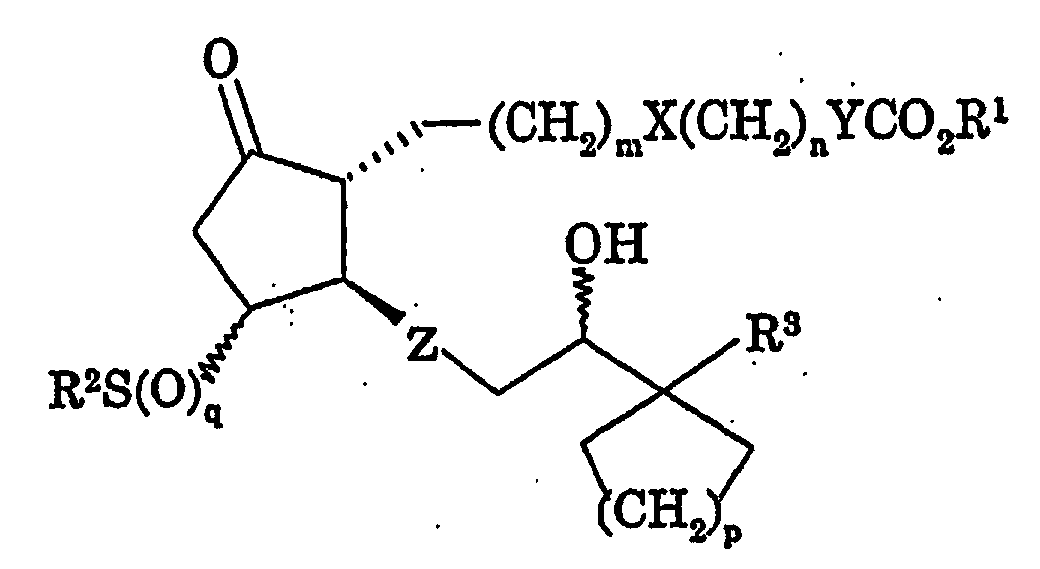
Y is an ethylene group, a vinylene group, an ethynylene group or a group represented by the formula: O(CH2)tl or S(O)q2(CH2)tl (wherein q2 is an integer of 0 to 2, and tl is an integer of 1 to 3),
Z is an ethylene group, a vinylene group or an ethynylene group,
R1 is a hydrogen atom, a C1-10 alkyl group or a C3-10 cycloalkyl group,
R2 is a C1-10 alkyl group, a C2-10 alkenyl group, a C2-10 alkynyl group, a C3-10 cycloalkyl group, a C1-5 alkyl-C3-10 cycloalkyl group, a C3-10 cycloalkyl-C1-5 alkyl group, a hydroxy-C1-5 alkyl group, a halogeno-C1-5 alkyl group, a C1-5 alkoxy-C1-5 alkyl group, a C2-4 alkoxycarbonyl-C1-5 alkyl group, a carboxyl-C1-5 alkyl group, a cyano-C1-5 alkyl group, a C1-5 alkyl group substituted with a group represented by the formula: -NR7R8 (wherein R7 and R8 are the same or different, and each a hydrogen atom or a C1-5 alkyl group, or R7 and R8 together with the nitrogen atom to which they are attached form a pyrrolidino group, a piperidino group, a piperazino group, a morpholino group or a thiomorpholino group), an acyl group, a group represented by the formula: -(CH2)t2CH(NH2)COOR9 (wherein R9 is a hydrogen atom or a C1-5 alkyl group, t2 is 1 or 2) or a group represented by the formula:(wherein R4 and R5 are the same or different, and each a hydrogen atom, a hydroxyl group, a halogen atom, a C1-10 alkyl group, a C1-10 alkoxy group, a C2-10 alkenyl group, a C2-10 alkynyl group, a hydroxy-C1-5 alkyl group, a halogeno-C1-5 alkyl group, a C1-5 alkoxy-C1-5 alkyl group, a C2-4 alkoxycarbonyl group, a carboxyl group, an acyl group, a nitro group, an amino group or an amino group which is mono- or di- substituted with C1-5 alkyl group(s), and r is an integer of 0 to 3),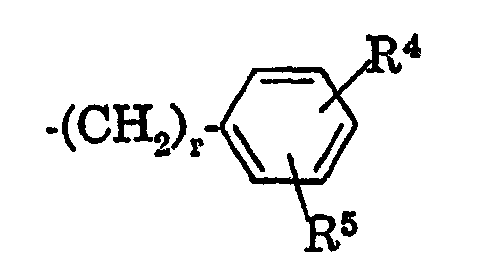
R3 is a hydrogen atom, a C1-10 alkyl group, a C3-10 cycloalkyl group, a C1-5 alkyl-C3-10 cycloalkyl group, a C3-10 cycloalkyl-C1-5 alkyl group, a C2-10 alkenyl group or a C2-10 alkynyl group,
m is an integer of 0 to 3, n is an integer of 1 to 3, p is an integer of 0 to 5, and q is an integer of 0 to 2], a pharmaceutically acceptable salt thereof or a hydrate thereof. - The prostaglandin derivative according to Claim 1 wherein X is CH2 or a group represented by the formula: S(O)q1 (wherein q1 is an integer of 0 to 2), R2 is a C1-10 alkyl group, a hydroxy-C1-5 alkyl group, a C1-5 alkoxy-C1-5 alkyl group, a C2-4 alkoxycarbonyl-C1-5 alkyl group, a cyano-C1-5 alkyl group, a C1-5 alkyl group substituted with a group represented by the formula: -NR77R88 (wherein R77 and R88 are the same or different, and each a hydrogen atom or a C1-5 alkyl group), a C2-10 alkanoyl group, a group represented by the formula: -(CH2)t2CH(NH2)COOR9 (wherein R9 is a hydrogen atom or a C1-5 alkyl group, and t2 is 1 or 2) or a group represented by the formula:(wherein R44 is a hydrogen atom, a halogen atom, a C1-10 alkyl group, a C1-10 alkoxy group, a nitro group or an amino group, and r is an integer of 0 to 3), and R3 is a hydrogen atom, a C1-10 alkyl group, a C3-10 cycloalkyl group, a C3-10 cycloalkyl-C1-5 alkyl group or a C2-10 alkenyl group; the pharmaceutically acceptable salt thereof or the hydrate thereof.
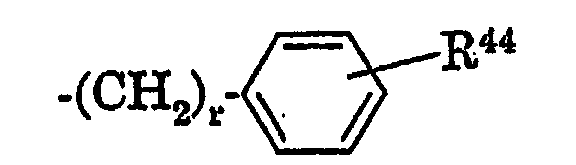
- The prostaglandin derivative according to Claim 1 wherein X is CH2, Y is an ethylene group, a vinylene group, or a group represented by the formula: O(CH2)tl or S(O)q2(CH2)tl (wherein q2 is an integer of 0 to 2, and t1 is an integer of 1 to 3), Z is a vinylene group or an ethynylene group, R1 is a hydrogen atom or a C1-10 alkyl group, R2 is a hydroxy-C1-5 alkyl group, a C2-4 alkoxycarbonyl-C1-5 alkyl group, a C1-5 alkyl group substituted with a di-C1-5 alkylamino group, a C2-10 alkanoyl group, a group represented by the formula: -(CH2)t2CH(NH2)COOR9 (wherein R9 is a hydrogen atom or a C1-5 alkyl group, and t2 is 1 or 2) or a group represented by the formula:(wherein R44 is a hydrogen atom, a halogen atom, a C1-10 alkyl group, a C1-10 alkoxy group, a nitro group or an amino group, and r is an integer of 0 to 3), and R3 is a hydrogen atom or a C1-10 alkyl group; the pharmaceutically acceptable salt thereof or the hydrate thereof.
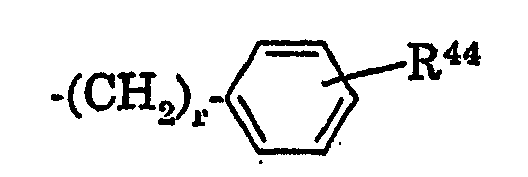
- The prostaglandin derivative according to Claim 3 wherein R44 is a hydrogen atom, a C1-10 alkoxy group, a nitro group or an amino group; the pharmaceutically acceptable salt thereof or the hydrate thereof.
- A pharmaceutical preparation which comprises as an effective ingredient the prostaglandin derivative according to any one of Claims 1 to 4, the pharmaceutically acceptable salt thereof or the hydrate thereof.
- The pharmaceutical preparation according to Claim 5, which is a pharmaceutical preparation for prevention or treatment of the restenosis after PTCA.
Applications Claiming Priority (5)
| Application Number | Priority Date | Filing Date | Title |
|---|---|---|---|
| JP25672699 | 1999-09-10 | ||
| JP25672699 | 1999-09-10 | ||
| JP2000079147 | 2000-03-21 | ||
| JP2000079147 | 2000-03-21 | ||
| PCT/JP2000/006161 WO2001019789A1 (en) | 1999-09-10 | 2000-09-08 | Prostaglandin derivatives |
Publications (2)
| Publication Number | Publication Date |
|---|---|
| EP1219601A1 true EP1219601A1 (en) | 2002-07-03 |
| EP1219601A4 EP1219601A4 (en) | 2004-10-27 |
Family
ID=26542866
Family Applications (1)
| Application Number | Title | Priority Date | Filing Date |
|---|---|---|---|
| EP00957063A Withdrawn EP1219601A4 (en) | 1999-09-10 | 2000-09-08 | PROSTAGLANDIN DERIVATIVES |
Country Status (7)
| Country | Link |
|---|---|
| US (1) | US6613932B1 (en) |
| EP (1) | EP1219601A4 (en) |
| KR (1) | KR20020043582A (en) |
| CN (1) | CN1190417C (en) |
| AU (1) | AU766900B2 (en) |
| CA (1) | CA2384715A1 (en) |
| WO (1) | WO2001019789A1 (en) |
Families Citing this family (1)
| Publication number | Priority date | Publication date | Assignee | Title |
|---|---|---|---|---|
| WO2014053968A1 (en) | 2012-10-04 | 2014-04-10 | Pfizer Limited | Pyrrolo[3,2-c]pyridine tropomyosin-related kinase inhibitors |
Family Cites Families (6)
| Publication number | Priority date | Publication date | Assignee | Title |
|---|---|---|---|---|
| US4029681A (en) | 1976-02-13 | 1977-06-14 | The Upjohn Company | 13,14-Didehydro-PG analogs |
| US4189597A (en) * | 1977-03-30 | 1980-02-19 | American Cyanamid Company | 11-(2-Hydroxyethylthio)prostenoic acid E series derivatives |
| US4131738A (en) | 1977-07-05 | 1978-12-26 | The Upjohn Company | 6-Hydroxy-PGE1 compounds |
| FR2608924B1 (en) * | 1986-12-29 | 1990-07-20 | Pasteur Institut | THERAPEUTIC COMPOSITIONS CONTAINING SULFUR DERIVATIVES OF PROSTAGLANDINS, NOVEL SULFUR DERIVATIVES AND THEIR PREPARATION METHOD |
| HK1045836A1 (en) * | 1999-04-09 | 2002-12-13 | 大正制药株式会社 | Prostaglandin ei derivatives |
| AU2001235990A1 (en) * | 2000-02-28 | 2001-09-03 | Fumie Sato | Prostaglandin e derivatives |
-
2000
- 2000-09-08 WO PCT/JP2000/006161 patent/WO2001019789A1/en not_active Ceased
- 2000-09-08 KR KR1020027003166A patent/KR20020043582A/en not_active Withdrawn
- 2000-09-08 AU AU68766/00A patent/AU766900B2/en not_active Ceased
- 2000-09-08 US US10/070,752 patent/US6613932B1/en not_active Expired - Fee Related
- 2000-09-08 CA CA002384715A patent/CA2384715A1/en not_active Abandoned
- 2000-09-08 EP EP00957063A patent/EP1219601A4/en not_active Withdrawn
- 2000-09-08 CN CNB008155658A patent/CN1190417C/en not_active Expired - Fee Related
Also Published As
| Publication number | Publication date |
|---|---|
| CN1390199A (en) | 2003-01-08 |
| US6613932B1 (en) | 2003-09-02 |
| AU766900B2 (en) | 2003-10-23 |
| CN1190417C (en) | 2005-02-23 |
| CA2384715A1 (en) | 2001-03-22 |
| AU6876600A (en) | 2001-04-17 |
| HK1051181A1 (en) | 2003-07-25 |
| WO2001019789A1 (en) | 2001-03-22 |
| EP1219601A4 (en) | 2004-10-27 |
| KR20020043582A (en) | 2002-06-10 |
Similar Documents
| Publication | Publication Date | Title |
|---|---|---|
| DE69805874T2 (en) | Omega cycloalkyl prostaglandin E2 derivatives | |
| EP0597095B1 (en) | Prostaglandin e1 analogue | |
| US6613932B1 (en) | Prostaglandin derivatives | |
| US6455584B1 (en) | Prostaglandin E1 derivatives | |
| US4562204A (en) | Trans-Δ2 -prostaglandin D derivatives, process for their preparation and compositions containing them | |
| AU766983B2 (en) | Prostaglandin derivatives | |
| JP4029251B2 (en) | ω-cycloalkyl-prostaglandin E2 derivative | |
| JPWO2001019789A1 (en) | Prostaglandin derivatives | |
| JPWO2001019790A1 (en) | Prostaglandin derivatives | |
| US5583158A (en) | Prostaglandin E1 analogues | |
| EP0172963A1 (en) | Prostaglandin analogues, processes for their preparation and compositions containing them | |
| EP0099673A2 (en) | Prostaglandin D derivatives, process for their preparation and compositions containing them | |
| EP1598335A1 (en) | Prostaglandin derivatives | |
| AU2003280977B2 (en) | Prostaglandin derivatives | |
| JP2002161082A (en) | Prostaglandin derivatives | |
| JPWO2000061550A1 (en) | Prostaglandin E1 derivatives | |
| JP3316050B2 (en) | Prostaglandin E1 analog | |
| JP2002155046A (en) | Prostaglandin derivatives | |
| JP2641622B2 (en) | Prostaglandin E lower 1 analog | |
| JP2001316357A (en) | Prostaglandin E derivative | |
| JPWO1992018472A1 (en) | Prostaglandin E↓1 analogues |
Legal Events
| Date | Code | Title | Description |
|---|---|---|---|
| PUAI | Public reference made under article 153(3) epc to a published international application that has entered the european phase |
Free format text: ORIGINAL CODE: 0009012 |
|
| 17P | Request for examination filed |
Effective date: 20020311 |
|
| AK | Designated contracting states |
Kind code of ref document: A1 Designated state(s): AT BE CH CY DE DK ES FI FR GB GR IE IT LI LU MC NL PT SE |
|
| A4 | Supplementary search report drawn up and despatched |
Effective date: 20040913 |
|
| STAA | Information on the status of an ep patent application or granted ep patent |
Free format text: STATUS: THE APPLICATION HAS BEEN WITHDRAWN |
|
| 18W | Application withdrawn |
Effective date: 20050616 |