EP1219553A2 - Method and apparatus for separating a collation from a supply stack - Google Patents
Method and apparatus for separating a collation from a supply stack Download PDFInfo
- Publication number
- EP1219553A2 EP1219553A2 EP01131031A EP01131031A EP1219553A2 EP 1219553 A2 EP1219553 A2 EP 1219553A2 EP 01131031 A EP01131031 A EP 01131031A EP 01131031 A EP01131031 A EP 01131031A EP 1219553 A2 EP1219553 A2 EP 1219553A2
- Authority
- EP
- European Patent Office
- Prior art keywords
- collation
- sheets
- supply stack
- stack
- separating
- Prior art date
- Legal status (The legal status is an assumption and is not a legal conclusion. Google has not performed a legal analysis and makes no representation as to the accuracy of the status listed.)
- Granted
Links
Images




Classifications
-
- B—PERFORMING OPERATIONS; TRANSPORTING
- B65—CONVEYING; PACKING; STORING; HANDLING THIN OR FILAMENTARY MATERIAL
- B65H—HANDLING THIN OR FILAMENTARY MATERIAL, e.g. SHEETS, WEBS, CABLES
- B65H3/00—Separating articles from piles
- B65H3/32—Separating articles from piles by elements, e.g. fingers, plates, rollers, inserted or traversed between articles to be separated and remainder of the pile
- B65H3/322—Separating articles from piles by elements, e.g. fingers, plates, rollers, inserted or traversed between articles to be separated and remainder of the pile for separating a part of the pile, i.e. several articles at once
-
- B—PERFORMING OPERATIONS; TRANSPORTING
- B65—CONVEYING; PACKING; STORING; HANDLING THIN OR FILAMENTARY MATERIAL
- B65H—HANDLING THIN OR FILAMENTARY MATERIAL, e.g. SHEETS, WEBS, CABLES
- B65H3/00—Separating articles from piles
- B65H3/08—Separating articles from piles using pneumatic force
-
- B—PERFORMING OPERATIONS; TRANSPORTING
- B65—CONVEYING; PACKING; STORING; HANDLING THIN OR FILAMENTARY MATERIAL
- B65H—HANDLING THIN OR FILAMENTARY MATERIAL, e.g. SHEETS, WEBS, CABLES
- B65H31/00—Pile receivers
- B65H31/30—Arrangements for removing completed piles
- B65H31/3027—Arrangements for removing completed piles by the nip between moving belts or rollers
-
- B—PERFORMING OPERATIONS; TRANSPORTING
- B65—CONVEYING; PACKING; STORING; HANDLING THIN OR FILAMENTARY MATERIAL
- B65H—HANDLING THIN OR FILAMENTARY MATERIAL, e.g. SHEETS, WEBS, CABLES
- B65H33/00—Forming counted batches in delivery pile or stream of articles
- B65H33/02—Forming counted batches in delivery pile or stream of articles by moving a blade or like member into the pile
-
- B—PERFORMING OPERATIONS; TRANSPORTING
- B65—CONVEYING; PACKING; STORING; HANDLING THIN OR FILAMENTARY MATERIAL
- B65H—HANDLING THIN OR FILAMENTARY MATERIAL, e.g. SHEETS, WEBS, CABLES
- B65H5/00—Feeding articles separated from piles; Feeding articles to machines
- B65H5/02—Feeding articles separated from piles; Feeding articles to machines by belts or chains, e.g. between belts or chains
- B65H5/021—Feeding articles separated from piles; Feeding articles to machines by belts or chains, e.g. between belts or chains by belts
- B65H5/023—Feeding articles separated from piles; Feeding articles to machines by belts or chains, e.g. between belts or chains by belts between a pair of belts forming a transport nip
-
- B—PERFORMING OPERATIONS; TRANSPORTING
- B65—CONVEYING; PACKING; STORING; HANDLING THIN OR FILAMENTARY MATERIAL
- B65H—HANDLING THIN OR FILAMENTARY MATERIAL, e.g. SHEETS, WEBS, CABLES
- B65H2301/00—Handling processes for sheets or webs
- B65H2301/40—Type of handling process
- B65H2301/42—Piling, depiling, handling piles
- B65H2301/421—Forming a pile
- B65H2301/4214—Forming a pile of articles on edge
- B65H2301/42142—Forming a pile of articles on edge by introducing articles from beneath
-
- B—PERFORMING OPERATIONS; TRANSPORTING
- B65—CONVEYING; PACKING; STORING; HANDLING THIN OR FILAMENTARY MATERIAL
- B65H—HANDLING THIN OR FILAMENTARY MATERIAL, e.g. SHEETS, WEBS, CABLES
- B65H2301/00—Handling processes for sheets or webs
- B65H2301/40—Type of handling process
- B65H2301/42—Piling, depiling, handling piles
- B65H2301/422—Handling piles, sets or stacks of articles
- B65H2301/4224—Gripping piles, sets or stacks of articles
- B65H2301/42242—Gripping piles, sets or stacks of articles by acting on the outermost articles of the pile for clamping the pile
-
- B—PERFORMING OPERATIONS; TRANSPORTING
- B65—CONVEYING; PACKING; STORING; HANDLING THIN OR FILAMENTARY MATERIAL
- B65H—HANDLING THIN OR FILAMENTARY MATERIAL, e.g. SHEETS, WEBS, CABLES
- B65H2301/00—Handling processes for sheets or webs
- B65H2301/40—Type of handling process
- B65H2301/42—Piling, depiling, handling piles
- B65H2301/422—Handling piles, sets or stacks of articles
- B65H2301/4226—Delivering, advancing piles
- B65H2301/42262—Delivering, advancing piles by acting on surface of outermost articles of the pile, e.g. in nip between pair of belts or rollers
-
- B—PERFORMING OPERATIONS; TRANSPORTING
- B65—CONVEYING; PACKING; STORING; HANDLING THIN OR FILAMENTARY MATERIAL
- B65H—HANDLING THIN OR FILAMENTARY MATERIAL, e.g. SHEETS, WEBS, CABLES
- B65H2301/00—Handling processes for sheets or webs
- B65H2301/50—Auxiliary process performed during handling process
- B65H2301/54—Auxiliary process performed during handling process for managing processing of handled material
- B65H2301/541—Counting
-
- B—PERFORMING OPERATIONS; TRANSPORTING
- B65—CONVEYING; PACKING; STORING; HANDLING THIN OR FILAMENTARY MATERIAL
- B65H—HANDLING THIN OR FILAMENTARY MATERIAL, e.g. SHEETS, WEBS, CABLES
- B65H2511/00—Dimensions; Position; Numbers; Identification; Occurrences
- B65H2511/30—Numbers, e.g. of windings or rotations
-
- B—PERFORMING OPERATIONS; TRANSPORTING
- B65—CONVEYING; PACKING; STORING; HANDLING THIN OR FILAMENTARY MATERIAL
- B65H—HANDLING THIN OR FILAMENTARY MATERIAL, e.g. SHEETS, WEBS, CABLES
- B65H2511/00—Dimensions; Position; Numbers; Identification; Occurrences
- B65H2511/50—Occurence
- B65H2511/51—Presence
- B65H2511/512—Marks, e.g. invisible to the human eye; Patterns
-
- B—PERFORMING OPERATIONS; TRANSPORTING
- B65—CONVEYING; PACKING; STORING; HANDLING THIN OR FILAMENTARY MATERIAL
- B65H—HANDLING THIN OR FILAMENTARY MATERIAL, e.g. SHEETS, WEBS, CABLES
- B65H2553/00—Sensing or detecting means
- B65H2553/40—Sensing or detecting means using optical, e.g. photographic, elements
- B65H2553/42—Cameras
Definitions
- the invention disclosed herein relates generally to an apparatus for separating sheets from a stack and, more particularly, to an apparatus and method for identifying a collation and separating the entire collation from a stack.
- accumulators which accumulate a sequence of sheets being processed by the apparatus to form a stack, or accumulation, for further processing.
- a sequence of sheets might be fed to a printer for printing of predetermined information, and the output of the printer fed in seriatim to an accumulator where a predetermined number of sheets in the sequence would be accumulated, and the resulting accumulation passed on for further processing, such as folding and insertion into an envelope.
- An input subsystem associated with any insertion system typically includes separation of sheets from a primary source such as, e.g., through sheet feeding, bursting, or cutting, and then transport of those sheets at very high-speed into an accumulating device.
- a primary source such as, e.g., through sheet feeding, bursting, or cutting
- Prior art involves the separation and linear transport of each sheet into an accumulator, then after the specified number of sheets has been assembled into a collation, the collation is removed from the accumulator in a linear fashion at high-speed so that the collations can be assembled as quickly as possible.
- one of the problems of the prior art is that it requires high-speed manipulations to accumulate a collation.
- Another problem of the prior art is that high-speed manipulation can be costly.
- Another problem of the prior art is that high-speed manipulation can be mechanically complex.
- Still another problem of the prior art is that high-speed manipulation can be noisy.
- Yet another problem of the prior art is that high-speed manipulation can require unnatural paper motions.
- the present invention does not require high-speed manipulation of individual sheets to accumulate collations. Instead of processing the sheets seritatim at very high velocities, the individual sheets are identified as part of a collation and separated as a collation while they are still in their original, sheet-feeding stack. That is, rather than separating each sheet from the stack and re-accumulating the sheets for collation processing, collations are removed from the supply stack and processed as a whole. This reduces the need for high-speed transports and accumulating techniques.
- this technique can also be applied to high-speed cutting and bursting applications in which cut/burst sheets are accumulated in a stack for subsequent feeding.
- This invention overcomes the disadvantages of the prior art by providing a method and apparatus for identification and separation of an entire collation from a supply stack. This is in contrast to conventional processing techniques that entail separation of singular sheets from a supply stack, and their transport and accumulation at high linear velocities. Thus, the present invention affords for more efficient and higher reliability collation processing.
- the present invention is directed to, in a general aspect, an apparatus and method for separating an entire collation of individual sheets from a supply stack for downstream processing.
- the apparatus generally comprises: a supply stack tray for containing the supply stack while the collations in the supply stack are being separated; a separator device positioned adjacent to the supply stack tray for separating a corner of each sheet of the collation from the supply stack; a deflector positioned adjacent to an edge of the collation for deflecting the collation from the supply stack after the collation has been separated by the separator; and a gripper device positioned in a plane proximate to the first sheet in the collation for gripping the entire collation after the collation has been deflected from the supply stack and for moving the entire collation downstream for processing.
- the method for separating a collation of individual sheets from a supply stack comprises, generally, the steps of separating a comer of each of the individual sheets in the collation from the supply stack; deflecting the collation from the supply stack; and gripping the entire collation and moving the entire collation from the supply stack for downstream processing.
- the undesirable aspects of conventional sheet processing and accumulating techniques are readily apparent when associated sheet velocities, accelerations, and decelerations are considered.
- the present inventions provides a way to reduce associated paper motions, e.g., velocities, accelerations, and decelerations, enhance system reliability and cost aspects, as well as minimize acoustic noise.
- advantages can be gained.
- an advantage of the present invention is that it reduces the paper manipulations and velocities required to generate a collation.
- Another advantage of the present invention is that it provides a collation accumulating process that can enhance the performance, cycle rate, cost, and overall reliability of down stream processing devices such as statement generation and processing devices of an inserter.
- Another advantage of the present invention is that it can replace conventional methods associated with high-speed sheet processing and associated accumulation techniques.
- Fig. 1 is a schematic representation of an embodiment of the apparatus 10 of the present invention where the stack is fed from the bottom in a horizontal orientation,
- a sheet supply stack 12 in stack tray 11 supplies sheets 14 for collation and separation.
- a scanner 16 reads identifying information, which is commonly referred to as control document information, from a bottom most sheet 18 in sheet supply stack 12.
- the identifying information which typically is encoded (for example a bar code) on at least the first sheet of the collation, includes the number of sheets in the collation.
- the information is sent to a microprocessor controller 19, which coordinates the operation of the components of apparatus 10 in the processing of the collation.
- a corner separation device 21 located at a corner of the sheet supply stack separates and deflects the comer of each sheet's lead edge downward as the sheet is counted and recognized.
- Corner separation device 21 of this and other embodiments described herein could be a comer separation device such as a device found on sheet and currency counting devices which operate using a vacuum force, Corner separation device 21 separates and deflects the corners of the sheets of the collation based upon the identifying information obtained by the scanner 16 and furnished to the microprocessor controller 19.
- an auger collation deflection mechanism 20 biases the leading edge of the entire collation downward after the required number of sheets has been counted and separated (this will effectively identify and separate the first collation from all others).
- Auger collation deflection mechanism 20 of this and other embodiments described herein could be a mechanism that is commonly found in envelope manufacturing equipment, which deflects the lead edge of an envelope blank which in a feeder, Such a mechanism is used in the envelope manufacturing equipment of Winkler Dunnerieier of Germany.
- a gripper drum generally referred to as 25, includes a collation extraction device 22 that grips the leading edge of the deflected sheets of the collation and pulls them from the supply stack as a complete collation.
- Arrow A shows the direction of movement of the gripper drum 25 and arrow B shows the direction of movement of collation extraction device 22.
- Gripper drum 25 of this and other embodiments of the present invention described herein, is a continuous motion (rotating) drum with counter rotating gripper devices 22.
- gripper drums are used in high-speed bindery equipment.
- Gripper drum 25 with its collation extraction devices 22 grips the leading edge of the deflected sheets that comprise each collation, pulls them from the supply stack (as a complete collation) and deposits the collation for further downstream processing.
- gripper drum delivers the entire collation to a takeaway belt device 24 whereat collation extraction device 22 disengages and allows takeaway belt device 24 to transport the collation downstream for further processing, for example to the folder device (not shown).
- Fig. 1 Also shown in Fig. 1 is an optional confirmation scanner 27 that may be used to confirm the integrity of the collation processing of the present invention.
- Such scanner reads the identifying information that was scanned upstream by scanner 16 and sent to controller 19. Controller 19 verifies that each collation has the same bottom most sheet scanned by scanner 27 as was scanned by scanner 16.
- Fig. 2 is a schematic representation of an embodiment of the apparatus 10 of the present invention where the stack is fed in a vertical orientation.
- the sheet supply stack 12 in stack tray 11 supplies sheets 14 for collation and separation.
- the scanner 16 reads the identifying information from first sheet 18 in the sheet supply stack.
- the identifying information includes the number of sheets in the collation.
- the information is sent to the microprocessor controller 19, which coordinates the operation of the components of apparatus 10 in the processing of the collation.
- the corner separation device (not shown but similar to that in Fig. 1A) located at a corner of the sheet supply stack separates and deflects the corner of each sheet's leading edge downward as the sheet is counted and recognized.
- the corner separation device separates and deflects the corners of the sheets of the collation based upon the identifying information obtained by the scanner 16 and furnished to the microprocessor controller 19. Once the comer separator separates the comers of the sheets of the collation, auger collation deflection mechanism 20 biases the leading edge of the entire collation downward after the required number of sheets have been counted and separated (effectively identifying and separating the first collation from all others).
- Gripper drum 25 with its collation extraction device 22 grips the leading edge of the deflected sheets of the collation and pulls them from the supply stack as a complete collation. Arrow A shows the direction of movement of gripper drum 25 and Arrow B shows the direction of movement of collation extraction device 22.
- Gripper drum 25 with its collation extraction devices 22 grips the leading edge of the deflected sheets that comprise each collation, pulls them from the supply stack 12 (as a complete collation) and disengages the collation for further downstream processing.
- gripper drum delivers the entire collation to a takeaway belt device 24 whereat collation extraction device 22 disengages and allows takeaway belt device 24 to transport the collation downstream for further processing, for example to the folder device (not shown).
- Fig. 2 Also shown in Fig. 2 is an optional confirmation scanner 27 that may be used to confirm the integrity of the collation processing of the present invention.
- Such scanner reads the identifying information that was scanned upstream by scanner 16 and sent to controller 19. Controller 19 verifies that each collation has the same bottom most sheet scanned by scanner 27 as was scanned by scanner 16.
- the sheet supply stack could be continuously automatically reloadable, such as for high-speed applications.
- Fig. 3 is a schematic representation of an embodiment of the apparatus 10 of the present invention where the sheet supply stack 12 comprises sheets separated from web material 13 such as, for example, fanfold paper (shown) or rolled continuous feed paper (not shown).
- the web material 13 is fed to a cutter or burster 15 to form individual sheets 14 which are fed to stack tray 11 to form the sheet supply stack 12.
- the cutter or burster 15 can be a high-speed device which would provide singular sheets to the continuously reloadable sheet supply stack device 12.
- Scanner 16 reads collation identifying information from the sheets 14 .
- the identifying information which includes the number of sheets in the collation, printed on the first sheet of each collation.
- the identifying information is sent to a microprocessor controller 19, which coordinates the operation of the components of apparatus 10 in the processing of the collation. While the scanner 16 is shown after cutter or burster 15, the scanner could be positioned either before or after the cutter or burster 15, or at stack 12 (shown as 16').
- Stack tray 11 functions as a refeed buffer from which sheet supply stack 12 supplies sheets 14 for collation and separation.
- a corner separation device (not shown shown but similar to that in Fig. 1A) located at a corner of the sheet supply stack separates and deflects the comer of each sheet's leading edge downward as the sheet is counted and recognized.
- the corner separation device separates and deflects the corners of the sheets of the collation based upon the identifying information obtained by the scanner 16 and fumished to the microprocessor controller 19. Once the corner separator separates the corners of the sheets of the collation, auger collation deflection mechanism 20 biases the leading edge of the entire collation downward after the required number of sheets have been counted and separated (effectively identifying and separating the first collation from all others).
- Gripper drum 25 with its collation extraction device 22 grips the leading edge of the deflected sheets of the collation and pulls them from the supply stack as a complete collation. Arrow A shows the direction of movement of gripper drum 25 and Arrow B shows the direction of movement of collation extraction device 22.
- Gripper drum 25 with its collation extraction devices 22 grips the leading edge of the deflected sheets that comprise each collation, pulls them from supply stack 12 (as a complete collation) and disengages the collation for further downstream processing.
- the gripper drum collation extraction device 22 delivers the entire collation to the takeaway belt device 24. At that point, the gripper drum collation extraction device 22 disengages the entire collation and allows the takeaway belt device 24 to transport the entire collation for downstream processing such as, for example to a folder device (not shown).
- verification scanning can be performed.
- Optional confirmation scanner 27 may be used to confirm the integrity of the collation processing of the present invention as set forth in the previous embodiments.
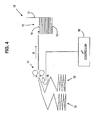
- Fig. 4 is a schematic representation of an embodiment of an upstream portion of the apparatus 10 of the present invention where the stack is fed from dual web material 13 and 13'.
- An advantage of this configuration is that a singular document stream associated with either dual or two-up paper streams can be stacked or sandwiched together so that one cut would produce two sheets that are conveyed to supply stack 12.
- the apparatus 10 would process document collations as described above in the descriptions of Figs. 1 and 3.
- Fig. 5 is a flow chart of an embodiment of the method of the present invention. The method could be performed with any of the embodiments described herein.
- the method begins.
- the first sheet 18 in the stack 12 is scanned using scanner 16 to obtain collation identification information.
- the number of sheets in the collation is obtained.
- This collation identification information is processed using microprocessor 19 which sends a signal to the corner separating device 21 to separate the number of sheets 14 in the collation to be formed, from the stack 12.
- the corner separating device 21 separates the comers of the collation sheets from the stack 12.
- the auger collation deflection mechanism 20 biases the leading edge of the entire collation downward after the required number of sheets has been counted and separated (this will effectively identify and separate the first collation from all others),
- the gripper drum 22 is used to move the entire collation to takeaway belts 24.
- the take away belts 24 move the entire collation downstream for further processing such as, for example, folding and insertion.
- Fig. 6 is a flow chart of an embodiment of the method of the present invention. The method could be performed with the embodiments described in Figs. 3 and 4.
- the method begins.
- the sheets of web 13 are separated (cut or burst) and scanned (optional) using scanner 16 to obtain collation identification information.
- the sheets are accumulated in stack tray 11 to form stack 12.
- first sheet of stack 12 is scanned to obtain or verify collation identification information (when optional scanning performed at step 202).
- step 205 from the scanned collation identification information, the number of sheets in the collation is obtained.
- This collation identification information is processed using microprocessor 19 which sends a signal to the corner separating device 21 to separate the number of sheets 14 in the collation to be formed, from the stack 12,
- the corner separating device 21 separates the corners of the collation sheets from the stack 12.
- the auger collation deflection mechanism 20 biases the leading edge of the entire collation downward after the required number of sheets has been counted and separated (this will effectively identify and separate the first collation from all others).
- the gripper drum 22 is used to move the entire collation to takeaway belts 24.
- the take away belts 24 move the entire collation downstream for further processing such as, for example, folding and insertion.
- the bottom sheet of the collation is scanned to verify collation integrity.
- a moving beam scanner could be used to read associated codes on first sheet for collation identification/verification purposes,
- the code could alternatively be read dynamically as the collation is removed from the feed tray.
- scanning may not necessarily be performed in situations where each collation contains the same number of sheets. That is, if for example, each collation contained four sheets, each separation action would separate four sheets from the stack, and those four sheets would be deflected as a collation. The steps would be repeated on the remainder of the stack.
- the present invention generates collations at a speed that is fractional compared to processes that require accumulating sheets seriatim to form collations. For example, compared to a machine transporting sheets at a velocity of 360 ips to form four-sheet collations, the present invention, the present invention can form such four-sheet collations at approximately one fourth (1/4) the velocity because the collations are taken as a whole from the stack supply.
- the advantages of the apparatus and method of the present invention are novel compared to conventional sheet separation and processing methods.
- the present invention provides distinct advantages compared to conventional processing.
- the present invention can reduce cost, complexity, noise (such as transport noise, drive transmission noise and paper flutter), and unnatural paper motions associated with conventional input processing methods.
- the distinct advantages of this process will be particularly evident for processing input documents at the rates required by the high-speed inserting system.
Landscapes
- Engineering & Computer Science (AREA)
- Mechanical Engineering (AREA)
- Collation Of Sheets And Webs (AREA)
- Sheets, Magazines, And Separation Thereof (AREA)
Abstract
Description
Claims (9)
- An apparatus for separating an entire collation of individual sheets from a supply stack for downstream processing comprising:(a) a supply stack tray, the supply stack tray for containing a plurality of collations comprised of a supply stack of individual sheets;(b) a separator device positioned adjacent to corner of the sheets in the supply stack tray, the separator device for separating a corner of all sheets of a first collation from corresponding corners of other sheets the supply stack;(c) a deflector positioned adjacent to an edge of the first collation for defecting the leading edge of the sheets of the first collation from the other sheets in the supply stack after the comer of the sheets of the first collation have been separated by the separator; and(d) a gripper device positioned in a plane proximate to the first sheet in the first collation for gripping the entire first collation after the leading edge of the sheets of the first collation have been deflected from the other sheets in the supply stack, the gripper device moving the entire collation from the supply stack tray downstream for processing.
- The apparatus as claimed in claim 1 wherein the separator device is a vacuum operated separation device.
- The apparatus as claimed in claim 1 wherein the deflector is an auger mechanism.
- The apparatus as claimed in claim 1 wherein the gripper device is a gripper drum.
- The apparatus as claimed in claim 1 further comprising:(a) a scanner for scanning collation identification information on the first sheet in the supply stack to obtain the number of sheets in the first collation; and(b) a microprocessor controller for processing the collation identification information obtained by the scanner and signaling the separation device to separate the number of sheets in the first collation from the supply stack.
- An apparatus for separating a collation of individual sheets from a supply stack comprising:(a) a means for containing a supply stack while collations in the supply stack are being separated;(b) a separating means adjacent to the means for containing the supply stack for separating a corner of each sheet in the collation from the supply stack to form a collation;(c) a collation deflection means for deflecting the collation after the collation has been separated by the corner separating means; and(d) a gripper means for gripping the entire collation after the collation has been separated and deflected from the stack, and for moving the collation downstream for further processing.
- A method for separating a collation of individual sheets from a supply stack comprising the steps of:(a) separating a corner of the individual sheets in the collation from a corresponding comer of the other sheets in the supply stack;(b) deflecting the leading edge of the sheets of the collation from the leading edge of the other sheets in the supply stack; and(c) gripping the entire collation and moving the entire collation from the supply stack for downstream processing.
- The method as claimed in claim 7 further comprising the steps of:(a) scanning a first sheet in the supply stack to obtain information about a number of sheets in the collation prior to step 7(a); and(b) processing the information obtained by scanning in step 8(a) and signaling a separating device to separate the number of sheets in the collation.
- The method as claimed in claim 8 further comprising the step of:scanning a first sheet in the collation after step 7(c) to verify that the first sheet scanned at step 8(a) is the first sheet of the collation after the collation has been separated from the supply stack.
Applications Claiming Priority (2)
| Application Number | Priority Date | Filing Date | Title |
|---|---|---|---|
| US09/750,929 US6502812B2 (en) | 2000-12-28 | 2000-12-28 | Method and apparatus for separating a collation from a supply stack |
| US750929 | 2000-12-28 |
Publications (3)
| Publication Number | Publication Date |
|---|---|
| EP1219553A2 true EP1219553A2 (en) | 2002-07-03 |
| EP1219553A3 EP1219553A3 (en) | 2003-11-19 |
| EP1219553B1 EP1219553B1 (en) | 2006-03-08 |
Family
ID=25019715
Family Applications (1)
| Application Number | Title | Priority Date | Filing Date |
|---|---|---|---|
| EP01131031A Expired - Lifetime EP1219553B1 (en) | 2000-12-28 | 2001-12-28 | Method and apparatus for separating a collation from a supply stack |
Country Status (4)
| Country | Link |
|---|---|
| US (2) | US6502812B2 (en) |
| EP (1) | EP1219553B1 (en) |
| CA (1) | CA2365057C (en) |
| DE (1) | DE60117679T2 (en) |
Cited By (1)
| Publication number | Priority date | Publication date | Assignee | Title |
|---|---|---|---|---|
| ITMI20110364A1 (en) * | 2011-03-09 | 2012-09-10 | Paper Converting Machine Co | DEVICE AND PROCEDURE FOR COUNTING, SEPARATION AND TRANSFER TO THE NEXT PACKAGING OF FLAT OBJECTS |
Families Citing this family (12)
| Publication number | Priority date | Publication date | Assignee | Title |
|---|---|---|---|---|
| DE10049432A1 (en) * | 2000-10-06 | 2002-04-18 | Giesecke & Devrient Gmbh | Accepting sheet material items, e.g. bank notes, involves associating each group of received items with at least one separating arrangement before or during acceptance or during processing |
| DE10120904A1 (en) * | 2001-04-27 | 2002-10-31 | Giesecke & Devrient Gmbh | Method and device for processing sheet material |
| JP4101482B2 (en) * | 2001-07-13 | 2008-06-18 | 株式会社サム技研 | High-speed paper sealing device |
| US7306222B2 (en) * | 2003-05-14 | 2007-12-11 | Goss International Americas, Inc. | Sheet material feeder |
| GB0419261D0 (en) * | 2004-08-27 | 2004-09-29 | Mach Shop Special Effects Ltd | Confetti and confetti-like discharge |
| US20060192981A1 (en) * | 2005-02-25 | 2006-08-31 | Fernandez Ismael C | De-bursting print media output |
| WO2008144727A1 (en) * | 2007-05-21 | 2008-11-27 | Wind Hill Concepts, Llc | Apparatus and method for processing sheets |
| DE102009020664A1 (en) * | 2009-05-11 | 2010-11-25 | Siemens Aktiengesellschaft | Method and device for sorting various objects |
| US9186678B2 (en) | 2012-10-15 | 2015-11-17 | Fellowes, Inc. | Shredder auto feed system with paper stack separation mechanism |
| US9409182B2 (en) | 2013-03-15 | 2016-08-09 | Fellowes, Inc. | Shredder with paper separation and advancement mechanism |
| US8854675B1 (en) | 2013-03-28 | 2014-10-07 | Xerox Corporation | Electronic document processing method and device |
| US9669411B2 (en) | 2013-09-30 | 2017-06-06 | Fellowes, Inc. | Shredder auto feed system |
Family Cites Families (12)
| Publication number | Priority date | Publication date | Assignee | Title |
|---|---|---|---|---|
| US4551053A (en) * | 1984-05-29 | 1985-11-05 | Fuji Photo Film Co. Ltd. | Sheet sub-stack separating and feeding apparatus |
| NL8402365A (en) * | 1984-07-27 | 1986-02-17 | Oce Nederland Bv | HOLDER FOR A STACK OF SHEETS. |
| JPH0678150B2 (en) * | 1984-07-30 | 1994-10-05 | 新王子製紙株式会社 | Sheet bundle separation device |
| US4934685A (en) * | 1985-05-28 | 1990-06-19 | Eastman Kodak Company | Sheet feeder for two stacks of sheets |
| US4939888A (en) * | 1990-07-06 | 1990-07-10 | Webcraft Technologies, Inc. | Method for producing a mass distributable printed packet |
| US5017085A (en) * | 1989-11-14 | 1991-05-21 | Maruishi Iron Works Co., Ltd. | Method and apparatus for separating paper sheets into units and distributing them |
| US5062599A (en) * | 1990-03-19 | 1991-11-05 | Eastman Kodak Company | Sheet separating mechanism and apparatus for use therein |
| US5245547A (en) * | 1990-09-05 | 1993-09-14 | Pitney Bowes Inc. | Methods of processing sheets having an order corresponding to the order of stored data |
| US5156384A (en) * | 1991-11-04 | 1992-10-20 | Webcraft Technologies, Inc. | Collect tab stacking method with transverse cutting stage forming inserts and indexing inserts |
| DE4409489A1 (en) * | 1994-03-19 | 1995-09-21 | Womako Masch Konstr | Paper stack separating device |
| US5685533A (en) * | 1996-02-14 | 1997-11-11 | R. R. Donnelley & Sons Company | Signature pocket apparatus and method of make ready |
| US6227539B1 (en) * | 1998-10-21 | 2001-05-08 | Xerox Corporation | Printer mailboxing system with automatic variable capacity bins |
-
2000
- 2000-12-28 US US09/750,929 patent/US6502812B2/en not_active Expired - Fee Related
-
2001
- 2001-12-17 CA CA002365057A patent/CA2365057C/en not_active Expired - Fee Related
- 2001-12-28 EP EP01131031A patent/EP1219553B1/en not_active Expired - Lifetime
- 2001-12-28 DE DE60117679T patent/DE60117679T2/en not_active Expired - Lifetime
-
2002
- 2002-08-13 US US10/218,929 patent/US6619652B2/en not_active Expired - Lifetime
Cited By (1)
| Publication number | Priority date | Publication date | Assignee | Title |
|---|---|---|---|---|
| ITMI20110364A1 (en) * | 2011-03-09 | 2012-09-10 | Paper Converting Machine Co | DEVICE AND PROCEDURE FOR COUNTING, SEPARATION AND TRANSFER TO THE NEXT PACKAGING OF FLAT OBJECTS |
Also Published As
| Publication number | Publication date |
|---|---|
| US20020185803A1 (en) | 2002-12-12 |
| EP1219553A3 (en) | 2003-11-19 |
| US20020084571A1 (en) | 2002-07-04 |
| CA2365057A1 (en) | 2002-06-28 |
| DE60117679T2 (en) | 2006-11-16 |
| CA2365057C (en) | 2009-10-27 |
| US6502812B2 (en) | 2003-01-07 |
| EP1219553B1 (en) | 2006-03-08 |
| US6619652B2 (en) | 2003-09-16 |
| DE60117679D1 (en) | 2006-05-04 |
Similar Documents
| Publication | Publication Date | Title |
|---|---|---|
| CA2365057C (en) | Method and apparatus for separating a collation from a supply stack | |
| US5033729A (en) | Mechanism for the handling and singulating of flat materials | |
| CN103037986B (en) | Postal sorting machine including gripping conveying means, and method for implementing same | |
| EP1252080B1 (en) | Right angle stager apparatus and method | |
| US7878497B2 (en) | Image forming apparatus and sheet inserting device | |
| US5734566A (en) | Method and apparatus for keeping a matched document inserter system in synchronization | |
| US6607190B1 (en) | Apparatus for providing gap control for a high-speed check feeder | |
| US5511936A (en) | Separation method and device | |
| EP0237129B1 (en) | A method for handling documents to be inserted into an envelope by combining a plurality of serially supplied sheets into a set and document handling device for carrying said method into effect | |
| US5492318A (en) | Sheet accumulator | |
| JP4128658B2 (en) | Optical image reader | |
| US8936242B1 (en) | Re-time sheet buffering system for digital print finishers | |
| US7527262B2 (en) | Offsetting device for mail stackers | |
| EP1798176A1 (en) | Cutter sequencing method and apparatus | |
| EP3036182A1 (en) | Folding machine as combined knife and buckle folders | |
| US6568676B2 (en) | Removable turnbar in a sheet accumulator | |
| JP3275692B2 (en) | Paper processing equipment | |
| CN120288566A (en) | Equipment for collecting sheets | |
| JPS5869644A (en) | Cut paper feeding equipment | |
| JP2002293441A (en) | Form supply device and form processing device using the same | |
| JP2000325889A (en) | Letter supply device | |
| JPH09142727A (en) | Form processing device | |
| JPH08268629A (en) | Conveying paper sorting device | |
| JP2001252621A (en) | Paper sorter | |
| JPH10109070A (en) | Paper sorting machine and mail sorting machine |
Legal Events
| Date | Code | Title | Description |
|---|---|---|---|
| PUAI | Public reference made under article 153(3) epc to a published international application that has entered the european phase |
Free format text: ORIGINAL CODE: 0009012 |
|
| AK | Designated contracting states |
Kind code of ref document: A2 Designated state(s): AT BE CH CY DE DK ES FI FR GB GR IE IT LI LU MC NL PT SE TR |
|
| AX | Request for extension of the european patent |
Free format text: AL;LT;LV;MK;RO;SI |
|
| PUAL | Search report despatched |
Free format text: ORIGINAL CODE: 0009013 |
|
| AK | Designated contracting states |
Kind code of ref document: A3 Designated state(s): AT BE CH CY DE DK ES FI FR GB GR IE IT LI LU MC NL PT SE TR |
|
| AX | Request for extension of the european patent |
Extension state: AL LT LV MK RO SI |
|
| 17P | Request for examination filed |
Effective date: 20040511 |
|
| AKX | Designation fees paid |
Designated state(s): DE FR GB |
|
| 17Q | First examination report despatched |
Effective date: 20050126 |
|
| GRAP | Despatch of communication of intention to grant a patent |
Free format text: ORIGINAL CODE: EPIDOSNIGR1 |
|
| RAP1 | Party data changed (applicant data changed or rights of an application transferred) |
Owner name: PITNEY BOWES INC. |
|
| GRAS | Grant fee paid |
Free format text: ORIGINAL CODE: EPIDOSNIGR3 |
|
| GRAA | (expected) grant |
Free format text: ORIGINAL CODE: 0009210 |
|
| AK | Designated contracting states |
Kind code of ref document: B1 Designated state(s): DE FR GB |
|
| REG | Reference to a national code |
Ref country code: GB Ref legal event code: FG4D |
|
| REF | Corresponds to: |
Ref document number: 60117679 Country of ref document: DE Date of ref document: 20060504 Kind code of ref document: P |
|
| ET | Fr: translation filed | ||
| PLBE | No opposition filed within time limit |
Free format text: ORIGINAL CODE: 0009261 |
|
| STAA | Information on the status of an ep patent application or granted ep patent |
Free format text: STATUS: NO OPPOSITION FILED WITHIN TIME LIMIT |
|
| 26N | No opposition filed |
Effective date: 20061211 |
|
| PGFP | Annual fee paid to national office [announced via postgrant information from national office to epo] |
Ref country code: FR Payment date: 20100106 Year of fee payment: 9 |
|
| PGFP | Annual fee paid to national office [announced via postgrant information from national office to epo] |
Ref country code: DE Payment date: 20091230 Year of fee payment: 9 |
|
| PGFP | Annual fee paid to national office [announced via postgrant information from national office to epo] |
Ref country code: GB Payment date: 20101229 Year of fee payment: 10 |
|
| REG | Reference to a national code |
Ref country code: FR Ref legal event code: ST Effective date: 20110831 |
|
| PG25 | Lapsed in a contracting state [announced via postgrant information from national office to epo] |
Ref country code: FR Free format text: LAPSE BECAUSE OF NON-PAYMENT OF DUE FEES Effective date: 20110103 |
|
| REG | Reference to a national code |
Ref country code: DE Ref legal event code: R119 Ref document number: 60117679 Country of ref document: DE Effective date: 20110701 |
|
| PG25 | Lapsed in a contracting state [announced via postgrant information from national office to epo] |
Ref country code: DE Free format text: LAPSE BECAUSE OF NON-PAYMENT OF DUE FEES Effective date: 20110701 |
|
| GBPC | Gb: european patent ceased through non-payment of renewal fee |
Effective date: 20121228 |
|
| PG25 | Lapsed in a contracting state [announced via postgrant information from national office to epo] |
Ref country code: GB Free format text: LAPSE BECAUSE OF NON-PAYMENT OF DUE FEES Effective date: 20121228 |