EP1219234A1 - Method and apparatus for assessing tissue perfusion - Google Patents
Method and apparatus for assessing tissue perfusion Download PDFInfo
- Publication number
- EP1219234A1 EP1219234A1 EP01310531A EP01310531A EP1219234A1 EP 1219234 A1 EP1219234 A1 EP 1219234A1 EP 01310531 A EP01310531 A EP 01310531A EP 01310531 A EP01310531 A EP 01310531A EP 1219234 A1 EP1219234 A1 EP 1219234A1
- Authority
- EP
- European Patent Office
- Prior art keywords
- patient
- probe
- sensor
- measurement
- tissue
- Prior art date
- Legal status (The legal status is an assumption and is not a legal conclusion. Google has not performed a legal analysis and makes no representation as to the accuracy of the status listed.)
- Withdrawn
Links
- 230000010412 perfusion Effects 0.000 title claims abstract description 85
- 238000000034 method Methods 0.000 title claims abstract description 56
- 239000000523 sample Substances 0.000 claims abstract description 83
- 238000001139 pH measurement Methods 0.000 claims abstract description 61
- 210000004877 mucosa Anatomy 0.000 claims abstract description 60
- 210000001519 tissue Anatomy 0.000 claims abstract description 38
- 210000001035 gastrointestinal tract Anatomy 0.000 claims abstract description 34
- 210000002345 respiratory system Anatomy 0.000 claims abstract description 24
- 230000004044 response Effects 0.000 claims abstract description 18
- 230000000241 respiratory effect Effects 0.000 claims abstract description 11
- CURLTUGMZLYLDI-UHFFFAOYSA-N Carbon dioxide Chemical compound O=C=O CURLTUGMZLYLDI-UHFFFAOYSA-N 0.000 claims description 132
- 239000001569 carbon dioxide Substances 0.000 claims description 66
- 229910002092 carbon dioxide Inorganic materials 0.000 claims description 66
- 238000009530 blood pressure measurement Methods 0.000 claims description 40
- 239000008280 blood Substances 0.000 claims description 28
- 210000004369 blood Anatomy 0.000 claims description 28
- 239000012528 membrane Substances 0.000 claims description 20
- 230000001079 digestive effect Effects 0.000 claims description 13
- 230000005669 field effect Effects 0.000 claims description 12
- 238000004868 gas analysis Methods 0.000 claims description 4
- 238000012545 processing Methods 0.000 claims description 2
- 150000002500 ions Chemical class 0.000 description 39
- 238000005259 measurement Methods 0.000 description 19
- 210000004379 membrane Anatomy 0.000 description 19
- 210000003296 saliva Anatomy 0.000 description 17
- BVKZGUZCCUSVTD-UHFFFAOYSA-M Bicarbonate Chemical compound OC([O-])=O BVKZGUZCCUSVTD-UHFFFAOYSA-M 0.000 description 16
- 210000002200 mouth mucosa Anatomy 0.000 description 13
- 239000011521 glass Substances 0.000 description 11
- 239000007789 gas Substances 0.000 description 10
- 230000017531 blood circulation Effects 0.000 description 9
- 230000002685 pulmonary effect Effects 0.000 description 9
- 208000028867 ischemia Diseases 0.000 description 8
- 230000009885 systemic effect Effects 0.000 description 8
- 238000004458 analytical method Methods 0.000 description 7
- QVGXLLKOCUKJST-UHFFFAOYSA-N atomic oxygen Chemical compound [O] QVGXLLKOCUKJST-UHFFFAOYSA-N 0.000 description 7
- 239000006227 byproduct Substances 0.000 description 7
- 210000000056 organ Anatomy 0.000 description 7
- 239000001301 oxygen Substances 0.000 description 7
- 229910052760 oxygen Inorganic materials 0.000 description 7
- 230000004060 metabolic process Effects 0.000 description 6
- 239000007853 buffer solution Substances 0.000 description 5
- 230000002496 gastric effect Effects 0.000 description 5
- VEXZGXHMUGYJMC-UHFFFAOYSA-N Hydrochloric acid Chemical compound Cl VEXZGXHMUGYJMC-UHFFFAOYSA-N 0.000 description 4
- VYPSYNLAJGMNEJ-UHFFFAOYSA-N Silicium dioxide Chemical compound O=[Si]=O VYPSYNLAJGMNEJ-UHFFFAOYSA-N 0.000 description 4
- 229910021607 Silver chloride Inorganic materials 0.000 description 4
- FAPWRFPIFSIZLT-UHFFFAOYSA-M Sodium chloride Chemical compound [Na+].[Cl-] FAPWRFPIFSIZLT-UHFFFAOYSA-M 0.000 description 4
- 230000002427 irreversible effect Effects 0.000 description 4
- JVTAAEKCZFNVCJ-UHFFFAOYSA-N lactic acid Chemical compound CC(O)C(O)=O JVTAAEKCZFNVCJ-UHFFFAOYSA-N 0.000 description 4
- 239000000203 mixture Substances 0.000 description 4
- 210000001147 pulmonary artery Anatomy 0.000 description 4
- 229910052709 silver Inorganic materials 0.000 description 4
- 239000004332 silver Substances 0.000 description 4
- HKZLPVFGJNLROG-UHFFFAOYSA-M silver monochloride Chemical compound [Cl-].[Ag+] HKZLPVFGJNLROG-UHFFFAOYSA-M 0.000 description 4
- 239000011780 sodium chloride Substances 0.000 description 4
- 239000000243 solution Substances 0.000 description 4
- 210000002784 stomach Anatomy 0.000 description 4
- 208000010444 Acidosis Diseases 0.000 description 3
- 230000007950 acidosis Effects 0.000 description 3
- 208000026545 acidosis disease Diseases 0.000 description 3
- 239000003792 electrolyte Substances 0.000 description 3
- 239000000463 material Substances 0.000 description 3
- 230000035939 shock Effects 0.000 description 3
- WQZGKKKJIJFFOK-GASJEMHNSA-N Glucose Natural products OC[C@H]1OC(O)[C@H](O)[C@@H](O)[C@@H]1O WQZGKKKJIJFFOK-GASJEMHNSA-N 0.000 description 2
- 208000032843 Hemorrhage Diseases 0.000 description 2
- JVTAAEKCZFNVCJ-UHFFFAOYSA-M Lactate Chemical compound CC(O)C([O-])=O JVTAAEKCZFNVCJ-UHFFFAOYSA-M 0.000 description 2
- 210000002565 arteriole Anatomy 0.000 description 2
- 210000004556 brain Anatomy 0.000 description 2
- BVKZGUZCCUSVTD-UHFFFAOYSA-N carbonic acid Chemical compound OC(O)=O BVKZGUZCCUSVTD-UHFFFAOYSA-N 0.000 description 2
- HVYWMOMLDIMFJA-DPAQBDIFSA-N cholesterol Chemical compound C1C=C2C[C@@H](O)CC[C@]2(C)[C@@H]2[C@@H]1[C@@H]1CC[C@H]([C@H](C)CCCC(C)C)[C@@]1(C)CC2 HVYWMOMLDIMFJA-DPAQBDIFSA-N 0.000 description 2
- DDRJAANPRJIHGJ-UHFFFAOYSA-N creatinine Chemical compound CN1CC(=O)NC1=N DDRJAANPRJIHGJ-UHFFFAOYSA-N 0.000 description 2
- 230000005684 electric field Effects 0.000 description 2
- 239000008103 glucose Substances 0.000 description 2
- 210000002216 heart Anatomy 0.000 description 2
- 239000012212 insulator Substances 0.000 description 2
- 238000005342 ion exchange Methods 0.000 description 2
- 239000004310 lactic acid Substances 0.000 description 2
- 235000014655 lactic acid Nutrition 0.000 description 2
- 239000002207 metabolite Substances 0.000 description 2
- 229910052751 metal Inorganic materials 0.000 description 2
- 239000002184 metal Substances 0.000 description 2
- 206010040560 shock Diseases 0.000 description 2
- 239000000377 silicon dioxide Substances 0.000 description 2
- 210000004876 tela submucosa Anatomy 0.000 description 2
- 238000002560 therapeutic procedure Methods 0.000 description 2
- 241000894006 Bacteria Species 0.000 description 1
- OYPRJOBELJOOCE-UHFFFAOYSA-N Calcium Chemical compound [Ca] OYPRJOBELJOOCE-UHFFFAOYSA-N 0.000 description 1
- VEXZGXHMUGYJMC-UHFFFAOYSA-M Chloride anion Chemical compound [Cl-] VEXZGXHMUGYJMC-UHFFFAOYSA-M 0.000 description 1
- 201000003883 Cystic fibrosis Diseases 0.000 description 1
- 208000005189 Embolism Diseases 0.000 description 1
- 102000001554 Hemoglobins Human genes 0.000 description 1
- 108010054147 Hemoglobins Proteins 0.000 description 1
- DGAQECJNVWCQMB-PUAWFVPOSA-M Ilexoside XXIX Chemical compound C[C@@H]1CC[C@@]2(CC[C@@]3(C(=CC[C@H]4[C@]3(CC[C@@H]5[C@@]4(CC[C@@H](C5(C)C)OS(=O)(=O)[O-])C)C)[C@@H]2[C@]1(C)O)C)C(=O)O[C@H]6[C@@H]([C@H]([C@@H]([C@H](O6)CO)O)O)O.[Na+] DGAQECJNVWCQMB-PUAWFVPOSA-M 0.000 description 1
- KKCBUQHMOMHUOY-UHFFFAOYSA-N Na2O Inorganic materials [O-2].[Na+].[Na+] KKCBUQHMOMHUOY-UHFFFAOYSA-N 0.000 description 1
- BPQQTUXANYXVAA-UHFFFAOYSA-N Orthosilicate Chemical group [O-][Si]([O-])([O-])[O-] BPQQTUXANYXVAA-UHFFFAOYSA-N 0.000 description 1
- ZLMJMSJWJFRBEC-UHFFFAOYSA-N Potassium Chemical compound [K] ZLMJMSJWJFRBEC-UHFFFAOYSA-N 0.000 description 1
- 206010040047 Sepsis Diseases 0.000 description 1
- XUIMIQQOPSSXEZ-UHFFFAOYSA-N Silicon Chemical compound [Si] XUIMIQQOPSSXEZ-UHFFFAOYSA-N 0.000 description 1
- 208000001435 Thromboembolism Diseases 0.000 description 1
- XSQUKJJJFZCRTK-UHFFFAOYSA-N Urea Chemical compound NC(N)=O XSQUKJJJFZCRTK-UHFFFAOYSA-N 0.000 description 1
- 210000004100 adrenal gland Anatomy 0.000 description 1
- 210000003484 anatomy Anatomy 0.000 description 1
- 238000013459 approach Methods 0.000 description 1
- 230000006793 arrhythmia Effects 0.000 description 1
- 206010003119 arrhythmia Diseases 0.000 description 1
- 230000008901 benefit Effects 0.000 description 1
- WQZGKKKJIJFFOK-VFUOTHLCSA-N beta-D-glucose Chemical compound OC[C@H]1O[C@@H](O)[C@H](O)[C@@H](O)[C@@H]1O WQZGKKKJIJFFOK-VFUOTHLCSA-N 0.000 description 1
- 230000036770 blood supply Effects 0.000 description 1
- 210000004204 blood vessel Anatomy 0.000 description 1
- 210000000988 bone and bone Anatomy 0.000 description 1
- 239000011575 calcium Substances 0.000 description 1
- 229910052791 calcium Inorganic materials 0.000 description 1
- 239000004202 carbamide Substances 0.000 description 1
- 230000000747 cardiac effect Effects 0.000 description 1
- 230000009084 cardiovascular function Effects 0.000 description 1
- 230000008859 change Effects 0.000 description 1
- 235000012000 cholesterol Nutrition 0.000 description 1
- 229910052681 coesite Inorganic materials 0.000 description 1
- 238000010276 construction Methods 0.000 description 1
- 229940109239 creatinine Drugs 0.000 description 1
- 229910052906 cristobalite Inorganic materials 0.000 description 1
- 230000006378 damage Effects 0.000 description 1
- 230000006735 deficit Effects 0.000 description 1
- 230000006866 deterioration Effects 0.000 description 1
- 230000002542 deteriorative effect Effects 0.000 description 1
- 239000003814 drug Substances 0.000 description 1
- 229940079593 drug Drugs 0.000 description 1
- 238000005534 hematocrit Methods 0.000 description 1
- 230000000004 hemodynamic effect Effects 0.000 description 1
- 208000015181 infectious disease Diseases 0.000 description 1
- 210000003734 kidney Anatomy 0.000 description 1
- 231100000518 lethal Toxicity 0.000 description 1
- 230000001665 lethal effect Effects 0.000 description 1
- 210000004185 liver Anatomy 0.000 description 1
- 229910021645 metal ion Inorganic materials 0.000 description 1
- 239000007769 metal material Substances 0.000 description 1
- 229910044991 metal oxide Inorganic materials 0.000 description 1
- 150000004706 metal oxides Chemical class 0.000 description 1
- 238000012544 monitoring process Methods 0.000 description 1
- 208000010125 myocardial infarction Diseases 0.000 description 1
- 235000015097 nutrients Nutrition 0.000 description 1
- 230000036284 oxygen consumption Effects 0.000 description 1
- 238000006213 oxygenation reaction Methods 0.000 description 1
- 229920001296 polysiloxane Polymers 0.000 description 1
- 229910052700 potassium Inorganic materials 0.000 description 1
- 239000011591 potassium Substances 0.000 description 1
- 230000035935 pregnancy Effects 0.000 description 1
- 230000000750 progressive effect Effects 0.000 description 1
- 239000004065 semiconductor Substances 0.000 description 1
- 229910052710 silicon Inorganic materials 0.000 description 1
- 239000010703 silicon Substances 0.000 description 1
- 235000012239 silicon dioxide Nutrition 0.000 description 1
- 239000011734 sodium Substances 0.000 description 1
- 229910052708 sodium Inorganic materials 0.000 description 1
- 241000894007 species Species 0.000 description 1
- 229910052682 stishovite Inorganic materials 0.000 description 1
- 208000011580 syndromic disease Diseases 0.000 description 1
- 229910052905 tridymite Inorganic materials 0.000 description 1
Images

Classifications
-
- A—HUMAN NECESSITIES
- A61—MEDICAL OR VETERINARY SCIENCE; HYGIENE
- A61B—DIAGNOSIS; SURGERY; IDENTIFICATION
- A61B5/00—Measuring for diagnostic purposes; Identification of persons
- A61B5/145—Measuring characteristics of blood in vivo, e.g. gas concentration or pH-value ; Measuring characteristics of body fluids or tissues, e.g. interstitial fluid or cerebral tissue
- A61B5/14542—Measuring characteristics of blood in vivo, e.g. gas concentration or pH-value ; Measuring characteristics of body fluids or tissues, e.g. interstitial fluid or cerebral tissue for measuring blood gases
-
- A—HUMAN NECESSITIES
- A61—MEDICAL OR VETERINARY SCIENCE; HYGIENE
- A61B—DIAGNOSIS; SURGERY; IDENTIFICATION
- A61B5/00—Measuring for diagnostic purposes; Identification of persons
- A61B5/145—Measuring characteristics of blood in vivo, e.g. gas concentration or pH-value ; Measuring characteristics of body fluids or tissues, e.g. interstitial fluid or cerebral tissue
- A61B5/14539—Measuring characteristics of blood in vivo, e.g. gas concentration or pH-value ; Measuring characteristics of body fluids or tissues, e.g. interstitial fluid or cerebral tissue for measuring pH
-
- A—HUMAN NECESSITIES
- A61—MEDICAL OR VETERINARY SCIENCE; HYGIENE
- A61B—DIAGNOSIS; SURGERY; IDENTIFICATION
- A61B5/00—Measuring for diagnostic purposes; Identification of persons
- A61B5/145—Measuring characteristics of blood in vivo, e.g. gas concentration or pH-value ; Measuring characteristics of body fluids or tissues, e.g. interstitial fluid or cerebral tissue
- A61B5/1468—Measuring characteristics of blood in vivo, e.g. gas concentration or pH-value ; Measuring characteristics of body fluids or tissues, e.g. interstitial fluid or cerebral tissue using chemical or electrochemical methods, e.g. by polarographic means
- A61B5/1473—Measuring characteristics of blood in vivo, e.g. gas concentration or pH-value ; Measuring characteristics of body fluids or tissues, e.g. interstitial fluid or cerebral tissue using chemical or electrochemical methods, e.g. by polarographic means invasive, e.g. introduced into the body by a catheter
-
- A—HUMAN NECESSITIES
- A61—MEDICAL OR VETERINARY SCIENCE; HYGIENE
- A61B—DIAGNOSIS; SURGERY; IDENTIFICATION
- A61B5/00—Measuring for diagnostic purposes; Identification of persons
- A61B5/41—Detecting, measuring or recording for evaluating the immune or lymphatic systems
- A61B5/412—Detecting or monitoring sepsis
-
- A—HUMAN NECESSITIES
- A61—MEDICAL OR VETERINARY SCIENCE; HYGIENE
- A61B—DIAGNOSIS; SURGERY; IDENTIFICATION
- A61B5/00—Measuring for diagnostic purposes; Identification of persons
- A61B5/42—Detecting, measuring or recording for evaluating the gastrointestinal, the endocrine or the exocrine systems
- A61B5/4222—Evaluating particular parts, e.g. particular organs
- A61B5/4238—Evaluating particular parts, e.g. particular organs stomach
-
- A—HUMAN NECESSITIES
- A61—MEDICAL OR VETERINARY SCIENCE; HYGIENE
- A61B—DIAGNOSIS; SURGERY; IDENTIFICATION
- A61B5/00—Measuring for diagnostic purposes; Identification of persons
- A61B5/68—Arrangements of detecting, measuring or recording means, e.g. sensors, in relation to patient
- A61B5/6801—Arrangements of detecting, measuring or recording means, e.g. sensors, in relation to patient specially adapted to be attached to or worn on the body surface
- A61B5/6813—Specially adapted to be attached to a specific body part
- A61B5/6814—Head
- A61B5/682—Mouth, e.g., oral cavity; tongue; Lips; Teeth
Definitions
- the invention relates to assessing perfusion failure of a patient by measuring the pH of the mucosa tissue in the upper digestive/respiratory tract of the patient.
- Perfusion is defined as the flow of blood through the body to organs or tissues to supply nutrients and oxygen. Perfusion failure occurs when the flow of blood through the body is disrupted. Specifically, perfusion failure may be caused by bacteria and infection, by hemorrhage, or by coronary syndromes, such as myocardial infarction. Perfusion failure leads to the progressive deterioration of the cardiovascular functions of the body. If the perfusion failure can be corrected by the appropriate therapy, the perfusion failure is referred to as refractory shock. However, if the perfusion failure is irreversible and ultimately lethal, the perfusion failure is referred to as irreversible shock. Methods have been developed to detect and correct perfusion failure with the appropriate therapy during refractory shock, before the patient's condition deteriorates to irreversible shock.
- Perfusion failure can be detected by measuring systemic levels of blood gases.
- Systemic levels of blood gases provide an indication of perfusion failure throughout the body.
- One method of determining perfusion failure by measuring systemic levels of blood gases is to perform an arterial blood gas (ABG) analysis of the patient's blood.
- the ABG analysis produces five main measurements, including arterial pH, the arterial partial pressure of oxygen (P aO2 ), the arterial partial pressure of carbon dioxide (P aCO2 ), oxygen saturation (S O2 ), and bicarbonate (HCO 3 - ) concentration.
- P aO2 arterial partial pressure of oxygen
- P aCO2 the arterial partial pressure of carbon dioxide
- S O2 oxygen saturation
- HCO 3 - bicarbonate
- pulmonary artery catheter Another method of determining perfusion failure by measuring systemic levels of blood gases is the use of a pulmonary artery catheter.
- a catheter is inserted directly into the pulmonary artery to take hemodynamic measurements, such as cardiac output, pulmonary artery occlusion pressure, and mixed venous oxygen saturation, along with blood gas measurements, such as arterial oxygenation, global oxygen delivery, and oxygen consumption.
- hemodynamic measurements such as cardiac output, pulmonary artery occlusion pressure, and mixed venous oxygen saturation
- blood gas measurements such as arterial oxygenation, global oxygen delivery, and oxygen consumption.
- Perfusion failure can also be detected by measuring the by-products of anaerobic metabolism in bodily tissues.
- the by-products of anaerobic metabolism are not carried away from bodily tissues as quickly during low blood flow states as during normal blood flow states.
- the build-up of by-products results in tissue acidosis, which is reflected in a decrease in the pH level of the tissue. Accordingly, a decrease in tissue pH correlates to perfusion failure.
- Gastric tonometry takes advantage of the fact that during perfusion failure blood flow is directed away from the gastrointestinal (GI) tract to organs such as the heart and the brain.
- Gastric tonometry involves inserting a catheter down a nasal gastric tube into the patient's stomach.
- the catheter contains a gas-permeable silicone balloon filled with saline. While in the patient's stomach, the saline in the balloon is allowed to equilibrate with carbon dioxide, a by-product of anaerobic metabolism.
- the catheter is removed from the patient's stomach, and the saline from the balloon is analyzed for its carbon dioxide level.
- Gastric tonometry provides accurate information about tissue-level perfusion failure, but it is a highly invasive procedure that requires a significant length of time for the saline in the balloon to equilibrate with the carbon dioxide in the stomach.
- U.S. Patent No. 6,055,447 discloses a method and apparatus for assessing impairment of blood circulation of a patient by measuring the partial pressure of carbon dioxide in the patient's upper digestive/respiratory tract.
- the body automatically directs blood flow to the organs that need continuous blood flow to survive and away from the organs that do not need continuous blood flow to survive.
- the body directs blood flow to organs such as the heart, kidney, liver, adrenal glands, and brain, and away from the organs of the GI tract.
- organs such as the heart, kidney, liver, adrenal glands, and brain
- ischemia is defined as a decrease in the blood supply to a bodily organ, tissue, or part caused by constriction or obstruction of the blood vessels. Accordingly, if ischemia in the GI tract can be detected before systemic perfusion failure occurs, the clinician can take steps to prevent the patient from deteriorating into irreversible shock.
- ischemia can be detected in tissues by measuring the pH level of the tissue.
- lactic acid a by-product of anaerobic metabolism, is not carried away from tissues as quickly as during normal perfusion.
- the lactic acid builds up in the tissue, increasing the acidosis of the tissue. This increase in the acidosis of the tissue is reflected in a decrease in the pH of the tissue.
- the pH of the tissue is determined directly based on the level of H+ ions in the tissue.
- ischemia can be detected by determining intramucosal pH (pHi).
- the mucosa layer is the most proximal of the four layers of the GI tract.
- Below the mucosa layer is the submucosa layer.
- the arterial supply for GI tract perfusion flows through arterioles in the submucosa layer and through branches of the arterioles into the folds and projections, called villus, of the mucosa layer. Due to the flow of blood through the villus of the mucosa layer, ischemia of the GI tract can be detected by measuring the adequacy of perfusion in the tissue of the mucosa layer.
- Detecting ischemia by measuring the partial pressure of carbon dioxide and then calculating intramucosal pH with the Henderson-Hasselbalch equation is an indirect and possibly inaccurate method of detecting perfusion failure.
- the Henderson-Hasselbalch equation depends on two assumptions: first, that the intramucosal bicarbonate concentration is equal to the arterial bicarbonate concentration, and second, that the arterial bicarbonate concentration is constant. However, these assumptions are inaccurate during states of very low perfusion. Specifically, during partial or total GI tract ischemia, the mucosal bicarbonate concentration may be significantly lower than the arterial bicarbonate concentration. Moreover, the arterial bicarbonate concentration fluctuates significantly in very low perfusion states.
- the calculated intramucosal pH may be lower than the actual intramucosal pH. If the calculated intramucosal pH is lower than the actual intramucosal pH, perfusion failure may be indicated when perfusion failure is not actually occurring.
- tissue-level perfusion failure based on a direct measurement of the tissue pH level, rather than on an indirect or highly invasive determination of tissue perfusion.
- the present invention measures the H + ion concentration of the mucosa tissue directly.
- the pH is determined directly from the H + ion concentration for a more accurate result than when pH is calculated from the partial pressure of carbon dioxide.
- the invention is embodied in a device for assessing perfusion failure of a patient, including a probe for contacting the mucosa tissue in the upper digestive/respiratory tract of a patient, and a sensor coupled to the probe for directly detecting the pH of the mucosa tissue.
- the sensor is either an ion-selective, field-effect transistor or an electrochemical sensor.
- the sensor is not encapsulated within a permeable membrane.
- the device includes a holder for the probe to secure the probe to the patient.
- the device in another embodiment, includes a pH sensor and a second sensor for acquiring an end-tidal carbon-dioxide partial pressure measurement.
- the end-tidal carbon-dioxide partial-pressure measurement is used as a reference measurement to increase the accuracy of the pH measurement.
- the device includes additional sensors or sensor platforms for detecting not only pH and end-tidal carbon-dioxide partial-pressure, but also for detecting blood chemistry data and saliva chemistry data.
- the invention is also embodied in a new method of assessing tissue perfusion in a patient.
- the method includes the acts of providing a probe capable of measuring pH, placing the probe in contact with the mucosa tissue in the patient's upper digestive/respiratory tract, obtaining a pH measurement of the mucosa tissue, and converting the pH measurement into an indicator to a clinician representing the level of perfusion failure.
- the method includes the acts of providing a sensor capable of measuring end-tidal carbon-dioxide partial-pressure, placing the probe in the patient's upper digestive/respiratory tract, obtaining an end-tidal carbon-dioxide partial-pressure measurement, and comparing the pH measurement to the end-tidal carbon-dioxide partial-pressure measurement in order to increase the accuracy of the pH measurement.
- the method includes the acts of providing additional sensors or sensor platforms for detecting not only pH and end-tidal carbon-dioxide partial-pressure, but also for detecting blood-chemistry data and saliva-chemistry data.
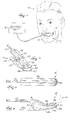
- FIG. 1 illustrates a device 11 embodying the invention.
- the device 11 includes a probe 12, a sensor 30 (shown in FIG. 7) coupled to the probe 12, a holder 14 coupled to the probe 12, and a display unit 16 coupled to the probe 12.
- the display unit 16 may be a stand-alone unit dedicated solely to providing an indicator of tissue perfusion levels to a clinician. Alternatively, the display unit 16 may be part of a complete patient monitoring system.
- an ion-selective, field-effect transistor is used to detect the pH of the mucosa tissue.
- ISFETs are steady-state devices similar to metal-oxide semiconductor field-effect transistors (MOSFET). MOSFETs are composed of two diodes separated by a gate region. The gate is a thin insulator, usually silicon dioxide, upon which a metallic material is deposited. Voltage applied to the gate generates an electric field, and thus current flows between the drain and the source. ISFETs are similar to MOSFETS, except that the metal gate region is replaced with an ion-selective layer. Ions traveling through the ion-selective layer generate an electric field, and thus current flows between the drain and source.
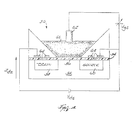
- FIG. 4 is a schematic illustration of one embodiment of the sensor 30.
- the sensor 30 is an ISFET and includes a gate 52, an insulator 54, an ion-selective surface 56, a drain 58, a source 60, a reference electrode 62, and a plurality of metal contacts 64.
- the ion-selective surface 56 and the reference electrode 62 are in contact with the mucosa tissue 66.
- the reference electrode 62 keeps a constant voltage potential V gs against the mucosa tissue 66, independent of the mucosa tissue composition.
- a voltage potential is developed at the ion-selective surface 56 in response to the H + ion concentration of the mucosa tissue 66.
- the ion-selective surface 56 is not encapsulated by any permeable membranes, rather the surface itself is ion-selective.
- the voltage potential V ds developed in response to the H + ion concentration modulates the current between the drain 58 and the source 60. As the voltage potential V ds across the gate changes, the ISFET current I ds flows. The voltage potential V ds correlates to the pH of the mucosa tissue.
- FIG. 3 is a schematic illustration of another suitable sensor 30.
- the sensor 30 shown in FIG. 3 is an electrochemical sensor.
- the electrochemical sensor 30 includes a voltmeter 32 coupled between a reference electrode 34 and a silver/silver-chloride reference wire 36.
- a shielded lead 44 connects the reference wire 36 to the voltmeter 32.
- the reference wire 36 is immersed within a buffer solution 38 with a constant pH level.
- the buffer solution 38 is hydrochloric acid (HCI).
- a pH-sensitive glass membrane 40 encapsulates the reference wire 36 and the buffer solution 38.
- the glass membrane 40 is not encapsulated within an ion-selective permeable membrane.
- Ion-selective permeable membranes are not necessary in order to measure H + ion concentration, as they are necessary to measure carbon dioxide concentration and other ion concentrations.
- the glass membrane composition itself is ion-selective.
- the ion-selective composition of the glass membrane 40 is SiO 2 or Na 2 O.
- the pH-sensitive glass membrane 40 and the reference electrode 34 are in contact with the mucosa tissue, represented by sample 42, which has an unknown pH.
- the reference electrode 34 keeps a constant voltage potential against the sample 42, independent of the sample composition.
- a direct voltage is developed between the inside and outside of the glass membrane 40.
- the voltage is caused by an ion exchange at each surface of the glass membrane 40 between the metal ions of the glass and the H + ions of the solutions.
- the approach of H + ions to the outside of the membrane 40 causes the silicate structure of the glass to conduct a positive charge into the buffer solution 38 inside the membrane 40.
- the ion exchange across the glass membrane 40 is controlled by the concentration of H + ions in each solution, and thus, the pH of each solution.
- the change in the voltage potential between the reference electrode 34 and the reference wire 36 is sensed by the voltmeter 32. If the concentration of H + ions in both solutions is the same, the potential difference across the glass membrane and the output of the voltmeter 32 is zero volts. Thus, the output of the voltmeter 32 correlates to the pH of the mucosa tissue, represented by sample 42.
- the device 11 includes a sensor for acquiring an end-tidal carbon-dioxide partial-pressure (P etCO2 ) measurement.
- P etCO2 end-tidal carbon-dioxide partial-pressure
- a P etCO2 sensor suitable for use in the present invention is disclosed in U.S. Patent Application serial number 09/477,914 entitled "Low Cost Main Stream Gas Analyzer System”.
- the device 11 includes additional sensors or sensor platforms for acquiring blood-chemistry and/or saliva-chemistry data from the patient.
- additional sensors preferably one or more ISFETs capable of detecting multiple species of ions and molecules are fabricated onto one silicon chip.
- the additional sensors are capable of detecting the blood chemistry data that is normally gathered in an arterial blood gas (ABG) analysis.
- the additional sensors are preferably capable of detecting at least one of pH, the partial pressure of oxygen (P O2 ), the partial pressure of carbon dioxide (P CO2 ), bicarbonate, hematocrit, hemoglobin, oxygen saturation (S O2 ), electrolyte concentration, and metabolite concentration.
- the additional sensors are preferably capable of detecting electrolytes including at least one of sodium, potassium, calcium, and chloride.
- the additional sensors are preferably capable of detecting metabolites including at least one of glucose, lactate, creatinine, and urea.
- the additional sensors are also preferably capable of detecting saliva chemistry data including at least one of cholesterol, lactate, electrolytes, illegal or abused drugs, glucose, bone markers, cystic fibrosis, HIV, and pregnancy.
- FIGS. 5-7 illustrate the preferred embodiment of the holder 14.
- the holder 14 could be constructed in any configuration and of any material capable of placing the sensor or sensors in contact with the mucosa tissue in the patient's upper digestive/respiratory tract.
- the holder 14 preferably includes an inner holder portion 90 and an outer holder portion 92 coupled to the inner holder portion 90 by a resilient connecting member 102.
- the inner holder portion 90 includes an outer surface 93 and a groove 94 formed in the outer surface 93.
- the probe 12 is positioned within the groove 94.
- the inner holder portion 90 also includes a first end 96 and a second end 98.
- the first end 96 is a projection for use by the clinician to grasp the holder 14.
- the second end 98 is a gradually downward-sloping projection that is positioned within the patient's mouth, preferably in contact with the patient's cheek.
- the sensor 30 is coupled to the second end 98.
- the sensor 30 is positioned to contact the mucosa tissue within the patient's mouth.
- the outer holder portion 92 includes a first end 104 and a second end 106.
- the first end 104 is a projection for use by the clinician in conjunction with the first end 96 of the inner holder portion 92 to grasp the holder 14.
- the second end 106 is a gradually upward-sloping projection that is positioned outside the patient's mouth, preferably in contact with the cheek-area of the patient's face.
- the space 108 between the second end 98 of the inner holder portion 90 and the second end 106 of the outer holder portion 92 is such that the holder 14 remains secured to the patient's cheek.
- the holder 14 is constructed from a soft, pliable material that easily conforms to the patient's anatomy while remaining rigid enough to secure the holder 14 to the patient's face.
- the material for the holder 14 is biocompatible.
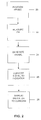
- FIG. 2 is a flow chart illustrating the method of the invention.
- the holder 14 coupled to the probe 12 is positioned 20 on the patient.
- the holder 14 is attached to the patient's cheek, and when in the appropriate position, presents the sensor 30 in contact with the oral mucosa tissue of the patient 10.
- the holder 14 may be attached to the patient's lip or under the patient's tongue.
- the clinician grasps the holder 14 by the first end 96 of the inner holder portion 90 and by the first end 104 of the outer holder portion 92.
- the clinician then positions the second end 98 of the inner holder portion 90 within the patient's mouth, preferably so that the sensor 30 is in contact with the mucosa tissue inside the patient's cheek.
- the clinician positions the second end 106 of the outer holder portion 92 outside the patient's mouth, preferably so that the second end 106 is in contact with the cheek area of the patient's face.
- the sensor 30 within the probe 12 measures 22 the pH by detecting the H + ion concentration of the mucosa tissue in the patient's mouth.
- the sensor 30 generates 24 an electrical signal in response to the detected pH.
- the signal is converted 26 into an indicator of the level of perfusion.
- the indicator of the level of perfusion is displayed 28 to a clinician on display unit 16.
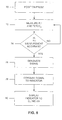
- FIG. 8 is a flow chart illustrating another preferred embodiment of the method of the invention including the additional step of acquiring a P etCO2 measurement.
- mucosa tissue pH correlates to arterial perfusion
- P etCO2 correlates to pulmonary perfusion.
- the mucosa tissue pH measurement is compared to the P etCO2 measurement.
- the comparison between the pH and P etCO2 measurements helps to provide a more accurate assessment of systemic perfusion failure.
- the holder 14 coupled to the probe 12 is positioned 70 on the patient 10.
- probe 12 includes both a pH sensor 30 and a P etCO2 sensor (not shown).
- the holder 14 is attached to the patient's cheek. In other embodiments (not shown), the holder 14 may be attached to the patient's lip or under the patient's tongue.
- the pH sensor 30 measures 72 the pH of the mucosa tissue
- the P etCO2 sensor measures 72 the P etCO2 level of the air expired by the patient. The P etCO2 measurement is compared to the pH measurement and used as a reference to determine the accuracy of the pH measurement.
- the pH measurement can be taken again 72 or the P etCO2 measurement can be relied upon to indicate the level of perfusion failure.
- the sensors generate 76 an electrical signal in response to the detected pH and P etCO2 .
- the signal is converted 78 into an indicator of the level of perfusion.
- the indicator of the level of perfusion is displayed 80 to a clinician on display unit 16.
Landscapes
- Health & Medical Sciences (AREA)
- Life Sciences & Earth Sciences (AREA)
- Physics & Mathematics (AREA)
- Public Health (AREA)
- Biophysics (AREA)
- Pathology (AREA)
- Engineering & Computer Science (AREA)
- Biomedical Technology (AREA)
- Heart & Thoracic Surgery (AREA)
- Medical Informatics (AREA)
- Molecular Biology (AREA)
- Surgery (AREA)
- Animal Behavior & Ethology (AREA)
- General Health & Medical Sciences (AREA)
- Veterinary Medicine (AREA)
- Optics & Photonics (AREA)
- Chemical & Material Sciences (AREA)
- Chemical Kinetics & Catalysis (AREA)
- General Chemical & Material Sciences (AREA)
- Endocrinology (AREA)
- Gastroenterology & Hepatology (AREA)
- Physiology (AREA)
- Dentistry (AREA)
- Oral & Maxillofacial Surgery (AREA)
- Immunology (AREA)
- Vascular Medicine (AREA)
- Measurement Of The Respiration, Hearing Ability, Form, And Blood Characteristics Of Living Organisms (AREA)
- Investigating Or Analysing Biological Materials (AREA)
- Measuring And Recording Apparatus For Diagnosis (AREA)
Applications Claiming Priority (2)
| Application Number | Priority Date | Filing Date | Title |
|---|---|---|---|
| US751681 | 1985-07-03 | ||
| US09/751,681 US20020087057A1 (en) | 2000-12-29 | 2000-12-29 | Method and apparatus for assessing tissue perfusion |
Publications (1)
| Publication Number | Publication Date |
|---|---|
| EP1219234A1 true EP1219234A1 (en) | 2002-07-03 |
Family
ID=25023032
Family Applications (1)
| Application Number | Title | Priority Date | Filing Date |
|---|---|---|---|
| EP01310531A Withdrawn EP1219234A1 (en) | 2000-12-29 | 2001-12-17 | Method and apparatus for assessing tissue perfusion |
Country Status (3)
| Country | Link |
|---|---|
| US (1) | US20020087057A1 (enExample) |
| EP (1) | EP1219234A1 (enExample) |
| JP (1) | JP2002306432A (enExample) |
Cited By (1)
| Publication number | Priority date | Publication date | Assignee | Title |
|---|---|---|---|---|
| WO2011027182A1 (en) * | 2009-09-01 | 2011-03-10 | Domokos Boda | Tonometric device for examining respiratory insufficiency and regional tissue perfusion failure |
Families Citing this family (17)
| Publication number | Priority date | Publication date | Assignee | Title |
|---|---|---|---|---|
| GB0219068D0 (en) * | 2002-08-16 | 2002-09-25 | Grampian Univ Hospitals | Apparatus and method |
| US7297113B1 (en) * | 2003-04-25 | 2007-11-20 | United States Of America As Represented By The Secretary Of The Navy | Microsensor system and method for measuring data |
| WO2005096920A1 (en) * | 2004-03-26 | 2005-10-20 | Healthcarelink | Apparatus and system for predictive health monitoring |
| US10071218B2 (en) | 2006-01-24 | 2018-09-11 | Zoll Medical Corporation | Reperfusion protection in resuscitation |
| US20070169779A1 (en) * | 2006-01-24 | 2007-07-26 | Freeman Gary A | Reperfusion protection in resuscitation |
| US7291502B2 (en) * | 2006-03-15 | 2007-11-06 | Franco Wayne P | Method for performing a non-invasive blood gas test |
| US20080128265A1 (en) * | 2006-11-30 | 2008-06-05 | Imperial Innovations Limited | Electrode Assembly and System |
| US8425428B2 (en) | 2008-03-31 | 2013-04-23 | Covidien Lp | Nitric oxide measurements in patients using flowfeedback |
| US8652064B2 (en) * | 2008-09-30 | 2014-02-18 | Covidien Lp | Sampling circuit for measuring analytes |
| US8536626B2 (en) | 2011-04-28 | 2013-09-17 | Honeywell International Inc. | Electronic pH sensor die packaging |
| US11583220B2 (en) | 2013-11-20 | 2023-02-21 | Koninklijke Philips N.V. | Traumatic brain injury guideline system and method |
| US20150374274A1 (en) * | 2014-06-30 | 2015-12-31 | Ace Jovanovski | Oral Detection Apparatus |
| DE102014019658B4 (de) * | 2014-12-19 | 2017-09-07 | Karl-Heinz Wenk | Sauerstoffsättigungsdetektionsvorrichtung zur Detektion und Signalisierung der arteriellen Sauerstoffsättigung und Verfahren zur Steigerung der körperlichen Leistungsfähigkeit |
| US11324954B2 (en) | 2019-06-28 | 2022-05-10 | Covidien Lp | Achieving smooth breathing by modified bilateral phrenic nerve pacing |
| US12115001B2 (en) | 2019-10-15 | 2024-10-15 | Exostat Medical, Inc. | Tissue perfusion sensor and placement device |
| CA3154419A1 (en) * | 2019-10-15 | 2021-04-22 | Irvin T. Pierskalla | Carbon dioxide sensor |
| EP4322829A4 (en) * | 2021-04-14 | 2025-02-26 | Exostat Medical, Inc. | TISSUE PERFUSION SENSOR AND PLACEMENT DEVICE |
Citations (3)
| Publication number | Priority date | Publication date | Assignee | Title |
|---|---|---|---|---|
| US4629424A (en) * | 1984-08-30 | 1986-12-16 | Integrated Ionics, Inc. | Intraoral ambient sensing device |
| EP0882434A2 (en) * | 1997-06-02 | 1998-12-09 | Hideyuki Takeuchi | Dental probe and dental diagnosis device |
| WO1999016346A1 (en) * | 1997-09-29 | 1999-04-08 | Institute Of Critical Care Medicine | Method and device for assessing perfusion failure in a patient |
Family Cites Families (4)
| Publication number | Priority date | Publication date | Assignee | Title |
|---|---|---|---|---|
| US5456251A (en) * | 1988-08-26 | 1995-10-10 | Mountpelier Investments, S.A. | Remote sensing tonometric catheter apparatus and method |
| US5158083A (en) * | 1989-10-23 | 1992-10-27 | Mountpelier Investments, S.A. | Miniature pco2 probe for in vivo biomedical applications |
| US5341803A (en) * | 1993-06-22 | 1994-08-30 | Goldberg Michael S | Apparatus and method for monitoring gastric fluid pH |
| US6258046B1 (en) * | 1995-07-06 | 2001-07-10 | Institute Of Critical Care Medicine | Method and device for assessing perfusion failure in a patient by measurement of blood flow |
-
2000
- 2000-12-29 US US09/751,681 patent/US20020087057A1/en not_active Abandoned
-
2001
- 2001-12-17 EP EP01310531A patent/EP1219234A1/en not_active Withdrawn
- 2001-12-28 JP JP2001399031A patent/JP2002306432A/ja not_active Withdrawn
Patent Citations (4)
| Publication number | Priority date | Publication date | Assignee | Title |
|---|---|---|---|---|
| US4629424A (en) * | 1984-08-30 | 1986-12-16 | Integrated Ionics, Inc. | Intraoral ambient sensing device |
| US6055447A (en) | 1995-07-06 | 2000-04-25 | Institute Of Critical Care Medicine | Patient CO2 Measurement |
| EP0882434A2 (en) * | 1997-06-02 | 1998-12-09 | Hideyuki Takeuchi | Dental probe and dental diagnosis device |
| WO1999016346A1 (en) * | 1997-09-29 | 1999-04-08 | Institute Of Critical Care Medicine | Method and device for assessing perfusion failure in a patient |
Non-Patent Citations (2)
| Title |
|---|
| OESCH U ET AL: "Solvent polymeric membrane pH catheter electrode for intraluminal measurements in the upper gastrointestinal tract", MEDICAL & BIOLOGICAL ENGINEERING & COMPUTING, JULY 1987, UK, vol. 25, no. 4, pages 414 - 419, XP002195504, ISSN: 0140-0118 * |
| OGINO H ET AL: "Reflectance pulse oximeter measuring central SaO2 from mouth", ENGINEERING IN MEDICINE AND BIOLOGY SOCIETY, 1994. ENGINEERING ADVANCES: NEW OPPORTUNITIES FOR BIOMEDICAL ENGINEERS., PROCEEDINGS OF THE 16TH ANNUAL INTERNATIONAL CONFERENCE OF THE IEEE BALTIMORE, MD, USA 3-6 NOV. 1994, NEW YORK, NY, USA,IEEE, US, 3 November 1994 (1994-11-03), pages 914 - 915, XP010145703, ISBN: 0-7803-2050-6 * |
Cited By (1)
| Publication number | Priority date | Publication date | Assignee | Title |
|---|---|---|---|---|
| WO2011027182A1 (en) * | 2009-09-01 | 2011-03-10 | Domokos Boda | Tonometric device for examining respiratory insufficiency and regional tissue perfusion failure |
Also Published As
| Publication number | Publication date |
|---|---|
| US20020087057A1 (en) | 2002-07-04 |
| JP2002306432A (ja) | 2002-10-22 |
Similar Documents
| Publication | Publication Date | Title |
|---|---|---|
| EP1219234A1 (en) | Method and apparatus for assessing tissue perfusion | |
| US6055447A (en) | Patient CO2 Measurement | |
| US7972495B1 (en) | System, method, and probe for monitoring pH levels of a sample medium | |
| US6258046B1 (en) | Method and device for assessing perfusion failure in a patient by measurement of blood flow | |
| US7618376B2 (en) | Device for assessing perfusion failure in a patient by measurement of blood flow | |
| US6216024B1 (en) | Method and device for assessing perfusion failure in a patient | |
| US20100057046A1 (en) | Systems for characterizing physiologic parameters and methods for use therewith | |
| US20100010328A1 (en) | Probes and sensors for ascertaining blood characteristics and methods and devices for use therewith | |
| EP0643942A1 (en) | System and method of diagnosing bacterial growth | |
| Uusaro et al. | Gastric mucosal end‐tidal P co2 difference as a continuous indicator of splanchnic perfusion | |
| JP2002306432A5 (enExample) | ||
| CN102317774A (zh) | 诊断设备 | |
| CN113167761B (zh) | 二氧化碳传感器 | |
| US20140127791A1 (en) | Diagnostic device | |
| Parker | Sensors for monitoring blood gases in intensive care | |
| RU2188576C1 (ru) | Способ количественной оценки воспалительного процесса в тканях пародонта | |
| JP3547124B2 (ja) | 患者において灌流不全を評価するための方法およびデバイス | |
| RU2363371C2 (ru) | Диагностический зонд и комплект для тонометрического исследования дыхательной недостаточности и недостаточности регионарного кровоснабжения организма | |
| JPS6317448B2 (enExample) | ||
| JP7752882B2 (ja) | 組織灌流センサ及び配置器具 | |
| WO1988006860A1 (en) | A method and a system for the in vivo determination of an electrical potential difference | |
| US20130030272A1 (en) | Tonometric device for examining respiratory insufficiency and regional tissue perfusion failure | |
| JPH07231885A (ja) | 生体内ガスセンサ |
Legal Events
| Date | Code | Title | Description |
|---|---|---|---|
| PUAI | Public reference made under article 153(3) epc to a published international application that has entered the european phase |
Free format text: ORIGINAL CODE: 0009012 |
|
| AK | Designated contracting states |
Kind code of ref document: A1 Designated state(s): AT BE CH CY DE DK ES FI FR GB GR IE IT LI LU MC NL PT SE TR |
|
| AX | Request for extension of the european patent |
Free format text: AL;LT;LV;MK;RO;SI |
|
| 17P | Request for examination filed |
Effective date: 20030103 |
|
| AKX | Designation fees paid |
Designated state(s): DE FR |
|
| 17Q | First examination report despatched |
Effective date: 20040325 |
|
| 17Q | First examination report despatched |
Effective date: 20040325 |
|
| STAA | Information on the status of an ep patent application or granted ep patent |
Free format text: STATUS: THE APPLICATION IS DEEMED TO BE WITHDRAWN |
|
| 18D | Application deemed to be withdrawn |
Effective date: 20070301 |