EP1218004B1 - 5-methyl indirubin for use in the treatment of human solid tumors - Google Patents
5-methyl indirubin for use in the treatment of human solid tumors Download PDFInfo
- Publication number
- EP1218004B1 EP1218004B1 EP00922625A EP00922625A EP1218004B1 EP 1218004 B1 EP1218004 B1 EP 1218004B1 EP 00922625 A EP00922625 A EP 00922625A EP 00922625 A EP00922625 A EP 00922625A EP 1218004 B1 EP1218004 B1 EP 1218004B1
- Authority
- EP
- European Patent Office
- Prior art keywords
- indirubin
- carcinoma
- tumor
- ref
- nmr
- Prior art date
- Legal status (The legal status is an assumption and is not a legal conclusion. Google has not performed a legal analysis and makes no representation as to the accuracy of the status listed.)
- Expired - Lifetime
Links
- 206010028980 Neoplasm Diseases 0.000 title claims abstract description 22
- 238000011282 treatment Methods 0.000 title claims abstract description 7
- AOHZJKSTSDMBIZ-UHFFFAOYSA-N chembl111433 Chemical compound C1=CC=C2C(=O)C(C3=C(O)NC4=CC=C(C=C43)C)=NC2=C1 AOHZJKSTSDMBIZ-UHFFFAOYSA-N 0.000 title claims description 7
- 210000000170 cell membrane Anatomy 0.000 claims abstract description 5
- 239000003814 drug Substances 0.000 claims abstract description 5
- 230000000149 penetrating effect Effects 0.000 claims abstract description 5
- 238000004519 manufacturing process Methods 0.000 claims abstract description 4
- CRDNMYFJWFXOCH-YPKPFQOOSA-N (3z)-3-(3-oxo-1h-indol-2-ylidene)-1h-indol-2-one Chemical class N/1C2=CC=CC=C2C(=O)C\1=C1/C2=CC=CC=C2NC1=O CRDNMYFJWFXOCH-YPKPFQOOSA-N 0.000 claims description 39
- 201000001441 melanoma Diseases 0.000 claims description 14
- 208000010507 Adenocarcinoma of Lung Diseases 0.000 claims description 7
- 201000005249 lung adenocarcinoma Diseases 0.000 claims description 7
- 201000008275 breast carcinoma Diseases 0.000 claims description 5
- 201000009546 lung large cell carcinoma Diseases 0.000 claims description 4
- 206010005003 Bladder cancer Diseases 0.000 claims description 3
- 206010009944 Colon cancer Diseases 0.000 claims description 3
- 206010027476 Metastases Diseases 0.000 claims description 3
- 206010033128 Ovarian cancer Diseases 0.000 claims description 3
- 206010038389 Renal cancer Diseases 0.000 claims description 3
- 208000006265 Renal cell carcinoma Diseases 0.000 claims description 3
- 201000001531 bladder carcinoma Diseases 0.000 claims description 3
- 208000021045 exocrine pancreatic carcinoma Diseases 0.000 claims description 3
- 230000009401 metastasis Effects 0.000 claims description 3
- 208000008443 pancreatic carcinoma Diseases 0.000 claims description 3
- 201000010174 renal carcinoma Diseases 0.000 claims description 3
- 208000000587 small cell lung carcinoma Diseases 0.000 claims description 3
- 208000010570 urinary bladder carcinoma Diseases 0.000 claims description 3
- 206010060862 Prostate cancer Diseases 0.000 claims description 2
- 150000003839 salts Chemical class 0.000 claims description 2
- 239000007787 solid Substances 0.000 abstract description 2
- 230000000259 anti-tumor effect Effects 0.000 description 28
- 150000001875 compounds Chemical class 0.000 description 24
- 238000001460 carbon-13 nuclear magnetic resonance spectrum Methods 0.000 description 15
- 238000000425 proton nuclear magnetic resonance spectrum Methods 0.000 description 15
- 230000000052 comparative effect Effects 0.000 description 14
- CRDNMYFJWFXOCH-UHFFFAOYSA-N isoindigotin Natural products N1C2=CC=CC=C2C(=O)C1=C1C2=CC=CC=C2NC1=O CRDNMYFJWFXOCH-UHFFFAOYSA-N 0.000 description 13
- 239000000126 substance Substances 0.000 description 13
- CRDNMYFJWFXOCH-BUHFOSPRSA-N Couroupitine B Natural products N\1C2=CC=CC=C2C(=O)C/1=C1/C2=CC=CC=C2NC1=O CRDNMYFJWFXOCH-BUHFOSPRSA-N 0.000 description 12
- 238000000160 carbon, hydrogen and nitrogen elemental analysis Methods 0.000 description 12
- 210000001072 colon Anatomy 0.000 description 12
- MLCPSWPIYHDOKG-BUHFOSPRSA-N (3e)-3-(2-oxo-1h-indol-3-ylidene)-1h-indol-2-one Chemical compound O=C\1NC2=CC=CC=C2C/1=C1/C2=CC=CC=C2NC1=O MLCPSWPIYHDOKG-BUHFOSPRSA-N 0.000 description 11
- 210000004027 cell Anatomy 0.000 description 10
- 230000001413 cellular effect Effects 0.000 description 10
- 238000001819 mass spectrum Methods 0.000 description 10
- 239000013543 active substance Substances 0.000 description 9
- JKMBMIMLVFMXRW-LYYFRFARSA-N epicocconone Chemical compound C1=C2C[C@@H](CO)OC=C2C(=O)[C@]2(C)C1=C(C(/O)=C/C(=O)/C=C/C=C/C=C/C)C(=O)O2 JKMBMIMLVFMXRW-LYYFRFARSA-N 0.000 description 9
- 241001062009 Indigofera Species 0.000 description 8
- 235000000177 Indigofera tinctoria Nutrition 0.000 description 8
- JUJWROOIHBZHMG-UHFFFAOYSA-N Pyridine Chemical compound C1=CC=NC=C1 JUJWROOIHBZHMG-UHFFFAOYSA-N 0.000 description 8
- 210000004072 lung Anatomy 0.000 description 8
- 239000012528 membrane Substances 0.000 description 8
- 210000004881 tumor cell Anatomy 0.000 description 8
- 229940097275 indigo Drugs 0.000 description 7
- COHYTHOBJLSHDF-UHFFFAOYSA-N indigo powder Natural products N1C2=CC=CC=C2C(=O)C1=C1C(=O)C2=CC=CC=C2N1 COHYTHOBJLSHDF-UHFFFAOYSA-N 0.000 description 7
- 238000012360 testing method Methods 0.000 description 7
- XLYOFNOQVPJJNP-UHFFFAOYSA-N water Substances O XLYOFNOQVPJJNP-UHFFFAOYSA-N 0.000 description 7
- YMWUJEATGCHHMB-UHFFFAOYSA-N Dichloromethane Chemical compound ClCCl YMWUJEATGCHHMB-UHFFFAOYSA-N 0.000 description 6
- IAZDPXIOMUYVGZ-UHFFFAOYSA-N Dimethylsulphoxide Chemical compound CS(C)=O IAZDPXIOMUYVGZ-UHFFFAOYSA-N 0.000 description 6
- LFQSCWFLJHTTHZ-UHFFFAOYSA-N Ethanol Chemical compound CCO LFQSCWFLJHTTHZ-UHFFFAOYSA-N 0.000 description 6
- XEKOWRVHYACXOJ-UHFFFAOYSA-N Ethyl acetate Chemical compound CCOC(C)=O XEKOWRVHYACXOJ-UHFFFAOYSA-N 0.000 description 6
- VEXZGXHMUGYJMC-UHFFFAOYSA-N Hydrochloric acid Chemical compound Cl VEXZGXHMUGYJMC-UHFFFAOYSA-N 0.000 description 6
- OKKJLVBELUTLKV-UHFFFAOYSA-N Methanol Chemical compound OC OKKJLVBELUTLKV-UHFFFAOYSA-N 0.000 description 6
- 230000000694 effects Effects 0.000 description 6
- -1 indirubin compound Chemical class 0.000 description 6
- 230000002611 ovarian Effects 0.000 description 6
- 241000196324 Embryophyta Species 0.000 description 5
- 238000001727 in vivo Methods 0.000 description 5
- PCKPVGOLPKLUHR-UHFFFAOYSA-N indoxyl Chemical compound C1=CC=C2C(O)=CNC2=C1 PCKPVGOLPKLUHR-UHFFFAOYSA-N 0.000 description 5
- 230000005764 inhibitory process Effects 0.000 description 5
- IAZDPXIOMUYVGZ-WFGJKAKNSA-N Dimethyl sulfoxide Chemical compound [2H]C([2H])([2H])S(=O)C([2H])([2H])[2H] IAZDPXIOMUYVGZ-WFGJKAKNSA-N 0.000 description 4
- WTDHULULXKLSOZ-UHFFFAOYSA-N Hydroxylamine hydrochloride Chemical compound Cl.ON WTDHULULXKLSOZ-UHFFFAOYSA-N 0.000 description 4
- QQILFGKZUJYXGS-UHFFFAOYSA-N Indigo dye Chemical compound C1=CC=C2C(=O)C(C3=C(C4=CC=CC=C4N3)O)=NC2=C1 QQILFGKZUJYXGS-UHFFFAOYSA-N 0.000 description 4
- 241000699660 Mus musculus Species 0.000 description 4
- 238000006243 chemical reaction Methods 0.000 description 4
- 238000002512 chemotherapy Methods 0.000 description 4
- 239000013078 crystal Substances 0.000 description 4
- 238000002474 experimental method Methods 0.000 description 4
- 238000011534 incubation Methods 0.000 description 4
- HBDSHCUSXQATPO-BGBJRWHRSA-N indirubin-3'-monoxime Chemical compound O=C/1NC2=CC=CC=C2C\1=C\1/C(=N/O)/C2=CC=CC=C2N/1 HBDSHCUSXQATPO-BGBJRWHRSA-N 0.000 description 4
- JXDYKVIHCLTXOP-UHFFFAOYSA-N isatin Chemical compound C1=CC=C2C(=O)C(=O)NC2=C1 JXDYKVIHCLTXOP-UHFFFAOYSA-N 0.000 description 4
- 238000011580 nude mouse model Methods 0.000 description 4
- UMJSCPRVCHMLSP-UHFFFAOYSA-N pyridine Natural products COC1=CC=CN=C1 UMJSCPRVCHMLSP-UHFFFAOYSA-N 0.000 description 4
- 238000006467 substitution reaction Methods 0.000 description 4
- QTBSBXVTEAMEQO-UHFFFAOYSA-N Acetic acid Chemical compound CC(O)=O QTBSBXVTEAMEQO-UHFFFAOYSA-N 0.000 description 3
- KWYUFKZDYYNOTN-UHFFFAOYSA-M Potassium hydroxide Chemical compound [OH-].[K+] KWYUFKZDYYNOTN-UHFFFAOYSA-M 0.000 description 3
- 241000257673 Strobilanthes cusia Species 0.000 description 3
- 125000000217 alkyl group Chemical group 0.000 description 3
- 230000000719 anti-leukaemic effect Effects 0.000 description 3
- 125000003118 aryl group Chemical group 0.000 description 3
- 238000003556 assay Methods 0.000 description 3
- FQCPPVRJPILDIK-UHFFFAOYSA-N chembl126077 Chemical compound N1C2=CC=CC=C2C(N=O)=C1C1=C(O)NC2=CC=CC=C21 FQCPPVRJPILDIK-UHFFFAOYSA-N 0.000 description 3
- XMPHNZMDLSUDQI-UHFFFAOYSA-N chembl173682 Chemical compound C1=CC=C2C(=O)C(C=3C4=CC(Br)=CC=C4NC=3O)=NC2=C1 XMPHNZMDLSUDQI-UHFFFAOYSA-N 0.000 description 3
- 239000003795 chemical substances by application Substances 0.000 description 3
- 239000000203 mixture Substances 0.000 description 3
- 239000008194 pharmaceutical composition Substances 0.000 description 3
- 239000002244 precipitate Substances 0.000 description 3
- 239000003981 vehicle Substances 0.000 description 3
- YIMMDWQJMUECHD-OWOJBTEDSA-N 1-isocyanato-4-[(e)-2-(4-isocyanatophenyl)ethenyl]benzene Chemical compound C1=CC(N=C=O)=CC=C1\C=C\C1=CC=C(N=C=O)C=C1 YIMMDWQJMUECHD-OWOJBTEDSA-N 0.000 description 2
- 238000001644 13C nuclear magnetic resonance spectroscopy Methods 0.000 description 2
- XKRFYHLGVUSROY-UHFFFAOYSA-N Argon Chemical compound [Ar] XKRFYHLGVUSROY-UHFFFAOYSA-N 0.000 description 2
- 208000031648 Body Weight Changes Diseases 0.000 description 2
- 241000219193 Brassicaceae Species 0.000 description 2
- RTZKZFJDLAIYFH-UHFFFAOYSA-N Diethyl ether Chemical compound CCOCC RTZKZFJDLAIYFH-UHFFFAOYSA-N 0.000 description 2
- JBOPQACSHPPKEP-UHFFFAOYSA-N Indoxyl acetate Chemical compound C1=CC=C2C(OC(=O)C)=CNC2=C1 JBOPQACSHPPKEP-UHFFFAOYSA-N 0.000 description 2
- 241000334154 Isatis tinctoria Species 0.000 description 2
- 229910006069 SO3H Inorganic materials 0.000 description 2
- CDBYLPFSWZWCQE-UHFFFAOYSA-L Sodium Carbonate Chemical compound [Na+].[Na+].[O-]C([O-])=O CDBYLPFSWZWCQE-UHFFFAOYSA-L 0.000 description 2
- UIIMBOGNXHQVGW-UHFFFAOYSA-M Sodium bicarbonate Chemical compound [Na+].OC([O-])=O UIIMBOGNXHQVGW-UHFFFAOYSA-M 0.000 description 2
- 150000001408 amides Chemical class 0.000 description 2
- 230000037396 body weight Effects 0.000 description 2
- 230000004579 body weight change Effects 0.000 description 2
- 210000000172 cytosol Anatomy 0.000 description 2
- 238000011161 development Methods 0.000 description 2
- 238000009826 distribution Methods 0.000 description 2
- 238000011156 evaluation Methods 0.000 description 2
- 238000000338 in vitro Methods 0.000 description 2
- XVARCVCWNFACQC-RKQHYHRCSA-N indican Chemical compound O[C@@H]1[C@@H](O)[C@H](O)[C@@H](CO)O[C@H]1OC1=CNC2=CC=CC=C12 XVARCVCWNFACQC-RKQHYHRCSA-N 0.000 description 2
- 210000003463 organelle Anatomy 0.000 description 2
- CTSLXHKWHWQRSH-UHFFFAOYSA-N oxalyl chloride Chemical compound ClC(=O)C(Cl)=O CTSLXHKWHWQRSH-UHFFFAOYSA-N 0.000 description 2
- 208000000649 small cell carcinoma Diseases 0.000 description 2
- 125000000020 sulfo group Chemical group O=S(=O)([*])O[H] 0.000 description 2
- 229940124530 sulfonamide Drugs 0.000 description 2
- 125000001273 sulfonato group Chemical group [O-]S(*)(=O)=O 0.000 description 2
- 231100000338 sulforhodamine B assay Toxicity 0.000 description 2
- 230000004565 tumor cell growth Effects 0.000 description 2
- 238000002371 ultraviolet--visible spectrum Methods 0.000 description 2
- MAOBFOXLCJIFLV-UHFFFAOYSA-N (2-aminophenyl)-phenylmethanone Chemical compound NC1=CC=CC=C1C(=O)C1=CC=CC=C1 MAOBFOXLCJIFLV-UHFFFAOYSA-N 0.000 description 1
- VBMISAYWIMDRCV-UHFFFAOYSA-N 3-(2-hydroxy-1H-indol-3-yl)indol-2-one Chemical compound Oc1[nH]c2ccccc2c1C1=c2ccccc2=NC1=O VBMISAYWIMDRCV-UHFFFAOYSA-N 0.000 description 1
- 241000207965 Acanthaceae Species 0.000 description 1
- 208000035143 Bacterial infection Diseases 0.000 description 1
- 201000009030 Carcinoma Diseases 0.000 description 1
- 201000000274 Carcinosarcoma Diseases 0.000 description 1
- XTHFKEDIFFGKHM-UHFFFAOYSA-N Dimethoxyethane Chemical compound COCCOC XTHFKEDIFFGKHM-UHFFFAOYSA-N 0.000 description 1
- 241000220485 Fabaceae Species 0.000 description 1
- WQZGKKKJIJFFOK-GASJEMHNSA-N Glucose Natural products OC[C@H]1OC(O)[C@H](O)[C@@H](O)[C@@H]1O WQZGKKKJIJFFOK-GASJEMHNSA-N 0.000 description 1
- 240000004343 Indigofera suffruticosa Species 0.000 description 1
- 208000006552 Lewis Lung Carcinoma Diseases 0.000 description 1
- 241001465754 Metazoa Species 0.000 description 1
- 241000699670 Mus sp. Species 0.000 description 1
- VCUFZILGIRCDQQ-KRWDZBQOSA-N N-[[(5S)-2-oxo-3-(2-oxo-3H-1,3-benzoxazol-6-yl)-1,3-oxazolidin-5-yl]methyl]-2-[[3-(trifluoromethoxy)phenyl]methylamino]pyrimidine-5-carboxamide Chemical compound O=C1O[C@H](CN1C1=CC2=C(NC(O2)=O)C=C1)CNC(=O)C=1C=NC(=NC=1)NCC1=CC(=CC=C1)OC(F)(F)F VCUFZILGIRCDQQ-KRWDZBQOSA-N 0.000 description 1
- 229930182559 Natural dye Natural products 0.000 description 1
- 241000283984 Rodentia Species 0.000 description 1
- VYPSYNLAJGMNEJ-UHFFFAOYSA-N Silicium dioxide Chemical compound O=[Si]=O VYPSYNLAJGMNEJ-UHFFFAOYSA-N 0.000 description 1
- 241001062472 Stokellia anisodon Species 0.000 description 1
- 208000036142 Viral infection Diseases 0.000 description 1
- HCHKCACWOHOZIP-UHFFFAOYSA-N Zinc Chemical compound [Zn] HCHKCACWOHOZIP-UHFFFAOYSA-N 0.000 description 1
- 239000002253 acid Substances 0.000 description 1
- 238000005903 acid hydrolysis reaction Methods 0.000 description 1
- 230000002378 acidificating effect Effects 0.000 description 1
- 229940121363 anti-inflammatory agent Drugs 0.000 description 1
- 239000002260 anti-inflammatory agent Substances 0.000 description 1
- 230000003110 anti-inflammatory effect Effects 0.000 description 1
- 230000001754 anti-pyretic effect Effects 0.000 description 1
- 229940030225 antihemorrhagics Drugs 0.000 description 1
- 239000000063 antileukemic agent Substances 0.000 description 1
- 239000002221 antipyretic Substances 0.000 description 1
- 229940125716 antipyretic agent Drugs 0.000 description 1
- 229910052786 argon Inorganic materials 0.000 description 1
- 230000001580 bacterial effect Effects 0.000 description 1
- 208000022362 bacterial infectious disease Diseases 0.000 description 1
- WQZGKKKJIJFFOK-VFUOTHLCSA-N beta-D-glucose Chemical compound OC[C@H]1O[C@@H](O)[C@H](O)[C@@H](O)[C@@H]1O WQZGKKKJIJFFOK-VFUOTHLCSA-N 0.000 description 1
- 230000015572 biosynthetic process Effects 0.000 description 1
- 239000001045 blue dye Substances 0.000 description 1
- 244000309464 bull Species 0.000 description 1
- 201000011510 cancer Diseases 0.000 description 1
- 230000004700 cellular uptake Effects 0.000 description 1
- 238000012512 characterization method Methods 0.000 description 1
- CHGLHVVJPSESHY-UHFFFAOYSA-N chembl172540 Chemical compound C1=CC=C2C(=O)C(C=3C4=CC=C(F)C=C4NC=3O)=NC2=C1 CHGLHVVJPSESHY-UHFFFAOYSA-N 0.000 description 1
- 230000005757 colony formation Effects 0.000 description 1
- 238000004440 column chromatography Methods 0.000 description 1
- 239000012043 crude product Substances 0.000 description 1
- 238000000354 decomposition reaction Methods 0.000 description 1
- 230000001627 detrimental effect Effects 0.000 description 1
- 239000003085 diluting agent Substances 0.000 description 1
- 239000003937 drug carrier Substances 0.000 description 1
- 238000007877 drug screening Methods 0.000 description 1
- 239000000975 dye Substances 0.000 description 1
- 230000007071 enzymatic hydrolysis Effects 0.000 description 1
- 238000006047 enzymatic hydrolysis reaction Methods 0.000 description 1
- 239000000706 filtrate Substances 0.000 description 1
- 239000012530 fluid Substances 0.000 description 1
- 238000009472 formulation Methods 0.000 description 1
- 230000002496 gastric effect Effects 0.000 description 1
- 239000008103 glucose Substances 0.000 description 1
- 229930182470 glycoside Natural products 0.000 description 1
- 150000002338 glycosides Chemical class 0.000 description 1
- 230000009036 growth inhibition Effects 0.000 description 1
- 230000000025 haemostatic effect Effects 0.000 description 1
- 238000010438 heat treatment Methods 0.000 description 1
- 125000004435 hydrogen atom Chemical group [H]* 0.000 description 1
- 230000005917 in vivo anti-tumor Effects 0.000 description 1
- JYGFTBXVXVMTGB-UHFFFAOYSA-N indolin-2-one Chemical compound C1=CC=C2NC(=O)CC2=C1 JYGFTBXVXVMTGB-UHFFFAOYSA-N 0.000 description 1
- 125000001041 indolyl group Chemical group 0.000 description 1
- BXFFHSIDQOFMLE-UHFFFAOYSA-N indoxyl sulfate Natural products C1=CC=C2C(OS(=O)(=O)O)=CNC2=C1 BXFFHSIDQOFMLE-UHFFFAOYSA-N 0.000 description 1
- XVARCVCWNFACQC-UHFFFAOYSA-N indoxyl-beta-D-glucopyranoside Natural products OC1C(O)C(O)C(CO)OC1OC1=CNC2=CC=CC=C12 XVARCVCWNFACQC-UHFFFAOYSA-N 0.000 description 1
- 230000001939 inductive effect Effects 0.000 description 1
- 239000011261 inert gas Substances 0.000 description 1
- 238000002329 infrared spectrum Methods 0.000 description 1
- 238000007912 intraperitoneal administration Methods 0.000 description 1
- 238000002955 isolation Methods 0.000 description 1
- 201000003445 large cell neuroendocrine carcinoma Diseases 0.000 description 1
- 235000021374 legumes Nutrition 0.000 description 1
- 150000002632 lipids Chemical class 0.000 description 1
- 230000000873 masking effect Effects 0.000 description 1
- 239000000463 material Substances 0.000 description 1
- 238000000034 method Methods 0.000 description 1
- IVTPKBBAFISNAL-UHFFFAOYSA-N n,n'-bis(2-benzoylphenyl)oxamide Chemical compound C=1C=CC=C(C(=O)C=2C=CC=CC=2)C=1NC(=O)C(=O)NC1=CC=CC=C1C(=O)C1=CC=CC=C1 IVTPKBBAFISNAL-UHFFFAOYSA-N 0.000 description 1
- 239000000978 natural dye Substances 0.000 description 1
- 229930014626 natural product Natural products 0.000 description 1
- 230000007935 neutral effect Effects 0.000 description 1
- 238000011275 oncology therapy Methods 0.000 description 1
- 238000007254 oxidation reaction Methods 0.000 description 1
- 125000003544 oxime group Chemical group 0.000 description 1
- 230000035515 penetration Effects 0.000 description 1
- 230000002688 persistence Effects 0.000 description 1
- 239000000047 product Substances 0.000 description 1
- 102000004169 proteins and genes Human genes 0.000 description 1
- 108090000623 proteins and genes Proteins 0.000 description 1
- 239000011541 reaction mixture Substances 0.000 description 1
- 238000001953 recrystallisation Methods 0.000 description 1
- 238000010992 reflux Methods 0.000 description 1
- 229940125723 sedative agent Drugs 0.000 description 1
- 239000000932 sedative agent Substances 0.000 description 1
- 210000002966 serum Anatomy 0.000 description 1
- 239000000741 silica gel Substances 0.000 description 1
- 229910002027 silica gel Inorganic materials 0.000 description 1
- 229910000030 sodium bicarbonate Inorganic materials 0.000 description 1
- 235000017557 sodium bicarbonate Nutrition 0.000 description 1
- 229910000029 sodium carbonate Inorganic materials 0.000 description 1
- 239000002904 solvent Substances 0.000 description 1
- 238000001228 spectrum Methods 0.000 description 1
- 238000003860 storage Methods 0.000 description 1
- 238000003210 sulforhodamine B staining Methods 0.000 description 1
- 238000003786 synthesis reaction Methods 0.000 description 1
- 230000002194 synthesizing effect Effects 0.000 description 1
- YONPGGFAJWQGJC-UHFFFAOYSA-K titanium(iii) chloride Chemical compound Cl[Ti](Cl)Cl YONPGGFAJWQGJC-UHFFFAOYSA-K 0.000 description 1
- 231100000816 toxic dose Toxicity 0.000 description 1
- 231100000419 toxicity Toxicity 0.000 description 1
- 230000001988 toxicity Effects 0.000 description 1
- 230000004614 tumor growth Effects 0.000 description 1
- 230000009385 viral infection Effects 0.000 description 1
Images




Classifications
-
- A—HUMAN NECESSITIES
- A61—MEDICAL OR VETERINARY SCIENCE; HYGIENE
- A61K—PREPARATIONS FOR MEDICAL, DENTAL OR TOILETRY PURPOSES
- A61K31/00—Medicinal preparations containing organic active ingredients
- A61K31/33—Heterocyclic compounds
- A61K31/395—Heterocyclic compounds having nitrogen as a ring hetero atom, e.g. guanethidine or rifamycins
- A61K31/40—Heterocyclic compounds having nitrogen as a ring hetero atom, e.g. guanethidine or rifamycins having five-membered rings with one nitrogen as the only ring hetero atom, e.g. sulpiride, succinimide, tolmetin, buflomedil
- A61K31/403—Heterocyclic compounds having nitrogen as a ring hetero atom, e.g. guanethidine or rifamycins having five-membered rings with one nitrogen as the only ring hetero atom, e.g. sulpiride, succinimide, tolmetin, buflomedil condensed with carbocyclic rings, e.g. carbazole
- A61K31/404—Indoles, e.g. pindolol
-
- A—HUMAN NECESSITIES
- A61—MEDICAL OR VETERINARY SCIENCE; HYGIENE
- A61P—SPECIFIC THERAPEUTIC ACTIVITY OF CHEMICAL COMPOUNDS OR MEDICINAL PREPARATIONS
- A61P35/00—Antineoplastic agents
-
- A—HUMAN NECESSITIES
- A61—MEDICAL OR VETERINARY SCIENCE; HYGIENE
- A61P—SPECIFIC THERAPEUTIC ACTIVITY OF CHEMICAL COMPOUNDS OR MEDICINAL PREPARATIONS
- A61P35/00—Antineoplastic agents
- A61P35/02—Antineoplastic agents specific for leukemia
Definitions
- the present invention relates to the use of a cell membrane penetrating indirubin bisindole derivative for the manufacture of a medicament for the treatment of human solid cancers.
- Indigoid bisindoles comprise a spectrum of natural dye stuffs. Many of these can be obtained from plants. Accordingly, indirubin, indigo and isoindigo are natural products which can be obtained from different plants: namely, Baphicacanthus cusia (Acanthaceae), Indigofera suffruticosa (Fabaceae), Isatis indigotica (Brassicaceae) and others.
- Indican a glycoside which is found in plants, gives glucose and 3-hydroxyindole due to acidic or enzymatic hydrolysis. 3-Hydroxyindole is converted by air-oxidation into indigo and its isomers.
- Indigo naturalis is the natural blue dye obtained from plant material, e.g. lsatis indigotica (Brassicaceae).
- Indirubin an isomer of indigo, can be found in Indigo naturalis in an amount of up to 60% ( Falbe J. & Regitz M., Römpp Chemie Lexikon (1992), 9. Aufl., Stuttgart, Georg Thieme Verlag ). It occurs also in Isatis tinctoria in an amount of up to 5% which is indigenous to Central Europe ( Gelius R., Z. Chem., 20, (1980), 340-341 ). Derivatives of indirubin are known for a long time as dyes of low persistence.
- Indigo naturalis is reported to be used in traditional Chinese medicine as a haemostatic, anti-pyretic, anti-inflammatory and sedative agent in the treatment of bacterial and viral infections. Antileukemic effects of Indigo naturalis have also been reported, with indirubin being the effective principle ( Ji X. et al., Acta Pharm. Sin., 16, (1981), 146-148 ; Gan W. J. et al., J. Hematol., 6, (1985), 611-613 ). In spite of its anti-leukaemic activity, however, indirubin dissolves only poorly in water and is therefore not readily resorbed. Recently, the antileukemic activity of some better soluble indirubin derivatives has been reported ( Ch. Li et a., Bull. Chem. Soc, Jpn. 69, 1621-1627 (1996 )).
- Derwent Abstract XP-002164029 describes inter alia lower alkyl indirubins which, however, are N-alkyl indirubins, as well as lower alkyl indigos and lower alkyl isoindigotins. The respective compounds are said to exhibit anti-tumor activity against Walker 256 carcinosarcoma and Lewis-Lung carcinoma in rodents.
- Derwent Abstract XP-002164030 describes indirubin derivatives which are useful as anti-tumoral agents. Wu K. et al.:"Potential antileukemic agents systhesis of derivatives of indirubinindigo, and isoindigotin", Acta Pharmaceutica Sinica, Beijing, CN, vol. 20, no.
- indigoid bisindole or its derivatives have never been investigated with respect to solid tumors, in particular human solid tumors, and furthermore, the problem of the poor solubility resulting in a poor resorption has not been sufficiently solved yet.
- the technical problem underlying the present invention is to provide new active substances which can be used in the treatment of human solid tumors and metastasis thereof. Furthermore, the resorption of said substances should be improved in order to improve their in vivo anti-tumor activity.
- the present invention relates to the use of a cell membrane penetrating indirubin derivative for the manufacture of a medicament for the treatment of human solid tumors and metastasis thereof wherein the indirubin derivative is selected from 5-methyl indirubin represented by the following formula (I): wherein the solid tumors are selected from mammary carcinoma, melanoma, large-cell lung carcinoma, small-cell lung carcinoma, lung adenocarcinoma, colon carcinoma, bladder carcinoma, ovarian carcinoma, pancreatic carcinoma, renal carcinoma, prostatic carcinoma and melanomas.
- the solid tumors are selected from mammary carcinoma, melanoma, large-cell lung carcinoma, small-cell lung carcinoma, lung adenocarcinoma, colon carcinoma, bladder carcinoma, ovarian carcinoma, pancreatic carcinoma, renal carcinoma, prostatic carcinoma and melanomas.
- derivatives according to the present invention may also be chemically coupled to masking agents as described e.g. in German patent application DE-A-38 27 488 which function to carry the anti-tumor active substances to the tumor.
- indirubin derivative selected from 5-methyl indirubin according to the present invention is also addressed to as "anti-tumor active compound according to the present invention”.
- cell membrane penetrating and “cell resorbable” mean the ability of the indirubin derivative to be taken up by the tumor ceil through the cellular membrane.
- the above identified indirubin derivative of the present invention can be formulated into pharmaceutical compositions which contain optionally a pharmaceutically acceptable carrier and/or diluent.
- Said pharmaceutical compositions can be applied e.g. orally, topically, intravenously, intraperitoneally, subcutaneously and rectally in pharmaceutically effective amounts.
- compositions which can be applied to a human body. Since most physiological fluids are waterbased, the pharmaceutically active substances should be soluble in water and/or a water mixable solvent wherein the latter of course has to be physiologically acceptable in small concentrations, such as ethanol. Furthermore, pharmaceutically active substances which are taken orally have to be resorbed into surface of the human body - including the gastrointestinal mucous membrane- or, in case of an application via syringe, e.g. intraperitoneal or intravasal, have to be resorbed through the cellular membranes of the of destination cells, specifically into the tumor cells.
- indirubin derivative according to the present invention, a good solubility is not the only prerequisite guaranteeing a good anti-tumor activity in vivo as it will become apparent by the Examples and Comparative Examples shown below.
- An important factor for the anti-tumor activity of indirubin derivatives is their ability to penetrate the cellular membranes of the tumor cells.
- Cellular membranes are composed of lipids and compose a rather non-polar medium. Therefore, substitution with extremely polar groups such as the sulfonate group on the one hand improves the water solubility of a compound but on the other hand hinders or even prohibits the resorption of anti-tumor active substances into a tumor cell.
- anti-tumor active substances which show good anti-tumor activities under certain in vitro conditions, have to be rejected because of not showing any activity when tested using intact cells or in vivo.
- the testing of the anti-tumor active substances are tested by in vitro tests using intact tumor cells and, additionally, in vivo tests. Furthermore, a comparison of the activity test results and the tests evaluating the ability to penetrate cellular membranes shows that indigoid bisindole compounds which exhibit a good cell-penetrating ability also show good to excellent anti-tumor activity.
- Example 6 is in accordance with the present invention, while Examples 1 to 5 and 7 to 14 are for illustrative purposes, thus indicated as Reference Examples.
- Indirubin-3'-oxime was synthesized by reaction of indirubin with hydroxylamine hydrochloride in a pyridine solution (Farbtechnike vorm. Meister Lucius & Brüning in Hoechst a.M., Patentschrift des Reichspatentamtes Nr. 283726 (1913)).
- Isoindigo was synthesized by reaction of oxindole with isatin in acetic acid with addition of hydrochloric acid ( Wahl A., Bayard P., Comptes Rendues Hebdomadaires des Seances de L'Academie des Sciences, 148, (1909), 716-719 ).
- Table 2 summarizes the structures of the indirubin compounds of Examples 1 to 9 and Comparative Examples 1 and 2.
- Table 1 Example compound R 1 X 1 (Ref. Ex.) Indirubin H 2 (Ref. Ex.) 5-Iodoindirubin I O 3 (Ref. Ex.) 5-Bromoindirubin Br O 4 (Ref. Ex.) 5-Chloroindirubin Cl O 5 (Ref. Ex.) 5-Fluoroindirubin F O 6 (Invention) 5-Methylindirubin CH 3 O 7 (Ref. Ex.) 5-Nitroindirubin NO 2 O 8 (Ref. Ex.) indirubin-3'-oxime H NOH 9 (Ref.
- the ability of the compound according to Example 6 to penetrate the cellular membrane is substantially improved compared to that of the parent compound indirubin (Reference Example 1).
- the uptake of the compound according to Reference Example 8 is also slightly improved compared to the non-substituted indirubin
- the anti-tumor activity of the compounds was evaluated via a colony-forming-assay as described e.g. by D. P. Berger et al. in Annals of Oncology 1, pages 333-341 (1990 ), "The clonongenic assay with human tumor xenografts, evaluation, predictive values and application for drug screening".
- mammary carcinoma MAXF
- LXFA lung adenocarcinoma
- LXFL large-cell lung carcinoma
- LXFS small-cell lung carcinoma
- CXF colon carcinoma
- MEXF pancreatic carcinoma
- PAXF renal carcinoma
- RXF ovarian carcinoma
- BXF bladder carcinoma
- the IC 70 -values and IC 50 -values, respectively, define the concentration of a pharmaceutically active compound causing 70 % and 50 %, respectively, reduction of colony formation compared to the untreated control. Therefore, IC 70 - and IC 50 -values serve to demonstrate the anti-tumor activity of a pharmaceutically active compound wherein low IC 70 - and/or IC 50 -values demonstrate a superior anti-tumor activity.
- the IC 70 -value preferably is 20 ⁇ M or lower, more preferably 10 ⁇ M or lower.
- Table 3 shows the anti-tumor activity of the compounds according to the Example, Reference Examples and Comparative Example 1.
- the compounds according to the Example and the Reference Examples show good to excellent anti-tumor activity against various types of tumor cell lines.
- the compound according to Comparative Example 1 does not exhibit an anti-tumor activity against any of the tumor lines. This behaviour is in accordance with the lacking ability of this substance to penetrate cellular membranes as demonstrated in Table 2, above.
- Anti-tumor activity was evaluated comparing the median tumor volume relative to control, expressed as %T/C, wherein T is the test group and C the vehicle control group.
- %T/C the median tumor volume relative to control
- anti-tumor activity is given according to an activity rate scale.
- a reduction of the body weight of the tested mice of more then 20 % by weight in general is interpreted as a toxic dose.
Landscapes
- Health & Medical Sciences (AREA)
- Pharmacology & Pharmacy (AREA)
- Veterinary Medicine (AREA)
- Public Health (AREA)
- Chemical & Material Sciences (AREA)
- General Health & Medical Sciences (AREA)
- Medicinal Chemistry (AREA)
- Animal Behavior & Ethology (AREA)
- Life Sciences & Earth Sciences (AREA)
- Chemical Kinetics & Catalysis (AREA)
- Organic Chemistry (AREA)
- Nuclear Medicine, Radiotherapy & Molecular Imaging (AREA)
- General Chemical & Material Sciences (AREA)
- Epidemiology (AREA)
- Oncology (AREA)
- Hematology (AREA)
- Pharmaceuticals Containing Other Organic And Inorganic Compounds (AREA)
- Indole Compounds (AREA)
Abstract
Description
- The present invention relates to the use of a cell membrane penetrating indirubin bisindole derivative for the manufacture of a medicament for the treatment of human solid cancers.
- Indigoid bisindoles comprise a spectrum of natural dye stuffs. Many of these can be obtained from plants. Accordingly, indirubin, indigo and isoindigo are natural products which can be obtained from different plants: namely, Baphicacanthus cusia (Acanthaceae), Indigofera suffruticosa (Fabaceae), Isatis indigotica (Brassicaceae) and others. Indican, a glycoside which is found in plants, gives glucose and 3-hydroxyindole due to acidic or enzymatic hydrolysis. 3-Hydroxyindole is converted by air-oxidation into indigo and its isomers. Indigo naturalis (Chinese: quingdai) is the natural blue dye obtained from plant material, e.g. lsatis indigotica (Brassicaceae). Indirubin, an isomer of indigo, can be found in Indigo naturalis in an amount of up to 60% (Falbe J. & Regitz M., Römpp Chemie Lexikon (1992), 9. Aufl., Stuttgart, Georg Thieme Verlag). It occurs also in Isatis tinctoria in an amount of up to 5% which is indigenous to Central Europe (Gelius R., Z. Chem., 20, (1980), 340-341). Derivatives of indirubin are known for a long time as dyes of low persistence.
- Indigo naturalis is reported to be used in traditional Chinese medicine as a haemostatic, anti-pyretic, anti-inflammatory and sedative agent in the treatment of bacterial and viral infections. Antileukemic effects of Indigo naturalis have also been reported, with indirubin being the effective principle (Ji X. et al., Acta Pharm. Sin., 16, (1981), 146-148; Gan W. J. et al., J. Hematol., 6, (1985), 611-613). In spite of its anti-leukaemic activity, however, indirubin dissolves only poorly in water and is therefore not readily resorbed. Recently, the antileukemic activity of some better soluble indirubin derivatives has been reported (Ch. Li et a., Bull. Chem. Soc, Jpn. 69, 1621-1627 (1996)).
- Derwent Abstract XP-002164029 describes inter alia lower alkyl indirubins which, however, are N-alkyl indirubins, as well as lower alkyl indigos and lower alkyl isoindigotins. The respective compounds are said to exhibit anti-tumor activity against Walker 256 carcinosarcoma and Lewis-Lung carcinoma in rodents. Derwent Abstract XP-002164030 describes indirubin derivatives which are useful as anti-tumoral agents. Wu K. et al.:"Potential antileukemic agents systhesis of derivatives of indirubinindigo, and isoindigotin", Acta Pharmaceutica Sinica, Beijing, CN, vol. 20, no. 11, 1985, pages 821-826, describes the study of the role of N1-substitution and connecting position of two indole rings in the anti-tumor activity, by synthesizing two N1-substituted and one N1,N1-bis-substituted derivatives of indirubin, wherein it was found that the N1-substitution caused loss of anti-tumoral activity in Walker 256 carcinoma, wherein the bis-substituted derivative showed some activity. Li L. et al.:"Chemical studies of strobilanthes cusia", Acta Pharmaceutica Sinica, Beijing, CN, vol. 28, no. 3, 1993, pages 238-240 describes the isolation of inter alia an indirubin compound from the whole plant of Strobilanthes cusia and its chemical and biological characterization, resulting in the finding that said indirubin derivative showed some anti-tumor activity. "CDK inhibition and cancer therapy", Current Opinion in Genetics and Development, Vol. 9, Nr. 1, pages 104-111, describes in general the CDK inhibition and its role, in particular in association with cancer.
- However, indigoid bisindole or its derivatives have never been investigated with respect to solid tumors, in particular human solid tumors, and furthermore, the problem of the poor solubility resulting in a poor resorption has not been sufficiently solved yet.
- Thus, the technical problem underlying the present invention is to provide new active substances which can be used in the treatment of human solid tumors and metastasis thereof. Furthermore, the resorption of said substances should be improved in order to improve their in vivo anti-tumor activity.
- The solution to the above technical problem is achieved by the embodiments characterized in the claims.
- In particular, the present invention relates to the use of a cell membrane penetrating indirubin derivative for the manufacture of a medicament for the treatment of human solid tumors and metastasis thereof wherein the indirubin derivative is selected from 5-methyl indirubin represented by the following formula (I):

- The above indigoid bisindole derivatives can also be employed in the form of their physiologically acceptable salts. Furthermore, the indigoid bisindole
- derivatives according to the present invention may also be chemically coupled to masking agents as described e.g. in German patent application
DE-A-38 27 488 which function to carry the anti-tumor active substances to the tumor. - In the following, the indirubin derivative selected from 5-methyl indirubin according to the present invention is also addressed to as "anti-tumor active compound according to the present invention".
- According to the present invention the terms "cell membrane penetrating" and "cell resorbable" mean the ability of the indirubin derivative to be taken up by the tumor ceil through the cellular membrane.
- The above identified indirubin derivative of the present invention can be formulated into pharmaceutical compositions which contain optionally a pharmaceutically acceptable carrier and/or diluent. Said pharmaceutical compositions can be applied e.g. orally, topically, intravenously, intraperitoneally, subcutaneously and rectally in pharmaceutically effective amounts.
- One general problem in the field of pharmacology is the formulation of pharmaceutically active substances in pharmaceutical compositions which can be applied to a human body. Since most physiological fluids are waterbased, the pharmaceutically active substances should be soluble in water and/or a water mixable solvent wherein the latter of course has to be physiologically acceptable in small concentrations, such as ethanol. Furthermore, pharmaceutically active substances which are taken orally have to be resorbed into surface of the human body - including the gastrointestinal mucous membrane- or, in case of an application via syringe, e.g. intraperitoneal or intravasal, have to be resorbed through the cellular membranes of the of destination cells, specifically into the tumor cells.
- According to the present invention it has been found that in case of the indirubin derivative according to the present invention, a good solubility is not the only prerequisite guaranteeing a good anti-tumor activity in vivo as it will become apparent by the Examples and Comparative Examples shown below. An important factor for the anti-tumor activity of indirubin derivatives is their ability to penetrate the cellular membranes of the tumor cells. Cellular membranes are composed of lipids and compose a rather non-polar medium. Therefore, substitution with extremely polar groups such as the sulfonate group on the one hand improves the water solubility of a compound but on the other hand hinders or even prohibits the resorption of anti-tumor active substances into a tumor cell. Thus, anti-tumor active substances which show good anti-tumor activities under certain in vitro conditions, have to be rejected because of not showing any activity when tested using intact cells or in vivo.
- Therefore, in the following Examples the testing of the anti-tumor active substances are tested by in vitro tests using intact tumor cells and, additionally, in vivo tests. Furthermore, a comparison of the activity test results and the tests evaluating the ability to penetrate cellular membranes shows that indigoid bisindole compounds which exhibit a good cell-penetrating ability also show good to excellent anti-tumor activity.
- The Figures show:
-
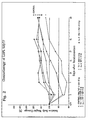
Fig. 1 is a graph which shows the development of the relative tumor volume with time during chemotherapy ofLXFL 529/17 with indigoid bisindole derivatives (compounds according to Examples 1, 4 and 6). The anti-tumor active substances were applied intraperitoneally to nude mice in doses and according to the schedule as described below in Table 4. Compared to the vehicle control, all compounds significantly inhibited the tumor growth. -
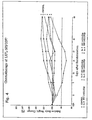
Fig. 2 is a graph which shows the relative body weight change of the tested nude mice with time during chemotherapy ofLXFL 529/17. 5-Methylindirubin (Example 5) at a dosage of 100 mg/kg up to 300 mg/kg showed very high anti-tumor activity (Fig. 1 andFig. 3 ) without any significant reduction of body weight (Fig. 2 andFig. 4 ) thus demonstrating high anti-tumor activity without significant toxicity. -
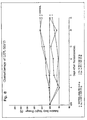
Fig. 3 ,Fig. 5 andFig. 7 are graphs which show the relative tumor volume versus the time during the chemotherapy ofLXFL 529/17 with other indigoid bisindole derivatives (compounds according to Examples 8, 9, 10 and 14). -
Fig. 4 ,Fig. 6 andFig. 8 are graphs which show the relative body weight change of the tested nude mice with time during chemotherapy ofLXFL 529/17 using said other indigoid bisindole derivatives. - The present invention is explained in detail by the following example and comparative examples by which also further advantages of the present invention will become apparent. Only Example 6 is in accordance with the present invention, while Examples 1 to 5 and 7 to 14 are for illustrative purposes, thus indicated as Reference Examples.
- To a solution of 0.42 g (2.4 mmol) of indoxyl acetate in 20 ml methanol under argon 0.35 g (2.4 mmol) of isatin and 0.55 g (5.2 mmol) of sodium carbonate are added. The mixture is stirred for 30 min at ambient temperature. After 24 h standing at ambient temperature, the reaction mixture is filtered off. The precipitate is washed with little methanol and water until the filtrate shows a neutral pH. Residual water is removed by storage in an evacuated exsiccator over potassium hydroxide, Recrystallisation from ethanol or pyridine gives deep purple crystals (Russell G.A., Kaupp G. (1969), J. Am. Chem. Soc., 91, 3851-9, modified).
Yield: 0.51 g (81%), fine, deep-purple needles, Fp: 341-343°C
CHN-analysis: (C16H10N2O2); MW: 262.26 g/mol;
calc.: 73.3% C, 3.8% H, 10.7% N;
found: 73.2% C, 4.0% H, 10.6% N
mass spectrum: m/z = 262: (M+, 100%), 234: (43%), 205 (25%), 158 (3%), 131 (4%), 103 (7%), 76(3%)
1H-NMR and 13C-NMR-spectrum are in accordance with the proposed structure. IR-spectrum: 3340 cm-1: v (N-H), 1.710 cm-1: v (3'-C=D), 1650 cm-1: v (2-C = O), 1590 cm-1: v (C=C, aryl), 1450 cm-1: v (C = C, aryl), 745 cm-1; v (aryl with four neighbouring H-atoms).
UV/Vis-spectrum (DMSO): 290 nm, 363 nm, 383 nm (shoulder), 551nm - Essentially the same synthetic procedure was applied for the following Examples 2 to 9, 12, 13 and Comparative Examples 1 and 2:
- Yield: 80%, fine, deep-purple needles, Fp: 334-335 °C (decomposition);
CHN-analysis (C16H9IN2O2); MG = 388.16 g/mol;
calc.: 49.5% C, 2.3% H, 7.2% N;
found.: 49.7% C, 2.5% H, 7.1% N;
Mass spectrum: 388 (M+, 100%), 360 (3%), 269 (9%), 261 (6%), 233 (16%), 205 (16%), 128 (1 %);
1H-NMR- and 13C-NMR-spectrum are in accordance with the proposed structure. UV/Vis-spectrum (DMSO): 370 nm, 386 nm (shoulder), 555 nm. - Yield: 70%, fine, deep-purple needles;
CHN-analysis (C16H9BrN2O2); MG = 341.16 g/mol,
calc.: 56.3% C, 2.7% H, 8.2% N;
found 56.4% C, 2.7% H, 8.2% N;
Mass spectrum: 342(M+, 100%), 340 (M+, 99%), 314 (18%), 262 (64%), 233 (34%), 205 (81%), 177 (10%);
1H-NMR- and 13C-NMR-spectrum are in accordance with the proposed structure. - Yield: 95%, fine, deep-purple needles;
CHN-analysis (C16H9ClN2O2); MG = 296.70 g/mol;
calc.: 49.5% C, 2.3% H, 7.2% N;
found: 49.7% C, 2.5% H, 7.1% N;
Mass spectrum: m/z = 296 (M+, 100%), 268 (39%), 239 (8%), 233 (35%), 205 (50%), 177 (7%), 153 (6%), 137 (7%), 77 (7%), 120 (4%), 102 (6%), 77 (7%).
1H-NMR- and 13C-NMR-spectrum are in accordance with the proposed structure. - Yield: 92%, fine, deep-purple needles;
CHN-analysis (C16H9FN2O2), MG = 280.25 g/mol,
calc.: 68.6% C, 3.2% H, 9.9% N;
found: 68.0%C, 3.2% H, 9.9% N;
Mass spectrum: m/z = 281 (M+ +H+, 19%), 280 (M+, 100%), 252 (73%), 223 (32%), 176 (6%), 140 (7%), 121 (13%), 94 (4%), 76 (12%), 77 (7%), 57 (4%), 44(15%).
1H-NMR- and 13C-NMR-spectrum are in accordance with the proposed structure. - Yield: 92%, fine, deep-purple needles;
CHN-analysis (C17H12N2O2), MG = 276:28 g/mol,
calc.; 73.9% C, 4.4% H, 10.1% N;
found: 73.8%C, 4.3% H, 10.2% N;
Mass spectrum: m/z = 276 (M+, 100%), 261 (10%), 248 (47%), 247 (53%), 220 (6%), 219 (18%), 205 (7%), 171 (4%), 165 (10%), 138 (4%), 133 (15%), 104 (7%), 77 (7%);
1H-NMR- and 13C-NMR-spectrum are in accordance with the proposed structure. - Yield: 88%, fine, deep-purple needles;
CHN-analysis (C16H9N3O4), MG = 307.26 g/mol;
calc.: 62.5% C, 3.0% H, 13.7% N;
found: 62.4%C, 3.0% H, 13.3% N;
Mass spectrum: m/z = 307 (M+, 5%), 276 (10%), 262 (100%), 234 (23%), 205 (22%), 158 (6%), 131 (10), 104 (19%), 76 (12%), 50 (6%).
1H-NMR- and 13C-NMR-spectrum are in accordance with the proposed structure. - Indirubin-3'-oxime was synthesized by reaction of indirubin with hydroxylamine hydrochloride in a pyridine solution (Farbwerke vorm. Meister Lucius & Brüning in Hoechst a.M., Patentschrift des Reichspatentamtes Nr. 283726 (1913)). 13C-NMR-spectroscopy revealed the location of the hydroxyimino residue in 3'-Position (δ(C2) = 171.05 ppm; δ(C3') = 145.42 ppm; DMSO-d6, RT)
Yield: 90 %, red crystals;
CHN-analysis (C16H11N3O2), MG = 277.30 g/mol;
calc.: 69.3% C, 4.0% H, 15.2 % N;
found: 69.0% C, 4.0% H, 14.9% N;
1H-NMR- and 13C-NMR-spectrum are in accordance with the proposed structure. - Indirubin-3'-oxime was synthesized by reaction of 5-Iodoindirubine with hydroxylamine hydrochloride in a pyridine solution. 13C-NMR-spectroscopy revealed the location of the hydroxyimino residue in 3'-position (δ(C2) = 170.25 ppm; δ(C3') = 151.52 ppm; DMSO-d6, RT)
Yield: 90 %, red crystals;
CHN-analysis (C16H10IN3O2), MG = 403,20 g/mol;
calc.: 47,7%C, 2,5% H, 10,4% N;
found: 47,1 % C, 2,5% H, 10,1 % N;
1H-NMR- and 13C-NMR-spectrum are in accordance with the proposed structure. -

- Isoindigo was synthesized by reaction of oxindole with isatin in acetic acid with addition of hydrochloric acid (Wahl A., Bayard P., Comptes Rendues Hebdomadaires des Seances de L'Academie des Sciences, 148, (1909), 716-719).
Yield: 84%, crystalline, brown substance;
CHN-analysis (C16H10N2O2), MG = 262.26 g/mol;
calc.: 73.3% C, 3.8% H, 10.7% N;
found: 73.0% C, 3.8% H, 10.9% N;
Mass spectrum: m/z = 262 (M+, 100%), 234 (85%), 220 (5%), 205 (18%), 190 (4%), 177 (5%), 151 (5%), 132 (17%), 103 (6%), 76 (4%), 32 (26%).
1H-NMR- and 13C-NMR-spectrum are in accordance with the proposed structure. -

- Chemical grade indigo was purchased by Fluka Chemie AG.
- 1H-NMR- and 13C-NMR-spectrum are in accordance with the proposed structure.
- 1H-NMR- and 13C-NMR-spectrum are in accordance with the proposed structure.
-
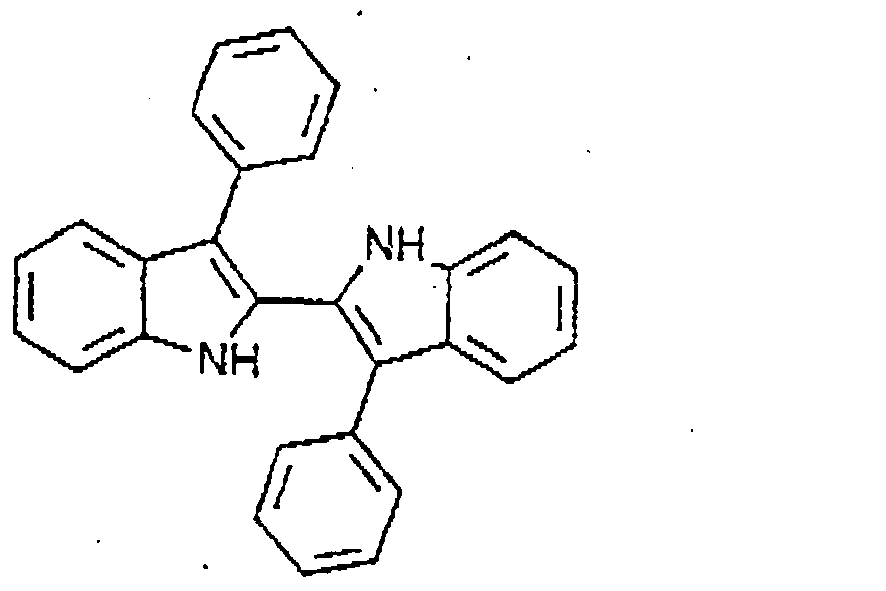
- To a cooled solution of 2-aminobenzophenone in dichloromethane and pyridine under inert gas, a solution of oxalyl chloride in dichloromethane is dropped. After completion of the reaction, 0.5 n hydrochloric acid is added, the formed precipitate is filtrated off and washed subsequently with 0.5 n hydrochloric acid, a solution of sodium hydrogencarbonate and water, The obtained product (N,N'-bis(2-benzoylphenyl)-oxamide), zinc dust and titanium(III)chloride are suspended in dimethoxyethane and heated to reflux. After heating for 3 h, the mixture is cooled to ambient temperature and the precipitate is filtrated off and washed with ethyl acetate. The crude product is purified using column chromatography (silica gel), then dissolved in ethyl acetate and precipitated in form of white crystals by adding petrol ether.
CHN-analysis (C28H20N2), MG = 384.48 g/mol;
calc.: 87.5%C, 5.2% H, 7.3% N;
found: 87.3% C, 5.3% H, 7.3% N;
1H-NMR- and 13C-NMR-spectrum are in accordance with the proposed structure. - Yield: 76%, crystalline, deep-purple substance;
Mass spectrum: 388 (M+, 100%), 360 (3%), 269 (9%), 261 (6%), 233 (16%), 205 (16%), 128 (1%).
1H-NMR- and 13C-NMR-spectrum are in accordance with the proposed structure. - Yield: 76%, crystalline, deep-purple substance;
Mass spectrum: 388 (M+, 100%), 360 (3%), 269 (9%), 251 (6%), 233 (16%), 205 (16%), 128 (1%).
1H-NMR- and 13C-NMR-spectrum are in accordance with the proposed structure. - Table 2 summarizes the structures of the indirubin compounds of Examples 1 to 9 and Comparative Examples 1 and 2.
Table 1 
Example compound R1 X 1 (Ref. Ex.) Indirubin H 2 (Ref. Ex.) 5-Iodoindirubin I O 3 (Ref. Ex.) 5-Bromoindirubin Br O 4 (Ref. Ex.) 5-Chloroindirubin Cl O 5 (Ref. Ex.) 5-Fluoroindirubin F O 6 (Invention) 5-Methylindirubin CH3 O 7 (Ref. Ex.) 5-Nitroindirubin NO2 O 8 (Ref. Ex.) indirubin-3'-oxime H NOH 9 (Ref. Ex.) 5-Iodoindirubine-3'-oxime I NOH 10 (Ref. Ex.) Isoindigo 11 (Ref. Ex.) Indigo 12 (Ref. Ex.) Indirubin-5-sulfonamide SO2-NH2 O 13 (Ref. Ex.) Indirubin-5-sulfone(2-hydroxyethyl)amide SO2-NH-CH2CH2OH O 14 (Ref. Ex.) Bis(3-phenylindol-2-yl) Comparative Examples 1 Indirubin-5-sulfonic acid Indirubin-3'-oxime-5-sulfonic SO3H O 2 acid SO3H NOH - The compounds of Reference Example 1, Example 6 and Reference Example 8 and Comparative Examples 1 and 2 were investigated with respect to their ability to penetrate LXFL 529L cells having the passage numbers P23 to P39. The results are shown in Table 2. The amounts of the substances taken up by the cells are given depending on the concentration of the substance within the incubation medium. The time of incubation was 2 hours in all of the experiments. Furthermore, the distribution of the substance which was taken up by the cells in the cytosol and the cellular organelles (particular) was estimated and is given in the intermediate column of Table 2. Tumor cell growth inhibition was determined by the sulfo-rhodamine B assay (SRB assay) according to Skehan et al., J. Natl. Cancer Institute 82, pages 1107 - 1112 (1990). Incubation was conducted for three days in serum containing medium. Tumor cell lines tested were a large-cell lung carcinoma xenograft line LXFL 529 L and the mammary carcinoma line MCF-7. Results are given as IC50 [µM] corresponding to the concentration of compounds inducing 50 % growth inhibition, compared to vehicle treated control.
Table 2 substance concentration of incubation amount of substance within the cells distribution [%] Tumor cell growth inhibition (SR8-assay) IC50 [µM] [µM] [µm/mg protein] cytosol cellular organelles LXFL529L MCF7 Example 1 (Ref. Ex.) 10 0.15±0.08 7±5.7 93±5.7 9.9±0.1 4.0±2.0 20 0.20±0.08 6±1.4 94±1.4 Example 6 (Invention) 10 0.52±0.1 13±0.7 87±0.7 7.5±0.5 4.8±0.5 20 0.86±0.22 6±2.8 94±2.8 Example 8 (Ref. Ex.) 10 0.16±0.01 43±14.1 57±14.1 3.0±0.5 3.3±0.4 20 0.23±0.03 44±15.6 56±15.6 Comparative Example 1 10 < 0.02 - - > 100 > 100 20 < 0.02 - - Comparative Example 2 10 < 0.05 - - > 100 > 100 20 < 0.05 - - - The compounds according to the Example 6 and Reference Examples 1 and 8, were all taken up by the tumor cells. The ability of the compound according to Example 6 to penetrate the cellular membrane is substantially improved compared to that of the parent compound indirubin (Reference Example 1). The uptake of the compound according to Reference Example 8 is also slightly improved compared to the non-substituted indirubin
- The compounds of Comparative Examples 1 and 2 were essentially not taken up by the cells although these compound are well soluble in physiological solutions. Obviously, the sulfonate group hinders the penetration through the cellular membrane. Furthermore, referring to Comparative Example 2, this detrimental effect cannot be compensated by the introduction of an oxime group.
- The anti-tumor activity of the compounds was evaluated via a colony-forming-assay as described e.g. by D. P. Berger et al. in Annals of ), "The clonongenic assay with human tumor xenografts, evaluation, predictive values and application for drug screening".
- The experiments were conducted using various tumor cell lines, in particular mammary carcinoma (MAXF) , lung adenocarcinoma (LXFA), large-cell lung carcinoma (LXFL), small-cell lung carcinoma (LXFS), colon carcinoma (CXF), melanoma (MEXF), pancreatic carcinoma (PAXF), renal carcinoma (RXF), ovarian carcinoma (OVXF) and bladder carcinoma (BXF).
- The IC70-values and IC50-values, respectively, define the concentration of a pharmaceutically active compound causing 70 % and 50 %, respectively, reduction of colony formation compared to the untreated control. Therefore, IC70- and IC50-values serve to demonstrate the anti-tumor activity of a pharmaceutically active compound wherein low IC70- and/or IC50-values demonstrate a superior anti-tumor activity. According to the present invention, the IC70-value preferably is 20 µM or lower, more preferably 10 µM or lower.
- Table 3 shows the anti-tumor activity of the compounds according to the Example, Reference Examples and Comparative Example 1. The compounds according to the Example and the Reference Examples show good to excellent anti-tumor activity against various types of tumor cell lines. The compound according to Comparative Example 1 does not exhibit an anti-tumor activity against any of the tumor lines. This behaviour is in accordance with the lacking ability of this substance to penetrate cellular membranes as demonstrated in Table 2, above.
- Surprisingly, smelt variations in the substitution pattern result in remarkable changes in the anti-tumor activity profile. However, almost all compounds according to the Examples exhibit good anti-tumor activity against mammary carcinoma.
Table 3 Example IC50 [µM] IC70 [µM] tumor xenograft type xenograft 1 (indirubin) (Ref. Ex.) 25.3 36.6 lung large-celi LXFL629 2.0 6.0 mammary MCF7X 12.3 >30 ovarian OVXF1353 5.4 >30 pancreatic PAXF736 2 (5-iodo-indirubin) (Ref. Ex.) 6.3 >30 colon HT29X 8.0 23 lung adeno carcinorna LXFA526 13,7 24.5 lung small-cell LXFS650 <1.0 2.5 mammary MCF7X 18.0 >30 pancreatic PAXF546 3 (5-bromo-indirubin) (Ref.Ex.) < 1.0 17.3 colon HT29X 2.3 14.4 lung adenocarcinoma LXFA626 <1.0 <1.0 mammary MCF7X 3.4 8.0 melanoma MEXF514 13.2 >30 pancreatic HT29X 04 (5-chloro-indirubin) (Ref.Ex.) < 1.0 <1.0 mammary MCF7X 17.1 26,0 melanoma MEXF514 3.2 8.0 pancreatic Pax736 11.2 24.7 renal 1220 4,6 >30 pancreatic PAXF546 <1 17.3 colon HT29X 5 (6-fluoro-indirubin) (Ref. Ex.) <1.0 <1.0 mammary MCF7X <1.0 6.1 ovarian OVXF1353 <1.0 1.1 pancreatic PAXF73G 6 (5-methyl-indirubin) (Invention) <1.0 14.4 colon HT29X <1.0 1.2 mammary MCF7X 19.2 27.8 melanoma MEXF514 16.4 27.5 pancreatic PAXF736 1.0 >30 ovarian OVXF1352 7 (5-nitro-indirubin) (Ref. Ex.) <1.0 15.1 mammary MCF7X 4.9 >10.0 melanoma MEXF514 8 (indirubin-3'-axima) (Ref. Ex.) 10.6 16.1 bladdar BXF1301 8.0 12.6 colon CXF280 0.9 3.4 lung adenocarcinoma LXFA289 7.7 9.2 mammary MX1 1.0 2.6 melanoma MEXF9B9 2.8 5.7 melanoma MEXF515LX 9 (5-lodo-3'ooxima-indirubin) (Ref. Ex.) 4.0 5.8 bladdar BXF1301 10.7 16.3 colon CXF280 0.05 0.7 lung adenocarcinoma LXFA289 2.4 10.4 mammary MCF7X 2.6 4.9 melanoma MEXF515LX 10 (isoindigo) (Ref. Ex.) 6.0 8.2 bladder BXF1301 <1.0 <1.0 colon CXF280 2.6 4.6 lung large-cell LXFL529 <1.0 <1.0 lung small cell LXFS650 <1.0 <1.0 mammary MX1 <1.0 <1.0 mammary MCF7X <1.0 <1.0 melanoma MEXF989 <1.0 <1.0 ovarian OVXF1355 <1.0 <1.0 pancreatic PAXF546 <1.0 <1.0 pancreatic PAXF736 <1.0 <1.0 colon HT29X 11 (indigo) (Ref. Ex.) 3.3 26.1 colon HT29X 3.6 12.3 lung adenocarcinoma LXFA289 3.9 16.7 ovarian OVXF1353 13 (5-SO2-NH-CH2-CH2-OH-indirubin) (Ref. Ex.) 12.0 17.3 colon CXF280 1.1 2.6 lung adenacarcinoma LXFA289 3.4 5.9 lung large-call LXFL529 0.6 2.1 mammary MCF7X <0.1 0.4 melanoma MEXF515LX 0.3 0.4 ovarian OVXF899 14 (Bis(3-phenylindol-2-yl)) (Ref. Ex.) 2.7 6.2 bladder BXF1299 <1.0 7.2 colon CXF280 1.5 3.4 colon HT29X 4.7 6.7 lung small-cell LXFS660 2.8 4,8 mammary MX1 Comp. 1 >30.0 >30.0 [all] - Compounds of Example 6 and Reference Examples 1, 4, 8, 9 and 10 were subjected to in vivo testing in nude mice bearing subcutaneously growing human
tumor xenograft LXFL 529. The indigoid bisindole derivatives were applied intraperitoneally to the animals in doses and according to the schedule as described in Table 4.Table 4 doses [mg/kg/day] schedule of application [day(s)] activity rating Graph shown in Figure Ex. 1 (Ref. Ex.) 100 1-5,8-9 + Fg. 1 and 2 200 1-5,8-9 ++ Fig. 1 and2 Ex. 4 (Ref. Ex.) 100 1-5 ++ Fig. 1 and2 300 1-5 ++ Fig. 1 and2 Ex. 6 (Invention) 100 1-5,8-12,15,17,19,22 ++ Fig. 1 and2 300 1,4,8,11,15,18,22 ++ Fig. 3 and4 Ex. 8 (Ref. Ex.) 100 1,4,8,11,15,18,22 - Fig. 3 and4 300 1,4,8,11,15,18,22 - Fig.3 and4 Ex. 9 (Ref. Ex.) 100 1,4,8,11,15,18,22 - Fig. 3 and4 300 1,4,8,11,15,18,22 + Fig. 3 and4 Ex.10 (Ref. Ex.) 30 1-5 - Fig. 5 and6 100 1-5 - Fig. 5 and6 300 1-5 + Fig. 5 and6 Ex.14 (Ref. Ex.) 10 1-5, 8-12 - Fig. 7 and8 100 1-5. 8-12 + Fig. 7 and8 300 3-5, 8-12 + Fig. 7 and8 - The experiments were run for 21 or 28 days. Anti-tumor activity was evaluated comparing the median tumor volume relative to control, expressed as %T/C, wherein T is the test group and C the vehicle control group. In Table 4, anti-tumor activity is given according to an activity rate scale.
-
- inactive T/C > 50 % + tumor inhibition T/C > 25 - 50 % ++ tumor stasis T/C ≤ 25 % - The results are further demonstrated by
Figures 1 to 8 . - A reduction of the body weight of the tested mice of more then 20 % by weight in general is interpreted as a toxic dose.
Claims (2)
- Use of a cell membrane penetrating indirubin derivative for the manufacture of a medicament for the treatment of human solid tumors and metastasis thereof wherein the indirubin derivative is selected from 5-methyl indirubin represented by the following formula (I):

- Use according to claim 1, wherein the indirubin derivative is in the form of a physiologically acceptable salt.
Priority Applications (1)
| Application Number | Priority Date | Filing Date | Title |
|---|---|---|---|
| EP00922625A EP1218004B1 (en) | 1999-04-12 | 2000-04-11 | 5-methyl indirubin for use in the treatment of human solid tumors |
Applications Claiming Priority (6)
| Application Number | Priority Date | Filing Date | Title |
|---|---|---|---|
| EP99106206 | 1999-04-12 | ||
| EP99106206 | 1999-04-12 | ||
| EP99107474 | 1999-04-29 | ||
| EP99107474 | 1999-04-29 | ||
| EP00922625A EP1218004B1 (en) | 1999-04-12 | 2000-04-11 | 5-methyl indirubin for use in the treatment of human solid tumors |
| PCT/EP2000/003210 WO2000061124A2 (en) | 1999-04-12 | 2000-04-11 | Use off cell membrane penetrating indigoid bisindole derivatives |
Publications (2)
| Publication Number | Publication Date |
|---|---|
| EP1218004A2 EP1218004A2 (en) | 2002-07-03 |
| EP1218004B1 true EP1218004B1 (en) | 2009-04-08 |
Family
ID=26152939
Family Applications (1)
| Application Number | Title | Priority Date | Filing Date |
|---|---|---|---|
| EP00922625A Expired - Lifetime EP1218004B1 (en) | 1999-04-12 | 2000-04-11 | 5-methyl indirubin for use in the treatment of human solid tumors |
Country Status (11)
| Country | Link |
|---|---|
| US (1) | US6664285B1 (en) |
| EP (1) | EP1218004B1 (en) |
| JP (1) | JP2002541189A (en) |
| CN (1) | CN1378447A (en) |
| AT (1) | ATE427746T1 (en) |
| AU (1) | AU775633B2 (en) |
| BR (1) | BR0009771A (en) |
| CA (1) | CA2369626C (en) |
| DE (1) | DE60041974D1 (en) |
| MX (1) | MXPA01010436A (en) |
| WO (1) | WO2000061124A2 (en) |
Families Citing this family (15)
| Publication number | Priority date | Publication date | Assignee | Title |
|---|---|---|---|---|
| DE10125763A1 (en) * | 2001-05-17 | 2002-11-28 | Schering Ag | New use of indirubin derivatives as VEGF inhibitors useful for preparing medicaments useful for e.g. treating cancer, autoimmune diseases, cardiovascular diseases or viral infections |
| US8563525B2 (en) | 2004-01-12 | 2013-10-22 | Natrogen Therapeutics International, Inc. | Methods of treating an inflammatory-related disease |
| US20050154046A1 (en) | 2004-01-12 | 2005-07-14 | Longgui Wang | Methods of treating an inflammatory-related disease |
| WO2003051900A1 (en) * | 2001-12-13 | 2003-06-26 | Natrogen Therapeutics, Inc. | Derivatives of isoindigo, indigo and indirubin and use in treating cancer |
| US7582670B2 (en) | 2001-12-13 | 2009-09-01 | Natrogen Therapeutics, Inc. | Methods of treating an inflammatory-related disease |
| EP1340745A1 (en) * | 2002-02-20 | 2003-09-03 | Gerhard Prof. Dr. Eisenbrand | Indirubin derivatives and their use for the treatment of cancer |
| KR100588803B1 (en) * | 2004-01-27 | 2006-06-12 | 학교법인조선대학교 | Indirubin derivatives with anticancer activity in cancer cell lines |
| FR2952819A1 (en) * | 2009-11-23 | 2011-05-27 | Oreal | Composition, useful for dyeing keratin fibers, preferably human keratin fibers such as hair, comprises one or more dye precursors comprising oxindole derivatives and one or more dyes comprising indoline dione compounds in a medium |
| AU2013234955A1 (en) | 2012-03-23 | 2014-11-13 | Dennis Brown | Compositions and methods to improve the therapeutic benefit of indirubin and analogs thereof, including meisoindigo |
| CN103333161B (en) * | 2013-05-28 | 2015-09-30 | 滁州市洛达生物科技有限公司 | The preparation of 1 '-oxo Indirubin and purposes |
| CN103274987A (en) * | 2013-06-07 | 2013-09-04 | 华东师范大学 | 3,3-disubstituted oxoindole derivative, and synthetic method and application thereof |
| CN103342674B (en) * | 2013-07-05 | 2015-08-19 | 华东师范大学 | Optical activity pyrrole derivative and synthetic method thereof |
| KR101493324B1 (en) | 2013-07-11 | 2015-02-16 | 연세대학교 산학협력단 | Composition comprising an indirubin derivative for stimulating bone growth |
| CN110305056A (en) * | 2019-05-22 | 2019-10-08 | 西北大学 | New derivatives of indirubin and their medicinal uses |
| CN114533755B (en) * | 2022-03-23 | 2024-05-03 | 遵义医科大学 | Application of gynostemma pentaphylla polysaccharide and indirubin in anti-melanoma medicine |
Family Cites Families (7)
| Publication number | Priority date | Publication date | Assignee | Title |
|---|---|---|---|---|
| JPS609023B2 (en) * | 1981-06-19 | 1985-03-07 | イスクラ産業株式会社 | Indirubin derivatives and antitumor agents containing them |
| JPS609022B2 (en) * | 1981-06-19 | 1985-03-07 | イスクラ産業株式会社 | Indirubin derivatives and antitumor agents containing them |
| JPS617254A (en) * | 1984-06-20 | 1986-01-13 | Isukura Sangyo Kk | Bisindolinone and carcinostatic agent consisting essentially of same |
| US5935581A (en) * | 1996-07-24 | 1999-08-10 | Kapadia; Govind J. | Inhibitory effects of synthetic and natural colorants on carcinogenesis |
| ES2194468T3 (en) * | 1998-05-29 | 2003-11-16 | Centre Nat Rech Scient | USE OF INDIGOID BISINDOL DERIVATIVES FOR THE MANUFACTURE OF A MEDICINAL PRODUCT FOR INHIBITING CYCLINE DEPENDENT KINASES. |
| CN1207924A (en) * | 1998-08-07 | 1999-02-17 | 刘克贤 | Medicine for diseases of oral cavity, throat and gullet and its preparation |
| US6987092B1 (en) | 1999-04-12 | 2006-01-17 | Faustus Forschungs Cie. Translational Cancer Research Gmbh | Indigoid bisindole derivatives |
-
2000
- 2000-04-11 EP EP00922625A patent/EP1218004B1/en not_active Expired - Lifetime
- 2000-04-11 AT AT00922625T patent/ATE427746T1/en not_active IP Right Cessation
- 2000-04-11 US US09/958,674 patent/US6664285B1/en not_active Expired - Fee Related
- 2000-04-11 CN CN00808825A patent/CN1378447A/en active Pending
- 2000-04-11 BR BR0009771-3A patent/BR0009771A/en not_active Application Discontinuation
- 2000-04-11 DE DE60041974T patent/DE60041974D1/en not_active Expired - Fee Related
- 2000-04-11 WO PCT/EP2000/003210 patent/WO2000061124A2/en not_active Ceased
- 2000-04-11 MX MXPA01010436A patent/MXPA01010436A/en not_active Application Discontinuation
- 2000-04-11 CA CA002369626A patent/CA2369626C/en not_active Expired - Fee Related
- 2000-04-11 AU AU42949/00A patent/AU775633B2/en not_active Ceased
- 2000-04-11 JP JP2000610457A patent/JP2002541189A/en active Pending
Also Published As
| Publication number | Publication date |
|---|---|
| BR0009771A (en) | 2002-01-08 |
| DE60041974D1 (en) | 2009-05-20 |
| AU775633B2 (en) | 2004-08-05 |
| JP2002541189A (en) | 2002-12-03 |
| CN1378447A (en) | 2002-11-06 |
| MXPA01010436A (en) | 2002-09-18 |
| AU4294900A (en) | 2000-11-14 |
| CA2369626A1 (en) | 2000-10-19 |
| CA2369626C (en) | 2009-01-13 |
| WO2000061124A3 (en) | 2002-05-02 |
| EP1218004A2 (en) | 2002-07-03 |
| WO2000061124A2 (en) | 2000-10-19 |
| US6664285B1 (en) | 2003-12-16 |
| ATE427746T1 (en) | 2009-04-15 |
Similar Documents
| Publication | Publication Date | Title |
|---|---|---|
| US6664285B1 (en) | Use of cell membrane penetrating indigoid bisindole derivatives | |
| JP2604783B2 (en) | Bisnaphthalimide and a medicament containing the same that have tumor-suppressing and anti-leukemic effects | |
| EP1079826B1 (en) | Use of indigoid bisindole derivatives for the manufacture of a medicament to inhibit cyclin dependent kinases | |
| AU2020356793B2 (en) | PH/glutathione-responsive β-carbolines/cycloketene derivatives and their preparation and application | |
| US20260022110A1 (en) | Diarylacetylene compound, preparation method thereof, and uses thereof | |
| HUP0200724A2 (en) | Indigoid bisindole derivatives and pharmaceurical compositions containing them | |
| WO2006015263A2 (en) | Lonidamine analogs | |
| JP2007535520A (en) | Indole and azaindole derivatives having antitumor activity | |
| CN116917288B (en) | 7, 9-Dihydro purine derivative and pharmaceutical application thereof | |
| US7452910B2 (en) | Indolyl-3-glyoxylic acid derivatives having therapeutically valuable properties | |
| HU219232B (en) | Bis-naphthalimide derivatives, process for producing them, and pharmaceutical compositions containing them | |
| US20020173468A1 (en) | Modified cytostatic agents | |
| EP2610257B1 (en) | Diimidated derivative of berbamine, and preparation method therefor and use thereof | |
| JP2000505792A (en) | Induction of tumor cell death using piperazine derivatives | |
| CN116768903B (en) | Pyrrolo pyrimidine derivative, preparation method thereof, pharmaceutical composition and application | |
| KR20010042482A (en) | Methods for Inhibiting MRP1 | |
| US6716879B2 (en) | Methods for anti-tumor therapy | |
| CN106146612B (en) | A class of glyoxalase I irreversible inhibitors and their preparation methods and uses | |
| ZA200108378B (en) | Use of cell membrane penetrating indigoid bisindole derivatives. | |
| WO2015069766A1 (en) | Dupa-indenoisoquinoline conjugates | |
| KR102421065B1 (en) | Method for preparing novel quinone-indolizine hybrid derivatives and anticancer composition containing the same | |
| WO2026032248A1 (en) | Methods and compositions for treating malignant cancers | |
| HUP0401912A2 (en) | Pharmaceutically acceptable salts of 20(s)-camptothecins, process for their preparation and pharmaceutical compositions containing them | |
| WO2025260492A1 (en) | 7-oxabicyclo[2.2.1]heptane-2,3-dicarboxylic acid derivative, preparation method therefor, and use thereof | |
| CN105037490B (en) | A kind of glyoxalase I irreversible inhibitor and its preparation method and application |
Legal Events
| Date | Code | Title | Description |
|---|---|---|---|
| PUAI | Public reference made under article 153(3) epc to a published international application that has entered the european phase |
Free format text: ORIGINAL CODE: 0009012 |
|
| 17P | Request for examination filed |
Effective date: 20011011 |
|
| AK | Designated contracting states |
Kind code of ref document: A2 Designated state(s): AT BE CH CY DE DK ES FI FR GB GR IE IT LI LU MC NL PT SE |
|
| AX | Request for extension of the european patent |
Free format text: AL;LT;LV;MK;RO;SI |
|
| 17Q | First examination report despatched |
Effective date: 20050223 |
|
| 17Q | First examination report despatched |
Effective date: 20050223 |
|
| GRAP | Despatch of communication of intention to grant a patent |
Free format text: ORIGINAL CODE: EPIDOSNIGR1 |
|
| RTI1 | Title (correction) |
Free format text: 5-METHYL INDIRUBIN FOR USE IN THE TREATMENT OF HUMAN SOLID TUMORS |
|
| RAP1 | Party data changed (applicant data changed or rights of an application transferred) |
Owner name: FIEBIG, HEINZ HERBERT |
|
| GRAS | Grant fee paid |
Free format text: ORIGINAL CODE: EPIDOSNIGR3 |
|
| GRAA | (expected) grant |
Free format text: ORIGINAL CODE: 0009210 |
|
| AK | Designated contracting states |
Kind code of ref document: B1 Designated state(s): AT BE CH CY DE DK ES FI FR GB GR IE IT LI LU MC NL PT SE |
|
| REG | Reference to a national code |
Ref country code: GB Ref legal event code: FG4D |
|
| REG | Reference to a national code |
Ref country code: CH Ref legal event code: NV Representative=s name: BOHEST AG Ref country code: CH Ref legal event code: EP |
|
| REG | Reference to a national code |
Ref country code: IE Ref legal event code: FG4D |
|
| REF | Corresponds to: |
Ref document number: 60041974 Country of ref document: DE Date of ref document: 20090520 Kind code of ref document: P |
|
| PGFP | Annual fee paid to national office [announced via postgrant information from national office to epo] |
Ref country code: DE Payment date: 20090427 Year of fee payment: 10 Ref country code: FR Payment date: 20090427 Year of fee payment: 10 |
|
| PG25 | Lapsed in a contracting state [announced via postgrant information from national office to epo] |
Ref country code: PT Free format text: LAPSE BECAUSE OF FAILURE TO SUBMIT A TRANSLATION OF THE DESCRIPTION OR TO PAY THE FEE WITHIN THE PRESCRIBED TIME-LIMIT Effective date: 20090908 Ref country code: FI Free format text: LAPSE BECAUSE OF FAILURE TO SUBMIT A TRANSLATION OF THE DESCRIPTION OR TO PAY THE FEE WITHIN THE PRESCRIBED TIME-LIMIT Effective date: 20090408 Ref country code: ES Free format text: LAPSE BECAUSE OF FAILURE TO SUBMIT A TRANSLATION OF THE DESCRIPTION OR TO PAY THE FEE WITHIN THE PRESCRIBED TIME-LIMIT Effective date: 20090719 Ref country code: AT Free format text: LAPSE BECAUSE OF FAILURE TO SUBMIT A TRANSLATION OF THE DESCRIPTION OR TO PAY THE FEE WITHIN THE PRESCRIBED TIME-LIMIT Effective date: 20090408 |
|
| PGFP | Annual fee paid to national office [announced via postgrant information from national office to epo] |
Ref country code: CH Payment date: 20090429 Year of fee payment: 10 |
|
| PG25 | Lapsed in a contracting state [announced via postgrant information from national office to epo] |
Ref country code: SE Free format text: LAPSE BECAUSE OF FAILURE TO SUBMIT A TRANSLATION OF THE DESCRIPTION OR TO PAY THE FEE WITHIN THE PRESCRIBED TIME-LIMIT Effective date: 20090708 |
|
| PGFP | Annual fee paid to national office [announced via postgrant information from national office to epo] |
Ref country code: GB Payment date: 20090429 Year of fee payment: 10 |
|
| NLV4 | Nl: lapsed or anulled due to non-payment of the annual fee |
Effective date: 20091101 |
|
| PG25 | Lapsed in a contracting state [announced via postgrant information from national office to epo] |
Ref country code: DK Free format text: LAPSE BECAUSE OF FAILURE TO SUBMIT A TRANSLATION OF THE DESCRIPTION OR TO PAY THE FEE WITHIN THE PRESCRIBED TIME-LIMIT Effective date: 20090408 |
|
| REG | Reference to a national code |
Ref country code: IE Ref legal event code: MM4A |
|
| PLBE | No opposition filed within time limit |
Free format text: ORIGINAL CODE: 0009261 |
|
| STAA | Information on the status of an ep patent application or granted ep patent |
Free format text: STATUS: NO OPPOSITION FILED WITHIN TIME LIMIT |
|
| PG25 | Lapsed in a contracting state [announced via postgrant information from national office to epo] |
Ref country code: BE Free format text: LAPSE BECAUSE OF FAILURE TO SUBMIT A TRANSLATION OF THE DESCRIPTION OR TO PAY THE FEE WITHIN THE PRESCRIBED TIME-LIMIT Effective date: 20090408 Ref country code: NL Free format text: LAPSE BECAUSE OF NON-PAYMENT OF DUE FEES Effective date: 20091101 |
|
| 26N | No opposition filed |
Effective date: 20100111 |
|
| PG25 | Lapsed in a contracting state [announced via postgrant information from national office to epo] |
Ref country code: MC Free format text: LAPSE BECAUSE OF NON-PAYMENT OF DUE FEES Effective date: 20090430 Ref country code: IE Free format text: LAPSE BECAUSE OF NON-PAYMENT OF DUE FEES Effective date: 20090411 |
|
| PG25 | Lapsed in a contracting state [announced via postgrant information from national office to epo] |
Ref country code: GR Free format text: LAPSE BECAUSE OF FAILURE TO SUBMIT A TRANSLATION OF THE DESCRIPTION OR TO PAY THE FEE WITHIN THE PRESCRIBED TIME-LIMIT Effective date: 20090709 |
|
| REG | Reference to a national code |
Ref country code: CH Ref legal event code: PL |
|
| GBPC | Gb: european patent ceased through non-payment of renewal fee |
Effective date: 20100411 |
|
| REG | Reference to a national code |
Ref country code: FR Ref legal event code: ST Effective date: 20101230 |
|
| PG25 | Lapsed in a contracting state [announced via postgrant information from national office to epo] |
Ref country code: LI Free format text: LAPSE BECAUSE OF NON-PAYMENT OF DUE FEES Effective date: 20100430 Ref country code: DE Free format text: LAPSE BECAUSE OF NON-PAYMENT OF DUE FEES Effective date: 20101103 Ref country code: CH Free format text: LAPSE BECAUSE OF NON-PAYMENT OF DUE FEES Effective date: 20100430 |
|
| PG25 | Lapsed in a contracting state [announced via postgrant information from national office to epo] |
Ref country code: GB Free format text: LAPSE BECAUSE OF NON-PAYMENT OF DUE FEES Effective date: 20100411 Ref country code: IT Free format text: LAPSE BECAUSE OF FAILURE TO SUBMIT A TRANSLATION OF THE DESCRIPTION OR TO PAY THE FEE WITHIN THE PRESCRIBED TIME-LIMIT Effective date: 20090408 |
|
| PG25 | Lapsed in a contracting state [announced via postgrant information from national office to epo] |
Ref country code: LU Free format text: LAPSE BECAUSE OF NON-PAYMENT OF DUE FEES Effective date: 20090411 |
|
| PG25 | Lapsed in a contracting state [announced via postgrant information from national office to epo] |
Ref country code: CY Free format text: LAPSE BECAUSE OF FAILURE TO SUBMIT A TRANSLATION OF THE DESCRIPTION OR TO PAY THE FEE WITHIN THE PRESCRIBED TIME-LIMIT Effective date: 20090408 |
|
| PG25 | Lapsed in a contracting state [announced via postgrant information from national office to epo] |
Ref country code: FR Free format text: LAPSE BECAUSE OF NON-PAYMENT OF DUE FEES Effective date: 20100430 |