Technical Field
The present invention relates to an apparatus and a method of image
coding, an apparatus and a method of image decoding, and a computer-readable
recording medium recorded with respective image coding and
image decoding programs. Particularly, the present invention relates to
an apparatus and a method of image coding that allows a higher
compression rate using a hardware or software module that performs
currently-available image compression processing, an apparatus and a
method of image decoding, and a computer-readable recording medium
recorded with respective image coding and decoding programs.
Background Art
The compression scheme of text image was conventionally
implemented using the MMR (Modified Modified Read) or JBIG (Joint Bi-level
Image Coding Experts Groups) features that process the text image as
binary image. The reason why a text image is handled as a binary image
may be the nature of the text image that allows image processing by
identifying the background of the text image from the text region.
The standards of the MMR or JBIG are developed focusing on
application to facsimile (referenced document: ISO/IEC JTC1/SC29/WG1
N1359, "14492 FCD Information Technology - Coded Representation of
Picture and Audio Information - Lossy/Lossless Coding of Bi-level Images",
JBIG Committee (July 16,1999)). At the current stage, they are
substantially the standard scheme for binary image compression. In the
compression schemes of MMR, JBIG and the like, reusability is
contemplated through modularization by hardware or software. The
hardware device particularly has high usage efficiency in apparatuses with
poor CPU (Central Processing Unit) power such as portable information
terminals that have difficulty in effecting image compression processing by
software from the standpoint of the processing rate.
In contrast, compression of a text image formed of a gray scale image
was carried out by the scheme of dividing a gray scale image into a
plurality of weighted bit planes, each represented as a binary image, to
divide the gray scale image into a plurality of binary images for processing.
Such an example is shown in Fig. 1. Fig. 1 corresponds to an octal image
in which each pixel can take any eight values (0-7). Figs. 2-4 correspond
to the division of the octal image into three planes. Each plane
corresponds to each digit of the original image represented in binary of
three digits. Here, the value of each plane is determined depending upon
whether each digit is 0 or 1. The first plane shown in Fig. 2 corresponds to
the most significant digit of the three digits. The second plane shown in
Fig. 3 corresponds to the second most significant digit. The third plane
shown in Fig. 4 corresponds to the least significant digit.
By dividing a gray scale image into binary bit planes, the binary
image compression scheme can be employed in the compression of a gray
scale image.
According to the aforementioned conventional compression scheme,
each of the first to third planes is compressed into a binary image
independent of other planes. There was a problem that the amount of
compression increases since the correlation between respective planes is not
utilized. For example, in the case where an image constituted by just the
value of 0 (represented as 000 in binary of 3 digits) and the value of 7
(represented as 111 in binary of 3 digits) is to be compressed from an octal
image that can take any of the 8 values of 0-7, the contents of the first to
third planes are all identical according to the aforementioned bit plane
generation method. Even though there is only information of one plane,
the compression size increases to as much as three times thereof since each
plane is compressed independently.
Although this is an extreme example, there is a definite correlation
between each plane also in a general text image. Although the first plane
shown in Fig. 2 is slightly degraded in picture quality, the contents of the
original text can be generally read. The second plane shown in Fig. 3 and
the third plane shown in Fig. 4, though gradually degraded in picture
quality, can be recognized to a level so as to work out the original text or so
as to locate the characters in the original text. This means that the pixel
values of respective pixels corresponding to each plane are not independent,
i.e., have a correlation.
A compression scheme utilizing the correlation between bit planes to
solve the above problem is disclosed in Japanese Patent Laying-Open No.
63-296564. According to this compression scheme, the most significant
plane is coded by a first coding method and the planes of the lower level are
coded with linear prediction using pixels of bit planes already coded or
pixels already coded in the relevant bit plane.
Although the problem of the compression size being increased can be
alleviated, this compression scheme does not correspond to the binary
image compression standard scheme of MMR, JBIG, or the like. This
imposes the problem that the currently-available hardware or software
modules cannot be reused.
Disclosure of the Invention
The present invention is directed to solving the above problem. An
object of the present invention is to provide an image coding apparatus and
a method utilizing to the standard scheme of binary image compression and
improving the compression efficiency of a gray scale image, an image
decoding apparatus and method, and a computer-readable recording
medium recorded with respective image coding and decoding programs.
Another object of the present invention is to provide an image coding
apparatus and method utilizing to the standard compression scheme
compressing a continuous images and improving the compression efficiency,
an image decoding apparatus and method, and a computer-readable
recording medium recorded with respective image coding and decoding
programs.
According to an aspect of the present invention, an image coding
apparatus includes a bit plane generator dividing unitary image data into a
plurality of bit planes determined depending upon the number of bits
forming each pixel, an image preprocessor connected to the bit plane
generator to arrange bit data of the same position forming a plurality of bit
planes in close proximity to combine into a single bit plane, and a data
compressor connected to the image preprocessor to compress the image of
the single bit plane.
Following division of the unitary image data into a plurality of bit
planes, bit data of the same position forming a plurality of bit planes are
arranged so as to be in close proximity to combine into a single bit plane by
which an image is compressed. Accordingly, the amount of compression
can be reduced in the compression process of a gray scale image. This
method can accommodate the existing standard scheme of binary image
compression, and allows usage of the currently-available hardware or
software module.
Preferably, the image preprocessor extracts data sequentially one
line at a time from a plurality of bit planes to combine into a single bit
plane.
In combining a plurality of bit planes into a single bit plane,
processing can be effected on a line-by-line basis. Therefore, the amount
of processing in combining a single bit plane can be reduced.
Further preferably, the data compressor includes a composite plane
data compressor connected to the image preprocessor to compress the image
of a single bit plane, and a bit plane data compressor connected to the
image preprocessor to compress respective images of the plurality of bit
planes. The image coding apparatus further includes a data size
comparator connected to the composite plane data compressor and bit plane
data compressor to compare the data size after image compression of the
single bit plane with the total data size of each of the plurality of bit planes
after image compression, and employing the data of the smaller size as the
compressed data.
The present invention can accommodate both the method of
compressing a plurality of bit planes after being combined into a single bit
plane and the method of compressing a plurality of bit planes individually.
Thus, the optimum compression method can always be employed
independent of the characteristic of the data of the original image.
According to another aspect of the present invention, an image
coding apparatus includes an image preprocessor arranging bit data of the
same position forming a plurality of image data input continuously in close
proximity to combine into unitary image data, and a data compressor
connected to the image preprocessor to compress the image of the unitary
image data.
In a plurality of image data such as a continuous motion picture,
correlation is established between bit data of the same position. Taking
advantage of this nature, the compression size can be reduced by combining
unitary image data from a plurality of image data and then performing
image compression. Furthermore, the currently-available standard
method of image compression can be accommodated.
According to a further aspect of the present invention, an image
decoding apparatus includes a data decompressor decompressing
compressed data to a single bit plane, an image postprocessor connected to
the data decompressor to decompose a single bit plane combined by
arranging bit data of the same position forming a plurality of bit planes in
close proximity into a plurality of bit planes, and a bit plane integrator
connected to the image postprocessor to integrate a plurality of bit planes
into image data with the value of each pixel in the plurality of bit planes as
the bit value of each pixel.
The image data coded by the image coding apparatus can be decoded.
According to still another aspect of the present invention, an image
decoding apparatus includes a data decompressor decompressing
compressed data to a single bit plane, a data type determiner connected to
the data decomposer to determine whether the single bit plane
decompressed by the data decompresser is a bit plane corresponding to a
plurality of bit planes compressed after being combined into a single bit
plane, or a bit plane corresponding to a plurality of bit planes compressed
individually, an image postprocessor connected to the data type determiner
to selectively execute whether to decompose a single bit plane combined by
arranging bit data of the same position forming a plurality of bit planes in
close proximity into a plurality of bit planes based on the output of the data
type determiner, and a bit plane integrator connected to the image
postprocessor to integrate a plurality of bit planes into image data with the
value of each pixel in the plurality of bit planes as the bit value of each
pixel.
Based on the output result of the data type determiner, data of a
plurality of bit planes compressed after being combined into a single bit
plane, and data of a plurality of bit planes compressed individually can
both be decoded.
According to a still further aspect of the present invention, an image
decoding apparatus includes a data decompressor decompressing
compressed data into unitary image data, and an image postprocessor
connected to the data decompressor to decompose the unitary image data
combined by arranging bit data of the same position forming a plurality of
image data in close proximity into a plurality of image data.
The image data coded by the image coding apparatus can be decoded.
According to yet a further aspect of the present invention, an image
coding method includes the steps of dividing unitary image data into a
plurality of bit planes determined depending on the number of bits forming
each pixel, arranging bit data of the same position forming a plurality of bit
planes in close proximity to combine into a single bit plane, and
compressing the image of the single bit plane.
Following division of the unitary image data into a plurality of bit
planes, bit data of the same position forming a plurality of bit planes are
arranged in close proximity to combine into a single bit plane by which the
image is compressed. Accordingly, the compression size in the
compression process of a gray scale image can be reduced. Furthermore,
the standard scheme of the existing binary image compression can be
accommodated to allow usage of the currently-available hardware or
software module.
According to yet another aspect of the present invention, an image
coding method includes the steps of arranging bit data of the same position
forming a plurality of image data continuously input in close proximity to
combine into unitary image data, and compressing the image of the unitary
image data.
Correlation between bit data of the same position is established in a
plurality of image data such as continuous motion pictures. Taking
advantage of this characteristic, the compression size can be reduced by
combining unitary image data from a plurality of image data for image
compression. Furthermore, the standard scheme of the currently available
image compression can be accommodated.
According to yet a still further aspect of the present invention, an
image decoding method includes the steps of decompressing compressed
data to a single bit plane, dividing the single bit plane combined by
arranging bit data of the same position forming a plurality of bit planes in
close proximity into a plurality of bit planes, and integrating the plurality
of bit planes into image data with the value of each pixel of the plurality of
bit planes as the bit number of each pixel.
The image data coded by the image coding method can be decoded.
According to an additional aspect of the present invention, an image
decoding method includes the steps of decompressing compressed data to a
single bit plane, determining whether the decompressed single bit plane is
a bit plane corresponding to a plurality of bit planes compressed after being
combined into a single bit plane or a bit plane corresponding to a plurality
of bit planes compressed individually, selectively executing whether to
decompose the single bit plane combined by arranging bit data of the same
position forming the plurality of bit planes in close proximity into a
plurality of bit planes based on the determination result, and integrating
the plurality of bit planes into image data with the value of each pixel of
the plurality of bit planes as the bit value of each pixel.
According to the output result of the data type determiner, data of a
plurality of bit planes compressed after being combined into a single bit
plane and data of a plurality of bit planes compressed individually can both
be decoded.
According to another aspect of the present invention, an image
decoding method includes the steps of decompressing compressed data to
unitary image data, and decomposing the unitary image data combined by
arranging bit data of the same position forming a plurality of image data in
close proximity into a plurality of image data.
Image data coded by the image coding method can be decoded.
According to a further aspect of the present invention, a computer-readable
recording medium is recorded with an image coding program
causing a computer to execute the steps of dividing unitary image data into
a plurality of bit planes determined depending upon the number of bits
forming each pixel, arranging bit data of the same position forming a
plurality of bit planes in close proximity to combine into a single bit plane,
and compressing the image of the single bit plane.
Following division of the unitary image data into a plurality of bit
planes, bit data of the same position forming the plurality of bit planes are
arranged in close proximity to combine into a single bit plane from which
the image is compressed. Accordingly, the compression size in the
compression process of a gray scale image can be reduced. Furthermore,
the standard scheme of the existing binary image compression can be
accommodated to allow usage of the currently-available hardware or
software module.
According to still another aspect of the present invention, a
computer-readable recording medium is recorded with an image coding
program causing a computer to execute the steps of arranging bit data of
the same position forming a plurality of image data input continuously in
close proximity to combine into unitary image data, and compressing the
image of the unitary image data.
Correlation is established between bit data of the same position in a
plurality of image data such as a continuous motion picture. Taking
advantage of this characteristic, the compression size can be reduced by
combining the plurality of image data into unitary image data for image
compression. Furthermore, the standard scheme of the existing image
compression can be accommodated.
According to a still further aspect of the present invention, a
computer-readable medium is recorded with an image decoding program
causing a computer to execute the steps of decompressing compressed data
to a single bit plane, decomposing the single bit plane combined by
arranging bit data of the same position forming a plurality of bit planes in
close proximity into a plurality of bit planes, and integrating the plurality
of bit planes into image data with the value of each pixel of the plurality of
bit planes as the bit value of each pixel.
Image data coded by the image coding method can be decoded.
According to yet a further aspect of the present invention, a
computer-readable recording medium is recorded with an image decoding
program causing a computer to execute the steps of decompressing
compressed data to a single bit plane, determining whether the
decompressed single bit plane is a bit plane corresponding to a plurality of
bit planes compressed after being combined into a single bit plane or a bit
plane corresponding to a plurality of bit planes compressed individually,
selectively executing whether to decompose the single bit plane combined
by arranging bit data of the same position forming the plurality of bit
planes arranged in close proximity into a plurality of bit planes based on
the determination result, and integrating the plurality of bit planes into
image data with the value of each pixel of the plurality of bit planes as the
bit value of each pixel.
Based on the output result of the data type determiner, data of a
plurality of bit planes compressed after being combined into a single bit
plane and data of a plurality of bit planes compressed individually can both
be decoded.
According to yet another aspect of the present invention, a computer-readable
recording medium is recorded with an image decoding program
causing a computer to execute the steps of decompressing compressed data
to unitary image data, and decomposing the unitary image data combined
by arranging bit data of the same position forming a plurality of image data
in close proximity into a plurality of image data.
Image data coded by the image coding method can be decoded.
Brief Description of the Drawings
Fig. 1 shows an example of a gray scale image.
Figs. 2-4 show examples of bit planes of the gray scale image of Fig. 1.
Fig. 5 is a block diagram showing a hardware structure of an image
coding apparatus according to a first embodiment.
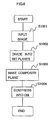
Fig. 6 is a flow chart of an image coding process of the first
embodiment.
Fig. 7 shows an example of the bit plane generation rule of the gray
scale image of Fig. 1.
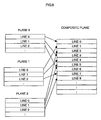
Fig. 8 shows an exemplified method of producing a composite plane
from three bit planes.
Fig. 9 shows an exemplified method of combining four bit planes into
a composite plane on a pixel-by-pixel basis.
Fig. 10 is a block diagram showing a hardware structure of an image
decoding apparatus of a second embodiment.
Fig. 11 is a flow chart of an image decoding process of the second
embodiment.
Fig. 12 shows an exemplified method of decomposing a composite
plane into three bit planes in the second embodiment.
Fig. 13 is a block diagram showing a hardware structure of an image
coding apparatus of a third embodiment.
Fig. 14 is a flow chart of an image coding process of the third
embodiment.
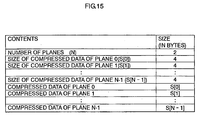
Fig. 15 shows an example of rules to determine whether compressed
data corresponds to a composite plane or data compressed for each plane.
Fig. 16 is a block diagram showing a hardware structure of an image
decoding apparatus according to a fourth embodiment.
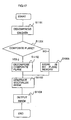
Fig. 17 is a flow chart of an image decoding process of the fourth
embodiment.
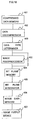
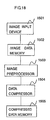
Fig. 18 is a block diagram showing a hardware structure of an image
coding apparatus of a fifth embodiment.
Fig. 19 is a flow chart of an image coding process of the fifth
embodiment.
Fig. 20 is a block diagram showing a hardware structure of an image
decoding apparatus of a sixth embodiment.
Fig. 21 is a flow chart of an image decoding process of the sixth
embodiment.
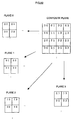
Fig. 22 shows an exemplified method of decomposing a composite
plane into four bit planes on a pixel-by-pixel basis.
Best Modes for Carrying Out the Invention
First Embodiment
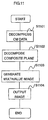
Referring to Fig. 5, an image coding apparatus according to the first
embodiment includes an image input device 301 for entering an image, an
image data memory 302 connected to image input device 301 to store image
data applied by image input device 301, a bit plane generator 303
connected to image data memory 302 to divide the image data stored in
image data memory 302 into bit planes, and a bit plane memory 304
connected to bit plane generator 303 to store the bit planes divided by bit
plane generator 303.
The image coding apparatus further includes an image preprocessor
305 connected to bit plane memory 304 to combine data of each bit plane
stored in bit plane memory 304 into a single plane (also called "composite
plane"), a data compressor 306 connected to image preprocessor 305 to
compress the composite plane, and a compressed data memory 307
connected to data compressor 306 to store compressed data output from
data compressor 306.
Although a scanner is used as image input device 301, image input
device 301 is not limited thereto.
An image coding process using the image coding apparatus of Fig. 5
will be described here with reference to Fig. 6. The image data input
through image input device 301 is written into image data memory 302
("step" S1001 (step abbreviated hereinafter)).
The image data stored in image data memory 302 is divided into bit
planes by bit plane generator 303 and stored in bit plane memory 304
(S1002). In the present embodiment, it is assumed that there are eight
gray scale levels of the number of colors (gradation) of the original image
(input image). The image stored in image data memory 302 takes any of
the eight values of 0-7.
Although bit plane generator 303 divides the data into three bit
planes, the present invention is not limited to three bit planes. However,
it is to be noted that when the value of 2 exponentiated by the number of
bit planes (the maximum gray scale level that can be represented by the
combination of the bit planes) is lower than the number of gray scale levels
of the original image, information will be lost when represented as a bit
plane.
In the process of dividing the image data into bit planes at bit plane
generator 303 it is assumed that the method of determining the pixel value
of each bit plane conforms to the rules shown in Fig. 7. For example, when
the pixel value of the original image is 0, all the pixel values in planes 1-3
are determined as 0. When the pixel value in the original image is 1,
planes 1 and 2 have their pixel values set to 0 and plane 3 has it pixel
value set to 1.
The data of each bit plane stored in bit plane memory 304 are
combined into a composite plane at image preprocessor 305 (S1003). Fig. 8
shows the method of combining three bit planes into a composite plane.
Specifically, data of one line is sequentially output from the three planes to
produce a composite plane. For example, line 0 of plane 0 is set to line 0 of
the composite plane; line 0 of plane 1 is set to line 1 of the composite plane;
line 0 of plane 2 is set to line 2 of the composite plane; and line 1 of plane 0
is set to line 3 of the composite plane. The produced composite plane has a
horizontal width identical to that of the original image (or each bit plane
prior to composite), and a vertical width three times that of the original
image. The present invention is not limited to the line assemble method in
producing a composite plane from respective bit planes shown in Fig. 8.
Any method may be employed as long as the correlation between lines is
increased.
The composite plane is compressed by data compressor 306 and
stored in compressed data memory 307 (S1004). Although it is assumed
that JBIG is employed as the compression scheme of data compressor 306
in the present embodiment, the present invention is not limited to this
scheme. However, it is to be noted that a compression scheme taking
advantage of the fact that the correlation between pixels positioned in close
proximity is high is desirable for the purpose of implementing the present
embodiment effectively. In other words, the inventive point of the present
embodiment is that pixels of high correlation belonging to different bit
planes are rearranged on a new bit plane so as to be positioned in close
proximity on the same bit plane, and then compressed as one binary image.
Therefore, the present invention can be operated effectively by employing a
compression scheme that exhibits a high compression ratio when the
correlation between pixels located in close proximity is high. Such a
compression scheme includes MMR in addition to JBIG.
Alternatively, the vertical line may be employed in the method of
combining a composite plane at image preprocessor 305 instead of
combining in accordance with a horizontal direction line. Also, the
combining process may be carried out on a pixel-by-pixel basis instead of
the line-by-line basis.
Fig. 9 shows an exemplified method of combining a composite plane
from four bit planes on a pixel-by-pixel basis. Although it is assumed that
the number of planes in Fig. 9 is 4, the present invention is not limited to
this number. According to Fig. 9, respective pixels in plane 0-plane 3 are
arranged regularly in the composite plane. For example, in the case where
the compression scheme by data compressor 306 is effected with four pixels
located in close proximity as a unit, the correlation between each pixel can
be increased by positioning each of the four pixels of plane 0-plane 3
corresponding to the same position (pixel 000 in plane 0, pixel 100 in plane
1, pixel 200 in plane 2 and pixel 300 in plane 3) in close proximity at the
composite plane, which in turn can increase the compression ratio.
According to the present invention described above, following
division of unitary image data into a plurality of bit planes, bit data of the
same position forming a plurality of bit planes are arranged in close
proximity to be combined into a single bit plane from which the image is
compressed. Thus, compression amount can be reduced in the
compression process of a gray scale image. Furthermore, the standard
scheme of the existing binary image compression can be accommodated to
allow usage of the currently-available hardware or software module.
Second Embodiment
Referring to Fig. 10, an image decoding apparatus corresponding to
the image coding apparatus of the first embodiment includes a compressed
data memory 401 storing data compressed by the image coding apparatus,
a data decompressor 402 connected to compressed data memory 401 to
decompress compressed data, an image postprocessor 403 connected to data
decompressor 402 to decompose the composite plane output from data
decompressor 402 into bit planes, and a bit plane memory 404 connected to
image postprocessor 403 to store a bit plane.
The image decoding apparatus further includes a bit plane integrator
405 connected to bit plane memory 404 to integrate bit planes to produce a
gray scale image, an image data memory 406 connected to bit plane
integrator 405 to store a gray scale image, and an image output device 407
connected to image data memory 406 to display a gray scale image.
Although it is assumed that a CRT (Cathode-Ray Tube) is employed
as image output device 407 in the present embodiment, the present
invention is not limited thereto.
An image decoding process using the image decoding apparatus of
Fig. 10 will be described here with reference to Fig. 11. The compressed
data stored in compressed data memory 401 is decompressed by data
decompressor 402 and then supplied to image postprocessor 403 (S1101).
Since the present embodiment corresponds to the first embodiment, the
JBIG is employed in the decompression process by data decompressor 402.
Image postprocessor 403 decomposes the composite plane output
from data decompressor 402 into bit planes. The bit planes are stored in
bit plane memory 404 (S1102).
The process of decomposing the composite plane into three bit planes
will be described with reference to Fig. 12. This process has a procedure
opposite to that of the composite plane production procedure of the coding
apparatus of Fig. 8. One line is sequentially output at a time from the
composite plane to be decomposed into respective bit planes. For example,
line 0 of the composite plane is set as line 0 of plane 0; line 1 of the
composite plane is set as line 0 of plane 1; line 2 of the composite plane is
set as line 0 of plane 2; and line 3 of the composite plane is set as line 1 of
plane 0.
The bit plane output from image postprocessor 403 is stored in bit
plane memory 404. Bit plane integrator 405 produces a gray scale image
based on the contents of planes 1-3 stored in bit plane memory 404
according to the rule shown in Fig. 7. The produced gray scale image is
stored in image data memory 406 (S1103).
The gray scale image decoded as described above is output to image
output device 407 (S1104).
According to the present invention, image data coded by the image
coding apparatus of the first embodiment can be decoded.
Third Embodiment
Referring to Fig. 13, an image coding apparatus according to a third
embodiment includes an image input device 301, an image data memory
302 connected to image input device 301, a bit plane generator 303
connected to image data memory 302, a bit plane memory 304 connected to
bit plane generator 303, and an image preprocessor 305 connected to bit
plane memory 304.
The image coding apparatus further includes a data compressor 806
connected to bit plane memory 304 and image preprocessor 305 to compress
respective bit planes and composite planes, a first temporary compressed
data memory 807 connected to data compressor 806 to temporarily store
data corresponding to a compressed bit plane, a second temporary
compressed data memory 808 connected to data compressor 806 to
temporarily store data corresponding to a compressed composite plane, a
data size comparator 806 connected to first and second temporary
compressed data memories 807 and 808 to compare the size of data stored
in first temporary compressed data memory 807 to the data stored in
second temporary compressed data memory 808, and a compressed data
memory 307 connected to data size comparator 809 to store compressed
data that is stored in first temporary compressed data memory 807 or
second temporary compressed data memory 808 based on the comparison
result of data size comparator 809.
Components similar to those in Fig. 5 have the same reference
characters allotted. Since the function and structure thereof are identical,
detailed description thereof will not be repeated here.
Similar to the first embodiment, it is assumed that JBIG
compression is employed at data compressor 806. However, the present
invention is not limited to JBIG compression, as mentioned in the previous
first embodiment.
An image coding process using the image coding apparatus of Fig. 13
will be described here with reference to Fig. 14.
The processes of S1101 and S1102 are similar to those of the first
embodiment. Therefore, detailed description thereof will not be repeated.
The content of bit plane memory 304 is compressed for every plane at
data compressor 806 to be stored in first temporary compressed data
memory 807 (S1203).
Similar to S1003 of the first embodiment, data of respective bit
planes stored in bit plane memory 304 are combined into a composite plane
at image preprocessor 305 (S1003).
The produced composite plane is compressed at data compressor 806
and stored in second temporary compressed data memory 808 (S1205).
Data size comparator 809 compares the size of data stored in first
temporary compressed data memory 807 (referred to as "D1" hereinafter)
with the size of the data stored in second temporary compressed data
memory 808 (referred to as "D2" hereinafter) (S1206). When the value of
D2 is equal to or larger than the value of D1 (YES at S1206), the contents
of first temporary compressed data memory 807 are copied into compressed
data memory 307 (S1207); When the value of D2 is smaller than the value
of D1, the contents of second temporary compressed data memory 808 are
copied into compressed data memory 307 (S1208).
The reason why S1207 and S1208 are provided will be described here.
The purpose of producing a composite plane for compression is to achieve a
higher compression ratio than by compressing each plane taking advantage
of the correlation between planes. This is based on the empirical fact that
correlation is established between planes, which is as shown in Figs. 1-4.
In theory, there may be little correlation between planes. In such a case,
the compression ratio will not necessarily be increased by first producing a
composite plane and then compressing the same. In view of the foregoing,
the conventional compression for each plane is to be carried out in such a
case to achieve a high compression ratio independent of the type of the
image. Although the method of carrying out compression for each plane at
S1203 and the method of carrying out compression of a composite plane at
S1205 are identical here, different methods may be employed instead.
Since information about the number of included planes and the
range of compressed data corresponding to each plane is included in the
compressed data in the JBIG scheme, determination of whether the
compressed data corresponds to a composite plane or data compressed for
each plane can be made readily in the decoding process. However, in the
case of a compression scheme that does not particularly define how data of
a plurality of planes is compressed, consideration is required as to the
arrangement of the contents in first temporary compressed data memory
807 so as to discriminate the compressed data of each plane in the decoding
process. Such an example is shown in Fig. 15. Specifically, the range of
the presence of data in each plane can be rendered definite by storing the
number of planes and the number of bytes of the compressed data in each
plane at the beginning.
According to the present embodiment, the method of compressing a
plurality of bit planes after being combined into a single bit plane and the
method of compressing the plurality of bit planes individually can both be
accommodated. Thus, the most appropriate compression method can
always be employed independent of the property of data of the original
image.
Fourth Embodiment
Referring to Fig. 16, an image decoding apparatus corresponding to
the image coding apparatus of the third embodiment includes a compressed
data memory 401, a data decompressor 402 connected to compressed data
memory 401, a data type determiner 903 connected to data decompressor
402 to determine the type of plane data decompressed at data decompressor
402, an image postprocessor 403 connected to data type determiner 903 to
decompose a composite plane into bit planes based on the determination
result of data type determiner 903, a bit plane memory 404 connected to
data type determiner 903 and image postprocessor 403 to store bit planes, a
bit plane integrator connected to bit plane memory 404, an image data
memory 406 connected to bit plane integrator 405, and an image output
device 407 connected to image data memory 406.
Since the present embodiment corresponds to the third embodiment,
the JBIG scheme is employed in the decompression process of data
decompressor 402.
Components corresponding to those in Fig. 10 have the same
reference characters allotted. Since the function and structure are similar,
detailed description thereof will not be repeated here.
An image decoding process by the image decoding apparatus of the
present embodiment will be described hereinafter with reference to Fig. 17.
The compressed data stored in compressed data memory 401 is
decompressed by data decompressor 402 (S1101). Data type determiner
903 identifies whether the compressed data prior to decompression
corresponds to compressed data of a plurality of bit planes after being
combined into a single bit plane or data of a plurality of bit planes
compressed individually (S1304). This identification method is performed
by reading out the number of planes included in the compressed data from
the compressed data. The JBIG compression scheme employed in the
present embodiment takes advantage of the fact that information
corresponding to the number of planes is stored at the header section of the
compressed data according to the rule thereof. In the case where a
compression scheme that does not include information corresponding to the
aforementioned identification method is employed, the number of planes
and the number of bytes of data to be decompressed can readily be obtained
by using the data format as shown in Fig. 15, for example. If the size of
the original image (or each bit plane prior to combining) is known,
identification can be made by comparing that size with the size of the
image decompressed at data decompressor 402. This is based on the fact
that the vertical width or horizontal width of a composite plane is always
an integer multiple of the original image (or each bit plane prior to
combining). For example, in the composite method as shown in Fig. 8, the
input compressed data can be easily identified whether it corresponds to a
composite plane or not since the vertical width of the composite plane is
three times that of the original image (or each bit plane prior to combining).
When determination is made that the compressed data corresponds
to a composite plane as a result of the identification (YES at S1304), the
process of S1102-S1104 is executed. These processes are similar to those
described with reference to Fig. 11. Therefore, detailed description thereof
will not be repeated here.
When the data does not correspond to a composite plane (NO at
S1304), the composite plane does not have to be decomposed. Therefore,
the output of data decompressor 402 is stored directly in bit plane memory
404 without passing through image postprocessor 403 (S1305). Then, the
process of S1103 and S1104 is executed.
In the present embodiment, determination is made whether the
compressed data corresponds to a composite plane or not after data
decompression. It is also possible to determine whether the compressed
data corresponds to a composite plane without conducting data
decompression, if dispensable.
In such a case, a higher compression ratio can be achieved by
employing another compression scheme at data decompressor 402
depending upon whether the compressed data corresponds to a composite
plane or compressed data for every plane, as described in the third
embodiment.
According to the present embodiment, data of a plurality of bit
planes compressed after being combined into a single bit plane and data of
a plurality of bit planes compressed individually can both be decoded
according to the output result of the data type determiner.
Fifth Embodiment
The present embodiment is directed to an image coding apparatus
that achieves a higher compression ratio by producing a composite plane
from a series of continuous images of high similarity instead of a plurality
of bit planes produced from the same image for compression.
Referring to Fig. 18, an image coding apparatus according to the fifth
embodiment includes an image input device 1501 for entering a continuous
image, an image data memory 1502 connected to image input device 1501
to store image data input continuously through image input device 1501, an
image preprocessor 1503 connected to image data memory 1502 to generate
a composite plane from the image data continuously input, a data
compressor 1504 connected to image preprocessor 1503 to compress a
composite plane, and a compressed data memory 1505 connected to data
compressor 1504 to store compressed data output from data compressor
1504.
An image coding process using the image coding apparatus of Fig. 18
will be described hereinafter with reference to Fig. 19. The continuous
image input from image input device 1501 is stored in image data memory
1502 (S1701).
Image data memory 1502 is configured to allow storage of a plurality
of image data. Although it is assumed that the input is a color image of
256 gray scale levels taking the values of 0-255 in the present embodiment,
the number of gray scale levels and the type of image (color image or binary
image) are not limited thereto. In the case where the input image is a
color image, the present invention is applicable by preparing a bit plane for
each color component (RGB, YCbCr, and the like) and producing a
composite plane from respective bit planes.
Image preprocessor 1503 produces a composite plane from the input
continuous image (S1702). Specifically, pixels of the same position are
selected from a predetermined number of images, and a composite plane is
produced so that the selected pixels are positioned in close proximity. The
present embodiment differs from the first embodiment in that the image of
respective bit planes forming a composite plane is not a binary image, but a
gray scale image. However, the issue of producing a composite plane so
that pixels of high correlation between different images are positioned in
close proximity is similar to the first embodiment in which a composite
plane is produced so that pixels with a correlation between different planes
are located in close proximity. In the present embodiment, a composite
plane is produced from four images according to the correspondence shown
in Fig. 9. However, a composite plane may be produced from three images
according to the correspondence as shown in Fig. 8. The present invention
is not limited to these composite methods.
The composite plane produced at image preprocessor 1503 is
compressed by data compressor 1504 to be stored in image data memory
1502 (S1073). Although the JPEG (Joint Photographic Experts Group)
compression scheme is employed at data compressor 1504 in the present
embodiment, any compression scheme can be employed as long as a higher
compression ratio can be expected in proportion to a higher similarity of
pixels positioned in close proximity. It is known that a high correlation
between pixels is substantially equal to less high frequency components
(referenced document "Image Information Compression" published by Ohm
Corporation (1991)). Since the general image compression scheme utilizes
these characteristics, any general compression scheme is applicable to the
present invention.
The present embodiment is directed to achieving a higher
compression ratio than that achieved as a result of compressing data
individually by compressing a plurality of gray scale images after being
converted into a composite plane instead of compressing a plurality of gray
scale images individually. Continuous frames of a series of a motion
picture sequence or a text image taken from the same document has high
similarity in each of the images. Therefore, such an effect can be expected.
Furthermore, it is possible to carry out compression using a
composite plane only in the case where a higher compression ratio can be
achieved by applying the present invention and to carry out compression
for each image individually in other cases.
According to the present embodiment, bit data of the same position
has a among a plurality of image data such as continuous motion pictures
correlation. Taking advantage of this characteristic, the compression size
can be reduced by producing unitary image data from a plurality of image
data for image compression. Furthermore, the standard scheme of the
existing image compression can be accommodated.
Sixth Embodiment
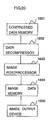
Referring to Fig. 20, an image decoding apparatus corresponding to
the image coding apparatus of the fifth embodiment includes a compressed
data memory 1601 storing data compressed by the image coding apparatus,
a data decompressor 1602 connected to compressed data memory 1601 to
decompress compressed data, an image postprocessor 1603 connected to
data decompressor 1602 to decompose a composite plane output from data
decompressor 1602 into a plurality of images, an image data memory 1604
connected to image postprocessor 1603 to store the decomposed plurality of
images, and an image output device 1605 connected to image data memory
1604 to display a plurality of images.
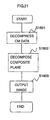
An image decoding process using the image decoding apparatus of
Fig. 20 will be described with reference to Fig. 21. The compressed data
output from compressed data memory 1601 is decompressed at data
decompressor 1602 and then supplied to image postprocessor 1603 (S1801).
The decoded composite plane is decomposed into a plurality of
images at image postprocessor 1603 and stored in image data memory 1604
(S1802). This decomposing method is to be carried out as shown in Fig. 22,
which is opposite to the combining method shown in Fig. 9. If the
combining method in the coding process differs, the decomposing method
will differ accordingly. The plurality of image data stored in the image
data memory is output from image output device 1605.
According to the present embodiment, the image data coded by the
image coding apparatus of the fifth embodiment can be decoded.
Regarding the above-described first to sixth embodiments, the flow
chart of the processing procedure of the coding apparatus or decoding
apparatus of respective embodiments can be implemented by a program
executed on a computer. In this case, each program is provided through a
computer-readable recording medium such as a magnetic disk or a CD-ROM
(Compact Disc-Read Only Memory). Each program can be supplied
from another computer through a communication network.
According to the present invention, the correlation between each bit
plane and the standard image compression can be utilized in the
compression process of unitary image data. Therefore, a higher
compression ratio can be achieved while utilizing the currently-available
hardware or software modules.
The process of producing a composite plane can be alleviated since
the process can be effected on a line-by-line basis in the composite plane
producing step.
Since utilization of a composite plane can be selected according to the
compression ratio, a higher compression ratio can always be achieved
independent of the type of the image. Furthermore, decoding thereof can
be effected.
Since the correlation between each bit plane and the standard image
compression can be utilized in the compression process of a plurality of
image data of high similarity, a higher compression ratio can be achieved
while using the currently-available hardware or software modules.
Industrial Applicability
Thus, the present invention is applicable to achieve a higher
compression ratio while utilizing a hardware or software module that
performs the existing image compression process.