-
The present invention relates to an improved protective overcoat
for to image recording materials which overcoat provides excellent scratch,
fingerprint, and water resistance. In particular, the protective overcoat comprises
a selected polycarbonate-polyurethane material.
-
Gelatin or other hydrophilic polymers are commonly used as
binders in image recording materials such as silver-based photographic materials
and ink-jet receivers. These products are known to be swellable when in contact
with water. The swelling property is essential in order to accomplish
photographic processing chemistry or to absorb ink to generate images in the final
product. However, the same property also inhibits end users from fully enjoying
the imaged product. It is worrisome that, during handling, the imaged product is
liable to damage from spilled drinks, fingerprints, and the like.
-
Various kinds of processes for applying protective overcoats onto
image recording processes are known. Teachings on various methods and
apparatus for applying a controlled amount of overcoat material onto silver-based
photographic materials during photographic processing have been disclosed, for
example, in U.S. Pat. No. 5,984,539, U.S. Pat. No. 5,905,924, U.S. Pat. No.
5,875,370, and US Patent 6,087,051. It would be advantageous to implement
overcoat technology, including material compositions, in currently existing
photofinishing systems and laboratories with minimal or no changes. The
temperature and residence time of photographic materials in the drying section of
photofinishing trade equipment typically vary from 50°C to 70°C and from 30
seconds to 2.5 minutes. (The actual temperature of an image recording material
during drying is lower than the temperature set for the dryer due to the
evaporation of water.) High temperatures or fusing steps are not normally used in
photoprocessing and would involve an additional expense and inconvenience if
required to apply an overcoat composition to an imaged element.
-
U.S. Pat. No. 2,719,791 describes the use of an aqueous dispersion
of an organic plastic material, which yields a water impermeable coating on
drying. However, it is known that when dispersions of low Tg material
(Tg<25°C) are used to obtain a water resistant protective coating, the surface of
the protective coating has an undesirable tacky characteristic. In customer's
hands, such a coating on an image recording element can degrade due to print
blocking, fingerprinting, dust attraction, and high scratch propensity. On the
other hand, when dispersions of high Tg materials (Tg>25°C) are used, it is
difficult or impossible to form a continuous water resistance layer on the prints
under the drying condition described above.
-
U.S. Pat. No. 5,376,434 describes the use of at least two resins in
the protective overcoat layer of a photographic print, at least one first resin having
a glass transition temperature (Tg) of not less than 80°C, and at least one second
resin having a Tg of 0°C to 30°C, wherein an arithmetic mean of the glass
transition temperatures of said first resin and said second resin is 30°C to 70°C.
The patent teaches the use of the high Tg resin to reduce the stickiness of the
overcoat due to the low Tg material.
-
U.S. Pat. No. Patent 5,447,832 describes coating compositions for
imaging elements comprising aqueous-based mixtures of lower Tg, film-forming
polymeric particles and higher-Tg, non-film-forming polymeric particles. The
film-forming particles provide continuous film formation and the non-film-forming
particles comprise glassy polymers to provide resistance to tackiness,
blocking, ferrotyping, abrasion and scratching.
-
While recognizing the above-mentioned benefits of two-component
aqueous dispersions cited in U.S. Pat. No. 5,376,434 and 5,447,832,
U.S. Pat. No. 5,952,130 further disclosed preferred substituents on the high and
low Tg components in two-latex formulations in order to obtain improved
fingerprint resistance. This patent discloses an overcoat comprising a first water-insoluble
polymer having a Tg less than 25°C (film-forming) and a second water
insoluble polymer having a Tg greater than 25°C (non-film forming), wherein one
or the other of the two polymers comprise 20-100 weight percent of a monomer
having a formula in which a substituent is Cl, F, or CN. Examples of such
monomers are acrylonitrile, vinylidene chloride, tetrafluoroethylene, and
methacrylonitrile.
-
U.S. Serial No. 09/354,209 disclosed a low Tg polymer that fulfills
the requirements of film formation, high gloss, excellent dry and wet scratch
resistance, water resistance, oil and fingerprint resistance, and low tackiness
without the use of a high Tg polymer latex. The polymer latex of this invention
comprises 75% to 100%, preferably 80% to 95%, of the ethylenically unsaturated
monomers of a certain formula wherein a substituent X is selected from the group
consisting of -Cl, -F, or -CN, such as vinylidene chloride or acrylonitrile. A
disclosed advantage of this coating is its ability to form a coating film at a modest
drying temperature without being tacky on handling. The material composition is
a colloidal dispersion of water insoluble polymeric materials having a Tg not
more than 30°C. Preferred monomers are acrylonitrile, methacrylonitrile,
vinylidene chloride, vniylidene fluoride, vinylidene cyanide, vinyl chloride, vinyl
fluoride, tetrafluoroethylene, etc.
-
Materials described in U.S. Pat. No. 5,952,130 and U.S. Serial No.
09/354,209 provide excellent protection to imaging materials compared to those
described in U.S. Patents 5,376,434 and 5,447,832 in terms of fingerprint-resistance,
However, they have a problem with respect to image discolorization
due to the de-hydrochlorination of the vinylidene chloride comonomer. This
phenomenum is especially noticeable in the low image density area of the image
recording element. Therefore, there is a need to identify a new class of materials
that does not discolorize while maintaining equivalent fingerprint resistance.
-
US Patent No. 6,087,051 discloses the use of polyurethane resins
containing a polycarbonate expressed by the general formula of -(O-R-O-CO)-,
where R is a divalent group, for forming a protective coating layer for information
recording materials. The protective coating layer was described as glossy and
having excellent water and fingerprint resistance. However, the materials
exemplified in the examples of this patent employ a system of coating involving
relatively high drying temperatures.
-
In view of the above, there is a need for overcoat materials that
provide good film formation during coating and drying, but which provide good
properties in the final coating. The overcoat material should not discolorize while
maintaining equivalent water, scratch, and fingerprint resistance. It would be
desirable for such a coating to be applied to an image recording element under
advantageous process conditions, such that minimal or no changes to existing
photofinishing systems are necessary.
-
The present invention involves an aqueous overcoat composition for an
image recording element. It has been found that the presence of a polycarbonate-containing
polyurethane polymer having a weight average molecular weight
above 15,000 and below 200,000 provides fulfills the requirements of film
formation, high gloss, excellent durability to dry and wet scratches, and excellent
resistance to water, oil, and fingerprints, without image discoloration on long-term
keeping. The present invention is, therefore, able to prevent original image
quality in an image recording element from being destroyed due to handling.
Advanatageously, the composition can be applied in a coating operation that
employs common drying conditions. The term image recording element includes
imaged photographic prints, ink-jet prints, thermal dye-tranfer prints, and
electrophotographic prints.
-
Preferably, the polycarbonate-containing polyurethane polymers
also have a Tg between 30°C to 70°C. In one embodiment of the present
invention, the polycarbonate-polyurethane polymer can be a combined with a
second polymeric material or binder, including another, different polyurethane.
Optionally, the present invention may comprise a combination of at least one
aqueous dispersible polycarbonate-polyurethane, as described above, and at least
one organic or inorganic material, in the form of particles, having a Tg greater
than 70°C and having average particle size between 5 nm and 100 nm to control
other surface and physical characteristics of the protective layer, such as
coefficient of friction, hardness, stickiness, and the like.
-
The present invention employs a class of aqueous dispersible
polyurethanes composed of at least three basic starting materials: (1) a
polycarbonate polyol, (2) a diisocyanate, and (3) a chain extender, for example, a
glycol or diamine. The polycarbonate polyol is quite flexible and is commonly
referred to as the soft segment. The diisocyanate and the chain extender form stiff
oligourethane units referred to as hard segments. The ratio of the two-phase hard
and soft segments is calculated on a weight percent, as described in more detail
below. The polyurethane-containing compositions of the present invention are
preferably free of volatile organic compounds or solvents and are applied as a
coating to the image-recording product after image formation to form a water
resistant, scratch resistant, and fingerprint resistant durable overcoat.
Advantageously, as mentioned above, a feature of this invention that commonly
assigned U.S. Pat. Nos. 5,376,434 and 5,477,832 do not possess is fingerprint
resistance, and an improved feature of this invention, compared to commonly
assigned U.S. Pat. No. 5,952,130 and U.S. Serial No. 09/354,209 is non-discoloration
on long-term keeping.
-
The polycarbonate-containing polyurethane polymer has a Tg
of 0 to 70°C, preferably 20 to 60°C, and molecular weight of 15,000 to
200,000, preferably 16,000 to 150,000, wherein the amount of polycarbonate,
based on the total weight of the polymer is at least 20 percent, preferably 25
to 60 percent.
-
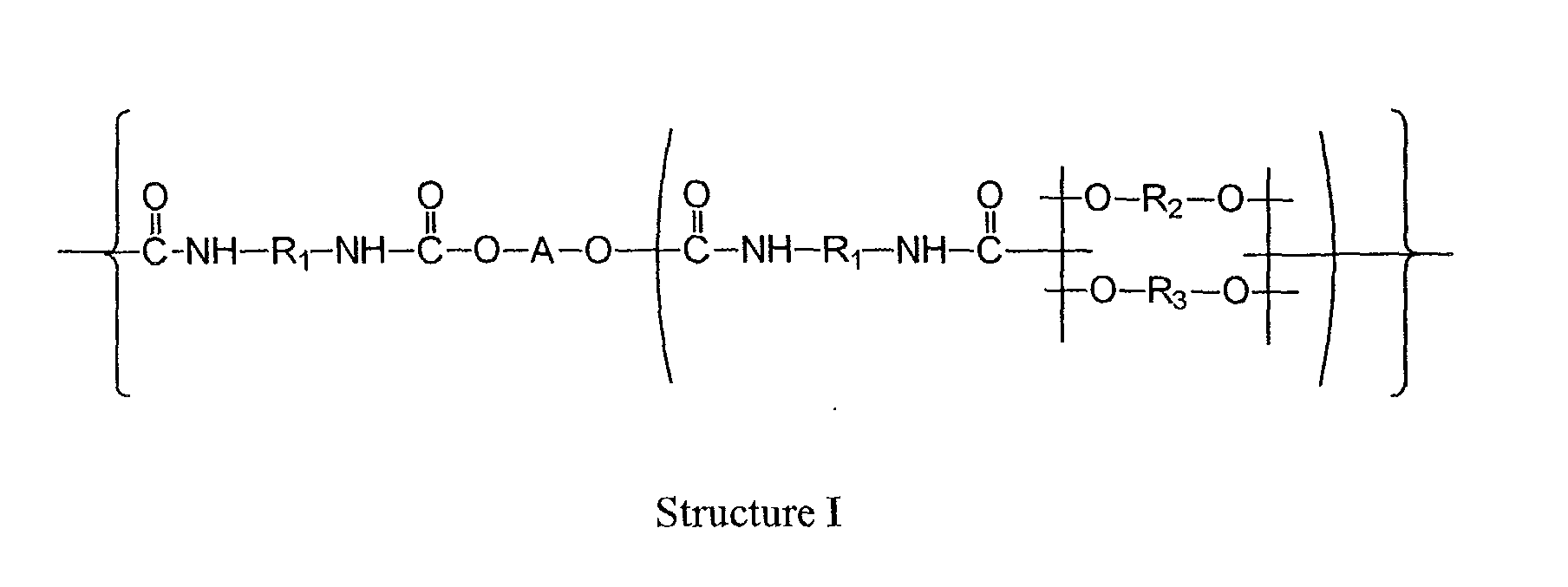
In one embodiment of the invention, the polymeric composition
employed in the present invention can be represented by the following structure:
wherein the R
1 moiety is the central portion of the monomeric unit that is
polymerization product of an diisocyanate monomer; A represents the central
portion of a monomeric unit that is the polymerization product of one or more
polyols, including at least one hydroxy-terminated polycarbonate having a
molecular weight of 500 to 2500; R
2 represents the central portion of a
monomeric unit that is the polymerization product of a diamine or diol chain
extender having a molecular weight less than about 500; and optional R
3 is the
central portion of an optional monomeric unit containing a phosphonate,
carboxylate or sulfonate group. By the term "central portion" is meant the
monomeric unit minus the terminal functional groups in the monomeric unit.
-
The hydroxy terminated polycarbonate can be selected from
compounds disclosed in US Patent No. 6,087,051, the entirety of which is
incorporated by reference. The A group in such polycarbonates can be based
on the dihydroxy-containing aliphatic or aromatic compounds disclosed in
columns 6 to 15 of said patent. At least 50%, preferably at least 80%, more
preferably 95%, and most preferably 100% by weight of the one or more
polyols forming the A group is a hydroxy terminated polycarbonate.
-
Optionally, in addition to the hydroxy-terminated polycarbonate,
one or more other polyols may included such as (a) a dihydroxy polyester
obtained by esterification of a dicarboxylic acid such as succinic acid, adipic acid,
suberic acid, azelaic acid, sebacic acid, phthalic, isophthalic, terephthalic,
tetrahydrophthalic acid, and the like, and a diol such as ethylene glycol,
propylene-1,2-glycol, propylene-1,3-glycol, diethylene glycol, butane-1,4-diol,
hexane-1,6-diol, octane-1,8-diol, neopentyl glycol, 2-methyl propane-1,3-diol,
2,2-bis-(4-hydroxyphenyl)-propane, 2,2-bis-(4-hydroxyphenyl)-hexafluoropropane
or the various isomeric bis-hydroxymethylcyclohexanes;(b) a
polylactone such as polymers of ε-caprolactone and one of the above mentioned
diols; and/or (c) a polyether such as a polymer or copolymer of styrene oxide,
propylene oxide, ethylene oxide, tetrahydrofuran, butylene oxide or
epichlorohydrin.
-
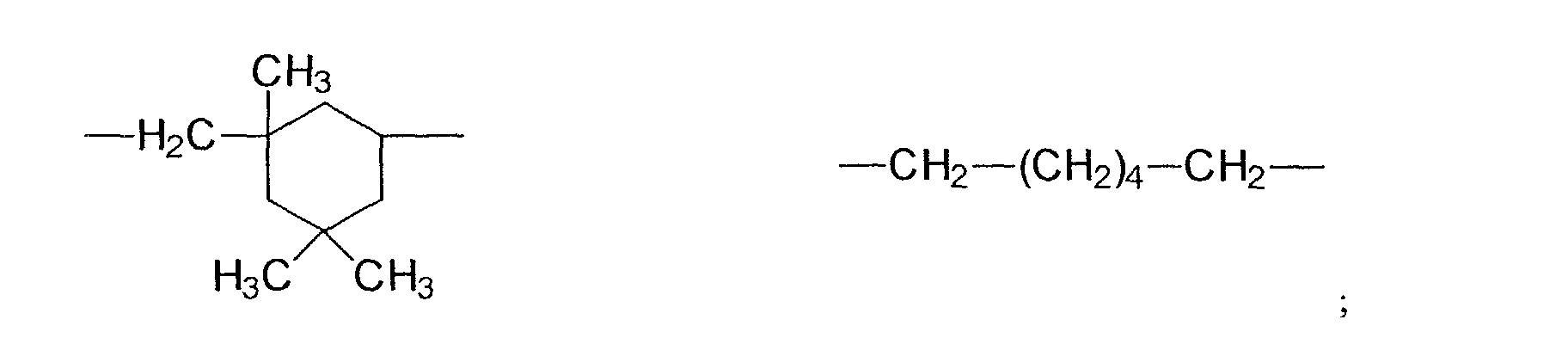
R
1 in Structure I above is preferably a hydrocarbon group
having a valence of two, more preferably containing a substituted or
unsubstituted alicyclic, aliphatic, or aromatic group, preferably represented by
one or more of the following structures:
-
Preferably, R1 is a non-aromatic, hydrocarbon group having 1
to 20 carbon atoms.
-
With respect to R2, examples of suitable diamine chain
extenders useful herein include ethylene diamine, diethylene triamine,
propylene diamine, butylene diamine, hexamethylene diamine, cyclohexylene
diamine, phenylene diamine, tolylene diamine, xylylene diamine, 3,3'-dinitrobenzidene,
ethylene methylenebis(2-chloroaniline), 3,3'-dichloro-4,4'-biphenyl
diamine. 2,6-diaminopyridine, 4,4'-diamino diphenylmethane, and
adducts of diethylene triamine with acrylate or its hydrolyzed products. Also
included are materials such as hydrazine, substituted hydrazines such as, for
example, dimethyl hydrazine, 1,6-hexamethylene-bis-hydrazine,
carbodihydrazide, hydrazides of dicarboxylic acids and sulfonic acids such as
adipic acid mono- or dihydrazide, oxalic acid dihydrazide, isophthalic acid
dihydrazide, tartaric acid dihydrazide, 1,3-phenylene disulfonic acid
dihydrazide, omega-amino-caproic acid dihydrazide, hydrazides made by
reacting lactones with hydrazine such as gamma-hydroxylbutyric hydrazide,
bis-semi-carbazide, bis-hydrazide carbonic esters of glycols such as any of the
glycols mentioned above. Suitable well-known diol chain extenders may also
be any of the glycols or diols listed above for A or below for other
polyurethanes.
-
The R3 group in the optional chain extender is suitably present
in the polycarbonate-containing polyurethane polymer in the amount of 0-20
percent by total weight of the polymer, preferably 2-10 percent by weight.
-
The polycarbonate-containing polyurethane polymer employed in
the invention preferably has a Tg between about 0°C and 70°C and a weight
average molecular above 15,000 and below 200,000. The soft segment in the
preferred polyurethane is preferably a aliphatic polycarbonate with the molecular
weight between 500 and 2500. A water-dispersible polyurethane employed in the
invention may be prepared as generally described in "Polyurethane Handbook",
Hanser Publishers, Munich Vienna, 1985.
-
The present invention can be a combination of more than one
aqueous dispersible polyurethane described above. In a second polyurethane, less
than 20% by weight of the polycarbonate segment A above may be used.
Optionally, the present invention may be a combination of at least one aqueous
dispersible polycarbonate-containing polyurethane polymer, as described above,
and at least one additional organic or inorganic material, in the form of particles
or a colloidal dispersion, having a Tg greater than 70°C and having an average
particle size between 5 nm and 100 nm (preferably 10 to 80 nm) in the amount of
0 to 40 percent, preferably 5 to 30 weight percent by weight of the dry coating, to
control other surface and physical characteristics of the protective layer, such as
coefficient of friction, hardness, stickiness, etc.
-
Preferred inorganic materials include colloidal silica, alumina, or
titania. Colloidal dispersions of hydrophobic polymers having a Tg greater than
70°C can be latexes or hydrophobic polymers of any composition that can be
stabilized in a water-based medium. Such hydrophobic polymers are generally
classified as either condensation polymers or addition polymers. Condensation
polymers include, for example, polyesters, polyamides, polyurethanes, polyureas,
polyethers, polycarbonates, polyacid anhydrides, and polymers comprising
combinations of the above-mentioned types. Addition polymers are polymers
formed from polymerization of vinyl-type monomers including, for example, allyl
compounds, vinyl ethers, vinyl esters, vinyl heterocyclic compounds, styrenes,
olefins and halogenated olefins, unsaturated acids and esters derived from them,
unsaturated nitriles, vinyl alcohols, acrylamides and methacrylamides, vinyl
ketones, multifunctional monomers, or copolymers formed from various
combinations of these monomers. Such latex polymers can be prepared in
aqueous media using well-known free-radical emulsion polymerization methods
and may consist of homopolymers made from one type of the above-mentioned
monomers or copolymers made from more than one type of the above-mentioned
monomers. Polymers comprising monomers which form water-insoluble
homopolymers are preferred, as are copolymers of such monomers. Preferred
polymers may also comprise monomers which give water-soluble homopolymers,
if the overall polymer composition is sufficiently water-insoluble to form a latex.
The aqueous phase of the latex or colloidal dispersion of the invention may
contain water-soluble polymers in order to control, for example, the viscosity and
flow characteristics. The aqueous phase may also include surfactants of the
cationic, anionic, zwitterionic or non-ionic types. Further listings of suitable
monomers for addition type polymers are found in US Patent No. 5,594,047.
-
Preferred polymers are microgel particles as disclosed in US Patent
No. 6,130,014. Microgel particles are highly crosslinked polymer particles
prepared by emulsion polymerization. Microgel particles typically comprise,
based on the total weight of the monomer mixture, from about 5 to 50%, most
preferably from about 5 to 20%, of a polymerizable carboxylic acid monomer and
2 to 20% of a difunctional crosslinking monomer, with the balance of the
microgel composition comprising water-insoluble, ethylenically unsaturated or
vinyl-type monomers.
-
The average particle size of the aqueous dispersible polycarbonate
polyurethane of this invention can suitably be from 5 nm to 500 nm, preferably 5
nm to 200 nm. The dry laydown of the total materials on the surface of the image
recording materials can be from 0.3 to 6.0 g/m2.
-
Other components commonly used in image recording materials or
photographic processing solutions, such as biocides, spreading aids (surfactants),
lubricants and waxes can also be incorporated in the formulation as needed. The
concentration of the formulation can be from 1% solids to 70% solids depending
on the thickness of the protective layer one wishes to apply, the machine speed,
the dryer efficiency and other factors that may affect the solution uptake by the
image recording materials.
-
Waxes can be in the form of particles including dispersions of
submicrometers size, from 0.01 µm to 1 µm wax particles such as those offered
commercially as aqueous or non-aqueous dispersions of polyolefins,
polypropylene, polyethylene, high density polyethylene, oxidized polyethylene,
ethylene acrylic acid copolymers, microcrystalline wax, paraffin, and natural
waxes such as carnauba wax, and aqueous dispersions of synthetic waxes from
such companies as, but not limited to, Chemical Corporation of America
(Chemcor), Inc., Michelman Inc., Shamrock Technologies Inc., Daniel Products
Company. The dispersion may also contain dispersing aids such as polyethylene
glycol.
-
Imaged photographic elements are among the image recording materials
protected in accordance with this invention. Typically, the exemplified elements
are derived from silver halide photographic elements that can be black and white
elements (for example, those which yield a silver image or those which yield a
neutral tone image from a mixture of dye forming couplers), single color elements
or multicolor elements. Multicolor elements typically contain dye image-forming
units sensitive to each of the three primary regions of the spectrum. The imaged
elements can be imaged elements which are viewed by transmission, such a
negative film images, reversal film images and motion picture prints or they can
be imaged elements that are viewed by reflection, such as paper prints. Because
of the amount of handling that can occur with paper prints and motion picture
prints, they are preferred imaged elements for use in this invention.
-
The overcoat composition of the present invention can be
applied to a image recording element following complete image formation by
various known coating methods, including immersion of the image recording
element in the coating composition, spraying of the image recording element
with the coating composition, extrusion of the coating composition onto the
element, or otherwise contacting and coating the image recording element
with a film of the coating composition. An example of one method of
applying the coating composition to the image recording element is disclosed
in US Patent No. 6,087,051, hereby incorporated by reference in its entirety.
In a photographic processing operation, the coating composition is applied
after development and before drying. The overcoat is suitably applied at
room temperature and subsequently heated in a drying step. The residence
time in the drying section of photofinishing trade equipment typically vary
from 30 seconds to 2.5 minutes, at rates up to and including 30 m/min or
more. (The actual temperature of an image recording material during drying
is lower than the temperature set for the dryer due to the evaporation of
water.) High temperatures or fusing steps are not normally necessary when
applying and drying the coating. In general, the overcoat composition is dried
at an average temperature of 40°C to 75°C, preferably 50 to 70°C, and
preferably maintained at not more than 75°C during the overall
photoprocessing operation, and the overcoat need not be exposed to higher
temperatures or fusing in order to provide good film forming and coalescence
of polymeric particles.
-
The photographic elements in which the images to be protected are
formed can have the structures and components shown in Research Disclosure
37038. Specific photographic elements can be those shown on pages 96-98 of
Research Disclosure 37038 as Color Paper Elements 1 and 2. Such photographic
elements, when imaged (developed) typically comprise at least one imaged layer
comprising either silver (in the case of black and white images) and/or the
reaction product of a developing agent and a dye-forming coupler (in the case of
multicolored images), which imaged layer is superposed on a side of a support. A
typical multicolor photographic element comprises a support bearing a cyan dye
image-forming unit comprised of at least one red-sensitive silver halide emulsion
layer having associated therewith at least one cyan dye-forming coupler, a
magenta dye image-forming unit comprising at least one green-sensitive silver
halide emulsion layer having associated therewith at least one magenta dye-forming
coupler, and a yellow dye image-forming unit comprising at least one
blue-sensitive silver halide emulsion layer having associated therewith at least one
yellow dye-forming coupler. The element can contain additional layers, such as
filter layers, interlayers, overcoat layers, subbing layers, and the like. All of these
can be coated on a support which can be transparent (for example, a film support)
or reflective (for example, a paper support). Support bases that can be used
include both transparent bases, such as those prepared from polyethylene
terephthalate, polyethylene naphthalate, cellulosics, such as cellulose acetate,
cellulose diacetate, cellulose triacetate, and reflective bases such as paper, coated
papers, melt-extrusion-coated paper, and laminated papers, such as those
described in U.S. Pat. Nos. 5,853,965; 5,866,282; 5,874,205; 5,888,643;
5,888,681; 5,888,683; and 5,888,714. Photographic elements protected in
accordance with the present invention may also include a magnetic recording
material as described in Research Disclosure, Item 34390, November 1992, or a
transparent magnetic recording layer such as a layer containing magnetic particles
on the underside of a transparent support as described in U.S. Pat. Nos. 4,279,945
and 4,302,523.
-
Suitable silver halide emulsions and their preparation, as well as
methods of chemical and spectral sensitization, are described in Sections I through
V of Research Disclosure 37038. Color materials and development modifiers are
described in Sections V through XX of Research Disclosure 37038. Vehicles are
described in Section II of Research Disclosure 37038, and various additives such
as brighteners, antifoggants, stabilizers, light absorbing and scattering materials,
hardeners, coating aids, plasticizers, lubricants and matting agents are described in
Sections VI through X and XI through XIV of Research Disclosure 37038.
Processing methods and agents are described in Sections XIX and XX of
Research Disclosure 37038, and methods of exposure are described in Section
XVI of Research Disclosure 37038.
-
Photographic elements typically provide the silver halide in the
form of an emulsion. Photographic emulsions generally include a vehicle for
coating the emulsion as a layer of a photographic element. Useful vehicles
include both naturally occurring substances such as proteins, protein derivatives,
cellulose derivatives (e.g., cellulose esters), gelatin (e.g., alkali-treated gelatin
such as cattle bone or hide gelatin, or acid treated gelatin such as pigskin gelatin),
gelatin derivatives (e.g., acetylated gelatin, phthalated gelatin, and the like). Also
useful as vehicles or vehicle extenders are hydrophilic water-permeable colloids.
These include synthetic polymeric peptizers, carriers, and/or binders such as
poly(vinyl alcohol), poly(vinyl lactams), acrylamide polymers, polyvinyl acetals,
polymers of alkyl and sulfoalkyl acrylates and methacrylates, hydrolyzed
polyvinyl acetates, polyamides, polyvinyl pyridine, methacrylamide copolymers,
and the like.
-
Photographic elements can be imagewise exposed using a variety
of techniques. Typically exposure is to light in the visible region of the spectrum,
and typically is of a live image through a lens. Exposure can also be to a stored
image (such as a computer stored image) by means of light emitting devices (such
as LEDs, CRTs, etc.).
-
Images can be developed in photographic elements in any of a
number of well known photographic processes utilizing any of a number of well
known processing compositions, described, for example, in T.H. James, editor,
The Theory of the Photographic Process, 4th Edition, Macmillan, New York,
1977. In the case of processing a color negative element, the element is treated
with a color developer (that is one which will form the colored image dyes with
the color couplers), and then with an oxidizer and a solvent to remove silver and
silver halide. In the case of processing a color reversal element or color paper
element, the element is first treated with a black and white developer (that is, a
developer which does not form colored dyes with the coupler compounds)
followed by a treatment to render developable unexposed silver halide (usually
chemical or light fogging), followed by treatment with a color developer.
Development is followed by bleach-fixing, to remove silver or silver halide,
washing and drying.
-
Photographic images may also be produced using ink-jet printing.
This printing technology is reviewed in an article titled "Progress and Trends in
Ink-Jet Printing Technology" by Hue P. Le in the Journal of Imaging Science and
Technology, Volume 42, Number 1 (January/February 1998), pp. 49-61.
Essentially, ink droplets, typically in the volume range 1-100 picoliters, are
ejected from a printhead to a receiver material on which the image is formed. The
ink-jet printhead may be of the continuous or drop-on-demand varieties. Several
physical mechanisms for drop ejection are known, but the currently most popular
among these are thermal and piezoelectric. In the thermal mechanism, ink in the
printhead is heated to form a water vapor bubble that expels one or more ink
droplets out of the printhead toward the receiver. Representative thermal ink-jet
printheads are described in, for example, U.S.Pat. No. 4,723,129 of Endo et al.
(Canon) and U.S. Pat. No. 4,490,728 of Vaught et al. (Hewlett Packard). In the
piezoelectric mechanism, one or more droplets are expelled from the printhead by
a physical deformation that accompanies a voltage change across a piezoelectric
material forming a part of the printhead structure. Representative piezoelectric
printheads are described in, for example, U.S. Pat. No. 4,459,601 of Howkins
(Exxon) and U.S. Pat. No. 5,563,634 of Masahiro et al. (Seiko Epson). Ink-jet
inks may be either aqueous- or organic solvent-based. Aqueous inks are preferred
for printing in home, office and retail environments. In addition to water and one
or more colorants, such as dyes or pigments, an aqueous ink typically contains
one or more humectants, which affect ink viscosity and volatility, one or more
surfactants, which affect the wetting and penetrating properties of the ink, and a
biocide, which extends the useful life of the ink. Aqueous inks may also contain
many other ingredients, including metal ion chelating agents, pH buffers,
defoamers, and dispersing agents. It is well known to improve the tone scale or
bit depth of an image by using more than one ink density for each color.
Representative ink-jet inks are described in, for example, U.S. Pat. No. 5,571,850
of Ma et al. (DuPont), U.S. Pat. No. 5, 560,770 of Yatake (Seiko Epson), and
U.S. Pat. No. 5,738,716 of Santilli et al. (Eastman Kodak). Ink-jet receivers may
be reflective, transparent, or of intermediate transparency (e.g., for day/night
display materials). At minimum, an ink-jet receiver includes a support and an ink
receiving layer. The simplest ink-jet receiver is plain paper, in which these two
functions are combined. As a practical matter, more complex receiver structures
are required for improved image quality and physical properties. Specifically
formulated ink receiving layers coated on paper or other supports improve color
density and dot resolution. Receiver composition and structure may also be
modified to improve properties such as wettability, ink absorptivity, drying time,
gloss, reduced image artifacts, water-fastness, and light and dark stability.
Representative ink-jet receiver structures and compositions are described in, for
example, U.S. Pat. No. 4,954,395 of Hasegawa et al. (Canon), U.S. Pat. No.
5,725,961 of Ozawa et al. (Seiko Epson), and U.S. Pat. No. 5,605,750 of Romano
et al. (Eastman Kodak).
-
The present invention is illustrated by the following examples.
Unless indicated otherwise, all molecular weight ranges herein are weight average
molecular weights.
EXAMPLES
Characterizations of polymeric materials:
Glass Transition Temperature and Melting Temperature
-
Both glass transition temperature (Tg) and melting temperature
(Tm) of the dry polymer material were determined by differential scanning
calorimetry (DSC), using a heating rate of 20°C/minute. Tg is defined herein as
the inflection point of the glass transition and Tm is defined herein as the peak of
the melting transition.
Particle Size Measurement
-
All particles were characterized by Photon Correlation
Spectroscopy (PCS) using a Zetasizer® Model DTS5100 manufactured by
Malvern Instruments. Z-average particle sizes are reported.
Average Molecular Weight
-
The samples were analyzed by size-exclusion chromatography
(SEC) in tetrahydrofuran using three Polymer Laboratories Plgel™mixed-C
columns. The column set was calibrated with narrow-molecular-weight
distribution polystyrene standards between 595 (log M=2.76) and 2170000 (log
M=6.34) daltons. Weight average molecular weights (Mw) were reported.
Material preparation:
-
Comparative polymers C1 to C8 are materials described in the
prior art. In particular, C1 to C5 are styrene acrylic polymers, and C6 is an
ethylacrylate/vinylidene chloride/itaconic acid polymer, C7 to C17 are
comparative polyurethane materials that are outside the composition of this
invention for various reasons. For example, C7, C9 to C13, C15 and C16 are
non-polycarbonate polyurethanes, whereas C8, C14, and C17 are polycarbonate-containing
polyurethanes outside the molecular weight range of the present
invention.
-
H1 to H4 are hard particles used in combination with a
polyurethane of this invention in a protective overcoat to modify the overcoat
properties. Polymers P1 to P6 are materials of this invention. Polymeric
materials used in the examples were prepared by the following synthetic methods.
C1 Styrene Acrylic Latex
-
Joncryl™ 2161, a water based styrene acrylic polymer latex, was purchased from
SC Johnson Polymer at 48.5% solids, and used as received. Glass transition
temperature was 90°C (quoted from SC Johnson literature), average particle size
obtained from PCS was 138 nm.
C2 Styrene Acrylic Latex
-
Joncryl™1603, a water based styrene acrylic polymer latex, was purchased from
SC Johnson Polymer at 40% solids, and used as received. Glass transition
temperatures were 25°C and 80°C (quoted from SC Johnson literature), average
particle size obtained from PCS was 85 nm.
C3 Styrene Acrylic Latex
-
Joncryl™ HRC-1645, a water based styrene acrylic polymer latex, was purchased
from SC Johnson Polymer at 40% solids, and used as received. Glass transition
temperatures were 15°C and 80°C (quoted from SC Johnson literature), average
particle size obtained from PCS was 163 nm.
C4 Styrene Acrylic Latex
-
Joncryl™SCX 2500, a water based styrene acrylic polymer latex, was purchased
from SC Johnson Polymer at 43% solids, and used as received. Minimum film
formation temperature was 8°C (quoted from SC Johnson literature).
C5 Styrene Acrylic Latex
-
Joncryl™1908, a water based styrene acrylic polymer latex, was purchased from
SC Johnson Polymer at 43% solids, and used as received. Minimum film
formation temperature was greater than 80°C (quoted from SC Johnson
literature).
C6 Ethylacrylate/Vinylidene Chloride/Itaconic Acid (10/88/2)
-
To a 20-gallon, stainless-steel reactor added 44 kg of demineralized water. The
system was purged for 15-30 minutes with nitrogen. The temperature was set at
15°C and the stirrer was set at 150 RPM. The following were added to the reactor
in order: 104.6g potassium metabisulfite dissolved in 500 ml demineralized water,
421.9g itaconic acid, 2109.5g ethylacrylate, 18.56 kg of vinylidene chloride, 469g
of Dowfax™ 2EP rinsed in with 1 kg demineralized water, and 104.6g potassium
persulfate dissolved in 1.5 kg demineralized water. The reactor port and the vent
were closed. The reactor was pressurized to 2 psi with nitrogen. The internal
temperature was set to 40°C, and held there for 16-20 hours. The product was
then cooled to 20°C, and the vacuum was broken with nitrogen. The product was
filtered through cheesecloth. Glass transition temperature was 9°C as measured
by DSC, average particle size obtained from PCS was 77 nm.
C7 Superflex® 150 (Aqueous Polyurethane in US Pat. No. 6,087,051)
-
This is a commercially available weak anionic colloidal dispersion of a
crosslinked ester-ether aliphatic urethane elastomer sold by DKS (Daiichi Kogyo
Seiyaku) International, Inc. Tokyo, Japan. The measured Tg is 34°C and the
molecular weight is higher than 1,000,000.
C8 Superflex® 410 (Aqueous Polyurethane in US Pat. No. 6,087,051)
-
This is a commercially available weak anionic colloidal dispersion of a
crosslinked carbonate type aliphatic urethane elastomer sold by DKS (Daiichi
Kogyo Seiyaku) International, Inc. Tokyo, Japan. The measured Tg is 67°C and
the molecular weight is higher than 1,000,000.
C9 Comparison Polyurethane
-
In a 1 liter resin flask equipped with thermometer, stirrer, water condenser and a
vacuum outlet, 18.90g (0.018mole) Pluracol® 1010 polyol (a polyethylene oxide,
molecular weight of 1000, available from PPG) was placed in and dewatered
under vacuum at 100 °C. Release vacuum and at 40 °C. add 4.29g (0.032 mole)
dimethylol propionic acid, 27.8g (0.125 mole) isophorone diisocyanate, and 1.80g
dibutyltin dilaurate (catalyst) while stirring. Adjust temperature to75 °C. and
maintain for about 4 hours to complete the reaction resulting in an intermediate
containing approximately 3% free isocyanate. The free isocyanate content was
monitored by Infrared spectroscopy of the absorption peak at 2240 wave number.
Stir in 75g tetrahydrofuran and stir at the same temperature for about 1 hour. Stir
in 8.86g (0.075 mole) 1,6-hexanediol and maintain temperature until free
isocyanate is substantially nil. Stir in a stoichiometric amount of potassium
hydroxide based on dimethylol propionic acid, and maintain for additional 5
minutes. Mix with 600g of distilled water under high shear to form a stable
aqueous dispersion followed by evaporation of tetrahydrofuran. The weight ratio
of hard segment to soft segment is 68/32. Mw as obtained by SEC was 9,180.
C10 Comparison Polyurethane
-
This material was prepared following the same procedure as for C9 except
Terathane® 1000 (a poly(tetramethylene glycol), molecular weight of 1000,
available from Dow Chemical was used in place of pluracol 1010, and 1,4-butanediol
was used as the chain extender. The weight ratio of hard segment to
soft segment was 66/34. Mw as obtained by SEC was 9,860.
C11 Comparison Polyurethane
-
This material was prepared following the same procedure as for C9 except
Desmophen® ( a poly(ethylene adipate) glycol, molecular weight of 2000,
available from Bayer) was used in place of pluracol 1010, and neopentyl glycol
was used as the chain extender. The weight ratio of hard segment to soft segment
was 60/40. Mw as obtained by SEC was 6,460.
C12 Comparison Polyurethane
-
This material was prepared following the same procedure as for C9 except Tone®
0210 ( a polycaprolactone polyol, molecular weight of 830, available from Union
Carbide) was used in place of pluracol 1010, and neopentyl glycol was used as the
chain extender. The weight ratio of hard segment to soft segment was 68/32. Mw
as obtained by SEC was 6,300.
C13 Comparison Polyurethane
-
This material was prepared following the same procedure as for C9 except 4,4'-(hexafluoroisopropylidene)
diphenol was used as the chain extender. The weight
ratio of hard segment to soft segment was 65/35. Mw as obtained by SEC was
33,900.
C14 Comparison Polyurethane
-
This material was prepared following the same procedure as for C9 except PC-1733
(a polycarbonate polyol, molecular weight of 860, available from Stahl) was
used in place of pluracol 1010 and 1,4-butanediol was used as the chain extender.
The weight ratio of hard segment to soft segment was 67/33. Mw as obtained by
SEC was 10,500.
C 15 Comparison Polyurethane
-
This material was prepared following the same procedure as for C10, except the
weight ratio of hard segment to soft segment was 58/42. Mw as obtained by SEC
was 24,600.
C16 Comparison Polyurethane
-
This material was prepared following the same procedure as for C12 except 1,4-butanediol
was used as the chain extender and the weight ratio of hard segment to
soft segment was 58/42. Mw as obtained by SEC was 41,000.
C17 Comparison Polyurethane
-
This material was prepared following the same procedure as for C14 except the
weight ratio of hard segment to soft segment was 53/47. Mw as obtained by SEC
was 20,600.
H1 Hard Particles (80/10/10 ratio of methyl methacrylate/ ethylene glycol
dimethacrylate/ methacrylic acid)
-
1000g deionized water and 11.25g of sodium dodecyl sulfate (SDS) were charged
to a 2-liter three-neck round-bottom flask equipped with mechanical stirrer and
nitrogen inlet. The solution was purged with nitrogen for 30 min and heated to
60°C in a constant temperature bath. 180g of methyl methacrylate, 22.5g of
methacrylic acid and 22.5g of ethylene glycol dimethacrylate were added and
stirred for three min. 22.5g of 10% sodium persulfate and 10% sodium
formaldehyde bisulfite were added to initiate the polymerization. Polymerization
was continued for two hours at 60°C. 1ml each of t-butyl hydroperoxide (10%)
and sodium formaldehyde bisulfite (10%) were post-added and stirred for 30 min.
The latex was cooled and filtered. Glass transition temperature was 144°C,
average particle size was 45 nm, and % solids was 10%.
H2 Hard Particles (Ludox® AM Silica)
-
Is a commercially available aqueous colloidal dispersion of very small silica
particles from DuPont. The average particle size is approximately 12 nm.
H3 Hard Particles (Ludox® TM Silica)
-
Is a commercially available aqueous colloidal dispersion of very small silica
particles from DuPont. The average particle size is approximately 22 nm.
H4 Hard Particles (45/45/5/5 ratio of styrene/ n-butyl methacrylate/ ethylene
glycol dimethacrylate/ methacrylic acid)
-
1080 g of deionized water and 25g of Rhodacal™ A-246L were charged to a 2-liter
three-neck round- bottom flask equipped with mechanical stirrer and nitrogen
inlet. The solution was purged with nitrogen for 30 min and heated to 80°C in a
constant temperature bath. 2g of sodium persulfate was added and stirred for one
min. A monomer emulsion comprising 25g of Rhodacal™ A-246L, 2g of sodium
persulfate, 180g of styrene, 180g of n-butyl methacrylate, 20g of methacrylic
acid, and 20g of ethylene glycol dimethacrylate was pumped in to the reactor over
two hours. The polymerization was continued for one more hour. 2ml each of
t-butylhydroperoxide(10%) and sodium formaldehyde bisulfite(10%) were post
added and stirred 20 minutes. The latex was cooled and filtered. Glass transition
temperature was 75°C, average particle size was 44 nm and % solids was 20.6%.
H5 Hard Particles (98/2 ratio of methyl methacrylate to 2-acrylamido-2-methyl-1-propanesufonic
acid sodium salt)
-
400g deionized water and 2.25g of sodium dodecyl sulfate (SDS) were charged to
a 1-liter three-neck round-bottom flask equipped with a mechanical stirrer and
nitrogen inlet. The solution was purged with nitrogen for 30 min and heated to
80°C in a constant temperature bath. 49g of methyl methacrylate and 1g of 2-acrylamido-2-methyl-1-propanesufonic
acid(sodium salt) were added and stirred
for three minutes. 4.5g each of 10% sodium persulfate and 10% sodium
metabisulfite were added to initiate the polymerization. Polymerization was
continued for one hour and heated one more hour at 80°C. Temperature was
reduced to 65-70°C and 1ml each of t-butyl hydroperoxide (10%) and sodium
formaldehyde bisulfite (10%) were post-added. Latex was cooled and filtered.
Glass transition temperature was 120°C, average particle size was 45 nm, and %
solids was 10.1%.
P1 Polycarbonate-containing Polyurethane according to the Invention
-
This material was prepared following the same procedure as for C14, except the
resulting material had Mw of 17,400 as obtained by SEC. The higher MW is
obtained by extending the reaction time to 24 hours.
P2 Polycarbonate-containing Polyurethane according to the Invention
-
This material was prepared following the same procedure as for C14 except
bisphenol A was used on as the chain extender at 8.2 wt% based on the entire hard
segment composition. The weight ratio of hard segment to soft segment was
68/32. Mw as obtained by SEC was 25,800.
P3 Polycarbonate-containing Polyurethane according to the Invention
-
This material was prepared following the same procedure as for C14 having the
weight ratio of hard segment to soft segment of 58/42, except the resulting
material had an Mw of 26,100 as measured by SEC.
P4 Polycarbonate-containing Polyurethane according to the Invention
-
This material was prepared following the same procedure as for C14 except
diethylene glycol was used as the chain extender at 6.5 wt% based on the entire
hard segment composition. The weight ratio of hard segment to soft segment was
67/33, the resulting material had a Mw of 23,900 as measured by SEC.
P5 Polycarbonate-containing Polyurethane according to the Invention
-
This material was prepared following the same procedure as for P2 except
Bisphenol A bis(2-hydroxyethyl)ether is used in place of Bisphenol A at 15 wt%
of the hard segment. The weight ratio of hard segment to soft segment was 58/42,
the resulting material had a Mw of 35,900 as measured by SEC.
P6 Polycarbonate-containing Polyurethane according to the Invention
-
This material was prepared following the same procedure as for P2 except
Bisphenol A was used at 11.2 wt% of the hard segment. The weight ratio of hard
segment to soft segment was 58/42, the resulting material had a Mw of 19,300.
Wax-1
-
Jonwax™26, an aqueous dispersion of high density polyethylene
wax particles, was purchased from SC Johnson at 25 % solids and used as
received. The melting point of this wax was 130°C and the average particle size
was 58 nm.
Wax-2
-
ML160®, an aqueous dispersion of carnauba wax particles, was
purchased from Michelman at 25 % solids and used as received. The melting
point of this wax was 88°C and the average particle size was 109 nm.
Sample Preparation:
-
Kodak Edge 7 Ektacolor™paper was exposed with a step tablet
wedge to three different colors (red, green and blue) on a Kodak® Automatic 312
Color Printer and processed by a HOPE® 3026 processor using RA-4 chemicals
to provide cyan, magenta and yellow colors.
-
All samples were prepared by coating aqueous colloidal
dispersions on the exposed/processed Kodak Edge 7 Ektacolor™ paper described
above at 3.0 cc/sq.ft. with a dryer temperature of 140F to simulate the
photofinishing process. Surfactant FT-248® (available from Bayer) was used at
the dry laydown of 1 mg per square foot respectively in all formulations to control
the surface tension of the coating fluid. Waxes were used in formulations to
control the friction characteristics of the protective overcoat surface.
Sample Testing:
Test for Water Resistance
-
Ponceau Red dye is known to stain gelatin through ionic
interaction. Ponceau red dye solution was prepared by dissolving 1 gram of dye
in 1000 grams mixture of acetic acid and water (5 parts: 95 parts). Samples were
soaked in the dye solution for 5 minutes followed by a 30-second water rinse to
removed excess dye solution on the coating surface, then air dried. A sample with
a good water-resistant protective layer does not change in appearance by this test.
Samples showed very dense red color if there was no protective overcoat applied
to the surface or the formulation did not form a protective overcoat layer to
provide the water resistance property.
Test for Durability on Wet Wiping
-
An approximately 0.2 cc Ponceau Red dye solution was placed on
the sample surface of 1 cm-diameter area for 10 minutes. The liquid was then
wiped up with Sturdi-Wipes paper towel with approx. 1000 grams weight applied
on it Several phenomena were often observed.
- A: no mark of surface scratches was observed.
- B: very mild scratches on the protective overcoat layer were observed.
- C: very severe scratches on the protective overcoat layer were observed.
- D: protective overcoat layer was removed by wiping and Ponceau red dye
penetrated into image layers to give a red mark.
-
-
A visual observation was recorded. "A" is most desirable and "B"
is acceptable. A result of "C" or "D" is not acceptable at all.
Test for Dry Scratch Resistance
-
Each sample was rubbed with a dry paper towel for 40 passes
under a pressure of 0.75 psi (500 grams over a 1.375 inch-diameter area). The
scratches generated by the rubbing test were rated according to the description
below. Ratings higher than 5 are desirable.
Scratch Resistance Ratings:
- 0.....Totally abraded/worn
- 1.....Dense scratches with associated haze band
- 2.....Numerous scratches with associated haze band
- 3.....Few scratches with associated haze band
- 4.....Dense, heavy scratches
- 5.....Numerous, heavy scratches
- 6.....Few, heavy scratches
- 7.....Dense, heavy scratches
- 8.....Numerous, light scratches
- 9.....Few, light scratches
- 10.....No visible damage
-
Test for Fingerprint Resistance
-
Thermaderm, a specially formulated mixture (see preparation
below) to mimic fingerprint oil having the composition in Table 1 below , was
applied to the surface of the protective overcoat by smearing with a finger at
approx. lmg thermaderm over an area of 1 sq.cm. The sample was left for 24
hours in room condition (often 70F/50%RH) and then wiped with cotton cloth to
clean up the surface. The test area was ranked according to the following
phenomenon. The test was done in the high image density area for easier
observation.
- A: no mark of fingerprints was observed.
- B: very mild/faint fingerprints on the protective overcoat layer was
observed.
- C: very obvious fingerprint mark by Thermaderm on the protective
overcoat layer was observed.
- D: protective overcoat layer was removed on wiping.
-
-
A ranking of "A" is most desirable, "B" is acceptable, "C" and "D"
are not acceptable at all.
| Non-aqueous phase | Amount |
| Corn oil | 78.96 grams |
| Mineral oil | 25.26. grams |
| Glycerin | 52.64 grams |
| Stearyl alcohol | 15.79 grams |
| Oleic acid | 63.16 grams |
| Sorbitan monooleate | 21.05 grams |
| Cetyl palmitate | 6.32 grams |
| Oleyl alcohol | 6.32 grams |
| Stearic acid | 31.58 grams |
| Lexemul® AR Glyceryl Stearate (Inolex Chemical Co., Philadelphia, PA 19148) | 47.36 grams |
| Cholesterol | 9.47 grams |
| Methylparaben | 4.21 grams |
| Butyl paraben | 3.16 grams |
| Butylated hydroxytoluene | 0.21 grams |
| Butylated hydroxyanisole | 0.21 grams |
| Vitamin E acetate | 0.13 grains |
| Cetyl alcohol | 15.79 grams |
| Squalene | 15.79 grams |
| Aqueous Phase |
| Pegosperse® 1750 MS-K Surfactant | 31.58 grams |
| Distilled water | 571.01 grams |
-
Ingredients were added in the order listed. The corn oil was
carefully heated using a warm water bath to aid in the dissolution of the non-aqueous
phase. The aqueous phase was warmed to aid in the dissolution of the
Pegosperse®, an ethoxylated fatty acid sold by Glyco Chemicals, Inc. The
aqueous phase was quickly added to the non-aqueous phase with vigorous
agitation. The resultant suspension was then partially emulsified with an air
powered Polytron® mixer for approximately 5 minutes. Complete emulsification
was accomplished by processing through a Microfluidizer® mixer. After
preparation, the material was stored in a tightly sealed container and kept frozen,
removing a small quantity as needed for the tests.
Test for Thermal Yellowing of Protective Overcoat
-
This test was done on the area of sample where no image dye was
formed (unexposed, white image area) for easier comparison. Samples with
protective overcoat along with a comparison sample without overcoat were kept
in a condition chamber of 75°C and 50%RH for 4 weeks. Blue density of each
sample before and after the test was measured by X-Rite® 820 densitometer in
reflection status A mode. The density gain for the comparison sample without
protective overcoat after the thermal incubation is attributed to the imaging layers,
whilst the density gain for samples with protective overcoat after the test is
contributed from both the imaging layers and the protective overcoat layer. The
difference in density gain between a sample with protective overcoat and a
comparison sample without protective overcoat is due to the thermal yellowing of
the protective overcoat layer, which is reported in the Examples below.
EXAMPLE 1
-
A variety of aqueous polyurethane dispersions, both according to
the present invention and for comparison, were prepared. Their differences in
composition and average molecular weight are tabulated in Table 2 below for
reference.
| Identification | Chain Extender | Soft segment | Weight % Soft Segment | Mw |
| Comparison C7 | Not available | Poly(ester-ether) | Not available | 1,000,000 (crosslinked) |
| Comparison C8 | Not available | Polycarbonate | Not available | > 1,000,000 (crosslinked) |
| Comparison C9 | 1,6-Hexanediol | Pluracol® 1010 (polyethylene oxide, MW=1000) | 32% | 9,180 |
| Comparison C10 | 1,4-Butanediol | Terathane® 1000 (polytetramethylene oxide, MW=1000) | 34% | 6,460 |
| Comparison C11 | Neopentyl glycol | Desmophen® 2000 (poly(ethylene adipate) glycol, MW=2000) | 40% | 6,460 |
| Comparison C12 | Neopentyl glycol | Tone® 0210 (polycaprolactone diol, MW=830) | 32% | 6,300 |
| Comparison C13 | 4,4'-(hexafluoroisopropylidene) diphenol | Pluracol® 1010 (polyethylene oxide, MW=1000) | 35% | 33,900 |
| Comparison C14 | 1,4-Butanediol | PC-1733® (polycarbonate diol, MW=860) | 33% | 10,500 |
| Comparison C15 | 1,4-Butanediol | Terathane® 1000 (polytetramethylene oxide, MW=1000) | 42% | 24,600 |
| Comparison C16 | 1,4-Butanediol | Tone® 0210 (polycaprolactone diol, MW=830) | 42% | 41,000 |
| P1 | 1,4-Butanediol | PC-1733® (polycarbonate diol, MW=860) | 33% | 17,400 |
| P2 | 1,4-Butanediol and Bisphenol A | PC-1733® (polycarbonate diol, MW=860) | 32% | 25,800 |
| P3 | 1,4-Butanediol | PC-1733® (polycarbonate diol, MW=860) | 42% | 26,100 |
| P4 | 1,4-Butanediol and diethylene glycol | PC-1733® (polycarbonate diol, MW=860) | 33% | 23,900 |
| P5 | 1,4-butanediol and Bisphenol A bis(2-hydroxyethyl)ether | PC-1733® (polycarbonate diol, MW=860) | 42% | 35,900 |
| P6 | 1,4-butanediol and Bisphenol A | PC-1733® (polycarbonate diol, MW=860) | 42% | 19,300 |
A series of samples were prepared with the protective overcoat formulation
described in Table 3.
| Sample ID | Description | Overcoat Composition @ mg/ft2 | Water Resis- tance | Wet Wipe Dura- bility | Dry Scratch Durability | Fingerprint Resistance |
| Control CC-1 | Edge® 7 without inventive overcoat | None | No | Very poor | 5 | C |
| CC-2 | similar to examples shown in US Pat No. 5,376,434 | C1 @ 26
C2 @ 156
C3 @ 78
Wax-1 @ 39 | Yes | A | 8 | D |
| CC-3 | Similar to examples shown in US Pat.No. 5,376,434 | C4 @ 180
C5 @ 80
Wax-1 @ 39 | Yes | A | 8 | C |
| CC-4 | Example shown in US Pat. No. 5,952,130 | C6 @ 200
Wax-1 @ 10
Wax-2 @ 10 | Yes | A | 5 | A |
| CC-5 | Example shown in US Pat. No. 6,130,014 | C6 @ 200
C21 @ 50
Wax-1 @ 7
Wax-2 @ 7 | Yes | A | 4 | A |
| CC-6 | Example in US Pat. No. 6,087,051 | C7 @ 200 | Yes | A | 8 | C |
| CC-7 | Example in US Pat. No. 6,087,051 | C8 @ 200 | Yes | C | 8 | C |
| CC-8 | Comparison example of polyurethane | C9 @ 200
Wax-1 @ 7
Wax-2 @ 7 | Yes | A | 5 | D |
| CC-9 | Comparison example of polyurethane | C10 @ 200
Wax-1 @ 7
Wax-2 @ 7 | Yes | B | 5 | D |
| CC-10 | Comparison example of polyurethane | C11@200
Wax-1 @ 7
Wax-2 @ 7 | Yes | C | 5 | C |
| CC-11 | Comparison example of polyurethane | C12 @ 200
Wax-1 @ 7
Wax-2 @ 7 | Yes | B | 5 | D |
| CC-12 | Comparison example of polyurethane | C13 @ 200
Wax-1 @ 7
Wax-2 @ 7 | Yes | A | 5 | D |
| CC-13 | Comparison example of polyurethane | C15 @ 200
H1 @ 50
Wax-1 @ 5
Wax-2 @ 5 | Yes | A | 8 | D |
| CC-14 | Comparison example of polyurethane | C16 @ 200
H1 @ 50
Wax-1 @ 5
Wax-2 @ 5 | Yes | A | 5 | D |
| CC-15 | Comparison example of polyurethane | C14 @ 200
Wax-1 @ 5
Wax-2 @ 5 | Yes | B | 5 | B |
| PP-1 | Invention | P1 @ 200
Wax-2 @ 5 | Yes | A | 5 | A |
| PP-2 | Invention | P1 @ 200
H1 @ 50
Wax-1 @ 5
Wax-2 @ 5 | Yes | A | 5 | A |
| PP-3 | Invention | P1 @ 200
H5 @ 50
Wax-1 @ 5
Wax-2 @ 5 | Yes | A | 4 | A |
| PP-4 | Invention | P1 @ 200
H2 @ 15
Wax-1 @ 5
Wax-2 @ 5 | Yes | B | 6 | A |
| PP-5 | Invention | P1 @ 200
H3 @ 15
Wax-1 @ 5
Wax-2 @ 5 | Yes | B | 5 | A |
| PP-6 | Invention | P2 @ 200
H1 @ 50
Wax-1 @ 5
Wax-3 @ 5 | Yes | A | 5 | A |
| PP-7 | Invention | P3 @ 200
H1 @ 50
Wax-1 @ 5
Wax-3 @ 5 | Yes | A | 5 | A |
| PP-8 | Invention | P4 @ 200
H1 @ 50
Wax-1 @ 5
Wax-3 @ 5 | Yes | A | 5 | A |
| PP-9 | Invention | P5 @ 200
H1 @ 50
Wax-1 @ 5
Wax-3 @ 5 | Yes | A | 6 | A |
| PP-10 | Invention | P6 @ 200
H1 @ 50
Wax-1 @ 5
Wax-3 @ 5 | Yes | A | 6 | A |
-
As presented in Table 3, the Control sample CC-1 is Kodak Edge®
7 paper without a latex overcoat which, therefore, does not possess the improved
water resistance nor fingerprint resistance.
-
Comparative samples CC-2 and CC-3 are similar to examples
demonstrated in U.S. Pat. No. 5,376,434, which consists of at least two latices in
the overcoat composition, one having Tg below 30°C and one having Tg above
80°C. The introduction of the high Tg latex was needed to avoid the tackiness in
high temperature condition. However, none of them have desirable fingerprint
resistance. Comparative sample CC-4 was the reproduction of example from U.S.
Pat. No. 5,952,130. Comparative sample C6 is a vinylidene chloride copolymer
having Tg of 9°C. Comparative Sample CC-5 was a reproduction of example
from US Patent No. 6,130,014, which contained a second latex having Tg higher
than 30°C in the overcoat. Both samples showed excellent water resistance, wet
and dry scratch resistance, and fingerprint resistance.
-
Comparative samples CC-6 and CC-7 were the reproduction of
examples described in US Pat. No. 6,087,051. Even though polyurethane
dispersions C7 and C8 were used as the protective overcoat, they do not provide
fingerprint resistance property to the photographic prints. Due to the crosslinked
structure and, thus, high molecular weight of these polyurethanes, poor
coalescence resulted.
-
Comparative samples CC-8 to CC-14 were prepared from a variety
of polyurethane dispersions in which the soft segments were not polycarbonate
and, therefore, did not provide fingerprint resistance property, regardless of the
very high average molecular weight for C13, C 15 and C16.
-
Comparative sample CC-15 was prepared using a polyurethane
C14 with identical composition to P1, except having lower average molecular
weight, Mw=10,500. As shown by the test result in Table 3, the wet scratch
resistance and the fingerprint resistance for sample PP-20 were degraded due to
the lower molecular weight compared to PP-1.
-
Inventive sample PP-1 was prepared from polyurethane dispersion
P1, which consists of polycarbonate as the soft segment, the %SS (soft segment)
is 33%, and the average molecular weight Mw is 17,400. As shown in Table 2,
this sample provide excellent fingerprint resistance property in addition to the
excellent durability to wet and dry scratches.
-
Inventive samples PP-2 to PP-5 were prepared similar to PP-1,
except with the addition of hard particles H1, H2, H3 and H4 in the overcoat
composition to modify the surface property of the protective overcoat. The
composition of hard particles ranges from polymethyl methacrylate for H1 and
H5 to colloidal silica particles for H2 and H3. As indicated by the test results, the
addition of hard particles did not affect the fingerprint resistance property.
-
Samples PP-6 to PP-10 were additional samples prepared using
other polyurethane dispersion according to the present invention. The
compositions of P1 to P6 are different in the hard segment. However, they all
consist of polycarbonate as the soft segment and their average molecular weights
are all above 12,000. As shown in Table 2, samples PP-6 to PP-10 all possessed
excellent durability to wet and dry scratches and to fingerprint, as did sample PP-1.
EXAMPLE 2
-
Samples described in Example 1 that demonstrated satisfactory
resistance to wet and dry scratches and fingerprint were further tested for thermal
yellowing. The results are shown in Table 4 below.
| Sample ID | Description | Overcoat Composition (@ mg/sq.ft.) | Fingerprint Resistance | Thermal yellowing of the protective overcoat layer |
| CC-1 | Edge® 7 without inventive overcoat | None | C | Reference |
| CC-4 | Example shown in U.S. Serial No. US09/354,2 09 | C6 @ 200
Wax-1 @ 10
Wax-2 @ 10 | A | +0.05 |
| CC-5 | Example shown in US Pat. No. 6,130,014 | C6 @ 200
C21 @ 50
Wax-1 @ 7
Wax-2 @ 7 | A | +0.02 |
| PP-1 | Invention | P1 @ 200
Wax-2 @ 5 | A | +0.00 |
| PP-2 | Invention | P1 @ 200
H1 @ 50
Wax-1 @ 5
Wax-2 @ 5 | A | +0.00 |
| PP-3 | Invention | P1 @ 200
H5 @ 50
Wax-1 @ 5
Wax-2 @ 5 | A | +0.00 |
| PP-4 | Invention | P1 @ 200
H2 @ 15
Wax-1 @ 5
Wax-2 @ 5 | A | +0.00 |
| PP-5 | Invention | P1 @ 200
H3 @ 15
Wax-1 @ 5
Wax-2 @ 5 | A | +0.00 |
| PP-6 | Invention | P2 @ 200
H1 @ 50
Wax-1 @ 5
Wax-3 @ 5 | A | +0.00 |
| PP-7 | Invention | P3 @ 200
H1 @ 50
Wax-1 @ 5
Wax-3 @ 5 | A | +0.00 |
| PP-8 | Invention | P4 @ 200
H1 @ 50
Wax-1 @ 5
Wax-3 @ 5 | A | +0.00 |
| PP-9 | Invention | P5 @ 200
H1 @ 50
Wax-1 @ 5
Wax-3 @ 5 | A | +0.00 |
| PP-10- | Invention | P6 @ 200
H1 @ 50
Wax-1 @ 5
Wax-3 @ 5 | A | +0.00 |
As shown in Table 4, the protective overcoat materials disclosed in prior
application SN 09/354,209 and US Pat. No. 6,130,014 exhibits undesirable
thermal yellowing, while the protective overcoat of this invention does not.