EP1217360A2 - Use of styrene based syndiotactic polymers as sensing elements for detection of organic pollutants - Google Patents
Use of styrene based syndiotactic polymers as sensing elements for detection of organic pollutants Download PDFInfo
- Publication number
- EP1217360A2 EP1217360A2 EP01830779A EP01830779A EP1217360A2 EP 1217360 A2 EP1217360 A2 EP 1217360A2 EP 01830779 A EP01830779 A EP 01830779A EP 01830779 A EP01830779 A EP 01830779A EP 1217360 A2 EP1217360 A2 EP 1217360A2
- Authority
- EP
- European Patent Office
- Prior art keywords
- sensors
- styrene
- copolymers
- syndiotactic
- sensing elements
- Prior art date
- Legal status (The legal status is an assumption and is not a legal conclusion. Google has not performed a legal analysis and makes no representation as to the accuracy of the status listed.)
- Ceased
Links
Images
Classifications
-
- G—PHYSICS
- G01—MEASURING; TESTING
- G01N—INVESTIGATING OR ANALYSING MATERIALS BY DETERMINING THEIR CHEMICAL OR PHYSICAL PROPERTIES
- G01N33/00—Investigating or analysing materials by specific methods not covered by groups G01N1/00 - G01N31/00
- G01N33/18—Water
- G01N33/1826—Organic contamination in water
-
- G—PHYSICS
- G01—MEASURING; TESTING
- G01N—INVESTIGATING OR ANALYSING MATERIALS BY DETERMINING THEIR CHEMICAL OR PHYSICAL PROPERTIES
- G01N29/00—Investigating or analysing materials by the use of ultrasonic, sonic or infrasonic waves; Visualisation of the interior of objects by transmitting ultrasonic or sonic waves through the object
- G01N29/02—Analysing fluids
- G01N29/022—Fluid sensors based on microsensors, e.g. quartz crystal-microbalance [QCM], surface acoustic wave [SAW] devices, tuning forks, cantilevers, flexural plate wave [FPW] devices
-
- G—PHYSICS
- G01—MEASURING; TESTING
- G01N—INVESTIGATING OR ANALYSING MATERIALS BY DETERMINING THEIR CHEMICAL OR PHYSICAL PROPERTIES
- G01N2291/00—Indexing codes associated with group G01N29/00
- G01N2291/01—Indexing codes associated with the measuring variable
- G01N2291/014—Resonance or resonant frequency
-
- G—PHYSICS
- G01—MEASURING; TESTING
- G01N—INVESTIGATING OR ANALYSING MATERIALS BY DETERMINING THEIR CHEMICAL OR PHYSICAL PROPERTIES
- G01N2291/00—Indexing codes associated with group G01N29/00
- G01N2291/02—Indexing codes associated with the analysed material
- G01N2291/025—Change of phase or condition
- G01N2291/0255—(Bio)chemical reactions, e.g. on biosensors
-
- G—PHYSICS
- G01—MEASURING; TESTING
- G01N—INVESTIGATING OR ANALYSING MATERIALS BY DETERMINING THEIR CHEMICAL OR PHYSICAL PROPERTIES
- G01N2291/00—Indexing codes associated with group G01N29/00
- G01N2291/02—Indexing codes associated with the analysed material
- G01N2291/025—Change of phase or condition
- G01N2291/0256—Adsorption, desorption, surface mass change, e.g. on biosensors
-
- G—PHYSICS
- G01—MEASURING; TESTING
- G01N—INVESTIGATING OR ANALYSING MATERIALS BY DETERMINING THEIR CHEMICAL OR PHYSICAL PROPERTIES
- G01N2291/00—Indexing codes associated with group G01N29/00
- G01N2291/04—Wave modes and trajectories
- G01N2291/042—Wave modes
- G01N2291/0423—Surface waves, e.g. Rayleigh waves, Love waves
-
- G—PHYSICS
- G01—MEASURING; TESTING
- G01N—INVESTIGATING OR ANALYSING MATERIALS BY DETERMINING THEIR CHEMICAL OR PHYSICAL PROPERTIES
- G01N2291/00—Indexing codes associated with group G01N29/00
- G01N2291/04—Wave modes and trajectories
- G01N2291/042—Wave modes
- G01N2291/0426—Bulk waves, e.g. quartz crystal microbalance, torsional waves
-
- G—PHYSICS
- G01—MEASURING; TESTING
- G01N—INVESTIGATING OR ANALYSING MATERIALS BY DETERMINING THEIR CHEMICAL OR PHYSICAL PROPERTIES
- G01N2291/00—Indexing codes associated with group G01N29/00
- G01N2291/04—Wave modes and trajectories
- G01N2291/042—Wave modes
- G01N2291/0427—Flexural waves, plate waves, e.g. Lamb waves, tuning fork, cantilever
-
- Y—GENERAL TAGGING OF NEW TECHNOLOGICAL DEVELOPMENTS; GENERAL TAGGING OF CROSS-SECTIONAL TECHNOLOGIES SPANNING OVER SEVERAL SECTIONS OF THE IPC; TECHNICAL SUBJECTS COVERED BY FORMER USPC CROSS-REFERENCE ART COLLECTIONS [XRACs] AND DIGESTS
- Y10—TECHNICAL SUBJECTS COVERED BY FORMER USPC
- Y10T—TECHNICAL SUBJECTS COVERED BY FORMER US CLASSIFICATION
- Y10T29/00—Metal working
- Y10T29/49—Method of mechanical manufacture
- Y10T29/49002—Electrical device making
- Y10T29/49005—Acoustic transducer
Definitions
- the present invention relates to the use of syndiotactic polystyrene or syndiotactic copolymers of styrene, either at least in part in the crystalline nanoporous form, as sensing elements for detection of organic pollutants in air and water and to sensors using such polymers.
- Polymeric films are frequently used as sensing elements in sensorics since they offer a lot of advantages: they are generally low cost materials; their fabrication techniques are simple (not involving special clean-room or high temperature processes) and can be deposited on various types of substrates.
- polymeric sensing materials have been used for impedance, semiconductor, resonant, electrochemical, calorimetric and fiber optic sensors.
- polymer coatings are used which sorb molecules (adsorption on the surface or absorption into the bulk of the material) from the environment.
- polymeric sensing elements generally present a very poor selectivity between different molecules, since sorption involves amorphous phases.
- resonant sensors for which the mass increase of the sensing film due to sorption of the analyte from the environment produces a shift of the resonant frequency.
- quartz-crystal-microbalance (QCM) sensors are particularly used for the online detection of organic compounds.
- QCM quartz-crystal-microbalance
- syndiotactic polystyrene styrene polymers or syndiotactic copolymers of styrene may be used as sensing elements in sensors for the detection of organic pollutants.
- syndiotactic polystyrene or of syndiotactic copolymers of styrene either at least in part in the crystalline nanoporous ⁇ form, as sensing elements in sensors for the detection of organic pollutants.
- Syndiotactic polystyrene is a rigid semicrystalline material with a glass transition temperature close to 80-90°C and a melting temperature close to 270°C which presents several crystalline forms.
- syndiotactic styrene polymer is meant the polymer where the fraction of syndiotactic (also indicated by r ) dyads is larger than 0.9. This polymer may be obtained according to the method described in European patent application n.0271875.
- Samples including syndiotactic polymers in the nanoporous crystalline ⁇ form, described in the Italian patents IT 1271842 and 1306004 are able to readily absorb, mainly in the crystalline phase rather than in the amorphous phase, suitable volatile organic compounds.
- syndiotactic styrene homopolymer syndiotactic polystyrene
- the syndiotactic fraction is likewise larger than 0.9 and the copolymers are crystallizable in the nanoporous ⁇ form.
- the comonomers may be present in an amount lower than 80% by mol.
- the nanoporous ⁇ form is essential for the working of the invention.
- the nanoporous ⁇ form should constitute at least 80% of the syndiotactic styrene polymer or copolymer crystalline fraction.
- the nanoporous ⁇ form as described in the Italian patent IT 1271842, is characterized by X-ray diffraction reflections of higher intensity at 2 ⁇ (CuK ⁇ ) ⁇ 8.4°, 10.6°, 13.3°, 16.8°, 20.7° 23.5°, and by an intensity ratio between two reflections presenting Miller indexes (010) and (-210), that is I(8.4)/I(10.6), larger than 5.
- the nanoporous ⁇ form may be produced according the teaching of IT 1271842 and 1306004.
- organic pollutants which can be detected by sensing elements based on syndiotactic styrene polymers according to the present invention are those which give rise to clathrate structures, the formation of which provoke substantial decreases of the intensity ratio I(8.4)/I(10.6) of X-ray diffraction spectra to values lower than 4.
- organic pollutants with molecular dimensions lower than 200 ⁇ 3 may be detected.
- organic pollutants which can be detected by these sensing elements can be halogenated compounds (like e.g., chloroform, methylene chloride, carbon tetrachloride, dichloroethane, trichloroethylene, tetrachloroethylene, dibromoethane, methylene iodide, chlorobenzene, dichlorobenzene, etc.), aromatic compounds (like e.g., benzene, toluene, styrene, naphthalene, xylene, ethylbenzene, etc.), cyclic compounds (like e.g., cyclohexane, cyclohexene, decalin, tetrahydrofurane, cyclopentanone, etc.) as well as ketones, organic esters and ethers and organic compounds containing sulfur atoms (e.g.,carbon disulfide).
- halogenated compounds like e.g., chlor
- sensors produced using syndiotactic styrene polymers or copolymers in the nanoporous ⁇ form according to the present invention are sensitive to the volatile organic compounds most frequently present in industrial wastes, like benzene, toluene, chloroform, methylene chloride, tetrachloroethylene, trichloroethylene and chlorobenzenes.
- the liquid and gaseous mixtures from which these compounds can be detected can be based on water and air.
- Sensing elements for detection of organic pollutants which are based on the crystalline nanoporous form of syndiotactic styrene homopolymer or copolymers present, with respect to those based on other rigid (semicrystalline or glassy) polymers, a higher sensitivity and selectivity, while with respect to those based on rubbery polymers a higher selectivity associated with a substantial absence of viscoelastic influences on the sensor response.
- sensors for the detection of organic pollutants including sensing elements comprising syndiotactic polystyrene or syndiotactic copolymers of styrene, either at least in part in the nanoporous crystalline ⁇ form.
- the devices where these sensing elements can be used can be of several different kinds, such as for instance resonant sensors (which measure the shift of the resonance frequency of crystals); impedance type sensors (which measure capacitance and/or resistance changes); electrochemical cells (potentiometric, amperometric and conductometric devices); calorimetric sensors (which measure temperature differences) ; fibre optic sensors (based on changes of the light propagation, absorption and/or emission).
- resonant sensors which measure the shift of the resonance frequency of crystals
- impedance type sensors which measure capacitance and/or resistance changes
- electrochemical cells potentiometric, amperometric and conductometric devices
- calorimetric sensors which measure temperature differences
- fibre optic sensors based on changes of the light propagation, absorption and/or emission.
- sensing elements of the present invention are particularly useful in resonant sensors, which can be classified depending on the used waves as bulk acoustic wave (BAW), surface acoustic wave (SAW) and flexural plate wave (FPW).
- BAW bulk acoustic wave
- SAW surface acoustic wave
- FPW flexural plate wave
- sensing elements based on syndiotactic polystyrene also present the advantage of a high rigidity, which eliminates possible viscoelastic effects.
- a further object of the present invention is a process for the preparation of sensing elements to be used in sensors for the detection of organic pollutants through deposition on the sensor substrate of a polymeric film characterised by the fact that syndiotactic polystyrene or syndiotactic copolymers of styrene, either at least in part in the crystalline nanoporous ⁇ form, are used as polymeric film.
- Sensing elements for detection of organic pollutants can be prepared by deposition on substrates of polymers presenting a clathrate crystalline form.
- polymers in a clathrate form can be obtained by suitable solution processes, like solution casting, spin-coating, spray-coating or by solvent exposure of polymers obtained by melt processing, like extrusion or compression molding or injection molding.
- Suitable solvent are, for instance, halogenated compounds (chloroform, methylene chloride, carbon tetrachloride, dichloroethane, trichloroethylene, tetrachloroethylene, dibromoethane, methylene iodide, etc.) aromatic compounds (benzene, toluene, styrene, etc.) cyclic compounds (cyclohexane, tetrahydrofurane, etc.) as well as compounds containing sulfur atoms (carbon disulfide, etc.).
- halogenated compounds chloroform, methylene chloride, carbon tetrachloride, dichloroethane, trichloroethylene, tetrachloroethylene, dibromoethane, methylene iodide, etc.
- aromatic compounds benzene, toluene, styrene, etc.
- cyclic compounds cyclohexane, te
- Syndiotactic styrene homopolymer and copolymers in the crystalline nanoporous form ⁇ can be obtained from the polymers in a clathrate form by guest removal with volatile solvents, like acetone or methyl-ethyl-ketone, as described in IT 1271842, or by extraction procedures with carbon dioxide, as described in IT 1306004.
- the ratio I(8.4)/I(10.6) on which is based the definition of the nanoporous ⁇ form cannot be evaluated with a standard automatic powder diffractometer, but the overall intensity of the two reflection presenting Miller indexes (010) and (-210) has to be collected by an automatic four circles diffractometer, for instance by collecting the pole figures for the two reflections.
- the obtained semicrystalline film presents a clathrate form including chloroform in amount close to 10% b.w.
- This clathrate form was transformed into the nanoporous ⁇ form after treatment by carbon disulfide vapor at room temperature for 2 hours, followed by desiccation in a vacuum oven (pressure lower than 1 bar) at 45°C for 5 hours.
- the residual amount of volatile organic compounds as measured by thermogravimetric analyses in the temperature range 40-200°C, was lower than 1 % b.w.
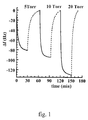
- the quartz frequencies were measured using a XTC/2 controller produced by Leybold Inficon (East Syracuse, NY, USA) which is able to detect resonance frequency variations of 0.05 Hz, thus allowing to measure mass variations of nearly 0.5 ng. This system is able to measure 4 frequency values per second using a reference oscillator at constant frequency.
- Syndiotactic polystyrene homopolymer of Example 1 was dissolved into chloroform (1% b.w. solutions) and then spray-coated at room temperature on an quartz disc like that one of Example 1.
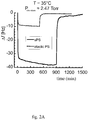
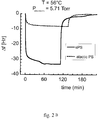
- a QCM sensor was constructed by following the procedure described in Example 1. The response of the prepared QCM sensor at 35°C to sudden changes of chloroform pressure, from zero to 2.5 torr and viceversa, is shown in Figure 2A. The response of the prepared QCM sensor at 56°C to sudden changes of chloroform pressure, from zero to 5.7 torr and viceversa, is shown in Figure 2B
- an analogous QCM sensor based on a commercial atactic polystyrene homopolymer (a-PS) was constructed.
- the a-PS sample has been dissolved into chloroform (1% b.w. solutions) and then spray coated at room temperature on the silver electrode of the quartz disc, producing a film with a thickness close to 1 ⁇ m.
- the a-PS film coated on the quartz crystal was directly desiccated in a vacuum oven at 45°C for 5 hours.
- the response of the a-PS based QCM sensor at 35°C to a sudden change of chloroform pressure, from zero to 2.5 torr and viceversa is shown in Figure 2A.
- the response of the a-PS based QCM sensor at 56°C to a sudden change of chloroform pressure, from zero to 5.7 torr and viceversa is shown in Figure 2B.
Landscapes
- Chemical & Material Sciences (AREA)
- Physics & Mathematics (AREA)
- Health & Medical Sciences (AREA)
- Life Sciences & Earth Sciences (AREA)
- General Physics & Mathematics (AREA)
- Analytical Chemistry (AREA)
- Biochemistry (AREA)
- General Health & Medical Sciences (AREA)
- Immunology (AREA)
- Pathology (AREA)
- Acoustics & Sound (AREA)
- Engineering & Computer Science (AREA)
- Food Science & Technology (AREA)
- Medicinal Chemistry (AREA)
- Addition Polymer Or Copolymer, Post-Treatments, Or Chemical Modifications (AREA)
- Investigating Or Analyzing Materials By The Use Of Fluid Adsorption Or Reactions (AREA)
Abstract
Description
Claims (9)
- Use of syndiotactic polystyrene, or of syndiotactic copolymers of styrene, either at least in part in the crystalline nanoporous δ form, as sensing elements in sensors for the detection of organic pollutants.
- Use according to claim 1, wherein said crystalline nanoporous δ form represents at least 80% of the crystalline fraction.
- Use according to one of the preceding claims, wherein said crystalline nanoporous δ form shows an X-ray diffraction spectrum having maximum intensity reflections at 2ϑ (CuKα) ≈ 8.4°, 10.6°, 13.3°, 16.8°, 20.7° 23.5°, and an intensity ratio between two reflections presenting Miller indexes (010) and (-210), that is I(8.4)/I(10.6), larger than 5.
- Use according to any one of the preceding claims, wherein said copolymers are styrene copolymers with comonomers belonging to the class formed by CH2=CH-R olefins, where R is an alkyl-aryl or an halogen-aryl radical with 6-20 carbon atoms, and by ethylenically unsaturated monomers.
- Use according to anyone of the preceding claims, wherein in said copolymers of styrene said comonomers are present in an amount lower than 80% by mol.
- Sensors for detection of organic pollutants including sensing elements comprising syndiotactic polystyrene or syndiotactic copolymers of styrene, either at least in part in the crystalline nanoporous δ form according to anyone of the preceding claims.
- Sensors according to claim 6, wherein the sensors are selected from the class formed by bulk acoustic wave (BAW) sensors, surface acoustic wave (SAW) sensors and flexural plate wave (FPW) sensors.
- Sensors according to claims 6 or 7,wherein a commercial quartz crystal microbalance (QCM) is used.
- A process for the preparation of sensing elements to be used in sensors for the detection of organic pollutants through deposition on the sensor substrate of a polymeric film, characterised by the fact that syndiotactic polystyrene or syndiotactic copolymers of styrene, either at least in part in the crystalline nanoporous δ form, are used as polymeric film.
Applications Claiming Priority (2)
| Application Number | Priority Date | Filing Date | Title |
|---|---|---|---|
| ITSA000023 | 2000-12-20 | ||
| IT2000SA000023A ITSA20000023A1 (en) | 2000-12-21 | 2000-12-21 | SYNDOTACTIC POLYSTYRENE BASED FILM IN NANOPOROUS CRYSTALLINE FORM AS SENSITIVE ELEMENTS FOR THE DETECTION OF ORGANIC POLLUTANTS. |
Publications (2)
| Publication Number | Publication Date |
|---|---|
| EP1217360A2 true EP1217360A2 (en) | 2002-06-26 |
| EP1217360A3 EP1217360A3 (en) | 2004-09-29 |
Family
ID=11456824
Family Applications (1)
| Application Number | Title | Priority Date | Filing Date |
|---|---|---|---|
| EP01830779A Ceased EP1217360A3 (en) | 2000-12-20 | 2001-12-19 | Use of styrene based syndiotactic polymers as sensing elements for detection of organic pollutants |
Country Status (3)
| Country | Link |
|---|---|
| US (1) | US20020073764A1 (en) |
| EP (1) | EP1217360A3 (en) |
| IT (1) | ITSA20000023A1 (en) |
Cited By (3)
| Publication number | Priority date | Publication date | Assignee | Title |
|---|---|---|---|---|
| WO2005012402A1 (en) * | 2003-07-21 | 2005-02-10 | Universita' Degli Studi Di Salerno | Nanoporous and microporous manufacts based on syndiotactic polystyrene and processes for their preparation |
| WO2005012401A1 (en) * | 2003-07-21 | 2005-02-10 | Universita' Degli Studi Di Salerno | Films based on syndiotactic polystyrene with new kinds of preferential orientation of the crystalline phase |
| EP2306181A1 (en) * | 2009-09-30 | 2011-04-06 | Honeywell International Inc. | Three-dimensionally ordered macroporous sensor apparatus and method |
Families Citing this family (4)
| Publication number | Priority date | Publication date | Assignee | Title |
|---|---|---|---|---|
| ITSA20060008A1 (en) * | 2006-03-21 | 2007-09-22 | Univ Degli Studi Salerno | SOLID POLYMERIC MATERIALS USABLE FOR DETECTION, TRANSFER, AMPLIFICATION AND MEMORY OF CHIRALITY OF COMPOUNDLY ACTIVE COMPOUNDS. |
| US8302458B2 (en) * | 2007-04-20 | 2012-11-06 | Parker-Hannifin Corporation | Portable analytical system for detecting organic chemicals in water |
| GB2553250B (en) | 2011-09-07 | 2018-04-25 | Parker Hannifin Corp | Analytical system for detecting volatile organic compounds in water |
| US10895565B2 (en) | 2015-06-05 | 2021-01-19 | Parker-Hannifin Corporation | Analysis system and method for detecting volatile organic compounds in liquid |
Family Cites Families (3)
| Publication number | Priority date | Publication date | Assignee | Title |
|---|---|---|---|---|
| US4312228A (en) * | 1979-07-30 | 1982-01-26 | Henry Wohltjen | Methods of detection with surface acoustic wave and apparati therefor |
| JPH10158429A (en) * | 1996-12-04 | 1998-06-16 | Bridgestone Corp | Microporous body and its production |
| KR20020010142A (en) * | 1999-05-06 | 2002-02-02 | 가즈토 도미나가 | Adsorbents made of styrene polymers |
-
2000
- 2000-12-21 IT IT2000SA000023A patent/ITSA20000023A1/en unknown
-
2001
- 2001-12-19 EP EP01830779A patent/EP1217360A3/en not_active Ceased
- 2001-12-20 US US10/022,725 patent/US20020073764A1/en not_active Abandoned
Cited By (5)
| Publication number | Priority date | Publication date | Assignee | Title |
|---|---|---|---|---|
| WO2005012402A1 (en) * | 2003-07-21 | 2005-02-10 | Universita' Degli Studi Di Salerno | Nanoporous and microporous manufacts based on syndiotactic polystyrene and processes for their preparation |
| WO2005012401A1 (en) * | 2003-07-21 | 2005-02-10 | Universita' Degli Studi Di Salerno | Films based on syndiotactic polystyrene with new kinds of preferential orientation of the crystalline phase |
| JP2007507557A (en) * | 2003-07-21 | 2007-03-29 | ユニベルシタ デッリ スツディ ディ サレルノ | Nanoporous and microporous products based on syndiotactic polystyrene and methods for their production |
| EP2306181A1 (en) * | 2009-09-30 | 2011-04-06 | Honeywell International Inc. | Three-dimensionally ordered macroporous sensor apparatus and method |
| US8323465B2 (en) | 2009-09-30 | 2012-12-04 | Honeywell International Inc. | Three-dimensionally ordered macroporous sensor apparatus and method |
Also Published As
| Publication number | Publication date |
|---|---|
| ITSA20000023A1 (en) | 2001-03-21 |
| US20020073764A1 (en) | 2002-06-20 |
| EP1217360A3 (en) | 2004-09-29 |
Similar Documents
| Publication | Publication Date | Title |
|---|---|---|
| US5571944A (en) | Acoustic wave (AW) based moisture sensor for use with corrosive gases | |
| US6500547B1 (en) | Coating materials for sensors and monitoring systems, methods for detecting using sensors and monitoring systems | |
| Mensitieri et al. | Polymeric sensing films absorbing organic guests into a nanoporous host crystalline phase | |
| Wohltjen et al. | Surface acoustic wave probes for chemical analysis. III. Thermomechanical polymer analyzer | |
| KR102362977B1 (en) | Gas sensors and methods of sensing a gas-phase analyte | |
| US20020073764A1 (en) | Method for the detection of organic pollutants using syndiotactic polystyrene polymers as sensing elements | |
| US6357278B1 (en) | Polymer coatings for chemical sensors | |
| JP2003511676A (en) | Chemical sensors and coatings for such chemical sensors | |
| JPH04233436A (en) | Surface wave gas sensor | |
| FR2972261A1 (en) | HUMIDITY SENSOR COMPRISING AS A ABSORBENT MOISTURE LAYER A POLYMERIC LAYER COMPRISING A MIXTURE OF POLYAMIDES | |
| US20050226773A1 (en) | Multiple modes acoustic wave sensor | |
| Augsburg et al. | Determination of contact angles and solid surface tensions of poly (4‐X‐styrene) films | |
| JPH02245607A (en) | Measurement of thickness by x-ray for organic thin film | |
| Spaeth et al. | In-situ characterization of thin polymer films for applications in chemical sensing of volatile organic compounds by spectroscopic ellipsometry | |
| Kim et al. | Parallel frequency readout of an array of mass-sensitive transducers for sensor applications | |
| Duval et al. | Polymerization of benzene in a capacitively coupled RF plasma | |
| Spatorico | Evaluation of the light‐scattering technique for determining compositional heterogeneity in copolymers | |
| Avramov et al. | Comparative studies on polymer coated SAW and STW resonators for chemical gas sensor applications | |
| Kobari et al. | Fabrication of thin sensitive film of ball surface acoustic wave sensor by off-axis spin-coating method | |
| JP2007507557A (en) | Nanoporous and microporous products based on syndiotactic polystyrene and methods for their production | |
| De Wilde et al. | Vacuum deposition rate measurements on thin polymer films | |
| Sugimoto | Organic vapor detection using quartz crystal sensors coated by sputtering of porous sintered-polymer targets | |
| Ranucci et al. | Poly (ethyleneglycol) s-based hydrogels as coatings for relative humidity sensors | |
| KR100698439B1 (en) | Surface acoustic wave gas sensor for detecting volatile substances | |
| MXPA01013214A (en) | Frequency warping for improving resonator signal-to-noise ratio. |
Legal Events
| Date | Code | Title | Description |
|---|---|---|---|
| PUAI | Public reference made under article 153(3) epc to a published international application that has entered the european phase |
Free format text: ORIGINAL CODE: 0009012 |
|
| AK | Designated contracting states |
Kind code of ref document: A2 Designated state(s): AT BE CH CY DE DK ES FI FR GB GR IE IT LI LU MC NL PT SE TR |
|
| AX | Request for extension of the european patent |
Free format text: AL;LT;LV;MK;RO;SI |
|
| RIN1 | Information on inventor provided before grant (corrected) |
Inventor name: VENDITTO, VINCENZO Inventor name: MENSITIERI, GIUSEPPE Inventor name: GUERRA, GAETANO |
|
| PUAL | Search report despatched |
Free format text: ORIGINAL CODE: 0009013 |
|
| AK | Designated contracting states |
Kind code of ref document: A3 Designated state(s): AT BE CH CY DE DK ES FI FR GB GR IE IT LI LU MC NL PT SE TR |
|
| AX | Request for extension of the european patent |
Extension state: AL LT LV MK RO SI |
|
| 17P | Request for examination filed |
Effective date: 20050131 |
|
| AKX | Designation fees paid |
Designated state(s): AT BE CH CY DE DK ES FI FR GB GR IE IT LI LU MC NL PT SE TR |
|
| 17Q | First examination report despatched |
Effective date: 20090618 |
|
| STAA | Information on the status of an ep patent application or granted ep patent |
Free format text: STATUS: THE APPLICATION HAS BEEN REFUSED |
|
| 18R | Application refused |
Effective date: 20110124 |