EP1217312A2 - Air conditioner and method for inhibiting mold growth in said air conditioner - Google Patents
Air conditioner and method for inhibiting mold growth in said air conditioner Download PDFInfo
- Publication number
- EP1217312A2 EP1217312A2 EP01130301A EP01130301A EP1217312A2 EP 1217312 A2 EP1217312 A2 EP 1217312A2 EP 01130301 A EP01130301 A EP 01130301A EP 01130301 A EP01130301 A EP 01130301A EP 1217312 A2 EP1217312 A2 EP 1217312A2
- Authority
- EP
- European Patent Office
- Prior art keywords
- air conditioner
- mold
- isothiocyanate
- heating
- air
- Prior art date
- Legal status (The legal status is an assumption and is not a legal conclusion. Google has not performed a legal analysis and makes no representation as to the accuracy of the status listed.)
- Withdrawn
Links
Images

Classifications
-
- A—HUMAN NECESSITIES
- A61—MEDICAL OR VETERINARY SCIENCE; HYGIENE
- A61L—METHODS OR APPARATUS FOR STERILISING MATERIALS OR OBJECTS IN GENERAL; DISINFECTION, STERILISATION OR DEODORISATION OF AIR; CHEMICAL ASPECTS OF BANDAGES, DRESSINGS, ABSORBENT PADS OR SURGICAL ARTICLES; MATERIALS FOR BANDAGES, DRESSINGS, ABSORBENT PADS OR SURGICAL ARTICLES
- A61L2/00—Disinfection or sterilisation of materials or objects, in general; Accessories therefor
- A61L2/02—Disinfection or sterilisation of materials or objects, in general; Accessories therefor using physical processes
- A61L2/04—Heat
-
- A—HUMAN NECESSITIES
- A61—MEDICAL OR VETERINARY SCIENCE; HYGIENE
- A61L—METHODS OR APPARATUS FOR STERILISING MATERIALS OR OBJECTS IN GENERAL; DISINFECTION, STERILISATION OR DEODORISATION OF AIR; CHEMICAL ASPECTS OF BANDAGES, DRESSINGS, ABSORBENT PADS OR SURGICAL ARTICLES; MATERIALS FOR BANDAGES, DRESSINGS, ABSORBENT PADS OR SURGICAL ARTICLES
- A61L2/00—Disinfection or sterilisation of materials or objects, in general; Accessories therefor
- A61L2/16—Disinfection or sterilisation of materials or objects, in general; Accessories therefor using chemical substances
- A61L2/20—Gaseous substances, e.g. vapours
-
- A—HUMAN NECESSITIES
- A61—MEDICAL OR VETERINARY SCIENCE; HYGIENE
- A61L—METHODS OR APPARATUS FOR STERILISING MATERIALS OR OBJECTS IN GENERAL; DISINFECTION, STERILISATION OR DEODORISATION OF AIR; CHEMICAL ASPECTS OF BANDAGES, DRESSINGS, ABSORBENT PADS OR SURGICAL ARTICLES; MATERIALS FOR BANDAGES, DRESSINGS, ABSORBENT PADS OR SURGICAL ARTICLES
- A61L9/00—Disinfection, sterilisation or deodorisation of air
- A61L9/015—Disinfection, sterilisation or deodorisation of air using gaseous or vaporous substances, e.g. ozone
-
- A—HUMAN NECESSITIES
- A61—MEDICAL OR VETERINARY SCIENCE; HYGIENE
- A61L—METHODS OR APPARATUS FOR STERILISING MATERIALS OR OBJECTS IN GENERAL; DISINFECTION, STERILISATION OR DEODORISATION OF AIR; CHEMICAL ASPECTS OF BANDAGES, DRESSINGS, ABSORBENT PADS OR SURGICAL ARTICLES; MATERIALS FOR BANDAGES, DRESSINGS, ABSORBENT PADS OR SURGICAL ARTICLES
- A61L9/00—Disinfection, sterilisation or deodorisation of air
- A61L9/16—Disinfection, sterilisation or deodorisation of air using physical phenomena
-
- F—MECHANICAL ENGINEERING; LIGHTING; HEATING; WEAPONS; BLASTING
- F24—HEATING; RANGES; VENTILATING
- F24F—AIR-CONDITIONING; AIR-HUMIDIFICATION; VENTILATION; USE OF AIR CURRENTS FOR SCREENING
- F24F1/00—Room units for air-conditioning, e.g. separate or self-contained units or units receiving primary air from a central station
- F24F1/0007—Indoor units, e.g. fan coil units
- F24F1/0011—Indoor units, e.g. fan coil units characterised by air outlets
-
- F—MECHANICAL ENGINEERING; LIGHTING; HEATING; WEAPONS; BLASTING
- F24—HEATING; RANGES; VENTILATING
- F24F—AIR-CONDITIONING; AIR-HUMIDIFICATION; VENTILATION; USE OF AIR CURRENTS FOR SCREENING
- F24F1/00—Room units for air-conditioning, e.g. separate or self-contained units or units receiving primary air from a central station
- F24F1/0007—Indoor units, e.g. fan coil units
- F24F1/0043—Indoor units, e.g. fan coil units characterised by mounting arrangements
- F24F1/0057—Indoor units, e.g. fan coil units characterised by mounting arrangements mounted in or on a wall
-
- F—MECHANICAL ENGINEERING; LIGHTING; HEATING; WEAPONS; BLASTING
- F24—HEATING; RANGES; VENTILATING
- F24F—AIR-CONDITIONING; AIR-HUMIDIFICATION; VENTILATION; USE OF AIR CURRENTS FOR SCREENING
- F24F8/00—Treatment, e.g. purification, of air supplied to human living or working spaces otherwise than by heating, cooling, humidifying or drying
- F24F8/20—Treatment, e.g. purification, of air supplied to human living or working spaces otherwise than by heating, cooling, humidifying or drying by sterilisation
- F24F8/24—Treatment, e.g. purification, of air supplied to human living or working spaces otherwise than by heating, cooling, humidifying or drying by sterilisation using sterilising media
Definitions
- the present invention relates to an air conditioner having a function for inhibiting mold growth, and a method for inhibiting mold growth in the air conditioner.
- a body of an air conditioner is provided with an air-intake port, a heat exchanger, a blower and an air-blowoff port, as air-blowing means.
- An air filter is provided in the air-intake port. According to the air conditioner having such air-blowing means, since moisture condensation is prone to be generated in the heat exchanger, humidity in the body becomes high, and mold is prone to grow in the air-blowing means or the air filter. Thereupon, various attempts have been made to inhibit mold from growing in the air conditioner.
- a fungicide comprising a compound of silver or copper is applied to the heat exchanger, the air-blower or the air filter where the mold is prone to be generated, thereby inhibiting mold from growing.
- the air conditioner is used for a long term, dust settles on a component on which the fungicide was applied, effect of the fungicide can not be obtained sufficiently, and mold is prone to grow on the accumulated dust.
- fungicide which directly acts on mold in a vapor phase inside the body.
- fungicide components must be carried on a porous medium and must be disposed inside the air conditioner, and it is difficult to reduce the fungicide in size and to elongate the life thereof.
- a fungicide function is provided in the air conditioner to sterilize mold or germ in a vapor phase inside a body of the air conditioner.
- An ultraviolet lamp and an electrical discharge mechanism for generating ozone and negative ion are used as fungicide mechanism.
- Japanese Patent Application Laid-open No. 9-119657 discloses a refrigerating and air conditioner having a bacteria growth preventing mechanism which generates negative ion while lowering concentration of ozone to sterilize bacteria.
- This bacteria propagation preventing mechanism comprises an ion chamber for ionizing gas in air, and an ozone decomposing chamber for removing ozone included in the ionized gas, but its structure is complicated.
- this mechanism requires to be of a certain size and thus, there is a problem that it is difficult to incorporate this mechanism in the body. Even if the mechanism could be incorporated in the body, there arises a problem that the system can not be reduced in size Furthermore, since ozone is harmful to human, it is preferable not to use such ozone. There is also a problem that an air conditioner using an ultraviolet lamp as a fungicide mechanism can not be reduced in size if the ultraviolet lamp is provided in the body.
- Japanese Unexamined Patent Application No. 5-141692 discloses an air conditioner in which a short-circuit flow-path is provided in the air conditioner, high temperature air is short-circuited to sterilize the interior of the air conditioner.
- the interior of the air conditioner In order to sterilize, however, the interior of the air conditioner must be maintained at a high temperature of 80 °C or more, and it is necessary that resin components constituting the air conditioner be changed to another material capable of withstanding such high temperature.
- An air conditioner of the present invention is characterized in that at least one of a heating means and a mold inhibiting means is provided in a body of the air conditioner, an interior of the body is exposed to a specific condition, thereby inhibiting mold growth at least in an air blowing means.
- the present invention it is possible to satisfactorily inhibit mold growth in the air conditioner with a simplified configuration of the conditioner, and to reduce the size of the conditioner.
- a mold-growth inhibiting method for an air conditioner of the present invention is characterized in that the interior of a body of the conditioner is heated under a specific condition or supplied with a specific fungicide.
- An air conditioner of the present invention generally means a system in which humidity in a body of the system is increased by cooling or dehumidification operation.
- Examples of such an air conditioner are a wall-mounted separate type air conditioner, a ceiling built-in type separate type air conditioner, an integral type window air conditioner, a vehicle air conditioner and the like.
- Fig.1 shows the air conditioner of the present invention.
- an air-intake port 2 In an indoor unit 1a as a body, an air-intake port 2, a heat exchanger 3, a blower 4 and an air-blowoff port 5 are provided as air-blowing means.
- the air-blowoff port 5 is provided with an air-blowoff blade 6 capable of opening and closing, and laterally-changing blades 7 for adjusting the direction of wind.
- a reference number 10 represents an air filter.
- Mold which is prone to be grown in the air conditioner is hygrophilous mold widely existing in a normal indoor, and is Cladosporium, Alternaria, Aspergillus or the like for example.
- a size of the spore is usually 100 ⁇ m or less.
- Growing speed of mold is largely varied depending upon temperature or humidity and usually, the growing speed becomes fast when the temperature is in a range of 20 °C to 30 °C and humidity is as high as 70 %RH or higher.
- the humidity in the indoor unit 1a becomes higher. More specifically, during the cooling operation or dehumidification operation, the humidity in the indoor unit is about 100 %RH, and even when the system is stopped, the humidity is maintained at 90 %RH or higher for a long time.
- At least one of a heating means for inhibiting mold growth or a mold-preventing means is provided in the air conditioner, the growth of mold in the air conditioner is inhibited to such an extent of causing practically no problem, by using a mold-growth inhibiting method.
- at least one of the heating means or mold-preventing means is provided to inhibit the mold growth under specific condition when an interior of the indoor unit was brought into a condition suitable for breeding mold. More specifically, it is unnecessary to carry out the present invention when heating operation is carried out, and it is necessary to carry out the present invention when cooling operation or the like is carried out.
- the indoor unit has the heating means, and it is necessary to carry out the heating process at a temperature of 36 °C or higher for 10 minutes or longer at least once a day.
- the heating temperature becomes lower than 36 °C, sufficient mold-growth inhibiting effect can not be obtained.
- the heating temperature may be 36 °C or higher, but if the temperature exceeds 80 °C, the mold-growth inhibiting effect is almost the same. As the heating temperature is increased, components are more prone to be deteriorated. Therefore, in the present invention, it is preferable that the heating temperature is in a range of 40 to 80 °C and more preferably, in a range of 40 to 60 °C.
- the heating time is shorter than 10 minutes, sufficient mold-growth inhibiting effect can not be obtained.
- the heating time may be 10 minutes or longer, but if the time exceeds 60 minutes, the effect is almost the same. If the heating time is excessively long, the components are more prone to be deteriorated, and energy is consumed uselessly. Therefore, in the present invention, it is preferable that the heating time is in a range of 10 to 60 minutes and more preferably, in a range of 10 to 30 minutes.
- Such a heating process can only inhibits growth of mold but can not deaden the mold, but if the heating process is repeatedly carried out at least once every day, it is possible to inhibit growth of hypha, to suppress adhesion of spore, and to inhibit mold growth in the air conditioner finally. Since the interior temperature in the indoor unit at the time of heating operation is about 60 °C at the highest, a conventionally used components can be used as they are as resin components constituting the indoor unit.
- the heating method is not limited especially, and a heater for carrying out usual heating operation provided in an air conditioner may be used for example.
- types of the heater are heat-pump type, coolant heating type or hot water type. If such a previously incorporated heater is used, since it is unnecessary to increase the number of components, miniaturization of the system is not hindered.
- the heating process is carried out by using the heating operation which is previously incorporated, the heating process is carried out under a condition that the cooling operation is once stopped one time or more a day in a cooling operation season. In a heating season, it is unnecessary to carry out heating-mold preventing process.
- the air conditioner is provided with control means for controlling the heating mold-preventing process, and if instructions for executing the heating mold-preventing process are given, the heating process is carried out at a set operation-start time for a predetermined time at a predetermined temperature. It is also preferable that the control means is programmed such that after the heating mold-preventing process was completed, the operation state is automatically returned to the original cooling operation.
- a button for heating mold-preventing process is provided on an input setting device provided in the air conditioner, and if a person who uses the air conditioner sets time for executing the heating mold-preventing process by means of the button, the heating mold-preventing process is executed at a predetermined time utilizing a timer incorporated in the input setting device. If such control means is provided, a user can specify the starting time of the heating mold-preventing operation by himself or herself and thus, it is possible to reliably carry out the heating mold-preventing process.
- Heating means may newly be provided.
- a heater 8 may be disposed in an indoor unit 1b to carry out the heating process as shown in Fig.2. It is preferable to dispose the heater 8 in such a place that draft in the indoor unit 1b is not hindered as small as possible.
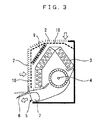
- Peltier device 9 Even if a Peltier device 9 is provided in a indoor unit 1c instead of the heater 5 as shown in Fig.3, the same effect can be obtained. Although the Peltier devices 9 are disposed side-by-side on the outer surface of the heat exchanger 3, if the Peltier devices 9 are disposed on places where draft in the indoor unit 1c is not hindered as small as possible, the places are not limited especially.
- the size of the air conditioner can be reduced.
- the heating means may be used singly, or a plurality of heating means may be combined and used.
- the heating process it is preferable to do so in a state in which the air-blowoff port 5 of the indoor unit (1a, 1b or 1c) is closed.
- the heating process is carried out while the air-blowoff blade 6 provided in the opening of the air-blowoff port 5 is closed, the interior of the indoor unit is entirely heated, which is effective to inhibit the mold growth. Further, since warm air is not discharged from the air conditioner, it is possible to reduce the annoyance of the user when the mold-preventing process is carried out.
- the volume of air sent by the blower fan is smaller than the volume of air when the normal cooling operation is carried out, because a temperature in the indoor unit can be heated to 36 °C or higher swiftly.
- control means carries out the above action.
- control means which controls such that the air-blowoff ports 5 of the indoor units 1a to 1c are closed, and the volume of air of the blower fan is smaller than that of the normal cooling operation is carried out.
- the fungicide comprising compound such as conventionally used silver or copper is applied to the constituent components of the blower means where mold is prove to be generated, because mold is less prone to be generated on the components more effectively and mold growth in a vapor phase can effectively be inhibited.
- the isothiocyanate is liquid under a normal temperature, but has high vapor pressure under the normal temperature, and some isothiocyanate has vapor pressure of about 1000 ppm in its saturation.
- the isothiocyanate inhibits breathing of mold, and is material having high mold-preventing effect. If gas having 0.1 ppm or more of the isothiocyanate is supplied into the indoor unit at least once a day for 10 minutes or longer, it is possible to prevent reproduction of mold spore in the indoor unit and to inhibit the mold growth.
- the concentration of the isothiocyanate in the vapor phase is lower than 0.1 ppm, sufficient mold-growth inhibiting effect can not be obtained. If the concentration of the isothiocyanate is 0.1 ppm or more, it is possible to inhibit the mold growth effectively, but if the concentration of the isothiocyanate is excessively high, smell of the isothiocyanate is adversely transmitted outside an outdoor unit. Therefore, if the air conditioner is used while human is living, it is preferable to adjust the concentration of the isothiocyanate in the indoor unit near the air-blowing exit to 10 ppm or lower.
- the isothiocyanate inhibits breathing of the mold, and in order to inhibit the mold growth and to obtain the mold-preventing effect, it is considered that certain time period is required. Therefore, if the isothiocyanate is not supplied once a day, sufficient mold-preventing effect can not be obtained. Similarly, if the supplying time is shorter than 10 minutes, sufficient mold-preventing effect can not be obtained.
- the exposing time of the air conditioner with the isothiocyanate can be changed depending upon the concentration of the isothiocyanate, and if the concentration is increased as high as possible, it is possible to carry out the mold-preventing process in a short time within one hour.
- isothiocyanate examples include allyl isothiocyanate, methyl isothiocyanate, phenyl isothiocyanate, 4-methylthio-3-butenyl isothiocyanate.
- the allyl isothiocyanate is optimal material.
- the allyl isothiocyanate has high mold-preventing effect, has smell component of horse-radish, and high safety and thus, it can be used preferably.
- the supply means for supplying the gas including isothiocyanate into the indoor unit is not especially limited only if the supply means periodically supplies the gas including isothiocyanate into the indoor unit.
- a bag is put on a portion of the indoor unit from its air-sucking port to its air-blowing exit, isothiocyanate having a predetermined concentration is supplied into the bag, and the gas including the isothiocyanate can be supplied to the indoor unit periodically.
- isothiocyanate and resin are mixed to lower the vapor pressure, and the mixture may be used as the mold-preventing means. Even if the resin mixture having low vapor pressure is provided in the indoor unit and the concentration of the isothiocyanate in the vapor phase is set to 0.1 ppm or higher, it is possible to prevent the reproduction of mold spore in the blowing path, the heat exchanger, the fan and the filter, to prevent breeding of the mold and to inhibit mold growth in the same manner as described above. Although it is difficult to actually measure the vapor pressure of the resin component, it is possible to obtain the vapor pressure by measuring the discharge speed of the isothiocyanate.
- the discharge speed of the isothiocyanate is controlled to 25 mold growth/day, excellent mold-preventing effect can be obtained. If this control is not carried out, the discharge speed is 1 g/day or faster.
- the resin component including the isothiocyanate can preferably be used because the concentration of the isothiocyanate can easily be controlled. Since the resin component does not require constant size, this does not hinder miniaturization of the system.
- Urethane resin, acrylic resin, rosin ester can preferable used as resin to be mixed with isothiocyanate.
- paint including isothiocyanate and having gradually-releasing characteristic can also be used as another mold-preventing means. If such paint is applied to at least one of constituent components of the blowing means and the concentration of the isothiocyanate in the vapor phase of the body is set to 0.1 ppm or higher, effect for inhibiting the mold growth on the component can be obtained, and which is more preferable.
- the “gradually-releasing characteristic" of isothiocyanate in the present invention means a state in which the concentration of the isothiocyanate in the vapor phase is 1 ppm to 500 ppm for one month or longer.
- Paint in which micro capsules of isothiocyanate are dispersed in water solution mainly comprising urethane resin or urethane-acrylic resin can preferably be used as paint including isothiocyanate and having gradually-releasing characteristic.
- Such paint has high adhering strength with respect to polystyrene which is widely used for a component constituting an inside portion of the indoor unit and thus, it is used preferably.
- isothiocyanate Since the micro capsules of isothiocyanate are surrounded by resin, isothiocyanate is less prone to be vaporized into air through the resin, and the gradually-releasing characteristic is realized In the temperature environment of the indoor unit of the air conditioner, gradually-releasing characteristic of isothiocyanate can be maintained for about three months and thus, it is effective to apply immediately before the cooling operation season. It is more preferable to apply paint having gradually-releasing characteristic because it is easy to uniform the concentration of the isothiocyanate.
- the applying method of paint having isothiocyanate and gradually-releasing characteristic is not especially limited, and a common method can be used.
- a common method can be used.
- the paint is put into an atomizer and the paint is sprayed to components constituting the blowing means such as the blower and air-blowoff blade of the indoor unit, because even those components deep in the indoor unit can easily be processed.
- a method in which the paint is put into a cylindrical container, an exit of the paint is provided with an applying apparatus, and the paint is applied to the surface of the component such that the paint seeps through mesh of fiber of the applying apparatus is preferable because the paint can be applied to wider range.
- heating means such as the heater 8 or the Peltier device 9 is provided, and paint having isothiocyanate and gradually-releasing characteristic is applied to surfaces of components constituting wind-path such as the blower or heat exchanger.
- gas including isothiocyanate may be supplied into the indoor unit.
- isothiocyanate having specific concentration if the gas including isothiocyanate is supplied into the indoor unit at the same time when the interior of the indoor unit is heated, two growth inhibiting factors, i.e., growth inhibiting factor by means of heating and breathing inhibiting factor by isothiocyanate can be applied to the mold. This is more preferable.
- the mold-preventing operation time is set by an input setting device, a user can recognize the mold-preventing operation and this is preferable. For example, if time reaches the mold-preventing operation time, the cooling operation is first stopped, and the operation state is switched to the heating mold-preventing operation. At that time, gas including isothiocyanate is simultaneously charged into the indoor unit.
- a method for charging the gas including isothiocyanate into the indoor unit it is possible to use a method in which a container accommodating the isothiocyanate liquid is opened in the indoor unit, a method in which liquid isothiocyanate is injected into the indoor unit, and the like.
- the liquid isothiocyanate liquid When the container accommodating the isothiocyanate liquid is opened in the indoor unit, it is preferable if the liquid isothiocyanate is allowed to be carried on expanded body and put in a container, because it is possible to inhibit leakage of the liquid to outside, and the concentration of the isothiocyanate in the indoor unit can easily be controlled.
- the method for injecting the liquid isothiocyanate into the indoor unit is not especially limited. For example, a method in which a head is vibrated when voltage is applied utilizing a piezoelectric device to inject liquid is preferable because the dispersing amount can finely be controlled.
- cooling operation of 26 °C was continuously carried out 12 hours a day.
- a room temperature was set to 27 °C and humidity was set to 60 %RH.
- AITC allyl isothiocyanate
- AITC gas was not supplied into the indoor unit. Other conditions were the same as those of the embodiment 1, and the mold-growth state after seven days was measured.
- the concentration of AITC gas supplied into the indoor unit was set lower than a range of the present invention. Other conditions were the same as those of the embodiment 1, and the mold-growth state after seven days was measured.
- the AITC gas was supplied into the indoor unit once a week. Other conditions were the same as those of the embodiment 1, and the mold-growth state after two weeks was measured.
- the AITC gas was supplied into the indoor unit once for two days. Other conditions were the same as those of the embodiment 1, and the mold-growth state after seven days was measured.
- AITC paint having gradually-releasing characteristic was applied onto surfaces of components shown in Table 2 with methods shown in Table 2.
- the AITC paint having gradually-releasing characteristic was prepared by mixing AITC micro capsules (Daiichi Kougyou Seiyaku, Wasaoro Capsule SR) and water-soluble urethane resin (Daiichi Kougyou Seiyaku, Super flex) in the proportion of 1:1.
- concentration of AITC was 5%.
- water-soluble emulsion of 25% solid was used as the super flex.
- This paint was applied on the surfaces of predetermined components until film thickness reached 20 ⁇ m.
- the paint was applied in the following two methods: a method in which AITC paint solution was put into an atomizer and sprayed like the atomizer, and a method in which AITC paint solution was put into a cylindrical container, and the paint solution was applied to an exit of the container by a paint cloth apparatus having a sponge surface covered with cloth.
- the concentration of the AITC in the vapor phase in the indoor unit after seven days was measured.
- the growing speed of hypha was measured like the previous embodiments.
- the obtained mold-growing speed and the like are shown in Table 2.
- a comparative example 1 is shown so that the results can be compared and considered.
- Paint used in the embodiments 4 to 7 was paint in which AITC is held in urethane resin film and had gradually-releasing characteristic constructed such that the paint was gradually evaporated from the surface of the component with time. Further, since the concentration of AITC was equal to or higher than 0.1 ppm which is within the range of the present invention, any of the embodiments could obtain excellent growing inhibiting effect of hypha.
- AITC application method AITC concentration (ppm) Hypha growing speed ( ⁇ m/day) Embodiment 4 Blowing fan Spray 0.4 230 Embodiment 5 Air-blowoff blade Spray 0.5 250 embodiment 6 Blowing fan Painting 0.9 120 Embodiment 7 Air-blowoff blade Painting 0.8 160 Comparative example -- -- -- 420
- the mold sensor as that used in the embodiments 1 to 7 was provided on a wall of a back surface of the blowing fan, an interior of the indoor unit was heated for a predetermined time at heating temperature and frequency as shown in Table 3, and growing speed of mold hypha of Alternaria sp. was measured.
- the interior of the indoor unit was heated by switching a refrigeration cycle of the air conditioner to so-called "heating operation" so that the heat exchanger functions as a condenser.
- thermocouple was disposed in the vicinity of the blowing fan to measure the heating temperature.
- the heating process was carried out for two weeks under heating conditions shown in Table 3, and the growing speed of hypha after two weeks was measured.
- the heating frequency was set to once in a week, and other conditions are the same as those in the embodiment 8, and the heating process was carried out.
- the heating time was set to five minutes shorter than the range of the present invention. Other conditions are the same as those in the embodiment 8, and the heating process was carried out.
- the heating frequency was set to once for two days less than the range of the present invention. Other conditions are the same as those in the embodiment 8, and the heating process was carried out.
- the heating temperature was set to 35 °C lower than the range of the present invention. Other conditions are the same as those in the embodiment 8, and the heating process was carried out.
- any of the conditions of heating time and frequency are out of the ranges of the present invention and thus, substantially the same results as that of the comparative example 1 which did not carry out the heating process were obtained.
- the comparative examples 8 and 9 since the heating temperature was lower than the range of the invention, sufficient growing inhibiting effect could not be obtained.
- the reason why the growing speed of hypha was high although the heating process was carried out is due to variation in lots of mold sensor or measuring error of hypha. Since about 10% error may be caused, speeds of the comparative examples 1 and 5 to 9 are almost the same.
Landscapes
- Health & Medical Sciences (AREA)
- Engineering & Computer Science (AREA)
- General Health & Medical Sciences (AREA)
- Animal Behavior & Ethology (AREA)
- Life Sciences & Earth Sciences (AREA)
- Public Health (AREA)
- Veterinary Medicine (AREA)
- Chemical & Material Sciences (AREA)
- Epidemiology (AREA)
- Combustion & Propulsion (AREA)
- Mechanical Engineering (AREA)
- General Engineering & Computer Science (AREA)
- Chemical Kinetics & Catalysis (AREA)
- General Chemical & Material Sciences (AREA)
- Agricultural Chemicals And Associated Chemicals (AREA)
- Devices For Blowing Cold Air, Devices For Blowing Warm Air, And Means For Preventing Water Condensation In Air Conditioning Units (AREA)
- Air Filters, Heat-Exchange Apparatuses, And Housings Of Air-Conditioning Units (AREA)
Abstract
Description
| AITC concentration (ppm) | AITC supply frequency | Hypha growing speed (µm/day) | |
| Embodiment 1 | 40 | Once a day | 320 |
| | 50 | Once a day | 200 |
| | 60 | Once a day | 100 |
| Comparative example 1 | -- | -- | 420 |
| Comparative example 2 | 0.06 | Once a day | 410 |
| Comparative example 3 | 1.0 | Once a week | 430 |
| Comparative example 4 | 1.0 | Once for two days | 400 |
| Component to which paint is applied | AITC application method | AITC concentration (ppm) | Hypha growing speed (µm/day) | |
| | Blowing fan | Spray | 0.4 | 230 |
| | Air-blowoff blade | Spray | 0.5 | 250 |
| | Blowing fan | Painting | 0.9 | 120 |
| | Air-blowoff blade | Painting | 0.8 | 160 |
| Comparative example | -- | -- | -- | 420 |
| Heating temperature (°C) | Heating time (minutes) | Heating frequency | Hypha growing speed (µm/day) | |
| | 40 | 10 | Once a day | 0 |
| Embodiment 9 | 50 | 10 | Once a day | 0 |
| | 60 | 10 | Once a day | 0 |
| Comparative example 1 | -- | -- | -- | 420 |
| Comparative example 5 | 40 | 10 | once a week | 420 |
| Comparative example 6 | 40 | 5 | Once a day | 430 |
| Comparative example 7 | 40 | 10 | Once for two days | 410 |
| Comparative example 8 | 35 | 10 | Once a day | 430 |
| Comparative example 9 | 35 | 20 | Once a day | 450 |
Claims (23)
- An air conditioner including a body having an air blowing means, wherein said body is provided with a heating means so as to carry out heating at 36 °C or higher for 10 minutes or longer at least once a day, thereby inhibiting mold growth in said body.
- The air conditioner according to claim 1, wherein at least part of the blowing means is heated.
- The air conditioner according to claim 1 or 2, wherein said heating means is at least one of a heating equipment, a heater and a Peltier device for carrying out a normal heating operation.
- An air conditioner including a body having an air blowing means, wherein said body is provided with a supplying means for supplying gas containing isothiocyanate, and a component constituting said blowing means is exposed at least once a day for 10 minutes or longer each to an atmosphere in which a concentration of isothiocyanate in a vapor phase is 0.1 ppm or higher.
- An air conditioner including a body having an air blowing means, wherein said body is provided with a mold-preventing means in which isothiocyanate and resin are mixed with each other so as to lower a vapor pressure, and a concentration of isothiocyanate in a vapor phase in said body is set to 0.1 ppm or higher.
- The air conditioner according to claim 5, wherein said resin includes at least one of urethane resin, acrylic resin and rosin ester resin.
- An air conditioner including a body having an air blowing means, wherein at least one of components constituting said blowing means is applied with a paint containing isothiocyanate and having a gradually-releasing characteristics, so that a concentration of isothiocyanate in a vapor phase in said body is set to 0.1 ppm or higher.
- The air conditioner according to claim 7, wherein said paint comprises a mixture of isothiocyanate and urethane resin or a mixture of isothiocyanate and acrylic resin.
- The air conditioner according to claim 7, wherein said paint is prepared such that according as temperature rises, isothiocyanate is more easily discharged into the vapor phase.
- An air conditioner including a body having an air blowing means, wherein said body is provided with a heating means and with a mold-preventing means in which isothiocyanate and resin are mixed with each other so as to lower a steam pressure, so that a concentration of isothiocyanate in a vapor phase in said body is set to 0.1 ppm or higher by heating with said heating means.
- An air conditioner including a body having an air blowing means, wherein said body is provided with a heating means, at least one component constituting said blowing means is applied with a paint containing isothiocyanate and having a gradually-releasing characteristic, and the isothiocyanate applied to the component is evaporated by heating with said heating means, whereby a concentration of isothiocyanate in a vapor phase in said body is set to 0.1 ppm or higher.
- A mold growth inhibiting method for an air conditioner including a body having a blowing means, wherein a gas containing isothiocyanate having a concentration of 0.1 ppm or higher is brought into contact, at least once a day, with a surface of a component constituting said blowing means, thereby inhibiting growth of mold.
- A mold growth inhibiting method, in which a paint containing isothiocyanate and a gradually-releasing characteristic is applied to at least one component constituting a blowing means provided in a body of an air conditioner, and a concentration of isothiocyanate in a vapor phase in said body is set to 0.1 ppm or higher, thereby inhibiting growth of mold.
- The mold growth inhibiting method according to claim 13, wherein said paint is prepared such that according as temperature rises, a discharge amount of isothiocyanate increases.
- The mold growth inhibiting method according to claim 13 or 14, wherein the paint containing isothiocyanate and haing a gradually-releasing characteristic is applied or sprayed onto a surface of the component.
- A mold growth inhibiting method, in which a body of an air conditioner is heated at 40 °C for 10 minutes at least once a day, thereby inhibiting growth of mold in said body.
- The mold growth inhibiting method according to claim 16, wherein the body is heated by at least either a normal heating operation, or a heater or Peltier device provided in the body.
- The mold growth inhibiting method according to claim 16 or 17, wherein the body is heated in a condition in which an air-blowoff port constituting a blowing means is closed.
- The mold growth inhibiting method according to claim 16 or 17, wherein the body is heated in a condition in which an amount of blowing air by a blower constituting the blowing means is reduced as compared with that for a cooling operation.
- The air conditioner according to claim 1 or 2, further comprising a control means for executing a heat treatment, at a set operation start time, by a normal heating operation for a predetermined time at a predetermined temperature, under an instruction to operate a mold-preventing heat treatment.
- The air conditioner according to claim 20, wherein the control means is returned to a former cooling operation when the heat treatment has been completed.
- The air conditioner according to claim 20, wherein the control means is provided to an input setting device so that said control means is capable of executing the heat treatment utilizing a timer provided to said input setting device.
- The air conditioner according to claim 20, wherein when the mold-preventing operation start time is reached, the control means stops a cooling operation and switches to a mold-preventing operation, and the control means charges a gas containing isothiocyanate into an indoor unit.
Applications Claiming Priority (2)
| Application Number | Priority Date | Filing Date | Title |
|---|---|---|---|
| JP2000386643A JP2002188897A (en) | 2000-12-20 | 2000-12-20 | Mold growth control method for air conditioner |
| JP2000386643 | 2000-12-20 |
Publications (2)
| Publication Number | Publication Date |
|---|---|
| EP1217312A2 true EP1217312A2 (en) | 2002-06-26 |
| EP1217312A3 EP1217312A3 (en) | 2002-07-10 |
Family
ID=18853710
Family Applications (1)
| Application Number | Title | Priority Date | Filing Date |
|---|---|---|---|
| EP01130301A Withdrawn EP1217312A3 (en) | 2000-12-20 | 2001-12-19 | Air conditioner and method for inhibiting mold growth in said air conditioner |
Country Status (4)
| Country | Link |
|---|---|
| EP (1) | EP1217312A3 (en) |
| JP (1) | JP2002188897A (en) |
| KR (1) | KR100776279B1 (en) |
| CN (3) | CN100362287C (en) |
Cited By (6)
| Publication number | Priority date | Publication date | Assignee | Title |
|---|---|---|---|---|
| CN102494388A (en) * | 2011-12-13 | 2012-06-13 | 奇瑞汽车股份有限公司 | Control method and system for preventing musty odor from car air-conditioners and car |
| EP3778849A4 (en) * | 2018-03-26 | 2021-05-26 | Sharp Kabushiki Kaisha | Clean space maintenance device, building structure, cell culturing method, and cell production method |
| CN113669853A (en) * | 2020-05-13 | 2021-11-19 | 广东美的制冷设备有限公司 | Air conditioner sterilization method, air conditioner and readable storage medium |
| WO2021259551A1 (en) * | 2020-06-22 | 2021-12-30 | Stanley Black & Decker, Inc. | Anti-virus air purifying device |
| DE102017219364B4 (en) | 2017-10-27 | 2022-07-07 | Weiss Klimatechnik Gmbh | Air conditioner and method for disinfecting an air conditioner |
| CN116465042A (en) * | 2022-01-11 | 2023-07-21 | 广东美的制冷设备有限公司 | air handling unit |
Families Citing this family (10)
| Publication number | Priority date | Publication date | Assignee | Title |
|---|---|---|---|---|
| JP2002188897A (en) * | 2000-12-20 | 2002-07-05 | Matsushita Electric Ind Co Ltd | Mold growth control method for air conditioner |
| JP2007107807A (en) * | 2005-10-13 | 2007-04-26 | Matsushita Electric Ind Co Ltd | Air conditioner |
| JP2007333240A (en) * | 2006-06-12 | 2007-12-27 | Inax Corp | Mildew-proofing method, mildew-proofing device, and ventilator equipped with mildew-proofing functions |
| CN102331120B (en) * | 2011-05-25 | 2013-03-06 | 宁波奥克斯电气有限公司 | Processing method for preventing mildew of indoor unit of direct-current variable-frequency multi-split air conditioning system during heating |
| CN105276787B (en) * | 2015-11-13 | 2018-12-14 | 珠海格力电器股份有限公司 | Air conditioner condensed water treatment method and treatment device |
| JP6824779B2 (en) * | 2017-02-28 | 2021-02-03 | 株式会社富士通ゼネラル | Antifungal method of air conditioner and air conditioner using it |
| CN108844200A (en) * | 2018-06-19 | 2018-11-20 | 珠海格力电器股份有限公司 | Drying method and device for air conditioner heat exchanger |
| CN111854036A (en) * | 2020-07-16 | 2020-10-30 | 宁波奥克斯电气股份有限公司 | Condensation elimination control method, device, air conditioner and storage medium of air conditioner |
| CN113531840B (en) * | 2021-06-24 | 2023-01-13 | 青岛海尔空调器有限总公司 | Method and device for controlling air conditioner, air conditioner and storage medium |
| CN116729049A (en) * | 2022-03-02 | 2023-09-12 | 上汽通用汽车有限公司 | Air conditioner self-cleaning method, air conditioner and vehicle comprising air conditioner |
Family Cites Families (28)
| Publication number | Priority date | Publication date | Assignee | Title |
|---|---|---|---|---|
| DE2631260B2 (en) * | 1976-07-12 | 1978-10-19 | Kkw Kulmbacher Klimageraete-Werk Gmbh & Co Kg, 8650 Kulmbach | Method and apparatus for eliminating bacteria in or the like by air conditioning. treated air |
| FR2390695A1 (en) * | 1977-05-10 | 1978-12-08 | Gatrun Anstalt | Packing system in sterile surroundings - uses composite strip comprising vessel and cover portions separated at sterile chamber |
| JPS55114251A (en) * | 1979-02-27 | 1980-09-03 | Earth Chemical Co | Smoking method |
| DE3107458A1 (en) * | 1981-02-27 | 1982-09-16 | Rahdener Maschinenfabrik August Kolbus Gmbh & Co Kg, 4993 Rahden | BOOK BLOCK PLIERS FOR TRANSPORT SYSTEM |
| JPS5875128A (en) * | 1982-09-10 | 1983-05-06 | Canon Inc | Camera |
| JPH0814383B2 (en) * | 1986-11-06 | 1996-02-14 | 三洋電機株式会社 | Blower |
| SE467089B (en) * | 1989-11-29 | 1992-05-25 | Frigoscandia Food Process Syst | PROCEDURES CONCERN PREVENTION OF BACTERY GROWTH IN A FOOD PLANT AND SUCH PLACES BEFORE IMPLEMENTATION OF THE PROCEDURE |
| JPH05141692A (en) * | 1991-11-19 | 1993-06-08 | Daikin Ind Ltd | Air conditioner |
| JPH05196246A (en) * | 1992-01-20 | 1993-08-06 | Toshiba Corp | Antibacterial paint and fan for air conditioner coated with it |
| JPH05346238A (en) * | 1992-06-12 | 1993-12-27 | Toshiba Corp | Mold proof coating of fan |
| CA2098889A1 (en) * | 1992-07-06 | 1994-01-07 | Takashi Chinuki | Slow-releasing medicated resin moldings and process for producing the same |
| JPH06129656A (en) * | 1992-08-11 | 1994-05-13 | Osaka Gas Co Ltd | Air conditioning device with fungs prevention function |
| JP3413232B2 (en) * | 1993-03-19 | 2003-06-03 | 東芝キヤリア株式会社 | Air conditioner |
| CN2197612Y (en) * | 1994-04-05 | 1995-05-17 | 重庆建筑大学 | Air conditioner with antiseptic, deodouring and perfume providing functions |
| US5558158A (en) * | 1994-05-19 | 1996-09-24 | Elmore; Robert L. | Hygienic air handler |
| JP3477950B2 (en) * | 1995-10-25 | 2003-12-10 | 三菱電機株式会社 | Refrigeration and air conditioning equipment |
| JPH10205791A (en) * | 1997-01-20 | 1998-08-04 | Kiyomasa Akazawa | Attachment device of air conditioner |
| US6136074A (en) * | 1997-06-18 | 2000-10-24 | Funai Electric Co., Ltd. | Air conditioning apparatus with an air cleaning function and electric dust collector for use in the same |
| DE19730293B4 (en) * | 1997-07-15 | 2004-02-12 | Daimlerchrysler Ag | Air cleaning system |
| US6124219A (en) * | 1997-08-29 | 2000-09-26 | Rengo Co., Ltd. | Functional material containing volatile agent |
| JPH11118231A (en) * | 1997-10-13 | 1999-04-30 | Toshiba Corp | Air conditioner |
| JPH11130608A (en) * | 1997-10-27 | 1999-05-18 | Minato Sangyo Kk | Antimicrobial composition |
| JP3254416B2 (en) * | 1998-01-30 | 2002-02-04 | シャープ株式会社 | Air conditioner |
| JP3387425B2 (en) * | 1998-09-10 | 2003-03-17 | 松下電器産業株式会社 | Air conditioner |
| JP2000213795A (en) * | 1999-01-25 | 2000-08-02 | Daikin Ind Ltd | Air conditioner |
| JP2001153385A (en) * | 1999-11-26 | 2001-06-08 | Matsushita Electric Ind Co Ltd | Air conditioner |
| JP2001248852A (en) * | 2000-03-06 | 2001-09-14 | Matsushita Electric Ind Co Ltd | Air conditioning system |
| JP2002188897A (en) * | 2000-12-20 | 2002-07-05 | Matsushita Electric Ind Co Ltd | Mold growth control method for air conditioner |
-
2000
- 2000-12-20 JP JP2000386643A patent/JP2002188897A/en active Pending
-
2001
- 2001-12-17 KR KR1020010079946A patent/KR100776279B1/en not_active Expired - Fee Related
- 2001-12-19 EP EP01130301A patent/EP1217312A3/en not_active Withdrawn
- 2001-12-20 CN CNB2004100567193A patent/CN100362287C/en not_active Expired - Fee Related
- 2001-12-20 CN CNB011437480A patent/CN1200232C/en not_active Expired - Fee Related
- 2001-12-20 CN CN01277613U patent/CN2549363Y/en not_active Expired - Fee Related
Cited By (7)
| Publication number | Priority date | Publication date | Assignee | Title |
|---|---|---|---|---|
| CN102494388A (en) * | 2011-12-13 | 2012-06-13 | 奇瑞汽车股份有限公司 | Control method and system for preventing musty odor from car air-conditioners and car |
| DE102017219364B4 (en) | 2017-10-27 | 2022-07-07 | Weiss Klimatechnik Gmbh | Air conditioner and method for disinfecting an air conditioner |
| EP3778849A4 (en) * | 2018-03-26 | 2021-05-26 | Sharp Kabushiki Kaisha | Clean space maintenance device, building structure, cell culturing method, and cell production method |
| CN113669853A (en) * | 2020-05-13 | 2021-11-19 | 广东美的制冷设备有限公司 | Air conditioner sterilization method, air conditioner and readable storage medium |
| CN113669853B (en) * | 2020-05-13 | 2022-09-20 | 广东美的制冷设备有限公司 | Air conditioner sterilization method, air conditioner and readable storage medium |
| WO2021259551A1 (en) * | 2020-06-22 | 2021-12-30 | Stanley Black & Decker, Inc. | Anti-virus air purifying device |
| CN116465042A (en) * | 2022-01-11 | 2023-07-21 | 广东美的制冷设备有限公司 | air handling unit |
Also Published As
| Publication number | Publication date |
|---|---|
| CN100362287C (en) | 2008-01-16 |
| CN2549363Y (en) | 2003-05-07 |
| JP2002188897A (en) | 2002-07-05 |
| EP1217312A3 (en) | 2002-07-10 |
| CN1200232C (en) | 2005-05-04 |
| CN1576741A (en) | 2005-02-09 |
| KR100776279B1 (en) | 2007-11-13 |
| CN1360182A (en) | 2002-07-24 |
| KR20020050117A (en) | 2002-06-26 |
Similar Documents
| Publication | Publication Date | Title |
|---|---|---|
| EP1217312A2 (en) | Air conditioner and method for inhibiting mold growth in said air conditioner | |
| EP1918651A1 (en) | Air conditioner and operation method thereof | |
| KR20010087353A (en) | Air conditioner and method for controlling air conditioner | |
| US20070154344A1 (en) | Sterilizer and method for controlling the same | |
| JPH09229456A (en) | Air conditioner and sterilization method of air conditioner | |
| JP6198415B2 (en) | Mold control method for bathroom and bathroom heating dryer with mist sauna function | |
| JP2011099574A (en) | Air cleaner | |
| JP2012037169A (en) | Humidifier and its control method | |
| JP3899449B2 (en) | Dehumidifier | |
| JPH04108063A (en) | Vehicle air conditioner and operating method thereof | |
| JP6959412B2 (en) | Air conditioner, air conditioner control system and control method of air conditioner | |
| JP2002235946A (en) | Operation control device for air conditioner | |
| JP4738138B2 (en) | Bathroom mist equipment | |
| JPH01127828A (en) | Fragrance generating device incorporated in air-conditioning equipment | |
| SU1741809A1 (en) | Device for producing aerosol of common salt | |
| JPH03121074A (en) | Aroma feeding device | |
| KR100757912B1 (en) | Incense Air Conditioning Equipment | |
| CN215337418U (en) | Tea leaf tedding room | |
| JP3619649B2 (en) | Air conditioner | |
| KR200261390Y1 (en) | Multi-Air Conditioner Used The Evaporative Cooling Pad | |
| KR20160082375A (en) | Humidifier and control method thereof | |
| JPH05248669A (en) | Air conditioner | |
| CN210123190U (en) | Indoor air purifying device using wet drying mode | |
| JP3048585B2 (en) | Storage device | |
| JPH043845A (en) | Air conditioner |
Legal Events
| Date | Code | Title | Description |
|---|---|---|---|
| PUAI | Public reference made under article 153(3) epc to a published international application that has entered the european phase |
Free format text: ORIGINAL CODE: 0009012 |
|
| PUAL | Search report despatched |
Free format text: ORIGINAL CODE: 0009013 |
|
| AK | Designated contracting states |
Kind code of ref document: A2 Designated state(s): AT BE CH CY DE DK ES FI FR GB GR IE IT LI LU MC NL PT SE TR |
|
| AX | Request for extension of the european patent |
Free format text: AL;LT;LV;MK;RO;SI |
|
| AK | Designated contracting states |
Kind code of ref document: A3 Designated state(s): AT BE CH CY DE DK ES FI FR GB GR IE IT LI LU MC NL PT SE TR |
|
| AX | Request for extension of the european patent |
Free format text: AL;LT;LV;MK;RO;SI |
|
| 17P | Request for examination filed |
Effective date: 20021111 |
|
| AKX | Designation fees paid |
Designated state(s): ES GR IT |
|
| REG | Reference to a national code |
Ref country code: DE Ref legal event code: 8566 |
|
| 17Q | First examination report despatched |
Effective date: 20040920 |
|
| GRAP | Despatch of communication of intention to grant a patent |
Free format text: ORIGINAL CODE: EPIDOSNIGR1 |
|
| STAA | Information on the status of an ep patent application or granted ep patent |
Free format text: STATUS: THE APPLICATION IS DEEMED TO BE WITHDRAWN |
|
| 18D | Application deemed to be withdrawn |
Effective date: 20070619 |