EP1217118A1 - Method of treatment of textile to provide water repellency thereto - Google Patents
Method of treatment of textile to provide water repellency thereto Download PDFInfo
- Publication number
- EP1217118A1 EP1217118A1 EP00204143A EP00204143A EP1217118A1 EP 1217118 A1 EP1217118 A1 EP 1217118A1 EP 00204143 A EP00204143 A EP 00204143A EP 00204143 A EP00204143 A EP 00204143A EP 1217118 A1 EP1217118 A1 EP 1217118A1
- Authority
- EP
- European Patent Office
- Prior art keywords
- group
- composition
- epoxy
- textile substrate
- textile
- Prior art date
- Legal status (The legal status is an assumption and is not a legal conclusion. Google has not performed a legal analysis and makes no representation as to the accuracy of the status listed.)
- Withdrawn
Links
- XLYOFNOQVPJJNP-UHFFFAOYSA-N water Substances O XLYOFNOQVPJJNP-UHFFFAOYSA-N 0.000 title claims abstract description 45
- 239000004753 textile Substances 0.000 title claims abstract description 40
- 238000000034 method Methods 0.000 title claims abstract description 30
- 238000011282 treatment Methods 0.000 title description 19
- 239000000203 mixture Substances 0.000 claims abstract description 75
- 239000000758 substrate Substances 0.000 claims abstract description 69
- -1 polysiloxane Polymers 0.000 claims abstract description 57
- 239000004593 Epoxy Substances 0.000 claims abstract description 32
- 229920001296 polysiloxane Polymers 0.000 claims abstract description 30
- 239000003960 organic solvent Substances 0.000 claims abstract description 9
- 238000005108 dry cleaning Methods 0.000 claims description 14
- CYTYCFOTNPOANT-UHFFFAOYSA-N Perchloroethylene Chemical group ClC(Cl)=C(Cl)Cl CYTYCFOTNPOANT-UHFFFAOYSA-N 0.000 claims description 12
- 125000000962 organic group Chemical group 0.000 claims description 11
- 239000002904 solvent Substances 0.000 claims description 10
- 125000003118 aryl group Chemical group 0.000 claims description 9
- 125000000217 alkyl group Chemical group 0.000 claims description 8
- 125000003700 epoxy group Chemical group 0.000 claims description 8
- 125000002877 alkyl aryl group Chemical group 0.000 claims description 6
- 125000003710 aryl alkyl group Chemical group 0.000 claims description 6
- 125000001931 aliphatic group Chemical group 0.000 claims description 5
- 238000005507 spraying Methods 0.000 claims description 3
- 125000005907 alkyl ester group Chemical group 0.000 claims 1
- 239000003849 aromatic solvent Substances 0.000 claims 1
- LLZRNZOLAXHGLL-UHFFFAOYSA-J titanic acid Chemical compound O[Ti](O)(O)O LLZRNZOLAXHGLL-UHFFFAOYSA-J 0.000 claims 1
- 229920000435 poly(dimethylsiloxane) Polymers 0.000 description 22
- 239000004205 dimethyl polysiloxane Substances 0.000 description 19
- 239000004744 fabric Substances 0.000 description 18
- 230000000052 comparative effect Effects 0.000 description 17
- 239000003054 catalyst Substances 0.000 description 16
- 235000013870 dimethyl polysiloxane Nutrition 0.000 description 15
- RTAQQCXQSZGOHL-UHFFFAOYSA-N Titanium Chemical class [Ti] RTAQQCXQSZGOHL-UHFFFAOYSA-N 0.000 description 14
- KFZMGEQAYNKOFK-UHFFFAOYSA-N Isopropanol Chemical compound CC(C)O KFZMGEQAYNKOFK-UHFFFAOYSA-N 0.000 description 12
- 238000012360 testing method Methods 0.000 description 10
- 230000002940 repellent Effects 0.000 description 7
- 239000005871 repellent Substances 0.000 description 7
- 239000012530 fluid Substances 0.000 description 6
- 239000007921 spray Substances 0.000 description 6
- 101001073212 Arabidopsis thaliana Peroxidase 33 Proteins 0.000 description 5
- 229920000742 Cotton Polymers 0.000 description 5
- 101001123325 Homo sapiens Peroxisome proliferator-activated receptor gamma coactivator 1-beta Proteins 0.000 description 5
- 102100028961 Peroxisome proliferator-activated receptor gamma coactivator 1-beta Human genes 0.000 description 5
- 125000002887 hydroxy group Chemical group [H]O* 0.000 description 5
- 238000010409 ironing Methods 0.000 description 5
- 239000007788 liquid Substances 0.000 description 5
- 229920004482 WACKER® Polymers 0.000 description 4
- UKLDJPRMSDWDSL-UHFFFAOYSA-L [dibutyl(dodecanoyloxy)stannyl] dodecanoate Chemical compound CCCCCCCCCCCC(=O)O[Sn](CCCC)(CCCC)OC(=O)CCCCCCCCCCC UKLDJPRMSDWDSL-UHFFFAOYSA-L 0.000 description 4
- KPUWHANPEXNPJT-UHFFFAOYSA-N disiloxane Chemical class [SiH3]O[SiH3] KPUWHANPEXNPJT-UHFFFAOYSA-N 0.000 description 4
- 229960004592 isopropanol Drugs 0.000 description 4
- 229920000728 polyester Polymers 0.000 description 4
- 229920001410 Microfiber Polymers 0.000 description 3
- 239000004952 Polyamide Substances 0.000 description 3
- 150000001875 compounds Chemical class 0.000 description 3
- 239000000835 fiber Substances 0.000 description 3
- 239000003658 microfiber Substances 0.000 description 3
- 230000000149 penetrating effect Effects 0.000 description 3
- 229920002647 polyamide Polymers 0.000 description 3
- 125000002924 primary amino group Chemical group [H]N([H])* 0.000 description 3
- 239000007787 solid Substances 0.000 description 3
- 238000009736 wetting Methods 0.000 description 3
- KTXWGMUMDPYXNN-UHFFFAOYSA-N 2-ethylhexan-1-olate;titanium(4+) Chemical compound [Ti+4].CCCCC(CC)C[O-].CCCCC(CC)C[O-].CCCCC(CC)C[O-].CCCCC(CC)C[O-] KTXWGMUMDPYXNN-UHFFFAOYSA-N 0.000 description 2
- 239000012975 dibutyltin dilaurate Substances 0.000 description 2
- 238000011156 evaluation Methods 0.000 description 2
- 238000002474 experimental method Methods 0.000 description 2
- 238000009877 rendering Methods 0.000 description 2
- JMXKSZRRTHPKDL-UHFFFAOYSA-N titanium ethoxide Chemical compound [Ti+4].CC[O-].CC[O-].CC[O-].CC[O-] JMXKSZRRTHPKDL-UHFFFAOYSA-N 0.000 description 2
- VXUYXOFXAQZZMF-UHFFFAOYSA-N titanium(IV) isopropoxide Chemical compound CC(C)O[Ti](OC(C)C)(OC(C)C)OC(C)C VXUYXOFXAQZZMF-UHFFFAOYSA-N 0.000 description 2
- 125000004209 (C1-C8) alkyl group Chemical group 0.000 description 1
- NOGBEXBVDOCGDB-NRFIWDAESA-L (z)-4-ethoxy-4-oxobut-2-en-2-olate;propan-2-olate;titanium(4+) Chemical compound [Ti+4].CC(C)[O-].CC(C)[O-].CCOC(=O)\C=C(\C)[O-].CCOC(=O)\C=C(\C)[O-] NOGBEXBVDOCGDB-NRFIWDAESA-L 0.000 description 1
- IHEDBVUTTQXGSJ-UHFFFAOYSA-M 2-[bis(2-oxidoethyl)amino]ethanolate;titanium(4+);hydroxide Chemical compound [OH-].[Ti+4].[O-]CCN(CC[O-])CC[O-] IHEDBVUTTQXGSJ-UHFFFAOYSA-M 0.000 description 1
- 229920002972 Acrylic fiber Polymers 0.000 description 1
- PXGOKWXKJXAPGV-UHFFFAOYSA-N Fluorine Chemical compound FF PXGOKWXKJXAPGV-UHFFFAOYSA-N 0.000 description 1
- 239000006087 Silane Coupling Agent Substances 0.000 description 1
- 229920006221 acetate fiber Polymers 0.000 description 1
- ZOIORXHNWRGPMV-UHFFFAOYSA-N acetic acid;zinc Chemical compound [Zn].CC(O)=O.CC(O)=O ZOIORXHNWRGPMV-UHFFFAOYSA-N 0.000 description 1
- 239000002253 acid Substances 0.000 description 1
- 125000003277 amino group Chemical group 0.000 description 1
- 229920001400 block copolymer Polymers 0.000 description 1
- 238000004140 cleaning Methods 0.000 description 1
- 239000011248 coating agent Substances 0.000 description 1
- 238000000576 coating method Methods 0.000 description 1
- 125000000753 cycloalkyl group Chemical group 0.000 description 1
- 125000000113 cyclohexyl group Chemical group [H]C1([H])C([H])([H])C([H])([H])C([H])(*)C([H])([H])C1([H])[H] 0.000 description 1
- 238000001035 drying Methods 0.000 description 1
- 230000000694 effects Effects 0.000 description 1
- 150000002170 ethers Chemical class 0.000 description 1
- 125000001495 ethyl group Chemical group [H]C([H])([H])C([H])([H])* 0.000 description 1
- 229910052731 fluorine Inorganic materials 0.000 description 1
- 239000011737 fluorine Substances 0.000 description 1
- 238000009472 formulation Methods 0.000 description 1
- 239000011521 glass Substances 0.000 description 1
- 238000010438 heat treatment Methods 0.000 description 1
- 150000002430 hydrocarbons Chemical class 0.000 description 1
- 125000001183 hydrocarbyl group Chemical group 0.000 description 1
- 150000002576 ketones Chemical class 0.000 description 1
- 239000010985 leather Substances 0.000 description 1
- 238000005259 measurement Methods 0.000 description 1
- 125000002496 methyl group Chemical group [H]C([H])([H])* 0.000 description 1
- KQJBQMSCFSJABN-UHFFFAOYSA-N octadecan-1-olate;titanium(4+) Chemical compound [Ti+4].CCCCCCCCCCCCCCCCCC[O-].CCCCCCCCCCCCCCCCCC[O-].CCCCCCCCCCCCCCCCCC[O-].CCCCCCCCCCCCCCCCCC[O-] KQJBQMSCFSJABN-UHFFFAOYSA-N 0.000 description 1
- WWZKQHOCKIZLMA-UHFFFAOYSA-M octanoate Chemical compound CCCCCCCC([O-])=O WWZKQHOCKIZLMA-UHFFFAOYSA-M 0.000 description 1
- 125000001997 phenyl group Chemical group [H]C1=C([H])C([H])=C(*)C([H])=C1[H] 0.000 description 1
- 229920000642 polymer Polymers 0.000 description 1
- HKJYVRJHDIPMQB-UHFFFAOYSA-N propan-1-olate;titanium(4+) Chemical compound CCCO[Ti](OCCC)(OCCC)OCCC HKJYVRJHDIPMQB-UHFFFAOYSA-N 0.000 description 1
- XTUSEBKMEQERQV-UHFFFAOYSA-N propan-2-ol;hydrate Chemical class O.CC(C)O XTUSEBKMEQERQV-UHFFFAOYSA-N 0.000 description 1
- 125000001436 propyl group Chemical group [H]C([*])([H])C([H])([H])C([H])([H])[H] 0.000 description 1
- 239000011347 resin Substances 0.000 description 1
- 229920005989 resin Polymers 0.000 description 1
- LMHHRCOWPQNFTF-UHFFFAOYSA-N s-propan-2-yl azepane-1-carbothioate Chemical compound CC(C)SC(=O)N1CCCCCC1 LMHHRCOWPQNFTF-UHFFFAOYSA-N 0.000 description 1
- 229920002545 silicone oil Polymers 0.000 description 1
- 125000004469 siloxy group Chemical group [SiH3]O* 0.000 description 1
- 150000003384 small molecules Chemical class 0.000 description 1
- 239000000126 substance Substances 0.000 description 1
- 229920002994 synthetic fiber Polymers 0.000 description 1
- 239000012209 synthetic fiber Substances 0.000 description 1
- UUJLHYCIMQOUKC-UHFFFAOYSA-N trimethyl-[oxo(trimethylsilylperoxy)silyl]peroxysilane Chemical compound C[Si](C)(C)OO[Si](=O)OO[Si](C)(C)C UUJLHYCIMQOUKC-UHFFFAOYSA-N 0.000 description 1
- 238000004078 waterproofing Methods 0.000 description 1
- 239000004246 zinc acetate Substances 0.000 description 1
Classifications
-
- D—TEXTILES; PAPER
- D06—TREATMENT OF TEXTILES OR THE LIKE; LAUNDERING; FLEXIBLE MATERIALS NOT OTHERWISE PROVIDED FOR
- D06M—TREATMENT, NOT PROVIDED FOR ELSEWHERE IN CLASS D06, OF FIBRES, THREADS, YARNS, FABRICS, FEATHERS OR FIBROUS GOODS MADE FROM SUCH MATERIALS
- D06M23/00—Treatment of fibres, threads, yarns, fabrics or fibrous goods made from such materials, characterised by the process
- D06M23/10—Processes in which the treating agent is dissolved or dispersed in organic solvents; Processes for the recovery of organic solvents thereof
-
- C—CHEMISTRY; METALLURGY
- C08—ORGANIC MACROMOLECULAR COMPOUNDS; THEIR PREPARATION OR CHEMICAL WORKING-UP; COMPOSITIONS BASED THEREON
- C08K—Use of inorganic or non-macromolecular organic substances as compounding ingredients
- C08K5/00—Use of organic ingredients
- C08K5/0091—Complexes with metal-heteroatom-bonds
-
- D—TEXTILES; PAPER
- D06—TREATMENT OF TEXTILES OR THE LIKE; LAUNDERING; FLEXIBLE MATERIALS NOT OTHERWISE PROVIDED FOR
- D06L—DRY-CLEANING, WASHING OR BLEACHING FIBRES, FILAMENTS, THREADS, YARNS, FABRICS, FEATHERS OR MADE-UP FIBROUS GOODS; BLEACHING LEATHER OR FURS
- D06L1/00—Dry-cleaning or washing fibres, filaments, threads, yarns, fabrics, feathers or made-up fibrous goods
- D06L1/02—Dry-cleaning or washing fibres, filaments, threads, yarns, fabrics, feathers or made-up fibrous goods using organic solvents
- D06L1/04—Dry-cleaning or washing fibres, filaments, threads, yarns, fabrics, feathers or made-up fibrous goods using organic solvents combined with specific additives
-
- D—TEXTILES; PAPER
- D06—TREATMENT OF TEXTILES OR THE LIKE; LAUNDERING; FLEXIBLE MATERIALS NOT OTHERWISE PROVIDED FOR
- D06M—TREATMENT, NOT PROVIDED FOR ELSEWHERE IN CLASS D06, OF FIBRES, THREADS, YARNS, FABRICS, FEATHERS OR FIBROUS GOODS MADE FROM SUCH MATERIALS
- D06M13/00—Treating fibres, threads, yarns, fabrics or fibrous goods made from such materials, with non-macromolecular organic compounds; Such treatment combined with mechanical treatment
- D06M13/50—Treating fibres, threads, yarns, fabrics or fibrous goods made from such materials, with non-macromolecular organic compounds; Such treatment combined with mechanical treatment with organometallic compounds; with organic compounds containing boron, silicon, selenium or tellurium atoms
-
- D—TEXTILES; PAPER
- D06—TREATMENT OF TEXTILES OR THE LIKE; LAUNDERING; FLEXIBLE MATERIALS NOT OTHERWISE PROVIDED FOR
- D06M—TREATMENT, NOT PROVIDED FOR ELSEWHERE IN CLASS D06, OF FIBRES, THREADS, YARNS, FABRICS, FEATHERS OR FIBROUS GOODS MADE FROM SUCH MATERIALS
- D06M15/00—Treating fibres, threads, yarns, fabrics, or fibrous goods made from such materials, with macromolecular compounds; Such treatment combined with mechanical treatment
- D06M15/19—Treating fibres, threads, yarns, fabrics, or fibrous goods made from such materials, with macromolecular compounds; Such treatment combined with mechanical treatment with synthetic macromolecular compounds
- D06M15/37—Macromolecular compounds obtained otherwise than by reactions only involving carbon-to-carbon unsaturated bonds
- D06M15/643—Macromolecular compounds obtained otherwise than by reactions only involving carbon-to-carbon unsaturated bonds containing silicon in the main chain
- D06M15/65—Macromolecular compounds obtained otherwise than by reactions only involving carbon-to-carbon unsaturated bonds containing silicon in the main chain containing epoxy groups
-
- D—TEXTILES; PAPER
- D06—TREATMENT OF TEXTILES OR THE LIKE; LAUNDERING; FLEXIBLE MATERIALS NOT OTHERWISE PROVIDED FOR
- D06M—TREATMENT, NOT PROVIDED FOR ELSEWHERE IN CLASS D06, OF FIBRES, THREADS, YARNS, FABRICS, FEATHERS OR FIBROUS GOODS MADE FROM SUCH MATERIALS
- D06M2200/00—Functionality of the treatment composition and/or properties imparted to the textile material
- D06M2200/10—Repellency against liquids
- D06M2200/12—Hydrophobic properties
Definitions
- the present invention relates to a method for treating textile and to provide water repellency thereto.
- the present invention relates to the treatment of textile with a polysiloxane containing composition.
- compositions for making substrates water repellent, and in particular fibrous substrates such as textile are known in the art.
- the commercially available compositions to render textile water repellent comprise a fluorochemical compound, i.e. a compound that comprises substantial amounts of fluorine.
- fluorochemical compounds can be simple low molecular weight compounds as well as oligomeric or polymeric compounds.
- fluorochemical based compositions generally also provide oil repellency properties.
- textile can also be treated with other compositions such as compositions based on hydrocarbon compounds or compositions based on polysiloxanes.
- compositions based on hydrocarbon compounds or compositions based on polysiloxanes For example, DE 3116509 discloses a composition comprising polydimethylsiloxanes having hydroxy endgroups for rendering textile and leather water repellent.
- EP 246007 discloses a cleaning and water proofing composition comprising a siloxane resin copolymer, a polydimethylsiloxane fluid, a titanate ester and a dimethylsiloxane-oxyalkylene block copolymer dispersed in a solvent.
- NL 8101672 discloses an aqueous composition that contains one or more polysiloxanes that have an amino group, zinc acetate and triethanolaminetitanate to provide water repellency to textile. Because these compositions are water based, they are not compatible with dry cleaning and therefore cannot be applied during or at the end of dry cleaning of the textile. Aqueous based compositions are also disclosed in NL 7002622 and EP 651089.
- Polysiloxane compositions are also known for application on other substrates.
- US 4,749,110 discloses a spray can containing a polyorganosiloxane having hydroxy endgroups, a silane coupling agent, a silicone oil and a dibutyltin dilaurate catalyst in an organic solvent to provide a water repellent coating on for example the exterior of a car.
- compositions for rendering textile water repellent there continues to be the desire to find further suitable and/or improved compositions.
- such compositions would have a high efficiency in providing water repellency such that they can be applied at low amounts while displaying excellent water repellency.
- the compositions are cost-effective, can be easily produced and have a good stability.
- the compositions can preferably be applied from a solvent and are compatible with dry cleaning of textile such that the application of the composition can proceed during or at the end of dry cleaning in a dry cleaning apparatus.
- such solvent is non-aromatic.
- the present invention provides a method for providing water repellency to a textile substrate.
- the method comprises contacting the textile substrate with a composition comprising a solution of an epoxy functional polysiloxane and an organic titanate ester in an organic solvent.
- the method further comprises the steps of removing the organic solvent by drying the substrate and/or subsequently curing the applied composition by applying heat thereto.
- the method of the present invention provides excellent water repellency properties to textile substrates even at low application levels of the composition. Furthermore, the composition can be applied at the end of or after dry cleaning of the textile substrate in a dry cleaning equipment.
- the composition used in the method of treatment of textile in accordance with the present invention comprises an epoxy functional polysiloxane.
- the epoxy functional polysiloxane comprises repeating siloxy units that contain hydrocarbon substituents such as for example alkyl or aryl groups.
- the epoxy functional polysiloxane may have one or more epoxy groups as pending groups on the backbone of the polysiloxane. Alternatively or in addition thereto, one or more epoxy groups may be contained in the terminating groups of the polysiloxane.
- Preferred epoxy functional polysiloxanes correspond to the formula: wherein X and Y each independently represents a terminal group, R 1 and R 3 each independently represents an alkyl group, preferably a C 1 -C 8 alkyl group such as methyl, ethyl or propyl or an alkyl group containing a cycloalkyl such as cyclohexyl or cylcopentyl, an aryl group such as phenyl, an alkylaryl group or an aralkyl group, R 2 represents an alkyl group for example as listed above for R 1 , an aryl group, an alkylaryl group, an aralkyl group or an epoxy containing organic group, R 4 represents an epoxy containing organic group, x and y represent the amount of the corresponding unit present in the polysiloxane.
- the value of x can be 0 and the value of y will generally be non-zero. However, if at least one of the terminal groups X and Y contains an epoxy containing organic group, then y can be 0 provided of course that x is then different from 0.
- Examples of typical terminal groups X and Y include hydroxy, amino or R 3 Si in which each R independently represents an alkyl group for example as listed above for R 1 , an aryl group, an alkylaryl group, an aralkyl group or an epoxy containing organic group.
- epoxy containing organic groups include aliphatic groups containing an epoxy group. Particular examples of epoxy containing organic groups are: wherein n is an integer of 0 to 6, typically 1, 2 or 3; wherein m is an integer of 1 to 5;
- the epoxy functional polysiloxane is generally used in the treatment composition in an amount of 5 to 8.5 % by weight, preferably in an amount of 6 to 7.5 % by weight.
- the composition may also contain further non-epoxy functional polysiloxanes such as for example amino or hydroxy terminated polydimethylsiloxanes.
- a major amount of the total amount of polysiloxanes in the composition is epoxy functional.
- the relative amount of epoxy functional polysiloxanes will be at least 80% by weight and more preferably at least 95 % by weight based on the total weight of polysiloxane present in the composition.
- the composition will contain only epoxy functional polysiloxanes.
- the treatment composition should also contain an organic titanate ester.
- organic titanate esters for use in the treatment composition are alkyl titanate esters.
- suitable organic titanate esters include tetraethyl titanate, tetrapropyl titanate, tetraisopropyl titanate, tetra-n-butyl titanate, tetra-2-ethylhexyl titanate, tetraphenyl titanate, tetraoctadecyl titanate, tetrastearyl titanate, diisopropoxylbiacetylacetone titanate, tri-n-butoxymonostearyl titanate and dihydroxybislactic acid titanate.
- the organic titanate ester is generally present in the composition in an amount of 1.5 to 5 % by weight, preferably in an amount of 2.5 to 4 % by weight.
- Preferred organic solvents for the composition for use in the method for treating textile substrates in accordance with the present invention are organic solvents that are compatible with dry cleaning and that are non-aromatic.
- suitable solvents include ketones, ethers, aliphatic solvents and halogenated solvents.
- aliphatic isoparaffin solvents and halogenated solvents such as perchloroethylene.
- compositions may be applied to the textile substrate in any of the known ways including spraying the composition on the textile or rinsing the textile with the composition.
- the composition will generally be applied in an amount sufficient such that 0.05 % to 5 % by weight, preferably 0.1 % to 2% by weight, based on the weight of the substrate, of the solids of the composition is present on the treated substrate.
- the composition is applied to the textile substrate in a dry cleaning equipment at the end of dry cleaning of the textile substrate or immediately after dry cleaning of the textile substrate.
- the textile substrate will also be subjected to a temperature of 30°C to 160°C in order to effect curing of the applied composition.
- Such heat treatment may be effected by application of the composition in a dry cleaning equipment and/or by subsequent ironing of the textile substrate.
- Suitable textile substrates that can be treated in accordance with the method of the present invention include textile that is based on natural fibers, synthetic fibers or a mixture thereof.
- the textile substrate may consist of polyester fibers, polyamide fibers, cotton fibers, mixtures of polyester and cotton fibers, acrylic fibers and acetate fibers.
- Treatment mixtures were prepared in perchloroethylene or in Isopar L. Treatments were applied to the test substrates by padding to provide a concentration of 0.1 to 0.6% (based on fabric weight and indicated as SOF (solids on fabric)). The treated fabrics were dried horizontal on a grid at room temperature for 20 minutes and then dried and cured in a forced air oven at 60°C during 25 minutes. One half of the total treated fabric area was ironed at 150°C during 15 seconds. The treated substrates were tested for their water repellency properties.
- test substrates were immersed in a glass bottle, containing a treatment solution at a desired concentration.
- the bottles were shaken at 150 rpm (setting on the shaker) during 20 minutes.
- the treated fabrics were taken out of the bottles, dried horizontal on a grid at room temperature for 20 minutes and then dried and cured in a forced air oven at 60°C during 25 minutes.
- One half of the total treated fabric area was ironed at 150°C during 15 seconds.
- the treated substrates were tested for their water repellency properties.
- the spray rating of a treated substrate is a value indicative of the dynamic repellency of the treated substrate to water that impinges on the treated substrate.
- the repellency was measured by Standard Test Number 22, published in the 1985 Technical Manual and Yearbook of the American Association of Textile Chemists and Colorists (AATCC), and was expressed in terms of 'spray rating' (SR) of the tested substrate.
- the spray rating was obtained by spraying 250 ml water on the substrate from a height of 15 cm.
- the wetting pattern was visually rated : using a 0 to 100 scale, where 0 meant complete wetting and 100 meant no wetting at all.
- the spray rating was recorded as SR 60 (no ironing) or SR 150 (after ironing).
- the water repellency (WR) of a substrate was measured using a series of water-isopropyl alcohol test liquids and was expressed in terms of the "WR" rating of the treated substrate.
- the WR rating corresponded to the most penetrating test liquid which did not penetrate or wet the substrate surface after 15 seconds exposure. Substrates which were penetrated by or were resistant only to 100% water (0% isopropyl alcohol), the least penetrating test liquid, were given a rating of 0, whereas substrates resistant to 100% isopropyl alcohol (0% water), the most penetrating test liquid, were given a rating of 10.
- the data in table 2 show that the treatment compositions according to the invention provided good water repellency at low application levels.
- the comparative examples using Fluid 593, a polysiloxane without epoxy groups generally performed less, in particular at low application levels of the composition.
- fabrics were treated with a mixture of SLM 45182 and VertecTM KE2 catalyst in perchloroethylene, in amounts as given in table 4.
- the samples were treated in a pad application so as to give a concentration on fabric (% SOF) as indicated in table 4. After treatment the fabrics were dried and ironed according to the general procedure. The results of water repellency are given in table 4.
- VertecTM KE2 was an efficient catalyst for the treatment composition comprising epoxypolydimethylsiloxane. High water repellency properties were observed for all substrates when about 0.3% total solids were applied.
- substrates were treated with mixtures of SLM 45182 and TilcomTM EHT in perchloroethylene, by bath rinsing application at different concentrations as given in table 7.
- the treated substrates were dried and ironed according to the general procedure. The samples were tested for their water repellency. The results are given in table 7.
- Substrates treated with SLM 45182 and TilcomTM EHT (bath - PERC) Ex No g/100 ml PES PES/CO WR 60 SR 60 WR 150 SR 150 WR 60 SR 60 WR 150 SR 150 25 4 1 100 1 100 1 70 1 70 26 6 1 100 1 100 2 90 1 90 27 8 1 100 1 100 2 100 2 100 28 10 1 100 1 100 2 100 2 100 2 100
- Examples 33 to 42 were made in the same way as examples 25 to 32, except that the treatments were done with Isopar L solvent instead of perchloroethylene. The results are given in tables 9 and 10.
- PES and PES/CO substrates treated with SLM 45182 and TilcomTM EHT (Bath - Isopar L) Ex No g/100 ml PES PES/CO WR 60 SR 60 WR 150 SR 150 WR 60 SR 60 WR 150 SR 150 33 4 1 100 1 100 2 100 2 100 34 6 1 100 1 100 2 100 2 100 35 8 1 100 1 100 2 100 2 100 36 10 2 100 2 100 2 100 2 100 2 100 37 12 2 100 2 100 2 100 2 100 2 100 2 100 PA and CO substrates treated with SLM 45182 and TilcomTM EHT (Bath - Isopar L) Ex No g/100 ml PA ⁇ CO WR 60 SR 60 WR 150 SR 150 WR 60 SR 60 WR 150 SR 150 38 4 2 100 2 100 2 100 2
Landscapes
- Chemical & Material Sciences (AREA)
- Engineering & Computer Science (AREA)
- Textile Engineering (AREA)
- Chemical Kinetics & Catalysis (AREA)
- Organic Chemistry (AREA)
- Health & Medical Sciences (AREA)
- Medicinal Chemistry (AREA)
- Polymers & Plastics (AREA)
- Inorganic Chemistry (AREA)
- Dispersion Chemistry (AREA)
- Treatments For Attaching Organic Compounds To Fibrous Goods (AREA)
Abstract
The present invention provides a method for providing water repellency to a textile
substrate comprising contacting the textile substrate with a composition comprising a
solution of an epoxy functional polysiloxane and an organic titanate ester in an
organic solvent.
Description
- The present invention relates to a method for treating textile and to provide water repellency thereto. In particular, the present invention relates to the treatment of textile with a polysiloxane containing composition.
- Various compositions for making substrates water repellent, and in particular fibrous substrates such as textile, are known in the art. Generally, the commercially available compositions to render textile water repellent comprise a fluorochemical compound, i.e. a compound that comprises substantial amounts of fluorine. Such fluorochemical compounds can be simple low molecular weight compounds as well as oligomeric or polymeric compounds. Such fluorochemical based compositions generally also provide oil repellency properties.
- When oil repellency is not a requirement and water repellency properties are sufficient, textile can also be treated with other compositions such as compositions based on hydrocarbon compounds or compositions based on polysiloxanes. For example, DE 3116509 discloses a composition comprising polydimethylsiloxanes having hydroxy endgroups for rendering textile and leather water repellent. EP 246007 discloses a cleaning and water proofing composition comprising a siloxane resin copolymer, a polydimethylsiloxane fluid, a titanate ester and a dimethylsiloxane-oxyalkylene block copolymer dispersed in a solvent.
- NL 8101672 discloses an aqueous composition that contains one or more polysiloxanes that have an amino group, zinc acetate and triethanolaminetitanate to provide water repellency to textile. Because these compositions are water based, they are not compatible with dry cleaning and therefore cannot be applied during or at the end of dry cleaning of the textile. Aqueous based compositions are also disclosed in NL 7002622 and EP 651089.
- Polysiloxane compositions are also known for application on other substrates. For example, US 4,749,110 discloses a spray can containing a polyorganosiloxane having hydroxy endgroups, a silane coupling agent, a silicone oil and a dibutyltin dilaurate catalyst in an organic solvent to provide a water repellent coating on for example the exterior of a car.
- Despite the many known compositions for rendering textile water repellent, there continues to be the desire to find further suitable and/or improved compositions. In particular, it is desirable to find further polysiloxane based compositions that can be used to render textile water repellent. Typically, such compositions would have a high efficiency in providing water repellency such that they can be applied at low amounts while displaying excellent water repellency. Desirably, the compositions are cost-effective, can be easily produced and have a good stability. Further, the compositions can preferably be applied from a solvent and are compatible with dry cleaning of textile such that the application of the composition can proceed during or at the end of dry cleaning in a dry cleaning apparatus. Preferably, such solvent is non-aromatic.
- The present invention provides a method for providing water repellency to a textile substrate. The method comprises contacting the textile substrate with a composition comprising a solution of an epoxy functional polysiloxane and an organic titanate ester in an organic solvent. Typically, the method further comprises the steps of removing the organic solvent by drying the substrate and/or subsequently curing the applied composition by applying heat thereto.
- It has been found that the method of the present invention provides excellent water repellency properties to textile substrates even at low application levels of the composition. Furthermore, the composition can be applied at the end of or after dry cleaning of the textile substrate in a dry cleaning equipment.
- The composition used in the method of treatment of textile in accordance with the present invention comprises an epoxy functional polysiloxane. Generally, the epoxy functional polysiloxane comprises repeating siloxy units that contain hydrocarbon substituents such as for example alkyl or aryl groups. The epoxy functional polysiloxane may have one or more epoxy groups as pending groups on the backbone of the polysiloxane. Alternatively or in addition thereto, one or more epoxy groups may be contained in the terminating groups of the polysiloxane.
- Preferred epoxy functional polysiloxanes correspond to the formula:wherein X and Y each independently represents a terminal group, R1 and R3 each independently represents an alkyl group, preferably a C1-C8 alkyl group such as methyl, ethyl or propyl or an alkyl group containing a cycloalkyl such as cyclohexyl or cylcopentyl, an aryl group such as phenyl, an alkylaryl group or an aralkyl group, R2 represents an alkyl group for example as listed above for R1, an aryl group, an alkylaryl group, an aralkyl group or an epoxy containing organic group, R4 represents an epoxy containing organic group, x and y represent the amount of the corresponding unit present in the polysiloxane. The value of x can be 0 and the value of y will generally be non-zero. However, if at least one of the terminal groups X and Y contains an epoxy containing organic group, then y can be 0 provided of course that x is then different from 0.

- Examples of typical terminal groups X and Y include hydroxy, amino or R3Si in which each R independently represents an alkyl group for example as listed above for R1, an aryl group, an alkylaryl group, an aralkyl group or an epoxy containing organic group.
- Examples of epoxy containing organic groups include aliphatic groups containing an epoxy group. Particular examples of epoxy containing organic groups are:wherein n is an integer of 0 to 6, typically 1, 2 or 3;
 wherein m is an integer of 1 to 5;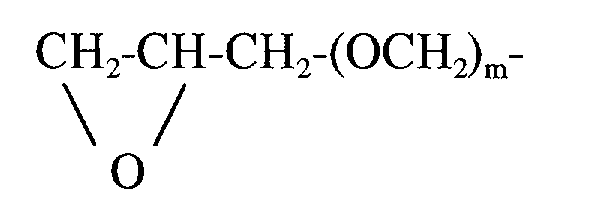


- The epoxy functional polysiloxane is generally used in the treatment composition in an amount of 5 to 8.5 % by weight, preferably in an amount of 6 to 7.5 % by weight. The composition may also contain further non-epoxy functional polysiloxanes such as for example amino or hydroxy terminated polydimethylsiloxanes. However, it will generally be preferred that a major amount of the total amount of polysiloxanes in the composition is epoxy functional. In a particularly preferred embodiment in accordance with the present invention, the relative amount of epoxy functional polysiloxanes will be at least 80% by weight and more preferably at least 95 % by weight based on the total weight of polysiloxane present in the composition. Most preferably, the composition will contain only epoxy functional polysiloxanes.
- In addition to the epoxy functional polysiloxane, the treatment composition should also contain an organic titanate ester. Preferred organic titanate esters for use in the treatment composition are alkyl titanate esters. Examples of suitable organic titanate esters include tetraethyl titanate, tetrapropyl titanate, tetraisopropyl titanate, tetra-n-butyl titanate, tetra-2-ethylhexyl titanate, tetraphenyl titanate, tetraoctadecyl titanate, tetrastearyl titanate, diisopropoxylbiacetylacetone titanate, tri-n-butoxymonostearyl titanate and dihydroxybislactic acid titanate. The organic titanate ester is generally present in the composition in an amount of 1.5 to 5 % by weight, preferably in an amount of 2.5 to 4 % by weight.
- Preferred organic solvents for the composition for use in the method for treating textile substrates in accordance with the present invention are organic solvents that are compatible with dry cleaning and that are non-aromatic. Examples of suitable solvents include ketones, ethers, aliphatic solvents and halogenated solvents. Especially preferred are aliphatic isoparaffin solvents and halogenated solvents such as perchloroethylene.
- The compositions may be applied to the textile substrate in any of the known ways including spraying the composition on the textile or rinsing the textile with the composition. The composition will generally be applied in an amount sufficient such that 0.05 % to 5 % by weight, preferably 0.1 % to 2% by weight, based on the weight of the substrate, of the solids of the composition is present on the treated substrate. In a particularly preferred embodiment, the composition is applied to the textile substrate in a dry cleaning equipment at the end of dry cleaning of the textile substrate or immediately after dry cleaning of the textile substrate. Generally, the textile substrate will also be subjected to a temperature of 30°C to 160°C in order to effect curing of the applied composition. Such heat treatment may be effected by application of the composition in a dry cleaning equipment and/or by subsequent ironing of the textile substrate.
- Suitable textile substrates that can be treated in accordance with the method of the present invention include textile that is based on natural fibers, synthetic fibers or a mixture thereof. For example the textile substrate may consist of polyester fibers, polyamide fibers, cotton fibers, mixtures of polyester and cotton fibers, acrylic fibers and acetate fibers.
- The invention is further illustrated with reference to the following examples, without however the intention to limit the invention thereto.
- Treatment mixtures were prepared in perchloroethylene or in Isopar L. Treatments were applied to the test substrates by padding to provide a concentration of 0.1 to 0.6% (based on fabric weight and indicated as SOF (solids on fabric)). The treated fabrics were dried horizontal on a grid at room temperature for 20 minutes and then dried and cured in a forced air oven at 60°C during 25 minutes. One half of the total treated fabric area was ironed at 150°C during 15 seconds. The treated substrates were tested for their water repellency properties.
- The test substrates were immersed in a glass bottle, containing a treatment solution at a desired concentration. The bottles were shaken at 150 rpm (setting on the shaker) during 20 minutes. The treated fabrics were taken out of the bottles, dried horizontal on a grid at room temperature for 20 minutes and then dried and cured in a forced air oven at 60°C during 25 minutes. One half of the total treated fabric area was ironed at 150°C during 15 seconds. The treated substrates were tested for their water repellency properties.
- Substrates used for the evaluation of treatments of this invention were commercially available and are listed below :
- 100% cotton (khaki) : style no. 1511.1, available from Utexbel N.V., Ronse, Belgium.
- PES/CO 65/35 (white) : polyester/cotton, style no. 2681, available from Utexbel N.V., Ronse, Belgium
- 100% PESµ (brown) : polyester microfiber, style no. 6145.3, available from Sofinal, Belgium.
- PAµ : polyamide microfiber, style no. 7819.4, available from Sofinal, Belgium
-
- Respective data of water repellency shown in the Examples and Comparative Examples were based on the following methods of measurement and evaluation criteria :
- The spray rating of a treated substrate is a value indicative of the dynamic repellency of the treated substrate to water that impinges on the treated substrate. The repellency was measured by Standard Test Number 22, published in the 1985 Technical Manual and Yearbook of the American Association of Textile Chemists and Colorists (AATCC), and was expressed in terms of 'spray rating' (SR) of the tested substrate. The spray rating was obtained by spraying 250 ml water on the substrate from a height of 15 cm. The wetting pattern was visually rated : using a 0 to 100 scale, where 0 meant complete wetting and 100 meant no wetting at all. The spray rating was recorded as SR 60 (no ironing) or SR 150 (after ironing).
- The water repellency (WR) of a substrate was measured using a series of water-isopropyl alcohol test liquids and was expressed in terms of the "WR" rating of the treated substrate. The WR rating corresponded to the most penetrating test liquid which did not penetrate or wet the substrate surface after 15 seconds exposure. Substrates which were penetrated by or were resistant only to 100% water (0% isopropyl alcohol), the least penetrating test liquid, were given a rating of 0, whereas substrates resistant to 100% isopropyl alcohol (0% water), the most penetrating test liquid, were given a rating of 10. Other intermediate ratings were calculated by dividing the percent isopropylalcohol in the test liquid by 10, e.g., a treated substrate resistant to a 20%/80% isopropyl alcohol/water blend, but not to an 30%/70% blend, would be given a rating of 2. The water repellency was recorded as WR 60 (no ironing) or WR 150 (after ironing).
- The following abbreviations and trade names were used in the Examples and Comparative Examples :
- Isopar L : Isoparaffin, available from Exxon Chemical
- PERC : perchloroethylene, available from Merck Eurolab N.V.
- SLM 45182 : polydimethylsiloxane having pending epoxy groups, according to the
following formula
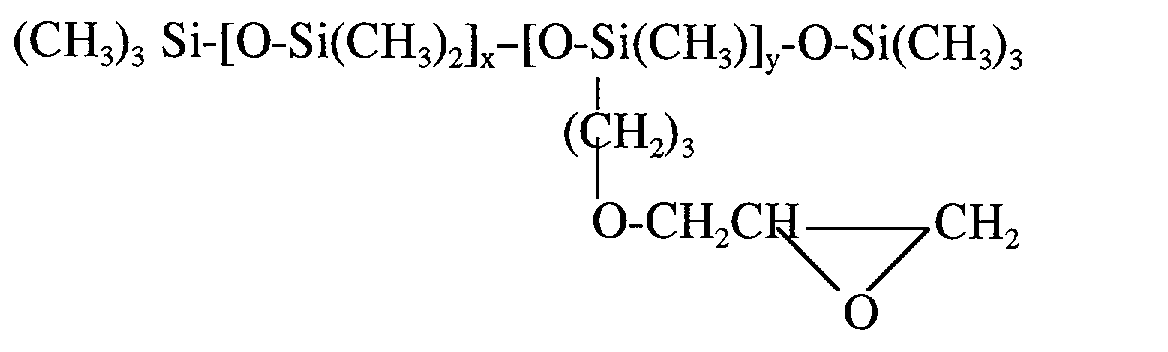
- (x:y = 50:1), available from Wacker Chemie GmbH
- SLM 50250/3 : α,ω-Bis-epoxy-polydimethylsiloxane (terminal epoxy groups and x = 70, y = 0 in formula above), available from Wacker Chemie GmbH
- SLM 50400/7 : α,ω-Bis-hydroxy-polydimethylsiloxane, available from Wacker Chemie GmbH
- SLM 55019/1 : α,ω-Bis-amino-polydimethylsiloxane, available from Wacker Chemie GmbH
- Fluid 593 : polydimethylsiloxane/trimethylsiloxysilicate, available from Dow Corning
- DBTDL : dibutyl tin dilaurate
- Tilcom™ EHT : tetra-2-ethylhexyl titanate, available from Avecia s.a.
- CAT : catalyst
- Vertec™ KE2 : Diisopropoxy titanium bis(ethylacetoacetate), available from Avecia s.a.
-
- All parts, ratios, percentages etc. in the following examples are by weight unless otherwise noted.
- In examples 1 to 5 different substrates were treated with a mixture of SLM 45182 and Tilcom™ EHT catalyst in perchloroethylene, using pad application, so as to obtain a concentration on fabric as indicated in table 1 (%SOF). Comparative examples C-1 and C-2 were made in the same way, but without the addition of catalyst ; Comparative examples C-3 and C-4 were made using DBTDL catalyst ; Comparative examples C-5 and C-6 were made with Sn octanoate catalyst and comparative examples C-7 and C-8 were made with Zr isopropylate. The composition of the treating mixtures and the water repellency of the treated substrates are given in table 1.
Substrates treated with SLM 45182 and Tilcom™ EHT (pad/PERC) Ex No %SOF SLM 45182 %SOF CAT PES PES/CO PAµ WR 60 SR 60 WR 150 SR 150 WR 60 SR 60 WR 150 SR 150 WR 60 SR 60 WR 150 SR 150 1 0.1 0.1 1 100 1 100 0 0 0 0 1 50 1 50 2 0.2 0.1 1 100 1 100 0 50 0 50 2 70 2 70 3 0.2 0.12 2 100 2 100 2 100 2 100 2 100 2 100 4 0.2 0.16 2 100 2 100 2 100 2 100 2 100 2 100 5 0.4 0.12 2 100 2 100 2 100 2 100 2 100 2 100 C-1 0.2 0 0 0 0 0 0 0 0 0 1 50 1 50 C-2 0.4 0 0 0 0 0 0 0 0 0 1 50 1 50 C-3 0.2 0.12 0 0 0 0 0 0 0 0 1 50 1 50 C-4 0.2 0.16 0 0 0 0 0 0 0 0 1 50 1 50 C-5 0.2 0.12 1 90 1 80 1 80 1 80 2 80 2 80 C-6 0.2 0.16 1 90 1 90 1 80 1 80 2 80 2 80 C-7 0.2 0.12 1 100 1 100 1 0 1 0 2 80 1 80 C-8 0.2 0.16 1 100 1 100 1 90 1 80 2 70 1 70 - The results in table 1 show that good water repellency properties could be obtained on all substrates when a composition including epoxydimethylsiloxane and titanate catalyst was applied to the fabrics. With PES as a substrate, even low application levels gave an acceptable water repellency.
- Comparative examples without the use of catalyst showed only marginal performance on PAµ. Also, when the organic titanate ester was replaced with other alternative catalysts, the performace level was low.
- In examples 6 to 9, fabrics was treated with a mixture of α,ω-Bis-epoxy-polydimethylsiloxane SLM 50250/3 with Tilcom™ EHT catalyst in perchloroethylene, in amounts as given in table 2. Comparative examples C-9 to C-11 were made in the same way, but with a mixture of Fluid 593 and Tilcom™ EHT. The samples were treated in a pad application so as to give a concentration on fabric (% SOF) as indicated in table 2. After treatment the fabrics were dried and ironed according to the general procedure. The results of water repellency are given in table 2.
Substrates treated with α,ω-bis-epoxy-polydimethylsiloxane and Tilcom™ EHT Ex No %SOF siloxane %SOF CAT PES PES/CO PAµ WR 60 SR 60 WR 150 SR 150 WR 60 SR 60 WR 150 SR 150 WR 60 SR 60 WR 150 SR 150 SLM 50250/3 + Tilcom™ EHT 6 0.2 0.08 1 100 1 100 1 90 1 90 2 100 2 100 7 0.2 0.12 1 100 1 100 2 100 2 100 2 100 2 100 8 0.2 0.16 1 100 1 100 2 100 2 100 2 100 2 100 9 0.4 0.08 1 100 1 100 1 90 1 90 2 100 2 100 Fluid 593 + Tilcom™ EHT C-9 0.2 0.12 1 80 1 80 1 70 1 70 2 80 2 80 C-10 0.2 0.16 1 80 1 80 1 70 1 70 2 80 2 80 C-11 0.4 0.08 2 100 1 100 2 80 2 80 2 100 2 100 - The data in table 2 show that the treatment compositions according to the invention provided good water repellency at low application levels. The comparative examples using Fluid 593, a polysiloxane without epoxy groups generally performed less, in particular at low application levels of the composition.
- In examples 10 to 17 different substrates were treated with a mixture of SLM 45182 and Tilcom™ EHT catalyst in Isopar L. Comparative examples C-12 and C-13 were made in the same way, but with a mixture of Fluid 593 and Tilcom™ EHT in Isopar L. The samples were treated in a pad application so as to give a concentration on fabric (% SOF) as indicated in table 3. After treatment the fabrics were dried and ironed according to the general procedure. The results of water repellency are given in table 3.
Substrates treated with SLM 45182 and Tilcom™ EHT - Isopar L Ex No %SOF siloxane %SOF CAT PES PES/CO PAµ WR 60 SR 60 WR 150 SR 150 WR 60 SR 60 WR 150 SR 150 WR 60 SR 60 WR 150 SR 150 10 0.2 0.1 1 80 1 80 2 90 2 90 2 90 2 90 11 0.2 0.12 2 90 2 90 2 100 2 100 2 100 2 100 12 0.2 0.14 2 90 2 90 2 100 2 100 2 100 2 100 13 0.2 0.16 2 90 2 90 2 100 2 100 2 100 2 100 14 0.2 0.2 2 90 2 90 2 100 2 100 2 100 2 100 15 0.4 0.12 2 100 2 100 2 90 2 90 2 100 2 100 16 0.4 0.16 2 100 2 100 2 100 2 100 2 100 2 100 17 0.4 0.2 2 100 2 100 2 100 2 100 2 100 2 100 C-12 0.4 0.12 2 90 2 90 2 80 2 80 C-13 0.4 0.2 2 90 2 90 2 90 2 90 - The results in table 3 indicate that also for compositions applied out of Isopar L, good water repellency properties could be obtained. The results of the comparative examples using a polysiloxane that did not contain epoxy groups, showed poorer performance even at high application levels.
- In examples 18 to 22, fabrics were treated with a mixture of SLM 45182 and Vertec™ KE2 catalyst in perchloroethylene, in amounts as given in table 4. The samples were treated in a pad application so as to give a concentration on fabric (% SOF) as indicated in table 4. After treatment the fabrics were dried and ironed according to the general procedure. The results of water repellency are given in table 4.
Substrates treated with SLM 45182 and Vertec™ KE2 Ex No %SOF siloxane %SOF CAT PES PES/CO PAµ WR 60 SR 60 WR 150 SR 150 WR 60 SR 60 WR 150 SR 150 WR 60 SR 60 WR 150 SR 150 18 0.2 0.1 2 100 2 100 2 100 2 100 2 90 2 90 19 0.2 0.12 2 100 2 100 2 100 2 100 2 90 2 90 20 0.4 0.12 2 100 2 100 2 100 2 100 2 100 2 100 - The results in the table indicated that also Vertec™ KE2 was an efficient catalyst for the treatment composition comprising epoxypolydimethylsiloxane. High water repellency properties were observed for all substrates when about 0.3% total solids were applied.
- In examples 21 and 22 mixtures of epoxypolydimethylsiloxane SLM 45182 with α,ω-bis-hydroxy-polydimethylsiloxane SLM 50400/7 and Tilcom™ EHT catalyst (used at 0.12% SOF) were evaluated as water repellent treatment compositions. The substrates were treated in a pad application using PERC, so as to give a concentration on fabric (% SOF) as indicated in table 5. After treatment the fabrics were dried and ironed according to the general procedure. Comparative example C-14 was made in the same way, but with α,ω-Bis-hydroxy-polydimethylsiloxane SLM 50400/7 and Tilcom™ EHT (used at 0.12% SOF). The results of water repellency are given in table 5.
Substrates treated with mixtures of siloxanes and Tilcom™ EHT Ex No %SOF SLM 45182 %SOF SLM 50400/7 PES PES/CO PAµ WR 60 SR 60 WR 150 SR 150 WR 60 SR 60 WR 150 SR 150 WR 60 SR 60 WR 150 SR 150 21 0.05 0.15 1 100 1 100 1 90 1 90 2 80 2 80 22 0.15 0.05 1 100 1 100 2 100 2 100 2 100 2 100 C-14 0 0.2 1 90 1 90 1 70 1 70 1 70 1 70 - The results indicated that small amounts of hydroxy functional polydimethylsiloxane could be used in combination with epoxy polydimethylsiloxane. Hydroxy functional polydimethylsiloxane together with titanate catalyst did not perform well.
- In examples 23 and 24 the same kind of experiment was repeated with SLM 42182 in combination with α,ω-bis-aminopolydimethylsiloxane SLM 55019/1. Tilcom™ EHT catalyst was used at 0.12% SOF. The results of water repellency are given in table 6.
Substrates treated with mixtures of siloxanes and Tilcom™ EHT Ex No %SOF SLM 45182 %SOF SLM 55019/1 PES PES/CO PAµ WR 60 SR 60 WR 150 SR 150 WR 60 SR 60 WR 150 SR 150 WR 60 SR 60 WR 150 SR 150 23 0.05 0.15 2 100 2 100 1 80 1 80 2 80 2 80 24 0.15 0.05 1 100 1 100 1 90 1 90 3 100 3 100 C-15 0 0.2 1 100 1 100 1 80 1 50 2 80 2 70 - The results indicated that also in this case, small amounts of amino functional polydimethylsiloxane could be added to epoxy polydimethylsiloxane and titanate in order to obtain good water repellency. On PAµ substrate, the combination of polydimethylsiloxanes provided higher water repellency. The use of amino functional polydimethylsiloxane together with titanate did not give acceptable performance, except for PES.
- In examples 25 to 28 substrates were treated with mixtures of SLM 45182 and Tilcom™ EHT in perchloroethylene, by bath rinsing application at different concentrations as given in table 7. The treated substrates were dried and ironed according to the general procedure. The samples were tested for their water repellency. The results are given in table 7.
Substrates treated with SLM 45182 and Tilcom™ EHT (bath - PERC) Ex No g/100 ml PES PES/CO WR 60 SR 60 WR 150 SR 150 WR 60 SR 60 WR 150 SR 150 25 4 1 100 1 100 1 70 1 70 26 6 1 100 1 100 2 90 1 90 27 8 1 100 1 100 2 100 2 100 28 10 1 100 1 100 2 100 2 100 - As can be seen from the results, good water repellency properties on all substrates could be obtained when the epoxy polydimethylsiloxane and titanate mixture was applied at a concentration of 6g/100 ml. For PES lower concentrations could be used.
- In examples 28 to 32 the same kind of experiment was repeated on polyamide microfiber and cotton substrates. The results are given in table 8.
Substrates treated with SLM 45182 and Tilcom™ EHT (bath - PERC) Ex No g/100 ml PAµ CO WR 60 SR 60 WR 150 SR 150 WR 60 SR 60 WR 150 SR 150 29 4 2 90 3 100 2 90 2 90 30 6 3 90 3 100 2 90 2 100 31 8 2 100 2 100 2 90 2 100 32 10 2 100 2 100 2 100 2 100 - The same observations could be made from these results. Especially good results were obtained when epoxy polydimethylsiloxane and titanate was applied on PAµ, even at low add on levels.
- Examples 33 to 42 were made in the same way as examples 25 to 32, except that the treatments were done with Isopar L solvent instead of perchloroethylene.
The results are given in tables 9 and 10.PES and PES/CO substrates treated with SLM 45182 and Tilcom™ EHT (Bath - Isopar L) Ex No g/100 ml PES PES/CO WR 60 SR 60 WR 150 SR 150 WR 60 SR 60 WR 150 SR 150 33 4 1 100 1 100 2 100 2 100 34 6 1 100 1 100 2 100 2 100 35 8 1 100 1 100 2 100 2 100 36 10 2 100 2 100 2 100 2 100 37 12 2 100 2 100 2 100 2 100 PA and CO substrates treated with SLM 45182 and Tilcom™ EHT (Bath - Isopar L) Ex No g/100 ml PAµ CO WR 60 SR 60 WR 150 SR 150 WR 60 SR 60 WR 150 SR 150 38 4 2 100 2 100 2 100 2 100 39 6 2 100 2 100 2 100 2 100 40 8 2 100 2 100 2 100 2 100 41 10 2 100 2 100 2 100 2 100 42 12 2 100 2 100 2 100 2 100 - As can be seen in the tables, substrates treated with epoxy polydimethylsiloxane and titanate showed high water repellency properties at low add-on levels, indicating a high efficiency.
Claims (13)
- Method for providing water repellency to a textile substrate comprising contacting the textile substrate with a composition comprising a solution of an epoxy functional polysiloxane and an organic titanate ester in an organic solvent.
- Method according to claim 1 wherein said organic solvent consists of one or more non-aromatic solvents.
- Method according to claim 2 wherein said organic solvent is selected from the group consisting of perchloroethylene and aliphatic isoparaffin solvents.
- Method according to claim 1 wherein said polysiloxane corresponds to the general formula:wherein X and Y each independently represents a terminal group, R1 and R3 each independently represents an alkyl group, an aryl group, an alkylaryl group or an aralkyl group, R2 represents an alkyl group, an aryl group, an alkylaryl group, an aralkyl group or an epoxy containing organic group, R4 represents an epoxy containing organic group, x and y represent the amount of the corresponding unit present in the polysiloxane, with the proviso that y represents an amount different from 0.

- Method according to claim 4 wherein said terminal groups X and Y each independently represent R3Si wherein each R independently represents an alkyl group, an aryl group, an alkylaryl group, an aralkyl group or an epoxy containing organic group.
- Method according to claim 1 wherein said epoxy functional polysiloxane is a polysiloxane terminated with an epoxy containing organic group.
- Method according to any of claims 4 to 6 wherein said epoxy containing organic group is an epoxy functionalised aliphatic group.
- Method according to any of the previous claims wherein said organic titanate ester is an alkyl ester of titanic acid.
- Method according to any of the previous claims wherein said composition is substantially free of other polysiloxanes that do not contain an epoxy group.
- Method according to any of the previous claims wherein said composition comprises said epoxy functional polysiloxane in an amount of 5 to 8.5 % and said organic titanate ester in an amount of 1.5 to 5 % .
- Method according to any of the previous claims wherein said textile substrate is contacted with said composition by spraying said composition on said textile substrate or by rinsing said textile substrate with said composition.
- Method according to any of the previous claims further comprising the step of subjecting the textile substrate to a temperature of 30°C to 160°C.
- Method according to any of the previous claims wherein said textile substrate is contacted with said composition in a dry cleaning equipment at the end of or after dry cleaning of said textile substrate.
Priority Applications (1)
| Application Number | Priority Date | Filing Date | Title |
|---|---|---|---|
| EP00204143A EP1217118A1 (en) | 2000-11-22 | 2000-11-22 | Method of treatment of textile to provide water repellency thereto |
Applications Claiming Priority (1)
| Application Number | Priority Date | Filing Date | Title |
|---|---|---|---|
| EP00204143A EP1217118A1 (en) | 2000-11-22 | 2000-11-22 | Method of treatment of textile to provide water repellency thereto |
Publications (1)
| Publication Number | Publication Date |
|---|---|
| EP1217118A1 true EP1217118A1 (en) | 2002-06-26 |
Family
ID=8172312
Family Applications (1)
| Application Number | Title | Priority Date | Filing Date |
|---|---|---|---|
| EP00204143A Withdrawn EP1217118A1 (en) | 2000-11-22 | 2000-11-22 | Method of treatment of textile to provide water repellency thereto |
Country Status (1)
| Country | Link |
|---|---|
| EP (1) | EP1217118A1 (en) |
Citations (6)
| Publication number | Priority date | Publication date | Assignee | Title |
|---|---|---|---|---|
| GB822673A (en) * | 1956-08-31 | 1959-10-28 | Monsanto Chemicals | Silicone compositions for imparting water-repellency |
| GB1540858A (en) * | 1976-04-12 | 1979-02-14 | Du Pont | Dry cleaning of textiles |
| US4490416A (en) * | 1984-05-15 | 1984-12-25 | Dow Corning Limited | Organosiloxane-oxyalkylene copolymers |
| US4677178A (en) * | 1985-04-05 | 1987-06-30 | Shin-Etsu Chemical Co., Ltd. | Silicone-based textile finishing agent |
| EP0506113A2 (en) * | 1991-03-28 | 1992-09-30 | Dow Corning Toray Silicone Company, Limited | Antimicrobial silicone composition |
| EP0718433A2 (en) * | 1994-12-06 | 1996-06-26 | Dow Corning S.A. | Curable coating compositions |
-
2000
- 2000-11-22 EP EP00204143A patent/EP1217118A1/en not_active Withdrawn
Patent Citations (6)
| Publication number | Priority date | Publication date | Assignee | Title |
|---|---|---|---|---|
| GB822673A (en) * | 1956-08-31 | 1959-10-28 | Monsanto Chemicals | Silicone compositions for imparting water-repellency |
| GB1540858A (en) * | 1976-04-12 | 1979-02-14 | Du Pont | Dry cleaning of textiles |
| US4490416A (en) * | 1984-05-15 | 1984-12-25 | Dow Corning Limited | Organosiloxane-oxyalkylene copolymers |
| US4677178A (en) * | 1985-04-05 | 1987-06-30 | Shin-Etsu Chemical Co., Ltd. | Silicone-based textile finishing agent |
| EP0506113A2 (en) * | 1991-03-28 | 1992-09-30 | Dow Corning Toray Silicone Company, Limited | Antimicrobial silicone composition |
| EP0718433A2 (en) * | 1994-12-06 | 1996-06-26 | Dow Corning S.A. | Curable coating compositions |
Similar Documents
| Publication | Publication Date | Title |
|---|---|---|
| EP1081271B1 (en) | Fiber treatment composition containing amine, polyol, functional siloxanes | |
| EP0515044B1 (en) | Silicone compositions and their use for treating fibers | |
| US6136215A (en) | Fiber treatment composition containing amine-, polyol-, amide-functional siloxanes | |
| KR950012693B1 (en) | Fabric coating by polysiloxanes | |
| US20080102289A1 (en) | Textile coating formulations comprising crosslinkable liquid silicones, metal alkoxides and functional coreactants | |
| JPS5926707B2 (en) | Treatment agent for fibrous materials | |
| JP3072120B2 (en) | Water and oil repellent treatment agent | |
| CH666280A5 (en) | ORGANOSILOXANE OXYALKYLENE COPOLYMERS. | |
| US5300239A (en) | Water-repellent and oil-repellent treatment | |
| JP2001226878A (en) | Composition for treating fiber | |
| US6756077B2 (en) | Water repellent textile finishes and method of making | |
| US8216321B2 (en) | Silicone/fluorinated organic compound mixed composition for conferring oleophobicity and/or hydrophobicity on a textile material | |
| EP1081272B1 (en) | Fiber treatment composition containing amine, polyol, amide-functional siloxanes | |
| CN110267998A (en) | Polymers for hydrophobic and oleophobic fabric finishing | |
| US4874662A (en) | Process for impregnating organic fibers | |
| EP1217118A1 (en) | Method of treatment of textile to provide water repellency thereto | |
| US3419423A (en) | Adducts of silicon hydride polysiloxanes and hydrolyzable silanes having alkenyl radicals useful for rendering substrates water repellent | |
| EP1519996B1 (en) | Fire and stain resistant compositions | |
| EP1595022B1 (en) | Use of a cross-linkable liquid silicon formulation as a textile coating base | |
| JP7615310B2 (en) | Use of low-cyclic derivatized amino-functional silicone polymers for the treatment of fibrous substrates - Patents.com | |
| JPH10131054A (en) | Fiber treating agent composition | |
| KR100777010B1 (en) | Amino oil with excellent alkali resistance | |
| EP1368525B1 (en) | Water repellent textile finishes and method of treating textiles | |
| CA1286822C (en) | Durable silicone emulsion polish | |
| DE19807022A1 (en) | Hydrocarbyl-substituted organosilicon compounds especially for treating textiles or ceramic hobs |
Legal Events
| Date | Code | Title | Description |
|---|---|---|---|
| PUAI | Public reference made under article 153(3) epc to a published international application that has entered the european phase |
Free format text: ORIGINAL CODE: 0009012 |
|
| AK | Designated contracting states |
Kind code of ref document: A1 Designated state(s): AT BE CH CY DE DK ES FI FR GB GR IE IT LI LU MC NL PT SE TR |
|
| AX | Request for extension of the european patent |
Free format text: AL;LT;LV;MK;RO;SI |
|
| AKX | Designation fees paid | ||
| REG | Reference to a national code |
Ref country code: DE Ref legal event code: 8566 |
|
| STAA | Information on the status of an ep patent application or granted ep patent |
Free format text: STATUS: THE APPLICATION IS DEEMED TO BE WITHDRAWN |
|
| 18D | Application deemed to be withdrawn |
Effective date: 20021227 |